Group
Interview
Practice of questioning,
interviewing & writing
techniques
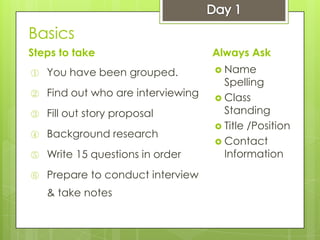
Basics
Steps to take
① You have been grouped.
② Find out who are interviewing
③ Fill out story proposal
④ Background research
⑤ Write 15 questions in order
⑥ Prepare to conduct interview
& take notes
Always Ask
 Name
Spelling
 Class
Standing
 Title /Position
 Contact
Information
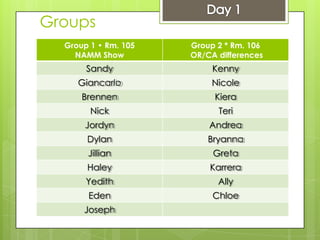
Groups
Group 1 • Rm. 105
NAMM Show
Group 2 * Rm. 106
OR/CA differences
Sandy Kenny
Giancarlo Nicole
Brennen Kiera
Nick Teri
Jordyn Andrea
Dylan Bryanna
Jillian Greta
Haley Karrera
Yedith Ally
Eden Chloe
Joseph
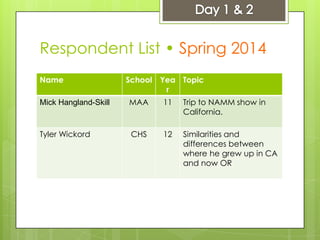
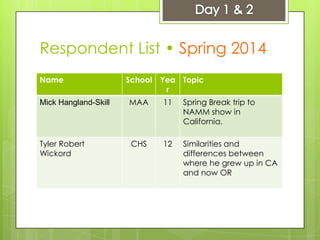
Respondent List • Spring 2014
Name School Yea
r
Topic
Mick Hangland-Skill MAA 11 Trip to NAMM show in
California.
Tyler Wickord CHS 12 Similarities and
differences between
where he grew up in CA
and now OR
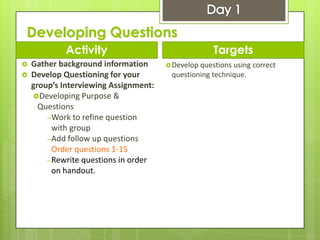
Developing Questions
Activity
 Gather background information
 Develop Questioning for your
group’s Interviewing Assignment:
Developing Purpose &
Questions
–Work to refine question
with group
–Add follow up questions
Order questions 1-15
–Rewrite questions in order
on handout.
Targets
Develop questions using correct
questioning technique.
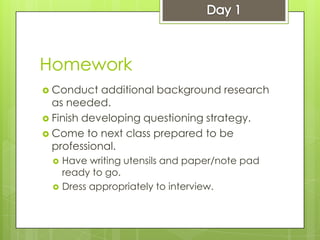
Homework
 Conduct additional background research
as needed.
 Finish developing questioning strategy.
 Come to next class prepared to be
professional.
 Have writing utensils and paper/note pad
ready to go.
 Dress appropriately to interview.
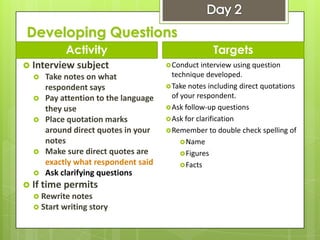
Developing Questions
Activity
 Interview subject
 Take notes on what
respondent says
 Pay attention to the language
they use
 Place quotation marks
around direct quotes in your
notes
 Make sure direct quotes are
exactly what respondent said
 Ask clarifying questions
 If time permits
 Rewrite notes
 Start writing story
Targets
Conduct interview using question
technique developed.
Take notes including direct quotations
of your respondent.
Ask follow-up questions
Ask for clarification
Remember to double check spelling of
Name
Figures
Facts
Respondent List • Spring 2014
Name School Yea
r
Topic
Mick Hangland-Skill MAA 11 Spring Break trip to
NAMM show in
California.
Tyler Robert
Wickord
CHS 12 Similarities and
differences between
where he grew up in CA
and now OR
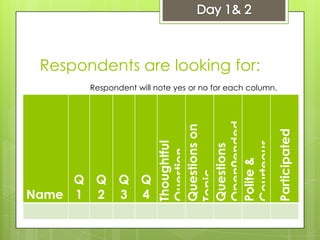
Respondents are looking for:
Name
Q
1
Q
2
Q
3
Q
4
Thoughtful
Question
Questionson
Topic
Questions
Open0ended
Polite&
Courteous
Participated
Respondent will note yes or no for each column.
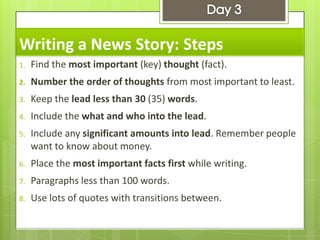
Writing a News Story: Steps
1. Find the most important (key) thought (fact).
2. Number the order of thoughts from most important to least.
3. Keep the lead less than 30 (35) words.
4. Include the what and who into the lead.
5. Include any significant amounts into lead. Remember people
want to know about money.
6. Place the most important facts first while writing.
7. Paragraphs less than 100 words.
8. Use lots of quotes with transitions between.
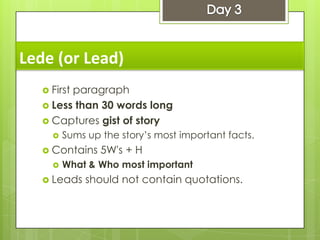
 First paragraph
 Less than 30 words long
 Captures gist of story
 Sums up the story’s most important facts.
 Contains 5W's + H
 What & Who most important
 Leads should not contain quotations.
Lede (or Lead)
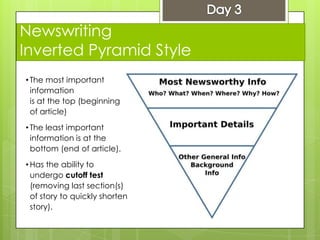
Newswriting
Inverted Pyramid Style
• The most important
information
is at the top (beginning
of article)
• The least important
information is at the
bottom (end of article).
• Has the ability to
undergo cutoff test
(removing last section(s)
of story to quickly shorten
story).
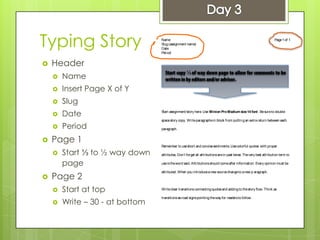
Typing Story
 Header
 Name
 Insert Page X of Y
 Slug
 Date
 Period
 Page 1
 Start ⅓ to ½ way down
page
 Page 2
 Start at top
 Write – 30 - at bottom
Name
Slug(assignment name)
Date
Period
Page1of 1


Start assignment/story here. Use Minion ProMedium size14 font. Besureto double
spacestory copy. Writeparagraphsin block from puttingan extrareturn between each
paragraph.
Remember to useshort and concisesentiments. Usecolorful quotes with proper
attributes. Don’t forget all attributionsarein past tense. Thevery best attribution term to
useistheword said. Attributionsshould comeafter information. Every opinion must be
attributed. When you introduceanew sourcechangeto anew p aragraph.
Writeclear transitions connectingquotesand addingto thestory flow. Think as
transitionsasroad signspointingtheway for readersto follow .
⅓
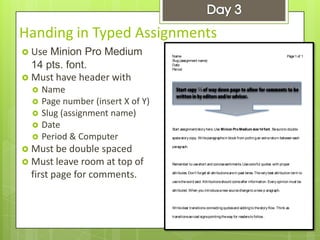
Handing in Typed Assignments
 Use Minion Pro Medium
14 pts. font.
 Must have header with
 Name
 Page number (insert X of Y)
 Slug (assignment name)
 Date
 Period & Computer
 Must be double spaced
 Must leave room at top of
first page for comments.
Name
Slug(assignment name)
Date
Period
Page1of 1
Start assignment/story here. Use Minion ProMedium size14 font. Besureto double
spacestory copy. Writeparagraphsin block from puttingan extrareturn between each
paragraph.
Remember to useshort and concisesentiments. Usecolorful quotes with proper
attributes. Don’t forget all attributionsarein past tense. Thevery best attribution term to
useistheword said. Attributionsshould comeafter information. Every opinion must be
attributed. When you introduceanew sourcechangeto anew p aragraph.
Writeclear transitions connectingquotesand addingto thestory flow. Think as
transitionsasroad signspointingtheway for readersto follow .
⅓
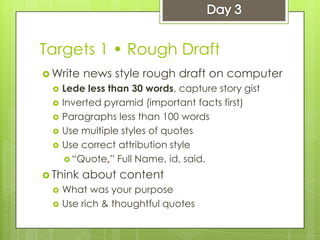
Targets 1 • Rough Draft
 Write news style rough draft on computer
 Lede less than 30 words, capture story gist
 Inverted pyramid (important facts first)
 Paragraphs less than 100 words
 Use multiple styles of quotes
 Use correct attribution style
 “Quote,” Full Name, id, said.
 Think about content
 What was your purpose
 Use rich & thoughtful quotes
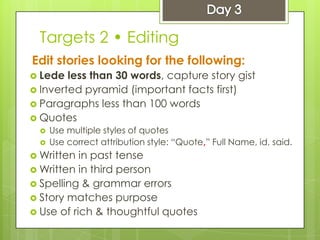
Targets 2 • Editing
Edit stories looking for the following:
 Lede less than 30 words, capture story gist
 Inverted pyramid (important facts first)
 Paragraphs less than 100 words
 Quotes
 Use multiple styles of quotes
 Use correct attribution style: “Quote,” Full Name, id, said.
 Written in past tense
 Written in third person
 Spelling & grammar errors
 Story matches purpose
 Use of rich & thoughtful quotes
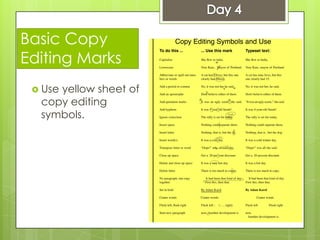
Basic Copy
Editing Marks
 Use yellow sheet of
copy editing
symbols.
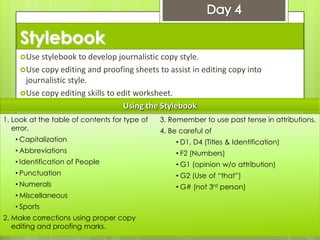
Stylebook
Use stylebook to develop journalistic copy style.
Use copy editing and proofing sheets to assist in editing copy into
journalistic style.
Use copy editing skills to edit worksheet.
1. Look at the table of contents for type of
error.
• Capitalization
• Abbreviations
• Identification of People
• Punctuation
• Numerals
• Miscellaneous
• Sports
2. Make corrections using proper copy
editing and proofing marks.
3. Remember to use past tense in attributions.
4. Be careful of
• D1, D4 (Titles & Identification)
• F2 (Numbers)
• G1 (opinion w/o attribution)
• G2 (Use of “that”)
• G# (not 3rd person)
Using the Stylebook
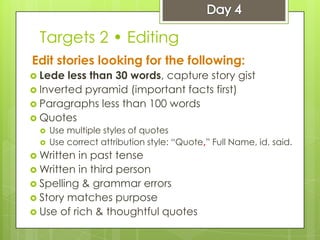
Targets 2 • Editing
Edit stories looking for the following:
 Lede less than 30 words, capture story gist
 Inverted pyramid (important facts first)
 Paragraphs less than 100 words
 Quotes
 Use multiple styles of quotes
 Use correct attribution style: “Quote,” Full Name, id, said.
 Written in past tense
 Written in third person
 Spelling & grammar errors
 Story matches purpose
 Use of rich & thoughtful quotes
In your group peer edit
 Journalism students use green pens.
1. Sit in circle and edit someone else’s story.
2. When done pass story to person on the
right for them to edit.
3. Repeat 1-3 until everyone has edited every
story.
 Time permitting, type changes to your story.
Targets 3 • Rewriting
Rewrite stories to include recommended edits.
Remember the following:
 Lede less than 30 words, capture story gist
 Inverted pyramid (important facts first)
 Paragraphs less than 100 words
 Quotes
 Use multiple styles of quotes
 Use correct attribution style: “Quote,” Full Name, id, said.
 Written in past tense
 Written in third person
 Spelling & grammar errors
 Story matches purpose
 Use of rich & thoughtful quotes
Targets 4 • Rewriting
Rewrite stories to include recommended edits.
Remember the following:
 Lede less than 30 words, capture story gist
 Inverted pyramid (important facts first)
 Paragraphs less than 100 words
 Quotes
 Use multiple styles of quotes
 Use correct attribution style: “Quote,” Full Name, id, said.
 Written in past tense
 Written in third person
 Spelling & grammar errors
 Story matches purpose
 Use of rich & thoughtful quotes
Group Interview Project
General Notes 1
9. Don’t reference interview, NEVER write
something like:
a.I am interviewing (insert name here)
b.I also asked (insert name here)...
c.I then asked…
d.My last question for (insert name here) was…
e.Is there anything you want to say to your …
f.When asked about…
g.When asked if…
Group Interview Project
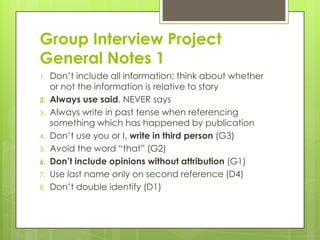
General Notes 1
1. Don’t include all information; think about whether
or not the information is relative to story
2. Always use said, NEVER says
3. Always write in past tense when referencing
something which has happened by publication
4. Don’t use you or I, write in third person (G3)
5. Avoid the word “that” (G2)
6. Don’t include opinions without attribution (G1)
7. Use last name only on second reference (D4)
8. Don’t double identify (D1)
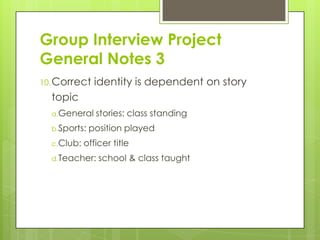
Group Interview Project
General Notes 3
10.Correct identity is dependent on story
topic
a.General stories: class standing
b.Sports: position played
c.Club: officer title
d.Teacher: school & class taught
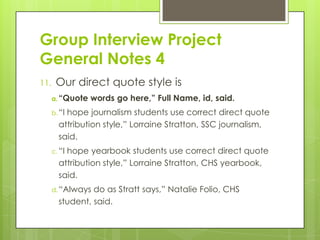
Group Interview Project
General Notes 4
11. Our direct quote style is
a. “Quote words go here,” Full Name, id, said.
b.“I hope journalism students use correct direct quote
attribution style,” Lorraine Stratton, SSC journalism,
said.
c. “I hope yearbook students use correct direct quote
attribution style,” Lorraine Stratton, CHS yearbook,
said.
d.“Always do as Stratt says,” Natalie Folio, CHS
student, said.
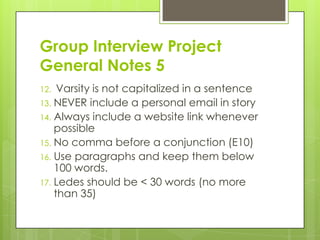
Group Interview Project
General Notes 5
12. Varsity is not capitalized in a sentence
13. NEVER include a personal email in story
14. Always include a website link whenever
possible
15. No comma before a conjunction (E10)
16. Use paragraphs and keep them below
100 words.
17. Ledes should be < 30 words (no more
than 35)

Group Interview Spring 2014

  • 1.
  • 2.
    Basics Steps to take ①You have been grouped. ② Find out who are interviewing ③ Fill out story proposal ④ Background research ⑤ Write 15 questions in order ⑥ Prepare to conduct interview & take notes Always Ask  Name Spelling  Class Standing  Title /Position  Contact Information
  • 3.
    Groups Group 1 •Rm. 105 NAMM Show Group 2 * Rm. 106 OR/CA differences Sandy Kenny Giancarlo Nicole Brennen Kiera Nick Teri Jordyn Andrea Dylan Bryanna Jillian Greta Haley Karrera Yedith Ally Eden Chloe Joseph
  • 4.
    Respondent List •Spring 2014 Name School Yea r Topic Mick Hangland-Skill MAA 11 Trip to NAMM show in California. Tyler Wickord CHS 12 Similarities and differences between where he grew up in CA and now OR
  • 5.
    Developing Questions Activity  Gatherbackground information  Develop Questioning for your group’s Interviewing Assignment: Developing Purpose & Questions –Work to refine question with group –Add follow up questions Order questions 1-15 –Rewrite questions in order on handout. Targets Develop questions using correct questioning technique.
  • 6.
    Homework  Conduct additionalbackground research as needed.  Finish developing questioning strategy.  Come to next class prepared to be professional.  Have writing utensils and paper/note pad ready to go.  Dress appropriately to interview.
  • 7.
    Developing Questions Activity  Interviewsubject  Take notes on what respondent says  Pay attention to the language they use  Place quotation marks around direct quotes in your notes  Make sure direct quotes are exactly what respondent said  Ask clarifying questions  If time permits  Rewrite notes  Start writing story Targets Conduct interview using question technique developed. Take notes including direct quotations of your respondent. Ask follow-up questions Ask for clarification Remember to double check spelling of Name Figures Facts
  • 8.
    Respondent List •Spring 2014 Name School Yea r Topic Mick Hangland-Skill MAA 11 Spring Break trip to NAMM show in California. Tyler Robert Wickord CHS 12 Similarities and differences between where he grew up in CA and now OR
  • 9.
    Respondents are lookingfor: Name Q 1 Q 2 Q 3 Q 4 Thoughtful Question Questionson Topic Questions Open0ended Polite& Courteous Participated Respondent will note yes or no for each column.
  • 10.
    Writing a NewsStory: Steps 1. Find the most important (key) thought (fact). 2. Number the order of thoughts from most important to least. 3. Keep the lead less than 30 (35) words. 4. Include the what and who into the lead. 5. Include any significant amounts into lead. Remember people want to know about money. 6. Place the most important facts first while writing. 7. Paragraphs less than 100 words. 8. Use lots of quotes with transitions between.
  • 11.
     First paragraph Less than 30 words long  Captures gist of story  Sums up the story’s most important facts.  Contains 5W's + H  What & Who most important  Leads should not contain quotations. Lede (or Lead)
  • 12.
    Newswriting Inverted Pyramid Style •The most important information is at the top (beginning of article) • The least important information is at the bottom (end of article). • Has the ability to undergo cutoff test (removing last section(s) of story to quickly shorten story).
  • 13.
    Typing Story  Header Name  Insert Page X of Y  Slug  Date  Period  Page 1  Start ⅓ to ½ way down page  Page 2  Start at top  Write – 30 - at bottom Name Slug(assignment name) Date Period Page1of 1             Start assignment/story here. Use Minion ProMedium size14 font. Besureto double spacestory copy. Writeparagraphsin block from puttingan extrareturn between each paragraph. Remember to useshort and concisesentiments. Usecolorful quotes with proper attributes. Don’t forget all attributionsarein past tense. Thevery best attribution term to useistheword said. Attributionsshould comeafter information. Every opinion must be attributed. When you introduceanew sourcechangeto anew p aragraph. Writeclear transitions connectingquotesand addingto thestory flow. Think as transitionsasroad signspointingtheway for readersto follow . ⅓
  • 14.
    Handing in TypedAssignments  Use Minion Pro Medium 14 pts. font.  Must have header with  Name  Page number (insert X of Y)  Slug (assignment name)  Date  Period & Computer  Must be double spaced  Must leave room at top of first page for comments. Name Slug(assignment name) Date Period Page1of 1 Start assignment/story here. Use Minion ProMedium size14 font. Besureto double spacestory copy. Writeparagraphsin block from puttingan extrareturn between each paragraph. Remember to useshort and concisesentiments. Usecolorful quotes with proper attributes. Don’t forget all attributionsarein past tense. Thevery best attribution term to useistheword said. Attributionsshould comeafter information. Every opinion must be attributed. When you introduceanew sourcechangeto anew p aragraph. Writeclear transitions connectingquotesand addingto thestory flow. Think as transitionsasroad signspointingtheway for readersto follow . ⅓
  • 15.
    Targets 1 •Rough Draft  Write news style rough draft on computer  Lede less than 30 words, capture story gist  Inverted pyramid (important facts first)  Paragraphs less than 100 words  Use multiple styles of quotes  Use correct attribution style  “Quote,” Full Name, id, said.  Think about content  What was your purpose  Use rich & thoughtful quotes
  • 16.
    Targets 2 •Editing Edit stories looking for the following:  Lede less than 30 words, capture story gist  Inverted pyramid (important facts first)  Paragraphs less than 100 words  Quotes  Use multiple styles of quotes  Use correct attribution style: “Quote,” Full Name, id, said.  Written in past tense  Written in third person  Spelling & grammar errors  Story matches purpose  Use of rich & thoughtful quotes
  • 17.
    Basic Copy Editing Marks Use yellow sheet of copy editing symbols.
  • 18.
    Stylebook Use stylebook todevelop journalistic copy style. Use copy editing and proofing sheets to assist in editing copy into journalistic style. Use copy editing skills to edit worksheet. 1. Look at the table of contents for type of error. • Capitalization • Abbreviations • Identification of People • Punctuation • Numerals • Miscellaneous • Sports 2. Make corrections using proper copy editing and proofing marks. 3. Remember to use past tense in attributions. 4. Be careful of • D1, D4 (Titles & Identification) • F2 (Numbers) • G1 (opinion w/o attribution) • G2 (Use of “that”) • G# (not 3rd person) Using the Stylebook
  • 19.
    Targets 2 •Editing Edit stories looking for the following:  Lede less than 30 words, capture story gist  Inverted pyramid (important facts first)  Paragraphs less than 100 words  Quotes  Use multiple styles of quotes  Use correct attribution style: “Quote,” Full Name, id, said.  Written in past tense  Written in third person  Spelling & grammar errors  Story matches purpose  Use of rich & thoughtful quotes
  • 20.
    In your grouppeer edit  Journalism students use green pens. 1. Sit in circle and edit someone else’s story. 2. When done pass story to person on the right for them to edit. 3. Repeat 1-3 until everyone has edited every story.  Time permitting, type changes to your story.
  • 21.
    Targets 3 •Rewriting Rewrite stories to include recommended edits. Remember the following:  Lede less than 30 words, capture story gist  Inverted pyramid (important facts first)  Paragraphs less than 100 words  Quotes  Use multiple styles of quotes  Use correct attribution style: “Quote,” Full Name, id, said.  Written in past tense  Written in third person  Spelling & grammar errors  Story matches purpose  Use of rich & thoughtful quotes
  • 22.
    Targets 4 •Rewriting Rewrite stories to include recommended edits. Remember the following:  Lede less than 30 words, capture story gist  Inverted pyramid (important facts first)  Paragraphs less than 100 words  Quotes  Use multiple styles of quotes  Use correct attribution style: “Quote,” Full Name, id, said.  Written in past tense  Written in third person  Spelling & grammar errors  Story matches purpose  Use of rich & thoughtful quotes
  • 23.
    Group Interview Project GeneralNotes 1 9. Don’t reference interview, NEVER write something like: a.I am interviewing (insert name here) b.I also asked (insert name here)... c.I then asked… d.My last question for (insert name here) was… e.Is there anything you want to say to your … f.When asked about… g.When asked if…
  • 24.
    Group Interview Project GeneralNotes 1 1. Don’t include all information; think about whether or not the information is relative to story 2. Always use said, NEVER says 3. Always write in past tense when referencing something which has happened by publication 4. Don’t use you or I, write in third person (G3) 5. Avoid the word “that” (G2) 6. Don’t include opinions without attribution (G1) 7. Use last name only on second reference (D4) 8. Don’t double identify (D1)
  • 25.
    Group Interview Project GeneralNotes 3 10.Correct identity is dependent on story topic a.General stories: class standing b.Sports: position played c.Club: officer title d.Teacher: school & class taught
  • 26.
    Group Interview Project GeneralNotes 4 11. Our direct quote style is a. “Quote words go here,” Full Name, id, said. b.“I hope journalism students use correct direct quote attribution style,” Lorraine Stratton, SSC journalism, said. c. “I hope yearbook students use correct direct quote attribution style,” Lorraine Stratton, CHS yearbook, said. d.“Always do as Stratt says,” Natalie Folio, CHS student, said.
  • 27.
    Group Interview Project GeneralNotes 5 12. Varsity is not capitalized in a sentence 13. NEVER include a personal email in story 14. Always include a website link whenever possible 15. No comma before a conjunction (E10) 16. Use paragraphs and keep them below 100 words. 17. Ledes should be < 30 words (no more than 35)