Revision
Re-seeing/ Re-writing
“In the first draft is the talent. In the second is the art.” —Paul
Valery
Figuring out what you’ve
created
Whether a piece of writing comes from a writing
prompt or out-of-the-blue inspiration, the first draft
should come in a burst—not from the critical side of
your brain.
Revision, on the other hand, is about looking at
what’s happened when you wrote, and figuring it out.
From there, revision becomes about consciously
changing what is on the page.
Use the critique to inform those decisions, not to
dictate them.
Revision vs. futzing
The revision process should include checking
word choice, sentence structure, grammar etc.,
but that is line editing, not revising.
In other words, don’t give a car that needs a new
engine a sparkly paint job (bad metaphor)
Instead, start with the larger elements of non-
fiction as points of revision
Elements of Non-Fiction
We use the critique/workshop process to take a
look at the largest aspects of non-fiction as they
are playing out in your pieces: scene, character,
voice, reflection
Take a look at the comments—are there any
patterns in the responses? Do any of the issues
raised coincide with concerns you had about the
piece? Start where you think it needs work.
Areas for Review: Scene
Scene is not “scenery,” although a scene should
include elements of scenery, such as place and
description
Scene = action in real time
Scene vs. summary (exposition)
Scene should occur when the event being
described is key to the emotional and narrative
arc of the story.
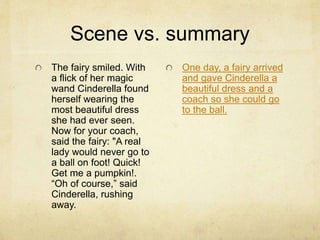
Scene vs. summary
The fairy smiled. With
a flick of her magic
wand Cinderella found
herself wearing the
most beautiful dress
she had ever seen.
Now for your coach,
said the fairy: "A real
lady would never go to
a ball on foot! Quick!
Get me a pumpkin!.
“Oh of course,” said
Cinderella, rushing
away.
One day, a fairy arrived
and gave Cinderella a
beautiful dress and a
coach so she could go
to the ball.
Scene vs. summary
As with fiction (and fairy tales), Creative
Nonfiction requires scenes—for the most part—
for the portions of the story that make up the key
events in the narrative arc.
Scene is about recreating the emotional impact
of the events in the story.
Even if the story doesn’t follow a traditional
chronological arc, it should still have key
moments that create a sense of plot, crisis action
and resolution.
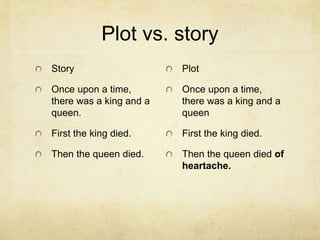
Plot vs. story
Story
Once upon a time,
there was a king and a
queen.
First the king died.
Then the queen died.
Plot
Once upon a time,
there was a king and a
queen
First the king died.
Then the queen died of
heartache.
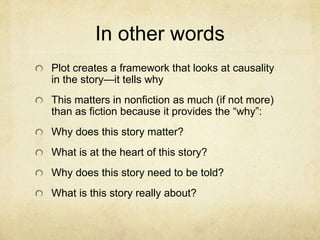
In other words
Plot creates a framework that looks at causality
in the story—it tells why
This matters in nonfiction as much (if not more)
than as fiction because it provides the “why”:
Why does this story matter?
What is at the heart of this story?
Why does this story need to be told?
What is this story really about?
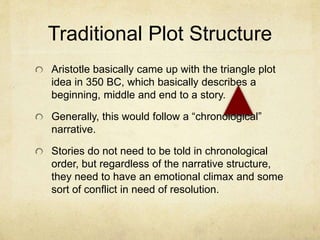
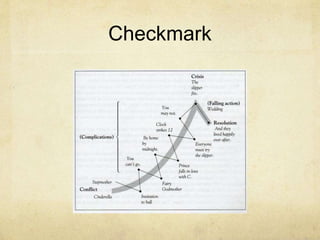
Traditional Plot Structure
Aristotle basically came up with the triangle plot
idea in 350 BC, which basically describes a
beginning, middle and end to a story.
Generally, this would follow a “chronological”
narrative.
Stories do not need to be told in chronological
order, but regardless of the narrative structure,
they need to have an emotional climax and some
sort of conflict in need of resolution.
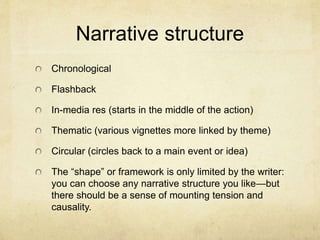
Narrative structure
Chronological
Flashback
In-media res (starts in the middle of the action)
Thematic (various vignettes more linked by theme)
Circular (circles back to a main event or idea)
The “shape” or framework is only limited by the writer:
you can choose any narrative structure you like—but
there should be a sense of mounting tension and
causality.
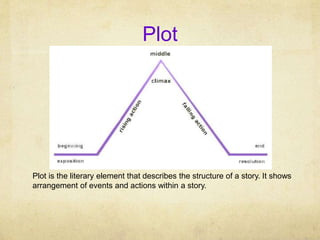
Plot
Plot is the literary element that describes the structure of a story. It shows
arrangement of events and actions within a story.
Checkmark
Conflict
The danger is to assume that because the story
you are telling is inherently conflicted (death,
heartache, loss etc) that the piece will reflect that
conflict.
The piece will reflect the conflict if those key
moments are rendered in scene so that the
reader inhabits them as well
This also means that the “crisis action”—the
moment of reckoning—should be rendered in a
scene as well.
Voice
When we evaluate voice in a piece, we are looking at a
variety of factors:
The author’s voice: the attitude expressed, the word
choice, diction (to name a few)
The voice of the characters in the story: how they speak,
and what they say.
Just as in real life, the voice of the people inhabiting a
piece of nonfiction should be distinct
“Point of view” is a part of voice (choosing which person,
1st, 2nd, 3rd) the story is being told from, but they are not
one and the same.
The narrator’s voice is...
Sarcastic
Confused
Accepting
Angry
Exuberant
Arrogant
That of a 5 year old
Word choice
Content of what is said
Syntax of sentences
The way the narrator
sees other people,
places, objects
How other people
respond
Let’s do an exercise
Take a scene from your first draft (if it’s long, condense to
about a paragraph for the purpose of this exercise)
Set an “intention” regarding the voice of the piece (you
don’t have to keep this or mean it; this is an experiment).
For example: Decide that the voice is “angry”, and rewrite
the scene with that intention.
Now rewrite the scene again with an entirely different
voice—as far away from the first intention as possible.
Change the voice by changing the word choice, the rhythm
of the sentences.
Spend 10 minutes on each paragraph
Working with Theme
Theme in crafted non-fiction writing has
similarities with fiction. It means that all the
pieces—the narrator’s point of view, the
metaphors, the setting, are helping to support
that larger abstract idea. Over-do it, and you’re
hitting the reader on the head. Ignore it, and
you’re likely to end up with a piece that feels
fragmented.
Understanding your theme helps you create
connections in the writing.
Just ask yourself: What is my story about? Not
what happens, but what is at stake?
The Revision Checklist
Show, don’t tell. Go through your manuscript and find
the places where you’ve summarized—either
dialogue or action. Are these important moments?
Remember that important moments should be shown
in scenes or with direct discussion.
What is undeveloped? Are your people without
faces? Have you worked to transform them from your
memories to characters on the page? Are there
scenes without locations? Even if you over-write to fill
out, you can then pull it back.
Revision means adding what’s missing and taking out
what isn’t necessary. Kill your darlings!
Line editing tips
Eliminate vague nouns and verbs:
Everything from the “thing” family (something,
everything, nothing, anything): find a concrete
specific subject that captures what you mean
Verbs from the “to be” family (is, was, will be,
were). Forms of “to be” often indicate a passive
sentence structure and vagueness to action.
Active Voice
One of the greatest challenges most writers face
is remembering to keep prose in active voice.
This can be dealt with on revision, but it’s key to
strong writing.
In active voice, the subject performs the action:
Julia operated the computer (active)
The computer was operated by Julia (passive)
Variety
The other “problem” with vague subjects and
verbs is that writers often use them over and
over again, creating a lack of vibrancy in the
writing.
Go through and circle each time you’ve used a
form of “to be” and restructure the sentence to be
more active and use a variety of verbs.
Adjectives
Adjectives are not the enemy, but when overused
they detract from the goal of “showing” versus
telling.
A beautiful day may indeed be beautiful but it
doesn’t show the reader the day in the same way
that the orange sky and trees filled with lilac buds
and silver-coated unicorn will (OK, OK, no
unicorns in nonfiction, please)
Vary your syntax
Read a paragraph out loud. Are all the sentences
the same length? Are they all short and clipped?
Are the long sentences so long that you lose
your breath and forget to make a point?
Line editing means also looking for opportunities
to vary the rhythm of your sentences, and to
clean up any grammatical issues (run-ons,
fragments.
Syntax Exercise
To experiment, take a piece of writing from someone
else—one paragraph
Rewrite one paragraph from your memoir imitating
the exact sentence structure of each sentence in that
paragraph
Notice how changing the punctuation, the order of
nouns and verbs, the length of sentences to imitate
someone else’s writing changes the way your writing
sounds (this is just to see the difference diction
makes; don’t rewrite your whole piece imitating
someone else’s sentence structure).
If you’re really ambitious, use a sentence written by
James Baldwin.
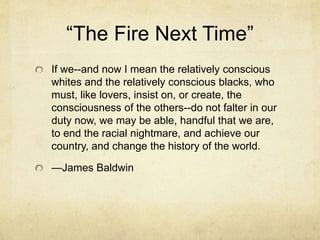
“The Fire Next Time”
If we--and now I mean the relatively conscious
whites and the relatively conscious blacks, who
must, like lovers, insist on, or create, the
consciousness of the others--do not falter in our
duty now, we may be able, handful that we are,
to end the racial nightmare, and achieve our
country, and change the history of the world.
—James Baldwin
More from the Revision
Checklist
ALWAYS keep one copy of the original unrevised
work in progress. You never know when you might
want to change something back to the way it was.
Try retyping sections where you are stuck.
Read out loud. Tape record yourself reading out loud
and listen to it. Ask a friend to read your work out
loud.
All of these are steps to try to help you “re-see” your
work. Revision means literally re-envisioning your
piece, not just trying to mend what is already there.
It’s the little things
I have marked typos and grammatical errors. Be sure
to review and correct
If you’re unclear on some basic grammar issues, this
is an excellent time to review them. Don’t let grammar
scare you. Everyone has little gaps in their
understanding of writing rules. Face them now.
Common grammar errors include: comma splices,
verb tenses, pronoun/antecedent agreement.
A good resource:
http://www.quickanddirtytips.com/grammar-girl
Your Memoir Revision
Your memoir revision is due in your final portfolio
along with your original draft
A legitimate revision may mean that you throw
out most of what you wrote and start again,
focusing in on one scene
It may mean that you expand on what you have
But the revision needs to contain a significant
shift from the original piece.

CNF Revision 2016

  • 1.
    Revision Re-seeing/ Re-writing “In thefirst draft is the talent. In the second is the art.” —Paul Valery
  • 2.
    Figuring out whatyou’ve created Whether a piece of writing comes from a writing prompt or out-of-the-blue inspiration, the first draft should come in a burst—not from the critical side of your brain. Revision, on the other hand, is about looking at what’s happened when you wrote, and figuring it out. From there, revision becomes about consciously changing what is on the page. Use the critique to inform those decisions, not to dictate them.
  • 3.
    Revision vs. futzing Therevision process should include checking word choice, sentence structure, grammar etc., but that is line editing, not revising. In other words, don’t give a car that needs a new engine a sparkly paint job (bad metaphor) Instead, start with the larger elements of non- fiction as points of revision
  • 4.
    Elements of Non-Fiction Weuse the critique/workshop process to take a look at the largest aspects of non-fiction as they are playing out in your pieces: scene, character, voice, reflection Take a look at the comments—are there any patterns in the responses? Do any of the issues raised coincide with concerns you had about the piece? Start where you think it needs work.
  • 5.
    Areas for Review:Scene Scene is not “scenery,” although a scene should include elements of scenery, such as place and description Scene = action in real time Scene vs. summary (exposition) Scene should occur when the event being described is key to the emotional and narrative arc of the story.
  • 6.
    Scene vs. summary Thefairy smiled. With a flick of her magic wand Cinderella found herself wearing the most beautiful dress she had ever seen. Now for your coach, said the fairy: "A real lady would never go to a ball on foot! Quick! Get me a pumpkin!. “Oh of course,” said Cinderella, rushing away. One day, a fairy arrived and gave Cinderella a beautiful dress and a coach so she could go to the ball.
  • 7.
    Scene vs. summary Aswith fiction (and fairy tales), Creative Nonfiction requires scenes—for the most part— for the portions of the story that make up the key events in the narrative arc. Scene is about recreating the emotional impact of the events in the story. Even if the story doesn’t follow a traditional chronological arc, it should still have key moments that create a sense of plot, crisis action and resolution.
  • 8.
    Plot vs. story Story Onceupon a time, there was a king and a queen. First the king died. Then the queen died. Plot Once upon a time, there was a king and a queen First the king died. Then the queen died of heartache.
  • 9.
    In other words Plotcreates a framework that looks at causality in the story—it tells why This matters in nonfiction as much (if not more) than as fiction because it provides the “why”: Why does this story matter? What is at the heart of this story? Why does this story need to be told? What is this story really about?
  • 10.
    Traditional Plot Structure Aristotlebasically came up with the triangle plot idea in 350 BC, which basically describes a beginning, middle and end to a story. Generally, this would follow a “chronological” narrative. Stories do not need to be told in chronological order, but regardless of the narrative structure, they need to have an emotional climax and some sort of conflict in need of resolution.
  • 11.
    Narrative structure Chronological Flashback In-media res(starts in the middle of the action) Thematic (various vignettes more linked by theme) Circular (circles back to a main event or idea) The “shape” or framework is only limited by the writer: you can choose any narrative structure you like—but there should be a sense of mounting tension and causality.
  • 12.
    Plot Plot is theliterary element that describes the structure of a story. It shows arrangement of events and actions within a story.
  • 13.
  • 14.
    Conflict The danger isto assume that because the story you are telling is inherently conflicted (death, heartache, loss etc) that the piece will reflect that conflict. The piece will reflect the conflict if those key moments are rendered in scene so that the reader inhabits them as well This also means that the “crisis action”—the moment of reckoning—should be rendered in a scene as well.
  • 15.
    Voice When we evaluatevoice in a piece, we are looking at a variety of factors: The author’s voice: the attitude expressed, the word choice, diction (to name a few) The voice of the characters in the story: how they speak, and what they say. Just as in real life, the voice of the people inhabiting a piece of nonfiction should be distinct “Point of view” is a part of voice (choosing which person, 1st, 2nd, 3rd) the story is being told from, but they are not one and the same.
  • 16.
    The narrator’s voiceis... Sarcastic Confused Accepting Angry Exuberant Arrogant That of a 5 year old Word choice Content of what is said Syntax of sentences The way the narrator sees other people, places, objects How other people respond
  • 17.
    Let’s do anexercise Take a scene from your first draft (if it’s long, condense to about a paragraph for the purpose of this exercise) Set an “intention” regarding the voice of the piece (you don’t have to keep this or mean it; this is an experiment). For example: Decide that the voice is “angry”, and rewrite the scene with that intention. Now rewrite the scene again with an entirely different voice—as far away from the first intention as possible. Change the voice by changing the word choice, the rhythm of the sentences. Spend 10 minutes on each paragraph
  • 18.
    Working with Theme Themein crafted non-fiction writing has similarities with fiction. It means that all the pieces—the narrator’s point of view, the metaphors, the setting, are helping to support that larger abstract idea. Over-do it, and you’re hitting the reader on the head. Ignore it, and you’re likely to end up with a piece that feels fragmented. Understanding your theme helps you create connections in the writing. Just ask yourself: What is my story about? Not what happens, but what is at stake?
  • 19.
    The Revision Checklist Show,don’t tell. Go through your manuscript and find the places where you’ve summarized—either dialogue or action. Are these important moments? Remember that important moments should be shown in scenes or with direct discussion. What is undeveloped? Are your people without faces? Have you worked to transform them from your memories to characters on the page? Are there scenes without locations? Even if you over-write to fill out, you can then pull it back. Revision means adding what’s missing and taking out what isn’t necessary. Kill your darlings!
  • 20.
    Line editing tips Eliminatevague nouns and verbs: Everything from the “thing” family (something, everything, nothing, anything): find a concrete specific subject that captures what you mean Verbs from the “to be” family (is, was, will be, were). Forms of “to be” often indicate a passive sentence structure and vagueness to action.
  • 21.
    Active Voice One ofthe greatest challenges most writers face is remembering to keep prose in active voice. This can be dealt with on revision, but it’s key to strong writing. In active voice, the subject performs the action: Julia operated the computer (active) The computer was operated by Julia (passive)
  • 22.
    Variety The other “problem”with vague subjects and verbs is that writers often use them over and over again, creating a lack of vibrancy in the writing. Go through and circle each time you’ve used a form of “to be” and restructure the sentence to be more active and use a variety of verbs.
  • 23.
    Adjectives Adjectives are notthe enemy, but when overused they detract from the goal of “showing” versus telling. A beautiful day may indeed be beautiful but it doesn’t show the reader the day in the same way that the orange sky and trees filled with lilac buds and silver-coated unicorn will (OK, OK, no unicorns in nonfiction, please)
  • 24.
    Vary your syntax Reada paragraph out loud. Are all the sentences the same length? Are they all short and clipped? Are the long sentences so long that you lose your breath and forget to make a point? Line editing means also looking for opportunities to vary the rhythm of your sentences, and to clean up any grammatical issues (run-ons, fragments.
  • 25.
    Syntax Exercise To experiment,take a piece of writing from someone else—one paragraph Rewrite one paragraph from your memoir imitating the exact sentence structure of each sentence in that paragraph Notice how changing the punctuation, the order of nouns and verbs, the length of sentences to imitate someone else’s writing changes the way your writing sounds (this is just to see the difference diction makes; don’t rewrite your whole piece imitating someone else’s sentence structure). If you’re really ambitious, use a sentence written by James Baldwin.
  • 26.
    “The Fire NextTime” If we--and now I mean the relatively conscious whites and the relatively conscious blacks, who must, like lovers, insist on, or create, the consciousness of the others--do not falter in our duty now, we may be able, handful that we are, to end the racial nightmare, and achieve our country, and change the history of the world. —James Baldwin
  • 27.
    More from theRevision Checklist ALWAYS keep one copy of the original unrevised work in progress. You never know when you might want to change something back to the way it was. Try retyping sections where you are stuck. Read out loud. Tape record yourself reading out loud and listen to it. Ask a friend to read your work out loud. All of these are steps to try to help you “re-see” your work. Revision means literally re-envisioning your piece, not just trying to mend what is already there.
  • 28.
    It’s the littlethings I have marked typos and grammatical errors. Be sure to review and correct If you’re unclear on some basic grammar issues, this is an excellent time to review them. Don’t let grammar scare you. Everyone has little gaps in their understanding of writing rules. Face them now. Common grammar errors include: comma splices, verb tenses, pronoun/antecedent agreement. A good resource: http://www.quickanddirtytips.com/grammar-girl
  • 29.
    Your Memoir Revision Yourmemoir revision is due in your final portfolio along with your original draft A legitimate revision may mean that you throw out most of what you wrote and start again, focusing in on one scene It may mean that you expand on what you have But the revision needs to contain a significant shift from the original piece.

Editor's Notes

  • #7 (http://www.bgfl.org/bgfl/custom/resources_ftp/client_ftp/ks1/english/story_telling/cinderella/cinderella6.htm)
  • #13 Freytag, german novelist in the 19th century, added to Aristotle’s triangle but creating a five-part structure where we have a leadup, and then a rising action with conflict then a crisis that changes everything, and
  • #16 Diction is vocabulary plus syntax.
  • #30 QUESTIONS?