Fictional
time and
plot
Fictional
Time
Stories are both set in time and use time
navigate the events of the story.
Time is navigated through the use of
scenes and summaries.
Scenes happen in the real time of the story
Summaries move the reader through
blocks of time quickly.
Other time-travel techniques in fiction
include flashbacks and slow-motion and In
media res (in the middle of things) when a
story starts mid-action
Summary
and
Scene
Summary and scene
are used to represent
time in fiction
Summary moves quickly
over longer periods of
time
Scenes slow down time
and deal with shorter
periods of time
Scene vs.
Summary
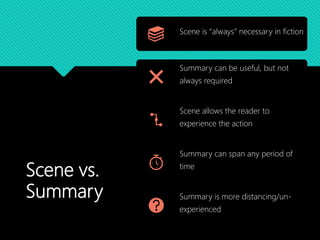
Scene is “always” necessary in fiction
Summary can be useful, but not
always required
Scene allows the reader to
experience the action
Summary can span any period of
time
Summary is more distancing/un-
experienced
Choosing
Which to
use
While a story can be written simply as a
scene or series of scenes, summary helps
transition between scenes
Summary can help highlight the
importance of those events that happen in
scenes
Important events should often be
in scenes rather than summary so that the
reader fully experiences them, is shown,
rather than told, about them.
Flashback
 Allows the writer, and reader, to
move backward in time
 Overuse of flashback can result in
too much back story
 Flashback requires transition from
past to present and back, but not
overly self-conscious ones
 Be wary of tense changes for
flashbacks. If writing in present
tense, use past tense for the
flashback. If writing in past tense,
use the past perfect.
A Note on
Verb
Tenses
The main action of a story can be
written in either past or present tense.
Past is more common; present tense
has become more pervasive, but is still
considered more stylized and,
sometimes, intrusive.
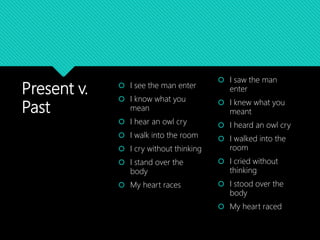
Present v.
Past
 I see the man enter
 I know what you
mean
 I hear an owl cry
 I walk into the room
 I cry without thinking
 I stand over the
body
 My heart races
 I saw the man
enter
 I knew what you
meant
 I heard an owl cry
 I walked into the
room
 I cried without
thinking
 I stood over the
body
 My heart raced
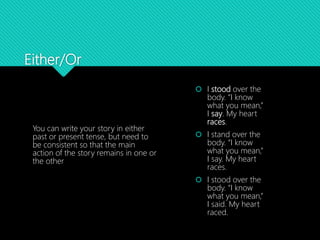
Either/Or
You can write your story in either
past or present tense, but need to
be consistent so that the main
action of the story remains in one or
the other
 I stood over the
body. “I know
what you mean,”
I say. My heart
races.
 I stand over the
body. “I know
what you mean,”
I say. My heart
races.
 I stood over the
body. “I know
what you mean,”
I said. My heart
raced.
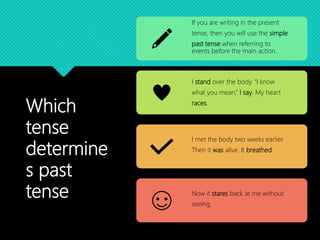
Which
tense
determine
s past
tense
If you are writing in the present
tense, then you will use the simple
past tense when referring to
events before the main action.
I stand over the body. “I know
what you mean,” I say. My heart
races.
I met the body two weeks earlier.
Then it was alive. It breathed.
Now it stares back at me without
seeing.
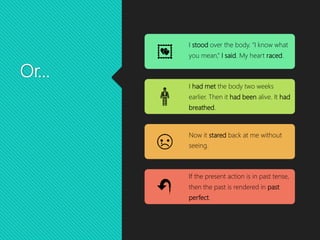
Or…
I stood over the body. “I know what
you mean,” I said. My heart raced.
I had met the body two weeks
earlier. Then it had been alive. It had
breathed.
Now it stared back at me without
seeing.
If the present action is in past tense,
then the past is rendered in past
perfect.
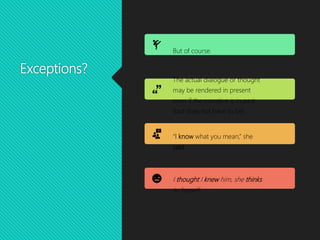
Exceptions?
But of course.
The actual dialogue or thought
may be rendered in present
even if the narrative is in past
(but does not have to be).
“I know what you mean,” she
said.
I thought I knew him, she thinks
to herself.
So what is
a story?
And what
is plot?
Stories have characters who have faces, bodies, emotions,
words and experiences
They have settings
They have event(s) that happen over time
They have themes, ideas
They are made out of words
And yet a piece of writing can have all of these elements
and still not be a story.
Pop quiz: What does every story require in order to be a
story?
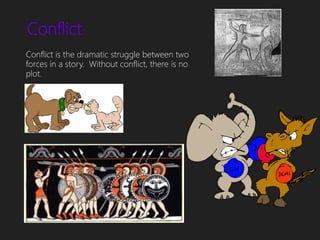
Conflict
Conflict is the dramatic struggle between two
forces in a story. Without conflict, there is no
plot.
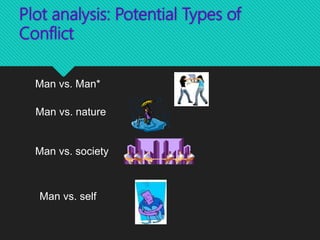
Plot analysis: Potential Types of
Conflict
Man vs. nature
Man vs. society
Man vs. self
Man vs. Man*
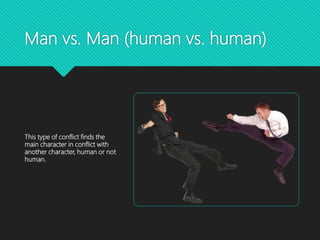
Man vs. Man (human vs. human)
This type of conflict finds the
main character in conflict with
another character, human or not
human.
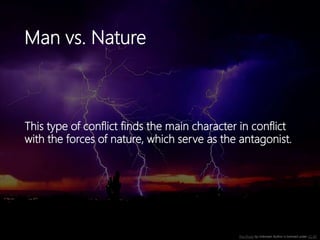
Man vs. Nature
This type of conflict finds the main character in conflict
with the forces of nature, which serve as the antagonist.
This Photo by Unknown Author is licensed under CC BY
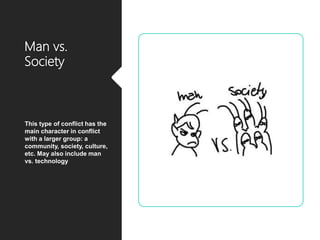
Man vs.
Society
This type of conflict has the
main character in conflict
with a larger group: a
community, society, culture,
etc. May also include man
vs. technology
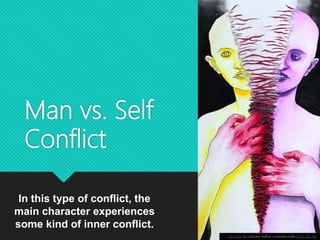
Man vs. Self
Conflict
This Photo by Unknown Author is licensed under CC BY-NC-ND
In this type of conflict, the
main character experiences
some kind of inner conflict.
Conflict
does not
mean
extreme
action
 Plot does not require bank heists
or aliens landing on the planet
 It does require characters to want
something and to be changed
through actions in the story
 It requires conflict that reaches a
crisis and is resolved to some
degree
 Ordering events to show conflict,
crisis and resolution in some way
is what constitutes a plot.
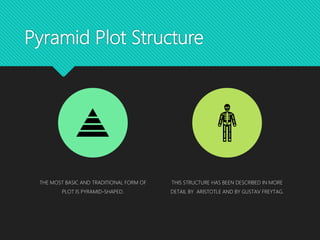
Pyramid Plot Structure
THE MOST BASIC AND TRADITIONAL FORM OF
PLOT IS PYRAMID-SHAPED.
THIS STRUCTURE HAS BEEN DESCRIBED IN MORE
DETAIL BY ARISTOTLE AND BY GUSTAV FREYTAG.
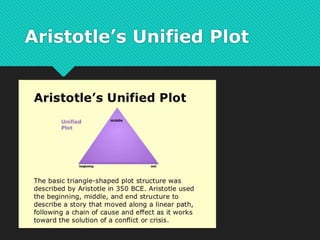
Aristotle’s Unified Plot
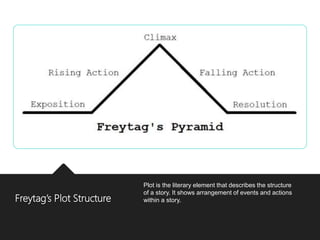
Freytag’s Plot Structure
Plot is the literary element that describes the structure
of a story. It shows arrangement of events and actions
within a story.
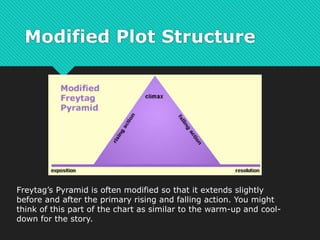
Modified Plot Structure
Freytag’s Pyramid is often modified so that it extends slightly
before and after the primary rising and falling action. You might
think of this part of the chart as similar to the warm-up and cool-
down for the story.
Plot
Components
Climax, also known as Crisis Action: the
turning point, the most intense moment—
either mentally or in action
Rising Action: the series of conflicts and
crisis in the story that lead to the climax
Exposition: the start of the story, the
situation before the action starts
Falling Action: all of the action which follows
the climax
Resolution: the conclusion, the tying
together of all of the threads
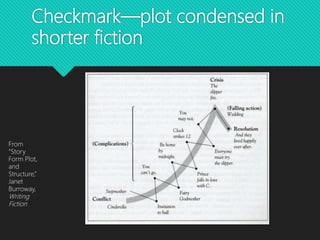
Checkmark—plot condensed in
shorter fiction
From
“Story
Form Plot,
and
Structure,”
Janet
Burroway,
Writing
Fiction
Plot &
Story
Simply put:
A story is an event or series of events
A plot is the arrangement of these events to
that shows causality, drama and meaning.
The King Died. The Queen Died.
(Events/Story)
The King Died. The Queen Died of Grief
(Plot).

2022timeandplot.pptx

  • 1.
  • 2.
    Fictional Time Stories are bothset in time and use time navigate the events of the story. Time is navigated through the use of scenes and summaries. Scenes happen in the real time of the story Summaries move the reader through blocks of time quickly. Other time-travel techniques in fiction include flashbacks and slow-motion and In media res (in the middle of things) when a story starts mid-action
  • 3.
    Summary and Scene Summary and scene areused to represent time in fiction Summary moves quickly over longer periods of time Scenes slow down time and deal with shorter periods of time
  • 4.
    Scene vs. Summary Scene is“always” necessary in fiction Summary can be useful, but not always required Scene allows the reader to experience the action Summary can span any period of time Summary is more distancing/un- experienced
  • 5.
    Choosing Which to use While astory can be written simply as a scene or series of scenes, summary helps transition between scenes Summary can help highlight the importance of those events that happen in scenes Important events should often be in scenes rather than summary so that the reader fully experiences them, is shown, rather than told, about them.
  • 6.
    Flashback  Allows thewriter, and reader, to move backward in time  Overuse of flashback can result in too much back story  Flashback requires transition from past to present and back, but not overly self-conscious ones  Be wary of tense changes for flashbacks. If writing in present tense, use past tense for the flashback. If writing in past tense, use the past perfect.
  • 7.
    A Note on Verb Tenses Themain action of a story can be written in either past or present tense. Past is more common; present tense has become more pervasive, but is still considered more stylized and, sometimes, intrusive.
  • 8.
    Present v. Past  Isee the man enter  I know what you mean  I hear an owl cry  I walk into the room  I cry without thinking  I stand over the body  My heart races  I saw the man enter  I knew what you meant  I heard an owl cry  I walked into the room  I cried without thinking  I stood over the body  My heart raced
  • 9.
    Either/Or You can writeyour story in either past or present tense, but need to be consistent so that the main action of the story remains in one or the other  I stood over the body. “I know what you mean,” I say. My heart races.  I stand over the body. “I know what you mean,” I say. My heart races.  I stood over the body. “I know what you mean,” I said. My heart raced.
  • 10.
    Which tense determine s past tense If youare writing in the present tense, then you will use the simple past tense when referring to events before the main action. I stand over the body. “I know what you mean,” I say. My heart races. I met the body two weeks earlier. Then it was alive. It breathed. Now it stares back at me without seeing.
  • 11.
    Or… I stood overthe body. “I know what you mean,” I said. My heart raced. I had met the body two weeks earlier. Then it had been alive. It had breathed. Now it stared back at me without seeing. If the present action is in past tense, then the past is rendered in past perfect.
  • 12.
    Exceptions? But of course. Theactual dialogue or thought may be rendered in present even if the narrative is in past (but does not have to be). “I know what you mean,” she said. I thought I knew him, she thinks to herself.
  • 13.
    So what is astory? And what is plot? Stories have characters who have faces, bodies, emotions, words and experiences They have settings They have event(s) that happen over time They have themes, ideas They are made out of words And yet a piece of writing can have all of these elements and still not be a story. Pop quiz: What does every story require in order to be a story?
  • 14.
    Conflict Conflict is thedramatic struggle between two forces in a story. Without conflict, there is no plot.
  • 15.
    Plot analysis: PotentialTypes of Conflict Man vs. nature Man vs. society Man vs. self Man vs. Man*
  • 16.
    Man vs. Man(human vs. human) This type of conflict finds the main character in conflict with another character, human or not human.
  • 17.
    Man vs. Nature Thistype of conflict finds the main character in conflict with the forces of nature, which serve as the antagonist. This Photo by Unknown Author is licensed under CC BY
  • 18.
    Man vs. Society This typeof conflict has the main character in conflict with a larger group: a community, society, culture, etc. May also include man vs. technology
  • 19.
    Man vs. Self Conflict ThisPhoto by Unknown Author is licensed under CC BY-NC-ND In this type of conflict, the main character experiences some kind of inner conflict.
  • 20.
    Conflict does not mean extreme action  Plotdoes not require bank heists or aliens landing on the planet  It does require characters to want something and to be changed through actions in the story  It requires conflict that reaches a crisis and is resolved to some degree  Ordering events to show conflict, crisis and resolution in some way is what constitutes a plot.
  • 21.
    Pyramid Plot Structure THEMOST BASIC AND TRADITIONAL FORM OF PLOT IS PYRAMID-SHAPED. THIS STRUCTURE HAS BEEN DESCRIBED IN MORE DETAIL BY ARISTOTLE AND BY GUSTAV FREYTAG.
  • 22.
  • 23.
    Freytag’s Plot Structure Plotis the literary element that describes the structure of a story. It shows arrangement of events and actions within a story.
  • 24.
    Modified Plot Structure Freytag’sPyramid is often modified so that it extends slightly before and after the primary rising and falling action. You might think of this part of the chart as similar to the warm-up and cool- down for the story.
  • 25.
    Plot Components Climax, also knownas Crisis Action: the turning point, the most intense moment— either mentally or in action Rising Action: the series of conflicts and crisis in the story that lead to the climax Exposition: the start of the story, the situation before the action starts Falling Action: all of the action which follows the climax Resolution: the conclusion, the tying together of all of the threads
  • 26.
    Checkmark—plot condensed in shorterfiction From “Story Form Plot, and Structure,” Janet Burroway, Writing Fiction
  • 27.
    Plot & Story Simply put: Astory is an event or series of events A plot is the arrangement of these events to that shows causality, drama and meaning. The King Died. The Queen Died. (Events/Story) The King Died. The Queen Died of Grief (Plot).