




Reality
Mining
Virgílio Solano
RA 180158
Universidade Estadual de Campinas
Instituto de Computação
Web e Web Semântica
Prof. André Santanchè
Agenda
◎Introduction
◎What’s Reality Mining?
◎Motivation
◎Examples
◎Research
◎Challenges
◎Conclusion
◎Questions
What’s
Reality
Mining?
Computer Social Science
Social Physics
Social Network Patterns
“
We define reality mining as quantifying and modeling
long-term human behavior and social interactions,
by using mobile phones and wearable badges
as sensors that capture realworld
face-to-face interactions.
Reality Mining and Personal Privacy Will Privacy Disappear when Social Sensors Learn Our Lives? - MIT Media
Laboratory
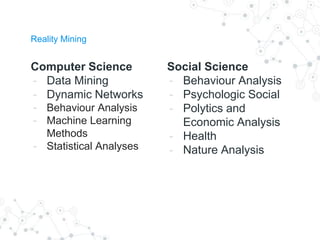
Computer Science
- Data Mining
- Dynamic Networks
- Behaviour Analysis
- Machine Learning
Methods
- Statistical Analyses
Reality Mining
Social Science
- Behaviour Analysis
- Psychologic Social
- Polytics and
Economic Analysis
- Health
- Nature Analysis
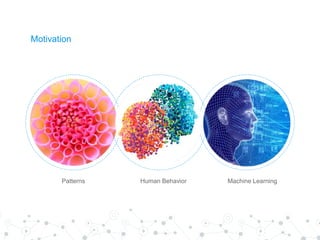
Motivation
Human BehaviorPatterns Machine Learning
Patterns Human Behavior Machine Learning
Examples
Some examples using
Reality Mining
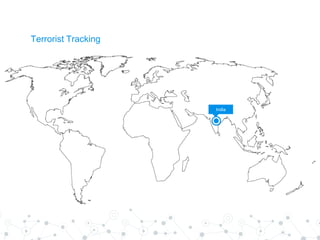
Terrorist Tracking
India
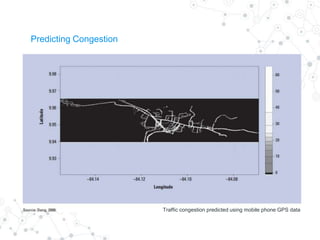
Predicting Congestion
Traffic congestion predicted using mobile phone GPS data
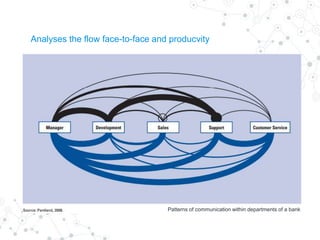
Analyses the flow face-to-face and producvity
Patterns of communication within departments of a bank
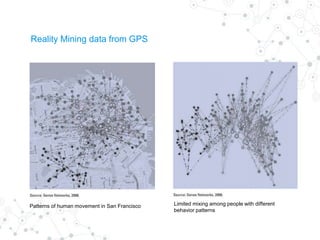
Reality Mining data from GPS
Patterns of human movement in San Francisco Limited mixing among people with different
behavior patterns
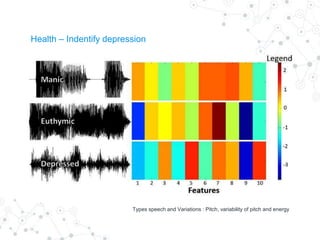
Health – Indentify depression
Types speech and Variations : Pitch, variability of pitch and energy
Research
Experiments
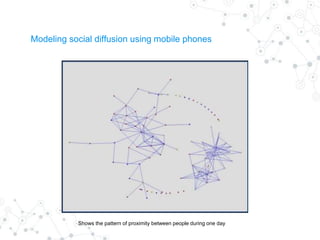
Modeling social diffusion using mobile phones
Shows the pattern of proximity between people during one day
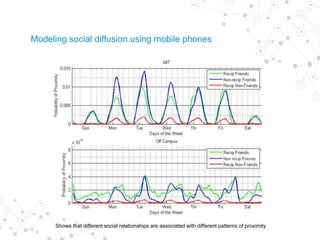
Modeling social diffusion using mobile phones
Shows that different social relationships are associated with different patterns of proximity
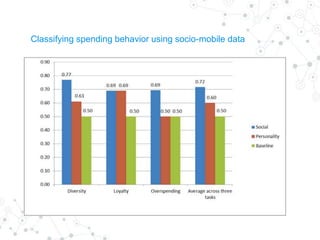
Classifying spending behavior using socio-mobile data
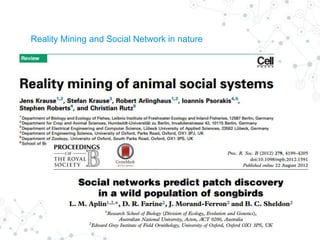
Reality Mining and Social Network in nature
Many Researches
- Efficient detection of contagious outbreaks in massive metropolitan
encounter networks
- The Social Amplifier – Reaction of Human Communities to Emergencies
- Friends don’t Lie - Inferring Personality Traits from Social Network
Structure
- Limits of social mobilization
- Incremental Learning with Accuracy Prediction of Social and Individual
Properties from Mobile-Phone Data
- The capacity to collect and analyze massive amounts of data
unambiguously
Challenges
Problems and
solutions
Challenges
- Security, Data ownership and privacy
- Echo Chamber in network
- Robust models of collaboration and data sharing between industry and
the academy need to be developed that safeguard
- How to developing technologies that protect privacy while preserving
data essential for research?
- How to integrate and approach Computer Science Scientists and Social
Scientists?
- Developer robust algorithms to process the big data around the world
Conclusion
Some considerations
Conclusion
- New way for understand to social mechanism and life
- Improving methods to sharing private data and privacy policies
- Advanced analysing big data around the world
- Increase the efficiency and responsiveness of industries and
governments.
- Convenience for everything at today
- Computational social science needs to be the work of teams of social
and computer scientists.
- Salvation or our destruction.
Thanks!
Any questions?
You can find me at:
virgiliosolano.wordpress.com
virgiliosolmag@gmail.com
References
- T. Choudhury (2004) “Sensing and Modeling Human Networks.” Cambridge, MA USA, PhD Thesis, MIT Media
Laboratory.
- A. Pentland (2005) “Socially Aware Computation and Communication.” IEEE Computer,33-40.
- F. Grippa, A. Zilli, R. Laubacher and P. Gloor (2006) “E-mail may not reflect the social network.” Proceedings of
the North American Association for Computational Social and Organizational Science Conference.
- A. Pentland (2006) “Automatic mapping and modeling of human networks.”, Physica A: Statistical Mechanics and
its Applications.
- A. Pentland (2006) “Life in the network: the coming age of computational social science”,
http://www.ncbi.nlm.nih.gov/pmc/articles/PMC2745217/, April;
- A. Pentland (2006) “Automatic mapping and modeling of human networks.”, Physica A: Statistical Mechanics and
its Applications.
- S. Aral, E. Brynjolfssen and M.W. Van Alstyne (2007) “Productivity Effects of Information Diffusion in Networks,”
MIT Center for Digital Business, paper 234
- L. Backstrom, C. Dwork, and J. Kleinberg (2007) “Wherefore Art Thou R3579X? Anonymized Social Networks,
Hidden Patterns, and Structural Steganography.” WWW Conference.
- M. Gonzalez, C. Hidalgo and A.-L. Barabási (2008) “Understanding Human Mobility Patterns.” Nature 453, pp
779-782.
- B.N. Waber, D. Olguin Olguin, T. Kim and A. Pentland (2008) “Understanding Organizational Behavior with
Wearable Sensing Technology.” Acadmey of Mangement Annual Conference. Anaheim, CA, USA.
- B.N. Waber, D. Olguin Olguin, T. Kim and A. Pentland (2008) “Workplace Privacy.” EPIC Workplace Privacy
Page. Electronic Privacy Information Center, 11 September 2008. Retrieved 14 July 2009
- A. Pentland. (2008) “Reality Mining of Mobile Communications: Toward a New Deal on Data”,
http://hd.media.mit.edu/wef_globalit.pdf, April;
- D. Lazer, D. Brewer, T. Heibeck and A. Pentland. (2009) “Improving Public Health and Medicine by use of
Reality Mining”. http://hd.media.mit.edu/rwjf-reality-mining-whitepaper-0309.pdf, April.
References
- N. Eagle and A. Pentland, (2009) “Reality Mining: Sensing Complex Social Systems”, Personal and Ubiquitous
Computing, Vol 10, #4, 255-26.
- N. Eagle and A. Pentland (2009) “Employee Monitoring: Is There Privacy in the Workplace?” Fact Sheet 7:
Workplace Privacy. Privacy Rights Clearinghouse, April.
- A. Madan, B. N. Waber, M. Ding, P. Kominers, and A. Pentland (2009) “Reality Mining and Personal Privacy”:
Will Privacy Disappear when Social Sensors Learn Our Lives?,
http://senseable.mit.edu/engagingdata/papers/ED_SIII_Reality_Mining_and_Personal_Privacy.pdf, April.
- J. Krause, S. Krause, R. Arlinghaus, I. Psorakis, S. Roberts and C. Rutz (2013) “Reality mining of animal social
systems”. http://www.igb-berlin.de/tl_files/data_igb/_aktuell_presse/_publikationen/KrauseEtAl_TREE_2013.pdf,
April.

Reality Mining

  • 1.
  • 2.
    Virgílio Solano RA 180158 UniversidadeEstadual de Campinas Instituto de Computação Web e Web Semântica Prof. André Santanchè
  • 3.
  • 5.
  • 6.
    “ We define realitymining as quantifying and modeling long-term human behavior and social interactions, by using mobile phones and wearable badges as sensors that capture realworld face-to-face interactions. Reality Mining and Personal Privacy Will Privacy Disappear when Social Sensors Learn Our Lives? - MIT Media Laboratory
  • 8.
    Computer Science - DataMining - Dynamic Networks - Behaviour Analysis - Machine Learning Methods - Statistical Analyses Reality Mining Social Science - Behaviour Analysis - Psychologic Social - Polytics and Economic Analysis - Health - Nature Analysis
  • 9.
    Motivation Human BehaviorPatterns MachineLearning Patterns Human Behavior Machine Learning
  • 10.
  • 11.
  • 12.
    Predicting Congestion Traffic congestionpredicted using mobile phone GPS data
  • 13.
    Analyses the flowface-to-face and producvity Patterns of communication within departments of a bank
  • 14.
    Reality Mining datafrom GPS Patterns of human movement in San Francisco Limited mixing among people with different behavior patterns
  • 15.
    Health – Indentifydepression Types speech and Variations : Pitch, variability of pitch and energy
  • 16.
  • 17.
    Modeling social diffusionusing mobile phones Shows the pattern of proximity between people during one day
  • 18.
    Modeling social diffusionusing mobile phones Shows that different social relationships are associated with different patterns of proximity
  • 19.
    Classifying spending behaviorusing socio-mobile data
  • 20.
    Reality Mining andSocial Network in nature
  • 21.
    Many Researches - Efficientdetection of contagious outbreaks in massive metropolitan encounter networks - The Social Amplifier – Reaction of Human Communities to Emergencies - Friends don’t Lie - Inferring Personality Traits from Social Network Structure - Limits of social mobilization - Incremental Learning with Accuracy Prediction of Social and Individual Properties from Mobile-Phone Data - The capacity to collect and analyze massive amounts of data unambiguously
  • 22.
  • 23.
    Challenges - Security, Dataownership and privacy - Echo Chamber in network - Robust models of collaboration and data sharing between industry and the academy need to be developed that safeguard - How to developing technologies that protect privacy while preserving data essential for research? - How to integrate and approach Computer Science Scientists and Social Scientists? - Developer robust algorithms to process the big data around the world
  • 24.
  • 25.
    Conclusion - New wayfor understand to social mechanism and life - Improving methods to sharing private data and privacy policies - Advanced analysing big data around the world - Increase the efficiency and responsiveness of industries and governments. - Convenience for everything at today - Computational social science needs to be the work of teams of social and computer scientists. - Salvation or our destruction.
  • 26.
    Thanks! Any questions? You canfind me at: virgiliosolano.wordpress.com virgiliosolmag@gmail.com
  • 27.
    References - T. Choudhury(2004) “Sensing and Modeling Human Networks.” Cambridge, MA USA, PhD Thesis, MIT Media Laboratory. - A. Pentland (2005) “Socially Aware Computation and Communication.” IEEE Computer,33-40. - F. Grippa, A. Zilli, R. Laubacher and P. Gloor (2006) “E-mail may not reflect the social network.” Proceedings of the North American Association for Computational Social and Organizational Science Conference. - A. Pentland (2006) “Automatic mapping and modeling of human networks.”, Physica A: Statistical Mechanics and its Applications. - A. Pentland (2006) “Life in the network: the coming age of computational social science”, http://www.ncbi.nlm.nih.gov/pmc/articles/PMC2745217/, April; - A. Pentland (2006) “Automatic mapping and modeling of human networks.”, Physica A: Statistical Mechanics and its Applications. - S. Aral, E. Brynjolfssen and M.W. Van Alstyne (2007) “Productivity Effects of Information Diffusion in Networks,” MIT Center for Digital Business, paper 234 - L. Backstrom, C. Dwork, and J. Kleinberg (2007) “Wherefore Art Thou R3579X? Anonymized Social Networks, Hidden Patterns, and Structural Steganography.” WWW Conference. - M. Gonzalez, C. Hidalgo and A.-L. Barabási (2008) “Understanding Human Mobility Patterns.” Nature 453, pp 779-782. - B.N. Waber, D. Olguin Olguin, T. Kim and A. Pentland (2008) “Understanding Organizational Behavior with Wearable Sensing Technology.” Acadmey of Mangement Annual Conference. Anaheim, CA, USA. - B.N. Waber, D. Olguin Olguin, T. Kim and A. Pentland (2008) “Workplace Privacy.” EPIC Workplace Privacy Page. Electronic Privacy Information Center, 11 September 2008. Retrieved 14 July 2009 - A. Pentland. (2008) “Reality Mining of Mobile Communications: Toward a New Deal on Data”, http://hd.media.mit.edu/wef_globalit.pdf, April; - D. Lazer, D. Brewer, T. Heibeck and A. Pentland. (2009) “Improving Public Health and Medicine by use of Reality Mining”. http://hd.media.mit.edu/rwjf-reality-mining-whitepaper-0309.pdf, April.
  • 28.
    References - N. Eagleand A. Pentland, (2009) “Reality Mining: Sensing Complex Social Systems”, Personal and Ubiquitous Computing, Vol 10, #4, 255-26. - N. Eagle and A. Pentland (2009) “Employee Monitoring: Is There Privacy in the Workplace?” Fact Sheet 7: Workplace Privacy. Privacy Rights Clearinghouse, April. - A. Madan, B. N. Waber, M. Ding, P. Kominers, and A. Pentland (2009) “Reality Mining and Personal Privacy”: Will Privacy Disappear when Social Sensors Learn Our Lives?, http://senseable.mit.edu/engagingdata/papers/ED_SIII_Reality_Mining_and_Personal_Privacy.pdf, April. - J. Krause, S. Krause, R. Arlinghaus, I. Psorakis, S. Roberts and C. Rutz (2013) “Reality mining of animal social systems”. http://www.igb-berlin.de/tl_files/data_igb/_aktuell_presse/_publikationen/KrauseEtAl_TREE_2013.pdf, April.