Real Time Operating systems
(RTOS) concepts
Abu Bakr Mohamed Ramadan
Eng.abubakr88@gmail.com
Content:
• Semaphore Types
• Binary Semaphore.
• Counting Semaphore.
• Mutual Exclusion with Binary Semaphore.
• Semaphore in µC/OS-II.
• Dead Lock.
• Avoid Dead Lock.
• References and Read more
Semaphore Types
• Binary Semaphore.
• Counting Semaphore.
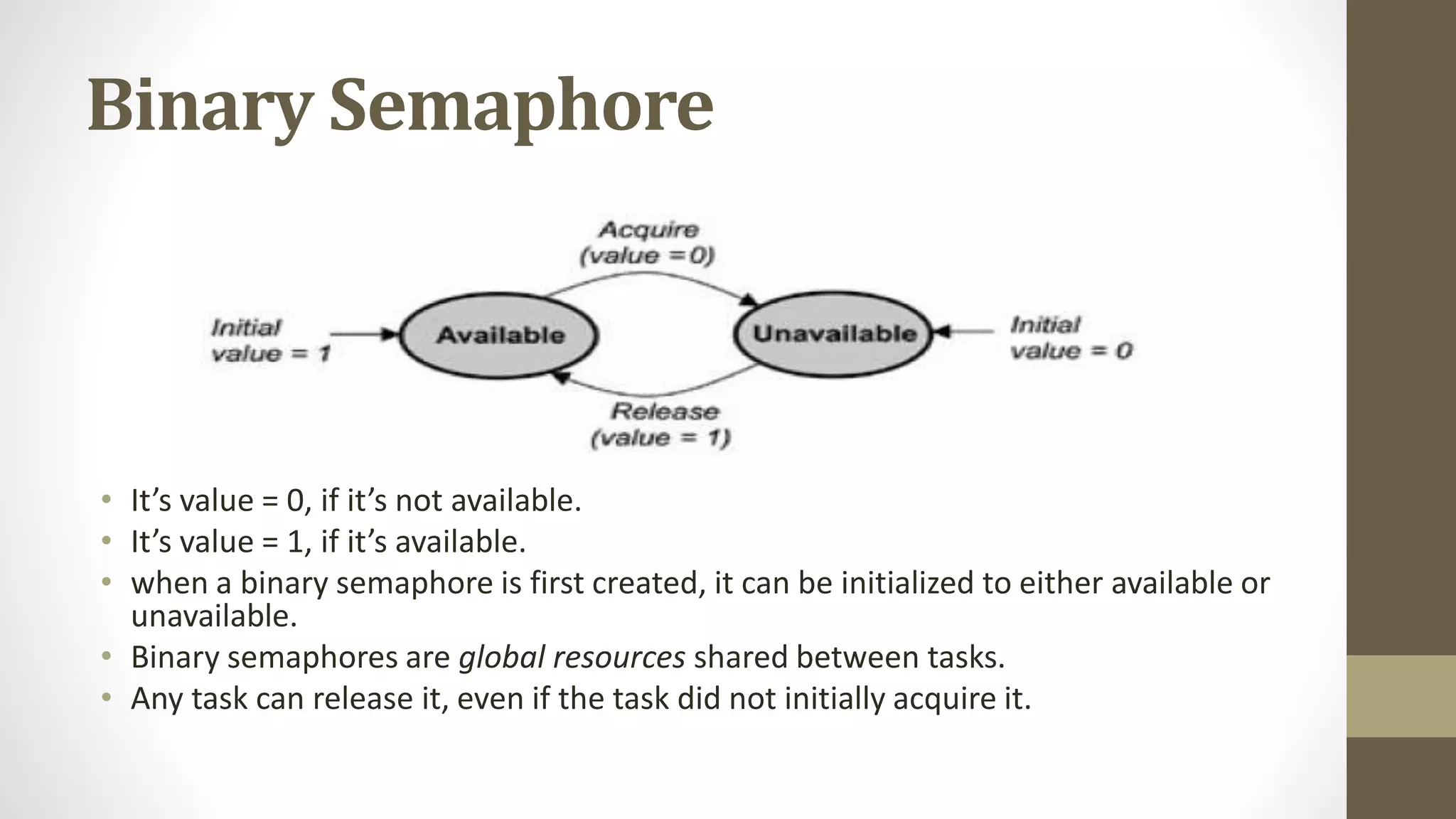
Binary Semaphore
• It’s value = 0, if it’s not available.
• It’s value = 1, if it’s available.
• when a binary semaphore is first created, it can be initialized to either available or
unavailable.
• Binary semaphores are global resources shared between tasks.
• Any task can release it, even if the task did not initially acquire it.
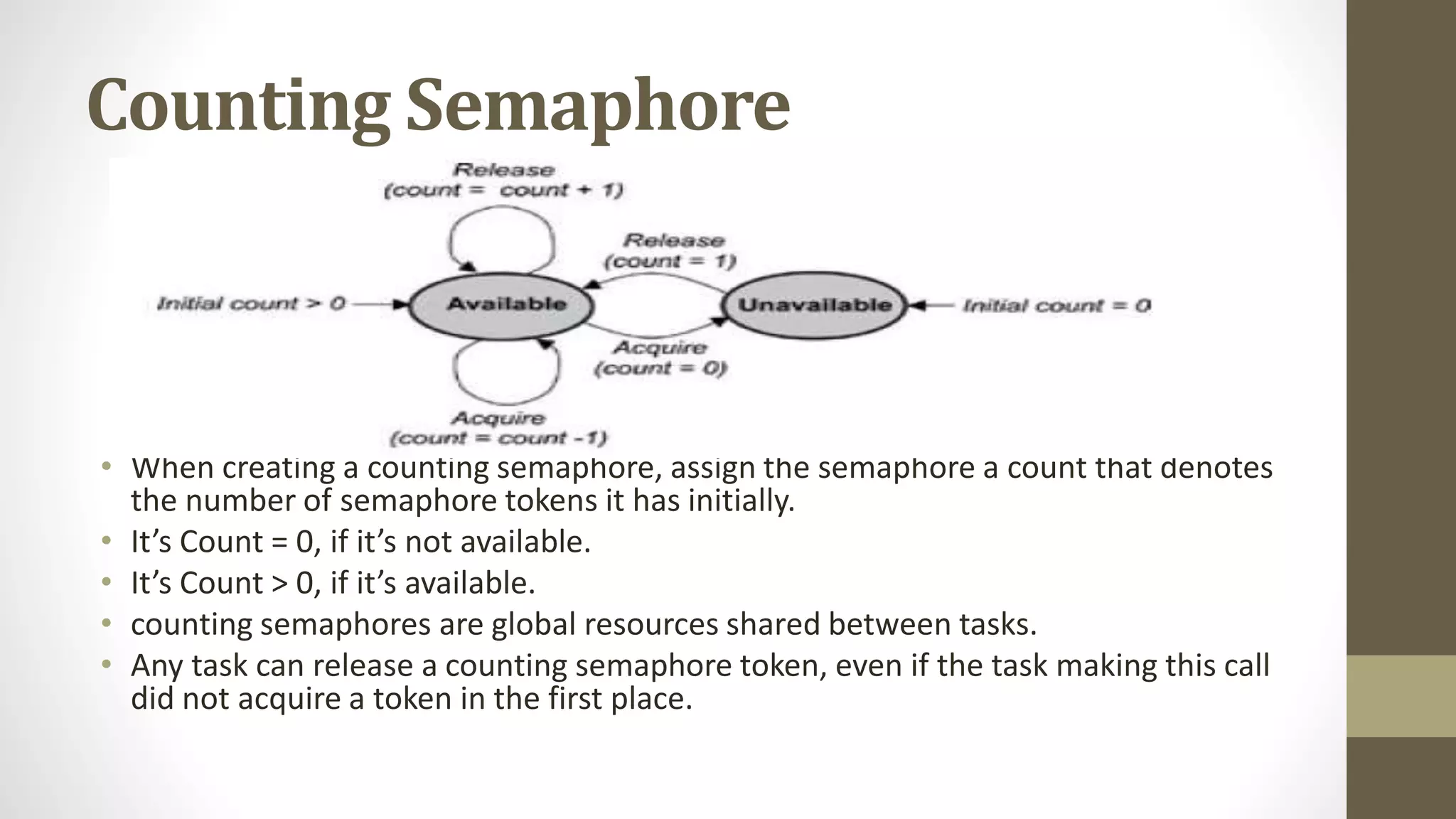
Counting Semaphore
• When creating a counting semaphore, assign the semaphore a count that denotes
the number of semaphore tokens it has initially.
• It’s Count = 0, if it’s not available.
• It’s Count > 0, if it’s available.
• counting semaphores are global resources shared between tasks.
• Any task can release a counting semaphore token, even if the task making this call
did not acquire a token in the first place.
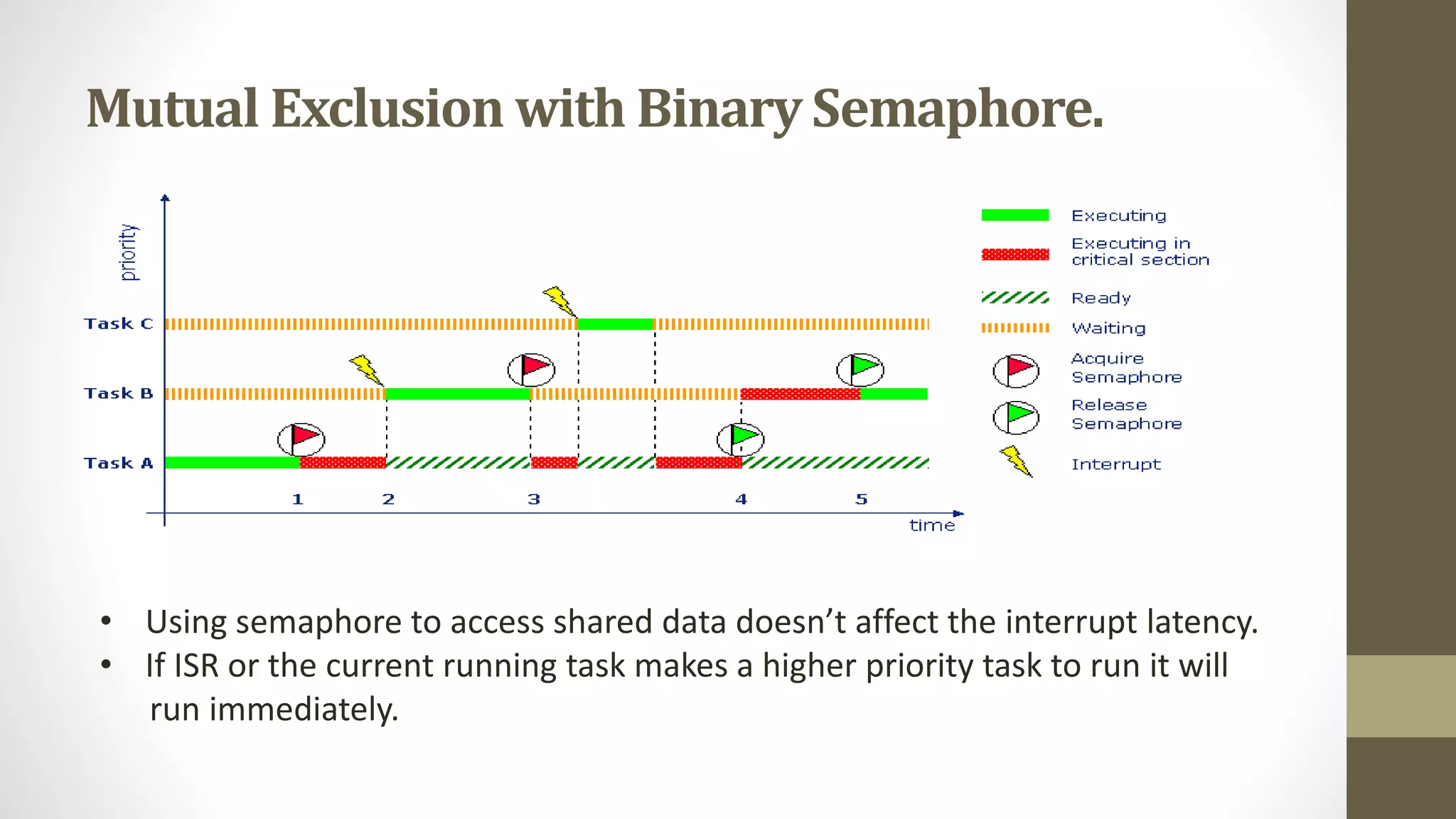
Mutual Exclusion with Binary Semaphore.
• Using semaphore to access shared data doesn’t affect the interrupt latency.
• If ISR or the current running task makes a higher priority task to run it will
run immediately.
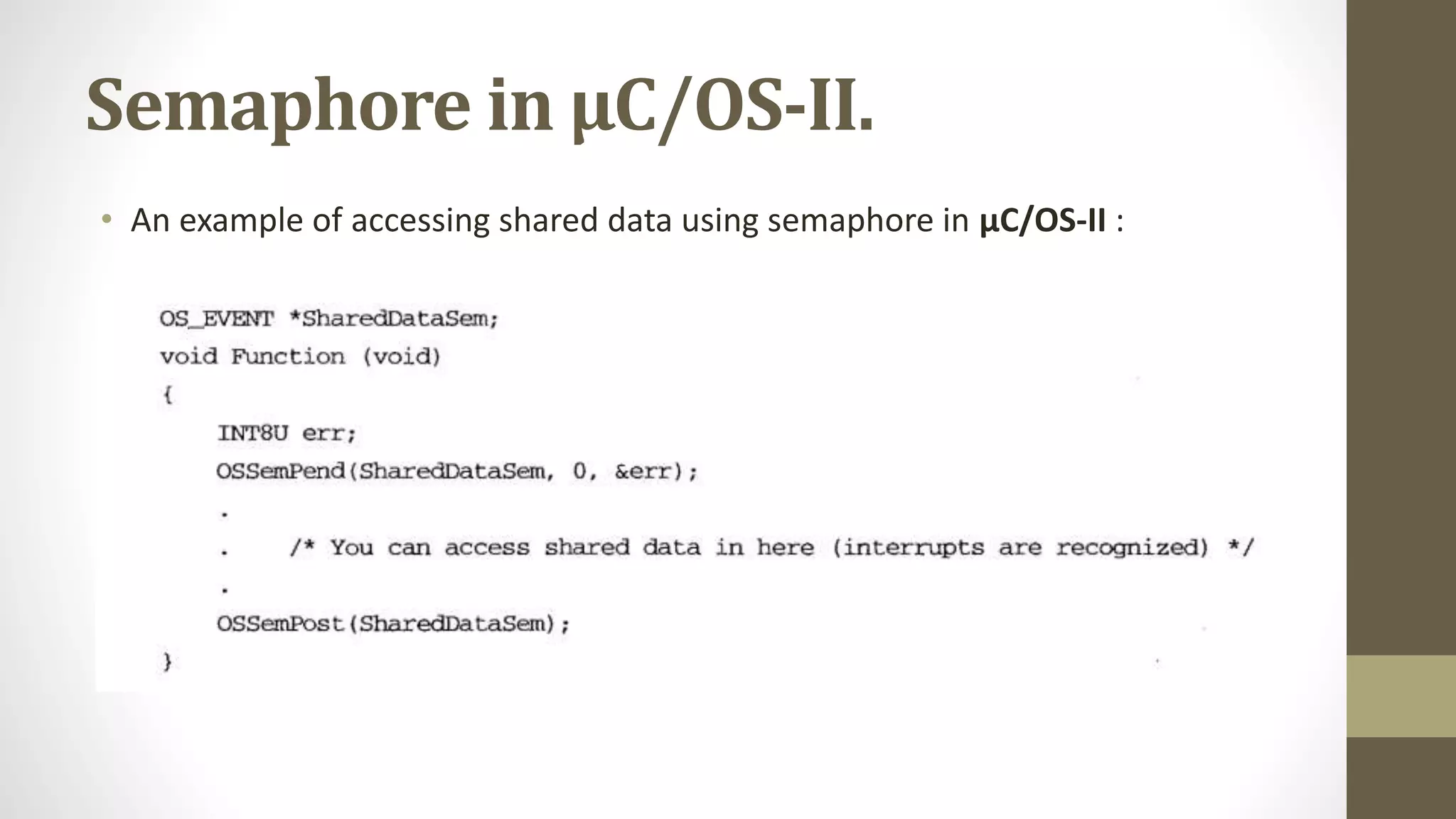
Semaphore in µC/OS-II.
• An example of accessing shared data using semaphore in µC/OS-II :
Dead Lock
• Also called Deadly Embrace.
• When two tasks are waiting the resource held by the other.
• Example
• Task1 has an exclusive access to Resource1,
• And Task2 has an exclusive access to Resource2.
• If Task1 needs an exclusive access to Resource2,
• And Task2 needs an exclusive access to Resource1.
• Both the tasks will be blocked, and a DeadLock happen.
Avoid Dead Lock
• Through a timeout, If the resource is not available for a certain time, the task
will resume executing.
• Good Design .
References and Read more:
• Real-Time Concepts for Embedded Systems book by Qing Li and Carolyn.
• http://www.e-reading.club/book.php?book=102147
• An Embedded Software Primer by David E. Simon.
• http://www.amazon.com/Embedded-Software-Primer-David-
Simon/dp/020161569X
• Embedded Systems Building Blocks 2e by Jean J. Labrosse.
• http://www.amazon.com/Embedded-Systems-Building-Blocks-
Ready/dp/0879306041
• FreeRTOS website.
• http://www.freertos.org

Real time operating systems (rtos) concepts 7

  • 1.
    Real Time Operatingsystems (RTOS) concepts Abu Bakr Mohamed Ramadan Eng.abubakr88@gmail.com
  • 2.
    Content: • Semaphore Types •Binary Semaphore. • Counting Semaphore. • Mutual Exclusion with Binary Semaphore. • Semaphore in µC/OS-II. • Dead Lock. • Avoid Dead Lock. • References and Read more
  • 3.
    Semaphore Types • BinarySemaphore. • Counting Semaphore.
  • 4.
    Binary Semaphore • It’svalue = 0, if it’s not available. • It’s value = 1, if it’s available. • when a binary semaphore is first created, it can be initialized to either available or unavailable. • Binary semaphores are global resources shared between tasks. • Any task can release it, even if the task did not initially acquire it.
  • 5.
    Counting Semaphore • Whencreating a counting semaphore, assign the semaphore a count that denotes the number of semaphore tokens it has initially. • It’s Count = 0, if it’s not available. • It’s Count > 0, if it’s available. • counting semaphores are global resources shared between tasks. • Any task can release a counting semaphore token, even if the task making this call did not acquire a token in the first place.
  • 6.
    Mutual Exclusion withBinary Semaphore. • Using semaphore to access shared data doesn’t affect the interrupt latency. • If ISR or the current running task makes a higher priority task to run it will run immediately.
  • 7.
    Semaphore in µC/OS-II. •An example of accessing shared data using semaphore in µC/OS-II :
  • 8.
    Dead Lock • Alsocalled Deadly Embrace. • When two tasks are waiting the resource held by the other. • Example • Task1 has an exclusive access to Resource1, • And Task2 has an exclusive access to Resource2. • If Task1 needs an exclusive access to Resource2, • And Task2 needs an exclusive access to Resource1. • Both the tasks will be blocked, and a DeadLock happen.
  • 9.
    Avoid Dead Lock •Through a timeout, If the resource is not available for a certain time, the task will resume executing. • Good Design .
  • 10.
    References and Readmore: • Real-Time Concepts for Embedded Systems book by Qing Li and Carolyn. • http://www.e-reading.club/book.php?book=102147 • An Embedded Software Primer by David E. Simon. • http://www.amazon.com/Embedded-Software-Primer-David- Simon/dp/020161569X • Embedded Systems Building Blocks 2e by Jean J. Labrosse. • http://www.amazon.com/Embedded-Systems-Building-Blocks- Ready/dp/0879306041 • FreeRTOS website. • http://www.freertos.org