CH = 1
Natural Numbers
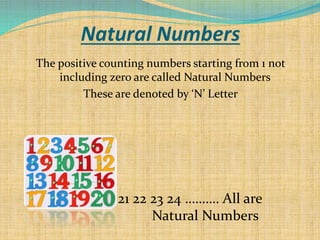
The positive counting numbers starting from 1 not
including zero are called Natural Numbers
These are denoted by ‘N’ Letter
21 22 23 24 ………. All are
Natural Numbers
Whole Numbers
All the natural numbers including zero [0] are called
Whole Numbers
These are denoted by letter ‘W’
10 11 12 ……
All are
Whole Numbers
Integers
All positive & negative numbers which can be
represented on number line are called Integers
We can say that integers are set of natural numbers &
their opposites & zero
These are denoted by letter ‘Z’
{…,-3, -2, -1, 0, 1, 2, 3,…}
Rational Numbers
q
p
The numbers which can be written in the form
where p & q are integers ; q ≠ 0
are called Rational numbers
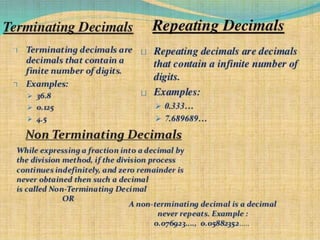
They can be expressed as Terminating &
Non - Terminating Repeating Numbers
Examples -> 1. 56345467.39472348793
2. 90347809732.453653643
3. 3247034729387403847923748039247982374923
4. 6666.66 5. 0.00000000000003
6. 200 7. 19.1 ETC.
______________
___
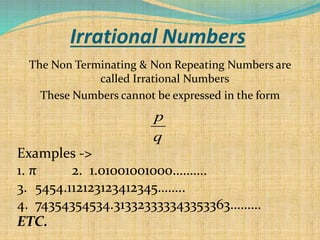
Irrational Numbers
The Non Terminating & Non Repeating Numbers are
called Irrational Numbers
These Numbers cannot be expressed in the form
q
p
Examples ->
1. π 2. 1.01001001000……….
3. 5454.112123123412345……..
4. 74354354534.313323333343353363………
ETC.
Real Numbers
The sum of all Rational & Irrational numbers
is called Real Numbers
It is denoted by letter ‘R’
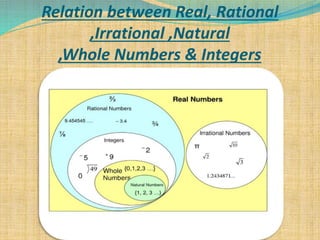
Relation between Real, Rational
,Irrational ,Natural
,Whole Numbers & Integers
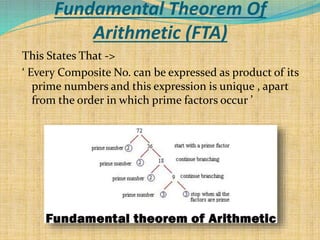
Fundamental Theorem Of
Arithmetic (FTA)
This States That ->
‘ Every Composite No. can be expressed as product of its
prime numbers and this expression is unique , apart
from the order in which prime factors occur ’
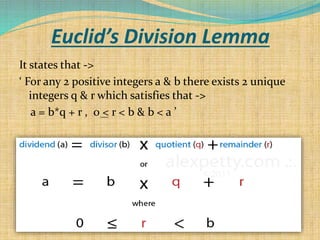
Euclid’s Division Lemma
It states that ->
‘ For any 2 positive integers a & b there exists 2 unique
integers q & r which satisfies that ->
a = b*q + r , 0 < r < b & b < a ’__
Prepared By ->
BHAVYAM ARORA
Class = Tenth ‘A’
Roll No. = 37

Real numbers

  • 1.
  • 2.
    Natural Numbers The positivecounting numbers starting from 1 not including zero are called Natural Numbers These are denoted by ‘N’ Letter 21 22 23 24 ………. All are Natural Numbers
  • 3.
    Whole Numbers All thenatural numbers including zero [0] are called Whole Numbers These are denoted by letter ‘W’ 10 11 12 …… All are Whole Numbers
  • 4.
    Integers All positive &negative numbers which can be represented on number line are called Integers We can say that integers are set of natural numbers & their opposites & zero These are denoted by letter ‘Z’ {…,-3, -2, -1, 0, 1, 2, 3,…}
  • 6.
    Rational Numbers q p The numberswhich can be written in the form where p & q are integers ; q ≠ 0 are called Rational numbers They can be expressed as Terminating & Non - Terminating Repeating Numbers Examples -> 1. 56345467.39472348793 2. 90347809732.453653643 3. 3247034729387403847923748039247982374923 4. 6666.66 5. 0.00000000000003 6. 200 7. 19.1 ETC. ______________ ___
  • 7.
    Irrational Numbers The NonTerminating & Non Repeating Numbers are called Irrational Numbers These Numbers cannot be expressed in the form q p Examples -> 1. π 2. 1.01001001000………. 3. 5454.112123123412345…….. 4. 74354354534.313323333343353363……… ETC.
  • 8.
    Real Numbers The sumof all Rational & Irrational numbers is called Real Numbers It is denoted by letter ‘R’
  • 9.
    Relation between Real,Rational ,Irrational ,Natural ,Whole Numbers & Integers
  • 11.
    Fundamental Theorem Of Arithmetic(FTA) This States That -> ‘ Every Composite No. can be expressed as product of its prime numbers and this expression is unique , apart from the order in which prime factors occur ’
  • 13.
    Euclid’s Division Lemma Itstates that -> ‘ For any 2 positive integers a & b there exists 2 unique integers q & r which satisfies that -> a = b*q + r , 0 < r < b & b < a ’__
  • 15.
    Prepared By -> BHAVYAMARORA Class = Tenth ‘A’ Roll No. = 37