The Basics & The New Lessons www.real-english.com An introduction to
Outline The Basics for those new to Real English What’s different about Real English? Adding a 2.0 Social Dimension to a Traditional Site On the Street: Our Filming Campaigns MAIN SECTION – The New Lessons: MULTImedia as a Necessity The Problem of a Cool Domain Name Lesson Conclusions
The Basics Part 1 Real English is primarily an online program for learning English as a Second of Foreign Language, used by  teachers  in the classroom who project from their computers, and by students  working on their own.
The Basics Part 2 The entire Real English site, including all videos and lessons, are both free and free-access (only disadvantage in my opinion: no newsletter possible). It has a long history, begun in  1992 . New videos and lessons have been added  every year  since its creation.
There are hundreds, if not thousands, of ESL – EFL learning sites on the web. What makes Real English different? The Basics Part 3
The originality is in the nature of the 2 types of content: 1 - We will look at part of a Real English  video   to illustrate the aspect of  spontaneity  which permeates Real English. 2 - Beginning in 2005, I began to change the exercises for the videos. All the  lessons  now have unique characteristics, as we shall see in a few minutes…
The Real English videos do not include any actors. I suppose pedagogical arguments can be made for slow, artificial speech, but our first keyword  is  spontaneity , with all the difficulties which it creates in practice.
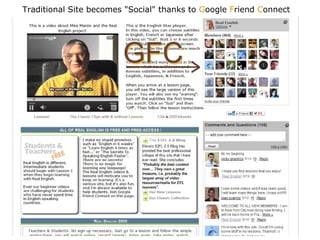
Traditional Site becomes  " Social " thanks to  G oogle  F riend  C onnect
Our street interview campaigns are always fun, but they are also  complicated  affairs which deserve a separate presentation. Beginning with slide 11 we will look at some of the  final results  of these interview campaigns.
Why are the Filming Campaigns So Complicated? Question Preparation (Will they use our target language or structure in their replies?) Approaching people in the street (Who to approach? The laughing couple!  Will they accept to sign a Release Form? – Yes 1/3, No 2/3) One out of ten interviewees are finally used  in Real English edits. There are limits, or  " acceptable levels of spontaneity " , depending on the speed of delivery, general comprehensibility (mumbling, extreme regional accents). I also make mistakes while filming. Finally, we want people who are simply interesting for one reason or another, which also contributes to the  1 out of 10 ratio .
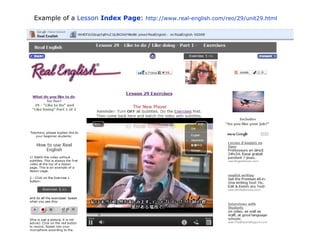
Example of a  Lesson   Index Page :  http://www.real-english.com/reo/29/unit29.html
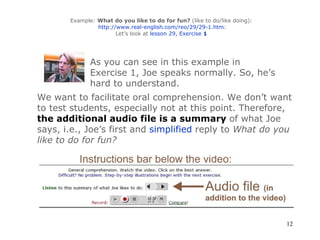
Example:  What do you like to do for fun?  (like to do/like doing):   http://www.real-english.com/reo/29/29-1.htm : Let’s look at  lesson 29, Exercise  1 As you can see in this example in Exercise 1, Joe speaks normally. So, he’s hard to understand.  We want to facilitate oral comprehension. We don’t want to test students, especially not at this point. Therefore,  the additional audio file is a summary   of what Joe says, i.e., Joe’s first and   simplified   reply to  What do you like to do for fun?
Example:  What do you like to do for fun?  (like to do/like doing):   http://www.real-english.com/reo/29/29-1.htm : Let’s look at  lesson 29, Exercise  1 Note that this audio file, a summary of the essential part of his reply in the video, begins to present the student with New Vocabulary in a casual way. Joe’s last words are "[I like]  sitting around with folks, talking ." On the other hand, " sitting around with folks, talking " is not included in the exercise as a  correct  answer. Instead, the student can choose the answer including  socializing , which of course is a synonym. He might begin to learn new vocabulary by a process of elimination in this MC exercise. If not, he will learn  socialize  in exercise 5.
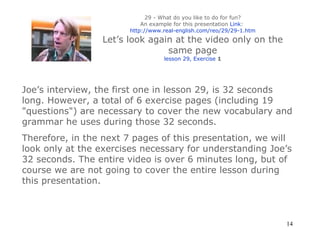
29 - What do you like to do for fun? An example for this presentation  Link :  http://www.real-english.com/reo/29/29-1.htm Let’s look again at the video only on the same page lesson 29, Exercise  1 Joe’s interview, the first one in lesson 29, is 32 seconds long. However, a total of 6 exercise pages (including 19 "questions") are necessary to cover the new vocabulary and grammar he uses during those 32 seconds.  Therefore, in the next 7 pages of this presentation, we will look only   at the exercises necessary for understanding Joe’s 32 seconds. The entire video is over 6 minutes long, but of course we are not going to cover the entire lesson during this presentation.
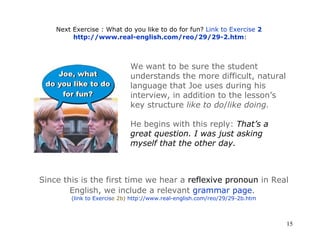
Next Exercise : What do you like to do for fun?  Link to Exercise  2   http://www.real-english.com/reo/29/29-2.htm : We want to be sure the student understands the more difficult, natural language that Joe uses during his interview, in addition to the lesson’s key structure  like to do / like doing. He begins with this reply:  That’s a great question. I was just asking myself that the other day. Since this is the first time we hear a  reflexive pronoun  in Real English, we include a relevant  grammar page .   (link to Exerci s e 2b)   http://www.real-english.com/reo/29/29-2b.htm
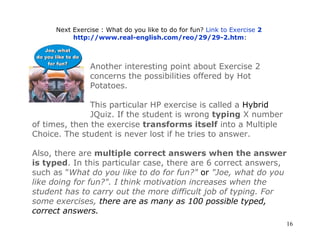
Next Exercise : What do you like to do for fun?  Link to Exercise  2   http://www.real-english.com/reo/29/29-2.htm : Another interesting point about Exercise 2 concerns the possibilities offered by Hot Potatoes. This particular HP exercise is called a  Hybrid  JQuiz. If the student is wrong  typing  X number of times, then the exercise  transforms itself  into a Multiple Choice. The student is never lost if he tries to answer. Also, there are  multiple correct answers when the answer is typed . In this particular case, there are 6 correct answers, such as  " What do you like to do for fun?"  or   "Joe, what do you like doing for fun?". I think motivation increases when the student has to carry out the more difficult job of typing. For some exercises,  there are as many as 100 possible typed, correct answers.
Getting back to  the grammar page    http://www.real-english.com/reo/29/29- 2b .htm   concerning reflexive pronouns:  this grammar section exists only because of the way Joe answers the question.  Course organization is turned upside down to a certain extent.  Spontaneous speech determines what is covered in the exercises, not the  " author " . At the same time, I attempt to grade and correlate these results of spontaneous speech with EFL methods from the Big Publishers so that Real English can always be used by a teacher as a complement to a main method. As you can see, my grammar pages are traditional, but with sound files and the record/compare java applet for pronunciation. Joe begins his reply:  " I  was just  asking myself  that the other day. "
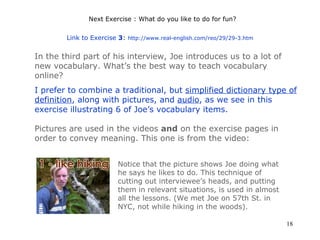
Next Exercise : What do you like to do for fun? Link to Exercise  3 :  http://www.real-english.com/reo/29/29-3.htm   In the third part of his interview, Joe introduces us to a lot of new vocabulary. What’s the best way to teach vocabulary online? I prefer to combine a traditional, but  simplified dictionary type of  definition , along with  pictures , and  audio , as we see in this exercise illustrating 6 of Joe’s vocabulary items. Pictures are used in the videos  and  on the exercise pages in order to convey meaning. This one is from the video: Notice that the picture shows Joe doing what he says he likes to do. This technique of cutting out interviewee’s heads, and putting them in relevant situations, is used in almost all the lessons. (We met Joe on 57th St. in NYC, not while hiking in the woods).
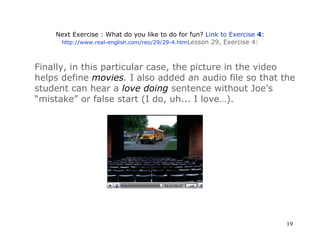
Next Exercise : What do you like to do for fun?  Link to Exercise  4 : http://www.real-english.com/reo/29/29-4.htm Lesson 29, Exercise 4 : Finally, in this particular case, the picture in the video helps define  movies .  I also added an audio file so that the student can hear a  love doing  sentence without Joe’s  “mistake” or false start (I do, uh... I love…).
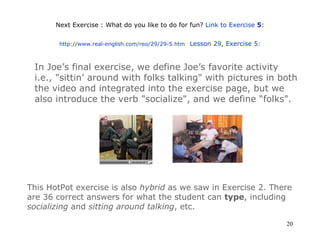
Next Exercise : What do you like to do for fun?  Link to Exercise  5 : http://www.real-english.com/reo/29/29-5.htm   Lesson 29, Exercise 5 : In Joe’s final exercise, we define Joe’s favorite activity i.e.,  " sittin’ around with folks talking "  with pictures in both the video and integrated into the exercise page, but we also introduce the verb  " socialize ", and we define “folks".   This HotPot exercise is also  hybrid  as we saw in Exercise 2. There are 36 correct answers for what the student can  type , including  socializing  and  sitting around talking , etc.
Examples of Other Types of Exercises / Lessons  1/2   (in case we have more presentation time) An example of « French Bubbles » http://www.real-english.com/reo/2/unit2.html   An example of unusable speech, nevertheless used as an illustration: http://www.real-english.com/reo/38/38-15.htm Grammar in context, example: http://www.real-english.com/reo/37/37-1.htm Example of a contribution from an exercise maker: http://www.real-english.com/reo/32/unit32.html  (Birgit Ferran) Combo: my exercises with contributor exercise (Glenys Hanson) http://www.real-english.com/reo/53/unit53.html
Examples of Other Types of Exercises / Lessons  2/2   (in case we have more presentation time) One of many examples contrasting American and British usages:  http ://www.real-english.com/reo/38/38-7.htm Multiple videos on 1 page: http ://www.real-english.com/reo/38/38-11.htm and small videos for Drag &  Drop: http://www.real-english.com/reo/23/23-12.htm   The  " old approach ":   http://www.real-english.com/reo/7/7-1.htm Grammar Practice before watching video: http://www.real-english.com/reo/19/19-1.htm Example of an advanced lesson: http ://www.real-english.com/reo/55/unit55.html
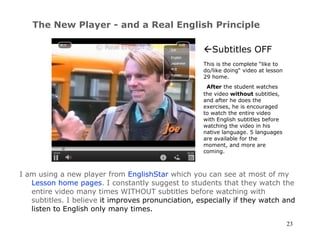
The New Player - and a Real English Principle I am using a new player from  EnglishStar  which you can see at most of my  Lesson home pages . I constantly suggest to students that they watch the entire video many times WITHOUT subtitles before watching with subtitles. I believe  it improves pronunciation, especially if they watch and listen to English only many times.   Subtitles OFF This is the complete  “like to do/like doing“ video at lesson 29 home.   After  the student watches the video  without  subtitles, and after he does the exercises, he is encouraged to watch the entire video with English subtitles before watching the video in his native language. 5 languages are available for the moment, and more are coming.
PS: the Problem of a Cool Domain Name Trademark as opposed to Copyright 3 court cases since 1994 (never lost a court case but always expensive) Winning is loosing, especially internationally And today  " Learn  Real English".
Conclusions 1/2 Spontaneous street speech defines the  course content and organization  of Real English to a large extent. Elements which help make the ( apparently difficult ) videos  accessible  and useful include the addition of  explanatory pictures and additional audio files . Multimedia is a necessity, not an add-on. The record/compare applet enables students to practice their pronunciation. We thereby cover  all   4 skills  in our lessons: speaking, reading, writing (keyboarding), and of course listening,  hopefully lots of listening before all else .
Conclusions 2/2 The exercise content of the Lessons are all  ongoing experiments . I can never be sure an exercise will work until I see one of my students working on the exercises on my computer. Strange as it seems, the  " beginner "  videos are often as difficult as the  " upper intermediate "  videos due to the nature of real English. Example: my so-called  " advanced students "  often have problems with lesson 3 (spelling, which follows the introduction to the alphabet), simply because they have not spent enough time in English-speaking countries, i.e.,  for lack of extended listening practice , and often despite their good results in international exams.

Real English Final Version Wiaoc09

  • 1.
    The Basics &The New Lessons www.real-english.com An introduction to
  • 2.
    Outline The Basicsfor those new to Real English What’s different about Real English? Adding a 2.0 Social Dimension to a Traditional Site On the Street: Our Filming Campaigns MAIN SECTION – The New Lessons: MULTImedia as a Necessity The Problem of a Cool Domain Name Lesson Conclusions
  • 3.
    The Basics Part1 Real English is primarily an online program for learning English as a Second of Foreign Language, used by teachers in the classroom who project from their computers, and by students working on their own.
  • 4.
    The Basics Part2 The entire Real English site, including all videos and lessons, are both free and free-access (only disadvantage in my opinion: no newsletter possible). It has a long history, begun in 1992 . New videos and lessons have been added every year since its creation.
  • 5.
    There are hundreds,if not thousands, of ESL – EFL learning sites on the web. What makes Real English different? The Basics Part 3
  • 6.
    The originality isin the nature of the 2 types of content: 1 - We will look at part of a Real English video to illustrate the aspect of spontaneity which permeates Real English. 2 - Beginning in 2005, I began to change the exercises for the videos. All the lessons now have unique characteristics, as we shall see in a few minutes…
  • 7.
    The Real Englishvideos do not include any actors. I suppose pedagogical arguments can be made for slow, artificial speech, but our first keyword is spontaneity , with all the difficulties which it creates in practice.
  • 8.
    Traditional Site becomes " Social " thanks to G oogle F riend C onnect
  • 9.
    Our street interviewcampaigns are always fun, but they are also complicated affairs which deserve a separate presentation. Beginning with slide 11 we will look at some of the final results of these interview campaigns.
  • 10.
    Why are theFilming Campaigns So Complicated? Question Preparation (Will they use our target language or structure in their replies?) Approaching people in the street (Who to approach? The laughing couple! Will they accept to sign a Release Form? – Yes 1/3, No 2/3) One out of ten interviewees are finally used in Real English edits. There are limits, or " acceptable levels of spontaneity " , depending on the speed of delivery, general comprehensibility (mumbling, extreme regional accents). I also make mistakes while filming. Finally, we want people who are simply interesting for one reason or another, which also contributes to the 1 out of 10 ratio .
  • 11.
    Example of a Lesson Index Page : http://www.real-english.com/reo/29/unit29.html
  • 12.
    Example: Whatdo you like to do for fun? (like to do/like doing): http://www.real-english.com/reo/29/29-1.htm : Let’s look at lesson 29, Exercise 1 As you can see in this example in Exercise 1, Joe speaks normally. So, he’s hard to understand. We want to facilitate oral comprehension. We don’t want to test students, especially not at this point. Therefore, the additional audio file is a summary of what Joe says, i.e., Joe’s first and simplified reply to What do you like to do for fun?
  • 13.
    Example: Whatdo you like to do for fun? (like to do/like doing): http://www.real-english.com/reo/29/29-1.htm : Let’s look at lesson 29, Exercise 1 Note that this audio file, a summary of the essential part of his reply in the video, begins to present the student with New Vocabulary in a casual way. Joe’s last words are "[I like] sitting around with folks, talking ." On the other hand, " sitting around with folks, talking " is not included in the exercise as a correct answer. Instead, the student can choose the answer including socializing , which of course is a synonym. He might begin to learn new vocabulary by a process of elimination in this MC exercise. If not, he will learn socialize in exercise 5.
  • 14.
    29 - Whatdo you like to do for fun? An example for this presentation Link : http://www.real-english.com/reo/29/29-1.htm Let’s look again at the video only on the same page lesson 29, Exercise 1 Joe’s interview, the first one in lesson 29, is 32 seconds long. However, a total of 6 exercise pages (including 19 "questions") are necessary to cover the new vocabulary and grammar he uses during those 32 seconds. Therefore, in the next 7 pages of this presentation, we will look only at the exercises necessary for understanding Joe’s 32 seconds. The entire video is over 6 minutes long, but of course we are not going to cover the entire lesson during this presentation.
  • 15.
    Next Exercise :What do you like to do for fun? Link to Exercise 2 http://www.real-english.com/reo/29/29-2.htm : We want to be sure the student understands the more difficult, natural language that Joe uses during his interview, in addition to the lesson’s key structure like to do / like doing. He begins with this reply: That’s a great question. I was just asking myself that the other day. Since this is the first time we hear a reflexive pronoun in Real English, we include a relevant grammar page . (link to Exerci s e 2b) http://www.real-english.com/reo/29/29-2b.htm
  • 16.
    Next Exercise :What do you like to do for fun? Link to Exercise 2 http://www.real-english.com/reo/29/29-2.htm : Another interesting point about Exercise 2 concerns the possibilities offered by Hot Potatoes. This particular HP exercise is called a Hybrid JQuiz. If the student is wrong typing X number of times, then the exercise transforms itself into a Multiple Choice. The student is never lost if he tries to answer. Also, there are multiple correct answers when the answer is typed . In this particular case, there are 6 correct answers, such as " What do you like to do for fun?" or "Joe, what do you like doing for fun?". I think motivation increases when the student has to carry out the more difficult job of typing. For some exercises, there are as many as 100 possible typed, correct answers.
  • 17.
    Getting back to the grammar page http://www.real-english.com/reo/29/29- 2b .htm concerning reflexive pronouns: this grammar section exists only because of the way Joe answers the question. Course organization is turned upside down to a certain extent. Spontaneous speech determines what is covered in the exercises, not the " author " . At the same time, I attempt to grade and correlate these results of spontaneous speech with EFL methods from the Big Publishers so that Real English can always be used by a teacher as a complement to a main method. As you can see, my grammar pages are traditional, but with sound files and the record/compare java applet for pronunciation. Joe begins his reply: " I was just asking myself that the other day. "
  • 18.
    Next Exercise :What do you like to do for fun? Link to Exercise 3 : http://www.real-english.com/reo/29/29-3.htm In the third part of his interview, Joe introduces us to a lot of new vocabulary. What’s the best way to teach vocabulary online? I prefer to combine a traditional, but simplified dictionary type of definition , along with pictures , and audio , as we see in this exercise illustrating 6 of Joe’s vocabulary items. Pictures are used in the videos and on the exercise pages in order to convey meaning. This one is from the video: Notice that the picture shows Joe doing what he says he likes to do. This technique of cutting out interviewee’s heads, and putting them in relevant situations, is used in almost all the lessons. (We met Joe on 57th St. in NYC, not while hiking in the woods).
  • 19.
    Next Exercise :What do you like to do for fun? Link to Exercise 4 : http://www.real-english.com/reo/29/29-4.htm Lesson 29, Exercise 4 : Finally, in this particular case, the picture in the video helps define movies . I also added an audio file so that the student can hear a love doing sentence without Joe’s “mistake” or false start (I do, uh... I love…).
  • 20.
    Next Exercise :What do you like to do for fun? Link to Exercise 5 : http://www.real-english.com/reo/29/29-5.htm Lesson 29, Exercise 5 : In Joe’s final exercise, we define Joe’s favorite activity i.e., " sittin’ around with folks talking " with pictures in both the video and integrated into the exercise page, but we also introduce the verb " socialize ", and we define “folks". This HotPot exercise is also hybrid as we saw in Exercise 2. There are 36 correct answers for what the student can type , including socializing and sitting around talking , etc.
  • 21.
    Examples of OtherTypes of Exercises / Lessons 1/2 (in case we have more presentation time) An example of « French Bubbles » http://www.real-english.com/reo/2/unit2.html An example of unusable speech, nevertheless used as an illustration: http://www.real-english.com/reo/38/38-15.htm Grammar in context, example: http://www.real-english.com/reo/37/37-1.htm Example of a contribution from an exercise maker: http://www.real-english.com/reo/32/unit32.html (Birgit Ferran) Combo: my exercises with contributor exercise (Glenys Hanson) http://www.real-english.com/reo/53/unit53.html
  • 22.
    Examples of OtherTypes of Exercises / Lessons 2/2 (in case we have more presentation time) One of many examples contrasting American and British usages: http ://www.real-english.com/reo/38/38-7.htm Multiple videos on 1 page: http ://www.real-english.com/reo/38/38-11.htm and small videos for Drag & Drop: http://www.real-english.com/reo/23/23-12.htm The " old approach ": http://www.real-english.com/reo/7/7-1.htm Grammar Practice before watching video: http://www.real-english.com/reo/19/19-1.htm Example of an advanced lesson: http ://www.real-english.com/reo/55/unit55.html
  • 23.
    The New Player- and a Real English Principle I am using a new player from EnglishStar which you can see at most of my Lesson home pages . I constantly suggest to students that they watch the entire video many times WITHOUT subtitles before watching with subtitles. I believe it improves pronunciation, especially if they watch and listen to English only many times.  Subtitles OFF This is the complete “like to do/like doing“ video at lesson 29 home. After the student watches the video without subtitles, and after he does the exercises, he is encouraged to watch the entire video with English subtitles before watching the video in his native language. 5 languages are available for the moment, and more are coming.
  • 24.
    PS: the Problemof a Cool Domain Name Trademark as opposed to Copyright 3 court cases since 1994 (never lost a court case but always expensive) Winning is loosing, especially internationally And today " Learn Real English".
  • 25.
    Conclusions 1/2 Spontaneousstreet speech defines the course content and organization of Real English to a large extent. Elements which help make the ( apparently difficult ) videos accessible and useful include the addition of explanatory pictures and additional audio files . Multimedia is a necessity, not an add-on. The record/compare applet enables students to practice their pronunciation. We thereby cover all 4 skills in our lessons: speaking, reading, writing (keyboarding), and of course listening, hopefully lots of listening before all else .
  • 26.
    Conclusions 2/2 Theexercise content of the Lessons are all ongoing experiments . I can never be sure an exercise will work until I see one of my students working on the exercises on my computer. Strange as it seems, the " beginner " videos are often as difficult as the " upper intermediate " videos due to the nature of real English. Example: my so-called " advanced students " often have problems with lesson 3 (spelling, which follows the introduction to the alphabet), simply because they have not spent enough time in English-speaking countries, i.e., for lack of extended listening practice , and often despite their good results in international exams.