��---�IC:)C,;c_,:,.;..r�,"
e>o
�.,.
irLanguage
www.irLanguage.com
OXFORD
UNIVERSITY PRESS
Jack C. Richards
David Bohlke
Carmella Lieske
‫اﯾﺮاﻧﯿﺎن‬ ‫زﺑﺎن‬ ‫ﻣﺮﺟﻊ‬ ‫ﻟﻮﮔﻮى‬ ‫ﺑﺎ‬ ‫ﻣﺠﻤﻮﻋﻪ‬ ‫اﯾﻦ‬
‫اﺳﺖ‬ ‫رﺳﯿﺪه‬ ‫ﺛﺒﺖ‬ ‫ﺑﻪ‬ ‫ﺣﺎﻣﻞ‬ ‫و‬ ‫ﺑﺮﺧﻂ‬ ‫ﻧﺸﺮ‬ ‫ﺻﻮرت‬ ‫ﺑﻪ‬
‫ﺷﺪ‬ ‫ﺧﻮاﻫﺪ‬ ‫ﭘﯿﮕﺮد‬ ‫ﺷﺎﻣﻞ‬ ‫اﺳﺖ‬ ‫اﺧﻼق‬ ‫و‬ ‫ﺷﺮع‬ ،‫ﻗﺎﻧﻮن‬ ‫ﺧﻼف‬ ‫آن‬ ‫از‬ ‫ﺑﺮدارى‬ ‫.ﮐﭙﻰ‬
s��
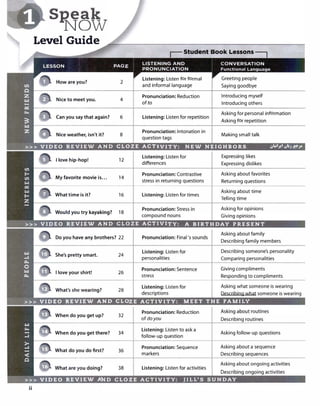
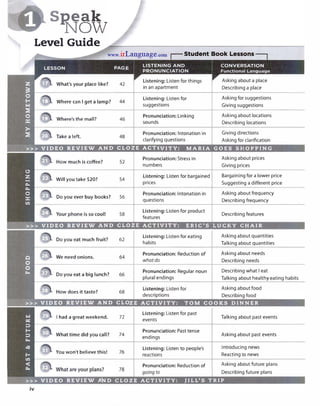
Level Guide
How are you? 2
Nice to meet you. 4
Can you say that again? 6
Nice weather, isn't it? 8
I love hip-hop! 12
My favorite movie is... 14
What time is it? 16
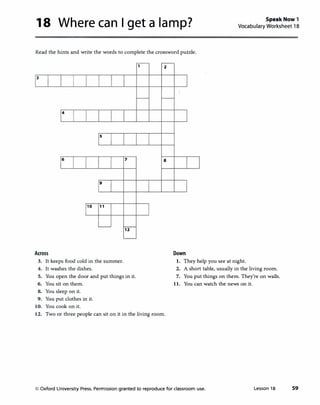
18
Do you have any brothers? 22
She's pretty smart. 24
I love your shirt! 26
When do you get up? 32
When do you get there? 34
What do you do first? 36
38
Listening: Listen for formal
and informal language
Pronunciation: Reduction
of to
Listening: Listen for repetition
Pronunciation: Intonation in
question tags
Listening: Listen for
differences
Pronunciation: Contrastive
stress in returning questions
Listening: Listen for times
Pronunciation: Stress in
compound nouns
Pronunciation: Final 's sounds
Listening: Listen for
personalities
Pronunciation: Sentence
stress
Pronunciation: Reduction
of do you
Listening: Listen to ask a
follow-up question
Pronunciation: Sequence
markers
Listening: Listen for activities
Greeting people
Saying goodbye
Introducing myself
Introducing others
Asking for personal information
Asking for repetition
Making small talk
Expressing likes
Expressing dislikes
Asking about favorites
Returning questions
Asking about time
Telling time
Asking for opinions
Asking about family
Describing family members
Describing someone's personality
Comparing personalities
Giving compliments
Responding to compliments
Asking what someone is wearing
Describing what someone is wearing
Describing routines
Asking follow-up questions
Asking about a sequence
Describing sequences
Asking about ongoing activities
a
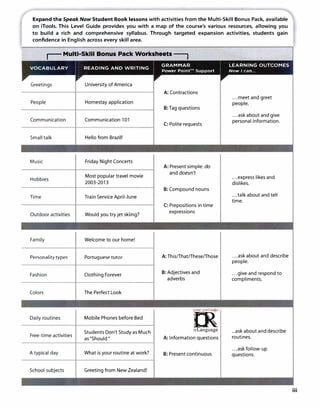
Expand the Speak Now Student Book lessons with activities from the Multi-Skill Bonus Pack, available
on iTools. This Level Guide provides you with a map of the course's various resources, allowing you
to build a rich and comprehensive syllabus. Through targeted expansion activities, students gain
confidence in English across every skill area.
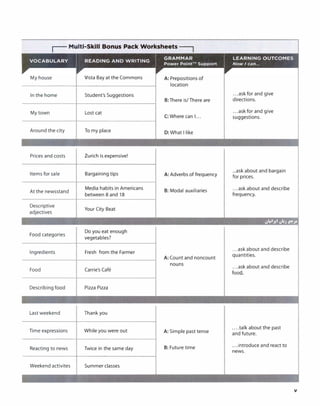
i-- Multi-Skill Bonus Pack Worksheets-----,
VOCABULARY READING AND WRITING
GRA
MM�
R LEARNING OUTCO
M
ES
Power Point™
Support Now I can...
Greetings
People
Communication
Small talk
Music
Hobbies
Time
Outdoor activities
Family
Personality types
Fashion
Colors
Daily routines
Free-time activities
A typical day
School subjects
University of America
Homestay application
Communication 101
Hello from Brazil!
Friday Night Concerts
Most popular travel movie
2003-2013
Train Service April-June
Would you try jet skiing?
Welcome to our home!
Portuguese tutor
Clothing Forever
The Perfect Look
Mobile Phones before Bed
Students Don't Study as Much
as"Should"
What is your routine at work?
Greeting from New Zealand!
A: Contractions
B: Tag questions
C: Polite requests
A: Present simple: do
and doesn't
B: Compound nouns
C: Prepositions in time
expressions
A: This/That/These/Those
B: Adjectives and
adverbs
�m.i..•o,;C,1',=,0
�irLanguage
A: Information questions
B: Present continuous
...meet and greet
people.
...ask about and give
personal information.
...express likes and
dislikes.
...talk about and tell
time.
...ask about and describe
people.
...give and respond to
compliments.
...ask about and describe
routines.
...ask follow-up
questions.
iii
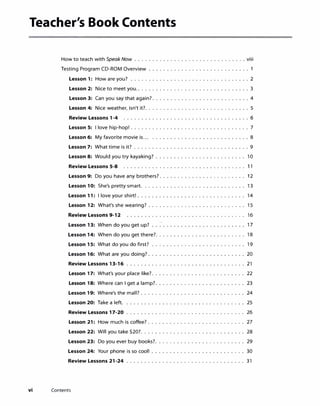
s��tLevel Guide
What's your place like? 42
Listening: Listen for things Asking about a place
in an apartment Describing a place
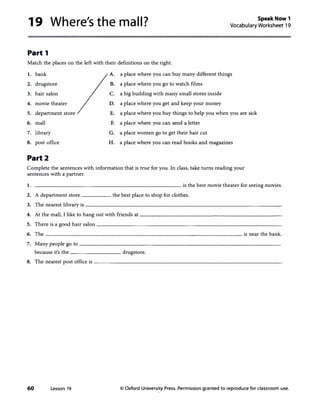
Where can I get a lamp? 44
Listening: Listen for Asking for suggestions
suggestions Giving suggestions
46
Pronunciation: Linking Asking about locations
sounds Describing locations
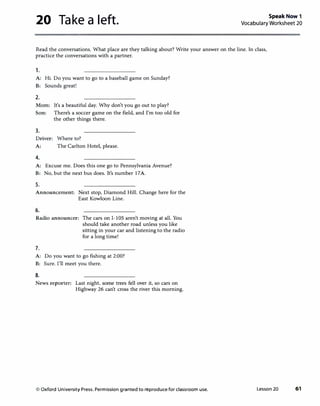
Take a left. 48
Pronunciation: Intonation in Giving directions
clarifying questions Asking for clarification
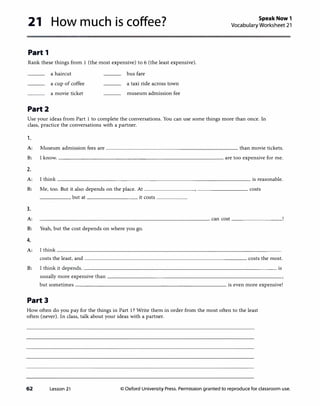
How much is coffee? 52
Pronunciation: Stress in Asking about prices
numbers Giving prices
Will you take $20? 54
Listening: Listen for bargained Bargaining for a lower price
prices Suggesting a different price
Do you ever buy books? 56
Pronunciation: Intonation in Asking about frequency
questions Describing frequency
58
Listening: Listen for product
Describing features
features
Do you eat much fruit? 62
Listening: Listen for eating Asking about quantities
habits Talking about quantities
We need onions. 64
Pronunciation: Reduction of Asking about needs
what do Describing needs
Do you eat a big lunch? 66
Pronunciation: Regular noun Describing what I eat
plural endings Talking about healthy eating habits
How does it taste? 68
Asking about food
I had a great weekend. 72
Listening: Listen for past
Talking about past events
events
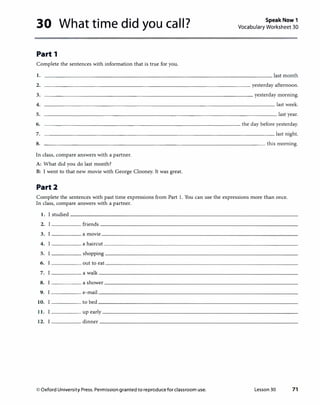
What time did you call? 74
Pronunciation: Past tense
endings
Asking about past events
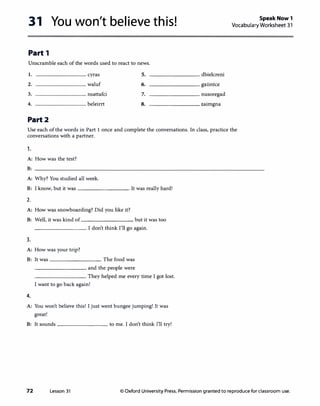
You won't believe this! 76
Listening: Listen to people's Introducing news
reactions Reacting to news
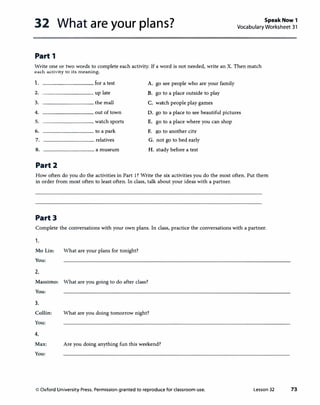
78
Pronunciation: Reduction of Asking about future plans
going to Describing future plans
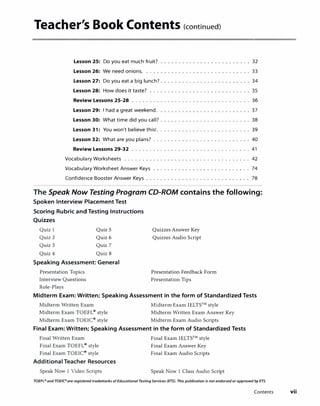
My house
In the home
My town
Around the city
Prices and costs
Items for sale
At the newsstand
Descriptive
adjectives
Food categories
Ingredients
Food
Describing food
Last weekend
Time expressions
Reacting to news
Weekend activites
Vista Bay at the Commons
Student's Suggestions
Lost cat
To my place
Zurich is expensive!
Bargaining tips
Media habits in Americans
between 8 and 18
Your City Beat
Do you eat enough
vegetables?
Fresh from the Farmer
Carrie's Cafe
Pizza Pizza
Thank you
While you were out
Twice in the same day
Summer classes
A: Prepositions of
location
B: There is/ There are
C:Where can I...
D:What I like
A:Adverbs of frequency
B: Modal auxiliaries
A:Count and noncount
nouns
A: Simple past tense
B: Future time
...ask for and give
directions.
...ask for and give
suggestions.
...ask about and bargain
for prices.
...ask about and describe
frequency.
...ask about and describe
quantities.
...ask about and describe
food.
....talk about the past
and future.
. ..introduce and react to
news.
v
Teacher's Book Contents
How to teach with Speak Now ...............................viii
Testing Program CD-ROM Overview ............................ 1
Lesson 1: How are you? ................................. 2
Lesson 2: Nice to meet you................................3
Lesson 3: Can you say that again?...........................4
Lesson 4: Nice weather, isn't it?............................. 5
Review Lessons 1-4 ................................... 6
Lesson 5: I love hip-hop! ................................. 7
Lesson 6: My favorite movie is... ........................... 8
Lesson 7: What time is it? ................................9
Lesson 8: Would you try kayaking? ......................... 10
Review Lessons 5-8 .................. . .... . .......... 1 1
Lesson 9: Do you have any brothers?........................ 12
Lesson 10: She's pretty smart. ............................ 13
Lesson 11: I love your shirt! .............................. 14
Lesson 12: What's she wearing? ........................... 15
Review Lessons 9-12 ........................ 16
Lesson 13: When do you get up? 17
Lesson 14: When do you get there?. 18
Lesson 15: What do you do first? 19
Lesson 16: What are you doing? . 20
Review Lessons 13-16 ................... . ............. 21
Lesson 17: What's your place like?.......................... 22
Lesson 18: Where can I get a lamp?......................... 23
Lesson 19: Where's the mall? ............................. 24
Lesson 20: Take a left. ................................. 25
Review Lessons 17-20 ........................ 26
Lesson 21: How much is coffee? ........................... 27
Lesson 22: Will you take $20?............................. 28
Lesson 23: Do you ever buy books?............... . ......... 29
Lesson 24: Your phone is so cool! .......................... 30
Review Lessons 21-24 ................................. 31
vi Contents
Teacher's Book Contents (continued)
Lesson 25: Do you eat much fruit?
Lesson 26: We need onions. ....
Lesson 27: Do you eat a big lunch? ....
Lesson 28: How does it taste?
Review Lessons 25-28 .....
Lesson 29: I had a great weekend.
Lesson 30: What time did you call? ..
Lesson 31: You won't believe this! ...
Lesson 32: What are you plans? ...
Review Lessons 29-32 ... . . . . . . .
32
33
34
35
36
37
38
39
40
41
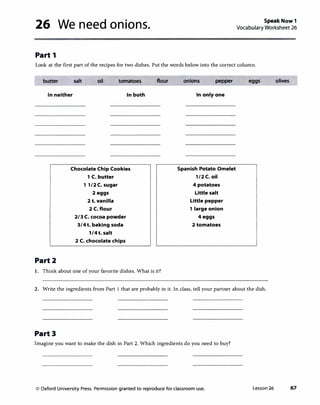
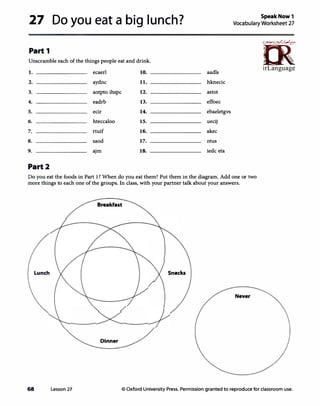
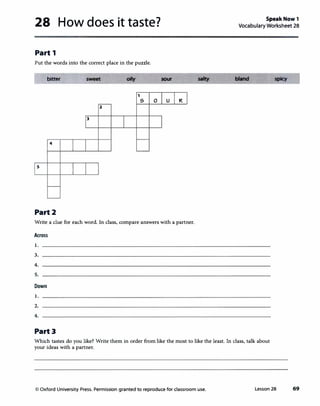
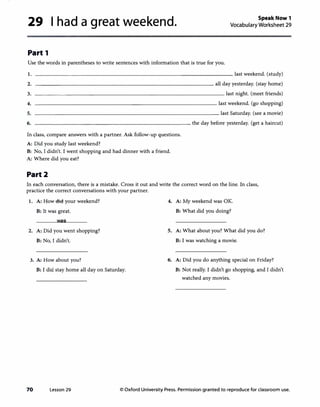
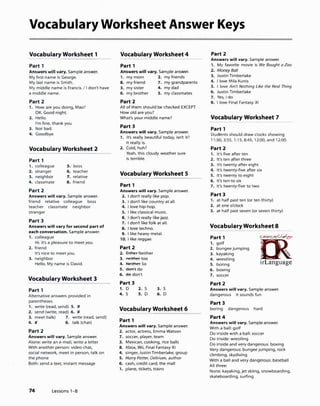
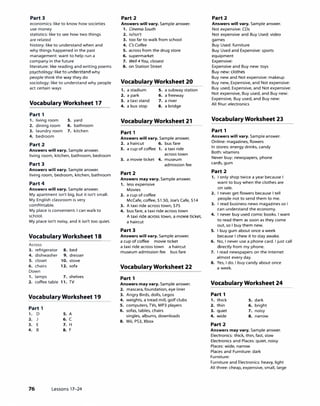
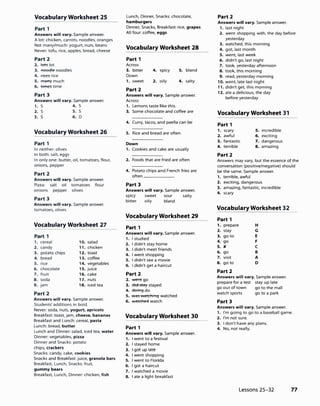
Vocabulary Worksheets ...... ..... .. . .. 42
Vocabulary Worksheet Answer Keys ..... ..... . .. 74
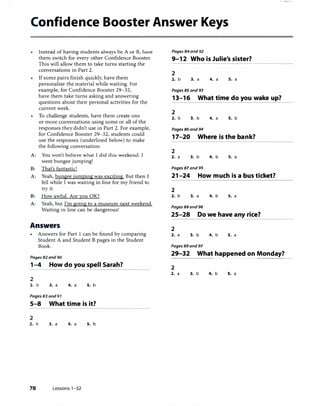
Confidence Booster Answer Keys ....... ..... . .. 78
The Speak Now Testing Program CD-ROM contains the following:
Spoken Interview Placement Test
Scoring Rubric and Testing Instructions
Quizzes
Quiz 1
Quiz 2
Quiz 5
Quiz 6
Quiz 3 Quiz 7
Quiz 4 Quiz 8
Speaking Assessment: General
Presentation Topics
Quizzes Answer Key
Quizzes Audio Script
Presentation Feedback Form
Interview Questions Presentation Tips
Role-Plays
Midterm Exam: Written; Speaking Assessment in the form of Standardized Tests
Midterm Written Exam Midterm Exam IELTS™
style
Midterm Exam TOEFL®
style Midterm Written Exam Answer Key
Midterm Exam TOEIC®
style Midterm Exam Audio Scripts
Final Exam: Written; Speaking Assessment in the form of Standardized Tests
Final Written Exam
Final Exam TOEFL®
style
Final Exam TOEIC®
style
Additional Teacher Resources
Speak Now 1 Video Scripts
Final Exam IELTS™
style
Final Exam Answer Key
Final Exam Audio Scripts
Speak Now 1 Class Audio Script
TOEFL• and TOE/(• are registered trademarks ofEducational TestingServices (ETS). This publication is not endorsed or approved by ETS.
Contents vii
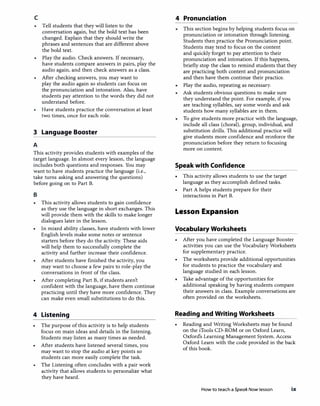
How to teach a SpeakNow lesson
Each lesson has five parts-Vocabulary,
Conversation, Language Booster, Listening or
Pronunciation, and Speak with Confidence.
Lesson Introduction
Read the lesson title as students follow along.
When applicable, have students answer the
question.
Point out the functions they will be studying.
These are listed to the right of the lesson title.
1 Vocabulary
The purpose of this section is to get students
thinking about the topic, activate their background
knowledge, and introduce them to vocabulary that
they will use during the lesson. To prepare the
students to use the vocabulary, preteach it. When
the vocabulary is unfamiliar to your students,
present it through visual aids (for example, photos),
actions, and gestures, and rephrasing or definitions.
If necessary, have students use an English
Learners' dictionary, perhaps before coming to
class, to better understand not only the meanings
but also how to use the words.
• Avoid giving students definitions in their first
language. Although doing so may initially save
time, students do not acquire the language as
thoroughly and will rely on their first language
rather than developing their English ability.
In addition, nuances in languages often vary,
creating additional complications as students
continue to use the language.
When you have time, further reinforce the
vocabulary with personalization (for example,
using the vocabulary in true sentences about
themselves).
2 Conversation
There are two types of lesson patterns for the
Conversation section. Some of the lessons follow the
"Conversation with Substitutions" model and others
follow the "Conversation with Changes" model.
Teaching procedures for each lesson pattern are
outlined below. Both conversations follow the same
procedure for Part A.
viii How to teach a Speak Now Lesson
Conversation with Substitutions
A
B
This section helps students become comfortable
with the topic and provides a model conversation
that uses the functional language from the
Language Booster section.
Read the questions aloud. Ask the students
to guess the answers by looking at the photos
or illustrations. Ask students questions about
details in the art.
Play the audio and select students to answer the
questions. If necessary, play the audio again.
Make sure students understand the answers to
the questions by asking concept questions or
reforming the question to check understanding.
Practice the conversation in Part A.
Have students exchange the green and blue text
as they practice the conversation again. This
activity increases students' awareness of the
different ways we can express the same idea.
Encourage students to practice both roles and
look at each other rather than their books.
Students who finish the activities quickly can
practice the conversation again using their own
phrases and sentences.
In the second type of conversation, there are words
and phrases highlighted in bold. Students are asked
in Part C to listen for differences between the
recorded conversation and the written conversation.
Conversation with Changes�_;:_�������-
A
Follow the same procedure as Conversation with
Substitutions, Part A.
B
By practicing the conversation, students become
more aware of functional language and more
comfortable with language in "chunks". This
prepares them for the Language Booster section and
will also help them notice the changes in Part C.
c
Tell students that they will listen to the
conversation again, but the bold text has been
changed. Explain that they should write the
phrases and sentences that are different above
the bold text.
Play the audio. Check answers. If necessary,
have students compare answers in pairs, play the
audio again, and then check answers as a class.
After checking answers, you may want to
play the audio again so students can focus on
the pronunciation and intonation. Also, have
students pay attention to the words they did not
understand before.
Have students practice the conversation at least
two times, once for each role.
3 Language Booster
A
This activity provides students with examples of the
target language. In almost every lesson, the language
includes both questions and responses. You may
want to have students practice the language (i.e.,
take turns asking and answering the questions)
before going on to Part B.
B
• This activity allows students to gain confidence
as they use the language in short exchanges. This
will provide them with the skills to make longer
dialogues later in the lesson.
• In mixed ability classes, have students with lower
English levels make some notes or sentence
starters before they do the activity. These aids
will help them to successfully complete the
activity and further increase their confidence.
• After students have finished the activity, you
may want to choose a few pairs to role-play the
conversations in front of the class.
• After completing Part B, if students aren't
confident with the language, have them continue
practicing until they have more confidence. They
can make even small substitutions to do this.
4 Listening
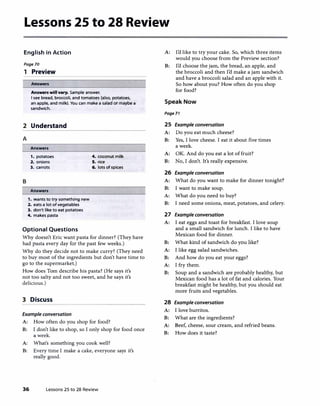
• The purpose of this activity is to help students
focus on main ideas and details in the listening.
Students may listen as many times as needed.
• After students have listened several times, you
may want to stop the audio at key points so
students can more easily complete the task.
The Listening often concludes with a pair work
activity that allows students to personalize what
they have heard.
4 Pronunciation
This section begins by helping students focus on
pronunciation or intonation through listening.
Students then practice the Pronunciation point.
Students may tend to focus on the content
and quickly forget to pay attention to their
pronunciation and intonation. If this happens,
briefly stop the class to remind students that they
are practicing both content and pronunciation
and then have them continue their practice.
Play the audio, repeating as necessary.
Ask students obvious questions to make sure
they understand the point. For example, if you
are teaching syllables, say some words and ask
students how many syllables are in them.
To give students more practice with the language,
include all class (choral), group, individual, and
substitution drills. This additional practice will
give students more confidence and reinforce the
pronunciation before they return to focusing
more on content.
Speak with Confidence
This activity allows students to use the target
language as they accomplish defined tasks.
• Part A helps students prepare for their
interactions in Part B.
Lesson Expansion
Vocabulary Worksheets
After you have completed the Language Booster
activities you can use the Vocabulary Worksheets
for supplementary practice.
• The worksheets provide additional opportunities
for students to practice the vocabulary and
language studied in each lesson.
Take advantage of the opportunities for
additional speaking by having students compare
their answers in class. Example conversations are
often provided on the worksheets.
Reading and Writing Worksheets
• Reading and Writing Worksheets may be found
on the iTools CD-ROM or on Oxford Learn,
Oxford's Learning Management System. Access
Oxford Learn with the code provided in the back
of this book.
How to teach a SpeakNow lesson ix
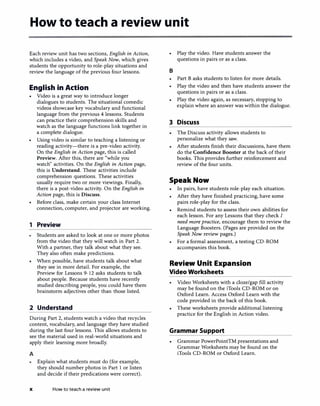
How to teach a review unit
Each review unit has two sections, English in Action,
which includes a video, and Speak Now, which gives
students the opportunity to role-play situations and
review the language of the previous four lessons.
English in Action
• Video is a great way to introduce longer
dialogues to students. The situational comedic
videos showcase key vocabulary and functional
language from the previous 4 lessons. Students
can practice their comprehension skills and
watch as the language functions link together in
a complete dialogue.
• Using video is similar to teaching a listening or
reading activity-there is a pre-video activity.
On the English in Action page, this is called
Preview. After this, there are "while you
watch" activities. On the English in Action page,
this is Understand. These activities include
comprehension questions. These activities
usually require two or more viewings. Finally,
there is a post-video activity. On the English in
Action page, this is Discuss.
• Before class, make certain your class Internet
connection, computer, and projector are working.
1 Preview
Students are asked to look at one or more photos
from the video that they will watch in Part 2.
With a partner, they talk about what they see.
They also often make predictions.
• When possible, have students talk about what
they see in more detail. For example, the
Preview for Lessons 9-12 asks students to talk
about people. Because students have recently
studied describing people, you could have them
brainstorm adjectives other than those listed.
2 Understand
During Part 2, students watch a video that recycles
content, vocabulary, and language they have studied
during the last four lessons. This allows students to
see the material used in real-world situations and
apply their learning more broadly.
A
Explain what students must do (for example,
they should number photos in Part 1 or listen
and decide if their predications were correct).
x How to teach a review unit
• Play the video. Have students answer the
questions in pairs or as a class.
B
Part B asks students to listen for more details.
• Play the video and then have students answer the
questions in pairs or as a class.
Play the video again, as necessary, stopping to
explain where an answer was within the dialogue.
3 Discuss
The Discuss activity allows students to
personalize what they saw.
After students finish their discussions, have them
do the Confidence Booster at the back of their
books. This provides further reinforcement and
review of the four units.
Speak Now
•
In pairs, have students role-play each situation.
After they have finished practicing, have some
pairs role-play for the class.
Remind students to assess their own abilities for
each lesson. For any Lessons that they check I
need more practice, encourage them to review the
Language Boosters. (Pages are provided on the
Speak Now review pages.)
For a formal assessment, a testing CD-ROM
accompanies this book.
Review Unit Expansion
Video Worksheets
• Video Worksheets with a doze/gap fill activity
may be found on the iTools CD-ROM or on
Oxford Learn. Access Oxford Learn with the
code provided in the back of this book.
These worksheets provide additional listening
practice for the English in Action video.
Grammar Support
Grammar PowerPointTM presentations and
Grammar Worksheets may be found on the
iTools CD-ROM or Oxford Learn.
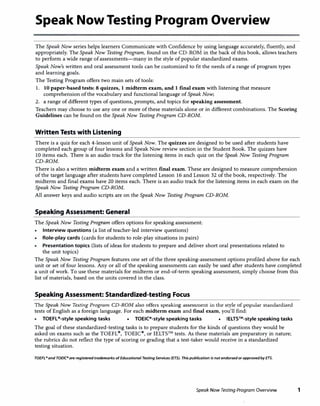
Speak Now Testing Program Overview
The Speak Now series helps learners Communicate with Confidence by using language accurately, fluently, and
appropriately. The Speak Now Testing Program, found on the CD-ROM in the back of this book, allows teachers
to perform a wide range of assessments-many in the style of popular standardized exams.
Speak Now's written and oral assessment tools can be customized to fit the needs of a range of program types
and learning goals.
The Testing Program offers two main sets of tools:
1. 10 paper-based tests: 8 quizzes, I midterm exam, and I final exam with listening that measure
comprehension of the vocabulary and functional language of Speak Now;
2. a range of different types of questions, prompts, and topics for speaking assessment.
Teachers may choose to use any one or more of these materials alone or in different combinations. The Scoring
Guidelines can be found on the Speak Now Testing Program CD-ROM.
Written Tests with Listening
There is a quiz for each 4-lesson unit of Speak Now. The quizzes are designed to be used after students have
completed each group of four lessons and Speak Now review section in the Student Book. The quizzes have
10 items each. There is an audio track for the listening items in each quiz on the Speak Now Testing Program
CD-ROM.
There is also a written midterm exam and a written final exam. These are designed to measure comprehension
of the target language after students have completed Lesson 16 and Lesson 32 of the book, respectively. The
midterm and final exams have 20 items each. There is an audio track for the listening items in each exam on the
Speak Now Testing Program CD-ROM.
AU answer keys and audio scripts are on the Speak Now Testing Program CD-ROM.
Speaking Assessment: General
The Speak Now Testing Program offers options for speaking assessment:
• Interview questions (a list of teacher-led interview questions)
• Role-play cards (cards for students to role-play situations in pairs)
Presentation topics (lists of ideas for students to prepare and deliver short oral presentations related to
the unit topics)
The Speak Now Testing Program features one set of the three speaking-assessment options profiled above for each
unit or set of four lessons. Any or all of the speaking assessments can easily be used after students have completed
a unit of work. To use these materials for midterm or end-of-term speaking assessment, simply choose from this
list of materials, based on the units covered in the class.
Speaking Assessment: Standardized-testing Focus
The Speak Now Testing Program CD-ROM also offers speaking assessment in the style of popular standardized
tests of English as a foreign language. For each midterm exam and final exam, you'll find:
• TOEFL"-style speaking tasks • TOEIC"-style speaking tasks IELTS™-style speaking tasks
The goal of these standardized-testing tasks is to prepare students for the kinds of questions they would be
asked on exams such as the TOEFL11>, TOEIC,z,
, or IELTS™ tests. As these materials are preparatory in nature;
the rubrics do not reflect the type of scoring or grading that a test-taker would receive in a standardized
testing situation.
TOEFL• and TOEIC• are registered trademarks ofEducational TestingServices (ETS). This publication is not endorsed or approved by ETS.
Speak Now Testing Program Overview 1
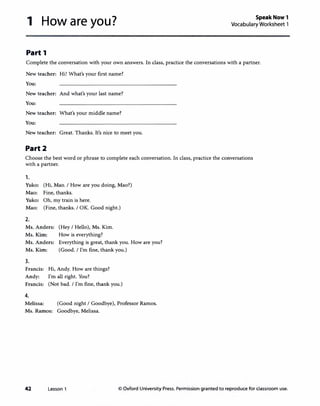
Lesson 1 How are you?
Pagel
1 Vocabulary
A
Answers
Ans-rs will vary. Sample answer.
First Name: Naomi
Middle Name: None
Last Name: Ootani
Explain that last name can also be calledfamily
name since it is your family's name.
If students don't have a middle name, ask them
to omit it or make up a name they would like.
2 Conversation
[CD 1, Track 2)
A
Answers
Steve's last name is Hill.
Emma's middle name Is Lori.
Point out that Steve and Emma shake hands in the
third frame. Explain that how people introduce
themselves varies between cultures, and that in
many Western cultures, shaking hands is common
when first meeting someone. Also explain that we
sometimes shake hands when we see someone again
after a period of time, but shaking hands is more
formal and not often done between close friends.
Optional Question
Are Steve and Emma good friends? (No, they are
meeting for the first time.)
B
Optional Activity
Have students practice the conversation again,
substituting their own names.
2 Lesson 1
Page3
3 Language Booster
A
Tell students that see you is often blended together
and said seeya.
Optional Activity
Ask students with whom they might use informal
(for example, their friends) and formal (for example,
teachers) language.
4 Listening
A
[CD l, Track 3)
Answers
1. informal 3. informal
2. formal 4. formal
Optional Activity
Have students identify elements of the informal
language. (For example, in Number 1, the speakers
say Hey, Great rather than a complete sentence, and
Yeah. In Number 3, the speakers say Hey and not
bad and ask You?)
B
[CD 1, Track 3)
Answers
1. See you later. 3. Bye!
2. Good night. 4. Goodbye.
Optional Activity
Have students identify how one speaker says they
need to leave. (Number 2: There's my bus. Number
3: I have to go. Number 4: Well, I'm off to work.)
S Speak with Confidence
Encourage students to use formal language with you
and informal language with other classmates.
After practicing, if you want students to use
informal language with you in the class (for
example, to call you by your first name), explain this
to the students.
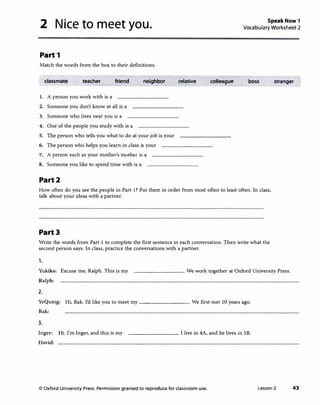
Lesson 2 Nice to meet you.
Page4
1 Vocabulary
A
Answen
Ans-rs will vary. Sample answer.
./ a classmate )( a teacher
./ a neighbor ./ a relative
)( a boss )( a stranger
2 Conversation
[CD 1, Track 4]
A
Answen
Jesse lives in apartment 21.
Tizzy is four months old.
Optional Question
./ a friend
)( a colleague
Who or what is Tizzy? (Tizzy is Alex's cat.)
c
[CD 1, Track SJ
Ans-n
My name is => I'm
I'd like you to meet => this is
No problem. => No worries.
Pages
3 Language Booster
B
Example conversation
A: Hi, everyone. My name is Chie.
B: Hi. My name is Sam.
C: Hello. My name is Massimo.
D: Hello. I'm Danielle.
A: This is Sam.
B: I'd like you to meet Massimo.
Optional Activity
Have students get into small groups. The first
student introduces him-/herself and says one
thing that he/she likes. If appropriate, increase the
challenge by making students say something that
starts with the letter of their name. The second
student repeats what the first person said and then
introduces him-/herself. Play continues until the
first student introduces everyone in the group.
Example conversation
Anna: I'm Anna. I My name's Anna. I like apples.
Bob: This is Anna. She likes apples. I'm Bob. I
like bikes.
Carl: That's Anna. She likes apples. This is Bob.
He likes bikes. I'm Carl. I love cats.
4 Pronunciation
A
[CD 1, Track 6)
•
Have students identify whether to combines with
the word before or after it. (To combines with the
word after it.)
Have students indicate which sound is reduced
(i.e., the o in to almost completely disappears).
S Speak with Confidence
A
c
Answen
Answen will vary. Sample answer.
My first name is Miguel.
My last name is Lopez.
I'm from Peru.
I study at Tokyo University.
Optional Activity
After students have finished Part C, have them get
into small groups and try to introduce all of the
group members to the rest of the group. Encourage
them to say one thing about each person (for
example, where they are from or where they work/
study).
Example conversation
A: Hi, everyone. My name is Jae-sun, and this
is Mark. He's a student at City College. That's
Katie, and she's from Canada. And that's Raul.
He moved here last month.
Lesson 2 3
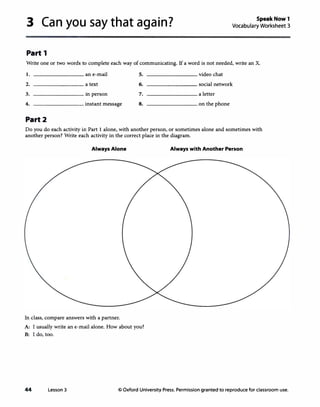
Lesson 3 Can you say that again?
Page6 Page7
1 Vocabulary 3 Language Booster
A A
Answen
Answen will vary. Sample answer.
write an e-mail ./ talk on the phone
write a letter ./ social network
./ instant message
./ send a text
./ meet in person
video chat
If necessary, explain that a text is a message that
is sent from a cell phone or smart phone device.
Also explain that an instant message [IM] is a
message that is in real time. !Ms can be sent
from computers and cell phones.
You may want to explain that a social network
is a group of people who write on the same
Internet site. The people are often related in
some way (for example, friends or people in the
same kind of job).
Optional Activity
Ask students to say other ways they communicate
with people (for example, a blog). If necessary, have
students explain these forms of communication to
their classmates. (For example, a blog is an Internet
site where people write about their experiences
and opinions.)
2 Conversation
[CD 1, Track 7]
A
Answen
Matt needs help with his homework.
Joe's e-mail address is joe@newmail.com.
You may want to discuss the importance of
identifying yourself when making a phone caJI.
For example, Matt could have said, "Hi, Joe. It's
Matt." This would have helped Joe understand
who was calling and avoid confusion.
Explain to students that when saying e-mail
addresses, we say words and abbreviations that
can be understood. For example, we say at for
the symbol @ and dot for any periods found in
e-mail addresses. And we say com rather than
spelling out c-o-m.
You might want to have students practice saying
e-mail addresses.
4 Lesson 3
Have students identify which expressions are
more formal (Can I have your...? Can you give
me your...?).
B
Optional Activity
Teach one response that students can use when they
don't want to give the information (for example,
Sorry. Ia rather not give that to you/say that.).
4 Listening
A
[CD 1, Track 8]
Answers
•· 2 times
B
[CD 1, Track 8]
� Answers
Della
e-mail address:
delial5@snmail.com
cell phone number:
968-8815
work phone number:
752-9947
b. 1 time
Andy
e-mail address:
andy@245mail.com
cell phone number:
361-0018
work phone number:
902-9914
S Speak with Confidence
A
Explain that eye contact is important in English­
speaking countries and encourage students to use
eye contact as they talk to their classmates.
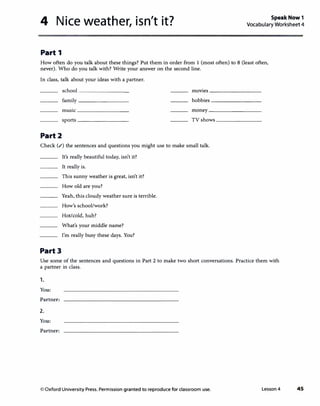
Lesson 4 Nice weather, isn't it?
Page8
1 Vocabulary
A
Answers
Answers will vary. Sample answer.
./ school ./ movies
./ hobbies ./ music
./ sports ./ TV shows
./ family
./ money
2 Conversation
[CD 1, Track 9]
A
Answers
Chris and Maria talk about the weather, being busy,
and music.
No, Maria doesn't like the song.
Point out that Maria hesitates before saying
interesting. Explain that this is one indication she
doesn't really like the music.
• Explain that interesting can have both a positive
and negative meaning. We often use interesting
when we don't want to say something negative
(for example, so we don't hurt the other person's
feelings).
c
Point out that after Chris says I don't have much
free time (an utterance with not), Maria uses
neither to agree. Maria does not use either. Help
students remember this by pointing out that both
start with the letter n.
[CD 1, Track 10]
Answers
It's really nice today=> Nice weather
So, how are things at school?=> How's life?
They're OK.=> Things are OK.
You might want to point out that How are things
at school is not as broad as How's life, which asks
about not only school but also other things currently
happening (for example, your family, your job).
Page9
3 Language Booster
A
Point out the isn't in the tag part of the question.
Have students notice that is is used in the response.
If necessary, have students make other tag questions
and responses (for example, This is a pretty nice
place, isn't it? Yeah, it's fantastic.).
B
If necessary, have students make the questions
before starting to practice.
Examples:
It's really sunny/cloudy, isn't it?
Beautiful/terrible, huh?
How's school/work? (Emphasize we usually don't say
your school/your work. Have students provide the
response: It's OK/great.)
Really hot/cold, isn't it?
You might want to teach a response to disagree (for
example, Not really.).
4 Pronunciation
A
[CD 1, Track 11]
Emphasize that this intonation is used when the
speaker expects the listener to have the same
opinion.
S Speak with Confidence
If necessary, have students brainstorm other
expressions before they start.
Examples:
It's a little warm in here, isn't it?
You aren't in our class, are you?
You sit next to Collin, don't you?
Example conversation
A: It's a little warm in here, isn't it?
B: Yeah, it sure is.
A: Hi, you sit next to Collin, don't you?
C: Yeah. My name's Steve.
A: Nice to meet you. I'm Anna.
Lesson 4 5
Lessons 1 to 4 Review
English in Action
Page 10
1 Preview
Answen www.irLanguage.com
Answers will vary. Sample answer.
I think some people will talk in an apartment.
2 a. 4 c.
3 b. 1 d.
2 Understand
A
Answers
Answers will vary. Sample answer.
Yes, I did guess correctly. I No, I didn't. I thought d. was
second.
B
Answers
1. T
2. T
3. F (Jill wantsto
borrow a broom
from Eric.)
4. F (Maria and Jill are
roommates.)
5. F (Tom is cooking.)
6. F (Her number is
555-3992.)
You might want to have students correct the false
statements. (See answers in parenthe�es above.)
Optional Questions
What does one second mean? (It means wait just a
minute, please.)
What apartment do Jill and Maria live in? (They live
in 3F.)
When are they going to eat dinner? (They are going
to eat in about 30 minutes.)
What are Maria and Jill going to do until dinner?
(They are going to clean their apartment.)
3 Discuss
You might want to have students give reasons for
their answers to the questions in 2 and 3.
Example conversation
A: Do you know your neighbors?
B: Yeah.
A: Do you ever borrow things from people?
B: Not really.
6 Lessons 1 to 4 Review
Speak Now
Page 7 7
Provide an example ofeach conversation when
necessary.
Ifmany students need more practice with a
particular lesson, you might want to review it
in class.
1 Example conversation
A: Good morning, Max. How is everything?
B: Everything is great, thanks.
A: Have a nice day.
B: See you.
2 Example conversation
A: Good morning. My name is Leo Palace.
B: It's nice to meet you. I'm Collin Masters.
3 Example conversation
A: Excuse me. What's your name?
B: It's Peter Smithe.
A: And what's your e-mail address?
B: It's peter.smithe@newmail.com.
A: Can you repeat that?
B: Sure. It's peter.smithe@newmail.com.
A: Great. And what's your phone number?
B: It's 852-9136.
A: Can you say that again?
B: Sure. It's 852-9136.
4 Example conversation
A: Hi. Nice weather, isn't it?
B: Yeah, it sure is.
A: What are you up to these days?
B: I am really busy at school. How about you?
Lesson 5 I love hip-hop!
Optional Activity
Before students open their books, ask several of
them if they like music (for example, Do you like
music?). Ask them when and where they listen to
music. (They might say, for example, in my room
when I'm studying.) Then have students name some
popular musicians and groups.
Page 12
1 Vocabulary
A
Answers
Answers will vary. Sample answer.
,/ rock ./ pop ./ country
./ hip-hop X classical ./ jazz
./ folk X techno
./ heavy metal ./ reggae
You might want to have students name musicians
they associate with each kind of music.
2 Conversation
[CD 1, Track 12]
A
Answers
Yes, he does.
They both like hip-hop music. (Sandra also loves
classical music.)
Page 13
3 Language Booster
A
Have students look at how to express dislikes.
Explain that the position of really is very
important, giving an example. I don't really like
jazz expresses a mild dislike but I really don't like
jazz expresses a strong dislike, closer to don't like
at all.
Explain that when Student A uses not to express
a dislike (for example, I don't reaIIy like jazz.)
and Student B agrees (i.e., has the same dislike),
Neither do I is used. However, explain that when
Student A says I really dislikejazz, students
must agree by saying "So do r:' Help students
remember this by pointing out that not and
4
A
neither both start with n (i.e., both students use
a word that starts with n or both don't use words
starting with n).
Listening
[CD 1, Track 13)
Answers
3 a. rock
4 b. country
5 c. hip-hop
1 d. classical
2 e. jazz
B
[CD 1, Track 14)
Answers
a. S (both dislike)
b. S (both like)
c. D (male likes but female doesn't)
d. D (female likes but male doesn't)
e. S (both like)
To increase the chaJienge, you may want to have
students also identify the opinion of each speaker.
(See answers in parentheses above.)
5 Speak with Confidence
A
Answers
Answers will vary. Sample answer.
1. I like hip-hop a lot.
2. I don't like classical very much.
3. I really like Lady Gaga a lot.
4. I don't like Shakira at all.
5. I don't like I Wanna Go.
6. I don't really like Mindless Behavior.
B
If necessary, have students make the questions
before getting into groups.
Optional Activity
Have students go around the classroom interviewing
each other. When they've finished, as a class decide
which kind of music is most and least popular.
Lesson 5 7
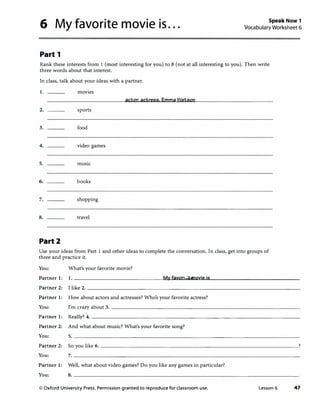
Lesson 6 My favorite movie is...
Page 14
1 Vocabulary�������������-
A
Answers
Answers will vary. Sample answer.
_ sports ./ food ./ movies
travel _ video games music
B
books ./ shopping
You may want to encourage students to expand
on their opinions by using the Lesson 5 Language
Booster language and giving examples of the kinds
of things in which they are and are not interested.
Example
A: Are you interested in sports?
B: Yes, I am. I really like baseball and basketball.
Do you like video games?
A: No, I don't.
2 Conversation
[CD 1, Track 15]
A
Answers
Dan's favorite movie is The Sound ofMusic.
Beth's favorite actress is Gong Li.
Optional Questions
What is the difference between an actor and an
actress? (An actor is a man. An actress is a woman.)
Who is Dan's favorite actress? (He likes Reese
Witherspoon.)
c
[CD 1, Track 16]
Answers
Who's yours?=> What about you?
My favorite is => I really like
I'm crazy about=> I particularly like
8 Lesson 6
ff>�'
�
irLanguage
Page 15
3 Language Booster
A
If necessary, remind students to use who for
questions about people and what for questions about
things such as movies.
Point out that in response to the yes/no question
(i.e., Do you like any bands in particular?),
the response omits Yes/Yes, I do, but it can be
understood.
B
Example
A: What's your favorite food?
B: I really like pizza. What about you?
A: I'm crazy about cheese.
4 Pronunciation
A
[CD 1, Track 17]
After students listen, point out that you and
yours are said more strongly to help the listener
understand that the speaker is asking for an opinion.
S Speak with Confidence
Emphasize that students should continue to practice
stressing you/yours as they talk with their classmates.
A
Before students start, you may want to ask students
to identify what food is in the picture (sushi).
Point out that they may have several answers for
each favorite.
Answers
Answers will vary. Sample answers.
food: pizza, sushi
TV show: Big Bang Theory
sport: volleyball, jogging
restaurant: La Italia
celebrity: J.K. Rowllng
day of the week: Saturday, Sunday, Friday
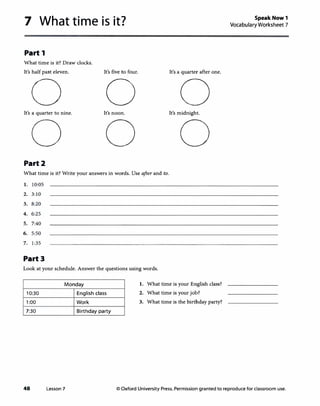
Lesson 7 What time is it?
Page 16
1 Vocabulary
A
[CD 1, Track 18)
Students are probably unfamiliar with the second
way of expressing time under clocks two, three, and
four. After students have listened once, explain this
way of telling time.
Write 1/4 on the board and have students read it
(either one-fourth or one quarter). Tell students
that when we use quarter to tell time, we use a to
mean one.
• Have students say how many minutes are in one­
fourth of an hour (fifteen).
• Draw a basic clock on the board, with an arrow
starting at the 12 and going to 6. Explain that
we say how many minutes have passed since the
hour started.
Explain that we only use this way of telling time
for 5, 10, 15, 20, and 25 after. Point out that
saying It's 18 after 8 is both difficult to say and
difficult to understand.
If necessary, remind students that we don't
use a with numbers, so It's a ten after twelve
is incorrect.
Return to the clock you have drawn on the
board. Draw an arrow from 12, this time going
backward (i.e., past 11, 10, 9, 8, 7) to 6. Explain
that when we pass thirty minutes after the hour,
we say how many minutes are left until the next
hour (because it is closer than counting from
the hour that has passed). Have students read
the second example under the last clock and
notice whether the minutes or hour comes first
(minutes). Tell students that we only use this way
of telling time for times that are multiples of 5
(i.e., 35, 40, 45, 50, and 55). If necessary, practice
these times.
Have students deduce how to say 11:45. (It's a
quarter to 12.)
Tell students that it is important to
understand this way of telling time to avoid
misunderstandings. Write 1:40 on the board and
have one student say the time. (It's twenty to
two.) As the student says the time again, write 20
2 2 on the board. Say the time again writing 22 2.
Point out that if they don't know twenty to two,
they may not realize they are being told the time.
After you've finished explaining, have students
listen again before they practice.
2 Conversation
[CD l, Track 19)
A
Answen www.i.rLanguage.com
Ken and Zack are going to a concert.
The train is at 6:15.
Page 17
3 Language Booster
Have students look at the Telling exact time column.
Explain that at is used to give the time something
will happen and is not used to give the current time.
4 Listening
A
[CD l, Track 20)
Answers
1. 11:00 3. 8:00
2. 2:50 4. 12:05
B
[CD 1, Track 20)
Answen
1. no 3. no
2. yes 4. yes
S Speak with Confidence
A
To make it more like a competition, give pairs the
same amount of time. Then have the entire class
close their books at the same time. When students
have finished their conversations, have pairs say how
many of the appointments they remembered.
Lesson 7 9
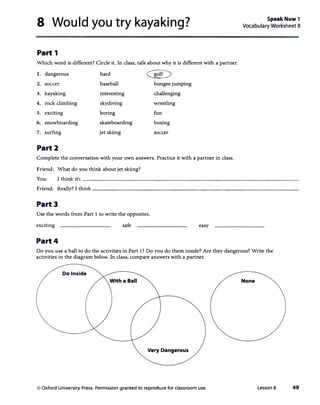
Lesson 8 Would you try kayaking?
Page 18
1 Vocabulary
A
B
Answen
Answers will vary. Sample answer.
7 kayaking 8 snowboarding
2 skydiving 6 bungee jumping
5 skateboarding 3 rock climbing
1 jet skiing 4 surfing
Optional Activity
Before students begin, have them think of other
words to describe activities (for example, difficult,
easy, fascinating, scary, confusing, great).
2 Conversation
[CD 1, Track21J
A
c
Answers
She thinks it looks really hard.
She wants to walk around.
[CD 1, Track221
Answers
What do you think => How do you feel
doesn't seem safe => seems dangerous
bungee jumping => skateboarding
Page 19
3 Language Booster
A
Point out that we use and (fun and exciting) when
giving two positive or two negative opinions. We
use but (fun but dangerous) when one opinion is
positive and the other is negative.
B
Have students refer back to page 15 if they are
struggling with how to return the question.
10 Lesson 8
Example conversation
A: What do you think of golf?
B: It seems kind of boring to me. What about you?
A: It looks fascinating to me.
4 Pronunciation
A
[CD 1, Track23)
If necessary, tell students that compound nouns
are different than a noun with an adjective.
Explain that a compound noun is a noun that
combines two or more words. Emphasize that
each word, by itself, has a meaning, but when the
two words are combined together, the meaning
of the compound noun is different than the
meaning of each word separately. For example,
the compound noun check-in is the process after
you get to an airport or hotel, but check means
the act of looking at something and in is used to
show a location.
• Point out that compound nouns can be one
word (for example, skateboarding) or two words
(for example, jet skiing). Explain that some
compound nouns are written with a hyphen (for
example, check-in).
B
[CD 1,Track24]
Answers
1, !!!!!!boarding
3. river rafting
2. �diving
4. mountain biking
S Speak with Confidence
A
Answers
Answers will vary. Sample answer.
individual activities: running, weight lifting
group activities: football, soccer
water activities: swimming, water skiing
adventure activities: scuba diving, paragliding
Lessons 5 to 8 Review
English in Action
Page20
1 Preview
A
! Answen
Answen will vary. Sample answer.
A good gift is a CD by her favorite music group.
2 Understand
A
Answen
They get Jill tickets to a new musical called DanceCity.
Yes, I did guess correctly. I No, I didn't.
B
Answen
,. c 4. c
2. a 5. c
3. b
Optional Questions
Does Tom like sports? (Yes, he loves them.)
Who likes heavy metal music? (Jill.)
What is Coldplay? (It's a band that Maria and
Tom like.)
What time does the musical start? (It starts at 7:30.)
How did they buy the tickets? (They bought them
on the Internet.)
3 Discuss
You might want to have students give reasons for
their answers to Number 1.
Speak Now
Page21
Provide an example of each conversation when
necessary.
If many students need more practice with a
particular lesson, you might want to review it
in class.
In a mixed-ability class, have lower level students
make the required conversations but encourage
higher level students to provide reasons for their
answers and expand the conversation (i.e., don't
just follow a Question-Answer, Question-Answer,
trade partners, Question-Answer, Question-Answer
pattern).
S Example conversation
A: I love techno. How about you?
B: I don't.
A: What kind of music do you like?
B: I really like jazz.
A: So do I. How about slow songs? Do you like
slow songs? I don't.
B: Neither do I.
6 Example conversation
A: What's your favorite TV show?
B: I'm crazy about Big Bang Theory. How
about you?
A: I love that show, too. So, do you like any ice
cream flavors in particular?
B: I really like Swiss almond.
7 Example conversation
A: What time do you wake up?
B: At half past six.
A: What time do you go to sleep?
B: About eleven.
8 Example conversation
A: How do you feel about surfing?
B: It sounds dangerous to me.
A: What do you think of table tennis?
B: I think it's kind of boring.
Lessons 5 to 8 Review 11
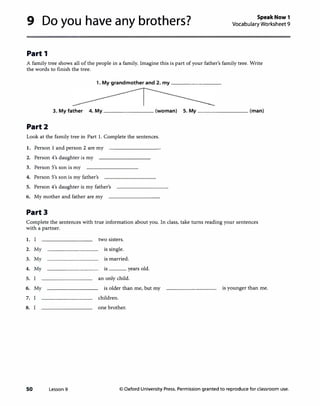
Lesson 9 Do you have any brothers?
Page22
1 Vocabulary
A
Answers
1. f 2. c 3. e 4. b
5. d 6. a 7. g
You may want to ask students what they call each
parent (mom/mother, dad/father) and grandparent
(grandma/grandmother, grandpa/grandfather).
B
Tell students that when they count brothers and
sisters, they should not include themselves.
However, students should include themselves in
counting the number offamily members. (For
example, How many people are in your family?
Five. My mother, my father, my brother, my sister,
and me.)
Optional Activity
A family tree is a visual representation of an
extended family. The youngest generation is at the
bottom of the "tree;' and the oldest generation is at
the top. A basic tree might look like the one below,
with Nancy and Bob having one child, their son
Steve. Steve is married to Sherry (shown by=),
and they have two children, Lee and Nate. Sketch a
simple family tree on the board and then use it to
ask students questions. (For example, Who are Lee's
grandparents?) With a more detailed tree, cousins
and other vocabulary can be practiced.
Nancy= Bob
I
Steve= Sherry
I I
Lee Nate
Have students quickly sketch family trees and
then take turns asking and answering questions to
practice the vocabulary.
12 Lesson 9
2 Conversation
[CD 1, Track 25]
A
c
Answers
Teresa has three sisters.
Her brother is 12 years old.
[CD 1, Track 26]
Answers
have no idea => don't know
Why don't you get them => How about
his => your brother's
Optional Question
How many brothers and sisters does Teresa have?
(Four.)
Page23
3 Language Booster
A
Optional Activity
Bring in a photo ofyour family. Have students take
turns asking you questions to practice the questions.
4 Pronunciation
A
[CD 1, Track 27]
If necessary, remind students that a word ending in s
(such as parents) does not have 's (i.e., not parents's),
but instead just an apostrophe mark after the word.
Since the pronunciation is the same as ifthere is
no apostrophe, the listener must understand the sis'
by context.
S Speak with Confidence
Students can bring in a picture of their family or
share a photo from their cell phones. This may make
the conversation more interesting and personal.
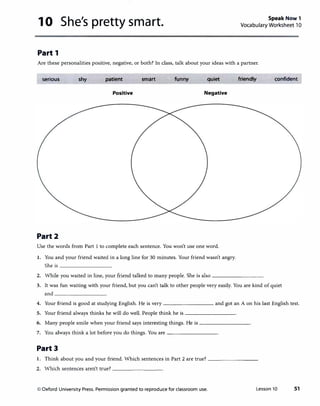
Lesson 10 She's pretty smart.
Page24 4 Listening
1 Vocabulary
A
Answers
Answers will vary. Sample answers.
You
patient ./
friendly
serious ./
shy ./
quiet ./
smart ./
funny
confident
2 Conversation
[CD 1, Track 28)
Answers
Lily and her sister are both friendly.
Best friend
,/
,/
,/
./
,/
./
Lily's sister is patient, but Lily isn't patient at all.
B
Optional Activity
If your students have pictures of their brothers and
sisters, have them practice the conversation again,
substituting their real names, ages, and personalities.
Page25
3 Language Booster
A
You may want to have students brainstorm other
ways to talk about personalities.
Examples: cheerful, helpful, outgoing, reliable
B
Monitor the discussions and if students are being
unkind to others in the class, point out those
students' good points.
���������������������
A
Answers
,. p
4. p
2. p
S. N
3. N
Answers could vary, if students consider someone
who is, for example, extremely (too) generous.
If this happens, encourage students to think
more generally.
B
[CD 1, Track 29]
Answers
1. serious, friendly, patient
2. shy, quiet (They aren't sure if she is friendly or not.)
3. forgetful, funny
Optional Questions
Does Katy like the new math teacher?
(Yes, she does.)
What is Katy probably going to do? (She is probably
going to talk to Vanessa.)
What is Katy's example of Joey being forgetful? (He
called her by the wrong name two times.)
5 Speak with Confidence
A
B
Answers
Answers will vary. Sample answer.
a babysitter: friendly, patient
a parent: strict, calm
a best friend: funny, creative
a teacher: smart, friendly
Increase the challenge by having students explain
why they feel those traits are necessary.
Optional Activity
Have pairs think of other people and the
personalities they need. For example, a police officer
needs to be patient and smart.
Lesson 10 13
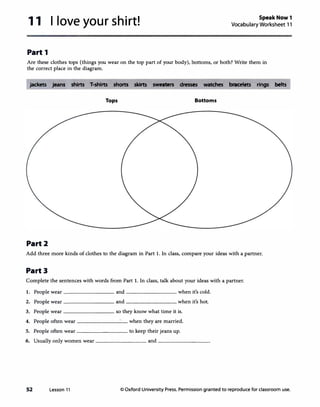
Lesson 11 I love your shirt!
Optional Activity
Before students open their books, you may want to
have students name some popular clothing stores in
the area.
Page26
1 Vocabulary
A
Answers
Answers will v•ry. Sample answer.
d, f, i, j, I
Point out that jeans and shorts don't have an a and
seem to be plural since they end in an s. Explain that
these pieces of clothing do not actually have plural
forms (i.e., we don't say jeanses). You may want to
teach how to count jeans and shorts (i.e., a pair of, 2
pairs of).
B
If necessary, remind students that this/these are used
when the clothes are near the speaker and have
students identify when to use each (these with jeans
and shorts, this with the other items in part A). Also
remind students of that/those, which are used when
the objects are far away.
Optional Activity
Bring in pictures of people and have students
practice the conversation until they are comfortable
with the vocabulary. Or, have students describe
other people in the class. To make it more like a
game, have students keep points, awarded to the first
person who guesses correctly.
2 Conversation
(CD 1, Track 30)
A
Answers
Cindy likes the color of Rachel's shirt (She says the
color looks really good on Rachel.).
Rachel got the shirt from her sister.
14 Lesson 11
1
c
[CD 1, Track 31)
Answers
I love your shirt! => That's a nice shirt!
It was a gift from my sister. => I got it on sale.
That's so nice of you. => Thank you!
Page27
3 Language Booster
A
Have students identify what it refers to in the
response (the shirt). Then have them guess how
to respond the compliment I love your jeans. (For
example, I like them, too. I got them on sale.)
4 Pronunciation
A
[CD l, Track 32)
• The meaning of a sentence can change
drastically, depending on the words that are
stressed. For example, in they're my mother's
the speaker may be correcting the other person's
wrong statement that they're your sister's.
However, they're my mother's emphasizes which
one belongs to the speaker's mother.
B
Teach students that in English, the important
words (the words that emphasize what the
speaker wants to say) are usually stressed. These
are often nouns, the important verbs, adjectives,
and adverbs.
Less important words (called function words)
are usually not stressed and often spoken more
quickly. Examples include the, a, auxiliary verbs
such as is, prepositions such as before and as, and
conjunctions such as while.
(CD 1, Track 33)
Answers
A: pretty, ring
B: thank, gift
B: love, belt, new
A: no, old, brother's
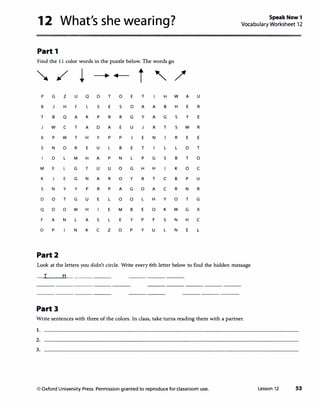
Lesson 12 What's she wearing?
Optional Activity Optional Activity
To review clothing from Lesson 11, before students
open their books, have students say what some of
their classmates are wearing.
Page28
1 Vocabulary
A
����������������
Answers
Answers will vary. Sample answer.
Fred's shirt is orange.
His socks are purple.
His shoes are red.
Hisjacket is blue.
Optional Activity
Have students use these colors to describe other
things.
Examples: Apples are red.
B
This desk is brown.
My pen is black.
You might want to teach vocabulary to describe
patterns in clothing.
Examples: striped, polka dot, plaid, checked, print,
solid, flowered
2 Conversation
[CD 1, Track 34)
A
Before students listen, ask them where Casey
and Brad are (in a store) and what they are doing
(looking at clothes).
B
Answers
Casey doesn't like the yellow shirt because she thinks
Brad doesn't look good in yellow.
She likes the purple sweater for Brad.
Remind students to practice speaking, not reading,
by looking up from their books each time it is their
turn to speak.
Have students talk about which colors look good/
don't look good on them. Then have them practice
the conversation again, substituting these colors.
Page29
3 Language Booster
A
Point out that we use wearing for contacts and
explain that we also use it for glasses.
4 Listening
A
[CD 1, Track 35)
Answers
,. c 2. b 3. a 4. d
B
[CD 1, Track 35)
Answers
1. friendly
2. serious
3. confident I pretty
4. quiet
Optional Questions
What word describes the first guy's personality?
(Shy.)
Does the guy in the second conversation think
Randy's clothes are unusual? (Yes, he does.)
In conversation three, who is pretty? (Susan.)
What does the guy think of Gary's shoes? (He thinks
they are cool, but different. I He likes them even
though they are different.)
S Speak with Confidence
You might want to teach other vocabulary so
students can describe the clothes in more detail.
Examples: It has buttons. It has a zipper. It's long­
sleeved. It has short sleeves.
Lesson 12 15
Lessons 9 to 12 Review
English in Action
Page30
1 Preview
A
� Answen
Answers wlll vary. Sample answer.
Jill's mother is wearing glasses and a hat. Her father is
wearing a hat and a black shirt. Jill's grandmother is
wearing a scarf and helmet. Her mom looks friendly.
Her dad looks serious. Her grandmother looks creative.
2 Understand
A
Answers
1. c
2. b
B
Answers
1. jacket
2. and shy
Optional Questions
Who is shy? (Eric.)
3. a
4. d
3. easygoing
4. 75
Who is wearing new clothes for the party?
(Jill and Eric.)
What is Jill like? (She's easygoing and creative [like
her mother]. If students answer her mother, point
out that the question asks what she is like, not who
she is like.)
Is David coming to the party?
(No, he's not.)
3 Discuss
If some students are doing most of the talking,
l
stop the discussion. Remind students that they can
include everyone in the group by asking the quieter
students their opinions (for example, by asking How
about you?).
16 Lessons 9 to 12 Review
Speak Now
Page31
Make sure students mark how well they can do each
task. If many students need more practice with a
particular lesson, review it in class.
9 Example conversation
A: Do you have any siblings?
B: No. I'm an only child. How about you?
A: I have one brother. He's 18.
B: Is he a student?
A: Yes. He is in college. Do you have any cousins?
10 Example conversation
A: What are two of your friends' names?
B: Natsuki and Yoh. Natsuki is a student.
A: What is Natsuki like?
B: She is serious but funny.
A: What is Yoh like?
B: Yoh is a student, like Natsuki, but she also
works at a bank. She is always calm.
11 Example conversation
A: That's a great shirt!
B: Thanks. I got it yesterday. I really like
your jacket.
A: Thank you. It was a gift from my family.
1 2 Example conversation
A: What is Marco wearing?
B: He's wearing a T-shirt, jeans, and tennis shoes.
A: What color is his T-shirt?
B: It's red. It's cool!
A: And who's wearing purple shoes?
B: Leah is. She is the only student with
purple shoes!
A: I know. What color is Sam's sweater?
B: It's green.
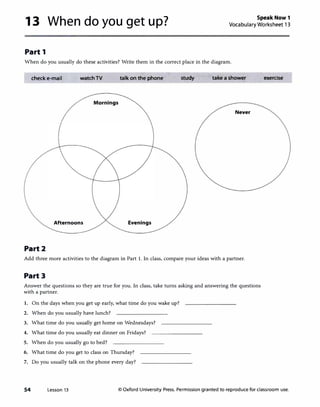
Lesson 13 When do you get up?
Page32
1 Vocabulary
A
B
Answers
Answers will v•ry. Sample answer.
_ get up early ./ check e-mail
./ watchTV ./ talk on the phone
_study have lunch
./ take a shower exercise
You might want to teach the phrase almost every day
and have students also discuss the things they do
almost every day.
2 Conversation
[CD 1. Track 36]
A
I Answers
c
At 8:30 he has a karate lesson.
He finishes school at S:00.
[CD 1, Track 37)
Answers
What time do you wake up? => When do you get up?
wake up => get up
Do you have time then? => Are you free?
at 10:00 I start school => school begins at 10:00
Page33
3 Language Booster
A
Explain that late may have different meanings for
different people. For example, if A says, I went to
bed late last night, she may be talking about 11:00,
but when B says the same thing, he may be talking
about 2:30 in the morning.
B
Optional Activity
Have students brainstorm other routines (for
example, cook dinner, wash your face) and practice
with these activities.
4 Pronunciation
A
[CD 1, Track 38]
Explain that reduction occurs when it sounds
like we combine two words into one.
• Explain that when reducing do you, students
must do two things. First, they should blend
the two words together (i.e., say them without
a pause between them) instead ofenunciating
each word. In addition, they must change the
pronunciation of the o in do.
• Tell students that as they combine these words
together, their rhythm will become more
natural. In addition, their ability to understand
reductions will improve.
• You might want to explain that we often combine
the Wh- question word with do you, so that the
three words sound like one word. For example,
it may sound like a speaker says whaddaya
rather than what do you. This combination is
particularly difficult since the t sound becomes
ad.
B
Remind students to use at.
Example conversation
A: What time do you eat dinner?
B: At 8:30.
A: When do you finish class?
B: At 5:45.
S Speak with Confidence
Example conversation
A: Do you have lunch at home?
B: No, I don't.
A: Do you watch TV at night?
B: Yes, I do.
A: Great. Let me write your name here. (How do
you spell it?)
Lesson 13 17
Lesson 14 When do you get there?
Page34
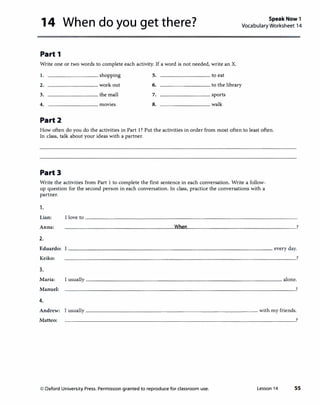
1 Vocabulary
A
Answers
Answers will vary. Sample answer.
S go shopping S go out to eat
S workout A go to the library
S go to the mall A watch sports
A watch movies A take a walk
2 Conversation
[CD 1, Track 39]
Optional Activity
Before students listen, ask them if any of them
go to the gym. If some do, have them talk about
(using gestures as necessary) what they do there
(for example, lift weights) and how often they go
(for example, two times a week). Alternatively, have
students brainstorm different activities they can do
at the gym (for example, aerobics, ride a bike, row).
A
B
Answers
Laura runs (on the treadmill) at the gym.
Sophie does yoga (at the gym).
Tell students that one of the reasons they practice
these substitutions is that there are many different
ways to say the same thing. Remind them that even
if they tend to use the same question when they
speak, it is important to recognize questions and
sentences with the same meaning when listening.
Page35
3 Language Booster
A
Tell students that follow-up questions often use
the five W (i.e., who, what, when, where, why) and
one H (i.e., how) question words. Have them think
about why this is better than questions starting with
do, providing the answer if necessary. (A yes/no
response doesn't contribute as much to continuing
a conversation.)
18 Lesson 14
Optional Activity
Have students think of additional follow-up
questions. This will help demonstrate the diversity
that is possible.
4 Listening
A
[CD 1, Track 40]
Answers
3 a. 4 d.
1 b. 5 e.
6 c. 2 f.
B
I Answers
Answers will vary. Sample answers.
1. What do you do in the library?
Can you use the Internet in the library?
2. Where do you walk?
Do you walk in the same area every night or do you
go to different places?
3. How many hours a night do you usually watch TV?
DoyouusuallywatchTValoneor with someone?
{Whodo you watch TV with?)
4. Where is the new mall?
How do you go to the mall?
5. Where is the cafe?
What's the name of the cafe?
6. Who's your favorite player?
What's your favorite team?
Optional Activity
After pairs think of questions, have them share their
questions with the class. As a class, decide which
questions will elicit longer conversations.
S Speak with Confidence
A
Emphasize that students should only write notes.
This will help them practice speaking, rather than
reading, in Part B. However, if you have a mixed
ability class, you may want to allow lower level
learners to write more complete thoughts.
Lesson 15 What do you do first?
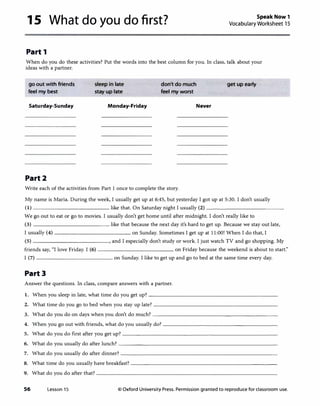
Page36
1 Vocabulary
A
Tell students that they can use the days of the week
and time phrases many times.
Answen
Answen will vary. Sample answer.
I get up early on Sunday mornings.
I stay up late on Friday nights.
I go out with friends on Sunday afternoons.
I don't do much on Saturday nights.
I feel my best onThursday mornings.
I feel my worst onTuesday mornings.
Optional Activity
Take a class poll to find out when most students do
each activity.
2 Conversation
[CD 1, Track 41)
A
Answen
Derek meets some friends on Sundays.
He goes to an outdoor market in the park.
c
[CD 1, Track 42)
Answen
on Sundays => first
Then what do you do?=> What do you do next?
Yeah, I like that place. => What do you do after that?
Point out that the third substitution is a change from
a statement to a question, but the response remains
the same.
Poge37
3 Language Booster
A
Point out that all the verbs are simple present.
Explain that this is because we're talking about
routines, not something that's happening right now.
B
Emphasize that they will need the notes later so
they must take them.
• Explain that later suggests some time passes
between the activities, and it is possible that
some unmentioned activities occur in between
the activities that are mentioned.
• Emphasize that students don't have to say the
activities in the order of the chart.
Example conversation
A: Well, in the mornings, first I get up. Then I take
a shower. After that I check e-mail. I don't eat
breakfast until later, maybe 10:00. After school,
first I do my homework. Then I have dinner.
Later I watch about 30 minutes of TV before I
go to bed.
4 Pronunciation
A
[CD 1, Track 43)
Have students notice the secondary stress within
the sentence, and then explain that the next most
important information is often stressed. If necessary,
have students identify this (i.e., breakfast, run,
shower).
B
Students should use their notes about their partner's
routine (written in Part 3 B).
S Speak with Confidence
B
Have students focus on their pronunciation as they
do the activity.
Example conversation
A: So what do you do Friday nights?
B: Well, first I go home and eat dinner. Then I go
to my friend's house. We talk and eat snacks
like ice cream. Later, we listen to music.
A: Sounds fun. How about you, C? What do you
do first on Friday nights?
C: Well, first I meet friends outside of the library
and we go out for dinner. Then we go to the
mall to shop. After that, we go to a coffee shop.
Lesson 15 19
Lesson 16 What are you doing?
Optional Activity 4 Listening
Before students open their books, ask students what
their majors are, or what they majored in/would like
to major in.
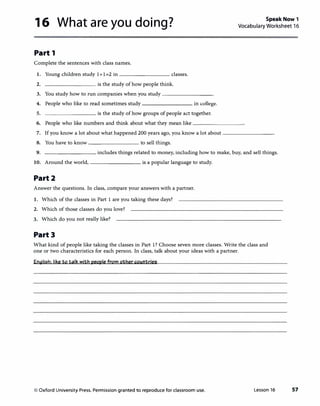
Page38
1 Vocabulary
A
Read the class names so students become familiar
with their pronunciation. You may want to point out
that the p is silent in psychology.
B
Answen
Answen will vary. Sample answer.
B statistics BE
B economics E
BE math B
E psychology B
BE English E
history
sociology
marketing
management
literature
Emphasize that opinions cannot be wrong even
when they are different. Tell students that B uses
actually to point out their difference in opinion.
Explain that actually should not be used if they have
the same opinion.
Optional Activity
Have students talk about which classes they have to
(had to/will have to) take for their major.
2 Conversation
A
[CD 1, Track 44)
Answen
Greg wants to go to a movie. I He wants to watch
a movie.
Emi is learning modern dance/tap dance.
Page39
3 Language Booster
A
Point out that the grammar is the same as that used
to discuss activities that are currently being done
(for example, I'm studying math right now.).
20 Lesson 16
���������������������
A
[CD 1, Track 45)
B
Answers
rehearsing for a play
studying for midterm exams
saving money for a trip
teaching French
[CD 1, Track 4SJ
Answers
1. The play starts next week.
2. He works two nights a week.
Manuel
.,/
.,/
Claire
.,/
.,/
.,/
3. Claire Is teaching her neighbor (a person who lives
near her).
Optional Activity
Remind students that it is important to guess the
meaning of a new word by using the context. Have
students listen for the word performance and reword
it (for example, show).
Have students listen for the word rehearsing and
reword it (for example, practicing).
Optional Questions
Who is really busy? (Both Claire and Manuel are.)
Is the play that Claire's in funny? (Yes. She says this,
and it is a comedy.)
Is Manuel going to go to Claire's play? (Yes, he is.)
Does Manuel want to study French with Claire?
(Yes, he does.)
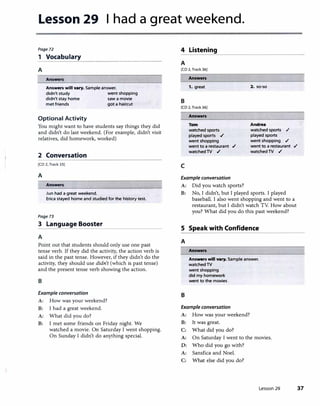
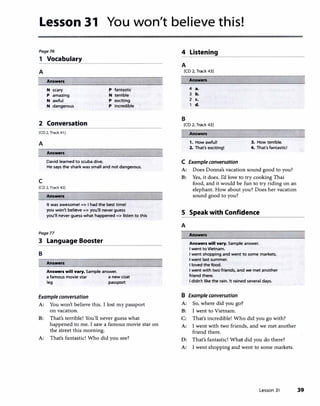
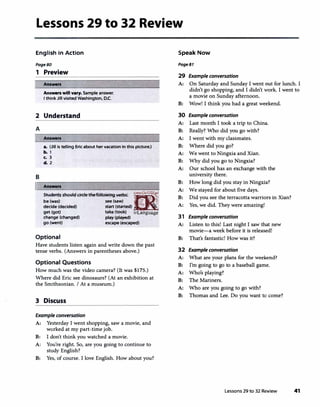
S Speak with Confidence
B Example conversation
A: This person is watching a lot ofTV.
B: Is it Jae-soon?
C: No, it's not me. Is it you, David?
D: Yes, it's me.
A: What shows are you watching?
Lessons 13 to 16 Review
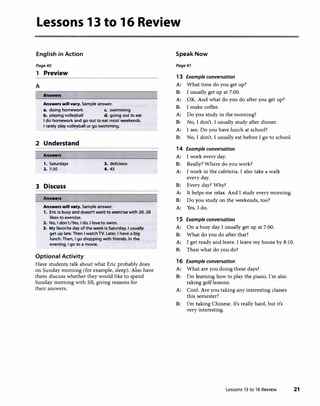
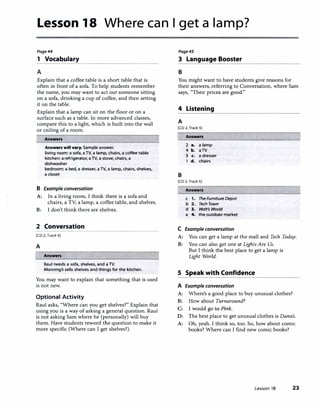
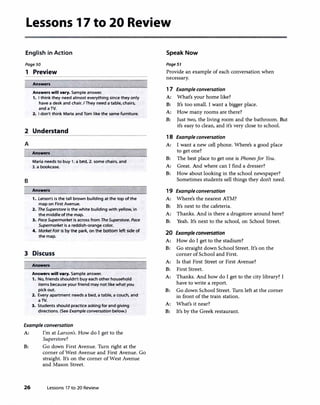
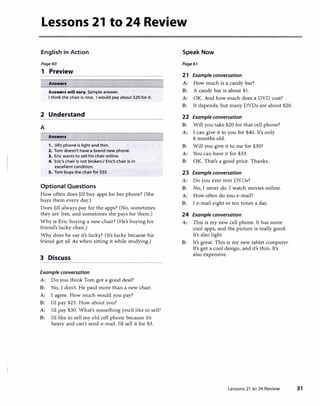
English in Action
Page40
1 Preview
A
f Answers
Answers will v•ry. Sample answer.
a. doing homework c. swimming
b. playing volleyball d. going out to eat
I do homework and go out to eat most weekends.
I rarely play volleyball or go swimming.
2 Understand
Answers
1. Saturdays 3. delicious
2. 7:30 4. 45
3 Discuss
Answers
Answers will v•ry. Sample answer.
1. Eric is busy and doesn't want to exercise with Jill. Jill
likes to exercise.
2. No, I don't./Yes, I do. I love to swim.
3. My favorite day of the week is Saturday. I usually
get up late. Then I watchTV. Later, I have a big
lunch. Then, I go shopping with friends. In the
evening, I go to a movie.
Optional Activity
Have students talk about what Eric probably does
on Sunday morning (for example, sleep). Also have
them discuss whether they would like to spend
Sunday morning with Jill, giving reasons for
their answers.
Speak Now
Page41
13 Example conversation
A: What time do you get up?
B: I usually get up at 7:00.
A: OK. And what do you do after you get up?
B: I make coffee.
A: Do you study in the morning?
B: No, I don't. I usually study after dinner.
A: I see. Do you have lunch at school?
B: No, I don't. I usually eat before I go to school.
14 Example conversation
A: I work every day.
B: Really? Where do you work?
A: I work in the cafeteria. I also take a walk
every day.
B: Every day? Why?
A: It helps me relax. And I study every morning.
B: Do you study on the weekends, too?
A: Yes, I do.
1 5 Example conversation
A: On a busy day I usually get up at 7:00.
B: What do you do after that?
A: I get ready and leave. I leave my house by 8:10.
B: Then what do you do?
16 Example conversation
A: What are you doing these days?
B: I'm learning how to play the piano. I'm also
taking golflessons.
A: Cool. Are you taking any interesting classes
this semester?
B: I'm taking Chinese. It's really hard, but it's
very interesting.
Lessons 13 to 16 Review 21
Lesson 17 What's your place like?
Page42
1 Vocabulary
A
Explain that your place means the place where
you live.
Answers
Top of apartment, left to right: 6, 3, 1, S
Outside the apartment: 7
Bottom of the apartment, left to right 2, 4
Optional Activity
Have students talk about whether the apartment is
typical for their area. (For example, In our country,
there usually isn't a laundry room in an apartment.)
2 Conversation
[CD 2, Track 2]
A
Answers
Andy thinks the location is goodJ Andy likes his
apartment because it is convenient.
There are four rooms.
Optional Activity
Have students talk about whether they would rather
have a small but conveniently located apartment or a
large but less conveniently located apartment, giving
reasons for their answers.
B
Optional Activity
Have students practice again substituting real
information about their apartments.
Page43
3 Language Booster
You might want to have students think of other
substitutions for the first question (for example,
bedroom, kitchen).
22 Lesson 17
B Example conversation
A: What's your apartment like?
B: lt's small and not very convenient.
A: Is there a laundry room?
B: No, there isn't. How about your place?
What's it like?
4 Listening
A
[CD 2, Track 3]
B
Answers
1. ./
2. ./
[CD 2, Track 3]
Answers
3. (The living room is the
bedroom.)
4. (It does not have a
laundry room.)
Students should write two of the following:
it's nice, it's comfortable, the yard, it's quiet
c
Encourage students to give reasons for the things
they like about their homes.
Example conversation
A: I really like my living room. It's big. And my
place is very convenient. I can walk to school
in 3 minutes.
B: That's cool.
A: How about you? What's your place like?
B: I like my apartment because there's a laundry
room in it. Many apartments don't have a
laundry room. And I like my apartment
because it's small. I can clean it in an hour!
S Speak with Confidence
If necessary, have students brainstorm their
questions and information in pairs but then
do Part B with a different person to make the
conversation more original.
Lesson 18 Where can I get a lamp?
Page44
1 Vocabulary
A
Explain that a coffee table is a short table that is
often in front of a sofa. To help students remember
the name, you may want to act out someone sitting
on a sofa, drinking a cup of coffee, and then setting
it on the table.
Explain that a lamp can sit on the floor or on a
surface such as a table. In more advanced classes,
compare this to a light, which is built into the wall
or ceiling of a room.
Answers
Answers will vary. Sample answer.
living room: a sofa, aTV, a lamp, chairs, a coffee table
kitchen: a refrigerator, a TV, a stove, chairs, a
dishwasher
bedroom: a bed, a dresser, aTV, a lamp, chairs, shelves,
a closet
B Example conversation
A: In a living room, I think there is a sofa and
chairs, a TV, a lamp, a coffee table, and shelves.
B: I don't think there are shelves.
2 Conversation
[CD 2, Track 4J
A
Answers
Raul needs a sofa, shelves, and a TV.
Manning's sells shelves and things for the kitchen.
You may want to explain that something that is used
is not new.
Optional Activity
Raul asks, "Where can you get shelves?" Explain that
using you is a way of asking a general question. Raul
is not asking Sam where he (personally) will buy
them. Have students reword the question to make it
more specific (Where can I get shelves?).
Page45
3 Language Booster
B
You might want to have students give reasons for
their answers, referring to Conversation, where Sam
says, "Their prices are good."
4 Listening
A
[CD 2. Track SJ
B
Answers
2 a. a lamp
4 b. aTV
3 c. a dresser
1 d. chairs
[CD 2, Track SJ
Answers
c 1. TheFurnitureDepot
b 2. Tech Town
d 3. Walt's World
a 4. the outdoor market
C Example conversation
A: You can get a lamp at the mall and Tech Today.
B: You can also get one at Lights Are Us.
But I think the best place to get a lamp is
Light World.
5 Speak with Confidence
A Example conversation
A: Where's a good place to buy unusual clothes?
B: How about Turnaround?
C: I would go to Pink.
D: The best place to get unusual clothes is Dana's.
A: Oh, yeah. I think so, too. So, how about comic
books? Where can I find new comic books?
Lesson 18 23
Lesson 19 Where's the mall?
Page46
1 Vocabulary
A
B
Answers
Ans-rs will vary. Sample answer.
./ bank � drugstore
./ movie ./ mall
theater � post office
Optional Activity
� hair salon
./ library
� department
store
Have students talk about other activities they do in
each of the places in Part A. For example, I usually
eat dinner at the mall. There are lots of different
places.
2 Conversation
[CD 2,Track 6]
A
Answers
The post office is on King Street.
There's a hair salon called Freddy's on University Avenue.
Optional Activity
Tell students that every street in the United States
has a name, no matter how short the street is. You
might want to explain that in addition to streets
and avenues, there are drives, circles, courts, and
boulevards. (Boulevards are usually wide and often
have something down the center between the lanes,
which go in two directions.)
c
[CD 2, Track 7]
Answers
send these postcards => mail these letters
across from the park=> next to the library
on University Avenue => in the mall
24 Lesson 19
Page47
3 Language Booster
A
Optional Activity
Have students practice the language, substituting
real locations, for example, near the school.
Example conversation
A: Where's the nearest supermarket?
B: It's across from the school.
B
As students follow along, read the street names.
Point out that the streets go up and down and the
avenues go right to left. Also point out that the
avenues are in numerical order (i.e., First, Second,
Third).
Optional Activity
Teach additional language to allow students to be
more specific.
It's on the corner (of Third Avenue and Elm Street).
It's in the middle of the block.
It's just down the street.
4 Pronunciation
A
[CD 2. Track 8)
B
Explain that students should not pay attention to
spelling, but instead must focus on the sounds. For
example, the final e in where is silent, creating linked
sounds between the r (consonant) and thee (vowel)
in exactly.
S Speak with Confidence
B Example conversation
A: Where's the nearest ATM?
B: There's one in the drugstore.
A: Where's the drugstore?
B: It's on Elm Street, next to the movie theater.
Lesson 20 Take a left.
Page4B
1 Vocabulary
A
Answen
Answen will vary. Sample answer.
a stadium ./ a bridge
a river ./ a subway
./ a bus stop station
Optional Activity
_a park
_a freeway
a taxi stand
Have students say different activities they do at the
places. For example, I can watch a baseball game in
a stadium.
B
Optional Activity
Explain that some freeways are called highways or
expressways. Also explain that turnpikes are like
highways but usually charge a toll (i.e., money to
drive on them).
2 Conversation
[CD 2, Track 9]
A
c
Answen
Anna is having a birthday party (for herself)
on Sunday.
Her address is 122 Pine Street.
[CD 2, Track 10]
Answen
I'd love to. => That sounds great!
not far=> really close
Can you give me directions? => How do I get there?
Take a => Turn
Optional Questions
What is Anna's apartment number? {14C)
What time does the party start? (It starts
around 6:00.)
Page49
3 Language Booster
A
Ifnecessary. explain that askingfor clarification
means to get more (specific) information or to make
sure of something.
Optional Activity
Using desks as blocks/corners, have students take
turns giving directions while you (or a student)
follow the directions (i.e., walk around the
classroom) and ask for clarification.
B
After giving directions once, you may want to
encourage students to start at the new location (i.e.,
the place they just got directions to), rather than
always returning to the X. This will allow them to
practice more varied conversations.
4 Pronunciation
A
[CD 2, Track 11]
• Explain that the intonation and stress help
the speaker point out that he/she has two
different ideas and would like to know which one
is correct.
Explain that students should use pauses carefully,
with a pause before or.
Tell students they should also chunk the
information. In other words, they should try to
say each idea as a smooth phrase (for example,
turn right, turn left). They should try not to have
long pauses within each phrase (for example, not
say turn [pause] right).
• Point out that the speaker also says the choices
with a little more emphasis (i.e., more strongly)
to help the listener understand the choices.
S Speak with Confidence
If students are having difficulty giving directions
without looking at something, have them sketch a
rough map and then start again.
Lesson 20 25
Lessons 17 to 20 Review
English in Action
Page SO
1 Preview
Answers
Answers will vary. Sample answer.
1. I think they need almost everything since they only
have a desk and chair. IThey need a table, chairs,
and a TV.
2. I don't think Maria and Tom like the same furniture.
2 Understand
A
B
Answers
Maria needs to buy 1. a bed, 2. some chairs, and
3. a bookcase.
Answers
1. Larson's is the tall brown building at the top of the
map on First Avenue.
2. The Superstore is the white building with yellow, in
the middle of the map.
3. Pace Supermarket is across from TheSuperstore. Pace
Supermarket is a reddish-orange color.
4. MarketFair is by the park, on the bottom left side of
the map.
3 Discuss
Answers
Answers will vary. Sample answer.
1. No, friends shouldn't buy each other household
items because your friend may not like what you
pick out.
2. Every apartment needs a bed, a table, a couch, and
a TV.
3. Students should practice asking for and giving
directions. (See Example conversation below.)
Example conversation
A: I'm at Larson's. How do I get to the
Superstore?
B: Go down First Avenue. Turn right at the
corner of West Avenue and First Avenue. Go
straight. It's on the corner of West Avenue
and Mason Street.
26 Lessons 17 to 20 Review
Speak Now
Page51
Provide an example of each conversation when
necessary.
1 7 Example conversation
A: What's your home like?
B: It's too small. I want a bigger place.
A: How many rooms are there?
B: Just two, the living room and the bathroom. But
it's easy to clean, and it's very close to school.
1 8 Example conversation
A: I want a new cell phone. Where's a good place
to get one?
B: The best place to get one is Phonesfor You.
A: Great. And where can I find a dresser?
B: How about looking in the school newspaper?
Sometimes students sell things they don't need.
1 9 Example conversation
A: Where's the nearest ATM?
B: It's next to the cafeteria.
A: Thanks. And is there a drugstore around here?
B: Yeah. It's next to the school, on School Street.
20 Example conversation
A: How do I get to the stadium?
B: Go straight down School Street. It's on the
corner of School and First.
A: Is that First Street or First Avenue?
B: First Street.
A: Thanks. And how do I get to the city library? I
have to write a report.
B: Go down School Street. Turn left at the corner
in front of the train station.
A: What's it near?
B: It's by the Greek restaurant.
Lesson 21 How much is coffee?
Page51
1 Vocabulary
A
Answers
Answers will v•ry. Sample answer.
$20 a haircut
$3.75 a cup of coffee
$50 a taxi ride across town
S1O museum admission fee
S13 a movie ticket
$2 bus fare
2 Conversation
[CD 2, Track 12]
A
Answers
Coffee is one dollar in a convenience store.
Coffee in a coffee shop is not cheap.
• Explain that there are one hundred cents in one
dollar. This is important in countries that don't
have smaller and larger units of their currency.
Tell students that when saying prices with dollars
and cents, they should either say both dollars and
cents (for example, two dollars and fifty cents) or
neither dollars nor cents (for example, two fifty).
Emphasize that they should not say only one of
the two words. For example, it is incorrect to
say two dollarsfifty, and two andfifty cents is
also wrong.
• Tell students that a dollar is the exception
because a rather than a number is used. Point
out that a dollarfifty is used in the conversation.
c
[CD 2, Track 13]
Answers
That's reasonable. => That seems fair.
can be=> costs around
They cost => They're
Ask students to explain the difference between can
be six dollars and costs around six dollars, providing
the answer if necessary. (Can be six dollars suggests
that the most coffee costs is six dollars and that
some coffee is not this expensive. Costs around six
dollars implies that most coffee in nice coffee shops
is usually six dollars.)
Optional Question
ls Eduardo probably from the same town as Greg?
(No. He doesn't know the prices, and he says
your town.)
Page53
3 Language Booster
B
Example conversation
A: How much does a meal at a fast-food
restaurant cost?
B: It's around six dollars.
4 Pronunciation
A
[CD 2. Track 14)
Explain that we generally stress the first sound
(i.e., syllable) of multiples of ten (i.e., thirty, forty,
fifty, etc.).
Tell students that even native speakers sometimes
misunderstand numbers that sound similar (for
example, 13 and 30), but that by practicing the
correct stress, they will be better able to both say
and understand the numbers.
B
[CD 2, Track 1SJ
Answers
1. $1 .70 3. $16.17
2. $40.50 4. $19.90
S Speak with Confidence
A
If students don't know the prices, have them guess.
Lesson 21 27
Lesson 22 Will you take $20?
Page54
1 Vocabulary
A
Answers
Answ•rs wlll vary. Sample answer.
clothes
./ furniture
./ CDs
./ toys
2 Conversation
[CD 2, Track 16]
A
Answers
_makeup
electronics
_video games
_ sports equipment
Luke offers Zoe $20 for the lamp.
They agree on $25.
Explain that give it to you does not mean giveforfree
but instead emphasizes the speaker's belief that the
price is low.
Optional Activity
Explain that Luke and Zoe negotiated the price
rather than Luke paying the price Zoe originally
said. Have students talk about whether bargaining
is common in their area. If it is, have them talk
about who bargains (for example, usually people in
markets), when (for example, on market days), and
what for (for example, anything in a market).
If bargaining isn't popular in the area, have students
talk about the advantages (for example, it can be
fun, you can buy things for a lower price) and
disadvantages (for example, it can be frustrating, you
might pay more than other people) of bargaining.
PageSS
3 Language Booster
A
If necessary, have students make the third question
for situations when there are two or more things.
(Will you give them to me for $20?)
28 Lesson 22
4 Listening
A
[CD 2, Track 17]
B
Ans...-s
4 a. CDs
1 b. a computer bag
3 c. a bowl
2 d. sunglasses
[CD 2,Track 17]
Answers
1. $50
2. $12
c
3. $115
4. $20 for all of the CDs
If there aren't any regular markets in the city, have
students think about markets during festivals or
make up their answers.
Example conversation
A: We don't have outdoor markets.
B: I know. I wish we did. But there are markets
during the summer festivals.
A: That's true. I always buy a snow cone.
B: It's a good place to buy used clothes, too.
A: But there's no bargaining.
B: Yeah, but that makes it easier to choose which
clothes I want.
S Speak with Confidence
B Example conversation
A: How much is this black jacket?
B: It's $75.
A: That's expensive. A new one is $85. Will you
take $35?
B: No, but I can give it to you for $70.
A: No, thanks. I'll keep looking.
Lesson 23 Do you ever buy books?
Page56
1 Vocabulary
A
Answers
Answers will vary. Sample answer.
N newspapers
S candy
N energy drinks
N flowers
Optional Activity
N magazines
N gum
S vitamins
N phone cards
Have students get into small groups and write as
many things as they can that they buy often. When
time is up, have groups count the number of things
they wrote, and determine the winning group. Have
groups share their ideas with the class.
2 Conversation
[CD 2,Track 18)
A
Answers
Lian buys fashion and interior design magazines.
Lian keeps all of the magazines.
If necessary, explain that interior design has to do
with how to decorate and use the area in rooms
and buildings.
c
[CD 2, Track 19)
Answers
I buy lots of magazines. => I often buy them.
What kind => Which ones
Every week. => Twice a week.
Ask students to discuss the difference between
what kind and which ones, providing the answer if
necessary. (For example, the response to the kind of
magazine can be broad-the topic of the magazines,
while the response to which ones can be quite
specific-the names of magazines.)
Optional Question
Why does Lian's mom probably think Lian is crazy?
(Perhaps because magazines are so expensive, yet
Lian buys them very often.)
PageSl
3 Language Booster
A
If students are familiar with the grammar have you
ever..., ask them to explain the difference, providing
the answer if necessary. (For example, have you ever
asks about a past experience, while do you ever asks
about actions that repeat.)
4 Pronunciation
A
[CD 2, Track 20)
B Example conversation
A: Do you ever buy comics?
B: No. I think they are too expensive. How about
you? Do you ever buy celebrity magazines?
Optional Activity
Give students more questions to discuss, having
them focus on intonation as they ask the questions.
How often do you go shopping?
Do you ever go shopping alone?
Who do you usually go shopping with?
How often do you shop online?
S Speak with Confidence
A Example conversation
A: Do you ever buy things on sale?
B: Yes, I often do.
A: [Student writes name.] Thanks. And what do
you usually buy?
B Example conversation
A: Matthew often buys DVDs on sale. And Francis
often buys gifts for friends. Susan does, too.
Lesson 23 29
Lesson 24 Your phone is so cool!
Page58 4 Listening
1 Vocabulary
----------------
A
Answers
1. light 5. slow
2. expensive 6. thin
3. small 7. narrow
4. dark 8. quiet
If it won't confuse students, explain that light can
mean both bright and not heavy.
2 Conversation
[CD 2, Track 21 I
A
Answers
Iris' phone is light, and it has a cool design.
Iris watches videos on her new phone.
You might want to explain that apps is short for
applications and apps are programs you can buy to
do more things on smart phones.
Optional Activity
Have students say all the things Iris' phone can do
(watch videos, take pictures, play games). Then
have them say other things they can do with smart
phones (for example, send e-mail, surf the Internet,
video chat). Have them practice again using
these ideas.
Page59
3 Language Booster
A
Have students look at the two grammar structures
and decide when they use each, providing the
answer ifnecessary. (We use the be verb to describe
the entire thing, for example, the size or cost. We use
has or a has + got to describe one part of the entire
thing, for example, the screen or a function.)
30 Lesson 24
A
[CD 2, Track 22]
Answers
3 a. (a printer)
2 b. (a video camera)
c. (a widescreen TV)
4 d. (MP3 player)
Optional Activity
You might want to have students name each of the
electronics. (See answers above in parentheses.)
B
(CD 2, Track 221
Answers
For each, students should name any two of the
following.
1. wide screen, thin, good picture quality
2. nice color (although they don't agree on this), light
(weight), small screen, cheap
3. the gray color (for the woman), cheap, makes
color copies, heavy (they think that means it is
good quality)
4. small, light (weight), white (color), cool design,
good price
C Example conversation
A: I look for black MP3 players. They look cool.
B: I like ones that are light and not too expensive.
5 Speak with Confidence
B
You may want to review how to make negative
sentences before students do the activity. (For
example, Our phone doesn't have a nice camera./
Our phone doesn't.)
Example conversation
A: This phone has a nice camera.
B: Our phone doesn't.
C: Our phone is very light.
D: Ours is, too.
Lessons 21 to 24 Review
English in Action
Page60
1 Preview
Answers
Answers will vary. Sample answer.
I think the chair is nice. I would pay about $20 for it.
2 Understand
A
Answers
1. Jill's phone is light and thin.
2. Tom doesn't have a brand new phone.
3. Eric wants to sell his chair online.
4. Eric's chair is not broken} Eric's chair is in
excellent condition.
S. Tom buys the chair for $55.
Optional Questions
How often does Jill buy apps for her phone? (She
buys them every day.)
Does Jill always pay for the apps? (No, sometimes
they are free, and sometimes she pays for them.)
Why is Eric buying a new chair? (He's buying his
friend's lucky chair.)
Why does he say it's lucky? (It's lucky because his
friend got all As when sitting it while studying.)
3 Discuss
Example conversation
A: Do you think Tom got a good deal?
B: No, I don't. He paid more than a new chair.
A: I agree. How much would you pay?
B: I'd pay $25. How about you?
A: I'd pay $30. What's something you'd like to sell?
B: I'd like to sell my old cell phone because it's
heavy and can't send e-mail. I'd sell it for $3.
Speak Now
Page61
21 Example conversation
A: How much is a candy bar?
B: A candy bar is about $1.
A: OK. And how much does a DVD cost?
B: It depends, but many DVDs are about $20.
22 Example conversation
B: Will you take $20 for that cell phone?
A: I can give it to you for $40. It's only
6 months old.
B: Will you give it to me for $30?
A: You can have it for $33.
B: OK. That's a good price. Thanks.
23 Example conversation
A: Do you ever rent DVDs?
B: No, I never do. I watch movies online.
A: How often do you e-mail?
B: I e-mail eight or ten times a day.
24 Example conversation
A: This is my new cell phone. It has some
cool apps, and the picture is really good.
It's also light.
B: It's great. This is my new tablet computer.
It's got a cool design, and it's thin. It's
also expensive.
Lessons 21 to 24 Review 31
Lesson 25 Do you each much fruit?
Page62
1 Vocabulary
A
Answers
meat/protein
chicken
tofu
fruit/vegetables
carrots
oranges
nuts
beans
dairy
yogurt
apples
grains
noodles
rice
bread
C>.-!
[R
· . !MICJO/c,:,.r�,
0
:?,,
irLanguagecheese
Optional Activity
You might want to have students name other foods
for each category. (For example, Meat/Protein:
hamburger, turkey; Dairy: milk, ice cream; Fruit/
Vegetables: bananas, broccoli; Grains: pasta)
B Example conversation
A: How often do you eat chicken each week?
B: I eat it about twice a week. How often do you
eat it?
2 Conversation
[CD 2, Track 23]
A
Answers
Lauren eats nuts for protein.
Rob does not eat a lot of vegetables.
Page63
3 Language Booster
A
������������
Point out that vegetables has an s but fruit
does not. Explain that this is because fruit is an
uncountable noun.
Have students look at the questions and decide
when to use many and much, providing the
answer if necessary. (We use many for things that
we cannot count. We use much for things that we
can count.)
32 Lesson 25
4
A
Explain that we use an additional word to count
uncountable nouns. For example, we can say a
glass of water or a liter of water, but we cannot
say waters.
Have students decide whether each food in the
Vocabulary section is countable (carrots, oranges,
apples) or not (chicken, tofu, yogurt, cheese,
rice, bread).
You might want to explain that some nouns can
be both countable and uncountable. For example,
a bowl of noodles is uncountable, but each
noodle can also be counted. This is also true for
nuts and beans.
Listening
[CD 2, Track 24]
Answers
Greg Emily Greg Emily
meat x ./ fruit ./ ./
fish ./ ./ vegetables ./ x
tofu ./ x ice cream x ./
bread ./ ./ chocolate x ./
B
[CD 2, Track 24]
Answers
See second column above under Emily.
c
Answers
Answers will vary. Sample answer.
I think Greg's eating habits are healthier. He eats
healthy food like fruit and vegetables, and he doesn't
eat ice cream or chocolate.
Example conversation
A: I think Greg's eating habits are healthier.
B: l think so, too. He doesn't eat ice cream or
chocolate. But what's life without chocolate?
5 Speak with Confidence
Example conversation
A: Do you eat many eggs?
B: Yes, I eat them all the time.
[A writes B's name in the chart.]
Lesson 26 We need onions.
Page64 4 Pronunciation
1 Vocabulary
---------
A
Answers
Answers will vary. Sample answer.
an omelet pizza
eggs olives
onions flour
salt tomatoes
pepper oil
butter onions
2 Conversation
(CD 2. Track 25]
A
Answers
Ariel is making pizza for dinner.
She needs onions and tomatoes.
Explain that adding completely (We're completely out)
strengthens the statement. You might want to give
a few more examples. (For example, I'm completely
broke to emphasize the person really has no money
right now. I'm completely exhausted emphasizes how
tired the person is.)
c
(CD 2, Track 26]
Answers
you in the mood for=> you craving
We're completely out. => We don't have any.
Yes, we need some. => We have tomatoes.
Page65
3 Language Booster���������������
A
• If necessary, explain that what else suggests
something has already been mentioned, so it
should not be used to start a discussion.
Have students decide when to use some and
any, providing an explanation, if necessary.
(Any is used to ask questions and in negative
sentences [i.e., with not]. Some is used in
positive sentences.
• Point out that some and any are used in the same
way for both count and uncountable nouns.
A
[CD 2, Track 27)
• Explain that this practice focuses on the
shortened pronunciation of What do. Point out
that the o sound in do becomes an a sound.
• It may be helpful to have students practice What
do as a phrase. This should help them combine
the two words together more easily.
B
Emphasize that students should use complete
sentences.
Example conversation
A: What do we need to make vegetable soup?
B: We need some onion and tomatoes.
A: What do we need at the store?
B: Maybe buy some carrots and potatoes.
A: What do you already have at home?
B: I have tomatoes and vegetable broth.
S Speak with Confidence
c
Example conversation
A: We are going to make sushi and a salad.
B: We need fish and sushi vinegar. We also need
some lettuce.
C: Our group is going to make pizza and cake.
Lesson 26 33
Lesson 27 Do you eat a big lunch?
Page66
1 Vocabulary
A
l Answers
Answers will vary. Students should circle the foods
they think are healthy, for example:
salad
fruit
chicken
rice
vegetables
Optional Activity
If students have different opinions, you may want to
have them talk about their reasons for their ideas.
Example conversation
A: I think juice is healthy.
B: It's not always healthy. Some juice has a lot of
sugar and not many vitamins.
B
Optional Activity
Have students have conversations about what they
eat for lunch and dinner.
2 Conversation
[CD 2, Track 28]
A
c
Answers
Jae-soon has a small breakfast.
Answers will vary. Sample answer. I don't think
Simon has a healthy lunch (because he eats cake
and drinks soda).
[CD 2, Track 29]
Answers
having=> eating
Is that all you're having?=> That's a small lunch.
like a small breakfast=> have a light meal
34 Lesson 27
Page67
3 Language Booster
B Example conversation
A: Do you have a big lunch?
B: No, I don't. I usually have a salad or a sandwich.
4 Pronunciation
A
[CD 2, Track 30]
Point out that !rzl adds a vowel sound, and as
a result, there is another syllable. For example,
peach is one syllable, but peaches is two. It may
be helpful to have students think of the original
word plus is until they become used to adding
the syllable.
• Explain that Isl and Jzl do not add a syllable.
• Explain that /Jzl is after sounds such as s, z, ks,
ch, and c.
B,C
[CD 2, Track 31 J
Answers
Isl
nuts
chips
carrots
lz/
beans
noodles
vegetables
llz!
juices
oranges
sandwiches
S Speak with Confidence
Example conversation
A: Do you prefer an early or a late dinner?
B: I prefer to eat a late dinner.
C: Why?
8: I like to eat after I get home from school, and I
don't get home until 8:30.
A: So what time do you eat?
Lesson 28 How does it taste?
Page68
1 Vocabulary
A
Answers
Answers will vary. Sample answer.
sweet: cake spicy:
bitter: coffee salty:
bland: rice sour:
oily: onion rings
2 Conversation
[CD 2, Track 32]
A
Answers
taco sauce
potato chips
some apples
Rice, seafood, and some spices are in paella.
The salad dressing tastes both sweet and sour.
Page69
3 Language Booster
B
If you think your students may not know some of
these foods, bring in pictures (for example, from the
Internet) to help them understand them.
Example conversation
A: What's in sushi?
B: Rice with fish, seafood, or egg. How does
it taste?
4 Listening
A
[CD 2, Track 33]
Answers
Answers will vary. Sample answer.
4 ••
5 b.
2 c.
d.
3 •.
B
[CD 2, Track 34]
Answers
1. delicious 4. bland
2. very spicy S. really sweet
3. really salty
C Example conversation
A: Which of these foods would you eat?
B: I would eat the soup. I like spicy food. And I
would eat the ice cream. I love ice cream. But
I wouldn't eat the fish. I don't really like fish.
How about you? Which of these foods would
you eat?
5 Speak with Confidence
A Example conversation
A: What's a typical dish from your country?
B: Nikujaga.
A: What's in it?
B: It has meat and potatoes, and also some carrots
and onions.
A: When do you usually eat it?
B: We often eat it in the winter.
A: How does it taste?
B: It has soy sauce and sugar, so it's a little sweet,
I guess.
A: What do you eat with it?
B: We often eat it with rice.
B Example conversation
A: It's a typical dish from my country. It has meat,
potatoes, carrots, and onions. We often eat it in
the winter. It has soy sauce and sugar, so it's a
little sweet. We eat it with rice. What is it?
B: Is it nikujaga?
A: That's right.
Lesson 28 35
Lessons 25 to 28 Review
English in Action
Page70
1 Preview
Answers
Answers will vary. Sample answer.
I see bread, broccoli, and tomatoes (also, potatoes,
an apple, and milk). You can make a salad or maybe a
sandwich.
2 Understand
A
Answers
1. potatoes 4. coconut milk
2. onions 5. rice
3. carrots 6. lots ofspices
B
Answers
1. wants to try something new
2. eats a lot ofvegetables
3. don't like to eat potatoes
4. makes pasta
Optional Questions
Why doesn't Eric want pasta for dinner? (They have
had pasta every day for the past few weeks.)
Why do they decide not to make curry? (They need
to buy most of the ingredients but don't have time to
go to the supermarket.)
How does Tom describe his pasta? (He says it's
not too salty and not too sweet, and he says it's
delicious.)
3 Discuss
Example conversation
A: How often do you shop for food?
B: I don't like to shop, so I only shop for food once
a week.
A: What's something you cook well?
B: Every time I make a cake, everyone says it's
really good.
36 Lessons 25 to 28 Review
A: I'd like to try your cake. So, which three items
would you choose from the Preview section?
B: I'd choose the jam, the bread, an apple, and
the broccoli and then I'd make a jam sandwich
and have a broccoli salad and an apple with it.
So how about you? How often do you shop
for food?
Speak Now
Page71
25 Example conversation
A: Do you eat much cheese?
B: Yes, I love cheese. I eat it about five times
a week.
A: OK. And do you eat a lot of fruit?
B: No, I don't. It's really expensive.
26 Example conversation
A: What do you want to make for dinner tonight?
B: I want to make soup.
A: What do you need to buy?
B: I need some onions, meat, potatoes, and celery.
27 Example conversation
A: I eat eggs and toast for breakfast. I love soup
and a small sandwich for lunch. I like to have
Mexican food for dinner.
B: What kind of sandwich do you like?
A: I like egg salad sandwiches.
B: And how do you eat your eggs?
A: I fry them.
B: Soup and a sandwich are probably healthy, but
Mexican food has a lot of fat and calories. Your
breakfast might be healthy, but you should eat
more fruits and vegetables.
28 Example conversation
A: I love burritos.
B: What are the ingredients?
A: Beef, cheese, sour cream, and refried beans.
B: How does it taste?
Lesson 29 I had a great weekend.
Page72
1 Vocabulary
A
Answers
Answers will vary. Sample answer.
didn't study went shopping
didn't stay home saw a movie
met friends got a haircut
Optional Activity
You might want to have students say things they did
and didn't do last weekend. (For example, didn't visit
relatives, did homework, worked)
2 Conversation
[CD 2, Track 35)
A
Answers
Jun had a great weekend.
Erica stayed home and studied for the history test.
Page73
3 Language Booster
A
Point out that students should only use one past
tense verb. If they did the activity, the action verb is
said in the past tense. However, if they didn't do the
activity, they should use didn't (which is past tense)
and the present tense verb showing the action.
B
Example conversation
A: How was your weekend?
B: I had a great weekend.
A: What did you do?
B: I met some friends on Friday night. We
watched a movie. On Saturday I went shopping.
On Sunday I didn't do anything special.
4 Listening
A
[CD 2, Track 36)
Answers
1. great
B
[CD 2, Track 36)
c
Answers
Tom
watched sports
played sports .,/
went shopping
went to a restaurant .,/
watched TV .,/
Example conversation
A: Did you watch sports?
2. so-so
Andrea
watched sports .,/
played sports
went shopping .,/
went to a restaurant .,/
watched TV .,/
B: No, I didn't, but I played sports. I played
baseball. I also went shopping and went to a
restaurant, but I didn't watch TV. How about
you? What did you do this past weekend?
S Speak with Confidence
A
B
Answers
Answers will vary. Sample answer.
watched TV
went shopping
did my homework
went to the movies
Example conversation
A: How was your weekend?
B: It was great.
C: What did you do?
A: On Saturday I went to the movies.
D: Who did you go with?
A: Sansfica and Noel.
C: What else did you do?
Lesson 29 37
Lesson 30 What time did you call?
Page74
1 Vocabulary
A
Answers
2 last month
s yesterday morning
1 last year
6 yesterday afternoon
3 last week
7 last night
4 the day before
yesterday
8 this morning
B
Answers
1. a movie last week
2. my grandmother last night
3. to a nice restaurant last month
4. a delicious chicken burger with my friends the day
before yesterday
2 Conversation
[CD 2. Track 37]
A
I Answers
c
last night Sarah went to a movie.
last night Terry did his homework.
[CD 2, Track 38]
Answers
What time => When
between 9:00 and 10:00 => around 9:30
Did you finish it? => Are you done?
Pagels
3 Language Booster
A
KS�
�irLanguage
Point out that we use one past tense verb in each
question (i.e., did, were, did) and that other verbs in
the questions are present tense (i.e., finish, do).
38 Lesson 30
B Example conversation
A: Did you watch TV yesterday?
B: No, I didn't. Did you?
A: Yes, I did. Where did you go after your last
English class?
B: I went to my part-time job. How about you?
4 Pronunciation
A
[CD 2, Track 39)
B
[CD 2, Track 40)
Answers
/ti
finished
skipped
worked
/d/
played
turned
stayed
C Example conversation
/1d/
waited
started
wanted
A: I finished my homework last night.
B: I didn't skip class. I never skip class.
A: I worked at a fast-food restaurant last year.
B: I played tennis in junior high school.
A: I turned 21 last week.
B: I stayed home last night.
A: I waited for my sister this morning.
She's always late.
B: I started reading this book the day
before yesterday.
A: I wanted to watch a movie yesterday,
but I didn't.
5 Speak with Confidence
Remind students to practice eye contact
while talking.
Lesson 31 You won't believe this!
Poge76
1 Vocabulary
A
Answers
N scary p fantastic
p amazing N terrible
N awful p exciting
N dangerous p incredible
2 Conversation
[CD 2. Track 41 I
A
Answers
David learned to scuba dive.
He says the shark was small and not dangerous.
c
[CD 2, Track 42)
Answen
It was awesome! => I had the best time!
you won't believe => you'll never guess
you'll never guess what happened => listen to this
Pogell
3 Language Booster
B
Answers
Ans-n will vary. Sample answer.
a famous movie star a new coat
leg passport
Example conversation
A: You won't believe this. I lost my passport
on vacation.
B: That's terrible! You'll never guess what
happened to me. I saw a famous movie star on
the street this morning.
A: That's fantastic! Who did you see?
4 Listening
A
[CD 2, Track 43)
B
Answers
4 a.
3 b.
2 c.
d.
[CD 2, Track 43)
1. How awful! 3. How terrible.
2. That's exciting! 4. That's fantastid
C Example conversation
A: Does Donna's vacation sound good to you?
B: Yes, it does. I'd love to try cooking Thai
food, and it would be fun to try riding on an
elephant. How about you? Does her vacation
sound good to you?
S Speak with Confidence
A
Answen will vary. Sample answer.
I went to Vietnam.
I went shopping and went to some markets.
I went last summer.
I loved the food.
I went with two friends, and we met another
friend there.
I didn't like the rain. It rained several days.
B Example conversation
A: So, where did you go?
B: I went to Vietnam.
C: That's incredible! Who did you go with?
A: I went with two friends, and we met another
friend there.
D: That's fantastic! What did you do there?
A: I went shopping and went to some markets.
Lesson 31 39
Lesson 32 What are your plans?
Pagels
1 Vocabulary
A
I AnnNn
An.swers will vary. Sample answer.
_prepare for a test
,/ go to the mall
,/ watch sports
./ visit relatives
2 Conversation
[CD 2, Track 44]
A
_stay up late
_ go out of town
_go to a park
_go to a museum
Mark and Reid are going to watch the tennis finals.
Reid and Alan are going to go to the science
museum together. They are going to look at the new
robots display.
Page79
3 Language Booster
A
You might want to teach the response I haven't
decided yet.
B Example conversation
A: What are you doing after class?
B: I'm going to go to the cafeteria to eat lunch.
What are your plans for tonight?
4 Pronunciation
A
[CD 2, Track 45]
• You might want to explain that even though
they combine the words going and to, they
should not add another to (i.e., they should not
say gonna to).
• Remind students that they must still include the
be verb (for example, am in I am/I'm).
Tell students that when they say gonna the o
sounds less like an o and more like the schwa.
You might want to tell students that want to is
reduced in a similar way.
40 Lesson 32
B Example conversation
A: What are you gonna do this weekend?
B: I'm gonna go to the museum. What are you
gonna do this weekend?
A: I'm gonna work at my part-time job at a fast­
food restaurant.
B: What are you gonna do after work?
A: I'm gonna go home and take a shower. I always
smell like hamburgers and chicken after work.
B: When are you gonna start work on Saturday?
A: I'm gonna start at 9:00. What about you? Are
you gonna work this Saturday?
B: No, but I'm gonna work on Sunday.
A: How many hours are you gonna work?
B: I'm gonna work 8 hours. I work 8 hours
every weekend.
S Speak with Confidence
A
Answers wlll vary. Sample answer.
work
sleep in late
B Example conversation
A: Are you gonna work this weekend?
B: Yes, I am.
C Example conversation
A: Nigel is gonna work this weekend.
B: So is Nathan.
C: Natsuki is gonna go shopping.
D: So is Carol, and Don is gonna go out of town.
Lessons 29 to 32 Review
English in Action
PageBO
1 Preview
Answers
Answen will v•ry. Sample answer.
I think Jill visited Washington, D.C.
2 Understand
A
Answers
•· (Jill is telling Eric about her vacation in this picture.)
b. 1
c. 3
d. 2
B
I Answers
Student, ,houldd<dethefollowing,...,._
iRbe (was) see (saw)
"
decide (decided) start (started) � ��
get (got) take (took) irLanguage
change (changed) play (played)
go (went) escape (escaped)
Optional
Have students listen again and write down the past
tense verbs. (Answers in parentheses above.)
Optional Questions
How much was the video camera? (It was $175.)
Where did Eric see dinosaurs? (At an exhibition at
the Smithsonian. I At a museum.)
3 Discuss
Example conversation
A: Yesterday I went shopping, saw a movie, and
worked at my part-time job.
B: I don't think you watched a movie.
A: You're right. So, are you going to continue to
study English?
B: Yes, of course. I love English. How about you?
Speak Now
Page81
29 Example conversation
A: On Saturday and Sunday I went out for lunch. I
didn't go shopping, and I didn't work. I went to
a movie on Sunday afternoon.
B: Wow! I think you had a great weekend.
30 Example conversation
A: Last month I took a trip to China.
B: Really? Who did you go with?
A: I went with my classmates.
B: Where did you go?
A: We went to Ningxia and Xian.
B: Why did you go to Ningxia?
A: Our school has an exchange with the
university there.
B: How long did you stay in Ningxia?
A: We stayed for about five days.
B: Did you see the terracotta warriors in Xian?
A: Yes, we did. They were amazing!
31 Example conversation
A: Listen to this! Last night I saw that new
movie-a week before it is released!
B: That's fantastic! How was it?
32 Example conversation
A: What are your plans for the weekend?
B: I'm going to go to a baseball game.
A: Who's playing?
B: The Mariners.
A: Who are you going to go with?
B: Thomas and Lee. Do you want to come?
Lessons 29 to 32 Review 41
1 How are you?
Part 1
Speak Now 1
Vocabulary Worksheet 1
Complete the conversation with your own answers. In class, practice the conversations with a partner.
New teacher: Hi! What's your first name?
You:
New teacher: And what's your last name?
You:
New teacher: What's your middle name?
You:
New teacher: Great. Thanks. It's nice to meet you.
Part2
Choose the best word or phrase to complete each conversation. In class, practice the conversations
with a partner.
1.
Yuko: (Hi, Mao. I How are you doing, Mao?)
Mao: Fine, thanks.
Yuko: Oh, my train is here.
Mao: (Fine, thanks. I OK. Good night.)
2.
Ms. Anders: (Hey I Hello), Ms. Kim.
Ms. Kim: How is everything?
Ms. Anders: Everything is great, thank you. How are you?
Ms. Kim: (Good. I I'm fine, thank you.)
3.
Francis: Hi, Andy. How are things?
Andy: I'm all right. You?
Francis: (Not bad. I I'm fine, thank you.)
4.
Melissa: (Good night I Goodbye), Professor Ramos.
Ms. Ramos: Goodbye, Melissa.
42 Lesson 1 © Oxford University Press. Permission granted to reproduce for classroom use.
2 Nice to meet you. Speak Now 1
Vocabulary Worksheet 2
Part 1
Match the words from the box to their definitions.
classmate teacher friend neighbor relative colleague boss stranger
1. A person you work with is a
2. Someone you don't know at all is a
3. Someone who lives near you is a
4. One of the people you study with is a
5. The person who tells you what to do at your job is your
6. The person who helps you learn in class is your
'7. A person such as your mother's mother is a
8. Someone you like to spend time with is a
Part2
How often do you see the people in Part 1? Put them in order from most often to least often. In class,
talk about your ideas with a partner.
Part3
Write the words from Part 1 to complete the first sentence in each conversation. Then write what the
second person says. In class, practice the conversations with a partner.
1.
Yukiko: Excuse me, Ralph. This is my
Ralph:
---------· We work together at Oxford University Press.
2.
YeQuing: Hi, Bak. I'd like you to meet my __________ We first met 10 years ago.
Bak:
3.
Inger: Hi. I'm Inger, and this is my
David:
---------· I live in 4A, and he lives in SB.
© Oxford University Press. Permission granted to reproduce for classroom use. Lesson 2 43
3 Can you say that again?
Part 1
Speak Now 1
Vocabulary Worksheet 3
Write one or two words to complete each way of communicating. If a word is not needed, write an X.
I. an e-mail 5. video chat
2. a text 6. social network
3. in person 7. a letter
4. instant message 8. on the phone
Part2
Do you do each activity in Part 1 alone, with another person, or sometimes alone and sometimes with
another person? Write each activity in the correct place in the diagram.
Always Alone
In class, compare answers with a partner.
A: I usually write an e-mail alone. How about you?
B: I do, too.
Always with Another Person
44 Lesson 3 © Oxford University Press. Permission granted to reproduce for classroom use.
4 Nice weather, isn't it? SpeakNow1
Vocabulary Worksheet 4
Part 1
How often do you talk about these things? Put them in order from 1 (most often) to 8 (least often,
never). Who do you talk with? Write your answer on the second line.
In class, talk about your ideas with a partner.
school _________ movies---------
family _________ hobbies---------
music _________ money _________
sports--------- TV shows ________
Part2
Check (.() the sentences and questions you might use to make small talk.
Part3
It's really beautiful today, isn't it?
It really is.
This sunny weather is great, isn't it?
How old are you?
Yeah, this cloudy weather sure is terrible.
How's school/work?
Hot/cold, huh?
What's your middle name?
I'm really busy these days. You?
Use some of the sentences and questions in Part 2 to make two short conversations. Practice them with
a partner in class.
1.
You:
Partner:
2.
You:
Partner:
0 Oxford University Press. Permission granted to reproduce for classroom use. Lesson 4 45
5 I love hip-hop! SpeakNow1
Vocabulary Worksheet 5
Part 1
Do you like this music? Write I love [the music](QQ), I like [the music](Q), I don't really like
[the music](@), or I don't like [the music] at all(@@).
1. rock Idon't really like rock,
2. pop
3. country
4. hip-hop
5. classical
6. jazz
7. folk
8. techno
9. heavy metal
10. reggae
In class, compare answers with a partner.Do you like the same music or different music?
A: I don't really like rock music.Do you?
B: I love it!
Part2
In each ofB's answers, one word is wrong. Cross it out and write the correct word on the line. In class,
practice the correct conversations with your partner.
1. A: I love techno. 4. A: I really like country.
B: Really? I do. don't B: Neither do I.
2. A: I don't like jazz at all. 5. A: I don't really like hip-hop.
B: Either do I. B: Oh, I don't.
3. A: I like reggae. 6. A: I really dislike heavy metal.
B: Me neither. B: Really? I do.
Part3
Look at the conversations in Part 2.Do A and B like the same(S) music or different(D) music?
1.
2.
3.
46 Lesson 5
4.
5.
6.
© Oxford University Press. Permission granted to reproduce for classroom use.
6 My favorite movie is... Speak Now 1
Vocabulary Worksheet 6
Part 1
Rank these interests from l (most interesting for you) to 8 (not at all interesting to you). Then write
three words about that interest.
In class, talk about your ideas with a partner.
1. movies
actor, actress. Emma Watson
2. sports
3. food
4. video games
5. music
6. books
7. shopping
8. travel
Part2
Use your ideas from Part 1 and other ideas to complete the conversation. In class, get into groups of
three and practice it.
You: What's your favorite movie?
Partner 1: 1. ________________M�yuf�auy�o�r1u·te""-'-m........o�vi�e�i�s--------------�
Partner 2: I like 2. -------------------------------------
Partner 1: How about actors and actresses? Who's your favorite actress?
You: I'm crazy about3. _______________________________�
Partner 1: Really? 4. -----------------------------------­
Partner 2: And what about music? What's your favorite song?
You: 5. _______________________________________
Partner 2: So you like 6. __________________________________?
You: 7. _______________________________________
Partner 1: Well, what about video games? Do you like any games in particular?
You: 8. _______________________________________
© Oxford University Press. Permission granted to reproduce for classroom use. Lesson 6 47
7 What time is it?
Part 1
What time is it? Draw clocks.
It's half past eleven.
0It's a quarter to nine.
0Part2
It's five to four.
0It's noon.
0
It's a quarter after one.
0It's midnight.
0
What time is it? Write your answers in words. Use after and to.
1. 10:05
2. 3:10
3. 8:20
4. 6:25
5. 7:40
6. 5:50
7. 1:35
Part3
Look at your schedule. Answer the questions using words.
Monday 1. What time is your English class?
10:30 English class 2. What time is your job?
1:00 Work 3. What time is the birthday party?
7:30 Birthday party
Speak Now 1
Vocabulary Worksheet 7
48 Lesson 7 © Oxford University Press. Permission granted to reproduce for classroom use.
8 Would you try kayaking?
Part 1
Which word is different? Circle it. In class, talk about why it is different with a partner.
1. dangerous hard
�
2. soccer baseball bungee jumping
3. kayaking interesting challenging
4. rock climbing skydiving wrestling
5. exciting boring fun
6. snowboarding skateboarding boxing
7. surfing jet skiing soccer
Part2
Complete the conversation with your own answers. Practice it with a partner in class.
Friend: What do you think about jet skiing?
Speak Now 1
Vocabulary Worksheet 8
You: I think its-----------------------------------�·
Friend: Really? I think __________________________________
Part3
Use the words from Part 1 to write the opposites.
exciting safe easy
Part4
Do you use a ball to do the activities in Part 1? Do you do them inside? Are they dangerous? Write the
activities in the diagram below. In class, compare answers with a partner.
Do Inside
None
Very Dangerous
© Oxford University Press. Permission granted to reproduce for classroom use. Lesson 8 49
9 Do you have any brothers?
Part 1
Speak Now 1
Vocabulary Worksheet 9
A family tree shows all of the people in a family. Imagine this is part of your father's family tree. Write
the words to finish the tree.
1. My grandmother and 2. my ________
3. My father 4. My ________ (woman) 5. My ________ (man)
Part2
Look at the family tree in Part 1. Complete the sentences.
1. Person 1 and person 2 are my
2. Person 4's daughter is my
3. Person S's son is my
4. Person S's son is my father's
5. Person 4's daughter is my father's
6. My mother and father are my
Part3
Complete the sentences with true information about you. In class, take turns reading your sentences
with a partner.
1. I two sisters.
2. My is single.
3. My is married.
4. My is years old.
5. an only child.
6. My is older than me, but my is younger than me.
7. children.
8. one brother.
50 Lesson 9 © Oxford University Press. Permission granted to reproduce for classroom use.
10 She's pretty smart. Speak Now 1
Vocabulary Worksheet 10
Part 1
Are these personalities positive, negative, or both? In class, talk about your ideas with a partner.
serious shy patient smart funny quiet friendly confident
Positive Negative
Part2
Use the words from Part 1 to complete each sentence. You won't use one word.
I. You and your friend waited in a long line for 30 minutes. Your friend wasn't angry.
She is ________
2. While you waited in line, your friend talked to many people. She is also--------
3. It was fun waiting with your friend, but you can't talk to other people very easily. You are kind of quiet
and ________
4. Your friend is good at studying English. He is very-------- and got an A on his last English test.
5. Your friend always thinks he will do well. People think he is--------
6. Many people smile when your friend says interesting things. He is--------
7. You always think a lot before you do things. You are--------
Part3
I. Think about you and your friend. Which sentences in Part 2 are true? ________
2. Which sentences aren't true? ________
© Oxford University Press. Permission granted to reproduce for classroom use. Lesson 10 51
11
Part 1
I love your shirt! SpeakNow1
Vocabulary Worksheet 11
Are these clothes tops (things you wear on the top part of your body), bottoms, or both? Write them in
the correct place in the diagram.
jackets jeans shirts T-shirts shorts skirts sweaters dresses watches bracelets rings belts
Tops Bottoms
Part2
Add three more kinds of clothes to the diagram in Part 1. In class, compare your ideas with a partner.
Part3
Complete the sentences with words from Part 1. In class, talk about your ideas with a partner.
l.
2.
3.
4.
5.
6.
52
People wear --------and--------when it's cold.
People wear --------and ________ when it's hot.
People wear --------so they know what time it is.
________ when they are married.People often wear
People often wear --------to keep their jeans up.
Usually only women wear ________ and ________
Lesson 11 © Oxford University Press. Permission granted to reproduce for classroom use.
12 What's she wearing?
Part 1
Find the 11 color words in the puzzle below. The words go
� / i _____. +----
t ' /
p G z u Q D T 0 E T H w A
B H F L s E s 0 A A B H E
T B Q A K p R R G y A G s y
J w c T A D A E u J R T s w
x p w T H y p p E N R E
s N 0 R E u L B E T l l D
D l M H A p N l p G s B T
M E l G T u u 0 G H H K 0
K E G N A R 0 y R T c B p
s N y y p R p A G 0 A c R N
D 0 T G u E l 0 0 l H y 0 T
Q D D w H E M B E 0 K w G
F A N l A s l E y p F s N H
0 p N K c z D p y u l N E
Part2
u
R
E
R
E
T
0
c
u
R
G
x
c
l
SpeakNow1
Vocabulary Worksheet 12
Look at the letters you didn't circle. Write every 6th letter below to find the hidden message.
I H
Part3
Write sentences with three of the colors. In class, take turns reading them with a partner.
I.
2.
3.
© Oxford University Press. Permission granted to reproduce for classroom use. Lesson 12 53
13 When do you get up? Speak Now 1
Vocabulary Worksheet 13
Part 1
When do you usually do these activities? Write them in the correct place in the diagram.
check e-mail watchTV talk on the phone study take a shower
Mornings
Never
Afternoons Evenings
Part2
Add three more activities to the diagram in Part 1. In class, compare your ideas with a partner.
Part 3
Answer the questions so they are true for you. In class, take turns asking and answering the questions
with a partner.
1. On the days when you get up early, what time do you wake up?
2. When do you usually have lunch?
3. What time do you usually get home on Wednesdays?
4. What time do you usually eat dinner on Fridays?
5. When do you usually go to bed?
6. What time do you get to class on Thursday?
7. Do you usually talk on the phone every day?
exercise
54 Lesson 13 © Oxford University Press. Permission granted to reproduce for classroom use.
14 When do you get there? Speak Now 1
Vocabulary Worksheet 14
Part 1
Write one or two words to complete each activity. If a word is not needed, write an X.
1. shopping 5. to eat
2. work out 6. to the library
3. the mall 7. sports
4. movies 8. walk
Part2
How often do you do the activities in Part 1? Put the activities in order from most often to least often.
In class, talk about your ideas with a partner.
Part3
Write the activities from Part 1 to complete the first sentence in each conversation. Write a follow­
up question for the second person in each conversation. In class, practice the conversations with a
partner.
1.
Lian: I love to
Anna:
2.
Eduardo:
Keiko:
3.
Maria: I usually
Manuel:
4.
Andrew: I usually ------------------------------ with my friends.
Matteo: ---------------------------------------�?
© Oxford University Press. Permission granted to reproduce for classroom use. Lesson 14 55
1 S What do you do first?
Part 1
Speak Now 1
Vocabulary Worksheet 15
When do you do these activities?Put the words into the best column for you. In class, talk about your
ideas with a partner.
go out with friends
feel my best
Saturday-Sunday
Part2
sleep in late
stay up late
Monday-Friday
don't do much
feel my worst
Never
Write each of the activities from Part I once to complete the story.
get up early
My name is Maria. During the week, I usually get up at 6:45, but yesterday I got up at 5:30. I don't usually
(1) like that. On Saturday night I usually (2) ------------
We go out to eat or go to movies. I usually don't get home until after midnight. I don't really like to
(3) _____________ like that because the next day it's hard to get up. Because we stay out late,
I usually (4) on Sunday. Sometimes I get up at 11:00! When I do that, I
(5) , and I especially don't study or work. I just watch TV and go shopping. My
friends say, "I love Friday. I (6) on Friday because the weekend is about to start:'
I (7) on Sunday. I like to get up and go to bed at the same time every day.
Part3
Answer the questions. In class, compare answers with a partner.
1. When you sleep in late, what time do you get up?---------------------
2. What time do you go to bed when you stay up late?--------------------
3. What do you do on days when you don't do much?--------------------
4. When you go out with friends, what do you usually do?-------------------
5. What do you do first after you get up?-------------------------
6. What do you usually do after lunch?--------------------------
7. What do you usually do after dinner?--------------------------
8. What time do you usually have breakfast?------------------------
9. What do you do after that?------------------------------
56 Lesson 15 © Oxford University Press. Permission granted to reproduce for classroom use.
16 What are you doing? Speak Now 1
Vocabulary Worksheet 16
Part 1
Complete the sentences with class names.
I. Young children study 1+ 1=2 in -------- classes.
2. --------- is the study ofhow people think.
3. You study how to run companies when you study ________
4. People who like to read sometimes study-------- in college.
5. _________ is the study ofhow groups of people act together.
6. People who like numbers and think about what they mean like--------
7. If you know a lot about what happened 200 years ago, you know a lot about ________
8. You have to know ________ to sell things.
9. _________ includes things related to money, including how to make, buy, and sell things.
10. Around the world, ________ is a popular language to study.
Part2
Answer the questions. In class, compare your answers with a partner.
1. Which of the classes in Part 1 are you taking these days?
2. Which of those classes do you love?
3. Which do you not really like?
Part3
What kind of people like taking the classes in Part 1? Choose seven more classes. Write the class and
one or two characteristics for each person. In class, talk about your ideas with a partner.
Eo(illisb:liketotalk with people from othercountries
© Oxford University Press. Permission granted to reproduce for classroom use. Lesson 16 57
17 What's your place like? Speak Now 1
Vocabulary Worksheet 17
Part 1
Write the room that matches the definition.
1.
2.
3.
4.
5.
6.
7.
--------- this room in homes often has a TV
--------- the room in homes where people eat
--------- the room in some houses where you wash your clothes
--------- the room in apartments where people usually sleep
--------- the place outside and near homes, often with grass, trees, and/or flowers
--------- the room in an apartment where you can take a shower
--------- the room in your apartment where you cook
Part2
Which rooms in Part 1 do you have in your place?
In class, compare answers with a partner.
Part3
How much time do you spend in the rooms in Part 2? Put them in order from the most time to the
least time.
Part4
Use the words below to write about your place or your English classroom. In class, takes turns reading
your sentences with a partner.
big comfortable convenient noisy quiet small
58 Lesson 17 © Oxford University Press. Permission granted to reproduce for classroom use.
18 Where can I get a lamp? Speak Now 1
Vocabulary Worksheet 18
Read the hints and write the words to complete the crossword puzzle.
3
4
6
Across
s
9
10 11
3. It keeps food cold in the summer.
4. It washes the dishes.
7
12
5. You open the door and put things in it.
6. You sit on them.
8. You sleep on it.
9. You put clothes in it.
10. You cook on it.
2
8
12. Two or three people can sit on it in the living room.
Down
1. They help you see at night.
2. A short table, usually in the living room.
7. You put things on them. They're on walls.
11. You can watch the news on it.
© Oxford University Press. Permission granted to reproduce for classroom use. Lesson 18 59
19 Where's the mall? Speak Now 1
Vocabulary Worksheet 19
Part 1
Match the places on the left with their definitions on the right.
1. bank
2. drugstore
3. hair salon
4. movie theater
5. department store
6. mall
7. library
8. post office
Part2
A.
B.
c.
D.
E.
F.
G.
H.
a place where you can buy many different things
a place where you go to watch films
a big buildingwith many small stores inside
a place where you get and keep your money
a place where you buy things to help you when you are sick
a place where you can send a letter
a place women go to get their hair cut
a place where you can read books and magazines
Complete the sentences with information that is true for you. In class, take turns reading your
sentences with a partner.
1. ------------------------- is the best movie theater for seeing movies.
2. A department store _____ the best place to shop for clothes.
3. The ne�est library is----------------------------------
4. At the maJI, I like to hang out with friends at-----------------------
5. There is a good hair salon--------------------------------
6. The __________________________________ is near thebank.
7. Many people go to--------------------------------­
because it's the --------- drugstore.
8. The ne�est post office is--------------------------------
60 Lesson 19 © Oxford University Press. Permission granted to reproduce for classroom use.
20 Take a left. Speak Now 1
Vocabulary Worksheet 20
Read the conversations. What place are they talking about? Write your answer on the line. In class,
practice the conversations with a partner.
1.
A: Hi. Do you want to go to a baseball game on Sunday?
B: Sounds great!
2.
Mom: It's a beautiful day. Why don't you go out to play?
Son: There's a soccer game on the field, and I'm too old for
the other things there.
3.
Driver: Where to?
A: The Carlton Hotel, please.
4.
A: Excuse me. Does this one go to Pennsylvania Avenue?
B: No. but the next bus does. It's number 17A.
5.
Announcement: Next stop, Diamond Hill. Change here for the
East Kowloon Line.
6.
Radio announcer: The cars on 1-105 aren't moving at all. You
should take another road unless you like
sitting in your car and listening to the radio
for a long time!
7.
A: Do you want to go fishing at 2:00?
B: Sure. I'll meet you there.
8.
News reporter: Last night, some trees fell over it, so cars on
Highway 26 can't cross the river this morning.
© Oxford University Press. Permission granted to reproduce for classroom use. Lesson 20 61
21 How much is coffee?
Part 1
Rank these things from 1 (the most expensive) to 6 (the least expensive).
Part2
a haircut
a cup of coffee
a movie ticket
bus fare
a taxi ride across town
museum admission fee
Speak Now 1
Vocabulary Worksheet 21
Use your ideas from Part 1 to complete the conversations. You can use some things more than once. In
class, practice the conversations with a partner.
,.
A: Museum admission fees are----------------------- than movie tickets.
B: I know.---------------------------- are too expensive for me.
2.
A: I think--------------------------------- is reasonable.
B: Me, too. But it also depends on the place. At __________________ costs
----- , but at _________ it costs _____
3.
A: can cost _________
B: Yeah, but the cost depends on where you go.
4.
A: !think-------------------------------------�
costs the least, and---------------------------- costs the most.
B: lthink it depends. ________________________________ is
usually more expensive than-----------------------------­
but sometimes-------------------------- is even more expensive!
Part3
How often do you pay for the things in Part 1? Write them in order from the most often to the least
often (never). In class, talk about your ideas with a partner.
62 Lesson 21 © Oxford University Press. Permission granted to reproduce for classroom use.
22 Will you take $20?
Part 1
For each thing, write three examples.
I. clothes pants. shorts.asweater
2. makeup
3. toys
4. sports equipment
5. electronics
6. furniture
7. CDs
8. video games
In class, compare answers with a partner.
A: Pants, shorts, and a sweater are examples of clothes.
B: Yeah. And so are jeans, a jacket, and a T-shirt.
Part2
Speak Now 1
Vocabulary Worksheet 22
What do you think about each of the things in Part 1? Put them in the diagram. In class, with your
partner talk about why you put each one where you did.
Not Expensive
Buy Used Buy New
Expensive
© Oxford University Press. Permission granted to reproduce for classroom use. Lesson 22 63
23 Do you ever buy books? Speak Now 1
Vocabulary Worksheet 23
Part 1
How do you buy these things? Put them in the diagram. In class, with your partner talk about why you
put each one where you did.
energy drinks magazines vitamins candy flowers phone cards
Online In Stores Never Buy
Part2
Answer the questions, giving reasons when you can. In class, take turns asking and answering the
questions with a partner.
I. How often do you shop for clothes?
2. When do you get flowers?
3. What kind ofmagazines do you read?
4. When do you buy used comic books?
5. How often do you buy gum?
6. Do you ever use a phone card?
7. How often do you read newspapers on the Internet?
8. Do you often buy candy?
gum
64 Lesson 23 © Oxford University Press. Permission granted to reproduce for classroom use.
24 Your phone is so cool!
Part 1
Which word is different? Circle it. In class, with a partner talk about why it is different.
1. heavy � light
2. fast slow thin
3. quiet cheap expensive
4. noisy quiet wide
5. dark narrow wide
6. thin thick bright
7. small noisy large
8. dark narrow bright
Part2
SpeakNow1
VocabularyWorksheet 24
ff>���
irLanguage
What can you describe with the words in Part 1? Put them in the diagram. In class, with your partner
talk about why you put each one where you did.
Electronics
Places Furniture
co Oxford University Press. Permission granted to reproduce for classroom use. Lesson 24 65
25 Do you eat much fruit? Speak Now 1
Vocabulary Worksheet 25
www.irLanguage.com
Part 1
How often do you eat these foods? Put the words into the best column for you. In class, talk about
your ideas with a partner.
chicken yogurt tofu carrots noodles oranges nuts rice apples beans bread cheese
A lot Not many/much Never
Part2
In each conversation, one word is wrong. Cross it out and write the correct word on the line. In class,
practice the correct conversations with your partner.
1. A: Do you eat many chicken? 4. A: Do you eat much rices?
B: Yes, I love it. B: No, I don't.
much
2. A: Do you eat a lot ofcarrots? 5. A: Do you eat a lot ofbread?
B: No, I don't eat a lots of carrots. B: No, I don't eat many bread.
3. A: Do you eat a lot of noodle? 6. A: Do you eat a lot of cheese?
B: Yes, I eat them all the time. B: Cheese? I eat it all the times.
Part3
Look at B's answers in Part 2. Do you have the same (S) answer or different (D) answers for each
question?
1. 2. 3. 4. 5. 6.
66 Lesson 25 © Oxford University Press. Permission granted to reproduce for classroom use.
26 We need onions.
Part 1
Speak Now 1
Vocabulary Worksheet 26
Look at the first part of the recipes for two dishes. Put the words below into the correct column.
butter salt oil tomatoes
In neither In both
Part2
Chocolate Chip Cookies
1C. butter
11/2C. sugar
2eggs
2t. vanilla
2C. flour
2/3C. cocoa powder
3/4t. baking soda
1/4t. salt
2C. chocolate chips
flour
1. Think about one of your favorite dishes. What is it?
onions pepper
In only one
Spanish Potato Omelet
1/2C. oil
4potatoes
Little salt
Little pepper
1large onion
4eggs
2tomatoes
eggs
2. Write the ingredients from Part 1 that are probably in it. In class, tell your partner about the dish.
Part3
Imagine you want to make the dish in Part 2. Which ingredients do you need to buy?
© Oxford University Press. Permission granted to reproduce for classroom use. Lesson 26
olives
67
27 Do you eat a big lunch?
Part 1
Unscramble each of the things people eat and drink.
I. ecaerl 10.
2. aydnc 11.
3. aotpto ihspc 12.
4. eadrb 13.
5. ecir 14.
6. hteccaloo 15.
7. rtuif 16.
8. saod 17.
9. ajm 18.
Part2
aadls
hknecic
astot
effoec
ebaeletgvs
uecij
akec
ntus
iedc eta
SpeakNow1
Vocabulary Worksheet 27
n5�,
�
irLanguage
Do you eat the foods in Part 1? When do you eat them? Put them in the diagram. Add one or two
more things to each one of the groups. In class, with your partner talk about your answers.
Breakfast
Lunch Snacks
Never
Dinner
68 Lesson 27 © Oxford University Press. Permission granted to reproduce for classroom use.
28 How does it taste?
Part 1
Put the words into the correct place in the puzzle.
bitter
4
s
Part2
2
3
oHy
1
5 0
sour
u R
Write a clue for each word. In class, compare answers with a partner.
Across
1.
3.
4.
5.
Down
1.
2.
4.
Part3
SpeakNow1
Vocabulary Worksheet 28
Which tastes do you like? Write them in order from like the most to like the least. In class, talk about
your ideas with a partner.
<O Oxford University Press. Permission granted to reproduce for classroom use. Lesson 28 69
29 I had a great weekend. Speak Now 1
Vocabulary Worksheet 29
Part 1
Use the words in parentheses to write sentences with information that is true for you.
I.
2.
3.
4.
5.
6.
________________________________ last weekend. (study)
---------------------------- all day yesterday. (stay home)
_______________________________ last night. (meet friends)
______________________________ last weekend. (go shopping)
______________________________ last Saturday. (see a movie)
-------------------------- the day before yesterday. (get a haircut)
In class, compare answers with a partner. Ask follow-up questions.
A: Did you study last weekend?
B: No, I didn't. I went shopping and had dinner with a friend.
A: Where did you eat?
Part2
In each conversation, there is a mistake. Cross it out and write the correct word on the line. In class,
practice the correct conversations with your partner.
1. A: How did your weekend? 4. A: My weekend was OK.
B: It was great. B: What did you doing?
was
2. A: Did you went shopping? 5. A: What about you? What did you do?
B: No, I didn't. B: I was watching a movie.
3. A: How about you? 6. A: Did you do anything special on Friday?
B: I did stay home all day on Saturday. B: Not really. I didn't go shopping, and I didn't
watched any movies.
70 Lesson 29 © Oxford University Press. Permission granted to reproduce for classroom use.
30 What time did you call?
Part 1
Complete the sentences with information that is true for you.
Speak Now 1
Vocabulary Worksheet 30
1.
2.
3.
4.
5.
6.
7.
8.
____________________________________ yesterday afternoon.
------------------------------------yesterday morning.
---------------------------------------�last week.
---------------------------------------�last year.
---------------------------------the day before yesterday.
---------------------------------------�last night.
-------------------------------------�this morning.
In class, compare answers with a partner.
A: What did you do last month?
B: I went to that new movie with George Clooney. It was great.
Part2
Complete the sentences with past time expressions from Part 1. You can use the expressions more than once.
In class, compare answers with a partner.
1. I studied
2. friends
3. I a movie
4. a haircut
5. shopping
6. out to eat
7. a walk
8. a shower
9. I e-mail
10. to bed
11. up early
12. dinner
© Oxford University Press. Permissiongranted toreproduce for classroom use. Lesson 30 71
31 You won't believe this!
Part 1
Unscramble each of the words used to react to news.
1. cyras
2. waluf
3. nsattafci
4. beleirrt
Part2
5.
6.
7.
8.
--------- dbielcreni
_________ gxiintce
--------- nusoregad
--------- zaimgna
Speak Now 1
Vocabulary Worksheet 31
Use each of the words in Part 1 once and complete the conversations. In class, practice the
conversations with a partner.
1.
A: How was the test?
B:
A: Why? You studied all week.
B: I know, but it was---------· It was really hard!
2.
A: How was snowboarding? Did you like it?
B: Well, it was kind of _________, but it was too
--------· I don't think I'll go again.
3.
A: How was your trip?
B: It was---------· The food was
---------, and the people were
--------· They helped me every time I got lost.
I want to go back again!
4.
A: You won't believe this! I just went bungee jumping! It was
great!
B: It sounds-------- to me. I don't think I'll try!
72 Lesson 31 © Oxford University Press. Permission granted to reproduce for classroom use.
32 What are your plans? Speak Now 1
Vocabulary Worksheet 31
Part 1
Write one or two words to complete each activity. If a word is not needed, write an X. Then match
each activity to its meaning.
1. for a test A. go see people who are your family
2. up late B. go to a place outside to play
3. the mall C. watch people play games
4. out of town D. go to a place to see beautiful pictures
5. watch sports E. go to a place where you can shop
6. to a park F. go to another city
7. relatives G. not go to bed early
8. a museum H. study before a test
Part2
How often do you do the activities in Part 1? Write the six activities you do the most often. Put them
in order from most often to least often. In class, talk about your ideas with a partner.
Part3
Complete the conversations with your own plans. In class, practice the conversations with a partner.
1.
Mo Lin: What are your plans for tonight?
You:
2.
Massimo: What are you going to do after class?
You:
3.
Collin: What are you doing tomorrow night?
You:
4.
Max: Are you doing anything fun this weekend?
You:
© Oxford University Press. Permission granted to reproduce for classroom use. Lesson 32 73
Vocabulary Worksheet Answer Keys
Vocabulary Worksheet 1
Part 1
Answers will vary. Sample answer.
My first name is George.
My last name is Smith.
My middle name is Francis. I I don't have
a middle name.
Part 2
1. How are you doing, Mao?
OK. Good night.
2. Hello.
I'm fine, thank you.
3. Not bad.
4. Goodbye
Vocabulary Worksheet 2
Part 1
1. colleague s. boss
2. stranger 6. teacher
3. neighbor 7. relative
4. classmate 8. friend
Part 2
Answers will vary. Sample answer.
friend relative colleague boss
teacher classmate neighbor
stranger
Part 3
Answers will vary for second part of
each conversation. Sample answer.
1. colleague
Hi. It's a pleasure to meet you.
2. friend
It's nice to meet you.
3. neighbor
Hello. My name is David.
Vocabulary Worksheet 3
Part 1
Alternative answers provided in
parentheses.
1. write (read, send) S. )(
2. send (write, read) 6. )(
3. meet (talk) 7. write (read, send)
4. )( 8. talk (chat)
Part 2
Answers will vary. Sample answer.
Alone: write an e-mail, write a letter
With another person: video chat,
social network, meet in person, talk on
the phone
Both: send a text, instant message
74 Lessons 1-8
Vocabulary Worksheet 4
Part 1
Answers will vary. Sample answer.
1. my mom 2. my friends
8. my friend 7. my grandparents
3. my sister 4. my dad
6. my brother 5. my classmates
Part 2
All of them should be checked EXCEPT
How old are you?
What's your middle name?
Part 3
Answers will vary. Sample answer.
1. It's really beautiful today, isn't it?
It really is.
2. Cold, huh?
Yeah, this cloudy weather sure
is terrible.
Vocabulary Worksheet 5
Part 1
Answers will vary. Sample answer.
2. I don't really like pop.
3. I don't like country at all.
4. I love hip-hop.
s. I like classical music.
6. I don't really like jazz.
7. I don't like folk at all.
8. I love techno.
9. I like heavy metal.
1O. I like reggae.
Part 2
2. Either Neither
3. neither too
4. Nfflher So
S. don't do
6. do don't
Part 3
1. D
4. S
2. S
S. D
3. S
6. D
Vocabulary Worksheet 6
Part 1
Answers will vary. Sample answer.
2. actor, actress, Emma Watson
7. soccer, player, team
3. Mexican, cooking, rice balls
8. Xbox, Wii, Final Fantasy XI
4. singer, Justin Timberlake, group
S. Harry Potter, Delirium, author
6. cash, credit card, the mall
1. plane, tickets, trains
Part 2
Answers will vary. Sample answer.
1. My favorite movie is We Bought a Zoo
2. Money Ball
3. Justin Timberlake
4. I love Mila Kunis
S. I love Ain't Nothing Like the Real Thing
6. Justin Timberlake
7. Yes, I do
8. I love Final Fantasy XI
Vocabulary Worksheet 7
Part 1
Students should draw clocks showing
11:30, 3:55, 1:15, 8:45, 12:00, and 12:00.
Part 2
1. It's five after ten
2. It's ten after three
3. It's twenty after eight
4. It's twenty-five after six
S. It's twenty to eight
6. It's ten to six
7. It's twenty-five to two
Part 3
1. at half past ten (or ten thirty)
2. at one o'clock
3. at half past seven (or seven thirty)
Vocabulary Worksheet 8
Part 1
1. golf
2. bungee jumping
3. kayaking
4. wrestling
S. boring
6. boxing
7. soccer
Part 2
ff>��
L-n_irLanguage
Answers will vary. Sample answer.
dangerous it sounds fun
Part 3
boring dangerous hard
Part 4
Answers will vary. Sample answer.
With a ball: golf
Do inside with a ball: soccer
Do inside: wrestling
Do inside and very dangerous: boxing
Very dangerous: bungee jumping, rock
climbing, skydiving
With a ball and very dangerous: baseball
All three:
None: kayaking, jet skiing, snowboarding,
skateboarding, surfing
Vocabulary Worksheet 9
Part 1
2. grandfather
4. aunt
S. uncle
Part 2
1. grandparents
2. cousin
3. cousin
4. nephew
s. niece
6. parents
Part 3
Answers will vary. Sample answer.
1. have/don't have
2. cousin
3. brother
4. friend's daughter, 4
s. am/am not
6. sister, brother
7. have/don't have
8. have/don't have
Vocabulary Worksheet 10
Part 1
Answers will vary. Sample answer.
Positive: patient, funny, friendly
Negative: shy
Both: serious, smart, quiet, confident
Part 2
1. patient
2. friendly
3. shy
4. smart
s. confident
6. funny
7. serious
Part 3
Answers will vary. Sample answer.
1. True: 1, 3, 5, 6
2. Not true: 2, 4, 7
Vocabulary Worksheet 11
Part 1
Tops: jackets, shirts, T-shirts, sweaters,
watches, bracelets, rings
Bottoms: jeans, shorts, skirts, belts
Both: dresses (bracelets, rings if students
consider putting them on other parts of
the body, for example, ankle bracelet)
Part 2
Answers will vary. Sample answer.
Students should add three mores kinds
of clothes.
Tops: coats, turtle necks
Bottoms: pants
Part 3
1. sweaters, jackets
2. T-shirts, shorts
3. watches
4. rings
s. belts
6. dresses, skirts
Vocabulary Worksheet 12
Part 1
Students should circle:
white, red, green, blue, yellow, orange,
black, brown, pink, purple, gray
Part 2
That red shirt looks good on you.
Part 3
Answers will vary. Sample answer.
1. I love to wear purple.
2. An apple is red.
3. My car is white.
Vocabulary Worksheet 13
Part 1
Answers will vary. Sample answer.
Mornings: take a shower
Afternoons: work
Evenings: watch TV
Mornings and Afternoons: talk on
the phone
Mornings and Evenings: study
Afternoons and Evenings: exercise
All three: check e-mail, send texts
Never: take a bath
Part 2
Answers will vary. Sample answers in
bold under Part 1.
Part 3
Answers will vary. Sample answer.
1. at 5:30 2. at 2:15
3. at 9:45 4. at 6:35
S. at 11:45 6. at 12:00
7. No, I don't.
Vocabulary Worksheet 14
Part 1
Alternative answers provided
in parentheses.
1. go s. go out
2. " 6. go
3. go to 7. watch (play)
4. watch (rent) 8. take a
Part 2
Answers will vary. Sample answer.
go out to eat take a walk workout
go to the library go shopping
go to the mall watch movies
watch sports
Part 3
Answers will vary. Sample answer.
1. go to the mall
Who do you go with?
2. workout
Where do you exercise?
3. go to the library
What do you do there?
4. watch movies
What kind of movies do you usually
watch?
Vocabulary Worksheet 15
Part 1
Answers will vary. Sample answer.
Saturday-Sunday: go out with friends,
stay up late, feel my worst
Monday-Friday: get up early, feel my best
Never: sleep in late, don't do much
Part 2
1. get up early 2. go out with friends
3. stay up late 4. sleep in late
S. don't do much 6. feel my best
7. feel my worst
Part 3
Answers may vary. Sample answer.
1. I get up at 1:00 p.m.
2. I go to bed at 1:00 a.m.
3. I watchTV and eat lots of snacks.
4. We usually go to the mall.
S. I take a shower first.
6. I usually go to class after lunch.
7. I usually work after dinner.
8. I usually have breakfast at 10:00.
9. After that, I usually go to class.
Vocabulary Worksheet 16
Part 1
1. math 6. statistics
2. psychology 7. history
3. management 8. marketing
4. literature 9. economics
s. sociology 10. English
Part 2
Answers will vary. Sample answer.
1. English, statistics, sociology,
economics
2. English. economics, statistics
3. sociology
Lessons 9-16 75
Part 3
economics: like to know how societies
use money
statistics: like to see how two things
are related
history: like to understand when and
why things happened in the past
management: want to help run a
company in the future
literature: like reading and writing poems
psychology: like to understand why
people think the way they do
sociology: like to understand why people
act certain ways
Vocabulary Worksheet 17
Part 1
1. living room s. yard
2. dining room 6. bathroom
3. laundry room 7. kitchen
4. bedroom
Part 2
Answers will vary. Sample answer.
living room, kitchen, bathroom, bedroom
Part 3
Answers will vary. Sample answer.
living room, bedroom, kitchen, bathroom
Part 4
Answers will vary. Sample answer.
My apartment isn't big, but it isn't small.
My English classroom is very
comfortable.
My place is convenient. I can walk to
school.
My place isn't noisy, and it isn't too quiet.
Vocabulary Worksheet 18
Across
3. refrigerator
4. dishwasher
S. closet
6. chairs
Down
1. lamps
2. coffee table
8. bed
9. dresser
10. stove
12. sofa
7. shelves
11. TV
Vocabulary Worksheet 19
Part 1
1. D
2.
3. E
4. B
S. A
6. C
7. H
8. F
76 Lessons 17-24
Part 2
Answers will vary. Sample answer.
1. Cinema South
2. is/isn't
3. too far to walk from school
4. Cs Coffee
S. across from the drug store
6. supermarket
7. We/14 You, closest
8. on Station Street
Vocabulary Worksheet 20
1. a stadium s. a subway station
2. a park 6. a freeway
3. a taxi stand 7. a river
4. a bus stop 8. a bridge
Vocabulary Worksheet 21
Part 1
Answers will vary. Sample answer.
2. a haircut 6. bus fare
s. a cup of coffee 1. a taxi ride
across town
3. a movie ticket 4. museum
admission fee
Part 2
Answers may vary. Sample answer.
1. less expensive
Movies
2. a cup of coffee
McCafe, coffee, $1.50, Joe's Cafe, $14
3. A taxi ride across town, $75
4. bus fare, a taxi ride across town
A taxi ride across town, a movie ticket,
a haircut
Part 3
Answers will vary. Sample answer.
a cup of coffee movie ticket
a taxi ride across town a haircut
museum admission fee bus fare
Vocabulary Worksheet 22
Part 1
Answers may vary. Sample answer.
2. mascara, foundation, eye liner
3. Angry Birds, dolls, Legos
4. weights, a tread mill, golf clubs
S. computers, TVs, MP3 players
6. sofas, tables, chairs
singles, albums, downloads
8. Wii, PS3, Xbox
Part 2
Answers will vary. Sample answer.
Not expensive: CDs
Not expensive and Buy Used: video
games
Buy Used: furniture
Buy Used and Expensive: sports
equipment
Expensive:
Expensive and Buy new: toys
Buy new: clothes
Buy new and Not expensive: makeup
Buy new, Expensive, and Not expensive:
Buy used, Expensive, and Not expensive:
Not expensive, Buy used, and Buy new:
Expensive, Buy used, and Buy new:
All four: electronics
Vocabulary Worksheet 23
Part 1
Answers will vary. Sample answer.
Online: magazines, flowers
In stores: energy drinks, candy
Both: vitamins
Never buy: newspapers, phone
cards, gum
Part 2
1. I only shop twice a year because I
want to buy when the clothes are
on sale.
2. I never get flowers because I tell
people not to send them to me.
3. I read business news magazines so I
can understand the economy.
4. I never buy used comic books. I want
to read them as soon as they come
out, so I buy them new.
S. I buy gum about once a week
because I chew it to stay awake.
6. No, I never use a phone card. I just call
directly from my phone.
7. I read newspapers on the Internet
almost every day.
8. Yes, I do. I buy candy about once
a week.
Vocabulary Worksheet 24
Part 1
1. thick s. dark
2. thin 6. bright
3. quiet 7. noisy
4. wide 8. narrow
Part 2
Answers may vary. Sample answer.
Electronics: thick, thin, fast, slow
Electronics and Places: quiet, noisy
Places: wide, narrow
Places and Furniture: dark
Furniture:
Furniture and Electronics: heavy, light
All three: cheap, expensive, small, large
Vocabulary Worksheet 25
Part 1
Answers will vary. Sample answer.
A lot: chicken, carrots, noodles, oranges
Not many/much: yogurt, nuts, beans
Never: tofu, rice, apples. bread, cheese
Part2
2. �lot
3. �noodles
4. �rice
5. ITl8nY much
6. ttme, time
Part 3
Answers will vary. Sample answer.
1. S 4. S
2. S 5. S
3. S 6. D
Vocabulary Worksheet 26
Part 1
In neither: olives
In both: salt, eggs
In only one: butter, oil, tomatoes, flour,
onions, pepper
Part2
Answers will vary. Sample answer.
Pizza: salt oil tomatoes flour
onions pepper olives
Part 3
Answers will vary. Sample answer.
tomatoes, olives
Vocabulary Worksheet 27
Part 1
1. cereal 10. salad
2. candy 11. chicken
3. potato chips 12. toast
4. bread 13. coffee
5. rice 14. vegetables
6. chocolate 15. juice
7. fruit 16. cake
8. soda 17. nuts
9. jam 18. iced tea
Part2
Answers will vary. Sample answer.
Students' additions in bold.
Never: soda, nuts, yogurt, apricots
Breakfast: toast, jam, cheese, bananas
Breakfast and lunch: cereal, pasta
Lunch: bread, butter
Lunch and Dinner: salad, iced tea, water
Dinner: vegetables, pizza
Dinner and Snacks: potato
chips, crackers
Snacks: candy, cake, cookies
Snacks and Breakfast: juice, granola bars
Breakfast, Lunch, Snacks: fruit,
gummy bears
Breakfast, Lunch, Dinner: chicken, fish
Lunch, Dinner, Snacks: chocolate,
hamburgers
Dinner, Snacks, Breakfast: rice, grapes
All four: coffee, eggs
Vocabulary Worksheet 28
Part 1
Across
3. bitter 4. spicy 5. bland
Down
1. sweet 2. oily 4. salty
Part2
Answers will vary. Sample answer.
Across
1. Lemons taste like this.
3. Some chocolate and coffee are
4. Curry, tacos, and paella can be
5. Rice and bread are often
Down
1. Cookies and cake are usually
2. Foods that are fried are often
4. Potato chips and French fries are
often------
Part 3
Answers will vary. Sample answer.
spicy sweet sour salty
bitter oily bland
Vocabulary Worksheet 29
Part 1
Answers will vary. Sample answer.
1. I studied
2. I didn't stay home
3. I didn't meet friends
4. I went shopping
5. I didn't see a movie
6. I didn't get a haircut
Part2
2. wentgo
3. did-fflty stayed
4. doing do
5. ,,es..etching watched
6. ..etched watch
Vocabulary Worksheet 30
Part 1
Answers will vary. Sample answer.
1. I went to a festival
2. I stayed home
3. I got up late
4. I went shopping
5. I went to Florida
6. I got a haircut
7. I watched a movie
8. I ate a light breakfast
Part2
Answers will vary. Sample answer.
1. last night
2. went shopping with, the day before
yesterday
3. watched. this morning
4. got, last month
5. went, last week
6. didn't go, last night
7. took, yesterday afternoon
8. took, this morning
9. read, yesterday morning
10. went, late last night
11. didn't get, this morning
12. ate a delicious, the day
before yesterday
Vocabulary Worksheet 31
Part 1
1. scary 5. incredible
2. awful 6. exciting
3. fantastic 7. dangerous
4. terrible 8. amazing
Part2
Answers may vary, but the essence of the
conversation (positive/negative) should
be the same. Sample answer.
1. terrible, awful
2. exciting, dangerous
3. amazing, fantastic, incredible
4. scary
Vocabulary Worksheet 32
Part 1
1. prepare H
2. stay G
3. go to E
4. go F
5. )( c
6. go B
7. visit A
8. go to D
Part2
Answers will vary. Sample answer.
prepare for a test stay up late
go out of town go to the mall
watch sports go to a park
Part 3
Answers will vary. Sample answer.
1. I'm going to go to a baseball game.
2. I'm not sure.
3. I don't have any plans.
4. No, not really.
Lessons 25-32 77
Confidence Booster Answer Keys
Instead of having students always be A ur B, have
them switch for every other Confidence Booster.
This will a1low them to take turns starting the
conversations in Part 2.
If some pairs finish quickly, have them
personalize the material while waiting. For
example, for Confidence Booster 29-32,
have them take turns asking and answering
questions about their personal activities for the
current week.
To challenge students, have them create one
or more conversations using some or all of the
responses they didn't use in Part 2. For example,
for Confidence Booster 29-32, students could
use the responses (underlined below) to make
the following conversation.
A: You won't bdit:vt: what I did this weekend. I
went bungee jumping!
B: That's fantastic!
A: Yeah, bungee jumpingwas exciting. But then I
fell while I was waiting in line for my friend to
try it.
B: How awful. Are you OK?
A: Yeah, but I'm going to a museum next weekend.
Waiting in line can be dangerous!
Answers
• Answers for Part l can be found by comparing
Student A and Student B pages in the Student
Book.
Pages 82 and 90
1-4 How do you spell Sarah?
2
2. b 3. a 4. a s. b
Pages 83 and 97
5-8 What time is it?
2
2. b 3. a 4. a
78 Lessons 1-32
s. b
Pages 84 and 92
9-12 Who is Julie's sister?
2
2. b 3. a 4. a s. a
Pages 85 and 93
13-16 What time do you wake up?
2
2. b 3. b 4. a s. b
Pages 86 and 94
17-20 Where is the bank?
2
2. a 3. b 4. b S. a
Pages 87 and 95
21-24 How much is a bus ticket?
2
2. b 3. a 4. b S. a
Pages 88 and 96
25-28 Do we have any rice?
2
2. a 3. b 4. b s. a
Pages 89 and 97
29-32 What happened on Monday?
2
2. a 3. b 4. b S. a
oxfordlearn �
Use the access code below to log in to Speak Now Online Practice.
Online Practice
www.oxfordlearn.com/login
ISBN 978-0-19-4030304
It's easy to start!
• Go to www.oxfordlearn.com/login to register.
• Follow instructions online.
• Use a coin to gently scratch off the panel to reveal your code.
• Enter your access code and register.
• For help, contact customer service: eltsupport@oup.com.
Speak Now Testing Program CD-ROM
• Level Guide • Unit quizzes for every 4-lessons
• Lesson plans • Midterm and Final Exams
• Answer keys
• Audio and Video scripts
• Rubric for scoring oral
• Vocabulary Worksheets assessment

Speak now 1 tb

  • 1.
  • 2.
    www.irLanguage.com OXFORD UNIVERSITY PRESS Jack C.Richards David Bohlke Carmella Lieske ‫اﯾﺮاﻧﯿﺎن‬ ‫زﺑﺎن‬ ‫ﻣﺮﺟﻊ‬ ‫ﻟﻮﮔﻮى‬ ‫ﺑﺎ‬ ‫ﻣﺠﻤﻮﻋﻪ‬ ‫اﯾﻦ‬ ‫اﺳﺖ‬ ‫رﺳﯿﺪه‬ ‫ﺛﺒﺖ‬ ‫ﺑﻪ‬ ‫ﺣﺎﻣﻞ‬ ‫و‬ ‫ﺑﺮﺧﻂ‬ ‫ﻧﺸﺮ‬ ‫ﺻﻮرت‬ ‫ﺑﻪ‬ ‫ﺷﺪ‬ ‫ﺧﻮاﻫﺪ‬ ‫ﭘﯿﮕﺮد‬ ‫ﺷﺎﻣﻞ‬ ‫اﺳﺖ‬ ‫اﺧﻼق‬ ‫و‬ ‫ﺷﺮع‬ ،‫ﻗﺎﻧﻮن‬ ‫ﺧﻼف‬ ‫آن‬ ‫از‬ ‫ﺑﺮدارى‬ ‫.ﮐﭙﻰ‬
  • 3.
    s�� Level Guide How areyou? 2 Nice to meet you. 4 Can you say that again? 6 Nice weather, isn't it? 8 I love hip-hop! 12 My favorite movie is... 14 What time is it? 16 18 Do you have any brothers? 22 She's pretty smart. 24 I love your shirt! 26 When do you get up? 32 When do you get there? 34 What do you do first? 36 38 Listening: Listen for formal and informal language Pronunciation: Reduction of to Listening: Listen for repetition Pronunciation: Intonation in question tags Listening: Listen for differences Pronunciation: Contrastive stress in returning questions Listening: Listen for times Pronunciation: Stress in compound nouns Pronunciation: Final 's sounds Listening: Listen for personalities Pronunciation: Sentence stress Pronunciation: Reduction of do you Listening: Listen to ask a follow-up question Pronunciation: Sequence markers Listening: Listen for activities Greeting people Saying goodbye Introducing myself Introducing others Asking for personal information Asking for repetition Making small talk Expressing likes Expressing dislikes Asking about favorites Returning questions Asking about time Telling time Asking for opinions Asking about family Describing family members Describing someone's personality Comparing personalities Giving compliments Responding to compliments Asking what someone is wearing Describing what someone is wearing Describing routines Asking follow-up questions Asking about a sequence Describing sequences Asking about ongoing activities
  • 4.
    a Expand the SpeakNow Student Book lessons with activities from the Multi-Skill Bonus Pack, available on iTools. This Level Guide provides you with a map of the course's various resources, allowing you to build a rich and comprehensive syllabus. Through targeted expansion activities, students gain confidence in English across every skill area. i-- Multi-Skill Bonus Pack Worksheets-----, VOCABULARY READING AND WRITING GRA MM� R LEARNING OUTCO M ES Power Point™ Support Now I can... Greetings People Communication Small talk Music Hobbies Time Outdoor activities Family Personality types Fashion Colors Daily routines Free-time activities A typical day School subjects University of America Homestay application Communication 101 Hello from Brazil! Friday Night Concerts Most popular travel movie 2003-2013 Train Service April-June Would you try jet skiing? Welcome to our home! Portuguese tutor Clothing Forever The Perfect Look Mobile Phones before Bed Students Don't Study as Much as"Should" What is your routine at work? Greeting from New Zealand! A: Contractions B: Tag questions C: Polite requests A: Present simple: do and doesn't B: Compound nouns C: Prepositions in time expressions A: This/That/These/Those B: Adjectives and adverbs �m.i..•o,;C,1',=,0 �irLanguage A: Information questions B: Present continuous ...meet and greet people. ...ask about and give personal information. ...express likes and dislikes. ...talk about and tell time. ...ask about and describe people. ...give and respond to compliments. ...ask about and describe routines. ...ask follow-up questions. iii
  • 5.
    s��tLevel Guide What's yourplace like? 42 Listening: Listen for things Asking about a place in an apartment Describing a place Where can I get a lamp? 44 Listening: Listen for Asking for suggestions suggestions Giving suggestions 46 Pronunciation: Linking Asking about locations sounds Describing locations Take a left. 48 Pronunciation: Intonation in Giving directions clarifying questions Asking for clarification How much is coffee? 52 Pronunciation: Stress in Asking about prices numbers Giving prices Will you take $20? 54 Listening: Listen for bargained Bargaining for a lower price prices Suggesting a different price Do you ever buy books? 56 Pronunciation: Intonation in Asking about frequency questions Describing frequency 58 Listening: Listen for product Describing features features Do you eat much fruit? 62 Listening: Listen for eating Asking about quantities habits Talking about quantities We need onions. 64 Pronunciation: Reduction of Asking about needs what do Describing needs Do you eat a big lunch? 66 Pronunciation: Regular noun Describing what I eat plural endings Talking about healthy eating habits How does it taste? 68 Asking about food I had a great weekend. 72 Listening: Listen for past Talking about past events events What time did you call? 74 Pronunciation: Past tense endings Asking about past events You won't believe this! 76 Listening: Listen to people's Introducing news reactions Reacting to news 78 Pronunciation: Reduction of Asking about future plans going to Describing future plans
  • 6.
    My house In thehome My town Around the city Prices and costs Items for sale At the newsstand Descriptive adjectives Food categories Ingredients Food Describing food Last weekend Time expressions Reacting to news Weekend activites Vista Bay at the Commons Student's Suggestions Lost cat To my place Zurich is expensive! Bargaining tips Media habits in Americans between 8 and 18 Your City Beat Do you eat enough vegetables? Fresh from the Farmer Carrie's Cafe Pizza Pizza Thank you While you were out Twice in the same day Summer classes A: Prepositions of location B: There is/ There are C:Where can I... D:What I like A:Adverbs of frequency B: Modal auxiliaries A:Count and noncount nouns A: Simple past tense B: Future time ...ask for and give directions. ...ask for and give suggestions. ...ask about and bargain for prices. ...ask about and describe frequency. ...ask about and describe quantities. ...ask about and describe food. ....talk about the past and future. . ..introduce and react to news. v
  • 7.
    Teacher's Book Contents Howto teach with Speak Now ...............................viii Testing Program CD-ROM Overview ............................ 1 Lesson 1: How are you? ................................. 2 Lesson 2: Nice to meet you................................3 Lesson 3: Can you say that again?...........................4 Lesson 4: Nice weather, isn't it?............................. 5 Review Lessons 1-4 ................................... 6 Lesson 5: I love hip-hop! ................................. 7 Lesson 6: My favorite movie is... ........................... 8 Lesson 7: What time is it? ................................9 Lesson 8: Would you try kayaking? ......................... 10 Review Lessons 5-8 .................. . .... . .......... 1 1 Lesson 9: Do you have any brothers?........................ 12 Lesson 10: She's pretty smart. ............................ 13 Lesson 11: I love your shirt! .............................. 14 Lesson 12: What's she wearing? ........................... 15 Review Lessons 9-12 ........................ 16 Lesson 13: When do you get up? 17 Lesson 14: When do you get there?. 18 Lesson 15: What do you do first? 19 Lesson 16: What are you doing? . 20 Review Lessons 13-16 ................... . ............. 21 Lesson 17: What's your place like?.......................... 22 Lesson 18: Where can I get a lamp?......................... 23 Lesson 19: Where's the mall? ............................. 24 Lesson 20: Take a left. ................................. 25 Review Lessons 17-20 ........................ 26 Lesson 21: How much is coffee? ........................... 27 Lesson 22: Will you take $20?............................. 28 Lesson 23: Do you ever buy books?............... . ......... 29 Lesson 24: Your phone is so cool! .......................... 30 Review Lessons 21-24 ................................. 31 vi Contents
  • 8.
    Teacher's Book Contents(continued) Lesson 25: Do you eat much fruit? Lesson 26: We need onions. .... Lesson 27: Do you eat a big lunch? .... Lesson 28: How does it taste? Review Lessons 25-28 ..... Lesson 29: I had a great weekend. Lesson 30: What time did you call? .. Lesson 31: You won't believe this! ... Lesson 32: What are you plans? ... Review Lessons 29-32 ... . . . . . . . 32 33 34 35 36 37 38 39 40 41 Vocabulary Worksheets ...... ..... .. . .. 42 Vocabulary Worksheet Answer Keys ..... ..... . .. 74 Confidence Booster Answer Keys ....... ..... . .. 78 The Speak Now Testing Program CD-ROM contains the following: Spoken Interview Placement Test Scoring Rubric and Testing Instructions Quizzes Quiz 1 Quiz 2 Quiz 5 Quiz 6 Quiz 3 Quiz 7 Quiz 4 Quiz 8 Speaking Assessment: General Presentation Topics Quizzes Answer Key Quizzes Audio Script Presentation Feedback Form Interview Questions Presentation Tips Role-Plays Midterm Exam: Written; Speaking Assessment in the form of Standardized Tests Midterm Written Exam Midterm Exam IELTS™ style Midterm Exam TOEFL® style Midterm Written Exam Answer Key Midterm Exam TOEIC® style Midterm Exam Audio Scripts Final Exam: Written; Speaking Assessment in the form of Standardized Tests Final Written Exam Final Exam TOEFL® style Final Exam TOEIC® style Additional Teacher Resources Speak Now 1 Video Scripts Final Exam IELTS™ style Final Exam Answer Key Final Exam Audio Scripts Speak Now 1 Class Audio Script TOEFL• and TOE/(• are registered trademarks ofEducational TestingServices (ETS). This publication is not endorsed or approved by ETS. Contents vii
  • 9.
    How to teacha SpeakNow lesson Each lesson has five parts-Vocabulary, Conversation, Language Booster, Listening or Pronunciation, and Speak with Confidence. Lesson Introduction Read the lesson title as students follow along. When applicable, have students answer the question. Point out the functions they will be studying. These are listed to the right of the lesson title. 1 Vocabulary The purpose of this section is to get students thinking about the topic, activate their background knowledge, and introduce them to vocabulary that they will use during the lesson. To prepare the students to use the vocabulary, preteach it. When the vocabulary is unfamiliar to your students, present it through visual aids (for example, photos), actions, and gestures, and rephrasing or definitions. If necessary, have students use an English Learners' dictionary, perhaps before coming to class, to better understand not only the meanings but also how to use the words. • Avoid giving students definitions in their first language. Although doing so may initially save time, students do not acquire the language as thoroughly and will rely on their first language rather than developing their English ability. In addition, nuances in languages often vary, creating additional complications as students continue to use the language. When you have time, further reinforce the vocabulary with personalization (for example, using the vocabulary in true sentences about themselves). 2 Conversation There are two types of lesson patterns for the Conversation section. Some of the lessons follow the "Conversation with Substitutions" model and others follow the "Conversation with Changes" model. Teaching procedures for each lesson pattern are outlined below. Both conversations follow the same procedure for Part A. viii How to teach a Speak Now Lesson Conversation with Substitutions A B This section helps students become comfortable with the topic and provides a model conversation that uses the functional language from the Language Booster section. Read the questions aloud. Ask the students to guess the answers by looking at the photos or illustrations. Ask students questions about details in the art. Play the audio and select students to answer the questions. If necessary, play the audio again. Make sure students understand the answers to the questions by asking concept questions or reforming the question to check understanding. Practice the conversation in Part A. Have students exchange the green and blue text as they practice the conversation again. This activity increases students' awareness of the different ways we can express the same idea. Encourage students to practice both roles and look at each other rather than their books. Students who finish the activities quickly can practice the conversation again using their own phrases and sentences. In the second type of conversation, there are words and phrases highlighted in bold. Students are asked in Part C to listen for differences between the recorded conversation and the written conversation. Conversation with Changes�_;:_�������- A Follow the same procedure as Conversation with Substitutions, Part A. B By practicing the conversation, students become more aware of functional language and more comfortable with language in "chunks". This prepares them for the Language Booster section and will also help them notice the changes in Part C.
  • 10.
    c Tell students thatthey will listen to the conversation again, but the bold text has been changed. Explain that they should write the phrases and sentences that are different above the bold text. Play the audio. Check answers. If necessary, have students compare answers in pairs, play the audio again, and then check answers as a class. After checking answers, you may want to play the audio again so students can focus on the pronunciation and intonation. Also, have students pay attention to the words they did not understand before. Have students practice the conversation at least two times, once for each role. 3 Language Booster A This activity provides students with examples of the target language. In almost every lesson, the language includes both questions and responses. You may want to have students practice the language (i.e., take turns asking and answering the questions) before going on to Part B. B • This activity allows students to gain confidence as they use the language in short exchanges. This will provide them with the skills to make longer dialogues later in the lesson. • In mixed ability classes, have students with lower English levels make some notes or sentence starters before they do the activity. These aids will help them to successfully complete the activity and further increase their confidence. • After students have finished the activity, you may want to choose a few pairs to role-play the conversations in front of the class. • After completing Part B, if students aren't confident with the language, have them continue practicing until they have more confidence. They can make even small substitutions to do this. 4 Listening • The purpose of this activity is to help students focus on main ideas and details in the listening. Students may listen as many times as needed. • After students have listened several times, you may want to stop the audio at key points so students can more easily complete the task. The Listening often concludes with a pair work activity that allows students to personalize what they have heard. 4 Pronunciation This section begins by helping students focus on pronunciation or intonation through listening. Students then practice the Pronunciation point. Students may tend to focus on the content and quickly forget to pay attention to their pronunciation and intonation. If this happens, briefly stop the class to remind students that they are practicing both content and pronunciation and then have them continue their practice. Play the audio, repeating as necessary. Ask students obvious questions to make sure they understand the point. For example, if you are teaching syllables, say some words and ask students how many syllables are in them. To give students more practice with the language, include all class (choral), group, individual, and substitution drills. This additional practice will give students more confidence and reinforce the pronunciation before they return to focusing more on content. Speak with Confidence This activity allows students to use the target language as they accomplish defined tasks. • Part A helps students prepare for their interactions in Part B. Lesson Expansion Vocabulary Worksheets After you have completed the Language Booster activities you can use the Vocabulary Worksheets for supplementary practice. • The worksheets provide additional opportunities for students to practice the vocabulary and language studied in each lesson. Take advantage of the opportunities for additional speaking by having students compare their answers in class. Example conversations are often provided on the worksheets. Reading and Writing Worksheets • Reading and Writing Worksheets may be found on the iTools CD-ROM or on Oxford Learn, Oxford's Learning Management System. Access Oxford Learn with the code provided in the back of this book. How to teach a SpeakNow lesson ix
  • 11.
    How to teacha review unit Each review unit has two sections, English in Action, which includes a video, and Speak Now, which gives students the opportunity to role-play situations and review the language of the previous four lessons. English in Action • Video is a great way to introduce longer dialogues to students. The situational comedic videos showcase key vocabulary and functional language from the previous 4 lessons. Students can practice their comprehension skills and watch as the language functions link together in a complete dialogue. • Using video is similar to teaching a listening or reading activity-there is a pre-video activity. On the English in Action page, this is called Preview. After this, there are "while you watch" activities. On the English in Action page, this is Understand. These activities include comprehension questions. These activities usually require two or more viewings. Finally, there is a post-video activity. On the English in Action page, this is Discuss. • Before class, make certain your class Internet connection, computer, and projector are working. 1 Preview Students are asked to look at one or more photos from the video that they will watch in Part 2. With a partner, they talk about what they see. They also often make predictions. • When possible, have students talk about what they see in more detail. For example, the Preview for Lessons 9-12 asks students to talk about people. Because students have recently studied describing people, you could have them brainstorm adjectives other than those listed. 2 Understand During Part 2, students watch a video that recycles content, vocabulary, and language they have studied during the last four lessons. This allows students to see the material used in real-world situations and apply their learning more broadly. A Explain what students must do (for example, they should number photos in Part 1 or listen and decide if their predications were correct). x How to teach a review unit • Play the video. Have students answer the questions in pairs or as a class. B Part B asks students to listen for more details. • Play the video and then have students answer the questions in pairs or as a class. Play the video again, as necessary, stopping to explain where an answer was within the dialogue. 3 Discuss The Discuss activity allows students to personalize what they saw. After students finish their discussions, have them do the Confidence Booster at the back of their books. This provides further reinforcement and review of the four units. Speak Now • In pairs, have students role-play each situation. After they have finished practicing, have some pairs role-play for the class. Remind students to assess their own abilities for each lesson. For any Lessons that they check I need more practice, encourage them to review the Language Boosters. (Pages are provided on the Speak Now review pages.) For a formal assessment, a testing CD-ROM accompanies this book. Review Unit Expansion Video Worksheets • Video Worksheets with a doze/gap fill activity may be found on the iTools CD-ROM or on Oxford Learn. Access Oxford Learn with the code provided in the back of this book. These worksheets provide additional listening practice for the English in Action video. Grammar Support Grammar PowerPointTM presentations and Grammar Worksheets may be found on the iTools CD-ROM or Oxford Learn.
  • 12.
    Speak Now TestingProgram Overview The Speak Now series helps learners Communicate with Confidence by using language accurately, fluently, and appropriately. The Speak Now Testing Program, found on the CD-ROM in the back of this book, allows teachers to perform a wide range of assessments-many in the style of popular standardized exams. Speak Now's written and oral assessment tools can be customized to fit the needs of a range of program types and learning goals. The Testing Program offers two main sets of tools: 1. 10 paper-based tests: 8 quizzes, I midterm exam, and I final exam with listening that measure comprehension of the vocabulary and functional language of Speak Now; 2. a range of different types of questions, prompts, and topics for speaking assessment. Teachers may choose to use any one or more of these materials alone or in different combinations. The Scoring Guidelines can be found on the Speak Now Testing Program CD-ROM. Written Tests with Listening There is a quiz for each 4-lesson unit of Speak Now. The quizzes are designed to be used after students have completed each group of four lessons and Speak Now review section in the Student Book. The quizzes have 10 items each. There is an audio track for the listening items in each quiz on the Speak Now Testing Program CD-ROM. There is also a written midterm exam and a written final exam. These are designed to measure comprehension of the target language after students have completed Lesson 16 and Lesson 32 of the book, respectively. The midterm and final exams have 20 items each. There is an audio track for the listening items in each exam on the Speak Now Testing Program CD-ROM. AU answer keys and audio scripts are on the Speak Now Testing Program CD-ROM. Speaking Assessment: General The Speak Now Testing Program offers options for speaking assessment: • Interview questions (a list of teacher-led interview questions) • Role-play cards (cards for students to role-play situations in pairs) Presentation topics (lists of ideas for students to prepare and deliver short oral presentations related to the unit topics) The Speak Now Testing Program features one set of the three speaking-assessment options profiled above for each unit or set of four lessons. Any or all of the speaking assessments can easily be used after students have completed a unit of work. To use these materials for midterm or end-of-term speaking assessment, simply choose from this list of materials, based on the units covered in the class. Speaking Assessment: Standardized-testing Focus The Speak Now Testing Program CD-ROM also offers speaking assessment in the style of popular standardized tests of English as a foreign language. For each midterm exam and final exam, you'll find: • TOEFL"-style speaking tasks • TOEIC"-style speaking tasks IELTS™-style speaking tasks The goal of these standardized-testing tasks is to prepare students for the kinds of questions they would be asked on exams such as the TOEFL11>, TOEIC,z, , or IELTS™ tests. As these materials are preparatory in nature; the rubrics do not reflect the type of scoring or grading that a test-taker would receive in a standardized testing situation. TOEFL• and TOEIC• are registered trademarks ofEducational TestingServices (ETS). This publication is not endorsed or approved by ETS. Speak Now Testing Program Overview 1
  • 13.
    Lesson 1 Howare you? Pagel 1 Vocabulary A Answers Ans-rs will vary. Sample answer. First Name: Naomi Middle Name: None Last Name: Ootani Explain that last name can also be calledfamily name since it is your family's name. If students don't have a middle name, ask them to omit it or make up a name they would like. 2 Conversation [CD 1, Track 2) A Answers Steve's last name is Hill. Emma's middle name Is Lori. Point out that Steve and Emma shake hands in the third frame. Explain that how people introduce themselves varies between cultures, and that in many Western cultures, shaking hands is common when first meeting someone. Also explain that we sometimes shake hands when we see someone again after a period of time, but shaking hands is more formal and not often done between close friends. Optional Question Are Steve and Emma good friends? (No, they are meeting for the first time.) B Optional Activity Have students practice the conversation again, substituting their own names. 2 Lesson 1 Page3 3 Language Booster A Tell students that see you is often blended together and said seeya. Optional Activity Ask students with whom they might use informal (for example, their friends) and formal (for example, teachers) language. 4 Listening A [CD l, Track 3) Answers 1. informal 3. informal 2. formal 4. formal Optional Activity Have students identify elements of the informal language. (For example, in Number 1, the speakers say Hey, Great rather than a complete sentence, and Yeah. In Number 3, the speakers say Hey and not bad and ask You?) B [CD 1, Track 3) Answers 1. See you later. 3. Bye! 2. Good night. 4. Goodbye. Optional Activity Have students identify how one speaker says they need to leave. (Number 2: There's my bus. Number 3: I have to go. Number 4: Well, I'm off to work.) S Speak with Confidence Encourage students to use formal language with you and informal language with other classmates. After practicing, if you want students to use informal language with you in the class (for example, to call you by your first name), explain this to the students.
  • 14.
    Lesson 2 Niceto meet you. Page4 1 Vocabulary A Answen Ans-rs will vary. Sample answer. ./ a classmate )( a teacher ./ a neighbor ./ a relative )( a boss )( a stranger 2 Conversation [CD 1, Track 4] A Answen Jesse lives in apartment 21. Tizzy is four months old. Optional Question ./ a friend )( a colleague Who or what is Tizzy? (Tizzy is Alex's cat.) c [CD 1, Track SJ Ans-n My name is => I'm I'd like you to meet => this is No problem. => No worries. Pages 3 Language Booster B Example conversation A: Hi, everyone. My name is Chie. B: Hi. My name is Sam. C: Hello. My name is Massimo. D: Hello. I'm Danielle. A: This is Sam. B: I'd like you to meet Massimo. Optional Activity Have students get into small groups. The first student introduces him-/herself and says one thing that he/she likes. If appropriate, increase the challenge by making students say something that starts with the letter of their name. The second student repeats what the first person said and then introduces him-/herself. Play continues until the first student introduces everyone in the group. Example conversation Anna: I'm Anna. I My name's Anna. I like apples. Bob: This is Anna. She likes apples. I'm Bob. I like bikes. Carl: That's Anna. She likes apples. This is Bob. He likes bikes. I'm Carl. I love cats. 4 Pronunciation A [CD 1, Track 6) • Have students identify whether to combines with the word before or after it. (To combines with the word after it.) Have students indicate which sound is reduced (i.e., the o in to almost completely disappears). S Speak with Confidence A c Answen Answen will vary. Sample answer. My first name is Miguel. My last name is Lopez. I'm from Peru. I study at Tokyo University. Optional Activity After students have finished Part C, have them get into small groups and try to introduce all of the group members to the rest of the group. Encourage them to say one thing about each person (for example, where they are from or where they work/ study). Example conversation A: Hi, everyone. My name is Jae-sun, and this is Mark. He's a student at City College. That's Katie, and she's from Canada. And that's Raul. He moved here last month. Lesson 2 3
  • 15.
    Lesson 3 Canyou say that again? Page6 Page7 1 Vocabulary 3 Language Booster A A Answen Answen will vary. Sample answer. write an e-mail ./ talk on the phone write a letter ./ social network ./ instant message ./ send a text ./ meet in person video chat If necessary, explain that a text is a message that is sent from a cell phone or smart phone device. Also explain that an instant message [IM] is a message that is in real time. !Ms can be sent from computers and cell phones. You may want to explain that a social network is a group of people who write on the same Internet site. The people are often related in some way (for example, friends or people in the same kind of job). Optional Activity Ask students to say other ways they communicate with people (for example, a blog). If necessary, have students explain these forms of communication to their classmates. (For example, a blog is an Internet site where people write about their experiences and opinions.) 2 Conversation [CD 1, Track 7] A Answen Matt needs help with his homework. Joe's e-mail address is joe@newmail.com. You may want to discuss the importance of identifying yourself when making a phone caJI. For example, Matt could have said, "Hi, Joe. It's Matt." This would have helped Joe understand who was calling and avoid confusion. Explain to students that when saying e-mail addresses, we say words and abbreviations that can be understood. For example, we say at for the symbol @ and dot for any periods found in e-mail addresses. And we say com rather than spelling out c-o-m. You might want to have students practice saying e-mail addresses. 4 Lesson 3 Have students identify which expressions are more formal (Can I have your...? Can you give me your...?). B Optional Activity Teach one response that students can use when they don't want to give the information (for example, Sorry. Ia rather not give that to you/say that.). 4 Listening A [CD 1, Track 8] Answers •· 2 times B [CD 1, Track 8] � Answers Della e-mail address: delial5@snmail.com cell phone number: 968-8815 work phone number: 752-9947 b. 1 time Andy e-mail address: andy@245mail.com cell phone number: 361-0018 work phone number: 902-9914 S Speak with Confidence A Explain that eye contact is important in English­ speaking countries and encourage students to use eye contact as they talk to their classmates.
  • 16.
    Lesson 4 Niceweather, isn't it? Page8 1 Vocabulary A Answers Answers will vary. Sample answer. ./ school ./ movies ./ hobbies ./ music ./ sports ./ TV shows ./ family ./ money 2 Conversation [CD 1, Track 9] A Answers Chris and Maria talk about the weather, being busy, and music. No, Maria doesn't like the song. Point out that Maria hesitates before saying interesting. Explain that this is one indication she doesn't really like the music. • Explain that interesting can have both a positive and negative meaning. We often use interesting when we don't want to say something negative (for example, so we don't hurt the other person's feelings). c Point out that after Chris says I don't have much free time (an utterance with not), Maria uses neither to agree. Maria does not use either. Help students remember this by pointing out that both start with the letter n. [CD 1, Track 10] Answers It's really nice today=> Nice weather So, how are things at school?=> How's life? They're OK.=> Things are OK. You might want to point out that How are things at school is not as broad as How's life, which asks about not only school but also other things currently happening (for example, your family, your job). Page9 3 Language Booster A Point out the isn't in the tag part of the question. Have students notice that is is used in the response. If necessary, have students make other tag questions and responses (for example, This is a pretty nice place, isn't it? Yeah, it's fantastic.). B If necessary, have students make the questions before starting to practice. Examples: It's really sunny/cloudy, isn't it? Beautiful/terrible, huh? How's school/work? (Emphasize we usually don't say your school/your work. Have students provide the response: It's OK/great.) Really hot/cold, isn't it? You might want to teach a response to disagree (for example, Not really.). 4 Pronunciation A [CD 1, Track 11] Emphasize that this intonation is used when the speaker expects the listener to have the same opinion. S Speak with Confidence If necessary, have students brainstorm other expressions before they start. Examples: It's a little warm in here, isn't it? You aren't in our class, are you? You sit next to Collin, don't you? Example conversation A: It's a little warm in here, isn't it? B: Yeah, it sure is. A: Hi, you sit next to Collin, don't you? C: Yeah. My name's Steve. A: Nice to meet you. I'm Anna. Lesson 4 5
  • 17.
    Lessons 1 to4 Review English in Action Page 10 1 Preview Answen www.irLanguage.com Answers will vary. Sample answer. I think some people will talk in an apartment. 2 a. 4 c. 3 b. 1 d. 2 Understand A Answers Answers will vary. Sample answer. Yes, I did guess correctly. I No, I didn't. I thought d. was second. B Answers 1. T 2. T 3. F (Jill wantsto borrow a broom from Eric.) 4. F (Maria and Jill are roommates.) 5. F (Tom is cooking.) 6. F (Her number is 555-3992.) You might want to have students correct the false statements. (See answers in parenthe�es above.) Optional Questions What does one second mean? (It means wait just a minute, please.) What apartment do Jill and Maria live in? (They live in 3F.) When are they going to eat dinner? (They are going to eat in about 30 minutes.) What are Maria and Jill going to do until dinner? (They are going to clean their apartment.) 3 Discuss You might want to have students give reasons for their answers to the questions in 2 and 3. Example conversation A: Do you know your neighbors? B: Yeah. A: Do you ever borrow things from people? B: Not really. 6 Lessons 1 to 4 Review Speak Now Page 7 7 Provide an example ofeach conversation when necessary. Ifmany students need more practice with a particular lesson, you might want to review it in class. 1 Example conversation A: Good morning, Max. How is everything? B: Everything is great, thanks. A: Have a nice day. B: See you. 2 Example conversation A: Good morning. My name is Leo Palace. B: It's nice to meet you. I'm Collin Masters. 3 Example conversation A: Excuse me. What's your name? B: It's Peter Smithe. A: And what's your e-mail address? B: It's peter.smithe@newmail.com. A: Can you repeat that? B: Sure. It's peter.smithe@newmail.com. A: Great. And what's your phone number? B: It's 852-9136. A: Can you say that again? B: Sure. It's 852-9136. 4 Example conversation A: Hi. Nice weather, isn't it? B: Yeah, it sure is. A: What are you up to these days? B: I am really busy at school. How about you?
  • 18.
    Lesson 5 Ilove hip-hop! Optional Activity Before students open their books, ask several of them if they like music (for example, Do you like music?). Ask them when and where they listen to music. (They might say, for example, in my room when I'm studying.) Then have students name some popular musicians and groups. Page 12 1 Vocabulary A Answers Answers will vary. Sample answer. ,/ rock ./ pop ./ country ./ hip-hop X classical ./ jazz ./ folk X techno ./ heavy metal ./ reggae You might want to have students name musicians they associate with each kind of music. 2 Conversation [CD 1, Track 12] A Answers Yes, he does. They both like hip-hop music. (Sandra also loves classical music.) Page 13 3 Language Booster A Have students look at how to express dislikes. Explain that the position of really is very important, giving an example. I don't really like jazz expresses a mild dislike but I really don't like jazz expresses a strong dislike, closer to don't like at all. Explain that when Student A uses not to express a dislike (for example, I don't reaIIy like jazz.) and Student B agrees (i.e., has the same dislike), Neither do I is used. However, explain that when Student A says I really dislikejazz, students must agree by saying "So do r:' Help students remember this by pointing out that not and 4 A neither both start with n (i.e., both students use a word that starts with n or both don't use words starting with n). Listening [CD 1, Track 13) Answers 3 a. rock 4 b. country 5 c. hip-hop 1 d. classical 2 e. jazz B [CD 1, Track 14) Answers a. S (both dislike) b. S (both like) c. D (male likes but female doesn't) d. D (female likes but male doesn't) e. S (both like) To increase the chaJienge, you may want to have students also identify the opinion of each speaker. (See answers in parentheses above.) 5 Speak with Confidence A Answers Answers will vary. Sample answer. 1. I like hip-hop a lot. 2. I don't like classical very much. 3. I really like Lady Gaga a lot. 4. I don't like Shakira at all. 5. I don't like I Wanna Go. 6. I don't really like Mindless Behavior. B If necessary, have students make the questions before getting into groups. Optional Activity Have students go around the classroom interviewing each other. When they've finished, as a class decide which kind of music is most and least popular. Lesson 5 7
  • 19.
    Lesson 6 Myfavorite movie is... Page 14 1 Vocabulary�������������- A Answers Answers will vary. Sample answer. _ sports ./ food ./ movies travel _ video games music B books ./ shopping You may want to encourage students to expand on their opinions by using the Lesson 5 Language Booster language and giving examples of the kinds of things in which they are and are not interested. Example A: Are you interested in sports? B: Yes, I am. I really like baseball and basketball. Do you like video games? A: No, I don't. 2 Conversation [CD 1, Track 15] A Answers Dan's favorite movie is The Sound ofMusic. Beth's favorite actress is Gong Li. Optional Questions What is the difference between an actor and an actress? (An actor is a man. An actress is a woman.) Who is Dan's favorite actress? (He likes Reese Witherspoon.) c [CD 1, Track 16] Answers Who's yours?=> What about you? My favorite is => I really like I'm crazy about=> I particularly like 8 Lesson 6 ff>�' � irLanguage Page 15 3 Language Booster A If necessary, remind students to use who for questions about people and what for questions about things such as movies. Point out that in response to the yes/no question (i.e., Do you like any bands in particular?), the response omits Yes/Yes, I do, but it can be understood. B Example A: What's your favorite food? B: I really like pizza. What about you? A: I'm crazy about cheese. 4 Pronunciation A [CD 1, Track 17] After students listen, point out that you and yours are said more strongly to help the listener understand that the speaker is asking for an opinion. S Speak with Confidence Emphasize that students should continue to practice stressing you/yours as they talk with their classmates. A Before students start, you may want to ask students to identify what food is in the picture (sushi). Point out that they may have several answers for each favorite. Answers Answers will vary. Sample answers. food: pizza, sushi TV show: Big Bang Theory sport: volleyball, jogging restaurant: La Italia celebrity: J.K. Rowllng day of the week: Saturday, Sunday, Friday
  • 20.
    Lesson 7 Whattime is it? Page 16 1 Vocabulary A [CD 1, Track 18) Students are probably unfamiliar with the second way of expressing time under clocks two, three, and four. After students have listened once, explain this way of telling time. Write 1/4 on the board and have students read it (either one-fourth or one quarter). Tell students that when we use quarter to tell time, we use a to mean one. • Have students say how many minutes are in one­ fourth of an hour (fifteen). • Draw a basic clock on the board, with an arrow starting at the 12 and going to 6. Explain that we say how many minutes have passed since the hour started. Explain that we only use this way of telling time for 5, 10, 15, 20, and 25 after. Point out that saying It's 18 after 8 is both difficult to say and difficult to understand. If necessary, remind students that we don't use a with numbers, so It's a ten after twelve is incorrect. Return to the clock you have drawn on the board. Draw an arrow from 12, this time going backward (i.e., past 11, 10, 9, 8, 7) to 6. Explain that when we pass thirty minutes after the hour, we say how many minutes are left until the next hour (because it is closer than counting from the hour that has passed). Have students read the second example under the last clock and notice whether the minutes or hour comes first (minutes). Tell students that we only use this way of telling time for times that are multiples of 5 (i.e., 35, 40, 45, 50, and 55). If necessary, practice these times. Have students deduce how to say 11:45. (It's a quarter to 12.) Tell students that it is important to understand this way of telling time to avoid misunderstandings. Write 1:40 on the board and have one student say the time. (It's twenty to two.) As the student says the time again, write 20 2 2 on the board. Say the time again writing 22 2. Point out that if they don't know twenty to two, they may not realize they are being told the time. After you've finished explaining, have students listen again before they practice. 2 Conversation [CD l, Track 19) A Answen www.i.rLanguage.com Ken and Zack are going to a concert. The train is at 6:15. Page 17 3 Language Booster Have students look at the Telling exact time column. Explain that at is used to give the time something will happen and is not used to give the current time. 4 Listening A [CD l, Track 20) Answers 1. 11:00 3. 8:00 2. 2:50 4. 12:05 B [CD 1, Track 20) Answen 1. no 3. no 2. yes 4. yes S Speak with Confidence A To make it more like a competition, give pairs the same amount of time. Then have the entire class close their books at the same time. When students have finished their conversations, have pairs say how many of the appointments they remembered. Lesson 7 9
  • 21.
    Lesson 8 Wouldyou try kayaking? Page 18 1 Vocabulary A B Answen Answers will vary. Sample answer. 7 kayaking 8 snowboarding 2 skydiving 6 bungee jumping 5 skateboarding 3 rock climbing 1 jet skiing 4 surfing Optional Activity Before students begin, have them think of other words to describe activities (for example, difficult, easy, fascinating, scary, confusing, great). 2 Conversation [CD 1, Track21J A c Answers She thinks it looks really hard. She wants to walk around. [CD 1, Track221 Answers What do you think => How do you feel doesn't seem safe => seems dangerous bungee jumping => skateboarding Page 19 3 Language Booster A Point out that we use and (fun and exciting) when giving two positive or two negative opinions. We use but (fun but dangerous) when one opinion is positive and the other is negative. B Have students refer back to page 15 if they are struggling with how to return the question. 10 Lesson 8 Example conversation A: What do you think of golf? B: It seems kind of boring to me. What about you? A: It looks fascinating to me. 4 Pronunciation A [CD 1, Track23) If necessary, tell students that compound nouns are different than a noun with an adjective. Explain that a compound noun is a noun that combines two or more words. Emphasize that each word, by itself, has a meaning, but when the two words are combined together, the meaning of the compound noun is different than the meaning of each word separately. For example, the compound noun check-in is the process after you get to an airport or hotel, but check means the act of looking at something and in is used to show a location. • Point out that compound nouns can be one word (for example, skateboarding) or two words (for example, jet skiing). Explain that some compound nouns are written with a hyphen (for example, check-in). B [CD 1,Track24] Answers 1, !!!!!!boarding 3. river rafting 2. �diving 4. mountain biking S Speak with Confidence A Answers Answers will vary. Sample answer. individual activities: running, weight lifting group activities: football, soccer water activities: swimming, water skiing adventure activities: scuba diving, paragliding
  • 22.
    Lessons 5 to8 Review English in Action Page20 1 Preview A ! Answen Answen will vary. Sample answer. A good gift is a CD by her favorite music group. 2 Understand A Answen They get Jill tickets to a new musical called DanceCity. Yes, I did guess correctly. I No, I didn't. B Answen ,. c 4. c 2. a 5. c 3. b Optional Questions Does Tom like sports? (Yes, he loves them.) Who likes heavy metal music? (Jill.) What is Coldplay? (It's a band that Maria and Tom like.) What time does the musical start? (It starts at 7:30.) How did they buy the tickets? (They bought them on the Internet.) 3 Discuss You might want to have students give reasons for their answers to Number 1. Speak Now Page21 Provide an example of each conversation when necessary. If many students need more practice with a particular lesson, you might want to review it in class. In a mixed-ability class, have lower level students make the required conversations but encourage higher level students to provide reasons for their answers and expand the conversation (i.e., don't just follow a Question-Answer, Question-Answer, trade partners, Question-Answer, Question-Answer pattern). S Example conversation A: I love techno. How about you? B: I don't. A: What kind of music do you like? B: I really like jazz. A: So do I. How about slow songs? Do you like slow songs? I don't. B: Neither do I. 6 Example conversation A: What's your favorite TV show? B: I'm crazy about Big Bang Theory. How about you? A: I love that show, too. So, do you like any ice cream flavors in particular? B: I really like Swiss almond. 7 Example conversation A: What time do you wake up? B: At half past six. A: What time do you go to sleep? B: About eleven. 8 Example conversation A: How do you feel about surfing? B: It sounds dangerous to me. A: What do you think of table tennis? B: I think it's kind of boring. Lessons 5 to 8 Review 11
  • 23.
    Lesson 9 Doyou have any brothers? Page22 1 Vocabulary A Answers 1. f 2. c 3. e 4. b 5. d 6. a 7. g You may want to ask students what they call each parent (mom/mother, dad/father) and grandparent (grandma/grandmother, grandpa/grandfather). B Tell students that when they count brothers and sisters, they should not include themselves. However, students should include themselves in counting the number offamily members. (For example, How many people are in your family? Five. My mother, my father, my brother, my sister, and me.) Optional Activity A family tree is a visual representation of an extended family. The youngest generation is at the bottom of the "tree;' and the oldest generation is at the top. A basic tree might look like the one below, with Nancy and Bob having one child, their son Steve. Steve is married to Sherry (shown by=), and they have two children, Lee and Nate. Sketch a simple family tree on the board and then use it to ask students questions. (For example, Who are Lee's grandparents?) With a more detailed tree, cousins and other vocabulary can be practiced. Nancy= Bob I Steve= Sherry I I Lee Nate Have students quickly sketch family trees and then take turns asking and answering questions to practice the vocabulary. 12 Lesson 9 2 Conversation [CD 1, Track 25] A c Answers Teresa has three sisters. Her brother is 12 years old. [CD 1, Track 26] Answers have no idea => don't know Why don't you get them => How about his => your brother's Optional Question How many brothers and sisters does Teresa have? (Four.) Page23 3 Language Booster A Optional Activity Bring in a photo ofyour family. Have students take turns asking you questions to practice the questions. 4 Pronunciation A [CD 1, Track 27] If necessary, remind students that a word ending in s (such as parents) does not have 's (i.e., not parents's), but instead just an apostrophe mark after the word. Since the pronunciation is the same as ifthere is no apostrophe, the listener must understand the sis' by context. S Speak with Confidence Students can bring in a picture of their family or share a photo from their cell phones. This may make the conversation more interesting and personal.
  • 24.
    Lesson 10 She'spretty smart. Page24 4 Listening 1 Vocabulary A Answers Answers will vary. Sample answers. You patient ./ friendly serious ./ shy ./ quiet ./ smart ./ funny confident 2 Conversation [CD 1, Track 28) Answers Lily and her sister are both friendly. Best friend ,/ ,/ ,/ ./ ,/ ./ Lily's sister is patient, but Lily isn't patient at all. B Optional Activity If your students have pictures of their brothers and sisters, have them practice the conversation again, substituting their real names, ages, and personalities. Page25 3 Language Booster A You may want to have students brainstorm other ways to talk about personalities. Examples: cheerful, helpful, outgoing, reliable B Monitor the discussions and if students are being unkind to others in the class, point out those students' good points. ��������������������� A Answers ,. p 4. p 2. p S. N 3. N Answers could vary, if students consider someone who is, for example, extremely (too) generous. If this happens, encourage students to think more generally. B [CD 1, Track 29] Answers 1. serious, friendly, patient 2. shy, quiet (They aren't sure if she is friendly or not.) 3. forgetful, funny Optional Questions Does Katy like the new math teacher? (Yes, she does.) What is Katy probably going to do? (She is probably going to talk to Vanessa.) What is Katy's example of Joey being forgetful? (He called her by the wrong name two times.) 5 Speak with Confidence A B Answers Answers will vary. Sample answer. a babysitter: friendly, patient a parent: strict, calm a best friend: funny, creative a teacher: smart, friendly Increase the challenge by having students explain why they feel those traits are necessary. Optional Activity Have pairs think of other people and the personalities they need. For example, a police officer needs to be patient and smart. Lesson 10 13
  • 25.
    Lesson 11 Ilove your shirt! Optional Activity Before students open their books, you may want to have students name some popular clothing stores in the area. Page26 1 Vocabulary A Answers Answers will v•ry. Sample answer. d, f, i, j, I Point out that jeans and shorts don't have an a and seem to be plural since they end in an s. Explain that these pieces of clothing do not actually have plural forms (i.e., we don't say jeanses). You may want to teach how to count jeans and shorts (i.e., a pair of, 2 pairs of). B If necessary, remind students that this/these are used when the clothes are near the speaker and have students identify when to use each (these with jeans and shorts, this with the other items in part A). Also remind students of that/those, which are used when the objects are far away. Optional Activity Bring in pictures of people and have students practice the conversation until they are comfortable with the vocabulary. Or, have students describe other people in the class. To make it more like a game, have students keep points, awarded to the first person who guesses correctly. 2 Conversation (CD 1, Track 30) A Answers Cindy likes the color of Rachel's shirt (She says the color looks really good on Rachel.). Rachel got the shirt from her sister. 14 Lesson 11 1 c [CD 1, Track 31) Answers I love your shirt! => That's a nice shirt! It was a gift from my sister. => I got it on sale. That's so nice of you. => Thank you! Page27 3 Language Booster A Have students identify what it refers to in the response (the shirt). Then have them guess how to respond the compliment I love your jeans. (For example, I like them, too. I got them on sale.) 4 Pronunciation A [CD l, Track 32) • The meaning of a sentence can change drastically, depending on the words that are stressed. For example, in they're my mother's the speaker may be correcting the other person's wrong statement that they're your sister's. However, they're my mother's emphasizes which one belongs to the speaker's mother. B Teach students that in English, the important words (the words that emphasize what the speaker wants to say) are usually stressed. These are often nouns, the important verbs, adjectives, and adverbs. Less important words (called function words) are usually not stressed and often spoken more quickly. Examples include the, a, auxiliary verbs such as is, prepositions such as before and as, and conjunctions such as while. (CD 1, Track 33) Answers A: pretty, ring B: thank, gift B: love, belt, new A: no, old, brother's
  • 26.
    Lesson 12 What'sshe wearing? Optional Activity Optional Activity To review clothing from Lesson 11, before students open their books, have students say what some of their classmates are wearing. Page28 1 Vocabulary A ���������������� Answers Answers will vary. Sample answer. Fred's shirt is orange. His socks are purple. His shoes are red. Hisjacket is blue. Optional Activity Have students use these colors to describe other things. Examples: Apples are red. B This desk is brown. My pen is black. You might want to teach vocabulary to describe patterns in clothing. Examples: striped, polka dot, plaid, checked, print, solid, flowered 2 Conversation [CD 1, Track 34) A Before students listen, ask them where Casey and Brad are (in a store) and what they are doing (looking at clothes). B Answers Casey doesn't like the yellow shirt because she thinks Brad doesn't look good in yellow. She likes the purple sweater for Brad. Remind students to practice speaking, not reading, by looking up from their books each time it is their turn to speak. Have students talk about which colors look good/ don't look good on them. Then have them practice the conversation again, substituting these colors. Page29 3 Language Booster A Point out that we use wearing for contacts and explain that we also use it for glasses. 4 Listening A [CD 1, Track 35) Answers ,. c 2. b 3. a 4. d B [CD 1, Track 35) Answers 1. friendly 2. serious 3. confident I pretty 4. quiet Optional Questions What word describes the first guy's personality? (Shy.) Does the guy in the second conversation think Randy's clothes are unusual? (Yes, he does.) In conversation three, who is pretty? (Susan.) What does the guy think of Gary's shoes? (He thinks they are cool, but different. I He likes them even though they are different.) S Speak with Confidence You might want to teach other vocabulary so students can describe the clothes in more detail. Examples: It has buttons. It has a zipper. It's long­ sleeved. It has short sleeves. Lesson 12 15
  • 27.
    Lessons 9 to12 Review English in Action Page30 1 Preview A � Answen Answers wlll vary. Sample answer. Jill's mother is wearing glasses and a hat. Her father is wearing a hat and a black shirt. Jill's grandmother is wearing a scarf and helmet. Her mom looks friendly. Her dad looks serious. Her grandmother looks creative. 2 Understand A Answers 1. c 2. b B Answers 1. jacket 2. and shy Optional Questions Who is shy? (Eric.) 3. a 4. d 3. easygoing 4. 75 Who is wearing new clothes for the party? (Jill and Eric.) What is Jill like? (She's easygoing and creative [like her mother]. If students answer her mother, point out that the question asks what she is like, not who she is like.) Is David coming to the party? (No, he's not.) 3 Discuss If some students are doing most of the talking, l stop the discussion. Remind students that they can include everyone in the group by asking the quieter students their opinions (for example, by asking How about you?). 16 Lessons 9 to 12 Review Speak Now Page31 Make sure students mark how well they can do each task. If many students need more practice with a particular lesson, review it in class. 9 Example conversation A: Do you have any siblings? B: No. I'm an only child. How about you? A: I have one brother. He's 18. B: Is he a student? A: Yes. He is in college. Do you have any cousins? 10 Example conversation A: What are two of your friends' names? B: Natsuki and Yoh. Natsuki is a student. A: What is Natsuki like? B: She is serious but funny. A: What is Yoh like? B: Yoh is a student, like Natsuki, but she also works at a bank. She is always calm. 11 Example conversation A: That's a great shirt! B: Thanks. I got it yesterday. I really like your jacket. A: Thank you. It was a gift from my family. 1 2 Example conversation A: What is Marco wearing? B: He's wearing a T-shirt, jeans, and tennis shoes. A: What color is his T-shirt? B: It's red. It's cool! A: And who's wearing purple shoes? B: Leah is. She is the only student with purple shoes! A: I know. What color is Sam's sweater? B: It's green.
  • 28.
    Lesson 13 Whendo you get up? Page32 1 Vocabulary A B Answers Answers will v•ry. Sample answer. _ get up early ./ check e-mail ./ watchTV ./ talk on the phone _study have lunch ./ take a shower exercise You might want to teach the phrase almost every day and have students also discuss the things they do almost every day. 2 Conversation [CD 1. Track 36] A I Answers c At 8:30 he has a karate lesson. He finishes school at S:00. [CD 1, Track 37) Answers What time do you wake up? => When do you get up? wake up => get up Do you have time then? => Are you free? at 10:00 I start school => school begins at 10:00 Page33 3 Language Booster A Explain that late may have different meanings for different people. For example, if A says, I went to bed late last night, she may be talking about 11:00, but when B says the same thing, he may be talking about 2:30 in the morning. B Optional Activity Have students brainstorm other routines (for example, cook dinner, wash your face) and practice with these activities. 4 Pronunciation A [CD 1, Track 38] Explain that reduction occurs when it sounds like we combine two words into one. • Explain that when reducing do you, students must do two things. First, they should blend the two words together (i.e., say them without a pause between them) instead ofenunciating each word. In addition, they must change the pronunciation of the o in do. • Tell students that as they combine these words together, their rhythm will become more natural. In addition, their ability to understand reductions will improve. • You might want to explain that we often combine the Wh- question word with do you, so that the three words sound like one word. For example, it may sound like a speaker says whaddaya rather than what do you. This combination is particularly difficult since the t sound becomes ad. B Remind students to use at. Example conversation A: What time do you eat dinner? B: At 8:30. A: When do you finish class? B: At 5:45. S Speak with Confidence Example conversation A: Do you have lunch at home? B: No, I don't. A: Do you watch TV at night? B: Yes, I do. A: Great. Let me write your name here. (How do you spell it?) Lesson 13 17
  • 29.
    Lesson 14 Whendo you get there? Page34 1 Vocabulary A Answers Answers will vary. Sample answer. S go shopping S go out to eat S workout A go to the library S go to the mall A watch sports A watch movies A take a walk 2 Conversation [CD 1, Track 39] Optional Activity Before students listen, ask them if any of them go to the gym. If some do, have them talk about (using gestures as necessary) what they do there (for example, lift weights) and how often they go (for example, two times a week). Alternatively, have students brainstorm different activities they can do at the gym (for example, aerobics, ride a bike, row). A B Answers Laura runs (on the treadmill) at the gym. Sophie does yoga (at the gym). Tell students that one of the reasons they practice these substitutions is that there are many different ways to say the same thing. Remind them that even if they tend to use the same question when they speak, it is important to recognize questions and sentences with the same meaning when listening. Page35 3 Language Booster A Tell students that follow-up questions often use the five W (i.e., who, what, when, where, why) and one H (i.e., how) question words. Have them think about why this is better than questions starting with do, providing the answer if necessary. (A yes/no response doesn't contribute as much to continuing a conversation.) 18 Lesson 14 Optional Activity Have students think of additional follow-up questions. This will help demonstrate the diversity that is possible. 4 Listening A [CD 1, Track 40] Answers 3 a. 4 d. 1 b. 5 e. 6 c. 2 f. B I Answers Answers will vary. Sample answers. 1. What do you do in the library? Can you use the Internet in the library? 2. Where do you walk? Do you walk in the same area every night or do you go to different places? 3. How many hours a night do you usually watch TV? DoyouusuallywatchTValoneor with someone? {Whodo you watch TV with?) 4. Where is the new mall? How do you go to the mall? 5. Where is the cafe? What's the name of the cafe? 6. Who's your favorite player? What's your favorite team? Optional Activity After pairs think of questions, have them share their questions with the class. As a class, decide which questions will elicit longer conversations. S Speak with Confidence A Emphasize that students should only write notes. This will help them practice speaking, rather than reading, in Part B. However, if you have a mixed ability class, you may want to allow lower level learners to write more complete thoughts.
  • 30.
    Lesson 15 Whatdo you do first? Page36 1 Vocabulary A Tell students that they can use the days of the week and time phrases many times. Answen Answen will vary. Sample answer. I get up early on Sunday mornings. I stay up late on Friday nights. I go out with friends on Sunday afternoons. I don't do much on Saturday nights. I feel my best onThursday mornings. I feel my worst onTuesday mornings. Optional Activity Take a class poll to find out when most students do each activity. 2 Conversation [CD 1, Track 41) A Answen Derek meets some friends on Sundays. He goes to an outdoor market in the park. c [CD 1, Track 42) Answen on Sundays => first Then what do you do?=> What do you do next? Yeah, I like that place. => What do you do after that? Point out that the third substitution is a change from a statement to a question, but the response remains the same. Poge37 3 Language Booster A Point out that all the verbs are simple present. Explain that this is because we're talking about routines, not something that's happening right now. B Emphasize that they will need the notes later so they must take them. • Explain that later suggests some time passes between the activities, and it is possible that some unmentioned activities occur in between the activities that are mentioned. • Emphasize that students don't have to say the activities in the order of the chart. Example conversation A: Well, in the mornings, first I get up. Then I take a shower. After that I check e-mail. I don't eat breakfast until later, maybe 10:00. After school, first I do my homework. Then I have dinner. Later I watch about 30 minutes of TV before I go to bed. 4 Pronunciation A [CD 1, Track 43) Have students notice the secondary stress within the sentence, and then explain that the next most important information is often stressed. If necessary, have students identify this (i.e., breakfast, run, shower). B Students should use their notes about their partner's routine (written in Part 3 B). S Speak with Confidence B Have students focus on their pronunciation as they do the activity. Example conversation A: So what do you do Friday nights? B: Well, first I go home and eat dinner. Then I go to my friend's house. We talk and eat snacks like ice cream. Later, we listen to music. A: Sounds fun. How about you, C? What do you do first on Friday nights? C: Well, first I meet friends outside of the library and we go out for dinner. Then we go to the mall to shop. After that, we go to a coffee shop. Lesson 15 19
  • 31.
    Lesson 16 Whatare you doing? Optional Activity 4 Listening Before students open their books, ask students what their majors are, or what they majored in/would like to major in. Page38 1 Vocabulary A Read the class names so students become familiar with their pronunciation. You may want to point out that the p is silent in psychology. B Answen Answen will vary. Sample answer. B statistics BE B economics E BE math B E psychology B BE English E history sociology marketing management literature Emphasize that opinions cannot be wrong even when they are different. Tell students that B uses actually to point out their difference in opinion. Explain that actually should not be used if they have the same opinion. Optional Activity Have students talk about which classes they have to (had to/will have to) take for their major. 2 Conversation A [CD 1, Track 44) Answen Greg wants to go to a movie. I He wants to watch a movie. Emi is learning modern dance/tap dance. Page39 3 Language Booster A Point out that the grammar is the same as that used to discuss activities that are currently being done (for example, I'm studying math right now.). 20 Lesson 16 ��������������������� A [CD 1, Track 45) B Answers rehearsing for a play studying for midterm exams saving money for a trip teaching French [CD 1, Track 4SJ Answers 1. The play starts next week. 2. He works two nights a week. Manuel .,/ .,/ Claire .,/ .,/ .,/ 3. Claire Is teaching her neighbor (a person who lives near her). Optional Activity Remind students that it is important to guess the meaning of a new word by using the context. Have students listen for the word performance and reword it (for example, show). Have students listen for the word rehearsing and reword it (for example, practicing). Optional Questions Who is really busy? (Both Claire and Manuel are.) Is the play that Claire's in funny? (Yes. She says this, and it is a comedy.) Is Manuel going to go to Claire's play? (Yes, he is.) Does Manuel want to study French with Claire? (Yes, he does.) S Speak with Confidence B Example conversation A: This person is watching a lot ofTV. B: Is it Jae-soon? C: No, it's not me. Is it you, David? D: Yes, it's me. A: What shows are you watching?
  • 32.
    Lessons 13 to16 Review English in Action Page40 1 Preview A f Answers Answers will v•ry. Sample answer. a. doing homework c. swimming b. playing volleyball d. going out to eat I do homework and go out to eat most weekends. I rarely play volleyball or go swimming. 2 Understand Answers 1. Saturdays 3. delicious 2. 7:30 4. 45 3 Discuss Answers Answers will v•ry. Sample answer. 1. Eric is busy and doesn't want to exercise with Jill. Jill likes to exercise. 2. No, I don't./Yes, I do. I love to swim. 3. My favorite day of the week is Saturday. I usually get up late. Then I watchTV. Later, I have a big lunch. Then, I go shopping with friends. In the evening, I go to a movie. Optional Activity Have students talk about what Eric probably does on Sunday morning (for example, sleep). Also have them discuss whether they would like to spend Sunday morning with Jill, giving reasons for their answers. Speak Now Page41 13 Example conversation A: What time do you get up? B: I usually get up at 7:00. A: OK. And what do you do after you get up? B: I make coffee. A: Do you study in the morning? B: No, I don't. I usually study after dinner. A: I see. Do you have lunch at school? B: No, I don't. I usually eat before I go to school. 14 Example conversation A: I work every day. B: Really? Where do you work? A: I work in the cafeteria. I also take a walk every day. B: Every day? Why? A: It helps me relax. And I study every morning. B: Do you study on the weekends, too? A: Yes, I do. 1 5 Example conversation A: On a busy day I usually get up at 7:00. B: What do you do after that? A: I get ready and leave. I leave my house by 8:10. B: Then what do you do? 16 Example conversation A: What are you doing these days? B: I'm learning how to play the piano. I'm also taking golflessons. A: Cool. Are you taking any interesting classes this semester? B: I'm taking Chinese. It's really hard, but it's very interesting. Lessons 13 to 16 Review 21
  • 33.
    Lesson 17 What'syour place like? Page42 1 Vocabulary A Explain that your place means the place where you live. Answers Top of apartment, left to right: 6, 3, 1, S Outside the apartment: 7 Bottom of the apartment, left to right 2, 4 Optional Activity Have students talk about whether the apartment is typical for their area. (For example, In our country, there usually isn't a laundry room in an apartment.) 2 Conversation [CD 2, Track 2] A Answers Andy thinks the location is goodJ Andy likes his apartment because it is convenient. There are four rooms. Optional Activity Have students talk about whether they would rather have a small but conveniently located apartment or a large but less conveniently located apartment, giving reasons for their answers. B Optional Activity Have students practice again substituting real information about their apartments. Page43 3 Language Booster You might want to have students think of other substitutions for the first question (for example, bedroom, kitchen). 22 Lesson 17 B Example conversation A: What's your apartment like? B: lt's small and not very convenient. A: Is there a laundry room? B: No, there isn't. How about your place? What's it like? 4 Listening A [CD 2, Track 3] B Answers 1. ./ 2. ./ [CD 2, Track 3] Answers 3. (The living room is the bedroom.) 4. (It does not have a laundry room.) Students should write two of the following: it's nice, it's comfortable, the yard, it's quiet c Encourage students to give reasons for the things they like about their homes. Example conversation A: I really like my living room. It's big. And my place is very convenient. I can walk to school in 3 minutes. B: That's cool. A: How about you? What's your place like? B: I like my apartment because there's a laundry room in it. Many apartments don't have a laundry room. And I like my apartment because it's small. I can clean it in an hour! S Speak with Confidence If necessary, have students brainstorm their questions and information in pairs but then do Part B with a different person to make the conversation more original.
  • 34.
    Lesson 18 Wherecan I get a lamp? Page44 1 Vocabulary A Explain that a coffee table is a short table that is often in front of a sofa. To help students remember the name, you may want to act out someone sitting on a sofa, drinking a cup of coffee, and then setting it on the table. Explain that a lamp can sit on the floor or on a surface such as a table. In more advanced classes, compare this to a light, which is built into the wall or ceiling of a room. Answers Answers will vary. Sample answer. living room: a sofa, aTV, a lamp, chairs, a coffee table kitchen: a refrigerator, a TV, a stove, chairs, a dishwasher bedroom: a bed, a dresser, aTV, a lamp, chairs, shelves, a closet B Example conversation A: In a living room, I think there is a sofa and chairs, a TV, a lamp, a coffee table, and shelves. B: I don't think there are shelves. 2 Conversation [CD 2, Track 4J A Answers Raul needs a sofa, shelves, and a TV. Manning's sells shelves and things for the kitchen. You may want to explain that something that is used is not new. Optional Activity Raul asks, "Where can you get shelves?" Explain that using you is a way of asking a general question. Raul is not asking Sam where he (personally) will buy them. Have students reword the question to make it more specific (Where can I get shelves?). Page45 3 Language Booster B You might want to have students give reasons for their answers, referring to Conversation, where Sam says, "Their prices are good." 4 Listening A [CD 2. Track SJ B Answers 2 a. a lamp 4 b. aTV 3 c. a dresser 1 d. chairs [CD 2, Track SJ Answers c 1. TheFurnitureDepot b 2. Tech Town d 3. Walt's World a 4. the outdoor market C Example conversation A: You can get a lamp at the mall and Tech Today. B: You can also get one at Lights Are Us. But I think the best place to get a lamp is Light World. 5 Speak with Confidence A Example conversation A: Where's a good place to buy unusual clothes? B: How about Turnaround? C: I would go to Pink. D: The best place to get unusual clothes is Dana's. A: Oh, yeah. I think so, too. So, how about comic books? Where can I find new comic books? Lesson 18 23
  • 35.
    Lesson 19 Where'sthe mall? Page46 1 Vocabulary A B Answers Ans-rs will vary. Sample answer. ./ bank � drugstore ./ movie ./ mall theater � post office Optional Activity � hair salon ./ library � department store Have students talk about other activities they do in each of the places in Part A. For example, I usually eat dinner at the mall. There are lots of different places. 2 Conversation [CD 2,Track 6] A Answers The post office is on King Street. There's a hair salon called Freddy's on University Avenue. Optional Activity Tell students that every street in the United States has a name, no matter how short the street is. You might want to explain that in addition to streets and avenues, there are drives, circles, courts, and boulevards. (Boulevards are usually wide and often have something down the center between the lanes, which go in two directions.) c [CD 2, Track 7] Answers send these postcards => mail these letters across from the park=> next to the library on University Avenue => in the mall 24 Lesson 19 Page47 3 Language Booster A Optional Activity Have students practice the language, substituting real locations, for example, near the school. Example conversation A: Where's the nearest supermarket? B: It's across from the school. B As students follow along, read the street names. Point out that the streets go up and down and the avenues go right to left. Also point out that the avenues are in numerical order (i.e., First, Second, Third). Optional Activity Teach additional language to allow students to be more specific. It's on the corner (of Third Avenue and Elm Street). It's in the middle of the block. It's just down the street. 4 Pronunciation A [CD 2. Track 8) B Explain that students should not pay attention to spelling, but instead must focus on the sounds. For example, the final e in where is silent, creating linked sounds between the r (consonant) and thee (vowel) in exactly. S Speak with Confidence B Example conversation A: Where's the nearest ATM? B: There's one in the drugstore. A: Where's the drugstore? B: It's on Elm Street, next to the movie theater.
  • 36.
    Lesson 20 Takea left. Page4B 1 Vocabulary A Answen Answen will vary. Sample answer. a stadium ./ a bridge a river ./ a subway ./ a bus stop station Optional Activity _a park _a freeway a taxi stand Have students say different activities they do at the places. For example, I can watch a baseball game in a stadium. B Optional Activity Explain that some freeways are called highways or expressways. Also explain that turnpikes are like highways but usually charge a toll (i.e., money to drive on them). 2 Conversation [CD 2, Track 9] A c Answen Anna is having a birthday party (for herself) on Sunday. Her address is 122 Pine Street. [CD 2, Track 10] Answen I'd love to. => That sounds great! not far=> really close Can you give me directions? => How do I get there? Take a => Turn Optional Questions What is Anna's apartment number? {14C) What time does the party start? (It starts around 6:00.) Page49 3 Language Booster A Ifnecessary. explain that askingfor clarification means to get more (specific) information or to make sure of something. Optional Activity Using desks as blocks/corners, have students take turns giving directions while you (or a student) follow the directions (i.e., walk around the classroom) and ask for clarification. B After giving directions once, you may want to encourage students to start at the new location (i.e., the place they just got directions to), rather than always returning to the X. This will allow them to practice more varied conversations. 4 Pronunciation A [CD 2, Track 11] • Explain that the intonation and stress help the speaker point out that he/she has two different ideas and would like to know which one is correct. Explain that students should use pauses carefully, with a pause before or. Tell students they should also chunk the information. In other words, they should try to say each idea as a smooth phrase (for example, turn right, turn left). They should try not to have long pauses within each phrase (for example, not say turn [pause] right). • Point out that the speaker also says the choices with a little more emphasis (i.e., more strongly) to help the listener understand the choices. S Speak with Confidence If students are having difficulty giving directions without looking at something, have them sketch a rough map and then start again. Lesson 20 25
  • 37.
    Lessons 17 to20 Review English in Action Page SO 1 Preview Answers Answers will vary. Sample answer. 1. I think they need almost everything since they only have a desk and chair. IThey need a table, chairs, and a TV. 2. I don't think Maria and Tom like the same furniture. 2 Understand A B Answers Maria needs to buy 1. a bed, 2. some chairs, and 3. a bookcase. Answers 1. Larson's is the tall brown building at the top of the map on First Avenue. 2. The Superstore is the white building with yellow, in the middle of the map. 3. Pace Supermarket is across from TheSuperstore. Pace Supermarket is a reddish-orange color. 4. MarketFair is by the park, on the bottom left side of the map. 3 Discuss Answers Answers will vary. Sample answer. 1. No, friends shouldn't buy each other household items because your friend may not like what you pick out. 2. Every apartment needs a bed, a table, a couch, and a TV. 3. Students should practice asking for and giving directions. (See Example conversation below.) Example conversation A: I'm at Larson's. How do I get to the Superstore? B: Go down First Avenue. Turn right at the corner of West Avenue and First Avenue. Go straight. It's on the corner of West Avenue and Mason Street. 26 Lessons 17 to 20 Review Speak Now Page51 Provide an example of each conversation when necessary. 1 7 Example conversation A: What's your home like? B: It's too small. I want a bigger place. A: How many rooms are there? B: Just two, the living room and the bathroom. But it's easy to clean, and it's very close to school. 1 8 Example conversation A: I want a new cell phone. Where's a good place to get one? B: The best place to get one is Phonesfor You. A: Great. And where can I find a dresser? B: How about looking in the school newspaper? Sometimes students sell things they don't need. 1 9 Example conversation A: Where's the nearest ATM? B: It's next to the cafeteria. A: Thanks. And is there a drugstore around here? B: Yeah. It's next to the school, on School Street. 20 Example conversation A: How do I get to the stadium? B: Go straight down School Street. It's on the corner of School and First. A: Is that First Street or First Avenue? B: First Street. A: Thanks. And how do I get to the city library? I have to write a report. B: Go down School Street. Turn left at the corner in front of the train station. A: What's it near? B: It's by the Greek restaurant.
  • 38.
    Lesson 21 Howmuch is coffee? Page51 1 Vocabulary A Answers Answers will v•ry. Sample answer. $20 a haircut $3.75 a cup of coffee $50 a taxi ride across town S1O museum admission fee S13 a movie ticket $2 bus fare 2 Conversation [CD 2, Track 12] A Answers Coffee is one dollar in a convenience store. Coffee in a coffee shop is not cheap. • Explain that there are one hundred cents in one dollar. This is important in countries that don't have smaller and larger units of their currency. Tell students that when saying prices with dollars and cents, they should either say both dollars and cents (for example, two dollars and fifty cents) or neither dollars nor cents (for example, two fifty). Emphasize that they should not say only one of the two words. For example, it is incorrect to say two dollarsfifty, and two andfifty cents is also wrong. • Tell students that a dollar is the exception because a rather than a number is used. Point out that a dollarfifty is used in the conversation. c [CD 2, Track 13] Answers That's reasonable. => That seems fair. can be=> costs around They cost => They're Ask students to explain the difference between can be six dollars and costs around six dollars, providing the answer if necessary. (Can be six dollars suggests that the most coffee costs is six dollars and that some coffee is not this expensive. Costs around six dollars implies that most coffee in nice coffee shops is usually six dollars.) Optional Question ls Eduardo probably from the same town as Greg? (No. He doesn't know the prices, and he says your town.) Page53 3 Language Booster B Example conversation A: How much does a meal at a fast-food restaurant cost? B: It's around six dollars. 4 Pronunciation A [CD 2. Track 14) Explain that we generally stress the first sound (i.e., syllable) of multiples of ten (i.e., thirty, forty, fifty, etc.). Tell students that even native speakers sometimes misunderstand numbers that sound similar (for example, 13 and 30), but that by practicing the correct stress, they will be better able to both say and understand the numbers. B [CD 2, Track 1SJ Answers 1. $1 .70 3. $16.17 2. $40.50 4. $19.90 S Speak with Confidence A If students don't know the prices, have them guess. Lesson 21 27
  • 39.
    Lesson 22 Willyou take $20? Page54 1 Vocabulary A Answers Answ•rs wlll vary. Sample answer. clothes ./ furniture ./ CDs ./ toys 2 Conversation [CD 2, Track 16] A Answers _makeup electronics _video games _ sports equipment Luke offers Zoe $20 for the lamp. They agree on $25. Explain that give it to you does not mean giveforfree but instead emphasizes the speaker's belief that the price is low. Optional Activity Explain that Luke and Zoe negotiated the price rather than Luke paying the price Zoe originally said. Have students talk about whether bargaining is common in their area. If it is, have them talk about who bargains (for example, usually people in markets), when (for example, on market days), and what for (for example, anything in a market). If bargaining isn't popular in the area, have students talk about the advantages (for example, it can be fun, you can buy things for a lower price) and disadvantages (for example, it can be frustrating, you might pay more than other people) of bargaining. PageSS 3 Language Booster A If necessary, have students make the third question for situations when there are two or more things. (Will you give them to me for $20?) 28 Lesson 22 4 Listening A [CD 2, Track 17] B Ans...-s 4 a. CDs 1 b. a computer bag 3 c. a bowl 2 d. sunglasses [CD 2,Track 17] Answers 1. $50 2. $12 c 3. $115 4. $20 for all of the CDs If there aren't any regular markets in the city, have students think about markets during festivals or make up their answers. Example conversation A: We don't have outdoor markets. B: I know. I wish we did. But there are markets during the summer festivals. A: That's true. I always buy a snow cone. B: It's a good place to buy used clothes, too. A: But there's no bargaining. B: Yeah, but that makes it easier to choose which clothes I want. S Speak with Confidence B Example conversation A: How much is this black jacket? B: It's $75. A: That's expensive. A new one is $85. Will you take $35? B: No, but I can give it to you for $70. A: No, thanks. I'll keep looking.
  • 40.
    Lesson 23 Doyou ever buy books? Page56 1 Vocabulary A Answers Answers will vary. Sample answer. N newspapers S candy N energy drinks N flowers Optional Activity N magazines N gum S vitamins N phone cards Have students get into small groups and write as many things as they can that they buy often. When time is up, have groups count the number of things they wrote, and determine the winning group. Have groups share their ideas with the class. 2 Conversation [CD 2,Track 18) A Answers Lian buys fashion and interior design magazines. Lian keeps all of the magazines. If necessary, explain that interior design has to do with how to decorate and use the area in rooms and buildings. c [CD 2, Track 19) Answers I buy lots of magazines. => I often buy them. What kind => Which ones Every week. => Twice a week. Ask students to discuss the difference between what kind and which ones, providing the answer if necessary. (For example, the response to the kind of magazine can be broad-the topic of the magazines, while the response to which ones can be quite specific-the names of magazines.) Optional Question Why does Lian's mom probably think Lian is crazy? (Perhaps because magazines are so expensive, yet Lian buys them very often.) PageSl 3 Language Booster A If students are familiar with the grammar have you ever..., ask them to explain the difference, providing the answer if necessary. (For example, have you ever asks about a past experience, while do you ever asks about actions that repeat.) 4 Pronunciation A [CD 2, Track 20) B Example conversation A: Do you ever buy comics? B: No. I think they are too expensive. How about you? Do you ever buy celebrity magazines? Optional Activity Give students more questions to discuss, having them focus on intonation as they ask the questions. How often do you go shopping? Do you ever go shopping alone? Who do you usually go shopping with? How often do you shop online? S Speak with Confidence A Example conversation A: Do you ever buy things on sale? B: Yes, I often do. A: [Student writes name.] Thanks. And what do you usually buy? B Example conversation A: Matthew often buys DVDs on sale. And Francis often buys gifts for friends. Susan does, too. Lesson 23 29
  • 41.
    Lesson 24 Yourphone is so cool! Page58 4 Listening 1 Vocabulary ---------------- A Answers 1. light 5. slow 2. expensive 6. thin 3. small 7. narrow 4. dark 8. quiet If it won't confuse students, explain that light can mean both bright and not heavy. 2 Conversation [CD 2, Track 21 I A Answers Iris' phone is light, and it has a cool design. Iris watches videos on her new phone. You might want to explain that apps is short for applications and apps are programs you can buy to do more things on smart phones. Optional Activity Have students say all the things Iris' phone can do (watch videos, take pictures, play games). Then have them say other things they can do with smart phones (for example, send e-mail, surf the Internet, video chat). Have them practice again using these ideas. Page59 3 Language Booster A Have students look at the two grammar structures and decide when they use each, providing the answer ifnecessary. (We use the be verb to describe the entire thing, for example, the size or cost. We use has or a has + got to describe one part of the entire thing, for example, the screen or a function.) 30 Lesson 24 A [CD 2, Track 22] Answers 3 a. (a printer) 2 b. (a video camera) c. (a widescreen TV) 4 d. (MP3 player) Optional Activity You might want to have students name each of the electronics. (See answers above in parentheses.) B (CD 2, Track 221 Answers For each, students should name any two of the following. 1. wide screen, thin, good picture quality 2. nice color (although they don't agree on this), light (weight), small screen, cheap 3. the gray color (for the woman), cheap, makes color copies, heavy (they think that means it is good quality) 4. small, light (weight), white (color), cool design, good price C Example conversation A: I look for black MP3 players. They look cool. B: I like ones that are light and not too expensive. 5 Speak with Confidence B You may want to review how to make negative sentences before students do the activity. (For example, Our phone doesn't have a nice camera./ Our phone doesn't.) Example conversation A: This phone has a nice camera. B: Our phone doesn't. C: Our phone is very light. D: Ours is, too.
  • 42.
    Lessons 21 to24 Review English in Action Page60 1 Preview Answers Answers will vary. Sample answer. I think the chair is nice. I would pay about $20 for it. 2 Understand A Answers 1. Jill's phone is light and thin. 2. Tom doesn't have a brand new phone. 3. Eric wants to sell his chair online. 4. Eric's chair is not broken} Eric's chair is in excellent condition. S. Tom buys the chair for $55. Optional Questions How often does Jill buy apps for her phone? (She buys them every day.) Does Jill always pay for the apps? (No, sometimes they are free, and sometimes she pays for them.) Why is Eric buying a new chair? (He's buying his friend's lucky chair.) Why does he say it's lucky? (It's lucky because his friend got all As when sitting it while studying.) 3 Discuss Example conversation A: Do you think Tom got a good deal? B: No, I don't. He paid more than a new chair. A: I agree. How much would you pay? B: I'd pay $25. How about you? A: I'd pay $30. What's something you'd like to sell? B: I'd like to sell my old cell phone because it's heavy and can't send e-mail. I'd sell it for $3. Speak Now Page61 21 Example conversation A: How much is a candy bar? B: A candy bar is about $1. A: OK. And how much does a DVD cost? B: It depends, but many DVDs are about $20. 22 Example conversation B: Will you take $20 for that cell phone? A: I can give it to you for $40. It's only 6 months old. B: Will you give it to me for $30? A: You can have it for $33. B: OK. That's a good price. Thanks. 23 Example conversation A: Do you ever rent DVDs? B: No, I never do. I watch movies online. A: How often do you e-mail? B: I e-mail eight or ten times a day. 24 Example conversation A: This is my new cell phone. It has some cool apps, and the picture is really good. It's also light. B: It's great. This is my new tablet computer. It's got a cool design, and it's thin. It's also expensive. Lessons 21 to 24 Review 31
  • 43.
    Lesson 25 Doyou each much fruit? Page62 1 Vocabulary A Answers meat/protein chicken tofu fruit/vegetables carrots oranges nuts beans dairy yogurt apples grains noodles rice bread C>.-! [R · . !MICJO/c,:,.r�, 0 :?,, irLanguagecheese Optional Activity You might want to have students name other foods for each category. (For example, Meat/Protein: hamburger, turkey; Dairy: milk, ice cream; Fruit/ Vegetables: bananas, broccoli; Grains: pasta) B Example conversation A: How often do you eat chicken each week? B: I eat it about twice a week. How often do you eat it? 2 Conversation [CD 2, Track 23] A Answers Lauren eats nuts for protein. Rob does not eat a lot of vegetables. Page63 3 Language Booster A ������������ Point out that vegetables has an s but fruit does not. Explain that this is because fruit is an uncountable noun. Have students look at the questions and decide when to use many and much, providing the answer if necessary. (We use many for things that we cannot count. We use much for things that we can count.) 32 Lesson 25 4 A Explain that we use an additional word to count uncountable nouns. For example, we can say a glass of water or a liter of water, but we cannot say waters. Have students decide whether each food in the Vocabulary section is countable (carrots, oranges, apples) or not (chicken, tofu, yogurt, cheese, rice, bread). You might want to explain that some nouns can be both countable and uncountable. For example, a bowl of noodles is uncountable, but each noodle can also be counted. This is also true for nuts and beans. Listening [CD 2, Track 24] Answers Greg Emily Greg Emily meat x ./ fruit ./ ./ fish ./ ./ vegetables ./ x tofu ./ x ice cream x ./ bread ./ ./ chocolate x ./ B [CD 2, Track 24] Answers See second column above under Emily. c Answers Answers will vary. Sample answer. I think Greg's eating habits are healthier. He eats healthy food like fruit and vegetables, and he doesn't eat ice cream or chocolate. Example conversation A: I think Greg's eating habits are healthier. B: l think so, too. He doesn't eat ice cream or chocolate. But what's life without chocolate? 5 Speak with Confidence Example conversation A: Do you eat many eggs? B: Yes, I eat them all the time. [A writes B's name in the chart.]
  • 44.
    Lesson 26 Weneed onions. Page64 4 Pronunciation 1 Vocabulary --------- A Answers Answers will vary. Sample answer. an omelet pizza eggs olives onions flour salt tomatoes pepper oil butter onions 2 Conversation (CD 2. Track 25] A Answers Ariel is making pizza for dinner. She needs onions and tomatoes. Explain that adding completely (We're completely out) strengthens the statement. You might want to give a few more examples. (For example, I'm completely broke to emphasize the person really has no money right now. I'm completely exhausted emphasizes how tired the person is.) c (CD 2, Track 26] Answers you in the mood for=> you craving We're completely out. => We don't have any. Yes, we need some. => We have tomatoes. Page65 3 Language Booster��������������� A • If necessary, explain that what else suggests something has already been mentioned, so it should not be used to start a discussion. Have students decide when to use some and any, providing an explanation, if necessary. (Any is used to ask questions and in negative sentences [i.e., with not]. Some is used in positive sentences. • Point out that some and any are used in the same way for both count and uncountable nouns. A [CD 2, Track 27) • Explain that this practice focuses on the shortened pronunciation of What do. Point out that the o sound in do becomes an a sound. • It may be helpful to have students practice What do as a phrase. This should help them combine the two words together more easily. B Emphasize that students should use complete sentences. Example conversation A: What do we need to make vegetable soup? B: We need some onion and tomatoes. A: What do we need at the store? B: Maybe buy some carrots and potatoes. A: What do you already have at home? B: I have tomatoes and vegetable broth. S Speak with Confidence c Example conversation A: We are going to make sushi and a salad. B: We need fish and sushi vinegar. We also need some lettuce. C: Our group is going to make pizza and cake. Lesson 26 33
  • 45.
    Lesson 27 Doyou eat a big lunch? Page66 1 Vocabulary A l Answers Answers will vary. Students should circle the foods they think are healthy, for example: salad fruit chicken rice vegetables Optional Activity If students have different opinions, you may want to have them talk about their reasons for their ideas. Example conversation A: I think juice is healthy. B: It's not always healthy. Some juice has a lot of sugar and not many vitamins. B Optional Activity Have students have conversations about what they eat for lunch and dinner. 2 Conversation [CD 2, Track 28] A c Answers Jae-soon has a small breakfast. Answers will vary. Sample answer. I don't think Simon has a healthy lunch (because he eats cake and drinks soda). [CD 2, Track 29] Answers having=> eating Is that all you're having?=> That's a small lunch. like a small breakfast=> have a light meal 34 Lesson 27 Page67 3 Language Booster B Example conversation A: Do you have a big lunch? B: No, I don't. I usually have a salad or a sandwich. 4 Pronunciation A [CD 2, Track 30] Point out that !rzl adds a vowel sound, and as a result, there is another syllable. For example, peach is one syllable, but peaches is two. It may be helpful to have students think of the original word plus is until they become used to adding the syllable. • Explain that Isl and Jzl do not add a syllable. • Explain that /Jzl is after sounds such as s, z, ks, ch, and c. B,C [CD 2, Track 31 J Answers Isl nuts chips carrots lz/ beans noodles vegetables llz! juices oranges sandwiches S Speak with Confidence Example conversation A: Do you prefer an early or a late dinner? B: I prefer to eat a late dinner. C: Why? 8: I like to eat after I get home from school, and I don't get home until 8:30. A: So what time do you eat?
  • 46.
    Lesson 28 Howdoes it taste? Page68 1 Vocabulary A Answers Answers will vary. Sample answer. sweet: cake spicy: bitter: coffee salty: bland: rice sour: oily: onion rings 2 Conversation [CD 2, Track 32] A Answers taco sauce potato chips some apples Rice, seafood, and some spices are in paella. The salad dressing tastes both sweet and sour. Page69 3 Language Booster B If you think your students may not know some of these foods, bring in pictures (for example, from the Internet) to help them understand them. Example conversation A: What's in sushi? B: Rice with fish, seafood, or egg. How does it taste? 4 Listening A [CD 2, Track 33] Answers Answers will vary. Sample answer. 4 •• 5 b. 2 c. d. 3 •. B [CD 2, Track 34] Answers 1. delicious 4. bland 2. very spicy S. really sweet 3. really salty C Example conversation A: Which of these foods would you eat? B: I would eat the soup. I like spicy food. And I would eat the ice cream. I love ice cream. But I wouldn't eat the fish. I don't really like fish. How about you? Which of these foods would you eat? 5 Speak with Confidence A Example conversation A: What's a typical dish from your country? B: Nikujaga. A: What's in it? B: It has meat and potatoes, and also some carrots and onions. A: When do you usually eat it? B: We often eat it in the winter. A: How does it taste? B: It has soy sauce and sugar, so it's a little sweet, I guess. A: What do you eat with it? B: We often eat it with rice. B Example conversation A: It's a typical dish from my country. It has meat, potatoes, carrots, and onions. We often eat it in the winter. It has soy sauce and sugar, so it's a little sweet. We eat it with rice. What is it? B: Is it nikujaga? A: That's right. Lesson 28 35
  • 47.
    Lessons 25 to28 Review English in Action Page70 1 Preview Answers Answers will vary. Sample answer. I see bread, broccoli, and tomatoes (also, potatoes, an apple, and milk). You can make a salad or maybe a sandwich. 2 Understand A Answers 1. potatoes 4. coconut milk 2. onions 5. rice 3. carrots 6. lots ofspices B Answers 1. wants to try something new 2. eats a lot ofvegetables 3. don't like to eat potatoes 4. makes pasta Optional Questions Why doesn't Eric want pasta for dinner? (They have had pasta every day for the past few weeks.) Why do they decide not to make curry? (They need to buy most of the ingredients but don't have time to go to the supermarket.) How does Tom describe his pasta? (He says it's not too salty and not too sweet, and he says it's delicious.) 3 Discuss Example conversation A: How often do you shop for food? B: I don't like to shop, so I only shop for food once a week. A: What's something you cook well? B: Every time I make a cake, everyone says it's really good. 36 Lessons 25 to 28 Review A: I'd like to try your cake. So, which three items would you choose from the Preview section? B: I'd choose the jam, the bread, an apple, and the broccoli and then I'd make a jam sandwich and have a broccoli salad and an apple with it. So how about you? How often do you shop for food? Speak Now Page71 25 Example conversation A: Do you eat much cheese? B: Yes, I love cheese. I eat it about five times a week. A: OK. And do you eat a lot of fruit? B: No, I don't. It's really expensive. 26 Example conversation A: What do you want to make for dinner tonight? B: I want to make soup. A: What do you need to buy? B: I need some onions, meat, potatoes, and celery. 27 Example conversation A: I eat eggs and toast for breakfast. I love soup and a small sandwich for lunch. I like to have Mexican food for dinner. B: What kind of sandwich do you like? A: I like egg salad sandwiches. B: And how do you eat your eggs? A: I fry them. B: Soup and a sandwich are probably healthy, but Mexican food has a lot of fat and calories. Your breakfast might be healthy, but you should eat more fruits and vegetables. 28 Example conversation A: I love burritos. B: What are the ingredients? A: Beef, cheese, sour cream, and refried beans. B: How does it taste?
  • 48.
    Lesson 29 Ihad a great weekend. Page72 1 Vocabulary A Answers Answers will vary. Sample answer. didn't study went shopping didn't stay home saw a movie met friends got a haircut Optional Activity You might want to have students say things they did and didn't do last weekend. (For example, didn't visit relatives, did homework, worked) 2 Conversation [CD 2, Track 35) A Answers Jun had a great weekend. Erica stayed home and studied for the history test. Page73 3 Language Booster A Point out that students should only use one past tense verb. If they did the activity, the action verb is said in the past tense. However, if they didn't do the activity, they should use didn't (which is past tense) and the present tense verb showing the action. B Example conversation A: How was your weekend? B: I had a great weekend. A: What did you do? B: I met some friends on Friday night. We watched a movie. On Saturday I went shopping. On Sunday I didn't do anything special. 4 Listening A [CD 2, Track 36) Answers 1. great B [CD 2, Track 36) c Answers Tom watched sports played sports .,/ went shopping went to a restaurant .,/ watched TV .,/ Example conversation A: Did you watch sports? 2. so-so Andrea watched sports .,/ played sports went shopping .,/ went to a restaurant .,/ watched TV .,/ B: No, I didn't, but I played sports. I played baseball. I also went shopping and went to a restaurant, but I didn't watch TV. How about you? What did you do this past weekend? S Speak with Confidence A B Answers Answers will vary. Sample answer. watched TV went shopping did my homework went to the movies Example conversation A: How was your weekend? B: It was great. C: What did you do? A: On Saturday I went to the movies. D: Who did you go with? A: Sansfica and Noel. C: What else did you do? Lesson 29 37
  • 49.
    Lesson 30 Whattime did you call? Page74 1 Vocabulary A Answers 2 last month s yesterday morning 1 last year 6 yesterday afternoon 3 last week 7 last night 4 the day before yesterday 8 this morning B Answers 1. a movie last week 2. my grandmother last night 3. to a nice restaurant last month 4. a delicious chicken burger with my friends the day before yesterday 2 Conversation [CD 2. Track 37] A I Answers c last night Sarah went to a movie. last night Terry did his homework. [CD 2, Track 38] Answers What time => When between 9:00 and 10:00 => around 9:30 Did you finish it? => Are you done? Pagels 3 Language Booster A KS� �irLanguage Point out that we use one past tense verb in each question (i.e., did, were, did) and that other verbs in the questions are present tense (i.e., finish, do). 38 Lesson 30 B Example conversation A: Did you watch TV yesterday? B: No, I didn't. Did you? A: Yes, I did. Where did you go after your last English class? B: I went to my part-time job. How about you? 4 Pronunciation A [CD 2, Track 39) B [CD 2, Track 40) Answers /ti finished skipped worked /d/ played turned stayed C Example conversation /1d/ waited started wanted A: I finished my homework last night. B: I didn't skip class. I never skip class. A: I worked at a fast-food restaurant last year. B: I played tennis in junior high school. A: I turned 21 last week. B: I stayed home last night. A: I waited for my sister this morning. She's always late. B: I started reading this book the day before yesterday. A: I wanted to watch a movie yesterday, but I didn't. 5 Speak with Confidence Remind students to practice eye contact while talking.
  • 50.
    Lesson 31 Youwon't believe this! Poge76 1 Vocabulary A Answers N scary p fantastic p amazing N terrible N awful p exciting N dangerous p incredible 2 Conversation [CD 2. Track 41 I A Answers David learned to scuba dive. He says the shark was small and not dangerous. c [CD 2, Track 42) Answen It was awesome! => I had the best time! you won't believe => you'll never guess you'll never guess what happened => listen to this Pogell 3 Language Booster B Answers Ans-n will vary. Sample answer. a famous movie star a new coat leg passport Example conversation A: You won't believe this. I lost my passport on vacation. B: That's terrible! You'll never guess what happened to me. I saw a famous movie star on the street this morning. A: That's fantastic! Who did you see? 4 Listening A [CD 2, Track 43) B Answers 4 a. 3 b. 2 c. d. [CD 2, Track 43) 1. How awful! 3. How terrible. 2. That's exciting! 4. That's fantastid C Example conversation A: Does Donna's vacation sound good to you? B: Yes, it does. I'd love to try cooking Thai food, and it would be fun to try riding on an elephant. How about you? Does her vacation sound good to you? S Speak with Confidence A Answen will vary. Sample answer. I went to Vietnam. I went shopping and went to some markets. I went last summer. I loved the food. I went with two friends, and we met another friend there. I didn't like the rain. It rained several days. B Example conversation A: So, where did you go? B: I went to Vietnam. C: That's incredible! Who did you go with? A: I went with two friends, and we met another friend there. D: That's fantastic! What did you do there? A: I went shopping and went to some markets. Lesson 31 39
  • 51.
    Lesson 32 Whatare your plans? Pagels 1 Vocabulary A I AnnNn An.swers will vary. Sample answer. _prepare for a test ,/ go to the mall ,/ watch sports ./ visit relatives 2 Conversation [CD 2, Track 44] A _stay up late _ go out of town _go to a park _go to a museum Mark and Reid are going to watch the tennis finals. Reid and Alan are going to go to the science museum together. They are going to look at the new robots display. Page79 3 Language Booster A You might want to teach the response I haven't decided yet. B Example conversation A: What are you doing after class? B: I'm going to go to the cafeteria to eat lunch. What are your plans for tonight? 4 Pronunciation A [CD 2, Track 45] • You might want to explain that even though they combine the words going and to, they should not add another to (i.e., they should not say gonna to). • Remind students that they must still include the be verb (for example, am in I am/I'm). Tell students that when they say gonna the o sounds less like an o and more like the schwa. You might want to tell students that want to is reduced in a similar way. 40 Lesson 32 B Example conversation A: What are you gonna do this weekend? B: I'm gonna go to the museum. What are you gonna do this weekend? A: I'm gonna work at my part-time job at a fast­ food restaurant. B: What are you gonna do after work? A: I'm gonna go home and take a shower. I always smell like hamburgers and chicken after work. B: When are you gonna start work on Saturday? A: I'm gonna start at 9:00. What about you? Are you gonna work this Saturday? B: No, but I'm gonna work on Sunday. A: How many hours are you gonna work? B: I'm gonna work 8 hours. I work 8 hours every weekend. S Speak with Confidence A Answers wlll vary. Sample answer. work sleep in late B Example conversation A: Are you gonna work this weekend? B: Yes, I am. C Example conversation A: Nigel is gonna work this weekend. B: So is Nathan. C: Natsuki is gonna go shopping. D: So is Carol, and Don is gonna go out of town.
  • 52.
    Lessons 29 to32 Review English in Action PageBO 1 Preview Answers Answen will v•ry. Sample answer. I think Jill visited Washington, D.C. 2 Understand A Answers •· (Jill is telling Eric about her vacation in this picture.) b. 1 c. 3 d. 2 B I Answers Student, ,houldd<dethefollowing,...,._ iRbe (was) see (saw) " decide (decided) start (started) � �� get (got) take (took) irLanguage change (changed) play (played) go (went) escape (escaped) Optional Have students listen again and write down the past tense verbs. (Answers in parentheses above.) Optional Questions How much was the video camera? (It was $175.) Where did Eric see dinosaurs? (At an exhibition at the Smithsonian. I At a museum.) 3 Discuss Example conversation A: Yesterday I went shopping, saw a movie, and worked at my part-time job. B: I don't think you watched a movie. A: You're right. So, are you going to continue to study English? B: Yes, of course. I love English. How about you? Speak Now Page81 29 Example conversation A: On Saturday and Sunday I went out for lunch. I didn't go shopping, and I didn't work. I went to a movie on Sunday afternoon. B: Wow! I think you had a great weekend. 30 Example conversation A: Last month I took a trip to China. B: Really? Who did you go with? A: I went with my classmates. B: Where did you go? A: We went to Ningxia and Xian. B: Why did you go to Ningxia? A: Our school has an exchange with the university there. B: How long did you stay in Ningxia? A: We stayed for about five days. B: Did you see the terracotta warriors in Xian? A: Yes, we did. They were amazing! 31 Example conversation A: Listen to this! Last night I saw that new movie-a week before it is released! B: That's fantastic! How was it? 32 Example conversation A: What are your plans for the weekend? B: I'm going to go to a baseball game. A: Who's playing? B: The Mariners. A: Who are you going to go with? B: Thomas and Lee. Do you want to come? Lessons 29 to 32 Review 41
  • 53.
    1 How areyou? Part 1 Speak Now 1 Vocabulary Worksheet 1 Complete the conversation with your own answers. In class, practice the conversations with a partner. New teacher: Hi! What's your first name? You: New teacher: And what's your last name? You: New teacher: What's your middle name? You: New teacher: Great. Thanks. It's nice to meet you. Part2 Choose the best word or phrase to complete each conversation. In class, practice the conversations with a partner. 1. Yuko: (Hi, Mao. I How are you doing, Mao?) Mao: Fine, thanks. Yuko: Oh, my train is here. Mao: (Fine, thanks. I OK. Good night.) 2. Ms. Anders: (Hey I Hello), Ms. Kim. Ms. Kim: How is everything? Ms. Anders: Everything is great, thank you. How are you? Ms. Kim: (Good. I I'm fine, thank you.) 3. Francis: Hi, Andy. How are things? Andy: I'm all right. You? Francis: (Not bad. I I'm fine, thank you.) 4. Melissa: (Good night I Goodbye), Professor Ramos. Ms. Ramos: Goodbye, Melissa. 42 Lesson 1 © Oxford University Press. Permission granted to reproduce for classroom use.
  • 54.
    2 Nice tomeet you. Speak Now 1 Vocabulary Worksheet 2 Part 1 Match the words from the box to their definitions. classmate teacher friend neighbor relative colleague boss stranger 1. A person you work with is a 2. Someone you don't know at all is a 3. Someone who lives near you is a 4. One of the people you study with is a 5. The person who tells you what to do at your job is your 6. The person who helps you learn in class is your '7. A person such as your mother's mother is a 8. Someone you like to spend time with is a Part2 How often do you see the people in Part 1? Put them in order from most often to least often. In class, talk about your ideas with a partner. Part3 Write the words from Part 1 to complete the first sentence in each conversation. Then write what the second person says. In class, practice the conversations with a partner. 1. Yukiko: Excuse me, Ralph. This is my Ralph: ---------· We work together at Oxford University Press. 2. YeQuing: Hi, Bak. I'd like you to meet my __________ We first met 10 years ago. Bak: 3. Inger: Hi. I'm Inger, and this is my David: ---------· I live in 4A, and he lives in SB. © Oxford University Press. Permission granted to reproduce for classroom use. Lesson 2 43
  • 55.
    3 Can yousay that again? Part 1 Speak Now 1 Vocabulary Worksheet 3 Write one or two words to complete each way of communicating. If a word is not needed, write an X. I. an e-mail 5. video chat 2. a text 6. social network 3. in person 7. a letter 4. instant message 8. on the phone Part2 Do you do each activity in Part 1 alone, with another person, or sometimes alone and sometimes with another person? Write each activity in the correct place in the diagram. Always Alone In class, compare answers with a partner. A: I usually write an e-mail alone. How about you? B: I do, too. Always with Another Person 44 Lesson 3 © Oxford University Press. Permission granted to reproduce for classroom use.
  • 56.
    4 Nice weather,isn't it? SpeakNow1 Vocabulary Worksheet 4 Part 1 How often do you talk about these things? Put them in order from 1 (most often) to 8 (least often, never). Who do you talk with? Write your answer on the second line. In class, talk about your ideas with a partner. school _________ movies--------- family _________ hobbies--------- music _________ money _________ sports--------- TV shows ________ Part2 Check (.() the sentences and questions you might use to make small talk. Part3 It's really beautiful today, isn't it? It really is. This sunny weather is great, isn't it? How old are you? Yeah, this cloudy weather sure is terrible. How's school/work? Hot/cold, huh? What's your middle name? I'm really busy these days. You? Use some of the sentences and questions in Part 2 to make two short conversations. Practice them with a partner in class. 1. You: Partner: 2. You: Partner: 0 Oxford University Press. Permission granted to reproduce for classroom use. Lesson 4 45
  • 57.
    5 I lovehip-hop! SpeakNow1 Vocabulary Worksheet 5 Part 1 Do you like this music? Write I love [the music](QQ), I like [the music](Q), I don't really like [the music](@), or I don't like [the music] at all(@@). 1. rock Idon't really like rock, 2. pop 3. country 4. hip-hop 5. classical 6. jazz 7. folk 8. techno 9. heavy metal 10. reggae In class, compare answers with a partner.Do you like the same music or different music? A: I don't really like rock music.Do you? B: I love it! Part2 In each ofB's answers, one word is wrong. Cross it out and write the correct word on the line. In class, practice the correct conversations with your partner. 1. A: I love techno. 4. A: I really like country. B: Really? I do. don't B: Neither do I. 2. A: I don't like jazz at all. 5. A: I don't really like hip-hop. B: Either do I. B: Oh, I don't. 3. A: I like reggae. 6. A: I really dislike heavy metal. B: Me neither. B: Really? I do. Part3 Look at the conversations in Part 2.Do A and B like the same(S) music or different(D) music? 1. 2. 3. 46 Lesson 5 4. 5. 6. © Oxford University Press. Permission granted to reproduce for classroom use.
  • 58.
    6 My favoritemovie is... Speak Now 1 Vocabulary Worksheet 6 Part 1 Rank these interests from l (most interesting for you) to 8 (not at all interesting to you). Then write three words about that interest. In class, talk about your ideas with a partner. 1. movies actor, actress. Emma Watson 2. sports 3. food 4. video games 5. music 6. books 7. shopping 8. travel Part2 Use your ideas from Part 1 and other ideas to complete the conversation. In class, get into groups of three and practice it. You: What's your favorite movie? Partner 1: 1. ________________M�yuf�auy�o�r1u·te""-'-m........o�vi�e�i�s--------------� Partner 2: I like 2. ------------------------------------- Partner 1: How about actors and actresses? Who's your favorite actress? You: I'm crazy about3. _______________________________� Partner 1: Really? 4. -----------------------------------­ Partner 2: And what about music? What's your favorite song? You: 5. _______________________________________ Partner 2: So you like 6. __________________________________? You: 7. _______________________________________ Partner 1: Well, what about video games? Do you like any games in particular? You: 8. _______________________________________ © Oxford University Press. Permission granted to reproduce for classroom use. Lesson 6 47
  • 59.
    7 What timeis it? Part 1 What time is it? Draw clocks. It's half past eleven. 0It's a quarter to nine. 0Part2 It's five to four. 0It's noon. 0 It's a quarter after one. 0It's midnight. 0 What time is it? Write your answers in words. Use after and to. 1. 10:05 2. 3:10 3. 8:20 4. 6:25 5. 7:40 6. 5:50 7. 1:35 Part3 Look at your schedule. Answer the questions using words. Monday 1. What time is your English class? 10:30 English class 2. What time is your job? 1:00 Work 3. What time is the birthday party? 7:30 Birthday party Speak Now 1 Vocabulary Worksheet 7 48 Lesson 7 © Oxford University Press. Permission granted to reproduce for classroom use.
  • 60.
    8 Would youtry kayaking? Part 1 Which word is different? Circle it. In class, talk about why it is different with a partner. 1. dangerous hard � 2. soccer baseball bungee jumping 3. kayaking interesting challenging 4. rock climbing skydiving wrestling 5. exciting boring fun 6. snowboarding skateboarding boxing 7. surfing jet skiing soccer Part2 Complete the conversation with your own answers. Practice it with a partner in class. Friend: What do you think about jet skiing? Speak Now 1 Vocabulary Worksheet 8 You: I think its-----------------------------------�· Friend: Really? I think __________________________________ Part3 Use the words from Part 1 to write the opposites. exciting safe easy Part4 Do you use a ball to do the activities in Part 1? Do you do them inside? Are they dangerous? Write the activities in the diagram below. In class, compare answers with a partner. Do Inside None Very Dangerous © Oxford University Press. Permission granted to reproduce for classroom use. Lesson 8 49
  • 61.
    9 Do youhave any brothers? Part 1 Speak Now 1 Vocabulary Worksheet 9 A family tree shows all of the people in a family. Imagine this is part of your father's family tree. Write the words to finish the tree. 1. My grandmother and 2. my ________ 3. My father 4. My ________ (woman) 5. My ________ (man) Part2 Look at the family tree in Part 1. Complete the sentences. 1. Person 1 and person 2 are my 2. Person 4's daughter is my 3. Person S's son is my 4. Person S's son is my father's 5. Person 4's daughter is my father's 6. My mother and father are my Part3 Complete the sentences with true information about you. In class, take turns reading your sentences with a partner. 1. I two sisters. 2. My is single. 3. My is married. 4. My is years old. 5. an only child. 6. My is older than me, but my is younger than me. 7. children. 8. one brother. 50 Lesson 9 © Oxford University Press. Permission granted to reproduce for classroom use.
  • 62.
    10 She's prettysmart. Speak Now 1 Vocabulary Worksheet 10 Part 1 Are these personalities positive, negative, or both? In class, talk about your ideas with a partner. serious shy patient smart funny quiet friendly confident Positive Negative Part2 Use the words from Part 1 to complete each sentence. You won't use one word. I. You and your friend waited in a long line for 30 minutes. Your friend wasn't angry. She is ________ 2. While you waited in line, your friend talked to many people. She is also-------- 3. It was fun waiting with your friend, but you can't talk to other people very easily. You are kind of quiet and ________ 4. Your friend is good at studying English. He is very-------- and got an A on his last English test. 5. Your friend always thinks he will do well. People think he is-------- 6. Many people smile when your friend says interesting things. He is-------- 7. You always think a lot before you do things. You are-------- Part3 I. Think about you and your friend. Which sentences in Part 2 are true? ________ 2. Which sentences aren't true? ________ © Oxford University Press. Permission granted to reproduce for classroom use. Lesson 10 51
  • 63.
    11 Part 1 I loveyour shirt! SpeakNow1 Vocabulary Worksheet 11 Are these clothes tops (things you wear on the top part of your body), bottoms, or both? Write them in the correct place in the diagram. jackets jeans shirts T-shirts shorts skirts sweaters dresses watches bracelets rings belts Tops Bottoms Part2 Add three more kinds of clothes to the diagram in Part 1. In class, compare your ideas with a partner. Part3 Complete the sentences with words from Part 1. In class, talk about your ideas with a partner. l. 2. 3. 4. 5. 6. 52 People wear --------and--------when it's cold. People wear --------and ________ when it's hot. People wear --------so they know what time it is. ________ when they are married.People often wear People often wear --------to keep their jeans up. Usually only women wear ________ and ________ Lesson 11 © Oxford University Press. Permission granted to reproduce for classroom use.
  • 64.
    12 What's shewearing? Part 1 Find the 11 color words in the puzzle below. The words go � / i _____. +---- t ' / p G z u Q D T 0 E T H w A B H F L s E s 0 A A B H E T B Q A K p R R G y A G s y J w c T A D A E u J R T s w x p w T H y p p E N R E s N 0 R E u L B E T l l D D l M H A p N l p G s B T M E l G T u u 0 G H H K 0 K E G N A R 0 y R T c B p s N y y p R p A G 0 A c R N D 0 T G u E l 0 0 l H y 0 T Q D D w H E M B E 0 K w G F A N l A s l E y p F s N H 0 p N K c z D p y u l N E Part2 u R E R E T 0 c u R G x c l SpeakNow1 Vocabulary Worksheet 12 Look at the letters you didn't circle. Write every 6th letter below to find the hidden message. I H Part3 Write sentences with three of the colors. In class, take turns reading them with a partner. I. 2. 3. © Oxford University Press. Permission granted to reproduce for classroom use. Lesson 12 53
  • 65.
    13 When doyou get up? Speak Now 1 Vocabulary Worksheet 13 Part 1 When do you usually do these activities? Write them in the correct place in the diagram. check e-mail watchTV talk on the phone study take a shower Mornings Never Afternoons Evenings Part2 Add three more activities to the diagram in Part 1. In class, compare your ideas with a partner. Part 3 Answer the questions so they are true for you. In class, take turns asking and answering the questions with a partner. 1. On the days when you get up early, what time do you wake up? 2. When do you usually have lunch? 3. What time do you usually get home on Wednesdays? 4. What time do you usually eat dinner on Fridays? 5. When do you usually go to bed? 6. What time do you get to class on Thursday? 7. Do you usually talk on the phone every day? exercise 54 Lesson 13 © Oxford University Press. Permission granted to reproduce for classroom use.
  • 66.
    14 When doyou get there? Speak Now 1 Vocabulary Worksheet 14 Part 1 Write one or two words to complete each activity. If a word is not needed, write an X. 1. shopping 5. to eat 2. work out 6. to the library 3. the mall 7. sports 4. movies 8. walk Part2 How often do you do the activities in Part 1? Put the activities in order from most often to least often. In class, talk about your ideas with a partner. Part3 Write the activities from Part 1 to complete the first sentence in each conversation. Write a follow­ up question for the second person in each conversation. In class, practice the conversations with a partner. 1. Lian: I love to Anna: 2. Eduardo: Keiko: 3. Maria: I usually Manuel: 4. Andrew: I usually ------------------------------ with my friends. Matteo: ---------------------------------------�? © Oxford University Press. Permission granted to reproduce for classroom use. Lesson 14 55
  • 67.
    1 S Whatdo you do first? Part 1 Speak Now 1 Vocabulary Worksheet 15 When do you do these activities?Put the words into the best column for you. In class, talk about your ideas with a partner. go out with friends feel my best Saturday-Sunday Part2 sleep in late stay up late Monday-Friday don't do much feel my worst Never Write each of the activities from Part I once to complete the story. get up early My name is Maria. During the week, I usually get up at 6:45, but yesterday I got up at 5:30. I don't usually (1) like that. On Saturday night I usually (2) ------------ We go out to eat or go to movies. I usually don't get home until after midnight. I don't really like to (3) _____________ like that because the next day it's hard to get up. Because we stay out late, I usually (4) on Sunday. Sometimes I get up at 11:00! When I do that, I (5) , and I especially don't study or work. I just watch TV and go shopping. My friends say, "I love Friday. I (6) on Friday because the weekend is about to start:' I (7) on Sunday. I like to get up and go to bed at the same time every day. Part3 Answer the questions. In class, compare answers with a partner. 1. When you sleep in late, what time do you get up?--------------------- 2. What time do you go to bed when you stay up late?-------------------- 3. What do you do on days when you don't do much?-------------------- 4. When you go out with friends, what do you usually do?------------------- 5. What do you do first after you get up?------------------------- 6. What do you usually do after lunch?-------------------------- 7. What do you usually do after dinner?-------------------------- 8. What time do you usually have breakfast?------------------------ 9. What do you do after that?------------------------------ 56 Lesson 15 © Oxford University Press. Permission granted to reproduce for classroom use.
  • 68.
    16 What areyou doing? Speak Now 1 Vocabulary Worksheet 16 Part 1 Complete the sentences with class names. I. Young children study 1+ 1=2 in -------- classes. 2. --------- is the study ofhow people think. 3. You study how to run companies when you study ________ 4. People who like to read sometimes study-------- in college. 5. _________ is the study ofhow groups of people act together. 6. People who like numbers and think about what they mean like-------- 7. If you know a lot about what happened 200 years ago, you know a lot about ________ 8. You have to know ________ to sell things. 9. _________ includes things related to money, including how to make, buy, and sell things. 10. Around the world, ________ is a popular language to study. Part2 Answer the questions. In class, compare your answers with a partner. 1. Which of the classes in Part 1 are you taking these days? 2. Which of those classes do you love? 3. Which do you not really like? Part3 What kind of people like taking the classes in Part 1? Choose seven more classes. Write the class and one or two characteristics for each person. In class, talk about your ideas with a partner. Eo(illisb:liketotalk with people from othercountries © Oxford University Press. Permission granted to reproduce for classroom use. Lesson 16 57
  • 69.
    17 What's yourplace like? Speak Now 1 Vocabulary Worksheet 17 Part 1 Write the room that matches the definition. 1. 2. 3. 4. 5. 6. 7. --------- this room in homes often has a TV --------- the room in homes where people eat --------- the room in some houses where you wash your clothes --------- the room in apartments where people usually sleep --------- the place outside and near homes, often with grass, trees, and/or flowers --------- the room in an apartment where you can take a shower --------- the room in your apartment where you cook Part2 Which rooms in Part 1 do you have in your place? In class, compare answers with a partner. Part3 How much time do you spend in the rooms in Part 2? Put them in order from the most time to the least time. Part4 Use the words below to write about your place or your English classroom. In class, takes turns reading your sentences with a partner. big comfortable convenient noisy quiet small 58 Lesson 17 © Oxford University Press. Permission granted to reproduce for classroom use.
  • 70.
    18 Where canI get a lamp? Speak Now 1 Vocabulary Worksheet 18 Read the hints and write the words to complete the crossword puzzle. 3 4 6 Across s 9 10 11 3. It keeps food cold in the summer. 4. It washes the dishes. 7 12 5. You open the door and put things in it. 6. You sit on them. 8. You sleep on it. 9. You put clothes in it. 10. You cook on it. 2 8 12. Two or three people can sit on it in the living room. Down 1. They help you see at night. 2. A short table, usually in the living room. 7. You put things on them. They're on walls. 11. You can watch the news on it. © Oxford University Press. Permission granted to reproduce for classroom use. Lesson 18 59
  • 71.
    19 Where's themall? Speak Now 1 Vocabulary Worksheet 19 Part 1 Match the places on the left with their definitions on the right. 1. bank 2. drugstore 3. hair salon 4. movie theater 5. department store 6. mall 7. library 8. post office Part2 A. B. c. D. E. F. G. H. a place where you can buy many different things a place where you go to watch films a big buildingwith many small stores inside a place where you get and keep your money a place where you buy things to help you when you are sick a place where you can send a letter a place women go to get their hair cut a place where you can read books and magazines Complete the sentences with information that is true for you. In class, take turns reading your sentences with a partner. 1. ------------------------- is the best movie theater for seeing movies. 2. A department store _____ the best place to shop for clothes. 3. The ne�est library is---------------------------------- 4. At the maJI, I like to hang out with friends at----------------------- 5. There is a good hair salon-------------------------------- 6. The __________________________________ is near thebank. 7. Many people go to--------------------------------­ because it's the --------- drugstore. 8. The ne�est post office is-------------------------------- 60 Lesson 19 © Oxford University Press. Permission granted to reproduce for classroom use.
  • 72.
    20 Take aleft. Speak Now 1 Vocabulary Worksheet 20 Read the conversations. What place are they talking about? Write your answer on the line. In class, practice the conversations with a partner. 1. A: Hi. Do you want to go to a baseball game on Sunday? B: Sounds great! 2. Mom: It's a beautiful day. Why don't you go out to play? Son: There's a soccer game on the field, and I'm too old for the other things there. 3. Driver: Where to? A: The Carlton Hotel, please. 4. A: Excuse me. Does this one go to Pennsylvania Avenue? B: No. but the next bus does. It's number 17A. 5. Announcement: Next stop, Diamond Hill. Change here for the East Kowloon Line. 6. Radio announcer: The cars on 1-105 aren't moving at all. You should take another road unless you like sitting in your car and listening to the radio for a long time! 7. A: Do you want to go fishing at 2:00? B: Sure. I'll meet you there. 8. News reporter: Last night, some trees fell over it, so cars on Highway 26 can't cross the river this morning. © Oxford University Press. Permission granted to reproduce for classroom use. Lesson 20 61
  • 73.
    21 How muchis coffee? Part 1 Rank these things from 1 (the most expensive) to 6 (the least expensive). Part2 a haircut a cup of coffee a movie ticket bus fare a taxi ride across town museum admission fee Speak Now 1 Vocabulary Worksheet 21 Use your ideas from Part 1 to complete the conversations. You can use some things more than once. In class, practice the conversations with a partner. ,. A: Museum admission fees are----------------------- than movie tickets. B: I know.---------------------------- are too expensive for me. 2. A: I think--------------------------------- is reasonable. B: Me, too. But it also depends on the place. At __________________ costs ----- , but at _________ it costs _____ 3. A: can cost _________ B: Yeah, but the cost depends on where you go. 4. A: !think-------------------------------------� costs the least, and---------------------------- costs the most. B: lthink it depends. ________________________________ is usually more expensive than-----------------------------­ but sometimes-------------------------- is even more expensive! Part3 How often do you pay for the things in Part 1? Write them in order from the most often to the least often (never). In class, talk about your ideas with a partner. 62 Lesson 21 © Oxford University Press. Permission granted to reproduce for classroom use.
  • 74.
    22 Will youtake $20? Part 1 For each thing, write three examples. I. clothes pants. shorts.asweater 2. makeup 3. toys 4. sports equipment 5. electronics 6. furniture 7. CDs 8. video games In class, compare answers with a partner. A: Pants, shorts, and a sweater are examples of clothes. B: Yeah. And so are jeans, a jacket, and a T-shirt. Part2 Speak Now 1 Vocabulary Worksheet 22 What do you think about each of the things in Part 1? Put them in the diagram. In class, with your partner talk about why you put each one where you did. Not Expensive Buy Used Buy New Expensive © Oxford University Press. Permission granted to reproduce for classroom use. Lesson 22 63
  • 75.
    23 Do youever buy books? Speak Now 1 Vocabulary Worksheet 23 Part 1 How do you buy these things? Put them in the diagram. In class, with your partner talk about why you put each one where you did. energy drinks magazines vitamins candy flowers phone cards Online In Stores Never Buy Part2 Answer the questions, giving reasons when you can. In class, take turns asking and answering the questions with a partner. I. How often do you shop for clothes? 2. When do you get flowers? 3. What kind ofmagazines do you read? 4. When do you buy used comic books? 5. How often do you buy gum? 6. Do you ever use a phone card? 7. How often do you read newspapers on the Internet? 8. Do you often buy candy? gum 64 Lesson 23 © Oxford University Press. Permission granted to reproduce for classroom use.
  • 76.
    24 Your phoneis so cool! Part 1 Which word is different? Circle it. In class, with a partner talk about why it is different. 1. heavy � light 2. fast slow thin 3. quiet cheap expensive 4. noisy quiet wide 5. dark narrow wide 6. thin thick bright 7. small noisy large 8. dark narrow bright Part2 SpeakNow1 VocabularyWorksheet 24 ff>��� irLanguage What can you describe with the words in Part 1? Put them in the diagram. In class, with your partner talk about why you put each one where you did. Electronics Places Furniture co Oxford University Press. Permission granted to reproduce for classroom use. Lesson 24 65
  • 77.
    25 Do youeat much fruit? Speak Now 1 Vocabulary Worksheet 25 www.irLanguage.com Part 1 How often do you eat these foods? Put the words into the best column for you. In class, talk about your ideas with a partner. chicken yogurt tofu carrots noodles oranges nuts rice apples beans bread cheese A lot Not many/much Never Part2 In each conversation, one word is wrong. Cross it out and write the correct word on the line. In class, practice the correct conversations with your partner. 1. A: Do you eat many chicken? 4. A: Do you eat much rices? B: Yes, I love it. B: No, I don't. much 2. A: Do you eat a lot ofcarrots? 5. A: Do you eat a lot ofbread? B: No, I don't eat a lots of carrots. B: No, I don't eat many bread. 3. A: Do you eat a lot of noodle? 6. A: Do you eat a lot of cheese? B: Yes, I eat them all the time. B: Cheese? I eat it all the times. Part3 Look at B's answers in Part 2. Do you have the same (S) answer or different (D) answers for each question? 1. 2. 3. 4. 5. 6. 66 Lesson 25 © Oxford University Press. Permission granted to reproduce for classroom use.
  • 78.
    26 We needonions. Part 1 Speak Now 1 Vocabulary Worksheet 26 Look at the first part of the recipes for two dishes. Put the words below into the correct column. butter salt oil tomatoes In neither In both Part2 Chocolate Chip Cookies 1C. butter 11/2C. sugar 2eggs 2t. vanilla 2C. flour 2/3C. cocoa powder 3/4t. baking soda 1/4t. salt 2C. chocolate chips flour 1. Think about one of your favorite dishes. What is it? onions pepper In only one Spanish Potato Omelet 1/2C. oil 4potatoes Little salt Little pepper 1large onion 4eggs 2tomatoes eggs 2. Write the ingredients from Part 1 that are probably in it. In class, tell your partner about the dish. Part3 Imagine you want to make the dish in Part 2. Which ingredients do you need to buy? © Oxford University Press. Permission granted to reproduce for classroom use. Lesson 26 olives 67
  • 79.
    27 Do youeat a big lunch? Part 1 Unscramble each of the things people eat and drink. I. ecaerl 10. 2. aydnc 11. 3. aotpto ihspc 12. 4. eadrb 13. 5. ecir 14. 6. hteccaloo 15. 7. rtuif 16. 8. saod 17. 9. ajm 18. Part2 aadls hknecic astot effoec ebaeletgvs uecij akec ntus iedc eta SpeakNow1 Vocabulary Worksheet 27 n5�, � irLanguage Do you eat the foods in Part 1? When do you eat them? Put them in the diagram. Add one or two more things to each one of the groups. In class, with your partner talk about your answers. Breakfast Lunch Snacks Never Dinner 68 Lesson 27 © Oxford University Press. Permission granted to reproduce for classroom use.
  • 80.
    28 How doesit taste? Part 1 Put the words into the correct place in the puzzle. bitter 4 s Part2 2 3 oHy 1 5 0 sour u R Write a clue for each word. In class, compare answers with a partner. Across 1. 3. 4. 5. Down 1. 2. 4. Part3 SpeakNow1 Vocabulary Worksheet 28 Which tastes do you like? Write them in order from like the most to like the least. In class, talk about your ideas with a partner. <O Oxford University Press. Permission granted to reproduce for classroom use. Lesson 28 69
  • 81.
    29 I hada great weekend. Speak Now 1 Vocabulary Worksheet 29 Part 1 Use the words in parentheses to write sentences with information that is true for you. I. 2. 3. 4. 5. 6. ________________________________ last weekend. (study) ---------------------------- all day yesterday. (stay home) _______________________________ last night. (meet friends) ______________________________ last weekend. (go shopping) ______________________________ last Saturday. (see a movie) -------------------------- the day before yesterday. (get a haircut) In class, compare answers with a partner. Ask follow-up questions. A: Did you study last weekend? B: No, I didn't. I went shopping and had dinner with a friend. A: Where did you eat? Part2 In each conversation, there is a mistake. Cross it out and write the correct word on the line. In class, practice the correct conversations with your partner. 1. A: How did your weekend? 4. A: My weekend was OK. B: It was great. B: What did you doing? was 2. A: Did you went shopping? 5. A: What about you? What did you do? B: No, I didn't. B: I was watching a movie. 3. A: How about you? 6. A: Did you do anything special on Friday? B: I did stay home all day on Saturday. B: Not really. I didn't go shopping, and I didn't watched any movies. 70 Lesson 29 © Oxford University Press. Permission granted to reproduce for classroom use.
  • 82.
    30 What timedid you call? Part 1 Complete the sentences with information that is true for you. Speak Now 1 Vocabulary Worksheet 30 1. 2. 3. 4. 5. 6. 7. 8. ____________________________________ yesterday afternoon. ------------------------------------yesterday morning. ---------------------------------------�last week. ---------------------------------------�last year. ---------------------------------the day before yesterday. ---------------------------------------�last night. -------------------------------------�this morning. In class, compare answers with a partner. A: What did you do last month? B: I went to that new movie with George Clooney. It was great. Part2 Complete the sentences with past time expressions from Part 1. You can use the expressions more than once. In class, compare answers with a partner. 1. I studied 2. friends 3. I a movie 4. a haircut 5. shopping 6. out to eat 7. a walk 8. a shower 9. I e-mail 10. to bed 11. up early 12. dinner © Oxford University Press. Permissiongranted toreproduce for classroom use. Lesson 30 71
  • 83.
    31 You won'tbelieve this! Part 1 Unscramble each of the words used to react to news. 1. cyras 2. waluf 3. nsattafci 4. beleirrt Part2 5. 6. 7. 8. --------- dbielcreni _________ gxiintce --------- nusoregad --------- zaimgna Speak Now 1 Vocabulary Worksheet 31 Use each of the words in Part 1 once and complete the conversations. In class, practice the conversations with a partner. 1. A: How was the test? B: A: Why? You studied all week. B: I know, but it was---------· It was really hard! 2. A: How was snowboarding? Did you like it? B: Well, it was kind of _________, but it was too --------· I don't think I'll go again. 3. A: How was your trip? B: It was---------· The food was ---------, and the people were --------· They helped me every time I got lost. I want to go back again! 4. A: You won't believe this! I just went bungee jumping! It was great! B: It sounds-------- to me. I don't think I'll try! 72 Lesson 31 © Oxford University Press. Permission granted to reproduce for classroom use.
  • 84.
    32 What areyour plans? Speak Now 1 Vocabulary Worksheet 31 Part 1 Write one or two words to complete each activity. If a word is not needed, write an X. Then match each activity to its meaning. 1. for a test A. go see people who are your family 2. up late B. go to a place outside to play 3. the mall C. watch people play games 4. out of town D. go to a place to see beautiful pictures 5. watch sports E. go to a place where you can shop 6. to a park F. go to another city 7. relatives G. not go to bed early 8. a museum H. study before a test Part2 How often do you do the activities in Part 1? Write the six activities you do the most often. Put them in order from most often to least often. In class, talk about your ideas with a partner. Part3 Complete the conversations with your own plans. In class, practice the conversations with a partner. 1. Mo Lin: What are your plans for tonight? You: 2. Massimo: What are you going to do after class? You: 3. Collin: What are you doing tomorrow night? You: 4. Max: Are you doing anything fun this weekend? You: © Oxford University Press. Permission granted to reproduce for classroom use. Lesson 32 73
  • 85.
    Vocabulary Worksheet AnswerKeys Vocabulary Worksheet 1 Part 1 Answers will vary. Sample answer. My first name is George. My last name is Smith. My middle name is Francis. I I don't have a middle name. Part 2 1. How are you doing, Mao? OK. Good night. 2. Hello. I'm fine, thank you. 3. Not bad. 4. Goodbye Vocabulary Worksheet 2 Part 1 1. colleague s. boss 2. stranger 6. teacher 3. neighbor 7. relative 4. classmate 8. friend Part 2 Answers will vary. Sample answer. friend relative colleague boss teacher classmate neighbor stranger Part 3 Answers will vary for second part of each conversation. Sample answer. 1. colleague Hi. It's a pleasure to meet you. 2. friend It's nice to meet you. 3. neighbor Hello. My name is David. Vocabulary Worksheet 3 Part 1 Alternative answers provided in parentheses. 1. write (read, send) S. )( 2. send (write, read) 6. )( 3. meet (talk) 7. write (read, send) 4. )( 8. talk (chat) Part 2 Answers will vary. Sample answer. Alone: write an e-mail, write a letter With another person: video chat, social network, meet in person, talk on the phone Both: send a text, instant message 74 Lessons 1-8 Vocabulary Worksheet 4 Part 1 Answers will vary. Sample answer. 1. my mom 2. my friends 8. my friend 7. my grandparents 3. my sister 4. my dad 6. my brother 5. my classmates Part 2 All of them should be checked EXCEPT How old are you? What's your middle name? Part 3 Answers will vary. Sample answer. 1. It's really beautiful today, isn't it? It really is. 2. Cold, huh? Yeah, this cloudy weather sure is terrible. Vocabulary Worksheet 5 Part 1 Answers will vary. Sample answer. 2. I don't really like pop. 3. I don't like country at all. 4. I love hip-hop. s. I like classical music. 6. I don't really like jazz. 7. I don't like folk at all. 8. I love techno. 9. I like heavy metal. 1O. I like reggae. Part 2 2. Either Neither 3. neither too 4. Nfflher So S. don't do 6. do don't Part 3 1. D 4. S 2. S S. D 3. S 6. D Vocabulary Worksheet 6 Part 1 Answers will vary. Sample answer. 2. actor, actress, Emma Watson 7. soccer, player, team 3. Mexican, cooking, rice balls 8. Xbox, Wii, Final Fantasy XI 4. singer, Justin Timberlake, group S. Harry Potter, Delirium, author 6. cash, credit card, the mall 1. plane, tickets, trains Part 2 Answers will vary. Sample answer. 1. My favorite movie is We Bought a Zoo 2. Money Ball 3. Justin Timberlake 4. I love Mila Kunis S. I love Ain't Nothing Like the Real Thing 6. Justin Timberlake 7. Yes, I do 8. I love Final Fantasy XI Vocabulary Worksheet 7 Part 1 Students should draw clocks showing 11:30, 3:55, 1:15, 8:45, 12:00, and 12:00. Part 2 1. It's five after ten 2. It's ten after three 3. It's twenty after eight 4. It's twenty-five after six S. It's twenty to eight 6. It's ten to six 7. It's twenty-five to two Part 3 1. at half past ten (or ten thirty) 2. at one o'clock 3. at half past seven (or seven thirty) Vocabulary Worksheet 8 Part 1 1. golf 2. bungee jumping 3. kayaking 4. wrestling S. boring 6. boxing 7. soccer Part 2 ff>�� L-n_irLanguage Answers will vary. Sample answer. dangerous it sounds fun Part 3 boring dangerous hard Part 4 Answers will vary. Sample answer. With a ball: golf Do inside with a ball: soccer Do inside: wrestling Do inside and very dangerous: boxing Very dangerous: bungee jumping, rock climbing, skydiving With a ball and very dangerous: baseball All three: None: kayaking, jet skiing, snowboarding, skateboarding, surfing
  • 86.
    Vocabulary Worksheet 9 Part1 2. grandfather 4. aunt S. uncle Part 2 1. grandparents 2. cousin 3. cousin 4. nephew s. niece 6. parents Part 3 Answers will vary. Sample answer. 1. have/don't have 2. cousin 3. brother 4. friend's daughter, 4 s. am/am not 6. sister, brother 7. have/don't have 8. have/don't have Vocabulary Worksheet 10 Part 1 Answers will vary. Sample answer. Positive: patient, funny, friendly Negative: shy Both: serious, smart, quiet, confident Part 2 1. patient 2. friendly 3. shy 4. smart s. confident 6. funny 7. serious Part 3 Answers will vary. Sample answer. 1. True: 1, 3, 5, 6 2. Not true: 2, 4, 7 Vocabulary Worksheet 11 Part 1 Tops: jackets, shirts, T-shirts, sweaters, watches, bracelets, rings Bottoms: jeans, shorts, skirts, belts Both: dresses (bracelets, rings if students consider putting them on other parts of the body, for example, ankle bracelet) Part 2 Answers will vary. Sample answer. Students should add three mores kinds of clothes. Tops: coats, turtle necks Bottoms: pants Part 3 1. sweaters, jackets 2. T-shirts, shorts 3. watches 4. rings s. belts 6. dresses, skirts Vocabulary Worksheet 12 Part 1 Students should circle: white, red, green, blue, yellow, orange, black, brown, pink, purple, gray Part 2 That red shirt looks good on you. Part 3 Answers will vary. Sample answer. 1. I love to wear purple. 2. An apple is red. 3. My car is white. Vocabulary Worksheet 13 Part 1 Answers will vary. Sample answer. Mornings: take a shower Afternoons: work Evenings: watch TV Mornings and Afternoons: talk on the phone Mornings and Evenings: study Afternoons and Evenings: exercise All three: check e-mail, send texts Never: take a bath Part 2 Answers will vary. Sample answers in bold under Part 1. Part 3 Answers will vary. Sample answer. 1. at 5:30 2. at 2:15 3. at 9:45 4. at 6:35 S. at 11:45 6. at 12:00 7. No, I don't. Vocabulary Worksheet 14 Part 1 Alternative answers provided in parentheses. 1. go s. go out 2. " 6. go 3. go to 7. watch (play) 4. watch (rent) 8. take a Part 2 Answers will vary. Sample answer. go out to eat take a walk workout go to the library go shopping go to the mall watch movies watch sports Part 3 Answers will vary. Sample answer. 1. go to the mall Who do you go with? 2. workout Where do you exercise? 3. go to the library What do you do there? 4. watch movies What kind of movies do you usually watch? Vocabulary Worksheet 15 Part 1 Answers will vary. Sample answer. Saturday-Sunday: go out with friends, stay up late, feel my worst Monday-Friday: get up early, feel my best Never: sleep in late, don't do much Part 2 1. get up early 2. go out with friends 3. stay up late 4. sleep in late S. don't do much 6. feel my best 7. feel my worst Part 3 Answers may vary. Sample answer. 1. I get up at 1:00 p.m. 2. I go to bed at 1:00 a.m. 3. I watchTV and eat lots of snacks. 4. We usually go to the mall. S. I take a shower first. 6. I usually go to class after lunch. 7. I usually work after dinner. 8. I usually have breakfast at 10:00. 9. After that, I usually go to class. Vocabulary Worksheet 16 Part 1 1. math 6. statistics 2. psychology 7. history 3. management 8. marketing 4. literature 9. economics s. sociology 10. English Part 2 Answers will vary. Sample answer. 1. English, statistics, sociology, economics 2. English. economics, statistics 3. sociology Lessons 9-16 75
  • 87.
    Part 3 economics: liketo know how societies use money statistics: like to see how two things are related history: like to understand when and why things happened in the past management: want to help run a company in the future literature: like reading and writing poems psychology: like to understand why people think the way they do sociology: like to understand why people act certain ways Vocabulary Worksheet 17 Part 1 1. living room s. yard 2. dining room 6. bathroom 3. laundry room 7. kitchen 4. bedroom Part 2 Answers will vary. Sample answer. living room, kitchen, bathroom, bedroom Part 3 Answers will vary. Sample answer. living room, bedroom, kitchen, bathroom Part 4 Answers will vary. Sample answer. My apartment isn't big, but it isn't small. My English classroom is very comfortable. My place is convenient. I can walk to school. My place isn't noisy, and it isn't too quiet. Vocabulary Worksheet 18 Across 3. refrigerator 4. dishwasher S. closet 6. chairs Down 1. lamps 2. coffee table 8. bed 9. dresser 10. stove 12. sofa 7. shelves 11. TV Vocabulary Worksheet 19 Part 1 1. D 2. 3. E 4. B S. A 6. C 7. H 8. F 76 Lessons 17-24 Part 2 Answers will vary. Sample answer. 1. Cinema South 2. is/isn't 3. too far to walk from school 4. Cs Coffee S. across from the drug store 6. supermarket 7. We/14 You, closest 8. on Station Street Vocabulary Worksheet 20 1. a stadium s. a subway station 2. a park 6. a freeway 3. a taxi stand 7. a river 4. a bus stop 8. a bridge Vocabulary Worksheet 21 Part 1 Answers will vary. Sample answer. 2. a haircut 6. bus fare s. a cup of coffee 1. a taxi ride across town 3. a movie ticket 4. museum admission fee Part 2 Answers may vary. Sample answer. 1. less expensive Movies 2. a cup of coffee McCafe, coffee, $1.50, Joe's Cafe, $14 3. A taxi ride across town, $75 4. bus fare, a taxi ride across town A taxi ride across town, a movie ticket, a haircut Part 3 Answers will vary. Sample answer. a cup of coffee movie ticket a taxi ride across town a haircut museum admission fee bus fare Vocabulary Worksheet 22 Part 1 Answers may vary. Sample answer. 2. mascara, foundation, eye liner 3. Angry Birds, dolls, Legos 4. weights, a tread mill, golf clubs S. computers, TVs, MP3 players 6. sofas, tables, chairs singles, albums, downloads 8. Wii, PS3, Xbox Part 2 Answers will vary. Sample answer. Not expensive: CDs Not expensive and Buy Used: video games Buy Used: furniture Buy Used and Expensive: sports equipment Expensive: Expensive and Buy new: toys Buy new: clothes Buy new and Not expensive: makeup Buy new, Expensive, and Not expensive: Buy used, Expensive, and Not expensive: Not expensive, Buy used, and Buy new: Expensive, Buy used, and Buy new: All four: electronics Vocabulary Worksheet 23 Part 1 Answers will vary. Sample answer. Online: magazines, flowers In stores: energy drinks, candy Both: vitamins Never buy: newspapers, phone cards, gum Part 2 1. I only shop twice a year because I want to buy when the clothes are on sale. 2. I never get flowers because I tell people not to send them to me. 3. I read business news magazines so I can understand the economy. 4. I never buy used comic books. I want to read them as soon as they come out, so I buy them new. S. I buy gum about once a week because I chew it to stay awake. 6. No, I never use a phone card. I just call directly from my phone. 7. I read newspapers on the Internet almost every day. 8. Yes, I do. I buy candy about once a week. Vocabulary Worksheet 24 Part 1 1. thick s. dark 2. thin 6. bright 3. quiet 7. noisy 4. wide 8. narrow Part 2 Answers may vary. Sample answer. Electronics: thick, thin, fast, slow Electronics and Places: quiet, noisy Places: wide, narrow Places and Furniture: dark Furniture: Furniture and Electronics: heavy, light All three: cheap, expensive, small, large
  • 88.
    Vocabulary Worksheet 25 Part1 Answers will vary. Sample answer. A lot: chicken, carrots, noodles, oranges Not many/much: yogurt, nuts, beans Never: tofu, rice, apples. bread, cheese Part2 2. �lot 3. �noodles 4. �rice 5. ITl8nY much 6. ttme, time Part 3 Answers will vary. Sample answer. 1. S 4. S 2. S 5. S 3. S 6. D Vocabulary Worksheet 26 Part 1 In neither: olives In both: salt, eggs In only one: butter, oil, tomatoes, flour, onions, pepper Part2 Answers will vary. Sample answer. Pizza: salt oil tomatoes flour onions pepper olives Part 3 Answers will vary. Sample answer. tomatoes, olives Vocabulary Worksheet 27 Part 1 1. cereal 10. salad 2. candy 11. chicken 3. potato chips 12. toast 4. bread 13. coffee 5. rice 14. vegetables 6. chocolate 15. juice 7. fruit 16. cake 8. soda 17. nuts 9. jam 18. iced tea Part2 Answers will vary. Sample answer. Students' additions in bold. Never: soda, nuts, yogurt, apricots Breakfast: toast, jam, cheese, bananas Breakfast and lunch: cereal, pasta Lunch: bread, butter Lunch and Dinner: salad, iced tea, water Dinner: vegetables, pizza Dinner and Snacks: potato chips, crackers Snacks: candy, cake, cookies Snacks and Breakfast: juice, granola bars Breakfast, Lunch, Snacks: fruit, gummy bears Breakfast, Lunch, Dinner: chicken, fish Lunch, Dinner, Snacks: chocolate, hamburgers Dinner, Snacks, Breakfast: rice, grapes All four: coffee, eggs Vocabulary Worksheet 28 Part 1 Across 3. bitter 4. spicy 5. bland Down 1. sweet 2. oily 4. salty Part2 Answers will vary. Sample answer. Across 1. Lemons taste like this. 3. Some chocolate and coffee are 4. Curry, tacos, and paella can be 5. Rice and bread are often Down 1. Cookies and cake are usually 2. Foods that are fried are often 4. Potato chips and French fries are often------ Part 3 Answers will vary. Sample answer. spicy sweet sour salty bitter oily bland Vocabulary Worksheet 29 Part 1 Answers will vary. Sample answer. 1. I studied 2. I didn't stay home 3. I didn't meet friends 4. I went shopping 5. I didn't see a movie 6. I didn't get a haircut Part2 2. wentgo 3. did-fflty stayed 4. doing do 5. ,,es..etching watched 6. ..etched watch Vocabulary Worksheet 30 Part 1 Answers will vary. Sample answer. 1. I went to a festival 2. I stayed home 3. I got up late 4. I went shopping 5. I went to Florida 6. I got a haircut 7. I watched a movie 8. I ate a light breakfast Part2 Answers will vary. Sample answer. 1. last night 2. went shopping with, the day before yesterday 3. watched. this morning 4. got, last month 5. went, last week 6. didn't go, last night 7. took, yesterday afternoon 8. took, this morning 9. read, yesterday morning 10. went, late last night 11. didn't get, this morning 12. ate a delicious, the day before yesterday Vocabulary Worksheet 31 Part 1 1. scary 5. incredible 2. awful 6. exciting 3. fantastic 7. dangerous 4. terrible 8. amazing Part2 Answers may vary, but the essence of the conversation (positive/negative) should be the same. Sample answer. 1. terrible, awful 2. exciting, dangerous 3. amazing, fantastic, incredible 4. scary Vocabulary Worksheet 32 Part 1 1. prepare H 2. stay G 3. go to E 4. go F 5. )( c 6. go B 7. visit A 8. go to D Part2 Answers will vary. Sample answer. prepare for a test stay up late go out of town go to the mall watch sports go to a park Part 3 Answers will vary. Sample answer. 1. I'm going to go to a baseball game. 2. I'm not sure. 3. I don't have any plans. 4. No, not really. Lessons 25-32 77
  • 89.
    Confidence Booster AnswerKeys Instead of having students always be A ur B, have them switch for every other Confidence Booster. This will a1low them to take turns starting the conversations in Part 2. If some pairs finish quickly, have them personalize the material while waiting. For example, for Confidence Booster 29-32, have them take turns asking and answering questions about their personal activities for the current week. To challenge students, have them create one or more conversations using some or all of the responses they didn't use in Part 2. For example, for Confidence Booster 29-32, students could use the responses (underlined below) to make the following conversation. A: You won't bdit:vt: what I did this weekend. I went bungee jumping! B: That's fantastic! A: Yeah, bungee jumpingwas exciting. But then I fell while I was waiting in line for my friend to try it. B: How awful. Are you OK? A: Yeah, but I'm going to a museum next weekend. Waiting in line can be dangerous! Answers • Answers for Part l can be found by comparing Student A and Student B pages in the Student Book. Pages 82 and 90 1-4 How do you spell Sarah? 2 2. b 3. a 4. a s. b Pages 83 and 97 5-8 What time is it? 2 2. b 3. a 4. a 78 Lessons 1-32 s. b Pages 84 and 92 9-12 Who is Julie's sister? 2 2. b 3. a 4. a s. a Pages 85 and 93 13-16 What time do you wake up? 2 2. b 3. b 4. a s. b Pages 86 and 94 17-20 Where is the bank? 2 2. a 3. b 4. b S. a Pages 87 and 95 21-24 How much is a bus ticket? 2 2. b 3. a 4. b S. a Pages 88 and 96 25-28 Do we have any rice? 2 2. a 3. b 4. b s. a Pages 89 and 97 29-32 What happened on Monday? 2 2. a 3. b 4. b S. a
  • 90.
    oxfordlearn � Use theaccess code below to log in to Speak Now Online Practice. Online Practice www.oxfordlearn.com/login ISBN 978-0-19-4030304 It's easy to start! • Go to www.oxfordlearn.com/login to register. • Follow instructions online. • Use a coin to gently scratch off the panel to reveal your code. • Enter your access code and register. • For help, contact customer service: eltsupport@oup.com. Speak Now Testing Program CD-ROM
  • 91.
    • Level Guide• Unit quizzes for every 4-lessons • Lesson plans • Midterm and Final Exams • Answer keys • Audio and Video scripts • Rubric for scoring oral • Vocabulary Worksheets assessment