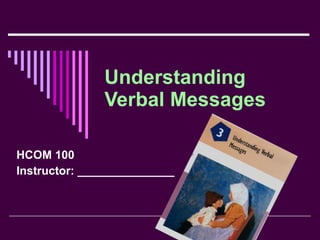
Understanding Verbal Messages HCOM 100 Instructor: _______________
Understanding Verbal Messages Why focus on language? The nature of language The power of words Confronting bias in language Using Words to establish supportive relationships
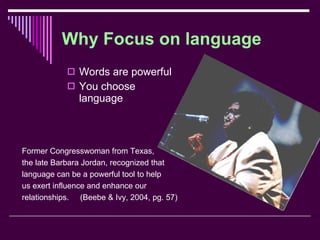
Why Focus on language Words are powerful You choose language Former Congresswoman from Texas, the late Barbara Jordan, recognized that  language can be a powerful tool to help us exert influence and enhance our relationships.  (Beebe & Ivy, 2004, pg. 57)
The Nature of Language A  language  is a system of symbols (words or vocabulary) structured by grammar (rules and standards) and syntax (patterns in the arrangement of words) common to a community of people. Words dictate and limit the nature of our reality.
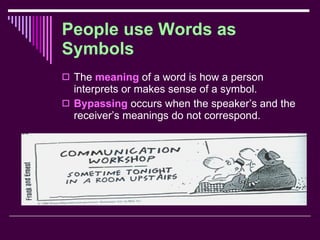
People use Words as Symbols The  meaning  of a word is how a person interprets or makes sense of a symbol. Bypassing  occurs when the speaker’s and the receiver’s meanings do not correspond.
People Create Denotative and Connotative Meanings The  denotative  level of language conveys content. The  connotative  level of language conveys feelings.
People Convey Meanings Through Words A word is  concrete  if we can see it, touch it, smell it, taste it, or hear it. If we cannot, the word is  abstract . Concrete messages are more clear, abstract terms or more difficult to understand or agree upon.
Meanings Are  Culture-Bound Culture  consists of the rules, norms, and values of a group of people that have been learned and shaped from one generation to the next. The meaning of words can change from culture to culture.
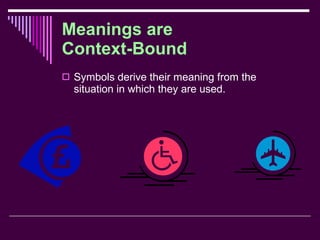
Meanings are Context-Bound Symbols derive their meaning from the situation in which they are used.
The Power of Words Words have the power to create and label experience. Words have the power to impact thoughts and actions. Words have the power to shape and reflect culture. Words have the power to make and break relationships.
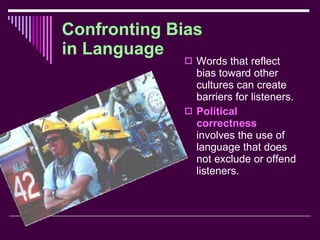
Confronting Bias in Language Words that reflect bias toward other cultures can create barriers for listeners. Political correctness  involves the use of language that does not exclude or offend listeners.
Biased Language: Race, Ethnicity, Nationality and Religion Allness  occurs when words reflect unqualified, often untrue generalizations that deny individual differences or variations. Keep abreast of linguistic changes and adopt the designations currently preferred by members of the ethnic groups themselves.
Biased Language: Gender and Sexual Orientation Sexist  language reveals bias in favor of one sex against another. The use of a masculine term as though it were generic. To avoid sexist language, use either she or he, he/she, or s/he. Homophobic  language reveals insensitivity or intolerance toward persons who are gay, lesbian, or bisexual.
Biased Language: Age, Class,  and Ability Inventory your language for terms that are disrespectful to elders or patronizing to younger persons. Monitor references to socioeconomic differences (e.g., blue- and white-collar workers). Avoid drawing attention to a person’s physical, mental, or learning ability.
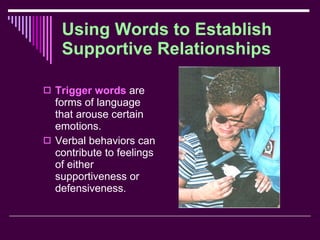
Using Words to Establish Supportive Relationships Trigger words  are forms of language that arouse certain emotions. Verbal behaviors can contribute to feelings of either supportiveness or defensiveness.
Using Words to Establish Supportive Relationships Describe your own feelings rather than evaluate others Solve problems rather than control others Be genuine rather than manipulative Empathize rather than remain detached from others Be flexible rather than rigid toward others Present yourself as equal rather than superior
What questions do you have? HOMEWORK: Reading? Turn in assignment?

03 verbal.pp tverbalmessages-souza

  • 1.
    Understanding Verbal MessagesHCOM 100 Instructor: _______________
  • 2.
    Understanding Verbal MessagesWhy focus on language? The nature of language The power of words Confronting bias in language Using Words to establish supportive relationships
  • 3.
    Why Focus onlanguage Words are powerful You choose language Former Congresswoman from Texas, the late Barbara Jordan, recognized that language can be a powerful tool to help us exert influence and enhance our relationships. (Beebe & Ivy, 2004, pg. 57)
  • 4.
    The Nature ofLanguage A language is a system of symbols (words or vocabulary) structured by grammar (rules and standards) and syntax (patterns in the arrangement of words) common to a community of people. Words dictate and limit the nature of our reality.
  • 5.
    People use Wordsas Symbols The meaning of a word is how a person interprets or makes sense of a symbol. Bypassing occurs when the speaker’s and the receiver’s meanings do not correspond.
  • 6.
    People Create Denotativeand Connotative Meanings The denotative level of language conveys content. The connotative level of language conveys feelings.
  • 7.
    People Convey MeaningsThrough Words A word is concrete if we can see it, touch it, smell it, taste it, or hear it. If we cannot, the word is abstract . Concrete messages are more clear, abstract terms or more difficult to understand or agree upon.
  • 8.
    Meanings Are Culture-Bound Culture consists of the rules, norms, and values of a group of people that have been learned and shaped from one generation to the next. The meaning of words can change from culture to culture.
  • 9.
    Meanings are Context-BoundSymbols derive their meaning from the situation in which they are used.
  • 10.
    The Power ofWords Words have the power to create and label experience. Words have the power to impact thoughts and actions. Words have the power to shape and reflect culture. Words have the power to make and break relationships.
  • 11.
    Confronting Bias inLanguage Words that reflect bias toward other cultures can create barriers for listeners. Political correctness involves the use of language that does not exclude or offend listeners.
  • 12.
    Biased Language: Race,Ethnicity, Nationality and Religion Allness occurs when words reflect unqualified, often untrue generalizations that deny individual differences or variations. Keep abreast of linguistic changes and adopt the designations currently preferred by members of the ethnic groups themselves.
  • 13.
    Biased Language: Genderand Sexual Orientation Sexist language reveals bias in favor of one sex against another. The use of a masculine term as though it were generic. To avoid sexist language, use either she or he, he/she, or s/he. Homophobic language reveals insensitivity or intolerance toward persons who are gay, lesbian, or bisexual.
  • 14.
    Biased Language: Age,Class, and Ability Inventory your language for terms that are disrespectful to elders or patronizing to younger persons. Monitor references to socioeconomic differences (e.g., blue- and white-collar workers). Avoid drawing attention to a person’s physical, mental, or learning ability.
  • 15.
    Using Words toEstablish Supportive Relationships Trigger words are forms of language that arouse certain emotions. Verbal behaviors can contribute to feelings of either supportiveness or defensiveness.
  • 16.
    Using Words toEstablish Supportive Relationships Describe your own feelings rather than evaluate others Solve problems rather than control others Be genuine rather than manipulative Empathize rather than remain detached from others Be flexible rather than rigid toward others Present yourself as equal rather than superior
  • 17.
    What questions doyou have? HOMEWORK: Reading? Turn in assignment?