
Oral Presentations
Workshop
Preparing, Presenting, and
Using PowerPoint as An Effective Aid
Part 1:
Preparing an Oral Presentation
Part 2:
Presenting an Oral Presentation
Part 3:
Using PowerPoint Effectively
Part 1: Preparing an
Oral Presentation
Getting Started
•

Identify the expectations of the assignment
–
–

•

How long should the presentation be?
What is the intent of this presentation? To inform?
Persuade? Critique? Educate? Inspire?

Analyze the audience
–
–
–

What do they know about your topic? About you?
What do they expect?
Are they interested? Biased?
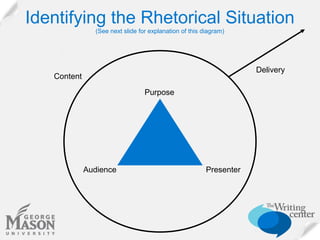
Identifying the Rhetorical Situation
(See next slide for explanation of this diagram)

Delivery

Content
Purpose

Audience

Presenter
The diagram on the previous slide illustrates the
parts of a rhetorical situation (like the one
created by your oral presentation). Identifying
the purpose and the audience of your
presentation will allow you to choose the
appropriate content and delivery style.
For example, if the purpose is to persuade and
the audience is biased, the content should
include especially compelling evidence. You
should also deliver this content in a way that
assures your skeptical audience you are a
trustworthy expert.
How is preparing an oral
presentation like writing a paper?
• Research
• Overall Organization:
– Introduction
– Thesis Statement
– Supporting information/proof (Body)
– Conclusion
How is preparing an oral
presentation NOT like
writing a paper?
•
•
•
•

Multipurpose introductions
Rhetorical signposts
Memory aids/Meta-commentary
Strategies to highlight important points
Multipurpose Introductions
• Hook the audience
• Preview the content of the presentation
• Establish common ground with the
audience
• Build credibility
Rhetorical Signposts
• Give the audience cues that help them
follow your ideas. Some examples are:
– Numbering your points (1st, 2nd, 3rd)
– Making old-to-new transitions
– Using parallel sentence structures
Memory Aids/Meta-commentary
• Also help the audience follow your ideas. Some
examples are:
– Repeating key words or ideas
– Restating your thesis when you transition into a new
idea
– Grouping a set of ideas together under a single
heading
– Giving a short internal summary
– Explaining to the audience exactly why you’re telling
them a particular piece of information
Strategies to Highlight
Important Points
• Include:
–
–
–
–

Repeating or reiterating an important idea
Using key words/vocab
Flagging: “If you remember only one thing…”
Doing the unexpected (using humor, telling an
anecdote, changing your tone or volume, presenting
an attention grabbing visual, getting the audience
involved).
Part 2: Presenting an
Oral Presentation
Overcoming Nervousness
“A survey of more than 2,500 Americans
revealed that people feared public speaking
before a group more than death. Amazing
as it may seem, many Americans appear to
consider public speaking a fate worse than
death.” - Stephen E. Lucas, The Art of
Public Speaking
Delivery DOs
•
•
•
•
•
•
•
•
•

Breathe
Appear confident and knowledgeable
Speak slowly and clearly
Maintain good eye contact
Occupy the space
Stand up straight
Use natural hand motions for emphasis
Be prepared for Q&A
Relax and try to have fun!
Delivery DON’Ts
•
•
•
•
•
•
•
•

Let your nervousness distract the audience
Speak too quickly
Read directly from a script
Pace, rock, slouch, tap your hands or feet, twirl your hair,
or adjust your clothes
Constantly use distracting hand gestures
Chew gum, eat, or drink
Repeat stalling words like: um, er, uh, basically, you
know, and like
Speak with rising inflection (when the ends of your
sentences rise in tone like a question)
Scripting vs. Notecards
• Format notes with bullet points and important words
highlighted (so they’re easy to reference as you speak).
• If you want to write out a fully scripted version to
practice, that’s OK, but convert it into notes for the actual
presentation. You won't be able to resist the
temptation to read from a script.
• Factoid: It takes about two minutes to read a typed,
double-spaced page. As you write, you can remember
this to keep track of how long your presentation will be.
Convert this Script!
Rewrite the paragraph below. Try to create notes you could use during a presentation.

Autism is a pervasive developmental disorder, characterized
by impaired communication, excessive rigidity, and emotional
detachment. An article titled “Repetitive Behaviors in Autistic
Disorder” states that some common characteristics of autistic
children are inflexibility to adhere to routines and rituals,
repetitive motor manifestations, and a persistent preoccupation
with parts of objects. Children with autism do not all have the
same behaviors, and these different characteristics are not
always stable over time. This means some children with
autism may have a hard time sitting still through an entire
story time, or they may use repetitive behaviors such as hand
gestures and body movements that are different from other
children.
Practice, Practice, Practice
•
•
•
•

Do a test run in front of a mirror
Demonstrate your presentation for a friend
Videotape it
Don’t forget to:
– Use your notecards!
– Time it!
CLUB (the Collaborative Learning Hub), which is located in
Johnson Center 311, has a Presentation Practice Space
where you can record your presentation, save it to a
flashdrive, and watch it on your computer. Their hours are
M-R 9-7 and F 10-6. Lab assistants are there to help!
Part 3: Using
PowerPoint Effectively
PowerPoint: Visuals
• Images must be relevant and enhance the
presentation in a meaninful way.
• Tables, charts, and graphs should be easy
to read and understand.
The following slides, excerpted from “How to
Avoid Death by PowerPoint” by Lisa Andion
illustrate what not to do.
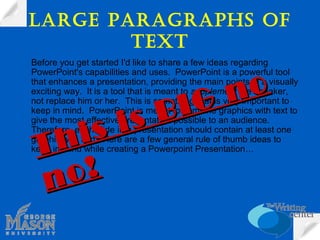
Large ParagraPhs of
TexT
Before you get started I'd like to share a few ideas regarding
PowerPoint's capabilities and uses. PowerPoint is a powerful tool
that enhances a presentation, providing the main points in a visually
exciting way. It is a tool that is meant to supplement the speaker,
not replace him or her. This is something that is very important to
keep in mind. PowerPoint is meant to combine graphics with text to
give the most effective presentation possible to an audience.
Therefore, each slide in a presentation should contain at least one
graphic with text. Here are a few general rule of thumb ideas to
keep in mind while creating a Powerpoint Presentation…

o
n
IG
B
is
is
Th
o!
n
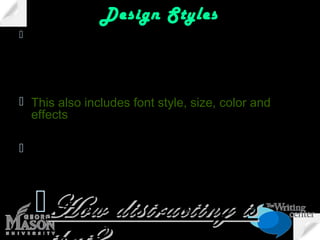
Design Styles
 Your presentation should have
one design style applied to it,
including background

 This also includes font style, size, color and
effects
 Slides in this presentation are all
different

How distracting is
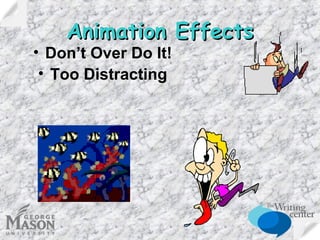
Animation Effects

• Don’t Over Do It!
• Too Distracting
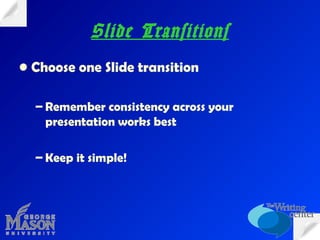
Slide Transitions
• Choose one Slide transition
– Remember consistency across your
presentation works best
– Keep it simple!
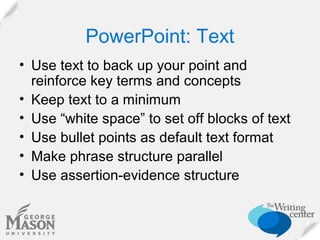
PowerPoint: Text
• Use text to back up your point and
reinforce key terms and concepts
• Keep text to a minimum
• Use “white space” to set off blocks of text
• Use bullet points as default text format
• Make phrase structure parallel
• Use assertion-evidence structure
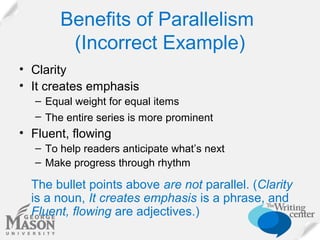
Benefits of Parallelism
(Incorrect Example)
• Clarity
• It creates emphasis
– Equal weight for equal items
– The entire series is more prominent

• Fluent, flowing
– To help readers anticipate what’s next
– Make progress through rhythm

The bullet points above are not parallel. (Clarity
is a noun, It creates emphasis is a phrase, and
Fluent, flowing are adjectives.)
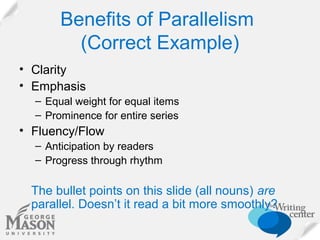
Benefits of Parallelism
(Correct Example)
• Clarity
• Emphasis
– Equal weight for equal items
– Prominence for entire series

• Fluency/Flow
– Anticipation by readers
– Progress through rhythm

The bullet points on this slide (all nouns) are
parallel. Doesn’t it read a bit more smoothly?
The Assertion-Evidence Structure
• Because the purpose of the PowerPoint is
to help the audience understand the
content, rather than to provide talking
points for the speaker, using the
Assertion-Evidence Structure will help
shape an argument-based presentation.
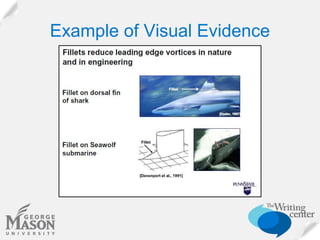
• This structure often features a sentenceassertion headline supported by visual
evidence.
Example of Visual Evidence
The Assertion-Evidence Structure
is useful because:
• It helps the audience understand the
content of the presentation
• It helps the audience engage with the
speaker instead of just reading content on
the presentation
• It helps the speaker engage with the
audience by having talking points but not
scripting exactly what to say
Don’t Forget to Proofread
Your Visuals!
For a little practice writing effective PowerPoint
slides, go back to slide 18, “Convert this Script!”
See if you can rewrite that same paragraph into
an appropriate PowerPoint slide.
Good Luck with All Your Future
Oral Presentations!
Resources Consulted
•
•
•
•
•
•

Rebecca McGill, Emily Viggiano, Ranjani Murali: Sample oral
presentations
Candy Fowler: Parallelism lesson, Composition 101 oral
presentation lesson notes
Lisa Andion: “How to Avoid Death by PowerPoint”
Susan Lawrence: sample rubrics (Georgia Tech Research Corp.,
Pam Lewis & Heinz School of Public Policy at Carnegie Mellon
University)
Sharon Zuber & The College of William and Mary’s Writing
Resource Center: Rubric, Delivery DOs and DON’Ts, oral
presentation handouts
Penn State University: “Rethinking the Design of Presentation
Slides: The Assertion-Evidence Structure”
(http://www.writing.engr.psu.edu/slides.html)

Oral presentations & writing for power point

  • 1.
    Oral Presentations Workshop Preparing, Presenting,and Using PowerPoint as An Effective Aid
  • 2.
    Part 1: Preparing anOral Presentation Part 2: Presenting an Oral Presentation Part 3: Using PowerPoint Effectively
  • 3.
    Part 1: Preparingan Oral Presentation
  • 4.
    Getting Started • Identify theexpectations of the assignment – – • How long should the presentation be? What is the intent of this presentation? To inform? Persuade? Critique? Educate? Inspire? Analyze the audience – – – What do they know about your topic? About you? What do they expect? Are they interested? Biased?
  • 5.
    Identifying the RhetoricalSituation (See next slide for explanation of this diagram) Delivery Content Purpose Audience Presenter
  • 6.
    The diagram onthe previous slide illustrates the parts of a rhetorical situation (like the one created by your oral presentation). Identifying the purpose and the audience of your presentation will allow you to choose the appropriate content and delivery style. For example, if the purpose is to persuade and the audience is biased, the content should include especially compelling evidence. You should also deliver this content in a way that assures your skeptical audience you are a trustworthy expert.
  • 7.
    How is preparingan oral presentation like writing a paper? • Research • Overall Organization: – Introduction – Thesis Statement – Supporting information/proof (Body) – Conclusion
  • 8.
    How is preparingan oral presentation NOT like writing a paper? • • • • Multipurpose introductions Rhetorical signposts Memory aids/Meta-commentary Strategies to highlight important points
  • 9.
    Multipurpose Introductions • Hookthe audience • Preview the content of the presentation • Establish common ground with the audience • Build credibility
  • 10.
    Rhetorical Signposts • Givethe audience cues that help them follow your ideas. Some examples are: – Numbering your points (1st, 2nd, 3rd) – Making old-to-new transitions – Using parallel sentence structures
  • 11.
    Memory Aids/Meta-commentary • Alsohelp the audience follow your ideas. Some examples are: – Repeating key words or ideas – Restating your thesis when you transition into a new idea – Grouping a set of ideas together under a single heading – Giving a short internal summary – Explaining to the audience exactly why you’re telling them a particular piece of information
  • 12.
    Strategies to Highlight ImportantPoints • Include: – – – – Repeating or reiterating an important idea Using key words/vocab Flagging: “If you remember only one thing…” Doing the unexpected (using humor, telling an anecdote, changing your tone or volume, presenting an attention grabbing visual, getting the audience involved).
  • 13.
    Part 2: Presentingan Oral Presentation
  • 14.
    Overcoming Nervousness “A surveyof more than 2,500 Americans revealed that people feared public speaking before a group more than death. Amazing as it may seem, many Americans appear to consider public speaking a fate worse than death.” - Stephen E. Lucas, The Art of Public Speaking
  • 15.
    Delivery DOs • • • • • • • • • Breathe Appear confidentand knowledgeable Speak slowly and clearly Maintain good eye contact Occupy the space Stand up straight Use natural hand motions for emphasis Be prepared for Q&A Relax and try to have fun!
  • 16.
    Delivery DON’Ts • • • • • • • • Let yournervousness distract the audience Speak too quickly Read directly from a script Pace, rock, slouch, tap your hands or feet, twirl your hair, or adjust your clothes Constantly use distracting hand gestures Chew gum, eat, or drink Repeat stalling words like: um, er, uh, basically, you know, and like Speak with rising inflection (when the ends of your sentences rise in tone like a question)
  • 17.
    Scripting vs. Notecards •Format notes with bullet points and important words highlighted (so they’re easy to reference as you speak). • If you want to write out a fully scripted version to practice, that’s OK, but convert it into notes for the actual presentation. You won't be able to resist the temptation to read from a script. • Factoid: It takes about two minutes to read a typed, double-spaced page. As you write, you can remember this to keep track of how long your presentation will be.
  • 18.
    Convert this Script! Rewritethe paragraph below. Try to create notes you could use during a presentation. Autism is a pervasive developmental disorder, characterized by impaired communication, excessive rigidity, and emotional detachment. An article titled “Repetitive Behaviors in Autistic Disorder” states that some common characteristics of autistic children are inflexibility to adhere to routines and rituals, repetitive motor manifestations, and a persistent preoccupation with parts of objects. Children with autism do not all have the same behaviors, and these different characteristics are not always stable over time. This means some children with autism may have a hard time sitting still through an entire story time, or they may use repetitive behaviors such as hand gestures and body movements that are different from other children.
  • 19.
    Practice, Practice, Practice • • • • Doa test run in front of a mirror Demonstrate your presentation for a friend Videotape it Don’t forget to: – Use your notecards! – Time it! CLUB (the Collaborative Learning Hub), which is located in Johnson Center 311, has a Presentation Practice Space where you can record your presentation, save it to a flashdrive, and watch it on your computer. Their hours are M-R 9-7 and F 10-6. Lab assistants are there to help!
  • 20.
  • 21.
    PowerPoint: Visuals • Imagesmust be relevant and enhance the presentation in a meaninful way. • Tables, charts, and graphs should be easy to read and understand. The following slides, excerpted from “How to Avoid Death by PowerPoint” by Lisa Andion illustrate what not to do.
  • 22.
    Large ParagraPhs of TexT Beforeyou get started I'd like to share a few ideas regarding PowerPoint's capabilities and uses. PowerPoint is a powerful tool that enhances a presentation, providing the main points in a visually exciting way. It is a tool that is meant to supplement the speaker, not replace him or her. This is something that is very important to keep in mind. PowerPoint is meant to combine graphics with text to give the most effective presentation possible to an audience. Therefore, each slide in a presentation should contain at least one graphic with text. Here are a few general rule of thumb ideas to keep in mind while creating a Powerpoint Presentation… o n IG B is is Th o! n
  • 23.
    Design Styles  Yourpresentation should have one design style applied to it, including background  This also includes font style, size, color and effects  Slides in this presentation are all different How distracting is
  • 24.
    Animation Effects • Don’tOver Do It! • Too Distracting
  • 25.
    Slide Transitions • Chooseone Slide transition – Remember consistency across your presentation works best – Keep it simple!
  • 26.
    PowerPoint: Text • Usetext to back up your point and reinforce key terms and concepts • Keep text to a minimum • Use “white space” to set off blocks of text • Use bullet points as default text format • Make phrase structure parallel • Use assertion-evidence structure
  • 27.
    Benefits of Parallelism (IncorrectExample) • Clarity • It creates emphasis – Equal weight for equal items – The entire series is more prominent • Fluent, flowing – To help readers anticipate what’s next – Make progress through rhythm The bullet points above are not parallel. (Clarity is a noun, It creates emphasis is a phrase, and Fluent, flowing are adjectives.)
  • 28.
    Benefits of Parallelism (CorrectExample) • Clarity • Emphasis – Equal weight for equal items – Prominence for entire series • Fluency/Flow – Anticipation by readers – Progress through rhythm The bullet points on this slide (all nouns) are parallel. Doesn’t it read a bit more smoothly?
  • 29.
    The Assertion-Evidence Structure •Because the purpose of the PowerPoint is to help the audience understand the content, rather than to provide talking points for the speaker, using the Assertion-Evidence Structure will help shape an argument-based presentation. • This structure often features a sentenceassertion headline supported by visual evidence.
  • 30.
  • 31.
    The Assertion-Evidence Structure isuseful because: • It helps the audience understand the content of the presentation • It helps the audience engage with the speaker instead of just reading content on the presentation • It helps the speaker engage with the audience by having talking points but not scripting exactly what to say
  • 32.
    Don’t Forget toProofread Your Visuals! For a little practice writing effective PowerPoint slides, go back to slide 18, “Convert this Script!” See if you can rewrite that same paragraph into an appropriate PowerPoint slide.
  • 33.
    Good Luck withAll Your Future Oral Presentations!
  • 34.
    Resources Consulted • • • • • • Rebecca McGill,Emily Viggiano, Ranjani Murali: Sample oral presentations Candy Fowler: Parallelism lesson, Composition 101 oral presentation lesson notes Lisa Andion: “How to Avoid Death by PowerPoint” Susan Lawrence: sample rubrics (Georgia Tech Research Corp., Pam Lewis & Heinz School of Public Policy at Carnegie Mellon University) Sharon Zuber & The College of William and Mary’s Writing Resource Center: Rubric, Delivery DOs and DON’Ts, oral presentation handouts Penn State University: “Rethinking the Design of Presentation Slides: The Assertion-Evidence Structure” (http://www.writing.engr.psu.edu/slides.html)