
Forrester – BSM Best practices

               April 23, 2007
                 Peter o Neill
               Evelyn Hubert
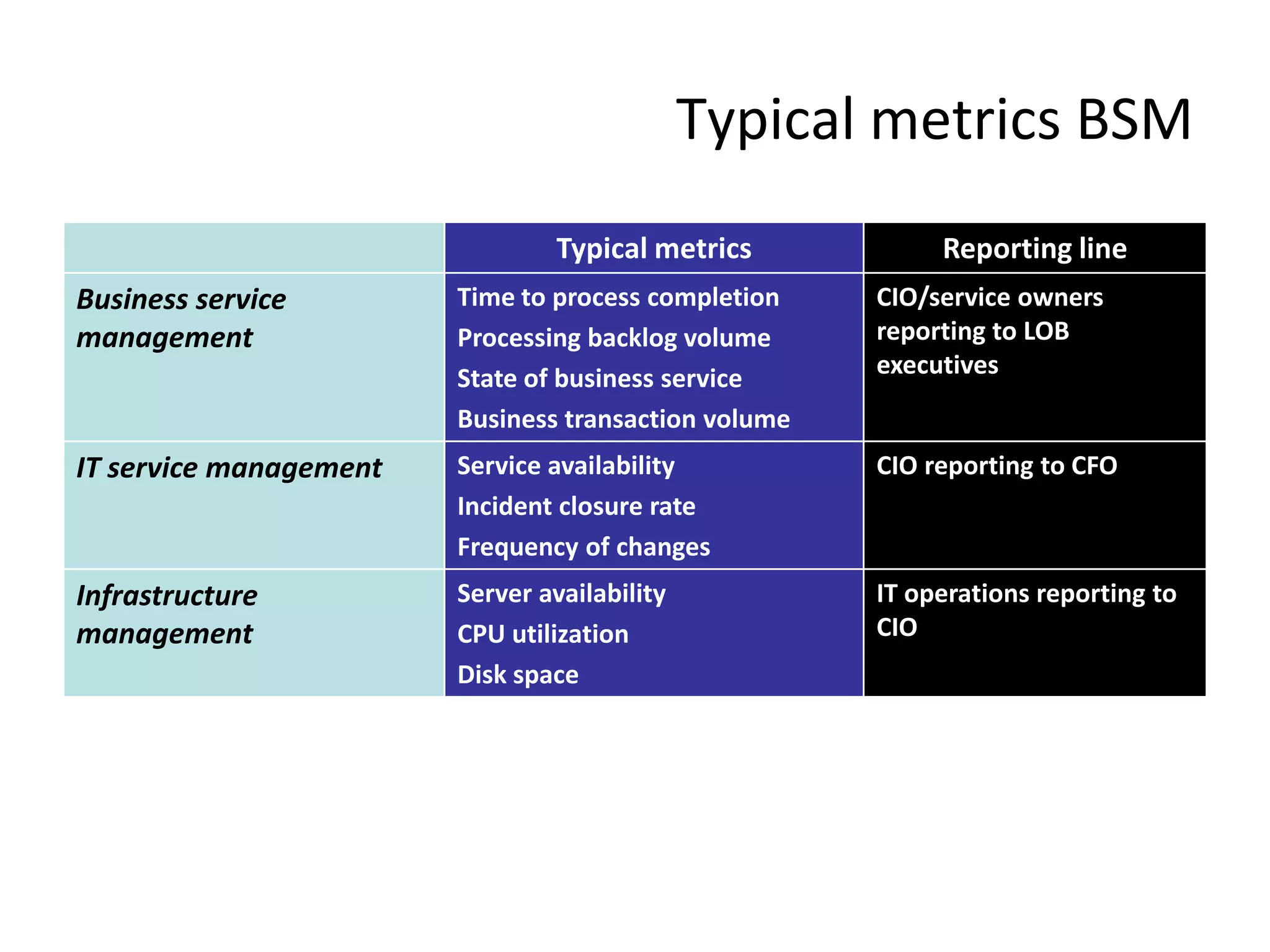
Typical metrics BSM
                                 Typical metrics           Reporting line
Business service        Time to process completion    CIO/service owners
management              Processing backlog volume     reporting to LOB
                        State of business service     executives
                        Business transaction volume
IT service management   Service availability          CIO reporting to CFO
                        Incident closure rate
                        Frequency of changes
Infrastructure          Server availability           IT operations reporting to
management              CPU utilization               CIO
                        Disk space
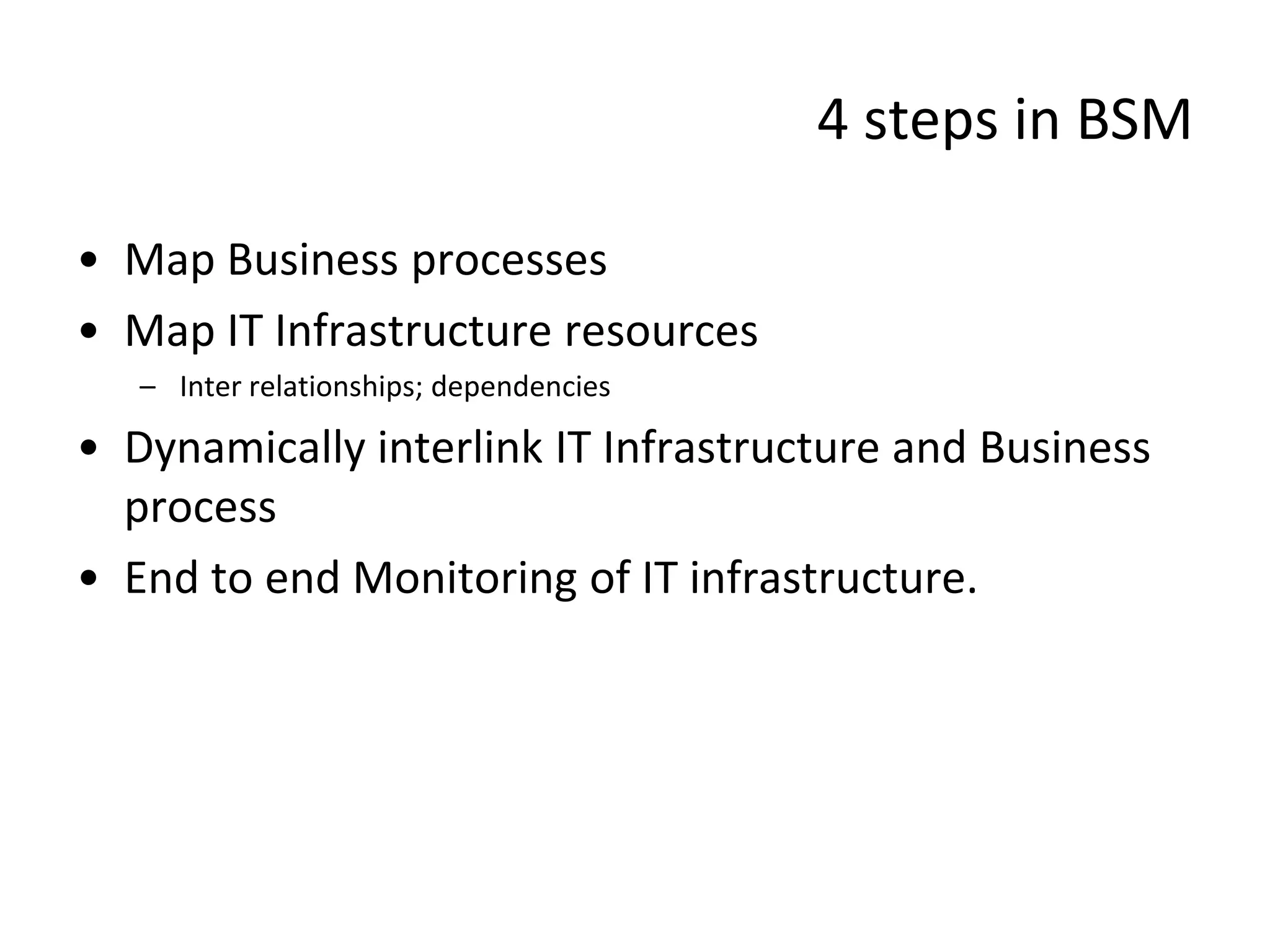
4 steps in BSM

• Map Business processes
• Map IT Infrastructure resources
   – Inter relationships; dependencies

• Dynamically interlink IT Infrastructure and Business
  process
• End to end Monitoring of IT infrastructure.
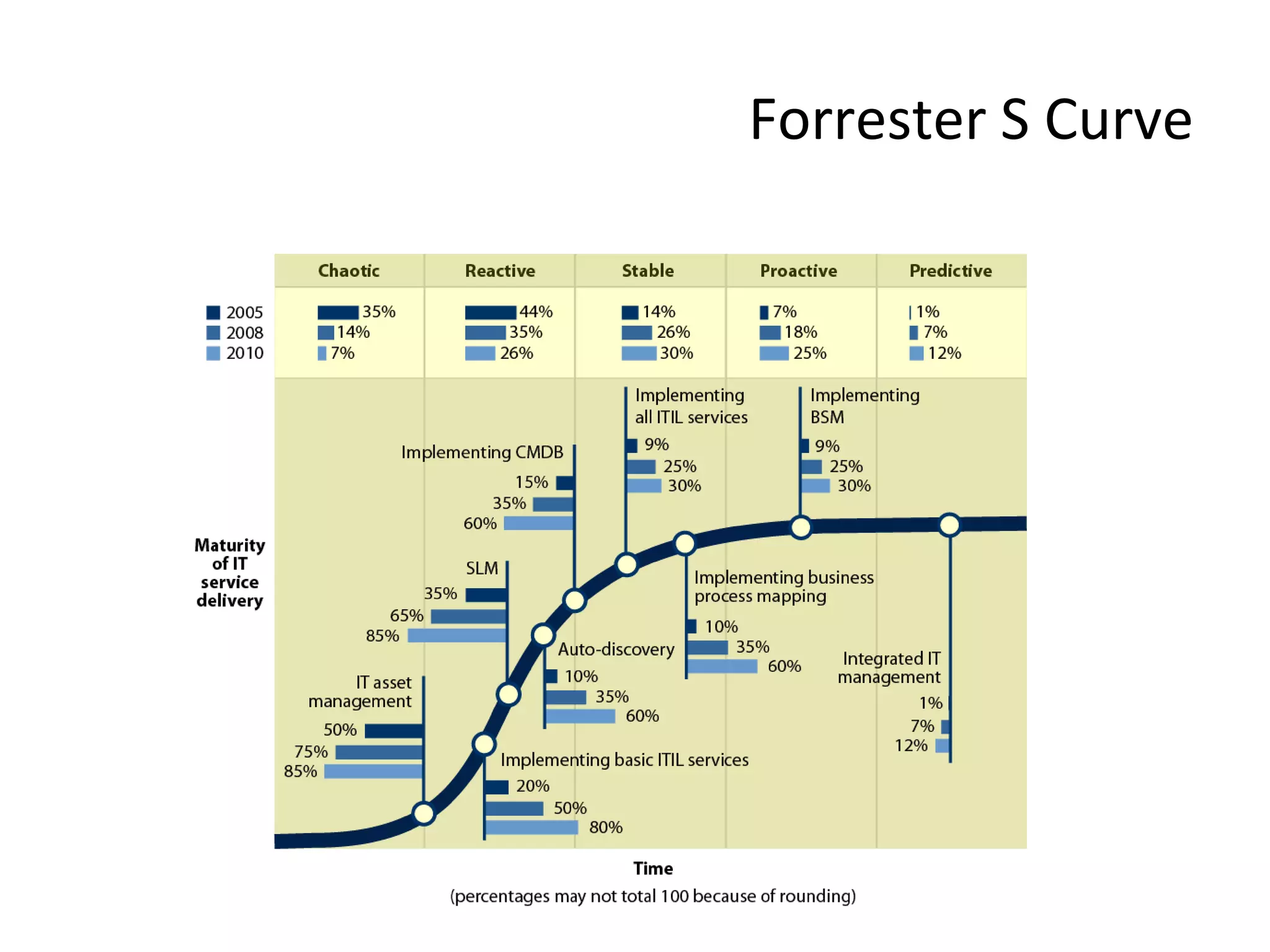
Forrester S Curve
Some key advice on the way

•   Just enough BSM
•   ITIL based standard practices
•   Service oriented approach
•   Involve business analysts
•   Low hanging quick wins
•   Be pragmatic – just enough top down
•   CMDB should be the center of all IT SM
•   Define BSM and CMDB from process perspective
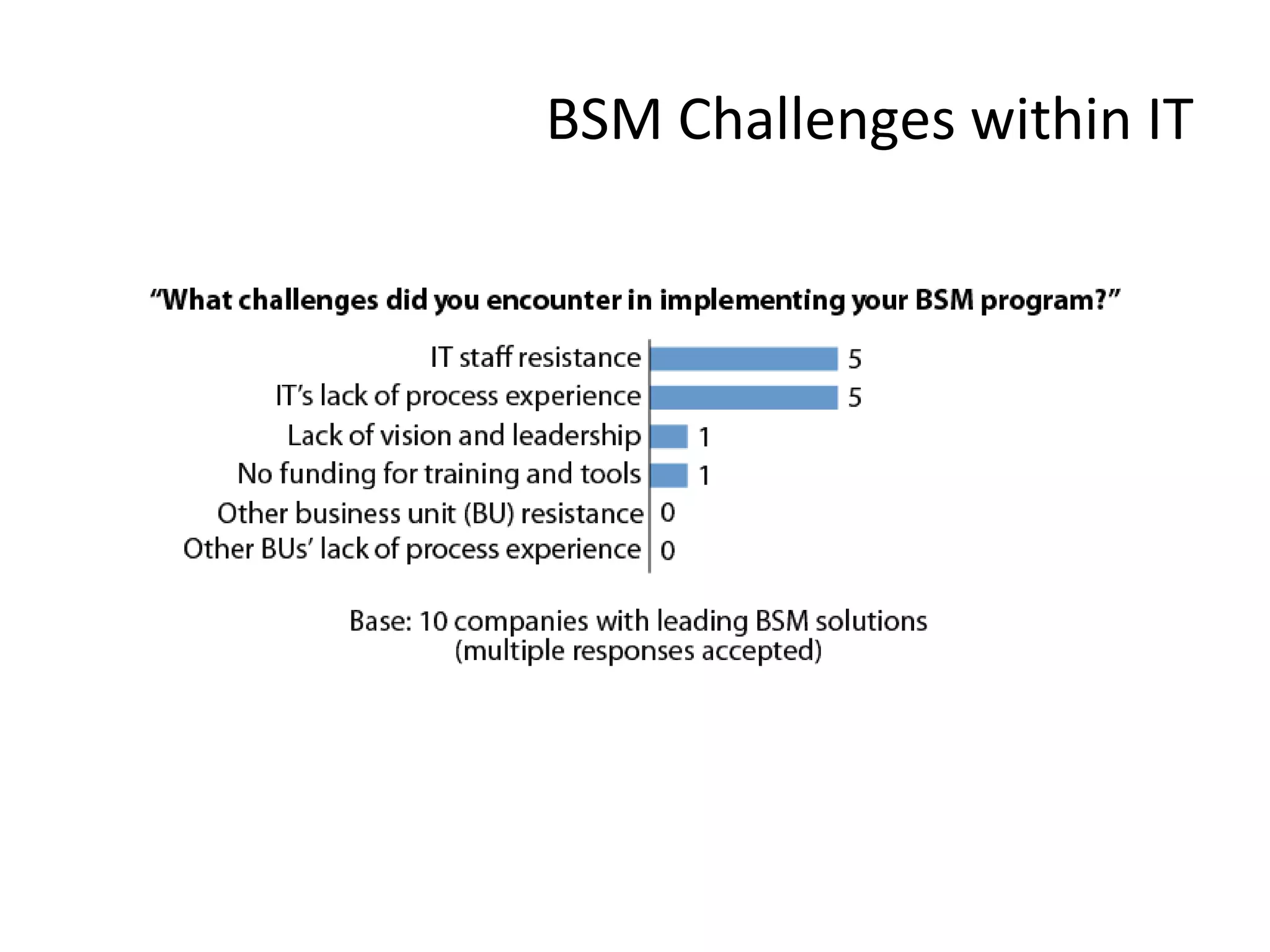
BSM Challenges within IT
BSM vendor landscape

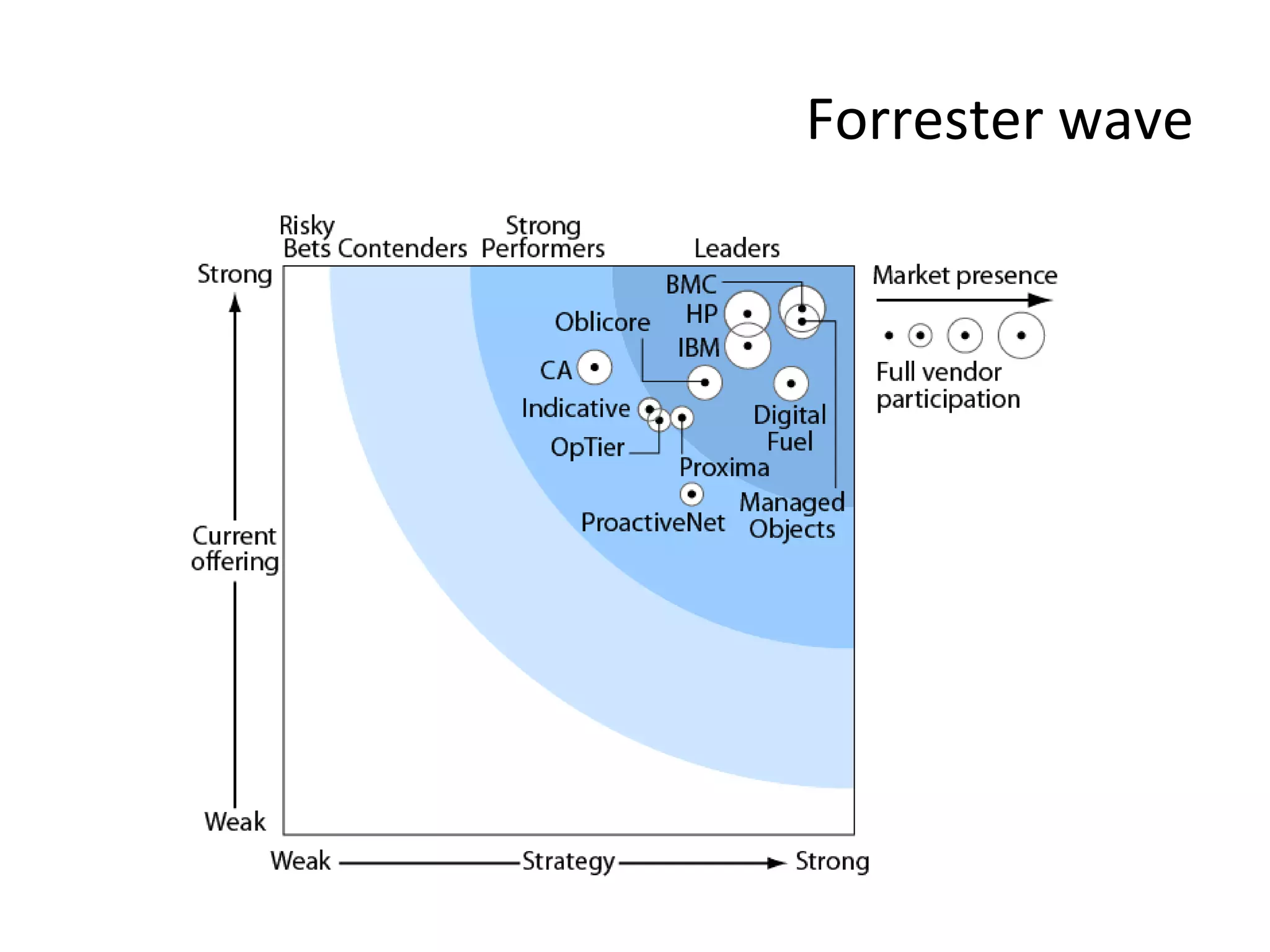
• Strategic integrated vendors
   – IBM HP CA BMC Managed objects

• Service Management approach
   – Service catalogs with business metrics
   – Digital fuel, Oblicore Proxima

• Performance management approach
   – Transaction / performance management tools with business metrics
   – Proactivenet, OpTier
Forrester wave
Defining BSM

CA.Sarah Meyer
Benefits from BSM

• BSM Empowers IT to
  –   Offer reliable, flexible, business-sensitive levels of service
  –   Measure service quality in terms of business user experience
  –   Improve operational efficiency and agility end-to-end
  –   Reduce and control costs through automation and integration
  –   Become a strategic partner, value generator and source of innovation
Key phrases

• Managing the IT service supply chain aligned to
  business
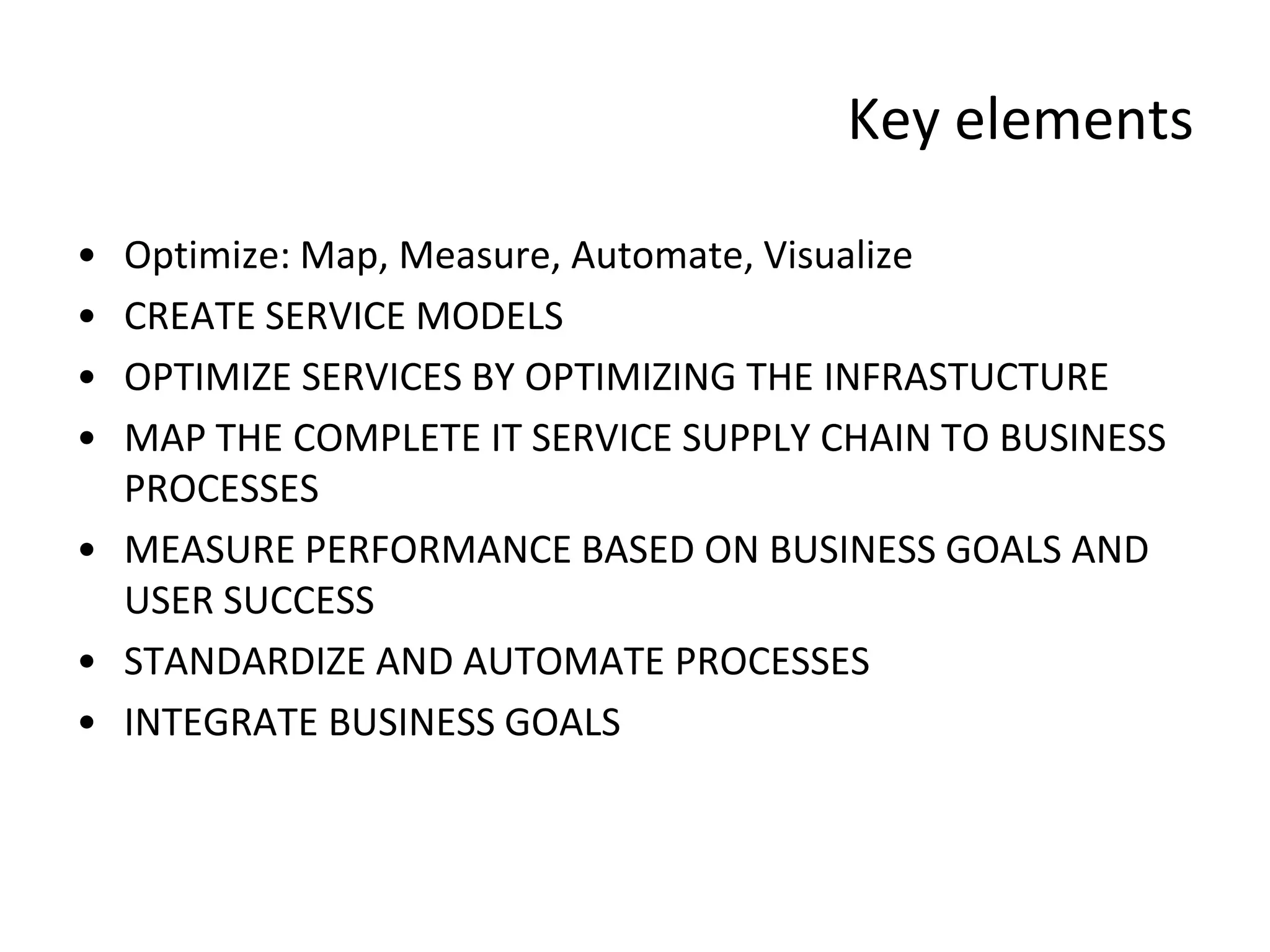
Key elements

• Optimize: Map, Measure, Automate, Visualize
• CREATE SERVICE MODELS
• OPTIMIZE SERVICES BY OPTIMIZING THE INFRASTUCTURE
• MAP THE COMPLETE IT SERVICE SUPPLY CHAIN TO BUSINESS
  PROCESSES
• MEASURE PERFORMANCE BASED ON BUSINESS GOALS AND
  USER SUCCESS
• STANDARDIZE AND AUTOMATE PROCESSES
• INTEGRATE BUSINESS GOALS
BSM TIBCO Whitepaper
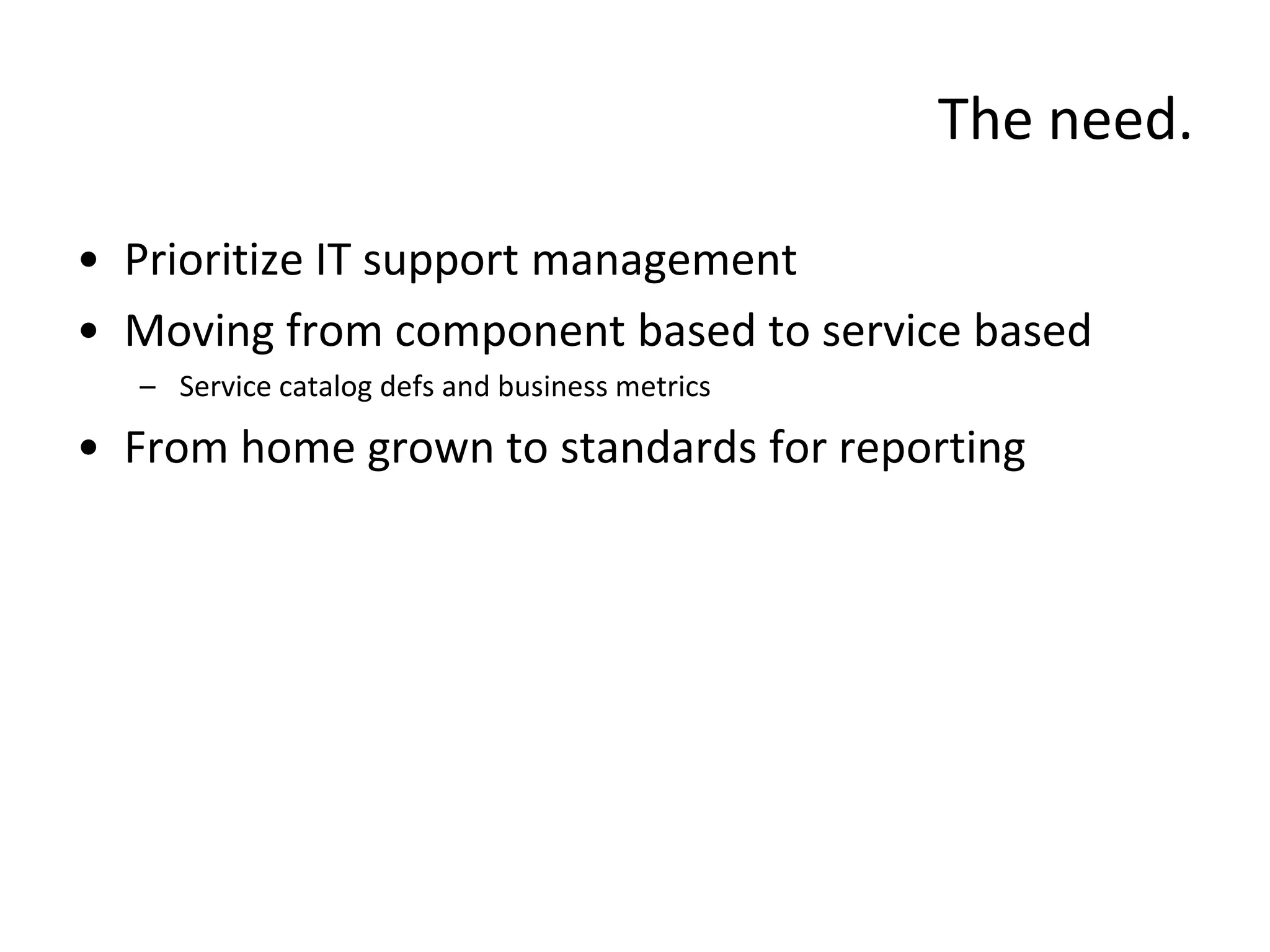
The need.

• Prioritize IT support management
• Moving from component based to service based
  – Service catalog defs and business metrics

• From home grown to standards for reporting
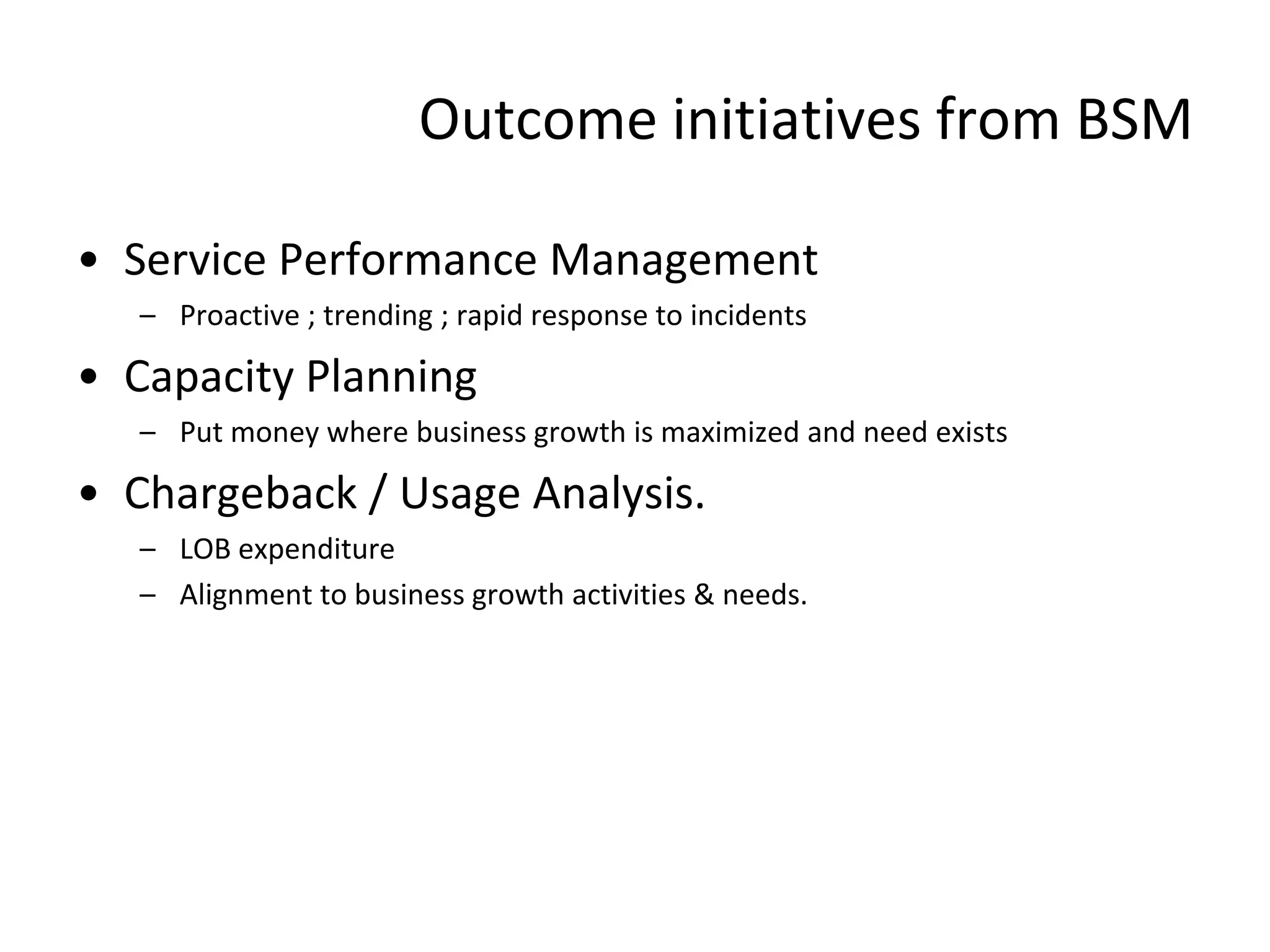
Outcome initiatives from BSM

• Service Performance Management
   – Proactive ; trending ; rapid response to incidents

• Capacity Planning
   – Put money where business growth is maximized and need exists

• Chargeback / Usage Analysis.
   – LOB expenditure
   – Alignment to business growth activities & needs.
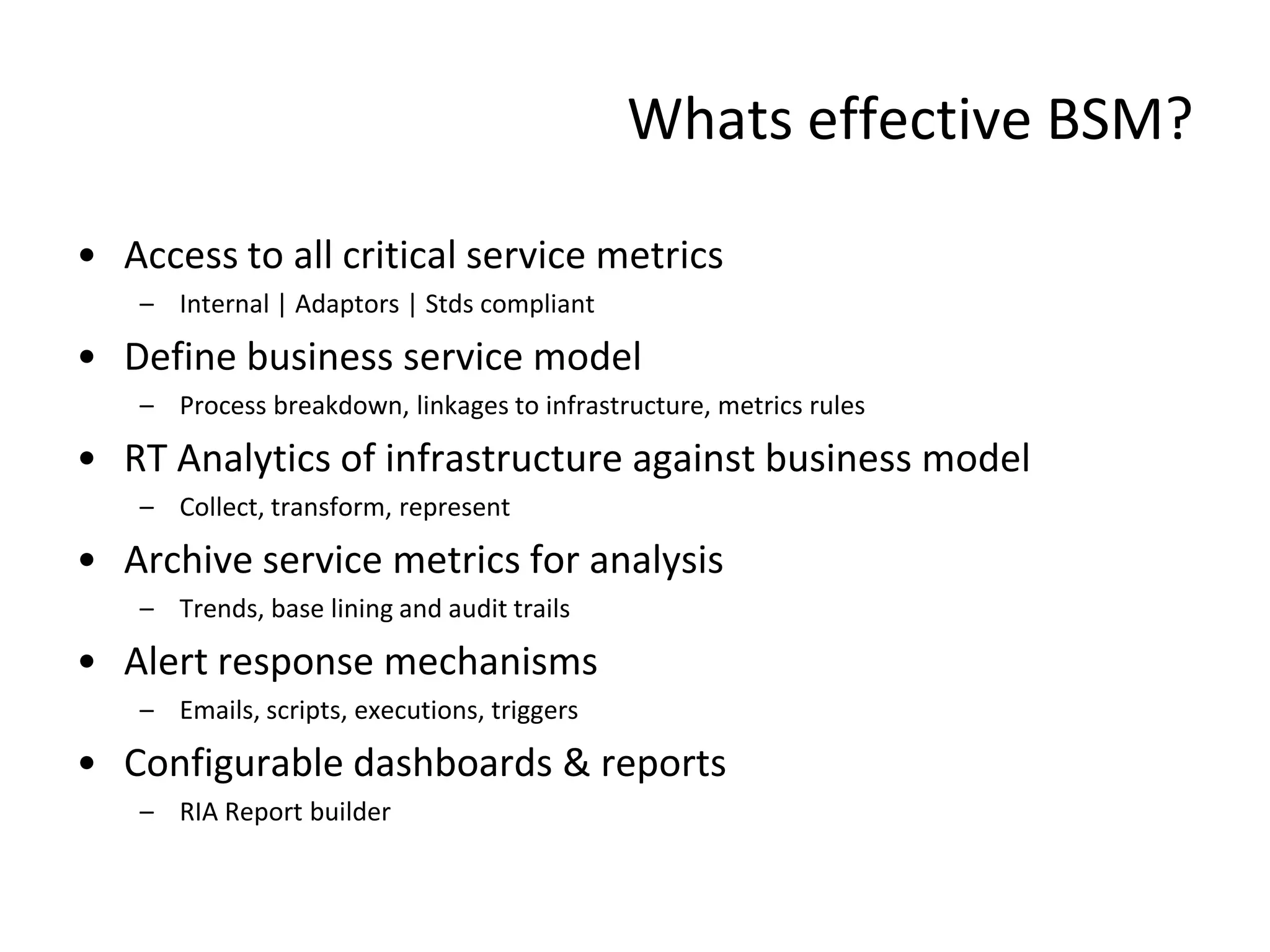
Whats effective BSM?

• Access to all critical service metrics
   – Internal | Adaptors | Stds compliant

• Define business service model
   – Process breakdown, linkages to infrastructure, metrics rules

• RT Analytics of infrastructure against business model
   – Collect, transform, represent

• Archive service metrics for analysis
   – Trends, base lining and audit trails

• Alert response mechanisms
   – Emails, scripts, executions, triggers

• Configurable dashboards & reports
   – RIA Report builder
BMC - Discovery

Mapping Infrastructure resources,
 relationships and dependencies
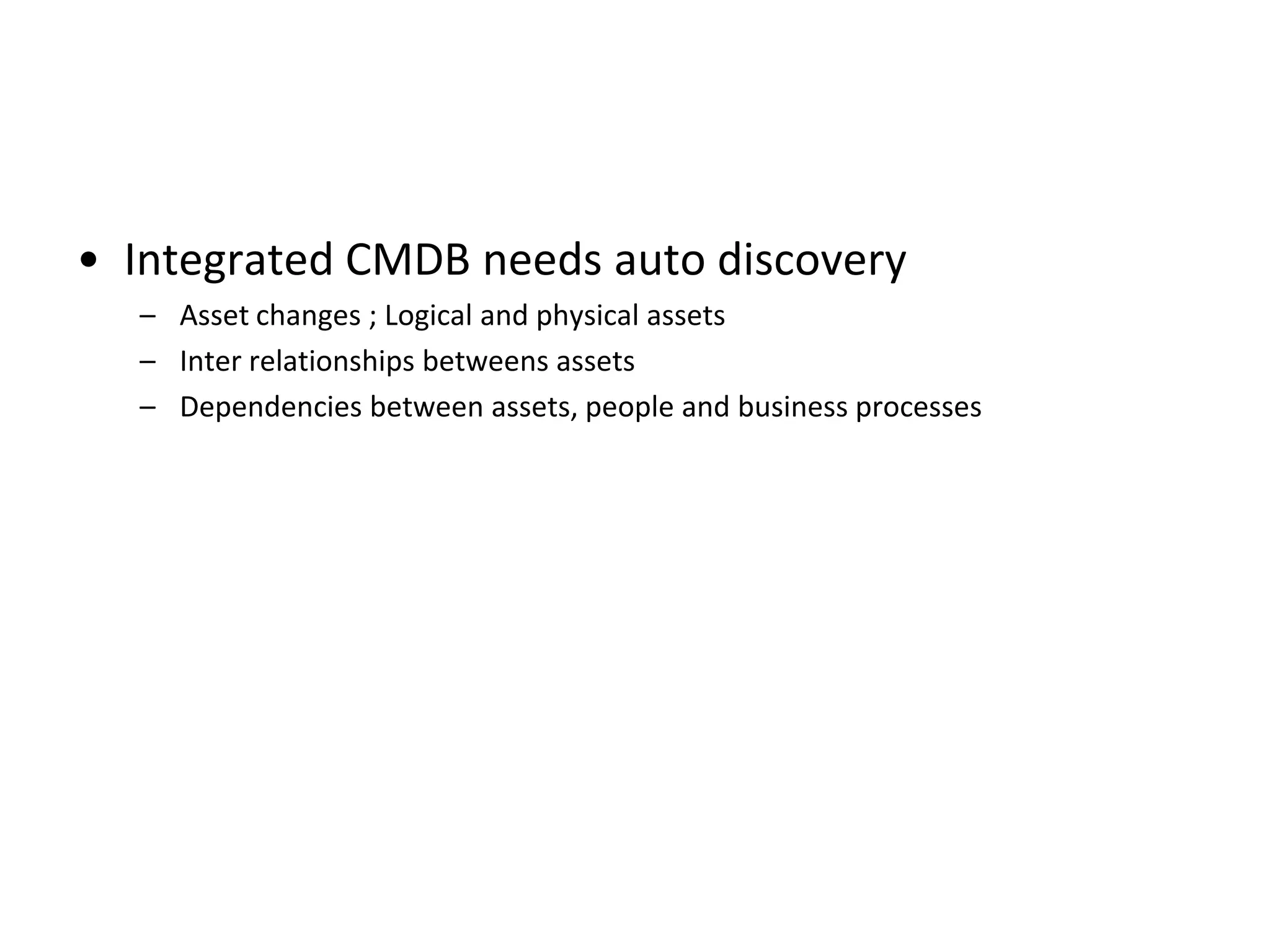
• Integrated CMDB needs auto discovery
  – Asset changes ; Logical and physical assets
  – Inter relationships betweens assets
  – Dependencies between assets, people and business processes
Doug Mcclure

Dougmcclure.net
            we
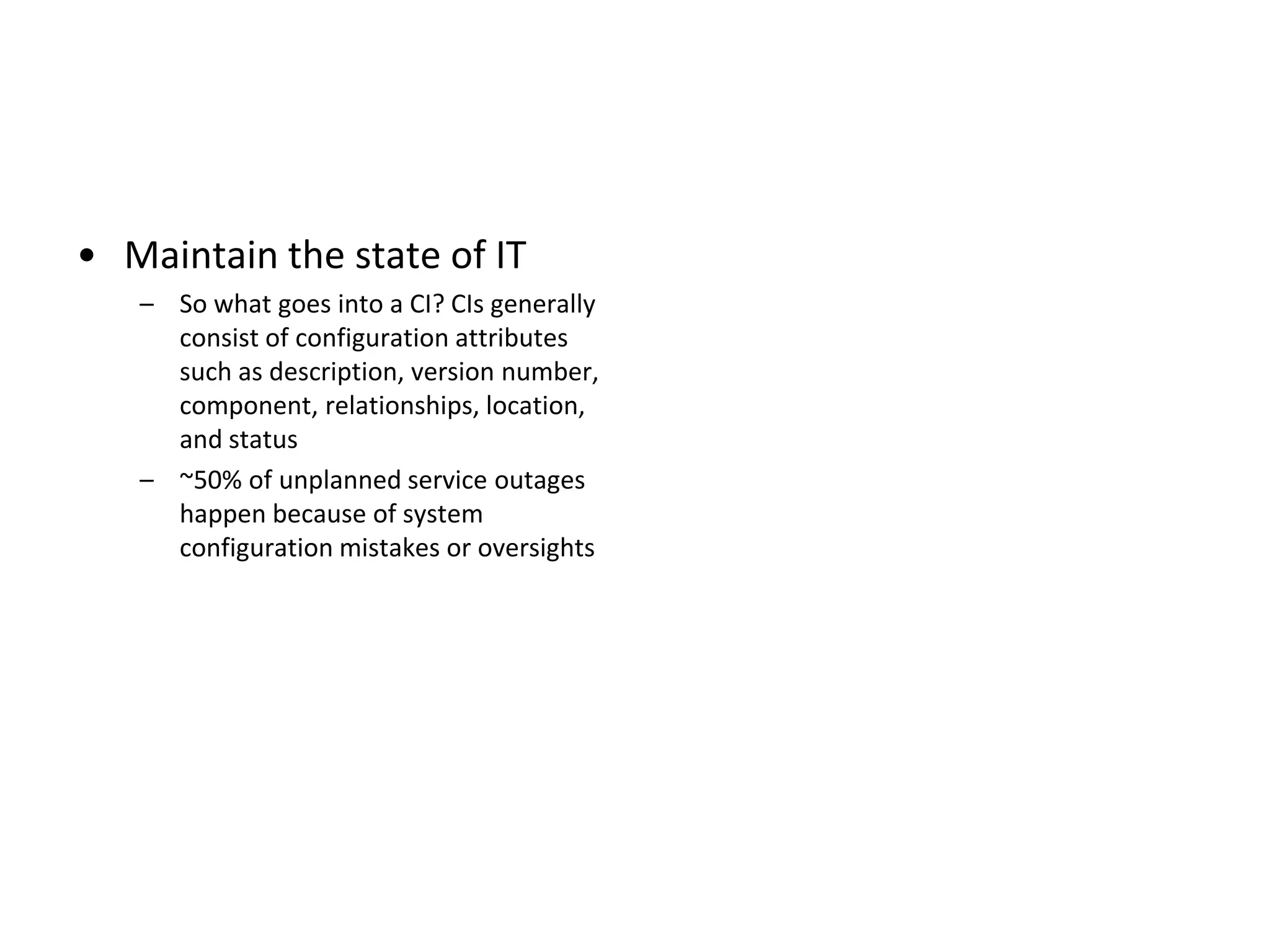
• Maintain the state of IT
   – So what goes into a CI? CIs generally
     consist of configuration attributes
     such as description, version number,
     component, relationships, location,
     and status
   – ~50% of unplanned service outages
     happen because of system
     configuration mistakes or oversights
Definitive Guide to BSM

           Greg Shields
           Compuware
    Realtime publishers
Challenges to IT

• Monitoring and response infrastructure focused
   – Critical links of infrastructure to business missing
   – Other factors like time zones etc.. Not factored in
   – What is an SLA?

• Factors that influence
   – Loss / performance / response time


• Applying $ value to reduction in quality
   – Monitoring + Money
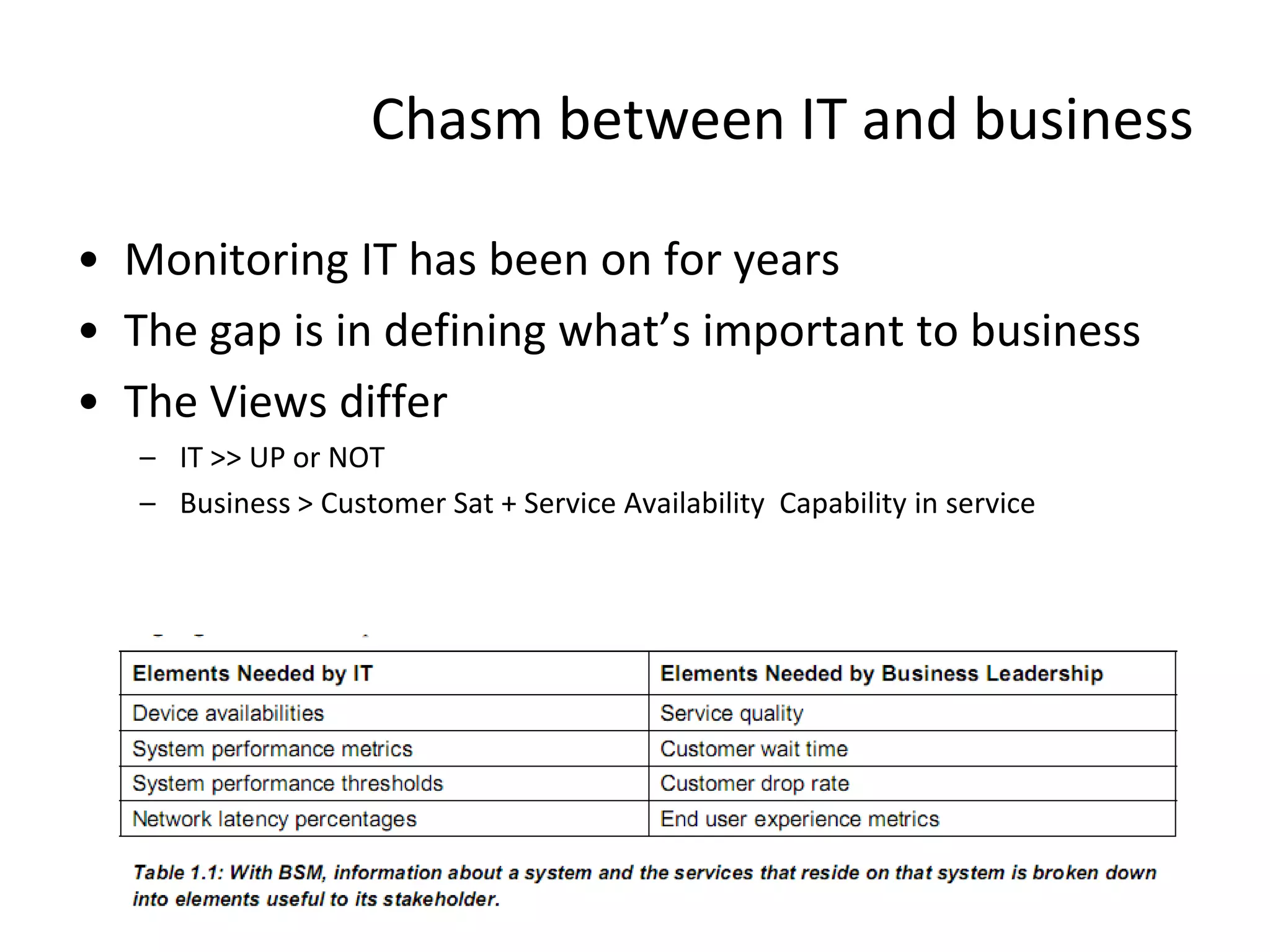
Chasm between IT and business

• Monitoring IT has been on for years
• The gap is in defining what’s important to business
• The Views differ
   – IT >> UP or NOT
   – Business > Customer Sat + Service Availability Capability in service
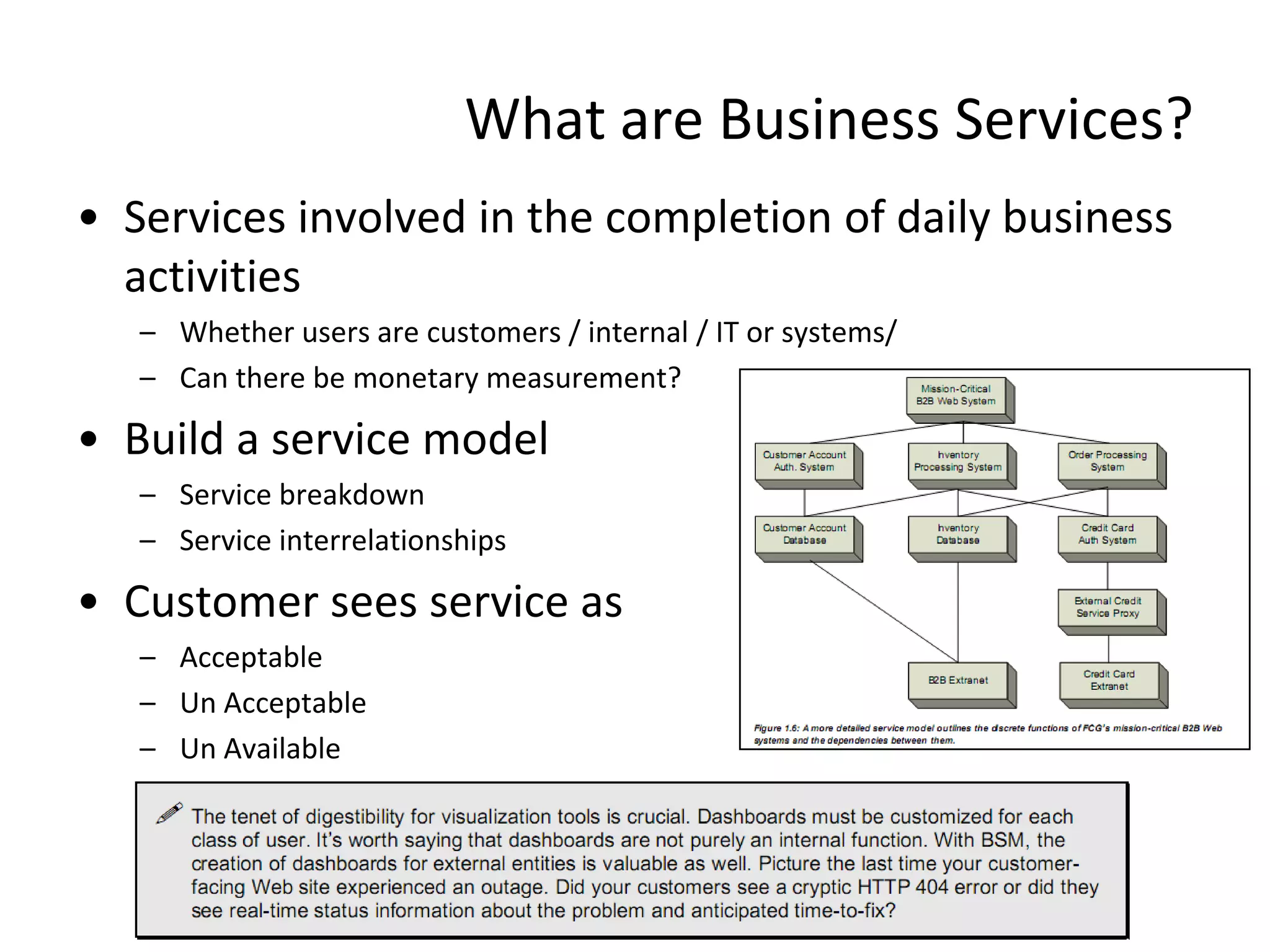
What are Business Services?
• Services involved in the completion of daily business
  activities
   – Whether users are customers / internal / IT or systems/
   – Can there be monetary measurement?

• Build a service model
   – Service breakdown
   – Service interrelationships

• Customer sees service as
   – Acceptable
   – Un Acceptable
   – Un Available
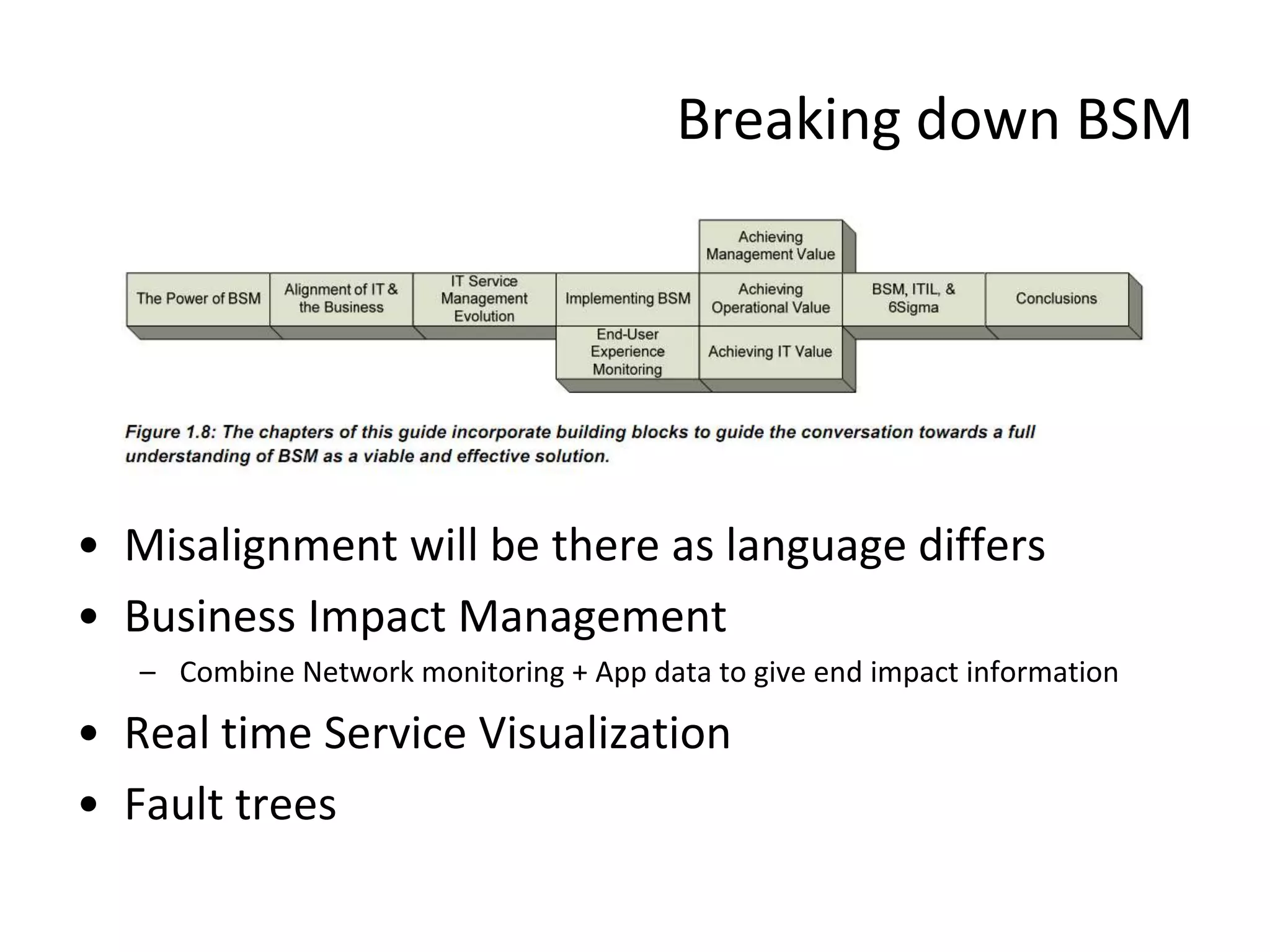
Breaking down BSM


• Misalignment will be there as language differs
• Business Impact Management
   – Combine Network monitoring + App data to give end impact information

• Real time Service Visualization
• Fault trees
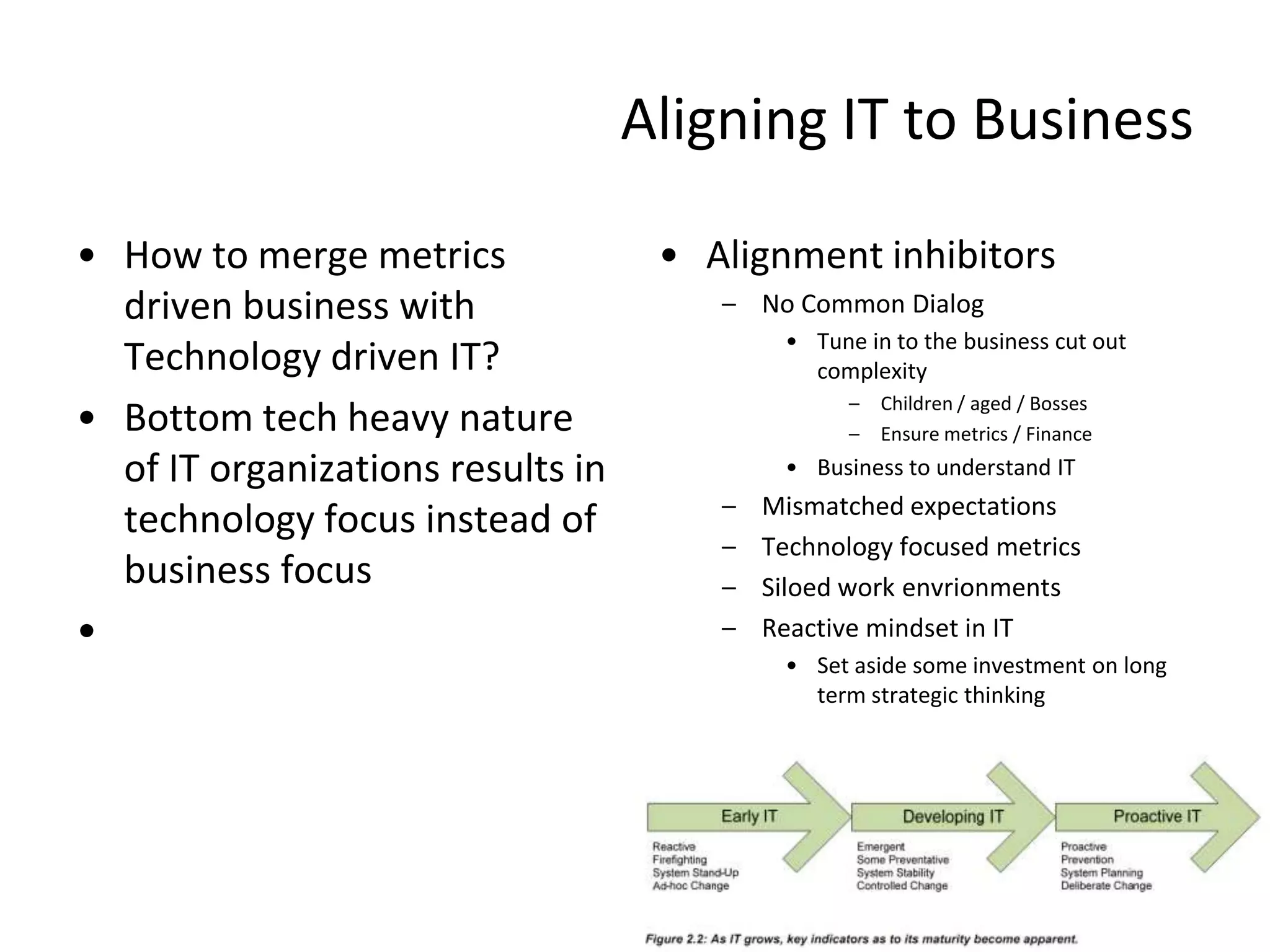
Aligning IT to Business

• How to merge metrics              • Alignment inhibitors
  driven business with                 – No Common Dialog
                                            • Tune in to the business cut out
  Technology driven IT?                       complexity
                                                  –   Children / aged / Bosses
• Bottom tech heavy nature                        –   Ensure metrics / Finance
  of IT organizations results in            • Business to understand IT
                                       –   Mismatched expectations
  technology focus instead of
                                       –   Technology focused metrics
  business focus                       –   Siloed work envrionments
•                                      –   Reactive mindset in IT
                                            • Set aside some investment on long
                                              term strategic thinking
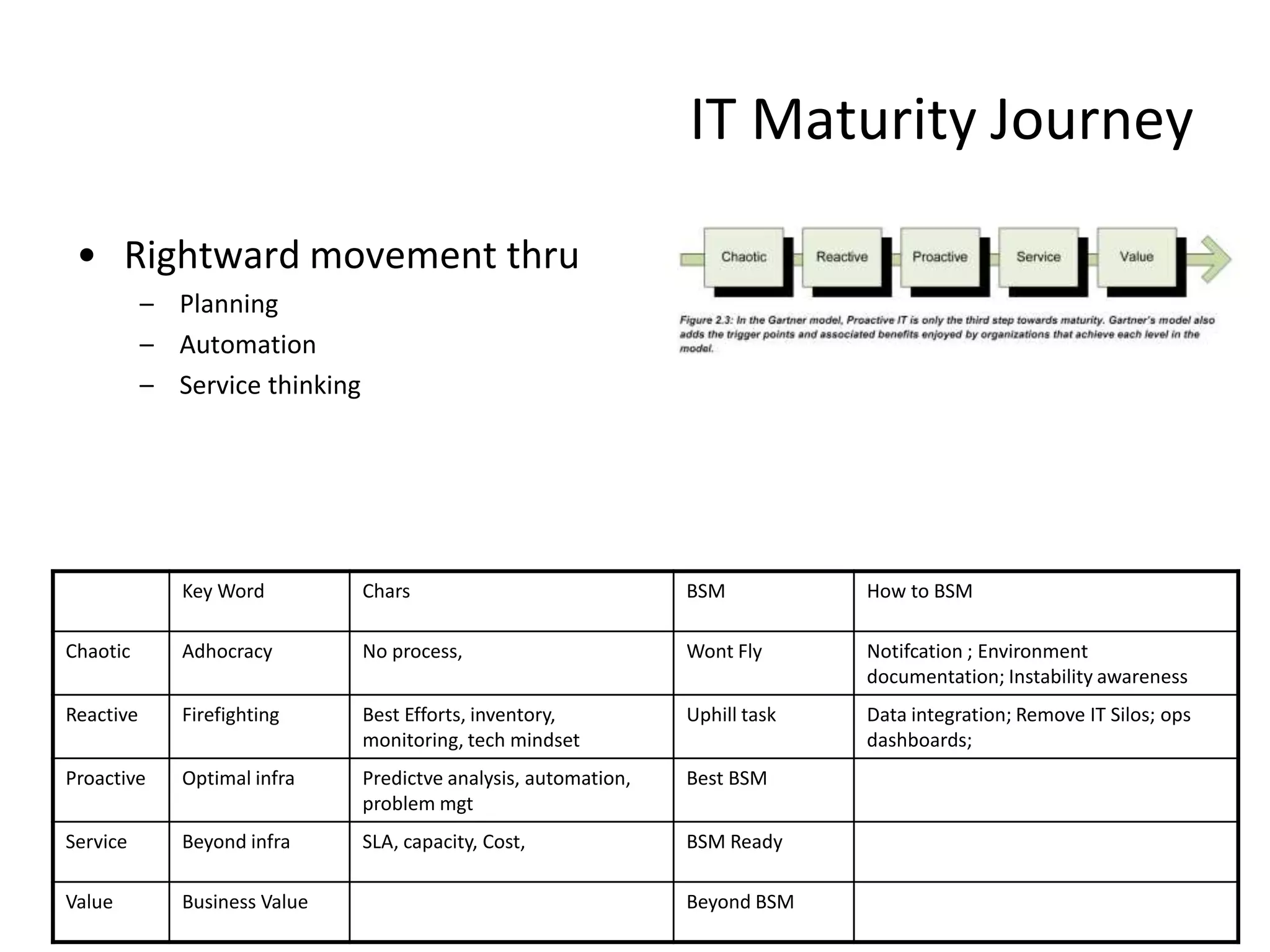
IT Maturity Journey

 • Rightward movement thru
           – Planning
           – Automation
           – Service thinking


              Key Word          Chars                             BSM           How to BSM

Chaotic       Adhocracy         No process,                       Wont Fly      Notifcation ; Environment
                                                                                documentation; Instability awareness
Reactive      Firefighting      Best Efforts, inventory,          Uphill task   Data integration; Remove IT Silos; ops
                                monitoring, tech mindset                        dashboards;
Proactive     Optimal infra     Predictve analysis, automation,   Best BSM
                                problem mgt
Service       Beyond infra      SLA, capacity, Cost,              BSM Ready

Value         Business Value                                      Beyond BSM
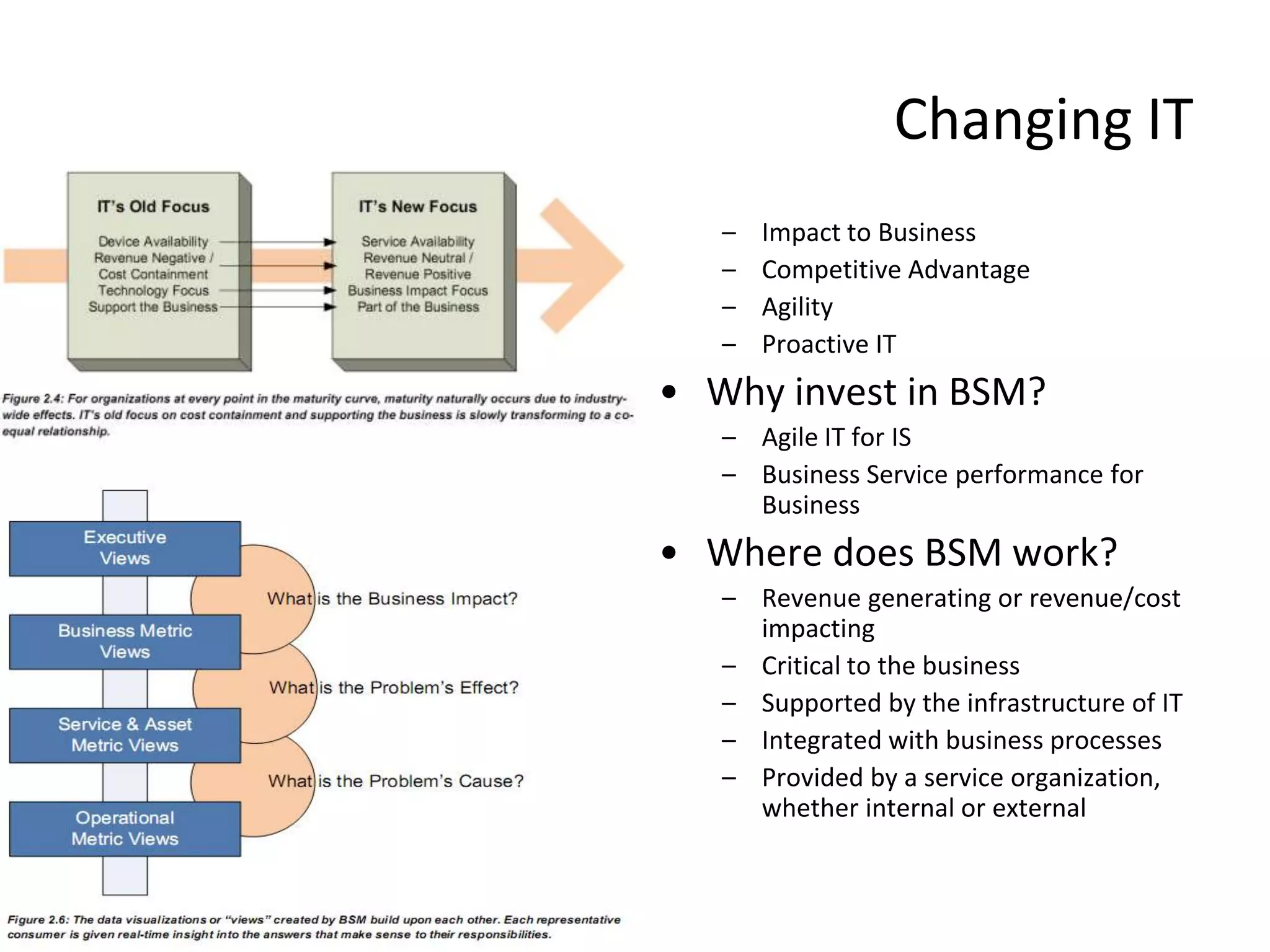
Changing IT
   –   Impact to Business
   –   Competitive Advantage
   –   Agility
   –   Proactive IT
• Why invest in BSM?
   – Agile IT for IS
   – Business Service performance for
     Business
• Where does BSM work?
   – Revenue generating or revenue/cost
     impacting
   – Critical to the business
   – Supported by the infrastructure of IT
   – Integrated with business processes
   – Provided by a service organization,
     whether internal or external
Chapter   2                                     IT service Evolution

  • What is IT Service / What is Business service?
      – Business relevance of information?

  • Typical Monitor and respond process
      – Identify Manageable Endpoints | Classify / Categorize Elements | Notify |
        Granularize Iteratively | Remediate

  • Maturity of IT
      – Organization structure with RACI to ensure right messages to right levels

  • Data Centric view of IT?
      – Store | Manage | Administer | Transform | Transport | Visualize
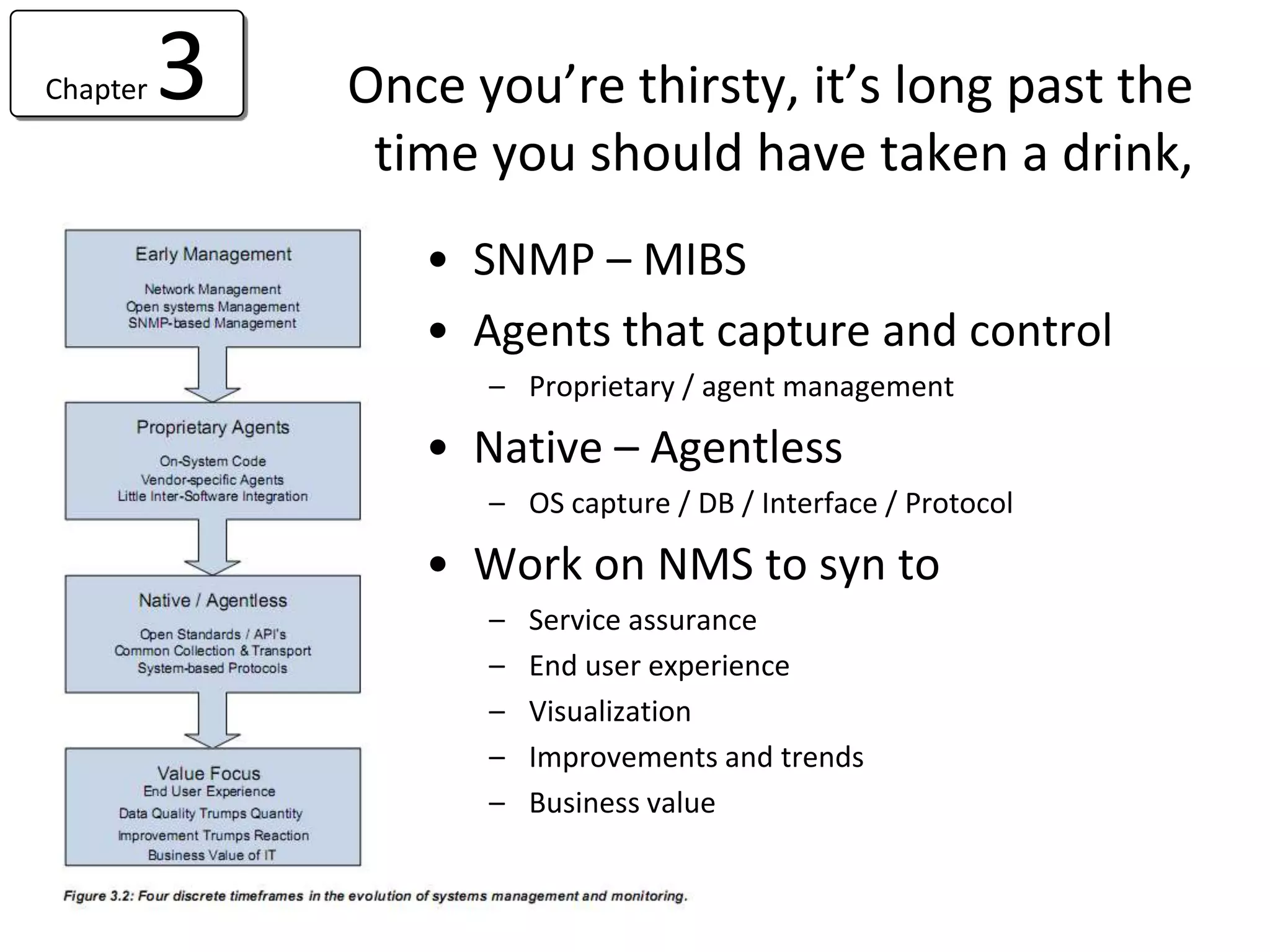
Chapter   3   Once you’re thirsty, it’s long past the
               time you should have taken a drink,
                 • SNMP – MIBS
                 • Agents that capture and control
                    – Proprietary / agent management

                 • Native – Agentless
                    – OS capture / DB / Interface / Protocol

                 • Work on NMS to syn to
                    –   Service assurance
                    –   End user experience
                    –   Visualization
                    –   Improvements and trends
                    –   Business value
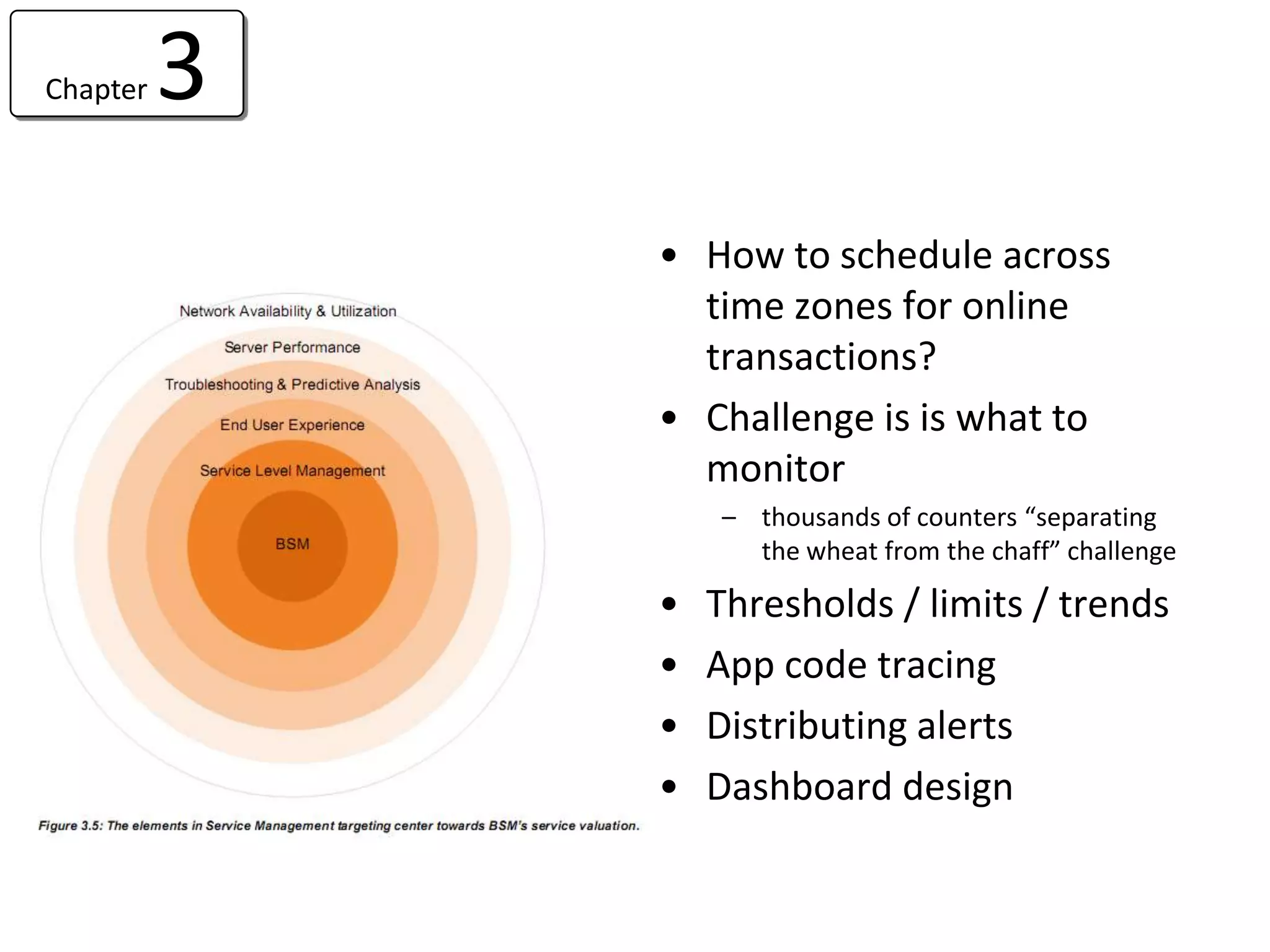
Chapter   3
              • How to schedule across
                time zones for online
                transactions?
              • Challenge is is what to
                monitor
                  – thousands of counters “separating
                    the wheat from the chaff” challenge

              •   Thresholds / limits / trends
              •   App code tracing
              •   Distributing alerts
              •   Dashboard design
Chapter   4                                    Implementing BSM

  • Value of BSM
      – Understand the Critical to Quality Services [ portfolio]
      – Manage Daily Risk and Improve Business Decision Making
      – Initiate Service Improvement Activities

  • 7 steps of BSM Implementation


      – These are malleable and need to be fit to a customer
      – 100% is never reached! [ CSI]
Chapter   4                 7 steps in BSM Implementation

  • Step 0 – prepare                            • Step 2 – Define
      – Project Team / Charter                     – Structure. Behavior. Relevance.
           • Ensure that business is involved      – Use Case Diagrams
      – Stakeholders / Plan                        – Categorize
                                                        • Value / Outage impact / Abnormality
  • Step 1 - Selection                                    Impact / RTO – RPO / SLA – OLA /
      – Identify services MECE + Business                 Users / time / Code / Location
      – Just Enough | Phases | Low hanging                /Dependencies
        fruit                                      – Define SLR [ Service Assurance ]
      – Critical and measurable services                • Availability / Reliability /
                                                          Performance
      – Define Service Breakdown
                                                   – Define PIE / Problem & opps - Kano
      – Assess [ Value / Cost ]
                                                   – Define CSF
Chapter   4                 7 steps in BSM Implementation

  • Step 3 – Model                               • Step 5 – Data Analysis
      – Hierarchical diagrams with business         – Where are the gaps
        processes in relation to IT resources             • bad service quality, customer ratings,
      – FMEA / CRAMM / CFIA / FTA                           system overload, element response
                                                            time, or transaction throughput
      – Model Associated Metrics [KPI]
                                                    –   What are the trends
           • user wait time, business metrics,
             systems & transaction performance      –   Visualize the Data
      – Build the service model                     –   Validate Data – Assumptions
           • Link metrics to actual data            –   Realize the Fault tree paths
      – Define the Data model [ERD]                       • Derive Impact analyses
                                                          •
  • Step 4 – Measure
      –   Ensure enough time for this step
      –   Tie BSM to infra monitoring
      –   Also attache End user monitoring
      –   Tie into SM systems, SD, CMDB


   Remember too that BSM is not intended to “rip and replace” existing monitoring systems
Chapter   4                 7 steps in BSM Implementation

  • Step 6 – Improve                                • Step – 7 – Reporting
      – What are the problem domains                      – Ensure that reporting model does not
      – Identify and resolve the gap                        stagnate [ users get reliant]
           • De Bono – Simplicity                         – Dashboards
           • TRIZ – 40 Principles                         – Notifications
           • Lean – 3M 5S 7W                              – Configuration control & handoff to
      – Recheck the model continually                       operations


      Remember too that BSM is not intended to “rip and replace” existing monitoring systems
Chapter   5              End user Experience Monitoring

  • “Egg Timer” Problem
      – times but does not reflect the quality of the eggs

  • Flow Analysis
      – Single flow analysis [End user monitoring]
           • Understand the Client Network Server [CNS] Spread
           • Agent / Agentless || Server / Client || Service / Transaction
      – Aggregate flow analysis [ flood monitoring]
      – Usage / Feature Profiling

  • Visualize & Prioritize problems before the impact
      – Interface tracing / data channel sniffing /
Chapter   6   Achieving management value

Readings on BSM

  • 1.
    Forrester – BSMBest practices April 23, 2007 Peter o Neill Evelyn Hubert
  • 2.
    Typical metrics BSM Typical metrics Reporting line Business service Time to process completion CIO/service owners management Processing backlog volume reporting to LOB State of business service executives Business transaction volume IT service management Service availability CIO reporting to CFO Incident closure rate Frequency of changes Infrastructure Server availability IT operations reporting to management CPU utilization CIO Disk space
  • 3.
    4 steps inBSM • Map Business processes • Map IT Infrastructure resources – Inter relationships; dependencies • Dynamically interlink IT Infrastructure and Business process • End to end Monitoring of IT infrastructure.
  • 4.
  • 5.
    Some key adviceon the way • Just enough BSM • ITIL based standard practices • Service oriented approach • Involve business analysts • Low hanging quick wins • Be pragmatic – just enough top down • CMDB should be the center of all IT SM • Define BSM and CMDB from process perspective
  • 6.
  • 7.
    BSM vendor landscape •Strategic integrated vendors – IBM HP CA BMC Managed objects • Service Management approach – Service catalogs with business metrics – Digital fuel, Oblicore Proxima • Performance management approach – Transaction / performance management tools with business metrics – Proactivenet, OpTier
  • 8.
  • 9.
  • 10.
    Benefits from BSM •BSM Empowers IT to – Offer reliable, flexible, business-sensitive levels of service – Measure service quality in terms of business user experience – Improve operational efficiency and agility end-to-end – Reduce and control costs through automation and integration – Become a strategic partner, value generator and source of innovation
  • 11.
    Key phrases • Managingthe IT service supply chain aligned to business
  • 12.
    Key elements • Optimize:Map, Measure, Automate, Visualize • CREATE SERVICE MODELS • OPTIMIZE SERVICES BY OPTIMIZING THE INFRASTUCTURE • MAP THE COMPLETE IT SERVICE SUPPLY CHAIN TO BUSINESS PROCESSES • MEASURE PERFORMANCE BASED ON BUSINESS GOALS AND USER SUCCESS • STANDARDIZE AND AUTOMATE PROCESSES • INTEGRATE BUSINESS GOALS
  • 13.
  • 14.
    The need. • PrioritizeIT support management • Moving from component based to service based – Service catalog defs and business metrics • From home grown to standards for reporting
  • 15.
    Outcome initiatives fromBSM • Service Performance Management – Proactive ; trending ; rapid response to incidents • Capacity Planning – Put money where business growth is maximized and need exists • Chargeback / Usage Analysis. – LOB expenditure – Alignment to business growth activities & needs.
  • 16.
    Whats effective BSM? •Access to all critical service metrics – Internal | Adaptors | Stds compliant • Define business service model – Process breakdown, linkages to infrastructure, metrics rules • RT Analytics of infrastructure against business model – Collect, transform, represent • Archive service metrics for analysis – Trends, base lining and audit trails • Alert response mechanisms – Emails, scripts, executions, triggers • Configurable dashboards & reports – RIA Report builder
  • 17.
    BMC - Discovery MappingInfrastructure resources, relationships and dependencies
  • 18.
    • Integrated CMDBneeds auto discovery – Asset changes ; Logical and physical assets – Inter relationships betweens assets – Dependencies between assets, people and business processes
  • 19.
  • 20.
    • Maintain thestate of IT – So what goes into a CI? CIs generally consist of configuration attributes such as description, version number, component, relationships, location, and status – ~50% of unplanned service outages happen because of system configuration mistakes or oversights
  • 21.
    Definitive Guide toBSM Greg Shields Compuware Realtime publishers
  • 22.
    Challenges to IT •Monitoring and response infrastructure focused – Critical links of infrastructure to business missing – Other factors like time zones etc.. Not factored in – What is an SLA? • Factors that influence – Loss / performance / response time • Applying $ value to reduction in quality – Monitoring + Money
  • 23.
    Chasm between ITand business • Monitoring IT has been on for years • The gap is in defining what’s important to business • The Views differ – IT >> UP or NOT – Business > Customer Sat + Service Availability Capability in service
  • 24.
    What are BusinessServices? • Services involved in the completion of daily business activities – Whether users are customers / internal / IT or systems/ – Can there be monetary measurement? • Build a service model – Service breakdown – Service interrelationships • Customer sees service as – Acceptable – Un Acceptable – Un Available
  • 25.
    Breaking down BSM •Misalignment will be there as language differs • Business Impact Management – Combine Network monitoring + App data to give end impact information • Real time Service Visualization • Fault trees
  • 26.
    Aligning IT toBusiness • How to merge metrics • Alignment inhibitors driven business with – No Common Dialog • Tune in to the business cut out Technology driven IT? complexity – Children / aged / Bosses • Bottom tech heavy nature – Ensure metrics / Finance of IT organizations results in • Business to understand IT – Mismatched expectations technology focus instead of – Technology focused metrics business focus – Siloed work envrionments • – Reactive mindset in IT • Set aside some investment on long term strategic thinking
  • 27.
    IT Maturity Journey • Rightward movement thru – Planning – Automation – Service thinking Key Word Chars BSM How to BSM Chaotic Adhocracy No process, Wont Fly Notifcation ; Environment documentation; Instability awareness Reactive Firefighting Best Efforts, inventory, Uphill task Data integration; Remove IT Silos; ops monitoring, tech mindset dashboards; Proactive Optimal infra Predictve analysis, automation, Best BSM problem mgt Service Beyond infra SLA, capacity, Cost, BSM Ready Value Business Value Beyond BSM
  • 28.
    Changing IT – Impact to Business – Competitive Advantage – Agility – Proactive IT • Why invest in BSM? – Agile IT for IS – Business Service performance for Business • Where does BSM work? – Revenue generating or revenue/cost impacting – Critical to the business – Supported by the infrastructure of IT – Integrated with business processes – Provided by a service organization, whether internal or external
  • 29.
    Chapter 2 IT service Evolution • What is IT Service / What is Business service? – Business relevance of information? • Typical Monitor and respond process – Identify Manageable Endpoints | Classify / Categorize Elements | Notify | Granularize Iteratively | Remediate • Maturity of IT – Organization structure with RACI to ensure right messages to right levels • Data Centric view of IT? – Store | Manage | Administer | Transform | Transport | Visualize
  • 30.
    Chapter 3 Once you’re thirsty, it’s long past the time you should have taken a drink, • SNMP – MIBS • Agents that capture and control – Proprietary / agent management • Native – Agentless – OS capture / DB / Interface / Protocol • Work on NMS to syn to – Service assurance – End user experience – Visualization – Improvements and trends – Business value
  • 31.
    Chapter 3 • How to schedule across time zones for online transactions? • Challenge is is what to monitor – thousands of counters “separating the wheat from the chaff” challenge • Thresholds / limits / trends • App code tracing • Distributing alerts • Dashboard design
  • 32.
    Chapter 4 Implementing BSM • Value of BSM – Understand the Critical to Quality Services [ portfolio] – Manage Daily Risk and Improve Business Decision Making – Initiate Service Improvement Activities • 7 steps of BSM Implementation – These are malleable and need to be fit to a customer – 100% is never reached! [ CSI]
  • 33.
    Chapter 4 7 steps in BSM Implementation • Step 0 – prepare • Step 2 – Define – Project Team / Charter – Structure. Behavior. Relevance. • Ensure that business is involved – Use Case Diagrams – Stakeholders / Plan – Categorize • Value / Outage impact / Abnormality • Step 1 - Selection Impact / RTO – RPO / SLA – OLA / – Identify services MECE + Business Users / time / Code / Location – Just Enough | Phases | Low hanging /Dependencies fruit – Define SLR [ Service Assurance ] – Critical and measurable services • Availability / Reliability / Performance – Define Service Breakdown – Define PIE / Problem & opps - Kano – Assess [ Value / Cost ] – Define CSF
  • 34.
    Chapter 4 7 steps in BSM Implementation • Step 3 – Model • Step 5 – Data Analysis – Hierarchical diagrams with business – Where are the gaps processes in relation to IT resources • bad service quality, customer ratings, – FMEA / CRAMM / CFIA / FTA system overload, element response time, or transaction throughput – Model Associated Metrics [KPI] – What are the trends • user wait time, business metrics, systems & transaction performance – Visualize the Data – Build the service model – Validate Data – Assumptions • Link metrics to actual data – Realize the Fault tree paths – Define the Data model [ERD] • Derive Impact analyses • • Step 4 – Measure – Ensure enough time for this step – Tie BSM to infra monitoring – Also attache End user monitoring – Tie into SM systems, SD, CMDB Remember too that BSM is not intended to “rip and replace” existing monitoring systems
  • 35.
    Chapter 4 7 steps in BSM Implementation • Step 6 – Improve • Step – 7 – Reporting – What are the problem domains – Ensure that reporting model does not – Identify and resolve the gap stagnate [ users get reliant] • De Bono – Simplicity – Dashboards • TRIZ – 40 Principles – Notifications • Lean – 3M 5S 7W – Configuration control & handoff to – Recheck the model continually operations Remember too that BSM is not intended to “rip and replace” existing monitoring systems
  • 36.
    Chapter 5 End user Experience Monitoring • “Egg Timer” Problem – times but does not reflect the quality of the eggs • Flow Analysis – Single flow analysis [End user monitoring] • Understand the Client Network Server [CNS] Spread • Agent / Agentless || Server / Client || Service / Transaction – Aggregate flow analysis [ flood monitoring] – Usage / Feature Profiling • Visualize & Prioritize problems before the impact – Interface tracing / data channel sniffing /
  • 37.
    Chapter 6 Achieving management value