READING
Grade 11-STEM
WRITING
SKILLS
and
ORGANIZING
INFORMATIO
N
TECHNIQUES IN
OBJECTIVES
At the end of the lesson, the
students can:
a. describe practically the
effective ways to select and
organize information;
b. appreciate innately the
importance of organizing ideas
in a given situation;
c. Use effectively the techniques
in organizing information.
HOW DO YOU
ORGANIZE YOUR
IDEAS?
What do you think are the effective ways of
selecting and organizing information?
1. What is brainstorming?
2. What are graphic organizers for?
3. What is outlining? How do you
format an outline?
FACT SHEET
Here are three (3) of the basic techniques you may
use in organizing your information.
A. BRAINSTORMING
Brainstorming is a group creativity
technique by which efforts are made
to find a conclusion for a specific
problem by gathering a list of ideas
spontaneously contributed by its
members.
Here are four (4) of the brainstorming tips suggested by Mark
Nichol in Writing Tips.
1. Cubing. In this strategy, a topic or idea is examined in six
viewpoints:
a. What is the topic?
b. What is it like or unlike?
c. What does it make you think of?
d. What constituent parts is it made of?
e. How can it be used?
f. In what ways can you support or oppose it?
2. Free writing. In this technique, just
keep on writing and not minding errors in
spelling and grammar. Have a
quantitative goal like coming up with 500
words or more. The objective here is just
to write what comes to your mind. Then
review what you have written later, and
hopefully choose a topic from what you
have written that would interest you.
3. Listing. As the term states, list down
what comes to your mind. If your
intention is to come up with topics to
write about, enumerate them. An
important reminder in using this
technique is not to list your ideas in
outline form.
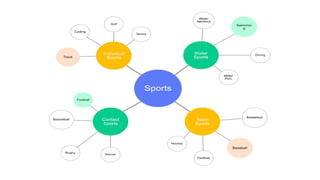
4. Mapping. Mapping, also known as
clustering and webbing, is a graphic
form of listing that simply involves
jotting down ideas on a large writings
surface and then making connections by
associating similarly themed ideas with
color-coded circles or underlines of
distinct patterns and then indicating
other relationships by linking with lines.
B. GRAPHIC ORGANIZERS
A graphic organizer, also known as knowledge
map, concept map, story map, cognitive organizer,
advance organizer, or concept diagram, is a
communication tool that uses visual symbols to
express knowledge, concepts, thoughts, or ideas ,
and the relationship between them.
The following are the types of graphic organizers which you
can use in writing:
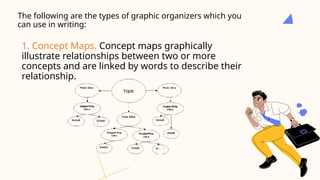
1. Concept Maps. Concept maps graphically
illustrate relationships between two or more
concepts and are linked by words to describe their
relationship.
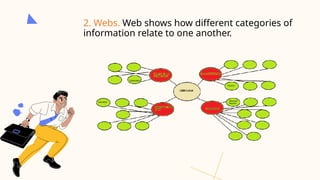
2. Webs. Web shows how different categories of
information relate to one another.
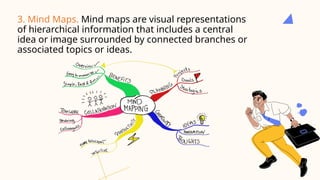
3. Mind Maps. Mind maps are visual representations
of hierarchical information that includes a central
idea or image surrounded by connected branches or
associated topics or ideas.
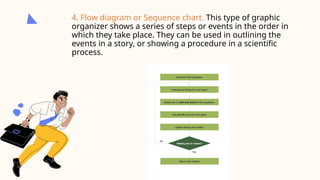
4. Flow diagram or Sequence chart. This type of graphic
organizer shows a series of steps or events in the order in
which they take place. They can be used in outlining the
events in a story, or showing a procedure in a scientific
process.
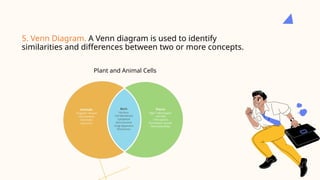
5. Venn Diagram. A Venn diagram is used to identify
similarities and differences between two or more concepts.
Plant and Animal Cells
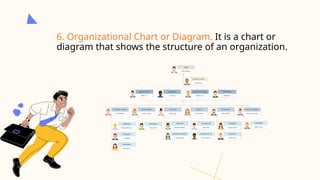
6. Organizational Chart or Diagram. It is a chart or
diagram that shows the structure of an organization.
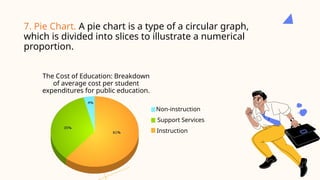
7. Pie Chart. A pie chart is a type of a circular graph,
which is divided into slices to illustrate a numerical
proportion.
The Cost of Education: Breakdown
of average cost per student
expenditures for public education.
Non-instruction
Support Services
Instruction
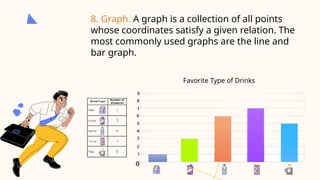
8. Graph. A graph is a collection of all points
whose coordinates satisfy a given relation. The
most commonly used graphs are the line and
bar graph.
Favorite Type of Drinks
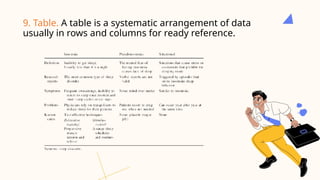
9. Table. A table is a systematic arrangement of data
usually in rows and columns for ready reference.
C. OUTLINE
An outline is the general plan of what you intend to
write. In preparing the outline, you have to classify each
information and its connection to your topic or subject.
The sorted information may now be grouped according
to content. From this group information, you can already
provide headings – main and subheadings – which are
parallel in structure. Parallel in structure means that if
you want to use phrases for all the headings, use
phrases all throughout. This type of outline is the topic
outline.
If you choose to use sentences, do the same for
all the headings and subheadings. An outline
that makes use of sentences for its headings and
subheadings is called a sentence outline. In
preparing an outline, have at least two topics
after each heading, and two for the subheading.
The following are the formats of an outline with their
explanation and example:
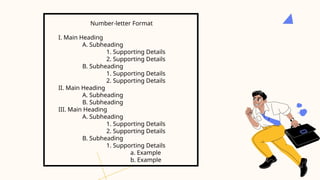
1. Number-Letter Format. It is the use of the
number, then letter in an outline. You use the
Roman numerals for the main headings. For
example, you start with the Roman “I” for the
main heading, under it are the subheadings or
supporting details which are indented and are
marked by capital letters. If there are
subheadings under subheading A, indent further
and use Arabic numbers 1 and so on. In case of
information not as important as the subheading,
indent it and mark it with a small letter instead.
Number-letter Format
I. Main Heading
A. Subheading
1. Supporting Details
2. Supporting Details
B. Subheading
1. Supporting Details
2. Supporting Details
II. Main Heading
A. Subheading
B. Subheading
III. Main Heading
A. Subheading
1. Supporting Details
2. Supporting Details
B. Subheading
1. Supporting Details
a. Example
b. Example
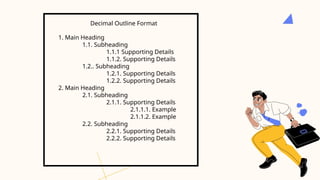
2. Decimal Outline Format. This outline make use
of decimal numbers in place of the number-
letters used in the first example. Arabic number
1 is used instead of a Roman numeral I for the
main heading. Numbers 1.1. is used in case
there is a subheading for the first main heading;
numbers 1.2 if there is another subheading that
follows it.
Decimal Outline Format
1. Main Heading
1.1. Subheading
1.1.1 Supporting Details
1.1.2. Supporting Details
1.2.. Subheading
1.2.1. Supporting Details
1.2.2. Supporting Details
2. Main Heading
2.1. Subheading
2.1.1. Supporting Details
2.1.1.1. Example
2.1.1.2. Example
2.2. Subheading
2.2.1. Supporting Details
2.2.2. Supporting Details
IVITY
AC
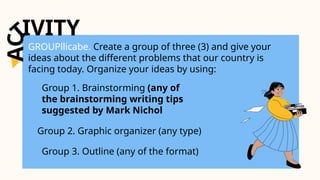
TGROUPllicabe. Create a group of three (3) and give your
ideas about the different problems that our country is
facing today. Organize your ideas by using:
Group 3. Outline (any of the format)
Group 1. Brainstorming (any of
the brainstorming writing tips
suggested by Mark Nichol
Group 2. Graphic organizer (any type)
TIME FOR A
Please click the link posted in
our Google Classroom.
QUI
Z
A
SSIGNMEN
T
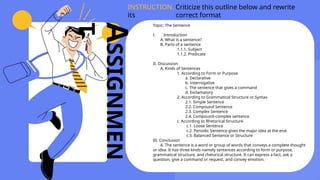
INSTRUCTION. Criticize this outline below and rewrite
its correct format
Topic: The Sentence
I. Introduction
A. What is a sentence?
B. Parts of a sentence
1.1.1. Subject
1.1.2. Predicate
II. Discussion
A. Kinds of Sentences
1. According to Form or Purpose
a. Declarative
b. Interrogative
c. The sentence that gives a command
d. Exclamatory
2. According to Grammatical Structure or Syntax
2.1. Simple Sentence
2.2. Compound Sentence
2.3. Complex Sentence
2.4. Compound-complex sentence
c. According to Rhetorical Structure
c.1. Loose Sentence
c.2. Periodic Sentence gives the major idea at the end.
c.3. Balanced Sentence or Structure
III. Conclusion
A. The sentence is a word or group of words that conveys a complete thought
or idea. It has three kinds namely sentences according to form or purpose,
grammatical structure, and rhetorical structure. It can express a fact, ask a
question, give a command or request, and convey emotion.
3.-Techniques-in-Organizing-Information.pptx

  • 1.
  • 2.
  • 3.
    OBJECTIVES At the endof the lesson, the students can: a. describe practically the effective ways to select and organize information; b. appreciate innately the importance of organizing ideas in a given situation; c. Use effectively the techniques in organizing information.
  • 4.
  • 5.
    What do youthink are the effective ways of selecting and organizing information? 1. What is brainstorming? 2. What are graphic organizers for? 3. What is outlining? How do you format an outline?
  • 6.
    FACT SHEET Here arethree (3) of the basic techniques you may use in organizing your information. A. BRAINSTORMING Brainstorming is a group creativity technique by which efforts are made to find a conclusion for a specific problem by gathering a list of ideas spontaneously contributed by its members.
  • 7.
    Here are four(4) of the brainstorming tips suggested by Mark Nichol in Writing Tips. 1. Cubing. In this strategy, a topic or idea is examined in six viewpoints: a. What is the topic? b. What is it like or unlike? c. What does it make you think of? d. What constituent parts is it made of? e. How can it be used? f. In what ways can you support or oppose it?
  • 8.
    2. Free writing.In this technique, just keep on writing and not minding errors in spelling and grammar. Have a quantitative goal like coming up with 500 words or more. The objective here is just to write what comes to your mind. Then review what you have written later, and hopefully choose a topic from what you have written that would interest you.
  • 9.
    3. Listing. Asthe term states, list down what comes to your mind. If your intention is to come up with topics to write about, enumerate them. An important reminder in using this technique is not to list your ideas in outline form.
  • 10.
    4. Mapping. Mapping,also known as clustering and webbing, is a graphic form of listing that simply involves jotting down ideas on a large writings surface and then making connections by associating similarly themed ideas with color-coded circles or underlines of distinct patterns and then indicating other relationships by linking with lines.
  • 12.
    B. GRAPHIC ORGANIZERS Agraphic organizer, also known as knowledge map, concept map, story map, cognitive organizer, advance organizer, or concept diagram, is a communication tool that uses visual symbols to express knowledge, concepts, thoughts, or ideas , and the relationship between them.
  • 13.
    The following arethe types of graphic organizers which you can use in writing: 1. Concept Maps. Concept maps graphically illustrate relationships between two or more concepts and are linked by words to describe their relationship.
  • 14.
    2. Webs. Webshows how different categories of information relate to one another.
  • 15.
    3. Mind Maps.Mind maps are visual representations of hierarchical information that includes a central idea or image surrounded by connected branches or associated topics or ideas.
  • 16.
    4. Flow diagramor Sequence chart. This type of graphic organizer shows a series of steps or events in the order in which they take place. They can be used in outlining the events in a story, or showing a procedure in a scientific process.
  • 17.
    5. Venn Diagram.A Venn diagram is used to identify similarities and differences between two or more concepts. Plant and Animal Cells
  • 18.
    6. Organizational Chartor Diagram. It is a chart or diagram that shows the structure of an organization.
  • 19.
    7. Pie Chart.A pie chart is a type of a circular graph, which is divided into slices to illustrate a numerical proportion. The Cost of Education: Breakdown of average cost per student expenditures for public education. Non-instruction Support Services Instruction
  • 20.
    8. Graph. Agraph is a collection of all points whose coordinates satisfy a given relation. The most commonly used graphs are the line and bar graph. Favorite Type of Drinks
  • 21.
    9. Table. Atable is a systematic arrangement of data usually in rows and columns for ready reference.
  • 22.
    C. OUTLINE An outlineis the general plan of what you intend to write. In preparing the outline, you have to classify each information and its connection to your topic or subject. The sorted information may now be grouped according to content. From this group information, you can already provide headings – main and subheadings – which are parallel in structure. Parallel in structure means that if you want to use phrases for all the headings, use phrases all throughout. This type of outline is the topic outline.
  • 23.
    If you chooseto use sentences, do the same for all the headings and subheadings. An outline that makes use of sentences for its headings and subheadings is called a sentence outline. In preparing an outline, have at least two topics after each heading, and two for the subheading.
  • 24.
    The following arethe formats of an outline with their explanation and example: 1. Number-Letter Format. It is the use of the number, then letter in an outline. You use the Roman numerals for the main headings. For example, you start with the Roman “I” for the main heading, under it are the subheadings or supporting details which are indented and are marked by capital letters. If there are subheadings under subheading A, indent further and use Arabic numbers 1 and so on. In case of information not as important as the subheading, indent it and mark it with a small letter instead.
  • 25.
    Number-letter Format I. MainHeading A. Subheading 1. Supporting Details 2. Supporting Details B. Subheading 1. Supporting Details 2. Supporting Details II. Main Heading A. Subheading B. Subheading III. Main Heading A. Subheading 1. Supporting Details 2. Supporting Details B. Subheading 1. Supporting Details a. Example b. Example
  • 26.
    2. Decimal OutlineFormat. This outline make use of decimal numbers in place of the number- letters used in the first example. Arabic number 1 is used instead of a Roman numeral I for the main heading. Numbers 1.1. is used in case there is a subheading for the first main heading; numbers 1.2 if there is another subheading that follows it.
  • 27.
    Decimal Outline Format 1.Main Heading 1.1. Subheading 1.1.1 Supporting Details 1.1.2. Supporting Details 1.2.. Subheading 1.2.1. Supporting Details 1.2.2. Supporting Details 2. Main Heading 2.1. Subheading 2.1.1. Supporting Details 2.1.1.1. Example 2.1.1.2. Example 2.2. Subheading 2.2.1. Supporting Details 2.2.2. Supporting Details
  • 28.
    IVITY AC TGROUPllicabe. Create agroup of three (3) and give your ideas about the different problems that our country is facing today. Organize your ideas by using: Group 3. Outline (any of the format) Group 1. Brainstorming (any of the brainstorming writing tips suggested by Mark Nichol Group 2. Graphic organizer (any type)
  • 29.
    TIME FOR A Pleaseclick the link posted in our Google Classroom. QUI Z
  • 30.
    A SSIGNMEN T INSTRUCTION. Criticize thisoutline below and rewrite its correct format Topic: The Sentence I. Introduction A. What is a sentence? B. Parts of a sentence 1.1.1. Subject 1.1.2. Predicate II. Discussion A. Kinds of Sentences 1. According to Form or Purpose a. Declarative b. Interrogative c. The sentence that gives a command d. Exclamatory 2. According to Grammatical Structure or Syntax 2.1. Simple Sentence 2.2. Compound Sentence 2.3. Complex Sentence 2.4. Compound-complex sentence c. According to Rhetorical Structure c.1. Loose Sentence c.2. Periodic Sentence gives the major idea at the end. c.3. Balanced Sentence or Structure III. Conclusion A. The sentence is a word or group of words that conveys a complete thought or idea. It has three kinds namely sentences according to form or purpose, grammatical structure, and rhetorical structure. It can express a fact, ask a question, give a command or request, and convey emotion.