Techniques in
Selecting and
Organizing Information
MODULE II
REVIEW Please
provide extra gadget
START UP:
On a sheet of paper,
write about ten (10) ideas
that would occur in your
mind about “gadgets”
TECHNIQUES
It is a procedure or
way something is
done. Or strategy.
Basic techniques you may use in
organizing your information:
BRAINSTORMING
GRAPHIC ORGANIZERS
OUTLINING
1.
BRAINSTORMING
BRAINSTORMING
Is a group creativity technique by
which efforts are made to find a
conclusion for a specific problem
by gathering a list of ideas
spontaneously contributed by its
member.
Tools in brainstorming:
a. Idea list
b. Concept map
Things to do for Effective
Brainstorming
a. Lay out the problem you want to solve
b. Identify the objectives of a possible
solution
c. Try to generate solutions individually
d. When your problems, objectives, and
personal solutions are clear, work as a
group.
HEALTH BREAK
2. GRAPHIC
ORGANIZERS
GRAPHIC ORGANIZERS
known as knowledge map,
concept map, story map,
cognitive organizer,
advance organizer, or
concept diagram.
GRAPHIC ORGANIZERS
May be drawn to help a
writer organize his ideas. To
provide a visual aid to
facilitate learning and
instruction.
The following are the types of graphic
organizers which you can use in writing:
1. Concept Map
2. Story Map
3. Flow Chart
4. Clock Diagram
5. Venn Diagram
6. T-Chart
7. Y-Chart
8. KWL Chart
9. Cycle Diagram
10. Fishbone Diagram
11. Frayer Model
12. Star Diagram
13. Chain Diagram or Series of
Events Chart
14. Discussion Web
is a visual organization
and representation of
knowledge. It
shows concepts and
ideas and the
relationships among
them
is a strategy that uses a
graphic organizer to
help students learn the
elements of a book or
story
is simply a graphical
representation of
steps. It shows steps in
sequential order and
is widely used in
presenting the flow of
algorithms, workflow
or processes
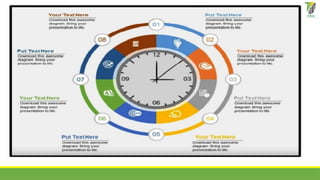
Clock Diagrams are a
type of graphic
organizer that shows
how items are related
to one another in a
time-oriented cycle.
Another graphic organizer
that helps you visually
represent a comparison of
differences and similarities
between two subjects, is
the Venn diagram.
T-charts allow students to
study two facets of a
topic. For example,
disadvantages and
advantages, pros and
cons, differences and
similarities, etc.
The aim of the Y Chart is
for students to think
about environments from
three perspectives (looks
like, sounds like, and feels
like).
KWL chart is used for gathering
information from student’s prior
knowledge or experience. This
3 column chart captures the
before (what the reader
already knows), during (what
the reader wants to learn) and
after (what the reader
learned) stages of reading.
Cycle Diagram
A Cycle Diagram is
simply used to show
how a series of events
interact repeatedly
through a cycle.
Fishbone Diagram
This type of graphic
organizer shows the
causes and effects of an
event. The cause is the
reason why something
has happened, and
effect is the result of
what has happened.
Frayer Model
The Frayer Model is a
type of graphic organizer
that uses a four-square
model to determine,
clarify, and analyze word
meaning and structure.
Star Diagram
Star diagrams are
used to organize the
characteristics of a
chosen topic. It can
also be used to
brainstorm around
new topics.
Chain Diagram or Series of
Events Chart
This kind of sequence
graphic organizer is a tool
that helps visualize the
order of steps of a process
or a timeline of events,
etc. It can also be used for
note-taking, lesson
planning, and essay
writing.
Discussion Web
A Discussion Web is an
organizational tool that
helps students to
visualize the key
elements of an issue,
and quickly identify
opposing points of view
on the matter.
3. Outlining
OUTLINING
An outline is the
general plan of
what you intend to
write.
TWO MAJOR TYPES OF OUTLINE
a. Topic outline – uses words
or phrases as headings,
without punctuation
b. Sentence outline – uses full
sentences

02-230503012222-3fc2bbca.pptx powerpoint

  • 1.
  • 2.
  • 3.
    START UP: On asheet of paper, write about ten (10) ideas that would occur in your mind about “gadgets”
  • 4.
    TECHNIQUES It is aprocedure or way something is done. Or strategy.
  • 5.
    Basic techniques youmay use in organizing your information: BRAINSTORMING GRAPHIC ORGANIZERS OUTLINING
  • 6.
  • 7.
    BRAINSTORMING Is a groupcreativity technique by which efforts are made to find a conclusion for a specific problem by gathering a list of ideas spontaneously contributed by its member.
  • 8.
    Tools in brainstorming: a.Idea list b. Concept map
  • 9.
    Things to dofor Effective Brainstorming a. Lay out the problem you want to solve b. Identify the objectives of a possible solution c. Try to generate solutions individually d. When your problems, objectives, and personal solutions are clear, work as a group.
  • 10.
  • 11.
  • 12.
    GRAPHIC ORGANIZERS known asknowledge map, concept map, story map, cognitive organizer, advance organizer, or concept diagram.
  • 13.
    GRAPHIC ORGANIZERS May bedrawn to help a writer organize his ideas. To provide a visual aid to facilitate learning and instruction.
  • 14.
    The following arethe types of graphic organizers which you can use in writing: 1. Concept Map 2. Story Map 3. Flow Chart 4. Clock Diagram 5. Venn Diagram 6. T-Chart 7. Y-Chart 8. KWL Chart 9. Cycle Diagram 10. Fishbone Diagram 11. Frayer Model 12. Star Diagram 13. Chain Diagram or Series of Events Chart 14. Discussion Web
  • 15.
    is a visualorganization and representation of knowledge. It shows concepts and ideas and the relationships among them
  • 16.
    is a strategythat uses a graphic organizer to help students learn the elements of a book or story
  • 17.
    is simply agraphical representation of steps. It shows steps in sequential order and is widely used in presenting the flow of algorithms, workflow or processes
  • 18.
    Clock Diagrams area type of graphic organizer that shows how items are related to one another in a time-oriented cycle.
  • 19.
    Another graphic organizer thathelps you visually represent a comparison of differences and similarities between two subjects, is the Venn diagram.
  • 20.
    T-charts allow studentsto study two facets of a topic. For example, disadvantages and advantages, pros and cons, differences and similarities, etc.
  • 21.
    The aim ofthe Y Chart is for students to think about environments from three perspectives (looks like, sounds like, and feels like).
  • 22.
    KWL chart isused for gathering information from student’s prior knowledge or experience. This 3 column chart captures the before (what the reader already knows), during (what the reader wants to learn) and after (what the reader learned) stages of reading.
  • 23.
    Cycle Diagram A CycleDiagram is simply used to show how a series of events interact repeatedly through a cycle.
  • 24.
    Fishbone Diagram This typeof graphic organizer shows the causes and effects of an event. The cause is the reason why something has happened, and effect is the result of what has happened.
  • 25.
    Frayer Model The FrayerModel is a type of graphic organizer that uses a four-square model to determine, clarify, and analyze word meaning and structure.
  • 26.
    Star Diagram Star diagramsare used to organize the characteristics of a chosen topic. It can also be used to brainstorm around new topics.
  • 27.
    Chain Diagram orSeries of Events Chart This kind of sequence graphic organizer is a tool that helps visualize the order of steps of a process or a timeline of events, etc. It can also be used for note-taking, lesson planning, and essay writing.
  • 28.
    Discussion Web A DiscussionWeb is an organizational tool that helps students to visualize the key elements of an issue, and quickly identify opposing points of view on the matter.
  • 29.
  • 30.
    OUTLINING An outline isthe general plan of what you intend to write.
  • 31.
    TWO MAJOR TYPESOF OUTLINE a. Topic outline – uses words or phrases as headings, without punctuation b. Sentence outline – uses full sentences

Editor's Notes

  • #2 Please get extra gadget for this review activity.
  • #3 How did you organize your thoughts? In organizing our ideas we have techniques or procedure on how we write that one so on and so forth. So lets define Technique as we deeper our understanding in our lesson this morning.
  • #4  TECHNIQUES are approaches or methods you as a writer may use to organize the information you have gathered, to accomplish your desired aim in writing and to improve the writing craft.
  • #5 We use the ff. Effective Ways as we Select and Organize Information
  • #7 The term was popularized by Alex Faikney Osborn in the 1953 book APPLIED IMAGINATION ( wikipedia.org)he develop this technique when he got frustrated that his employees could not come up with useful techniques as they worked individualy. Commonly, brainstorming is resorted to when there is a need for new ideas and when there is a problem to be solved. In writing however, brainstorming is useful when a person has too few ideas or has too many and she/ he is confused as to what topic to choose. Brainstorming is a technique to generate ideas within a group or individual setting. It provides a quick means for tapping the ideas and concepts of an individual or of a group then helps establish patterns and develop relationship among these concepts.
  • #8 Idea list - Start by listing down broad topics then go on by identifying related, narrower topics. Concept map – Begin by writing the main concept at the middle and then adding more branches for its subtopics. Explore more topics by adding more branches.
  • #9 According to RALPH KEENEY , an emeritus professor at DUKES FUQUA SCHOOL OF BUSINESS and a consultant to multinational companies and government organizations , almost everybody does brainstorming wrong. Faced with a problem ,most people panic and think of irrelevant solutions. SO, to avoid this, we must consider the ff. things to do for better and effective brainstorming. This may be easier said than done. You need to identify your objectives then, evaluate the alternatives, and select the best. Thinking a possible solution is not easy and it takes time but if you can approach your goals critically and hone-in on what you want to achieve, your brainstorming session will be much more effective. Before heading into a group brainstorming session , organizations should insists that staff member first then try to come up with their own solution. One problem with group brainstorming is that when we hear someone else’s solution to a problem, we tend to see it an “anchor”. In other words, we get stuck on that objective and potential solution to the exclusion of other goals. Though we acknowledge that it’s a challenge not to “anchor” on one solution in a brainstorming session. We must also believe that If participants have done their homework, clarifying the problem , identifying objectives , and individually trying to come up with solutions a brainstorming sessions can be extremely productive.
  • #10 Lets have 5 mins water break. Please come back after 5 mins.
  • #12 This is a visual learning device that shows the information organized or arranged in a charts, clusters, tables, bars, and the like. These devices guide the learners as they fill in and build upon visual map or diagram. The summarized information or data presented in a systematic and logically organized form using symbols and numbers guide you in understanding the paragraph in part as a whole.
  • #13 The choice of an appropriate graphic organizer is dependent on the pattern to be used in developing the paper. For example , a venn diagram is appropriate for a comparison and contrast of two or more items, a tree diagram for classification , a pie graph for analysis or partitioning, a semantic web for definition, , a cycle graph for a process description, a story map or fishbone for narration a table for showing a big number of details,
  • #14 In writing, graphic organizers help separate what is important to know or what is essential form those that are not so essential. Because the information are organized, readers or learners find it easier to understand the information . It is also easier for the writer to explain his or her ideas if she is able to present the graphic devices in such a way that can help others focus on the relationships of the ideas presented with other details. We can use the following types of graphic organizers in writing:
  • #15 Concepts maps graphically illustrate relationships between two or more concepts and are linked by words to describe their relationship. You will Begin by writing the main concept at the middle and then adding more branches for its subtopics. Explore more topics by adding more branches.
  • #16 Story mapping is a method for arranging user stories to create a more holistic view of how they fit into the overall user experience. Story mapping is usually done on a wall using sticky notes or index cards and many tapes. Usually the entire team identifies and agrees on the primary steps of the user journey and then assigns user stories beneath them. Story mapping serves a few key purposes . First it paints a full pictures of how a product is used. Second it can identify the holes in functionality or areas to focus on since they can visually highlight gaps in the user experience. And of course the most common usage of story mapping utilizes it as an alternative to “ flat” backlog management.
  • #17 This type of organizers shows a series of events in the order in which they take place. They can be used in outlining the events in a story, or showing a procedure in a scientific process.
  • #18 The clock diagram is a variation of a pie chart that can be used for diagramming the use if hours in a day. For example, it can be used to illustrate how time is spent during a school day or the sequence of events in a story.
  • #19 A Venn diagram is used to identify similarities and differences between two or more concept. It shows the logical relationship between groups of things. They are most often shown as two circle that intersect in the middle of the page. Attributes that are exclusive to each group are listed in the circles, and attributes that are shared by both groups are listed in the intersecting space.
  • #20 A T Chart (or T-Chart) is a graphic organizer that separates information into columns, traditionally for comparing. It gets its name from the basic version with two columns: it looks like the letter "T" and is both versatile and commonly used across all subjects. T Charts Help You: Compare and contrast two or more items Separate information into groups Show change The T-Chart is an easy-to-use and versatile graphic organizer because of its straightforward layout. So, All of the information of your chart is in the columns. Depending on what type of information you are recording or displaying, there may be more information in certain columns than others. Some columns may have only words or only pictures.
  • #21 A Y-chart is a 3 part graphic organizer that is used for describing 3 aspects of a topic. For examples include observation of an object (looks like, sounds like, and feels like) or the characteristic of the 3 branches of the Government (Executive, Legislative, and Judicial branches)
  • #22 KWL Chart allow student to document their own learning process from start to finish on a particular subject. The letter stand for the steps in the process, which are “what I already know, What I want to learn and What I have to learned). You may also enter the a subject title for the worksheet, the number if rows of a cells in the chart and the orientation of the chart.
  • #23 A cycle diagram is used to show how a series of events interacts repeatedly through cycle. Some examples of topic that work well with cycle diagrams include the cycle of life, the flow of money in a economy and the carbon cycle in nature. A typical lesson plan using this diagram would have students identifying the critical events that make up the cycle, determining the relationship between cycle events and explaining how the cycle is self- reinforcing.
  • #24 Fishbone is used to idebtify the cause or composition of some complex system or event. Each bone coming off of the spine of the diagram is then broken down into more details. Example of topics that fit well into fishbone diagrams include the causes of major wars, or the manufacture of automobiles.
  • #25  The Frayer model is a vocabulary development tool. In contrast with a straight definition, the model helps to develop a better understanding of complex concepts by having students identify not just what something is, but what something is not. The center of the diagram shows the concept being defined, while the quadrants around the concept are used for providing the details. Words that work well with the Frayer Model include quadrilaterals, insects , and democracies.
  • #26 A star diagram is used for organizing the characteristics of a single topic. A central space is used for displaying the topi, with each “point” of the star listing some fact, attribute, or can be the topic, and each point around the topic can describe some part of that character’s life or relationship.
  • #27 Chain Diagram also called Series/ sequence of Events Chart , are a type of graphic organizer that describes the stages or steps in a process. The students must be able to identify the first step in the process, all of the resulting stages in the procedure as they unfold, and the outcome (the final stage)
  • #28 Discussion Webs can guide discussions by allowing students to identify ideas of contention, to weigh opposing viewpoints, to critically evaluate the arguments, and to draw conclusions. Discussion Webs offer learners a clear "point-counterpoint" visual framework for analyzing texts or oral arguments. Discussion Web shows how different categories of information relate to one another.
  • #30  Outlines serve as a road map or blueprint when writing. It helps organize the ideas as it shows the hierarchical relationship or logical ordering of information. In preparing the outline, you have to classify each information and its connection to your topic or subject. The sorted information may now be grouped according to content. From these grouped information, you can already provide headings – main and subheadings – which are parallel in structure.
  • #31 There are two major types of outline: the topic outline and the sentence outline. Topic outline – A topic outline arranges your ideas hierarchically ( showing which are main and which are sub-points), in the sequence you want, and show what you will talk about. As the same name implies, it identifies all the little mini-topics that your paper will comprise. Sentence outline – A sentence outline does all of these; plus, it shows exactly what you will say about each mini-topics. Each sentence, instead of simply identifying a mini-topic, is like a mini-thesis statement about the mini-topic. It expresses the specific and complete idea that section of the paper will cover as part of proving the overall thesis.