Jennifer Evans 
Assistant Director ELA 
St. Clair County RESA 
Evans.jennifer@sccresa.org 
http://www.protopage.com/evans.jennifer
2 
Why are we here and how 
today's meeting is relevant 
to you? 
_______________________________________________________________________________________________________ 
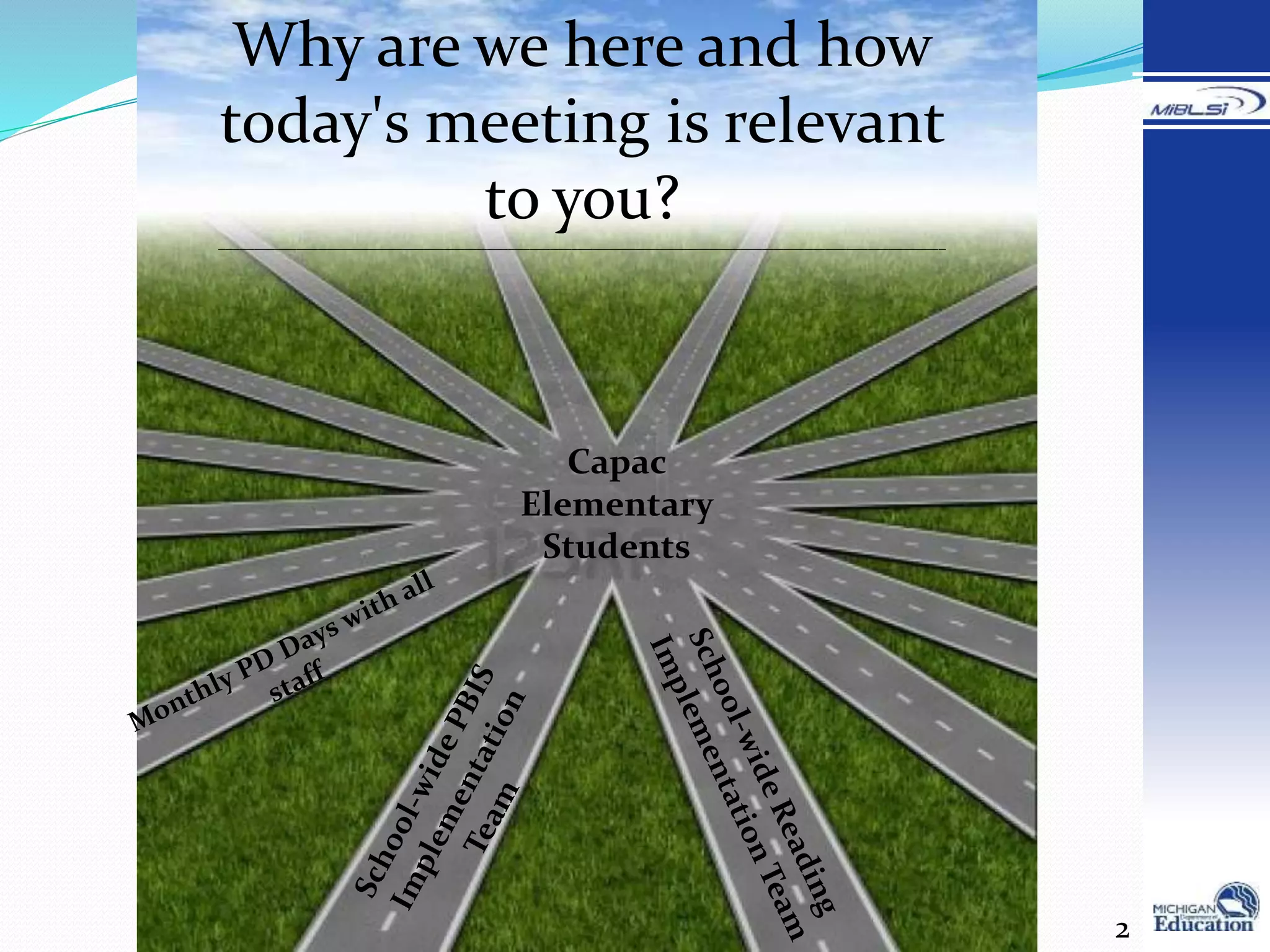
Capac 
Elementary 
Students
Capac Vision for Multi-tiered 
System of Supports 
Day One of School-wide Reading: 
• School-wide Reading Kick-Off 
• Critical Reading Skills – Complete 
• (Relate Big 5 to Reading Strategies Flip book) 
• School-wide Reading Assessment System 
• School-wide Schedules for Reading Instruction 
• Review and Reflection
Learn Port 
 Overview of Essential Components of Elementary 
Reading 
MiBLSi
Agenda 
What: 
Reading Strategies 
Flipbook 
Why: 
To support Teachers 
With Instructional 
Decisions 
How: 
Practice Observing 
Reading Behaviors
Regie Routman…Conversations 
“There must be a match between what we 
teach and the child’s needs, interests, 
engagement, and readiness to learn. It 
takes a knowledgeable teacher, not a 
program from a publisher, to determine 
and assess what needs to be directly 
taught and how and when to teach it.”
The following principals are not new. They have 
been proven by years of research as well as 
classroom experience. 
Students need 
lots of time to 
read. 
Students need to 
read books that 
interest them. 
Students need to 
be read to (in all 
grades). 
Students need to 
see adults 
reading. 
Students need 
teachers who are 
knowledgeable 
about reading. 
Students need 
access to a wide 
variety of reading 
material.
Variation in Amount of Independent 
Reading 
Percentile Rank Minutes/Day Reading Words/Year 
98 67.3 4,733,000 
90 33.4 2,357,000 
70 16.9 1,168,000 
50 9.2 601,000 
30 4.3 251,000 
10 1.0 51,000 
2 0 8,000
Using Your Reading Strategies Flip- 
Book 
Determine the 
reading stage 
Think about 
what you 
observed: 
What does the 
student do 
well? 
What does the 
student use but 
confuse? 
What does the 
student not 
know?
Characteristics of Readers 
Emergent 
Early 
Transitional 
Self-Extending 
Advanced 
See Reading Strategies Flip Book
Emergent 
Pre K – 1 (Levels A-B) 
Rely on language and meaning as they read simple texts 
with only one or two lines of print. 
Are beginning to control reading behavior, such as 
matching spoken words, one by one, with written words 
on the page.
Early 
K-2 (Levels B-H) 
Have achieved control of early behaviors such as reading from left to 
right (directionality) and are beginning to do some reading without 
pointing. 
Have acquired a core of frequently encountered words. 
Can read books with several lines of print, keeping the meaning in 
mind and solving simple words.
Transitional 
2-3 (Levels H-M) 3-4(Levels M-R) 
Have early behaviors well under control and can read texts with many 
lines of print. 
Use multiple sources of information while reading for meaning. 
Read fluently. 
Do not rely heavily on pictures. 
Have a large core of frequently used words they can recognize quickly and 
easily. 
Are working on solving more complex words through a range of word 
analysis techniques.
Self-Extending 
4-6 (Levels R-Y) 
Make use of all sources of information flexibly in a smoothly orchestrated 
system. 
Can apply strategies to reading longer, more complex texts. 
Have a large core of frequently used words. 
Can solve many other words, including multi-syllable ones, quickly. 
Are still building background knowledge and learning how to apply what 
they know to longer, more difficult text.
Portrait of a Reader – Learn NC 
 http://www.learnnc.org/lp/editions/readassess/1302 
 - Rosalie – Emergent 
 - Ben – 4th grade
At The Zoo 
 https://www.youtube.com/watch?v=qEd-mZsCVg8& 
list=PLFC2DC18916C8664E&index=10 
 What stage of reading development? 
 What behavior did you observe? 
 What would you say? 
 What instructional decisions would you make? 
 1:23
Practice
The New Watch 
What stage? 
What did you observe? 
What would you say? 
What instructional decisions would 
you make? :52
The Big Bad Wolf 
What stage? 
What did you observe? 
What would you say? 
What instructional decisions would 
you make? 4:54
Clifford 
What stage? 
What did you observe? 
What would you say? 
What instructional decisions would 
you make? 2:49
What stage? 
A Candy House 
What did you observe? 
What would you say? 
What instructional decisions would 
you make? 5:08
What stage? 
Abby K. 
What did you observe? 
What would you say? 
What instructional decisions would 
you make? :40
To be continued…March 9, 2015
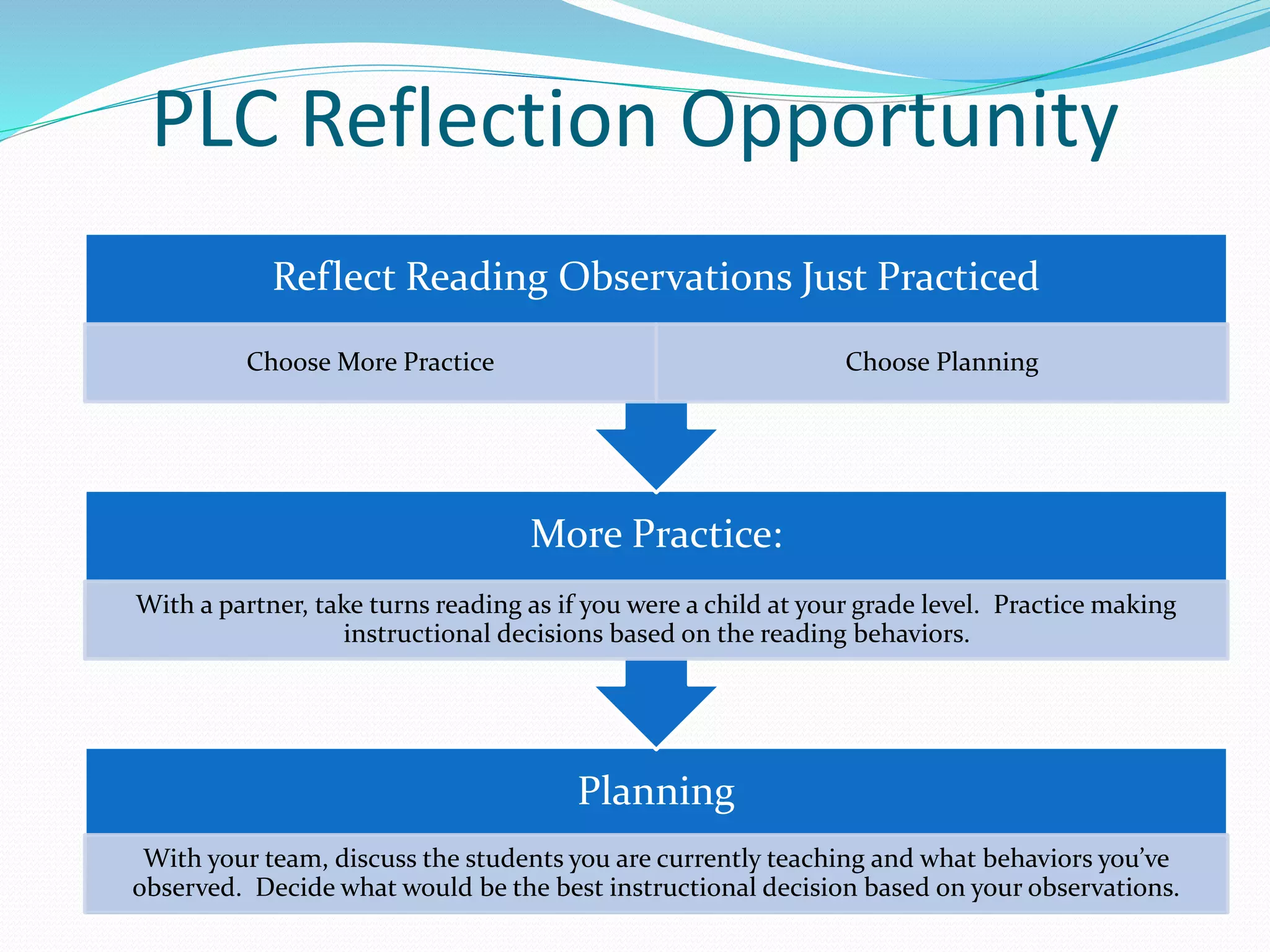
PLC Reflection Opportunity 
Reflect Reading Observations Just Practiced 
Choose More Practice Choose Planning 
More Practice: 
With a partner, take turns reading as if you were a child at your grade level. Practice making 
instructional decisions based on the reading behaviors. 
Planning 
With your team, discuss the students you are currently teaching and what behaviors you’ve 
observed. Decide what would be the best instructional decision based on your observations.
Other Resources 
Teacher Self- 
Reflection 
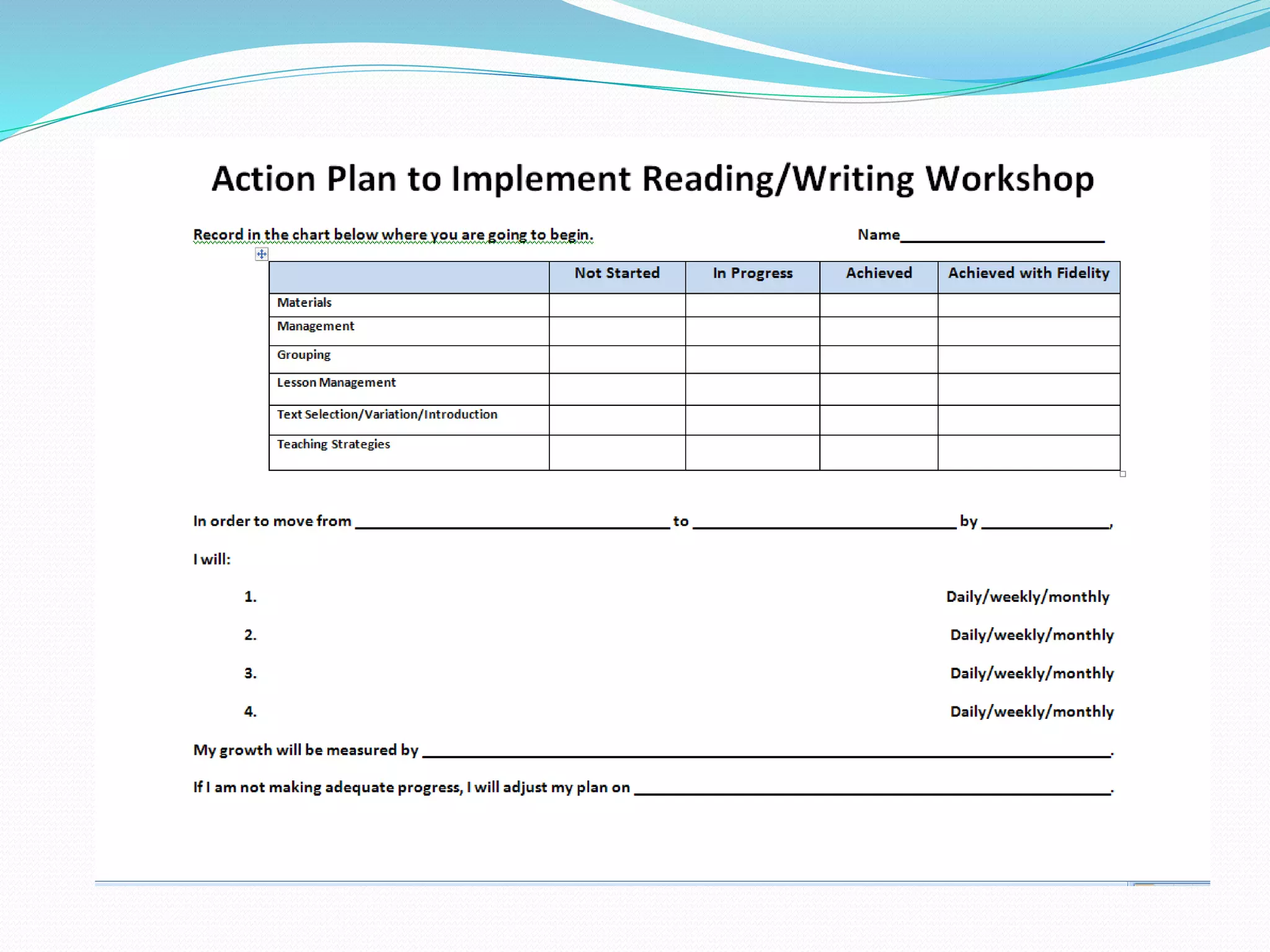
Action Plan 
Reading 
Workshop Look-fors
Review Teacher Self-Reflection for Reading 
Workshop 
Highlight Where you are on the Continuum
Select one area to concentrate on: 
For example in Teaching Strategies : 
My goal is to successfully implement all 
components of a guided reading lesson 
including before, during, and after 
activities. Or 
Grouping: I am just beginning to 
observe students’ reading behaviors and 
to think about forming groups based on 
levels of text; I have not identified other 
ways that I use to group students. 
Usually I teach the whole class.
Keep This in Mind:
Questions?

Reading strategies flip book teacher's meeting10 27-14

  • 1.
    Jennifer Evans AssistantDirector ELA St. Clair County RESA Evans.jennifer@sccresa.org http://www.protopage.com/evans.jennifer
  • 2.
    2 Why arewe here and how today's meeting is relevant to you? _______________________________________________________________________________________________________ Capac Elementary Students
  • 3.
    Capac Vision forMulti-tiered System of Supports Day One of School-wide Reading: • School-wide Reading Kick-Off • Critical Reading Skills – Complete • (Relate Big 5 to Reading Strategies Flip book) • School-wide Reading Assessment System • School-wide Schedules for Reading Instruction • Review and Reflection
  • 4.
    Learn Port Overview of Essential Components of Elementary Reading MiBLSi
  • 6.
    Agenda What: ReadingStrategies Flipbook Why: To support Teachers With Instructional Decisions How: Practice Observing Reading Behaviors
  • 7.
    Regie Routman…Conversations “Theremust be a match between what we teach and the child’s needs, interests, engagement, and readiness to learn. It takes a knowledgeable teacher, not a program from a publisher, to determine and assess what needs to be directly taught and how and when to teach it.”
  • 8.
    The following principalsare not new. They have been proven by years of research as well as classroom experience. Students need lots of time to read. Students need to read books that interest them. Students need to be read to (in all grades). Students need to see adults reading. Students need teachers who are knowledgeable about reading. Students need access to a wide variety of reading material.
  • 9.
    Variation in Amountof Independent Reading Percentile Rank Minutes/Day Reading Words/Year 98 67.3 4,733,000 90 33.4 2,357,000 70 16.9 1,168,000 50 9.2 601,000 30 4.3 251,000 10 1.0 51,000 2 0 8,000
  • 10.
    Using Your ReadingStrategies Flip- Book Determine the reading stage Think about what you observed: What does the student do well? What does the student use but confuse? What does the student not know?
  • 11.
    Characteristics of Readers Emergent Early Transitional Self-Extending Advanced See Reading Strategies Flip Book
  • 12.
    Emergent Pre K– 1 (Levels A-B) Rely on language and meaning as they read simple texts with only one or two lines of print. Are beginning to control reading behavior, such as matching spoken words, one by one, with written words on the page.
  • 13.
    Early K-2 (LevelsB-H) Have achieved control of early behaviors such as reading from left to right (directionality) and are beginning to do some reading without pointing. Have acquired a core of frequently encountered words. Can read books with several lines of print, keeping the meaning in mind and solving simple words.
  • 14.
    Transitional 2-3 (LevelsH-M) 3-4(Levels M-R) Have early behaviors well under control and can read texts with many lines of print. Use multiple sources of information while reading for meaning. Read fluently. Do not rely heavily on pictures. Have a large core of frequently used words they can recognize quickly and easily. Are working on solving more complex words through a range of word analysis techniques.
  • 15.
    Self-Extending 4-6 (LevelsR-Y) Make use of all sources of information flexibly in a smoothly orchestrated system. Can apply strategies to reading longer, more complex texts. Have a large core of frequently used words. Can solve many other words, including multi-syllable ones, quickly. Are still building background knowledge and learning how to apply what they know to longer, more difficult text.
  • 16.
    Portrait of aReader – Learn NC  http://www.learnnc.org/lp/editions/readassess/1302  - Rosalie – Emergent  - Ben – 4th grade
  • 17.
    At The Zoo  https://www.youtube.com/watch?v=qEd-mZsCVg8& list=PLFC2DC18916C8664E&index=10  What stage of reading development?  What behavior did you observe?  What would you say?  What instructional decisions would you make?  1:23
  • 18.
  • 19.
    The New Watch What stage? What did you observe? What would you say? What instructional decisions would you make? :52
  • 20.
    The Big BadWolf What stage? What did you observe? What would you say? What instructional decisions would you make? 4:54
  • 21.
    Clifford What stage? What did you observe? What would you say? What instructional decisions would you make? 2:49
  • 22.
    What stage? ACandy House What did you observe? What would you say? What instructional decisions would you make? 5:08
  • 23.
    What stage? AbbyK. What did you observe? What would you say? What instructional decisions would you make? :40
  • 24.
  • 25.
    PLC Reflection Opportunity Reflect Reading Observations Just Practiced Choose More Practice Choose Planning More Practice: With a partner, take turns reading as if you were a child at your grade level. Practice making instructional decisions based on the reading behaviors. Planning With your team, discuss the students you are currently teaching and what behaviors you’ve observed. Decide what would be the best instructional decision based on your observations.
  • 26.
    Other Resources TeacherSelf- Reflection Action Plan Reading Workshop Look-fors
  • 28.
    Review Teacher Self-Reflectionfor Reading Workshop Highlight Where you are on the Continuum
  • 29.
    Select one areato concentrate on: For example in Teaching Strategies : My goal is to successfully implement all components of a guided reading lesson including before, during, and after activities. Or Grouping: I am just beginning to observe students’ reading behaviors and to think about forming groups based on levels of text; I have not identified other ways that I use to group students. Usually I teach the whole class.
  • 31.
  • 32.

Editor's Notes

  • #3 Ideally this slide would be introduced by a building administrator, verbally answering ‘why are we here today for PD and what does it have to do with you in this building, district, etc.’ Help staff connect the dots, that in order to install tiered support systems, teams such as the reading and behavior team are attending school-wide training with miblsi, then that team works on contexualizing that material for Capac, then before finalizing that material for our building shares that information with building staff to obtain feedback. This is all being done to ensure that effective systems deliver research based strategies to our students.
  • #4 This slide can be updated for each staff PD day, this is an example for explaining school-wide reading day 1 objectives. Help staff understand that this content/objectives is what Jen or Natalie will be talking more about during our PD time today. For example: “Jen will be presenting on the Big 5 ideas of Literacy, which is helping us as an entire building to become consistent in our understanding of the critical reading skills that we should all be aware of. Because of these ideas and their importance, we will be working to develop our schedule for reading instruction or an effective 90 minute block, which you will hear more about this year”
  • #5 Learnport extra account: evans.jennifer Finish Learnport Module reviewing the "Big 5" in reading.  (We covered phonemic awareness, phonics, fluency, vocabulary - comprehension will be next).  (10 min.) Connect the Big 5 to the reading process in the back of the "Reading Strategies Flipbook"  (10 min.) Practice observing reading behaviors and making instructional decisions (20 min.) Q & A (5 min.)
  • #11 What would your teaching point for this student be? What area in the flip book would you look? What strategies could be suggested to move this student forward?
  • #17 Rosalie: Literacy play boxes; Word games Ben: Early – can only decode by letter sounds – “chunking” Transitional – only reads one type of book ; has difficulty reading for information -
  • #18 Stage: Emergent – Child pays little attention to print in the world: Strategy: one-to-one matching; environmental print; work with names; read the room; etc. The ultimate goal of this workshop series is to provide teachers with the ability to make instructional decisions based on observations. To empower teachers to use data to guide instruction and to move all of their students to higher levels of literacy success.
  • #20 Transitional: A child reads quickly but inaccurately and with limited comprehension – cross check (does that make sense?); fix-up strategies - Her dad “tell” (instead of took) her to the store. - Pam looked at all the “clocks” (instead of colors) and sizes… - “was” instead of “with” - “real” instead of “round” - appealed for help on “face”
  • #21 Transitional – reads quickly but inaccurately with limited comprehension – cross check – reads right through words without asking “does that make sense or does it sound right? Fix-up strategies; fluency for the new words;questioning Instead of “freeze to death” she said “freeze and deeth” “Nightgoons” “Science” instead of “since” “woke” instead of “awoke” “ran over hisself” instead of “ran for his life” Mispronounce “humans”
  • #22 Early (uses letter – sound information to solve problems but does not use other cueing systems to determine if it sounds right, looks right, or makes sense – she does not check one source of information against another to solve problems) –Transitional (has a large core of known words that are recognized automatically but isn’t quite to the many lines of print – chapter books- quite yet.) Struggles with names and problem solving when she comes to them Inconsistent with reading unknown words (Charlie) Early: If a child reads words he knows but stops at every new or unfamiliar word, then: Help them learn to use all three cueing systems by…
  • #23 Early – (still reads by pointing, recognizes most high frequency words, checks one source of information against another to problem solve, uses information from pictures, he recognizes known words built on sight words (thin – things) but is inconsistent with this strategy) – Transitional (longer text) Reads words he knows, but stops at every new or unfamiliar word: Help him to use all three cueing systems – does it make sense? Reads word – by – word: work on pre-reading so student makes predictions and reads to confirm or adjust predictions Start after 1:00 when teacher figures out the camera
  • #24 Transitional: (however, she doesn’t pay attention to ending punctuation – Early – and adds ending to words) A child reads quickly but inaccurately and with limited comprehension: help them read at a pace that supports comprehension- adjust and apply different rates to match text, cross check, Use phrasing, use punctuation,