Principles of EffectivePrinciples of Effective
Teaching of ReadingTeaching of Reading
(and Writing)(and Writing)
Effective teachers…
1. understand how children learn (student-
centered approaches that appreciate
social and cognitive development)
2. support children’s use of multiple cueing
systems (sound, meaning, structure,
visual, social)
1. I see the dog > I see the puppy.
2. I see the dog > I see the dish.
3. I see the dog > I seven the dog.
3. Create a community of learners
(opportunity, responsibility,risks,
and choices)
Effective teachers…
4. Adopt a balanced approach to literacy
instruction
• Balance reading and writing (oral, reading, vocabulary,
comprehension, phonics, spelling, content-area study)
• Balance ways of teaching
• Flexibly meet the needs of students
• Balanced vs. comprehensive
5. Scaffold children’s reading and writing (based
on their development)
6. Use a combination of modeled > shared >
interactive > independent activities
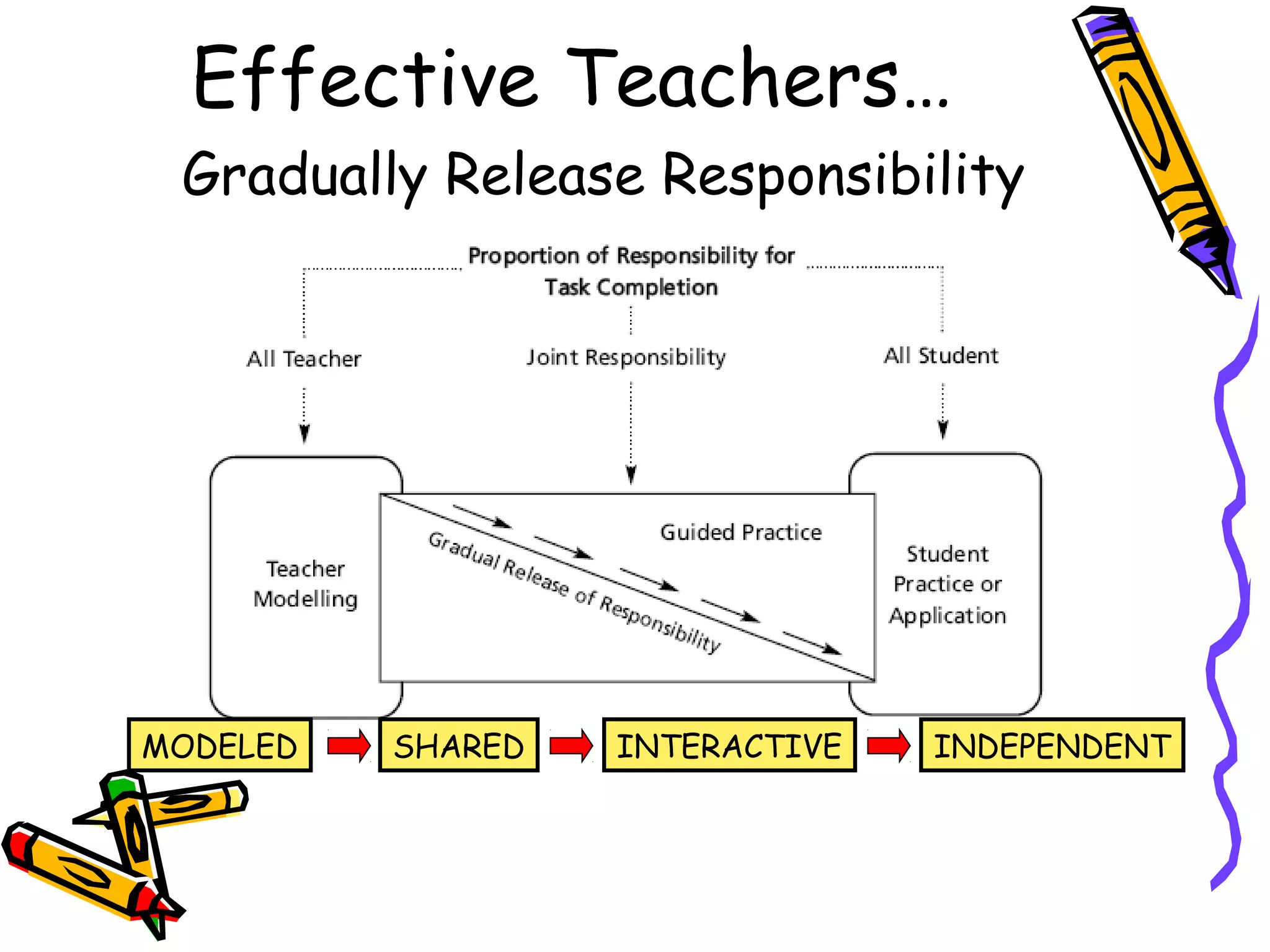
Gradual release of responsibility….
Effective Teachers…
Gradually Release Responsibility
MODELED SHARED INTERACTIVE INDEPENDENT
Effective teachers…
7. Use literature in their instruction
8. Organize literacy instruction in one of four ways
• (a) Basal
• (b) literature focused
• (c) literature circles
• (d) reading & writing workshop
9. Connect instruction and assessment (identify,
monitor, assess, analyze, adjust)
10. Become partners with parents.
So how do readers and
writers DEVELOP?
• Children weave reading and writing skills,
oral language, and story sense together as
they grow and socially interact with others
• Developmental:
– the level of instruction must match the level of
word/reading knowledge of the learner
– individuals may vary in their rate of progress
through these stages, but most tend to follow
the same order of development
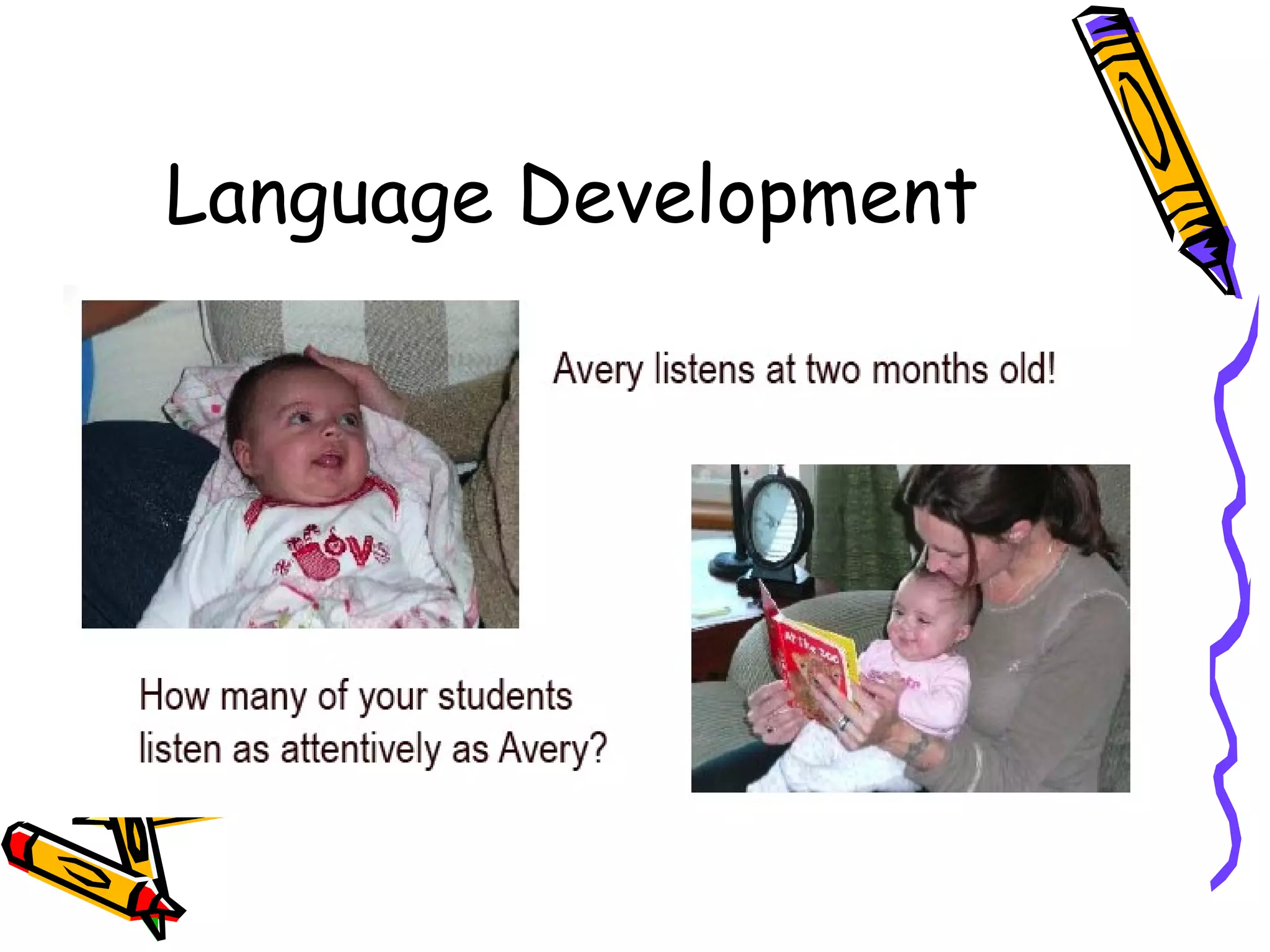
Language Development
Activity: The 30 Second
Conversation
• Make time for authentic conversation
• Focus on activities that develop speaking,
listening, and conversational skills.
• Let’s try it: Walk around room and introduce
yourself to someone you do not already know.
• Have a 30 second conversation with each
partner, speaking & responding in authentic
conversation.
• We will repeat this 3 times.
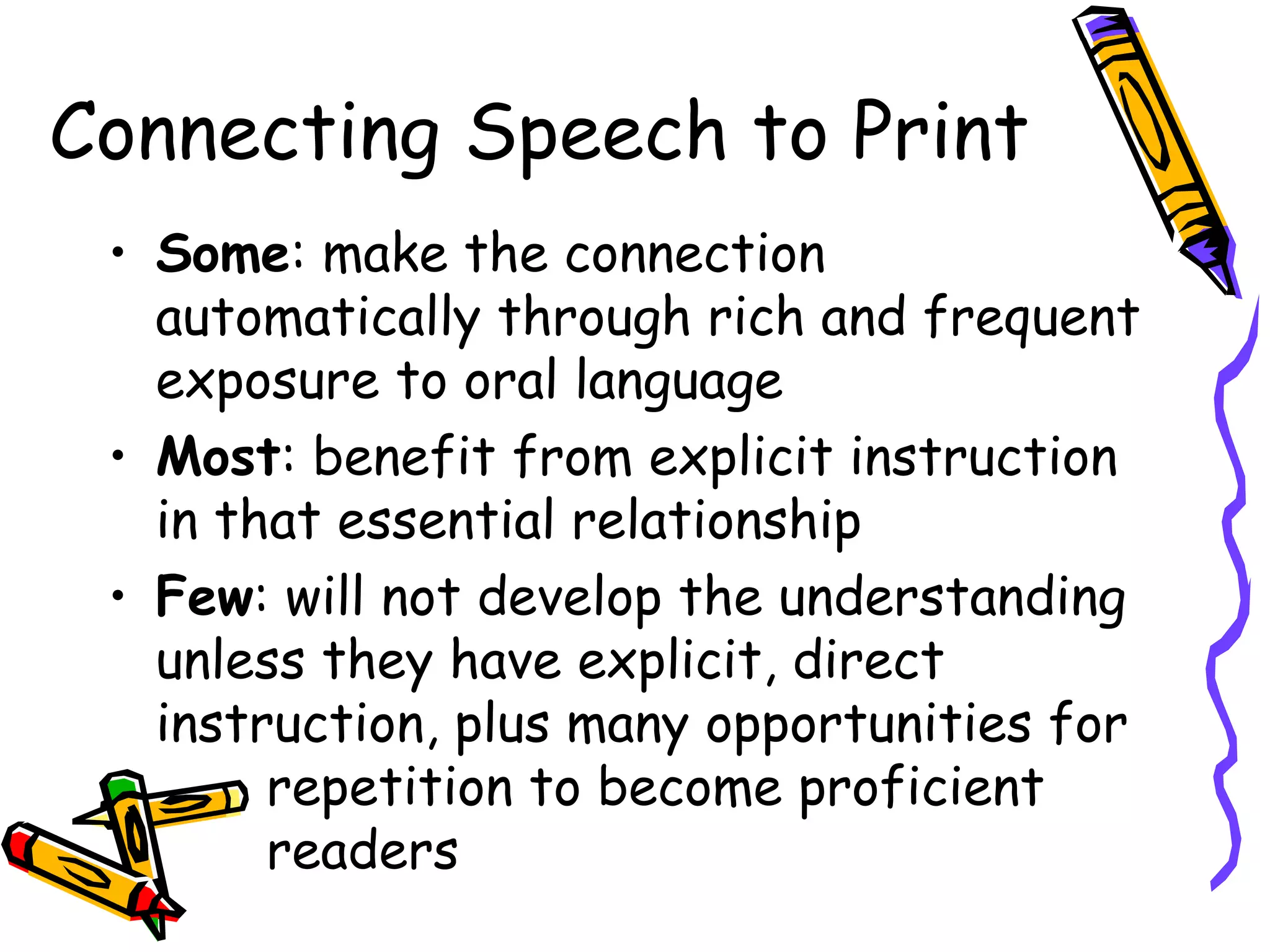
Connecting Speech to Print
• Some: make the connection
automatically through rich and frequent
exposure to oral language
• Most: benefit from explicit instruction
in that essential relationship
• Few: will not develop the understanding
unless they have explicit, direct
instruction, plus many opportunities for
repetition to become proficient
readers
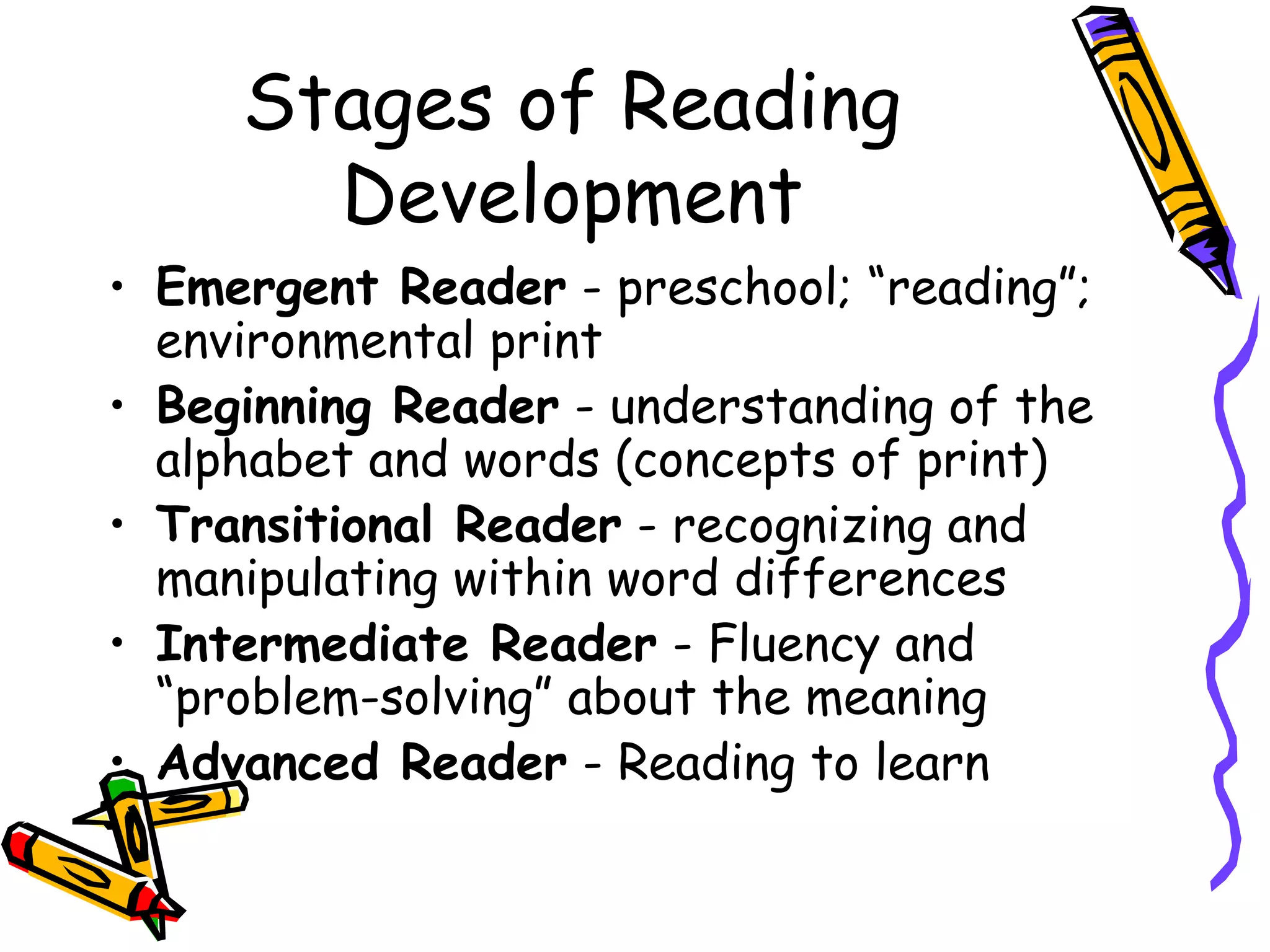
Stages of Reading
Development
• Emergent Reader - preschool; “reading”;
environmental print
• Beginning Reader - understanding of the
alphabet and words (concepts of print)
• Transitional Reader - recognizing and
manipulating within word differences
• Intermediate Reader - Fluency and
“problem-solving” about the meaning
• Advanced Reader - Reading to learn
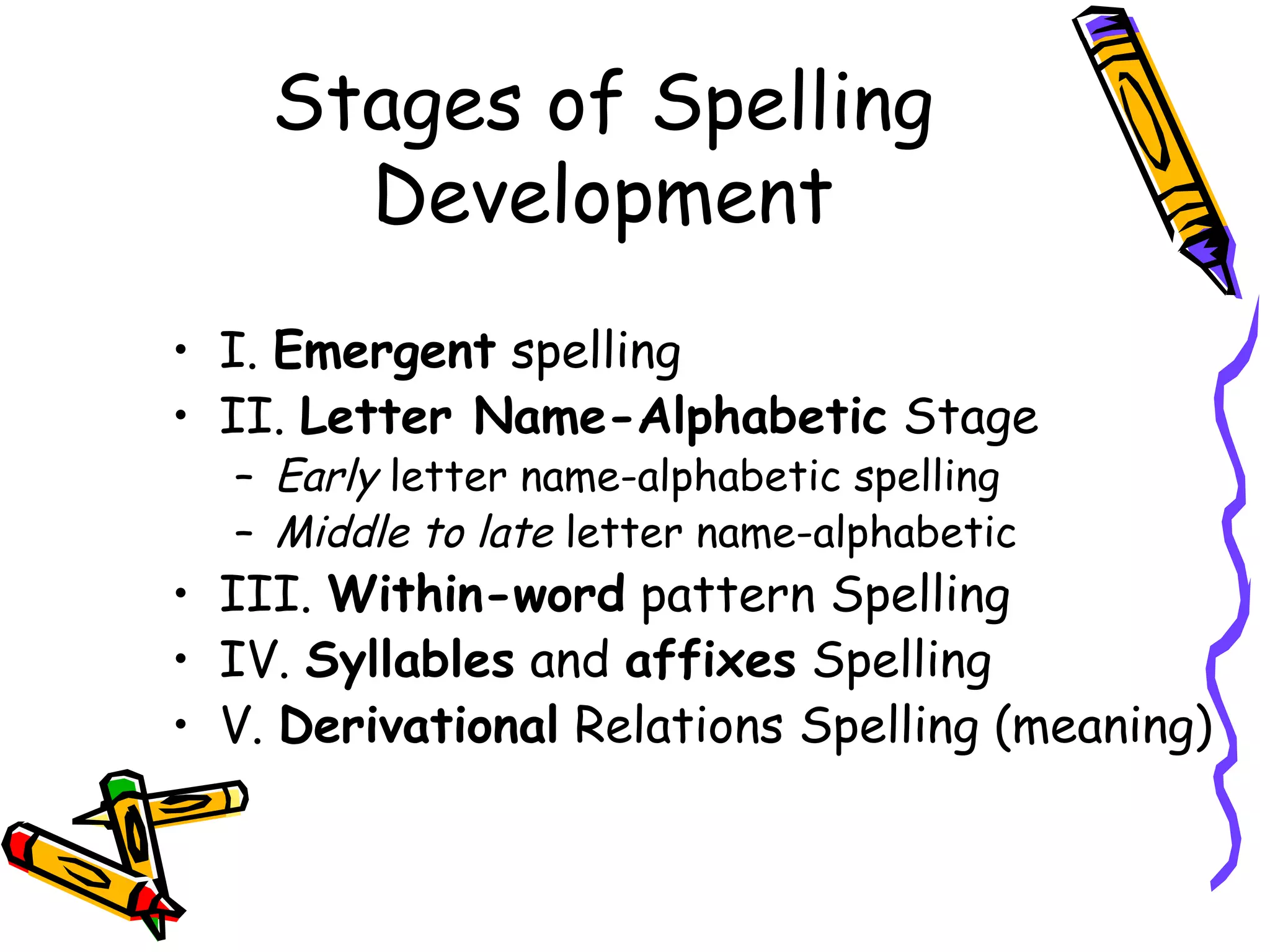
Stages of Spelling
Development
• I. Emergent spelling
• II. Letter Name-Alphabetic Stage
– Early letter name-alphabetic spelling
– Middle to late letter name-alphabetic
• III. Within-word pattern Spelling
• IV. Syllables and affixes Spelling
• V. Derivational Relations Spelling (meaning)
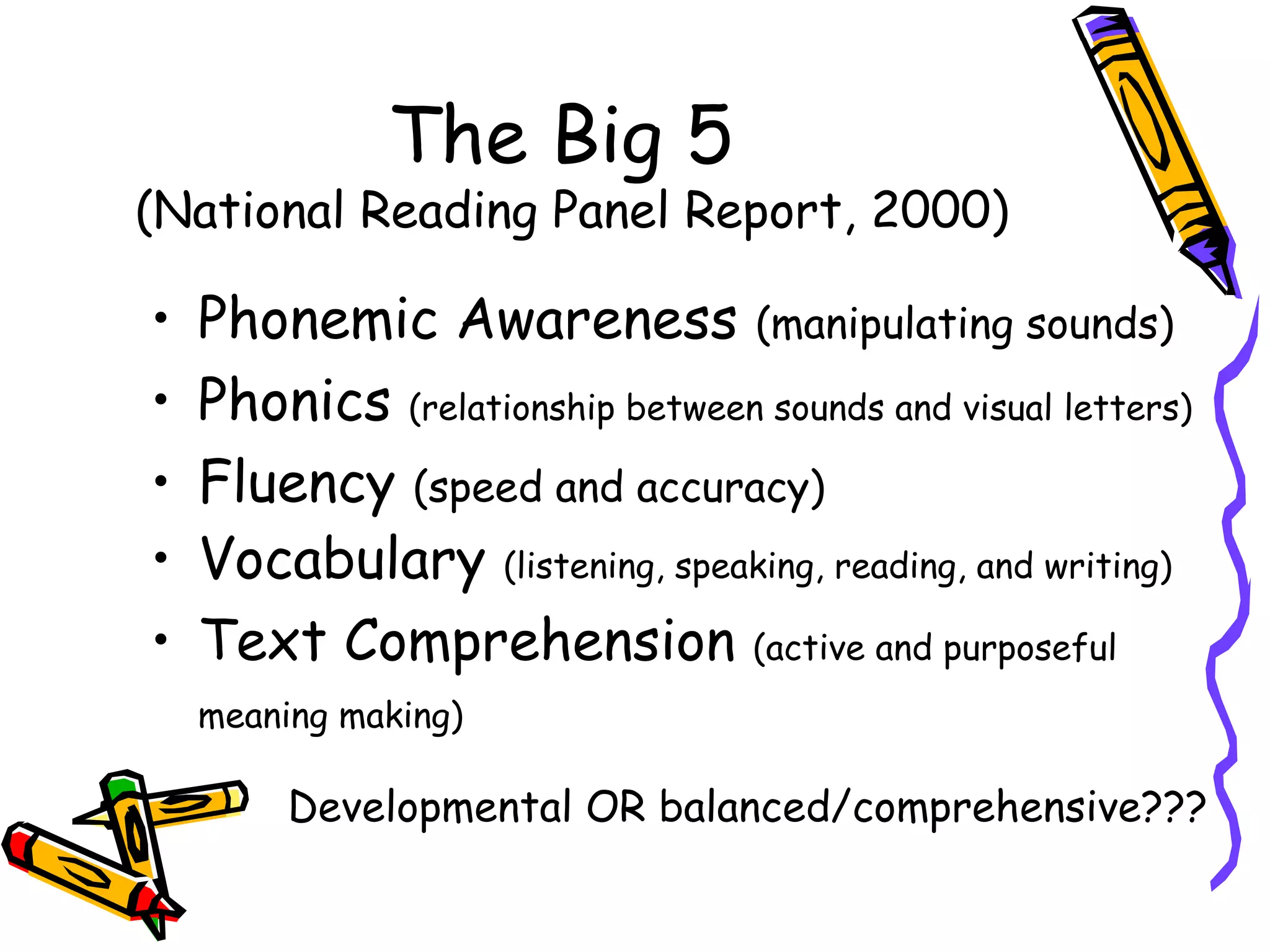
The Big 5
(National Reading Panel Report, 2000)
• Phonemic Awareness (manipulating sounds)
• Phonics (relationship between sounds and visual letters)
• Fluency (speed and accuracy)
• Vocabulary (listening, speaking, reading, and writing)
• Text Comprehension (active and purposeful
meaning making)
Developmental OR balanced/comprehensive???
Homework
• Rhode Island Literacy Policy
– Typical Development: p. 17-19;
– 5 Components of Literacy: p. 20-35
• Skim Reading First Materials
• Connect to RI GLE’s for Reading K-5
– Use Reading Guide to take brief notes
to prepare for class activity – save for
homework the next class too

Oral lang reading development

  • 1.
    Principles of EffectivePrinciplesof Effective Teaching of ReadingTeaching of Reading (and Writing)(and Writing)
  • 2.
    Effective teachers… 1. understandhow children learn (student- centered approaches that appreciate social and cognitive development) 2. support children’s use of multiple cueing systems (sound, meaning, structure, visual, social) 1. I see the dog > I see the puppy. 2. I see the dog > I see the dish. 3. I see the dog > I seven the dog. 3. Create a community of learners (opportunity, responsibility,risks, and choices)
  • 3.
    Effective teachers… 4. Adopta balanced approach to literacy instruction • Balance reading and writing (oral, reading, vocabulary, comprehension, phonics, spelling, content-area study) • Balance ways of teaching • Flexibly meet the needs of students • Balanced vs. comprehensive 5. Scaffold children’s reading and writing (based on their development) 6. Use a combination of modeled > shared > interactive > independent activities Gradual release of responsibility….
  • 4.
    Effective Teachers… Gradually ReleaseResponsibility MODELED SHARED INTERACTIVE INDEPENDENT
  • 5.
    Effective teachers… 7. Useliterature in their instruction 8. Organize literacy instruction in one of four ways • (a) Basal • (b) literature focused • (c) literature circles • (d) reading & writing workshop 9. Connect instruction and assessment (identify, monitor, assess, analyze, adjust) 10. Become partners with parents.
  • 6.
    So how doreaders and writers DEVELOP? • Children weave reading and writing skills, oral language, and story sense together as they grow and socially interact with others • Developmental: – the level of instruction must match the level of word/reading knowledge of the learner – individuals may vary in their rate of progress through these stages, but most tend to follow the same order of development
  • 7.
  • 8.
    Activity: The 30Second Conversation • Make time for authentic conversation • Focus on activities that develop speaking, listening, and conversational skills. • Let’s try it: Walk around room and introduce yourself to someone you do not already know. • Have a 30 second conversation with each partner, speaking & responding in authentic conversation. • We will repeat this 3 times.
  • 9.
    Connecting Speech toPrint • Some: make the connection automatically through rich and frequent exposure to oral language • Most: benefit from explicit instruction in that essential relationship • Few: will not develop the understanding unless they have explicit, direct instruction, plus many opportunities for repetition to become proficient readers
  • 10.
    Stages of Reading Development •Emergent Reader - preschool; “reading”; environmental print • Beginning Reader - understanding of the alphabet and words (concepts of print) • Transitional Reader - recognizing and manipulating within word differences • Intermediate Reader - Fluency and “problem-solving” about the meaning • Advanced Reader - Reading to learn
  • 11.
    Stages of Spelling Development •I. Emergent spelling • II. Letter Name-Alphabetic Stage – Early letter name-alphabetic spelling – Middle to late letter name-alphabetic • III. Within-word pattern Spelling • IV. Syllables and affixes Spelling • V. Derivational Relations Spelling (meaning)
  • 12.
    The Big 5 (NationalReading Panel Report, 2000) • Phonemic Awareness (manipulating sounds) • Phonics (relationship between sounds and visual letters) • Fluency (speed and accuracy) • Vocabulary (listening, speaking, reading, and writing) • Text Comprehension (active and purposeful meaning making) Developmental OR balanced/comprehensive???
  • 13.
    Homework • Rhode IslandLiteracy Policy – Typical Development: p. 17-19; – 5 Components of Literacy: p. 20-35 • Skim Reading First Materials • Connect to RI GLE’s for Reading K-5 – Use Reading Guide to take brief notes to prepare for class activity – save for homework the next class too

Editor's Notes

  • #11 Environmental print: MacDonald’s, Dunkin Donuts; Beginning Reader (My name is Julie, cat > bat > sat > sit > fit); Transitional Reader: Within word differences (smock vs. smoke; tack vs. take); Intermediate Reader (syllables and affixes – prefixes and suffixes) (hop > hopping vs. trade > trading); Advanced Reader (greek and latin roots for knowing ineffective vs. effective; inactive vs. active); illogical vs. logical; illegible vs. legible)