To Amaia—you aremy sweet Noelani, my passion and
grace. Each day with you is blessed with everlasting
love and tenderness.
—C.K.H.
To my daughters Anisa, Jenna, and Sarah for being my
inspiration and my greatest joy. I love you more than
words could ever express.
—L.A.R.
7.
CONTENTS
FOREWORD
ACKNOWLEDGMENTS
INTRODUCTION
PART 1 Componentsof Reading: Making the
Connections
CHAPTER 1 Foundations of Reading
CHAPTER 2 Impact of Visual Impairments on Reading
CHAPTER 3 Understanding Reading Instruction
CHAPTER 4 Assessment of Students’ Performance in
Reading
PART 2 Teaching the Components: Putting the
Pieces Together
CHAPTER 5 Teaching Phonemic Awareness
8.
CHAPTER 6 TeachingPhonics and Decoding
CHAPTER 7 Teaching Reading Fluency
CHAPTER 8 Teaching Vocabulary
CHAPTER 9 Teaching Reading Comprehension
CHAPTER 10 Additional Components of Reading
REFERENCES
APPENDIX A Kamei-Hannan and Ricci Reading Assessment
APPENDIX B Assessment Tools
RESOURCES
INDEX
ABOUT THE AUTHORS
9.
FOREWORD
Reading is askill that supports learning in all areas of the school
curriculum. Providing students with a strong foundation in reading is an
important responsibility for educators, including teachers of students with
visual impairments. Throughout recent history in this field, there has been
much interest and discussion about reading instruction and how teachers
best encourage students with visual impairments to acquire reading skills
and a love of reading. However, professionals continue to be challenged by
the need to balance teaching skills that relate to reading with skills that
relate to students’ use of appropriate media and/or technologies that provide
access to text. Too often teaching reading and writing is separated from
teaching braille or teaching use of optical devices or visual efficiency skills.
By separating these important literacy skills, instruction is often
fragmented. The crux of this book is the authors’ belief that when teachers
of students with visual impairments work with their students on braille
reading or print reading, they are, in fact, teaching reading.
The authors of this book appreciate the holistic approach to examining
the process of teaching reading to students who are blind or visually
impaired and address the importance of skills that are universal for reading
instruction and those that are unique to the population of students with
visual impairments. This book zeros in on the process of reading and
provides the reader with a perspective of the complexity of a skill that
seems so easy to those of us who are accomplished readers. The authors
acknowledge that teaching writing as a companion to teaching reading is
most effective during literacy instruction and recommend that readers of
10.
this text accessresources for teaching writing and use writing instruction in
tandem with reading instruction where appropriate.
The introduction to this text includes advice to read through the first four
chapters in sequence and to use the remainder of the chapters as needed to
support an individual student’s literacy program. Teachers will find this a
helpful suggestion and will likely refer to the chapters in the book
frequently as they teach children in various stages of literacy acquisition.
Readers of this text will find the chapters easy to read, logical, and
organized. Chapters address a variety of helpful topics including supporting
development of phonemic awareness, phonics, vocabulary, and
comprehension as well as additional components of reading such as oral
language and memory. Assessment of reading is addressed as a separate
chapter but is also infused in other chapters. Helpful examples and case
studies provide support for concepts included in the book, which skillfully
weaves together what is known about reading, what is known about reading
for students with visual impairments, and practical suggestions and
activities for teaching specific skills. While the text provides a step-by-step
guide to help teachers understand the idea of each activity, creative teachers
will want to use these ideas as springboards to develop extension activities
or games that are geared to individual students’ interests and to use these as
part of a comprehensive literacy program.
The authors of this text, Cheryl Kamei-Hannan and Leila Ansari Ricci,
are well qualified to write on this important topic. Both have a research
focus on literacy for special populations. The focus of this topic fits
perfectly into their scholarly agenda and provides an important bridge
between research/theory and practice. Readers of this text will benefit from
their expertise in teaching reading, working with students with a wide
variety of special needs, and supporting children for whom English is an
additional language.
My experience talking with teachers of students with visual impairments
is that there is great concern and low confidence about teaching reading and
writing. Some teachers feel that teaching reading is not their “job.” This text
will help counter the fragmentation of literacy instruction, alleviate
11.
teachers’ concerns, andsupport teachers as they provide literacy instruction
to their students with visual impairments who read braille, print, or a
combination of braille and print.
M. Cay Holbrook
Professor
University of British Columbia
Vancouver, British Columbia, Canada
12.
ACKNOWLEDGMENTS
Reading Connections wouldnot have been possible without the endless
support of numerous outstanding professionals in the field, colleagues,
mentors, family members, and friends. These individuals gave us
confidence and provided us with inspiration. We want to express our sincere
gratitude and appreciation for their patience and encouragement throughout
the project.
We would first like to acknowledge the many teachers who are
passionate about literacy and provide fun and motivating ways to teach
reading to their students. Some of these wonderful teachers contributed the
case studies found throughout this book. We would particularly like to
recognize the contributions of Linda Cox, Parisa Lamarra, Ramona
McLaughlin, Angela Orchid, and Susan Walker. We would also like to
recognize the genuine and endearing students with whom we work.
We want to express our gratitude to AFB Press and the American
Foundation for the Blind for providing us the opportunity to share our
knowledge in Reading Connections. Specifically, we want to acknowledge
Natalie Hilzen, former editor in chief of AFB Press, who was with us from
the start of the project and who provided us with endless encouragement
throughout the project. We also want to thank two special people whose
attention to detail contributed to the quality of this book: Ellen Bilofsky,
Executive Editor, thank you for your patience and support throughout the
editing process, and Alina Vayntrub, Project Editor, thank you for your keen
eye and for catching those pesky details. In addition, we want to thank
George Abbott, Director, AFB Press and Professional Development, for his
management of the final product.
13.
Many of ourcolleagues provided us with mentorship and inspiration
along the way. Specifically, we would like to thank Jane Erin, Diane Fazzi,
Diane Haager, Cay Holbrook, Holly Lawson, Tessa McCarthy, Penny
Rosenblum, Sharon Sacks, Irene Topor, and Andrea Zetlin. In addition, we
would like to recognize Larry Hannan, who contributed the artwork and
personalized this book for us.
Cheryl Kamei-Hannan would especially like to thank her mom, her first
reading teacher, who always provides strength and love. She would also like
to extend her sincere appreciation to Jason, who provides endless
unconditional support; thank you for your love! Special thanks to Kalea,
who provided ears for listening and endless smiles of encouragement.
Lastly, she would like to thank Seanarae, who believed this book was
important.
Finally, we would like to thank all the teachers, families, and children
we have worked with over the years and who have taught us so much.
Thank you for your inspiration!
14.
INTRODUCTION
Reading Connections: Strategiesfor Teaching Students with Visual
Impairments was written for educators seeking to improve the reading skills
of their students who are visually impaired, with the aim of offering an in-
depth and user-friendly guide for teaching reading. Teachers of students
with visual impairments, as well as family members and other professionals
who work with children who are blind or visually impaired, will find within
this book a repertoire of strategies and activities for teaching essential
reading skills necessary for students’ success. This book addresses the
needs of students who read print, braille, or both.
Reading Connections provides teachers and professionals with a
foundation for understanding reading instruction, along with a variety of
activities that can be used on a daily basis to help improve students’ reading
skills. This hands-on resource is aimed at teachers currently working in
general and special education schools, as well as instructors and pre-service
teachers in teacher preparation programs. This book can also provide school
administrators with a better understanding of the role of the teachers of
students with visual impairments in teaching reading. Although this book is
written primarily for teachers, parents of children with visual impairments
will also find it helpful for learning more about effective reading instruction
for their children.
Many of the strategies presented in this book will also be beneficial for
sighted and typically developing children who are struggling readers, or for
children who have disabilities other than, or in addition to, visual
impairment. In fact, much of this book is consistent with strategies for
teaching reading to students who have, or are at risk for, developing reading
15.
disabilities. Although childrenwho are visually impaired may have a
variety of other disabilities, it is beyond the scope of this book to address
the needs of children who have more severe or profound disabilities.
ORGANIZATION OF THIS BOOK
Part 1, Components of Reading: Making the Connections, provides the
foundation for the rest of the book, and the chapters in this section are
designed to be read sequentially. Chapter 1 discusses the fundamentals of
typical reading development, including the reading process and essential
components of reading. In Chapter 2, the impact of visual impairments on
reading is discussed in depth. Chapters 3 and 4 provide information on
understanding and evaluating general reading instruction in schools, as well
as how to assess individual students’ performance in reading.
The chapters in Part 2, Teaching the Components: Putting the Pieces
Together, address in detail the essential components of reading—phonemic
awareness, phonics, reading fluency, vocabulary, and reading
comprehension—and Chapter 10 covers other essential reading components
and subskills. The chapters in Part 2 can be read in any order, as these skills
are not necessarily taught in a sequential manner.
The organizational basis for this book is the findings of the National
Reading Panel (NRP; 2000a), an expert panel charged by Congress with the
task of establishing the components of effective reading instruction. The
five areas of phonemic awareness, phonics, reading fluency, vocabulary,
and reading comprehension are those for which the panel found evidence-
based, effective teaching practices supported by research, as discussed in
Chapter 1, and recommended that they be included in any reading
instruction program. Although critics have pointed out the limits of the
NRP’s recommendations—and indeed much more research is needed to
determine all sound, evidence-based methods for teaching reading to
children—teachers of reading need to be aware of these five evidence-based
practices and incorporate them into their teaching repertoire in order to
16.
reach all theirstudents. This book also highlights a number of additional
components needed for reading that, although not included in the NRP
report, make a significant contribution to how well children learn to read,
including oral language; memory; prior knowledge; attention and focus and
motivation and interest; and auditory, visual, and tactile processing. These
components are the focus of Chapter 10. Our hope is that as research in
reading continues to expand, even more evidence-based practices will
emerge to promote the reading success of our nation’s children.
USING THIS BOOK
Teachers of children with visual impairments are encouraged to begin by
evaluating the current reading instruction offered to their students, as
explained in Chapter 3. Teachers are then encouraged to assess each
individual student’s reading ability, as described in detail in Chapter 4, and
to refer to Chapters 5–10 as appropriate for creating a balanced,
comprehensive plan of reading instruction for each student, in collaboration
with general education teachers and other service providers. Each of these
chapters defines a component and its importance for reading, discusses
strategies for assessing and teaching the skill to students who are visually
impaired, and provides a variety of activities for teaching the skill. Chapters
5–9 also contain case studies of students who are struggling with reading
and describe how teachers have used the information provided in this book
to help improve the reading skills of their students who are visually
impaired.
Appendix A presents an informal assessment tool that can be used to
evaluate current reading instruction and determine a student’s strengths and
areas of need; Appendix B lists a variety of tools available to assess specific
components of reading; and the Resources section recommends additional
sources of information for teachers seeking to improve the reading skills of
their students with visual impairments.
17.
Although writing isvery much interconnected with reading and is
important for overall literacy, this book focuses solely on reading
instruction for students who are visually impaired, since an entire additional
book would be required to provide adequate coverage on the topic of
writing instruction. Given the importance of writing, however, teachers are
encouraged to draw connections between reading and writing as appropriate
and to simultaneously teach writing alongside many of the reading activities
presented in this book.
READING AND TEACHERS OF STUDENTS WITH VISUAL
IMPAIRMENTS
Readers should note that the case studies woven throughout the chapters in
Part 2 of this book are modeled after instructional programs used to teach
reading to students by student teachers in the teacher preparation program
in Visual Impairment and Blindness at California State University, Los
Angeles. (Names were changed to protect the privacy of students and
teachers.) In most instances, the assessments, curricula, interventions, and
activities are those that were actually used with the students. The problem-
solving approach to instruction and the planning tools available in this book
were used as the framework for each of these case studies.
Teachers of students with visual impairments often receive very little
training in reading instruction and are not offered much guidance when it
comes to their role in the delivery of effective reading instruction. This
book is dedicated to enhancing the competence and confidence of these
educators in teaching reading—whether in print or braille—to children who
are blind or visually impaired.
It can be argued that reading is one of the most critical skills we teach
our children. Our hope is that Reading Connections: Strategies for Teaching
Students with Visual Impairments will offer teachers, professionals, and
caregivers a variety of useful strategies and activities, and that it will serve
as a valuable resource in this very important endeavor.
CHAPTER 1
Foundations ofReading
KEY CONCEPTS
The definition of reading
What happens in the brain during the process of reading
How reading develops in typical children
21.
F
Five essential componentsof reading
Additional components necessary for successful reading
Characteristics of skilled versus struggling readers
or many people, reading evokes happy childhood memories of
curling under the bedcovers with a favorite book full of stories about
adventures to faraway lands or of waiting eagerly for the publication
of the latest installment of their favorite novel series. Yet others cringe with
thoughts of embarrassment and misery when recalling a childhood in which
they struggled with learning to read. This chapter describes the foundations
for this fundamental skill, the learning of which can elicit such vastly
different yet powerful emotions. The chapter that follows will examine in
detail the implications of visual impairment for learning to read.
READING: A DEFINITION
Simply defined, reading is the act of understanding the meaning of symbols
in a print or tactile medium. When a reader sees the visual images of letters
or feels the tactile input of braille, the brain processes the information to
comprehend the meaning of these symbols. Reading is a fundamental skill
that is essential for day-to-day living and critical for academic success.
Simple daily tasks, such as reading labels on grocery items or signs in the
community, make reading invaluable for independence. According to the
American Federation of Teachers (2008), reading serves as the foundation
for the rest of a child’s formal education. In schools, reading is used as a
primary means of communication, with high levels of reading achievement
necessary for full and successful participation in the educational
curriculum.
Despite the critical importance of learning to read, many children face
struggles on the road to becoming a proficient reader. According to the
National Assessment of Educational Progress, 32 percent of American
fourth graders and 22 percent of the nation’s eighth graders scored below
22.
basic levels inreading (National Center for Education Statistics, 2013).
Only 35 percent of the fourth graders and 36 percent of the eighth graders
scored at or above the proficient level, which indicates grade-level mastery
of reading. In fact, low reading achievement is one of the major reasons for
chronically low-performing public schools in the United States. Children
who struggle with reading are vulnerable to feelings of low self-confidence
and to developing a lack of overall motivation in school (Glick, 1972;
Morgan, Fuchs, & Compton, 2008). Furthermore, children who struggle to
read in preschool, kindergarten, and first grade are less likely to remain at
grade level in the rest of their academic subjects (Francis, Shaywitz,
Stuebing, Shaywitz, & Fletcher, 1996; Phillips, Norris, Osmond, &
Maynard, 2002; Simmons et al., 2008; Whitehurst & Lonigan, 2002).
Because the demands of reading far surpass their abilities to comprehend
text, struggling readers have diminished access to critical learning
opportunities (Whitehurst & Lonigan, 2002). Ultimately, children who
struggle with reading read less often and are more likely to drop out of high
school. Freshmen high school students who are in the bottom 25th
percentile of reading performance are less likely to graduate than those in
the top 25th percentile (Torgesen et al., 2007). With these grim statistics and
the passage of legislation in recent decades requiring that every child learn
to read by the end of third grade, it is understandable that reading has
become a national priority.
THE READING PROCESS
Though the process of reading may seem simple to good readers, the act of
deriving meaning from symbols is actually a complex activity that requires
demanding cognitive work. The process of reading requires the brain to use
several facilities, including auditory, visual, and (in the case of braille)
tactile processing; logic and reasoning; language; emotion; and short- and
long-term memory (Adams, 1994; Goodman, 1964, 1993; Whitehurst,
2001). Visual, auditory, and tactile processing includes the perception of
23.
stimuli by thesenses of sight, hearing, and touch and the interpretation of
these stimuli by the brain to make meaning. Table 1.1 explains some of
these visual, auditory, and tactile processing skills and gives examples of
how they are used during the reading process. A child who is a proficient
reader uses these processing skills seamlessly.
TABLE 1.1
Visual, Auditory, and Tactile Processes Used During Reading
(Description)
Processing
Skill Definition and Use in Reading
Visual
discrimination
Ability to visually differentiate objects based on their
individual characteristics. Typically, the eyes work
together to process an image.
Example: recognizing the difference between letters
Visual
memory
Ability to store and recall information presented visually
Example: remembering letters seen on a page of text
Auditory
discrimination
Ability to recognize differences in sounds
Example: identifying words that sound similar and those
that sound different
Auditory
memory
Ability to store and recall information presented verbally
Example: recalling information from a story that was
read aloud
Auditory
sequencing
Ability to recall and re-create the order of sounds in a
syllable or word, or the sequence of events in a story
Example: “animal” instead of “aminal”
Auditory
blending
Ability to combine individual sounds to form words
Example: blending /d/, /o/, and /g/ to say “dog”
24.
Tactile
discrimination
Ability to discernsymbols using the sense of touch;
unlike visual discrimination, a tactile reader can
simultaneously identify different objects or symbols in
each hand
Tactile
memory
Ability to store and recall information presented
tactilely
Sources: Adams, M. J. (1994). Beginning to read: Thinking and learning about print. Cambridge,
MA: MIT Press; Goodman, K. S. (1964). The linguistics of reading. Elementary School Journal,
64(8), 355–361; Goodman, K. S. (1993). Phonics phacts: A common-sense look at the most
controversial issue affecting today’s classrooms! Toronto, ON: Scholastic Canada, Ltd;
Whitehurst, G. J. (2001). Do preschoolers need academic content? Education Matters, 1(2).
Recent research using functional magnetic resonance imaging (fMRI)
technology has shed light on the regions of the brain activated during
reading. Within the left hemisphere of the brain, which is associated with
speech, language, and reading, researchers have now identified three areas
critical for reading: Broca’s area, the parietal-temporal area, and the
occipital-temporal area (Pugh, Sandak, Frost, Moore, & Mencl, 2006;
Shaywitz, 2003). Broca’s area is associated with organizing, producing, and
manipulating speech and language. The parietal-temporal area is associated
with the decoding of words—the act of recognizing the sounds of letters
and linking the letters together sound by sound to read words—while the
occipital-temporal area is associated with the rapid and automatic
recognition of words by sight. Each of these areas contributes to an overall
understanding of the ideas being conveyed by the written word. All of the
cognitive processes must work together, as if in “concert” (Adams, 1994),
allowing the reader to translate text into meaningful language in order to
process what is being read.
25.
READING DEVELOPMENT
For mostpeople, the process of learning to read is a journey that begins
sometime in early childhood. Through a combination of listening to stories,
observing the environment, following natural curiosity, attending early
education programs, learning through parental guidance, and soaking up the
print-rich world, some children develop a love for reading and learn to read
with little effort. For most children, however, structured guided lessons with
varying levels of teacher support and ample practice are necessary for
adequate reading development. A small percentage of children have severe,
pervasive reading disabilities that require special education services. The
journey of acquiring reading skills is different for every person. Often, the
process of learning to read, though initiated well before entering school, is
not fully developed until formal education has begun. Because learning to
read is not a natural process for most children, direct instruction is often
necessary for children to master this fundamental skill (Adams, 1994;
Chall, 1967).
Learning to read occurs in stages during a child’s life, beginning with
very early experiences with language and print. As children learn to read,
they progress through various stages from emergent to skilled readers. Table
1.2 provides an overview of the stages of reading development in children
(Adams, 1994; Chall, 1967; D’Andrea & Farrenkopf, 2000; Steinman,
LeJeune, & Kimbrough, 2006; Whitehurst & Lonigan, 1998).
TABLE 1.2
Stages of Reading Development in Children
(Description)
Stage of
Reading
Development Definition
26.
Emergent
reading
Demonstration of thebeginning stages of reading.
Students at this level are beginning to understand that
letters on a page produce specific sounds and that words
are made up of letters.
Beginning
reading
Development of a set of skills required for early
elementary-level reading, including the ability to read
connected text with a fluency rate of about 50–100 words
per minute with comprehension. Students at this stage are
transitioning from learning to read to reading to learn.
Advanced
reading
Development of a set of skills required for reading at
upper elementary levels. Students at this stage use reading
for inquiry and knowledge building. They primarily use
reading to learn new concepts.
Academic
reading
An advanced reading level that is specific to academic
content areas, including high school- and college-level
reading. Students at this level have developed
specialized vocabulary and concepts that are used in
very specific academic content areas such as chemistry,
physics, political science, and economics.
Sources: Adams, M. J. (1994). Beginning to read: Thinking and learning about print. Cambridge,
MA: MIT Press; Chall, J. (1967). Learning to read: The great debate. New York: McGraw-Hill;
D’Andrea, F. M. & Farrenkopf, C. (Eds.). (2000). Looking to learn: Promoting literacy for
students with low vision. New York: AFB Press; Steinman, B. A., LeJeune, B. J., & Kimbrough,
B. T. (2006). Developmental stages of reading processes in children who are blind and sighted.
Journal of Visual Impairment & Blindness, 100(1), 36–46; Whitehurst, G. J., & Lonigan, C. J.
(1998). Child development and emergent literacy. Child Development, 69(3), 848–872.
Beginning early in a child’s life and before enrollment in school, the
stage of emergent reading encompasses early knowledge about the printed
word and reading (Gunn, Simmons, & Kameenui, 1998; Lonigan, Burgess,
27.
& Anthony, 2000;Simmons & Kameenui, 1998). Emergent readers
typically develop important skills such as receptive vocabulary, awareness
of print concepts, knowledge of letters and sounds, phonological awareness
(the general ability to recognize the variety of sounds used in language),
and recognition of common words seen in the environment (National Early
Literacy Panel, 2008; van Kleeck, 1990; Whitehurst & Lonigan, 1998).
Receptive vocabulary is the repertoire of spoken words that are understood
by an emergent reader. Having knowledge of the meaning of a variety of
words is essential for later reading as the act of reading involves connecting
visual forms—written words—with meaningful language. Awareness of
print concepts refers to an understanding of the purpose, uses, and
conventions of print. For example, children who demonstrate awareness of
English print understand that the words on a page convey meaning, that text
written in English begins at the top of a page and proceeds from left to
right, and that punctuation marks, such as periods, indicate the ends of
sentences (Whitehurst & Lonigan, 1998). Knowledge of letters and sounds
is the ability to name letters of the alphabet and recognize their related
sounds. In alphabetically based writing systems such as English, reading
involves translating the units of print (letters of the alphabet) into units of
sound, thus making letter knowledge a strong predictor of later success in
reading (Adams, 1994). Phonemic awareness, a subcomponent of
phonological awareness, involves the ability to detect and manipulate the
individual units of sound, or phonemes, of words; without adequate
phonemic awareness, children will often have difficulty in decoding
unfamiliar words (Neuman & Dickinson, 2002). (See Chapter 5 for more on
the difference between phonological and phonemic awareness.) Finally,
sight-word reading is the ability to recognize common words by sight and
derive meaning from print. Children often learn early on to read candy
labels, fast-food restaurant signs, or famous logos.
Upon entry into school, formal instruction in reading and writing begins,
allowing children to progress from beginning to advanced readers in the
course of their K-12 education. Advanced students in high school and
beyond will become academic readers.
28.
ESSENTIAL COMPONENTS OFREADING
Years of research have led to the identification of the skills necessary for
proficient reading as well as for evidence-based, effective approaches for
teaching reading. Proficient readers use several subsets of skills while
reading, each of which must be cultivated during reading instruction
(Adams, 1994; Chall, 1967; Goodman, 1993; Whitehurst, 2001). In order to
teach children to become mature readers, teachers must teach complex
reading skills in interconnected ways. The National Reading Panel (NRP;
2000a), a group of leading national experts charged by Congress with the
task of determining effective reading instruction, identified five areas of
reading instruction for which there were evidence-based, effective teaching
practices and that should be included in any reading education program:
phonemic awareness
phonics
reading fluency
vocabulary
reading comprehension
These five areas, illustrated in Figure 1.1, should be considered critical
areas for struggling readers.
FIGURE 1.1
The Five Essential Components of Reading Identified by the
National Reading Panel
29.
These five componentsare described in the rest of this chapter and are
addressed in detail in Chapters 5–9 of this book. Also included are
instructional routines and activities for teaching each component to students
who are visually impaired. Additional components that are equally essential
for children to develop into mature readers include oral language skills,
memory, prior knowledge, attention and focus, motivation and interest, and
cognitive processing skills; these are introduced later in this chapter and
discussed in more detail in Chapter 2. However, the five components
identified by the NRP are those for which the panel was able to find
sufficient evidence-based research on which to base conclusions about
effective instruction (Cassidy, Valadez, & Garrett, 2010). These components
constitute specific, teachable skills that typically form the basis for reading
instruction. For these reasons, Part 2 of this book focuses most heavily on
the five NRP components, dedicating a chapter for in-depth description of
30.
each. Chapter 10includes discussion of the additional essential areas of
reading instruction. Sidebar 1.1 presents a brief history of the National
Reading Panel and how it developed its recommendations.
SIDEBAR 1.1
The National Reading Panel and Its Recommendations
Established in 1997 under a directive by the United States Congress,
the National Reading Panel (NRP) was tasked with evaluating
existing research on reading and determining the most effective
ways to teach the nation’s children how to read. The NRP consisted
of 14 members from various backgrounds including school teachers,
administrators, and those conducting research in the area of reading.
Congress charged the NRP with the following tasks:
Review all available existing research on how children learn
to read (which included more than 100,000 research studies
since 1966)
Determine evidence-based, effective ways for teaching
children to read
Determine methods of reading instruction ready for use in
classrooms and the means of providing this information to
schools
Make recommendations for further research in reading
development and instruction
After selecting and analyzing several hundred studies from the
available pool of research, the NRP presented its final reports in
2000. The panel concluded that the best approach to reading
instruction that could be documented from available evidence
consists of the following:
explicit instruction in phonemic awareness
systematic instruction in phonics
31.
instruction in readingfluency, including guided oral reading
vocabulary instruction
teaching reading comprehension strategies
These findings and recommendations were incorporated into the No
Child Left Behind Act (NCLB) in 2001.
Although the NRP’s recommendations for reading instruction
have informed federal regulations and reading curricula in schools,
criticisms of the panel’s findings must also be considered. Critics of
the NRP’s recommendations worried that the components identified
in the report might be considered to be the only skills needed for
successful reading, and that viewing these areas of reading as
separate skills fails to account for the complexity of the reading
process as a whole. Furthermore, the components identified by the
NRP were not intended to be taught in a linear sequence; they were
meant to be woven together in an appropriate, well-balanced
reading instruction program. However, after the release of the NRP
findings, some schools placed such great emphasis on developing
students’ proficiency in phonemic awareness, phonics, and fluency
that instruction in vocabulary, comprehension, and other areas were
delayed (Weaver, 2009).
It is important to remember that the five areas identified by the
NRP were not meant to be the only essential skills required for
reading; rather, they were simply the topic areas chosen by the 14-
member panel and for which the panel found enough evidence-
based research to draw conclusions about effective reading
instruction (Cassidy et al., 2010). Many factors contributing to
successful reading outcomes were not considered by the NRP
because they did not meet the criteria set for evidence-based
research. Additional components, such as those presented in this
book (oral language, memory, prior knowledge, attention/focus and
motivation/interest, and processing skills), also play a significant
role in effective reading instruction.
32.
Although the structureof this book presents the essential components of
reading in a sequential manner, these skills should not be taught in a linear
sequence or in isolation from each other. Teachers can and should teach a
variety of reading skills within a single lesson, and are encouraged to flip
back and forth between the chapters of this book when designing reading
instruction.
Phonemic Awareness
Phonemes are the smallest units of sound in the spoken language. Phonemic
awareness, then, is the ability to both hear and manipulate the smallest units
of sound in a spoken language. An individual letter may represent a sound
—as in the two sounds we hear in the word “no”—or two or more letters
may represent one phoneme—such as the sh in the word “shell” or gh in the
word “laugh.” Within phonemic awareness, the skills of segmenting
(breaking apart words into their individual phonemes, as cat is broken apart
into /c/-/a/-/t/) and blending (linking together individual phonemes in order
to say a word, as /d/-/o/-/g/ together make the word “dog”) are most critical
for later success in reading. In order to become effective readers, children
need instruction in focusing on and manipulating the phonemes within
spoken words in the early grades. This skill is often taught in kindergarten
and mastered by typically developing readers by the end of the first grade.
Phonemic awareness then is an essential skill that lays the foundation for
the development of the alphabetic principle and phonics instruction.
Alphabetic Principle and Phonics
The alphabetic principle is the understanding that the symbols (letters) on a
page correspond to the sounds used in spoken words. Phonics instruction is
a method of teaching reading that emphasizes this acquisition of letter-
sound correspondences and their use in reading, for example, teaching a
33.
child that theletter p on a page makes the /p/ sound as in the word “pan.” In
learning to read, children progress through stages in the development of
phonics skills (Ehri, 2005). In the pre-alphabetic phase, children understand
that there is a relationship between letters and their sounds but memorize
words as visual forms. In the partial-alphabetic phase, children associate
some letters with their sounds—for example the letter s makes the sound /s/
—while in the full-alphabetic phase, they have learned most of the common
letter-sound relationships and can use this ability to read unknown words. In
the consolidated-alphabetic phase, children recognize multi-letter
sequences, such as syllables and parts of words, and can read longer words
more easily. Finally, in the automatic phase of the alphabetic principle,
children recognize whole words by sight quickly and efficiently, no longer
needing to consciously associate letters with sounds. This ability to read
words quickly and accurately without having to apply sound-symbol
relationships to decode a word is also known as rapid automatic naming
(RAN). Thus, in order to become effective readers, children must acquire
mastery of the alphabetic principle and be adept at phonics in order to read
unfamiliar words.
Reading Fluency
The ability to read words easily enables children to develop reading
fluency, another essential component of reading. Readers who are fluent are
able to read text orally with accuracy, speed, and natural expression. By
reading text in an efficient and fluid manner, children can focus on the
comprehension of meaning. Laborious and choppy reading, by contrast,
often makes it difficult for a reader to remember what has been read
because so much energy has been devoted to the act of word-for-word
reading. Fluent oral reading should mirror how a reader would speak those
same sentences in a natural conversation. Explicit instruction in reading
fluency is necessary for helping beginning readers make the transition into
becoming fluent, expressive readers.
34.
Vocabulary
Knowledge of vocabulary,the collection of words used within a language,
is also essential for proficient reading. Having knowledge of a wide range
of words allows a reader to better comprehend text. The larger the
vocabulary, the more likely a reader is to understand a variety of texts.
When decoding an unfamiliar word in text, the reader can understand its
meaning if the word is already part of his or her oral vocabulary (for
example, a child who sounds out the word “piglet” would benefit from
knowing that a piglet is a baby pig). In order to become effective readers,
children benefit from repetition and multiple exposures to vocabulary words
that are both encountered incidentally in rich learning contexts as well as
taught directly as part of a systematic reading program.
Comprehension
Comprehension is the ultimate purpose of reading. In order to read
effectively, children must understand the meaning of the printed word.
Comprehension is defined as “intentional thinking during which meaning is
constructed through interactions between text and reader” (Harris &
Hodges, 1995). During reading, children who actively relate the ideas
presented in print to their own prior knowledge demonstrate higher levels of
reading comprehension. For example, children who read a story such as
Alexander and the Terrible, Horrible, No Good, Very Bad Day (a popular
children’s book written by Judith Viorst) and who can relate the main
character’s struggles to their own relationship with their siblings or to being
in a bad mood, will have a stronger understanding of the story than children
who do not make this type of connection. According to the National
Reading Panel (2000a), good readers employ a variety of comprehension
strategies, such as generating and asking questions while reading, drawing
conclusions from information in a text, summarizing information read in the
text, and making informed predictions.
35.
ADDITIONAL COMPONENTS REQUIREDFOR
SUCCESSFUL READING
Although each of the five components just discussed is essential for
effective reading instruction, as noted earlier, there are additional
components that are equally important in the complex task of reading (see
Figure 1.2). The first is oral language, the ability to understand and produce
spoken language. Oral language consists of semantics, the vocabulary and
concepts that convey meaning, and syntax, the organization and structure of
words that relate to the meaning. Good readers use their skills in
understanding and expressing oral language (Goodman, 1964; National
Early Literacy Panel, 2008). They use their semantic skills to understand
what they read, and they use their syntax skills to read with fluency. Next,
memory is the ability to quickly recall information from past experiences.
Short-term memory is essential for remembering what the reader just read.
Long-term memory of experiences in the more distant past allows the
reader to connect that information to the text being read, thus ensuring
greater comprehension (Mather & Jaffe, 2002). In addition to memory,
prior knowledge is essential for reading, as it allows readers to relate
information from the text to what they already know about the world in
order to make sense of the new concepts (Echevarria, Vogt, & Short, 2010).
FIGURE 1.2
Comprehensive Group of Components Required for Successful
Reading
(Description)
36.
Effective readers alsohave adequate attention and focus (Johns &
Lenski, 2010), which is the ability to concentrate on the task of reading long
enough to derive meaning. Next, motivation and interest play a role in
successful reading (Arnold, 2004; Johns & Lenski, 2010). Children’s desire,
curiosity, and attraction to reading result in heightened engagement and
awareness of text, contributing to their comprehension of written materials.
Attention and focus and motivation and interest are different but highly
interrelated concepts. Children need to attend to and focus on their reading;
however, they are unable to do so if their motivation and interest in a topic
is missing. Conversely, if a child is highly motivated and interested in a
given topic, he or she is more likely to focus and attend to the reading.
Because these concepts are so closely related, they are treated as one
component of reading in the rest of this book.
37.
Finally, as notedearlier, having intact and efficient auditory, visual, and
(in the case of children who are visually impaired and learn braille) tactile
processing skills enables children to become competent readers (Adams,
1994; Mather & Jaffe, 2002). These additional components are discussed in
more detail in Chapter 2 and are the focus of Chapter 10. Table 1.3
summarizes all the components of reading instruction discussed in this
book.
TABLE 1.3
A Glossary of Skills Necessary for Successful Reading
(Description)
Skill Definition
Phonemic
awareness
The ability to hear and manipulate the individual units
of sound that make up spoken words.
Phonics The ability to use sound-symbol relationships to read
(decode) unfamiliar words, including the skill to read
words quickly and automatically.
Reading
fluency
The ability to read aloud rapidly and accurately with
natural expression.
Vocabulary The understanding of the meaning of words and
concepts.
Reading
Comprehension
The ability to recall information and understand written
text. Includes higher-order skills such as analyzing text
by comparing, contrasting, or inferring information.
Oral language The ability to understand and produce spoken language.
Two components of oral language are essential for
reading: (1) vocabulary and concepts that convey
meaning (semantics) and (2) organization and structure
of words related to meaning (syntax).
38.
Memory The abilityto quickly recall information from reading
and relate knowledge from the past—either recent past
experiences (short-term memory) or those from long
ago (long-term memory).
Prior
knowledge
The ability to use information that has already been
acquired or learned during past experiences to make
sense of new information encountered in text.
Attention and
focus
The ability to maintain concentration on a task.
Motivation and
interest
The desire, curiosity, and attraction to reading that result
in engagement, awareness, and attention to text.
Processing
skills
The unconscious ability to activate all areas of the
brain that are required to process written information
and language, including auditory, visual, and (if
necessary) tactile processing.
CHARACTERISTICS OF SKILLED VERSUS
STRUGGLING READERS
In summary, effective readers are proficient in skills that are often
challenging for students who struggle with reading. The American
Federation of Teachers (2008) describes skilled readers as those who
process text very rapidly and without conscious effort. These effective
readers clearly understand letter-sound correspondence and likely learned it
early in their development of reading. Skilled readers use speech sounds
that are represented by letters to decode unfamiliar words. They have a
solid understanding of the linguistic structure of sounds and syllables in the
39.
English language. Usingthis understanding, effective readers can quickly
break down a word into its syllables and meaningful word parts. In the
middle of second grade, these skilled readers can read approximately 90
correct words per minute with 90 percent accuracy (Hasbrouck & Tindal,
2006). Finally, skilled readers enjoy reading for meaning and for pleasure,
thereby improving their reading ability further with the continued practice
of reading.
In contrast, students who struggle in reading lack proficiency in the
various components of reading described in this chapter. Struggling readers
often have difficulty with phonemic awareness, which can impede their
ability to isolate and manipulate the individual sounds of spoken words.
Students who struggle with reading sometimes lack the ability to efficiently
understand and use letter-sound relationships and patterns to decode
unfamiliar words. Understanding the linguistic structure of the English
language can pose a formidable challenge for ineffective readers. Not
surprisingly then, many struggling readers read laboriously and are
embarrassed to read out loud in their classrooms. These children may
experience difficulty with comprehending the meaning of text and will in
no uncertain terms express their dislike of reading. As they are unlikely to
read for pleasure, these children often fall further and further behind their
peers who are skilled readers, unless their teachers use appropriate and
effective reading interventions. (See Table 4.1 in Chapter 4 for a list of the
characteristics of struggling and effective readers.)
SUMMARY
Reading is a fundamental skill that serves as the foundation for a child’s
formal education. Much of later academic and life success depends on the
mastery of this very important skill. Reading can be defined simply as the
act of deriving meaning from written symbols, yet reading is a complex
process involving several different regions of the brain. Reading
development begins early in a child’s life and progresses through stages
40.
from emergent toproficient. In order to become proficient readers, children
must master several essential components of reading, including phonemic
awareness, the alphabetic principle and phonics, reading fluency,
vocabulary, and reading comprehension. Furthermore, oral language,
memory, prior knowledge, attention and focus, motivation and interest, and
auditory, visual, and tactile processing all play a role in proficient reading.
The next chapter will explore the impact of visual impairments on
children’s reading skills.
41.
CHAPTER 2
Impact ofVisual Impairments on
Reading
KEY CONCEPTS
What happens in the brain of a child with a visual impairment
during the process of reading
How reading develops in children with visual impairments
The impact of visual impairments on the five essential
components of reading
42.
R
The impact ofvisual impairments on the additional
components necessary for successful reading
eading plays an equally important role in the lives of children with
visual impairments as it does in the lives of sighted children. Many
children with visual impairments enjoy reading under the covers
with a flashlight or reading braille long after saying goodnight to their
parents, cherishing those fun moments of reading. Besides providing
enjoyment, reading is a foundational skill for individuals with visual
impairments, just as it is for anyone else. Reading allows people who have
visual impairments to function independently, liberating them in daily life,
and paving the way to gainful employment.
Although some easily learn to read, many children who have visual
impairments struggle to make the same progress in reading as their sighted
peers. For example, by third grade, children who read braille were found to
be in the bottom 25th percentile in most reading skills (Wall Emerson,
Holbrook, & D’Andrea, 2009). Similarly, children with low vision have
been reported as being two years behind their typically developing peers in
reading speed, accuracy, and comprehension (Douglas, Grimley, Hill, Long,
& Tobin, 2002; Douglas, Grimley, McLinden, & Watson, 2004). Because
the children in these studies did not have additional, undiagnosed
disabilities (such as learning disabilities or cognitive delays), we might
conclude that visual impairments could significantly impact children’s
achievement in reading. This chapter begins with an explanation of the
reading process and how reading develops in children who have visual
impairments, followed by a discussion of the impact of visual impairments
on each of the essential components of reading in this population.
VISUAL IMPAIRMENTS AND THE READING PROCESS
The cognitive reading process—the ability of several regions of the brain to
function simultaneously for proficient reading—is the same for readers with
43.
and without visualimpairments (Pring, 1984; Veispak & Ghesquière, 2010).
Research in brain imaging has verified that the areas of the brain used by
proficient readers remain the same whether the medium for accessing the
written word is visual (print) or tactile (braille). Surprisingly, even
individuals who have never had vision show activation of the visual cortex
(or occipital lobe) of the brain during reading tasks (Hannan, 2006; Sadato
et al., 1996; Sadato et al., 1998). In fact, proficient braille readers who
depend on their tactile sense for reading still showed the same activation in
their visual cortex as sighted readers. Although braille readers also show
activation in their somatosensory area—which is the area of the brain
typically associated with tactile perception (Burton et al., 2002)—most of
the reading process is the same for both tactile and sighted readers. Much
like their sighted peers, children with visual impairments use their visual,
auditory, and language processing skills to read in print or in braille.
VISUAL IMPAIRMENTS AND READING DEVELOPMENT
Although the processes the brain uses in reading may be the same for
sighted children and those who have visual impairments, the development
of reading skills in children with visual impairments often requires more
support on the part of caregivers and teachers. As with many sighted
children, children who have visual impairments do not acquire reading
skills naturally without formal instruction. Many children who have visual
impairments often need much more intensive, direct instruction to learn to
read. A visual impairment may have an impact on early development of
emergent reading skills. For example, children with significant vision loss
commonly experience delays in their development of oral language skills
and their knowledge of events, people, and objects in their world. These
children receive less visual input and exposure to people and objects in their
natural environment, which often leads to a lower level of visual curiosity
than that of fully sighted children. Children who are blind need to be able to
touch objects in their natural environment in order to truly understand them.
44.
Children with visualimpairments need directed and supported exposure to,
and exploration of, the world around them in order to inspire, augment, and
satisfy their natural curiosity. Without this effort and guidance, these
children may experience delayed development of vocabulary and concepts
that come readily for sighted children.
Moreover, much of a sighted child’s early learning occurs incidentally
by observing and mimicking the behavior and language of parents and
others. However, this incidental learning of language and concepts does not
happen as frequently for children with visual impairments because they
often have reduced access to their environments. Because children who are
visually impaired have fewer opportunities for incidental learning, they
often have incomplete or delayed understanding of concepts. Furthermore,
children with visual impairments may experience a delay in understanding
the conventions of the printed word because they have less exposure and
access to written text in their environment. They do not develop the same
understanding about books, words, and letters as their sighted peers.
Children who are blind or have severe low vision and will become braille
readers can be particularly challenged in reading development, since braille
books are not as common as print books in children’s homes and natural
environments (Kamei-Hannan & Sacks, 2012), potentially limiting their
ability to engage with accessible text and practice reading skills. All these
factors can contribute to many children with vision loss lagging behind their
sighted peers in early reading skills.
In addition to potential delays in the development of early reading skills,
children who have visual impairments may also need to learn additional
skills necessary to support reading. Essentially, children with visual
impairments must conquer two reading-related tasks: learning to read and
learning to efficiently use some combination of their residual vision, optical
devices, and a tactile medium (see Sidebar 2.1). The addition of these
necessary skills may present challenges during reading development.
Lastly, the presence of other disabilities or being an English language
learner can also affect a child’s rate of reading development. (Sidebar 2.2
45.
discusses the languagedevelopment of English language learners and how
it informs the teaching of reading to these students.)
SIDEBAR 2.1
Additional Reading-Related Skills that Students with
Visual Impairments May Need to Learn
ADDITIONAL SKILLS FOR READING BRAILLE
Developing tactile sensitivity and braille reading mechanics
Learning the braille code, including braille contractions
Using technology to access text
ADDITIONAL SKILLS FOR READING WITH LOW VISION
Using vision efficiently
Using an optical device or technology or both to access text
SIDEBAR 2.2
A Word about English Language Learners
Most people can relate to a situation in which a person with whom
they needed to communicate did not speak English. The situation
may have occurred in a foreign country or perhaps in a conversation
with an individual who was learning English. Communication
between two individuals who do not speak the same language can
be challenging. In these situations, communicators often resort to
using body language such as pointing, animated facial expressions,
or gesturing toward objects to assist in the conversation.
46.
While these techniquesmay serve in an emergency, basic
language skills are needed to communicate clearly. Not surprisingly,
the same basic language skills are needed for beginning reading. In
school, as a child progresses through upper grade levels, advanced
language skills are needed for proficient reading of text related to
academic subjects, especially when the vocabulary used becomes
terminology specific to a given academic subject area.
Children who are learning English as a second language and who
are visually impaired may face significant challenges when learning
to read. English language learners may not have the necessary
vocabulary or grammar skills in English to facilitate comprehension
of written text. Since oral language and reading skills are linked,
English language learners often struggle with reading tasks until
their English language proficiency develops.
When communicating in a second language, many strategies are
based on visual cues or information. For example, in conversational
dialogue, individuals use gestures, body language, and pointing as a
means to convey their thoughts and ideas. Reduced vision or
blindness limits the visual mode of input and thus reduces access to
the visual environment. As a result, individuals who are visually
impaired may not be aware of the subtle body cues, gestures, and
nonverbal communication of others. In addition, visual stimuli often
prompt conversation and questioning, which can contribute to
vocabulary and overall language development. For example, when
people see an object and reference it in a conversation, an individual
who is blind or visually impaired may have reduced opportunities to
engage in the conversation based on the visual stimuli referenced.
Likewise, pictures and photographs are one of the most commonly
used media for teaching new vocabulary words to English language
learners. Alternate methods for teaching vocabulary must be
developed for English language learners with visual impairments.
This sidebar provides a description of typical language development
and implications for English language learners with visual
impairments.
TYPICAL LANGUAGE DEVELOPMENT
47.
Language development canbe defined as the way in which one
learns to use spoken forms of communication, both in
understanding what others say and in expressing oneself to others.
Language development begins during infancy, and it is first noticed
when an infant begins to babble (McCormick, Loeb, &
Schiefelbusch, 2003). Interestingly, infants mimic sounds of babble
that are heard in their native language. Thus, a baby in an English-
speaking family babbles with sounds that are heard in English, a
baby in an Arabic-speaking family babbles with sounds heard in
Arabic, a baby in a Japanese-speaking family babbles with sounds
that are heard in Japanese, and so on.
A typical progression of skills in early language development
may follow these stages:
0–3 months: fussing, crying, coughing, sneezing, burping
3–4 months: laughing, chuckling
4–6 months: babbling that sounds like speech of native language
6–12 months: using syllables of words, repetition of sounds
12–18 months: using single words (e.g. mama, ball)
18–24 months: beginning to use word combinations (e.g. go here,
thank you)
2 years: using expanded phrases (e.g. all done eating, mama work
now)
3 years: using simple sentences (e.g. I go to bed)
Children first begin to understand the words they hear when their
caregivers talk to them. Likewise, when toddlers begin to speak,
their first words are words that are meaningful, interesting, and
heard frequently, such as “mama,” “dada,” or “papa.” Researchers
have proven that first words are words that are used by caregivers
(McCormick et al., 2003). At about two years old, toddlers begin to
string two to three words together and to speak simple phrases.
These phrases are used primarily to communicate needs, wants,
likes, and dislikes.
Language development continues as the child grows, and the
structure of spoken language and comprehension of receptive
48.
language increases incomplexity. As the child puts together phrases
to form simple sentences, an understanding of grammatical structure
begins to form. As a child grows older and moves into the academic
world, vocabulary becomes specific to the school context, building
in complexity from one grade level to the next.
Just in terms of vocabulary, children learn new words at rapid
rates as they progress from one grade level to another. From ages 3
to 18, the number of words acquired seems to grow exponentially;
at age 18, a child knows about 175,000 words. A typical rate of
vocabulary growth follows the phases below (Anderson & Nagy,
1993):
3 years: children know about 525–1,116 words
8 years: children know about 6,000 words
18 years: children know about 175,000 words
Children learn approximately 800–1,200 root words per year, and
about 2–3,000 new root words per year throughout high school
(Anderson & Nagy, 1993). Children who are learning English as a
second language can face challenges because their rate of
vocabulary growth is not the same as that of a native English
speaker. The number of words that English language learners must
know in the higher grades is much higher than in the lower grades.
Therefore, maintaining grade-level work requires that English
language learners learn many more words to catch up to their peers
(Echevarria, Vogt, & Short, 2010). If the English language learner is
a child with a visual impairment, he or she has less access to visual
input, which is often a motivator and a conduit for learning new
vocabulary. For example, when children see something that is
unfamiliar, they seek out the name for it. Without visual input, the
motivation to learn new words wanes. Likewise, an English
language learner with visual impairments misses out on the gestures
and nonverbal communication that assist in initiating and
maintaining communication.
LANGUAGE DEVELOPMENT IN A SECOND LANGUAGE
49.
For individuals whoare learning a second language, such as English
language learners, many language skills have already been
developed in their native tongue. For example, most children within
the school system are past the earliest stage of language learning,
the babbling stage. However, for English language learners, the
verbal production of sounds that exist in their primary language
may be different than that of English. Therefore, at a very beginning
level, they must contend with the sound system of the second
language. When languages have similar sound systems, learning to
hear isolated words may happen quickly. However, for some
language learners, this learning curve may take a while. This is
especially the case when the sound system of the second language is
vastly different than the first language. Many of the skills in
language development will transfer from the first language to the
second language.
The learning of a second language, such as English, occurs in a
series of predictable stages (Haynes, 2007; Krashen, 1981). At the
very beginning stages of learning a second language, the
preproduction period, an English language learner may be in what
is known as the “silent period.” This period is usually characterized
by spending most of his or her time listening to the spoken language
and making sense of the language, sometimes not even hearing
individual words or sentences. At this stage, the English language
learner may not be able to speak many words. However, sounds can
be memorized to produce phrases such as “hello” and “good
morning.” Sometimes, the English language learner may not have a
true sense of what these phrases mean. In other words, the English
language learner may be able to utter the sounds that make up the
phrases, but may not fully comprehend them. For children with
visual impairments, the silent phase may be extended, as they
attempt to gain an understanding of the spoken language without the
added benefit of contextual clues that are visual. It is important for
teachers to recognize the silent phase as a typical stage in English
language development, rather than attributing a child’s lack of
verbal response to the student’s cognitive ability or other processing
delays.
50.
At the earlyproduction stage, English language learners begin to
have some comprehension and are able to respond appropriately
with words or phrases. Often these sayings are rehearsed,
memorized, repetitive, and common. Sentences like “How are
you?” and “I am fine, how are you?” show that an English language
learner is learning the common phrases of a language and is able to
interact appropriately with social greetings. Also, expansion of these
phrases may include, “What you doing today?” and an appropriate
response, “Going school.” Responses are limited to one to two
words, and even in common sayings, some errors may be heard.
Children with visual impairments may do well with common
conversational phrases, and they may memorize and use such
phrases appropriately. However, they may be somewhat routinely
replying without the ability to extend a conversation or without
realizing that the speaker may be using nonverbal communication to
extend a conversation. The consequence is that children who have
visual impairments may take longer to further develop their
language skills, compared to children who are sighted and therefore
able to use visual cueing to extend conversations.
As they progress in language development, English language
learners may begin to put together words using the vocabulary that
they have acquired into phrases and to manipulate the word order of
the phrases. Sentence structure may not be correct. This is
characteristic of the speech emergence stage. With regard to
receptive language, or understanding what others are
communicating, English language learners understand most of
conversational English, and communicate appropriately in social
contexts. However, in settings where unfamiliar topics are being
discussed and specific vocabulary is needed, English language
learners may struggle to comprehend what is being said.
Expressively, English language learners may be able to create
complete sentences using common words. However, in dialogue on
specific, unfamiliar subjects, English language learners may
struggle to comprehend what is being said, thus not fully
participating in the conversation. For some individuals, there is no
need to go beyond the speech emergence stage, as most of their
51.
communicative intents aremet at this level through being able to
hold basic social conversations as well as communicate their basic
needs (for example, a person who holds a job in which English
proficiency is not required, or for whom basic English
conversational skills are only necessary for daily tasks, such as
grocery shopping).
At least an intermediate fluency stage of language, in which an
individual communicates with a basic command of grammar, is
required in schools because a considerable amount of academic
vocabulary is used in the classroom setting. Academic vocabulary
refers to words and concepts used in a specific subject. For
example, in mathematics, teachers use many content-specific words,
such as “number/numeral,” “inside/outside,” “increase/decrease,”
“equal,” “estimate,” “examine,” “fraction,” “predict,” “whole,” and
“unit.” Not only is the vocabulary specific, but also what math
teachers ask their students to do is very particular. For example, a
math question may read, “Find the average length of the picnic
tables in the park and the average length of the benches at the tables.
Then, compare the two averages to find out if they are different.”
The ability to comprehend this terminology and apply it to perform
a function requires a more sophisticated level of understanding
vocabulary than simply memorizing the definition of a word. In
addition, application of vocabulary often occurs in multiple forms
of expression—oral communication, reading, and writing. For many
English language learners, the move from the emergent stage into
the intermediate stage is difficult because of this transition from
conversational to academic language. Students who are visually
impaired may also struggle with developing academic language.
Furthermore, they may face the added challenges of needing to have
access to and interpret visual supports (such as images, figures,
charts, and graphs) that assist in developing academic language,
through nonvisual means (such as tactile graphics and models). This
potentially presents the need to master additional skills (such as
reading tactile graphics and understanding abstract concepts using
models) in order to access the same vocabulary.
52.
The final stageof second language development in this model is
known as the advanced fluency or stabilization stage. At this stage,
English language learners are able to carry on conversations in
academic arenas as well as social conversations. However, English
language learners may no longer focus on language development
skills and may continue to repeat errors in pronunciation or
grammar, a trend known as fossilization. Typically, these errors do
not interfere with communication or fluency. Also, for some English
language learners, their ability to communicate in one or more
academic arenas in English may surpass their ability to
communicate in the same arenas in their first language. For
example, some English language learners learn to read and write in
English and then become proficient in the English academic
language related to a given subject. Because they learned the subject
in English, they may not know the equivalent vocabulary in their
first language.
IMPACT OF ENGLISH LANGUAGE DEVELOPMENT ON READING
As children progress through school, the ability to communicate
effectively must extend to oral language, reading, and writing. A
student’s overall language ability will be apparent in each of these
three manners of communication. Though a student may excel in
one area over another, her overall skill level in language
development will be apparent in conversation, reading, and writing.
Therefore, if a student is an English language learner, then it is
important to understand his or her stage of language development
and use strategies accordingly. Chapter 3 contains strategies that
teachers can use to address the needs of English language learners,
and Chapter 4 provides assessment strategies to learn the stage of
language development at which a child may be performing.
53.
Finally, it isknown that reading skills are typically learned in a
predictable order, regardless of the speed of acquisition. The essential
components also occur in the same developmental sequence regardless of
whether the learner has a visual impairment or the reading medium he or
she uses (Steinman, LeJeune, & Kimbrough, 2006). In summary, children
with visual impairments acquire reading skills in the same manner as
sighted peers, but often require much more intensive, direct instruction to
do so.
IMPACT OF VISUAL IMPAIRMENTS ON READING
ACHIEVEMENT
How much progress a child with a visual impairment makes in reading
often depends on several factors. These factors include the age at which the
child lost his or her vision, the amount of residual vision a child has and
how the child uses the remaining vision, as well as the accuracy of his or
her visual perception. Each of these factors will be discussed in more depth
below.
Age of Vision Loss
The age at which a child loses her vision could potentially impact her
reading achievement. The potential challenges vary depending on whether
or not the child was old enough to acquire essential reading skills before the
vision loss. Children who are born with a visual impairment face more
challenges in developing the early language skills essential for later reading
achievement (Brambring, 2007; Dunlea, 1989; Fraiberg, 1977; McConachie
& Moore, 1994). Vision loss at birth often affects these children’s abilities
to learn visually about their surroundings, and therefore to develop the
vocabulary to describe the objects, events, and people in their environment.
One study shows that young children with visual impairments scored lower
on vocabulary tests than sighted children (Wall Emerson, Holbrook, &
54.
D’Andrea, 2009). Furthermore,when children are born with a visual
impairment, they do not readily learn that printed symbols represent words
—a skill that sighted children develop incidentally through visual exposure
to print. Children with early vision loss often do not learn to name letters of
the alphabet or read common signs, such as McDonalds, EXIT, or STOP.
Children who are blind often learn to name the letters of the braille alphabet
later than children who are learning to name the letters of the print alphabet
(Hatton, Erickson, & Brostek Lee, 2010). Thus, losing vision from birth can
hinder the development of early language and reading skills.
In contrast, children who lose their vision after learning essential reading
skills face different challenges. These children may often retain and transfer
some skills to the use of braille or optical devices. For example, although
these children may have to learn tactile perception for reading braille or
learn to use a handheld magnifier, their proficiency in phonemic awareness,
decoding unfamiliar words, or vocabulary knowledge often remains intact
despite their vision loss. Reading fluency, however, could be affected as
these children need to learn to access print in a new manner. Learning the
braille alphabet or adjusting to the use of a handheld magnifier may slow
down the rate of reading, which in turn can hinder comprehension as
children focus less on meaning and more on adjusting to the new medium.
Finally, children who experience deteriorating vision or sudden vision loss
may have negative emotional reactions that can hinder their reading
achievement (Trent & Truan, 1997). For example, the challenge of having
to learn to read all over again in braille can lead to frustration,
disappointment, and a lack of motivation to read at all. In this manner, later
vision loss can potentially affect children’s fluency, comprehension, and
motivation and interest in reading.
Amount and Use of Residual Vision
Residual vision and a child’s use of that remaining vision may also affect
reading achievement. First, the amount of residual vision influences
55.
children’s achievement inphonics and letter-sound correspondence. Many
children who are blind do better at phonemic awareness tasks as compared
to children with low vision (Hatton et al., 2010). Perhaps a higher reliance
on auditory skills may in fact improve the ability of children who are blind
to isolate and manipulate individual sounds, which is important for reading
achievement. Yet children with low vision perform better when naming the
letters of the alphabet, suggesting that their residual vision may allow them
to learn letters incidentally, as opposed to children with no usable vision
who can only access braille letters through explicit instruction. In addition,
the amount of residual vision a child has may influence some language
skills, such as an understanding of metaphors and similes, which facilitate
reading comprehension. Lastly, as children experience a decrease in their
visual acuity (or sharpness of vision), they may read at a slower rate and
make more errors in their reading (Bailey et al., 2003; Douglas et al., 2004).
Accuracy of Visual Perception
For children with low vision, the ability to accurately perceive visual
images may also impact reading achievement. A visual impairment may
result in reduced acuity or a reduced field of vision, each of which may
affect how a child perceives letters and words. Reduced visual acuity may
result in blurriness of letters and words, thus causing a reader to
inaccurately perceive letters in words (Douglas et al., 2004). This
misperception of letters can lead to slower and less accurate reading,
ultimately hindering comprehension of text. Errors in visual perception due
to reduced visual acuity may result in misinterpreting similar letters or
symbols, causing a reader to misread the words within the text (Russell-
Minda et al., 2007). Symbols that can be easily confused include:
h, b f, t
n, c, e, u, o, a m, rn
56.
l, i, tC, G, O, Q
v, u 6, 5
Furthermore, a reduced visual field may impact the subtle eye
movements required for accurate visual perception that is essential for
reading (Holbrook & Koenig, 2010). These subtle eye movements include
fixations—the ability to maintain gaze on a specific location—and saccades
—rapid intermittent eye movements from one fixation point to another.
Skilled readers scan each letter of a word with rapid fixations separated by
saccades. The size of the field or window for each fixation is called the
perceptual span or perceptual window (Juhasz, Liversaedge, White, &
Rayner, 2008). A typical span is about 15–20 letters with an asymmetrical
focus in the direction of upcoming text. That is, each fixation is about 3–4
letters to the left and 14–15 letters to the right (see Figure 2.1). Although
skilled readers must process every word, they only need to fixate on two-
thirds of them for comprehension. A child with a reduced visual field may
have a reduced perceptual span, with longer and more frequent fixations,
and shorter saccades—all of which can hinder his ability to read fluently.
Thus, this accuracy of visual perception can greatly influence how well a
child with a visual impairment reads.
FIGURE 2.1
Perceptual Span Given a Potential Field Loss
57.
Caption: The trianglerepresents a growing visual field loss. At the bottom, the visual field is large,
but gets smaller toward the top. The window within each segment of the triangle represents the
perceptual span, showing the 14-letter word “sesquipedalian” at the bottom, but gradually becoming
narrower until only one letter can be perceived at a time at the top.
Source: Adapted from Juhasz, B. J., Liversaedge, S. P., White, S. J., & Rayner, K. (2008). Eye
movements and the use of parafoveal word length information in reading. Journal of Experimental
Psychology: Human Perception and Performance, 34(6), 1560–1579.
Functional Vision and Its Implications for Reading
How an individual functions visually can vary based on the severity of
vision loss and the eye condition, both of which may affect reading
achievement. Generally speaking, students who are visually impaired may
rely too much on the context of text to compensate for their inability to see
58.
text clearly (Gompel,van Bon, & Schreuder, 2004b). Certain causes of
vision loss are more likely to be associated with additional delays in
development or learning disabilities. For example, students with traumatic
brain injury or neuronal ceroid lipofuscinoisis (NCL) may have processing
difficulties that affect memory, perception, or both (Dutton, 2015). When
reviewing a student’s medical and background information, teachers of
students with visual impairments should pay particular attention to the eye
condition and be familiar with its functional implications for learning. They
should also consider the functional vision assessment report and understand
the impact of specific impairments in visual functioning on particular areas
of reading. While a discussion of the causes of vision loss is beyond the
scope of this book, Table 2.1 presents the potential impact of some
impairments in functional vision on specific reading skills (Douglas et al.,
2004; Gompel, van Bon, & Schreuder, 2004a; Gompel et al., 2004b).
TABLE 2.1
Functional Vision and Its Implications for Reading
(Description)
Visual
Function Effects of an Impairment of Visual Function on Reading
Near visual
acuity
At near distances, clarity or sharpness of image is reduced,
causing blurriness. Letters and words do not appear in
focus.
Impairment of near visual acuity may result in visual
fatigue, reduced stamina for reading, or confusion of
letters, and more reliance on context, rather than decoding
skills. Reading isolated words may be easier and faster
than reading words in connected text.
Using larger print size or ocular aids may be helpful.
59.
Distance
visual
acuity
At a distance,the clarity or sharpness of an image is
reduced and the image is blurred.
Impairment of distance visual acuity may result in not
clearly seeing instructional materials (e.g. whiteboards,
bulletin boards, group work materials used during circle
time).
Having materials adapted for seatwork may be helpful,
such as having items that appear on the whiteboard or
bulletin board reproduced in a binder.
Contrast
sensitivity
Reduced contrast sensitivity will cause text to appear
washed out or lighter.
Foreground is difficult to discriminate from background
when colors are of similar hues or saturation (such as
yellow writing on white background).
Impairment of contrast sensitivity may result in straining to
see the images, words, or text.
Increasing contrast of foreground against the background,
reducing the complexity of the background, or increasing
light on the task may be helpful.
Color
vision
Hues and saturation of different colors are not easily
discriminated and perception of color is affected.
Typically, impairment occurs within a specific spectrum
(such as red/green or blue/yellow), but in rare cases can
result in total loss of color perception, leading to grayscale
vision.
Colored text on colored backgrounds or text overlaid on
pictures may be difficult to see.
Presenting high-contrast materials or reducing the
complexity of the picture (by presenting line drawings,
eliminating the backgrounds of pictures, or reducing the
clutter of nonessential information in a picture) may be
helpful.
60.
Visual field Sizeof perceivable area during fixation on a target is
reduced.
Implications vary based on which part of the visual field is
affected.
Individuals with central field loss may not see clearly
when fixating directly on a target. They may have to use
eccentric viewing (using peripheral fields to see a target) or
a head turn (to bring the target into the perceivable area),
which can result in increased regressions (rereading words
or lines of text) when reading.
Individuals with peripheral field loss may need to use
bigger head movements to see all of a target, and may see
fewer letters in a single fixation.
Individuals with hemianopia or scattered field loss may
need to place the head in an unusual position so that the
target is in view, and may require exaggerated head
movements to see a target.
Field loss may impact reading fluency and cause visual
fatigue.
Field loss may result in reliance on context over decoding
skills.
Isolated words may be easier to read than words in
connected or crowded text.
Additional lighting, presenting fewer words in a line (thus
reducing the size of the target and the need to move the
head to see a wide visual field), and presenting regular or
small print may be helpful.
Light
sensitivity
Reduced or heightened sensitivity to light can affect vision
in a variety of ways.
Inadequate lighting may cause text to appear washed out
(in the case of photophobia, or overstimulation by light) or
lacking in contrast (in the case of a reduction in visual
field). Glare may cause overstimulation, or may cause a
reduction in contrast, leading to text appearing washed out
or appearing to blend into the background.
61.
Adjusting light tomeet the needs of the individual may be
beneficial. Also, use of electronic displays for text may
provide better illumination for reading.
Motility Reduction in movement of the eyes can cause them to be
misaligned or be unable to focus on the same target
(strabismus or convergence issues).
Impairment of eye motility may cause double vision, eye
strain, and visual fatigue.
Strabismus or convergence issues may result in difficulty
decoding words, which may lead to a higher frequency of
substitution errors (such as reading “cot” instead of “cat”).
Frequent breaks and shifting the gaze away and back to the
target to refocus the eyes may be helpful.
Nystagmus Rapid side-to-side movement of the eye can cause
difficulty in focusing on one spot.
An individual may position his or her head so that focus is
obtained at the null point (spot in which vision is clearest).
Nystagmus may result in slower reading fluency as a result
of inefficient fixations (either too few or too many), or
regressions.
Frequent breaks, larger print size, and additional lighting
may be helpful.
Sources: Douglas, G., Grimley, M., McLinden, M., & Watson, L. (2004). Reading errors made by
children with low vision. Ophthalmic & Physiological Optics: The Journal of the British College
of Ophthalmic Opticians (Optometrists), 24(4), 319–322; Gompel, M., van Bon, W. H. J., &
Schreuder, R. (2004a). Reading by children with low vision. Journal of Visual Impairment &
Blindness, 98(2), 77–89; Gompel, M., van Bon, W. H. J., & Schreuder, R. (2004b). Word reading
and processing of the identity and order of letters by children with low vision and sighted
children. Journal of Visual Impairment & Blindness, 98(12), 757–772.
62.
Decisions about TactileVersus Print Reading
Whether a student should learn to read braille is an extremely important
decision and should be considered with great care. A learning media
assessment conducted by a teacher of students with visual impairments will
provide a wealth of information about a student’s primary mode of sensory
input (auditory, tactile, or visual), how a student uses his or her functional
vision during reading, and if the student’s current reading modality is
efficient and the instruction appropriate. If a student has not had a learning
media assessment, then an initial learning media assessment will inform the
teacher of the best media in which to begin instruction: print with or
without optical devices, large print, braille, or dual media (both print and
braille). In some cases, it will be recommended that students learn to read in
both print and braille. Dual media provides students with learning media
options. Evidence has also shown that early exposure to braille develops
tactile processing skills in the brain (Sadato, Okada, Honda, & Yonekura,
2002). Eventually, as these students progress in school, they can make a
decision to rely more heavily on braille or print, or they can continue to use
both media. A teacher of students with visual impairments should conduct
an annual learning media assessment, ensuring that it includes a focus on
reading achievement. (See Chapter 4 for more on assessment.)
IMPACT OF VISUAL IMPAIRMENTS ON THE FIVE
ESSENTIAL COMPONENTS OF READING
A visual impairment has the potential to affect all the skills that are
important for reading. This section describes the impact on the essential
components of reading identified by the National Reading Panel (NRP;
2000a; see Chapter 1). Table 1.3 in Chapter 1 provides brief descriptions of
all the components of reading, including both the NRP’s essential
components, and the additional components identified in Chapter 1, which
are discussed in more depth later in this chapter.
63.
Phonemic Awareness
As discussedin Chapter 1, phonemic awareness is the ability to hear and
manipulate the smallest units of sound, or phonemes, in a spoken language.
Skills such as identifying the beginning, middle, and final sounds of an
orally spoken word, blending phonemes (combining individual sounds to
form whole words), and segmenting phonemes (breaking words down into
their individual sounds) are examples of phonemic awareness. Recent
studies have shown that a large majority of children who are blind or have
low vision develop phonemic awareness skills at similar rates and in a
similar order as sighted children (Hatton et al., 2010; Veispak &
Ghesquière, 2010). Since it is an auditory skill that does not require visual
input, children who are blind can excel in phonemic awareness.
In the Alphabetic Braille and Contracted Braille Study (ABC Braille
Study; see Sidebar 2.3), a longitudinal study of reading instruction of
children who were blind and who read braille, the majority of children
participating were at grade level in phonemic awareness skills. Seventy-five
percent of kindergarteners were on grade level in five out of seven
phonemic awareness tasks, and 70 percent of first graders were on grade
level in seven out of eight skills (Wall Emerson, Sitar, Erin, Wormsley, &
Herlich, 2009). Blending word syllables and identifying ending sounds
were the most difficult tasks for these blind students, perhaps because a
visual impairment may inhibit a child’s ability to see the motor function of a
speaker’s mouth when words are spoken aloud, possibly affecting the
ability to recognize subtle differences in spoken sounds (Hatton et al.,
2010).
SIDEBAR 2.3
A Summary of the ABC Braille Study
The braille code is a unique tactile system used by individuals who
are blind to read and write. It includes various configurations of
64.
raised dots arrangedin two columns of three dots, which is called a
braille cell (see Figure 2.2). The six dots of the braille cell can be
arranged into 64 possible configurations, including a blank cell. The
dots are numbered from 1 to 6, as shown in Figure 2.2, and the
numbers are used to refer to the arrangement of dots in a braille cell.
For example, the letter a consists of one dot in the upper left-hand
position in the cell, which is referred to as “dot 1.”
FIGURE 2.2
A Braille Cell with Dots Numbered 1 through 6
Each letter of the alphabet has a corresponding braille
configuration. Punctuation symbols also have different
configurations. To convey aspects of print, such as italics,
abbreviations, and letter symbols, composition signs (unique to
braille) are used. In addition, braille contractions represent
frequently used words (such as “and,” “people,” “but”) and word
parts (such as–sion,–er, and –ing). The most commonly used braille
codes in the United States are the Unified English Braille Code
(UEB) and the English Braille American Edition (EBAE) braille
codes. They both include letters of the alphabet, contractions,
composition signs, and punctuation symbols. Uncontracted braille,
also referred to as alphabetic braille, consists of the 26 letters of the
alphabet, numbers, and punctuation (see Figure 2.3). In contrast, the
contracted braille code includes the whole- and part-word
65.
contractions, punctuation, andcomposition symbols. Proficient
braille readers read contracted braille, a skill required in academic
contexts.
FIGURE 2.3
Alphabetic Braille: The Braille Alphabet, Numbers, and
Punctuation Symbols Using the Unified English Braille
Code (UEB)
(Description)
Many professionals who teach braille reading have debated about
when to introduce contractions to beginning readers. Some people
believe that children must become proficient readers in uncontracted
braille before they can learn contracted braille. Others believe that
teachers need to teach reading in contracted braille from the
beginning. Researchers have studied the impact of learning
contracted braille versus uncontracted braille in beginning readers.
Troughton (1992) found that the students who learned to read in
uncontracted braille were faster readers than those who learned
contracted braille first. This study also showed that readers read
66.
faster in uncontractedbraille than contracted braille. Hong and Erin
(2004) also studied the impact of contracted braille versus
uncontracted braille on beginning readers. They found no
differences between the two groups in reading comprehension,
reading rate, spelling, or braille error analysis. Hong and Erin
suggested that other variables such as instruction, environment,
cognitive levels, and mechanics may affect reading ability and
performance.
To investigate whether acquisition of literacy differs between
children who learn contractions early versus those who learn them
later in reading development, researchers conducted a longitudinal
study known as the Alphabetic Braille and Contracted Braille Study
(ABC Braille Study; Wall Emerson, Holbrook, & D’Andrea, 2009).
This five-year study followed the reading development of 42
children in preschool though fourth grade, and their introduction to,
and use of, braille contractions. Additional information gathered in
the study shed light on reading fluency, hand movement patterns,
vocabulary, reading comprehension, parental involvement, and
overall reading achievement of the participants.
The results of the ABC Braille Study showed that students who
learned contractions earlier in their reading instruction had better
skills than students who were introduced to fewer contractions
(Wall Emerson, Holbrook, & D’Andrea, 2009). Researchers
stressed that a causal relationship cannot be assumed, and that the
results did not indicate that teaching contractions will lead to better
reading achievement. Rather, the researchers asserted that teaching
fundamental reading skills such as decoding, vocabulary, and
reading comprehension in a consistent, structured manner lead to
better reading achievement than introducing contractions early on
(Wall Emerson, Holbrook, & D’Andrea, 2009).
In the authors’ experience, when teaching contractions, teachers
should introduce them in a methodical and organized manner
consistent with the student’s reading ability (for example, following
the order in which contractions appear in students’ reading passages
or following the Patterns series of braille instructional materials).
Teachers should introduce the contractions as they appear in the
67.
student’s reading sothat the context of the reading material provides
practice with using the contractions. Students will learn more
efficiently when contractions are introduced within the context of
the reading material (within a word that is part of a sentence in the
story, for instance), instead of in isolation (such as providing the
student with a list of contractions and drilling the student on the
contractions using flash cards). Teachers should allow students to
gain mastery over the contractions before introducing new ones.
(For more strategies on teaching contractions, see Chapter 6.)
While phonemic awareness is generally viewed as a strength for many
readers who have visual impairments, those who struggle in this area also
exhibit difficulties in overall reading performance. In general, struggling
braille readers—as opposed to proficient braille readers—seem to have
more difficulty with phonemic awareness as emergent readers, and their
overall reading progress lags significantly behind in all other reading skills
as well (Wall Emerson, Holbrook, & D’Andrea, 2009). These finding are
consistent with what is known about struggling readers who are sighted, in
whom phonemic awareness is a predictor of later difficulties in reading
achievement (National Early Literacy Panel, 2008).
Phonics
As noted in Chapter 1, the alphabetic principle involves the ability to use
sound-symbol relationships to decode unfamiliar words. Research shows
that children who have visual impairments use the same phonetic principles
to read unknown words as sighted children (Pring, 1984). Children with
visual impairments can develop the same proficiency with phonics and
decoding words, whether in print or braille, as their sighted peers. Although
braille contractions were once thought to slow down the reading process, it
68.
is now knownthat braille readers can excel in their phonics skills. In fact,
braille enthusiasts believe that part-word contractions (such as ar, er, ing,
and tion) can assist readers in chunking (or grouping) letters and sounds
since so many of the braille contractions also correlate with commonly used
phonemes (such as /sh/, /th/, /gh/, and /ch/). In addition, whole-word
contractions (including the, in, this, and but) may speed the reading process
by providing a shorthand form of words that can be read quickly.
Much like their sighted peers, children who have visual impairments
rely less on decoding individual words as they become skilled readers.
Although children who have visual impairments can do well in phonics and
decoding, struggling readers with visual impairments have difficulty
associating letters with their sounds. Students in the ABC Braille Study who
were in the low-achieving tier had difficulty with phonics (Wall Emerson,
Sitar, et al., 2009). Ultimately, whether a child struggles with the alphabetic
principle or phonics instruction is not necessarily a function of visual
impairment alone, but rather may mirror the same process that is seen in
proficient versus struggling readers who are sighted.
Reading Fluency
Reading fluency is the ability to read aloud with the speed, accuracy,
intonation, and expression of natural oral speech. Generally speaking,
reading fluency is an area of weakness for children with visual
impairments. Readers with low vision may be as many as two grade levels
behind their sighted peers in reading speed and accuracy (Bosman, Gompel,
Vervloed, & van Bon, 2006; Douglas et al., 2004). A number of factors,
such as lack of background knowledge and limited vocabulary, can affect
reading rates for children with low vision. Other factors that can affect
visual performance are stamina, fatigue, lighting conditions, size of the
print, distance to the print, and clarity of the printed materials such as the
contrast, clutter, font, and style (see Table 2.2).
69.
TABLE 2.2
Factors AffectingVisual Performance
(Description)
Factor Definition
Stamina Length of time a person is able to attend to the task of
reading
Fatigue Exhaustion that sets in from visual strain
Lighting
conditions
Environmental factors that contribute to more or less
illumination
Size of
print
Height, width, and boldness of a letter or word, and the
spacing between words and lines
Distance to
print
Space between the reader’s eyes and the text, usually
measured in inches or centimeters
Clarity of
print
Sharpness of text when factors such as contrast, size, and
background color and images are considered
Researchers have identified several reading skills affected by low vision
(Gompel et al., 2004a, 2004b). Lack of clarity of letters or words, or a field
loss, affect decoding, speed, accuracy, and working memory (the ability to
store letters while processing them to decode a word), and all can affect
reading achievement. In these studies, students with low vision relied more
on context or guessing words than their sighted counterparts. Compared to
students with typical vision, the students with low vision made more errors
when reading, particularly substitutions (confusing one letter for another
70.
letter, such asreading “cat” instead of “cot”) and regressions (rereading a
word or section of text to clarify meaning). The students with low vision
had inefficient fixations (meaning fewer letters were recognized in a
fixation), which, in turn, had an impact on the chunking (or grouping) of
letters. Although their comprehension was not hindered, students with low
vision needed more time than students with typical sight to complete tasks
at a word level and when reading longer sentences or paragraphs.
Children who read in braille also have slower reading rates than their
sighted peers (Nolan & Kederis, 1969; Wall Emerson, Holbrook, &
D’Andrea, 2009; Wright, Wormsley, & Kamei-Hannan, 2009). In the ABC
Braille Study, the reading speeds of braille readers across four grade levels
were significantly below expected rates compared to typical sighted readers
of the same age. One explanation for the slow reading rates of many braille
readers is that tactile processing takes longer than visual processing (Rex,
Koenig, Wormsley, & Baker, 1994). This is in part due to the fact that hand
movement and tactile perception are less efficient than visual perception.
Braille reading is a serial task, meaning that letters are read one at a time
(Nolan & Kederis, 1969). This differs from visual reading in that fixations
and saccadic movements of the hand are absent. Therefore, braille readers
must rely on their memory to keep the previous letters in mind and process
text in a sequential manner during braille reading, as opposed to sighted
readers who can view the same text in one fixation. Also, contractions in the
braille code that may change the orthography, or appearance of words, may
confuse readers who are still learning to sound out unfamiliar words.
Vocabulary
Vocabulary, another essential component of reading, assists readers in
making sense of connected text. The larger the repertoire of vocabulary
words that children have and the more connections they make with the
words being used, the more meaning they can extract from the text.
Children with visual impairments—as compared to sighted children—
71.
typically experience delaysin the area of vocabulary. Despite delays in
acquiring their first words, children who have visual impairments quickly
catch up to their sighted peers in the number of words learned (Brambring,
2007). Yet braille readers who had grade-level vocabulary skills through the
second grade began to fall behind in vocabulary in later years of school
(Wall Emerson, Holbrook, & D’Andrea, 2009).
One explanation for this difficulty with vocabulary is that despite the
number of words acquired, children who are visually impaired typically use
different words (such as more nouns) than children who are sighted.
Therefore, in general, children with visual impairments may have a smaller
repertoire of descriptive vocabulary and be less likely to make comparisons
(Bigelow, 1987; Preisler, 1997). Generally speaking, children who have
visual impairments are more literal in their definitions and may struggle to
generalize meaning or understand figurative meanings of words. Children
who are blind often have a literal understanding of a word through
memorization of the definition, rather than a relational understanding
between and among words based on the concepts the words describe
(e.g.comparisons, differences, or generalizations).
Reading Comprehension
Reading comprehension, or the ability to make sense of text, is the ultimate
goal of reading. Reading comprehension requires a good foundation in the
other components of phonemic awareness, phonics, reading fluency, and
vocabulary. In addition, a reader must be able to connect prior knowledge
gained from experiences, otherwise known as the reader’s schema, when
interpreting text. This connection between the reader’s schema and the text
enables the reader to comprehend the text. Readers must “judge what is
important, analyze how it fits with current knowledge, and then synthesize
new knowledge on the basis of a high level of abstraction” (Steinman et al.,
2006, p. 44). Children who have visual impairments often have limited
experiential knowledge, which therefore limits the scope of their schema.
72.
Research shows thatbraille readers who were at grade level in their
reading skills up through second grade began to fall behind in the area of
comprehension and scored low on vocabulary tests (Wall Emerson,
Holbrook, & D’Andrea, 2009). These children can often answer literal
questions but have more difficulty with drawing inferences (Edmonds &
Pring, 2006). Therefore, visual impairments can affect reading
comprehension in this population.
IMPACT OF VISUAL IMPAIRMENTS ON ADDITIONAL
SKILLS NEEDED FOR SUCCESSFUL READING
As previously stated, the act of reading requires the complex integration of
multiple skills, and skilled readers use these processes seamlessly, without
consciously recognizing the intricacies of all the faculties required.
Additional components of successful reading, as well as the NRP’s (2000a)
five essential components, are discussed here with regard to the way they
are affected by visual impairments. Chapter 10 provides information on
how teachers of students with visual impairments can assess and teach these
important additional components.
Oral Language
Oral language skills are fundamental to becoming a proficient reader. Oral
language skills enable a child to fully understand the grammatical structure
as well as the meaning of thoughts and ideas presented within text. The
rhythm of spoken language also carries over into the appropriate expression
of reading text aloud. Thus, strong verbal skills pave the way for reading
achievement. Visual impairments influence a child’s acquisition of oral
language skills. Children with vision loss are often delayed in the
production of their first sounds and words (Brambring, 2007). This delay
may be caused by the child being unable to see a speaker’s mouth forming
sounds, which may lead to an inability to mimic the lip formations needed
73.
to create varioussounds (Hatton et al., 2010). Children who have visual
impairments often have strengths in listening comprehension, short-term
recall, and auditory memory. They can appropriately use nouns and action
words. The areas of weakness for many children with visual impairments
are in pragmatic language (appropriate use of language in social settings)
and in understanding the feelings of others (Tadic, Pring, & Dale, 2009).
The language used by children who are blind may be more self-focused
rather than attending to the perspectives of others. In addition, research has
shown a weakness in figurative problem solving for those who have visual
impairments (Dimcovic & Tobin, 1995). Lastly, children with visual
impairments tend to use fewer adjectives, adverbs, pronouns, and personal-
social words. Struggling readers with vision loss may have difficulty using
context to define unfamiliar words, demonstrating appropriate expression
during oral reading, and using appropriate syntax and semantics. Thus,
although children with visual impairments in general have strong verbal
skills, their reading skills may be affected by these weaknesses in oral
language. Furthermore, children with visual impairments who are also
English language learners may face additional challenges in learning to read
(see Sidebar 2.1 for more information about English language learners).
Memory
The development of proficient reading requires the use of memory. In the
early stages of reading, children use their memory to remember the sounds
of letters in sequence in order to blend those letters into a word. Proficient
readers rely upon their memory when they recall facts and details presented
in text and make connections to their prior knowledge to facilitate
comprehension. Many children who have visual impairments often have
superior short-term and auditory memory, and are able to recall details of a
text better than children who are sighted. However, the tactile memory
required for braille reading may lead to slower reading (Rex et al., 1994).
Braille reading differs from visual reading in that a tactile medium requires
74.
the sequential readingof letters, one letter after another; in contrast, visual
reading, with the use of saccades and fixations, allows for the reader to
quickly preview and review text. As a result of letter-by-letter reading,
braille readers must rely more on their memory to decode and understand
words (Rex et al., 1994). Hence, memory (both auditory and tactile) is an
important component of reading for many children with visual impairments
because it can facilitate the reading process. Similarly, working memory is
needed to retain the sounds of letters while decoding an unfamiliar word.
For students who have low vision, visual field restrictions, an inability to
efficiently fixate on words, or difficulty seeing words clearly may cause
these students to focus most of their energy on using their vision rather than
on decoding. This often results in slower reading speeds and lower accuracy
(Gompel et al., 2004a, 2004b).
Prior Knowledge
Proficient readers are able to make personal connections between what they
read and what they already know. Such connections facilitate reading
comprehension. Skills such as making connections, comparing, contrasting,
and synthesizing multiple texts are higher-order thinking tasks that many
proficient readers perform unconsciously by activating their prior
knowledge. However, while some children with visual impairments may be
able to read fluently, they may misunderstand what they read because they
lack the prior knowledge necessary to make connections with the text. A
visual impairment can affect the experiences of a child with vision loss,
especially those gained through visual channels. First, a young child who
has a significant visual impairment may not be able to see his or her
surroundings, causing a lack of visual curiosity to explore the environment.
Second, much of what a child learns comes through visual channels. A child
who has a significant visual impairment misses out on opportunities for
incidental learning and requires direct, explicit instruction in order to fully
understand concepts. For example, children who have visual impairments
75.
may not trulygrasp the subtle differences between two similar objects
without feeling both of them. Since many children with visual impairments
often lack the wealth of prior knowledge experienced by their sighted peers,
they may only comprehend text superficially and recall only certain literal
details. In addition, they may struggle with synthesizing multiple passages
to compare and contrast concepts within texts.
Environmental factors and cultural practices also affect children’s prior
knowledge. For example, children who grow up in the desert may not fully
understand the process of rolling snow to create large snowballs for making
a snowman; however, these same children may be able to describe electrical
thunderstorms and flooding caused by monsoon storms. Similarly, children
who grow up in one setting or culture may not easily understand practices
that are unfamiliar to their own life experiences. For example, a child
growing up in the city may buy groceries from a store and be unfamiliar
with gardening, while another child growing up on a farm may learn from a
young age how to harvest seasonal fruits and vegetables and have little
experience with chain grocery stores. In each of these scenarios, the
vocabulary and concepts based on life experiences contribute to the
foundation of prior knowledge that needs to be accessed during reading.
Thus, limitations in prior knowledge can play a key role in the reading
achievement of children with visual impairments.
Attention and Focus and Motivation and Interest
Readers need to pay attention to and focus on the text in order to locate and
retain the information it contains. Children who struggle to maintain their
attention on the text may read an entire story from start to finish but not be
able to recall any details of what was read. Proficient reading requires
sustained attention to both read words correctly and understand their
meaning. Sometimes, attending and focusing on a task is difficult when
children are not interested in or motivated by a particular topic. Motivation
and interest are tied to positive attitudes toward reading (Arnold, 2004). In
76.
the ABC BrailleStudy, higher achieving students who were braille readers
had more positive attitudes toward reading than lower achieving students
(Wall Emerson, Holbrook, et al., 2009). When children are motivated by
what they are reading, they often make personal connections with the text
that in turn boost their comprehension. Motivation is also closely connected
with self-perception. Children who have a poor self-concept as a reader are
not likely to enjoy reading. Furthermore, as mentioned earlier in this
chapter, losing vision later in life can cause emotional, social, and
psychological difficulties. Adjusting to vision loss and having to relearn
skills that had been simple in the past may lead to a lack of motivation for,
and lower interest in, reading.
Auditory, Tactile, and Visual Processing Skills
Children with visual impairments need adequate auditory, tactile, and visual
perception and processing skills in order to become capable readers. The
auditory processing skills for students who are visually impaired are the
same as those for sighted readers, as described in Chapter 1 (see Table 1.1),
and involve such skills as recognizing and distinguishing sounds, recalling
information presented verbally, and blending sounds to form words.
Although auditory processing is an important part of phonemic awareness,
because it is similar for both readers who are sighted and those who are
visually impaired, it is not treated separately in the rest of this book.
Proficient readers of braille, who need to make use of tactile processing
skills, often read using both their left and right hands simultaneously
(Wright et al., 2009). The left hand begins a line of text in braille and then,
while the right hand finishes the line, the left hand finds the next line of text
(this is known as the scissor technique). This efficient tactile perception
requires sensitive fingertips and deft hand movements. Wright et al. (2009)
found that poor finger sensitivity may lead to an up-and-down scrubbing
motion of the finger, resulting in inefficient perception of letters and slower
reading rates. Scrubbing also may indicate a weakness in automatic
77.
recognition of wordsand symbols or difficulty in decoding skills. In
addition, poor tactile processing may result in regressions in reading, thus
reducing reading speed.
In children with low vision, as in sighted children, reading requires
subtle eye movements such as fixations and saccades (Bailey et al., 2003;
Holbrook & Koenig, 2010). As mentioned earlier in this chapter, visual
impairments may interfere with these subtle eye movements and cause
difficulty in visual processing. For example, nystagmus may interfere with
the ability to have steady fixations required for reading (Gompel et al.,
2004a). In another example, the inability of the eyes to converge on a target
may cause double vision. Poor visual perception, such as problems
differentiating figure from background or difficulty with visual clutter, may
cause reading problems as well. Hence, efficient perception and processing
through the tactile and visual channels are important for reading
achievement in children who have visual impairments.
SUMMARY
Reading is an essential skill and a basic human right for individuals who
have visual impairments. Though the medium may differ and require the
use of braille, large print, or optical devices, the cognitive reading process is
similar for those with and without visual impairments. Reading
achievement may be affected by the age at which a child loses vision, the
amount and use of residual vision, the accuracy of visual perception, and
the cause of the visual impairment. Although reading development follows
the same trajectory in children with vision loss as it does in sighted
children, children who are visually impaired often require more direct,
intensive instruction to learn to read. Since visual impairments can affect
each of the essential components required for successful reading,
instructional strategies and activities to support students in each of these
areas will be presented in later chapters.
78.
CHAPTER 3
Understanding ReadingInstruction
KEY CONCEPTS
Balanced, structured, explicit reading instruction for students with visual
impairments
Reading instruction offered in schools
Key players in reading instruction
Effective instructional practices for teaching reading to students with visual
impairments
Instructional strategies for teaching English language learners with visual
impairments
How to evaluate current reading instruction for students with visual impairments
efore we teach, we must first understand. Given the essential skills necessary for successful
reading and the potential impact of visual impairments on reading development, it is critical to
79.
B
fully understand thecurrent reading instruction being offered to a child with a visual
impairment. Teachers of students with visual impairments need to collaborate with
other professionals to make important decisions about reading instruction for individual
students. As educational team members, teachers of students with visual impairments can
evaluate their students’ current reading instruction and the teaching strategies and materials
being used in their schools. Their feedback is essential to understanding the impact of a visual
impairment on a student’s reading development and its implications for reading instruction.
This chapter describes effective reading instruction and offers a model for evaluating a
student’s current reading program.
PROVIDING WELL-BALANCED READING INSTRUCTION
To be an effective teacher of reading, it is important to provide instruction in each of the
essential components of reading in a balanced manner, addressing all reading skills with
relatively equal importance. For example, when providing instruction on the foundational skill
of sounding out unfamiliar words—/s/-/a/-/sh/ is read as “sash”—using new braille
contractions, teachers should also develop their students’ comprehension by building their
vocabulary and background knowledge, such as by describing different types of sashes and
when and how they are worn. Once children develop a repertoire of words they can sound out,
they should read these words in meaningful sentences to develop their oral reading fluency.
Often, teachers of students with visual impairments work on isolated reading skills with their
students without having a comprehensive understanding of the overall reading program. A
thorough reading instruction assessment will determine if the current program is balanced by
evaluating the instruction provided by all educational team members, including instruction
from a teacher of students with visual impairments, the general education teacher, and any
additional teachers, such as a teacher of English language learners or a reading specialist.
Finally, creating a balanced program requires both an assessment of the student’s current
reading program and the student’s present reading abilities. Chapter 4 will focus on reading
skills assessment for individual students and the process of integrating program assessment
with individual data to plan appropriate instruction.
A balanced approach to reading instruction includes each of the essential components of
reading discussed in the preceding chapters:
establishing a strong foundation in phonemic awareness
developing phonics skills that enable students to sound out unfamiliar words, including
multisyllabic words
increasing reading fluency
building a robust vocabulary
teaching comprehension skills that tap higher-order thinking
80.
Depending upon theage of the student, there might be greater emphasis on certain
components of reading within a balanced program. For instance, younger students require more
instruction in phonemic awareness and early decoding, but older students who have mastered
basic decoding would require more focus on fluent reading and comprehension of longer
passages. Though they may emphasize certain components more for particular students,
teachers should continually strive to provide balanced reading instruction, with attention to
each of the five essential components of reading. Furthermore, a balanced approach to reading,
particularly for students with visual impairments, needs to include the development of
additional skills such as oral language, memory, application of prior knowledge, visual and
tactile processing, and students’ attention and focus, as well as their motivation and interest in
reading.
PROVIDING STRUCTURED, EXPLICIT READING INSTRUCTION
In teaching the essential components of successful reading, teachers of students with visual
impairments also should ensure that their students receive structured, explicit reading
instruction, delivered in a consistent manner. Structured reading instruction is methodical and
organized into sequential developmental steps. For example, in the area of phonics, a teacher
would first teach the short vowel sounds before teaching more difficult vowel digraphs (two
letters that when put together make one sound, such as /ea/ or /ei/). Similarly, in the area of
comprehension, a teacher would teach children how to recall literal facts from a story before
teaching them to make inferences. This structured, developmental approach to teaching reading
allows teachers to instruct students at a level appropriate for their skills—not so difficult that
the student becomes frustrated and not so easy that the student becomes bored. In this way,
children acquire reading skills in an organized, sequential manner rather than learning isolated
skills haphazardly.
Moreover, teachers should aim to teach reading to students with visual impairments in a
clear, explicit manner. In explicit instruction, teachers set clear instructional goals for what they
want their students to learn, teach skills in a clear and easily understandable manner, model the
skill for their students, provide guided practice to their students before requiring them to
practice the skill independently, check for students’ understanding, and provide positive,
corrective feedback on students’ performance (see Figure 3.1 for the instructional feedback
loop).
FIGURE 3.1
Using Explicit Instruction to Introduce a New Skill
81.
Explicit instruction isparticularly important for students with visual impairments because
their reduced vision often hinders incidental learning (learning that occurs naturally through
observation and visual exposure). Less access to incidental learning may result in students with
visual impairments acquiring skills at different rates than children who are sighted, or
acquiring skills in some areas and not others. Explicit instruction ensures that skills are being
taught directly and clearly. Reading instruction that follows a consistent and structured
approach is most significant in promoting reading success for students with visual impairments
(Wall Emerson, Holbrook, & D’Andrea, 2009). These students benefit most from a balanced
and structured program of explicit instruction that consistently addresses all reading
components. A model for evaluating a student’s current reading instruction to determine if
these elements are present will be provided later in this chapter.
READING INSTRUCTION IN SCHOOLS
General Education Reading Programs
Typically, in a general education setting, state-adopted textbook series and instructional
materials are used during reading instruction. These core curricula in English language arts are
materials based on the Common Core State Standards (CCSS), or perhaps the particular
standards for the states that have not adopted the CCSS. These core curricula have been
82.
developed by commercialtextbook publishers to support balanced reading instruction. They
typically consist of an array of materials, including a teacher’s manual that identifies a scope
and sequence for introducing reading so that skills are taught in a developmental order, and
provides assessments and a structured set of detailed lesson plans that includes a list of the
reading skills addressed in each lesson. A timeline of when to teach which skills is often
included as an important aspect of a state-adopted reading textbook series, one that helps
teachers maintain a consistent, structured, and balanced approach to reading instruction. When
used correctly in a consistent manner, textbook series can offer teachers a structured and
balanced reading program that provides children with explicit instruction. Because core
English language arts curricula must be aligned with the CCSS (or the standards of states
which have not adopted the CCSS), publishers often create different versions of textbook series
in order to meet specific states’ standards.
Also commonly used in primary grades in general education are leveled books or guided,
leveled reading programs. These programs use series of books that build on skills in a
progressive manner, with text getting increasingly more difficult as the student reads through a
series. Sometimes these systems assign reading difficulty levels or readability levels to a
variety of additional books that allow readers to explore topics that are of interest to them and
that may not be a part of the formal reading program.
Many of the books in leveled reading series include pictures that support the vocabulary and
reading comprehension needed to understand the text. Teachers of students with visual
impairments need to consider how such pictures are used in the stories and provide appropriate
support to their students who cannot see the pictures. This support may include using objects
for vocabulary development and telling parts of the story using the objects to role-play or
illustrate through actions what the pictures depict.
Reading Intervention Programs
For English language learners and students who struggle with reading, educators may choose
more intensive reading programs or series, also known as reading intervention programs. In
addition to state-adopted core curriculum in reading, states can also adopt commercially
available reading intervention programs to be used as either comprehensive or supplemental
reading materials in classrooms. These programs are designed to provide more explicit, in-
depth intervention in the essential components of reading for struggling students.
Furthermore, reading specialists and special educators may choose intensive reading
interventions targeted at students’ specific areas of difficulty. These intensive programs target
specific areas of weakness and are designed to help students who are far below their grade
level in reading to develop the appropriate skills.
Reading Programs for Students with Visual Impairments
83.
For students withvisual impairments whose primary reading medium is braille, Building on
Patterns: Primary Braille Literacy Program, from the American Printing House for the Blind
(APH), is the most commonly used braille basal reading program. Building on Patterns is a
comprehensive, balanced general reading program that addresses the five essential components
of reading. This highly structured program includes explicit lesson plans that cover additional
components of reading, such as tactile perception. The program offers special considerations
for working with children who are blind. Building on Patterns includes reading materials for
kindergarten through third grade.
The Early Braille Trade Books program from the American Printing House for the Blind
(see the Resources section at the end of this book) is similar to leveled readers in that it
includes books for students to choose based on their interests. These books are organized to
include the reading level recommended by the publisher (the “reading recovery level”), and
they can be used in conjunction with Building on Patterns. Teachers can select books at
students’ reading levels and help them identify specific books that are engaging and of interest.
For students who require more intensive instruction in phonics, decoding, and fluency,
teachers of students with visual impairments can also use the phonics-based reading
intervention, the Wilson Reading System (see the Resources section), which has been adapted
into large print and braille by APH. Since the focus of the program is on phonics and decoding,
the Wilson Reading System is considered a supplementary intervention program and should be
used in conjunction with a complete and comprehensive reading program. In order to obtain
the best results with their students, teachers who would like to use the Wilson Reading System
should seek training prior to using the program.
Schoolwide Assessment Systems
In addition to the positive instructional feedback loop used to introduce a skill (discussed
earlier and shown in Figure 3.1), many schools have adopted Multi-Tiered Systems of Support
(MTSS) or Response to Intervention (RTI) models. In these schoolwide models, ongoing
assessments evaluate whether a student is making sufficient progress in learning, given his or
her instructional program. The MTSS or RTI models put in place increasing tiers of
intervention for supporting students who are at risk for reading failure or who simply need
additional assistance. (See Sidebar 3.1 for more information on MTSS and RTI.)
SIDEBAR 3.1
Multi-Tier Systems of Support and Response to Intervention
MULTI-TIER SYSTEMS OF SUPPORT
Teachers of children with visual impairments may encounter Multi-Tier Systems of
Support (MTSS) as a model for determining the various types of instruction and
intervention that different learners may need. In general, MTSS can be an effective
84.
problem-solving model forpreventing educational failure and making important
educational decisions such as whether a student might qualify for special education
services. Often, MTSS is used to identify students who may have a learning or
behavioral disability. Though implementation may differ across school districts, the
concepts underlying MTSS are the same and can be described as follows (Barnes &
Harlacher, 2008; Deno et al., 2009; Fletcher & Vaughn, 2009; Fuchs & Fuchs, 2006;
Gersten et al., 2009; Glover & DiPerna, 2007; Mesmer & Mesmer, 2008; National
Center for Response to Intervention, 2010; Vaughn & Fuchs, 2006):
1. Use of a school-wide approach for preventing academic failure that involves the
participation of all students in a school, including students with visual
impairments. This may be more likely the case if a student is mainstreamed into
a regular education program and receives itinerant or resource services from a
teacher of students with visual impairments, in comparison to a student who
attends a specialized school for students who are visually impaired.
2. Use of universal screening or the assessment of all students to identify students
at risk for poor educational performance and behavioral difficulties (those
students not showing typical progress for their grade level in reading or math).
3. Use of a multitiered approach to prevent school failure that includes various
levels of support (such as intervention, instruction, or specialists), called tiers,
which are developed to provide incrementally increasing assistance if a student
is identified through assessment as needing more support.
4. Use of ongoing data collection, or continuous progress monitoring, to document
student progress (or lack thereof) and make decisions about instruction.
5. Use of evidence-based, scientifically validated interventions offered at
increasing levels of intensity that are effectively matched to the needs of the
learner.
RESPONSE TO INTERVENTION
Response to Intervention, commonly referred to as RTI, is an MTSS model used to
help determine the best academic intervention and instruction for students in schools.
Principles of RTI often are used to determine level, frequency, and duration of service,
as well as instructional strategies, teaching methods, and types of interventions that
should be used for development of academic skills, mainly in literacy and math.
RTI is a problem-solving approach that uses frequent assessment to identify students
who are at risk for learning problems. Once a student is identified as at risk, his or her
educational programming is adjusted to address areas of weakness. Ongoing
monitoring of student progress helps educators determine whether the student is
responding to an intervention. Students receive increasingly intensive levels (or tiers)
of intervention if they do not make the expected progress (see Figure 3.2). Students
who show a lack of response to increasing levels of intervention may qualify for
special education services.
FIGURE 3.2
85.
Tiers of Interventionin RTI Showing Increasing Levels of Instruction
(Description)
Source: Adapted from National Association of State Directors of Special Education. (2006). Response to
intervention: Policy considerations and implementation (p. 22). Alexandria, VA: Author.
RTI is recognized in the most recent reauthorization of the Individuals with
Disabilities Education Act (IDEA; U.S. Department of Education, 2004) as a formal
component to identify students with learning disabilities. Under IDEA, states were
allowed to adopt an RTI model and use it to determine a student’s “responsiveness”
(his or her performance, either positive, negative, or neutral) to an evidence-based
intervention. If a student progresses through multiple tiers of intervention and
continues to show a lack of progress, he or she may then be identified as having a
learning disability. Through the RTI process, eligibility for special education services
may be determined.
Although students with visual impairments are not identified as being in need of
special services through the same processes as those with learning disabilities, teachers
of children with visual impairments may work at school sites that implement the
school-wide RTI or MTSS approach and thus should be familiar with its principles.
Teachers of students with visual impairments may work alongside general education
and special education teachers who are providing instruction within a specific tier of
the RTI model and need to be familiar with the model in order to participate in
determining the most appropriate reading intervention for their students. Additional
information about how the RTI model applies specifically to reading and an RTI
approach modified to serve the reading needs of students who are visually impaired is
found in Chapter 4.
86.
When evaluating astudent’s reading instructional program, teachers of students with visual
impairments should also learn about the schoolwide assessment and intervention systems
available to a student, and whether an MTSS or RTI model is in place. Additional information
regarding assessment of individual students is discussed in Chapter 4.
KEY PLAYERS IN READING INSTRUCTION
From the time a child enters the school system, the teacher of students with visual impairments
must work collaboratively with others to develop appropriate, consistent, and structured
instruction in reading. Often in public schools, the reading instruction of students with visual
impairments is delivered jointly by the general education teacher and the teacher of students
with visual impairments. Students who are mainstreamed or included in the general education
classroom may receive varying degrees of reading instruction from each of these teachers.
Other service providers, such as an orientation and mobility (O&M) specialist, occupational
therapist, or speech-language pathologist, may be involved with reading instruction as well.
The team of professionals who provide reading instruction also may include a reading
interventionist, an English language specialist, or a learning disabilities specialist. Regardless
of the school setting, family members can play a role in their student’s reading instruction. For
example, family members can support reading development by reading aloud to their younger
children, or parents of older students can listen to their children read aloud and ask them
questions to boost their comprehension.
The teacher of students with visual impairments needs to be aware of the role of each of the
key players involved in their students’ reading instruction. Effective teachers of students with
visual impairments ensure that the general education curriculum is supplemented with lessons
on specialized skills as necessary, and they collaborate with general education teachers to align
content with what is being taught in the general education setting. Through periodic
observations of instruction that occurs in general education or other settings, the teacher of
students with visual impairments may gather important information about how skills are being
taught, including determining if the adaptations being used are appropriate, and to what extent
the curriculum covers each of the reading components.
Because they understand the impact and implications of vision loss, teachers of students
with visual impairments can assist in determining instructional strategies and reading
interventions that will be effective for a particular student, and can make recommendations for
adaptations to reading materials. For example, a general education teacher may provide
balanced reading instruction on phonemic awareness, phonics, reading fluency, vocabulary,
and reading comprehension, while a teacher of students with visual impairments enhances that
reading instruction by focusing on tactile perception, reading fluency, and building background
knowledge through exposure to a robust vocabulary and rich learning experiences. Given the
variety of individuals who can be involved with reading instruction for a student with a visual
87.
impairment, collaboration amongall parties is essential to ensure that reading skills are being
taught and reinforced in a consistent, structured manner. By engaging in collaborative team
teaching with the general education teacher or other specialists, a teacher of students with
visual impairments can model instructional strategies, demonstrate ways to adapt materials,
and identify, describe, and explain issues in reading that are related to visual impairment.
EFFECTIVE INSTRUCTIONAL PRACTICES FOR TEACHING READING
Teaching students with visual impairments to read requires responsive and effective
instruction. Good teachers share some characteristics that make it more likely for their
struggling students to become capable readers. Before focusing on the specific strategies for
teaching each of the essential components of reading, educators must first consider a variety of
general effective strategies that can be helpful for teaching children who are visually impaired.
These strategies can be used when teaching any area of reading.
Providing Reading Instruction Using a Balanced Approach
A balanced reading program addresses all components of reading. The use of a structured
reading program is recommended and is often required by schools. Supplemental activities
may be added and incorporated into the lessons, but such activities should not replace the
existing core curriculum.
Example
Several balanced reading approaches include grade-level textbooks and reading series adopted
by each state. The student who is visually impaired may receive the typical reading program in
a general education setting or in a specialized setting, such as a resource room or specialized
school, or the student may use an alternative curriculum, such as Building on Patterns.
Considerations for Teachers of Students with Visual Impairments
Assess the current reading program to ensure it is balanced and that the student has
complete access to reading instruction.
Assess the appropriateness of the media and determine if an alternate program should be
used instead of the current reading program. An alternate balanced program may be
advisable if, for example, the current curriculum is highly visual and the student is not
able to access substantial parts of it.
Supplement the balanced reading program with activities that directly address additional
skills required by the individual student.
Do not replace the balanced reading program with only supplemental instruction.
88.
Teaching to AppropriateDevelopmental Scope and Sequence
Reading lessons need to be coherent and build on previous lessons. The teacher of students
with visual impairments needs to consider grade-level standards, prerequisite skills, and the
developmental scope and sequence of reading skills, moving from simple to more complex.
Lessons need to be based on individual assessment of students’ reading performance, tied to
the scope and sequence of reading skills, and targeted to the appropriate instructional levels for
each student.
Example
Using reading assessments, the teacher determines that a first grader does not yet recognize the
sounds of all the letters. The teacher first teaches the consonants with stable sounds, such as /s/
or /t/, and short vowel sounds, before proceeding to consonant blends, such as /cl/ and /bl/, or
vowel digraphs, such as /ei/ or /ea/.
Considerations for Teachers of Students with Visual Impairments
Introduce braille contractions as they appear in the student’s text, which may vary from
instruction of contractions by type—for example, alphabet contractions, short-form
words, initial and final letter contractions.
Rather than teaching all alphabet contractions at one time, teach the ones that are
essential for reading the student’s current materials. For example, “can,” “go,” “you,”
and “like” may appear in texts earlier than words like “knowledge” and “rather.”
Aligning Instruction with the General Education Curriculum
In addition to the balanced reading program, instructional activities that are directed toward
specific subsets of skills should align with the vocabulary, concepts, and themes of the general
education curriculum as much as possible. This allows repetition and reinforcement of
concepts to promote further learning.
Example
When teaching digraphs and r-controlled words (that is, when a vowel is followed by the letter
r, it changes the sound the vowel makes, such as in “park” or “turn”), select words from the
weekly reading so that the student works on the phonetic skills in addition to the vocabulary
being used in class. If the current story being read in the general education curriculum is about
penguins, then supplemental materials may include vocabulary words from the unit such as
“ice shelf,” “blizzard,” and “habitat.”
Considerations for Teachers of Students with Visual Impairments
89.
Collaborate or consultfrequently with the general education teacher regarding the
themes, units, and vocabulary being taught and incorporate these elements into lessons.
Avoid teaching skills in isolation of content. For instance, when teaching visual
efficiency skills when using video magnifiers or handheld magnifiers, use the student’s
reading materials and textbooks. Teach textbook handling skills, such as searching for
levels of headers and understanding sidebars, while teaching optical device skills.
Providing Explicit and Systematic Instruction
Explicit and systematic instruction addresses specific skills and areas of need with intense
focus and with instruction structured in such a way that subsequent lessons build on previously
introduced skills and increase in difficulty. Explicit instruction refers to the importance of
teaching skills directly and breaking them down into smaller increments of subskills to make
sure each skill is fully addressed. Systematic instruction refers to the organized teaching of a
lesson so that all skills are addressed in a structured format that includes all subskills needed to
succeed in using that skill. Understanding the scope and sequence is essential to providing
explicit and systematic instruction, so that the skills being targeted fall within a continuum of
skills and all subskills within a skill set are taught.
Example
During a phonics assessment, the teacher determines that the student knows some digraphs and
blends, but does not know all the consonant sounds. The teacher explicitly teaches the
consonant sounds that the student does not know, prior to continuing to teach blends and
digraphs. When she introduces new letter combinations and sounds, she has the student
practice with the parts of words before asking the student to read words with the new syllable
type. The student then reads a word list that contains words with the new syllable type. Finally,
the student is asked to read a passage that contains words from the list and reviews with the
teacher the word types in the passage that contain the new letter combinations.
Considerations for Teachers of Students with Visual Impairments
The following strategies may be helpful to use when working with students with visual
impairments:
Use clear and focused directions
Provide clear objectives
Review prior skills before introducing a new skill
Provide multiple examples
Use modeling
Break down skills into manageable chunks
Present organized, step-by-step, thorough, structured lessons
90.
Provide opportunities forguided and independent practice
Check frequently for student understanding
Allow opportunities for meaningful practice
Increase wait time
Provide many opportunities for students to respond
Provide students with a preview of the next skill at the end of a lesson, to assist them in
knowing where the skill fits in to the scope and sequence of the skill set
Providing Appropriate Adaptations for Tasks: Accommodations and
Modifications
Appropriate adaptations in the form of either accommodations or modifications may be needed
to ensure equal access to the general education curriculum for students with visual
impairments. Accommodations are changes to the presentation of materials, environment,
responses, or instruction that facilitate equal access and learning outcomes for children with
disabilities. Accommodations do not alter the content of learning tasks or assignments, nor do
they change what a test measures. Students with disabilities may be given accommodations in
the presentation of instructional materials (such as materials presented in large print or braille),
in their method of response (such as allowing students to respond verbally to tests or record
answers to assignments), in the timing of the task (such as allowing students to have frequent
breaks or extended time to complete a task), or in the setting of the task (such as preferential
seating, special lighting, or tests given individually or in a small group). If speed is not the goal
of an activity, a child may be given extra time to complete it, thus making it an
accommodation.
If the goal, standard, or content of an activity is altered, however, the change would be
considered a modification, not an accommodation. A modification is a substantial change to the
curriculum or construct of a task that significantly alters the standard or difficulty level of the
task. Modifications are made for students with disabilities who are unable to comprehend all of
the content an instructor is teaching. A modification to an activity occurs when the skill that
was intended to be addressed is simplified or changed to be more accessible for a student.
For example, if students are supposed to read a passage and make inferences, but instead
the teacher provides them with strips of paper containing the events of the story to put in
appropriate sequence, this activity is a modification because it has altered the intended focus
and content of the lesson. In another example, if a teacher orally names letters and their sounds
during a phonics activity, in which a student is supposed to identify the sounds of a written
letter, this task becomes a modification since the focus is no longer on the student practicing
sound-symbol correspondence (which requires the student read the individual letters, rather
than hear them).
Adaptations to print materials are discussed in Chapter 6.
91.
Considerations for Teachersof Students with Visual Impairments
Determine appropriate accommodations and assistive technology, and make sure they
are used consistently.
Before modifying a task, determine if appropriate accommodations can be made to
successfully support student achievement without reducing the expectations, quality, or
difficulty of the learning task.
Consider allowing a student to use dual media to maintain the same level of
expectations. For example, if the goal of the lesson is to obtain content knowledge (e.g.
gleaning information about fossils from a science textbook), have the student read a few
pages of the chapter, and then listen to an audio recording of the rest of the chapter.
Adjusting the Difficulty of Reading Materials Based on the Purpose of the Task
Pleasure reading should be at or slightly above a student’s independent level to allow the
student opportunities for independent successful reading. Instructional materials should be
challenging yet not frustrating; guided instruction will facilitate learning how to approach
challenging text. Provide the student with abbreviated versions, controlled text, and/or
materials that are at the student’s independent or mastery level and that are interesting to the
student to read for pleasure, while using more challenging texts during instruction. Text may be
assessed for difficulty using a readability guide (see Sidebar 7.2 for more on readability and
text complexity).
Considerations for Teachers of Students with Visual Impairments
If the student is a dual-media learner, provide pleasure reading in both preferred and
challenging (or new) media.
Consider allowing the student to develop word knowledge and vocabulary in his or her
preferred or best reading medium simultaneously with, or prior to, instructing the
student to read the word in a new or more challenging medium.
To reinforce skill development with pleasure reading in a new or more challenging
medium, be sure that text is of interest, within the student’s readability level, and the
required time on task to complete the reading is within the student’s tolerable limits
(shorter than the maximum time before frustration or fatigue sets in).
For some students, especially older students, a combination of media may assist with
providing interesting leisure reading material at the students’ grade level. For example,
allow the student to listen to difficult reading material, and then have the student read a
small portion of it back into an audio recorder.
Conducting an Annual Learning Media Assessment
92.
A learning mediaassessment conducted by a teacher of students with visual impairments is
critical to ensuring that the appropriate media is used for all reading activities (Koenig &
Holbrook, 1995; Koenig et al., 2000). A learning media assessment involves a systematic
process of data collection and analysis to determine how a student uses visual, tactile, and
auditory media to learn and which literacy formats would be best suited to the student’s needs
in different tasks. Teachers of students with visual impairments must be fully aware of the
different circumstances in which and reasons why a student chooses a particular media—for
instance, print for short tasks, audio for long reading assignments, or electronic text for writing
activities. Also, teachers should be aware of the student’s preferred media, which media the
student finds more challenging, and which media require the student to use new or
underdeveloped skills. A proper and up-to-date learning media assessment will assist in these
determinations (see Chapter 4 for more on learning media assessments).
Example
In middle school, a student may use an electronic braille notetaker with refreshable braille
display exclusively for reading and writing. When switching to reading hard-copy braille, a
new learning media assessment may reveal that the student’s fundamental braille skills have
regressed, and she now has difficulty reading single-spaced braille because the refreshable
braille display she previously used showed only one line of braille at a time. Improving her
reading fluency with single-spaced braille may help with her overall reading ability.
Considerations for Teachers of Students with Visual Impairments
A learning media assessment should be conducted annually.
Students may have different media preferences depending on the task. Provide multiple
ways to access text and encourage students to explore the various media for different
tasks. Ultimately, a student should be able to choose an appropriate media for the task
and know the reasons to support the choice that was made.
Providing Instruction in the Most Appropriate Media
Whenever possible, teachers of students with visual impairments should use hands-on
activities, with manipulatives and real-life objects, and provide experiences that include dual-
media and multisensory approaches when appropriate. Simulating, acting out, or role-playing
scenarios can provide effective access to lesson content. Teachers can preview text using
pictures, photographs, models, diagrams, charts, maps, globes, or other objects, and can
include multimedia opportunities like podcasts, music, videos, and audio files in lessons.
Example
93.
During braille readinglessons, the teacher decides to intersperse podcasts with braille reading.
The podcasts are brief recordings of facts about the country the student is studying in a social
studies lesson. Each week the student is given a new list of vocabulary words related to the
social studies lesson. The teacher has the student read the words, and then listen to the
podcasts. This reduces the cognitive load, or the need to use several processes simultaneously
—such as understanding academic vocabulary and discipline-specific concepts and relating
them to prior knowledge gained in previous lessons—all while using a new technology device
and trying to remember key commands to navigate the text.
After the student listens to the podcast, the teacher provides a hard copy of the reading for
the lesson in braille, on which headings have been identified by staples—one staple next to
primary headings, two staples next to subheadings. Together, they preview the headings in the
chapter, and then the student independently locates the headings to preview the text. The
teacher then asks the student to read independently for ten minutes.
Finally, the teacher has the student recall what he read as the teacher brailles the student’s
recollections on a Perkins brailler, using the headers as a guide. The teacher gives the notes to
the student to review. For homework, the teacher has the student read two additional marked
pages and summarize the reading, using the teacher’s notes as a model.
Considerations for Teachers of Students with Visual Impairments
Use hands-on objects. As much as possible, use real items and items that closely
resemble real objects (also called realia). For example, for an apple, use a real apple
rather than a plastic one.
Provide manipulatives.
Use tactile symbols to mark text for braille readers.
Use color to mark text for print readers who can see colors.
Allow for a brief relief from high cognitive loads or from fatigue by using auditory
means to break up lessons and provide the student with relief from visual fatigue or
sensory or cognitive overload.
Activating Prior Knowledge to Build Experiential Knowledge
Connecting new information to existing experiences or knowledge is essential to expanding
vocabulary and understanding new concepts. As part of helping students acquire new
knowledge, teachers should seek opportunities to develop a student’s ability to compare,
contrast, and categorize similarities or differences in order to assist in developing students’
deeper understanding of words. While having students memorize definitions of words or
concepts develops their ability to retain and recall information, working on making
connections provides a deeper and more fundamental understanding of terminology. Teaching
using an explorative method may assist in building background knowledge prior to introducing
new stories, vocabulary, or concepts.
94.
Example
To assist witha student’s understanding of what it would be like to explore the frontier in a
canoe like Lewis and Clark, an elementary school teacher paddles one student at a time across
the school pool in a kayak (the closest thing the school for the blind had to a canoe) with a
large backpack of supplies and food. At the other end of the pool, the students have a pioneer
lunch that involves opening and eating cans of food and drinking from canteens. Afterward, the
class engages in a conversation about what the experience would have been like on the frontier.
Considerations for Teachers of Students with Visual Impairments
A visual impairment may affect how a student interprets information and makes
connections with prior knowledge. These connections are best made through explicit
instruction.
Limited vision may reduce the ability to comprehensively gather visual information.
Thus, conclusions regarding similarities and differences may be more difficult to
articulate, and specific features may need to be explicitly discussed.
Using realia and providing concrete experiences are the best ways to develop a student’s
background knowledge.
Using Techniques That Maintain Students’Attention and Focus
Teachers of students with visual impairments need to obtain and maintain students’ attention
and focus through verbal, tactile, and nonverbal cues. Communicating expectations for
students’ participation and engagement helps set the stage for success. Consider adjusting the
length of lessons and reading materials so that they are within a student’s attention span.
Example
A teacher working with a student on correcting reversals of the letters d and f uses a tactile
sticker—a furry animal sticker—with the letter d brailled on it. She puts the sticker on the
student’s right hand. For this student, a native Spanish speaker, d stands for derecha, which
means “right” in English. The student refers to the sticker to help him remember the letter d.
Also, the braille letter d can fit in the right-hand corner of the paper (as opposed to f, which fits
in the left-hand corner of the paper).
Likewise, for print readers, the teacher can also use a sticker, and teach students to form the
letter d by closing all fingers to the thumb on the right hand, creating a circle, and then
extending the pointer finger, which stands straight up to make the stem of the lowercase letter
d. Having a novel way to remember the letter d with the help of the sticker and hand position
helps the student maintain focus on the task.
Considerations for Teachers of Students with Visual Impairments
95.
Use visual ortactile cues to highlight important aspects of text or parts of a lesson.
Engage students through enthusiasm, animation, high energy, and varied vocal
expression. These are also good techniques for maintaining the momentum in a lesson.
Provide instruction using activities and materials that are age-appropriate, motivating,
and engaging.
Teaching with Appropriate Pacing and Phrasing
At times, more intensive instruction may be needed. Some students may need less verbal
prompting and longer wait time between prompts to allow for processing the teacher’s
instructions. Students with additional disabilities and students who are English language
learners may find a slower pace or an adjustment to the difficulty in the phrasing of
instructions helpful to their understanding. Once a lesson has begun, it is important to maintain
instructional momentum and keep instruction purposeful, focusing on targeted skills, with short
transitions, active responding, rapid pace, adequate practice, high levels of student
engagement, and plenty of opportunities for students to respond.
Example
Adjusting phrasing may include reducing the complexity of a sentence as follows:
Advanced: It is a cold winter day, and it is snowing more heavily than usual.
Intermediate: The day is very cold, and heavy snow is falling.
Early intermediate: The day is cold, and there is snow.
Beginning: Cold day
Considerations for Teachers of Students with Visual Impairments
Adjust rate of speech; slow speech if necessary.
Increase wait time between prompts if necessary.
Avoid the use of nonspecific terms, such as “this,” “that,” “here,” and “there.” Instead,
use specific locators and descriptors, such as “to your right, below your binder,” and
“across the room on the whiteboard.”
Change the size of the group. Provide one-to-one instruction or have students work in
pairs.
Adjust the length of sentences and shorten sentences as needed.
Reinforce context and paraphrase.
Provide examples.
Use explicit wording.
Reduce use of figurative language, idioms, and abstract terminology.
96.
Using Gradual Releaseof Responsibility
Gradual release of responsibility is a model of teaching in which students transition from a
teacher-directed lesson to self-directed independent work through guided practice, modeling,
and collaborative group work (Fisher & Frey, 2008). Direct instruction, modeling, and
scaffolding can be provided by structuring the instructional sequence as follows:
1. My turn: teacher provides direct instruction and modeling
2. Together: teacher and students practice skill together; guided practice
3. Your turn together: students practice skill in small collaborative groups
4. Your turn independently: students practice skill independently
Example
A teacher introduces a list of new reading words that begin with the prefix dis. She breaks
down each word and discusses the meaning of the prefix and how it changes the meaning of
the root word when it is used. She says each word, defines it, and then demonstrates how to use
the word in a sentence. She then has each student come up with a sentence using the word.
After she discusses all of the words on the list, one by one, the teacher has the students work in
small groups on a matching task, in which students are given two sets of cards, one set with the
words on them and the other set with the definitions of the words on them. The students work
in their groups to match the words to their definitions. Finally, for independent practice, she
has the students write sentences, with each student using one of the words from the word list.
Considerations for Teachers of Students with Visual Impairments
Identify the skill being addressed and minimize competing skills. For example, if the
skill is to recall facts from a story, do not ask questions that require the student to
compare scenarios from the story to previous experiences.
Identify the student’s instructional level and provide ample practice so that the student
feels confident, prior to releasing the student to work completely independently.
Allow the student to work alongside you, and be responsive to his or her questions (as
long as the questions are on task) before the student begins independent work.
When modeling a skill for the student, be sure to use techniques that are appropriate for
the student’s visual or tactile abilities.
When having the student work in a small group, be sure the activities are appropriate for
the student given his or her visual or tactile abilities.
Employing Positive Classroom and Behavior Management Approaches
Teachers of students with visual impairments should ensure that their classroom and individual
behavior management approaches are positive and conducive to maximum student learning.
97.
They need toestablish clear rules, routines, and procedures for their classes, ensuring that
students are clear about what is expected from them. Often, teachers may need to implement
positive behavior support systems (such as using a token economy, in which students earn
tickets or tokens toward a desired incentive). Effective teachers use verbal or auditory signals
to facilitate smooth transitions between activities. A teacher who has clearly communicated
expectations for behavior will have students who are on task and engaged in their learning
activities.
Example
A teacher working with a student who has an emotional and behavioral disorder in addition to a
visual impairment plans two activities in an hour-long lesson. After each successful 20-minute
period, the student is rewarded with a chance to swing on the swing set in the playground for
10 minutes. Each time the teacher pushes the swing, the teacher reinforces the day’s phonemic
awareness lesson by having the student practice words that begin with the chosen sound for the
day, for example, “B: baby, balloon, butterfly.”
Considerations for Teachers of Students with Visual Impairments
Follow the student’s behavior management plan, if applicable.
Identify motivators and use them throughout the lesson. Vary the amount of time
between rewards to match the student’s attention to and focus on the task.
Tactile stickers and smelly stickers are often good motivators for young students.
TEACHING ENGLISH LANGUAGE LEARNERS WITH VISUAL
IMPAIRMENTS
To support the reading skills of English language learners with visual impairments, teachers
can adopt a number of strategies designed to foster English language learning. Some of these
are extensions of the strategies already offered for teaching reading to students with visual
impairments.
Providing Comprehensible Input
First, teachers can adjust how they interact and communicate with students by providing
comprehensible input, or information that is presented in such a way that an English language
learner can understand it (Echevarria, Vogt, & Short, 2010). One way a teacher can make input
more comprehensible is by slowing down his or her rate of speech. Sometimes, speaking
slower is enough of an adjustment for students to be able to process what is being said.
Increasing the wait time for English language learners to respond can give them enough time to
process what is being asked and to formulate a response. In addition, teachers can alter
98.
sentences by adjustingtheir complexity to be commensurate with a student’s language ability,
as in the following example for students at different levels:
Beginning: Cold day.
Early-intermediate: It is a cold and rainy day.
Intermediate: Today, it was cold and stormy with thunder and lightning.
Advanced: Today was unusually frigid and very stormy with torrential rain, thunder, and
lightning.
Making content more comprehensible may also include strategies such as using explicit
wording and reducing figurative language, idioms, or abstract terminology. By repeating,
giving examples, and providing definitions for difficult or unfamiliar vocabulary, teachers can
provide students with additional supports to assist their understanding of what is being said.
These strategies can increase clarity for a student and can lead to better comprehension. The
following list of strategies includes self-monitoring questions that can assist teachers in making
themselves understood more easily by English language learners:
Rate of speech: Is speech slow enough to be understood by the student?
Wait time: Does the student have adequate time to process, possibly translate, and
respond to questions posed?
Length and complexity of sentences: Does the teacher’s speech include sentence
structure at the student’s level of understanding? Does the sentence structure match the
student’s listening comprehension level?
Idioms and figurative speech: Are any idioms and figures of speech being used
understood by the student?
Use of specific descriptors instead of nonspecific terms: Are specific locators and
descriptors defined for the student instead of using vague terms such as “this,” “that,”
“here,” or “there”?
Other instructional strategies for teaching reading to English language learners include:
previewing subject matter with students
reinforcing context
paraphrasing content
providing extra examples
providing one-to-one or paired instruction
Adjusting the Language or Readability Level of Lessons
Teachers can also adapt reading lessons to meet an English language learner’s language or
readability level by making one or more of the following changes:
99.
adjusting the difficultyof the language
shortening sentences
paraphrasing
explicitly defining key words
repeating key vocabulary
Building Background Knowledge
Building background knowledge helps English language learners better understand reading
tasks. In building background knowledge, teachers should make connections to their students’
personal lives and use examples from their students’ experiences whenever possible. This
includes exploring how different cultures may present different explanations and
interpretations of events, and considering stories from the students’ culture that are related to a
given topic. When building students’ background knowledge, teachers should consider and
explore all senses prior to teaching the new topic. To facilitate discussion, teachers can use
tactile objects that serve as reminders and that stimulate conversation and make connections to
the content.
Using Multimodal Input
Using multimodal input—employing a combination of video, audio, graphic images, models,
manipulatives, and text—is another way teachers can adjust their instructional style. For
example, providing additional input through hands-on activities with manipulatives, real-life
objects, and concrete experiences can generate conversation, stimulate vocabulary
development, and create background knowledge. Examples of multimodal input can include
simulation activities, theatre, and role-playing scenarios in which students act out parts.
Teachers can also use pictures, photographs, models, diagrams, charts, maps, globes, or other
objects to preview text. Multimedia support through podcasts, music, videos, and audio files
can also enhance learning for English language learners.
Scaffolding
Finally, when teaching English language learners, teachers should scaffold (teach in a manner
in which skills build upon one another from simple to more complex) what is being taught in a
variety of ways. Teachers should demonstrate, model, and collaboratively complete a task—all
the while providing the student with the vocabulary to describe what the teacher is doing—
prior to asking a student to do the task independently. Two additional forms of scaffolding can
be helpful for teachers of English language learners with visual impairments. First, teachers
can implement a procedural scaffolding approach that includes steps in each lesson such as
pre-teaching new vocabulary, language, and concepts, and modeling, guiding, coaching,
100.
practicing, and follow-upwith independent practice. Reviewing, assessing, reflecting, and
future planning are also considered in the procedural scaffolding approach. Second, teachers
should consider instructional scaffolding. This begins by using comprehensible input and then
stretching students’ language abilities by having them use new vocabulary words and
grammatical structures. Teachers should use verbal scaffolding (techniques focusing on
language development) to introduce new language skills. They can first model and demonstrate
the use of the new skill. Then the teacher should allow the student to practice using the new
language skills, encouraging independent usage as the final stage. All these strategies can help
the teachers of English language learners with visual impairments better support these
students’ language and reading development.
UNDERSTANDING AND EVALUATING THE CURRENT READING
PROGRAM
In addition to assessing their students’ individual reading performance, teachers of students
with visual impairments need to evaluate the current reading instruction, including the teaching
strategies and materials being used with their students. This is particularly important if a
student is struggling with learning to read. A teacher of students with visual impairments needs
to identify how a visual impairment is influencing a student’s learning and if appropriate
accommodations are being made during instruction.
Teachers should first consider whether the student is currently receiving appropriate,
balanced reading instruction. This includes assessment of the general education instruction as
well as any specialized reading instruction by a reading specialist, teacher of English language
learners, or resource teacher. In addition, the teacher of students with visual impairments
should assess the quality of reading instruction that he or she provides to the student. If the
teacher of students with visual impairments is the primary teacher providing instruction, then a
self-evaluation may help to determine if the reading program being delivered is comprehensive
and appropriate. Ideally, the process should include everyone involved in reading instruction
including the general education teacher, reading specialist, instructor for English language
learners, and others who deliver reading instruction in a collaborative approach.
Finally, teachers must ensure that proper accommodations are made so that the student may
participate fully in reading activities. Teachers should verify that accommodations do not
interfere with or change the skill being addressed, also known as the construct of the activity.
For example, if a phonics activity that involves looking at pictures and matching them to a
letter that begins with the same sound is adapted to be oral in such a way that the teacher reads
the letters and names the picture, then the student is no longer responsible for identifying the
letter and sound in its print or tactile form. Thus, the adaptation has changed the task from a
phonics activity to a phonemic awareness activity. If changes to an activity alter the construct,
then a modification has been made, and an alternate activity that addresses the originally
intended skill should be explicitly taught to replace the modified task.
101.
Appendix 3A providesa guide for evaluating a student’s current reading program through a
process of interviews and observations that can help a teacher develop an understanding of a
student’s current reading instruction. (Completed examples of the Evaluation of Current
Reading Instruction form provided in the appendix are shown in Figure 5.1; Figure 7.1; and
Figure 9.1). Chapter 4 and subsequent chapters will address assessment of individual students’
performance in reading.
SUMMARY
Teachers of students with visual impairments need to develop a solid understanding of their
students’ current reading programs. Effective reading instruction for students with visual
impairments is balanced, structured, and explicit. In schools today, general educators often
provide core reading instruction, while teachers of students with visual impairments provide
instruction in braille reading or supplementary reading intervention. A tool for evaluating
current reading instruction and promoting collaboration among general educators and teachers
of students with visual impairments is provided in this chapter. The next chapter will describe
how teachers can assess the reading performance of individual students with visual
impairments.
102.
APPENDIX 3A
Instructions forCompleting an Evaluation
of Current Reading Instruction
DIRECTIONS
The steps outlined here will help the teacher of students with visual impairments specify how
each of the components of reading is being addressed in the current instruction and by whom
(general education teacher, teacher of children with visual impairments, and so forth). Include
information about how materials have been adapted for those activities so that the student who
is visually impaired can participate.
Remember to carefully consider how adaptations are being made to activities. If an activity
is adapted, teachers need to be aware of whether and how the adaptation affects the construct,
or intention, behind the lesson. Accommodations allow students to access the lesson, but keep
the focus on the targeted skill. Modifications change the focus of the lesson to something other
than the intended skill. (For example, a print-based phonics lesson that is adapted so that it is
done orally has been modified to the point that it is no longer a phonics lesson because it omits
the symbol portion of the sound-symbol correspondence.) Whenever possible, adaptations
should not change or alter the construct of an activity.
Step 1: Gather General Information about the Current Reading Instruction
Observe the instruction provided by all individuals who teach reading. This includes the
general education teacher, reading specialist, teacher of English language learners, resource
room teachers, special day class teachers, and the teacher of students with visual impairments.
Answer the following questions:
1. Who provides reading instruction? _____________________________________________
2. In total, how many hours of direct instruction are dedicated to reading per week?
a. How many minutes or hours of reading instruction are provided by the general
education teacher? ____________________
b. How many minutes or hours of reading instruction (including braille instruction) are
provided by the teacher of students with visual impairments? _____________
103.
c. Who elseteaches reading? How many minutes of instruction does that person
provide? _____________________________
3. Does a paraeducator support reading instruction? If so, how?
___________________________________________________________
4. What is going well in the student’s reading program? ______________________________
5. Are there areas that need improvement in the student’s reading program? How can they be
improved? _____________________________________________________________
Step 2: Describe Activities within the Current Reading Instruction
Using the Evidence of Essential Components in Reading Instruction form below, observe
activities in each of the five essential skills of reading. Consider how instruction was provided
in the past two weeks. Think about whether the activities constituted formal or supplemental
reading instruction. Think about who was responsible for instruction and if any
accommodations or modifications were made to those activities so that the student could fully
participate.
EVIDENCE OF ESSENTIAL COMPONENTS IN READING INSTRUCTION
(Description)
Name of Student: __________________________________________
Name of Reading Curriculum: ________________________________
School:_______________________ Date:____________
___________
Reading
Component Activities
Primary
Person
Responsible
Accommodations/Modifications
Needed
Phonemic
awareness
Phonics
Reading
fluency
Vocabulary
104.
Reading
comprehension
Step 3: Evaluatethe Current General Education and Specialized Reading Instruction
Use the Evaluation of Current Reading Instruction form (Figure 3.3, Section A) to rate how
well the reading instruction delivered by the general education teacher and by the teacher of
students with visual impairments focuses on each of the following components of reading. The
list of questions below will assist teachers in evaluating the current reading instruction of their
students who are visually impaired. Use these questions and the rubric that follows the list
below (see page 60) as a guide to assessing the instruction.
1. Phonemic awareness
2. Phonics
3. Reading fluency
4. Vocabulary
5. Reading comprehension
6. Oral language (If the child is an English language learner, are specific language
components addressed during reading?)
7. Memory (Are teachers providing strategies for students to remember what they read
and to recall facts, figures, and information at a later time? Also, are teachers
encouraging students to use strategies to help them remember information from
multiple sources and synthesize the information?)
8. Prior knowledge (Are teachers activating background knowledge, or prior knowledge
about a topic, before beginning instruction on the topic?)
9. Attention and focus and motivation and interest (Are self-monitoring strategies being
taught so that students can be aware of their attention and focus to what they are
reading? Does the student find the reading materials and stories interesting?)
10. Auditory, visual, and tactile perception and visual efficiency (Does the teacher
provide instruction about visual or tactile skills?)
FIGURE 3.3
Evaluation of Current Reading Instruction Form
(Description)
EVALUATION OF CURRENT READING INSTRUCTION
Student: _______________________ Date: ___________________
2. = Instructionon the skill occurs sporadically, or proper access to the instruction does
not allow for skill development to occur. For example, the adaptations modify the
construct and the target skill is no longer being addressed.
3. = Instruction occurs most of the time, is consistent and structured, and the target skill is
addressed explicitly.
4. = Instruction consistently occurs daily, is highly consistent, structured, and motivating,
and the target skill is addressed completely and explicitly.
Step 4: Note Effective Practices and Special Considerations
In Section B, check the boxes that apply based on observed practices that help the student with
reading. If materials have been adapted for activities, mark off the adaptations that have been
made. Since the list is not exhaustive, space is also provided to add any items or adaptations
not provided on the list.
Step 5: Describe the Key Players Who Teach Reading, Their Roles, and Collaborative
Practices They Use
Who are the key players involved in teaching reading to the student? List the specific roles of
the general education teacher, the teacher of students with visual impairments, the primary
caregiver, and any related service providers involved in reading instruction. What are the
collaborative practices engaged in by these individuals who teach reading? List these in
Section C of the form.
Step 6: Consider Questions about the Overall Current Reading Program
Consider the following questions about the overall current reading program and rate the
program on the Evaluation of Current Reading Instruction form, Sections D and E:
1. Is an effective, data-based progress monitoring system being used to systematically
track student performance? What type of data is collected and for which specific
components of reading (such as words-per-minute for fluency)? How often is data
collected?
2. Does the overall program provide consistent instruction (frequent instruction, delivered
in a similar manner from occurrence to occurrence)?
3. Does the overall program provide structured instruction (methodical and organized
teaching in an appropriate developmental sequence)?
4. Does the overall program provide explicit instruction (instruction with clear goals that
are taught in an easily understandable manner including provision of modeling, guided
practice, and independent opportunities to develop the skill) of each reading
component?
5. Are there any identified weaknesses in the overall current reading instruction?
107.
F
CHAPTER 4
Assessment ofStudents’ Performance in Reading
KEY CONCEPTS
Using multiple sources of information for assessing reading skills of students with visual
impairments
Specialized assessments for students with visual impairments
Types of reading assessments (screening, diagnostic, and progress monitoring)
Special considerations for assessing skills of students with visual impairments
The diagnostic approach to assessment of reading skills of students with visual impairments
A step-by-step process for assessing individual student performance in reading
or most teachers, much of their days are consumed with thoughts of what to teach, when to teach it,
and how to teach it most effectively. Many will admit to waking up in the middle of the night
thinking about how to make classroom instruction more engaging for all their students or how to
use a new strategy to reach a particular student. Teachers’ minds, it seems, are always alert to their
students’ needs.
For the teacher of students with visual impairments, providing the most appropriate reading instruction
must begin with a thorough understanding of the strengths and needs of their students. Once teachers
understand the specific needs of a student, whether the student is just beginning reading instruction or is
struggling with reading, they can design more effective and engaging reading lessons and use targeted
strategies. Effective teaching often hinges on well-designed assessments that inform instruction.
In addition to evaluating the current reading instruction provided to the students on their caseloads (as
described in Chapter 3), teachers of students with visual impairments can also partner with other
108.
professionals, such asreading teachers or learning disability specialists, to conduct thorough assessments
of the reading skills of the individual students on their caseloads who appear to have difficulty with
reading. This chapter describes various types of assessments and offers a diagnostic problem-solving
approach that teachers can use to determine their students’ strengths and needs in reading. Ultimately, data
from the assessments should be used to plan appropriate reading instruction. An exercise at the end of this
chapter is designed to assist teachers in planning instruction that is based on the data collected from
assessing both the current reading instruction and the student’s specific strengths and needs in reading.
Understanding a student’s performance in reading requires information from multiple sources. The
teacher of students with visual impairments then fits together these various pieces of the puzzle to gain an
accurate picture of if and why a student is struggling with reading.
THE NEED FOR MULTIPLE ASSESSMENTS
In recent years, experts in the field of education have been advocating for scientific evidence to be used
when making educational decisions, an approach known as data-driven or evidence-based decision
making. Using this type of approach, educators make instructional decisions based on assessment results.
The reliance on data for decision making necessitates assessment practices that are appropriate and
meaningful, and that produce accurate and reliable information. Data from several assessments should be
used to provide a detailed picture of students’ performance. Relying solely on any given test result may
not give an accurate portrayal of students’ ability. Therefore, teachers should consider using multiple
sources of assessment data when determining appropriate educational programming for their students. We
encourage teachers of students with visual impairments to work with other professionals using a
collaborative team approach that includes multiple viewpoints to arrive at the richest portrayal of a
student’s performance in reading. During the assessment process, teachers of students with visual
impairments should consider collaborating with general education teachers, reading specialists, teachers
of English language learners, and resource teachers. Parents or caregivers may also provide a wealth of
information about a student’s reading abilities, and informal interviews with them may be an avenue for
finding out valuable information.
An important preliminary step in the assessment process is to conduct a review of records, or an in-
depth look into the student’s educational file, which will typically include valuable sources of information
such as past assessment reports, test scores, and educational history. Previous records in a student’s
cumulative file may contain information regarding the student’s visual impairment, prognosis, medical
history, and educational performance, all of which can be helpful for informing instructional decisions.
Before delving into assessment of a student’s reading skills, the teacher should have a solid
understanding of how the student’s visual impairment affects his or her overall educational performance.
Conducting specialized assessments of the impact of vision loss on the student’s performance is the first
piece of the puzzle.
SPECIALIZED ASSESSMENTS FOR STUDENTS WITH VISUAL IMPAIRMENTS
Two critical specialized assessments for students with visual impairments are the functional vision
assessment and learning media assessment.
109.
Functional Vision Assessment
Afunctional vision assessment determines the extent of what the student can see in a variety of typical
learning environments, such as a classroom, library, cafeteria, or playground. The information obtained by
this assessment enables the teacher of students with visual impairments to understand how efficiently a
student uses his or her vision within the context of the educational setting. Additional evaluation can occur
in a variety of environments, including unfamiliar places in the community. The purpose of the functional
vision assessment is to identify what the student is able to see and what conditions—such as lighting,
glare, size of print—may help or hinder the student’s ability to see (Anthony, 2000). After the teacher of
students with visual impairments considers the visual diagnosis, other medical diagnoses, and pertinent
educational information as identified in the review of records, she will observe the student’s visual
abilities as he performs a variety of tasks, in several settings and times throughout the day. Formal and
informal evaluation of the student’s visual performance includes assessment of the following visual
abilities (Anthony, 2000; Koenig et al., 2000):
the extent to which the student can see objects clearly at a distance or nearby (also known as
distance and near acuity)
the student’s field of vision (central and peripheral)
the range of colors the student can see
the student’s ability to differentiate objects from their background (contrast)
the student’s motility (spontaneous movement) of eyes, including muscle balance, eye preference,
eye movement, and eye teaming (ability of the eyes to move synchronously)
the student’s ability to see clearly in a variety of lighting conditions, body positions (such as
upright, sitting, and supported), and environments, including familiar and unfamiliar locations
Finally, the information gathered is written as a formal functional vision assessment report. The
information gleaned from the functional vision assessment can inform decisions such as whether the
student will require additional lighting in the classroom, or whether the glare from windows is affecting
the clarity with which the student sees material written on whiteboards or bulletin boards. Suggestions for
best positioning and seating arrangements may be included in the report. A list of recommendations for
assisting the student in making maximum use of his or her vision are included as an important part of the
report.
Learning Media Assessment
Another essential assessment that should be conducted annually for students with visual impairments is a
learning media assessment. Using a systematic process of data collection, the learning media assessment
enables the teacher of students with visual impairments to determine how a student uses visual, tactile,
and auditory learning media—in other words, how the student uses hearing, touch, and vision to learn. In
a learning media assessment, the teacher gathers and analyzes data to determine the student’s specific
learning and sensory needs, given his or her visual impairment (Koenig & Holbrook, 1995).
If a student has not been assessed before, then the teacher of students with visual impairments gathers
data about the student’s readiness for learning to read. This includes completing an assessment of
prerequisite skills required for learning to read, an essential element of determining if a student is
equipped with the skills needed for success in a formal reading program.
110.
The teacher alsoassesses the student’s overall reading ability when using different media, such as
regular or large print with or without optical devices, or braille. When evaluating a student’s overall
reading ability, the teacher evaluates the student’s reading fluency (speed, accuracy, expression, and types
of errors made during reading) and determines the grade level at which a student is reading. Testing using
a variety of media (such as print, large print, braille, and electronic text) also provides teachers with
insight on the best media in which to present instructional materials. When testing students, optimal
lighting conditions and positioning (as recommended in the functional vision assessment) should be used,
including the use of special lighting or slant boards to prop up the reading material. The data from a
thorough learning media assessment can be used to identify general reading difficulties, including
difficulties with fluency, comprehension, and overall reading levels. Ultimately, the student’s primary and
secondary learning media are determined through this assessment. Thus, information from both the
functional vision assessment and the learning media assessment can be used to identify the impact of a
visual impairment on students’ general learning and their reading skills in particular.
TYPES OF READING ASSESSMENTS
For students who struggle with reading, several types of assessments can offer useful information for their
reading teachers. Each of the following assessments provides a different yet important source of
information for the teacher who wants to plan appropriate reading instruction.
Screening assessments (also known as benchmark assessments or universal screening) are given at
various times during the school year. These assessments are given to whole classes of students in order to
identify those who may be at risk for reading difficulty. Examples of screening measures used in schools
include the aimsweb Test of Early Literacy (Pearson Assessments, 2010; see Appendix B) and the
Dynamic Indicators of Basic Early Literacy Skills (DIBELS; Good & Kaminski, 2011; see Appendix B).
These research-based assessments have established benchmarks that are aligned with state standards and
that determine what skills students should master in their grade level by a particular time during the
academic year. Students’ scores on these measures can help educators identify those who are progressing
at grade level in reading as well as those who are at risk for reading difficulty.
Norm-referenced reading assessments compare the performance of a student to that of other children
who are the same age/grade (the norm sample). Large-group data is gathered, and individual performance
is compared to how others performed on the same test. Children with visual impairments are often not
included in the norm samples of these types of assessments. Examples of norm-referenced reading
assessments include the Gates-MacGinitie Reading Tests, 4th Edition (GMRT-4; MacGinitie, MacGinitie,
Maria, Dreyer, & Hughes, 2000) and the Comprehensive Test of Phonological Processing, 2nd Edition
(CTOPP-2; Wagner, Torgesen, Rashotte, & Pearson, 2013).
Criterion-referenced assessments compare the performance of a student to a predefined set of criteria
as opposed to a norm sample. These types of assessments measure whether students have mastered a
particular set of skills or competencies. Criterion-referenced assessments are often used when norm-
referenced tests do not provide detailed enough information regarding performance. Examples of
criterion-referenced assessments include the Stanford Diagnostic Reading Test, 4th Edition (SDRT-4;
Karlsen & Gardner, 2005) and the Criterion Test of Basic Skills (CTOBS-2; Evans, Lundell, & Brown,
2002).
Informal reading inventories are individually administered diagnostic assessments of reading skills
designed to determine students’ instructional needs in reading. Informal reading inventories typically
consist of graded word lists and reading passages with comprehension questions, and typically span the
111.
range from pre-primerlevel to high school. Fluency is measured by having students read the passages
orally while an analysis of reading errors is conducted. Teachers can use these informal inventories to
match students with appropriate reading materials at their instructional levels. Examples of informal
reading inventories include the Basic Reading Inventory (BRI; Johns, 2012) and the Comprehensive
Reading Inventory (Cooter, Flynt, & Cooter, 2013).
Informal checklists can be used to assess students’ abilities and to monitor when skills are introduced,
when instruction is provided, and when skills are mastered. Data from checklists can be extremely useful
in determining next steps in the assessment process, and later when developing and carrying out
instruction. For example, teachers can complete a “concepts of print” checklist by providing yes-or-no
answers to questions such as the following:
Can the student identify the title and author of a book?
Does the student know that text is written from left to right?
Does the student understand that periods mark the end of sentences?
Can the student identify that individual words make up sentences?
Observational notes or journal notes can be made by teachers to informally record their reflections or
observations of their students in a notebook or lesson plan book. They can include notes about a student’s
mastery of a grade-level passage or the success or failure of a particular strategy used with a student.
These notes may resemble a journal in that documentation is kept in chronological order, detailing the
teacher’s observations over time.
Communication logs are daily or weekly records that contain notes that can be sent back and forth
between school and home to share information about a student. Some teachers use a notebook to write
daily notes to the parents, to which the parents can respond. The notebook helps provide a collective and
convenient avenue for constant communication.
Interviews are another form of informal assessment and can be used by a teacher of students with
visual impairments to gather information from parents, general education teachers, and other specialists
who are working with the student. Likewise, a teacher of students with visual impairments may be
interviewed by another education professional.
When it is determined that a student is reading below grade level or is not making adequate progress in
reading (often based on the results of screening assessments), teachers of students with visual
impairments, in collaboration with general educators, reading specialists, or other appropriate
professionals, can conduct diagnostic assessments to pinpoint specific areas of strength and weakness in
order to plan appropriate instruction. The collaborative, diagnostic approach involves gathering data and
conducting a systematic evaluation of students’ knowledge and abilities in particular subskills within the
various components of reading. For example, in a phonemic awareness diagnostic assessment, the teacher
may test a student’s ability to isolate, identify, categorize, blend, segment, and delete phonemes.
Diagnostic assessments provide teachers with comprehensive, in-depth information about an individual
student’s reading skills that may not be identified in yearly, state-mandated, high-stakes performance tests.
Thus, using assessment data from a diagnostic approach aids in creating an individualized instructional
program. A diagnostic approach to assessing students with visual impairments will be the focus of the
later part of this chapter.
Once diagnostic assessments have been used to design appropriate instruction for a given student,
frequent progress monitoring assessments provide information on how the student is responding to the
instruction. Curriculum-based measurement is one method often used for progress monitoring through
direct assessment of basic academic skills, such as reading and math, to gather data to inform instructional
112.
decisions. These short,standardized assessments are given on a weekly basis to track a student’s progress
in particular reading skills—for instance, letter knowledge or oral reading fluency—over the course of the
reading instruction. Similarly, informal checklists (such as a high-frequency word checklist, vocabulary
word checklist, or contractions list checklist) or reading logs may be used to monitor progress. Teachers
can adjust their instruction based on whether or not the student shows adequate growth over time on these
progress-monitoring assessments. Using a modified version of response to intervention (RTI), which was
discussed in Chapter 3, to monitor instruction will help in the cycle of assessing, planning, teaching,
evaluating, and reflecting (Zebehazy, Barclay, & Kamei-Hannan, in press). (See Sidebar 4.1 for more
information about the modified RTI approach.)
SIDEBAR 4.1
A Modified RTI Approach to Reading for Students with Visual Impairments
As explained in Sidebar 3.1, Response to Intervention (RTI) is a multitiered, preventive approach
to reading instruction that, since the reauthorization of IDEA in 2004, is increasingly being used in
schools. RTI is designed to identify children at risk for reading difficulties and provide
individualized instruction and support. RTI is a form of Multi-Tier Systems of Support (MTSS)
offered to students in schools to meet their multiple academic, social, and behavioral needs. The
modified RTI model described here for students with visual impairments uses a systematic,
problem-solving approach to monitor students’ reading progress and to make adjustments to
educational programming as necessary (Kamei-Hannan, Holbrook, & Ricci, 2012).
The approach is considered a modified approach for several reasons. First, modified RTI does
not require that the school participate in a system- or district-wide RTI model. Since many
districts are using a multitiered approach or an RTI model, the problem-solving, data-driven
approach may be used to create, plan, and implement instruction for students with visual
impairments. The modified approach uses general assessment data available to the teacher of
students with visual impairments, followed by a diagnostic approach to determine specific areas of
need. Once an intervention and educational program is developed, implementation of the program
and student progress are monitored using ongoing and frequent data collection. Because the
diagnostic approach targets specific subskills, progress in these areas can be shown in small
increments that are not often detected in more global types of assessments. In addition, the scale at
which progress is measured can be adjusted for each student’s level.
Another reason that this is considered a modified approach is that RTI is often used as a means
to qualify at-risk or underperforming students for special education services. Students with visual
impairments can already qualify for special education using eligibility criteria and IDEA
definitions of a visual impairment, without needing to be identified via RTI. The first level of
intervention occurs with typical instruction, regardless of where students are receiving those
services. Students with visual impairments may receive services in a variety of settings, including
with an itinerant teacher, in a resource room, or in a specialized school for students who are blind
or visually impaired. The RTI framework, however, can be used as a means to identify a student
who is visually impaired as being at risk of reading failure, independent of his or her visual
disability. By doing so, additional, supplementary services may be provided, such as receiving
small-group instruction, participating in supplementary curriculum, or receiving services from a
reading specialist or to determine eligibility for a secondary disability. If a student does not show
improvements with additional services, then educators may investigate qualification for special
education services under the category of a learning disability.
113.
Creating an effectiveintervention must take into consideration the student’s functional vision
and identified learning media. Likewise, several factors must be considered, including
accommodations, modifications, instructional strategies, and the frequency, duration, and size of
groupings for each lesson.
The diagram shown in Figure 4.1 provides a visual representation of the modified RTI
approach applied to students with visual impairments. In Tier 1 instruction, the student’s learning
medium or media is determined by a learning media assessment, regardless of the student’s
placement. If a student is not responsive to Tier 1 instruction, as gauged by ongoing progress
monitoring, he or she will be moved to Tier 2, where more individualized instruction targeted to
the student’s areas of difficulties can be implemented. If the student does not respond to this level
of instruction, the student will be offered even more intensive instruction in Tier 3. Data from a
current learning media assessment needs to be used to support any change in the tier of
intervention. Instruction in reading and writing is provided by a qualified teacher of students with
visual impairments at all levels.
FIGURE 4.1
A Modified RTI Model for Use with Students with Visual Impairments
(Description)
Source: Adapted from Kamei-Hannan, C., Holbrook, M. C., & Ricci, L. A. (2012). Applying a Response-to-Intervention model to literacy
instruction for students who are blind or have low vision. Journal of Visual Impairment & Blindness, 106(2), 69–80.
114.
SPECIAL CONSIDERATIONS FORASSESSING STUDENTS WITH VISUAL
IMPAIRMENTS
Assessing students who have visual impairments is a complex process. A number of factors must be
considered when selecting appropriate assessment tools. Most importantly, the validity of assessment tools
should be examined. This means that when using a particular assessment, the teacher of students with
visual impairments must be sure that any adaptations made to the assessment for accessibility purposes do
not alter the construct of the assessment as a whole, or any of the individual test items. In other words,
teachers need to verify that the test will measure the skills that it was designed to measure, and that each
item on the test will also measure the skill that it is intended to measure (see Figure 4.2).
FIGURE 4.2
Assessment Validity Check
(Description)
The following examples illustrate situations in which a test is no longer valid because adaptations have
altered the construct:
A teacher uses an assessment that was designed to assess a student’s vocabulary by asking the
student to name objects represented in pictures. However, if a student is unable to see the images,
then the assessment tool is actually measuring visual skills and not vocabulary knowledge. In this
case, the teacher must be sure that the student can see the pictures and, if the student is unable to
see the pictures, the teacher must implement an accommodation that provides the student with the
ability to see the pictures but does not change the intention behind the task. If a student is unable to
see the pictures with accommodations, then the test cannot be used because providing nonvisual
access to the images will alter the construct of the test.
A teacher of students with visual impairments is measuring a braille-reading student’s knowledge of
sound-symbol relationships and phonics. The teacher chooses to assess digraphs (two letters that
when put together make one sound). Many of the digraphs in the test are also braille contractions
such as ch, sh, or th. The student has not yet learned to read these contractions. In this case, if the
teacher proceeds to use the assessment, she will be testing the student’s recognition of the braille
symbols, not her ability to name the digraph sounds. The test results may be interpreted
115.
inaccurately as indicatingthat the student does not understand letter-sound relationships, when in
actuality she has not yet learned the braille contractions, thereby making this assessment invalid. If,
however, a teacher knows that a given student has learned all of the braille contractions used on the
assessment, then the assessment is a valid test of digraphs for that student.
DIAGNOSTIC ASSESSMENT OF READING SKILLS OF STUDENTS WITH VISUAL
IMPAIRMENTS
As noted earlier, upon realizing that a student is having difficulty with reading, teachers of students with
visual impairments should collaborate with other professionals (such as general education teachers,
reading specialists, or resource specialists) to conduct a thorough, diagnostic assessment to pinpoint the
student’s specific strengths and areas of need. (See Table 4.1 for a list of characteristics of struggling and
effective readers.) In a diagnostic assessment, the teacher evaluates the student’s performance in each of
the essential components of reading, identifying which subskills have been mastered and which require
further or more intensive instruction. For example, a teacher may suspect that a student who is reading
below grade level is struggling with reading comprehension. After conducting a thorough diagnostic
assessment, the teacher might discover that the student is competent at recalling literal facts within a story
(such as the color of the house in a story) but is not able to make inferences based on his prior knowledge
and the information provided in the story (such as inferring that a store that smells of fresh baked cookies
is a bakery). In this example, the subskill of being able to make connections between knowledge gained
from past experiences and what is being presented in the text is the process of making inferences, which is
one of several reading comprehension skills. Only through diagnostic assessment could the teacher
accurately determine the student’s particular weakness.
TABLE 4.1
Characteristics of Struggling and Effective Readers
(Description)
Characteristics of Struggling Readers Characteristics of Effective Readers
Read slowly and laboriously, and may be embarrassed to
read aloud
Read text easily without conscious effort
Lack ability to efficiently understand and apply letter-
sound relationships and patterns to decode unfamiliar
words
Understand and apply decoding skills to
read unfamiliar words
Lack understanding of the linguistic structure of sounds
and syllables in the English language
Have a solid understanding of the linguistic
structure of sounds and syllables in the
English language
Are unable to read unfamiliar words or use word parts or
syllables to understand new vocabulary
Are able to break down words into syllables
and meaningful word parts
Dislike reading, lack confidence, and are not motivated to
read
Read rapidly, accurately, and with
appropriate, natural expression
116.
Have difficulty understandingthe meaning of text Process and comprehend what they are
reading
Expend more energy trying to decode words and are
unable to gather meaning from the text or apply
previous knowledge to what is being read
Make connections between their
experiences (and previously read material)
and new texts being read
A diagnostic assessment may also reveal interactions between subskills. For example, a student who
struggles with reading may do so because of her poor decoding skills or an inability to sound out
unfamiliar words. This weakness could then cause her to read in a slow, halting manner (poor reading
fluency) and not understand what she is reading (poor comprehension). Another student may appear to
have adequate reading fluency, but a diagnostic assessment could reveal that this is actually due to having
a large repertoire of sight words rather than the ability to decode words accurately.
When conducting a diagnostic assessment, the teacher of students with visual impairments should take
into consideration any existing assessment data, including data gathered from the functional vision
assessment and the learning media assessment discussed earlier in this chapter. In a diagnostic assessment,
the teacher should assess the essential components of reading (phonemic awareness, phonics, reading
fluency, vocabulary, and reading comprehension). Table 4.2 provides a list of sample subskills within each
component of reading.
TABLE 4.2
Sample Subskills within Each Component of Reading
(Description)
Component Subskills
Phonemic
awareness
Phoneme isolation
Phoneme identity
Phoneme categorization
Phoneme blending
Phoneme segmentation
Phoneme deletion
Phonics Letter names; letter sounds
Specific letter combinations (for example, vowel digraphs such as ei and ea), or r-
controlled words (in which the sound of the vowel changes when followed by the
letter r; for example, “fern” and “burn”)
Specific word patterns (such as consonant-vowel-consonant [CVC—for example,
“cat”] or vowel-consonant-e [VCE—for example, “face”])
Word attack skills (such as reading multisyllabic words)
Reading
fluency
Accuracy
Speed
117.
Expression
Rapid automatic naming(orthographic word level)
Vocabulary Academic vocabulary
Word study, common affixes (prefixes, such as un- and pre-, or suffixes, such as -ness
or -tion)
Reading
comprehension
Recalling facts
Summarizing and determining the main idea
Predicting
Making inferences
Connecting, comparing, and contrasting information in text
Because the essential components of reading are, as described in Chapter 1, often learned in a
predictable order, at any given time a student may have more mastery over some skills than others.
Therefore, how thoroughly the teacher assesses the subskills within each component may vary depending
on the student’s grade level or level of functioning. For example, a first grader who is struggling with
reading might require a more thorough examination of phonemic awareness and phonics subskills than a
sixth grader who is reading at a fourth-grade level but struggling with fluency and comprehension.
Steps in a Diagnostic Assessment of Individual Reading Performance
The following is an outline of the steps in a diagnostic assessment of an individual student’s reading
performance.
Step 1: Conduct a Review of Records
As previously stated, it is important to use a variety of tools to assess individual reading ability. A review
of the student’s file will provide general information and may have data regarding general reading
performance. The student’s Individualized Education Program (IEP) will contain a wealth of information
about the student, including the impact of his or her particular disability on learning, as well as present
levels of performance in academics, goals in the area of reading, and accommodations and modifications
necessary to ensure access to the general education curriculum. In particular, a thorough functional vision
assessment will provide information regarding a student’s visual abilities and any special conditions that
should be used to enhance visual ability (such as special lighting, use of a slant board, use of digital
formats, and the like). A learning media assessment will include data regarding a student’s preferred
reading medium, reading level, fluency, and recommended accommodations or modifications.
Step 2: Complete the Kamei-Hannan and Ricci Reading Assessment
Following a review of records, additional information may need to be gathered on specific reading skills.
The Kamei-Hannan and Ricci Reading Assessment (provided in Appendix A) is designed to assess each of
the five major components of reading. This diagnostic tool will provide in-depth analysis of a student’s
abilities within several subskills of each component. The Kamei-Hannan and Ricci Reading Assessment is
118.
discussed section bysection in Part 2 of this book in the chapters addressing each of the reading
components.
Step 3: Conduct Additional Assessments as Needed
Additional assessment tools also are included in some of the chapters in Part 2 to further assess a
particular area of reading. Teachers can review the assessment tools provided in each chapter and select
the ones that are appropriate for the student. Also, the ELL Student Observation Matrix, an assessment
tool that may be used to assess language skills of an English language learner, is discussed in the
following section of this chapter.
Step 4: Create an Instructional Plan: The Kamei-Hannan Reading Instruction Planning
Tool
The Kamei-Hannan Reading Instruction Planning Tool (see Figure 4.3) is a tool that can be used to assist
with development of supplemental reading instruction. Supplemental instruction is teaching that enhances
the existing reading program with specific activities to explicitly address skills that have been identified
through assessment as difficult for a student. Using a diagnostic approach to identify subskills within a
component may help to identify individual needs, and results from the Kamei-Hannan and Ricci Reading
Assessment (Appendix A) may provide data needed to identify these areas. Using these results, teachers
of students with visual impairments may use the Kamei-Hannan Reading Instruction Planning Tool to
plan supplemental instruction. Sidebar 4.2 provides detailed instructions for completing this form.
(Examples of the completed tool are provided in Chapters 5, 7, and 9.)
FIGURE 4.3
Kamei-Hannan Reading Instruction Planning Tool
(Description)
120.
SIDEBAR 4.2
A Guideto Using the Kamei-Hannan Reading Instruction Planning Tool
The Kamei-Hannan Reading Instruction Planning Tool is designed to assist the teacher in thinking
about important ways to support reading instruction. By using this tool, teachers can incorporate
assessment data to create a plan to address reading development. Follow these instructions to
complete the tool:
1. Based on data gathered from the evaluation of current reading instruction (see Chapter 3),
review of records (including the functional vision assessment and learning media assessment),
the Kamei-Hannan and Ricci Reading Assessment (Appendix A), and any other reading
assessments conducted, begin by identifying the specific skills that need to be addressed in the
instruction. Write the skill or skills in the box in the top right-hand corner of the first page of
the Kamei-Hannan Reading Instruction Planning Tool (Figure 4.3).
2. Identify three activities that can be used to support the instruction in this area and that can
build on one another (such as repeating readings; for more information, see the activities in
Chapters 5–9 for each component), and write them in the same box in the top right-hand corner
of the form and also on the second page of the tool. These activities will be completed when
teaching the skill or skills. Multiple planning sheets can be used for multiple sessions to add
skills or change activities. The activities can all address the identified specific skill or skills
exclusively, or they can support skills in addition to what is being addressed in this planning
form. However, they should all support reading development. The activities should build on
one another over several lessons or within one session. Teachers can incorporate scaffolding
naturally into their lessons by allowing the skills within each activity to build upon one another
and by increasing the difficulty of each subsequent activity.
Also include at least one extension activity and an activity for independent practice.
3. Note the literacy medium, instructional strategies, and any necessary accommodations or
modifications in the space below the skill area box.
a. The student’s literacy medium should be identified in the most recent learning media
assessment report. If the most recent learning media assessment was performed more
than three years ago, then the teacher may need to conduct one to obtain current
information. Reading media may include print, large print, braille, oral, or a
combination.
b. Instructional strategies are ways to adjust the teaching or communication style to meet
the needs of the individual learner.
c. Accommodations alter the instructional materials in ways such as adding braille,
adjusting the contrast, shortening the length of the sentences in the reading passage,
highlighting key words, or reformatting the text to include more space between words,
lines, or paragraphs.
d. Modifications differ from accommodations in that modifications change the construct
or intent of the skill or skills being addressed. If a modification is made to an activity so
that it no longer addresses the intended skill or skills, then a different activity that does
address that skill or those skills is needed. During the planning stages of the
121.
intervention, the teachercan note each of these on the form. The targeted skill or skills
may be supported by other specialists who may want to support literacy instruction in
their teaching.
4. The next part of the planning tool (the boxes with the arrows) involves collaboration. Consult
with the general education teacher, other specialists, and family members and caregivers to
determine how literacy is being taught and how the skills identified in this tool can be
addressed in each setting. Summarize the collaborative activities and curriculum in the boxes
that are provided, as follows:
a. The box on the left is a space where you can identify specific activities that occur in the
general education classroom as part of the general education curriculum.
b. The middle top box is for activities that can be done at home and that can be supported
by the family or caregivers.
c. The middle bottom box is for projects in which everyone may participate. These may
include field trips or special topics that are being addressed as part of the general
education curriculum.
d. The box on the right is where connections between reading and the expanded core
curriculum are to be made, including daily living skills, technology access, transition
and vocational skills, social skills, leisure and recreation, and orientation and mobility.
5. The box below the collaborative section of the tool is for identifying the data collection
instruments or measurements that are being used to document progress. For example, for
fluency, the teacher may choose words per minute as a measure; for comprehension, the
teacher may choose the number of correctly answered questions as a measure.
6. After instruction has been planned, the teacher should implement the plan for two to three
weeks, collecting frequent data points along the way that can be used to reflect on instruction at
a later time. The final line in the box at the bottom of the first page of the tool is for key
observations from the data collected during implementation of the plan of instruction, a
reflection about the instruction that was provided, and a plan for the future.
Using the Kamei-Hannan Reading Instruction Planning Tool, teachers can identify appropriate
strategies and activities and encourage others to infuse skill development at home or in other subject
areas, such as during orientation and mobility training. The tool also may be used to plan instruction in
areas of need for a particular student that are not being covered in the general education reading program.
These areas may have been identified when the evaluation of current reading instruction was conducted
(see Chapter 3).
The planning tool should not be used as a core reading program, nor is it a reading curriculum. A
formal reading program that provides a well-balanced approach to the essential components of reading
should continue to be the primary reading instruction program. Multiple planning tools can be completed
during several instructional sessions to help structure the supplemental instruction. Best practices are to
assess, plan, teach, evaluate, and reflect as teachers create individual lesson plans for each session with a
student (Zebehazy, Barclay, & Kamei-Hannan, in press).
Considerations in Planning Instruction
122.
Choosing Activities, Strategies,and Accommodations for Instruction
The Kamei-Hannan Reading Instruction Planning Tool requires teachers to identify basic activities to be
used to support instruction in the targeted skill, as well as extension activities and activities for
independent practice. Extension activities are activities that reinforce the skill area and expand it into
another area of literacy. For example, in vocabulary development, an extension activity may be to write
about what the student read or did, using the new vocabulary. An activity for independent practice is one
that the student can complete without assistance (such as independent reading at a student’s mastery
level).
In choosing the basic activities, teachers should select activities that build on one another within one
session or over several lessons. For example, if the student is working on phonics, Activity A may be
naming letters and identifying letter sounds, Activity B may be blending sounds and recognizing word
families with specific patterns such as consonant-vowel-consonant (CVC), and Activity C may be to read
controlled sentences or passages that include three-letter words with CVC patterns. As another example,
in the area of vocabulary, Activity A may be to introduce new vocabulary using a hands-on experiential
activity, Activity B may be to create a student-made dictionary of new words, and Activity C may be to
read those words in a story or passage. As seen in these examples, teachers can incorporate scaffolding
naturally into their lessons by allowing the skills within each activity to build upon one another and by
increasing the difficulty of each subsequent activity. Extension activities may provide reinforcement of a
skill and relate new skills to those that have been previously learned.
When identifying instructional strategies to use, the teacher may find that the same strategies identified
in the assessment of the student’s current reading instruction (see Chapter 3), which are being used by the
general education teacher or teacher of students with visual impairments, are working well, and may want
to include them on the form. For example, when working with English language learners, teachers may
choose to shorten the length of sentences, paraphrase frequently, and provide multimodal input strategies
(for example, oral, tactile, and visual combined; see also Chapter 3). For students with cognitive delays or
processing disabilities, it may be helpful to increase wait time, use one- or two-step directions, or break
the task down into smaller steps.
When accommodations are identified for instruction, they require preplanning and should be done with
the student’s visual, language, and cognitive needs in mind. Accommodations allow the student to have
better access and attention to the task, without changing the skills being addressed. For example,
accommodations can include allowing a student more time to complete a task as long as speed is not a
requirement of the skill; reducing the number of questions required; using an optical aid; or scanning and
reading the text with computer-assisted software.
Collaborative Instruction
Collaborative instruction is an important feature of the Kamei-Hannan Reading Instruction Planning Tool.
When planning, best practice is to consult with the general education teacher, other specialists, and family
members and caregivers to determine how literacy is being addressed. As the teacher of students with
visual impairments plans a program, it is important to communicate with other educational specialists and
caregivers at home and find out how the skills identified in this tool can be addressed.
The teacher of students with visual impairments should supplement well-balanced reading instruction,
not aim to replace it. If a student is not receiving well-balanced, effective reading instruction because his
or her visual impairment is hindering access to the core reading curriculum, it is the responsibility of the
teacher of students with visual impairments to provide access to and supplement instruction and to make
appropriate accommodations and modifications for the student. In some cases, this will involve providing
123.
supplemental instruction directly.In the case of a student attending a specialized school for students with
visual impairments, the teacher of students with visual impairments may be the primary reading teacher.
The reading instruction planning tool serves as a guide for these teachers in determining if a well-
balanced instructional program is in place, or adjusting the program to ensure that it is well balanced. If a
well-balanced program is in place, and assessment results show that a student needs additional support in
a particular skill area, the suggestions provided in this book may be used to assist teachers in developing
supplemental activities to enhance the skill area.
In planning activities with other educators, thematic planning—or organizing instruction around a
common motif, such as “back to school” or “farm animals”—is one approach to making connections
between school, home, and pull-out services. Activities based on subject matter being studied in the
general education classroom should be incorporated during specialized skills instruction. For example,
during the beginning of the school year, the theme in an elementary classroom may be “back to school.”
During specific skill instruction, the teacher of students with visual impairments can incorporate this
theme into the lesson. If the skill is naming initial sounds, then the teacher can have the student name
objects that are part of the school day and talk about the beginning sounds that are in that word. At home,
the parents may play word games that support initial sound development by finding household objects that
are also used in school.
Family involvement is best supported with open and frequent communication. At the beginning of
each theme, send a letter home to the family that discusses what the theme is and how it is being
supported in general education and in services from the teacher of student with visual impairments. Then
provide some suggestions on how the theme and skills can be supported at home. One of the best ways for
family members to support reading education is to infuse it into functional daily routines, thus touching on
the expanded core curriculum. For example, vocabulary and concept development can occur at home
during daily routines such as cooking dinner—by, for example, teaching adjectives that describe smells
and verbs that are used in cooking like “stir,” “mix,” “bake,” “boil”—or doing the laundry—by teaching
colors, naming articles of clothing, and learning adjectives that describe the textures of different fabrics.
Implementing Instruction and Collecting Data
After planning the instruction, the teacher should implement the plan for a short period of two to three
weeks, collecting frequent data along the way that can be used to reflect upon instruction at a later time.
Data collection is an integral part of this process. Since this data will inform future decisions, it is
essential for the teacher to create and use data-collection sheets that capture his or her teaching and the
student’s learning.
After two or three weeks of instruction, the teacher should analyze the data, then review, assess,
reflect, and plan future lessons around the student’s success. Areas that could use improvement should be
adjusted. The teacher should continuously review, assess, reflect, and plan throughout the intervention
using a modified RTI approach (see Sidebar 4.1).
ASSESSMENT OF ENGLISH LANGUAGE LEARNERS
High-quality instruction for English language learners is similar to high-quality instruction for all learners.
However, English language learners may need additional supports and instructional accommodations. To
best determine what types of supports are needed, the teacher should conduct an assessment.
124.
A team approachto both data gathering and teaching is recommended. A student’s language abilities
may be context specific. For example, he or she may appear to have more fluent use of language in
science class than in language arts class. This could be because the cognitive demand in science is less
focused on language proficiency or the science instruction is accompanied by objects, manipulatives, and
hands-on learning. Because a student’s language abilities may vary depending on the subject matter, the
assessment team should include all individuals who work with the student (e.g., physical education
teacher, orientation and mobility specialist, occupational and physical therapists), not just those who have
first-hand experience of a student’s academic performance.
The ELL Student Observation Matrix assessment (see Figure 4.4) was developed as an informal
measure of a student’s language ability and should supplement a comprehensive, diagnostic assessment of
a student’s reading skills. The matrix is based on the Common Core State Standards (a national set of
instructional standards used to determine curriculum in the United States; see Sidebar 4.3) and the Student
Oral Language Observation Matrix (SOLOM; California State Department of Education, 1981; Peregoy
& Boyle, 2008). Three areas of literacy are evaluated using this tool: language, listening, and speaking;
reading; and writing. These subskills are aligned with the Common Core State Standards, and these
standards are noted on the assessment tool. The student’s performance can be categorized in one of five
levels: emerging, beginning, intermediate, intermediate/advanced, and advanced.
FIGURE 4.4
English Language Learner Student Observation Matrix
(Description)
ENGLISH LANGUAGE LEARNER STUDENT OBSERVATION MATRIXa
Student: _______________________________________________________________________
Evaluator(s): ___________________________________________________________________
Administration: Based on your observation of the student, indicate with an X across the cell in
each row that best describes the student’s abilities. Each cell is worth from 1 to 5 points, as
indicated by the header at the top of each column. Write the score for each row in the right-hand
column labeled “Score.” Add the scores in each row and write the total in the bottom right-hand
corner of the final row. For best results, several teachers and specialists on a student’s instructional
team should conduct the observational assessment across several subject areas. These specialists
should present and discuss their findings, as multiple perspectives provide the best portrayal of a
student’s language abilities.
LANGUAGE, LISTENING, AND SPEAKING
Common
Core
Standardsb 1 2 3 4 5 Score
CSE1 Speech is
heavily
accented,
fragmented,
and
Speech
continues to
be accented
and
fragmented;
Speech is
accented, but
sentence
structure is
emerging
Speech is fluid
with correct
and consistent
intonation with
occasional
Speech
resembles a
native speaker
of English,
including
125.
communication
is difficult;
knowledge or
evidencethat
the student
understands
grammar is
absent because
the student
uses one-word
responses and
questions
grammar is
developing
as student
begins to put
two and
three words
together, but
often in the
wrong word
order with
incorrect
vocabulary,
and not used
consistently
(e.g., “Sit
desk” for
“Sit down at
your desk,”
or “Paper
give” for
“May I have
a piece of
paper?”)
and the
student is
able to speak
in complete
sentences,
though the
student may
show
difficulty
with
grammar,
word use,
and
conventions
pauses,
inaccurate
phrases, or
grammatical
errors; speaker
may continue
to have an
accent; basic
grammar, use,
and
conventions
are mostly
developed with
minor errors
intonation and
prosody,
though the
student may
continue to
have a slight
accent; student
demonstrates
command of
English
grammar, use,
and
conventions
when speaking
and is grade
level
appropriate
KL3
CC2
PKI5
Student can
listen to
conversation
and guess at
the main topic
but does not
understand
subject area
details (e.g.,
math, science)
or details such
as who, what,
when, where,
and how
Begins to
understand
the main
topic of
conversation,
heavily
relying on
gestures,
body
language,
pictures,
objects,
media or
visual
display to
convey
thoughts or
inquire about
ideas
Student is
able to
communicate
about the
overall topic
and some
details but
may not
expand upon
or inquire
about the
subject;
student can
interpret and
analyze
digital media
by
presenting
the main idea
Student is able
to present a
coherent
summary and
expansion of
the main topic
and supporting
details, but
may need to
ask clarifying
questions;
includes the
ability to
interpret and
analyze digital
media
Student
communicates
and expands on
the academic
content area or
topic of
discussion
using
vocabulary
typical of a
native speaker
and is grade
level
appropriate;
includes the
ability to
interpret and
analyze digital
media
VAU4
PKI4
Student is
unable to use
appropriate
vocabulary or
ask questions
about
Student is
able to
determine
general topic
areas within
a specific
Student asks
appropriate
questions to
clarify
meaning of
words and
academic
Student is able
to use context
and any
reference
materials to
clarify
meaning of
Student
understands
and can
analyze
academic
content
including
126.
academic
content
academic
content area
content
including
being ableto
comprehend
an argument,
purpose, or
line of
reasoning
words and
academic
content,
including the
ability to
expand on his
or her own
argument,
purpose, or
line of
reasoning
multiple
meanings of
words, word
parts, and use
of reference
materials, and
the student is
able to
comprehend
and present an
argument,
purpose, or
line of
reasoning
VAU5
CC1
CC3
Student may
initiate and
maintain brief
and simple
conversation
(e.g., “Hi!”
“How are
you?”
Student
begins to
initiate and
engage in
conversation
beyond
common
social
politeness by
expanding
conversation
using simple
one- to
Student is
able to listen
to a speaker
and
understand
his or her
point of
view, but
may not
comprehend
the use of
idiomatic
Student is able
to
communicate
about a range
of topics
including
familiar topics
and general
academic
content
Student is able
to
communicate
about
unfamiliar and
specific
academic
topics to a
variety of
individuals
through
listening and
“I’m fine.”
“What’s new?”
“Nice day!”),
but cannot
extend
conversation
two-word
questions
and phrases
speech or use
of figurative
language;
student is
able to
respond but
may not be
able to
expand the
conversation
through
listening and
speaking,
including
communicating
and
understanding
points of view,
but may not
understand
idiomatic and
figurative
speech
speaking,
including
communicating
and
understanding
points of view;
when idiomatic
and figurative
language is
presented, the
student is able
to build on
another’s
perspective
and clearly
present
thoughts and
ideas
VAU6
PKI6
Student is not
able to use
specific
Student’s
vocabulary
in academic
Student has a
limited
vocabulary,
Student uses
appropriate
vocabulary in a
Student uses
grade level
vocabulary
127.
academic
content area
words or
phrases
contentarea
is dependent
on pictures,
objects,
gestures,
etc.; often
does not
know
vocabulary
and misuses
words
occasionally
misuses
words, but is
able to
present
explanations
and
demonstrate
knowledge
about a topic
variety of
contexts to
communicate
about a topic
but may not be
precise in word
selection and
usage
with precision
and is able to
acquire new
vocabulary to
convey
thoughts
clearly;
demonstrates
command of
academic
English
TOTAL POINTS FOR LANGUAGE, LISTENING, and SPEAKING =
Key to Common Core Standards for Language, Listening, and Speaking:
CSE = Conventions of Standard English, College and Career Readiness Anchor Standards for
Language
KL = Knowledge of Language, College and Career Readiness Anchor Standards for Language
VAU = Vocabulary Acquisition and Use, College and Career Readiness Anchor Standards for
Language
CC = Comprehension and Collaboration, College and Career Readiness Anchor Standards for
Speaking and Listening
PKI = Presentation of Knowledge and Ideas, College and Career Readiness Anchor Standards for
Speaking and Listening
READING
CCS 1 2 3 4 5 Score
RF1-4 Student can
recognize
the number
of words in
a short
sentence,
number of
letters in a
word, and
may know
the English
alphabet
and
letter/sound
system
Student is able
to apply basic
phonics skills,
including
recognizing
common
phonemes, to
begin to
decode simple
words
Student is able
to read aloud,
but may be
slow, pause at
unfamiliar
words, and
may not have
proper prosody
(inflection,
intonation, or
pitch)
Student is able
to read aloud
with prosody,
pausing
occasionally, but
pronouncing
most phonemes
correctly, and is
able to apply
phonetic
principles to
decode
unfamiliar words
Student is able to
read aloud fluently
without pausing,
using appropriate
prosody,
pronouncing
familiar and
unfamiliar words
correctly
KID1-
3
Student is
able to
guess what
the main
topic of a
story is by
Student is able
to respond to
basic
comprehension
questions with
one- to two-
Student is able
to respond to
comprehension
questions
using phrases
and short
Student is able
to respond to
comprehension
questions by
discussing and
expanding upon
Student is able to
respond to
comprehension
questions by
summarizing and
expanding upon a
128.
looking at
the pictures
ina book
or by
listening to
the story
word
responses and
identify the
main topic and
some details of
a story by
looking at the
pictures in a
book or by
listening to the
story
sentences, and
discuss the
main topic and
explain,
sequence,
compare, and
contrast some
details of a
story that he or
she reads
the main topic
and details,
sequencing,
comparing, and
contrasting
details of a story
that he or she
reads
story that is read,
using advanced
comprehension
strategies including
analyzing,
inferring, and
building upon its
details
CS4-6 Student is
able to
identify
main
features of
a book
such as the
cover page,
table of
contents,
titles,
headings,
glossary,
and index
Student is able
to recognize
key words
found in main
features of the
text, such as
chapter titles
and headings
to determine
the main topic
Student is able
to read and
discuss how
the text is
organized,
including
describing the
structure of the
text
Student is able
to read and
discuss how the
structure and
organization of
text explains the
purpose or
cause/effect, or
support a claim
or point of view
Student is able to
read and discuss
features and quotes
from the text that
explain the purpose
or cause/effect, or
support a claim or
point of view
IKI Student
uses
pictures or
listens and
is able to
recognize
words
within the
text and
guess at the
main
author’s
motive or
main
argument
Student is able
to recognize
words or rely
on pictures
within the text
and may guess
at the author’s
motive or main
argument
Student is able
to read the text
and identify
the author’s
motive or main
argument, and
present on the
topic with or
without media
Student is able
to read text and
explain the
author’s
intention and
main argument,
and is able to
compare/contrast
main points
from differing
texts; may use
media to present
on the topic
Student is able to
read text and
explain the author’s
intention,
reasoning/argument
with supporting
claims, and
compare/contrast
specific details
from differing
texts; may use
media to present on
the topic
TOTAL POINTS FOR READING =
Key to Common Core Standards for Reading:
RF = Reading Foundational Skills
KID = Key Ideas and Details, College and Career Readiness Anchor Standards for Reading
CS = Craft and Structure, College and Career Readiness Anchor Standards for Reading
IKI = Integration of Knowledge and Ideas, College and Career Readiness Anchor Standards for
Reading
129.
WRITING
CCS 1 23 4 5 Score
TTP Student is
able to copy
words about
a topic that is
of interest
Student is
able to write
phrases and
short, simple
sentences
about a topic
to convey a
thought;
phrases or
sentences
contain
grammatical
and spelling
errors, and
improper
word use
Student is able
to
independently
write a few
sentences
strung together
to tell a story
but may have
unconventional
grammar and
spelling and
improper word
use
Student is able
to
independently
write stories
but may have
some
grammatical
errors, misuse
of words, or
unconventional
spellings of
words
Student is able to
write a variety of
texts including
narrative,
informational,
persuasive, etc.,
using age-
appropriate
vocabulary and
cohesive
development of
text with
supporting details
PDW Student is
able to write
the alphabet
and copy
words from
classroom
materials and
may use
media to
illustrate the
writing
Student is
able to write
phrases and
short, simple
sentences
regarding a
topic (with
or without
media) using
a limited
vocabulary
that has been
pretaught
and
presented in
writing for
the student to
copy;
improper
grammar and
misuse of
words and
phrases
Student is able
to string
sentences
together about a
topic (with or
without media),
but may not
develop the
thought well
due to limited
vocabulary,
improper
grammar, or
misuse of
words and
phrases
Student is able
to write a
paragraph using
age-appropriate
vocabulary
(with or
without media)
to develop a
thought, but
sentence
structure and
word choice
may not be
accurate
Student is able to
construct a
cohesive age-
appropriate text in
writing (with or
without media),
including
development of
thoughts,
appropriate
formatting, and
organization
RBP Student is
able to
respond to a
topic by
copying text
from material
Student is
able to
respond to a
topic by
writing
phrases and
Student is able
to respond to a
topic that he or
she read about
by writing a
few complete
Student is able
to research a
topic and
summarize the
information in
writing using
Student is able to
research a topic
using multiple
sources,
synthesize the
information, and
130.
presented to
him orher
(e.g.,
copying
words from a
whiteboard, a
book, or a
multimedia
presentation)
short, simple
sentences
about it
sentences about
the topic
some
supporting
details
write about it
using supporting
details based on
sources, including
the ability to
reflect,
compare/contrast,
analyze, and
present an
argument about
the topic
TOTAL POINTS FOR WRITING =
Key to Common Core Standards for Writing:
TTP = Text Types and Purposes, College and Career Readiness Anchor Standards for Writing
PDW = Production and Distribution of Writing, College and Career Readiness Anchor Standards for
Writing
RBP = Research to Build and Present Knowledge, College and Career Readiness Anchor Standards
for Writing
Scoring: Use the rubric below to determine the level of English language proficiency.
Section: Score:
Language, Listening, and Speaking
Reading
Writing
Total ___________ (out of 60)
Level 1: Score 12–18 = Emerging English Language Level
Level 2: Score 19–30 = Beginning English Language Level
Level 3: Score 31–41 = Intermediate English Language Level
Level 4: Score 42–53 = Intermediate/Advanced English Language Level
Level 5: Score 54–60 = Advanced English Language Level
a
Note: The English Language Learner Student Observation Matrix should be administered only by people who themselves score at
level 4 or above on all categories in the language being assessed.
b
The abbreviations in this column refer to specific standards within the Common Core State Standards, as explained in the key for
each section.
Source: Based on Common Core State Standards (Common Core State Standards Initiative, 2010) and the Student Oral Language
Observation Matrix (SOLOM; California State Department of Education, 1981; Peregoy & Boyle, 2008).
131.
SIDEBAR 4.3
Common CoreState Standards
The Common Core State Standards in English Language Arts and Literacy in History/Social
Studies, Science, and Technical Subjects and Mathematics (Common Core State Standards
Initiative, 2010) were developed through the efforts of state education leaders and governors in 48
states as a comprehensive set of academic standards for kindergarten through grade 12. They were
designed to promote college and career readiness in the nation’s children. The majority of states
have adopted and are implementing the Common Core State Standards in schools.
The Common Core State Standards for English Language Arts and Literacy in History/Social
Studies, Science, and Technical Subjects represent a shift from previous educational standards.
(The complete set of Common Core Standards in English Language Arts and Literacy is available
online at www.corestandards.org/ELA-Literacy/.) The goal is to reflect the skills, knowledge, and
content that students will need to succeed in college, in their careers, and in their lives. These
lifelong goals, called College and Career Readiness Anchor Standards, are broadly defined and are
meant to be cross-disciplinary in nature. The College and Career Readiness Anchor Standards are
broken down into detailed skill sets for each grade level, getting progressively more difficult from
kindergarten through high school. These College and Career Readiness standards are designed to
complement the grade-specific standards, with the former providing broad standards and the latter
providing greater specificity.
The Common Core State Standards in English Language Arts and Literacy call for the
following:
Regular practice with complex texts and their academic language
Reading, writing, and speaking grounded in evidence from texts, both literary and
informational
Building knowledge through content-rich nonfiction
These standards define what students should know and be able to do in reading, writing,
listening, and speaking by the end of each academic year.
The implementation of these standards—along with how the Common Core is taught, what
curriculum is developed, and what materials are used to support teachers in helping their students
meet the standards—is determined by the individual states and the local schools within each state.
The activities in this book may be used to support the Common Core Standards, and Chapters 5–9
each contain a sidebar that discusses how the component of reading discussed in that chapter fits
within the framework of the Common Core.
An additional set of standards, called Reading Standards: Foundational Skills, is provided for
kindergarten through fifth grade. These are designed to provide students with a strong foundation
in basic reading skills, and they correspond to three of the essential components mentioned in this
book: phonemic awareness, phonics and decoding (or word recognition), and reading fluency.
The College and Career Readiness Anchor Standards that apply to reading and the Reading
Standards: Foundational Skills (K–5), which are also reinforced in this book, are listed below:
COMMON CORE ENGLISH LANGUAGE ARTS AND LITERACY STANDARDS
College and Career Readiness Anchor Standards for Reading
The following list of standards provides the objectives students should meet in each area.
Key Ideas and Details:
132.
1. Read closelyto determine what the text says explicitly and to make logical inferences from it;
cite specific textual evidence when writing or speaking to support conclusions drawn from the
text.
2. Determine central ideas or themes of a text and analyze their development; summarize the key
supporting details and ideas.
3. Analyze how and why individuals, events, or ideas develop and interact over the course of a
text.
Craft and Structure:
4. Interpret words and phrases as they are used in a text, including determining technical,
connotative, and figurative meanings, and analyze how specific word choices shape meaning
or tone.
5. Analyze the structure of texts, including how specific sentences, paragraphs, and larger
portions of the text (e.g., a section, chapter, scene, or stanza) relate to each other and the
whole.
6. Assess how point of view or purpose shapes the content and style of a text.
Integration of Knowledge and Ideas:
7. Integrate and evaluate content presented in diverse media and formats, including visually and
quantitatively, as well as in words.
8. Delineate and evaluate the argument and specific claims in a text, including the validity of the
reasoning, as well as the relevance and sufficiency of the evidence.
9. Analyze how two or more texts address similar themes or topics in order to build knowledge or
to compare the approaches the authors take.
Range of Reading and Level of Text Complexity:
10. Read and comprehend complex literary and informational texts independently and proficiently.
College and Career Readiness Anchor Standards for Language
Conventions of Standard English:
1. Demonstrate command of the conventions of standard English grammar and usage when
writing or speaking.
2. Demonstrate command of the conventions of standard English capitalization, punctuation, and
spelling when writing.
Knowledge of Language:
3. Apply knowledge of language to understand how language functions in different contexts, to
make effective choices for meaning or style, and to comprehend more fully when reading or
listening.
Vocabulary Acquisition and Use:
4. Determine or clarify the meaning of unknown and multiple-meaning words and phrases by
using context clues, analyzing meaningful word parts, and consulting general and specialized
reference materials, as appropriate.
5. Demonstrate understanding of figurative language, word relationships, and nuances in word
meanings.
133.
6. Acquire anduse accurately a range of general academic and domain-specific words and
phrases sufficient for reading, writing, speaking, and listening at the college and career
readiness level; demonstrate independence in gathering vocabulary knowledge when
encountering an unknown term important to comprehension or expression.
Reading Standards: Foundational Skills (K–5)
1. Print concepts
2. Phonological awareness
3. Phonics and word recognition
4. Fluency
Each member of the student’s educational team should independently assess the student’s abilities
using the matrix. After gathering matrices from each member of the team, members should convene to
discuss the results. The student’s language proficiency level can be determined using the assessment’s
scoring system. In addition, specific areas of strengths and weakness in each of the three main areas can
be determined. (See Chapter 8 for an example of a completed matrix.) When planning instruction,
teachers should consider the student’s performance on this assessment and address identified areas of
weakness. Specific language goals also may be written using the three areas of the rubric for specific
language skills and addressed explicitly during instruction. The following are some examples of language
goals that relate to reading:
Developing key vocabulary: student will be able to define terms and use them in oral discussions.
Improving language function: student will preview a text, make predictions, and formulate
questions prior to reading a passage.
Improving reading comprehension skills: student will identify the main idea, characters, or setting
of a story.
SUMMARY
Multiple sources of information need to be considered when assessing the reading skills of students with
visual impairments. Conducting a systematic, diagnostic assessment, in collaboration with other educators
and family members, can provide teachers with comprehensive, in-depth information about an individual
student’s reading skills that can then be used to plan appropriate, individualized instruction. The Kamei-
Hannan and Ricci Reading Assessment is a diagnostic tool that may be used by teachers of students with
visual impairments to identify students’ strengths and specific areas of weakness in reading. The ELL
Student Observation Matrix is an assessment that can be used with English Language Learners. Results
from these assessments should be used to plan appropriate reading instruction; the Kamei-Hannan
Reading Instruction Planning Tool can be used to guide instructional planning.
After beginning an intervention, teachers of students with visual impairments should continue ongoing
progress monitoring to determine if the instruction is effective for the given student. A modified RTI
approach to monitoring students’ progress and adjusting instruction is an effective practice.
134.
Part 2 ofthis book will provide strategies and activities for teaching essential components of reading as
part of a comprehensive, balanced reading program.
CHAPTER 5
Teaching PhonemicAwareness
KEY CONCEPTS
Why phonemic awareness is an essential component of reading
The most important phonemic awareness skills for effective reading
Assessment tools used to measure students’ phonemic awareness skills
Instructional routines for teaching phonemic awareness
Activities for teaching phonemic awareness skills for effective reading
ACTIVITIES IN THIS CHAPTER
Sound Songs
Name Game
Shopping Trip
Partner Phonemes
Tap It Out!
Bag Game
Jump Up and Clap!
Block Play
Clanking Coins
Sound-by-Sound
Game Show
Soup and Salad Game
PHONEMIC AWARENESS IN ACTION: MEET TAMMY
138.
T
ammy, a 5-year-oldstudent with low vision, recently began kindergarten at Vista Elementary School
after moving from a rural farming town into a suburban neighborhood. Tammy has diminished
distance acuity and congenital cataracts. She lives with her mother and grandmother, Nana. Nana
frequently reads to Tammy and loves to sing songs like the alphabet song with her. Because Tammy and her
family lived in a rural area, she did not attend a preschool program. Thus, Ms. Johnson’s kindergarten at
Vista Elementary is Tammy’s first placement in a general education classroom, where she has been fully
included for the past three weeks. Tammy also receives special education services from a teacher of
students with visual impairments twice a month for 30 minutes each session.
In the kindergarten classroom, Ms. Johnson says that reading is an instructional priority and provides
about three hours of reading instruction every day. In an initial conversation with Ms. Lopez, Tammy’s
teacher of students with visual impairments, Ms. Johnson described several strategies to teach reading,
many of which occur within whole-class instruction, during daily circle time, and some that take place
during individual seatwork.
Each week, Ms. Johnson selects a book to read aloud. She presents excerpts from the books on large,
colorful posters. During these read-aloud activities, Ms. Johnson points to each word with a pointer as the
students read the words in chorus. She applies a similar strategy to draw students’ attention to the sounds
in words, using individual letter cards placed in a pocket chart to identify the letters and sounds within
words. After reading the short story, Ms. Johnson asks the students reading comprehension questions, and
they discuss any unfamiliar vocabulary words.
After this whole-class instruction is complete, Ms. Johnson places students in smaller groups, where they
are given independent seatwork consisting of matching pictures to the sound of the beginning letter of the
picture’s name. All activities and independent seatwork are based on the curriculum from the Houghton
Mifflin Treasure textbook series, which includes a library of books that are leveled to a student’s reading
ability. Ms. Johnson uses the textbook series to determine themes to introduce during whole-class
instruction. She often uses vocabulary words from the textbook to include on a “word wall” chart at the
front of the room. Reading comprehension is also addressed in the Houghton Mifflin reading curriculum.
During the first few weeks in kindergarten, Ms. Johnson conducted an initial reading screening, one of
the first in a series of school-wide, district benchmark assessments. Tammy’s below-average scores
concerned Ms. Johnson, who stated that Tammy was not able to hear or recognize similar sounds at the
beginnings and ends of words. Ms. Johnson said that Tammy could recognize separate words within a
sentence, but had trouble breaking apart individual sounds, or phonemes, that are heard within a word.
Tammy’s initial Individualized Education Program (IEP) meeting took place during the third week of
school. At the meeting, Ms. Johnson shared her concerns with the IEP team regarding Tammy’s early
performance on benchmark reading assessments. Following the IEP, Ms. Lopez decided to conduct a
thorough investigation of Tammy’s reading instruction and performance, beginning with observing Tammy’s
reading instruction in the kindergarten class. The information gathered from the assessment of Tammy’s
current reading program is summarized here in Figure 5.1. During the observation, Ms. Lopez noticed that
many reading activities, all of which required distance viewing, were conducted during circle time. In
addition, seatwork included activities that used pictures with significant details. After observing the class,
Ms. Lopez felt that Tammy’s visual impairment was likely limiting her access to the general education
curriculum. In particular, Ms. Lopez was concerned that due to her poor distance acuity, Tammy was not able
to see the text used during whole-class reading activities (such as the poems on the wall that were read
during circle time). Also, Tammy’s congenital cataracts caused her to be sensitive to glare, so she was
unable to see low-contrast print on the posters presented during circle time. Finally, Tammy’s cataracts
caused her to have poor contrast sensitivity, which made it difficult for her to see the details of the pictures
on worksheets and books, especially those with complex and colorful pictures.
FIGURE 5.1
Evaluation of Tammy’s Current Reading Program
139.
EVALUATION OF CURRENTREADING INSTRUCTION
Step 1: Gather General Information about the Current Reading Instruction
1. Who provides reading instruction? Ms. Johnson, Tammy’s kindergarten general education teacher.
2. In total, how many hours of direct instruction are dedicated to reading per week? 15 hours
a. How many minutes or hours of reading instruction are provided by the general education
teacher? 3 hours/day
b. How many minutes or hours of reading instruction (including braille instruction) are provided
by the teacher of students with visual impairments? None
c. Who else teaches reading? How many minutes of instruction does that person provide? At this
time, Tammy only receives reading instruction from Ms. Johnson.
3. Does a paraeducator support reading instruction? If so, how? No
4. What is going well in the student’s reading program? Ms. Johnson provides a variety of engaging
reading activities that occur during whole-class, small-group and individual instruction.
5. Are there areas that need improvement in the student’s reading program? How can they be improved?
Further assessment should be conducted to see if Tammy is accessing the materials during
instruction.
Step 2: Describe Activities within the Current Reading Instruction
Use the Evidence of Essential Components in Reading Instruction form to observe activities in each of the
five essential skills of reading.
EVIDENCE OF ESSENTIAL COMPONENTS IN READING INSTRUCTION
(Description)
Name of Student: Tammy
Name of Reading Curriculum: Houghton Mifflin Treasures
School: Vista Elementary School Date: September 1
Reading
Component
Activities
Primary
Person
Responsible
Accommodations/Modifications
Needed
Phonemic
awareness
Pocket
chart
activity
Ms. Johnson No accommodations have been
provided as of yet; further
assessment and observation
are recommended.
Phonics Pocket
chart
activity
Ms. Johnson No accommodations have been
provided as of yet; further
assessment and observation
are recommended.
Reading
fluency
Choral
reading
Ms. Johnson No accommodations have been
provided as of yet; further
assessment and observation
are recommended.
140.
Vocabulary Word wallMs. Johnson No accommodations have been
provided as of yet; further
assessment and observation
are recommended.
Reading
comprehension
Questioning
techniques
used
during
circle time;
reading
short
decodable
text
stories
from the
textbook
and
answering
questions
Ms. Johnson No accommodations have been
provided as of yet; further
assessment and observation
are recommended.
Steps 3–5: Evaluate the Current General Education and Specialized Reading Instruction; Note
Effective Practices and Special Considerations; and Describe the Key Players Who Teach Reading,
Their Roles, and Collaborative Practices They Use
(Description)
Use the Evaluation of Current Reading Instruction form to rate how well the reading instruction delivered
by the general education teacher and by the teacher of students with visual impairments focuses on each
of the components of reading.
141.
Step 6: ConsiderQuestions about the Overall Current Reading Program
1. Is an effective, data-based progress monitoring system being used to systematically track student
performance? What type of data is collected and for which specific components of reading (such
as words-per-minute for fluency)? How often is data collected? Yes. District-wide, whole-school
benchmark assessment is being used to identify struggling readers. Because Tammy is
just beginning the school year, she has only participated in one of these assessments. In
the initial assessment, Ms. Johnson identified some of Tammy’s weaknesses and has asked
me to help investigate how vision is affecting her learning. I plan to conduct further
individual assessment in reading in collaboration with Ms. Johnson.
2. Does the overall program provide consistent instruction (frequent instruction, delivered in a
similar manner from occurrence to occurrence)? Yes. Each day, Ms. Johnson follows a similar
schedule and introduces new material, such as letters and sounds, in a similar manner.
After only two weeks of school, the students know what to expect and can anticipate the
routine.
3. Does the overall program provide structured instruction (methodical and organized teaching in
an appropriate developmental sequence)? Yes. The instruction is organized and new concepts
are introduced in a step-by-step manner, so that foundational skills are developed prior
to introducing more difficult skills. The textbook series being used is particularly
structured.
4. Does the overall program provide explicit instruction (instruction with clear goals that are taught
in an easily understandable manner including provision of modeling, guided practice, and
independent opportunities to develop the skill) of each reading component? Instruction is
explicit and occurs during whole-class, small-group, and individual routines.
142.
5. Are thereany identified weaknesses in the overall current reading instruction? Overall, the
instruction is balanced. Assessment results may provide additional information about how,
when, and what collaboration may be beneficial to Tammy’s overall reading program.
THE IMPORTANCE OF PHONEMIC AWARENESS
Children’s first forays into becoming readers often begin with playing with the sounds of language. Although
singing nursery rhymes and chuckling when making different sounds with words seem like only fun child’s play,
they are actually activities that lay the foundation for phonemic awareness, one of the essential components of
reading. For an example, consider the traditional American children’s song “Apples and Bananas,” which focuses
on vowel sounds in words:
I like to eat, eat, eat apples and bananas
I like to eat, eat, eat epples and benenes
I like to eat, eat, eat ipples and bininis
I like to eat, eat, eat opples and bononos
I like to eat, eat, eat upples and bununus
Many children find the interchanging vowel sounds humorous and will laugh at the nonsense words.
As mentioned in Chapter 1, phonemic awareness is defined as the ability to identify and manipulate the
phonemes, or individual units of sound, in the English language (National Reading Panel, 2000a). For example, a
child demonstrates phonemic awareness when he or she can say that the word “cat” is made up of the three
sounds /c/-/a/-/t/. (In this and other instances throughout this book, when a letter is placed between two slash
marks, it indicates the sound that letter makes.) In demonstrating phonemic awareness, children are not yet
reading letters on a page; they are distinguishing and analyzing the smallest units of sound heard in words. As
explained in more detail later in this chapter, this seemingly simple skill is actually quite important for later
achievement in reading.
Teachers might hear the terms “phonemic awareness” and “phonological awareness” used interchangeably, but
it is important to know the differences. Phonological awareness refers to the general understanding of the sounds
of the spoken language. As mentioned earlier, children develop phonological awareness from a young age as they
sing nursery rhymes and other songs involving word play. Phonological awareness is acquired via a progression
of skills that begins with the development of a global awareness of sound and culminates with phonemic
awareness, the understanding of individual units of sound. Phonological awareness encompasses the following
skills:
1. Rhyming: the ability to identify and produce words with similar endings (for example, recognizing that
“play” rhymes with “clay” and not “tree”).
2. Alliteration: the ability to identify and produce words that begin with the same sound (for example,
saying “funny, friendly frogs found five fireflies”).
3. Segmenting sentences: the ability to break sentences into individual words (for example, recognizing that
the sentence “the girl ate a pie” consists of 5 words).
143.
4. Syllables: theability to break apart or blend together the syllables in words (for example, hearing /pig/
and /let/ and recognizing the word “piglet,” or hearing “magnet” and breaking it apart into /mag/ and
/net/).
5. Onsets and rimes: the ability to blend or segment the onset sounds of a word (the initial consonant) and
the rime (the vowel and consonant sounds that follow the onset; for example, separating the /m/ and /ake/
of the word “make” or putting together /bl/ and /ock/ to say the word “block”).
6. Phonemic awareness: the ability to hear and manipulate the individual units of sound, or phonemes, in
words (for example, “swap” is made up of /s/-/w/-/a/-/p/).
The ability to detect and manipulate sounds at the individual phoneme level can help children become better
readers (National Reading Panel, 2000a). Some children develop phonemic awareness without explicit instruction
from teachers. Some students may require only a few minutes of phonemic instruction a day in kindergarten and
first grade (Ehri et al., 2001). The focus of this chapter is on those students who struggle with this foundational
skill and require targeted intervention in phonemic awareness. It should be noted that children who do not acquire
phonemic awareness by the second grade may be at risk for additional reading disabilities, thus warranting further
testing.
As with the developmental progression of phonological awareness, children demonstrate their phonemic
awareness in a variety of ways. Table 5.1 shows phonemic awareness skills ranging from simple to more complex
(Ellery, 2005). Having an understanding of the types of phonemic awareness skills will enable teachers to develop
appropriate reading instruction in this area.
TABLE 5.1
Phonemic Awareness Skills
(Description)
Phonemic Awareness Skill Definition Example
Phoneme isolation Recognizing individual sounds
in words
Teacher: What is the first sound you hear in
the word “bat”?
Student: /b/
Phoneme identity Identifying the same sound in
several words
Teacher: What is the same sound you hear in
“fan,” “fairy,” and “fish”?
Student: /f/
Phoneme categorization Identifying words that share
the same sound
Teacher: Which word doesn’t belong in this
group: “basket,” “blanket,” or “table”?
Student: table
Phoneme blending Listening to separate sounds of
a word and then blending the
sounds together to say the
whole word
Teacher: What word do these sounds make:
/f/-/l/-/a/-/t/?
Student: flat
Phoneme segmentation Listening to a whole word and
then separating and saying
each individual sound of the
word
Teacher: The word is “soft.” What sounds do
you hear?
Student: /s/-/o/-/f/-/t/
Phoneme deletion Listening to a whole word and
then deleting a sound and
Teacher: The word is “spin.” If you take
away the /s/, what is the new word?
Student: pin
144.
saying the remainingword that
is formed
Phoneme substitution Substituting a sound in a
given word with a different
sound and then saying the
new word that is formed
Teacher: The word is “map.” Change the /a/
to an /o/ and say the new word.
Student: mop
Source: Adapted from Ellery, V. (2005). Creating strategic readers: Techniques for developing competency in phonemic awareness, phonics,
fluency, vocabulary, and comprehension. Newark, DE: International Reading Association.
Teachers of reading should refer to the Common Core State Standards for English Language Arts and Literacy
(Common Core State Standards Initiative, 2010)—or their own state standards—along with the scope and
sequence of their school’s core reading program, to determine what is expected in terms of year-end
accomplishments in phonemic awareness for their students (see Sidebar 5.1). The National Research Council
(Snow, Burns, & Griffin, 1998) provides general guidelines for phonemic awareness accomplishments by grade
level for students in the early grades (see Table 5.2).
SIDEBAR 5.1
Common Core State Standards for Phonological Awareness
The Common Core State Standards in English Language Arts and Literacy in History/Social Studies,
Science, and Technical Subjects address phonological awareness as one of the four Foundational Skills in
Reading Standards. Because phonological skills are one of the most essential foundational skills, the
Common Core State Standards emphasize them primarily at the kindergarten and first-grade level.
However, in the introductory statement to the Reading Standards: Foundational Skills, authors of the
Common Core State Standards explicitly state that phonological awareness is an important component to
reading, and that skills in this area are essential to include in a comprehensive reading program throughout
a child’s education. At each grade level, student understanding of spoken words, syllables, and phonemes,
including sounds, is developed. Highlights of each grade level include the ability to identify and say
words that rhyme; segment and blend sounds and syllables; isolate beginning, middle, and ending sounds;
and add or substitute words.
TABLE 5.2
National Research Council Recommendations for Accomplishments in Phonemic Awareness
(Description)
Grade National Research Council Recommendations for Phonemic Awareness
K Demonstrates understanding that spoken words consist of sequences of phonemes
145.
Given spoken setslike “dan, dan, den,” can identify the first two as the same and the third
as different
Given spoken sets like “dak, pat, zen,” can identify the first two as sharing the same middle
sound
Given spoken segments, can merge them into a meaningful target word
Given a spoken word, can produce another word that rhymes with it
1 Can count the number of syllables in a word
Can blend or segment the phonemes of most one-syllable words
Source: Adapted from Snow, C. E., Burns, M. S., & Griffin, P. (Eds.). (1998). Preventing reading difficulties in young children. Washington, DC:
National Academy Press, National Research Council.
ASSESSING PHONEMIC AWARENESS
To teach phonemic awareness effectively, teachers of students with visual impairments should first understand
their students’ strengths and weaknesses in this area of reading. As discussed in Chapter 4, various types of
assessments can guide how educators will teach reading to their students who are visually impaired, including
screening, diagnostic, and progress monitoring tools. A simple checklist may also be used to assess phonemic
awareness, such as the one found in Part 1 of the Kamei-Hannan and Ricci Reading Assessment—available in
Appendix A in its entirety. (This assessment tool also includes items related to the more global skill of
phonological awareness in order to help teachers detect students’ specific strengths and needs in discerning the
sounds in spoken words.) For an example of this section of the assessment completed for Tammy, the student
introduced at the beginning of this chapter, see Figure 5.2. In addition, many commercially designed assessments
for measuring students’ phonemic awareness are available for teachers. Appendix B includes a list of additional
assessment tools that may be used for assessing phonemic awareness.
FIGURE 5.2
Tammy’s Results on the Kamei-Hannan and Ricci Reading Assessment
Part 1: Phonological and Phonemic Awareness Skills
(Description)
148.
TEACHING PHONEMIC AWARENESS
Afterdetermining students’ strengths and needs in the area of phonemic awareness, teachers can use a variety of
activities to teach phonemic awareness skills to students with visual impairments. As discussed in Chapter 3, it is
important for teachers to know whether or not a particular student is receiving appropriate, balanced reading
instruction in the general education classroom. This is the best way to ensure that the student is receiving
intensive, complementary support in reading. See Sidebar 5.2 for a set of recommendations on teaching phonemic
awareness from the National Reading Panel.
SIDEBAR 5.2
National Reading Panel Recommendations for Teaching Phonemic Awareness
1. Teaching phonemic awareness to children in a direct, explicit manner improves their word reading,
comprehension, and spelling skills.
2. Many children benefit from direct instruction in phonemic awareness, including those in
kindergarten and first grade, those who struggle with reading in the early grades, and older
students with disabilities.
3. Phonemic awareness instruction that focuses on only learning one or two types of phonemic
manipulation at a time produces better results (such as teaching students to identify initial
phonemes before asking them to blend phonemes).
4. Learning to segment and blend phonemes has the greatest impact on a child’s learning to read.
Blending is a precursor skill for decoding unfamiliar words; segmenting is a precursor skill for
spelling words.
5. Teachers should make explicit for students the connection between phonemic awareness and the
act of reading (for instance, directly state to students that phonemic awareness is related to and
important for reading).
6. Instruction in phonemic awareness is most effective when children are simultaneously taught the
letters of the alphabet.
7. Classroom teachers can be effective in teaching phonemic awareness to children with only modest
training.
8. Small-group instruction (as opposed to individual or whole-class instruction) is one effective way
of teaching phonemic awareness.
9. Phonemic awareness is only one part of a complete reading program.
Source: Adapted from National Reading Panel. (2000b). Teaching children to read: An evidence-based assessment of the scientific research
literature on reading and its implications for reading instruction. Reports of the subgroups (pp. 2-40–2-43). Washington, DC: National Institute
of Child Health and Human Development.
Special Considerations for Teaching Phonemic Awareness to Students with Visual Impairments
When using the suggestions and activities in this book to teach phonemic awareness skills, teachers of students
with visual impairments will want to take the following into consideration.
Select Meaningful Objects
149.
Use objects thatare encountered in the student’s immediate environment (such as a toothbrush, a bar of
soap, or a fork).
Choose real objects over representational ones—use a real apple instead of a plastic apple, for instance. A
representational object may be used if a real object is not available. When choosing these representational
objects, be sure that the object has distinct features that make it easily distinguishable via nonvisual means
from other objects. For example, when using stuffed toys, choose toys that make animal sounds or toys that
have distinct features (such as webbed feet to represent a duck).
Be sure that the student already knows and easily recognizes the objects before using them for teaching
phonemic awareness.
Target the Skills Appropriate for the Student
Work on only one or two skills at a time.
Select activities that are developmentally appropriate for the student.
Consider whether or not the student has the necessary prerequisite skills for a given activity (for instance,
make sure the student understands initial sounds before teaching medial sounds).
Focus on and teach the specific objectives of each activity.
Use Predictable Prompts and Repeat Prompts as Needed
Reduce the verbiage used and create scripted prompts, such as those in the routines presented in this
chapter.
Repeat prompts and follow a pattern. This will assist the student in predicting the correct response and
noticing the patterns.
Teach to Mastery
Repeat the same activity or activities until the student is consistently responding correctly.
Vary the activities, but use the same language within the context of each variation of the same skill (follow
a teaching script like the ones presented in the following section).
Additional Considerations for English Language Learners
As mentioned in Chapter 2, children with visual impairments who are also English language learners may need
additional support in learning to read in English. As an example, Sidebar 5.3 presents three languages that do not
share the same phonemes as English. Teachers should be aware of these differences when teaching reading to
English language learners with visual impairments.
SIDEBAR 5.3
Unfamiliar English Sounds Not Used in the Primary Language
When students learn a second language, sometimes their primary language uses a different sound system
than that of English. Therefore, the students may confuse some sounds that are difficult for them to
pronounce. The list below includes some of these confusing sounds and pronunciation errors that Spanish,
Korean, and Vietnamese speakers are likely to make when learning to speak in English.
SPANISH
short / ǐ/ pronounced as long /ē/
schwa sounds confused with other short vowel sounds
150.
long /ū/ pronouncedas /aw/
short /ŭ/ pronounced as /oo/
/v/ pronounced as /b/
/h/ pronounced as /x/
/j/ confused with /h/
/y/ confused with /dg/
/z/ confused with /s/
/sh/ pronounced as /ch/
/r/ pronounced with a trill
/sion/ pronounced as /chin/
KOREAN
/b/ pronounced as /p/
/f/ pronounced as /p/
/b/ pronounced as /v/
/j/ or /ch/ pronounced as /z/
deletion of /s/ in pronouns (he versus she) and in plurals
/s/ instead of /sh/
addition of the sound /ee/ or /ē/ at the end of words
/l/ pronounced as /r/
long /ō/ pronounced as short /ǒ/
short /ă/ pronounced as short /ĕ/
/th/ unvoiced pronounced as /s/
/th/ voiced pronounced as /s/ or /v/
short /ǐ/ pronounced as long /ē/
VIETNAMESE
Vietnamese is a tonal language, and the patterns of rhythm, stress, and intonation of Vietnamese are often
transferred into English via non-native English speakers, or speakers who may attempt to eliminate the
tonal sound system of Vietnamese and sound monotone with English words. Speakers may have trouble
with some initial sounds and some consonant blends. They may insert vowels in the consonant blends.
Some final consonant sounds may be confused.
initial sound /t/ voiced as /d/
initial sound /k/ voiced as /g/
/p/ may be confused with /b/
/v/ may be confused with /j/
final /b/ is likely to be confused with /p/
final /d/ is likely to be confused with /t/
final /f/ is likely to be confused with /p/
final /v/ is likely to be confused with /b/ or /p/
final /s/ is likely to be confused with /sh/ or simply omitted
final /z/ is likely to be confused with /sh/
final /l/ is likely to be confused with /n/
final /t/ may be confused with /k/
Sources: Adapted from Bauman, N. R. (2006, October). A catalogue of errors made by Korean learners of English. Paper presented at
KOTESOL International Conference, Seoul, South Korea; Coe, N. (2001). Speakers of Spanish and Catalan. In M. Swan & B. Smith (Eds.),
Learner English: A teacher’s guide to interference and other problems (2nd ed., pp. 90–112). Cambridge, UK: Cambridge University Press;
Hwa-Froelich, D., Hodson, B. W., & Edwards, H. T. (2002). Characteristics of Vietnamese phonology. American Journal of Speech-Language
Pathology, 11(3), 264–273.
151.
When teaching phonemicawareness activities to students whose first language is not English, teachers need to
consider the effects of dialect and native language on pronunciation and to listen for consistent pronunciation of
sounds. If pronunciation of sounds is the skill being addressed, the teacher should give feedback. Otherwise, it is
important not to overcorrect pronunciation. Sometimes, overcorrection can reduce a child’s confidence in
speaking when English is a second language or the child speaks a different dialect of English.
Developing Phonemic Awareness in Students with Visual Impairments
The teaching routines described here can be used to develop phonemic awareness in students with visual
impairments and can be incorporated into brief 5-minute segments during the day, such as before reading
instruction, while students are transitioning between activities or in small-group rotations as students complete
independent work.
Instructional Routines for Teaching Phonemic Awareness
Blending and segmenting phonemes are the two most important phonemic awareness skills required for
successful reading. Teachers of students with visual impairments can use the following instructional routines for
teaching their students to blend and segment individual sounds. These routines may be done individually or in
small groups for a few minutes each day.
Instructional Routine for Blending Phonemes
To make this task more concrete for students, the teacher can give students with visual impairments tactile blocks
to put together as they blend individual phonemes.
Teacher: Today, we will practice putting sounds together to say words. We will practice saying sounds slowly
like a turtle and then say them fast like a rabbit. [If students do not understand the reference to the speed of
turtles and rabbits, read the story “The Tortoise and the Hare.”]
First, it is my turn. Listen to me as I say a word slowly [stretching out each sound]: /sssss/ … /aaaaaaa/ …
/tttttt/.
Notice how I said it slowly like a turtle inching along: /sssss/ … /aaaaaaa/ … /tttttt/. When I say the word fast
like a rabbit, I say “sat.”
Now let’s practice together: /sssss/ … /aaaaaaa/ … /tttttt/. What word did I say?
Students and Teacher: “Sat.”
Teacher: Yes! “Sat.” Now it is your turn. I will say the sounds like a turtle and you say the word like a rabbit.
/sssss/ … /aaaaaaa/ … /tttttt/. What word?
Students: “Sat.”
Teacher Yes! “Sat.”
The teacher repeats this routine with several more consonant-vowel-consonant (CVC) words. Then the teacher
calls on individual students to blend sounds together.
Instructional Routine for Segmenting Phonemes
152.
To make thistask more concrete for students, the teacher of students with visual impairments can give them
tactile blocks to break apart as they segment individual phonemes.
Teacher: Today, we will practice listening to words and breaking up the sounds we hear. We will say a word fast
like a rabbit and then say it slowly like a turtle.
First, it is my turn. Listen to me as I say a word fast: “fan.” When I say it slowly like a turtle, I say: /ffffff/ …
/aaaaaaa/ … /nnnnn/. The sounds in the word “fan” are: /ffffff/ … /aaaaaaa/ … /nnnnn/.
Now let’s practice together. “Fan.” What sounds did I say?
Students and Teacher: /ffffff/ … /aaaaaaa/ … /nnnnn/
Teacher: Yes! /ffffff/ … /aaaaaaa/ … /nnnnn/
Now it is your turn. I will say the word like a rabbit, and you say the sounds like a turtle. “Fan.” What sounds
did I say?
Students: /ffffff/ … /aaaaaaa/ … /nnnnn/
Teacher: Yes! /ffffff/ … /aaaaaaa/ … /nnnnn/
The teacher repeats this routine with several more CVC words. Then the teacher calls on individual students to
segment phonemes of words.
Variation: The teacher can stretch the phonemes of words or say them without stretching (/f/-/a/-/n/).
Instructional Routine for Identifying and Isolating Phonemes
The teacher asks students to listen to a list of four words. One of these words does not sound like the others. The
teacher asks students to identify the word that is different (the bold word in the following examples).
Identifying initial phonemes:
candle, house, cat, kitchen (words starting with the /k/ sound)
knife, nest, nick, fish (words starting with the /n/ sound)
go, get, run, give (words starting with the /g/ sound)
Identifying ending phonemes:
hat, fat, mat, pan (words ending with the /t/ sound)
nice, ride, hide, side (words ending with the /d/ sound)
cap, nap, sack, lap (words ending with the /p/ sound)
Identifying middle phonemes:
cake, rake, bake, skunk (words with the long /a/ sound in middle position)
sing, night, ring, wing (words with the short /i/ sound in the middle position)
pin, skunk, hunk, bunk (words with the short /u/ sound in the middle position)
Instructional Routine for Deleting Phonemes
The teacher says: “I’m going to tell you a word. Then I want you to say the word without one of the sounds. For
example, ‘hat’ without the /h/ is ‘at.’ Now you say the new words that are formed.”
Initial phonemes:
Say “pan” without the /p/ (an)
Say “meat” without the /m/ (eat)
153.
Say “plump” withoutthe /p/ (lump)
Ending phonemes:
Say “clocks” without the /s/ (clock)
Say “plant” without the /t/ (plan)
Say “sappy” without the /y/ (sap)
Instructional Routine for Substituting Phonemes
The teacher says: “I’m going to tell you a word. Then I want you to change one of the sounds in the word. For
example, ‘hat’ becomes ‘hot’ if I change the /a/ to /o/. Now it’s your turn.”
Initial phonemes:
Say the word “rake” but change the sound /r/ to /c/ (cake)
Say the word “light” but change the sound /l/ to /n/ (night)
Say the word “bin” but change the sound /b/ to /p/ (pin)
Ending phonemes:
Say the word “pan” but change the sound /n/ to /m/ (Pam)
Say the word “hill” but change the sound /l/ to /t/ (hit)
Say the word “sink” but change the sound /k/ to /g/ (sing)
Middle phonemes:
Say the word “bake” but change the sound /ā/ to /ē/ (beak)
Say the word “gum” but change the sound /u/ to /ā/ (game)
Say the word “dime” but change the sound /ī/ to /í/ (dim)
Additional Phonemic Awareness Tasks
Teachers may also practice the following routines in addition to the ones previously described:
Identifying the number of phonemes heard in a word (example: “fox” has 4 phonemes, /f/-/o/-/k/-/s/)
Segmenting phonemes (example: what sounds do you hear in the word “plan”? /p/-/l/-/a/-/n/)
Blending sounds to form a word (example: /s/-/a/-/p/ is “sap”)
ACTIVITIES FOR TEACHING PHONEMIC AWARENESS
The activities presented here can be used by teachers to increase students’ ability to identify and manipulate
individual sounds in words. As noted earlier, phonemic awareness activities often require only a few minutes of
instruction per day. These activities have been adapted for use with students with visual impairments.
Sound Songs
(Adapted from Yopp, 1992)
Goal: to develop phoneme identification skills
Additional skills: to develop oral language
Materials: “Old MacDonald Had a Farm” song with selected phonemes. Teacher will create versions of the
song emphasizing different initial, ending, or middle sounds.
154.
Initial Phonemes
Teacher sings:
What’sthe sound that starts these words: “book,” “band,” and “box”?
Students respond:
/b/ is the sound that starts these words: “book,” “band,” and “box.”
With a /b/ /b/ here and a /b/ /b/ there
Here a /b/, there a /b/, everywhere a /b/ /b/ /b/ is the sound that starts these words: “book,” “band,” and “box”
Ending Phonemes
Teacher sings:
What’s the sound that ends these words: “peach,” “lunch,” and “torch”?
Students respond:
/ch/ is the sound that ends these words: “peach,” “lunch,” and “torch”
With a /ch/ /ch/ here and a /ch/ /ch/ there
Here a /ch/, there a /ch/, everywhere a /ch/ /ch/
/ch/ is the sound that ends these words: “peach,” “lunch,” and “torch”
Name Game
(Adapted from Smartt & Glaser, 2010)
Goal: to develop phoneme identification skills
Additional skills: to develop oral language and motivation and interest
Materials: students’ names (this activity is best done with a small group of students from the class; be sure
the students all know each other’s names)
Beginning Phonemes
Teacher says:
I’m thinking of a student whose name begins with the sound /p/. Do you know who that is?
Students respond:
Naming the students in the group whose names start with the sound the teacher said (for example, Pete,
Pablo).
Teacher says:
I’m thinking of a student whose name is Barry (select any name). What is the first sound in his name?
Students respond:
/b/
Ending Phonemes
Teacher says:
I’m thinking of a student whose name ends with the sound /k/. Do you know who that is?
Students respond:
155.
Naming the studentsin the group whose names end with the sound the teacher said (for example, Jack,
Mark).
Teacher says:
I’m thinking of a student whose name is Juan. What is the last sound in his name?
Students respond:
/n/
Shopping Trip
(Adapted from Smartt & Glaser, 2010)
Goal: to develop phoneme identification skills
Additional skills: to develop oral language and build prior knowledge
Materials: small objects found in a store
Tell students that they will be going on a shopping trip. Place objects on a table or shelf to simulate a grocery
store. Ask students to select items for their grocery carts by asking questions related to selected phonemes. For
example, you might ask students to find all objects that begin with the sound /l/. Students will then find a lemon
and lettuce. Or you might ask students to find all the objects that have /u/ as their middle sound, and students then
find gum, a cup, and a plum.
Partner Phonemes
(Adapted from Yopp & Yopp, 2000)
Goal: to develop phoneme identification and matching skills
Additional skills: to promote motivation and interest
Materials: assortment of small objects representing selected phonemes (for example, key, crayon,
toothbrush, hairbrush, cup, nut)
Give each student one of the small objects, ensuring that they know the name of all the objects that are distributed
to classmates. Then tell students to find their “partner” or the person who has an object with the same sound. Be
sure to indicate whether they are searching for a partner with the same initial sound, middle sound, or ending
sound. If focusing on initial phonemes, tell students to find a partner with the same first sound, and, for example,
the student holding the “key” would find the classmate who is holding the “crayon.” If focusing on middle
sounds, the student holding the “cup” would find the classmate who is holding the “nut.” If focusing on the
ending sound, the student who is holding the “hairbrush” would find the classmate who is holding the
“toothbrush.” Redistribute objects and repeat.
Tap It Out!
(Adapted from Haager, Dimino, & Windmueller, 2014)
Goal: to develop phoneme blending skills
Additional skills: to promote motivation and interest
Materials: small objects, list of words
Say a word from a list of words or give students a small object. Tell students that they will tap their desk one time
for each sound they hear in a word, and then blend the sounds together to say the whole word. For example, you
156.
might give astudent a “box” and name it. The student then says, “The word is ‘box,’ /b/-/o/-/k/-/s/” while tapping
four times, once for each of the phonemes in the word “box.”
Bag Game
(Adapted from Yopp & Yopp, 2000)
Goal: to develop phoneme segmentation skills
Additional skills: to promote motivation and interest and develop oral language
Materials: large box, resealable zipper-top plastic bags, interlocking cubes, small objects
Place one object in a plastic bag along with the number of interlocking cubes representing the phonemes in the
name of the object. For example, a bag that contains a “cup” would have three interlocking cubes (representing
the three sounds of /c/-/u/-/p/); a bag that contains a “brush” would have four interlocking cubes (representing the
sounds of /b/-/r/-/u/-/sh/). Place all plastic bags in a large box. Ask a student to draw one bag from the large box.
The student opens the bag and takes out the object and the interlocking cubes. The student names the object and
then says each of the sounds of the object’s name, breaking apart the cubes one by one while saying each sound.
For example, if the student selects the bag that has a “frog,” she will say: “This is a ‘frog,’ /f/-/r/-/o/-/g/.” Then,
holding up the four interlocked cubes, she will break apart the four cubes while saying “/f/-/r/-/o/-/g/.”
Jump Up and Clap!
Goal: to develop phoneme identification skills
Additional skills: to develop oral language and tactile/motor skills
Materials: A clear area that is big enough to move around freely, chairs, and a word list. This activity is fun
to do in small groups.
Ask students to sit in the chairs. Tell them that when they hear a word that ends with the sound /p/, they should
stand up quickly and clap. For example, say the word “jump.” The students should stand up and clap. Repeat with
the words “up” and “clap.” Intersperse additional words that have different final endings. Students should remain
seated until they hear words with /p/.
Variation: This activity can be done with initial and final letter sounds.
Block Play
Goal: to develop phoneme blending and segmentation skills
Additional skills: to develop tactile/motor skills
Materials: blocks, a list of words with three or four phonemes each
Give students a block and tell them that the block stands for a sound, such as /s/. Once students understand that
one block stands for one sound, give the students another block and tell them it stands for another sound, such as
/a/, and then a third block standing for a different sound, such as /t/. Model for the students by putting the blocks
together and saying this is the word “sat” and when pulled apart, it is /s/-/a/-/t/. Students practice putting their
blocks together and breaking them apart as they repeat each sound. Continue the activity by giving students words
from the word list and asking students to put together and break apart the phonemes in each word using the
blocks.
Clanking Coins
157.
Goal: to developphoneme segmentation and blending skills
Additional skills: to develop tactile/motor skills and promote motivation and interest
Materials: pennies, quarters, and a metal can the size of a coffee tin
Say a word to the student (for example, “dog”). Have the student count out the sounds of the phonemes in the
word. As each sound is named, have the student drop a penny into the metal can (/d/-/o/-/g/). A high-pitched
clanking noise will be made for each sound in the word. After each sound is made, have the student blend the
sounds and say the word (“dog”). As the student says the whole word, have him drop a quarter into the can, which
will make a deeper sound, signifying the blended word.
Sound-by-Sound
Goal: to develop phoneme segmentation and blending skills
Additional skills: to develop tactile/motor skills
Materials: a list of words with three or four phonemes each
Isolating Three Sounds in a Word
The teacher says a whole word (“fish”). The teacher names each sound in the word while simultaneously tapping
the student’s shoulder (/f/), then elbow (/i/), then wrist (/sh/) as each sound is made. After all three sounds are
named, the teacher uses one long swooping motion from the shoulder to the wrist and says, “fish.”
At first, the teacher will be using the hand-under-hand technique to guide the student to use his arm as a
reference point while learning to isolate and blend sounds in words. After practice, the student can use this
technique of tapping on his arm to independently isolate and blend sounds.
Isolating Four Sounds in a Word
The teacher says a whole word that has four sounds (“nest”). The teacher names each sound in the word while
simultaneously tapping the student’s shoulder (/n/), then elbow (/e/), then wrist (/s/), then fingers (/t/) as each
sound is made. After all four sounds are named, the teacher uses one long swooping motion from the shoulder to
the fingertips and says, “nest.”
Blending Three Sounds in a Word
The teacher says three sounds of a word (/g/-/oa/-/t/). The teacher names each sound in the word while
simultaneously tapping the student’s shoulder (/g/), then elbow (/oa/), then wrist (/t/) as each sound is made. After
all three sounds are named, the teacher uses one long swooping motion from the shoulder to the wrist and says,
“goat.”
Blending Four Sounds in a Word
The teacher says four sounds of a word (/g/-/ō/-/l/-/d/). The teacher names each sound in the word while
simultaneously tapping the student’s shoulder (/g/), then elbow (/ō/), then wrist (/l/), then the fingers (/d/) as each
sound is made. After all four sounds are named, the teacher uses one long swooping motion from the shoulder to
the fingertips and says “gold.”
Variation:
Head, Shoulders, Knees, and Toes: This same activity can be done using the head, shoulders, knees, and toes as
the reference points on the body for each sound. Each time the students touch a body part, they say a sound, while
squatting for the final sounds and touching the toes. To blend the sounds, students must stand up quickly and say
the whole word.
158.
Game Show
Goal: todevelop assorted phonemic awareness skills (depending on focus of each lesson)
Additional skills: to promote motivation and interest
Materials: buzzer or bell, list of words and questions with selected phonemes, whiteboards and markers
Tell students that they will be contestants and the audience in a game show. For each round, select two students to
be the contestants. Position the contestants with their backs to the audience (the rest of the group) and with one
hand each placed close to the buzzer. Read a pair of words such as “mat” and “map.” The two students will try to
ring the buzzer first to answer such questions as “Do these words begin with the same sound?” or “How many
sounds do you hear in these words?” To keep the audience engaged, the rest of the students should also write their
responses on whiteboards.
Soup and Salad Game
(Adapted from Honig, Diamond, & Gutlohn, 2013)
Goal: to develop assorted phonemic awareness skills (depending on focus of each lesson)
Additional skills: to build prior knowledge and promote motivation and interest
Materials: a variety of vegetables for making soup, salad, or both
During a class activity in which students assist with making a salad or cooking soup, use the vegetables to focus
students’ attention on phonemes. This activity may be used for older students. For example, you might ask the
following questions:
What is the first sound you hear in “cucumber”? (/c/)
What is the first sound you hear in “tomato”? (/t/)
What is the last sound you hear in “carrot”? (/t/)
What is the last sound in the word “lettuce”? (/s/)
How many sounds do you hear in the word “salt”? (4)
What do the sounds /b/-/r/-/o/-/th/ make? (broth)
Variation:
Recipes: Use other recipes and vary the ingredients used in the recipes.
PHONEMIC AWARENESS IN ACTION: TAMMY’S SUCCESS STORY
At Tammy’s IEP meeting, when Ms. Johnson shared her concerns with the IEP team regarding Tammy’s early
performance on benchmark reading assessments, Ms. Lopez, Tammy’s teacher of students with visual
impairments, decides to investigate her reading skills even further. She uses the framework provided in
Chapter 4 to complete her investigation. She first re-reviews Tammy’s records, where she confirms that
Tammy’s best corrected distance acuity in both eyes is about 20/180 and that her initial learning media is
large print.
Ms. Lopez decides that she needs detailed information regarding Tammy’s current reading skills. She
decides to conduct Part 1 of the reading skills assessment using the Kamei-Hannan and Ricci Reading
Assessment (see Tammy’s results in Figure 5.2). Tammy’s scores were as follows:
Auditory discrimination 90%
Rhyming 100%
Segmenting phrases or sentences 90%
159.
Segmenting syllables 90%
Blendingsyllables 80%
Identifying beginning sounds 60%
Identifying ending sounds 60%
Segmenting phonemes 70%
Blending phonemes 60%
Results from this assessment indicate that while Tammy has more global phonological awareness skills,
she displays an overall weakness in phonemic awareness. Ms. Lopez decides to increase service delivery
time to two 30-minute lessons each week in order to address phonemic awareness with additional
activities that will enhance the existing reading program, give Tammy better access to the curriculum, and
parallel the activities and worksheets being used in general education with activities that are not
dependent on vision. Ms. Lopez works collaboratively with Ms. Johnson to select activities that align with
the general education classwork, such as addressing the same sounds being addressed in the general
education curriculum, and building on the sounds that are used in weekly vocabulary words. Ms. Lopez uses
the Kamei-Hannan Reading Instruction Planning Tool to help create an instructional program for Tammy
(see Figure 5.3).
FIGURE 5.3
Tammy’s Kamei-Hannan Reading Instruction Planning Tool
(Description)
161.
Ms. Lopez beginseach of her two weekly lessons with a short progress-monitoring drill using the
Dynamic Indicators of Basic Early Literacy Skills (DIBELS) Phoneme Segmentation Fluency test (see
Appendix B), which requires Tammy to isolate the sounds in words that Ms. Lopez says aloud. The test lasts
one minute, and Ms. Lopez calculates and graphs the number of correctly named sounds each session so
she can monitor how Tammy is doing from week to week. Next, Ms. Lopez introduces the class’s book of the
week to Tammy. She reads a passage of the book for 5–10 minutes and selects 5–10 words from that
passage that were conceptually difficult for Tammy. Ms. Lopez pairs an object to each of these words.
Sometimes the objects represent an attribute of the word, not the word itself. For instance, if in a story the
grandma wraps her gray hair with a scarf, Ms. Lopez may use a scarf to symbolize the grandma. Ms. Lopez
teaches Tammy the object names and concepts.
Ms. Lopez then uses the objects in the Shopping Trip activity (described earlier in the chapter), varying
the activity to focus on different elements of phonemic awareness. Ms. Lopez might present an object to
Tammy (the scarf, for example) and have her name it before selecting all of the objects that start with the
same sound. Or she might ask Tammy to find objects that end with similar sounds. After a month or so of
repeating this lesson, Ms. Lopez introduces a new game, the Sound-by-Sound activity (described earlier).
After a while, Tammy becomes so good at this game that Ms. Lopez has to include words with five or six
sounds and use Tammy’s head, shoulders, waist, knees, ankles, and toes.
Ms. Lopez’s 30-minute lesson looks like this:
1. DIBELS progress monitoring (1 minute, twice a week)
2. Book of the week (5–10 minutes)
3. Object naming and concepts (5–7 minutes)
4. Shopping Trip game or Sound-by-Sound (15 minutes)
After 12 weeks of following the lesson outlined above, Tammy’s progress monitoring shows an upward
trend. Figure 5.4 shows Tammy’s progress over the course of a 12-week period. The figure also shows
Tammy’s predicted progress (using the slope of the existing data to project future performance over time) if
she were to continue on the same pathway to success for an extended period of time (27 weeks).
FIGURE 5.4
Tammy’s Progress in Phonemic Awareness Skills
(Description)
162.
Caption: The solidline depicts actual data points for 12 weeks of intervention and the dotted line represents Tammy’s predicted progress if continuing
with the intervention for the remaining 15 weeks of kindergarten.
Although Tammy still has progress to make (by spring of kindergarten, students should earn a score of
35–40 in the DIBELS Phoneme Segmentation Fluency test), the upward trend in her progress monitoring
indicates that she is improving in her phonemic awareness skills. In addition, based on her predicted rate
of improvement, Tammy will reach the target benchmark with another 15 weeks or so of this intervention,
which is when she will be finishing her kindergarten year.
Ms. Lopez continues to work with Tammy on phonemic awareness. As Tammy’s skills improve, Ms. Lopez
incorporates additional activities. Tammy is now a much more confident student.
163.
CHAPTER 6
Teaching Phonicsand Decoding
KEY CONCEPTS
Phonics and why it is an essential component of reading
The most important phonics and decoding skills for effective
reading
Assessment tools used to measure students’ phonics and
decoding skills
164.
A
Instructional routines forteaching phonics, basic decoding,
and advanced decoding
Activities for teaching phonics, basic decoding, and advanced
decoding for effective reading
ACTIVITIES IN THIS CHAPTER
Phonics Basic
Decoding
Advanced Decoding
What’s in My Box? Grouping Game Race to the Finish Line!
Where Do You Hear
It?
Tile Me a Word Flip Book
Dominoes Let’s Talk It through
Aloud
Word Wheel Word Web
Acronym Assist
My Office Space
PHONICS AND BASIC DECODING IN ACTION: MEET
ALEJANDRO
lejandro is a 7-year-old student who attends school in a
suburban community. Alejandro came to the United States when
he was 4 and began a preschool program for students with
visual impairments where he was first exposed to English. Currently, his
family speaks Spanish at home. Alejandro appears to be fluent in
conversational English, but often struggles with the academic
vocabulary used in school.
Alejandro was born with anopthalmia, a rare condition in which the
eyes do not form during fetal development, resulting in the absence of
eyes at birth. He is totally blind and has prosthetic eyes. Alejandro’s
165.
primary learning mediais tactile; he has been learning to read and
write in braille since preschool. He has learned the letters of the
alphabet and some whole-word and part-word contractions, though
Alejandro will often reverse the letters e and i, h and j, f and d, m and sh,
s and wh, and p and th. He is currently reading about 15 words per
minute, except when he comes across a challenging word. When he
struggles to decode the word, his frustration often leads him to shove
his work off the desk and shout comments like,“I can’t do this!” or “This
is hard!”
Alejandro is in a resource room for students with visual impairments
four days a week for part of the school day. In the resource room he
works specifically on reading for 90 minutes per session, spelling and
writing for 30 minutes per session, and math for 60 minutes per
session. Alejandro is mainstreamed for the rest of the school day,
mainly for science, physical education, and social studies lessons. Ms.
Reyes, the resource teacher, uses the Houghton Mifflin Reading
curriculum. This literacy curriculum includes instructional materials
that develop oral language and comprehension, phonemic awareness,
decoding skills (phonics, analogy, context, and word recognition),
fluency, reading comprehension, writing, spelling, and grammar.
Alejandro’s literacy lessons take place in very small groups of no more
than three children. The lessons are designed to build on each other
over the course of the school year.
A psycho-educational report on file at school indicates that
Alejandro’s intellectual abilities are within typical ranges. Although
Alejandro is in the second grade, he is reading at a pre-kindergarten
reading level, as determined by an informal reading inventory. This
finding is further supported by his performance on a district-made
kindergarten reading word list. On the Kamei-Hannan and Ricci
Reading Assessment, Alejandro does well with letter recognition and
letter-sound correspondence. He is able to read most words with 3 or 4
letters, including words with short vowel and long vowel sounds.
However, he struggles with words with consonant blends (such as fl,
166.
and st), r-controlledsounds (when a vowel is followed by the letter r,
such as ar and er), and digraphs (a combination of two letters
representing a single sound, such as ph or ch). Alejandro is also able to
read many high-frequency words, which assist him in reading
connected text. He is able to read one or two sentences consecutively
but has difficulty with reading assignments longer than about 50
words. He has strong verbal skills that appear to have supported good
vocabulary acquisition. He also says he enjoys audiobooks, but he gets
bored with them. His teacher reports that his limited attention span
reduces the time he is willing to dedicate to reading or listening.
Alejandro could benefit the most from additional instruction in
phonics and decoding, and developing his attention and focus. His
reading rate is slow because he uses a lot of energy to decode. He is so
affected by his inability to focus and pay attention that it appears that
he forgets what he has been taught and becomes frustrated. He would
benefit from continued strategies to help his focus and to keep his
attention on the lesson.
THE IMPORTANCE OF PHONICS
Many children experience a thrill when they first recognize the sounds of
letters on a page and are able to “crack the code” of reading by
independently sounding out simple words such as “cat” or “spot.” They are
thrilled because they know the gate to reading has finally opened. While
everyone enjoys their parents and teachers reading aloud to them, they revel
in the excitement that they could now be readers too. In this chapter, the
authors address how educators can teach their students with visual
167.
impairments the soundsof letters, basic decoding skills, and multisyllabic
reading.
As discussed in Chapter 1, phonics—one of the essential components of
reading identified by the National Reading Panel (2000a)—is a method of
teaching that emphasizes the explicit relationship between letters on a page
and their corresponding spoken sounds. The English alphabet has 26 letters.
These letters, used in various combinations, can create more than 40 speech
sounds. For example, students learn that the printed letter s makes a /ssss/
sound or that the letter a has a short vowel sound of /a/, as in the word “at.”
Through phonics instruction, students acquire the alphabetic principle,
which is the understanding that printed letters represent sounds of speech.
The ability to recognize the sounds of letters on a page and then
subsequently blend those sounds together to read words is the act of
decoding unfamiliar words—that is, converting a written word into its
spoken form or, more simply stated, reading printed text. As students
become more adept at decoding, they learn to read longer, multisyllabic
words. Recognizing printed words accurately and efficiently leads to fluent
reading and comprehension of the text’s meaning. Teachers of reading need
to be familiar with the following important definitions:
Phonics: a method of instruction that teaches children the
relationship between written letters and the sounds they represent
Alphabetic principle: the understanding that printed letters represent
sounds of speech, and that the sounds can be combined to make
words
Decoding: the act of converting a written word from print to speech
(“sounding out” words)
Advanced decoding or multisyllabic decoding: the act of sounding
out or reading words containing multiple syllables
Teachers of reading should refer to the Common Core State Standards
for English Language Arts and Literacy (Common Core State Standards
Initiative, 2010; see Sidebar 6.1) or their own state standards for English
language arts, along with the scope and sequence of their school’s core
168.
reading program, todetermine what is expected in terms of year-end
accomplishments in phonics for their students. The National Research
Council (Snow, Burns, & Griffin, 1998) provides guidelines for
accomplishments in phonics by grade level for students in the early grades
(see Table 6.1).
SIDEBAR 6.1
Common Core State Standards for Phonics and
Decoding
The Common Core State Standards in English Language Arts and
Literacy in History/Social Studies, Science, and Technical Subjects
address phonics as one of the four Reading Standards: Foundational
Skills (Common Core State Standards Initiative, 2010). Specifically,
the standards focus on phonics and word recognition. These
standards are stressed in grades K–5 and include skills in letter-
sound correspondence, word analysis, and decoding. Additionally,
these foundational standards emphasize the importance of
understanding the meaning of suffixes and prefixes (collectively
known as affixes). Greek and Latin affixes are also addressed in the
Language standards, although the emphasis is on vocabulary
building. Highlights of each grade level include the ability to
identify letter-sound correspondence, read and spell irregularly
spelled words, decode words, and use decoding skills to read
unfamiliar words.
TABLE 6.1
169.
National Research CouncilRecommendations for
Accomplishments in Phonics
(Description)
Grade
National Research Council Recommendations for
Phonics
K Recognizes and can name all uppercase and lowercase
letters
Understands that the sequence of letters in a written word
represents the sequence of sounds (phonemes) in a spoken
word (alphabetic principle)
Learns many, though not all, one-to-one letter-sound
correspondences
1 Accurately decodes regular one-syllable words and
nonsense words (such as “sit” and “zot”), sounding out
unknown words by mapping sounds onto the letters on the
page
Uses letter-sound correspondence knowledge to sound out
unknown words when reading text
2 Accurately decodes regular multisyllabic words and
nonsense words (such as “capital” and “Kalamazoo”)
Sounds out unknown words by mapping sounds onto the
letters on the page
Accurately reads many irregularly spelled words and
spelling patterns such as diphthongs, special vowel
spellings, and common word endings
3 Uses knowledge of letter-sound correspondence and
analyzes structure of words to decode unfamiliar words
Source: Adapted from Snow, C. E., Burns, M. S., & Griffin, P. (Eds.). (1998). Preventing reading
difficulties in young children. Washington, DC: National Academy Press, National Research
Council.
170.
ASSESSING PHONICS ANDDECODING SKILLS
As discussed in Chapter 4, teachers need to use a variety of assessments to
guide how they will teach reading to their students with visual impairments.
These assessments include screening, diagnostic, and progress monitoring
tools (see Chapter 4 for a complete description of these types of reading
assessments). A simple checklist, like that used in Part 2 of the Kamei-
Hannan and Ricci Reading Assessment can be used to assess phonics.
Figure 6.1 presents Alejandro’s results on Part 2 of the Kamei-Hannan and
Ricci Reading Assessment. (See Appendix A for the complete Kamei-
Hannan and Ricci Reading Assessment.) Many commercially available
assessments for measuring students’ phonics and decoding skills are
available for teachers. Appendix B lists some of these tools.
FIGURE 6.1
Alejandro’s Results on the Kamei-Hannan and Ricci Reading
Assessment
Part 2: Basic Phonics and Decoding
(Description)
176.
TEACHING PHONICS ANDDECODING SKILLS
After determining students’ strengths and needs in the area of phonics and
decoding skills, teachers of students with visual impairments should
consider the recommendations for teaching phonics that were set forth by
the National Reading Panel (2000b) as they plan for instruction based on
the students’ assessment (see Sidebar 6.2). In schools, teachers will often
encounter programs with a variety of approaches to teaching phonics. These
approaches, adapted from the National Reading Panel report, are outlined in
the following sections.
SIDEBAR 6.2
National Reading Panel Recommendations for Teaching
Phonics
1. Providing systematic, structured instruction in phonics (as
opposed to unsystematic or no phonics instruction at all)
promotes children’s growth in reading.
2. Different approaches to phonics instruction can be equally
effective at improving children’s reading skills. One
177.
approach to teachingphonics is not necessarily superior to
another. What is important is teaching phonics in an explicit
manner.
3. Systematic phonics instruction is effective whether it is
conducted through whole-class instruction, small-group
instruction, or individual tutoring.
4. Phonics instruction should be taught early in children’s
schooling. It is most effective in kindergarten and first grade.
5. Systematic phonics instruction improves the spelling skills
of K–1 students.
6. Systematic phonics instruction is significantly more
effective than non-phonics reading instruction in preventing
reading difficulties in at-risk students and remediating
reading difficulties in children with disabilities.
7. Systematic phonics instruction boosts children’s growth in
word reading and comprehension skills.
8. In implementing phonics instruction, teachers should ensure
that children apply the skills of letter-sound recognition to
daily reading and writing.
9. Systematic phonics instruction should be integrated with
other reading instruction within a balanced reading program.
Source: Adapted from National Reading Panel. (2000b). Teaching children to read: An
evidence-based assessment of the scientific research literature on reading and its
implications for reading instruction. Reports of the subgroups (pp 2-131–2-136).
Washington, DC: National Institute of Child Health and Human Development.
Types of Phonics Instruction
Teachers can use the types of phonics instruction listed here with their
students. They may choose one or a combination of approaches for teaching
178.
phonics skills, dependingon the needs of their students. Typically, students
requiring more explicit instruction would benefit most from synthetic
phonics instruction. However, teachers are urged to select the approach they
feel is most appropriate and engaging for a given student.
Synthetic phonics: explicitly teaching students the sounds of letters and
how to blend these sounds together to read words (for example, teaching the
/s/-/a/-/t/ sounds of corresponding letters and then blending together to read
“sat”). Students read “decodable” text that is comprised mainly of words
they have learned to sound out. Students who are struggling with early
reading skills or have disabilities in the area of reading often benefit most
from a synthetic phonics approach.
Analytic phonics: teaching whole words first and then having students
attend to the sounds of individual letters within words (for example,
teaching the whole word “hat” and then having students attend to the
middle /a/ sound of the word “hat” along with “mat, “fat,” and “bat”).
Analogy-based phonics: Teaching students to use patterns in familiar
words to read unknown words (for example, learning to read “brake” by
recalling the ake in the previously-learned word “cake”).
Spelling-based phonics: Teaching students to break apart the phonemes
in words and spell the words by writing the letters that correspond to the
individual sounds (for example, saying the sounds of the word “mat” and
having students write the letters that correspond to /m/-/a/-/t/).
Embedded phonics: Teaching letter-sound relationships within the
context of reading passages or stories (for example, reading a passage and
drawing students’ attention to phonics elements as determined by the
teacher, such as asking: “Do you know other words that start with the same
sound as ‘mat’?”).
Scope and Sequence for Phonics Instruction
Teachers often wonder which elements of phonics to teach and in what
order to teach them. There is no universally agreed upon scope and
179.
sequence for teachingphonics. Commercially available programs have a
variety of sequence charts for teaching phonics. While each has a somewhat
different version, the general rule of thumb is to progress from simple
phonics elements to those that are more complex. Table 6.2 shows a sample
sequence for teaching phonics skills to students. Teachers can adjust the
sequence as necessary to appropriately meet the individual needs of their
students.
TABLE 6.2
Sample Sequence for Teaching Phonics Skills
(Description)
Phonics Component Examples
Simple consonants b, p, m, w, h, d, t, n, f, k, hard sounds of c
and g (/k/ and /g/), and y (as in “yellow”)
Short vowels a, e, i, o, u, y
More difficult consonants v, l, z, s, r, q, x, j, g, s, and soft sounds of c
and g (/s/ and /j/)
Consonant blends or
clusters (with l, r, p, or t)
bl, pl, gr, br, sp, st, tr, thr, str, spl, scr
Consonant digraphs th, zh, sh, th, wh, ch, gh
Long vowels a, e, i, o, u, y (as in the long /ee/ sound)
Vowel digraphs and
diphthongs
ai, ea, oa, ee, ey, ea
au, aw, oo, oo, ow, ou, oi, oy, ow
R-controlled vowels ar, er, ir, or, ur
Silent consonants knife, write, talk, gnat, black, hour
180.
Common spelling
patterns andcomplex
rules
ail, ain, all, and, ate, ay, con, eep, ell, en,
ent, er, est, ick, ight, ill, ull, in, ing, ock, ter,
tion
Source: Adapted from Spache, G. D., & Spache, E. B. (1986). Reading in elementary school (5th
ed.). Boston: Allyn & Bacon.
Many teachers inquire about a sequence for introducing braille
contractions when teaching phonics to their students who read braille. One
option for braille readers is to adapt the student’s current reading series and
generate a list of phonemes and contractions in the order that they are
introduced in the reading series. For example, if a reading series introduces
digraphs in the order seen in Table 6.2, then it would make sense that the
teacher also introduces the contractions in the same sequence. This
technique helps students maintain pace with their classmates and
encourages collaboration between the general education teacher and the
teacher of students with visual impairments. Teachers of students with
visual impairments will need to evaluate their students’ reading program to
generate a list of letters, phonemes, and contractions and the order in which
they appear in their students’ textbooks. It is recommended that teachers
determine when to introduce contractions based on when the contractions
and the words with those contractions are being used in the textbook series.
The teaching sequence presented in this book, like the sequence shown
in Table 6.2, should be viewed as an example, not as the best or only way to
organize the introduction of letters, sounds, and symbols. The best sequence
should be determined by the teacher of students with visual impairments
and take into consideration the needs of each individual student, including
his or her pace for learning symbols, overall phonics skills, motivation,
vocabulary, general reading skills, and aptitude for learning new symbols.
Determining an appropriate sequence for learning new symbols should, as
181.
already noted, includeconsideration of the sequence used in the primary
reading curriculum. Contractions should be introduced as students
encounter them in their readings. Finally, teachers should teach one set of
symbols until the students have gained mastery of them before introducing
more symbols. Having mastery of symbols may prevent students from
confusing similar symbols or reversing letters and symbols (such as b and d
in print, or f and d in braille).
For some students, especially those who struggle with phonics or who
tend to reverse letters and symbols, a systematic and intensive reading
instruction program that controls the introduction of letters, phonemes, and
contractions may be needed. The Wilson Reading System (Wilson, 2004b)
addresses struggling readers’ difficulties with letter recognition, reversals,
and rapid auto naming. If teachers of students with visual impairments
choose to use an intensive intervention such as this, it is recommended that
they receive adequate training from the publishing company in order to
implement the program effectively and have the best potential for success
with their students. The Wilson Reading System has several levels of
instruction. Each level breaks down the English language phonetic system
into micro-parts, a structure that expands the sequencing into several
components. The introduction of phonemes is tightly controlled, and the
format for introducing them allows students to gain mastery of each letter,
symbol, or phoneme prior to introducing new ones. Although originally
designed for print readers, this reading intervention has been adapted for
braille readers and is available through the American Printing House for the
Blind (2014). However, the pacing of the Wilson Reading System may be
too slow for braille readers who are not struggling with the phonetic system.
Instead, these students would most likely benefit from a teacher of students
with visual impairments adapting their general education curriculum, as
already noted.
Special Considerations for Teaching Phonics to Students with
Visual Impairments
182.
Teaching phonics tostudents with visual impairments should follow the
same scope and sequence of letter-sound correspondence used for students
who do not have visual impairments. However, since use of vision can
affect learning, it is critical to refer to a student’s functional vision
assessment and learning media assessment when determining what media to
use when introducing symbols. Conducting a complete functional vision
assessment and learning media assessment will assist the teacher with
developing or selecting instructional materials for teaching phonics skills.
When teaching students about letter sounds, the following teaching tips
are essential:
Introduce one sound per letter at first (for example, only the hard /k/
sound of c as in the word “cat” initially, and not the soft /s/ sound as
in “cent”).
Teach students to stretch sounds (such as /mmmm/ and /sssss/).
Eliminate the /uh/ sound that is often attached to certain consonants
(for example, p is said /p/, not /puh/; b is said /b/, not /buh/).
Introduce the most frequently used letters first (a, s, t are used more
often than x or q).
Ensure that students have mastered initial letter sounds before
gradually introducing others.
Tips for Teaching Phonics to Print Readers
During instruction of students with low vision, teachers should pay
particular attention to a variety of factors, such as the position of the
student’s head (if it is tilting to one side or there are excessive head
movements), eye strain (squinting), lighting needs (turning away from, or
into, the light), and visual stamina (the length of time the student can
visually attend to the task). Teachers of students with visual impairments
need to adjust instructional materials as needed (see also the section on
Providing Appropriate Adaptations for Tasks in Chapter 3). For example,
enlarging print not only makes each letter bigger, but it also creates more
space between letters and words, thus making individual letters easier to see
183.
for a studentwho has reduced visual acuity. In contrast, a student who has a
significant visual field loss may find that the large-print size reduces the
number of letters that are visible. In this case, the student may need to move
his head a great deal to scan a line and see all letters presented. For a
student with a significant field loss, the teacher may reduce the size of the
font, as long as the student can still see the print clearly. Sans-serif fonts—
those without the small “feet” at the tops and bottoms of letters—are
recommended for students with low vision as the letterforms are simplified,
and wider spacing between letters can aid in legibility. Examples of
common sans-serif fonts are Arial and Verdana.
In addition, lighting conditions may affect a student’s ability to clearly
see the instructional materials. During instruction, teachers should pay
particular attention to the potential for light-related eye strain. If a student is
experiencing eyestrain, the teacher can adjust the lighting or change the
student’s position (for example, moving the student so his or her back is to
the window to reduce glare, or using direct task lighting as opposed to
overhead lighting). Finally, the visual complexity of materials may affect
visibility. When creating instructional materials, teachers should use high-
contrast letters (such as white writing on black paper) and present only one
word or sound at a time on solid-colored background paper. At first,
teachers may want to eliminate pictures for students who have difficulty
processing complex images.
In addition to the suggestions listed previously for teaching about letter
sounds, these additional tips will also help when teaching letter-sound
correspondence to print readers:
Introduce lowercase letters first, as these are most often seen in print.
Separate the introduction of letters that are similar in sound or visual
form (for example, separate b, d, and p; separate m and n).
Tips for Teaching Phonics to Braille Readers
184.
When teaching beginningphonics to braille readers, teachers need to pay
particular attention to proper body mechanics. The student should be
positioned directly in front of the desk with feet flat against the ground. The
height of the desk should be adjusted as needed. Materials should be
centered, stationary, and directly in front of the student. Using a nonslip pad
under the paper may assist with keeping the materials stationary. If the
student has full mobility in his or her hands, then the student should be
encouraged to use two hands to read the materials presented. If a student
persistently uses one hand, the teacher should encourage the student to
practice reading with both hands.
As much as possible, teachers should try to create materials in a
consistent manner. For example, when creating flash cards, teachers should
use the same size card and present the word or letter in the same location on
the card every time. When creating cards with single symbols on them,
teachers should use a placeholder locator cell (such as a full six-dot braille
cell) before or after the letter or contraction being shown, or both. A locator
cell is a placeholder that indicates the location of the dots in the cell,
thereby reducing the possibility that the symbol can be confused with
another letter or contraction. For instance, if presenting the contraction for
com (-), it would be brailled as follows (with the locator cell following the
contraction): (-=), so as not to be confused with con or a colon (3), or the
letter c or word “can” (c). The locator cell should be placed alongside the
contraction following standard braille rules. For example, the contraction
dis is always used at the beginning of a word. Therefore, the locator cell
would be placed after the dis (4=). Similarly, contractions such as ar, er,
and st may show up at any place in a word. Therefore, the locator cell
should be placed before and after the contraction. Finally, teachers should
cut the top right-hand corner off all cards at an angle so the student will
know how to orient the card correctly.
In addition, the following tips will also help when teaching letter-sound
correspondence to braille readers:
185.
Introduce letters thatare frequently used and that are easily
distinguishable from one another (for example, a and g are easily
distinguished from one another in braille).
Teach to mastery before introducing letters that are easily confused
(teach d until the student demonstrates mastery before introducing f).
Introduce composition signs, such as the capital letter symbol (dot 6)
after the student demonstrates mastery of the letter.
Introduce contractions as they appear in the phonics lessons (for
example, introduce st with blends and ch, sh, th, wh with digraphs).
Instructional Routines for Teaching Letter-Sound
Correspondence
As noted earlier, learning to recognize the letters of the alphabet and the
sounds that correspond to the letters is an essential skill needed in decoding.
Teachers of students with visual impairments can use the following
instructional routines for teaching their students the sounds of letters.
Teaching Routine for Learning Letter Names and Sounds for a
Print Reader
To make this task more concrete for students with low vision, the teacher
can begin with letters written on flashcards. For kinesthetic reinforcement,
the students can then write the letter on a whiteboard or an electronic table
and say its corresponding sound.
Teacher: Today, we will practice naming letters and saying their sounds.
Then, we will practice writing the letters. Listen to me as I say the letter
and the sound that it makes [stretching out the sound while tracing the
letter shape with a finger]: m .…./mmmmm/ .…. Now let’s practice
together: m .…/mmmmm/. What sound does m say?
Student and Teacher: /mmmmmmmm/ [teacher says the sound with him
as the student traces the letter with his finger].
186.
Teacher: Yes, msays /mmmmm/. Let’s write the letter on the tablet.
[Teacher gives a whiteboard or electronic tablet to the student and allows
the student to write the letter. As he writes it, the teacher says the name
of the letter and the sound.]
Now it is your turn to name a letter and then its sound. [The teacher may
show the student a different card or repeat the same letter.] p .…/ppppp/.
What sound does p say?
Student: /pppppppp/ [teacher says the sound with him as student traces the
letter with his finger].
Teacher: Yes, p says /ppppp/. [Teacher repeats this routine with several
more letter cards.]
Teaching Routine for Learning Letter Names and Sounds for a
Braille Reader
To provide practice in tactile recognition of letters while practicing the
sounds that the letters make, the teacher can give students a page with rows
of braille already embossed—that is, using the top dots 1 and 4, middle dots
2 and 5, or bottom dots 3 and 6 and the target letter embedded within the
lines of braille cells. For example, if the target letter was b then a line may
look like this:
(Description)
---------- b ------ b --------------
b - b
This activity also reinforces the hand movement of tracking lines of braille.
Figure 6.2 shows what the brailled exercise for the letter m would look like.
FIGURE 6.2
Sample Phonics Exercise for the Letter m
(Description)
187.
m
---------- m -----------------------
------m --------------------- m ---
------------- m --------------------
------ m ------------------------ m
------------- m -------------- m ---
------------ m ---------------------
-------------- m ---------- m ------
---------- m ---------- m ----------
------------------- m
Caption: The worksheet has the letter to be found—in this case, the letter m—in braille at the top left-
hand corner of the page, for reference. The rest of the worksheet consists of rows of dots 3–6, with
the letter m embedded in different locations on the lines for the student to find.
Teacher: Today, we will practice naming letters and saying their sounds.
Then, we will practice finding the letters that are hiding on the page.
[Teacher presents the first page of braille to the student, has the student
position both of his hands at the top of the page, and has the student
locate the first letter.]
Listen to me as I say the letter and the sound that it makes [stretching
out the sound while tracing the letter shape with a finger]: m
.…./mmmmm/ .…. Now let’s practice together: m .…/mmmmm/. What
sound does m say?
Student and Teacher: /mmmmmmmm/ [teacher says the sound with him
as the student traces the letter with his finger].
Teacher: Yes, m says /mmmmm/. Let’s practice finding all the m’s on this
page. [The teacher has the student use a two-handed reading motion
from left to right to find the letters on the page. Whenever the student
finds the letter, the teacher has the student say the letter name and its
sound. Teacher repeats this routine with several more letters or, for
188.
added reinforcement ofpreviously learned letters, includes multiple
letters that the student has mastered on a single page.]
Teaching Students Basic Decoding: Blending Sounds to Form
Words
Blending sounds is an essential phonics skill. Teachers can consider the
following suggestions when teaching students with visual impairments to
blend the sounds of letters to read words:
For blending, use initial sounds that are continuous. Blending
continuous sounds is easier than blending stop sounds. Continuous
sounds are sounds that can be held for a few seconds or stretched out,
such as /mmmmmmm/ or /fffffff/. The continuous sounds are /a/, /e/,
/i/, /o/, /u/, /f/, /l/, /m/, /n/, /r/, /s/, /v/, /w/, /y/, and /z/. Stop sounds can
only be said in an instant and cannot be stretched out, such as /b/, /d/,
/g/, /h/, /j/, /k/, /p/, and /t/.
In the beginning, teach words that are easily decoded, such as words
that follow the pattern consonant-vowel-consonant (CVC), for
example, “mat” or “pen”).
Gradually introduce more complex letter combinations and patterns.
Use hand signals to accompany instruction in blending (for instance,
the teacher can run her finger from left to right underneath the word,
pausing for each letter as it is blended together, or she can tap a
finger to each letter as the sound is spoken and then brush the finger
over the word to signify blending).
Throughout phonics instruction, provide students with practice
reading words in connected text containing many words that can be
sounded out by the students.
Teaching Routine for Teaching Students to Blend Sounds
189.
Teachers of studentswith visual impairments can use the following
instructional routine for teaching their students to blend sounds. To make
this task more concrete for the students, the teacher can give students tiles,
cards, or blocks with print or braille letters on them. The students can tap
each letter with an isolated finger, and then tap all fingers down to blend the
sounds and say the word.
Teacher: Today, we will practice putting sounds together to say words. We
will practice tapping each letter and saying the sounds slowly like a
turtle and then say the word fast like a rabbit. First, it is my turn. Listen
to me as I say a word slowly [stretching out each sound while tapping
one finger on each tile: first the thumb on m, then the pointer finger on a
and the middle finger on t; all fingers tap the table on “mat.”]: /mmmm/
.…./aaaaaaa/ .…./tttttt/ .….“mat.” Notice how I tapped each letter and
said it slowly like a turtle inching along: /mmmmm/ .…./aaaaaaa/
.…./ttttttt/. When I say the word fast like a rabbit, I say “mat.”
Now let’s practice together: /mmmmm/ .…./aaaaaaa/ .…./ttttttt/.
What word did I say?
Student: “Mat” [the teacher taps the table with the student.]
Teacher: Yes, “mat.” Now it is your turn. [Teacher repeats this routine with
several more CVC words.]
To end the lesson, the teacher can give the students word cards with the
words that were practiced in the lesson written on them. Have the student
read as many words as he or she can without needing to tap. If the student
reads the word correctly without tapping, put it in one pile. If the student
needs to tap out a word or is not sure of the word, practice tapping it out
together and return the card to the back of the pile. See how many words
the student can read in two to five minutes.
ACTIVITIES FOR TEACHING PHONICS AND BASIC
DECODING
190.
The following activitiescan be used to develop phonics and basic decoding
skills and have been adapted for students with visual impairments.
Phonics Activities
What’s in My Box?
Goal: to develop awareness of beginning letter-sound correspondence
Additional skills: to develop oral language and build prior knowledge
Materials: small objects—several that have the same beginning sound
and a few objects that do not
Choose a letter-sound correspondence to study for the activity and call it the
letter of the day. Put the objects that begin with the same sound and a few
items that begin with a different sound in a box. Ask the student, “What’s in
my box?” and have the student select an object from the box. Ask the
student to name the object and say whether or not the object begins with the
sound of the letter of the day. The activity continues until all of the objects
are named and sounds and letters are identified.
Variations:
What’s in my classroom?: Using a timer set for five minutes, explain to
the student that he is going to explore the perimeter of the classroom and
find as many objects that begin with the sound of the letter of the day as he
can. Tell the student that whenever he finds an object, he should name the
object and determine if it starts with the letter of the day. Count the number
of objects that begin with the sound of the letter of the day that the student
finds. (This activity also supports the orientation and mobility skill of using
systematic search patterns.)
What’s in your box?: Create two smaller boxes with two different
consonants labeled (in braille or in print) on each box. Present the student
with a box containing a set of objects with names that begin with the two
consonants (see Figure 6.3). Have the student sort the objects into the
correct box, matching the beginning sound of the word to the letter that is
191.
written on thebox. After the student is finished sorting, have the student
name all the objects that she placed in each of the boxes.
FIGURE 6.3
Boxes Labeled in Braille for the “What’s in Your Box?”
Activity
(Description)
Where Do You Hear It?
(Adapted from McCracken & McCracken, 1996)
Goal: to develop awareness of letter-sound correspondence of letters
in the beginning and ending positions (this activity also supports
spelling)
Materials: a piece of paper divided in half with a line
Choose a letter of the day and talk about the name of the letter versus the
sound that the letter makes (such as g and /g/). Have the student practice
writing the letter. Then, on a new piece of paper, write the letter of the day
centered at the top of the page and draw a line under the letter. Explain to
the student that you are going to say a word. If the word begins with the
192.
sound that theletter makes, then the student will write the letter on the left
side of the paper. If the word ends with the sound that the letter makes, then
he will write the letter on the right side of the paper. Do one word together
(for example, “sag”). Then, explain that you are going to say four more
words (such as “girl,” “bag,” “greenhouse,” “jitterbug”) and the student has
to decide to write the letter on the left or right side of the paper.
Variations:
Closed-syllable words (words with short vowel sounds that end with a
consonant sound): At the top of the page, write a closed syllable (such as
an) on the left side and a different one (such as en) on the right side of the
page. Say five words and have the student write the word under the correct
side of the page that matches the closed syllable type. Have the student read
the five words on the paper when he or she is finished.
Closed-syllable versus vowel-consonant-silent e (VCE): At the top of the
page, write an example of a closed syllable with a short vowel sound on the
left-hand side of the page and a VCE ending on the right-hand side of the
page. Say a word and have the student write the word in the correct column,
using the syllable type as a guide. For example, write “cap” on the left side
of the page and “cape” on the right side. Say a word such as “map,”
“shape,” “hat,” “make,” and “sap.” Have the student write the word in the
correct column.
VCE versus r-controlled words: At the top of the page, write an example
of a VCE ending on the left-hand side of the page (such as ave) and an r-
controlled ending on the right-hand side of the page (such as aver). Say a
word (such as “cave,” “laser,” “shaver,” “craze,” or “blazer”) and have the
student write the word in the correct column, using the syllable type as a
guide.
Basic Decoding Activities
Grouping Game
193.
(Adapted from Bear,Invernizzi, Templeton, & Johnston, 2008)
Goal: to develop assorted phonics skills (varies based on the focus of
the word sort)
Additional skills: to develop tactile/motor skills
Materials: two sets of cards each with five cards per concept (for
example, five words that end in in versus five that end in en); a
variety of cards may be created based on the intended focus of the
word sort (see variations below)
Explain to the student that you have a stack of 10 cards with different
endings. Some say en and others say in. Tell the student that it is her job to
sort them into the right groups. If the word ends in en it should go on the
left corner of the desk. If it ends in in it should go on the right corner of the
desk. Hand the student one card at a time. Ask the student to read the word
and put it in the correct pile. Proceed with the task until all 10 cards are
sorted.
Variations:
Cards also may be grouped in the following ways:
beginning sounds
closed-syllable versus VCE pattern
VCE words versus r-controlled words
vowel sounds, given the same spelling pattern (such as: “mow, bow,
slow, show, crow, flow” versus “cow, how, plow, now, wow, chow”)
inflectional endings (for instance, words with endings such as ing or
ed)
final-letter braille contractions (such sion versus tion or less versus
ness)
contracted words versus uncontracted words (such as “are not”
versus “aren’t” or “do not” versus “don’t”)
Tile Me a Word
194.
(Adapted from Bearet al., 2008)
Goal: to develop skills in isolating and sounding out words
Additional skills: to develop oral language and tactile/motor skills
Materials: small magnetic letter tiles in braille or print, magnetic
board
Using the tiles, create words using the syllable pattern that is being studied.
Discuss the sounds that are made in the syllable pattern (for instance, short
vowel sounds are made in closed-syllable patterns). Have the student say
the sound of each letter (e.g., /c/-/a/-/t/). As the student says each sound,
have the student tap her finger on each of the letter tiles. After all letter
sounds are spoken, repeat the sounds and have the student blend the sounds
and say the word; for example, /c/-/a/-/t/, “cat.” A kinesthetic approach,
tapping one finger when saying each sound and all fingers when the word is
spoken, is a helpful way to isolate individual sounds and blend multiple
sounds to read a word.
Variations:
Multisyllabic words: For multisyllabic words, create tiles with word
parts on each tile, such as “basket” and “ball.” Self-adhesive magnetic strips
can be found at craft stores and can be used to create your own tiles. For a
simpler method, create a set of cards with various syllable types (for
instance, closed syllables such as in the word “catnip” in which both cat
and nip end in a consonant and have a short vowel sound, or open syllables
such as in the word “table” in which the first syllable, ta, ends in a long
vowel). Set a timer for five minutes. Have the student create as many
multisyllabic words as he can (for instance, creating new multisyllabic
words such as “telescope,” “microphone,” and “television” from the
components tele, scope, vision, phone, and micro). As the student says each
word, write the new word on a piece of paper for the student. After five
minutes, give the list of words to the student to read aloud. Retain the list of
words for recordkeeping. Repeat this activity for several days using various
word parts. Chart the number of words the student creates over time.
195.
The preceding variationcan also be used with compound words. Use
separate words that, when combined, form a new word (such as bath + tub
= “bathtub”). Have the student write the word and use it in a sentence.
Inflectional forms: Another variation is to use the activity to teach
inflectional endings, prefixes, or suffixes. Use a set of tiles or cards that
have base words on them and a separate set of cards that contain
inflectional endings (letters such as s, es, ed, and ing that are added to a
word to alter its meaning), or prefixes or suffixes (collectively known as
affixes). Be sure to select base words whose spelling does not change when
inflectional endings or affixes are added to them (for example, “read” can
be made into “readable,” “preread,” “reread,” “reading,” “unread,” and so
on). Also, affixes may be given to the student without the base word. The
student is given five minutes and asked to generate a list of words that she
knows have the affix in it (for instance, name all of the words that begin
with dis, or name all of the words that end with tion). When creating cards
for this activity, it may be helpful to identify the cards or tiles with the base
words on them using a specific colored paper or a tactile symbol at the top
of the card (such as a tactile line running across the top of the card).
Mystery words: Create multisyllabic mystery words by using blank tiles
for missing letters. Provide the student with a one-word clue about the
mystery word, such as a synonym for the word, and have the student guess
the missing letters. When the student knows the word, he or she can name
it. This variation can be played as a game with two players. A point can be
scored for each word that a student correctly guesses and pronounces. For
added fun, have the players use the word correctly in a sentence for a bonus
point. The player with the most points at the end of game wins.
Dominoes
(Adapted from Johns & Lenski, 2010)
Goal: to read compound words
Additional skills: to develop tactile/motor skills
196.
Materials: several magneticcards with pairs of words in print or
braille separated by a vertical line (index cards work great for this
activity; add a magnetic strip to the back so that they stay in place
when playing the game using a magnetic whiteboard), magnetic
board
In small groups of two or three students, have each player select five cards.
Put the remaining cards on the table in a pile. Draw the top card off the pile
and place it face up on the table. Have the students take turns matching
halves of their cards to those on the table to create a compound word. A
card can be moved to line up either vertically or horizontally, so long as the
original word remains unchanged and the new word can be read from either
left to right or top to bottom (see Figure 6.4). Have students take turns until
all cards are used. If a student cannot use a domino to create a word, then he
must draw a card from the pile for his turn. The first player to use all of his
cards wins.
FIGURE 6.4
Sample Diagram for Dominoes Activity
(Description)
Caption: Note: Each square represents an individual word; thus the ou sign for “out” is used, even
though the word “without” would be written ou sign followed by t (i.e.,|t).
Source: Adapted from Johns, J. L., & Lenski, S. D. (2010). Improving reading: Interventions,
strategies, and resources (5th ed.). Dubuque, IA: Kendall Hunt Publishing Company.
Word Wheel
197.
(Adapted from Bearet al., 2008; Johns & Lenski, 2010)
Goal: to identify syllable patterns (closed-syllable versus VCE word
patterns)
Additional skills: to develop tactile/motor and oral language skills
Materials: wheel pattern (cardboard top and bottom pieces), scissors,
paper fastener
Cut two circles out of cardboard stock paper (file folders or braille paper
work best). One will be the top “wheel,” and the other will be the bottom
“wheel.” On the top wheel, cut out a rectangular window to fit the size of a
short three-letter word, and write the letter e to the right of the window. On
the bottom wheel, write or braille closed-syllable words positioned to line
up with the window when the top wheel covers the bottom wheel, as shown
in the sample (see Figure 6.5). Have the student read the word patterns on
the bottom wheel first. Discuss the short vowel sound pattern that the words
make in each of these closed-syllable words.
FIGURE 6.5
Word Wheel Sample
(Description)
198.
Caption: The topwheel has a rectangular window cut out to show the word that is written on the
bottom wheel. When the word in the window (here “dim”) lines up with the letter e on the top wheel,
it forms a new word (here “dime”). The second wheel shown here is a sample of a bottom wheel
showing the written or brailled words that will appear through the window on the top wheel.
Connect the two wheel pieces using a paper fastener in the center of the
two circles (indicated by the black dot). Line up the closed-syllable word in
the window with the letter e and have the student read the new word.
Discuss how the addition of the e changes the syllable type and how the
word now has a long vowel sound.
Variations:
199.
Multiple wheels: Cutout a small window on the top wheel that is large
enough to fit one letter. Think of a word that has a middle vowel, a
consonant beginning, and a consonant ending. To the left of the window,
write or braille the beginning consonant and to the right, the ending
consonant. The letter that will appear in the window will serve as the
middle vowel. On the bottom wheel, write all the vowels. Assemble the
wheel as described above. Rotate the bottom wheel to change the vowel
sound and have the student read the new set of words.
PHONICS IN ACTION: ALEJANDRO’S SUCCESS STORY
To develop Alejandro’s phonics skills as well as his attention and focus
during reading, Ms. Reyes develops an individualized, direct reading
intervention that includes three 45- to 60-minute sessions each week
in addition to the structured Houghton Mifflin Reading program. She
completes and follows the Kamei-Hannan Reading Instruction Planning
Tool (see Figure 6.6) as a guide for planning instruction. She considers
Alejandro’s strengths and weaknesses when developing lesson plans.
FIGURE 6.6
Alejandro’s Kamei-Hannan Reading Instruction Planning Tool
(Description)
201.
Each day, Ms.Reyes chooses a list of words that includes words with
the focus letter. The first time a letter is introduced, she generates a list
of words that have the focus letter in them. Each lesson starts off with
a warm-up activity and a list of words. During the first lesson of the
intervention, Ms. Reyes notices that Alejandro reverses d (d in braille)
and f (f in braille) in many of the words he reads. She places a sticker of
a dog or a dinosaur on his right hand as a reminder of which way the
letter d faces. The letter d, she says, makes the same shape as the top
right corner of the paper. She also tells Alejandro that he can
remember which way the letter faces by thinking of the word derecho
(which means “right” in Spanish). Ms. Reyes spends additional time
during the first lesson discussing the letter d and what it looks like. She
brings in household items that resemble a braille letter d for Alejandro
to see and touch. The conversation about the letter d evolves into
writing a short story using words that begin with the letter. Ms. Reyes
places the letter and short story on writing strips and displays it in the
work area each week.
During subsequent lessons, Ms. Reyes presents Alejandro with a
sticker to put on his right hand and asks him to braille a row of the
letter d on braille paper along with one short word that starts with the
letter d (such as “dog,”“dad,”“dam”). Ms. Reyes presents three words
from a story in the Houghton Mifflin Reading program that contain the
letter d: “doll,”“damp,” and “road.” Alejandro is not able to read any of
the words that begin with d independently at the beginning of the
lesson. However, by the end of the lesson, he is able to read two words
consistently: “doll” and “damp.” He continues to have difficulty with
“road,” a word Ms. Reyes selected because it occurs frequently in the
Houghton Mifflin Reading program. Alejandro’s performance indicates
that he has the most difficulty with letters and sounds in the middle
202.
and at theend of words. Figure 6.7 shows Alejandro’s progress in
learning new words in subsequent lessons.
FIGURE 6.7
Alejandro’s Progress in Word Recognition Before and After
Lessons
(Description)
Each time Alejandro masters a word, Ms. Reyes adds a new word to
the initial list of words. As time progresses, Ms. Reyes introduces more
symbols representing sounds and letters, such as the digraphs sh and
th. Each time a new symbol is introduced, she creates a new list of
words, being careful to delay introduction of a new list with new
symbols until after the previous symbol has been mastered. The
number of words on the initial list increases each time Alejandro reads
100% correctly. After several weeks, he has mastered six new symbols.
Figure 6.8 indicates that Alejandro levels off in his acquisition of these
words, which seems to indicate that he needs consistent structured
intervention to show progress. He correctly reads all three initial words
during a lesson toward the end of the intervention. This would indicate
that with some additional focused practice, Alejandro would be able to
203.
independently read wordswith these symbols when they appear in
text.
FIGURE 6.8
Alejandro’s Progress in Word Recognition with Specific Sounds
(Description)
Note: The letter d was introduced in Lesson 1, the digraph sh was introduced in Lesson 4, and the
digraph th was introduced in Lesson 8.
Ms. Reyes presents Alejandro with a different book each week that
highlights words from the list. They read the week’s book at least once
during every lesson. The first book they read is an early reading level
one book. Alejandro struggles with some of the words but still makes
an effort to complete the book. By the end of the week, he is able to
read the book independently.
Ms. Reyes also uses realia (real objects) to support Alejandro’s
reading. Each lesson includes real items that are mentioned in, or
related to, the week’s book. Connecting real items to words gives
Alejandro another element to draw from when retrieving the words.
204.
The first timeMs. Reyes introduces realia, she spends a lot of time with
Alejandro examining and discussing each item. For example, Ms. Reyes
chose a washcloth and hand soap to represent the word “wash.”
Because there is a sink in the room they work in, Alejandro and Ms.
Reyes were able to wash their hands with the soap and dry their hands
with the towel. Alejandro is given time to explore and interact with any
realia introduced into his lessons. To work on reading comprehension,
sometimes Alejandro is asked to retell the story using pretend play
with the items. A subset of words containing digraphs (such as “wash,”
“hill,”“ship,”“fish,”“dish”) is selected from the word list used in the
lesson. Ms. Reyes presents a word card with the realia that represents
the word. The data shows a steady improvement in the number of
words with the digraph sh (introduced in Lesson 4) that Alejandro was
able to read after the second week of using realia in his lessons.
During the second week of the intervention Ms. Reyes introduces
Play-Doh to the lessons. She and Alejandro make a long snake out of
the Play-Doh and then form it into the shape of things that contain the
letters d and sh (such as a duck and a ship). Ms. Reyes and Alejandro
talk about the words and make the sound of the diagraph as they say
each word. Even though the activity highlights their inability to sculpt
identifiable objects, Alejandro really enjoys it and it engages him in
great dialogue. Ms. Reyes brings an assortment of colored Play-Doh,
which she describes for Alejandro. He likes to choose different colors of
Play-Doh during each lesson. In an interview, Ms. Reyes stated,“It was
during this week that we really started to see Alejandro’s progress
increase. I think he benefited from the kinesthetic interaction during
the lessons.”
Part of Alejandro’s intervention includes a behavior-shaping strategy.
Ms. Reyes gives Alejandro pennies after each task he completes and at
the end of each lesson. The pennies are put into a glass jar. As he earns
each penny, Ms. Reyes and Alejandro count how many he has and rattle
the jar to hear the coins jingle. He is given an opportunity to use his
pennies to buy stickers at the end of each lesson. Ms. Reyes
205.
strategically chooses stickerswith items that have the letters they were
working on. Alejandro responds very well to this intervention,
demonstrating better focus on tasks. Also, in the beginning of the
intervention, Alejandro complains of hunger. He often says he did not
have breakfast. Even though he is eligible for free breakfast, he is not
always at school on time to take part. Once Ms. Reyes adds a snack
time to the lessons, Alejandro’s ability to focus on tasks greatly
improves.
Ms. Reyes ends each lesson by having Alejandro read the word list
introduced at the beginning of the lesson. She documents the number
of words that Alejandro is able to independently read at the start of
each lesson and at the end of each lesson. Figure 6.8 demonstrates his
progress across 15 lessons. In addition to tracking the number of words
overall, Ms. Reyes notes the specific words he misses each time.
Alejandro’s progress is influenced by Ms. Reyes’s flexibility. Initially,
Ms. Reyes believes Alejandro’s larger issue is phonemic awareness
rather than phonics. The first week, Ms. Reyes spends a lot of time
during the lesson doing activities geared toward awareness of sounds,
such as sound isolation. Once she realizes she is off track, she adjusts.
The graphs of his progress show that Alejandro benefited from having
the correct intervention.
Ms. Reyes follows these steps during her lessons:
1. Introduce the word list for the day (2 minutes)
2. Write letter of the day (2 minutes)
3. Read word list and discuss letter of the day and sounds (7
minutes)
4. Eat a snack (5 minutes)
5. Read story and discuss words that contain the letter of the day
(10 minutes)
6. Discuss words in story and use Play-Doh or retell story with
objects (10 minutes)
206.
7. Read progress-monitoringword list introduced at beginning of
lesson (5 minutes)
ADVANCED DECODING IN ACTION: MEET CATARINA
Catarina is a 15-year-old high school sophomore who has been
diagnosed with congenital cataracts, bilateral sclerocornea,
microophthalmia, and glaucoma. She has no vision in her left eye and
now wears a prosthesis. She is legally blind. Catarina is an English
language learner and participates in the yearly California English
Development Language Test (CEDLT), an assessment of English
language skills. In the home setting, Catarina’s conversations with
family members are in Spanish, but she does speak English with
cousins who share the same home. Catarina speaks both Spanish and
English with peers in the academic setting.
At Pierce High School, her neighborhood school, all class instruction
is in English. Catarina is mainstreamed for almost all her classes,
including two periods of language arts, an algebra class, biology class,
and physical education. Catarina’s only special education class is a
study skills period where she attends a resource room for students with
learning disabilities. As a teacher of students who are visually impaired,
Mr. Murphy works with her during study skills period and collaborates
with her general education teachers to ensure Catarina has access to
the general education curriculum.
Catarina’s primary learning medium is braille, which she uses for
both mathematics and literacy instruction. In mathematics, she uses a
Perkins braillewriter when spatial concepts need to be taught. Mr.
Murphy often works with Catarina during math class to assist her with
the Nemeth code, a braille math code. In two of her other classes, social
studies and language arts, she is able to print her classwork from her
braille notetaker, an electronic personal data assistant with a
refreshable display. Catarina presents her work directly to teachers, thus
207.
increasing her independence.She also is able to use a computer with a
screen reader to type and access the Internet.
Although Catarina has all her materials in braille and has been
using braille since preschool, Mr. Murphy has a hunch that she is overly
reliant on auditory media. He decides to conduct a full learning and
literacy media assessment to determine how Catarina accesses
information, and to determine if her braille literacy skills are in fact
becoming her secondary method of accessing information.
According to Mr. Murphy’s assessment, Catarina’s greatest strengths
are her determination and will to learn. She is motivated during the
assessment and shows great interest in the reading tasks required in
the John’s (2012) Basic Reading Inventory. She even identifies words
with which she is unfamiliar and asks about their meaning. Her
comprehension is good. However, Catarina reads laboriously at about
19–25 words per minute at the ninth-grade level. When asked how she
feels about reading braille, Catarina is keenly aware of her slow braille-
reading speed. She argues that listening to class materials using her
braille notetaker is much more efficient than trying to read the same
material in braille. Thus, she has made a decision to forgo reading
braille. Over the last few years, her dependence on braille has declined.
During the assessment, Catarina is embarrassed to admit that she
rarely reads in braille. She also states that when she was in middle
school, she was an A student. Catarina asks Mr. Murphy if he thought
improving her reading fluency would result in her regaining her A
status.
Mr. Murphy gives Catarina a passage from her social studies book
and notes that she struggles with the 10th-grade reading material. To
learn more about her reading ability, he gives her an unfamiliar
passage of text to read from her social studies book. Catarina reads 25
correct words per minute (cwpm; sometimes also referred to as wcpm).
Retesting her a second time on the same passage, she increases to 65
cwpm. Mr. Murphy is puzzled by the marked improvement, but he is
reassured by her potential.
208.
In Parts 1and 2 of the phonology portion of the Kamei-Hannan and
Ricci Reading Assessment (see Appendix A), Catarina scores 90 percent
or higher in all assessments. Parts 3 through 6 are more challenging,
especially with regard to multisyllabic decoding. Vocabulary at her
grade level also proves difficult. Although Catarina previously tested
well in comprehension, when it came to reading her coursework, her
lack of fluency now appears to be affecting her comprehension.
Catarina requires an abundant amount of time to decode grade-level
academic vocabulary words. Thus, she is missing key concepts from the
reading. Catarina also maps incorrect sounds to common syllables,
possibly as a result of being an English language learner.
After a battery of assessments, Mr. Murphy advocates at the next IEP
meeting to increase service time with Catarina to work specifically on
increasing her braille decoding and reading fluency. Using the Wilson
Reading System Student Braille Kit (American Printing House for the
Blind, 2014), Mr. Murphy focuses on teaching Catarina to decode
individual words using the systematic approach in the Wilson system,
which also allows him to emphasize correct pronunciation of syllables
and words.
THE IMPORTANCE OF ADVANCED DECODING
Once students have mastered basic decoding, they will continue to require
instruction in reading longer words (those that contain more than one
syllable). As students move up in the elementary grades, they encounter
these longer words with multiple syllables, which often carry much of the
meaning in written text. Consider what happens when words with multiple
syllables are omitted from a typical passage, such as the following:
209.
In 1908, __________________ came to Maria’s ________. The
_________ were ____________. They were looking for
__________ of early _____________ life. The _________ had
been _________ near Maria’s _________. During the dig, they
had found __________ bits of __________. The pots had
__________ to a group of Native ____________ who had lived
there seven __________ years before. The __________ finds
____________ Maria’s art. They also changed her life.
When reading this passage (a fourth-grade English language arts passage
that has appeared, in its complete form, on the California Standards Test), a
student who cannot read multisyllabic words would not be able to access
much of the meaning. The full text of the passage is as follows:
In 1908, special visitors came to Maria’s village. The visitors
were archaeologists. They were looking for remains of early
Native-American life. The visitors had been digging near Maria’s
village. During the dig, they had found broken bits of pottery. The
pots had belonged to a group of Native Americans who had lived
there seven hundred years before. The visitors’ finds influenced
Maria’s art. They also changed her life.
As shown in this example, the ability to read multisyllabic words is
important as it helps students better comprehend reading material of
increasing difficulty. Instruction of advanced decoding is therefore an
essential part of an effective reading program.
TEACHING ROUTINE FOR ADVANCED DECODING
Teachers of students with visual impairments can use the following
instructional routine for teaching their students to identify parts of a word
and blend syllables in multisyllabic words. To make this task more concrete
210.
for students withvisual impairments, the teacher can provide cards, blocks,
or tiles with sample syllable types on them. Students can practice arranging
and rearranging the manipulatives to create a variety of words. The teacher
can also create a set of word cards that have multisyllabic words written on
them that include the syllable types that are practiced in the exercise.
Teacher: Today, we will practice constructing and reading words with
many syllables. You have already seen many words with these syllables
or words that sound similar to the syllables we are going to learn today.
First, let’s practice reading these syllables. [Teacher gives the student the
cards with one syllable written in print or braille on each card and has
the student read the syllables. For braille readers, the teacher should
write the syllable in uncontracted braille on the top left corner of the
card, with the contracted version below.]
Now, let’s try combining these syllables to make some longer words.
Listen to me as I say a word slowly and tap each card: /dis/ .…./tract/
.….“distract.” [The teacher then presents the word card for “distract”
and has the student read the word again and then write the word in both
uncontracted and contracted braille.]
Now it’s your turn. Here are two cards. Say each syllable separately,
then put them together.
The teacher repeats this routine with several more syllable cards. At the
end of the lesson, the teacher gives the student a stack of word cards with
the multisyllabic words that were practiced in the lesson written on them.
The teacher asks the student to read as many words as he or she can as
quickly as he or she can. If the student reads the word correctly, the teacher
puts it aside. If the student needs to sound it out, or is not sure of the word,
the teacher demonstrates breaking the syllables apart and putting them
together. Then, the teacher returns the card to the back of the stack. The
teacher sees how many words the student can read in 2–5 minutes.
211.
ACTIVITIES FOR TEACHINGADVANCED DECODING
The following activities can be used to develop advanced decoding skills
and have been adapted for students with visual impairments.
Advanced Decoding Activities
Race to the Finish Line!
(Adapted from Bear et al., 2008; Johns & Lenski, 2010)
Goal: to create multisyllabic words (such as dis + assemble =
“disassemble”)
Additional skills: to develop oral language and promote motivation
and interest (also supports social skills)
Materials: deck of cards with a base word on each card (such as
“sad,” “run,” “laugh,” “happy,” “make,” “assemble”), spinner (cut
out a circle from heavy cardboard and attach a spinner—a piece of
cardboard in the shape of an arrow—to the center of the circle with
a paper fastener), game board, game markers
Split students into groups of two to four (for each group of students, you’ll
need a deck of cards, spinner, game board, and game markers). Around each
wheel, write or braille inflectional endings (such as ing, ed, less, ness) and
affixes (such as re, dis, un). The first player in each group selects a word
from the deck and spins the wheel. If the player can create a word with the
card and the word part indicated by the spinner, then the student moves his
or her game marker one square. If the student can correctly use the word in
a sentence, then the student may move his or her marker an additional
square. The first player to reach the end of the game board wins.
Flip Book
(Adapted from Johns & Lenski, 2010)
212.
Goal: to blendinflectional endings and/or affixes with base words
Materials: for print readers: three flip books, one each for prefixes
(one syllable each), root or base words, and suffixes or inflectional
endings (one syllable each). Each word is written on an individual
card, and the cards are held together with a spiral binding at the
short end so that they can be rotated to change the card on top, like
turning the pages in a spiral notebook (see Figure 6.9).
FIGURE 6.9
Sample Flip Book
Place the three flip books side by side with the prefixes on the left, the base
words in the middle, and the suffixes on the right to create a word when
read all together. As the cards in the prefix and suffix flip books are
213.
changed, the meaningof the word is changed; or the root word can be
changed to create an entirely new word. The activity can also be done using
the base words with only prefixes or only suffixes.
To work on suffixes, have the student read the base word, followed by
the new ending (for example, “astonish”: ed, ing, or ment). The student then
blends the two together to say the new word (“astonished,” “astonishing,”
or “astonishment”). When a spelling pattern needs to be altered, or if the
new word is a nonword, then the teacher and student must discuss the
nonwords and how to correct them (for example, if adding an ed ending to
the base word “amaze,” the last e is dropped; there is only one e in
“amazed”).
To work on prefixes, have the student read the base word first, then
introduce the prefixes one at a time. Practice blending the syllables together
and saying the new word. You may also combine prefixes, root words, and
suffixes to make longer words. This process is repeated for all combinations
of words in the flip books.
Variations:
For braille readers: Use the same procedure for organizing the cards.
Trim the cards so that the braille is positioned at the edge of the card,
allowing the student to easily find the braille and read it using a sweeping
motion. For example, if the goal is to read suffixes, braille the root word at
the right side of the card; then, on a separate card, braille the suffix on the
left side of the card. This way, the student can move easily from the root
word to the suffix.
Let’s Talk It through Aloud
(Adapted from Cunningham, 1995)
Goal: to decode multisyllabic words
Additional skills: to develop oral language
Materials: sentence strips with sentences that include several words
the student knows and one multisyllabic word that the student does
214.
not know ineach sentence
Ask the student to read the sentence aloud. If the student gets to a word he
or she does not know, the student should skip it and read to the end of the
sentence. Explain that you will “talk it through aloud” to figure out the
unfamiliar word. On separate, smaller word strips, rewrite the unfamiliar
words with extra spaces between the letters (if using braille, write the word
in uncontracted braille). Ask the student to try to break the word into
smaller word parts that he or she recognizes. Cut the word strip into smaller
phonemes and assist the student in reading the word parts and blending the
phonemes to say the word. Then rebuild the word so the student is able to
see that the small chunks make up a bigger word. To help stabilize the
pieces, the individual word parts can be taped to the sentence strip, just
below the sentence. Have the student reread the sentence with the new
word. Ask the student, “Is that a word that you know?” If the student says
“yes,” then praise the student and go on to the next sentence. If the student
does not know the word, talk about the word parts and the meaning of the
word. Continue until all word strips and sentence strips are read.
Word Web
(Adapted from Bos, Mather, Silver-Pacuilla, & Narr, 2000)
Goal: to generate multisyllabic words by attaching affixes to familiar
base words
Additional skills: to develop oral language and memory
Materials: root or base words that are familiar to students
Present a familiar word to a student (such as “read”) and ask the student to
generate new, multisyllabic words by adding inflectional endings, prefixes,
and suffixes (student must already be familiar with these terms) to the word.
As the student generates new words, create a diagram of the cluster of
words (see Figure 6.10). After finishing the diagram, ask the student to read
each new word and discuss how the affixes changed or expanded upon the
215.
meaning of theroot word. The student can then use these words in his or
her writing as well.
FIGURE 6.10
Sample Diagram for Word Web Activity
(Description)
Acronym Assist
(Adapted from Lenz & Hughes, 1990; O’Connor & Bell, 2004)
Goal: to decode unfamiliar multisyllabic words by following steps in
the BEST and DISSECT acronym strategies (see Sidebar 6.3)
Additional skills: to develop oral language and memory
Materials: tip sheet explaining BEST and DISSECT strategies (Lenz
& Hughes, 1990); list of unfamiliar multisyllabic words
216.
SIDEBAR 6.3
The BESTand DISSECT Strategies for Decoding
Unfamiliar Multisyllabic Words
BEST STRATEGY
Break the word apart
Examine each part
Say each part
Try the whole thing in context
DISSECT STRATEGY
Discover the context
Isolate the prefix
Separate the suffix
Say the stem
Examine the stem
Check with someone
Try the dictionary
Source: Lenz, B. K., & Hughes, C. A. (1990). A word identification strategy for adolescents
with learning disabilities. Journal of Learning Disabilities, 23, 149–158.
For elementary school students, explain the BEST acronym, and for middle
and secondary school students, explain the DISSECT acronym. Follow the
steps in each strategy for decoding unfamiliar multisyllabic words. Instruct
students in memorizing the appropriate acronym and the steps for each
letter. Use the list of unfamiliar multisyllabic words to guide students
through the steps represented by each letter of the appropriate acronym to
decode the words. Several weeks of brief daily practice may be necessary
217.
for students tolearn how to apply the acronym independently to read
unfamiliar multisyllabic words.
My Office Space
Goal: to decode troublesome words
Additional skills: to develop focus and attention and to promote
motivation and interest
Materials: three pieces of cardboard per student (one middle piece 16
inches wide by 12 inches tall; two side pieces each 10 inches wide
by 12 inches tall); stamps, markers, embossers, wallpaper samples,
and other methods of decorating cardboard; solid butcher paper in a
variety of colors; electrical tape
First, make the “office spaces.” Each office is made of three pieces of
cardboard taped together to form a private workspace for a student. Before
assembling the pieces, have each student decorate the outside walls of the
office with stamps, markers, embossing tools, wallpaper samples, and the
like. Use a solid piece of butcher paper on the other side of the cardboard
pieces. Tape the three pieces together using electrical tape so that all pieces
with the outside wallpaper are facing in one direction. Then, strengthen the
edges of each side of the office by folding the electrical tape equally in half
over the front and backsides of the office (top, bottom, left, and right sides
of the office). The assembled structure should look like a mini stand-up
trifold poster board (see Figure 6.11).
FIGURE 6.11
Sample Office Space
218.
Next, create alist of words relevant to the class lesson or book that the
student is reading. Clip the word list to one of the walls of the office and
call it a poster. Encourage students to refer to their poster when they come
to a word that they do not know. At first, you may want to have only one list
clipped to the office space. As students become more independent with
using their posters, you may add more word lists and switch posters based
on the class curriculum, themes, or literature being read. For added fun,
decorate the posters with stickers or adhesive objects and spontaneously
create new posters for students. Have students create their own posters for
their office and posters for each other.
The office should be used with caution, so that students are not isolated
behind their trifold office space too regularly. Rather, it should be used as a
resource, or to encourage quiet time needed for concentrating on tasks that
require focus.
Variations:
219.
Word alternatives: Makeposters consisting of alphabetized lists (to
organize troublesome words so they are easier to find); new vocabulary
words (to preview new content words in a reading passage; include
definitions and adhesive object cues to help support vocabulary); or high-
frequency words or word study lists (to spotlight troublesome words,
syllable types, or braille contractions).
ADVANCED DECODING IN ACTION: CATARINA’S
SUCCESS STORY
Although Catarina had prior instruction in braille, she has received little
or no instruction to address deficiencies resulting in her inability to
read at grade level. Catarina’s greatest strength is her desire to improve
vocabulary concepts, fluency, phonemic awareness, attention, and focus.
She understands that as these areas improve, so too will her academic
success. Catarina is very motivated to improve her reading skills.
Instruction using the Wilson Reading System takes place for 45 to
60 minutes per day, five days a week. To minimize distractions from
other students and teachers, Mr. Murphy and Catarina work in a location
outside the general education classroom. Mr. Murphy decides that she
should start at the beginning, Level 1 of the Wilson program, a decision
based on the Wilson Assessment of Decoding and Encoding (WADE;
Wilson, 2004a), the reading intervention’s assessment tool used to
place students in the appropriate level of the program. Intensive,
consistent daily instruction focuses on phonics and multisyllabic
decoding, using a systematic and cumulative approach to teach total
word structure for decoding and encoding. As part of the instruction, Mr.
Murphy reminds Catarina that accuracy is more important than speed,
and that the focus of each exercise is to minimize errors. He often
reminds Catarina that fluency will improve, but only after the basics
have been mastered. Mr. Murphy also focuses on hand movement,
including using two hands to deliberately sweep over each cell within
220.
a word, ratherthan scrubbing the first cell and then making an
educated guess at the word. He uses the Kamei-Hannan Reading
Instruction Planning Tool to help him organize his instruction (see
Figure 6.12).
FIGURE 6.12
Catarina’s Kamei-Hannan Reading Instruction Planning Tool
(Description)
222.
Catarina is motivatedand determined to do well from day one of
the program, and after five weeks of the Wilson Reading System
intervention, Mr. Murphy remarks that motivation is a key factor of the
program. Catarina experiences instant success and finds early parts of
the program easy. She improves her skills as a result of her success in
the Wilson Reading System. She also requests homework to improve
her skills and understands the correlation between practice and
improvement. Classroom teachers comment on Catarina’s attitude and
increased motivation. Within the first five weeks of the Wilson Reading
System, Mr. Murphy decides that since he and Catarina are going to
focus on basic reading skills and since Catarina clearly enjoys listening
to audio books, an audio player would be a nice way for her to continue
listening to books while maintaining pace with the curriculum. Mr.
Murphy introduces a digital talking book player that can play a variety
of both specialized and mainstream formats. He and Catarina use the
player to read audio books and documents from class. Catarina reads
roughly 20 books for leisure in the first year she has the digital talking
book player, more books in one year than in the previous nine years of
school combined. IEP team members see Catarina’s success and offer
encouragement. Her parents comment on Catarina’s increased
motivation and say that she is positive about school not only in the
social area, but in academics as well.
Mr. Murphy records data for fluency, spelling, comprehension, and
vocabulary. Fluency is measured by the number of correct words per
minute on controlled passages from the Wilson Reading System. Her
spelling average is determined by assessing Catarina’s ability to
correctly spell words (the percentage of correctly spelled words out of
total words). Comprehension and vocabulary are determined by
assessing her ability to answer questions after reading selected
223.
sentences. Mr. Murphycontinues the Wilson Reading System program
for two years. His data on Catarina indicate that as the words become
more difficult in the Wilson Reading System, Catarina exhibits
accelerated growth in the second year. During the first year, Catarina
progresses slowly through the first book and part of the second book of
the Wilson Reading System, which focuses on closed, single-syllable
words. Often, these two books are the most difficult because students
are learning how to apply sound-symbol relationships to decode words.
Once this step becomes natural, students often excel, as seen with
Catarina. During the second year, Catarina makes the most progress,
rapidly working through Books 3 through 6.
After two years of the Wilson Reading System, Catarina is able to
decode almost every word she encounters in her academic and
personal reading. A post-intervention assessment indicates that she is
able to decode words that contain any mixture of syllable types. During
Catarina’s senior year (the year after the intervention was completed),
she continues to rely mostly on audio format to access grade-level
curriculum. However, her knowledge of word study has improved her
overall vocabulary, comprehension, and spelling. Her improved skills are
reflected in the complexity of her writing. Furthermore, through word
study, Catarina is able to make better connections between the
meanings of similar words by analyzing the word parts.
224.
CHAPTER 7
Teaching ReadingFluency
KEY CONCEPTS
Reading fluency and why it is an essential component of reading
The most important fluency skills to teach for effective reading
Assessment tools used to measure students’ reading fluency skills
Instructional routines for teaching reading fluency skills
Activities for teaching reading fluency skills for effective reading
ACTIVITIES IN THIS CHAPTER
Repeated Readings
Echo Reading
Self-Reflective Reading
See It, Say It, Sack It!
225.
J
Choral Reading
Famous Speeches,
MediaAnnouncer,
and Readers’
Theater
Word Search
Hide-and-Seek
Punctuation Function
READING FLUENCY IN ACTION: MEET JASMINE
asmine is an energetic 8-year-old girl attending second grade at Lincoln
Elementary School. Jasmine is visually impaired as a result of left
hemianopsia in both eyes, which means that she cannot see anything to the
left of midline in either eye. This causes her to turn her head to the left when she
needs to view something on her left. In addition, she has a slight astigmatism in
both eyes that cannot be corrected with eyeglasses or contact lenses. Jasmine
has a history of seizure disorder and was treated with a right brain
hemispherectomy. She is fully mainstreamed in a general education classroom
and receives services from a teacher of students with visual impairments for 30
minutes a session four times per week. Jasmine has been diagnosed with
attention deficit disorder and requires several motivating activities as incentives
to encourage her to complete tasks. Her Individualized Education Program (IEP)
team recently implemented a formal behavior support plan to ensure a more
controlled environment for Jasmine. As part of the behavior support plan, Jasmine
is rewarded for demonstrating good, acceptable behavior.
Jasmine’s primary literacy learning medium at present, according to a learning
media assessment, is large print. However, because most materials at Jasmine’s
reading level are already in a large font, there is no need for additional print
enlargement at this time. During the most recent IEP meeting, braille was
discussed as a potential reading medium. At that time, the team decided that
Jasmine would benefit from being a dual reader, and Jasmine’s parents agreed
that braille instruction should begin. Therefore, the teacher of students with
visual impairments, Ms. Williams, began braille instruction while simultaneously
continuing to support visual efficiency skills in reading instruction in print.
Although Jasmine began braille instruction, this case study focuses on Ms.
Williams’s efforts to increase Jasmine’s fluency skills in print reading.
Results from a diagnostic reading assessment indicate that Jasmine’s
strengths are in the areas of phonemic awareness and phonics. When asked
226.
about her readinghabits, Jasmine answers enthusiastically that she likes to read.
Jasmine is very social, with a strong competitive spirit that drives her to keep up
with her classmates. She also has a fairly robust vocabulary for her age. However,
during the diagnostic reading assessment, she was easily distracted and tired
frequently, requiring many breaks. Visually following a line of text that includes
multisyllabic words also tired her. A dark line guide or typoscope (a type of
reading guide made out of a piece of paper that covers all the text except the
line being read) was used to assist Jasmine in keeping her place as she read. She
persisted through each passage on the reading fluency test, but her frequent
halting, which occurred when she did not know a word, disrupted the flow of the
story. As a strategy to continue reading, she frequently skipped or guessed at
unfamiliar words, causing her to lose her place. Overall, Jasmine’s reading fluency
rate was 5 words per minute.
Because of her very slow reading rate, Jasmine’s determination to keep up with
her peers means she spends three to four times the amount of time her peers do
in order to finish the same work. Ms. Williams uses the process detailed in the
Appendix to Chapter 3 to evaluate Jasmine’s reading instruction and is very
impressed by her current program (see Figure 7.1). Ms. Williams admits that she
has not had much of a role in Jasmine’s reading instruction up until now. She is
also concerned that the amount of time Jasmine takes to complete assignments
has affected her ability to stay on grade level with her peers. As Jasmine
progresses through second grade, the amount of reading increases, which is
causing Jasmine to start falling behind.
FIGURE 7.1
Evaluation of Jasmine’s Current Reading Program
EVALUATION OF CURRENT READING INSTRUCTION
Step 1: Gather General Information about the Current Reading Instruction
1. Who provides reading instruction? Jasmine’s general education teacher,
with some support in increasing visual efficiency—such as tracing a
line of text and using tools such as a typoscope.
2. In total, how many hours of direct instruction are dedicated to reading per
week? 17 hours
227.
a. How manyminutes or hours of reading instruction are provided by
the general education teacher? 15 hours
b. How many minutes or hours of reading instruction (including braille
instruction) are provided by the teacher of students with visual
impairments? 2 hours
c. Who else teaches reading? How many minutes of instruction does
that person provide? The general education teacher primarily
teaches reading.
3. Does a paraeducator support reading instruction? If so, how? No.
4. What is going well in the student’s reading program? So far, Jasmine has
participated in a well-balanced reading instruction program.
5. Are there areas that need improvement in the student’s reading program?
How can they be improved? The instruction does not seem to be as
much of a problem as the pacing. Jasmine is doing okay, but because
she takes a long time to complete the activities, she becomes
frustrated when she cannot keep up and then disengages from the
activities.
Step 2: Describe Activities within the Current Reading Instruction
Use the Evidence of Essential Components in Reading Instruction form to
observe activities in each of the five essential skills of reading.
EVIDENCE OF ESSENTIAL COMPONENTS IN READING
INSTRUCTION
(Description)
Name of Student: Jasmine
Name of Reading Curriculum: Houghton Mifflin
School: Lincoln Elementary School Date:
September 1
Reading
Component
Activities
Primary
Person
Responsible
Accommodations/Modifications
Needed
Phonemic
awareness
Spelling
lessons
where
General
education
teacher
None, this is primarily an oral
activity.
228.
syllable
sounds are
compared
and
contrasted
Phonics Priorto
oral
reading
activities,
unfamiliar
words are
pointed out
and broken
apart into
syllables
and
written on
a chart in
front of
the
classroom
General
education
teacher
Jasmine needs to sit up front
to be able to see the chart
paper. Is this still too far
away? Should further
adaptations be considered,
such as pre-identifying the
words and having them on a
separate piece of paper for
Jasmine prior to the start of
the lesson? More assessment is
needed.
Reading
fluency
Small-group
reading
aloud, while
general
education
teacher
focuses on
prosody
and
encourages
fluent
reading
General
education
teacher
Until second grade, Jasmine
had been reading the general
textbook materials without
adaptation. Since the print size
used in the materials
decreases in second grade, an
increase in the print size was
needed. The typoscope also has
helped Jasmine maintain her
place on a line of text.
Vocabulary Student-
made
dictionaries
General
education
teacher
No accommodations have been
provided as of yet.
Reading
comprehension
Questioning
techniques
General
education
No accommodations have been
provided as of yet, though this
229.
used
during
small-group
reading
and
answering
questions
teacher is anarea of frustration for
Jasmine because she often has
not finished reading the text
when it comes time to answer
the questions.
Steps 3–5: Evaluate the Current General Education and Specialized
Reading Instruction; Note Effective Practices and Special Considerations;
and Describe the Key Players Who Teach Reading, Their Roles, and
Collaborative Practices They Use
(Description)
Use the Evaluation of Current Reading Instruction form to rate how well the
reading instruction delivered by the general education teacher and by the
teacher of students with visual impairments focuses on each of the components
of reading.
230.
Step 6: ConsiderQuestions about the Overall Current Reading Program
1. Is an effective data-based progress monitoring system being used to
systematically track student performance? What type of data is
collected and for which specific components of reading (such as
words-per-minute for fluency)? How often is data collected?
Currently, Jasmine participates in the district-wide, whole-school
benchmark assessments. Consider adding weekly fluency
measures as part of her progress monitoring.
2. Does the overall program provide consistent instruction (frequent
instruction, delivered in a similar manner from occurrence to
occurrence)? Yes, it’s great!
231.
3. Does theoverall program provide structured instruction (methodical
and organized teaching in an appropriate developmental sequence)?
Yes, it’s great!
4. Does the overall program provide explicit instruction (instruction
with clear goals that are taught in an easily understandable manner
including provision of modeling, guided practice, and independent
opportunities to develop the skill) of each reading component? Yes,
but I’m worried that Jasmine is missing part of the instruction
because of her decreased vision and slower pace.
5. Are there any identified weaknesses in the overall current reading
instruction? Overall, the instruction is good. Would like to focus
on helping Jasmine to increase reading fluency in the hopes that
she will be able to keep pace with her peers.
Because Jasmine’s visual impairment is affecting her reading speed, Ms.
Williams determines that fluency is an important area to address in Jasmine’s
reading instruction. Specifically, Jasmine’s astigmatism, in combination with her
limited field of vision, may be causing her to struggle with following a line of
text, especially when the line contains long words. Ms. Williams decides to focus
on strategies to help Jasmine decode multisyllabic words and increase her
reading fluency. Ms. Williams feels that Jasmine will benefit from being a dual
media (braille and print) reader, so she continues to focus on the visual efficiency
skills needed for reading print while also teaching Jasmine braille.
THE IMPORTANCE OF READING FLUENCY
As children, we may have listened to our parents read bedtime stories with great
excitement. Often varying their pitch and tone to convey the delightful message of a
story, our parents read smoothly and effortlessly. We did not realize it at the time, but
our parents were modeling fluent reading for our young ears. Reading fluency is yet
another essential component of reading that should be taught to students with visual
impairments as part of balanced, comprehensive reading instruction.
232.
A student whois a fluent reader is able to orally read connected text accurately and
automatically with appropriate prosody, or natural expression (Hudson, Lane, &
Pullen, 2005; Kuhn & Stahl, 2003). To read text accurately means that the student has
sufficient word-recognition abilities to read words correctly. A strong foundation in
phonics is important to ensure the student can accurately decode unfamiliar words, as
is a repertoire of irregular words the student learns to recognize by sight. To read text
automatically means that the student can read at an appropriate speed: the rate of
reading is not too slow and not too fast, but rather mirrors the rate of conversational
speech. Finally, to read text with prosody means that the student can read text aloud
with appropriate natural expression, sounding like the rhythm and tone of speech. For
example, a student with appropriate prosody varies the pitch when reading, stresses
particular words to convey differences in meaning, and pauses at appropriate
punctuation. All three elements of reading fluency—accuracy, automaticity or rate,
and prosody—are essential for a student to become a successful, fluent reader.
Fluency is a vital component of reading because reading text orally in an efficient
and fluid manner allows students to focus on comprehension. Reading words
inaccurately, too slowly, or without the appropriate expression can lead to a
breakdown in comprehension as the student devotes more energy to word-for-word
reading than actually understanding the content of what is being read (National
Reading Panel, 2000a). Research suggests that there is a clear link between the
reading rate, accuracy, and prosody involved in fluent reading and students’ ability to
comprehend the meaning of text (Kuhn & Stahl, 2003; LaBerge & Samuels, 1974;
Mastropieri, Leinart, & Scruggs, 1999; National Reading Panel, 2000a).
Teachers of reading should refer to the Common Core State Standards in English
Language Arts and Literacy in History/Social Studies, Science, and Technical Subjects
(Common Core State Standards Initiative, 2010; see Sidebar 7.1) or their own state
standards, along with the scope and sequence of their school’s core reading program,
to determine what is expected in terms of year-end accomplishments in reading
fluency for their students. Table 7.1 provides guidelines for fluency accomplishments
by grade level for students in the early grades (Snow, Burns, & Griffin, 1998).
SIDEBAR 7.1
Common Core State Standards for Fluency
The Common Core State Standards in English Language Arts and Literacy in
History/Social Studies, Science, and Technical Subjects address fluency as one
233.
of the ReadingStandards: Foundational Skills (Common Core State Standards
Initiative, 2010). The standards address fluency in grades K–5. At a
kindergarten level, the standard simply stresses that readers should read with
“purpose and understanding (p. 16).” This skill is repeated at each grade level
through grade 5. In later grades, the emphasis is on accurate and fluent oral
reading. However, speed and accuracy are not the only skills addressed in this
standard. The standards also stress the importance of reading with appropriate
expression in a variety of texts including fiction, nonfiction, and poetry.
Another highlight of this standard is the importance of students learning to
self-correct misread words when reading aloud and to use the context of the
passage to determine if the corrected word makes sense in the passage.
TABLE 7.1
National Research Council Recommendations for
Accomplishments in Fluency
(Description)
Grade National Research Council Recommendations for Fluency
K Begins to track print when listening to a familiar text being read
or when rereading own writing
Reads familiar texts emergently (not necessarily verbatim from
print alone)
Recognizes some words by sight, including a few very common
ones (“a,” “the,” “my,” “you,” “is,” “are”)
1 Makes a transition from emergent to “real” reading
Has a reading vocabulary of 300–500 sight words and easily
sounded-out words
Recognizes common, irregularly spelled words by sight (“have,”
“said,” “where,” “two”)
2 Reads aloud with fluency any text that is appropriately designed
for second-grade level
234.
3 Reads aloudwith fluency any text that is appropriately designed
for third-grade level
Source: Adapted from Snow, C. E., Burns, M. S., & Griffin, P. (Eds.). (1998). Preventing reading
difficulties in young children. Washington, DC: National Academy Press, National Research Council.
ASSESSING READING FLUENCY
To assess a child’s reading fluency, teachers must be aware of strategies for assessing
each of the three skills necessary for fluent reading: accuracy, rate, and prosody.
Assessing Accuracy
To assess how accurately a student can read text orally, the teacher measures the
percentage of words the student reads correctly. To do this, the teacher presents the
student with an unfamiliar passage that is at the student’s instructional level—a
reading level that the teacher believes the student is able to read with more than 90
percent accuracy. The teacher asks the student to read the passage aloud and records
the number of errors per 100 words that the student reads. For example, if a student
reads 100 words from a third grade–level text and makes only 5 errors, he or she is
reading this passage with 95 percent accuracy. This level of accuracy implies that the
passage is at the student’s independent reading level. Sidebar 7.2 provides information
about determining the readability level of passages based on accuracy rates.
SIDEBAR 7.2
Determining Readability and Reading Level
Readability is a measure of text difficulty that considers how challenging a
passage may be for a student to read. Typically, readability measures are used
to categorize passages by grade levels. Many readability scales are available
that analyze the complexity of a text according to factors such as the number
of words in a passage, number and length of sentences, and difficulty of the
235.
vocabulary. Complex textsinclude content-specific vocabulary and words that
students may not encounter outside very specialized subjects or jargon found
in a particular area of study such as in statistics. For example, terms such as
independent variable, dependent variable, analysis of variance, and sum of
squares are all jargon vocabulary specific to statistics.
Identifying the approximate readability level of a passage is challenging yet
essential for supporting students’ success in reading. Factors such as a
student’s background with the vocabulary, familiarity with a subject, prior
experiences, and motivation and interest in a topic influence readability at an
individual level. For example, an excerpt from a Star Wars book may contain
several vocabulary words that are challenging to a student who is not familiar
with the characters and fantasy world created in the series, such as the names
of characters (e.g., Queen Amidala and Anakin Skywalker) or planets (e.g.,
Coruscant and Tatooine). In contrast, the same excerpt may be a captivatingly
simple passage to someone who is a Star Wars fanatic. Even though the
approximate readability score of a given passage can be determined, each
student’s background and motivation will influence how difficult the passage
is to read.
Despite the challenges in approximating readability levels, it is important
for teachers to identify grade levels of passages when searching for reading
material for beginning and struggling readers. Matching the difficulty level of
a passage or a book to the reader’s ability level is critical to providing a
successful reading experience. If a passage is too difficult, it may contribute to
the reader’s frustration, discourage further reading, or even affect the student’s
confidence or self-esteem related to reading. On the other hand, if a reading
passage is too easy, it may be boring for the reader.
For pleasure reading, teachers should assist students in finding an array of
reading materials that are at or just slightly below the student’s independent
readability level, and that are motivating and interesting to the reader. For
instructional purposes, and under a teacher’s guidance, the reading material
may be at the student’s threshold for learning, meaning that materials should
be neither too easy nor too frustrating. Rather, materials that are slightly
challenging and that stretch the student’s learning should be used during
teacher-guided reading and instructional activities. The difficulty of a passage,
or its readability, will affect reading the student’s fluency and other areas of
reading, such as vocabulary and comprehension. Presenting passages that are
at a student’s instructional reading level will provide practice in reading.
Therefore, determining the readability of a particular passage is important for
selecting appropriate reading materials for students.
READABILITY FORMULAS
236.
Over the years,a few different formulas and indexes have been devised for
calculating readability. Most formulas analyze the difficulty of text based on
the number of words in each sentence, the number of syllables in the words,
and the number of words that do not appear on a list of commonly used words
(e.g., the DOLCH list of commonly used words). The readability formulas
presented in this sidebar are used to analyze student reading materials found in
educational settings. You may encounter scores from these formulas in
textbooks, leveled readers, and other published reading materials for students.
Among the different formulas currently in use are the following:
Flesch Reading Ease score: uses a scale of 0–100, with a higher score
representing easier texts.
Flesch-Kincaid Grade Level: uses a score indicating grade-level
equivalency—a score of 2 means that the text is representative of
second-grade level material.
Gunning Fog Index: uses a scale from 1–20, with 1–5 being easy or
about elementary level reading, 6–10 being hard or about middle school
level reading, 11–15 being difficult or about high school level, and 16–
20 being very difficult or about college level reading.
Fry Graph Readability Formula: uses grade-level equivalency as a
scale.
Dale-Chall Formula: provides grade-level equivalencies.
Spache: provides grade-level equivalencies.
Lexile: provides a score that can be compared with the Dale-Chall or Fry
to get a grade-level equivalency.
Degrees of Reading Power (DRP) scale of text complexity: developed by
Questar (http://drp.questarai.com/home/), DRP uses a scale ranging from
0–100 and is linked to a system of assessments; provides a score that
can be compared with the Dale-Chall or Fry to get a grade-level
equivalency.
ATOS Analyzer: developed collaboratively by Renaissance Learning and
Touchstone Applied Science Associates (the assessment company that
designed the Degrees of Reading Power [DRP] readability scale;
Milone, 2014), ATOS analysis considers the number of words in a
passage and average length of words and sentences in its calculation
(www.renaissance.com/products/accelerated-reader/atos-analyzer;
Renaissance Learning, 2014). The Common Core State Standards
recognize ATOS as a valid and reliable tool for determining text
complexity.
237.
In addition tothe resources mentioned in the previous list, a number of
online resources are available to assist with the determination of text
complexity and readability:
ReadabilityFormulas.com (www.readabilityformulas.com/): includes a
number of the measures of readability listed here and also explains the
history behind each. This website allows the teacher to copy and paste
text into an analyzer that uses several scales to provide readability
scores.
Textalyser (http://textalyser.net/): allows the teacher to copy and paste
text into a field to determine word count, number of different words,
readability using the Gunning Fog Index, average sentence length, and a
number of other factors.
LEVELED READING BOOKS
Sometimes, especially with early reading books, books are “leveled,” meaning
that a readability score is assigned to the book. Several methods of
determining readability are used in these leveled books and may include the
Dale-Chall, Fry, Lexile, and DRP readability formulas. The Lexile and DRP
scores do not present grade-level equivalencies, but the scores can be used to
get a general sense of the grade level of a particular book, passage, or text by
using the table of equivalencies for these methods. For example, a first grade–
level book, as measured by a Dale-Chall or Fry equivalency, may have a
Lexile score of 200–370 or a DRP score of 32–46. The ranges that Lexile and
DRP use provide a more incremental scale than grade level equivalency.
Scales with more increments allow a teacher to make selections within a single
grade level and discern differences between a beginning first grade–level text
and late first grade–level text, for example.
The following table can be used to determine grade level of a text given a
Lexile or DRP score:
(Description)
Grade Level (Dale-
Chall or Fry Score) Lexile Score DRP Score
1 200–370 32–46
2 370–500 39–49
3 490–670 43–53
4 650–800 46–55
5 800–930 49–57
Assessing Automaticity orRate
As rate refers to the speed at which a student reads text aloud, timed readings of
passages are a good way to measure automaticity in reading. In timed readings, the
teacher gives the student an unfamiliar passage that is at his or her independent level
of reading (meaning the student can read the passage with 95 percent accuracy or
better). The teacher then times the student reading the passage aloud for one minute
while recording any errors. The teacher calculates the reading rate by subtracting the
number of errors from the total number of words read by the student, which yields the
correct words per minute (cwpm). If the student reads for a time other than one
minute, the following formula can be used:
(Number of words in the passage − words read incorrectly) × 60
Number of seconds student took to read the passage
For example, suppose a student reads 85 words in 93 seconds and makes 5 errors.
Subtract the number of errors from the total number of words in the passage (85 words
− 5 errors = 80 words read correctly). Then multiply the number of correctly read
words by 60 (80 correctly read words × 60 = 4800). Finally, divide by the number of
seconds (4800 ÷ 93 seconds). The cwpm is 51.61; that is, this student’s rate of reading
is 51.61 correct words per minute. Table 7.2 presents the approximate oral fluency
rates that have been found for braille readers at each grade level, compared to reading
rates for print readers.
TABLE 7.2
Approximate Reading Rates for Braille Readers and Typically
Developing Children (Print Readers)
(Description)
Grade
Braillea
(cwpm)
Brailleb
(cwpm)
Oral Fluency for
Typically Developing
Students at the 50th
percentilec
(cwpm)
RANGE MEAN RANGE MEAN MEAN
K — — 4.3–45.1 19.39 —
240.
1 16–48 34.136.0–68.0 30.68 53
2 19–89 47.52 1.1–93.1 44.97 89
3 21–86 53.19 16.5–97 51.21 107
4 15–115 62.44 7–91 50.20 123
Note: cwpm = correct words per minute
Sources: a
Wall Emerson, R., Holbrook, M. C., & D’Andrea, F. M. (2009). Acquisition of literacy skills by
young children who are blind: Results from the ABC Braille Study. Journal of Visual Impairment & Blindness,
103(10), 610–624; b
Wright, T., Wormsley, D. P., & Kamei-Hannan, C. (2009). Hand movements and braille
reading efficiency: Data from the Alphabetic Braille and Contracted Braille Study. Journal of Visual
Impairment & Blindness, 103(10), 649–661; c
Hasbrouck, J., & Tindal, G. (2006). Oral reading fluency norms:
A valuable assessment tool for reading teachers. The Reading Teacher, 59(7), 636–644.
Assessing Prosody
To assess a student’s prosody (natural expression) during reading, teachers can use
oral fluency checklists. The teacher listens carefully as a student reads connected text
aloud, noting the child’s expression and inflection on a prosody checklist. Sidebar 7.3
gives an example of a prosody checklist.
SIDEBAR 7.3
Sample Prosody Checklist
Student placed vocal emphasis on appropriate words.
Student’s voice tone rose and fell at appropriate points in the text.
Student’s inflection reflected the punctuation in the text (for instance,
voice tone rose near the end of a question).
In narrative text with dialogue, student used appropriate vocal tone to
represent characters’ mental states, such as excitement, sadness, fear, or
confidence.
Student used punctuation to pause appropriately at phrase boundaries
(the chunking of text into appropriate phrases).
Student used prepositional phrases to pause appropriately at phrase
boundaries.
Nonfluent Level 2Reads primarily in two-word phrases with
some three- or four-word groupings. Some
word-by-word reading may be present. Word
groupings may seem awkward and unrelated
to larger context of sentence or passage.
Nonfluent Level 1 Reads primarily word-by-word. Occasional
two- or three-word phrases may occur, but
these are infrequent and do not preserve
meaningful syntax.
Source: U.S. Department of Education, Institute of Education Sciences, National Center for Education
Statistics, National Assessment of Educational Progress. (2002). Oral reading study: Oral reading fluency
scale. Washington, DC: Author. Retrieved from http://nces.ed.gov/nationsreportcard/studies/ors/scale.aspx
When assessing a student’s oral reading fluency skills, teachers need to consider
whether the student is an English language learner. As mentioned in previous chapters,
English language learners often require additional support in learning to read in a
second language. For an example of how prosody can be a challenge for English
language learners, see Sidebar 7.4. Teachers should take into account such factors as a
student’s accent and the transferring of prosody from the student’s first language when
assessing the fluency skills of English language learners.
SIDEBAR 7.4
English Language Learners and Reading Fluency
Prosody is often affected by a student’s primary language. For English
language learners, the rhythm and pace of their first language is often
transferred into English. Therefore, the emphasis on some words or the accent
of specific words within the sentence may not match the expected rhythm of
what is being read in English. Not only does prosody affect reading speed, but
it may alter the meaning behind the sentence as well. The following activity,
known as Sentence Tunes (Fry & Kress, 2006), provides an example of how
changing the emphasis on certain words when reading a sentence may change
its meaning:
243.
Read the followingsentences. While reading the sentences, emphasize the
word in bold and take note of how the meaning of the sentence changes.
I didn’t want you to bake me a cake.
I didn’t want you to bake me a cake.
I didn’t want you to bake me a cake.
I didn’t want you to bake me a cake.
I didn’t want you to bake me a cake.
I didn’t want you to bake me a cake.
I didn’t want you to bake me a cake.
As teachers teach prosody and reading fluency to their students, they can
use this exercise to discuss how meanings of sentences change when different
words are accentuated.
TEACHING READING FLUENCY
Teaching students to read fluently should be a component of a comprehensive,
balanced reading instruction program. To effectively teach reading fluency, teachers
can follow several evidence-based instructional strategies, including the modeling of
fluent oral reading for students with teacher read alouds (Blevins, 2001; Rasinski,
2003). Teachers can also use a variety of repeated reading techniques for developing
students’ reading fluency (see the activities later in this chapter for examples).
Teachers also need to explicitly instruct their students in decoding unfamiliar words,
using correct expression, pausing appropriately at phrase boundaries, and employing
strategies used by fluent readers (National Reading Panel, 2000a). This explicit
instruction and feedback gives students a greater understanding of what to do to
become more fluent readers. Furthermore, teachers need to provide students with
materials for reading practice appropriate to each student’s independent level of
reading (Allington, 2000). By providing adequate materials at the independent level,
teachers can ensure that students will focus on improving the accuracy, rate, and
expression of their reading rather than struggling to decode single words. Teachers of
students with visual impairments should consider the recommendations for teaching
reading fluency set forth by the National Reading Panel (2000b) listed in Sidebar 7.5.
244.
SIDEBAR 7.5
National ReadingPanel Recommendations for Teaching Reading
Fluency
1. Because one of the major differences between poor and good readers is
the difference in the total amount of time spent reading, students
should practice reading frequently.
2. To become competent readers, children should practice reading words
in meaningful context rather than reading isolated words in a word list.
3. Repeated reading and other activities that involve children reading
passages aloud multiple times while receiving feedback and guidance
from teachers, parents, or peers are most effective in improving
reading fluency.
4. Rereading independent level text a certain number of times, or until the
student reaches a particular level of speed or accuracy, increases
reading fluency skills.
5. Repeated reading with teacher guidance improves students’ reading
ability at least to fifth grade, extending beyond that for students with
learning problems.
6. Improving fluency can lead to improvement in students’
comprehension.
7. Because current research does not confirm that silent, independent
reading improves reading fluency, it is best for teachers to adopt more
explicit instructional approaches for developing their students’ reading
fluency.
Source: Adapted from National Reading Panel. (2000b). Teaching children to read: An evidence-based
assessment of the scientific research literature on reading and its implications for reading instruction.
Reports of the subgroups (pp. 3-20–3-28). Washington, DC: National Institute of Child Health and Human
Development.
Tips for Teaching Reading Fluency
245.
Once teachers havedetermined their students’ needs in the area of reading fluency, the
task of providing effective instruction begins. The following are some general tips that
teachers can keep in mind when teaching reading fluency:
Select passages at the readability or difficulty level that matches a student’s
independent level of reading. Many tools are available that measure the
readability of a passage (see Sidebar 7.2 for more information on readability
analysis and scoring tools).
Select a passage that is motivating for the individual student. The more
motivated a student is to read the passage, the more focus and attention he or
she will devote to the task. Focus and attention lead to task completion and
success. Also, a student’s motivation will increase with successful progress in
reading, which can start a cycle: the student enjoys reading and thereby
improves in reading skills, which feeds into the student’s desire to read more,
resulting in even further improvements.
Teach students to monitor and reflect on their own oral reading skills as they
read. Asking students to listen to themselves read and assisting them with
recognizing when they mispronounce words or when they do not understand the
meaning of a word will ultimately help them with their comprehension, as long
as students maintain confidence in reading and do not feel overcorrected. Self-
monitoring also allows students to be actively involved with observing their
own progress in reading fluency. Students often enjoy graphing their progress
on their own individual charts, which can be put into large print, braille, or an
electronic spreadsheet (such as Microsoft Excel). When students see their
growth, they often feel a sense of pride in their success.
Provide positive behavior supports for students. Reinforce success often with
praise or a reward system, as appropriate for the student. Setting a realistic goal
for achievement may be helpful. When the student meets the goal, a celebration
is in order—the teacher and the student together should select an appropriate
positive reward to celebrate this success.
SPECIAL CONSIDERATIONS FOR TEACHING READING
FLUENCY TO STUDENTS WITH VISUAL IMPAIRMENTS
Students with visual impairments have been noted to read slower than their sighted
peers. Reading fluency requires an extraordinary level of visual efficiency. A visual
impairment may cause students with low vision to read slower and sometimes
246.
laboriously, depending ontheir visual efficiency skills. Students with low vision may
benefit from a variety of accommodations, depending on their visual impairment.
Students who read braille may also benefit from certain strategies and approaches to
increase reading fluency.
Impact of Functional Vision Conditions on Reading Fluency
Oculomotor Difficulties
Reading requires an astonishing amount of muscle control and balance; therefore, eye
motility is critical for successful reading. The ability to trace a line of text with the
eyes working synchronously can be a difficult task when oculomotor skills are not
intact. Students who have trouble with convergence (turning the eyes inward
synchronously), or those who have strabismus (misalignment of the eyes in which the
eyes do not look in the same direction), may fatigue faster when reading. A
misalignment of the eyes may affect a student’s ability to follow or trace a line of text
with a steady movement. Moreover, the task of reading requires minute but controlled
movements of the eye, known as saccades, which allow the reader to preview and
review text to clarify understanding. Poor eye motility affects the fluidity of saccadic
movements and thus the ability to preview and review text. In addition, students who
have significantly reduced vision in one eye versus the other, or no vision at all in one
eye, may experience problems with depth perception. All of this may hinder reading
fluency.
Nystagmus
Similarly, nystagmus, a condition that causes involuntary and repetitive side-to-side or
up-and-down movements of the eye, may reduce a student’s ability to finely control
the subtle eye movements that are required for reading. Often, students with
nystagmus find a comfortable head position that allows for the best eye control, called
the null point. Students with nystagmus may need to find and maintain use of the null
point throughout the duration of a reading task. The amount of eye control and
concentration required is often fatiguing, and can cause students to tire after moderate
or even short periods of time.
Visual Field Loss
247.
A student witha field loss may have perfect acuity within a tiny field, but, depending
on how much of the field of vision is affected, he or she may have difficulty seeing the
string of words that make up a line of text. Proficient readers often scan ahead and
sometimes backward, a skill that is significantly affected in the case of visual field
loss. If a student has difficulty with eye motility and a reduced visual field, his or her
reading may be more profoundly affected since the field loss reduces the perceptual
span available for focusing on the text. A reader who faces oculomotor difficulties in
combination with a field loss will have a difficult time locating text. Scanning ahead
or backward becomes extremely cumbersome under these conditions, and often
readers will try to hold their fixation steady without allowing themselves to scan
ahead or back.
Astigmatism
Students with astigmatism (blurred vision resulting from the irregular shape of the
cornea or curvature of the lens) may not see the shapes of words and letters clearly.
Depending on the degree of astigmatism, words and letters may appear distorted. The
distortion, if significant, may cause the student to struggle to discern letters and words.
The reader may then need to expend more energy than a typical reader to make sense
of the text.
Reduced Visual Acuity
Reduced visual acuity affects the clarity of what a student sees. When a student has
reduced acuity, letters and words appear blurry or out of focus. With severely reduced
acuity, letters and words may appear to have decreased contrast because the image
blurs, causing lines to be less sharp. If a student strains his or her eyes to bring clarity,
by squinting for example, then he or she may experience headaches as a result of this
strain. In addition, students who have trouble with accommodation (the ability of the
lens to adjust to bring objects into focus) may have difficulty focusing on the text.
Accommodations to Consider for Students with Low Vision
Generally speaking, the miscues (mistakes) made during oral reading by students with
low vision may include more substitutions of words or misinterpretations of letters
than students with typical vision (Douglas, Grimley, McLinden, & Watson, 2004).
Since the impact of vision loss can vary among individuals, teachers of students with
248.
visual impairments shouldconsider which accommodations might be needed by each
of their students.
Adjusting the Text
Teachers can vary typeface, size of text, and type of background as an accommodation
for their students.
Typeface. Teachers can select the typeface that is most easily seen by their students
with visual impairments. Word processing programs offer several typefaces. Generally
speaking, sans-serif typefaces (such as Arial and Verdana) are easier to read, with
letterforms that do not blur as easily as those with serifs. The thickness of letters may
also affect legibility. Comic Sans is a typeface that has a thick brush stroke, which
makes each individual letter appear thicker and darker. However, Comic Sans also has
a slight slant to the letters. If a student has astigmatism, the letters may appear even
more distorted in Comic Sans than in a more upright typeface such as Arial. Generally
speaking, teachers should avoid ornamental typefaces.
The American Printing House for the Blind (APH) has designed a sans-serif
typeface for readers with low vision called APHont that includes features important
for increased legibility, such as wide, bold letters, extra space between letters, and
larger punctuation marks. According to APH, readers state that they have faster
reading speeds, better comprehension, and increased comfort when using APHont
(American Printing House for the Blind, n.d.). APHont can be downloaded from the
APH website (see the Resources section at the back of the book).
Font size. Teachers should also choose the most appropriate font size for their
students. Larger font sizes may be easier to read for some students. Two things occur
when font size is increased. First, the size of the letter increases, and the letter
becomes thicker and may appear darker or bolder. Second, the space between letters
and words also increases, which means that fewer words will fit on a single line of
text. In comparison to regular print, increasing font size may allow those with poor
eye motility to take in a more manageable amount of information while tracing a line
of text with a left-to-right eye movement.
Figure-ground contrast. Teachers can adjust the color of the text and the
background to improve readability. If text is laid against a busy background, it may be
difficult for a student with low vision to discern the letters. Likewise, if text is a light
color against a light background (low contrast), a student with low vision may need to
strain to see the letters and words. Busy backgrounds and low contrast increase the
difficulty of the task. If a student must exert energy to visually focus on a task, then
his or her reading is likely to be negatively affected. Providing adequate contrast
249.
between the textand background will better support the reading of students with
visual impairments.
Adjusting Lighting Conditions
For students with low vision, teachers can increase the amount of light directed at a
task to improve visibility. In particular, students with a significant field loss may need
additional lighting directed toward the reading material. On the other hand, if a
student is sensitive to light, or has photophobia, then additional light may reduce
visibility. Similarly, sensitivity to glare can affect a student’s ability to see the print on
a page. With overhead lighting directed at an angle, for example, a page of text may
reflect a significant amount of glare, which may make the page illegible. Sensitivity to
glare is common with cataracts, which can also cause print to look faded and make
materials with low contrast difficult to see. Thus, it is important to select the most
appropriate lighting conditions for students with low vision.
Using Electronic Book Readers
Teachers can use the features of electronic book readers as an accommodation for their
students with visual impairments. With the introduction of electronic book readers, the
ability to adjust font size, typeface, and the color of the words and background has
greatly expanded. Electronic readers have several typefaces to choose from and also
allow the user to adjust the size of the font. When font size is increased, the number of
words on a line is decreased, spacing between words is increased, and the text is
repaginated accordingly. A large font size, reduced number of words on a line, and
increased spacing may allow a reader to relax his or her eyes during the tracing
movements, thus resulting in less eye strain.
Many electronic book readers also provide a variety of options for changing the
color of text and background. For nighttime reading or dim lighting, a reader may
prefer white text on a black background, while during the daytime or in bright lighting
the reader may prefer black text on a white background. The brightness of the display
may also be adjusted on electronic book readers. Increasing brightness simulates an
increase in lighting conditions, as the display increases the light being projected from
the screen. Teachers should allow students to manipulate these features and teach them
to adjust the settings independently. A teacher of students with visual impairments can
use informal observational data to inform decisions, such as noting a student’s
squinting or how close a student is to the reading material, along with the measures of
reading fluency mentioned earlier in this chapter.
250.
Using Optical Devices
Teacherscan offer their students a variety of optical devices to assist with reading.
Readers with low vision may have been prescribed handheld magnifiers, or they may
use electronic video magnifiers. These devices increase the size of the image. Some
electronic video magnifiers allow the user to adjust the color of text and background
color as well as the brightness of the image. Other magnifiers use optical character
recognition to convert a photograph of the page into text that can be resized and
reorganized (for example, into columns or a line of text scrolling from left to right) as
if the text were exported into a word processor.
Considerations for Braille Readers
Hand Movement
Research has shown that two-handed braille reading is more efficient than one-handed
reading (Wright, Wormsley, & Kamei-Hannan, 2009). Teachers should encourage
braille readers to use both hands when reading. For optimal efficiency, students must
learn to read equally well with each individual hand. With this ability, a student will be
able to use a scissoring technique in which the left hand reads the beginning of the line
and the right hand finishes the line, while the left hand is already moving to the next
line of text. In this method, the left hand reads the left side of the page and the right
hand reads the right side of the page. Both hands work fluidly together, alternating all
the way down a page. (For tips on how to teach the scissoring technique, see Wright et
al., 2009. For additional information on hand movement and tactile processing, see
Chapter 10.)
Spacing of Braille Text
Generally speaking, for beginning readers, double-spaced braille is easier to read than
single-spaced braille. Young children (pre-K to second grade) should be introduced to
double-spaced braille when reading connected text. As a child’s fluency in reading
double-spaced lines increases, the teacher may begin a slow transition to single-spaced
braille, starting by single spacing two lines of braille followed by a line break; then
increasing to three lines of single-spaced braille; followed by having an extra line
space between paragraphs; and finally a page of completely single-spaced braille.
Teachers can choose single or multiple pages, double- or single-sided, and length of
reading passages, as appropriate for their particular students.
251.
Electronic Braille Displays
Individualswho read on an electronic refreshable braille display—a device in which
the dots of braille cells are represented by plastic pins that are raised and lowered—
may find that the braille dots are more pronounced than they are on paper. This is
because the plastic pins used to produce braille on these displays are more uniform
and durable than braille embossed on paper. Paper braille, in comparison, sometimes
has smudged or less pronounced dots, especially in older texts that have seen some
use. An electronic braille display can also isolate single lines of text, which may be
easier to read than a page of single-spaced braille. Depending on the number of braille
cells on the display, reading fluency may also be affected by the number of characters
displayed and the readers’ ability to review and preview text within the line. Some
braille readers argue that a 40-cell braille display is optimal, and that displays with 18
or 28 cells are, in fact, more difficult to read because of the minimal amount of
information being displayed at one time.
INSTRUCTIONAL ROUTINE FOR TEACHING READING
FLUENCY
To prepare for teaching reading fluency, the teacher should select a passage that is at
the student’s independent level and approximately five times the length of the
student’s current reading rate for one minute. For example, if the student reads 5–10
words per minute, then the teacher should select a passage that is about 25–50 words
long. The text should be somewhat familiar, but one that the student has not yet read.
For example, the teacher may choose an unfamiliar passage from a later section of a
chapter book that the student is reading. The teacher should make an extra copy of the
passage for marking errors, or miscues, as the student reads aloud.
Teacher: Today we’re going to focus on reading fluency. I have a passage here that I
would like you to read out loud. For this activity, it’s important for you to read as
quickly as you can, but not so fast that you make mistakes. If you come to a word
that you don’t know, it’s okay to skip that word. I’ll time you as you read aloud to
see how many words you can read per minute. Are you ready to begin? (The
teacher gives the passage to the student. Teacher starts the timer.) You may begin.
(NOTE: Teachers should include some form of reading comprehension skills check to
ensure students are understanding the reading material.)
252.
Calculating Correctly ReadWords per Minute
As the student reads aloud, the teacher follows along on the teacher’s copy of the
passage. If the student reads a word incorrectly, the teacher marks the passage with
what the student said. After the student finishes reading the passage, the teacher stops
the timer. The teacher calculates the correctly read words per minute (cwpm) using the
following formula provided earlier:
(Number of words in the passage − words read incorrectly) × 60
Number of seconds student took to read the passage
For example, if a student missed 5 words in a 152-word passage that took 242
seconds to read, the reading rate would be calculated as follows:
(152 − 5) (60) ÷ 242 = 36.44 cwpm
Graphing Reading Progress
After calculating the cwpm, the teacher has the student graph his or her own progress
on a reading fluency progress chart like the one in Figure 7.2.
FIGURE 7.2
Repeated Reading Fluency Progress Chart: Cold Read (First Reading)
(Description)
Caption: The graph indicates positive growth in reading speed and accuracy over the period of five weeks.
253.
Teacher: Now Iwould like you to read the passage silently. If you like, you may
choose to listen to a recorded version of the passage as you read it aloud. Would
you like to listen to it as you read?
If the student replies “yes,” then the teacher provides an audio version of the
passage using a digital talking book player, a stand-alone device or a software player
used on computer, that can play digital books in a variety of file formats. Digital
players provide an effective way of presenting the audio version of text at an
appropriate pace. The teacher can adjust the playback speed on a digital talking book
player to match a student’s reading pace. This allows the student to follow along with
the audio recording while reading silently.
After the student has finished reading the passage silently or listening to and
reading the passage together, the teacher repeats the procedure of having the student
read the passage out loud while timing the reading. Thus, the entire activity consists of
a cold reading (first attempt), a silent reading with or without audio, and a second
reading. On the second reading, the teacher calculates the number of correctly read
words per minute and graphs it on the same chart, as illustrated in Figure 7.3 If the
student elects to listen and read some of the time, and read silently other times, then
the teacher should indicate those choices on the chart. There may be a difference in
outcomes when a student reads silently while listening simultaneously versus not
listening at the same time as reading. The teacher should be sure to capture the
differences, and should therefore mark and graph them separately.
FIGURE 7.3
Repeated Reading Fluency Progress Chart: Second Reading
(Description)
254.
Caption: The graphindicates positive growth in reading speed and accuracy over the period of five weeks.
Miscue Analysis
In addition, the teacher may choose to analyze the student’s miscues (or errors) made
when reading the passage aloud. Table 7.4 lists common types of miscues with
examples, and shows how the teacher can indicate them on a copy of the reading
passage. Recording the student’s miscues will allow the teacher to notice patterns of
errors to help guide further reading instruction for this particular student. Sidebar 7.6
provides guidelines on performing a miscue analysis.
TABLE 7.4
Types of Miscues
(Description)
255.
SIDEBAR 7.6
Miscue Analysis
Amiscue (or error) analysis is a systematic method for analyzing a student’s
accuracy in reading aloud. The process involves identifying and analyzing the
types of reading errors a student makes while reading aloud. The analysis of
errors can provide insight into the student’s reading process, such as his or her
ability to decode words and comprehend text. The following guide may assist
the teacher in conducting a reading miscue analysis on a selection of text.
Step 1: Using knowledge about the student’s reading speed, select a
passage for the student that will take about 2–3 minutes to read. If you are
unsure of the student’s reading speed, then consider using a portion of a
passage. Have two copies of the text, one copy in the student’s preferred
medium (print, large print, or braille) for him or her to read, and one copy for
you to use to collect data, as well as an audio recorder and a timer.
Step 2: Instruct the student to begin reading. Start the audio recorder and
timer when the student begins reading. After the student has completed the
passage or has read for 2 minutes, instruct the student to stop reading, and stop
the audio recorder and timer.
256.
Step 3: Listento the audio recording of the student reading the passage.
When you hear a word that has been read as an error, mark the copy of the
passage using notations like those shown in Table 7.4. Continue marking
miscues until the audio recording has finished playing.
Step 4: Transfer each of the miscues from the annotated copy of the
passage onto the Miscue Analysis Form (Figure 7.4) below. Indicate the type
of miscue in the first six columns of the form and then analyze each miscue
separately for the following factors:
FIGURE 7.4
Miscue Analysis Form
(Description)
257.
Unacceptable syntax: Checkthis box if the miscue does not make
sense grammatically in the sentence. For instance, if the student reads
“the dog chased the kitty” instead of “the dog chased the cat,” because
“cat” and “kitty” are both nouns, this is acceptable. However, if the
student reads “the dog chasing the cat” instead of “the dog chased the
cat,” this is not acceptable because “chasing” is an incorrect verb form.
Unacceptable semantics: Check this box if the miscue changes the
meaning of the original sentence. For example, if the student reads the
sentence “it is on the top shelf” as “it is on the mop shelf,” the meaning
of the sentence changes, so Unacceptable Semantics would be checked,
even though the sentence still makes sense syntactically. The same
would be true for “the dog is gray” and “the fog is gray.” However, if
the student reads “find the hat” as “fend the hat,” this both changes the
meaning and does not make sense syntactically, so both the
Unacceptable Syntax and Unacceptable Semantics boxes would be
checked.
If the passage is in braille, analyze each miscue for braille-related errors as
follows:
Missed dot: any word or contraction that is misread as a result of a dot
or dots not being perceived. For example:
Student reads the original word “mother” as “more” because dot 5 was
missed.
Student reads the original word “pot” as “lot” because dot 4 was not
perceived.
Student reads the original word “shot” as “cot” because dot 6 was
missed.
Added dot: any word or contraction that is misread as a result of
perceiving that it has an additional dot. For instance, reading “nutt”
instead of “mutt” because n has one more dot than m. Or, reading the
word “child” as “character.” In both instances, the student added dot 5,
or perceived it as being there when it was not.
Braille reversal: any letter or contraction that is misread as a result of
one or more dots being reversed, such as reading “pig” instead of “peg”
(i instead of e), or “mop” instead of “shop” (m instead of sh).
Alignment: any letter or contraction that is misread because of a
misperception of the location of the dots in either the top/bottom or
left/right part of the cell, but that retains the same shape of the letter or
258.
contraction, such asreading “still” instead of A (left/right alignment) or
“he” instead of “hen” (top/bottom alignment).
Missed ending: any word part or braille contraction that is missed at the
end of the word. For example, the student reading “contract” because he
or she missed the tion at the end of “contraction.” Or, reading “fulfill”
because he or she missed the ment at the end of “fulfillment.”
Step 5: Finally, calculate the correctly read words per minute (cwpm) using
the formula provided below and tally the total number of miscues by adding
the totals from the Types, Context, and Braille miscue columns in Figure 7.4.
To calculate the correctly read words per minute (cwpm), follow these
steps:
1. Subtract the number of errors from the total number of words to
determine the number of words read correctly.
2. Divide the number of words read correctly by the total number of
words to calculate the percent of words read accurately.
3. Translate into seconds the total time it took the student to read the
passage.
4. To determine the total reading time, convert the total number of
seconds to a decimal by dividing by 60.
5. To calculate the cwpm, divide the number of words read correctly by
the total reading time.
Here is an example:
A student reads a passage with 202 words in the span of 3 minutes and 15
seconds. The student makes 22 errors.
1. Subtract the number of errors from the total number of words to
determine the number of words read correctly: 202−22 = 180
2. Divide the number of words read correctly by the total number of
words to calculate the percent of words read accurately: 180/202 =
89%
3. Translate into seconds the total time it took the student to read the
passage: 3 minutes, 15 seconds = 195 seconds
4. To determine the total reading time, convert the total number of
seconds to a decimal by dividing by 60: 195/60 = 3.25
5. To calculate the cwpm, divide the number of words read correctly by
the total reading time: 180/3.25 = 55 cwpm
Source: Adapted from Goodman, Y. M., & Marek, A. M. (1996). Retrospective miscue analysis: Revaluing
readers and reading. Katonah, NY: Richard C. Owen Publishers, Inc.; Johns, J. L. (2012). Basic reading
inventory: Pre-primer through grade twelve and early literacy assessments (11th ed.). Dubuque, IA:
Kendall Hunt Publishing Company; Johns, J. L., & Lenski, S. D. (2010). Improving reading:
259.
Interventions, strategies, andresources (5th ed.). Dubuque, IA: Kendall Hunt Publishing Company;
Reading Rockets. (n.d.). Timed repeated readings. Retrieved from
http://www.readingrockets.org/strategies/timed_repeated_readings; Wormsley, D. P., & D’Andrea, F. M.
(Eds.). (1997). Instructional strategies for braille literacy. New York: AFB Press.
Research on the miscue analysis was conducted as part of the Improving Literacy and Technology Skills
Using the Braille Challenge Mobile Application project supported by the Office of Special Education
Programs (OSEP), Technical and Media Services for Individuals with Disabilities: Stepping-Up
Technology Implementation program of the U.S. Department of Education under award number
H327S120007.
The miscue analysis in Figure 7.4 details the types of reading errors that the
student made during the first reading of the repeated reading exercise. After analyzing
this braille reader’s errors, the teacher may conclude that the student is having some
problems with reversing letters or contractions (such as d and f, the and z, or sh and
m). At this point, the teacher can discuss the miscues with the student and have the
student review the sentences in which the miscues were made. By having students
reread the sentences, teachers can make students aware of the types of miscues they
make, giving them a better understanding of their reading behaviors. If a student
repeats an error, the teacher may ask if he or she noticed that the word read was a
miscue. Also, the teacher may encourage the student to use strategies, such as using
context to determine the correct word. The teacher can ask, “Does that make sense
here?” to help the student decipher words that he or she may not know when reading.
In subsequent lessons, the teacher can focus on braille letter and contraction
reversals, using the suggested activities found in the next section. Teachers who seek a
commercial reading fluency program for their students can use Read Naturally, an
intervention program that provides assessments, passages, and recordings to support
reading fluency.
ACTIVITIES FOR TEACHING READING FLUENCY
The following activities are suggested for developing students’ reading fluency skills.
They have been adapted for use with students who are blind or who have low vision.
Repeated Readings
260.
Goal: to developreading accuracy, rate, and prosody
Additional skills: to increase focus and attention and build prior knowledge
Materials: a short, unfamiliar passage that is at the student’s instructional level
(the passage should take the student about 3–5 minutes, but no longer than 7
minutes, to read), audio recording of the passage, audio recorder, progress
chart, and timer
Prior to beginning the activity, identify with the student his or her current reading
fluency rate (in cwpm) and establish a reasonable goal for improvement. Give the
student the passage to read aloud while you time the student and record miscues. After
the student is finished reading the passage, count the number of correctly read words
and calculate the cwpm. Have the student listen to the audio recording of the passage,
and then repeat the timed oral reading. To increase the student’s motivation, the
student can set a goal for cwpm for the second reading of the passage. Calculate the
cwpm for the second reading. Assist the student with graphing his or her progress on a
line graph. Use a different symbol for the first reading and the second reading. Discuss
the student’s progress toward meeting the goal that was set at the beginning of the
activity—specifically, was the goal met? Was it a reasonable goal? What went well?
What would you change, if anything?
Echo Reading
Goal: to develop reading accuracy, rate, and prosody
Additional skills: to increase focus and attention
Materials: two copies of a short, unfamiliar passage that is at the student’s
instructional level
Give the student a copy of the passage and keep one for yourself. Tell the student that
you will read a sentence and ask the student to repeat the sentence after you. Continue
in this manner until you reach the end of the passage. As you read each sentence of the
passage, model appropriate accuracy, rate, and prosody for your student.
Variation:
Switch roles: Once the student is comfortable, switch roles so that the student is the
lead reader and reads the first sentence of the passage. The teacher then echoes the
student by repeating the same sentence and modeling appropriate fluency. The student
then reads the second sentence, the teacher repeats the second sentence, and so on.
261.
Alternate reading sentences:The teacher reads the first sentence of the passage.
The student reads the second sentence. The teacher reads the third sentence, student
reads fourth sentence, and so on.
Choral Reading
Goal: to develop reading, accuracy, rate, and prosody
Additional skills: to increase focus and attention
Materials: two copies of a short, unfamiliar passage that is at the student’s
instructional level
Give the student a copy of the passage and keep one for yourself. Tell the student that
you will read from the passage, and then the student will join you in reading the
passage together. Read a few sentences or a paragraph from the passage while the
student listens to you read. After modeling fluent reading of this selection, ask the
student to join you in reading aloud the same sentences or paragraph. Repeat reading
the text two to three more times together with the student. Then continue on with the
rest of this passage in this manner.
Famous Speeches, Media Announcer, and Readers’ Theater
(Adapted from Johns & Lenski, 2010)
Goal: to develop prosody
Additional skills: to build prior knowledge and to promote motivation and
interest
Materials: famous speeches, news or media announcements, or interesting
passages with dialogue from stories (topics should be chosen based on
student’s interest); audio recorder
The teacher models appropriate prosody and expression by reading a selected passage
from a speech, news announcement, dialogue, or play. The student then reads or acts
out the speech, news announcement, or dialogue. If the passage has more than one
character, the teacher and student may take turns reading the dialogue, each taking the
role of a different character. Record audio of this reading and play it back to the
student. Discuss the expression with which the student read the passage.
Variation:
262.
Imitation: Find anaudio recording of a speech, announcement, or dialogue. Play
the audio recording to the student and have the student imitate the expression heard on
the recording. Some audiobook readers will use several voices to indicate different
characters of a book. For example, in the Harry Potter series, the actor Jim Dale uses a
different voice for each of the characters, and the audio versions of these books can
provide nice modeling for prosody and expression.
Self-Reflective Reading
(Adapted from Goodman, 1996; Goodman & Marek, 1996)
Goal: to understand reading errors and increase reading accuracy
Additional skills: to increase focus and attention
Materials: a short, unfamiliar passage that is slightly above the student’s
instructional level (the passage should take the student about three minutes to
read, but not longer than five minutes); audio recorder
Give the student an unfamiliar passage to read (the passage should be slightly above
the student’s instructional level, but not so difficult that it is frustrating) into an audio
recorder. After the student is finished reading, have him or her listen to the audio
recording and follow along with the print or braille version of the passage. Each time
the student has a miscue, pause the audio recording. Ask the student if the miscue
made sense. Discuss the miscue by reading the correct text and talking about how the
student read it. Discuss the type of miscue that was made (substitution, omission, or
the like) and whether or not the miscue made sense in the text or if it changed the
meaning of the text.
See It, Say It, Sack It!
Goal: to develop sight word recognition of high-frequency words
Additional skills: to develop tactile/motor skills
Materials: deck of high-frequency word cards, a paper bag (such as a paper
lunch bag)
Fan out the deck of cards for the student and have him or her randomly choose a card.
If the student can read the card, he or she puts it in the bag. Begin with 10–15 high-
frequency word cards and gradually increase the number of cards as the student begins
to master reading them. Vary the difficulty level to always include words the student
263.
knows well andwords the student is learning. After about five minutes, count the
number of cards the student has in his or her bag.
Variation:
Sticks: Instead of using a deck of cards, write high-frequency words on tongue
depressors or Popsicle sticks. Put the Popsicle sticks into a cup or canister. Allow the
student to choose more sticks and read as many words as he or she can. After about
five minutes, count how many sticks the student earned.
Coins: Attach a coin to the top corner of each card, so that the edge of the coin can
be felt beyond the edge of the card. Vary the value of each word based on its difficulty.
For example, the first 25 words in the list can be worth a penny each. The next 25
words, that are more difficult, can be worth a nickel each, and so on. Each time the
student is able to read the card correctly, allow the student to drop the card with the
coin on it into a can with a tin bottom. The student will enjoy the sound that the coin
makes when it drops into the can. For added fun, have the student use the words in
phrases for 10 cents and in sentences for 25 cents. At the end of the activity, count the
amount of money the student earned by counting the value of the coins. This is a nice
way to integrate math concepts with reading.
Word Search
Goal: to develop reading rate and sight recognition of high-frequency words
Additional skill: to develop visual tracing
Materials: readers with low vision will need a print worksheet with high-
frequency words hidden among random letters (be sure that the words are only
written from left to right rather than backwards or diagonally). For added fun,
use symbols and pictures and embed words within the symbols; readers of
braille will need a brailled worksheet with high-frequency words written on
lines, separated by a string of braille cells using dots 2 and 5.
For readers with low vision: Have the student track a line of text from left to right,
using a pen or pencil to circle the hidden high-frequency words. When the student
reaches the end of the page, count how many words the student was able to find.
For braille readers: This is a good activity to help the student make the transition
from reading double-spaced braille to single-spaced braille. The extra spaces between
words and the guiding lines—the line of dots 2 and 5—assist the student in
maintaining fluid hand movements while tracking the single-spaced lines of text. For
example:
264.
(Description)
333333333 & 3333333333333)3333333333333 y
3333333333333 n 3333333333333 h
3333333333333 x 33333333333333 ?
3333333333333 b 3333333333333 h]
333333333333333 %e 3333333333333 c
333333333333 we 333333333333333333 I
333333333333333
Hide-and-Seek
Goal: to develop phrasing skills
Additional skills: to develop tactile and motor skills
Materials: readers with low vision will need a typoscope and a print worksheet
with common phrases written in two columns down the left side of the paper;
readers of braille will need a brailled worksheet with common phrases written
on lines, separated by a string of braille cells using dots 2 and 5. On the last
line of the page, write the name of an animal or a person. When creating the
worksheets, use common phrases with similar concepts that could be used to
identify the animal or person.
For readers with low vision: Say, “Someone is playing a game of hide-and-seek. Who
do you think it is?” Have the student use the typoscope to center the first phrase within
the typoscope. The student moves the typoscope from left to right and top to bottom.
When the student reaches a phrase, have him or her read the phrase aloud. The phrases
should all relate to the game of hide-and-seek and provide clues as to who is hiding.
For example, phrases may include:
at the shore near the bank
in the lake by my house
on a lily pad that croaks all night
Who is it? It’s a frog.
For braille readers: Say, “Someone is playing a game of hide-and-seek. Who do
you think it is?” Have the student use both hands to track a line of braille cells. When
the student reaches a phrase, have him or her read the phrase aloud. The phrases
265.
should all relateto the game of hide-and-seek and provide clues as to who is hiding.
For example:
(Description)
33333333333333333333 at ! %ore
333333333333333333333333333333333333333333
33333333 ne> ! bank 333333333333 9 ! lake
33333333333333333333333333333 by my hse
33333333333333333333333333 on a lily pad
333333333 t croaks all ni<t
33333333333333333333 ,:o is x8
3333333333333333333333333333333333333333
,x's a frog6
Variation:
Identification: Before beginning the activity, have the student identify an adjective
and a noun (for instance, “blue alien”). Have the student follow the text with the
typoscope or tracking the braille until he or she finds a phrase. Have the student say,
“The blue alien is …” and then read the phrase. Students will laugh at the nonsensical
phrases that they come up with when silly words are chosen to be read with the
phrases.
____________“The blue alien is” in the house________________up the stairs
______________around the corner________ in my room__________ under the
bed____________on my socks__________________ in my
shoes__________________oh my! What are we going to do?
Punctuation Function
(Adapted from Johns & Lenski, 2010)
Goal: to develop phrasing and identify the function of punctuation
Materials: two versions of a short reading passage, the first without punctuation
and capitalization (except for proper names), but with extra spaces between
phrases. The extra spaces may appear where punctuation would normally be or
may mark natural reading pauses. For example:
my friends Hannah and Maria went
266.
to the storethey bought ice cream
and candy to take to school Hannah
and Maria shared the ice cream and candy
with the other kids they were happy
The second version of the passage should be written in print or braille using
appropriate punctuation and capitalization. A chart showing the function of
punctuation marks (see Table 7.5) may be a helpful reference tool for students.
TABLE 7.5
Punctuation Mark Chart
(Description)
Looks Like Sounds Like Example
Period (.) Voice tone gets lower and
the reader pauses
Mary read the story.
Comma (,) Reader groups words
together and briefly pauses
After a while, my two friends, Aisha
and Raul, went home.
Question mark
(?)
Voice tone goes up and the
reader pauses
Did you buy bread?
Exclamation
mark (!)
Voice tone gets slightly
louder and higher and the
reader pauses
Way to go!
Have the student read the spaced version as fluently as he or she can, pausing at
each natural break. Discuss with the student what types of punctuation marks may be
found in the passage and where they belong. Give the student the same passage with
the punctuation marks and have the student read the entire passage again, this time
paying particular attention to the punctuation marks.
267.
READING FLUENCY INACTION: JASMINE’S SUCCESS STORY
At the last annual IEP meeting, the IEP team decides to include a goal to support
Jasmine in increasing her reading fluency. In implementing this IEP goal, Jasmine
and Ms. Williams agree on an initial goal of increasing her reading fluency rate
from 4 cwpm to 25 cwpm on a first reading of an unfamiliar passage. Ms.
Williams decides she will use a repeated reading strategy to assist with
increasing Jasmine’s reading fluency rate.
Each day, Ms. Williams selects a second grade–level passage of 30–50 words
for Jasmine to read. Jasmine reads the passage and times herself. Together they
mark a graph indicating Jasmine’s cwpm rate. Ms. Williams reads the passage
aloud to Jasmine; then they do a few activities to support Jasmine’s multisyllabic
word decoding skills using the vocabulary from the passage. At the end of the 30-
minute lesson, Jasmine reads the passage again and times herself. A second mark
is placed on her graph. As a reward for doing great work, Ms. Williams and
Jasmine go to the playground swings for 10 minutes. While they are there, they
practice spelling the key words from the passages out loud, naming each letter of
the word with each leg pump on the swings. This helps Jasmine with her memory
and spelling while reinforcing positive behavior as part of her behavior support
plan.
After five weeks of instruction, Jasmine reads a passage with an average rate
of 25 cwpm on the first reading. Jasmine is cooperative and excited to participate
in each lesson, especially when she sees her improvement on the graph. She
takes particular interest in actually graphing her own timed sessions. She is also
very responsive to the following motivational strategies adopted by Ms. Williams:
Modeling the passage with Jasmine to encourage her to read with
expression on her own.
Allowing Jasmine to chart her own progress graph with blue and red
pencils to give her a sense of pride in her work.
Giving Jasmine mermaid stickers for her to put on her folder each time she
increases her reading speed from the previous session.
Providing Jasmine with a list of key words after reading the unfamiliar
passage, and practicing reading these words with motivating phonics
activities.
Integrating reading comprehension.
268.
Using silly optionson the cards in the See It, Say It, Sack It game and
having Jasmine act them out, such as “stand up and sit down,”“wave your
arms above your head,”“shake your teacher’s hand,” in addition to options
such as “find two words that start with the same letter,”“find all the e’s in
the first line of the passage,” and “find two words that end with the same
letter.”
Swinging on the swings as a reward for good work.
As noted in Jasmine’s progress graph of fluency data points taken from the
first readings of passages (see Figure 7.5), Jasmine starts out with a very strong
improvement rate of 8 cwpm during the first week (from 4 cwpm to 12 cwpm).
The second week’s best score remains at 12 cwpm, and Jasmine becomes
frustrated by her lack of progress. She does not earn any mermaid stickers this
week, and she requires several reminders to stay on task, though she is
encouraged by the idea of playing on the swings. By the third week, the first
reading is better (at 23 cwpm), and remains steady through the fourth week. At
this point, Ms. Williams feels that Jasmine is guessing at unfamiliar words in
order to finish the passage quickly. She has many incorrect words, which lowers
her score. As Jasmine begins to realize that her inaccuracy lowers her score, she
makes a conscious effort to slow down and aim for greater accuracy in her
reading. During the last week, Jasmine reaches beyond her initial goal of 25
cwpm, averaging 27 cwpm over three sessions.
FIGURE 7.5
Jasmine’s Progress in Reading Fluency
(Description)
269.
Caption: The graphindicates positive growth in reading fluency for Jasmine over the period of five weeks. A goal
of 25 cwpm for first readings was set during the first week. A goal of 35 cwpm for second readings was set during
the third week.
In the third week, Jasmine and Ms. Williams discuss her successful
performance and set another goal of 35 cwpm for the second reading of
passages. The graph shows both the first and second readings as agreed on by
Jasmine and Ms. Williams at the start of the intervention. After 5 weeks of the
intervention, Jasmine surpasses both the first goal of 25 cwpm on first readings
and the second goal of 35 cwpm on second readings.
270.
CHAPTER 8
Teaching Vocabulary
KEYCONCEPTS
Vocabulary knowledge and why it is an essential component of
reading
Assessment tools used to measure vocabulary knowledge
Instructional routines for teaching vocabulary
Activities for teaching vocabulary for effective reading
271.
J
ACTIVITIES IN THISCHAPTER
Example/Nonexample
Zip It!
Scatter-
Categorization
Retell Highlights
Vocabulary Retirement
What’s in Your Name?
Give a Clue, Get a Word
Word Chains
VOCABULARY IN ACTION: MEET JAE
ae originally moved to the United States from Korea when he was in
the sixth grade. Prior to coming to the US, he had primarily been an
auditory learner and had not received literacy instruction in braille. In
the US, he was placed in a resource room for children with visual
impairments where he began braille instruction. After a year, Jae and his
parents moved back to Korea. Two years later, Jae’s parents decided that
the US offered Jae a better education, and so he returned in ninth grade
under the paid guardianship of an elderly Korean couple. His family still
resides in Korea. Though Jae’s guardians speak very little English and are
unable to help Jae with his schoolwork, they are dedicated to making
sure Jae is active in the community. They drive him to after-school
programs, including judo lessons, choir, and clarinet lessons.
Jae, now in ninth grade, has been attending Washington High School
for the past year and is currently mainstreamed for most of his classes,
except for one period a day when he receives braille instruction. During
the braille instruction period, his teacher of students with visual
impairments, Ms. Khan, is using a braille curriculum designed to help
older students who previously read print to make the transition to
reading in braille.
Jae is an English language learner (ELL) who attends two periods of
classes for English language development. In these classes, the
instruction is focused on listening and speaking skills, grammar, idiomatic
272.
speech, and comprehension.His English language teacher states that
although Jae has basic conversational skills in English, he struggles with
reading and writing assignments. In particular, he has difficulty reading
braille, as well as understanding academic vocabulary and idiomatic and
figurative language. In addition, many common American cultural
artifacts are unfamiliar to Jae, such as the references to characters from
fairy tales like the Big Bad Wolf in the Three Little Pigs or characters from
American pop culture.
Ms. Khan’s review of Jae’s records reveals that he was born
prematurely at six months and experienced severe vision loss as a result
of retinopathy of prematurity. He is legally blind. Dr. Kubota, Jae’s
optometrist, reported in his clinical low vision evaluation that Jae has no
vision in his left eye and has 20/400 vision in his right eye. In Korea, Jae
learned to use his limited vision to read Korean. However, he says that he
could not sustain reading for very long and had trouble keeping up with
the amount of reading he had to do in school. He reports that his mother
and older sister helped him read the schoolwork given to him in Korea. A
year ago, a learning media assessment determined that Jae’s primary
learning media was braille and his secondary learning media was aural.
A collaborative team, consisting of the general education teacher, the
English language development teacher, the orientation and mobility
specialist, and the teacher of students with visual impairments,
conducted an assessment of Jae’s reading, writing, language, listening,
and speaking skills using the English Language Learner Student
Observation Matrix introduced in Chapter 4. Results of the assessment
showed that Jae was at an emergent level of English language
development (see Figure 8.1 for Jae’s results).
FIGURE 8.1
English Language Learner Student Observation Matrix for Jae
(Description)
278.
Jae has receivedbraille instruction this past year in English. He is able
to identify the letter names and sounds of most letters of the alphabet.
He has trouble with reading words with the short vowel sounds /i/ and
279.
/e/. Out of181 contractions given to him on a list, Jae is familiar with
158. However, when reading connected text, Jae has difficulty with some
of the most common contractions, such as h for “have” and c for “can.” He
also has many reversals including e and i, and sh and m. When asked to
read a passage at a third-grade level for five minutes, Jae reads at a rate
of nine words per minute. His miscues include: “were” for “go,”“must” for
“much,”“now” for “no,” and “shall” for “more.” These miscues indicate that
Jae struggles with left-right and top-bottom reversals of braille symbols.
Jae also misreads “big” for “best.” All of the miscues change the meaning
of the passage, which indicates that Jae struggles to read connected text
and to gather meaning from what he is reading. Jae’s laborious reading
truly deflects from his comprehension; he is unable to answer basic
questions about what he has read. However, when the same passage is
read aloud to him, he is able to remember details and answer all
comprehension questions posed.
When given a list of common academic words used in the school
setting, Jae is unfamiliar with most of the words, especially in the areas of
math and science. He also is unfamiliar with many synonyms, antonyms,
Greek and Latin root words, prefixes, and suffixes. Jae also seems to
exhibit a low level of confidence in reading. He states that he hates
reading, finds it boring, and does not read for pleasure. He says he thinks
it is a waste of time, and that he has better things to do than read. The
only pleasurable reading materials that he finds of interest are Korean
soccer magazines, which he struggles to read visually. Despite Jae’s
dislike for reading, he has an incredible memory for what is read aloud to
him. His ELL teacher reports that Jae demonstrates strong receptive
language skills and has wonderful leadership skills in class.
The results from the battery of reading assessments given to Jae
indicate that he needs a comprehensive braille literacy program that
includes an emphasis on reading fluency, vocabulary, and reading
comprehension. He also needs direct instruction in language
development to assist with his academic vocabulary and use of idiomatic
and figurative language.
280.
THE IMPORTANCE OFVOCABULARY
Learning new words is a gateway to learning more about the world. Young
children frequently ask their parents, “What does [insert any word here]
mean?” As children become readers, this knowledge of vocabulary helps
them to understand stories and textbooks. The new words children learn about
in books keep building their knowledge, and so the cycle ideally continues.
Children who acquire a love of learning develop strong vocabularies; strong
vocabularies, in turn, make them brighter learners. Vocabulary knowledge is
therefore essential for competent reading. Understanding a large repertoire of
vocabulary words allows children to better comprehend a variety of written
materials (Nagy, 1988; Pressley, 2000). Without adequate vocabulary
knowledge, children may perform poorly in reading, particularly in
comprehension (Biemiller, 2006; Hart & Risley, 1995; Neuman, 2006). If
children do not have enough vocabulary knowledge to understand the
meaning of words on a page, then reading becomes laborious and
overwhelming. In addition, the more vocabulary words children know, the
more likely they are to expand their word knowledge even further by making
connections with new words they encounter (Nagy & Anderson, 1984). For
example, when children learn one word, such as “wedge,” they can quickly
learn the plural “wedges” and the verb “to wedge” with its past and present
tenses. In this manner, learning one word opens the door to learning several
other new words.
Children typically learn vocabulary both incidentally and as a result of
direct instruction. Estimates show that students acquire 6,000 distinct words
by the end of second grade and learn about 2,000–3,000 words per year
throughout their high school years (Anderson & Nagy, 1993; Biemiller,
2006). Despite the large number of vocabulary words students acquire each
281.
year, teachers directlyteach only about 300 words per year, with only about
200 of these words learned well enough by students to affect their
performance on high-stakes yearly academic assessments. In this chapter, we
discuss instructional routines and activities for explicitly teaching new
vocabulary words to students with visual impairments.
Teachers of reading should refer to the Common Core State Standards for
English Language Arts and Literacy (Common Core State Standards
Initiative, 2010; see Sidebar 8.1), or their own state standards, along with the
scope and sequence of their school’s core reading program, to determine what
is expected in terms of year-end accomplishments in vocabulary skills for
their students. The National Research Council (Snow, Burns, & Griffin, 1998)
provides guidelines for vocabulary accomplishments by grade level for
students in the early grades (see Table 8.1).
SIDEBAR 8.1
Common Core State Standards for Vocabulary
The Common Core State Standards in English Language Arts and
Literacy in History/Social Studies, Science, and Technical Subjects
address vocabulary in the Language standards. Specifically, the
anchor standards for vocabulary acquisition and use are:
Determine or clarify the meaning of unknown and multiple-
meaning words and phrases by using context clues, analyzing
meaningful word parts, and consulting general and specialized
reference materials, as appropriate.
Demonstrate understanding of figurative language, word
relationships, and nuances in word meanings.
Acquire and use accurately a range of general academic and
domain-specific words and phrases sufficient for reading,
writing, speaking, and listening at the college and career-
readiness level; demonstrate independence in gathering
vocabulary knowledge when encountering an unknown term
important to comprehension or expression.
282.
Vocabulary and worduse are also addressed in the College and Career
Readiness Anchor Standards for Reading, specifically in Integration
of Knowledge and Ideas, where it states:
Integrate and evaluate content presented in diverse media and
formats, including visually and quantitatively, as well as in
words.
This essential component is addressed at every grade level from
kindergarten to grade 12. Skills build upon one another during each
subsequent year. In kindergarten, students should be able to categorize
familiar words based on their meanings, such as knowing that cats and
dogs are animals, and know that there are multiple meanings for some
words—for example, “sink” can be a noun, as in the fixture in the
bathroom where you brush your teeth, or a verb, as in to lower
yourself into a chair. Students at this early age should also be able to
apply rules of grammar to create derivations of simple words and
understand how the meanings of words change when endings such as
ed, ing, ly, or ment are added. As students progress through grade
levels, emphasis is placed on being able to derive meanings of words
by using context to determine the meaning. Students build upon these
early skills and by grades 2 and 3, they should be able to use word
parts and root words to determine meanings of words. They should
also be able to use dictionaries (electronic or print) by grade 2. Upper
elementary age students in grades 4 and 5 continue to use and refine
these skills while reading grade-level material. In the upper grades (6–
12), students are expected to use context clues from the passage to
determine the meaning of a word or phrase, understand common
Greek and Latin root words and affixes, and use resources such as
dictionaries to define new words.
283.
TABLE 8.1
National ResearchCouncil Recommendations for
Accomplishments in Vocabulary
(Description)
Grade
National Research Council Recommendations for
Vocabulary
K Uses new vocabulary and grammatical constructions in own
speech
1 Shows evidence of expanding language repertoire, including
increasing appropriate use of standard, more formal language
2 Shows evidence of expanding language repertoire, including
increasing use of more formal language
3 Infers word meaning from taught roots, prefixes, and
suffixes
Source: Adapted from Snow, C. E., Burns, M. S., & Griffin, P. (Eds.). (1998). Preventing reading
difficulties in young children. Washington, DC: National Academy Press, National Research
Council.
ASSESSING VOCABULARY KNOWLEDGE
As discussed in Chapter 4, it is recommended that teachers use a variety of
assessments to guide how they will teach reading to their students with visual
impairments. These assessments include screening, diagnostic, and progress
monitoring tools (see Chapter 4 for a complete description of these types of
284.
reading assessments). Manyassessments for measuring students’ vocabulary
knowledge are available for teachers (Appendix B describes some of these
tools). Part 6 of the Kamei-Hannan and Ricci Reading Assessment (Appendix
A) is designed for assessing students’ vocabulary knowledge.
TEACHING VOCABULARY KNOWLEDGE AND SKILLS
After determining students’ strengths and needs in the area of vocabulary
knowledge, teachers of students with visual impairments should consider the
recommendations for teaching vocabulary that were set forth by the National
Reading Panel (2000b), listed in Sidebar 8.2.
SIDEBAR 8.2
National Reading Panel Recommendations for Teaching
Vocabulary
1. Although children learn words both directly and indirectly,
teachers should explicitly teach students specific vocabulary
words prior to reading written materials; doing so will
improve both vocabulary knowledge and reading
comprehension.
2. Direct instruction in both vocabulary words and word-learning
strategies is beneficial for reading comprehension. (See the
instructional routines and activities in this chapter for more
information.)
3. Repeated instruction over an extended period of time leads to
better vocabulary learning.
4. Teaching useful words in multiple contexts facilitates
vocabulary acquisition.
5. Motivating students and maintaining their active engagement
in vocabulary learning will lead to greater vocabulary
knowledge.
285.
6. Computer technologycan be useful in teaching vocabulary to
students.
Source: Adapted from National Reading Panel. (2000b). Teaching children to read: An
evidence-based assessment of the scientific research literature on reading and its implications
for reading instruction. Reports of the subgroups (pp. 4-15–4-35). Washington, DC: National
Institute of Child Health and Human Development.
Special Considerations for Teaching Vocabulary to Students with
Visual Impairments
When teaching vocabulary, teachers need to go beyond the dictionary.
Memorizing a word’s definition is easy, but proper application of vocabulary
requires a more in-depth understanding of the meaning of words. It is more
challenging for students to truly understand and use a new word than to
simply recite a dictionary definition. Teachers of students who are visually
impaired can encourage depth of understanding using the following
suggestions:
Guide students to use newly learned words in a variety of contexts.
Be specific in teaching words by providing precise definitions.
Provide rich, hands-on, meaningful experiences to learn new words.
Use realia (real objects) or manipulatives to teach vocabulary.
Encourage students to make connections to other words that are similar
and different (see Table 8.2).
Build background knowledge for understanding the context of words
and making connections between the new words and students’ prior
knowledge. For example, when teaching vocabulary about camping,
the teacher can bring context to the words by having students
experience the words rather than just learn about them in isolation. The
teacher can have students pitch a tent in the playground in order to
286.
fully comprehend howa tent is set up, the size of the tent, the thinness
and texture of the fabric from which it is made, and what it would be
like to sleep in the tent. The teacher can make comparisons, connecting
the experience to students’ prior knowledge, by asking questions that
may relate to camping such as, “Have you ever fallen asleep outside?
What sounds did you hear as you fell asleep?”
TABLE 8.2
Strategies to Define the Longest Word in Webster’s Dictionary
(Description)
Strategies Word: Pneumonoultramicroscopicsilicovolcanoconiosis
Strategy To define it, look at its parts:
Pneumono/ultra/micro/scopic/silico/volcano/con/iosis
Define the
parts
Pneumono: related to the lung
Ultra: beyond or exceedingly + Micro: very small + Scpopic:
related to sight (ultramicroscopic = exceedingly small so that
it cannot be detected by sight)
Silico: related to hard stone or quartz; a mineral
Volcano: related to volcanic dust; very fine particles of rock
powder
Con: dust
Iosis: disease
Define
the word
Definition: a disease of the lungs contracted from particles of
volcanic or mineral dust so small they cannot be detected by
sight.
Source: Adapted from Johns, J. L., & Lenski, S. D. (2010). Improving reading: Interventions,
strategies, and resources (5th ed., p. 399). Dubuque, IA: Kendall Hunt Publishing Company.
287.
Teaching Idioms andFigures of Speech to Increase Vocabulary
Children with severe visual impairments may have difficulty understanding
nonliteral text, such as sarcasm, figures of speech, metaphors, and similes
(D’Andrea, 1997), in part because many of them require visual references to
provide context. Idioms, figures of speech, and proverbs are common
expressions that use words in a nonliteral manner, meaning they cannot be
understood by knowing the meanings of the individual words used in the
phrase. Often, the definition of an individual word is altered when it is used in
such phrases. Because these literary elements are common in texts written for
older children, teachers need to teach them explicitly to their students with
visual impairments. (See Sidebar 8.3 for examples of different kinds of
nonliteral vocabulary.)
SIDEBAR 8.3
Examples of Nonliteral Vocabulary: Idioms, Figures of
Speech, Proverbs, and Cultural Phrases
IDIOMS
An idiom is a common phrase that, through established usage, has
developed a meaning separate from the definitions of the individual
words that make up the phrase. Some examples of idioms are listed
here.
Idioms using “come”:
come a long way
come about
come across
come again
come alive
come around
288.
come back
come by
comeclean
come down on
come into
come into your own
come off it
come out
come over
come through
come to
come to think of it
come up to
come upon
come-on
Idioms using “get”:
get ahead
get along
get around to
get away with
get back at
get even with
get into
get lost
get off the ground
get on someone’s nerves
get out of
get over
get the hang of
get up
get up and go
get your back up
Idioms using “head”:
have a good head
head of a coin
289.
head of acompany
head of a nail
head of a pimple
head of lettuce
head of the line
head to head
Idioms using “hit”:
hit bottom
hit it off
hit the books
hit the high points
hit the jackpot
hit the nail on the head
hit the road
hit the roof
hit the spot
Idioms using “keep”:
keep a straight face
keep it down
keep on
keep one’s chin up
keep one’s nose clean
keep the pot boiling
keep track
keep up with
keep your head above water
keep your word
FIGURES OF SPEECH
A figure of speech is a group of words that when used together present
an idea, feeling, or sentiment. They may include metaphors, similes,
hyperboles, or personification. They use words in a nonliteral manner,
or utilize figurative language, to exaggerate a point. Oftentimes
idioms are used as part of a figure of speech. The following are some
examples:
290.
cheeks like roses
crylike a baby
fierce as a lion
fits like a glove
large as life
light as a feather
like a fish out of water
louder than a freight train
moves like a snail
smooth as glass
sparkle like diamonds
sun-kissed flowers
time is ticking
white-capped waters
PROVERBS
Proverbs are sayings that are often used to convey a piece of advice or
truth. Some examples of proverbs that include nonliteral language are
the following:
Birds of a feather flock together.
Still waters run deep.
The pen is mightier than the sword.
Better to slip with your feet than your tongue.
The early bird catches the worm.
Beggars can’t be choosers.
Too many cooks in the kitchen.
The squeaky wheel gets the grease.
Every cloud has a silver lining.
REGIONALAND CULTURAL USAGE
Many sayings are culturally or geographically specific. For example,
in Hawaii, the following phrases are common:
stink eye (dirty look)
stuck nose (congestion in the nose)
talk story (have a conversation)
291.
choke cars (heavytraffic)
These are common sayings in the American South:
It is too much pumpkin for a nickel. (It is more trouble than it is
worth.)
That dog will hunt. (That method will be successful.)
An example of idiomatic phrases and multiple meanings of the
word “up” are seen in the following passage, often quoted online:
There is a two-letter word that perhaps has more meanings than
any other English two-letter word, and it is “up.” It’s easy to
understand “up,” meaning toward the sky or at the top of the list,
but when we awaken in the morning, why do we “wake up”? At a
meeting, why does a topic “come up”? Why do we “speak up”
and why are the officers “up for” election and why is it “up to”
the secretary to “write up” a report? We “call up” our friends and
we use it to “brighten up” a room, “polish up” the silver, and we
“warm up” the leftovers and “clean up” the kitchen. People “stir
up” trouble, “line up” for tickets, “work up” an appetite, and
“think up” excuses. We “open up” a store in the morning but we
“close it up” at night. Do you have the impression that we seem to
be pretty “mixed up” about “up”? We could go on and on, but I’ll
“wrap it up,” because now my “time is up”; so, I’ll “shut up.”
In early language development, vision is often used to understand the
social functions of language. Intention and emotion are often attributed to
language based on visual information. Lack of vision may cause delays in the
development of communication skills, such as being able to attribute intention
and motivation to a speaker, a form of pragmatic language (Pijnacker,
Vervloed, & Steenbergen, 2012; Tadic, Pring, & Dale, 2010). Pragmatic
292.
language is thepractical ability to know what, when, and how to say things in
social situations. Sometimes, understanding a figure of speech requires us to
understand the intention behind its use. Comprehension of nonliteral
language, therefore, requires a pragmatic understanding and the ability to
sympathize with a speaker or character. The ability to understand the intention
behind the use of nonliteral language is a higher-order thinking skill
(sometimes referred to as “theory of mind,” or the ability to attribute mental
states to others that are different from one’s own). This skill may be difficult
for some children with congenital visual impairment, especially younger
children (Pijnacker et al., 2012; Tadic et al., 2010).
In addition, idioms and figures of speech are often specific to a given
context, and sometimes learned only when they are encountered through
repeated experiences. Ample exposure and experiential connections from a
person’s own background knowledge—both of which may be reduced for
students with visual impairments—are helpful in comprehending nonliteral
language.
Furthermore, some figures of speech use visual references. For example,
“eats like a bird,” is a reference to the way some birds consume frequent,
small portions, or “waddle like a duck” refers to the way ducks walk with a
side-to-side swaying motion. Other visual references include “green as grass,”
“dark as night,” “bright as day,” “glassy eyed,” and “eyes like stars.” A
conceptual frame of reference helps a person understand a nonliteral figure of
speech. Some of that conceptual knowledge may not be familiar to a student
who has not seen how a bird pecks at its food or how a duck waddles when it
walks. Therefore, understanding a figure of speech may be more challenging
when visual information is limited. It is important to note, however, that many
idiomatic phrases have tactile or auditory references, such as “clear as a bell,”
“smooth as glass,” “soft as silk,” “hard as a rock,” and “sing like a bird.”
Therefore, when teaching about figures of speech, teachers can provide
explicit instruction on phrases that have auditory, tactile, olfactory, or
gustatory references to convey the concept before proceeding to instruction
on phrases that have a visual context.
Finally, students with visual impairments who are also English language
learners may struggle with understanding nonliteral phrases, mainly because
293.
the words thatmake up the phrases require students to understand multiple
meanings that deviate from the familiar, literal definitions of the words. In
second language acquisition classes, explicit lessons are dedicated to learning
idiomatic expressions and figures of speech. Another consideration when
teaching figurative language is that some of the references may be cultural,
and similar references may exist in various cultures.
Idiomatic phrases and figures of speech are not usually taught deliberately,
the way that vocabulary is taught. However, for students who struggle with
nonliteral language, and particularly for English language learners with visual
impairments who may not understand multiple meanings of words, teachers
should consider directly teaching idioms and figures of speech.
INSTRUCTIONAL ROUTINE FOR TEACHING
VOCABULARY KNOWLEDGE AND SKILLS
Teaching vocabulary in an explicit, direct manner first begins with the teacher
selecting appropriate new words to introduce to students. Teachers should
select words that are unfamiliar to students, yet would be useful to students in
many contexts. According to Beck, McKeown, and Kucan (2002), vocabulary
words fall into one of three categories:
1. Tier I words are words that students are usually familiar with and
would use in daily contexts (such as “home,” “warm,” “child,”
“happy,” “sadness”).
2. Tier II words are words that are unfamiliar to students but would
allow students to access a wide variety of written materials (such as
“abode,” “tepid,” “offspring,” “elated,” “melancholy”).
3. Tier III words are specialized, unfamiliar words that are relevant to a
specific context or topic of reading but have limited usefulness in a
wide variety of texts (such as “schemata,” “bicuspid,” “homonym,”
“seriation”).
294.
It is mosteffective for teachers to select words that are at the Tier II level
for explicit vocabulary instruction.
Effective vocabulary instruction means that the teacher directly teaches the
meanings of new vocabulary words in addition to strategies students can use
on their own to figure out the meaning of new words. The following are some
strategies for explicitly teaching students new vocabulary words (Armbruster,
Lehr, & Osborn, 2001; Beck et al., 2002; National Reading Panel, 2000a).
Develop a routine for vocabulary learning (for instance, teach students
in small groups to say the new word in unison and individually).
Select a simple and student-friendly definition from a student
dictionary such as the Collins COBUILD Illustrated Basic Dictionary
of American English (Collins COBUILD, 2010) or Collins COBUILD
School Dictionary of American English (Collins COBUILD, 2007).
Provide both examples and nonexamples to illustrate the meaning of a
word (for instance, an example of a “mammal” would be a dog, while a
nonexample would be a snake).
Connect the word to students’ background knowledge and life
experiences.
Connect the word’s meaning to the context of the passage in which it
appears. (For example, if a student reads the sentence, “The carnivore
hunted for its next kill among the herd of sheep,” the student can be
taught to use the context to determine that carnivores are meat-eating
animals.)
Check for students’ understanding of the new vocabulary word.
Provide guided practice and frequent opportunities for students to
practice the word in meaningful ways.
Encourage students’ active involvement and deep processing of the
word (engaging with a word’s meaning beyond a simple definition; see
the activities later in this chapter for ideas).
Provide multiple exposures to the word. Frequent repetition is
important for students acquiring new vocabulary words.
295.
Teachers of studentswith visual impairments should use as many
opportunities as possible to incorporate vocabulary lessons into other daily
instructional routines, particularly for students who are English language
learners. Here are some strategies for weaving vocabulary skills into daily
instructional activities:
Read aloud to students from a variety of rich texts, discussing and
emphasizing the useful and novel vocabulary words encountered in the
content of the readings.
Encourage students to use the new vocabulary in discussions about the
text.
Encourage students to read and reread text on their own, so they have
multiple exposures to new vocabulary words.
Provide both narrative (fiction) and expository (nonfiction) reading
selections for students, to provide exposure to a wide variety of
vocabulary words.
Provide books on tape for students to listen to and discuss new
vocabulary words.
ACTIVITIES FOR TEACHING VOCABULARY
Teachers can use the following activities to increase students’ vocabulary
knowledge.
Example/Nonexample
(Adapted from Johns & Lenski, 2010)
Goal: to develop vocabulary knowledge by making connections with
other words, including similarities and differences
Additional skills: to build prior knowledge and develop oral language
Materials: five-step vocabulary guide, paper, notebook
296.
Use the followingfive-step vocabulary guide to create a dictionary of
examples and nonexamples. Words should be written on separate pages of the
notebook, creating a personalized dictionary. After several pages have been
compiled, they may be sorted in various ways (alphabetical, by subject, by
type of word, by category, and so on). Keep the vocabulary guide with the
five-step prompts as the first page in the notebook for future reference when
adding new words to the notebook.
Five-Step Vocabulary Guide
1. Write the word at the top left corner of the page
2. Write the definition of the word
3. Use the word in a sentence
4. Give an example using the sentence starter, “A ____ is like a ____.”
5. Give a nonexample using the sentence starter, “A ___ is not like a
______.”
Sample:
1. Electricity.
2. Energy that is stored and used to power things.
3. My television needs to have electricity that comes from the
electrical outlets in the wall to make it work.
4. Electricity is like the energy stored in a battery.
5. Electricity is not like using my braillewriter, which only works
when I type on it.
Zip It!
(Adapted from Ellery, 2005)
Goal: to develop vocabulary knowledge
Additional skills: to build prior knowledge, promote motivation and
interest, and develop memory
Materials: quart size zipper-type plastic bags, paper, index card,
notebook
297.
Write the newvocabulary word on an index card and insert it into the plastic
bag. Find a small object that is similar to or that represents the new word and
put it in the bag with the card. Create a trifold page by folding a piece of
paper into thirds. In the left-hand column, write the vocabulary word and
definition. In the center column, clip the plastic bag holding the index card to
the paper. In the right-hand column, write a sentence that contains the word.
Have the student take the card out of the plastic bag and read the word. Ask
the student to define the word, given the object clue that is in the plastic bag.
Discuss the word and its meaning. Create a notebook filled with pages of new
words, each with an object in a plastic bag that represents its meaning (see
Figure 8.2 for an example).
FIGURE 8.2
Sample Zip It! Activity
(Description)
Sample:
298.
Word: Seashell
Object: Cowryshell
Definition: A hard outer layer that protects the sea animal.
Sentence: I found a seashell at the beach.
Variations:
New words: Use the same trifold method to create new pages for the
notebook. Provide the student with a plastic bag containing an index card that
has a new word written on it. Have the student pull out the card from the bag
and read and discuss the new word. Then, for homework, have the student
find an object from home that fits in the plastic bag, and that represents the
new word.
Bingo: Have the student create a Bingo card using the words on the index
cards. Play a game of Bingo by calling out the definition of each word. Have
the student find the word that matches the definition on the Bingo card. The
first player to have a row of markers in a column or in a row wins. For added
fun, this activity is best played in small groups.
Scatter Categorization
(Adapted from Johns & Lenski, 2010)
Goal: to categorize words by finding similarities and differences
Additional skills: to develop oral language
Materials: several index cards containing one easy-to-categorize word
—other words that have similar attributes, that are opposites, or that
can be categorized by trait (for example, an animal with two legs, an
animal with four legs)—written on each card
Give the student a scattered pile of the index cards. Have the student read the
word on each card. Then, ask the student to sort the words. At first, specify
the type of sort based on a specific feature (such as opposites or animals with
four legs). After a few repeated word sorts with different types of attributes,
have the student sort the words in a way that makes sense to him or her. Ask
the student to label each pile and explain why he or she sorted the words into
299.
the chosen piles.Be prepared to hear several variations in reasoning behind
the different word sorts. Discuss the different types of categorizations.
Sample:
tomato orange apple
peach carrot lemon
banana lettuce cucumber
Possible sorts:
1. By vegetable or fruit (fruit: tomato, peach, orange, apple,
banana, lemon; vegetable: lettuce, cucumber, carrot)
2. By color (red: tomato, apple; yellow: lemon, banana, apple;
orange: orange, peach, carrot; green: lettuce, cucumber, apple)
3. By texture (soft: tomato, orange, peach, lemon, banana;
crunchy: apple, carrot, lettuce, cucumber)
4. By how they are eaten (needs to be peeled: orange, banana,
lemon; does not need to be peeled: tomato, apple, peach,
lettuce, cucumber)
5. By seeds (has seeds: tomato, orange, apple, peach, lemon,
cucumber; no seeds: carrot, banana, lettuce)
Variations:
Table: Create a table with the attributes from the word sorts. Have the
student fill in the table based on the attributes. Vary the complexity of the
table based on the student’s knowledge and familiarity with reading and using
tables (see Figures 8.3 and 8.4 for examples). This variation also encourages
writing and spelling development.
FIGURE 8.3
Sample Table for Scatter Categorization Activity, Simple
Variation
(Description)
300.
Categories
Words Red YellowOrange Green
Tomato X
Peach X
Banana X
Orange X
Carrot X
Lettuce X
Apple X X X
Lemon X
Cucumber X
Source: Adapted from Johns, J. L., & Lenski, S. D. (2010). Improving reading: Interventions, strategies,
and resources (5th ed., p. 347). Dubuque, IA: Kendall Hunt Publishing Company.
FIGURE 8.4
Sample Table for Scatter Categorization Activity, Complex
Variation
(Description)
Categories
Words Color
Fruit or
Vegetable Texture
Peel or
No Peel
Seeds or
No Seeds
Tomato red fruit soft no peel seeds
Peach orange fruit soft no peel seeds
Banana yellow fruit soft peel no seeds
301.
Orange orange fruitsoft peel seeds
Carrot orange vegetable crunchy peel no seeds
Lettuce green vegetable crunchy no peel no seeds
Apple red, green,
or yellow
fruit crunchy no peel seeds
Lemon yellow fruit soft peel seeds
Cucumber green vegetable crunchy no peel seeds
Source: Adapted from Johns, J. L., & Lenski, S. D. (2010). Improving reading: Interventions, strategies,
and resources (5th ed., p. 347). Dubuque, IA: Kendall Hunt Publishing Company.
Word pairs: Another variation of word sorting can be done with two words
or a word pair. Students can determine if the words are synonyms, antonyms,
similar in any way, or have no relationship (see Figure 8.5 for an example).
FIGURE 8.5
Sample Table for Scatter Categorization Activity, Word Pair
Variation
(Description)
Word Pairs
Same
(Synonyms)
Opposite
(Antonyms)
Go
Together
No
Relationship
Ocean/sea X
River/lake X
Rapid/gradual X
302.
Sediment/sea
urchin
X
Source: Adapted fromJohns, J. L., & Lenski, S. D. (2010). Improving reading: Interventions, strategies,
and resources (5th ed., p. 360). Dubuque, IA: Kendall Hunt Publishing Company.
Retell Highlights
Goal: to develop vocabulary knowledge
Additional skills: to develop oral language and memory (this activity
also supports use of a braillewriter, slate and stylus, or appropriate
technology, if applicable)
Materials: reading passage, method of creating a list on paper or
electronically, pennies (or some type of counting markers such as
beans, chips, blocks, etc.), jar or can, index cards
As a student reads a passage, have the student mark any unfamiliar words that
he or she comes across. To do so electronically using a digital talking book
player, insert a bookmark at the location of the unfamiliar word. Have the
student create a list of unfamiliar words from the section of text. The list can
be created electronically by providing an audio-recorded list of words, or the
student can write the words in braille or print on a piece of paper. Discuss
each word on the list. You may also encourage the student to create a personal
dictionary with the definitions of each of these words.
After discussing the unfamiliar words and their meanings, have the student
retell the story that was read using as many of the unfamiliar words as he or
she can. For each word on the list that is used during the retelling, drop a
penny or other counter into a jar or can. At the end of the retelling, count the
number of new words used. Together with the student, chart the number of
new words used during this activity each day.
Using an index card for each word is an easy way to create a personalized
vocabulary box. Index cards can be organized alphabetically into a small file
303.
box (such asan index card–sized recipe box). If a student is a braille reader,
index cards can be brailled using a Janus slate (available through the
American Printing House for the Blind) to support slate and stylus skills.
Note cards may also be created using a Perkins braillewriter.
Variation:
Highlighting: Electronic tablets (such as iPads) have a feature in which
words can be highlighted or marked electronically. Download a book of
interest using iTunes on an iPad. After opening the book in iBooks, double tap
on a word. After double tapping on the word, a pop-up menu will appear.
Select the highlight feature and a variety of colors will appear. Select a color
to mark the word. In the Notes menu, these highlighted words can be found in
the order in which they appear within the text. Encourage students to use this
feature to highlight unfamiliar words. The teacher or student may also create a
print or braille list of words based on these notes. Then, during each lesson,
the teacher can use the list to discuss unfamiliar words.
Vocabulary Retirement
Goal: to develop vocabulary knowledge (synonyms)
Additional skills: to develop oral language and build prior knowledge
Materials: trifold office space (see My Office Space activity in Chapter
6 for instructions), a list of words that are overused and that should be
replaced with new vocabulary
Explain to your student that retirement is when a person leaves his or her job,
usually after working for a very long time. Describe how sometimes words
need to be retired because they have already been learned, and that these
retired words are going to be replaced with new words that will further
expand the student’s vocabulary knowledge. Together, create a list of words
that are frequently used in your student’s vocabulary and that need to be
retired. Call the list “Vocabulary Retirement.” You may find these words from
conversations with the student, in the student’s writing, or during the student’s
retelling of stories. Discuss each word on the list and identify synonyms for
304.
each of thewords. Attach the “Vocabulary Retirement” list to a wall in the
student’s trifold office space. Each time the student uses one of the synonyms,
he or she can be rewarded with a small sticker that can be used to decorate his
or her office space (see My Office Space, chapter 6).
Sample:
Words to
Retire
Synonyms
Nice kind, polite, charismatic, amiable, delightful, attractive,
charming
Good delightful, pleasant, enjoyable, lovely, agreeable
Big enormous, giant, gigantic, huge, vast, immense
Small minor, minute, petite, miniature, tiny
Happy joyful, cheerful, content, glad, pleased, jovial
Sad gloomy, miserable, depressed, sorrowful, melancholy
What’s in Your Name?
Goal: to develop vocabulary knowledge (synonyms)
Additional skills: to promote motivation and interest
Materials: paper, dictionary, other written text
Have students write their own names vertically on the left side of a piece of
paper. Explain that they need to find as many unknown words as they can that
begin with each letter of their name. They can look in the dictionary to find
the words or search within a written text that you provide. Have the students
list the words on the right-hand side of the paper, corresponding to each letter.
Once students have found at least four words for each letter of their name, the
teacher tells them to select at least four words from the whole list, learn their
meanings, and teach their meanings to a peer.
Sample:
M misfit, mime, menace, mirage
305.
O obscure, ooze,oasis, opaque
N nix, niche, nocturnal, novice
A avid, abide, align, asset
Variation:
PowerPoint: Consider using PowerPoint, with or without audio or braille
displays as appropriate, as a medium for this activity. Create a slide for each
letter and display all the words that start with that letter on each slide. Audio
recordings of the student saying the words can be added to each slide to
support pronunciation.
Give a Clue, Get a Word
Goal: to develop vocabulary knowledge
Additional skills: to develop oral language (also supports social skills)
Materials: vocabulary words written on cards, with a definition of a
different word written on the back (five to seven cards per student in
the class or group)
Give each student five to seven vocabulary cards. Explain that one side of
each card has a vocabulary word on it and the back has a definition of a
different word. Tell the students that the purpose of this activity is to try to
match the words with the right definitions. The first student begins by giving
a clue about the word or definition she wants to find. The student who has the
word or definition responds to the clue by providing his or her card and
matching it with the first student’s card. If no one is able to find a match, then
the student can give a second clue. The activity continues until all of the cards
have been matched to their proper definitions.
Sample:
Student #1 reads a word on his card, saying “My clue is ‘docile.’ ” The
student who has the definition of docile holds up her card, saying “I give you
‘quiet,’ ‘easily controlled,’ and ‘not aggressive.’ ” Those two students match
their cards. Student #2 then reads a definition on her card, saying “My clue is
306.
‘acting in abrave way.’ ” The student who has the matching word then holds
up his card, saying “I give you ‘intrepid.’ ”
Word Chains
(Adapted from Johns & Lenski, 2010)
Goal: to develop vocabulary knowledge (synonyms)
Additional skills: to develop tactile/motor skills and promote motivation
and interest
Materials: index cards with the top edges cut using pinking sheers or
decorative scissors, brads (or paper fasteners)
Working with the student or students, write synonyms on index cards, one
word per card. Attach the cards together using brads, or paper fasteners. See
how many cards can be attached to the chain (see Figure 8.6).
FIGURE 8.6
Diagram for Word Chains Activity
(Description)
Caption: The Word Chains activity involves making a chain by connecting together index cards
containing synonyms. Synonyms on paper loops can also be strung together.
Source: Adapted from Johns, J. L., & Lenski, S. D. (2010). Improving reading: Interventions, strategies,
and resources (5th ed., p. 355). Dubuque, IA: Kendall Hunt Publishing Company.
Variations:
307.
Loop chains: Createa paper chain of synonyms by making loops with
strips of paper and interconnecting them to make a paper chain.
Mobile: Create a “Syno-mobile,” a hanging mobile of synonyms. Use a
hanger to create the top of the mobile. Use a large piece of paper to fill the
inside of the hanger and write the main word in the center. Have students find
words that have the same meaning and create a chain of words with similar
meanings that can hang downward from the hanger, using index cards, paper
loops, or another medium. When creating the syno-mobile, discuss that some
words are exact word equivalents or true synonyms, for example “car” and
“automobile.” Other words are partial synonyms and may have similar
meanings (“witty” and “clever”), may be variations of similarities (“nice” and
“likeable” versus “nice” and “polite”), or may be subcategories of a larger
category (such as “locomotive” and “train”). Create different chains for true
synonyms and partial synonyms. To address an additional skill set, add a
chain of antonyms using a different colored paper or a different edging at the
top of the card.
VOCABULARY IN ACTION: JAE’S SUCCESS STORY
Ms. Khan, the teacher of students with visual impairments, decides that in
addition to the braille curriculum, Jae will benefit from direct instruction
that infuses fluency, vocabulary, and reading comprehension within daily
braille literacy instruction. Ms. Khan implements a reading strategy using
passages of no more than 45 words. She writes the passages herself
using humorous anecdotal stories about Jae and his friends. She builds in
references to pop culture and introduces at least one idiomatic phrase in
each story. Each day, Jae reads one of Ms. Khan’s funny stories. By using
these simple passages, Jae’s motivation for reading increases. He smiles
and laughs at the funny stories, and his comprehension improves.
Because the passages are short and do not take long for Jae to read, he
does not reach a frustration point. Ms. Khan asks Jae to reread the
passages a couple of times to practice his accuracy, reading rate, and
prosody. With each rereading, Jae increases his reading rate and makes
308.
fewer reading errors(going from 22 miscues on the first reading to 8 on
the third reading of the first passage on day one, and from 9 miscues to 2
miscues after two weeks). After two weeks of working with Jae using
these fun, motivating passages, Ms. Khan decides it is time to work
alongside Jae’s English language development teacher. Together, they
come up with a plan.
Ms. Khan selects three readings a week of no more than 100 words
from the English language learner class’s weekly readings. She pre-
teaches 3 to 4 words or phrases of vocabulary from each passage,
totaling about 10 words per week. When pre-teaching the vocabulary
words, Ms. Khan incorporates realia whenever possible. Jae is asked to
create a page in his personal dictionary for each of the words. Then, Jae
uses a repeated reading strategy to practice reading the passage. Ms.
Khan records data on his fluency and miscues using a running record.
(For more information on repeated readings and miscue analysis, see
Chapter 7.) Ms. Khan also focuses on hand positioning during reading.
After reading the passage, Jae is asked to retell what he read. Jae is
involved with monitoring his progress. Ms. Khan uses a reward system to
motivate him to reach his goal. For each time Jae uses one of his
vocabulary words or phrases, she places a nickel in a tin can. At the end
of each week, Jae can choose to earn interest (an additional nickel for
every 25 cents in his can) or cash it out (spend the money in the can at
his high school’s student store).
For homework, Ms. Khan provides Jae with two “treasure hunt”
worksheets three times a week. Each worksheet contains a list of five
sentences that use the vocabulary words and phrases Jae is working on.
One of the sentences contains errors in spelling or demonstrates
incorrect usage of the words or phrases. Jae needs to find the sentence
that does not make sense and correct it. At the end of the week, Ms. Khan
quizzes Jae on spelling, definitions, and context of the words. She asks
him to use words in a sentence to determine if he understands what
context the words could be used in.
After five weeks of instruction, Ms. Khan witnesses tremendous growth
in Jae’s motivation to read and overall skills. He has fewer miscues from
309.
braille errors suchas left-right reversals. Jae is much more motivated to
read and works hard during lessons to earn nickels. He particularly likes
the end of the week when he reaps the benefits of his earnings. After six
weeks of intervention, his fluency improves from 9 cwpm to 21 cwpm. He
has a personal dictionary of 60 words and phrases, of which 35 have
become a part of his day-to-day vocabulary. Also, his reading
comprehension improves slightly, as his reading fluency and motivation
improve. The reading process is less of a struggle for him, which
facilitates his reading comprehension as well.
310.
CHAPTER 9
Teaching ReadingComprehension
KEY CONCEPTS
Reading comprehension and why it is an essential component of
reading
The most important reading comprehension skills for effective reading
Assessment tools used to measure students’ reading comprehension
skills
Instructional routines for teaching reading comprehension
Activities for teaching reading comprehension skills for effective
reading
ACTIVITIES IN THIS CHAPTER
311.
C
Myth Busters
Question, Predict,
andConnect
Picture or Object
Walk
Character Journal
The Purpose of
Reading
Understanding
Organization
Gisting
Question-Answer
Relationship
(QAR)
Skimming for Clues
Five Fun
Hypotheses
Reaction/Reflection
Dramatization
What’s Really Going On?
Word Mobile
Summary Sticks
How Does This Story Stack Up?
Four Ways to Work It Out
Main Idea Book
Podcasting a Synopsis
One Paragraph Stop
READING COMPREHENSION IN ACTION: MEET
CHRISTOPHER
hristopher is 13 years old and in the eighth grade at Roosevelt Junior
High School. His distance visual acuity is 20/400 in both eyes. His near
visual acuity is 20/80, and he has nystagmus. His primary reading
medium is print, typically large print or electronic text, but as a result of the
increased reading required in middle school, Christopher has been experiencing
eye fatigue and headaches after reading for short periods of time, due to eye
strain. Christopher prefers all reading materials to be in electronic form and to
access them using a computer. Mr. Taylor, Christopher’s teacher of students with
visual impairments, has recently ordered a portable, lightweight tablet, which
he hopes Christopher will use to access electronic text while adjusting the font
size and background colors to his preferred specifications. Mr. Taylor also hopes
that the tablet will help Christopher access the Internet by allowing him to
adjust font sizes and take pictures of important text documents so he can
enlarge them. He also thinks Christopher will benefit from the backlit high-
resolution screen. Mr. Taylor has begun to instruct Christopher on how to use
312.
the tablet toaccess his books and other instructional materials, such as class
notes and handouts.
A low vision ophthalmologist has prescribed a monocular telescope and a
handheld magnifier to help Christopher gain access to instructional materials
that are in print, but Christopher is reluctant to use them in his general
education classes. The low vision ophthalmologist also recommended brighter
direct lighting conditions. Although Christopher has a portable light source he
can use, his rotating class schedule makes his learning environments difficult to
control, so lighting conditions have generally been less than optimal.
Christopher is also an English language learner. He recently scored 3 out of 5
(intermediate level) in both reading and writing on the state’s English language
development test, indicating that he understands conversational English
fluently but may struggle with academic vocabulary, thus affecting his overall
reading comprehension. Although he has not been diagnosed with a learning
disability, Christopher has been identified as a student who is at risk for reading
failure, so he receives instruction from a learning disability specialist for one
class period per day. The learning disability specialist works with Christopher
on completing his classwork, in particular assisting with his understanding of
the vocabulary used in his academic subjects, increasing his reading
comprehension, and making sure that he is able to complete his assignments.
Christopher is enrolled in an eighth grade general education English
language arts class, an English language development class, and a resource
class for students with learning disabilities. The literacy program in the English
language arts class teaches state standards explicitly, and addresses reading
skills in each lesson. A supplemental workbook, worksheets, and activities are
used to help reinforce concepts and build comprehension. In the English
language development class, the teacher encourages goal setting and self-
monitoring strategies to help strengthen reading and language skills. In the
resource class for students with learning disabilities, Christopher receives
services from Mr. Taylor three times a week for 30 minutes each session, and
receives 20 minutes of reading instruction each day from the teacher of
students with learning disabilities, who works with students who are at risk for
reading failure. Mr. Taylor focuses on teaching Christopher to use technology
and optical devices to access instructional materials. He also spends ample
time consulting and collaborating with all of Christopher’s teachers and staff
regarding strategies for accessing the general education curriculum.
313.
Generally speaking, thereading instruction that Christopher receives in his
various classes is systematic and consistent. His teachers use many
supplemental materials to reinforce concepts, and these materials are
structured to build upon one another. In the resource room, emphasis is placed
on phonics and improving reading fluency, and there is a focus on the
connection between reading, writing, and spelling. Class activities include
reading poems with rhyming words, breaking down words into syllables, and
discussing the meanings of syllables. Despite the tremendous support in
reading that Christopher receives, his grades have been below average in
English language arts, pre-algebra, and biology. Christopher’s English language
arts teacher states that Christopher struggles with comprehending grade-level
readings, and his test scores are in the lower quartile. Christopher’s slow
reading speed may also be contributing to his academic struggles, given the
amount of reading that is assigned in each of his classes.
After a careful analysis of the three classes in which reading is a focus (see
Figure 9.1 for results of Christopher’s assessment), Mr. Taylor feels that
Christopher’s reading program has not been individualized in response to his
performance. Furthermore, Mr. Taylor feels that the reading passages are very
long and dense, and that teachers do not provide adequate depth in assisting
students with understanding key vocabulary words and concepts. The lessons
do not encourage active participation and are fast-paced. For an English
language learner who is visually impaired, the lessons are difficult to follow and
comprehend. Given the considerable amount of material being covered, the
teacher’s ability to provide depth of instruction with hands-on, context-
embedded learning (providing support for new concepts by providing
background information) with multimodal instruction is limited. Much of the
instruction relies on the student making connections to his background
knowledge, but Christopher has limited experiences with the topics being
taught. This makes it difficult for him to connect with the content.
FIGURE 9.1
Evaluation of Christopher’s Current Reading Program
EVALUATION OF CURRENT READING INSTRUCTION
314.
Step 1: GatherGeneral Information about the Current Reading
Instruction
1. Who provides reading instruction? The general education teacher, the
teacher of students with learning disabilities, and Mr. Taylor,
Christopher’s teacher of students with visual impairments.
2. In total, how many hours of direct instruction are dedicated to reading per
week? 5–10 hours
a. How many minutes or hours of reading instruction are provided by
the general education teacher? 52 minutes per day
b. How many minutes or hours of reading instruction (including
braille instruction) are provided by the teacher of students with
visual impairments? 30 minutes, 3 times a week
c. Who else teaches reading? How many minutes of instruction does
that person provide? Teacher of students with learning
disabilities— 20 minutes per day
3. Does a paraeducator support reading instruction? If so, how? No
4. What is going well in the student’s reading program? There are a lot of
challenges for Christopher, as described below.
5. Are there areas that need improvement in the student’s reading program?
How can they be improved? Material is dense and instruction very
fast-paced. Lessons do not encourage active participation, adequate
depth is not emphasized, and mastery not encouraged before moving
on to new concepts. Multimodal instruction is limited and context-
embedded instruction is not encouraged, therefore affecting
Christopher’s ability to make connections to his past experiences.
Step 2: Describe Activities within the Current Reading Instruction
Use the Evidence of Essential Components in Reading Instruction form to
observe activities in each of the five essential skills of reading.
EVIDENCE OF ESSENTIAL COMPONENTS IN READING
INSTRUCTION
(Description)
Name of Student: Christopher
315.
Name of ReadingCurriculum: Houghton Mifflin
School: Roosevelt Junior High School Date: September 1
Reading
Component Activities
Primary
Person
Responsible
Accommodations/Modifications
Needed
Phonemic
awareness
Basic
sounds are
discussed
during
spelling
lessons
Teacher of
students
with
learning
disabilities
None
Phonics Encoding
and
decoding
of new
words
Teacher of
students
with
learning
disabilities
Video magnifier
Reading
fluency
Reading
long, dense
passages
Teacher of
students
with
learning
disabilities
No accommodations have been
provided as of yet; further
assessment and observation
are recommended.
Vocabulary Personal
student
dictionary;
students
are
encouraged
to use new
words in
context
Mr. Taylor Personal student-made
dictionary
316.
Reading
comprehension
Questioning
techniques
and
answering
worksheets
Teacher of
students
with
learning
disabilities
No accommodationshave been
provided as of yet; further
assessment and observation
are recommended.
Steps 3–5: Evaluate the Current General Education and Specialized
Reading Instruction; Note Effective Practices and Special Considerations;
and Describe the Key Players Who Teach Reading, Their Roles, and
Collaborative Practices They Use
(Description)
Use the Evaluation of Current Reading Instruction form to rate how well the
reading instruction delivered by the general education teacher and by the
teacher of students with visual impairments focuses on each of the
components of reading.
317.
Step 6: ConsiderQuestions about the Overall Current Reading Program
1. Is an effective data-based progress monitoring system being used to
systematically track student performance? What type of data is
collected and for which specific components of reading (such as
words-per-minute for fluency)? How often is data collected?
Somewhat, but I would like additional measures that are more
frequent.
2. Does the overall program provide consistent instruction (frequent
instruction, delivered in a similar manner from occurrence to
occurrence)? Yes, but Christopher does not appear to be
accessing the instruction to his full potential. I would like to
consider modifying the instruction and supplementing with
318.
additional activities. Furtherassessment will help to create a
more consistent plan.
3. Does the overall program provide structured instruction (methodical
and organized teaching in an appropriate developmental sequence)?
Somewhat. I would like to adapt Christopher’s program even
further, following additional assessment.
4. Does the overall program provide explicit instruction (instruction
with clear goals that are taught in an easily understandable manner
including provision of modeling, guided practice, and independent
opportunities to develop the skill) of each reading component?
Instruction is not explicit and additional adaptations need to
be made.
5. Are there any identified weaknesses in the overall current reading
instruction? Yes, as stated above.
Christopher would benefit from explicit instruction to build his background
knowledge, including teaching of visual and abstract concepts, use of realia,
hands-on learning with three-dimensional representations, and encouraging
Christopher’s active participation in the lessons. In addition, strategies such as
previewing academic vocabulary, developing and activating prior knowledge,
using frequent comprehension checks, and reinforcing instruction with ample
repetition can further enhance Christopher’s reading program.
Mr. Taylor uses various assessments to ensure a complete overview of
Christopher’s reading performance. In a fluency assessment, Christopher reads
at 98 correct words per minute (cwpm), below grade level. In addition,
Christopher’s reading lacks prosody; he reads without expression and at times
ignores punctuation, running the sentences together and using inappropriate
phrasing.
A miscue analysis of Christopher’s oral reading shows that repetitions,
omissions, and substitutions are the types of errors he makes most often.
Christopher tends to repeat words in a sentence, especially at the beginning. All
of the miscues were grammatically unacceptable and significantly changed the
meaning of the sentence. In addition, when Christopher was asked to retell
what happened in a story, he was able to explain the main idea of the story but
319.
not many details.He also recounted some events out of sequence. Reading
comprehension is an evident area of need for Christopher.
Christopher uses a large vocabulary when conversing, but he struggles with
many context-specific words used in his classes. Conceptual development and
academic vocabulary are likely affected by his visual impairment and the fact
that he is an English language learner.
On a survey of reading interests, Christopher states that he does not like to
read. He admits that he does not read unless he “has to” and does not
remember the last book he read for enjoyment. He does not consider himself a
good reader and is reluctant to read aloud in class.
THE IMPORTANCE OF READING COMPREHENSION
When we flip open the pages of a mystery novel, course textbook, training manual,
or the latest pop culture magazine, our primary goal is to understand the meaning of
the words on those pages. All the previous components of reading discussed in this
book ultimately lead to the ability of students to understand the meaning of the
written word. Comprehension, therefore, is the ultimate purpose of reading.
In its simplest definition, reading comprehension is the ability to understand what
is being read. Comprehension is actually a complex process involving the reader, the
text, and the activity of reading (Snow, 2002). When attempting to comprehend text,
readers must actively connect and integrate their background knowledge, word-
recognition abilities, fluency skills, and vocabulary knowledge. Factors that
influence reading comprehension include vocabulary knowledge, accurate and fluent
reading, general knowledge of facts and concepts, ability to use cognitive strategies,
reasoning skills, and motivation and interest in the text (Torgesen et al., 2007).
Although all these elements are necessary for competent comprehension, there are
additional behaviors and strategies that successful readers often use to aid in
comprehension, whether deliberately or without being aware of them (Pressley &
Afflerbach, 1995).
320.
Students with strongreading comprehension often utilize many strategies before,
during, and after reading text, often without consciously realizing that they are using
effective ways of extracting meaning from passages. Teachers of students with visual
impairments can instruct their students to engage in these activities before, during,
and after reading to maximize their understanding of the text (Pressley & Afflerbach,
1995).
Before Reading
Set a goal for the reading
Preview the text
Predict what the text will say
During Reading
Think about the main ideas related to the reading goal
Make and adjust predictions as the student reads
Relate the reading to the student’s background knowledge
Monitor and clarify the student’s understanding of the text as he or she reads
Summarize or paraphrase passages the student has read
After Reading
Reread parts of text as needed
Reflect on the student’s comprehension of the text
Summarize or paraphrase the text
To help students who may be struggling with reading comprehension make sense
of what they are reading and to help them become more effective readers, examples
of some of these strategies can be found in Table 9.1.
TABLE 9.1
Strategies for Enhancing Reading Comprehension
(Description)
321.
Reading
Comprehension
Strategies Description Example
BEFOREREADING
Recognizing text
structure
Previewing the text and
identifying the way that
a given text is
organized.
Student: “What story elements
are included in this piece of
fiction?”
Predicting Making an informed
guess about what will
occur next in the text,
based on prior
knowledge and what
has been read so far.
Student: “What do I think will
happen next and what makes me
think that?”
DURING READING
Monitoring
comprehension
Observing whether or
not the student
understands the text
and addressing
problems related to
comprehension as they
occur.
Student: “Does this passage
make sense to me?”
Connecting to prior
knowledge
Connecting the ideas in
the text with
knowledge from prior
experiences.
Student: “What do I already
know that is related to this text?”
Asking questions Asking questions about
the text that is being
read.
Student: “What do I want to
know more about from this
text?”
Creating mental
images
Visualizing mental
pictures based on the
text while reading.
Student: “What does this setting
look like?”
Using graphic and
semantic organizers
Organizing ideas from
the reading using a
visual, systematic,
Using a Venn diagram (a graphic
organizer that uses overlapping
circles to visually represent
322.
external organizational
tool.
differences andsimilarities
between two or more concepts)
to compare and contrast main
characters in a story.
AFTER READING
Answering
questions
Identifying and using
information from the
reading to answer
questions posed by the
teacher.
Responding to teacher’s
comprehension questions related
to text.
Cooperative
learning
Working in groups,
listening to peers, and
helping peers use
strategies to promote
reading
comprehension.
Using the think-pair-share (a
collaborative learning strategy in
which children think individually
about a given problem or task,
and then pair up with a partner to
share their ideas) strategy within
a small group to discuss a
character’s motivations.
Summarizing Condensing the
information learned
from the reading into
a concise summary.
Retelling the story or retelling
key points learned from a
nonfiction passage.
Sources: Based on Armbruster, B., Lehr, F., & Osborn, J. (2001). Put reading first: The research building
blocks for teaching children to read. Washington, DC: Partnership for Reading; Duke, N. K., & Pearson,
P. D. (2002). Effective practices for developing reading comprehension. In A. E. Farstrup & S. J. Samuels
(Eds.), What research has to say about reading instruction (pp. 205–242). Newark, DE: International
Reading Association; National Reading Panel (2000a). Teaching children to read: An evidence-based
assessment of the scientific research literature on reading and its implications for reading instruction.
Washington, DC: National Institute of Child Health and Human Development; Pressley, M. (2002).
Comprehension strategies instruction: A turn-of-the-century status report. In C. C. Block & M. Pressley
(Eds.), Comprehension instruction: Research-based best practices (pp. 11–27). New York: The Guilford
Press; Snow, C. (2002). Reading for understanding: Toward an R & D program in reading
comprehension. Santa Monica, CA: RAND Reading Study Group.
Reading comprehension is vital to students’ success in all academic areas as well
as in life. Successful learners must master the comprehension of two types of text
323.
that they willencounter in school and beyond: narrative text and expository text.
Narrative text is fiction, often with a format consisting of characters, settings, plots,
and themes (for example, short stories, fairy tales, novels, and fables). Expository
text (or informational text) is nonfiction and takes forms that are usually far less
consistent in structure than narrative text (for example, textbooks, nonfiction books,
news articles, catalogs, recipes, and repair manuals). An expository or informational
text can be organized according to an explanation of concepts and topics, a
description of a problem and its solutions, a cause and effect scenario, or one of any
number of additional organizing principles. Expository or informational texts may
also be rich in subject-specific vocabulary and jargon, making them more abstract.
Therefore, students may not connect expository or informational text to their own
personal experiences as readily as they do with narrative text. How successful
students are in school is often determined by how well they can understand these
two types of texts. This is especially true as students enter the “reading to learn”
phase of the later elementary years (see Table 1.2 in Chapter 1 for the stages of
reading development in children), in which they build knowledge in subject areas
such as science and history. Reading comprehension is essential in the workforce, as
many jobs require competent comprehension of written materials such as training
manuals and policy documents.
Teachers of reading should refer to the Common Core State Standards for English
Language Arts and Literacy (Common Core State Standards Initiative, 2010; see
Sidebar 9.1) or their own state standards, along with the scope and sequence of their
school’s core reading program, to determine what is expected in terms of year-end
accomplishments in reading comprehension for their students. The National
Research Council (Snow, Burns, & Griffin, 1998) provides guidelines for
comprehension accomplishments by grade level for students in the early grades (see
Table 9.2).
SIDEBAR 9.1
Common Core State Standards for Reading Comprehension
The Common Core State Standards in English Language Arts and Literacy in
History/Social Studies, Science, and Technical Subjects address reading
comprehension in several standards. In fact, the majority of the reading
standards have some component of reading comprehension in them. They
are:
324.
KEY IDEAS ANDDETAILS:
1. Read closely to determine what the text says explicitly and to make
logical inferences from it; cite specific textual evidence when writing or
speaking to support conclusions drawn from the text.
2. Determine central ideas or themes of a text and analyze their
development; summarize the key supporting details and ideas.
3. Analyze how and why individuals, events, or ideas develop and interact
over the course of a text.
CRAFT AND STRUCTURE:
4. Interpret words and phrases as they are used in a text, including
determining technical, connotative, and figurative meanings, and analyze
how specific word choices shape meaning or tone.
5. Analyze the structure of texts, including how specific sentences,
paragraphs, and larger portions of the text (a section, chapter, scene, or
stanza) relate to each other and to the whole text.
6. Assess how point of view or purpose shapes the content and style of a
text.
INTEGRATION OF KNOWLEDGE AND IDEAS:
7. Delineate and evaluate the argument and specific claims in a text,
including the validity of the reasoning as well as the relevance and
sufficiency of the evidence.
8. Analyze how two or more texts address similar themes or topics in order
to build knowledge or to compare the approaches the authors take.
RANGE OF READING AND LEVEL OF TEXT COMPLEXITY:
9. Read and comprehend complex literary and informational texts
independently and proficiently.
Furthermore, each of these anchor standards are broken into sub-standards
that address fictional text (Reading: Literature, or RL standards) and
nonfictional, expository text (Reading: Informational Text, or RI standards).
As students progress through their academic years, the type of
information presented shifts from fictional text to nonfictional text.
According to the Reading Framework for the 2009 National Assessment of
Educational Progress (National Assessment Governing Board, 2008), in
fourth grade, 50% of the readings students encounter are fictional works and
50% are informational. However, a gradual shift occurs such that by eighth
325.
grade, 55% ofthe readings are informational and 45% are fictional, and by
twelfth grade, 70% of the readings are informational and only 30% are
fictional. The framework further identifies the types of informational text as
either persuasive (to present an argument), explanatory (to impart
knowledge), or experiential (to convey experiences) in nature. Authors of the
Common Core State Standards were mindful of the important shift from
reading literature to reading informational text and created the standards to
maintain a focus on both types of text, starting at an early age and
progressively becoming more difficult over the years. Likewise, the
standards address the various types of informational texts presented and
require students to respond to the various persuasive, explanatory, and
experiential texts.
Ultimately, the goals of the Common Core State Standards (Common
Core State Standards Initiative, 2010, p. 7) are to foster skills in students so
that they:
demonstrate independence,
have strong content knowledge,
respond to the varying demands of audience, task, purpose, and
discipline,
comprehend as well as critique,
value evidence,
use technology and digital media strategically and capably, and
come to understand other perspectives and cultures.
TABLE 9.2
National Research Council Recommendations for Accomplishments
in Reading Comprehension
(Description)
Grade
National Research Council Recommendations for Reading
Comprehension
326.
K Notices whensimple sentences fail to make sense
Connects information and events in texts to life, and life
experiences to text
Retells, reenacts, or dramatizes stories or parts of stories
Listens attentively to books the teacher reads to the class
Demonstrates familiarity with a number of types or genres of text
(such as storybooks, expository texts, poems, newspapers, and
everyday print such as signs, notices, and labels)
Correctly answers questions about stories read aloud
Makes predictions based on illustrations or portions of stories
1 Monitors own reading and self-corrects when an incorrectly
identified word does not fit with cues provided by the letters in the
word or the context surrounding the word
Reads and comprehends both fiction and nonfiction that is
appropriately designed for the grade level
Notices when difficulties are encountered in understanding text
Reads and understands simple written instructions
Predicts and justifies what will happen next in stories
Discusses prior knowledge of topics in expository texts
Uses how, why, and what-if questions to discuss nonfiction texts
Describes new information gained from texts in own words
Distinguishes whether simple sentences are incomplete or fail to
make sense; notices when simple texts fail to make sense
Can answer simple written comprehension questions based on the
material read
Engages in a variety of literacy activities voluntarily (such as
choosing books and stories to read, or writing a note to a friend)
2 Reads and comprehends both fiction and nonfiction that is
appropriately designed for grade level
Rereads sentences when meaning is not clear
Interprets information from diagrams, charts, and graphs
Recalls facts and details of texts
Reads nonfiction materials for answers to specific questions or for
specific purposes
Takes part in creative responses to texts such as dramatizations,
oral presentations, fantasy play, etc.
Discusses similarities in characters and events across stories
Connects and compares information across nonfiction selections
327.
Poses possible answersto how, why, and what-if questions
3 Reads aloud with fluency and comprehension any text that is
appropriately designed for grade level
Reads longer fictional selections and chapter books independently
Takes part in creative responses to texts such as dramatizations,
oral presentations, fantasy play, etc.
Can point to or clearly identify specific words or wordings that are
causing comprehension difficulties
Summarizes major points from fiction and nonfiction texts
Discusses underlying themes or messages when interpreting
fiction
Asks how, why, and what-if questions in interpreting nonfiction
texts
Distinguishes cause and effect, fact and opinion, main idea and
supporting details when interpreting nonfiction
Uses information and reasoning to examine bases of hypotheses
of opinions
Source: Adapted from Snow, C. E., Burns, M. S., & Griffin, P. (Eds.). (1998). Preventing reading difficulties
in young children. Washington, DC: National Academy Press, National Research Council.
ASSESSING READING COMPREHENSION
As discussed in Chapter 4, teachers can use a variety of assessments to guide how
they will teach reading to their students with visual impairments. Reading
comprehension, however, is a difficult area to assess, in part because it requires so
many complex processes. Often, assessments fail to truly measure the complexity of
comprehension because comprehension may be confused with other components of
reading such as vocabulary knowledge. Therefore, several methods of assessment
may be needed to pinpoint why, exactly, a student is struggling with understanding
the meaning of text (Snow, 2002). Appendix B provides some assessments that can
be used for measuring students’ reading comprehension. In addition, the following
328.
two procedures, retellingand questioning prompts, can be used to informally assess
students’ comprehension.
Retelling Assessment
Retelling is a way to informally assess a student’s reading comprehension. After
reading a passage, the student is asked to restate what he or she remembers from
reading the passage. The student is scored based on the thoroughness of the retelling.
To help a student retell the story, the teacher may guide the student with prompts.
Different subject areas present different information and may have different formats
for retelling. For example, in a narrative story, a passage may contain characters and
a sequence of events. In contrast, in a science lesson, a passage may contain factual
information with key vocabulary words and supporting details. Practicing the skill of
retelling a story may help a student improve his or her reading comprehension. It
may also help the student to commit to memory facts from the reading. The
following are the instructions for a retelling assessment:
Provide the student with a passage at the student’s instructional reading level.
Select a passage that is motivating to the student and to which the student is
able to make a personal connection. Tell the student that when he or she is
finished reading the passage, you would like him or her to tell you everything
that he or she remembers from the text. For expository texts, preview the
passage, highlight the key vocabulary words, the headings and subheadings,
and the length of the text. For narrative stories, preview the characters and
setting, and then emphasize that remembering the sequence of events and the
characters’ actions and feelings are important. Provide the student with an
adequate amount of time to read the passage. Allow the student to reread the
passage as many times as he or she needs in order to help the student
remember the details. When teaching this method, you may find it helpful to
model the procedure by having the student read a short passage that you retell.
After the student has read the passage, ask the student to retell what he or she
has read. Prompt the student for more information by asking, “And then what
happened?” or “Can you tell me more?” A guide for scoring the retelling is
provided in Figure 9.2.
329.
FIGURE 9.2
Scoring Guidefor Retelling Assessment
Using the following rubric, score the student on a scale of 1–3 on each aspect
of the retelling:
Excellent = 3 points
Adequate = 2 points
Poor = 1 point
BEGINNING
_____ The problem or main idea was presented.
_____ Specific names of characters, events, or key words were mentioned as
needed to understand the context of the story or passage.
_____ Main idea was presented but general terms were used to describe
names of characters, key events, location, etc. (for example, “he” or
“she” instead of a character’s name; “here” or “there” instead of the
name of a specific location)
_____ Details from the beginning of the story were recalled, and the details
related to the story or passage.
Score: ____________(out of 12)
MIDDLE
_____ Sequence of events was told in the order they occurred.
_____ Specific details using key vocabulary were shared.
_____ Some events or details were mentioned, but the retelling was not
thorough.
_____ Details from the middle of the story were recalled, and the details
related to the story or passage.
Score: ____________(out of 12)
END
_____ The story’s ending was told as it happened.
_____ The outcome or solution of the story or passage was told.
_____ Some events or details from the end of the passage were mentioned,
but the retelling was not thorough, or some facts or events were told
inaccurately.
_____ Details from the end of the story were recalled, and the details related
to the story or passage.
Score: ____________(out of 12)
ORGANIZATION AND SEQUENCE
330.
_____ Retelling followedthe structure of the passage (the events were
sequenced or the supporting details were told as they were organized
in the passage).
_____ Retelling included many details but in an organized manner and the
sequence of events was in order.
_____ Retelling included many facts and events, and the details were
accurate and related to the story.
Score: ____________(out of 9)
CHARACTERS AND DETAILS
_____ Retelling included the correct names of characters and key vocabulary
words introduced in the passage.
_____ The retelling included statements about the character’s feelings
(empathy).
_____ Prompting was not needed to draw out information regarding specific
details, and general terms or pronouns were used (such as “the girl” or
“the boy”).
_____ Characters were mentioned, and details were discussed.
Score: ____________(out of 12)
Total Score: ____________(out of 57)
SCORING:
51–57 points = Excellent
41–50 points = Adequate
0–40 points = Poor
Questioning Prompts
If the student has trouble remembering details during the retelling assessment, the
following questions (adapted from Johns & Lenski, 2010) may be used as prompts.
Although a score is not generated from the student’s ability to respond to these
questions, the teacher can use the answers to get a general sense of the student’s
comprehension.
Prompts for Narrative Passages
Who were the characters in the story?
331.
What did thecharacters in the story do?
When did the events in the story happen?
Where did the story take place?
What problem did the main character face?
How did the main character feel about his or her problem?
How did the main character solve his or her problem?
What happened at the end of the story?
Prompts for Expository or Informational Passages
What was the main idea of the passage?
What details do you remember from the passage?
Were any specific events important to remember? What can you remember
about those events?
Was any specific place mentioned in the passage? What can you remember
about that place?
TEACHING READING COMPREHENSION
After determining students’ strengths and needs in the area of reading
comprehension, teachers can use a variety of activities to teach reading
comprehension skills to students with visual impairments. As discussed in Chapter 3,
it is important for teachers of students with visual impairments to know whether or
not a particular student is receiving appropriate, balanced reading instruction in the
general education classroom, thereby providing intensive support in reading that is
complementary and best serves the student’s needs. Sidebar 9.2 provides the
recommendations for teaching reading comprehension from the National Reading
Panel (2000b).
SIDEBAR 9.2
National Reading Panel Recommendations for Teaching
Reading Comprehension
1. Teachers can improve students’ reading comprehension skills by
teaching them to use specific reading comprehension strategies (such
332.
as predicting orcreating mental images).
2. Several reading comprehension strategies are supported by research,
including monitoring comprehension, answering questions, asking
questions, identifying story structure, using graphic organizers,
summarizing, using prior knowledge, and using mental imagery.
3. Not all comprehension strategies will work for all types of text.
4. Using multiple reading comprehension strategies is more effective
than using a single strategy.
5. Flexible and coordinated use of reading comprehension strategies
improves student comprehension of text.
6. Reading comprehension instruction should be explicit (direct
explanation of strategy and why it is useful, teacher modeling of
strategy, guided practice of strategy by students, and applying the
strategy until students can use it independently).
7. Cooperative groups can help students in learning effective reading
comprehension strategies.
8. Reading comprehension instruction has been most effective in third
through sixth grades, but teachers in the earlier grades should also
work on building students’ reading comprehension skills.
Source: Adapted from National Reading Panel. (2000b). Teaching children to read: An evidence-based
assessment of the scientific research literature on reading and its implications for reading instruction.
Reports of the subgroups (pp. 4-42–4-49). Washington, DC: National Institute of Child Health and
Human Development.
The following suggestions for teaching reading comprehension are adapted from
Pressley and Block (2002):
Build decoding skills so the student can focus on comprehending the meaning
of the reading.
Teach comprehension skills in early grades through teacher modeling and
continue as needed.
Teach vocabulary to build student comprehension.
Guide the student to use his or her background knowledge in determining the
meaning of a new text.
333.
Guide the studentto read a meaningful and engaging variety of both narrative
and expository or informational texts.
Explicitly teach research-based comprehension strategies.
Teach the student to monitor his or her own comprehension of text.
SPECIAL CONSIDERATIONS FOR TEACHING READING
COMPREHENSION TO STUDENTS WITH VISUAL
IMPAIRMENTS
Teachers also need to consider the impact of a student’s visual impairment on his or
her reading comprehension (as discussed in Chapter 2). Reading comprehension
requires the use of all reading skills discussed thus far in this book. In order to
decode unfamiliar words, a student must rely on his or her phonemic awareness
skills and knowledge of phonics. He or she must be able to read fluently with
appropriate expression and connect what is being read to his or her own vocabulary
and background knowledge to generate meaning from the text. Because reading
comprehension utilizes so many skills, the considerations for students with visual
impairments discussed in previous chapters apply to this chapter as well.
The additional components of reading—oral language, prior knowledge,
motivation and interest, attention and focus, and visual, tactile, and auditory
processing (discussed in more detail in Chapter 10)—are also crucial aspects of
reading comprehension. With regard to visual processing, as previously mentioned,
it is imperative that the teacher refer to a student’s functional vision assessment and
learning media assessment when preparing instructional materials. Visual
presentation of instructional materials for students who read print is of particular
importance when teaching reading comprehension because this skill requires
sustained reading, usually for an extended amount of time. A student may be able to
see the text clearly when presented one word or one line at a time, but visual fatigue
may set in after reading several lines of text for several minutes. A mismatch
between the way in which instructional materials are presented visually and how the
student sees best for sustained reading, given his or her eye condition, can have a
significant impact on performance. Thus, if materials are not prepared in the most
optimal manner for a particular student, his or her poor performance may be
indicative of the inability to see rather than the difficulty associated with a particular
reading skill.
334.
Another critical considerationfor successful reading comprehension is a student’s
motivation and attention, which may affect recall ability. Finding material to engage
the student is essential. Teachers can conduct a survey to determine what topics and
genres of reading materials may be of interest to a student. Also, determining a
student’s self-perception and interest in reading may be helpful in understanding his
or her resistance toward reading. Finding a “hook,” or a way to draw a student into
the task of reading, may be helpful for increasing motivation. For some students, a
reward for completing a task or reaching a predetermined goal might be the “hook.”
For other students, charting progress and seeing growth may be enough of a reward
to encourage more reading. Yet others may be fascinated by a particular topic. Since
all required reading materials will not be interesting and motivating to a given
student, finding out what motivates that student to read will be very helpful in
encouraging the student to remain on task. (See Chapter 10 for more information on
attention and focus and motivation and interest.)
Memory is essential to recalling what has been read. It may be affected by a
student’s inability to focus or attend to the reading passage. Finding interesting
reading materials may help, but other strategies may be needed. Taking notes while
reading, summarizing each paragraph in the process of reading, and using graphic
organizers (such as Venn diagrams) are a few strategies that may assist a student
with recalling what has been read. Making connections to a student’s past
experiences or to something that is happening in his or her life may also help the
student remember what was read. Sometimes, the teacher may need to be explicit in
making these connections for the student. Previewing and reviewing the passage
with prompts that relate the text to the student’s personal life can be helpful. For
example, asking, “Have you ever had a similar experience?” can prompt a student to
identify connections. Pictures, realia, and experiences provide meaning to
vocabulary words and can be used to assist a student in finding something
meaningful that helps him or her make a connection to a word or passage. Asking
questions that require a student to infer meaning helps promote “active reasoning”
(Mather & Jaffe, 2002). For example, a story may discuss how a mother tiger carried
her cub by the collar to keep her safe. Asking the student a question such as “How
did the mother carry the cub?” may elicit the response, “By the collar.” However, a
question such as “How does a mother tiger carry a cub by the collar?” requires the
student to think about ways the mother tiger is able to grasp the cub, and a
conversation regarding the word “collar” may ensue. A child who is visually
impaired may associate his or her pet dog’s collar with the story and think that tigers
also wear collars.
335.
Students with visualimpairments may have difficulty comprehending other
people’s intentions, needs, ideas, feelings, or wishes, an ability known as “theory of
mind” (Brambring & Asbrock, 2010; Pijnacker, Vervloed, & Steenbergen, 2012).
The ability to interpret others’ feelings is necessary to understanding intention
behind characters’ actions and reactions. Research has found a delay in acquiring
theory of mind in those with visual impairments (Brambring & Asbrock, 2010), and
this delay—possibly caused by the inability to access visual information used to
communicate—may contribute to difficulty in identifying inferences in reading
comprehension (Pijnacker et al., 2012). For example, in the mother tiger and cub
scenario above, why a mother tiger would carry her cub to safety may be difficult to
interpret for some students. When asked to identify the mother tiger’s motivation, a
student may respond, “So the cub could sleep,” illustrating that the student did not
make a connection between danger and the need to be carried to safety. Rather, the
student may have projected his or her experience—that of his or her mother carrying
him or her to bed when he or she is too tired to walk—onto the story. The delay in
acquiring theory of mind may also affect a student’s ability to understand nonliteral
text, such as sarcasm, figures of speech, metaphors, and similes, as discussed in
Chapter 8. The appearance of these literary elements increases along with reading
level, becoming common in texts written for older children. Thus, providing explicit
instruction in identifying nonliteral phrases and pre-teaching these terms may
improve a student’s reading comprehension.
INSTRUCTIONAL ROUTINES FOR TEACHING READING
COMPREHENSION
As mentioned earlier, reading comprehension is an active and continuous process.
Strategies used to promote understanding need to be explicitly taught to students.
Teachers of students with visual impairments can use the following instructional
routines for teaching reading comprehension to their students before, during, and
after the reading of a story, book, or passage.
Before Reading
To generate conversation regarding the main idea:
336.
Teacher: The titleof the book is ___. When you hear the title of this book, what do
you think about?
Student: The title of the book makes me think about ____.
To activate the student’s prior knowledge:
Teacher: This story is about ____. Can you think of a time when you ____?
Student: I remember when ____.
Teacher: The main idea of the story is ___. What do you know about ____?
Student: I know ___.
Teacher: The topic of this passage is ____. What do you know about ___?
Student: I know ___.
Teacher: The author (or main character) of this passage says ____ [select a quote
from the passage]. What do you think that the author (or main character) meant
by this statement?
Student: I think _____.
[For additional discussion:
Do you think the statement is true or false, or is it an opinion?
Do you agree or disagree with the statement?
How do you feel about the statement?
Can you think of a time when you or someone you know had a similar
experience?]
To practice generating questions:
Teacher: This book is about ___. If you could ask the author anything about this
book before you read it, what are some things that you would like to know?
Student: I would like to know ___. [Student response may vary. Discuss responses.]
Teacher: Sometimes when we think of questions that we have before we start
reading the passage, these questions can help guide us when we read the passage.
Do you have anything that you would like to learn from the passage?
Student: I’d like to learn ______.
Teacher: Let’s write your questions down and see if we can find the answers in our
reading. [The teacher and student write the questions down. Teacher and student
read together or the student reads silently.]
337.
Teacher: The answersto our questions may be found in the passage, and we should
look for them when we read.
To practice predicting:
[Teacher presents pictures or objects related to the story.]
Teacher: These are some of the things we will hear about in the story. What do you
think these things have to do with this story? After seeing them, what do you
think is going to happen in the story? [Student surveys the pictures/objects.]
Student: I think the story will be about ___.
Teacher: The title of the story is _____. Tell me everything that you think will
happen in this story. These are your predictions. I’ll write them down as you tell
me what you think will happen in the story.
[Student responds as the teacher writes the information down.]
Teacher: This is what you predicted. [Read the list of predictions together.] Is there
anything else you would like to add?
[If the student responds with more information, add it to the list. After reading the
story, revisit the predictions to see if any of them were correct.]
To practice sensory imaging:
Teacher: When we read a story, it is helpful for us to use our imagination and
pretend like we are in the story with the characters. We can pretend to hear, feel,
smell, and see each scene in the story, as if we were there. This story takes place
in ____.
Describe the sounds you will hear in this place.
Describe the sensations you will feel in this place.
Describe the smells you will smell in this place.
Describe what you will see in this place.
Teacher: One of the main characters, ________ [main character name], in the story
is a ___ [describe a characteristic, occupation, or a feature of the character]. If
you were to meet ___ [main character’s name), what do you think he or she will
look like?
Describe the character’s face.
Describe the character’s clothes.
Describe the character’s voice.
338.
Describe the character’sbehavior, or how you think the character might
act.
Describe the smells you think of when you think of this character.
Describe the place where you might meet this character.
During Reading
To generate conversation regarding the main idea:
Teacher: Let’s read the first paragraph of the passage aloud together. [Teacher and
student read the passage aloud together.]
Teacher: The main idea of the first paragraph is ___.
[Teacher selects a question from below that applies to the type of passage and
topic.]
What do you know about the main idea?
Can you make any connections from other things that you have read that
relate to the main idea?
Can you think of anything similar that you have done?
What other stories/passages have we read that have a similar main idea?
[Student responds.]
Teacher: When we read something that has a lot of details, it is important to identify
the key points the author is trying to communicate. We can do this by marking the
key points using a highlighter to highlight text, a marker to underline text, or high
dots (raised stickers for braille readers that can be placed next to the line of
important text) to flag braille text. When you come to an important detail, mark
it. Let’s read the first paragraph together and practice marking the key points.
[Teacher and student practice reading and marking important text, then read the
portions that were marked and discuss why those were key points.]
Teacher: Now, it is your turn. You read the next paragraph to yourself and mark the
key points that you think are important.
[Teacher and student read the portions the student marked and discuss why those
were key points.]
To activate prior knowledge:
339.
Teacher: When youare reading a story, it is helpful to make connections between it
and other stories that you have read. Can you think of anything that you have
read recently that reminds you of this story?
[Student responds.]
Teacher: Sometimes we can make connections to our own lives. Sometimes the
things that happen in the story may be similar to things that have happened to us.
Does this story remind you of anything in your life?
[Student responds.]
Teacher: The characters in a story may remind us of people that we know.
Sometimes the characters look or act like someone we know, or sometimes the
characters face similar issues in life. Who do you know that is like one of the
characters in this story?
[Student responds.]
Teacher: Can you describe the character?
[Student responds.]
Teacher: What details from the story are similar to the person you know?
[Student responds.]
To practice generating questions:
Teacher: If you could meet any one of the characters in the story, who would you
choose?
[Student responds.]
Teacher: What questions would you ask him or her?
[Student responds.]
Teacher: We sometimes have questions about what we are reading. The answers to
these questions may help us to better understand what we are reading. Let’s read
the first section of the story together. Then, I want you to think of any questions
you may have.
[Teacher and student read the passage together.]
Teacher: Can you think of any questions that you had while you were reading the
text?
[Student responds. Teacher and student discuss the questions and potential
answers, along with where to find the answers to the questions (for example,
other resources like a dictionary or the Internet, prior reading that should be
reviewed, vocabulary that needs to be explained, or further reading of the text if
the answer is still to come).]
340.
To practice predicting:
[Teacherselects a book containing a predictable pattern or order of events (for
example, The Napping House, There Was an Old Lady Who Swallowed a Fly, or
Brown Bear, Brown Bear, What Do You See?). Teacher and student read the first
pattern in the book together (such as “Brown bear, brown bear, what do you
see?”).]
Teacher: What do you think will happen next?
[Student responds. Teacher and student read the next sequence in the pattern
together.]
Teacher: What do you think will happen next?
[Student responds. Teacher continues this dialogue throughout each sequence in
the book.]
[Teacher selects a short passage from a story to read together and stops at a point
in the story when something important or predicable may occur.]
Teacher: Sometimes we can use clues from reading that may help us to predict what
may happen next. What do you think will happen next?
[Student responds.]
Teacher: What were some of the clues from what you read that makes you think
your predictions will come true?
[Student responds. Student reads the next section of the passage.]
Teacher: Was your prediction correct?
[Student responds.]
To practice sensory imaging:
Teacher: Pretend you are an observer in the same room (or similar location) where
the story is taking place. Describe the setting.
[Encourage the student to describe the following:]
Describe the sounds you will hear in this place.
Describe the sensations you will feel in this place.
Describe the smells you will smell in this place.
Describe what you will see in this place.]
After Reading
341.
To generate conversationregarding the main idea:
Teacher: What do you think was the main idea of the story?
[Student responds. Teacher repeats the main idea or states the main idea.]
Teacher: The main idea of the story is ____. What are some of the details that
support the main idea?
[Student responds.]
Teacher: After reading a passage, it is helpful for us to paraphrase or summarize
what we have read in just a few sentences. After reading the passage, in three
sentences, tell me what you learned.
[Student responds.]
To activate prior knowledge:
Teacher: Sometimes authors do not provide all the information about a topic. What
information do you know that the author did not include?
[Student responds.]
Teacher: How do you know these details if the author did not include them?
[Student responds. Teacher selects several key points or vocabulary words from
the passage, story, or text.]
Teacher: I’m going to say a word or phrase. Tell me what comes to mind when you
hear the word or phrase. You don’t need to tell me the definition, but tell me of a
time when you used this word or phrase. For example, if I say _____, it makes
me think of _________. What do you think of when you hear ___?
[Student responds. Proceed with list of words and phrases.]
To practice generating questions:
Teacher: After reading the passage, what else would you like to know?
[Student responds.]
Teacher: Let’s create some questions and write them down.
[Teacher and student write down additional questions.]
Teacher: What are some ways that we can find out the answers to these questions?
[Student responds.]
[For a future lesson, the teacher may respond to the questions with additional
readings or resources, or encourage the student to independently pursue finding
the answers to his or her questions.]
342.
To practice sensoryimaging:
Teacher: Describe the _____ [setting, scenery, or character] from the story.
[Student responds.]
Teacher: What details did the author include that helped you to imagine the _____
[setting, scenery, or character]?
[Student responds.]
Teacher: Were there any details you imagined that were not in the story?
[Student responds.]
To practice drawing conclusions and summarizing:
Teacher: The author wrote this passage for a reason. What do you think that reason
was?
[Student responds.]
Teacher: Imagine that you are ____ [name of a main character]. How do you feel
after having done the things that ___ [name of character] did?
[Student responds.]
Teacher: Sometimes we can infer characteristics of authors from their writing.
Sometimes authors write about their experiences or their expertise. What things
do you think you may know about the author of this story?
[Student responds.]
Teacher: If you could interview the author, what things would you like to know?
[Student responds.]
[For a future lesson, the teacher may respond to the questions with additional
readings or resources, or encourage the student to independently pursue finding
the answers to his or her questions.]
ACTIVITIES FOR TEACHING READING COMPREHENSION
Teachers can use the following activities to increase students’ reading
comprehension skills.
Myth Busters
(Adapted from Johns & Lenski, 2010)
343.
Goal: to developskill in previewing text
Additional skills: to develop oral language, build prior knowledge, and
increase focus and attention
Materials: a passage of expository text, a teacher-generated list of true facts
and exaggerated statements or myths about the topic
Prior to the lesson, the teacher must read the passage and generate a list of true facts
and exaggerated, untrue statements or myths about the topic. When generating the
list, create a blank line at the beginning of each statement that will be used by the
student to predict if the statement is true or false.
First, introduce the topic area to the student and find out what he or she knows
about the topic. Then, present the list to the student and have him or her read each
statement and decide if it is true or false. Then, have the student read the passage.
After reading the passage, reread each statement with the student to see if his or her
predictions were correct.
Question, Predict, and Connect
(Adapted from Johns & Lenski, 2010)
Goal: to generate questions and make predictions
Additional skill: to build prior knowledge
Materials: piece of paper folded in three columns or rows
Prior to the lesson, create a worksheet with three columns or three large rows (best
format for braille readers and writers). Title each column or row with the headings
“Questions,” “Predictions,” and “Connections” (see Figure 9.3). During the lesson,
discuss the terms questioning, predicting, and connecting one at a time. With each
term, talk about how and why it is important for understanding what is being read.
After defining each term, have the student fill in the column or row with his or her
questions, predictions, and connections (related experiences or prior knowledge)
about the story. Then, have the student read the text. After reading the story, review
the worksheet and discuss whether the questions were answered, if the predictions
came true, and if the connections that the student made were in fact related to the
story.
FIGURE 9.3
Sample Worksheet for Question, Predict, and Connect Activity
344.
(Description)
This sample Question,Predict, and Connect worksheet shows a student’s responses to The Little Mermaid, by
Hans Christian Andersen.
Questions
Things I would like
to know about that
may be related to the
text
Predictions
Things I think are going to
happen in the text
Connections
Things I have experienced
or things I know that are
related to the text
What do mermaids
eat?
Where do mermaids
sleep?
A mermaid is going to be
taken out of the ocean
and she is going to get
very sick. They will need
to find a way to get her
back into the ocean so
she feels better.
Mermaids live in the
ocean.
Mermaids have the body
of a person, but have a
flipper instead of feet.
Mermaids can’t live on
land.
For Halloween last year, I
dressed up as Ariel, the
Little Mermaid from the
movie.
Source: Based on Johns, J. L., & Lenski, S. D. (2010). Improving reading: Interventions, strategies, and
resources (5th ed.). Dubuque, IA: Kendall Hunt Publishing Company.
Picture or Object Walk
(Adapted from Johns & Lenski, 2010)
Goal: to make predictions, practice visualization, and make connections
Additional skills: to develop oral language, build prior knowledge, and
increase focus and attention
345.
Materials: illustrations froma book, photographs of items related to those
found in the book, or objects similar to those found in the book
Present the illustrations, photos, or objects to the student. Allow the student time to
explore the illustrations, photos, or objects. Answer any questions that the student
may have regarding them. Then, ask the student to use his or her imagination. First,
ask the student to tell you what he or she thinks is going to happen in the story.
Second, ask the student to visualize the scenery in the story and tell you what he or
she thinks it looks like where the story is taking place. Finally, ask the student if any
of the illustrations or objects remind him or her of anything that he or she has done.
After the discussion is over, have the student read the text. As he or she reads, pause
every now and then and discuss if his or her predictions came true.
Character Journal
(Adapted from Ellery, 2005)
Goal: to practice prediction, synthesis, and visualization skills
Additional skills: to develop oral language and build prior knowledge (also
supports writing)
Materials: notebook or journal
While reading a chapter book or long story, present the student with a different topic
each day and have him or her write a journal entry about the topic. Tell the student to
pretend that he or she is living in the same time period as the main character and has
been an observer in the story. Present journal topics that require the student to
pretend that he or she is there with the other characters in the story. Ask the student
to reflect on the major events that occurred in the story or ask the student to react by
telling his or her feelings about the major events in the story. Or, have the student
express his or her opinion about a topic that has come up in the story.
The Purpose of Reading
(Adapted from Johns & Lenski, 2010)
Goal: to identify the purpose of the reading exercise and different procedures
for gathering information
Additional skills: to increase focus and attention
346.
Materials: different typesof texts (invitation, letter, story, bus schedule, recipe)
Discuss various types of reading materials. Explain to the student that people choose
to read things for different reasons or purposes. Present the student with different
types of reading materials and have the student explore the format of each one.
Discuss the features of the text that are clues to tell the student what kind of format it
is. Then, discuss the different ways the student may gather information from each of
the different types of text. For example, if the student is reading a letter, he or she
may skim the address at the top of the document to see who it is from or skip to the
bottom to see who wrote it, before reading the body of the letter. If the student is
reading a recipe, he or she may read the instructions to see if it requires an oven,
microwave, or stovetop for cooking, prior to reading the ingredients. If reading a
chapter book, he or she may preview the chapters prior to reading. Discuss how
information gathering may vary (skimming text, reading the first and last sentence,
reading the headings, and so forth) and how various formatting clues can help the
student organize his or her thoughts as he or she predicts what the text may be about.
Understanding Organization
(Adapted from Ellery, 2005)
Goal: to preview text and understand the organization of text
Additional skills: to increase focus and attention
Materials: table of contents
Present the table of contents of a book to the student. Explain that a table of contents
is usually found at the beginning of a book, and that it lists the major parts that will
be found in the book. Describe how sometimes the elements of a book are organized
into chapters, sections, or parts, and that the table of contents tells a reader the name
of each section and the page number on which it begins. Explain that some tables of
contents are very detailed and include heading titles as well. Explore together how
the sections of the book are organized (parts, sections, chapters, heading titles) and
discuss major and minor sections described in the table of contents. For braille
books, preview the special symbols page located after the title page of the book. This
page includes a preview of special symbols found in the text. It also provides the
reader with transcriber notes that may be important for understanding features and
formatting found in the text. Review the special symbols and the notes together.
347.
Discuss any newsymbols and features that are unfamiliar. Ask the student to
describe what he or she knows about the book after having read the table of contents.
Promote additional discussion through follow-up questions regarding:
general subject areas found in the book,
organization of the table of contents,
organization of the topic areas (are chapters organized by time period, subject,
or some other method?), and
length of the chapters.
Gisting
(Adapted from Ellery, 2005)
Goal: to determine the main idea and understand text organization
Additional skills: to increase focus and attention and develop memory
Materials: chapter book
Together with the student, look at the first chapter of a book. Explain that each time
the student comes to an important idea, he or she should mark it with a highlighter
(or use raised stickers, post-it notes, or electronic bookmarks). Model this for the
student by reading the first section and marking the important subheadings or
sections of the text. Discuss the main idea of the first section. Next, skim and mark
the second section together. Discuss the main idea of the second section. Finally,
have the student do a section by him- or herself.
Question-Answer Relationship
(Adapted from Raphael, 1984, 1986)
Goal: to find answers to comprehension questions within text
Additional skills: to increase focus and attention and develop memory
Materials: two reading selections; a set of questions related to each passage,
some requiring the student to find answers within the text and others that
require the student to make inferences
Explain to the student that understanding the nature of questions can help him or her
find the answers more effectively. In the Question-Answer Relationship (QAR)
questions, which arethe result of the reader’s own background knowledge and
experiences.
Explain the two categories and four subcategories of questions to the student and
illustrate them with a text selection. Then provide the student with another text
passage and a set of questions related to the text. Have the student place the
questions within the categories of the QAR strategy. Students can also generate their
own questions related to the text using the QAR technique.
Skimming for Clues
(Adapted from Ellery, 2005)
Goal: to determine the main idea and understand text organization
Additional skills: to develop oral language and increase focus and attention
Materials: expository passage or chapter from textbook
Explain that sometimes a reader skims a chapter to get a preview of what is to come,
and that when we skim a chapter we are looking for key information such as titles,
headings, and subheadings. Describe how, when skimming the text, the reader does
not read all of the words on the page, but instead gathers the main ideas of a chapter
by looking at the important clues that the author leaves, such as headings, which
indicate key topics and often stand out because they have different font styles. For
braille readers, it is important to discuss ways to find the headings. Look for
identifying features such as an extra line break prior to a heading or a bold, italic, or
underline symbol preceding the first word of a line.
Explain that headings are used to inform the reader about what is to come in the
following paragraphs. They provide the reader with hints about the main idea of
smaller sections of text found within a chapter. Together, find all of the headings in a
chapter and read them out loud. While searching for the headings, identify the
features of each major and minor heading.
Continue with this exercise until all headings in the passage have been read.
Then, ask the student to describe what he or she knows about the chapter after
having read the headings. Promote discussion through follow-up questions about
general subject areas, organization of information, and informational clues such as
the following:
350.
What are someof the main ideas in this chapter? How are these topics related
to one another?
How do you think the author decided to organize the information in the
chapter?
At the beginning of the chapter, did the author provide the reader with any
clues about what is important, such as a list of key points, questions to think
about before or after reading, or an advanced organizer? What about within
the chapter? At the end of the chapter?
Finally, have the student address the following questions:
What is the title of the chapter?
What are the main ideas presented in the chapter?
Which of the following features of the chapter will help me organize my
thoughts and understand the content?
chapter outline
chapter preview
chapter summary
pictures, charts, or diagrams in the chapter
list of vocabulary words or bold words in the chapter
What questions do I have about the main ideas presented in the chapter?
Five Fun Hypotheses
(Adapted from Ellery, 2005)
Goal: to make predictions, build prior knowledge, and develop questioning
techniques
Additional skills: to develop oral language
Materials: a list of five key words that are found in the story or text
Tell the student the title of the story or passage. Give the student a list of five words
that are found in the story. Ask the student what he or she knows about each of these
words. Then, ask the student to predict or hypothesize what the story will be about,
given these words. Tell the student that he or she must make a prediction about what
may happen in the story using each of the five words. Finally, have the student
generate a list of questions that include the five words and that the student thinks
will be answered by reading the text.
351.
Reaction/Reflection
(Adapted from Ellery,2005)
Goal: to generate questions and make predictions
Additional skills: to develop oral language and build prior knowledge
Materials: paper folded in three columns or rows
Prior to the lesson, create a worksheet with three columns or three large rows (best
format for braille readers and writers). Title each column or row with the headings
“Situation,” “Reaction,” and “Reflection” (see Figure 9.4). In the “Situation”
column, summarize three incidents that occurred in the story. Present the worksheet
to the student, and together go over the first situation. Ask the student, “What is your
reaction to this situation?” Have the student write his or her reaction in the column
titled “Reaction.” Next, discuss with the student connections that he or she may have
with the situation or something related that the student has experienced. Discuss how
the situation in the text and the student’s reaction to it are similar to his or her own
experiences. Have the student write about the connections made in the “Reflections”
column. Have the student independently complete the worksheet for the other two
situations.
FIGURE 9.4
Sample Worksheet for Reaction/Reflection Activity
(Description)
The following sample reaction/reflection exercise shows a student’s responses to William Shakespeare’s Romeo
and Juliet.
Situation Reaction Reflection
Romeo falls in love
with Juliet.
Being in love is exciting
and feels good.
I hope that I fall in love
one day.
Romeo and Juliet’s
families forbid them
to be together.
That is awful that they
can’t be together. Their
There’s this guy that I
don’t like. He’s mean and
rude. If my best friend
352.
families should learnto
get along better.
fell in love with him, I
would tell her that she
shouldn’t be with him.
In tragic desperation,
Juliet finds Romeo
dead and kills herself
to be with her lover.
I think Romeo
overreacted to kill
himself first. He should
have found out if Juliet
was dead first. And then,
for Juliet to kill herself
because Romeo did, I
think she overreacted
too.
They both should have
just moved on. They
should know that they
will find another person
to love them one day.
Source: Based on Ellery, V. (2005). Creating strategic readers: Techniques for developing competency in
phonemic awareness, phonics, fluency, vocabulary, and comprehension. Newark, DE: International Reading
Association.
Dramatization
(Adapted from Ellery, 2005)
Goal: to practice visualization or sensory imaging
Additional skills: to develop oral language and promote motivation and
interest
Materials: props or objects that relate to the story that is being read
Provide the student with props or objects that are related to the story that is being
read. Discuss each item and how it is related to the story. Then, have the student do a
retelling of the events in the story using the objects and props. As the student retells
the events, have him or her embellish the retelling by also describing the smells,
sounds, and imagery of the scene.
Variation:
353.
Role play: Askthe student to pretend that he or she is a character in the story and
to reenact a scene from the story using the appropriate props and objects.
What’s Really Going On?
(Adapted from Ellery, 2005)
Goal: to generate questions and make predictions
Additional skills: to develop oral language and build prior knowledge
Materials: paper folded into three columns
Prior to the lesson, create a worksheet with three columns or three large rows (best
format for braille readers and writers). Title each column or row with the words
“What’s the Situation?” “What’s Really Going On?” and “Situation Clue” (see
Figure 9.5). In the “What’s the Situation?” column, summarize three incidents that
occur in the story. Select incidents in which the author describes a scenario that
requires the reader to make inferences to understand the situation.
FIGURE 9.5
Sample Worksheet for What’s Really Going On? Activity
(Description)
The following sample What’s Really Going On? exercise shows a student’s responses to the book The Giver, by
Lois Lowry.
What’s the
Situation?
What’s Really Going
On?
Situation Clue
Jonas, the main
character in the
book, is told by the
leaders in his
community that he is
going to be the
“receiver” of
memories.
Jonas is learning about
the history of his
community and
everything that lies
outside of his community.
In doing so, he learns
that many secrets have
been hidden from the
The “Giver,” who teaches
Jonas about the history,
is allowed to break rules
in the community, such
as lying to the people.
354.
people living inthe
community.
Jonas learns that in
his community
people are “released”
when they do not
conform to the norms
of the society.
The term “released” is a
euphemism for “killed.”
The Giver tells Jonas
about a situation when
a twin was “released”
because identical people
were not allowed in the
community, so the
smaller baby was
rejected.
Jonas wants to leave
his community.
Jonas wants to save
Gabriel from being
“released.”
The Giver and Jonas plot
together a way for
Jonas to appear as
though he died in an
accident, through
drowning.
Source: Based on Ellery, V. (2005). Creating strategic readers: Techniques for developing competency in
phonemic awareness, phonics, fluency, vocabulary, and comprehension. Newark, DE: International Reading
Association.
Present the worksheet to the student. Have the student read each situation in the
“What’s the Situation?” column. Ask the student, “What do you think is really going
on?” After discussing the situation, have the student write his or her inference in the
“What’s Really Going On?” column. Ask the student what clues in the text made
him or her draw the inference and have the student defend his or her inference by
writing the reasons in the “Situation Clue” column. Follow the same procedure with
the other two situations.
Word Mobile
(Adapted from Ellery, 2005)
355.
Goal: to developsummarizing skills
Additional skills: to develop oral language, build prior knowledge, increase
focus and attention, and develop tactile/motor skills
Materials: index cards, markers, braillewriter or slate and stylus, timer, string
After reading a story, explain to the student that you are going to set a timer for one
minute (increase time to no more than five minutes if needed) and that you would
like the student to generate a list of words that come to mind when he or she thinks
of the story that was just read. Instruct the student that when you say “Begin,” he or
she is to write all those words down on a piece of paper. Tell the student to begin and
start the timer. After the student compiles the list, have him or her transfer each word
to a separate notecard. Then, tell the student to order the words from most important
to least important in the story. Punch a hole in the center of the top and bottom of
each card. Using string, create a mobile by stringing the words together in a chain.
Finally, have the student retell the story or explain why he or she chose the words
and put them in that order.
Summary Sticks
(Adapted from Ellery, 2005)
Goal: to summarize and respond to questions
Additional skills: to develop oral language and tactile and motor skills, and
increase focus and attention
Materials: tongue depressors, five index cards, glue, can or box
This activity is best for small groups. Write comprehension questions on index cards,
one question per card. Attach each index card to a tongue depressor using glue.
Questions that are sufficiently generic (such as, “Who is the main character?”) can
be used for several different stories. Put all the sticks in a can or box so that the
index cards are at the bottom. Ask each student to choose a stick. Taking turns, have
each student read the question on his or her index card and respond with an answer.
Discuss the response as a group.
Variation:
Vocabulary words: Create index cards with key vocabulary words on them and
repeat the activity, asking the students to pull out a word, define it, and relate it to
the story by using it in a sentence.
356.
How Does ThisStory Stack Up?
Goal: to summarize main ideas and key points of a story
Additional skills: to develop oral language and memory
Materials: paper folded horizontally into six sections with a tactile indicator
(e.g., line of raised dots 2 and 5), or paper with a raised-line drawing of a
rectangle with six boxes in it (see Figure 9.6)
FIGURE 9.6
Sample Worksheet for How Does This Story Stack Up? Activity
(Description)
The following How Does This Story Stack Up? exercise shows a student’s responses to Little Red Riding Hood,
by the Brothers Grimm.
Forest
Damp, dark
Red Riding Hood: young, friendly, kind
Goes to her grandmother’s house
Meets an evil wolf who wants to eat her
She tricks the wolf and runs away
Provide the students with the paper and the following instructions:
1. On the top line, write the setting of the story in one or two words.
2. On the second line, describe the setting in two to four words.
3. On the third line, name the main character in the story and describe him or
her using three to six adjectives.
4. On the fourth line, state one event that occurred in the story.
5. On the fifth line, state one conflict that occurred in the story.
6. On the sixth line, state the solution to the conflict from line five.
357.
Four Ways toWork It Out
(Adapted from Ellery, 2005)
Goal: to summarize the main idea, conflict, and resolution in a story
Additional skills: to increase focus and attention
Materials: paper divided into four sections (either folded into fourths or
divided into four rows using raised lines)
Divide a piece of paper into four sections, labelling each section with one of the
following headings: “Who,” “Wanted,” “Except,” and “Resolution.” Instruct the
student to fill in each section on his or her paper using the following prompts:
Who: Who is the main character? Describe the character in one sentence.
Wanted: What did the main character want (what was the character’s goal or
motivation)? Write your answer in one sentence.
Except: What conflict hindered the main character from getting what he or
she wanted? Write your answer in one sentence.
Resolution: How did the main character resolve the conflict and get what he
or she wanted? Write your answer in one sentence.
Main Idea Book
(Adapted from Johns & Lenski, 2010)
Goal: to identify the main idea and sequence of events
Additional skills: to develop oral language and build prior knowledge
Materials: strips of paper (four strips of 8½-inch standard paper or four strips
of 12½-inch braille paper; to create evenly spaced strips, fold the paper into
four sections before cutting), binder ring
Present the strips of paper to the student. Tell the student to recall as many events in
the story as he or she can remember. Instruct the student to describe each event in
one sentence on one strip of paper. Then, have the student read all of the strips of
paper and organize them into the order in which the events occurred in the story.
Once the events are organized in chronological order, have the student identify the
main idea of the story and create a front cover to the book with the main idea on it.
Attach the cover and all the strips in order with a binder ring (see Figure 9.7).
358.
FIGURE 9.7
Sample Pagesfor Main Idea Book Activity
(Description)
The following sample for the Main Idea Book activity shows the cover and pages of a student’s book about The
Three Little Pigs.
Main Idea (Cover) Event Strips in Chronological Order
Build your house out of bricks
because it is strong.
1. The first little pig built his house
out of straw.
2. The wolf blew his house down.
3. The second little pig built his house
out of sticks.
4. The wolf blew his house down.
5. The third little pig built his house
out of brick.
6. The wolf tried to destroy it, but he
couldn’t.
Source: Based on Johns, J. L., & Lenski, S. D. (2010). Improving reading: Interventions, strategies, and
resources (5th ed.). Dubuque, IA: Kendall Hunt Publishing Company.
Variation:
Character book: For each character in the story, create a character book
containing a different detail about the character on each strip of paper. Have the
student organize the strips of paper and create separate books for each character.
Podcasting a Synopsis
(Adapted from Johns & Lenski, 2010)
Goal: to summarize a story
Additional skills: to develop oral language and promote motivation and
interest (also supports assistive technology and social skills)
359.
Materials: digital audiorecorder
Explain to the student that he or she is going to create a podcast, or audio recording,
summarizing the main events in a story, like a news anchor detailing an event that
has occurred. Explain that a podcast is an audio recording that can be played
electronically through a digital audio recorder or other media player. Have the
student practice telling you what the story is about. Then, when the student is ready,
record his or her synopsis on the audio recorder. Share the recording with the
student’s peers who have read the same story.
Variation:
Character interview: Have the student pretend to interview his or her favorite
character from the story. Tell the student that he or she needs to identify five
questions to ask the main character. Have the student role-play with a peer who is
pretending to be the character. Have the student interview his or her peer and audio
record the interview. Switch roles and do a second interview with the student acting
as a character and the peer asking the interview questions.
One Paragraph Stop
(Adapted from Johns & Lenski, 2010)
Goal: to summarize and synthesize information
Additional skills: to develop oral language and promote motivation and
interest
Materials: multi-paragraph passage, countdown timer
Set the timer for two minutes. Explain to the student that he or she is going to read
aloud for two minutes, at the end of which a timer will go off. When the timer bell
rings, the student must finish the sentence he or she is reading and then summarize
what was just read (increase the time on the timer if the student reads slowly;
activity is not appropriate if the student’s reading rate is slower than 25 cwpm).
Variation:
Paragraph reading: The activity can be done with the student reading one
paragraph at a time and summarizing each paragraph. Also, to encourage synthesis
of multiple paragraphs, have the student summarize from the beginning of what he
360.
or she readafter each additional paragraph, thus allowing the amount of information
in the summary to accumulate as more text is read aloud.
READING COMPREHENSION IN ACTION: CHRISTOPHER’S
SUCCESS STORY
For Christopher, the acquisition of reading skills is made more difficult as a
result of his visual impairment and his status as an English language learner. To
help Christopher acquire strategies to facilitate his comprehension of reading
materials, Mr. Taylor develops a reading intervention that addresses his visual
and English language learning needs. Mr. Taylor’s sessions with Christopher are
about 30 minutes, three times a week. Mr. Taylor’s lesson plans are based on the
results of Christopher’s assessments. Explicit and direct instruction in reading
comprehension incorporates previewing vocabulary and using the Question-
Answer Relationship (QAR) technique. QAR is an approach that helps students
connect different pieces of information found in the readings, often integrating
background experiences to draw inferences (see the Question-Answer
Relationship activity earlier in this chapter). Mr. Taylor used the Kamei-Hannan
Reading Instruction Planning Tool to assist him in planning Christopher’s
reading instruction (see Figure 9.8).
FIGURE 9.8
Christopher’s Kamei-Hannan Reading Instruction Planning Tool
(Description)
362.
During the firstweek of the intervention, Christopher is given a section from
his biology textbook on the structure of animal and plant cells. The first section
that Christopher reads focuses on the animal cell. Mr. Taylor previews the
vocabulary using a set of index cards with the names and simple pictures of
various organelles on them. He introduces and models the QAR strategy and
explains how it can benefit Christopher in reading, including how and when the
strategy can be used. Christopher is then instructed to read the text. Though he
and Mr. Taylor previewed the QAR questions, Christopher cannot answer any of
them. For the next lesson, Mr. Taylor decides to shorten the passage and
frequently check for comprehension while Christopher is reading. Christopher
responds to all of the questions by just shrugging his shoulders. Mr. Taylor
suspects that he is not interested in the science materials and is not attending
to or focusing on the reading. Mr. Taylor feels a change is in order.
The following week, Mr. Taylor decides to give Christopher a choice of two
grade-level narrative books that he selected based on an interest survey he had
Christopher complete two weeks earlier. Mr. Taylor feels that with a high-
interest book, Christopher will have more motivation to read, which will give Mr.
Taylor the opportunity to focus on teaching the QAR strategy. Additionally, Mr.
Taylor feels that for some English language learners, narrative texts are less
cognitively demanding than expository texts because they have more
embedded context. He has Christopher read silently and use the QAR strategy.
This time, Christopher is able to make connections to his own life from a
camping trip he had taken, and from his background of being outdoors. These
connections support his comprehension of the text. To promote independent
practice using the QAR strategy, he reads the next few pages and is able to
answer four of the five comprehension questions.
With this success, Mr. Taylor returns to the cellular biology text and finds that
Christopher still has difficulty with comprehension of the science text. Mr. Taylor
suspects that subjects such as science and math are particularly difficult for
Christopher to grasp because of the lack of previous opportunities for
incidental learning related to these topics, as well as their complex terminology
and subject matter. Much of the information in biology was being taught
through pictures, videos, and other visual resources, which were rich in
363.
academic context andcontained many unfamiliar vocabulary words. Christopher
was missing the necessary visual reinforcements to understand these words. To
help Christopher comprehend the science vocabulary and to facilitate his
understanding of the construction of an animal cell, Mr. Taylor decides that a
hands-on activity that allows for multisensory input could be effective. His hope
is that the lesson will build Christopher’s background knowledge. Mr. Taylor
uses common food items to represent the organelles of the animal cell. He uses
chocolate chips to represent the lysosomes and raisins to symbolize the
mitochondria. This edible animal cell is not only fun for Christopher to make,
but he is able to use the information he gathers during the activity to make a
connection to what he has read in his science textbook and now correctly
answers five out of five questions.
As the intervention progresses, Mr. Taylor realizes that Christopher requires
additional strategies to be successful in comprehending his science text. He
needs comprehensible input from different learning modalities, and the
information needs to be presented in a variety of ways. Mr. Taylor is able to
adjust his lessons to include various strategies and techniques that allow
Christopher to expand his learning. For example, they create a graphic organizer
that helps Christopher see information as interrelated, rather than as a series of
isolated facts. The graphic organizer allows Christopher to build upon what he
already knows about animal cells and to connect it to plant cells. It is more
motivating for him to write short phrases and to see how information is
organized. Using the graphic organizer allows him to successfully answer five
out of five questions about the differences and similarities between plant and
animal cells. Mr. Taylor also realizes that, besides doing frequent comprehension
checks with Christopher, encouraging him to rephrase or paraphrase the
material in shorter sentences with simpler syntax helps too. This strategy is
particularly helpful given Christopher’s English language learning needs. Mr.
Taylor also adapts pictures for Christopher by emphasizing the outlines of
objects and decreasing visual complexity, a strategy that helps Christopher see
important portions of diagrams.
In addition to collecting data on the number of questions Christopher is able
to answer correctly, Mr. Taylor also notes the types of questions Christopher
answers correctly. As indicated by the graph Mr. Taylor made of his data (see
Figure 9.9), Christopher is more successful responding to literal questions
whose answers are found in single sentences in the text (”Right There”
questions) than questions that require connecting several ideas or require the
364.
reader to makeinferences from the reading (for example,“Think and Search”
and “Author and Me” questions; “On My Own” questions were not included in
this intervention). The graph reveals that Christopher’s reading comprehension
of the passages improves when the material and questions are previewed prior
to reading. Mr. Taylor notices that Christopher reads at a slower pace when the
material is previewed and pauses to clarify confusing information. Mr. Taylor
also finds that Christopher answers more questions correctly if he is interested
in the subject matter. Motivation and interest contribute to his comprehension
of the reading material.
FIGURE 9.9
Christopher’s Progress Monitoring on Question-Answer Relationship
Technique
(Description)
Note: Progress is based on three sessions per week, five questions per session, with intervention beginning on
Week 1. The “On My Own” category of questions was not included in this intervention.
In each lesson, Mr. Taylor introduces, demonstrates, and models the
strategies; provides guided and independent practice; and assesses to see if he
needs to adjust the lesson or reteach the strategy. Mr. Taylor also shortens the
content and passages covered by each lesson to allow Christopher to focus on
one concept at a time.
365.
Mr. Taylor iscareful not to teach any of the strategies in isolation. In addition,
he encourages Christopher to transfer strategies from one context or academic
subject to another (for instance, from a narrative text about camping to an
expository text about cellular function). Also essential to the success of these
lessons is activating Christopher’s background knowledge on the subject and
building upon what he already knows.
Mr. Taylor uses different learning strategies before, during, and after reading
the text. Mr. Taylor prompts Christopher with questions to help make
connections to his background knowledge before reading. While reading, Mr.
Taylor encourages Christopher to ask questions. Mr. Taylor also asks some
questions to monitor Christopher’s comprehension of the story and to
emphasize key vocabulary words. When Christopher finishes reading, Mr. Taylor
asks him to briefly retell what he has read or to summarize a passage.
Christopher’s progress is notable (see Figure 9.9) as Mr. Taylor makes the
content more accessible for him through different activities and lessons
(starting on Week 1). Christopher benefits from this reading intervention and
shows some improvement in his reading comprehension, especially when the
materials are previewed. Each week, he is able to correctly answer many of the
literal questions and some questions that require him to connect ideas, but still
has difficulty making inferences about what he reads. Mr. Taylor feels that if this
intervention is continued for a longer duration, Christopher will continue to
make progress.
366.
A
CHAPTER 10
Additional Componentsof Reading
KEY CONCEPTS
Other critical components that contribute to effective reading
The importance of these components for effective reading
Assessment tools used to measure students’ abilities in these areas
Tips for incorporating these components into reading programs
s emphasized throughout this book, reading is a complex process
incorporating a number of skills. Chapter 1 discussed the five critical
components proven essential in reading instruction and highlighted by the
National Reading Panel (NRP; 2000a), which were examined in depth in Chapters 5–
367.
9. However, asalso noted in Chapters 1 and 2, students need to acquire and activate
many skills in addition to those five to become effective readers, including:
oral language
memory
prior knowledge
attention and focus; motivation and interest
auditory, visual, and tactile processing
Although these additional components are not included in the NRP report, it can
be argued that they are as important to reading instruction as the five essential
components of reading. Ideally, these additional components will be woven
throughout any program of reading instruction for students with visual impairments.
ORAL LANGUAGE
Language is at the heart of reading comprehension. Simply stated, language is the
ability to interpret and express communication. When applied to reading, written
language is the means of communication used to tell a story, which is read and
interpreted by the reader. At the center of reading comprehension are language skills,
which allow the reader to extract concepts and ideas from the text to construct an
understanding of what is read. Proficient readers must not only be able to decode the
words in a text but they must also have language skills to attach meaning to what they
have read.
Acquisition of language skills begins at birth, when infants start to hear spoken or
oral language. As they develop, babies begin to express themselves orally (expressive
language) and to interpret oral communication (receptive language). Oral
communication skills evolve from babbling to include a repertoire of expressive and
receptive vocabulary words. Young children rapidly grasp spoken communication.
Through social interaction, they begin to understand and use accurate vocabulary
(semantics) as well as comprehend and form sentences with proper mechanics and
grammar (syntax). Both semantic and syntactical skills are required to understand
spoken language and communicate effectively (Snowling & Hulme, 2012). In
addition, memory, vocabulary, pragmatic skills, and the processing of grammatical
structure contribute to the ability to comprehend oral language. All these skills are
required to communicate effectively, and together they comprise an essential
368.
communication skill knownas listening comprehension, a critical component of oral
language.
Effective reading requires good listening comprehension. A good reader possesses
a robust vocabulary, understands the syntactical structure of language, and is able to
interpret voice inflections and nonverbal cues, otherwise known as pragmatic
language. A good reader also has to have a good working memory in order to retain
pertinent information, and the ability to use problem-solving skills to respond to the
speaker appropriately. Predictably, poor comprehension is often linked to difficulty
with these overall language abilities. In fact, the link is so strong, that by eighth
grade, reading comprehension and listening comprehension become
“indistinguishable constructs” (Adlof, Catts, & Little, 2006, p. 950). (For a detailed
treatment of listening skills, including assessment, see Barclay, 2012.)
The Importance of Oral Language in Reading
Research shows that children who struggle in the areas of vocabulary and
grammatical structure, and who have low scores on oral language tests in general,
also struggle with reading comprehension (Snowling & Hulme, 2012). In addition,
children who have poor listening skills often exhibit difficulty with pragmatic
language, a requirement for the interpretation of literature, and narrative fiction in
particular. The ability to understand pragmatic language links to the ability to make
inferences and understand figurative language (Snowling & Hulme, 2012). As
children move through grade school, reliance on language skills begins to surpass
knowledge of the alphabet and phonics skills as essential for good reading
comprehension (Adlof, Catts, & Lee, 2010). This is not to downplay the importance
of strong decoding skills, for it is through decoding that the student is able to read;
however, language skills become absolutely critical for good reading comprehension.
Children with visual impairments typically do not struggle with expressive and
receptive language skills. Overall, children who are visually impaired are able to
construct sentences with proper grammatical structure, and they have typical
vocabularies (Tadic, Pring, & Dale, 2010). Although children who are visually
impaired may use fewer adjectives, adverbs, pronouns, or personal-social words,
generally they are able to communicate effectively through oral means. Proper
assessment of language skills may identify children who have deficits in expressive
and receptive language skills.
Weaknesses in the language abilities of children with visual impairments often are
found in the areas of pragmatic language and problem solving (Pijnacker, Vervloed,
369.
& Steenbergen, 2012;Tadic et al., 2010). Both of these areas are essential to
understanding figurative language and being able to infer meaning based on text.
Struggles in these areas may result in some students having difficulty with reading
comprehension, especially in later grades. Also, research has documented that
children who are visually impaired are often self-focused in their topic of
conversation (Dimcovic & Tobin, 1995), which may impede the development of
depth of understanding of a character or the ability to understand the motives behind
a character’s actions. The types of language difficulties that students with visual
impairments have may explain why identification of reading difficulties in this
student population often does not occur until the later grades, when higher-order
thinking, inferences, and analysis are required. In the early grades, children who are
visually impaired may learn to read and have strong word-recognition or decoding
abilities. However, as they move through the grade levels, a combination of poor
fluency and language skills may explain difficulties in reading comprehension.
Assessment of Oral Language Skills
Informal observations of a student’s oral language skills are one way to gain an
understanding of his or her language ability. When assessing a student’s language
abilities, it is important to evaluate a variety of language types used for various
purposes. For example, an evaluation of conversational language may provide
information different from that of an evaluation of the same student’s ability to retell
a story or to describe an event. Similarly, evaluating a student’s listening
comprehension may provide insight into his or her ability to process, synthesize, and
construct meaning. Listening comprehension is an important skill that requires a
student to have good receptive language and memory skills.
Figure 10.1 provides some ways to assess language used in different scenarios,
including evaluating a conversational language sample or evaluating a student’s
retelling of a story.
FIGURE 10.1
Sample Assessments of Oral Language
Evaluating an individual’s utterances, or elements of spoken language, is one
method of gaining an understanding of the individual’s language ability. By
evaluating a student’s spoken language, the teacher may learn about the
student’s ability to communicate clearly and effectively using proper
370.
vocabulary and syntax.The length of utterances (single words, phrases,
simple or complex sentences), robustness of the student’s vocabulary, word
choice, and ability to construct responses using proper grammar may be
examined. Additionally, students who are English language learners may
exhibit some language difficulties that reflect their stage of learning English.
When assessing oral language, it may be helpful to audio record a
conversation first, and then use the form below to record data about the
conversation. When prompting a student during the conversation, use
questions that require the student to elaborate beyond one-word responses (for
example, try to avoid yes/no questions and instead use questions that ask the
student to describe or explain things).
In the first column, the “Prompt,” write anything that is spoken by the
person conducting the assessment. In the second column, the “Response,”
write the student’s response verbatim. Then, in the third column, describe the
“Type of Utterance” (for example, one word response, phrase, simple
sentence), including any errors. When the form is complete, use the last
column to interpret the type of utterances the student has. Note if the student
mostly responds with one word or a phrase, as opposed to lengthy sentences
or multiple sentences.
EVALUATION OF CONVERSATIONAL LANGUAGE
Use this simple evaluation form to assess a student’s conversational language.
Begin by selecting a topic of conversation. In this example, the topic is the
student’s new puppy. Engage the student in a conversation. Write down the
prompts spoken by the person conducting the assessment as well as the
student’s responses. At the end of the conversation, evaluate the student’s
responses by noting the type of the utterance, including any errors made by
the student.
(Description)
Prompt Response Type of Utterance
Good morning,
Leticia.
Good morning. Rote response
How are you this
morning?
He’s very, very, very cute,
my puppy.
Simple sentence, not
addressing the
question
He’s, ah, barks a lot. Simple sentence, with
one error (verb)
371.
Prompt Response Typeof Utterance
Why do you think
he barks a lot?
Yeah. One word, not
addressing the
question
And ah, yesterday, my
sister, she put him in the
bathing.
Simple sentence, with
one error (verb/noun)
He barks, the puppy,
because he hungry.
Simple sentence, with
one error (verb)
What do you feed
your puppy?
Yes. One word, not
addressing the
question
He eat chicken and
sometimes fish.
Complex sentence, with
one error (verb)
How old is your
puppy?
Um. He have one month. Simple sentence, with
one error (verb)
He really little. Simple sentence, with
one error (verb)
He’s really little?
What does he look
like?
Yeah. One word, not
addressing the whole
question
What color is he? Blanco. One word, using
Spanish word for white
He sounds really
cute, your puppy
Yeah. One word
In this first example, the student primarily uses short, simple sentences and
one-word answers with simple vocabulary. This may relate to her reading
ability, and it may indicate that she has a limited vocabulary and may have
difficulty comprehending complex sentences. The student also has several
grammatical errors in her language. She struggles with verb tense agreement
and, in one case, omitted the verb in her sentence altogether. She also used the
Spanish word for “white” to describe her puppy, and did not elaborate on
what the puppy looks like, other than to say he is little and white. She is an
372.
English language learnerand should work on verb tense agreement and
vocabulary.
TELLING OR RETELLING A STORY
Use this evaluation form to assess a student’s ability to tell a story or retell a
story that has been read. Begin by identifying a prompt for storytelling or
selecting a short story that the student can read and retell. In this example, the
prompt is to tell something that the student did over the weekend. Prompt the
student to begin telling you his story. Then, write your prompt—including any
additional prompts needed to encourage the student to expand his thoughts—
and the student’s responses. After the student is finished telling his story,
evaluate his responses by noting the type of the utterance as well as any
errors.
(Description)
Prompt Response
Type Of
Utterance
I want you to tell me a
story about something that
you did this weekend and I’m
going to write it down.
Okay?
Okay. One word
Then, I will help you braille it.
Tell me when you have
thought of something that
you did this weekend.
Okay. One word
Can you tell me your story? I go to the store
with my mom. I buy
one banana and two
apples.
Um.
Two short
sentences
Yes? [pause] Is there more? Um. No! One word
Let me read to you what I
wrote. “I go to the store with
my mom. I buy one banana
I wanted to buy
candy, but my mom,
she said no.
One sentence
373.
Prompt Response
Type Of
Utterance
andtwo apples.” Did anything
else happen?
Okay, let me write that
down. Did anything else
happen?
My mom, she gave
the store lady some
money.
One sentence
Okay! And then what
happened?
We went home. Simple sentence
Great! Let me read you your
story. “I go to the store with
my mom. I buy one banana
and two apples. I wanted to
buy candy, but my mom, she
said ‘no.’ My mom, she gave
the store lady some money.
We went home.” Do you want
to add anything to your
story?
No. One word
Okay, now we can braille it
together.
Okay. One word
In this example, the student primarily uses short sentences with simple
vocabulary. The limited vocabulary seen in his oral language may impact his
reading comprehension. He may need to work on developing a more robust
working vocabulary in order to use and comprehend new vocabulary words.
Figure 10.2 shows an assessment that provides a snapshot into a student’s listening
comprehension and memory. It is intended to be used with older students who are
able to integrate listening and writing. The assessment is carried out before, during,
and after the student listens to a passage, and each column in the assessment form
demonstrates a different aspect of listening comprehension.
374.
FIGURE 10.2
Assessment ofListening Comprehension
For this assessment, the teacher guides the student through previewing,
listening to, and recalling facts about a text, using a three-column worksheet.
When filled out by the student during this assessment, each of the three
columns will provide insight into a different process of listening
comprehension. Teachers may use this information to get a general sense of
the student’s ability to remember details of a passage. The “Preview” column
evokes the student’s background knowledge and provides insight into what he
or she already knows about a particular topic. The “Notes” column provides
insight into the student’s ability to discern the key ideas from a passage of
information. The “Embellishments” column provides insight into the student’s
ability to recall detailed information from memory. Braille readers may find it
easier to use three separate sheets of paper, one for each column.
Select a short passage of text to be used for the assessment. The passage
should be at the student’s grade level and on a topic that is motivating for the
student. The passage should be unfamiliar to the student. Provide a blank
three-column worksheet (see below) to the student.
Teacher: I am going to read a short passage to you. The title of the
passage is _______________. Before I begin reading it to you,
in the “Preview” column, write down everything you know
about _______________ and write down what you think the
passage is going to be about.
[Give the student a few minutes to jot down notes about what he
or she thinks the passage will be about.]
Teacher: Now, I am going to read the passage to you. As you listen to the
passage, use the “Notes” column to write down phrases from the
passage that you want to remember. Do not write every word
that you hear. Instead, write down the most important key words
that you hear.
Teacher: Now that you are finished listening to the passage, I want you to
use the “Embellishments” column to write down any details or
embellishments that you remember from the passage. These
may be details that you couldn’t write down when you were
listening but that are important to remember.
[Give the student a few minutes to add notes to his or her chart.]
Teacher: Now that you are finished embellishing your notes, I want you
to retell everything that you can remember about the passage.
375.
Use your notesto help you with your retelling.
(Description)
Preview (before) Notes (during) Embellishments (after)
Addressing Oral Language in Reading Instruction
Oral language typically is not taught separately from other curricula. Rather, it is a
basic part of all curricula because it is one of the basic means of communication in
teaching and learning. Therefore, embedding language skills into reading instruction
is the best way to integrate and build listening comprehension skills, and in turn, oral
language.
Use of objects based on pictures is common in teaching students with visual
impairments, but an object usually does not provide as many contextual nuances as a
picture. For example, a picture may depict setting, characters, and important items in
the scene. It may also present the mood, actions, and dress of a character, which offer
context about what is happening in the picture. A single object lacks much of this
complexity. When using objects, the teacher of students with visual impairments
should not only describe the object, but encourage the student to use language to
vividly capture a moment surrounding the object, including describing the setting and
actions that contextualize the object in a story. For example, encouraging the student
to describe scenes from the story, including who is in the scene, what is happening,
and what it smells, looks, and sounds like.
376.
When students havesignificant difficulties with oral language or listening
comprehension, it is important to consider the possibility that they may have speech
and language disabilities, learning disabilities, or hearing problems. In this case,
children may receive special services and instruction in language from a speech-
language pathologist, or a child may qualify for services from a resource specialist
under the category of learning disability. To investigate if a student has a speech or
language disability, a referral to a speech-language pathologist should be made
through the local education agency, which can also refer the student to an audiologist
if warranted. (For detailed information about identifying speech and language or
learning disabilities, see Denton & Silver, 2012.)
Strategies
Several strategies may be used to address oral language during reading instruction.
The strategies and activities suggested here may be helpful during lessons (Johns &
Lenski, 2010, p. 100; Peregoy & Boyle, 2008, pp. 126–133).
Read, read, read! Provide ample opportunities for children to hear language
through reading and discussing books. Encourage students to describe what
they read, including retelling the story, remembering details, and describing
characters and settings. Also, have students relate their own personal
experiences to the story by asking them to talk about things they have in
common with the characters or situations presented in the story.
Ask questions to prompt rich discussions, such as, “Tell me about a time when
…,” “What do you think about …,” “Describe …,” “How do you think ___
[name a character or person] felt about …,” “Tell me about something that …,”
and “How do you feel about .…” These question prompts promote
conversations beyond one-word responses. Have students elaborate on their
answers by embellishing the details. Have them provide details about the
context of the situation, events that occurred, people that were present, feelings
they felt, places they have seen, and so on.
Sing songs. Music often provides a fun way to learn new words. Songs also
serve as a basis for further conversation. Add to the experience by doing hand
motions while singing or use picture prompts to develop vocabulary. Using
musical instruments adds to the experience, as children can use them to keep
time and explore the rhythm of the language used in the song.
Structure group activities. Having students work in small groups or pairs
often sets up a scenario in which students must engage in conversation. Giving
377.
students a taskto accomplish, such as building or creating something, provides
a natural situation for conversation to occur and vocabulary to be developed.
For example, a lesson in which various food items were used to build a cell in
biology class allowed the students to use their content-specific vocabulary, in
this case the parts of the cell and cellular structure, while engaging in fun
conversation about how to build a cell.
Play games. Games are another motivating way to encourage social interaction
and communication.
Stretch students’ thoughts and ideas. Have students elaborate on their ideas
by asking them to expand their sentences. Model elaborating on thoughts. For
example, when a student retells a story, add a description and minor details to
their retell. If a student says, “The boy and his dog went to the park,” model
sentence expansion by saying, “The young boy and his big black furry dog
went to the lake in the park.”
Activities
Dramatization. Provide scenes for students to act out.
Sharing. Have students bring something small to share with the class, like in
the classic “show and tell” activity.
Games. Play games such as Pictionary or Charades that encourage students to
use new words.
Jokes and riddles. Tell jokes and riddles. Talk about them and discuss the
figurative language or the double meaning of words used in the jokes or
riddles.
Cooking. Cooking is a fun activity that students enjoy. Cooking in small
groups encourages student interaction and requires students to use language
during the task.
Community outings and field trips. Going on outings is also an avenue to
prompt conversation.
MEMORY
Memory plays several important roles in the reading process. In the early stages of
reading, a student uses memory to retain letters and sounds. This allows readers to
chunk (or group) letters into words in order to decode and read them. Remembering
the letters and sounds and manipulating them to decode words uses working memory,
378.
which is criticalfor remembering letter-sound relationships while reading. Working
memory is also used when defining unknown words. It allows the reader to store the
letters and words long enough to derive meaning from them. A reader will break apart
a word and use the word parts to make sense of the word, or a reader may use the
context of the sentence to help define an unknown word. Either way, memory is used
to retain the parts of a word or the clues in a sentence that may shed light on the
meaning of an unknown word. While reading, memory is needed to retain facts and
details as a story unfolds, to relate certain facts to other details in the story, make
inferences, and connect the reader’s experiences to what is happening in the story.
This type of retention is critical for comprehension. Finally, after a story is read,
memory is important to recall the details of a story, synthesize information, and relate
it to other readings or experiences to derive meaning from the text.
Students who are visually impaired may struggle with the memory skills required
for decoding words. A visual impairment, as previously stated, may interfere with the
clarity of letters and words, or a visual field loss may result in a reader only being
able to see a few letters at time, thus making it more difficult to group letters into
syllable patterns. Students who have low vision may need to exert more energy to see
the text, which can slow reading rate and deplete energy for developing reading skills.
Students who read in braille may also find grouping letters difficult. This may result
from the fact that tactile reading requires sequential reading of letters, one letter after
another, whereas in visual reading, saccades and fixations allow the reader to quickly
preview and review text. As a result of this letter-by-letter reading, braille readers
must rely more on their memory to decode and understand words (Rex, Koenig,
Wormsley, & Baker, 1994).
While reading a story, the ability to remember details, especially facts, may be a
strength for students who are visually impaired. Students who are visually impaired
are often very good at remembering the literal details of a story and recalling facts
from reading. However, drawing inferences, synthesizing information, or relating
facts to personal experiences may be areas of weakness for students with visual
impairments. This may be because they have had fewer opportunities for incidental
learning or lack experiential knowledge related to the content of the reading. Making
inferences requires students to draw conclusions using hints from a story. It is a skill
that is learned and that may improve with practice. (Information about direct
instruction in drawing inferences in reading can be found in Chapter 9.)
The Importance of Memory in Reading
379.
Memory is anessential skill for reading fluency, vocabulary, and comprehension.
Working memory is needed for decoding and to assist with defining unknown
vocabulary words. Memory is also needed for reading comprehension. Simple recall,
or the ability to remember facts and details from a story, requires short-term memory.
Long-term memory and previous knowledge is needed for a student to draw
conclusions, make inferences, synthesize information, compare and contrast
information, analyze text, and make connections. More complex comprehension
skills involve the student being able to recall information from previous readings,
experiences, or other ways of gathering information, and relating that knowledge to
new information. These higher-level comprehension skills are introduced to students
at a young age, but the amount of information that needs to be processed or
synthesized through their use increases as children grow older. In the upper
elementary grades, middle school, and high school, these skills are essential, and
comprise a main component of the curriculum.
Assessing Memory
Since several types of memory are used during the reading process, different methods
of assessment need to be used to test memory skills. One simple assessment of short-
term memory evaluates a student’s straight recall ability, or remembering simple facts
and details from a story. For this assessment, the teacher reads a sentence to a student
and then asks the student to recall bits of information from the sentence. For example,
the sentence may read, “The cat chased the rat.” The teacher reads the sentence, asks
the student to say what animals were in the sentence, and then asks if the student
knows what the animals were doing. The teacher may need to reread the sentence
between the two questions. If this task is too easy, the teacher can make it more
difficult. For example, the sentence can be, “The blue cat chased the purple rat.” The
teacher asks the student to say which animals were in the sentence, and then asks
what colors the animals were. Finally, the teacher asks if the student knows what the
animals were doing. Eventually, as the student’s recall improves, the teacher can
decrease the number of times the sentence is reread and increase the amount of
information the student needs to recall. For instance, the teacher can ask the student
to describe the animals in the story. The number of prompts the teacher gives the
student may also decrease as the student’s recall becomes more detailed.
Working memory, as noted earlier, is the ability to recall information and
manipulate it. The examples in Sidebar 10.1 can be used to observe a student’s
380.
working memory. Theteacher can create similar additional prompts to explore the
student’s ability in more depth.
SIDEBAR 10.1
Prompts for Working Memory
To get a sense of a student’s working memory, the teacher may perform this
activity with the student. Typically, a person with good working memory is
able to do the majority of these exercises without difficulty. However, the
student may need to do a few practice exercises to feel comfortable with the
task, in which case he or she may miss a few prompts at first, but catch on
easily thereafter.
Teacher: Remember the numbers and repeat them to me backwards. For
example, if I say “7-8,” then you would respond “8-7”
4-5
Student: 5-4
Teacher: 2-8
Student: 8-2
Teacher: 2-9-5
Student: 5-9-2
Teacher: 4-7-1
Student: 1-7-4
Teacher: 9-8-6-1
Student: 1-6-8-9
Teacher: Remember the letters and repeat them to me backwards.
a-b-c
Student: c-b-a
Teacher: g-g-y
Student: y-g-g
Teacher: g-o
Student: o-g
Teacher: b-a-t
Student: t-a-b
Teacher: c-a-k-e
Student: e-k-a-c
381.
Teacher: Remember thewords and repeat them to me backwards. (NOTE:
you may choose to use nonsense words or real words.)
go fish
Student: fish go
Teacher: egg white
Student: white egg
Teacher: see Jim jump
Student: jump Jim see
Teacher: big and gray cat
Student: cat gray and big
Teacher: swim sweet pat go
Student: go pat sweet swim
Teacher: Listen to the letters and tell me the word that it spells.
[This activity requires the student to have basic phonics skills.]
n-o
Student: no
Teacher: h-a-t
Student: hat
Teacher: k-i-t-e
Student: kite
Teacher: d-r-i-n-k
Student: drink
Teacher: s-t-r-e-e-t
Student: street
Teacher: Listen to the word, then drop the first sound of the word and tell me
what the new word is.
trip
Student: rip
Teacher: sting
Student: ting
Teacher: cream
Student: ream
Teacher: flub
Student: lub
Teacher: sweet
Student: weet
Source: Based on Mather, N., & Jaffe, L. E. (2002). Woodcock Johnson III: Reports, recommendations,
and strategies. New York: John Wiley & Sons, Inc.
382.
Teachers can assessthe memory required for higher-level comprehension tasks,
such as synthesizing information, comparing and contrasting information, and
drawing conclusions, by asking follow-up questions after reading a passage.
Presenting the student with multiple passages is another way to assess a student’s
ability to synthesize information from two or more sources.
The Common Core State Standards in English Language Arts and Literacy
(Common Core State Standards Initiative, 2010) specifically address skills such as
being able to understand that authors vary how they present material and that
different texts have different purposes. The Common Core State Standards place an
emphasis on being able to critique literature as well as recall information. Analytical
skills include evaluating and scrutinizing evidence that supports a claim, analyzing
texts for the author’s or speaker’s tone, and understanding different viewpoints,
including perspectives from classical, contemporary, and culturally diverse literature.
These skills—necessary for reading comprehension at a high level—require readers
to retain facts from previous readings in their memory, and to connect past content to
current content. The questions in Sidebar 10.2 can be used to seek out these skills in
students.
SIDEBAR 10.2
Activities and Questions for Assessing and Developing Memory
and Reading Comprehension
The following activities and questions may be used to assess and develop
students’ memory and reading comprehension. Memory serves as a
foundation for students to make comparisons and draw conclusions. The
sample questions below require a student to recall information, a simple
memory task, and then manipulate the information, a task requiring working
memory.
COMPARE AND CONTRAST
1. Identify two characters from material that the student has read. You may
want to choose two characters from the same book or from two different
383.
sources. Ask thefollowing questions to assess the student’s ability to
compare and contrast the characters.
a. In what ways are the characters the same?
b. In what ways are the characters different?
c. Compare and contrast how the two characters respond to their
challenges.
d. Compare and contrast how the two characters resolve their
problems.
e. Compare and contrast the feelings or emotions of the two
characters.
2. Identify two different settings from material that the student has read. You
may want to choose the settings from the same book or from two different
sources. Ask the following questions to assess the student’s ability to
compare and contrast the settings.
a. In what ways are the settings the same?
b. In what ways are the settings different?
c. Compare and contrast the character qualities and values of people
in each setting.
d. Compare and contrast the culture in each setting.
3. Identify two stories or sources with similar events. For example, books that
are turned into movies are easy selections to compare and contrast. Ask the
following questions to assess the student’s ability to compare and contrast
the different plots from the two stories or sources.
a. In what ways are the plots the same?
b. In what ways are the plots different?
c. Compare and contrast the audience reaction to a visual or
multimedia presentation of the story versus a written format of the
same story.
d. Compare and contrast the language and media used in each source
(for example, use of figurative language such as poetic voices,
metaphors, and similes versus use of technical, persuasive,
procedural, or factual language, versus the use of pictures, sounds,
and music).
4. Identify two different writing styles (such as a poem and a short story).
Using material from two different sources may be needed (since poems
and short stories are not often found in the same book). Ask the following
384.
questions to assessthe student’s ability to compare and contrast the
different writing styles.
a. In what ways are the writing styles the same?
b. In what ways are the writing styles different?
c. Compare and contrast the language used in each source (for
example, use of figurative language such as poetic voices,
metaphors, and similes versus use of technical, persuasive,
procedural, or factual language).
5. Identify two different text sources. Ask the following questions to assess
the student’s ability to compare and contrast the different themes presented
in the texts.
a. In what ways are the themes the same?
b. In what ways are the themes different?
SYNTHESIZE IDEAS FROM MULTIPLE SOURCES
1. Identify two different sources of factual information by the same author.
Ask the following questions to assess the student’s ability to synthesize
information from the varied sources.
a. What facts do you remember from the two sources?
b. Does the author’s or speaker’s viewpoint differ between the two
sources?
2. Identify a persuasive text or a factual text. Ask the following questions to
assess the student’s ability to synthesize information.
a. Is the author or speaker making a claim or an argument? If so, what
is his or her argument? What are some details that support the
claim?
b. What illustrations, graphs, charts, tables, or other multimedia
representations are used to support the author’s or speaker’s claim?
3. Identify and present multimedia sources that include text and graphic
images (either tactile or visual) such as tables, graphs, charts, audio clips,
or video clips. Ask the following questions that focus on the student’s
ability to synthesize information.
a. What information is gathered from the multimedia sources?
b. How are the multimedia sources used to support the author’s or
speaker’s claim?
385.
c. Are thereany connections or conclusions that you can draw
between the text and the multimedia sources?
d. What are the most important elements of the multimedia sources?
MAKE CONNECTIONS TO PERSONAL EXPERIENCES AND BELIEFS
1. Identify a scenario from a story the student has read. Ask the following
questions to assess the student’s ability to make connections between his or
her own experiences and the information in the story.
a. In the story that you read, how is your point of view the same as the
main character’s point of view?
b. In the story that you read, how is your point of view different from
the main character’s point of view?
c. Did anything happen in the story that made you think of a similar
situation in your own life?
2. Identify events in a plot that are told from different points of view. Ask the
following questions to assess the student’s ability to analyze different
responses to the same situation.
a. How did each character react to the situation?
b. How would you react to the situation?
c. What clues in the story help you to identify how the character felt
about the situation?
Addressing Memory in Reading Instruction
Several strategies may be used to address memory during reading instruction. The
strategies, activities, and modifications suggested here may be helpful during lessons.
Strategies
Observe the student’s behavior and monitor his or her attention to a task.
Sometimes the inability to recall information is a result of a student’s lack of
attention and focus (discussed later in this chapter), as opposed to difficulty
with memory (Mather & Jaffe, 2002).
386.
Promote the useof pictures, objects, experiences, and prior connections to help
a student remember content (Mather & Jaffe, 2002). It can be helpful to relate
content to prior knowledge (as discussed in the next section), or use pictures
and objects to make connections to details.
Provide many opportunities to practice skills that reinforce memory
development, and that assist in retaining information.
Provide advanced organizers or tools that deliver prompts of important key
concepts, ideas, or vocabulary that the students should search for and
remember while reading.
Preview the text before reading.
Model summarizing the information presented in the text.
Activities
Practice simple recall activities such as reading a sentence aloud and having the
student recall one thing from the sentence. Vary the activity by increasing the
length of the sentence, the number of sentences, and the amount of information
to recall.
Play games such as repeating numbers, letters, or spelling words (as suggested
in Sidebar 10.1). Give the student a set of numbers to remember. Say them
aloud and then have the student repeat them.
Encourage the student to summarize each paragraph after it is read.
Use an audio recording of a story and have the student practice taking notes
after listening. Begin with taking notes after listening to each sentence, then
increase to after each paragraph, and finally delay taking notes until multiple
paragraphs are read.
Provide experiences such as pretend play, acting out a scene, or mimicking the
actions of a character to help reinforce events in a story. For example, building
a tent in the classroom can simulate the experience of building a tent and
camping in the tent.
Modifications
Modifying a passage may assist students with identifying the key points. This allows
students to focus on committing the content to memory rather than decoding words in
the text. Some modifications to simplify the content include:
387.
Itemizing or bulletingessential information from the passage. Reduce content
by itemizing or bulleting essential information from stories.
Providing an outline or summary of a text.
Reducing the length of the text by eliminating some of the detail or any
extraneous descriptions.
PRIOR KNOWLEDGE
Prior knowledge is the information we carry with us that we apply to make sense of
something we are reading. We obtain prior knowledge in a myriad of ways, including
by reading, experiencing, seeing, hearing, interacting, and exploring the world. When
reading, we use our prior knowledge both consciously and subconsciously, to help us
formulate opinions, visualize new concepts, and interpret information.
What students have been exposed to and how they view the world shapes the way
they interpret new information, as in the following example:
In fifth grade, Abbey went camping with her class. For the first time she slept
in a cabin in the woods, away from her family and home. During the night, she
heard little animals scratching in the leaves outside her window. She was able to
fall asleep for a moment, but was startled awake by a howling coyote. The
sounds she heard scared her, and her family was not there to comfort her.
Because of this personal experience, when her class returned and read Island
of the Blue Dolphins by Scott O’Dell, Abbey could understand the fear
experienced by the main character, Karana, when her tribe abandoned her on the
island. Abbey could empathize with Ramo and Karana when they heard a pack of
animals nearby, and could better understand how distress ruled some of Karana’s
decisions. Abbey’s personal experiences contributed to the prior knowledge she
was able to bring to reading the book. By triggering her prior knowledge, Abbey
could make a connection to the characters and could infer the emotional state
that governed the actions of Karana and Ramo.
Because vision is the primary sense that human beings use to gather information,
having reduced vision or no vision can affect how a student gathers information and
relates that information to his or her prior knowledge. Vision allows students to
quickly recognize subtle differences, and to classify, sort, and relate images to those
they have seen previously. Many things are learned through looking at pictures,
diagrams, charts, and graphs. For example, the differences between two animals may
388.
be visually obvious,but challenging to describe in words. For students with visual
impairments, opportunities to learn about and experience things directly provide
alternatives to vision-based learning.
However, there are some things that cannot be experienced directly, such as how
matter is made up of molecules. For students with vision, graphic images are often
used to teach about these types of abstract concepts. For students with visual
impairments to obtain the same information and understanding from the graphic
images, the images may need to be adapted. Recreating the images tactilely or
optimizing the visual features by reducing unnecessary visual clutter are some of the
ways to modify these images. Additional instruction may be necessary to guide a
student through the concepts presented in the images. Teachers of students with visual
impairments may need to provide their students with explicit instruction about
background knowledge that their sighted classmates are assumed to have, especially
when sighted children typically obtain that prior knowledge incidentally through
visual channels.
The Importance of Prior Knowledge in Reading
Having a wide range of background experiences can help readers make connections
between their prior knowledge and what they are reading. The extent of background
information required to understand literature grows as a student reaches upper
elementary school, and progresses through higher grades. Prior knowledge can be
thought of as building blocks of information, in that what the student learns builds
upon itself, creating a deeper understanding with each level. As the student progresses
in understanding, the language or jargon used in reading materials becomes more
technical, requiring a progressively more advanced vocabulary. Information also
increases in complexity, requiring a deeper conceptual understanding in order to draw
conclusions or make inferences.
For example, consider the topic of plants. In kindergarten, students may learn
about the stem, leaves, and petals on a flower. In third grade, students may learn
about the parts of the flower (stamen, pistil, ovary, anther) as well as the parts of a
leaf (stipule, petiole, vein). In middle school, students learn about the functions of
each part of the plant in the process of photosynthesis. With each step, prior
knowledge helps the student learn new vocabulary and analyze, compare, contrast,
draw conclusions, and make inferences. These skills depend on prior knowledge and
are required to deepen comprehension about a particular topic.
389.
Assessment of PriorKnowledge
Lack of prior knowledge may cause inaccurate interpretations, or hinder a student’s
ability to infer meaning. This may then cause difficulty in analyzing, comparing, and
contrasting information in a text. Being able to assess a student’s prior knowledge and
activate it to interpret new information is essential when introducing new topics. The
assessment in Figure 10.3 uses questioning techniques that may assist the teacher in
determining the extent of a student’s prior knowledge and whether additional
information should be taught prior to introducing a new concept, story, idea, or topic.
FIGURE 10.3
Basic Assessment of Prior Knowledge
Date: ________________ Title of story: __________________
Student’s name: _________________
Description:
There are three sections to this assessment. The first section inquires about the
student’s ability to predict what the story may be about. Only the title is given
in this first prompt, so the student’s predictions may not be accurate. However,
you should be able to gather information about the student’s experience or
relationship to any of the words in the title.
The second section allows you to provide more information to the student by
letting the student preview pictures or objects that are related to the story. Begin
by previewing the text and selecting five or six pictures or key objects from the
story. Then, present them to the student and ask what he or she thinks is going
on in the picture or knows about the object. Using this information, the student
may respond more accurately when asked what he or she thinks the story is
about. The student may provide more information about his or her own
experiences and background with the pictures or objects, or describe events that
he or she thinks are going to happen in the story.
The last section inquires about the student’s vocabulary knowledge. Select a
handful of words (about one word for every two pages; no more than 10 words
total) from the story. Then, have the student define each word and tell you
anything he or she might know about that word.
Instructions
Read the prompt in the first column. Encourage the student to respond using his
or her own words, and not repeating the words in the prompt. Then, using the
rubric below, rate the quality of the student’s response. Finally, provide any
390.
relevant comments. Ifthe student scores a 1, 2, or 3, further instruction to build
background knowledge may be necessary prior to reading the story.
Scoring Rubric:
1 = No prior knowledge, needs more information
2 = Very little prior knowledge, needs more information
3 = Has background knowledge that will expand after reading
4 = Knows a lot about the topic
5 = Is an expert on the topic, for his or her age
(Description)
Prompt Score Comments
SECTION 1: TITLE
[Read the title of the story.] Given
the title, what do you think the
story is about?
SECTION 2: PICTURES AND OBJECTS
If using pictures:
Here is a picture from the story.
What do you think is happening in
the picture?
What do you think the story is
about when you look at the
picture?
If using objects:
Here is an object from the story.
What do you think the story has to
do with the ___ [name of object]?
What do you think the story is
about when you look at the object?
391.
SECTION 3: VOCABULARYPREVIEW
(Write words from the story in the blanks below)
I’m going to tell you some key
words that are found in the story.
What can you tell me about these
words?
1. _____________________
2. _____________________
3. _____________________
4. _____________________
5. _____________________
6. _____________________
7. _____________________
8. _____________________
9. _____________________
10. _____________________
1. _____________________
2. _____________________
3. _____________________
4. _____________________
5. _____________________
6. _____________________
7. _____________________
8. _____________________
9. _____________________
10. _____________________
Addressing Prior Knowledge in Reading Instruction
The following strategies are designed to assist the teacher in activating a student’s
prior knowledge and experiences. These strategies are best used before introducing a
new concept, story, idea, or topic.
1. Prior to giving a student a story or text, read the story and identify an event
the student might relate to. On a sticky note, write a prompt about the event.
For example, if the story is about kayaking, the prompt might be “Tell me
about a time when you rode on a boat.” Scatter several of these sticky notes
with prompts throughout the story and encourage discussion each time the
student reaches a prompt.
2. Generate a list of words from the story. Ask the student if there are any words
on the list that he or she knows. Then talk about how the student knows the
word and what he or she knows about it.
392.
3. Have thestudent create a list of words that he or she anticipates may be in the
story. Start by having the student write one of the words at the top of a page.
Then, below this topic word, have the student write other words or phrases
that he or she knows that relate to the topic word. After the student writes the
list of related words, ask him or her about each of them to see why they were
chosen. Encourage the student to make connections to the words from his or
her personal life. A table may be created like the one shown in Figure 10.4.
4. Create a list of true/false questions based on information that the student may
learn in a passage. Before reading the passage, have the student go over the
list of questions and guess if the answer is true or false. Discuss any of the
questions that the student does not understand. After the student reads the
passage, have him or her revisit the questions and see if he or she would
change any of the answers (adapted from Johns & Lenski, 2010). See Figure
10.5 for an example of a true/false questionnaire about the solar system.
5. Bring objects and materials found in the story and explore them with the
student before beginning to read the story. For example, if the story is about
different vocations that people have, then you might bring in a chef’s hat,
police hat, motorcycle helmet, baseball cap, football helmet, and construction
helmet. Talk about the features of each type of hat and the role of someone in
the occupation represented by each hat. Ask the student why a person may
need to wear such a hat while working. Then, after reading the story, ask the
student if there was anything that he or she learned that may explain why
certain hats are useful for certain professions.
FIGURE 10.4
Sample Table of Related Words and Personal Connections
(Description)
Topic Word: Horses
RELATED
WORDS PERSONAL CONNECTIONS
Horseback
riding
I went horseback riding in Girl Scouts one day.
Saddles I don’t know much about this, but I’ve heard the word.
393.
White horse Everyonewanted the white horse. There was only one white
horse. Shelly got to ride the white horse.
Hay In the horse’s stall, there was a lot of hay.
Apples We each got to feed our horse an apple.
FIGURE 10.5
Sample True/False Questionnaire
(Description)
Before:
True/False Questions
After:
True/False
The solar system contains 15 planets.
There are only a hundred stars in our solar
system.
All planets have gravity.
All planets revolve around the sun in an
elliptical pattern.
Earth is the only planet that has a moon.
Source: Based on Johns, J. L., & Lenski, S. D. (2010). Improving reading: Interventions, strategies, and resources
(5th ed.). Dubuque, IA: Kendall Hunt Publishing Company.
ATTENTION AND FOCUS AND MOTIVATION AND INTEREST
The two components of attention and focus and motivation and interest are closely
related and are addressed together here. Applied to reading, motivation is the desire to
read and interest is curiosity about a topic that engages the reader and propels him or
her to acquire knowledge about that topic. Most people have particular books,
magazines, or types of stories that they like to read or particular topics that they like
394.
to read about.When individuals are interested in what they are reading, they are more
likely to be motivated to read. Also, the more motivated and interested a student is in
reading, the more likely he or she is to pay attention to and remember essential
elements from that particular text.
In order to extract meaning from a text, a student must be able to pay sufficient
attention, applying his or her mind to understand what is being read. Sustaining
attention requires focus, or the ability to concentrate on a particular task or objective.
The ability to concentrate for a long enough period of time to gather meaning from a
text is referred to as attention and focus.
Importance of Attention and Focus and Motivation and Interest in
Reading
Through research, it has been demonstrated that children who enjoy reading read
more often (Fuchs & Fuchs, 2006). The more a child reads, the better he or she
becomes at reading. Conversely, struggling readers often dislike reading and thus read
less. Therefore, it is important to develop a student’s interest in reading as early as
possible. A student is more likely to be motivated to read content that he or she finds
interesting, and similarly, if a student is motivated to learn new information, then he
or she may develop an interest in reading in order to facilitate that quest for
knowledge. When teaching reading, the teacher should consider using motivating
activities that students find enjoyable. Learning new, exciting information gives
students a sense of purpose when reading. By using motivating activities during
lessons, teachers can increase interest and encourage learning.
Motivation and interest are related to a student’s self-perception of his or her own
reading ability (Fuchs & Fuchs, 2006). If a student perceives himself or herself as a
poor reader, he or she may be less inclined to choose reading as a leisure activity. If a
student struggles with reading at first, but begins to show noticeable improvement
over time, then reading may become more enjoyable. Self-perception rating scales (an
example of such a scale is provided later in Figure 10.6) are intended to assess
students’ beliefs about their ability to read and their attitudes toward reading.
Identifying students’ self-perception is helpful for determining how to approach
reading instruction. In sum, motivation and interest contribute to a student having a
higher self-perception of his or her own reading ability, which can lead to increased
pleasure reading, and provide a sense of purpose for reading.
395.
FIGURE 10.6
Motivation, Interest,and Self-Perception Rating Scale
(Description)
Read each statement below to the student and circle the student’s response to the statement. Begin by reading
these instructions: “I am going to read 30 sentences to you. Think about whether you agree or disagree with each
statement. Then say, ‘I agree’ or ‘I disagree.’ ”
Statement Response
1. I have many favorite books. Agree Disagree
2. If I want to find out information, I prefer to read about
it.
Agree Disagree
3. When I come to a word I do not know, I can figure it
out.
Agree Disagree
4. After reading for about 5 minutes, I can easily remember
what I read.
Agree Disagree
5. When I am asked to read out loud, I feel uncomfortable. Agree Disagree
6. I do not like to read. Agree Disagree
7. My mind wanders when I read. Agree Disagree
8. I read other things that are not part of my homework. Agree Disagree
9. I want to become a better reader. Agree Disagree
10. I think of other things when I am reading. Agree Disagree
11. After I finish reading, I find it difficult to remember
what I read.
Agree Disagree
12. I am a good reader. Agree Disagree
13. People who read are interesting to me. Agree Disagree
14. Reading is hard. Agree Disagree
15. Reading is boring. Agree Disagree
16. I am good at retelling a story or explaining what I read. Agree Disagree
17. I think the library is an interesting place to spend my
time.
Agree Disagree
18. I read fast. Agree Disagree
19. I often do not understand what I read unless a teacher is
there to help me read.
Agree Disagree
396.
20. When Iam reading, I often do not hear people talking to
me, and I am not distracted by things such as a TV.
Agree Disagree
21. I do not think reading is important. Agree Disagree
22. I like to talk about my favorite stories that I have read. Agree Disagree
23. I think being a good reader is important. Agree Disagree
24. I would rather watch TV or play with my friends than
read a book.
Agree Disagree
25. I would rather read a story myself than listen to
someone read it to me.
Agree Disagree
26. When it is time to read in class, I wish I could do
something else.
Agree Disagree
27. When I am reading a good book, I find it annoying to
have distractions.
Agree Disagree
28. I read as well as, or better than, my peers. Agree Disagree
29. I find it difficult to concentrate on what I am reading. Agree Disagree
30. I do not need to be a good reader. Agree Disagree
SCORING:
Motivation
The following questions reflect the student’s motivation to read. A higher
score indicates reading is important to the student.
Questions 2, 9, 13, 23: Score 1 point for Agree and 0 points for Disagree
Questions 21, 26, 30: Score 0 points for Agree and 1 point for Disagree
Motivation Score (out of 7 points): _____
Interest
The following questions reflect an interest in reading. The higher the score,
the higher the student’s interest in reading.
Questions 1, 8, 17, 22, 25: Score 1 point for Agree and 0 points for Disagree
Questions 6, 15, 24, 25: Score 0 points for Agree and 1 point for Disagree
Interest Score (out of 8 points): _____
Self-Perception
The following questions reflect the student’s self-perception of reading skills.
The higher the score, the more positive the student’s perception of his or her
own reading skills.
Questions 3, 12, 18, 28: Score 1 point for Agree and 0 points for Disagree
397.
Questions 5, 14,19: Score 0 points for Agree and 1 point for Disagree
Self-Perception Score (out of 7 points): _____
Focus and Attention
The following questions reflect the student’s self-perceived ability to focus
and maintain attention to the text. A higher score indicates that the student
perceives himself or herself to be able to maintain focus and attention on what
is being read.
Questions 4, 16, 20, 27: Score 1 point for Agree and 0 points for Disagree
Questions 7, 10, 11, 29: Score 0 points for Agree and 1 point for Disagree
Focus and Attention Score (out of 8 points): _____
Source: Adapted from Johns, J. L., & Lenski, S. D. (2010). Improving reading: Interventions, strategies, and
resources (5th ed.). Dubuque, IA: Kendall Hunt Publishing Company.
Attention and focus also contribute to effective reading. The act of gathering
information from reading requires that a student attend to the task with concentrated
effort for a long enough period of time to allow for information to be processed. A
student who struggles with either decoding or seeing the text may exert his or her
energy on processing sound-symbol relationships or interpreting symbols, to the
detriment of understanding the information in the text. Attention deficit hyperactivity
disorder (ADHD), a general lack of attention or a short attention span, may also
interfere with a student’s ability to focus on what is being read. Often, children who
have attention difficulties can read aloud all the words on the page, but have no idea
what the passage is about. When teachers ask them what they were thinking about as
they read, they may respond that they were thinking about something entirely
different. For example, a child may be thinking about what someone said to him or
her on the playground earlier in the day, rather than attending to the story at hand.
Difficulty with attention and focus affects reading comprehension and remembering
what was read.
Assessing Attention and Focus and Motivation and Interest
Checklists and interviews are two ways to assess a student’s motivation and learn
about a student’s interests. Figure 10.6 is an assessment that can be used to evaluate a
student’s motivation and interest in reading, as well as self-perception of focus and
398.
attention during reading.Sidebar 10.3 is a survey to ascertain a student’s interests as a
way to learn about topics that can be used to make lessons more interesting and
motivating.
SIDEBAR 10.3
Reading Interest and Motivation Survey
Learning about a student’s interests may help the teacher of students with
visual impairments choose highly engaging reading materials. Selecting a
highly motivating passage can help the student focus on the skill being taught.
Later, the skill can be transferred to another topic or subject area. For
example, when teaching questioning techniques for reading comprehension,
the teacher who knows that a student just returned from a family camping trip
in the woods may want to begin to practice the technique with a motivating
story about camping. Next, the teacher can move on to using the questioning
technique with a topic the student finds more difficult.
The following list of questions may be used to assist the teacher in finding
out more about students’ interests:
1. What do you like to do with your friends?
2. Do you enjoy reading?
3. What was your favorite school project that involved reading? If the
teacher said you have free time and can pick an activity that you enjoy
doing, what would you choose?
4. Is reading something you like to do for fun?
5. Have you read anything interesting on the Internet recently?
6. What are some of your favorite books?
7. Which of the following topics are most interesting to you? (Note all that
apply.)
a. Animals
i. What are your favorite animals?
ii. Do you have any pets?
iii. Do you like reptiles or creepy crawlies?
b. Sports
i. What are your favorite sports?
c. Travel
i. What is your favorite way to travel?
ii. Have you been anywhere recently that you thought was
interesting?
399.
iii. Where wouldyou like to go?
d. Recreation and Leisure
i. Do you like music?
ii. Who is your favorite musician or music group?
iii. Do you watch TV?
iv. What is your favorite TV show?
v. Have you done any art, music, or dance projects recently?
8. Do you like mysteries?
9. Do you like stories about people or animals?
10. Do you like to read about famous people?
11. Do you like to read about what happened a long time ago?
12. When you are alone, do you like to read?
13. When the teacher says it is time to read, how does that make you feel?
14. What pictures do you like to look at when you are reading?
Source: Adapted from Johns, J. L., & Lenski, S. D. (2010). Improving reading: Interventions, strategies,
and resources (5th ed.). Dubuque, IA: Kendall Hunt Publishing Company.
When assessing reading comprehension, interviewing a student about what he or
she was thinking while reading may reveal information about his or her focus and
attention. For example, if the student does a poor job of retelling a story, the teacher
can ask the student what he or she was thinking about when reading the story.
Sometimes, a student will candidly tell the teacher that he or she was thinking about
something completely different, even though he or she read each word correctly out
loud.
Addressing Attention and Focus and Motivation and Interest in
Reading Instruction
The following strategies are designed to assist teachers in providing motivating and
interesting lessons for students that will help maintain their focus and attention.
1. Conduct an interest survey (see Sidebar 10.3) with your student to inquire
about the things that he or she enjoys, including hobbies, sports, activities,
places, topics of interest, and people. Gather reading materials, multimedia
400.
materials, and illustrationsor objects that relate to these interests. Encourage
your student to explore the interesting materials that you have collected.
Occasionally, describe some of the reading material that provides more detail
about the topic of interest.
2. Find interesting facts or short excerpts about the student’s interests. Read
these aloud to the student each day, and encourage the student to seek more
information from the collection of materials that you have created.
3. Place all the interesting artifacts that you have collected about the student’s
topics of interest into a story box. You may want to decorate the story box to
enhance the experience. Allow the student to explore all the things in the box.
Tell the student that you will continue to add things to the box each week.
Encourage the student to explore the new things in the box as you add them.
As an added incentive, you may want to set up a reward system in which the
student gets a sticker or other motivating item every time you see him or her
reading something from the box.
4. Create a comfortable space dedicated to reading. Equip the space with all the
necessary adapted materials and assistive technology (such as task lamps,
electronic tablets, braille books). Design the space to be a special place to go
that includes inviting furniture arrangements such as bean bag chairs, low
couches, or cushions. Encourage the student to go on short reading retreats of
15 to 20 minutes, during which time he or she can enjoy the special quiet
reading place. When the student returns from a reading retreat, ask the student
to share what he or she has read with you.
5. Students who see you reading are more likely to imitate the behavior. Model
silent reading for your student. When you ask your student to read quietly to
himself or herself, spend that time also engaged in a book. If the student sees
that you are engaged in a different activity, he or she may be distracted by
your actions, wonder where you are, or think that you do not feel reading is
important. Also, tell your student about the things you are reading, and
encourage the student to talk about what he or she is reading.
6. Praise the student when he or she is engaged in reading during unassigned
time.
7. Emphasize that reading has many different purposes, such as reading an
operating manual to learn how to use a piece of equipment, reading a
webpage to learn more information about a topic, or reading a book or story
for pleasure. Seek out ways to engage the student in purposeful reading that
401.
serves a needfor the student. A cookbook, sports digest, or horse magazine
may be the hook that engages your student in reading.
8. Visit story time readings at your local library or bookstore as an activity with
your student. Sometimes listening to someone tell a story or read a book
aloud encourages a student’s interest in reading.
9. Pair your student with a younger reader and have your student read aloud to
the younger reader. For readers who lack confidence, this allows them to read
something at a level that he or she has mastered in a context that is
appropriate, such as reading to a younger child. The experience often builds
confidence, and the students usually enjoy their role as an older buddy.
Similarly, there are reading programs such as Reading Education Assistance
Dogs and Tail Waggin’ Tutors, in which a certified and trained service animal,
such as a therapy dog, may be brought into a classroom to have the student
read aloud to the animal.
10. Allow the student to alternate reading media, especially if fatigue is a factor.
A student may read a book for five minutes and then listen to the book for
five minutes. Or, a student may listen to the book while following along in
print or braille.
AUDITORY, VISUAL, AND TACTILE PROCESSING
Auditory Processing
Auditory processing is the ability to correctly hear sounds and understand information
gathered from the auditory channel (Bellis, n.d.). It includes the ability to distinguish
various sounds from one another, a skill called auditory discrimination (Johns &
Lenski, 2010). At first, discriminating sounds may be as simple as hearing the
differences between common noises in the environment such as a doorbell and a
beeping microwave. Applied to language, this skill requires students to be able to
distinguish words from one another, for example, identifying that there are three
words in the phrase “big fat cat.” The skill becomes more refined as students are able
to distinguish words that sound the same, such as knowing that “push” and “bush”
sound alike, but have different beginning sounds. The ability to isolate the sounds in
words, syllables, letter combinations, and letters, along with the ability to blend
sounds (auditory blending), are essential skills in phonological awareness and are
required for early reading (National Center for Learning Disabilities, 1999). A person
who struggles with auditory processing will be able to hear someone speak, but may
402.
not be ableto fully comprehend the spoken language as a result of a neurological
dysfunction in the brain.
In addition, auditory processing requires an individual to attend to the listener and
remember information presented verbally, a skill known as auditory memory, as well
as the ability to recall the specific order in which auditory information is presented,
known as auditory sequencing (Bellis, n.d.; National Center for Learning Disabilities,
1999). Students who are unable to attend to a speaker—as exhibited by some students
with ADHD—may actually be poor listeners, which is not the result of a processing
disorder.
Related to the inability to attend is the inability to isolate speech from other
noises, part of auditory discrimination. In this case, a student may struggle to isolate
and attend to one speaker if there are other auditory stimuli in the room.
Additionally, auditory processing includes the ability to locate the source of a
sound. This skill is important for communication and is exhibited by individuals with
good social skills who look at the speaker when they converse. Students who are
visually impaired often do not make eye contact or may not look at the speaker. The
consequence of this unintentional behavior is that a conversation may not be initiated
or may end prematurely if the speaker thinks the individual who is visually impaired
is not interested in the topic of conversation. In this situation, the student does not
have difficulty with auditory processing, but is missing the social cues of language
that lead to pragmatic language development.
Several causes of auditory processing difficulties have been identified. Difficulties
with auditory processing may be a result of the inability to integrate sensory
information, known as sensory processing disorder (SPD). Individuals who struggle
with sensory integration are unable to organize sensory signals in the brain to form
appropriate responses; their brain does not receive the information needed to interpret
sensory information correctly (Sensory Processing Disorder Foundation, n.d.).
Auditory processing difficulties may also be associated with other developmental,
neurological, or cognitive disabilities such as Down syndrome, fetal alcohol
syndrome, or traumatic brain injury.
It is important to understand that auditory processing difficulties are not the same
as hearing impairments or deafness. Auditory processing difficulties result from the
way the brain processes information, not from an inability to hear the information.
Auditory processing difficulties may occur with or without a hearing impairment.
Visual Processing
403.
Visual processing isthe ability to make sense of the information taken in through the
eyes and is different from problems associated with vision loss or the ability to
effectively use vision, a skill known as visual efficiency. Visual processing difficulties
affect how visual information is interpreted and processed by the brain. Students who
have visual processing difficulties may misinterpret visual information such as
movement, spatial relationships, direction, or form. The ability to understand spatial
relationships between letters and words is an essential skill required for reading
(National Center for Learning Disabilities, 1999). The inability to perceive letters and
words in the correct sequence may result in a severe reading disability. Students who
are not able to discriminate and isolate separate words or letters within a sentence or
students who frequently confuse the letters d and b or p and q may be exhibiting signs
of a visual processing disorder.
Another essential visual processing skill required in reading is visual
discrimination, the ability to discern objects as distinct from their backgrounds
(National Center for Learning Disabilities, 1999). This skill is particularly important
when reading books with graphics, or when words are presented within an illustration
(e.g., a labeled photograph) or graphic image (e.g., table, graph). Related to visual
discrimination is the ability to identify an object or a symbol if portions of the object
are missing, a skill known as visual closure. Proficient readers do not focus on
individual letters; instead, they use rapid auto naming to quickly identify the shapes
of words using brief fixations or saccades. The reader uses visual closure in rapid
auto naming, making it an important skill required for reading. Similarly, an inability
to recognize the parts that make up the whole may cause students to struggle with
phonics. For example, students may be able to read challenging multisyllabic words
by sight, but are unable to identify the individual letters or phonemes that make up
the words (National Center for Learning Disabilities, 1999), which impacts students’
ability to read unfamiliar words.
Lastly, students who have visual processing disorders may be unable to recall
visual images, a skill known as visual memory. A deficit in visual memory may
manifest as an inability to remember letters, words, and symbols taught from one
lesson to the next.
If a teacher notices that a student has difficulty processing information presented
visually and it is unrelated to the student’s visual impairment, the teacher may want to
consult with a school psychologist to determine if a learning disability related to
reading may be present as a result of a deficit in visual processing.
404.
Visual Efficiency
For studentswith low vision, proficient reading requires effective visual efficiency,
the ability to maximize the use of visual skills. Strong eye motility, also known as
ocular motility, or the ability to control the movements of the eyes, is essential during
reading tasks. Eye motility includes skills such as the following:
fixation: directing both eyes at the same target
tracing: moving both eyes synchronously while following a stationary target,
such as a line of text
shift of gaze: being able to view one target and then move the eyes to view
another target
convergence: moving both eyes inward to focus on a target up close
These skills are essential for reading. The eye muscles of each eye must work
together, or synchronously, for the most efficient use of vision during reading tasks.
When the eyes are not able to work together, a student may have difficulty attending
to the text, thus affecting overall reading ability.
Likewise, if a student has poor visual efficiency as a result of a reduced visual
field, poor contrast sensitivity (ability to distinguish the color of text against its
background), or a refractive error (such as nearsightedness, farsightedness, or
astigmatism), reading tasks may be difficult. A student may exert more energy trying
to see the text rather than gathering meaning from what is being read. Different eye
conditions may result in different symptoms related to reading.
Nystagmus
Nystagmus may interfere with a student’s ability to maintain the steady fixations
required for reading (Gompel, van Bon, & Schreuder, 2004a). Students with
nystagmus may turn their head in an attempt to find a null point, or the point at which
eye control is best. Teachers of students with visual impairments can help their
students with nystagmus find their null point and teach them to use it during reading
tasks.
Convergence Insufficiency
Students with convergence issues may not be able to focus clearly on text that is up
close, or they may have double vision. Teachers of students with visual impairments
405.
can adapt materialsby increasing the print size, which will allow these students to
maintain more distance between the print and their eyes.
Field Loss
A field loss may result in a student not being able to see all the text on a line. Some
students with peripheral field loss, or tunnel vision, may have a significantly reduced
field that only allows them to see a few letters of a word at a time. A significant field
loss such as this forces students to retain more letters in memory as they decode each
word. In contrast, a student with a central field loss who is looking directly at a word
may not be able to see it clearly. In this case, students may use eccentric viewing, a
technique that uses peripheral vision to see what would typically be viewed by central
vision. Eccentric viewing may be noticeable when a student appears to be looking
away with a slight head turn rather than looking directly at the text.
Refractive Error
Refractive error is another common eye condition that may affect visual efficiency.
Refractive error is often marked by text appearing blurry. As a result, a student may
need to strain his or her eyes or squint in order to bring the text into focus. Sustained
periods of time straining and squinting may result in fatigue, headaches, and even
lack of motivation to read or pay attention to a task. Typically, adaptations such as
enlarging the font size or providing optical devices like a handheld magnifier or
electronic video magnifier are helpful. Using a lamp to increase the illumination on
printed materials may also assist the reader.
Light and Contrast Sensitivity
Lighting conditions, and a student’s reaction to them, are additional factors that may
affect visual efficiency. Students who are sensitive to glare or who have photophobia
(extreme sensitivity to light) may have difficulty seeing text clearly. For these
students, print may have reduced contrast or appear washed out under typical lighting
conditions. Often, refractive errors are accompanied by a need to have higher contrast
materials. Dark-colored text against a light-colored background is recommended for
students who have difficulty perceiving contrast. However, for students who struggle
with glare or who are sensitive to light, electronic text displayed on a dark
background (for example, white or yellow text on a black background) may be
preferred.
406.
Visual Perception
Poor visualperception, such as problems with visual closure (the ability to identify
pictures that are not complete), identifying parts of a whole, pattern recognition,
figure-ground perception (the ability to distinguish the text from the background), and
spatial orientation (the ability to identify the top, bottom, and sides of an object) may
affect visual efficiency as well (D’Andrea & Farrenkopf, 2000). Additionally, visual
clutter or extraneous information on a page may detract from students’ ability to
identify essential information on a page. In children’s picture books, figure-ground
difficulties are common because the text is often overlaid on images. Students with
low vision may have difficulty distinguishing the text from its background, thus
making the text difficult to read. Similarly, if a page has many pictures or a complex
picture with text embedded in it, a reader with low vision may have trouble locating
the text and reading it fluidly.
Effects of Visual Impairment on Reading Ability
Generally speaking, the impact of a visual impairment on reading ability will vary
greatly depending on a student’s use of his or her vision and the effects of the visual
impairment. While some students function quite well despite their visual impairment,
others struggle to maintain focus long enough to read. Often, fatigue, headaches, and
general discomfort set in, and a student with low vision may not be able to attend to a
reading task for long periods of time. Shorter attention to a task may reduce the
amount of time a student spends reading. Consequently, students with poor visual
efficiency who are learning to read may not have the same amount of quality
instructional time when they are focused on the task of reading compared to students
who are not visually impaired. In addition, students with low vision may spend more
time and effort deciphering symbols—letters or braille characters—which increases
the amount of time it takes them to read. Therefore, they have less energy for reading
comprehension.
Tactile Perception
For students whose primary learning medium is braille, efficient braille reading
requires keen tactile perception, enabling them to discern braille symbols with their
finger pads. Training the fingertips to be sensitive is one of the first steps in learning
to read braille.
407.
A braille cell,unlike a print symbol, has a completely symmetrical rectangular
shape to it, with two columns of three dots each. A full braille cell looks like this:
=
There are a finite number of potential configurations of the 6 dots within a braille
cell, many of which are very similar. For example, the letter d (d) and a period (4)
look very similar, except that the letter d is positioned in the top portion of the cell,
whereas the period is positioned in the lower half of the cell.
Braille instruction often begins with learning skills such as being able to
differentiate raised-line drawings of shapes that are the same or different, being able
to trace a tactile line with the fingers, and locating braille letters or symbols
embedded within a raised line (for instance, finding the braille symbol G among a
line composed of dots 3–6) (see Figure 10.7). These early tactile perception exercises
train the fingers to become highly sensitive to subtle changes in the shapes of braille
symbols, eventually leading to the ability to distinguish differences in braille cells.
Once a student is able to discern braille symbols, he or she usually begins to learn the
letters of the alphabet.
FIGURE 10.7
Exercise for Finding the Braille Letter G in a Line of Text
----g----g-----------g--------------g----
-g---------g-------------g-------------g-
----------g--------------------g-----g---
------g--------------g-------------g-----
------g---
Caption: The letter G is embedded in lines of dots 3–6.
For a young reader, learning the letters of the alphabet corresponds with learning
the sounds of the letters and beginning reading. For older readers who may already
have a strong foundation in phonics, emphasis may be placed on learning the braille
code as opposed to learning letter-sound relationships. Sometimes, learning the letters
of the alphabet takes a significant amount of time, and mastery of the letters occurs
408.
only after amplepractice. Teachers may use worksheets as a way to practice letter
recognition. For example, a teacher may create worksheets with the letters embedded
in a raised line (as shown in Figure 10.7). The objective is for the student to find the
letter and mark it with either a tack, crayon, or sticker.
Braille reading skills need to be taught directly by a trained teacher of students
with visual impairments who knows braille. Tactile perception cannot be acquired
through incidental learning or observation. Therefore, instruction must occur on a
daily basis, and lessons should build upon one another.
In addition to acute tactile perception, proficient braille readers use fluid hand
movements (smooth left-to-right sweeping patterns with a light touch) when reading.
Six distinct patterns of hand movements have been identified that are used in reading
braille (Kusajima, 1974; Wright, Wormsley, & Kamei-Hannan, 2009; see Table 10.1).
When analyzing reading speed and accuracy, Wright et al. (2009) found that slower
readers often used one-handed reading techniques, whereas more proficient readers
used both hands. The fastest readers in the study read using a split or scissors
technique (see Table 10.1). Compared to slower readers, faster readers had fluid hand
motions, with infrequent pauses and a light touch on the braille as their fingers glided
across each line. Their fingers were slightly curled at the knuckles, which allowed all
of the fingertips to touch the same line of braille. Faster readers exhibited fewer
inefficient characteristics such as scrubbing, or rubbing a finger up and down over a
braille cell, which often indicated difficulty with perceiving the letter or symbol (see
Table 10.2 for a list of hand movement characteristics). Frequent scrubbing led to
irregular hand movement patterns and frequent pauses during reading, which affected
overall reading fluency. Both proficient and less proficient readers exhibited
regressions (rereading of words) or multiple regressions (rereading of words multiple
times). Regressions, unlike scrubbing, appeared to assist with reading comprehension,
and were used when students needed to make sense of what they were reading.
Students would often reread a word or a portion of the text, especially when a miscue
(or error) was made. Nonmeaningful movements, such as tapping on the table,
scratching the face, thumbing through the corners of pages, or placing a hand in the
lap, were also seen in braille readers, but these movements did not assist in the
reading process.
TABLE 10.1
409.
Patterns of HandMovements in Braille Reading
(Description)
Pattern Description
Left hand
only
The left hand is used exclusively; the right hand is not
involved in the reading process.
Right hand
only
The right hand is used exclusively; the left hand is not
involved in the reading process.
Left hand
marks, right
hand reads
The right hand is used exclusively for reading, and the left
hand is used to mark the beginning of the line. The observer
will see the right hand move across the page from left to
right, while the left hand remains stationary at the left side of
the page, marking the beginning of the line that is being read.
When the right hand returns, both hands travel down a line
and the right hand continues to read while the left hand
marks the beginning of the new line.
Parallel Both hands are used to read a line of text. The observer will
see both hands travel from left to right across a line of text
and back, as if the two hands are stuck together.
Split Both hands are used to read a line of text, but the hands split
in the middle of the page, allowing the right hand to
complete reading a line of text while the left hand does not.
The observer will see both hands travel from left to right
across a line of text to about midway through a line of text.
At that point, the right hand will continue to read to the end
of the line. The left hand may travel back to the beginning of
the line and wait for the right hand to finish before moving to
the next line of text.
Another variation is when the left hand waits in the
middle of the line while the right hand finishes the line of
text and travels back to the center of the line to meet the left
hand, at which point they both travel to the beginning of the
line together and move down to the next line.
Scissors Both hands are used to read a line of text. The observer will
see the left hand read halfway across a line and the right
hand finish the line. While the right hand is finishing the
410.
line, the lefthand will travel back to the beginning of the
line and down to the next line. When the right hand
finishes, the left hand will read halfway across the line, and
the pattern repeats. In this method, the left and right hands
work independently, with the left hand reading the left side
of a line and the right hand reading the right side of a line.
The pattern is called a scissor pattern because the hands
may be seen moving apart from each other and then toward
each other repeatedly, as if a pair of scissors was opening
and closing.
Sources: Kusajima, T. (1974). Visual reading and braille reading: An experimental investigation of the
physiology and psychology of visual and tactual reading. New York: American Foundation for the Blind;
Wright, T., Wormsley, D. P., & Kamei-Hannan, C. (2009). Hand movements and braille reading efficiency:
Data from the Alphabetic Braille and Contracted Braille Study. Journal of Visual Impairment & Blindness,
103(10), 649–661.
TABLE 10.2
Hand Movement Characteristics in Braille Reading
(Description)
Pattern Description
Scrubbing An up-and-down motion of a finger over a braille cell.
Typically indicates that an individual cannot discern the dots
that compose the symbol. Often an indicator of inefficient letter
or character recognition.
Regression A horizontal movement of the hands or fingers in which they
reread a word, phrase, or sentence. Typically indicates that an
individual is seeking more clarity in comprehending the text.
Multiple
regressions
Repeated horizontal movements of the hands in which they
reread a word, phrase, or sentence repeatedly. Typically
indicates that an individual is seeking more clarity in
comprehending the text.
411.
Random hand
movement
A nonmeaningfulmovement of the hand, such as tapping the
table, scratching the face, thumbing through the corners of
pages, or placing a hand in the lap.
Source: Wright, T., Wormsley, D. P., & Kamei-Hannan, C. (2009). Hand movements and braille reading
efficiency: Data from the Alphabetic Braille and Contracted Braille Study. Journal of Visual Impairment &
Blindness, 103(10), 649–661.
The contracted braille code contains many symbols (known as contractions) used
to denote common parts of words, as well as entire common words, such as er, th, sh,
with, and the. The symmetrical shape of the cells, the number of similar
configurations, and the use of contractions often lead beginning braille readers and
students who struggle with reading to confuse or reverse symbols. Beginning braille
readers and struggling readers may exhibit different types of reversals, as explained in
Table 10.3.
TABLE 10.3
Types of Reversals in Braille Reading
(Description)
Type of
Reversal
or Error Example Description
Left-right e (e); i (i)
h (h); j (j)
m (m); sh
(%)
the (!); as/z
(z)
These symbols are mirror images of each
other, reflecting similar configurations in the
left-right, or vertical, planes.
Top-bottom p (p); v (v)
m (m); u (u)
These symbols are also mirror images of
each other, reflecting similar configurations
in the top-bottom, or horizontal, planes.
412.
Diagonal the (!);n
(n)
q (q); with
())
These symbols reflect similar configurations
that are reversed across a diagonal plane, so
that the upper-left portion of the symbol is
mirrored in the lower-right portion of the
cell.
Upper-
lower part
of the cell
d (d); . (4)
g (g); gg
(7)
These confusing pairs of symbols use the
same configuration of dots, but one
configuration is in the upper half of the
cell, and the other is in the lower half of the
cell. Because they are the same
configuration, they are technically not
reversals. Nonetheless, they can be
confused. This is especially problematic if
the symbol is used in isolation. Therefore,
when quizzing students on symbols using
flash cards, a locator cell such as a full
braille cell (=) is often used in front of, or
after, the symbol, or sometimes in both
places.
The Importance of Auditory, Visual, and Tactile Processing in Reading
Auditory Processing
As previously stated, auditory processing is required for students to hear and
reproduce sounds. Students who are unable to hear the differences between sounds
often struggle with early reading skills such as phonemic awareness and phonics.
Specific phonemic awareness skills such as discerning two different words, hearing
syllables, manipulating sounds, and blending and segmenting sounds may be
especially challenging for students who have auditory processing difficulties. Later,
when students learn to decode new words, these early phonemic awareness skills may
impact a student’s ability to pair correct sounds with symbols. Students may confuse
sounds and decode words using the incorrect sound, thus changing the meaning of a
413.
word. For example,if the student confuses a short /i/ with a short /e/ and says “pen”
instead of “pin,” the meaning is drastically different.
Auditory processing difficulties differ from dialect differences or having an accent
carried over from a first language if the student is an English language learner. For
some students, dialect or an accent may alter the sounds of some letters and
phonemes, but the speaker retains the understanding of the word. In this case, it is
important to ask the student to state the definition of the word or provide an example
(for example, a “pen” is something that you write with).
Visual Efficiency
Strong visual efficiency skills allow a print reader to focus on reading. Poor visual
skills may interfere with a student’s ability to focus on reading. As already noted,
students with poor visual efficiency may spend more of their energy trying to discern
symbols or controlling their eye movements in order to be able to see. Straining,
squinting, and head tilting are signs that a student is struggling to see the print. As
previously mentioned in Chapter 2, the task of reading requires strong eye motility
abilities to assist the eyes in making the subtle movements required during reading,
mainly fixations and saccades (Bailey et al., 2003; Holbrook & Koenig, 2010). A
visual impairment may interfere with these subtle eye movements and cause difficulty
in focusing on the printed text or in being able to control eye movement to trace a line
of text. Poor visual efficiency may also affect a student’s ability to attend to a task.
Difficulty concentrating on viewing the printed material may result in a wandering
mind, a symptom caused by lack of focus and attention to reading.
Also, a student with poor visual efficiency may not be able to differentiate
difficulty in seeing from difficulty in reading. Thus, a student may associate reading
with the visual impairment and come to dislike reading altogether. A reluctant reader
is not motivated to read, and the resulting lack of reading practice may affect the
student’s reading development and growth. In general, the concern for students with
low vision is that a visual impairment may result in more time and energy focused on
using vision, as opposed to the essential skills of reading, such as decoding, word
recognition, and reading comprehension.
Tactile Perception
Tactile perception is important for braille reading fluency. Poor tactile efficiency may
lead to difficulty in identifying letters, symbols, and punctuation, thus hindering word
414.
recognition and overallreading fluency. As previously stated, fluid hand movement
patterns lead to better fluency and faster reading in braille.
Assessing Auditory Processing, Visual Efficiency, and Tactile Perception
Assessing Auditory Processing
If a hearing impairment is suspected, the student should be referred to an audiologist.
If an auditory processing disability is suspected, the student should be referred to a
speech-language pathologist and a school psychologist (Bellis, n.d.). A speech-
language pathologist will evaluate skills in oral language, speech, and the integration
of skills needed to understand language. A school psychologist will evaluate cognitive
functions that may be related to auditory processing and learning in general. A team
approach to assessment should be undertaken, with the teacher of students with visual
impairments actively involved in choosing appropriate assessment tools, modifying
the assessments if needed, and interpreting the results.
Assessing Visual Efficiency
Assessment of visual efficiency and the use of vision during reading tasks must be
conducted as part of a functional vision assessment and learning media assessment.
Both of these assessments, if conducted properly, will provide teachers with useful
information about what a student is able to see, how he or she uses vision, and the
print size and learning medium that are optimal for the student. A qualified teacher of
students with visual impairments should conduct these assessments annually.
Assessing Tactile Perception
Tactile perception may be evaluated during assessments of reading fluency.
Observation is the primary way of assessing hand movement patterns and
characteristics. A checklist may be used to identify key elements of fluid braille
reading (see Figure 10.8 for an example). When observing, watch each hand
separately. Indicate what the left hand is doing, then indicate what the right hand is
doing. Observations may reveal that one hand is used predominantly over the other
(for instance, the student may always scrub with the right index finger). Also, if the
teacher of students with visual impairments suspects that a student is primarily using
only one hand, then the teacher may want to assess the student’s reading speed with
each hand independent of the other. By observing the components listed in Figure
415.
10.8, the teachershould be able to gather important information about a student’s
tactile perception and hand movement patterns and characteristics.
FIGURE 10.8
Tactile Perception Checklist
Predominant hand movement pattern (check the pattern exhibited more than
50 percent of the time):
Left hand only
Right hand only
Left hand marks, right hand reads
Parallel
Split
Scissors
Secondary hand movement pattern (check the pattern exhibited less than 50
percent of the time, if applicable):
Left hand only
Right hand only
Left hand marks, right hand reads
Parallel
Split
Scissors
Indicate with a checkmark the characteristics of the student’s reading that
apply to either the left hand or the right hand and enter any additional
comments.
(Description)
CHARACTERISTIC
Left
Hand
Right
Hand Comment
Scrubbing
Regression/multiple regressions
Random movements
OTHER TRAITS
416.
Hand movement isfluid (few pauses or
regressions)
Hands have a light touch over a line of text
(student does not press on the braille or apply
pressure to the line when reading)
All fingers are used during reading
Fingers exhibit a slight arch in the knuckles so
that all fingertips are able to feel a line of text
Fingers of each hand are mostly always together
(fingers are touching, not widely spaced apart or
on different lines)
Student has many braille reversals
READING SPEED (IN CWPM)
Left: ____________
Right: ____________
Both: ____________
The following section contains suggestions for addressing some of the issues
observed during assessment of the student’s auditory, visual, and tactile perception.
Addressing Auditory Processing, Visual Efficiency, and Tactile
Perception in Reading Instruction
Addressing Auditory Processing
If a student has auditory processing difficulties, it is important that proper referrals
are made and appropriate services rendered, if needed (for example, services from a
speech-language pathologist). When working with students with auditory processing
issues, the teacher of students with visual impairments should collaborate with other
team members to incorporate specific strategies to assist with reading development
recommended by the speech-language pathologist or learning disabilities specialist.
Generally speaking, if auditory processing is difficult for a student, strengthening
skills such as language, memory, and attention and focus will be essential (Bellis,
417.
n.d.). The teacherof students with visual impairments should consult with other
professionals about incorporating strategies that address these core skills.
Addressing Visual Efficiency
Several approaches may assist with improving a student’s visual efficiency. First,
making environmental adaptations to improve the visibility of the materials or other
text in the classroom, such as adjusting lighting or seating arrangements, may help.
Second, adapting instructional materials, such as providing larger print, may be
necessary. Third, use of either low-tech or high-tech assistive technology, such as
slant boards or electronic tablets, may be helpful. Also, optical devices, such as
handheld magnifiers or electronic video magnifiers, may be useful. Finally, providing
instruction for optimizing the student’s vision with or without the use of assistive
technology may be necessary for a student to maximize his or her visual efficiency.
The approaches outlined here should be individualized for each student’s visual
impairment and preferences.
ENVIRONMENTAL ADAPTATIONS
Increasing or decreasing lighting; providing direct lighting by using a lamp or
task light.
Using tinted lenses prescribed by an optometrist or ophthalmologist.
Minimizing glare from windows; reducing glare from whiteboards, bulletin
boards, and other surfaces.
Positioning the student in order to maximize visual efficiency. For example, if
a student sees best with his or her left eye, position him or her slightly right of
the center of the classroom (if facing the front of the classroom). Or, if a
student has reduced visual acuity, position him or her in the front of the
classroom.
ADAPTING INSTRUCTIONAL MATERIALS
Providing instructional materials in the student’s preferred medium (such as
print, large print, or braille) based on the functional vision assessment and
learning media assessment.
Providing print materials in the student’s optimal print size and type font.
Visual skills, print layout, and reading speed are all important factors in
determining optimal print size for reading (Bailey et al., 2003). (For additional
418.
resources in determiningoptimal print size, see Bailey et al., 2003 and Lueck,
2004.)
Providing adequate spacing between lines of text and letters in a word. This
includes using double-spaced text and fonts that have more spacing between
letters. However, for students with a visual field loss, when the spacing
between lines of text, words, and letters is increased, the student’s reading
speed may decrease because greater portions of the text will fall outside of his
or her field of vision.
Reducing clutter and isolating text from its background. Blanking out or
erasing irrelevant portions of a background image or images can reduce clutter.
Rewriting the text on a page may be necessary. If this strategy is used, then the
text should be placed in the same location on each page.
Increasing contrast by manipulating the font color (such as using white text
against a black background). If an electronic version of the text is not available,
a high-contrast black-and-white photograph or photocopy may be created with
increased contrast. If the original text remains too light even after making a
copy, then retype the text or use a dark fine-point marker to darken it.
In addition to adapting instructional materials, teachers may need to monitor if
students use them. An incentive system can be implemented to encourage a student to
use the adapted materials versus the original format of a text. This system may be
simple, such as earning a sticker, coin, or other desirable item every time a teacher
notices the student using the adapted materials. The student can collect the coins or
stickers to earn a larger incentive, such as a walk to the student store or nearby
convenience store to buy something after collecting 20 stickers or coins.
USING ASSISTIVE TECHNOLOGY
Using a slant board or reading stand may assist students by bringing the
reading material closer to their eyes while allowing them to maintain a
comfortable reading position.
Using an electronic tablet or an e-book reader allows students to adjust the size,
color, and style of the text, and color of the background. And since they are
lightweight and portable, students can take them anywhere they wish to go.
For a detailed treatment of assistive technology used for reading, see Presley &
D’Andrea, 2009.
USING OPTICAL DEVICES
419.
Optical devices maybe used by students with low vision to provide them with a way
to enlarge text. Common devices used in reading include handheld magnifiers,
desktop electronic magnifiers (for example, closed circuit televisions, or CCTVs),
computer magnifiers (such as screen enlargement software), and handheld digital or
video magnifiers.
Addressing Tactile Perception
When teaching braille reading, attention should be paid to patterns of hand movement
and subtle characteristics that may indicate inefficient tactile perception. Consider the
following suggestions when teaching braille reading (Swenson, 1999; Wormsley,
2004; Wormsley & D’Andrea, 1997):
Teaching two-handed reading.
If a student has a dominant hand, encouraging the use of the less dominant
hand.
Concentrating on each hand separately.
Playing a game to see if the less dominant hand can read as fast as the
dominant hand.
Double-spacing braille lessons at first, then double-spacing after every two
lines, then single-spacing as the student becomes more proficient.
Using a refreshable braille display may affect the student’s hand movement
patterns and other characteristics of braille reading, including such subtle
aspects as pressure on the display, type of sweeping pattern, and use of all
fingers. Therefore, tactile perception using hard-copy braille (paper braille)
needs to be assessed separately from observing hand movement patterns used
on a braille display.
Addressing reversals; teaching mastery of symbols. When teaching words with
confusing letters, focus on one letter at a time until the student masters using
that letter and can read words that contain that letter. For example, if a student
reverses e and i, begin by only introducing words with e in them. Once the
student has mastered words with e in them, then introduce words with i. Focus
on the learning of words that contain common parts that have easily confused
symbols (such as fr: “front,” “frame,” “frill”; ft: “sift,” “gift,” “raft;” ff: “stuff,”
“buff,” “cuff”). Table 10.4 shows common word parts that contain often-
reversed or confused symbols and examples of words that include those
symbols. While the table focuses on left-right reversals, the same instructional
principles apply to vertical reversals, diagonal reversals, and upper cell/lower
420.
cell confusion (seeTable 10.3). Select the symbols the student is having trouble
with and practice words with those symbols.
TABLE 10.4
Common Reversals and Word Patterns That Incorporate Them
(Description)
Letters and
Symbols Often
Reversed
Common Word Patterns (in
alphabetical order;
parentheses indicate
contractions)
Examples of Words
(including confusing
symbols)
d/f (d/f) Initial: dr, fr
Ending: ad, ade, (ar)d, dge, ff,
ft, id, ide, od, ode, ud, ude
Initial: drip, drop, dream,
frill, frame, fry
Ending: bad, made, hard,
fridge, staff, cuff, raft, hid,
hide, nod, mode, bud, dude
h/j (h/j) Initial: h, j Initial: hit, hill, hot, jet,
jump, jam
i/e (i/e) Middle: vowel-consonant-
silent e, ai, ee, id, ide
Middle: made, rake, fame,
frail, pair, peel, reef, bid,
hide
z/the (z/!) Initial: the
Middle: ther
Ending: the, zz
Initial: they, then, theme,
theater, Theodore
Middle: other, brother
Ending: breathe, jazz, fizz,
buzz
n/ed (n/$) Initial: ed, gn, kn
Middle: nn
Ending: ed, vowel-n
Initial: educate, edible,
Edward, gnaw, gnat, gnarl,
knight, knife, knit
Middle: bunny, sunny,
nanny
Ending: bed, fled, bleed,
played, jumped, skipped,
ban, fin, run
of/with ((/)) Initial:of, with
Middle: of
Ending: of
Initial: often, offer, of,
withhold, without, withstand
Middle: coffee
Ending: off, scoff
ar/gh (>/<) Initial: ar, gh
Middle: ar
Ending: ar, gh
Initial: art, arm, arctic,
ghost, ghoul, ghetto
Middle: harm, farmer,
alarm
Ending: star, far, car, sigh,
cough, rough
st/ch (//*) Initial: ch, st, str
Middle: vowel-consonant st-
silent e pattern; vowel-
consonant ch-silent e pattern
Ending: vowel-ch, st, tch
Initial: chirp, chime, chill,
stern, sting, stand, strum,
strap, string
Middle: haste, paste, poste,
ache
Ending: rich, inch, bunch,
host, mast, list, watch, catch,
match
Note: This table shows left-right reversals, but the same principles may apply if the student has trouble with
vertical reversals (such as v/p: V/p) or upper cell/lower cell confusion (g/gg: g/7). This table is not
comprehensive, but is intended to provide samples of words and word parts that teachers can expand upon.
SUMMARY
In addition to the five essential components of reading described by the National
Reading Panel (2000a)—phonemic awareness, phonics, fluency, vocabulary, and
reading comprehension—effective reading requires additional components that are
also of critical importance for students with visual impairments. When students have
impaired or absent vision, the sensory channel or channels through which they access
information cannot be taken for granted, and therefore auditory processing, visual
efficiency, or tactile perception may become a focus of reading instruction. In
addition, the effects of visual impairments and other concomitant disabilities on such
factors as learning and prior experiences can make the skills of oral language,
423.
memory, prior knowledge,motivation and interest, and attention and focus
particularly difficult for students with visual impairments. Therefore, focusing on
these components is a crucial aspect of reading instruction for these students.
The information and strategies presented in this book are intended to provide
teachers with an in-depth resource for developing a balanced, comprehensive
program that incorporates these essential components of effective reading instruction
for the ultimate benefit of children with visual impairments.
424.
REFERENCES
Adams, M. J.(1994). Beginning to read: Thinking and learning about print. Cambridge, MA: MIT
Press.
Adlof, S. M., Catts, H. W., & Lee, J. (2010). Kindergarten predictors of second versus eighth grade
reading comprehension impairments. Journal of Learning Disabilities, 43(4), 332–345.
Adlof, S. M., Catts, H. W., & Little, T. D. (2006). Should the simple view of reading include a
fluency component? Reading and Writing, 19(9), 933–958.
Allington, R. L. (2000). What really matters for struggling readers: Designing research-based
programs. Upper Saddle River, NJ: Pearson.
American Federation of Teachers. (2008). Improved early reading instruction and intervention.
Washington, DC: Author.
American Printing House for the Blind. (2014). Wilson reading system, student braille kit one.
Louisville, KY: Author.
American Printing House for the Blind. (n.d.). APHont: A font for low vision. Louisville, KY: Author.
Retrieved from http://www.aph.org/products/aphont//
Anderson, R. C., & Nagy, W. E. (1993). The vocabulary conundrum (Technical Report No. 570).
Champaign, IL: University of Illinois at Urbana-Champaign, College of Education, Center for the
Study of Reading.
Anthony, T. L. (2000). Performing a functional low vision assessment. In F. M. D’Andrea & C.
Farrenkopf (Eds.), Looking to learn: Promoting literacy for students with low vision (pp. 32–83).
New York: AFB Press
Armbruster, B., Lehr, F., & Osborn, J. (2001). Put reading first: The research building blocks for
teaching children to read. Washington, DC: Partnership for Reading.
Arnold, A. (2004). Learning to read by touch: Developing braille reading schemes. The British
Journal of Visual Impairment, 22(3), 89–92.
Bailey, I. L., Lueck, A. H., Greer, R. B., Tuan, K. M., Bailey, V. M, & Dornbusch, H. G. (2003).
Understanding the relationships between print size and reading in low vision. Journal of Visual
Impairment & Blindness, 97(6), 325–334.
Barclay, L. A. (Ed.). (2012). Learning to listen/Listening to learn: Teaching listening skills to
students with visual impairments. New York: AFB Press.
Barnes, A. C., & Harlacher, J. E. (2008). Clearing the confusion: Response-to-Intervention as a set of
principles. Education and Treatment of Children, 31(3), 417–431.
Bauman, N. R. (2006, October). A catalogue of errors made by Korean learners of English. Paper
presented at KOTESOL International Conference, Seoul, South Korea.
425.
Bear, D. R.,Invernizzi, M., Templeton, S., & Johnston, F. (2008). Words their way: Word study for
phonics, vocabulary, and spelling instruction (4th ed.). Upper Saddle River, NJ: Prentice Hall.
Beck, I. L., McKeown, M. G., & Kucan, L. (2002). Bringing words to life: Robust vocabulary
instruction. New York: The Guilford Press.
Bellis, T. J. (n.d.). Understanding auditory processing disorders in children. Rockville, MD:
American Speech-Language-Hearing Association. Retrieved from
http://www.asha.org/public/hearing/Understanding-Auditory-Processing-Disorders-in-Children/
Biemiller, A. (2006). Vocabulary development and instruction: A prerequisite for school learning. In
D. K. Dickinson & S. B. Neuman (Eds.), Handbook of early literacy research: Vol. 2 (pp. 41–51).
New York: The Guilford Press.
Bigelow, A. (1987). Early words of blind children. Journal of Child Language, 14, 47–56.
Blevins, W. (2001). Building fluency: Lessons and strategies for reading success. New York:
Scholastic Inc.
Bos, C. S., Mather, N., Silver-Pacuilla, H., & Narr, R. F. (2000). Learning to teach early literacy
skills collaboratively. TEACHING Exceptional Children, 32(5), 38–45.
Bosman, A. M. T., Gompel, M., Vervloed, M. P. J., & van Bon, W. H. J. (2006). Low vision affects
the reading process quantitatively but not qualitatively. Journal of Special Education, 39(4), 208–
219.
Brambring, M. (2007). Divergent development of verbal skills in children who are blind or sighted.
Journal of Visual Impairment & Blindness, 101(12), 749–762.
Brambring, M., & Asbrock, D. (2010). Validity of false belief tasks in blind children. Journal of
Autism and Developmental Disorders, 40(12), 1471–1484.
Brown, V. L., Wiederholt, J. L., & Hammill, D. D. (2009). Test of Reading Comprehension (4th ed.).
Austin, TX: Pro-Ed.
Burnett, R., & Sanford, L. (2008). Functional Vision and Learning Media Assessment. Louisville,
KY: American Printing House for the Blind.
Burton, H., Snyder, A. Z., Conturo, T. E., Akbudak, E., Olinger, J. M., & Raichle, M. E. (2002).
Adaptive changes in early and late blind: A fMRI study of braille reading. Journal of
Neurophysiology, 87, 589–607.
California State Department of Education. (1981). Student Oral Language Observation Matrix
(SOLOM). Sacramento, CA: Author.
Cassidy, J., Valadez, C. M., & Garrett, S. D. (2010). Literacy trends and issues: A look at the five
pillars and the cement that supports them. The Reading Teacher, 63(8), 644–655.
Chall, J. (1967). Learning to read: The great debate. New York: McGraw-Hill.
Coe, N. (2001). Speakers of Spanish and Catalan. In M. Swan & B. Smith (Eds.), Learner English: A
teacher’s guide to interference and other problems (2nd ed., pp. 90–112). Cambridge, UK:
Cambridge University Press.
Collins COBUILD. (2007). Collins Cobuild school dictionary of American English. Glasgow, UK:
Harper Collins, Heinle Cengage Learning.
Collins COBUILD. (2010). Collins Cobuild illustrated basic dictionary of American English.
Glasgow, UK: Harper Collins, Heinle Cengage Learning.
Common Core State Standards Initiative. (2010). Common core state standards for English language
arts and literacy in history/social studies, science, and technical subjects. Retrieved from
426.
http://www.corestandards.org/ELA-Literacy/
Cooter, R. B.,Flynt, E. S., & Cooter, K. S. (2013). Flynt/Cooter Comprehensive Reading Inventory:
The assessment of K-12 reading skills in English and Spanish (2nd ed.). Upper Saddle River, NJ:
Pearson Education.
Cunningham, P. (1990). The Names Test: A quick assessment of decoding ability. The Reading
Teacher, 44(2), 124–129.
Cunningham, P. M. (1995). Phonics they use: Words for reading and writing (2nd ed.). Upper Saddle
River, NJ: Pearson Learning.
D’Andrea, F. M. (1997). Teaching braille to students with special needs. In D. P. Wormsley & F. M.
D’Andrea (Eds.), Instructional strategies for braille literacy (pp. 145–188). New York: AFB
Press.
D’Andrea, F. M., & Farrenkopf, C. (Eds). (2000). Looking to learn: Promoting literacy for students
with low vision. New York: AFB Press.
Deno, S. L., Reschly, A. L., Lembke, E. S., Magnusson, D., Callender, S. A., Windram, H., et al.
(2009). Developing a school-wide progress-monitoring system. Psychology in the Schools, 46(1),
44–55.
Denton, L. A., & Silver, M. A. (2012). Listening and understanding: Language and learning
disabilities. In L. A. Barclay (Ed.), Learning to listen/Listening to learn: Teaching listening skills
to students with visual impairments (pp. 372–453). New York: AFB Press.
Dimcovic, N., & Tobin, M. J. (1995). The use of language in simple classification tasks by children
who are blind. Journal of Visual Impairment & Blindness, 89(5), 448–459.
Dolch, E. W. (1948). Problems in reading. Champaign, IL: Garrard Press.
Douglas, G., Grimley, M., Hill, E., Long, R., & Tobin, M. J. (2002). The use of the NARA for
assessing the reading ability of children with low vision. British Journal of Visual Impairment, 20,
68–75.
Douglas, G., Grimley, M., McLinden, M., & Watson, L. (2004). Reading errors made by children
with low vision. Ophthalmic & Physiological Optics: The Journal of the British College of
Ophthalmic Opticians (Optometrists), 24(4), 319–322.
Duke, N. K., & Pearson, P. D. (2002). Effective practices for developing reading comprehension. In
A. E. Farstrup & S. J. Samuels (Eds.), What research has to say about reading instruction (pp.
205–242). Newark, DE: International Reading Association.
Dunlea, A. (1989). Vision and the emergence of meaning: Blind and sighted children’s early
language. New York: Cambridge University Press.
Dutton, G. N. (2015). Disorders of the brain and how they can affect vision. In A. H. Lueck & G. N.
Dutton (Eds.), Vision and the brain: Understanding cerebral visual impairment in children (pp.
39–82). New York: AFB Press.
Echevarria, J. J., Vogt, M. E., & Short, D. J. (2010). Making content comprehensible for English
learners: The SIOP model (4th ed.). Boston: Allyn & Bacon.
Edmonds, C. J., & Pring, L. (2006). Generating inferences from written and spoken language: A
comparison of children with visual impairment and children with sight. British Journal of
Developmental Psychology, 24, 337–351.
Ehri, L. C. (2005). Learning to read words: Theory, findings, and issues. Scientific Studies of
Reading, 9(2), 167–188.
427.
Ehri, L. C.,Nunes, S. R., Willows, D. M., Schuster, B. V., Yaghoub-Zadeh, Z., & Shanahan, T.
(2001). Phonemic awareness instruction helps children learn to read: Evidence from the National
Reading Panel’s meta-analysis. Reading Research Quarterly, 36(3), 250–287.
Ellery, V. (2005). Creating strategic readers: Techniques for developing competency in phonemic
awareness, phonics, fluency, vocabulary, and comprehension. Newark, DE: International Reading
Association.
Evans, J., Lundell, K., & Brown, W. (2002). Criterion Test of Basic Skills (CTOBS) (2nd ed.).
Novato, CA: Academic Therapy Publications.
Fisher, D., & Frey, N. (2008). Better learning through structured teaching: A framework for the
gradual release of responsibility. Alexandria, VA: Association for Supervision and Curriculum
Development.
Fletcher, J. M., & Vaughn, S. (2009). Response to intervention: Preventing and remediating academic
difficulties. Child Development Perspectives, 3(1), 30–37.
Fraiberg, S. (1977). Insights from the blind: Comparative studies of blind and sighted infants. New
York: New American Library.
Francis, D. J., Shaywitz, S. E., Stuebing, K. K., Shaywitz, B. A., & Fletcher, J. M. (1996).
Developmental lag versus deficit models of reading disability: A longitudinal, individual growth
corves analysis. Journal of Educational Psychology, 88(1), 3–17.
Fry, E. B., & Kress, J. E. (2006). The reading teacher’s book of lists (5th ed.). San Francisco: Jossey-
Bass.
Fuchs, D., & Fuchs, L. S. (2006). Introduction to response to intervention: What, why, and how valid
is it? Reading Research Quarterly, 41(1), 93–99.
Gersten, R., Compton, D., Connor, C. M., Dimino, J., Santoro, L., Linan-Thompson, S., et al. (2009).
Assisting students struggling with reading: Response to intervention (RtI) and multi-tier
intervention in the primary grades (NCEE 2009-4045). Washington, DC: Institute of Education
Sciences, National Center for Education Evaluation and Regional Assistance.
Glick, O. (1972). Some social-emotional consequences of early inadequate acquisition of reading
skills. Journal of Educational Psychology, 62(3), 253–257.
Glover, T. A., & DiPerna, J. C. (2007). Service delivery for response to intervention: Core
components and directions for future research. School Psychology Review, 36(4), 526–540.
Gompel, M., van Bon, W. H. J., & Schreuder, R. (2004a). Reading by children with low vision.
Journal of Visual Impairment & Blindness, 98(2), 77–89.
Gompel, M., van Bon, W. H. J., & Schreuder, R. (2004b). Word reading and processing of the
identity and order of letters by children with low vision and sighted children. Journal of Visual
Impairment & Blindness, 98(12), 757–772.
Good, R. H., & Kaminski, R. A. (2011). Dynamic Indicators of Basic Early Literacy Skills. Eugene,
OR: Dynamic Measurement Group. Retrieved from https://dibels.org/dibels.html
Goodman, K. S. (1964). The linguistics of reading. Elementary School Journal, 64(8), 355–361.
Goodman, K. S. (1993). Phonics phacts: A common-sense look at the most controversial issue
affecting today’s classrooms! Toronto, ON: Scholastic Canada, Ltd.
Goodman, Y. M. (1996). Revaluing readers while readers revalue themselves: Retrospective miscue
analysis. The Reading Teacher, 49(8), 600–609.
428.
Goodman, Y. M.,& Marek, A. M. (1996). Retrospective miscue analysis: Revaluing readers and
reading. Katonah, NY: Richard C. Owen Publishers, Inc.
Gunn, B. K., Simmons, D. C., & Kameenui, E. J. (1998). Emergent literacy: Research bases. In D. C.
Simmons & E. J. Kameenui (Eds.), What reading research tells us about children with diverse
learning needs: Bases and basics (pp. 2–50). Mahwah, NJ: Lawrence Erlbaum Associates.
Haager, D., Dimino, J. A., & Windmueller, M. P. (2014). Interventions for reading success (2nd ed.).
Baltimore: Paul H. Brookes Publishing Co.
Hannan, C. (2006). Review of research: Neuroscience and the impact of brain plasticity on braille
reading. Journal of Visual Impairment & Blindness, 100(7), 397–413.
Harris, T. L., & Hodges, R. E. (1995). The literacy dictionary: The vocabulary of reading and
writing. Newark, DE: International Reading Association.
Hart, B., & Risley, T. R. (1995). Meaningful differences in the everyday experience of young
American children. Baltimore: Paul H. Brookes Publishing Co.
Hasbrouck, J., & Tindal, G. A. (2006). Oral reading fluency norms: A valuable assessment tool for
reading teachers. The Reading Teacher, 59(7), 636–644.
Hatton, D. D., Erickson, K. A., & Brostek Lee, D. (2010). Phonological awareness of young children
with visual impairments. Journal of Visual Impairment & Blindness, 104(11), 743–752.
Haynes, J. (2007). Getting started with English language learners: How educators can meet the
challenge. Alexandria, VA: Association for Supervision and Curriculum Development.
Holbrook, M. C., & Koenig, A. J. (2010). Instruction of literacy skills to children and youths with
low vision. In A. L. Corn & J. N. Erin (Eds.), Foundations of low vision: Clinical and functional
perspectives (2nd ed., pp. 484–526). New York: AFB Press.
Hong, S., & Erin, J. N. (2004). The impact of early exposure to uncontracted braille reading on
students with visual impairments. Journal of Visual Impairment & Blindness, 98(6), 325–340.
Honig, B., Diamond, L., & Gutlohn, L. (2013). Teaching reading sourcebook for all educators
working to improve reading achievement (2nd ed.). Novato, CA: Arena Press.
Hudson, R., Lane, H., & Pullen, P. (2005). Reading fluency assessment and instruction: What, why,
and how? The Reading Teacher, 58(8), 702–714.
Hwa-Froelich, D., Hodson, B. W., & Edwards, H. T. (2002). Characteristics of Vietnamese
phonology. American Journal of Speech-Language Pathology, 11(3), 264–273.
Johns, J. L. (2012). Basic reading inventory: Pre-primer through grade twelve and early literacy
assessments (11th ed.). Dubuque, IA: Kendall Hunt Publishing Company.
Johns, J. L., & Lenski, S. D. (2010). Improving reading: Interventions, strategies, and resources (5th
ed.). Dubuque, IA: Kendall Hunt Publishing Company.
Juhasz, B. J., Liversaedge, S. P., White, S. J., & Rayner, K. (2008). Eye movements and the use of
parafoveal word length information in reading. Journal of Experimental Psychology: Human
Perception and Performance, 34(6), 1560–1579.
Kamei-Hannan, C., Holbrook, M. C., & Ricci, L. A. (2012). Applying a response-to-intervention
model to literacy instruction for students who are blind or have low vision. Journal of Visual
Impairment & Blindness, 106(2), 69–80.
Kamei-Hannan, C., & Sacks, S. J. (2012). Parents’ perspectives on braille literacy: Results from the
ABC Braille Study. Journal of Visual Impairment & Blindness, 106(4), 212–223.
429.
Karlsen, B., &Gardner, E. R. (2005). Stanford Diagnostic Reading Test (SDRT) (4th ed.). San
Antonio, TX: Harcourt Brace.
Koenig, A. J., & Farrenkopf, C. (1994–95). Assessment of Braille Literacy Skills. Houston, TX:
Region IV Education Service Center.
Koenig, A. J., & Holbrook, M. C. (1995). Learning media assessment of students with visual
impairments: A resource guide for teachers (2nd ed.). Austin: Texas School for the Blind and
Visually Impaired.
Koenig, A. J., Holbrook, M. C., Corn, A. L., DePriest, L. B., Erin, J. N., & Presley, I. (2000).
Specialized assessments for students with visual impairments. In A. J. Koenig & M. C. Holbrook
(Eds.), Foundations of education: Vol. II. Instructional strategies for teaching children and youths
with visual impairments (2nd ed., pp. 103–172). New York: AFB Press.
Krashen, S. D. (1981). Second language acquisition and second language learning. New York:
Pergamon Press.
Kuhn, M. R., & Stahl, S. (2003). Fluency: A review of developmental and remedial practices. The
Journal of Educational Psychology, 95(1), 3–21.
Kusajima, T. (1974). Visual reading and braille reading: An experimental investigation of the
physiology and psychology of visual and tactual reading. New York: American Foundation for the
Blind.
LaBerge, D., & Samuels, S. J. (1974). Toward a theory of automatic information processing in
reading. Cognitive Psychology, 6, 293–323.
Lenz, B. K., & Hughes, C. A. (1990). A word identification strategy for adolescents with learning
disabilities. Journal of Learning Disabilities, 23, 149–158.
Lonigan, C. J., Burgess, S. R., & Anthony, J. L. (2000). Development of emergent literacy and early
reading skills in preschool children: Evidence from a latent variable longitudinal study.
Developmental Psychology, 36, 596–613.
Lueck, A. H. (Ed.). (2004). Functional vision: A practitioner’s guide to evaluation and intervention.
New York: AFB Press.
MacGinitie, W. H., MacGinitie, R. K., Maria, K., Dreyer, L. G., & Hughes, K. E. (2000). Gates-
MacGinitie Reading Tests (4th ed.). Rolling Meadows, IL: Riverside Publishing.
Mastropieri, M. A., Leinart, A., & Scruggs, T. E. (1999). Strategies to increase reading fluency.
Intervention in School and Clinic, 34(5), 278–283.
Mather, N., & Jaffe, L. E. (2002). Woodcock-Johnson III: Reports, recommendations, and strategies.
New York: John Wiley & Sons, Inc.
McConachie, H. R., & Moore, V. (1994). Early expressive language of severely visually impaired
children. Developmental Medicine & Child Neurology, 36, 230–240.
McCormick, L., Loeb, D. F., & Schiefelbusch, R. L. (2003). Supporting children with communication
difficulties in inclusive settings: School-based language intervention. Boston: Pearson.
McCracken, M. J., & McCracken, R. A. (1996). Spelling through phonics (2nd ed.). Winnipeg, MB:
Portage & Main Press Ltd.
Mesmer, E. M., & Mesmer, H. A. (2008). Response to intervention (RTI): What teachers of reading
need to know. The Reading Teacher, 62(4), 280–290.
Milone, M. (2014). Development of the ATOS readability formula. Wisconsin Rapids, WI:
Renaissance Learning. Retrieved from http://doc.renlearn.com/KMNet/R004250827GJ11C4.pdf
430.
Moats, L. C.(1999). Teaching reading is rocket science: What expert teachers of reading should
know and be able to do. Washington, DC: American Federation of Teachers.
Morgan, P. L., Fuchs, D., & Compton, D. L. (2008). Does early reading failure decrease children’s
reading motivation? Journal of Learning Disabilities, 41(5), 387–404.
Nagy, W. E. (1988). Teaching vocabulary to improve reading comprehension. Newark, DE:
International Reading Association.
Nagy, W. E., & Anderson, R. C. (1984). How many words are there in printed school English?
Reading Research Quarterly, 19(3), 304–330.
National Assessment Governing Board. (2008). Reading framework for the 2009 National
Assessment of Educational Progress. Washington, DC: Author. Retrieved from:
http://www.nagb.org/content/nagb/assets/documents/publications/frameworks/reading/2009-
reading-framework.pdf
National Association of State Directors of Special Education. (2006). Response to intervention:
Policy considerations and implementation. Alexandria, VA: Author.
National Center for Education Statistics. (2013). The nation’s report card, a first look: 2013
mathematics and reading (NCES 2014–451). Washington, DC: U.S. Department of Education,
Institute of Education Sciences.
National Center for Learning Disabilities. (1999). Visual and auditory processing disorders.
Retrieved from http://www.ldonline.org/article/6390/
National Center for Response to Intervention. (2010). Essential components of RTI—A closer look at
response to intervention. Washington, DC: U.S. American Institutes for Research.
National Early Literacy Panel. (2008). Developing early literacy: Report of the National Early
Literacy Panel. A scientific synthesis of early literacy development and implications for
intervention. Washington, DC: National Institute for Literacy.
National Reading Panel. (2000a). Teaching children to read: An evidence-based assessment of the
scientific research literature on reading and its implications for reading instruction. Washington,
DC: National Institute of Child Health and Human Development.
National Reading Panel. (2000b). Teaching children to read: An evidence-based assessment of the
scientific research literature on reading and its implications for reading instruction. Reports of
the subgroups. Washington, DC: National Institute of Child Health and Human Development.
Neuman, S. B. (2006). N is for nonsensical. Educational Leadership, 64(2), 28–31.
Neuman, S. B., & Dickinson, D. K. (Eds.). (2002). Handbook of early literacy research. New York:
The Guilford Press.
Nolan, C. Y., & Kederis, C. J. (1969). Perceptual factors in braille word recognition (American
Foundation for the Blind Research Series No. 20). New York: American Foundation for the Blind.
O’Connor, R. E., & Bell, K. M. (2004). Teaching students with reading disability to read words. In C.
A. Stone, E. R. Silliman, B. J. Ehren, & K. Apel (Eds.), Handbook of language and literacy:
Development and disorders (pp. 479–496). New York: The Guilford Press.
Pearson Assessments. (2010). Aimsweb Test of Early Literacy. Boulder, CO: Author. Retrieved from
http://www.aimsweb.com/assessments/features/assessments/test-of-early-literacy
Peregoy, S. F., & Boyle, O. F. (2008). Reading, writing, and learning in ESL: A resource book for
teaching K-12 English learners (5th ed.). Boston: Allyn & Bacon.
431.
Phillips, L. M.,Norris, S. P., Osmond, W. C., & Maynard, A. M. (2002). Relative reading
achievement: A longitudinal study of 187 children from first through sixth grades. Journal of
Educational Psychology, 94(1), 3–13.
Pijnacker, J., Vervloed, M. P. J., & Steenbergen, B. (2012). Pragmatic abilities in children with visual
impairment: An exploration of non-literal language and advanced theory of mind understanding.
Journal of Autism and Developmental Disorders, 42(11), 2440–2449.
Preisler, G. (1997). Social and emotional development of blind children: A longitudinal study. In V.
Lewis & G. M. Collis (Eds.), Blindness and psychological development in young children (pp.
69–85). Leicester, UK: PBS Books.
Presley, I., & D’Andrea, F. M. (2009). Assistive technology for students who are blind or visually
impaired: A guide to assessment. New York: AFB Press.
Pressley, M. (2000). What should comprehension instruction be the instruction of? In M. L. Kamil, P.
B. Mosenthal, P. D. Pearson, & R. Barr (Eds.), Handbook of reading research: Vol. III (pp. 545–
561). Mahwah, NJ: Lawrence Erlbaum Associates.
Pressley, M. (2002). Comprehension strategies instruction: A turn-of-the-century status report. In C.
C. Block & M. Pressley (Eds.), Comprehension instruction: Research-based best practices (pp.
11–27). New York: The Guilford Press.
Pressley, M., & Afflerbach, P. (1995). Verbal protocols of reading: The nature of constructively
responsive reading. Hillsdale, NJ: Lawrence Erlbaum Associates.
Pressley, M., & Block, C. C. (2002). Summing up: What comprehension instruction could be. In C.
C. Block & M. Pressley (Eds.), Comprehension instruction: Research-based best practices (pp.
383–392). New York: The Guilford Press.
Pring, L. (1984). A comparison of the word recognition processes of blind and sighted children. Child
Development, 55(5), 1865–1877.
Pugh, K. R., Sandak, R., Frost, S. J., Moore, D., & Mencl, W. E. (2006). Examining reading
development and reading disability in diverse languages and cultures: Potential contributions from
functional neuroimaging. Journal of American Indian Education, 45(3), 60–76.
Raphael, T. E. (1984). Teaching learners about sources of information for answering comprehension
questions. Journal of Reading, 27(4), 303–311.
Raphael, T. E. (1986). Teaching question answer relationships, revisited. The Reading Teacher, 39(6),
516–520.
Rasinski, T. (2003). Fluency is fundamental. Instructor, 113(4), 16–20.
Reading Rockets. (n.d.). Timed repeated readings. Retrieved from
http://www.readingrockets.org/strategies/timed_repeated_readings
Renaissance Learning. (2014). ATOS analyzer. Wisconsin Rapids, WI: Author. Retrieved from
http://www.renaissance.com/products/accelerated-reader/atos-analyzer
Rex, E. J., Koenig, A. J., Wormsley, D. P., & Baker, R. L. (1994). Foundations of braille literacy.
New York: AFB Press.
Robertson, C., & Salter, W. (1995). The phonological awareness profile. Austin, TX: LinguiSystems.
Roe, B., & Burns, P. C. (2011). Informal reading inventory: Preprimer to twelfth grade (8th ed.).
Independence, KY: Cengage Learning.
Russell-Minda, E., Jutai, J. W., Strong, J. G., Campbell, K. A., Gold, D., Pretty, L., et al. (2007). The
legibility of typefaces for readers with low vision: A research review. Journal of Visual
432.
Impairment & Blindness,101(7), 402–415.
Sadato, N., Okada, T., Honda, M., & Yonekura,Y. (2002). Critical period for cross-modal plasticity in
blind humans: A functional MRI study. Neurolmage, 16(2), 389–400.
Sadato, N., Pascual-Leone, A., Grafman, J., Deiber, M. P., Ibanez, V., & Hallett, M. (1998). Neural
networks for braille reading by the blind. Brain, 121, 1213–1229.
Sadato, N., Pascual-Leone, A., Grafman, J., Ibanez, V., Deiber, M. P., Dold, G., et al. (1996).
Activation of the primary visual cortex by braille reading in blind subjects. Nature, 380, 526–528.
Sensory Processing Disorder Foundation. (n.d.). About SPD. Greenwood Village, CO: Author.
Retrieved from http://www.spdfoundation.net/about-sensory-processing-disorder/
Shaywitz, S. (2003). Overcoming dyslexia: A new and complete science-based program for reading
problems at any level. New York: Random House.
Simmons, D. C., Coyne, M. D., Kwok, O., McDonagh, S., Harn, B. A., & Kameenui, E. J. (2008).
Indexing response to intervention: A longitudinal study of reading risk from kindergarten through
third grade. Journal of Learning Disabilities, 14(2), 158–173.
Simmons, D. C., & Kameenui, E. J. (Eds.). (1998). What reading research tells us about children with
diverse learning needs: Bases and basics. In J. W. Lloyd (Series Ed.), The LEA series on special
education and disability. Mahwah, NJ: Lawrence Erlbaum Associates. Retrieved June 5, 2009,
from ERIC database (ERIC Document Reproduction Service No. ED460453).
Smartt, S. M., & Glaser, D. R. (2010). Next steps in literacy instruction: Connecting assessments to
effective interventions. Baltimore: Paul H. Brookes Publishing Co.
Snow, C. (2002). Reading for understanding: Toward an R&D program in reading comprehension.
Santa Monica, CA: RAND Reading Study Group.
Snow, C. E., Burns, M. S., & Griffin, P. (Eds.). (1998). Preventing reading difficulties in young
children. Washington, DC: National Academy Press, National Research Council.
Snowling, M. J., & Hulme, C. (2012). Annual research review: The nature and classification of
reading disorders—A commentary on proposals for DSM-5. Journal of Child Psychology and
Psychiatry, 53(5), 593–607.
Spache, G. D., & Spache, E. B. (1986). Reading in elementary school (5th ed.). Boston: Allyn &
Bacon.
Steinman, B. A., LeJeune, B. J., & Kimbrough, B. T. (2006). Developmental stages of reading
processes in children who are blind and sighted. Journal of Visual Impairment & Blindness,
100(1), 36–46.
Swenson, A. M. (1999). Beginning with braille: Firsthand experiences with a balanced approach to
literacy. New York: AFB Press.
Tadic, V., Pring, L., & Dale, N. (2009). Attentional processes in young children with congenital
visual impairment. British Journal of Developmental Psychology, 27, 311–330.
Tadic, V., Pring, L., & Dale, N. (2010). Are language and social communication intact in children
with congenital visual impairment at school age? Journal of Child Psychology and Psychiatry,
51(6), 696–705.
Torgesen, J., Schirm, A., Castner, L., Vartivarian, S., Mansfield, W., Myers, D., … Haan, C. (2007).
National assessment of Title I, final report. Volume II: Closing the reading gap: Findings from a
randomized trial of four reading interventions for striving readers (NCEE 2008-4013).
433.
Washington, DC: U.S.Department of Education, Institute of Education Sciences, National Center
for Education Evaluation and Regional Assistance.
Trent, S. D., & Truan, M. B. (1997). Speed, accuracy, and comprehension of adolescent braille
readers in a specialized school. Journal of Visual Impairment & Blindness, 91(5), 494–500.
Troughton, M. (1992). One is fun: Guidelines for better braille literacy. Brantford, ON: Dialatype.
U.S. Department of Education. (2004). Individuals with disabilities education improvement act
(IDEA) (Public Law 108–446). Washington, DC: Author.
U.S. Department of Education, Institute of Education Sciences, National Center for Education
Statistics, National Assessment of Educational Progress. (2002). Oral reading study: Oral reading
fluency scale. Washington, DC: Author. Retrieved from
http://nces.ed.gov/nationsreportcard/studies/ors/scale.aspx
van Kleeck, A. (1990). Emergent literacy: Learning about print before learning to read. Topics in
Language Disorders, 10(2), 25–45.
Vaughn, S., & Fuchs, L. S. (2006). A response to “Competing views: A dialogue on response to
intervention”: Why response to intervention is necessary but not sufficient for identifying students
with learning disabilities. Assessment for Effective Intervention, 32(1), 58–61.
Veispak, A., & Ghesquière, P. (2010). Could specific braille reading difficulties result from
developmental dyslexia? Journal of Visual Impairment & Blindness, 104(4), 228–238.
Wagner, R. K., Torgesen, J. K., Rashotte, C. A., & Pearson, N. A. (2013). Comprehensive Test of
Phonological Processing (2nd ed.). Austin, TX: Pro-Ed.
Wall Emerson, R., Holbrook, M. C., & D’Andrea, F. M. (2009). Acquisition of literacy skills by
young children who are blind: Results from the ABC Braille Study. Journal of Visual Impairment
& Blindness, 103(10), 610–624.
Wall Emerson, R., Sitar, D., Erin, J. N., Wormsley, D. P., & Herlich, S. L. (2009). The effect of
consistent structured reading instruction on high and low literacy achievement in young children
who are blind. Journal of Visual Impairment & Blindness, 103(10), 595–609.
Weaver, C. (2009). Reading process: Brief edition of reading process and practice (3rd ed.).
Portsmouth, NH: Heinemann.
Whitehurst, G. J. (2001). Do preschoolers need academic content? Education Matters, 1(2).
Whitehurst, G. J., & Lonigan, C. J. (1998). Child development and emergent literacy. Child
Development, 69(3), 848–872.
Whitehurst, G. J., & Lonigan, C. J. (2002). Emergent literacy: Development from prereaders to
readers. In S. B. Neuman & D. K. Dickinson (Eds.), Handbook of early literacy research (pp. 11–
29). New York: The Guilford Press.
Wiederholt, J. L., & Bryant, B. R. (2012). Gray Oral Reading Test (5th ed.). Austin, TX: Pro-Ed.
Wilson, B. (2004a). Wilson Assessment of Decoding and Encoding. Oxford, MA: Wilson Language
Training Corp.
Wilson, B. (2004b). Wilson Reading System. Oxford, MA: Wilson Language Training Corp.
Woodcock, R. W., McGrew, K. S., & Mather, N. (2001). Woodcock-Johnson III Tests of Academic
Achievement. Rolling Meadows, IL: Riverside Publishing.
Wormsley, D. P. (2004). Braille literacy: A functional approach. New York: AFB Press.
Wormsley, D. P., & D’Andrea, F. M. (Eds.). (1997). Instructional strategies for braille literacy. New
York: AFB Press.
434.
Wright, T., Wormsley,D. P., & Kamei-Hannan, C. (2009). Hand movements and braille reading
efficiency: Data from the Alphabetic Braille and Contracted Braille Study. Journal of Visual
Impairment & Blindness, 103(10), 649–661.
Yopp, H. K. (1992). Developing phonemic awareness in young children. The Reading Teacher, 45(9),
696–703.
Yopp, H. K. (1995). A test for assessing phonemic awareness in young children. The Reading
Teacher, 49(1), 20–29.
Yopp, H. K., & Yopp, R. H. (2000). Supporting phonemic awareness development in the classroom.
The Reading Teacher, 54(2), 130–143.
Zebehazy, K., Barclay, L., & Kamei-Hannan, C. (in press). Overview of assessment. In M. C.
Holbrook, T. Wright, & C. Kamei-Hannan (Eds.), Foundations of education: Vol. II (3rd ed.).
New York: AFB Press.
435.
APPENDIX A
Kamei-Hannan andRicci Reading Assessment
(Description)
KAMEI-HANNAN AND RICCI READING ASSESSMENT
INTRODUCTION
The Kamei-Hannan and Ricci Reading Assessment is a thorough, informal assessment of basic reading skills.
It is designed to identify students’ strengths and needs in phonological and phonemic awareness, phonics,
decoding, and vocabulary. Use the assessment with students who are struggling with reading skills. For
assessments of fluency and reading comprehension, as well as the remaining components and subskills, see
the corresponding chapters.
There are six parts to the reading assessment. The chart below indicates the grade levels in which the skills
are typically introduced. The chart is meant to assist with identifying which parts of the assessment are most
applicable to your student. Use the sections that are useful in identifying your student’s skills.
Pre-K K 1st 2nd 3rd 4th 5th 6th–8th
PART 1: Phonological and Phonemic Awareness
Skills
PART 2: Basic Phonics and Decoding
PART 3: Advanced Phonics and Advanced
Decoding
PART 4: Sight Word Reading
PART 5: Braille Contractions
PART 6: Vocabulary and Word Study
Upon completion of a section, fill in the summary chart on the second page of the assessment tool. Then
provide written comments regarding the student’s overall performance on the section and recommendations
for further reading instruction.
NOTE: This assessment is meant to be used with children who read print and/or braille. The student lists at
the end of the document must be printed and/or brailled prior to administration of the assessment. Sections of
the test that require a print or braille list are marked with an asterisk (*).
The assessment is based on several sources including the Phonological Awareness Profile (Robertson &
Salter, 1995), Wilson Assessment of Decoding and Encoding (Wilson, 2004a), Dolch word list (Dolch, 1948),
Reading Teacher’s Book of Lists (Fry & Kress, 2006), and Improving Reading: Interventions, Strategies, and
Resources (Johns & Lenski, 2010). The Kamei-Hannan and Ricci Reading Assessment attempts to pinpoint
specific skills that can be assessed and provide information regarding some of the five essential components
of reading. Additional assessments to further dissect reading abilities of specific subskills and the additional
components can be found in Chapters 5–10.
436.
Summary of Scores
SectionScore Comments Mark X for
Mastery
PART 1: PHONOLOGICALAND PHONEMIC AWARENESS SKILLS
Auditory Discrimination of Words
Rhyming
Segmenting Phrases or Sentences
Segmenting Syllables
Blending Syllables
Identifying Beginning Sounds
Identifying Ending Sounds
Segmenting Phonemes
Blending Phonemes
PART 2: BASIC PHONICS AND DECODING
Identifying Beginning, Final, and Middle Letters and
Sounds
Naming Beginning Letters
Naming Final Letters
Naming Middle Letters
Identifying Letter Names and Sounds
Identifying Letters and Sounds
Basic Decoding
Short Vowel Sounds
Long Vowel Sound (VCE) One-Syllable Words
PART 3: ADVANCED PHONICS AND ADVANCED DECODING
Identifying Advanced Letters and Sounds
Identifying Advanced Letters and Sounds
Advanced Decoding
Multisyllabic Short Vowel Sounds (CVC)
Long Vowel Sound (VCE) and Two or More
Syllables with CVC
Multisyllabic Open and Closed
R-Controlled Vowel Sounds
Vowel Digraphs and Diphthongs
Additional Phonics
PART 4: SIGHT WORDS
Uncontracted Braille
Contracted Braille
PART 5: BRAILLE CONTRACTIONS CHECKLIST
Total number of contractions introduced
Total number of contractions mastered
PART 6: VOCABULARY AND WORD STUDY
Elementary-Level Academic Vocabulary
437.
Common Academic Vocabulary
LanguageArts/Social Studies
Math Vocabulary
Science Vocabulary
Synonyms/Antonyms
Prefixes/Suffixes
Greek and Latin Roots
Comments
Areas of Strength: __________________________________________________________________________
_________________________________________________________________________________________
_________________________________________________________________________________________
Areas Needing
Improvement: _________________________________________________________________
_________________________________________________________________________________________
_________________________________________________________________________________________
Additional
Comments: _______________________________________________________________________
_________________________________________________________________________________________
_________________________________________________________________________________________
Recommendations
_______________________________________________________________________________________
_______________________________________________________________________________________
_______________________________________________________________________________________
_______________________________________________________________________________________
_______________________________________________________________________________________
PART 1: PHONOLOGICALAND PHONEMIC AWARENESS SKILLS
Mark a plus sign + if the student correctly completes each task, and mark a minus sign − if the student is
incorrect. The student must respond within 5 seconds to receive a +. Mark the + or − after the first response.
In each list, if the student misses more than three in a row, move to the next task. A score of 8 out of 10
correct responses or better in each section indicates mastery.
Auditory Discrimination of Words: Read each of the following pairs of words aloud. Ask
the student to identify if both words are the same.
Teacher says: Are the words “fun” and “fun” the same? (Allow time for the student to
respond.) What about “cot” and “coat”? (Allow time for the student to respond.) Now it’s
your turn. Listen to the two words and tell me if they are the same.
Score
___ hot/hat
___ lost/lost
___ mit/met
___ phone/bone
___ bear/bar
___ van/than
___ fall/ball
___ zip/zip
___ tick/thick
___ van/fan
_________
out of 10
Rhyming: Read these words aloud to the student. Ask the student if the words rhyme. Score
438.
Teacher says: Listento the words that I say. “Run” and “fun” rhyme, which means that
they both have the same ending sounds. Do the words “boat” and “coat” have the same
ending sounds? (Allow time for the student to respond.) What about “bat” and “boat”?
(Allow time for the student to respond.) Now it’s your turn. Listen to the two words and
tell me if they have the same ending sounds.
___ ball/tall
___ bar/car
___ bed/bin
___ nut/home
___ hot/met
___ came/rain
___ bike/hike
___ campfires/tires
___ baseball/baseman
___ fan/ran
_________
out of 10
Segmenting Phrases or Sentences: Read each phrase or sentence. Ask the student to state
each word in the following sentence or phrase by tapping on the table each time they state
a word.
Teacher says: Now I want you to listen to the sentence that I read. Tap the table for each
word that you hear. For example, “Sara (tap) had (tap) fun (tap).” Did you hear me tap the
table for each word? Let’s do one together. “The (tap) bird (tap) is (tap) red (tap).” Now
it’s your turn. Listen to the sentence and tap the table once for each word you hear.
Score
___ sweet smell (2)
___ teddy is a dog (4)
___ cold and rainy (3)
___ he is reading to the teacher (6)
___ the story was good (4)
___ the sun is yellow (4)
___ mom called (2)
___ silly ducks swimming in circles (5)
___ people are each very different (5)
___ eat dinner in the kitchen (5)
_________
out of 10
Segmenting Syllables: Read each word. Ask the student to state each syllable in each of
the following words by tapping on the table each time he or she states a syllable.
Teacher says: Now I want you to listen to the word that I read. Tap the table for each
syllable or part of the word that you hear. For example, “breakfast: break (tap) fast (tap).”
Did you hear me tap the table for each syllable? Let’s do one together. “Bicycle: bi (tap) cy
(tap) cle (tap).” Now it’s your turn. Listen to the word and tap the table once for each
syllable that you hear.
Score
___ pigpen (2)
___ flower (2)
___ cake (1)
___ cookie (2)
___ calendar (3)
___ swimming (2)
___ popsicle (3)
___ television (4)
___ computer (3)
___ purple (2)
_________
out of 10
Blending Syllables: Read the following syllables aloud with a pause between each
segment. Ask the student to blend the syllables and state the word that the syllables make.
Teacher says: This time, I am going to read the syllables of a word, and I want you to put
them together and tell me what word it makes. For example, “/rab/ /bit/” is the word
“rabbit.” Let’s do one together. “/Tur/ /tle/” is the word “turtle.” Now it’s your turn. Listen
to the syllables and tell me what word you hear.
Score
___ /street/ /light/ → streetlight
___ /car/ /toon/ → cartoon
___ /birth/ /day/ → birthday
___ /but/ /ter/ /fly/ → butterfly
_________
out of 10
439.
___ /pic/ /ture/→ picture
___ /riv/ /er/ → river
___ /pan/ /cake/ → pancake
___ /el/ /e/ /phant/ → elephant
___ /slip/ /er/ /y/ → slippery
___ /hand/ /writ/ /ten/→ handwritten
Identifying Beginning Sounds: Read the following pairs of words aloud. Ask the student
to state if the two words begin with the same sound.
Teacher says: Listen to the words that I say. “Rat” and “rain” begin with the same sound.
Do the words “boat” and “bat” have the same beginning sound? (Allow time for the
student to respond.) What about “note” and “coat”? (Allow time for the student to
respond.) Now it’s your turn. Listen to the two words and tell me if they have the same
beginning sounds.
Score
___ bell/button
___ hug/tub
___ gift/swift
___ pat/pillow
___ craft/creature
___ laugh/staff
___ marshmallow/milk
___ zebra/binder
___ dolphin/damsel
___ children/chicken
_________
out of 10
Identifying Ending Sounds: Read the following pairs of words. Ask the student to state if
the words end with the same sound.
Teacher says: Listen to the words that I say. “Run” and “fan” have the same sound at the
very end of the word. Do the words “boat” and “cat” have the same ending sounds?
(Allow time for the student to respond.) What about “bun” and “boat”? (Allow time for the
student to respond.) Now it’s your turn. Listen to the two words and tell me if they have
the same ending sounds.
Score
___ fox/fudge
___ jacket/last
___ sweep/group
___ tiny/battery
___ general/eagle
___ huge/gentle
___ snowman/captain
___ wonder/shower
___ ditch/clever
___ cereal/sheep
_________
out of 10
Segmenting Phonemes: Read each word aloud. Ask the student to state each sound that
they hear in the word by tapping on the table for each sound. Student must state all sounds
represented to receive a +.
Teacher says: Now I want you to listen to the word that I read. Tap the table for each
sound that you hear in the word. For example, “nut: /n/ (tap) /u/ (tap) /t/ (tap).” Did you
hear me tap the table for each sound? Let’s do one together. “Pink: /p/ (tap) /i/ (tap) /n/
(tap) /k/ (tap).” Now it’s your turn. Listen to the word and tap the table once for each
sound that you hear.
Score
___ nap → /n/ /a/ /p/
___ zip → /z/ /i/ /p/
___ stag → /s/ /t/ /a/ /g/
___ eat → /ea/ /t/
___ branch → /b/ /r/ /a/ /n/ /ch/
___ funny → /f/ /u/ /n/ /y/
___ ball → /b/ /aw/ /l/
___ quail → /qu/ /ai/ /l/
___ trade → /t/ /r/ /ā/ /d/
___ white → /wh/ /ī / /t/
_________
out of 10
440.
Blending Phonemes: Readeach of the following sounds with a pause between each
sound. Ask the student to blend the sounds and state the word that it makes.
Teacher says: Now I want you to listen to the sounds that I say. Blend the sounds to make
a word. For example, “/n/ (tap) /u/ (tap) /t/ (tap)” is the word “nut.” Let’s do one together.
“/S/ (tap) /k/ (tap) /u/ (tap) /n/ (tap) /k/ (tap)” is the word “skunk.” Now it’s your turn.
Listen to the word and tap the table once for each sound that you hear.
Score
___ /c/ /a/ /t/ → cat
___ /b/ /o/ /k/ /s/ → box
___ /m/ /i/ /t/ /e/ /n/ → mitten
___ /h/ /u/ /g/ → hug
___ /ch/ /i/ /ck/ → chick
___ /g/ /r/ /a/ /b/ → grab
___ /m/ /o/ /th/ → moth
___ /w/ /a/ /tch/ → watch
___ /s/ /l/ /ee/ /p/ → sleep
___ /l/ /e/ /t/ /er/ → letter
_________
out of 10
Comments:
_______________________________________________________________________________
________________________________________________________________________________________
_
________________________________________________________________________________________
_
________________________________________________________________________________________
_
________________________________________________________________________________________
_
PART 2: BASIC PHONICS AND DECODING
Mark a plus sign + if the student correctly completes each task, and mark a minus sign − if the student is
incorrect. The student must respond within 5 seconds to receive a +. Mark the + or − after the first response.
In each list, if the student misses more than three in a row, move to the next task.
NOTE: Subtests marked with an asterisk (*) must be administered using print or braille, not orally. Also note
that this section has timed tests. These timed tests are an indication of rapid auto naming (RAN) of individual
sounds and words, not reading fluency. A true indication of reading fluency must include connected text or
passages with sentences and comprehension.
A. Identifying Beginning, Final, and Middle Letters and Sounds
C. Basic Decoding
*ShortVowel Sounds: Have the student read each word in the list below. Mastery is 18 out of 20
correct responses on uncontracted words and 18 out of 20 correct responses on contracted words.
Teacher says: Read each of the following words.
Uncontracted Bonus Words with Digraphs and Braille
Contractions
Score
___ hut
___ mop
___ wig
___ rag
___ hill
___ flip
___ brick
___ moss
___ lamp
___ bet
___ golf
___ ramp
___ swell
___ help
___ scram
___ trap
___ cliff
___ brad
___ squid
___ flop
___ cloth
___ thud
___ moth
___ thrill
___ chest
___ rich
___ swish
___ string
___ mind
___ host
___ chimp
___ shut
___ send
___ think
___ squish
___ inch
___ wish
___ lunch
___ sing
___ ash
___________
out of 20
(uncontracted)
___________
out of 20
(uncontracted)
*Long Vowel Sound (vowel-consonant-silent e [VCE]) One-Syllable Words: Have the student read
each word in the list below. Mastery is 18 out of 20 correct responses on uncontracted words and 18 out
of 20 correct responses on contracted words.
Teacher says: Read each of the following words.
Uncontracted Bonus Words with Digraphs and Braille
Contractions
Score
___ spike ___ Luke ___ chime ___ strode
443.
___ cape
___ place
___frame
___ rove
___ date
___ flake
___ gripe
___ yoke
___ made
___ wrote
___ size
___ drive
___ June
___ robe
___ quote
___ rude
___ blaze
___ flake
___ thrice
___ white
___ shire
___ chive
___ shame
___ clothe
___ stake
___ flare
___ dine
___ whales
___ shone
___ bare
___ stone
___ shine
___ shares
___ whine
___ thrive
___ bathe
___________
out of 20
(uncontracted)
___________
out of 20
(uncontracted)
Comments:
_______________________________________________________________________________
________________________________________________________________________________________
_
________________________________________________________________________________________
_
________________________________________________________________________________________
_
________________________________________________________________________________________
_
________________________________________________________________________________________
_
PART 3: ADVANCED PHONICS AND ADVANCED DECODING
A. Identifying Advanced Letters and Sounds
*Identifying Advanced Letters and Sounds (Vowels/Digraphs/Blends): Give the
student the list of letters and digraphs below. Ask the student to tell you the sound
that the letters make. Mark a plus (+) if the student correctly identifies the sound.
Mastery is 32 out of 36 correct responses.
Teacher says: Read each of the following groups of letters and tell me the sound
that they make.
Score
c = /s/ as
in city
sh = /sh/
as in ship
er = /er/ as
in herd
sm = /sm/
as in smell
_______
out of
36
g =/j/ as
in cage
ch = /ch/
as in chat
ir = /îr/ as
in sir
tr = /tr/ as
in truck
kn = /n/
as in
know
wh = /wh/
as in what
or = /or/ as
in word
bl = /bl/ as
in blend
gn = /n/
as in
gnarl
ea = /ee/
as in meat
ar = /ar/ as
in car or /âr/
as in care
str = /str/
as in strip
c = /k/ as
in cat
ai = /ā/ as
in bait
ur = /ur/ as
in spur
pr = /pr/ as
in pretty
ck = /k/
as in
check
ee =/ee/ as
in street
air = /âr/ as
in hair
sp = /sp/ as
in spice
y = /ĭ/ as
in city
aw = /aw/
as in fawn
ay = /ā/ as
in hay
st = /st/ as
in stew
444.
th = /th/
asin
moth
ow = /ow/
as in
gown
gl = /gl/ as
in glue
squ = /skw/
as in
square
th = /th/
as in then
ph = /f/ as
in phone
oa = /ō/ as
in boat
tw = /tw/
as in twin
B. Advanced Decoding
*Multisyllabic Short Vowel Sounds (consonant-vowel-consonant [CVC]): Have the student read each
word in the list. Mastery is 8 out of 10 correct responses on uncontracted words and 8 out of 10 on correct
responses on contracted words.
Teacher says: Read each of the following words.
Uncontracted Words with Contractions Score
___ musket
___ lesson
___ uplift
___ pressbox
___ helmet
___ pretzel
___ sunlit
___ nutmeg
___ bottom
___ magnetic
___ windmill
___ splendid
___ secondhand
___ problem
___ fasten
___ chestnut
___ upswing
___ snapshot
___ athletic
___ hundred
___________
out of 10
(uncontracted)
___________
out of 10
(contracted)
*Long Vowel Sound (vowel-consonant-silent e [VCE]) and Two or More Syllables with CVC (consonant-
vowel-consonant): Have the student read each word in the list. Mastery is 8 out of 10 correct responses on
uncontracted words and 8 out of 10 correct responses on contracted words.
Teacher says: Read each of the following words.
Uncontracted Words with Contractions Score
___ reptile
___ exhale
___ classmate
___ fireball
___ subscribe
___ clockwise
___ umpire
___ homemade
___ upstage
___ tapeworm
___ stagnate
___ sunshine
___ enslavement
___ snowflake
___ stalemate
___ insane
___ namesake
___ shameless
___ backache
___ sometimes
___________
out of 10
(uncontracted)
___________
out of 10
(contracted)
*Multisyllabic Open and Closed: Have the student read each word in the list. Mastery is 8 out of 10 correct
responses on uncontracted words and 8 out of 10 correct responses on contracted words.
Teacher says: Read each of the following words.
Uncontracted Words with Contractions Score
___ skyway
___ fluid
___ hello
___ notice
___ iris
___ frypan
___ pony
___ lazy
___ quiet
___ giant
___ located
___ fragrance
___ secretion
___ potent
___ proposed
___ hyper
___ behaving
___ reaction
___ nystatin
___ omitted
___________
out of 10
(uncontracted)
___________
out of 10
(contracted)
*R-Controlled Vowel Sounds: Have the student read each word in the list. Mastery is 8 out of 10 correct
responses on uncontracted words and 8 out of 10 correct responses on contracted words.
445.
Teacher says: Readeach of the following words.
Uncontracted Words with Contractions Score
___ furry
___ wormlike
___ surfed
___ turnkey
___ surged
___ birdy
___ stirfry
___ circus
___ fortress
___ turnstile
___ carwash
___ market
___ blizzard
___ river
___ lower
___ emerge
___ furious
___ porcupine
___ arctic
___ federal
___________
out of 10
(uncontracted)
___________
out of 10
(contracted)
*Vowel Digraphs and Diphthongs: Have the student read each word in the list. Mastery is 18 out of 20
correct responses on uncontracted words and 18 out of 20 correct responses on contracted words.
Teacher says: Read each of the following words.
Uncontracted Words with Contractions Score
___ coat
___ dairy
___ feel
___ poise
___ sir
___ loyal
___ employ
___ loaf
___ auditor
___ salt
___ laundry
___ feature
___ wood
___ field
___ crawl
___ rescue
___ coil
___ autumn
___ toot
___ quail
___ players
___ weight
___ follow
___ bare
___ ear
___ deer
___ cowboy
___ train
___ pleasant
___ towboat
___ boastfully
___ tinfoil
___ measure
___ obtain
___ beanpole
___ bowl
___ feature
___ approach
___ embroider
___ doubt
___________
out of 20
(uncontracted)
___________
out of 20
(contracted)
*Additional Phonics: Have the student read each word in the list. Mastery is 8 out of 10 correct responses
on uncontracted words and 8 out of 10 correct responses on contracted words.
Teacher says: Read each of the following words.
Uncontracted Words with Contractions Score
___ photo
___ sausage
___ civil
___ face
___ knotty
___ graph
___ page
___ kneecap
___ gang
___ vowel
___ cent
___ whether
___ python
___ vegetable
___ gather
___ strong
___ pharmacy
___ something
___ thus
___ whisper
___________
out of 10
(uncontracted)
___________
out of 10
(contracted)
Comments:
_______________________________________________________________________________
________________________________________________________________________________________
_
________________________________________________________________________________________
_
PART 4: SIGHT WORDS
Provide the student with a braille or print list of the words below. Have the student read each word in the list.
Mark a plus sign (+) if the student correctly responds within 5 seconds on the first attempt. Mark a minus sign
(−) for incorrect responses.
NOTE: Subtests marked with an asterisk (*) must be administered using print or braille, not orally. Mastery
is 75 out of 83 correct responses on uncontracted words and 116 out of 128 correct responses on contracted
446.
words.
Teacher says: Readeach of the following words.
*Uncontracted Words
a cold got made pretty tell Score
all cut has make pull three
am did he may put too
an draw help me ran try
any eat hold my ride two
ask fall hot new run up
at five hurt no saw use
ate fly I old say walk
big full if on see want
black funny is once sit we
blue gave jump only six well
buy get keep or small write
call give let pick soon yes
came goes live play take __________
out of 83
*Words with Contractions
about come here now stop wash
after could him of ten went
again done his off thank were
always down how one that what
and drink in open the when
are eight into our their where
around every it out them which
as far its over then white
away fast just own there who
be find kind please these why
because first know read they will
been for laugh red think wish
before found light right this with
best four like round those work
better from little said to would
both go long seven today yellow
bring going many shall together you
brown good much she under yours
but green must sing upon
by grow myself slow us
can had never so very
447.
carry have notsome warm ___
o
clean her now start was
PART 5: BRAILLE CONTRACTIONS CHECKLIST (FOR BRAILLE READERS ONLY)
Check off the following contractions that the student knows. Mark the letter (I) for introduced if you have
introduced the contraction to the student and mark the letter (M) if the student has mastered reading the
contraction. Mastery is 168 out of 186 correct responses.
__ about __ blind __ ever __ knowledge __ part __ this
__ above __ braille __ every __ less __ people __ those
__ according __ but __ farther __ letter __ perceive __ through
__ across __ by __ ff __ like __ perceiving __ thyself
__ after __ can __ first __ little __ perhaps __ time
__ afternoon __ cannot __ for __ lord __ question __ tion
__ afterward __ cc __ friend __ many __ quick __ to
__ again __ ch __ from __ ment __ quite __ today
__ against __ character __ ful __ more __ rather __ together
__ ally __ child __ gg __ mother __ receive __ tomorrow
__ almost __ children __ gh __ much __ receiving __ tonight
__ already __ com __ go __ must __ rejoice __ under
__ also __ con __ good __ myself __ right __ upon
__ although __ conceive __ great __ name __ said __ us
__ altogether __ conceiving __ had __ necessary __ sh __ very
__ always __ could __ have __ neither __ shall __ was
__ ance __ day __ here __ ness __ should __ were
__ and __ dd __ herself __ not __ sion __ wh
__ ar __ deceive __ him __ o’clock __ so __ which
__ as __ deceiving __ himself __ of __ some __ whose
__ ation __ declare __ his __ one __ spirit __ will
__ bb __ declaring __ immediate __ oneself __ st __ with
__ be __ dis __ in __ ong __ still __ word
__ because __ do __ ing __ ou __ such __ work
__ before __ ea __ into __ ought __ th __ world
__ behind __ ed __ it __ ound __ that __ would
__ below __ either __ its __ ount __ the __ you
__ beside __ en __ itself __ ourselves __ their __ young
__ between __ ence __ ity __ out __ themselves __ your
__ beyond __ enough __ just __ ow __ there __ yourself
__ ble __ er __ know __ paid __ these __ yourselves
Comments:
_______________________________________________________________________________
________________________________________________________________________________________
_
448.
________________________________________________________________________________________
_
PART 6: VOCABULARYAND WORD STUDY
Elementary-Level Academic Vocabulary: Read each of the following words aloud to the student or provide the
with the word list to read. Then ask the student to define the word and use it in a sentence. Mastery is 18 out of 2
responses in each section (accept any reasonable response).
Teacher says: Read each of the following words. Then, define the word and use it in a sentence.
Common Academic Vocabulary Language Arts/Social Studies
Word Definition Sentence Word Definition Sentence
discuss _________ _________ plot _________ _________ C
Vo
idea _________ _________ freedom _________ _________
label _________ _________ explore _________ _________ D
problem _________ _________ history _________ _________ __
o
conclusion _________ _________ timeline _________ _________
explain _________ _________ council _________ _________
create _________ _________ laws _________ _________ S
skill _________ _________ character _________ _________ __
o
include _________ _________ rights _________ _________
chart _________ _________ illegal _________ _________
answer _________ _________ president _________ _________ L
S
investigate _________ _________ introduction _________ _________
predict _________ _________ sequence _________ _________
respond _________ _________ vote _________ _________ D
decrease _________ _________ trade _________ _________ __
o
strategy _________ _________ tax _________ _________
part _________ _________ founded _________ _________
false _________ _________ point-of-
view
_________ _________ S
understand _________ _________ contrast _________ _________ __
o
design _________ _________ effect _________ _________
Math Vocabulary Science Vocabulary
Word Definition Sentence Word Definition Sentence
digit _________ _________ absorb _________ _________
data _________ _________ compound _________ _________
amount _________ _________ evaporate _________ _________ D
degree _________ _________ evidence _________ _________ __
o
center _________ _________ attract _________ _________
pattern _________ _________ bacteria _________ _________
sphere _________ _________ forest _________ _________ S
currency _________ _________ earth _________ _________ __
o
organize _________ _________ texture _________ _________
449.
estimate _________ _________revolve _________ _________
range _________ _________ liquid _________ _________ S
greater
than
_________ _________ measure _________ _________
average _________ _________ climate _________ _________ D
order _________ _________ conserve _________ _________ __
o
combine _________ _________ examine _________ _________
equivalent _________ _________ expand _________ _________
uneven _________ _________ infer _________ _________ S
pie chart _________ _________ instinct _________ _________ __
o
positive _________ _________ motion _________ _________
relevant _________ _________ rate _________ _________
Synonyms/Antonyms: Read each of the following words aloud. For synonyms, ask the student to give
another word that means the same thing or something similar. For antonyms, a word that means the
opposite. If an answer is not listed, accept any reasonable response. Mastery is 8 out of 10 correct responses
in each section.
Teacher says: Listen to each of the following words. Then, tell me another word that means the same thing
or the opposite.
Synonyms Antonyms Score
___ ask (question)
___ below (under, beneath)
___ kind (nice, considerate, helpful,
friendly)
___ divide (split, separate)
___ grab (take, snatch, seize)
___ happy (glad, joyous, gay)
___ big (giant, huge)
___ noisy (loud, deafening)
___ annoy (irritate, vex, bother, pester)
___ brave (courageous, daring)
___ careless (careful)
___ strong (weak, feeble, delicate)
___ fat (thin, slender, skinny)
___ detest (like, admire)
___ bottom (top, peak, summit)
___ slow (hurry, fast, rush)
___ broken (fixed, repaired, working,
mended)
___ colorful (drab, colorless)
___ youthful (old, aged, ancient)
___ ungracious (grateful, appreciative,
thankful)
Synonyms
_________
out of 10
Antonyms
_________
out of 10
Prefixes/Suffixes: Read each of the following words. Ask the student to state the prefix or suffix and
root word. Then have the student explain what the prefix or suffix means, and how it changes the
meaning of the root word. Mastery is 8 out of 10 correct responses.
Teacher says: Listen to each of the following words. Then, state the prefix or suffix and root word.
Define the prefix or suffix.
Prefixes Suffixes Score
___ unlikable ([un]likable – not likable)
___ intermittent ([inter]mittent –
between times)
___ semiannual ([semi]annual – half a
year or two times a year)
___ misused ([mis]used – wrongly used)
___ reread ([re]read – to read again)
___ biked ([ed] – makes the verb, to bike,
past tense)
___ happily ([ly] – characterizes an
action as being happy)
___ laziness ([ness] – is the state of or
condition of being lazy)
___ boys ([s] – makes a noun, boy,
plural)
Prefixes
_________
out of 10
Suffixes
_________
out of 10
450.
___ reaction ([tion]– is the act or process
of reacting)
Greek and Latin Roots: Read each of the following words aloud. Then have the
student state the root word and define it. Mastery is 18 out of 20 correct responses in
each section (accept any reasonable response).
Teacher says: Listen to each of the following words. Then, state the root word and
define it.
Score
Word
_________
out of 20
___ flexible ([flex]ible – to bend or
curve)
___ dermal ([derm]al – skin)
___ current ([cur]rent – to run or go) ___ dynamic ([dyn]amic – power)
___ illuminate (il[lum]inate – light) ___ dehydrate (de[hydr]ate – water)
___ dormitory ([dorm]itory – sleep) ___ symphony (sym[phon]y – sound)
___ picture ([pic]ture – paint) ___ transport (trans[port] – carry)
___ judge ([jud]ge – law) ___ exceed (ex[cede] – go) Definition
___ mortal ([mort]al – death)
___ pediatrician ([ped]iatrician – child)
___ marina ([mar]ina – ocean)
___ anagram (ana[gram] – written or
drawn)
___ biosphere ([bio][sphere] – life; circle)
___ psychology ([psych][ology] – mind;
study)
_________
out of 20
WORD LISTS FOR STUDENTS
Use these word lists to produce versions for students to use during the assessment. Fill in students’ answers in
the corresponding sections above.
Part 2B: Identifying Letter Names and Sounds
Letters and Sounds List
m B z V
X C Y j
E M w K
a g L i
F c D S
k qu U A
I P J G
t v u
e b H
O Qu r
d l f
o n T
N s Z
p R y
x W h
Part 2C: Basic Decoding
451.
Short Vowel Sounds
hutgolf cloth chimp
mop ramp thud shut
wig swell moth send
rag help thrill think
hill scram chest squish
flip trap rich inch
brick cliff swish wish
moss brad string lunch
lamp squid mind sing
bet flop host ash
Long Vowel Sound One-Syllable Words
spike Luke chime strode
cape wrote thrice whales
place size white shone
frame drive shire bare
rove June chive stone
date robe shame shine
flake quote clothe shares
gripe rude stake whine
yoke blaze flare thrive
made flake dine bathe
Part 3A: Identifying Advanced Letters and Sounds
Advanced Letters and Sounds
c sh er sm
g ch ir tr
kn wh or bl
gn ea ar str
c ai ur pr
ck ee air sp
y aw ay st
th ow gl squ
th ph oa tw
Part 3B: Advanced Decoding
Multisyllabic Short Vowel Sounds
musket pretzel windmill chestnut
lesson sunlit splendid upswing
uplift nutmeg secondhand snapshot
452.
pressbox bottom problemathletic
helmet magnet fasten hundred
Long Vowel Sounds
reptile clockwise stagnate insane
exhale umpire sunshine namesake
classmate homemade enslavement shameless
fireball upstage snowflake backache
subscribe tapeworm stalemate sometimes
Multisyllabic Open and Closed
skyway frypan located hyper
fluid pony fragrance beehive
hello lazy secretion reaction
notice quiet potent nystatin
iris giant proposed omitted
R-Controlled Vowel Sounds
furry birdy carwash emerge
wormlike stirfry market furious
surf circus blizzard porcupine
turnkey fortress river arctic
surged turnstile lower federal
Vowel Digraphs and Diphthongs
coat laundry players boastfully
dairy feature weight tinfoil
feel wood follow measure
poise field bare obtain
sir crawl ear beanpole
loyal rescue deer bowl
employ coil cowboy feature
loaf autumn train approach
auditor toot pleasant embroider
salt quail towboat doubt
Additional Phonics
photo graph cent strong
sausage page whether pharmacy
civil kneecap python something
face gang vegetable thus
knotty vowel gather whisper
Part 4: Sight Words
453.
Uncontracted Words
a coldgot made pretty tell
all cut has make pull three
am did he may put too
an draw help me ran try
any eat hold my ride two
ask fall hot new run up
at five hurt no saw use
ate fly I old say walk
big full if on see want
black funny is once sit we
blue gave jump only six well
buy get keep or small write
call give let pick soon yes
came goes live play take
Words with Contractions
about come here now stop wash
after could him of ten went
again done his off thank were
always down how one that what
and drink in open the when
are eight into our their where
around every it out them which
as far its over then white
away fast just own there who
be find kind please these why
because first know read they will
been for laugh red think wish
before found light right this with
best four like round those work
better from little said to would
both go long seven today yellow
bring going many shall together you
brown good much she under yours
but green must sing upon
by grow myself slow us
can had never so very
carry have not some warm
clean her now start was
Part 6: Vocabulary and Word Study
Elementary-Level Academic Vocabulary: Common and Language Arts/Social Studies
454.
discuss plot
idea freedom
labelexplore
problem history
conclusion timeline
explain council
create laws
skill character
include rights
chart illegal
answer president
investigate introduction
predict sequence
respond vote
decrease trade
strategy tax
part founded
false point-of-view
understand contrast
design effect
Elementary-Level Academic Vocabulary: Math and Science Vocabulary
digit absorb
data compound
amount evaporate
degree evidence
center attract
pattern bacteria
sphere forest
currency earth
organize texture
estimate revolve
range liquid
greater than measure
average climate
order conserve
combine examine
equivalent expand
uneven infer
pie chart instinct
positive motion
relevant rate
455.
APPENDIX B
Assessment Tools
Thissection provides several assessment tools measuring a variety of
reading skills. For additional resources related to reading, see the Resources
section.
aimsweb Test of Early Literacy
The test measures are used to identify students at risk for reading
difficulties and to monitor the progress of all students in kindergarten and
early first grade as they move on the pathway to good reading. The four
measures include letter naming fluency, letter sound fluency, phoneme
segmentation fluency, and nonsense word fluency.
Source: Pearson Assessments. (2010). Aimsweb Test of Early Literacy.
Boulder, CO: Author.
http://www.aimsweb.com/assessments/features/assessments/test-of-early-
literacy
Assessment of Braille Literacy Skills (ABLS)
A checklist that focuses on a student’s mastery of braille skills within a
literacy framework. It assesses both knowledge of the braille code and
reading and writing behaviors in braille. It contains three sections:
Emergent Literacy, Academic Literacy, and Functional Literacy. Can be
used with students of all ages.
456.
Source: Koenig, A.J., & Farrenkopf, C. (1994–95). Assessment of braille
literacy skills. Houston, TX: Region IV Education Service Center.
http://www.region4store.com/Catalog.aspx?catid=347927&itmid=348557
Basic Reading Inventory (BRI)
An easy-to-use, individually administered informal reading assessment that
includes all of the tools needed for teachers to assess, interpret, and develop
responsive reading instruction for their students. The manual includes all of
the information needed for administering, scoring, and interpreting the BRI.
A separate student book contains all of the word lists, passages, and early
literacy assessments used by students.
Source: Johns, J. L. (2012). Basic reading inventory: Pre-primer through
grade twelve and early literacy assessments (11th ed.). Dubuque, IA:
Kendall Hunt Publishing Company.
https://www.kendallhunt.com/bri/
Comprehensive Test of Phonological Processing, Second Edition
(CTOPP-2)
First published in 1999 to meet the need for an assessment of reading-
related phonological processing skills, the CTOPP-2 has four principal uses:
(1) to identify individuals who are significantly below their peers in
important phonological abilities, (2) to determine strengths and weaknesses
among developed phonological processes, (3) to document individuals’
progress in phonological processing as a consequence of special
intervention programs, and (4) to serve as a measurement device in research
studies investigating phonological processing.
Source: Wagner, R. K., Torgesen, J. K., Rashotte, C. A., & Pearson, N. A.
(2013). Comprehensive Test of Phonological Processing (2nd ed.).
Austin, TX: Pro-Ed.
http://www.proedinc.com/customer/productview.aspx?id=5187
Dynamic Indicators of Basic Early Literacy Skills (DIBELS)
457.
A set ofprocedures and measures for assessing the acquisition of early
literacy skills from kindergarten through sixth grade. They are designed to
be short (one minute) fluency measures used to regularly monitor the
development of early literacy and early reading skills. DIBELS are
comprised of seven measures to function as indicators of phonemic
awareness, alphabetic principle, accuracy and fluency with connected text,
reading comprehension, and vocabulary.
Source: Good, R. H., & Kaminski, R. A. (2011). Dynamic Indicators of
Basic Early Literacy Skills. Eugene, OR: Dynamic Measurement Group.
https://dibels.org/dibels.html
Functional Vision and Learning Media Assessment (FVLMA)
This assessment tool helps practitioners gather, store, track, and analyze
information regarding students’ functional vision and appropriate learning
media. FVLMA is a user-friendly instrument that provides a framework for
the systematic assessment of a student’s visual functioning and needs for
adapted educational media.
Source: Burnett, R., & Sanford, L. (2008). Functional Vision and Learning
Media Assessment. Louisville, KY: American Printing House for the
Blind.
https://shop.aph.org/webapp/wcs/stores/servlet/Product_FVLMA%20Kit:%
20Functional%20Vision%20and%20Learning%20Media%20Assessmen
t_7-96151-00P_10001_11051
Gray Oral Reading Test, Fifth Edition (GORT-5)
Now in its fifth edition, the Gray Oral Reading Test is one of the most
widely used measures of oral reading fluency and comprehension in the
United States. The test includes two equivalent forms, both of which
contain 16 developmentally sequenced reading passages with five
comprehension questions each. The test measures rate, accuracy, fluency,
and comprehension.
458.
Source: Wiederholt, J.L., & Bryant, B. R. (2012). Gray Oral Reading Test
(5th ed.). Austin, TX: Pro-Ed.
http://www.proedinc.com/customer/ProductView.aspx?ID=5097
Learning Media Assessment
A how-to resource guide for assessing and evaluating appropriate learning
and literacy media for students, including reproducible forms. Designed for
teachers and diagnosticians working with visually impaired students of all
ages.
Source: Koenig, A. J., & Holbrook, M. C. (1995). Learning media
assessment of students with visual impairments: A resource guide for
teachers (2nd ed.). Austin: Texas School for the Blind and Visually
Impaired.
http://www.tsbvi.edu/store/ecom/index.php?
action=ecom.pdetails&mode=Learning_Media_Assessment
Phonics Inventory
A tool for assessing individual students so that they can be grouped
according to instructional needs.
Source: Reading Success Network of the Southern California
Comprehensive Assistance Center.
Directions and test can be found at
http://teams.lacoe.edu/reading/assessments/inven.html
Test of Reading Comprehension, 4th Edition (TORC-4)
An innovative approach to testing silent reading comprehension that can be
used to (a) identify children and adolescents who score significantly below
their peers and who therefore might need help in improving their reading
proficiency and comprehension, (b) document student progress in remedial
programs, and (c) serve as a research tool in studies investigating reading
problems in children and adolescents. The test has five subtests, all of
which measure word identification and contextual meaning.
459.
Source: Brown, V.L., Wiederholt, J. L., & Hammill, D. D. (2009). Test of
Reading Comprehension (4th ed.). Austin, TX: Pro-Ed.
http://www.proedinc.com/customer/productView.aspx?ID=4412
Texas Primary Reading Inventory (TPRI)
A highly reliable early reading assessment designed to identify the reading
development of students in kindergarten through third grade. This
diagnostic instrument is an easy-to-use, one-on-one assessment that helps
teachers provide targeted instruction so that students improve as readers.
The TPRI benchmark assessment is given three times per year. Also
available in Spanish.
Source: Children’s Learning Institute at The University of Texas Health
Science Center at Houston.
More information can be found at https://www.tpri.org/index.html
The Names Test: A Quick Assessment of Decoding Ability
Tool for diagnosing students’ decoding skills. Students are presented with a
list of 25 decodable first and last names and are asked to read the names
aloud to determine decoding strengths and weaknesses. Assessment is
achieved by recording any incorrect pronunciations.
Source: Cunningham, P. (1990). The Names Test: A quick assessment of
decoding ability. The Reading Teacher, 44(2), 124–129.
Wilson Assessment of Decoding and Encoding (WADE)
This criterion-referenced tool assists in identifying students and groups who
will benefit from the Wilson Reading System. The subtests cover sounds,
word spelling, and sentence spelling. The WADE provides low- and high-
level vocabulary options, as well as both mastery and achievement scoring.
Source: Wilson, B. (2004a). Wilson Assessment of Decoding and Encoding.
Oxford, MA: Wilson Language Training Corp.
460.
http://www.wilsonlanguage.com/store/item.aspx?id=d42228de-d25b-dc11-
be3c-0003ff30d5ff
Woodcock-Johnson III Testsof Academic Achievement
Includes 22 tests for measuring skills in reading, mathematics, and writing,
as well as important oral language abilities and academic knowledge. Two
parallel forms (Form A and Form B) contain all 22 tests and are divided into
two batteries—Standard and Extended. The Standard Battery includes tests
1 through 12 that provide a broad set of scores. The 10 tests in the Extended
Battery provide more in-depth diagnostic information on specific academic
strengths and weaknesses. Practitioners use the tests to help assess students
for learning disabilities and to determine if they need special services.
Source: Woodcock, R. W., McGrew, K. S., & Mather, N. (2001). Woodcock-
Johnson III Tests of Academic Achievement. Rolling Meadows, IL:
Riverside Publishing.
http://www.riverpub.com/products/woodcockFamily.html
Yopp-Singer Test of Phoneme Segmentation
Provides teachers with a new tool for assessing children’s phonemic
awareness and identifying those children who may experience difficulty in
reading and spelling. The test measures a student’s ability to separately
articulate the sounds of a spoken word in order.
Source: Yopp, H. K. (1995). A test for assessing phonemic awareness in
young children. The Reading Teacher, 49(1), 20–29.
Directions and test can be found at
http://teams.lacoe.edu/reading/assessments/yopp.html
461.
RESOURCES
The listings inthis section include a sampling of the many sources of information about developing
the reading skills of children with visual impairments. They include additional information and
resources on the topics discussed in this book, including helpful organizations; websites; books; and
sources of educational materials and other products for educators working with children who are
visually impaired.
NATIONAL ORGANIZATIONS AND AGENCIES
American Council of the Blind (ACB)
2200 Wilson Boulevard, Suite 650
Arlington, VA 22201-3354
(202) 467-5081; (800) 424-8666
Fax: (703) 465-5085
info@acb.org
www.acb.org
A national consumer membership organization that strives to increase independence, security,
equality of opportunity, and quality of life for all individuals who are blind or visually impaired.
Maintains state affiliates and local chapters across the country.
American Foundation for the Blind (AFB)
2 Penn Plaza, Suite 1102
New York, NY 10121
(212) 502-7600; (800) 232-5463
TDD: (212) 502-7662
Fax: (212) 502-7777
info@afb.org
www.afb.org
A national organization serving as an information clearinghouse for people who are visually
impaired, their families, professionals, schools, organizations, corporations, and the public. Operates
a toll-free information hotline; conducts research and mounts program initiatives to promote the
inclusion of people with visual impairments, especially in the areas of literacy, technology, aging, and
employment; and advocates for services and legislation. Through AFB Press, its publishing arm,
462.
publishes books, pamphlets,DVDs, and electronic and online products including the Directory of
Services for Blind and Visually Impaired Persons in the United States and Canada
(www.afb.org/directory.aspx), the Journal of Visual Impairment & Blindness (www.jvib.org), and
AccessWorld: Technology and People with Visual Impairments (www.afb.org/aw). AFB maintains a
number of web-based initiatives, including FamilyConnect (www.FamilyConnect.org), an online,
multimedia community for parents and families of children who are visually impaired created with
the National Association for Parents of Children with Visual Impairments; CareerConnect
(www.afb.org/careerconnect), a resource for learning about the range and diversity of jobs performed
by adults who are blind or visually impaired throughout the United States and Canada; and
VisionAware (www.VisionAware.org), an informational website for adults with vision loss, their
families, caregivers, health-care providers, and social service professionals maintained with the
Reader’s Digest Partners for Sight Foundation.
American Printing House for the Blind (APH)
1839 Frankfort Avenue
P.O. Box 6085
Louisville, KY 40206
(502) 895-2405; (800) 223-1839
info@aph.org
www.aph.org
A national nonprofit organization that offers educational, workplace, and independent living products
and services for persons with visual impairments. Administers the Federal Quota Program to provide
funds for purchase of educational materials for students with visual impairments; conducts
educational research and development; and maintains the AFB M. C. Migel Library. Maintains an
informational website, reference-catalog databases providing information about textbooks and other
materials produced in accessible media, and houses the National Instructional Materials Access
Center. (See also listing under Sources of Products.)
Association for the Education and Rehabilitation of the Blind and Visually Impaired (AER)
1703 N. Beauregard Street, Suite 440
Alexandria, VA 22311
(703) 671-4500; (877) 492-2708
Fax: (703) 671-6391
aer@aerbvi.org
http://aerbvi.org/
The primary professional organization for teachers, counselors, orientation and mobility specialists,
and other professionals in the field of blindness and low vision. It is organized into a variety of
special divisions. Promotes all phases of education and work for people of all ages who are blind or
visually impaired, strives to expand their opportunities to take a contributory place in society, and
disseminates information.
Braille Authority of North America (BANA)
www.brailleauthority.org
463.
An association consistingof representatives of North American organizations in the field of blindness
that works to assure literacy for tactile readers through the standardization of braille and/or tactile
graphics by promoting and facilitating the uses, teaching, and production of braille.
Braille Institute of America
741 North Vermont Avenue
Los Angeles, CA 90029
(323) 663-1111; (800) 272-4553
Fax: (323) 663-0867
la@brailleinstitute.org
www.Brailleinstitute.org
A service organization and braille publisher that also provides children’s books through its Braille
Special Collection, which offers children who are blind or visually impaired the opportunity to order
up to 12 free braille books a year from a collection of more than 1,100 classic and contemporary
literature and nonfiction. Also maintains the Vista Stores, an online catalog of household items
adapted for people with limited vision.
Council for Exceptional Children (CEC)
2900 Crystal Drive, Suite 1000
Arlington, VA 22202-3557
(888) 232-7733
Fax: (703) 264-9494
TTY: (866) 915-5000
service@cec.sped.org
www.cec.sped.org
Division on Visual Impairments
http://community.cec.sped.org/DVI/Home/
A professional organization for educators and other individuals serving children with disabilities and
children who are gifted and is organized into a variety of specialized divisions. The Division on
Visual Impairments works to advance the education of individuals with visual impairments and to
promote related educational, scientific, and charitable purposes and publishes DVI Quarterly.
International Literacy Association
800 Barksdale Road
Newark, DE 19711-3204
(800) 336-7323; (302) 731-1600
Fax: (302) 731-1057
customerservice@reading.org
www.reading.org
A global advocacy and membership organization of literacy educators, researchers, and experts
across 75 countries that publishes cutting-edge research on literacy, and translates this research into
practical resources for educators, students, and leaders involved in spreading literacy all across the
464.
world. Advocates forteachers’ and students’ needs and sets the standards for how literacy is taught
and evaluated.
Learning Ally
20 Roszel Road
Princeton, NJ 08540
(609) 452-0606; (800) 221-4792
Fax: (609) 987-8116
info@learningally.org
www.learningally.org
A national organization that provides recorded and computerized textbooks, library services, and
other educational resources to people who cannot read standard print because of visual, physical, or
specific learning disabilities. Maintains a lending library of recorded books and acts as a recording
service for additional titles.
National Braille Association
95 Allens Creek Road
Bldg. 1, Suite 202
Rochester, NY 14618
(585) 427-8260
Fax: 585-427-0263
www.nationalbraille.org
Organization providing continuing education to those who prepare braille and braille materials for
people who are visually impaired. Provides braille transcription and production services and
consultation. Also maintains a depository of music materials in braille. Publishes manuals and
guidelines for the production of braille and publishes a quarterly bulletin.
National Federation of the Blind (NFB)
200 East Wells Street at Jernigan Place
Baltimore, MD 21230
(410) 659-9314
Fax: (410) 685-5653
nfb@nfb.org
www.NFB.org
A national consumer organization that strives to improve social and economic conditions of people
who are blind and to integrate people who are blind or who have low vision as equal members of
society. Evaluates and assists in establishing programs and provides public education and
scholarships. Interest groups include the National Organization of Parents of Blind Children and the
Committee on the Concerns of the Deaf-Blind. Publishes The Braille Monitor and Future Reflections,
a magazine for parents.
National Library Service for the Blind and Physically Handicapped
1291 Taylor Street, NW
465.
Washington, DC 20542
(202)707-5100; (800) 424-8567
Fax: (202) 707-0712
TTY: (202) 707-0744
nls@loc.gov
www.loc.gov/nls
The library administers a free program of braille and digital audio materials circulated to eligible
borrowers in the United States by postage-free mail through a national network of cooperating
libraries.
Perkins
175 North Beacon Street
Watertown, MA 02472
(617) 924-3434
info@perkins.org
www.Perkins.org
A school for the blind that also publishes books, sells products for students with visual impairments,
and offers an informational website that includes teaching resources and instructional strategies,
professional development, and parent support. (See also listing under Sources of Products.)
Texas School for the Blind and Visually Impaired (TSBVI)
1100 West 45th St.
Austin, TX 78756
(512) 454-8631
www.tsbvi.edu/curriculum-a-publications
A specialized school and learning center that also offers online information and resources about
visual impairment, instruction, technology, assessment, and a wide range of other topics related to the
education of students who have visual and multiple disabilities and publishes professional books,
assessments, and curricula.
WEBSITES
Accelerated Reader
www.arbookfind.com/default.aspx
Contains a list of leveled books from which students can choose a book of interest. Students read
their chosen book and take comprehension quizzes using the computer software.
Big Ideas in Beginning Reading
http://reading.uoregon.edu
Provides information, technology, and resources to teachers, administrators, and parents across the
country. Focuses on the five big ideas of early literacy: phonemic awareness, alphabetic principle,
466.
accuracy and fluencywith text, vocabulary, and comprehension. Includes definitions and descriptions
of the research and theories behind each of the big ideas, describes how to assess the big ideas, and
provides information on how to teach the big ideas in the classroom.
BookShare
www.bookshare.org
Offers a searchable online library of approximately 90,000 digital books, including best sellers and
new releases, textbooks, teacher-recommended reading, and periodicals for free to students in the
United States with qualifying disabilities.
Building RTI
http://buildingrti.utexas.org/resources/elementary
Offers resources that address steps for campus-level RTI implementation—from conducting a
campus needs assessment, developing an action plan, promoting teacher collaboration, designing
differentiated instruction and intervention, to answering parents’ questions. Focuses on disseminating
information, resources, and tools designed to enhance the use of an instructional decision-making
model for RTI in the areas of reading, mathematics, and behavior.
Early Braille Trade Books
http://tech.aph.org/ebt
Offers a program similar to leveled readers in that it includes books for students to choose based on
their interests. Books are organized to include the reading level recommended by the publisher.
Teachers can select books at the student’s reading level and help students identify specific books that
are engaging and of interest.
Florida Center for Reading Research
www.fcrr.org
Disseminates information about research-based practices related to literacy instruction and
assessment for children in preschool through 12th grade and provides a selection of resources and
materials of particular interest to education practitioners. This includes a number of classroom
activities developed by teachers at FCRR for use in kindergarten through fifth-grade classrooms and
pedagogical information for empowering teachers with the skills and knowledge for effective
instruction in the classroom.
Intervention Central
www.interventioncentral.org
Provides teachers, schools, and districts with free resources to help struggling learners, implement
Response to Intervention (RTI), and attain the Common Core State Standards.
IRIS Center
http://iris.peabody.vanderbilt.edu/iris-resource-locator
467.
Creates and infusesresources about evidence-based instructional and intervention practices into pre-
service preparation and professional development programs. Disseminates and offers trainings on
those resources. Funded by the U.S. Department of Education’s Office of Special Education
Programs (OSEP), the IRIS Center is headquartered at Vanderbilt University in Nashville, Tennessee,
and Claremont Graduate University in Claremont, California.
National Reading Panel
www.nichd.nih.gov/research/supported/Pages/nrp.aspx
Contains information about the National Reading Panel, established in 1997 at the request of
Congress to evaluate existing research and evidence to find the best ways of teaching children to
read, as well as links to its publications. On April 13, 2000, the National Reading Panel submitted its
final reports and has not been reconvened since that time.
Reading Rockets
www.readingrockets.org
Offers research-based reading strategies, lessons, and activities designed to help young children learn
how to read and read better. Reading resources assist parents, teachers, and other educators in helping
struggling readers build fluency, vocabulary, and comprehension skills.
Vaughn Gross Center for Reading and Language Arts
www.texasreading.org/utcrla
Produces resources related to effective, research-based instruction for prekindergarten, primary,
secondary, and special education students. Develops professional development guides, videos, and
booklets that address a range of reading topics, including phonological awareness, phonics, fluency,
vocabulary, and comprehension.
What Works Clearinghouse
http://ies.ed.gov/ncee/wwc/
Reviews studies on education programs, products, practices, and policies; provides accurate
information on education research; conducts thorough reviews of the research literature and critically
assesses the evidence presented; and delivers information from its reviews through the “Find What
Works” tool, a searchable database of research studies and publications. Managed by the Institute of
Education Sciences on behalf of the U.S. Department of Education.
RECOMMENDED READINGS
Beck, I. L., McKeown, M. G., & Kucan, L. (2013). Bringing words to life: Robust vocabulary
instruction (2nd ed.). New York: The Guilford Press.
Haager, D., Dimino, J. A., & Windmueller, M. P. (2014). Interventions for reading success (2nd ed.).
Baltimore: Paul H. Brookes Publishing Co.
468.
Honig, B., Diamond,L., & Gutlohn, L. (2013). Teaching reading sourcebook (2nd ed.). Novato, CA:
Arena Press.
Klingner, J. K., Vaughn, S., & Boardman, A. (2015). Teaching reading comprehension to students
with learning difficulties (2nd ed.). New York: The Guilford Press.
O’Connor, R. E. (2014). Teaching word recognition: Effective strategies for students with learning
difficulties (2nd ed.). New York: The Guilford Press.
Vadasy, P. F., & Nelson, J. R. (2012). Vocabulary instruction for struggling students. New York: The
Guilford Press.
Wright, S., & Stratton, J. M. (2007). On the way to literacy (2nd ed.). Louisville, KY: American
Printing House for the Blind.
SOURCES OF PRODUCTS
Accessible Book Collection
12847 Point Pleasant Drive
Fairfax, VA 22033
(703) 631-1585
Fax: (206) 600-7957
customerservice@accessiblebookcollection.org
www.accessiblebookcollection.org
Offers a large selection of e-books in HTML that are high interest and have a low reading level for
students with print disabilities.
American Printing House for the Blind (APH)
1839 Frankfort Avenue
P.O. Box 6085
Louisville, KY 40206
(502) 895-2405; (800) 223-1839
www.aph.org
info@aph.org
Produces a variety of books and learning materials in braille and other media; manufactures
computer-access equipment, software, and special education and reading devices for people who are
visually impaired; and distributes a variety of educational products and teaching materials designed
for people of all ages who are blind and visually impaired. Developer and provider of APHont, a font
for low vision users. (See also listing under National Organizations and Agencies.)
Exceptional Teaching
3994 Oleander Way
Castro Valley, CA 94546
(510) 889-7282; (800) 549-6999
469.
Fax: (510) 889-7382
info@exceptionalteaching.com
www.exceptionalteaching.com
Manufacturesand distributes educational materials and equipment for students who are visually
impaired, including tutorial and other educational software programs and braille materials for reading
readiness, math readiness, and math practice.
National Braille Press (NBP)
88 St. Stephen Street
Boston, MA 02115
(617) 266-6160; (800) 548-7323
Fax: (617) 437-0456
contact@nbp.org
www.nbp.org
Publishes braille works and promotes literacy for blind children and adults. With Seedlings Braille
Books for Children, promotes the ReadBooks! Program, a national children’s braille literacy program
encouraging families with children who are blind to read print/braille books together. Also has a
Children’s Braille Book Club.
Perkins
175 North Beacon Street
Watertown, MA 02472
(617) 924-3434
info@perkins.org
www.Perkins.org
Manufactures and distributes the Perkins Brailler, braille slates, and drawing tools; publishes books
for families and professionals; and distributes educational and daily living products, low vision
devices, assistive technology, and other products for people who are blind or visually impaired. (See
also listing under National Organizations and Agencies.)
Seedlings Braille Books for Children
PO Box 51924
Livonia, MI 48151-5924
(734) 427-8552 or (800) 777-8552
Fax: (734) 427-8552
info@seedlings.org
www.seedlings.org
Publishes braille books for children and distributes Twin Vision print/braille books.
Wilson Language Training
47 Old Webster Road
Oxford, MA 01540
470.
(508) 368-2399 or(800) 899-8454
http://www.wilsonlanguage.com/FS_PROGRAM_WRS.htm
Produces the Wilson Reading System, a phonics-based reading intervention for students who require
more intensive instruction in phonics, decoding, and fluency.
471.
INDEX
A
ABC Braille Study(Alphabetic Braille and Contracted Braille Study)
academic performance, effect of reading level on
academic readers
accommodations
evaluating current reading program
Kamei-Hannan Reading Instruction Planning Tool
reading fluency
for reading instruction
accuracy
assessments of reading fluency
in reading
of visual perception
activities (for particular activities, see specific reading components by
name)
advanced decoding
basic decoding
memory
oral language
phonemic awareness
phonics
reading comprehension
reading fluency
vocabulary
advanced decoding. See also decoding
472.
activities for teaching
AcronymAssist
Flip Book
Let’s Talk It through Aloud
My Office Space
overview
Race to the Finish Line!
Word Web
BEST acronym strategy
DISSECT acronym strategy
importance of
overview
student example
general discussion
Kamei-Hannan Reading Instruction Planning Tool
progress in
teaching routine for
advanced fluency stage of learning second languages
advanced reading
after reading instructional routines
age of vision loss
alliteration
alphabetic braille
Alphabetic Braille and Contracted Braille Study (ABC Braille Study)
alphabetic principle
American Printing House for the Blind (APH)
analogy-based phonics
analytic phonics
APH (American Printing House for the Blind)
APHont typeface
assessments
attention and focus
auditory processing
473.
determining reading levels
diagnostic
considerationsin planning instruction
overview
steps in
ELL Student Observation Matrix
example of
overview
vocabulary
English language learners
Common Core State Standards
general discussion
functional vision assessment
Kamei-Hannan and Ricci Reading Assessment
assessing phonemic awareness
assessing phonics
general discussion
Kamei-Hannan Reading Instruction Planning Tool
general discussion
guide to using
phonemic awareness
phonics
reading comprehension
learning media
memory
need for multiple
oral language
overview
phonics and decoding
prior knowledge
reading comprehension
overview
questioning prompts
474.
retelling
reading fluency
of accuracy
ofautomaticity or rate
of prosody
review of records
schoolwide systems
special considerations for students with visual impairments
tactile perception
types of
validity of
visual efficiency
vocabulary
assistive technology
astigmatism
ATOS Analyzer
attention and focus
addressing in reading instruction
assessments
definition of
general discussion
impact of visual impairments on
importance of
maintaining
auditory, visual, and tactile processing skills
auditory processing
addressing in reading instruction
assessments
general discussion
importance of
impact of visual impairments on
overview
tactile perception
475.
addressing in readinginstruction
assessments
checklist
general discussion
importance of
visual efficiency
addressing in reading instruction
assessments
eye conditions affecting
importance of
visual processing
auditory blending
auditory discrimination
auditory memory
auditory processing
addressing in reading instruction
assessments
general discussion
importance of
auditory sequencing
automatic reading
automaticity, rate of reading fluency
awareness of print concepts
B
background knowledge, building
balanced approach to reading instruction
basic decoding. See also decoding
activities
Dominoes
Grouping Game
Tile Me a Word
Word Wheel
476.
blending sounds
Kamei-Hannan andRicci Reading Assessment
student example
beginning reading
behavior management approaches
benchmark assessments
BEST acronym strategy
blending phonemes
blending sounds to form words
body mechanics for braille reading
braille
ABC Braille Study
additional reading-related skills
alphabetic
annual learning media assessments
body mechanics
cognitive reading process
common reversals and word patterns
contracted
contractions
decoding student example
exercise for letter
Flip Book activity
general discussion
hand movements
locator cells
memory skills
phonics exercise for letter m
reading comprehension
reading fluency
reading instruction
reading proficiency
reading rates
477.
scissors technique
scrubbing
spacing oftext
tactile perception
tactile versus print reading
teaching letter names and sounds
teaching phonics to readers
types of reversals in
use of memory
Word Search activity
brain
Broca’s area
cognitive reading process
occipital-temporal area
parietal-temporal area
regions activated during reading
Building on Patterns: Primary Braille Literacy Program
C
calculating correctly read words per minute
CCSS. See Common Core State Standards
characteristics of skilled versus struggling readers
children who are blind. See also English language learners
ABC Braille Study
additional skills for reading braille
age of vision loss
phonemic awareness
phonics
reading comprehension
reading development
reading fluency
tactile versus print reading
teaching phonics to
478.
vocabulary
children with visualimpairments. See also English language learners
ABC Braille Study
additional reading-related skills
age of vision loss
factors affecting visual performance
functional vision
memory
oral language skills
perceptual span/window
phonemic awareness
phonics
prior knowledge
reading comprehension
reading development
reading fluency
reading programs for students
tactile versus print reading
teaching phonics to
use of residual vision
vocabulary
closed-syllable
versus vowel-consonant-silent e
words
cognitive reading process
collaborative instruction
color vision
Common Core State Standards (CCSS)
for fluency
general discussion
overview
for phonics and decoding
for phonological awareness
479.
for reading comprehension
forvocabulary
communication logs
components of reading. See also specific reading components by name
additional
general discussion
impact of visual impairments
essential
impact of visual impairments
comprehensible input, providing
comprehension, reading. See reading comprehension
consolidated-alphabetic phase of phonics development
consonant-vowel-consonant (CVC) pattern
construct of activities
continuous sounds, blending
contracted braille code
contractions, braille
contrast sensitivity
convergence
convergence insufficiency
conversational language, assessing
criterion-referenced assessments
culturally-specific sayings
CVC (consonant-vowel-consonant) pattern
D
Dale-Chall Formula
data-driven decision making
decoding. See also advanced decoding and basic decoding
assessing skills
Common Core State Standards for
overview
teaching letter-sound correspondence
480.
Degrees of ReadingPower (DRP) scale of text complexity
deleting phonemes, routine for teaching
development of reading
developmental scope and sequence, teaching to appropriate
diagnostic assessments
considerations in planning instruction
general discussion
overview
steps in
difficulty level of reading materials, adjusting based on purpose of task
discrimination
auditory
visual
DISSECT acronym strategy
distance visual acuity
drawing conclusions, practicing
DRP (Degrees of Reading Power) scale of text complexity
dual media
E
Early Braille Trade Books program
early production stage of learning second languages
EBAE (English Braille American Edition)
eccentric viewing
effective readers, characteristics of
electronic book readers
electronic braille displays
electronic tablets
electronic video magnifiers
ELL Student Observation Matrix
example of
overview
vocabulary
481.
embedded phonics
emergent reading
EnglishBraille American Edition (EBAE)
English language learners. See also ELL Student Observation Matrix
assessments of reading performance
Common Core State Standards
general discussion
general discussion
nonliteral vocabulary
reading fluency
reading instruction for children with visual impairments
adjusting lessons’ language or readability level
building background knowledge
multimodal input
overview
providing comprehensible input
scaffolding
reading intervention programs
student example
English Language Learner Student Observation Matrix
general discussion
teaching phonemic awareness to
unfamiliar English sounds
environmental adaptations
essential components of reading
general discussion
impact of visual impairments
evaluating current reading programs
evidence-based decision making
experiential knowledge, activating prior knowledge to build
explicit reading instruction
general discussion
introducing new skills
482.
overview
expository text
extension activities
eyemotility
eye movements, subtle
eye teaming
F
family involvement
field loss
figure-ground contrast
figures of speech
examples of
increasing vocabulary
using in conversations with English language learners
five-step vocabulary guide
fixations
Flesch Reading Ease score
Flesch-Kincaid Grade Level
fluency, reading. See reading fluency
focus. See attention and focus
fonts
formulas for determining readablility levels
fossilization
foundations of reading
additional components for successful reading
characteristics of skilled versus struggling readers
definition of reading
essential components of reading
overview
reading development
reading process
Fry Graph Readability Formula
483.
full-alphabetic phase ofphonics development
functional vision
assessments
astigmatism
impact on reading fluency
implications for reading
nystagmus
oculomotor difficulties
reduced visual acuity
visual field loss
G
games. See also activities
general education curriculum, aligning reading instruction with
general education reading programs
generating conversation about text
generating questions about text
gradual release of responsibility
graphing reading progress
group activities
guided, leveled reading programs
Gunning Fog Index
H
hand movements for braille
hand signals for blending sounds
I
identifying and isolating phonemes
idioms
examples of
increasing vocabulary
using in conversations with English language learners
Individualized Education Program (IEP)
484.
informal checklists
informal readinginventories
informational text
instructional level
instructional materials, adapting
instructional reading practices
accommodations and modifications
activating prior knowledge
adjusting reading difficulty
aligning instruction with general curriculum
appropriate pacing and phrasing
balanced approach
choosing appropriate media
explicit and systematic instruction
gradual release of responsibility
learning media assessments
maintaining students’ focus and attention
overview
positive classroom and behavior management approaches
teaching to appropriate developmental scope and sequence
instructional routines for teaching
advanced decoding
auditory processing
basic decoding, blending sounds
letter-sound correspondence
memory
activities
modifications
overview
strategies
oral language
activities
general discussion
485.
strategies
phonics
overview
scope and sequencefor
special considerations for students with visual impairments
types of instruction
phonemic awareness
additional tasks
for blending phonemes
for deleting phonemes
for identifying and isolating phonemes
overview
for segmenting phonemes
for substituting phonemes
prior knowledge
reading comprehension
overview
before reading
during reading
after reading
reading fluency
tactile perception
visual efficiency
vocabulary
instructional scaffolding
instructional strategies
intensive reading interventions
interest and motivation. See motivation and interest
interest surveys
intermediate fluency stage of learning second languages
interviews
J
486.
journal notes
K
Kamei-Hannan andRicci Reading Assessment
assessing phonemic awareness
assessing phonics
general discussion
Kamei-Hannan Reading Instruction Planning Tool
general discussion
guide to using
phonemic awareness
phonics
reading comprehension
key players in reading instruction
knowledge, prior. See prior knowledge
knowledge of letters and sounds
Korean speakers, confusing English sounds for
L
language, defined
language development
in second languages
typical
language disabilities
language level of lessons, adjusting for English language learners
language skills
learning media assessments
annual
assessing visual efficiency
overview
reading performance assessments
length and complexity of sentences
letter-sound correspondence, teaching
leveled reading books
487.
Lexile formula
light sensitivity
lightingconditions
listening comprehension
literacy medium
locator cells in braille
longest word in Webster’s Dictionary
M
magnifiers
mastery, teaching until
meaningful objects, teaching phonemic awareness with
media
choosing appropriate
multimodal input
memory
addressing in reading instruction
activities
modifications
overview
strategies
assessments
definition of
general discussion
impact of visual impairments on
importance in reading
prompts for working
reading comprehension
working
miscue analysis
form
general discussion
guide
488.
types of miscues
modifications
generaldiscussion
Kamei-Hannan Reading Instruction Planning Tool
memory
modified Response to Intervention (RTI)
motility. See eye motility
motivation and interest
addressing in reading instruction
assessments
definition of
general discussion
impact of visual impairments on
importance of
reading comprehension
self-perception rating scales
survey
teaching reading fluency
MTSS (Multi-Tiered Systems of Support)
multimodal input
multisyllabic decoding
Multi-Tiered Systems of Support (MTSS)
N
narrative text
National Assessment of Educational Progress (NAEP) Oral Reading
Fluency Scale
National Reading Panel (NRP)
five essential components of reading
recommendations for teaching
phonemic awareness
phonics
reading comprehension
489.
reading fluency
vocabulary
National ResearchCouncil recommendations
for phonemic awareness
for phonics
for reading comprehension
for reading fluency
for vocabulary
near visual acuity
nonliteral vocabulary
norm sample
norm-referenced reading assessments
NRP. See National Reading Panel
null point
nystagmus
O
observational notes
ocular motility. See eye motility
oculomotor difficulties
onset sounds
optical devices
oral language
addressing in reading instruction
activities
general discussion
strategies
assessments
definition of
impact of visual impairments on
importance of
overview
P
490.
pacing and phrasing,appropriate
partial-alphabetic phase of phonics development
patterns of hand movements in braille reading
perceptual span/window
phonemes
blending
categorization
deletion
identity
instructional routines for teaching
isolation
overview
segmentation
substitution
phonemic awareness
activities for teaching
Bag Game
Block Play
Clanking Coins
Game Show
Jump Up and Clap!
Name Game
overview
Partner Phonemes
Shopping Trip
Sound Songs
Sound-by-Sound
Soup and Salad Game
Tap It Out!
assessing
auditory processing skills
considerations for English language learners
definition of
491.
developing in studentswith visual impairments
general discussion
impact of visual impairments
importance of
instructional routines
additional tasks
for blending phonemes
for deleting phonemes
for identifying and isolating phonemes
overview
for segmenting phonemes
for substituting phonemes
National Research Council recommendations for
overview
versus phonological awareness
skills
special considerations for students with visual impairments
student example
evaluation of reading program
general discussion
Kamei-Hannan Reading Instruction Planning Tool
progress in phonemic awareness skills
success story
subskills
phonics
activities
What’s in My Box?
Where Do You Hear It?
analogy-based
analytic
assessing skills
blending sounds to form words
Common Core State Standards for
492.
definition of
embedded
exercise forletter m
general discussion
impact of visual impairments
importance of
instructional routines for teaching letter-sound correspondence
Kamei-Hannan and Ricci Reading Assessment
Kamei-Hannan Reading Instruction Planning Tool
National Reading Panel recommendations
National Research Council recommendations for
scope and sequence for
special considerations for students with visual impairments
spelling-based
student example
general discussion
Kamei-Hannan Reading Instruction Planning Tool
progress in
subskills
synthetic
teaching braille readers
teaching print readers
types of instruction
phonological awareness
pleasure reading
podcasts
positive classroom and behavior management approaches
pragmatic language
pre-alphabetic phase of phonics development
predicting, practicing
preproduction period of learning second languages
presentation of instructional materials
print concepts, awareness of
493.
print readers
reading rates
teachingletter-sound correspondence
teaching phonics to
prior knowledge
activating for reading comprehension
activating to build experiential knowledge
addressing in reading instruction
assessments
definition of
general discussion
impact of visual impairments on
importance of
overview
teaching vocabulary
procedural scaffolding approach
process of reading
processing skills, definition of
proficiency levels, national reading
programs for students with visual impairments
progress monitoring assessments
prompts
targeting in phonemic awareness instruction
for working memory
prosody
assessments of reading fluency
in English language learners
overview
sample checklist
proverbs, teaching
punctuation mark chart
Q
494.
questioning prompts
questions abouttext, generating
R
rapid automatic naming (RAN)
rate of reading fluency. See automaticity
rate of speech
r-controlled words
readability level
adjusting for English language learners
determining
formulas
ReadabilityFormulas.com
reading
additional components for successful
characteristics of skilled versus struggling readers
definition of
development of
essential components of
importance of skill
process of
reading achievement, impact of visual impairments
reading assessments. See assessments
reading comprehension
activities
Character Journal
Dramatization
Five Fun Hypotheses
Four Ways to Work It Out
Gisting
How Does This Story Stack Up?
Main Idea Book
Myth Busters
495.
One Paragraph Stop
Pictureor Object Walk
Podcasting a Synopsis
The Purpose of Reading
Question, Predict, and Connect
Question-Answer Relationship
Reaction/Reflection
Skimming for Clues
Summary Sticks
Understanding Organization
What’s Really Going On?
Word Mobile
assessments
overview
questioning prompts
retelling
Common Core State Standards for
defined
general discussion
impact of visual impairments on
importance of
instructional routines for teaching
overview
before reading
during reading
after reading
National Reading Panel recommendations
National Research Council recommendations
special considerations for students with visual impairments
strategies for enhancing
student example
evaluation of reading program
general discussion
496.
Kamei-Hannan Reading InstructionPlanning Tool
progress in
subskills
teaching
reading development
reading fluency
activities
Choral Reading
Echo Reading
Famous Speeches, Media Announcer, and Readers’ Theater
Hide-and-Seek
Punctuation Function
Repeated Readings
See It, Say It, Sack It!
Self-Reflective Reading
Word Search
assessments
of accuracy
of automaticity or rate
of prosody
calculating correctly read words per minute
Common Core State Standards for
definition of
general discussion
graphing reading progress
impact of visual impairments
importance of
instructional routine for teaching
miscue analysis
form
general discussion
guide
types of miscues
497.
National Assessment ofEducational Progress Oral Reading Fluency
Scale
National Reading Panel recommendations
National Research Council recommendations
punctuation mark chart
reading rates
self-monitoring
student example
evaluation of current reading program
general discussion
progress in
subskills
teaching
teaching students with visual impairments
accommodations for students with low vision
considerations for braille readers
impact of functional vision conditions
overview
reading instruction
balanced approach to
effective instructional practices
accommodations and modifications
activating prior knowledge
adjusting reading difficulty
aligning instruction with general curriculum
appropriate pacing and phrasing
balanced approach
choosing appropriate media
explicit and systematic instruction
gradual release of responsibility
learning media assessments
maintaining students’ focus and attention
overview
498.
positive classroom andbehavior management approaches
teaching to appropriate developmental scope and sequence
for English language learners with visual impairments
adjusting lessons’ language or readability level
building background knowledge
multimodal input
overview
providing comprehensible input
scaffolding
evaluating current reading programs
key players in
overview
in schools
general education reading programs
programs for students with visual impairments
reading intervention programs
school wide assessment systems
structured and explicit
reading intervention programs
reading levels, determining
reading process, visual impairments and
reading programs, evaluating current
reading speeds of braille readers
reading spots
realia
receptive vocabulary
records, review of
reduced visual acuity
refractive error
regional sayings
representational objects, teaching phonemic awareness with
residual vision, use of
response methods
499.
Response to Intervention(RTI)
retelling assessments
reversals
review of records
rhyming
rimes
RTI (Response to Intervention)
RTI (Response to Intervention), modified
S
saccades
sans-serif fonts
scaffolding
schema
schools
effect of reading on academic performance
general education reading programs
programs for students with visual impairments
reading intervention programs
schoolwide assessment systems
scissors technique for braille
scope and sequence
of reading skills
for teaching phonics
scoring guide for retelling assessment
screening assessments
scripted prompts, in phonemic awareness instruction
See It, Say It, Sack It! activity
segmenting phonemes
segmenting sentences
self-monitoring reading fluency
self-perception rating scales
semantics
500.
sensory imaging, practicing
sensoryprocessing disorder (SPD)
settings for tasks
shift of gaze
sight-word reading
silent reading, modeling
skilled versus struggling readers, characteristics of
skills
language
targeting in phonemic awareness instruction
sounds, knowledge of
Spache formula
spacing of braille text
Spanish speakers, confusing English sounds for
SPD (sensory processing disorder)
specific descriptors, using
speech disabilities
speech emergence stage of learning second languages
speech-language pathologists
speed of reading
spelling-based phonics
split technique for braille
squinting
stabilization stage of learning second languages
stages of reading development
stickers
storytelling assessment
strabismus
structured reading instruction
struggling readers
characteristics of
effect on academic performance
versus skilled readers, characteristics of
501.
subskills within componentsof reading
substituting phonemes
subtle eye movements
successful reading, additional components for
summarizing, practicing
syllables
syntax
synthetic phonics
systematic instruction
T
tablets
tactile discrimination
tactile memory
tactile perception
addressing in reading instruction
assessments
checklist
general discussion
tactile processing skills
tactile versus print reading
text accommodations
Textalyser
textbook series
timing of tasks
token economy
tracing
true/false questionnaire
typeface, selecting
U
Unified English Braille Code (UEB)
universal screening
502.
V
validity of assessments
VCE(vowel-consonant-silent e)
video magnifiers
Vietnamese speakers, confusing English sounds for
visual, auditory, and tactile processing. See auditory, visual, and tactile
processing skills
visual acuity, reduced
visual closure
visual discrimination
visual efficiency
addressing in reading instruction
assessments
general discussion
importance of
visual field
visual impairments. See also instructional reading practices
ABC Braille Study
accuracy of visual perception
age of vision loss
effect on memory skills
effect on reading ability
English language learners
functional vision and implications for reading
impact on additional skills needed for successful reading
impact on essential components of reading
impact on reading achievement
overview
and reading development
reading fluency activities
reading performance assessments
functional vision assessment
learning media assessments
503.
overview
and reading process
readingprograms for students with
tactile versus print reading
teaching reading components to students with
phonemic awareness
phonics and decoding
reading comprehension
reading fluency
vocabulary
use of residual vision
visual memory
visual perception
visual performance, factors affecting
visual presentation of lessons
vocabulary
activities
Example/Nonexample
Give a Clue, Get a Word
Retell Highlights
Scatter Categorization
Vocabulary Retirement
What’s in Your Name?
Word Chains
Zip It!
assessments
Common Core State Standards for
definition of
general discussion
idioms and figures of speech
impact of visual impairments on
importance of
instructional routine for teaching
504.
longest word inWebster’s Dictionary
National Reading Panel recommendations
National Research Council recommendations
nonliteral
rate of growth in children
receptive
special considerations for students with visual impairments
student example
English Language Learner Student Observation Matrix
general discussion
progress in
subskills
Summary Sticks activity
Vocabulary Retirement activity
vowel-consonant-silent e (VCE)
W
wait time
Webster’s Dictionary, longest word in
Wilson Reading System
working memory
written language
505.
ABOUT THE AUTHORS
CherylKamei-Hannan, Ph.D., is Associate Professor in the Division of
Special Education and Counseling at California State University, Los
Angeles, where she coordinates the Education Specialist credential and
Master of Arts degree programs in visual impairment and blindness. She
has previously worked as an itinerant, resource room, and language arts
teacher of students with visual impairments and as a reading specialist in
school districts throughout California and at the Arizona School for the
Deaf and Blind. Dr. Kamei-Hannan is co-editor of the forthcoming third
edition of Foundations of Education and is the author or co-author of
numerous articles on the topics of the ABC Braille Study, reading
efficiency, assessments, and use of assistive technology related to teaching
reading to students who are blind or visually impaired. She is currently the
principal investigator on the iBraille Challenge project, a mobile app
supporting braille literacy, which was awarded the Touch of Genius Prize
for Innovation from National Braille Press.
Leila Ansari Ricci, Ph.D., is Associate Professor in the Mild/Moderate
Disabilities Program of the Division of Special Education and Counseling,
and Coordinator of the Intern Program in Special Education and the
Certificate in Teaching Learners with Special Needs in General Education
Classrooms Program, at California State University, Los Angeles. Dr. Ricci
is also the faculty program coordinator for the special education pathway of
the Los Angeles Urban Teacher Residency Transformation Initiative and
has previously worked as a special educator in K–12 schools throughout
California. Dr. Ricci has researched, written, and presented posters and
506.
lectures on thetopics of emergent literacy, reading, mentoring novice
special education teachers, and collaboration and co-teaching to meet the
needs of children with disabilities.
508.
Table 1.1
Visual, Auditory,and Tactile Processes Used During Reading
Sources: Adams, M. J. (1994). Beginning to read: Thinking and learning
about print. Cambridge, MA: MIT Press; Goodman, K. S. (1964). The
linguistics of reading. Elementary School Journal, 64(8), 355–361;
Goodman, K. S. (1993). Phonics phacts: A common-sense look at the most
controversial issue affecting today’s classrooms! Toronto, ON: Scholastic
Canada, Ltd; Whitehurst, G. J. (2001). Do preschoolers need academic
content? Education Matters, 1(2).
Description: The table has two column heads: Processing Skill and
Definition and Use in Reading
Processing Skill: Visual discrimination
Definition and Use in Reading: Ability to visually differentiate objects
based on their individual characteristics. Typically, the eyes work together
to process an image; Example: recognizing the difference between letters
Processing Skill: Visual memory
Definition and Use in Reading: Ability to store and recall information
presented visually; Example: remembering letters seen on a page of text
Processing Skill: Auditory discrimination
Definition and Use in Reading: Ability to recognize differences in sounds;
Example: identifying words that sound similar and those that sound
different
Processing Skill: Auditory memory
509.
Definition and Usein Reading: Ability to store and recall information
presented verbally; Example: recalling information from a story that was
read aloud
Processing Skill: Auditory sequencing
Definition and Use in Reading: Ability to recall and re-create the order of
sounds in a syllable or word, or the sequence of events in a story; Example:
“animal” instead of “aminal”
Processing Skill: Auditory blending
Definition and Use in Reading: Ability to combine individual sounds to
form words; Example: blending /d/, /o/, and /g/ to say “dog”
Processing Skill: Tactile discrimination
Definition and Use in Reading: Ability to discern symbols using the sense
of touch; unlike visual discrimination, a tactile reader can simultaneously
identify different objects or symbols in each hand
Processing Skill: Tactile memory
Definition and Use in Reading: Ability to store and recall information
presented tactilely
Return to text
Table 1.2
Stages of Reading Development in Children
Sources: Adams, M. J. (1994). Beginning to read: Thinking and learning
about print. Cambridge, MA: MIT Press; Chall, J. (1967). Learning to
read: The great debate. New York: McGraw-Hill; D’Andrea, F. M. &
Farrenkopf, C. (Eds.). (2000). Looking to learn: Promoting literacy for
students with low vision. New York: AFB Press; Steinman, B. A., LeJeune,
510.
B. J., &Kimbrough, B. T. (2006). Developmental stages of reading
processes in children who are blind and sighted. Journal of Visual
Impairment & Blindness, 100(1), 36–46; Whitehurst, G. J., & Lonigan, C. J.
(1998). Child development and emergent literacy. Child Development,
69(3), 848–872.
Description: The table has two column heads: Stage of Reading
Development and Definition
Stage of Reading Development: Emergent reading
Definition: Demonstration of the beginning stages of reading. Students at
this level are beginning to understand that letters on a page produce specific
sounds and that words are made up of letters.
Stage of Reading Development: Beginning reading
Definition: Development of a set of skills required for early elementary-
level reading, including the ability to read connected text with a fluency rate
of about 50–100 words per minute with comprehension. Students at this
stage are transitioning from learning to read to reading to learn.
Stage of Reading Development: Advanced reading
Definition: Development of a set of skills required for reading at upper
elementary levels. Students at this stage use reading for inquiry and
knowledge building. They primarily use reading to learn new concepts.
Stage of Reading Development: Academic reading
Definition: An advanced reading level that is specific to academic content
areas, including high school- and college-level reading. Students at this
level have developed specialized vocabulary and concepts that are used in
very specific academic content areas such as chemistry, physics, political
science, and economics.
511.
Return to text
Figure1.2
Comprehensive Group of Components Required for Successful
Reading
Description: Illustration of interconnected puzzle pieces with three
adjoining levels. The central piece is labeled Reading. The surrounding
level consists of puzzle pieces labeled Phonics, Phonemic Awareness,
Reading Comprehension, Vocabulary, and Reading Fluency. The outermost
level pieces are labeled Oral Language; Auditory, Visual, and Tactile
Processing Skills; Motivation/Interest, Attention/Focus; Prior Knowledge;
and Memory.
Return to text
Table 1.3
A Glossary of Skills Necessary for Successful Reading
Description: The table has two column heads: Skill and Definition
Skill: Phonemic awareness
Definition: The ability to hear and manipulate the individual units of sound
that make up spoken words.
Skill: Phonics
Definition: The ability to use sound-symbol relationships to read (decode)
unfamiliar words, including the skill to read words quickly and
automatically.
Skill: Reading fluency
Definition: The ability to read aloud rapidly and accurately with natural
expression.
512.
Skill: Vocabulary
Definition: Theunderstanding of the meaning of words and concepts.
Skill: Reading comprehension
Definition: The ability to recall information and understand written text.
Includes higher-order skills such as analyzing text by comparing,
contrasting, or inferring information.
Skill: Oral language
Definition: The ability to understand and produce spoken language. Two
components of oral language are essential for reading: (1) vocabulary and
concepts that convey meaning (semantics) and (2) organization and
structure of words related to meaning (syntax).
Skill: Memory
Definition: The ability to quickly recall information from reading and relate
knowledge from the past—either recent past experiences (short-term
memory) or those from long ago (long-term memory).
Skill: Prior knowledge
Definition: The ability to use information that has already been acquired or
learned during past experiences to make sense of new information
encountered in text.
Skill: Attention and focus
Definition: The ability to maintain concentration on a task.
Skill: Motivation and interest
513.
Definition: The desire,curiosity, and attraction to reading that result in
engagement, awareness, and attention to text.
Skill: Processing skills
Definition: The unconscious ability to activate all areas of the brain that are
required to process written information and language, including auditory,
visual, and (if necessary) tactile processing.
Return to text
514.
Table 2.1
Functional Visionand Its Implications for Reading
Sources: Douglas, G., Grimley, M., McLinden, M., & Watson, L. (2004).
Reading errors made by children with low vision. Ophthalmic &
Physiological Optics: The Journal of the British College of Ophthalmic
Opticians (Optometrists), 24(4), 319–322; Gompel, M., van Bon, W. H. J.,
& Schreuder, R. (2004a). Reading by children with low vision. Journal of
Visual Impairment & Blindness, 98(2), 77–89; Gompel, M., van Bon, W. H.
J., & Schreuder, R. (2004b). Word reading and processing of the identity
and order of letters by children with low vision and sighted children.
Journal of Visual Impairment & Blindness, 98(12), 757–772.
Description: The table has two column heads: Visual Function and Effects
of an Impairment of Visual Function on Reading
Visual Function: Near visual acuity
Effects of an Impairment of Visual Function on Reading: *At near
distances, clarity or sharpness of image is reduced, causing blurriness.
Letters and words do not appear in focus.
*Impairment of near visual acuity may result in visual fatigue, reduced
stamina for reading, or confusion of letters, and more reliance on context,
rather than decoding skills. Reading isolated words may be easier and faster
than reading words in connected text.
*Using larger print size or ocular aids may be helpful.
Visual Function: Distance visual acuity
Effects of an Impairment of Visual Function on Reading: *At a distance, the
clarity or sharpness of an image is reduced and the image is blurred.
515.
*Impairment of distancevisual acuity may result in not clearly seeing
instructional materials (e.g. whiteboards, bulletin boards, group work
materials used during circle time).
*Having materials adapted for seatwork may be helpful, such as having
items that appear on the whiteboard or bulletin board reproduced in a
binder.
Visual Function: Contrast sensitivity
Effects of an Impairment of Visual Function on Reading: *Reduced contrast
sensitivity will cause text to appear washed out or lighter.
*Foreground is difficult to discriminate from background when colors are
of similar hues or saturation (such as yellow writing on white background).
*Impairment of contrast sensitivity may result in straining to see the
images, words, or text.
*Increasing contrast of foreground against the background, reducing the
complexity of the background, or increasing light on the task may be
helpful.
Visual Function: Color vision
Effects of an Impairment of Visual Function on Reading: *Hues and
saturation of different colors are not easily discriminated and perception of
color is affected. Typically, impairment occurs within a specific spectrum
(such as red/green or blue/yellow), but in rare cases can result in total loss
of color perception, leading to grayscale vision.
*Colored text on colored backgrounds or text overlaid on pictures may be
difficult to see.
*Presenting high-contrast materials or reducing the complexity of the
picture (by presenting line drawings, eliminating the backgrounds of
pictures, or reducing the clutter of nonessential information in a picture)
may be helpful.
516.
Visual Function: Visualfield
Effects of an Impairment of Visual Function on Reading: *Size of
perceivable area during fixation on a target is reduced.
*Implications vary based on which part of the visual field is affected.
*Individuals with central field loss may not see clearly when fixating
directly on a target. They may have to use eccentric viewing (using
peripheral fields to see a target) or a head turn (to bring the target into the
perceivable area), which can result in increased regressions (rereading
words or lines of text) when reading.
*Individuals with peripheral field loss may need to use bigger head
movements to see all of a target, and may see fewer letters in a single
fixation.
*Individuals with hemianopia or scattered field loss may need to place the
head in an unusual position so that the target is in view, and may require
exaggerated head movements to see a target.
*Field loss may impact reading fluency and cause visual fatigue.
*Field loss may result in reliance on context over decoding skills.
*Isolated words may be easier to read than words in connected or crowded
text.
*Additional lighting, presenting fewer words in a line (thus reducing the
size of the target and the need to move the head to see a wide visual field),
and presenting regular or small print may be helpful.
Visual Function: Light sensitivity
Effects of an Impairment of Visual Function on Reading: *Reduced or
heightened sensitivity to light can affect vision in a variety of ways.
*Inadequate lighting may cause text to appear washed out (in the case of
photophobia, or overstimulation by light) or lacking in contrast (in the case
of a reduction in visual field). Glare may cause overstimulation, or may
517.
cause a reductionin contrast, leading to text appearing washed out or
appearing to blend into the background.
*Adjusting light to meet the needs of the individual may be beneficial.
Also, use of electronic displays for text may provide better illumination for
reading.
Visual Function: Motility
Effects of an Impairment of Visual Function on Reading: *Reduction in
movement of the eyes can cause them to be misaligned or be unable to
focus on the same target (strabismus or convergence issues).
*Impairment of eye motility may cause double vision, eye strain, and visual
fatigue.
*Strabismus or convergence issues may result in difficulty decoding words,
which may lead to a higher frequency of substitution errors (such as reading
“cot” instead of “cat”).
*Frequent breaks and shifting the gaze away and back to the target to
refocus the eyes may be helpful.
Visual Function: Nystagmus
Effects of an Impairment of Visual Function on Reading: *Rapid side-to-
side movement of the eye can cause difficulty in focusing on one spot.
*An individual may position his or her head so that focus is obtained at the
null point (spot in which vision is clearest).
*Nystagmus may result in slower reading fluency as a result of inefficient
fixations (either too few or too many), or regressions.
*Frequent breaks, larger print size, and additional lighting may be helpful.
Return to text
Figure 2.3
518.
Alphabetic Braille: TheBraille Alphabet, Numbers, and Punctuation
Symbols Using the Unified English Braille Code (UEB)
Description: The figure is a table listing all the letters of the English
Alphabet, the numbers zero through nine, and common punctuation
symbols such as pound sign, comma, colon, semicolon, period, exclamation
point, open and closed parentheses, question mark, and open and closed
quotation marks, along with their corresponding braille symbols.
Return to text
Table 2.2
Factors Affecting Visual Performance
Description: The table has two column heads: Factor and Definition
Factor: Stamina
Definition: Length of time a person is able to attend to the task of reading
Factor: Fatigue
Definition: Exhaustion that sets in from visual strain
Factor: Lighting conditions
Definition: Environmental factors that contribute to more or less
illumination
Factor: Size of print
Definition: Height, width, and boldness of a letter or word, and the spacing
between words and lines
Factor: Distance to print
519.
Definition: Space betweenthe reader’s eyes and the text, usually measured
in inches or centimeters
Factor: Clarity of print
Definition: Sharpness of text when factors such as contrast, size, and
background color and images are considered
Return to text
520.
Figure 3.2
Tiers ofIntervention in RTI Showing Increasing Levels of Instruction
Source: Adapted from National Association of State Directors of Special
Education. (2006). Response to intervention: Policy considerations and
implementation (p. 22). Alexandria, VA: Author.
Description: The figure is a three-tiered pyramid with a left-pointing arrow
facing each tier. The bottom tier is labeled Evidence-based, general
education core program and ongoing assessment to monitor reading and
language learning for all students. The arrow pointing toward the tier is
labeled Tier 1: Instruction for all students (approx. 80%). The middle,
second tier of the pyramid is labeled Targeted, supplemental instruction in
small group settings. The arrow pointing toward the tier is labeled Tier 2:
Students who need supplemental intervention (approx. 15%). The top tier is
labeled Intensive specialized instruction (may possibly include special
education). The arrow pointing toward the tier is labeled Tier 3: Students
who need intensive intervention (approx. 5%).
Return to text
Appendix 3A
Evidence of Essential Components in Reading Instruction
Description: The blank form is a table with four column heads: Reading
Component; Activities; Primary Person Responsible;
Accommodations/Modifications Needed
Name of Student: [blank]
Name of Reading Curriculum: [blank]
School: [blank]
521.
Date: [blank]
Reading Component:Phonemic awareness
Activities: [blank]
Primary Person Responsible: [blank]
Accommodations/Modifications Needed: [blank]
Reading Component: Phonics
Activities: [blank]
Primary Person Responsible: [blank]
Accommodations/Modifications Needed: [blank]
Reading Component: Reading fluency
Activities: [blank]
Primary Person Responsible: [blank]
Accommodations/Modifications Needed: [blank]
Reading Component: Vocabulary
Activities: [blank]
Primary Person Responsible: [blank]
Accommodations/Modifications Needed: [blank]
Reading Component: Reading comprehension
Activities: [blank]
Primary Person Responsible: [blank]
Accommodations/Modifications Needed: [blank]
Return to text
522.
Figure 3.3
Evaluation ofCurrent Reading Instruction Form
Description: The figure is a blank form consisting of six sections separated
in boxes: A1. General Education Instruction; A2. Instruction by TVI; B.
Effective Practices and Special Considerations; C. Key Players: Roles and
Collaboration; D. Progress Monitoring; and E. Overall Reading Instruction.
Sections A1 and A2 are in boxes at the top of the page.
On the left box is section A1: General Education Instruction with the
following introduction: On a scale of 1–4 (see rubric, page 60), rate how
well each area is covered in overall reading instruction in general education.
On the right box is section A2: Instruction by TVI with the following
introduction: On a scale of 1–4 (see rubric, page 60), rate how well each
area is covered in overall reading instruction by the teacher of students with
visual impairments.
Under both these introductions are listed the following areas to be rated:
Phonemic awareness 1 2 3 4
Phonics 1 2 3 4
Reading fluency 1 2 3 4
Vocabulary 1 2 3 4
Reading comprehension 1 2 3 4
Oral language 1 2 3 4
Memory 1 2 3 4
Prior knowledge 1 2 3 4
Attention and focus, motivation and interest 1 2 3 4
Auditory/visual/tactile processing 1 2 3 4
523.
Below these twoboxes is a box across the page for Section B: Effective
Practices and Special Considerations and listed under it is the following
checkbox list:
[checkbox] Increased wait time
[checkbox] Decreased pace
[checkbox] Simplified wording
[checkbox] Word/letter cards
[checkbox] Increased spacing
[checkbox] Typoscope
[checkbox] Personal dictionary
[checkbox] Personal word wall
[checkbox] Tangible objects
[checkbox] Slant board
[checkbox] Electronic text
[checkbox] Auditory materials
[checkbox] Braille
[checkbox] Large print
[checkbox] Regular print
[checkbox] Braille notetaker
[checkbox] Refreshable braille
[checkbox] Video magnifier/CCTV
[checkbox] Optical devices
[checkbox] [blank]
[checkbox] [blank]
[checkbox] [blank]
[checkbox] [blank]
524.
[checkbox] [blank]
Below SectionB is a box across the page for Section C: Key Players: Roles
and Collaboration, which is a table with four column heads:
Role of the general education teacher: [blank text field]
Role of the teacher of students with visual impairments: [blank text field]
Role of the primary caregiver: [blank text field]
Role of the related service providers: [blank text field]
Centered under this table is a box shaped like an arrow for Section D:
Progress Monitoring:
Tool(s): [blank text field]
Who is responsible? [blank text field]
The arrow is pointing towards the box below it for Section E: Overall
Reading Instruction:
On a scale of 1–4 (1 being the lowest, and 4 being the highest), is
instruction:
Consistent? 1 2 3 4
Structured? 1 2 3 4
Explicit? 1 2 3 4
Is the current reading instruction balanced?
Yes [blank]
No [blank]
Are there any identified areas of weakness in the overall current reading
instruction? If so, which areas? [blank text field]
Return to text
525.
Figure 4.1
A ModifiedRTI Model for Use with Students with Visual Impairments
Source: Adapted from Kamei-Hannan, C., Holbrook, M. C., & Ricci, L. A.
(2012). Applying a Response-to-Intervention model to literacy instruction
for students who are blind or have low vision. Journal of Visual Impairment
& Blindness, 106(2), 69–80.
Description: The figure is a flowchart describing a RTI model for use with
students with visual impairments. Intensity and individualization of
instruction increases as the tier number increases.
Tier 1
Responsiveness = no change
Non-responsiveness = move to Tier 2
Progress monitoring
Learning Media Assessment
Print readers: General education classroom instruction with very limited
need for adaptations and no need for instruction from any teacher other than
the general education classroom teacher.
Print, Braille, or dual print-and-braille readers: Instruction in reading and
writing by a qualified teacher of students with visual impairments. Tier 1
braille or print (or dual) instruction occurs in any of the following settings:
*General education classroom (teacher of students with visual impairments
and general education teacher provide parallel or team teaching)
*The visual impairment resource room or pull-out instruction
*Special school, residential school
Tier 2
526.
Responsiveness = moveto Tier 1 or remain in Tier 2
Non-responsiveness = move to Tier 3
Progress monitoring
Learning Media Assessment
Instruction is individually planned and designed to address specific areas of
nonresponse (such as fluency, comprehension, or concept development) and
to support the student’s development of literacy skills. Additional
consultation or supplemental instruction may be provided by a low vision
specialist, occupational therapist, or reading specialist.
Tier 3
Learning Media Assessment
Intense, highly individualized instruction designed to meet the academic
and functional needs of the student. Instruction provided with support from
specialists in reading, special education, visual impairment, occupational or
physical therapy, and/or low vision.
Return to text
Figure 4.2
Assessment Validity Check
Description: The figure is a hexagon with the following label:
Stop!
Assessment Validity Check
Be sure that the test measures the student’s ability to perform the reading
skill being tested, and not the ability to
*see printed symbols or discern tactile symbols
*recognize braille contractions
*understand English
527.
*follow directions orcomplete the task
*remain focused and attend to the task
Return to text
Table 4.1
Characteristics of Struggling and Effective Readers
Description: The table has two column heads: Characteristics of Struggling
Readers and Characteristics of Effective Readers
Characteristics of Struggling Readers: Read slowly and laboriously, and
may be embarrassed to read aloud
Characteristics of Effective Readers: Read text easily without conscious
effort
Characteristics of Struggling Readers: Lack ability to efficiently understand
and apply letter-sound relationships and patterns to decode unfamiliar
words
Characteristics of Effective Readers: Understand and apply decoding skills
to read unfamiliar words
Characteristics of Struggling Readers: Lack understanding of the linguistic
structure of sounds and syllables in the English language
Characteristics of Effective Readers: Have a solid understanding of the
linguistic structure of sounds and syllables in the English language
Characteristics of Struggling Readers: Are unable to read unfamiliar words
or use word parts or syllables to understand new vocabulary
Characteristics of Effective Readers: Are able to break down words into
syllables and meaningful word parts
528.
Characteristics of StrugglingReaders: Dislike reading, lack confidence, and
are not motivated to read
Characteristics of Effective Readers: Read rapidly, accurately, and with
appropriate, natural expression
Characteristics of Struggling Readers: Have difficulty understanding the
meaning of text
Characteristics of Effective Readers: Process and comprehend what they are
reading
Characteristics of Struggling Readers: Expend more energy trying to
decode words and are unable to gather meaning from the text or apply
previous knowledge to what is being read
Characteristics of Effective Readers: Make connections between their
experiences (and previously read material) and new texts being read
Return to text
Table 4.2
Sample Subskills within Each Component of Reading
Description: The table has two column heads: Component and Subskills
Component: Phonemic awareness
Subskills: Phoneme isolation; Phoneme identity; Phoneme categorization;
Phoneme blending; Phoneme segmentation; Phoneme deletion
Component: Phonics
Subskills: Letter names; letter sounds; Specific letter combinations (for
example, vowel digraphs such as ei and ea), or r-controlled words (in which
529.
the sound ofthe vowel changes when followed by the letter r; for example,
“fern” and “burn”); Specific word patterns (such as consonant-vowel-
consonant [CVC—for example, “cat”] or vowel-consonant-e [VCE—for
example, “face”]); Word attack skills (such as reading multisyllabic words)
Component: Reading fluency
Subskills: Accuracy; Speed; Expression; Rapid automatic naming
(orthographic word level)
Component: Vocabulary
Subskills: Academic vocabulary; Word study, common affixes (prefixes,
such as un- and pre-, or suffixes, such as -ness or -tion)
Component: Reading comprehension
Subskills: Recalling facts; Summarizing and determining the main idea;
Predicting; Making inferences; Connecting, comparing, and contrasting
information in text
Return to text
Figure 4.3
Kamei-Hannan Reading Instruction Planning Tool
Description: The figure is a blank form entitled Kamei-Hannan Reading
Instruction Planning Tool. The form consists of four sections. The first
section has a circular puzzle piece image that is connected by a double-
sided arrow to a box. The puzzle image is an illustration of interconnected
puzzle pieces with three adjoining levels. The central piece is labeled
Reading. The surrounding level consists of puzzle pieces labeled Phonics,
Phonemic Awareness, Reading Comprehension, Vocabulary, and Reading
Fluency. The outermost level pieces are labeled Oral Language; Auditory,
Visual, and Tactile Processing Skills; Motivation/Interest, Attention/Focus;
530.
Prior Knowledge; andMemory. The box it connects to contains the
following fields:
Specific skills area(s): [blank]
Activity A: [blank]
Activity B: [blank]
Activity C: [blank]
Extension activity: [blank]
The second section is a box spanning the width of the form and contains the
following field to be filled in:
Literacy medium or media, instructional strategies, accommodations, and
modifications: [blank text field]
The third section contains four boxes to be filled in, with connecting arrows
between each box as well as to the boxes and sections above and below.
The central box is labeled Family Involvement and below it is a box labeled
Collaborative Projects. To the left of those central boxes is a box labeled
General Education Curriculum and to the right is a box labeled Expanded
Core Curriculum.
The fourth section contains a box spanning the width of the form, which
contains the following fields: Data collection instrument or measure(s):
[blank text field]
Review data, assess, reflect, plan: [blank text field]
Return to text
Figure 4.4
English Language Learner Student Observation Matrix
531.
Source: Based onCommon Core State Standards (Common Core State
Standards Initiative, 2010) and the Student Oral Language Observation
Matrix (SOLOM; California State Department of Education, 1981; Peregoy
& Boyle, 2008).
English Language Learner Student Observation Matrix (Note: The English
Language Learner Student Observation Matrix should be administered only
by people who themselves score at level 4 or above on all categories in the
language being assessed.)
Student: [blank]
Evaluator(s): [blank]
Administration: Based on your observation of the student, indicate with an
X across the cell in each row that best describes the student’s abilities. Each
cell is worth from 1 to 5 points, as indicated by the header at the top of each
column. Write the score for each row in the right-hand column labeled
“Score.” Add the scores in each row and write the total in the bottom right-
hand corner of the final row. For best results, several teachers and
specialists on a student’s instructional team should conduct the
observational assessment across several subject areas. These specialists
should pre sent and discuss their findings, as multiple perspectives provide
the best portrayal of a student’s language abilities.
Description: The table has seven headings: Common Core Standards (The
abbreviations in this column refer to specific standards within the Common
Core State Standards, as explained in the key for each section.); 1; 2: 3; 4;
5; and Score.
Language, Listening, and Speaking
Key to Common Core Standards for Language, Listening, and Speaking:
532.
CSE = Conventionsof Standard English, College and Career Readiness
Anchor Standards for Language
KL = Knowledge of Language, College and Career Readiness Anchor
Standards for Language
VAU = Vocabulary Acquisition and Use, College and Career Readiness
Anchor Standards for Language
CC = Comprehension and Collaboration, College and Career Readiness
Anchor Standards for Speaking and Listening
PKI = Presentation of Knowledge and Ideas, College and Career Readiness
Anchor Standards for Speaking and Listening
CCS: CSE1
1: Speech is heavily accented, fragmented, and communication is difficult;
knowledge or evidence that the student understands grammar is absent
because the student uses one-word responses and questions
2: Speech continues to be accented and fragmented; grammar is developing
as student begins to put two and three words together, but often in the
wrong word order with incorrect vocabulary, and not used consistently
(e.g., “Sit desk” for “Sit down at your desk,” or “Paper give” for “May I
have a piece of paper?”)
3: Speech is accented, but sentence structure is emerging and the student is
able to speak in complete sentences, though the student may show difficulty
with grammar, word use, and conventions
4: Speech is fluid with correct and consistent intonation with occasional
pauses, inaccurate phrases, or grammatical errors; speaker may continue to
have an accent; basic grammar, use, and conventions are mostly developed
with minor errors
5: Speech resembles a native speaker of English, including intonation and
prosody, though the student may continue to have a slight accent; student
533.
demonstrates command ofEnglish grammar, use, and conventions when
speaking and is grade level appropriate
Score: [blank]
CCS: KL3; CC2; PKI5
1: Student can listen to conversation and guess at the main topic but does
not understand subject area details (e.g., math, science) or details such as
who, what, when, where, and how
2: Begins to understand the main topic of conversation, heavily relying on
gestures, body language, pictures, objects, media or visual display to
convey thoughts or inquire about ideas
3: Student is able to communicate about the overall topic and some details
but may not expand upon or inquire about the subject; student can interpret
and analyze digital media by presenting the main idea
4: Student is able to pre sent a coherent summary and expansion of the main
topic and supporting details, but may need to ask clarifying questions;
includes the ability to interpret and analyze digital media
5: Student communicates and expands on the academic content area or topic
of discussion using vocabulary typical of a native speaker and is grade level
appropriate; includes the ability to interpret and analyze digital media
Score: [blank]
CCS: VAU4; PKI4
1: Student is unable to use appropriate vocabulary or ask questions about
academic content
2: Student is able to determine general topic areas within a specific
academic content area
3: Student asks appropriate questions to clarify meaning of words and
academic content including being able to comprehend an argument,
purpose, or line of reasoning
534.
4: Student isable to use context and any reference materials to clarify
meaning of words and academic content, including the ability to expand on
his or her own argument, purpose, or line of reasoning
5: Student understands and can analyze academic content including
multiple meanings of words, word parts, and use of reference materials, and
the student is able to comprehend and pre sent an argument, purpose, or line
of reasoning
Score: [blank]
CCS: VAU5; CC1; CC3
1: Student may initiate and maintain brief and simple conversation (e.g.,
“Hi!” “How are you?” “I’m fine.” “What’s new?” “Nice day!”), but cannot
extend conversation
2: Student begins to initiate and engage in conversation beyond common
social politeness by expanding conversation using simple one- to two-word
questions and phrases
3: Student is able to listen to a speaker and understand his or her point of
view, but may not comprehend the use of idiomatic speech or use of
figurative language; student is able to respond but may not be able to
expand the conversation
4: Student is able to communicate about a range of topics including familiar
topics and general academic content through listening and speaking,
including communicating and understanding points of view, but may not
understand idiomatic and figurative speech
5: Student is able to communicate about unfamiliar and specific academic
topics to a variety of individuals through listening and speaking, including
communicating and understanding points of view; when idiomatic and
figurative language is presented, the student is able to build on another’s
perspective and clearly pre sent thoughts and ideas
Score: [blank]
535.
CCS: VAU6; PKI6
1:Student is not able to use specific academic content area words or
phrases
2: Student’s vocabulary in academic content area is dependent on pictures,
objects, gestures, etc.; often does not know vocabulary and misuses words
3: Student has a limited vocabulary, occasionally misuses words, but is able
to present explanations and demonstrate knowledge about a topic
4: Student uses appropriate vocabulary in a variety of contexts to
communicate about a topic but may not be precise in word se lection and
usage
5: Student uses grade level vocabulary with precision and is able to acquire
new vocabulary to convey thoughts clearly; demonstrates command of
academic English
Score: [blank]
TOTAL POINTS FOR LANGUAGE, LISTENING, and SPEAKING =
[blank]
Reading
Reading Key to Common Core Standards for Reading:
RF = Reading Foundational Skills
KID = Key Ideas and Details, College and Career Readiness Anchor
Standards for Reading
CS = Craft and Structure, College and Career Readiness Anchor Standards
for Reading
IKI = Integration of Knowledge and Ideas, College and Career Readiness
Anchor Standards for
CCS: RF1-4
536.
1: Student canrecognize the number of words in a short sentence, number
of letters in a word, and may know the English alphabet and letter/sound
system
2: Student is able to apply basic phonics skills, including recognizing
common phonemes, to begin to decode simple words
3: Student is able to read aloud, but may be slow, pause at unfamiliar words,
and may not have proper prosody (inflection, intonation, or pitch)
4: Student is able to read aloud with prosody, pausing occasionally, but
pronouncing most phonemes correctly, and is able to apply phonetic
principles to decode unfamiliar words
5: Student is able to read aloud fluently without pausing, using appropriate
prosody, pronouncing familiar and unfamiliar words correctly
Score: [blank]
CCS: KID1-3
1: Student is able to guess what the main topic of a story is by looking at the
pictures in a book or by listening to the story
2: Student is able to respond to basic comprehension questions with one- to
two-word responses and identify the main topic and some details of a story
by looking at the pictures in a book or by listening to the story
3: Student is able to respond to comprehension questions using phrases and
short sentences, and discuss the main topic and explain, sequence, compare,
and contrast some details of a story that he or she reads
4: Student is able to respond to comprehension questions by discussing and
expanding upon the main topic and details, sequencing, comparing, and
contrasting details of a story that he or she reads
5: Student is able to respond to comprehension questions by summarizing
and expanding upon a story that is read, using advanced comprehension
strategies including analyzing, inferring, and building upon its details
Score: [blank]
537.
CCS: CS4-6
1: Studentis able to identify main features of a book such as the cover page,
table of contents, titles, headings, glossary, and index
2: Student is able to recognize key words found in main features of the text,
such as chapter titles and headings to determine the main topic
3: Student is able to read and discuss how the text is organized, including
describing the structure of the text
4: Student is able to read and discuss how the structure and organization of
text explains the purpose or cause/effect, or support a claim or point of view
5: Student is able to read and discuss features and quotes from the text that
explain the purpose or cause/ effect, or support a claim or point of view
Score: [blank]
CCS: IKI
1: Student uses pictures or listens and is able to recognize words within the
text and guess at the main author’s motive or main argument
2: Student is able to recognize words or rely on pictures within the text and
may guess at the author’s motive or main argument
3: Student is able to read the text and identify the author’s motive or main
argument, and pre sent on the topic with or without media
4: Student is able to read text and explain the author’s intention and main
argument, and is able to compare/contrast main points from differing texts;
may use media to pre sent on the topic
5: Student is able to read text and explain the author’s intention,
reasoning/argument with supporting claims, and compare/contrast specific
details from differing texts; may use media to pre sent on the topic
Score: [blank]
538.
TOTAL POINTS FORREADING = [blank]
Writing
Key to Common Core Standards for Writing:
TTP = Text Types and Purposes, College and Career Readiness Anchor
Standards for Writing
PDW = Production and Distribution of Writing, College and Career
Readiness Anchor Standards for Writing
RBP = Research to Build and Pre sent Knowledge, College and Career
Readiness Anchor Standards for Writing
CCS: TTP
1: Student is able to copy words about a topic that is of interest
2: Student is able to write phrases and short, simple sentences about a topic
to convey a thought; phrases or sentences contain grammatical and spelling
errors, and improper word use
3: Student is able to independently write a few sentences strung together to
tell a story but may have unconventional grammar and spelling and
improper word use
4: Student is able to independently write stories but may have some
grammatical errors, misuse of words, or unconventional spellings of words
5: Student is able to write a variety of texts including narrative,
informational, persuasive, etc., using age appropriate vocabulary and
cohesive development of text with supporting details
Score: [blank]
CCS: PDW
1: Student is able to write the alphabet and copy words from classroom
materials and may use media to illustrate the writing
539.
2: Student isable to write phrases and short, simple sentences regarding a
topic (with or without media) using a limited vocabulary that has been pre-
taught and presented in writing for the student to copy; improper grammar
and misuse of words and phrases
3: Student is able to string sentences together about a topic (with or without
media), but may not develop the thought well due to limited vocabulary,
improper grammar, or misuse of words and phrases
4: Student is able to write a paragraph using age- appropriate vocabulary
(with or without media) to develop a thought, but sentence structure and
word choice may not be accurate
5: Student is able to construct a cohesive age- appropriate text in writing
(with or without media), including development of thoughts, appropriate
formatting, and organization
Score: [blank]
CCS: RBP
1: Student is able to respond to a topic by copying text from material
presented to him or her (e.g., copying words from a whiteboard, a book, or
a multimedia presentation)
2: Student is able to respond to a topic by writing phrases and short, simple
sentences about it
3: Student is able to respond to a topic that he or she read about by writing a
few complete sentences about the topic
4: Student is able to research a topic and summarize the information in
writing using some supporting details
5: Student is able to research a topic using multiple sources, synthesize the
information, and write about it using supporting details based on sources,
including the ability to reflect, compare/contrast, analyze, and present an
argument about the topic
Score: [blank]
540.
TOTAL POINTS FORWRITING = [blank]
Scoring: Use the rubric below to determine the level of English language
proficiency.
Description: The rubric is a table with two column heads: Section and Score
Section: Language, Listening, and Speaking
Score: [blank]
Section: Reading
Score: [blank]
Section: Writing
Score: [blank]
Section: Total
Score: ______ (out of 60)
Level 1: Score 12–18 = Emerging English Language Level
Level 2: Score 19–30 = Beginning English Language Level
Level 3: Score 31–41 = Intermediate English Language Level
Level 4: Score 42–53 = Intermediate/Advanced English Language Level
Level 5: Score 54–60 = Advanced English Language Level
Return to text
541.
Forms within Figure5.1
Evidence of Essential Components in Reading Instruction
Description: The completed form is a table with four column heads:
Reading Component; Activities; Primary Person Responsible;
Accommodations/Modifications Needed
Name of Student: Tammy
Name of Reading Curriculum: Houghton Mifflin Treasures
School: Vista Elementary School
Date: September 1
Reading Component: Phonemic Awareness
Activities: Pocket chart activity
Primary Person Responsible: Ms. Johnson
Accommodations/Modifications Needed: No accommodations have been
provided as of yet; further assessment and observation are recommended.
Reading Component: Phonics
Activities: Pocket chart activity
Primary Person Responsible: Ms. Johnson
Accommodations/Modifications Needed: No accommodations have been
provided as of yet; further assessment and observation are recommended.
Reading Component: Reading fluency
Activities: Choral reading
Primary Person Responsible: Ms. Johnson
Accommodations/Modifications Needed: No accommodations have been
provided as of yet; further assessment and observation are recommended.
542.
Reading Component: Vocabulary
Activities:Word wall
Primary Person Responsible: Ms. Johnson
Accommodations/Modifications Needed: No accommodations have been
provided as of yet; further assessment and observation are recommended.
Reading Component: Reading comprehension
Activities: Questioning techniques used during circle time; reading short
decodable text stories from the textbook and answering questions
Primary Person Responsible: Ms. Johnson
Accommodations/Modifications Needed: No accommodations have been
provided as of yet; further assessment and observation are recommended.
Return to text
Evaluation of Current Reading Instruction Form
Description: The figure is a completed Evaluation of Current Reading
Instruction Form. The form consists of six sections separated in boxes: A1.
General Education Instruction; A2. Instruction by TVI; B. Effective
Practices and Special Considerations; C. Key Players: Roles and
Collaboration; D. Progress Monitoring; and E. Overall Reading Instruction
Student: Tammy
Date: September 1
Sections A1 and A2 are in boxes at the top of the page.
On the left box is section A1: General Education Instruction with the
following introduction:
543.
On a scaleof 1–4 (see rubric, page 60), rate how well each area is covered
in overall reading instruction in general education.
The areas to be rated are listed below. The selected ratings are underlined:
Phonemic awareness 1 2 3 4
Phonics 1 2 3 4
Reading fluency 1 2 3 4
Vocabulary 1 2 3 4
Reading comprehension 1 2 3 4
Oral language 1 2 3 4
Memory 1 2 3 4
Prior knowledge 1 2 3 4
Attention and focus, motivation and interest 1 2 3 4
Auditory/visual/tactile processing 1 2 3 4
On the right box is section A2: Instruction by TVI with the following
introduction: On a scale of 1–4 (see rubric, page 60), rate how well each
area is covered in overall reading instruction by the teacher of students with
visual impairments.
The areas to be rated are listed below. The selected ratings are underlined:
Phonemic awareness 1 2 3 4
Phonics 1 2 3 4
Reading fluency 1 2 3 4
Vocabulary 1 2 3 4
Reading comprehension 1 2 3 4
Oral language 1 2 3 4
Memory 1 2 3 4
544.
Prior knowledge 12 3 4
Attention and focus, motivation and interest 1 2 3 4
Auditory/visual/tactile processing 1 2 3 4
Below these two boxes is a box across the page for Section B: Effective
Practices and Special Considerations and listed under it is the following
checkbox list:
[checkbox] Increased wait time
[checkbox] Decreased pace
[checkbox] Simplified wording
[checkbox] Word/letter cards
[checkbox] Increased spacing
[checkbox] Typoscope
[checkbox] Personal dictionary
[checkbox] Personal word wall
[checkbox] Tangible objects
[checkbox] Slant board
[checkbox] Electronic text
[checkbox] Auditory materials
[checkbox] Braille
[checkbox] Large print
[checkbox] Regular print
[checkbox] Braille notetaker
[checkbox] Refreshable braille
[checkbox] Video magnifier/CCTV
[checkbox] Optical devices
[checkbox] [blank]
545.
[checkbox] [blank]
[checkbox] [blank]
[checkbox][blank]
[checkbox] [blank]
Below Section B is a box across the page for Section C: Key Players: Roles
and Collaboration, which is a table with four column heads:
Role of the general education teacher: All reading instruction is being
provided by the general education teacher.
Role of the teacher of students with visual impairments: Assessing and
identifying Tammy’s needs and adapting materials; collaborative activities
include consultation with Ms. Johnson.
Role of the primary caregiver: Provide support at home to complete
homework.
Role of the related service providers: No identified role in reading at this
point.
Centered under this table is a box shaped like an arrow for Section D:
Progress Monitoring:
Tool(s): District benchmarks
Who is responsible? Ms. Johnson
The arrow is pointing towards the box below it for Section E: Overall
Reading Instruction:
On a scale of 1–4 (1 being the lowest, and 4 being the highest), is
instruction: (Selected ratings are underlined.)
Consistent? 1 2 3 4
Structured? 1 2 3 4
546.
Explicit? 1 23 4
Is the current reading instruction balanced?
Yes: X
No: [blank]
Are there any identified areas of weakness in the overall current reading
instruction? If so, which areas?: After observing the general education
reading instruction, I am concerned about Tammy’s access to the materials,
especially during whole-class and small-group instruction. Further
assessment is needed.
Return to text
Table 5.1
Phonemic Awareness Skills
Source: Adapted from Ellery, V. (2005). Creating strategic readers:
Techniques for developing competency in phonemic awareness, phonics,
fluency, vocabulary, and comprehension. Newark, DE: International
Reading Association.
Description: The table has three column heads: Phonemic Awareness Skill;
Definition; and Example
Phonemic Awareness Skill: Phoneme isolation
Definition: Recognizing individual sounds in words
Example: Teacher: What is the first sound you hear in the word “bat”?;
Student: /b/
Phonemic Awareness Skill: Phoneme identity
Definition: Identifying the same sound in several words
547.
Example: Teacher: Whatis the same sound you hear in “fan,” “fairy,” and
“fish”?; Student: /f/
Phonemic Awareness Skill: Phoneme categorization
Definition: Identifying words that share the same sound
Example: Teacher: Which word doesn’t belong in this group: “basket,”
“blanket,” or “table”?; Student: table
Phonemic Awareness Skill: Phoneme blending
Definition: Listening to separate sounds of a word and then blending the
sounds together to say the whole word
Example: Teacher: What word do these sounds make: /f/-/l/-/a/-/t/?;
Student: flat
Phonemic Awareness Skill: Phoneme segmentation
Definition: Listening to a whole word and then separating and saying each
individual sound of the word
Example: Teacher: The word is “soft.” What sounds do you hear?; Student:
/s/-/o/-/f/-/t/
Phonemic Awareness Skill: Phoneme deletion
Definition: Listening to a whole word and then deleting a sound and saying
the remaining word that is formed
Example: Teacher: The word is “spin.” If you take away the /s/, what is the
new word?; Student: pin
Phonemic Awareness Skill: Phoneme substitution
Definition: Substituting a sound in a given word with a different sound and
then saying the new word that is formed
548.
Example: Teacher: Theword is “map.” Change the /a/ to an /o/ and say the
new word.; Student: mop
Return to text
Table 5.2
National Research Council Recommendations for Accomplishments in
Phonemic Awareness
Source: Adapted from Snow, C. E., Burns, M. S., & Griffin, P. (Eds.).
(1998). Preventing reading difficulties in young children. Washington, DC:
National Academy Press, National Research Council.
Description: The table has two column heads: Grade and National Research
Council Recommendations for Phonemic Awareness
Grade: K
National Research Council Recommendations for Phonemic Awareness:
*Demonstrates understanding that spoken words consist of sequences of
phonemes
*Given spoken sets like “dan, dan, den,” can identify the first two as the
same and the third as different
*Given spoken sets like “dak, pat, zen,” can identify the first two as sharing
the same middle sound
*Given spoken segments, can merge them into a meaningful target word
*Given a spoken word, can produce another word that rhymes with it
Grade: 1
National Research Council Recommendations for Phonemic Awareness:
*Can count the number of syllables in a word
*Can blend or segment the phonemes of most one-syllable words
549.
Return to text
Figure5.2
Tammy’s Results on the Kamei-Hannan and Ricci Reading Assessment,
Part 1: Phonological and Phonemic Awareness Skills
Description: The figure is a record of the results of the Kamei-Hannan and
Ricci Reading Assessment tool in which the phonological and phonemic
awareness skills are measured for Tammy. The words listed under each
category are marked according to the directions provided and a final score
is provided at the end of each section.
Part 1: Phonological and Phonemic Awareness Skills
Directions: Mark a + if the student correctly completes each task, and mark
a − if the student is incorrect. The student must respond within 5 seconds to
receive a +. Mark the + or − after the first response. In each list, if the
student misses more than three in a row, move to the next task. A score of 8
out of 10 correct responses or better in each section indicates mastery.
Auditory Discrimination of Words: Read each of the following pairs of
words aloud. Ask the student to identify if both words are the same.
Teacher says: Are the words “fun” and “fun” the same? (Allow time for the
student to respond.) What about “cot” and “coat”? (Allow time for the
student to respond.) Now it’s your turn. Listen to the two words and tell me
if they are the same.
+ hot/hat
+ lost/lost
+ mit/met
+ phone/bone
550.
+ bear/bar
+ van/than
+fall/ball
+ zip/zip
- tick/thick
+ van/fan
Score: 9 out of 10
Rhyming: Read these words aloud to the student. Ask the student if the
words rhyme.
Teacher says: Listen to the words that I say. “Run” and “fun” rhyme, which
means that they both have the same ending sounds. Do the words “boat”
and “coat” have the same ending sounds? (Allow time for the student to
respond.) What about “bat” and “boat”? (Allow time for the student to
respond.) Now it’s your turn. Listen to the two words and tell me if they
have the same ending sounds.
+ ball/tall
+ bar/car
+ bed/bin
+ nut/home
+ hot/met
+ came/rain
+ bike/hike
+ campfires/tires
+ baseball/baseman
+ fan/ran
551.
Score: 10 outof 10
Segmenting Phrases or Sentences: Read each phrase or sentence. Ask the
student to state each word in the following sentence or phrase by tapping on
the table each time he or she states a word.
Teacher says: Now I want you to listen to the sentence that I read. Tap the
table for each word that you hear. For example, “Sara (tap) had (tap) fun
(tap).” Did you hear me tap the table for each word? Let’s do one together.
“The (tap) bird (tap) is (tap) red (tap).” Now it’s your turn. Listen to the
sentence and tap the table once for each word you hear.
+ sweet smell (2)
+ teddy is a dog (4)
+ cold and rainy (3)
+ he is reading to the teacher (6)
+ the story was good (4)
+ the sun is yellow (4)
+ mom called (2)
− silly ducks swimming in circles (5)
+ people are each very different (5)
+ eat dinner in the kitchen (5)
Score: 9 out of 10
Segmenting Syllables: Read each word. Ask the student to state each
syllable in each of the following words by tapping on the table each time
they state a syllable.
552.
Teacher says: NowI want you to listen to the word that I read. Tap the table
for each syllable or part of the word that you hear. For example, “breakfast:
break (tap) fast (tap).” Did you hear me tap the table for each syllable? Let’s
do one together. “Bicycle: bi (tap) cy (tap) cle (tap).” Now it’s your turn.
Listen to the word and tap the table once for each syllable that you hear.
+ pigpen (2)
+ flower (2)
+ cake (1)
+ cookie (2)
− calendar (3)
+ swimming (2)
+ popsicle (3)
+ television (4)
+ computer (3)
+ purple (2)
Score: 9 out of 10
Blending Syllables: Read the following syllables aloud with a pause
between each segment. Ask the student to blend the syllables and state the
word that the syllables make.
Teacher says: This time, I am going to read the syllables of a word, and I
want you to put them together and tell me what word it makes. For
example, “/rab/ /bit/” is the word “rabbit.” Let’s do one together. “/Tur/
/tle/” is the word “turtle.” Now it’s your turn. Listen to the syllables and tell
me what word you hear.
553.
+ /street/ /light/→ streetlight
− /car/ /toon/ → cartoon
+ /pic/ /ture/ → picture
+ /riv/ /er/ → river
+ /pan/ /cake/ → pancake
+ /birth/ /day/ → birthday
+ /but/ /ter/ /fly/ → butterfly
+ /el/ /e/ /phant/ → elephant
− /slip/ /er/ /y/ → slippery
+ /hand/ /writ/ /ten/→ handwritten
Score: 8 out of 10
Identifying Beginning Sounds: Read the following pairs of words aloud.
Ask the student to state if the two words begin with the same sound.
Teacher says: Listen to the words that I say. “Rat” and “rain” begin with the
same sound. Do the words “boat” and “bat” have the same beginning
sound? (Allow time for the student to respond.) What about “note” and
“coat”? (Allow time for the student to respond.) Now it’s your turn. Listen
to the two words and tell me if they have the same beginning sounds.
+ bell/button
+ hug/tub
− gift/swift
− pat/pillow
+ craft/creature
− laugh/staff
554.
+ marshmallow/milk
+ zebra/binder
−dolphin/damsel
+ children/chicken
Score: 6 out of 10
Identifying Ending Sounds: Read the following pairs of words. Ask the
student to state if the words end with the same sound.
Teacher says: Listen to the words that I say. “Run” and “fan” have the same
sound at the very end of the word. Do the words “boat” and “cat” have the
same ending sounds? (Allow time for the student to respond.) What about
“bun” and “boat”? (Allow time for the student to respond.) Now it’s your
turn. Listen to the two words and tell me if they have the same ending
sounds.
+ fox/fudge
+ jacket/last
+ sweep/group
+ tiny/battery
− general/eagle
+ huge/gentle
− snowman/captain
− wonder/shower
+ ditch/clever
− cereal/sheep
Score: 6 out of 10
555.
Segmenting Phonemes: Readeach word aloud. Ask the student to state each
sound that they hear in the word by tapping on the table for each sound.
Student must state all sounds represented to receive a +.
Teacher says: Now I want you to listen to the word that I read. Tap the table
for each sound that you hear in the word. For example, “nut: /n/ (tap) /u/
(tap) /t/(tap).” Did you hear me tap the table for each sound? Let’s do one
together. “Pink: /p/ (tap) /i/ (tap) /n/ (tap) /k/ (tap).” Now it’s your turn.
Listen to the word and tap the table once for each sound that you hear.
+ nap → /n/ /a/ /p/
+ zip → /z/ /i/ /p/
− stag → /s/ /t/ /a/ /g/
+ eat → /ea/ /t/
− branch → /b/ /r/ /a/ /n/ /ch/
+ funny → /f/ /u/ /n/ /y/
+ ball → /b/ /aw/ /l/
− quail → /qu/ /ai/ /l/
+ trade → /t/ /r/ /ā/ /d/
+ white → /wh/ /ī / /t/
Score: 7 out of 10
Blending Phonemes: Read each of the following sounds with a pause
between each sound. Ask the student to blend the sounds and state the word
that it makes.
556.
Teacher says: NowI want you to listen to the sounds that I say. Blend the
sounds to make a word. For example, “/n/ (tap) /u/ (tap) /t/ (tap)” is the
word “nut.” Let’s do one together. “/S/ (tap) /k/ (tap) /u/ (tap) /n/ (tap) /k/
(tap)” is the word “skunk.” Now it’s your turn. Listen to the word and tap
the table once for each sound that you hear.
+ /c/ /a/ /t/ → cat
+ /b/ /o/ /k/ /s/ → box
+ /m/ /i/ /t/ /e/ /n/ → mitten
+ /h/ /u/ /g/ → hug
+ /ch/ /i/ /ck/ → chick
+ /g/ /r/ /a/ /b/ → grab
− /m/ /o/ /th/ → moth
− /w/ /a/ /tch/ → watch
− /s/ /l/ /ee/ /p/ → sleep
_ /l/ /e/ /t/ /er/ → letter
Score: 6 out of 10
Return to text
Figure 5.3
Tammy’s Kamei-Hannan Reading Instruction Planning Tool
Description: The figure is a form that has been completed for Tammy. The
form consists of four sections. The first section has a circular puzzle piece
image that is connected by a double-sided arrow to a box. The puzzle image
is an illustration of interconnected puzzle pieces with three adjoining levels.
The central piece is labeled Reading. The surrounding level consists of
puzzle pieces labeled Phonics, Phonemic Awareness, Reading
Comprehension, Vocabulary, and Reading Fluency. The outermost level
557.
pieces are labeledOral Language; Auditory, Visual, and Tactile Processing
Skills; Motivation/Interest, Attention/Focus; Prior Knowledge; and
Memory. The box it connects to contains the following fields:
Specific skills area: Phonemic awareness
Activity A: Select and read one book a week
Activity B: Shopping Trip
Activity C: Sound-by-Sound
Extension activity: Using body parts to sound out five to six sounds in a
word
The second section is a box spanning the width of the form:
Literacy medium or media, instructional strategies, accommodations, and
modifications: Print, slow pace, increase wait time, include vocabulary
words from general education curriculum, provide objects and pictures with
reduced clutter as visuals, provide ample repetition until student
demonstrates mastery
The third section contains four boxes to be filled in, with connecting arrows
between each box as well as to the boxes and sections above and below.
The central box is labeled Family Involvement and below it is a box labeled
Collaborative Projects. To the left of those central boxes is a box labeled
General Education Curriculum and to the right is a box labeled Expanded
Core Curriculum.
Family Involvement: Consider asking parents to help Tammy identify
objects for the book of the week that represent sounds being addressed
Collaborative Projects: Continue to work with the general education teacher
to determine lessons
558.
General Education Curriculum:Continue to follow general education
curriculum and reading instruction
Expanded Core Curriculum: Consider extending activities from the book of
the week to other areas of the expanded core curriculum, such as using the
“shopping trip” activity as an O&M extension lesson
The fourth section contains a box spanning the width of the form, which
contains the following fields: Data collection instrument or measure(s):
DIBELS PSF
Review data, assess, reflect, plan: Use DIBELS PSF for weekly progress
monitoring, graph student data and reflect upon performance. Use the data
to assist with future instructional planning.
Return to text
Figure 5.4
Tammy’s Progress in Phonemic Awareness Skills
Caption: The solid line depicts actual data points for 12 weeks of
intervention and the dotted line represents Tammy’s predicted progress if
continuing with the intervention for the remaining 15 weeks of
kindergarten.
Description: The figure is a line graph titled DIBELS Phoneme
Segmentation Fluency (PSF) Progress Monitoring Data. The X-axis is
labeled Weeks and goes from 0 to 27 in intervals of 1. The Y-axis is labeled
Number of Correctly Identified Phonemes (per minute) and goes from 0 to
30 in intervals of 5. There is a data point marked for each week from 1–12,
which are connected by a solid black line. There is a slight increase from
weeks 1–3, an increase and then slight decrease from weeks 3–7, and
finally a gradual increase from weeks 7–12. From week 13 on, there is a
dotted line indicating a gradual upward slope.
Table 6.1
National ResearchCouncil Recommendations for Accomplishments in
Phonics
Source: Adapted from Snow, C. E., Burns, M. S., & Griffin, P. (Eds.).
(1998). Preventing reading difficulties in young children. Washington, DC:
National Academy Press, National Research Council.
Description: The table has two column heads: Grade and National Research
Council Recommendations for Phonics
Grade: K
National Research Council Recommendations for Phonics: *Recognizes
and can name all uppercase and lowercase letters
*Understands that the sequence of letters in a written word represents the
sequence of sounds (phonemes) in a spoken word (alphabetic principle)
*Learns many, though not all, one-to-one letter-sound correspondences
Grade: 1
National Research Council Recommendations for Phonics: *Accurately
decodes regular one-syllable words and nonsense words (such as “sit” and
“zot”), sounding out unknown words by mapping sounds onto the letters on
the page
*Uses letter-sound correspondence knowledge to sound out unknown words
when reading text
Grade: 2
National Research Council Recommendations for Phonics: *Accurately
decodes regular multisyllabic words and nonsense words (such as “capital”
and “Kalamazoo”)
561.
*Sounds out unknownwords by mapping sounds onto the letters on the
page
*Accurately reads many irregularly spelled words and spelling patterns
such as diphthongs, special vowel spellings, and common word endings
Grade: 3
National Research Council Recommendations for Phonics: *Uses
knowledge of letter-sound correspondence and analyzes structure of words
to decode unfamiliar words
Return to text
Figure 6.1
Alejandro’s Results on the Kamei-Hannan and Ricci Reading
Assessment, Part 2: Basic Phonics and Decoding
Mark a plus sign + if the student correctly completes each task, and mark a
minus sign - if the student is incorrect. The student must respond within 5
seconds to receive a +. Mark the + or - after the first response. In each list,
if the student misses more than three in a row, move to the next task.
NOTE: Subtests marked with an asterisk (*) must be administered using
print or braille, not orally. Also note that this section has timed tests. These
timed tests are an indication of rapid auto naming (RAN) of individual
sounds and words, not reading fluency. A true indication of reading fluency
must include connected text or passages with sentences and comprehension.
Description: The figure is a record of the results of the Kamei-Hannan and
Ricci Reading Assessment tool in which basic phonics and decoding skills
are measured for Alejandro. The words listed under each category are
marked according to the directions provided and a final score is provided at
the end of each section. Plus signs indicate that the student correctly
562.
identified the sound;minus signs indicate that the student incorrectly
identified the sound. The space to the left of the backward slash represents
the top portion of the cell the space to the right of the slash represents the
bottom portion of the cell.
A. Identifying Beginning, Final, and Medial Letters and Sounds
Naming Beginning Letters: Read each word in the list. Tell the student to
name the letter that the word begins with and the sound that it makes. (In
the top portion of the cell, indicate if the student correctly identified the
letter name. In the bottom portion of the cell, indicate if the student
correctly identified the letter sound). Mastery is 18 out of 20 correct
responses on naming and 18 out of 20 correct responses on sound.
Teacher says: I’m going to say a word. Name the letter that it begins with,
then tell me the sound that the letter makes. For example, “fun” begins with
the letter f, which makes the sound /f/. Can you tell me the letter name and
the sound that you hear at the beginning of the word “go”? (Allow time for
the student to respond.) Now it’s your turn. Listen to each word and tell me
the name of the first letter and its sound.
+/+ fish (f; /f/)
+/+ quarter (q; /kw/)
+/+ zebra (z; /z/)
+/+ apricot (a; /ā/ or /ă/)
+/+ pumpkin (p; /p/)
+/+ table (t; /t/)
+/+ lamp (l; /l/)
+/+ under (u; /ǔ/)
+/+ bell (b; /b/)
563.
+/+ doctor (d;/d/)
+/+ gorilla (g; /g/)
+/+ igloo (i; /ĭ/)
+/+ jump rope (j; /j/)
+/+ hotdog (h; /h/)
+/+ melt (m; /m/)
+/+ October (o; /ŏ/)
+/+ rabbit (r; /r/)
+/+ net (n; /n/)
+/+ cup (c; /k/)
+/+ Ed (e; /ě/)
Score: 40 out of 40 (20 letter name + 20 letter sound)
Naming Final Letters: Read each word in the list. Tell the student to name
the letter that the word begins with and the sound that it makes. (In the top
portion of the cell, indicate if the student correctly identified the letter
name. In the bottom portion of the cell, indicate if the student correctly
identified the letter sound.) Mastery is 18 out of 20 correct responses on
naming and 18 out of 20 correct responses on sound.
Teacher says: I’m going to say a word. Name the letter that it ends with,
then tell me the sound that the letter makes. For example, “fun” ends with
the letter n, which makes the sound /n/. Can you tell me the letter name and
the sound that you hear at the end of the word “bat”? (Allow time for the
student to respond.) Now it’s your turn. Listen to each word and tell me the
name of the last letter and its sound.
+/+ bat (t; /t/)
564.
+/+ spell (l;/l/)
+/+ mailbox (x; /ks/)
+/+ stop (p; /p/)
+/+ fall (l; /l/)
+/+ desks (s; /s/)
+/+ shopping (g; /g/)
+/+ chive (v; /v/)
+/+ word (d; /d/)
+/+ slip (p; /p/)
+/+ knockout (t; /t/)
+/+ snicker (r; /r/)
+/+ look (k; /k/)
+/+ radio (o; /ō/)
+/+ yourself (f; /f/)
+/+ problem (m; /m/)
+/+ kitten (n; /n/)
+/+ sky (y; /y/)
+/+ happy (y; /ee/ or /ē/)
+/+ earthquakes (s; /s/)
Score: 40 out of 40 (20 letter name + 20 letter sound)
Naming Middle Letters: Read each word in the list. Tell the student to name
the letter that they hear in the middle of the word and the sound that it
makes. (In the top portion of the cell, indicate if the student correctly
identified the letter name. In the bottom portion of the cell, indicate if the
student correctly identified the letter sound.) Mastery is 9 out of 10 correct
responses on naming and 9 out of 10 correct responses on sound.
565.
Teacher says: I’mgoing to say a word. Name the letter that you hear in the
middle of the word. Then tell me the sound that the letter makes. For
example, “fun” has the letter u in the middle, which makes the sound /ŭ/.
Can you tell me the letter name and the sound that you hear in the middle of
the word “cat”? (Allow time for the student to respond.) Now it’s your turn.
Listen to each word and tell me the name of the middle letter and its sound.
+/+ hat (a; /ǎ/)
+/+ mope (o; /ō/)
+/+ and (n; /n/)
+/+ cut (u; /ǔ/)
+/+ hop (o; /ǒ/)
+/+ bed (e; /ĕ/)
+/+ vote (o; /ō/)
+/+ pin (i; /ĭ/)
+/+ elf (l; /l/)
+/+ act (c or k; /k/)
Score: 20 out of 20 (10 letter name + 10 letter sound)
B. Identifying Letter Names and Sounds
*Identifying Letters and Sounds: Give the student a list of the letters of the
alphabet presented in a random order. Ask the student to name the letter (in
the top portion of the cell, indicate with a + if the student correctly
identified the name of the letter). Then ask the student to tell you the sound
that the letter makes (in the bottom portion of the cell, indicate if the student
correctly identified the sound that the letter makes). NOTE: When
administering this test, give the test untimed, which gives you an indication
566.
of the accuracywith which the student identifies letter names and sounds.
Then, give the test again with a one- minute time limit. The timed
administration will give you the student’s fluency rate at identifying letter
names and sounds. Mastery is 52 out of 52 correct responses on naming and
52 out of 52 correct responses on sound.
Teacher says: Read each of the following letters and tell me the sound that it
makes.
+/+ m
+/+ B
+/+ z
+/+ V
+/+ X
+/+ C
+/+ Y
+/+ j
+/+ E
+/+ M
+/+ w
+/+ K
+/+ a
+/+ g
+/+ L
+/+ i
−/− F
+/+ c
+/+ D
567.
+/+ S
+/+ k
+/+qu
+/+ u
+/+ A
+/+ I
+/+ P
−/− J
/ G
+/+ t
+/+ v
+/+ u
−/− e
+/+ b
−/− H
+/+ O
+/+ Qu
+/+ r
+/+ d
+/+ l
−/− f
+/+ o
+/+ n
+/+ T
+/+ N
+/+ s
+/+ Z
568.
+/+ p
+/+ R
+/+y
+/+ x
+/+ W
+/+ h
Score: 47/47 = 94 out of 104 (52 letter name + 52 letter sound)
Score (fluency): number of letters and sounds named in 1 minute: 30/per
minute
C. Basic Decoding
*Short Vowel Sounds: Have the student read each word in the list below.
Mastery is 18 out of 20 correct responses on uncontracted words and 18 out
of 20 correct responses on contracted words.
Teacher says: Read each of the following words.
Uncontracted
+ hut
+ mop
− wig
+ rag
− hill
+ flip
+ brick
+ send
+ think
−squish
+ inch
− wish
+ lunch
+ sing
− ash
Score: 18 out of 20 (uncontracted); 14 out of 20 (contracted)
*Long Vowel Sound (vowel-consonant-silent e [VCE]) One-Syllable
Words: Have the student read each word in the list below. Mastery is 18 out
of 20 correct responses on uncontracted words and 18 out of 20 correct
responses on contracted words.
Teacher says: Read each of the following words.
Uncontracted
− spike
+ cape
+ place
+ frame
+ Luke
+ wrote
+ size
+ drive
+ rove
571.
+ date
+ flake
−gripe
+ yoke
+ made
+ June
+ robe
+ quote
+ rude
+ blaze
+ flake
Bonus Words with Digraphs and Braille Contractions
+ chime
− thrice
+ white
− shire
− strode
+ whales
− shone
− bare
− chive
+ shame
+ clothe
+ stake
+ flare
+ dine
572.
+ stone
− shine
+shares
− whine
+ thrive
+ bathe
Score: 18 out of 20 (uncontracted); 12 out of 20 (contracted)
Return to text
Table 6.2
Sample Sequence for Teaching Phonics Skills
Source: Adapted from Spache, G. D., & Spache, E. B. (1986). Reading in
elementary school (5th ed.). Boston: Allyn & Bacon.
Description: The table has two column heads: Phonics Component and
Examples
Phonics Component: Simple consonants
Examples: b, p, m, w, h, d, t, n, f, k, hard sounds of c and g (/k/ and /g/), and
y (as in “yellow”)
Phonics Component: Short vowels
Examples: a, e, i, o, u, y
Phonics Component: More difficult consonants
Examples: v, l, z, s, r, q, x, j, g, s, and soft sounds of c and g (/s/ and /j/)
573.
Phonics Component: Consonantblends or clusters (with l, r, p, or t)
Examples: bl, pl, gr, br, sp, st, tr, thr, str, spl, scr
Phonics Component: Consonant digraphs
Examples: th, zh, sh, th, wh, ch, gh
Phonics Component: Long vowels
Examples: a, e, i, o, u, y (as in the long /ee/ sound)
Phonics Component: Vowel digraphs and diphthongs
Examples: ai, ea, oa, ee, ey, ea; au, aw, oo, oo, ow, ou, oi, oy, ow
Phonics Component: R-controlled vowels
Examples: ar, er, ir, or, ur
Phonics Component: Silent consonants
Examples: knife, write, talk, gnat, black, hour
Phonics Component: Common spelling patterns and complex rules
Examples: ail, ain, all, and, ate, ay, con, eep, ell, en, ent, er, est, ick, ight,
ill, ull, in, ing, ock, ter, tion
Return to text
Braille on p. 134
Two rows of braille consisting of the letter b (dots 12) embedded within
lines of locator braille cells (dots 36).
Return to text
574.
Figure 6.2
Sample PhonicsExercise for the Letter m
Caption: The worksheet has the letter to be found—in this case, the letter m
— in braille at the top left-hand corner of the page, for reference. The rest of
the worksheet consists of rows of dots 3–6, with the letter m embedded in
different locations on the lines for the student to find.
Description: This figure is a worksheet made up of 8 rows of braille. The
first row contains the letter m (dots 134) in the left-hand corner. The
remaining rows contain the braille letter m embedded within lines of locator
braille cells (dots 36).
Return to text
Figure 6.3
Boxes Labeled in Braille for the “What’s in Your Box?” Activity
Description: The figure is a stylized image of three boxes, a large central
one and two smaller boxes on the left and right sides. Each box contains a
word or letter and the corresponding braille cells spelling out the word or
letter. The central box is labeled Objects (dots 135, 12, 245, 15, 14, 2345,
234); the box on the left is labeled s (dots 234); and the box on the right is
labeled m (dots 134).
Return to text
Figure 6.4
Sample Diagram for Dominoes Activity
Source: Adapted from Johns, J. L., & Lenski, S. D. (2010). Improving
reading: Interventions, strategies, and resources (5th ed.). Dubuque, IA:
Kendall Hunt Publishing Company.
575.
Note: Each squarerepresents an individual word; thus the ou sign for “out”
is used, even though the word “without” would be written ou sign followed
by t (i.e., dots 1256, 2345).
Description: The figure is a stylized image of six domino tiles with words
and corresponding braille on each of two squares of each tile. Each tile
forms a longer word, as does a square from one tile and another tile.
Starting from the top left, first tile: with (dots 23456) and out (dots 1256);
out connects to the second tile: run (dots 1235, 136, 1345) and way (dots
2456, 1, 13456); way connects to the third tile: lay (dots 123, 1, 13456) and
man (dots 134, 1, 1345); man connects to the fourth tile: power (dots 1234,
246, 12456) and house (dots 125, 1256, 234, 15); house connects to the fifth
tile: fly (dots 124, 123, 13456) and by (dots 12, 13456); by connects to the
sixth tile: pass (dots 1234, 1, 234, 234) and port (dots 1234, 135, 1235,
2345).
Return to text
Figure 6.5
Word Wheel Sample
Caption: The top wheel has a rectangular window cut out to show the word
that is written on the bottom wheel. When the word in the window (here
“dim”) lines up with the letter e on the top wheel, it forms a new word (here
“dime”). The second wheel shown here is a sample of a bottom wheel
showing the written or brailled words that will appear through the window
on the top wheel.
Description: The figure shows two stacked circles or wheels. At the center
of the top circle is a dot and to the right of it is a rectangular cutout with the
word "dim" and the letter "e" on the right outside of the rectangle. On the
bottom circle or wheel are seven rectangular cutouts around the circle in the
center and labeled (clockwise): mad, pin, dim, rod, can, mat, fin, hat.
576.
Return to text
Figure6.6
Alejandro’s Kamei-Hannan Reading Instruction Planning Tool
Description: The figure is a form that has been completed for Alejandro.
The form consists of four sections. The first section has a circular puzzle
piece image that is connected by a double-sided arrow to a box. The puzzle
image is an illustration of interconnected puzzle pieces with three adjoining
levels. The central piece is labeled Reading. The surrounding level consists
of puzzle pieces labeled Phonics, Phonemic Awareness, Reading
Comprehension, Vocabulary, and Reading Fluency. The outermost level
pieces are labeled Oral Language; Auditory, Visual, and Tactile Processing
Skills; Motivation/Interest, Attention/Focus; Prior Knowledge; and
Memory. The box it connects to contains the following fields:
Specific skills area(s): Phonics; additional component: attention and focus
Activity A: Warm-up activity: naming words that begin with the letter of the
week based on objects
Activity B: Play-Doh letters: molding the letter of the week out of Play-Doh
Activity C: Behavior shaping
Extension activity: None at this time
The second section is a box spanning the width of the form:
Literacy medium or media, instructional strategies, accommodations, and
modifications: Print, use of real objects, and use of Play-Doh to provide
kinesthetic learning. Provide consistent routine and ample repetition until
student demonstrates mastery. Use a behavior shaping strategy involving
earning pennies for task completion.
The third section contains four boxes to be filled in, with connecting arrows
between each box as well as to the boxes and sections above and below.
577.
The central boxis labeled Family Involvement and below it is a box labeled
Collaborative Projects. To the left of those central boxes is a box labeled
General Education Curriculum and to the right is a box labeled Expanded
Core Curriculum.
Family Involvement: Consider asking Alejandro’s parents to help him
identify objects for the letter of the week
Collaborative Projects: Work with the general education teacher to align
lessons with curriculum
General Education Curriculum: Continue to follow general education
curriculum and reading instruction
Expanded Core Curriculum: Ms. Reyes works on independent living skills
such as counting coins, money handling, and organization of money
The fourth section contains a box spanning the width of the form, which
contains the following fields: Data collection instrument or measure(s):
[blank]
Review data, assess, reflect, plan: Keep track of the number of words that
Alejandro can read independently at the start and end of each lesson. Graph
results.
Return to text
Figure 6.7
Alejandro’s Progress in Word Recognition Before and After Lessons
Description: The figure is a bar graph. The X-axis indicates odd-numbered
lessons from 1–15. The Y-axis is labeled Words read correctly and goes
from 0 to 30 in intervals of 5. Each odd-numbered lesson has two bars, one
representing Beginning of Lesson, and the other After Lesson. The After
Lesson bars are generally higher than the Beginning of Lesson bars, except
for Lesson 7, where they are even at 15 words. The Beginning of Lesson
bars start off at about 3 word read correctly in Lesson 1 and increase
578.
steadily to 25words by Lesson 15. The bars are even at 15 words for
Lessons 7 and 9 and at about 17 words for Lessons 11 and 13. The After
Lesson bars begin at about 8 words in Lesson 1 and increase to about 28
words by Lesson 15. The bars are even at 15 words for Lessons 5 and 7 and
at 25 words for Lessons 9, 11, and 13.
Return to text
Figure 6.8
Alejandro’s Progress in Word Recognition with Specific Sounds
Note: The letter d was introduced in Lesson 1, the digraph sh was
introduced in Lesson 4, and the digraph th was introduced in Lesson 8.
Description: The figure is a line graph with three separate lines. The X-axis
is labeled Lesson number and goes from 1–15. The Y-axis is labeled
Number of words read and goes from 0–12 in intervals of 2. The first line
represents words that contain the letter d. It starts off at 4 words in Lesson
1, dips in Lesson 2, steadily increases to 6 in Lesson 6, dips to 4 in Lesson 7
and plateaus there until Lesson 10, after which is continues to rise until it
reaches 10 in Lessons 14 and 15. The second line represents words that
contain the digraph sh. It starts off at 0 words in Lessons 1–4, increases to 4
in by Lesson 8, where it plateaus until Lesson 11, after which it continues to
rise until it reaches 8 in Lessons 13 and 14. The third line represents words
that contain the digraph th. It starts off at 0 words in Lessons 1–8, increases
to 4 in Lesson 9, dips in Lesson 10, increases back to 4 in Lesson 11, and
stays there through the remaining lessons.
Return to text
Figure 6.10
Sample Diagram for Word Web Activity
579.
Description: The figureconsists of two columns of stacked boxes. On the
left are three boxes labeled read (top); reads, reader, reading (center); and
unread, unreadable (bottom). On the right are three boxes labeled preread,
prereads, prereading (top); readable readability (center); misreads,
misreading (bottom). The three boxes on the right are connected with lines
to the top “read” box on the left.
Return to text
Figure 6.12
Catarina’s Kamei-Hannan Reading Instruction Planning Tool
Description: The figure is a form that has been completed for Catarina. The
form consists of four sections. The first section has a circular puzzle piece
image that is connected by a double-sided arrow to a box. The puzzle image
is an illustration of interconnected puzzle pieces with three adjoining levels.
The central piece is labeled Reading. The surrounding level consists of
puzzle pieces labeled Phonics, Phonemic Awareness, Reading
Comprehension, Vocabulary, and Reading Fluency. The outermost level
pieces are labeled Oral Language; Auditory, Visual, and Tactile Processing
Skills; Motivation/Interest, Attention/Focus; Prior Knowledge; and
Memory. The box it connects to contains the following fields:
Specific skills area(s): Phonics
Activity A: Wilson Reading System
Activity B: None at this time
Activity C: None at this time
Extension activity: None at this time
The second section is a box spanning the width of the form:
Literacy medium or media, instructional strategies, accommodations, and
modifications: Braille following the Wilson Reading System scripted lesson
580.
plan format andsequence. Provide consistent routine and ample repetition
until student demonstrates mastery.
The third section contains four boxes to be filled in, with connecting arrows
between each box as well as to the boxes and sections above and below.
The central box is labeled Family Involvement and below it is a box labeled
Collaborative Projects. To the left of those central boxes is a box labeled
General Education Curriculum and to the right is a box labeled Expanded
Core Curriculum.
Family Involvement: Frequent updates from Mr. Murphy to Catarina’s
parents regarding her progress
Collaborative Projects: Periodically inform general education teacher of
progress
General Education Curriculum: Continue to follow general education
curriculum and reading instruction and supplement with Wilson Reading
Intervention
Expanded Core Curriculum: No activities extended to ECC areas at this
time
The fourth section contains a box spanning the width of the form, which
contains the following fields: Data collection instrument or measure(s):
[blank]
Review data, assess, reflect, plan: Monitor and graph cwpm and number of
words spelled correctly given a list of words from the Wilson Reading
System.
Return to text
581.
Forms within Figure7.1
Evaluation of Jasmine’s Current Reading Program
Evidence of Essential Components in Reading Instruction
Description: The completed form is a table with five column heads:
Reading Component, Activities, Primary Person Responsible,
Accommodations/Modifications Needed
Name of Student: Jasmine
Name of Reading Curriculum: Houghtom Mifflin
School: Lincoln Elementary School
Date: September 1
Reading Component: Phonemic awareness
Activities: Spelling lessons where syllable sounds are compared and
contrasted
Primary Person Responsible: General education teacher
Accommodations/Modifications Needed: None, this is primarily an oral
activity.
Reading Component: Phonics
Activities: Prior to oral reading activities, unfamiliar words are pointed out
and broken apart into syllables and written on a chart in front of the
classroom
Primary Person Responsible: General education teacher
Accommodations/Modifications Needed: Jasmine needs to sit up front to be
able to see the chart paper. Is this still too far away? Should further
adaptations be considered, such as pre-identifying the words and having
582.
them on aseparate piece of paper for Jasmine prior to the start of the
lesson? More assessment is needed.
Reading Component: Reading fluency
Activities: Small-group reading aloud, while general education teacher
focuses on prosody and encourages fluent reading
Primary Person Responsible: General education teacher
Accommodations/Modifications Needed: Until second grade, Jasmine had
been reading the general textbook materials without adaptation. Since the
print size used in the materials decreases in second grade, an increase in the
print size was needed. The typoscope also has helped Jasmine maintain her
place on a line of text.
Reading Component: Vocabulary
Activities: Student-made dictionaries
Primary Person Responsible: General education teacher
Accommodations/Modifications Needed: No accommodations have been
provided as of yet.
Reading Component: Reading comprehension
Activities: Questioning techniques used during small-group reading and
answering questions
Primary Person Responsible: General education teacher
Accommodations/Modifications Needed: No accommodations have been
provided as of yet, though this is an area of frustration for Jasmine because
she often has not finished reading the text when it comes time to answer the
questions.
Return to text
583.
Evaluation of CurrentReading Instruction Form
Description: The figure is a completed Evaluation of Current Reading
Instruction Form. The form consists of six sections separated in boxes: A1.
General Education Instruction; A2. Instruction by TVI; B. Effective
Practices and Special Considerations; C. Key Players: Roles and
Collaboration; D. Progress Monitoring; and E. Overall Reading Instruction.
Student: Jasmine
Date: September 1
Sections A1 and A2 are in boxes at the top of the page.
On the left box is section A1: General Education Instruction with the
following introduction:
On a scale of 1–4 (see rubric, page 60), rate how well each area is covered
in overall reading instruction in general education.
The areas to be rated are listed below. The selected ratings are underlined:
Phonemic awareness 1 2 3 4
Phonics 1 2 3 4
Reading fluency 1 2 3 4
Vocabulary 1 2 3 4
Reading comprehension 1 2 3 4
Oral language 1 2 3 4
Memory 1 2 3 4
Prior knowledge 1 2 3 4
Attention and focus, motivation and interest 1 2 3 4
Auditory/visual/tactile processing 1 2 3 4
584.
On the rightbox is section A2: Instruction by TVI with the following
introduction: On a scale of 1–4 (see rubric, page 60), rate how well each
area is covered in overall reading instruction by the teacher of students with
visual impairments.
The areas to be rated are listed below. The selected ratings are underlined:
Phonemic awareness 1 2 3 4
Phonics 1 2 3 4
Reading fluency 1 2 3 4
Vocabulary 1 2 3 4
Reading comprehension 1 2 3 4
Oral language 1 2 3 4
Memory 1 2 3 4
Prior knowledge 1 2 3 4
Attention and focus, motivation and interest 1 2 3 4
Auditory/visual/tactile processing 1 2 3 4
Below these two boxes is a box across the page for Section B: Effective
Practices and Special Considerations and listed under it is the following
checkbox list:
[checkbox] Increased wait time
[X] Decreased pace
[X] Simplified wording
[checkbox] Word/letter cards
[X] Increased spacing
[X] Typoscope
[X] Personal dictionary
585.
[X] Personal wordwall
[checkbox] Tangible objects
[X] Slant board
[X Electronic text
[X] Auditory materials
[X] Braille
[X] Large print
[checkbox] Regular print
[checkbox] Braille notetaker
[checkbox] Refreshable braille
[checkbox] Video magnifier/CCTV
[checkbox] Optical devices
[checkbox] [blank]
[checkbox] [blank]
[checkbox] [blank]
[checkbox] [blank]
[checkbox] [blank]
Below Section B is a box across the page for Section C: Key Players: Roles
and Collaboration, which is a table with four column heads:
Role of the general education teacher: Reading instruction is being provided
by the general education teacher.
Role of the teacher of students with visual impairments: Reading passages
from the general education curriculum are being used to teach Jasmine to
use a typoscope and to monitor her ability to trace a line and maintain focus
on the reading passage.
Role of the primary caregiver: Provide support at home to complete
homework.
586.
Role of therelated service providers: No identified role in reading at this
point.
Centered under this table is a box shaped like an arrow for Section D:
Progress Monitoring:
Tool(s): Weekly WPM assessments
Who is responsible? Ms. Williams
The arrow is pointing towards the box below it for Section E: Overall
Reading Instruction:
On a scale of 1–4 (1 being the lowest, and 4 being the highest), is
instruction: (Selected ratings are underlined.)
Consistent? 1 2 3 4
Structured? 1 2 3 4
Explicit? 1 2 3 4
Is the current reading instruction balanced?
Yes: X
No: [blank]
Are there any identified areas of weakness in the overall current reading
instruction? If so, which areas? Jasmine struggles to keep pace with the
general education class. Consider providing additional instruction to
support reading fluency and increase visual efficiency.
Return to text
Table 7.1
National Research Council Recommendations for Accomplishments in
Fluency
Source: Adapted from Snow, C. E., Burns, M. S., & Griffin, P. (Eds.).
(1998). Preventing reading difficulties in young children. Washington, DC:
587.
National Academy Press,National Research Council.
Description: The table has two column heads: Grade and National Research
Council Recommendations for Fluency
Grade: K
National Research Council Recommendations for Fluency: *Begins to track
print when listening to a familiar text being read or when rereading own
writing
*Reads familiar texts emergently (not necessarily verbatim from print
alone)
*Recognizes some words by sight, including a few very common ones (“a,”
“the,” “my,” “you,” “is,” “are”)
Grade: 1
National Research Council Recommendations for Fluency: *Makes a
transition from emergent to “real” reading
*Has a reading vocabulary of 300–500 sight words and easily sounded-out
words
*Recognizes common, irregularly spelled words by sight (“have,” “said,”
“where,” “two”)
Grade: 2
National Research Council Recommendations for Fluency: *Reads aloud
with fluency any text that is appropriately designed for second-grade level
Grade: 3
National Research Council Recommendations for Fluency: *Reads aloud
with fluency any text that is appropriately designed for third-grade level
Grade Level (Dale-Challor Fry Score): 13 through college
Lexile Score: 1320–1490
DRP Score: 70–76
Return to text
Table 7.2
Approximate Reading Rates for Braille Readers and Typically
Developing Children (Print Readers)
Sources: a
Wall Emerson, R., Holbrook, M. C., & D’Andrea, F. M. (2009).
Acquisition of literacy skills by young children who are blind: Results from
the ABC Braille Study. Journal of Visual Impairment & Blindness, 103(10),
610–624; b
Wright, T., Wormsley, D. P., & Kamei-Hannan, C. (2009). Hand
movements and braille reading efficiency: Data from the Alphabetic Braille
and Contracted Braille Study. Journal of Visual Impairment & Blindness,
103(10), 649–661; c
Hasbrouck, J., & Tindal, G. (2006). Oral reading
fluency norms: A valuable assessment tool for reading teachers. The
Reading Teacher, 59(7), 636–644.
Description: The table has four column heads: Grade; Braillea
(cwpm);
Brailleb
(cwpm); and Oral Fluency for Typically Developing Students at the
50th
percentilec
(cwpm; Note: cwpm = correct words per minute). Both of
the Braille headings have two subheads: Range and Mean. Oral Fluency for
Typically Developing Students at the 50th
percentilec
(cwpm) has one
subhead: Mean
Grade: K
Braillea
(cwpm)-Range: [blank]
Braillea
(cwpm)-Mean: [blank]
591.
Brailleb
(cwpm)-Range: 4.3–45.1
Brailleb
(cwpm)-Mean: 19.39
OralFluency for Typically Developing Students at the 50th
percentilec
(cwpm)-Mean: [blank]
Grade: 1
Braillea
(cwpm)-Range: 16–48
Braillea
(cwpm)-Mean: 34.13
Brailleb
(cwpm)-Range: 6.0–68.0
Brailleb
(cwpm)-Mean: 30.68
Oral Fluency for Typically Developing Students at the 50th
percentilec
(cwpm)-Mean: 53
Grade: 2
Braillea
(cwpm)-Range: 19–89
Braillea
(cwpm)-Mean: 47.52
Brailleb
(cwpm)-Range: 1.1–93.1
Brailleb
(cwpm)-Mean: 44.97
Oral Fluency for Typically Developing Students at the 50th
percentilec
(cwpm)-Mean: 89
Grade: 3
Braillea
(cwpm)-Range: 21–86
Braillea
(cwpm)-Mean: 53.19
Brailleb
(cwpm)-Range: 16.5–97
Brailleb
(cwpm)-Mean: 51.21
592.
Oral Fluency forTypically Developing Students at the 50th
percentilec
(cwpm)-Mean: 107
Grade: 4
Braillea
(cwpm)-Range: 15–115
Braillea
(cwpm)-Mean: 62.44
Brailleb
(cwpm)-Range: 7–91
Brailleb
(cwpm)-Mean: 50.20
Oral Fluency for Typically Developing Students at the 50th
percentilec
(cwpm)-Mean: 123
Return to text
Table 7.3
National Assessment of Educational Progress Oral Reading Fluency
Scale, Grade 4
Source: U.S. Department of Education, Institute of Education Sciences,
National Center for Education Statistics, National Assessment of
Educational Progress. (2002). Oral reading study: Oral reading fluency
scale. Washington, DC: Author. Retrieved from
http://nces.ed.gov/nationsreportcard/studies/ors/scale.aspx
Description: The table has three column heads: Fluent/Nonfluent; Level;
and Description
Fluent/Nonfluent: Fluent
Level: Level 4
Description: Reads primarily in larger, meaningful phrase groups. Although
some regressions, repetitions, and deviations from text may be present,
these do not appear to detract from the overall structure of the story.
593.
Preservation of theauthor’s syntax is consistent. Some or most of the story
is read with expressive interpretation.
Fluent/Nonfluent: Fluent
Level: Level 3
Description: Reads primarily in three- or four-word phrase groups. Some
small groupings may be present. However, the majority of phrasing seems
appropriate and preserves the syntax of the author. Little or no expressive
interpretation is present.
Fluent/Nonfluent: Nonfluent
Level: Level 2
Description: Reads primarily in two-word phrases with some three- or four-
word groupings. Some word-by-word reading may be present. Word
groupings may seem awkward and unrelated to larger context of sentence or
passage.
Fluent/Nonfluent: Nonfluent
Level: Level 1
Description: Reads primarily word-by-word. Occasional two- or three-word
phrases may occur, but these are infrequent and do not preserve meaningful
syntax.
Return to text
Figure 7.2
Repeated Reading Fluency Progress Chart: Cold Read (First Reading)
Caption: The graph indicates positive growth in reading speed and accuracy
over the period of five weeks.
594.
Description: The figureis a line graph representing progress in reading
fluency. The X-axis is labeled Weeks 1–5, and the Y-axis is labeled
correctly read words per minute (cwpm) and goes from 44 to 62 in intervals
of 2. The number correctly read words begins at 50 in Week 1, goes up to
55 for Week 2, stays at 55 for Week 3, and steadily climbs to 60 words by
Week 5.
Return to text
Figure 7.3
Repeated Reading Fluency Progress Chart: Second Reading
Caption: The graph indicates positive growth in reading speed and accuracy
over the period of five weeks.
Description: The figure is a line graph composed of 4 lines representing 1st
and 2nd
readings for both oral and silent reading. The X-axis is labeled
Weeks 1–5, and the Y-axis is labeled correctly read words per minute
(cwpm) and goes from 20 to 40 in intervals of 5. The first oral reading
begins at about 22 correct words in Week 1 and climbs to 29 by Weeks 4
and 5. The second oral reading begins at about 25 words in Week 1, goes to
27 by Week 3, drops to 26 in Week 4, before returning to 27 by Week 5. The
first silent reading begins at about 27 words in Week 1, climbs steadily to
29 by Week 3, before increasing to 35 by Week 5. The second silent reading
begins at 30 words in Week 1 and climbs to 35 by Weeks 4 and 5.
Return to text
Table 7.4
Types of Miscues
Description: The table has two column heads: Type of Miscue and Sample
Notation
595.
Type of Miscue:Substitution: each word that is substituted for another
word, including real and nonsense words
Sample Notation: Eyes come in all shapes [“shapes” is crossed out and
above it is written “mapes”] and sizes [“sizes” is crossed out and above it is
written “seeds”].
Type of Miscue: Insertion: each word that is not in the original text and is
added
Sample Notation: Eyes come in ^ [a caret is inserted and above it is written
“many”] different colors.
Type of Miscue: Omission: each word that is in the original text that is not
read
Sample Notation: The colored part of your eye is called the iris [iris is
crossed out] and the white part of your eye is called the sclera [sclera is
crossed out].
Type of Miscue: Reversal: any words or phrases that are reversed (for
example, “dot black” instead of “black dot”)
Sample Notation: Everybody has a black dot [an arrow indicating to
transpose “black” and “dot” is located between the two words] in the center
of the iris, called a pupil.
Type of Miscue: Repetition: any phrase, word, or part of a word that is
repeated, including multiple words; mark all words in a phrase that are
repeated
Sample Notation: The pupil [“The pupil” is underlined and next to is an “R”
in a circle] can change its shape.
596.
Type of Miscue:Self-Corrected: if the student makes an error but rereads it
correctly
Sample Notation: When it is too dark [“dark” is crossed out; above it is
written “far,” which is also crossed out and has a “C” in a circle next to it]
the pupil gets very large. But in the bright sun, the pupil is very small.
Return to text
Figure 7.4
Miscue Analysis Form
Description: The figure is a table analyzing the miscues a student makes
while reading a passage entitled The Eye. The form is a table with six
column heads and subheads. Subheads for main heads are indicated within
parentheses after each main head: Original Text; Student’s Miscue; Type of
Miscue (Substitution, Insertion, Omission, Reversal, Repetition); Self-
Corrected; Context (Unacceptable Syntax, Unacceptable Semantics); and
Braille Miscue—if applicable (Missed Dot, Added Dot, Braille Reversal,
Alignment, Missed Ending).
Note: Since self-corrected miscues are corrected by the student, they are not
scored; self-corrections should still be checked off on the form, but not
counted in the total number of miscues.
Original Text: shapes
Student’s Miscue: mapes
Type of Miscue-Substitution: X
Type of Miscue-Insertion: [blank]
Type of Miscue-Omission: [blank]
Type of Miscue-Reversal: [blank]
Type of Miscue-Repetition: [blank]
597.
Self-Corrected: [blank]
Context-Unacceptable Syntax:[blank]
Context-Unacceptable Semantics: X
Braille Miscues (if applicable)-Missed Dot: [blank]
Braille Miscues (if applicable)-Added Dot: [blank]
Braille Miscues (if applicable)-Braille Reversal: X
Braille Miscues (if applicable)-Alignment: [blank]
Braille Miscues (if applicable)-Missed Ending: [blank]
Original Text: sizes
Student’s Miscue: seeds
Type of Miscue-Substitution: X
Type of Miscue-Insertion: [blank]
Type of Miscue-Omission: [blank]
Type of Miscue-Reversal: [blank]
Type of Miscue-Repetition: [blank]
Self-Corrected: [blank]
Context-Unacceptable Syntax: [blank]
Context-Unacceptable Semantics: [blank]
Braille Miscues (if applicable)-Missed Dot: [blank]
Braille Miscues (if applicable)-Added Dot: X
Braille Miscues (if applicable)-Braille Reversal: [blank]
Braille Miscues (if applicable)-Alignment: [blank]
Braille Miscues (if applicable)-Missed Ending: [blank]
Original Text: in different
Student’s Miscue: in [caret and inserted word many] differed
598.
Type of Miscue-Substitution:[blank]
Type of Miscue-Insertion: X
Type of Miscue-Omission: [blank]
Type of Miscue-Reversal: [blank]
Type of Miscue-Repetition: [blank]
Self-Corrected: [blank]
Context-Unacceptable Syntax: [blank]
Context-Unacceptable Semantics: [blank]
Braille Miscues (if applicable)-Missed Dot: [blank]
Braille Miscues (if applicable)-Added Dot: [blank]
Braille Miscues (if applicable)-Braille Reversal: [blank]
Braille Miscues (if applicable)-Alignment: [blank]
Braille Miscues (if applicable)-Missed Ending: [blank]
Original Text: iris
Student’s Miscue: [blank]
Type of Miscue-Substitution: [blank]
Type of Miscue-Insertion: [blank]
Type of Miscue-Omission: X
Type of Miscue-Reversal: [blank]
Type of Miscue-Repetition: [blank]
Self-Corrected: [blank]
Context-Unacceptable Syntax: [blank]
Context-Unacceptable Semantics: [blank]
Braille Miscues (if applicable)-Missed Dot: [blank]
Braille Miscues (if applicable)-Added Dot: [blank]
Braille Miscues (if applicable)-Braille Reversal: [blank]
599.
Braille Miscues (ifapplicable)-Alignment: [blank]
Braille Miscues (if applicable)-Missed Ending: [blank]
Original Text: sclera
Student’s Miscue: [blank]
Type of Miscue-Substitution: [blank]
Type of Miscue-Insertion: [blank]
Type of Miscue-Omission: X
Type of Miscue-Reversal: [blank]
Type of Miscue-Repetition: [blank]
Self-Corrected: [blank]
Context-Unacceptable Syntax: [blank]
Context-Unacceptable Semantics: [blank]
Braille Miscues (if applicable)-Missed Dot: [blank]
Braille Miscues (if applicable)-Added Dot: [blank]
Braille Miscues (if applicable)-Braille Reversal: [blank]
Braille Miscues (if applicable)-Alignment: [blank]
Braille Miscues (if applicable)-Missed Ending: [blank]
Original Text: black dot
Student’s Miscue: dot black
Type of Miscue-Substitution: [blank]
Type of Miscue-Insertion: [blank]
Type of Miscue-Omission: [blank]
Type of Miscue-Reversal: X
Type of Miscue-Repetition: [blank]
Self-Corrected: [blank]
600.
Context-Unacceptable Syntax: [blank]
Context-UnacceptableSemantics: [blank]
Braille Miscues (if applicable)-Missed Dot: [blank]
Braille Miscues (if applicable)-Added Dot: [blank]
Braille Miscues (if applicable)-Braille Reversal: [blank]
Braille Miscues (if applicable)-Alignment: [blank]
Braille Miscues (if applicable)-Missed Ending: [blank]
Original Text: the pupil
Student’s Miscue: the pupil, the pupil
Type of Miscue-Substitution: [blank]
Type of Miscue-Insertion: [blank]
Type of Miscue-Omission: [blank]
Type of Miscue-Reversal: [blank]
Type of Miscue-Repetition: X
Self-Corrected: [blank]
Context-Unacceptable Syntax: [blank]
Context-Unacceptable Semantics: [blank]
Braille Miscues (if applicable)-Missed Dot: [blank]
Braille Miscues (if applicable)-Added Dot: [blank]
Braille Miscues (if applicable)-Braille Reversal: [blank]
Braille Miscues (if applicable)-Alignment: [blank]
Braille Miscues (if applicable)-Missed Ending: [blank]
Original Text: dark
Student’s Miscue: far [far is crossed out, next to it is a “C” in a circle] dark
Type of Miscue-Substitution: [blank]
601.
Type of Miscue-Insertion:[blank]
Type of Miscue-Omission: [blank]
Type of Miscue-Reversal: [blank]
Type of Miscue-Repetition: [blank]
Self-Corrected: X
Context-Unacceptable Syntax: [blank]
Context-Unacceptable Semantics: [blank]
Braille Miscues (if applicable)-Missed Dot: [blank]
Braille Miscues (if applicable)-Added Dot: [blank]
Braille Miscues (if applicable)-Braille Reversal: [blank]
Braille Miscues (if applicable)-Alignment: [blank]
Braille Miscues (if applicable)-Missed Ending: [blank]
At the bottom of the table is a row to tally the miscues in each column. And
below that, a row indicating the correctly read words per minute.
Totals
Type of Miscues-Total number of miscues: 7
Self-Corrected: N/A
Context-Total number of significant miscues: 1
Braille Miscues (if applicable)-Total number of braille miscues: 2
Correctly read words per minute (cwpm): 25
To calculate the correctly read words per minute (cwpm), follow these
steps:
1. Subtract the number of errors from the total number of words to
determine the number of words read correctly.
602.
2. Divide thenumber of words read correctly by the total number of words
to calculate the percent of words read accurately.
3. Translate into seconds the total time it took the student to read the
passage.
4. To determine the total reading time, convert the total number of seconds
to a decimal by dividing by 60.
5. To calculate the cwpm, divide the number of words read correctly by the
total reading time.
Return to text
Braille on p. 184
Ten rows of braille composed of various words embedded within lines of
locator braille cells (dots 25).
Return to text
Braille on p. 184
Thirteen rows of braille consisting of the phrases “at the shore,” “in the
lake,” “on a lily pad,” “Who is it?” “near the bank,” “by my house,” “that
croaks all night,” and “It’s a frog” embedded within lines of locator braille
cells (dots 25).
Return to text
Table 7.5
Punctuation Mark Chart
Description: The table has three column heads: Looks Like; Sounds Like;
and Example
Looks Like: Period (.)
Sounds Like: Voice tone gets lower and the reader pauses
603.
Example: Mary readthe story.
Looks Like: Comma (,)
Sounds Like: Reader groups words together and briefly pauses
Example: After a while, my two friends, Aisha and Raul, went home.
Looks Like: Question mark (?)
Sounds Like: Voice tone goes up and the reader pauses
Example: Did you buy bread?
Looks Like: Exclamation mark (!)
Sounds Like: Voice tone gets slightly louder and higher and the reader
pauses
Example: Way to go!
Return to text
Figure 7.5
Jasmine’s Progress in Reading Fluency
Caption: The graph indicates positive growth in reading fluency for Jasmine
over the period of five weeks. A goal of 25 cwpm for first readings was set
during the first week. A goal of 35 cwpm for second readings was set during
the third week.
Description: The figure is a line graph representing Jasmine’s reading trials
for first and second readings over a period of 5 weeks. The X-axis is labeled
Trials and goes from 1 to 20. The Y-axis represents correctly read words per
minute (cwpm) and goes from 0 to 40 in intervals of 5. The weeks span the
trials. Week 1: Trials 1–4; Week 2: Trials 5–8; Week 3: Trials 9–12; Week 4:
Trials 13–16; and Week 5: Trials 17–20.
Figure 8.1
English LanguageLearner Student Observation Matrix for Jae
Source: Based on Common Core State Standards (Common Core State
Standards Initiative, 2010) and the Student Oral Language Observation
Matrix (SOLOM; California State Department of Education, 1981; Peregoy
& Boyle, 2008).
Note: The English Language Learner Student Observation Matrix should be
administered only by people who themselves score at level 4 or above on all
categories in the language being assessed.
Student: Jae
Evaluator(s): Ms. Khan, Mr. Wilson, Ms. Hunter, and Mr. Miller
Administration: Based on your observation of the student, indicate with an
X across the cell in each row that best describes the student’s abilities. Each
cell is worth from 1 to 5 points, as indicated by the header at the top of each
column. Write the score for each row in the right-hand column labeled
“Score.” Add the scores in each row and write the total in the bottom right-
hand corner of the final row. For best results, several teachers and
specialists on a student’s instructional team should conduct the
observational assessment across several subject areas. These specialists
should pre sent and discuss their findings, as multiple perspectives provide
the best portrayal of a student’s language abilities.
Description: The table has seven headings: Common Core Standards (The
abbreviations in this column refer to specific standards within the Common
Core State Standards, as explained in the key for each section.); 1; 2: 3; 4;
5; and Score. Cells that have been marked with an X are indicated with
double asterisks.
606.
Language, Listening, andSpeaking
Key to Common Core Standards for Language, Listening, and Speaking:
CSE = Conventions of Standard English, College and Career Readiness
Anchor Standards for Language
KL = Knowledge of Language, College and Career Readiness Anchor
Standards for Language
VAU = Vocabulary Acquisition and Use, College and Career Readiness
Anchor Standards for Language
CC = Comprehension and Collaboration, College and Career Readiness
Anchor Standards for Speaking and Listening
PKI = Presentation of Knowledge and Ideas, College and Career Readiness
Anchor Standards for Speaking and Listening
CCS: CSE1
1: **Speech is heavily accented, fragmented, and communication is
difficult; knowledge or evidence that the student understands grammar is
absent because the student uses one-word responses and questions
2: Speech continues to be accented and fragmented; grammar is developing
as student begins to put two and three words together, but often in the
wrong word order with incorrect vocabulary, and not used consistently
(e.g., “Sit desk” for “Sit down at your desk,” or “Paper give” for “May I
have a piece of paper?”)
3: Speech is accented, but sentence structure is emerging and the student is
able to speak in complete sentences, though the student may show difficulty
with grammar, word use, and conventions
4: Speech is fluid with correct and consistent intonation with occasional
pauses, inaccurate phrases, or grammatical errors; speaker may continue to
have an accent; basic grammar, use, and conventions are mostly developed
with minor errors
607.
5: Speech resemblesa native speaker of English, including intonation and
prosody, though the student may continue to have a slight accent; student
demonstrates command of English grammar, use, and conventions when
speaking and is grade level appropriate
Score: 1
CCS: KL3; CC2; PKI5
1: Student can listen to conversation and guess at the main topic but does
not understand subject area details (e.g., math, science) or details such as
who, what, when, where, and how
2: **Begins to understand the main topic of conversation, heavily relying
on gestures, body language, pictures, objects, media or visual display to
convey thoughts or inquire about ideas
3: Student is able to communicate about the overall topic and some details
but may not expand upon or inquire about the subject; student can interpret
and analyze digital media by presenting the main idea
4: Student is able to pre sent a coherent summary and expansion of the main
topic and supporting details, but may need to ask clarifying questions;
includes the ability to interpret and analyze digital media
5: Student communicates and expands on the academic content area or topic
of discussion using vocabulary typical of a native speaker and is grade level
appropriate; includes the ability to interpret and analyze digital media
Score: 2
CCS: VAU4; PKI4
1: **Student is unable to use appropriate vocabulary or ask questions about
academic content
2: Student is able to determine general topic areas within a specific
academic content area
608.
3: Student asksappropriate questions to clarify meaning of words and
academic content including being able to comprehend an argument,
purpose, or line of reasoning
4: Student is able to use context and any reference materials to clarify
meaning of words and academic content, including the ability to expand on
his or her own argument, purpose, or line of reasoning
5: Student understands and can analyze academic content including
multiple meanings of words, word parts, and use of reference materials, and
the student is able to comprehend and pre sent an argument, purpose, or line
of reasoning
Score: 1
CCS: VAU5; CC1; CC3
1: Student may initiate and maintain brief and simple conversation (e.g.,
“Hi!” “How are you?” “I’m fine.” “What’s new?” “Nice day!”), but cannot
extend conversation
2: **Student begins to initiate and engage in conversation beyond common
social politeness by expanding conversation using simple one- to two-word
questions and phrases
3: Student is able to listen to a speaker and understand his or her point of
view, but may not comprehend the use of idiomatic speech or use of
figurative language; student is able to respond but may not be able to
expand the conversation
4: Student is able to communicate about a range of topics including familiar
topics and general academic content through listening and speaking,
including communicating and understanding points of view, but may not
understand idiomatic and figurative speech
5: Student is able to communicate about unfamiliar and specific academic
topics to a variety of individuals through listening and speaking, including
communicating and understanding points of view; when idiomatic and
609.
figurative language ispresented, the student is able to build on another’s
perspective and clearly pre sent thoughts and ideas
Score: 2
CCS: VAU6; PKI6
1: **Student is not able to use specific academic content area words or
phrases
2: Student’s vocabulary in academic content area is dependent on pictures,
objects, gestures, etc.; often does not know vocabulary and misuses words
3: Student has a limited vocabulary, occasionally misuses words, but is able
to present explanations and demonstrate knowledge about a topic
4: Student uses appropriate vocabulary in a variety of contexts to
communicate about a topic but may not be precise in word se lection and
usage
5: Student uses grade level vocabulary with precision and is able to acquire
new vocabulary to convey thoughts clearly; demonstrates command of
academic English
Score: 1
TOTAL POINTS FOR LANGUAGE, LISTENING, and SPEAKING = 7
Reading
Reading Key to Common Core Standards for Reading:
RF = Reading Foundational Skills
KID = Key Ideas and Details, College and Career Readiness Anchor
Standards for Reading
CS = Craft and Structure, College and Career Readiness Anchor Standards
for Reading
610.
IKI = Integrationof Knowledge and Ideas, College and Career Readiness
Anchor Standards for
CCS: RF1-4
1: **Student can recognize the number of words in a short sentence,
number of letters in a word, and may know the English alphabet and
letter/sound system
2: Student is able to apply basic phonics skills, including recognizing
common phonemes, to begin to decode simple words
3: Student is able to read aloud, but may be slow, pause at unfamiliar words,
and may not have proper prosody (inflection, intonation, or pitch)
4: Student is able to read aloud with prosody, pausing occasionally, but
pronouncing most phonemes correctly, and is able to apply phonetic
principles to decode unfamiliar words
5: Student is able to read aloud fluently without pausing, using appropriate
prosody, pronouncing familiar and unfamiliar words correctly
Score: 1
CCS: KID1-3
1: **Student is able to guess what the main topic of a story is by looking at
the pictures in a book or by listening to the story
2: Student is able to respond to basic comprehension questions with one- to
two-word responses and identify the main topic and some details of a story
by looking at the pictures in a book or by listening to the story
3: Student is able to respond to comprehension questions using phrases and
short sentences, and discuss the main topic and explain, sequence, compare,
and contrast some details of a story that he or she reads
4: Student is able to respond to comprehension questions by discussing and
expanding upon the main topic and details, sequencing, comparing, and
contrasting details of a story that he or she reads
611.
5: Student isable to respond to comprehension questions by summarizing
and expanding upon a story that is read, using advanced comprehension
strategies including analyzing, inferring, and building upon its details
Score: 1
CCS: CS4-6
1: **Student is able to identify main features of a book such as the cover
page, table of contents, titles, headings, glossary, and index
2: Student is able to recognize key words found in main features of the text,
such as chapter titles and headings to determine the main topic
3: Student is able to read and discuss how the text is organized, including
describing the structure of the text
4: Student is able to read and discuss how the structure and organization of
text explains the purpose or cause/effect, or support a claim or point of view
5: Student is able to read and discuss features and quotes from the text that
explain the purpose or cause/ effect, or support a claim or point of view
Score: 1
CCS: IKI
1: **Student uses pictures or listens and is able to recognize words within
the text and guess at the main author’s motive or main argument
2: Student is able to recognize words or rely on pictures within the text and
may guess at the author’s motive or main argument
3: Student is able to read the text and identify the author’s motive or main
argument, and pre sent on the topic with or without media
4: Student is able to read text and explain the author’s intention and main
argument, and is able to compare/contrast main points from differing texts;
may use media to pre sent on the topic
5: Student is able to read text and explain the author’s intention,
reasoning/argument with supporting claims, and compare/contrast specific
612.
details from differingtexts; may use media to pre sent on the topic
Score: 1
TOTAL POINTS FOR READING = 4
Writing
Key to Common Core Standards for Writing:
TTP = Text Types and Purposes, College and Career Readiness Anchor
Standards for Writing
PDW = Production and Distribution of Writing, College and Career
Readiness Anchor Standards for Writing
RBP = Research to Build and Pre sent Knowledge, College and Career
Readiness Anchor Standards for Writing
CCS: TTP
1: **Student is able to copy words about a topic that is of interest
2: Student is able to write phrases and short, simple sentences about a topic
to convey a thought; phrases or sentences contain grammatical and spelling
errors, and improper word use
3: Student is able to independently write a few sentences strung together to
tell a story but may have unconventional grammar and spelling and
improper word use
4: Student is able to independently write stories but may have some
grammatical errors, misuse of words, or unconventional spellings of words
5: Student is able to write a variety of texts including narrative,
informational, persuasive, etc., using age appropriate vocabulary and
cohesive development of text with supporting details
Score: 1
613.
CCS: PDW
1: **Studentis able to write the alphabet and copy words from classroom
materials and may use media to illustrate the writing
2: Student is able to write phrases and short, simple sentences regarding a
topic (with or without media) using a limited vocabulary that has been pre-
taught and presented in writing for the student to copy; improper grammar
and misuse of words and phrases
3: Student is able to string sentences together about a topic (with or without
media), but may not develop the thought well due to limited vocabulary,
improper grammar, or misuse of words and phrases
4: Student is able to write a paragraph using age- appropriate vocabulary
(with or without media) to develop a thought, but sentence structure and
word choice may not be accurate
5: Student is able to construct a cohesive age- appropriate text in writing
(with or without media), including development of thoughts, appropriate
formatting, and organization
Score: 1
CCS: RBP
1: **Student is able to respond to a topic by copying text from material
presented to him or her (e.g., copying words from a whiteboard, a book, or
a multimedia presentation)
2: Student is able to respond to a topic by writing phrases and short, simple
sentences about it
3: Student is able to respond to a topic that he or she read about by writing a
few complete sentences about the topic
4: Student is able to research a topic and summarize the information in
writing using some supporting details
5: Student is able to research a topic using multiple sources, synthesize the
information, and write about it using supporting details based on sources,
614.
including the abilityto reflect, compare/contrast, analyze, and present an
argument about the topic
Score: 1
TOTAL POINTS FOR WRITING = 3
Scoring: Use the rubric below to determine the level of English language
proficiency.
Description: The rubric is a table with two column heads: Section and Score
Section: Language, Listening, and Speaking
Score: 7
Section: Reading
Score: 4
Section: Writing
Score: 3
Section: Total
Score: 14 (out of 60)
Level 1: Score 12–18 = Emerging English Language Level
Level 2: Score 19–30 = Beginning English Language Level
Level 3: Score 31–41 = Intermediate English Language Level
Level 4: Score 42–53 = Intermediate/Advanced English Language Level
Level 5: Score 54–60 = Advanced English Language Level
615.
Return to text
Table8.1
National Research Council Recommendations for Accomplishments in
Vocabulary
Source: Adapted from Snow, C. E., Burns, M. S., & Griffin, P. (Eds.).
(1998). Preventing reading difficulties in young children. Washington, DC:
National Academy Press, National Research Council.
Description: The table has two column heads: Grade and National Research
Council Recommendations for Vocabulary
Grade: K
National Research Council Recommendations for Vocabulary: Uses new
vocabulary and grammatical constructions in own speech
Grade: 1
National Research Council Recommendations for Vocabulary: Shows
evidence of expanding language repertoire, including increasing appropriate
use of standard, more formal language
Grade: 2
National Research Council Recommendations for Vocabulary: Shows
evidence of expanding language repertoire, including increasing use of
more formal language
Grade: 3
National Research Council Recommendations for Vocabulary: Infers word
meaning from taught roots, prefixes, and suffixes
616.
Return to text
Table8.2
Strategies to Define the Longest Word in Webster’s Dictionary
Source: Adapted from Johns, J. L., & Lenski, S. D. (2010). Improving
reading: Interventions, strategies, and resources (5th ed., p. 399). Dubuque,
IA: Kendall Hunt Publishing Company.
Description: The table has two column heads: Strategies and Word:
Pneumonoultramicroscopicsilicovolcanoconiosis
Strategies: Strategy
Word: Pneumonoultramicroscopicsilicovolcanoconiosis: To define it, look
at its parts:
Pneumono/ultra/micro/scopic/silico/volcano/con/iosis
Strategies: Define the parts
Word: Pneumonoultramicroscopicsilicovolcanoconiosis: Pneumono: related
to the lung; Ultra: beyond or exceedingly + Micro: very small + Scpopic:
related to sight (ultramicroscopic = exceedingly small so that it cannot be
detected by sight); Silico: related to hard stone or quartz; a mineral;
Volcano: related to volcanic dust; very fine particles of rock powder; Con:
dust; Iosis: disease
Strategies: Define the word
Word: Pneumonoultramicroscopicsilicovolcanoconiosis: Definition: a
disease of the lungs contracted from particles of volcanic or mineral dust so
small they cannot be detected by sight.
Return to text
617.
Figure 8.2
Sample ZipIt! Activity
Description: Photo of a sea shell in a plastic bag taped to the center of a tri-
fold paper. On the upper left-hand corner of the paper is the following
sentence: Seashell – a hard outer layer that protects the sea animal. On the
upper right-hand corner is the following sentence: I found a seashell at the
beach.
Return to text
Figure 8.3
Sample Table for Scatter Categorization Activity, Simple Variation
Source: Adapted from Johns, J. L., & Lenski, S. D. (2010). Improving
reading: Interventions, strategies, and resources (5th ed., p. 347). Dubuque,
IA: Kendall Hunt Publishing Company.
Description: The figure is a table with two main column heads: Words and
Categories. Categories has the following subheads: Red; Yellow; Orange;
and Green.
Words: Tomato
Categories—Red: X
Categories—Yellow: [blank]
Categories—Orange: [blank]
Categories—Green: [blank]
Words: Peach
Categories—Red: [blank]
Categories—Yellow: [blank]
618.
Categories—Orange: X
Categories—Green: [blank]
Words:Banana
Categories—Red: [blank]
Categories—Yellow: X
Categories—Orange: [blank]
Categories—Green: [blank]
Words: Orange
Categories—R ed: [blank]
Categories—Yellow: [blank]
Categories—Orange: X
Categories—Green: [blank]
Words: Carrot
Categories—Red: [blank]
Categories—Yellow: [blank]
Categories—Orange: X
Categories—Green: [blank]
Words: Lettuce
Categories—Red: [blank]
Categories—Yellow: [blank]
Categories—Orange: [blank]
Categories—Green: X
Words: Apple
619.
Categories—Red: X
Categories—Yellow: X
Categories—Orange:[blank]
Categories—Green: X
Words: Lemon
Categories—Red: [blank]
Categories—Yellow: X
Categories—Orange: [blank]
Categories—Green: [blank]
Words: Cucumber
Categories—Red: [blank]
Categories—Yellow: [blank]
Categories—Orange: [blank]
Categories—Green: X
Return to text
Figure 8.4
Sample Table for Scatter Categorization Activity, Complex Variation
Source: Adapted from Johns, J. L., & Lenski, S. D. (2010). Improving
reading: Interventions, strategies, and resources (5th ed., p. 347). Dubuque,
IA: Kendall Hunt Publishing Company.
Description: The figure is a table with two main column heads: Words and
Categories. Categories has the following subheads: Word; Color; Fruit or
Vegetable; Texture; Peel or
No Peel; and Seeds or No Seeds.
620.
Word: Tomato
Color: red
Fruitor Vegetable: fruit
Texture: soft
Peel or No Peel: no peel
Seeds or No Seeds: seeds
Word: Peach
Color: orange
Fruit or Vegetable: fruit
Texture: soft
Peel or No Peel: no peel
Seeds or No Seeds: seeds
Word: Banana
Color: yellow
Fruit or Vegetable: fruit
Texture: soft
Peel or No Peel: peel
Seeds or No Seeds: no seeds
Word: Orange
Color: orange
Fruit or Vegetable: fruit
Texture: soft
Peel or No Peel: peel
621.
Seeds or NoSeeds: seeds
Word: Carrot
Color: orange
Fruit or Vegetable: vegetable
Texture: crunchy
Peel or No Peel: peel
Seeds or No Seeds: no seeds
Word: Lettuce
Color: green
Fruit or Vegetable: vegetable
Texture: crunchy
Peel or No Peel: no peel
Seeds or No Seeds: no seeds
Word: Apple
Color: red, green, or yellow
Fruit or Vegetable: fruit
Texture: crunchy
Peel or No Peel: no peel
Seeds or No Seeds: seeds
Word: Lemon
Color: yellow
Fruit or Vegetable: fruit
Texture: soft
622.
Peel or NoPeel: peel
Seeds or No Seeds: seeds
Word: Cucumber
Color: green
Fruit or Vegetable: vegetable
Texture: crunchy
Peel or No Peel: no peel
Seeds or No Seeds: seeds
Return to text
Figure 8.5
Sample Table for Scatter Categorization Activity, Word Pair Variation
Source: Adapted from Johns, J. L., & Lenski, S. D. (2010). Improving
reading: Interventions, strategies, and resources (5th ed., p. 360). Dubuque,
IA: Kendall Hunt Publishing Company.
Description: The figure is a table with five column heads: Word Pairs; Same
(Synonyms); Opposite (Antonyms); Go Together; and No Relationship
Word Pairs: Ocean/sea
Same (Synonyms): X
Opposite (Antonyms): [blank]
Go Together: [blank]
No Relationship: [blank]
Word Pairs: River/lake
Same (Synonyms): [blank]
623.
Opposite (Antonyms): [blank]
GoTogether: X
No Relationship: [blank]
Word Pairs: Rapid/gradual
Same (Synonyms): [blank]
Opposite (Antonyms): X
Go Together: [blank]
No Relationship: [blank]
Word Pairs: Sediment/sea urchin
Same (Synonyms): [blank]
Opposite (Antonyms): [blank]
Go Together: [blank]
No Relationship: X
Return to text
Figure 8.6
Diagram for Word Chains Activity
Source: Adapted from Johns, J. L., & Lenski, S. D. (2010). Improving
reading: Interventions, strategies, and resources (5th ed., p. 355). Dubuque,
IA: Kendall Hunt Publishing Company.
Caption: The Word Chains activity involves making a chain by connecting
together index cards containing synonyms. Synonyms on paper loops can
also be strung together.
624.
Description: The figureconsists of six cards strung together. In order from
left to right, the cards read: big; enormous; giant; huge; vast; and immense.
Return to text
625.
Forms within Figure9.1
Evaluation of Christopher’s Current Reading Program
Evidence of Essential Components in Reading Instruction
Description: The completed form is a table with five column heads:
Reading Component; Activities; Primary Person Responsible;
Accommodations/Modifications Needed
Name of Student: Christopher
Name of Reading Curriculum: Houghton Mifflin
School: Roosevelt Junior High School
Date: September 1
Reading Component: Phonemic awareness
Activities: Basic sounds are discussed during spelling lessons
Primary Person Responsible: Teacher of students with learning disabilities
Accommodations/Modifications Needed: None
Reading Component: Phonics
Activities: Encoding and decoding of new words
Primary Person Responsible: Teacher of students with learning disabilities
Accommodations/Modifications Needed: Video magnifier
Reading Component: Reading fluency
Activities: Reading long, dense passages
Primary Person Responsible: Teacher of students with learning disabilities
Accommodations/Modifications Needed: No accommodations have been
provided as of yet; further assessment and observation are recommended.
626.
Reading Component: Vocabulary
Activities:Personal student dictionary; students are encouraged to use new
words in context
Primary Person Responsible: Mr. Taylor
Accommodations/Modifications Needed: Personal student-made dictionary
Reading Component: Reading comprehension
Activities: Questioning techniques and answering worksheets
Primary Person Responsible: Teacher of students with learning disabilities
Accommodations/Modifications Needed: No accommodations have been
provided as of yet; further assessment and observation are recommended.
Return to text
Evaluation of Current Reading Instruction Form
Description: The figure is a completed Evaluation of Current Reading
Instruction Form. The form consists of six sections separated in boxes: A1.
General Education Instruction; A2. Instruction by TVI; B. Effective
Practices and Special Considerations; C. Key Players: Roles and
Collaboration; D. Progress Monitoring; and E. Overall Reading Instruction
Student: Christopher
Date: September 1
Sections A1 and A2 are in boxes at the top of the page.
On the left box is section A1: General Education Instruction with the
following introduction:
627.
On a scaleof 1–4 (see rubric, page 60), rate how well each area is covered
in overall reading instruction in general education.
The areas to be rated are listed below. The selected ratings are underlined:
Phonemic awareness 1 2 3 4
Phonics 1 2 3 4
Reading fluency 1 2 3 4
Vocabulary 1 2 3 4
Reading comprehension 1 2 3 4
Oral language 1 2 3 4
Memory 1 2 3 4
Prior knowledge 1 2 3 4
Attention and focus, motivation and interest 1 2 3 4
Auditory/visual/tactile processing 1 2 3 4
On the right box is section A2: Instruction by TVI with the following
introduction: On a scale of 1–4 (see rubric, page 60), rate how well each
area is covered in overall reading instruction by the teacher of students with
visual impairments.
The areas to be rated are listed below. The selected ratings are underlined:
Phonemic awareness 1 2 3 4
Phonics 1 2 3 4
Reading fluency 1 2 3 4
Vocabulary 1 2 3 4
Reading comprehension 1 2 3 4
Oral language 1 2 3 4
Memory 1 2 3 4
628.
Prior knowledge 12 3 4
Attention and focus, motivation and interest 1 2 3 4
Auditory/visual/tactile processing 1 2 3 4
Below these two boxes is a box across the page for Section B: Effective
Practices and Special Considerations and listed under it is the following
checkbox list:
[checkbox] Increased wait time
[X] Decreased pace
[checkbox] Simplified wording
[checkbox] Word/letter cards
[checkbox] Increased spacing
[checkbox] Typoscope
[X] Personal dictionary
[X] Personal word wall
[checkbox] Tangible objects
[checkbox] Slant board
[checkbox] Electronic text
[checkbox] Auditory materials
[checkbox] Braille
[checkbox] Large print
[X] Regular print
[checkbox] Braille notetaker
[checkbox] Refreshable braille
[X] Video magnifier/CCTV
[X] Optical devices: monocular
[X] Music: parts of speech song
629.
[X] Glasses forglare
[checkbox] [blank]
Below Section B is a box across the page for Section C: Key Players: Roles
and Collaboration, which is a table with four column heads:
Role of the general education teacher: Instruction of literacy program
Role of the teacher of students with visual impairments: Allow access of
materials and curriculum. Make adjustments to collaboration and improve
connections between teacher of students with learning disabilities and his
own lessons.
Role of the primary caregiver: Attend IEP meetings.
Role of the related service providers: Resource support; assist with
unfinished work.
Centered under this table is a box shaped like an arrow for Section D:
Progress Monitoring:
Tool(s): District benchmarks
Who is responsible? General education teacher
The arrow is pointing towards the box below it for Section E: Overall
Reading Instruction:
On a scale of 1–4 (1 being the lowest, and 4 being the highest), is
instruction: (Selected ratings are underlined.)
Consistent? 1 2 3 4
Structured? 1 2 3 4
Explicit? 1 2 3 4
Is the current reading instruction balanced?
Yes: X
No: [blank]
630.
Are there anyidentified areas of weakness in the overall current reading
instruction? If so, which areas? Large class sizes, fast pace, and only one
level.
Return to text
Table 9.1
Strategies for Enhancing Reading Comprehension
Sources: Based on Armbruster, B., Lehr, F., & Osborn, J. (2001). Put
reading first: The research building blocks for teaching children to read.
Washington, DC: Partnership for Reading; Duke, N. K., & Pearson, P. D.
(2002). Effective practices for developing reading comprehension. In A. E.
Farstrup & S. J. Samuels (Eds.), What research has to say about reading
instruction (pp. 205–242). Newark, DE: International Reading Association;
National Reading Panel (2000a). Teaching children to read: An evidence-
based assessment of the scientific research literature on reading and its
implications for reading instruction. Washington, DC: National Institute of
Child Health and Human Development; Pressley, M. (2002).
Comprehension strategies instruction: A turn-of-the-century status report. In
C. C. Block & M. Pressley (Eds.), Comprehension instruction: Research-
based best practices (pp. 11–27). New York: The Guilford Press; Snow, C.
(2002). Reading for understanding: Toward an R & D program in reading
comprehension. Santa Monica, CA: RAND Reading Study Group.
Description: The table has three column heads: Reading Comprehension
Strategies; Description; and Example
Before Reading
Reading Comprehension Strategies: Recognizing text structure
Description: Previewing the text and identifying the way that a given text is
organized.
631.
Example: Student: “Whatstory elements are included in this piece of
fiction?”
Reading Comprehension Strategies: Predicting
Description: Making an informed guess about what will occur next in the
text, based on prior knowledge and what has been read so far.
Example: Student: “What do I think will happen next and what makes me
think that?”
During Reading
Reading Comprehension Strategies: Monitoring comprehension
Description: Observing whether or not the student understands the text and
addressing problems related to comprehension as they occur.
Example: Student: “Does this passage make sense to me?”
Reading Comprehension Strategies: Connecting to prior knowledge
Description: Connecting the ideas in the text with knowledge from prior
experiences.
Example: Student: “What do I already know that is related to this text?”
Reading Comprehension Strategies: Asking questions
Description: Asking questions about the text that is being read.
Example: Student: “What do I want to know more about from this text?”
Reading Comprehension Strategies: Creating mental images
Description: Visualizing mental pictures based on the text while reading.
Example: Student: “What does this setting look like?”
Reading Comprehension Strategies: Using graphic and semantic organizers
632.
Description: Organizing ideasfrom the reading using a visual, systematic,
external organizational tool.
Example: Using a Venn diagram (a graphic organizer that uses overlapping
circles to visually represent differences and similarities between two or
more concepts) to compare and contrast main characters in a story.
After Reading
Reading Comprehension Strategies: Answering questions
Description: Identifying and using information from the reading to answer
questions posed by the teacher.
Example: Responding to teacher’s comprehension questions related to text.
Reading Comprehension Strategies: Cooperative learning
Description: Working in groups, listening to peers, and helping peers use
strategies to promote reading comprehension.
Example: Using the think-pair-share (a collaborative learning strategy in
which children think individually about a given problem or task, and then
pair up with a partner to share their ideas) strategy within a small group to
discuss a character’s motivations.
Reading Comprehension Strategies: Summarizing
Description: Condensing the information learned from the reading into a
concise summary.
Example: Retelling the story or retelling key points learned from a
nonfiction passage.
Return to text
Table 9.2
National Research Council Recommendations for Accomplishments in
Reading Comprehension
633.
Source: Adapted fromSnow, C. E., Burns, M. S., & Griffin, P. (Eds.).
(1998). Preventing reading difficulties in young children. Washington, DC:
National Academy Press, National Research Council.
Description: The table has two column heads: Grade and National Research
Council Recommendations for Reading Comprehension
Grade: K
National Research Council Recommendations for Reading Comprehension:
*Notices when simple sentences fail to make sense
*Connects information and events in texts to life, and life experiences to
text
*Retells, reenacts, or dramatizes stories or parts of stories
*Listens attentively to books the teacher reads to the class
*Demonstrates familiarity with a number of types or genres of text (such as
storybooks, expository texts, poems, newspapers, and everyday print such
as signs, notices, and labels)
*Correctly answers questions about stories read aloud
*Makes predictions based on illustrations or portions of stories
Grade: 1
National Research Council Recommendations for Reading Comprehension:
*Monitors own reading and self-corrects when an incorrectly identified
word does not fit with cues provided by the letters in the word or the
context surrounding the word
*Reads and comprehends both fiction and nonfiction that is appropriately
designed for the grade level
*Notices when difficulties are encountered in understanding text
*Reads and understands simple written instructions
634.
*Predicts and justifieswhat will happen next in stories
*Discusses prior knowledge of topics in expository texts
*Uses how, why, and what-if questions to discuss nonfiction texts
*Describes new information gained from texts in own words
*Distinguishes whether simple sentences are incomplete or fail to make
sense; notices when simple texts fail to make sense
*Can answer simple written comprehension questions based on the material
read
*Engages in a variety of literacy activities voluntarily (such as choosing
books and stories to read, or writing a note to a friend)
Grade: 2
National Research Council Recommendations for Reading Comprehension:
*Reads and comprehends both fiction and nonfiction that is appropriately
designed for grade level
*Rereads sentences when meaning is not clear
*Interprets information from diagrams, charts, and graphs
*Recalls facts and details of texts
*Reads nonfiction materials for answers to specific questions or for specific
purposes
*Takes part in creative responses to texts such as dramatizations, oral
presentations, fantasy play, etc.
*Discusses similarities in characters and events across stories
*Connects and compares information across nonfiction selections
*Poses possible answers to how, why, and what-if questions
Grade: 3
National Research Council Recommendations for Reading Comprehension:
*Reads aloud with fluency and comprehension any text that is appropriately
635.
designed for gradelevel
*Reads longer fictional selections and chapter books independently
*Takes part in creative responses to texts such as dramatizations, oral
presentations, fantasy play, etc.
*Can point to or clearly identify specific words or wordings that are causing
comprehension difficulties
*Summarizes major points from fiction and nonfiction texts
*Discusses underlying themes or messages when interpreting fiction
*Asks how, why, and what-if questions in interpreting nonfiction texts
*Distinguishes cause and effect, fact and opinion, main idea and supporting
details when interpreting nonfiction
*Uses information and reasoning to examine bases of hypotheses of
opinions
Return to text
Figure 9.3
Sample Worksheet for Question, Predict, and Connect Activity
Source: Based on Johns, J. L., & Lenski, S. D. (2010). Improving reading:
Interventions, strategies, and resources (5th ed.). Dubuque, IA: Kendall
Hunt Publishing Company.
This sample Question, Predict, and Connect worksheet shows a student’s
responses to The Little Mermaid, by Hans Christian Andersen.
Description: The figure is a table with three column heads:
Questions-Things I would like to know about that may be related to the text
Predictions-Things I think are going to happen in the text
In the Book-RightThere: The answer is right there in one sentence of the
text.
In My Head-Author and You: The answer is not in the text. The reader has
to use both information from the text and his or her own previous
experiences to answer the question.
In the Book-Think and Search: The answer is in the text, but requires the
reader to gather the information from various places within the text.
In My Head-On My Own: The answer is not in the text. The reader has to
generate a response based on his or her own previous experiences to answer
the question.
Return to text
Figure 9.4
Sample Worksheet for Reaction/Reflection Activity
Source: Based on Ellery, V. (2005). Creating strategic readers: Techniques
for developing competency in phonemic awareness, phonics, fluency,
vocabulary, and comprehension. Newark, DE: International Reading
Association.
Description: The figure is a table with three column heads: Situation;
Reaction; and Reflection
The following sample reaction/reflection exercise shows a student’s
responses to William Shakespeare’s Romeo and Juliet.
Situation: Romeo falls in love with Juliet.
Reaction: Being in love is exciting and feels good.
Reflection: I hope that I fall in love one day.
638.
Situation: Romeo andJuliet’s families forbid them to be together.
Reaction: That is awful that they can’t be together. Their families should
learn to get along better.
Reflection: There’s this guy that I don’t like. He’s mean and rude. If my
best friend fell in love with him, I would tell her that she shouldn’t be with
him.
Situation: In tragic desperation, Juliet finds Romeo dead and kills herself to
be with her lover.
Reaction: I think Romeo overreacted to kill himself first. He should have
found out if Juliet was dead first. And then, for Juliet to kill herself because
Romeo did, I think she overreacted too.
Reflection: They both should have just moved on. They should know that
they will find another person to love them one day.
Return to text
Figure 9.5
Sample Worksheet for What’s Really Going On? Activity
Source: Based on Ellery, V. (2005). Creating strategic readers: Techniques
for developing competency in phonemic awareness, phonics, fluency,
vocabulary, and comprehension. Newark, DE: International Reading
Association.
Description: The figure is a table with three column heads: What’s the
Situation?; What’s Really Going On?; and Situation Clue
The following sample What’s Really Going On? exercise shows a student’s
responses to the book The Giver, by Lois Lowry.
639.
What’s the Situation?:Jonas, the main character in the book, is told by the
leaders in his community that he is going to be the “receiver” of memories.
What’s Really Going On?: Jonas is learning about the history of his
community and everything that lies outside of his community. In doing so,
he learns that many secrets have been hidden from the people living in the
community.
Situation Clue: The “Giver,” who teaches Jonas about the history, is
allowed to break rules in the community, such as lying to the people.
What’s the Situation?: Jonas learns that in his community people are
“released” when they do not conform to the norms of the society.
What’s Really Going On?: The term “released” is a euphemism for “killed.”
Situation Clue: The Giver tells Jonas about a situation when a twin was
“released” because identical people were not allowed in the community, so
the smaller baby was rejected.
What’s the Situation?: Jonas wants to leave his community.
What’s Really Going On?: Jonas wants to save Gabriel from being
“released.”
Situation Clue: The Giver and Jonas plot together a way for Jonas to appear
as though he died in an accident, through drowning.
Return to text
Figure 9.6
Sample Worksheet for How Does This Story Stack Up? Activity
Description: The figure shows six stacked boxes labeled (from top to
bottom): Forest; Damp, dark; Red Riding Hood: young, friendly, kind; Goes
to her grandmother’s house; Meets an evil wolf who wants to eat her; She
tricks the wolf and runs away
640.
Return to text
Figure9.7
Sample Pages for Main Idea Book Activity
Source: Based on Johns, J. L., & Lenski, S. D. (2010). Improving reading:
Interventions, strategies, and resources (5th ed.). Dubuque, IA: Kendall
Hunt Publishing Company.
Description: The figure is a table with two column heads: Main Idea
(Cover) and Event Strips in Chronological Order.
Main Idea (Cover): Build your house out of bricks because it is strong.
Event Strips in Chronological Order:
1. The first little pig built his house out of straw.
2. The wolf blew his house down.
3. The second little pig built his house out of sticks.
4. The wolf blew his house down.
5. The third little pig built his house out of brick.
6. The wolf tried to destroy it, but he couldn’t.
Return to text
Figure 9.8
Christopher’s Kamei-Hannan Reading Instruction Planning Tool
Description: The figure is a form that has been completed for Christopher.
The form consists of four sections. The first section has a circular puzzle
piece image that is connected by a double-sided arrow to a box. The puzzle
image is an illustration of interconnected puzzle pieces with three adjoining
levels. The central piece is labeled Reading. The surrounding level consists
of puzzle pieces labeled Phonics, Phonemic Awareness, Reading
641.
Comprehension, Vocabulary, andReading Fluency. The outermost level
pieces are labeled Oral Language; Auditory, Visual, and Tactile Processing
Skills; Motivation/Interest, Attention/Focus; Prior Knowledge; and
Memory. The box it connects to contains the following fields:
Specific skills area(s): Reading comprehension – finding meaning in text
Activity A: QAR
Activity B: Preview vocabulary
Activity C: None
Extension activity: Use graphic organizers
The second section is a box spanning the width of the form:
Literacy medium or media, instructional strategies, accommodations, and
modifications: Monitor size and contrast of reading materials; provide
multimodal input when possible; provide comprehensible input through
modeling, demonstrations, use of manipulatives, and realia; preview text
and materials.
The third section contains four boxes to be filled in, with connecting arrows
between each box as well as to the boxes and sections above and below.
The central box is labeled Family Involvement and below it is a box labeled
Collaborative Projects. To the left of those central boxes is a box labeled
General Education Curriculum and to the right is a box labeled Expanded
Core Curriculum.
Family Involvement: Share strategies and assessment data and have older
sibling assist with rereading class material
Collaborative Projects: Read a story to his younger sibling at home or to
another teacher at school
General Education Curriculum: Vocabulary development: preview text,
review parts of speech, review root words, focus on affixes and prefixes
642.
Expanded Core Curriculum:Review any vocabulary in lessons, as
applicable; supply support service providers with a list of vocabulary each
month
The fourth section contains a box spanning the width of the form, which
contains the following fields: Data collection instrument or measure(s):
Miscue analysis and cwpm
Review data, assess, reflect, plan: Assess both before/after lessons, use
multiple sources to determine if strategy is working, assess methods as well
as student performance, improve as needed; plan to incorporate or change
the instruction as needed.
Return to text
Figure 9.9
Christopher’s Progress Monitoring on Question-Answer Relationship
Technique
Note: Progress is based on three sessions per week, five questions per
session, with intervention beginning on Week 1. The “On My Own”
category of questions was not included in this intervention.
Description: The figure is two sets of bar graphs side-by-side. The X-axis
on the left is labeled Not Previewed and on the right, Previewed. Both sets
of graphs have three intervals: Week 1, Week 8, and Week 16. The Y-axis is
labeled Number of correctly answered questions (out of 5) and goes from 0
to 14 in intervals of 2. Each week in each set of graphs contains 3 bars, each
representing a type of question: Right There, Think and Search, and Author
and Me. Right There questions have the highest number of correct
responses, Think and Search the second highest, and Author and Me the
lowest, in both sections. Right There questions show growth in the Not
Previewed section and a higher starting number of correctly answered
questions but slower growth in the Previewed section. Think and Search
643.
questions show slowgrowth and leveling off in the Not Previewed section
and a higher starting number and steady growth in the Previewed section.
Author and Me questions show growth in both sections, with a higher
starting number in the Previewed section.
Return to text
644.
Form within Figure10.1
Sample Assessments of Oral Language
Evaluation of Conversational Language
Description: The figure is a table with three column heads: Prompt;
Response; and Type of Utterance
Prompt: Good morning, Leticia.
Response: Good morning.
Type of Utterance: Rote response
Prompt: How are you this morning?
Response: He’s very, very, very cute, my puppy.
Type of Utterance: Simple sentence, not addressing the question
Prompt: [blank]
Response: He’s, ah, barks a lot.
Type of Utterance: Simple sentence, with one error (verb)
Prompt: Why do you think he barks a lot?
Response: Yeah.
Type of Utterance: One word, not addressing the question
Prompt: [blank]
Response: And ah, yesterday, my sister, she put him in the bathing.
Type of Utterance: Simple sentence, with one error (verb/noun)
Prompt: [blank]
645.
Response: He barks,the puppy, because he hungry.
Type of Utterance: Simple sentence, with one error (verb)
Prompt: What do you feed your puppy?
Response: Yes.
Type of Utterance: One word, not addressing the question
Prompt: [blank]
Response: He eat chicken and sometimes fish.
Type of Utterance: Complex sentence, with one error (verb)
Prompt: How old is your puppy?
Response: Um. He have one month.
Type of Utterance: Simple sentence, with one error (verb)
Prompt: [blank]
Response: He really little.
Type of Utterance: Simple sentence, with one error (verb)
Prompt: He’s really little? What does he look like?
Response: Yeah.
Type of Utterance: One word, not addressing the whole question
Prompt: What color is he?
Response: Blanco.
Type of Utterance: One word, using Spanish word for white
Prompt: He sounds really cute, your puppy
646.
Response: Yeah.
Type ofUtterance: One word
Return to text
Telling or Retelling A Story
Description: The figure is a table with three column heads: Prompt;
Response; and Type of Utterance
Prompt: I want you to tell me a story about something that you did this
weekend and I’m going to write it down. Okay?
Response: Okay.
Type of Utterance: One word
Prompt: Then, I will help you braille it. Tell me when you have thought of
something that you did this weekend.
Response: Okay.
Type of Utterance: One word
Prompt: Can you tell me your story?
Response: I go to the store with my mom. I buy one banana and two apples.
Um.
Type of Utterance: Two short sentences
Prompt: Yes? [pause] Is there more?
Response: Um. No!
Type of Utterance: One word
647.
Prompt: Let meread to you what I wrote. “I go to the store with my mom. I
buy one banana and two apples.” Did anything else happen?
Response: I wanted to buy candy, but my mom, she said no.
Type of Utterance: One sentence
Prompt: Okay, let me write that down. Did anything else happen?
Response: My mom, she gave the store lady some money.
Type of Utterance: One sentence
Prompt: Okay! And then what happened?
Response: We went home.
Type of Utterance: Simple sentence
Great! Let me read you your story. “I go to the store with my mom. I buy
one banana and two apples. I wanted to buy candy, but my mom, she said
‘no.’ My mom, she gave the store lady some money. We went home.” Do
you want to add anything to your story?
Response: No.
Type of Utterance: One word
Prompt: Okay, now we can braille it together.
Response: Okay.
Type of Utterance: One word
Return to text
Form within Figure 10.2
Assessment of Listening Comprehension
648.
Description: The figureis a blank table with three column heads: Preview
(before); Notes (during); and Embellishments (after)
Return to text
Form within Figure 10.3
Basic Assessment of Prior Knowledge
Description: The figure is a table with three column heads: Prompt; Score;
and Comments
Section 1: Title
Prompt: [Read the title of the story.] Given the title, what do you think the
story is about?
Score: [blank]
Comments: [blank]
Section 2: Pictures and Objects
Prompt: If using pictures: Here is a picture from the story. What do you
think is happening in the picture?
Score: [blank]
Comments: [blank]
Prompt: What do you think the story is about when you look at the picture?
Score: [blank]
Comments: [blank]
Prompt: If using objects: Here is an object from the story. What do you
think the story has to do with the ___ [name of object]?
Score: [blank]
649.
Comments: [blank]
Prompt: Whatdo you think the story is about when you look at the object?
Score: [blank]
Comments: [blank]
Section 3: Vocabulary Preview (Write words from the story in the blanks
below)
Prompt: I’m going to tell you some key words that are found in the story.
What can you tell me about these words?
1._____________________
2._____________________
3._____________________
4._____________________
5._____________________
6._____________________
7._____________________
8._____________________
9._____________________
10._____________________
Score:
1._____________________
2._____________________
3._____________________
4._____________________
5._____________________
6._____________________
650.
7._____________________
8._____________________
9._____________________
10._____________________
Comments: [blank]
Return totext
Figure 10.4
Sample Table of Related Words and Personal Connections
Description: The figure is a table with two column heads: Related Words
and Personal Connections.
Topic Word: Horses
Related Words: Horseback riding
Personal Connections: I went horseback riding in Girl Scouts one day.
Related Words: Saddles
Personal Connections: I don’t know much about this, but I’ve heard the
word.
Related Words: White horse
Personal Connections: Everyone wanted the white horse. There was only
one white horse. Shelly got to ride the white horse.
Related Words: Hay
Personal Connections: In the horse’s stall, there was a lot of hay.
651.
Related Words: Apples
PersonalConnections: We each got to feed our horse an apple.
Return to text
Figure 10.5
Sample True/False Questionnaire
Source: Based on Johns, J. L., & Lenski, S. D. (2010). Improving reading:
Interventions, strategies, and resources (5th ed.). Dubuque, IA: Kendall
Hunt Publishing Company.
Description: The figure is a table with three column heads: Before:
True/False; Questions; and After: True/False.
Before: True/False: [blank]
Questions: The solar system contains 15 planets.
After: True/False: [blank]
Before: True/False: [blank]
Questions: There are only a hundred stars in our solar system.
After: True/False: [blank]
Before: True/False: [blank]
Questions: All planets have gravity.
After: True/False: [blank]
Before: True/False: [blank]
Questions: All planets revolve around the sun in an elliptical pattern.
652.
After: True/False: [blank]
Before:True/False: [blank]
Questions: Earth is the only planet that has a moon.
After: True/False: [blank]
Return to text
Figure 10.6
Motivation, Interest, and Self- Perception Rating Scale
Source: Adapted from Johns, J. L., & Lenski, S. D. (2010). Improving
reading: Interventions, strategies, and resources (5th ed.). Dubuque, IA:
Kendall Hunt Publishing Company.
Read each statement below to the student and circle the student’s response
to the statement. Begin by reading these instructions: “I am going to read 30
sentences to you. Think about whether you agree or disagree with each
statement. Then say, ‘I agree’ or ‘I disagree.’ ”
Description: The figure lists a series of statements. Beside each statement
are the responses Agree or Disagree.
1. I have many favorite books.
Agree Disagree
2. If I want to find out information, I prefer to read about it.
Agree Disagree
3. When I come to a word I do not know, I can figure it out.
Agree Disagree
4. After reading for about 5 minutes, I can easily remember what I read.
653.
Agree Disagree
5. WhenI am asked to read out loud, I feel uncomfortable.
Agree Disagree
6. I do not like to read.
Agree Disagree
7. My mind wanders when I read.
Agree Disagree
8. I read other things that are not part of my homework.
Agree Disagree
9. I want to become a better reader.
Agree Disagree
10. I think of other things when I am reading.
Agree Disagree
11. After I finish reading, I find it difficult to remember what I read.
Agree Disagree
12. I am a good reader.
Agree Disagree
13. People who read are interesting to me.
Agree Disagree
14. Reading is hard.
Agree Disagree
15. Reading is boring.
Agree Disagree
16. I am good at retelling a story or explaining what I read.
Agree Disagree
17. I think the library is an interesting place to spend my time.
Agree Disagree
654.
18. I readfast.
Agree Disagree
19. I often do not understand what I read unless a teacher is there to help me
read.
Agree Disagree
20. When I am reading, I often do not hear people talking to me, and I am
Agree Disagree
not distracted by things such as a TV.
Agree Disagree
21. I do not think reading is important.
Agree Disagree
22. I like to talk about my favorite stories that I have read.
Agree Disagree
23. I think being a good reader is important.
Agree Disagree
24. I would rather watch TV or play with my friends than read a book.
Agree Disagree
25. I would rather read a story myself than listen to someone read it to me.
Agree Disagree
26. When it is time to read in class, I wish I could do something else.
Agree Disagree
27. When I am reading a good book, I find it annoying to have distractions.
Agree Disagree
28. I read as well as, or better than, my peers.
Agree Disagree
29. I find it difficult to concentrate on what I am reading.
Agree Disagree
655.
30. I donot need to be a good reader.
SCORING:
Motivation
The following questions reflect the student’s motivation to read. A higher
score indicates reading is important to the student.
Questions 2, 9, 13, 23: Score 1 point for Agree and 0 points for Disagree
Questions 21, 26, 30: Score 0 points for Agree and 1 point for Disagree
Motivation Score (out of 7 points): _____
Interest
The following questions reflect an interest in reading. The higher the score,
the higher the student’s interest in reading.
Questions 1, 8, 17, 22, 25: Score 1 point for Agree and 0 points for Disagree
Questions 6, 15, 24, 25: Score 0 points for Agree and 1 point for Disagree
Interest Score (out of 8 points): _____
Self- Perception
The following questions reflect the student’s self- perception of reading
skills. The higher the score, the more positive the student’s perception of his
or her own reading skills.
Questions 3, 12, 18, 28: Score 1 point for Agree and 0 points for Disagree
Questions 5, 14, 19: Score 0 points for Agree and 1 point for Disagree
Self- Perception Score (out of 7 points): _____
Focus and Attention
The following questions reflect the student’s self- perceived ability to focus
and maintain attention to the text. A higher score indicates that the student
656.
perceives himself orherself to be able to maintain focus and attention on
what is being read.
Questions 4, 16, 20, 27: Score 1 point for Agree and 0 points for Disagree
Questions 7, 10, 11, 29: Score 0 points for Agree and 1 point for Disagree
Focus and Attention Score (out of 8 points): _____
Return to text
Table 10.1
Patterns of Hand Movements in Braille Reading
Sources: Kusajima, T. (1974). Visual reading and braille reading: An
experimental investigation of the physiology and psychology of visual and
tactual reading. New York: American Foundation for the Blind; Wright, T.,
Wormsley, D. P., & Kamei-Hannan, C. (2009). Hand movements and braille
reading efficiency: Data from the Alphabetic Braille and Contracted Braille
Study. Journal of Visual Impairment & Blindness, 103(10), 649–661.
Description: The table has two column heads: Pattern and Description
Pattern: Left hand only
Description: The left hand is used exclusively; the right hand is not
involved in the reading process.
Pattern: Right hand only
Description: The right hand is used exclusively; the left hand is not
involved in the reading process.
Pattern: Left hand marks, right hand reads
Description: The right hand is used exclusively for reading, and the left
hand is used to mark the beginning of the line. The observer will see the
657.
right hand moveacross the page from left to right, while the left hand
remains stationary at the left side of the page, marking the beginning of the
line that is being read. When the right hand returns, both hands travel down
a line and the right hand continues to read while the left hand marks the
beginning of the new line.
Pattern: Parallel
Description: Both hands are used to read a line of text. The observer will
see both hands travel from left to right across a line of text and back, as if
the two hands are stuck together.
Pattern: Split
Description: Both hands are used to read a line of text, but the hands split in
the middle of the page, allowing the right hand to complete reading a line of
text while the left hand does not. The observer will see both hands travel
from left to right across a line of text to about midway through a line of
text. At that point, the right hand will continue to read to the end of the line.
The left hand may travel back to the beginning of the line and wait for the
right hand to finish before moving to the next line of text.
Another variation is when the left hand waits in the middle of the line while
the right hand finishes the line of text and travels back to the center of the
line to meet the left hand, at which point they both travel to the beginning
of the line together and move down to the next line.
Pattern: Scissors
Description: Both hands are used to read a line of text. The observer will
see the left hand read halfway across a line and the right hand finish the
line. While the right hand is finishing the line, the left hand will travel back
to the beginning of the line and down to the next line. When the right hand
finishes, the left hand will read halfway across the line, and the pattern
repeats. In this method, the left and right hands work independently, with
658.
the left handreading the left side of a line and the right hand reading the
right side of a line. The pattern is called a scissor pattern because the hands
may be seen moving apart from each other and then toward each other
repeatedly, as if a pair of scissors was opening and closing.
Return to text
Table 10.2
Hand Movement Characteristics in Braille Reading
Source: Wright, T., Wormsley, D. P., & Kamei-Hannan, C. (2009). Hand
movements and braille reading efficiency: Data from the Alphabetic Braille
and Contracted Braille Study. Journal of Visual Impairment & Blindness,
103(10), 649–661.
Description: The table has two column heads: Pattern and Description
Pattern: Scrubbing
Description: An up-and-down motion of a finger over a braille cell.
Typically indicates that an individual cannot discern the dots that compose
the symbol. Often an indicator of inefficient letter or character recognition.
Pattern: Regression
Description: A horizontal movement of the hands or fingers in which they
reread a word, phrase, or sentence. Typically indicates that an individual is
seeking more clarity in comprehending the text.
Pattern: Multiple regressions
Description: Repeated horizontal movements of the hands in which they
reread a word, phrase, or sentence repeatedly. Typically indicates that an
individual is seeking more clarity in comprehending the text.
659.
Pattern: Random handmovement
Description: A nonmeaningful movement of the hand, such as tapping the
table, scratching the face, thumbing through the corners of pages, or placing
a hand in the lap.
Return to text
Table 10.3
Types of Reversals in Braille Reading
Description: The table has three column heads: Type of Reversal or Error;
Example; and Description
Type of Reversal or Error: Left-right
Example: e (dots 15); i (dots 24)
h (dots 125); j (dots 245)
m (dots 134); sh (dots 146)
the (dots 2346); as/z (dots 1356)
Description: These symbols are mirror images of each other, reflecting
similar configurations in the left-right, or vertical, planes.
Type of Reversal or Error: Top-bottom
Example: p (dots 1234); v (dots 1236)
m (dots 134); u (dots 136)
Description: These symbols are also mirror images of each other, reflecting
similar configurations in the top-bottom, or horizontal, planes.
Type of Reversal or Error: Diagonal
Example: the (dots 2346); n (dots 1345)
q (dots 12345); with (dots 23456)
660.
Description: These symbolsreflect similar configurations that are reversed
across a diagonal plane, so that the upper-left portion of the symbol is
mirrored in the lower-right portion of the cell.
Type of Reversal or Error: Upper-lower part of the cell
Example: d (dots 145); . (dots 256)
g (dots 1245); gg (dots 2356)
Description: These confusing pairs of symbols use the same configuration
of dots, but one configuration is in the upper half of the cell, and the other is
in the lower half of the cell. Because they are the same configuration, they
are technically not reversals. Nonetheless, they can be confused. This is
especially problematic if the symbol is used in isolation. Therefore, when
quizzing students on symbols using flash cards, a locator cell such as a full
braille cell (dots 123456) is often used in front of, or after, the symbol, or
sometimes in both places.
Return to text
Form within Figure 10.8
Tactile Perception Checklist
Description: This is a table with four column heads: Characteristic/Other
Traits; Left Hand; Right Hand; and Comment
Characteristic: Scrubbing
Left Hand: [blank]
Right Hand: [blank]
Comment: [blank]
Characteristic: Regression/multiple regressions
Left Hand: [blank]
661.
Right Hand: [blank]
Comment:[blank]
Characteristic: Random movements
Left Hand: [blank]
Right Hand: [blank]
Comment: [blank]
OTHER TRAITS
Characteristic: Hand movement is fluid (few pauses or regressions)
Left Hand: [blank]
Right Hand: [blank]
Comment: [blank]
Characteristic: Hands have a light touch over a line of text (student does not
press on the braille or apply pressure to the line when reading)
Left Hand: [blank]
Right Hand: [blank]
Comment: [blank]
Characteristic: All fingers are used during reading
Left Hand: [blank]
Right Hand: [blank]
Comment: [blank]
Characteristic: Fingers exhibit a slight arch in the knuckles so that all
fingertips are able to feel a line of text
Left Hand: [blank]
662.
Right Hand: [blank]
Comment:[blank]
Characteristic: Fingers of each hand are mostly always together (fingers are
touching, not widely spaced apart or on different lines)
Left Hand: [blank]
Right Hand: [blank]
Comment: [blank]
Characteristic: Student has many braille reversals
Left Hand: [blank]
Right Hand: [blank]
Comment: [blank]
READING SPEED (IN CWPM)
Left: ____________
Right: ____________
Both: ____________
Return to text
Table 10.4
Common Reversals and Word Patterns That Incorporate Them
Note: This table shows left-right reversals, but the same principles may
apply if the student has trouble with vertical reversals (such as v/p: dots
1236/dots 1234) or upper cell/lower cell confusion (g/gg: dots 1245/dots
2356). This table is not comprehensive, but is intended to provide samples
of words and word parts that teachers can expand upon.
663.
Description: The tablehas three column heads: Letters and Symbols Often
Reversed; Common Word Patterns (in alphabetic order; parentheses
indicate contractions); Examples of Words (including confusing symbols)
Letters and Symbols Often Reversed: d/f (dots 145/dots 124)
Common Word Patterns (in alphabetic order; parentheses indicate
contractions): Initial: dr, fr; Ending: ad, ade, (ar)d, dge, ff, ft, id, ide, od,
ode, ud, ude
Examples of Words (including confusing symbols): Initial: drip, drop,
dream, frill, frame, fry; Ending: bad, made, hard, fridge, staff, cuff, raft, hid,
hide, nod, mode, bud, dude
Letters and Symbols Often Reversed: h/j (dots 125/dots 245)
Common Word Patterns (in alphabetic order; parentheses indicate
contractions): Initial: h, j
Examples of Words (including confusing symbols): Initial: hit, hill, hot, jet,
jump, jam
Letters and Symbols Often Reversed: i/e (dots 24/dots 15)
Common Word Patterns (in alphabetic order; parentheses indicate
contractions): Middle: vowel-consonant-silent e, ai, ee, id, ide
Examples of Words (including confusing symbols): Middle: made, rake,
fame, frail, pair, peel, reef, bid, hide
Letters and Symbols Often Reversed: z/the (dots 1356/dots 2346)
Common Word Patterns (in alphabetic order; parentheses indicate
contractions): Initial: the; Middle: ther; Ending: the, zz
Examples of Words (including confusing symbols): Initial: they, then,
theme, theater, Theodore; Middle: other, brother; Ending: breathe, jazz, fizz,
buzz
664.
Letters and SymbolsOften Reversed: n/ed (dots 1345/dots 1246)
Common Word Patterns (in alphabetic order; parentheses indicate
contractions): Initial: ed, gn, kn; Middle: nn; Ending: ed, vowel-n
Examples of Words (including confusing symbols): Initial: educate, edible,
Edward, gnaw, gnat, gnarl, knight, knife, knit; Middle: bunny, sunny,
nanny; Ending: bed, fled, bleed, played, jumped, skipped, ban, fin, run
Letters and Symbols Often Reversed: m/sh (dots 134/dots 146)
Common Word Patterns (in alphabetic order; parentheses indicate
contractions): Initial: sh; Middle: vowel-consonant m-silent e pattern;
Ending: ed, vowel-m, mp, sh
Examples of Words (including confusing symbols): Initial: ship, shell,
shine, shut, shade; Middle: dime, home, came; Ending: red, sled, Fred, Sam,
hum, stem, stump, lump, lamp, dish, rush, cash, marsh
Letters and Symbols Often Reversed: s/wh (dots 234/dots 156)
Common Word Patterns (in alphabetic order; parentheses indicate
contractions): Initial: sl, sp, wh; Middle: vowel-consonant s-silent e pattern;
Ending: vowel-ss
Examples of Words (including confusing symbols): Initial: slip, slope,
sliver, sport, spring, spell, white, why, whirl; Middle: case, wise, rose;
Ending: grass, moss, fuss
Letters and Symbols Often Reversed: y/and (dots 13456/dots 12346)
Common Word Patterns (in alphabetic order; parentheses indicate
contractions): Ending: long vowel sound y pattern, consonant-and
Examples of Words (including confusing symbols): Ending: stay, may, my,
cry, sand, hand, stand
665.
Letters and SymbolsOften Reversed: t/ou (dots 2345/dots 1256)
Common Word Patterns (in alphabetic order; parentheses indicate
contractions): Initial: ou, tr; Middle: vowel-consonant t-silent e pattern;
Ending: vowel-t
Examples of Words (including confusing symbols): Initial: out, ouch, ought,
tree, trust, trick; Middle: rate, mite, rote; Ending: hat, bit, nut
Letters and Symbols Often Reversed: o/ow (dots 135/dots 246)
Common Word Patterns (in alphabetic order; parentheses indicate
contractions): Middle: vowel o-consonant-silent e pattern; oa, oo; Ending:
ow
Examples of Words (including confusing symbols): Middle: mote, rose,
hope, coat, goat, coach, food, boot, moose; Ending: cow, mow, sow, wow
Letters and Symbols Often Reversed: u/ing (dots 136/dots 346)
Common Word Patterns (in alphabetic order; parentheses indicate
contractions): Middle: ing, vowel u-consonant-silent e pattern; Ending: ing
Examples of Words (including confusing symbols): Middle: binge, fringe,
hinge, flute, fume, rule; Ending: ring, sting, bring
Letters and Symbols Often Reversed: q/er (dots 12345/dots 12456)
Common Word Patterns (in alphabetic order; parentheses indicate
contractions): Initial: qu; Middle: er; Ending: er
Examples of Words (including confusing symbols): Initial: quick, quiver,
quack; Middle: germ, allergic, Vermont; Ending: river, leader, water, baker
Letters and Symbols Often Reversed: p/th (dots 1234/dots 1456)
Common Word Patterns (in alphabetic order; parentheses indicate
contractions): Initial: th; Middle: vowel-consonant p-silent e pattern;
Ending: vowel-p, th
666.
Examples of Words(including confusing symbols): Initial: three, thin,
thumb; Middle: cape, gripe, rope;
Ending: trip, map, nip, teeth, bath, earth
Letters and Symbols Often Reversed: of/with (dots 12356/dots 23456)
Common Word Patterns (in alphabetic order; parentheses indicate
contractions): Initial: of, with; Middle: of; Ending: of
Examples of Words (including confusing symbols): Initial: often, offer, of,
withhold, without, withstand;
Middle: coffee; Ending: off, scoff
Letters and Symbols Often Reversed: ar/gh (dots 345/dots 126)
Common Word Patterns (in alphabetic order; parentheses indicate
contractions): Initial: ar, gh; Middle: ar; Ending: ar, gh
Examples of Words (including confusing symbols): Initial: art, arm, arctic,
ghost, ghoul, ghetto; Middle: harm, farmer, alarm; Ending: star, far, car,
sigh, cough, rough
Letters and Symbols Often Reversed: st/ch (dots 34/dots 16)
Common Word Patterns (in alphabetic order; parentheses indicate
contractions): Initial: ch, st, str; Middle: vowel-consonant st-silent e
pattern; vowel-consonant ch-silent e pattern; Ending: vowel-ch, st, tch
Examples of Words (including confusing symbols): Initial: chirp, chime,
chill, stern, sting, stand, strum, strap, string; Middle: haste, paste, poste,
ache; Ending: rich, inch, bunch, host, mast, list, watch, catch, match
Return to text
667.
Appendix A
Kamei-Hannan andRicci Reading Assessment
INTRODUCTION
The Kamei-Hannan and Ricci Reading Assessment is a thorough, informal
assessment of basic reading skills. It is designed to identify students’
strengths and needs in phonological and phonemic awareness, phonics,
decoding, and vocabulary. Use the assessment with students who are
struggling with reading skills. For assessments of fluency and reading
comprehension, as well as the remaining components and subskills, see the
corresponding chapters.
There are six parts to the reading assessment. The chart below indicates the
grade levels in which the skills are typically introduced. The chart is meant
to assist with identifying which parts of the assessment are most applicable
to your student. Use the sections that are useful in identifying your student’s
skills.
Description: The chart identifies the grade levels in which the reading skills
are typically introduced and which parts of the assessment are most
applicable to the student. They are as follows:
PART 1: Phonological and Phonemic Awareness Skills: Pre-K; K; 1st
; and
2nd
PART 2: Basic Phonics and Decoding: Pre-K; K; 1st
; 2nd
; and 3rd
PART 3: Advanced Phonics and Advanced Decoding: 3rd
; 4th
; 5th
; and 6th–
8th
PART 4: Sight Word Reading: K; 1st
; 2nd
; 3rd
; 4th
; 5th
; and 6th–8th
PART 5: Braille Contractions: K; 1st
; 2nd
; 3rd
; 4th
; 5th
; and 6th–8th
PART 6: Vocabulary and Word Study: 3rd
; 4th
; 5th
; and 6th–8th
668.
Upon completion ofa section, fill in the summary chart on the second page
of the assessment tool. Then provide written comments regarding the
student’s overall performance on the section and recommendations for
further reading instruction.
NOTE: This assessment is meant to be used with children who read print
and/or braille. The student lists at the end of the document must be printed
and/or brailled prior to administration of the assessment.
Sections of the test that require a print or braille list are marked with an
asterisk (*).
The assessment is based on several sources including the Phonological
Awareness Profile (Robertson & Salter, 1995), Wilson Assessment of
Decoding and Encoding (Wilson, 2004a), Dolch word list (Dolch, 1948),
Reading Teacher’s Book of Lists (Fry & Kress, 2006), and Improving
Reading: Interventions, Strategies, and Resources (Johns & Lenski, 2010).
The Kamei- Hannan and Ricci Reading Assessment attempts to pinpoint
specific skills that can be assessed and provide information regarding some
of the five essential components of reading. Additional assessments to
further dissect reading abilities of specific subskills and the additional
components can be found in Chapters 5–10.
Summary of Scores
Description: The chart is a table with four column heads: Section; Score;
Comments; and Mark X for Mastery. Under the column Section are listed
the skills that can be assessed. They are as follows:
PART 1: PHONOLOGICAL AND PHONEMIC AWARENESS SKILLS
* Auditory Discrimination of Words
* Rhyming
* Segmenting Phrases or Sentences
669.
* Segmenting Syllables
*Blending Syllables
* Identifying Beginning Sounds
* Identifying Ending Sounds
* Segmenting Phonemes
* Blending Phonemes
PART 2: BASIC PHONICS AND DECODING
Identifying Beginning, Final, and Middle Letters and Sounds
*Naming Beginning Letters
* Naming Final Letters
* Naming Middle Letters
Identifying Letter Names and Sounds
* Identifying Letters and Sounds
Basic Decoding
* Short Vowel Sounds
* Long Vowel Sound (VCE) One-Syllable Words
PART 3: ADVANCED PHONICS AND ADVANCED DECODING
Identifying Advanced Letters and Sounds
* Identifying Advanced Letters and Sounds
Advanced Decoding
* Multisyllabic Short Vowel Sounds (CVC)
Long Vowel Sound (VCE) and Two or More Syllables with CVC
* Multisyllabic Open and Closed
* R-Controlled Vowel Sounds
* Vowel Digraphs and Diphthongs
670.
* Additional Phonics
PART4: SIGHT WORDS
Uncontracted Braille
Contracted Braille
PART 5: BRAILLE CONTRACTIONS CHECKLIST
Total number of contractions introduced
Total number of contractions mastered
PART 6: VOCABULARY AND WORD STUDY
* Elementary-Level Academic Vocabulary
** Common Academic Vocabulary
** Language Arts/Social Studies
** Math Vocabulary
** Science Vocabulary
* Synonyms/Antonyms
* Prefixes/Suffixes
* Greek and Latin Roots
Comments
Areas of Strength: [text field]
Areas Needing Improvement: [text field]
Additional Comments: [text field]
Recommendations: [text field]
PART 1: PHONOLOGICAL AND PHONEMIC AWARENESS SKILLS
671.
Mark a plussign + if the student correctly completes each task, and mark a
minus sign - if the student is incorrect. The student must respond within 5
seconds to receive a +. Mark the + or - after the first response. In each list,
if the student misses more than three in a row, move to the next task. A
score of 8 out of 10 correct responses or better in each section indicates
mastery.
Description: The figure is a blank Kamei-Hannan and Ricci Reading
Assessment tool in which phonological and phonemic awareness skills are
measured. The following words are listed in the tables for each of the
categories.
Auditory Discrimination of Words: Read each of the following pairs of
words aloud. Ask the student to identify if both words are the same.
Teacher says: Are the words “fun” and “fun” the same? (Allow time for the
student to respond.) What about “cot” and “coat”? (Allow time for the
student to respond.) Now it’s your turn. Listen to the two words and tell me
if they are the same.
___ hot/hat
___ lost/lost
___ mit/met
___ phone/bone
___ bear/bar
___ van/than
___ fall/ball
___ zip/zip
___ tick/thick
___ van/fan
672.
Score: ___ outof 10
Rhyming: Read these words aloud to the student. Ask the student if the
words rhyme.
Teacher says: Listen to the words that I say. “Run” and “fun” rhyme, which
means that they both have the same ending sounds. Do the words “boat”
and “coat” have the same ending sounds? (Allow time for the student to
respond.) What about “bat” and “boat”? (Allow time for the student to
respond.) Now it’s your turn. Listen to the two words and tell me if they
have the same ending sounds.
___ ball/tall
___ bar/car
___ bed/bin
___ nut/home
___ hot/met
___ came/rain
___ bike/hike
___ campfires/tires
___ baseball/baseman
___ fan/ran
Score: ___ out of 10
Segmenting Phrases or Sentences: Read each phrase or sentence. Ask the
student to state each word in the following sentence or phrase by tapping on
the table each time they state a word.
673.
Teacher says: NowI want you to listen to the sentence that I read. Tap the
table for each word that you hear. For example, “Sara (tap) had (tap) fun
(tap).” Did you hear me tap the table for each word? Let’s do one together.
“The (tap) bird (tap) is (tap) red (tap).” Now it’s your turn. Listen to the
sentence and tap the table once for each word you hear.
___ sweet smell (2)
___ teddy is a dog (4)
___ cold and rainy (3)
___ he is reading to the teacher (6)
___ the story was good (4)
___ the sun is yellow (4)
___ mom called (2)
___ silly ducks swimming in circles (5)
___ people are each very different (5)
___ eat dinner in the kitchen (5)
Score: ___ out of 10
Segmenting Syllables: Read each word. Ask the student to state each
syllable in each of the following words by tapping on the table each time he
or she states a syllable.
Teacher says: Now I want you to listen to the word that I read. Tap the table
for each syllable or part of the word that you hear. For example, “breakfast:
break (tap) fast (tap).” Did you hear me tap the table for each syllable? Let’s
do one together. “Bicycle: bi (tap) cy (tap) cle (tap).” Now it’s your turn.
Listen to the word and tap the table once for each syllable that you hear.

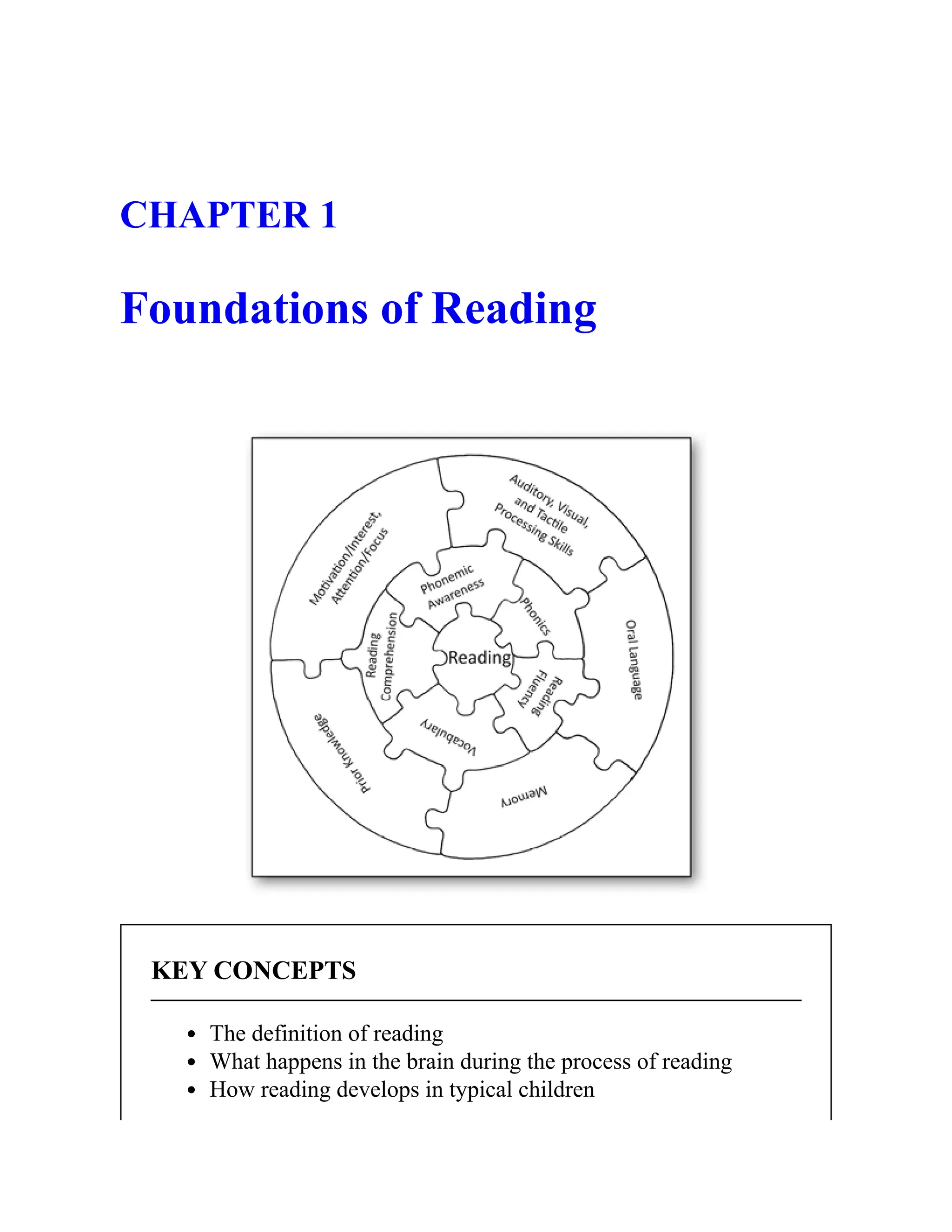
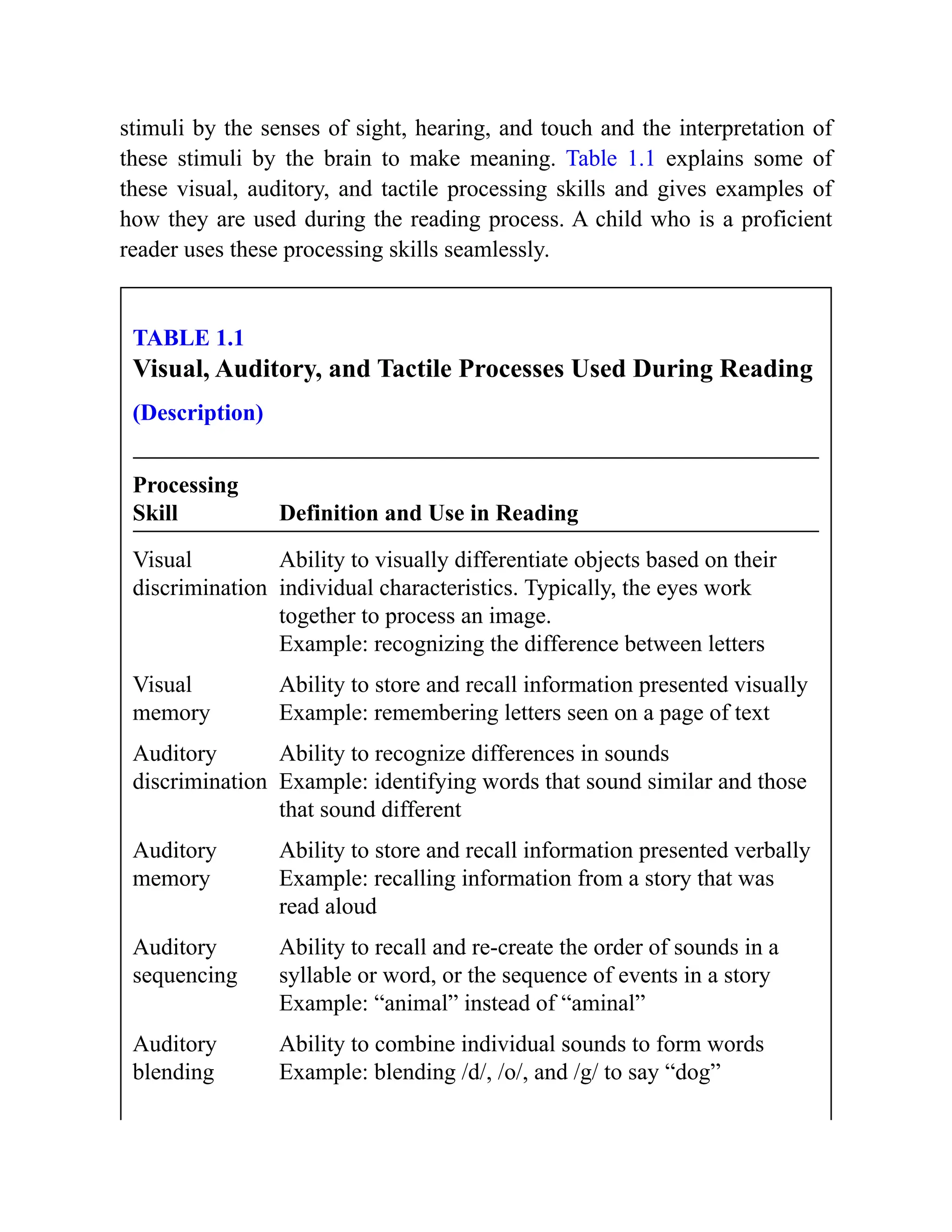
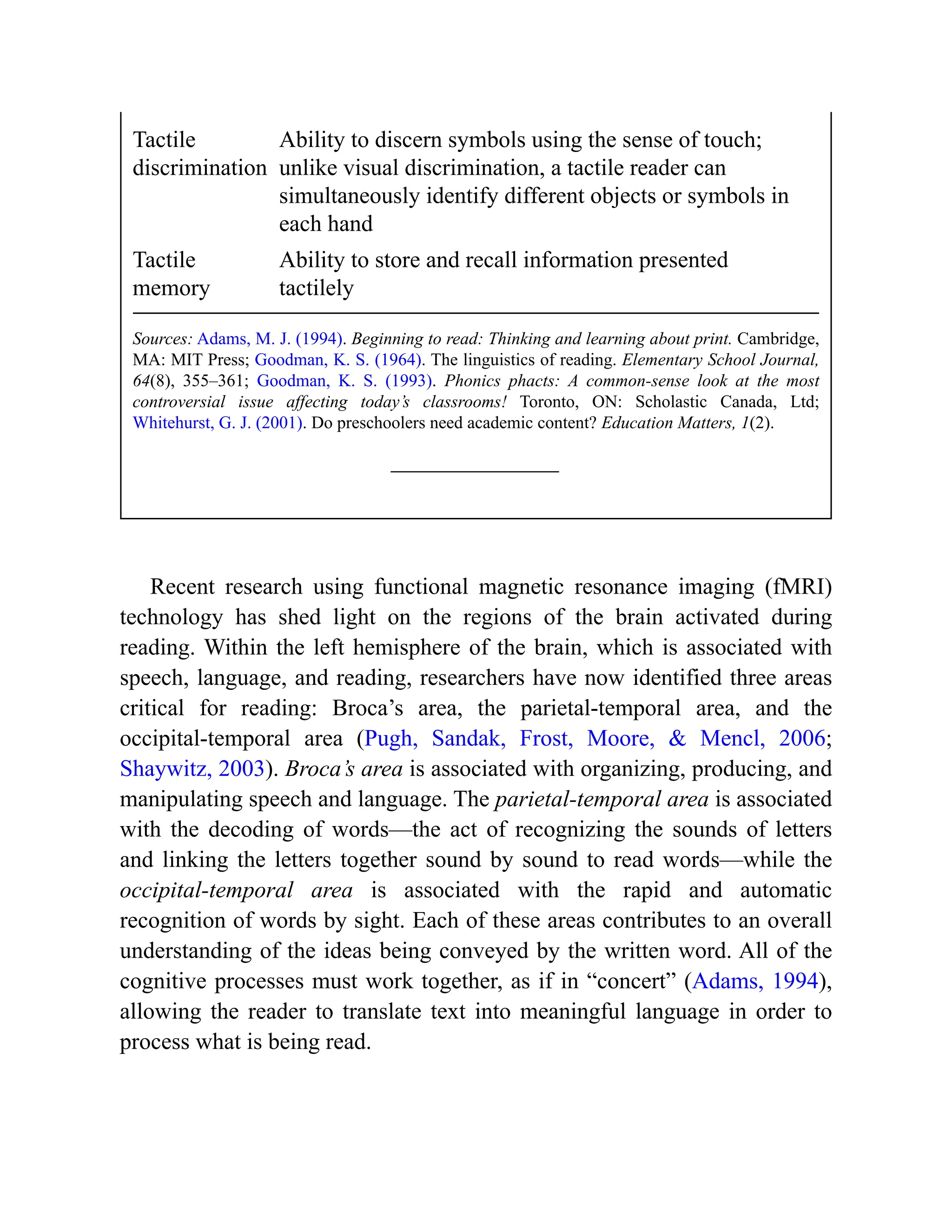
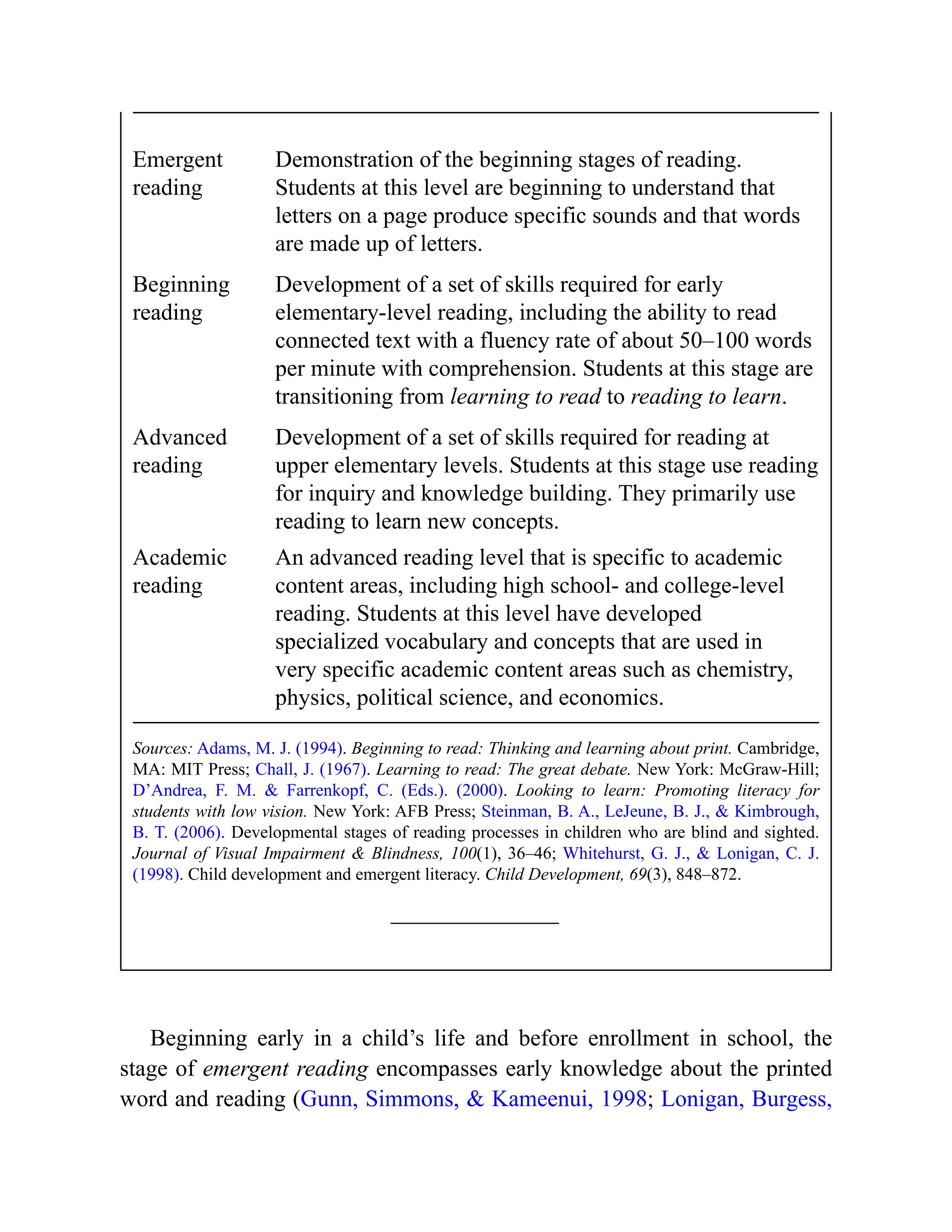
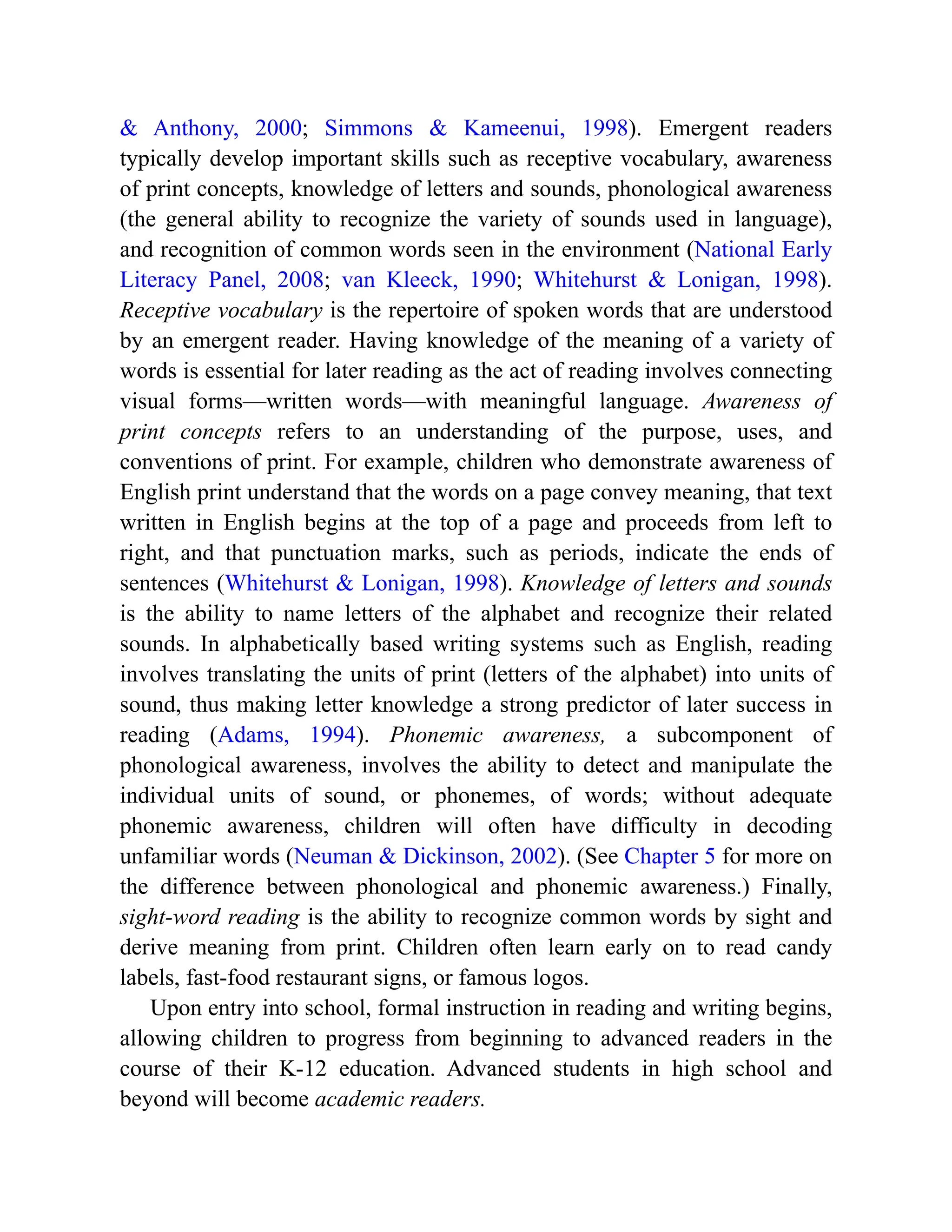
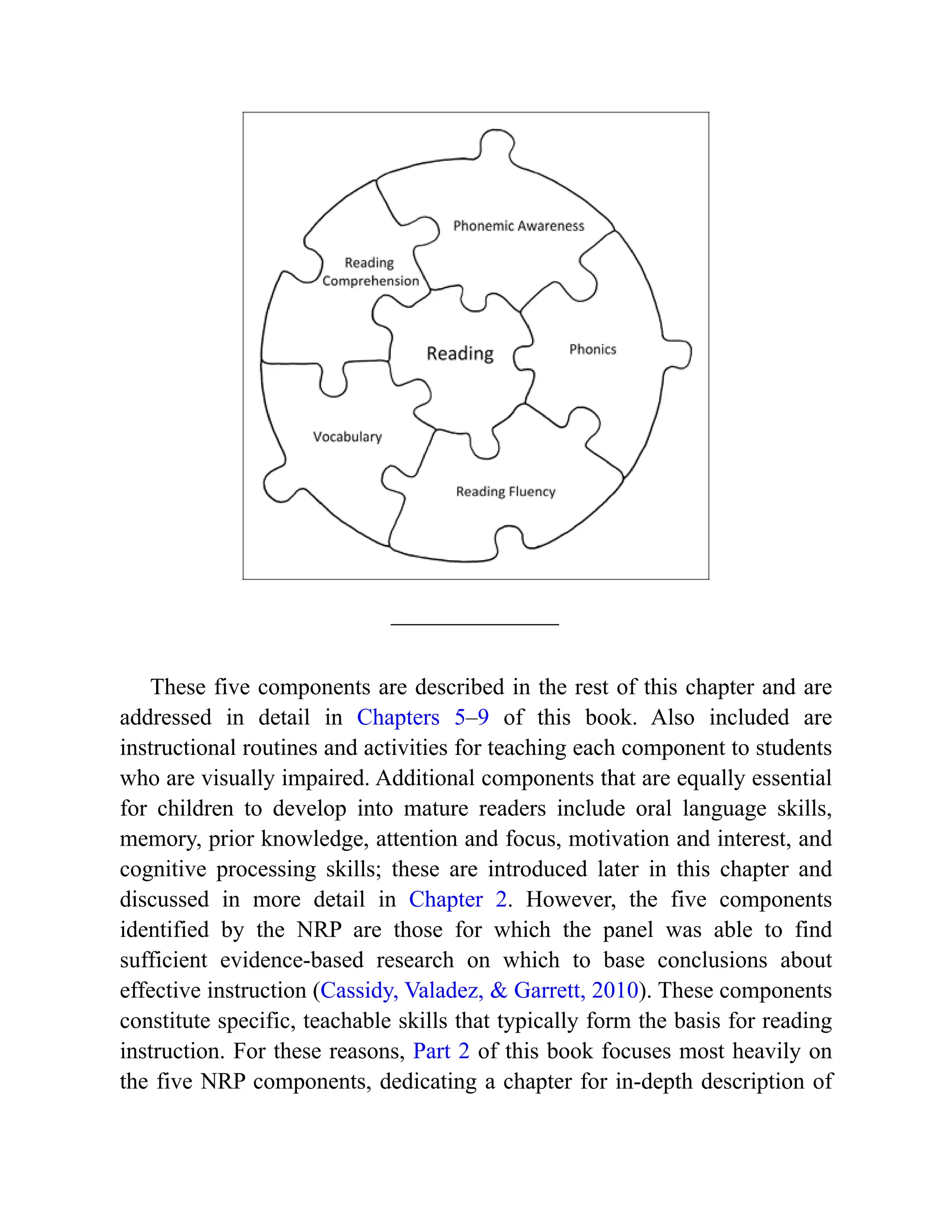

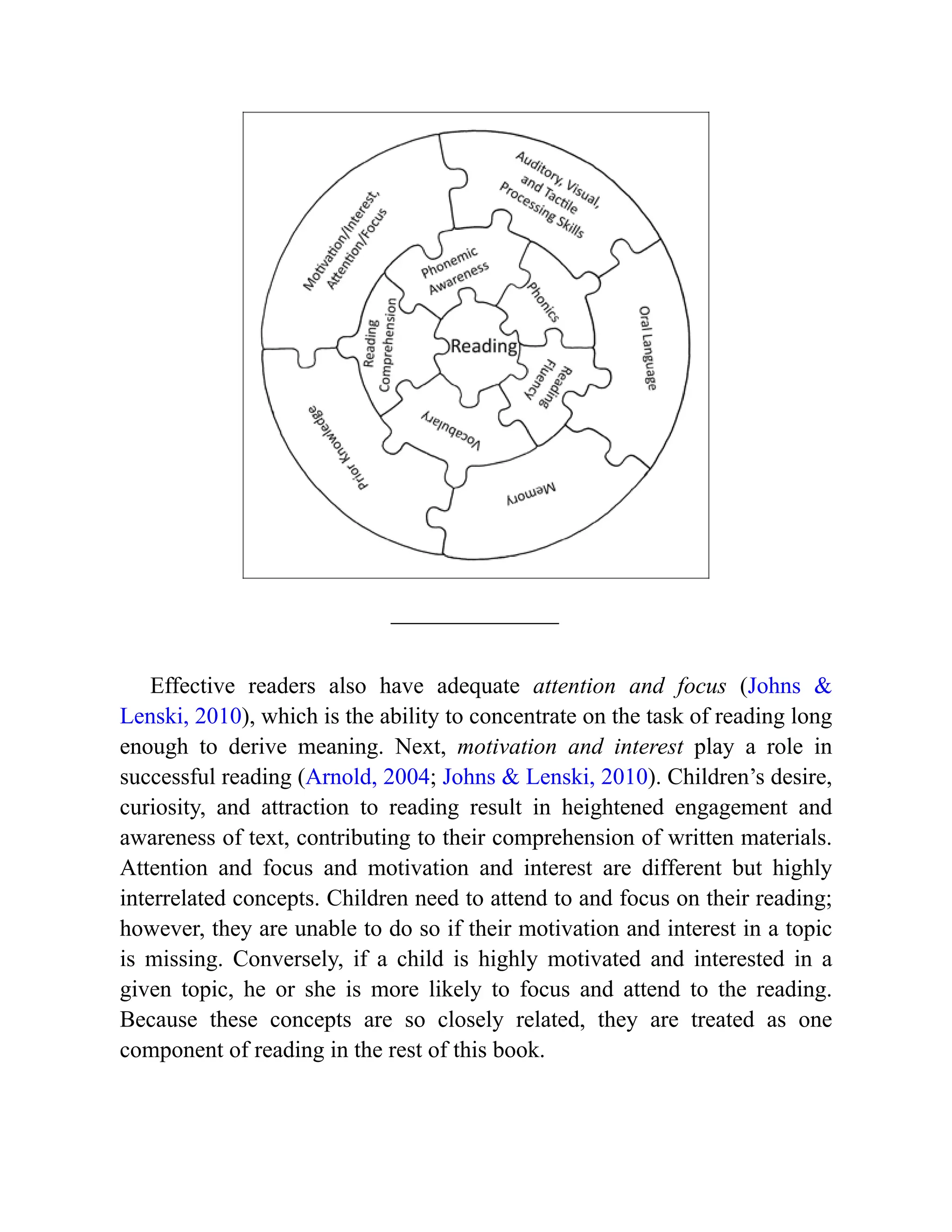
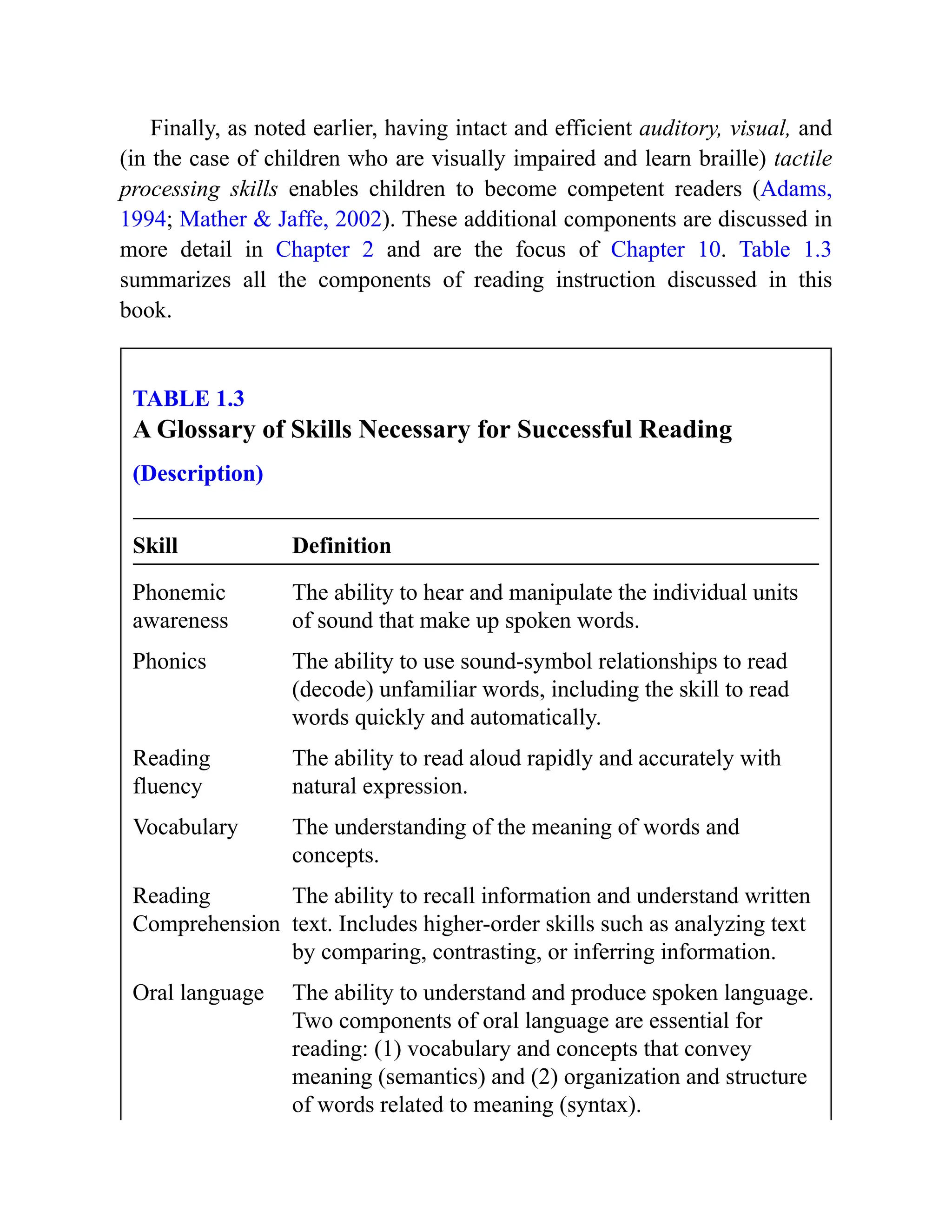
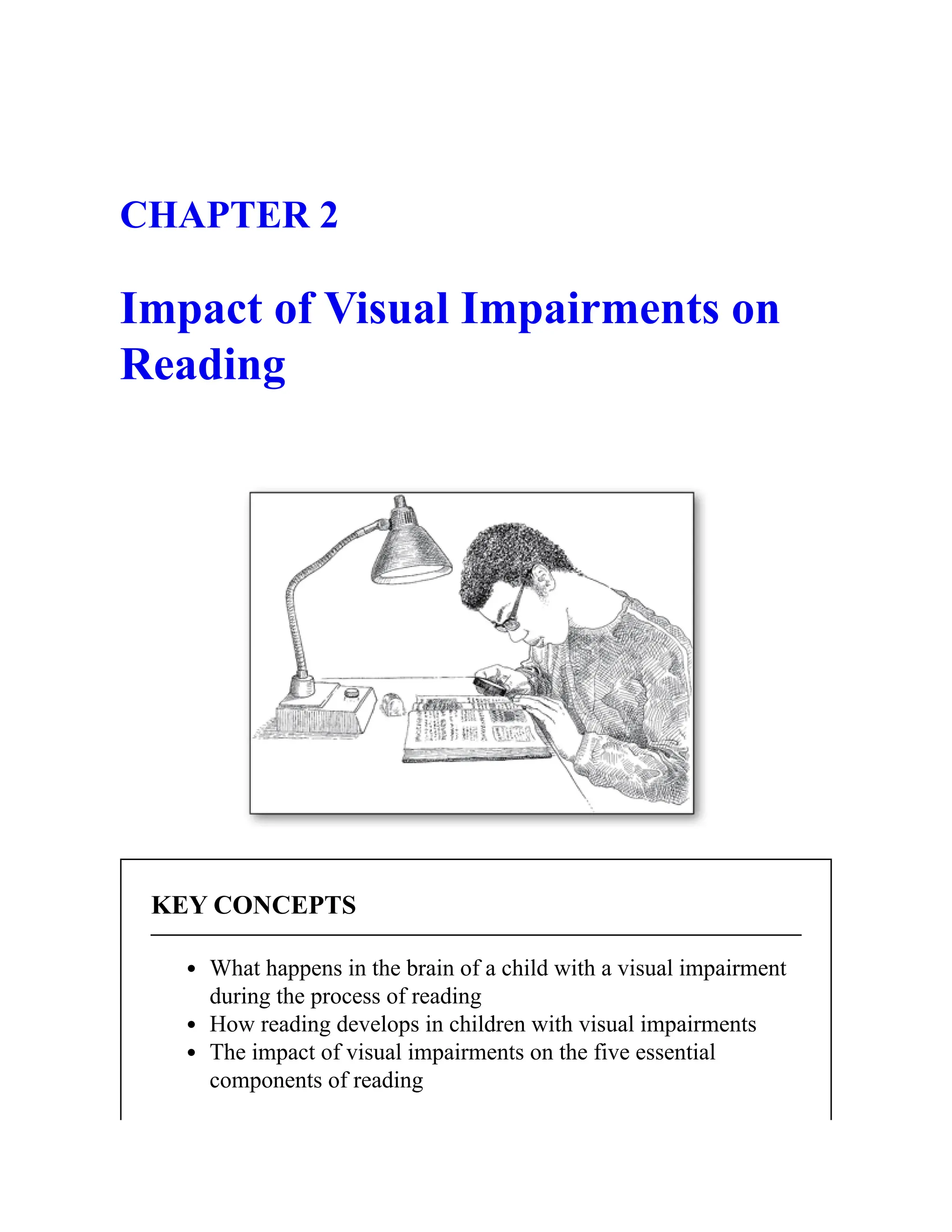
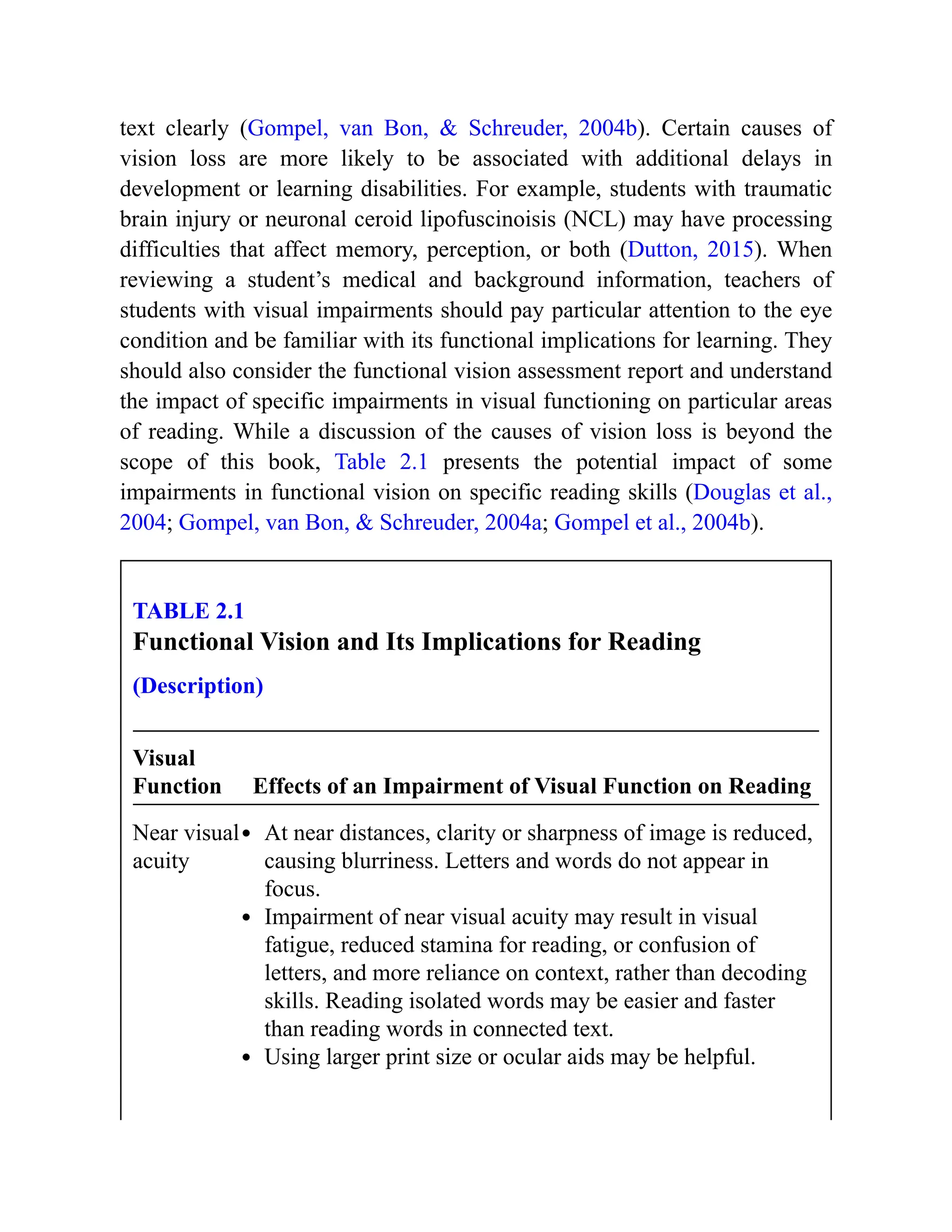
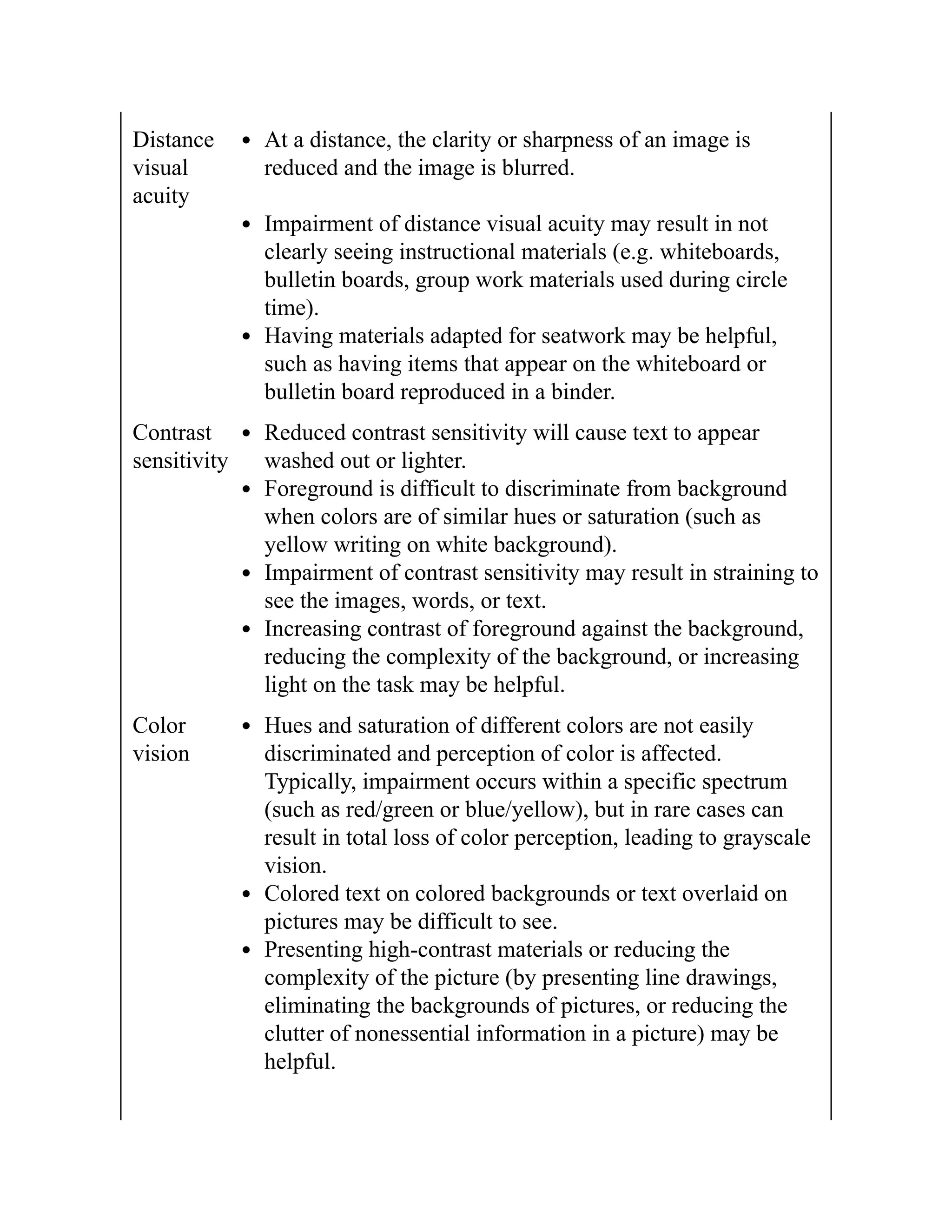
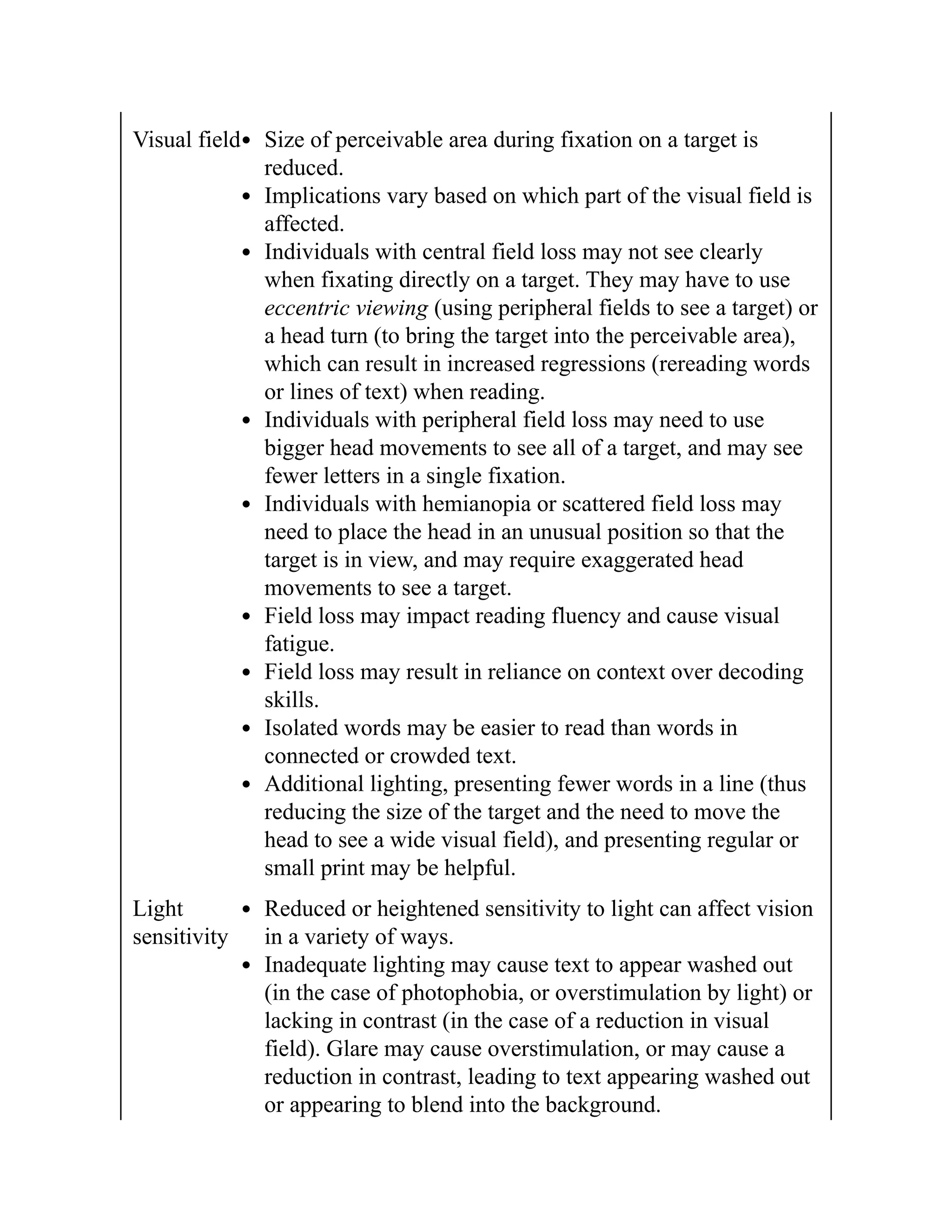
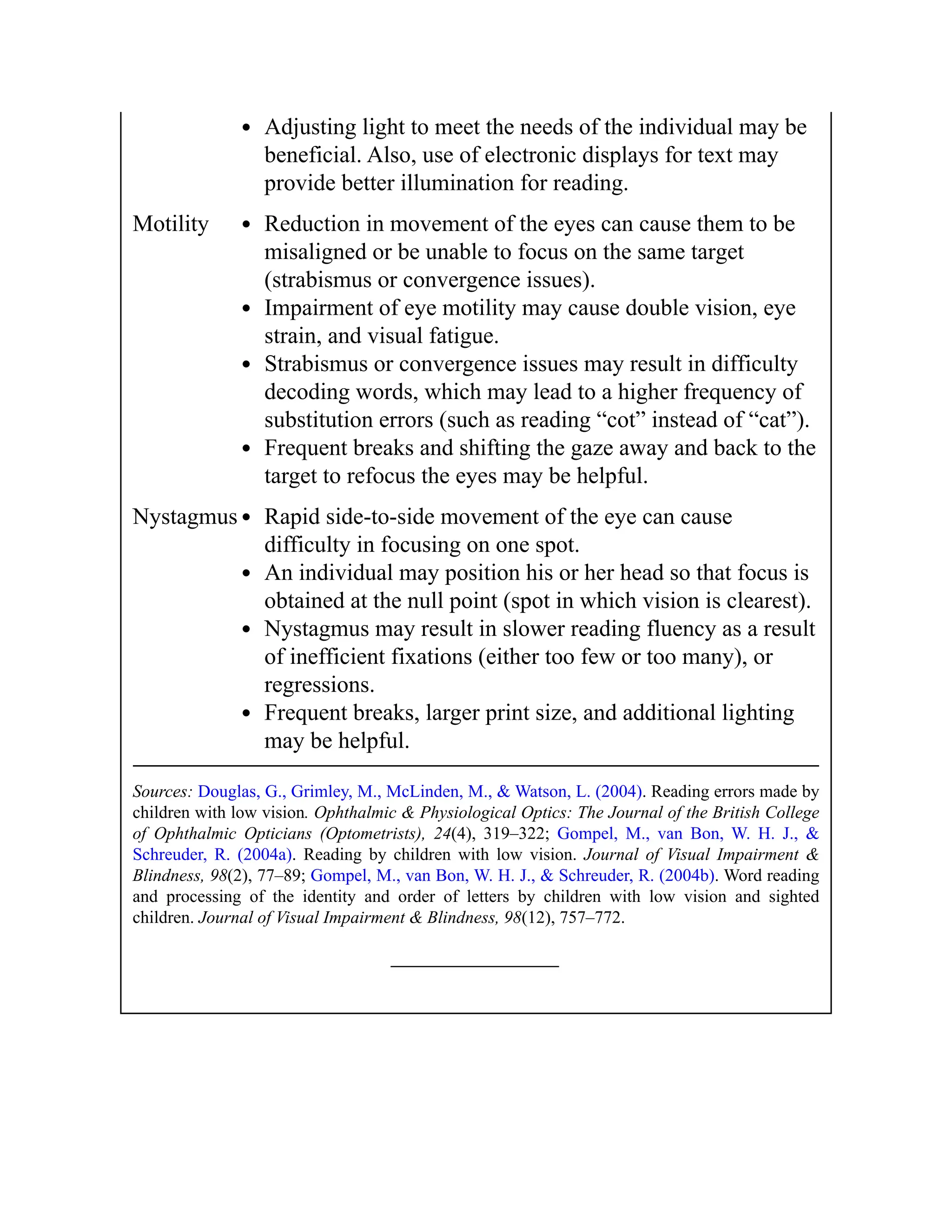
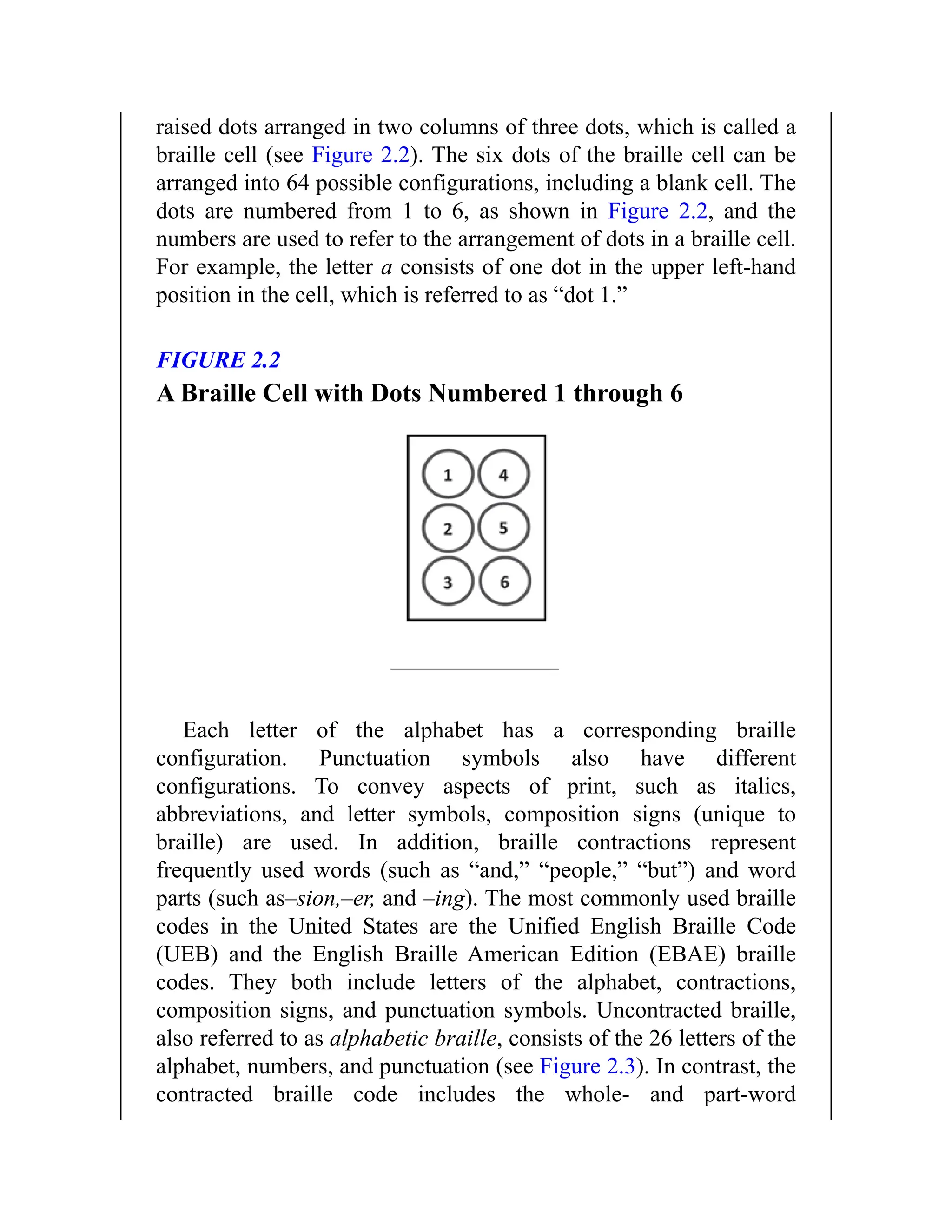
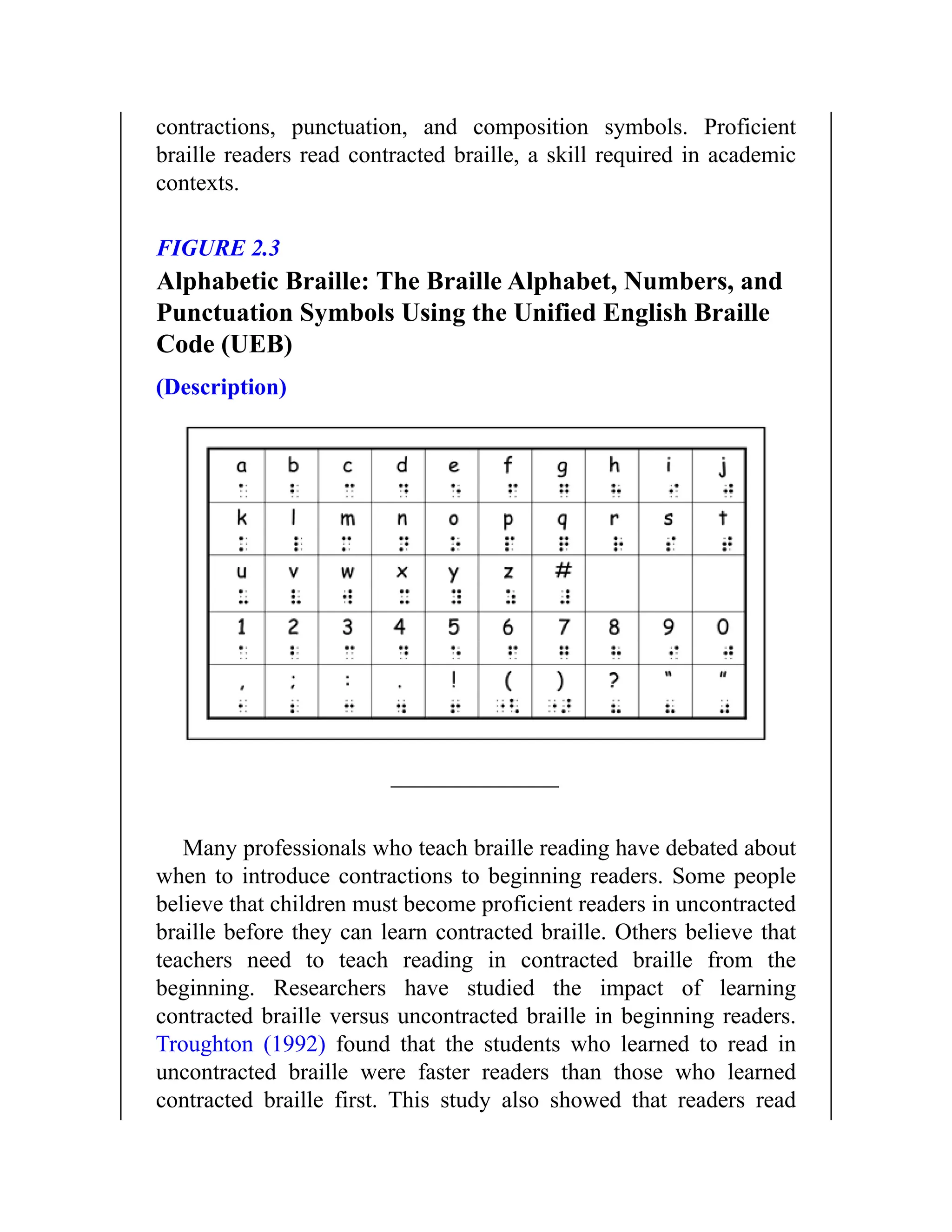
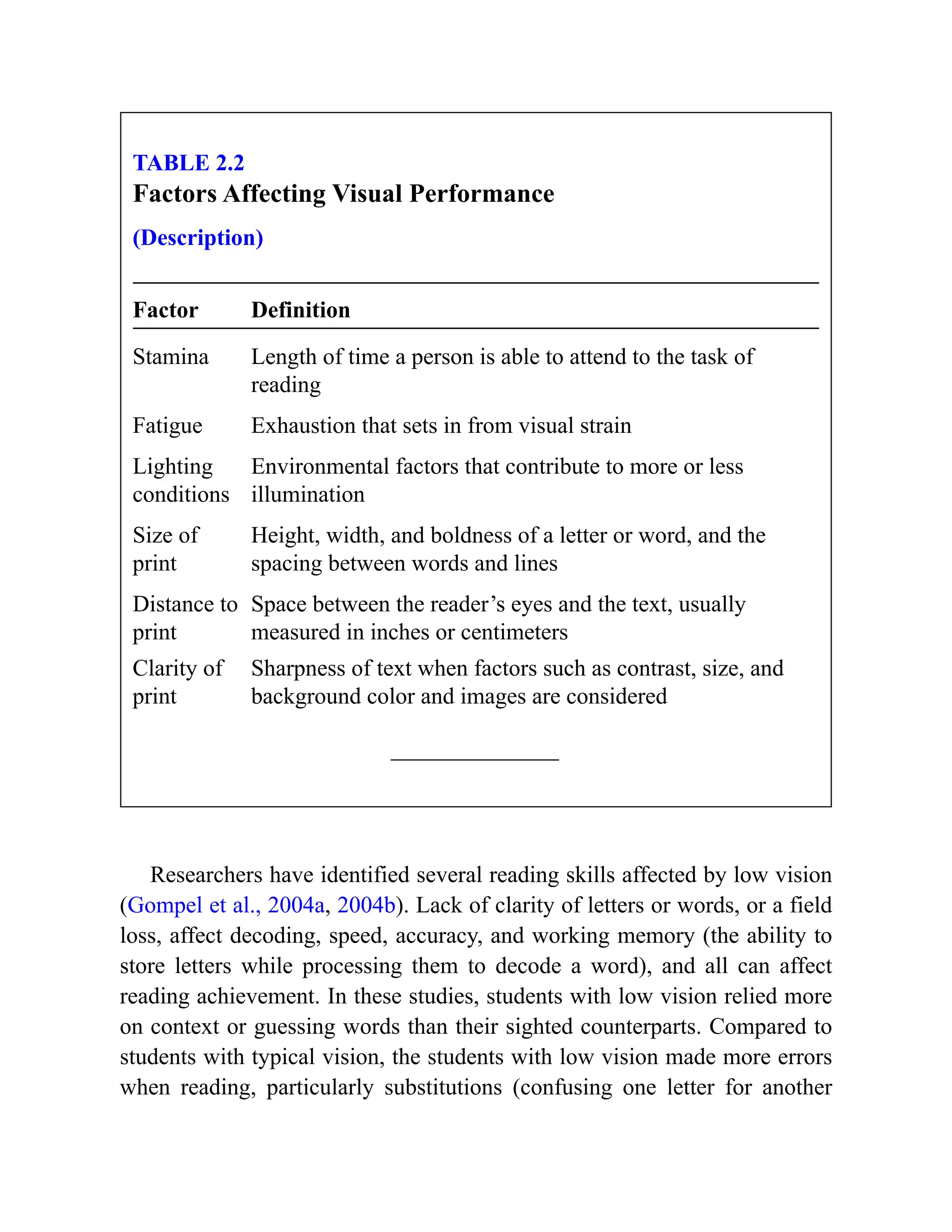
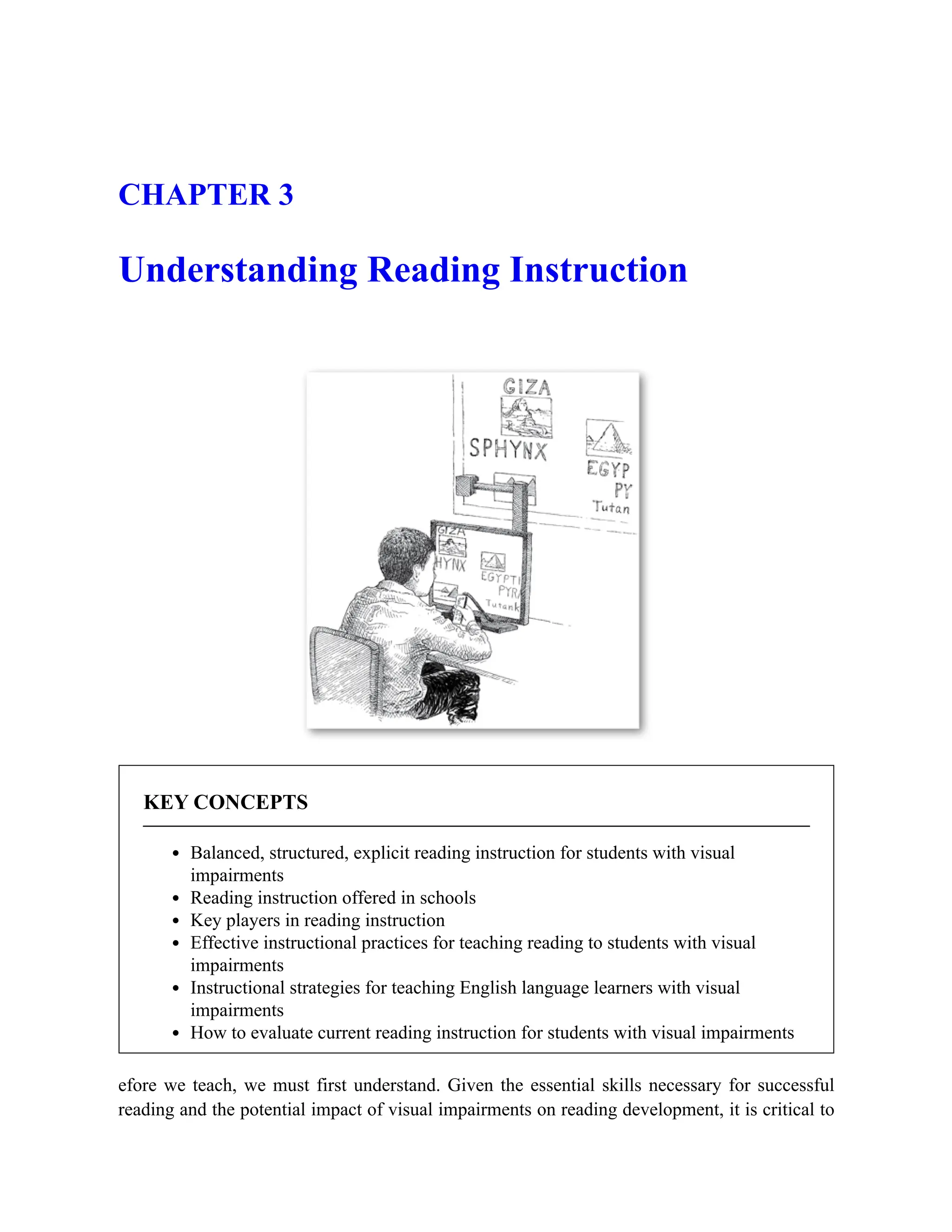
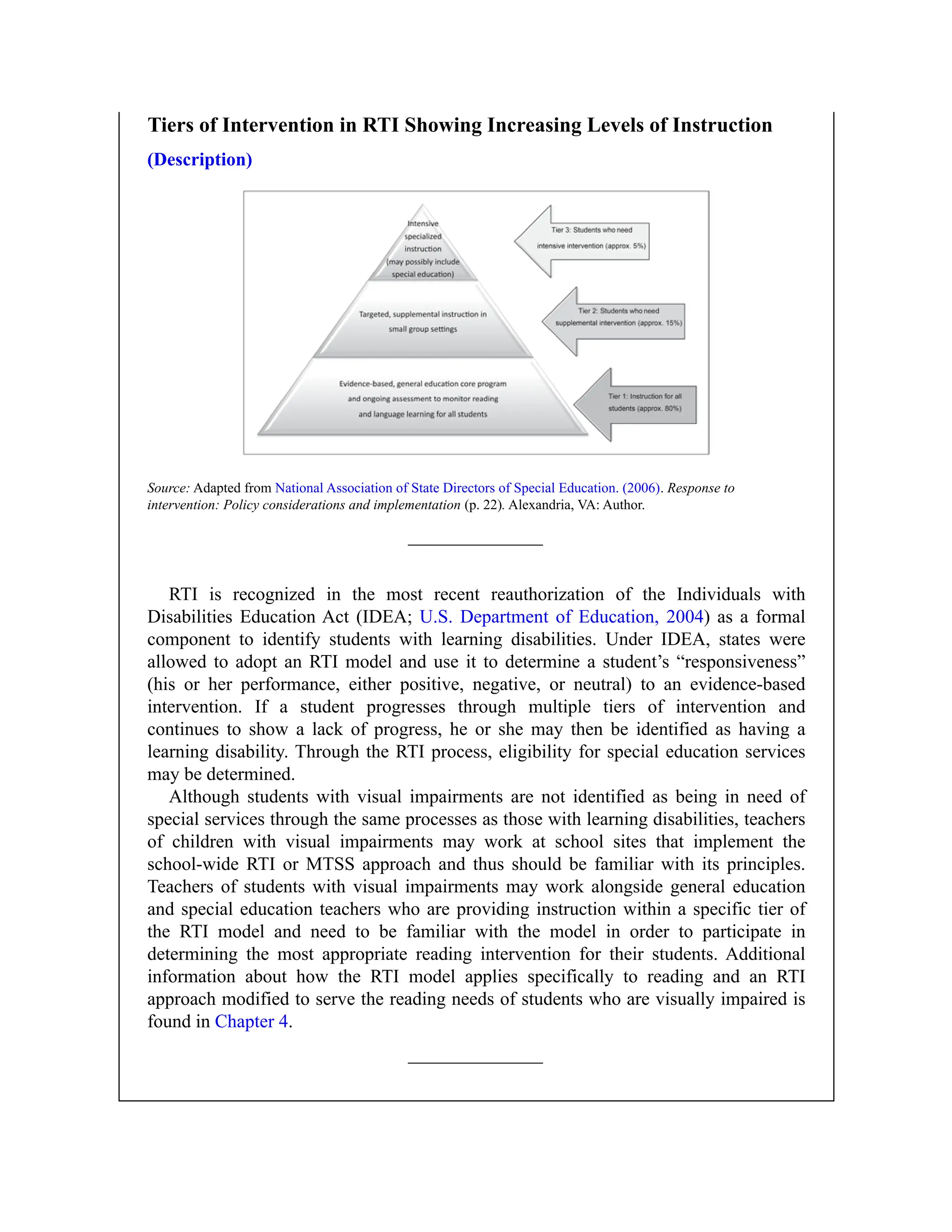
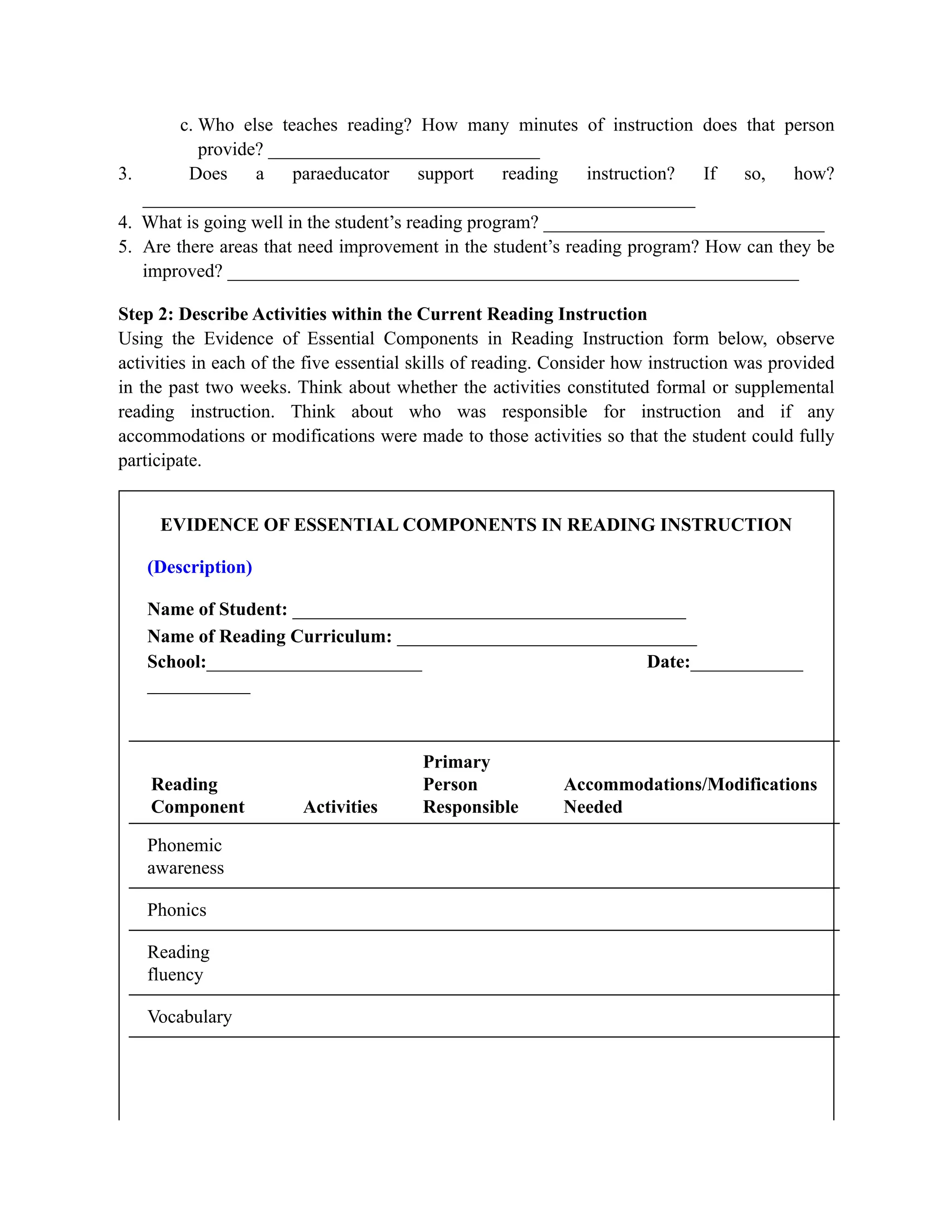
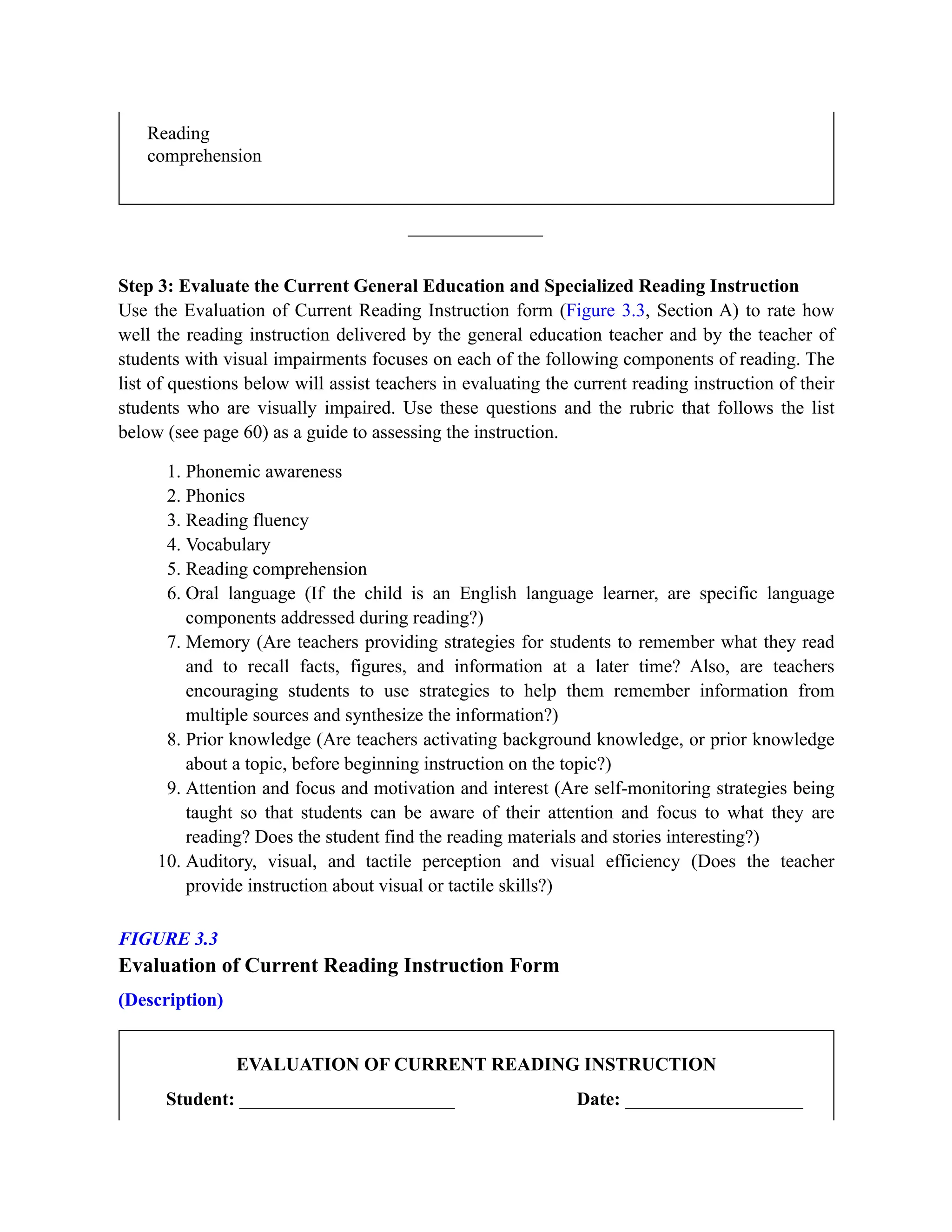
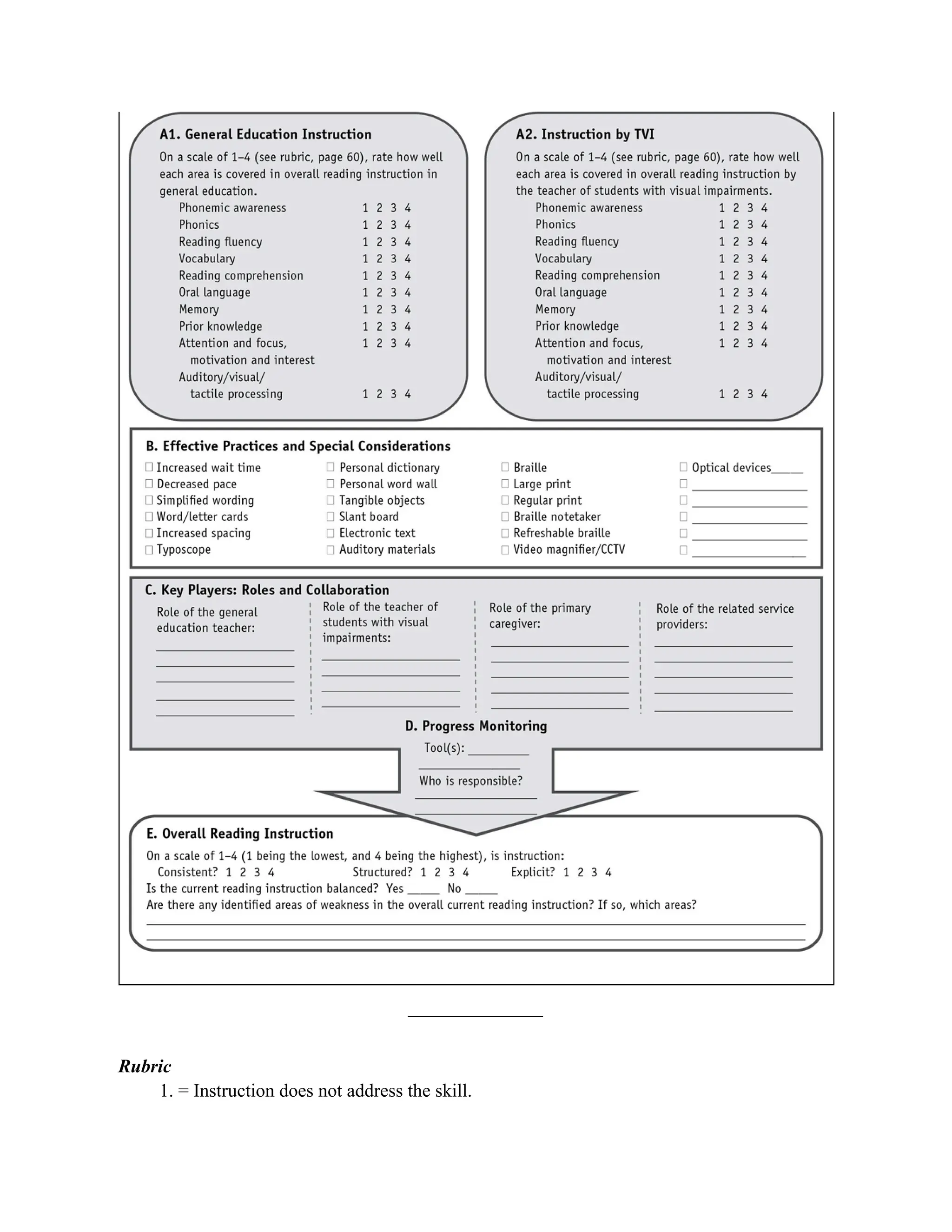
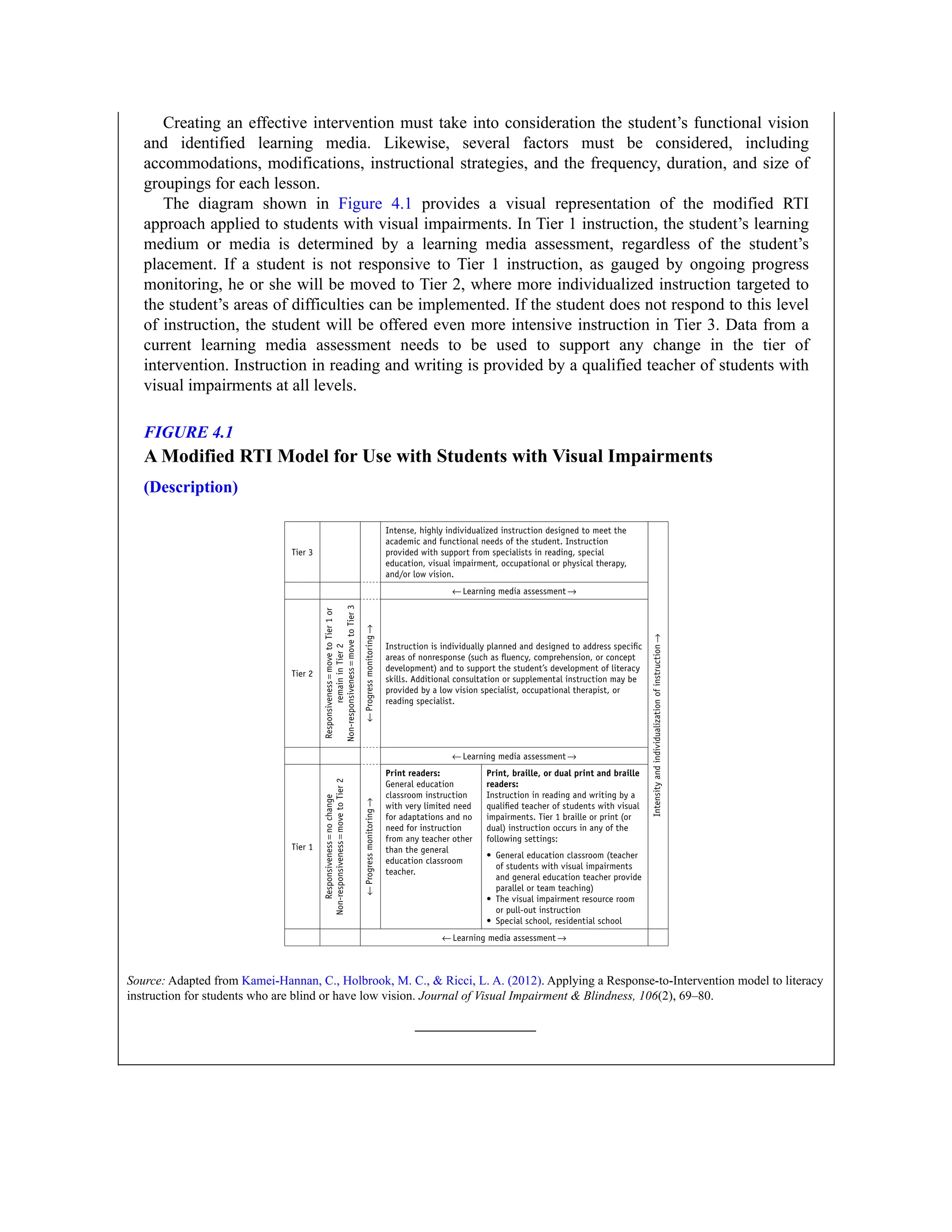
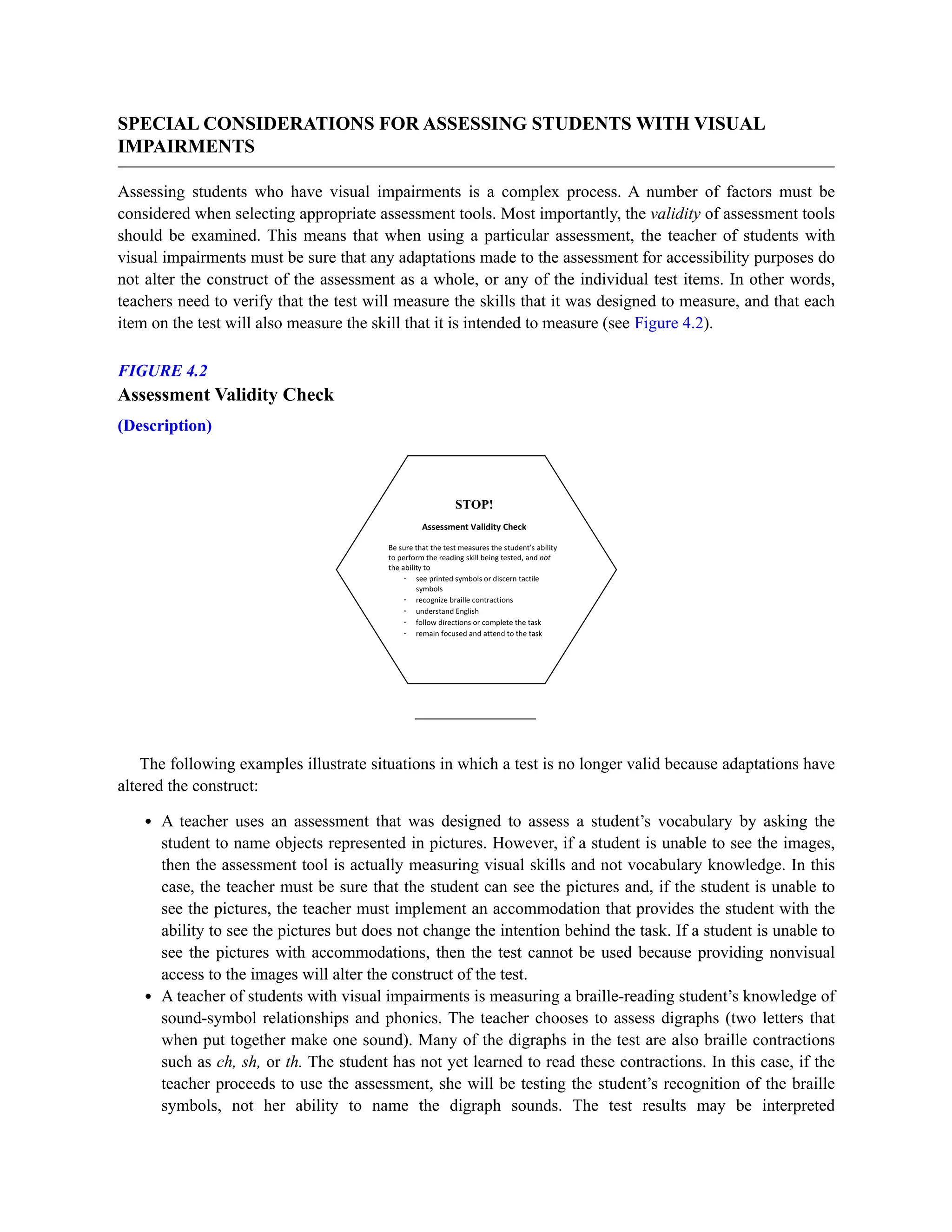
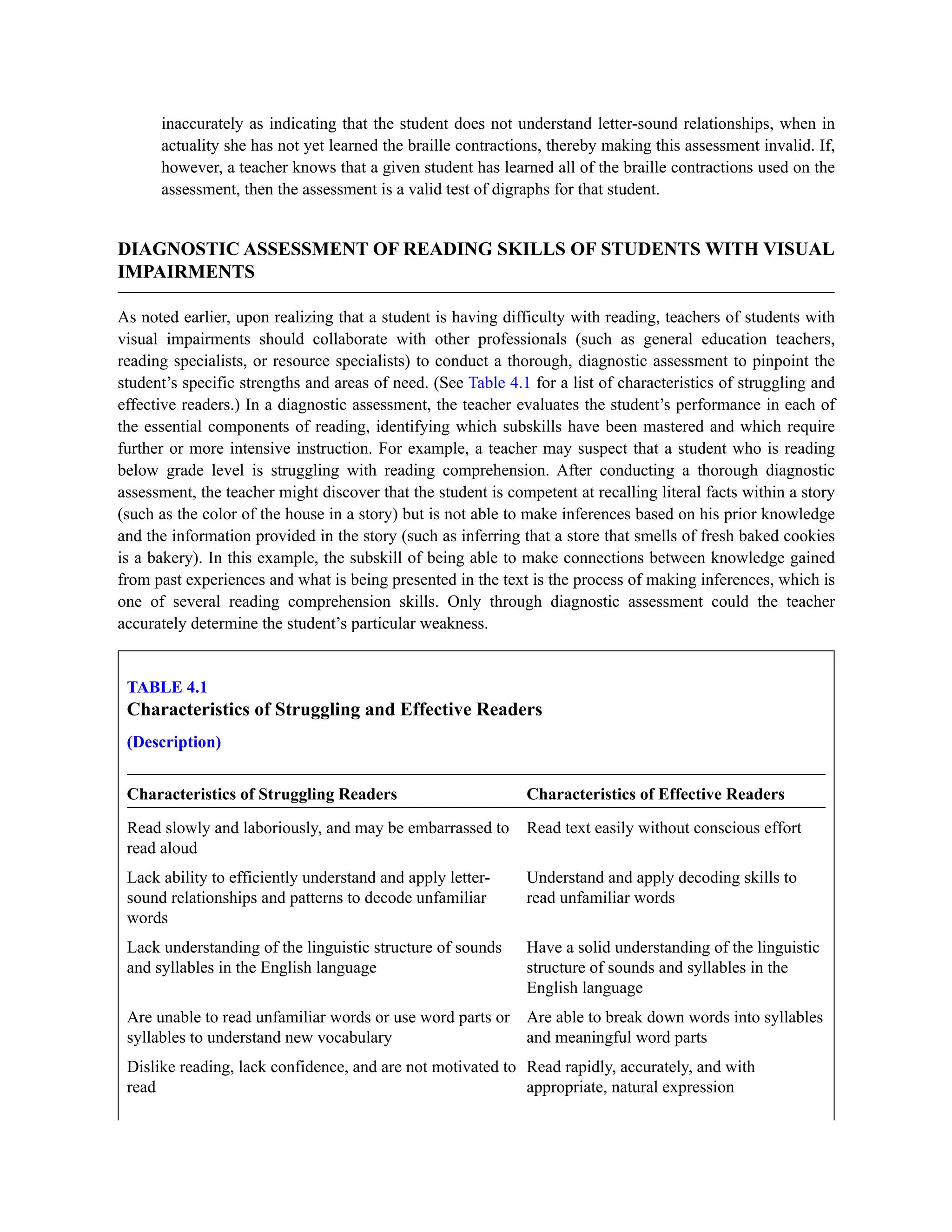
![Have difficulty understanding the meaning of text Process and comprehend what they are
reading
Expend more energy trying to decode words and are
unable to gather meaning from the text or apply
previous knowledge to what is being read
Make connections between their
experiences (and previously read material)
and new texts being read
A diagnostic assessment may also reveal interactions between subskills. For example, a student who
struggles with reading may do so because of her poor decoding skills or an inability to sound out
unfamiliar words. This weakness could then cause her to read in a slow, halting manner (poor reading
fluency) and not understand what she is reading (poor comprehension). Another student may appear to
have adequate reading fluency, but a diagnostic assessment could reveal that this is actually due to having
a large repertoire of sight words rather than the ability to decode words accurately.
When conducting a diagnostic assessment, the teacher of students with visual impairments should take
into consideration any existing assessment data, including data gathered from the functional vision
assessment and the learning media assessment discussed earlier in this chapter. In a diagnostic assessment,
the teacher should assess the essential components of reading (phonemic awareness, phonics, reading
fluency, vocabulary, and reading comprehension). Table 4.2 provides a list of sample subskills within each
component of reading.
TABLE 4.2
Sample Subskills within Each Component of Reading
(Description)
Component Subskills
Phonemic
awareness
Phoneme isolation
Phoneme identity
Phoneme categorization
Phoneme blending
Phoneme segmentation
Phoneme deletion
Phonics Letter names; letter sounds
Specific letter combinations (for example, vowel digraphs such as ei and ea), or r-
controlled words (in which the sound of the vowel changes when followed by the
letter r; for example, “fern” and “burn”)
Specific word patterns (such as consonant-vowel-consonant [CVC—for example,
“cat”] or vowel-consonant-e [VCE—for example, “face”])
Word attack skills (such as reading multisyllabic words)
Reading
fluency
Accuracy
Speed](https://image.slidesharecdn.com/readingconnections-strategies-for-teaching-students-with-visual-impairments-250721170318-cb16127e/75/Reading-Connections-Strategies-for-Teaching-Students-with-Visual-Impairments-116-2048.jpg)
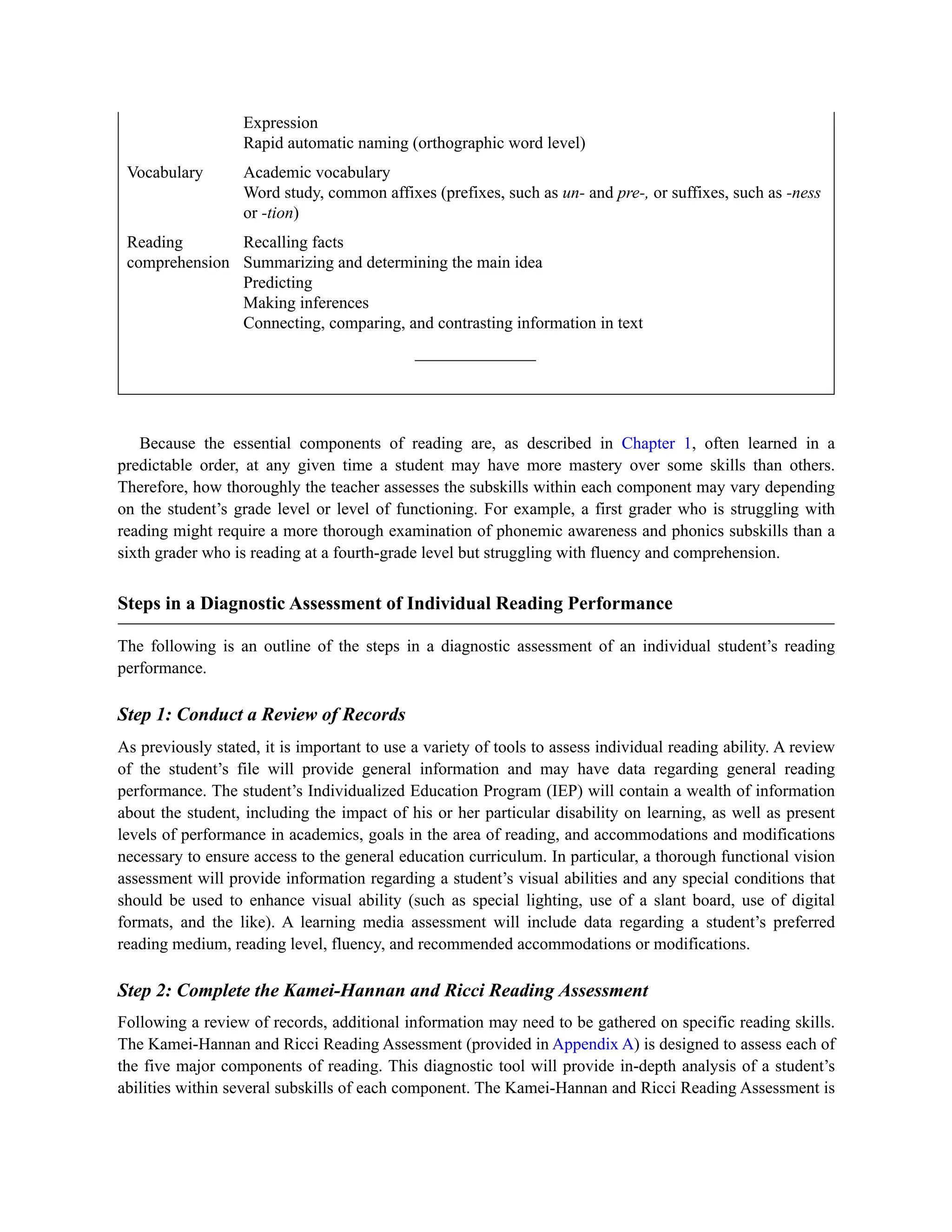
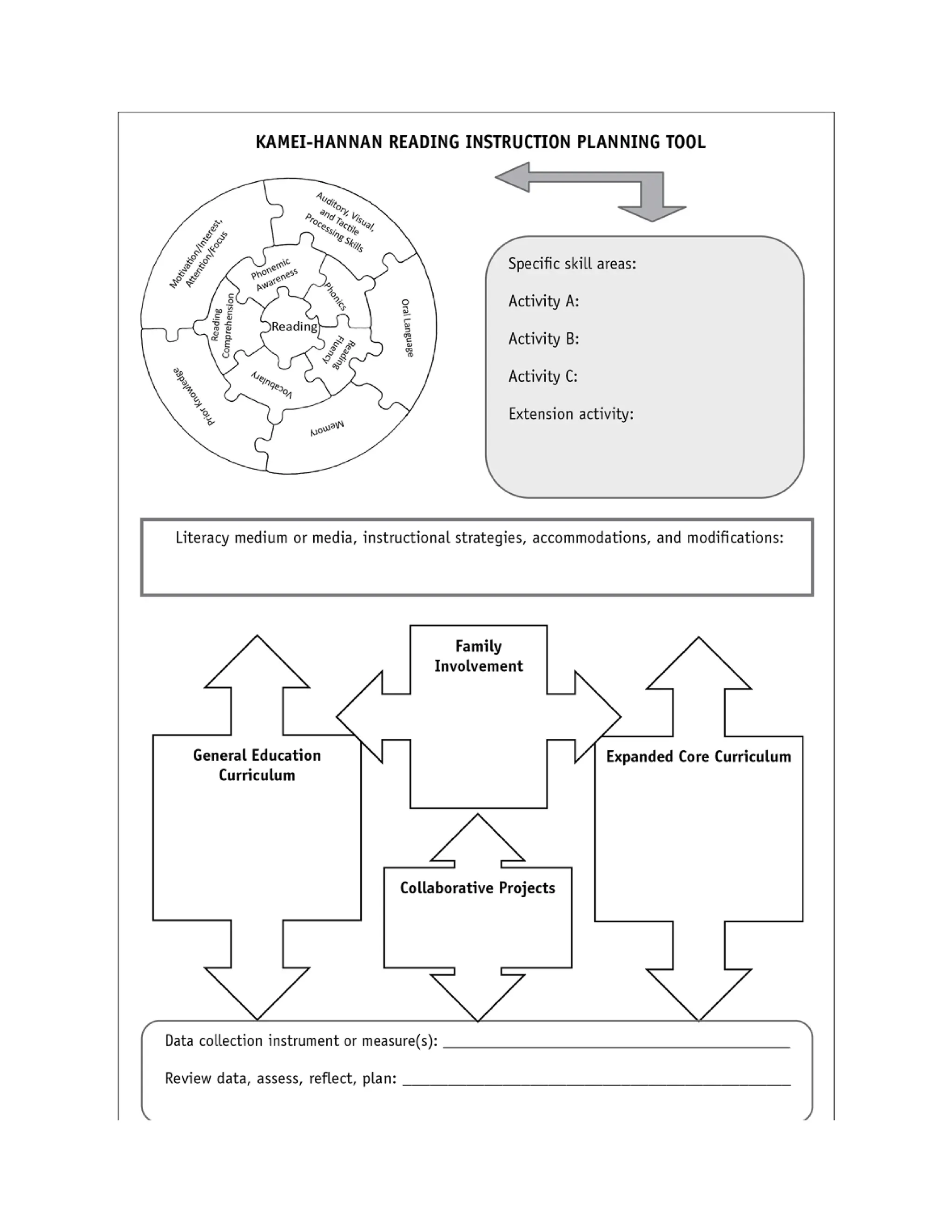
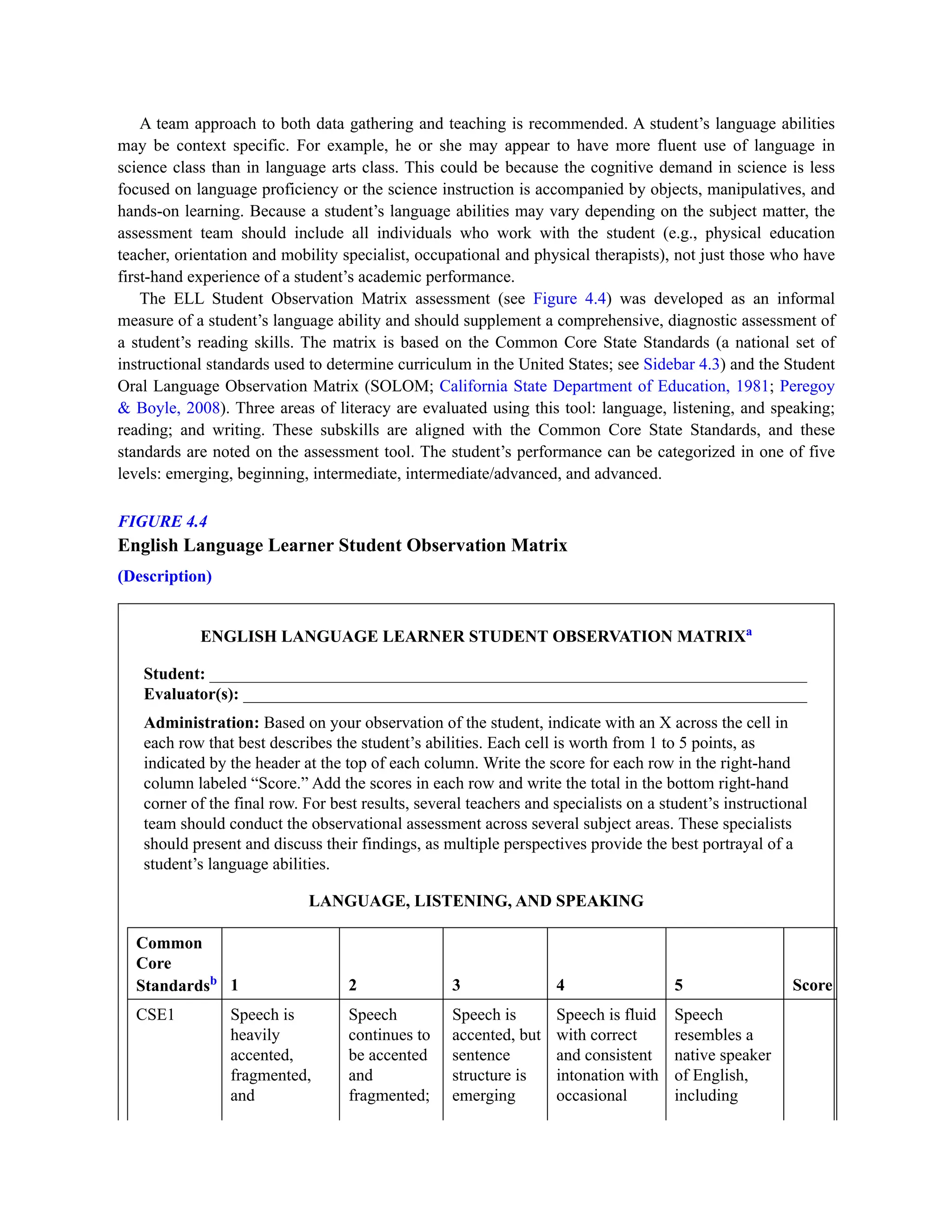
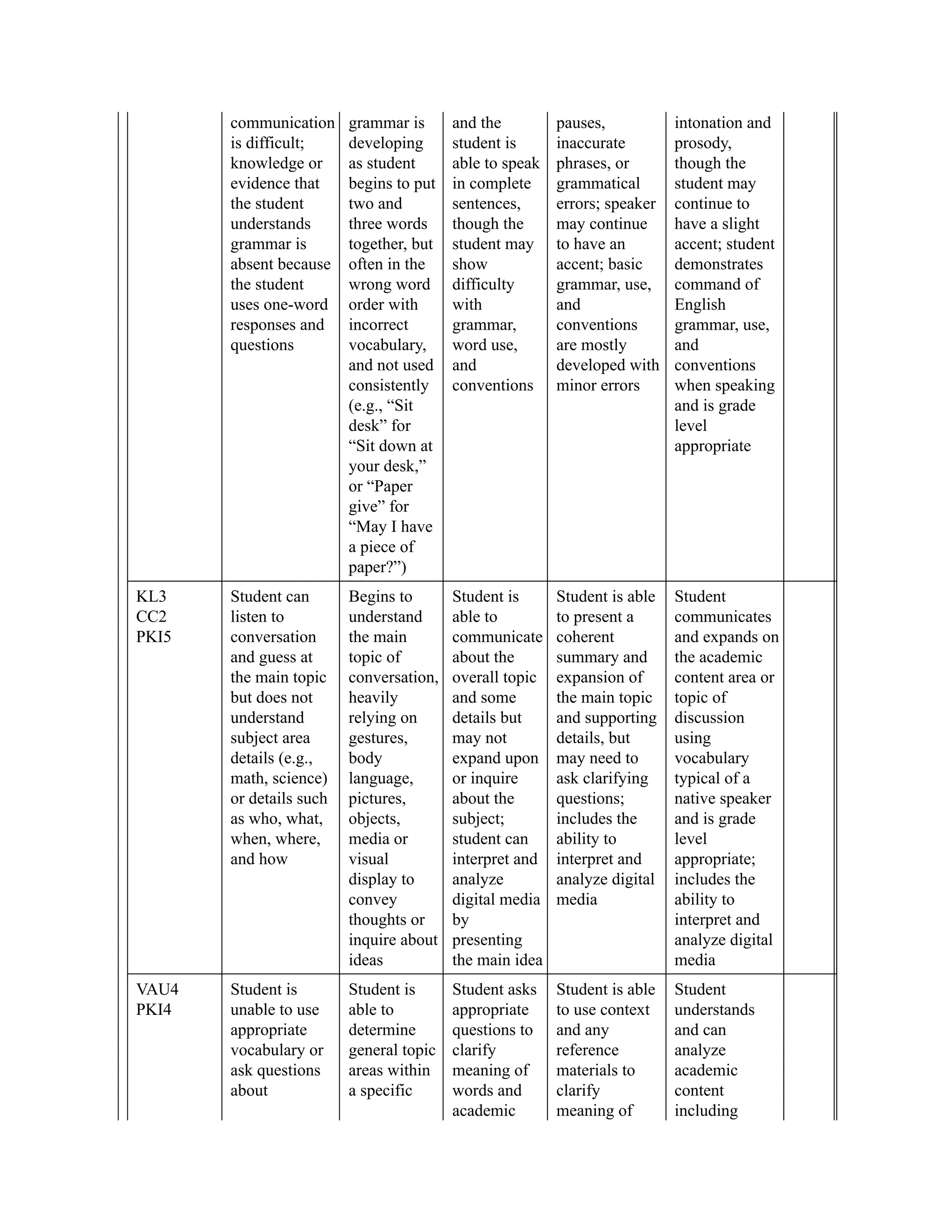
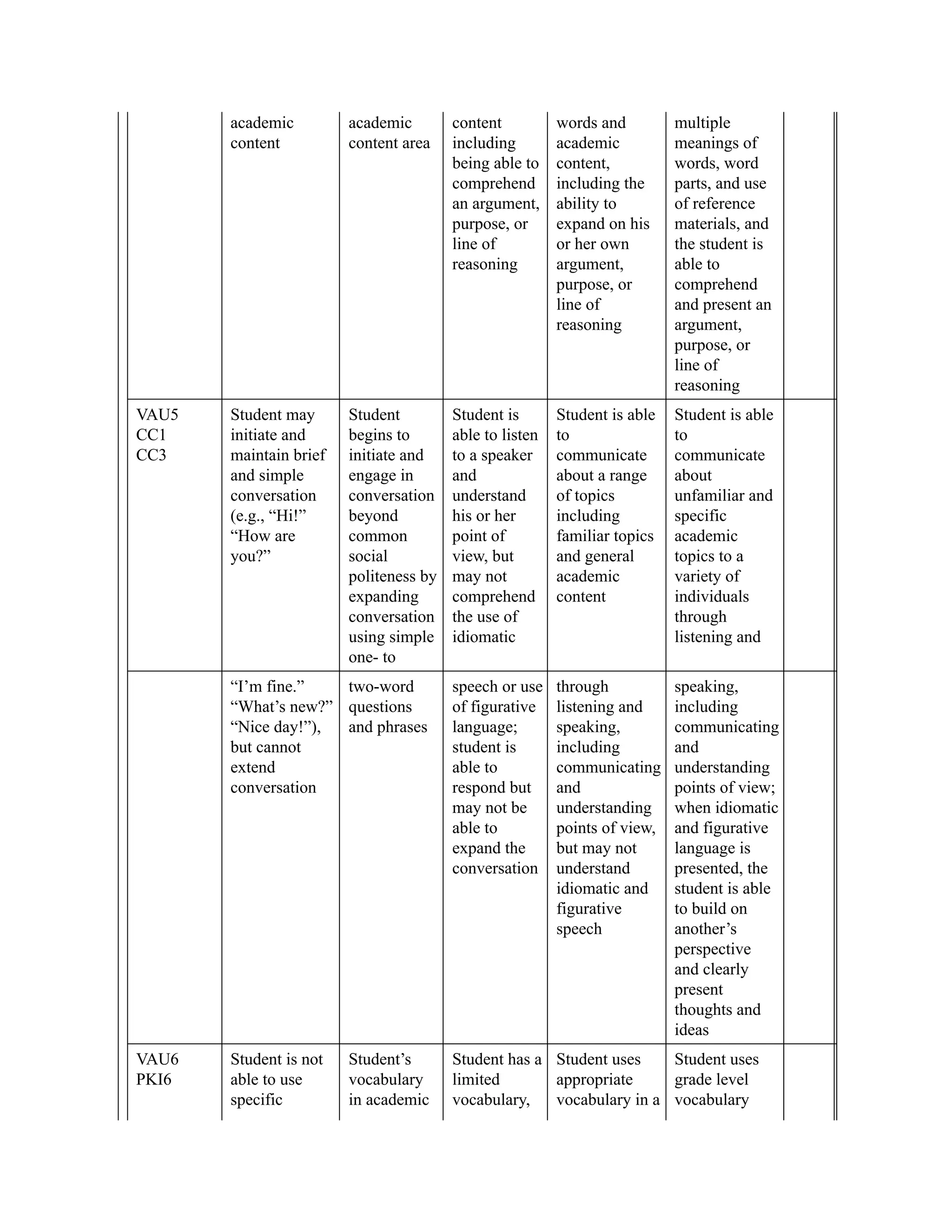
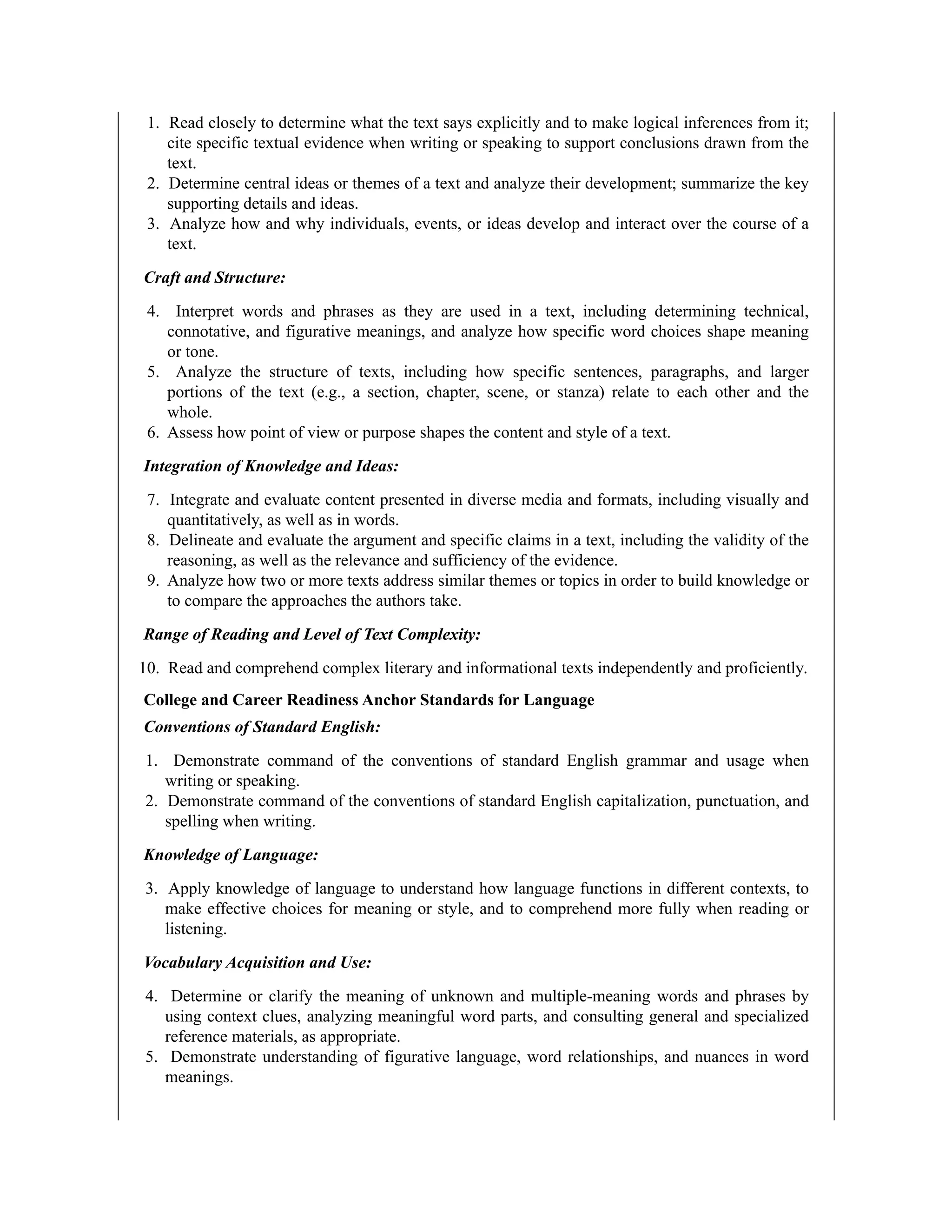


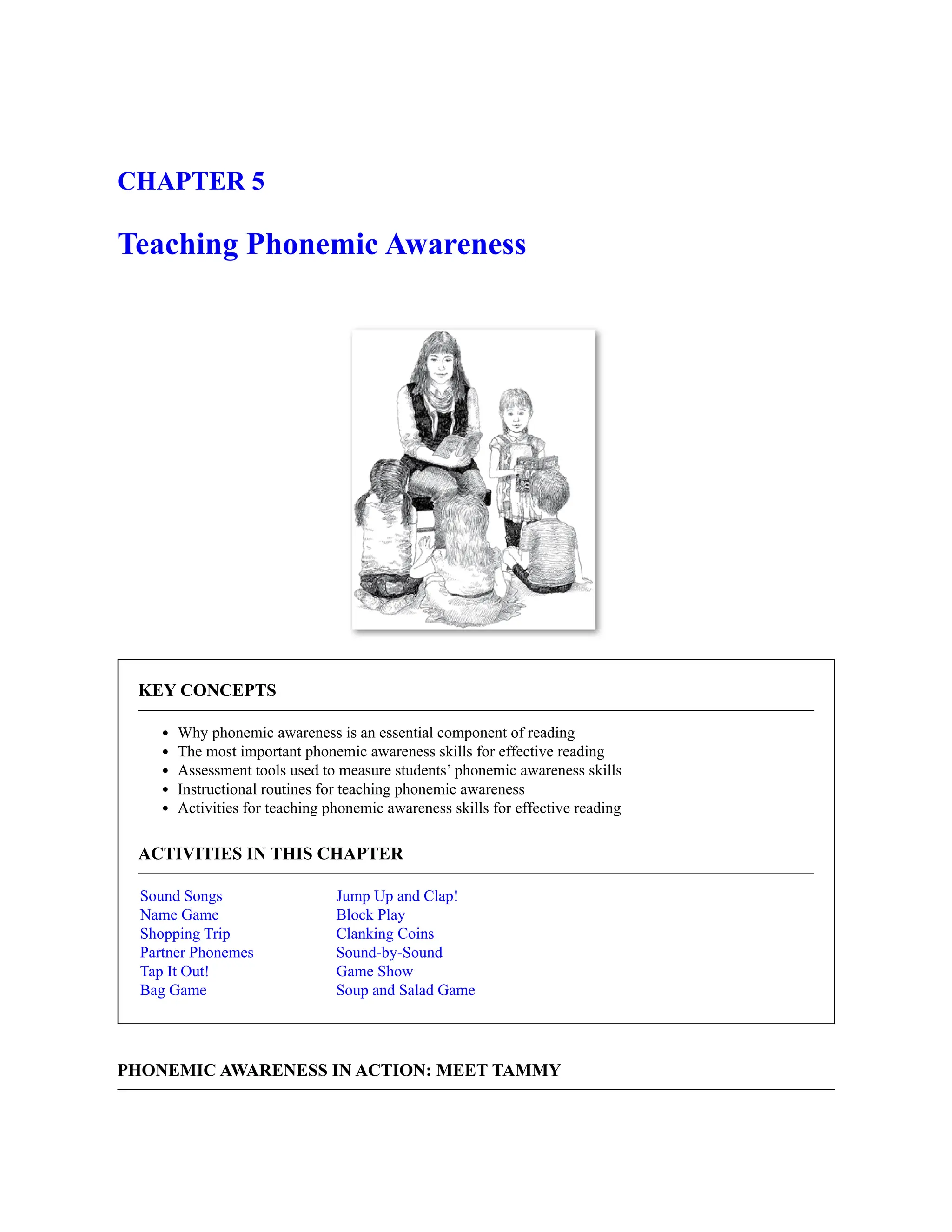
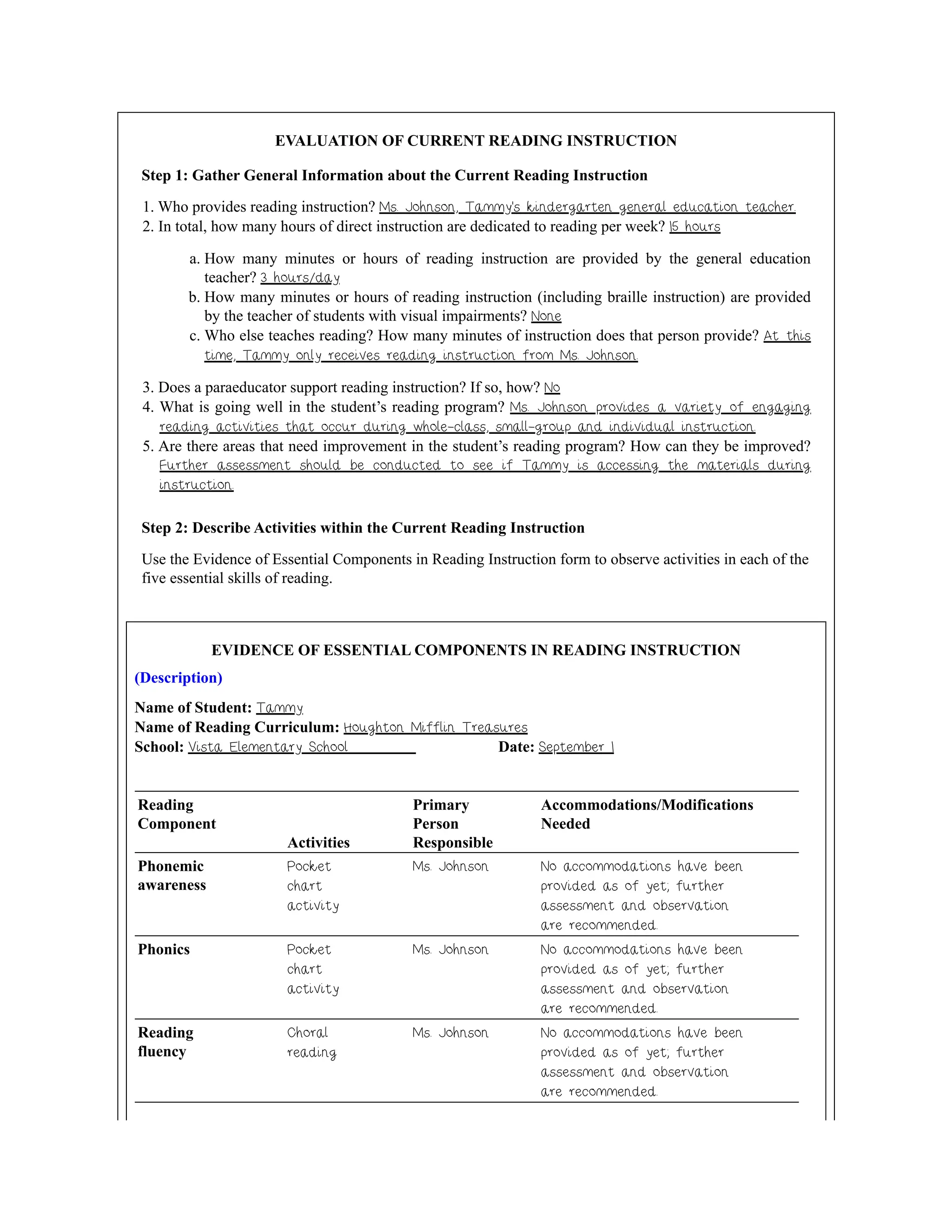
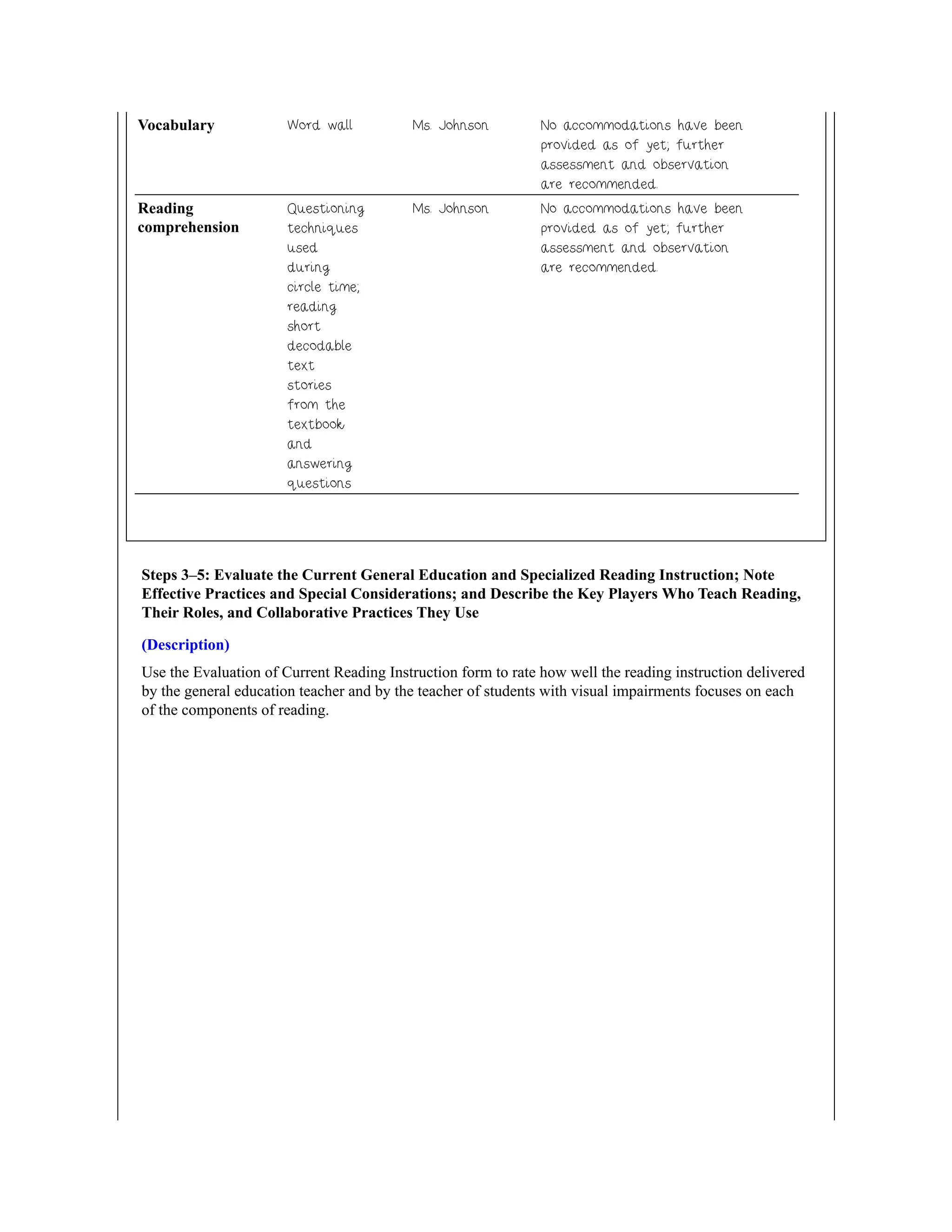
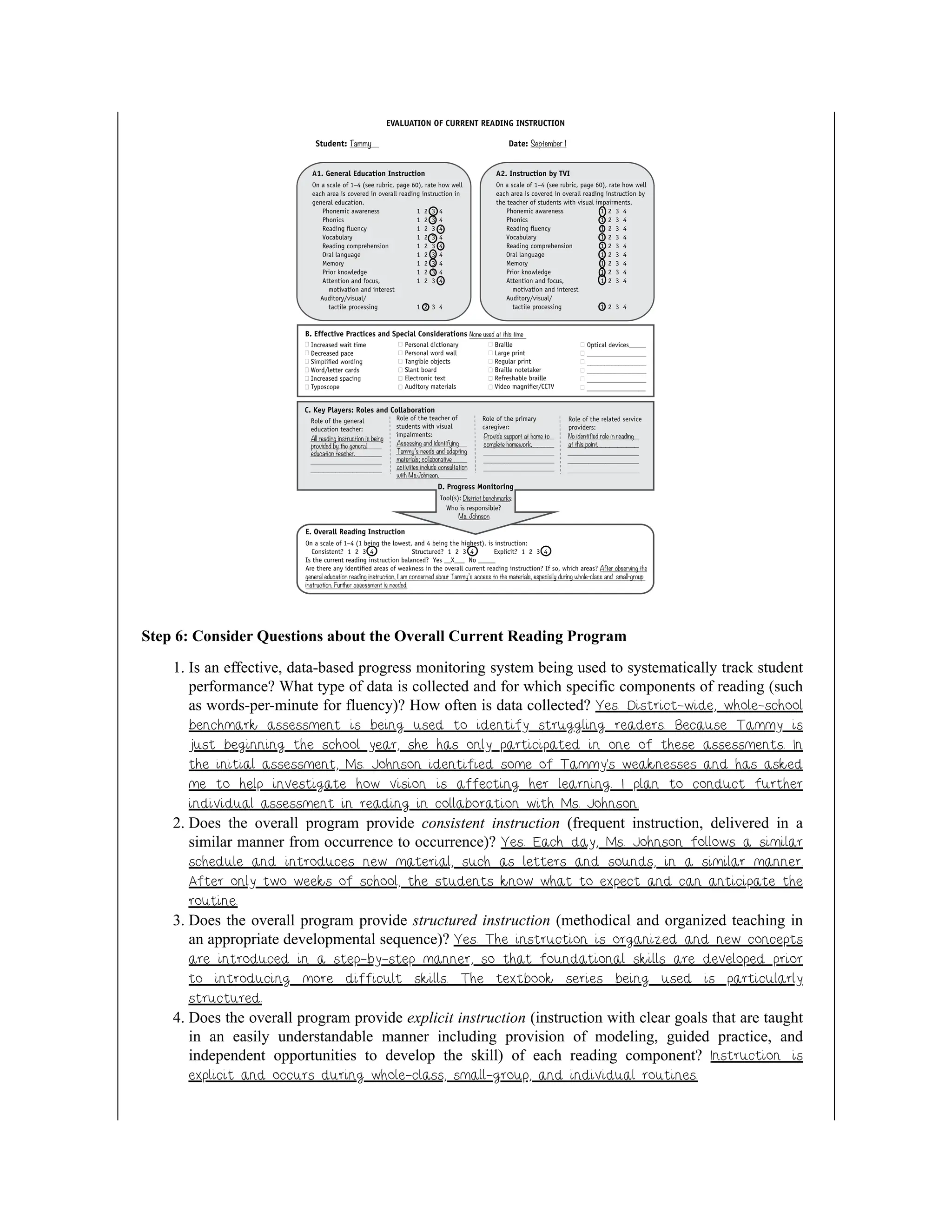
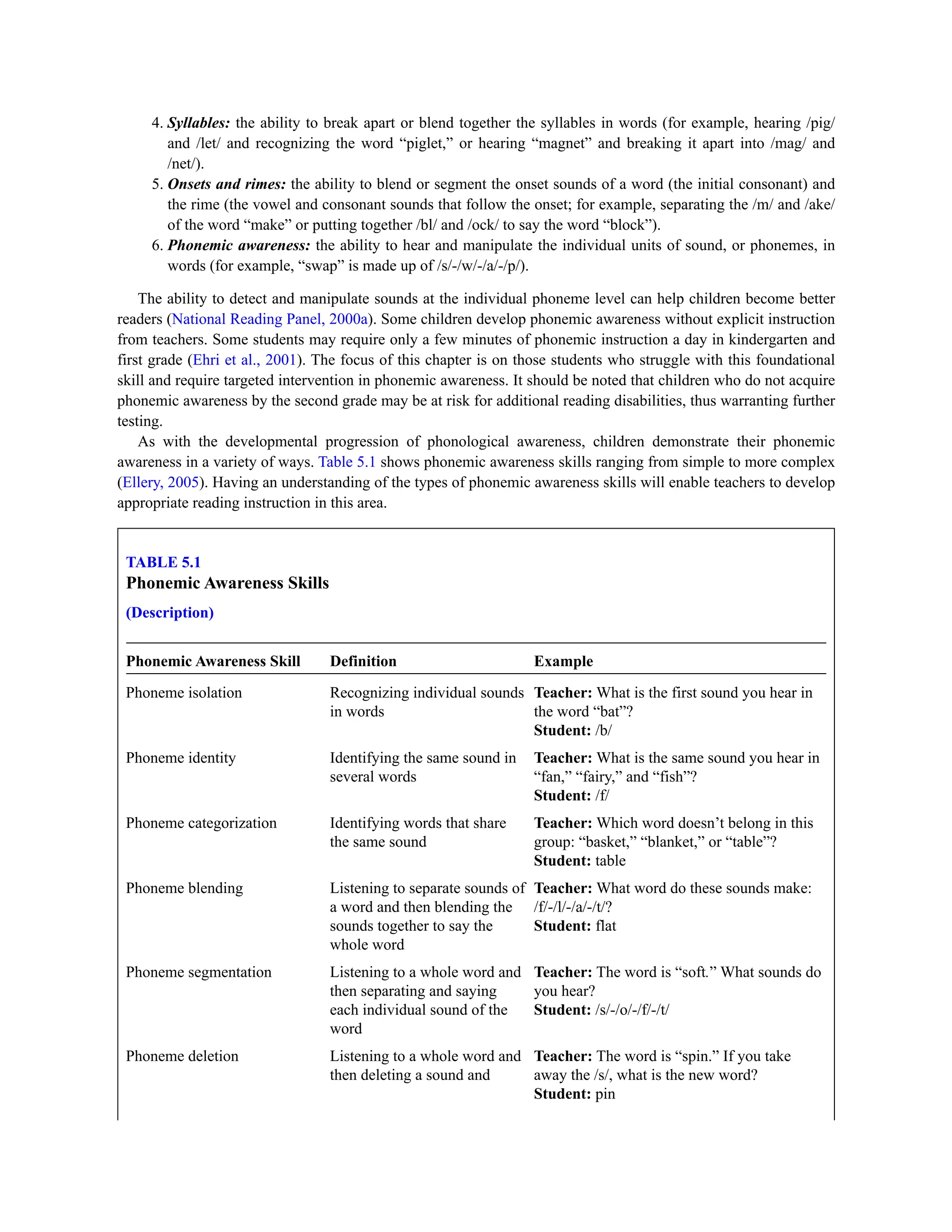
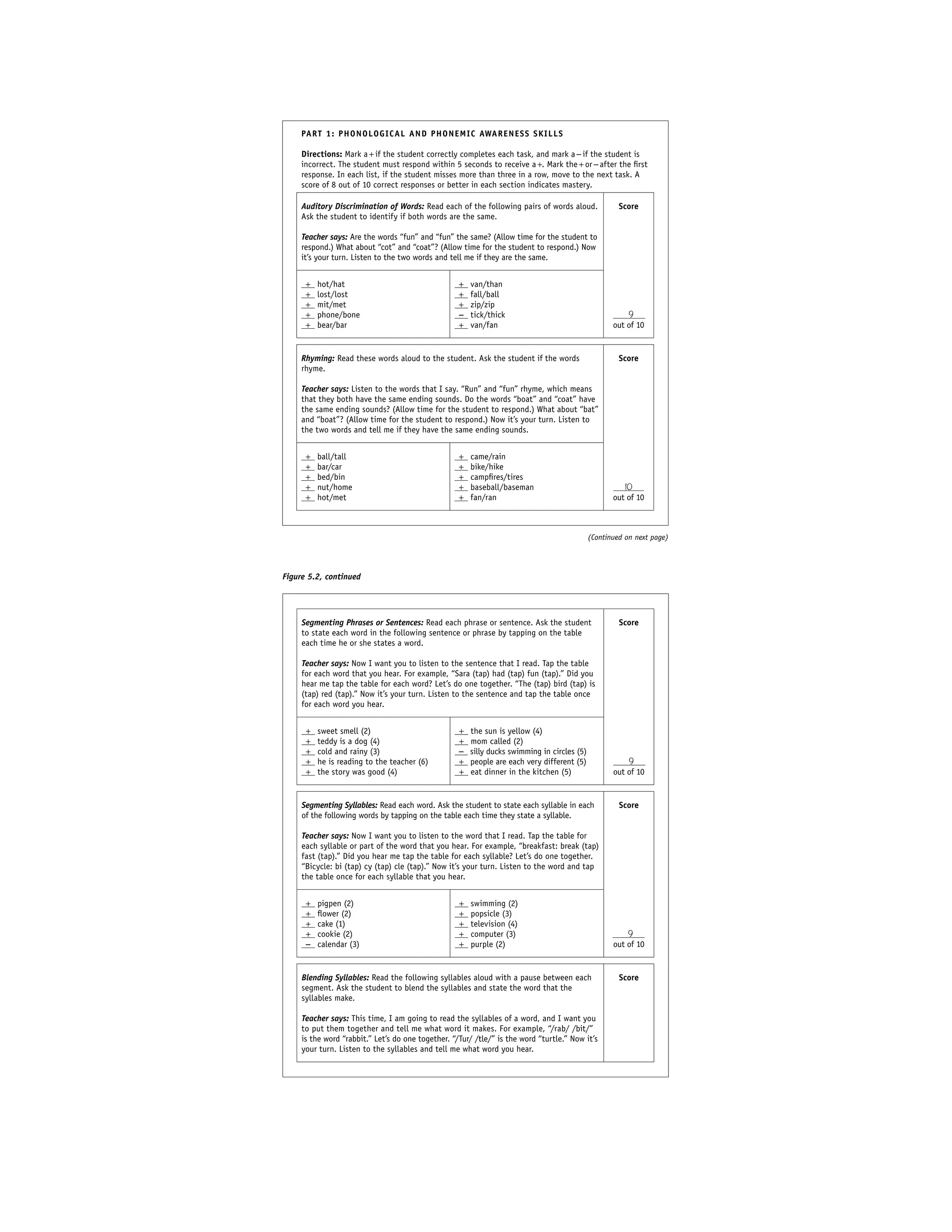
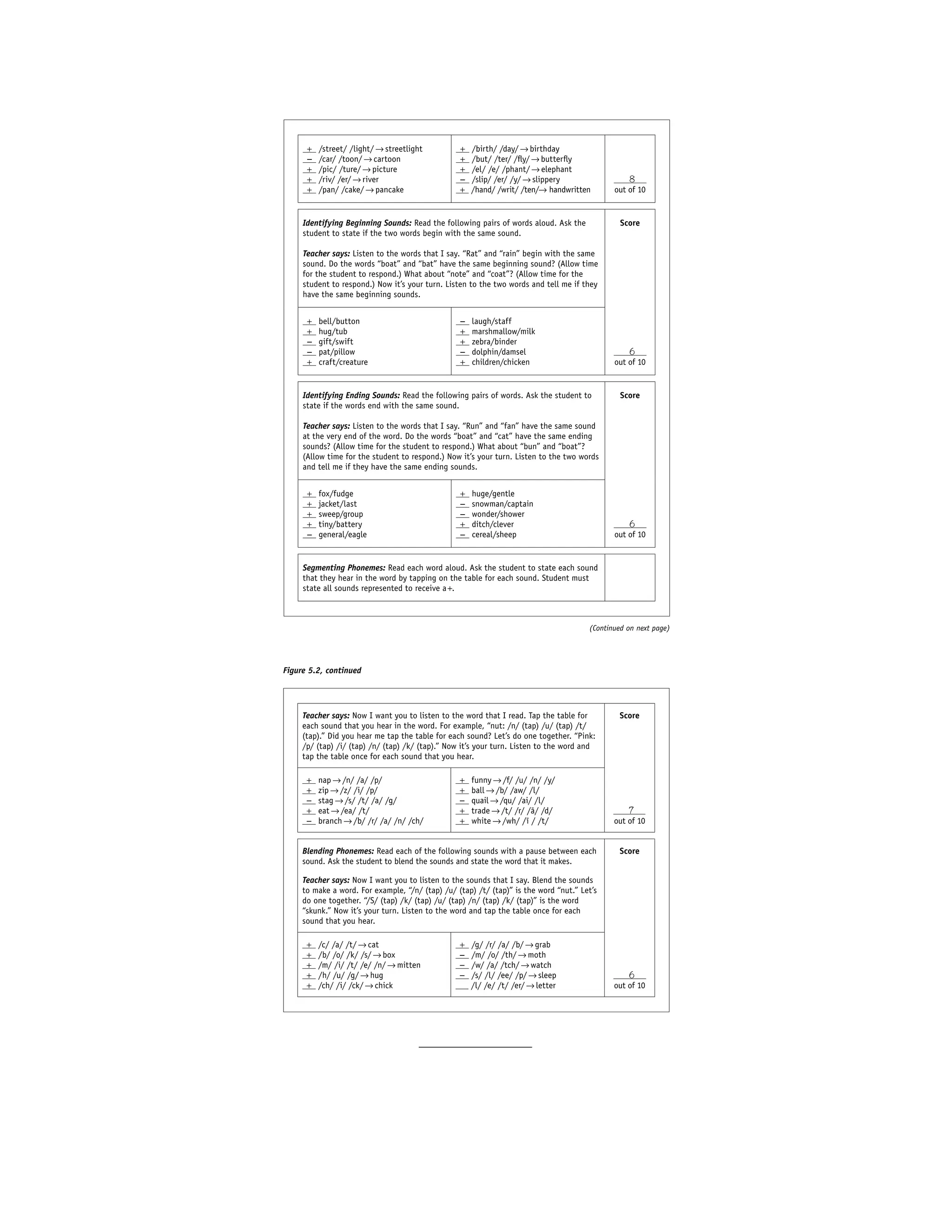
![When teaching phonemic awareness activities to students whose first language is not English, teachers need to
consider the effects of dialect and native language on pronunciation and to listen for consistent pronunciation of
sounds. If pronunciation of sounds is the skill being addressed, the teacher should give feedback. Otherwise, it is
important not to overcorrect pronunciation. Sometimes, overcorrection can reduce a child’s confidence in
speaking when English is a second language or the child speaks a different dialect of English.
Developing Phonemic Awareness in Students with Visual Impairments
The teaching routines described here can be used to develop phonemic awareness in students with visual
impairments and can be incorporated into brief 5-minute segments during the day, such as before reading
instruction, while students are transitioning between activities or in small-group rotations as students complete
independent work.
Instructional Routines for Teaching Phonemic Awareness
Blending and segmenting phonemes are the two most important phonemic awareness skills required for
successful reading. Teachers of students with visual impairments can use the following instructional routines for
teaching their students to blend and segment individual sounds. These routines may be done individually or in
small groups for a few minutes each day.
Instructional Routine for Blending Phonemes
To make this task more concrete for students, the teacher can give students with visual impairments tactile blocks
to put together as they blend individual phonemes.
Teacher: Today, we will practice putting sounds together to say words. We will practice saying sounds slowly
like a turtle and then say them fast like a rabbit. [If students do not understand the reference to the speed of
turtles and rabbits, read the story “The Tortoise and the Hare.”]
First, it is my turn. Listen to me as I say a word slowly [stretching out each sound]: /sssss/ … /aaaaaaa/ …
/tttttt/.
Notice how I said it slowly like a turtle inching along: /sssss/ … /aaaaaaa/ … /tttttt/. When I say the word fast
like a rabbit, I say “sat.”
Now let’s practice together: /sssss/ … /aaaaaaa/ … /tttttt/. What word did I say?
Students and Teacher: “Sat.”
Teacher: Yes! “Sat.” Now it is your turn. I will say the sounds like a turtle and you say the word like a rabbit.
/sssss/ … /aaaaaaa/ … /tttttt/. What word?
Students: “Sat.”
Teacher Yes! “Sat.”
The teacher repeats this routine with several more consonant-vowel-consonant (CVC) words. Then the teacher
calls on individual students to blend sounds together.
Instructional Routine for Segmenting Phonemes](https://image.slidesharecdn.com/readingconnections-strategies-for-teaching-students-with-visual-impairments-250721170318-cb16127e/75/Reading-Connections-Strategies-for-Teaching-Students-with-Visual-Impairments-151-2048.jpg)
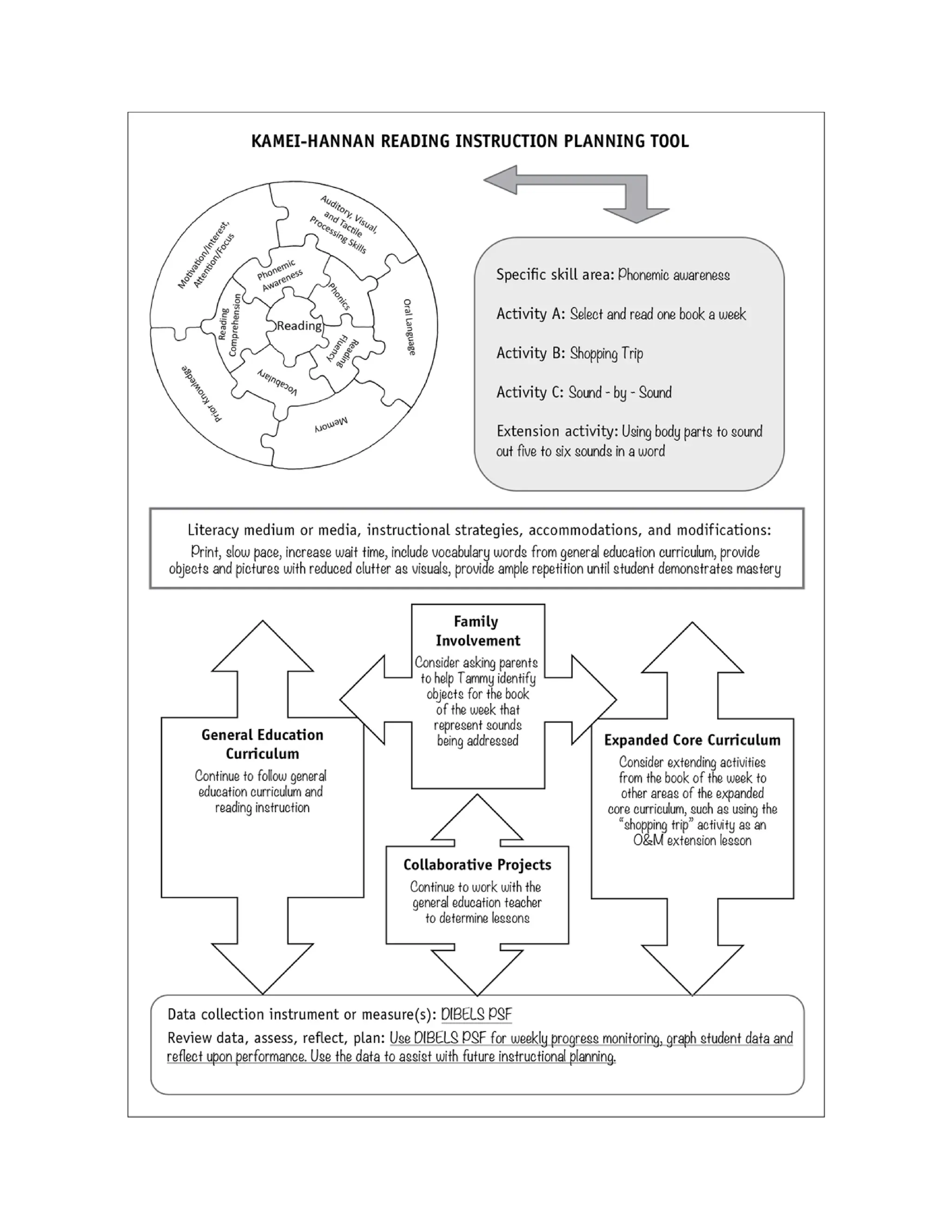
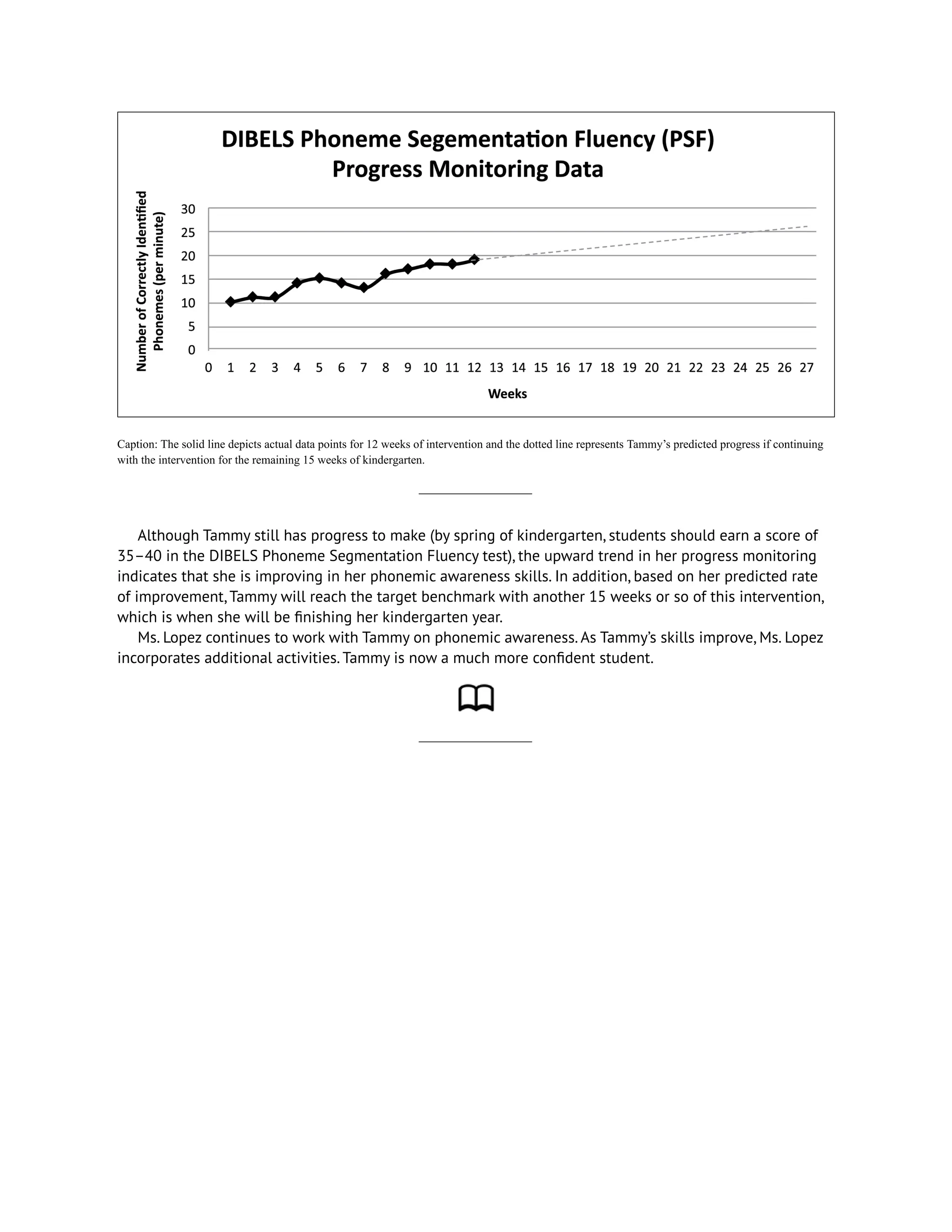
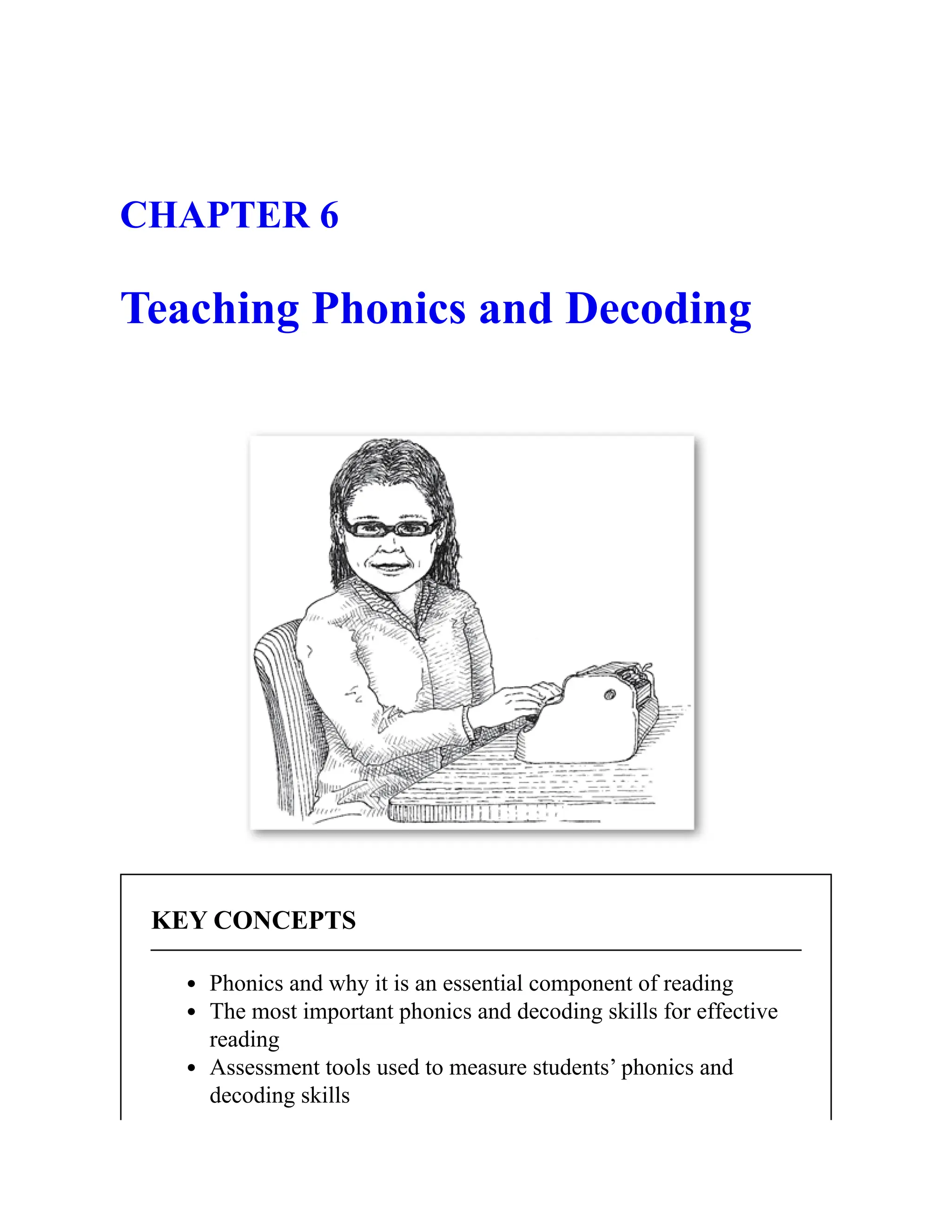
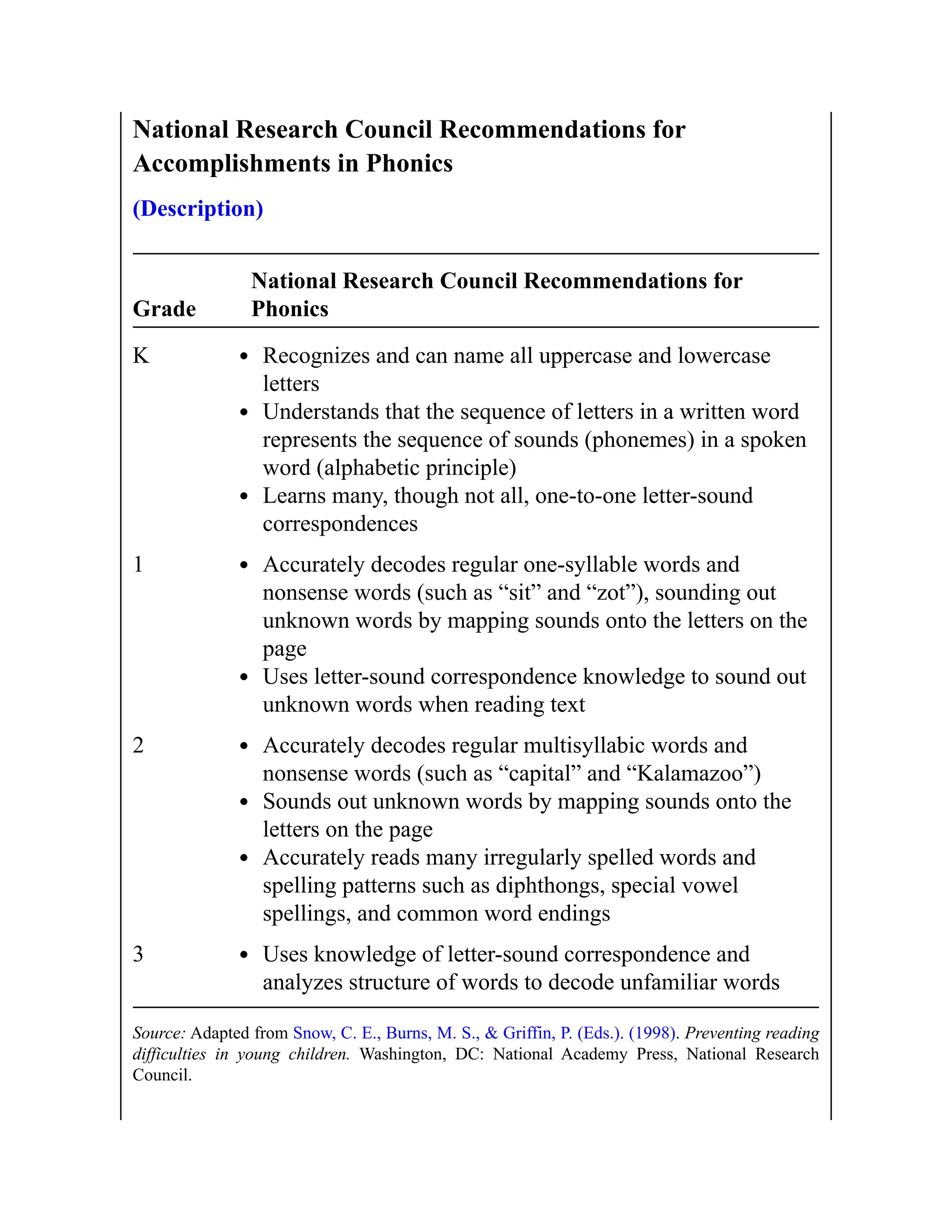
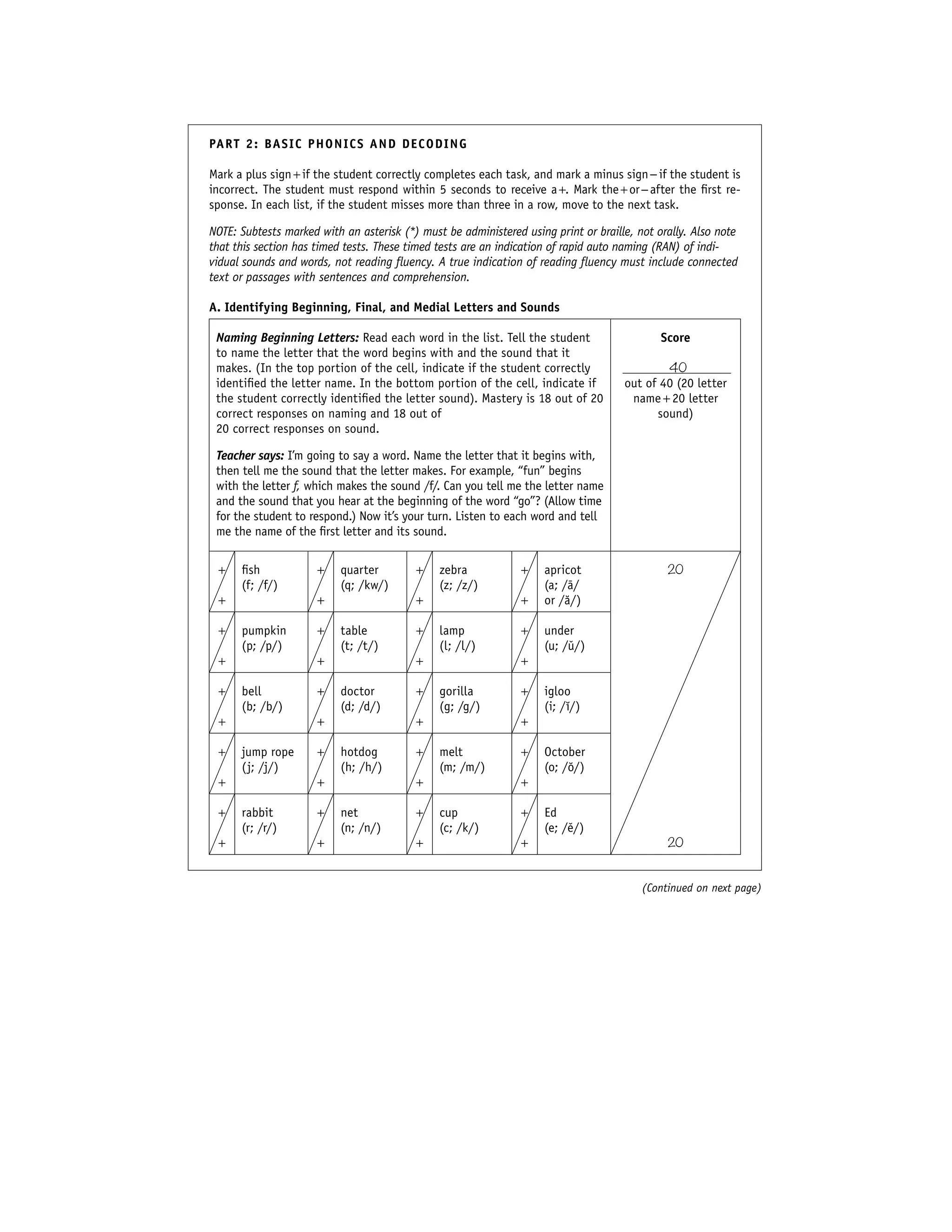
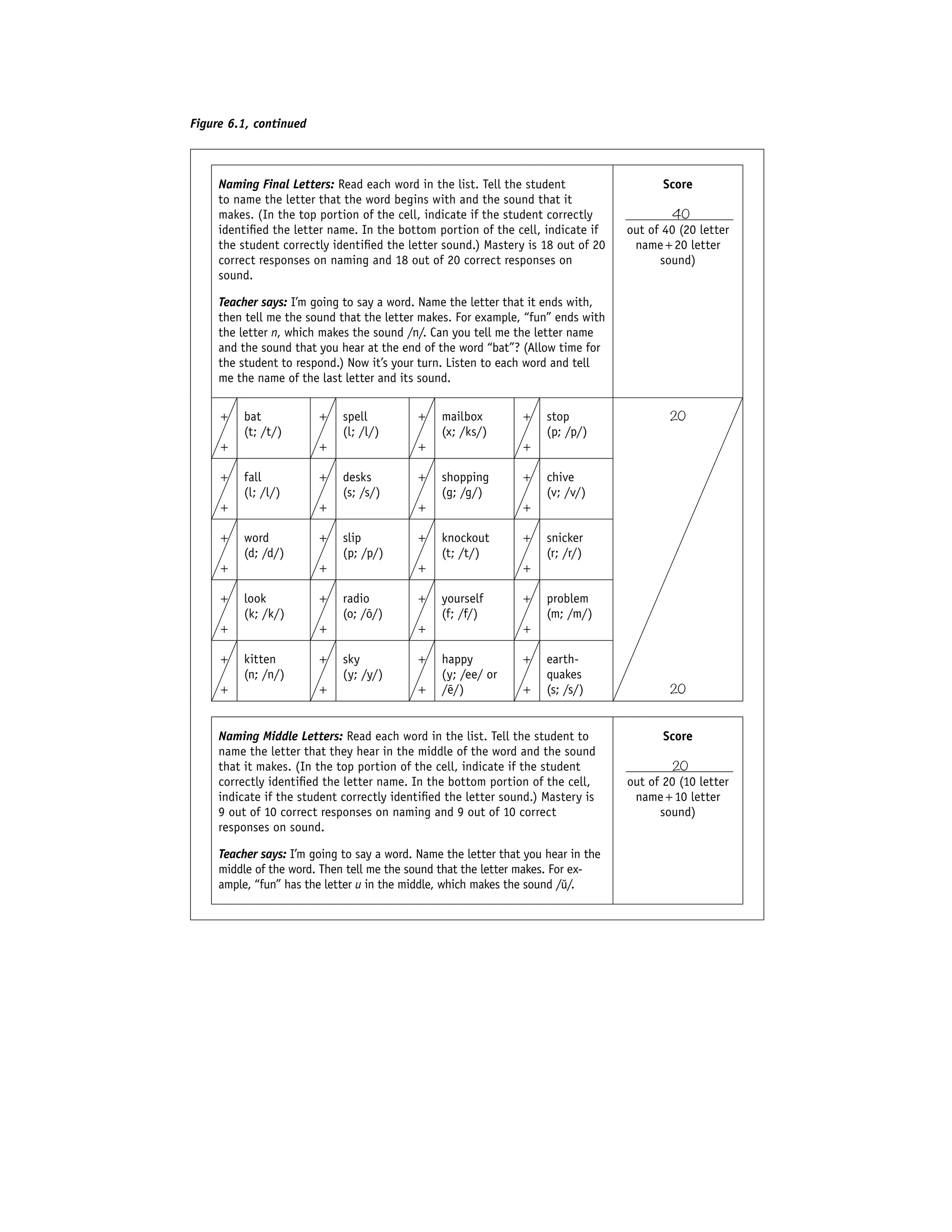
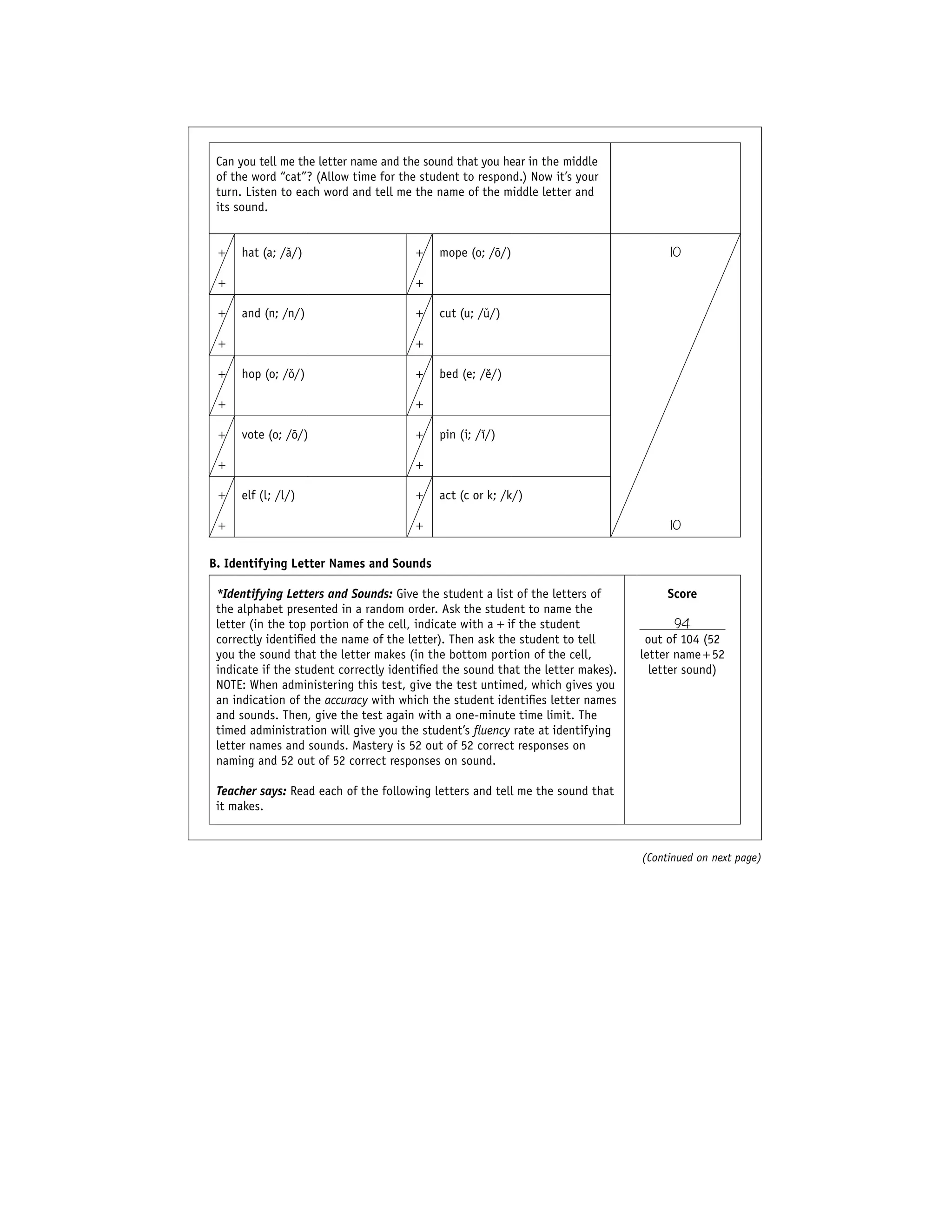
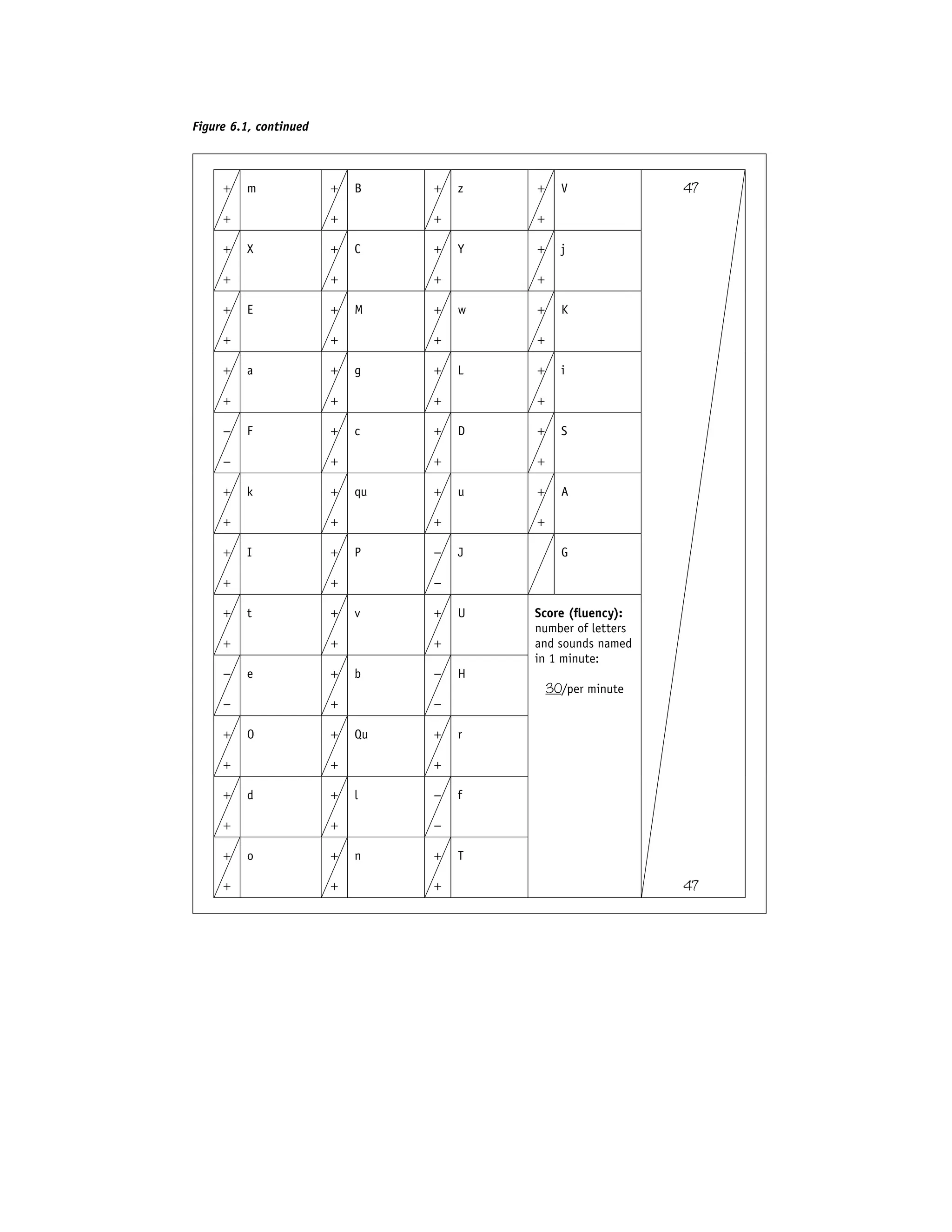
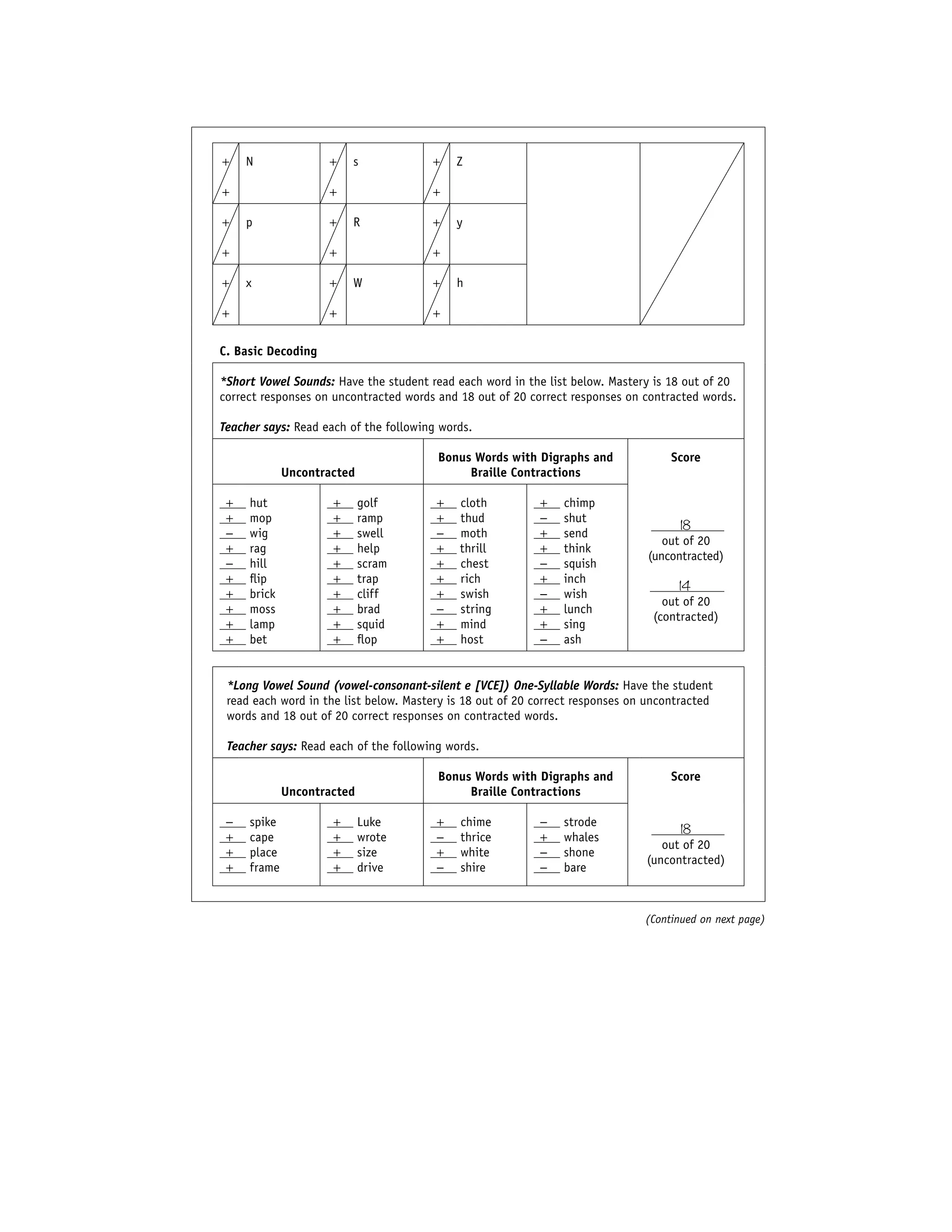
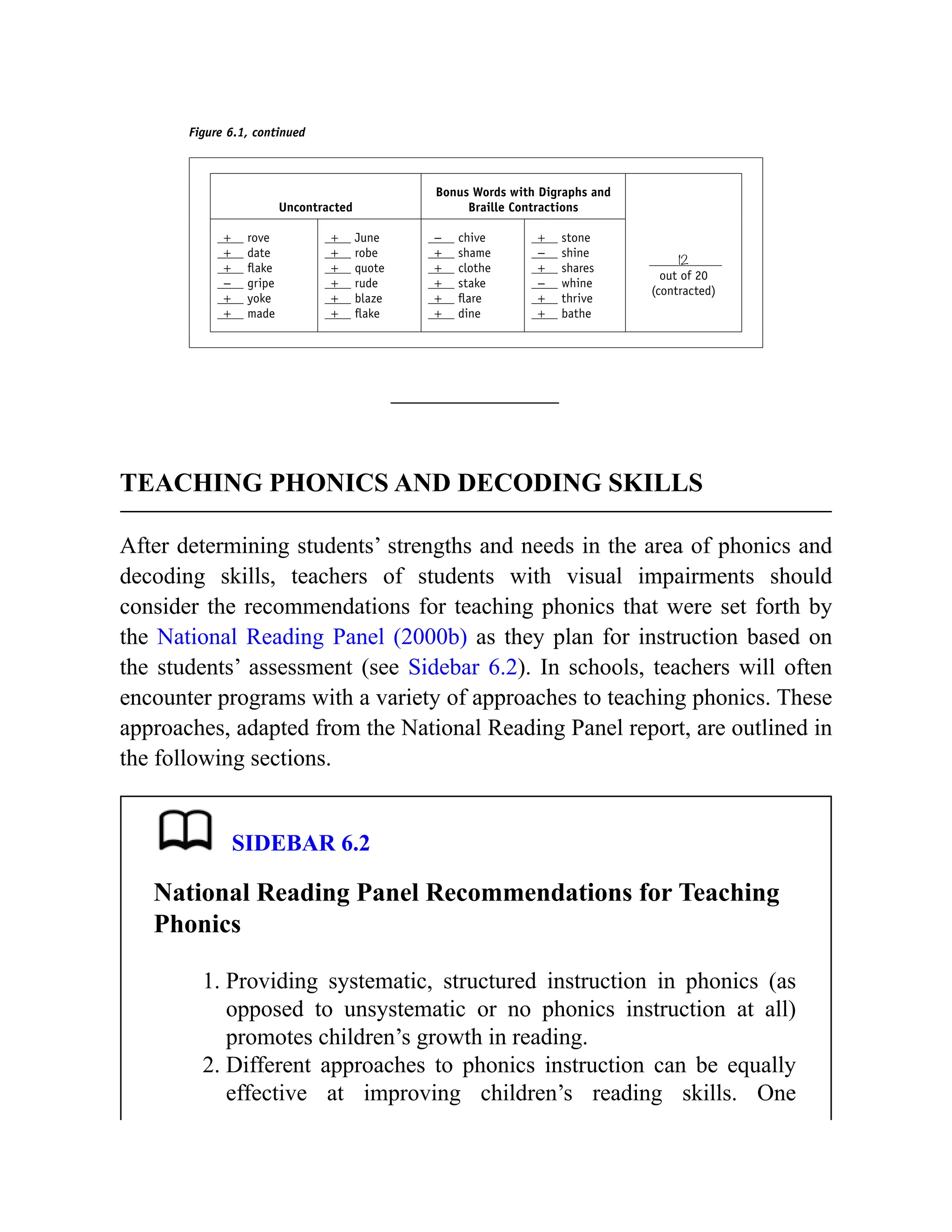
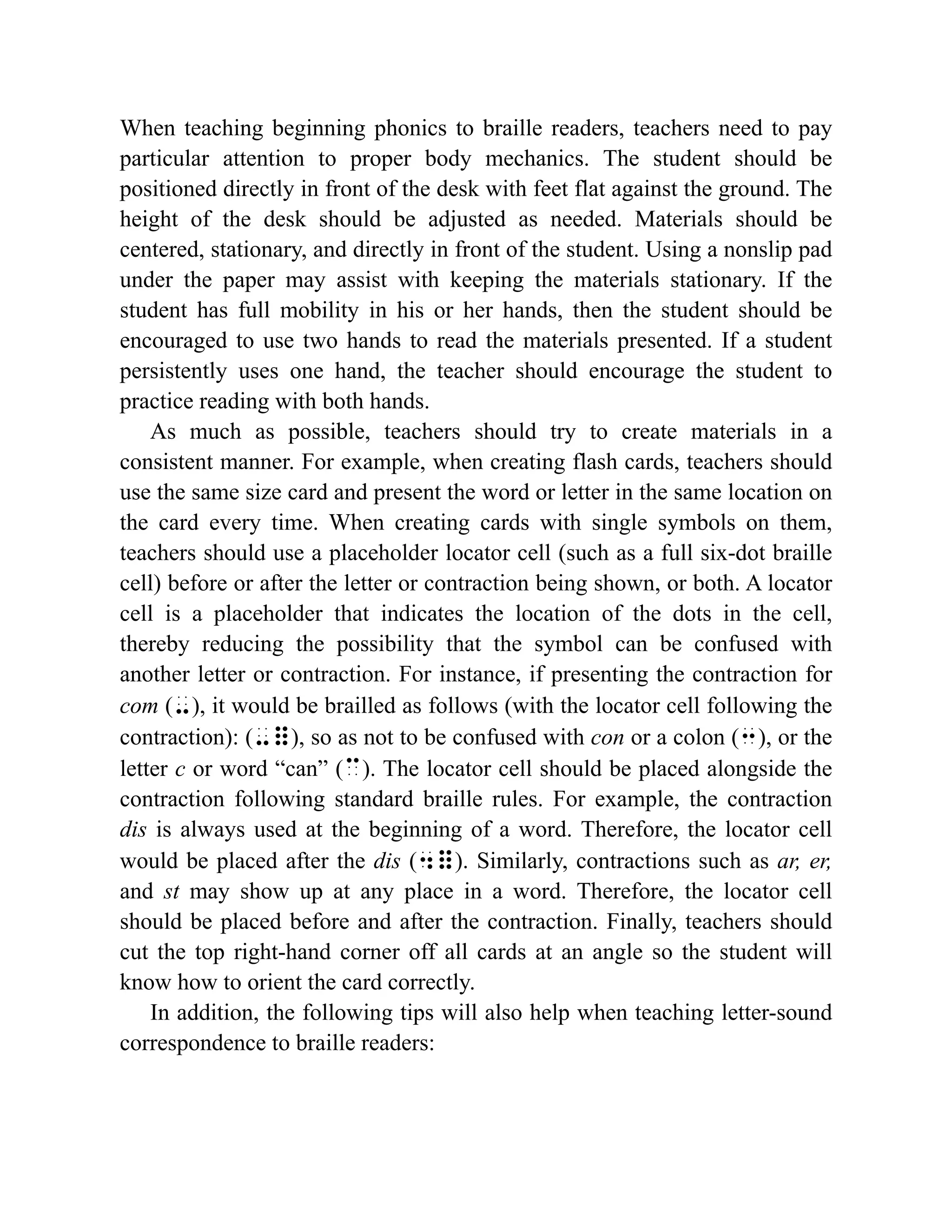
![Introduce letters that are frequently used and that are easily
distinguishable from one another (for example, a and g are easily
distinguished from one another in braille).
Teach to mastery before introducing letters that are easily confused
(teach d until the student demonstrates mastery before introducing f).
Introduce composition signs, such as the capital letter symbol (dot 6)
after the student demonstrates mastery of the letter.
Introduce contractions as they appear in the phonics lessons (for
example, introduce st with blends and ch, sh, th, wh with digraphs).
Instructional Routines for Teaching Letter-Sound
Correspondence
As noted earlier, learning to recognize the letters of the alphabet and the
sounds that correspond to the letters is an essential skill needed in decoding.
Teachers of students with visual impairments can use the following
instructional routines for teaching their students the sounds of letters.
Teaching Routine for Learning Letter Names and Sounds for a
Print Reader
To make this task more concrete for students with low vision, the teacher
can begin with letters written on flashcards. For kinesthetic reinforcement,
the students can then write the letter on a whiteboard or an electronic table
and say its corresponding sound.
Teacher: Today, we will practice naming letters and saying their sounds.
Then, we will practice writing the letters. Listen to me as I say the letter
and the sound that it makes [stretching out the sound while tracing the
letter shape with a finger]: m .…./mmmmm/ .…. Now let’s practice
together: m .…/mmmmm/. What sound does m say?
Student and Teacher: /mmmmmmmm/ [teacher says the sound with him
as the student traces the letter with his finger].](https://image.slidesharecdn.com/readingconnections-strategies-for-teaching-students-with-visual-impairments-250721170318-cb16127e/75/Reading-Connections-Strategies-for-Teaching-Students-with-Visual-Impairments-185-2048.jpg)
![Teacher: Yes, m says /mmmmm/. Let’s write the letter on the tablet.
[Teacher gives a whiteboard or electronic tablet to the student and allows
the student to write the letter. As he writes it, the teacher says the name
of the letter and the sound.]
Now it is your turn to name a letter and then its sound. [The teacher may
show the student a different card or repeat the same letter.] p .…/ppppp/.
What sound does p say?
Student: /pppppppp/ [teacher says the sound with him as student traces the
letter with his finger].
Teacher: Yes, p says /ppppp/. [Teacher repeats this routine with several
more letter cards.]
Teaching Routine for Learning Letter Names and Sounds for a
Braille Reader
To provide practice in tactile recognition of letters while practicing the
sounds that the letters make, the teacher can give students a page with rows
of braille already embossed—that is, using the top dots 1 and 4, middle dots
2 and 5, or bottom dots 3 and 6 and the target letter embedded within the
lines of braille cells. For example, if the target letter was b then a line may
look like this:
(Description)
---------- b ------ b --------------
b - b
This activity also reinforces the hand movement of tracking lines of braille.
Figure 6.2 shows what the brailled exercise for the letter m would look like.
FIGURE 6.2
Sample Phonics Exercise for the Letter m
(Description)](https://image.slidesharecdn.com/readingconnections-strategies-for-teaching-students-with-visual-impairments-250721170318-cb16127e/75/Reading-Connections-Strategies-for-Teaching-Students-with-Visual-Impairments-186-2048.jpg)
![m
---------- m -----------------------
------ m --------------------- m ---
------------- m --------------------
------ m ------------------------ m
------------- m -------------- m ---
------------ m ---------------------
-------------- m ---------- m ------
---------- m ---------- m ----------
------------------- m
Caption: The worksheet has the letter to be found—in this case, the letter m—in braille at the top left-
hand corner of the page, for reference. The rest of the worksheet consists of rows of dots 3–6, with
the letter m embedded in different locations on the lines for the student to find.
Teacher: Today, we will practice naming letters and saying their sounds.
Then, we will practice finding the letters that are hiding on the page.
[Teacher presents the first page of braille to the student, has the student
position both of his hands at the top of the page, and has the student
locate the first letter.]
Listen to me as I say the letter and the sound that it makes [stretching
out the sound while tracing the letter shape with a finger]: m
.…./mmmmm/ .…. Now let’s practice together: m .…/mmmmm/. What
sound does m say?
Student and Teacher: /mmmmmmmm/ [teacher says the sound with him
as the student traces the letter with his finger].
Teacher: Yes, m says /mmmmm/. Let’s practice finding all the m’s on this
page. [The teacher has the student use a two-handed reading motion
from left to right to find the letters on the page. Whenever the student
finds the letter, the teacher has the student say the letter name and its
sound. Teacher repeats this routine with several more letters or, for](https://image.slidesharecdn.com/readingconnections-strategies-for-teaching-students-with-visual-impairments-250721170318-cb16127e/75/Reading-Connections-Strategies-for-Teaching-Students-with-Visual-Impairments-187-2048.jpg)
![added reinforcement of previously learned letters, includes multiple
letters that the student has mastered on a single page.]
Teaching Students Basic Decoding: Blending Sounds to Form
Words
Blending sounds is an essential phonics skill. Teachers can consider the
following suggestions when teaching students with visual impairments to
blend the sounds of letters to read words:
For blending, use initial sounds that are continuous. Blending
continuous sounds is easier than blending stop sounds. Continuous
sounds are sounds that can be held for a few seconds or stretched out,
such as /mmmmmmm/ or /fffffff/. The continuous sounds are /a/, /e/,
/i/, /o/, /u/, /f/, /l/, /m/, /n/, /r/, /s/, /v/, /w/, /y/, and /z/. Stop sounds can
only be said in an instant and cannot be stretched out, such as /b/, /d/,
/g/, /h/, /j/, /k/, /p/, and /t/.
In the beginning, teach words that are easily decoded, such as words
that follow the pattern consonant-vowel-consonant (CVC), for
example, “mat” or “pen”).
Gradually introduce more complex letter combinations and patterns.
Use hand signals to accompany instruction in blending (for instance,
the teacher can run her finger from left to right underneath the word,
pausing for each letter as it is blended together, or she can tap a
finger to each letter as the sound is spoken and then brush the finger
over the word to signify blending).
Throughout phonics instruction, provide students with practice
reading words in connected text containing many words that can be
sounded out by the students.
Teaching Routine for Teaching Students to Blend Sounds](https://image.slidesharecdn.com/readingconnections-strategies-for-teaching-students-with-visual-impairments-250721170318-cb16127e/75/Reading-Connections-Strategies-for-Teaching-Students-with-Visual-Impairments-188-2048.jpg)
![Teachers of students with visual impairments can use the following
instructional routine for teaching their students to blend sounds. To make
this task more concrete for the students, the teacher can give students tiles,
cards, or blocks with print or braille letters on them. The students can tap
each letter with an isolated finger, and then tap all fingers down to blend the
sounds and say the word.
Teacher: Today, we will practice putting sounds together to say words. We
will practice tapping each letter and saying the sounds slowly like a
turtle and then say the word fast like a rabbit. First, it is my turn. Listen
to me as I say a word slowly [stretching out each sound while tapping
one finger on each tile: first the thumb on m, then the pointer finger on a
and the middle finger on t; all fingers tap the table on “mat.”]: /mmmm/
.…./aaaaaaa/ .…./tttttt/ .….“mat.” Notice how I tapped each letter and
said it slowly like a turtle inching along: /mmmmm/ .…./aaaaaaa/
.…./ttttttt/. When I say the word fast like a rabbit, I say “mat.”
Now let’s practice together: /mmmmm/ .…./aaaaaaa/ .…./ttttttt/.
What word did I say?
Student: “Mat” [the teacher taps the table with the student.]
Teacher: Yes, “mat.” Now it is your turn. [Teacher repeats this routine with
several more CVC words.]
To end the lesson, the teacher can give the students word cards with the
words that were practiced in the lesson written on them. Have the student
read as many words as he or she can without needing to tap. If the student
reads the word correctly without tapping, put it in one pile. If the student
needs to tap out a word or is not sure of the word, practice tapping it out
together and return the card to the back of the pile. See how many words
the student can read in two to five minutes.
ACTIVITIES FOR TEACHING PHONICS AND BASIC
DECODING](https://image.slidesharecdn.com/readingconnections-strategies-for-teaching-students-with-visual-impairments-250721170318-cb16127e/75/Reading-Connections-Strategies-for-Teaching-Students-with-Visual-Impairments-189-2048.jpg)
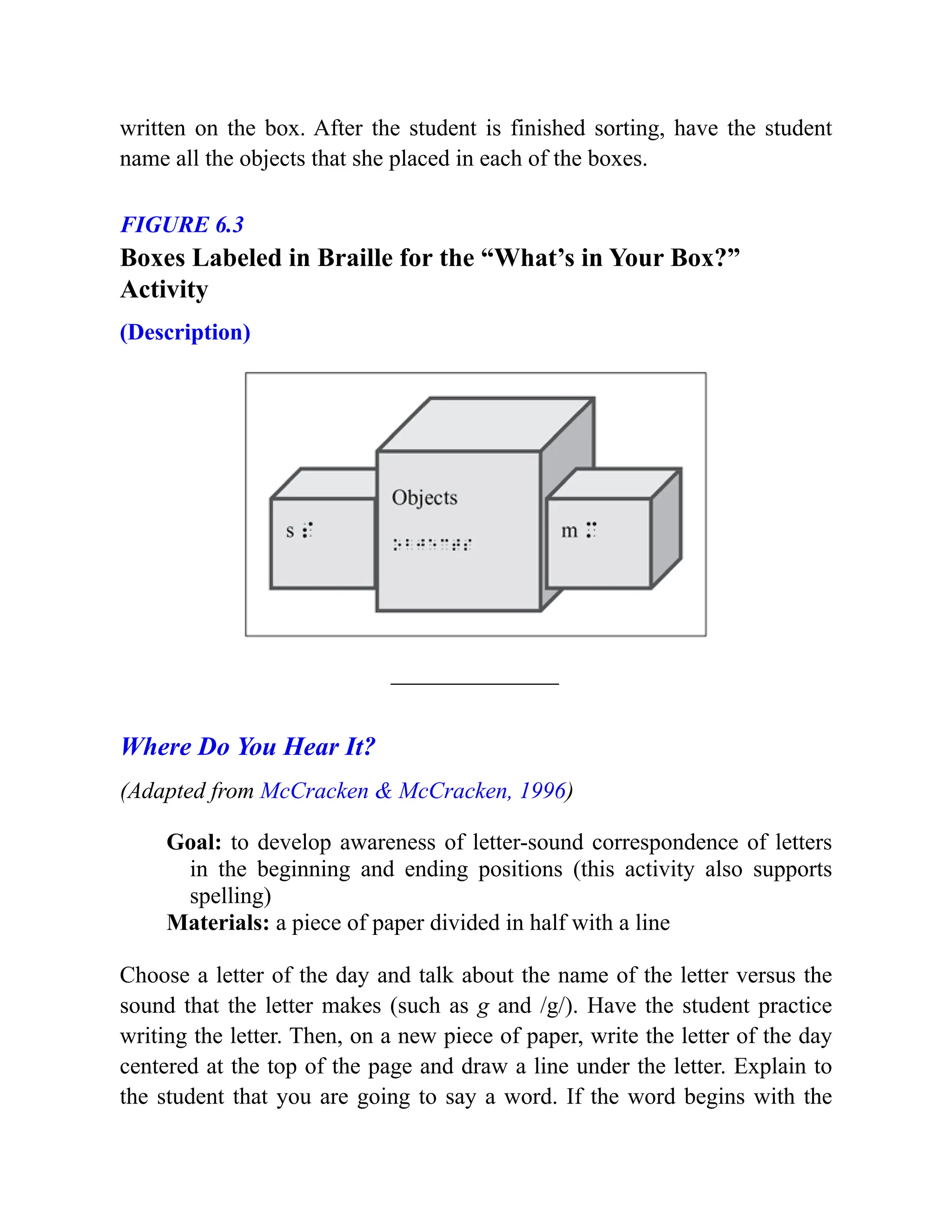
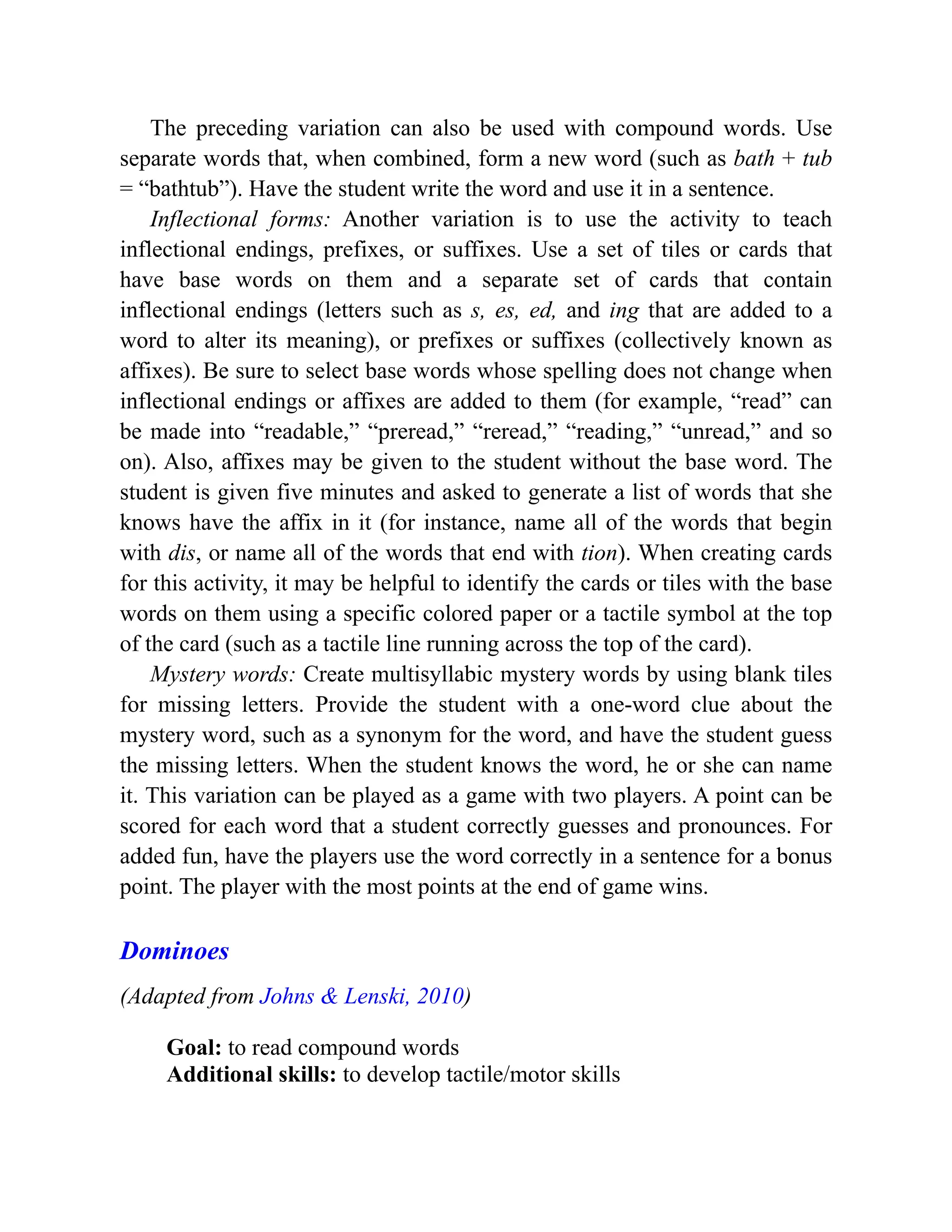
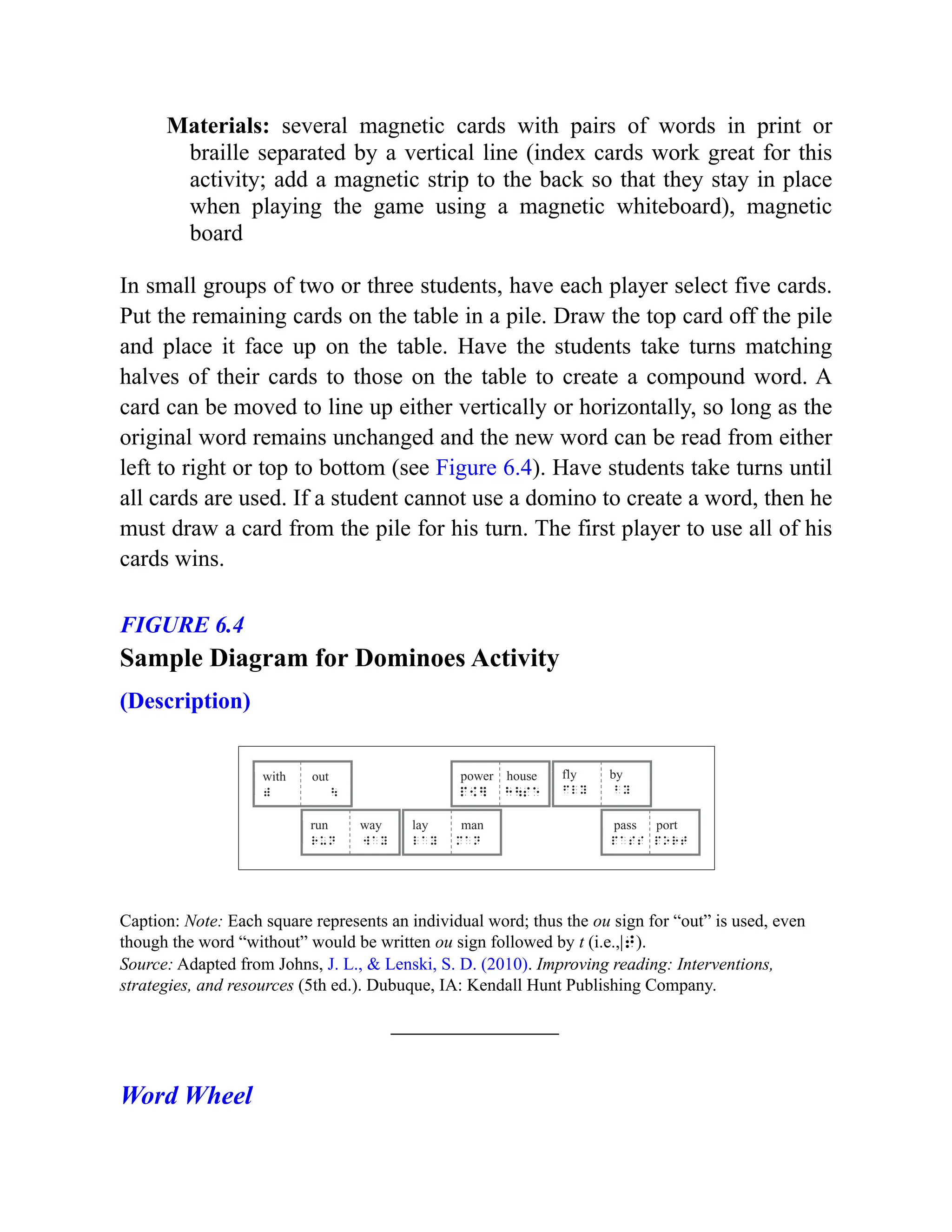
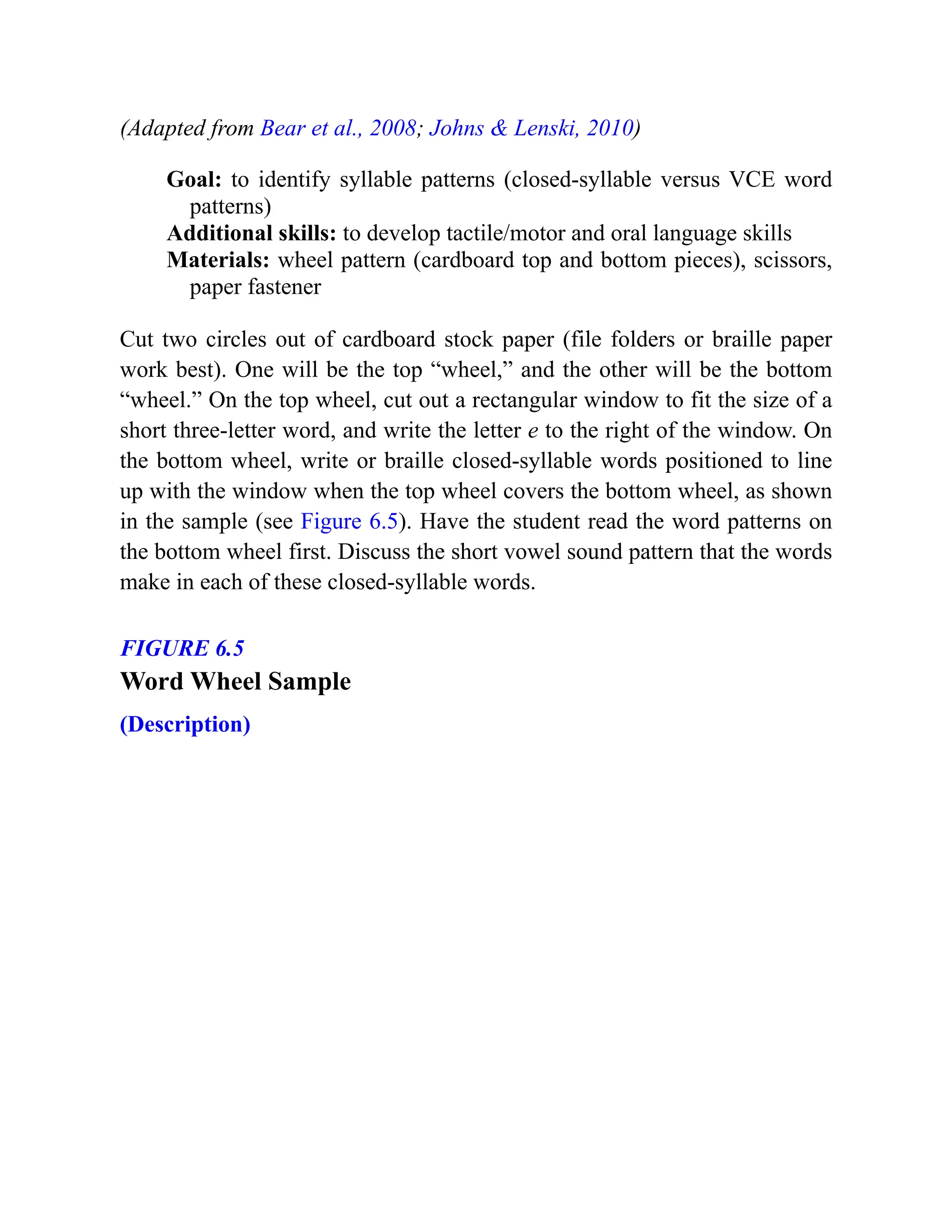
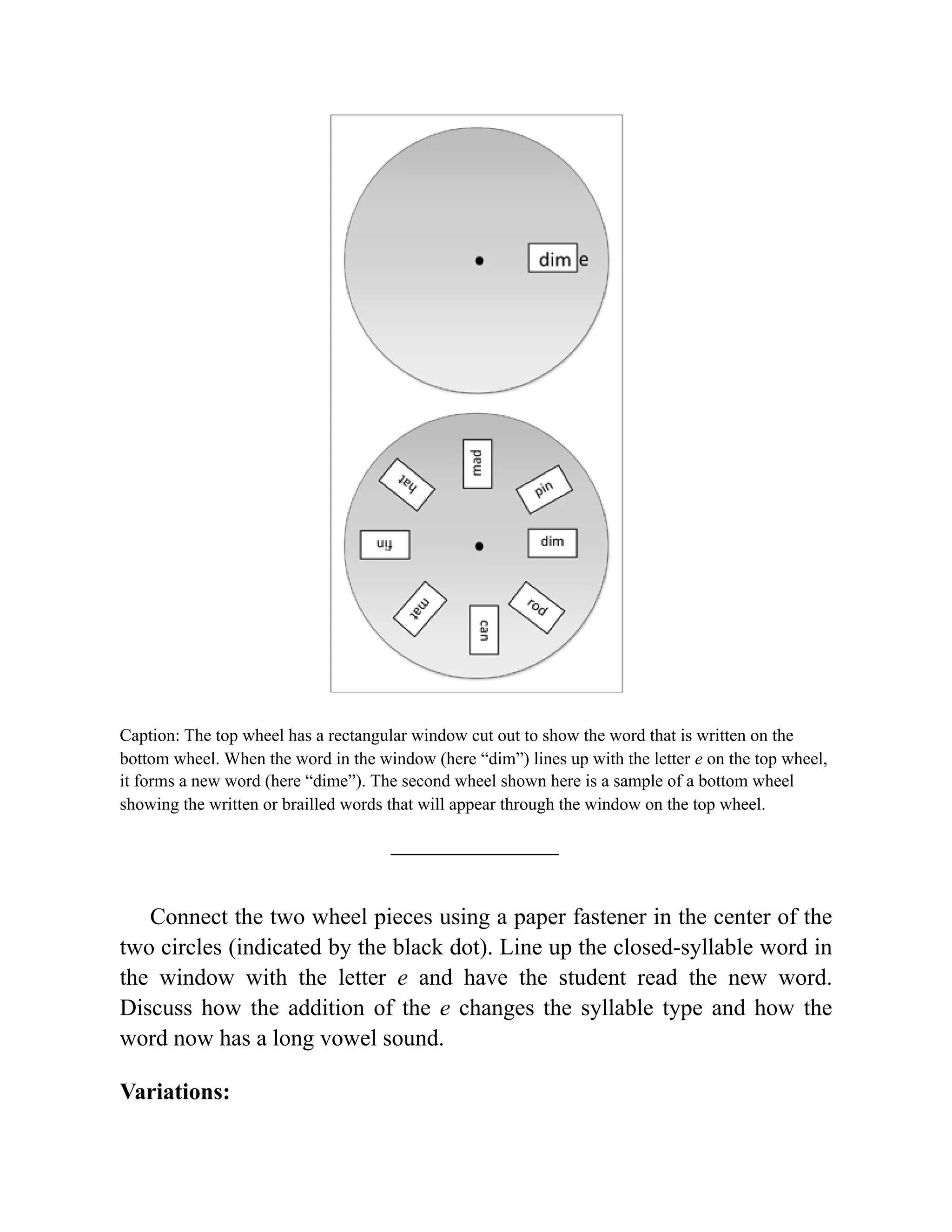
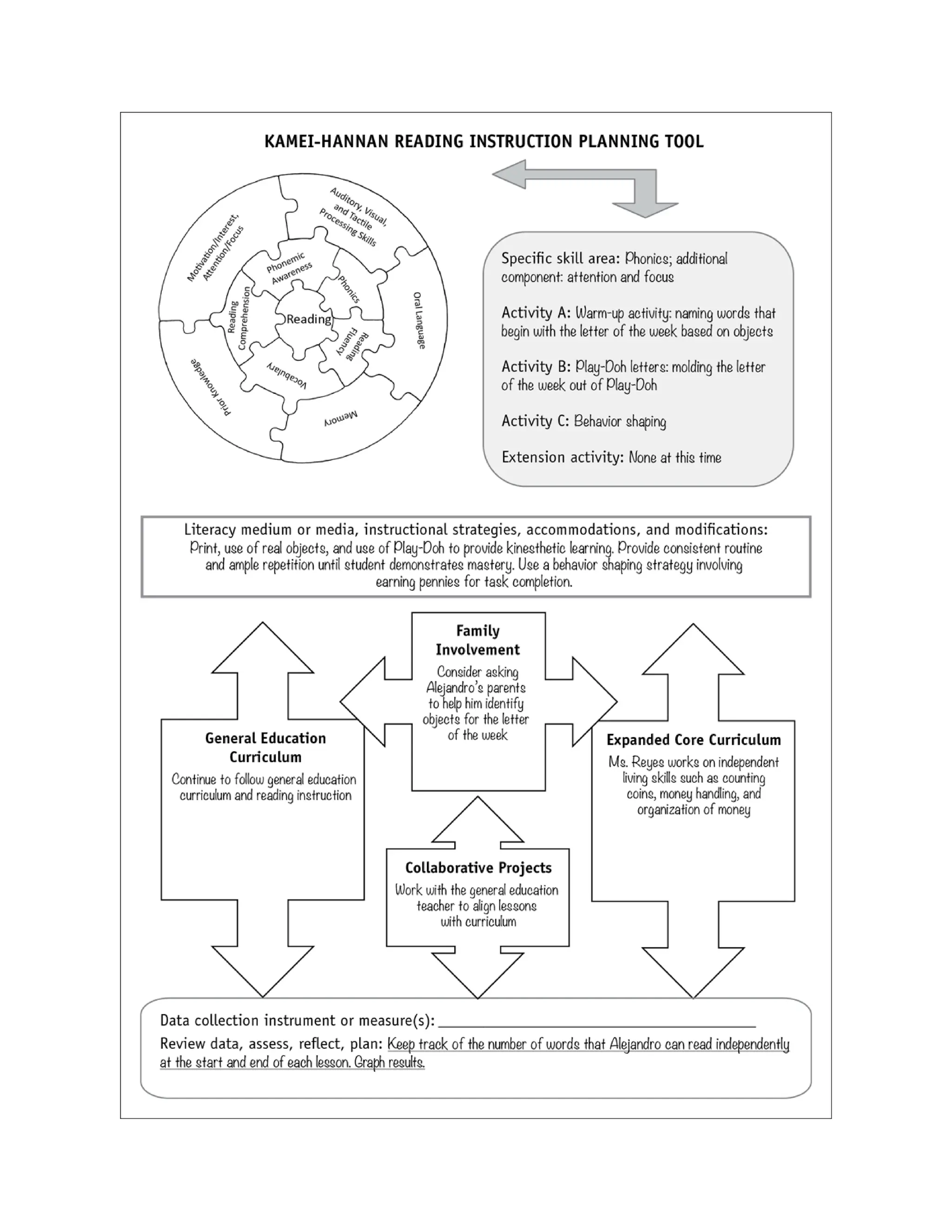
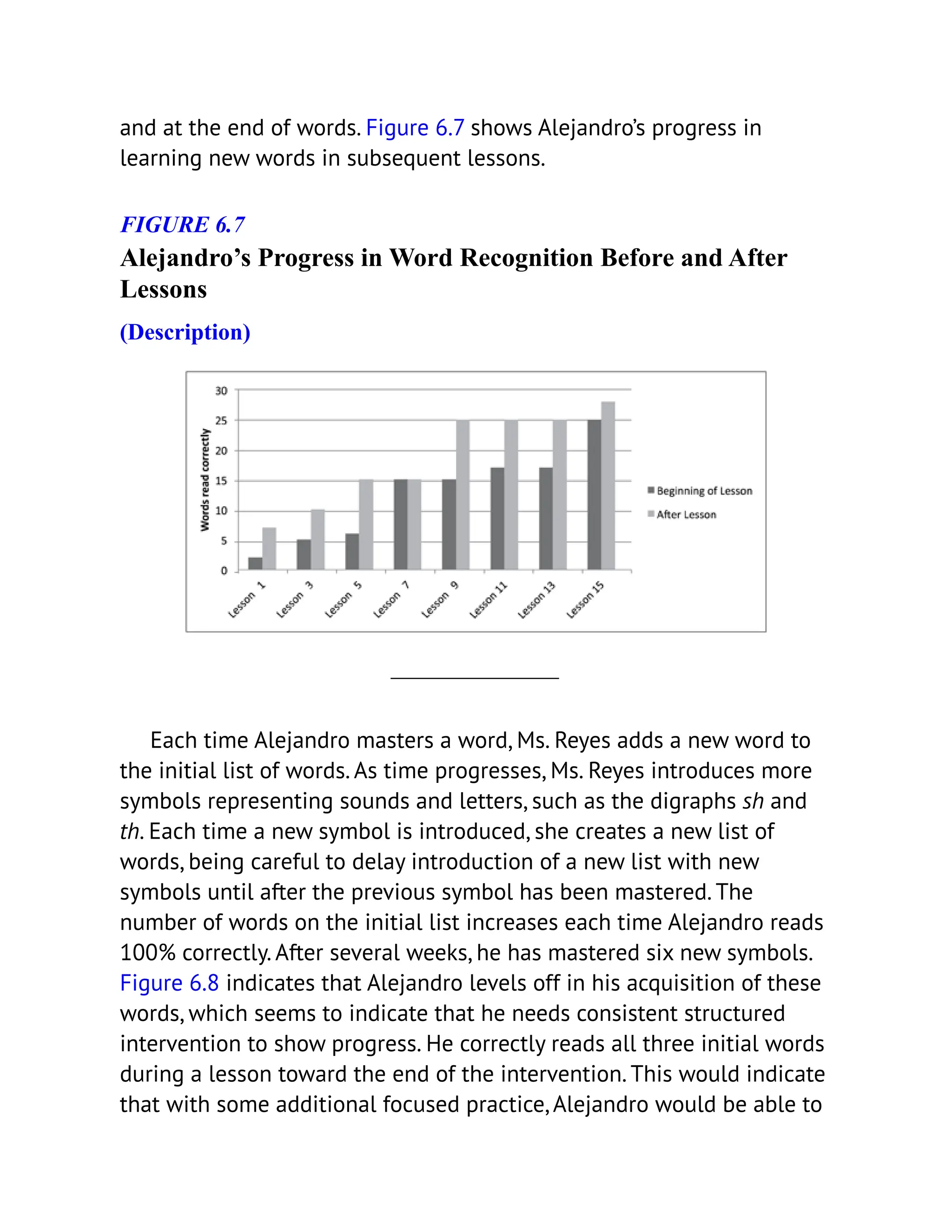
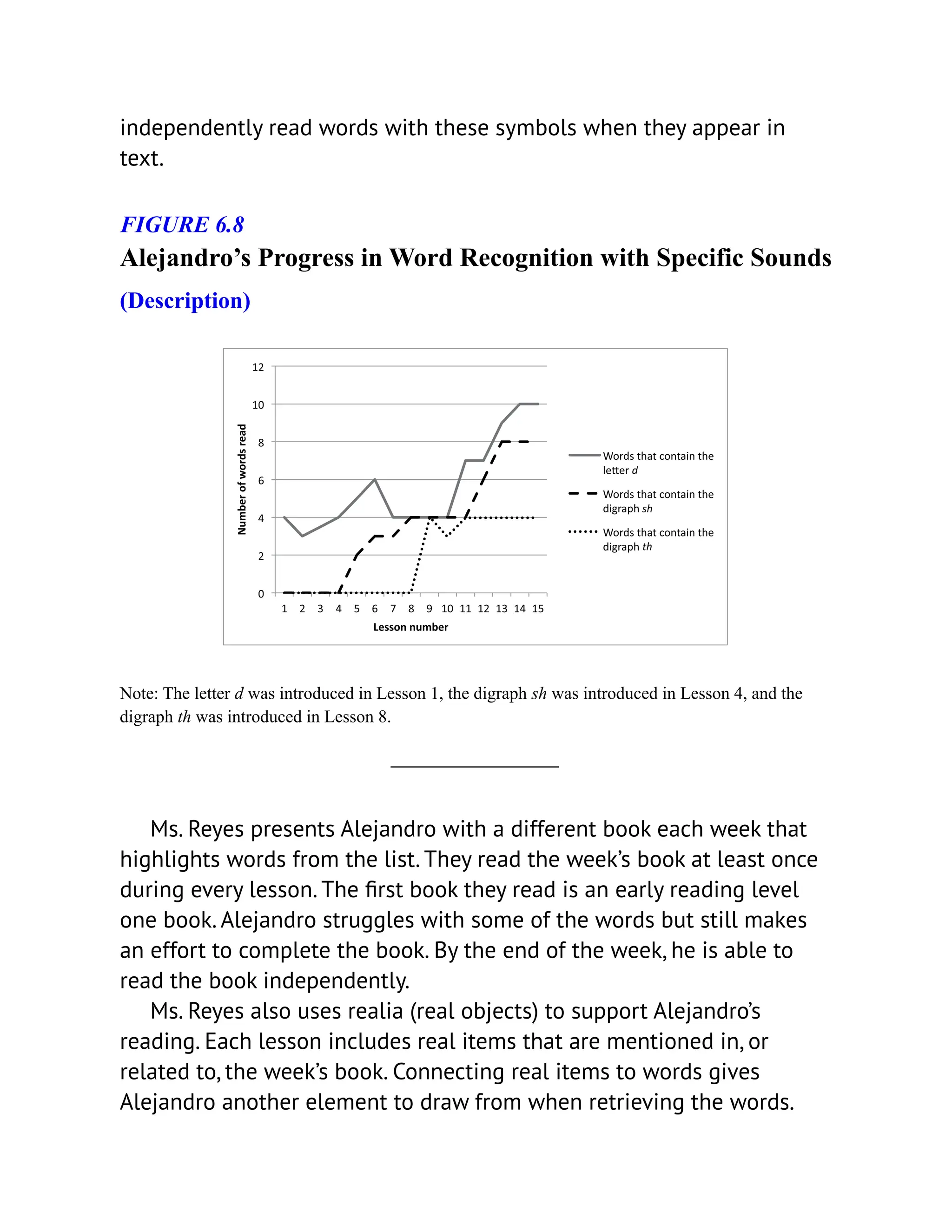
![for students with visual impairments, the teacher can provide cards, blocks,
or tiles with sample syllable types on them. Students can practice arranging
and rearranging the manipulatives to create a variety of words. The teacher
can also create a set of word cards that have multisyllabic words written on
them that include the syllable types that are practiced in the exercise.
Teacher: Today, we will practice constructing and reading words with
many syllables. You have already seen many words with these syllables
or words that sound similar to the syllables we are going to learn today.
First, let’s practice reading these syllables. [Teacher gives the student the
cards with one syllable written in print or braille on each card and has
the student read the syllables. For braille readers, the teacher should
write the syllable in uncontracted braille on the top left corner of the
card, with the contracted version below.]
Now, let’s try combining these syllables to make some longer words.
Listen to me as I say a word slowly and tap each card: /dis/ .…./tract/
.….“distract.” [The teacher then presents the word card for “distract”
and has the student read the word again and then write the word in both
uncontracted and contracted braille.]
Now it’s your turn. Here are two cards. Say each syllable separately,
then put them together.
The teacher repeats this routine with several more syllable cards. At the
end of the lesson, the teacher gives the student a stack of word cards with
the multisyllabic words that were practiced in the lesson written on them.
The teacher asks the student to read as many words as he or she can as
quickly as he or she can. If the student reads the word correctly, the teacher
puts it aside. If the student needs to sound it out, or is not sure of the word,
the teacher demonstrates breaking the syllables apart and putting them
together. Then, the teacher returns the card to the back of the stack. The
teacher sees how many words the student can read in 2–5 minutes.](https://image.slidesharecdn.com/readingconnections-strategies-for-teaching-students-with-visual-impairments-250721170318-cb16127e/75/Reading-Connections-Strategies-for-Teaching-Students-with-Visual-Impairments-210-2048.jpg)
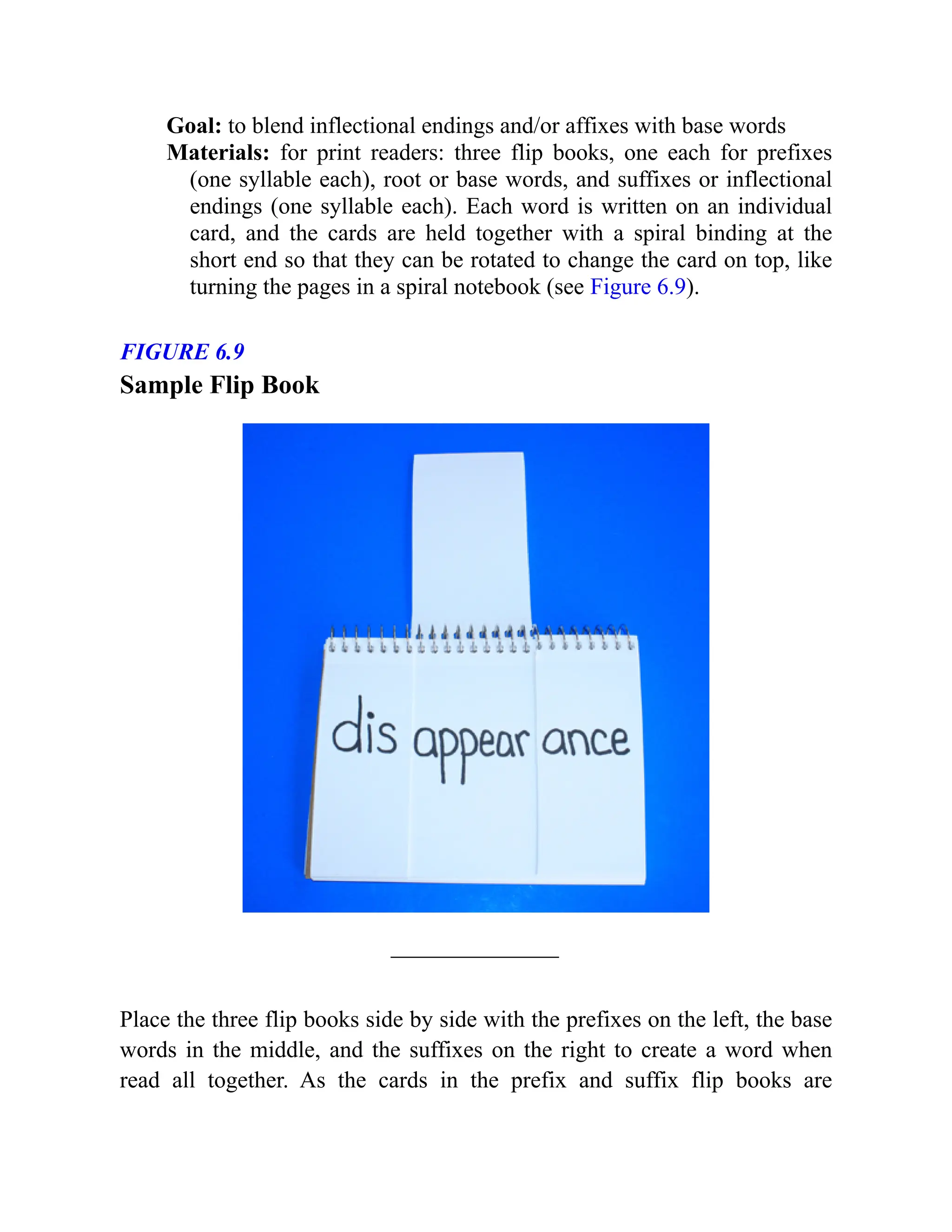
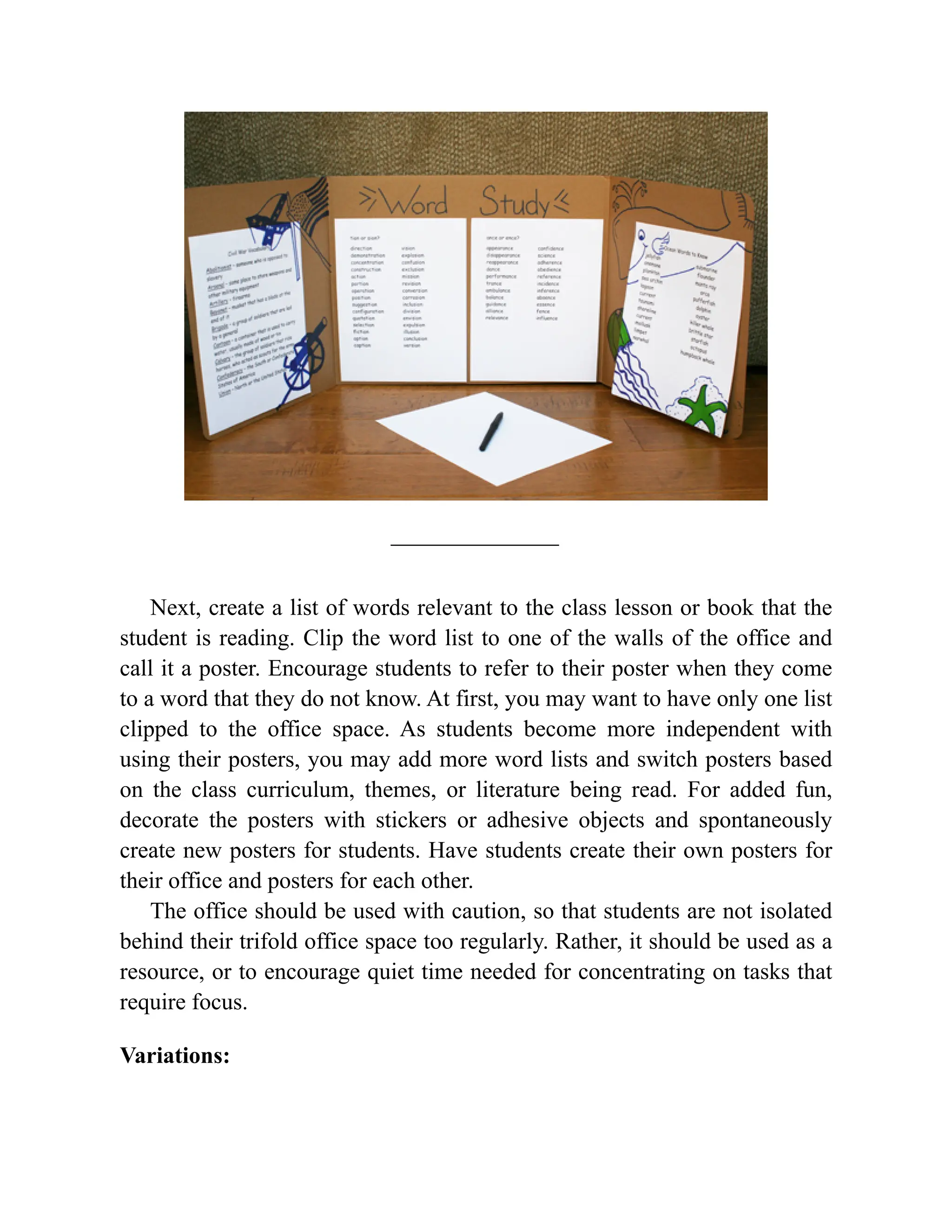
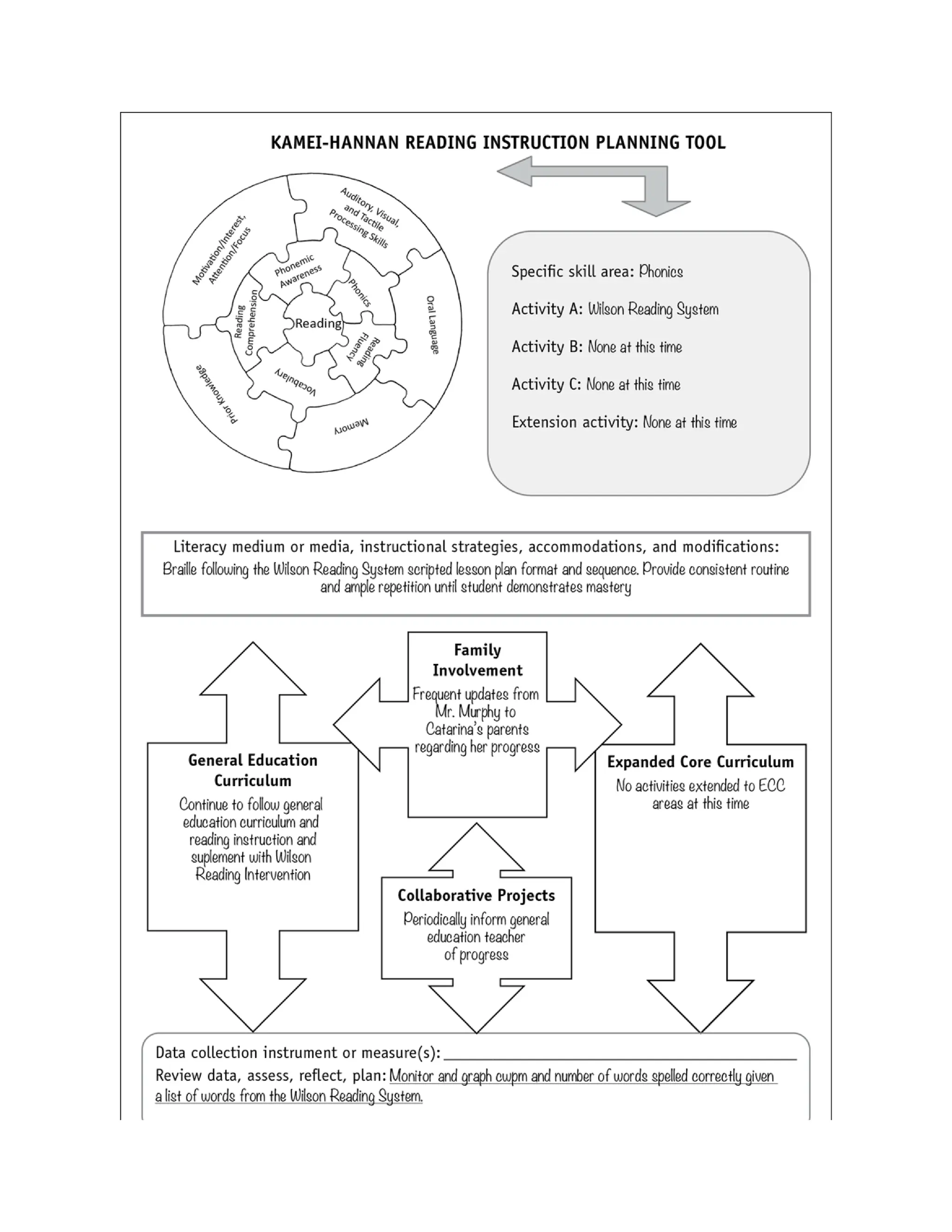
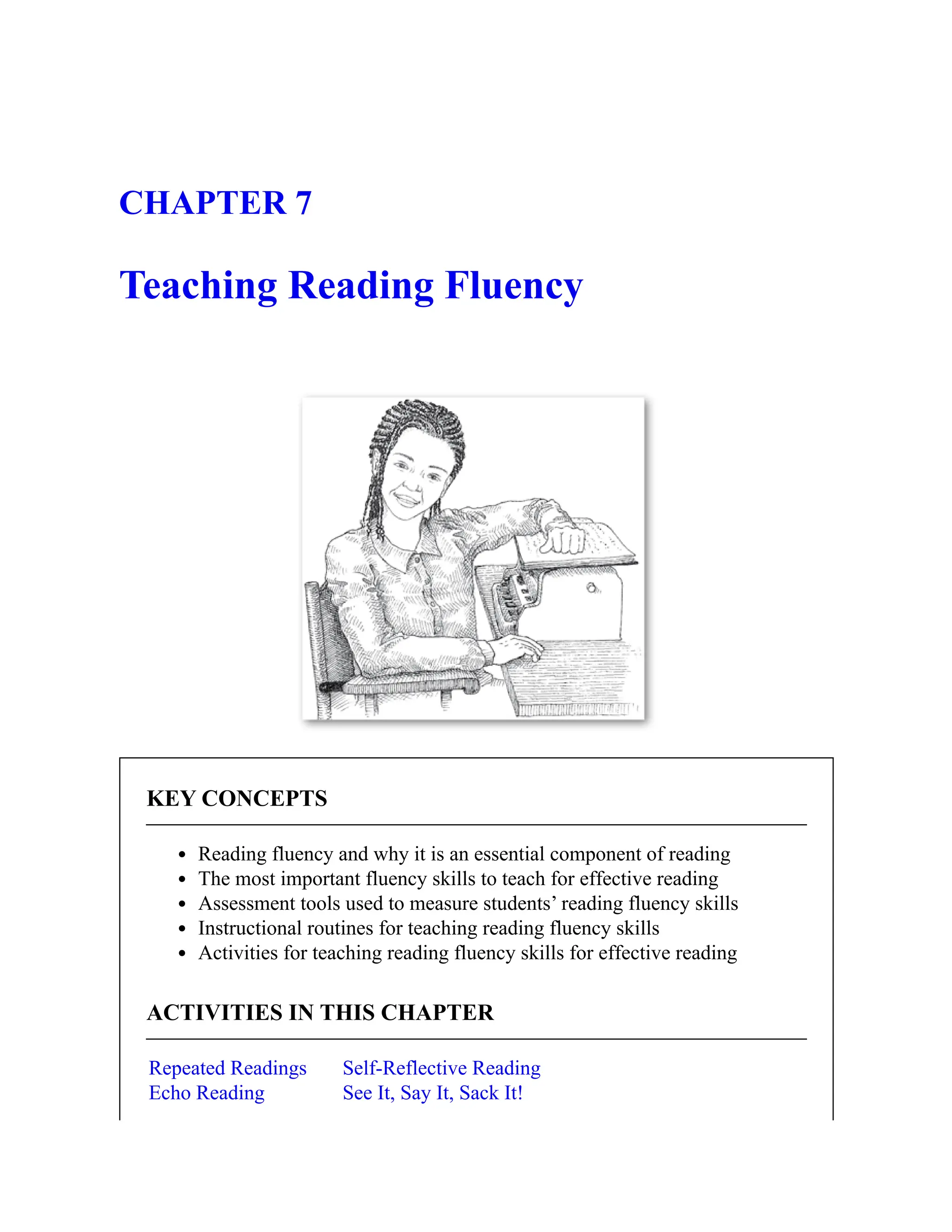
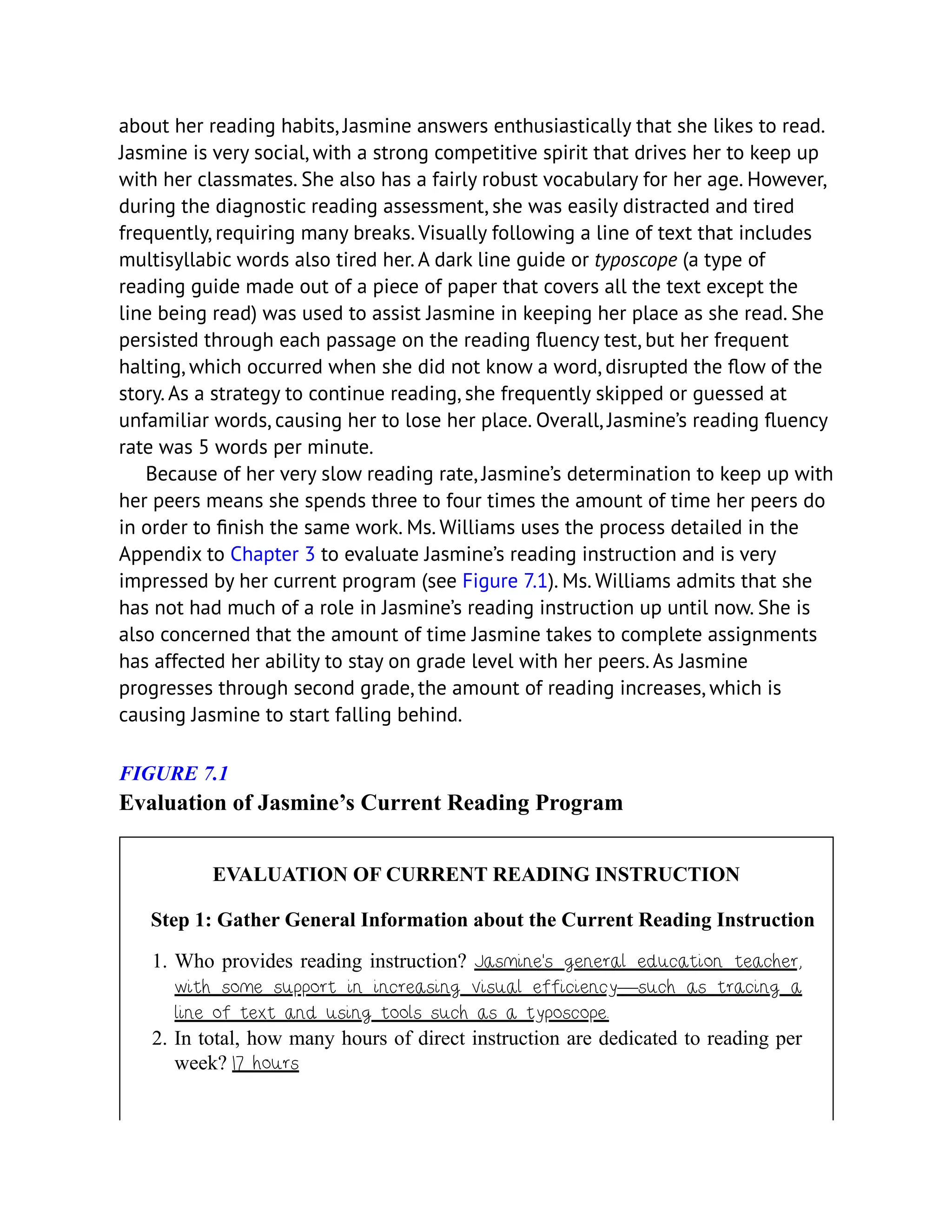
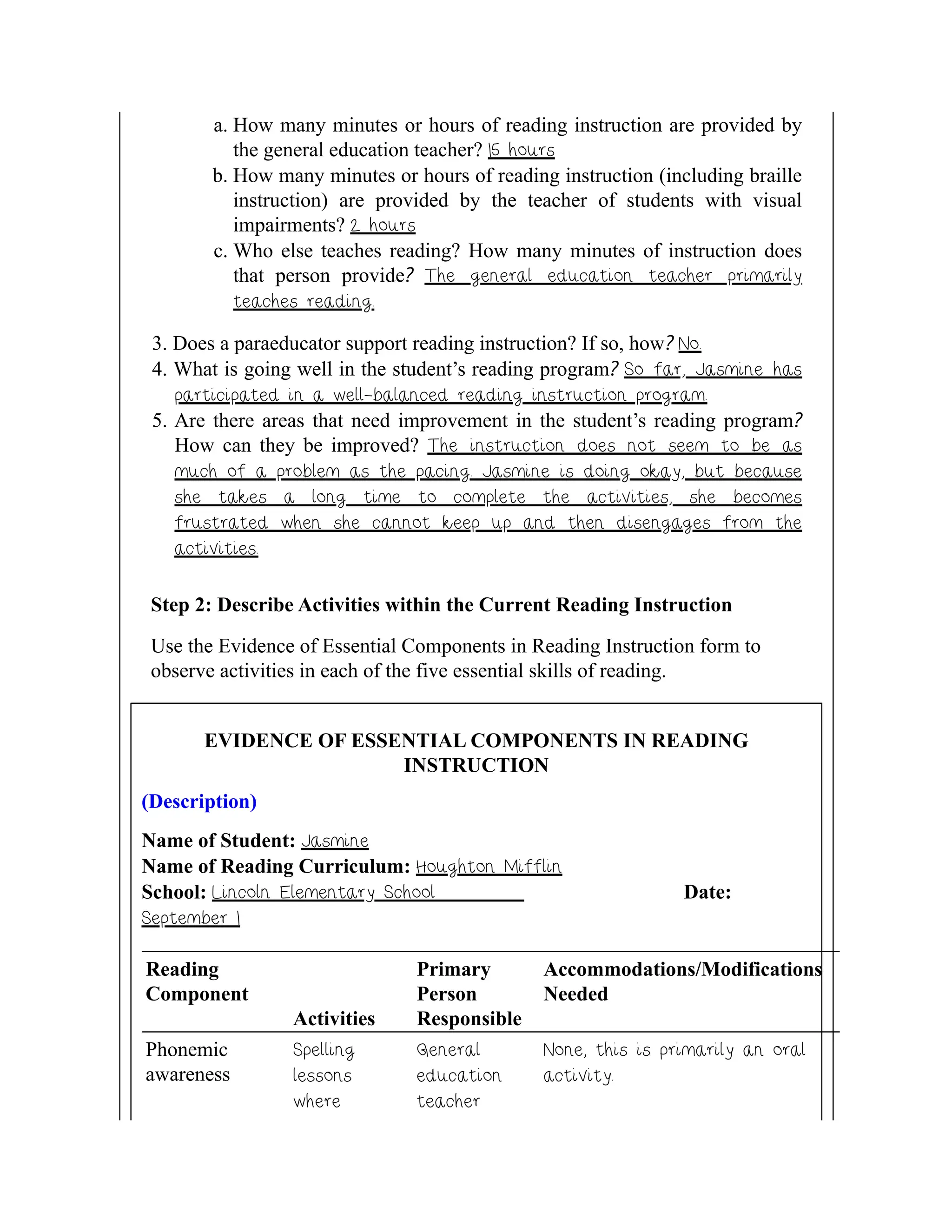
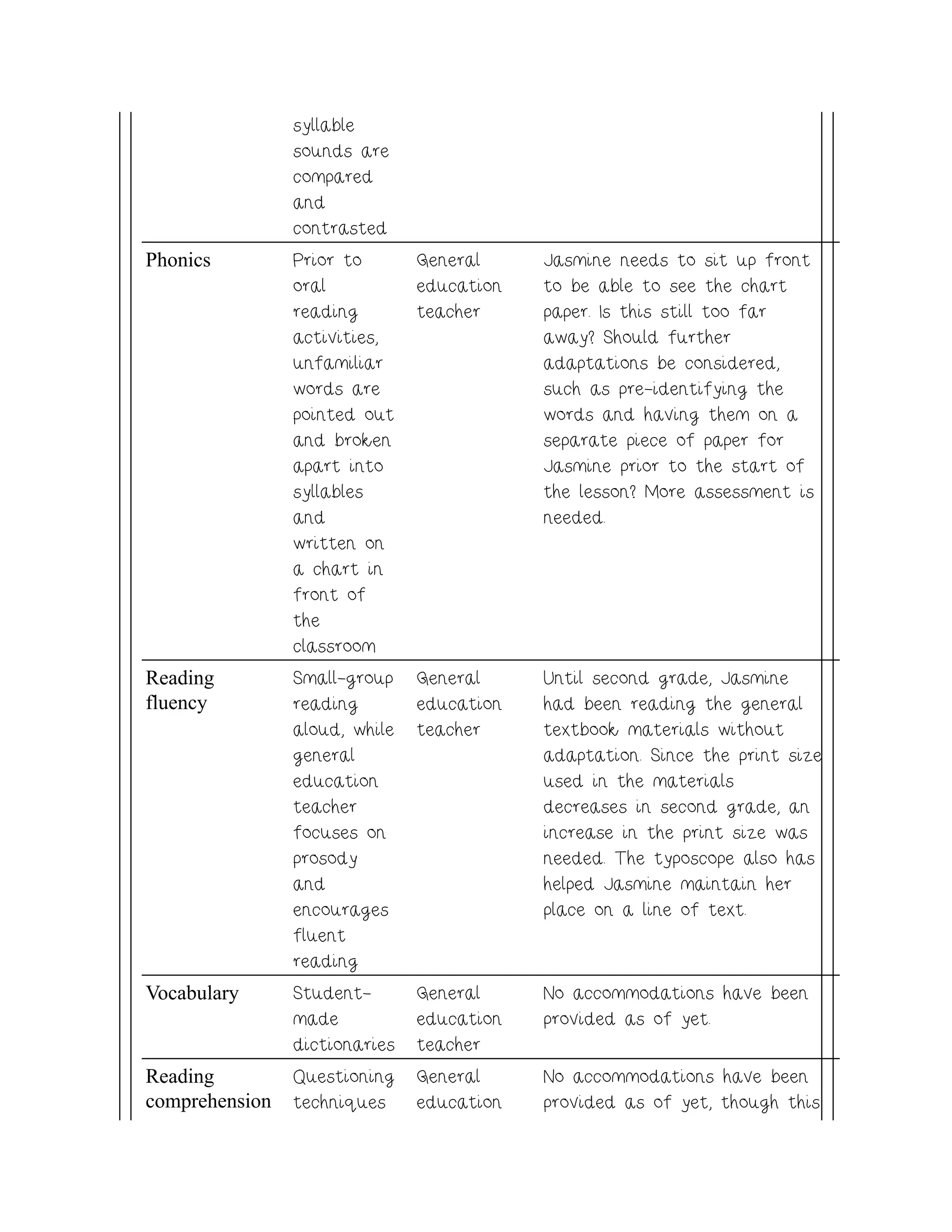
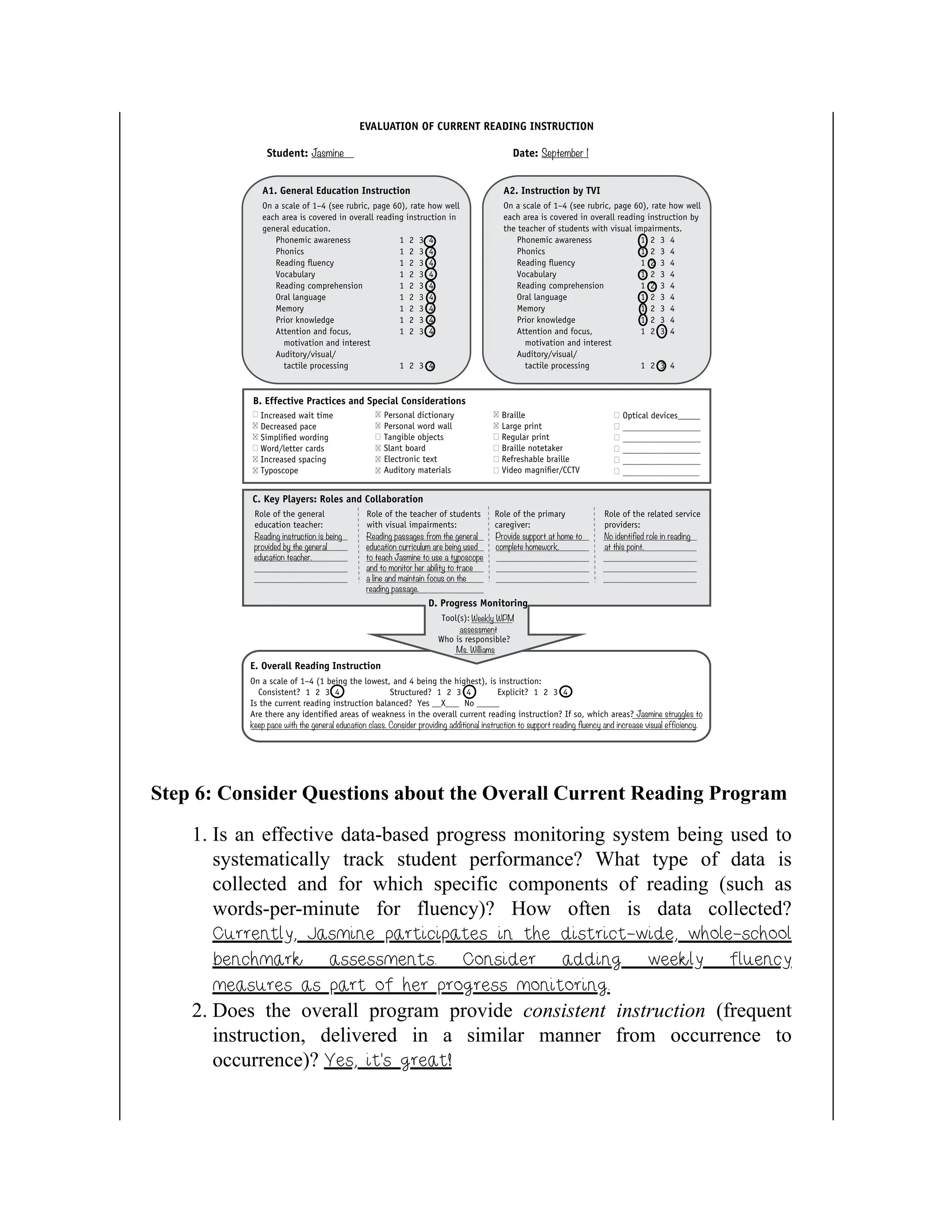
![Over the years, a few different formulas and indexes have been devised for
calculating readability. Most formulas analyze the difficulty of text based on
the number of words in each sentence, the number of syllables in the words,
and the number of words that do not appear on a list of commonly used words
(e.g., the DOLCH list of commonly used words). The readability formulas
presented in this sidebar are used to analyze student reading materials found in
educational settings. You may encounter scores from these formulas in
textbooks, leveled readers, and other published reading materials for students.
Among the different formulas currently in use are the following:
Flesch Reading Ease score: uses a scale of 0–100, with a higher score
representing easier texts.
Flesch-Kincaid Grade Level: uses a score indicating grade-level
equivalency—a score of 2 means that the text is representative of
second-grade level material.
Gunning Fog Index: uses a scale from 1–20, with 1–5 being easy or
about elementary level reading, 6–10 being hard or about middle school
level reading, 11–15 being difficult or about high school level, and 16–
20 being very difficult or about college level reading.
Fry Graph Readability Formula: uses grade-level equivalency as a
scale.
Dale-Chall Formula: provides grade-level equivalencies.
Spache: provides grade-level equivalencies.
Lexile: provides a score that can be compared with the Dale-Chall or Fry
to get a grade-level equivalency.
Degrees of Reading Power (DRP) scale of text complexity: developed by
Questar (http://drp.questarai.com/home/), DRP uses a scale ranging from
0–100 and is linked to a system of assessments; provides a score that
can be compared with the Dale-Chall or Fry to get a grade-level
equivalency.
ATOS Analyzer: developed collaboratively by Renaissance Learning and
Touchstone Applied Science Associates (the assessment company that
designed the Degrees of Reading Power [DRP] readability scale;
Milone, 2014), ATOS analysis considers the number of words in a
passage and average length of words and sentences in its calculation
(www.renaissance.com/products/accelerated-reader/atos-analyzer;
Renaissance Learning, 2014). The Common Core State Standards
recognize ATOS as a valid and reliable tool for determining text
complexity.](https://image.slidesharecdn.com/readingconnections-strategies-for-teaching-students-with-visual-impairments-250721170318-cb16127e/75/Reading-Connections-Strategies-for-Teaching-Students-with-Visual-Impairments-236-2048.jpg)
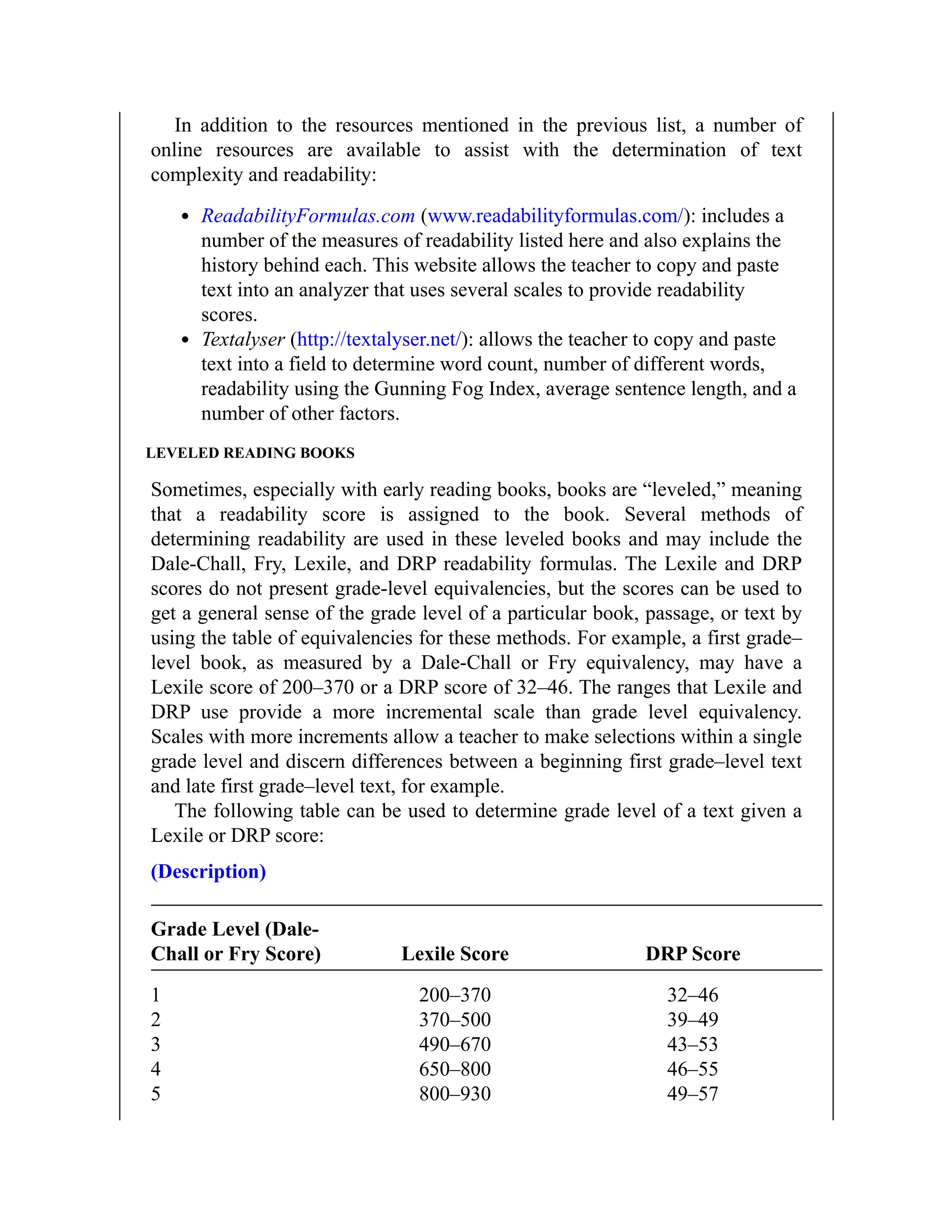
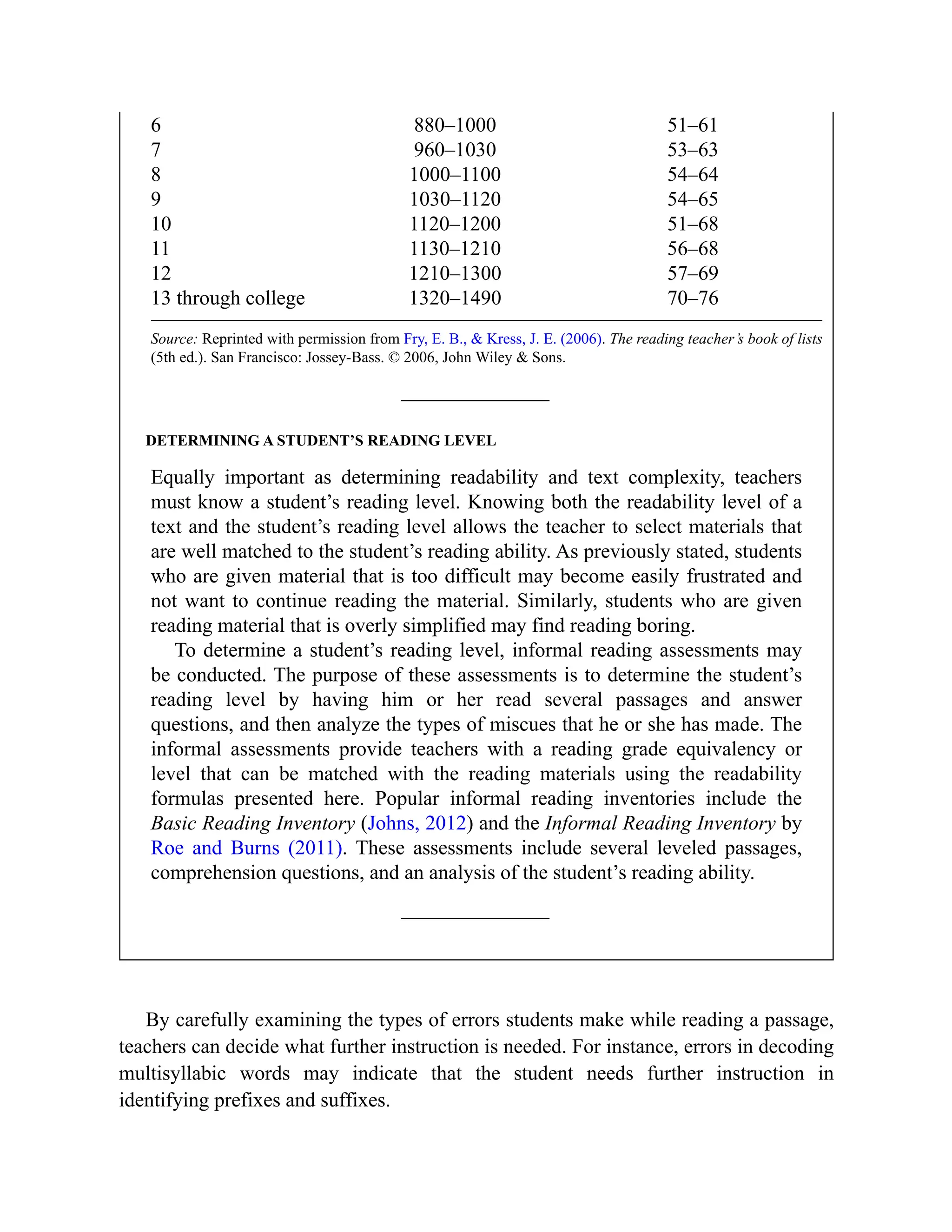
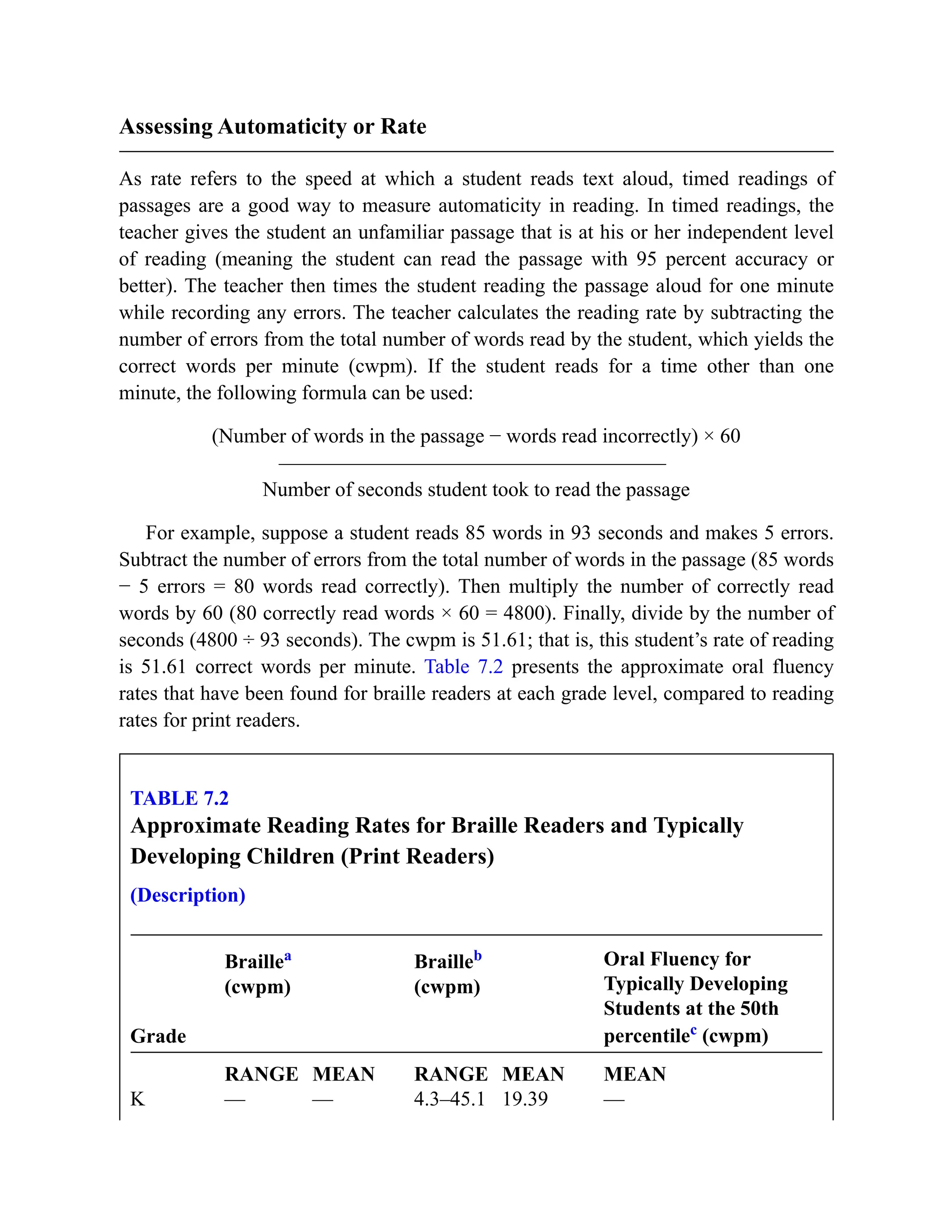
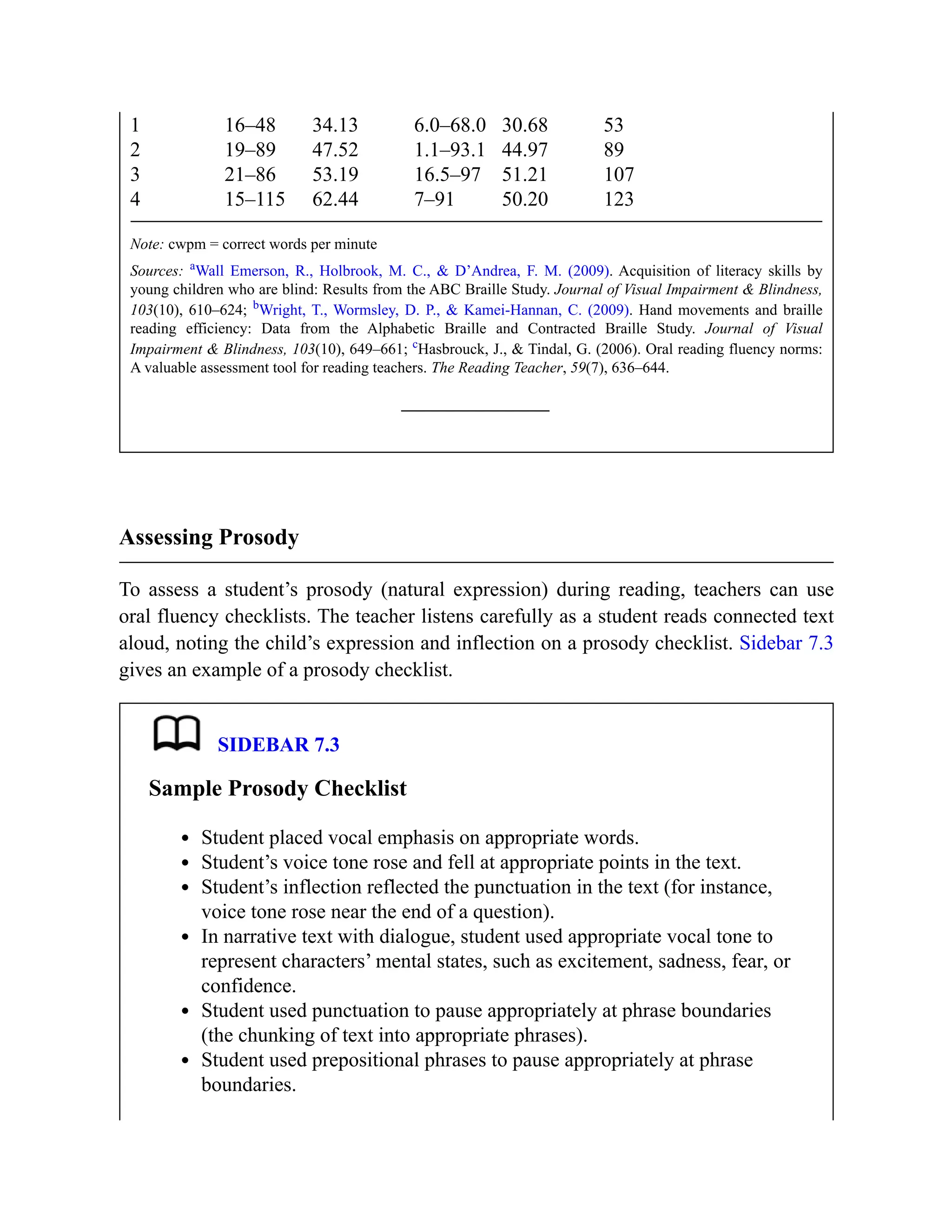
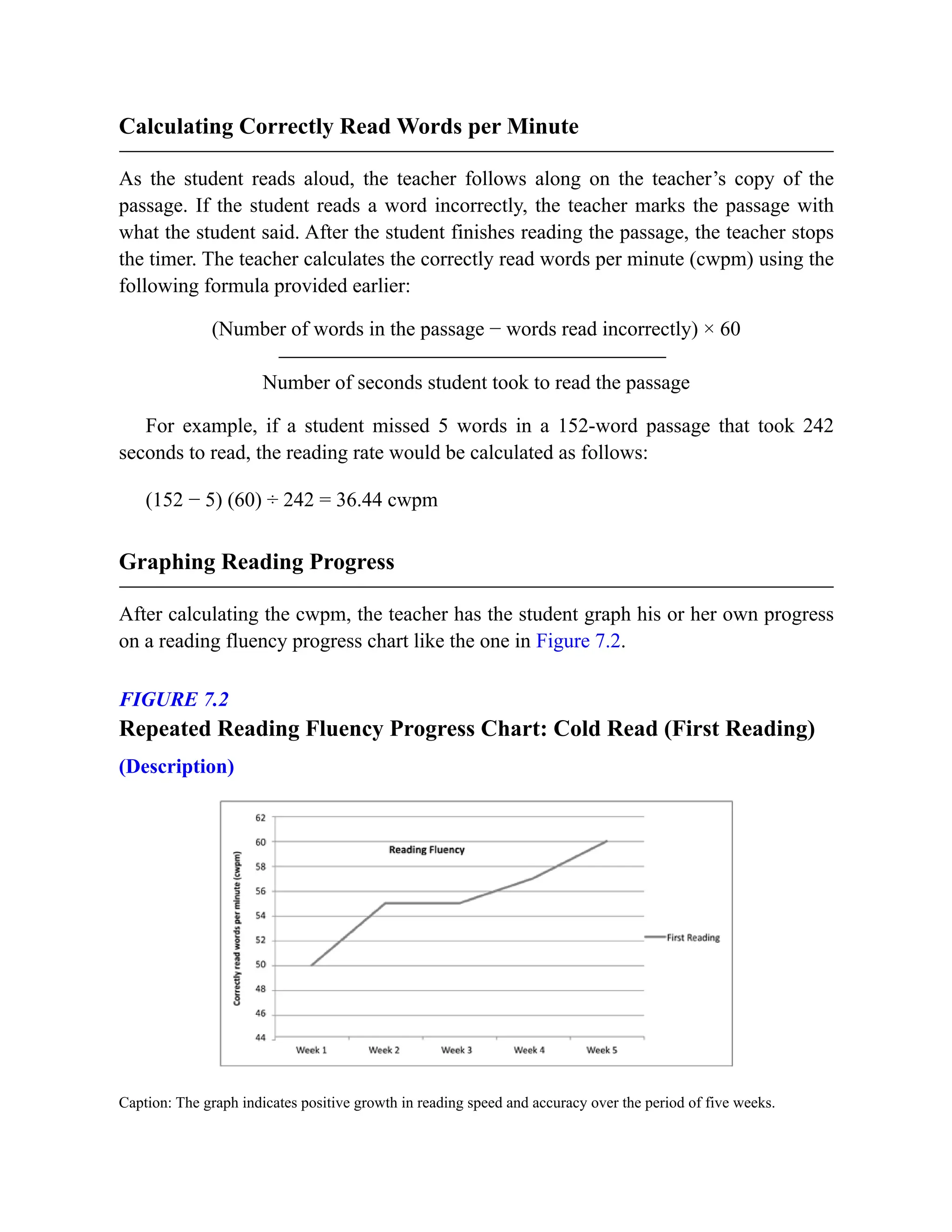
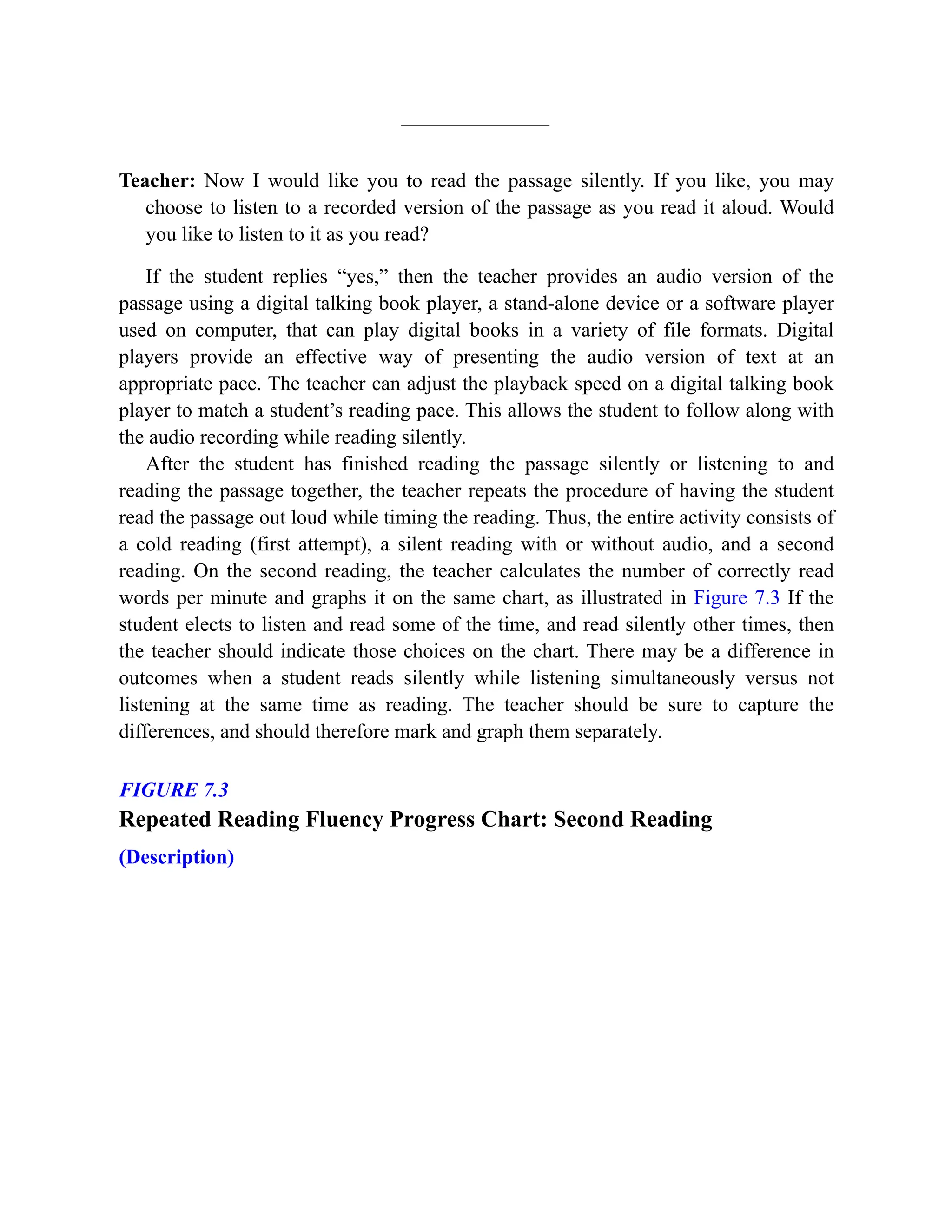
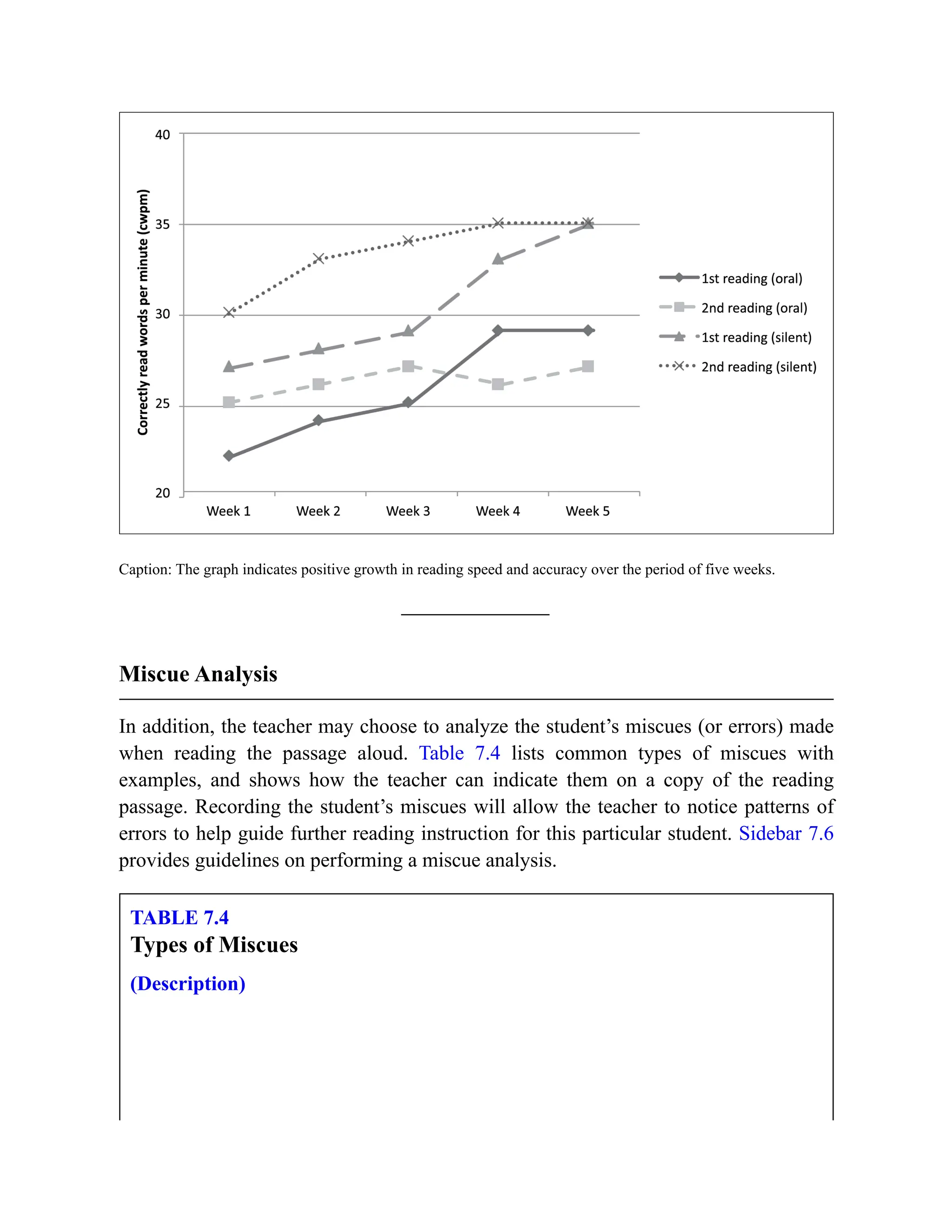
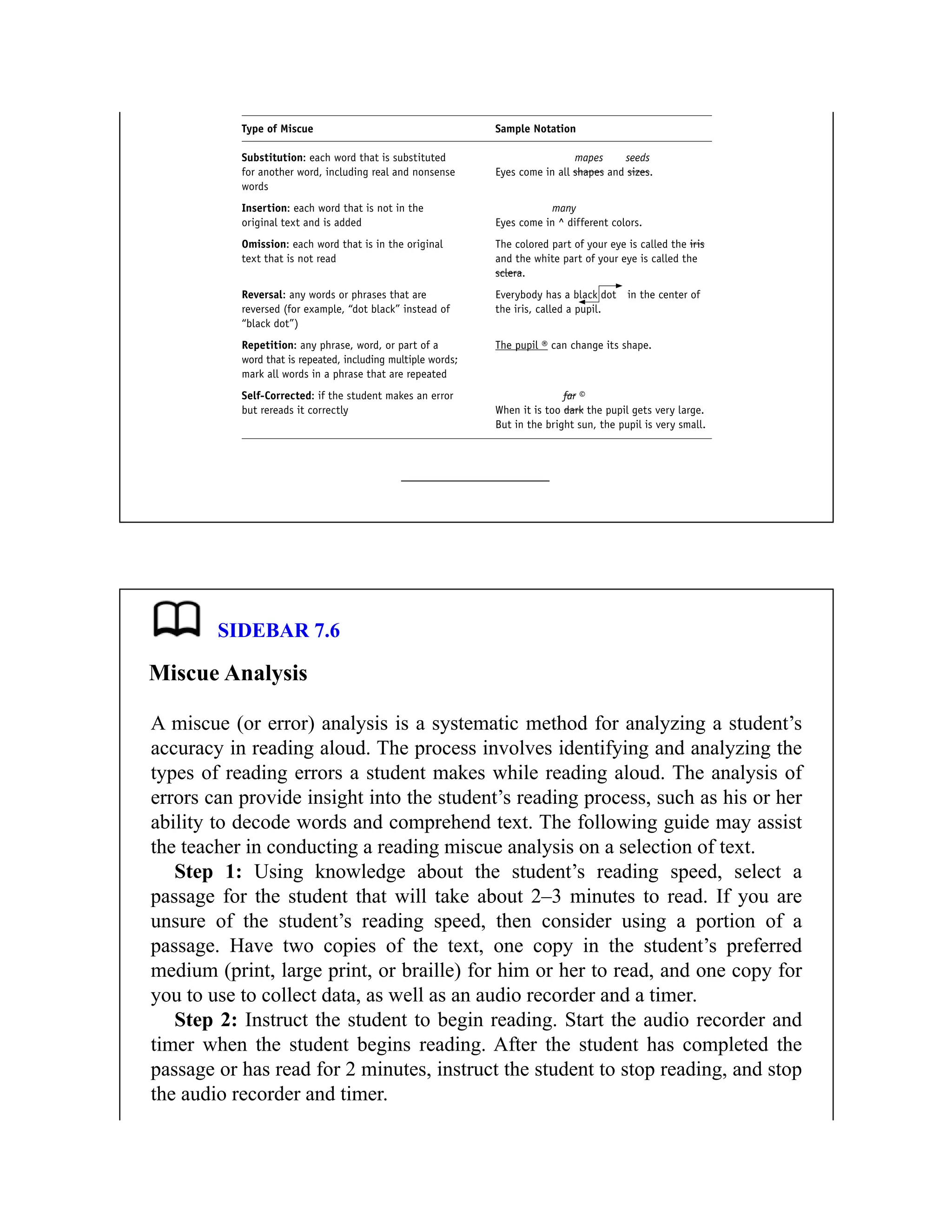
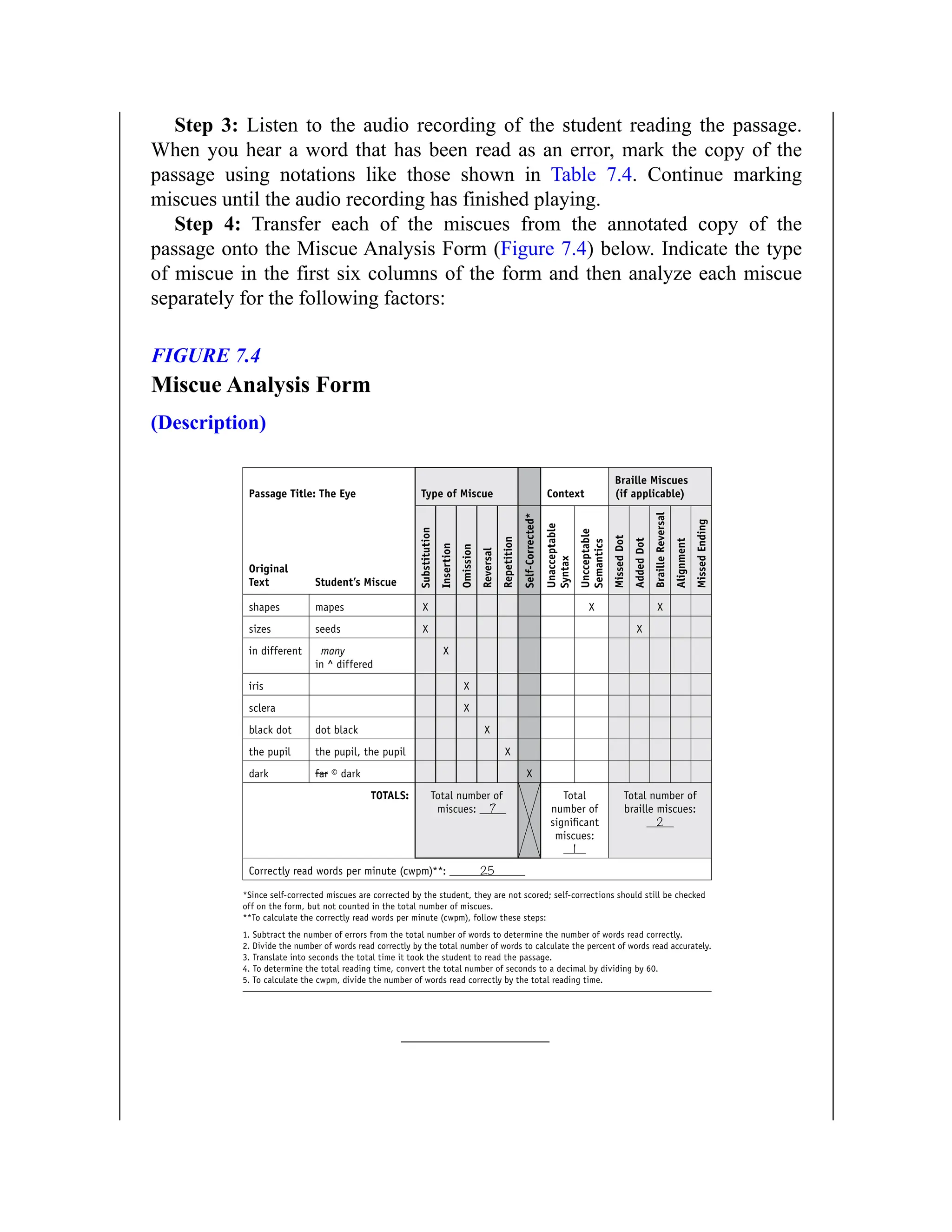
![(Description)
333333333 & 3333333333333) 3333333333333 y
3333333333333 n 3333333333333 h
3333333333333 x 33333333333333 ?
3333333333333 b 3333333333333 h]
333333333333333 %e 3333333333333 c
333333333333 we 333333333333333333 I
333333333333333
Hide-and-Seek
Goal: to develop phrasing skills
Additional skills: to develop tactile and motor skills
Materials: readers with low vision will need a typoscope and a print worksheet
with common phrases written in two columns down the left side of the paper;
readers of braille will need a brailled worksheet with common phrases written
on lines, separated by a string of braille cells using dots 2 and 5. On the last
line of the page, write the name of an animal or a person. When creating the
worksheets, use common phrases with similar concepts that could be used to
identify the animal or person.
For readers with low vision: Say, “Someone is playing a game of hide-and-seek. Who
do you think it is?” Have the student use the typoscope to center the first phrase within
the typoscope. The student moves the typoscope from left to right and top to bottom.
When the student reaches a phrase, have him or her read the phrase aloud. The phrases
should all relate to the game of hide-and-seek and provide clues as to who is hiding.
For example, phrases may include:
at the shore near the bank
in the lake by my house
on a lily pad that croaks all night
Who is it? It’s a frog.
For braille readers: Say, “Someone is playing a game of hide-and-seek. Who do
you think it is?” Have the student use both hands to track a line of braille cells. When
the student reaches a phrase, have him or her read the phrase aloud. The phrases](https://image.slidesharecdn.com/readingconnections-strategies-for-teaching-students-with-visual-impairments-250721170318-cb16127e/75/Reading-Connections-Strategies-for-Teaching-Students-with-Visual-Impairments-264-2048.jpg)
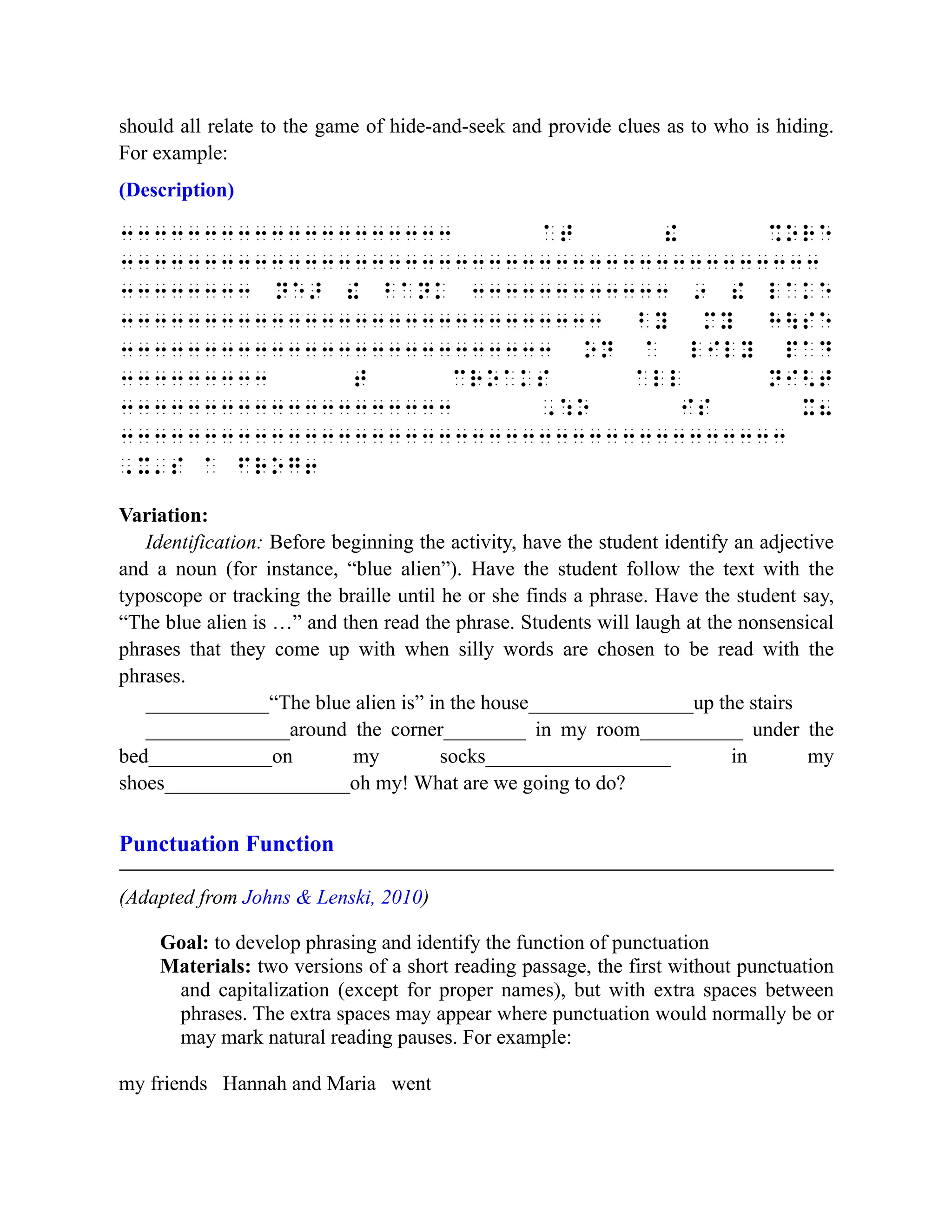
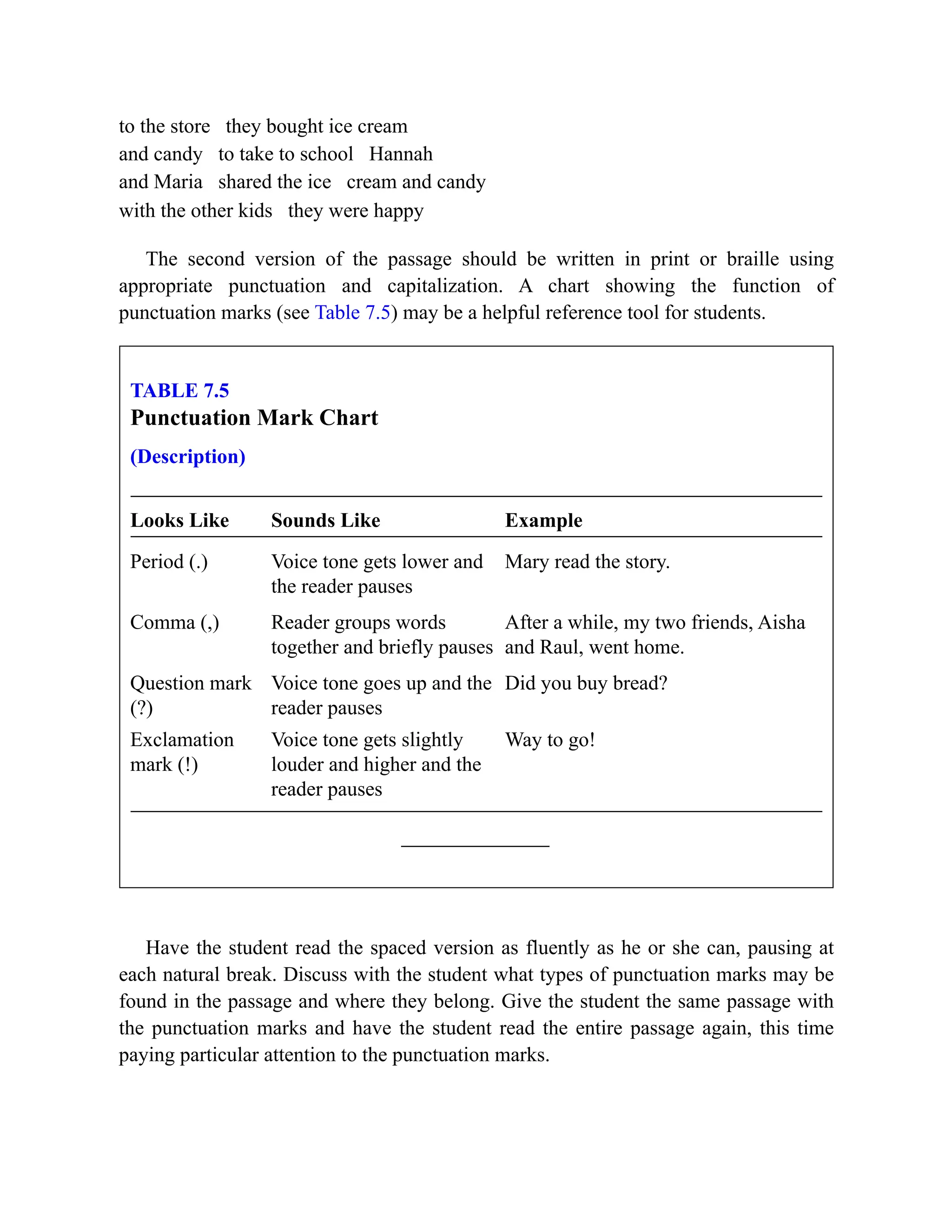
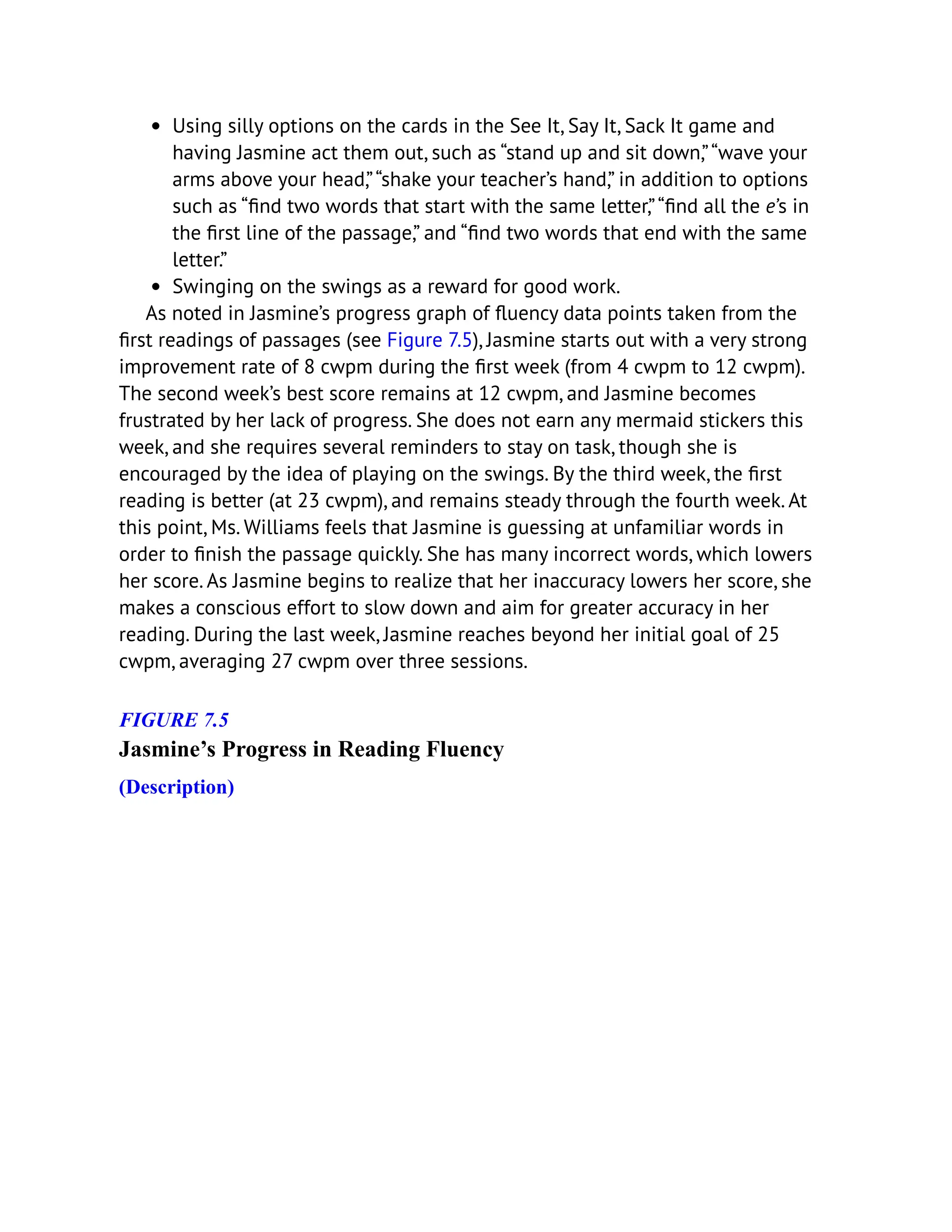
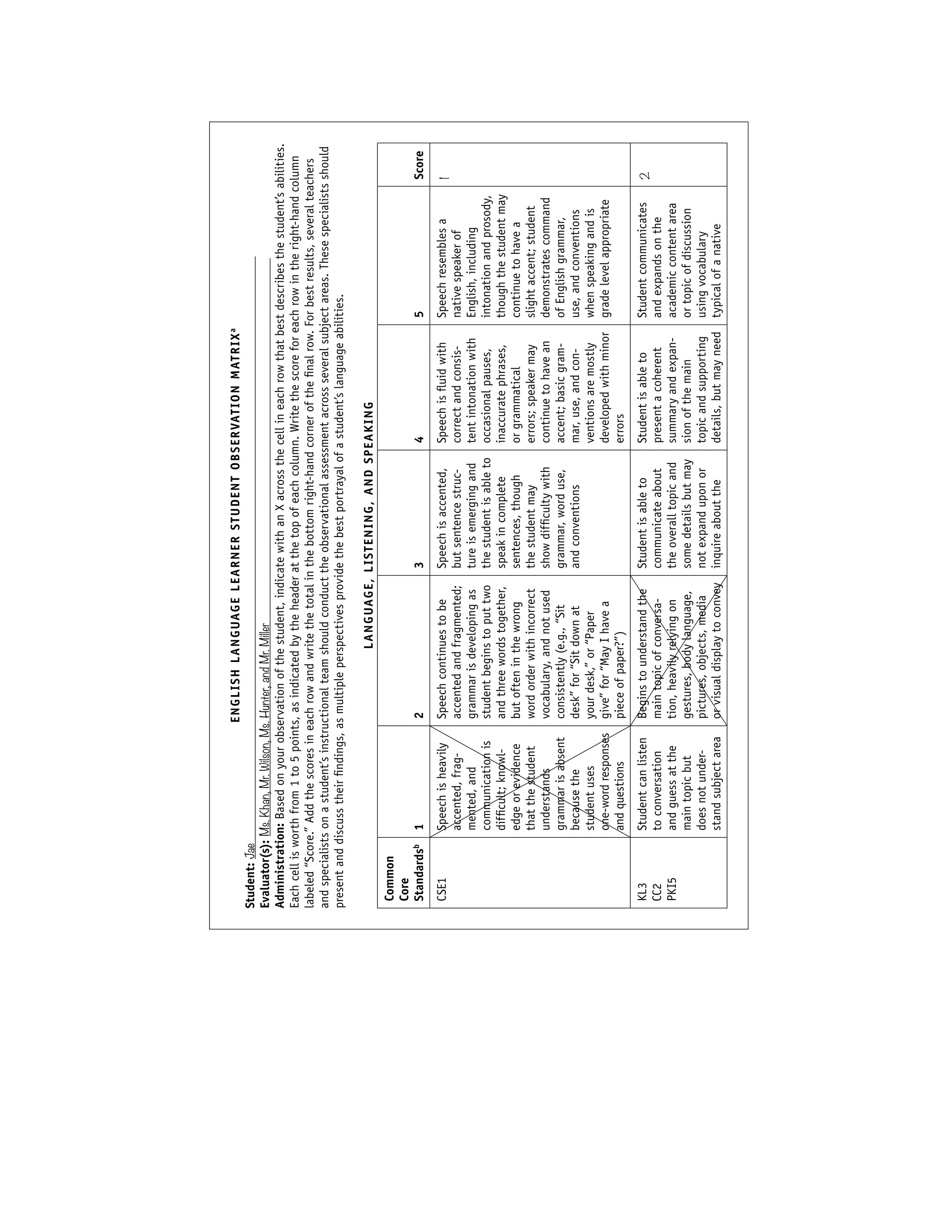
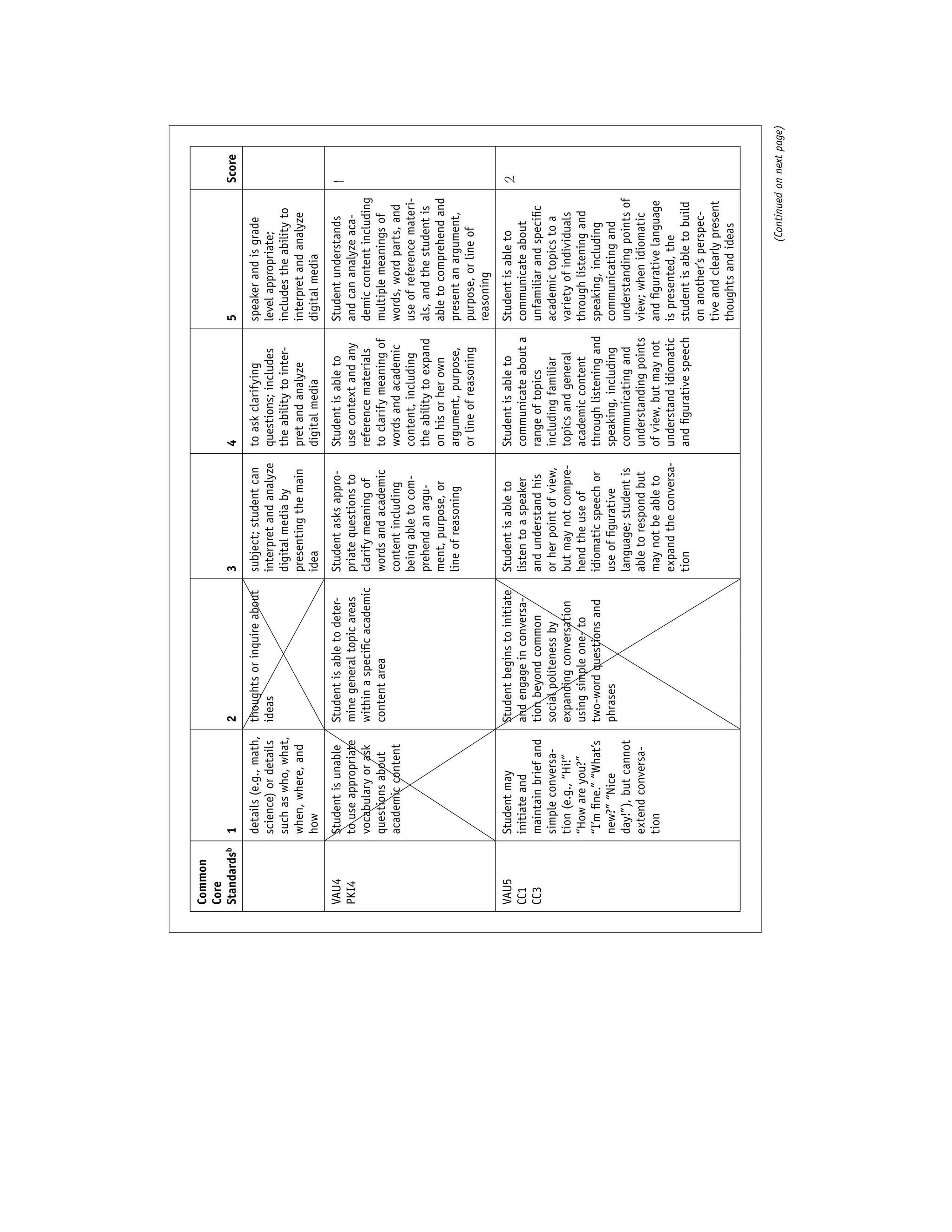
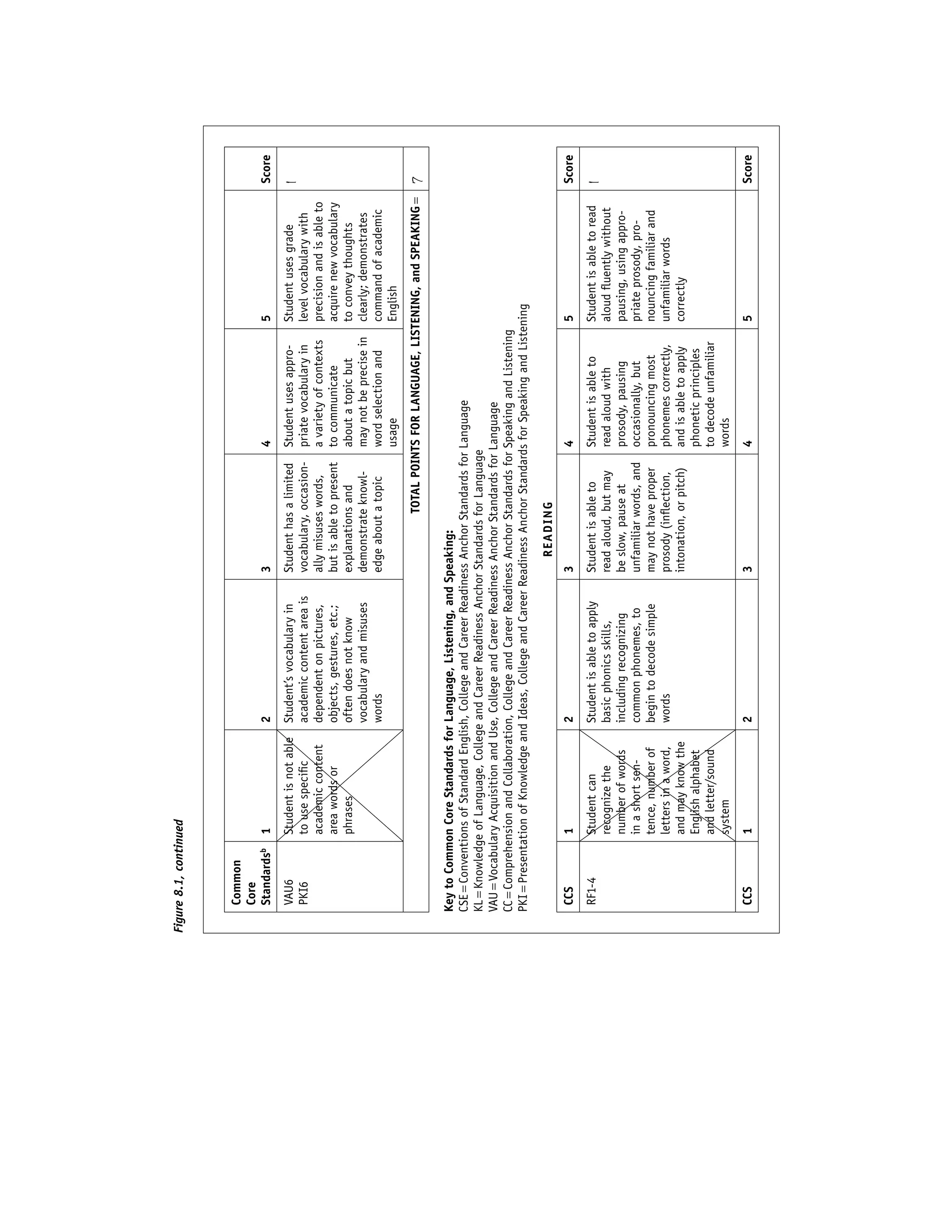
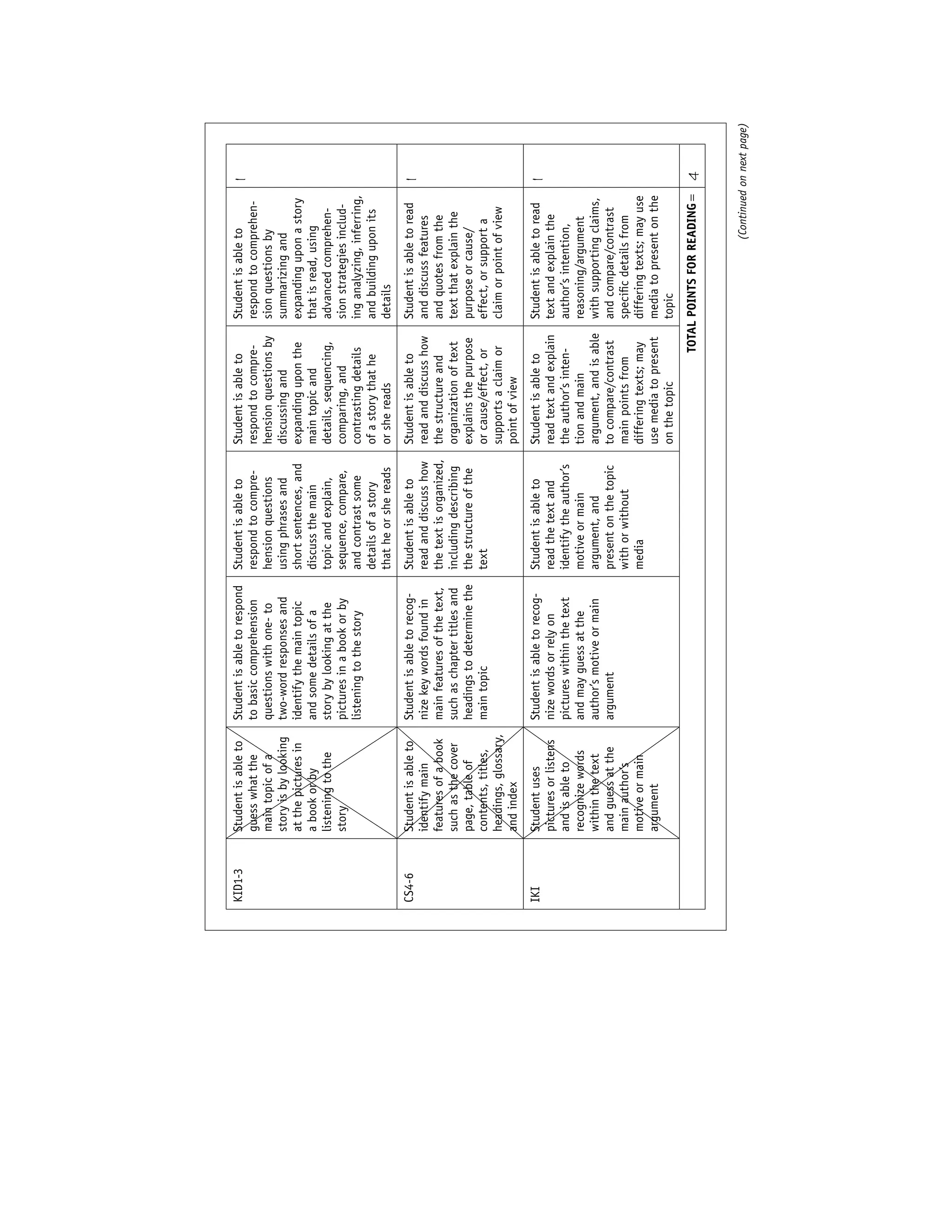
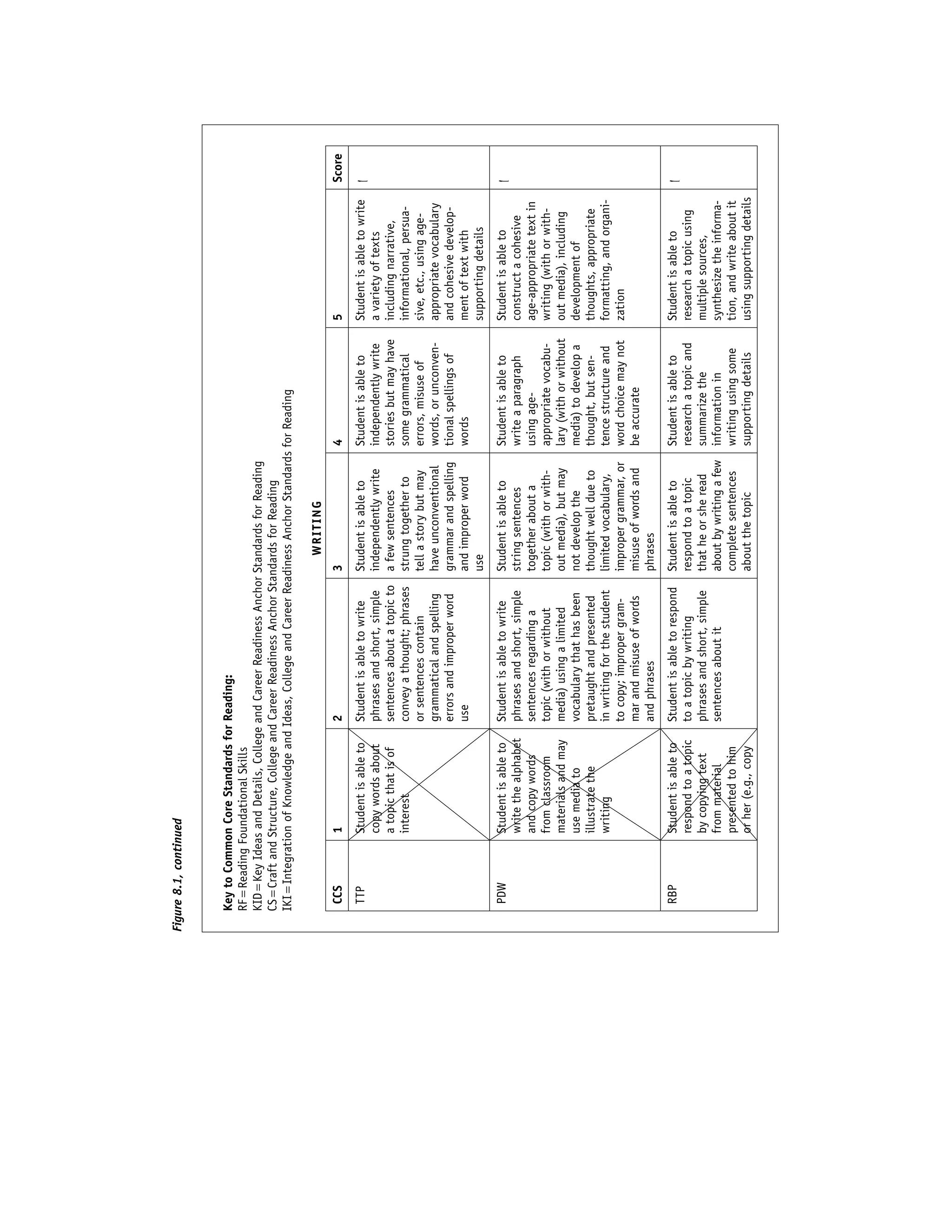
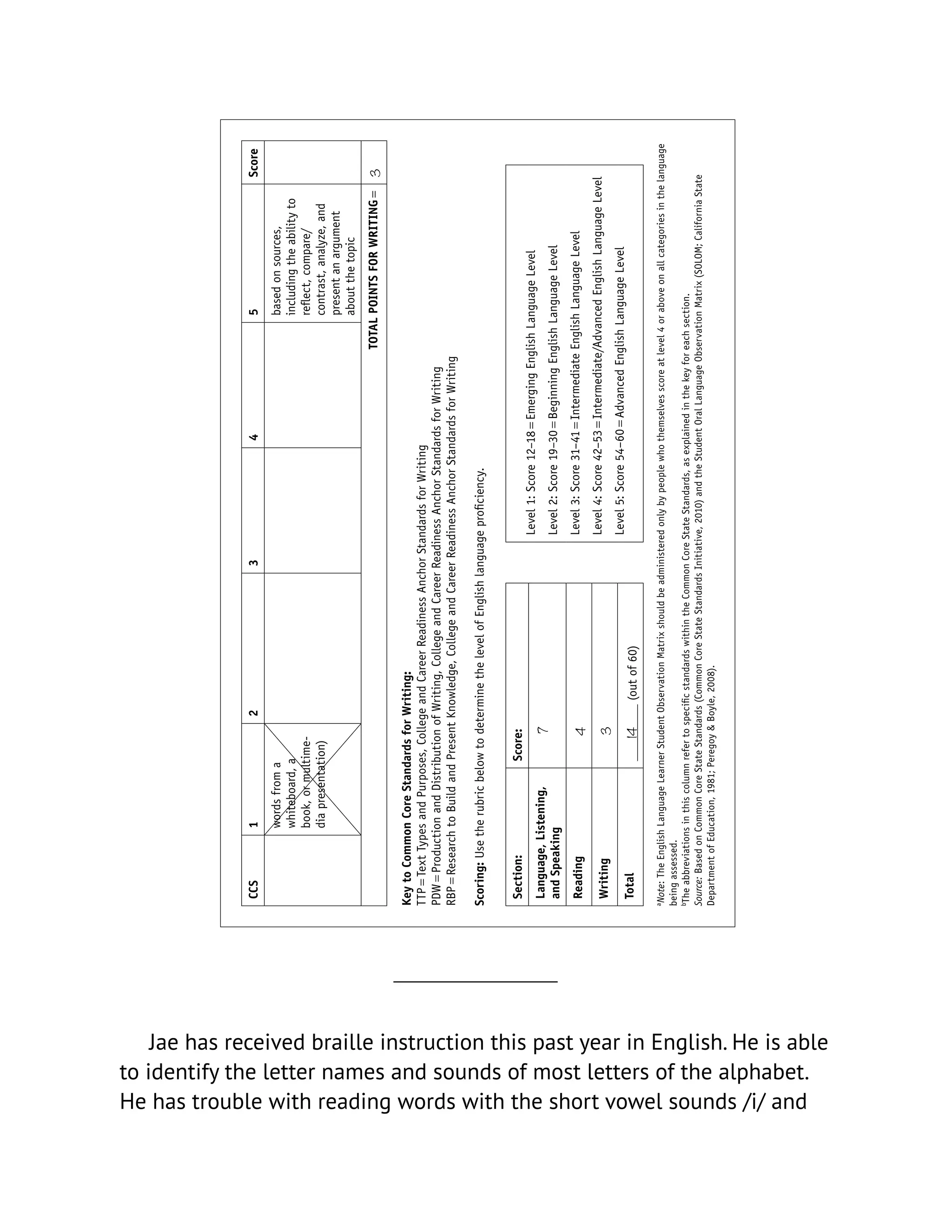
![THE IMPORTANCE OF VOCABULARY
Learning new words is a gateway to learning more about the world. Young
children frequently ask their parents, “What does [insert any word here]
mean?” As children become readers, this knowledge of vocabulary helps
them to understand stories and textbooks. The new words children learn about
in books keep building their knowledge, and so the cycle ideally continues.
Children who acquire a love of learning develop strong vocabularies; strong
vocabularies, in turn, make them brighter learners. Vocabulary knowledge is
therefore essential for competent reading. Understanding a large repertoire of
vocabulary words allows children to better comprehend a variety of written
materials (Nagy, 1988; Pressley, 2000). Without adequate vocabulary
knowledge, children may perform poorly in reading, particularly in
comprehension (Biemiller, 2006; Hart & Risley, 1995; Neuman, 2006). If
children do not have enough vocabulary knowledge to understand the
meaning of words on a page, then reading becomes laborious and
overwhelming. In addition, the more vocabulary words children know, the
more likely they are to expand their word knowledge even further by making
connections with new words they encounter (Nagy & Anderson, 1984). For
example, when children learn one word, such as “wedge,” they can quickly
learn the plural “wedges” and the verb “to wedge” with its past and present
tenses. In this manner, learning one word opens the door to learning several
other new words.
Children typically learn vocabulary both incidentally and as a result of
direct instruction. Estimates show that students acquire 6,000 distinct words
by the end of second grade and learn about 2,000–3,000 words per year
throughout their high school years (Anderson & Nagy, 1993; Biemiller,
2006). Despite the large number of vocabulary words students acquire each](https://image.slidesharecdn.com/readingconnections-strategies-for-teaching-students-with-visual-impairments-250721170318-cb16127e/75/Reading-Connections-Strategies-for-Teaching-Students-with-Visual-Impairments-280-2048.jpg)
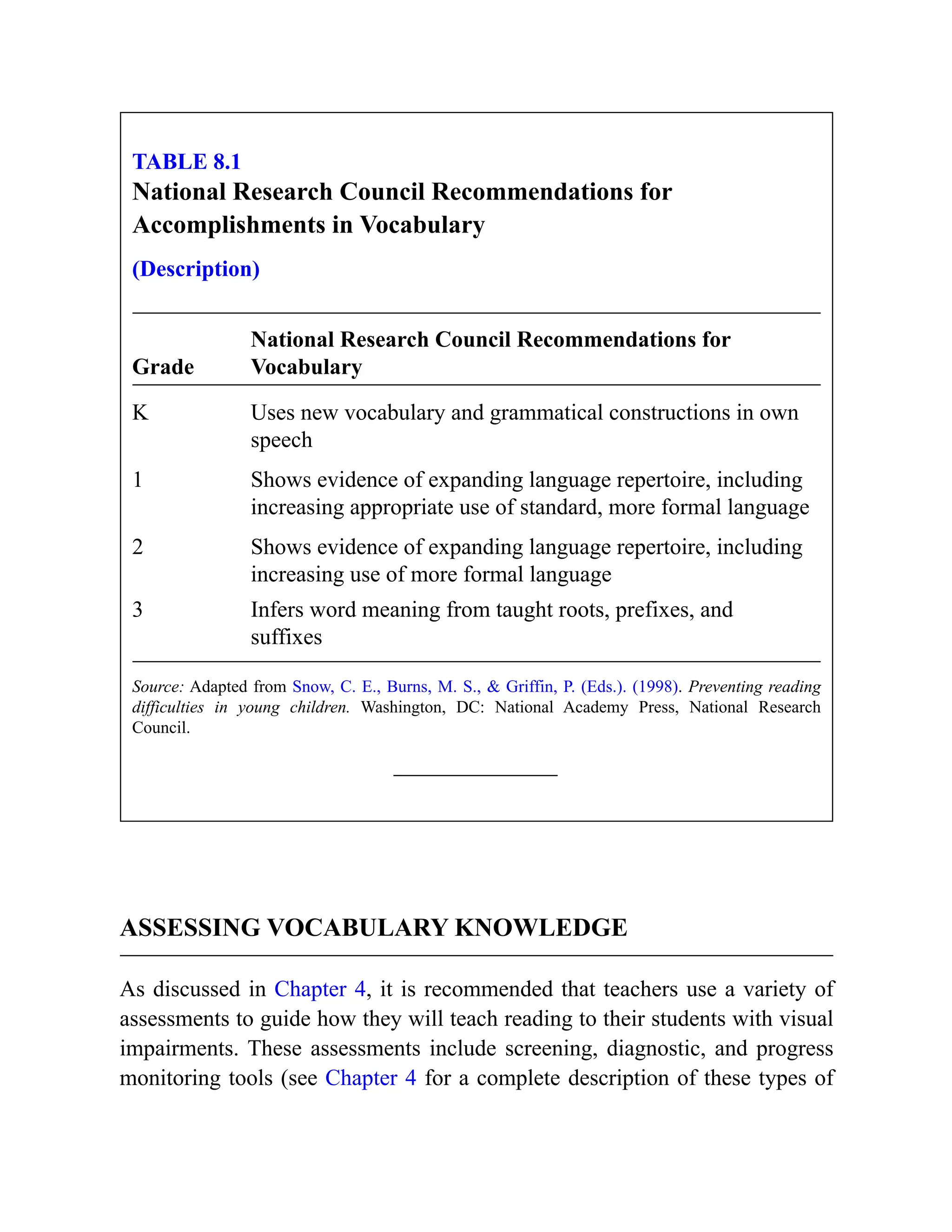
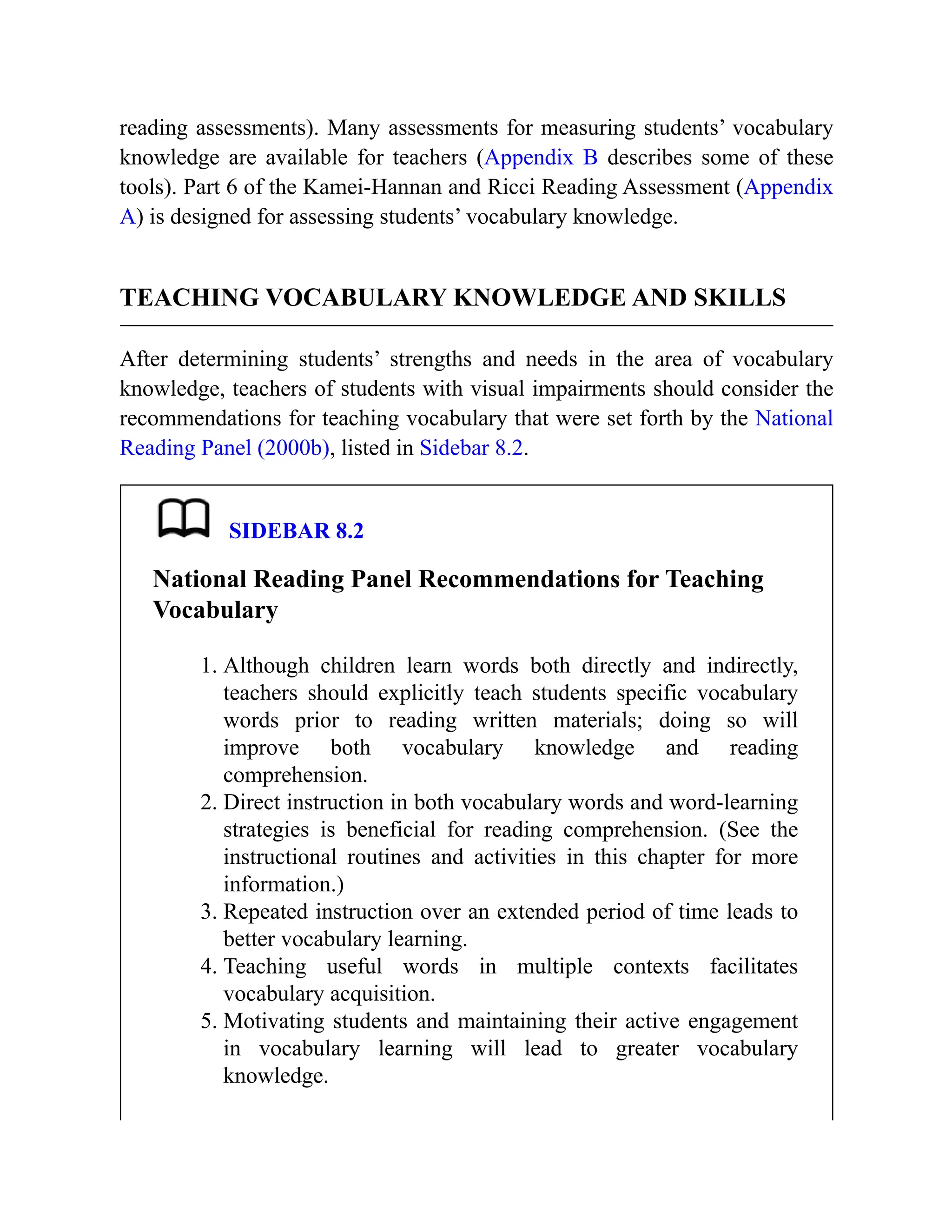
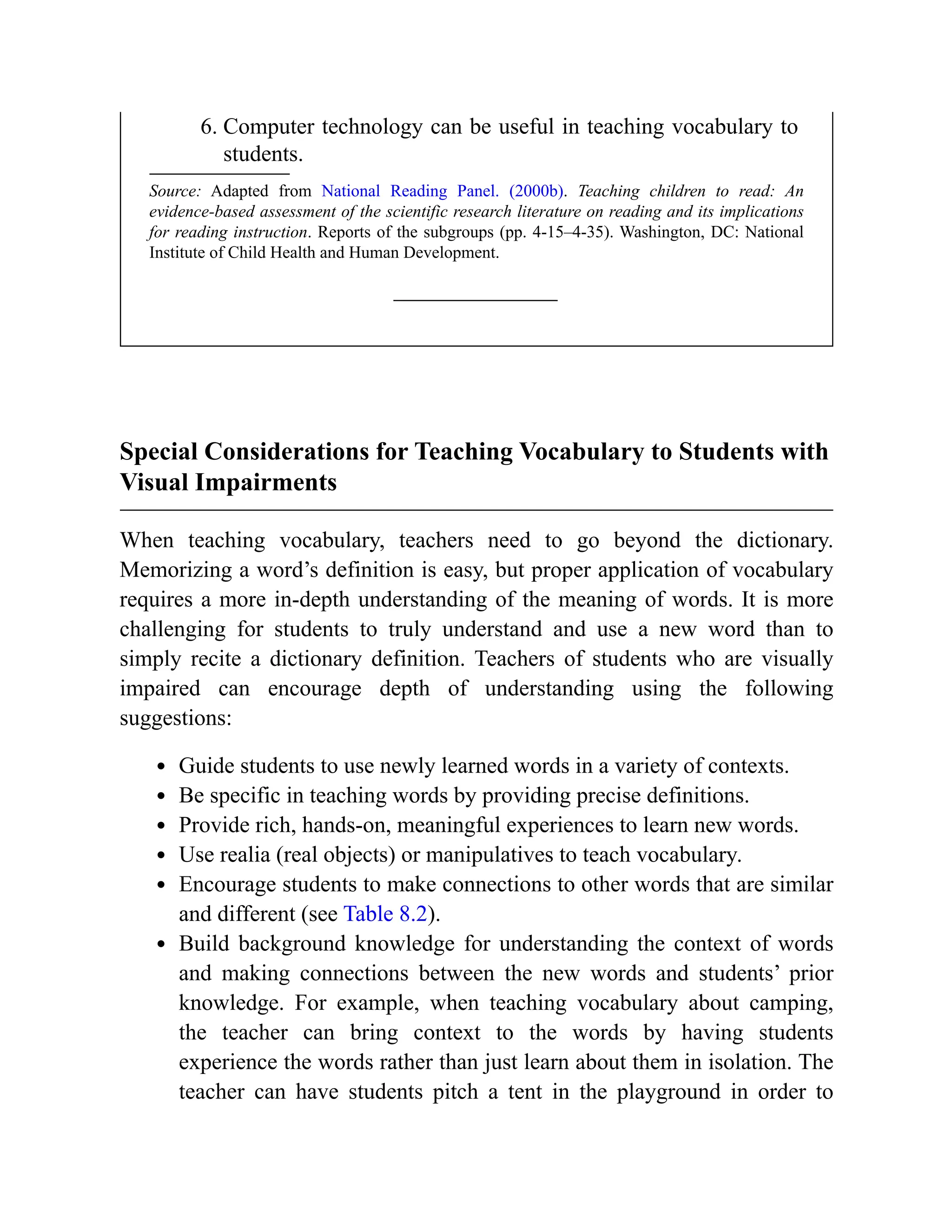
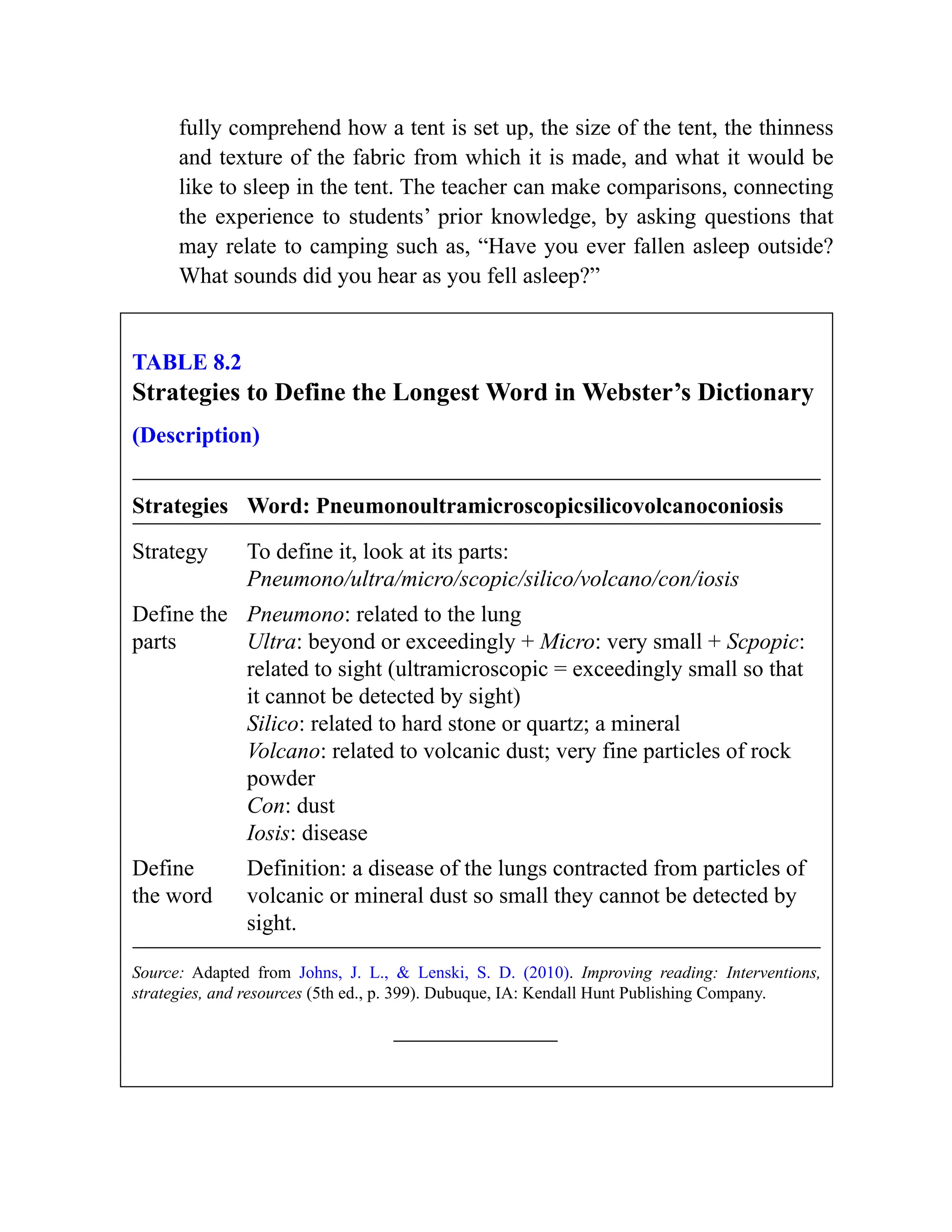
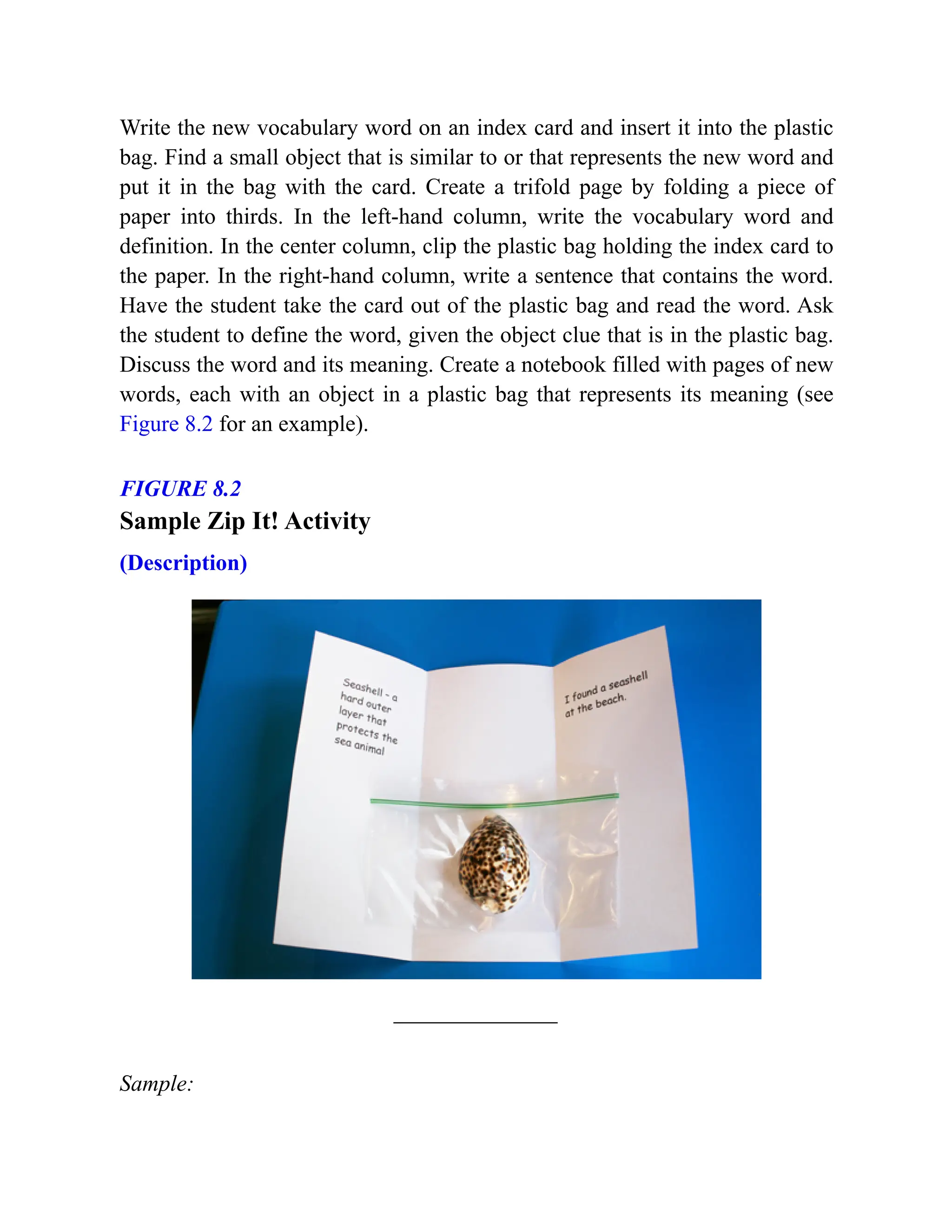
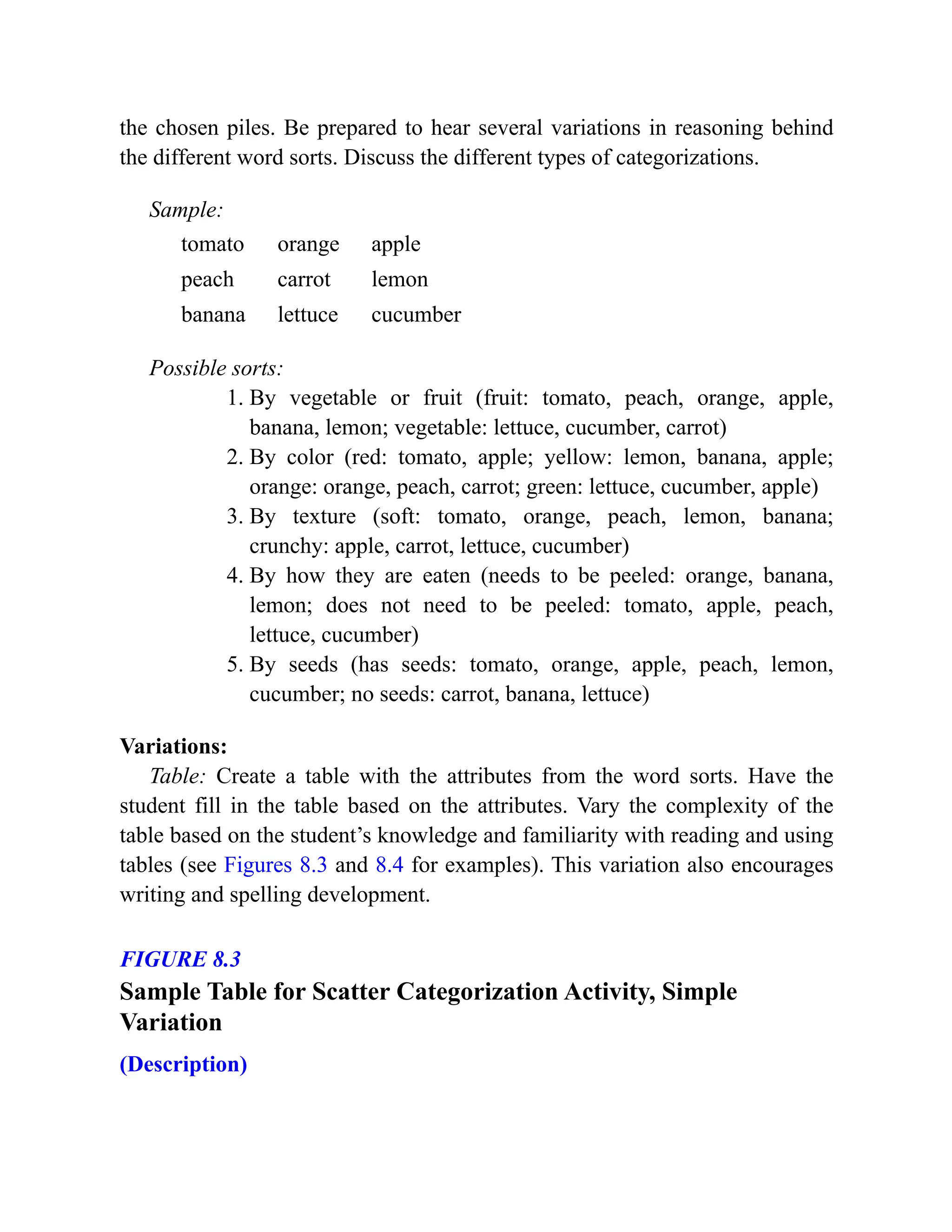
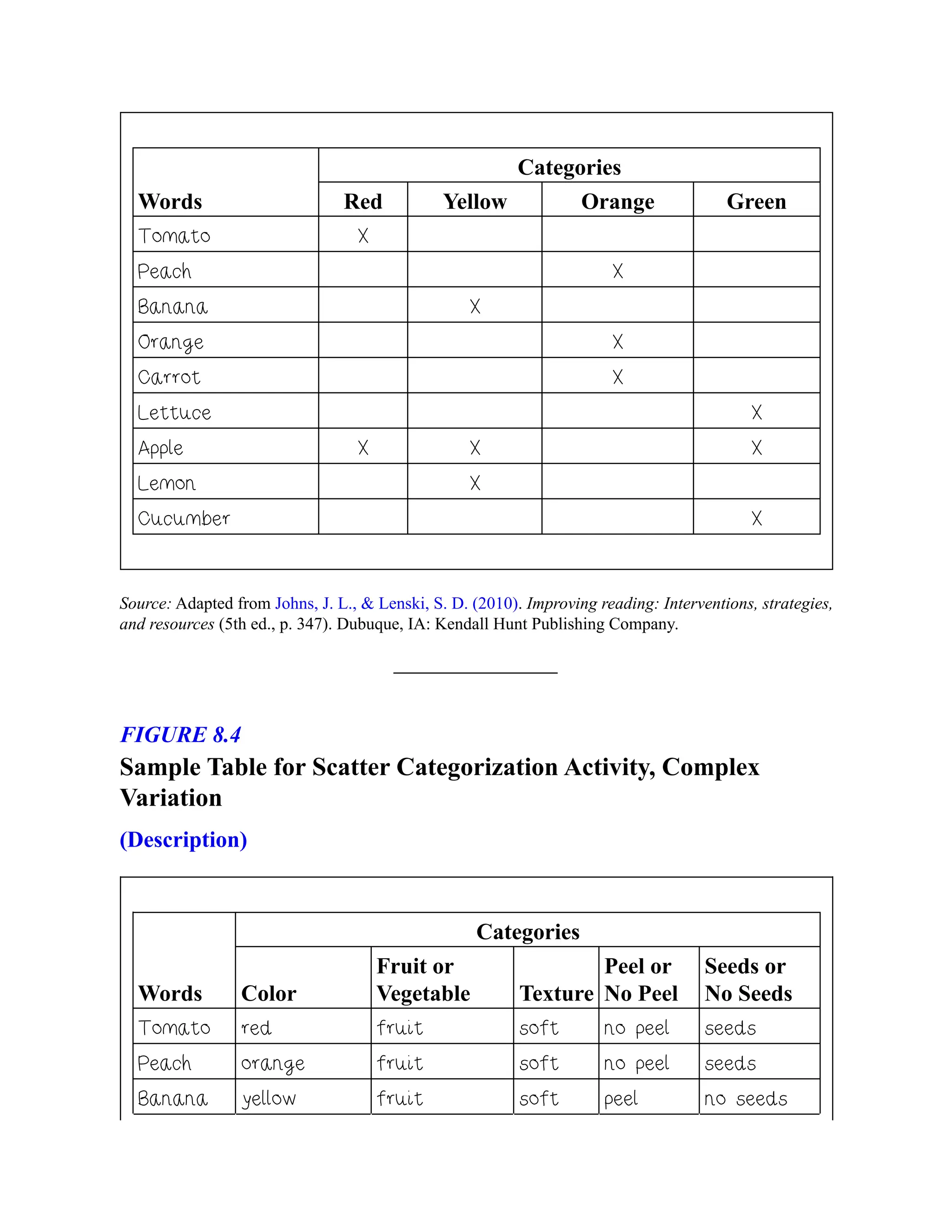
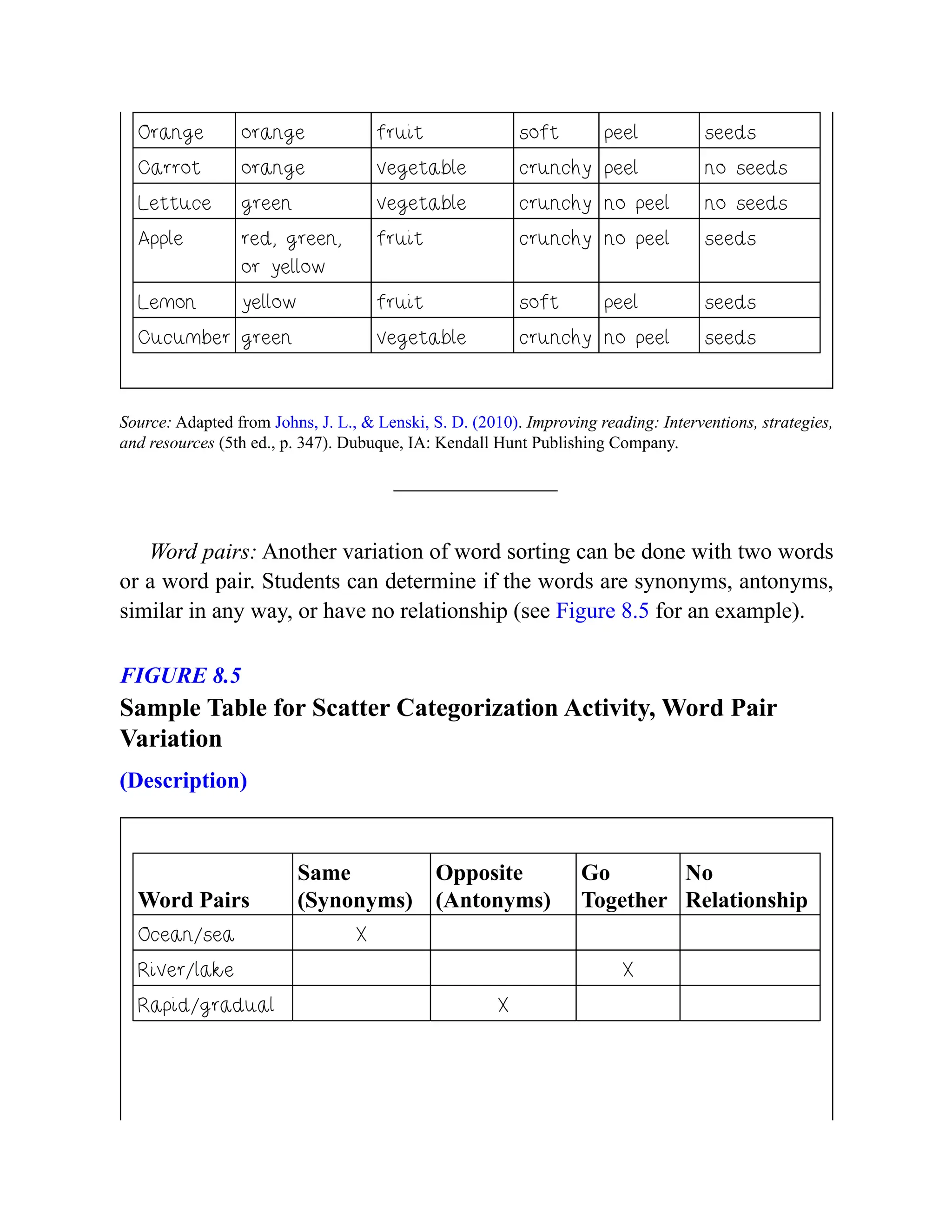
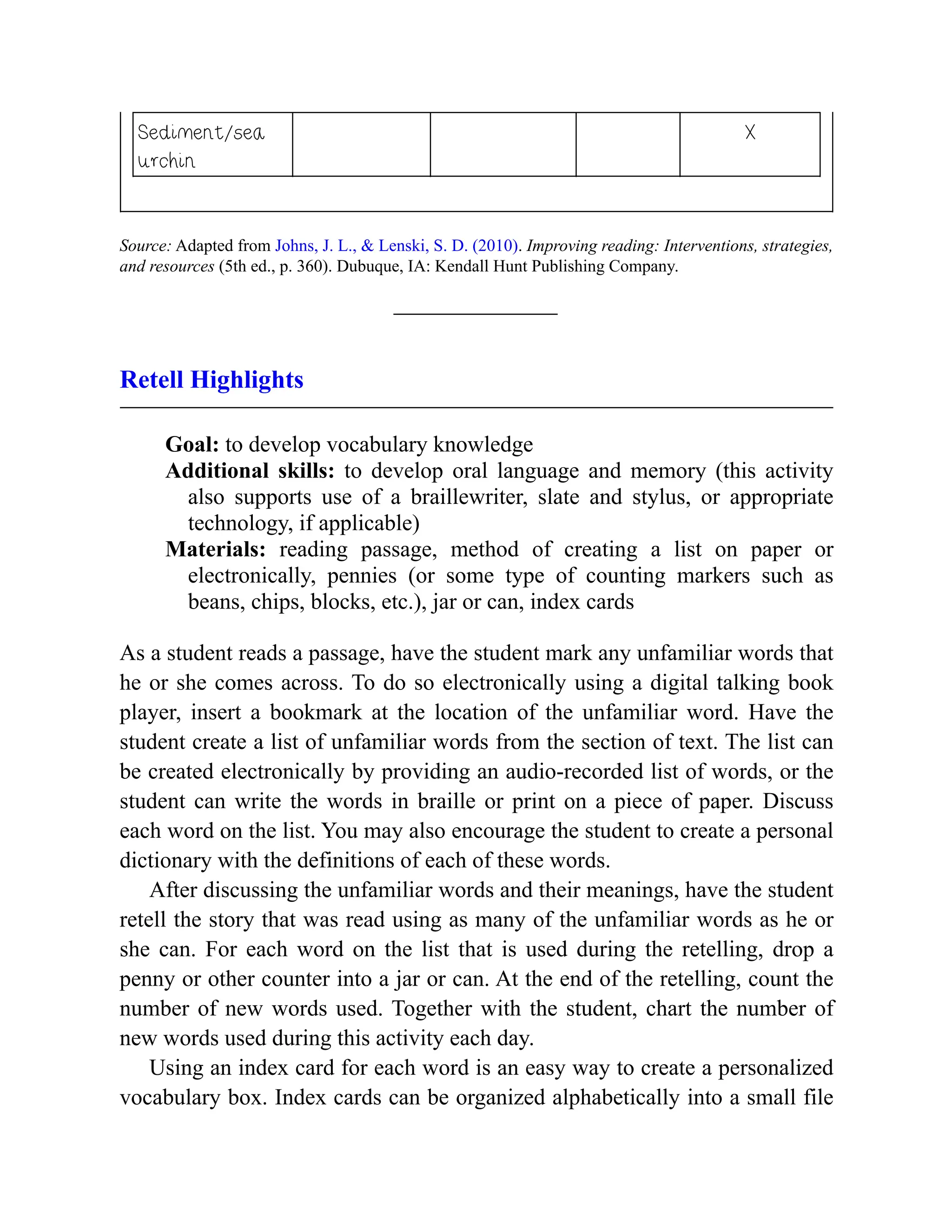
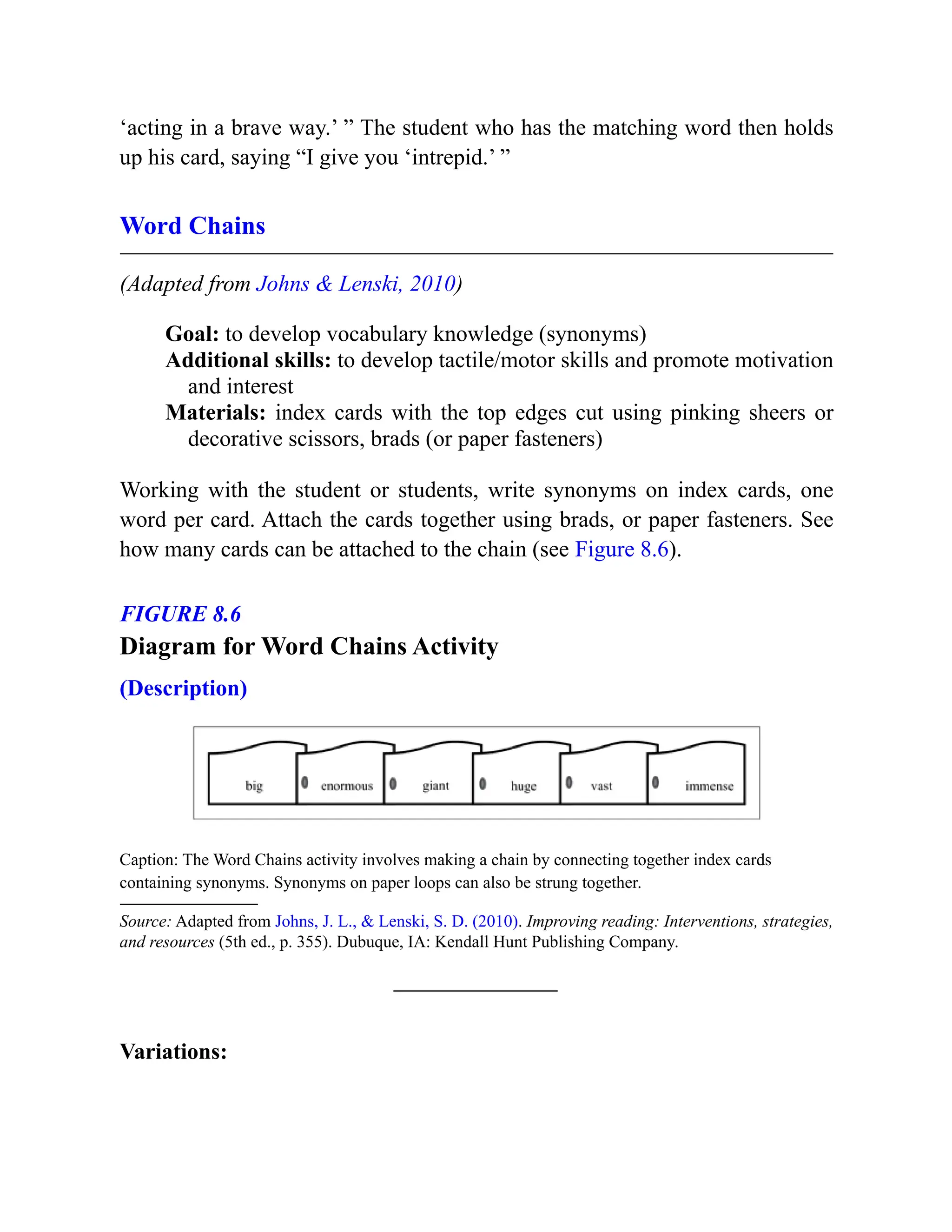
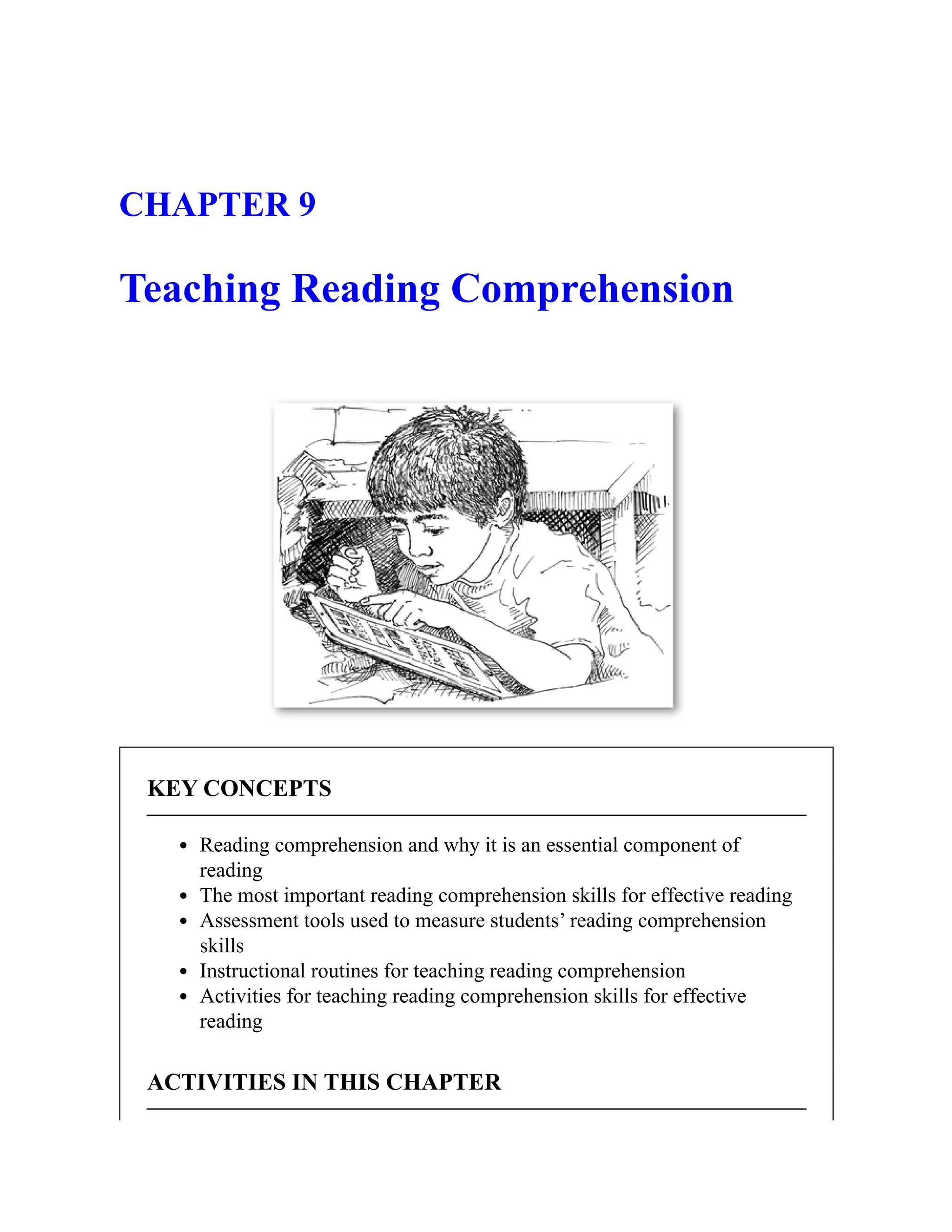
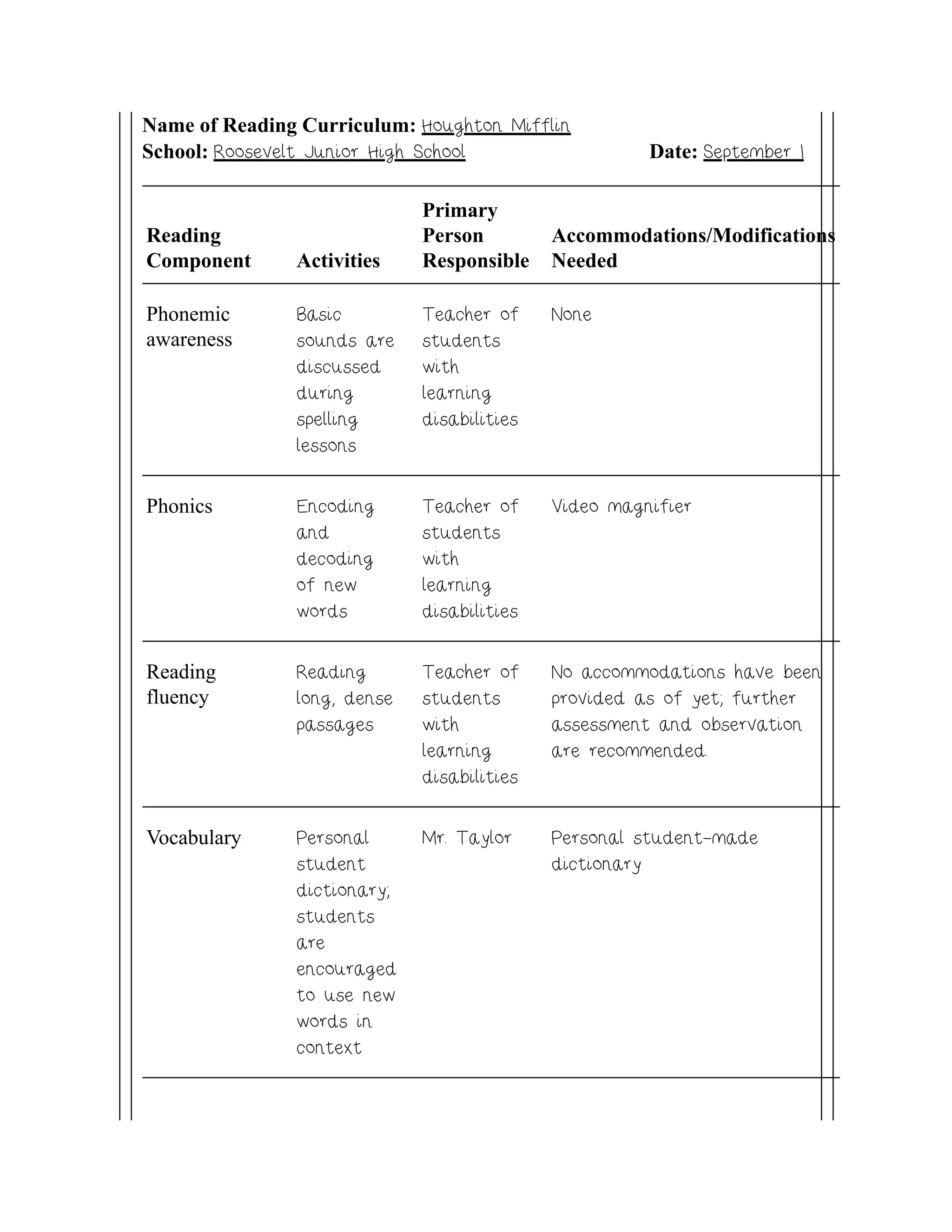
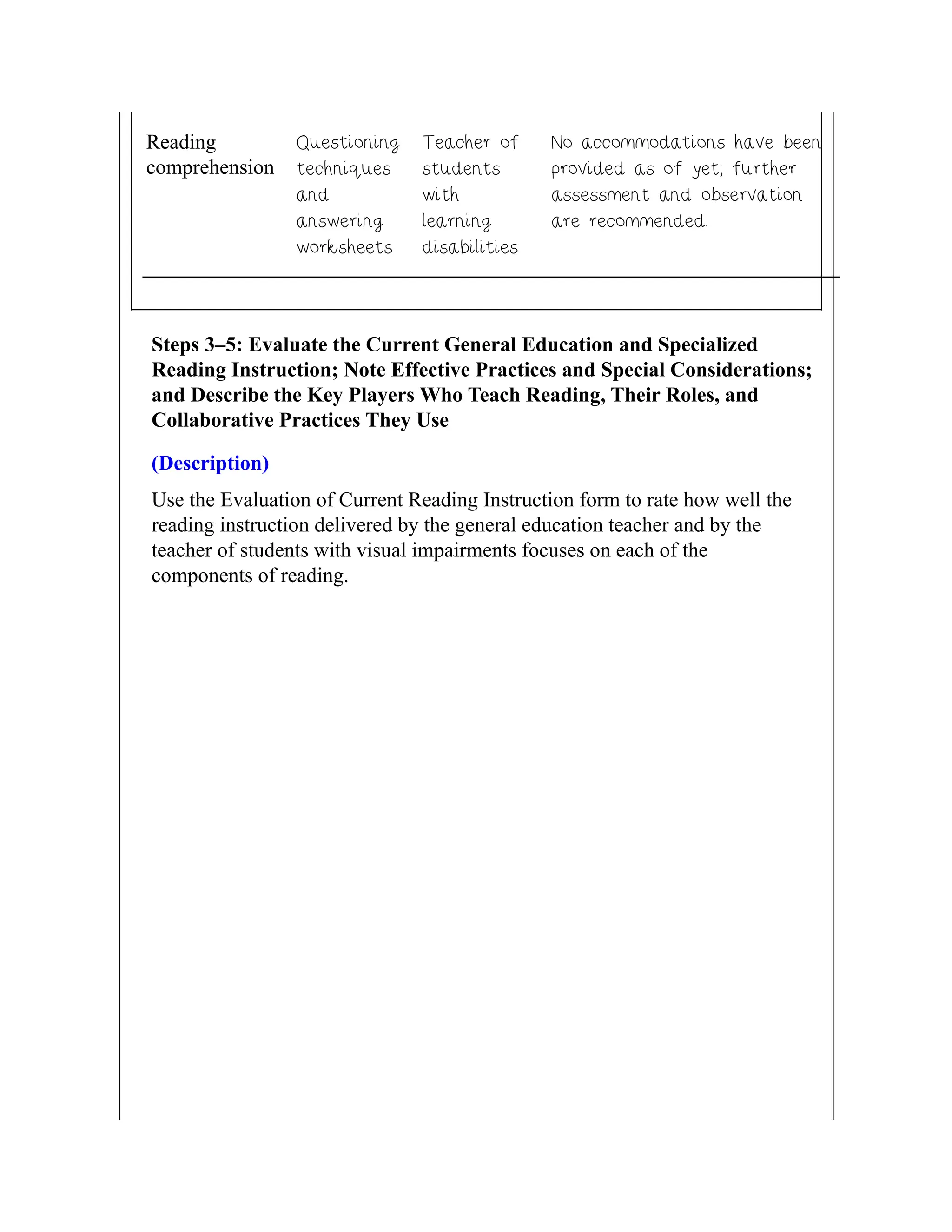
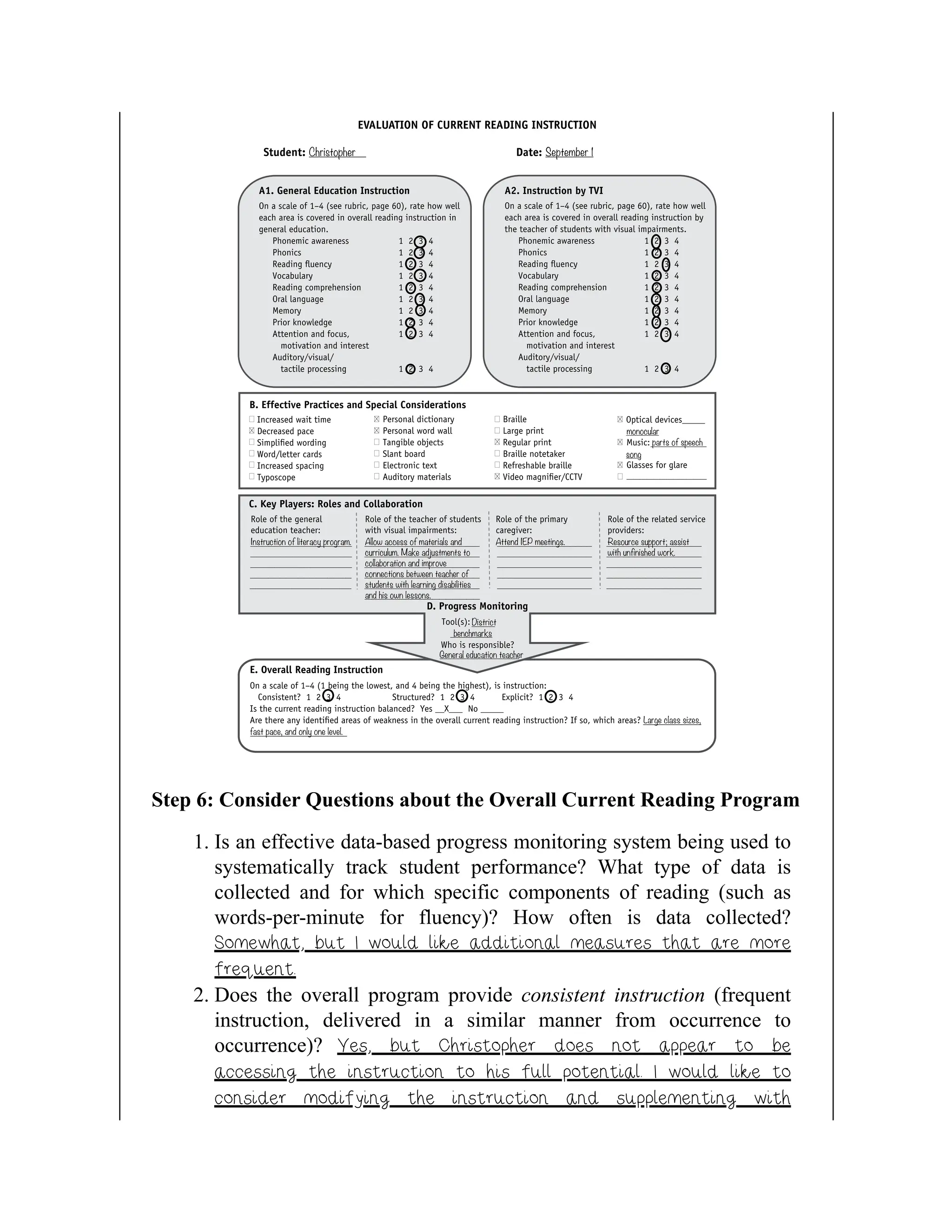
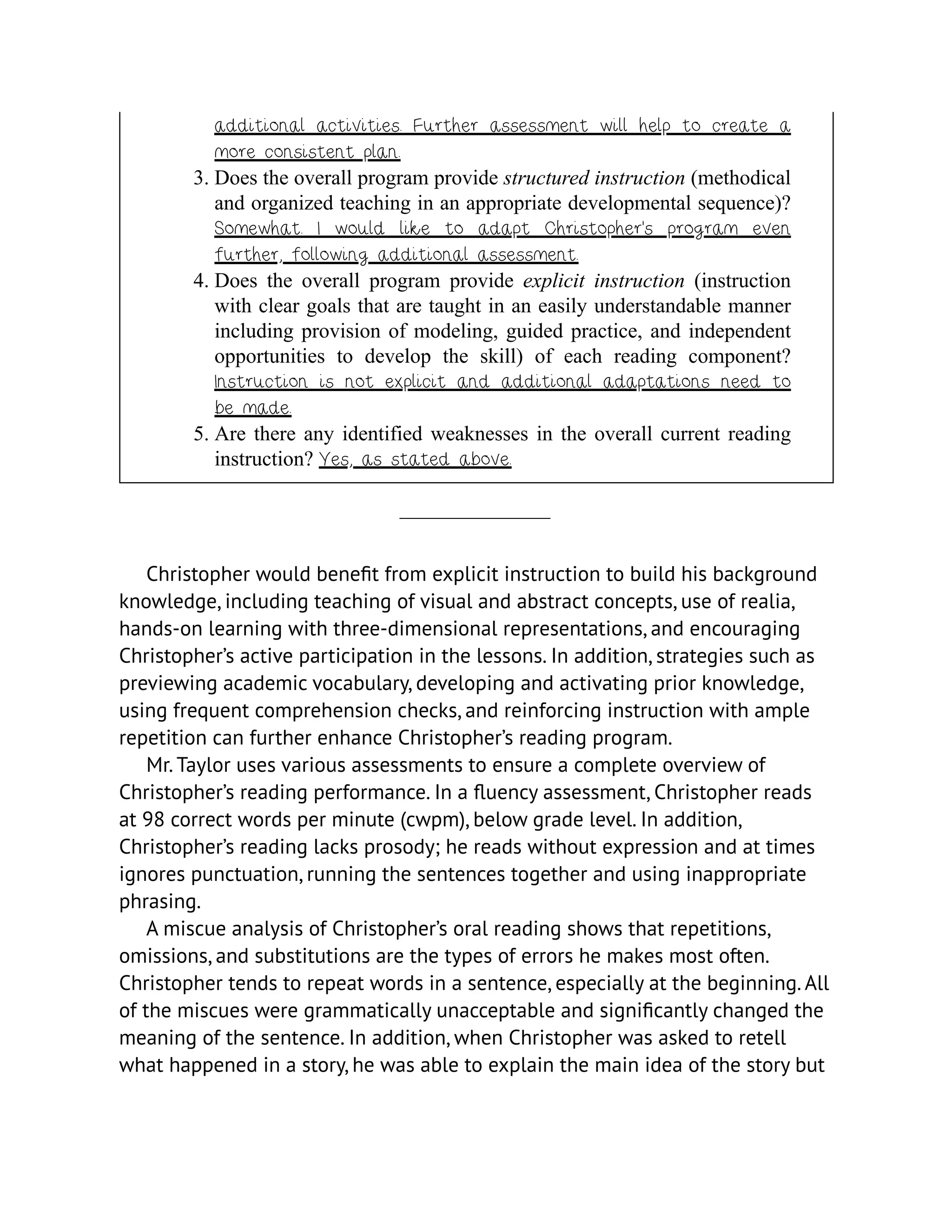
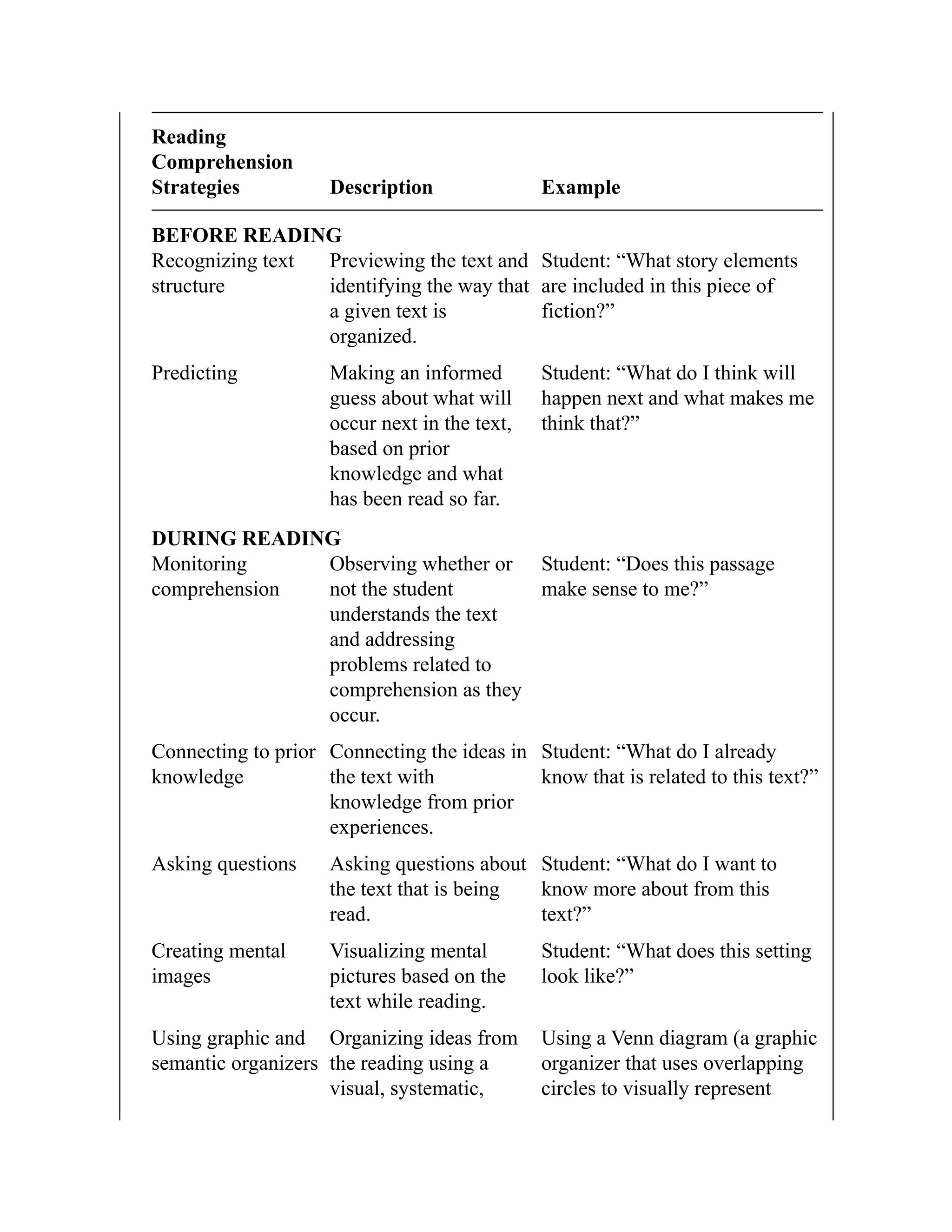
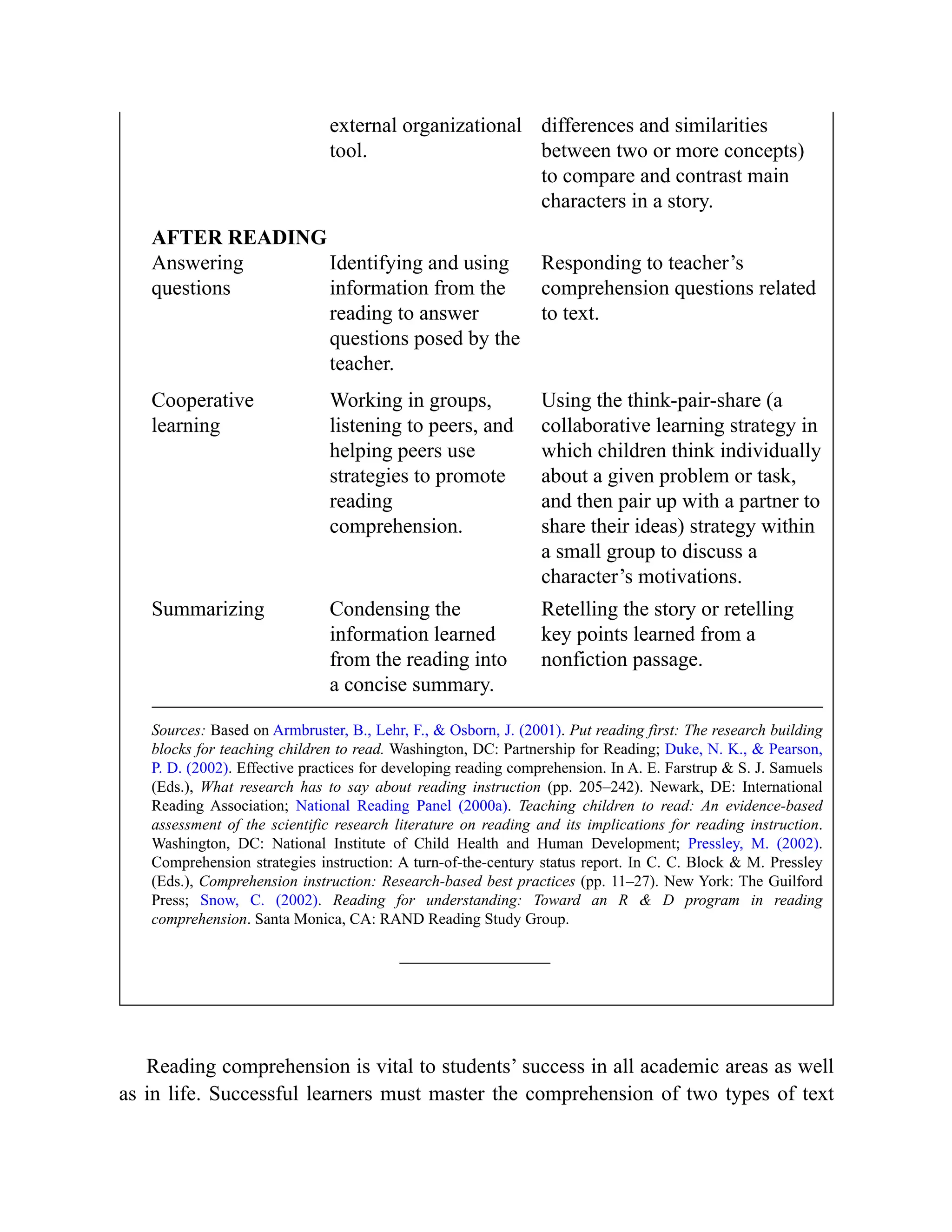
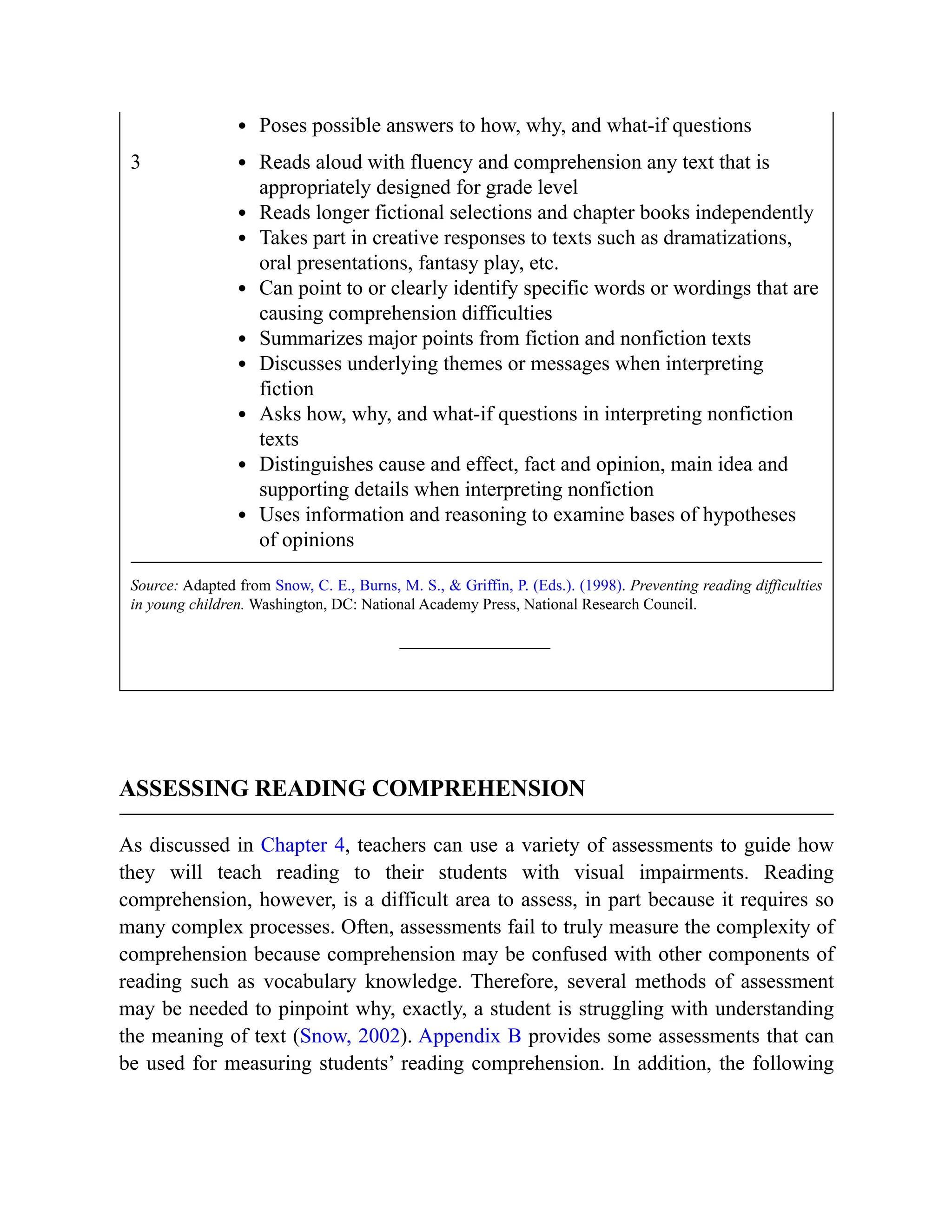
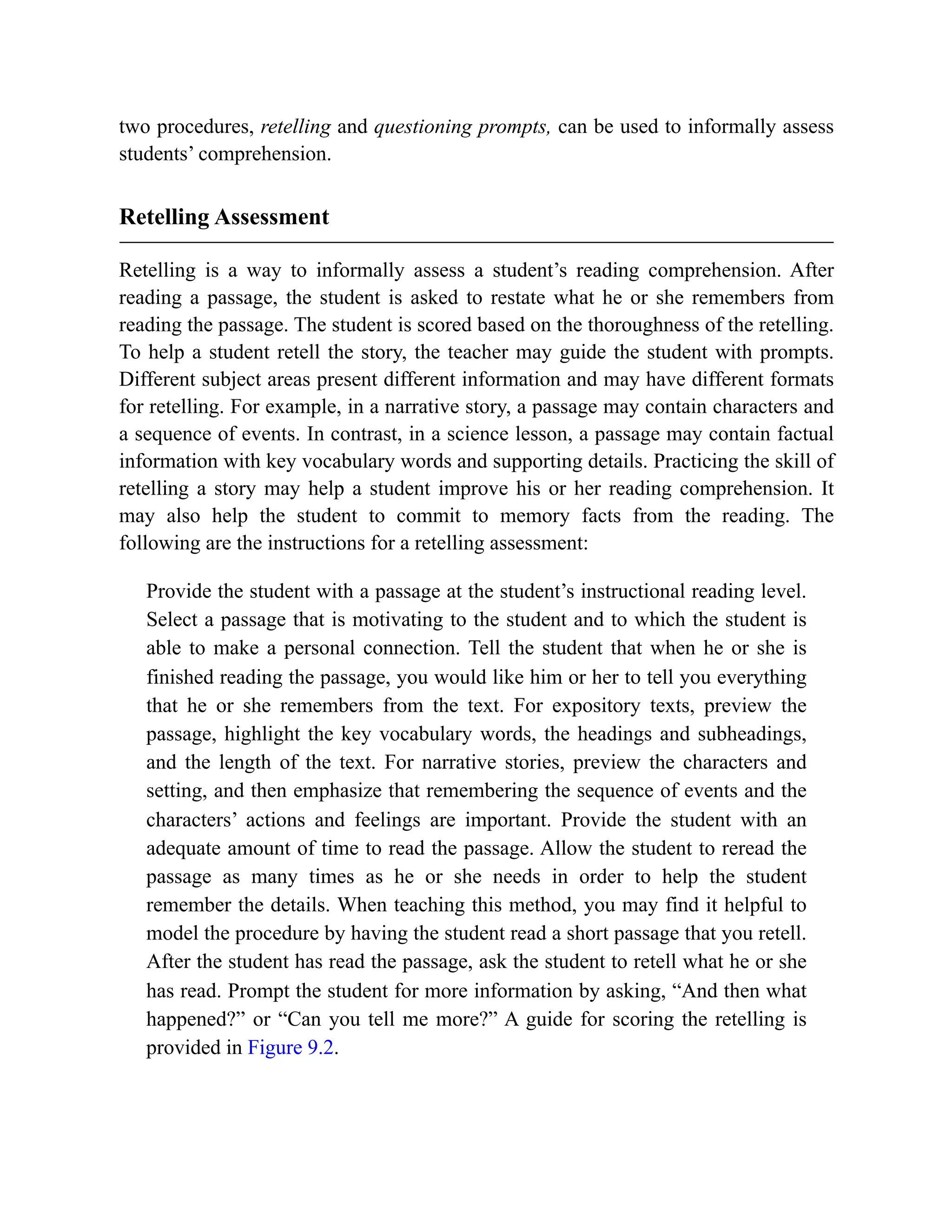
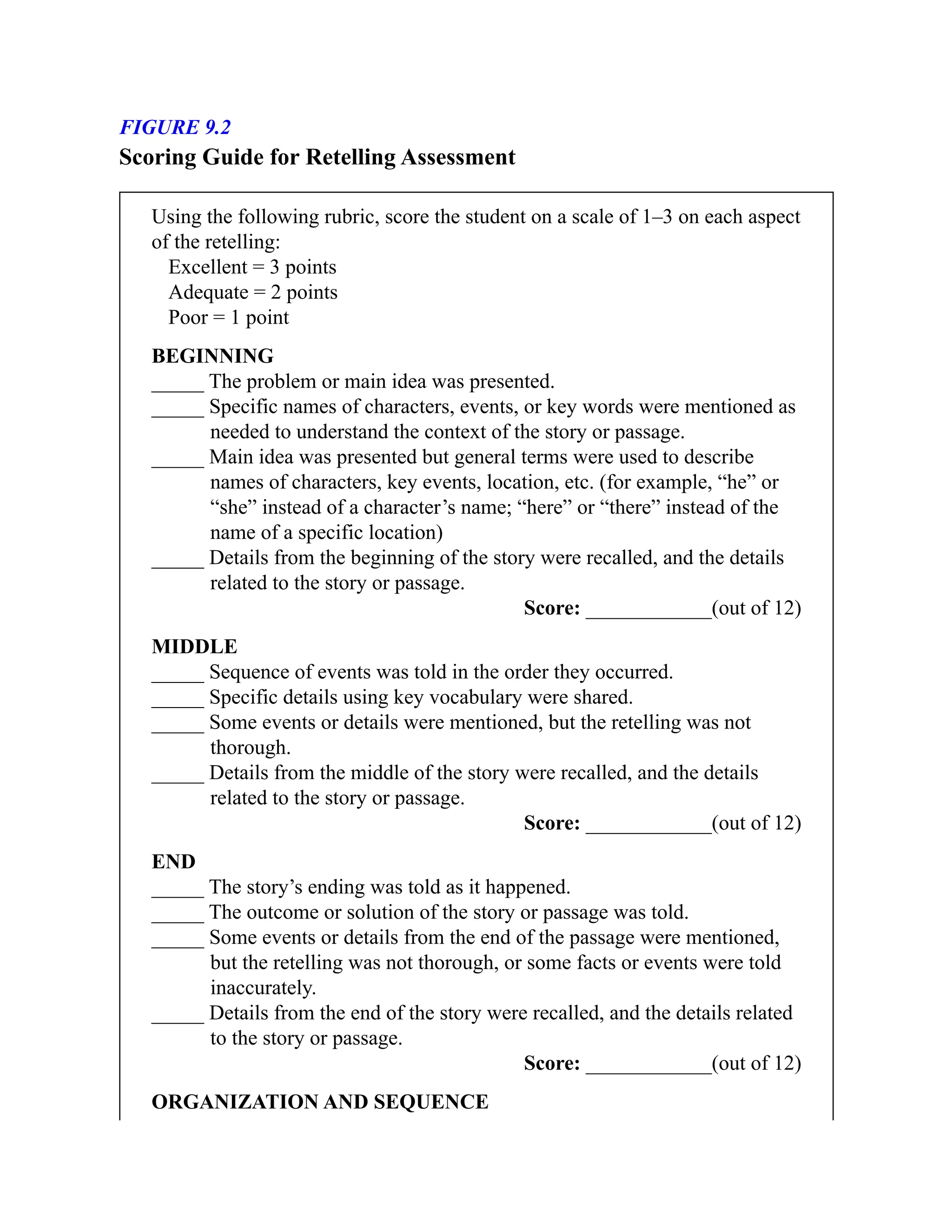
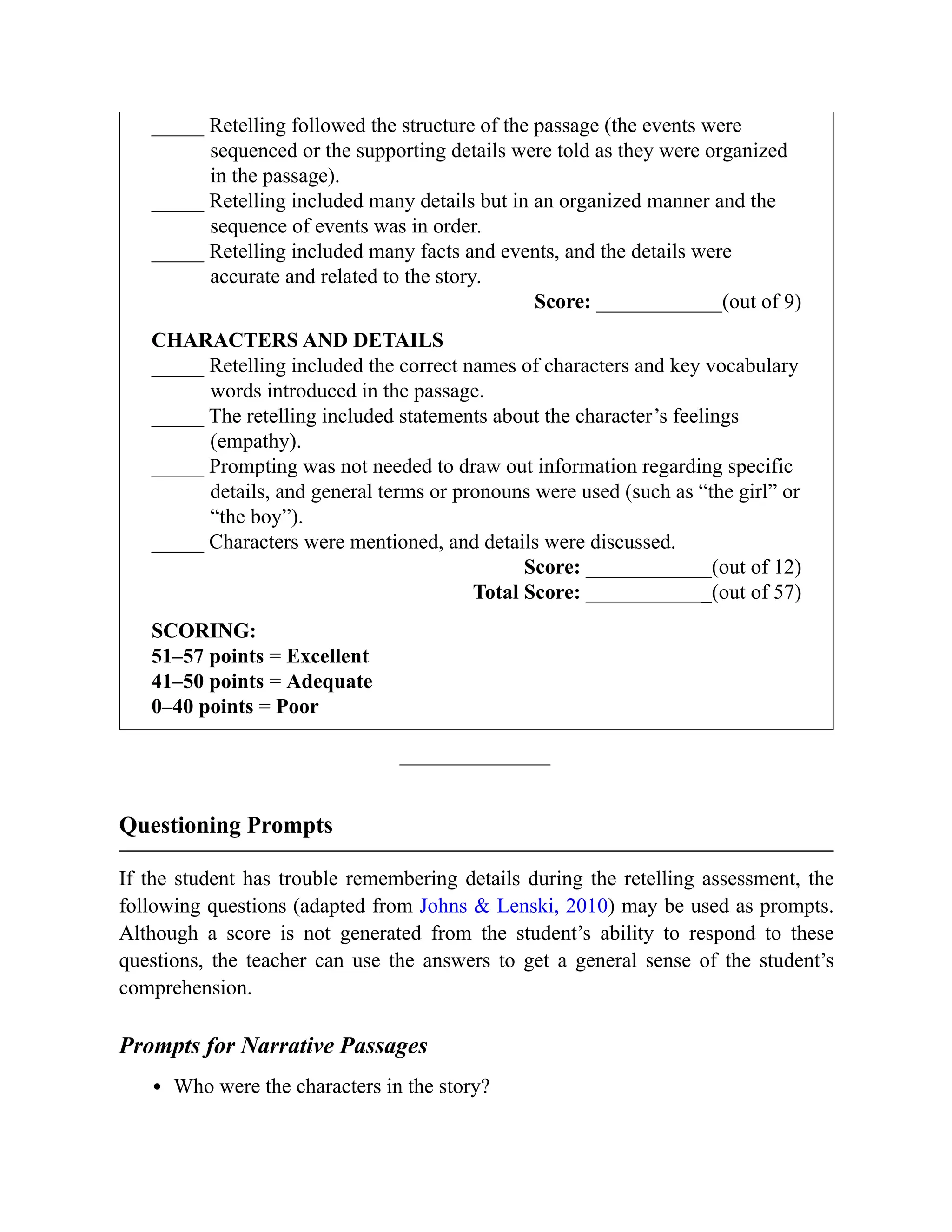
![Teacher: The title of the book is ___. When you hear the title of this book, what do
you think about?
Student: The title of the book makes me think about ____.
To activate the student’s prior knowledge:
Teacher: This story is about ____. Can you think of a time when you ____?
Student: I remember when ____.
Teacher: The main idea of the story is ___. What do you know about ____?
Student: I know ___.
Teacher: The topic of this passage is ____. What do you know about ___?
Student: I know ___.
Teacher: The author (or main character) of this passage says ____ [select a quote
from the passage]. What do you think that the author (or main character) meant
by this statement?
Student: I think _____.
[For additional discussion:
Do you think the statement is true or false, or is it an opinion?
Do you agree or disagree with the statement?
How do you feel about the statement?
Can you think of a time when you or someone you know had a similar
experience?]
To practice generating questions:
Teacher: This book is about ___. If you could ask the author anything about this
book before you read it, what are some things that you would like to know?
Student: I would like to know ___. [Student response may vary. Discuss responses.]
Teacher: Sometimes when we think of questions that we have before we start
reading the passage, these questions can help guide us when we read the passage.
Do you have anything that you would like to learn from the passage?
Student: I’d like to learn ______.
Teacher: Let’s write your questions down and see if we can find the answers in our
reading. [The teacher and student write the questions down. Teacher and student
read together or the student reads silently.]](https://image.slidesharecdn.com/readingconnections-strategies-for-teaching-students-with-visual-impairments-250721170318-cb16127e/75/Reading-Connections-Strategies-for-Teaching-Students-with-Visual-Impairments-336-2048.jpg)
![Teacher: The answers to our questions may be found in the passage, and we should
look for them when we read.
To practice predicting:
[Teacher presents pictures or objects related to the story.]
Teacher: These are some of the things we will hear about in the story. What do you
think these things have to do with this story? After seeing them, what do you
think is going to happen in the story? [Student surveys the pictures/objects.]
Student: I think the story will be about ___.
Teacher: The title of the story is _____. Tell me everything that you think will
happen in this story. These are your predictions. I’ll write them down as you tell
me what you think will happen in the story.
[Student responds as the teacher writes the information down.]
Teacher: This is what you predicted. [Read the list of predictions together.] Is there
anything else you would like to add?
[If the student responds with more information, add it to the list. After reading the
story, revisit the predictions to see if any of them were correct.]
To practice sensory imaging:
Teacher: When we read a story, it is helpful for us to use our imagination and
pretend like we are in the story with the characters. We can pretend to hear, feel,
smell, and see each scene in the story, as if we were there. This story takes place
in ____.
Describe the sounds you will hear in this place.
Describe the sensations you will feel in this place.
Describe the smells you will smell in this place.
Describe what you will see in this place.
Teacher: One of the main characters, ________ [main character name], in the story
is a ___ [describe a characteristic, occupation, or a feature of the character]. If
you were to meet ___ [main character’s name), what do you think he or she will
look like?
Describe the character’s face.
Describe the character’s clothes.
Describe the character’s voice.](https://image.slidesharecdn.com/readingconnections-strategies-for-teaching-students-with-visual-impairments-250721170318-cb16127e/75/Reading-Connections-Strategies-for-Teaching-Students-with-Visual-Impairments-337-2048.jpg)
![Describe the character’s behavior, or how you think the character might
act.
Describe the smells you think of when you think of this character.
Describe the place where you might meet this character.
During Reading
To generate conversation regarding the main idea:
Teacher: Let’s read the first paragraph of the passage aloud together. [Teacher and
student read the passage aloud together.]
Teacher: The main idea of the first paragraph is ___.
[Teacher selects a question from below that applies to the type of passage and
topic.]
What do you know about the main idea?
Can you make any connections from other things that you have read that
relate to the main idea?
Can you think of anything similar that you have done?
What other stories/passages have we read that have a similar main idea?
[Student responds.]
Teacher: When we read something that has a lot of details, it is important to identify
the key points the author is trying to communicate. We can do this by marking the
key points using a highlighter to highlight text, a marker to underline text, or high
dots (raised stickers for braille readers that can be placed next to the line of
important text) to flag braille text. When you come to an important detail, mark
it. Let’s read the first paragraph together and practice marking the key points.
[Teacher and student practice reading and marking important text, then read the
portions that were marked and discuss why those were key points.]
Teacher: Now, it is your turn. You read the next paragraph to yourself and mark the
key points that you think are important.
[Teacher and student read the portions the student marked and discuss why those
were key points.]
To activate prior knowledge:](https://image.slidesharecdn.com/readingconnections-strategies-for-teaching-students-with-visual-impairments-250721170318-cb16127e/75/Reading-Connections-Strategies-for-Teaching-Students-with-Visual-Impairments-338-2048.jpg)
![Teacher: When you are reading a story, it is helpful to make connections between it
and other stories that you have read. Can you think of anything that you have
read recently that reminds you of this story?
[Student responds.]
Teacher: Sometimes we can make connections to our own lives. Sometimes the
things that happen in the story may be similar to things that have happened to us.
Does this story remind you of anything in your life?
[Student responds.]
Teacher: The characters in a story may remind us of people that we know.
Sometimes the characters look or act like someone we know, or sometimes the
characters face similar issues in life. Who do you know that is like one of the
characters in this story?
[Student responds.]
Teacher: Can you describe the character?
[Student responds.]
Teacher: What details from the story are similar to the person you know?
[Student responds.]
To practice generating questions:
Teacher: If you could meet any one of the characters in the story, who would you
choose?
[Student responds.]
Teacher: What questions would you ask him or her?
[Student responds.]
Teacher: We sometimes have questions about what we are reading. The answers to
these questions may help us to better understand what we are reading. Let’s read
the first section of the story together. Then, I want you to think of any questions
you may have.
[Teacher and student read the passage together.]
Teacher: Can you think of any questions that you had while you were reading the
text?
[Student responds. Teacher and student discuss the questions and potential
answers, along with where to find the answers to the questions (for example,
other resources like a dictionary or the Internet, prior reading that should be
reviewed, vocabulary that needs to be explained, or further reading of the text if
the answer is still to come).]](https://image.slidesharecdn.com/readingconnections-strategies-for-teaching-students-with-visual-impairments-250721170318-cb16127e/75/Reading-Connections-Strategies-for-Teaching-Students-with-Visual-Impairments-339-2048.jpg)
![To practice predicting:
[Teacher selects a book containing a predictable pattern or order of events (for
example, The Napping House, There Was an Old Lady Who Swallowed a Fly, or
Brown Bear, Brown Bear, What Do You See?). Teacher and student read the first
pattern in the book together (such as “Brown bear, brown bear, what do you
see?”).]
Teacher: What do you think will happen next?
[Student responds. Teacher and student read the next sequence in the pattern
together.]
Teacher: What do you think will happen next?
[Student responds. Teacher continues this dialogue throughout each sequence in
the book.]
[Teacher selects a short passage from a story to read together and stops at a point
in the story when something important or predicable may occur.]
Teacher: Sometimes we can use clues from reading that may help us to predict what
may happen next. What do you think will happen next?
[Student responds.]
Teacher: What were some of the clues from what you read that makes you think
your predictions will come true?
[Student responds. Student reads the next section of the passage.]
Teacher: Was your prediction correct?
[Student responds.]
To practice sensory imaging:
Teacher: Pretend you are an observer in the same room (or similar location) where
the story is taking place. Describe the setting.
[Encourage the student to describe the following:]
Describe the sounds you will hear in this place.
Describe the sensations you will feel in this place.
Describe the smells you will smell in this place.
Describe what you will see in this place.]
After Reading](https://image.slidesharecdn.com/readingconnections-strategies-for-teaching-students-with-visual-impairments-250721170318-cb16127e/75/Reading-Connections-Strategies-for-Teaching-Students-with-Visual-Impairments-340-2048.jpg)
![To generate conversation regarding the main idea:
Teacher: What do you think was the main idea of the story?
[Student responds. Teacher repeats the main idea or states the main idea.]
Teacher: The main idea of the story is ____. What are some of the details that
support the main idea?
[Student responds.]
Teacher: After reading a passage, it is helpful for us to paraphrase or summarize
what we have read in just a few sentences. After reading the passage, in three
sentences, tell me what you learned.
[Student responds.]
To activate prior knowledge:
Teacher: Sometimes authors do not provide all the information about a topic. What
information do you know that the author did not include?
[Student responds.]
Teacher: How do you know these details if the author did not include them?
[Student responds. Teacher selects several key points or vocabulary words from
the passage, story, or text.]
Teacher: I’m going to say a word or phrase. Tell me what comes to mind when you
hear the word or phrase. You don’t need to tell me the definition, but tell me of a
time when you used this word or phrase. For example, if I say _____, it makes
me think of _________. What do you think of when you hear ___?
[Student responds. Proceed with list of words and phrases.]
To practice generating questions:
Teacher: After reading the passage, what else would you like to know?
[Student responds.]
Teacher: Let’s create some questions and write them down.
[Teacher and student write down additional questions.]
Teacher: What are some ways that we can find out the answers to these questions?
[Student responds.]
[For a future lesson, the teacher may respond to the questions with additional
readings or resources, or encourage the student to independently pursue finding
the answers to his or her questions.]](https://image.slidesharecdn.com/readingconnections-strategies-for-teaching-students-with-visual-impairments-250721170318-cb16127e/75/Reading-Connections-Strategies-for-Teaching-Students-with-Visual-Impairments-341-2048.jpg)
![To practice sensory imaging:
Teacher: Describe the _____ [setting, scenery, or character] from the story.
[Student responds.]
Teacher: What details did the author include that helped you to imagine the _____
[setting, scenery, or character]?
[Student responds.]
Teacher: Were there any details you imagined that were not in the story?
[Student responds.]
To practice drawing conclusions and summarizing:
Teacher: The author wrote this passage for a reason. What do you think that reason
was?
[Student responds.]
Teacher: Imagine that you are ____ [name of a main character]. How do you feel
after having done the things that ___ [name of character] did?
[Student responds.]
Teacher: Sometimes we can infer characteristics of authors from their writing.
Sometimes authors write about their experiences or their expertise. What things
do you think you may know about the author of this story?
[Student responds.]
Teacher: If you could interview the author, what things would you like to know?
[Student responds.]
[For a future lesson, the teacher may respond to the questions with additional
readings or resources, or encourage the student to independently pursue finding
the answers to his or her questions.]
ACTIVITIES FOR TEACHING READING COMPREHENSION
Teachers can use the following activities to increase students’ reading
comprehension skills.
Myth Busters
(Adapted from Johns & Lenski, 2010)](https://image.slidesharecdn.com/readingconnections-strategies-for-teaching-students-with-visual-impairments-250721170318-cb16127e/75/Reading-Connections-Strategies-for-Teaching-Students-with-Visual-Impairments-342-2048.jpg)
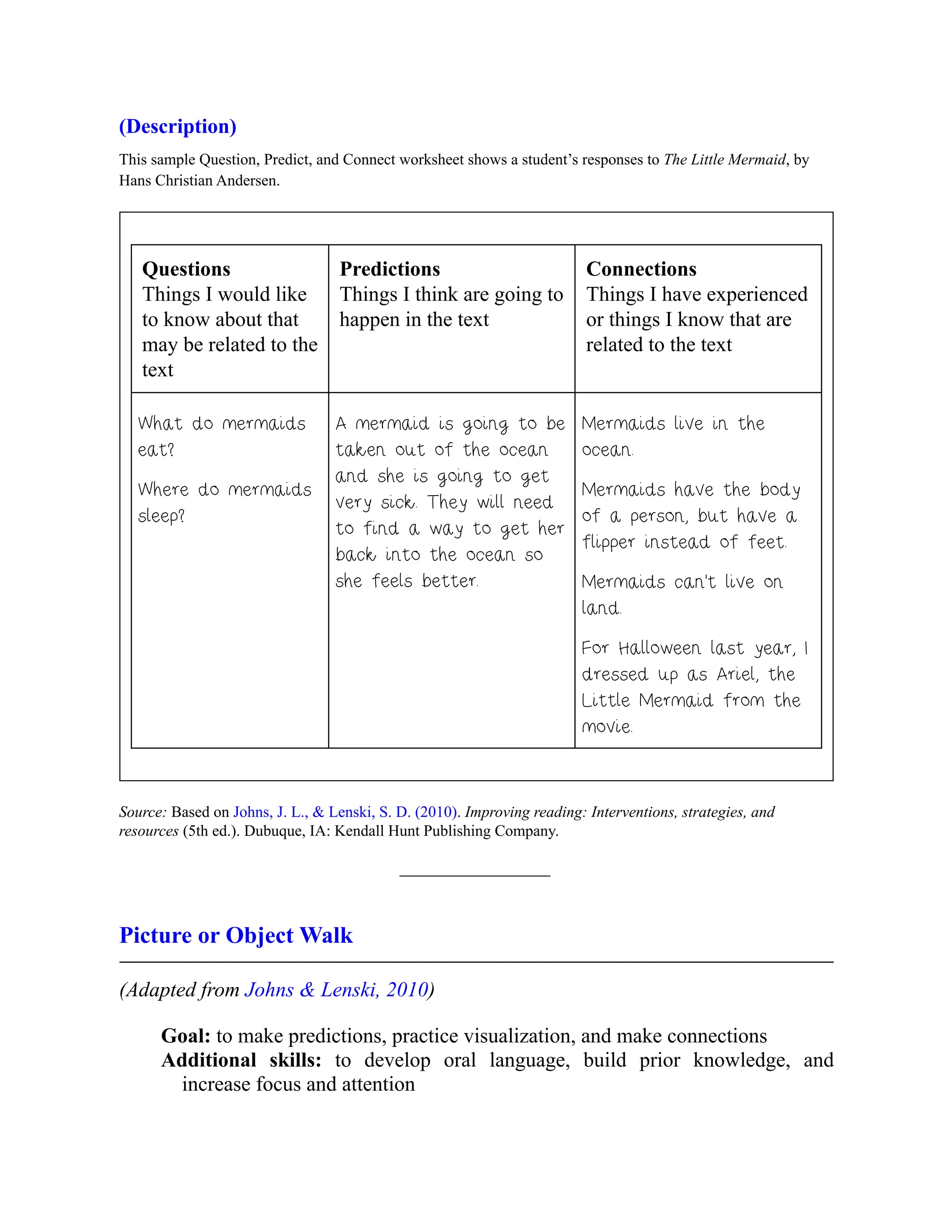
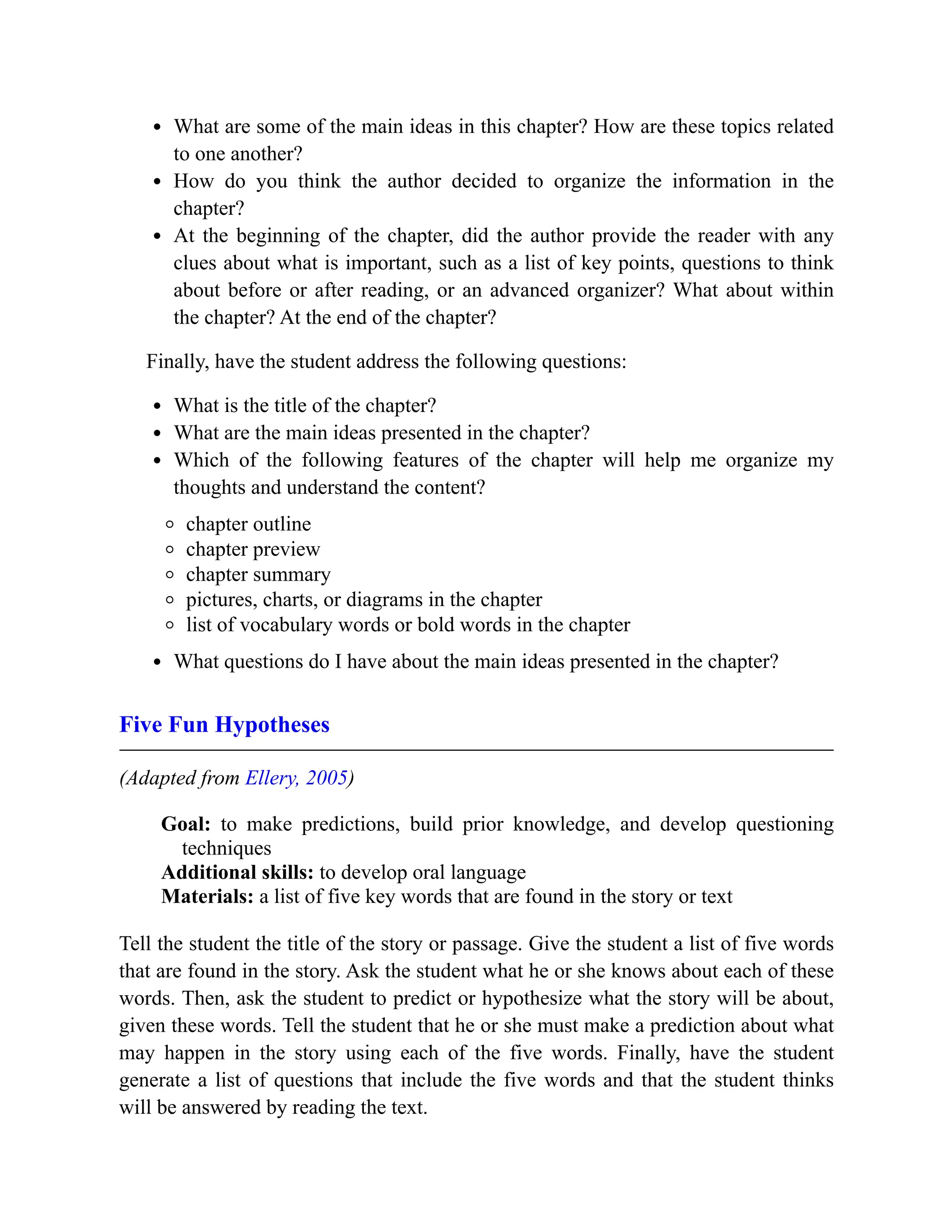
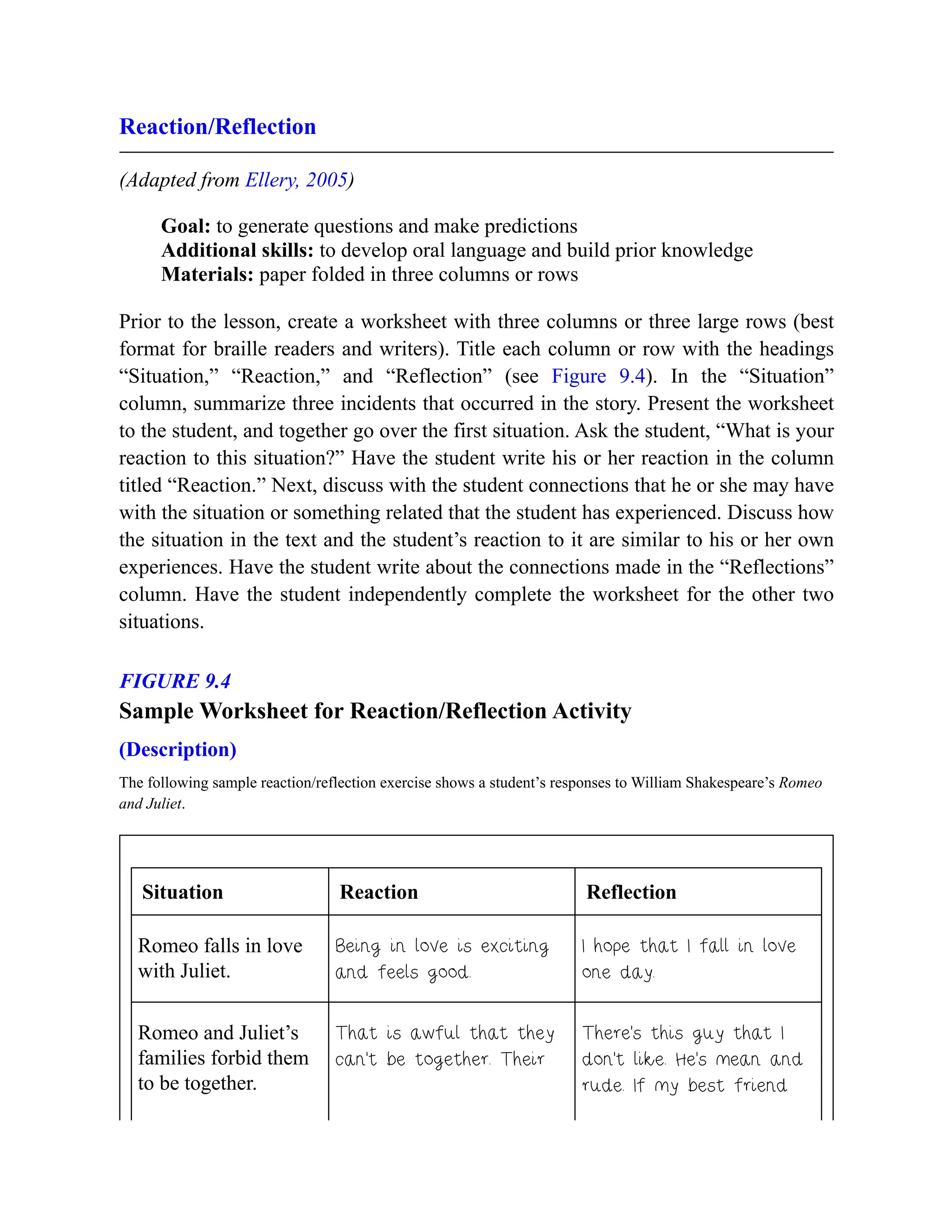
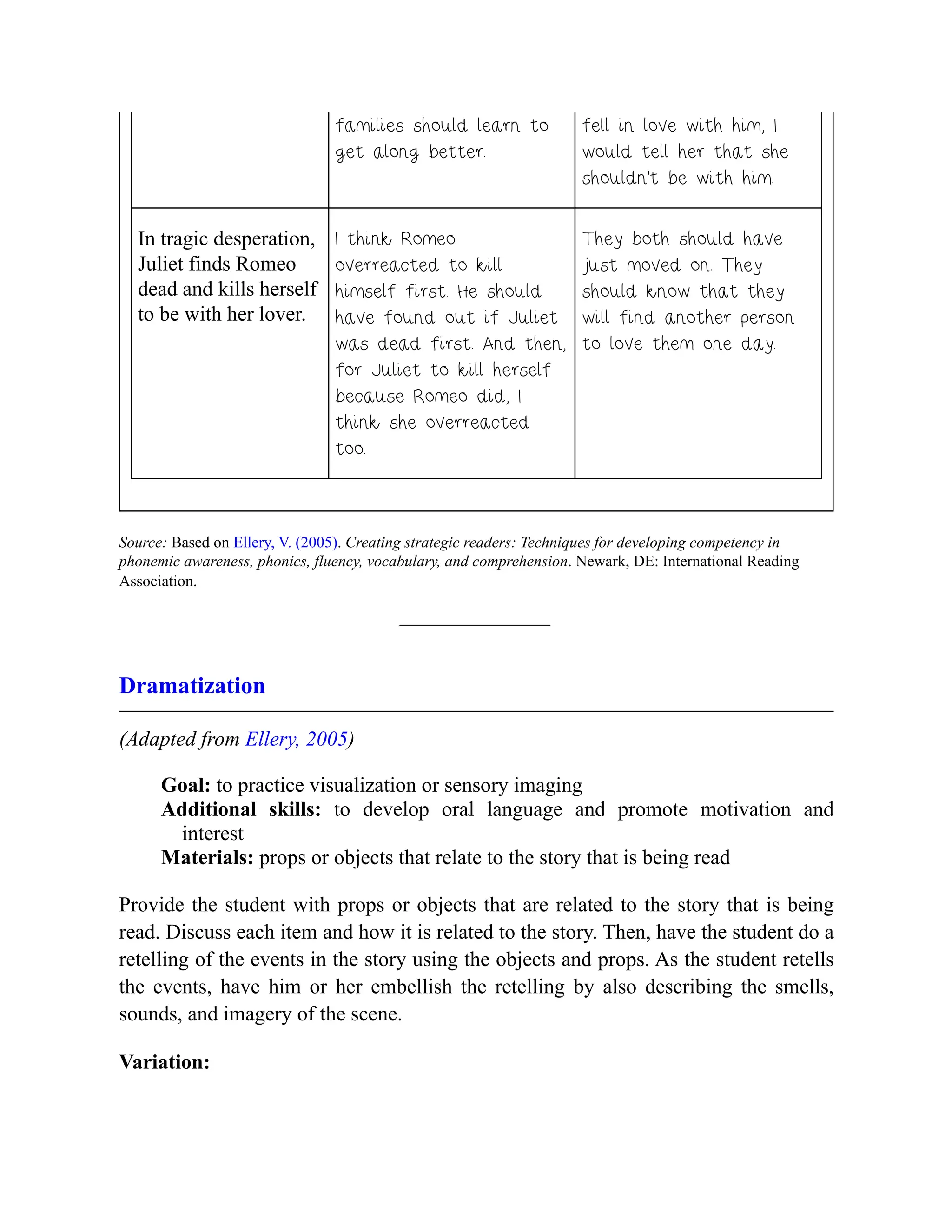
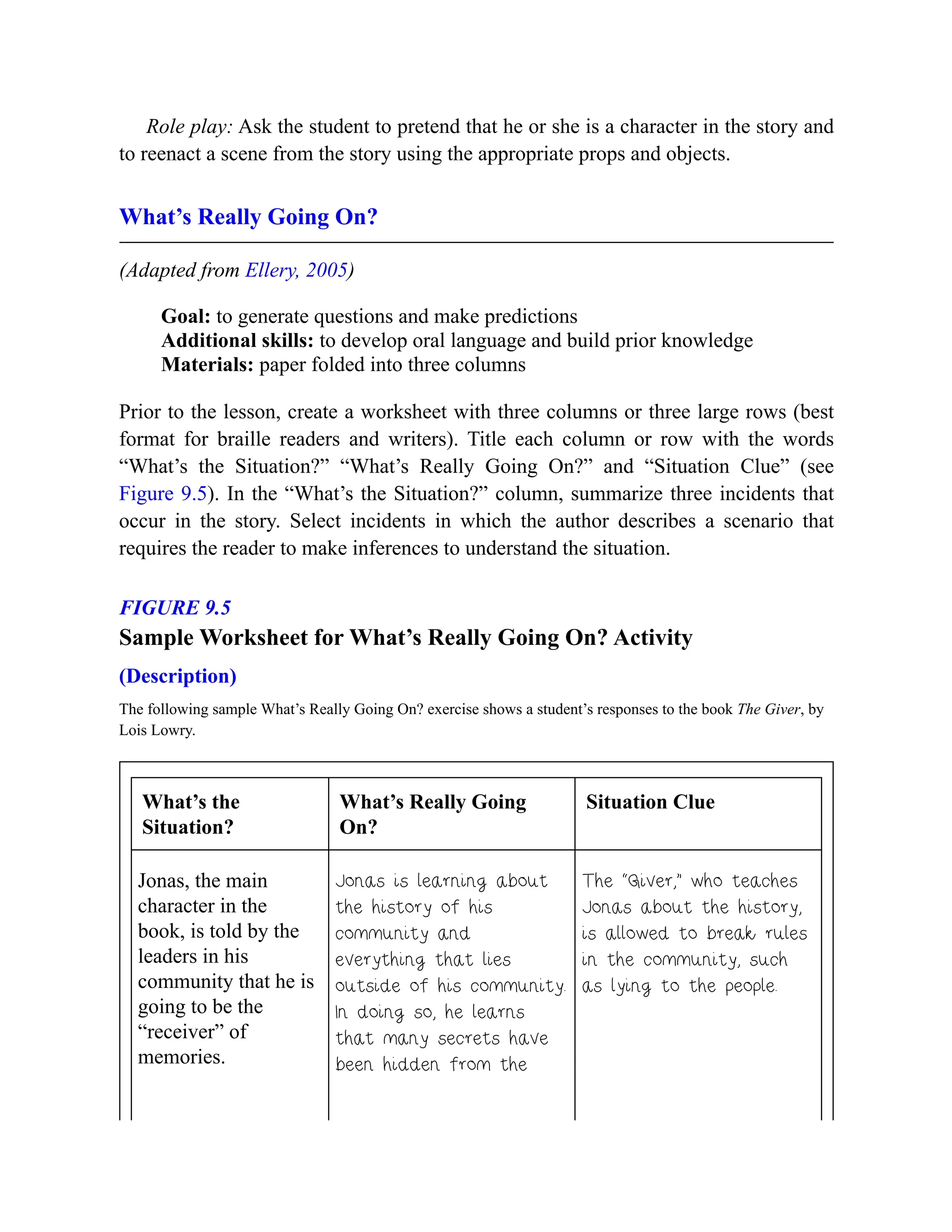
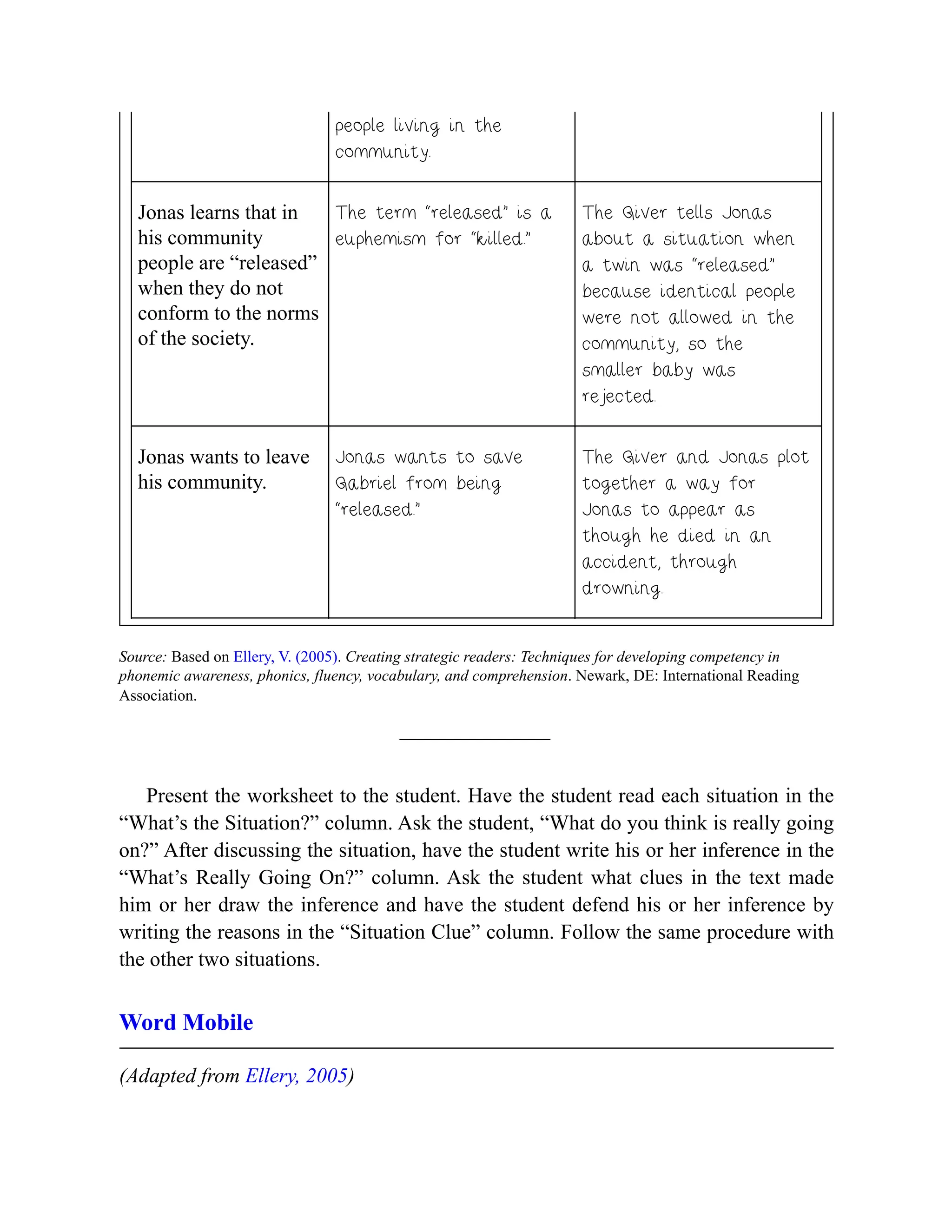
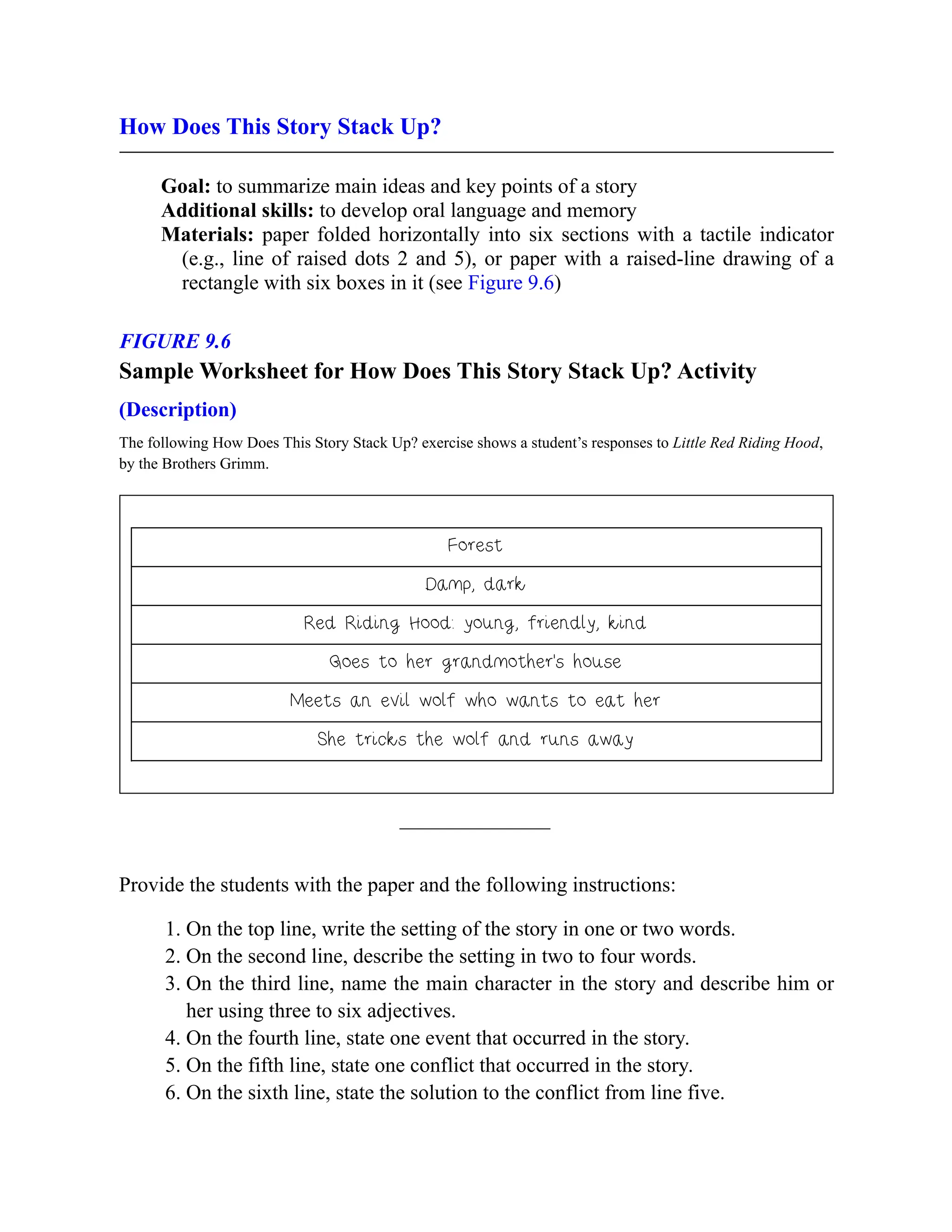
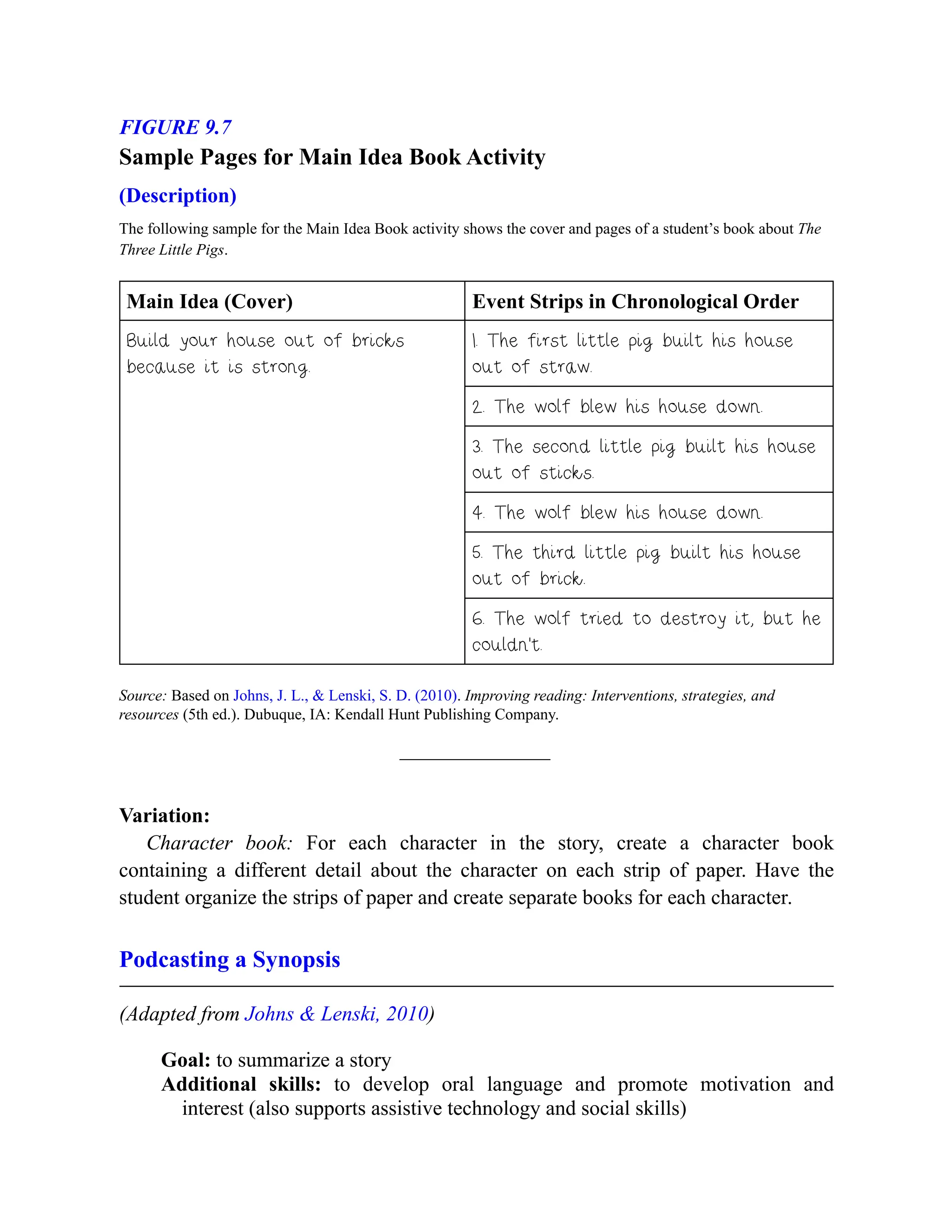
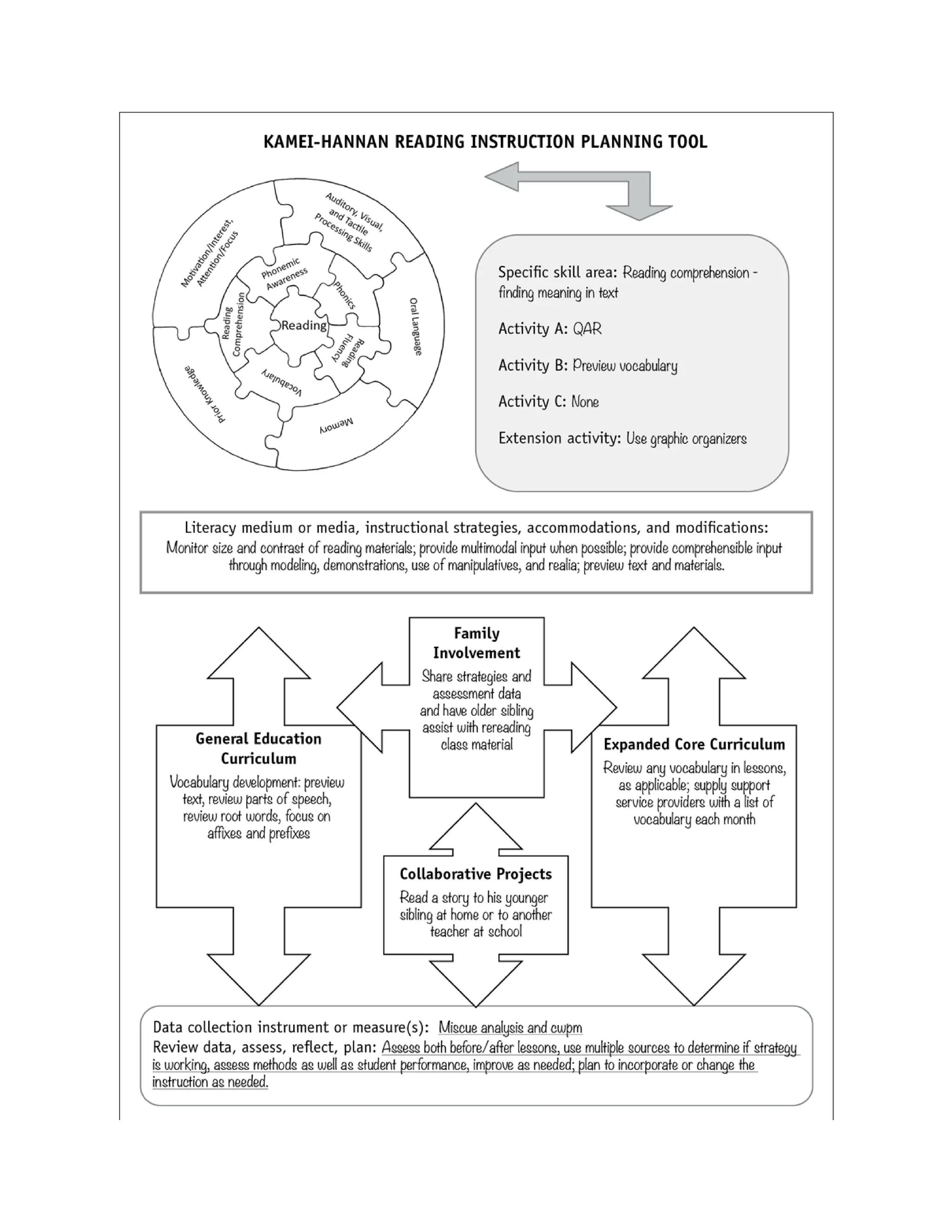
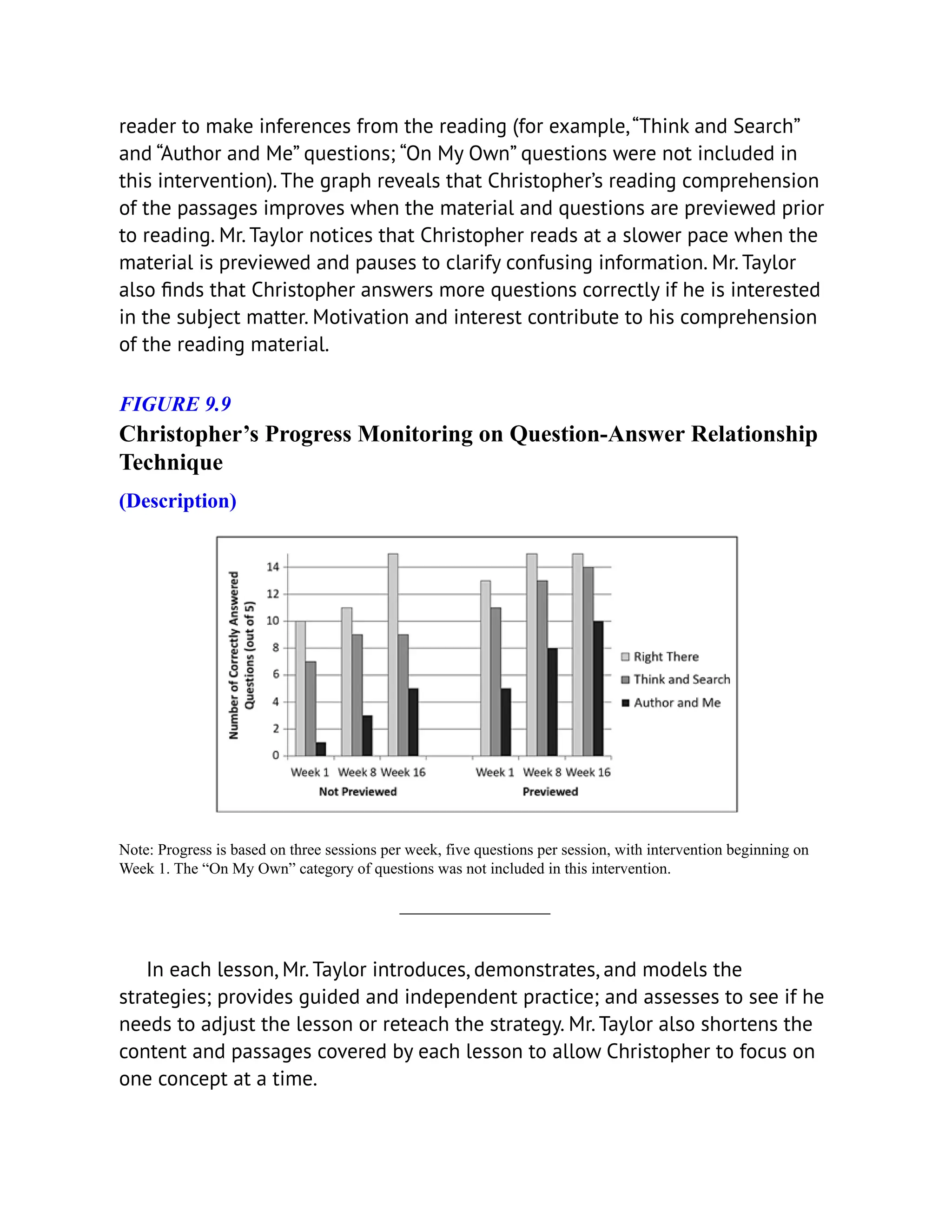
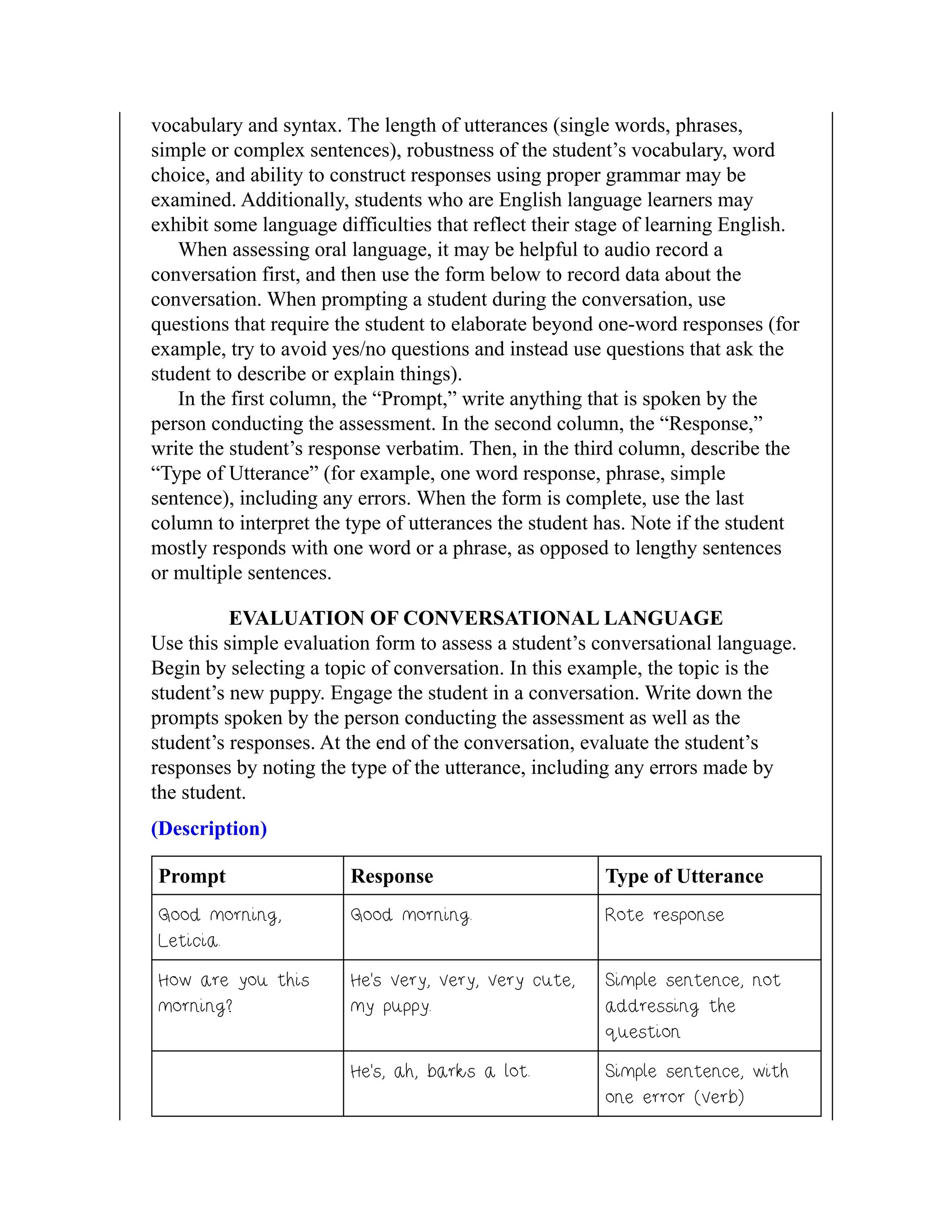
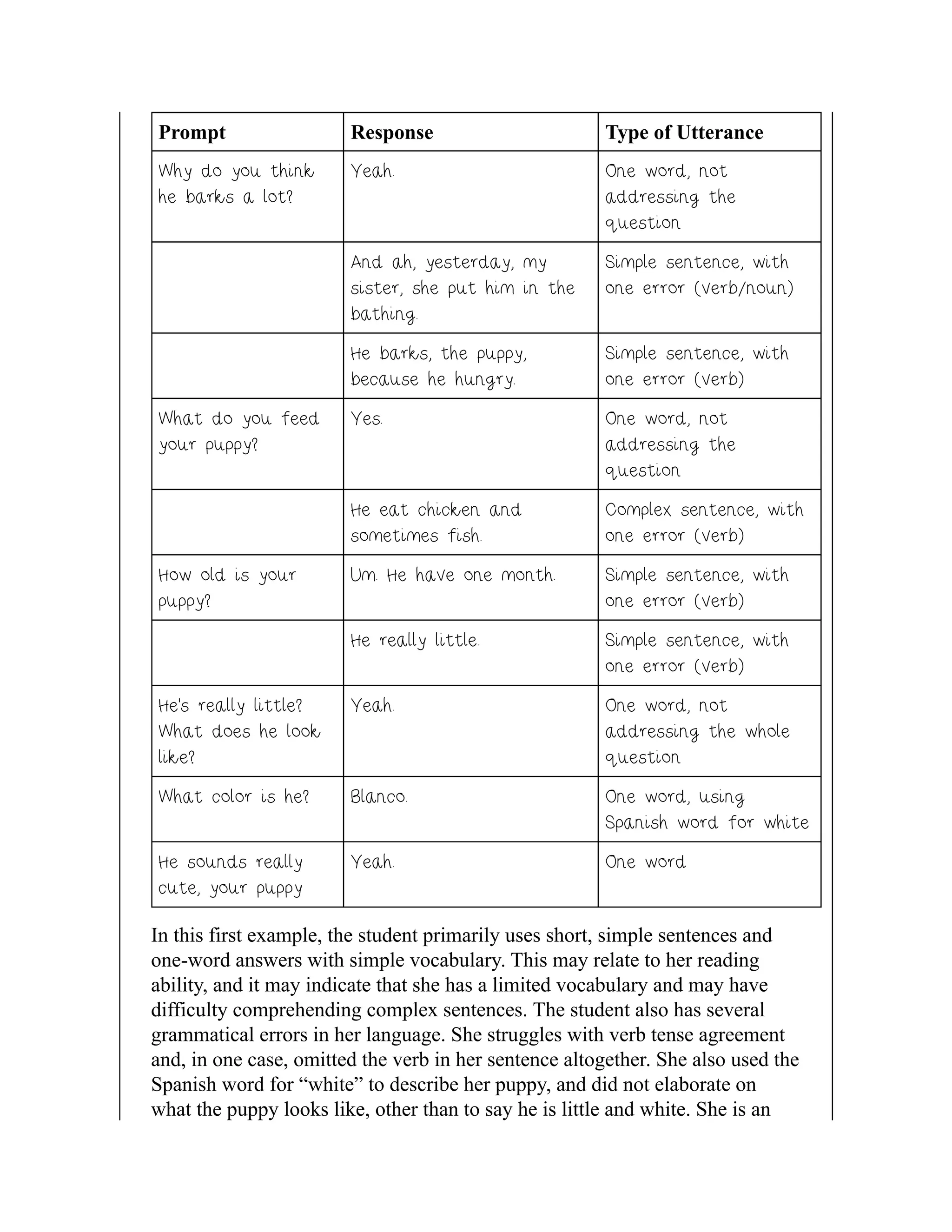
![English language learner and should work on verb tense agreement and
vocabulary.
TELLING OR RETELLING A STORY
Use this evaluation form to assess a student’s ability to tell a story or retell a
story that has been read. Begin by identifying a prompt for storytelling or
selecting a short story that the student can read and retell. In this example, the
prompt is to tell something that the student did over the weekend. Prompt the
student to begin telling you his story. Then, write your prompt—including any
additional prompts needed to encourage the student to expand his thoughts—
and the student’s responses. After the student is finished telling his story,
evaluate his responses by noting the type of the utterance as well as any
errors.
(Description)
Prompt Response
Type Of
Utterance
I want you to tell me a
story about something that
you did this weekend and I’m
going to write it down.
Okay?
Okay. One word
Then, I will help you braille it.
Tell me when you have
thought of something that
you did this weekend.
Okay. One word
Can you tell me your story? I go to the store
with my mom. I buy
one banana and two
apples.
Um.
Two short
sentences
Yes? [pause] Is there more? Um. No! One word
Let me read to you what I
wrote. “I go to the store with
my mom. I buy one banana
I wanted to buy
candy, but my mom,
she said no.
One sentence](https://image.slidesharecdn.com/readingconnections-strategies-for-teaching-students-with-visual-impairments-250721170318-cb16127e/75/Reading-Connections-Strategies-for-Teaching-Students-with-Visual-Impairments-372-2048.jpg)
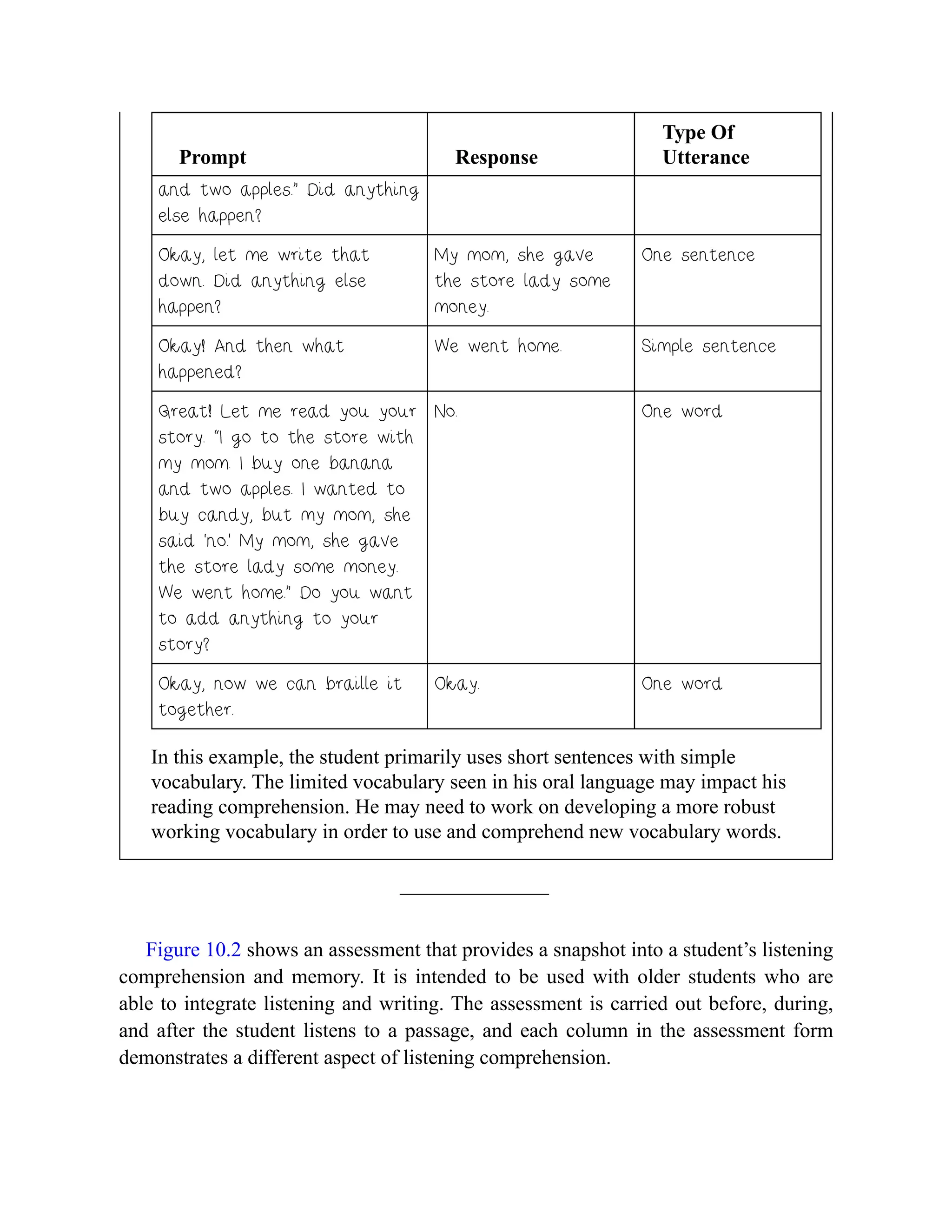
![FIGURE 10.2
Assessment of Listening Comprehension
For this assessment, the teacher guides the student through previewing,
listening to, and recalling facts about a text, using a three-column worksheet.
When filled out by the student during this assessment, each of the three
columns will provide insight into a different process of listening
comprehension. Teachers may use this information to get a general sense of
the student’s ability to remember details of a passage. The “Preview” column
evokes the student’s background knowledge and provides insight into what he
or she already knows about a particular topic. The “Notes” column provides
insight into the student’s ability to discern the key ideas from a passage of
information. The “Embellishments” column provides insight into the student’s
ability to recall detailed information from memory. Braille readers may find it
easier to use three separate sheets of paper, one for each column.
Select a short passage of text to be used for the assessment. The passage
should be at the student’s grade level and on a topic that is motivating for the
student. The passage should be unfamiliar to the student. Provide a blank
three-column worksheet (see below) to the student.
Teacher: I am going to read a short passage to you. The title of the
passage is _______________. Before I begin reading it to you,
in the “Preview” column, write down everything you know
about _______________ and write down what you think the
passage is going to be about.
[Give the student a few minutes to jot down notes about what he
or she thinks the passage will be about.]
Teacher: Now, I am going to read the passage to you. As you listen to the
passage, use the “Notes” column to write down phrases from the
passage that you want to remember. Do not write every word
that you hear. Instead, write down the most important key words
that you hear.
Teacher: Now that you are finished listening to the passage, I want you to
use the “Embellishments” column to write down any details or
embellishments that you remember from the passage. These
may be details that you couldn’t write down when you were
listening but that are important to remember.
[Give the student a few minutes to add notes to his or her chart.]
Teacher: Now that you are finished embellishing your notes, I want you
to retell everything that you can remember about the passage.](https://image.slidesharecdn.com/readingconnections-strategies-for-teaching-students-with-visual-impairments-250721170318-cb16127e/75/Reading-Connections-Strategies-for-Teaching-Students-with-Visual-Impairments-374-2048.jpg)
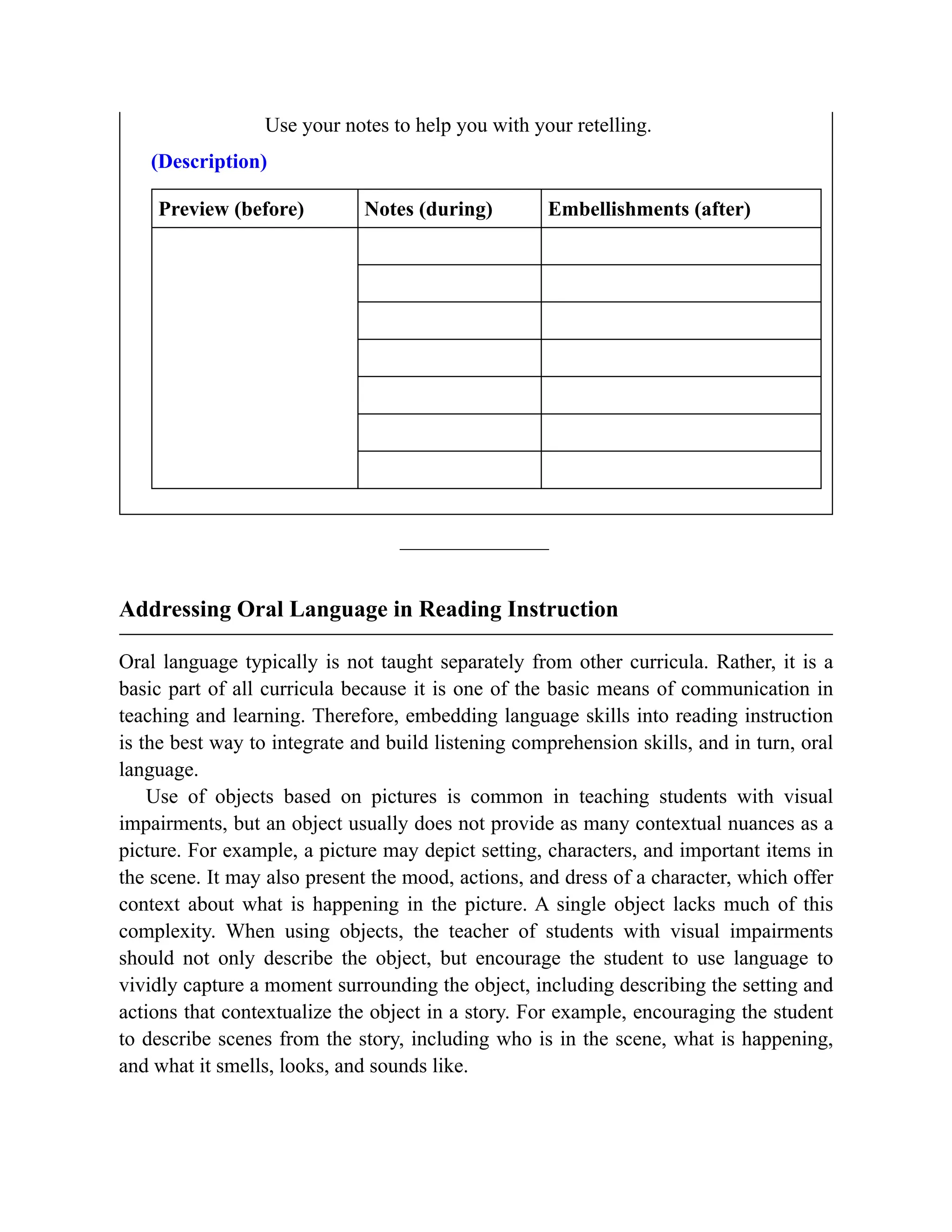
![When students have significant difficulties with oral language or listening
comprehension, it is important to consider the possibility that they may have speech
and language disabilities, learning disabilities, or hearing problems. In this case,
children may receive special services and instruction in language from a speech-
language pathologist, or a child may qualify for services from a resource specialist
under the category of learning disability. To investigate if a student has a speech or
language disability, a referral to a speech-language pathologist should be made
through the local education agency, which can also refer the student to an audiologist
if warranted. (For detailed information about identifying speech and language or
learning disabilities, see Denton & Silver, 2012.)
Strategies
Several strategies may be used to address oral language during reading instruction.
The strategies and activities suggested here may be helpful during lessons (Johns &
Lenski, 2010, p. 100; Peregoy & Boyle, 2008, pp. 126–133).
Read, read, read! Provide ample opportunities for children to hear language
through reading and discussing books. Encourage students to describe what
they read, including retelling the story, remembering details, and describing
characters and settings. Also, have students relate their own personal
experiences to the story by asking them to talk about things they have in
common with the characters or situations presented in the story.
Ask questions to prompt rich discussions, such as, “Tell me about a time when
…,” “What do you think about …,” “Describe …,” “How do you think ___
[name a character or person] felt about …,” “Tell me about something that …,”
and “How do you feel about .…” These question prompts promote
conversations beyond one-word responses. Have students elaborate on their
answers by embellishing the details. Have them provide details about the
context of the situation, events that occurred, people that were present, feelings
they felt, places they have seen, and so on.
Sing songs. Music often provides a fun way to learn new words. Songs also
serve as a basis for further conversation. Add to the experience by doing hand
motions while singing or use picture prompts to develop vocabulary. Using
musical instruments adds to the experience, as children can use them to keep
time and explore the rhythm of the language used in the song.
Structure group activities. Having students work in small groups or pairs
often sets up a scenario in which students must engage in conversation. Giving](https://image.slidesharecdn.com/readingconnections-strategies-for-teaching-students-with-visual-impairments-250721170318-cb16127e/75/Reading-Connections-Strategies-for-Teaching-Students-with-Visual-Impairments-376-2048.jpg)
![Teacher: Remember the words and repeat them to me backwards. (NOTE:
you may choose to use nonsense words or real words.)
go fish
Student: fish go
Teacher: egg white
Student: white egg
Teacher: see Jim jump
Student: jump Jim see
Teacher: big and gray cat
Student: cat gray and big
Teacher: swim sweet pat go
Student: go pat sweet swim
Teacher: Listen to the letters and tell me the word that it spells.
[This activity requires the student to have basic phonics skills.]
n-o
Student: no
Teacher: h-a-t
Student: hat
Teacher: k-i-t-e
Student: kite
Teacher: d-r-i-n-k
Student: drink
Teacher: s-t-r-e-e-t
Student: street
Teacher: Listen to the word, then drop the first sound of the word and tell me
what the new word is.
trip
Student: rip
Teacher: sting
Student: ting
Teacher: cream
Student: ream
Teacher: flub
Student: lub
Teacher: sweet
Student: weet
Source: Based on Mather, N., & Jaffe, L. E. (2002). Woodcock Johnson III: Reports, recommendations,
and strategies. New York: John Wiley & Sons, Inc.](https://image.slidesharecdn.com/readingconnections-strategies-for-teaching-students-with-visual-impairments-250721170318-cb16127e/75/Reading-Connections-Strategies-for-Teaching-Students-with-Visual-Impairments-381-2048.jpg)

![relevant comments. If the student scores a 1, 2, or 3, further instruction to build
background knowledge may be necessary prior to reading the story.
Scoring Rubric:
1 = No prior knowledge, needs more information
2 = Very little prior knowledge, needs more information
3 = Has background knowledge that will expand after reading
4 = Knows a lot about the topic
5 = Is an expert on the topic, for his or her age
(Description)
Prompt Score Comments
SECTION 1: TITLE
[Read the title of the story.] Given
the title, what do you think the
story is about?
SECTION 2: PICTURES AND OBJECTS
If using pictures:
Here is a picture from the story.
What do you think is happening in
the picture?
What do you think the story is
about when you look at the
picture?
If using objects:
Here is an object from the story.
What do you think the story has to
do with the ___ [name of object]?
What do you think the story is
about when you look at the object?](https://image.slidesharecdn.com/readingconnections-strategies-for-teaching-students-with-visual-impairments-250721170318-cb16127e/75/Reading-Connections-Strategies-for-Teaching-Students-with-Visual-Impairments-390-2048.jpg)
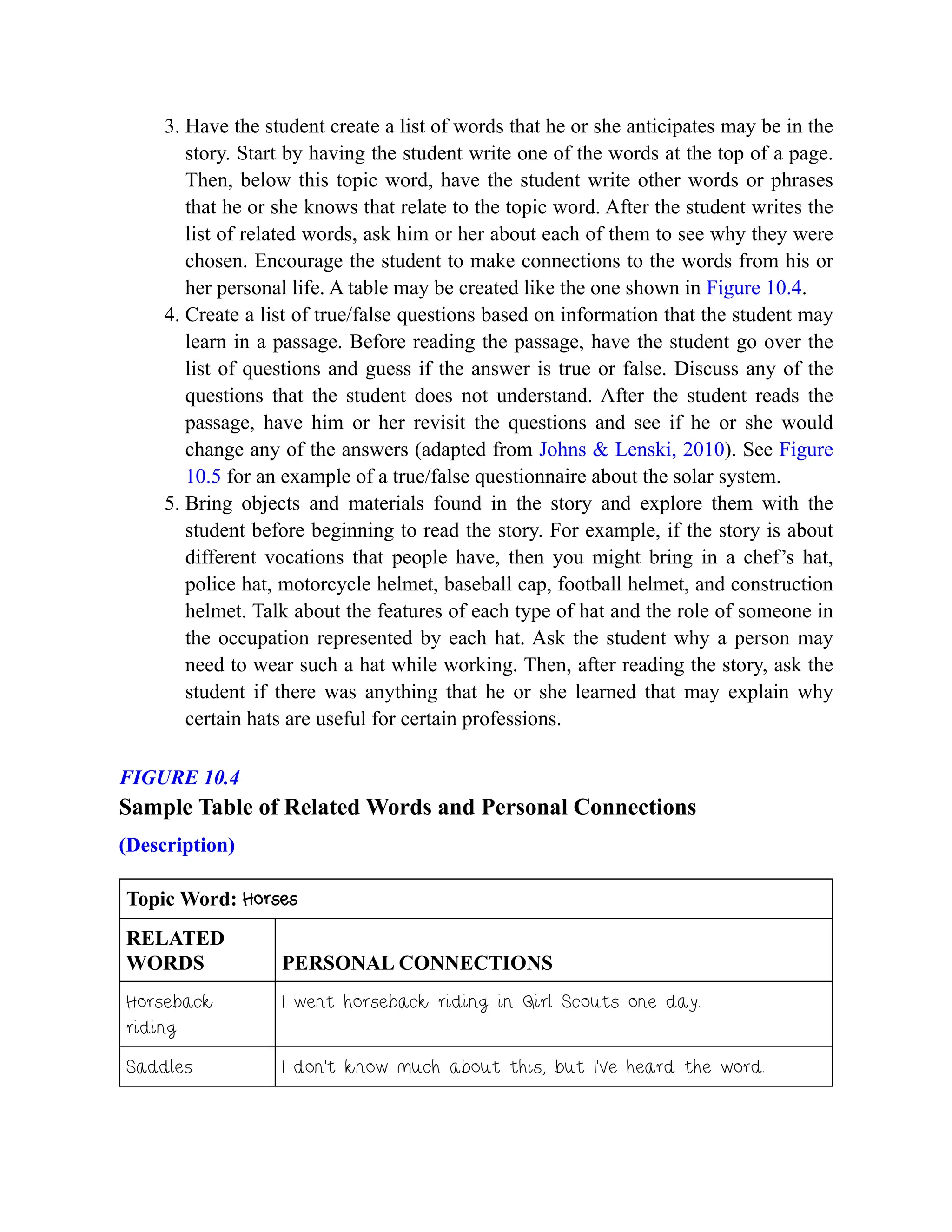
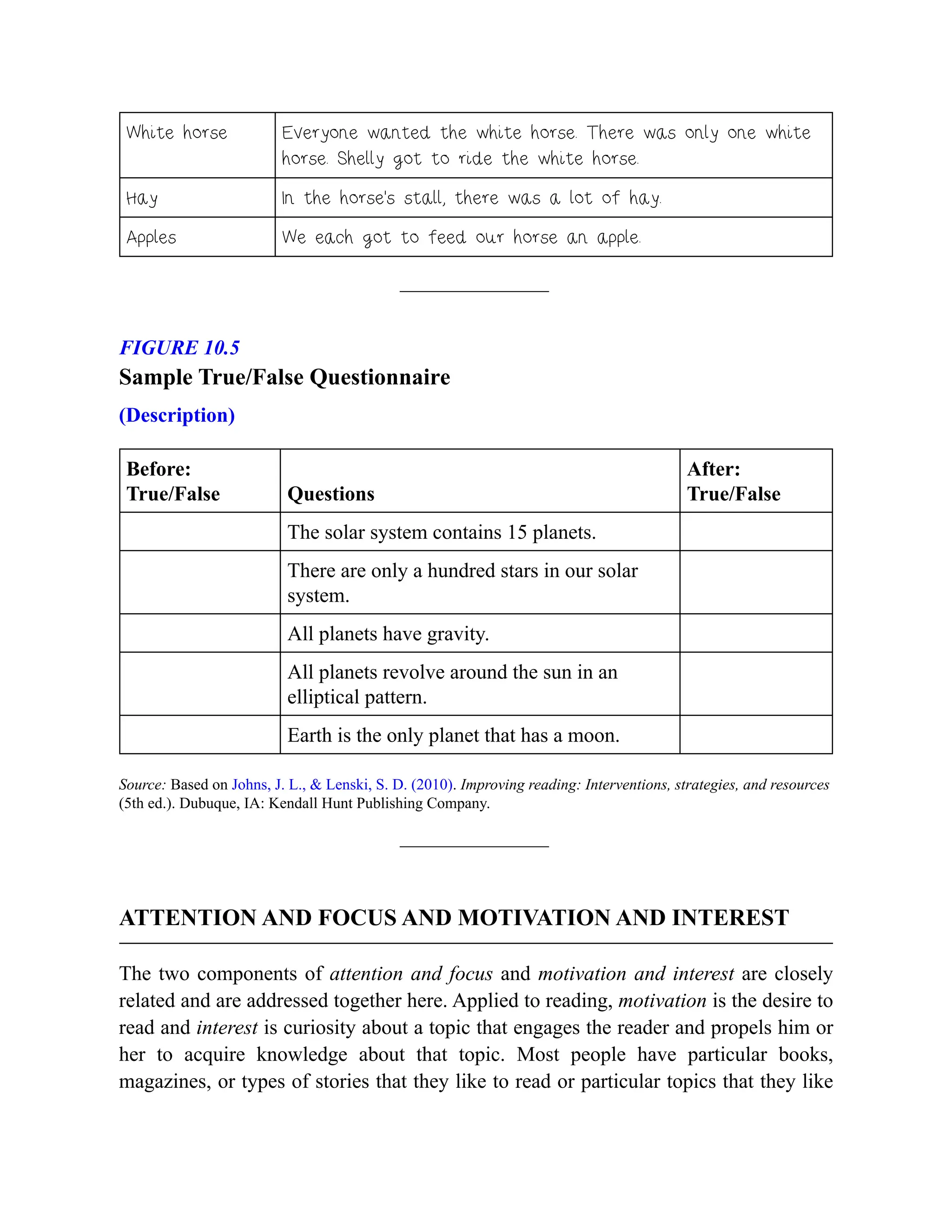
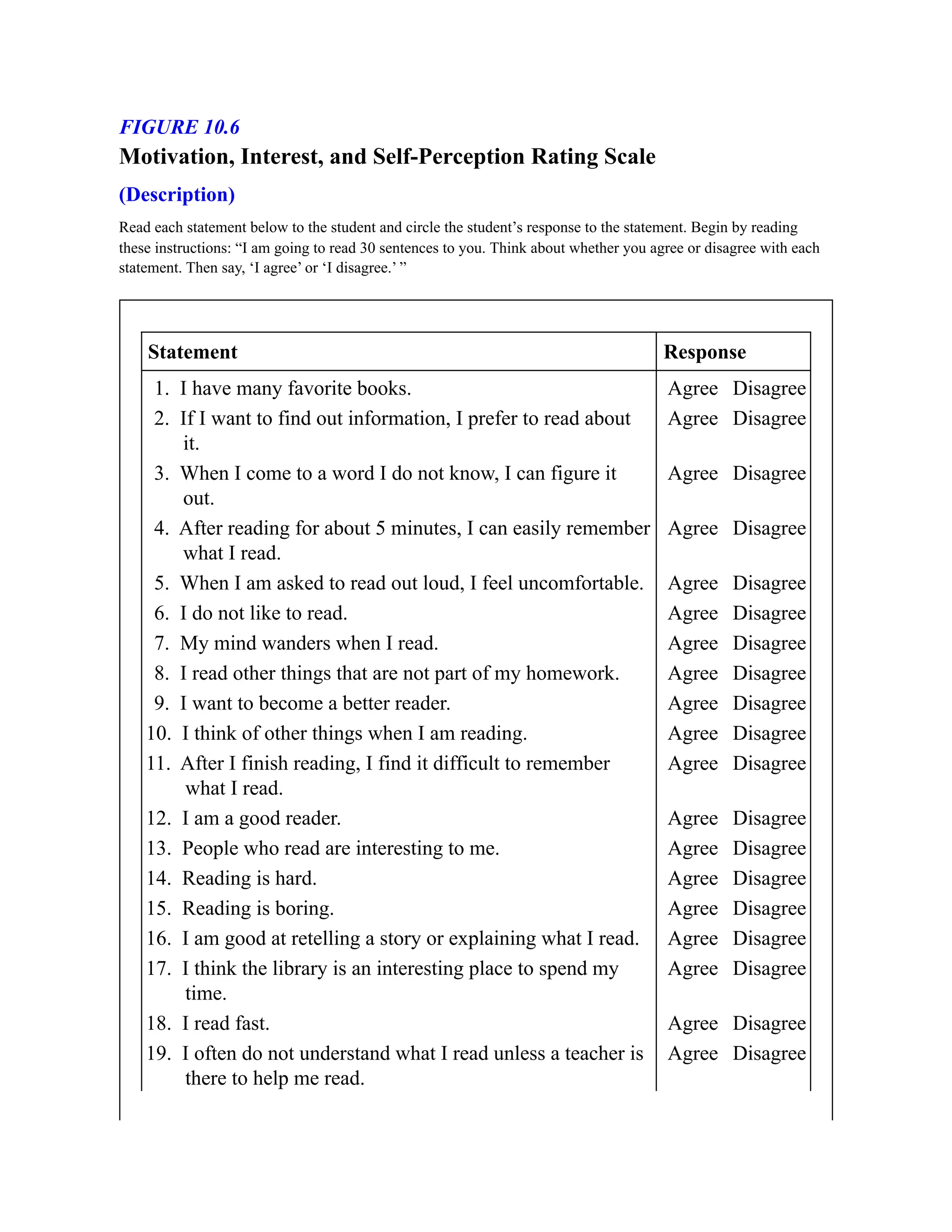
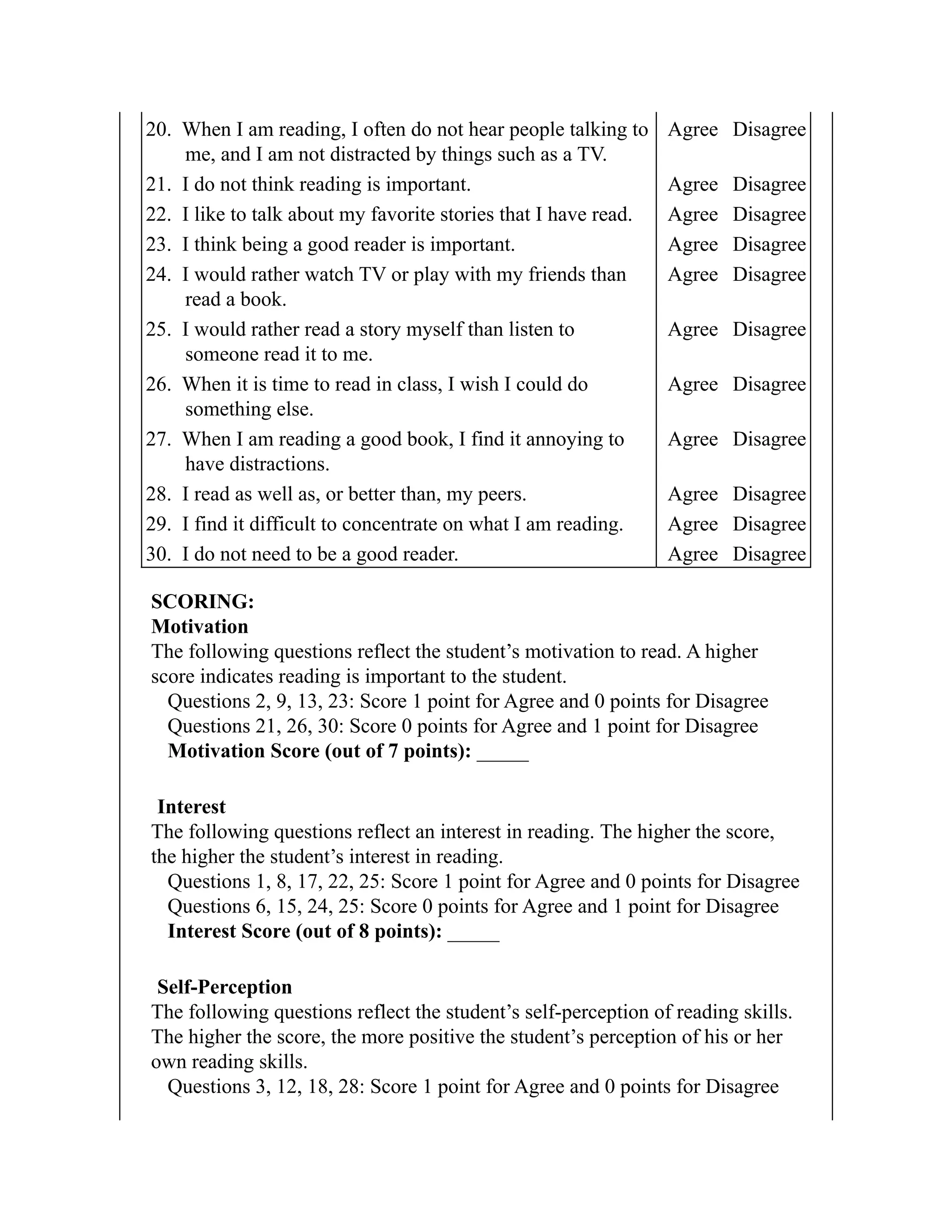
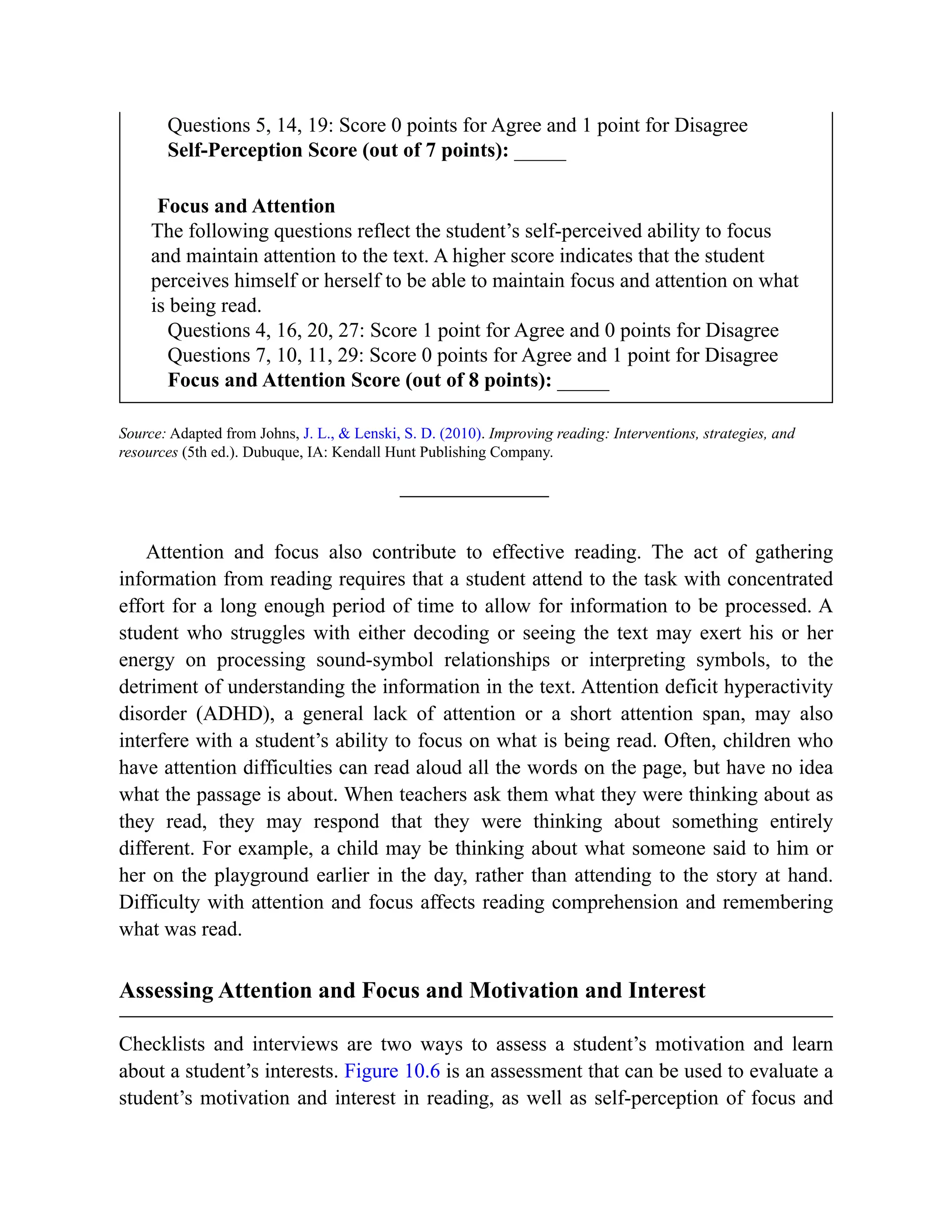
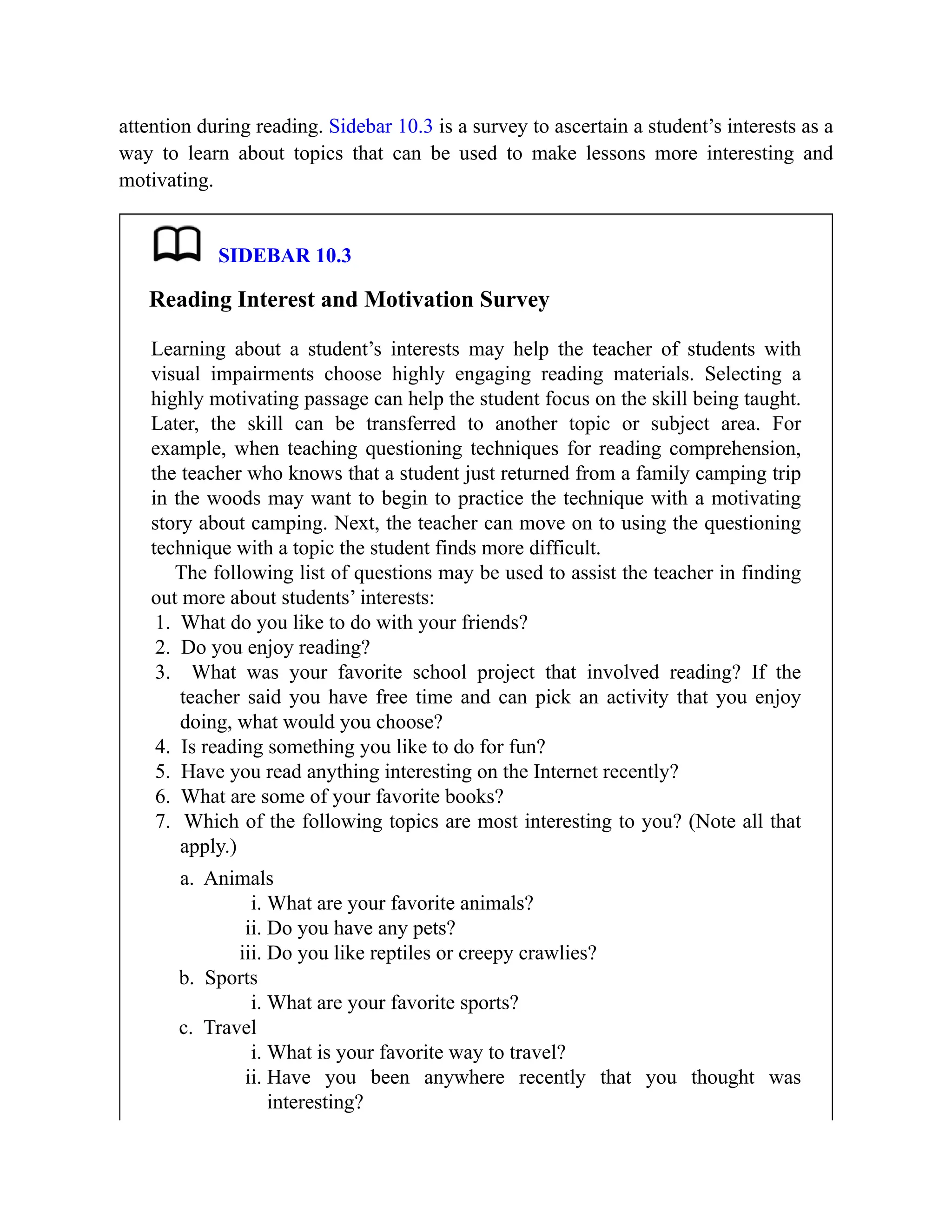
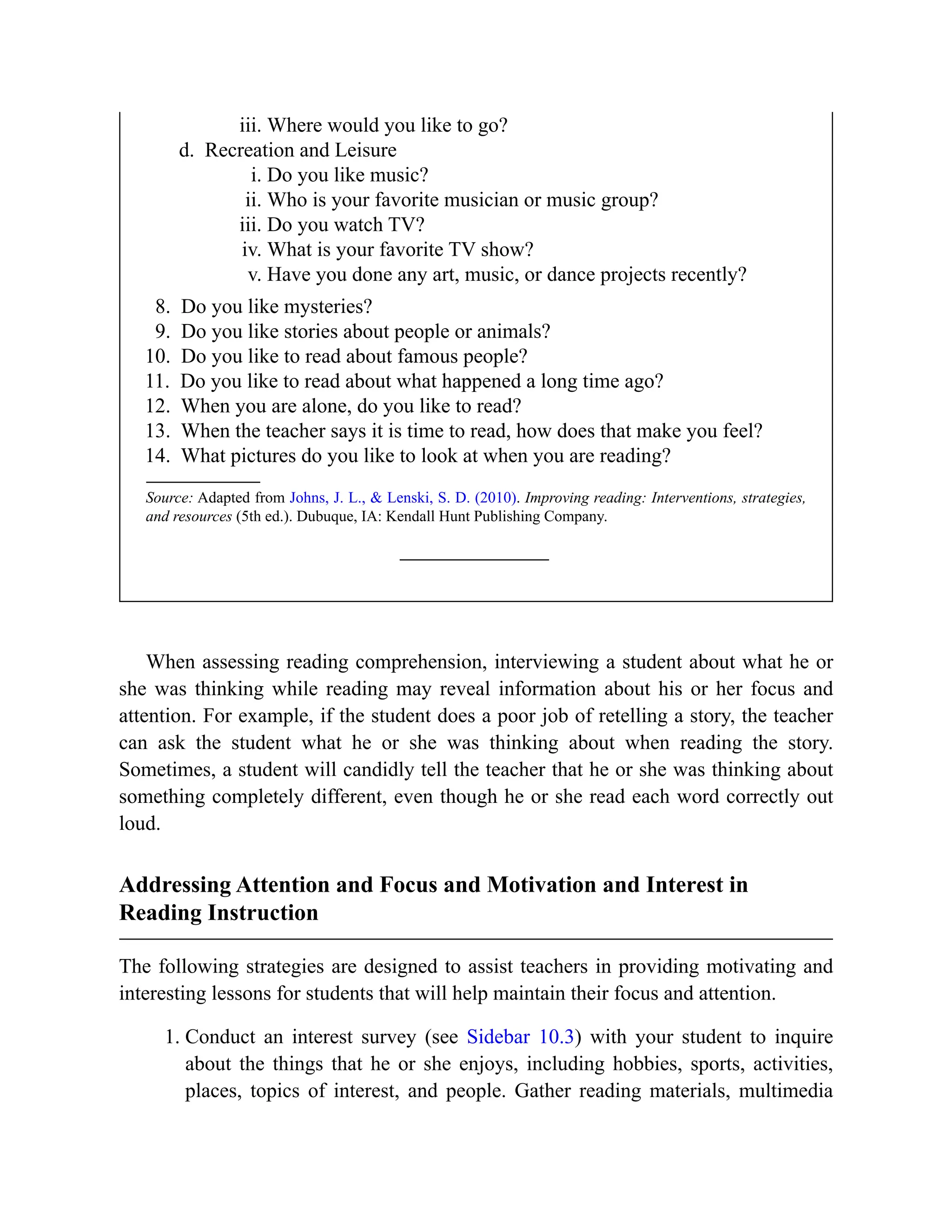
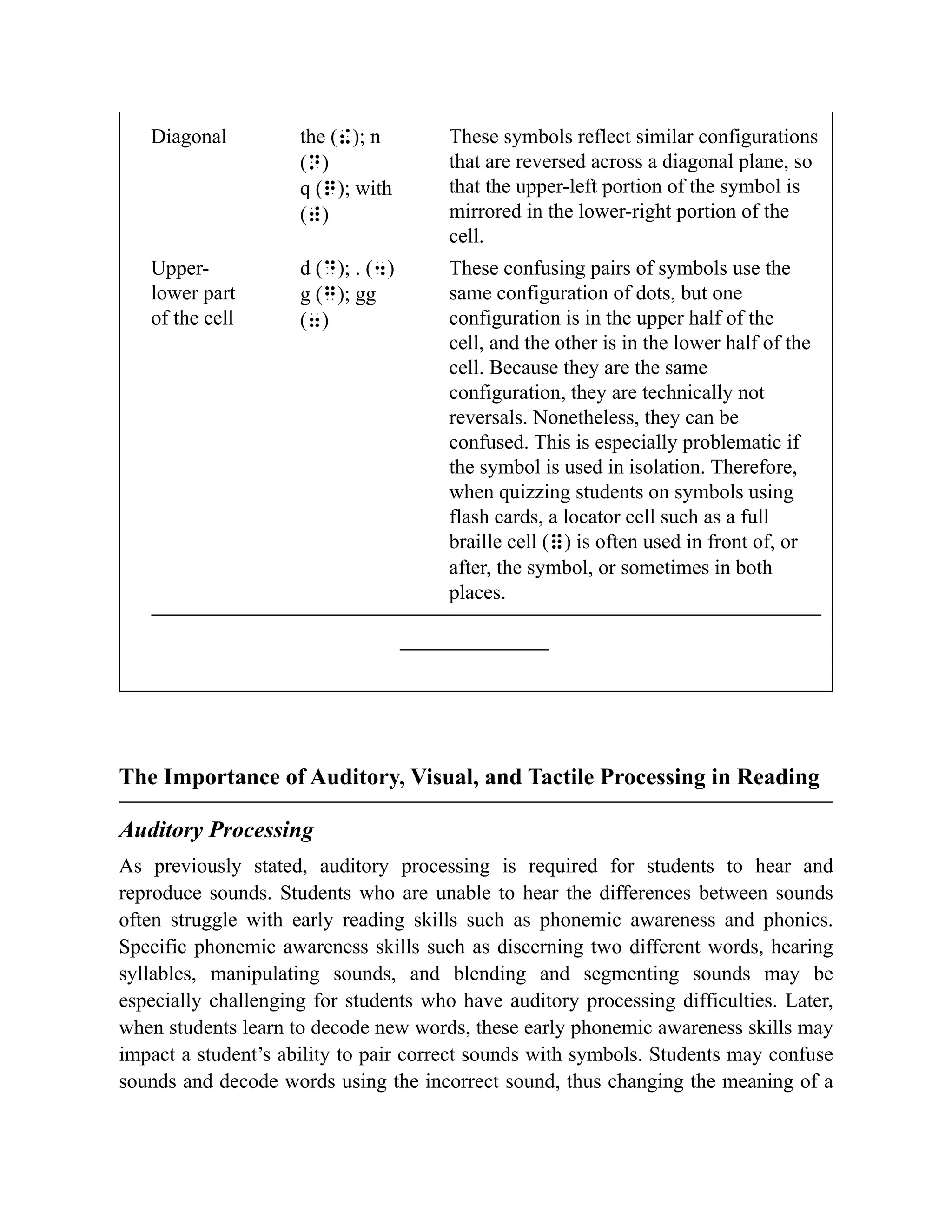
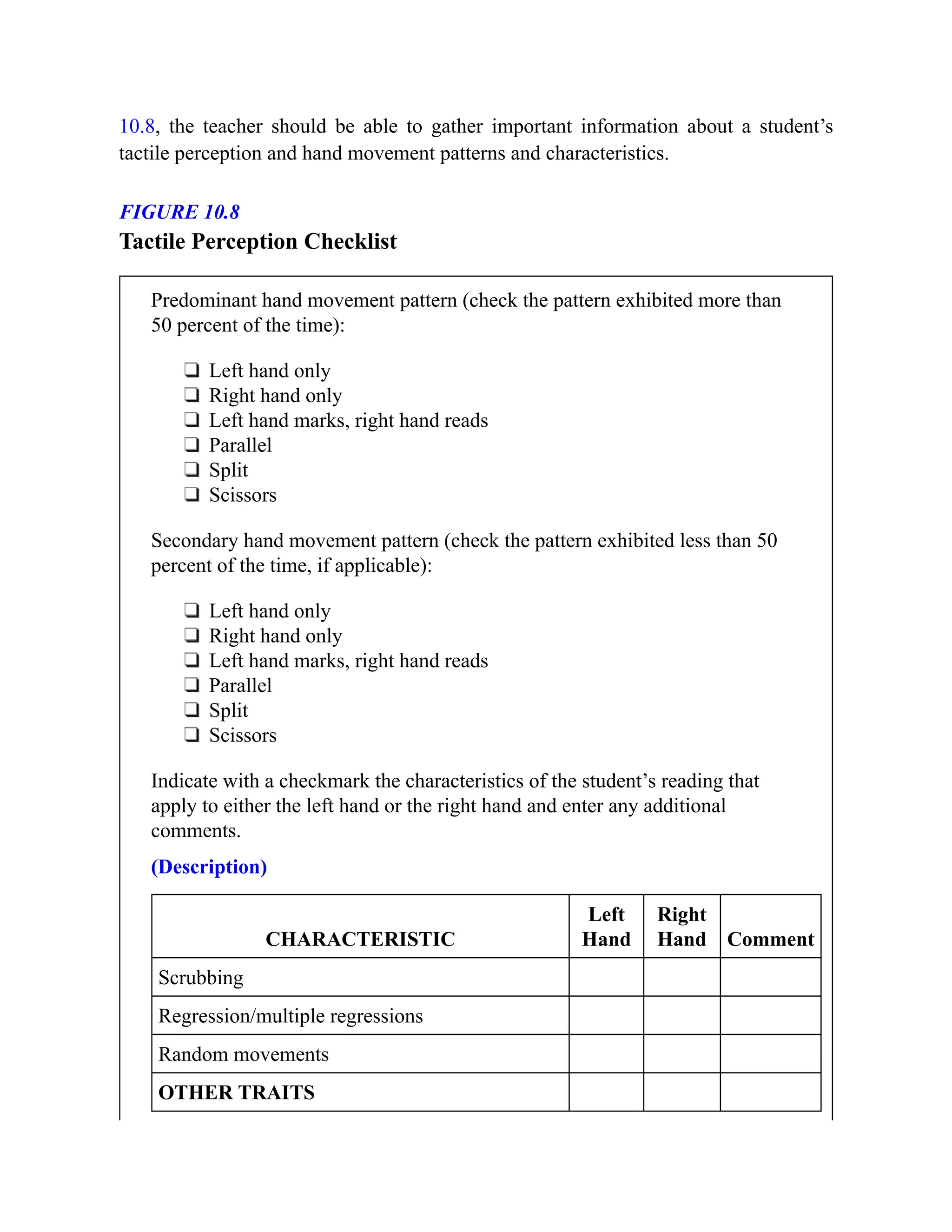
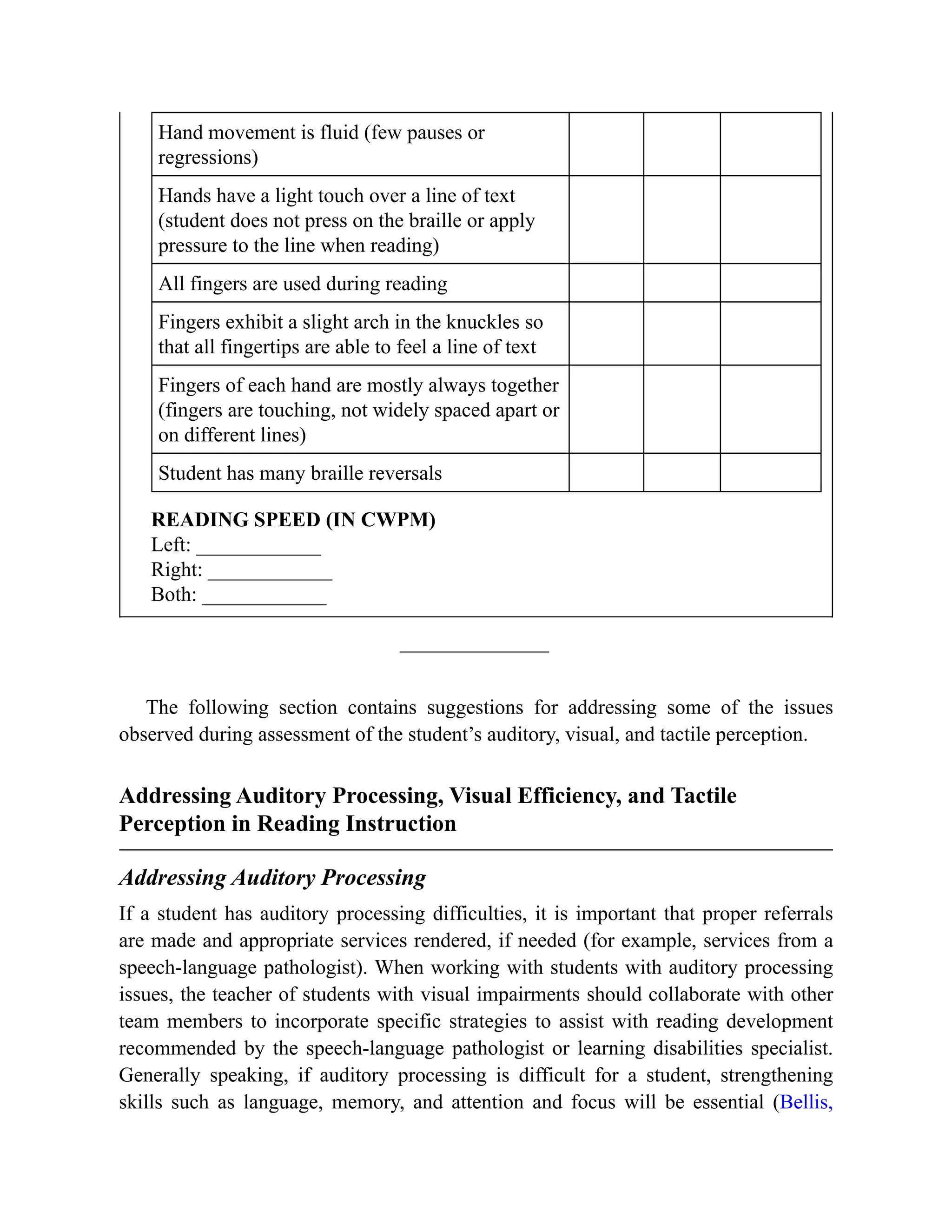
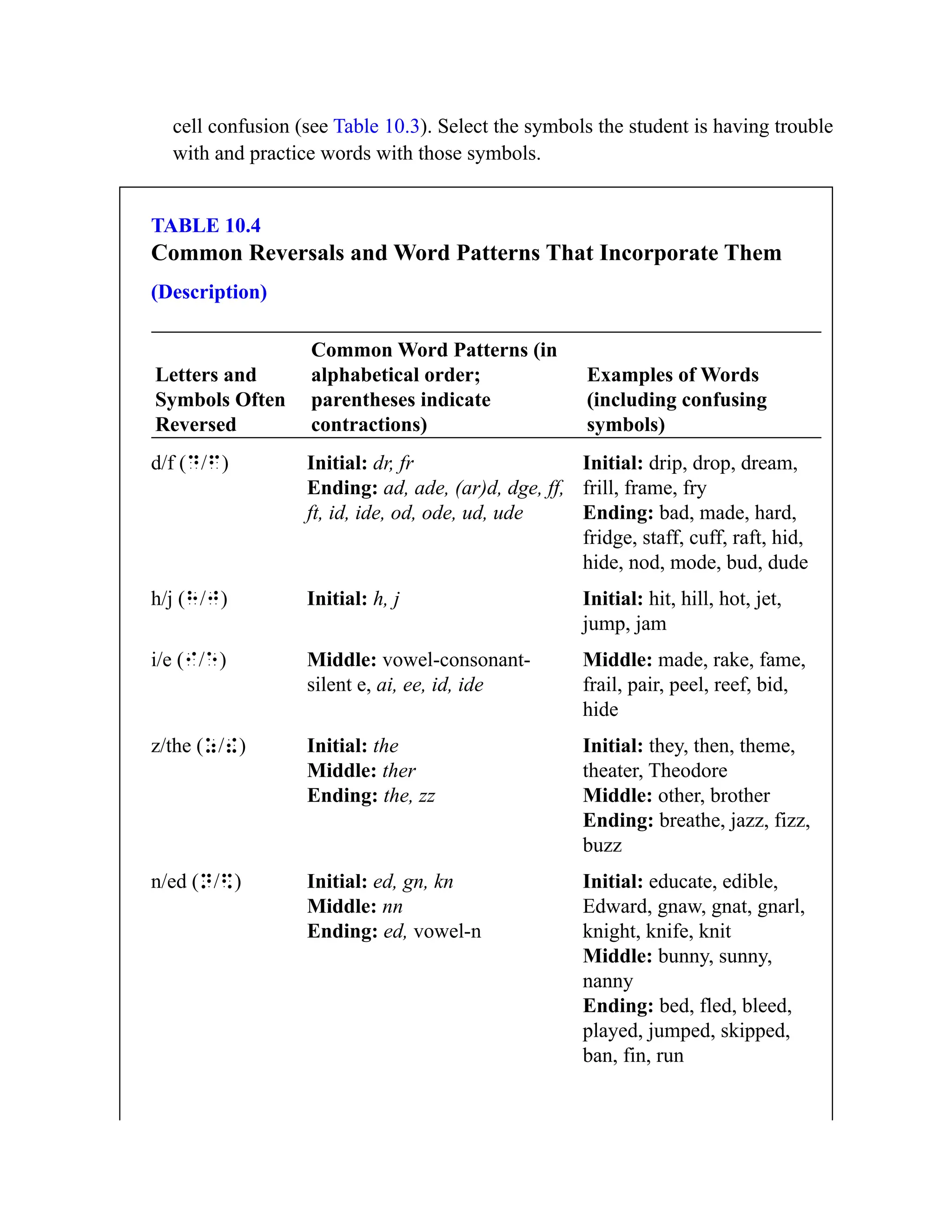
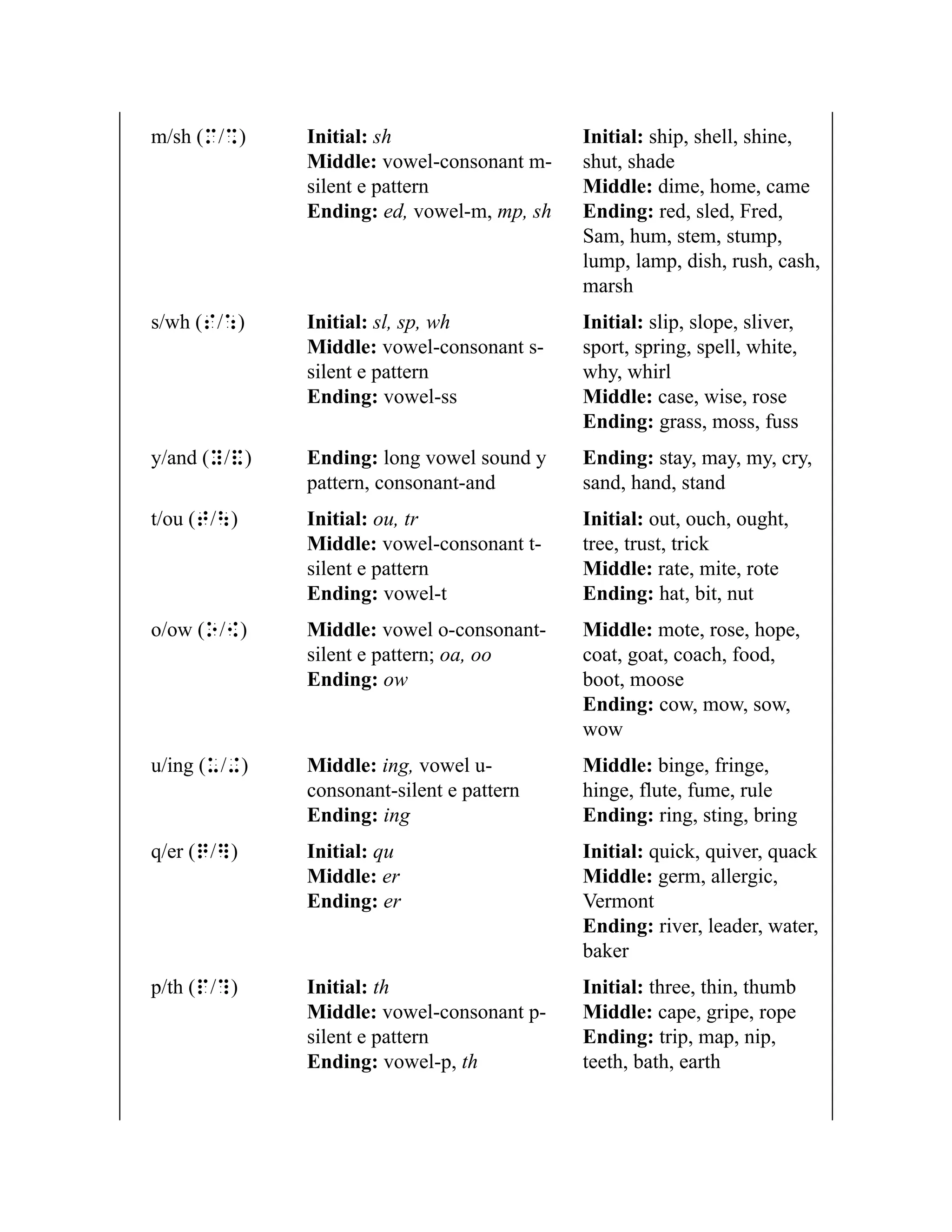
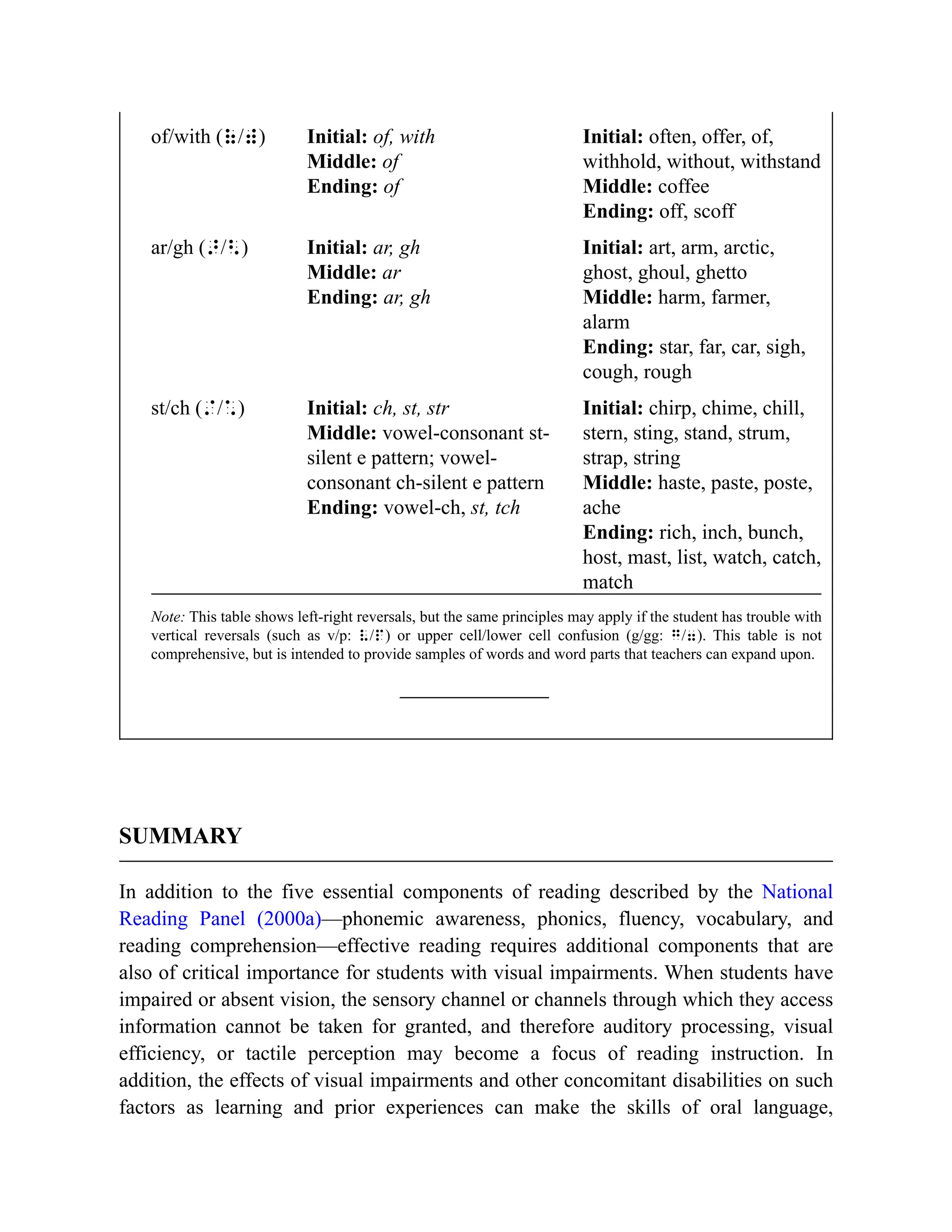
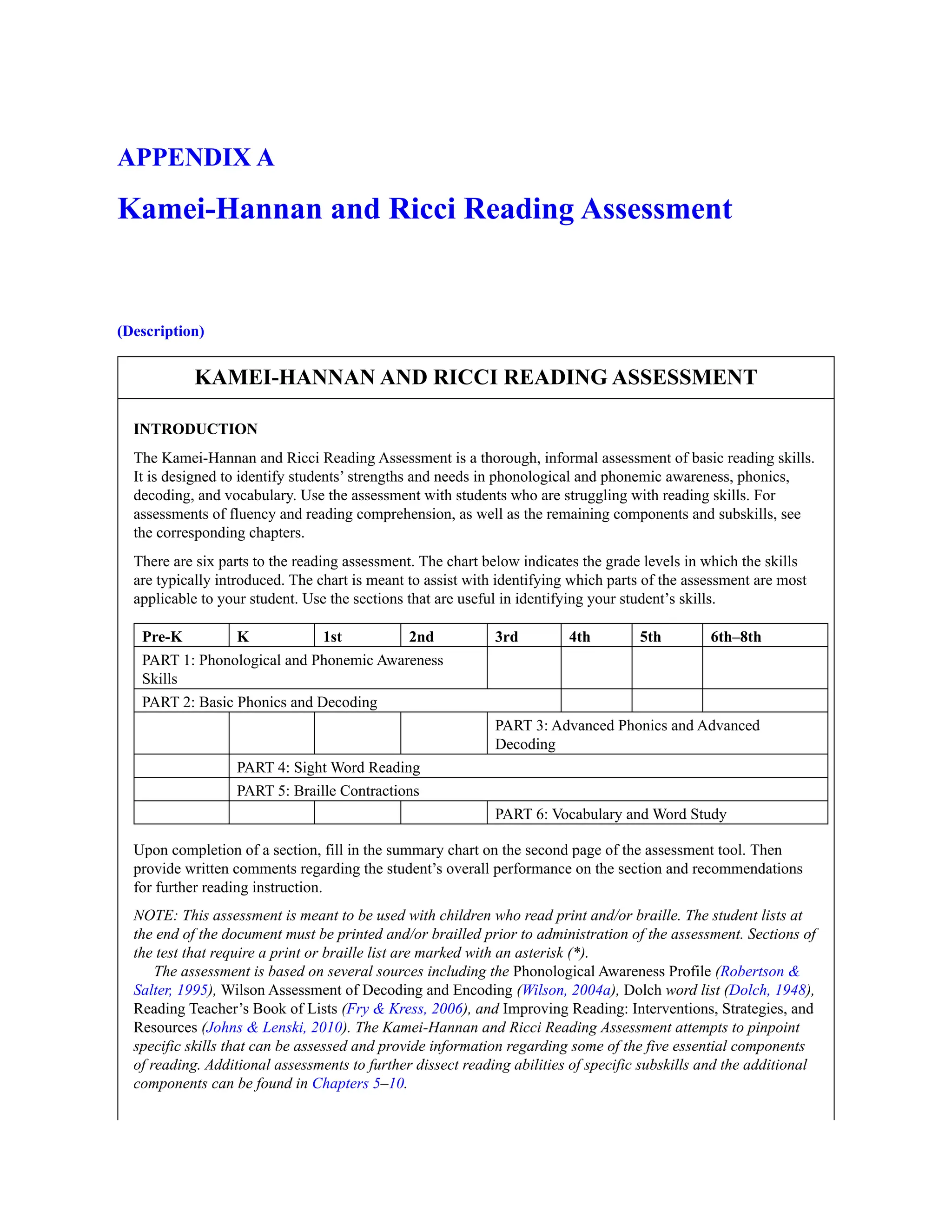
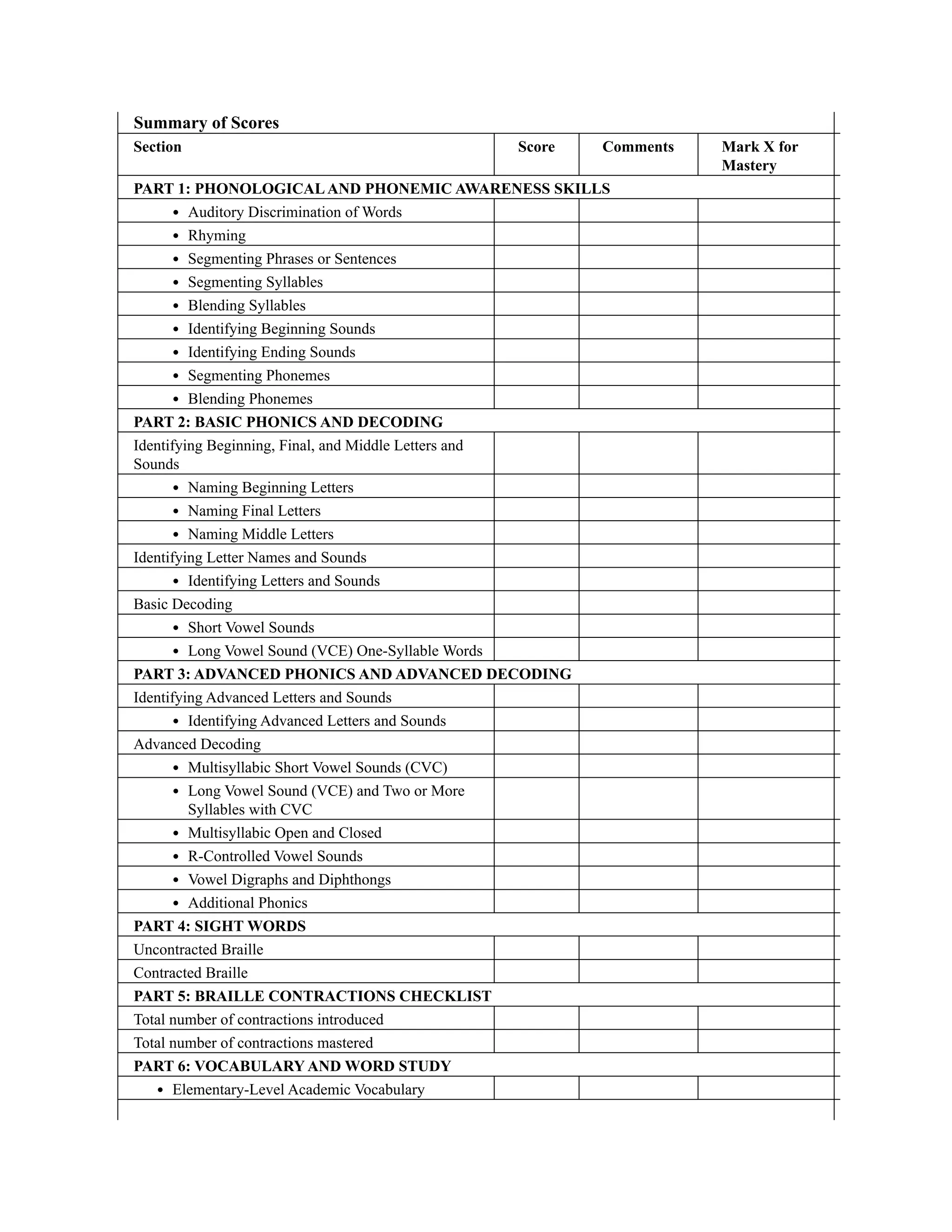
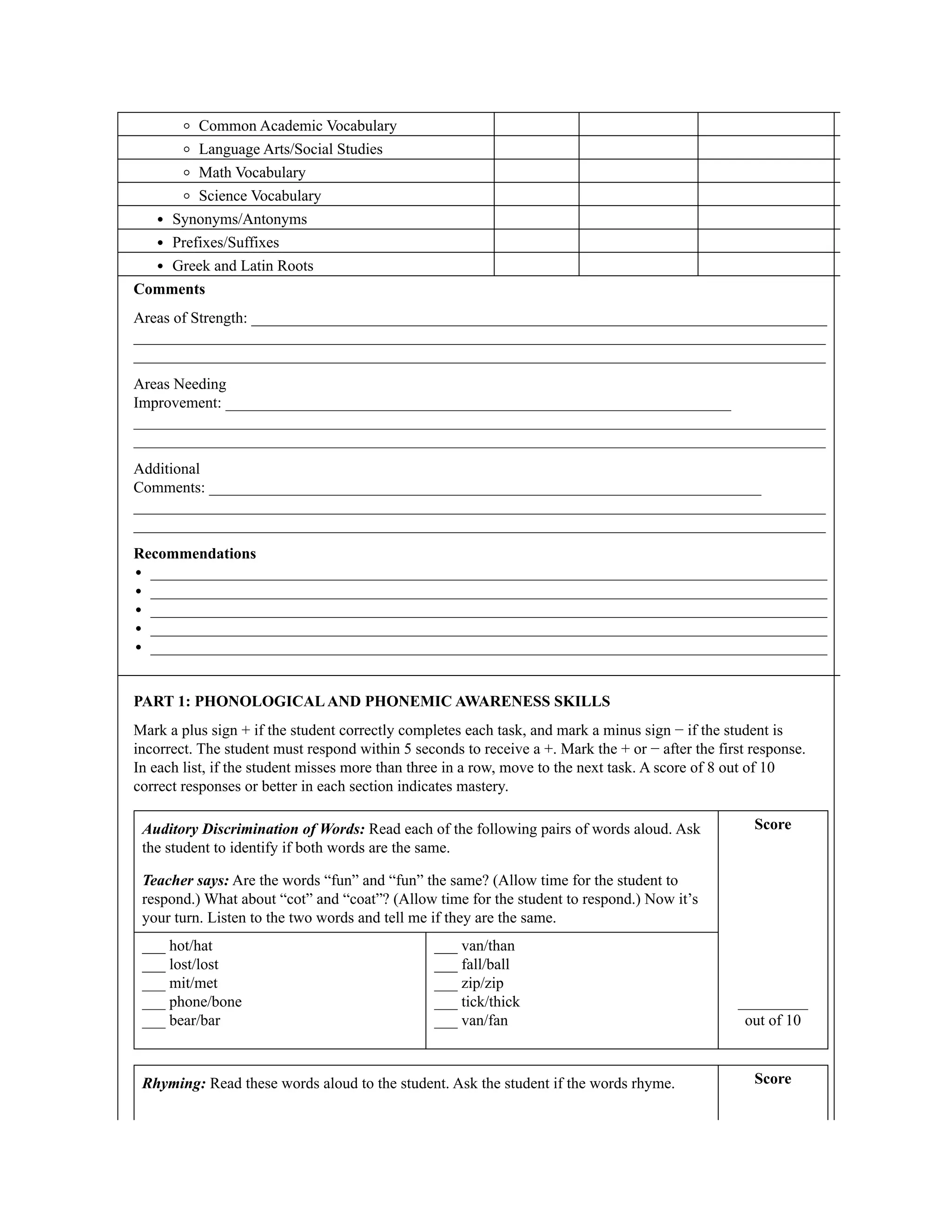
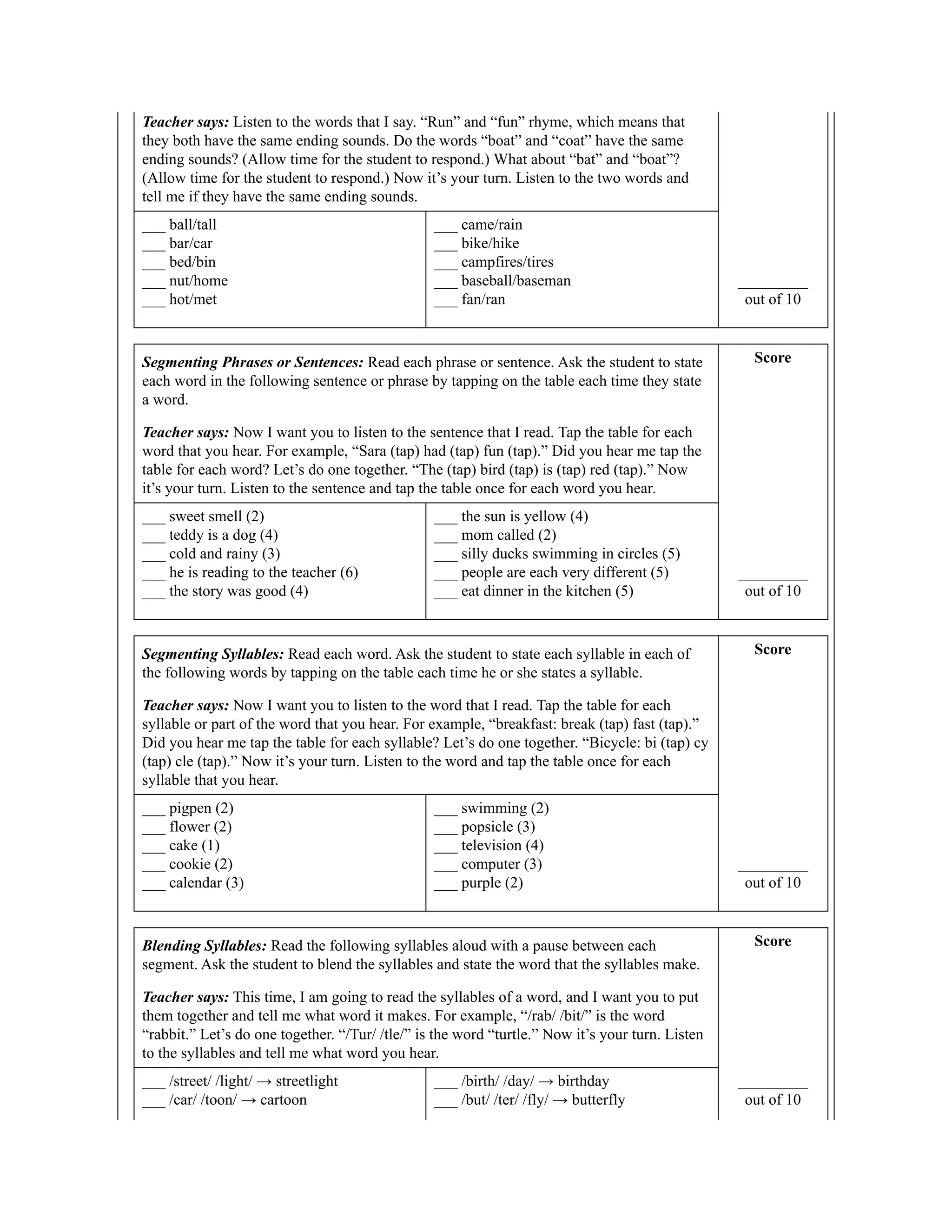
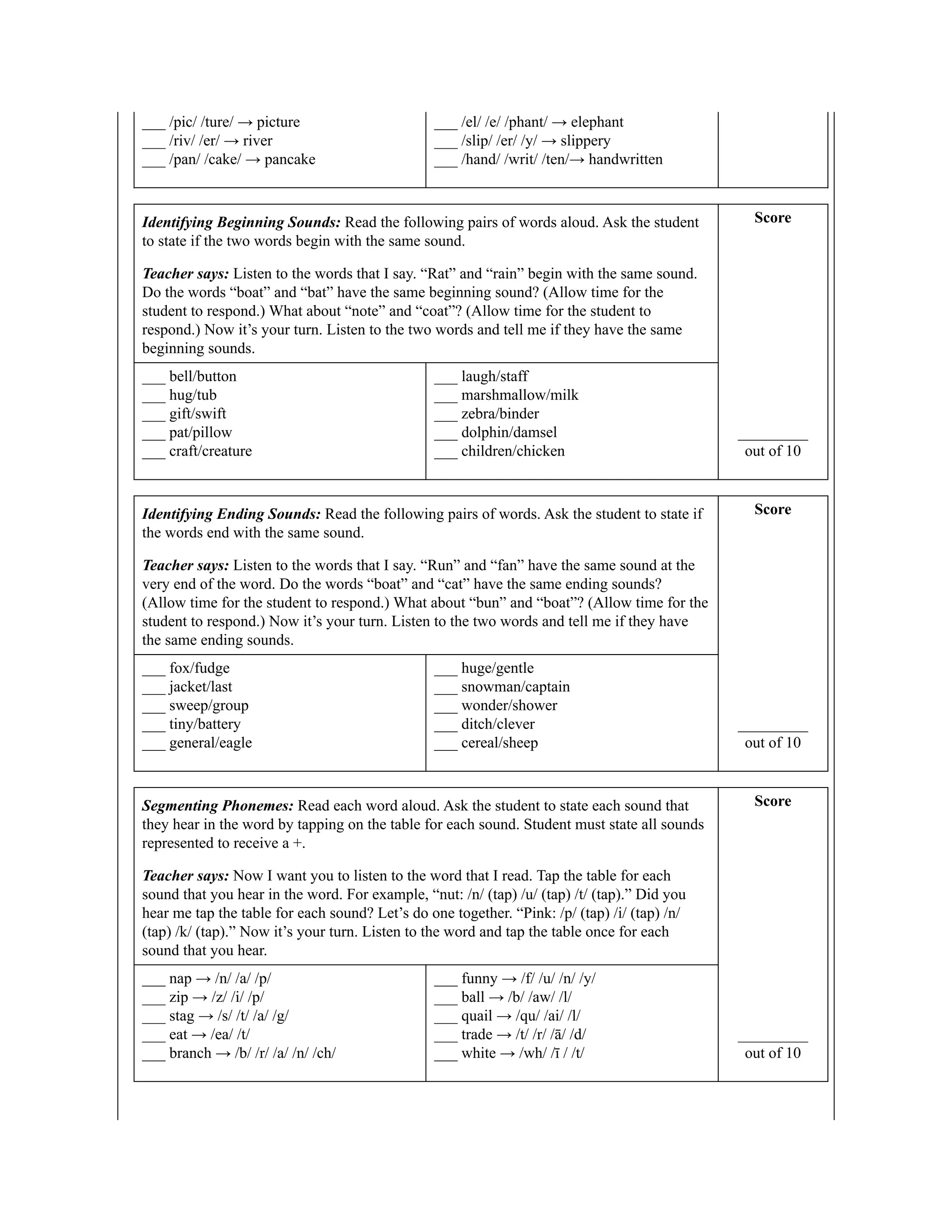
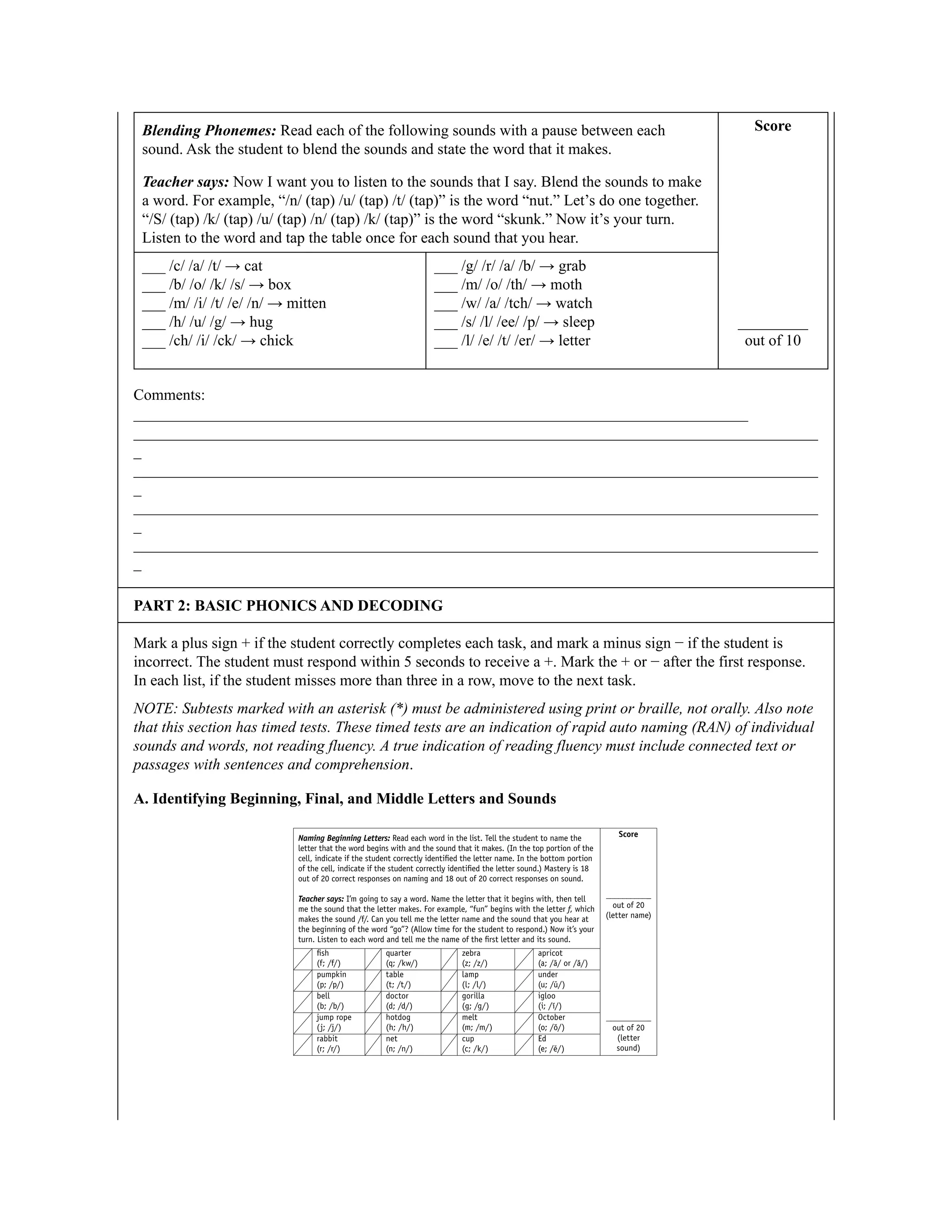
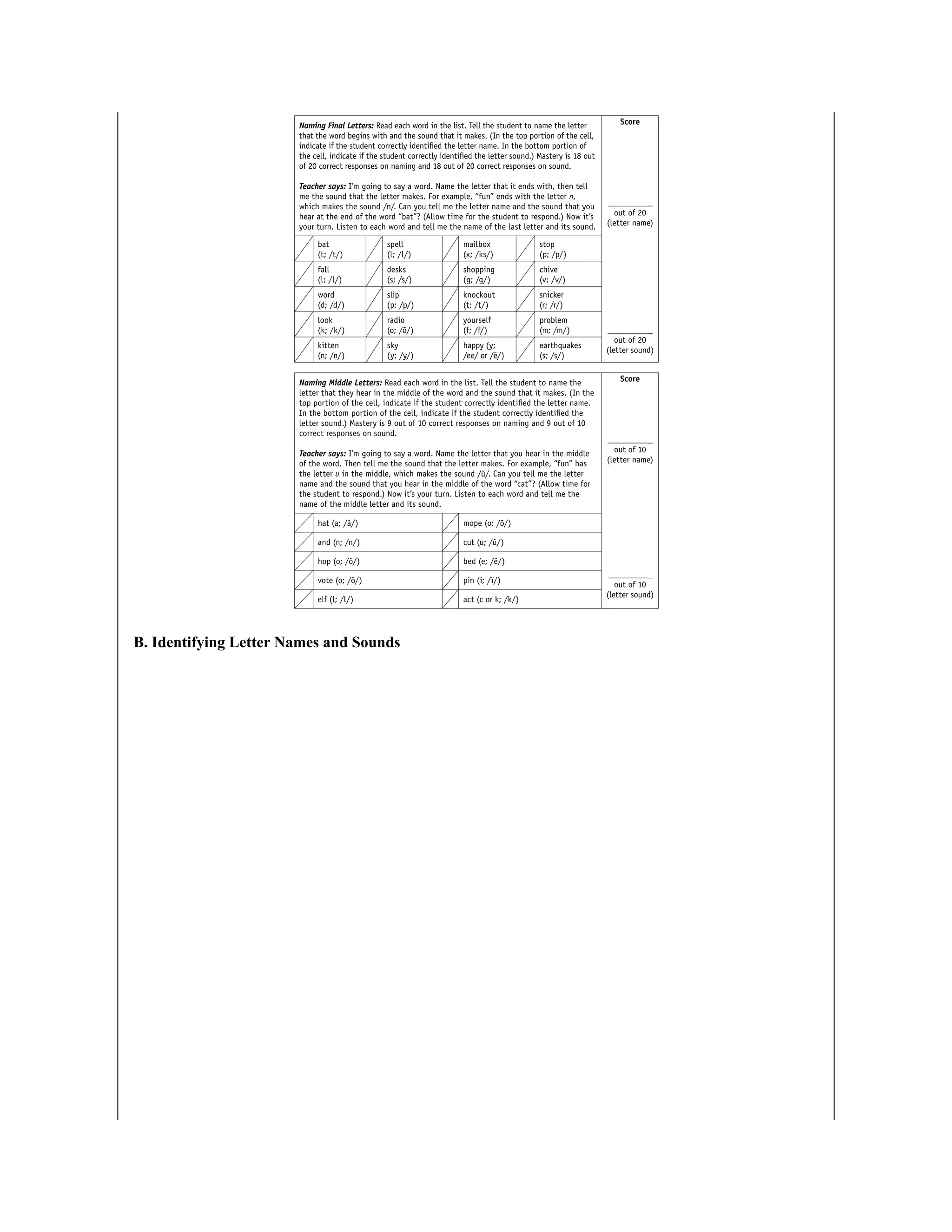
![C. Basic Decoding
*Short Vowel Sounds: Have the student read each word in the list below. Mastery is 18 out of 20
correct responses on uncontracted words and 18 out of 20 correct responses on contracted words.
Teacher says: Read each of the following words.
Uncontracted Bonus Words with Digraphs and Braille
Contractions
Score
___ hut
___ mop
___ wig
___ rag
___ hill
___ flip
___ brick
___ moss
___ lamp
___ bet
___ golf
___ ramp
___ swell
___ help
___ scram
___ trap
___ cliff
___ brad
___ squid
___ flop
___ cloth
___ thud
___ moth
___ thrill
___ chest
___ rich
___ swish
___ string
___ mind
___ host
___ chimp
___ shut
___ send
___ think
___ squish
___ inch
___ wish
___ lunch
___ sing
___ ash
___________
out of 20
(uncontracted)
___________
out of 20
(uncontracted)
*Long Vowel Sound (vowel-consonant-silent e [VCE]) One-Syllable Words: Have the student read
each word in the list below. Mastery is 18 out of 20 correct responses on uncontracted words and 18 out
of 20 correct responses on contracted words.
Teacher says: Read each of the following words.
Uncontracted Bonus Words with Digraphs and Braille
Contractions
Score
___ spike ___ Luke ___ chime ___ strode](https://image.slidesharecdn.com/readingconnections-strategies-for-teaching-students-with-visual-impairments-250721170318-cb16127e/75/Reading-Connections-Strategies-for-Teaching-Students-with-Visual-Impairments-442-2048.jpg)
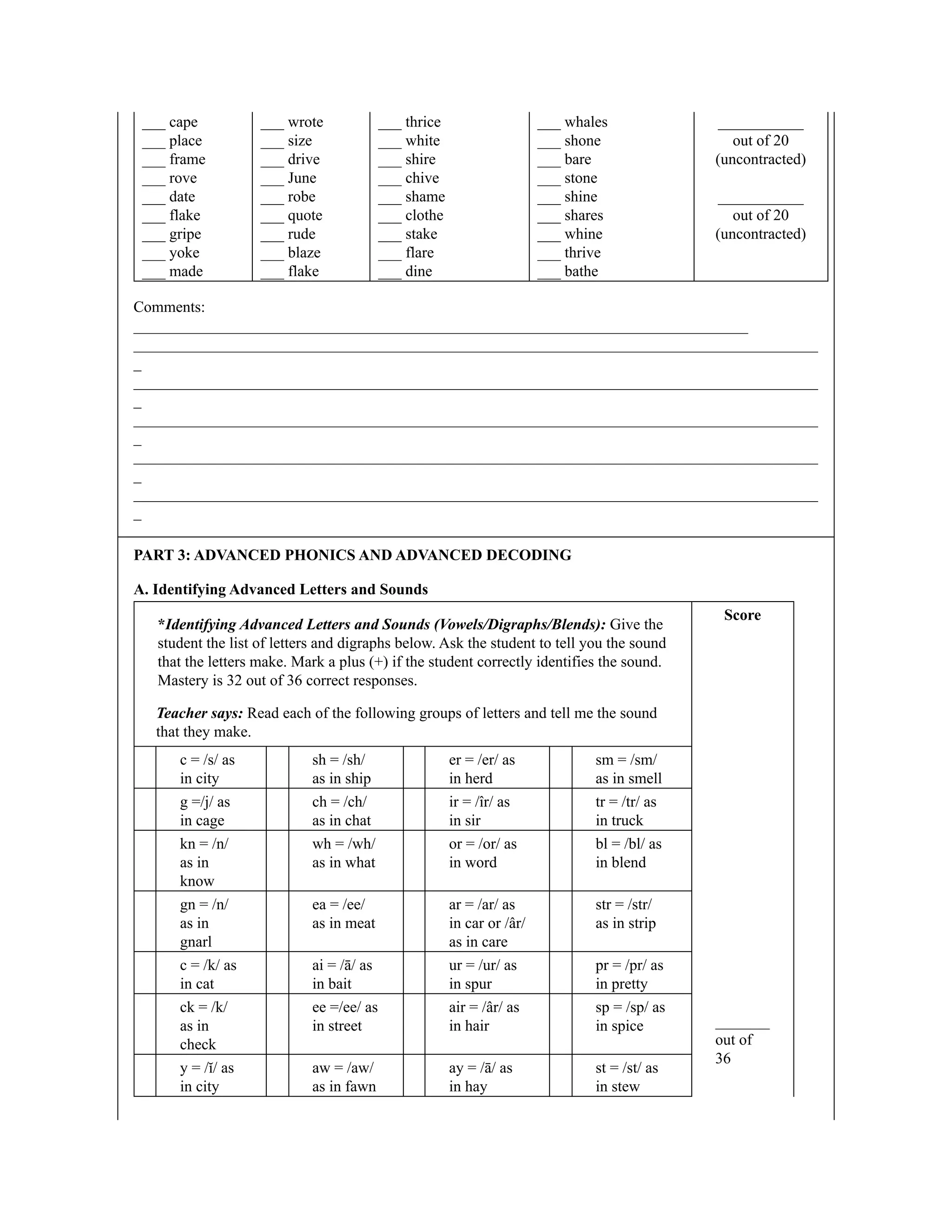
![th = /th/
as in
moth
ow = /ow/
as in
gown
gl = /gl/ as
in glue
squ = /skw/
as in
square
th = /th/
as in then
ph = /f/ as
in phone
oa = /ō/ as
in boat
tw = /tw/
as in twin
B. Advanced Decoding
*Multisyllabic Short Vowel Sounds (consonant-vowel-consonant [CVC]): Have the student read each
word in the list. Mastery is 8 out of 10 correct responses on uncontracted words and 8 out of 10 on correct
responses on contracted words.
Teacher says: Read each of the following words.
Uncontracted Words with Contractions Score
___ musket
___ lesson
___ uplift
___ pressbox
___ helmet
___ pretzel
___ sunlit
___ nutmeg
___ bottom
___ magnetic
___ windmill
___ splendid
___ secondhand
___ problem
___ fasten
___ chestnut
___ upswing
___ snapshot
___ athletic
___ hundred
___________
out of 10
(uncontracted)
___________
out of 10
(contracted)
*Long Vowel Sound (vowel-consonant-silent e [VCE]) and Two or More Syllables with CVC (consonant-
vowel-consonant): Have the student read each word in the list. Mastery is 8 out of 10 correct responses on
uncontracted words and 8 out of 10 correct responses on contracted words.
Teacher says: Read each of the following words.
Uncontracted Words with Contractions Score
___ reptile
___ exhale
___ classmate
___ fireball
___ subscribe
___ clockwise
___ umpire
___ homemade
___ upstage
___ tapeworm
___ stagnate
___ sunshine
___ enslavement
___ snowflake
___ stalemate
___ insane
___ namesake
___ shameless
___ backache
___ sometimes
___________
out of 10
(uncontracted)
___________
out of 10
(contracted)
*Multisyllabic Open and Closed: Have the student read each word in the list. Mastery is 8 out of 10 correct
responses on uncontracted words and 8 out of 10 correct responses on contracted words.
Teacher says: Read each of the following words.
Uncontracted Words with Contractions Score
___ skyway
___ fluid
___ hello
___ notice
___ iris
___ frypan
___ pony
___ lazy
___ quiet
___ giant
___ located
___ fragrance
___ secretion
___ potent
___ proposed
___ hyper
___ behaving
___ reaction
___ nystatin
___ omitted
___________
out of 10
(uncontracted)
___________
out of 10
(contracted)
*R-Controlled Vowel Sounds: Have the student read each word in the list. Mastery is 8 out of 10 correct
responses on uncontracted words and 8 out of 10 correct responses on contracted words.](https://image.slidesharecdn.com/readingconnections-strategies-for-teaching-students-with-visual-impairments-250721170318-cb16127e/75/Reading-Connections-Strategies-for-Teaching-Students-with-Visual-Impairments-444-2048.jpg)
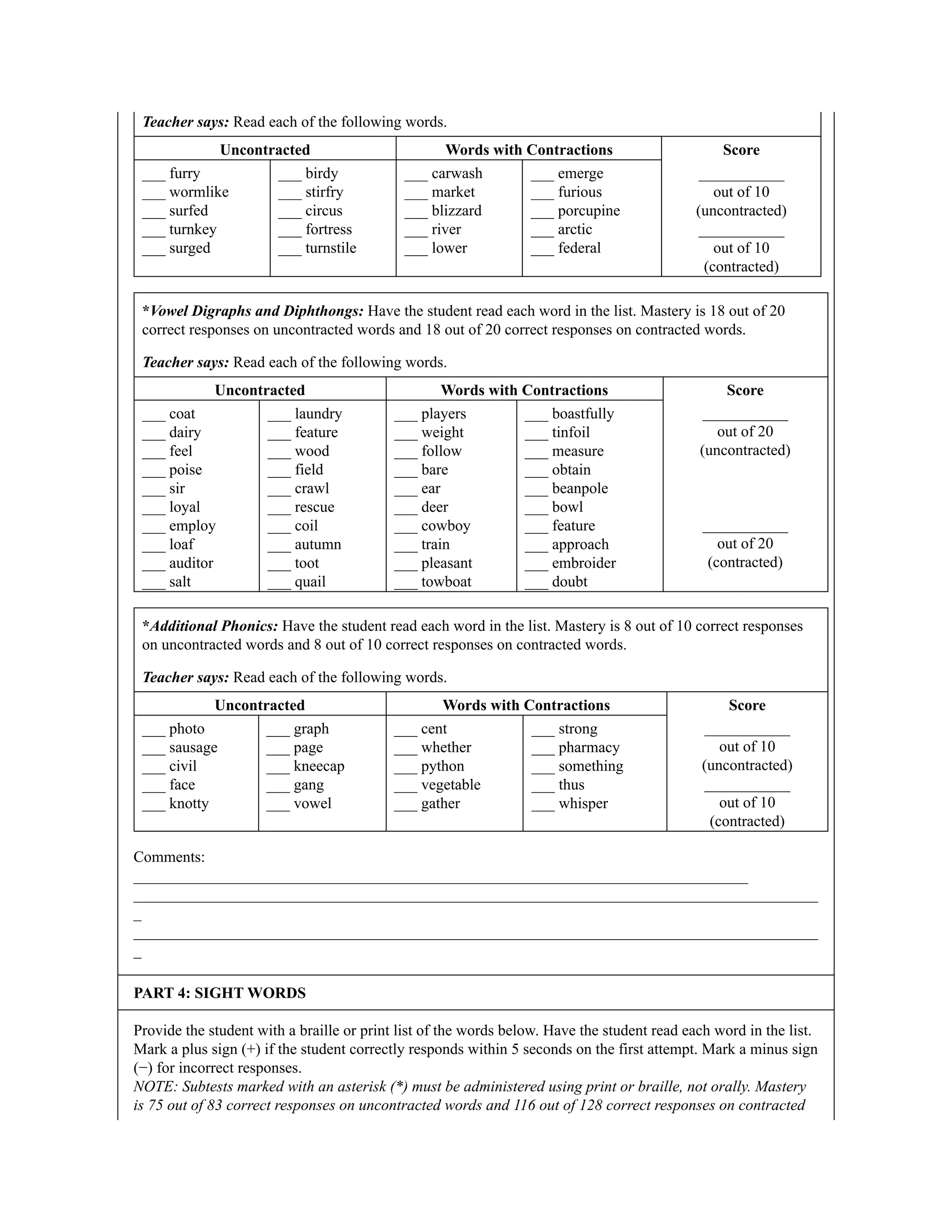
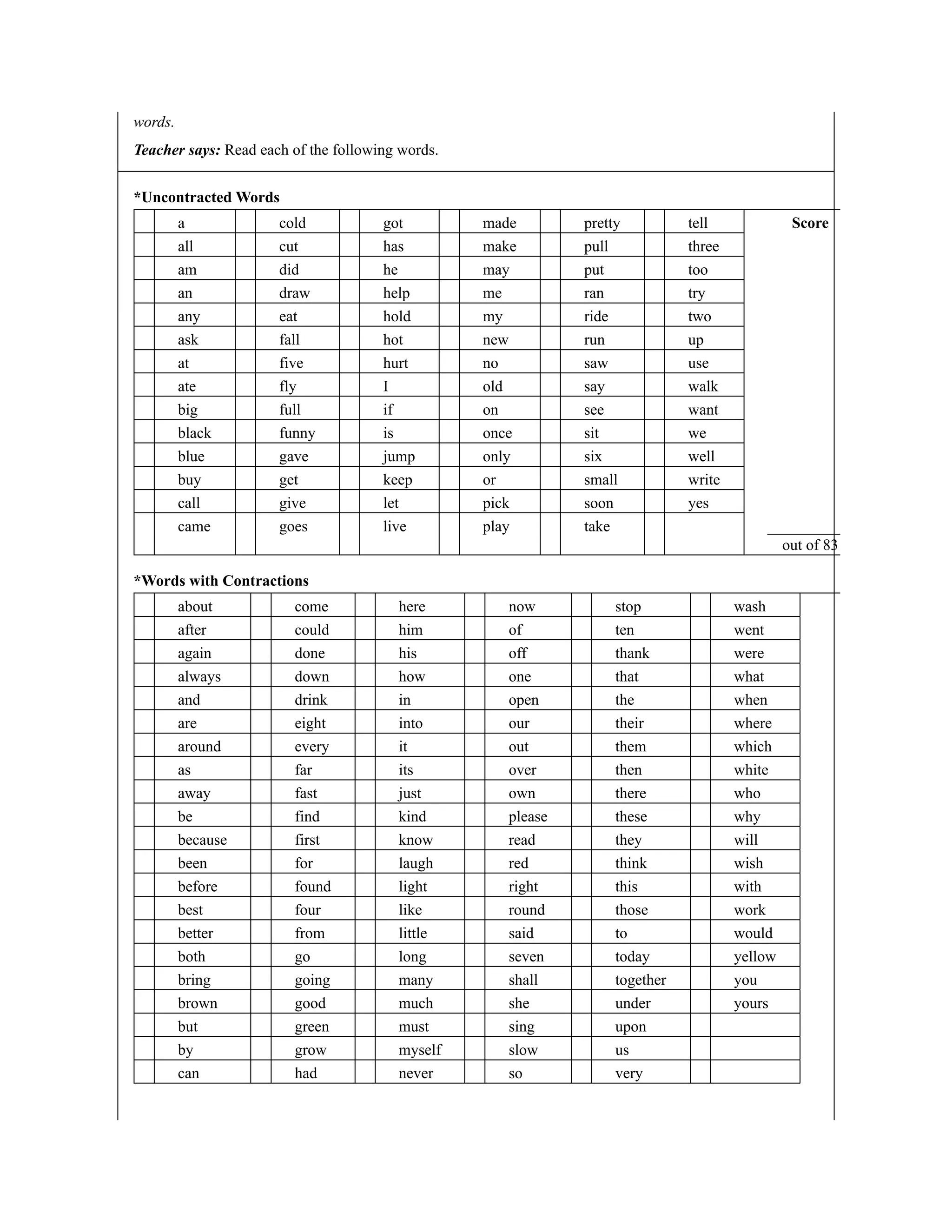
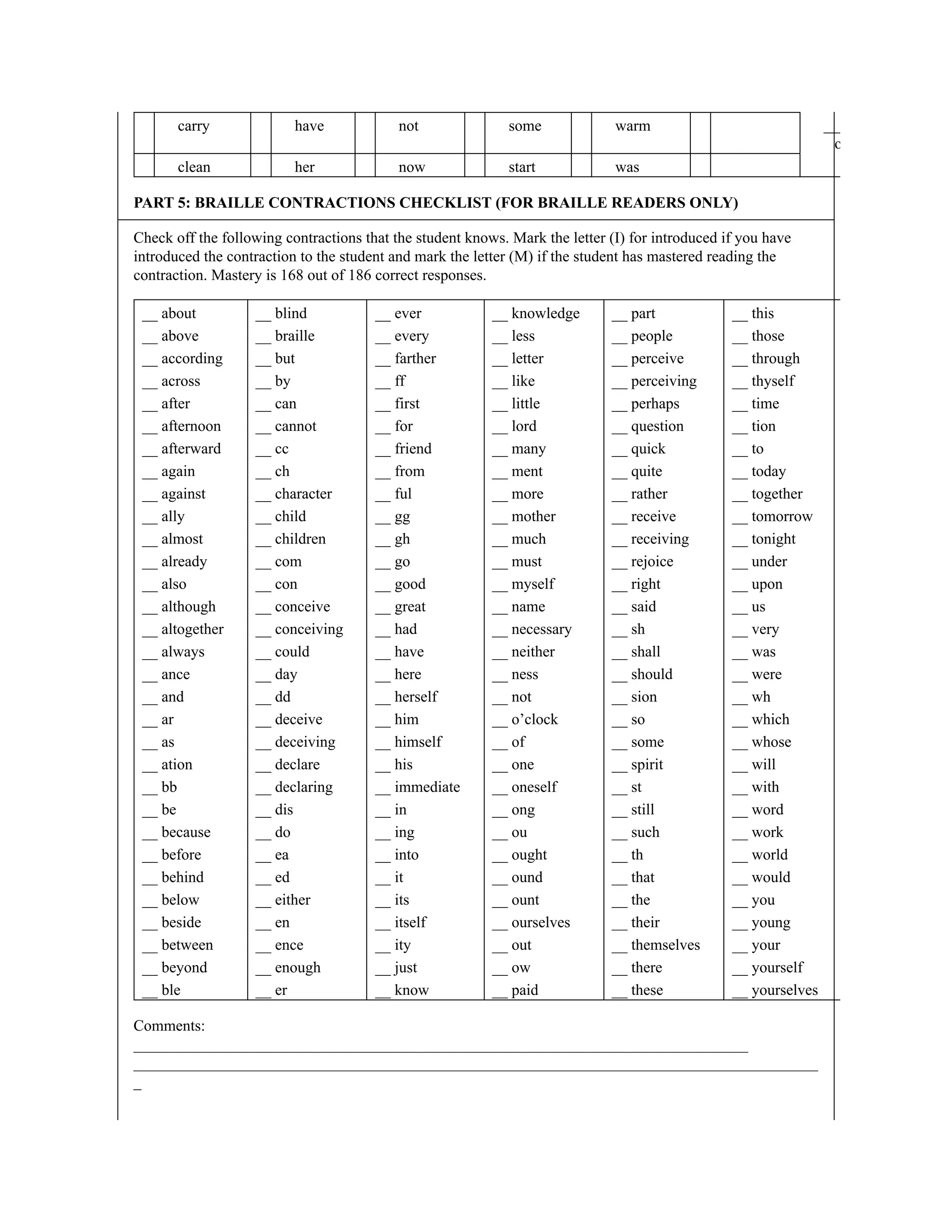
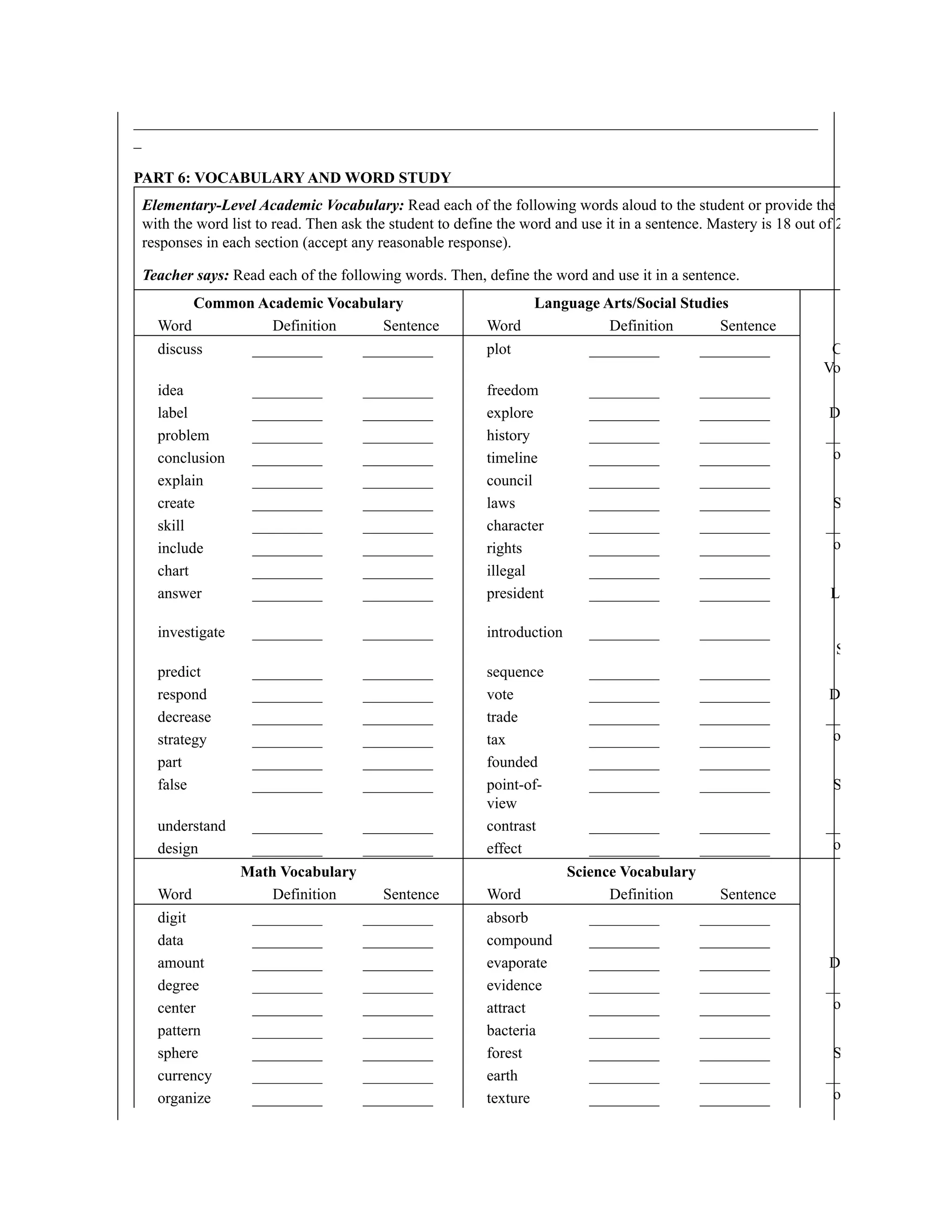
![estimate _________ _________ revolve _________ _________
range _________ _________ liquid _________ _________ S
greater
than
_________ _________ measure _________ _________
average _________ _________ climate _________ _________ D
order _________ _________ conserve _________ _________ __
o
combine _________ _________ examine _________ _________
equivalent _________ _________ expand _________ _________
uneven _________ _________ infer _________ _________ S
pie chart _________ _________ instinct _________ _________ __
o
positive _________ _________ motion _________ _________
relevant _________ _________ rate _________ _________
Synonyms/Antonyms: Read each of the following words aloud. For synonyms, ask the student to give
another word that means the same thing or something similar. For antonyms, a word that means the
opposite. If an answer is not listed, accept any reasonable response. Mastery is 8 out of 10 correct responses
in each section.
Teacher says: Listen to each of the following words. Then, tell me another word that means the same thing
or the opposite.
Synonyms Antonyms Score
___ ask (question)
___ below (under, beneath)
___ kind (nice, considerate, helpful,
friendly)
___ divide (split, separate)
___ grab (take, snatch, seize)
___ happy (glad, joyous, gay)
___ big (giant, huge)
___ noisy (loud, deafening)
___ annoy (irritate, vex, bother, pester)
___ brave (courageous, daring)
___ careless (careful)
___ strong (weak, feeble, delicate)
___ fat (thin, slender, skinny)
___ detest (like, admire)
___ bottom (top, peak, summit)
___ slow (hurry, fast, rush)
___ broken (fixed, repaired, working,
mended)
___ colorful (drab, colorless)
___ youthful (old, aged, ancient)
___ ungracious (grateful, appreciative,
thankful)
Synonyms
_________
out of 10
Antonyms
_________
out of 10
Prefixes/Suffixes: Read each of the following words. Ask the student to state the prefix or suffix and
root word. Then have the student explain what the prefix or suffix means, and how it changes the
meaning of the root word. Mastery is 8 out of 10 correct responses.
Teacher says: Listen to each of the following words. Then, state the prefix or suffix and root word.
Define the prefix or suffix.
Prefixes Suffixes Score
___ unlikable ([un]likable – not likable)
___ intermittent ([inter]mittent –
between times)
___ semiannual ([semi]annual – half a
year or two times a year)
___ misused ([mis]used – wrongly used)
___ reread ([re]read – to read again)
___ biked ([ed] – makes the verb, to bike,
past tense)
___ happily ([ly] – characterizes an
action as being happy)
___ laziness ([ness] – is the state of or
condition of being lazy)
___ boys ([s] – makes a noun, boy,
plural)
Prefixes
_________
out of 10
Suffixes
_________
out of 10](https://image.slidesharecdn.com/readingconnections-strategies-for-teaching-students-with-visual-impairments-250721170318-cb16127e/75/Reading-Connections-Strategies-for-Teaching-Students-with-Visual-Impairments-449-2048.jpg)
![___ reaction ([tion] – is the act or process
of reacting)
Greek and Latin Roots: Read each of the following words aloud. Then have the
student state the root word and define it. Mastery is 18 out of 20 correct responses in
each section (accept any reasonable response).
Teacher says: Listen to each of the following words. Then, state the root word and
define it.
Score
Word
_________
out of 20
___ flexible ([flex]ible – to bend or
curve)
___ dermal ([derm]al – skin)
___ current ([cur]rent – to run or go) ___ dynamic ([dyn]amic – power)
___ illuminate (il[lum]inate – light) ___ dehydrate (de[hydr]ate – water)
___ dormitory ([dorm]itory – sleep) ___ symphony (sym[phon]y – sound)
___ picture ([pic]ture – paint) ___ transport (trans[port] – carry)
___ judge ([jud]ge – law) ___ exceed (ex[cede] – go) Definition
___ mortal ([mort]al – death)
___ pediatrician ([ped]iatrician – child)
___ marina ([mar]ina – ocean)
___ anagram (ana[gram] – written or
drawn)
___ biosphere ([bio][sphere] – life; circle)
___ psychology ([psych][ology] – mind;
study)
_________
out of 20
WORD LISTS FOR STUDENTS
Use these word lists to produce versions for students to use during the assessment. Fill in students’ answers in
the corresponding sections above.
Part 2B: Identifying Letter Names and Sounds
Letters and Sounds List
m B z V
X C Y j
E M w K
a g L i
F c D S
k qu U A
I P J G
t v u
e b H
O Qu r
d l f
o n T
N s Z
p R y
x W h
Part 2C: Basic Decoding](https://image.slidesharecdn.com/readingconnections-strategies-for-teaching-students-with-visual-impairments-250721170318-cb16127e/75/Reading-Connections-Strategies-for-Teaching-Students-with-Visual-Impairments-450-2048.jpg)
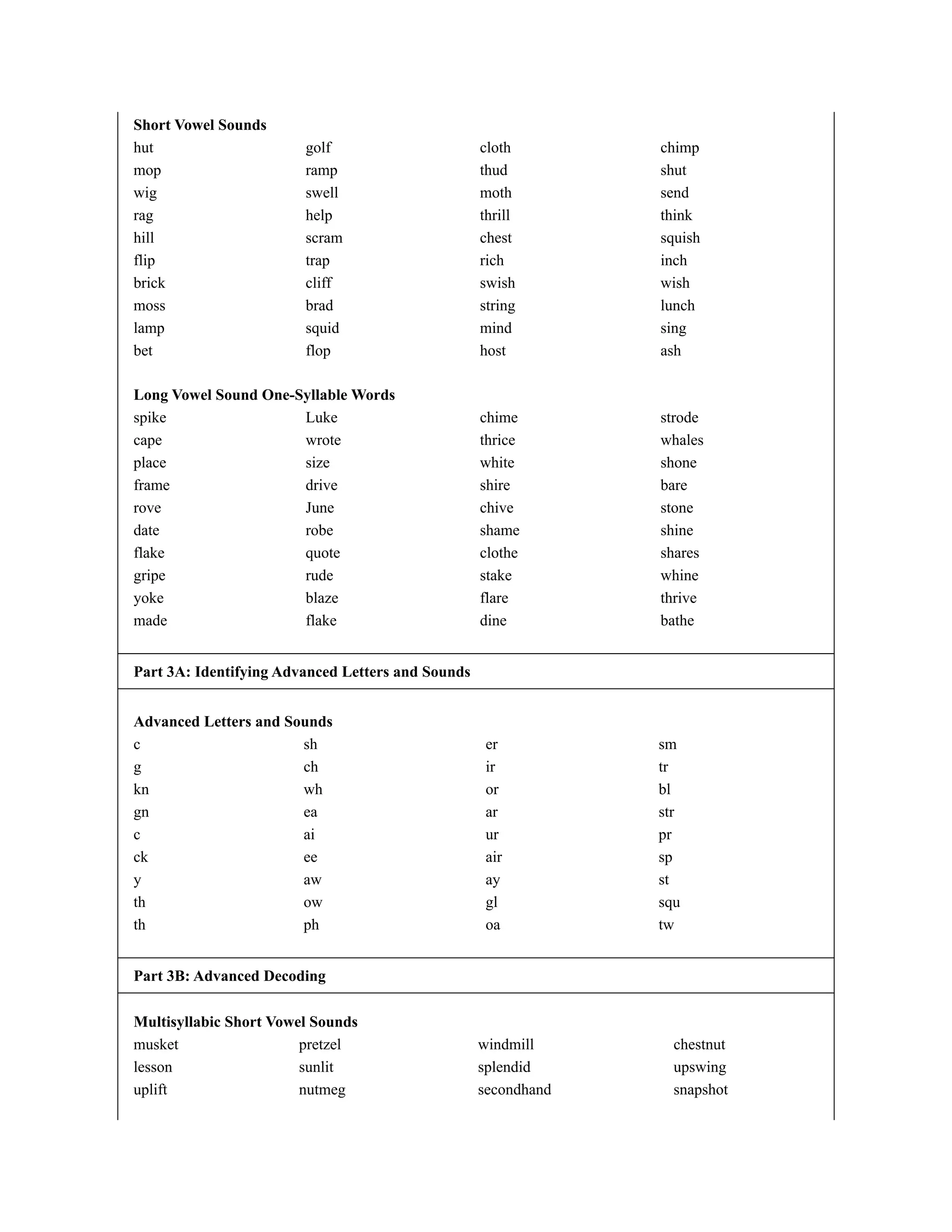
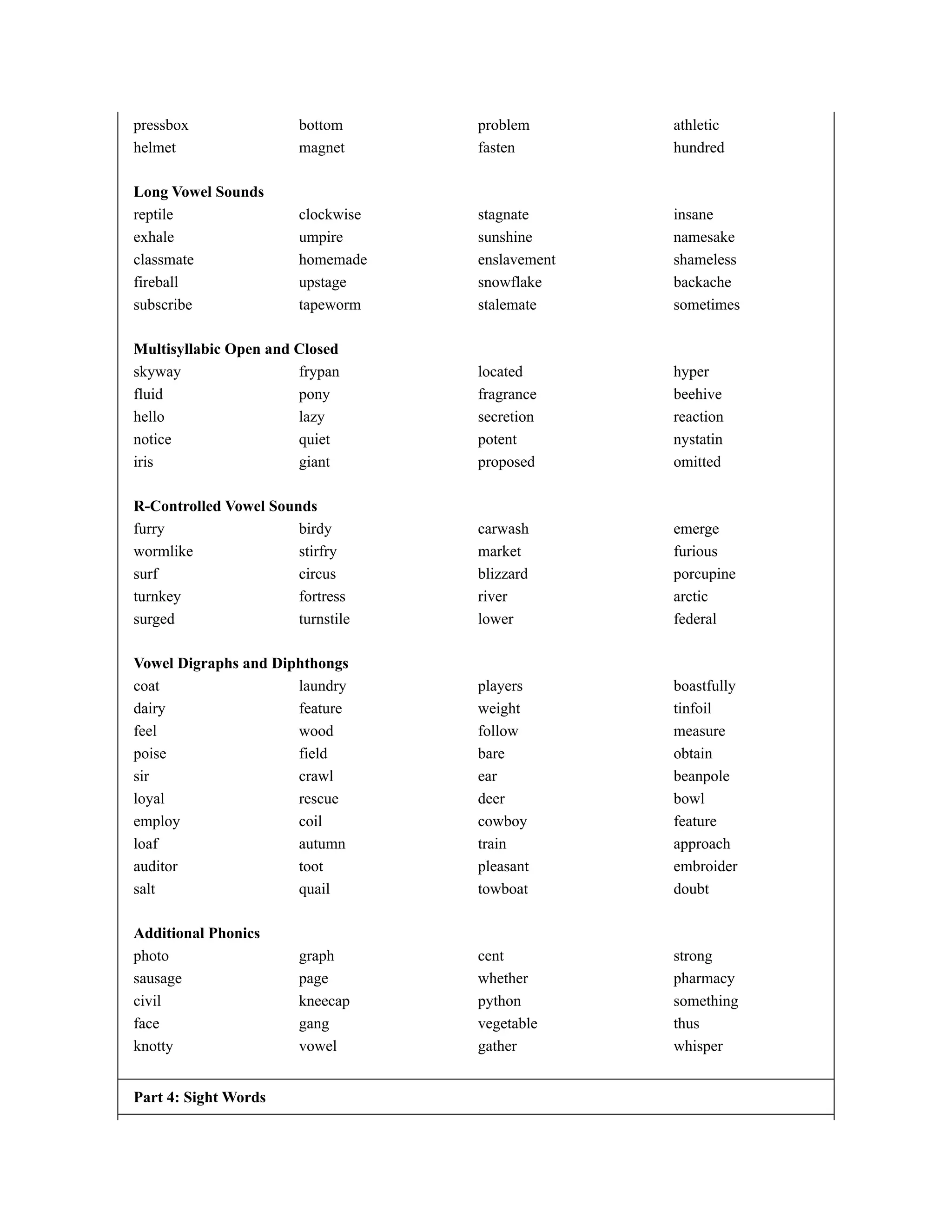
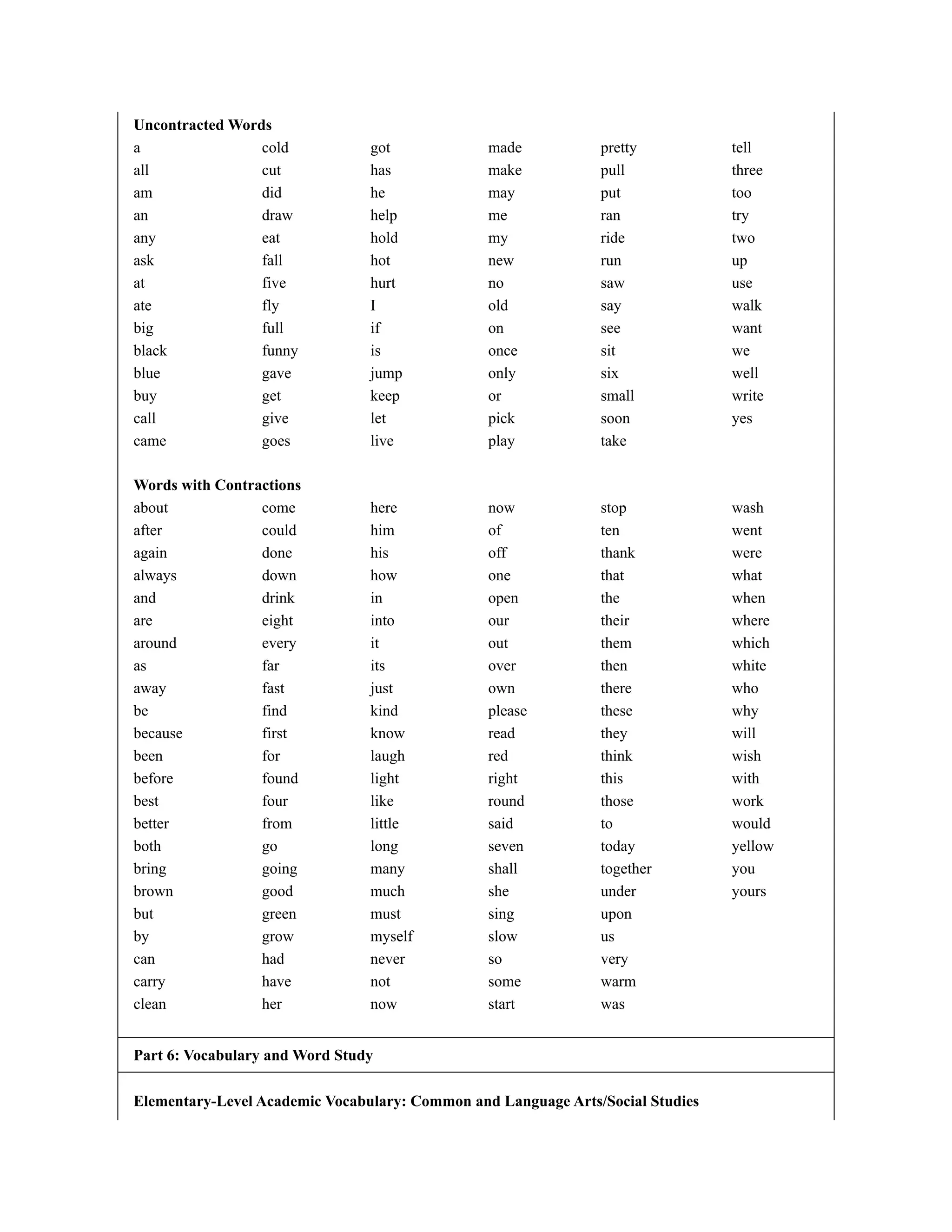
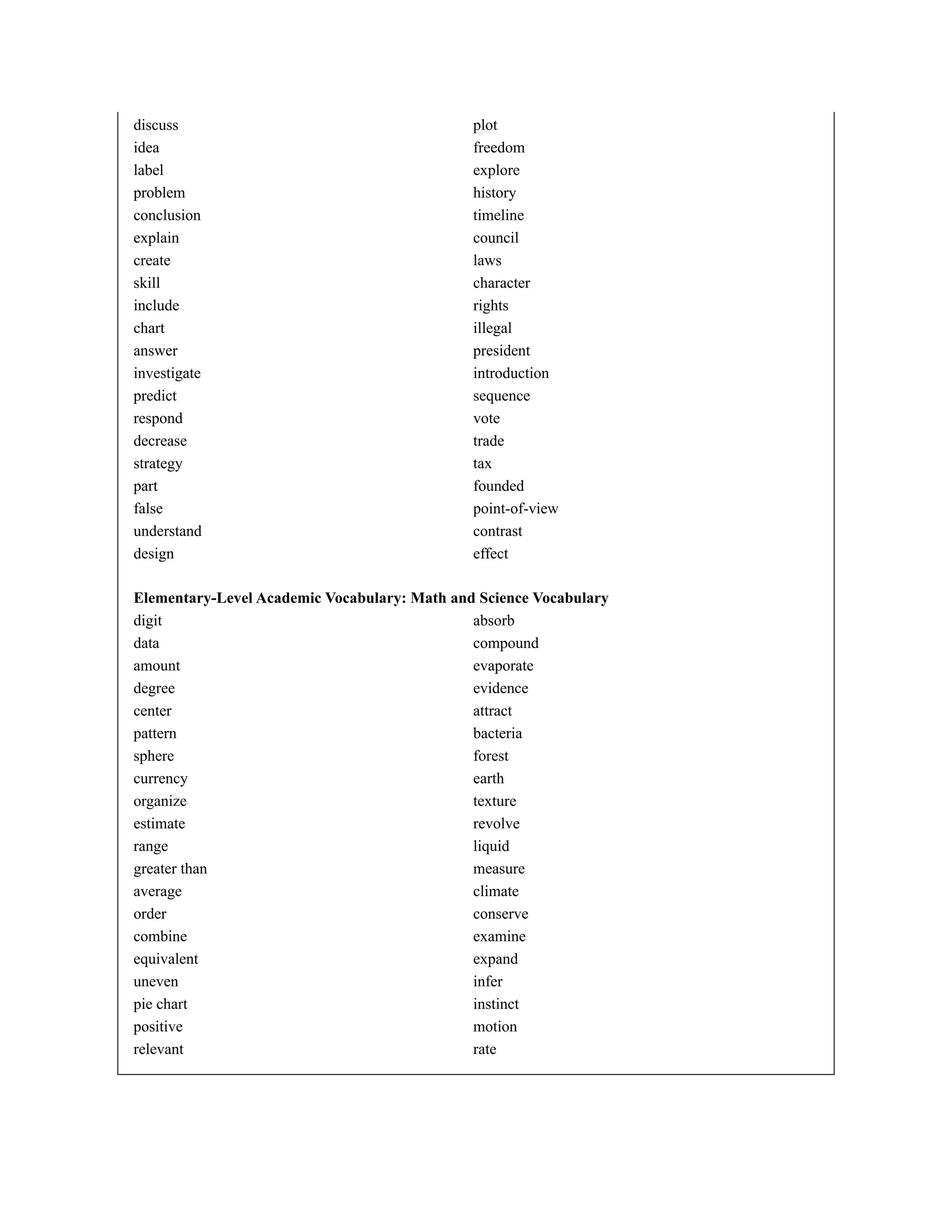



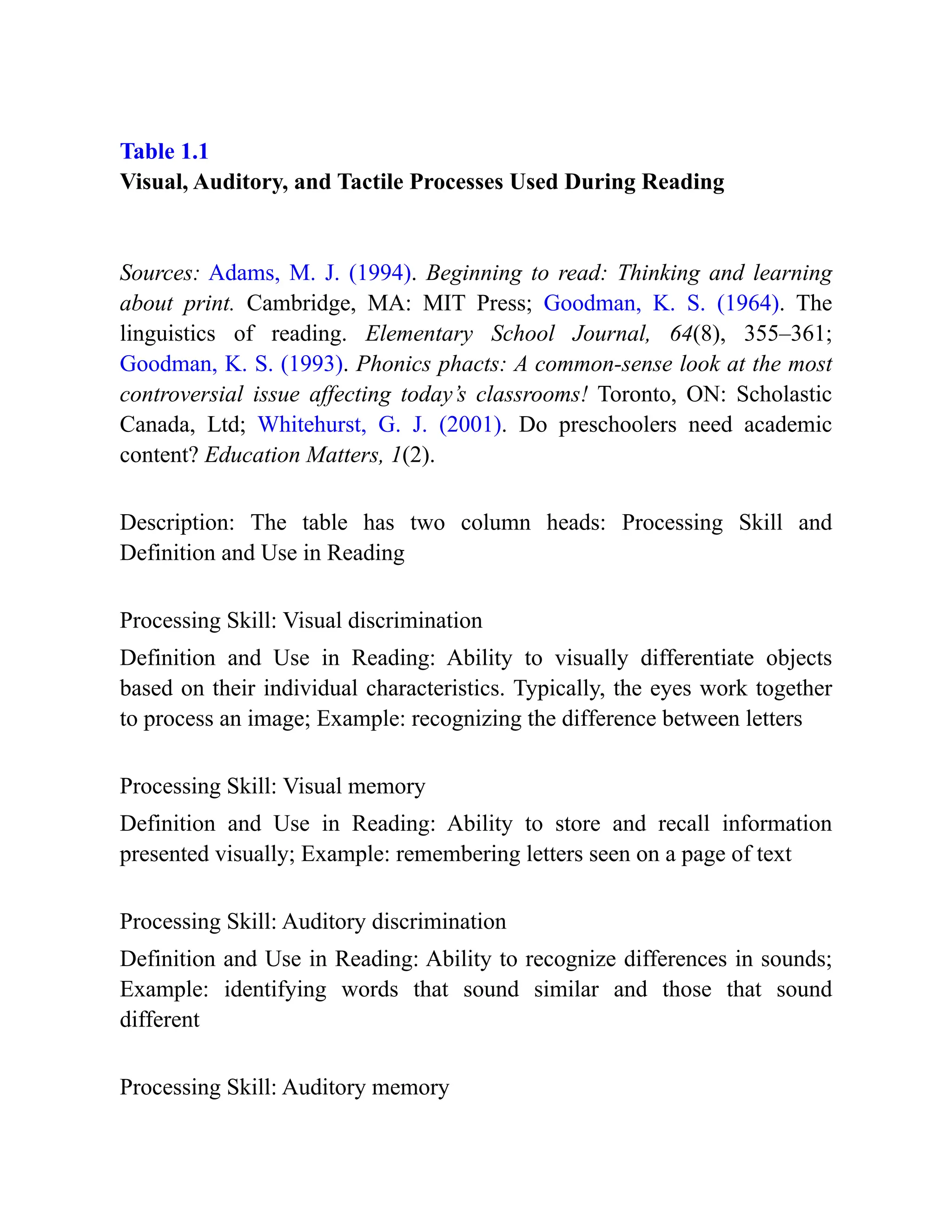
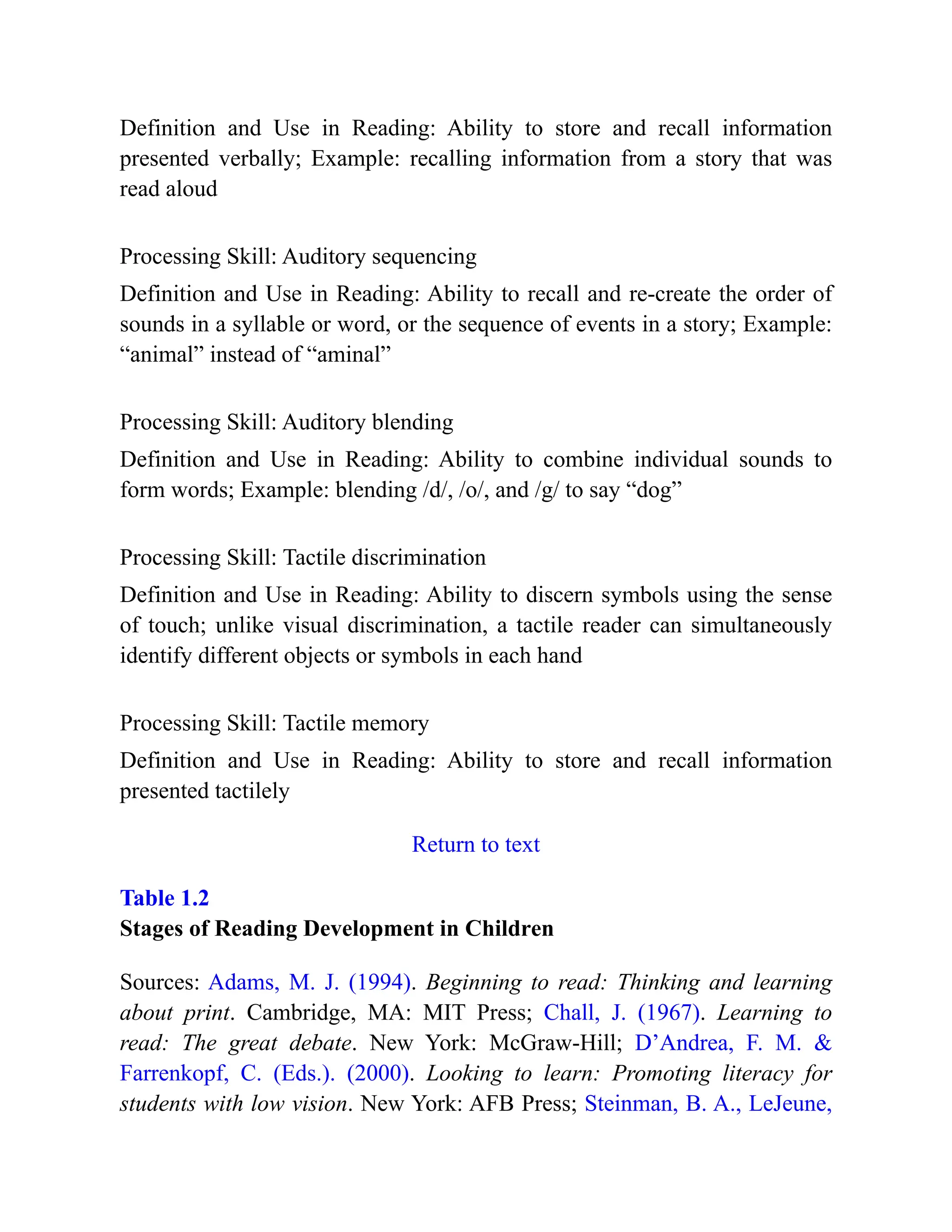
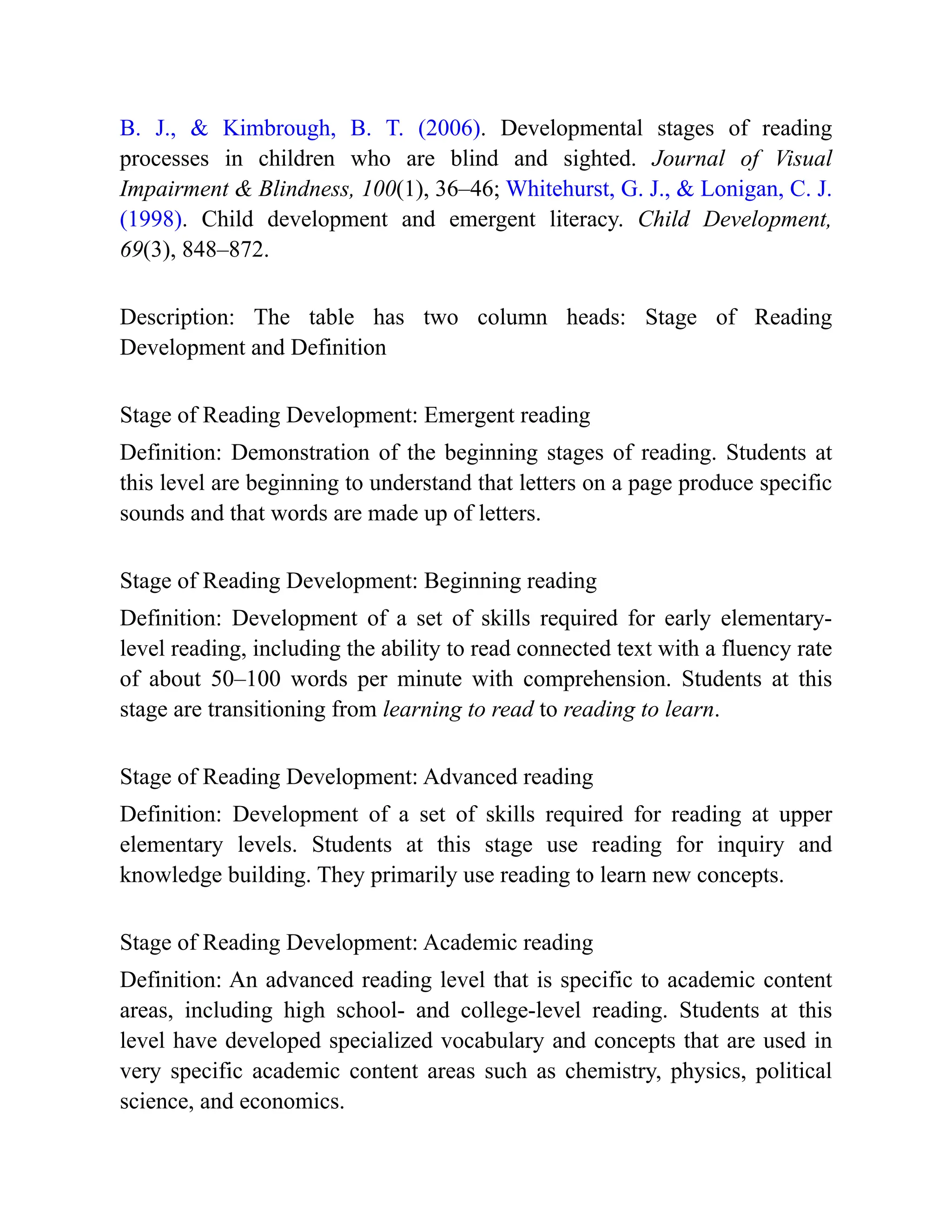
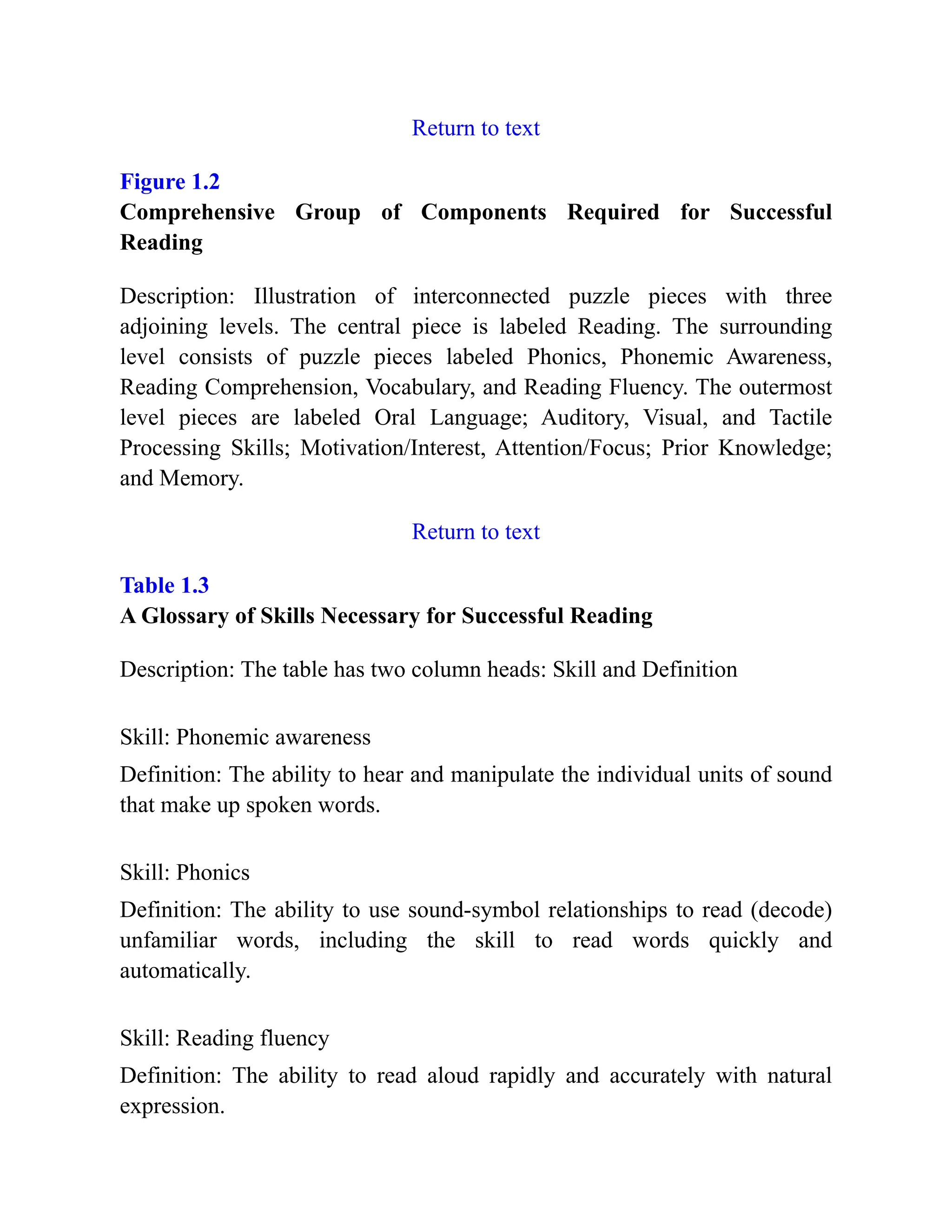
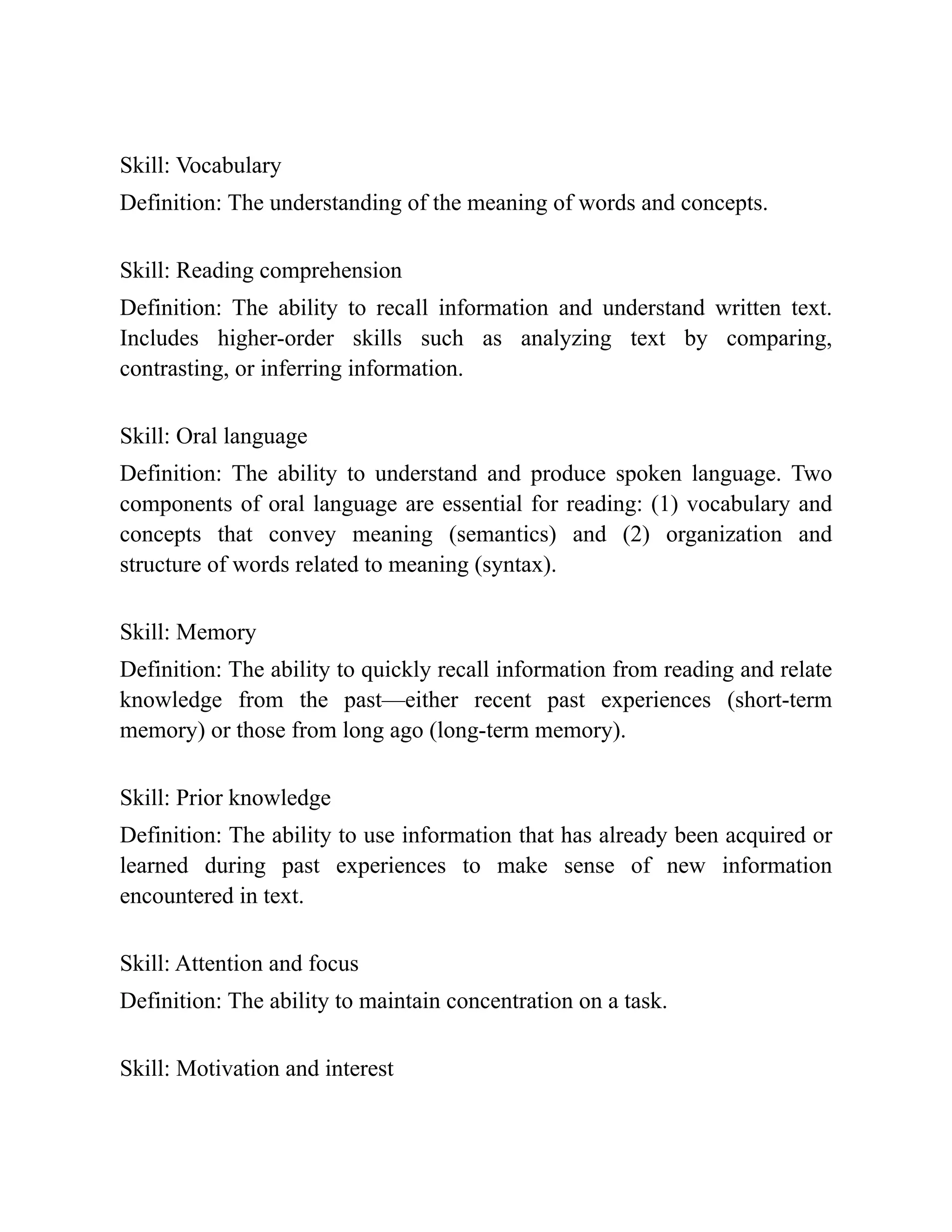
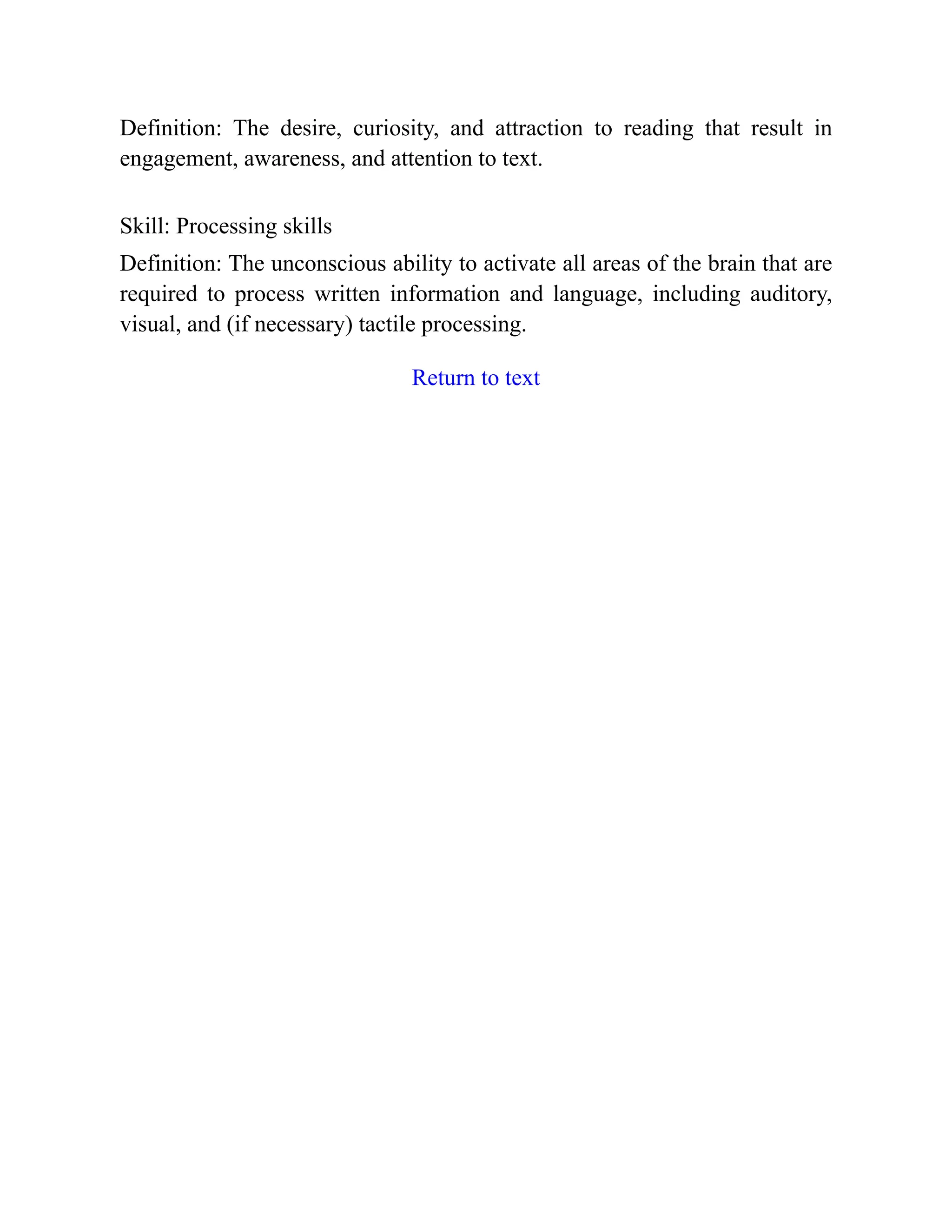
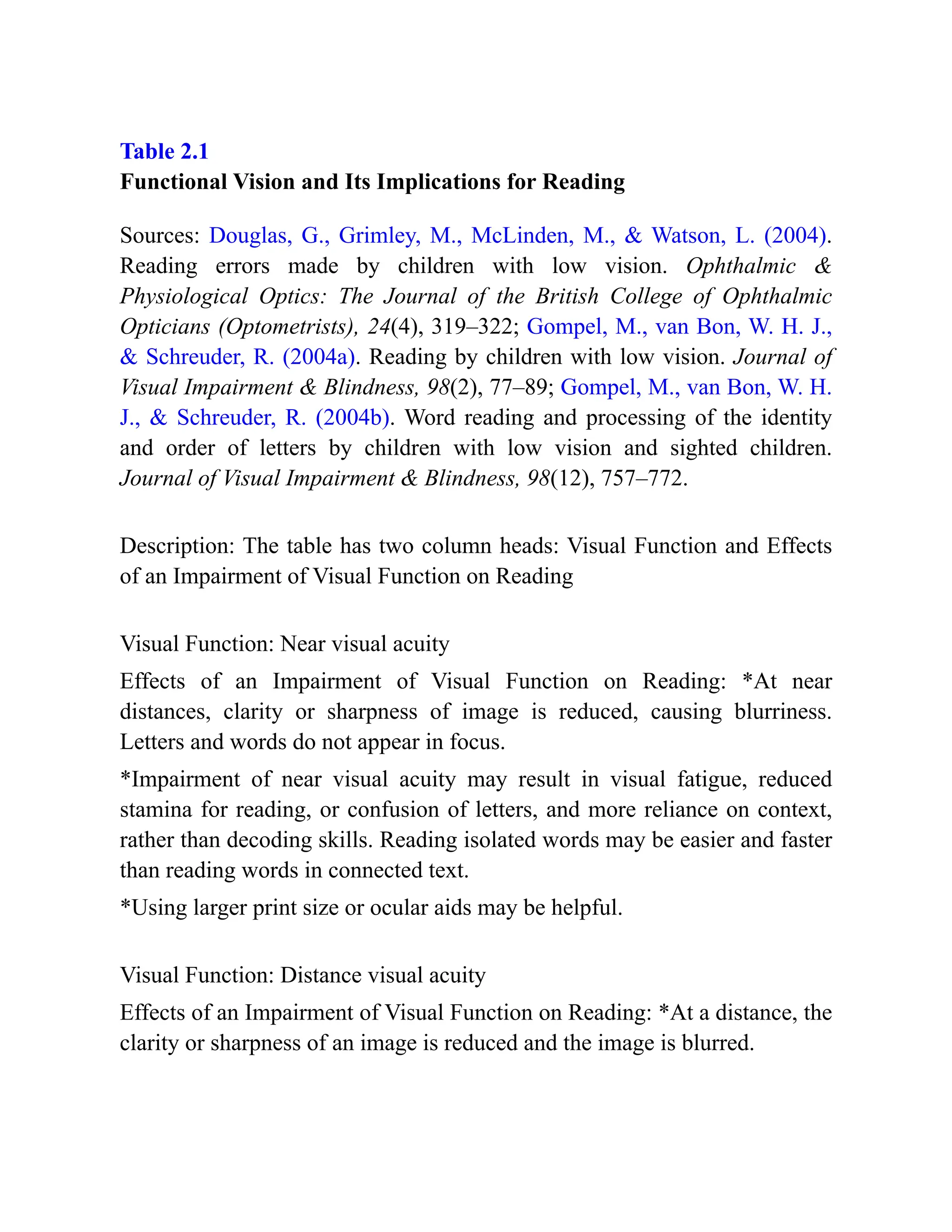

![Figure 3.2
Tiers of Intervention in RTI Showing Increasing Levels of Instruction
Source: Adapted from National Association of State Directors of Special
Education. (2006). Response to intervention: Policy considerations and
implementation (p. 22). Alexandria, VA: Author.
Description: The figure is a three-tiered pyramid with a left-pointing arrow
facing each tier. The bottom tier is labeled Evidence-based, general
education core program and ongoing assessment to monitor reading and
language learning for all students. The arrow pointing toward the tier is
labeled Tier 1: Instruction for all students (approx. 80%). The middle,
second tier of the pyramid is labeled Targeted, supplemental instruction in
small group settings. The arrow pointing toward the tier is labeled Tier 2:
Students who need supplemental intervention (approx. 15%). The top tier is
labeled Intensive specialized instruction (may possibly include special
education). The arrow pointing toward the tier is labeled Tier 3: Students
who need intensive intervention (approx. 5%).
Return to text
Appendix 3A
Evidence of Essential Components in Reading Instruction
Description: The blank form is a table with four column heads: Reading
Component; Activities; Primary Person Responsible;
Accommodations/Modifications Needed
Name of Student: [blank]
Name of Reading Curriculum: [blank]
School: [blank]](https://image.slidesharecdn.com/readingconnections-strategies-for-teaching-students-with-visual-impairments-250721170318-cb16127e/75/Reading-Connections-Strategies-for-Teaching-Students-with-Visual-Impairments-520-2048.jpg)
![Date: [blank]
Reading Component: Phonemic awareness
Activities: [blank]
Primary Person Responsible: [blank]
Accommodations/Modifications Needed: [blank]
Reading Component: Phonics
Activities: [blank]
Primary Person Responsible: [blank]
Accommodations/Modifications Needed: [blank]
Reading Component: Reading fluency
Activities: [blank]
Primary Person Responsible: [blank]
Accommodations/Modifications Needed: [blank]
Reading Component: Vocabulary
Activities: [blank]
Primary Person Responsible: [blank]
Accommodations/Modifications Needed: [blank]
Reading Component: Reading comprehension
Activities: [blank]
Primary Person Responsible: [blank]
Accommodations/Modifications Needed: [blank]
Return to text](https://image.slidesharecdn.com/readingconnections-strategies-for-teaching-students-with-visual-impairments-250721170318-cb16127e/75/Reading-Connections-Strategies-for-Teaching-Students-with-Visual-Impairments-521-2048.jpg)
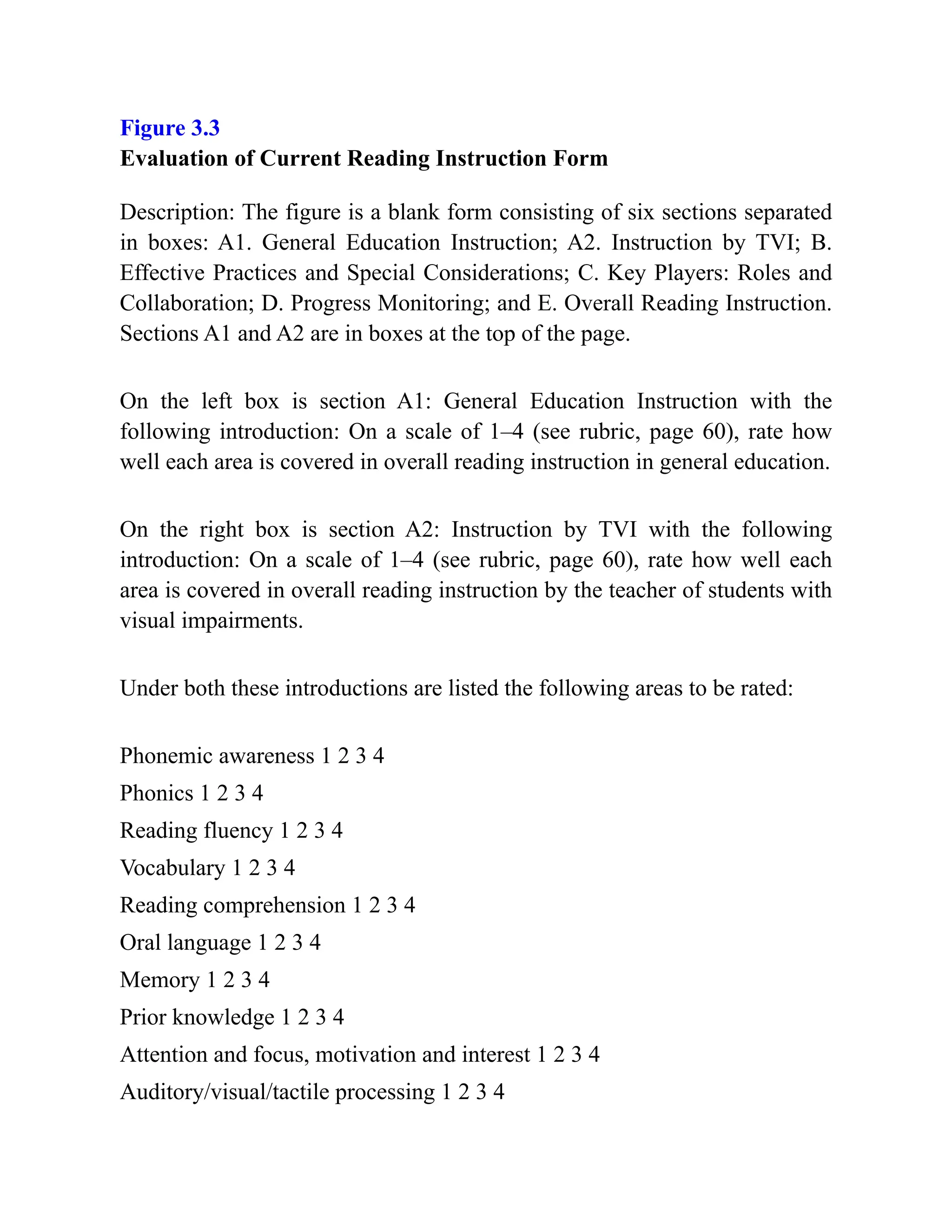
![Below these two boxes is a box across the page for Section B: Effective
Practices and Special Considerations and listed under it is the following
checkbox list:
[checkbox] Increased wait time
[checkbox] Decreased pace
[checkbox] Simplified wording
[checkbox] Word/letter cards
[checkbox] Increased spacing
[checkbox] Typoscope
[checkbox] Personal dictionary
[checkbox] Personal word wall
[checkbox] Tangible objects
[checkbox] Slant board
[checkbox] Electronic text
[checkbox] Auditory materials
[checkbox] Braille
[checkbox] Large print
[checkbox] Regular print
[checkbox] Braille notetaker
[checkbox] Refreshable braille
[checkbox] Video magnifier/CCTV
[checkbox] Optical devices
[checkbox] [blank]
[checkbox] [blank]
[checkbox] [blank]
[checkbox] [blank]](https://image.slidesharecdn.com/readingconnections-strategies-for-teaching-students-with-visual-impairments-250721170318-cb16127e/75/Reading-Connections-Strategies-for-Teaching-Students-with-Visual-Impairments-523-2048.jpg)
![[checkbox] [blank]
Below Section B is a box across the page for Section C: Key Players: Roles
and Collaboration, which is a table with four column heads:
Role of the general education teacher: [blank text field]
Role of the teacher of students with visual impairments: [blank text field]
Role of the primary caregiver: [blank text field]
Role of the related service providers: [blank text field]
Centered under this table is a box shaped like an arrow for Section D:
Progress Monitoring:
Tool(s): [blank text field]
Who is responsible? [blank text field]
The arrow is pointing towards the box below it for Section E: Overall
Reading Instruction:
On a scale of 1–4 (1 being the lowest, and 4 being the highest), is
instruction:
Consistent? 1 2 3 4
Structured? 1 2 3 4
Explicit? 1 2 3 4
Is the current reading instruction balanced?
Yes [blank]
No [blank]
Are there any identified areas of weakness in the overall current reading
instruction? If so, which areas? [blank text field]
Return to text](https://image.slidesharecdn.com/readingconnections-strategies-for-teaching-students-with-visual-impairments-250721170318-cb16127e/75/Reading-Connections-Strategies-for-Teaching-Students-with-Visual-Impairments-524-2048.jpg)
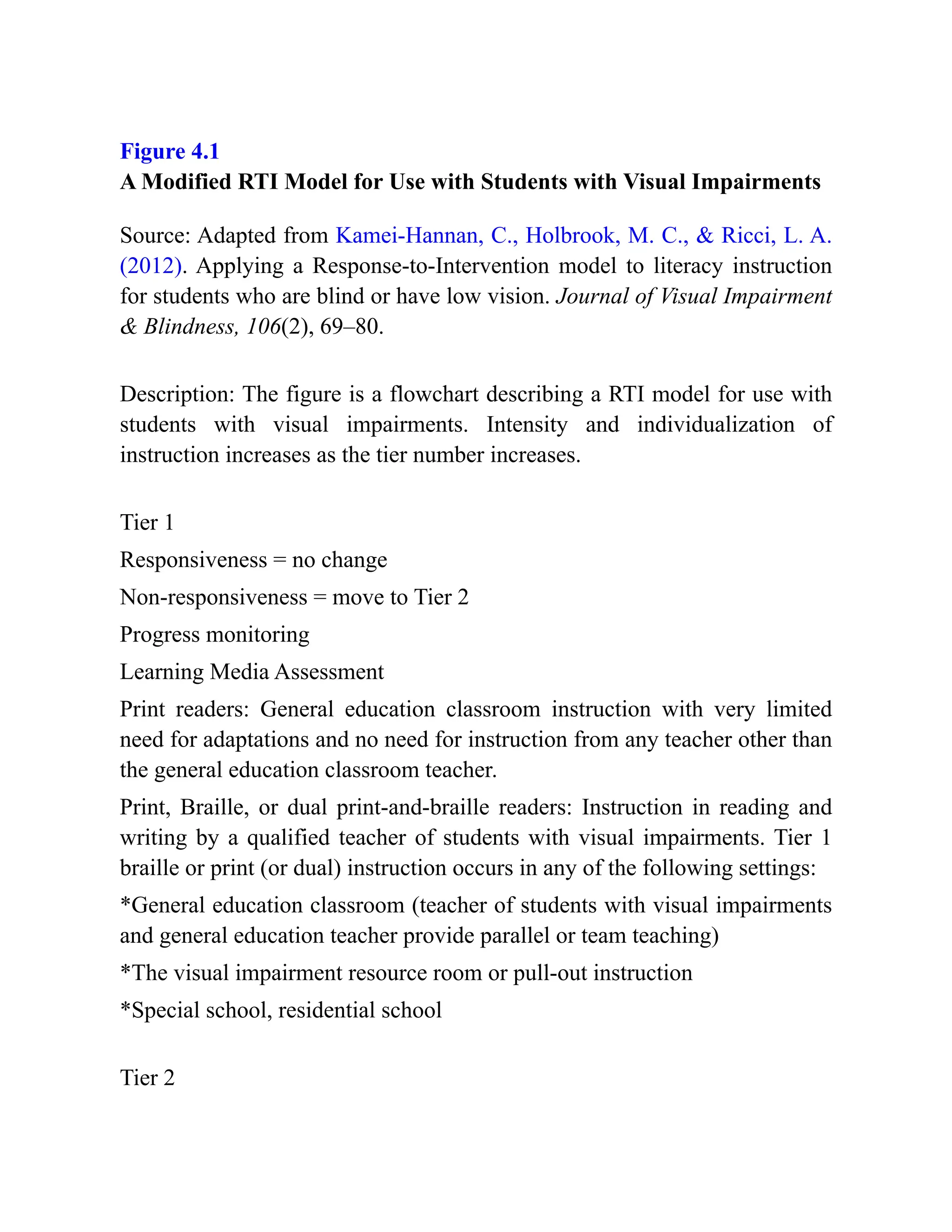
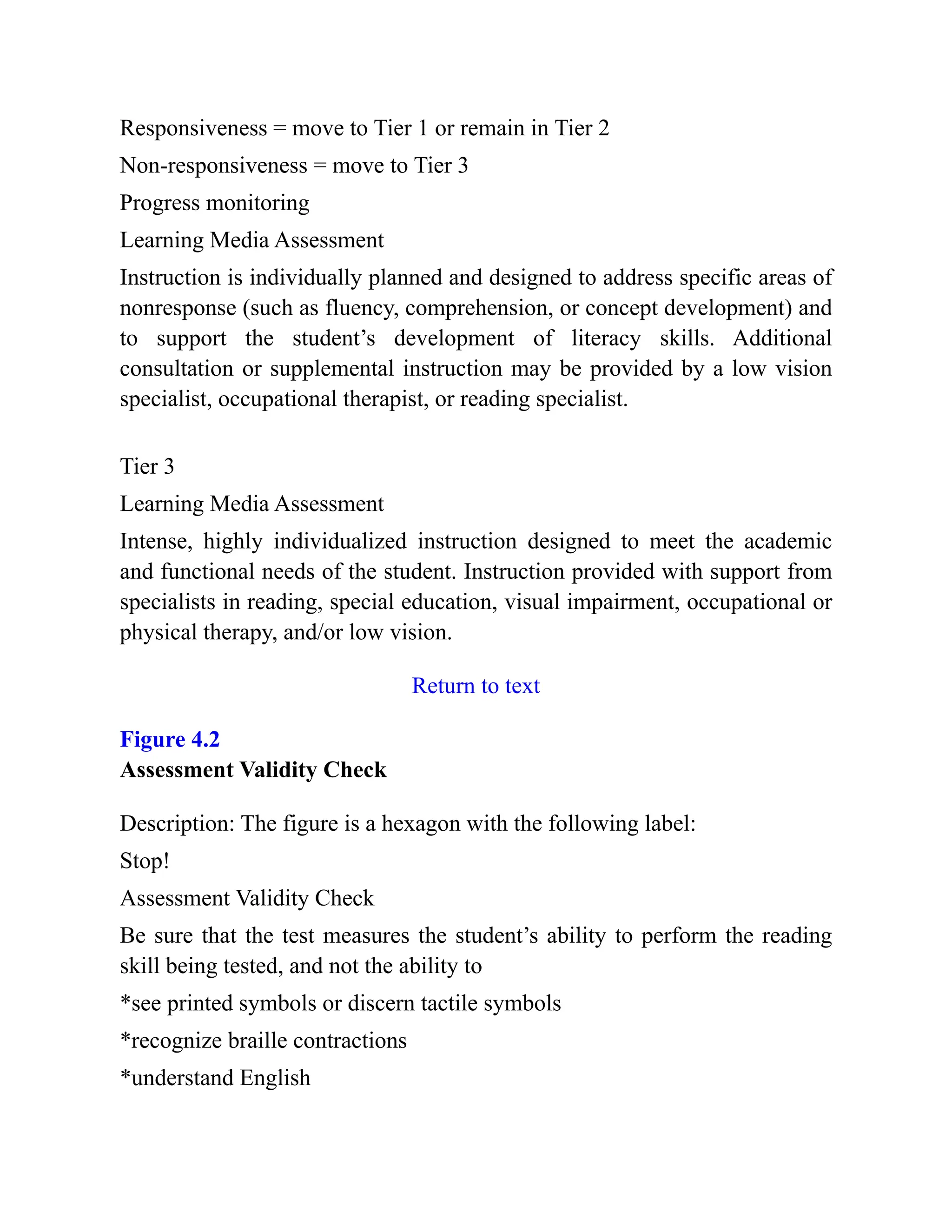
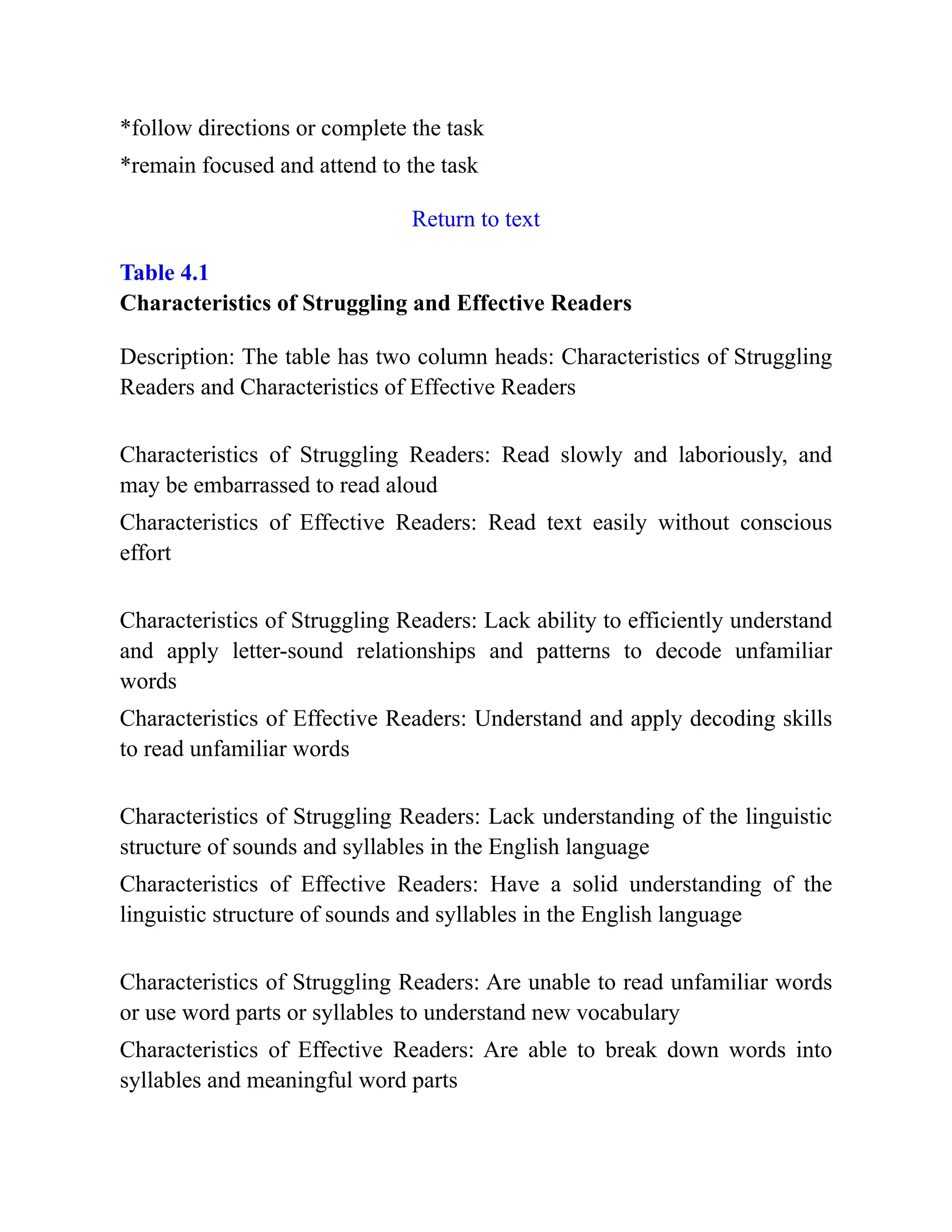
![the sound of the vowel changes when followed by the letter r; for example,
“fern” and “burn”); Specific word patterns (such as consonant-vowel-
consonant [CVC—for example, “cat”] or vowel-consonant-e [VCE—for
example, “face”]); Word attack skills (such as reading multisyllabic words)
Component: Reading fluency
Subskills: Accuracy; Speed; Expression; Rapid automatic naming
(orthographic word level)
Component: Vocabulary
Subskills: Academic vocabulary; Word study, common affixes (prefixes,
such as un- and pre-, or suffixes, such as -ness or -tion)
Component: Reading comprehension
Subskills: Recalling facts; Summarizing and determining the main idea;
Predicting; Making inferences; Connecting, comparing, and contrasting
information in text
Return to text
Figure 4.3
Kamei-Hannan Reading Instruction Planning Tool
Description: The figure is a blank form entitled Kamei-Hannan Reading
Instruction Planning Tool. The form consists of four sections. The first
section has a circular puzzle piece image that is connected by a double-
sided arrow to a box. The puzzle image is an illustration of interconnected
puzzle pieces with three adjoining levels. The central piece is labeled
Reading. The surrounding level consists of puzzle pieces labeled Phonics,
Phonemic Awareness, Reading Comprehension, Vocabulary, and Reading
Fluency. The outermost level pieces are labeled Oral Language; Auditory,
Visual, and Tactile Processing Skills; Motivation/Interest, Attention/Focus;](https://image.slidesharecdn.com/readingconnections-strategies-for-teaching-students-with-visual-impairments-250721170318-cb16127e/75/Reading-Connections-Strategies-for-Teaching-Students-with-Visual-Impairments-529-2048.jpg)
![Prior Knowledge; and Memory. The box it connects to contains the
following fields:
Specific skills area(s): [blank]
Activity A: [blank]
Activity B: [blank]
Activity C: [blank]
Extension activity: [blank]
The second section is a box spanning the width of the form and contains the
following field to be filled in:
Literacy medium or media, instructional strategies, accommodations, and
modifications: [blank text field]
The third section contains four boxes to be filled in, with connecting arrows
between each box as well as to the boxes and sections above and below.
The central box is labeled Family Involvement and below it is a box labeled
Collaborative Projects. To the left of those central boxes is a box labeled
General Education Curriculum and to the right is a box labeled Expanded
Core Curriculum.
The fourth section contains a box spanning the width of the form, which
contains the following fields: Data collection instrument or measure(s):
[blank text field]
Review data, assess, reflect, plan: [blank text field]
Return to text
Figure 4.4
English Language Learner Student Observation Matrix](https://image.slidesharecdn.com/readingconnections-strategies-for-teaching-students-with-visual-impairments-250721170318-cb16127e/75/Reading-Connections-Strategies-for-Teaching-Students-with-Visual-Impairments-530-2048.jpg)
![Source: Based on Common Core State Standards (Common Core State
Standards Initiative, 2010) and the Student Oral Language Observation
Matrix (SOLOM; California State Department of Education, 1981; Peregoy
& Boyle, 2008).
English Language Learner Student Observation Matrix (Note: The English
Language Learner Student Observation Matrix should be administered only
by people who themselves score at level 4 or above on all categories in the
language being assessed.)
Student: [blank]
Evaluator(s): [blank]
Administration: Based on your observation of the student, indicate with an
X across the cell in each row that best describes the student’s abilities. Each
cell is worth from 1 to 5 points, as indicated by the header at the top of each
column. Write the score for each row in the right-hand column labeled
“Score.” Add the scores in each row and write the total in the bottom right-
hand corner of the final row. For best results, several teachers and
specialists on a student’s instructional team should conduct the
observational assessment across several subject areas. These specialists
should pre sent and discuss their findings, as multiple perspectives provide
the best portrayal of a student’s language abilities.
Description: The table has seven headings: Common Core Standards (The
abbreviations in this column refer to specific standards within the Common
Core State Standards, as explained in the key for each section.); 1; 2: 3; 4;
5; and Score.
Language, Listening, and Speaking
Key to Common Core Standards for Language, Listening, and Speaking:](https://image.slidesharecdn.com/readingconnections-strategies-for-teaching-students-with-visual-impairments-250721170318-cb16127e/75/Reading-Connections-Strategies-for-Teaching-Students-with-Visual-Impairments-531-2048.jpg)
![demonstrates command of English grammar, use, and conventions when
speaking and is grade level appropriate
Score: [blank]
CCS: KL3; CC2; PKI5
1: Student can listen to conversation and guess at the main topic but does
not understand subject area details (e.g., math, science) or details such as
who, what, when, where, and how
2: Begins to understand the main topic of conversation, heavily relying on
gestures, body language, pictures, objects, media or visual display to
convey thoughts or inquire about ideas
3: Student is able to communicate about the overall topic and some details
but may not expand upon or inquire about the subject; student can interpret
and analyze digital media by presenting the main idea
4: Student is able to pre sent a coherent summary and expansion of the main
topic and supporting details, but may need to ask clarifying questions;
includes the ability to interpret and analyze digital media
5: Student communicates and expands on the academic content area or topic
of discussion using vocabulary typical of a native speaker and is grade level
appropriate; includes the ability to interpret and analyze digital media
Score: [blank]
CCS: VAU4; PKI4
1: Student is unable to use appropriate vocabulary or ask questions about
academic content
2: Student is able to determine general topic areas within a specific
academic content area
3: Student asks appropriate questions to clarify meaning of words and
academic content including being able to comprehend an argument,
purpose, or line of reasoning](https://image.slidesharecdn.com/readingconnections-strategies-for-teaching-students-with-visual-impairments-250721170318-cb16127e/75/Reading-Connections-Strategies-for-Teaching-Students-with-Visual-Impairments-533-2048.jpg)
![4: Student is able to use context and any reference materials to clarify
meaning of words and academic content, including the ability to expand on
his or her own argument, purpose, or line of reasoning
5: Student understands and can analyze academic content including
multiple meanings of words, word parts, and use of reference materials, and
the student is able to comprehend and pre sent an argument, purpose, or line
of reasoning
Score: [blank]
CCS: VAU5; CC1; CC3
1: Student may initiate and maintain brief and simple conversation (e.g.,
“Hi!” “How are you?” “I’m fine.” “What’s new?” “Nice day!”), but cannot
extend conversation
2: Student begins to initiate and engage in conversation beyond common
social politeness by expanding conversation using simple one- to two-word
questions and phrases
3: Student is able to listen to a speaker and understand his or her point of
view, but may not comprehend the use of idiomatic speech or use of
figurative language; student is able to respond but may not be able to
expand the conversation
4: Student is able to communicate about a range of topics including familiar
topics and general academic content through listening and speaking,
including communicating and understanding points of view, but may not
understand idiomatic and figurative speech
5: Student is able to communicate about unfamiliar and specific academic
topics to a variety of individuals through listening and speaking, including
communicating and understanding points of view; when idiomatic and
figurative language is presented, the student is able to build on another’s
perspective and clearly pre sent thoughts and ideas
Score: [blank]](https://image.slidesharecdn.com/readingconnections-strategies-for-teaching-students-with-visual-impairments-250721170318-cb16127e/75/Reading-Connections-Strategies-for-Teaching-Students-with-Visual-Impairments-534-2048.jpg)
![CCS: VAU6; PKI6
1: Student is not able to use specific academic content area words or
phrases
2: Student’s vocabulary in academic content area is dependent on pictures,
objects, gestures, etc.; often does not know vocabulary and misuses words
3: Student has a limited vocabulary, occasionally misuses words, but is able
to present explanations and demonstrate knowledge about a topic
4: Student uses appropriate vocabulary in a variety of contexts to
communicate about a topic but may not be precise in word se lection and
usage
5: Student uses grade level vocabulary with precision and is able to acquire
new vocabulary to convey thoughts clearly; demonstrates command of
academic English
Score: [blank]
TOTAL POINTS FOR LANGUAGE, LISTENING, and SPEAKING =
[blank]
Reading
Reading Key to Common Core Standards for Reading:
RF = Reading Foundational Skills
KID = Key Ideas and Details, College and Career Readiness Anchor
Standards for Reading
CS = Craft and Structure, College and Career Readiness Anchor Standards
for Reading
IKI = Integration of Knowledge and Ideas, College and Career Readiness
Anchor Standards for
CCS: RF1-4](https://image.slidesharecdn.com/readingconnections-strategies-for-teaching-students-with-visual-impairments-250721170318-cb16127e/75/Reading-Connections-Strategies-for-Teaching-Students-with-Visual-Impairments-535-2048.jpg)
![1: Student can recognize the number of words in a short sentence, number
of letters in a word, and may know the English alphabet and letter/sound
system
2: Student is able to apply basic phonics skills, including recognizing
common phonemes, to begin to decode simple words
3: Student is able to read aloud, but may be slow, pause at unfamiliar words,
and may not have proper prosody (inflection, intonation, or pitch)
4: Student is able to read aloud with prosody, pausing occasionally, but
pronouncing most phonemes correctly, and is able to apply phonetic
principles to decode unfamiliar words
5: Student is able to read aloud fluently without pausing, using appropriate
prosody, pronouncing familiar and unfamiliar words correctly
Score: [blank]
CCS: KID1-3
1: Student is able to guess what the main topic of a story is by looking at the
pictures in a book or by listening to the story
2: Student is able to respond to basic comprehension questions with one- to
two-word responses and identify the main topic and some details of a story
by looking at the pictures in a book or by listening to the story
3: Student is able to respond to comprehension questions using phrases and
short sentences, and discuss the main topic and explain, sequence, compare,
and contrast some details of a story that he or she reads
4: Student is able to respond to comprehension questions by discussing and
expanding upon the main topic and details, sequencing, comparing, and
contrasting details of a story that he or she reads
5: Student is able to respond to comprehension questions by summarizing
and expanding upon a story that is read, using advanced comprehension
strategies including analyzing, inferring, and building upon its details
Score: [blank]](https://image.slidesharecdn.com/readingconnections-strategies-for-teaching-students-with-visual-impairments-250721170318-cb16127e/75/Reading-Connections-Strategies-for-Teaching-Students-with-Visual-Impairments-536-2048.jpg)
![CCS: CS4-6
1: Student is able to identify main features of a book such as the cover page,
table of contents, titles, headings, glossary, and index
2: Student is able to recognize key words found in main features of the text,
such as chapter titles and headings to determine the main topic
3: Student is able to read and discuss how the text is organized, including
describing the structure of the text
4: Student is able to read and discuss how the structure and organization of
text explains the purpose or cause/effect, or support a claim or point of view
5: Student is able to read and discuss features and quotes from the text that
explain the purpose or cause/ effect, or support a claim or point of view
Score: [blank]
CCS: IKI
1: Student uses pictures or listens and is able to recognize words within the
text and guess at the main author’s motive or main argument
2: Student is able to recognize words or rely on pictures within the text and
may guess at the author’s motive or main argument
3: Student is able to read the text and identify the author’s motive or main
argument, and pre sent on the topic with or without media
4: Student is able to read text and explain the author’s intention and main
argument, and is able to compare/contrast main points from differing texts;
may use media to pre sent on the topic
5: Student is able to read text and explain the author’s intention,
reasoning/argument with supporting claims, and compare/contrast specific
details from differing texts; may use media to pre sent on the topic
Score: [blank]](https://image.slidesharecdn.com/readingconnections-strategies-for-teaching-students-with-visual-impairments-250721170318-cb16127e/75/Reading-Connections-Strategies-for-Teaching-Students-with-Visual-Impairments-537-2048.jpg)
![TOTAL POINTS FOR READING = [blank]
Writing
Key to Common Core Standards for Writing:
TTP = Text Types and Purposes, College and Career Readiness Anchor
Standards for Writing
PDW = Production and Distribution of Writing, College and Career
Readiness Anchor Standards for Writing
RBP = Research to Build and Pre sent Knowledge, College and Career
Readiness Anchor Standards for Writing
CCS: TTP
1: Student is able to copy words about a topic that is of interest
2: Student is able to write phrases and short, simple sentences about a topic
to convey a thought; phrases or sentences contain grammatical and spelling
errors, and improper word use
3: Student is able to independently write a few sentences strung together to
tell a story but may have unconventional grammar and spelling and
improper word use
4: Student is able to independently write stories but may have some
grammatical errors, misuse of words, or unconventional spellings of words
5: Student is able to write a variety of texts including narrative,
informational, persuasive, etc., using age appropriate vocabulary and
cohesive development of text with supporting details
Score: [blank]
CCS: PDW
1: Student is able to write the alphabet and copy words from classroom
materials and may use media to illustrate the writing](https://image.slidesharecdn.com/readingconnections-strategies-for-teaching-students-with-visual-impairments-250721170318-cb16127e/75/Reading-Connections-Strategies-for-Teaching-Students-with-Visual-Impairments-538-2048.jpg)
![2: Student is able to write phrases and short, simple sentences regarding a
topic (with or without media) using a limited vocabulary that has been pre-
taught and presented in writing for the student to copy; improper grammar
and misuse of words and phrases
3: Student is able to string sentences together about a topic (with or without
media), but may not develop the thought well due to limited vocabulary,
improper grammar, or misuse of words and phrases
4: Student is able to write a paragraph using age- appropriate vocabulary
(with or without media) to develop a thought, but sentence structure and
word choice may not be accurate
5: Student is able to construct a cohesive age- appropriate text in writing
(with or without media), including development of thoughts, appropriate
formatting, and organization
Score: [blank]
CCS: RBP
1: Student is able to respond to a topic by copying text from material
presented to him or her (e.g., copying words from a whiteboard, a book, or
a multimedia presentation)
2: Student is able to respond to a topic by writing phrases and short, simple
sentences about it
3: Student is able to respond to a topic that he or she read about by writing a
few complete sentences about the topic
4: Student is able to research a topic and summarize the information in
writing using some supporting details
5: Student is able to research a topic using multiple sources, synthesize the
information, and write about it using supporting details based on sources,
including the ability to reflect, compare/contrast, analyze, and present an
argument about the topic
Score: [blank]](https://image.slidesharecdn.com/readingconnections-strategies-for-teaching-students-with-visual-impairments-250721170318-cb16127e/75/Reading-Connections-Strategies-for-Teaching-Students-with-Visual-Impairments-539-2048.jpg)
![TOTAL POINTS FOR WRITING = [blank]
Scoring: Use the rubric below to determine the level of English language
proficiency.
Description: The rubric is a table with two column heads: Section and Score
Section: Language, Listening, and Speaking
Score: [blank]
Section: Reading
Score: [blank]
Section: Writing
Score: [blank]
Section: Total
Score: ______ (out of 60)
Level 1: Score 12–18 = Emerging English Language Level
Level 2: Score 19–30 = Beginning English Language Level
Level 3: Score 31–41 = Intermediate English Language Level
Level 4: Score 42–53 = Intermediate/Advanced English Language Level
Level 5: Score 54–60 = Advanced English Language Level
Return to text](https://image.slidesharecdn.com/readingconnections-strategies-for-teaching-students-with-visual-impairments-250721170318-cb16127e/75/Reading-Connections-Strategies-for-Teaching-Students-with-Visual-Impairments-540-2048.jpg)
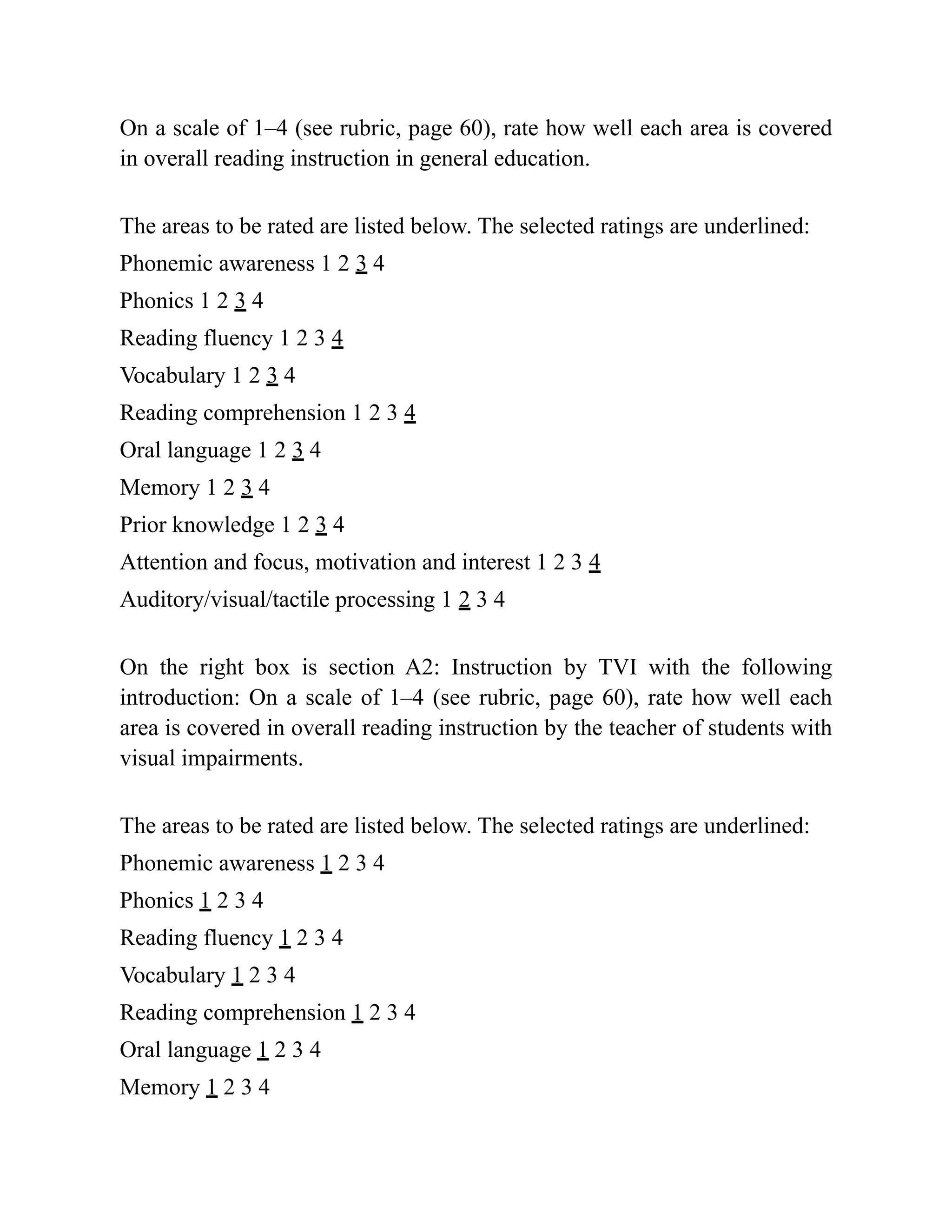
![Prior knowledge 1 2 3 4
Attention and focus, motivation and interest 1 2 3 4
Auditory/visual/tactile processing 1 2 3 4
Below these two boxes is a box across the page for Section B: Effective
Practices and Special Considerations and listed under it is the following
checkbox list:
[checkbox] Increased wait time
[checkbox] Decreased pace
[checkbox] Simplified wording
[checkbox] Word/letter cards
[checkbox] Increased spacing
[checkbox] Typoscope
[checkbox] Personal dictionary
[checkbox] Personal word wall
[checkbox] Tangible objects
[checkbox] Slant board
[checkbox] Electronic text
[checkbox] Auditory materials
[checkbox] Braille
[checkbox] Large print
[checkbox] Regular print
[checkbox] Braille notetaker
[checkbox] Refreshable braille
[checkbox] Video magnifier/CCTV
[checkbox] Optical devices
[checkbox] [blank]](https://image.slidesharecdn.com/readingconnections-strategies-for-teaching-students-with-visual-impairments-250721170318-cb16127e/75/Reading-Connections-Strategies-for-Teaching-Students-with-Visual-Impairments-544-2048.jpg)
![[checkbox] [blank]
[checkbox] [blank]
[checkbox] [blank]
[checkbox] [blank]
Below Section B is a box across the page for Section C: Key Players: Roles
and Collaboration, which is a table with four column heads:
Role of the general education teacher: All reading instruction is being
provided by the general education teacher.
Role of the teacher of students with visual impairments: Assessing and
identifying Tammy’s needs and adapting materials; collaborative activities
include consultation with Ms. Johnson.
Role of the primary caregiver: Provide support at home to complete
homework.
Role of the related service providers: No identified role in reading at this
point.
Centered under this table is a box shaped like an arrow for Section D:
Progress Monitoring:
Tool(s): District benchmarks
Who is responsible? Ms. Johnson
The arrow is pointing towards the box below it for Section E: Overall
Reading Instruction:
On a scale of 1–4 (1 being the lowest, and 4 being the highest), is
instruction: (Selected ratings are underlined.)
Consistent? 1 2 3 4
Structured? 1 2 3 4](https://image.slidesharecdn.com/readingconnections-strategies-for-teaching-students-with-visual-impairments-250721170318-cb16127e/75/Reading-Connections-Strategies-for-Teaching-Students-with-Visual-Impairments-545-2048.jpg)
![Explicit? 1 2 3 4
Is the current reading instruction balanced?
Yes: X
No: [blank]
Are there any identified areas of weakness in the overall current reading
instruction? If so, which areas?: After observing the general education
reading instruction, I am concerned about Tammy’s access to the materials,
especially during whole-class and small-group instruction. Further
assessment is needed.
Return to text
Table 5.1
Phonemic Awareness Skills
Source: Adapted from Ellery, V. (2005). Creating strategic readers:
Techniques for developing competency in phonemic awareness, phonics,
fluency, vocabulary, and comprehension. Newark, DE: International
Reading Association.
Description: The table has three column heads: Phonemic Awareness Skill;
Definition; and Example
Phonemic Awareness Skill: Phoneme isolation
Definition: Recognizing individual sounds in words
Example: Teacher: What is the first sound you hear in the word “bat”?;
Student: /b/
Phonemic Awareness Skill: Phoneme identity
Definition: Identifying the same sound in several words](https://image.slidesharecdn.com/readingconnections-strategies-for-teaching-students-with-visual-impairments-250721170318-cb16127e/75/Reading-Connections-Strategies-for-Teaching-Students-with-Visual-Impairments-546-2048.jpg)
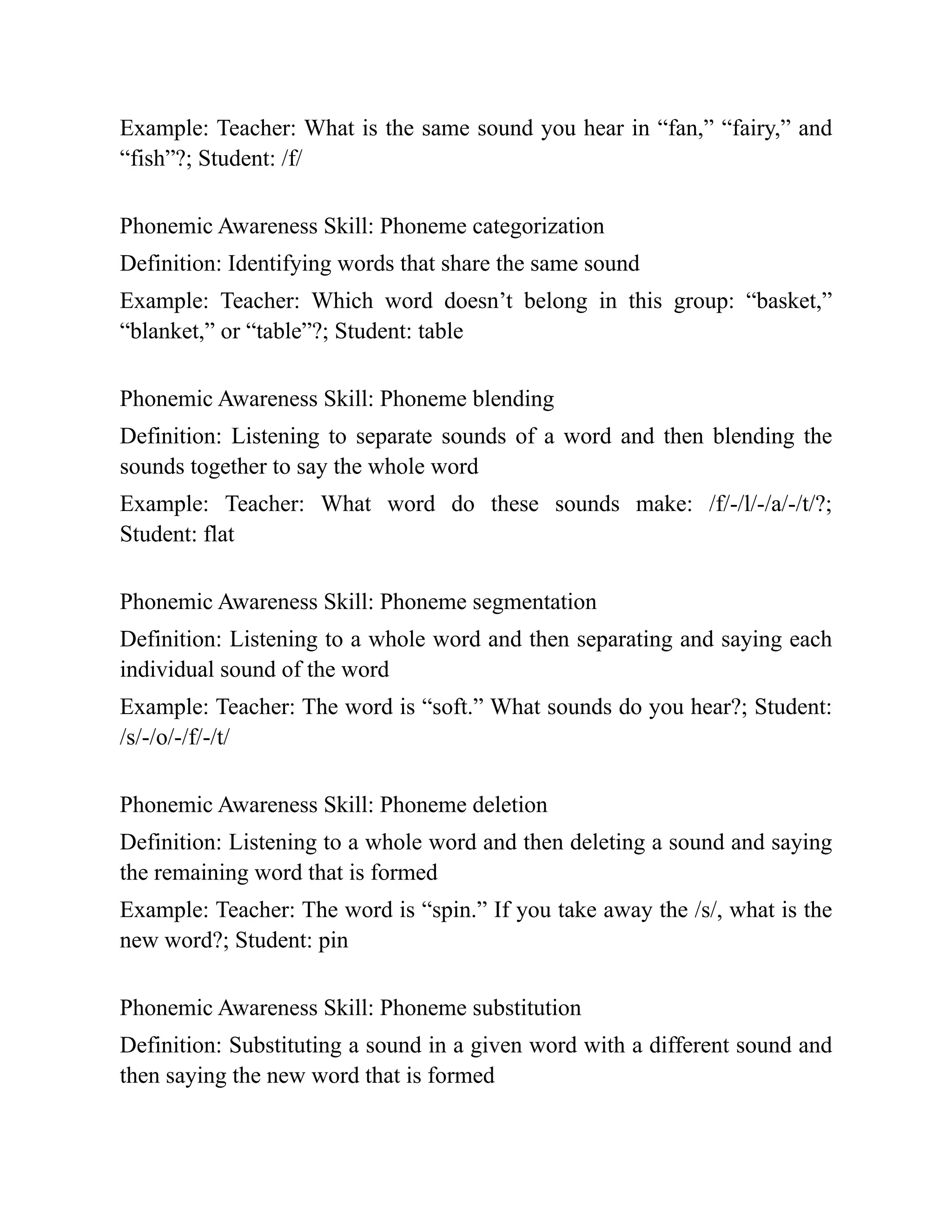
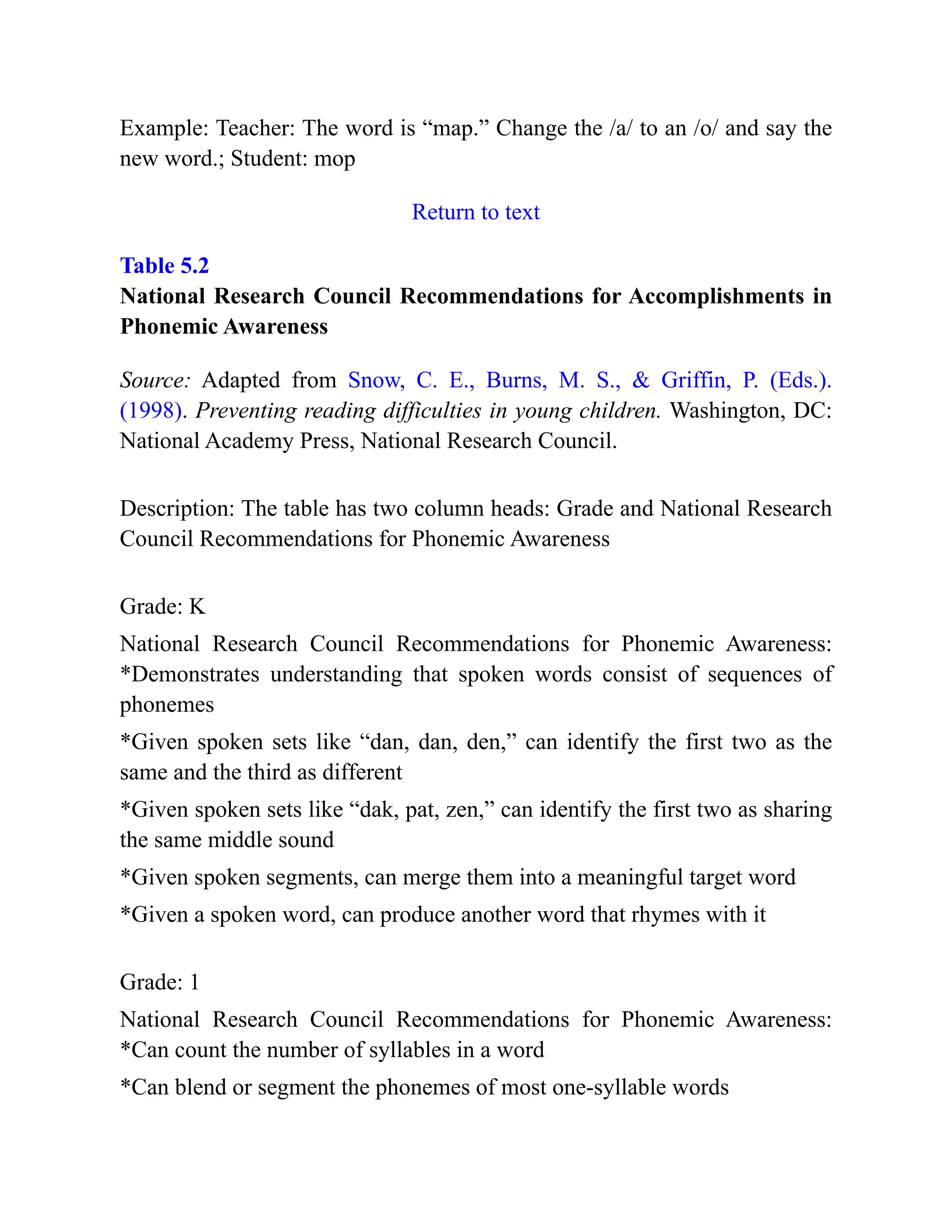
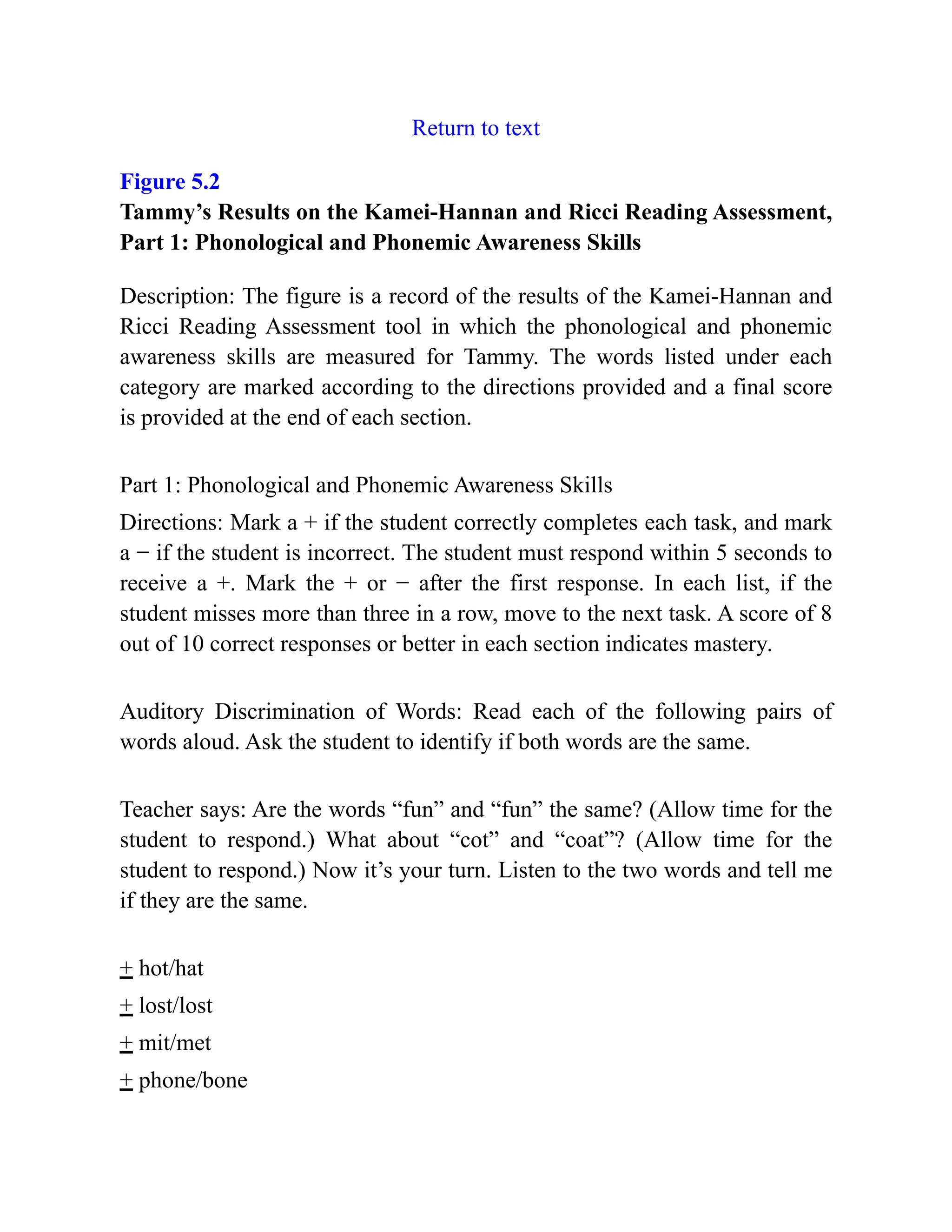


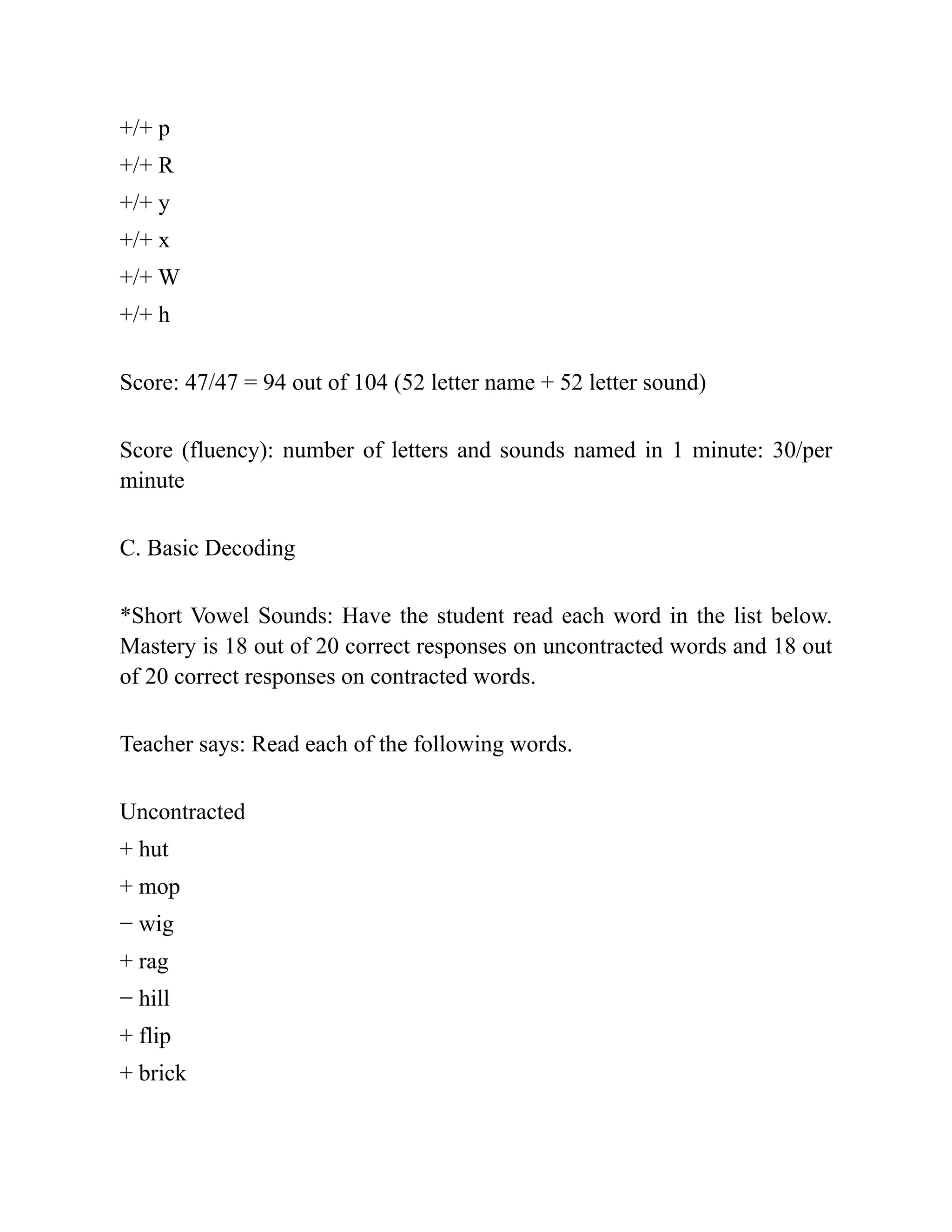
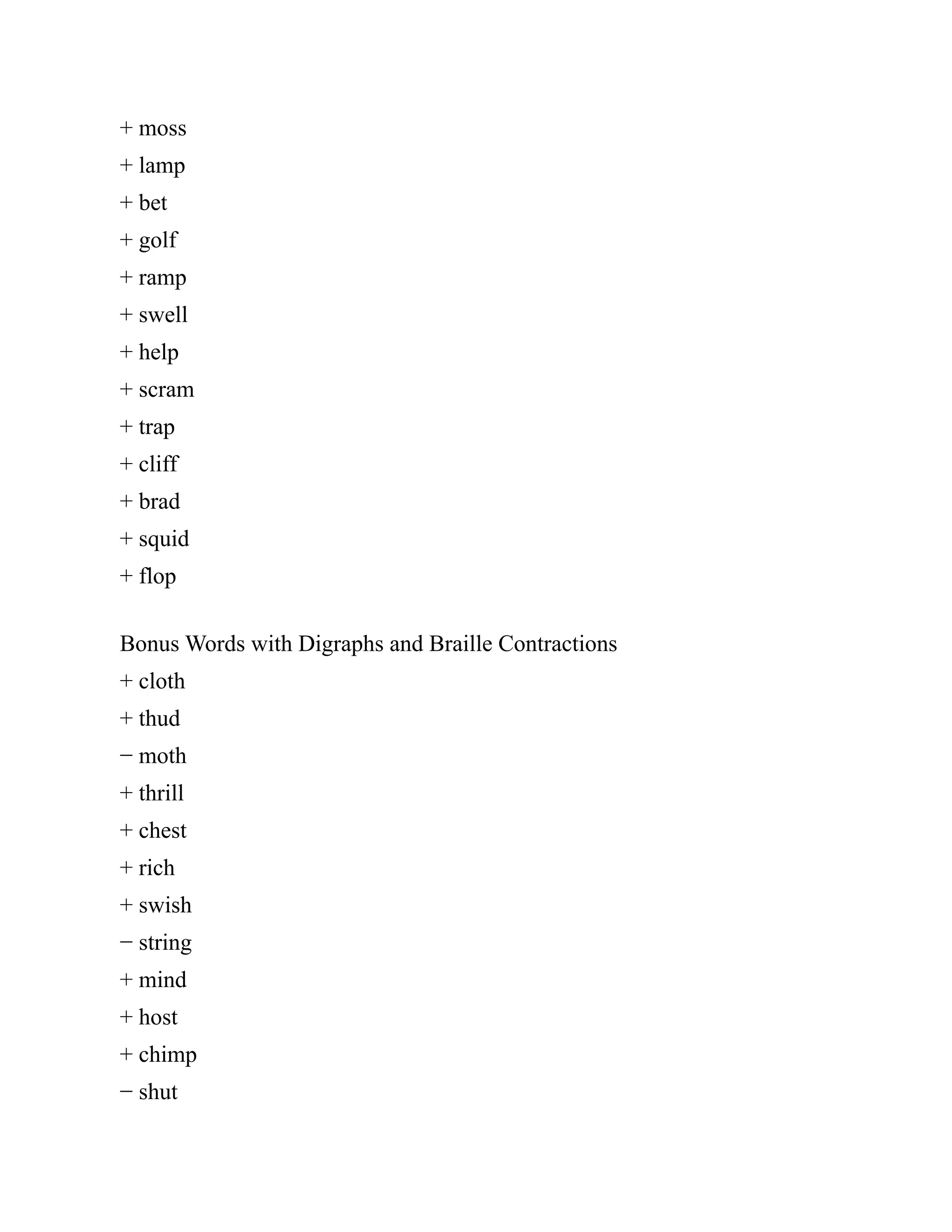
![+ send
+ think
− squish
+ inch
− wish
+ lunch
+ sing
− ash
Score: 18 out of 20 (uncontracted); 14 out of 20 (contracted)
*Long Vowel Sound (vowel-consonant-silent e [VCE]) One-Syllable
Words: Have the student read each word in the list below. Mastery is 18 out
of 20 correct responses on uncontracted words and 18 out of 20 correct
responses on contracted words.
Teacher says: Read each of the following words.
Uncontracted
− spike
+ cape
+ place
+ frame
+ Luke
+ wrote
+ size
+ drive
+ rove](https://image.slidesharecdn.com/readingconnections-strategies-for-teaching-students-with-visual-impairments-250721170318-cb16127e/75/Reading-Connections-Strategies-for-Teaching-Students-with-Visual-Impairments-570-2048.jpg)
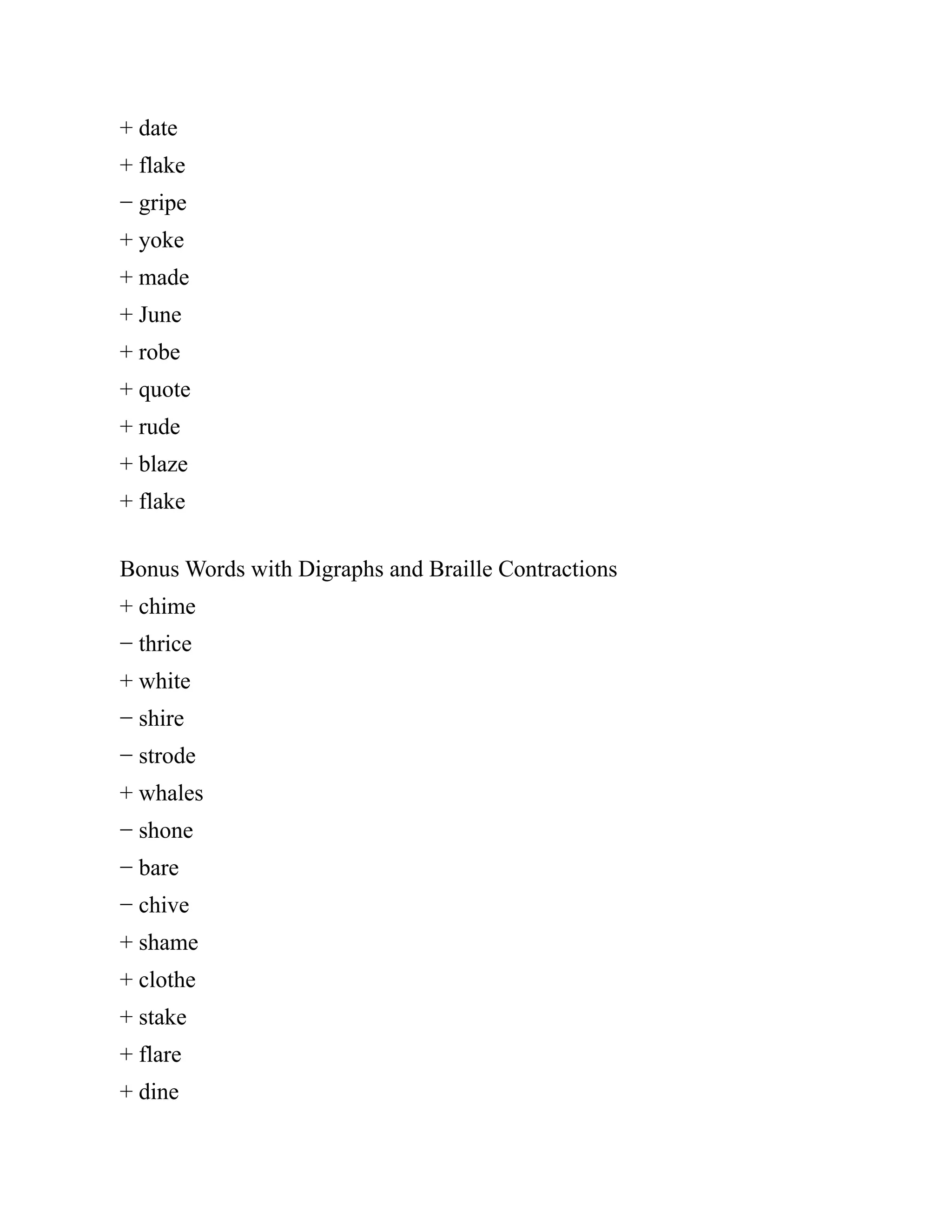
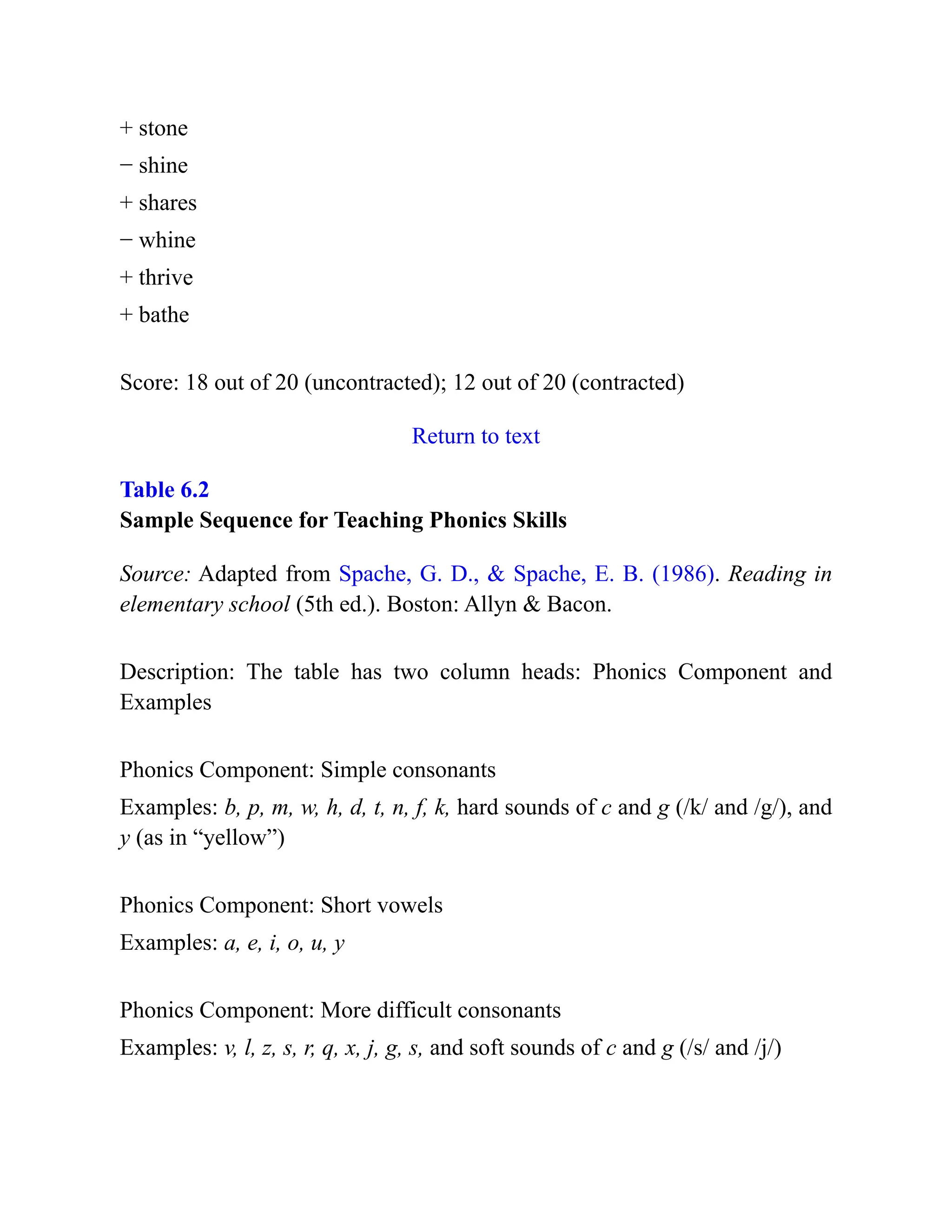
![The central box is labeled Family Involvement and below it is a box labeled
Collaborative Projects. To the left of those central boxes is a box labeled
General Education Curriculum and to the right is a box labeled Expanded
Core Curriculum.
Family Involvement: Consider asking Alejandro’s parents to help him
identify objects for the letter of the week
Collaborative Projects: Work with the general education teacher to align
lessons with curriculum
General Education Curriculum: Continue to follow general education
curriculum and reading instruction
Expanded Core Curriculum: Ms. Reyes works on independent living skills
such as counting coins, money handling, and organization of money
The fourth section contains a box spanning the width of the form, which
contains the following fields: Data collection instrument or measure(s):
[blank]
Review data, assess, reflect, plan: Keep track of the number of words that
Alejandro can read independently at the start and end of each lesson. Graph
results.
Return to text
Figure 6.7
Alejandro’s Progress in Word Recognition Before and After Lessons
Description: The figure is a bar graph. The X-axis indicates odd-numbered
lessons from 1–15. The Y-axis is labeled Words read correctly and goes
from 0 to 30 in intervals of 5. Each odd-numbered lesson has two bars, one
representing Beginning of Lesson, and the other After Lesson. The After
Lesson bars are generally higher than the Beginning of Lesson bars, except
for Lesson 7, where they are even at 15 words. The Beginning of Lesson
bars start off at about 3 word read correctly in Lesson 1 and increase](https://image.slidesharecdn.com/readingconnections-strategies-for-teaching-students-with-visual-impairments-250721170318-cb16127e/75/Reading-Connections-Strategies-for-Teaching-Students-with-Visual-Impairments-577-2048.jpg)
![plan format and sequence. Provide consistent routine and ample repetition
until student demonstrates mastery.
The third section contains four boxes to be filled in, with connecting arrows
between each box as well as to the boxes and sections above and below.
The central box is labeled Family Involvement and below it is a box labeled
Collaborative Projects. To the left of those central boxes is a box labeled
General Education Curriculum and to the right is a box labeled Expanded
Core Curriculum.
Family Involvement: Frequent updates from Mr. Murphy to Catarina’s
parents regarding her progress
Collaborative Projects: Periodically inform general education teacher of
progress
General Education Curriculum: Continue to follow general education
curriculum and reading instruction and supplement with Wilson Reading
Intervention
Expanded Core Curriculum: No activities extended to ECC areas at this
time
The fourth section contains a box spanning the width of the form, which
contains the following fields: Data collection instrument or measure(s):
[blank]
Review data, assess, reflect, plan: Monitor and graph cwpm and number of
words spelled correctly given a list of words from the Wilson Reading
System.
Return to text](https://image.slidesharecdn.com/readingconnections-strategies-for-teaching-students-with-visual-impairments-250721170318-cb16127e/75/Reading-Connections-Strategies-for-Teaching-Students-with-Visual-Impairments-580-2048.jpg)
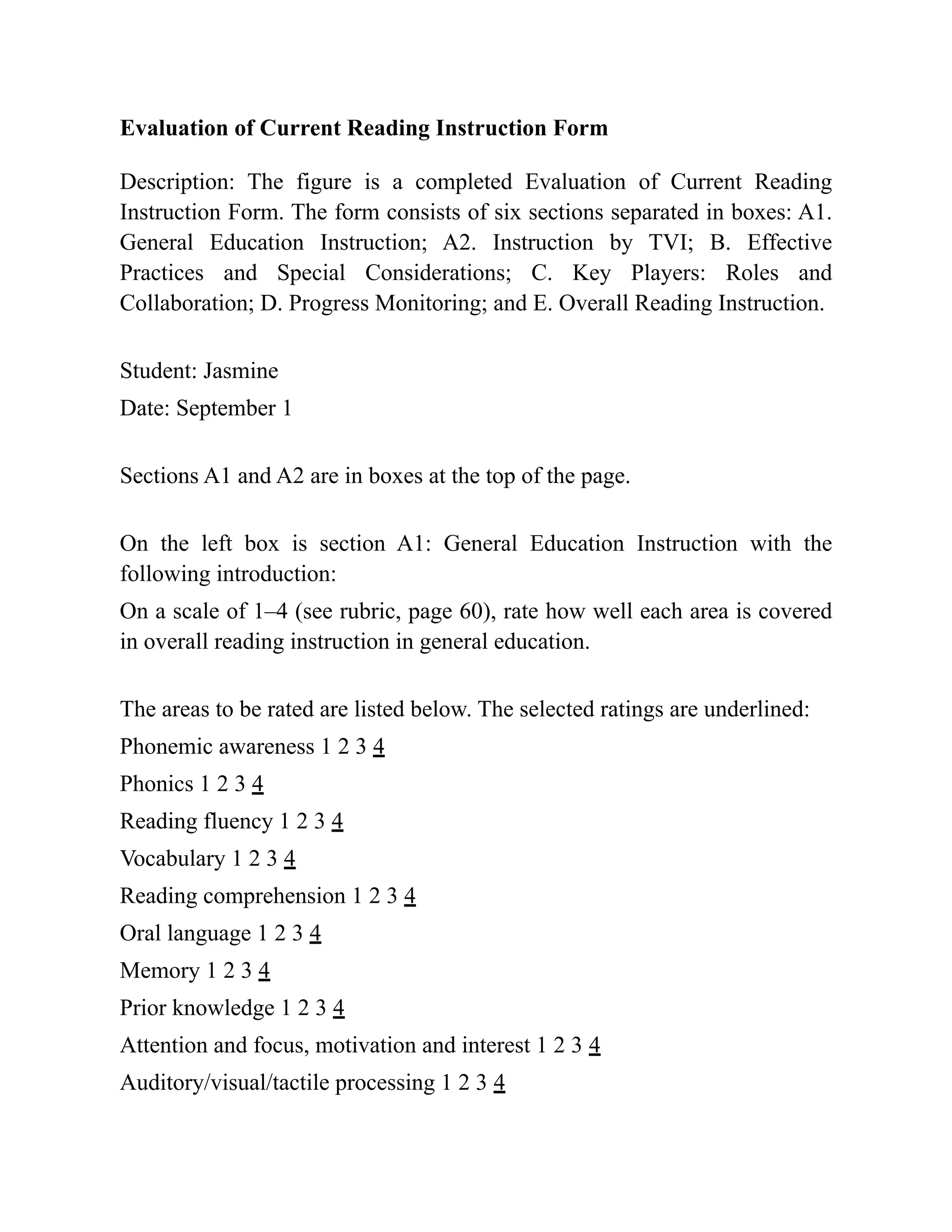
![On the right box is section A2: Instruction by TVI with the following
introduction: On a scale of 1–4 (see rubric, page 60), rate how well each
area is covered in overall reading instruction by the teacher of students with
visual impairments.
The areas to be rated are listed below. The selected ratings are underlined:
Phonemic awareness 1 2 3 4
Phonics 1 2 3 4
Reading fluency 1 2 3 4
Vocabulary 1 2 3 4
Reading comprehension 1 2 3 4
Oral language 1 2 3 4
Memory 1 2 3 4
Prior knowledge 1 2 3 4
Attention and focus, motivation and interest 1 2 3 4
Auditory/visual/tactile processing 1 2 3 4
Below these two boxes is a box across the page for Section B: Effective
Practices and Special Considerations and listed under it is the following
checkbox list:
[checkbox] Increased wait time
[X] Decreased pace
[X] Simplified wording
[checkbox] Word/letter cards
[X] Increased spacing
[X] Typoscope
[X] Personal dictionary](https://image.slidesharecdn.com/readingconnections-strategies-for-teaching-students-with-visual-impairments-250721170318-cb16127e/75/Reading-Connections-Strategies-for-Teaching-Students-with-Visual-Impairments-584-2048.jpg)
![[X] Personal word wall
[checkbox] Tangible objects
[X] Slant board
[X Electronic text
[X] Auditory materials
[X] Braille
[X] Large print
[checkbox] Regular print
[checkbox] Braille notetaker
[checkbox] Refreshable braille
[checkbox] Video magnifier/CCTV
[checkbox] Optical devices
[checkbox] [blank]
[checkbox] [blank]
[checkbox] [blank]
[checkbox] [blank]
[checkbox] [blank]
Below Section B is a box across the page for Section C: Key Players: Roles
and Collaboration, which is a table with four column heads:
Role of the general education teacher: Reading instruction is being provided
by the general education teacher.
Role of the teacher of students with visual impairments: Reading passages
from the general education curriculum are being used to teach Jasmine to
use a typoscope and to monitor her ability to trace a line and maintain focus
on the reading passage.
Role of the primary caregiver: Provide support at home to complete
homework.](https://image.slidesharecdn.com/readingconnections-strategies-for-teaching-students-with-visual-impairments-250721170318-cb16127e/75/Reading-Connections-Strategies-for-Teaching-Students-with-Visual-Impairments-585-2048.jpg)
![Role of the related service providers: No identified role in reading at this
point.
Centered under this table is a box shaped like an arrow for Section D:
Progress Monitoring:
Tool(s): Weekly WPM assessments
Who is responsible? Ms. Williams
The arrow is pointing towards the box below it for Section E: Overall
Reading Instruction:
On a scale of 1–4 (1 being the lowest, and 4 being the highest), is
instruction: (Selected ratings are underlined.)
Consistent? 1 2 3 4
Structured? 1 2 3 4
Explicit? 1 2 3 4
Is the current reading instruction balanced?
Yes: X
No: [blank]
Are there any identified areas of weakness in the overall current reading
instruction? If so, which areas? Jasmine struggles to keep pace with the
general education class. Consider providing additional instruction to
support reading fluency and increase visual efficiency.
Return to text
Table 7.1
National Research Council Recommendations for Accomplishments in
Fluency
Source: Adapted from Snow, C. E., Burns, M. S., & Griffin, P. (Eds.).
(1998). Preventing reading difficulties in young children. Washington, DC:](https://image.slidesharecdn.com/readingconnections-strategies-for-teaching-students-with-visual-impairments-250721170318-cb16127e/75/Reading-Connections-Strategies-for-Teaching-Students-with-Visual-Impairments-586-2048.jpg)
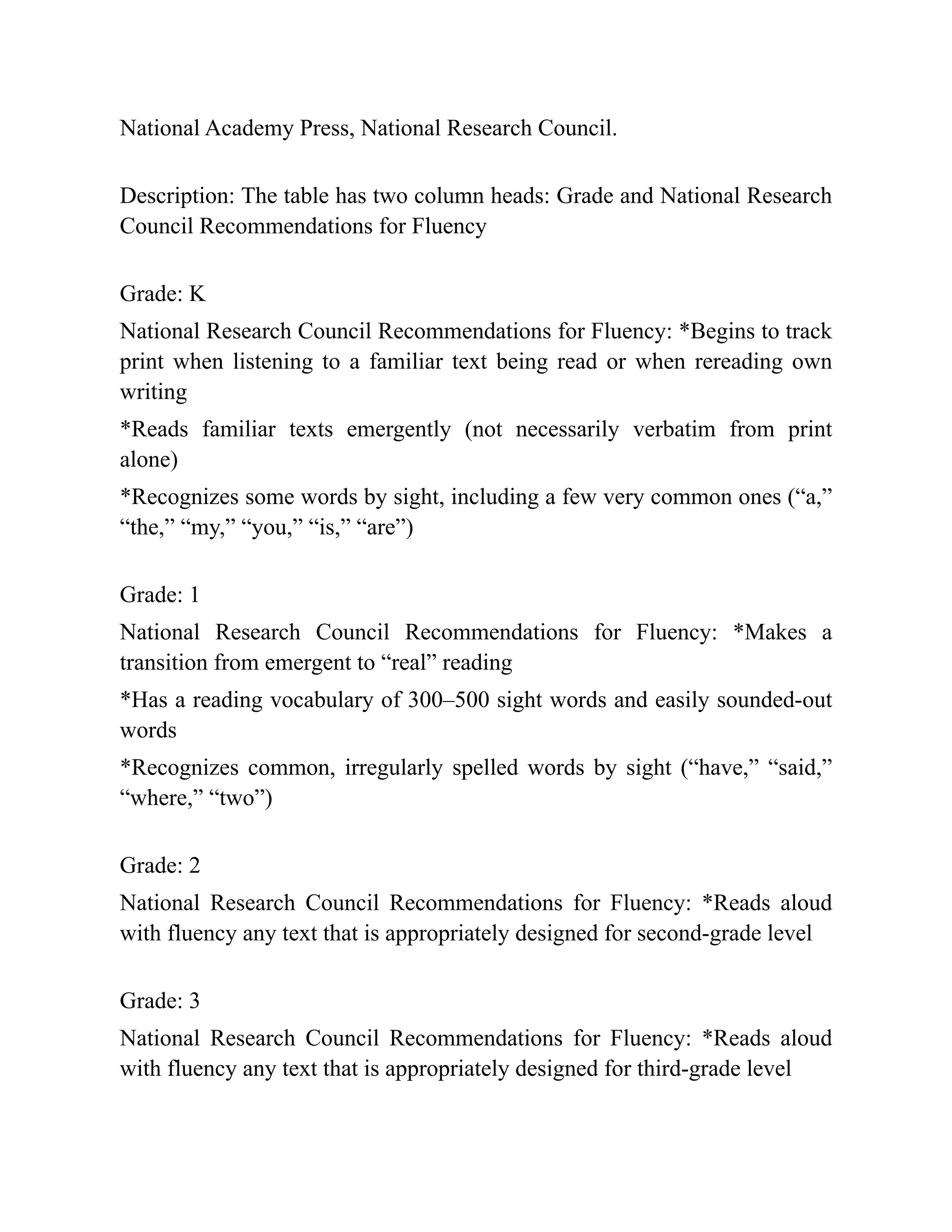
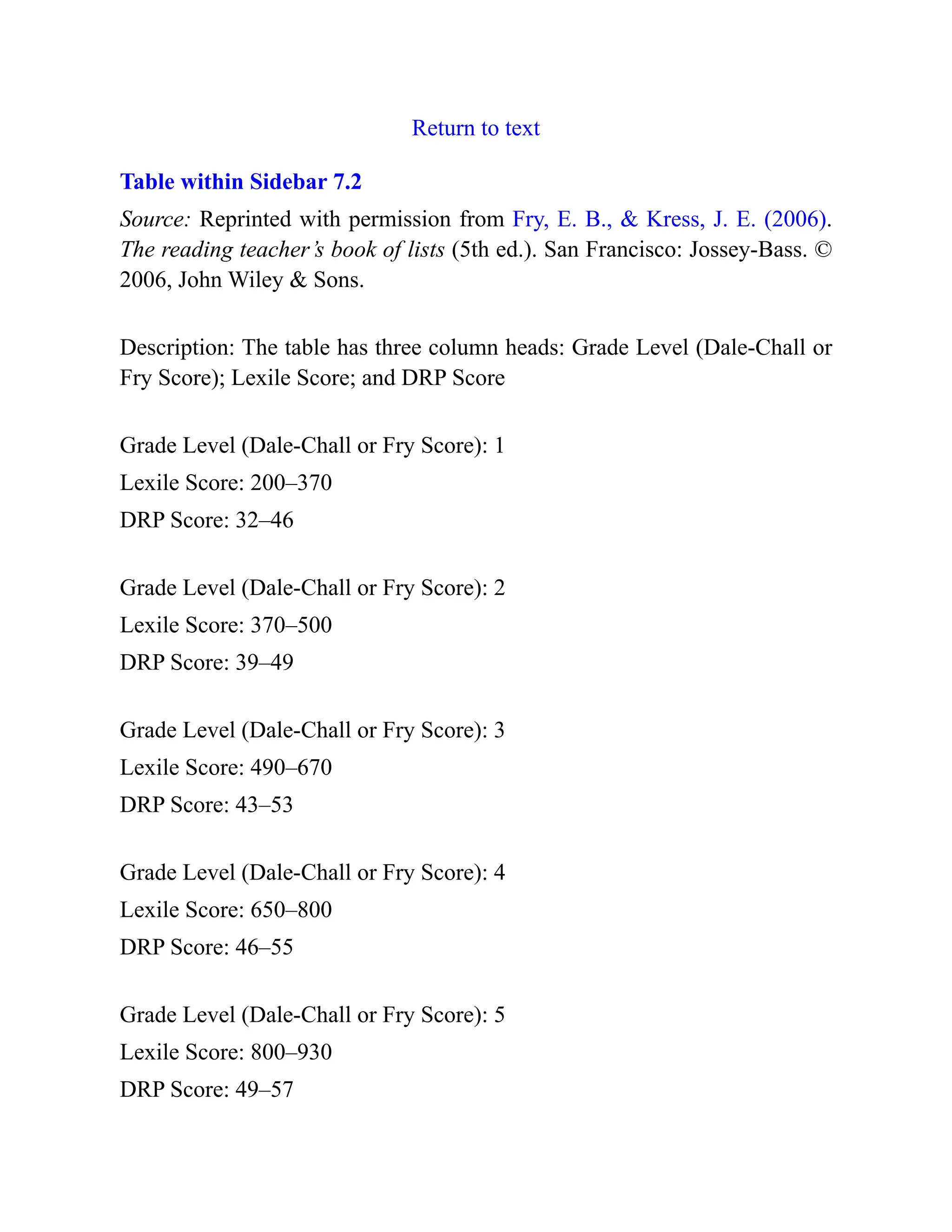
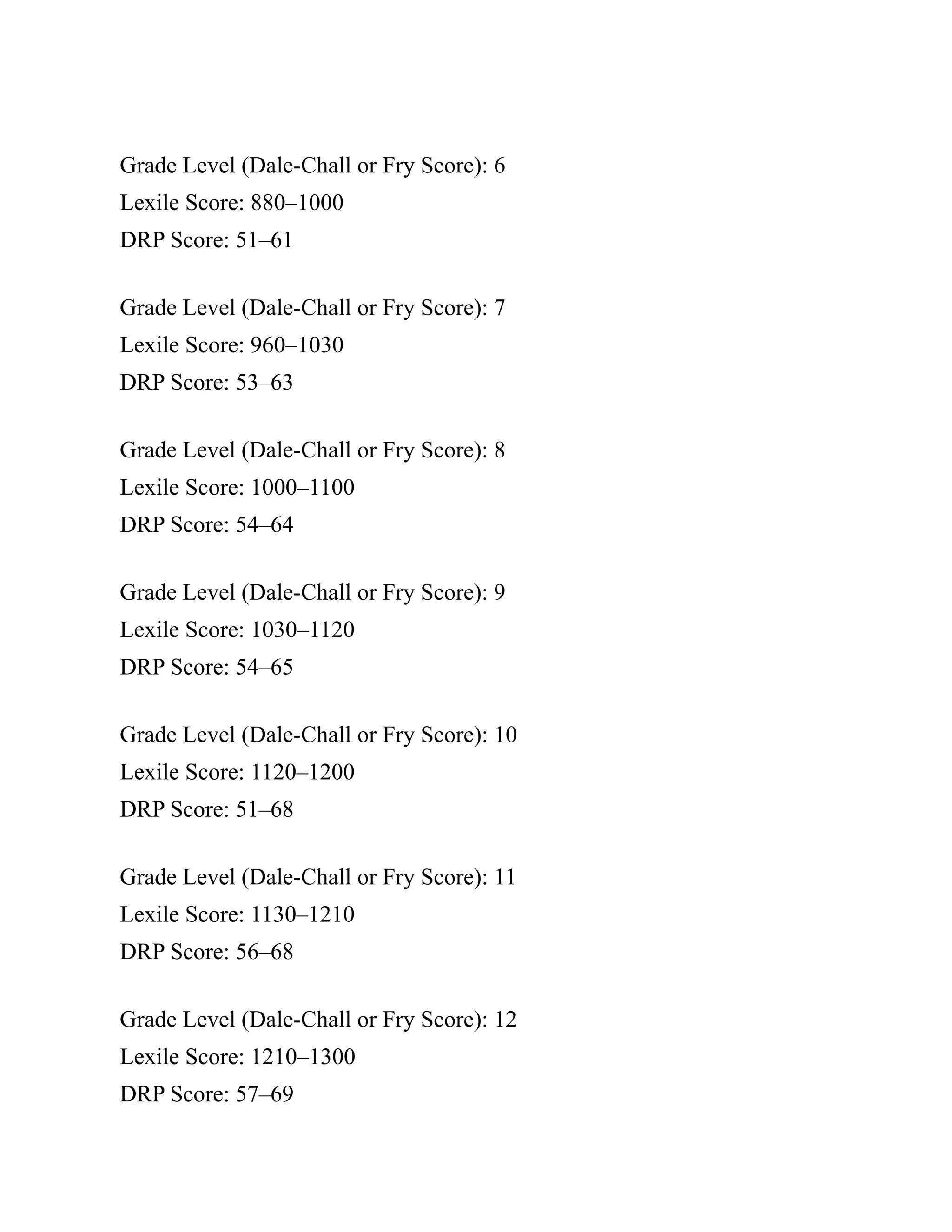
![Grade Level (Dale-Chall or Fry Score): 13 through college
Lexile Score: 1320–1490
DRP Score: 70–76
Return to text
Table 7.2
Approximate Reading Rates for Braille Readers and Typically
Developing Children (Print Readers)
Sources: a
Wall Emerson, R., Holbrook, M. C., & D’Andrea, F. M. (2009).
Acquisition of literacy skills by young children who are blind: Results from
the ABC Braille Study. Journal of Visual Impairment & Blindness, 103(10),
610–624; b
Wright, T., Wormsley, D. P., & Kamei-Hannan, C. (2009). Hand
movements and braille reading efficiency: Data from the Alphabetic Braille
and Contracted Braille Study. Journal of Visual Impairment & Blindness,
103(10), 649–661; c
Hasbrouck, J., & Tindal, G. (2006). Oral reading
fluency norms: A valuable assessment tool for reading teachers. The
Reading Teacher, 59(7), 636–644.
Description: The table has four column heads: Grade; Braillea
(cwpm);
Brailleb
(cwpm); and Oral Fluency for Typically Developing Students at the
50th
percentilec
(cwpm; Note: cwpm = correct words per minute). Both of
the Braille headings have two subheads: Range and Mean. Oral Fluency for
Typically Developing Students at the 50th
percentilec
(cwpm) has one
subhead: Mean
Grade: K
Braillea
(cwpm)-Range: [blank]
Braillea
(cwpm)-Mean: [blank]](https://image.slidesharecdn.com/readingconnections-strategies-for-teaching-students-with-visual-impairments-250721170318-cb16127e/75/Reading-Connections-Strategies-for-Teaching-Students-with-Visual-Impairments-590-2048.jpg)
![Brailleb
(cwpm)-Range: 4.3–45.1
Brailleb
(cwpm)-Mean: 19.39
Oral Fluency for Typically Developing Students at the 50th
percentilec
(cwpm)-Mean: [blank]
Grade: 1
Braillea
(cwpm)-Range: 16–48
Braillea
(cwpm)-Mean: 34.13
Brailleb
(cwpm)-Range: 6.0–68.0
Brailleb
(cwpm)-Mean: 30.68
Oral Fluency for Typically Developing Students at the 50th
percentilec
(cwpm)-Mean: 53
Grade: 2
Braillea
(cwpm)-Range: 19–89
Braillea
(cwpm)-Mean: 47.52
Brailleb
(cwpm)-Range: 1.1–93.1
Brailleb
(cwpm)-Mean: 44.97
Oral Fluency for Typically Developing Students at the 50th
percentilec
(cwpm)-Mean: 89
Grade: 3
Braillea
(cwpm)-Range: 21–86
Braillea
(cwpm)-Mean: 53.19
Brailleb
(cwpm)-Range: 16.5–97
Brailleb
(cwpm)-Mean: 51.21](https://image.slidesharecdn.com/readingconnections-strategies-for-teaching-students-with-visual-impairments-250721170318-cb16127e/75/Reading-Connections-Strategies-for-Teaching-Students-with-Visual-Impairments-591-2048.jpg)
![Type of Miscue: Substitution: each word that is substituted for another
word, including real and nonsense words
Sample Notation: Eyes come in all shapes [“shapes” is crossed out and
above it is written “mapes”] and sizes [“sizes” is crossed out and above it is
written “seeds”].
Type of Miscue: Insertion: each word that is not in the original text and is
added
Sample Notation: Eyes come in ^ [a caret is inserted and above it is written
“many”] different colors.
Type of Miscue: Omission: each word that is in the original text that is not
read
Sample Notation: The colored part of your eye is called the iris [iris is
crossed out] and the white part of your eye is called the sclera [sclera is
crossed out].
Type of Miscue: Reversal: any words or phrases that are reversed (for
example, “dot black” instead of “black dot”)
Sample Notation: Everybody has a black dot [an arrow indicating to
transpose “black” and “dot” is located between the two words] in the center
of the iris, called a pupil.
Type of Miscue: Repetition: any phrase, word, or part of a word that is
repeated, including multiple words; mark all words in a phrase that are
repeated
Sample Notation: The pupil [“The pupil” is underlined and next to is an “R”
in a circle] can change its shape.](https://image.slidesharecdn.com/readingconnections-strategies-for-teaching-students-with-visual-impairments-250721170318-cb16127e/75/Reading-Connections-Strategies-for-Teaching-Students-with-Visual-Impairments-595-2048.jpg)
![Type of Miscue: Self-Corrected: if the student makes an error but rereads it
correctly
Sample Notation: When it is too dark [“dark” is crossed out; above it is
written “far,” which is also crossed out and has a “C” in a circle next to it]
the pupil gets very large. But in the bright sun, the pupil is very small.
Return to text
Figure 7.4
Miscue Analysis Form
Description: The figure is a table analyzing the miscues a student makes
while reading a passage entitled The Eye. The form is a table with six
column heads and subheads. Subheads for main heads are indicated within
parentheses after each main head: Original Text; Student’s Miscue; Type of
Miscue (Substitution, Insertion, Omission, Reversal, Repetition); Self-
Corrected; Context (Unacceptable Syntax, Unacceptable Semantics); and
Braille Miscue—if applicable (Missed Dot, Added Dot, Braille Reversal,
Alignment, Missed Ending).
Note: Since self-corrected miscues are corrected by the student, they are not
scored; self-corrections should still be checked off on the form, but not
counted in the total number of miscues.
Original Text: shapes
Student’s Miscue: mapes
Type of Miscue-Substitution: X
Type of Miscue-Insertion: [blank]
Type of Miscue-Omission: [blank]
Type of Miscue-Reversal: [blank]
Type of Miscue-Repetition: [blank]](https://image.slidesharecdn.com/readingconnections-strategies-for-teaching-students-with-visual-impairments-250721170318-cb16127e/75/Reading-Connections-Strategies-for-Teaching-Students-with-Visual-Impairments-596-2048.jpg)
![Self-Corrected: [blank]
Context-Unacceptable Syntax: [blank]
Context-Unacceptable Semantics: X
Braille Miscues (if applicable)-Missed Dot: [blank]
Braille Miscues (if applicable)-Added Dot: [blank]
Braille Miscues (if applicable)-Braille Reversal: X
Braille Miscues (if applicable)-Alignment: [blank]
Braille Miscues (if applicable)-Missed Ending: [blank]
Original Text: sizes
Student’s Miscue: seeds
Type of Miscue-Substitution: X
Type of Miscue-Insertion: [blank]
Type of Miscue-Omission: [blank]
Type of Miscue-Reversal: [blank]
Type of Miscue-Repetition: [blank]
Self-Corrected: [blank]
Context-Unacceptable Syntax: [blank]
Context-Unacceptable Semantics: [blank]
Braille Miscues (if applicable)-Missed Dot: [blank]
Braille Miscues (if applicable)-Added Dot: X
Braille Miscues (if applicable)-Braille Reversal: [blank]
Braille Miscues (if applicable)-Alignment: [blank]
Braille Miscues (if applicable)-Missed Ending: [blank]
Original Text: in different
Student’s Miscue: in [caret and inserted word many] differed](https://image.slidesharecdn.com/readingconnections-strategies-for-teaching-students-with-visual-impairments-250721170318-cb16127e/75/Reading-Connections-Strategies-for-Teaching-Students-with-Visual-Impairments-597-2048.jpg)
![Type of Miscue-Substitution: [blank]
Type of Miscue-Insertion: X
Type of Miscue-Omission: [blank]
Type of Miscue-Reversal: [blank]
Type of Miscue-Repetition: [blank]
Self-Corrected: [blank]
Context-Unacceptable Syntax: [blank]
Context-Unacceptable Semantics: [blank]
Braille Miscues (if applicable)-Missed Dot: [blank]
Braille Miscues (if applicable)-Added Dot: [blank]
Braille Miscues (if applicable)-Braille Reversal: [blank]
Braille Miscues (if applicable)-Alignment: [blank]
Braille Miscues (if applicable)-Missed Ending: [blank]
Original Text: iris
Student’s Miscue: [blank]
Type of Miscue-Substitution: [blank]
Type of Miscue-Insertion: [blank]
Type of Miscue-Omission: X
Type of Miscue-Reversal: [blank]
Type of Miscue-Repetition: [blank]
Self-Corrected: [blank]
Context-Unacceptable Syntax: [blank]
Context-Unacceptable Semantics: [blank]
Braille Miscues (if applicable)-Missed Dot: [blank]
Braille Miscues (if applicable)-Added Dot: [blank]
Braille Miscues (if applicable)-Braille Reversal: [blank]](https://image.slidesharecdn.com/readingconnections-strategies-for-teaching-students-with-visual-impairments-250721170318-cb16127e/75/Reading-Connections-Strategies-for-Teaching-Students-with-Visual-Impairments-598-2048.jpg)
![Braille Miscues (if applicable)-Alignment: [blank]
Braille Miscues (if applicable)-Missed Ending: [blank]
Original Text: sclera
Student’s Miscue: [blank]
Type of Miscue-Substitution: [blank]
Type of Miscue-Insertion: [blank]
Type of Miscue-Omission: X
Type of Miscue-Reversal: [blank]
Type of Miscue-Repetition: [blank]
Self-Corrected: [blank]
Context-Unacceptable Syntax: [blank]
Context-Unacceptable Semantics: [blank]
Braille Miscues (if applicable)-Missed Dot: [blank]
Braille Miscues (if applicable)-Added Dot: [blank]
Braille Miscues (if applicable)-Braille Reversal: [blank]
Braille Miscues (if applicable)-Alignment: [blank]
Braille Miscues (if applicable)-Missed Ending: [blank]
Original Text: black dot
Student’s Miscue: dot black
Type of Miscue-Substitution: [blank]
Type of Miscue-Insertion: [blank]
Type of Miscue-Omission: [blank]
Type of Miscue-Reversal: X
Type of Miscue-Repetition: [blank]
Self-Corrected: [blank]](https://image.slidesharecdn.com/readingconnections-strategies-for-teaching-students-with-visual-impairments-250721170318-cb16127e/75/Reading-Connections-Strategies-for-Teaching-Students-with-Visual-Impairments-599-2048.jpg)
![Context-Unacceptable Syntax: [blank]
Context-Unacceptable Semantics: [blank]
Braille Miscues (if applicable)-Missed Dot: [blank]
Braille Miscues (if applicable)-Added Dot: [blank]
Braille Miscues (if applicable)-Braille Reversal: [blank]
Braille Miscues (if applicable)-Alignment: [blank]
Braille Miscues (if applicable)-Missed Ending: [blank]
Original Text: the pupil
Student’s Miscue: the pupil, the pupil
Type of Miscue-Substitution: [blank]
Type of Miscue-Insertion: [blank]
Type of Miscue-Omission: [blank]
Type of Miscue-Reversal: [blank]
Type of Miscue-Repetition: X
Self-Corrected: [blank]
Context-Unacceptable Syntax: [blank]
Context-Unacceptable Semantics: [blank]
Braille Miscues (if applicable)-Missed Dot: [blank]
Braille Miscues (if applicable)-Added Dot: [blank]
Braille Miscues (if applicable)-Braille Reversal: [blank]
Braille Miscues (if applicable)-Alignment: [blank]
Braille Miscues (if applicable)-Missed Ending: [blank]
Original Text: dark
Student’s Miscue: far [far is crossed out, next to it is a “C” in a circle] dark
Type of Miscue-Substitution: [blank]](https://image.slidesharecdn.com/readingconnections-strategies-for-teaching-students-with-visual-impairments-250721170318-cb16127e/75/Reading-Connections-Strategies-for-Teaching-Students-with-Visual-Impairments-600-2048.jpg)
![Type of Miscue-Insertion: [blank]
Type of Miscue-Omission: [blank]
Type of Miscue-Reversal: [blank]
Type of Miscue-Repetition: [blank]
Self-Corrected: X
Context-Unacceptable Syntax: [blank]
Context-Unacceptable Semantics: [blank]
Braille Miscues (if applicable)-Missed Dot: [blank]
Braille Miscues (if applicable)-Added Dot: [blank]
Braille Miscues (if applicable)-Braille Reversal: [blank]
Braille Miscues (if applicable)-Alignment: [blank]
Braille Miscues (if applicable)-Missed Ending: [blank]
At the bottom of the table is a row to tally the miscues in each column. And
below that, a row indicating the correctly read words per minute.
Totals
Type of Miscues-Total number of miscues: 7
Self-Corrected: N/A
Context-Total number of significant miscues: 1
Braille Miscues (if applicable)-Total number of braille miscues: 2
Correctly read words per minute (cwpm): 25
To calculate the correctly read words per minute (cwpm), follow these
steps:
1. Subtract the number of errors from the total number of words to
determine the number of words read correctly.](https://image.slidesharecdn.com/readingconnections-strategies-for-teaching-students-with-visual-impairments-250721170318-cb16127e/75/Reading-Connections-Strategies-for-Teaching-Students-with-Visual-Impairments-601-2048.jpg)

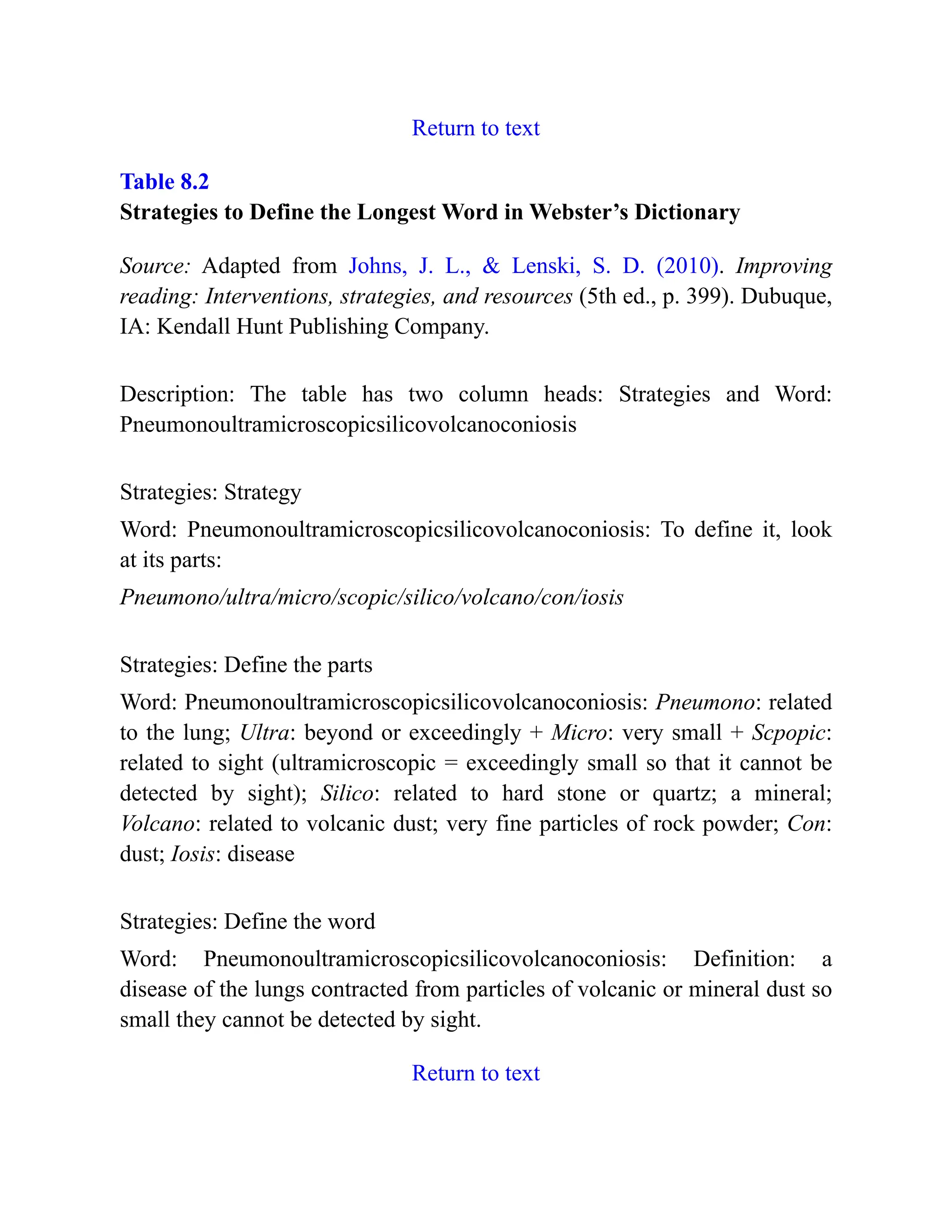
![Figure 8.2
Sample Zip It! Activity
Description: Photo of a sea shell in a plastic bag taped to the center of a tri-
fold paper. On the upper left-hand corner of the paper is the following
sentence: Seashell – a hard outer layer that protects the sea animal. On the
upper right-hand corner is the following sentence: I found a seashell at the
beach.
Return to text
Figure 8.3
Sample Table for Scatter Categorization Activity, Simple Variation
Source: Adapted from Johns, J. L., & Lenski, S. D. (2010). Improving
reading: Interventions, strategies, and resources (5th ed., p. 347). Dubuque,
IA: Kendall Hunt Publishing Company.
Description: The figure is a table with two main column heads: Words and
Categories. Categories has the following subheads: Red; Yellow; Orange;
and Green.
Words: Tomato
Categories—Red: X
Categories—Yellow: [blank]
Categories—Orange: [blank]
Categories—Green: [blank]
Words: Peach
Categories—Red: [blank]
Categories—Yellow: [blank]](https://image.slidesharecdn.com/readingconnections-strategies-for-teaching-students-with-visual-impairments-250721170318-cb16127e/75/Reading-Connections-Strategies-for-Teaching-Students-with-Visual-Impairments-617-2048.jpg)
![Categories—Orange: X
Categories—Green: [blank]
Words: Banana
Categories—Red: [blank]
Categories—Yellow: X
Categories—Orange: [blank]
Categories—Green: [blank]
Words: Orange
Categories—R ed: [blank]
Categories—Yellow: [blank]
Categories—Orange: X
Categories—Green: [blank]
Words: Carrot
Categories—Red: [blank]
Categories—Yellow: [blank]
Categories—Orange: X
Categories—Green: [blank]
Words: Lettuce
Categories—Red: [blank]
Categories—Yellow: [blank]
Categories—Orange: [blank]
Categories—Green: X
Words: Apple](https://image.slidesharecdn.com/readingconnections-strategies-for-teaching-students-with-visual-impairments-250721170318-cb16127e/75/Reading-Connections-Strategies-for-Teaching-Students-with-Visual-Impairments-618-2048.jpg)
![Categories—Red: X
Categories—Yellow: X
Categories—Orange: [blank]
Categories—Green: X
Words: Lemon
Categories—Red: [blank]
Categories—Yellow: X
Categories—Orange: [blank]
Categories—Green: [blank]
Words: Cucumber
Categories—Red: [blank]
Categories—Yellow: [blank]
Categories—Orange: [blank]
Categories—Green: X
Return to text
Figure 8.4
Sample Table for Scatter Categorization Activity, Complex Variation
Source: Adapted from Johns, J. L., & Lenski, S. D. (2010). Improving
reading: Interventions, strategies, and resources (5th ed., p. 347). Dubuque,
IA: Kendall Hunt Publishing Company.
Description: The figure is a table with two main column heads: Words and
Categories. Categories has the following subheads: Word; Color; Fruit or
Vegetable; Texture; Peel or
No Peel; and Seeds or No Seeds.](https://image.slidesharecdn.com/readingconnections-strategies-for-teaching-students-with-visual-impairments-250721170318-cb16127e/75/Reading-Connections-Strategies-for-Teaching-Students-with-Visual-Impairments-619-2048.jpg)
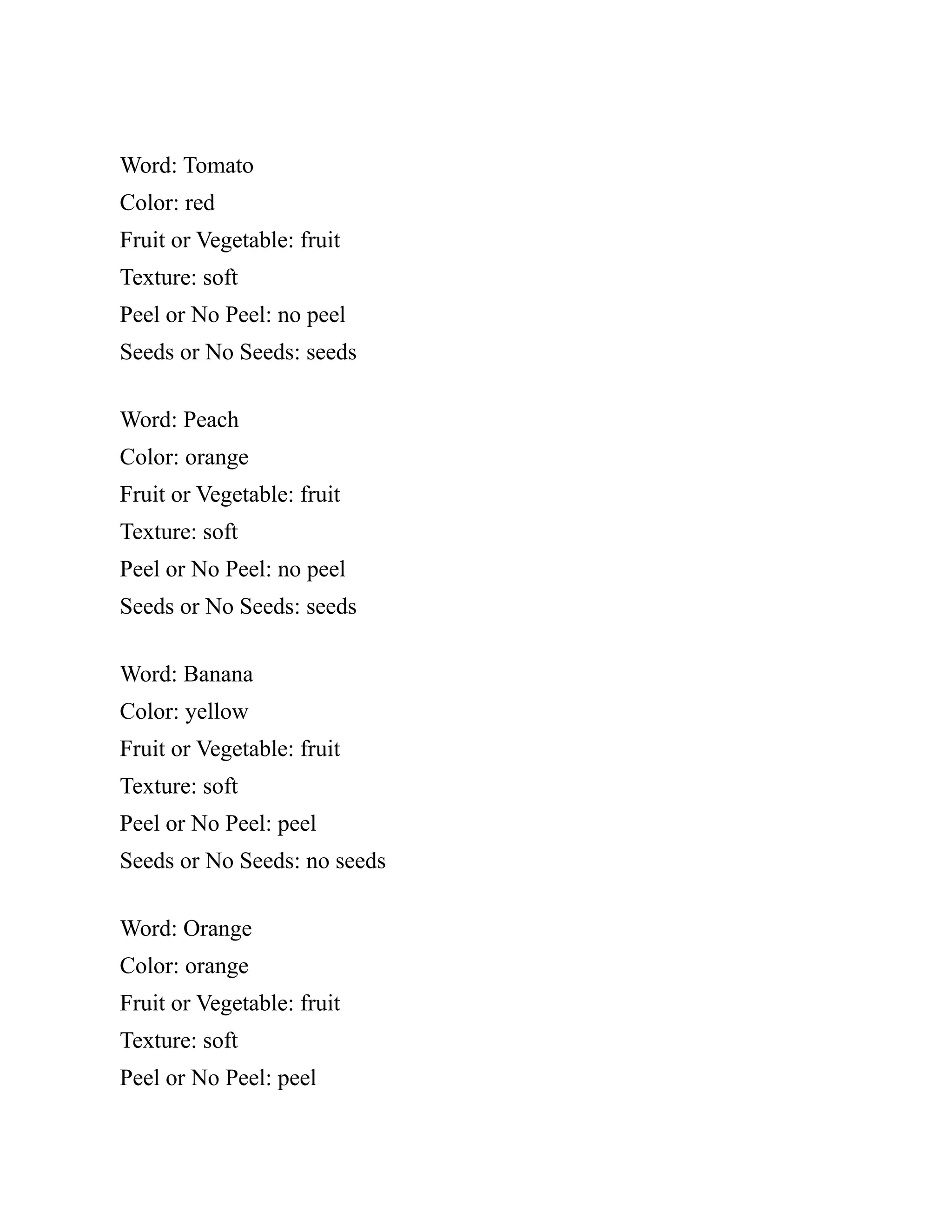
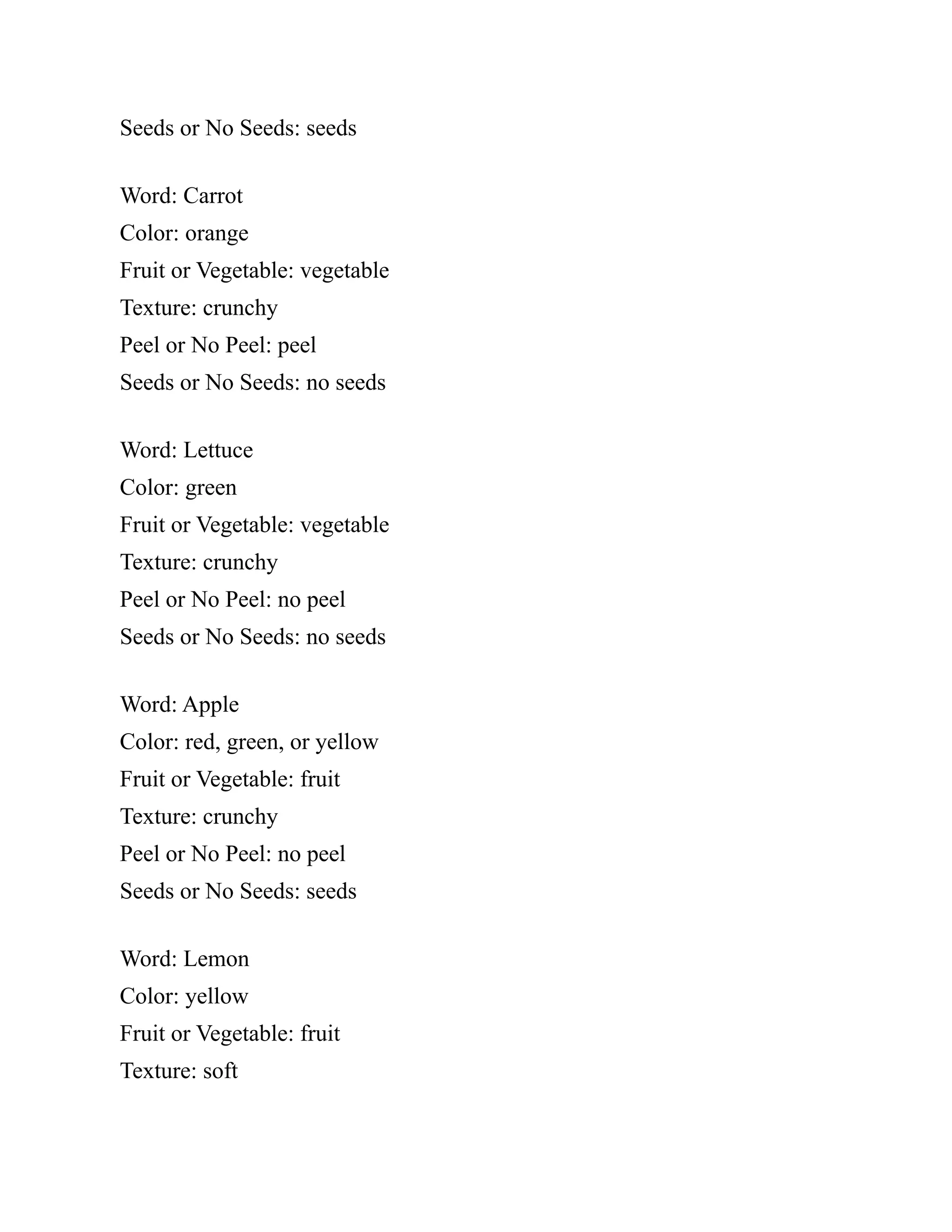
![Peel or No Peel: peel
Seeds or No Seeds: seeds
Word: Cucumber
Color: green
Fruit or Vegetable: vegetable
Texture: crunchy
Peel or No Peel: no peel
Seeds or No Seeds: seeds
Return to text
Figure 8.5
Sample Table for Scatter Categorization Activity, Word Pair Variation
Source: Adapted from Johns, J. L., & Lenski, S. D. (2010). Improving
reading: Interventions, strategies, and resources (5th ed., p. 360). Dubuque,
IA: Kendall Hunt Publishing Company.
Description: The figure is a table with five column heads: Word Pairs; Same
(Synonyms); Opposite (Antonyms); Go Together; and No Relationship
Word Pairs: Ocean/sea
Same (Synonyms): X
Opposite (Antonyms): [blank]
Go Together: [blank]
No Relationship: [blank]
Word Pairs: River/lake
Same (Synonyms): [blank]](https://image.slidesharecdn.com/readingconnections-strategies-for-teaching-students-with-visual-impairments-250721170318-cb16127e/75/Reading-Connections-Strategies-for-Teaching-Students-with-Visual-Impairments-622-2048.jpg)
![Opposite (Antonyms): [blank]
Go Together: X
No Relationship: [blank]
Word Pairs: Rapid/gradual
Same (Synonyms): [blank]
Opposite (Antonyms): X
Go Together: [blank]
No Relationship: [blank]
Word Pairs: Sediment/sea urchin
Same (Synonyms): [blank]
Opposite (Antonyms): [blank]
Go Together: [blank]
No Relationship: X
Return to text
Figure 8.6
Diagram for Word Chains Activity
Source: Adapted from Johns, J. L., & Lenski, S. D. (2010). Improving
reading: Interventions, strategies, and resources (5th ed., p. 355). Dubuque,
IA: Kendall Hunt Publishing Company.
Caption: The Word Chains activity involves making a chain by connecting
together index cards containing synonyms. Synonyms on paper loops can
also be strung together.](https://image.slidesharecdn.com/readingconnections-strategies-for-teaching-students-with-visual-impairments-250721170318-cb16127e/75/Reading-Connections-Strategies-for-Teaching-Students-with-Visual-Impairments-623-2048.jpg)

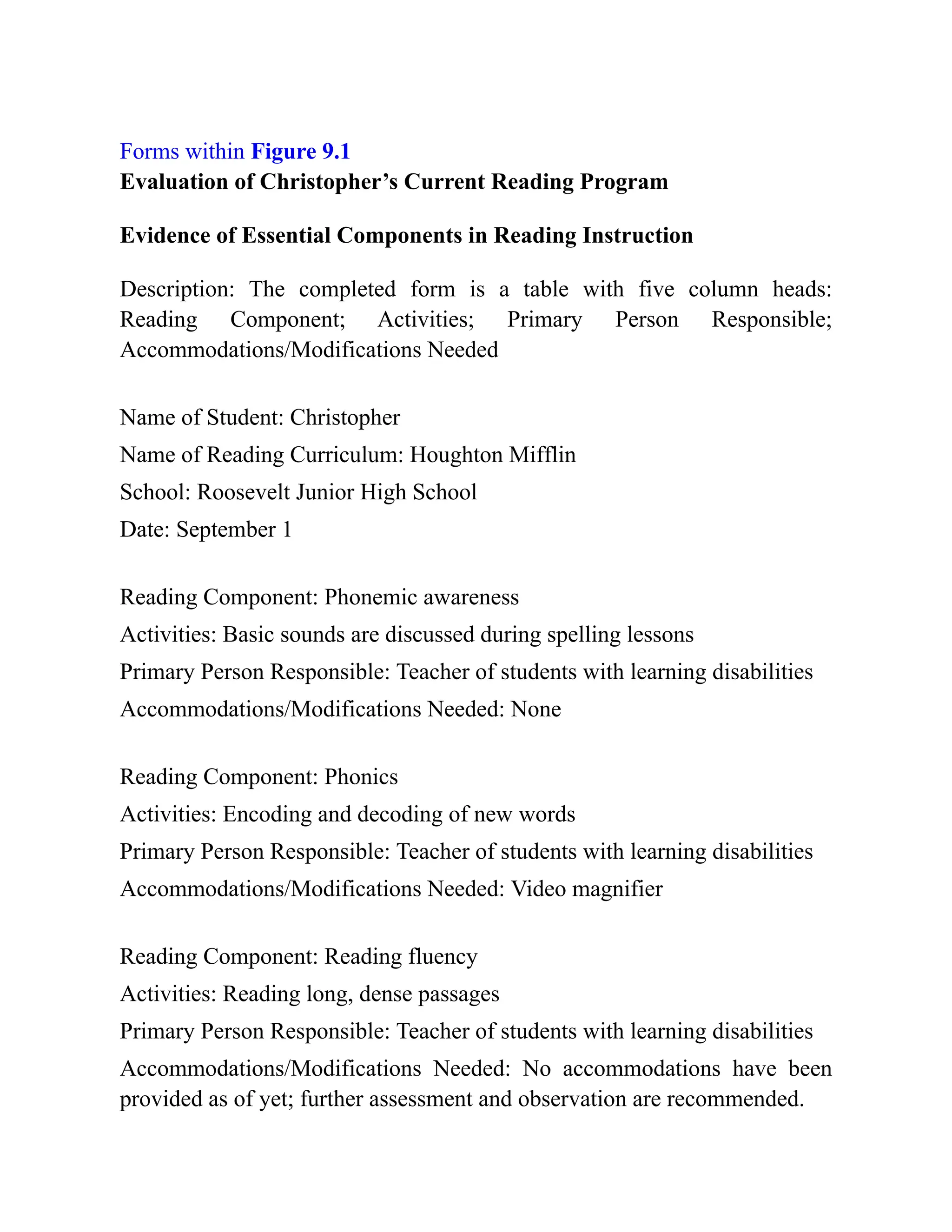
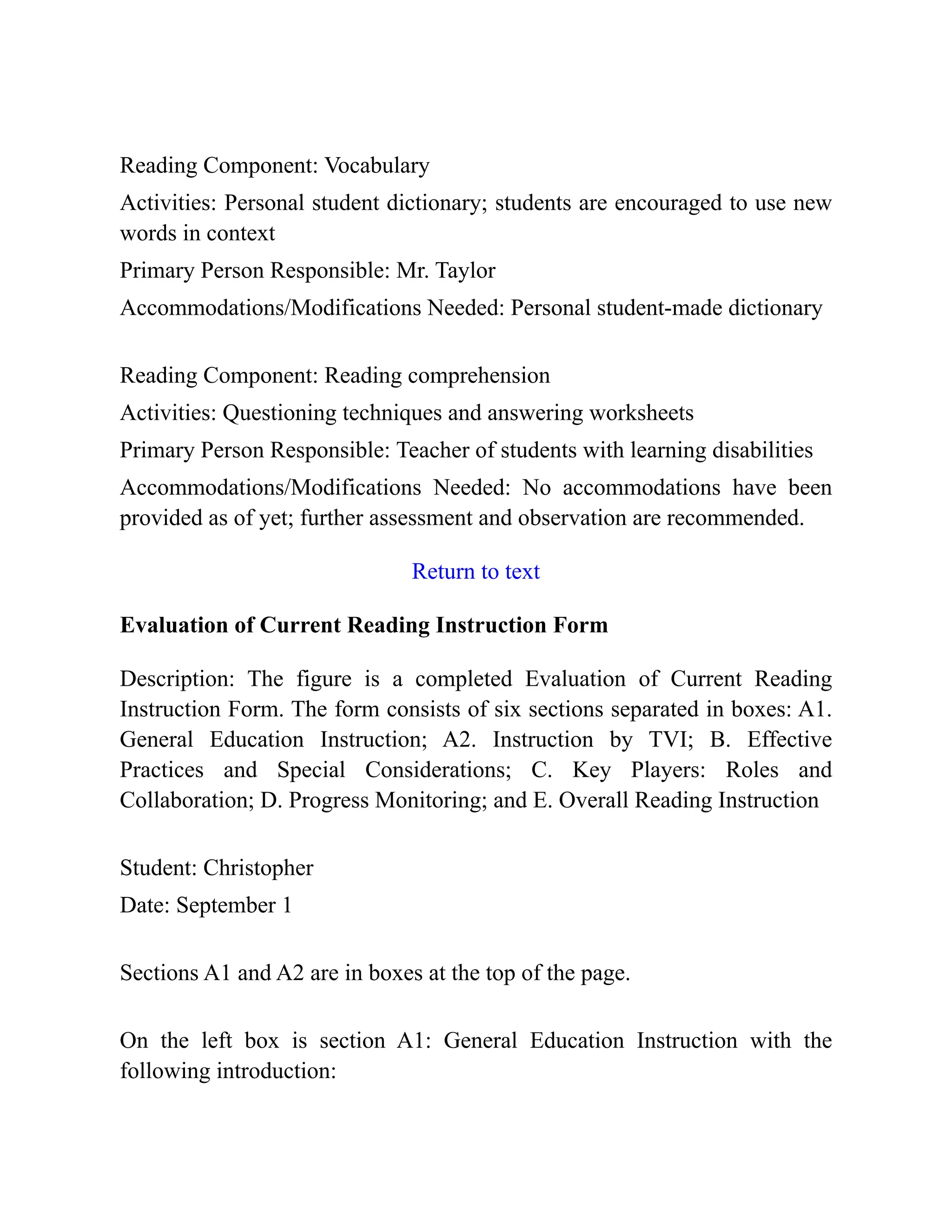
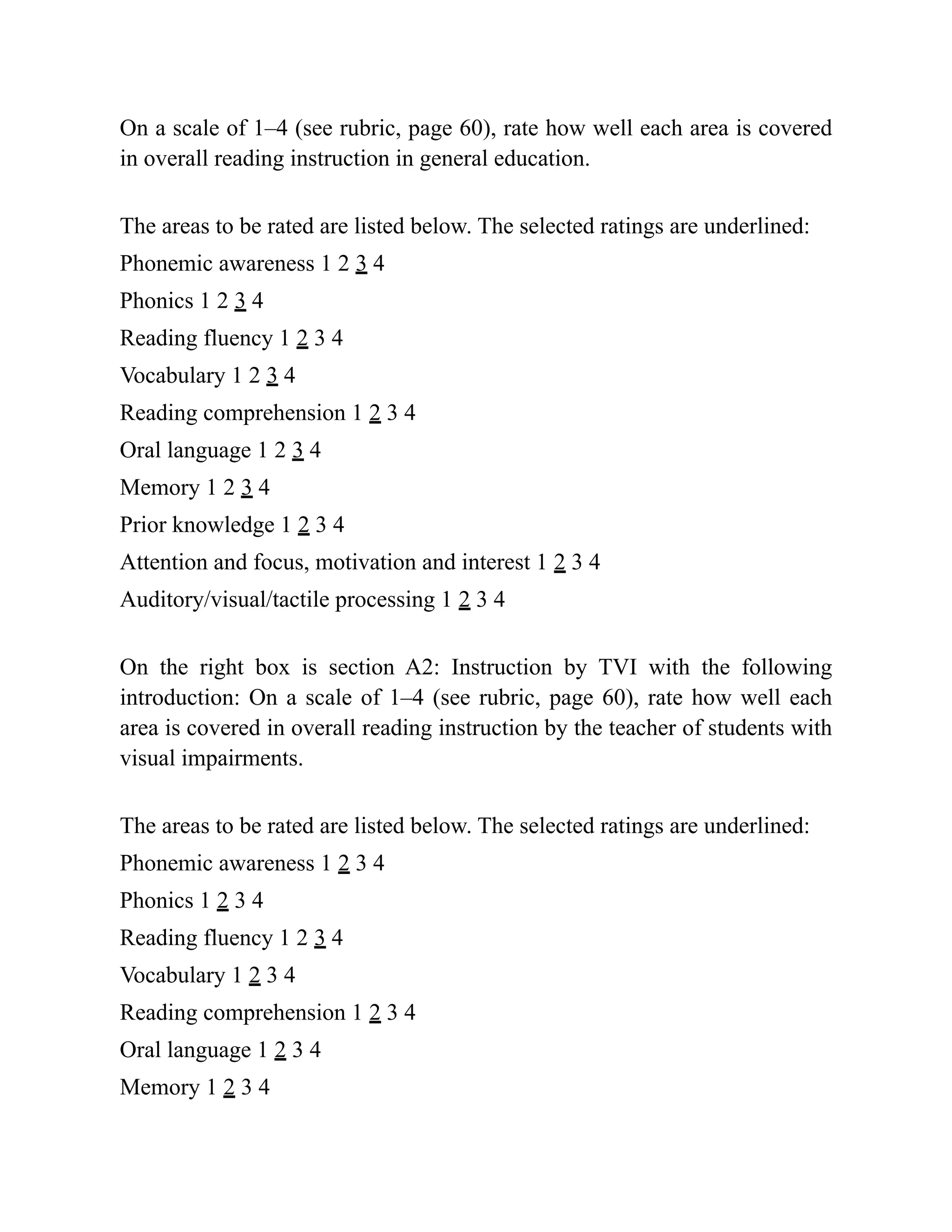
![Prior knowledge 1 2 3 4
Attention and focus, motivation and interest 1 2 3 4
Auditory/visual/tactile processing 1 2 3 4
Below these two boxes is a box across the page for Section B: Effective
Practices and Special Considerations and listed under it is the following
checkbox list:
[checkbox] Increased wait time
[X] Decreased pace
[checkbox] Simplified wording
[checkbox] Word/letter cards
[checkbox] Increased spacing
[checkbox] Typoscope
[X] Personal dictionary
[X] Personal word wall
[checkbox] Tangible objects
[checkbox] Slant board
[checkbox] Electronic text
[checkbox] Auditory materials
[checkbox] Braille
[checkbox] Large print
[X] Regular print
[checkbox] Braille notetaker
[checkbox] Refreshable braille
[X] Video magnifier/CCTV
[X] Optical devices: monocular
[X] Music: parts of speech song](https://image.slidesharecdn.com/readingconnections-strategies-for-teaching-students-with-visual-impairments-250721170318-cb16127e/75/Reading-Connections-Strategies-for-Teaching-Students-with-Visual-Impairments-628-2048.jpg)
![[X] Glasses for glare
[checkbox] [blank]
Below Section B is a box across the page for Section C: Key Players: Roles
and Collaboration, which is a table with four column heads:
Role of the general education teacher: Instruction of literacy program
Role of the teacher of students with visual impairments: Allow access of
materials and curriculum. Make adjustments to collaboration and improve
connections between teacher of students with learning disabilities and his
own lessons.
Role of the primary caregiver: Attend IEP meetings.
Role of the related service providers: Resource support; assist with
unfinished work.
Centered under this table is a box shaped like an arrow for Section D:
Progress Monitoring:
Tool(s): District benchmarks
Who is responsible? General education teacher
The arrow is pointing towards the box below it for Section E: Overall
Reading Instruction:
On a scale of 1–4 (1 being the lowest, and 4 being the highest), is
instruction: (Selected ratings are underlined.)
Consistent? 1 2 3 4
Structured? 1 2 3 4
Explicit? 1 2 3 4
Is the current reading instruction balanced?
Yes: X
No: [blank]](https://image.slidesharecdn.com/readingconnections-strategies-for-teaching-students-with-visual-impairments-250721170318-cb16127e/75/Reading-Connections-Strategies-for-Teaching-Students-with-Visual-Impairments-629-2048.jpg)
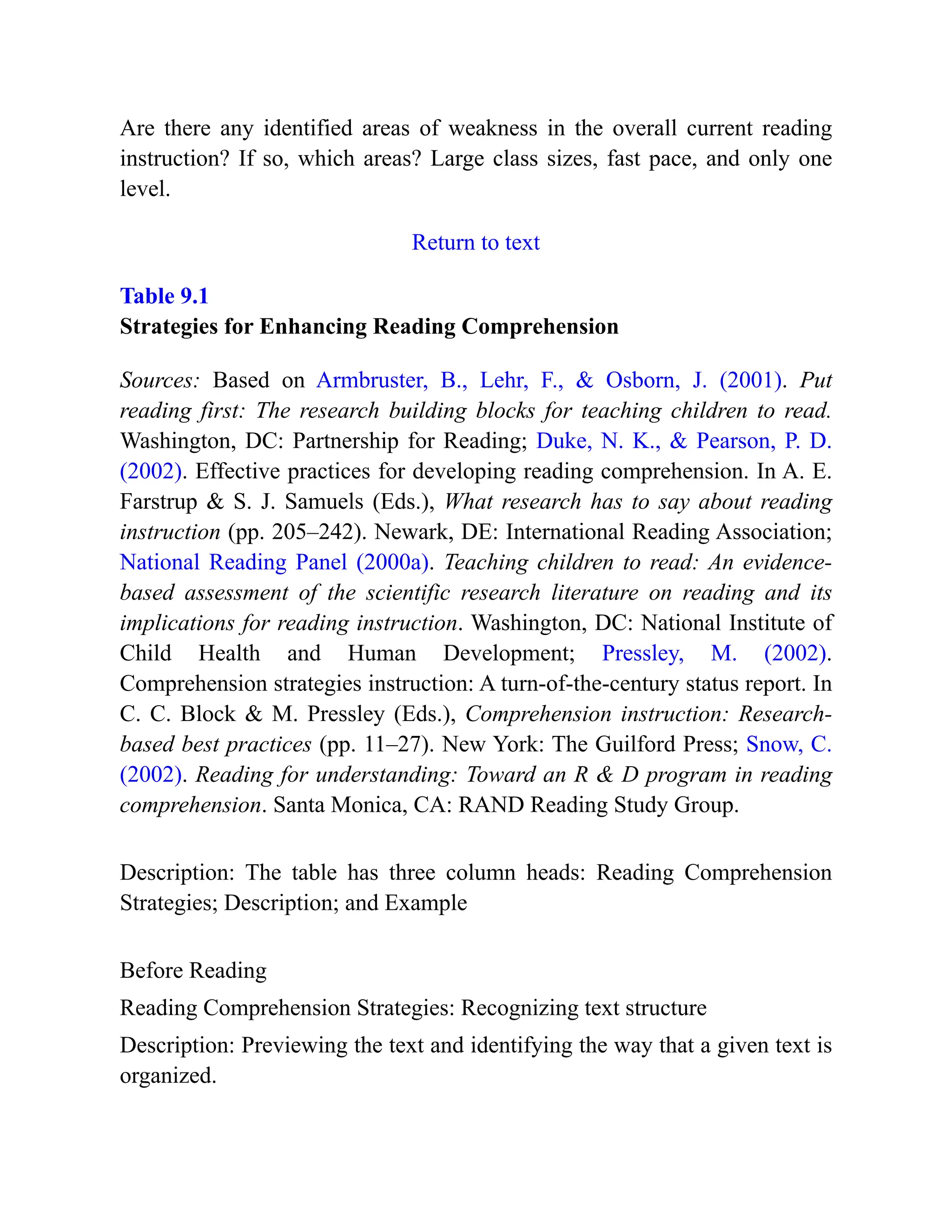
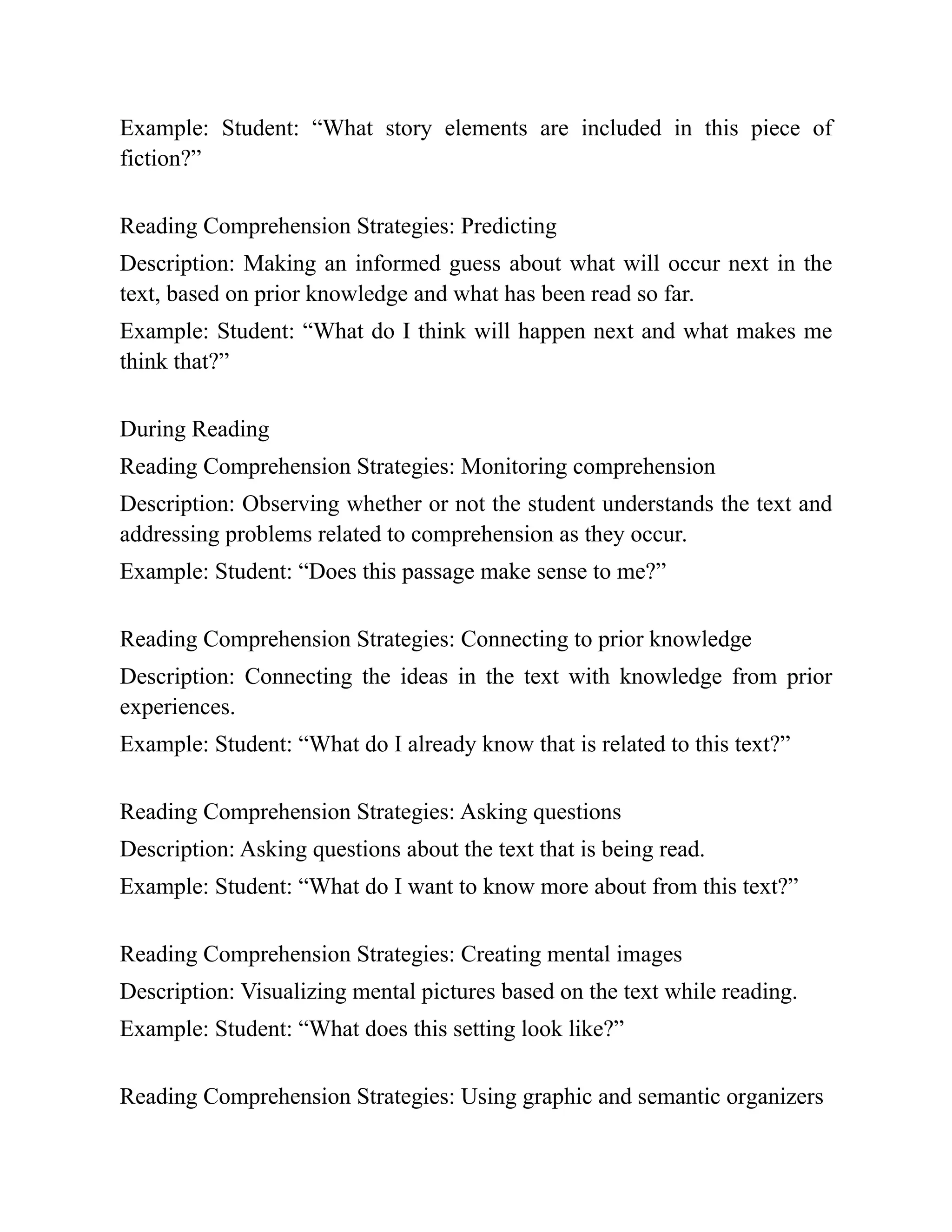

![Form within Figure 10.1
Sample Assessments of Oral Language
Evaluation of Conversational Language
Description: The figure is a table with three column heads: Prompt;
Response; and Type of Utterance
Prompt: Good morning, Leticia.
Response: Good morning.
Type of Utterance: Rote response
Prompt: How are you this morning?
Response: He’s very, very, very cute, my puppy.
Type of Utterance: Simple sentence, not addressing the question
Prompt: [blank]
Response: He’s, ah, barks a lot.
Type of Utterance: Simple sentence, with one error (verb)
Prompt: Why do you think he barks a lot?
Response: Yeah.
Type of Utterance: One word, not addressing the question
Prompt: [blank]
Response: And ah, yesterday, my sister, she put him in the bathing.
Type of Utterance: Simple sentence, with one error (verb/noun)
Prompt: [blank]](https://image.slidesharecdn.com/readingconnections-strategies-for-teaching-students-with-visual-impairments-250721170318-cb16127e/75/Reading-Connections-Strategies-for-Teaching-Students-with-Visual-Impairments-644-2048.jpg)
![Response: He barks, the puppy, because he hungry.
Type of Utterance: Simple sentence, with one error (verb)
Prompt: What do you feed your puppy?
Response: Yes.
Type of Utterance: One word, not addressing the question
Prompt: [blank]
Response: He eat chicken and sometimes fish.
Type of Utterance: Complex sentence, with one error (verb)
Prompt: How old is your puppy?
Response: Um. He have one month.
Type of Utterance: Simple sentence, with one error (verb)
Prompt: [blank]
Response: He really little.
Type of Utterance: Simple sentence, with one error (verb)
Prompt: He’s really little? What does he look like?
Response: Yeah.
Type of Utterance: One word, not addressing the whole question
Prompt: What color is he?
Response: Blanco.
Type of Utterance: One word, using Spanish word for white
Prompt: He sounds really cute, your puppy](https://image.slidesharecdn.com/readingconnections-strategies-for-teaching-students-with-visual-impairments-250721170318-cb16127e/75/Reading-Connections-Strategies-for-Teaching-Students-with-Visual-Impairments-645-2048.jpg)
![Response: Yeah.
Type of Utterance: One word
Return to text
Telling or Retelling A Story
Description: The figure is a table with three column heads: Prompt;
Response; and Type of Utterance
Prompt: I want you to tell me a story about something that you did this
weekend and I’m going to write it down. Okay?
Response: Okay.
Type of Utterance: One word
Prompt: Then, I will help you braille it. Tell me when you have thought of
something that you did this weekend.
Response: Okay.
Type of Utterance: One word
Prompt: Can you tell me your story?
Response: I go to the store with my mom. I buy one banana and two apples.
Um.
Type of Utterance: Two short sentences
Prompt: Yes? [pause] Is there more?
Response: Um. No!
Type of Utterance: One word](https://image.slidesharecdn.com/readingconnections-strategies-for-teaching-students-with-visual-impairments-250721170318-cb16127e/75/Reading-Connections-Strategies-for-Teaching-Students-with-Visual-Impairments-646-2048.jpg)
![Description: The figure is a blank table with three column heads: Preview
(before); Notes (during); and Embellishments (after)
Return to text
Form within Figure 10.3
Basic Assessment of Prior Knowledge
Description: The figure is a table with three column heads: Prompt; Score;
and Comments
Section 1: Title
Prompt: [Read the title of the story.] Given the title, what do you think the
story is about?
Score: [blank]
Comments: [blank]
Section 2: Pictures and Objects
Prompt: If using pictures: Here is a picture from the story. What do you
think is happening in the picture?
Score: [blank]
Comments: [blank]
Prompt: What do you think the story is about when you look at the picture?
Score: [blank]
Comments: [blank]
Prompt: If using objects: Here is an object from the story. What do you
think the story has to do with the ___ [name of object]?
Score: [blank]](https://image.slidesharecdn.com/readingconnections-strategies-for-teaching-students-with-visual-impairments-250721170318-cb16127e/75/Reading-Connections-Strategies-for-Teaching-Students-with-Visual-Impairments-648-2048.jpg)
![Comments: [blank]
Prompt: What do you think the story is about when you look at the object?
Score: [blank]
Comments: [blank]
Section 3: Vocabulary Preview (Write words from the story in the blanks
below)
Prompt: I’m going to tell you some key words that are found in the story.
What can you tell me about these words?
1._____________________
2._____________________
3._____________________
4._____________________
5._____________________
6._____________________
7._____________________
8._____________________
9._____________________
10._____________________
Score:
1._____________________
2._____________________
3._____________________
4._____________________
5._____________________
6._____________________](https://image.slidesharecdn.com/readingconnections-strategies-for-teaching-students-with-visual-impairments-250721170318-cb16127e/75/Reading-Connections-Strategies-for-Teaching-Students-with-Visual-Impairments-649-2048.jpg)
![7._____________________
8._____________________
9._____________________
10._____________________
Comments: [blank]
Return to text
Figure 10.4
Sample Table of Related Words and Personal Connections
Description: The figure is a table with two column heads: Related Words
and Personal Connections.
Topic Word: Horses
Related Words: Horseback riding
Personal Connections: I went horseback riding in Girl Scouts one day.
Related Words: Saddles
Personal Connections: I don’t know much about this, but I’ve heard the
word.
Related Words: White horse
Personal Connections: Everyone wanted the white horse. There was only
one white horse. Shelly got to ride the white horse.
Related Words: Hay
Personal Connections: In the horse’s stall, there was a lot of hay.](https://image.slidesharecdn.com/readingconnections-strategies-for-teaching-students-with-visual-impairments-250721170318-cb16127e/75/Reading-Connections-Strategies-for-Teaching-Students-with-Visual-Impairments-650-2048.jpg)
![Related Words: Apples
Personal Connections: We each got to feed our horse an apple.
Return to text
Figure 10.5
Sample True/False Questionnaire
Source: Based on Johns, J. L., & Lenski, S. D. (2010). Improving reading:
Interventions, strategies, and resources (5th ed.). Dubuque, IA: Kendall
Hunt Publishing Company.
Description: The figure is a table with three column heads: Before:
True/False; Questions; and After: True/False.
Before: True/False: [blank]
Questions: The solar system contains 15 planets.
After: True/False: [blank]
Before: True/False: [blank]
Questions: There are only a hundred stars in our solar system.
After: True/False: [blank]
Before: True/False: [blank]
Questions: All planets have gravity.
After: True/False: [blank]
Before: True/False: [blank]
Questions: All planets revolve around the sun in an elliptical pattern.](https://image.slidesharecdn.com/readingconnections-strategies-for-teaching-students-with-visual-impairments-250721170318-cb16127e/75/Reading-Connections-Strategies-for-Teaching-Students-with-Visual-Impairments-651-2048.jpg)
![After: True/False: [blank]
Before: True/False: [blank]
Questions: Earth is the only planet that has a moon.
After: True/False: [blank]
Return to text
Figure 10.6
Motivation, Interest, and Self- Perception Rating Scale
Source: Adapted from Johns, J. L., & Lenski, S. D. (2010). Improving
reading: Interventions, strategies, and resources (5th ed.). Dubuque, IA:
Kendall Hunt Publishing Company.
Read each statement below to the student and circle the student’s response
to the statement. Begin by reading these instructions: “I am going to read 30
sentences to you. Think about whether you agree or disagree with each
statement. Then say, ‘I agree’ or ‘I disagree.’ ”
Description: The figure lists a series of statements. Beside each statement
are the responses Agree or Disagree.
1. I have many favorite books.
Agree Disagree
2. If I want to find out information, I prefer to read about it.
Agree Disagree
3. When I come to a word I do not know, I can figure it out.
Agree Disagree
4. After reading for about 5 minutes, I can easily remember what I read.](https://image.slidesharecdn.com/readingconnections-strategies-for-teaching-students-with-visual-impairments-250721170318-cb16127e/75/Reading-Connections-Strategies-for-Teaching-Students-with-Visual-Impairments-652-2048.jpg)
![Description: These symbols reflect similar configurations that are reversed
across a diagonal plane, so that the upper-left portion of the symbol is
mirrored in the lower-right portion of the cell.
Type of Reversal or Error: Upper-lower part of the cell
Example: d (dots 145); . (dots 256)
g (dots 1245); gg (dots 2356)
Description: These confusing pairs of symbols use the same configuration
of dots, but one configuration is in the upper half of the cell, and the other is
in the lower half of the cell. Because they are the same configuration, they
are technically not reversals. Nonetheless, they can be confused. This is
especially problematic if the symbol is used in isolation. Therefore, when
quizzing students on symbols using flash cards, a locator cell such as a full
braille cell (dots 123456) is often used in front of, or after, the symbol, or
sometimes in both places.
Return to text
Form within Figure 10.8
Tactile Perception Checklist
Description: This is a table with four column heads: Characteristic/Other
Traits; Left Hand; Right Hand; and Comment
Characteristic: Scrubbing
Left Hand: [blank]
Right Hand: [blank]
Comment: [blank]
Characteristic: Regression/multiple regressions
Left Hand: [blank]](https://image.slidesharecdn.com/readingconnections-strategies-for-teaching-students-with-visual-impairments-250721170318-cb16127e/75/Reading-Connections-Strategies-for-Teaching-Students-with-Visual-Impairments-660-2048.jpg)
![Right Hand: [blank]
Comment: [blank]
Characteristic: Random movements
Left Hand: [blank]
Right Hand: [blank]
Comment: [blank]
OTHER TRAITS
Characteristic: Hand movement is fluid (few pauses or regressions)
Left Hand: [blank]
Right Hand: [blank]
Comment: [blank]
Characteristic: Hands have a light touch over a line of text (student does not
press on the braille or apply pressure to the line when reading)
Left Hand: [blank]
Right Hand: [blank]
Comment: [blank]
Characteristic: All fingers are used during reading
Left Hand: [blank]
Right Hand: [blank]
Comment: [blank]
Characteristic: Fingers exhibit a slight arch in the knuckles so that all
fingertips are able to feel a line of text
Left Hand: [blank]](https://image.slidesharecdn.com/readingconnections-strategies-for-teaching-students-with-visual-impairments-250721170318-cb16127e/75/Reading-Connections-Strategies-for-Teaching-Students-with-Visual-Impairments-661-2048.jpg)
![Right Hand: [blank]
Comment: [blank]
Characteristic: Fingers of each hand are mostly always together (fingers are
touching, not widely spaced apart or on different lines)
Left Hand: [blank]
Right Hand: [blank]
Comment: [blank]
Characteristic: Student has many braille reversals
Left Hand: [blank]
Right Hand: [blank]
Comment: [blank]
READING SPEED (IN CWPM)
Left: ____________
Right: ____________
Both: ____________
Return to text
Table 10.4
Common Reversals and Word Patterns That Incorporate Them
Note: This table shows left-right reversals, but the same principles may
apply if the student has trouble with vertical reversals (such as v/p: dots
1236/dots 1234) or upper cell/lower cell confusion (g/gg: dots 1245/dots
2356). This table is not comprehensive, but is intended to provide samples
of words and word parts that teachers can expand upon.](https://image.slidesharecdn.com/readingconnections-strategies-for-teaching-students-with-visual-impairments-250721170318-cb16127e/75/Reading-Connections-Strategies-for-Teaching-Students-with-Visual-Impairments-662-2048.jpg)
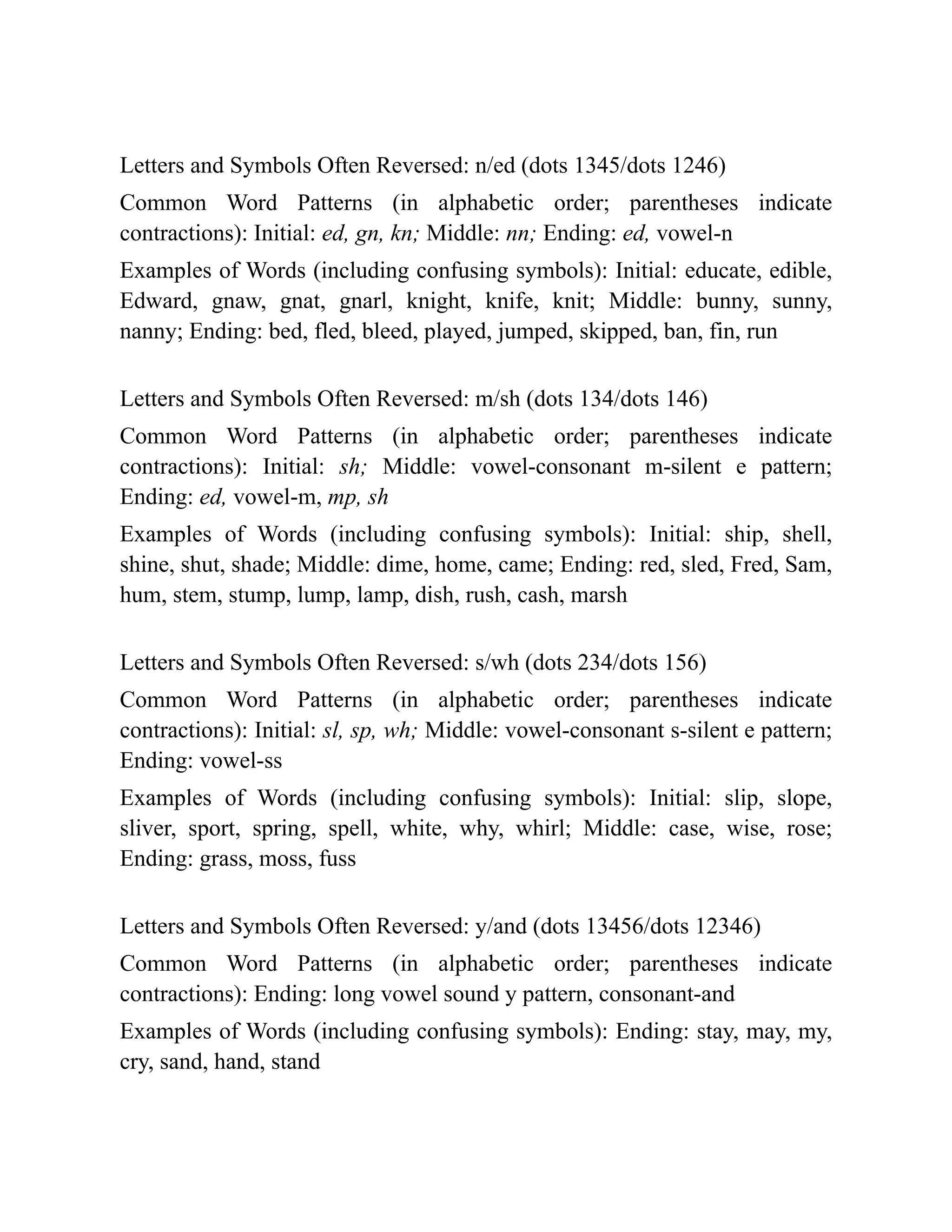
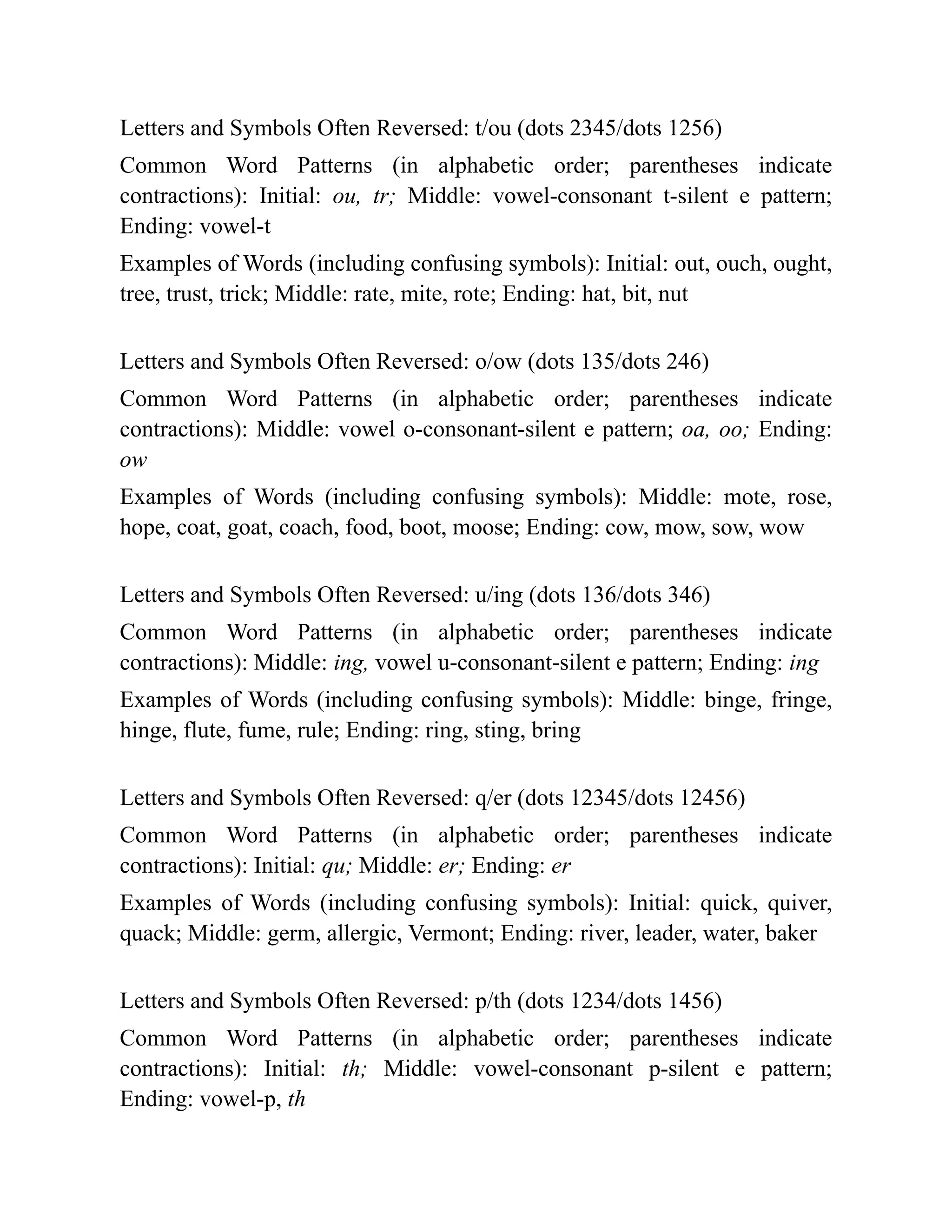
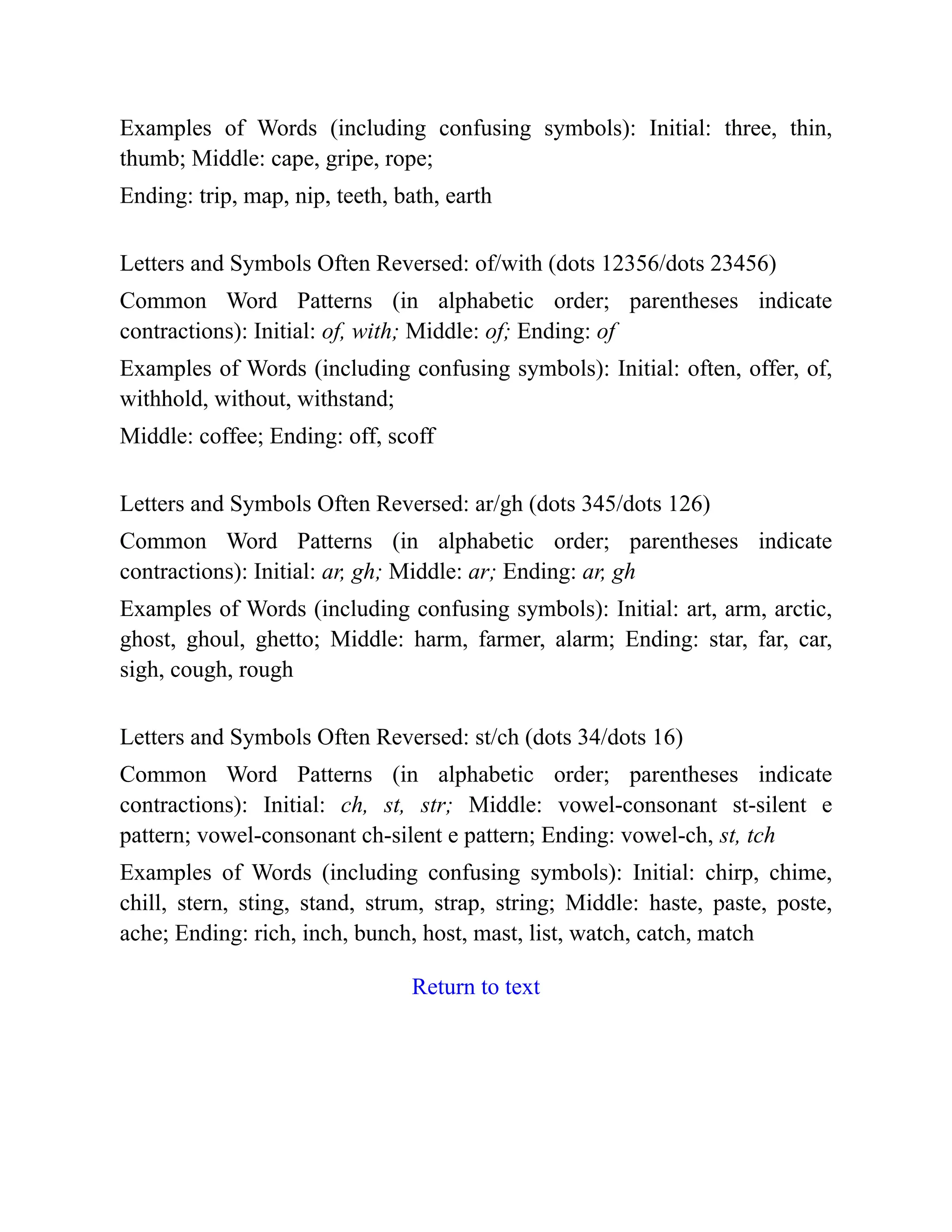
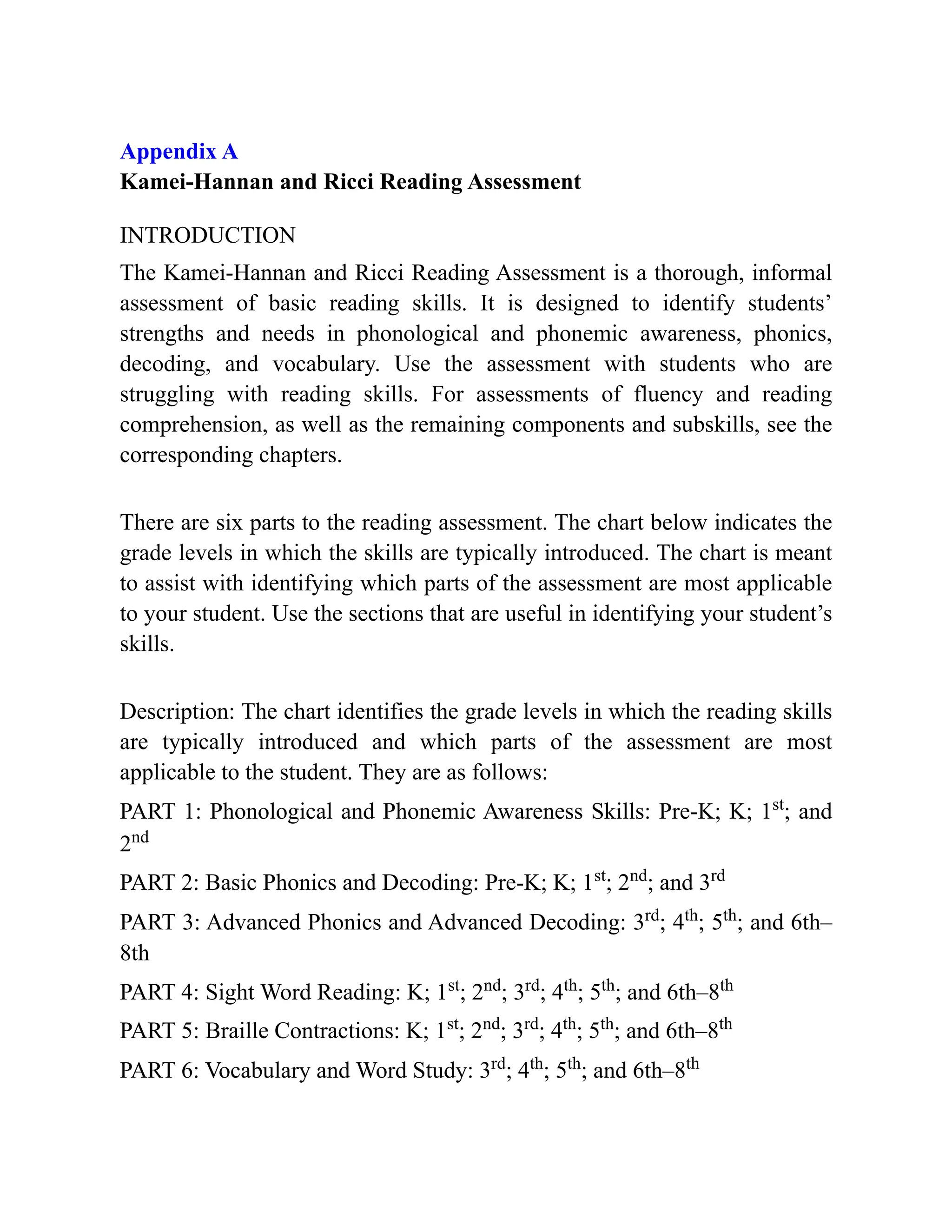
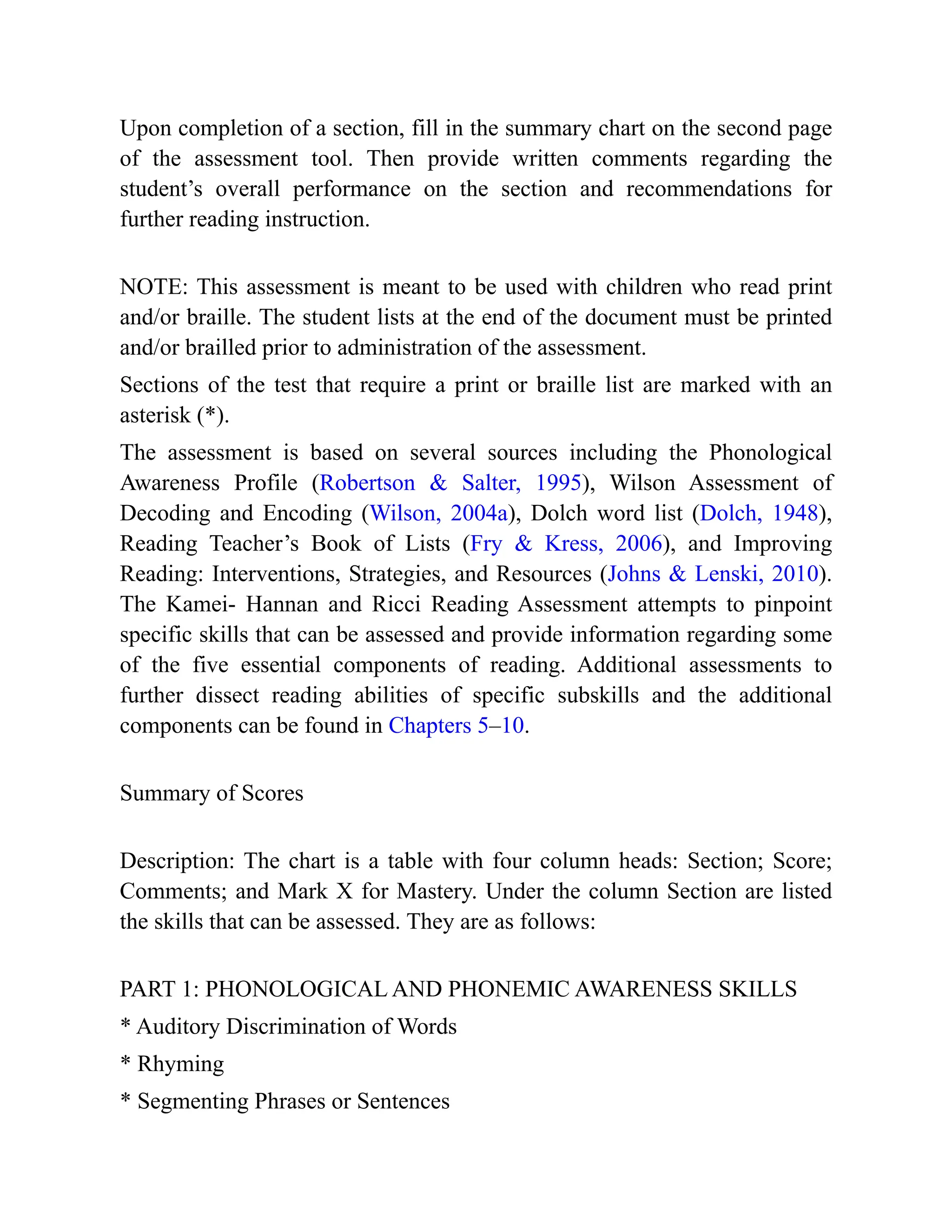
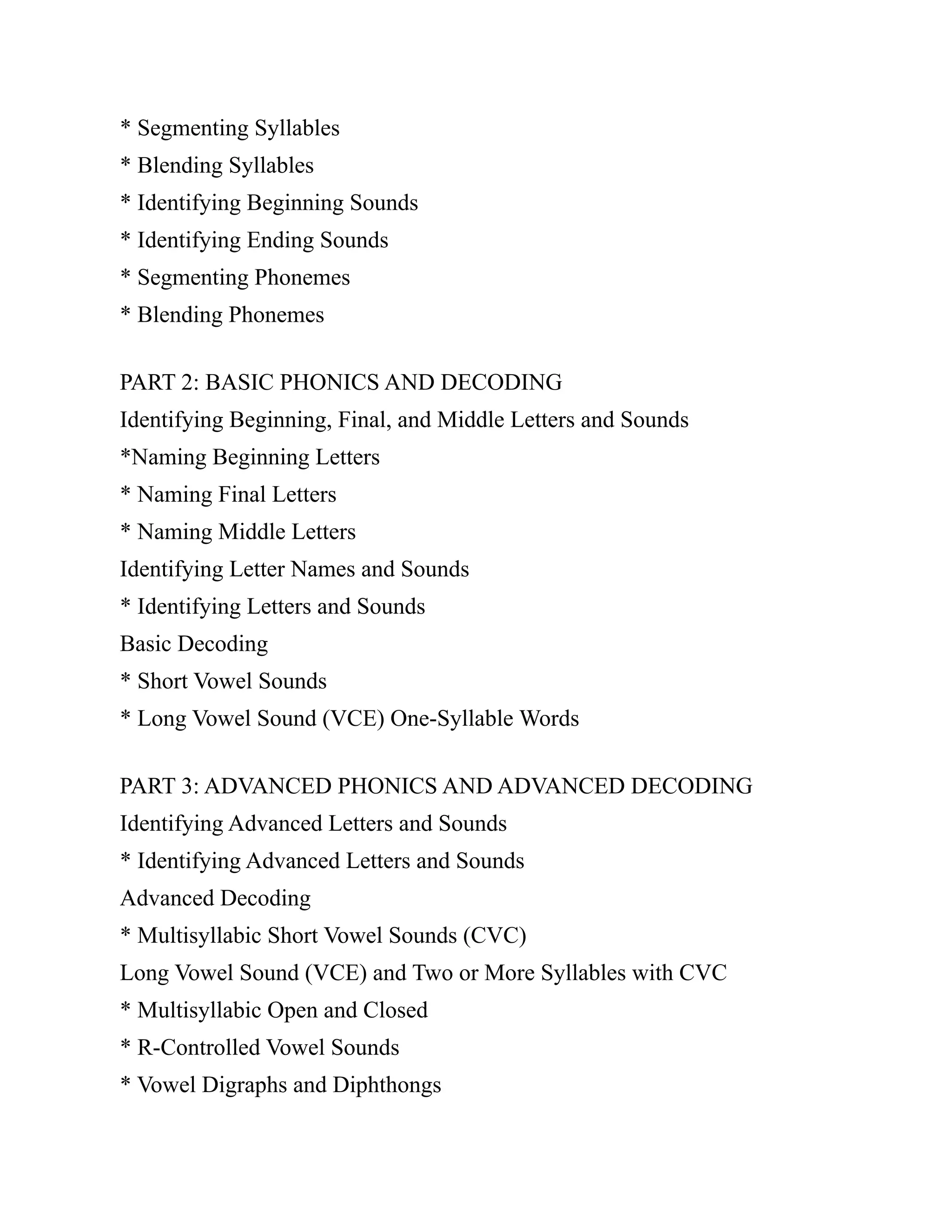
![* Additional Phonics
PART 4: SIGHT WORDS
Uncontracted Braille
Contracted Braille
PART 5: BRAILLE CONTRACTIONS CHECKLIST
Total number of contractions introduced
Total number of contractions mastered
PART 6: VOCABULARY AND WORD STUDY
* Elementary-Level Academic Vocabulary
** Common Academic Vocabulary
** Language Arts/Social Studies
** Math Vocabulary
** Science Vocabulary
* Synonyms/Antonyms
* Prefixes/Suffixes
* Greek and Latin Roots
Comments
Areas of Strength: [text field]
Areas Needing Improvement: [text field]
Additional Comments: [text field]
Recommendations: [text field]
PART 1: PHONOLOGICAL AND PHONEMIC AWARENESS SKILLS](https://image.slidesharecdn.com/readingconnections-strategies-for-teaching-students-with-visual-impairments-250721170318-cb16127e/75/Reading-Connections-Strategies-for-Teaching-Students-with-Visual-Impairments-670-2048.jpg)