Coaching on
Reading Instruction
MR. MARCO D. MEDURANDA
Education Program Supervisor – English
Division of Navotas
How to Teach Reading More Effectively?
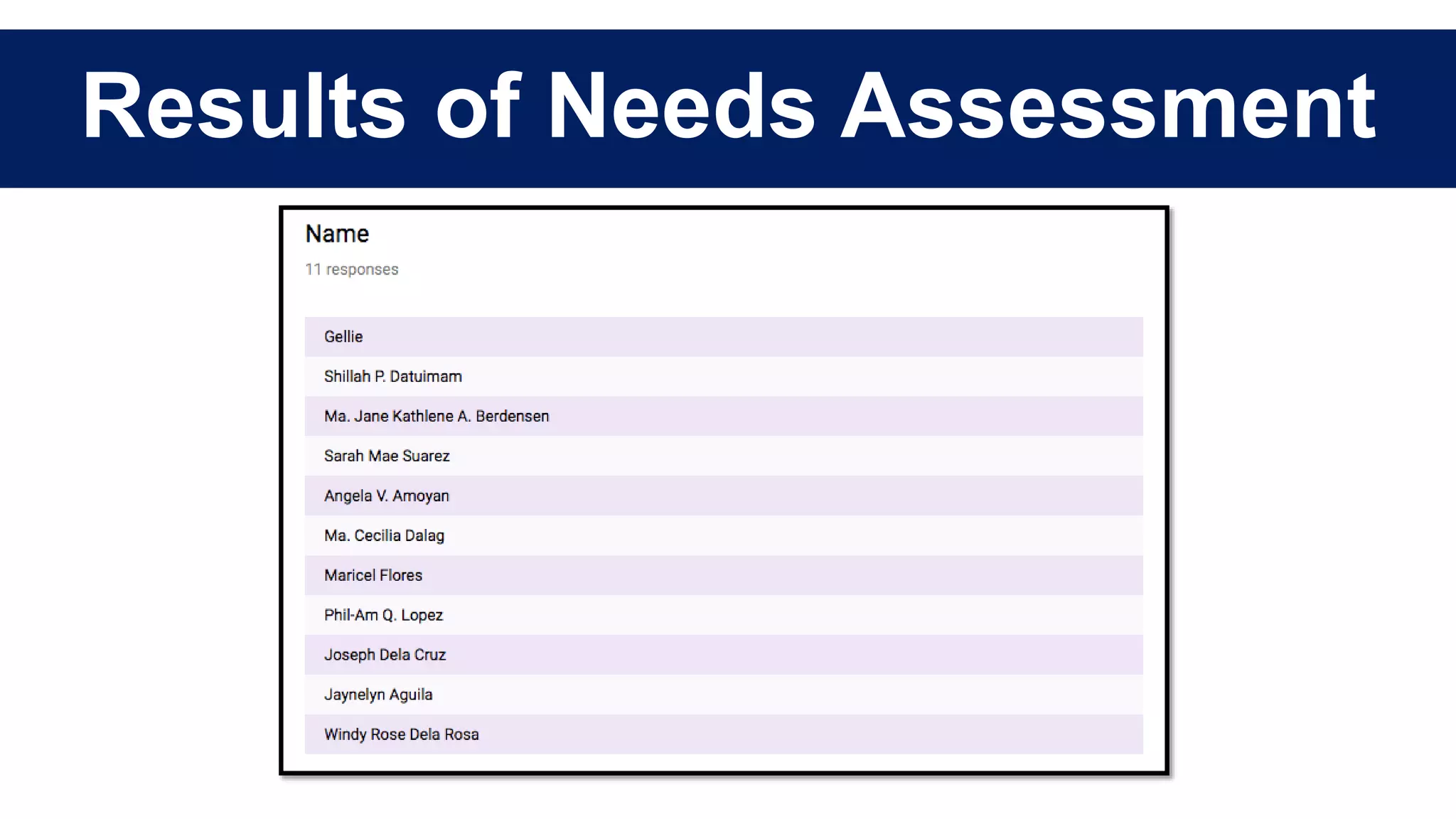
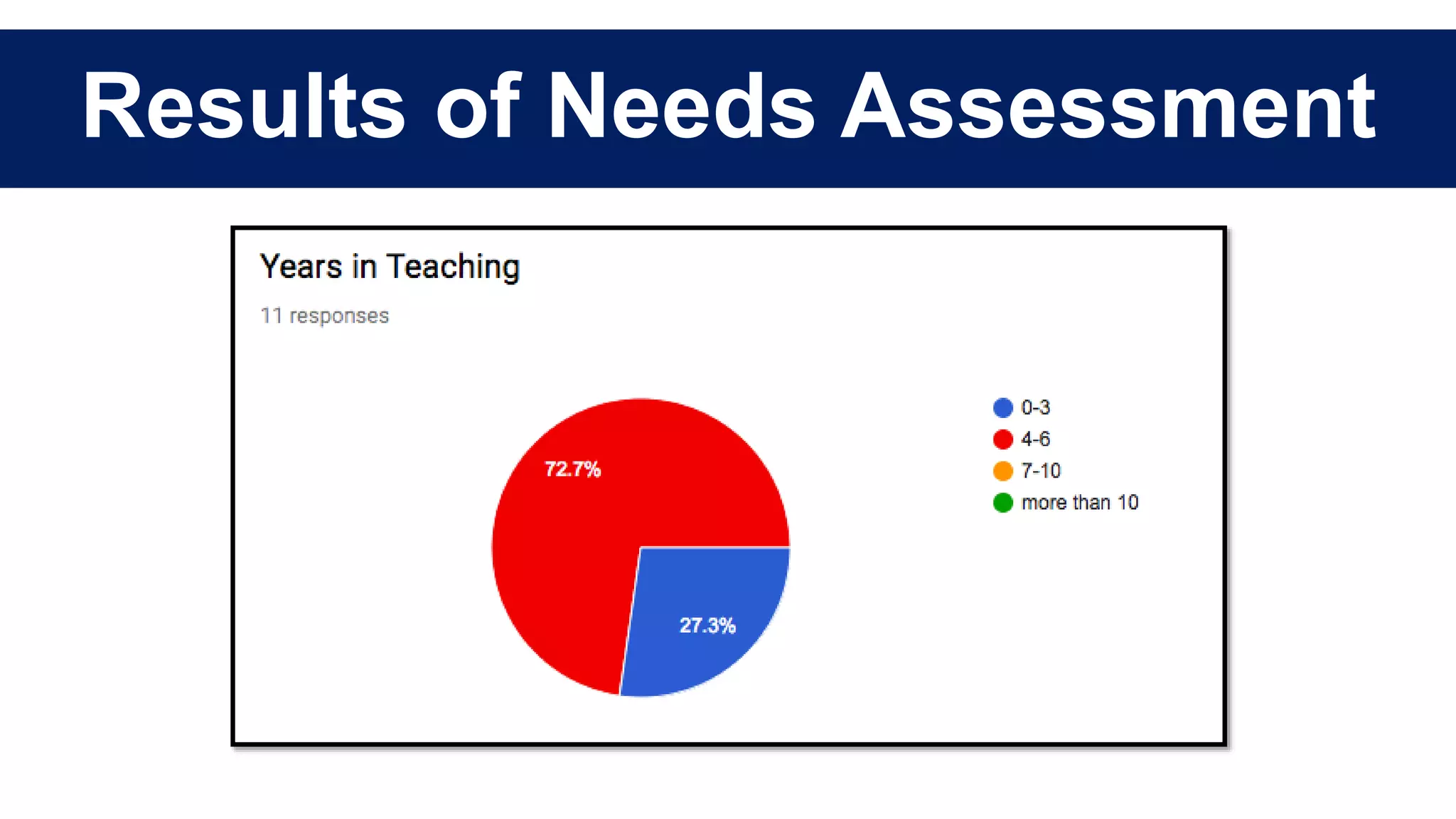
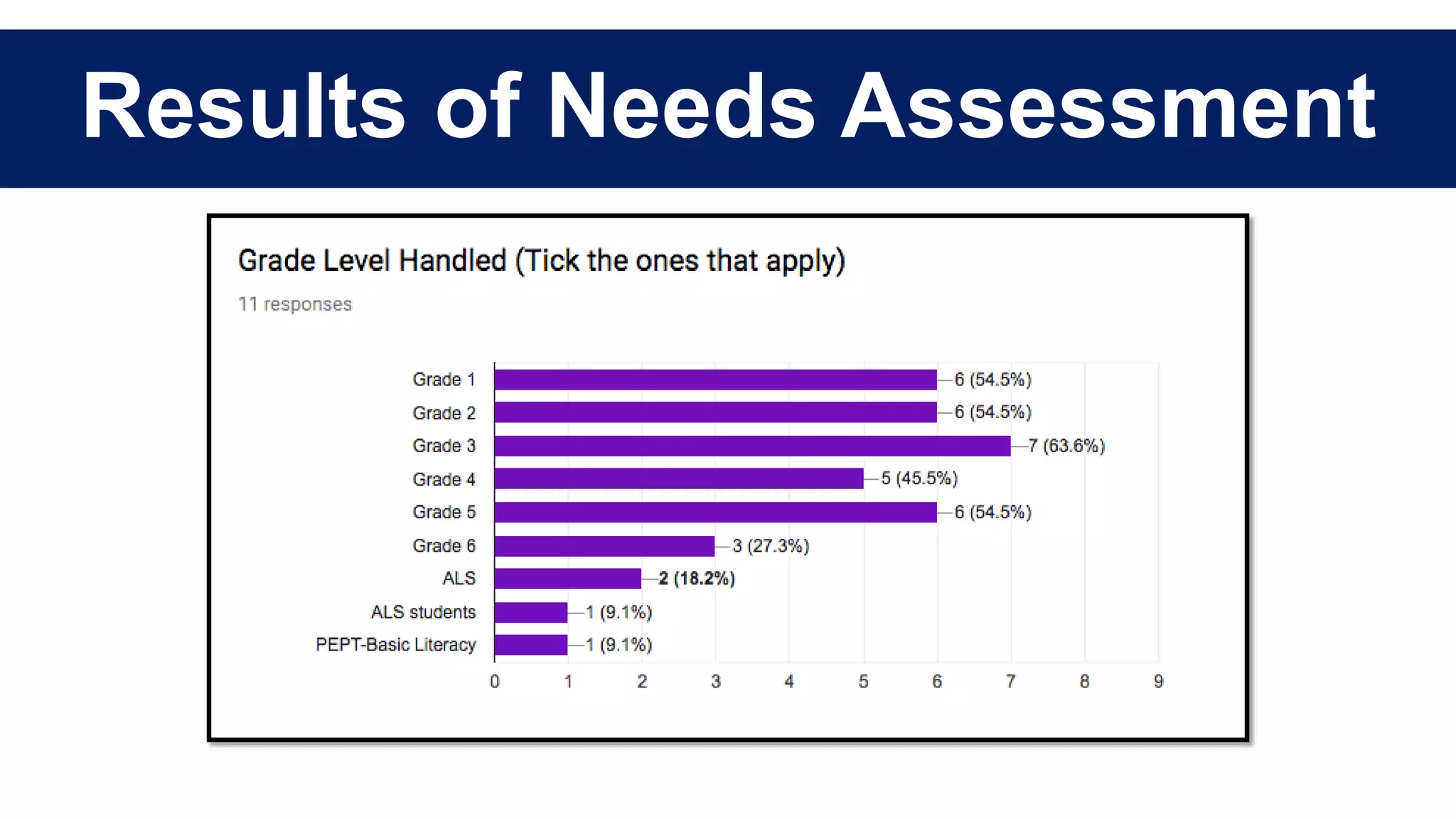
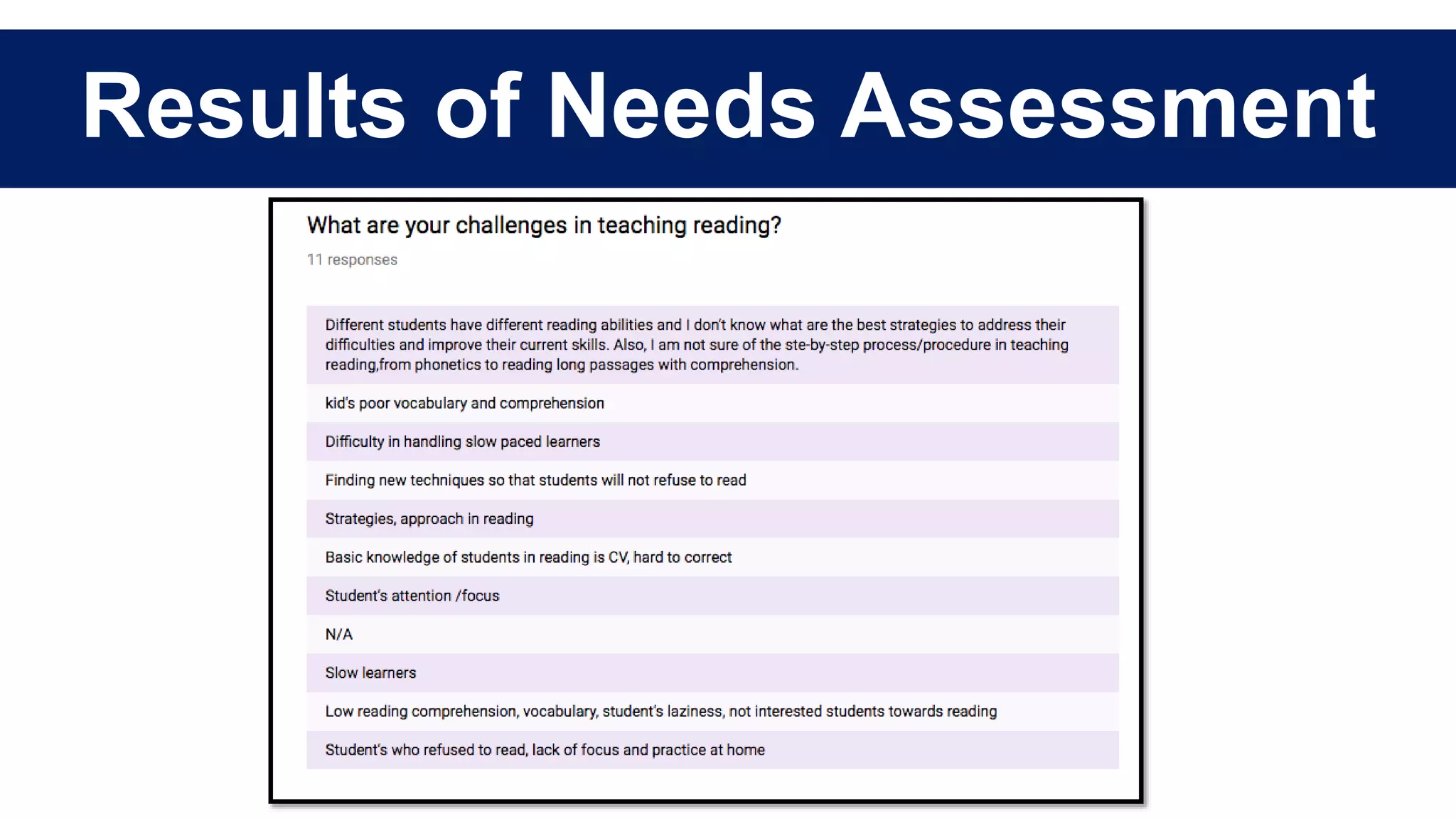
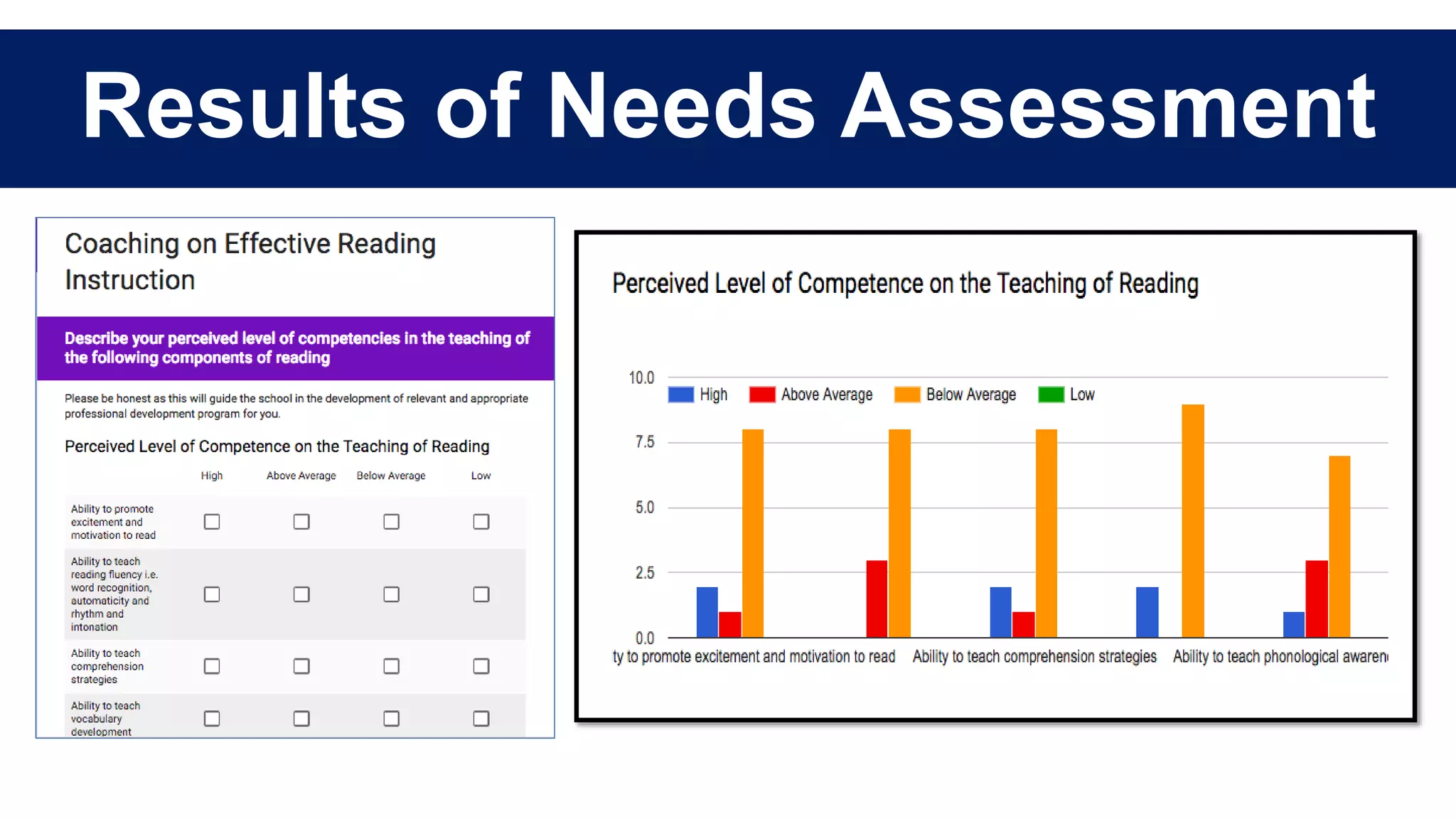
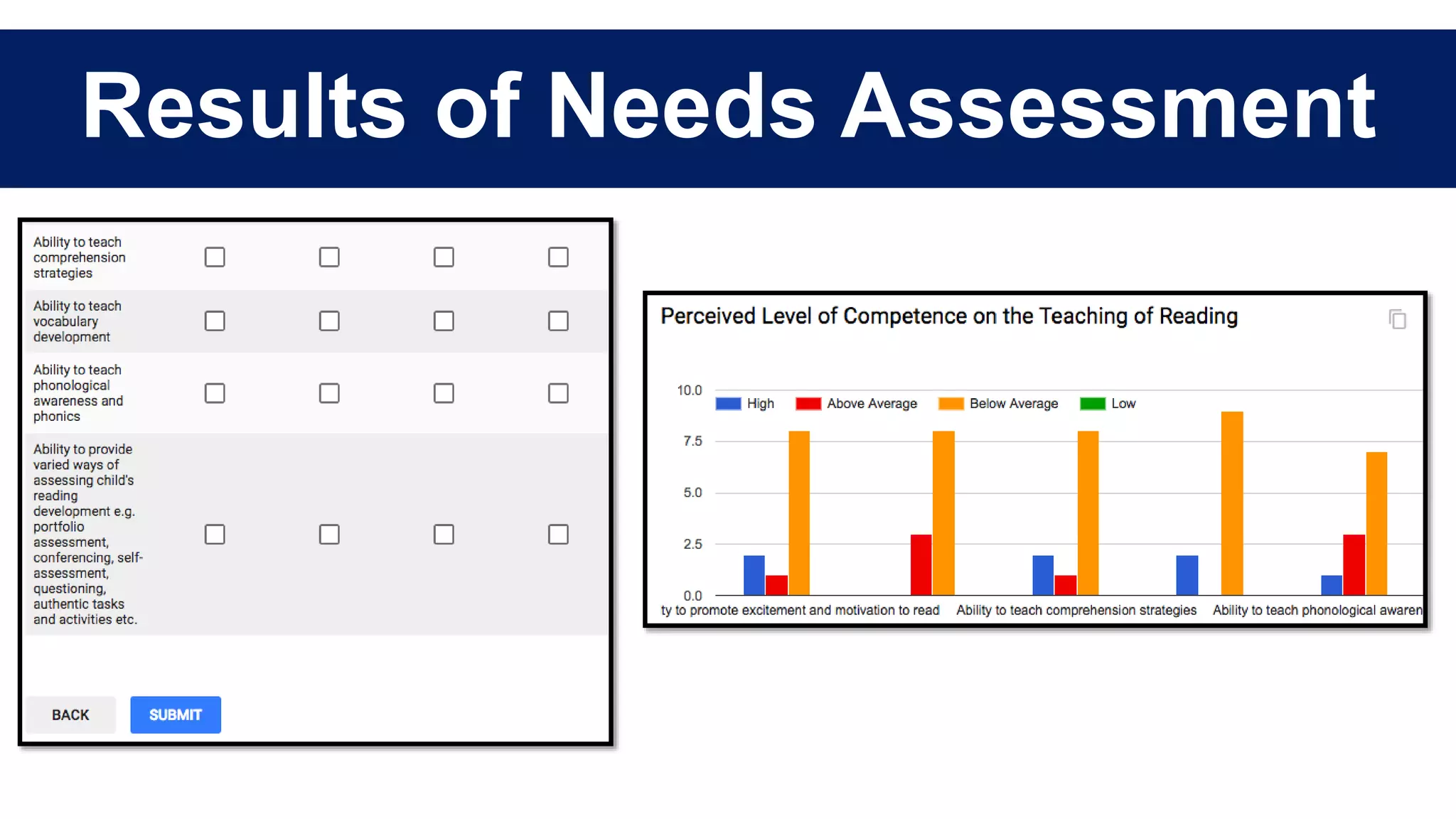
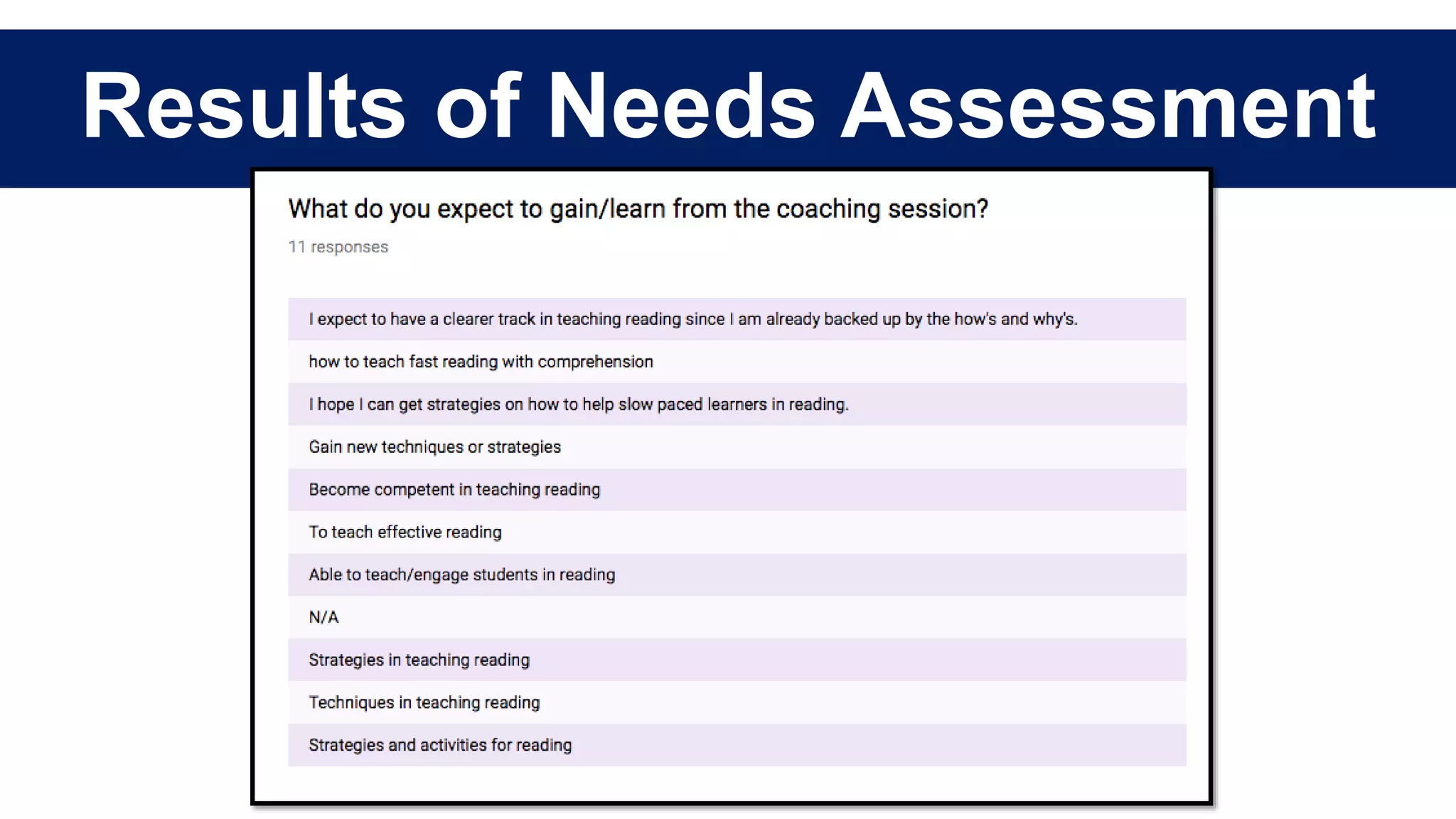
Results of Needs Assessment
Objectives
A. Share effective strategies in the teaching of reading.
B. Identify the characteristics of an effective reading/literacy teacher.
C. Re
Qualities of an Effective
Reading Teacher
Based from your experience, what are the qualities of a good
& effective reading teacher? Write it on metacards.
What Values and Attitude does an
Effective Reading Teacher have?
1. Passion for reading: enthusiasm comes through in how you teach
reading, in the books you choose and in how you read - with
energy and conviction
2. Respect for learners and their languages: respect for the various
languages children speak is a starting point to teach the standard
forms of the language
3. Encouraging learners to believe in themselves: motivation builds
children’s self-concept as readers and encourages more and better
reading
4. Creating a caring and inclusive classroom environment: make
children feel included and remove fear of the teacher and each
other
5. Respect for parents, families and other caregivers: establish good
relationships with them and help them to support their children’s
literacy at home
https://www.readinghorizons.com/blog/post/2013/02/20/6-characteristics-of-effective-reading-teachers
What an Effective Reading
Teacher Knows?
1. How young children develop and learn: understand that learning
to read involves the whole child (including physical, emotional,
social and cognitive development)
2. How children acquire languages and develop bilingually:
understand that exposure to language assists continuous language
development in children
3. How children learn to read: understand that reading is a skill that
has to be learned and a social practice as part of everyday lives
4. What to expect at different stages of children’s reading
development: understand the reading development continuum
which includes beginning, emergent, early, transitional and
independent reading
5. The curriculum: understand how learners are expected to make
progress in their reading through assessment activities
https://www.readinghorizons.com/blog/post/2013/02/20/6-characteristics-of-effective-reading-teachers
What Does Effective Reading
Teacher Do?
1. Organises their classroom to support the acquisition of language and
literacy: plan and use the available space , furniture and resources to support
language and literacy development
2. Plans for the year, the term, the week and the day: plan how the curriculum
will be covered and formal assessments completed in the time available
3. Teaches different parts of the reading process: teach decoding, fluency,
vocabulary and comprehension
4. Motivates children to read and provides them with opportunities to practice:
accommodate different reading activities (phonics, shared reading and group
guided reading) in lessons
5. Enjoys reading him/herself and provides a model for learners: demonstrate
that reading is purposeful and enjoyable
6. Uses the home and additional languages competently to support children’s
learning: teach reading in both home and additional languages confidently
7. Uses appropriate resources to support teaching and learning: use the most
interesting resource for teaching reading - interesting books at the right level
https://www.readinghorizons.com/blog/post/2013/02/20/6-characteristics-of-effective-reading-teachers
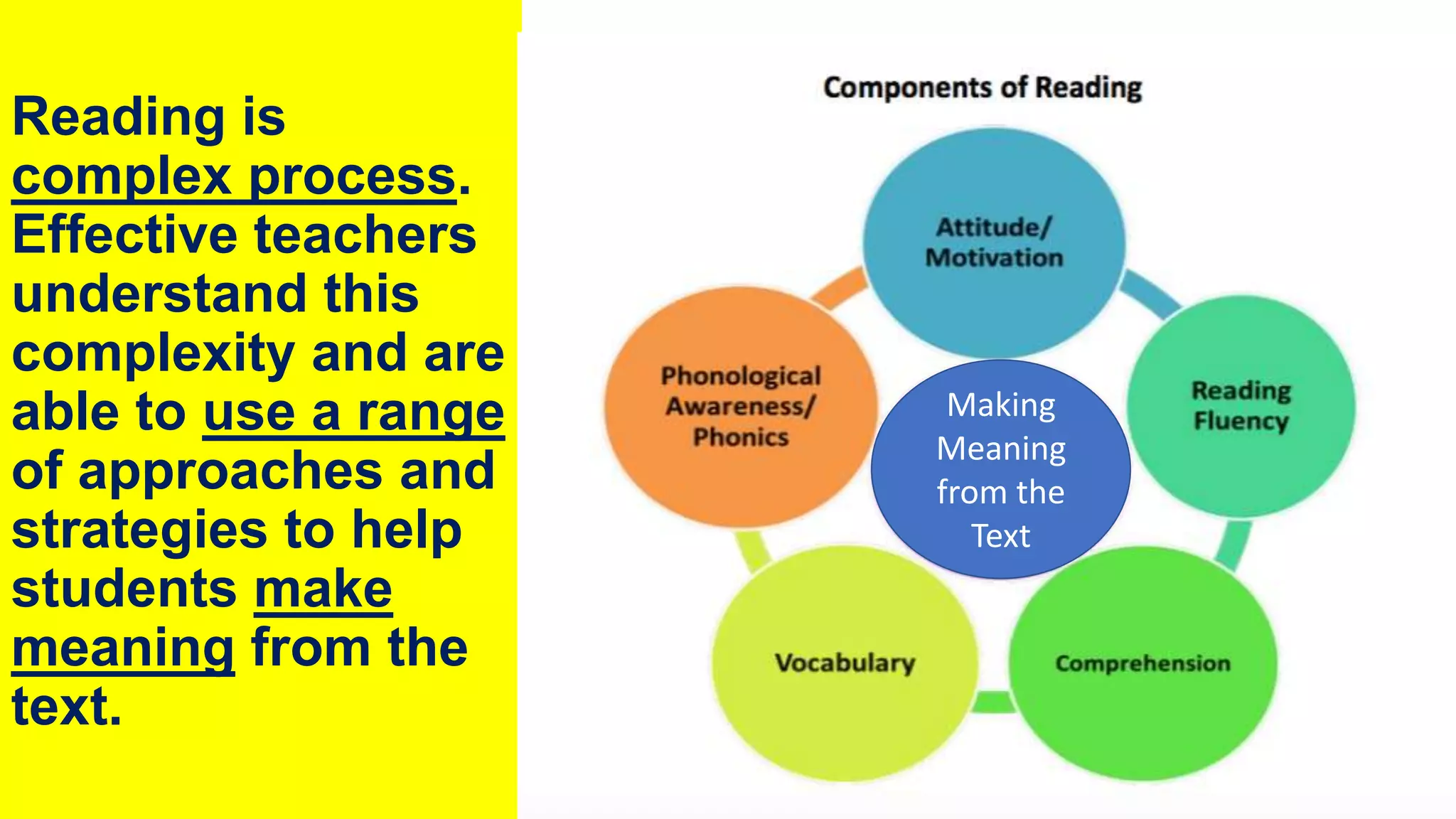
Reading is
complex process.
Effective teachers
understand this
complexity and are
able to use a range
of approaches and
strategies to help
students make
meaning from the
text.
Making
Meaning
from the
Text
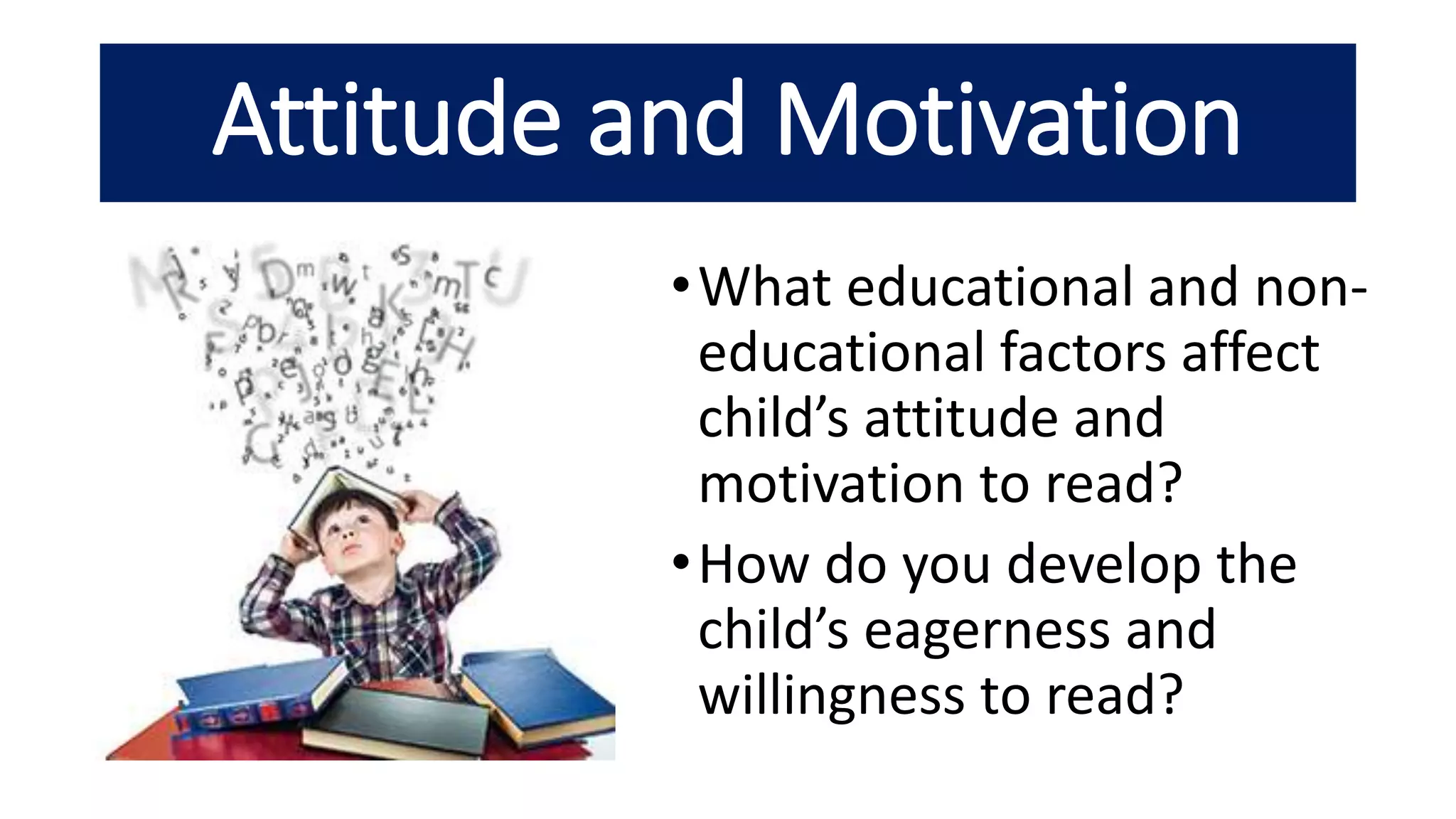
Attitude and Motivation
•What educational and non-
educational factors affect
child’s attitude and
motivation to read?
•How do you develop the
child’s eagerness and
willingness to read?
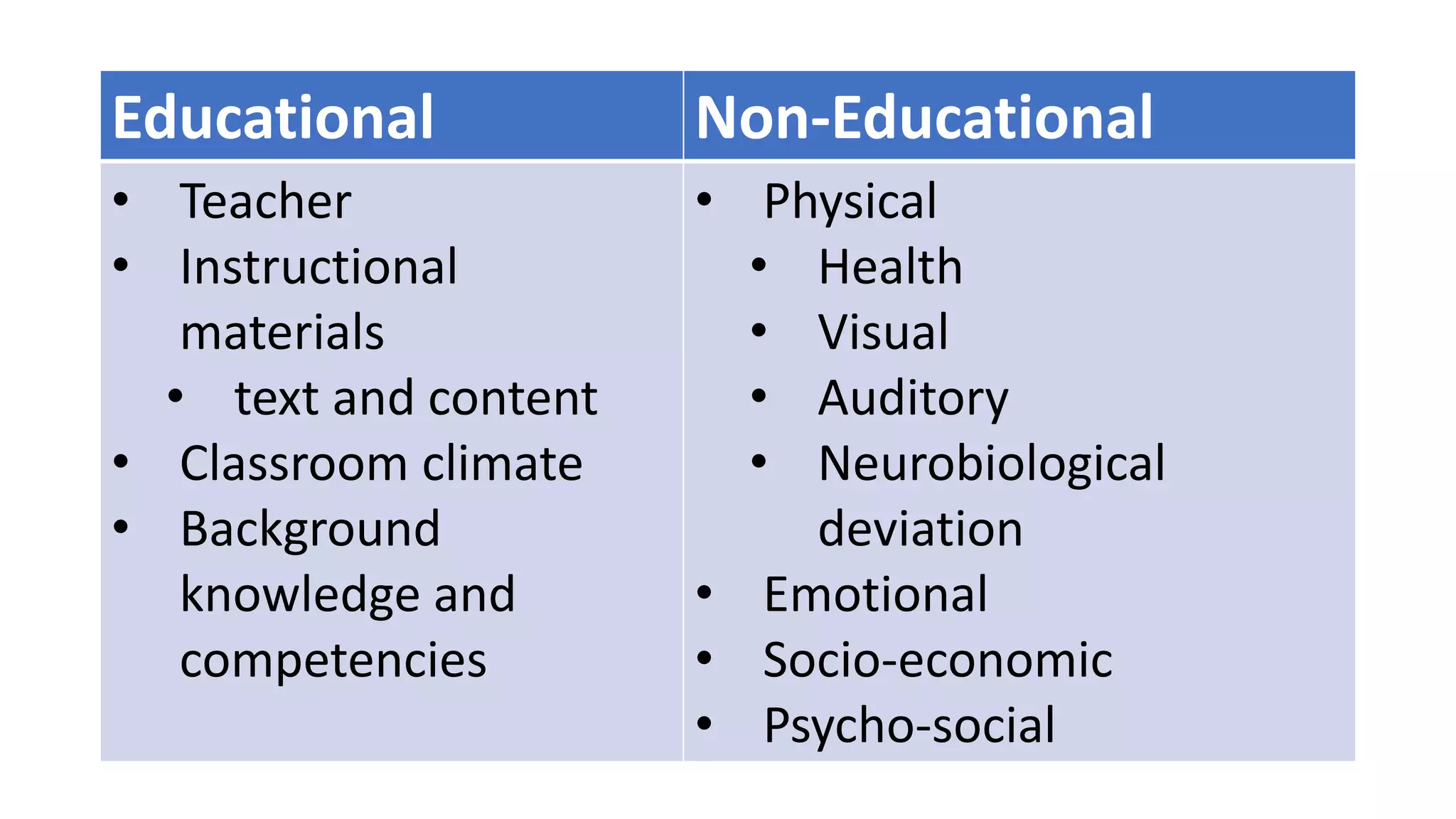
Educational Non-Educational
• Teacher
• Instructional
materials
• text and content
• Classroom climate
• Background
knowledge and
competencies
• Physical
• Health
• Visual
• Auditory
• Neurobiological
deviation
• Emotional
• Socio-economic
• Psycho-social
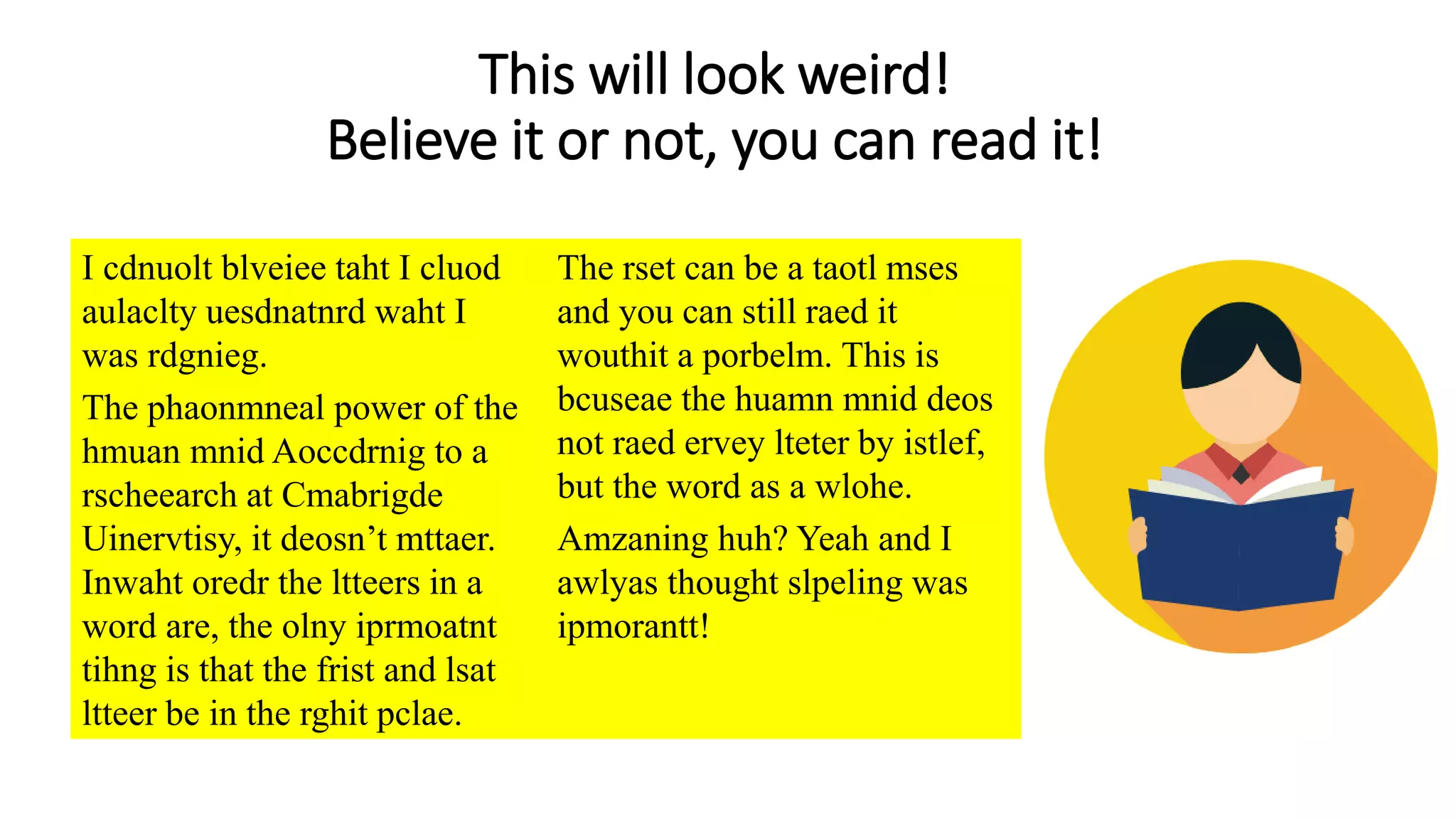
This will look weird!
Believe it or not, you can read it!
I cdnuolt blveiee taht I cluod
aulaclty uesdnatnrd waht I
was rdgnieg.
The phaonmneal power of the
hmuan mnid Aoccdrnig to a
rscheearch at Cmabrigde
Uinervtisy, it deosn’t mttaer.
Inwaht oredr the ltteers in a
word are, the olny iprmoatnt
tihng is that the frist and lsat
ltteer be in the rghit pclae.
The rset can be a taotl mses
and you can still raed it
wouthit a porbelm. This is
bcuseae the huamn mnid deos
not raed ervey lteter by istlef,
but the word as a wlohe.
Amzaning huh? Yeah and I
awlyas thought slpeling was
ipmorantt!
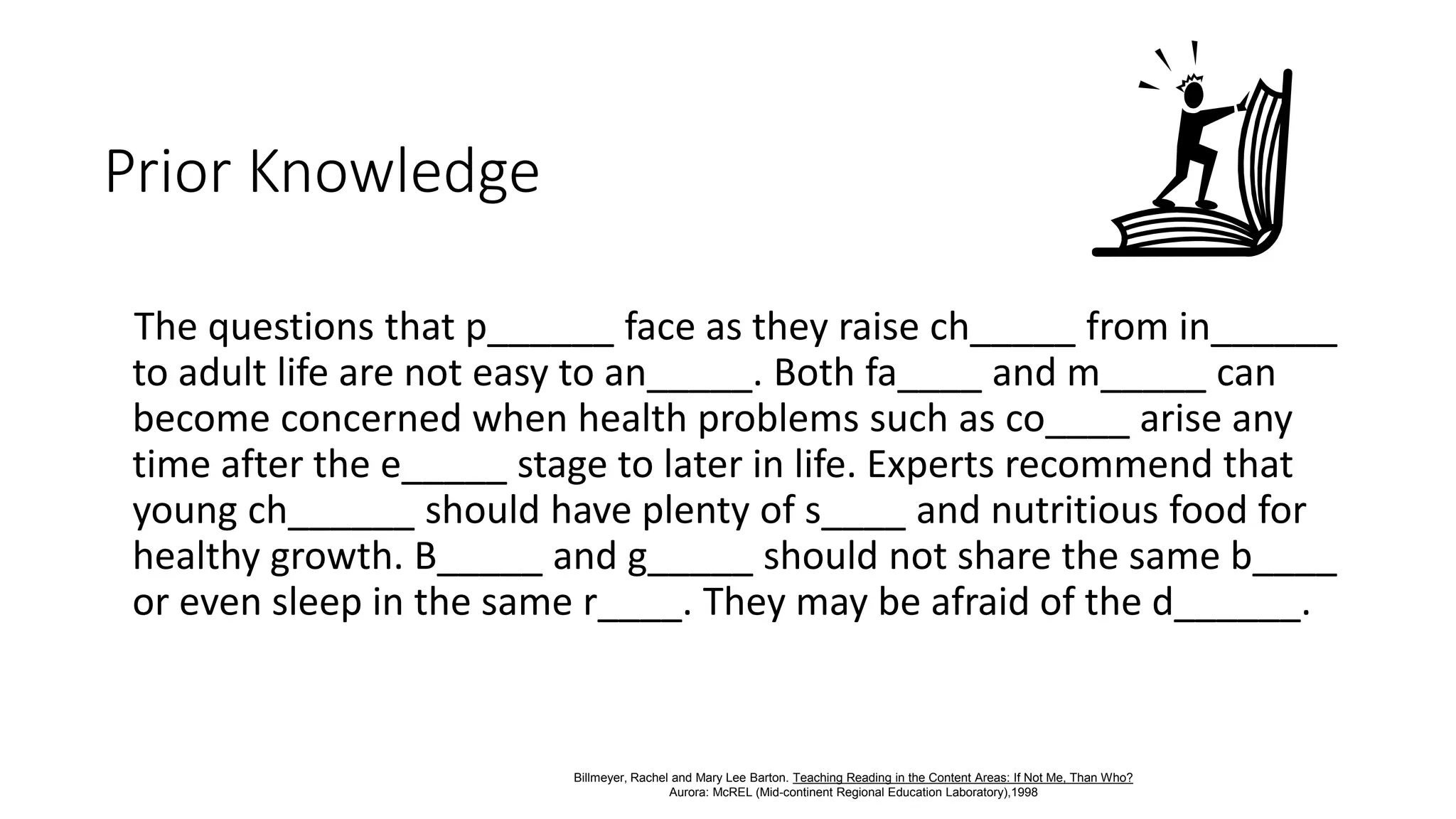
Prior Knowledge
The questions that p______ face as they raise ch_____ from in______
to adult life are not easy to an_____. Both fa____ and m_____ can
become concerned when health problems such as co____ arise any
time after the e_____ stage to later in life. Experts recommend that
young ch______ should have plenty of s____ and nutritious food for
healthy growth. B_____ and g_____ should not share the same b____
or even sleep in the same r____. They may be afraid of the d______.
Billmeyer, Rachel and Mary Lee Barton. Teaching Reading in the Content Areas: If Not Me, Than Who?
Aurora: McREL (Mid-continent Regional Education Laboratory),1998
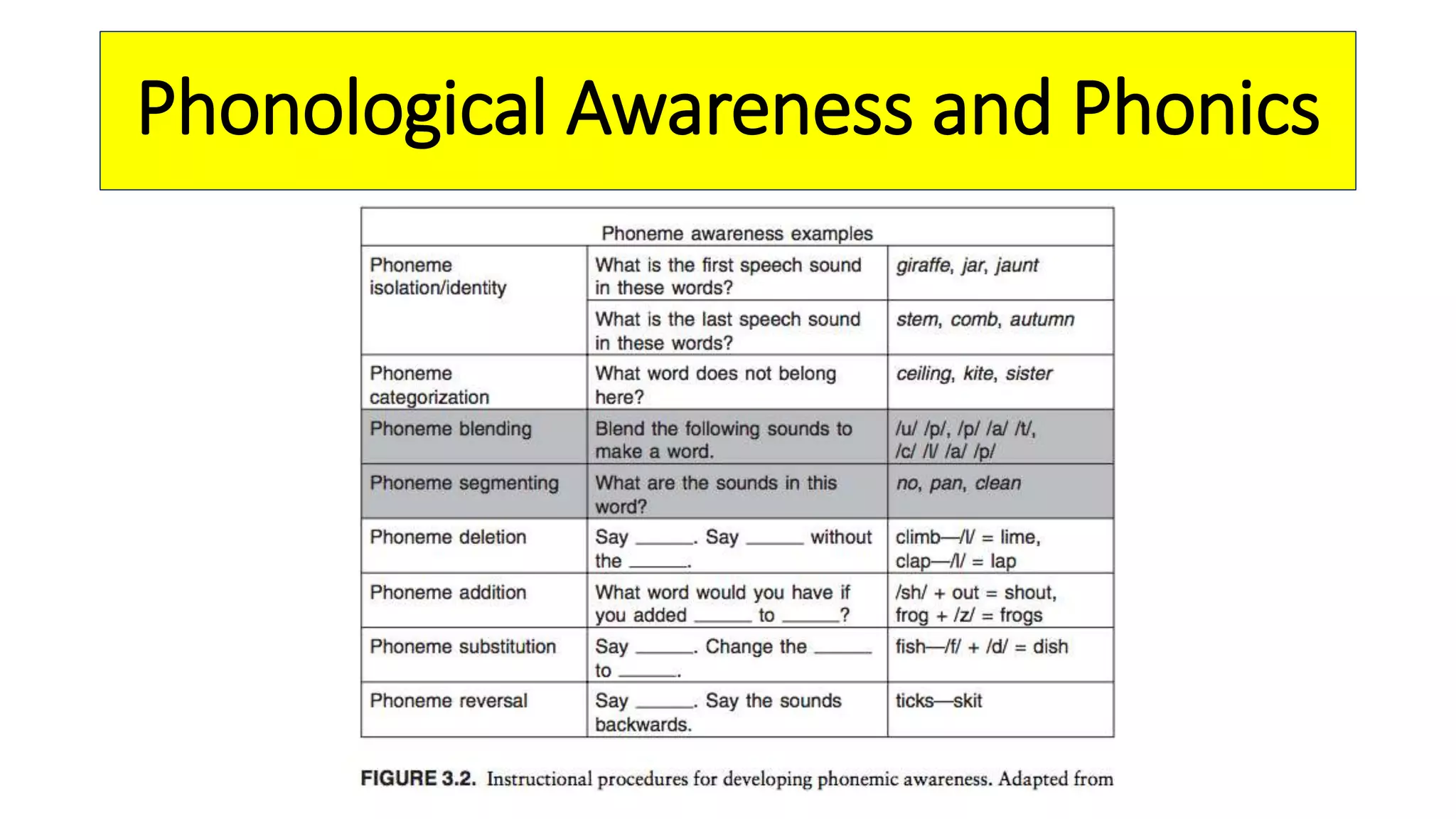
Phonological Awareness and Phonics
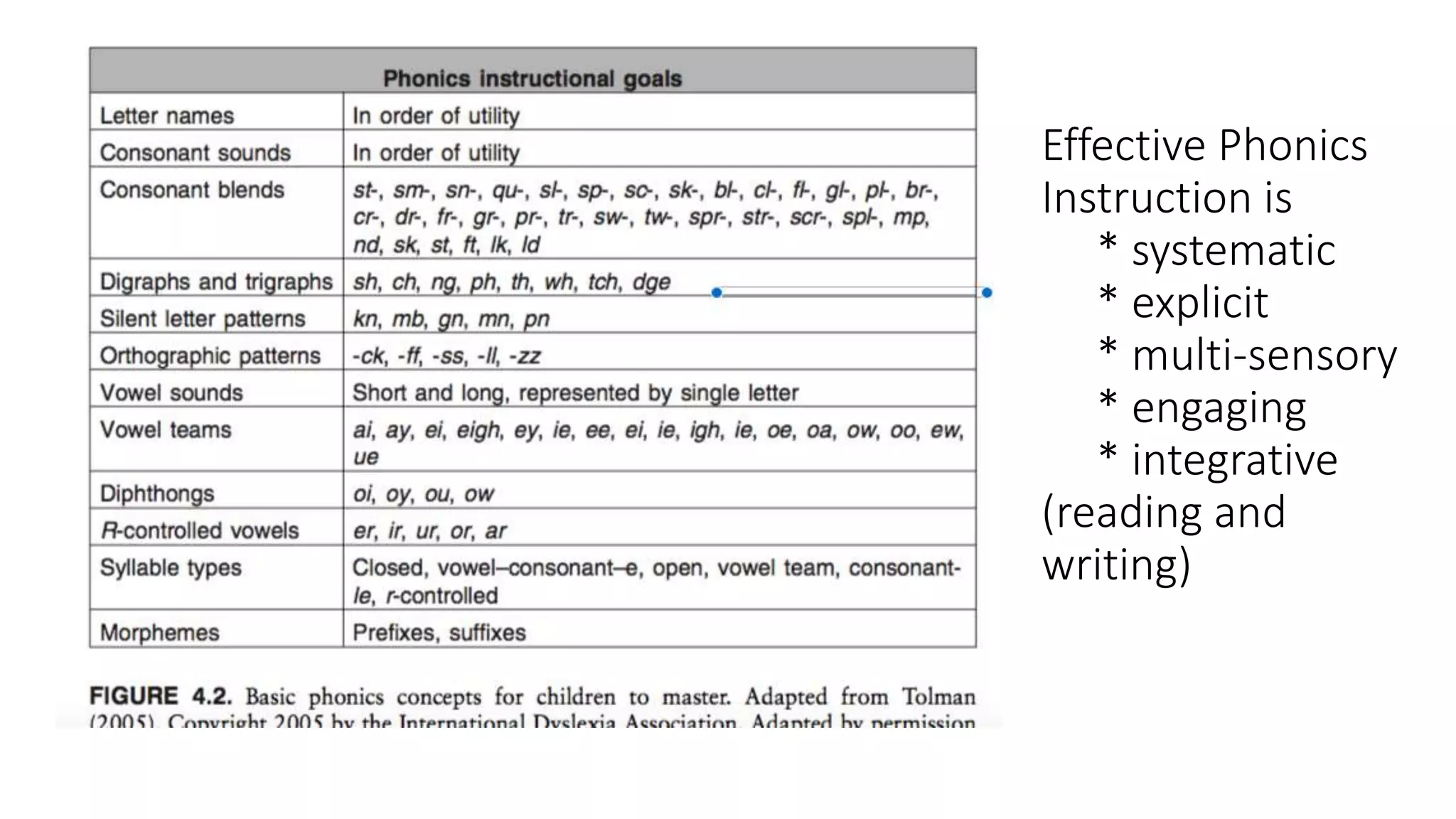
Effective Phonics
Instruction is
* systematic
* explicit
* multi-sensory
* engaging
* integrative
(reading and
writing)
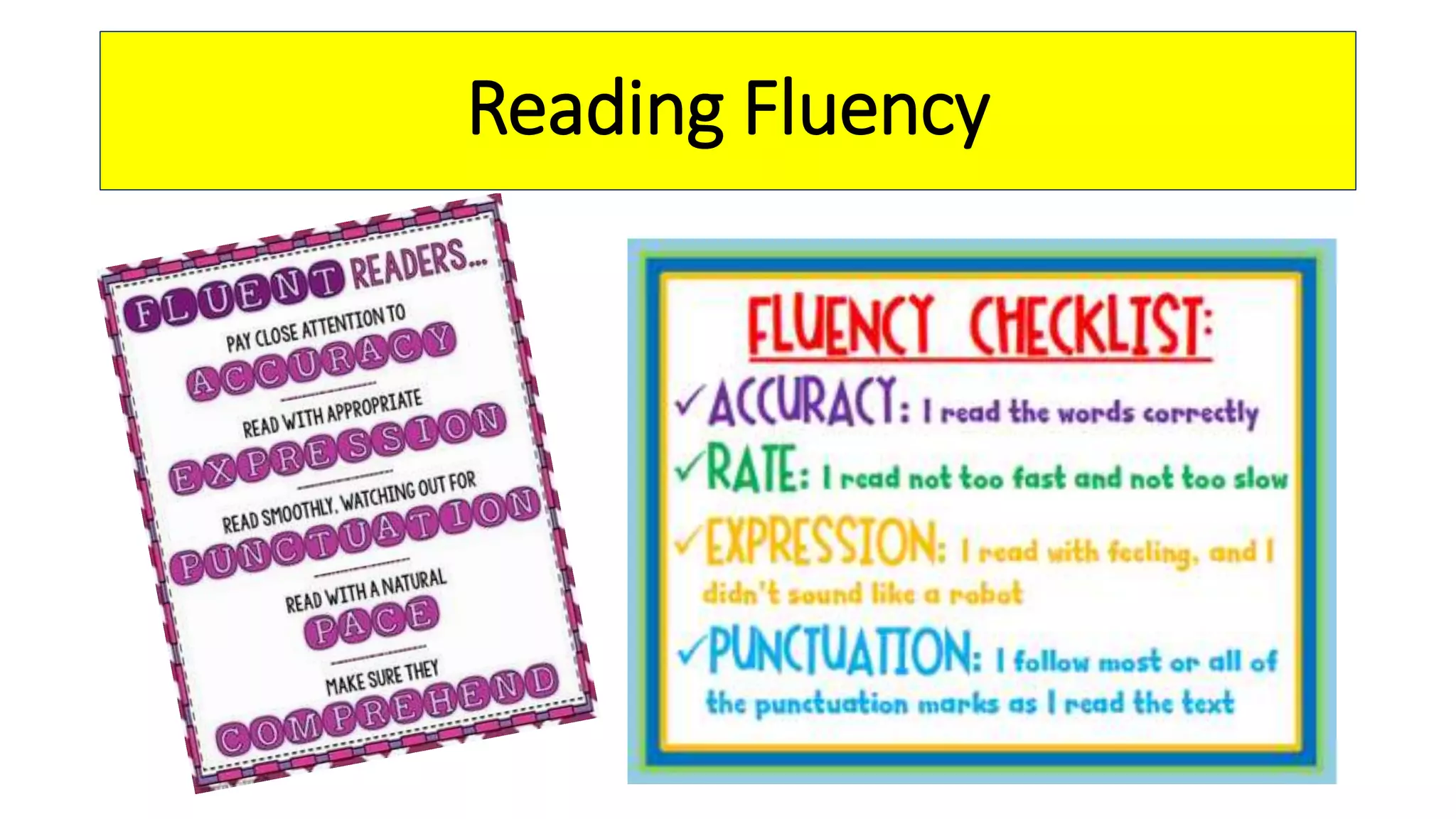
Reading Fluency
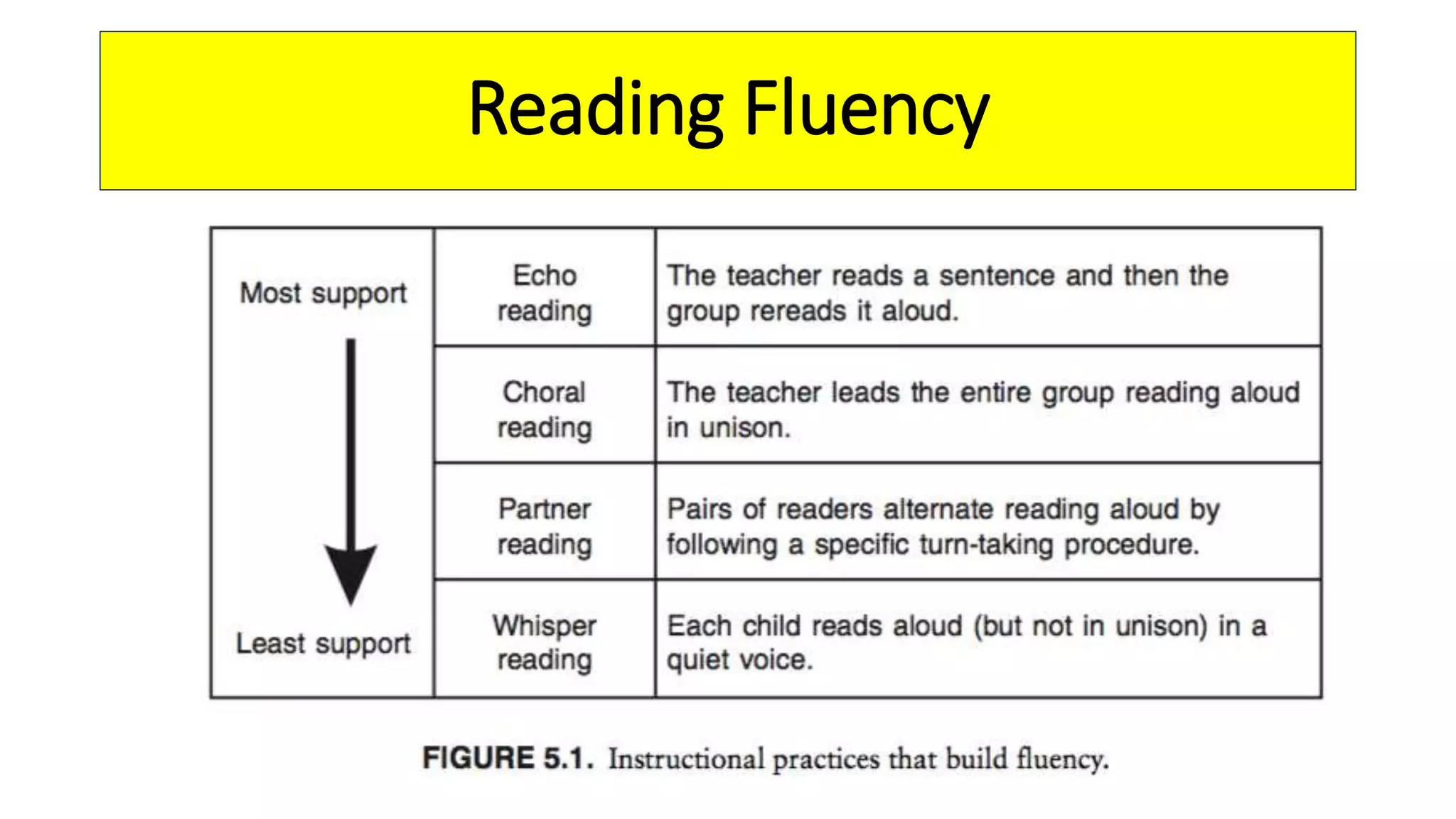
Reading Fluency
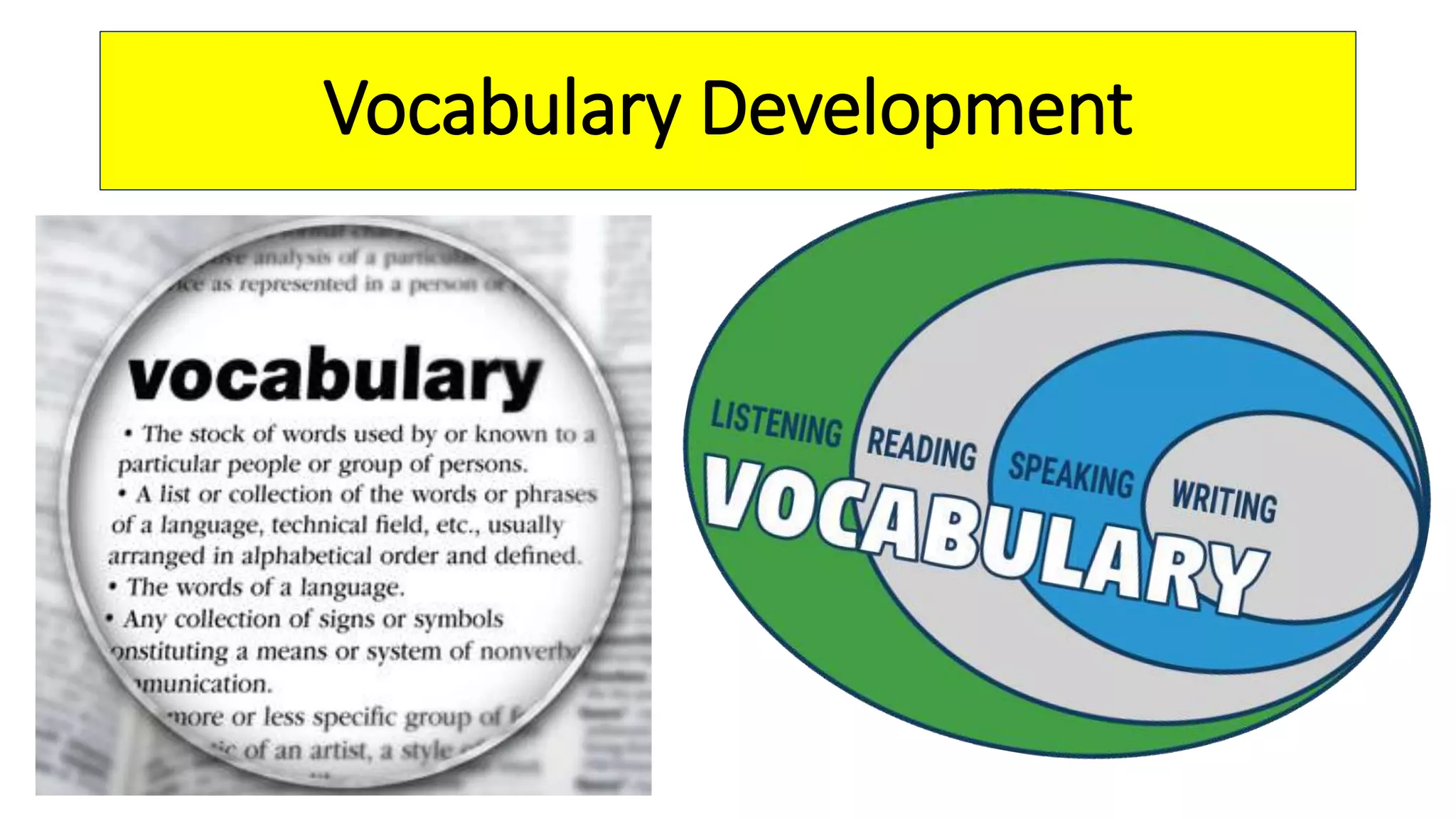
Vocabulary Development
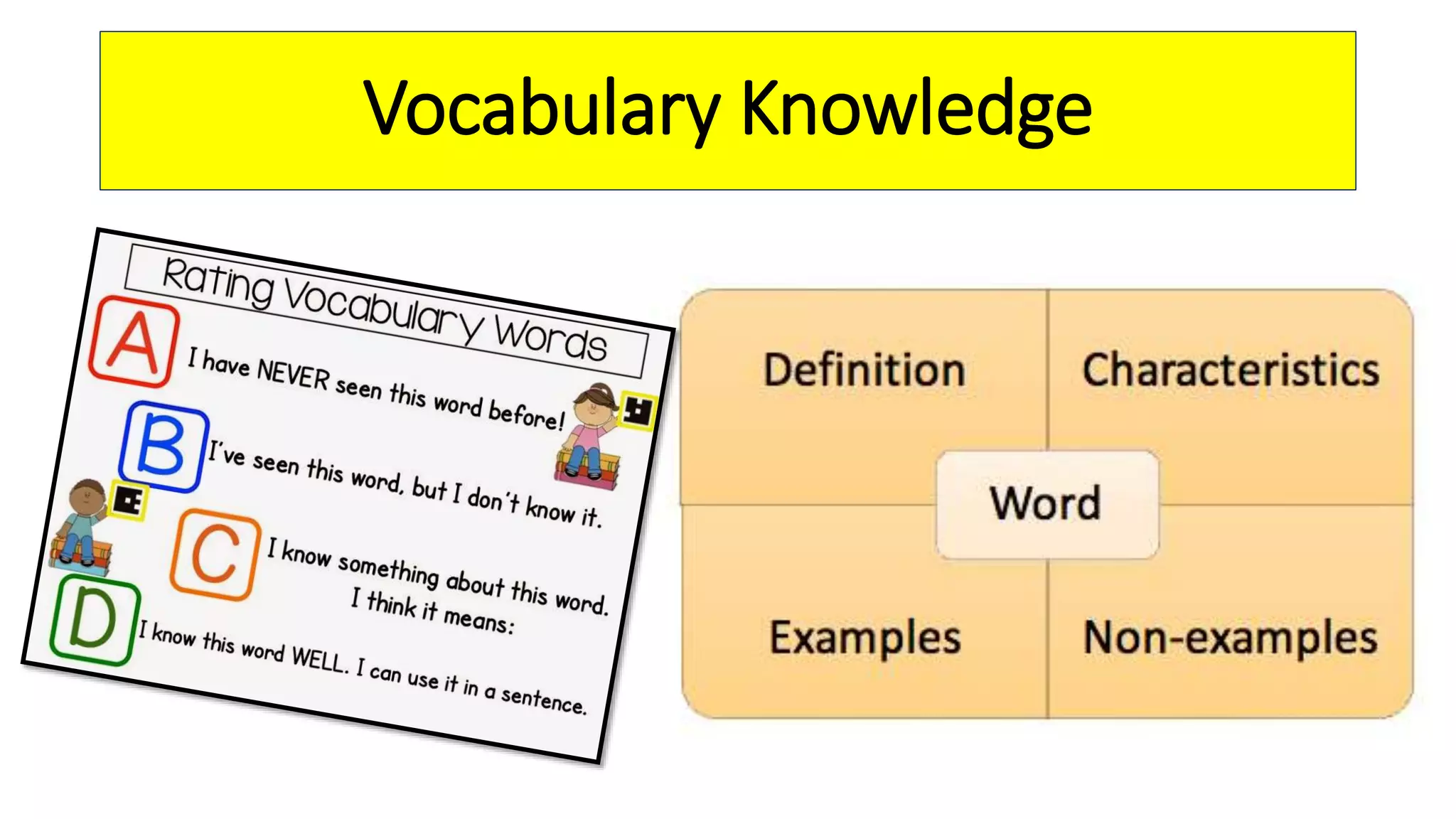
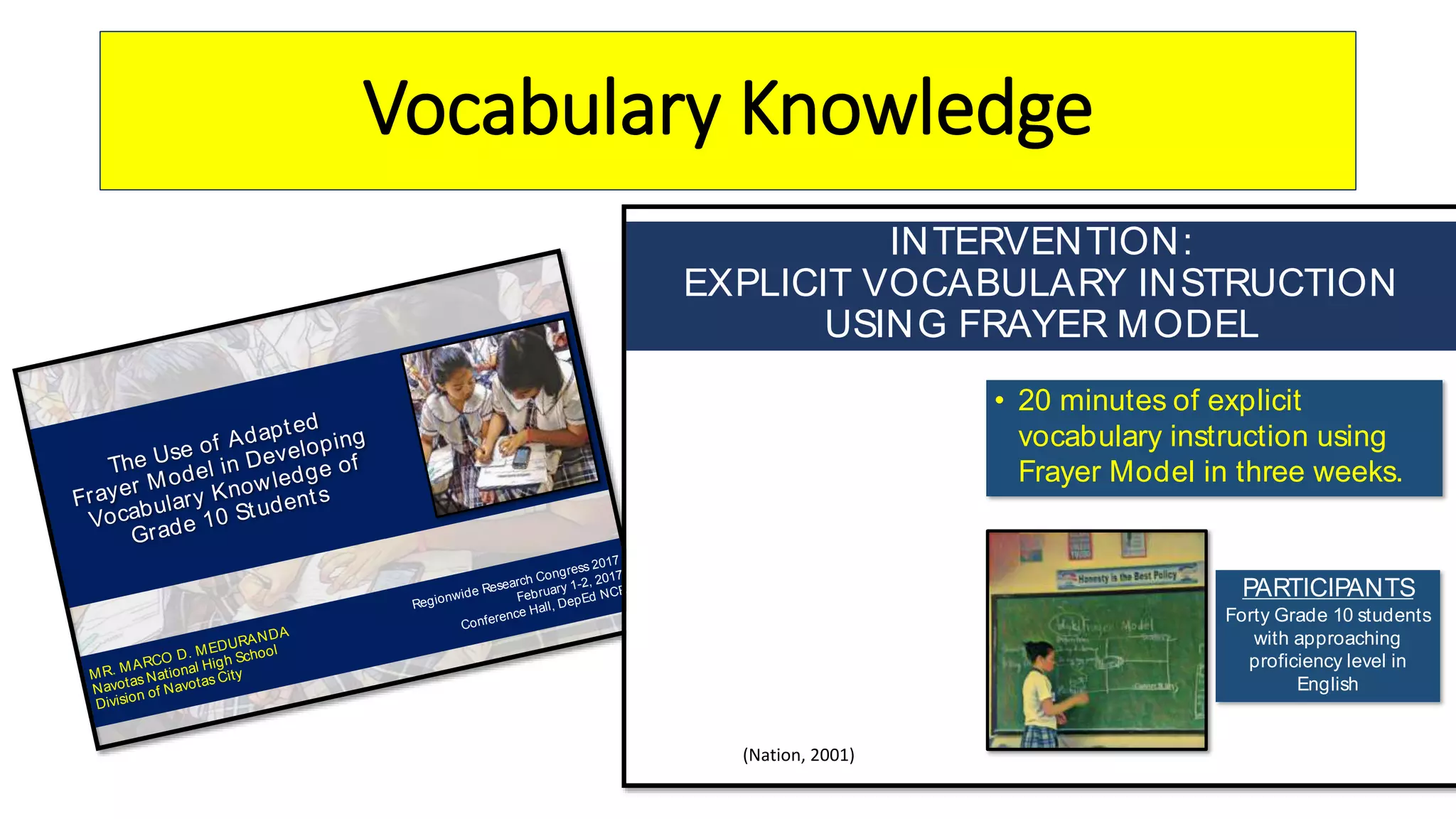
Vocabulary Knowledge
The Use of Adapted
Frayer Model in Developing
Vocabulary Knowledge of
Grade 10 Students
MR. MARCO D. MEDURANDA
Navotas National High School
Division of Navotas City
Regionwide Research Congress 2017
February 1-2, 2017
Conference Hall, DepEd NCR
INTERVENTION:
EXPLICIT VOCABULARY INSTRUCTION
USING FRAYER MODEL
PREPARATION
INTRODUCTION OF
STRATEGY
MODELLING
DEMONSTRATING
GUIDED PRACTICE:
PAIRWORK
INDEPENDENT
PRACTICE
WRAP UP
• 20 minutes of explicit
vocabulary instruction using
Frayer Model in three weeks.
PARTICIPANTS
Forty Grade 10 students
with approaching
proficiency level in
English
(Nation, 2001)
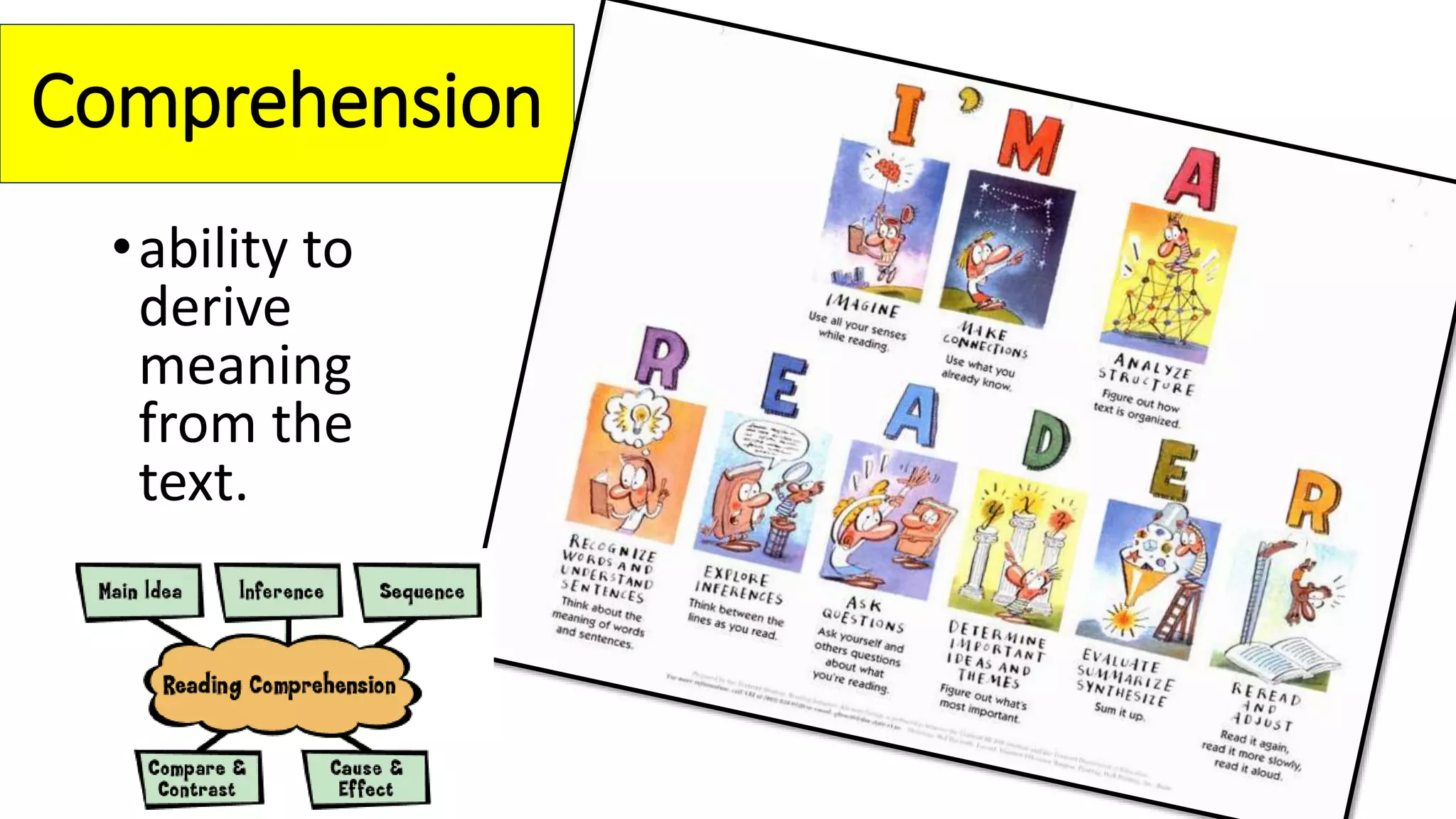
Comprehension
•ability to
derive
meaning
from the
text.
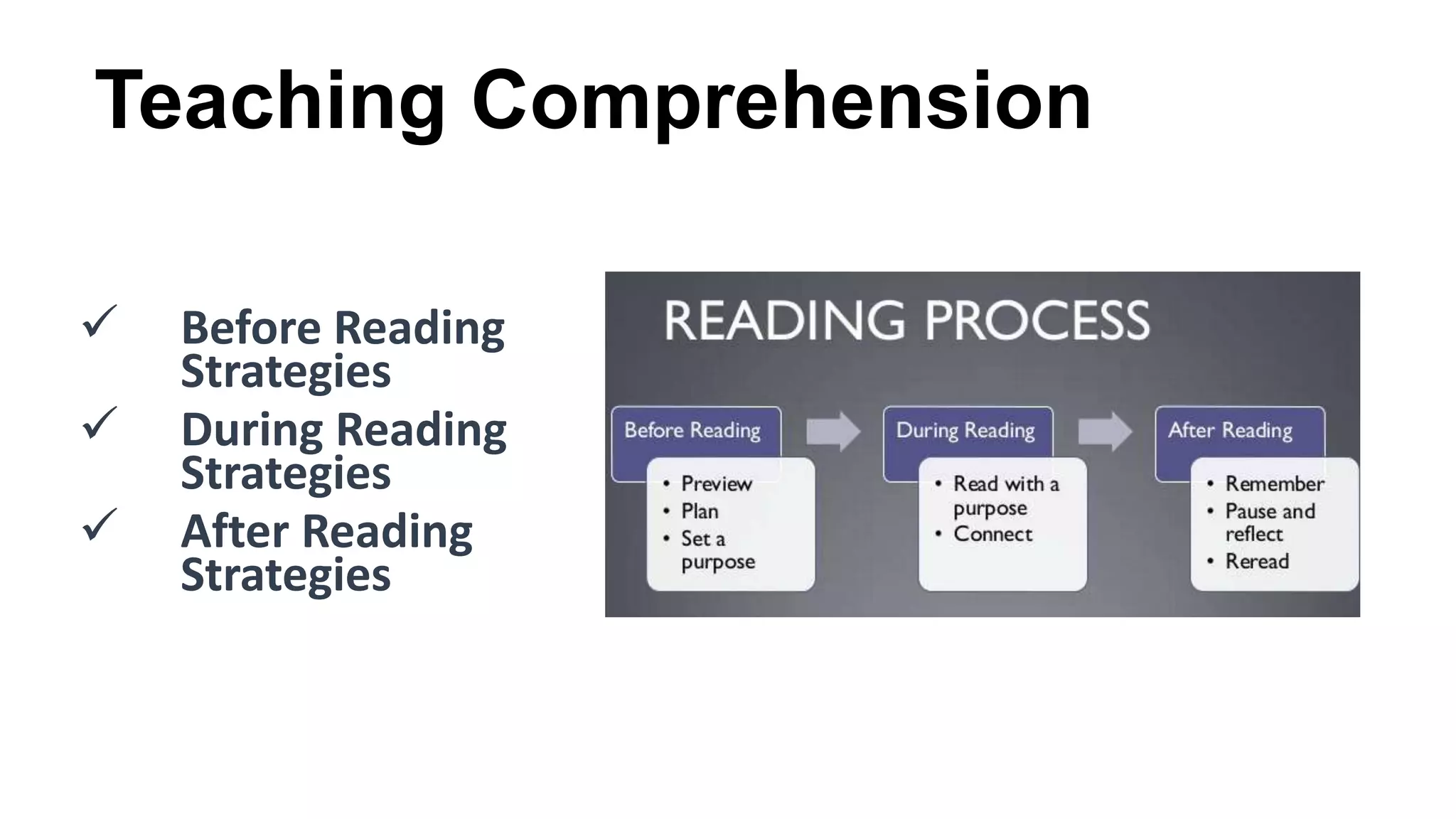
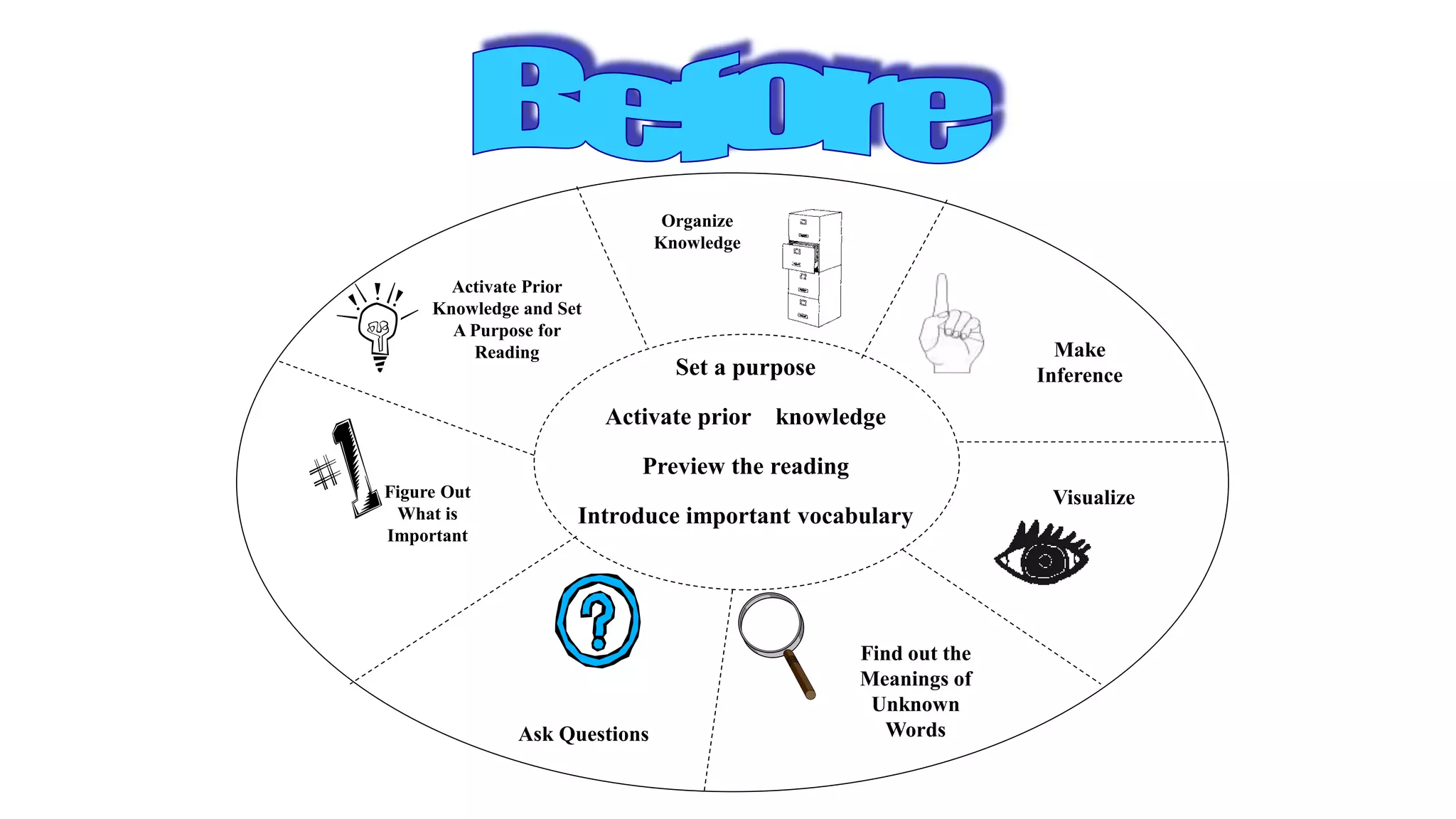
Teaching Comprehension
 Before Reading
Strategies
 During Reading
Strategies
 After Reading
Strategies
Activate Prior
Knowledge and Set
A Purpose for
Reading
Figure Out
What is
Important
Organize
Knowledge
Make
Inference
Find out the
Meanings of
Unknown
WordsAsk Questions
Visualize
Set a purpose
Activate prior knowledge
Preview the reading
Introduce important vocabulary
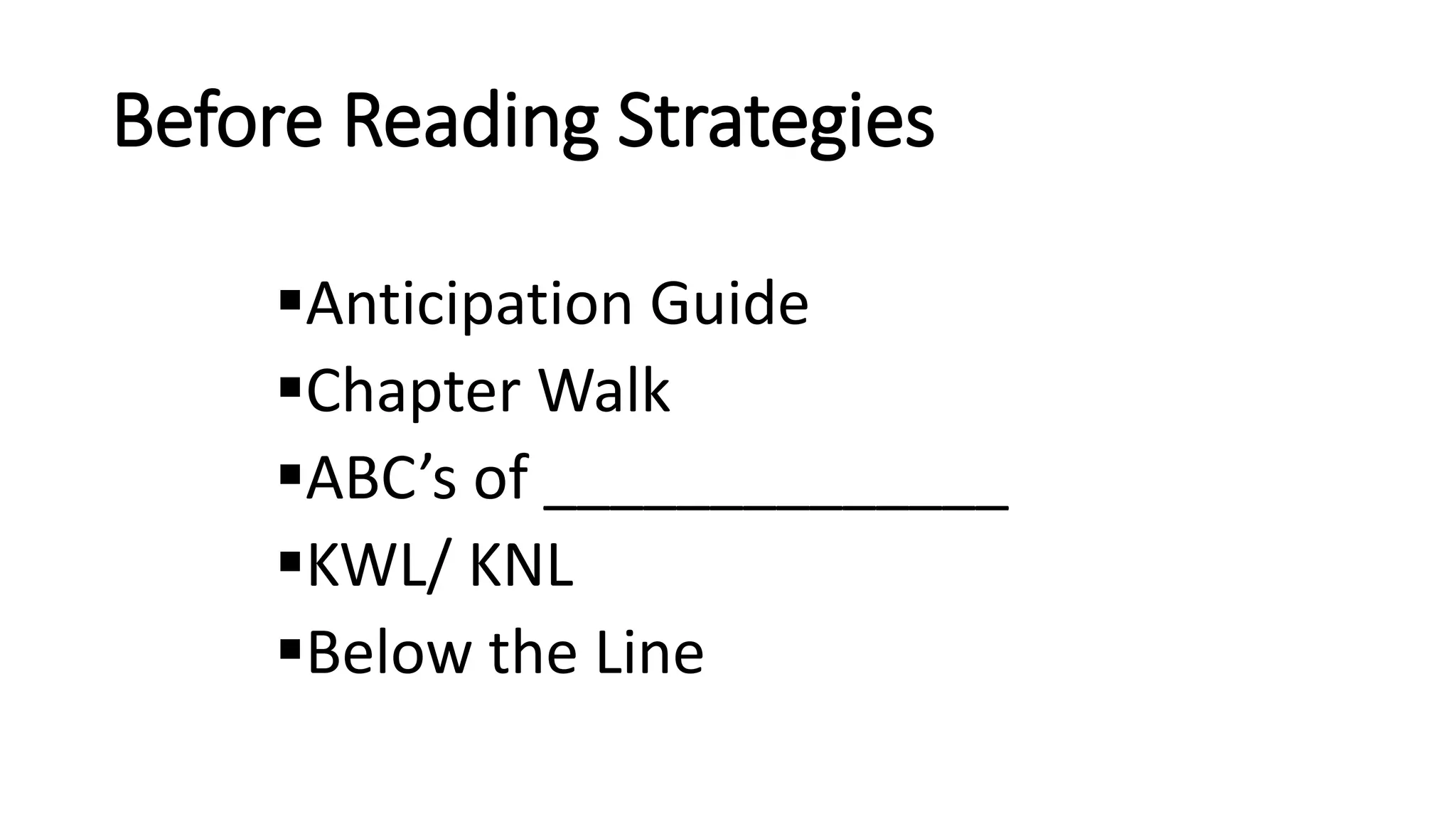
Before Reading Strategies
Anticipation Guide
Chapter Walk
ABC’s of ______________
KWL/ KNL
Below the Line
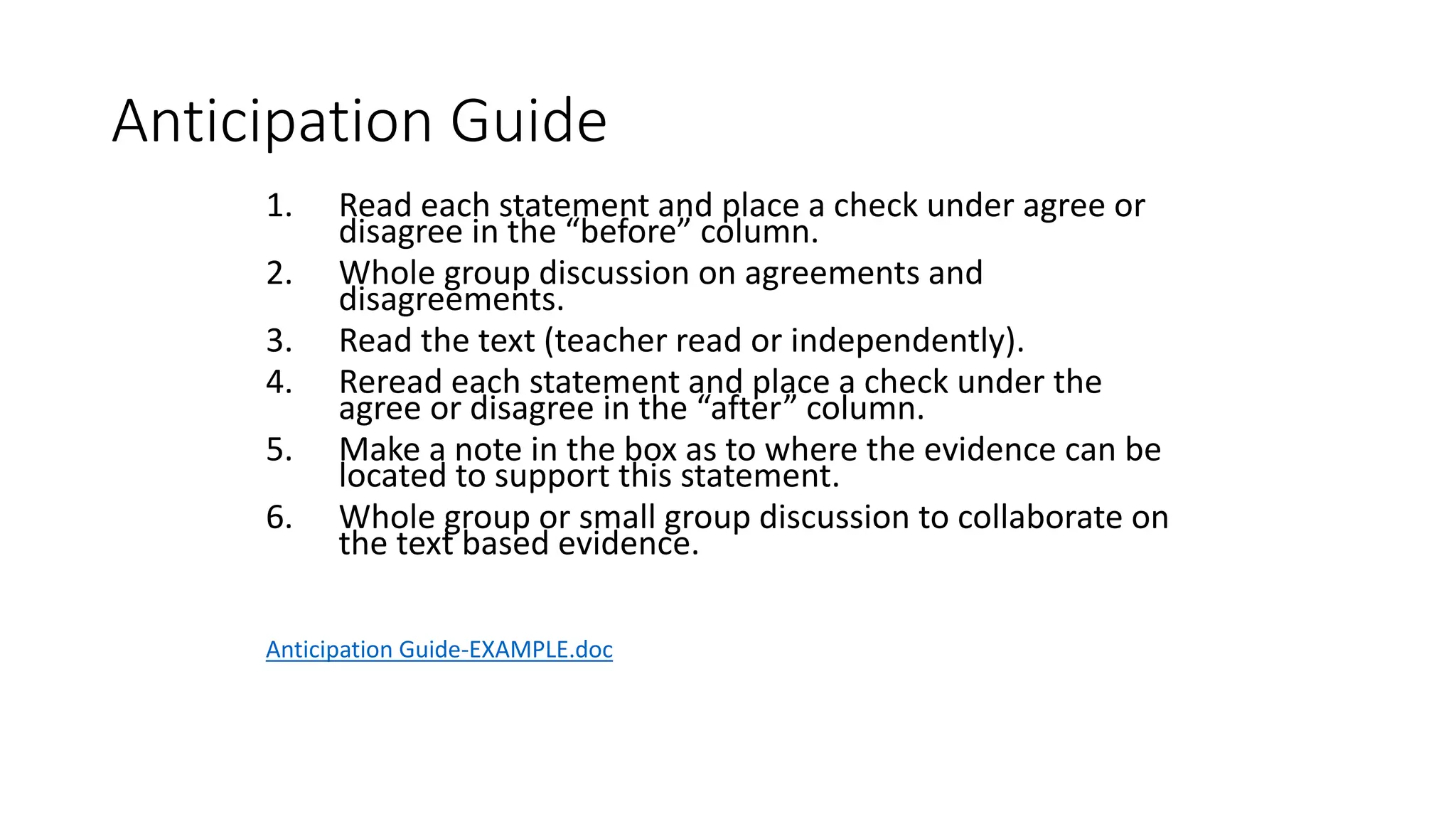
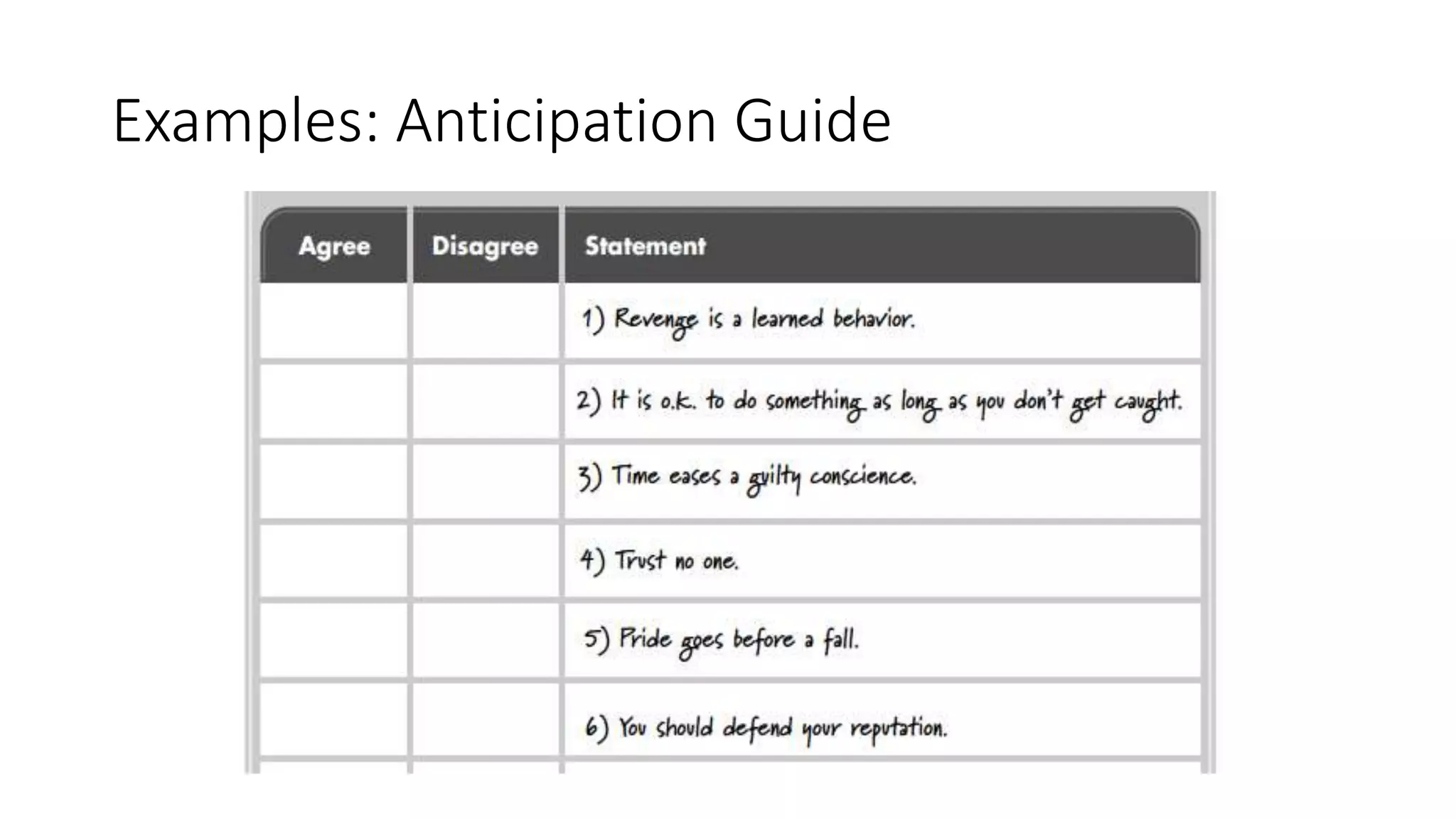
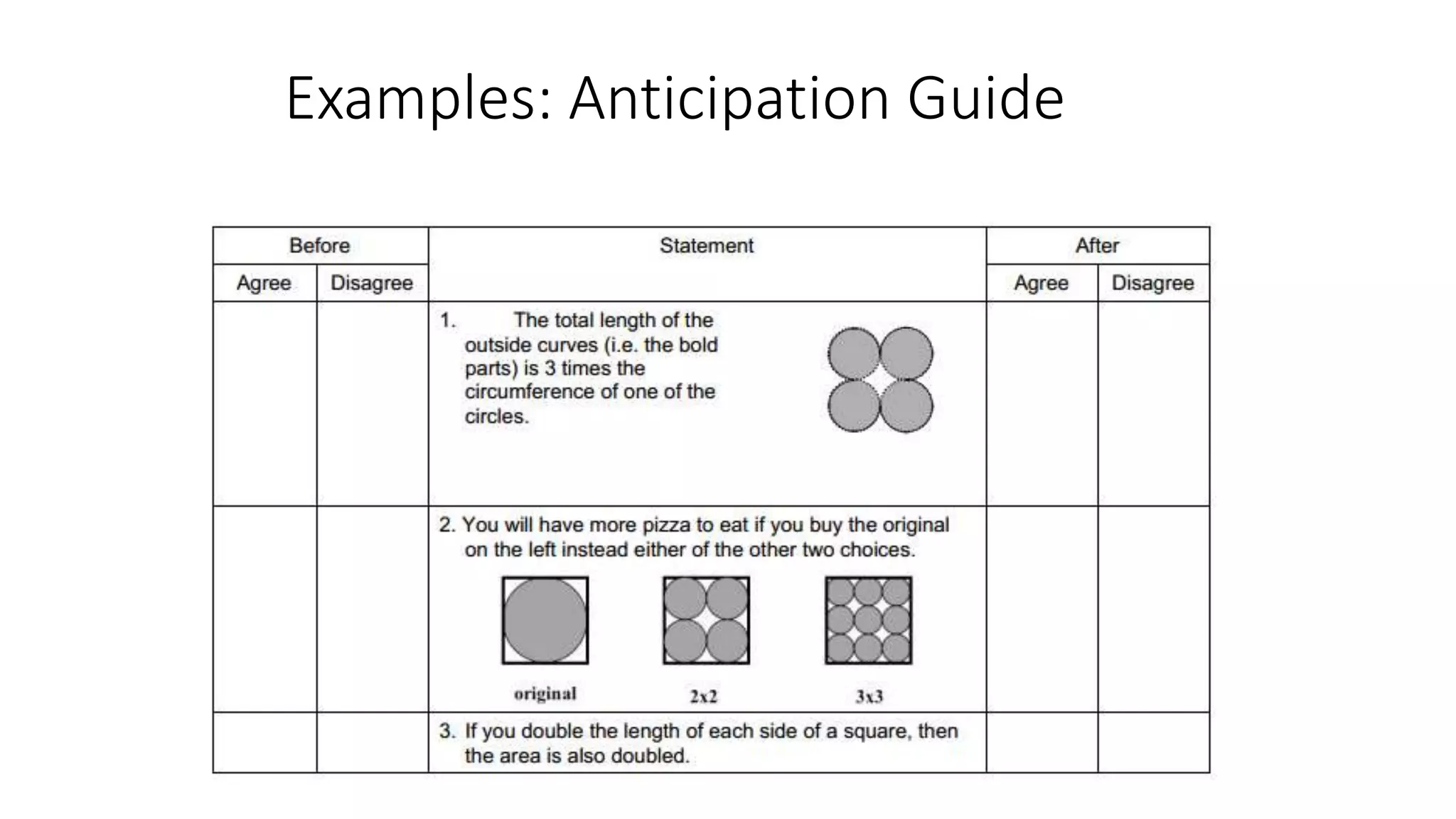
Anticipation Guide
1. Read each statement and place a check under agree or
disagree in the “before” column.
2. Whole group discussion on agreements and
disagreements.
3. Read the text (teacher read or independently).
4. Reread each statement and place a check under the
agree or disagree in the “after” column.
5. Make a note in the box as to where the evidence can be
located to support this statement.
6. Whole group or small group discussion to collaborate on
the text based evidence.
Anticipation Guide-EXAMPLE.doc
Examples: Anticipation Guide
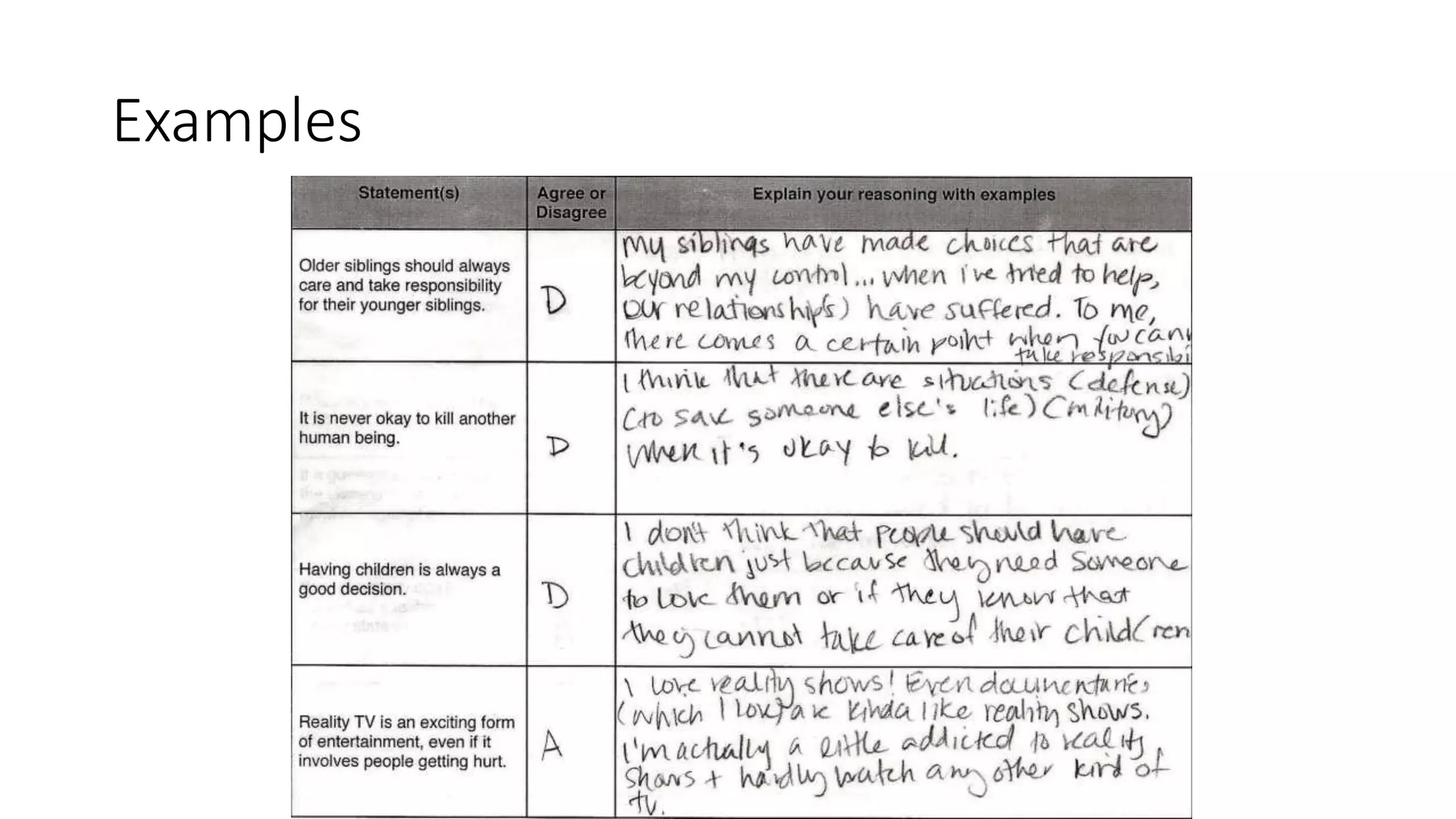
Examples
Strategy: ABC Brainstorm
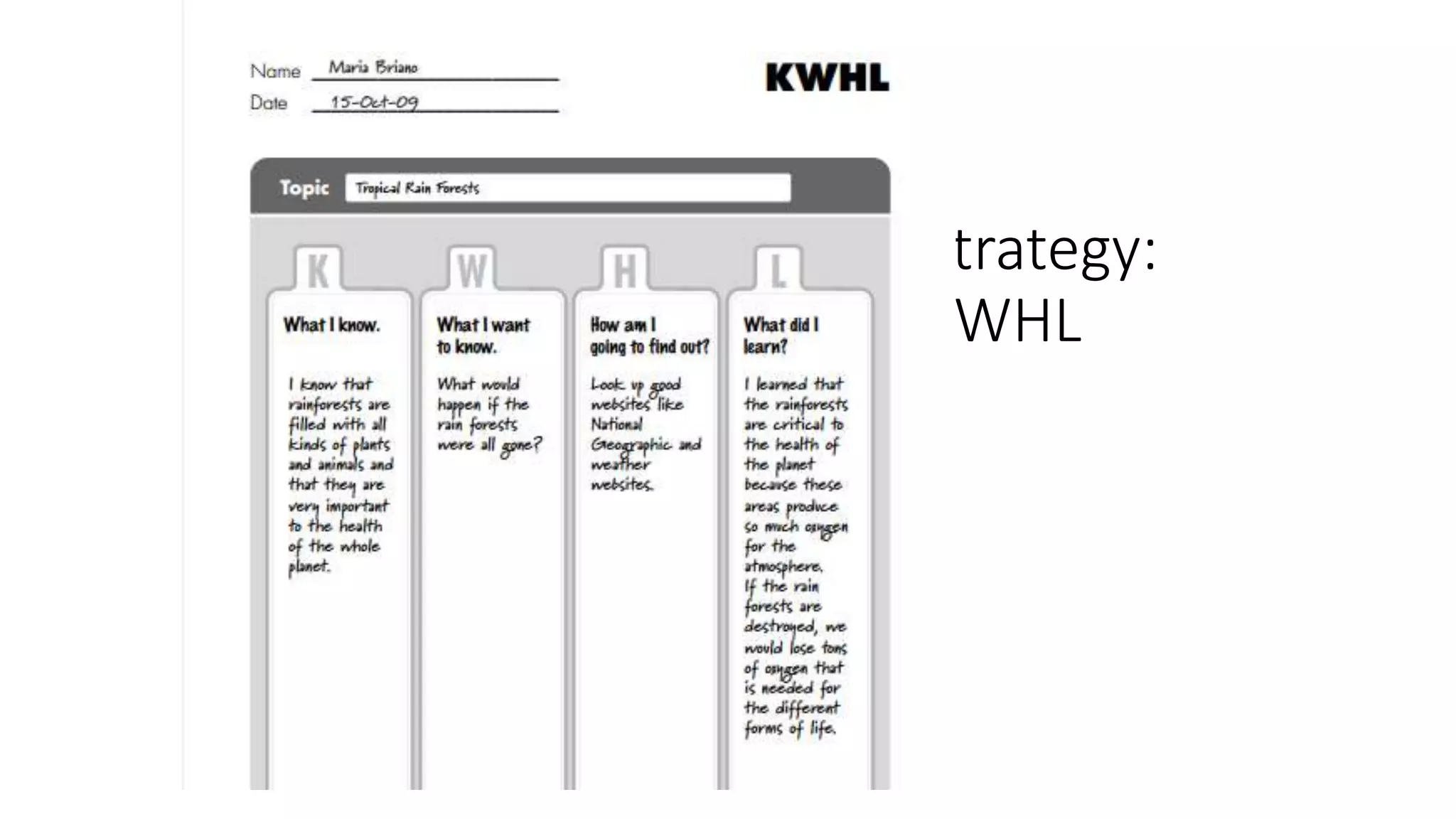
Strategy:
KWHL
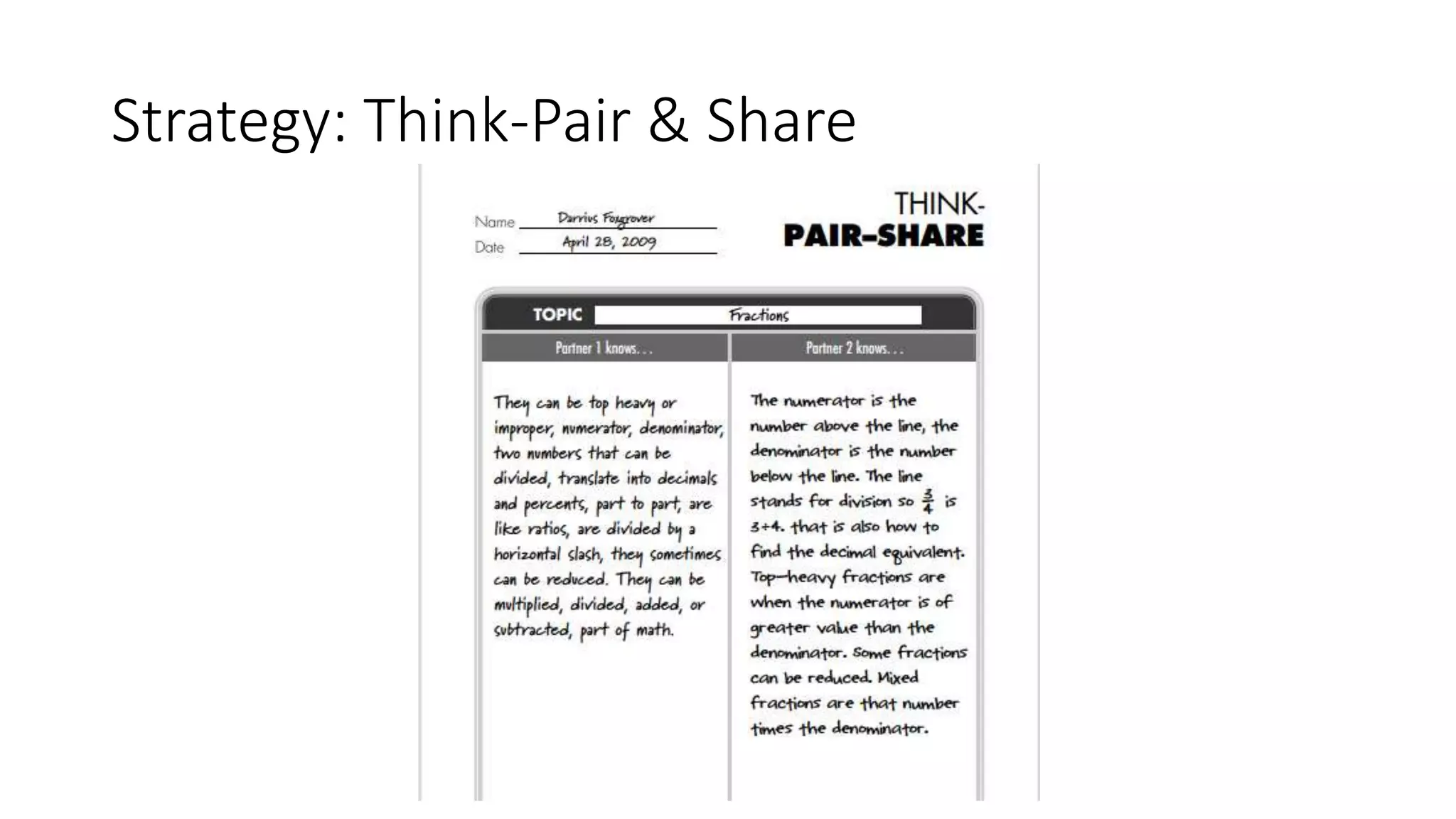
Strategy: Think-Pair & Share
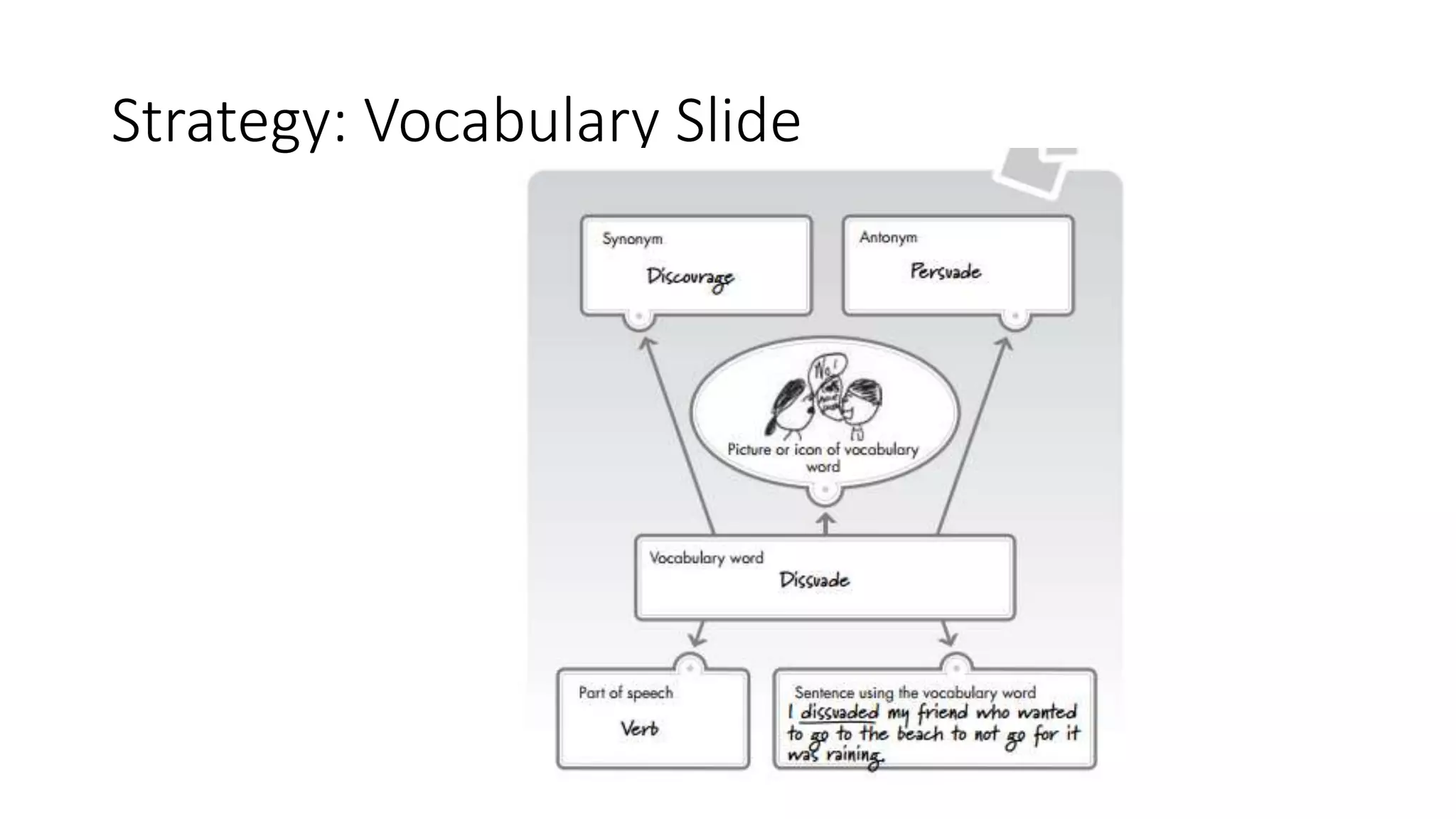
Strategy: Vocabulary Slide
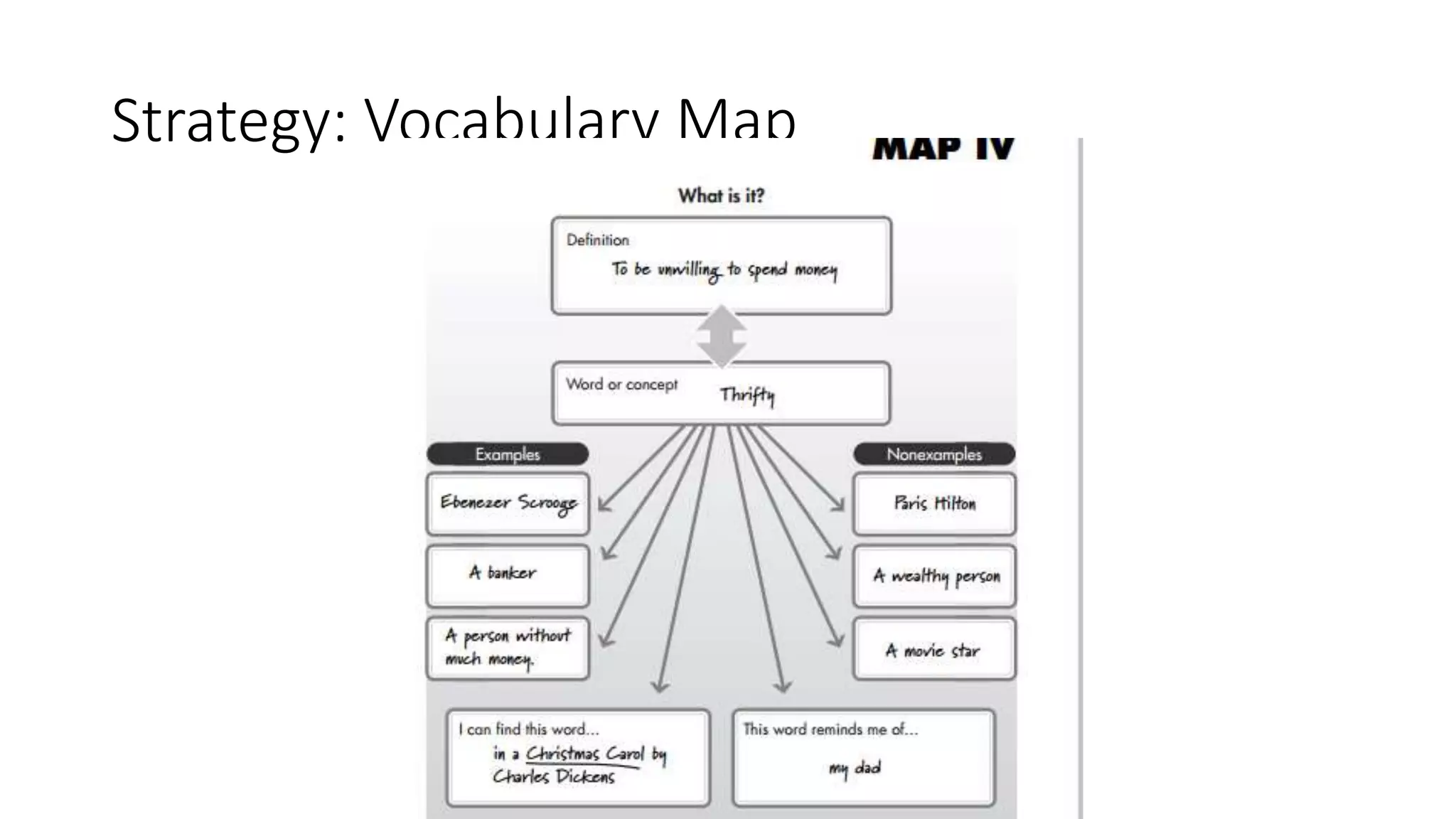
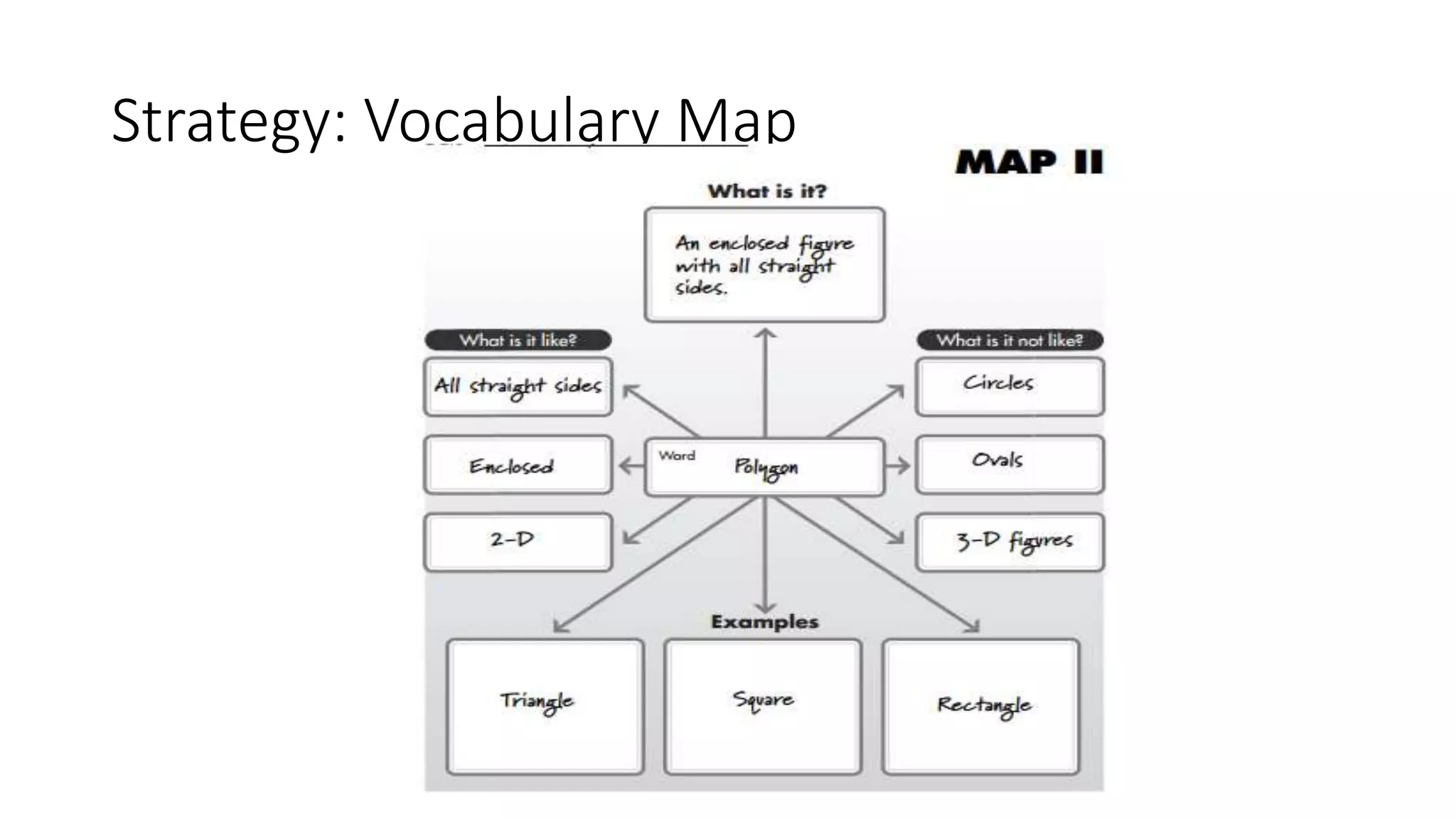
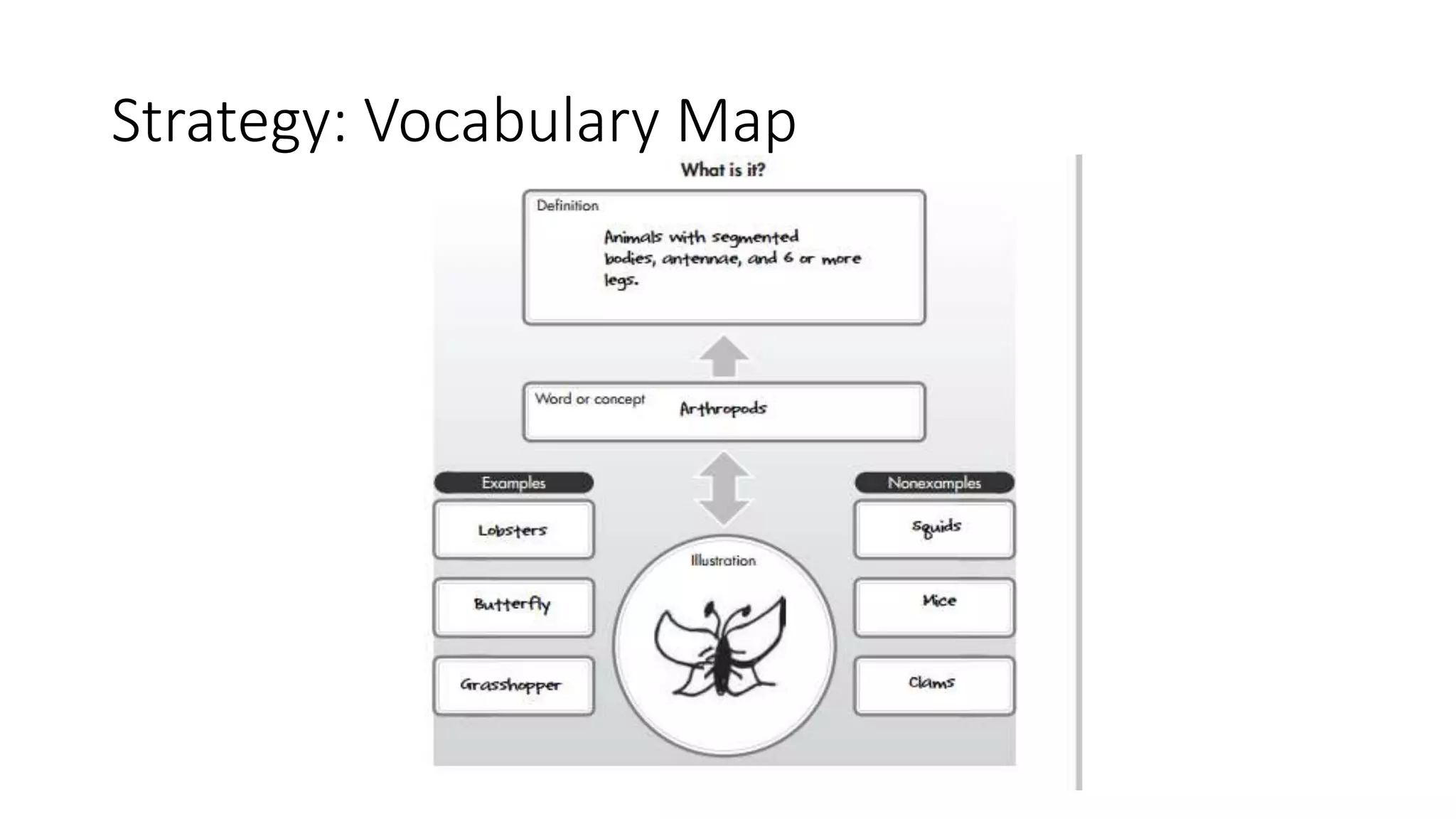
Strategy: Vocabulary Map
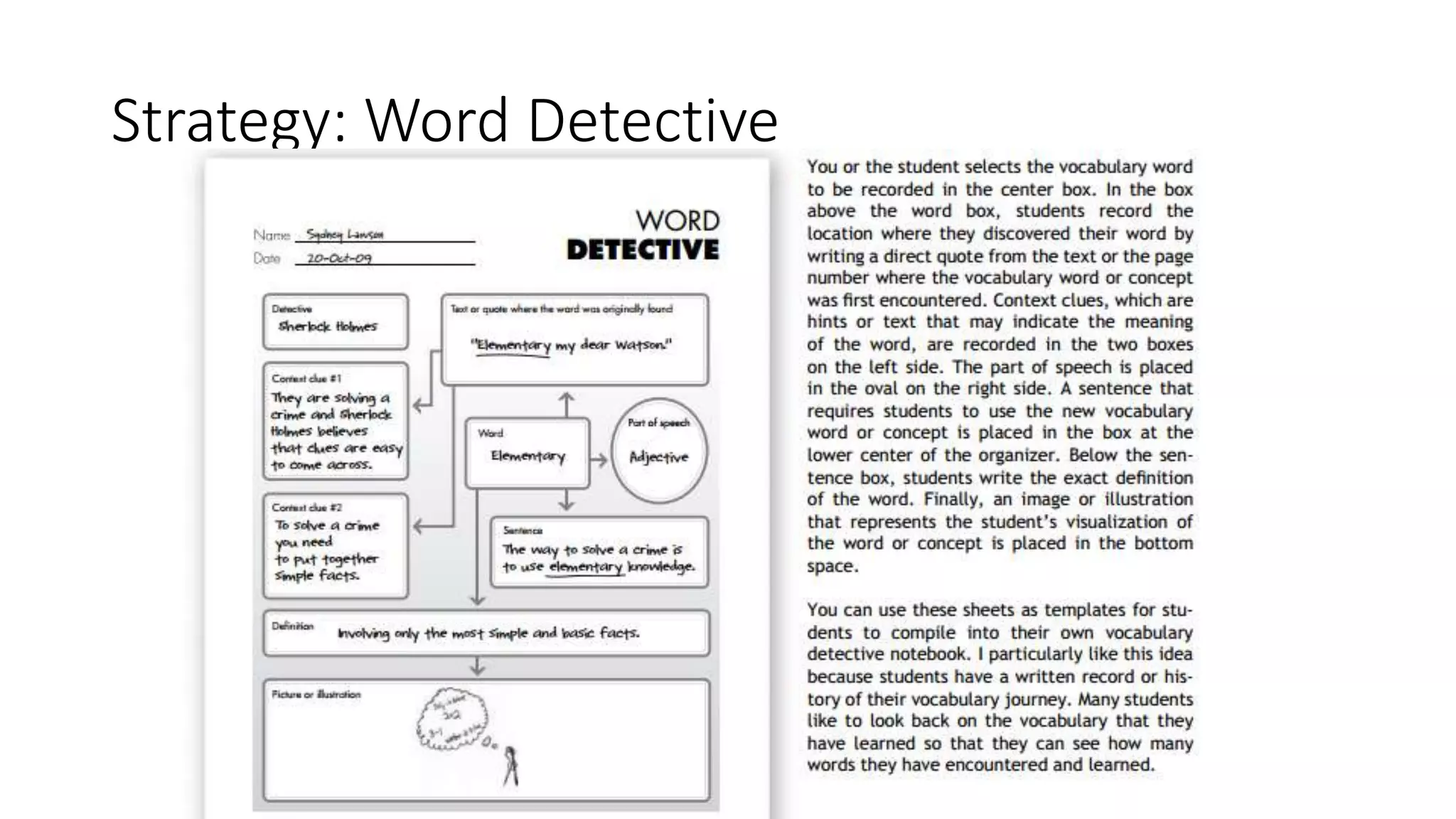
Strategy: Word Detective
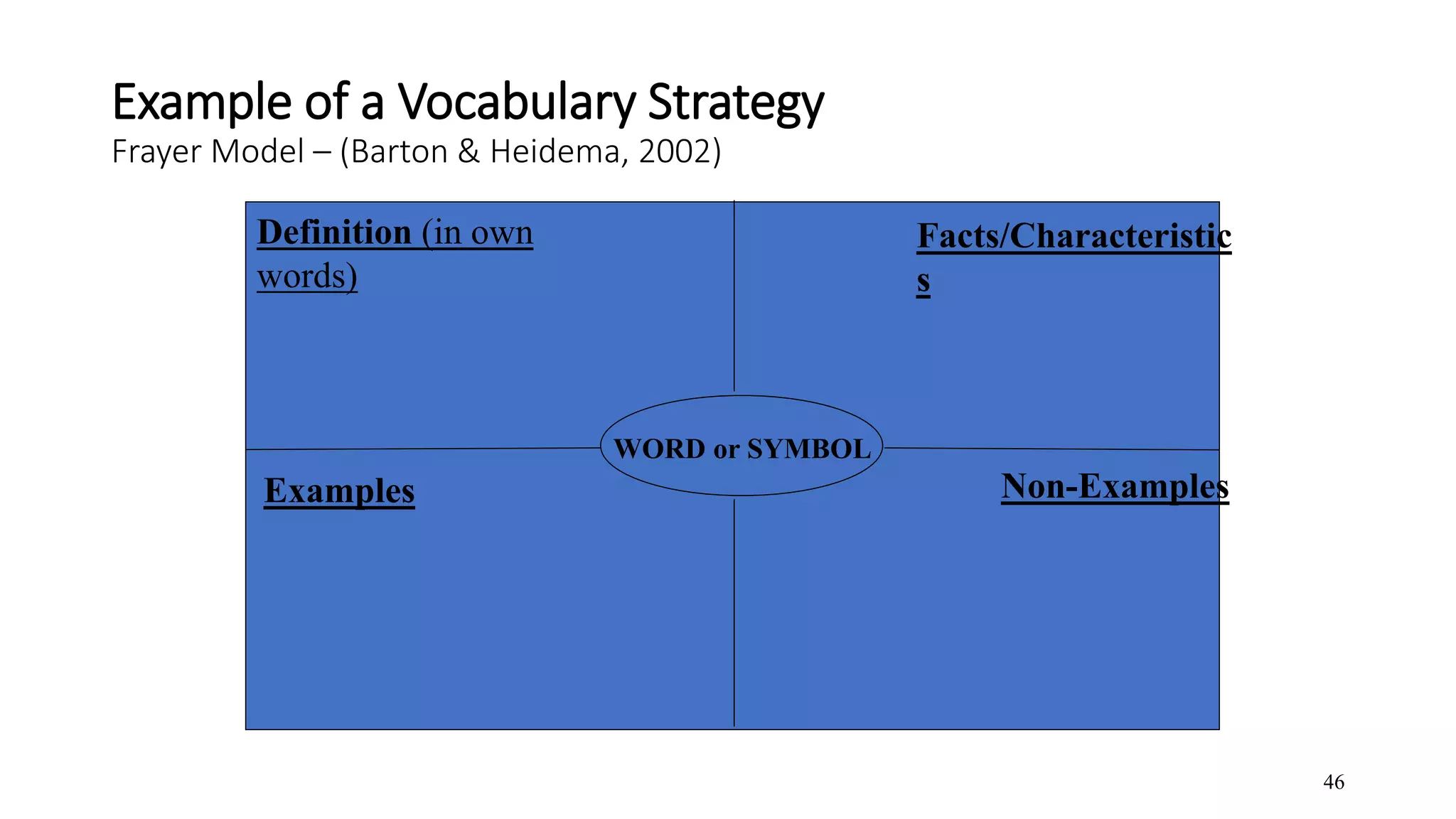
46
Example of a Vocabulary Strategy
Frayer Model – (Barton & Heidema, 2002)
Definition (in own
words)
Facts/Characteristic
s
Examples Non-Examples
WORD or SYMBOL
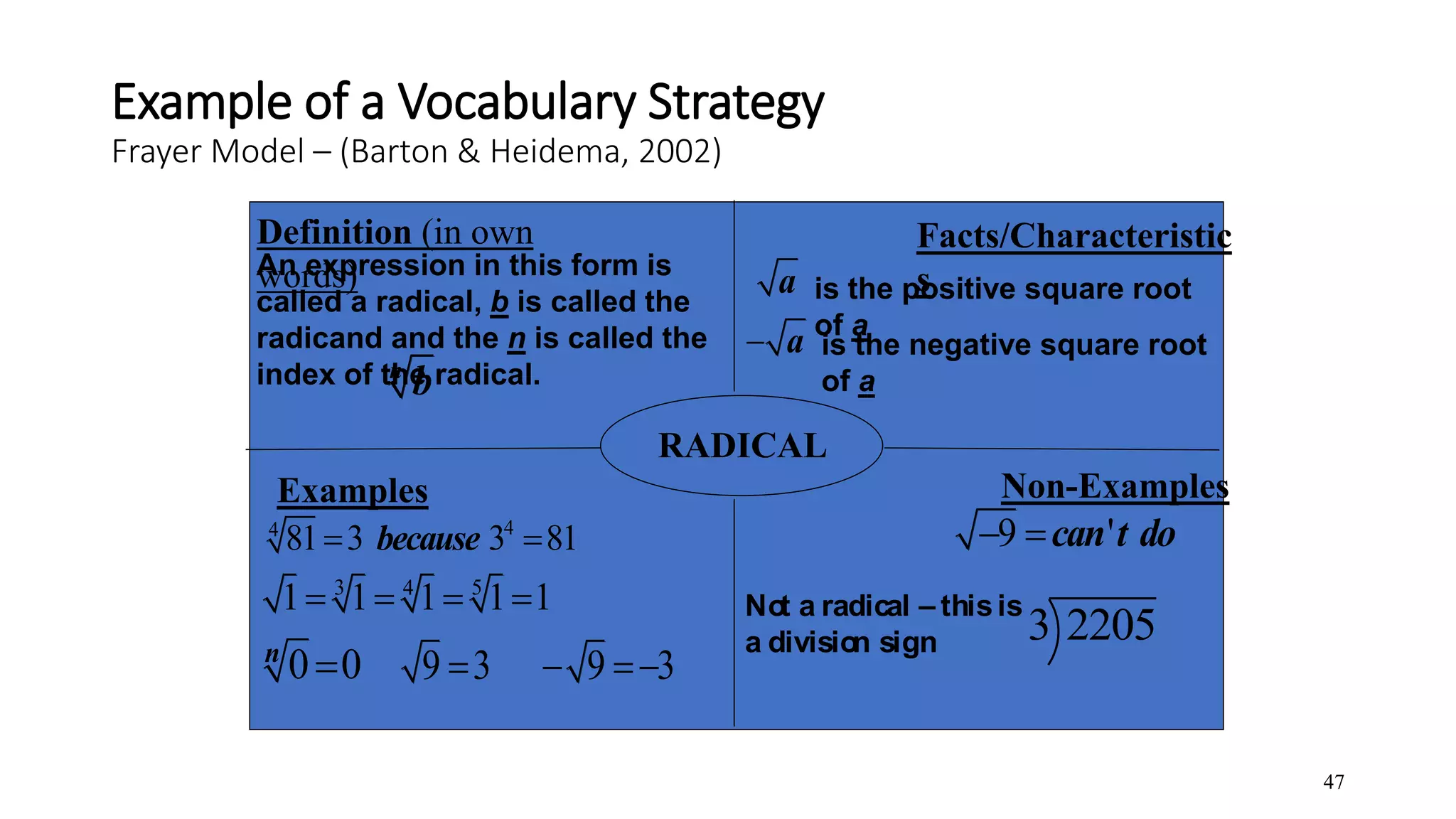
47
Example of a Vocabulary Strategy
Frayer Model – (Barton & Heidema, 2002)
Definition (in own
words)
Facts/Characteristic
s
Examples Non-Examples
RADICAL
An expression in this form is
called a radical, b is called the
radicand and the n is called the
index of the radical.n
b
44
81 3 3 81because 
3 54
1 1 1 1 1   
a is the positive square root
of a
a is the negative square root
of a
0 0n
9 3 9 3  
9 'can t do 
3 2205
Not a radical – thisis
a division sign
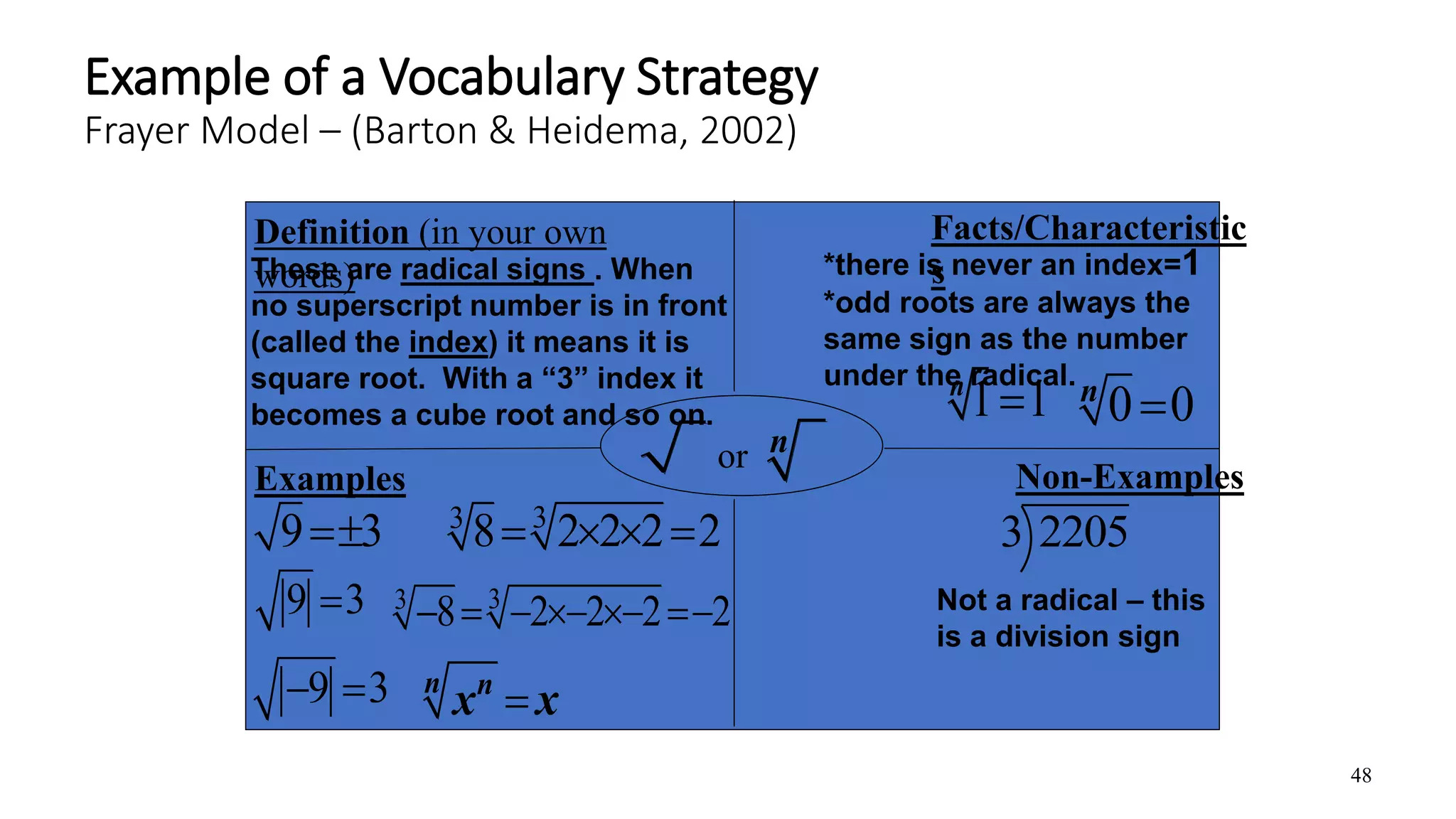
48
Example of a Vocabulary Strategy
Frayer Model – (Barton & Heidema, 2002)
33
9 3 8 2 2 2 2    
Definition (in your own
words)
Facts/Characteristic
s
Examples Non-Examples
These are radical signs . When
no superscript number is in front
(called the index) it means it is
square root. With a “3” index it
becomes a cube root and so on.
*there is never an index=1
*odd roots are always the
same sign as the number
under the radical.
Not a radical – this
is a division sign
n n
x x
3 2205
nor
0 0n
33
9 3 8 2 2 2 2    
9 3
9 3 
33
8 2 2 2 2     
1 1n
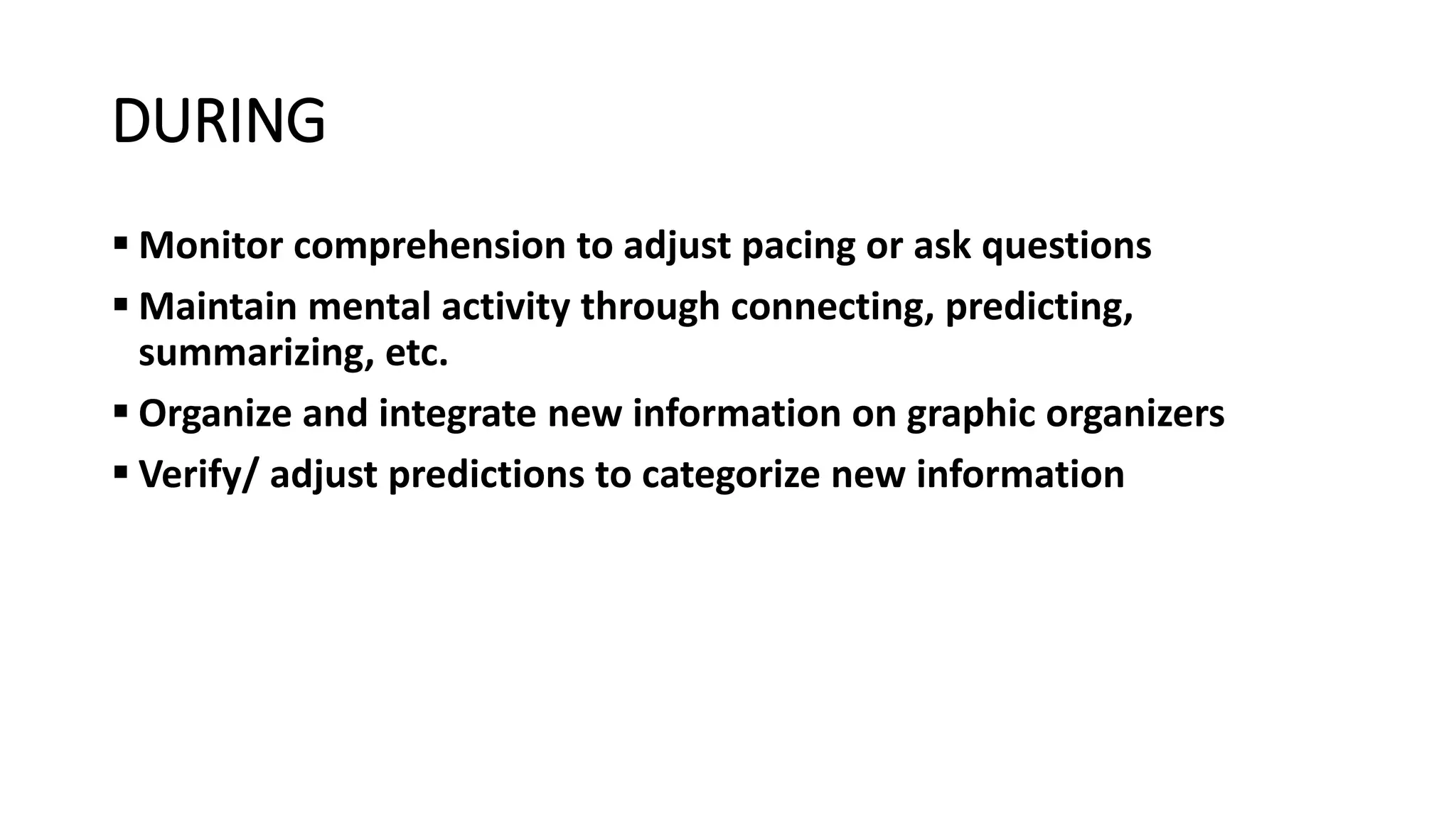
DURING
 Monitor comprehension to adjust pacing or ask questions
 Maintain mental activity through connecting, predicting,
summarizing, etc.
 Organize and integrate new information on graphic organizers
 Verify/ adjust predictions to categorize new information
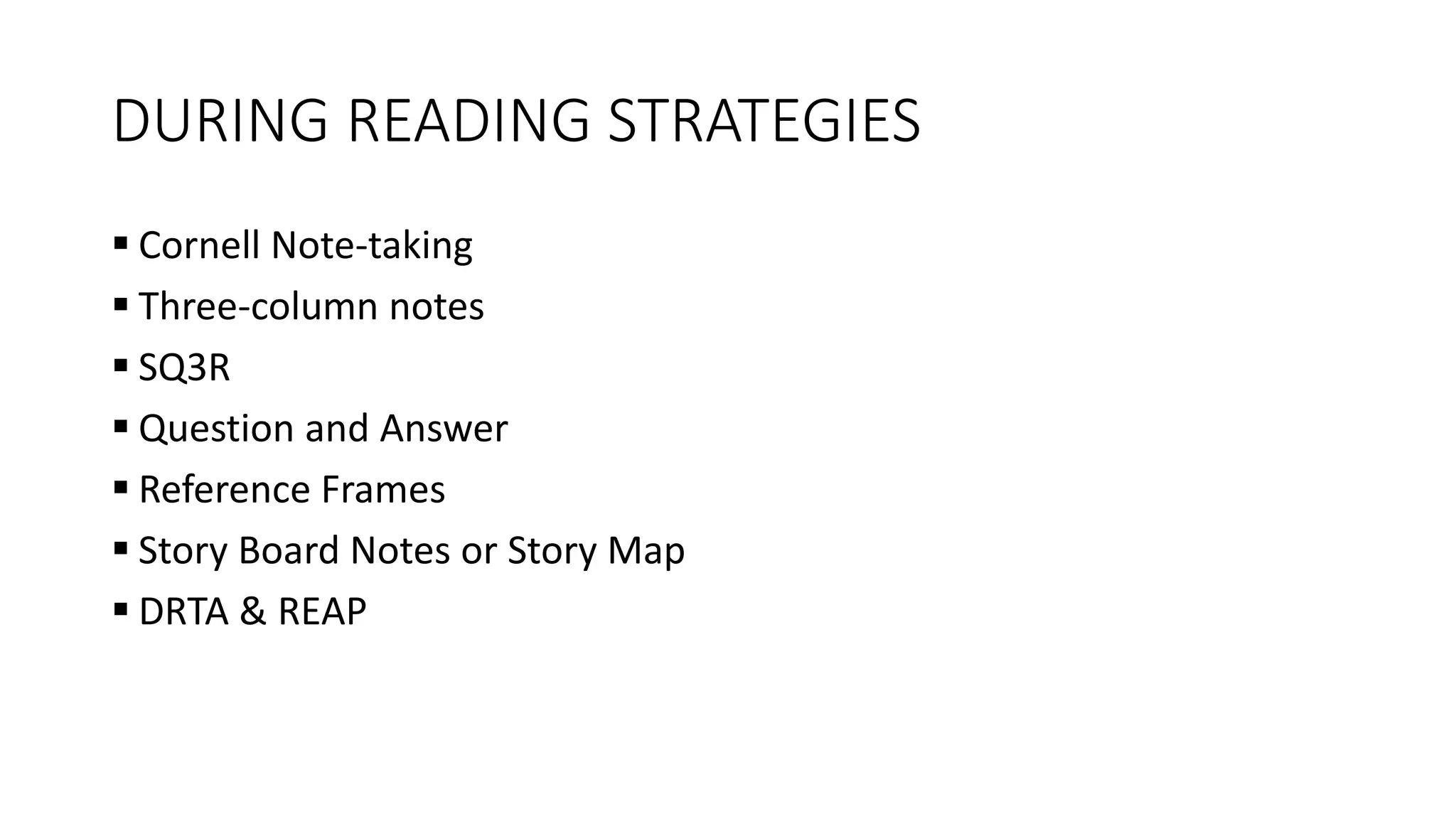
DURING READING STRATEGIES
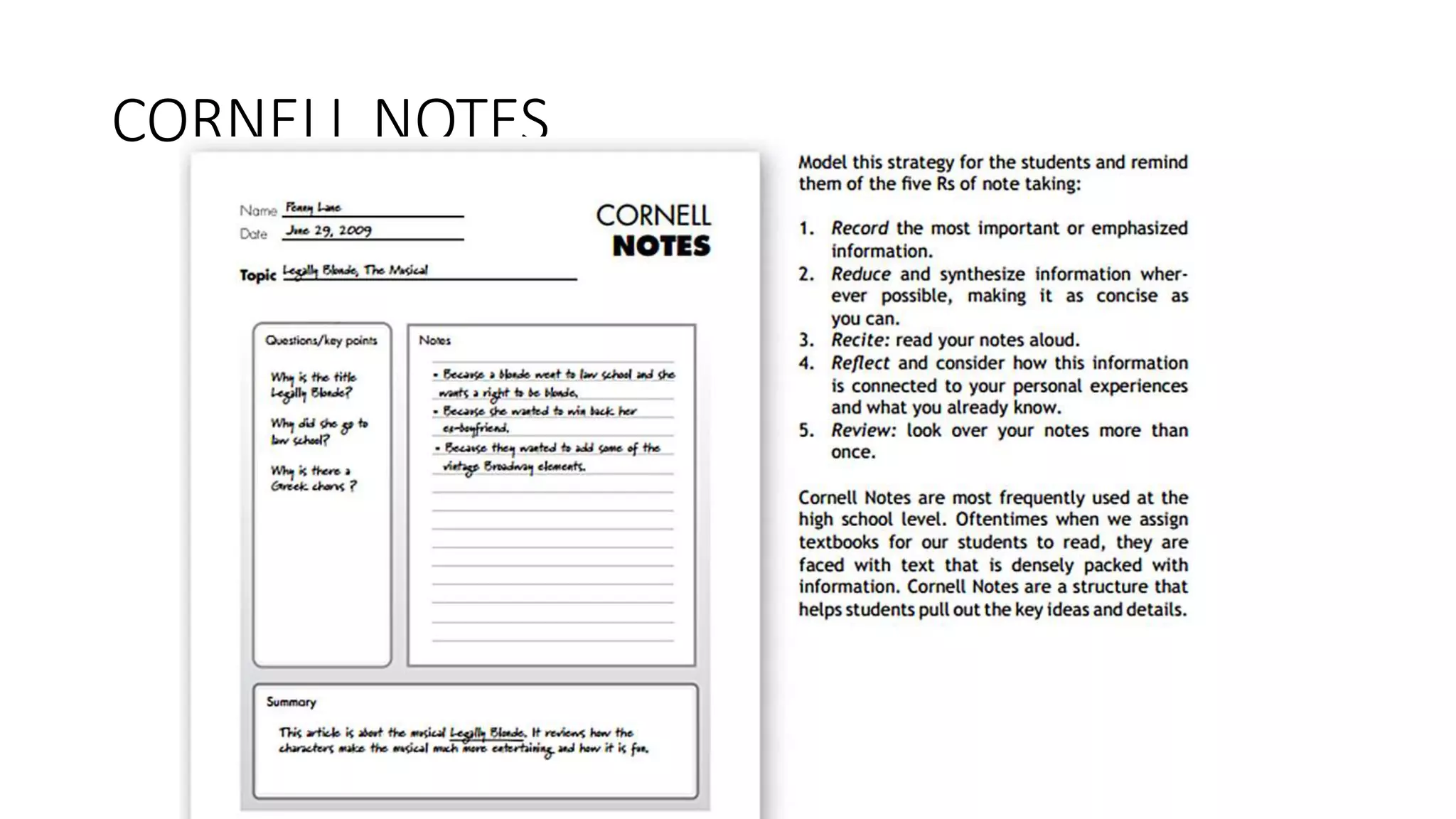
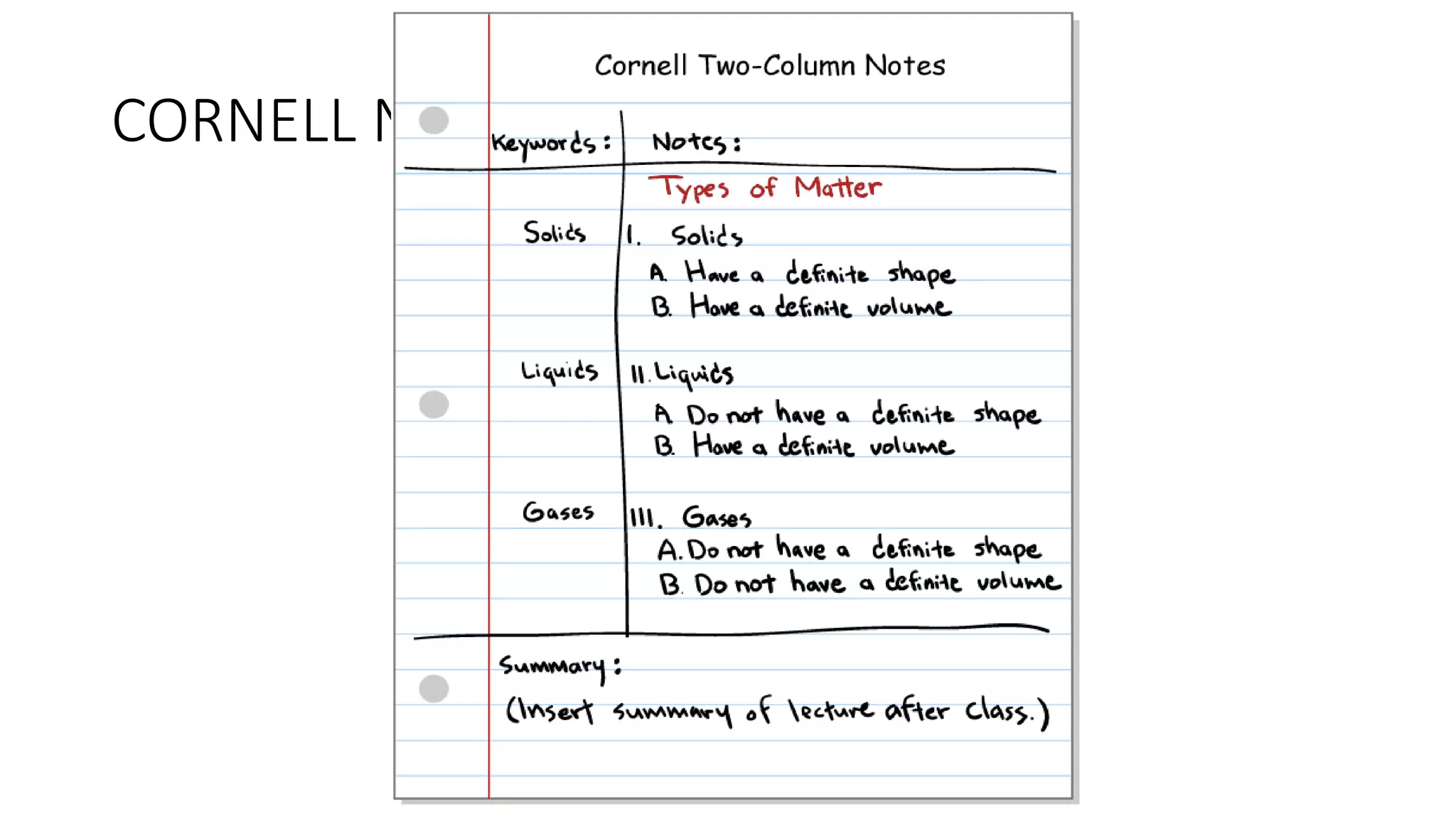
 Cornell Note-taking
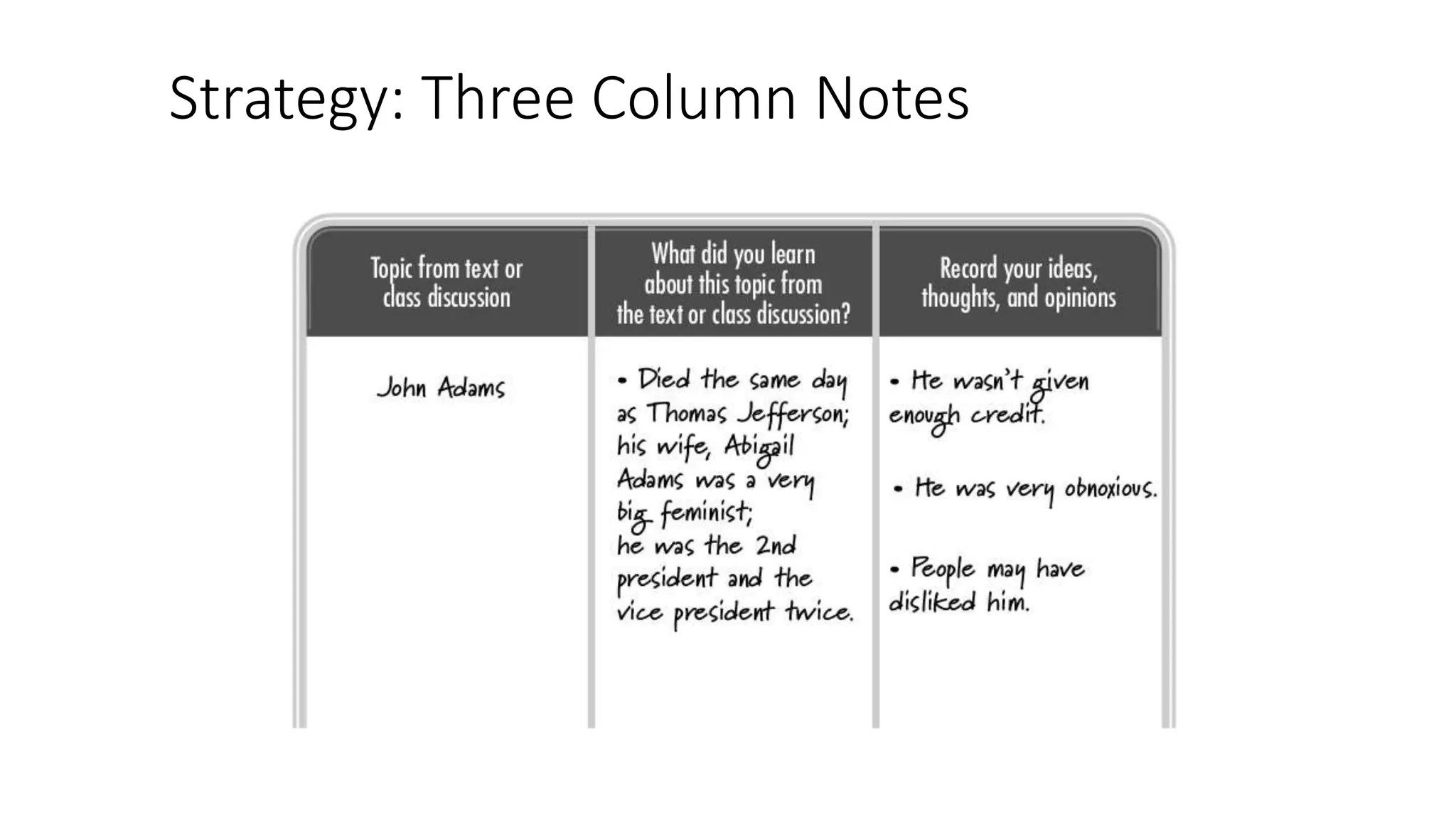
 Three-column notes
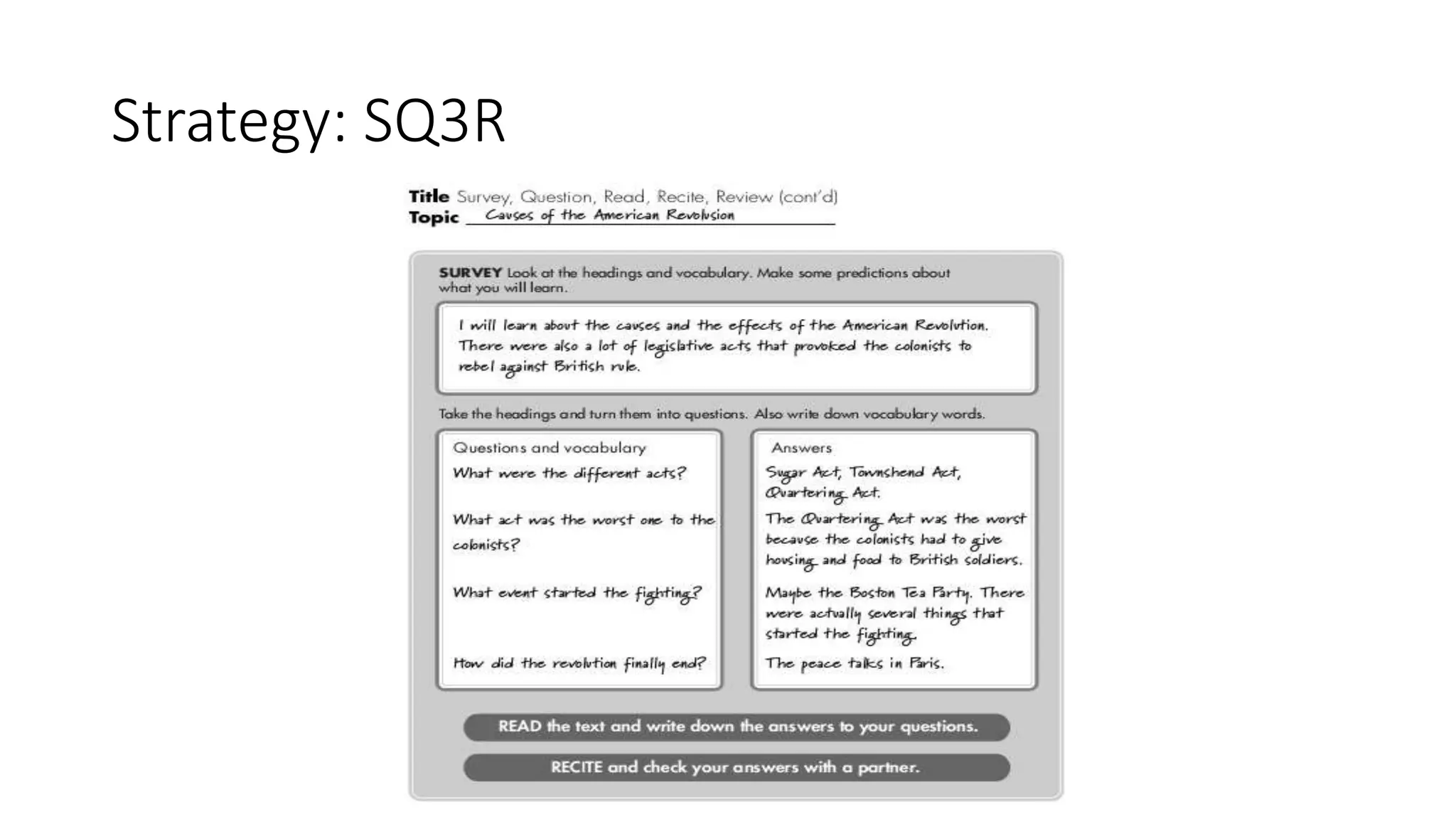
 SQ3R
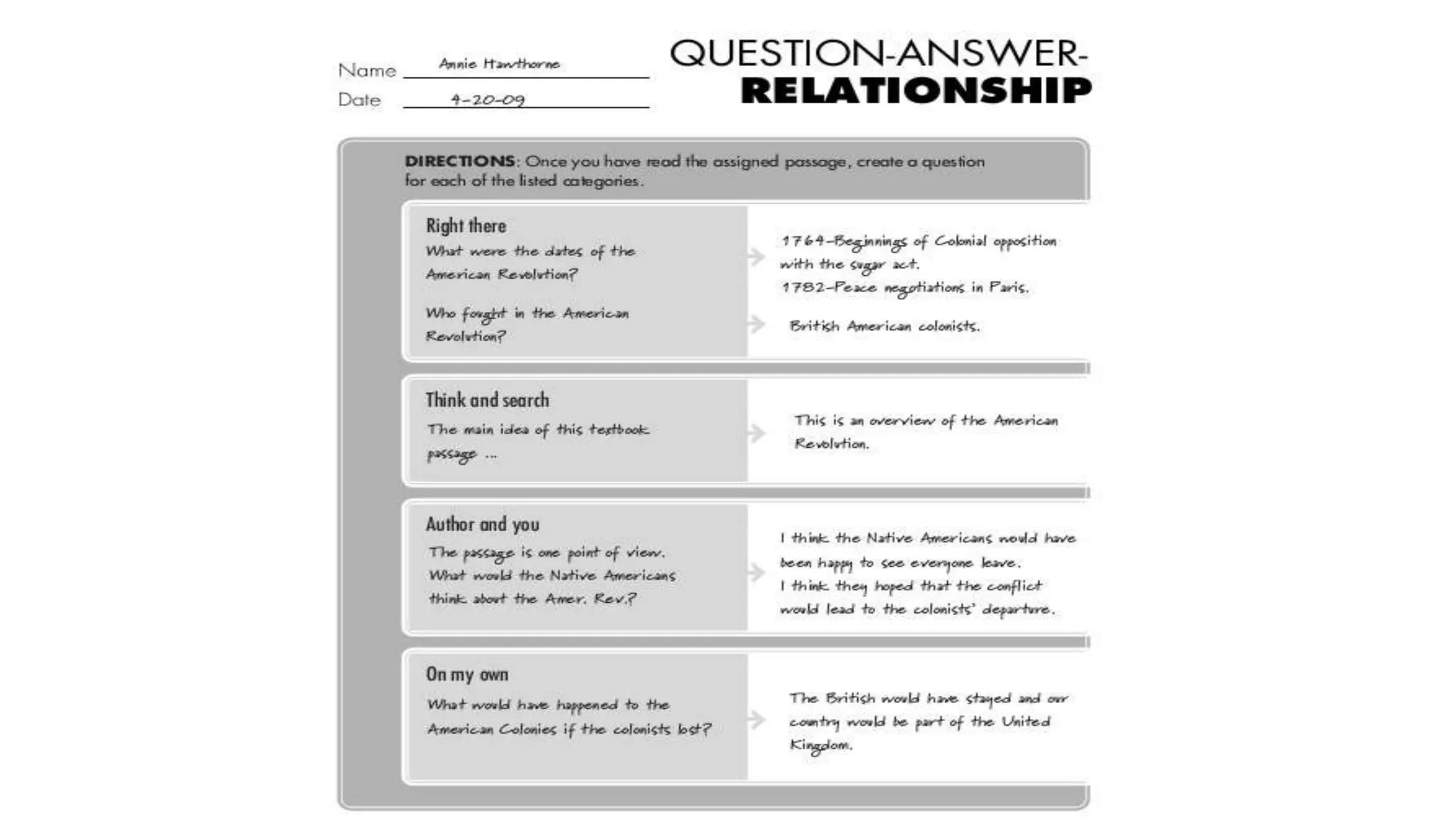
 Question and Answer
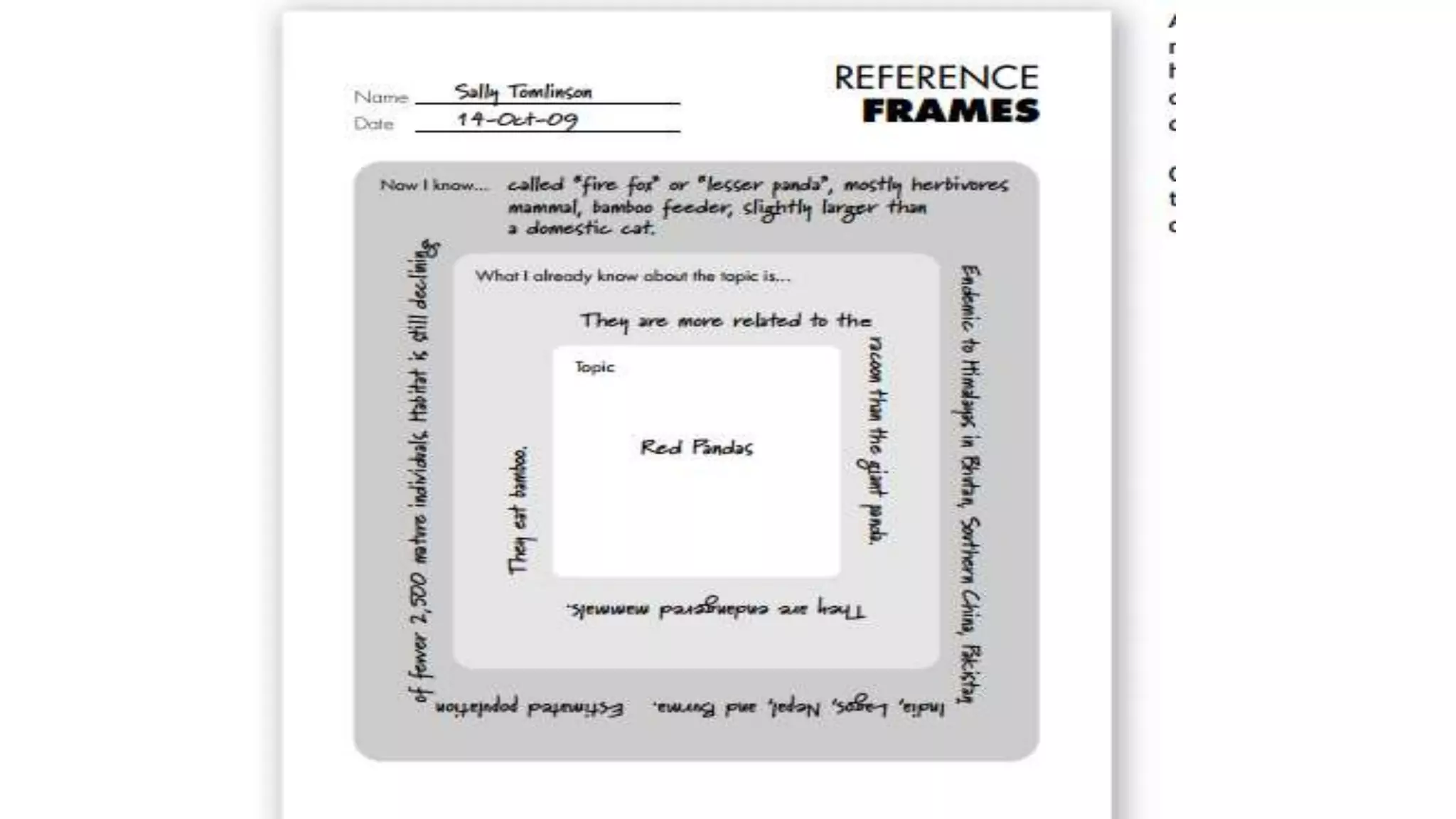
 Reference Frames
 Story Board Notes or Story Map
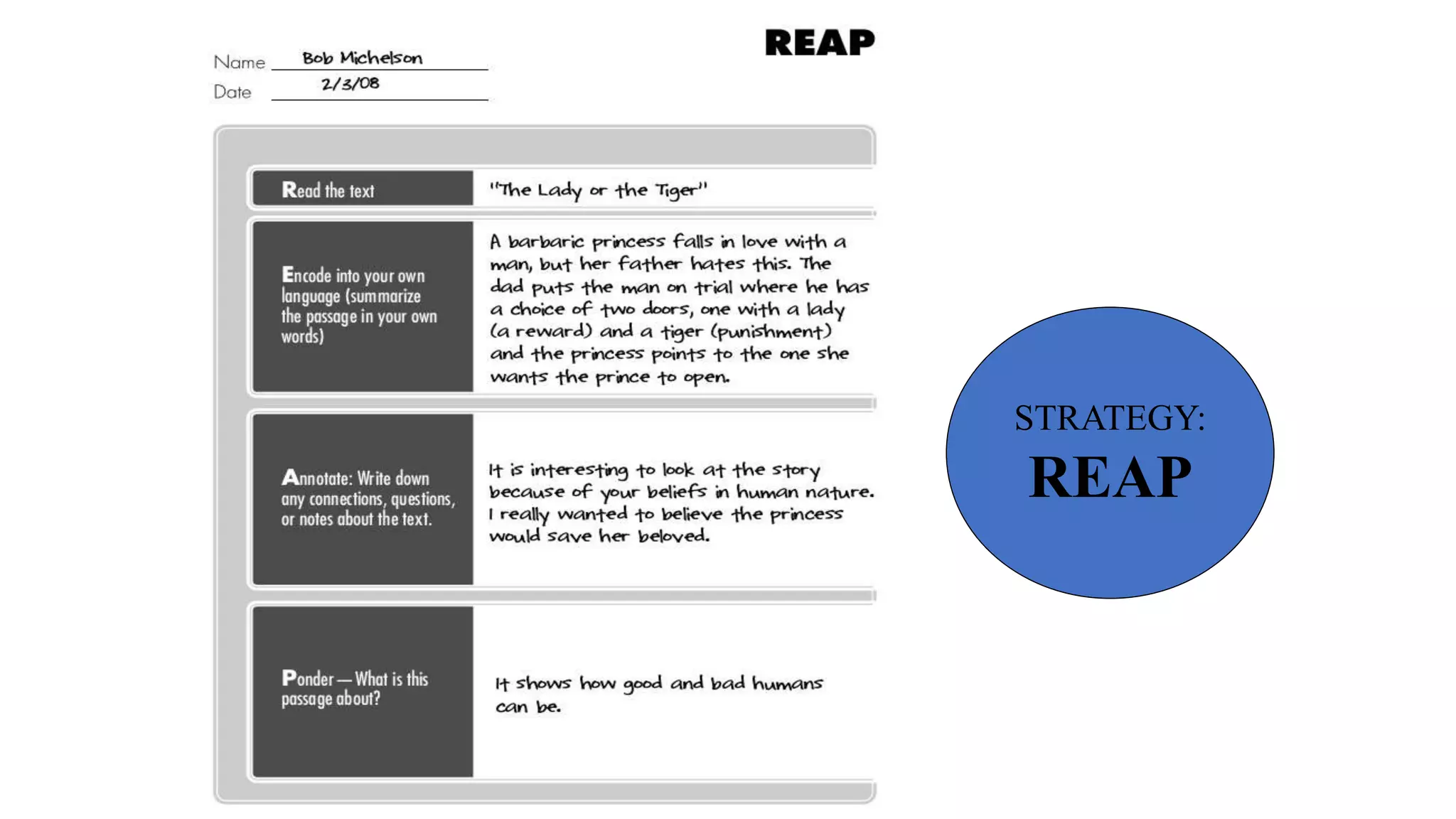
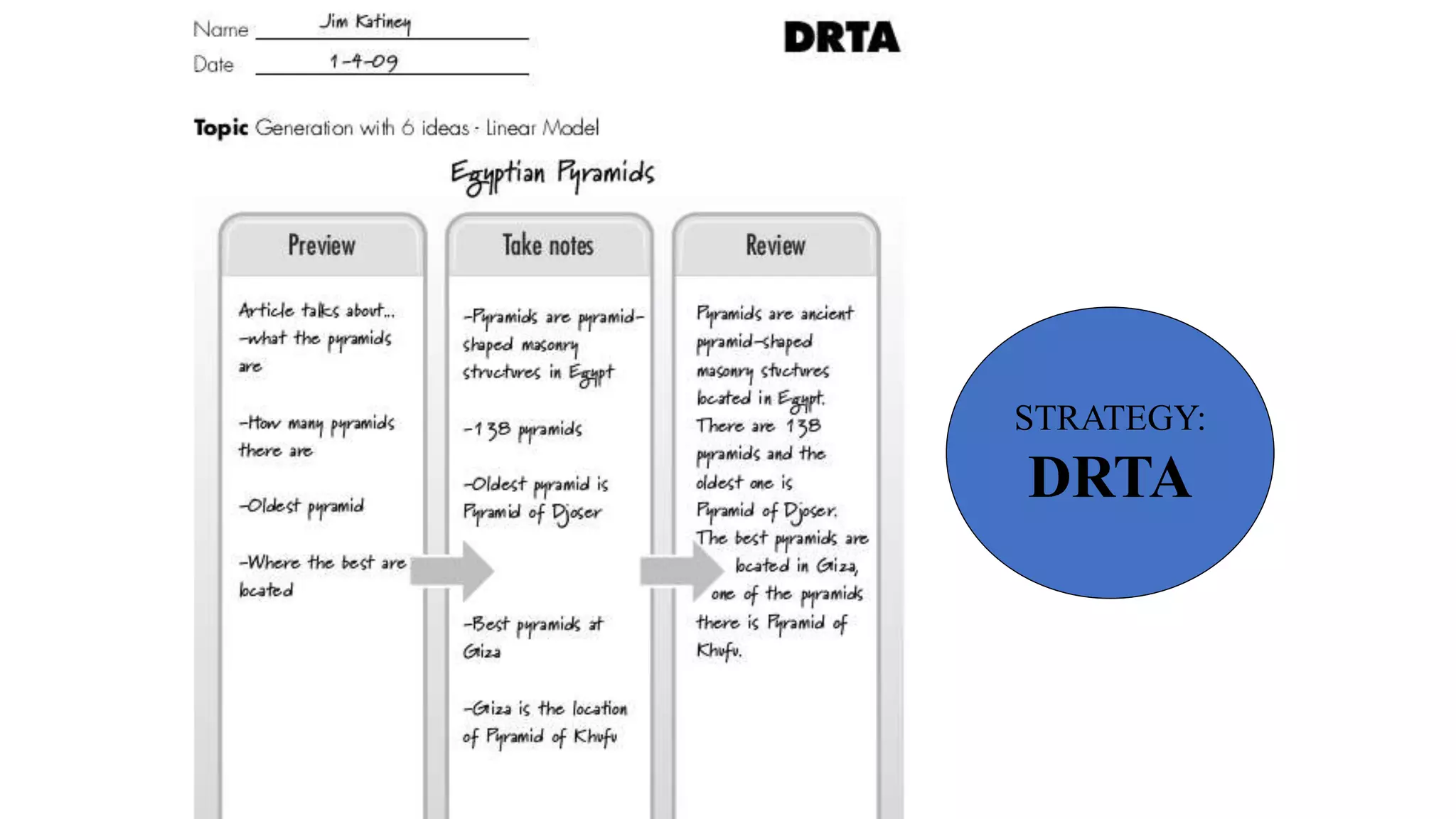
 DRTA & REAP
CORNELL NOTES
CORNELL NOTES
Strategy: SQ3R
STRATEGY:
REAP
STRATEGY:
DRTA
Strategy: Three Column Notes
After Reading Strategies
To consolidate their learning, effective learners reflect on new
information and integrate it into previous understandings by
personalizing and applying the new concepts.- Buehl, 2001
Have the students use the new information in a meaningful way that
they can apply prior knowledge and skills.- Runkle, 2009
After Reading Strategies
•3-2-1
•Discussion Webs
•Cooperative Activities
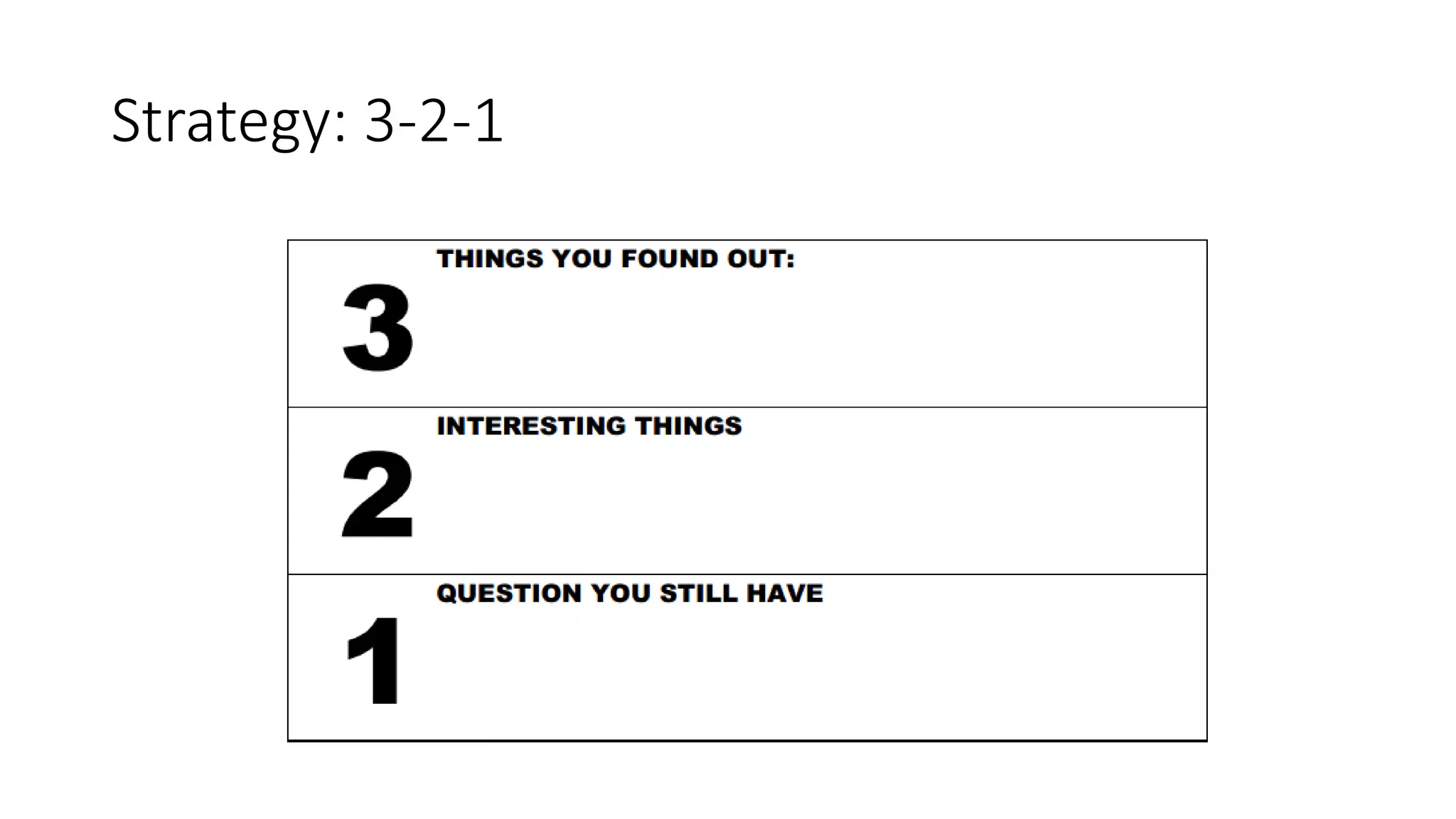
3-2-1- quick strategy for the end of any lesson, vary the response
3 - new facts that you have
learned over the past two days
2 - strategies that you will
definitely use this school year
1 - question that you still have
about content area literacy
Strategy: 3-2-1
Discussion Webs
• To encourage critical and
elaborative thinking
• Visual/graphic representation of
thinking processes
• Examining alternative points of
view
• Question should be stated so that
there is more than one point of
view
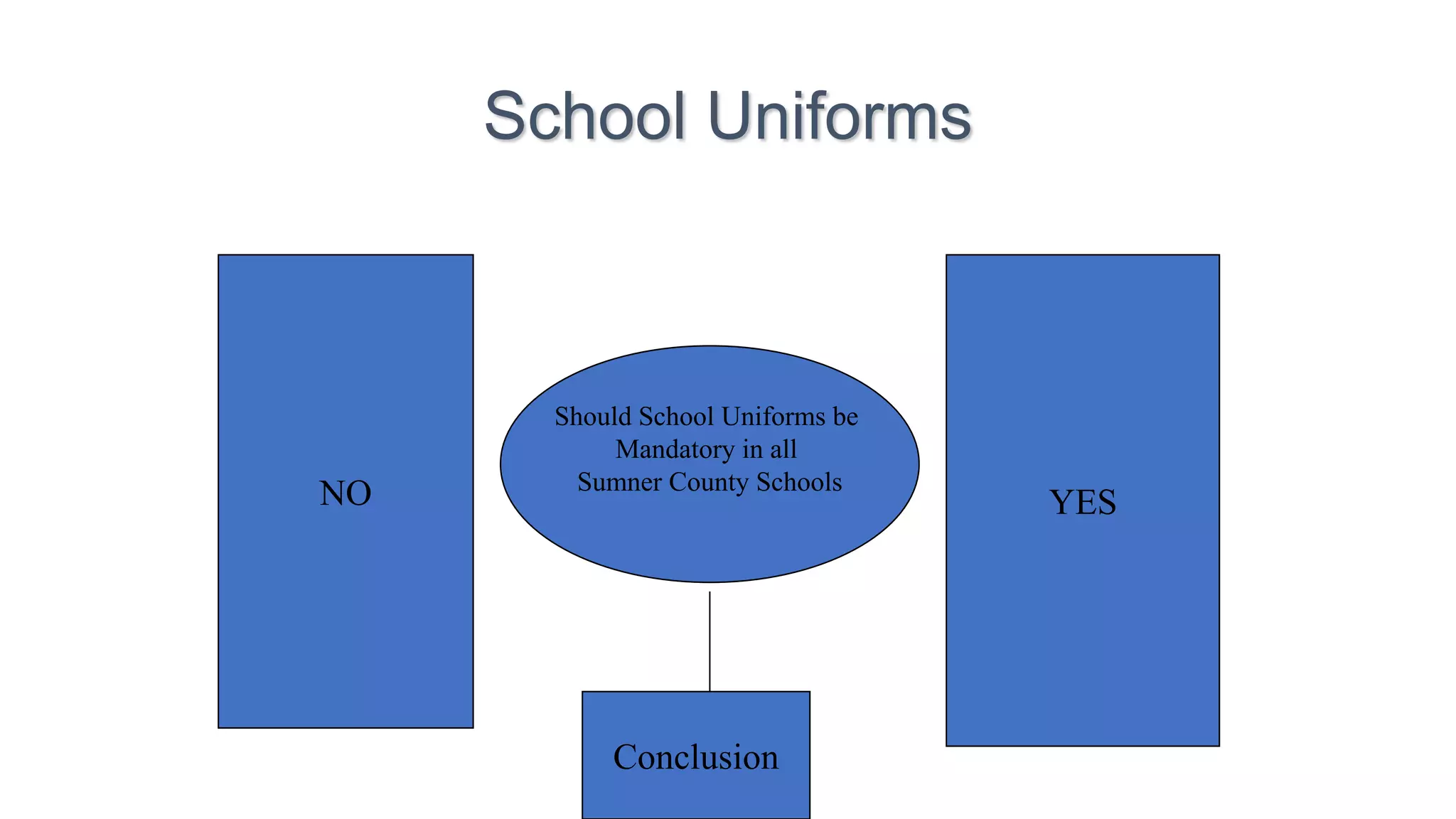
School Uniforms
Should School Uniforms be
Mandatory in all
Sumner County Schools
NO YES
Conclusion
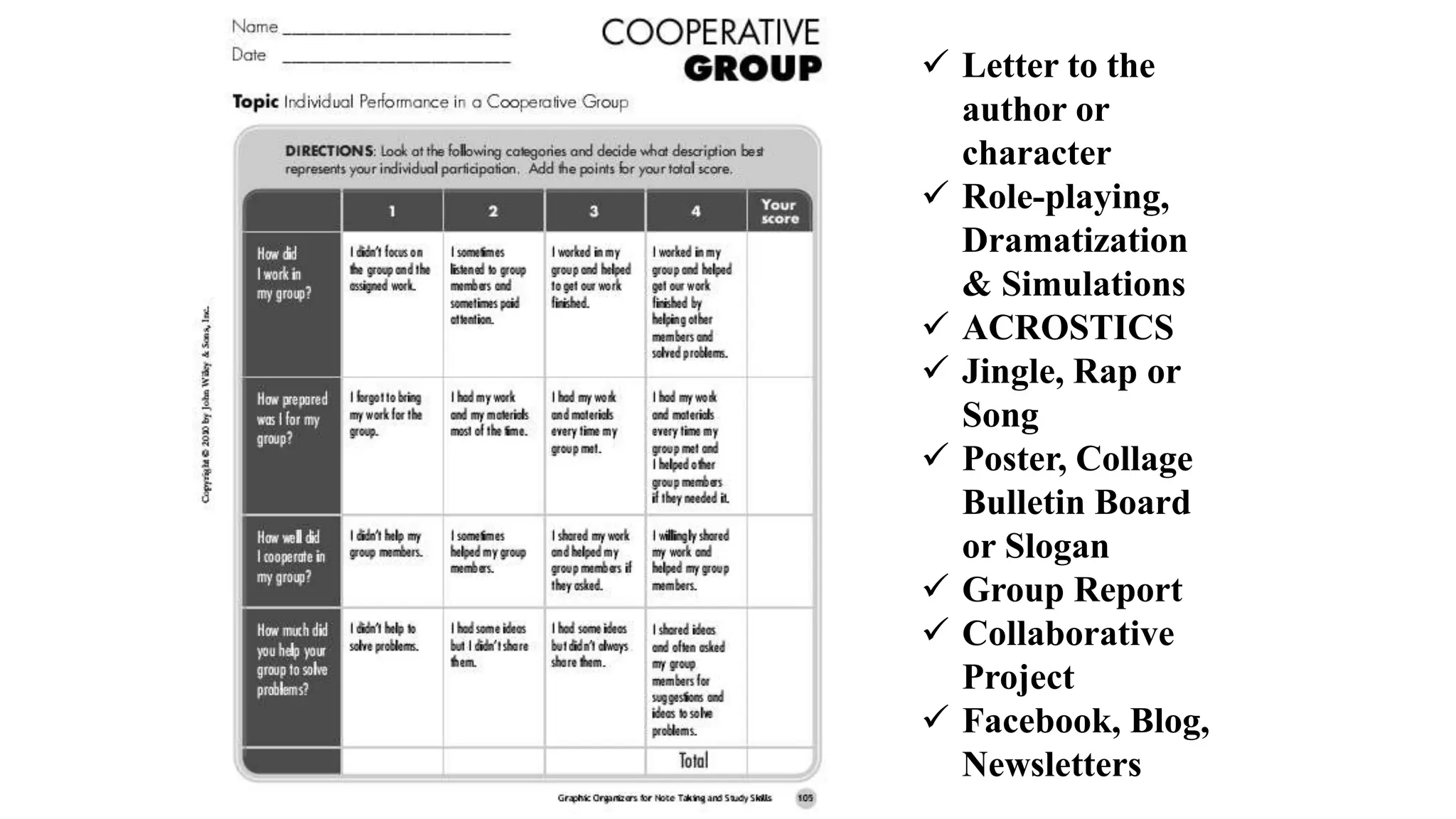
 Letter to the
author or
character
 Role-playing,
Dramatization
& Simulations
 ACROSTICS
 Jingle, Rap or
Song
 Poster, Collage
Bulletin Board
or Slogan
 Group Report
 Collaborative
Project
 Facebook, Blog,
Newsletters
 program is one that hinders or alters the action of
reading failure by preventing it from occurring
or stopping it if it has already started.
 Students
programs
who participate in intervention
attain the goal of reading or the
program is discontinued and other alternatives
are considered (Hiebert & Taylor, 1994).
Foorman and Moats (2004) summarized pertinent
findings regarding early reading intervention. These are:
1.Both explicit instruction in the alphabetic principle and
reading with comprehension should be incorporated.
2.Small-group instruction is as effective as one-on-one.
3.Grade 1 and 2 interventions are more efficient than
those implemented in later grades.
How do I evaluate programs?
Should:
1.Be adaptable to the students needs as identified by
assessment
2.Include alphabetic knowledge, phonemic awareness,
vocabulary development, and the reading of text as well as
systematic phonics instruction
3. Help teachers explicitly and systematically instruct students in
• how to relate letters and sounds
• how to break spoken words in to sounds
• and how to blend sounds to form words
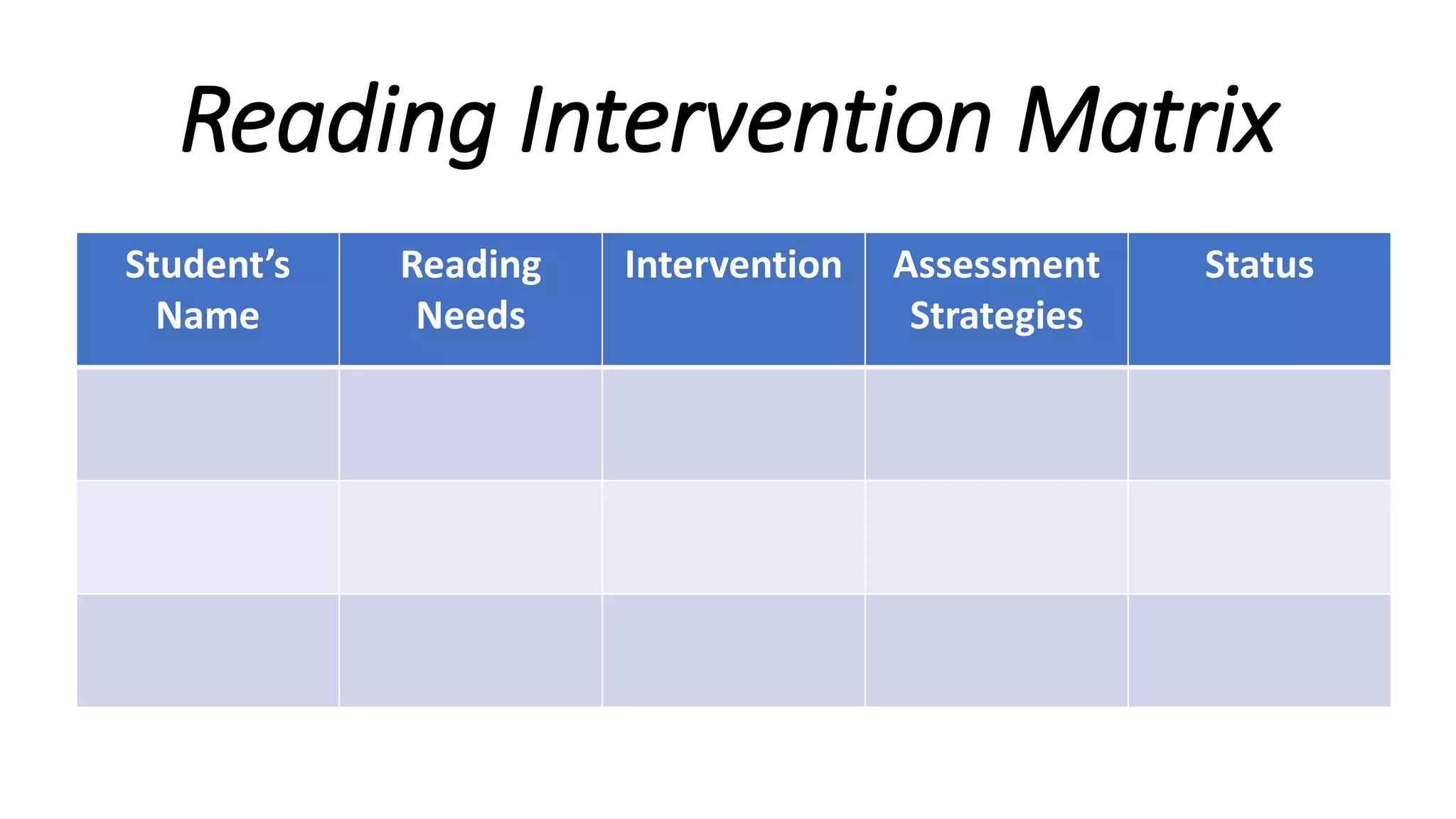
Reading Intervention Matrix
Student’s
Name
Reading
Needs
Intervention Assessment
Strategies
Status

Coaching on reading instruction

  • 1.
    Coaching on Reading Instruction MR.MARCO D. MEDURANDA Education Program Supervisor – English Division of Navotas How to Teach Reading More Effectively?
  • 2.
    Results of NeedsAssessment
  • 3.
    Results of NeedsAssessment
  • 4.
    Results of NeedsAssessment
  • 5.
    Results of NeedsAssessment
  • 6.
    Results of NeedsAssessment
  • 7.
    Results of NeedsAssessment
  • 8.
    Results of NeedsAssessment
  • 9.
    Results of NeedsAssessment
  • 10.
    Objectives A. Share effectivestrategies in the teaching of reading. B. Identify the characteristics of an effective reading/literacy teacher. C. Re
  • 11.
    Qualities of anEffective Reading Teacher Based from your experience, what are the qualities of a good & effective reading teacher? Write it on metacards.
  • 12.
    What Values andAttitude does an Effective Reading Teacher have? 1. Passion for reading: enthusiasm comes through in how you teach reading, in the books you choose and in how you read - with energy and conviction 2. Respect for learners and their languages: respect for the various languages children speak is a starting point to teach the standard forms of the language 3. Encouraging learners to believe in themselves: motivation builds children’s self-concept as readers and encourages more and better reading 4. Creating a caring and inclusive classroom environment: make children feel included and remove fear of the teacher and each other 5. Respect for parents, families and other caregivers: establish good relationships with them and help them to support their children’s literacy at home https://www.readinghorizons.com/blog/post/2013/02/20/6-characteristics-of-effective-reading-teachers
  • 13.
    What an EffectiveReading Teacher Knows? 1. How young children develop and learn: understand that learning to read involves the whole child (including physical, emotional, social and cognitive development) 2. How children acquire languages and develop bilingually: understand that exposure to language assists continuous language development in children 3. How children learn to read: understand that reading is a skill that has to be learned and a social practice as part of everyday lives 4. What to expect at different stages of children’s reading development: understand the reading development continuum which includes beginning, emergent, early, transitional and independent reading 5. The curriculum: understand how learners are expected to make progress in their reading through assessment activities https://www.readinghorizons.com/blog/post/2013/02/20/6-characteristics-of-effective-reading-teachers
  • 14.
    What Does EffectiveReading Teacher Do? 1. Organises their classroom to support the acquisition of language and literacy: plan and use the available space , furniture and resources to support language and literacy development 2. Plans for the year, the term, the week and the day: plan how the curriculum will be covered and formal assessments completed in the time available 3. Teaches different parts of the reading process: teach decoding, fluency, vocabulary and comprehension 4. Motivates children to read and provides them with opportunities to practice: accommodate different reading activities (phonics, shared reading and group guided reading) in lessons 5. Enjoys reading him/herself and provides a model for learners: demonstrate that reading is purposeful and enjoyable 6. Uses the home and additional languages competently to support children’s learning: teach reading in both home and additional languages confidently 7. Uses appropriate resources to support teaching and learning: use the most interesting resource for teaching reading - interesting books at the right level https://www.readinghorizons.com/blog/post/2013/02/20/6-characteristics-of-effective-reading-teachers
  • 15.
    Reading is complex process. Effectiveteachers understand this complexity and are able to use a range of approaches and strategies to help students make meaning from the text. Making Meaning from the Text
  • 16.
    Attitude and Motivation •Whateducational and non- educational factors affect child’s attitude and motivation to read? •How do you develop the child’s eagerness and willingness to read?
  • 17.
    Educational Non-Educational • Teacher •Instructional materials • text and content • Classroom climate • Background knowledge and competencies • Physical • Health • Visual • Auditory • Neurobiological deviation • Emotional • Socio-economic • Psycho-social
  • 18.
    This will lookweird! Believe it or not, you can read it! I cdnuolt blveiee taht I cluod aulaclty uesdnatnrd waht I was rdgnieg. The phaonmneal power of the hmuan mnid Aoccdrnig to a rscheearch at Cmabrigde Uinervtisy, it deosn’t mttaer. Inwaht oredr the ltteers in a word are, the olny iprmoatnt tihng is that the frist and lsat ltteer be in the rghit pclae. The rset can be a taotl mses and you can still raed it wouthit a porbelm. This is bcuseae the huamn mnid deos not raed ervey lteter by istlef, but the word as a wlohe. Amzaning huh? Yeah and I awlyas thought slpeling was ipmorantt!
  • 19.
    Prior Knowledge The questionsthat p______ face as they raise ch_____ from in______ to adult life are not easy to an_____. Both fa____ and m_____ can become concerned when health problems such as co____ arise any time after the e_____ stage to later in life. Experts recommend that young ch______ should have plenty of s____ and nutritious food for healthy growth. B_____ and g_____ should not share the same b____ or even sleep in the same r____. They may be afraid of the d______. Billmeyer, Rachel and Mary Lee Barton. Teaching Reading in the Content Areas: If Not Me, Than Who? Aurora: McREL (Mid-continent Regional Education Laboratory),1998
  • 20.
  • 21.
  • 22.
    Effective Phonics Instruction is *systematic * explicit * multi-sensory * engaging * integrative (reading and writing)
  • 24.
  • 25.
  • 26.
  • 27.
  • 28.
    Vocabulary Knowledge The Useof Adapted Frayer Model in Developing Vocabulary Knowledge of Grade 10 Students MR. MARCO D. MEDURANDA Navotas National High School Division of Navotas City Regionwide Research Congress 2017 February 1-2, 2017 Conference Hall, DepEd NCR INTERVENTION: EXPLICIT VOCABULARY INSTRUCTION USING FRAYER MODEL PREPARATION INTRODUCTION OF STRATEGY MODELLING DEMONSTRATING GUIDED PRACTICE: PAIRWORK INDEPENDENT PRACTICE WRAP UP • 20 minutes of explicit vocabulary instruction using Frayer Model in three weeks. PARTICIPANTS Forty Grade 10 students with approaching proficiency level in English (Nation, 2001)
  • 30.
  • 31.
    Teaching Comprehension  BeforeReading Strategies  During Reading Strategies  After Reading Strategies
  • 32.
    Activate Prior Knowledge andSet A Purpose for Reading Figure Out What is Important Organize Knowledge Make Inference Find out the Meanings of Unknown WordsAsk Questions Visualize Set a purpose Activate prior knowledge Preview the reading Introduce important vocabulary
  • 33.
    Before Reading Strategies AnticipationGuide Chapter Walk ABC’s of ______________ KWL/ KNL Below the Line
  • 34.
    Anticipation Guide 1. Readeach statement and place a check under agree or disagree in the “before” column. 2. Whole group discussion on agreements and disagreements. 3. Read the text (teacher read or independently). 4. Reread each statement and place a check under the agree or disagree in the “after” column. 5. Make a note in the box as to where the evidence can be located to support this statement. 6. Whole group or small group discussion to collaborate on the text based evidence. Anticipation Guide-EXAMPLE.doc
  • 35.
  • 36.
  • 37.
  • 38.
  • 39.
  • 40.
  • 41.
  • 42.
  • 43.
  • 44.
  • 45.
  • 46.
    46 Example of aVocabulary Strategy Frayer Model – (Barton & Heidema, 2002) Definition (in own words) Facts/Characteristic s Examples Non-Examples WORD or SYMBOL
  • 47.
    47 Example of aVocabulary Strategy Frayer Model – (Barton & Heidema, 2002) Definition (in own words) Facts/Characteristic s Examples Non-Examples RADICAL An expression in this form is called a radical, b is called the radicand and the n is called the index of the radical.n b 44 81 3 3 81because  3 54 1 1 1 1 1    a is the positive square root of a a is the negative square root of a 0 0n 9 3 9 3   9 'can t do  3 2205 Not a radical – thisis a division sign
  • 48.
    48 Example of aVocabulary Strategy Frayer Model – (Barton & Heidema, 2002) 33 9 3 8 2 2 2 2     Definition (in your own words) Facts/Characteristic s Examples Non-Examples These are radical signs . When no superscript number is in front (called the index) it means it is square root. With a “3” index it becomes a cube root and so on. *there is never an index=1 *odd roots are always the same sign as the number under the radical. Not a radical – this is a division sign n n x x 3 2205 nor 0 0n 33 9 3 8 2 2 2 2     9 3 9 3  33 8 2 2 2 2      1 1n
  • 49.
    DURING  Monitor comprehensionto adjust pacing or ask questions  Maintain mental activity through connecting, predicting, summarizing, etc.  Organize and integrate new information on graphic organizers  Verify/ adjust predictions to categorize new information
  • 50.
    DURING READING STRATEGIES Cornell Note-taking  Three-column notes  SQ3R  Question and Answer  Reference Frames  Story Board Notes or Story Map  DRTA & REAP
  • 51.
  • 52.
  • 55.
  • 56.
  • 57.
  • 58.
  • 59.
    After Reading Strategies Toconsolidate their learning, effective learners reflect on new information and integrate it into previous understandings by personalizing and applying the new concepts.- Buehl, 2001 Have the students use the new information in a meaningful way that they can apply prior knowledge and skills.- Runkle, 2009
  • 60.
  • 61.
    3-2-1- quick strategyfor the end of any lesson, vary the response 3 - new facts that you have learned over the past two days 2 - strategies that you will definitely use this school year 1 - question that you still have about content area literacy
  • 62.
  • 63.
    Discussion Webs • Toencourage critical and elaborative thinking • Visual/graphic representation of thinking processes • Examining alternative points of view • Question should be stated so that there is more than one point of view
  • 64.
    School Uniforms Should SchoolUniforms be Mandatory in all Sumner County Schools NO YES Conclusion
  • 65.
     Letter tothe author or character  Role-playing, Dramatization & Simulations  ACROSTICS  Jingle, Rap or Song  Poster, Collage Bulletin Board or Slogan  Group Report  Collaborative Project  Facebook, Blog, Newsletters
  • 66.
     program isone that hinders or alters the action of reading failure by preventing it from occurring or stopping it if it has already started.  Students programs who participate in intervention attain the goal of reading or the program is discontinued and other alternatives are considered (Hiebert & Taylor, 1994).
  • 67.
    Foorman and Moats(2004) summarized pertinent findings regarding early reading intervention. These are: 1.Both explicit instruction in the alphabetic principle and reading with comprehension should be incorporated. 2.Small-group instruction is as effective as one-on-one. 3.Grade 1 and 2 interventions are more efficient than those implemented in later grades.
  • 68.
    How do Ievaluate programs? Should: 1.Be adaptable to the students needs as identified by assessment 2.Include alphabetic knowledge, phonemic awareness, vocabulary development, and the reading of text as well as systematic phonics instruction 3. Help teachers explicitly and systematically instruct students in • how to relate letters and sounds • how to break spoken words in to sounds • and how to blend sounds to form words
  • 69.