Chapter 12 PresentationTiffany AlersJanelle BalujaLiz OvidezSilvia PerrinaJuliana SantosYessenia Zamora
Current trends in reading and reading instructionTiffany Alers
The goal of reading instruction is to provide students with the skills, strategies, and knowledge to read fluently and to understand the meaning from the text.
Reading skills are a prerequisite of learning in many different content areas.
The international reading association has a group called balance reading instruction.
The purpose of the balance approach is to teach early reading, including phonological awareness and phonics instruction.Current trends in Reading
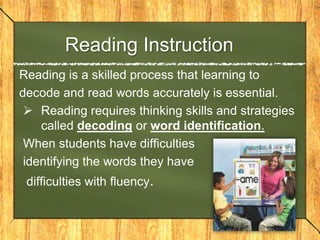
Reading Instruction Reading is a skilled process that learning todecode and read words accurately is essential.Reading requires thinking skills and strategies called decoding or word identification.When students have difficulties identifying the words they have difficulties with fluency.
 Reading involves understanding the meaning of the text interpreted by the reader which is called reading comprehension.
When the reader may not have understood they might create “fix-up” strategies.
 ex: rereading, reading on further or ignore confusion
An important goal in reading instruction is to teach comprehension and comprehension monitoring strategies.Reading Instruction Cont.
Learning difficultiesReading is a complex process and it involves many areas of potential difficulties.Reciprocal causation which means a domino effect that an initial factor leads to a second factor, and a third and so on.Ex: Children who are not read to during preschool might not be familiar with books, which leads to not knowing print or sounds, which leads to greater problems.When teaching you must be sensitive to the factors that influence reading to the individual needs of each student.
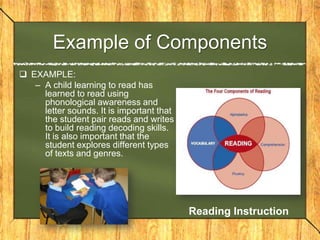
Depending on the student’s development and needs should emphasize on certain components.It is crucial to obtain these components to maintain a balance approach in reading. A goal of reading instruction is to use social content to engage students in discussion about what they are reading and the reading process.Components of Reading Instruction
Example of ComponentsEXAMPLE:A child learning to read has learned to read using phonological awareness and letter sounds. It is important that the student pair reads and writes to build reading decoding skills. It is also important that the student explores different types of texts and genres.Reading Instruction
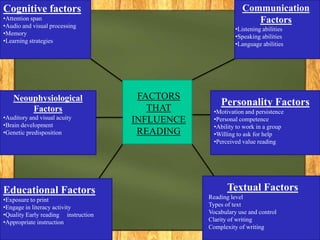
Cognitive factorsAttention span
Audio and visual processing
Memory
Learning strategiesCommunication FactorsListening abilities
Speaking abilities
Language abilitiesFACTORS THAT INFLUENCE READINGNeouphysiologicalFactorsAuditory and visual acuity
Brain development
Genetic predispositionPersonality FactorsMotivation and persistence
Personal competence
Ability to work in a group
Willing to ask for help
Perceived value readingTextual FactorsReading levelTypes of textVocabulary use and controlClarity of writingComplexity of writingEducational FactorsExposure to print
Engage in literacy activity
Quality Early reading     instruction
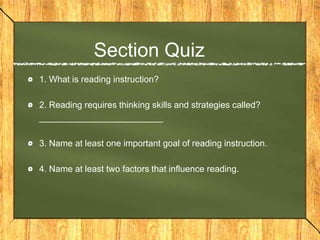
Appropriate instructionSection Quiz1. What is reading instruction?2. Reading requires thinking skills and strategies called? 	_________________________ 3. Name at least one important goal of reading instruction.4. Name at least two factors that influence reading.
Effective Reading Instruction for Struggling ReadersJanelle Baluja
Effective Reading for Struggling ReadersIt is important for teachers to create an effective reading environment for all students. Some effective reading instruction that a teacher can use throughout their classroom include the following:Establishing an environment to promote readingUsing appropriate on going assessments and monitoring (to see what students have mastered and need to develop)Providing intensive instructionObtaining early intervention when needed
Establishing an Environment to Promote ReadingHaving a room filled with print that is of interest to the students can help them become easily engaged to read, which will ultimately build up their vocabulary as well as reading skills.Some materials and resources that are beneficial in having include:Class libraryReading centerWord study centerListening center
Establishing an Environment to Promote ReadingThe social environment is also critical. The teacher needs to be the one providing the example of how a book should be read, and this can be done by reading a book aloud to the class. Having discussions on the books they have read is also another important element.Some strategies to help build the students reading skills would include echo and choral reading.
Using Response to Intervention to Screen Struggling ReadersThe focus in helping struggling readers get the help that they need is focused around RTI. The steps of RTI include: Ongoing screening Monitoring progress Early intervention in reading and ongoing assessments and treatments.
Using Response to Intervention to Screen Struggling ReadersHow do you know if students are responding to instruction? We are capable of finding out through several important questions: Have students received scientifically-based reading instruction? Have students received adequate opportunities to respond and obtain feedback? How does their performance in reading compare to the rest of the classroom? Have students received instructional opportunities in small groups to obtain reading proficiency? Have students been engaged and given opportunities to read texts of their interest? Is data available to view the slope of the students reading skills?
Using Response to Intervention to Screen Struggling ReadersAnswering those questions can help you as a teacher determine whether or not the student had received adequate instruction. This then allows you to understand whether or not their low responses to instruction is a functional need to the student.Completing assessments and monitoring their progress helps teachers have a better understanding where the student seems to be struggling at with their reading.
Using Screening Assessment and Progress MonitoringScreening is a mechanism that reveals a students progress compared to the rest of their grade level peers. These screenings also allow teachers to measure whether students are reading above or even below average. When it comes to assessing students, teachers need to make sure they go about it properly.TYPES OF ASSESSMENTS-Critical aspects to keep in mind before choosing an assessment: Purpose of assessment Specific information needed about the students reading Number of students being tested Qualifications of assessor
Using Screening Assessment and Progress MonitoringPicking the correct assessment is also a critical aspect. Diagnostic Assessments- Tells us specifically how a student is performing, and well else he or she need to know. Norm-based Assessments- Help us to determine how the student’s performance idea of what students of the same age or in the same grade.
Using Screening Assessment and Progress MonitoringPROGRESS MONITORING-Progress monitoring, also known as curriculum-based measurement (CBM), is a means of measuring student’s progress and highlights  the close tie between curriculum and student performance. CBM provides ongoing data for making instructional decisions by considering: How performance is affected by changing the instructional part The rate of learning compared to the goal The variability in the consistency of the performance
Using Screening Assessment and Progress MonitoringInformal reading inventories and curriculum-based measurement are means for monitoring student progress. Informal reading inventories is when students read lists of words and passages that are leveled by grade, and retell or answer questions about the passages that they have read.Guidelines that provide information on whether or not students are reading appropriate material: Independent reading level Instructional reading level Frustration reading level
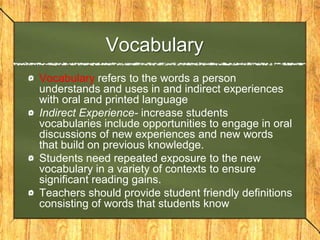
Providing Intensive InstructionStudents that have special learning needs, it is important to find ways to provide appropriate instruction for their individual needs and it needs to be intensive enough to create progress.Reading instruction is appropriate and intensive when:  Students have  a clear understanding of teacher expectations Instruction provided matches the reader’s instructional reading level and needs Adequate texts are used that are engaging to the students and at their reading level Instruction is is explicit and direct in the skills and strategies and reader needs in order to become proficient and more independent
Providing Intensive Instruction Students are grouped appropriately, which includes ability-level grouping Instruction includes frequent opportunities for responding with feedback Student progress is monitored frequently and used to make instructional decisions Teachers and peers support the students when necessary
Obtaining Early Intervention: Response to InterventionAn early intervention class addresses students with reading difficulties as soon as they become aware of there situation.
 These classes provide a one-on-one instruction in which each student is grouped by there levels and needs.
 Through this program, it teaches phonological awareness, letter-sound correspondences, decoding skills and word recognition.
 This programs work mainly for grade levels 2 -5.Section QuestionsAt what level is the material too difficult for the students to read with understanding even with assistance?
What does the curriculum-based measurement measure?
Why is it important to screen struggling readers?Strategies for teaching phonological awareness and phonicsLiz Ovides
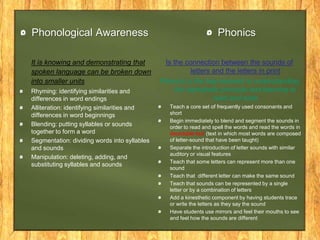
Phonological AwarenessPhonicsIt is knowing and demonstrating that spoken language can be broken down into smaller unitsRhyming: identifying similarities and differences in word endingsAlliteration: identifying similarities and differences in word beginningsBlending: putting syllables or sounds together to form a wordSegmentation: dividing words into syllables and soundsManipulation: deleting, adding, and substituting syllables and soundsIs the connection between the sounds of letters and the letters in printPhonics is the key element in understanding the alphabetic principle and learning to read and writeTeach a core set of frequently used consonants and shortBegin immediately to blend and segment the sounds in order to read and spell the words and read the words in decodable text (text in which most words are composed of letter-sound that have been taught)Separate the introduction of letter sounds with similar auditory or visual featuresTeach that some letters can represent more than one soundTeach that  different letter can make the same soundTeach that sounds can be represented by a single letter or by a combination of lettersAdd a kinesthetic component by having students trace or write the letters as they say the soundHave students use mirrors and feel their mouths to see and feel how the sounds are different
Section QuestionsWhat is phonological awareness?List the five skills included in phonological awareness.Describe the five skill you listed above.What is Phonics?What is decodable text?

Chapter 12 presentation eex

  • 1.
    Chapter 12 PresentationTiffanyAlersJanelle BalujaLiz OvidezSilvia PerrinaJuliana SantosYessenia Zamora
  • 2.
    Current trends inreading and reading instructionTiffany Alers
  • 3.
    The goal ofreading instruction is to provide students with the skills, strategies, and knowledge to read fluently and to understand the meaning from the text.
  • 4.
    Reading skills area prerequisite of learning in many different content areas.
  • 5.
    The international readingassociation has a group called balance reading instruction.
  • 6.
    The purpose ofthe balance approach is to teach early reading, including phonological awareness and phonics instruction.Current trends in Reading
  • 7.
    Reading Instruction Readingis a skilled process that learning todecode and read words accurately is essential.Reading requires thinking skills and strategies called decoding or word identification.When students have difficulties identifying the words they have difficulties with fluency.
  • 8.
    Reading involvesunderstanding the meaning of the text interpreted by the reader which is called reading comprehension.
  • 9.
    When the readermay not have understood they might create “fix-up” strategies.
  • 10.
    ex: rereading,reading on further or ignore confusion
  • 11.
    An important goalin reading instruction is to teach comprehension and comprehension monitoring strategies.Reading Instruction Cont.
  • 12.
    Learning difficultiesReading isa complex process and it involves many areas of potential difficulties.Reciprocal causation which means a domino effect that an initial factor leads to a second factor, and a third and so on.Ex: Children who are not read to during preschool might not be familiar with books, which leads to not knowing print or sounds, which leads to greater problems.When teaching you must be sensitive to the factors that influence reading to the individual needs of each student.
  • 13.
    Depending on thestudent’s development and needs should emphasize on certain components.It is crucial to obtain these components to maintain a balance approach in reading. A goal of reading instruction is to use social content to engage students in discussion about what they are reading and the reading process.Components of Reading Instruction
  • 14.
    Example of ComponentsEXAMPLE:Achild learning to read has learned to read using phonological awareness and letter sounds. It is important that the student pair reads and writes to build reading decoding skills. It is also important that the student explores different types of texts and genres.Reading Instruction
  • 15.
  • 16.
  • 17.
  • 18.
  • 19.
  • 20.
    Language abilitiesFACTORS THATINFLUENCE READINGNeouphysiologicalFactorsAuditory and visual acuity
  • 21.
  • 22.
  • 23.
  • 24.
    Ability to workin a group
  • 25.
  • 26.
    Perceived value readingTextualFactorsReading levelTypes of textVocabulary use and controlClarity of writingComplexity of writingEducational FactorsExposure to print
  • 27.
  • 28.
  • 29.
    Appropriate instructionSection Quiz1.What is reading instruction?2. Reading requires thinking skills and strategies called? _________________________ 3. Name at least one important goal of reading instruction.4. Name at least two factors that influence reading.
  • 30.
    Effective Reading Instructionfor Struggling ReadersJanelle Baluja
  • 31.
    Effective Reading forStruggling ReadersIt is important for teachers to create an effective reading environment for all students. Some effective reading instruction that a teacher can use throughout their classroom include the following:Establishing an environment to promote readingUsing appropriate on going assessments and monitoring (to see what students have mastered and need to develop)Providing intensive instructionObtaining early intervention when needed
  • 32.
    Establishing an Environmentto Promote ReadingHaving a room filled with print that is of interest to the students can help them become easily engaged to read, which will ultimately build up their vocabulary as well as reading skills.Some materials and resources that are beneficial in having include:Class libraryReading centerWord study centerListening center
  • 33.
    Establishing an Environmentto Promote ReadingThe social environment is also critical. The teacher needs to be the one providing the example of how a book should be read, and this can be done by reading a book aloud to the class. Having discussions on the books they have read is also another important element.Some strategies to help build the students reading skills would include echo and choral reading.
  • 34.
    Using Response toIntervention to Screen Struggling ReadersThe focus in helping struggling readers get the help that they need is focused around RTI. The steps of RTI include: Ongoing screening Monitoring progress Early intervention in reading and ongoing assessments and treatments.
  • 35.
    Using Response toIntervention to Screen Struggling ReadersHow do you know if students are responding to instruction? We are capable of finding out through several important questions: Have students received scientifically-based reading instruction? Have students received adequate opportunities to respond and obtain feedback? How does their performance in reading compare to the rest of the classroom? Have students received instructional opportunities in small groups to obtain reading proficiency? Have students been engaged and given opportunities to read texts of their interest? Is data available to view the slope of the students reading skills?
  • 36.
    Using Response toIntervention to Screen Struggling ReadersAnswering those questions can help you as a teacher determine whether or not the student had received adequate instruction. This then allows you to understand whether or not their low responses to instruction is a functional need to the student.Completing assessments and monitoring their progress helps teachers have a better understanding where the student seems to be struggling at with their reading.
  • 37.
    Using Screening Assessmentand Progress MonitoringScreening is a mechanism that reveals a students progress compared to the rest of their grade level peers. These screenings also allow teachers to measure whether students are reading above or even below average. When it comes to assessing students, teachers need to make sure they go about it properly.TYPES OF ASSESSMENTS-Critical aspects to keep in mind before choosing an assessment: Purpose of assessment Specific information needed about the students reading Number of students being tested Qualifications of assessor
  • 38.
    Using Screening Assessmentand Progress MonitoringPicking the correct assessment is also a critical aspect. Diagnostic Assessments- Tells us specifically how a student is performing, and well else he or she need to know. Norm-based Assessments- Help us to determine how the student’s performance idea of what students of the same age or in the same grade.
  • 39.
    Using Screening Assessmentand Progress MonitoringPROGRESS MONITORING-Progress monitoring, also known as curriculum-based measurement (CBM), is a means of measuring student’s progress and highlights the close tie between curriculum and student performance. CBM provides ongoing data for making instructional decisions by considering: How performance is affected by changing the instructional part The rate of learning compared to the goal The variability in the consistency of the performance
  • 40.
    Using Screening Assessmentand Progress MonitoringInformal reading inventories and curriculum-based measurement are means for monitoring student progress. Informal reading inventories is when students read lists of words and passages that are leveled by grade, and retell or answer questions about the passages that they have read.Guidelines that provide information on whether or not students are reading appropriate material: Independent reading level Instructional reading level Frustration reading level
  • 41.
    Providing Intensive InstructionStudentsthat have special learning needs, it is important to find ways to provide appropriate instruction for their individual needs and it needs to be intensive enough to create progress.Reading instruction is appropriate and intensive when: Students have a clear understanding of teacher expectations Instruction provided matches the reader’s instructional reading level and needs Adequate texts are used that are engaging to the students and at their reading level Instruction is is explicit and direct in the skills and strategies and reader needs in order to become proficient and more independent
  • 42.
    Providing Intensive InstructionStudents are grouped appropriately, which includes ability-level grouping Instruction includes frequent opportunities for responding with feedback Student progress is monitored frequently and used to make instructional decisions Teachers and peers support the students when necessary
  • 43.
    Obtaining Early Intervention:Response to InterventionAn early intervention class addresses students with reading difficulties as soon as they become aware of there situation.
  • 44.
    These classesprovide a one-on-one instruction in which each student is grouped by there levels and needs.
  • 45.
    Through thisprogram, it teaches phonological awareness, letter-sound correspondences, decoding skills and word recognition.
  • 46.
    This programswork mainly for grade levels 2 -5.Section QuestionsAt what level is the material too difficult for the students to read with understanding even with assistance?
  • 47.
    What does thecurriculum-based measurement measure?
  • 48.
    Why is itimportant to screen struggling readers?Strategies for teaching phonological awareness and phonicsLiz Ovides
  • 49.
    Phonological AwarenessPhonicsIt isknowing and demonstrating that spoken language can be broken down into smaller unitsRhyming: identifying similarities and differences in word endingsAlliteration: identifying similarities and differences in word beginningsBlending: putting syllables or sounds together to form a wordSegmentation: dividing words into syllables and soundsManipulation: deleting, adding, and substituting syllables and soundsIs the connection between the sounds of letters and the letters in printPhonics is the key element in understanding the alphabetic principle and learning to read and writeTeach a core set of frequently used consonants and shortBegin immediately to blend and segment the sounds in order to read and spell the words and read the words in decodable text (text in which most words are composed of letter-sound that have been taught)Separate the introduction of letter sounds with similar auditory or visual featuresTeach that some letters can represent more than one soundTeach that different letter can make the same soundTeach that sounds can be represented by a single letter or by a combination of lettersAdd a kinesthetic component by having students trace or write the letters as they say the soundHave students use mirrors and feel their mouths to see and feel how the sounds are different
  • 50.
    Section QuestionsWhat isphonological awareness?List the five skills included in phonological awareness.Describe the five skill you listed above.What is Phonics?What is decodable text?