A presentation by:
Hazel F. Estrebello
SPEECH
CONTEXTTHE TALK ON HOW TO TALK
WHAT IS SPEECH
CONTEXT?
• Is the way people use to communicate and transmit
message orally or verbally. It can be interpersonal
where you can talk wit other people or intrapersonal
where you can talk to yourself especially when
thinking and making decisions.
TYPES OF
SPEECH
CONTEXT
a type of communication that centers on one
person where the speakers acts both as the
sender and the receiver.
The message is made up of your own thoughts
and your own feelings. The channel is your
brain which processes what you are thinking and
feeling. There is feedback in the sense that as
you talk to yourself, you discard certain ideas
and replace them with something else.
Interpersonal
Examples:
• You kept on thinking and analyzing why something keeps
on making spooky sounds at night and probably decided
that it was nothing.
• You felt happy while thinking about how your crush
appreciated you for giving her hand made gift cards on
valentines day and you reflected why this was so…
a type of communication between and among
people and establishes personal relationship.
According to Solomon and Theiss, 2013:
• “Inter” – highlights how interpersonal
communication connects people.
• “Personal” – unique qualities as a person matter
during interpersonal communication.
Intrapersonal
TYPES OF
INTERPERSONAL
CONTEX
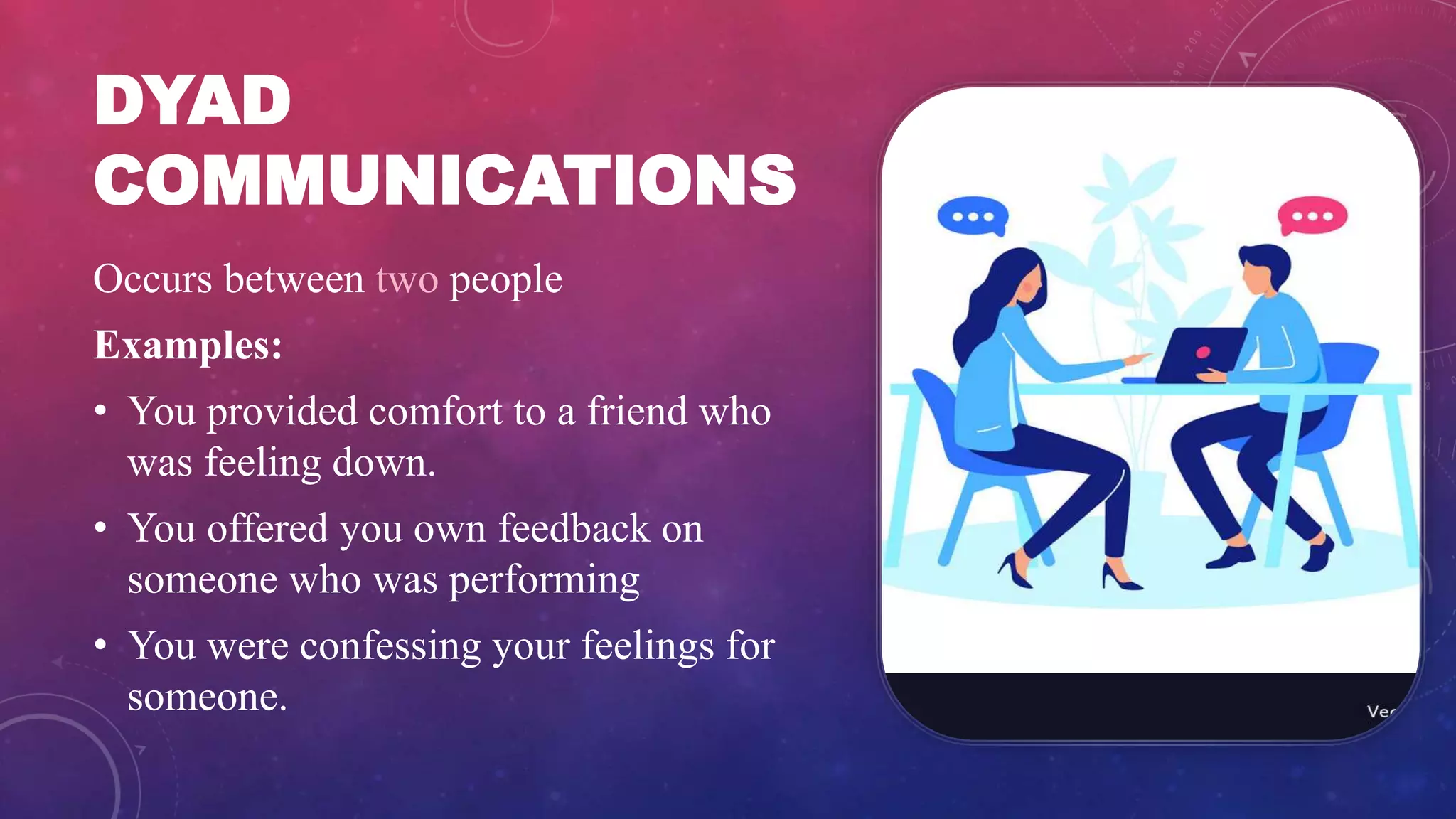
DYAD
COMMUNICATIONS
Occurs between two people
Examples:
• You provided comfort to a friend who
was feeling down.
• You offered you own feedback on
someone who was performing
• You were confessing your feelings for
someone.
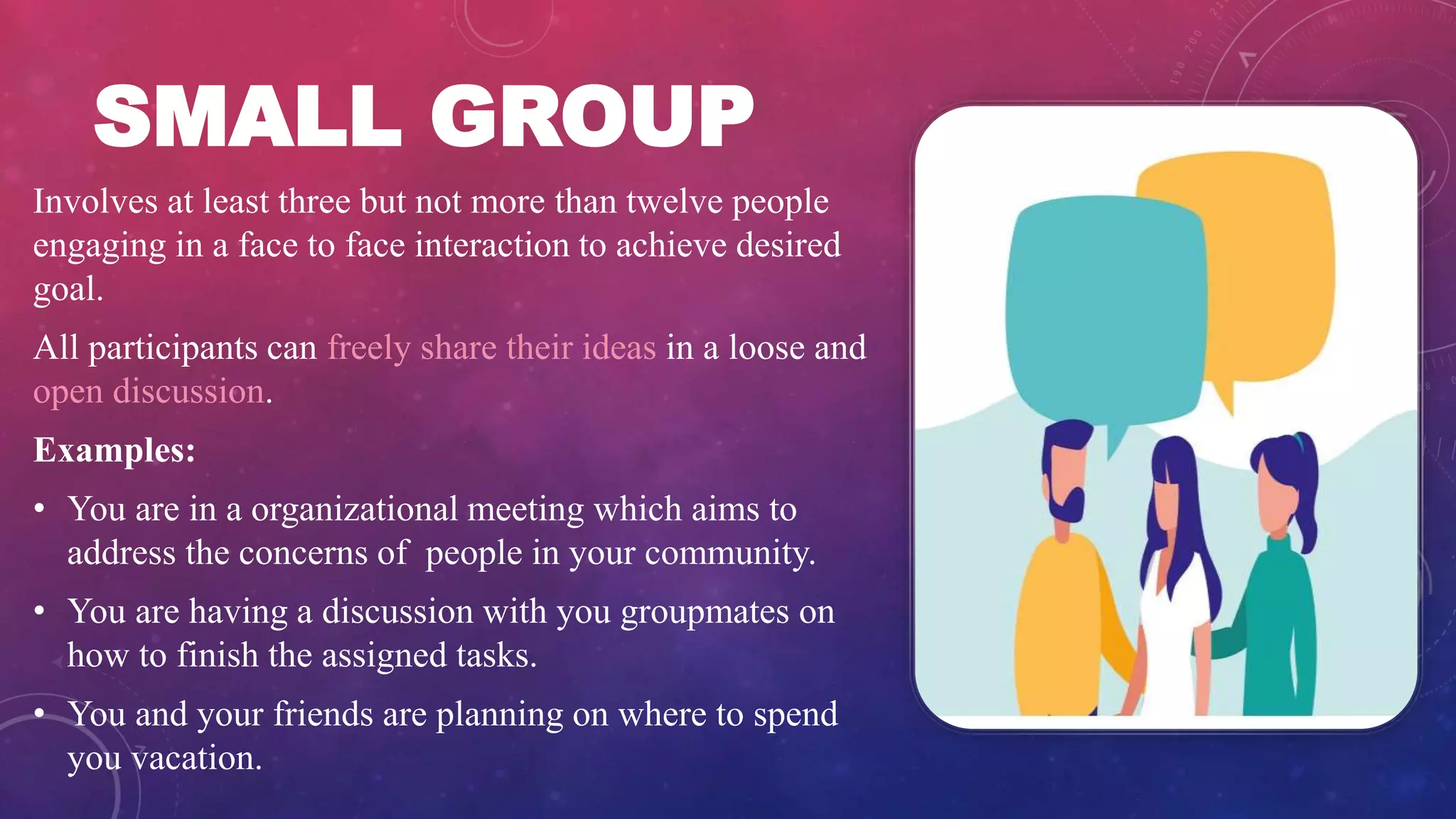
SMALL GROUP
Involves at least three but not more than twelve people
engaging in a face to face interaction to achieve desired
goal.
All participants can freely share their ideas in a loose and
open discussion.
Examples:
• You are in a organizational meeting which aims to
address the concerns of people in your community.
• You are having a discussion with you groupmates on
how to finish the assigned tasks.
• You and your friends are planning on where to spend
you vacation.
PUBLIC
Requires you to deliver the
message in front of people. The
message can be driven by
informational or persuasive
purposes. The channels are more
exaggerated, voice is louder,
gestures are more expansive due to
bigger audience. PowerPoint can
be used.
Examples:
• You deliver a graduation speech in front of your
fellow graduates.
• You participate in a declamation, oratorical contest or
debate watched by many people.
• Giving a speech in front of your schoolmates on why
they should vote you as the president of the school
body.
MASS
COMMUNICATION
Communication that takes place through
television, radio, newspaper, magazines,
books, billboards, internet and other types of
media.
Examples:
• You are a student Journalist articulating
your stand on current issues through the
school newspaper.
• You are a radio jock reporting the facts
about your community.
THANK YOU,
FOR LISTENING!
HAZEL F. ESTREBELLO

The Speech Context

  • 2.
  • 3.
  • 4.
    WHAT IS SPEECH CONTEXT? •Is the way people use to communicate and transmit message orally or verbally. It can be interpersonal where you can talk wit other people or intrapersonal where you can talk to yourself especially when thinking and making decisions.
  • 5.
  • 6.
    a type ofcommunication that centers on one person where the speakers acts both as the sender and the receiver. The message is made up of your own thoughts and your own feelings. The channel is your brain which processes what you are thinking and feeling. There is feedback in the sense that as you talk to yourself, you discard certain ideas and replace them with something else. Interpersonal
  • 7.
    Examples: • You kepton thinking and analyzing why something keeps on making spooky sounds at night and probably decided that it was nothing. • You felt happy while thinking about how your crush appreciated you for giving her hand made gift cards on valentines day and you reflected why this was so…
  • 8.
    a type ofcommunication between and among people and establishes personal relationship. According to Solomon and Theiss, 2013: • “Inter” – highlights how interpersonal communication connects people. • “Personal” – unique qualities as a person matter during interpersonal communication. Intrapersonal
  • 9.
  • 10.
    DYAD COMMUNICATIONS Occurs between twopeople Examples: • You provided comfort to a friend who was feeling down. • You offered you own feedback on someone who was performing • You were confessing your feelings for someone.
  • 11.
    SMALL GROUP Involves atleast three but not more than twelve people engaging in a face to face interaction to achieve desired goal. All participants can freely share their ideas in a loose and open discussion. Examples: • You are in a organizational meeting which aims to address the concerns of people in your community. • You are having a discussion with you groupmates on how to finish the assigned tasks. • You and your friends are planning on where to spend you vacation.
  • 12.
    PUBLIC Requires you todeliver the message in front of people. The message can be driven by informational or persuasive purposes. The channels are more exaggerated, voice is louder, gestures are more expansive due to bigger audience. PowerPoint can be used.
  • 13.
    Examples: • You delivera graduation speech in front of your fellow graduates. • You participate in a declamation, oratorical contest or debate watched by many people. • Giving a speech in front of your schoolmates on why they should vote you as the president of the school body.
  • 14.
    MASS COMMUNICATION Communication that takesplace through television, radio, newspaper, magazines, books, billboards, internet and other types of media. Examples: • You are a student Journalist articulating your stand on current issues through the school newspaper. • You are a radio jock reporting the facts about your community.
  • 15.