21st Century Literature
from the Philippines and
the World
Quarter 1
Module 1
Writing Close
Analysis, Critical
Interpretation, and
Adaptation of 21st
Century Philippine
Literature
Picture
Analysis!
Directions:
Analyze the pictures to discover
our next lesson. Clues are also
provided to help you answer the
mystery words.
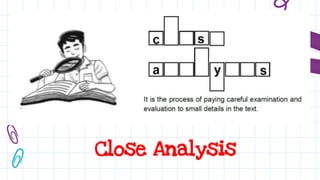
Close Analysis
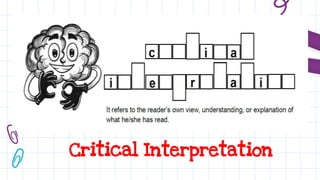
Critical Interpretation
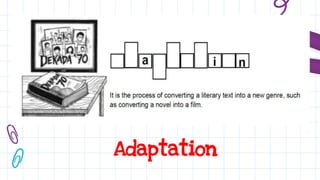
Adaptation
What I Need to Know
Differentiate close analysis, critical
interpretation, and adaptation from one
another;
01
02
Analyze varied genres of the 21st
Century Philippine Literature;
Write a close analysis and critical
interpretation of these texts; and
03
04 Write an adaptation of the texts.
What I Need to Know
Analization &
Interpretation
of Literary Text
Denotative VS. Connotative
To analyze and interpret a literary text,
one of the reading skills that you must
have is the ability to understand the
denotative and connotative meaning of
a word.
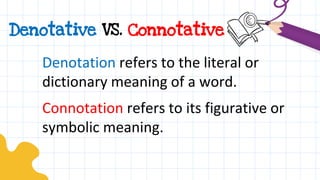
Denotative VS. Connotative
Denotation refers to the literal or
dictionary meaning of a word.
Connotation refers to its figurative or
symbolic meaning.
Denotative VS. Connotative
Writers often deviate from the literal
meaning of words for more striking
expressions.
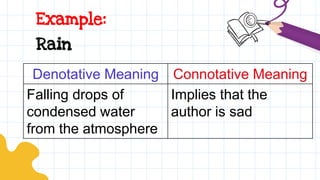
Example:
Denotative Meaning Connotative Meaning
Falling drops of
condensed water
from the atmosphere
Implies that the
author is sad
Rain
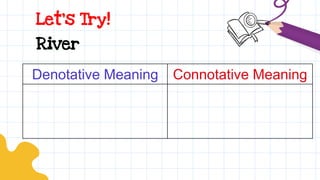
Let’s Try!
Denotative Meaning Connotative Meaning
River
Let’s Try!
Denotative Meaning Connotative Meaning
Dawn
Let’s Try!
Denotative Meaning Connotative Meaning
Snake
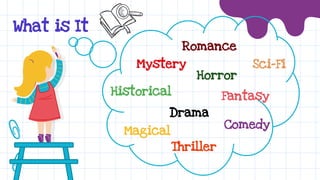
Mystery
Thriller
Drama
Historical
What is It
Magical
Fantasy
Sci-Fi
Romance
Comedy
Horror
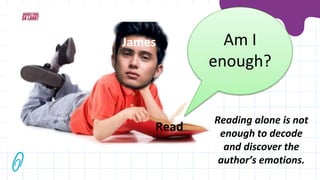
Am I
enough?
James
Read
Reading alone is not
enough to decode
and discover the
author’s emotions.
Close Analysis
Close Analysis must be done in order to
identify and examine the small details of the
text to fully grasp the whole context. It is like
studying every single organ to understand
how the entire human body works.
How can someone make
a close analysis?
Close analysis is done through close reading
which refers to the intensive examination of a
text’s language and literary devices, creating
a detailed map of the text’s possible
connotations and implications.
Determine the author’s purpose
by knowing the person’s
background and his/her purpose
for writing the material.
Tips in Close Analysis in Reading
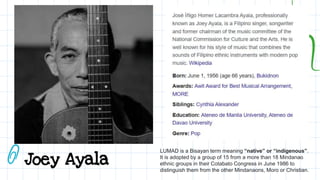
Joey Ayala
LUMAD is a Bisayan term meaning “native” or “indigenous”.
It is adopted by a group of 15 from a more than 18 Mindanao
ethnic groups in their Cotabato Congress in June 1986 to
distinguish them from the other Mindanaons, Moro or Christian.

Tips in Close Analysis in Reading
Understand the mood used by the
author to achieve that purpose.

Mood refers to the literary
element that evokes feelings
through words and descriptions.
Evoke means to bring
to mind or recollection
Tips in Close Analysis in Reading
Determine the author’s point of
view by identifying:
a. the issues involved in the text
b. the different sides of the issues
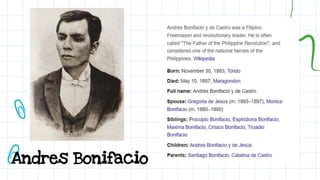
Pag-ibig sa
Tinubuang Lupa
Andres Bonifacio
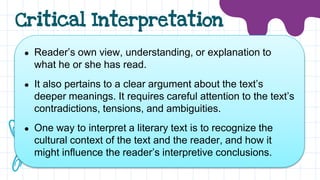
Critical Interpretation
● Reader’s own view, understanding, or explanation to
what he or she has read.
● It also pertains to a clear argument about the text’s
deeper meanings. It requires careful attention to the text’s
contradictions, tensions, and ambiguities.
● One way to interpret a literary text is to recognize the
cultural context of the text and the reader, and how it
might influence the reader’s interpretive conclusions.
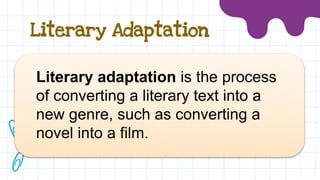
Literary Adaptation
Literary adaptation is the process
of converting a literary text into a
new genre, such as converting a
novel into a film.
Activity Time!
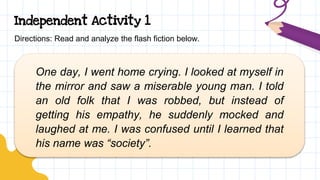
Independent Activity 1
Directions: Read and analyze the flash fiction below.
One day, I went home crying. I looked at myself in
the mirror and saw a miserable young man. I told
an old folk that I was robbed, but instead of
getting his empathy, he suddenly mocked and
laughed at me. I was confused until I learned that
his name was “society”.
Close Analysis & Critical Interpretation
of a Flash Fiction
Directions: Answer the following guide questions..
1. What do you think is the mood used to achieve the purpose of the
author?
2. What do you think is the purpose of the writer in writing his flash
fiction?
3. Why did the old folk laugh and mock the young man who was
robbed?
4. What do you think is the social issue that the author wanted to
raise?
Flash fiction is defined as a very short
story. It can convey deep truths and
universal human emotions and can
resonate with readers from all walks of
life in just a few short paragraphs unlike
the traditional short story.
Flash Fiction
Independent Activity 2
Directions: For adaptation, create your own flash fiction based
upon your close analysis and critical interpretation of the given
sample. Write your adaptation on a one whole sheet of paper.
Criteria for Grading:
Relevance of the Topic 5
Creativity in delivering the content 5
Quality of writing and proofreading _5_
15
Literary Adaptation

21st-Cent-Litt.pptx

  • 1.
    21st Century Literature fromthe Philippines and the World
  • 2.
  • 3.
    Writing Close Analysis, Critical Interpretation,and Adaptation of 21st Century Philippine Literature
  • 4.
  • 5.
    Directions: Analyze the picturesto discover our next lesson. Clues are also provided to help you answer the mystery words.
  • 6.
  • 7.
  • 8.
  • 9.
    What I Needto Know Differentiate close analysis, critical interpretation, and adaptation from one another; 01 02 Analyze varied genres of the 21st Century Philippine Literature;
  • 10.
    Write a closeanalysis and critical interpretation of these texts; and 03 04 Write an adaptation of the texts. What I Need to Know
  • 11.
  • 12.
    Denotative VS. Connotative Toanalyze and interpret a literary text, one of the reading skills that you must have is the ability to understand the denotative and connotative meaning of a word.
  • 13.
    Denotative VS. Connotative Denotationrefers to the literal or dictionary meaning of a word. Connotation refers to its figurative or symbolic meaning.
  • 14.
    Denotative VS. Connotative Writersoften deviate from the literal meaning of words for more striking expressions.
  • 15.
    Example: Denotative Meaning ConnotativeMeaning Falling drops of condensed water from the atmosphere Implies that the author is sad Rain
  • 16.
    Let’s Try! Denotative MeaningConnotative Meaning River
  • 17.
    Let’s Try! Denotative MeaningConnotative Meaning Dawn
  • 18.
    Let’s Try! Denotative MeaningConnotative Meaning Snake
  • 19.
  • 20.
    Am I enough? James Read Reading aloneis not enough to decode and discover the author’s emotions.
  • 21.
    Close Analysis Close Analysismust be done in order to identify and examine the small details of the text to fully grasp the whole context. It is like studying every single organ to understand how the entire human body works.
  • 22.
    How can someonemake a close analysis? Close analysis is done through close reading which refers to the intensive examination of a text’s language and literary devices, creating a detailed map of the text’s possible connotations and implications.
  • 23.
    Determine the author’spurpose by knowing the person’s background and his/her purpose for writing the material. Tips in Close Analysis in Reading
  • 25.
    Joey Ayala LUMAD isa Bisayan term meaning “native” or “indigenous”. It is adopted by a group of 15 from a more than 18 Mindanao ethnic groups in their Cotabato Congress in June 1986 to distinguish them from the other Mindanaons, Moro or Christian.
  • 26.
    Tips in CloseAnalysis in Reading Understand the mood used by the author to achieve that purpose. Mood refers to the literary element that evokes feelings through words and descriptions. Evoke means to bring to mind or recollection
  • 28.
    Tips in CloseAnalysis in Reading Determine the author’s point of view by identifying: a. the issues involved in the text b. the different sides of the issues
  • 29.
  • 30.
  • 31.
    Critical Interpretation ● Reader’sown view, understanding, or explanation to what he or she has read. ● It also pertains to a clear argument about the text’s deeper meanings. It requires careful attention to the text’s contradictions, tensions, and ambiguities. ● One way to interpret a literary text is to recognize the cultural context of the text and the reader, and how it might influence the reader’s interpretive conclusions.
  • 35.
    Literary Adaptation Literary adaptationis the process of converting a literary text into a new genre, such as converting a novel into a film.
  • 38.
  • 39.
    Independent Activity 1 Directions:Read and analyze the flash fiction below. One day, I went home crying. I looked at myself in the mirror and saw a miserable young man. I told an old folk that I was robbed, but instead of getting his empathy, he suddenly mocked and laughed at me. I was confused until I learned that his name was “society”.
  • 40.
    Close Analysis &Critical Interpretation of a Flash Fiction Directions: Answer the following guide questions.. 1. What do you think is the mood used to achieve the purpose of the author? 2. What do you think is the purpose of the writer in writing his flash fiction? 3. Why did the old folk laugh and mock the young man who was robbed? 4. What do you think is the social issue that the author wanted to raise?
  • 41.
    Flash fiction isdefined as a very short story. It can convey deep truths and universal human emotions and can resonate with readers from all walks of life in just a few short paragraphs unlike the traditional short story. Flash Fiction
  • 42.
    Independent Activity 2 Directions:For adaptation, create your own flash fiction based upon your close analysis and critical interpretation of the given sample. Write your adaptation on a one whole sheet of paper. Criteria for Grading: Relevance of the Topic 5 Creativity in delivering the content 5 Quality of writing and proofreading _5_ 15 Literary Adaptation