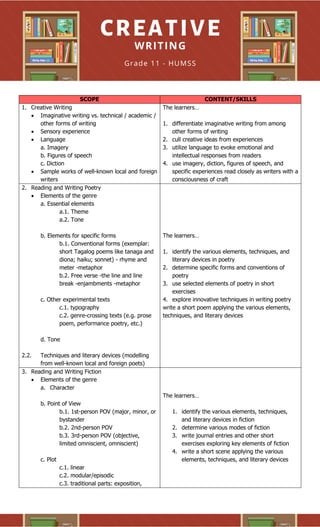
SCOPE CONTENT/SKILLS
1. Creative Writing
• Imaginative writing vs. technical / academic /
other forms of writing
• Sensory experience
• Language
a. Imagery
b. Figures of speech
c. Diction
• Sample works of well-known local and foreign
writers
The learners…
1. differentiate imaginative writing from among
other forms of writing
2. cull creative ideas from experiences
3. utilize language to evoke emotional and
intellectual responses from readers
4. use imagery, diction, figures of speech, and
specific experiences read closely as writers with a
consciousness of craft
2. Reading and Writing Poetry
• Elements of the genre
a. Essential elements
a.1. Theme
a.2. Tone
b. Elements for specific forms
b.1. Conventional forms (exemplar:
short Tagalog poems like tanaga and
diona; haiku; sonnet) - rhyme and
meter -metaphor
b.2. Free verse -the line and line
break -enjambments -metaphor
c. Other experimental texts
c.1. typography
c.2. genre-crossing texts (e.g. prose
poem, performance poetry, etc.)
d. Tone
2.2. Techniques and literary devices (modelling
from well-known local and foreign poets)
The learners…
1. identify the various elements, techniques, and
literary devices in poetry
2. determine specific forms and conventions of
poetry
3. use selected elements of poetry in short
exercises
4. explore innovative techniques in writing poetry
write a short poem applying the various elements,
techniques, and literary devices
3. Reading and Writing Fiction
• Elements of the genre
a. Character
b. Point of View
b.1. 1st-person POV (major, minor, or
bystander
b.2. 2nd-person POV
b.3. 3rd-person POV (objective,
limited omniscient, omniscient)
c. Plot
c.1. linear
c.2. modular/episodic
c.3. traditional parts: exposition,
The learners…
1. identify the various elements, techniques,
and literary devices in fiction
2. determine various modes of fiction
3. write journal entries and other short
exercises exploring key elements of fiction
4. write a short scene applying the various
elements, techniques, and literary devices
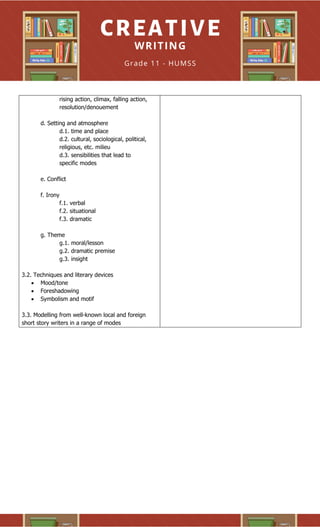
rising action, climax, falling action,
resolution/denouement
d. Setting and atmosphere
d.1. time and place
d.2. cultural, sociological, political,
religious, etc. milieu
d.3. sensibilities that lead to
specific modes
e. Conflict
f. Irony
f.1. verbal
f.2. situational
f.3. dramatic
g. Theme
g.1. moral/lesson
g.2. dramatic premise
g.3. insight
3.2. Techniques and literary devices
• Mood/tone
• Foreshadowing
• Symbolism and motif
3.3. Modelling from well-known local and foreign
short story writers in a range of modes
LESSON 1: CREATIVE WRITING
LESSON OBJECTIVES
At the end of the lesson, the learners are expected to…
1. differentiate imaginative writing from among other forms of writing
2. cull creative ideas from experiences
3. utilize language to evoke emotional and intellectual responses from readers
4. use imagery, diction, figures of speech, and specific experiences read closely as writers with a
consciousness of craft
CREATIVE WRITING
Creative writing is a form of writing where creativity is at the forefront of its purpose through using imagination,
creativity, and innovation in order to tell a story through strong written visuals with an emotional impact, like in
poetry writing, short story writing, novel writing, and more. Creative writing uses senses and emotions in order
to create a strong visual in the reader’s mind whereas other forms of writing typically only leave the reader with
facts and information instead of emotional intrigue.
VARIATIONS ON LANGUAGE
Words have both denotative and connotative meanings. The denotative meaning of a word is that which is found
in the dictionary. It is also known as the literal meaning of a word. On the other hand, the connotative meaning
of a word is that which is assigned by the writer to a word as it is used in the context of his text. It is also known
as the figurative meaning of a word.
Variation is a characteristic of language that allows a writer to express more than one way of saying the same
thing. This could be achieved in writing through diction, imagery and sensory experience, and figures of speech.
• Diction
Diction is the careful selection of words to communicate a message or establish a particular voice or
writing style. For example, flowy, figurative language creates colorful prose, while a more formal
vocabulary with concise and direct language can help drive home a point. Writers choose specific words
and phrases depending on the outcome they’re trying to achieve.
1. Formal Diction is writing that establishes a professional tone, such as business writing or formal
essays. It involves choosing descriptive, precise words that are polite and proper. Sentences in
formal diction are often longer.
2. Informal Diction is a conversational or friendly writing style. It often assumes that the reader
already knows what you’re talking about and generally uses shorter words. Sentences may be
incomplete or ignore some finer points in grammar and usage.
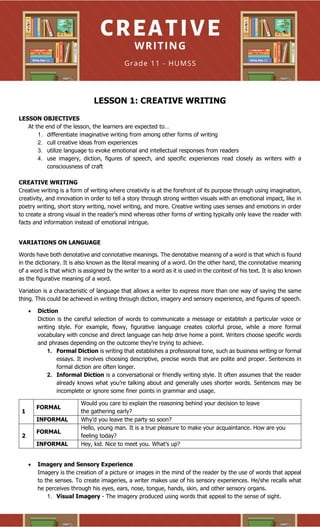
1
FORMAL
Would you care to explain the reasoning behind your decision to leave
the gathering early?
INFORMAL Why’d you leave the party so soon?
2
FORMAL
Hello, young man. It is a true pleasure to make your acquaintance. How are you
feeling today?
INFORMAL Hey, kid. Nice to meet you. What’s up?
• Imagery and Sensory Experience
Imagery is the creation of a picture or images in the mind of the reader by the use of words that appeal
to the senses. To create imageries, a writer makes use of his sensory experiences. He/she recalls what
he perceives through his eyes, ears, nose, tongue, hands, skin, and other sensory organs.
1. Visual Imagery - The imagery produced using words that appeal to the sense of sight.
2. Auditory Imagery - The imagery produced using words that appeal to the sense of hearing.
3. Olfactory Imagery - The imagery produced using words that appeal to the sense of smell.
4. Gustatory Imagery - The imagery produced by the use of words that appeal to the sense of
taste.
5. Tactile Imagery - The imagery produced using words that appeal to the sense of touch.
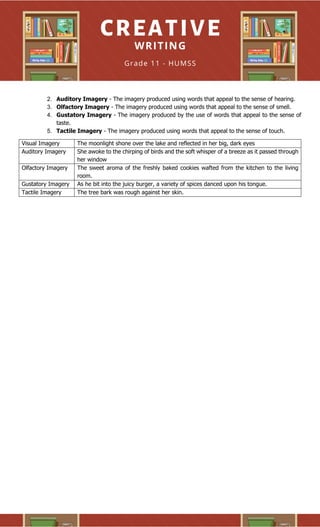
Visual Imagery The moonlight shone over the lake and reflected in her big, dark eyes
Auditory Imagery She awoke to the chirping of birds and the soft whisper of a breeze as it passed through
her window
Olfactory Imagery The sweet aroma of the freshly baked cookies wafted from the kitchen to the living
room.
Gustatory Imagery As he bit into the juicy burger, a variety of spices danced upon his tongue.
Tactile Imagery The tree bark was rough against her skin.
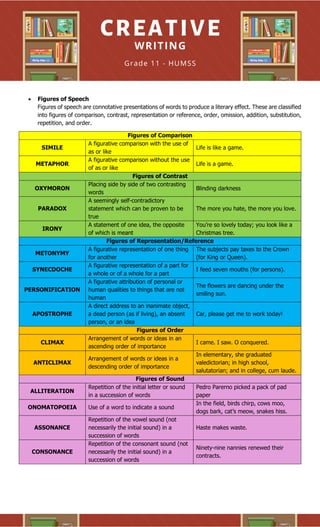
• Figures of Speech
Figures of speech are connotative presentations of words to produce a literary effect. These are classified
into figures of comparison, contrast, representation or reference, order, omission, addition, substitution,
repetition, and order.
Figures of Comparison
SIMILE
A figurative comparison with the use of
as or like
Life is like a game.
METAPHOR
A figurative comparison without the use
of as or like
Life is a game.
Figures of Contrast
OXYMORON
Placing side by side of two contrasting
words
Blinding darkness
PARADOX
A seemingly self-contradictory
statement which can be proven to be
true
The more you hate, the more you love.
IRONY
A statement of one idea, the opposite
of which is meant
You’re so lovely today; you look like a
Christmas tree.
Figures of Representation/Reference
METONYMY
A figurative representation of one thing
for another
The subjects pay taxes to the Crown
(for King or Queen).
SYNECDOCHE
A figurative representation of a part for
a whole or of a whole for a part
I feed seven mouths (for persons).
PERSONIFICATION
A figurative attribution of personal or
human qualities to things that are not
human
The flowers are dancing under the
smiling sun.
APOSTROPHE
A direct address to an inanimate object,
a dead person (as if living), an absent
person, or an idea
Car, please get me to work today!
Figures of Order
CLIMAX
Arrangement of words or ideas in an
ascending order of importance
I came. I saw. O conquered.
ANTICLIMAX
Arrangement of words or ideas in a
descending order of importance
In elementary, she graduated
valedictorian; in high school,
salutatorian; and in college, cum laude.
Figures of Sound
ALLITERATION
Repetition of the initial letter or sound
in a succession of words
Pedro Parerno picked a pack of pad
paper
ONOMATOPOEIA Use of a word to indicate a sound
In the field, birds chirp, cows moo,
dogs bark, cat’s meow, snakes hiss.
ASSONANCE
Repetition of the vowel sound (not
necessarily the initial sound) in a
succession of words
Haste makes waste.
CONSONANCE
Repetition of the consonant sound (not
necessarily the initial sound) in a
succession of words
Ninety-nine nannies renewed their
contracts.
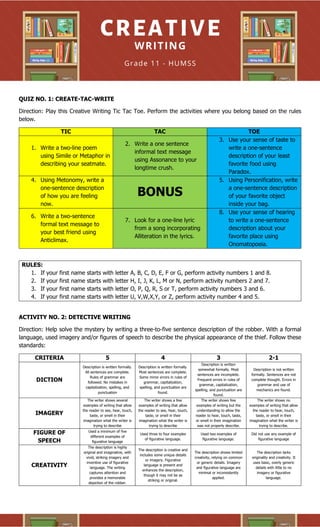
QUIZ NO. 1: CREATE-TAC-WRITE
Direction: Play this Creative Writing Tic Tac Toe. Perform the activities where you belong based on the rules
below.
TIC TAC TOE
1. Write a two-line poem
using Simile or Metaphor in
describing your seatmate.
2. Write a one sentence
informal text message
using Assonance to your
longtime crush.
3. Use your sense of taste to
write a one-sentence
description of your least
favorite food using
Paradox.
4. Using Metonomy, write a
one-sentence description
of how you are feeling
now.
BONUS
5. Using Personification, write
a one-sentence description
of your favorite object
inside your bag.
6. Write a two-sentence
formal text message to
your best friend using
Anticlimax.
7. Look for a one-line lyric
from a song incorporating
Alliteration in the lyrics.
8. Use your sense of hearing
to write a one-sentence
description about your
favorite place using
Onomatopoeia.
RULES:
1. If your first name starts with letter A, B, C, D, E, F or G, perform activity numbers 1 and 8.
2. If your first name starts with letter H, I, J, K, L, M or N, perform activity numbers 2 and 7.
3. If your first name starts with letter O, P, Q, R, S or T, perform activity numbers 3 and 6.
4. If your first name starts with letter U, V,W,X,Y, or Z, perform activity number 4 and 5.
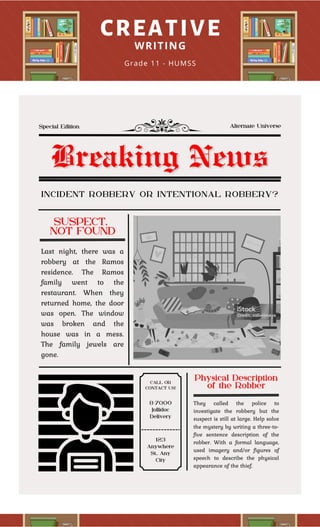
ACTIVITY NO. 2: DETECTIVE WRITING
Direction: Help solve the mystery by writing a three-to-five sentence description of the robber. With a formal
language, used imagery and/or figures of speech to describe the physical appearance of the thief. Follow these
standards:
CRITERIA 5 4 3 2-1
DICTION
Description is written formally.
All sentences are complete.
Rules of grammar are
followed. No mistakes in
capitalization, spelling, and
punctuation
Description is written formally.
Most sentences are complete.
Some minor errors in rules of
grammar, capitalization,
spelling, and punctuation are
found.
Description is written
somewhat formally. Most
sentences are incomplete.
Frequent errors in rules of
grammar, capitalization,
spelling, and punctuation are
found.
Description is not written
formally. Sentences are not
complete thought. Errors in
grammar and use of
mechanics are found.
IMAGERY
The writer shows several
examples of writing that allow
the reader to see, hear, touch,
taste, or smell in their
imagination what the writer is
trying to describe
The writer shows a few
examples of writing that allow
the reader to see, hear, touch,
taste, or smell in their
imagination what the writer is
trying to describe
The writer shows few
examples of writing but the
understanding to allow the
reader to hear, touch, taste,
or smell in their imagination
was not properly describe.
The writer shows no
examples of writing that allow
the reader to hear, touch,
taste, or smell in their
imagination what the writer is
trying to describe.
FIGURE OF
SPEECH
Used a minimum of five
different examples of
figurative language
Used three to four examples
of figurative language.
Used two examples of
figurative language.
Did not use any example of
figurative language
CREATIVITY
The description is highly
original and imaginative, with
vivid, striking imagery and
inventive use of figurative
language. The writing
captures attention and
provides a memorable
depiction of the robber.
The description is creative and
includes some unique details
or imagery. Figurative
language is present and
enhances the description,
though it may not be as
striking or original.
The description shows limited
creativity, relying on common
or generic details. Imagery
and figurative language are
minimal or inconsistently
applied.
The description lacks
originality and creativity. It
uses basic, overly generic
details with little to no
imagery or figurative
language.
LESSON 2: READING AND WRITING POETRY
LESSON OBJECTIVES
At the end of the lesson, the learners are expected to…
1. identify the various elements, techniques, and literary devices in poetry
2. determine specific forms and conventions of poetry
3. use selected elements of poetry in short exercises
4. explore innovative techniques in writing poetry
5. write a short poem applying the various elements, techniques, and literary devices
POEM
A poem is a form of literary expression that uses rhythmic and figurative language to convey vast meaning and
emotion. Unlike prose, which uses language in a conventional and straightforward manner, poetry defies
language norms to please, and sometimes shock, the reader. Prose has to only be understood while poetry
invites interpretation.
A poem is a piece of writing in which the words are chosen for their beauty and sound and are carefully arranged,
often in short lines. A poet uses literary devices like rhyme, meter, symbolism, and imagery to pack complex
ideas and themes in sparse words. These words often take the form of verse which is often arranged in stanzas.
If this poem definition isn’t enough, let’s dig some more.
A poem is usually about, or alluding to, a specific topic or theme. Some of the most common themes that poets
write about are:
• love;
• nature;
• friendship;
• family;
• animals;
• good vs evil;
• growing up and ageing;
• bravery and courage;
• prejudice;
• war.
POEM VS. POETRY
Often used interchangeably, the terms “poem” and “poetry” have distinct, although related, meanings. What is
poetry and how is it different from a poem?
• Poem - A single literary work that embodies various aspects of poetry such as rhyme and meter. A single
piece of poetry written by a poet. Poems are the fundamental unit of poetry, and poetry is made up of
poems
“Still I Rise by Maya Angelou is a powerful poem about endurance in the face of
oppression.”
• Poetry - The art of writing poems as well as the collective body of poetic work. A broad term for a type
of literature that uses the rhythmic and aesthetic qualities of language to evoke meaning. Poetry is often
written in verse form and uses abstract language to create an emotional response in the reader
“African American poetry is an important part of the American literary tradition.”
ELEMENTS OF A POEM
1. STANZA
• A stanza is a basic structural unit in a poem, similar to a paragraph in prose. It is composed of
some lines that are connected in terms of rhyme, meter, and theme. Stanzas in a poem are
separated from each other by a space or a line break. This visual separation guides the reader
through the developing mood, tone, and thought in a poem.
• Here are some common names for a stanza based on the number of lines in it:
▪ Couplet: A stanza consisting of two lines
▪ Tercet: A stanza consisting of three lines
▪ Quatrain: A stanza consisting of four lines (the most common stanza form in English
poetry)
▪ Quintain: A stanza consisting of five lines (also called a quintet)
▪ Sestet: A stanza consisting of six lines
▪ Septet: A stanza consisting of seven lines
▪ Octave: A stanza consisting of eight lines
2. RHYTHM
• A rhyme scheme in a poem is the pattern of rhyming words at the end of each line. It is a way of
organizing and structuring the rhyme relationships between the lines in a poem. Aside from the
aesthetic pleasure they offer, rhyme schemes can also be used to add an additional layer of meaning.
• Shakespeare’s Sonnet 18 is a good poetry example for understanding rhyme scheme:
Shall I compare thee to a summer’s day? (A)
Thou art more lovely and more temperate: (B)
Rough winds do shake the darling buds of May (A)
And summer’s lease hath all too short a date: (B)
• Since “day” and “May” are rhyming words, the lines are said to rhyme with each other. If we denote
them both the letter A and the other rhyming pair of lines the letter B, we get a rhyme scheme of
ABAB. Similarly, different poems have varying rhyme schemes, depending on their tone, mood, and
theme.
3. METER
• The meter in a poem refers to its rhythmic structure, determined by the pattern of stressed and
unstressed syllables in each line. In the lines of a poem, a fixed combination of stressed and
unstressed syllables called a poetic foot, is repeated over and over again:
“Shall I compare thee to a summer’s day?”
• While reading this line, try to focus on the sounds you unwittingly stress. It’ll give you this
structure, with an unstressed syllable (unbolded) followed by a stressed syllable (bolded):
“Shall I / compare / thee to / a sum / mer’s day?”
• In this line, there are 5 poetic feet, each with an unstressed syllable followed by a stressed
syllable. Such an arrangement of poetic feet, responsible for the rhythm and musicality in a poem,
is precisely what meter is! The above type of meter is called iambic pentameter, which is the
most common type in English poetry.
4. STRUCTURE
• The structure of a poem, or poetic form, refers to the organization of syllables, lines, and stanzas
in it. The art of poetry is most distinct from other types of writing, a large part of which is due to
its structure. From deliberately organized syllables (meter) to carefully composed stanzas (rhyme
scheme), poetic form helps make a poem meaningful.
5. IMAGERY
• Imagery in poems refers to the use of vivid and descriptive language that creates a mental picture
or sensory experience for the reader. Poets use sensory details related to sight, sound, taste,
touch, and smell to evoke an emotion or create an environment.
• Here’s an example of imagery in a poem:
“The apparition of these faces in the crowd:
Petals on a wet, black bough.” —In a Station of the Metro by Ezra Pound
6. SYMBOLISM
• Symbolism in poetry is a literary device where a symbol—a word, phrase, image, or object—is
used to represent an abstract idea, concept, or theme. Poets use symbols to evoke images,
reflect on a theme, or explore an idea with nuance.
• Symbols can be conventional or invented, and you often need some context to understand
them. Here’s an example to illustrate symbolism in poetry:
“What happens to a dream deferred?
Does it dry up
like a raisin in the sun?
Or fester like a sore—
And then run?
Does it stink like rotten meat?
Or crust and sugar over—
like a syrupy sweet?
Maybe it just sags
like a heavy load.
Or does it explode?” —Harlem by Langston Hughes
7. TONE
• The tone in a poem is the speaker’s apparent mood, attitude, or emotional stance. You can gauge
this by observing the rhythm, imagery, and word choice in a poem. The tone is crucial for a poet
in shaping the reader’s interpretation and emotional response to the poem.
8. THEME
• The theme of a poem is its central idea or underlying message. This isn’t necessarily the poet’s
intended “message”, but more so what the poem is composed around and what it is about. All
the same, the theme of a poem often reflects the poet’s perspective on a subject.
• Themes in poetry can range from human nature and emotions to society, relationships, and much
more. They can be tragic, comic, grand, mundane, and everything in between. All the other
elements of a poem help the poet articulate the theme to the best of their ability.
TRADITIONAL FORMS OF POETRY
1. Sonnet: A 14-line poem with a specific rhyme scheme (e.g., Shakespearean or Petrarchan) and meter
(usually iambic pentameter). Shakespearean sonnets follow the ABABCDCDEFEFGG rhyme scheme.
2. Haiku: A Japanese form consisting of three lines with a 5-7-5 syllable pattern. It often focuses on nature
and evokes a moment or feeling.
3. Limerick: A humorous five-line poem with an AABBA rhyme scheme. The first, second, and fifth lines
are longer, while the third and fourth lines are shorter.
4. Villanelle: A 19-line poem with a specific structure of repeating lines and a rhyme scheme of ABA ABA
ABA ABA ABA ABAA. The first and third lines are alternately repeated as the final lines of the remaining
stanzas.
5. Ballad: A narrative poem often written in quatrains with an ABAB or ABCB rhyme scheme. It typically
tells a story and is often set to music.
6. Ode: A formal, often elaborate poem that addresses and praises a person, thing, or abstract concept. It
has a specific structure and is written in a dignified style.
7. Elegy: A reflective poem that laments or mourns the loss of someone or something. It usually follows a
formal structure.
CREATIVE FORMS OF POETRY
1. Free Verse: Poetry that does not adhere to a specific rhyme scheme or meter. It allows for greater
freedom and flexibility in expression.
2. Concrete Poetry: Poems where the arrangement of text on the page forms a shape related to the
subject of the poem. The visual layout adds meaning to the words.
3. Spoken Word: Poetry performed aloud, often focusing on rhythm, performance, and audience
engagement. It blends elements of poetry, storytelling, and performance art.
4. Narrative Poetry: A poem that tells a story with characters, a plot, and a setting, similar to a short
story or novel. It can be written in various forms and styles.
5. Prose Poetry: A hybrid form that combines elements of prose and poetry. It typically lacks line breaks
but uses poetic techniques like imagery and metaphor.
6. Epiphany Poem: A poem that captures a sudden realization or insight. It often has a moment of clarity
or revelation at its core.
7. Experimental Poetry: Poetry that pushes the boundaries of conventional forms, often incorporating
elements from other disciplines or unconventional techniques.
QUIZ NO. 2: ACRO-POEM
Direction: Entering Senior High School is a privilege to many people because the education is not accessible
and available to everyone. Express your thoughts and feelings about your first day in Senior High School through
writing an acrostic poem using your chosen form of poetry.
E _______________________________________________________
D _______________________________________________________
U _______________________________________________________
C _______________________________________________________
A _______________________________________________________
T _______________________________________________________
I _______________________________________________________
O _______________________________________________________
N _______________________________________________________
CRITERIA 5 4 3 2-1
FORMAT
All lines in the
acrostic poem
begin with the
correct letter.
Most lines in the
acrostic poem
begin with the
correct letter.
Some of the lines in
the acrostic poem
begin with the
correct letter.
Few of the lines in
the acrostic poem
begin with the
correct letter.
CONTENT
All lines are related
to the topic.
Most lines are
related to the topic.
Some lines are
related to the topic.
Few lines are
related to the topic.
POETIC
TECHNIQUES
Effectively uses
poetic techniques
to reinforce the
theme.
Uses poetic
techniques to
reinforce the
theme.
Uses some poetic
techniques to
reinforce the
theme.
Uses few poetic
techniques.
ACTIVITY NO. 2: POETRY RAP BATTLE
Direction: A Poetry Rap Battle offers an engaging platform to demonstrate creativity and performance abilities
in a competitive yet enjoyable environment. This activity fosters quick thinking, confidence, and artistic
expression. Students will engage in a debate on a contemporary issue, responding either through improvised
poetry or pre-written poems. They will be divided into two groups: one supporting the issue (pros) and the other
opposing it (cons). Each group must counter the opposing team's arguments through poetry, ensuring that all
members actively participate. Participants may enhance their performances using gestures, props, or vocal
effects. Each member will have a maximum of two minutes to deliver their poem.
CRITERIA 5 4 3 2-1
Creativity &
Originality
Demonstrates
exceptional creativity
and originality in the
poem, with fresh
ideas and unique
perspectives.
Poem is creative
and shows original
thought, with some
unique elements.
Poem is somewhat
creative, but relies
on common ideas
or clichés.
Poem lacks
creativity and does
not offer a unique
perspective.
Relevance to
Topic
Poem is highly
relevant to the topic
and clearly addresses
the issue from a well-
defined perspective.
Poem is relevant to
the topic, but could
explore the issue
more deeply.
Poem addresses
the topic, but the
connection to the
issue is unclear or
weak.
Poem has limited
relevance to the
topic or does not
address the issue
clearly.
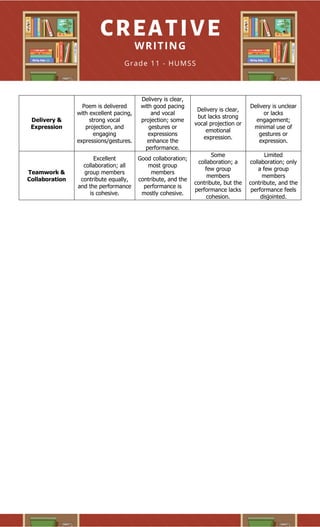
Delivery &
Expression
Poem is delivered
with excellent pacing,
strong vocal
projection, and
engaging
expressions/gestures.
Delivery is clear,
with good pacing
and vocal
projection; some
gestures or
expressions
enhance the
performance.
Delivery is clear,
but lacks strong
vocal projection or
emotional
expression.
Delivery is unclear
or lacks
engagement;
minimal use of
gestures or
expression.
Teamwork &
Collaboration
Excellent
collaboration; all
group members
contribute equally,
and the performance
is cohesive.
Good collaboration;
most group
members
contribute, and the
performance is
mostly cohesive.
Some
collaboration; a
few group
members
contribute, but the
performance lacks
cohesion.
Limited
collaboration; only
a few group
members
contribute, and the
performance feels
disjointed.
LESSON 3: READING AND WRITING FICTION
LESSON OBJECTIVES
At the end of the lesson, the learners are expected to…
3. identify the various elements, techniques, and literary devices in fiction
4. determine various modes of fiction
5. write journal entries and other short exercises exploring key elements of fiction
6. write a short scene applying the various elements, techniques, and literary devices
FICTION
Fiction is make-believe, invented stories. It refers to a genre of literature or storytelling that involves narratives
created from the imagination, rather than being based solely on real events or factual information. It can include
novels, short stories, plays, and other forms of creative writing. Fiction often explores characters, settings, and
plots that are invented by the author, though it may still be inspired by real-life experiences or concepts. The
purpose of fiction is often to entertain, provoke thought, or convey deeper truths about the human condition
through imaginative storytelling.
ELEMENTS OF FICTION
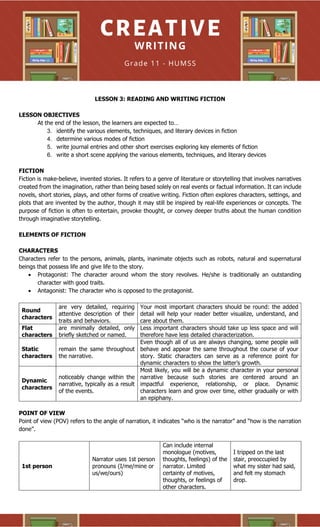
CHARACTERS
Characters refer to the persons, animals, plants, inanimate objects such as robots, natural and supernatural
beings that possess life and give life to the story.
• Protagonist: The character around whom the story revolves. He/she is traditionally an outstanding
character with good traits.
• Antagonist: The character who is opposed to the protagonist.
Round
characters
are very detailed, requiring
attentive description of their
traits and behaviors.
Your most important characters should be round: the added
detail will help your reader better visualize, understand, and
care about them.
Flat
characters
are minimally detailed, only
briefly sketched or named.
Less important characters should take up less space and will
therefore have less detailed characterization.
Static
characters
remain the same throughout
the narrative.
Even though all of us are always changing, some people will
behave and appear the same throughout the course of your
story. Static characters can serve as a reference point for
dynamic characters to show the latter’s growth.
Dynamic
characters
noticeably change within the
narrative, typically as a result
of the events.
Most likely, you will be a dynamic character in your personal
narrative because such stories are centered around an
impactful experience, relationship, or place. Dynamic
characters learn and grow over time, either gradually or with
an epiphany.
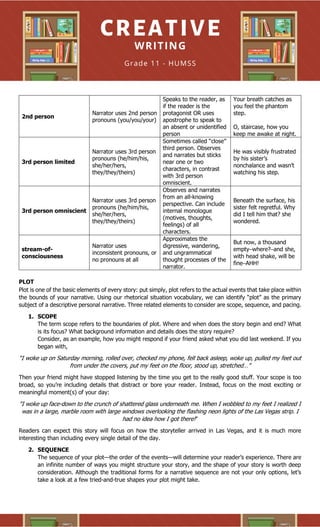
POINT OF VIEW
Point of view (POV) refers to the angle of narration, it indicates “who is the narrator” and “how is the narration
done”.
1st person
Narrator uses 1st person
pronouns (I/me/mine or
us/we/ours)
Can include internal
monologue (motives,
thoughts, feelings) of the
narrator. Limited
certainty of motives,
thoughts, or feelings of
other characters.
I tripped on the last
stair, preoccupied by
what my sister had said,
and felt my stomach
drop.
2nd person
Narrator uses 2nd person
pronouns (you/you/your)
Speaks to the reader, as
if the reader is the
protagonist OR uses
apostrophe to speak to
an absent or unidentified
person
Your breath catches as
you feel the phantom
step.
O, staircase, how you
keep me awake at night.
3rd person limited
Narrator uses 3rd person
pronouns (he/him/his,
she/her/hers,
they/they/theirs)
Sometimes called “close”
third person. Observes
and narrates but sticks
near one or two
characters, in contrast
with 3rd person
omniscient.
He was visibly frustrated
by his sister’s
nonchalance and wasn’t
watching his step.
3rd person omniscient
Narrator uses 3rd person
pronouns (he/him/his,
she/her/hers,
they/they/theirs)
Observes and narrates
from an all-knowing
perspective. Can include
internal monologue
(motives, thoughts,
feelings) of all
characters.
Beneath the surface, his
sister felt regretful. Why
did I tell him that? she
wondered.
stream-of-
consciousness
Narrator uses
inconsistent pronouns, or
no pronouns at all
Approximates the
digressive, wandering,
and ungrammatical
thought processes of the
narrator.
But now, a thousand
empty⎯where?⎯and she,
with head shake, will be
fine⎯AHH!
PLOT
Plot is one of the basic elements of every story: put simply, plot refers to the actual events that take place within
the bounds of your narrative. Using our rhetorical situation vocabulary, we can identify “plot” as the primary
subject of a descriptive personal narrative. Three related elements to consider are scope, sequence, and pacing.
1. SCOPE
The term scope refers to the boundaries of plot. Where and when does the story begin and end? What
is its focus? What background information and details does the story require?
Consider, as an example, how you might respond if your friend asked what you did last weekend. If you
began with,
“I woke up on Saturday morning, rolled over, checked my phone, fell back asleep, woke up, pulled my feet out
from under the covers, put my feet on the floor, stood up, stretched…”
Then your friend might have stopped listening by the time you get to the really good stuff. Your scope is too
broad, so you’re including details that distract or bore your reader. Instead, focus on the most exciting or
meaningful moment(s) of your day:
"I woke up face-down to the crunch of shattered glass underneath me. When I wobbled to my feet I realized I
was in a large, marble room with large windows overlooking the flashing neon lights of the Las Vegas strip. I
had no idea how I got there!"
Readers can expect this story will focus on how the storyteller arrived in Las Vegas, and it is much more
interesting than including every single detail of the day.
2. SEQUENCE
The sequence of your plot—the order of the events—will determine your reader’s experience. There are
an infinite number of ways you might structure your story, and the shape of your story is worth deep
consideration. Although the traditional forms for a narrative sequence are not your only options, let’s
take a look at a few tried-and-true shapes your plot might take.
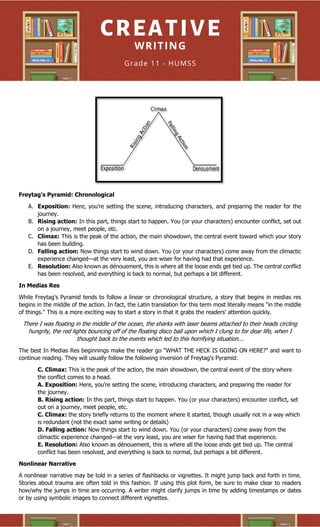
Freytag's Pyramid: Chronological
A. Exposition: Here, you’re setting the scene, introducing characters, and preparing the reader for the
journey.
B. Rising action: In this part, things start to happen. You (or your characters) encounter conflict, set out
on a journey, meet people, etc.
C. Climax: This is the peak of the action, the main showdown, the central event toward which your story
has been building.
D. Falling action: Now things start to wind down. You (or your characters) come away from the climactic
experience changed—at the very least, you are wiser for having had that experience.
E. Resolution: Also known as dénouement, this is where all the loose ends get tied up. The central conflict
has been resolved, and everything is back to normal, but perhaps a bit different.
In Medias Res
While Freytag's Pyramid tends to follow a linear or chronological structure, a story that begins in medias res
begins in the middle of the action. In fact, the Latin translation for this term most literally means "in the middle
of things." This is a more exciting way to start a story in that it grabs the readers' attention quickly.
There I was floating in the middle of the ocean, the sharks with laser beams attached to their heads circling
hungrily, the red lights bouncing off of the floating disco ball upon which I clung to for dear life, when I
thought back to the events which led to this horrifying situation...
The best In Medias Res beginnings make the reader go "WHAT THE HECK IS GOING ON HERE?" and want to
continue reading. They will usually follow the following inversion of Freytag's Pyramid:
C. Climax: This is the peak of the action, the main showdown, the central event of the story where
the conflict comes to a head.
A. Exposition: Here, you’re setting the scene, introducing characters, and preparing the reader for
the journey.
B. Rising action: In this part, things start to happen. You (or your characters) encounter conflict, set
out on a journey, meet people, etc.
C. Climax: the story briefly returns to the moment where it started, though usually not in a way which
is redundant (not the exact same writing or details)
D. Falling action: Now things start to wind down. You (or your characters) come away from the
climactic experience changed—at the very least, you are wiser for having had that experience.
E. Resolution: Also known as dénouement, this is where all the loose ends get tied up. The central
conflict has been resolved, and everything is back to normal, but perhaps a bit different.
Nonlinear Narrative
A nonlinear narrative may be told in a series of flashbacks or vignettes. It might jump back and forth in time.
Stories about trauma are often told in this fashion. If using this plot form, be sure to make clear to readers
how/why the jumps in time are occurring. A writer might clarify jumps in time by adding timestamps or dates
or by using symbolic images to connect different vignettes.
3. PACING
While scope determines the boundaries of plot, and sequencing determines where the plot goes, pacing
determines how quickly readers move through the story. In short, it is the amount of time you dedicate
to describing each event in the story.
The pacing is included with sequence because a change to one often influences the other. Put simply,
pacing refers to the speed and fluidity with which a reader moves through your story. You can play with
pacing by moving more quickly through events, or even by experimenting with sentence and paragraph
length. Consider how the “flow” of the following examples differ:
The train screeched to a halt. A flock of pigeons took
flight as the conductor announced, “We’ll be stuck
here for a few minutes.”
Lost in my thoughts, I shuddered as the train ground
to a full stop in the middle of an intersection. I was
surprised, jarred by the unannounced and abrupt
jerking of the car. I sought clues for our stop outside
the window. All I saw were pigeons as startled and
clueless as I.
SETTING
Each story has a setting. The setting is the place where the story takes place. Usually, an effective story
establishes its setting early in the story: otherwise, readers will have a difficult time visualizing the action of the
story. Below is an example of how a writer might establish setting in a way which immerses the reader: by
showing rather than telling.
Telling Showing
I went to the lake. It was cool.
My breath escaped in ragged bursts, my
quadriceps burning as I crested the summit. The
lake stretched before me, aquamarine, glistening
in the hot August afternoon sun. Ponderosa pines
lined its shores, dropping their spicy-scented
needles into the clear water. Despite the heat, the
Montana mountain air tasted crisp.
Which of the above lakes would you want to visit? Which one paints a more immersive picture, making you feel
like you are there? When writing a story, our initial instinct is usually to make a list of chronological moments:
first I did this, then I did this, then I did that. That might be factual, but it does not engage the reader or invite
them into your world. It bores the reader. Ever been stuck listening to someone tell a story that seems like it
will never end? It probably was someone telling you a story rather than using the five senses to immerse you.
In the example above, the writer uses visual (sight), auditory (sound), olfactory (smell), tactile (touch), or
gustatory (taste) imagery to help the reader picture the setting in their mind. By the final draft, the entire story
should be compelling and richly detailed. While it's fine to have an outline or first draft that recounts the events
of the story, the final draft should include dialogue, immersive description, plot twists, and metaphors to capture
your reader's attention as you write.
CONFLICT
Conflict is the struggle between two entities. In story writing the main character, also known as the protagonist,
encounters a conflict with the antagonist, which is an adversary.
• Social conflict (man versus man): The conflict which exists between the protagonist and the
antagonist.
• Physical conflict (man versus nature): The conflict which exists between the protagonist and any
natural forces (water, earth, wind, fire, as well as diseases)
• Internal/Personal/Psychological conflict (man versus himself): The conflict which exists
between the protagonist and his own self.
THEME
The theme is the idea or concept of the author. This is referred to as the message of the story.
• Moral/Lesson: This is the message or lesson that the story teaches, often related to right and wrong
or important values. It’s the takeaway that readers or viewers can learn from the characters' actions or
the events of the story. For example, in a fable, the moral might be "honesty is the best policy."
• Dramatic Premise: This refers to the central idea or situation that drives the conflict in a story. It’s the
core concept that sets up the drama and the unfolding of events. For example, the dramatic premise of
a mystery novel might be "a detective must solve a crime before the culprit escapes."
• Insight: This is the deeper understanding or revelation that the story provides about life, human nature,
or the world. It’s often an observation that helps the audience see things in a new light. For example, a
story might give insight into the struggles of a character trying to find their identity, offering a reflection
on personal growth or self-discovery.
TECHNIQUES AND LITERARY DEVICES
1. Flashback
Flashbacks in literature are when the narrator goes back in time for a specific scene or chapter in order
to give more context for the story.
In Suzanne Collins’ The Hunger Games, the author uses flashback to create a pivotal connection
between Katniss and Peeta. When Peeta is called to the podium, she distinctly remembers Peeta giving
her the bread when her family was starving.
2. Foreshadowing
Foreshadowing is when the author places elements within the writing that gives clues about what will
happen in the future of the story.
In Shakespeare’s Romeo and Juliet, Romeo says he prefers to die sooner than live without Juliet’s love:
“Life were better ended by their hate, than death prorogues, wanting of the love.
3. Symbolism
This literary device is the use of a situation or element to represent a larger message, idea, or concept.
In the novel series Harry Potter by JK Rowling, Harry’s scar is symbolic of his bravery, like a badge of
honor.
4. Figurative Language
Figurative language refers to the use of words in a way that deviates from the conventional order and
meaning in order to convey a complicated meaning, colorful writing, clarity, or evocative comparison. It
uses an ordinary sentence to refer to something without directly stating it.
QUIZ NO. 3: READING COMPREHENSION
Direction: Read and comprehend the Japanese folktale entitled “The Burning of the Rice Field” and identify the
elements of fiction.
CHARACTERS
SETTING
PLOT
POINT OF VIEW
CONFLICT
THEME
The Burning of the Rice Field
A Japanese Folktale
Once there was a good old man who lived up on a mountain, far away in Japan. All round his little house the
mountain was flat, and the ground was rich; and there were the rice fields of all the people who lived in the
village at the mountain’s foot. Mornings and evenings, the old man and his little grandson, who lived with him,
used to look far down on the people at work in the village, and watch the blue sea which lay all-round the land,
so close that there was no room for fields below, only for houses. The little boy loved the rice fields, dearly, for
he knew that all the good food for all the people came from them; and he often helped his grandfather to watch
over them.
One day, the grandfather was standing alone, before his house, looking far down at the people, and out at the
sea, when, suddenly, he saw something very strange far off where the sea and sky meet. Something like a great
cloud was rising there, as if the sea were lifting itself high into the sky. The old man put his hands to his eyes
and looked again, hard as his old sight could. Then he turned and ran to the house. “Yone, Yone!” he cried,
“bring a brand from the hearth!”
The little grandson could not imagine what his grandfather wanted with fire, but he always obeyed, so he ran
quickly and brought the brand. The old man already had one and was running for the rice fields. Yone ran after.
But what was his horror to see his grandfather thrust his burning brand into the ripe dry rice, where it stood.
“Oh, Grandfather, Grandfather!” screamed the little boy, “what are you doing?”
“Quick, set fire! Thrust your brand in!” said the grandfather.
Yone thought his dear grandfather had lost his mind, and he began to sob; but a little Japanese boy always
obeys, so though he sobbed, he thrust his torch in, and the sharp flame ran up the dry stalks, red and yellow.
In an instant, the field was ablaze, and thick black smoke began to pour up, on the mountain side. It rose like
a cloud, black and fierce, and in no time the people below saw that their precious rice fields were on fire. Ah,
how they ran! Men, women, and children climbed the mountain, running as fast as they could to save the rice;
not one soul stayed behind.
And when they came to the mountain top, and saw the beautiful rice-crop all in flames, beyond help, they cried
bitterly, “Who has done this thing? How did it happen?”
“I set fire,” said the old man, very solemnly; and the little grandson sobbed, “Grandfather set fire.”
But when they came fiercely round the old man, with “Why? Why?” he only turned and pointed to the sea.
“Look!” he said.
They all turned and looked. And there, where the blue sea had lain, so calm, a mighty wall of water, reaching
from earth to sky, was rolling in. No one could scream, so terrible was the sight. The wall of water rolled in on
the land, passed quite over the place where the village had been, and broke, with an awful sound, on the
mountain side. One wave more, and still one more, came; and then all was water, as far as they could look,
below; the village where they had been was under the sea.
But the people were all safe. And when they saw what the old man had done, they honoured him above all men
for the quick wit which had saved them all from the tidal wave.
ACTIVITY NO. 3: A-STORY-DOWN-THE-LANE
Direction: Students are expected to reflect on their childhood dreams, memorable experiences from their early
years, or significant events and celebrations they encountered for the first time during their childhood. The
students will illustrate an unforgettable memory from when they were 10 years old on yellow-pad paper. While
recalling this memory, they will consider a scenario in which things had turned out differently on that day—what
might have happened and how it could have affected their present lives. This activity will serve as an introduction
to the subsequent tasks that students will engage in during the discussion, as they will develop their stories
throughout the session.
CRITERIA 5 4 3 2-1
CONTENT
Thoroughly
explores the topic
with depth,
providing rich
details and insights.
Covers the topic
adequately, with
some details and
insights.
Addresses the topic
but lacks depth and
detail.
Fails to adequately
address the topic;
lacks focus.
ORGANIZATION
Ideas are well-
organized and flow
logically; clear
structure enhances
understanding.
Organization is
generally clear;
most ideas are
logically
sequenced.
Some organization
is evident, but
ideas may be
unclear or jump
around.
Lacks organization;
ideas are confusing
or disjointed.
STYLE
Language is
engaging and
appropriate for the
audience; effective
use of voice.
Language is clear
and appropriate;
voice is somewhat
effective.
Language is basic;
voice may be
inconsistent or
unclear.
Language is
unclear or
inappropriate; lacks
a distinct voice.
USE OF
LITERARY
ELEMENTS
Skillful use of
literary elements
enhances the
narrative.
Some use of
literary elements;
may add to the
narrative but lacks
skill.
Limited use of
literary elements;
may be
underdeveloped or
ineffective.
Minimal or no use
of literary
elements; narrative
is flat.
MECHANICS
Virtually no errors
in grammar,
punctuation, and
spelling;
demonstrates
strong command of
language
conventions.
Few errors in
grammar,
punctuation, and
spelling that do not
interfere with
meaning.
Some errors in
grammar,
punctuation, and
spelling that may
distract the reader.
Frequent errors in
grammar,
punctuation, and
spelling that
impede
understanding.

IM Creative Writing - Grade 11 [Midterms]

  • 1.
    SCOPE CONTENT/SKILLS 1. CreativeWriting • Imaginative writing vs. technical / academic / other forms of writing • Sensory experience • Language a. Imagery b. Figures of speech c. Diction • Sample works of well-known local and foreign writers The learners… 1. differentiate imaginative writing from among other forms of writing 2. cull creative ideas from experiences 3. utilize language to evoke emotional and intellectual responses from readers 4. use imagery, diction, figures of speech, and specific experiences read closely as writers with a consciousness of craft 2. Reading and Writing Poetry • Elements of the genre a. Essential elements a.1. Theme a.2. Tone b. Elements for specific forms b.1. Conventional forms (exemplar: short Tagalog poems like tanaga and diona; haiku; sonnet) - rhyme and meter -metaphor b.2. Free verse -the line and line break -enjambments -metaphor c. Other experimental texts c.1. typography c.2. genre-crossing texts (e.g. prose poem, performance poetry, etc.) d. Tone 2.2. Techniques and literary devices (modelling from well-known local and foreign poets) The learners… 1. identify the various elements, techniques, and literary devices in poetry 2. determine specific forms and conventions of poetry 3. use selected elements of poetry in short exercises 4. explore innovative techniques in writing poetry write a short poem applying the various elements, techniques, and literary devices 3. Reading and Writing Fiction • Elements of the genre a. Character b. Point of View b.1. 1st-person POV (major, minor, or bystander b.2. 2nd-person POV b.3. 3rd-person POV (objective, limited omniscient, omniscient) c. Plot c.1. linear c.2. modular/episodic c.3. traditional parts: exposition, The learners… 1. identify the various elements, techniques, and literary devices in fiction 2. determine various modes of fiction 3. write journal entries and other short exercises exploring key elements of fiction 4. write a short scene applying the various elements, techniques, and literary devices
  • 2.
    rising action, climax,falling action, resolution/denouement d. Setting and atmosphere d.1. time and place d.2. cultural, sociological, political, religious, etc. milieu d.3. sensibilities that lead to specific modes e. Conflict f. Irony f.1. verbal f.2. situational f.3. dramatic g. Theme g.1. moral/lesson g.2. dramatic premise g.3. insight 3.2. Techniques and literary devices • Mood/tone • Foreshadowing • Symbolism and motif 3.3. Modelling from well-known local and foreign short story writers in a range of modes
  • 3.
    LESSON 1: CREATIVEWRITING LESSON OBJECTIVES At the end of the lesson, the learners are expected to… 1. differentiate imaginative writing from among other forms of writing 2. cull creative ideas from experiences 3. utilize language to evoke emotional and intellectual responses from readers 4. use imagery, diction, figures of speech, and specific experiences read closely as writers with a consciousness of craft CREATIVE WRITING Creative writing is a form of writing where creativity is at the forefront of its purpose through using imagination, creativity, and innovation in order to tell a story through strong written visuals with an emotional impact, like in poetry writing, short story writing, novel writing, and more. Creative writing uses senses and emotions in order to create a strong visual in the reader’s mind whereas other forms of writing typically only leave the reader with facts and information instead of emotional intrigue. VARIATIONS ON LANGUAGE Words have both denotative and connotative meanings. The denotative meaning of a word is that which is found in the dictionary. It is also known as the literal meaning of a word. On the other hand, the connotative meaning of a word is that which is assigned by the writer to a word as it is used in the context of his text. It is also known as the figurative meaning of a word. Variation is a characteristic of language that allows a writer to express more than one way of saying the same thing. This could be achieved in writing through diction, imagery and sensory experience, and figures of speech. • Diction Diction is the careful selection of words to communicate a message or establish a particular voice or writing style. For example, flowy, figurative language creates colorful prose, while a more formal vocabulary with concise and direct language can help drive home a point. Writers choose specific words and phrases depending on the outcome they’re trying to achieve. 1. Formal Diction is writing that establishes a professional tone, such as business writing or formal essays. It involves choosing descriptive, precise words that are polite and proper. Sentences in formal diction are often longer. 2. Informal Diction is a conversational or friendly writing style. It often assumes that the reader already knows what you’re talking about and generally uses shorter words. Sentences may be incomplete or ignore some finer points in grammar and usage. 1 FORMAL Would you care to explain the reasoning behind your decision to leave the gathering early? INFORMAL Why’d you leave the party so soon? 2 FORMAL Hello, young man. It is a true pleasure to make your acquaintance. How are you feeling today? INFORMAL Hey, kid. Nice to meet you. What’s up? • Imagery and Sensory Experience Imagery is the creation of a picture or images in the mind of the reader by the use of words that appeal to the senses. To create imageries, a writer makes use of his sensory experiences. He/she recalls what he perceives through his eyes, ears, nose, tongue, hands, skin, and other sensory organs. 1. Visual Imagery - The imagery produced using words that appeal to the sense of sight.
  • 4.
    2. Auditory Imagery- The imagery produced using words that appeal to the sense of hearing. 3. Olfactory Imagery - The imagery produced using words that appeal to the sense of smell. 4. Gustatory Imagery - The imagery produced by the use of words that appeal to the sense of taste. 5. Tactile Imagery - The imagery produced using words that appeal to the sense of touch. Visual Imagery The moonlight shone over the lake and reflected in her big, dark eyes Auditory Imagery She awoke to the chirping of birds and the soft whisper of a breeze as it passed through her window Olfactory Imagery The sweet aroma of the freshly baked cookies wafted from the kitchen to the living room. Gustatory Imagery As he bit into the juicy burger, a variety of spices danced upon his tongue. Tactile Imagery The tree bark was rough against her skin.
  • 5.
    • Figures ofSpeech Figures of speech are connotative presentations of words to produce a literary effect. These are classified into figures of comparison, contrast, representation or reference, order, omission, addition, substitution, repetition, and order. Figures of Comparison SIMILE A figurative comparison with the use of as or like Life is like a game. METAPHOR A figurative comparison without the use of as or like Life is a game. Figures of Contrast OXYMORON Placing side by side of two contrasting words Blinding darkness PARADOX A seemingly self-contradictory statement which can be proven to be true The more you hate, the more you love. IRONY A statement of one idea, the opposite of which is meant You’re so lovely today; you look like a Christmas tree. Figures of Representation/Reference METONYMY A figurative representation of one thing for another The subjects pay taxes to the Crown (for King or Queen). SYNECDOCHE A figurative representation of a part for a whole or of a whole for a part I feed seven mouths (for persons). PERSONIFICATION A figurative attribution of personal or human qualities to things that are not human The flowers are dancing under the smiling sun. APOSTROPHE A direct address to an inanimate object, a dead person (as if living), an absent person, or an idea Car, please get me to work today! Figures of Order CLIMAX Arrangement of words or ideas in an ascending order of importance I came. I saw. O conquered. ANTICLIMAX Arrangement of words or ideas in a descending order of importance In elementary, she graduated valedictorian; in high school, salutatorian; and in college, cum laude. Figures of Sound ALLITERATION Repetition of the initial letter or sound in a succession of words Pedro Parerno picked a pack of pad paper ONOMATOPOEIA Use of a word to indicate a sound In the field, birds chirp, cows moo, dogs bark, cat’s meow, snakes hiss. ASSONANCE Repetition of the vowel sound (not necessarily the initial sound) in a succession of words Haste makes waste. CONSONANCE Repetition of the consonant sound (not necessarily the initial sound) in a succession of words Ninety-nine nannies renewed their contracts.
  • 6.
    QUIZ NO. 1:CREATE-TAC-WRITE Direction: Play this Creative Writing Tic Tac Toe. Perform the activities where you belong based on the rules below. TIC TAC TOE 1. Write a two-line poem using Simile or Metaphor in describing your seatmate. 2. Write a one sentence informal text message using Assonance to your longtime crush. 3. Use your sense of taste to write a one-sentence description of your least favorite food using Paradox. 4. Using Metonomy, write a one-sentence description of how you are feeling now. BONUS 5. Using Personification, write a one-sentence description of your favorite object inside your bag. 6. Write a two-sentence formal text message to your best friend using Anticlimax. 7. Look for a one-line lyric from a song incorporating Alliteration in the lyrics. 8. Use your sense of hearing to write a one-sentence description about your favorite place using Onomatopoeia. RULES: 1. If your first name starts with letter A, B, C, D, E, F or G, perform activity numbers 1 and 8. 2. If your first name starts with letter H, I, J, K, L, M or N, perform activity numbers 2 and 7. 3. If your first name starts with letter O, P, Q, R, S or T, perform activity numbers 3 and 6. 4. If your first name starts with letter U, V,W,X,Y, or Z, perform activity number 4 and 5. ACTIVITY NO. 2: DETECTIVE WRITING Direction: Help solve the mystery by writing a three-to-five sentence description of the robber. With a formal language, used imagery and/or figures of speech to describe the physical appearance of the thief. Follow these standards: CRITERIA 5 4 3 2-1 DICTION Description is written formally. All sentences are complete. Rules of grammar are followed. No mistakes in capitalization, spelling, and punctuation Description is written formally. Most sentences are complete. Some minor errors in rules of grammar, capitalization, spelling, and punctuation are found. Description is written somewhat formally. Most sentences are incomplete. Frequent errors in rules of grammar, capitalization, spelling, and punctuation are found. Description is not written formally. Sentences are not complete thought. Errors in grammar and use of mechanics are found. IMAGERY The writer shows several examples of writing that allow the reader to see, hear, touch, taste, or smell in their imagination what the writer is trying to describe The writer shows a few examples of writing that allow the reader to see, hear, touch, taste, or smell in their imagination what the writer is trying to describe The writer shows few examples of writing but the understanding to allow the reader to hear, touch, taste, or smell in their imagination was not properly describe. The writer shows no examples of writing that allow the reader to hear, touch, taste, or smell in their imagination what the writer is trying to describe. FIGURE OF SPEECH Used a minimum of five different examples of figurative language Used three to four examples of figurative language. Used two examples of figurative language. Did not use any example of figurative language CREATIVITY The description is highly original and imaginative, with vivid, striking imagery and inventive use of figurative language. The writing captures attention and provides a memorable depiction of the robber. The description is creative and includes some unique details or imagery. Figurative language is present and enhances the description, though it may not be as striking or original. The description shows limited creativity, relying on common or generic details. Imagery and figurative language are minimal or inconsistently applied. The description lacks originality and creativity. It uses basic, overly generic details with little to no imagery or figurative language.
  • 8.
    LESSON 2: READINGAND WRITING POETRY LESSON OBJECTIVES At the end of the lesson, the learners are expected to… 1. identify the various elements, techniques, and literary devices in poetry 2. determine specific forms and conventions of poetry 3. use selected elements of poetry in short exercises 4. explore innovative techniques in writing poetry 5. write a short poem applying the various elements, techniques, and literary devices POEM A poem is a form of literary expression that uses rhythmic and figurative language to convey vast meaning and emotion. Unlike prose, which uses language in a conventional and straightforward manner, poetry defies language norms to please, and sometimes shock, the reader. Prose has to only be understood while poetry invites interpretation. A poem is a piece of writing in which the words are chosen for their beauty and sound and are carefully arranged, often in short lines. A poet uses literary devices like rhyme, meter, symbolism, and imagery to pack complex ideas and themes in sparse words. These words often take the form of verse which is often arranged in stanzas. If this poem definition isn’t enough, let’s dig some more. A poem is usually about, or alluding to, a specific topic or theme. Some of the most common themes that poets write about are: • love; • nature; • friendship; • family; • animals; • good vs evil; • growing up and ageing; • bravery and courage; • prejudice; • war. POEM VS. POETRY Often used interchangeably, the terms “poem” and “poetry” have distinct, although related, meanings. What is poetry and how is it different from a poem? • Poem - A single literary work that embodies various aspects of poetry such as rhyme and meter. A single piece of poetry written by a poet. Poems are the fundamental unit of poetry, and poetry is made up of poems “Still I Rise by Maya Angelou is a powerful poem about endurance in the face of oppression.” • Poetry - The art of writing poems as well as the collective body of poetic work. A broad term for a type of literature that uses the rhythmic and aesthetic qualities of language to evoke meaning. Poetry is often written in verse form and uses abstract language to create an emotional response in the reader “African American poetry is an important part of the American literary tradition.”
  • 9.
    ELEMENTS OF APOEM 1. STANZA • A stanza is a basic structural unit in a poem, similar to a paragraph in prose. It is composed of some lines that are connected in terms of rhyme, meter, and theme. Stanzas in a poem are separated from each other by a space or a line break. This visual separation guides the reader through the developing mood, tone, and thought in a poem. • Here are some common names for a stanza based on the number of lines in it: ▪ Couplet: A stanza consisting of two lines ▪ Tercet: A stanza consisting of three lines ▪ Quatrain: A stanza consisting of four lines (the most common stanza form in English poetry) ▪ Quintain: A stanza consisting of five lines (also called a quintet) ▪ Sestet: A stanza consisting of six lines ▪ Septet: A stanza consisting of seven lines ▪ Octave: A stanza consisting of eight lines 2. RHYTHM • A rhyme scheme in a poem is the pattern of rhyming words at the end of each line. It is a way of organizing and structuring the rhyme relationships between the lines in a poem. Aside from the aesthetic pleasure they offer, rhyme schemes can also be used to add an additional layer of meaning. • Shakespeare’s Sonnet 18 is a good poetry example for understanding rhyme scheme: Shall I compare thee to a summer’s day? (A) Thou art more lovely and more temperate: (B) Rough winds do shake the darling buds of May (A) And summer’s lease hath all too short a date: (B) • Since “day” and “May” are rhyming words, the lines are said to rhyme with each other. If we denote them both the letter A and the other rhyming pair of lines the letter B, we get a rhyme scheme of ABAB. Similarly, different poems have varying rhyme schemes, depending on their tone, mood, and theme. 3. METER • The meter in a poem refers to its rhythmic structure, determined by the pattern of stressed and unstressed syllables in each line. In the lines of a poem, a fixed combination of stressed and unstressed syllables called a poetic foot, is repeated over and over again: “Shall I compare thee to a summer’s day?” • While reading this line, try to focus on the sounds you unwittingly stress. It’ll give you this structure, with an unstressed syllable (unbolded) followed by a stressed syllable (bolded): “Shall I / compare / thee to / a sum / mer’s day?” • In this line, there are 5 poetic feet, each with an unstressed syllable followed by a stressed syllable. Such an arrangement of poetic feet, responsible for the rhythm and musicality in a poem, is precisely what meter is! The above type of meter is called iambic pentameter, which is the most common type in English poetry. 4. STRUCTURE • The structure of a poem, or poetic form, refers to the organization of syllables, lines, and stanzas in it. The art of poetry is most distinct from other types of writing, a large part of which is due to
  • 10.
    its structure. Fromdeliberately organized syllables (meter) to carefully composed stanzas (rhyme scheme), poetic form helps make a poem meaningful. 5. IMAGERY • Imagery in poems refers to the use of vivid and descriptive language that creates a mental picture or sensory experience for the reader. Poets use sensory details related to sight, sound, taste, touch, and smell to evoke an emotion or create an environment. • Here’s an example of imagery in a poem: “The apparition of these faces in the crowd: Petals on a wet, black bough.” —In a Station of the Metro by Ezra Pound 6. SYMBOLISM • Symbolism in poetry is a literary device where a symbol—a word, phrase, image, or object—is used to represent an abstract idea, concept, or theme. Poets use symbols to evoke images, reflect on a theme, or explore an idea with nuance. • Symbols can be conventional or invented, and you often need some context to understand them. Here’s an example to illustrate symbolism in poetry: “What happens to a dream deferred? Does it dry up like a raisin in the sun? Or fester like a sore— And then run? Does it stink like rotten meat? Or crust and sugar over— like a syrupy sweet? Maybe it just sags like a heavy load. Or does it explode?” —Harlem by Langston Hughes 7. TONE • The tone in a poem is the speaker’s apparent mood, attitude, or emotional stance. You can gauge this by observing the rhythm, imagery, and word choice in a poem. The tone is crucial for a poet in shaping the reader’s interpretation and emotional response to the poem. 8. THEME • The theme of a poem is its central idea or underlying message. This isn’t necessarily the poet’s intended “message”, but more so what the poem is composed around and what it is about. All the same, the theme of a poem often reflects the poet’s perspective on a subject. • Themes in poetry can range from human nature and emotions to society, relationships, and much more. They can be tragic, comic, grand, mundane, and everything in between. All the other elements of a poem help the poet articulate the theme to the best of their ability.
  • 11.
    TRADITIONAL FORMS OFPOETRY 1. Sonnet: A 14-line poem with a specific rhyme scheme (e.g., Shakespearean or Petrarchan) and meter (usually iambic pentameter). Shakespearean sonnets follow the ABABCDCDEFEFGG rhyme scheme. 2. Haiku: A Japanese form consisting of three lines with a 5-7-5 syllable pattern. It often focuses on nature and evokes a moment or feeling. 3. Limerick: A humorous five-line poem with an AABBA rhyme scheme. The first, second, and fifth lines are longer, while the third and fourth lines are shorter. 4. Villanelle: A 19-line poem with a specific structure of repeating lines and a rhyme scheme of ABA ABA ABA ABA ABA ABAA. The first and third lines are alternately repeated as the final lines of the remaining stanzas. 5. Ballad: A narrative poem often written in quatrains with an ABAB or ABCB rhyme scheme. It typically tells a story and is often set to music. 6. Ode: A formal, often elaborate poem that addresses and praises a person, thing, or abstract concept. It has a specific structure and is written in a dignified style. 7. Elegy: A reflective poem that laments or mourns the loss of someone or something. It usually follows a formal structure. CREATIVE FORMS OF POETRY 1. Free Verse: Poetry that does not adhere to a specific rhyme scheme or meter. It allows for greater freedom and flexibility in expression. 2. Concrete Poetry: Poems where the arrangement of text on the page forms a shape related to the subject of the poem. The visual layout adds meaning to the words. 3. Spoken Word: Poetry performed aloud, often focusing on rhythm, performance, and audience engagement. It blends elements of poetry, storytelling, and performance art. 4. Narrative Poetry: A poem that tells a story with characters, a plot, and a setting, similar to a short story or novel. It can be written in various forms and styles. 5. Prose Poetry: A hybrid form that combines elements of prose and poetry. It typically lacks line breaks but uses poetic techniques like imagery and metaphor. 6. Epiphany Poem: A poem that captures a sudden realization or insight. It often has a moment of clarity or revelation at its core. 7. Experimental Poetry: Poetry that pushes the boundaries of conventional forms, often incorporating elements from other disciplines or unconventional techniques.
  • 12.
    QUIZ NO. 2:ACRO-POEM Direction: Entering Senior High School is a privilege to many people because the education is not accessible and available to everyone. Express your thoughts and feelings about your first day in Senior High School through writing an acrostic poem using your chosen form of poetry. E _______________________________________________________ D _______________________________________________________ U _______________________________________________________ C _______________________________________________________ A _______________________________________________________ T _______________________________________________________ I _______________________________________________________ O _______________________________________________________ N _______________________________________________________ CRITERIA 5 4 3 2-1 FORMAT All lines in the acrostic poem begin with the correct letter. Most lines in the acrostic poem begin with the correct letter. Some of the lines in the acrostic poem begin with the correct letter. Few of the lines in the acrostic poem begin with the correct letter. CONTENT All lines are related to the topic. Most lines are related to the topic. Some lines are related to the topic. Few lines are related to the topic. POETIC TECHNIQUES Effectively uses poetic techniques to reinforce the theme. Uses poetic techniques to reinforce the theme. Uses some poetic techniques to reinforce the theme. Uses few poetic techniques. ACTIVITY NO. 2: POETRY RAP BATTLE Direction: A Poetry Rap Battle offers an engaging platform to demonstrate creativity and performance abilities in a competitive yet enjoyable environment. This activity fosters quick thinking, confidence, and artistic expression. Students will engage in a debate on a contemporary issue, responding either through improvised poetry or pre-written poems. They will be divided into two groups: one supporting the issue (pros) and the other opposing it (cons). Each group must counter the opposing team's arguments through poetry, ensuring that all members actively participate. Participants may enhance their performances using gestures, props, or vocal effects. Each member will have a maximum of two minutes to deliver their poem. CRITERIA 5 4 3 2-1 Creativity & Originality Demonstrates exceptional creativity and originality in the poem, with fresh ideas and unique perspectives. Poem is creative and shows original thought, with some unique elements. Poem is somewhat creative, but relies on common ideas or clichés. Poem lacks creativity and does not offer a unique perspective. Relevance to Topic Poem is highly relevant to the topic and clearly addresses the issue from a well- defined perspective. Poem is relevant to the topic, but could explore the issue more deeply. Poem addresses the topic, but the connection to the issue is unclear or weak. Poem has limited relevance to the topic or does not address the issue clearly.
  • 13.
    Delivery & Expression Poem isdelivered with excellent pacing, strong vocal projection, and engaging expressions/gestures. Delivery is clear, with good pacing and vocal projection; some gestures or expressions enhance the performance. Delivery is clear, but lacks strong vocal projection or emotional expression. Delivery is unclear or lacks engagement; minimal use of gestures or expression. Teamwork & Collaboration Excellent collaboration; all group members contribute equally, and the performance is cohesive. Good collaboration; most group members contribute, and the performance is mostly cohesive. Some collaboration; a few group members contribute, but the performance lacks cohesion. Limited collaboration; only a few group members contribute, and the performance feels disjointed.
  • 14.
    LESSON 3: READINGAND WRITING FICTION LESSON OBJECTIVES At the end of the lesson, the learners are expected to… 3. identify the various elements, techniques, and literary devices in fiction 4. determine various modes of fiction 5. write journal entries and other short exercises exploring key elements of fiction 6. write a short scene applying the various elements, techniques, and literary devices FICTION Fiction is make-believe, invented stories. It refers to a genre of literature or storytelling that involves narratives created from the imagination, rather than being based solely on real events or factual information. It can include novels, short stories, plays, and other forms of creative writing. Fiction often explores characters, settings, and plots that are invented by the author, though it may still be inspired by real-life experiences or concepts. The purpose of fiction is often to entertain, provoke thought, or convey deeper truths about the human condition through imaginative storytelling. ELEMENTS OF FICTION CHARACTERS Characters refer to the persons, animals, plants, inanimate objects such as robots, natural and supernatural beings that possess life and give life to the story. • Protagonist: The character around whom the story revolves. He/she is traditionally an outstanding character with good traits. • Antagonist: The character who is opposed to the protagonist. Round characters are very detailed, requiring attentive description of their traits and behaviors. Your most important characters should be round: the added detail will help your reader better visualize, understand, and care about them. Flat characters are minimally detailed, only briefly sketched or named. Less important characters should take up less space and will therefore have less detailed characterization. Static characters remain the same throughout the narrative. Even though all of us are always changing, some people will behave and appear the same throughout the course of your story. Static characters can serve as a reference point for dynamic characters to show the latter’s growth. Dynamic characters noticeably change within the narrative, typically as a result of the events. Most likely, you will be a dynamic character in your personal narrative because such stories are centered around an impactful experience, relationship, or place. Dynamic characters learn and grow over time, either gradually or with an epiphany. POINT OF VIEW Point of view (POV) refers to the angle of narration, it indicates “who is the narrator” and “how is the narration done”. 1st person Narrator uses 1st person pronouns (I/me/mine or us/we/ours) Can include internal monologue (motives, thoughts, feelings) of the narrator. Limited certainty of motives, thoughts, or feelings of other characters. I tripped on the last stair, preoccupied by what my sister had said, and felt my stomach drop.
  • 15.
    2nd person Narrator uses2nd person pronouns (you/you/your) Speaks to the reader, as if the reader is the protagonist OR uses apostrophe to speak to an absent or unidentified person Your breath catches as you feel the phantom step. O, staircase, how you keep me awake at night. 3rd person limited Narrator uses 3rd person pronouns (he/him/his, she/her/hers, they/they/theirs) Sometimes called “close” third person. Observes and narrates but sticks near one or two characters, in contrast with 3rd person omniscient. He was visibly frustrated by his sister’s nonchalance and wasn’t watching his step. 3rd person omniscient Narrator uses 3rd person pronouns (he/him/his, she/her/hers, they/they/theirs) Observes and narrates from an all-knowing perspective. Can include internal monologue (motives, thoughts, feelings) of all characters. Beneath the surface, his sister felt regretful. Why did I tell him that? she wondered. stream-of- consciousness Narrator uses inconsistent pronouns, or no pronouns at all Approximates the digressive, wandering, and ungrammatical thought processes of the narrator. But now, a thousand empty⎯where?⎯and she, with head shake, will be fine⎯AHH! PLOT Plot is one of the basic elements of every story: put simply, plot refers to the actual events that take place within the bounds of your narrative. Using our rhetorical situation vocabulary, we can identify “plot” as the primary subject of a descriptive personal narrative. Three related elements to consider are scope, sequence, and pacing. 1. SCOPE The term scope refers to the boundaries of plot. Where and when does the story begin and end? What is its focus? What background information and details does the story require? Consider, as an example, how you might respond if your friend asked what you did last weekend. If you began with, “I woke up on Saturday morning, rolled over, checked my phone, fell back asleep, woke up, pulled my feet out from under the covers, put my feet on the floor, stood up, stretched…” Then your friend might have stopped listening by the time you get to the really good stuff. Your scope is too broad, so you’re including details that distract or bore your reader. Instead, focus on the most exciting or meaningful moment(s) of your day: "I woke up face-down to the crunch of shattered glass underneath me. When I wobbled to my feet I realized I was in a large, marble room with large windows overlooking the flashing neon lights of the Las Vegas strip. I had no idea how I got there!" Readers can expect this story will focus on how the storyteller arrived in Las Vegas, and it is much more interesting than including every single detail of the day. 2. SEQUENCE The sequence of your plot—the order of the events—will determine your reader’s experience. There are an infinite number of ways you might structure your story, and the shape of your story is worth deep consideration. Although the traditional forms for a narrative sequence are not your only options, let’s take a look at a few tried-and-true shapes your plot might take.
  • 16.
    Freytag's Pyramid: Chronological A.Exposition: Here, you’re setting the scene, introducing characters, and preparing the reader for the journey. B. Rising action: In this part, things start to happen. You (or your characters) encounter conflict, set out on a journey, meet people, etc. C. Climax: This is the peak of the action, the main showdown, the central event toward which your story has been building. D. Falling action: Now things start to wind down. You (or your characters) come away from the climactic experience changed—at the very least, you are wiser for having had that experience. E. Resolution: Also known as dénouement, this is where all the loose ends get tied up. The central conflict has been resolved, and everything is back to normal, but perhaps a bit different. In Medias Res While Freytag's Pyramid tends to follow a linear or chronological structure, a story that begins in medias res begins in the middle of the action. In fact, the Latin translation for this term most literally means "in the middle of things." This is a more exciting way to start a story in that it grabs the readers' attention quickly. There I was floating in the middle of the ocean, the sharks with laser beams attached to their heads circling hungrily, the red lights bouncing off of the floating disco ball upon which I clung to for dear life, when I thought back to the events which led to this horrifying situation... The best In Medias Res beginnings make the reader go "WHAT THE HECK IS GOING ON HERE?" and want to continue reading. They will usually follow the following inversion of Freytag's Pyramid: C. Climax: This is the peak of the action, the main showdown, the central event of the story where the conflict comes to a head. A. Exposition: Here, you’re setting the scene, introducing characters, and preparing the reader for the journey. B. Rising action: In this part, things start to happen. You (or your characters) encounter conflict, set out on a journey, meet people, etc. C. Climax: the story briefly returns to the moment where it started, though usually not in a way which is redundant (not the exact same writing or details) D. Falling action: Now things start to wind down. You (or your characters) come away from the climactic experience changed—at the very least, you are wiser for having had that experience. E. Resolution: Also known as dénouement, this is where all the loose ends get tied up. The central conflict has been resolved, and everything is back to normal, but perhaps a bit different. Nonlinear Narrative A nonlinear narrative may be told in a series of flashbacks or vignettes. It might jump back and forth in time. Stories about trauma are often told in this fashion. If using this plot form, be sure to make clear to readers how/why the jumps in time are occurring. A writer might clarify jumps in time by adding timestamps or dates or by using symbolic images to connect different vignettes.
  • 17.
    3. PACING While scopedetermines the boundaries of plot, and sequencing determines where the plot goes, pacing determines how quickly readers move through the story. In short, it is the amount of time you dedicate to describing each event in the story. The pacing is included with sequence because a change to one often influences the other. Put simply, pacing refers to the speed and fluidity with which a reader moves through your story. You can play with pacing by moving more quickly through events, or even by experimenting with sentence and paragraph length. Consider how the “flow” of the following examples differ: The train screeched to a halt. A flock of pigeons took flight as the conductor announced, “We’ll be stuck here for a few minutes.” Lost in my thoughts, I shuddered as the train ground to a full stop in the middle of an intersection. I was surprised, jarred by the unannounced and abrupt jerking of the car. I sought clues for our stop outside the window. All I saw were pigeons as startled and clueless as I. SETTING Each story has a setting. The setting is the place where the story takes place. Usually, an effective story establishes its setting early in the story: otherwise, readers will have a difficult time visualizing the action of the story. Below is an example of how a writer might establish setting in a way which immerses the reader: by showing rather than telling. Telling Showing I went to the lake. It was cool. My breath escaped in ragged bursts, my quadriceps burning as I crested the summit. The lake stretched before me, aquamarine, glistening in the hot August afternoon sun. Ponderosa pines lined its shores, dropping their spicy-scented needles into the clear water. Despite the heat, the Montana mountain air tasted crisp. Which of the above lakes would you want to visit? Which one paints a more immersive picture, making you feel like you are there? When writing a story, our initial instinct is usually to make a list of chronological moments: first I did this, then I did this, then I did that. That might be factual, but it does not engage the reader or invite them into your world. It bores the reader. Ever been stuck listening to someone tell a story that seems like it will never end? It probably was someone telling you a story rather than using the five senses to immerse you. In the example above, the writer uses visual (sight), auditory (sound), olfactory (smell), tactile (touch), or gustatory (taste) imagery to help the reader picture the setting in their mind. By the final draft, the entire story should be compelling and richly detailed. While it's fine to have an outline or first draft that recounts the events of the story, the final draft should include dialogue, immersive description, plot twists, and metaphors to capture your reader's attention as you write.
  • 18.
    CONFLICT Conflict is thestruggle between two entities. In story writing the main character, also known as the protagonist, encounters a conflict with the antagonist, which is an adversary. • Social conflict (man versus man): The conflict which exists between the protagonist and the antagonist. • Physical conflict (man versus nature): The conflict which exists between the protagonist and any natural forces (water, earth, wind, fire, as well as diseases) • Internal/Personal/Psychological conflict (man versus himself): The conflict which exists between the protagonist and his own self. THEME The theme is the idea or concept of the author. This is referred to as the message of the story. • Moral/Lesson: This is the message or lesson that the story teaches, often related to right and wrong or important values. It’s the takeaway that readers or viewers can learn from the characters' actions or the events of the story. For example, in a fable, the moral might be "honesty is the best policy." • Dramatic Premise: This refers to the central idea or situation that drives the conflict in a story. It’s the core concept that sets up the drama and the unfolding of events. For example, the dramatic premise of a mystery novel might be "a detective must solve a crime before the culprit escapes." • Insight: This is the deeper understanding or revelation that the story provides about life, human nature, or the world. It’s often an observation that helps the audience see things in a new light. For example, a story might give insight into the struggles of a character trying to find their identity, offering a reflection on personal growth or self-discovery. TECHNIQUES AND LITERARY DEVICES 1. Flashback Flashbacks in literature are when the narrator goes back in time for a specific scene or chapter in order to give more context for the story. In Suzanne Collins’ The Hunger Games, the author uses flashback to create a pivotal connection between Katniss and Peeta. When Peeta is called to the podium, she distinctly remembers Peeta giving her the bread when her family was starving. 2. Foreshadowing Foreshadowing is when the author places elements within the writing that gives clues about what will happen in the future of the story. In Shakespeare’s Romeo and Juliet, Romeo says he prefers to die sooner than live without Juliet’s love: “Life were better ended by their hate, than death prorogues, wanting of the love. 3. Symbolism This literary device is the use of a situation or element to represent a larger message, idea, or concept. In the novel series Harry Potter by JK Rowling, Harry’s scar is symbolic of his bravery, like a badge of honor. 4. Figurative Language Figurative language refers to the use of words in a way that deviates from the conventional order and meaning in order to convey a complicated meaning, colorful writing, clarity, or evocative comparison. It uses an ordinary sentence to refer to something without directly stating it.
  • 19.
    QUIZ NO. 3:READING COMPREHENSION Direction: Read and comprehend the Japanese folktale entitled “The Burning of the Rice Field” and identify the elements of fiction. CHARACTERS SETTING PLOT POINT OF VIEW CONFLICT THEME The Burning of the Rice Field A Japanese Folktale Once there was a good old man who lived up on a mountain, far away in Japan. All round his little house the mountain was flat, and the ground was rich; and there were the rice fields of all the people who lived in the village at the mountain’s foot. Mornings and evenings, the old man and his little grandson, who lived with him, used to look far down on the people at work in the village, and watch the blue sea which lay all-round the land, so close that there was no room for fields below, only for houses. The little boy loved the rice fields, dearly, for he knew that all the good food for all the people came from them; and he often helped his grandfather to watch over them. One day, the grandfather was standing alone, before his house, looking far down at the people, and out at the sea, when, suddenly, he saw something very strange far off where the sea and sky meet. Something like a great cloud was rising there, as if the sea were lifting itself high into the sky. The old man put his hands to his eyes and looked again, hard as his old sight could. Then he turned and ran to the house. “Yone, Yone!” he cried, “bring a brand from the hearth!” The little grandson could not imagine what his grandfather wanted with fire, but he always obeyed, so he ran quickly and brought the brand. The old man already had one and was running for the rice fields. Yone ran after. But what was his horror to see his grandfather thrust his burning brand into the ripe dry rice, where it stood. “Oh, Grandfather, Grandfather!” screamed the little boy, “what are you doing?” “Quick, set fire! Thrust your brand in!” said the grandfather. Yone thought his dear grandfather had lost his mind, and he began to sob; but a little Japanese boy always obeys, so though he sobbed, he thrust his torch in, and the sharp flame ran up the dry stalks, red and yellow. In an instant, the field was ablaze, and thick black smoke began to pour up, on the mountain side. It rose like a cloud, black and fierce, and in no time the people below saw that their precious rice fields were on fire. Ah, how they ran! Men, women, and children climbed the mountain, running as fast as they could to save the rice; not one soul stayed behind. And when they came to the mountain top, and saw the beautiful rice-crop all in flames, beyond help, they cried bitterly, “Who has done this thing? How did it happen?” “I set fire,” said the old man, very solemnly; and the little grandson sobbed, “Grandfather set fire.” But when they came fiercely round the old man, with “Why? Why?” he only turned and pointed to the sea. “Look!” he said.
  • 20.
    They all turnedand looked. And there, where the blue sea had lain, so calm, a mighty wall of water, reaching from earth to sky, was rolling in. No one could scream, so terrible was the sight. The wall of water rolled in on the land, passed quite over the place where the village had been, and broke, with an awful sound, on the mountain side. One wave more, and still one more, came; and then all was water, as far as they could look, below; the village where they had been was under the sea. But the people were all safe. And when they saw what the old man had done, they honoured him above all men for the quick wit which had saved them all from the tidal wave. ACTIVITY NO. 3: A-STORY-DOWN-THE-LANE Direction: Students are expected to reflect on their childhood dreams, memorable experiences from their early years, or significant events and celebrations they encountered for the first time during their childhood. The students will illustrate an unforgettable memory from when they were 10 years old on yellow-pad paper. While recalling this memory, they will consider a scenario in which things had turned out differently on that day—what might have happened and how it could have affected their present lives. This activity will serve as an introduction to the subsequent tasks that students will engage in during the discussion, as they will develop their stories throughout the session. CRITERIA 5 4 3 2-1 CONTENT Thoroughly explores the topic with depth, providing rich details and insights. Covers the topic adequately, with some details and insights. Addresses the topic but lacks depth and detail. Fails to adequately address the topic; lacks focus. ORGANIZATION Ideas are well- organized and flow logically; clear structure enhances understanding. Organization is generally clear; most ideas are logically sequenced. Some organization is evident, but ideas may be unclear or jump around. Lacks organization; ideas are confusing or disjointed. STYLE Language is engaging and appropriate for the audience; effective use of voice. Language is clear and appropriate; voice is somewhat effective. Language is basic; voice may be inconsistent or unclear. Language is unclear or inappropriate; lacks a distinct voice. USE OF LITERARY ELEMENTS Skillful use of literary elements enhances the narrative. Some use of literary elements; may add to the narrative but lacks skill. Limited use of literary elements; may be underdeveloped or ineffective. Minimal or no use of literary elements; narrative is flat. MECHANICS Virtually no errors in grammar, punctuation, and spelling; demonstrates strong command of language conventions. Few errors in grammar, punctuation, and spelling that do not interfere with meaning. Some errors in grammar, punctuation, and spelling that may distract the reader. Frequent errors in grammar, punctuation, and spelling that impede understanding.