Hands-on session: Python
Research Data Visualisation Workshop
Leighton Pritchard1,2,3
1
Information and Computational Sciences,
2
Centre for Human and Animal Pathogens in the Environment,
3
Dundee Effector Consortium,
The James Hutton Institute, Invergowrie, Dundee, Scotland, DD2 5DA
Acceptable Use Policy
Recording of this talk, taking photos, discussing the content using
email, Twitter, blogs, etc. is permitted (and encouraged),
providing distraction to others is minimised.
These slides will be made available at
http://www.slideshare.net/leightonp
Table of Contents
1 Introduction
Why listen to me?
What is visualisation?
Elementary perceptual tasks
2 Evidence-based representation
What representations work best?
Pie charts
Bars and lines
Scatterplots
Interactive plots
3 Hands-on session
Python libraries
Exercises
Let’s get started
What I do
Computational biologist (1996-present)
protein sequence-structure-function (1996-1999)
yeast metabolism (1999-2003)
plant pathology (2003-present)
Large datasets
sequence/genomic
metabolomics
statistics
geographical
Visualisation as communication to (wet) biologists
protein structures
metabolic flux
comparative genomics/evolution
statistical plots
Big data. . .
GenomeDiagram a b c
a
Pritchard et al. (2006) Bioinformatics doi:10.1093/bioinformatics/btk021
b
Toth et al. (2006) Ann. Rev. Phytopath. doi:10.1146/annurev.phyto.44.070505.143444
c
http://biopython.org
Functional adaptation in Pba a b
a
Toth et al. (2006) Ann. Rev. Phytopath. doi:10.1146/annurev.phyto.44.070505.143444
b
http://biopython.org
GenomeDiagram/SciArt a b c
a
Pritchard et al. (2006) Bioinformatics doi:10.1093/bioinformatics/btk021
b
Shemilt (2009) in“Digital Visual Culture: Theory and Practice” ISBN 978-1-84150-248-9
c
Shemilt (2010) in “Art Practice in a Digital Culture”, ISBN 978-0-7546-7623-2
Influence
Free open-source comparative
genomics visualisation library
Impact
Artwork (prints, audio-visual
installation) exhibited in UK and
internationally
Comparative metabolism a b c
a
Biopython KGML/KEGG visualisation module
b
https://github.com/widdowquinn/Notebooks-Bioinformatics
c
http://biopython.org
PyANI: prokaryote classification a b
a
http://widdowquinn.github.io/pyani/
b
Pritchard et al. (2016) Anal. Methods doi:10.1039/C5AY02550H
Pectobacterium_atrosepticum_SCRI1043_uid57957Pectobacterium_atrosepticum_NCPPB8549Pectobacterium_atrosepticum_NCPPB3404Pectobacterium_atrosepticum_21APectobacterium_atrosepticum_JG10-08Pectobacterium_carotovorum_PC1_uid59295Pectobacterium_carotovorum_subsp_carotovorum_NCPPB312Pectobacterium_carotovorum_subsp_oderiferum_NCPPB3841Pectobacterium_carotovorum_subsp_oderiferum_NCPPB3839Pectobacterium_carotovorum_subsp_carotovorum_NCPPB3395Pectobacterium_carotovorum_PCC21_uid174335Pectobacterium_carotovorum_subsp_brasiliensis_B5Pectobacterium_carotovorum_subsp_brasiliensis_B4Pectobacterium_betavasculorum_NCPPB2293Pectobacterium_betavasculorum_NCPPB2795Pectobacterium_wasabiae_NCPPB3702Pectobacterium_wasabiae_NCPPB3701Pectobacterium_wasabiae_WPP163_uid41297Pectobacterium_SCC3193_uid193707Dickeya_solani_AMYI01Dickeya_solani_AMWE01Dickeya_solani_GBBC2040Dickeya_solani_IPO2222Dickeya_solani_MK16Dickeya_solani_MK10Dickeya_dianthicola_NCPPB_3534Dickeya_dianthicola_GBBC2039Dickeya_dianthicola_NCPPB_453Dickeya_dianthicola_IPO980Dickeya_spp_NCPPB_3274Dickeya_spp_MK7Dickeya_dadantii_NCPPB_2976Dickeya_dadantii_NCPPB_898Dickeya_dadantii_NCPPB_3537Dickeya_dadantii_3937_uid52537Pantoea_ananatis_AJ13355_uid162073Pantoea_ananatis_LMG_20103_uid46807Pantoea_ananatis_PA13_uid162181Pantoea_ananatis_uid86861Erwinia_amylovora_CFBP1430_uid46839Erwinia_amylovora_ATCC_49946_uid46943Erwinia_Ejp617_uid159955Erwinia_pyrifoliae_Ep1_96_uid40659Erwinia_pyrifoliae_DSM_12163_uid159693Dickeya_dadantii_Ech703_uid59363Dickeya_paradisiaca_NCPPB_2511Dickeya_aquatica_DW_0440Dickeya_aquatica_CSL_RW240Erwinia_tasmaniensis_Et1_99_uid59029Pantoea_At_9b_uid55845Pantoea_vagans_C9_1_uid49871Erwinia_billingiae_Eb661_uid50547Dickeya_zeae_APMV01Dickeya_zeae_AJVN01Dickeya_zeae_CSL_RW192Dickeya_zeae_NCPPB_3531Dickeya_dadantii_Ech586_uid42519Dickeya_zeae_APWM01Dickeya_zeae_NCPPB_2538Dickeya_zeae_MK19Dickeya_zeae_NCPPB_3532Dickeya_spp_NCPPB_569Dickeya_chrysanthami_NCPPB_402Dickeya_chrysanthami_NCPPB_516Dickeya_zeae_Ech1591_uid59297Dickeya_chrysanthami_NCPPB_3533
0.00
0.25
0.50
0.75
1.00
ANIm_percentage_identity
Table of Contents
1 Introduction
Why listen to me?
What is visualisation?
Elementary perceptual tasks
2 Evidence-based representation
What representations work best?
Pie charts
Bars and lines
Scatterplots
Interactive plots
3 Hands-on session
Python libraries
Exercises
Let’s get started
Data visualisation is art and science
. . .storytelling in pictorial or graphical format
Stories to yourself (sense-making)
Stories to others (communication)
Cautionary tales
Data visualisation is art and science
. . .storytelling in pictorial or graphical format
Stories to yourself (sense-making)
summarise big stories quickly
data exploration and mining
identify areas/items of importance
find relationships and patterns
Stories to others (communication)
Cautionary tales
Data visualisation is art and science
. . .storytelling in pictorial or graphical format
Stories to yourself (sense-making)
summarise big stories quickly
data exploration and mining
identify areas/items of importance
find relationships and patterns
Stories to others (communication)
present your interpretation of data
make a specific point
assert a relationship or pattern
demonstrate significance
Cautionary tales
Data visualisation is art and science
. . .storytelling in pictorial or graphical format
Stories to yourself (sense-making)
summarise big stories quickly
data exploration and mining
identify areas/items of importance
find relationships and patterns
Stories to others (communication)
present your interpretation of data
make a specific point
assert a relationship or pattern
demonstrate significance
Cautionary tales
avoid distortion
make the reader think about the data, not the presentation
avoid chartjunk (excessive decoration)
aim for high data:ink ratio
The point of data visualisation a
a
https://en.wikipedia.org/wiki/Data visualization
Where does visualisation belong?
Communicating effectively
Understand the data
Know (or be receptive to) the message
Know your audience
Communicating effectively
Understand the data
size
cardinality
meaning
relationships
Know (or be receptive to) the message
Know your audience
Communicating effectively
Understand the data
size
cardinality
meaning
relationships
Know (or be receptive to) the message
what does pictorial representation mean?
match graphical relationships to data relationships
Know your audience
Communicating effectively
Understand the data
size
cardinality
meaning
relationships
Know (or be receptive to) the message
what does pictorial representation mean?
match graphical relationships to data relationships
Know your audience
how do people process pictorial information
how does your audience process information
domain-specific representations
A model of communication a
a
Randy Olson (2009) Don’t Be Such a Scientist
Table of Contents
1 Introduction
Why listen to me?
What is visualisation?
Elementary perceptual tasks
2 Evidence-based representation
What representations work best?
Pie charts
Bars and lines
Scatterplots
Interactive plots
3 Hands-on session
Python libraries
Exercises
Let’s get started
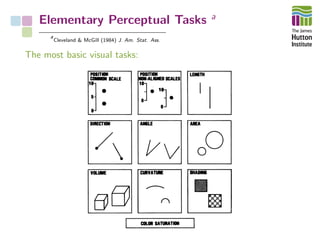
Elementary Perceptual Tasks a
a
Cleveland & McGill (1984) J. Am. Stat. Ass.
The most basic visual tasks:
Implementations a
a
http://www.datavizcatalogue.com/
Position: common scale
Scatterplot
Bar Chart
Angle
Pie Chart
Do(ugh)nut Chart
Curvature
Arc Diagram
Chord Diagram
Gestalt principles a
a
https://emeeks.github.io/gestaltdataviz
proximity: close objects perceived as
groups
enclosure: bounded objects perceived
as groups
continuity: aligned objects perceived
as continuous
similarity: similar attributes perceived
as groups
closure: open objects perceived as
complete
connection: connected items
perceived as groups
Table of Contents
1 Introduction
Why listen to me?
What is visualisation?
Elementary perceptual tasks
2 Evidence-based representation
What representations work best?
Pie charts
Bars and lines
Scatterplots
Interactive plots
3 Hands-on session
Python libraries
Exercises
Let’s get started
What works best? Experiment a b
a
Cleveland & McGill (1984) J. Am. Stat. Ass.
b
Heer & Bostock (2010) CHI 2010
Empirical measurements of interpretation
Subjects shown graphs representing same data
(log2) error in subjects’ accuracy compared by graph type
Judgement types
1-3: Position on a common scale (bar chart, stacked bar
chart)
4-5: Length encoding (stacked bar chart)
6: Angle (pie chart)
7-9: Area (bubble chart, aligned rectangles, treemap)
What works best? Result a b
a
Cleveland & McGill (1984) J. Am. Stat. Ass.
b
Heer & Bostock (2010) CHI 2010
We have inherent biases
that can distort
information recovered
Position > Angle ≈
Length > Area
Accuracy plateaus as
charts increase in size
Gridlines improve
accuracy
Aspect ratios affect area
judgements (squares
worst)
Table of Contents
1 Introduction
Why listen to me?
What is visualisation?
Elementary perceptual tasks
2 Evidence-based representation
What representations work best?
Pie charts
Bars and lines
Scatterplots
Interactive plots
3 Hands-on session
Python libraries
Exercises
Let’s get started
People hate pie charts
http://www.storytellingwithdata.com/blog/2011/07/death-to-pie-charts
especially Edward Tufte
A table is nearly always better than a dumb pie chart; the only worse design than a pie
chart is several of them[...] pie charts should never be used. - ”The Visual Display of
Quantitative Information”
”E pur si muove. . .” a b
a
Eells (1926) J Am. Stat. Ass.
b
Simkin & Hastie (1987) J Am. Stat. Ass.
For proportions of a whole:
Pie charts read as accurately as bar charts
As number of components in the chart increases, bars are less efficient than pie
charts
Table of Contents
1 Introduction
Why listen to me?
What is visualisation?
Elementary perceptual tasks
2 Evidence-based representation
What representations work best?
Pie charts
Bars and lines
Scatterplots
Interactive plots
3 Hands-on session
Python libraries
Exercises
Let’s get started
Bar charts are bad. . .mmmkay?
There is an ongoing backlash against bar charts
(and I’m not picking on Nick, he just tweets a lot. . .)
But are they really that bad?
Interpretation of bars and lines a
a
Zacks & Tversky (1999) Mem. Cognit.
People interpret bars and lines differently
Experiment 1: In absence of context (arbitrary X, Y )
bars: discrete comparison (24:0)
lines: trend assessment (0:35)
Interpretation of bars and lines a
a
Zacks & Tversky (1999) Mem. Cognit.
People interpret bars and lines differently
Experiment 2: With context (discrete or continuous data)
Bars vs. lines
People naturally interpret bar charts as categorical data
People naturally interpret line graphs as trends
Using bars for trend data or lines for categorical data can
mislead the reader
Bar charts can mislead a
a
Weissgerber et al. (2015) PLoS Biol. doi:10.1371/journal.pbio.1002128
Do these bars differ in value?
Bar charts can mislead a
a
Weissgerber et al. (2015) PLoS Biol. doi:10.1371/journal.pbio.1002128
Do these bars differ in value?
Bar charts represent data as a
single point: lossy compression.
Could different datasets give the
same bar chart?
Bars are lossy compression a
a
Weissgerber et al. (2015) PLoS Biol. doi:10.1371/journal.pbio.1002128
Bars hide detail:
Number of data points
Variance of data points
Distribution of data points (outliers, etc.)
Bars may mislead on statistics a
a
Weissgerber et al. (2015) PLoS Biol. doi:10.1371/journal.pbio.1002128
Bars may imply incorrect test statistics:
Overlaps, outliers, covariates, sample sizes masked
Bars for paired data a
a
Weissgerber et al. (2015) PLoS Biol. doi:10.1371/journal.pbio.1002128
Bars imply independence of data:
Better than bar charts?
Bar chart with SE bars suggests group 2 is highest
Better than bar charts?
Bar chart with SD bars suggests there is overlap
Better than bar charts?
Univariate scatterplots show sample sizes, outliers, variance
Any chart can mislead
Any chart can mislead a
a
Spurious Correlations, tylervigen.com
Any chart can mislead a
a
https://xkcd.com/1138/
Table of Contents
1 Introduction
Why listen to me?
What is visualisation?
Elementary perceptual tasks
2 Evidence-based representation
What representations work best?
Pie charts
Bars and lines
Scatterplots
Interactive plots
3 Hands-on session
Python libraries
Exercises
Let’s get started
Scatterplots a
a
http://www.datavizcatalogue.com/
Scatterplots should be awesome:
Positions on common scale (lowest error representation)
Show all data: outliers, sample sizes, trends, etc.
Framing affects interpretation a
a
Cleveland et al. (1982) Science doi:10.1126/science.216.4550.1138
Point cloud size affects interpretation of correlation
(more diffuse interpreted as lower correlation coefficient)
Interpreting correlation is difficult a
a
Fisher et al. (2014) PeerJ doi:10.7717/peerj.589
People don’t judge significance well
47.4% of significant relationships correctly classified
74.6% of non-significant relationships correctly classified
Table of Contents
1 Introduction
Why listen to me?
What is visualisation?
Elementary perceptual tasks
2 Evidence-based representation
What representations work best?
Pie charts
Bars and lines
Scatterplots
Interactive plots
3 Hands-on session
Python libraries
Exercises
Let’s get started
Latency affects usage
Increasing latency to 0.5s:
decreases user activity
decreases dataset
coverage
reduces rate of hypothesis
generation
changes data exploration
strategy
reduces future interaction
with other graphics
Table of Contents
1 Introduction
Why listen to me?
What is visualisation?
Elementary perceptual tasks
2 Evidence-based representation
What representations work best?
Pie charts
Bars and lines
Scatterplots
Interactive plots
3 Hands-on session
Python libraries
Exercises
Let’s get started
Python libraries
Matplotlib http://matplotlib.org/
Seaborn https://stanford.edu/ mwaskom/software/seaborn/
ggplot for Python http://yhat.github.io/ggplot/
Bokeh http://bokeh.pydata.org/
Table of Contents
1 Introduction
Why listen to me?
What is visualisation?
Elementary perceptual tasks
2 Evidence-based representation
What representations work best?
Pie charts
Bars and lines
Scatterplots
Interactive plots
3 Hands-on session
Python libraries
Exercises
Let’s get started
Exercise choices a
a
https://github.com/widdowquinn/Teaching-Data-Visualisation
One-variable, continuous data
Grammar of Graphics
Interactive map with bokeh
Two-variable, continuous x, y data
Arrays, colormaps, surface plots
Making movies
Table of Contents
1 Introduction
Why listen to me?
What is visualisation?
Elementary perceptual tasks
2 Evidence-based representation
What representations work best?
Pie charts
Bars and lines
Scatterplots
Interactive plots
3 Hands-on session
Python libraries
Exercises
Let’s get started
Let’s get started a
a
https://xkcd.com/1654/
Licence: CC-BY-SA
By: Leighton Pritchard
This presentation is licensed under the Creative Commons
Attribution ShareAlike license
https://creativecommons.org/licenses/by-sa/4.0/

RDVW Hands-on session: Python

  • 1.
    Hands-on session: Python ResearchData Visualisation Workshop Leighton Pritchard1,2,3 1 Information and Computational Sciences, 2 Centre for Human and Animal Pathogens in the Environment, 3 Dundee Effector Consortium, The James Hutton Institute, Invergowrie, Dundee, Scotland, DD2 5DA
  • 2.
    Acceptable Use Policy Recordingof this talk, taking photos, discussing the content using email, Twitter, blogs, etc. is permitted (and encouraged), providing distraction to others is minimised. These slides will be made available at http://www.slideshare.net/leightonp
  • 3.
    Table of Contents 1Introduction Why listen to me? What is visualisation? Elementary perceptual tasks 2 Evidence-based representation What representations work best? Pie charts Bars and lines Scatterplots Interactive plots 3 Hands-on session Python libraries Exercises Let’s get started
  • 4.
    What I do Computationalbiologist (1996-present) protein sequence-structure-function (1996-1999) yeast metabolism (1999-2003) plant pathology (2003-present) Large datasets sequence/genomic metabolomics statistics geographical Visualisation as communication to (wet) biologists protein structures metabolic flux comparative genomics/evolution statistical plots
  • 5.
  • 6.
    GenomeDiagram a bc a Pritchard et al. (2006) Bioinformatics doi:10.1093/bioinformatics/btk021 b Toth et al. (2006) Ann. Rev. Phytopath. doi:10.1146/annurev.phyto.44.070505.143444 c http://biopython.org
  • 7.
    Functional adaptation inPba a b a Toth et al. (2006) Ann. Rev. Phytopath. doi:10.1146/annurev.phyto.44.070505.143444 b http://biopython.org
  • 8.
    GenomeDiagram/SciArt a bc a Pritchard et al. (2006) Bioinformatics doi:10.1093/bioinformatics/btk021 b Shemilt (2009) in“Digital Visual Culture: Theory and Practice” ISBN 978-1-84150-248-9 c Shemilt (2010) in “Art Practice in a Digital Culture”, ISBN 978-0-7546-7623-2 Influence Free open-source comparative genomics visualisation library Impact Artwork (prints, audio-visual installation) exhibited in UK and internationally
  • 9.
    Comparative metabolism ab c a Biopython KGML/KEGG visualisation module b https://github.com/widdowquinn/Notebooks-Bioinformatics c http://biopython.org
  • 10.
    PyANI: prokaryote classificationa b a http://widdowquinn.github.io/pyani/ b Pritchard et al. (2016) Anal. Methods doi:10.1039/C5AY02550H Pectobacterium_atrosepticum_SCRI1043_uid57957Pectobacterium_atrosepticum_NCPPB8549Pectobacterium_atrosepticum_NCPPB3404Pectobacterium_atrosepticum_21APectobacterium_atrosepticum_JG10-08Pectobacterium_carotovorum_PC1_uid59295Pectobacterium_carotovorum_subsp_carotovorum_NCPPB312Pectobacterium_carotovorum_subsp_oderiferum_NCPPB3841Pectobacterium_carotovorum_subsp_oderiferum_NCPPB3839Pectobacterium_carotovorum_subsp_carotovorum_NCPPB3395Pectobacterium_carotovorum_PCC21_uid174335Pectobacterium_carotovorum_subsp_brasiliensis_B5Pectobacterium_carotovorum_subsp_brasiliensis_B4Pectobacterium_betavasculorum_NCPPB2293Pectobacterium_betavasculorum_NCPPB2795Pectobacterium_wasabiae_NCPPB3702Pectobacterium_wasabiae_NCPPB3701Pectobacterium_wasabiae_WPP163_uid41297Pectobacterium_SCC3193_uid193707Dickeya_solani_AMYI01Dickeya_solani_AMWE01Dickeya_solani_GBBC2040Dickeya_solani_IPO2222Dickeya_solani_MK16Dickeya_solani_MK10Dickeya_dianthicola_NCPPB_3534Dickeya_dianthicola_GBBC2039Dickeya_dianthicola_NCPPB_453Dickeya_dianthicola_IPO980Dickeya_spp_NCPPB_3274Dickeya_spp_MK7Dickeya_dadantii_NCPPB_2976Dickeya_dadantii_NCPPB_898Dickeya_dadantii_NCPPB_3537Dickeya_dadantii_3937_uid52537Pantoea_ananatis_AJ13355_uid162073Pantoea_ananatis_LMG_20103_uid46807Pantoea_ananatis_PA13_uid162181Pantoea_ananatis_uid86861Erwinia_amylovora_CFBP1430_uid46839Erwinia_amylovora_ATCC_49946_uid46943Erwinia_Ejp617_uid159955Erwinia_pyrifoliae_Ep1_96_uid40659Erwinia_pyrifoliae_DSM_12163_uid159693Dickeya_dadantii_Ech703_uid59363Dickeya_paradisiaca_NCPPB_2511Dickeya_aquatica_DW_0440Dickeya_aquatica_CSL_RW240Erwinia_tasmaniensis_Et1_99_uid59029Pantoea_At_9b_uid55845Pantoea_vagans_C9_1_uid49871Erwinia_billingiae_Eb661_uid50547Dickeya_zeae_APMV01Dickeya_zeae_AJVN01Dickeya_zeae_CSL_RW192Dickeya_zeae_NCPPB_3531Dickeya_dadantii_Ech586_uid42519Dickeya_zeae_APWM01Dickeya_zeae_NCPPB_2538Dickeya_zeae_MK19Dickeya_zeae_NCPPB_3532Dickeya_spp_NCPPB_569Dickeya_chrysanthami_NCPPB_402Dickeya_chrysanthami_NCPPB_516Dickeya_zeae_Ech1591_uid59297Dickeya_chrysanthami_NCPPB_3533 Pectobacterium_atrosepticum_SCRI1043_uid57957Pectobacterium_atrosepticum_NCPPB8549Pectobacterium_atrosepticum_NCPPB3404Pectobacterium_atrosepticum_21APectobacterium_atrosepticum_JG10-08Pectobacterium_carotovorum_PC1_uid59295Pectobacterium_carotovorum_subsp_carotovorum_NCPPB312Pectobacterium_carotovorum_subsp_oderiferum_NCPPB3841Pectobacterium_carotovorum_subsp_oderiferum_NCPPB3839Pectobacterium_carotovorum_subsp_carotovorum_NCPPB3395Pectobacterium_carotovorum_PCC21_uid174335Pectobacterium_carotovorum_subsp_brasiliensis_B5Pectobacterium_carotovorum_subsp_brasiliensis_B4Pectobacterium_betavasculorum_NCPPB2293Pectobacterium_betavasculorum_NCPPB2795Pectobacterium_wasabiae_NCPPB3702Pectobacterium_wasabiae_NCPPB3701Pectobacterium_wasabiae_WPP163_uid41297Pectobacterium_SCC3193_uid193707Dickeya_solani_AMYI01Dickeya_solani_AMWE01Dickeya_solani_GBBC2040Dickeya_solani_IPO2222Dickeya_solani_MK16Dickeya_solani_MK10Dickeya_dianthicola_NCPPB_3534Dickeya_dianthicola_GBBC2039Dickeya_dianthicola_NCPPB_453Dickeya_dianthicola_IPO980Dickeya_spp_NCPPB_3274Dickeya_spp_MK7Dickeya_dadantii_NCPPB_2976Dickeya_dadantii_NCPPB_898Dickeya_dadantii_NCPPB_3537Dickeya_dadantii_3937_uid52537Pantoea_ananatis_AJ13355_uid162073Pantoea_ananatis_LMG_20103_uid46807Pantoea_ananatis_PA13_uid162181Pantoea_ananatis_uid86861Erwinia_amylovora_CFBP1430_uid46839Erwinia_amylovora_ATCC_49946_uid46943Erwinia_Ejp617_uid159955Erwinia_pyrifoliae_Ep1_96_uid40659Erwinia_pyrifoliae_DSM_12163_uid159693Dickeya_dadantii_Ech703_uid59363Dickeya_paradisiaca_NCPPB_2511Dickeya_aquatica_DW_0440Dickeya_aquatica_CSL_RW240Erwinia_tasmaniensis_Et1_99_uid59029Pantoea_At_9b_uid55845Pantoea_vagans_C9_1_uid49871Erwinia_billingiae_Eb661_uid50547Dickeya_zeae_APMV01Dickeya_zeae_AJVN01Dickeya_zeae_CSL_RW192Dickeya_zeae_NCPPB_3531Dickeya_dadantii_Ech586_uid42519Dickeya_zeae_APWM01Dickeya_zeae_NCPPB_2538Dickeya_zeae_MK19Dickeya_zeae_NCPPB_3532Dickeya_spp_NCPPB_569Dickeya_chrysanthami_NCPPB_402Dickeya_chrysanthami_NCPPB_516Dickeya_zeae_Ech1591_uid59297Dickeya_chrysanthami_NCPPB_3533 0.00 0.25 0.50 0.75 1.00 ANIm_percentage_identity
  • 11.
    Table of Contents 1Introduction Why listen to me? What is visualisation? Elementary perceptual tasks 2 Evidence-based representation What representations work best? Pie charts Bars and lines Scatterplots Interactive plots 3 Hands-on session Python libraries Exercises Let’s get started
  • 12.
    Data visualisation isart and science . . .storytelling in pictorial or graphical format Stories to yourself (sense-making) Stories to others (communication) Cautionary tales
  • 13.
    Data visualisation isart and science . . .storytelling in pictorial or graphical format Stories to yourself (sense-making) summarise big stories quickly data exploration and mining identify areas/items of importance find relationships and patterns Stories to others (communication) Cautionary tales
  • 14.
    Data visualisation isart and science . . .storytelling in pictorial or graphical format Stories to yourself (sense-making) summarise big stories quickly data exploration and mining identify areas/items of importance find relationships and patterns Stories to others (communication) present your interpretation of data make a specific point assert a relationship or pattern demonstrate significance Cautionary tales
  • 15.
    Data visualisation isart and science . . .storytelling in pictorial or graphical format Stories to yourself (sense-making) summarise big stories quickly data exploration and mining identify areas/items of importance find relationships and patterns Stories to others (communication) present your interpretation of data make a specific point assert a relationship or pattern demonstrate significance Cautionary tales avoid distortion make the reader think about the data, not the presentation avoid chartjunk (excessive decoration) aim for high data:ink ratio
  • 16.
    The point ofdata visualisation a a https://en.wikipedia.org/wiki/Data visualization Where does visualisation belong?
  • 17.
    Communicating effectively Understand thedata Know (or be receptive to) the message Know your audience
  • 18.
    Communicating effectively Understand thedata size cardinality meaning relationships Know (or be receptive to) the message Know your audience
  • 19.
    Communicating effectively Understand thedata size cardinality meaning relationships Know (or be receptive to) the message what does pictorial representation mean? match graphical relationships to data relationships Know your audience
  • 20.
    Communicating effectively Understand thedata size cardinality meaning relationships Know (or be receptive to) the message what does pictorial representation mean? match graphical relationships to data relationships Know your audience how do people process pictorial information how does your audience process information domain-specific representations
  • 21.
    A model ofcommunication a a Randy Olson (2009) Don’t Be Such a Scientist
  • 22.
    Table of Contents 1Introduction Why listen to me? What is visualisation? Elementary perceptual tasks 2 Evidence-based representation What representations work best? Pie charts Bars and lines Scatterplots Interactive plots 3 Hands-on session Python libraries Exercises Let’s get started
  • 23.
    Elementary Perceptual Tasksa a Cleveland & McGill (1984) J. Am. Stat. Ass. The most basic visual tasks:
  • 24.
    Implementations a a http://www.datavizcatalogue.com/ Position: commonscale Scatterplot Bar Chart Angle Pie Chart Do(ugh)nut Chart Curvature Arc Diagram Chord Diagram
  • 25.
    Gestalt principles a a https://emeeks.github.io/gestaltdataviz proximity:close objects perceived as groups enclosure: bounded objects perceived as groups continuity: aligned objects perceived as continuous similarity: similar attributes perceived as groups closure: open objects perceived as complete connection: connected items perceived as groups
  • 26.
    Table of Contents 1Introduction Why listen to me? What is visualisation? Elementary perceptual tasks 2 Evidence-based representation What representations work best? Pie charts Bars and lines Scatterplots Interactive plots 3 Hands-on session Python libraries Exercises Let’s get started
  • 27.
    What works best?Experiment a b a Cleveland & McGill (1984) J. Am. Stat. Ass. b Heer & Bostock (2010) CHI 2010 Empirical measurements of interpretation Subjects shown graphs representing same data (log2) error in subjects’ accuracy compared by graph type Judgement types 1-3: Position on a common scale (bar chart, stacked bar chart) 4-5: Length encoding (stacked bar chart) 6: Angle (pie chart) 7-9: Area (bubble chart, aligned rectangles, treemap)
  • 28.
    What works best?Result a b a Cleveland & McGill (1984) J. Am. Stat. Ass. b Heer & Bostock (2010) CHI 2010 We have inherent biases that can distort information recovered Position > Angle ≈ Length > Area Accuracy plateaus as charts increase in size Gridlines improve accuracy Aspect ratios affect area judgements (squares worst)
  • 29.
    Table of Contents 1Introduction Why listen to me? What is visualisation? Elementary perceptual tasks 2 Evidence-based representation What representations work best? Pie charts Bars and lines Scatterplots Interactive plots 3 Hands-on session Python libraries Exercises Let’s get started
  • 30.
    People hate piecharts http://www.storytellingwithdata.com/blog/2011/07/death-to-pie-charts especially Edward Tufte A table is nearly always better than a dumb pie chart; the only worse design than a pie chart is several of them[...] pie charts should never be used. - ”The Visual Display of Quantitative Information”
  • 31.
    ”E pur simuove. . .” a b a Eells (1926) J Am. Stat. Ass. b Simkin & Hastie (1987) J Am. Stat. Ass. For proportions of a whole: Pie charts read as accurately as bar charts As number of components in the chart increases, bars are less efficient than pie charts
  • 32.
    Table of Contents 1Introduction Why listen to me? What is visualisation? Elementary perceptual tasks 2 Evidence-based representation What representations work best? Pie charts Bars and lines Scatterplots Interactive plots 3 Hands-on session Python libraries Exercises Let’s get started
  • 33.
    Bar charts arebad. . .mmmkay? There is an ongoing backlash against bar charts (and I’m not picking on Nick, he just tweets a lot. . .) But are they really that bad?
  • 34.
    Interpretation of barsand lines a a Zacks & Tversky (1999) Mem. Cognit. People interpret bars and lines differently Experiment 1: In absence of context (arbitrary X, Y ) bars: discrete comparison (24:0) lines: trend assessment (0:35)
  • 35.
    Interpretation of barsand lines a a Zacks & Tversky (1999) Mem. Cognit. People interpret bars and lines differently Experiment 2: With context (discrete or continuous data)
  • 36.
    Bars vs. lines Peoplenaturally interpret bar charts as categorical data People naturally interpret line graphs as trends Using bars for trend data or lines for categorical data can mislead the reader
  • 37.
    Bar charts canmislead a a Weissgerber et al. (2015) PLoS Biol. doi:10.1371/journal.pbio.1002128 Do these bars differ in value?
  • 38.
    Bar charts canmislead a a Weissgerber et al. (2015) PLoS Biol. doi:10.1371/journal.pbio.1002128 Do these bars differ in value? Bar charts represent data as a single point: lossy compression. Could different datasets give the same bar chart?
  • 39.
    Bars are lossycompression a a Weissgerber et al. (2015) PLoS Biol. doi:10.1371/journal.pbio.1002128 Bars hide detail: Number of data points Variance of data points Distribution of data points (outliers, etc.)
  • 40.
    Bars may misleadon statistics a a Weissgerber et al. (2015) PLoS Biol. doi:10.1371/journal.pbio.1002128 Bars may imply incorrect test statistics: Overlaps, outliers, covariates, sample sizes masked
  • 41.
    Bars for paireddata a a Weissgerber et al. (2015) PLoS Biol. doi:10.1371/journal.pbio.1002128 Bars imply independence of data:
  • 42.
    Better than barcharts? Bar chart with SE bars suggests group 2 is highest
  • 43.
    Better than barcharts? Bar chart with SD bars suggests there is overlap
  • 44.
    Better than barcharts? Univariate scatterplots show sample sizes, outliers, variance
  • 45.
  • 46.
    Any chart canmislead a a Spurious Correlations, tylervigen.com
  • 47.
    Any chart canmislead a a https://xkcd.com/1138/
  • 48.
    Table of Contents 1Introduction Why listen to me? What is visualisation? Elementary perceptual tasks 2 Evidence-based representation What representations work best? Pie charts Bars and lines Scatterplots Interactive plots 3 Hands-on session Python libraries Exercises Let’s get started
  • 49.
    Scatterplots a a http://www.datavizcatalogue.com/ Scatterplots shouldbe awesome: Positions on common scale (lowest error representation) Show all data: outliers, sample sizes, trends, etc.
  • 50.
    Framing affects interpretationa a Cleveland et al. (1982) Science doi:10.1126/science.216.4550.1138 Point cloud size affects interpretation of correlation (more diffuse interpreted as lower correlation coefficient)
  • 51.
    Interpreting correlation isdifficult a a Fisher et al. (2014) PeerJ doi:10.7717/peerj.589 People don’t judge significance well 47.4% of significant relationships correctly classified 74.6% of non-significant relationships correctly classified
  • 52.
    Table of Contents 1Introduction Why listen to me? What is visualisation? Elementary perceptual tasks 2 Evidence-based representation What representations work best? Pie charts Bars and lines Scatterplots Interactive plots 3 Hands-on session Python libraries Exercises Let’s get started
  • 53.
    Latency affects usage Increasinglatency to 0.5s: decreases user activity decreases dataset coverage reduces rate of hypothesis generation changes data exploration strategy reduces future interaction with other graphics
  • 54.
    Table of Contents 1Introduction Why listen to me? What is visualisation? Elementary perceptual tasks 2 Evidence-based representation What representations work best? Pie charts Bars and lines Scatterplots Interactive plots 3 Hands-on session Python libraries Exercises Let’s get started
  • 55.
    Python libraries Matplotlib http://matplotlib.org/ Seabornhttps://stanford.edu/ mwaskom/software/seaborn/ ggplot for Python http://yhat.github.io/ggplot/ Bokeh http://bokeh.pydata.org/
  • 56.
    Table of Contents 1Introduction Why listen to me? What is visualisation? Elementary perceptual tasks 2 Evidence-based representation What representations work best? Pie charts Bars and lines Scatterplots Interactive plots 3 Hands-on session Python libraries Exercises Let’s get started
  • 57.
    Exercise choices a a https://github.com/widdowquinn/Teaching-Data-Visualisation One-variable,continuous data Grammar of Graphics Interactive map with bokeh Two-variable, continuous x, y data Arrays, colormaps, surface plots Making movies
  • 58.
    Table of Contents 1Introduction Why listen to me? What is visualisation? Elementary perceptual tasks 2 Evidence-based representation What representations work best? Pie charts Bars and lines Scatterplots Interactive plots 3 Hands-on session Python libraries Exercises Let’s get started
  • 59.
    Let’s get starteda a https://xkcd.com/1654/
  • 60.
    Licence: CC-BY-SA By: LeightonPritchard This presentation is licensed under the Creative Commons Attribution ShareAlike license https://creativecommons.org/licenses/by-sa/4.0/