In A Different Class?
Whole genome classification of bacterial
potato pathogens
Leighton Pritchard1,2,3,4
1
Information and Computational Sciences,
2
Weeds, Pests and Diseases,
3
Centre for Human and Animal Pathogens in the Environment,
4
Dundee Effector Consortium,
The James Hutton Institute, Invergowrie, Dundee, Scotland, DD2 5DA
Acceptable Use Policy
Recording of this talk, taking photos, discussing the content using
email, Twitter, blogs, etc. is permitted (and encouraged),
providing distraction to others is minimised.
These slides will be made available at
http://www.slideshare.net/leightonp
Table of Contents
1 Introduction
A Tangled Taxonomy
The Insidious Dickeya Menace
2 Diagnostic Primers
qPCR Primer Design From Whole Genomes
Problems with Classification
3 Reclassification
ANI Are You OK? Are You OK ANI?
PYANI
ANIm of SREs
A New Hope
4 Conclusions
Final thoughts
Acknowledgements
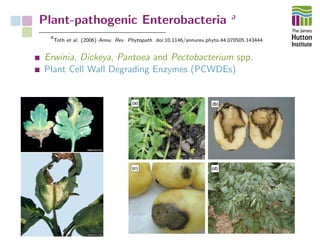
Plant-pathogenic Enterobacteria a b
a
Toth et al. (2006) Annu. Rev. Phytopath. doi:10.1146/annurev.phyto.44.070505.143444
b
Toth et al. (2011) Plant Path. doi:10.1111/j.1365-3059.2011.02427.x
Erwinia, Dickeya, Pantoea and Pectobacterium spp.
Plant Cell Wall Degrading Enzymes (PCWDEs)
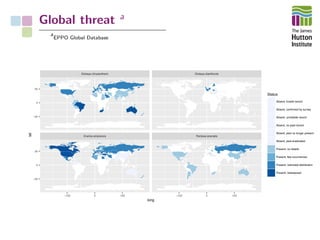
Global threat a
a
EPPO Global Database
Dickeya chrysanthemi Dickeya dianthicola
Erwinia amylovora Pantoea ananatis
−50
0
50
−50
0
50
−100 0 100 −100 0 100
long
lat
Status
Absent, invalid record
Absent, confirmed by survey
Absent, unreliable record
Absent, no pest record
Absent, pest no longer present
Absent, pest eradicated
Present, no details
Present, few occurrences
Present, restricted distribution
Present, widespread
A Tangled Taxonomy a b
a
Pritchard et al. (2016) Anal. Methods doi:10.1039/c5ay02550h
b
Williams et al. (2010) J. Bact. doi:10.1128/JB.01480-09
Enterobacterial taxonomy difficult to resolve, in general
Soft rot enterobacteria (SRE): Pectobacterium and Dickeya
Historical classification mostly polyphasic/phenotypic
SRE originally Erwinia spp., now three distinct genera
(Dickeya, Pectobacterium, Erwinia)
Pectobacterium spp. used to be E. carotovora (and E.
chrysanthemi)
Dickeya spp. used to be P. chrysanthemi
Not suitable for facultative bacteria?
Binomial nomenclature not designed for large amounts of genome
data, or organised metadata curation
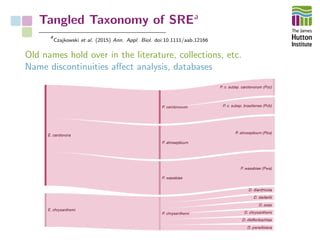
Tangled Taxonomy of SREa
a
Czajkowski et al. (2015) Ann. Appl. Biol. doi:10.1111/aab.12166
Old names hold over in the literature, collections, etc.
Name discontinuities affect analysis, databases
Table of Contents
1 Introduction
A Tangled Taxonomy
The Insidious Dickeya Menace
2 Diagnostic Primers
qPCR Primer Design From Whole Genomes
Problems with Classification
3 Reclassification
ANI Are You OK? Are You OK ANI?
PYANI
ANIm of SREs
A New Hope
4 Conclusions
Final thoughts
Acknowledgements
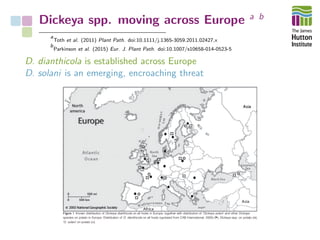
Dickeya spp. moving across Europe a b
a
Toth et al. (2011) Plant Path. doi:10.1111/j.1365-3059.2011.02427.x
b
Parkinson et al. (2015) Eur. J. Plant Path. doi:10.1007/s10658-014-0523-5
D. dianthicola is established across Europe
D. solani is an emerging, encroaching threat
Legislation a
a
Pritchard et al. (2015) Anal. Methods doi:10.1039/c5ay02550h
European and Mediterranean Plant Protection Organisation
(EPPO)
Member states should regulate D. dianthicola and E. amylovora as
quarantine pests (A2 list)
Seed Potatoes (Scotland) Amendment Regulations (2010)
Zero tolerance policy for all Dickeya spp. on potatoes in Scotland
to ensure production of ‘clean’ (disease-free) seed potato
production for export
EUPHRESCO consortium
: Control and epidemiology across Europe
Legislation by taxonomy a
a
Pritchard et al. (2015) Anal. Methods doi:10.1039/c5ay02550h
“Easy” to incorporate binomial nomenclature into legislation1
Assumption: taxonomy can be determined precisely
Taxonomy is a human-imposed hierarchical classification that truly
reflects nature
Assumption: taxonomy is a proxy for disease risk
Sharing a common ancestor with another pathogen is the primary
factor that influences virulence
1
(easy for policy-makers to understand)
Issues with legislating by taxonomy a
a
Pritchard et al. (2015) Anal. Methods doi:10.1039/c5ay02550h
Is current bacterial taxonomy objective and correct?
Taxonomy is ‘vertical’, but pathogenicity may be ‘laterally’
transferred (plasmid/transposon-borne, etc.) 2
Is a species concept even relevant for bacteria?
Mapping from taxonomy to phenotype is not one-to-one 3
Testing for disease phenotypes not exhaustive (facultative
pathogens)
Relationship between genome and disease/risk not fully
understood
2
Toth et al. (2006) Ann. Rev. Phyto. doi:10.1146/annurev.phyto.44.070505.143444
3
Deans et al. (2015) PLoS Biol. doi:10.1371/journal.pbio.1002033
Table of Contents
1 Introduction
A Tangled Taxonomy
The Insidious Dickeya Menace
2 Diagnostic Primers
qPCR Primer Design From Whole Genomes
Problems with Classification
3 Reclassification
ANI Are You OK? Are You OK ANI?
PYANI
ANIm of SREs
A New Hope
4 Conclusions
Final thoughts
Acknowledgements
Dickeya qPCR diagnostics a b c
a
Pritchard et al. (2013) Plant Path. doi:10.1111/j.1365-3059.2012.02678.x
b
Pritchard et al. (2013) Genome Ann. doi:10.1128/genomeA.00087-12
c
Pritchard et al. (2013) Genome Ann. doi:10.1128/genomeA.00978-13
To legislate on or quarantine contaminated materials, one
has to be able to identify and discriminate the pathogen
Having sequenced 25 Dickeya isolates, we were approached to
develop diagnostics at the species/isolate level
qPCR is cheaper, quicker and easier than bacterial genome
sequencing (for now, anyway. . . ) 4
No qPCR primers existed to distinguish among Dickeya spp.
4
Czajkowski et al. (2015) Ann. Appl. Biol. doi:10.1111/aab.12166
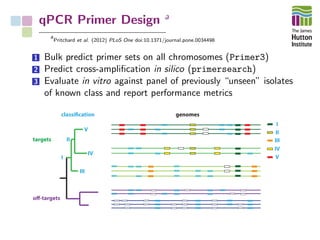
qPCR Primer Design a
a
Pritchard et al. (2012) PLoS One doi:10.1371/journal.pone.0034498
1 Bulk predict primer sets on all chromosomes (Primer3)
2 Predict cross-amplification in silico (primersearch)
3 Evaluate in vitro against panel of previously “unseen” isolates
of known class and report performance metrics
targets
off-targets
classification
V
IV
III
II
I
genomes
I
II
III
IV
V
Table of Contents
1 Introduction
A Tangled Taxonomy
The Insidious Dickeya Menace
2 Diagnostic Primers
qPCR Primer Design From Whole Genomes
Problems with Classification
3 Reclassification
ANI Are You OK? Are You OK ANI?
PYANI
ANIm of SREs
A New Hope
4 Conclusions
Final thoughts
Acknowledgements
Classification is a problem! a
a
Pritchard et al. (2013) Plant Path. doi:10.1111/j.1365-3059.2012.02678.x
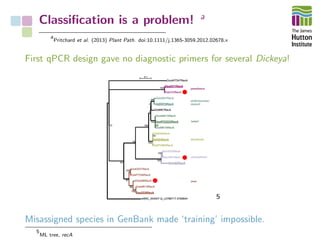
First qPCR design gave no diagnostic primers for several Dickeya!
5
Misassigned species in GenBank made ‘training’ impossible.
5
ML tree, recA
Consequences of misclassification a b
a
Pritchard et al. (2016) Anal. Methods doi:10.1039/c5ay02550h
b
Varghese et al. (2015) Nucl. Acids Res. doi:10.1093/nar/gkv657
Real-world consequences
False positives (type I errors):
clean samples rejected: economic cost
farms quarantined/close: economic/societal cost
False negatives (type II errors):
(irreversible) introduction of infectious material
potential for novel host jumps and spread
“Gold-standard”, correctly classified training and test sets essential
to estimate classifier error rates.
MiSI: 18% of NCBI bacterial genomes misclassified at species level
Accurate classification is essential!
Table of Contents
1 Introduction
A Tangled Taxonomy
The Insidious Dickeya Menace
2 Diagnostic Primers
qPCR Primer Design From Whole Genomes
Problems with Classification
3 Reclassification
ANI Are You OK? Are You OK ANI?
PYANI
ANIm of SREs
A New Hope
4 Conclusions
Final thoughts
Acknowledgements
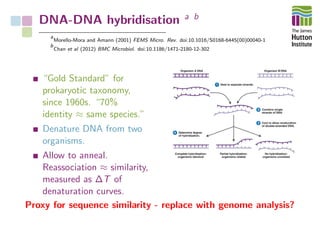
DNA-DNA hybridisation a b
a
Morello-Mora and Amann (2001) FEMS Micro. Rev. doi:10.1016/S0168-6445(00)00040-1
b
Chan et al (2012) BMC Microbiol. doi:10.1186/1471-2180-12-302
“Gold Standard” for
prokaryotic taxonomy,
since 1960s. “70%
identity ≈ same species.”
Denature DNA from two
organisms.
Allow to anneal.
Reassociation ≈ similarity,
measured as ∆T of
denaturation curves.
Proxy for sequence similarity - replace with genome analysis?
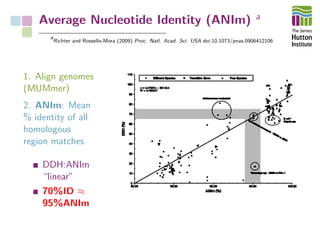
Average Nucleotide Identity (ANIm) a
a
Richter and Rossello-Mora (2009) Proc. Natl. Acad. Sci. USA doi:10.1073/pnas.0906412106
1. Align genomes
(MUMmer)
2. ANIm: Mean
% identity of all
homologous
region matches
DDH:ANIm
“linear”
70%ID ≈
95%ANIm
ANIm
ANIm is. . .
straightforward to apply to genomes
average identity of all ‘homologous’ regions
not dependent on dataset composition (unlike hierarchical
clustering)
(just) another pairwise distance measure
approximate limiting case of MLST/MLSA/multigene
comparisons
Table of Contents
1 Introduction
A Tangled Taxonomy
The Insidious Dickeya Menace
2 Diagnostic Primers
qPCR Primer Design From Whole Genomes
Problems with Classification
3 Reclassification
ANI Are You OK? Are You OK ANI?
PYANI
ANIm of SREs
A New Hope
4 Conclusions
Final thoughts
Acknowledgements
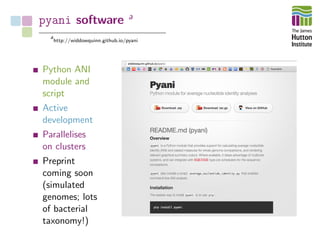
pyani software a
a
http://widdowquinn.github.io/pyani
Python ANI
module and
script
Active
development
Parallelises
on clusters
Preprint
coming soon
(simulated
genomes; lots
of bacterial
taxonomy!)
Table of Contents
1 Introduction
A Tangled Taxonomy
The Insidious Dickeya Menace
2 Diagnostic Primers
qPCR Primer Design From Whole Genomes
Problems with Classification
3 Reclassification
ANI Are You OK? Are You OK ANI?
PYANI
ANIm of SREs
A New Hope
4 Conclusions
Final thoughts
Acknowledgements
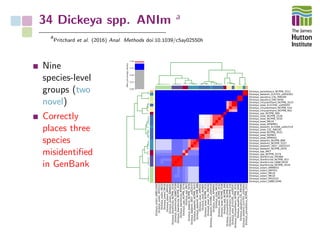
34 Dickeya spp. ANIm a
a
Pritchard et al. (2016) Anal. Methods doi:10.1039/c5ay02550h
Nine
species-level
groups (two
novel)
Correctly
places three
species
misidentified
in GenBank
Dickeya_solani_GBBC2040
Dickeya_solani_IPO2222
Dickeya_solani_MK10
Dickeya_solani_MK16
Dickeya_solani_AMYI01
Dickeya_solani_AMWE01
Dickeya_dianthicola_NCPPB_3534
Dickeya_dianthicola_GBBC2039
Dickeya_dianthicola_NCPPB_453
Dickeya_dianthicola_IPO980
Dickeya_spp_NCPPB_3274
Dickeya_spp_MK7
Dickeya_dadantii_NCPPB_2976
Dickeya_dadantii_3937_uid52537
Dickeya_dadantii_NCPPB_3537
Dickeya_dadantii_NCPPB_898
Dickeya_zeae_APMV01
Dickeya_zeae_AJVN01
Dickeya_zeae_NCPPB_3531
Dickeya_zeae_CSL_RW192
Dickeya_dadantii_Ech586_uid42519
Dickeya_zeae_APWM01
Dickeya_zeae_MK19
Dickeya_zeae_NCPPB_3532
Dickeya_zeae_NCPPB_2538
Dickeya_spp_NCPPB_569
Dickeya_chrysanthami_NCPPB_402
Dickeya_chrysanthami_NCPPB_516
Dickeya_zeae_Ech1591_uid59297
Dickeya_chrysanthami_NCPPB_3533
Dickeya_aquatica_DW_0440
Dickeya_aquatica_CSL_RW240
Dickeya_dadantii_Ech703_uid59363
Dickeya_paradisiaca_NCPPB_2511
Dickeya_solani_GBBC2040
Dickeya_solani_IPO2222
Dickeya_solani_MK10
Dickeya_solani_MK16
Dickeya_solani_AMYI01
Dickeya_solani_AMWE01
Dickeya_dianthicola_NCPPB_3534
Dickeya_dianthicola_GBBC2039
Dickeya_dianthicola_NCPPB_453
Dickeya_dianthicola_IPO980
Dickeya_spp_NCPPB_3274
Dickeya_spp_MK7
Dickeya_dadantii_NCPPB_2976
Dickeya_dadantii_3937_uid52537
Dickeya_dadantii_NCPPB_3537
Dickeya_dadantii_NCPPB_898
Dickeya_zeae_APMV01
Dickeya_zeae_AJVN01
Dickeya_zeae_NCPPB_3531
Dickeya_zeae_CSL_RW192
Dickeya_dadantii_Ech586_uid42519
Dickeya_zeae_APWM01
Dickeya_zeae_MK19
Dickeya_zeae_NCPPB_3532
Dickeya_zeae_NCPPB_2538
Dickeya_spp_NCPPB_569
Dickeya_chrysanthami_NCPPB_402
Dickeya_chrysanthami_NCPPB_516
Dickeya_zeae_Ech1591_uid59297
Dickeya_chrysanthami_NCPPB_3533
Dickeya_aquatica_DW_0440
Dickeya_aquatica_CSL_RW240
Dickeya_dadantii_Ech703_uid59363
Dickeya_paradisiaca_NCPPB_2511
0.00
0.25
0.50
0.75
1.00
ANIm_percentage_identity
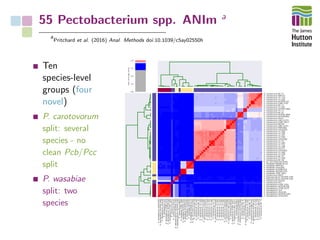
55 Pectobacterium spp. ANIm a
a
Pritchard et al. (2016) Anal. Methods doi:10.1039/c5ay02550h
Ten
species-level
groups (four
novel)
P. carotovorum
split: several
species - no
clean Pcb/Pcc
split
P. wasabiae
split: two
species
P. atrosepticum SCRI1043
P. atrosepticum NCPPB 3404
P. atrosepticum JG10­08
P. atrosepticum 21A
P. atrosepticum CFBP 6276
P. atrosepticum NCPPB 549
P. atrosepticum ICMP 1526
P. carotovorum PC1
P. carotovorum UGC32
P. betavasculorum NCPPB 2793
P. betavasculorum NCPPB 2795
P. carotovorum M022
P. wasabiae CFBP 3304
P. wasabiae NCPPB 3701
P. wasabiae NCPPB3702
P. wasabiae CFIA1002
P. wasabiae WPP163
P. wasabiae RNS08.42.1A
P. sp. SCC3193 SCC3193
P. carotovorum BC D6
P. carotovorum YC D49
P. carotovorum BC S2
P. carotovorum YC D29
P. carotovorum YC D65
P. carotovorum CFIA1001
P. carotovorum PCC21
P. carotovorum YC D46
P. carotovorum YC T31
P. carotovorum YC D62
P. carotovorum YC T3
P. carotovorum CFIA1009
P. carotovorum YC D52
P. carotovorum YC D21
P. carotovorum YC D64
P. carotovorum YC D60
P. carotovorum CFIA1033
P. carotovorum PBR1692
P. carotovorum LMG 21371
P. carotovorum BD255
P. carotovorum ICMP 19477
P. carotovorum LMG 21372
P. carotovorum KKH3
P. carotovorum NCPPB3841
P. carotovorum NCPPB 3839
P. carotovorum BC S7
P. carotovorum YC T1
P. carotovorum NCPPB 3395
P. carotovorum YC D57
P. carotovorum BC T2
P. carotovorum ICMP 5702
P. carotovorum NCPPB 312
P. carotovorum YC D16
P. carotovorum YC T39
P. carotovorum WPP14
P. carotovorum BC T5
P. atrosepticum SCRI1043
P. atrosepticum NCPPB 3404
P. atrosepticum JG10­08
P. atrosepticum 21A
P. atrosepticum CFBP 6276
P. atrosepticum NCPPB 549
P. atrosepticum ICMP 1526
P. carotovorum PC1
P. carotovorum UGC32
P. betavasculorum NCPPB 2793
P. betavasculorum NCPPB 2795
P. carotovorum M022
P. wasabiae CFBP 3304
P. wasabiae NCPPB 3701
P. wasabiae NCPPB3702
P. wasabiae CFIA1002
P. wasabiae WPP163
P. wasabiae RNS08.42.1A
P. sp. SCC3193 SCC3193
P. carotovorum BC D6
P. carotovorum YC D49
P. carotovorum BC S2
P. carotovorum YC D29
P. carotovorum YC D65
P. carotovorum CFIA1001
P. carotovorum PCC21
P. carotovorum YC D46
P. carotovorum YC T31
P. carotovorum YC D62
P. carotovorum YC T3
P. carotovorum CFIA1009
P. carotovorum YC D52
P. carotovorum YC D21
P. carotovorum YC D64
P. carotovorum YC D60
P. carotovorum CFIA1033
P. carotovorum PBR1692
P. carotovorum LMG 21371
P. carotovorum BD255
P. carotovorum ICMP 19477
P. carotovorum LMG 21372
P. carotovorum KKH3
P. carotovorum NCPPB3841
P. carotovorum NCPPB 3839
P. carotovorum BC S7
P. carotovorum YC T1
P. carotovorum NCPPB 3395
P. carotovorum YC D57
P. carotovorum BC T2
P. carotovorum ICMP 5702
P. carotovorum NCPPB 312
P. carotovorum YC D16
P. carotovorum YC T39
P. carotovorum WPP14
P. carotovorum BC T5
0.00
0.25
0.50
0.75
1.00
ANIm_percentage_identity
Interpreting ANIm a
a
Pritchard et al. (2016) Anal. Methods doi:10.1039/c5ay02550h
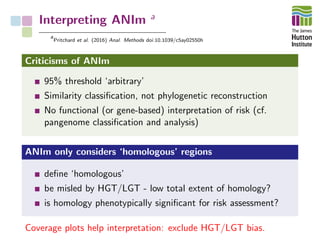
Criticisms of ANIm
95% threshold ‘arbitrary’
Similarity classification, not phylogenetic reconstruction
No functional (or gene-based) interpretation of risk (cf.
pangenome classification and analysis)
ANIm only considers ‘homologous’ regions
define ‘homologous’
be misled by HGT/LGT - low total extent of homology?
is homology phenotypically significant for risk assessment?
Coverage plots help interpretation: exclude HGT/LGT bias.
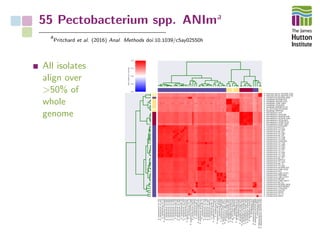
55 Pectobacterium spp. ANIma
a
Pritchard et al. (2016) Anal. Methods doi:10.1039/c5ay02550h
All isolates
align over
>50% of
whole
genome
P. carotovorum YC T31
P. carotovorum YC D21
P. carotovorum YC T3
P. carotovorum CFIA1009
P. carotovorum YC D64
P. carotovorum YC D52
P. carotovorum YC D62
P. carotovorum YC D60
P. carotovorum YC D49
P. carotovorum BC D6
P. carotovorum YC D65
P. carotovorum YC D46
P. carotovorum BC S2
P. carotovorum YC D29
P. carotovorum PCC21
P. carotovorum CFIA1001
P. carotovorum YC T1
P. carotovorum NCPPB 3395
P. carotovorum UGC32
P. carotovorum KKH3
P. carotovorum BC S7
P. carotovorum ICMP 5702
P. carotovorum NCPPB 312
P. carotovorum BC T2
P. carotovorum YC D16
P. carotovorum YC T39
P. carotovorum YC D57
P. carotovorum WPP14
P. carotovorum BC T5
P. carotovorum CFIA1033
P. carotovorum PC1
P. carotovorum LMG 21371
P. carotovorum BD255
P. carotovorum PBR1692
P. carotovorum ICMP 19477
P. carotovorum LMG 21372
P. wasabiae CFBP 3304
P. wasabiae NCPPB 3701
P. wasabiae NCPPB3702
P. sp. SCC3193 SCC3193
P. wasabiae WPP163
P. wasabiae RNS08.42.1A
P. wasabiae CFIA1002
P. atrosepticum CFBP 6276
P. atrosepticum NCPPB 3404
P. atrosepticum NCPPB 549
P. atrosepticum ICMP 1526
P. atrosepticum SCRI1043
P. atrosepticum JG10­08
P. atrosepticum 21A
P. carotovorum NCPPB3841
P. carotovorum NCPPB 3839
P. carotovorum M022
P. betavasculorum NCPPB 2793
P. betavasculorum NCPPB 2795
P. carotovorum M022
P. carotovorum YC T1
P. carotovorum KKH3
P. carotovorum UGC32
P. carotovorum CFIA1033
P. carotovorum NCPPB3841
P. carotovorum NCPPB 3839
P. carotovorum BC S7
P. carotovorum ICMP 19477
P. carotovorum BD255
P. carotovorum LMG 21372
P. carotovorum PBR1692
P. carotovorum LMG 21371
P. carotovorum PC1
P. carotovorum ICMP 5702
P. carotovorum NCPPB 312
P. carotovorum YC D57
P. carotovorum BC T2
P. carotovorum YC D16
P. carotovorum WPP14
P. carotovorum BC T5
P. carotovorum YC D62
P. carotovorum YC T31
P. carotovorum YC D52
P. carotovorum YC T3
P. carotovorum YC D64
P. carotovorum YC D21
P. carotovorum YC D60
P. carotovorum YC T39
P. carotovorum CFIA1001
P. carotovorum YC D46
P. carotovorum YC D49
P. carotovorum BC D6
P. carotovorum YC D65
P. carotovorum BC S2
P. carotovorum YC D29
P. carotovorum PCC21
P. carotovorum CFIA1009
P. atrosepticum ICMP 1526
P. atrosepticum CFBP 6276
P. atrosepticum SCRI1043
P. atrosepticum NCPPB 3404
P. atrosepticum NCPPB 549
P. atrosepticum JG10­08
P. atrosepticum 21A
P. wasabiae WPP163
P. sp. SCC3193 SCC3193
P. wasabiae RNS08.42.1A
P. wasabiae CFIA1002
P. wasabiae CFBP 3304
P. wasabiae NCPPB 3701
P. wasabiae NCPPB3702
P. carotovorum NCPPB 3395
P. betavasculorum NCPPB 2793
P. betavasculorum NCPPB 2795
0.00
0.25
0.50
0.75
1.00
ANIm_alignment_coverage
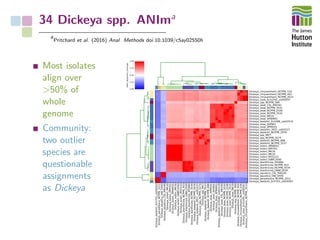
34 Dickeya spp. ANIma
a
Pritchard et al. (2016) Anal. Methods doi:10.1039/c5ay02550h
Most isolates
align over
>50% of
whole
genome
Community:
two outlier
species are
questionable
assignments
as Dickeya
Dickeya_dadantii_Ech703_uid59363
Dickeya_paradisiaca_NCPPB_2511
Dickeya_aquatica_DW_0440
Dickeya_aquatica_CSL_RW240
Dickeya_solani_MK10
Dickeya_solani_AMYI01
Dickeya_solani_AMWE01
Dickeya_solani_MK16
Dickeya_solani_GBBC2040
Dickeya_solani_IPO2222
Dickeya_dianthicola_NCPPB_453
Dickeya_dianthicola_GBBC2039
Dickeya_dianthicola_IPO980
Dickeya_dianthicola_NCPPB_3534
Dickeya_dadantii_NCPPB_2976
Dickeya_dadantii_3937_uid52537
Dickeya_spp_NCPPB_3274
Dickeya_spp_MK7
Dickeya_dadantii_NCPPB_3537
Dickeya_dadantii_NCPPB_898
Dickeya_zeae_APMV01
Dickeya_zeae_AJVN01
Dickeya_zeae_APWM01
Dickeya_dadantii_Ech586_uid42519
Dickeya_zeae_CSL_RW192
Dickeya_zeae_NCPPB_3532
Dickeya_zeae_NCPPB_2538
Dickeya_zeae_NCPPB_3531
Dickeya_zeae_MK19
Dickeya_spp_NCPPB_569
Dickeya_chrysanthami_NCPPB_402
Dickeya_chrysanthami_NCPPB_516
Dickeya_zeae_Ech1591_uid59297
Dickeya_chrysanthami_NCPPB_3533
Dickeya_dadantii_Ech703_uid59363
Dickeya_paradisiaca_NCPPB_2511
Dickeya_aquatica_DW_0440
Dickeya_aquatica_CSL_RW240
Dickeya_dianthicola_GBBC2039
Dickeya_dianthicola_NCPPB_3534
Dickeya_dianthicola_NCPPB_453
Dickeya_dianthicola_IPO980
Dickeya_solani_GBBC2040
Dickeya_solani_IPO2222
Dickeya_solani_MK10
Dickeya_solani_MK16
Dickeya_solani_AMYI01
Dickeya_solani_AMWE01
Dickeya_dadantii_NCPPB_3537
Dickeya_dadantii_NCPPB_898
Dickeya_spp_NCPPB_3274
Dickeya_spp_MK7
Dickeya_dadantii_NCPPB_2976
Dickeya_dadantii_3937_uid52537
Dickeya_zeae_APMV01
Dickeya_zeae_AJVN01
Dickeya_dadantii_Ech586_uid42519
Dickeya_zeae_APWM01
Dickeya_zeae_MK19
Dickeya_zeae_NCPPB_3532
Dickeya_zeae_NCPPB_2538
Dickeya_zeae_NCPPB_3531
Dickeya_zeae_CSL_RW192
Dickeya_spp_NCPPB_569
Dickeya_zeae_Ech1591_uid59297
Dickeya_chrysanthami_NCPPB_3533
Dickeya_chrysanthami_NCPPB_402
Dickeya_chrysanthami_NCPPB_516
0.00
0.25
0.50
0.75
1.00
ANIm_alignment_coverage
Table of Contents
1 Introduction
A Tangled Taxonomy
The Insidious Dickeya Menace
2 Diagnostic Primers
qPCR Primer Design From Whole Genomes
Problems with Classification
3 Reclassification
ANI Are You OK? Are You OK ANI?
PYANI
ANIm of SREs
A New Hope
4 Conclusions
Final thoughts
Acknowledgements
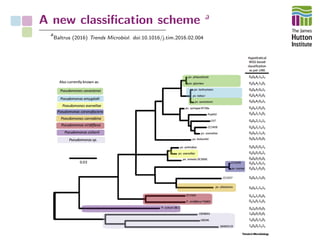
A new classification scheme a
a
Baltrus (2016) Trends Microbiol. doi:10.1016/j.tim.2016.02.004
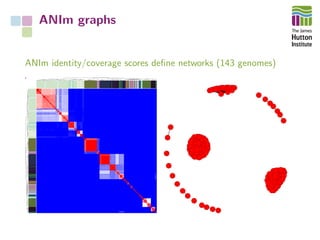
ANIm graphs
ANIm identity/coverage scores define networks (143 genomes)
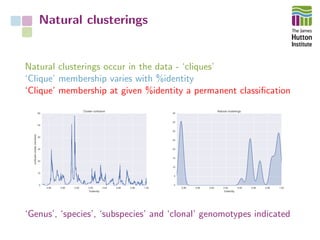
Natural clusterings
Natural clusterings occur in the data - ‘cliques’
‘Clique’ membership varies with %identity
‘Clique’ membership at given %identity a permanent classification
0.86 0.88 0.90 0.92 0.94 0.96 0.98 1.00
%identity
0
10
20
30
40
50
60
confusedclustermembers
Cluster confusion
0.86 0.88 0.90 0.92 0.94 0.96 0.98 1.00
%identity
0
5
10
15
20
25
30
35
40
Natural clusterings
‘Genus’, ‘species’, ‘subspecies’ and ‘clonal’ genomotypes indicated
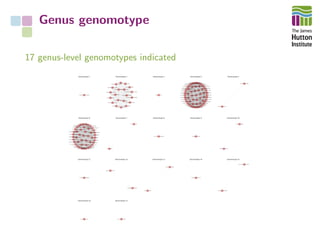
Genus genomotype
17 genus-level genomotypes indicated
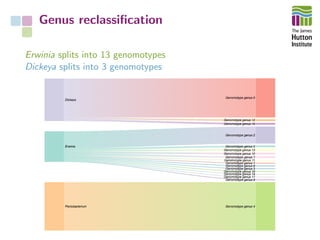
Genus reclassification
Erwinia splits into 13 genomotypes
Dickeya splits into 3 genomotypes
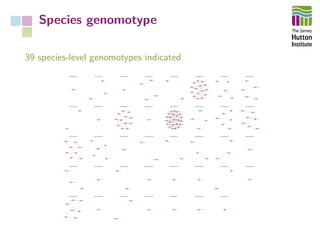
Species genomotype
39 species-level genomotypes indicated
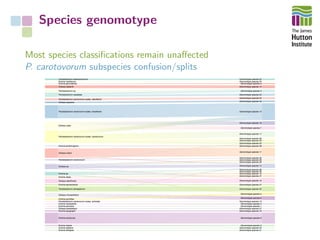
Species genomotype
Most species classifications remain unaffected
P. carotovorum subspecies confusion/splits
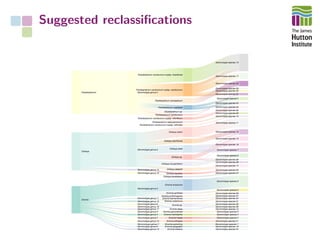
Suggested reclassifications
Table of Contents
1 Introduction
A Tangled Taxonomy
The Insidious Dickeya Menace
2 Diagnostic Primers
qPCR Primer Design From Whole Genomes
Problems with Classification
3 Reclassification
ANI Are You OK? Are You OK ANI?
PYANI
ANIm of SREs
A New Hope
4 Conclusions
Final thoughts
Acknowledgements
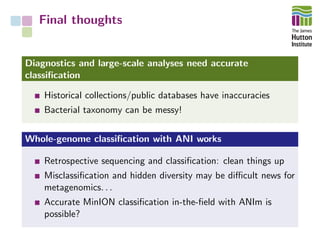
Final thoughts
Diagnostics and large-scale analyses need accurate
classification
Historical collections/public databases have inaccuracies
Bacterial taxonomy can be messy!
Whole-genome classification with ANI works
Retrospective sequencing and classification: clean things up
Misclassification and hidden diversity may be difficult news for
metagenomics. . .
Accurate MinION classification in-the-field with ANIm is
possible?
Table of Contents
1 Introduction
A Tangled Taxonomy
The Insidious Dickeya Menace
2 Diagnostic Primers
qPCR Primer Design From Whole Genomes
Problems with Classification
3 Reclassification
ANI Are You OK? Are You OK ANI?
PYANI
ANIm of SREs
A New Hope
4 Conclusions
Final thoughts
Acknowledgements
Acknowledgements
Dickeya/Erwinia/Pectobacterium
Steve Baeyen (ILVO)
Emma Campbell (JHI)
Sean Chapman (JHI)
John Elphinstone (Fera)
Tracey Gloster (St Andrews)
Rachel Glover (Fera)
Sonia Humphris (JHI)
Martine Maes (ILVO)
Katrin Mackenzie (BioSS)
Neil Parkinson (Fera)
Minna Pirhonen (Helsinki)
Gerry Saddler (SASA)
Elaine Shemilt (Duncan of
Jordanstone)
Ian Simpson (Edinburgh)
Ian Toth (JHI)
Jan van der Wolf (Wageningen)
Johan van Vaerenbergh (ILVO)
Frank Wright (BioSS)
Eirini Xemantilotou (St
Andrews/JHI)
Nematodes
Peter Cock (JHI)
John Jones (JHI/St Andrews)
Robbie Rae (John Moores)
Peter Thorpe (JHI)
Phytophthora
Miles Armstrong (Dundee)
Anna Avrova (JHI)
Jim Beynon (Warwick)
Paul Birch (Dundee)
David Cooke (JHI)
Kath Denby (York)
Eleanor Gilroy (JHI)
Sarah Green (Forest Research)
Edgar Huitema (Dundee)
Rory McLean (Dundee)
Hazel McLellan (Dundee)
Sophien Kamoun (TSL)
Gail Preston (Oxford)
Paul Sharp (Edinburgh)
Jens Steinbrenner (Warwick)
Pieter van West (Aberdeen)
Steve Whisson (JHI)
Computational and Systems
Biology
David Broadhurst (Edith
Cowan)
Peter Cock (JHI)
Mark Dufton (Strathclyde)
Roy Goodacre (Manchester)
Douglas Kell (Manchester)
David Martin (Dundee)
Iain Milne (JHI)
Pedro Mendes (Manchester)
E. coli/other bacteria
Florence Abram (Galway)
Martina Bielaszewska (Muenster)
Fiona Brennan (Galway)
Ken Forbes (Aberdeen)
Nicola Holden (JHI)
Ashleigh Holmes (JHI)
Paul Hoskisson (Strathclyde)
Helge Karch (Muenster)
Norval Strachan (Aberdeen)
David Studholme (Exeter)
Nick Waters (Galway)
Metagenomics/Communities
Natalie Ferry (Salford)
Thomas Freitag (JHI)
Ryan Joynson (Liverpool)
John Mitchell (St Andrews)
Les Noble (Aberdeen)
Jim Prosser (Aberdeen)
V Anne Smith (St Andrews)
Potato
Micha Bayer (JHI)
Glenn Bryan (JHI)
Graham Etherington (TSL)
Ingo Hein (JHI)
Florian Jupe (JHI)
Jonathan Jones (TSL)
Dan Maclean (TSL)
. . .and many others. . .
Licence: CC-BY-SA
By: Leighton Pritchard
This presentation is licensed under the Creative Commons
Attribution ShareAlike license
https://creativecommons.org/licenses/by-sa/4.0/

In a Different Class?

  • 1.
    In A DifferentClass? Whole genome classification of bacterial potato pathogens Leighton Pritchard1,2,3,4 1 Information and Computational Sciences, 2 Weeds, Pests and Diseases, 3 Centre for Human and Animal Pathogens in the Environment, 4 Dundee Effector Consortium, The James Hutton Institute, Invergowrie, Dundee, Scotland, DD2 5DA
  • 2.
    Acceptable Use Policy Recordingof this talk, taking photos, discussing the content using email, Twitter, blogs, etc. is permitted (and encouraged), providing distraction to others is minimised. These slides will be made available at http://www.slideshare.net/leightonp
  • 3.
    Table of Contents 1Introduction A Tangled Taxonomy The Insidious Dickeya Menace 2 Diagnostic Primers qPCR Primer Design From Whole Genomes Problems with Classification 3 Reclassification ANI Are You OK? Are You OK ANI? PYANI ANIm of SREs A New Hope 4 Conclusions Final thoughts Acknowledgements
  • 4.
    Plant-pathogenic Enterobacteria ab a Toth et al. (2006) Annu. Rev. Phytopath. doi:10.1146/annurev.phyto.44.070505.143444 b Toth et al. (2011) Plant Path. doi:10.1111/j.1365-3059.2011.02427.x Erwinia, Dickeya, Pantoea and Pectobacterium spp. Plant Cell Wall Degrading Enzymes (PCWDEs)
  • 5.
    Global threat a a EPPOGlobal Database Dickeya chrysanthemi Dickeya dianthicola Erwinia amylovora Pantoea ananatis −50 0 50 −50 0 50 −100 0 100 −100 0 100 long lat Status Absent, invalid record Absent, confirmed by survey Absent, unreliable record Absent, no pest record Absent, pest no longer present Absent, pest eradicated Present, no details Present, few occurrences Present, restricted distribution Present, widespread
  • 6.
    A Tangled Taxonomya b a Pritchard et al. (2016) Anal. Methods doi:10.1039/c5ay02550h b Williams et al. (2010) J. Bact. doi:10.1128/JB.01480-09 Enterobacterial taxonomy difficult to resolve, in general Soft rot enterobacteria (SRE): Pectobacterium and Dickeya Historical classification mostly polyphasic/phenotypic SRE originally Erwinia spp., now three distinct genera (Dickeya, Pectobacterium, Erwinia) Pectobacterium spp. used to be E. carotovora (and E. chrysanthemi) Dickeya spp. used to be P. chrysanthemi Not suitable for facultative bacteria? Binomial nomenclature not designed for large amounts of genome data, or organised metadata curation
  • 7.
    Tangled Taxonomy ofSREa a Czajkowski et al. (2015) Ann. Appl. Biol. doi:10.1111/aab.12166 Old names hold over in the literature, collections, etc. Name discontinuities affect analysis, databases
  • 8.
    Table of Contents 1Introduction A Tangled Taxonomy The Insidious Dickeya Menace 2 Diagnostic Primers qPCR Primer Design From Whole Genomes Problems with Classification 3 Reclassification ANI Are You OK? Are You OK ANI? PYANI ANIm of SREs A New Hope 4 Conclusions Final thoughts Acknowledgements
  • 9.
    Dickeya spp. movingacross Europe a b a Toth et al. (2011) Plant Path. doi:10.1111/j.1365-3059.2011.02427.x b Parkinson et al. (2015) Eur. J. Plant Path. doi:10.1007/s10658-014-0523-5 D. dianthicola is established across Europe D. solani is an emerging, encroaching threat
  • 10.
    Legislation a a Pritchard etal. (2015) Anal. Methods doi:10.1039/c5ay02550h European and Mediterranean Plant Protection Organisation (EPPO) Member states should regulate D. dianthicola and E. amylovora as quarantine pests (A2 list) Seed Potatoes (Scotland) Amendment Regulations (2010) Zero tolerance policy for all Dickeya spp. on potatoes in Scotland to ensure production of ‘clean’ (disease-free) seed potato production for export EUPHRESCO consortium : Control and epidemiology across Europe
  • 11.
    Legislation by taxonomya a Pritchard et al. (2015) Anal. Methods doi:10.1039/c5ay02550h “Easy” to incorporate binomial nomenclature into legislation1 Assumption: taxonomy can be determined precisely Taxonomy is a human-imposed hierarchical classification that truly reflects nature Assumption: taxonomy is a proxy for disease risk Sharing a common ancestor with another pathogen is the primary factor that influences virulence 1 (easy for policy-makers to understand)
  • 12.
    Issues with legislatingby taxonomy a a Pritchard et al. (2015) Anal. Methods doi:10.1039/c5ay02550h Is current bacterial taxonomy objective and correct? Taxonomy is ‘vertical’, but pathogenicity may be ‘laterally’ transferred (plasmid/transposon-borne, etc.) 2 Is a species concept even relevant for bacteria? Mapping from taxonomy to phenotype is not one-to-one 3 Testing for disease phenotypes not exhaustive (facultative pathogens) Relationship between genome and disease/risk not fully understood 2 Toth et al. (2006) Ann. Rev. Phyto. doi:10.1146/annurev.phyto.44.070505.143444 3 Deans et al. (2015) PLoS Biol. doi:10.1371/journal.pbio.1002033
  • 13.
    Table of Contents 1Introduction A Tangled Taxonomy The Insidious Dickeya Menace 2 Diagnostic Primers qPCR Primer Design From Whole Genomes Problems with Classification 3 Reclassification ANI Are You OK? Are You OK ANI? PYANI ANIm of SREs A New Hope 4 Conclusions Final thoughts Acknowledgements
  • 14.
    Dickeya qPCR diagnosticsa b c a Pritchard et al. (2013) Plant Path. doi:10.1111/j.1365-3059.2012.02678.x b Pritchard et al. (2013) Genome Ann. doi:10.1128/genomeA.00087-12 c Pritchard et al. (2013) Genome Ann. doi:10.1128/genomeA.00978-13 To legislate on or quarantine contaminated materials, one has to be able to identify and discriminate the pathogen Having sequenced 25 Dickeya isolates, we were approached to develop diagnostics at the species/isolate level qPCR is cheaper, quicker and easier than bacterial genome sequencing (for now, anyway. . . ) 4 No qPCR primers existed to distinguish among Dickeya spp. 4 Czajkowski et al. (2015) Ann. Appl. Biol. doi:10.1111/aab.12166
  • 15.
    qPCR Primer Designa a Pritchard et al. (2012) PLoS One doi:10.1371/journal.pone.0034498 1 Bulk predict primer sets on all chromosomes (Primer3) 2 Predict cross-amplification in silico (primersearch) 3 Evaluate in vitro against panel of previously “unseen” isolates of known class and report performance metrics targets off-targets classification V IV III II I genomes I II III IV V
  • 16.
    Table of Contents 1Introduction A Tangled Taxonomy The Insidious Dickeya Menace 2 Diagnostic Primers qPCR Primer Design From Whole Genomes Problems with Classification 3 Reclassification ANI Are You OK? Are You OK ANI? PYANI ANIm of SREs A New Hope 4 Conclusions Final thoughts Acknowledgements
  • 17.
    Classification is aproblem! a a Pritchard et al. (2013) Plant Path. doi:10.1111/j.1365-3059.2012.02678.x First qPCR design gave no diagnostic primers for several Dickeya! 5 Misassigned species in GenBank made ‘training’ impossible. 5 ML tree, recA
  • 18.
    Consequences of misclassificationa b a Pritchard et al. (2016) Anal. Methods doi:10.1039/c5ay02550h b Varghese et al. (2015) Nucl. Acids Res. doi:10.1093/nar/gkv657 Real-world consequences False positives (type I errors): clean samples rejected: economic cost farms quarantined/close: economic/societal cost False negatives (type II errors): (irreversible) introduction of infectious material potential for novel host jumps and spread “Gold-standard”, correctly classified training and test sets essential to estimate classifier error rates. MiSI: 18% of NCBI bacterial genomes misclassified at species level Accurate classification is essential!
  • 19.
    Table of Contents 1Introduction A Tangled Taxonomy The Insidious Dickeya Menace 2 Diagnostic Primers qPCR Primer Design From Whole Genomes Problems with Classification 3 Reclassification ANI Are You OK? Are You OK ANI? PYANI ANIm of SREs A New Hope 4 Conclusions Final thoughts Acknowledgements
  • 20.
    DNA-DNA hybridisation ab a Morello-Mora and Amann (2001) FEMS Micro. Rev. doi:10.1016/S0168-6445(00)00040-1 b Chan et al (2012) BMC Microbiol. doi:10.1186/1471-2180-12-302 “Gold Standard” for prokaryotic taxonomy, since 1960s. “70% identity ≈ same species.” Denature DNA from two organisms. Allow to anneal. Reassociation ≈ similarity, measured as ∆T of denaturation curves. Proxy for sequence similarity - replace with genome analysis?
  • 21.
    Average Nucleotide Identity(ANIm) a a Richter and Rossello-Mora (2009) Proc. Natl. Acad. Sci. USA doi:10.1073/pnas.0906412106 1. Align genomes (MUMmer) 2. ANIm: Mean % identity of all homologous region matches DDH:ANIm “linear” 70%ID ≈ 95%ANIm
  • 22.
    ANIm ANIm is. .. straightforward to apply to genomes average identity of all ‘homologous’ regions not dependent on dataset composition (unlike hierarchical clustering) (just) another pairwise distance measure approximate limiting case of MLST/MLSA/multigene comparisons
  • 23.
    Table of Contents 1Introduction A Tangled Taxonomy The Insidious Dickeya Menace 2 Diagnostic Primers qPCR Primer Design From Whole Genomes Problems with Classification 3 Reclassification ANI Are You OK? Are You OK ANI? PYANI ANIm of SREs A New Hope 4 Conclusions Final thoughts Acknowledgements
  • 24.
    pyani software a a http://widdowquinn.github.io/pyani PythonANI module and script Active development Parallelises on clusters Preprint coming soon (simulated genomes; lots of bacterial taxonomy!)
  • 25.
    Table of Contents 1Introduction A Tangled Taxonomy The Insidious Dickeya Menace 2 Diagnostic Primers qPCR Primer Design From Whole Genomes Problems with Classification 3 Reclassification ANI Are You OK? Are You OK ANI? PYANI ANIm of SREs A New Hope 4 Conclusions Final thoughts Acknowledgements
  • 26.
    34 Dickeya spp.ANIm a a Pritchard et al. (2016) Anal. Methods doi:10.1039/c5ay02550h Nine species-level groups (two novel) Correctly places three species misidentified in GenBank Dickeya_solani_GBBC2040 Dickeya_solani_IPO2222 Dickeya_solani_MK10 Dickeya_solani_MK16 Dickeya_solani_AMYI01 Dickeya_solani_AMWE01 Dickeya_dianthicola_NCPPB_3534 Dickeya_dianthicola_GBBC2039 Dickeya_dianthicola_NCPPB_453 Dickeya_dianthicola_IPO980 Dickeya_spp_NCPPB_3274 Dickeya_spp_MK7 Dickeya_dadantii_NCPPB_2976 Dickeya_dadantii_3937_uid52537 Dickeya_dadantii_NCPPB_3537 Dickeya_dadantii_NCPPB_898 Dickeya_zeae_APMV01 Dickeya_zeae_AJVN01 Dickeya_zeae_NCPPB_3531 Dickeya_zeae_CSL_RW192 Dickeya_dadantii_Ech586_uid42519 Dickeya_zeae_APWM01 Dickeya_zeae_MK19 Dickeya_zeae_NCPPB_3532 Dickeya_zeae_NCPPB_2538 Dickeya_spp_NCPPB_569 Dickeya_chrysanthami_NCPPB_402 Dickeya_chrysanthami_NCPPB_516 Dickeya_zeae_Ech1591_uid59297 Dickeya_chrysanthami_NCPPB_3533 Dickeya_aquatica_DW_0440 Dickeya_aquatica_CSL_RW240 Dickeya_dadantii_Ech703_uid59363 Dickeya_paradisiaca_NCPPB_2511 Dickeya_solani_GBBC2040 Dickeya_solani_IPO2222 Dickeya_solani_MK10 Dickeya_solani_MK16 Dickeya_solani_AMYI01 Dickeya_solani_AMWE01 Dickeya_dianthicola_NCPPB_3534 Dickeya_dianthicola_GBBC2039 Dickeya_dianthicola_NCPPB_453 Dickeya_dianthicola_IPO980 Dickeya_spp_NCPPB_3274 Dickeya_spp_MK7 Dickeya_dadantii_NCPPB_2976 Dickeya_dadantii_3937_uid52537 Dickeya_dadantii_NCPPB_3537 Dickeya_dadantii_NCPPB_898 Dickeya_zeae_APMV01 Dickeya_zeae_AJVN01 Dickeya_zeae_NCPPB_3531 Dickeya_zeae_CSL_RW192 Dickeya_dadantii_Ech586_uid42519 Dickeya_zeae_APWM01 Dickeya_zeae_MK19 Dickeya_zeae_NCPPB_3532 Dickeya_zeae_NCPPB_2538 Dickeya_spp_NCPPB_569 Dickeya_chrysanthami_NCPPB_402 Dickeya_chrysanthami_NCPPB_516 Dickeya_zeae_Ech1591_uid59297 Dickeya_chrysanthami_NCPPB_3533 Dickeya_aquatica_DW_0440 Dickeya_aquatica_CSL_RW240 Dickeya_dadantii_Ech703_uid59363 Dickeya_paradisiaca_NCPPB_2511 0.00 0.25 0.50 0.75 1.00 ANIm_percentage_identity
  • 27.
    55 Pectobacterium spp.ANIm a a Pritchard et al. (2016) Anal. Methods doi:10.1039/c5ay02550h Ten species-level groups (four novel) P. carotovorum split: several species - no clean Pcb/Pcc split P. wasabiae split: two species P. atrosepticum SCRI1043 P. atrosepticum NCPPB 3404 P. atrosepticum JG10­08 P. atrosepticum 21A P. atrosepticum CFBP 6276 P. atrosepticum NCPPB 549 P. atrosepticum ICMP 1526 P. carotovorum PC1 P. carotovorum UGC32 P. betavasculorum NCPPB 2793 P. betavasculorum NCPPB 2795 P. carotovorum M022 P. wasabiae CFBP 3304 P. wasabiae NCPPB 3701 P. wasabiae NCPPB3702 P. wasabiae CFIA1002 P. wasabiae WPP163 P. wasabiae RNS08.42.1A P. sp. SCC3193 SCC3193 P. carotovorum BC D6 P. carotovorum YC D49 P. carotovorum BC S2 P. carotovorum YC D29 P. carotovorum YC D65 P. carotovorum CFIA1001 P. carotovorum PCC21 P. carotovorum YC D46 P. carotovorum YC T31 P. carotovorum YC D62 P. carotovorum YC T3 P. carotovorum CFIA1009 P. carotovorum YC D52 P. carotovorum YC D21 P. carotovorum YC D64 P. carotovorum YC D60 P. carotovorum CFIA1033 P. carotovorum PBR1692 P. carotovorum LMG 21371 P. carotovorum BD255 P. carotovorum ICMP 19477 P. carotovorum LMG 21372 P. carotovorum KKH3 P. carotovorum NCPPB3841 P. carotovorum NCPPB 3839 P. carotovorum BC S7 P. carotovorum YC T1 P. carotovorum NCPPB 3395 P. carotovorum YC D57 P. carotovorum BC T2 P. carotovorum ICMP 5702 P. carotovorum NCPPB 312 P. carotovorum YC D16 P. carotovorum YC T39 P. carotovorum WPP14 P. carotovorum BC T5 P. atrosepticum SCRI1043 P. atrosepticum NCPPB 3404 P. atrosepticum JG10­08 P. atrosepticum 21A P. atrosepticum CFBP 6276 P. atrosepticum NCPPB 549 P. atrosepticum ICMP 1526 P. carotovorum PC1 P. carotovorum UGC32 P. betavasculorum NCPPB 2793 P. betavasculorum NCPPB 2795 P. carotovorum M022 P. wasabiae CFBP 3304 P. wasabiae NCPPB 3701 P. wasabiae NCPPB3702 P. wasabiae CFIA1002 P. wasabiae WPP163 P. wasabiae RNS08.42.1A P. sp. SCC3193 SCC3193 P. carotovorum BC D6 P. carotovorum YC D49 P. carotovorum BC S2 P. carotovorum YC D29 P. carotovorum YC D65 P. carotovorum CFIA1001 P. carotovorum PCC21 P. carotovorum YC D46 P. carotovorum YC T31 P. carotovorum YC D62 P. carotovorum YC T3 P. carotovorum CFIA1009 P. carotovorum YC D52 P. carotovorum YC D21 P. carotovorum YC D64 P. carotovorum YC D60 P. carotovorum CFIA1033 P. carotovorum PBR1692 P. carotovorum LMG 21371 P. carotovorum BD255 P. carotovorum ICMP 19477 P. carotovorum LMG 21372 P. carotovorum KKH3 P. carotovorum NCPPB3841 P. carotovorum NCPPB 3839 P. carotovorum BC S7 P. carotovorum YC T1 P. carotovorum NCPPB 3395 P. carotovorum YC D57 P. carotovorum BC T2 P. carotovorum ICMP 5702 P. carotovorum NCPPB 312 P. carotovorum YC D16 P. carotovorum YC T39 P. carotovorum WPP14 P. carotovorum BC T5 0.00 0.25 0.50 0.75 1.00 ANIm_percentage_identity
  • 28.
    Interpreting ANIm a a Pritchardet al. (2016) Anal. Methods doi:10.1039/c5ay02550h Criticisms of ANIm 95% threshold ‘arbitrary’ Similarity classification, not phylogenetic reconstruction No functional (or gene-based) interpretation of risk (cf. pangenome classification and analysis) ANIm only considers ‘homologous’ regions define ‘homologous’ be misled by HGT/LGT - low total extent of homology? is homology phenotypically significant for risk assessment? Coverage plots help interpretation: exclude HGT/LGT bias.
  • 29.
    55 Pectobacterium spp.ANIma a Pritchard et al. (2016) Anal. Methods doi:10.1039/c5ay02550h All isolates align over >50% of whole genome P. carotovorum YC T31 P. carotovorum YC D21 P. carotovorum YC T3 P. carotovorum CFIA1009 P. carotovorum YC D64 P. carotovorum YC D52 P. carotovorum YC D62 P. carotovorum YC D60 P. carotovorum YC D49 P. carotovorum BC D6 P. carotovorum YC D65 P. carotovorum YC D46 P. carotovorum BC S2 P. carotovorum YC D29 P. carotovorum PCC21 P. carotovorum CFIA1001 P. carotovorum YC T1 P. carotovorum NCPPB 3395 P. carotovorum UGC32 P. carotovorum KKH3 P. carotovorum BC S7 P. carotovorum ICMP 5702 P. carotovorum NCPPB 312 P. carotovorum BC T2 P. carotovorum YC D16 P. carotovorum YC T39 P. carotovorum YC D57 P. carotovorum WPP14 P. carotovorum BC T5 P. carotovorum CFIA1033 P. carotovorum PC1 P. carotovorum LMG 21371 P. carotovorum BD255 P. carotovorum PBR1692 P. carotovorum ICMP 19477 P. carotovorum LMG 21372 P. wasabiae CFBP 3304 P. wasabiae NCPPB 3701 P. wasabiae NCPPB3702 P. sp. SCC3193 SCC3193 P. wasabiae WPP163 P. wasabiae RNS08.42.1A P. wasabiae CFIA1002 P. atrosepticum CFBP 6276 P. atrosepticum NCPPB 3404 P. atrosepticum NCPPB 549 P. atrosepticum ICMP 1526 P. atrosepticum SCRI1043 P. atrosepticum JG10­08 P. atrosepticum 21A P. carotovorum NCPPB3841 P. carotovorum NCPPB 3839 P. carotovorum M022 P. betavasculorum NCPPB 2793 P. betavasculorum NCPPB 2795 P. carotovorum M022 P. carotovorum YC T1 P. carotovorum KKH3 P. carotovorum UGC32 P. carotovorum CFIA1033 P. carotovorum NCPPB3841 P. carotovorum NCPPB 3839 P. carotovorum BC S7 P. carotovorum ICMP 19477 P. carotovorum BD255 P. carotovorum LMG 21372 P. carotovorum PBR1692 P. carotovorum LMG 21371 P. carotovorum PC1 P. carotovorum ICMP 5702 P. carotovorum NCPPB 312 P. carotovorum YC D57 P. carotovorum BC T2 P. carotovorum YC D16 P. carotovorum WPP14 P. carotovorum BC T5 P. carotovorum YC D62 P. carotovorum YC T31 P. carotovorum YC D52 P. carotovorum YC T3 P. carotovorum YC D64 P. carotovorum YC D21 P. carotovorum YC D60 P. carotovorum YC T39 P. carotovorum CFIA1001 P. carotovorum YC D46 P. carotovorum YC D49 P. carotovorum BC D6 P. carotovorum YC D65 P. carotovorum BC S2 P. carotovorum YC D29 P. carotovorum PCC21 P. carotovorum CFIA1009 P. atrosepticum ICMP 1526 P. atrosepticum CFBP 6276 P. atrosepticum SCRI1043 P. atrosepticum NCPPB 3404 P. atrosepticum NCPPB 549 P. atrosepticum JG10­08 P. atrosepticum 21A P. wasabiae WPP163 P. sp. SCC3193 SCC3193 P. wasabiae RNS08.42.1A P. wasabiae CFIA1002 P. wasabiae CFBP 3304 P. wasabiae NCPPB 3701 P. wasabiae NCPPB3702 P. carotovorum NCPPB 3395 P. betavasculorum NCPPB 2793 P. betavasculorum NCPPB 2795 0.00 0.25 0.50 0.75 1.00 ANIm_alignment_coverage
  • 30.
    34 Dickeya spp.ANIma a Pritchard et al. (2016) Anal. Methods doi:10.1039/c5ay02550h Most isolates align over >50% of whole genome Community: two outlier species are questionable assignments as Dickeya Dickeya_dadantii_Ech703_uid59363 Dickeya_paradisiaca_NCPPB_2511 Dickeya_aquatica_DW_0440 Dickeya_aquatica_CSL_RW240 Dickeya_solani_MK10 Dickeya_solani_AMYI01 Dickeya_solani_AMWE01 Dickeya_solani_MK16 Dickeya_solani_GBBC2040 Dickeya_solani_IPO2222 Dickeya_dianthicola_NCPPB_453 Dickeya_dianthicola_GBBC2039 Dickeya_dianthicola_IPO980 Dickeya_dianthicola_NCPPB_3534 Dickeya_dadantii_NCPPB_2976 Dickeya_dadantii_3937_uid52537 Dickeya_spp_NCPPB_3274 Dickeya_spp_MK7 Dickeya_dadantii_NCPPB_3537 Dickeya_dadantii_NCPPB_898 Dickeya_zeae_APMV01 Dickeya_zeae_AJVN01 Dickeya_zeae_APWM01 Dickeya_dadantii_Ech586_uid42519 Dickeya_zeae_CSL_RW192 Dickeya_zeae_NCPPB_3532 Dickeya_zeae_NCPPB_2538 Dickeya_zeae_NCPPB_3531 Dickeya_zeae_MK19 Dickeya_spp_NCPPB_569 Dickeya_chrysanthami_NCPPB_402 Dickeya_chrysanthami_NCPPB_516 Dickeya_zeae_Ech1591_uid59297 Dickeya_chrysanthami_NCPPB_3533 Dickeya_dadantii_Ech703_uid59363 Dickeya_paradisiaca_NCPPB_2511 Dickeya_aquatica_DW_0440 Dickeya_aquatica_CSL_RW240 Dickeya_dianthicola_GBBC2039 Dickeya_dianthicola_NCPPB_3534 Dickeya_dianthicola_NCPPB_453 Dickeya_dianthicola_IPO980 Dickeya_solani_GBBC2040 Dickeya_solani_IPO2222 Dickeya_solani_MK10 Dickeya_solani_MK16 Dickeya_solani_AMYI01 Dickeya_solani_AMWE01 Dickeya_dadantii_NCPPB_3537 Dickeya_dadantii_NCPPB_898 Dickeya_spp_NCPPB_3274 Dickeya_spp_MK7 Dickeya_dadantii_NCPPB_2976 Dickeya_dadantii_3937_uid52537 Dickeya_zeae_APMV01 Dickeya_zeae_AJVN01 Dickeya_dadantii_Ech586_uid42519 Dickeya_zeae_APWM01 Dickeya_zeae_MK19 Dickeya_zeae_NCPPB_3532 Dickeya_zeae_NCPPB_2538 Dickeya_zeae_NCPPB_3531 Dickeya_zeae_CSL_RW192 Dickeya_spp_NCPPB_569 Dickeya_zeae_Ech1591_uid59297 Dickeya_chrysanthami_NCPPB_3533 Dickeya_chrysanthami_NCPPB_402 Dickeya_chrysanthami_NCPPB_516 0.00 0.25 0.50 0.75 1.00 ANIm_alignment_coverage
  • 31.
    Table of Contents 1Introduction A Tangled Taxonomy The Insidious Dickeya Menace 2 Diagnostic Primers qPCR Primer Design From Whole Genomes Problems with Classification 3 Reclassification ANI Are You OK? Are You OK ANI? PYANI ANIm of SREs A New Hope 4 Conclusions Final thoughts Acknowledgements
  • 32.
    A new classificationscheme a a Baltrus (2016) Trends Microbiol. doi:10.1016/j.tim.2016.02.004
  • 33.
    ANIm graphs ANIm identity/coveragescores define networks (143 genomes)
  • 34.
    Natural clusterings Natural clusteringsoccur in the data - ‘cliques’ ‘Clique’ membership varies with %identity ‘Clique’ membership at given %identity a permanent classification 0.86 0.88 0.90 0.92 0.94 0.96 0.98 1.00 %identity 0 10 20 30 40 50 60 confusedclustermembers Cluster confusion 0.86 0.88 0.90 0.92 0.94 0.96 0.98 1.00 %identity 0 5 10 15 20 25 30 35 40 Natural clusterings ‘Genus’, ‘species’, ‘subspecies’ and ‘clonal’ genomotypes indicated
  • 35.
    Genus genomotype 17 genus-levelgenomotypes indicated
  • 36.
    Genus reclassification Erwinia splitsinto 13 genomotypes Dickeya splits into 3 genomotypes
  • 37.
  • 38.
    Species genomotype Most speciesclassifications remain unaffected P. carotovorum subspecies confusion/splits
  • 39.
  • 40.
    Table of Contents 1Introduction A Tangled Taxonomy The Insidious Dickeya Menace 2 Diagnostic Primers qPCR Primer Design From Whole Genomes Problems with Classification 3 Reclassification ANI Are You OK? Are You OK ANI? PYANI ANIm of SREs A New Hope 4 Conclusions Final thoughts Acknowledgements
  • 41.
    Final thoughts Diagnostics andlarge-scale analyses need accurate classification Historical collections/public databases have inaccuracies Bacterial taxonomy can be messy! Whole-genome classification with ANI works Retrospective sequencing and classification: clean things up Misclassification and hidden diversity may be difficult news for metagenomics. . . Accurate MinION classification in-the-field with ANIm is possible?
  • 42.
    Table of Contents 1Introduction A Tangled Taxonomy The Insidious Dickeya Menace 2 Diagnostic Primers qPCR Primer Design From Whole Genomes Problems with Classification 3 Reclassification ANI Are You OK? Are You OK ANI? PYANI ANIm of SREs A New Hope 4 Conclusions Final thoughts Acknowledgements
  • 43.
    Acknowledgements Dickeya/Erwinia/Pectobacterium Steve Baeyen (ILVO) EmmaCampbell (JHI) Sean Chapman (JHI) John Elphinstone (Fera) Tracey Gloster (St Andrews) Rachel Glover (Fera) Sonia Humphris (JHI) Martine Maes (ILVO) Katrin Mackenzie (BioSS) Neil Parkinson (Fera) Minna Pirhonen (Helsinki) Gerry Saddler (SASA) Elaine Shemilt (Duncan of Jordanstone) Ian Simpson (Edinburgh) Ian Toth (JHI) Jan van der Wolf (Wageningen) Johan van Vaerenbergh (ILVO) Frank Wright (BioSS) Eirini Xemantilotou (St Andrews/JHI) Nematodes Peter Cock (JHI) John Jones (JHI/St Andrews) Robbie Rae (John Moores) Peter Thorpe (JHI) Phytophthora Miles Armstrong (Dundee) Anna Avrova (JHI) Jim Beynon (Warwick) Paul Birch (Dundee) David Cooke (JHI) Kath Denby (York) Eleanor Gilroy (JHI) Sarah Green (Forest Research) Edgar Huitema (Dundee) Rory McLean (Dundee) Hazel McLellan (Dundee) Sophien Kamoun (TSL) Gail Preston (Oxford) Paul Sharp (Edinburgh) Jens Steinbrenner (Warwick) Pieter van West (Aberdeen) Steve Whisson (JHI) Computational and Systems Biology David Broadhurst (Edith Cowan) Peter Cock (JHI) Mark Dufton (Strathclyde) Roy Goodacre (Manchester) Douglas Kell (Manchester) David Martin (Dundee) Iain Milne (JHI) Pedro Mendes (Manchester) E. coli/other bacteria Florence Abram (Galway) Martina Bielaszewska (Muenster) Fiona Brennan (Galway) Ken Forbes (Aberdeen) Nicola Holden (JHI) Ashleigh Holmes (JHI) Paul Hoskisson (Strathclyde) Helge Karch (Muenster) Norval Strachan (Aberdeen) David Studholme (Exeter) Nick Waters (Galway) Metagenomics/Communities Natalie Ferry (Salford) Thomas Freitag (JHI) Ryan Joynson (Liverpool) John Mitchell (St Andrews) Les Noble (Aberdeen) Jim Prosser (Aberdeen) V Anne Smith (St Andrews) Potato Micha Bayer (JHI) Glenn Bryan (JHI) Graham Etherington (TSL) Ingo Hein (JHI) Florian Jupe (JHI) Jonathan Jones (TSL) Dan Maclean (TSL) . . .and many others. . .
  • 44.
    Licence: CC-BY-SA By: LeightonPritchard This presentation is licensed under the Creative Commons Attribution ShareAlike license https://creativecommons.org/licenses/by-sa/4.0/