Knowledge Science for AI-based
biomedical and clinical applications
Catia Pesquita
LASIGE, University of Lisbon
@CPesquita clpesquita@fc.ul.pt
TOWARDS TRUSTWORTHY DATA
First International Workshop on Knowledge Science
March 31, 2022
Eindhoven Artificial Intelligence Systems Institute
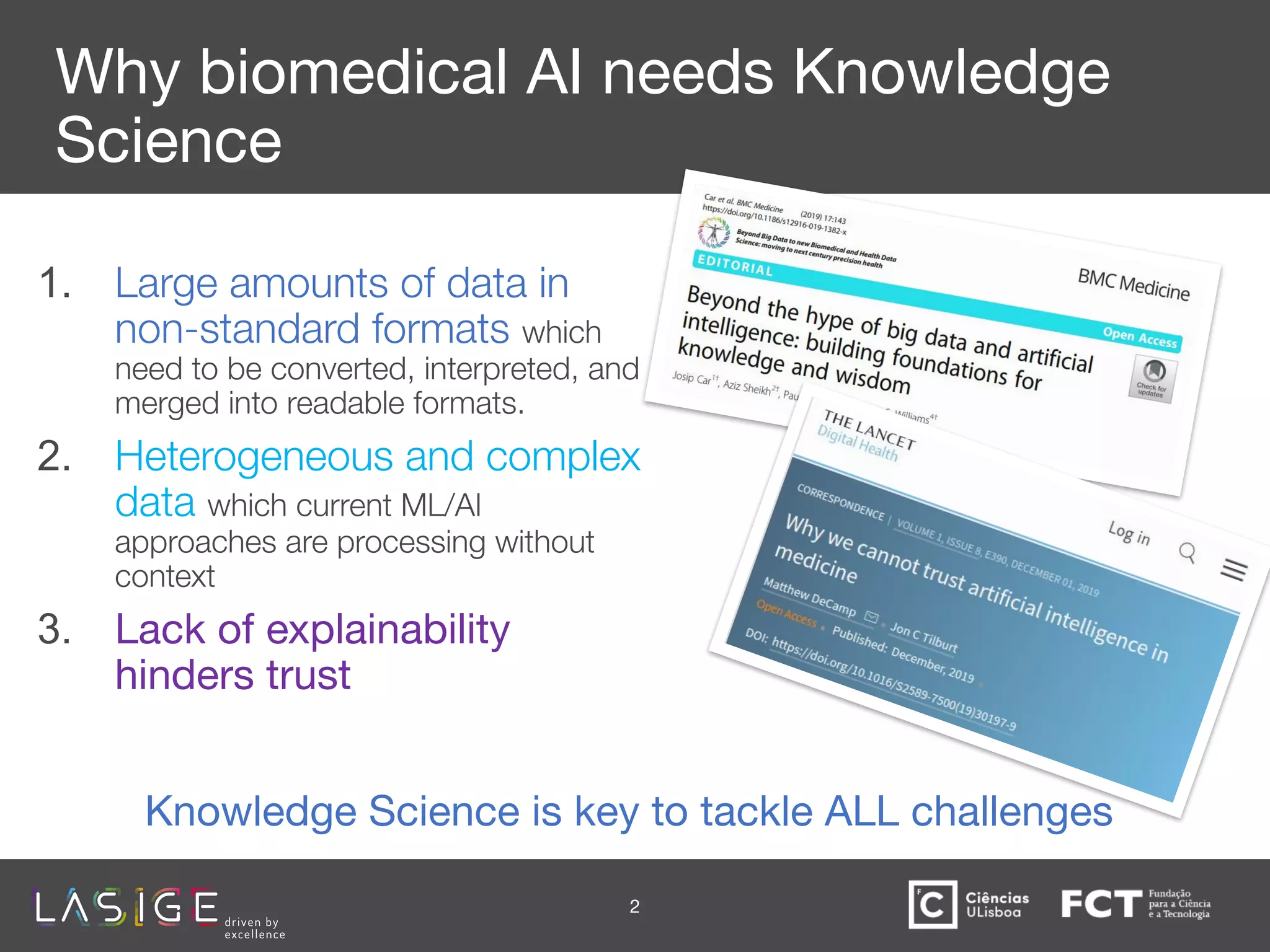
Why biomedical AI needs Knowledge
Science
1. Large amounts of data in
non-standard formats which
need to be converted, interpreted, and
merged into readable formats.
2. Heterogeneous and complex
data which current ML/AI
approaches are processing without
context
3. Lack of explainability
hinders trust
2
Knowledge Science is key to tackle ALL challenges
Trust in AI
• the user successfully comprehends how the model arrives
at an outcome 🡪 represent inputs, outputs and processes
• the model’s outcomes/workings match the user’s prior
knowledge 🡪 build a shared context
3
Jacovi, Alon, et al. "Formalizing trust in artificial intelligence: Prerequisites, causes and goals of human
trust in AI." Proceedings of the 2021 ACM conference on fairness, accountability, and transparency. 2021.
Trust in AI
• the user successfully comprehends how the model arrives
at an outcome 🡪 represent a model’s processes represent
inputs, outputs and
• the model’s outcomes/workings match the user’s prior
knowledge 🡪 evaluation
4
What happens when data
is complex, multi-domain,
heterogeneous,
incomplete, ambiguous?
5
Trust in AI for biomedical and clinical
applications
• the user successfully comprehends how the model arrives
at an outcome 🡪 represent a model’s processes represent
inputs, outputs and
• the model’s outcomes/workings match the user’s prior
knowledge 🡪 evaluation
6
Trust in AI for biomedical and clinical
applications
• the user successfully comprehends how the model arrives
at an outcome 🡪 represent a model’s inputs, outputs and
processes
• the model’s outcomes/workings match the user’s prior
knowledge 🡪 evaluation
7
Trust in AI for biomedical and clinical
applications
• the user successfully comprehends how the model arrives
at an outcome 🡪 represent a model’s inputs, outputs and
processes
• the model’s outcomes/workings match the user’s prior
knowledge 🡪 represent the scientific context
8
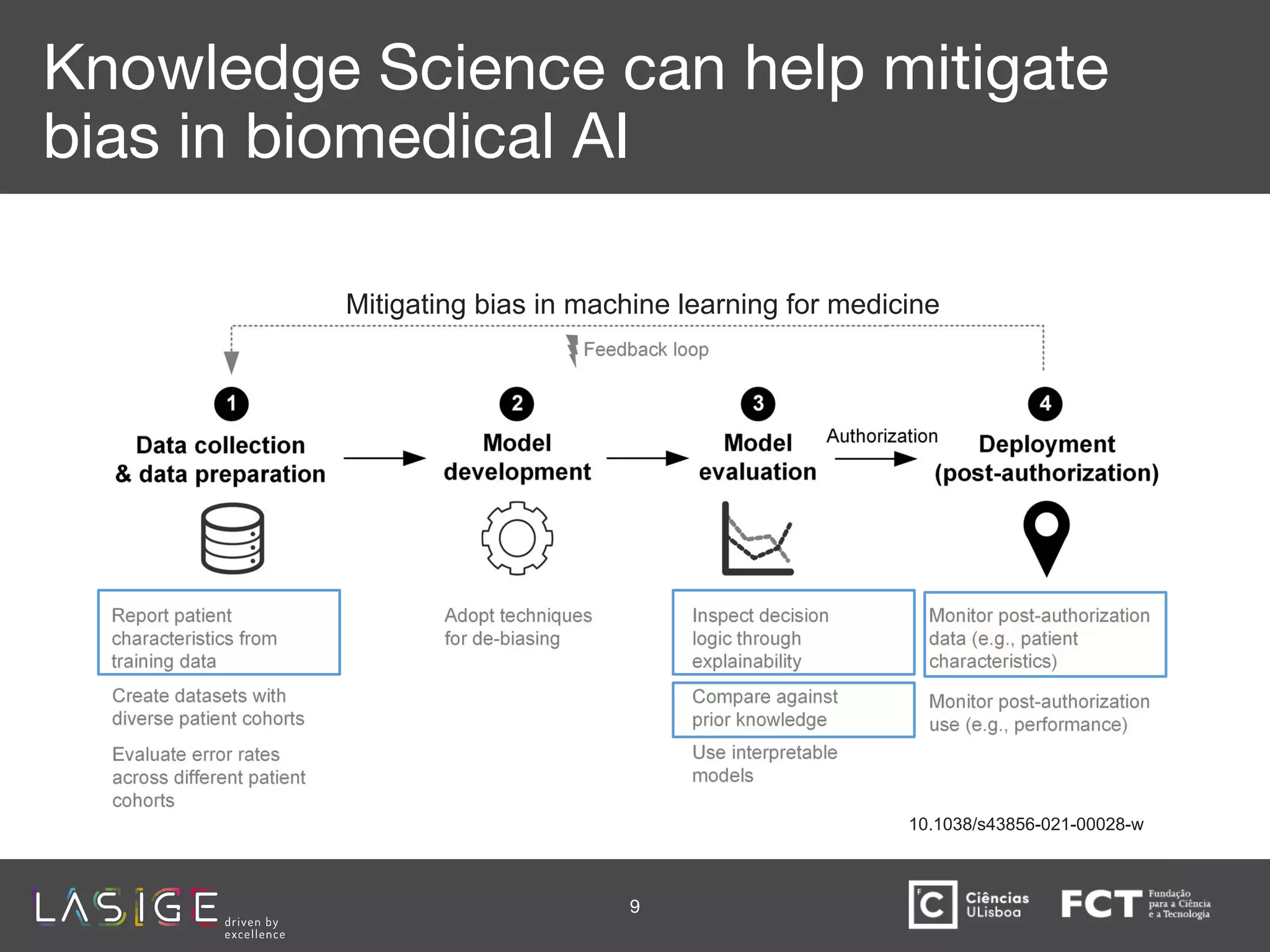
Knowledge Science can help mitigate
bias in biomedical AI
9
10.1038/s43856-021-00028-w
Mitigating bias in machine learning for medicine
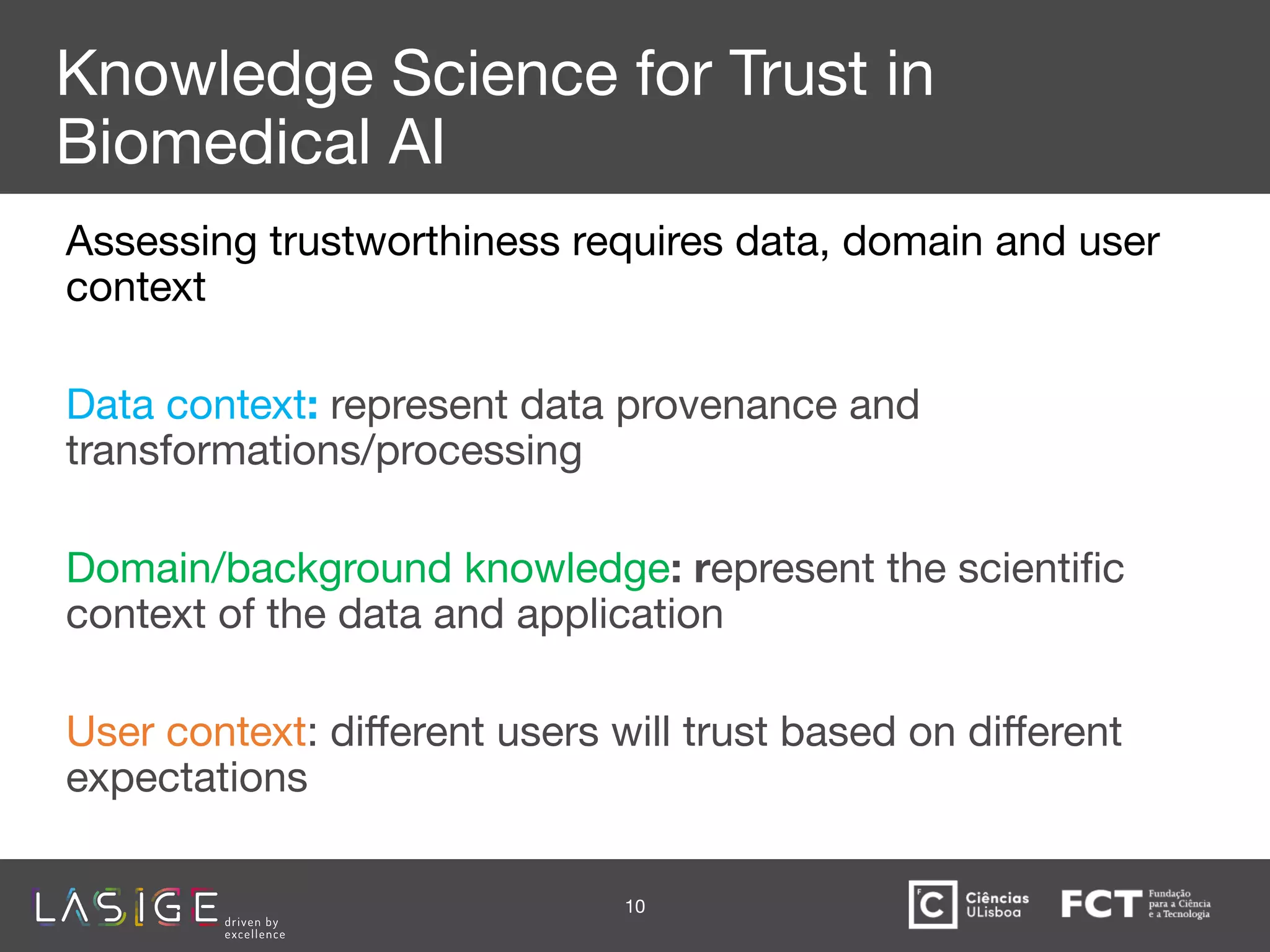
Knowledge Science for Trust in
Biomedical AI
Assessing trustworthiness requires data, domain and user
context
Data context: represent data provenance and
transformations/processing
Domain/background knowledge: represent the scientific
context of the data and application
User context: different users will trust based on different
expectations
10
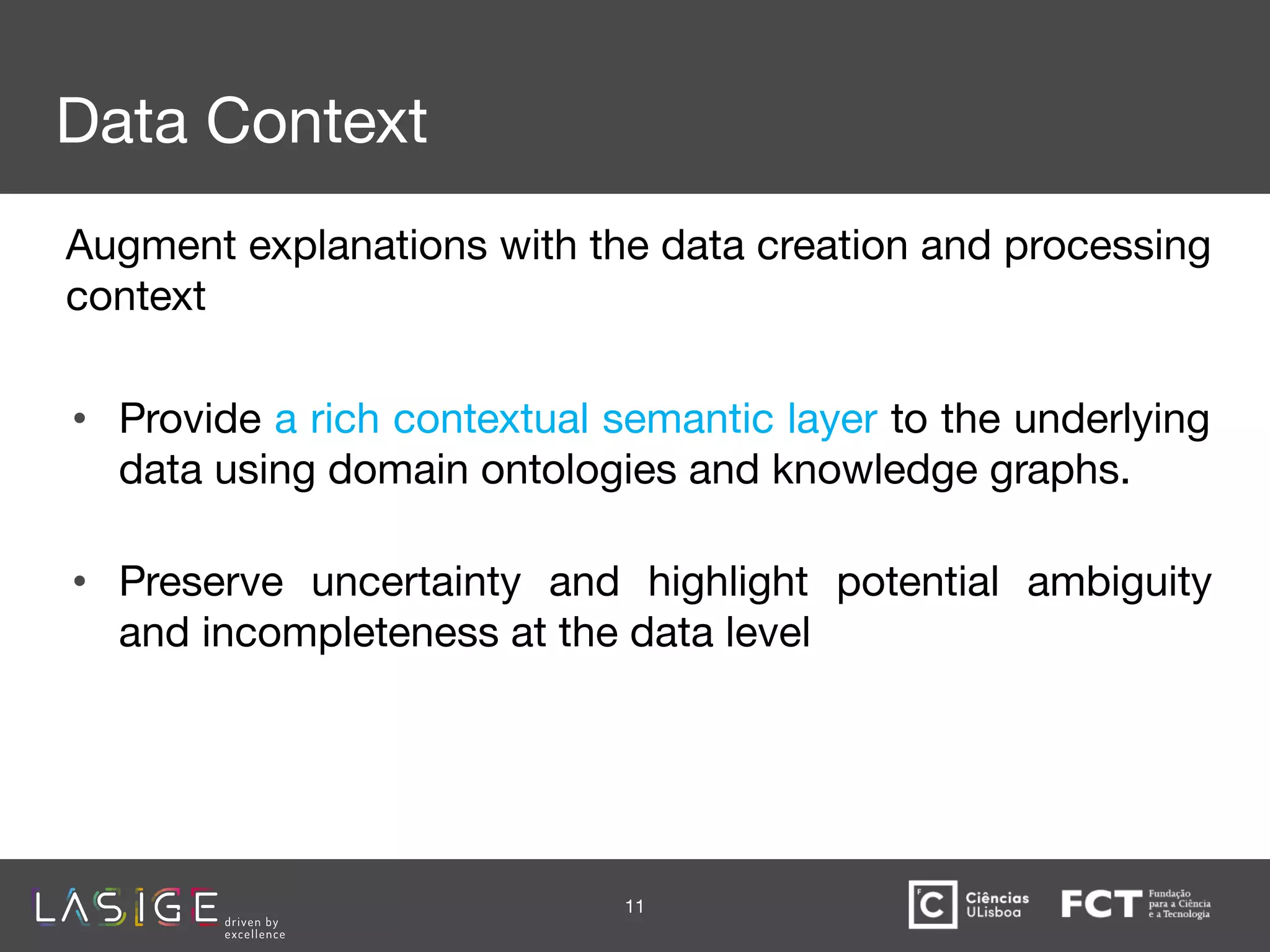
Data Context
Augment explanations with the data creation and processing
context
• Provide a rich contextual semantic layer to the underlying
data using domain ontologies and knowledge graphs. 
• Preserve uncertainty and highlight potential ambiguity
and incompleteness at the data level 
11
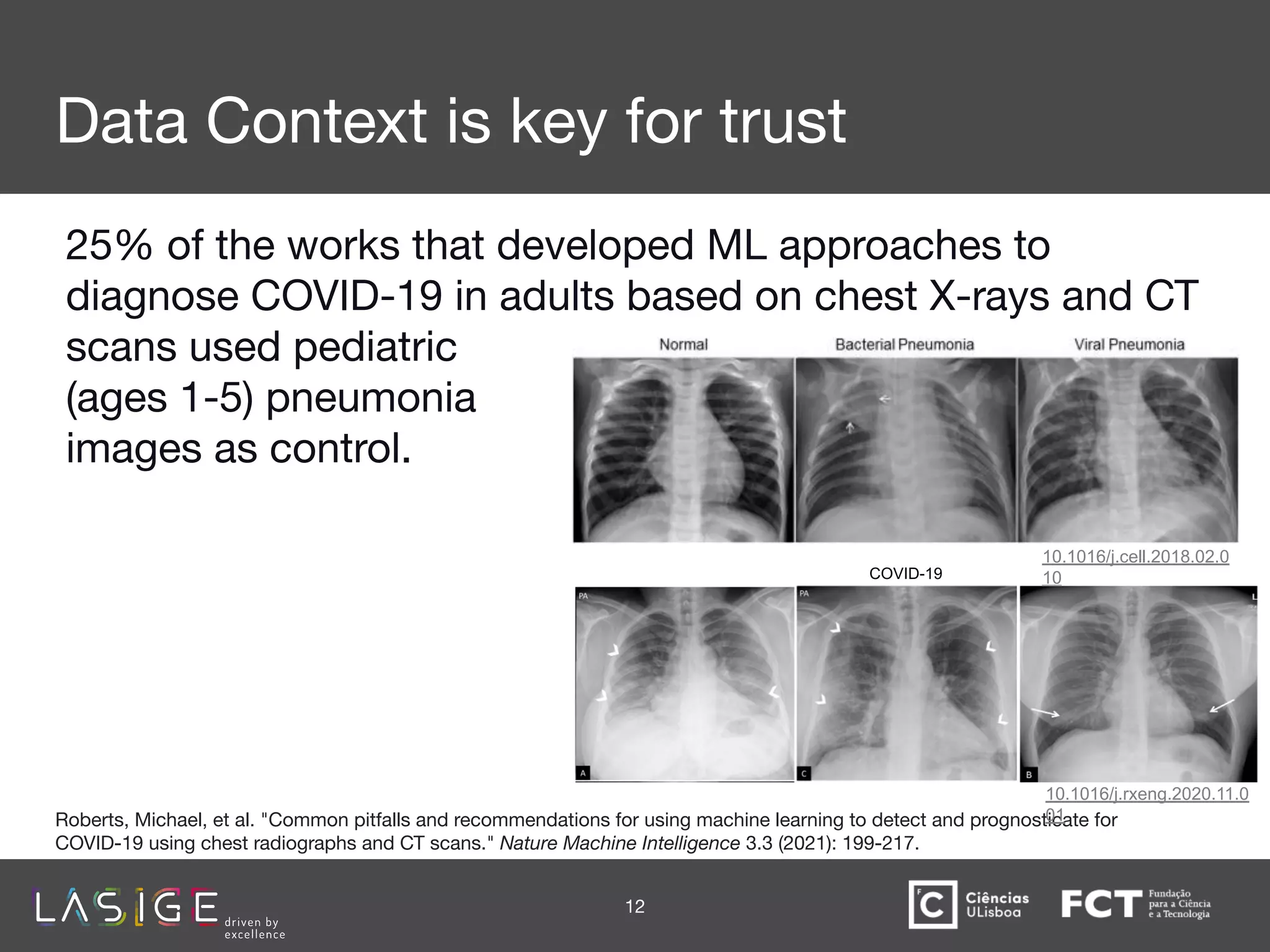
Data Context is key for trust
25% of the works that developed ML approaches to
diagnose COVID-19 in adults based on chest X-rays and CT
scans used pediatric
(ages 1-5) pneumonia
images as control.
12
Roberts, Michael, et al. "Common pitfalls and recommendations for using machine learning to detect and prognosticate for
COVID-19 using chest radiographs and CT scans." Nature Machine Intelligence 3.3 (2021): 199-217.
10.1016/j.cell.2018.02.0
10
COVID-19
10.1016/j.rxeng.2020.11.0
01
Domain Knowledge Context
Contextualize an explanation within existing knowledge
• Include prior knowledge through links to ontologies
• Enrich the contextual semantic layer with links and
relations across domains of knowledge
13
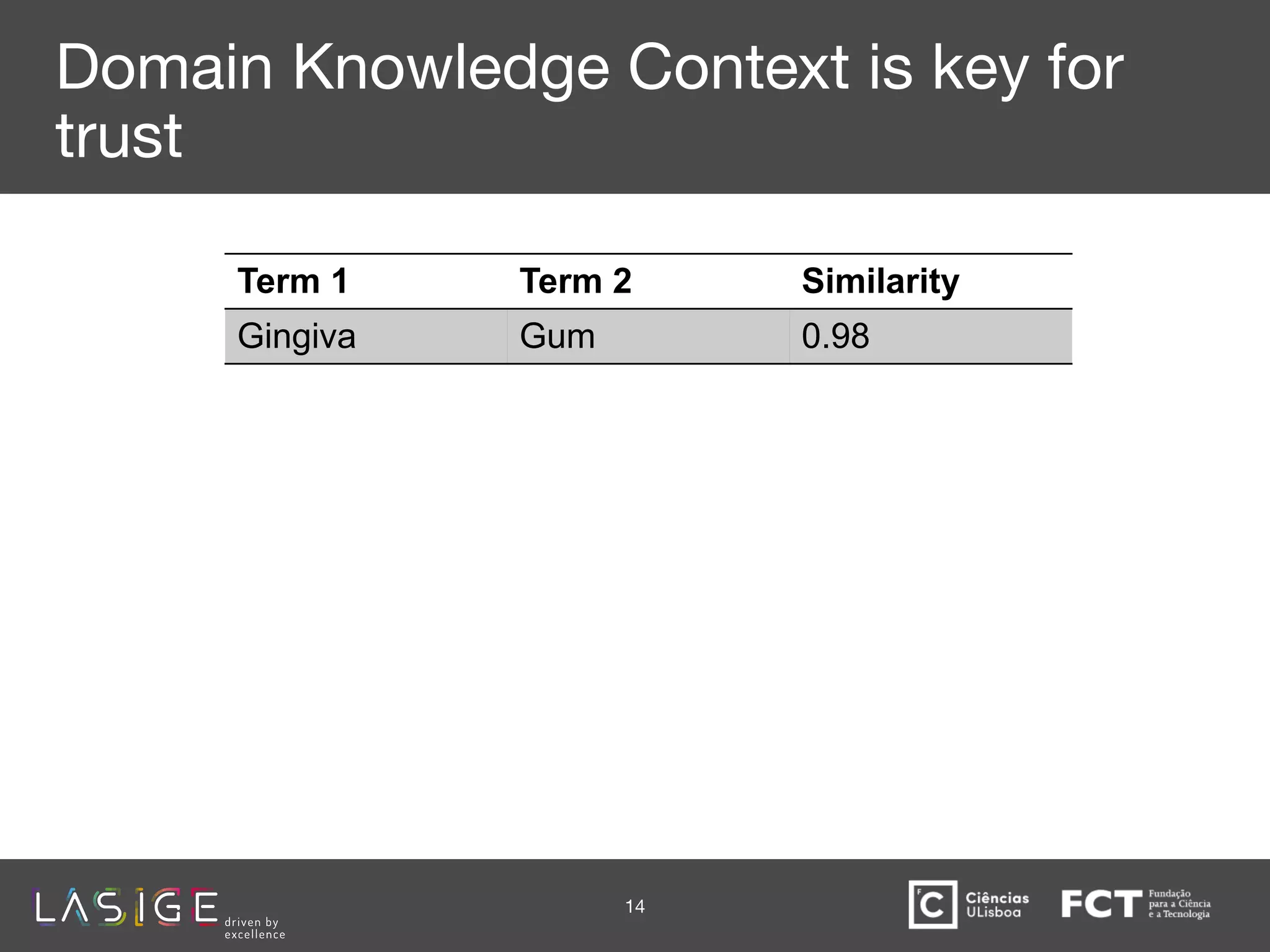
Domain Knowledge Context is key for
trust
14
Term 1 Term 2 Similarity
Gingiva Gum 0.98
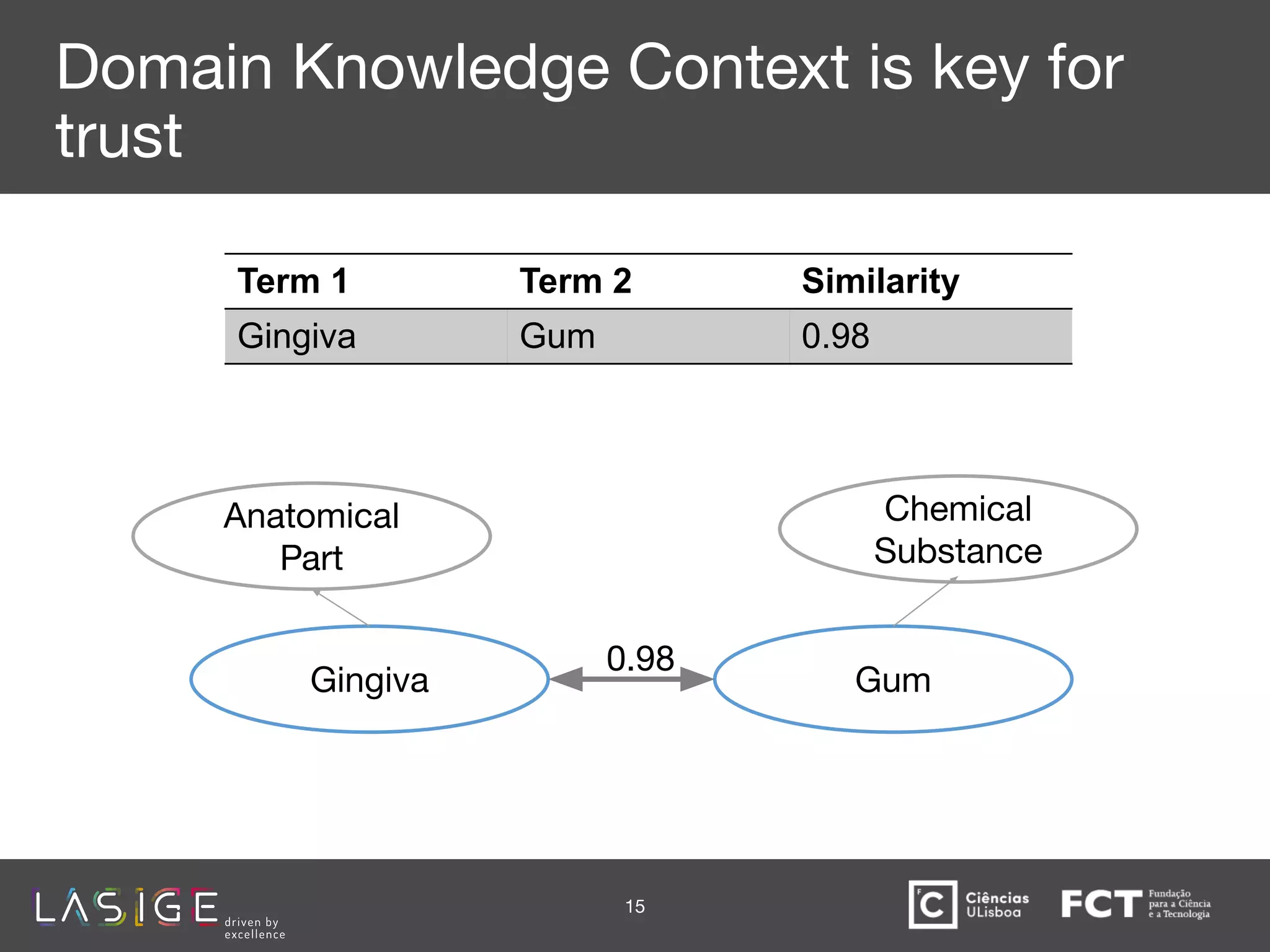
Domain Knowledge Context is key for
trust
15
Gingiva Gum
0.98
Term 1 Term 2 Similarity
Gingiva Gum 0.98
Anatomical
Part
Chemical
Substance
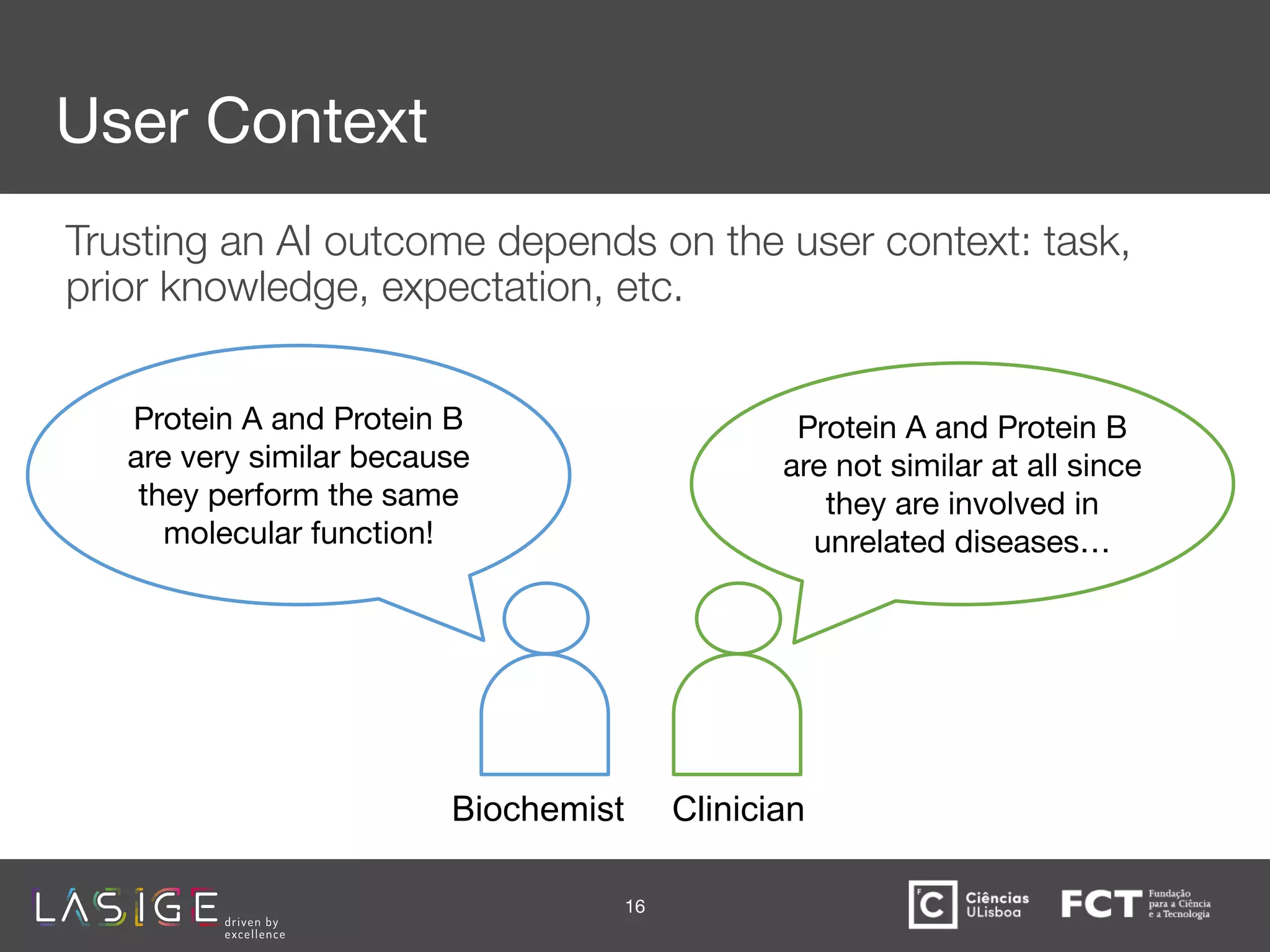
User Context
Trusting an AI outcome depends on the user context: task,
prior knowledge, expectation, etc.
16
Protein A and Protein B
are not similar at all since
they are involved in
unrelated diseases…
Protein A and Protein B
are very similar because
they perform the same
molecular function!
Biochemist Clinician
Ontologies, Knowledge
Graphs and FAIR data
principles can support
data, domain and user
context.
17
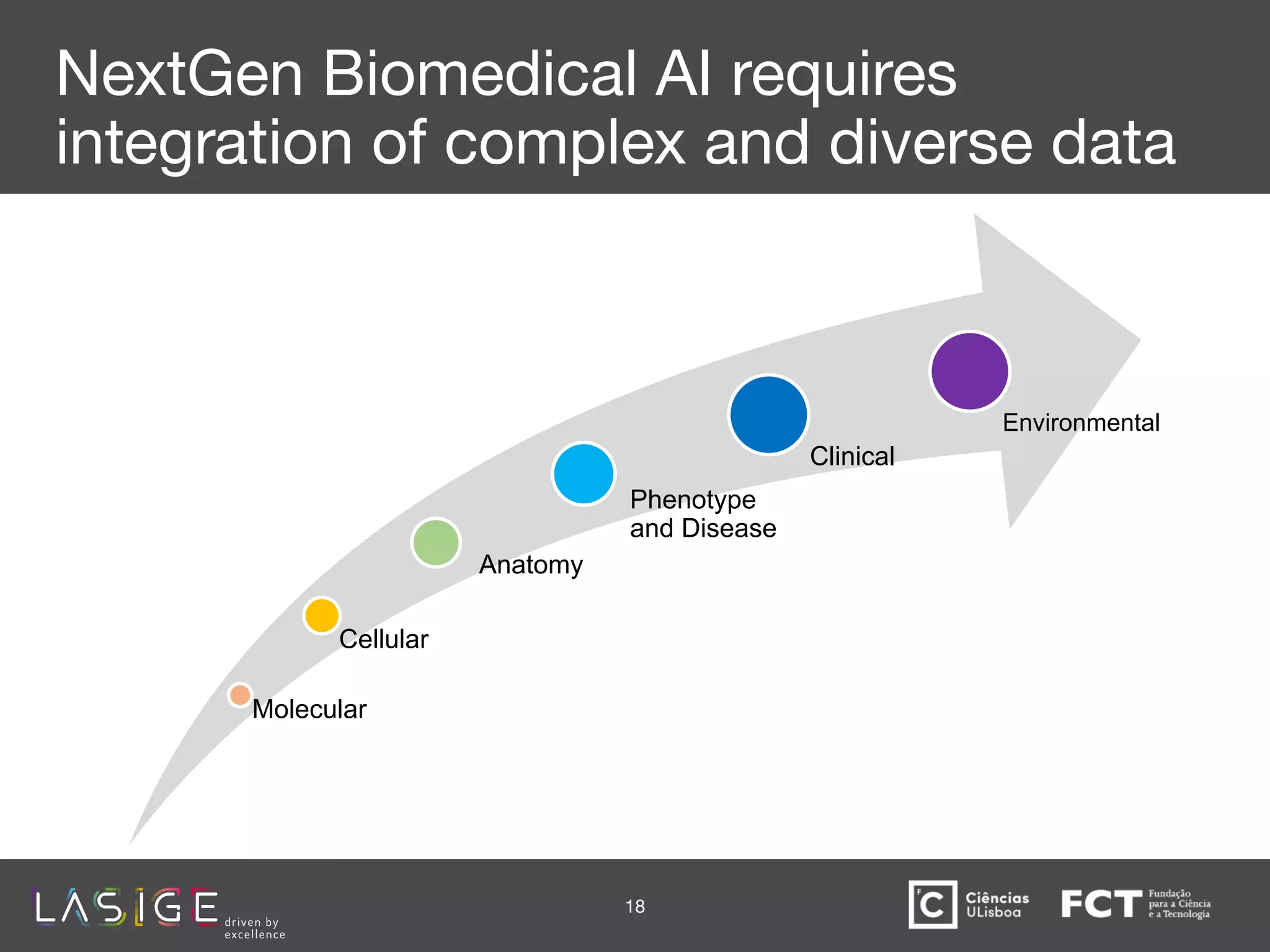
NextGen Biomedical AI requires
integration of complex and diverse data
Molecular
Cellular
Anatomy
Phenotype
and Disease
Clinical
18
Environmental
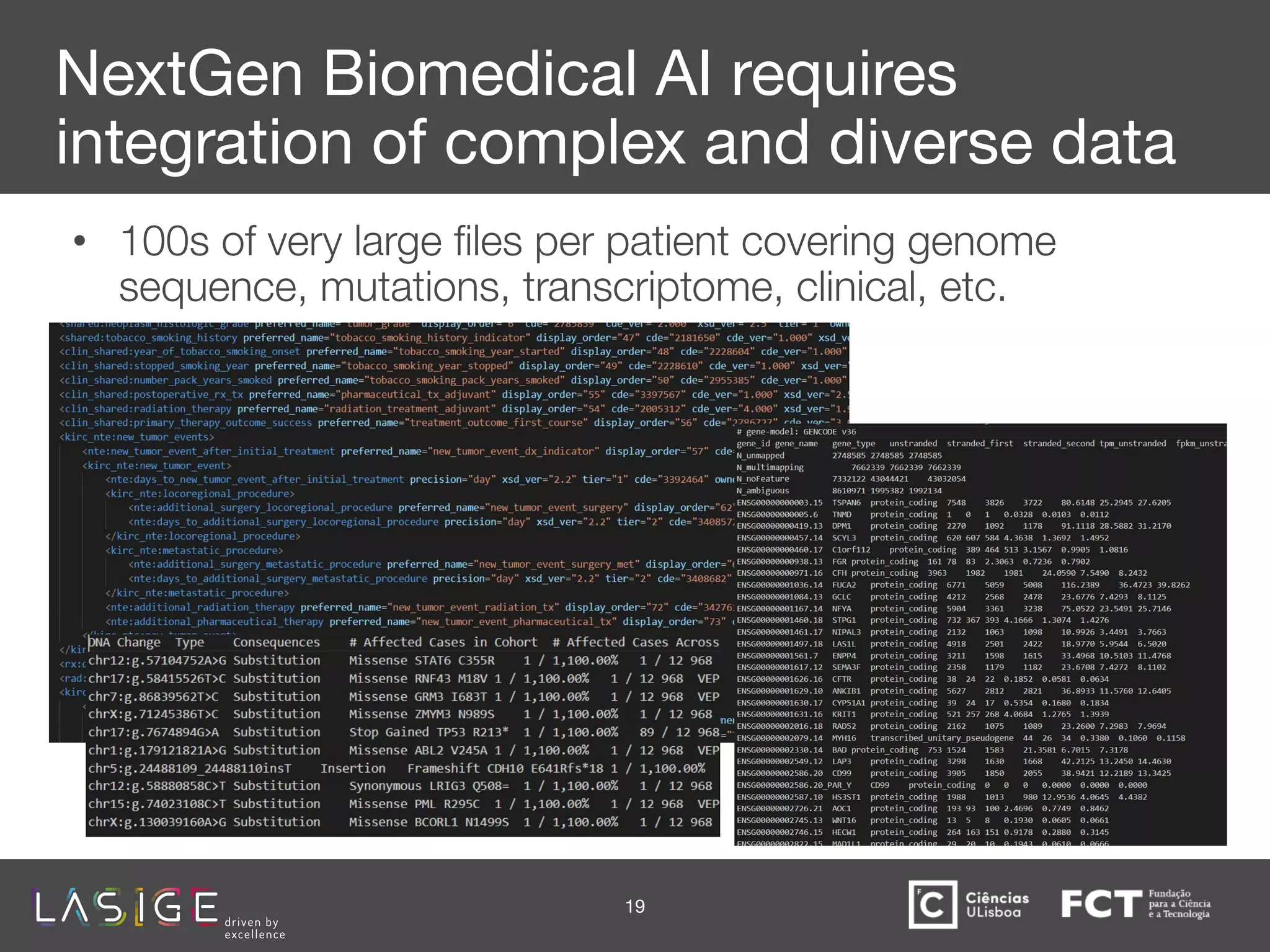
• 100s of very large files per patient covering genome
sequence, mutations, transcriptome, clinical, etc.
19
NextGen Biomedical AI requires
integration of complex and diverse data
What happens when data
is complex, multi-domain,
heterogeneous,
incomplete, ambiguous?
20
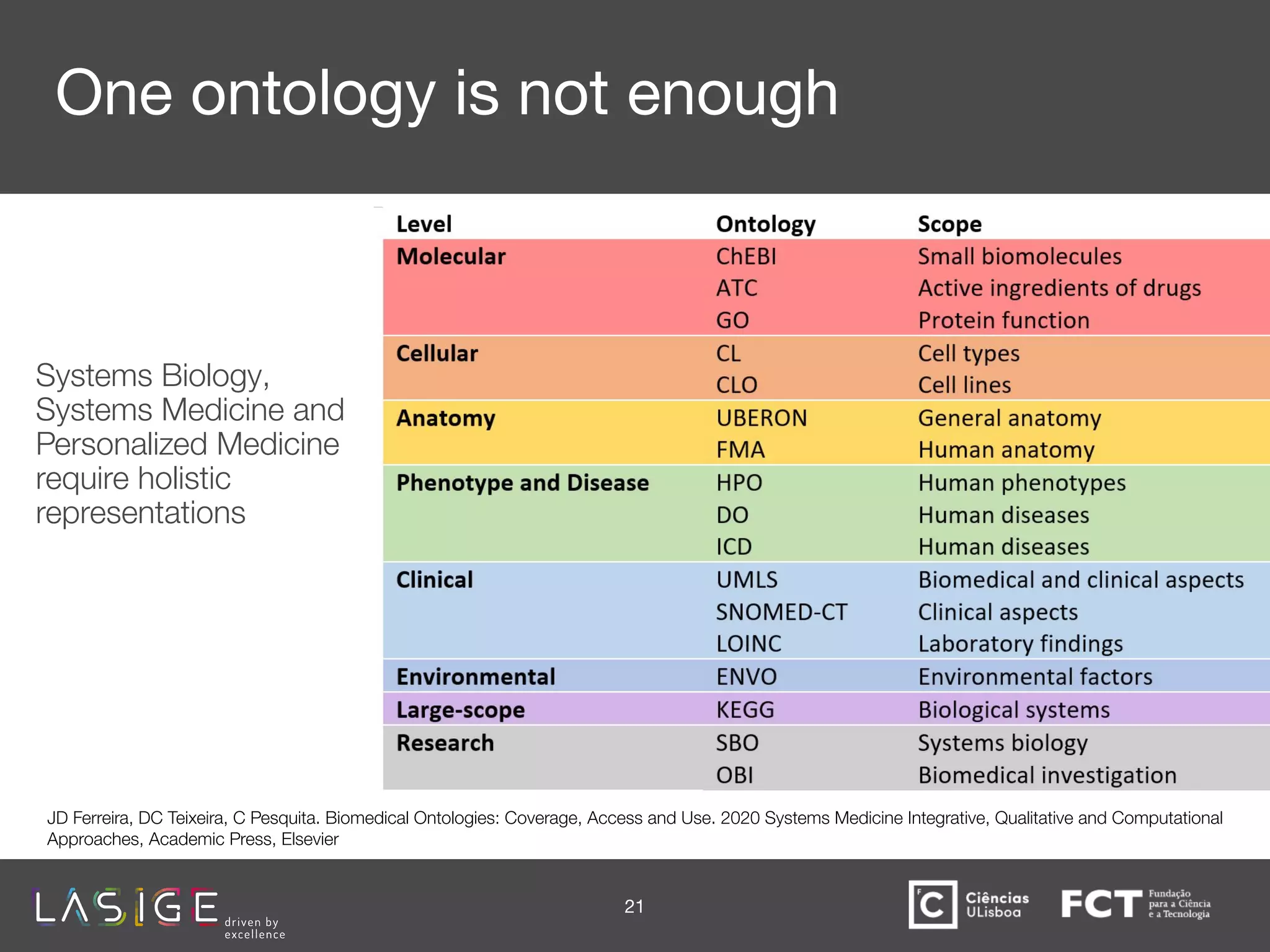
One ontology is not enough
Systems Biology,
Systems Medicine and
Personalized Medicine
require holistic
representations
21
JD Ferreira, DC Teixeira, C Pesquita. Biomedical Ontologies: Coverage, Access and Use. 2020 Systems Medicine Integrative, Qualitative and Computational
Approaches, Academic Press, Elsevier
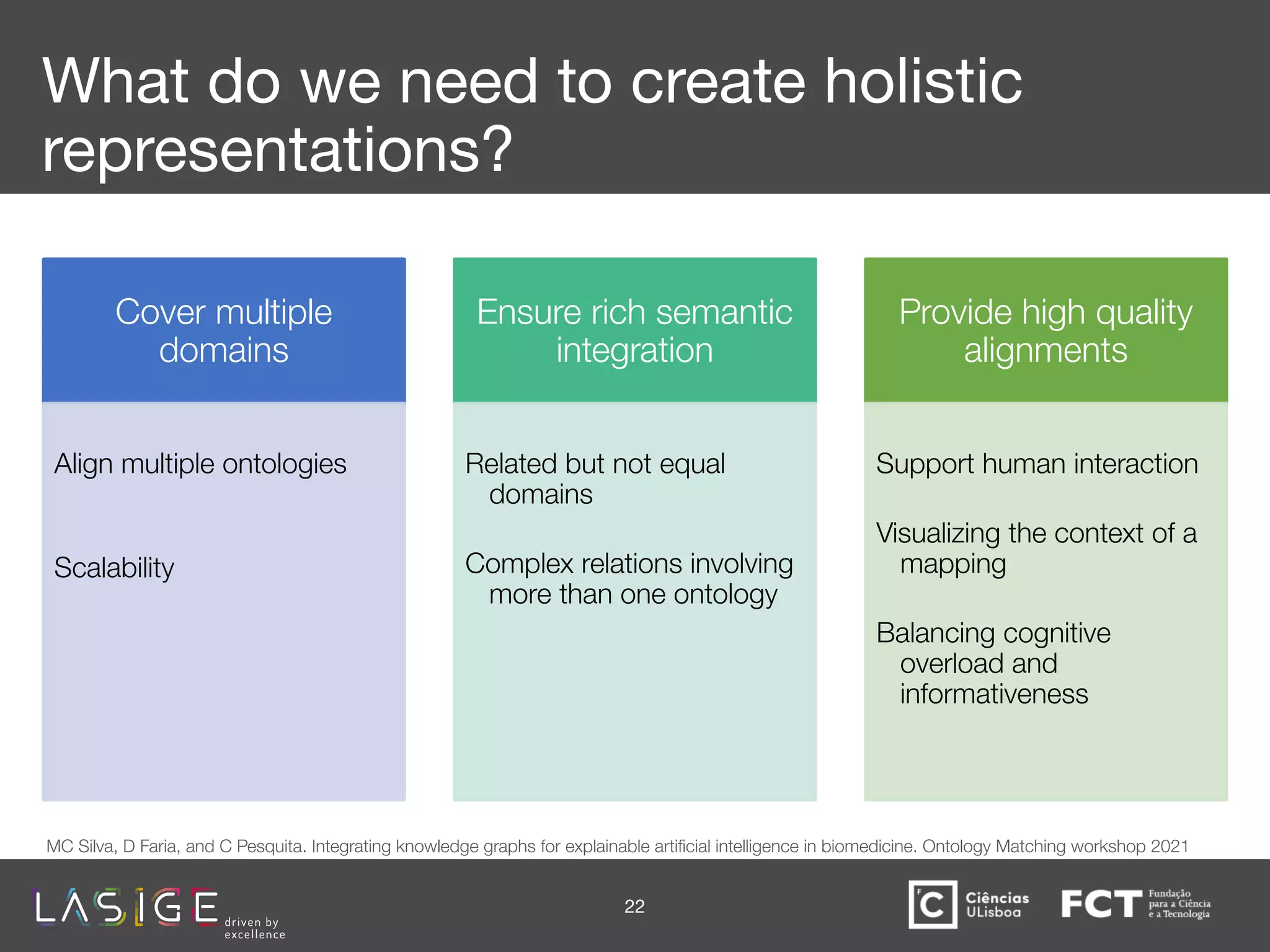
What do we need to create holistic
representations?
Cover multiple
domains
Align multiple ontologies
Scalability
Ensure rich semantic
integration
Related but not equal
domains
Complex relations involving
more than one ontology
Provide high quality
alignments
Support human interaction
Visualizing the context of a
mapping
Balancing cognitive
overload and
informativeness
22
MC Silva, D Faria, and C Pesquita. Integrating knowledge graphs for explainable artificial intelligence in biomedicine. Ontology Matching workshop 2021
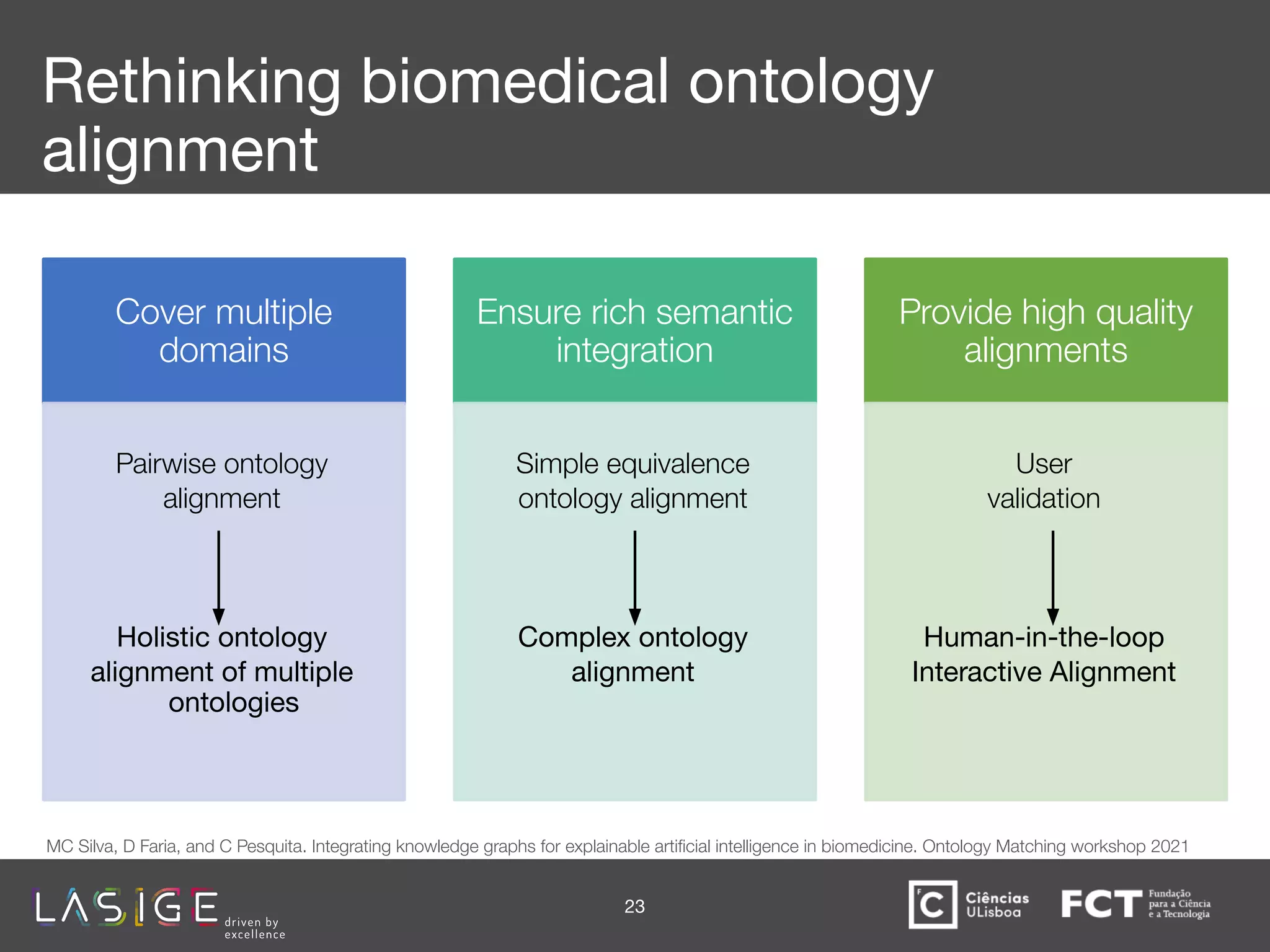
Rethinking biomedical ontology
alignment
Cover multiple
domains
Pairwise ontology
alignment
Holistic ontology
alignment of multiple
ontologies
Ensure rich semantic
integration
Simple equivalence
ontology alignment
Complex ontology
alignment
Provide high quality
alignments
User
validation
Human-in-the-loop
Interactive Alignment
23
MC Silva, D Faria, and C Pesquita. Integrating knowledge graphs for explainable artificial intelligence in biomedicine. Ontology Matching workshop 2021
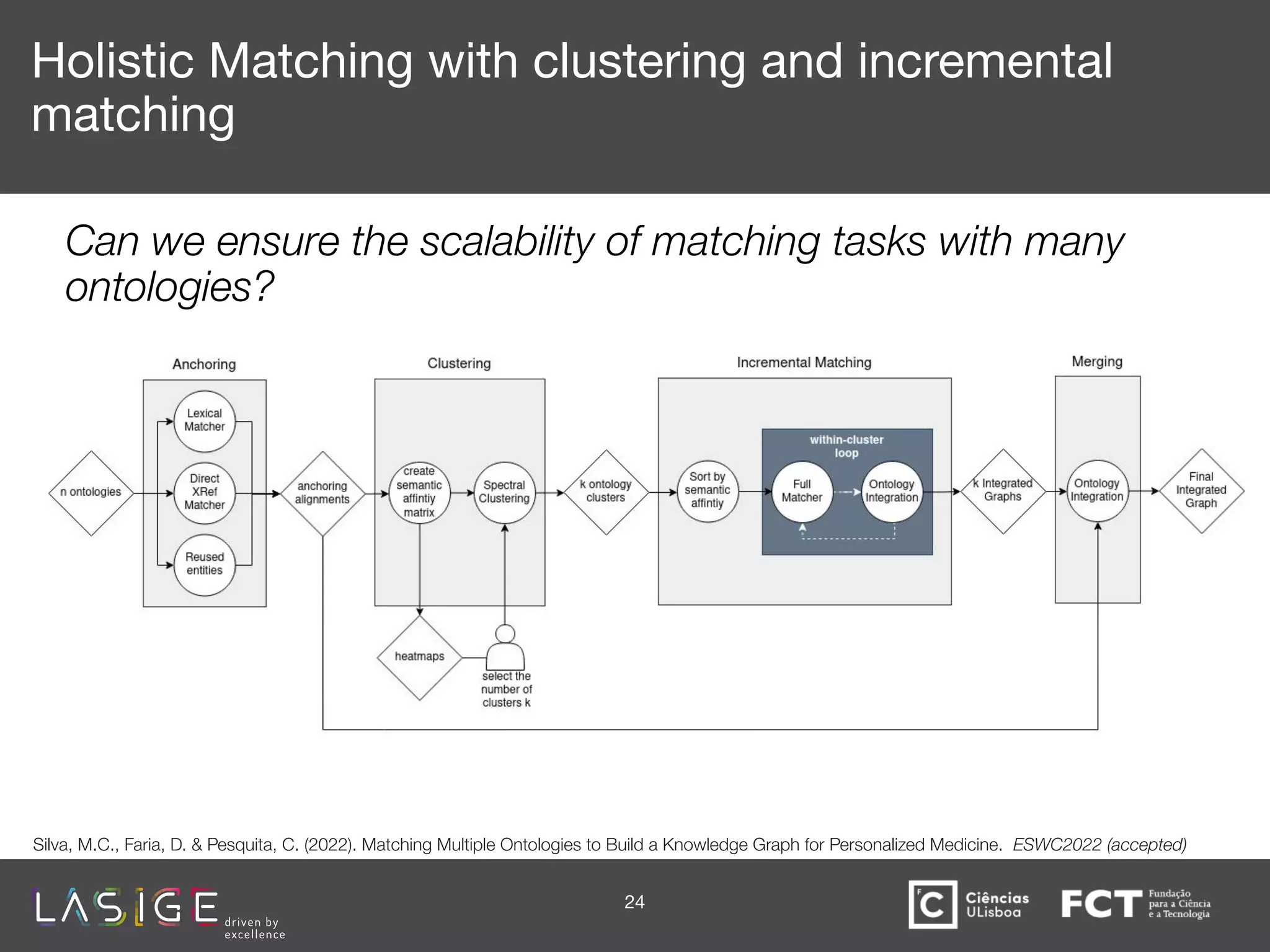
Holistic Matching with clustering and incremental
matching
24
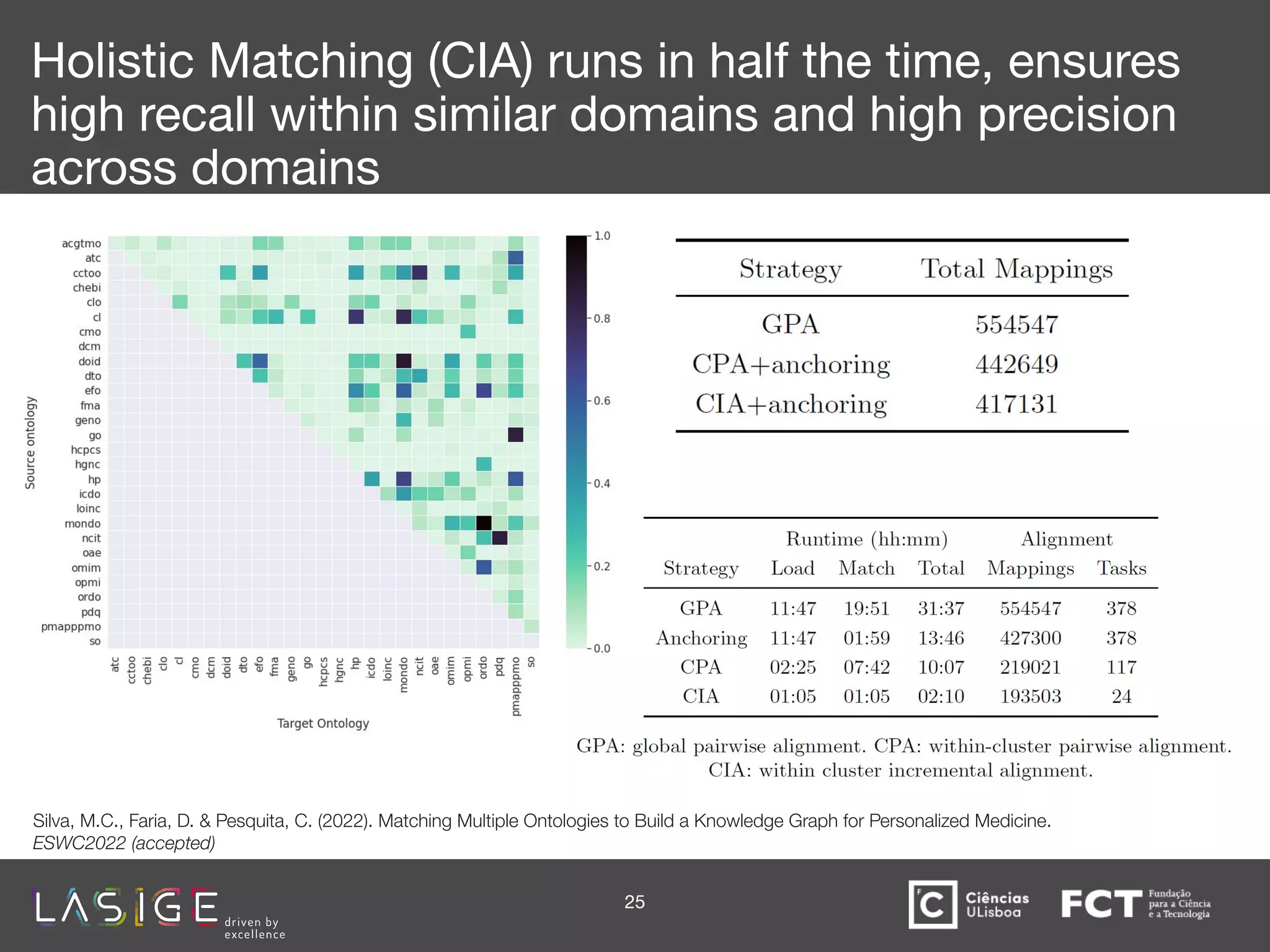
Silva, M.C., Faria, D. & Pesquita, C. (2022). Matching Multiple Ontologies to Build a Knowledge Graph for Personalized Medicine.  ESWC2022 (accepted)
Can we ensure the scalability of matching tasks with many
ontologies?
Holistic Matching (CIA) runs in half the time, ensures
high recall within similar domains and high precision
across domains
25
Silva, M.C., Faria, D. & Pesquita, C. (2022). Matching Multiple Ontologies to Build a Knowledge Graph for Personalized Medicine. 
ESWC2022 (accepted)
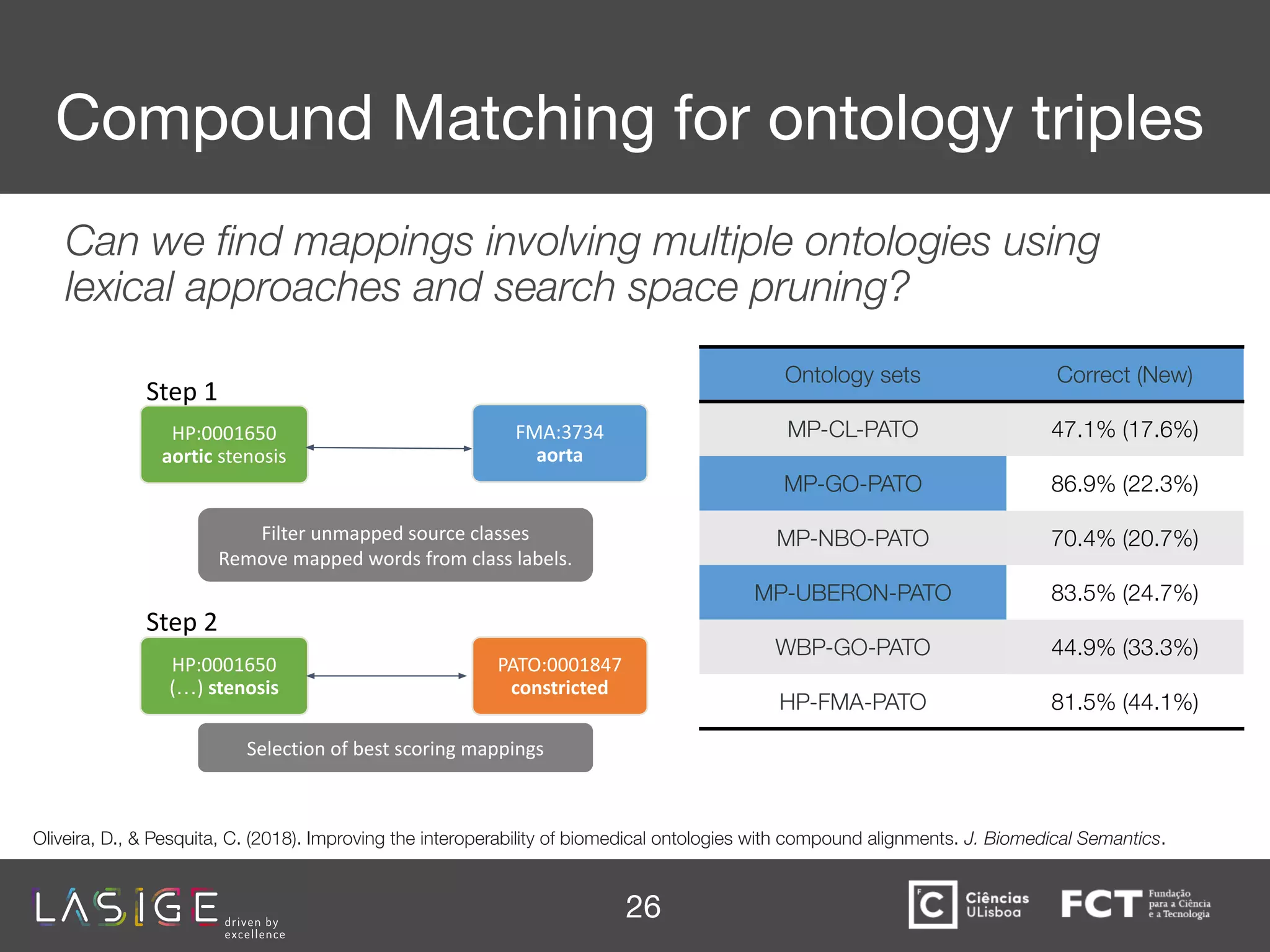
Compound Matching for ontology triples
Can we find mappings involving multiple ontologies using
lexical approaches and search space pruning?
26
HP:0001650
aortic stenosis
PATO:0001847
constricted
Step 1
FMA:3734
aorta
Step 2
HP:0001650
(…) stenosis
Filter unmapped source classes
Remove mapped words from class labels.
Selection of best scoring mappings
Oliveira, D., & Pesquita, C. (2018). Improving the interoperability of biomedical ontologies with compound alignments. J. Biomedical Semantics.
Ontology sets Correct (New)
MP-CL-PATO 47.1% (17.6%)
MP-GO-PATO 86.9% (22.3%)
MP-NBO-PATO 70.4% (20.7%)
MP-UBERON-PATO 83.5% (24.7%)
WBP-GO-PATO 44.9% (33.3%)
HP-FMA-PATO 81.5% (44.1%)
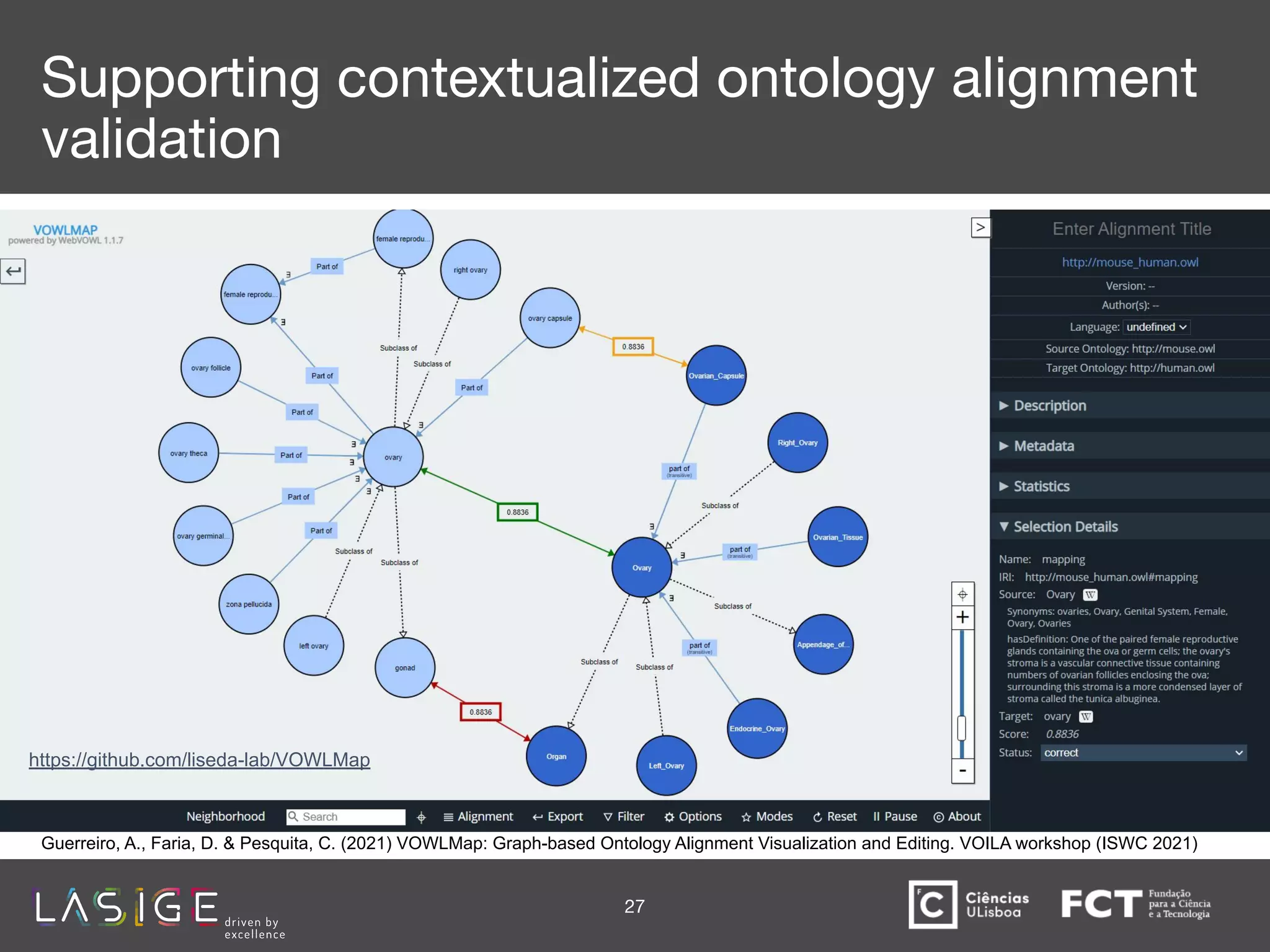
https://github.com/liseda-lab/VOWLMap
Supporting contextualized ontology alignment
validation
27
Guerreiro, A., Faria, D. & Pesquita, C. (2021) VOWLMap: Graph-based Ontology Alignment Visualization and Editing. VOILA workshop (ISWC 2021)
Trustworthy biomedical AI
requires trustworthy data.
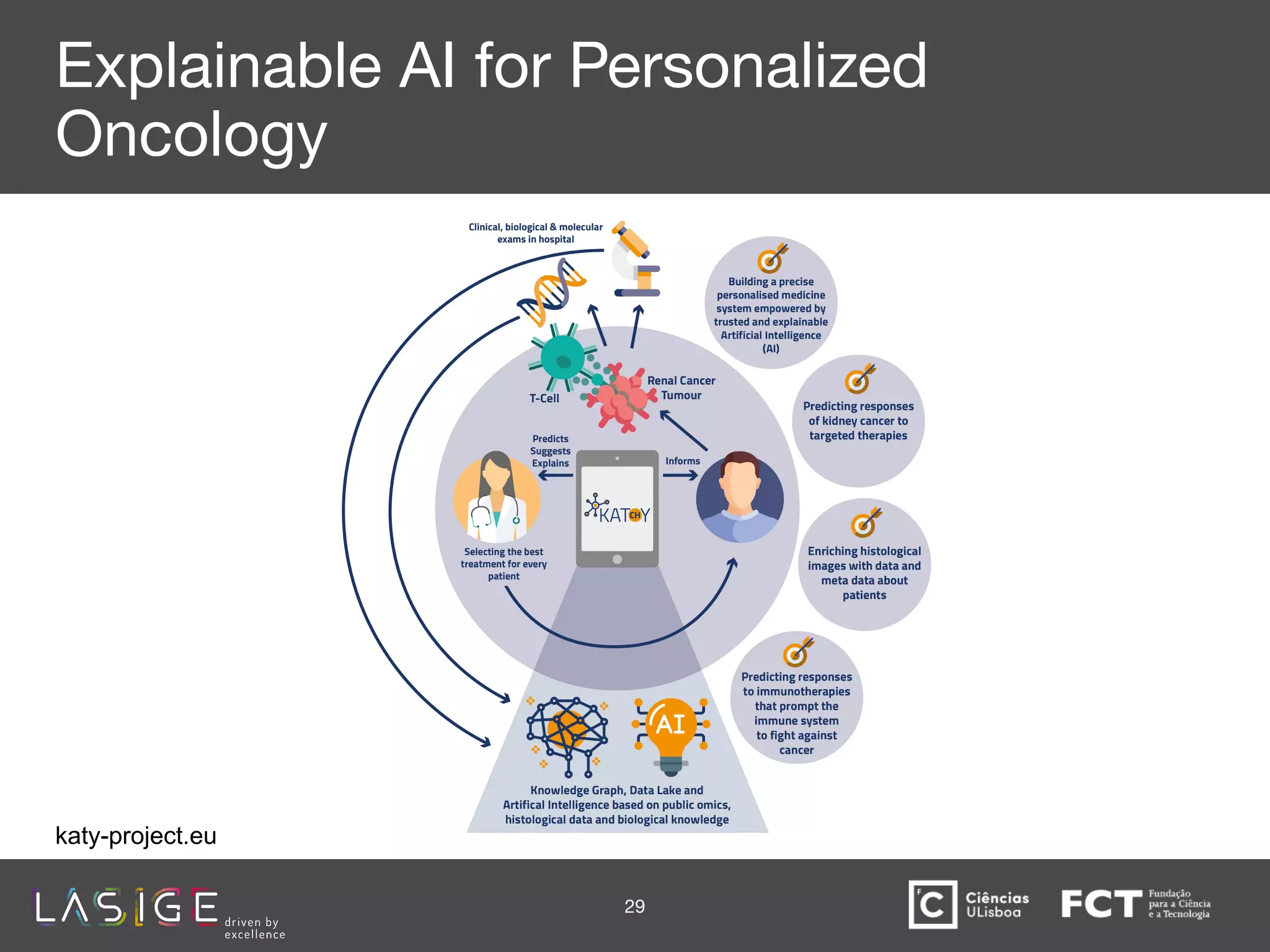
Explainable AI for Personalized
Oncology
29
katy-project.eu
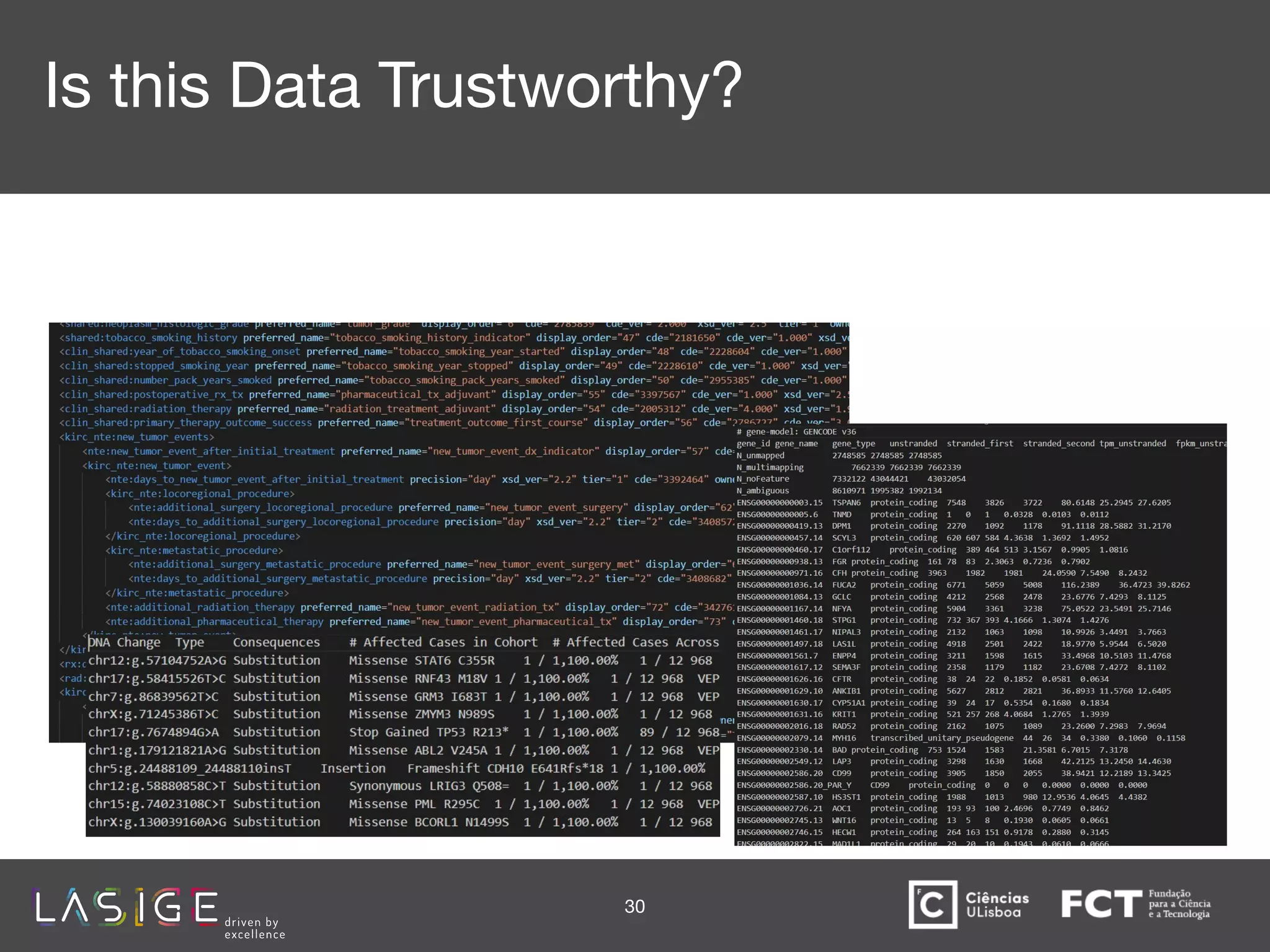
30
Is this Data Trustworthy?
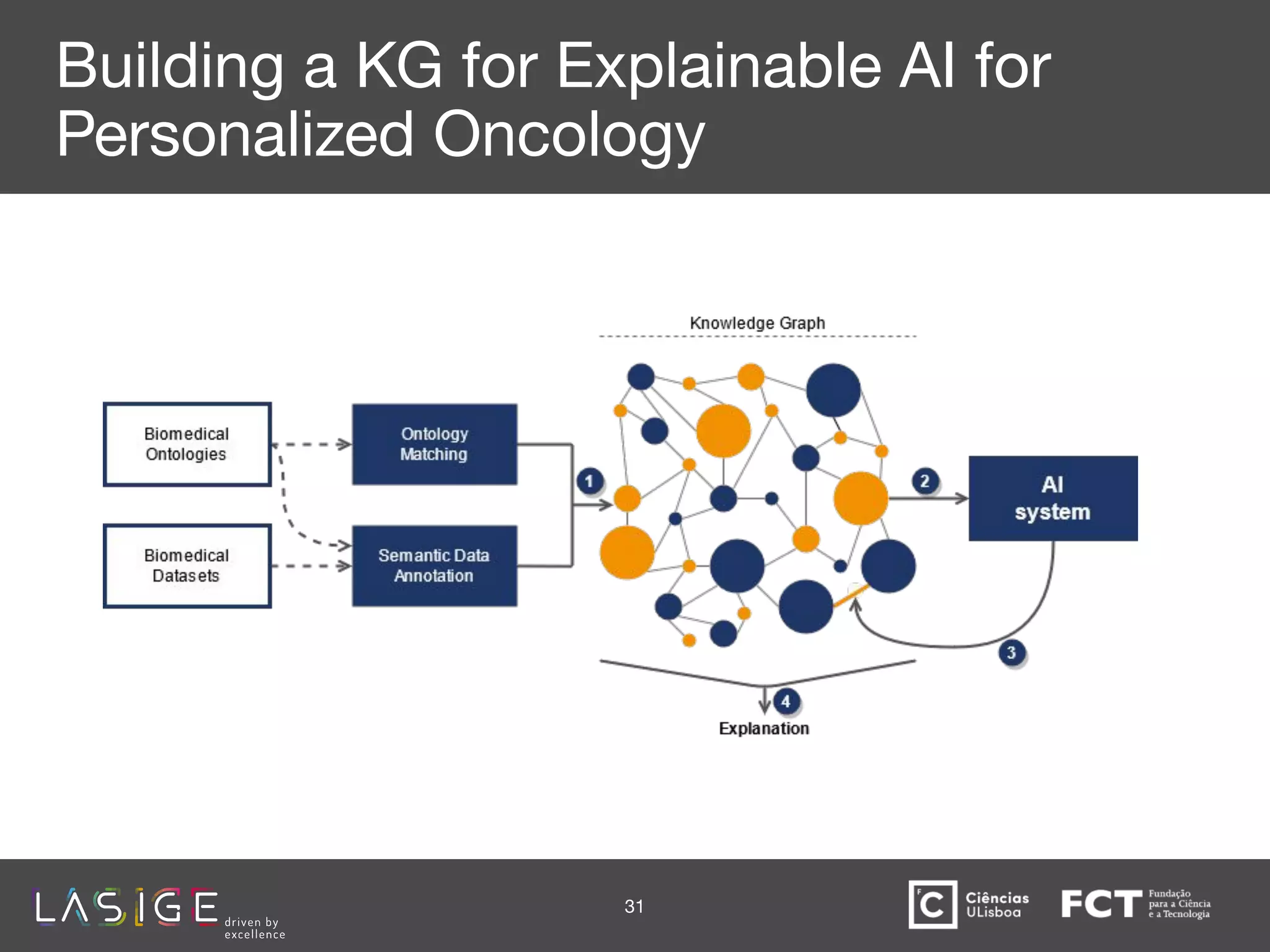
Building a KG for Explainable AI for
Personalized Oncology
31
Patient
Ex-smoker
Smoker
Diabetes
MET
HLA-A2
cytokine-mediated
signaling pathway
Renal cell
carcinoma, somatic Sunitinib
Antineoplastic
Agent
Tyrosine kinase
activity
Cancer
AI recommendation
presents
has mutation
inhibits
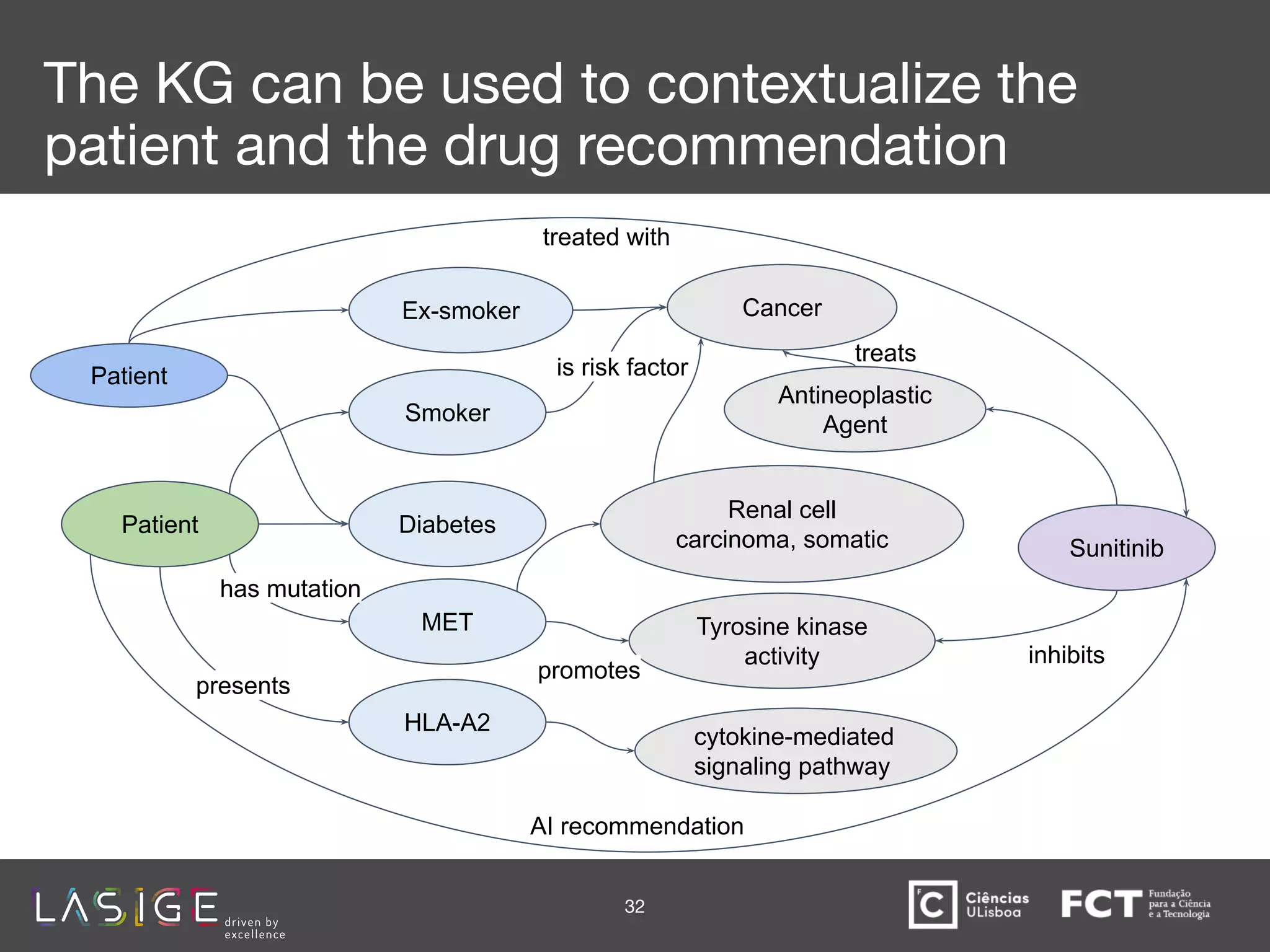
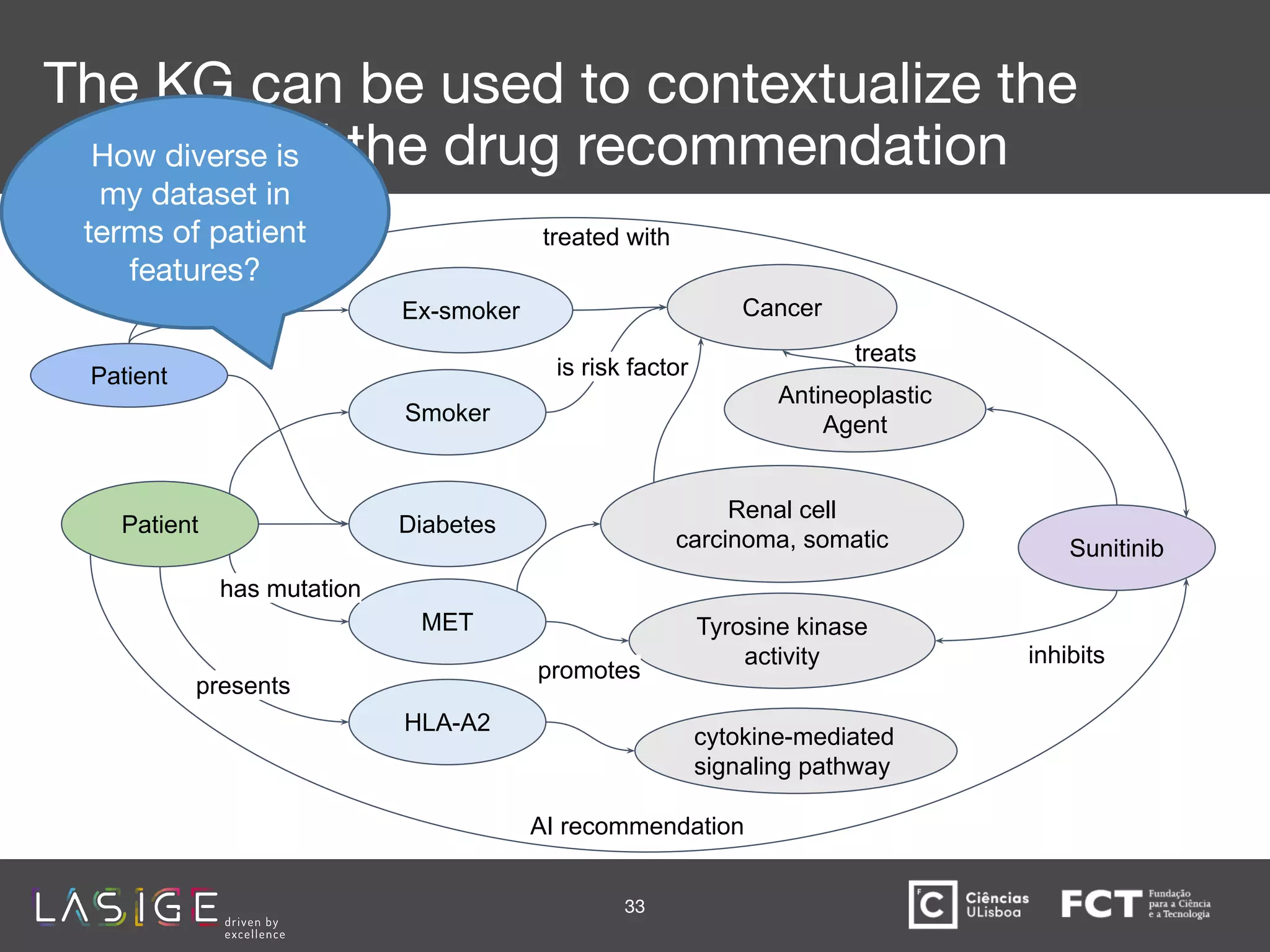
The KG can be used to contextualize the
patient and the drug recommendation
promotes
treats
Patient
treated with
32
is risk factor
Patient
Ex-smoker
Smoker
Diabetes
MET
HLA-A2
cytokine-mediated
signaling pathway
Renal cell
carcinoma, somatic Sunitinib
Antineoplastic
Agent
Tyrosine kinase
activity
Cancer
AI recommendation
presents
has mutation
inhibits
The KG can be used to contextualize the
patient and the drug recommendation
promotes
treats
Patient
treated with
33
is risk factor
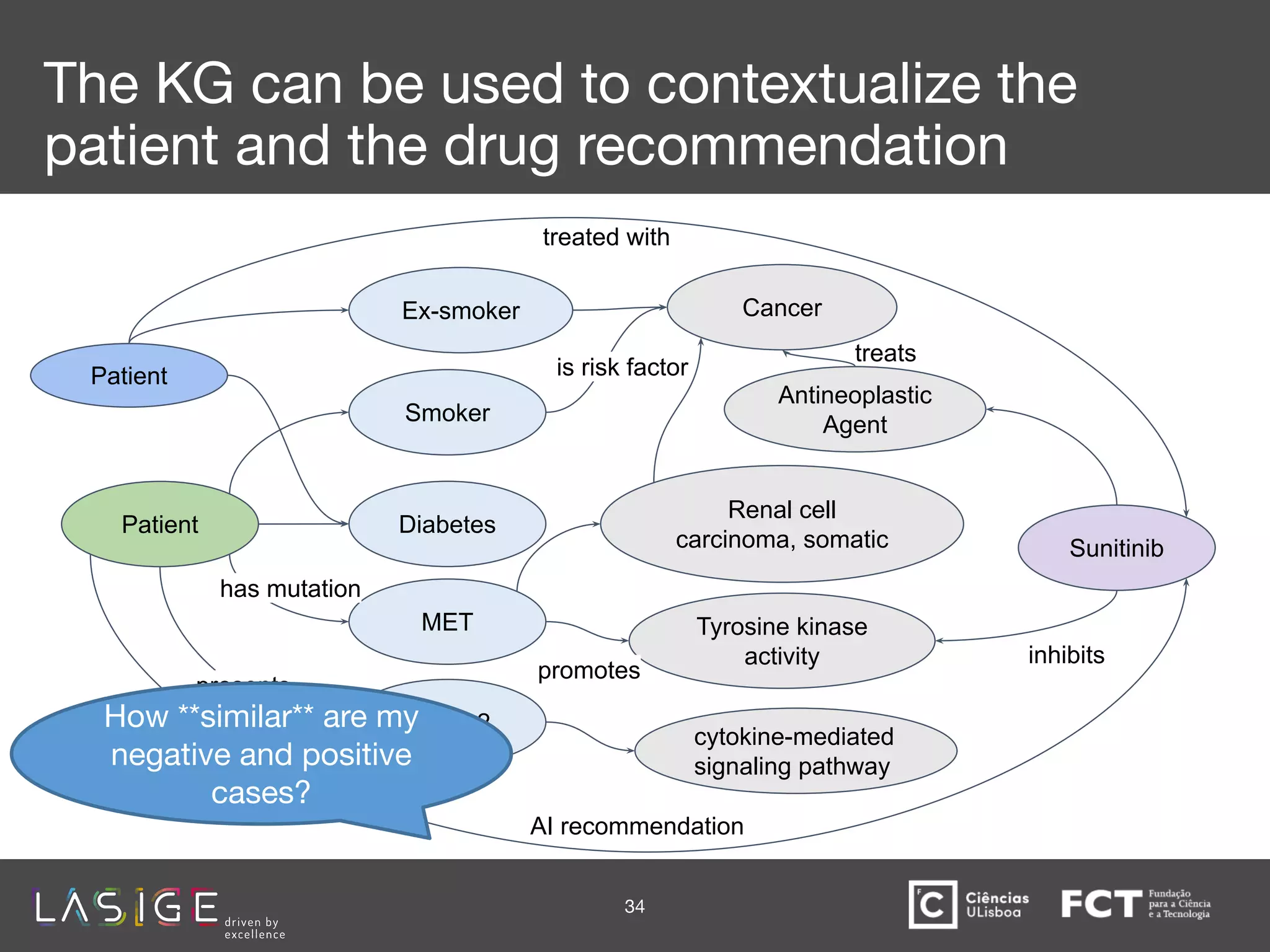
How diverse is
my dataset in
terms of patient
features?
Patient
Ex-smoker
Smoker
Diabetes
MET
HLA-A2
cytokine-mediated
signaling pathway
Renal cell
carcinoma, somatic Sunitinib
Antineoplastic
Agent
Tyrosine kinase
activity
Cancer
AI recommendation
presents
has mutation
inhibits
The KG can be used to contextualize the
patient and the drug recommendation
promotes
treats
Patient
treated with
34
is risk factor
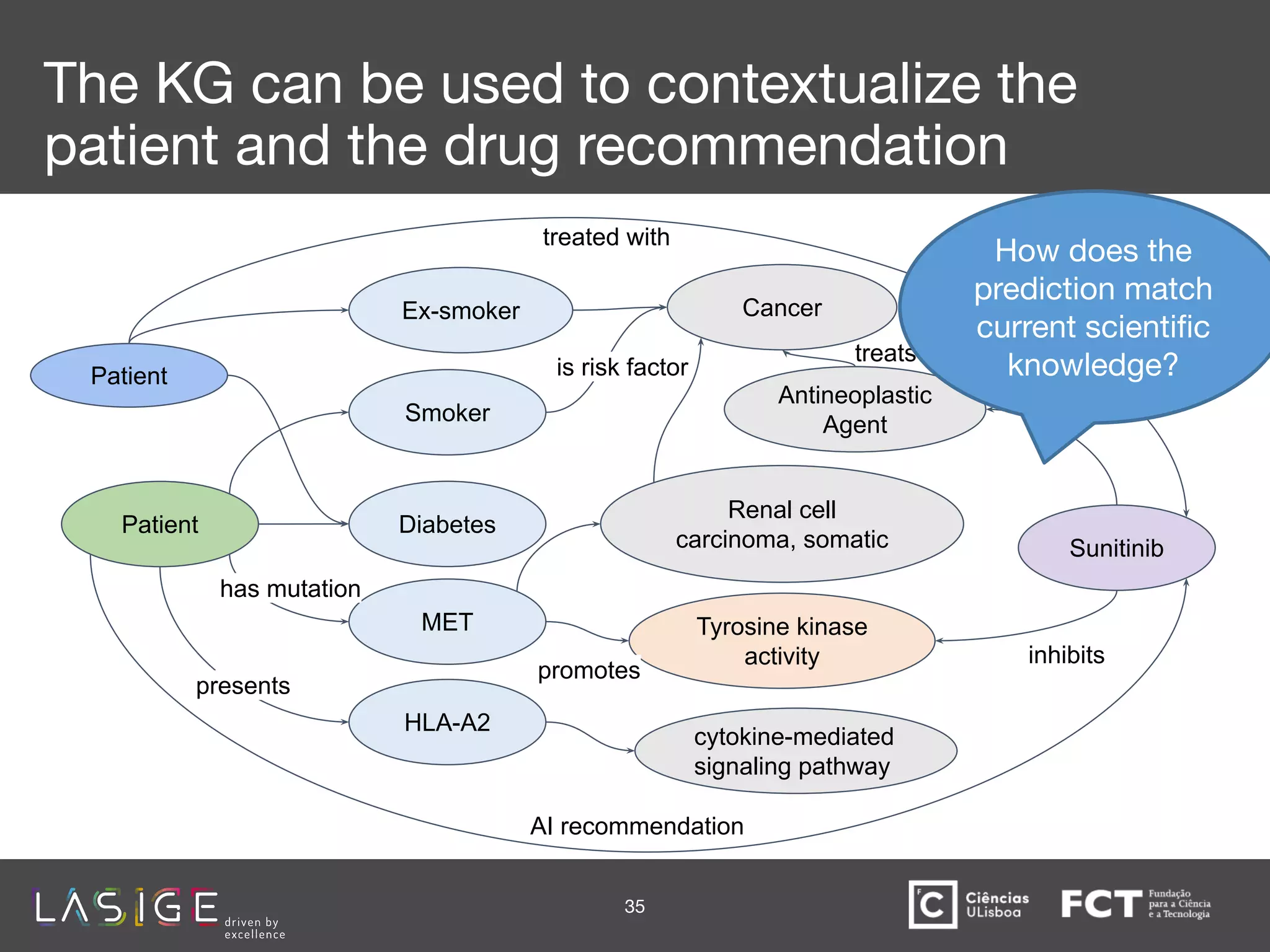
How **similar** are my
negative and positive
cases?
Patient
Ex-smoker
Smoker
Diabetes
MET
HLA-A2
cytokine-mediated
signaling pathway
Renal cell
carcinoma, somatic Sunitinib
Antineoplastic
Agent
Tyrosine kinase
activity
Cancer
AI recommendation
presents
has mutation
inhibits
The KG can be used to contextualize the
patient and the drug recommendation
promotes
treats
Patient
treated with
35
is risk factor
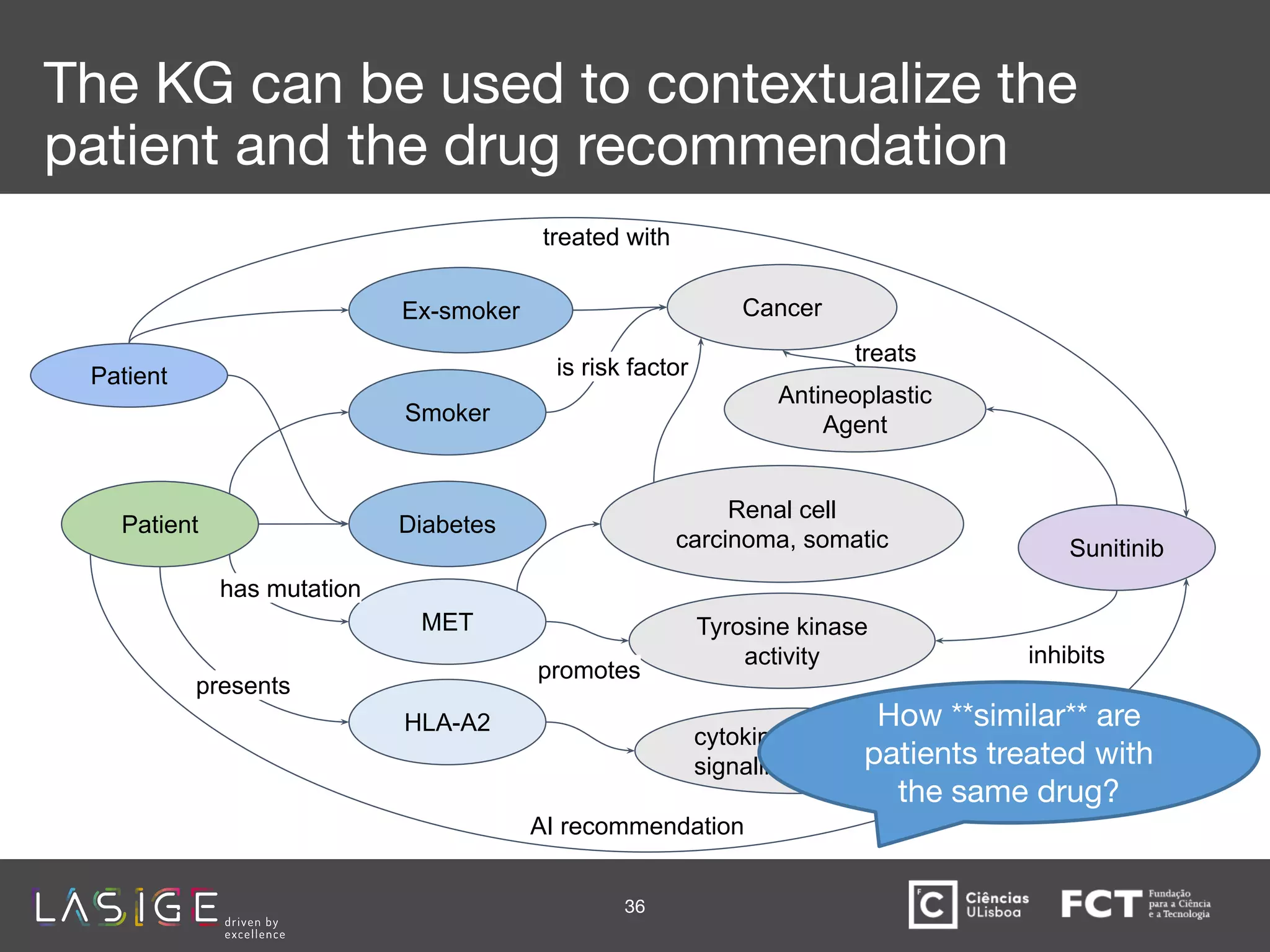
How does the
prediction match
current scientific
knowledge?
Patient
Ex-smoker
Smoker
Diabetes
MET
HLA-A2
cytokine-mediated
signaling pathway
Renal cell
carcinoma, somatic Sunitinib
Antineoplastic
Agent
Tyrosine kinase
activity
Cancer
AI recommendation
presents
has mutation
inhibits
The KG can be used to contextualize the
patient and the drug recommendation
promotes
treats
Patient
treated with
36
is risk factor
How **similar** are
patients treated with
the same drug?
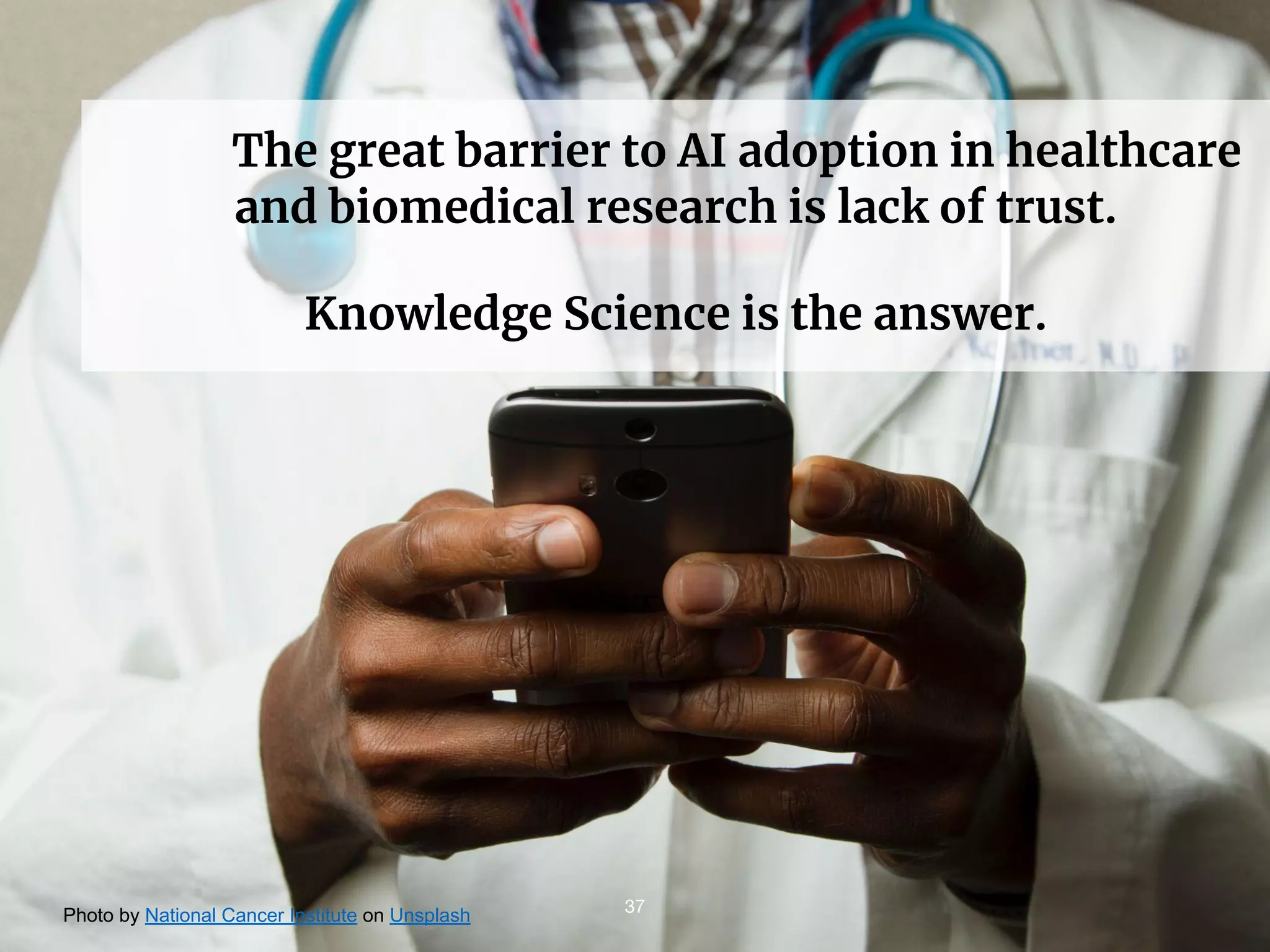
The great barrier to AI adoption in healthcare
and biomedical research is lack of trust.
Knowledge Science is the answer.
Photo by National Cancer Institute on Unsplash 37
Acknowledgements
Daniel Faria, LASIGE/Biodata.pt, Portugal
Isabel Cruz, U. Illinois, USA
Ernesto Jimenez-Ruiz, City, U. of London, UK
Daniela Oliveira, Novartis
Patrick Lambrix, U. Linkoping, Sweden
Valentina Ivanova, RISE, Sweden
Booma S. Balasubramani, Microsoft
and many others
Past and present students:
Rita Sousa
Marta Silva
Susana Nunes
Ana Guerreiro
Patrícia Eugénio
Filipa Serrano
Beatriz Lima
Carlota Cardoso
and many others
38
https://liseda-lab.github.io/
https://github.com/liseda-lab/
https://github.com/AgreementMakerLight
@CPesquita
clpesquita@fc.ul.pt
This work was supported by FCT through the
LASIGEResearch Unit (UIDB/00408/2020 and
UIDP/00408/2020). It was also partially supported by the
KATY project which has received funding from the European
Union’s Horizon 2020 research and innovation programme
under grant agreement No 101017453.

Knowledge Science for AI-based biomedical and clinical applications

  • 1.
    Knowledge Science forAI-based biomedical and clinical applications Catia Pesquita LASIGE, University of Lisbon @CPesquita clpesquita@fc.ul.pt TOWARDS TRUSTWORTHY DATA First International Workshop on Knowledge Science March 31, 2022 Eindhoven Artificial Intelligence Systems Institute
  • 2.
    Why biomedical AIneeds Knowledge Science 1. Large amounts of data in non-standard formats which need to be converted, interpreted, and merged into readable formats. 2. Heterogeneous and complex data which current ML/AI approaches are processing without context 3. Lack of explainability hinders trust 2 Knowledge Science is key to tackle ALL challenges
  • 3.
    Trust in AI •the user successfully comprehends how the model arrives at an outcome 🡪 represent inputs, outputs and processes • the model’s outcomes/workings match the user’s prior knowledge 🡪 build a shared context 3 Jacovi, Alon, et al. "Formalizing trust in artificial intelligence: Prerequisites, causes and goals of human trust in AI." Proceedings of the 2021 ACM conference on fairness, accountability, and transparency. 2021.
  • 4.
    Trust in AI •the user successfully comprehends how the model arrives at an outcome 🡪 represent a model’s processes represent inputs, outputs and • the model’s outcomes/workings match the user’s prior knowledge 🡪 evaluation 4
  • 5.
    What happens whendata is complex, multi-domain, heterogeneous, incomplete, ambiguous? 5
  • 6.
    Trust in AIfor biomedical and clinical applications • the user successfully comprehends how the model arrives at an outcome 🡪 represent a model’s processes represent inputs, outputs and • the model’s outcomes/workings match the user’s prior knowledge 🡪 evaluation 6
  • 7.
    Trust in AIfor biomedical and clinical applications • the user successfully comprehends how the model arrives at an outcome 🡪 represent a model’s inputs, outputs and processes • the model’s outcomes/workings match the user’s prior knowledge 🡪 evaluation 7
  • 8.
    Trust in AIfor biomedical and clinical applications • the user successfully comprehends how the model arrives at an outcome 🡪 represent a model’s inputs, outputs and processes • the model’s outcomes/workings match the user’s prior knowledge 🡪 represent the scientific context 8
  • 9.
    Knowledge Science canhelp mitigate bias in biomedical AI 9 10.1038/s43856-021-00028-w Mitigating bias in machine learning for medicine
  • 10.
    Knowledge Science forTrust in Biomedical AI Assessing trustworthiness requires data, domain and user context Data context: represent data provenance and transformations/processing Domain/background knowledge: represent the scientific context of the data and application User context: different users will trust based on different expectations 10
  • 11.
    Data Context Augment explanationswith the data creation and processing context • Provide a rich contextual semantic layer to the underlying data using domain ontologies and knowledge graphs.  • Preserve uncertainty and highlight potential ambiguity and incompleteness at the data level  11
  • 12.
    Data Context iskey for trust 25% of the works that developed ML approaches to diagnose COVID-19 in adults based on chest X-rays and CT scans used pediatric (ages 1-5) pneumonia images as control. 12 Roberts, Michael, et al. "Common pitfalls and recommendations for using machine learning to detect and prognosticate for COVID-19 using chest radiographs and CT scans." Nature Machine Intelligence 3.3 (2021): 199-217. 10.1016/j.cell.2018.02.0 10 COVID-19 10.1016/j.rxeng.2020.11.0 01
  • 13.
    Domain Knowledge Context Contextualizean explanation within existing knowledge • Include prior knowledge through links to ontologies • Enrich the contextual semantic layer with links and relations across domains of knowledge 13
  • 14.
    Domain Knowledge Contextis key for trust 14 Term 1 Term 2 Similarity Gingiva Gum 0.98
  • 15.
    Domain Knowledge Contextis key for trust 15 Gingiva Gum 0.98 Term 1 Term 2 Similarity Gingiva Gum 0.98 Anatomical Part Chemical Substance
  • 16.
    User Context Trusting anAI outcome depends on the user context: task, prior knowledge, expectation, etc. 16 Protein A and Protein B are not similar at all since they are involved in unrelated diseases… Protein A and Protein B are very similar because they perform the same molecular function! Biochemist Clinician
  • 17.
    Ontologies, Knowledge Graphs andFAIR data principles can support data, domain and user context. 17
  • 18.
    NextGen Biomedical AIrequires integration of complex and diverse data Molecular Cellular Anatomy Phenotype and Disease Clinical 18 Environmental
  • 19.
    • 100s ofvery large files per patient covering genome sequence, mutations, transcriptome, clinical, etc. 19 NextGen Biomedical AI requires integration of complex and diverse data
  • 20.
    What happens whendata is complex, multi-domain, heterogeneous, incomplete, ambiguous? 20
  • 21.
    One ontology isnot enough Systems Biology, Systems Medicine and Personalized Medicine require holistic representations 21 JD Ferreira, DC Teixeira, C Pesquita. Biomedical Ontologies: Coverage, Access and Use. 2020 Systems Medicine Integrative, Qualitative and Computational Approaches, Academic Press, Elsevier
  • 22.
    What do weneed to create holistic representations? Cover multiple domains Align multiple ontologies Scalability Ensure rich semantic integration Related but not equal domains Complex relations involving more than one ontology Provide high quality alignments Support human interaction Visualizing the context of a mapping Balancing cognitive overload and informativeness 22 MC Silva, D Faria, and C Pesquita. Integrating knowledge graphs for explainable artificial intelligence in biomedicine. Ontology Matching workshop 2021
  • 23.
    Rethinking biomedical ontology alignment Covermultiple domains Pairwise ontology alignment Holistic ontology alignment of multiple ontologies Ensure rich semantic integration Simple equivalence ontology alignment Complex ontology alignment Provide high quality alignments User validation Human-in-the-loop Interactive Alignment 23 MC Silva, D Faria, and C Pesquita. Integrating knowledge graphs for explainable artificial intelligence in biomedicine. Ontology Matching workshop 2021
  • 24.
    Holistic Matching withclustering and incremental matching 24 Silva, M.C., Faria, D. & Pesquita, C. (2022). Matching Multiple Ontologies to Build a Knowledge Graph for Personalized Medicine.  ESWC2022 (accepted) Can we ensure the scalability of matching tasks with many ontologies?
  • 25.
    Holistic Matching (CIA)runs in half the time, ensures high recall within similar domains and high precision across domains 25 Silva, M.C., Faria, D. & Pesquita, C. (2022). Matching Multiple Ontologies to Build a Knowledge Graph for Personalized Medicine.  ESWC2022 (accepted)
  • 26.
    Compound Matching forontology triples Can we find mappings involving multiple ontologies using lexical approaches and search space pruning? 26 HP:0001650 aortic stenosis PATO:0001847 constricted Step 1 FMA:3734 aorta Step 2 HP:0001650 (…) stenosis Filter unmapped source classes Remove mapped words from class labels. Selection of best scoring mappings Oliveira, D., & Pesquita, C. (2018). Improving the interoperability of biomedical ontologies with compound alignments. J. Biomedical Semantics. Ontology sets Correct (New) MP-CL-PATO 47.1% (17.6%) MP-GO-PATO 86.9% (22.3%) MP-NBO-PATO 70.4% (20.7%) MP-UBERON-PATO 83.5% (24.7%) WBP-GO-PATO 44.9% (33.3%) HP-FMA-PATO 81.5% (44.1%)
  • 27.
    https://github.com/liseda-lab/VOWLMap Supporting contextualized ontologyalignment validation 27 Guerreiro, A., Faria, D. & Pesquita, C. (2021) VOWLMap: Graph-based Ontology Alignment Visualization and Editing. VOILA workshop (ISWC 2021)
  • 28.
  • 29.
    Explainable AI forPersonalized Oncology 29 katy-project.eu
  • 30.
    30 Is this DataTrustworthy?
  • 31.
    Building a KGfor Explainable AI for Personalized Oncology 31
  • 32.
    Patient Ex-smoker Smoker Diabetes MET HLA-A2 cytokine-mediated signaling pathway Renal cell carcinoma,somatic Sunitinib Antineoplastic Agent Tyrosine kinase activity Cancer AI recommendation presents has mutation inhibits The KG can be used to contextualize the patient and the drug recommendation promotes treats Patient treated with 32 is risk factor
  • 33.
    Patient Ex-smoker Smoker Diabetes MET HLA-A2 cytokine-mediated signaling pathway Renal cell carcinoma,somatic Sunitinib Antineoplastic Agent Tyrosine kinase activity Cancer AI recommendation presents has mutation inhibits The KG can be used to contextualize the patient and the drug recommendation promotes treats Patient treated with 33 is risk factor How diverse is my dataset in terms of patient features?
  • 34.
    Patient Ex-smoker Smoker Diabetes MET HLA-A2 cytokine-mediated signaling pathway Renal cell carcinoma,somatic Sunitinib Antineoplastic Agent Tyrosine kinase activity Cancer AI recommendation presents has mutation inhibits The KG can be used to contextualize the patient and the drug recommendation promotes treats Patient treated with 34 is risk factor How **similar** are my negative and positive cases?
  • 35.
    Patient Ex-smoker Smoker Diabetes MET HLA-A2 cytokine-mediated signaling pathway Renal cell carcinoma,somatic Sunitinib Antineoplastic Agent Tyrosine kinase activity Cancer AI recommendation presents has mutation inhibits The KG can be used to contextualize the patient and the drug recommendation promotes treats Patient treated with 35 is risk factor How does the prediction match current scientific knowledge?
  • 36.
    Patient Ex-smoker Smoker Diabetes MET HLA-A2 cytokine-mediated signaling pathway Renal cell carcinoma,somatic Sunitinib Antineoplastic Agent Tyrosine kinase activity Cancer AI recommendation presents has mutation inhibits The KG can be used to contextualize the patient and the drug recommendation promotes treats Patient treated with 36 is risk factor How **similar** are patients treated with the same drug?
  • 37.
    The great barrierto AI adoption in healthcare and biomedical research is lack of trust. Knowledge Science is the answer. Photo by National Cancer Institute on Unsplash 37
  • 38.
    Acknowledgements Daniel Faria, LASIGE/Biodata.pt,Portugal Isabel Cruz, U. Illinois, USA Ernesto Jimenez-Ruiz, City, U. of London, UK Daniela Oliveira, Novartis Patrick Lambrix, U. Linkoping, Sweden Valentina Ivanova, RISE, Sweden Booma S. Balasubramani, Microsoft and many others Past and present students: Rita Sousa Marta Silva Susana Nunes Ana Guerreiro Patrícia Eugénio Filipa Serrano Beatriz Lima Carlota Cardoso and many others 38 https://liseda-lab.github.io/ https://github.com/liseda-lab/ https://github.com/AgreementMakerLight @CPesquita clpesquita@fc.ul.pt This work was supported by FCT through the LASIGEResearch Unit (UIDB/00408/2020 and UIDP/00408/2020). It was also partially supported by the KATY project which has received funding from the European Union’s Horizon 2020 research and innovation programme under grant agreement No 101017453.