RC-SS-137-3: Active Learning of
Secondary Science through the
      Integration of ICT


  Apr 29 – May 23, 2013 (4 Weeks)
         Course Supervisor:
          DR. C.ANNAMALAI
RATIONALE
• ICT has been playing a more significant role in the
  classrooms recently.
• Newer ICTs are much more interactive and offers
  potential for sustaining strategies that promote
  active learning in the classroom.
• Teachers need to encourage students to think
  critically
• Strategies that promote active learning are
  encouraged to be used extensively in the science
  classroom as it improves student understanding.
Objectives
  The main objective of this course is to provide participants with an
  understanding of how strategies that promotes active learning
  which can be enhanced by the use of ICT.
  At the end of the course, participants are able to:

• Acquire understanding of various strategies that enhance active
  learning and development of critical thinking skills;
• demonstrate skills in using ICT tools for active learning of science;
• develop assessment tools that measure successful use of strategies
  that enhance active learning in an ICT integrated environment; and
• use the lesson quality improvement process to design, develop and
  evaluate active learning enhanced ICT integrated science lessons
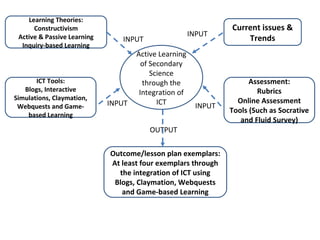
Learning Theories:
      Constructivism                                            Current issues &
 Active & Passive Learning                             INPUT
                                INPUT                               Trends
  Inquiry-based Learning
                                     Active Learning
                                       of Secondary
                                          Science
       ICT Tools:                      through the                    Assessment:
   Blogs, Interactive                 Integration of                    Rubrics
Simulations, Claymation,                                          Online Assessment
                             INPUT          ICT         INPUT
 Webquests and Game-
                                                                Tools (Such as Socrative
    based Learning
                                                                   and Fluid Survey)
                                         OUTPUT

                             Outcome/lesson plan exemplars:
                             At least four exemplars through
                               the integration of ICT using
                              Blogs, Claymation, Webquests
                                and Game-based Learning
Social Constructivism

• One version of constructivist learning theory,
  social constructivism, emphasizes
  consideration of the ways a culture influences
  its people’s mental constructs. One major
  assumption about social constructivism is that
  “learning is collaborative with meaning
  negotiated from multiple perspectives (Smith
  & Ragan, 1999, p. 15).
• Constructivism blends well with a variety of
  classroom practices. Constructivist perspectives,
  according to Cadiero-Kaplan (1999, p. 15), lead to
  “discovery learning, authentic (real world)
  classroom tasks, social discourse as part of
  learning, the teacher as facilitator and resource
  provider, and most importantly, the students as
  agents over the classroom environment and
  learning.” (See also Randolph & Everston, 1994;
  St. Pierre-Hirtle, 1996)
Active learning, Critical Thinking & ICT
• Fisseha (2011) and Tinio (2002) argue that learner learn as they do
  and, whenever appropriate work on real-life problems in-depth.
  Moreover, ICT makes the learning less abstract and more relevant
  to their life situations.
• In contrast to memorization-based or rote learning, that is the
  feature of traditional pedagogy; ICT-enhanced learning promotes
  increased learner engagement. ICT-enhanced learning can also be
  ‘just-in-time’ learning that the learners choose what to learn when
  they need.
• Li (2010) and Richardson’s (2004) argue that active learning
  involves problem-solving and enables learners to develop their
  critical thinking skills. They suggested weblogs or blogs have great
  value in the development of critical thinking skills, writing skills, and
  information literacy. Critical thinking is a required competency for
  successful learners and educators.
WEB & CONSTRUCTIVSIM
• Constructivism proposes that the learner actively
  participates in the learning process.
• This is in synchrony with the Web 2.0 paradigm,
  which is a highly interactive platform that
  stimulates user involvement and participation in
  the development and maintenance of content.
• Web 2.0 provides leverage for the active
  participation of the learner in constructing their
  learning processes by stimulating the individual
  learner to construe meaning out of the content
  being learnt. (Enonbun, 2010)

Rc ss-137-3 net

  • 1.
    RC-SS-137-3: Active Learningof Secondary Science through the Integration of ICT Apr 29 – May 23, 2013 (4 Weeks) Course Supervisor: DR. C.ANNAMALAI
  • 2.
    RATIONALE • ICT hasbeen playing a more significant role in the classrooms recently. • Newer ICTs are much more interactive and offers potential for sustaining strategies that promote active learning in the classroom. • Teachers need to encourage students to think critically • Strategies that promote active learning are encouraged to be used extensively in the science classroom as it improves student understanding.
  • 3.
    Objectives Themain objective of this course is to provide participants with an understanding of how strategies that promotes active learning which can be enhanced by the use of ICT. At the end of the course, participants are able to: • Acquire understanding of various strategies that enhance active learning and development of critical thinking skills; • demonstrate skills in using ICT tools for active learning of science; • develop assessment tools that measure successful use of strategies that enhance active learning in an ICT integrated environment; and • use the lesson quality improvement process to design, develop and evaluate active learning enhanced ICT integrated science lessons
  • 4.
    Learning Theories: Constructivism Current issues & Active & Passive Learning INPUT INPUT Trends Inquiry-based Learning Active Learning of Secondary Science ICT Tools: through the Assessment: Blogs, Interactive Integration of Rubrics Simulations, Claymation, Online Assessment INPUT ICT INPUT Webquests and Game- Tools (Such as Socrative based Learning and Fluid Survey) OUTPUT Outcome/lesson plan exemplars: At least four exemplars through the integration of ICT using Blogs, Claymation, Webquests and Game-based Learning
  • 5.
    Social Constructivism • Oneversion of constructivist learning theory, social constructivism, emphasizes consideration of the ways a culture influences its people’s mental constructs. One major assumption about social constructivism is that “learning is collaborative with meaning negotiated from multiple perspectives (Smith & Ragan, 1999, p. 15).
  • 6.
    • Constructivism blendswell with a variety of classroom practices. Constructivist perspectives, according to Cadiero-Kaplan (1999, p. 15), lead to “discovery learning, authentic (real world) classroom tasks, social discourse as part of learning, the teacher as facilitator and resource provider, and most importantly, the students as agents over the classroom environment and learning.” (See also Randolph & Everston, 1994; St. Pierre-Hirtle, 1996)
  • 7.
    Active learning, CriticalThinking & ICT • Fisseha (2011) and Tinio (2002) argue that learner learn as they do and, whenever appropriate work on real-life problems in-depth. Moreover, ICT makes the learning less abstract and more relevant to their life situations. • In contrast to memorization-based or rote learning, that is the feature of traditional pedagogy; ICT-enhanced learning promotes increased learner engagement. ICT-enhanced learning can also be ‘just-in-time’ learning that the learners choose what to learn when they need. • Li (2010) and Richardson’s (2004) argue that active learning involves problem-solving and enables learners to develop their critical thinking skills. They suggested weblogs or blogs have great value in the development of critical thinking skills, writing skills, and information literacy. Critical thinking is a required competency for successful learners and educators.
  • 8.
    WEB & CONSTRUCTIVSIM •Constructivism proposes that the learner actively participates in the learning process. • This is in synchrony with the Web 2.0 paradigm, which is a highly interactive platform that stimulates user involvement and participation in the development and maintenance of content. • Web 2.0 provides leverage for the active participation of the learner in constructing their learning processes by stimulating the individual learner to construe meaning out of the content being learnt. (Enonbun, 2010)