Merging Theory, Pedagogy, and Technology Bermuda Union of Teachers Session II October 24 th  & 25 th   Alnisha Simmons, M.A., M.Sc. Senior Biology Lecturer , Bermuda College  Educational Technology Specialist,  2011 Graduate George Washington University  & SMART Notebook Version 10 Trainer
Educational Technology “ Is a combination of the processes and tools involved in addressing educational needs using computers and other electronic technologies.” “ Integrating Educational Technologies… determining  which electronic  tools  and which  methods   for implementing them are the most appropriate responses to given classroom situations and problems”  (Roblyer & Doering, 2010)
Teachers Always Will Be More Important Than Technology What Has The Past Taught Us?
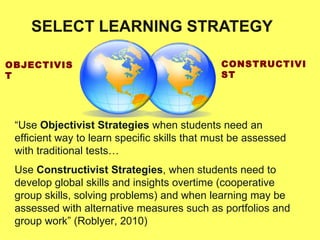
SELECT LEARNING STRATEGY OBJECTIVIST CONSTRUCTIVIST “ Use  Objectivist Strategies  when students need an efficient way to learn specific skills that must be assessed with traditional tests… Use  Constructivist Strategies , when students need to develop global skills and insights overtime (cooperative group skills, solving problems) and when learning may be assessed with alternative measures such as portfolios and group work” (Roblyer, 2010)
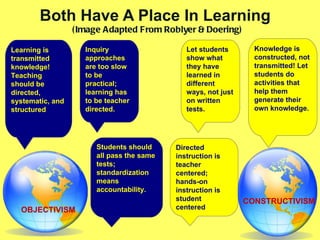
Both Have A Place In Learning  (Image Adapted From Roblyer & Doering) Learning is transmitted knowledge! Teaching should be directed, systematic, and structured Students should all pass the same tests; standardization means accountability.  Knowledge is constructed, not transmitted! Let students do activities that help them generate their own knowledge . Directed instruction is teacher centered; hands-on instruction is student centered Inquiry approaches are too slow to be practical; learning has to be teacher directed. OBJECTIVISM CONSTRUCTIVISM Let students show what they have learned in different ways, not just on written tests .
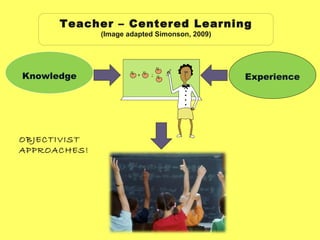
Knowledge Experience Teacher – Centered Learning (Image adapted Simonson, 2009) OBJECTIVIST APPROACHES!
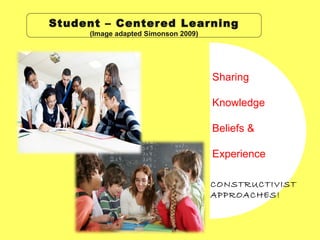
Sharing Knowledge Beliefs & Experience Student – Centered Learning (Image adapted Simonson 2009 ) CONSTRUCTIVIST APPROACHES!
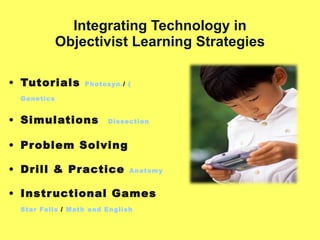
Integrating Technology in Objectivist Learning Strategies Tutorials   Photosyn. /  ( Genetics Simulations  Dissection Problem Solving Drill & Practice  Anatomy Instructional Games  Star Falls  /  Math and English
  Integrating Technology in Constructivist Learning  Strategies 1. WEB QUESTS http :// www.youtube.com/watch?v=o4rel5qOPvU   (What is a WebQuest?) http:// www.youtube.com/watch?v=Cyht-ehlAWY  (How to Make a WebQuest?) Nutrition Quest   Technology Quest   Quest Templates 2. WEB 2.0 COLLABORATIVE  (Wiki)  /  Google  Docs . 3. DEVELOP MULTIMEDIA TOOLS Weebly Template   Expression Website)  4. SIMULATIONS AND TOOLS  Virtual Lab
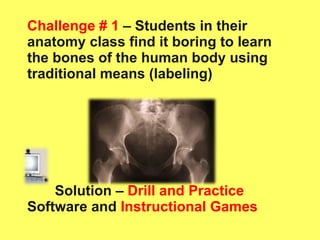
Challenge # 1  – Students in their anatomy class find it boring to learn the bones of the human body using traditional means (labeling) Solution –   Drill and Practice  Software and  Instructional Games
Challenge # 2  – Students in their social studies class dislike preparing research reports and presentations. Solution – Students develop   Web page/multimedia products
Challenge # 3  – A student has missed class due to illness and needs to review missed work. Solution –  Tutorials  or Multimedia software.
Challenge # 4  – Students in their english class need to contact journalists to complete interviews on writing styles.  Solution –   Internet and email projects, multimedia encyclopedias  and  Atlases.
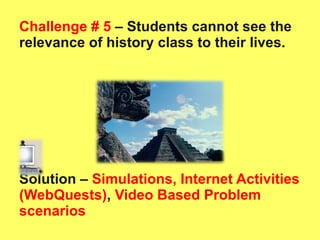
Challenge # 5  – Students cannot see the relevance of history class to their lives.  Solution –   Simulations, Internet Activities (WebQuests) ,  Video Based Problem scenarios
Challenge # 6  – The teacher wants to monitor contributions made by group members on a class projects Solution –   Web 2.0: Wiki and Blog Development
Technology Integration Model (TIP) Reflect on Technological Pedagogical Content Knowledge Determine Relative Advantage Decide on Objectives and Assessments Design Integration Strategies Prepare Instructional Environment Evaluate and Revise Integration Strategies
CHALLENGE Develop an Instructional Website with the content you teach using  Objectivist  and  Constructivist  learning strategies supplemented with educational technologies seen today. Use various forms of multimedia and Web 2.0 components if possible. When developing consider the layout of your content, graphic design elements, and engaging instructional activities for your learners. Upper  -  w ww.weebly.com   Lower  -  http://zunal.com/webquest.php?w=114019
References Newby, T. & Stepich, D. & Lehman, D. Russell, J. (2006). Educational Technology for Teaching and Learning. 3rd Ed. Pearson Education, Inc. Upper Saddle River, New Jersey.   Simonson, M.; Smaldino, S.; Albright M.; and Zvacek, S. (2008) Teaching and Learning at a Distance: Foundations of Distance Education - 4th Edition. Prentice Hall.  Roblyer, M. D. (2009).  Integrating educational technology into teaching . 5th Edition. B.F. Skinner Image - http://pics.livejournal.com/modernmatter/pic/0002xp65 RESOURCES  Howard Gardner image - http://www.preschools4all.com/image-files/howard gardner.jpg Jean Piaget image – http://faculty.mercer.edu/spears_a/studentpages/piaget/pipe.jpg Jerome Bruner image  http://www.educationupdate.com/archives/2005/Nov/assets/jerome bruner.jpg John Dewey image  http://www.notablebiographies.com/images/uewb_04_img0233.jp Robert Gagne Image - http://www.lifecircles inc.com/Learning theories/Gagnefiles/page80_1.jpg

Technology Integration BUT Workshops

  • 1.
    Merging Theory, Pedagogy,and Technology Bermuda Union of Teachers Session II October 24 th & 25 th Alnisha Simmons, M.A., M.Sc. Senior Biology Lecturer , Bermuda College Educational Technology Specialist, 2011 Graduate George Washington University & SMART Notebook Version 10 Trainer
  • 2.
    Educational Technology “Is a combination of the processes and tools involved in addressing educational needs using computers and other electronic technologies.” “ Integrating Educational Technologies… determining which electronic tools and which methods for implementing them are the most appropriate responses to given classroom situations and problems” (Roblyer & Doering, 2010)
  • 3.
    Teachers Always WillBe More Important Than Technology What Has The Past Taught Us?
  • 4.
    SELECT LEARNING STRATEGYOBJECTIVIST CONSTRUCTIVIST “ Use Objectivist Strategies when students need an efficient way to learn specific skills that must be assessed with traditional tests… Use Constructivist Strategies , when students need to develop global skills and insights overtime (cooperative group skills, solving problems) and when learning may be assessed with alternative measures such as portfolios and group work” (Roblyer, 2010)
  • 5.
    Both Have APlace In Learning (Image Adapted From Roblyer & Doering) Learning is transmitted knowledge! Teaching should be directed, systematic, and structured Students should all pass the same tests; standardization means accountability. Knowledge is constructed, not transmitted! Let students do activities that help them generate their own knowledge . Directed instruction is teacher centered; hands-on instruction is student centered Inquiry approaches are too slow to be practical; learning has to be teacher directed. OBJECTIVISM CONSTRUCTIVISM Let students show what they have learned in different ways, not just on written tests .
  • 6.
    Knowledge Experience Teacher– Centered Learning (Image adapted Simonson, 2009) OBJECTIVIST APPROACHES!
  • 7.
    Sharing Knowledge Beliefs& Experience Student – Centered Learning (Image adapted Simonson 2009 ) CONSTRUCTIVIST APPROACHES!
  • 8.
    Integrating Technology inObjectivist Learning Strategies Tutorials Photosyn. / ( Genetics Simulations Dissection Problem Solving Drill & Practice Anatomy Instructional Games Star Falls / Math and English
  • 9.
    IntegratingTechnology in Constructivist Learning Strategies 1. WEB QUESTS http :// www.youtube.com/watch?v=o4rel5qOPvU (What is a WebQuest?) http:// www.youtube.com/watch?v=Cyht-ehlAWY (How to Make a WebQuest?) Nutrition Quest Technology Quest Quest Templates 2. WEB 2.0 COLLABORATIVE (Wiki) / Google Docs . 3. DEVELOP MULTIMEDIA TOOLS Weebly Template Expression Website) 4. SIMULATIONS AND TOOLS Virtual Lab
  • 10.
    Challenge # 1 – Students in their anatomy class find it boring to learn the bones of the human body using traditional means (labeling) Solution – Drill and Practice Software and Instructional Games
  • 11.
    Challenge # 2 – Students in their social studies class dislike preparing research reports and presentations. Solution – Students develop Web page/multimedia products
  • 12.
    Challenge # 3 – A student has missed class due to illness and needs to review missed work. Solution – Tutorials or Multimedia software.
  • 13.
    Challenge # 4 – Students in their english class need to contact journalists to complete interviews on writing styles. Solution – Internet and email projects, multimedia encyclopedias and Atlases.
  • 14.
    Challenge # 5 – Students cannot see the relevance of history class to their lives. Solution – Simulations, Internet Activities (WebQuests) , Video Based Problem scenarios
  • 15.
    Challenge # 6 – The teacher wants to monitor contributions made by group members on a class projects Solution – Web 2.0: Wiki and Blog Development
  • 16.
    Technology Integration Model(TIP) Reflect on Technological Pedagogical Content Knowledge Determine Relative Advantage Decide on Objectives and Assessments Design Integration Strategies Prepare Instructional Environment Evaluate and Revise Integration Strategies
  • 17.
    CHALLENGE Develop anInstructional Website with the content you teach using Objectivist and Constructivist learning strategies supplemented with educational technologies seen today. Use various forms of multimedia and Web 2.0 components if possible. When developing consider the layout of your content, graphic design elements, and engaging instructional activities for your learners. Upper - w ww.weebly.com Lower - http://zunal.com/webquest.php?w=114019
  • 18.
    References Newby, T.& Stepich, D. & Lehman, D. Russell, J. (2006). Educational Technology for Teaching and Learning. 3rd Ed. Pearson Education, Inc. Upper Saddle River, New Jersey.   Simonson, M.; Smaldino, S.; Albright M.; and Zvacek, S. (2008) Teaching and Learning at a Distance: Foundations of Distance Education - 4th Edition. Prentice Hall. Roblyer, M. D. (2009). Integrating educational technology into teaching . 5th Edition. B.F. Skinner Image - http://pics.livejournal.com/modernmatter/pic/0002xp65 RESOURCES Howard Gardner image - http://www.preschools4all.com/image-files/howard gardner.jpg Jean Piaget image – http://faculty.mercer.edu/spears_a/studentpages/piaget/pipe.jpg Jerome Bruner image http://www.educationupdate.com/archives/2005/Nov/assets/jerome bruner.jpg John Dewey image http://www.notablebiographies.com/images/uewb_04_img0233.jp Robert Gagne Image - http://www.lifecircles inc.com/Learning theories/Gagnefiles/page80_1.jpg

Editor's Notes

  • #9 http://www.youtube.com/watch?v=0YOqgXjynd0
  • #10 http://biologytechresources.weebly.com/
  • #17 Mishra and Koehler (2006) – Components of teaching; knowledge, pedagogy, now technology
  • #19 SMART Tutorials