The United States
since
World War II
RC 4
VUS.13bThe student will demonstrate knowledge of United States foreign policy since
World War II by
b) explaining the origins of the Cold War, and describing the Truman Doctrine
and the policy of containment of communism, the American role in wars in Korea
and Vietnam, and the role of the North Atlantic Treaty Organization (NATO) in
Europe.
VUS.13b Essential
Questions
• How did the United States respond to the threat of
communist expansion?
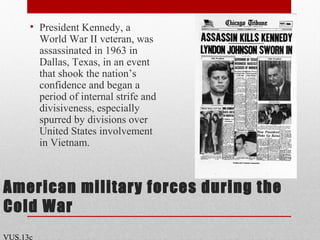
• What are the origins of the Cold War?
• What were the early significant events of the Cold War?
• What was the impact of the Cold War on Americans at
home?
• What was the impact of the Vietnam War on Americans
at home?
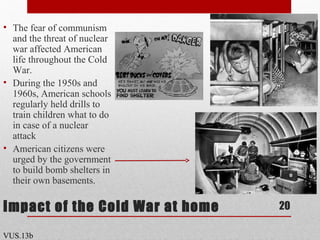
VUS.13b Essential
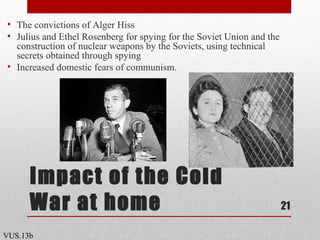
Understandings
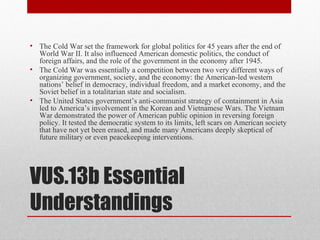
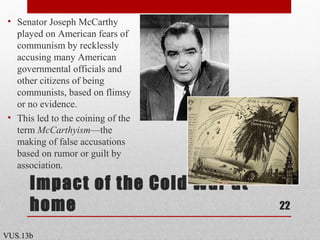
• The Cold War set the framework for global politics for 45 years after the end of
World War II. It also influenced American domestic politics, the conduct of
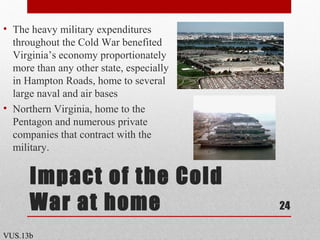
foreign affairs, and the role of the government in the economy after 1945.
• The Cold War was essentially a competition between two very different ways of
organizing government, society, and the economy: the American-led western
nations’ belief in democracy, individual freedom, and a market economy, and the
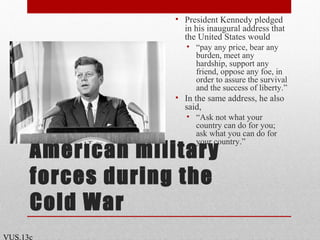
Soviet belief in a totalitarian state and socialism.
• The United States government’s anti-communist strategy of containment in Asia
led to America’s involvement in the Korean and Vietnamese Wars. The Vietnam
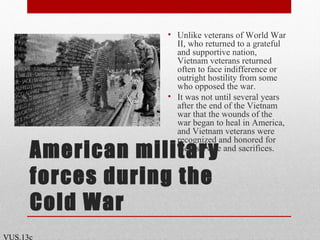
War demonstrated the power of American public opinion in reversing foreign
policy. It tested the democratic system to its limits, left scars on American society
that have not yet been erased, and made many Americans deeply skeptical of
future military or even peacekeeping interventions.
Origins of the Cold
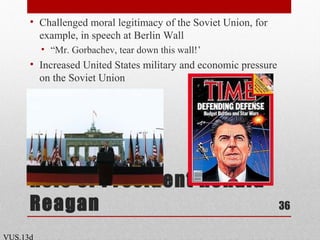
War
• The Cold War lasted from the end of World War II until
the collapse of the Soviet Union. (1945-1991)
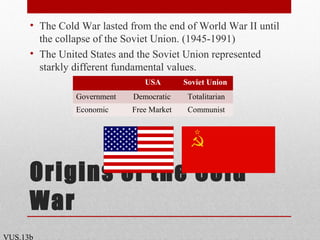
• The United States and the Soviet Union represented
starkly different fundamental values.
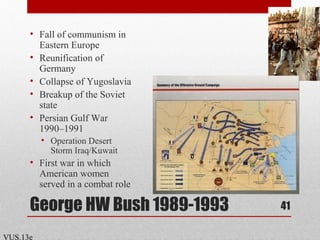
VUS.13b
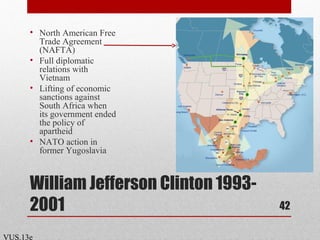
USA Soviet Union
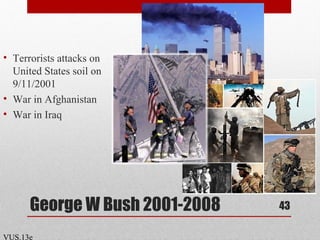
Government Democratic Totalitarian
Economic Free Market Communist
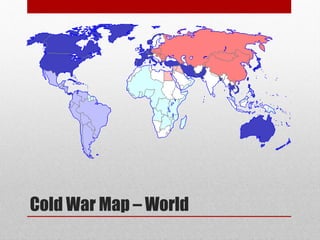
Cold War Map – World
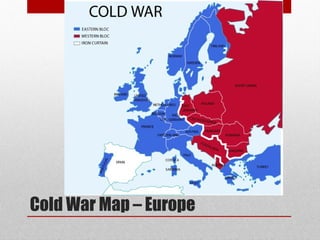
Cold War Map – Europe
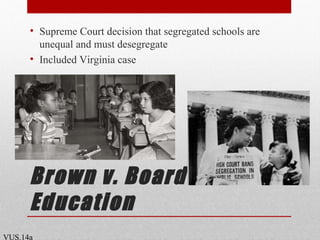
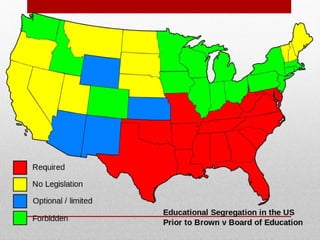
Origins of the Cold
War
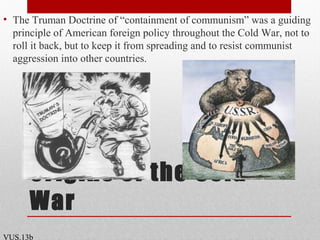
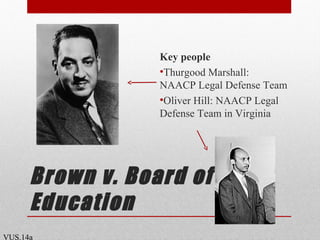
• The Truman Doctrine of “containment of communism” was a guiding
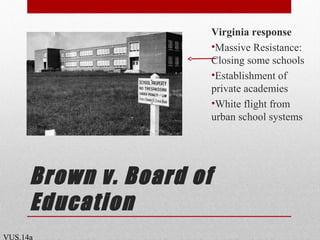
principle of American foreign policy throughout the Cold War, not to
roll it back, but to keep it from spreading and to resist communist
aggression into other countries.
VUS.13b
Origins of the Cold
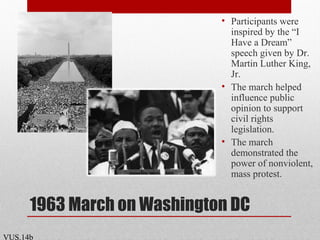
War
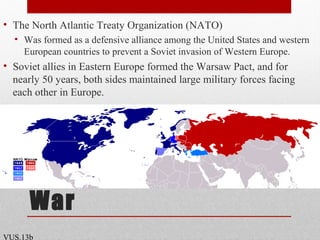
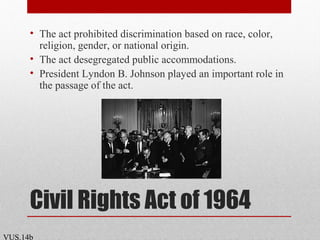
• The North Atlantic Treaty Organization (NATO)
• Was formed as a defensive alliance among the United States and western
European countries to prevent a Soviet invasion of Western Europe.
• Soviet allies in Eastern Europe formed the Warsaw Pact, and for
nearly 50 years, both sides maintained large military forces facing
each other in Europe.
VUS.13b
Origins of the Cold
War
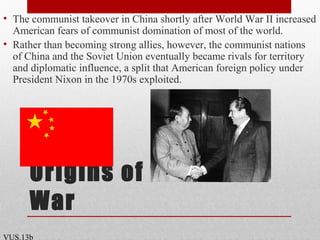
• The communist takeover in China shortly after World War II increased
American fears of communist domination of most of the world.
• Rather than becoming strong allies, however, the communist nations
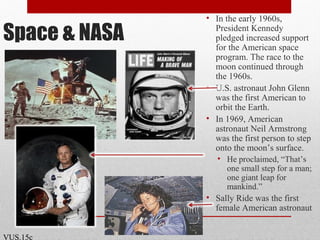
of China and the Soviet Union eventually became rivals for territory
and diplomatic influence, a split that American foreign policy under
President Nixon in the 1970s exploited.
VUS.13b
Origins of the Cold
War
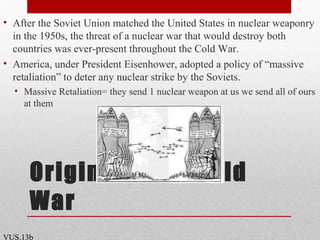
• After the Soviet Union matched the United States in nuclear weaponry
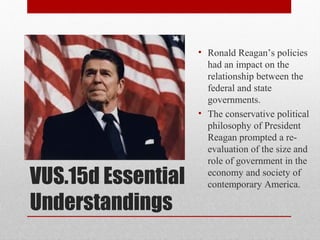
in the 1950s, the threat of a nuclear war that would destroy both
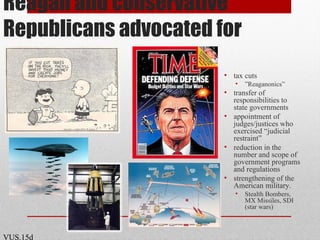
countries was ever-present throughout the Cold War.
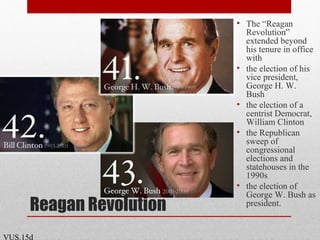
• America, under President Eisenhower, adopted a policy of “massive
retaliation” to deter any nuclear strike by the Soviets.
• Massive Retaliation= they send 1 nuclear weapon at us we send all of ours
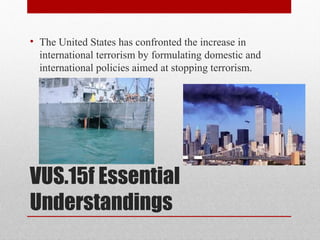
at them
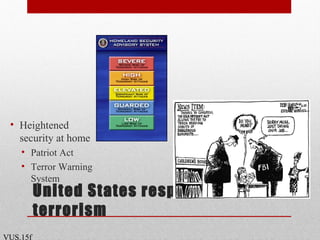
VUS.13b
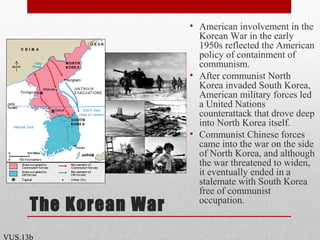
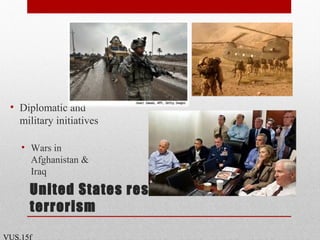
The Korean War
• American involvement in the
Korean War in the early
1950s reflected the American
policy of containment of
communism.
• After communist North
Korea invaded South Korea,
American military forces led
a United Nations
counterattack that drove deep
into North Korea itself.
• Communist Chinese forces
came into the war on the side
of North Korea, and although
the war threatened to widen,
it eventually ended in a
stalemate with South Korea
free of communist
occupation.
VUS.13b
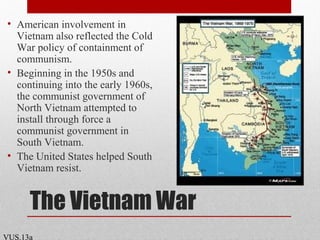
The Vietnam War
• American involvement in
Vietnam also reflected the Cold
War policy of containment of
communism.
• Beginning in the 1950s and
continuing into the early 1960s,
the communist government of
North Vietnam attempted to
install through force a
communist government in
South Vietnam.
• The United States helped South
Vietnam resist.
VUS.13a
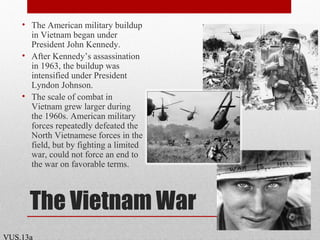
The Vietnam War
• The American military buildup
in Vietnam began under
President John Kennedy.
• After Kennedy’s assassination
in 1963, the buildup was
intensified under President
Lyndon Johnson.
• The scale of combat in
Vietnam grew larger during
the 1960s. American military
forces repeatedly defeated the
North Vietnamese forces in the
field, but by fighting a limited
war, could not force an end to
the war on favorable terms.
VUS.13a
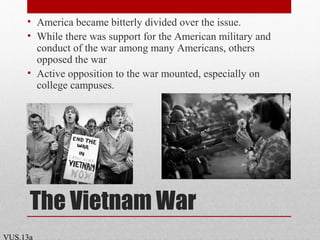
The Vietnam War
• America became bitterly divided over the issue.
• While there was support for the American military and
conduct of the war among many Americans, others
opposed the war
• Active opposition to the war mounted, especially on
college campuses.
VUS.13a
The Vietnam War
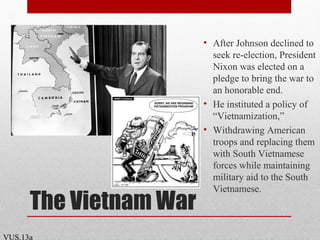
• After Johnson declined to
seek re-election, President
Nixon was elected on a
pledge to bring the war to
an honorable end.
• He instituted a policy of
“Vietnamization,”
• Withdrawing American
troops and replacing them
with South Vietnamese
forces while maintaining
military aid to the South
Vietnamese.
VUS.13a
The Vietnam War
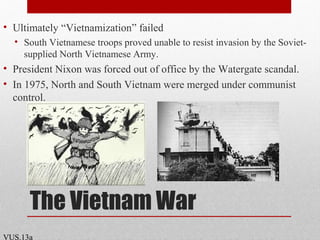
• Ultimately “Vietnamization” failed
• South Vietnamese troops proved unable to resist invasion by the Soviet-
supplied North Vietnamese Army.
• President Nixon was forced out of office by the Watergate scandal.
• In 1975, North and South Vietnam were merged under communist
control.
VUS.13a
Cuba
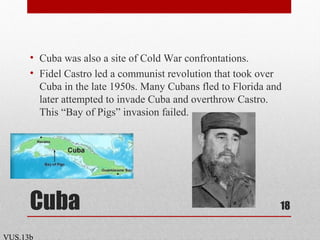
• Cuba was also a site of Cold War confrontations.
• Fidel Castro led a communist revolution that took over
Cuba in the late 1950s. Many Cubans fled to Florida and
later attempted to invade Cuba and overthrow Castro.
This “Bay of Pigs” invasion failed.
18
VUS.13b
Cuban Missile Crisis
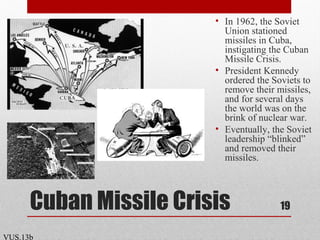
• In 1962, the Soviet
Union stationed
missiles in Cuba,
instigating the Cuban
Missile Crisis.
• President Kennedy
ordered the Soviets to
remove their missiles,
and for several days
the world was on the
brink of nuclear war.
• Eventually, the Soviet
leadership “blinked”
and removed their
missiles.
19
VUS.13b
Impact of the Cold War at home
• The fear of communism
and the threat of nuclear
war affected American
life throughout the Cold
War.
• During the 1950s and
1960s, American schools
regularly held drills to
train children what to do
in case of a nuclear
attack
• American citizens were
urged by the government
to build bomb shelters in
their own basements.
20
VUS.13b
Impact of the Cold
War at home
• The convictions of Alger Hiss
• Julius and Ethel Rosenberg for spying for the Soviet Union and the
construction of nuclear weapons by the Soviets, using technical
secrets obtained through spying
• Increased domestic fears of communism.
21
VUS.13b
Impact of the Cold War at
home
• Senator Joseph McCarthy
played on American fears of
communism by recklessly
accusing many American
governmental officials and
other citizens of being
communists, based on flimsy
or no evidence.
• This led to the coining of the
term McCarthyism—the
making of false accusations
based on rumor or guilt by
association.
22
VUS.13b
Impact of the Cold
War at home
• The Cold War made foreign policy a major issue in every
presidential election during the period.
23
VUS.13b
Impact of the Cold
War at home
• The heavy military expenditures
throughout the Cold War benefited
Virginia’s economy proportionately
more than any other state, especially
in Hampton Roads, home to several
large naval and air bases
• Northern Virginia, home to the
Pentagon and numerous private
companies that contract with the
military.
24
VUS.13b
VUS.13c
The student will demonstrate knowledge of United
States foreign policy since World War II by
c) explaining the role of America’s military and
veterans in defending freedom during the Cold War.
VUS.13c Essential
Questions
• How did America’s military forces defend freedom
during the Cold War?
VUS.13c Essential
Understandings
• A strong military was the key to America’s victory over
the Soviet Union in the Cold War.
• Millions of Americans served in the military during the
Cold War.
• Their service was often at great personal and family
sacrifice, yet they did their duty.
American military
forces during the
Cold War
• President Kennedy pledged
in his inaugural address that
the United States would
• “pay any price, bear any
burden, meet any
hardship, support any
friend, oppose any foe, in
order to assure the survival
and the success of liberty.”
• In the same address, he also
said,
• “Ask not what your
country can do for you;
ask what you can do for
your country.”
VUS.13c
American military
forces during the
Cold War
• During the Cold War era, millions of Americans served
in the military, defending freedom in wars and conflicts
that were not always popular.
• Many were killed or wounded. As a result of their
service, the United States and American ideals of
democracy and freedom ultimately prevailed in the Cold
War struggle with Soviet communism.
VUS.13c
American military forces during the
Cold War
• President Kennedy, a
World War II veteran, was
assassinated in 1963 in
Dallas, Texas, in an event
that shook the nation’s
confidence and began a
period of internal strife and
divisiveness, especially
spurred by divisions over
United States involvement
in Vietnam.
VUS.13c
American military
forces during the
Cold War
• Unlike veterans of World War
II, who returned to a grateful
and supportive nation,
Vietnam veterans returned
often to face indifference or
outright hostility from some
who opposed the war.
• It was not until several years
after the end of the Vietnam
war that the wounds of the
war began to heal in America,
and Vietnam veterans were
recognized and honored for
their service and sacrifices.
VUS.13c
VUS.13dThe student will demonstrate knowledge of United States
foreign policy since World War II by
d) explaining the collapse of communism and the end of the
Cold War, including the role of Ronald Reagan in making
foreign policy.
VUS.13d Essential
Questions
• How did internal problems affect the collapse of the
Soviet Union?
• What was President Ronald Reagan’s role in the collapse
of the Soviet Union?
VUS.13d Essential
Understandings
• Both internal problems and external pressures caused the
collapse of the Soviet Union.
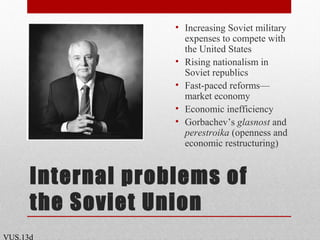
Internal problems of
the Soviet Union
• Increasing Soviet military
expenses to compete with
the United States
• Rising nationalism in
Soviet republics
• Fast-paced reforms—
market economy
• Economic inefficiency
• Gorbachev’s glasnost and
perestroika (openness and
economic restructuring)
VUS.13d
Role of President Ronald
Reagan
• Challenged moral legitimacy of the Soviet Union, for
example, in speech at Berlin Wall
• “Mr. Gorbachev, tear down this wall!’
• Increased United States military and economic pressure
on the Soviet Union
36
VUS.13d
VUS.13e
The student will demonstrate knowledge of United
States foreign policy since World War II by
e) explaining the impact of presidents of the
United States since 1988 on foreign policy.
VUS.13e Essential
Questions
• How did the United States redirect its goals and policies
in the post-Cold War era?
• How have presidents shaped American policy since
1988?
VUS.13e Essential
Understandings
• With the end of the Cold War, the United States changed
its goals and policies.
• Involvement in conflicts in other areas of the world has
been an integral part of United States foreign policy since
1988.
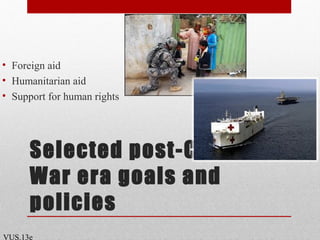
Selected post-Cold
War era goals and
policies
• Foreign aid
• Humanitarian aid
• Support for human rights
VUS.13e
George HW Bush 1989-1993
• Fall of communism in
Eastern Europe
• Reunification of
Germany
• Collapse of Yugoslavia
• Breakup of the Soviet
state
• Persian Gulf War
1990–1991
• Operation Desert
Storm Iraq/Kuwait
• First war in which
American women
served in a combat role
41
VUS.13e
William Jefferson Clinton 1993-
2001
• North American Free
Trade Agreement
(NAFTA)
• Full diplomatic
relations with
Vietnam
• Lifting of economic
sanctions against
South Africa when
its government ended
the policy of
apartheid
• NATO action in
former Yugoslavia
42
VUS.13e
George W Bush 2001-2008
• Terrorists attacks on
United States soil on
9/11/2001
• War in Afghanistan
• War in Iraq
43
VUS.13e
VUS.14aThe student will demonstrate knowledge of the Civil Rights
movement of the 1950s and 1960s by
a) identifying the importance of the Brown v. Board of
Education decision, the roles of Thurgood Marshall and
Oliver Hill, and how Virginia responded.
VUS.14a Essential
Questions
• What was the significance of Brown v. Board of
Education?
• What roles did Thurgood Marshall and Oliver Hill play in
the demise of segregated schools?
• How did Virginia respond to the Brown v. Board of
Education decision?
VUS.14a Essential
Understandings
• By interpreting its powers broadly, the Supreme Court
can reshape American society.
Brown v. Board of
Education
• Supreme Court decision that segregated schools are
unequal and must desegregate
• Included Virginia case
VUS.14a
Brown v. Board of
Education
Key people
•Thurgood Marshall:
NAACP Legal Defense Team
•Oliver Hill: NAACP Legal
Defense Team in Virginia
VUS.14a
Brown v. Board of
Education
Virginia response
•Massive Resistance:
Closing some schools
•Establishment of
private academies
•White flight from
urban school systems
VUS.14a
VUS.14bThe student will demonstrate knowledge of the Civil Rights
movement of the 1950s and 1960s by
b) describing the importance of the National Association for the
Advancement of Colored People (NAACP), the 1963 March on
Washington, the Civil Rights Act of 1964, and the Voting Rights Act
of 1965.
VUS.14b Essential
Questions
• How did the 1963 March on Washington influence public
opinion about civil rights?
• How did the legislative process advance the cause of civil
rights for African Americans?
• How did the NAACP advance civil rights for African
Americans?
VUS.14b Essential
Understandings
• African Americans, working through the court system
and mass protest, reshaped public opinion and secured
the passage of civil rights.
NAACP
National Association for the Advancement of Colored
People (NAACP)
•Challenged segregation in the courts.
VUS.14b
1963 March on Washington DC
• Participants were
inspired by the “I
Have a Dream”
speech given by Dr.
Martin Luther King,
Jr.
• The march helped
influence public
opinion to support
civil rights
legislation.
• The march
demonstrated the
power of nonviolent,
mass protest.
VUS.14b
Civil Rights Act of 1964
• The act prohibited discrimination based on race, color,
religion, gender, or national origin.
• The act desegregated public accommodations.
• President Lyndon B. Johnson played an important role in
the passage of the act.
VUS.14b
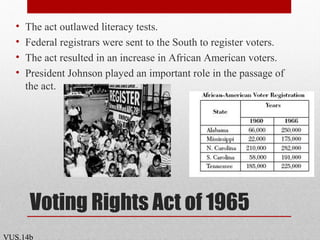
Voting Rights Act of 1965
• The act outlawed literacy tests.
• Federal registrars were sent to the South to register voters.
• The act resulted in an increase in African American voters.
• President Johnson played an important role in the passage of
the act.
VUS.14b
VUS.15bThe student will demonstrate knowledge of economic, social,
cultural, and political developments in recent decades and today by
b) analyzing the changing patterns of immigration, the reasons new
immigrants choose to come to this country, their contributions to
contemporary America, and the debates over immigration policy.
VUS.15b Essential
Questions
• What factors have drawn immigrants to the United
States?
• What immigrant groups account for the bulk of
immigration?
• What issues are currently being debated related to
immigration to the United States?
• What are some contributions made by immigrants?
VUS.15b Essential
Understandings
• Rising immigration has increased American diversity and
redefined American identity.
Immigration
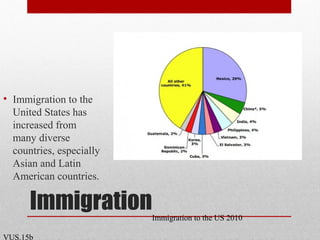
• Immigration to the
United States has
increased from
many diverse
countries, especially
Asian and Latin
American countries.
VUS.15b
Immigration to the US 2010
Immigration
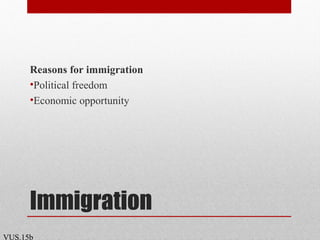
Reasons for immigration
•Political freedom
•Economic opportunity
VUS.15b
Immigration
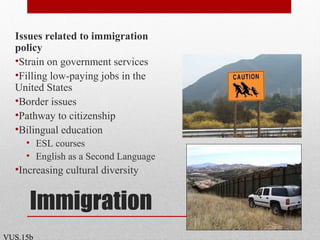
Issues related to immigration
policy
•Strain on government services
•Filling low-paying jobs in the
United States
•Border issues
•Pathway to citizenship
•Bilingual education
• ESL courses
• English as a Second Language
•Increasing cultural diversity
VUS.15b
Immigration
Contributions of immigrants
•Diversity in music, the visual arts, and literature
•Roles in labor force
•Achievements in science, engineering, and other fields
VUS.15b
VUS.15cThe student will demonstrate knowledge of economic, social,
cultural, and political developments in recent decades and today by
c) explaining the media influence on contemporary American
culture and how scientific and technological advances affect the
workplace, health care, and education.
VUS15c Essential
Questions
• How has the accessibility to improved technology and
communications affected American culture?
VUS.15c Essential
Understandings
• Dramatic advances in technology have affected life in
America in many significant areas.
• The American space program was a triumph of American
technological prowess.
• Technology can make communication and information
more accessible.
Space & NASA
• In the early 1960s,
President Kennedy
pledged increased support
for the American space
program. The race to the
moon continued through
the 1960s.
• U.S. astronaut John Glenn
was the first American to
orbit the Earth.
• In 1969, American
astronaut Neil Armstrong
was the first person to step
onto the moon’s surface.
• He proclaimed, “That’s
one small step for a man;
one giant leap for
mankind.”
• Sally Ride was the first
female American astronaut
VUS.15c
Technology
• Over the past three decades, improved technology and
media have brought about better access to
communication and information for businesses and
individuals in both urban and rural areas.
• As a result, many more Americans have access to global
information and viewpoints.
VUS.15c
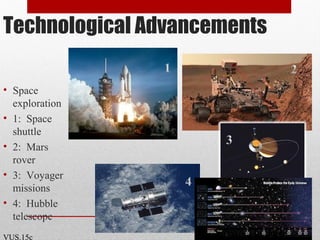
Technological Advancements
• Space
exploration
• 1: Space
shuttle
• 2: Mars
rover
• 3: Voyager
missions
• 4: Hubble
telescope
VUS.15c
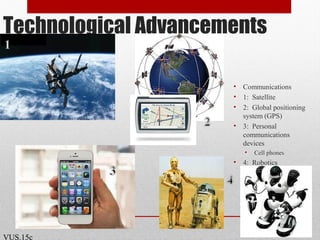
Technological Advancements
• Communications
• 1: Satellite
• 2: Global positioning
system (GPS)
• 3: Personal
communications
devices
• Cell phones
• 4: Robotics
VUS.15c
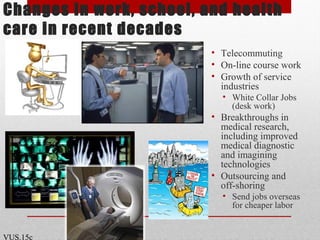
Changes in work, school, and health
care in recent decades
• Telecommuting
• On-line course work
• Growth of service
industries
• White Collar Jobs
(desk work)
• Breakthroughs in
medical research,
including improved
medical diagnostic
and imagining
technologies
• Outsourcing and
off-shoring
• Send jobs overseas
for cheaper labor
VUS.15c
VUS.15dThe student will demonstrate knowledge of economic, social,
cultural, and political developments in recent decades and today by
d) examining the impact of the “Reagan Revolution” on federalism,
the role of government, and state and national elections since 1988.
VUS.15d Essential
Questions
• What was the impact of the “Reagan Revolution” on
federalism, the role of government, and state and national
elections since 1988?
VUS.15d Essential
Understandings
• Ronald Reagan’s policies
had an impact on the
relationship between the
federal and state
governments.
• The conservative political
philosophy of President
Reagan prompted a re-
evaluation of the size and
role of government in the
economy and society of
contemporary America.
Reagan and conservative
Republicans advocated for
• tax cuts
• ”Reaganonics”
• transfer of
responsibilities to
state governments
• appointment of
judges/justices who
exercised “judicial
restraint”
• reduction in the
number and scope of
government programs
and regulations
• strengthening of the
American military.
• Stealth Bombers,
MX Missiles, SDI
(star wars)
VUS.15d
Reagan Revolution
• The “Reagan
Revolution”
extended beyond
his tenure in office
with
• the election of his
vice president,
George H. W.
Bush
• the election of a
centrist Democrat,
William Clinton
• the Republican
sweep of
congressional
elections and
statehouses in the
1990s
• the election of
George W. Bush as
president.
VUS.15d
VUS.15fThe student will demonstrate knowledge of economic, social,
cultural, and political developments in recent decades and
today by
f) assessing the role of the United States in a world
confronted by international terrorism.
VUS.15f Essential
Questions
• What role has the United States played in a world
confronted by international terrorism?
VUS.15f Essential
Understandings
• The United States has confronted the increase in
international terrorism by formulating domestic and
international policies aimed at stopping terrorism.
United States responses to
terrorism
• Heightened
security at home
• Patriot Act
• Terror Warning
System
VUS.15f
United States responses to
terrorism
• Diplomatic and
military initiatives
• Wars in
Afghanistan &
Iraq
VUS.15f

Rc 4

  • 1.
  • 2.
    VUS.13bThe student willdemonstrate knowledge of United States foreign policy since World War II by b) explaining the origins of the Cold War, and describing the Truman Doctrine and the policy of containment of communism, the American role in wars in Korea and Vietnam, and the role of the North Atlantic Treaty Organization (NATO) in Europe.
  • 3.
    VUS.13b Essential Questions • Howdid the United States respond to the threat of communist expansion? • What are the origins of the Cold War? • What were the early significant events of the Cold War? • What was the impact of the Cold War on Americans at home? • What was the impact of the Vietnam War on Americans at home?
  • 4.
    VUS.13b Essential Understandings • TheCold War set the framework for global politics for 45 years after the end of World War II. It also influenced American domestic politics, the conduct of foreign affairs, and the role of the government in the economy after 1945. • The Cold War was essentially a competition between two very different ways of organizing government, society, and the economy: the American-led western nations’ belief in democracy, individual freedom, and a market economy, and the Soviet belief in a totalitarian state and socialism. • The United States government’s anti-communist strategy of containment in Asia led to America’s involvement in the Korean and Vietnamese Wars. The Vietnam War demonstrated the power of American public opinion in reversing foreign policy. It tested the democratic system to its limits, left scars on American society that have not yet been erased, and made many Americans deeply skeptical of future military or even peacekeeping interventions.
  • 5.
    Origins of theCold War • The Cold War lasted from the end of World War II until the collapse of the Soviet Union. (1945-1991) • The United States and the Soviet Union represented starkly different fundamental values. VUS.13b USA Soviet Union Government Democratic Totalitarian Economic Free Market Communist
  • 6.
    Cold War Map– World
  • 7.
    Cold War Map– Europe
  • 8.
    Origins of theCold War • The Truman Doctrine of “containment of communism” was a guiding principle of American foreign policy throughout the Cold War, not to roll it back, but to keep it from spreading and to resist communist aggression into other countries. VUS.13b
  • 9.
    Origins of theCold War • The North Atlantic Treaty Organization (NATO) • Was formed as a defensive alliance among the United States and western European countries to prevent a Soviet invasion of Western Europe. • Soviet allies in Eastern Europe formed the Warsaw Pact, and for nearly 50 years, both sides maintained large military forces facing each other in Europe. VUS.13b
  • 10.
    Origins of theCold War • The communist takeover in China shortly after World War II increased American fears of communist domination of most of the world. • Rather than becoming strong allies, however, the communist nations of China and the Soviet Union eventually became rivals for territory and diplomatic influence, a split that American foreign policy under President Nixon in the 1970s exploited. VUS.13b
  • 11.
    Origins of theCold War • After the Soviet Union matched the United States in nuclear weaponry in the 1950s, the threat of a nuclear war that would destroy both countries was ever-present throughout the Cold War. • America, under President Eisenhower, adopted a policy of “massive retaliation” to deter any nuclear strike by the Soviets. • Massive Retaliation= they send 1 nuclear weapon at us we send all of ours at them VUS.13b
  • 12.
    The Korean War •American involvement in the Korean War in the early 1950s reflected the American policy of containment of communism. • After communist North Korea invaded South Korea, American military forces led a United Nations counterattack that drove deep into North Korea itself. • Communist Chinese forces came into the war on the side of North Korea, and although the war threatened to widen, it eventually ended in a stalemate with South Korea free of communist occupation. VUS.13b
  • 13.
    The Vietnam War •American involvement in Vietnam also reflected the Cold War policy of containment of communism. • Beginning in the 1950s and continuing into the early 1960s, the communist government of North Vietnam attempted to install through force a communist government in South Vietnam. • The United States helped South Vietnam resist. VUS.13a
  • 14.
    The Vietnam War •The American military buildup in Vietnam began under President John Kennedy. • After Kennedy’s assassination in 1963, the buildup was intensified under President Lyndon Johnson. • The scale of combat in Vietnam grew larger during the 1960s. American military forces repeatedly defeated the North Vietnamese forces in the field, but by fighting a limited war, could not force an end to the war on favorable terms. VUS.13a
  • 15.
    The Vietnam War •America became bitterly divided over the issue. • While there was support for the American military and conduct of the war among many Americans, others opposed the war • Active opposition to the war mounted, especially on college campuses. VUS.13a
  • 16.
    The Vietnam War •After Johnson declined to seek re-election, President Nixon was elected on a pledge to bring the war to an honorable end. • He instituted a policy of “Vietnamization,” • Withdrawing American troops and replacing them with South Vietnamese forces while maintaining military aid to the South Vietnamese. VUS.13a
  • 17.
    The Vietnam War •Ultimately “Vietnamization” failed • South Vietnamese troops proved unable to resist invasion by the Soviet- supplied North Vietnamese Army. • President Nixon was forced out of office by the Watergate scandal. • In 1975, North and South Vietnam were merged under communist control. VUS.13a
  • 18.
    Cuba • Cuba wasalso a site of Cold War confrontations. • Fidel Castro led a communist revolution that took over Cuba in the late 1950s. Many Cubans fled to Florida and later attempted to invade Cuba and overthrow Castro. This “Bay of Pigs” invasion failed. 18 VUS.13b
  • 19.
    Cuban Missile Crisis •In 1962, the Soviet Union stationed missiles in Cuba, instigating the Cuban Missile Crisis. • President Kennedy ordered the Soviets to remove their missiles, and for several days the world was on the brink of nuclear war. • Eventually, the Soviet leadership “blinked” and removed their missiles. 19 VUS.13b
  • 20.
    Impact of theCold War at home • The fear of communism and the threat of nuclear war affected American life throughout the Cold War. • During the 1950s and 1960s, American schools regularly held drills to train children what to do in case of a nuclear attack • American citizens were urged by the government to build bomb shelters in their own basements. 20 VUS.13b
  • 21.
    Impact of theCold War at home • The convictions of Alger Hiss • Julius and Ethel Rosenberg for spying for the Soviet Union and the construction of nuclear weapons by the Soviets, using technical secrets obtained through spying • Increased domestic fears of communism. 21 VUS.13b
  • 22.
    Impact of theCold War at home • Senator Joseph McCarthy played on American fears of communism by recklessly accusing many American governmental officials and other citizens of being communists, based on flimsy or no evidence. • This led to the coining of the term McCarthyism—the making of false accusations based on rumor or guilt by association. 22 VUS.13b
  • 23.
    Impact of theCold War at home • The Cold War made foreign policy a major issue in every presidential election during the period. 23 VUS.13b
  • 24.
    Impact of theCold War at home • The heavy military expenditures throughout the Cold War benefited Virginia’s economy proportionately more than any other state, especially in Hampton Roads, home to several large naval and air bases • Northern Virginia, home to the Pentagon and numerous private companies that contract with the military. 24 VUS.13b
  • 25.
    VUS.13c The student willdemonstrate knowledge of United States foreign policy since World War II by c) explaining the role of America’s military and veterans in defending freedom during the Cold War.
  • 26.
    VUS.13c Essential Questions • Howdid America’s military forces defend freedom during the Cold War?
  • 27.
    VUS.13c Essential Understandings • Astrong military was the key to America’s victory over the Soviet Union in the Cold War. • Millions of Americans served in the military during the Cold War. • Their service was often at great personal and family sacrifice, yet they did their duty.
  • 28.
    American military forces duringthe Cold War • President Kennedy pledged in his inaugural address that the United States would • “pay any price, bear any burden, meet any hardship, support any friend, oppose any foe, in order to assure the survival and the success of liberty.” • In the same address, he also said, • “Ask not what your country can do for you; ask what you can do for your country.” VUS.13c
  • 29.
    American military forces duringthe Cold War • During the Cold War era, millions of Americans served in the military, defending freedom in wars and conflicts that were not always popular. • Many were killed or wounded. As a result of their service, the United States and American ideals of democracy and freedom ultimately prevailed in the Cold War struggle with Soviet communism. VUS.13c
  • 30.
    American military forcesduring the Cold War • President Kennedy, a World War II veteran, was assassinated in 1963 in Dallas, Texas, in an event that shook the nation’s confidence and began a period of internal strife and divisiveness, especially spurred by divisions over United States involvement in Vietnam. VUS.13c
  • 31.
    American military forces duringthe Cold War • Unlike veterans of World War II, who returned to a grateful and supportive nation, Vietnam veterans returned often to face indifference or outright hostility from some who opposed the war. • It was not until several years after the end of the Vietnam war that the wounds of the war began to heal in America, and Vietnam veterans were recognized and honored for their service and sacrifices. VUS.13c
  • 32.
    VUS.13dThe student willdemonstrate knowledge of United States foreign policy since World War II by d) explaining the collapse of communism and the end of the Cold War, including the role of Ronald Reagan in making foreign policy.
  • 33.
    VUS.13d Essential Questions • Howdid internal problems affect the collapse of the Soviet Union? • What was President Ronald Reagan’s role in the collapse of the Soviet Union?
  • 34.
    VUS.13d Essential Understandings • Bothinternal problems and external pressures caused the collapse of the Soviet Union.
  • 35.
    Internal problems of theSoviet Union • Increasing Soviet military expenses to compete with the United States • Rising nationalism in Soviet republics • Fast-paced reforms— market economy • Economic inefficiency • Gorbachev’s glasnost and perestroika (openness and economic restructuring) VUS.13d
  • 36.
    Role of PresidentRonald Reagan • Challenged moral legitimacy of the Soviet Union, for example, in speech at Berlin Wall • “Mr. Gorbachev, tear down this wall!’ • Increased United States military and economic pressure on the Soviet Union 36 VUS.13d
  • 37.
    VUS.13e The student willdemonstrate knowledge of United States foreign policy since World War II by e) explaining the impact of presidents of the United States since 1988 on foreign policy.
  • 38.
    VUS.13e Essential Questions • Howdid the United States redirect its goals and policies in the post-Cold War era? • How have presidents shaped American policy since 1988?
  • 39.
    VUS.13e Essential Understandings • Withthe end of the Cold War, the United States changed its goals and policies. • Involvement in conflicts in other areas of the world has been an integral part of United States foreign policy since 1988.
  • 40.
    Selected post-Cold War eragoals and policies • Foreign aid • Humanitarian aid • Support for human rights VUS.13e
  • 41.
    George HW Bush1989-1993 • Fall of communism in Eastern Europe • Reunification of Germany • Collapse of Yugoslavia • Breakup of the Soviet state • Persian Gulf War 1990–1991 • Operation Desert Storm Iraq/Kuwait • First war in which American women served in a combat role 41 VUS.13e
  • 42.
    William Jefferson Clinton1993- 2001 • North American Free Trade Agreement (NAFTA) • Full diplomatic relations with Vietnam • Lifting of economic sanctions against South Africa when its government ended the policy of apartheid • NATO action in former Yugoslavia 42 VUS.13e
  • 43.
    George W Bush2001-2008 • Terrorists attacks on United States soil on 9/11/2001 • War in Afghanistan • War in Iraq 43 VUS.13e
  • 44.
    VUS.14aThe student willdemonstrate knowledge of the Civil Rights movement of the 1950s and 1960s by a) identifying the importance of the Brown v. Board of Education decision, the roles of Thurgood Marshall and Oliver Hill, and how Virginia responded.
  • 45.
    VUS.14a Essential Questions • Whatwas the significance of Brown v. Board of Education? • What roles did Thurgood Marshall and Oliver Hill play in the demise of segregated schools? • How did Virginia respond to the Brown v. Board of Education decision?
  • 46.
    VUS.14a Essential Understandings • Byinterpreting its powers broadly, the Supreme Court can reshape American society.
  • 47.
    Brown v. Boardof Education • Supreme Court decision that segregated schools are unequal and must desegregate • Included Virginia case VUS.14a
  • 49.
    Brown v. Boardof Education Key people •Thurgood Marshall: NAACP Legal Defense Team •Oliver Hill: NAACP Legal Defense Team in Virginia VUS.14a
  • 50.
    Brown v. Boardof Education Virginia response •Massive Resistance: Closing some schools •Establishment of private academies •White flight from urban school systems VUS.14a
  • 51.
    VUS.14bThe student willdemonstrate knowledge of the Civil Rights movement of the 1950s and 1960s by b) describing the importance of the National Association for the Advancement of Colored People (NAACP), the 1963 March on Washington, the Civil Rights Act of 1964, and the Voting Rights Act of 1965.
  • 52.
    VUS.14b Essential Questions • Howdid the 1963 March on Washington influence public opinion about civil rights? • How did the legislative process advance the cause of civil rights for African Americans? • How did the NAACP advance civil rights for African Americans?
  • 53.
    VUS.14b Essential Understandings • AfricanAmericans, working through the court system and mass protest, reshaped public opinion and secured the passage of civil rights.
  • 54.
    NAACP National Association forthe Advancement of Colored People (NAACP) •Challenged segregation in the courts. VUS.14b
  • 55.
    1963 March onWashington DC • Participants were inspired by the “I Have a Dream” speech given by Dr. Martin Luther King, Jr. • The march helped influence public opinion to support civil rights legislation. • The march demonstrated the power of nonviolent, mass protest. VUS.14b
  • 56.
    Civil Rights Actof 1964 • The act prohibited discrimination based on race, color, religion, gender, or national origin. • The act desegregated public accommodations. • President Lyndon B. Johnson played an important role in the passage of the act. VUS.14b
  • 57.
    Voting Rights Actof 1965 • The act outlawed literacy tests. • Federal registrars were sent to the South to register voters. • The act resulted in an increase in African American voters. • President Johnson played an important role in the passage of the act. VUS.14b
  • 58.
    VUS.15bThe student willdemonstrate knowledge of economic, social, cultural, and political developments in recent decades and today by b) analyzing the changing patterns of immigration, the reasons new immigrants choose to come to this country, their contributions to contemporary America, and the debates over immigration policy.
  • 59.
    VUS.15b Essential Questions • Whatfactors have drawn immigrants to the United States? • What immigrant groups account for the bulk of immigration? • What issues are currently being debated related to immigration to the United States? • What are some contributions made by immigrants?
  • 60.
    VUS.15b Essential Understandings • Risingimmigration has increased American diversity and redefined American identity.
  • 61.
    Immigration • Immigration tothe United States has increased from many diverse countries, especially Asian and Latin American countries. VUS.15b Immigration to the US 2010
  • 62.
    Immigration Reasons for immigration •Politicalfreedom •Economic opportunity VUS.15b
  • 63.
    Immigration Issues related toimmigration policy •Strain on government services •Filling low-paying jobs in the United States •Border issues •Pathway to citizenship •Bilingual education • ESL courses • English as a Second Language •Increasing cultural diversity VUS.15b
  • 64.
    Immigration Contributions of immigrants •Diversityin music, the visual arts, and literature •Roles in labor force •Achievements in science, engineering, and other fields VUS.15b
  • 65.
    VUS.15cThe student willdemonstrate knowledge of economic, social, cultural, and political developments in recent decades and today by c) explaining the media influence on contemporary American culture and how scientific and technological advances affect the workplace, health care, and education.
  • 66.
    VUS15c Essential Questions • Howhas the accessibility to improved technology and communications affected American culture?
  • 67.
    VUS.15c Essential Understandings • Dramaticadvances in technology have affected life in America in many significant areas. • The American space program was a triumph of American technological prowess. • Technology can make communication and information more accessible.
  • 68.
    Space & NASA •In the early 1960s, President Kennedy pledged increased support for the American space program. The race to the moon continued through the 1960s. • U.S. astronaut John Glenn was the first American to orbit the Earth. • In 1969, American astronaut Neil Armstrong was the first person to step onto the moon’s surface. • He proclaimed, “That’s one small step for a man; one giant leap for mankind.” • Sally Ride was the first female American astronaut VUS.15c
  • 69.
    Technology • Over thepast three decades, improved technology and media have brought about better access to communication and information for businesses and individuals in both urban and rural areas. • As a result, many more Americans have access to global information and viewpoints. VUS.15c
  • 70.
    Technological Advancements • Space exploration •1: Space shuttle • 2: Mars rover • 3: Voyager missions • 4: Hubble telescope VUS.15c
  • 71.
    Technological Advancements • Communications •1: Satellite • 2: Global positioning system (GPS) • 3: Personal communications devices • Cell phones • 4: Robotics VUS.15c
  • 72.
    Changes in work,school, and health care in recent decades • Telecommuting • On-line course work • Growth of service industries • White Collar Jobs (desk work) • Breakthroughs in medical research, including improved medical diagnostic and imagining technologies • Outsourcing and off-shoring • Send jobs overseas for cheaper labor VUS.15c
  • 73.
    VUS.15dThe student willdemonstrate knowledge of economic, social, cultural, and political developments in recent decades and today by d) examining the impact of the “Reagan Revolution” on federalism, the role of government, and state and national elections since 1988.
  • 74.
    VUS.15d Essential Questions • Whatwas the impact of the “Reagan Revolution” on federalism, the role of government, and state and national elections since 1988?
  • 75.
    VUS.15d Essential Understandings • RonaldReagan’s policies had an impact on the relationship between the federal and state governments. • The conservative political philosophy of President Reagan prompted a re- evaluation of the size and role of government in the economy and society of contemporary America.
  • 76.
    Reagan and conservative Republicansadvocated for • tax cuts • ”Reaganonics” • transfer of responsibilities to state governments • appointment of judges/justices who exercised “judicial restraint” • reduction in the number and scope of government programs and regulations • strengthening of the American military. • Stealth Bombers, MX Missiles, SDI (star wars) VUS.15d
  • 77.
    Reagan Revolution • The“Reagan Revolution” extended beyond his tenure in office with • the election of his vice president, George H. W. Bush • the election of a centrist Democrat, William Clinton • the Republican sweep of congressional elections and statehouses in the 1990s • the election of George W. Bush as president. VUS.15d
  • 78.
    VUS.15fThe student willdemonstrate knowledge of economic, social, cultural, and political developments in recent decades and today by f) assessing the role of the United States in a world confronted by international terrorism.
  • 79.
    VUS.15f Essential Questions • Whatrole has the United States played in a world confronted by international terrorism?
  • 80.
    VUS.15f Essential Understandings • TheUnited States has confronted the increase in international terrorism by formulating domestic and international policies aimed at stopping terrorism.
  • 81.
    United States responsesto terrorism • Heightened security at home • Patriot Act • Terror Warning System VUS.15f
  • 82.
    United States responsesto terrorism • Diplomatic and military initiatives • Wars in Afghanistan & Iraq VUS.15f