+
The student will demonstrate knowledge of how the nation grew and
changed from the end of Reconstruction through the early twentieth
century by
a) explaining the relationship among territorial expansion, westward
movement of the population, new immigration, growth of cities, the role of
the railroads, and the admission of new states to the United States.
VUS.8a 1
+
VUS.8a Essential Questions
 What factors influenced American growth and expansion in the
late nineteenth and early twentieth century?
2
+
VUS.8a Essential Understandings
 In the late nineteenth and early twentieth centuries, economic
opportunity, industrialization, technological change, and
immigration fueled American growth and expansion.
3
+
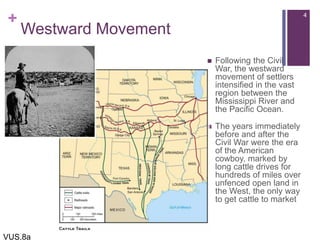
Westward Movement
 Following the Civil
War, the westward
movement of settlers
intensified in the vast
region between the
Mississippi River and
the Pacific Ocean.
 The years immediately
before and after the
Civil War were the era
of the American
cowboy, marked by
long cattle drives for
hundreds of miles over
unfenced open land in
the West, the only way
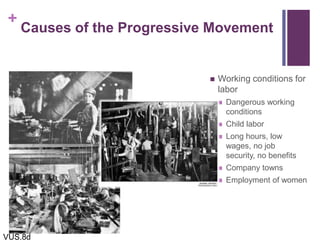
to get cattle to market
4
VUS.8a
+ Westward Movement
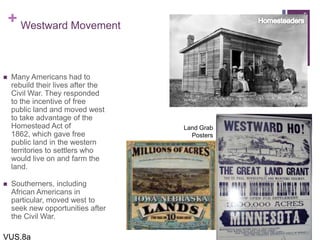
 Many Americans had to
rebuild their lives after the
Civil War. They responded
to the incentive of free
public land and moved west
to take advantage of the
Homestead Act of
1862, which gave free
public land in the western
territories to settlers who
would live on and farm the
land.
 Southerners, including
African Americans in
particular, moved west to
seek new opportunities after
the Civil War.
5
VUS.8a
Land Grab
Posters
+
Westward Movement
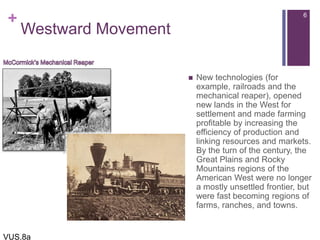
 New technologies (for
example, railroads and the
mechanical reaper), opened
new lands in the West for
settlement and made farming
profitable by increasing the
efficiency of production and
linking resources and markets.
By the turn of the century, the
Great Plains and Rocky
Mountains regions of the
American West were no longer
a mostly unsettled frontier, but
were fast becoming regions of
farms, ranches, and towns.
6
VUS.8a
+
Westward Movement
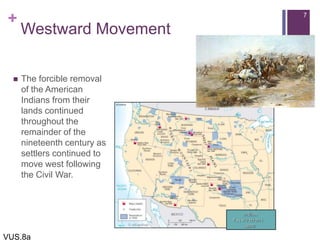
 The forcible removal
of the American
Indians from their
lands continued
throughout the
remainder of the
nineteenth century as
settlers continued to
move west following
the Civil War.
7
VUS.8a
+
Immigration
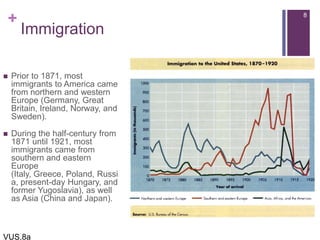
 Prior to 1871, most
immigrants to America came
from northern and western
Europe (Germany, Great
Britain, Ireland, Norway, and
Sweden).
 During the half-century from
1871 until 1921, most
immigrants came from
southern and eastern
Europe
(Italy, Greece, Poland, Russi
a, present-day Hungary, and
former Yugoslavia), as well
as Asia (China and Japan).
8
VUS.8a
+
Immigration
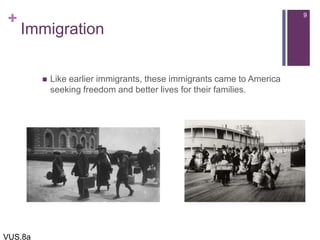
 Like earlier immigrants, these immigrants came to America
seeking freedom and better lives for their families.
9
VUS.8a
+
Immigration
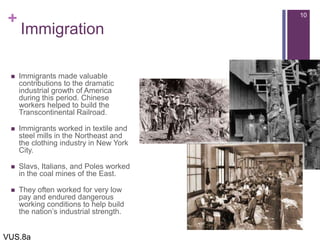
 Immigrants made valuable
contributions to the dramatic
industrial growth of America
during this period. Chinese
workers helped to build the
Transcontinental Railroad.
 Immigrants worked in textile and
steel mills in the Northeast and
the clothing industry in New York
City.
 Slavs, Italians, and Poles worked
in the coal mines of the East.
 They often worked for very low
pay and endured dangerous
working conditions to help build
the nation’s industrial strength.
10
VUS.8a
+
Immigration
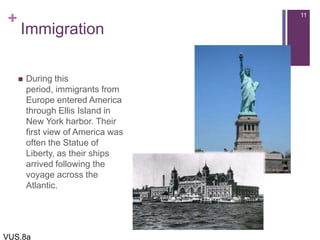
 During this
period, immigrants from
Europe entered America
through Ellis Island in
New York harbor. Their
first view of America was
often the Statue of
Liberty, as their ships
arrived following the
voyage across the
Atlantic.
11
VUS.8a
+
Immigration
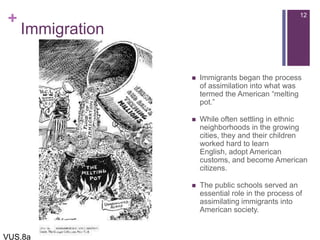
 Immigrants began the process
of assimilation into what was
termed the American “melting
pot.”
 While often settling in ethnic
neighborhoods in the growing
cities, they and their children
worked hard to learn
English, adopt American
customs, and become American
citizens.
 The public schools served an
essential role in the process of
assimilating immigrants into
American society.
12
VUS.8a
+
Immigration
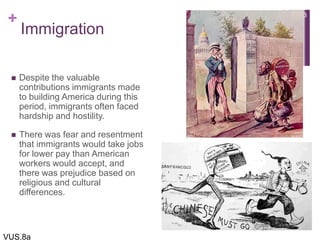
 Despite the valuable
contributions immigrants made
to building America during this
period, immigrants often faced
hardship and hostility.
 There was fear and resentment
that immigrants would take jobs
for lower pay than American
workers would accept, and
there was prejudice based on
religious and cultural
differences.
13
VUS.8a
+
Immigration
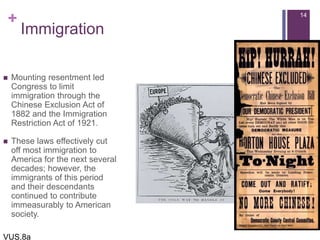
 Mounting resentment led
Congress to limit
immigration through the
Chinese Exclusion Act of
1882 and the Immigration
Restriction Act of 1921.
 These laws effectively cut
off most immigration to
America for the next several
decades; however, the
immigrants of this period
and their descendants
continued to contribute
immeasurably to American
society.
14
VUS.8a
+
Urbanization
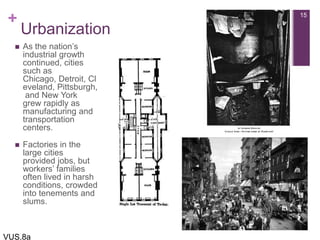
 As the nation’s
industrial growth
continued, cities
such as
Chicago, Detroit, Cl
eveland, Pittsburgh,
and New York
grew rapidly as
manufacturing and
transportation
centers.
 Factories in the
large cities
provided jobs, but
workers’ families
often lived in harsh
conditions, crowded
into tenements and
slums.
15
VUS.8a
+
Urbanization
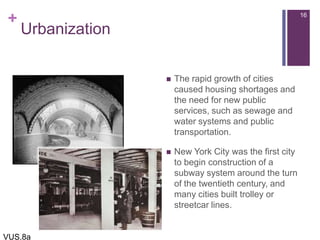
 The rapid growth of cities
caused housing shortages and
the need for new public
services, such as sewage and
water systems and public
transportation.
 New York City was the first city
to begin construction of a
subway system around the turn
of the twentieth century, and
many cities built trolley or
streetcar lines.
16
VUS.8a
+
Admission of New States
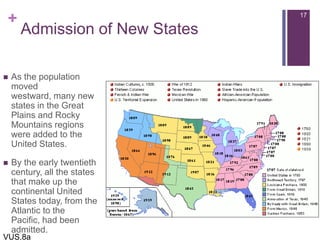
 As the population
moved
westward, many new
states in the Great
Plains and Rocky
Mountains regions
were added to the
United States.
 By the early twentieth
century, all the states
that make up the
continental United
States today, from the
Atlantic to the
Pacific, had been
admitted.
17
VUS.8a
+
VUS.8b
The student will demonstrate knowledge of how the
nation grew and changed from the end of
Reconstruction through the early twentieth century
by
b) describing the transformation of the American
economy from a primarily agrarian to a modern
industrial economy and identifying major inventions
that improved life in the United States.
+
VUS.8b Essential Questions
 What fueled the modern industrial economy?
+
VUS.8b Essential Understandings
 During the period from the Civil War to World War I, the United
States underwent an economic transformation that involved the
development of an industrial economy, the expansion of big
business, the growth of large-scale agriculture, and the rise of
national labor unions and industrial conflict.
+Inventions & Innovations
Technological change spurred growth of
industry primarily in northern cities.
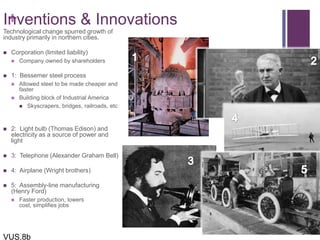
 Corporation (limited liability)
 Company owned by shareholders
 1: Bessemer steel process
 Allowed steel to be made cheaper and
faster
 Building block of Industrial America
 Skyscrapers, bridges, railroads, etc
 2: Light bulb (Thomas Edison) and
electricity as a source of power and
light
 3: Telephone (Alexander Graham Bell)
 4: Airplane (Wright brothers)
 5: Assembly-line manufacturing
(Henry Ford)
 Faster production, lowers
cost, simplifies jobs
VUS.8b
+
Industrial Leaders
Robber Barons
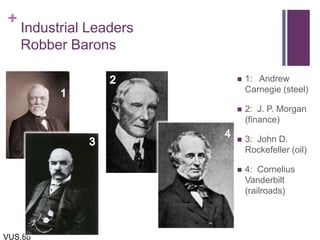
 1: Andrew
Carnegie (steel)
 2: J. P. Morgan
(finance)
 3: John D.
Rockefeller (oil)
 4: Cornelius
Vanderbilt
(railroads)
VUS.8b
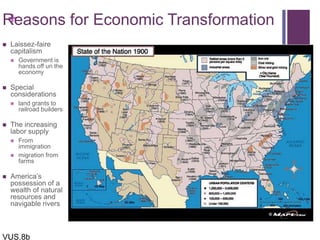
+Reasons for Economic Transformation
 Laissez-faire
capitalism
 Government is
hands off un the
economy
 Special
considerations
 land grants to
railroad builders
 The increasing
labor supply
 From
immigration
 migration from
farms
 America’s
possession of a
wealth of natural
resources and
navigable rivers
VUS.8b
+
VUS.8c
The student will demonstrate knowledge of how
the nation grew and changed from the end of
Reconstruction through the early twentieth
century by
c) analyzing prejudice and discrimination during
this time period, with emphasis on “Jim Crow”
and the responses of Booker T. Washington and
W.E.B. DuBois.
+
VUS.8c Essential Questions
 How did race relations in the South change after
Reconstruction, and what was the African American response?
+
VUS.8c Essential Understandings
 Discrimination against segregation of African Americans
intensified and took new forms in the late nineteenth century
and early twentieth century.
 African Americans disagreed about how to respond to these
developments.
+
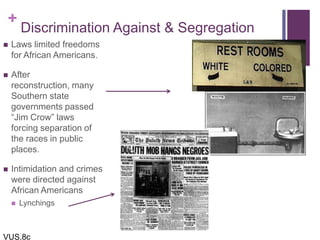
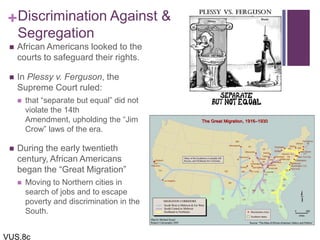
Discrimination Against & Segregation
 Laws limited freedoms
for African Americans.
 After
reconstruction, many
Southern state
governments passed
“Jim Crow” laws
forcing separation of
the races in public
places.
 Intimidation and crimes
were directed against
African Americans
 Lynchings
VUS.8c
+Discrimination Against &
Segregation
 African Americans looked to the
courts to safeguard their rights.
 In Plessy v. Ferguson, the
Supreme Court ruled:
 that “separate but equal” did not
violate the 14th
Amendment, upholding the “Jim
Crow” laws of the era.
 During the early twentieth
century, African Americans
began the “Great Migration”
 Moving to Northern cities in
search of jobs and to escape
poverty and discrimination in the
South.
VUS.8c
+
Responses of African Americans
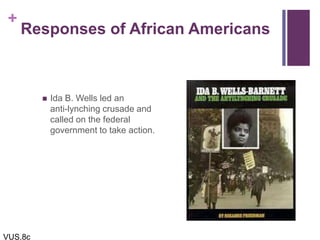
 Ida B. Wells led an
anti-lynching crusade and
called on the federal
government to take action.
VUS.8c
+
Responses of African Americans
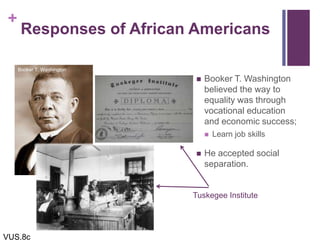
 Booker T. Washington
believed the way to
equality was through
vocational education
and economic success;
 Learn job skills
 He accepted social
separation.
VUS.8c
Booker T. Washington
Tuskegee Institute
+
Responses of African Americans
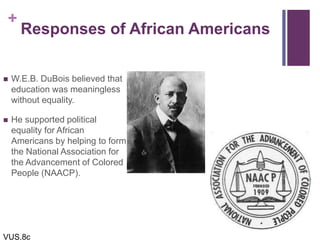
 W.E.B. DuBois believed that
education was meaningless
without equality.
 He supported political
equality for African
Americans by helping to form
the National Association for
the Advancement of Colored
People (NAACP).
VUS.8c
+
VUS.8d
The student will demonstrate knowledge of how the
nation grew and changed from the end of
Reconstruction through the early twentieth century
by
d) identifying the causes and impact of the
Progressive Movement, including the excesses of
the Gilded Age, child labor and antitrust laws, the
rise of labor unions, and the success of the women’s
suffrage movement.
+
VUS.8d Essential Questions
 How did the excesses of the Gilded Age contribute to the
development of the Progressive Movement?
 What were the goals of Progressives, and what were their
accomplishments?
+
VUS.8d Essential Understandings
 The period from Reconstruction through the early twentieth
century was a time of contradictions for many Americans.
 Agricultural expansion was accomplished through wars against
the Plains Indians, leading to new federal Indian policies.
 Industrial development brought great fortunes to a few and raised
the standard of living for millions of Americans, but also brought
about the rise of national labor unions and clashes between
industry and labor.
 Social problems in rural and urban settings gave rise to third-party
movements and the beginning of the Progressive Movement.
+
The Progressive Movement
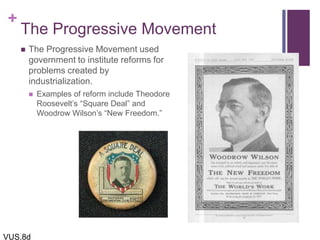
 The Progressive Movement used
government to institute reforms for
problems created by
industrialization.
 Examples of reform include Theodore
Roosevelt’s “Square Deal” and
Woodrow Wilson’s “New Freedom.”
VUS.8d
+
Causes of the Progressive Movement
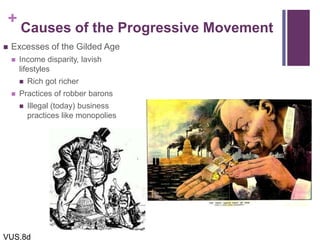
 Excesses of the Gilded Age
 Income disparity, lavish
lifestyles
 Rich got richer
 Practices of robber barons
 Illegal (today) business
practices like monopolies
VUS.8d
+
Causes of the Progressive Movement
 Working conditions for
labor
 Dangerous working
conditions
 Child labor
 Long hours, low
wages, no job
security, no benefits
 Company towns
 Employment of women
VUS.8d
+
Goals of the Progressive Movement
 Government controlled by the people
 Guaranteed economic opportunities through government
regulation
 Elimination of social injustices
VUS.8d
+
Progressive Accomplishments:
In Local Governments
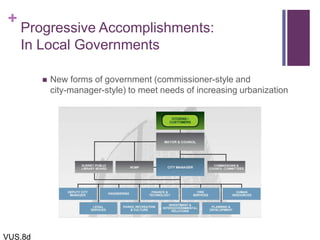
 New forms of government (commissioner-style and
city-manager-style) to meet needs of increasing urbanization
VUS.8d
+
Progressive Accomplishments:
In State Governments
 Referendum
 The people vote on if a
Bill becomes a law
 Initiative
 The people propose
legislation
 Recall
 The people an hold a
special election to
remove and elected
official
VUS.8d
+
Progressive Accomplishments:
In Elections
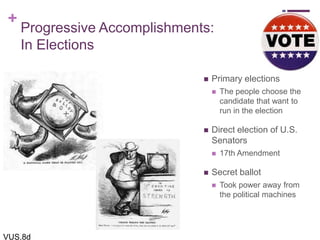
 Primary elections
 The people choose the
candidate that want to
run in the election
 Direct election of U.S.
Senators
 17th Amendment
 Secret ballot
 Took power away from
the political machines
VUS.8d
+
Progressive Accomplishments:
Child Labor
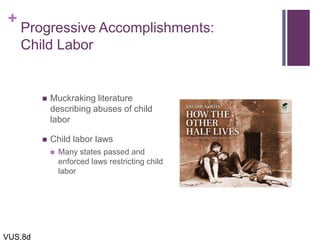
 Muckraking literature
describing abuses of child
labor
 Child labor laws
 Many states passed and
enforced laws restricting child
labor
VUS.8d
+
Labor Unions: Organizations
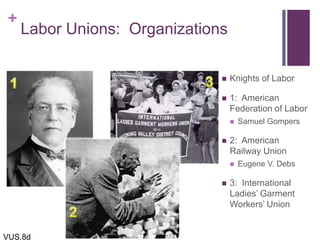
 Knights of Labor
 1: American
Federation of Labor
 Samuel Gompers
 2: American
Railway Union
 Eugene V. Debs
 3: International
Ladies’ Garment
Workers’ Union
VUS.8d
+
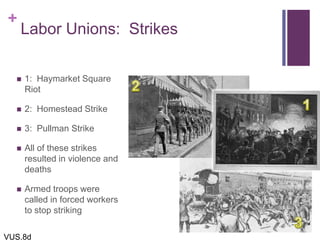
Labor Unions: Strikes
 1: Haymarket Square
Riot
 2: Homestead Strike
 3: Pullman Strike
 All of these strikes
resulted in violence and
deaths
 Armed troops were
called in forced workers
to stop striking
VUS.8d
+
Labor Unions: Gains
 Limited work hours
 Employees worked less hours a day/ a week
 Regulated work conditions
 Implemented safety standards and regulations
VUS.8d
+
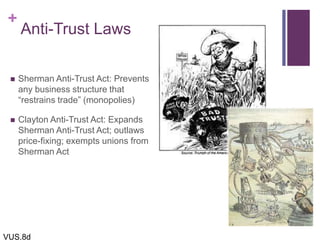
Anti-Trust Laws
 Sherman Anti-Trust Act: Prevents
any business structure that
“restrains trade” (monopolies)
 Clayton Anti-Trust Act: Expands
Sherman Anti-Trust Act; outlaws
price-fixing; exempts unions from
Sherman Act
VUS.8d
+
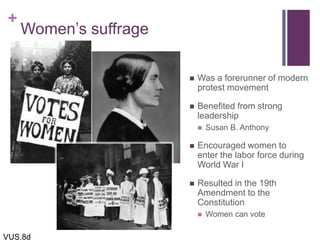
Women’s suffrage
 Was a forerunner of modern
protest movement
 Benefited from strong
leadership
 Susan B. Anthony
 Encouraged women to
enter the labor force during
World War I
 Resulted in the 19th
Amendment to the
Constitution
 Women can vote
VUS.8d

Vus8

  • 1.
    + The student willdemonstrate knowledge of how the nation grew and changed from the end of Reconstruction through the early twentieth century by a) explaining the relationship among territorial expansion, westward movement of the population, new immigration, growth of cities, the role of the railroads, and the admission of new states to the United States. VUS.8a 1
  • 2.
    + VUS.8a Essential Questions What factors influenced American growth and expansion in the late nineteenth and early twentieth century? 2
  • 3.
    + VUS.8a Essential Understandings In the late nineteenth and early twentieth centuries, economic opportunity, industrialization, technological change, and immigration fueled American growth and expansion. 3
  • 4.
    + Westward Movement  Followingthe Civil War, the westward movement of settlers intensified in the vast region between the Mississippi River and the Pacific Ocean.  The years immediately before and after the Civil War were the era of the American cowboy, marked by long cattle drives for hundreds of miles over unfenced open land in the West, the only way to get cattle to market 4 VUS.8a
  • 5.
    + Westward Movement Many Americans had to rebuild their lives after the Civil War. They responded to the incentive of free public land and moved west to take advantage of the Homestead Act of 1862, which gave free public land in the western territories to settlers who would live on and farm the land.  Southerners, including African Americans in particular, moved west to seek new opportunities after the Civil War. 5 VUS.8a Land Grab Posters
  • 6.
    + Westward Movement  Newtechnologies (for example, railroads and the mechanical reaper), opened new lands in the West for settlement and made farming profitable by increasing the efficiency of production and linking resources and markets. By the turn of the century, the Great Plains and Rocky Mountains regions of the American West were no longer a mostly unsettled frontier, but were fast becoming regions of farms, ranches, and towns. 6 VUS.8a
  • 7.
    + Westward Movement  Theforcible removal of the American Indians from their lands continued throughout the remainder of the nineteenth century as settlers continued to move west following the Civil War. 7 VUS.8a
  • 8.
    + Immigration  Prior to1871, most immigrants to America came from northern and western Europe (Germany, Great Britain, Ireland, Norway, and Sweden).  During the half-century from 1871 until 1921, most immigrants came from southern and eastern Europe (Italy, Greece, Poland, Russi a, present-day Hungary, and former Yugoslavia), as well as Asia (China and Japan). 8 VUS.8a
  • 9.
    + Immigration  Like earlierimmigrants, these immigrants came to America seeking freedom and better lives for their families. 9 VUS.8a
  • 10.
    + Immigration  Immigrants madevaluable contributions to the dramatic industrial growth of America during this period. Chinese workers helped to build the Transcontinental Railroad.  Immigrants worked in textile and steel mills in the Northeast and the clothing industry in New York City.  Slavs, Italians, and Poles worked in the coal mines of the East.  They often worked for very low pay and endured dangerous working conditions to help build the nation’s industrial strength. 10 VUS.8a
  • 11.
    + Immigration  During this period,immigrants from Europe entered America through Ellis Island in New York harbor. Their first view of America was often the Statue of Liberty, as their ships arrived following the voyage across the Atlantic. 11 VUS.8a
  • 12.
    + Immigration  Immigrants beganthe process of assimilation into what was termed the American “melting pot.”  While often settling in ethnic neighborhoods in the growing cities, they and their children worked hard to learn English, adopt American customs, and become American citizens.  The public schools served an essential role in the process of assimilating immigrants into American society. 12 VUS.8a
  • 13.
    + Immigration  Despite thevaluable contributions immigrants made to building America during this period, immigrants often faced hardship and hostility.  There was fear and resentment that immigrants would take jobs for lower pay than American workers would accept, and there was prejudice based on religious and cultural differences. 13 VUS.8a
  • 14.
    + Immigration  Mounting resentmentled Congress to limit immigration through the Chinese Exclusion Act of 1882 and the Immigration Restriction Act of 1921.  These laws effectively cut off most immigration to America for the next several decades; however, the immigrants of this period and their descendants continued to contribute immeasurably to American society. 14 VUS.8a
  • 15.
    + Urbanization  As thenation’s industrial growth continued, cities such as Chicago, Detroit, Cl eveland, Pittsburgh, and New York grew rapidly as manufacturing and transportation centers.  Factories in the large cities provided jobs, but workers’ families often lived in harsh conditions, crowded into tenements and slums. 15 VUS.8a
  • 16.
    + Urbanization  The rapidgrowth of cities caused housing shortages and the need for new public services, such as sewage and water systems and public transportation.  New York City was the first city to begin construction of a subway system around the turn of the twentieth century, and many cities built trolley or streetcar lines. 16 VUS.8a
  • 17.
    + Admission of NewStates  As the population moved westward, many new states in the Great Plains and Rocky Mountains regions were added to the United States.  By the early twentieth century, all the states that make up the continental United States today, from the Atlantic to the Pacific, had been admitted. 17 VUS.8a
  • 18.
    + VUS.8b The student willdemonstrate knowledge of how the nation grew and changed from the end of Reconstruction through the early twentieth century by b) describing the transformation of the American economy from a primarily agrarian to a modern industrial economy and identifying major inventions that improved life in the United States.
  • 19.
    + VUS.8b Essential Questions What fueled the modern industrial economy?
  • 20.
    + VUS.8b Essential Understandings During the period from the Civil War to World War I, the United States underwent an economic transformation that involved the development of an industrial economy, the expansion of big business, the growth of large-scale agriculture, and the rise of national labor unions and industrial conflict.
  • 21.
    +Inventions & Innovations Technologicalchange spurred growth of industry primarily in northern cities.  Corporation (limited liability)  Company owned by shareholders  1: Bessemer steel process  Allowed steel to be made cheaper and faster  Building block of Industrial America  Skyscrapers, bridges, railroads, etc  2: Light bulb (Thomas Edison) and electricity as a source of power and light  3: Telephone (Alexander Graham Bell)  4: Airplane (Wright brothers)  5: Assembly-line manufacturing (Henry Ford)  Faster production, lowers cost, simplifies jobs VUS.8b
  • 22.
    + Industrial Leaders Robber Barons 1: Andrew Carnegie (steel)  2: J. P. Morgan (finance)  3: John D. Rockefeller (oil)  4: Cornelius Vanderbilt (railroads) VUS.8b
  • 23.
    +Reasons for EconomicTransformation  Laissez-faire capitalism  Government is hands off un the economy  Special considerations  land grants to railroad builders  The increasing labor supply  From immigration  migration from farms  America’s possession of a wealth of natural resources and navigable rivers VUS.8b
  • 24.
    + VUS.8c The student willdemonstrate knowledge of how the nation grew and changed from the end of Reconstruction through the early twentieth century by c) analyzing prejudice and discrimination during this time period, with emphasis on “Jim Crow” and the responses of Booker T. Washington and W.E.B. DuBois.
  • 25.
    + VUS.8c Essential Questions How did race relations in the South change after Reconstruction, and what was the African American response?
  • 26.
    + VUS.8c Essential Understandings Discrimination against segregation of African Americans intensified and took new forms in the late nineteenth century and early twentieth century.  African Americans disagreed about how to respond to these developments.
  • 27.
    + Discrimination Against &Segregation  Laws limited freedoms for African Americans.  After reconstruction, many Southern state governments passed “Jim Crow” laws forcing separation of the races in public places.  Intimidation and crimes were directed against African Americans  Lynchings VUS.8c
  • 28.
    +Discrimination Against & Segregation African Americans looked to the courts to safeguard their rights.  In Plessy v. Ferguson, the Supreme Court ruled:  that “separate but equal” did not violate the 14th Amendment, upholding the “Jim Crow” laws of the era.  During the early twentieth century, African Americans began the “Great Migration”  Moving to Northern cities in search of jobs and to escape poverty and discrimination in the South. VUS.8c
  • 29.
    + Responses of AfricanAmericans  Ida B. Wells led an anti-lynching crusade and called on the federal government to take action. VUS.8c
  • 30.
    + Responses of AfricanAmericans  Booker T. Washington believed the way to equality was through vocational education and economic success;  Learn job skills  He accepted social separation. VUS.8c Booker T. Washington Tuskegee Institute
  • 31.
    + Responses of AfricanAmericans  W.E.B. DuBois believed that education was meaningless without equality.  He supported political equality for African Americans by helping to form the National Association for the Advancement of Colored People (NAACP). VUS.8c
  • 32.
    + VUS.8d The student willdemonstrate knowledge of how the nation grew and changed from the end of Reconstruction through the early twentieth century by d) identifying the causes and impact of the Progressive Movement, including the excesses of the Gilded Age, child labor and antitrust laws, the rise of labor unions, and the success of the women’s suffrage movement.
  • 33.
    + VUS.8d Essential Questions How did the excesses of the Gilded Age contribute to the development of the Progressive Movement?  What were the goals of Progressives, and what were their accomplishments?
  • 34.
    + VUS.8d Essential Understandings The period from Reconstruction through the early twentieth century was a time of contradictions for many Americans.  Agricultural expansion was accomplished through wars against the Plains Indians, leading to new federal Indian policies.  Industrial development brought great fortunes to a few and raised the standard of living for millions of Americans, but also brought about the rise of national labor unions and clashes between industry and labor.  Social problems in rural and urban settings gave rise to third-party movements and the beginning of the Progressive Movement.
  • 35.
    + The Progressive Movement The Progressive Movement used government to institute reforms for problems created by industrialization.  Examples of reform include Theodore Roosevelt’s “Square Deal” and Woodrow Wilson’s “New Freedom.” VUS.8d
  • 36.
    + Causes of theProgressive Movement  Excesses of the Gilded Age  Income disparity, lavish lifestyles  Rich got richer  Practices of robber barons  Illegal (today) business practices like monopolies VUS.8d
  • 37.
    + Causes of theProgressive Movement  Working conditions for labor  Dangerous working conditions  Child labor  Long hours, low wages, no job security, no benefits  Company towns  Employment of women VUS.8d
  • 38.
    + Goals of theProgressive Movement  Government controlled by the people  Guaranteed economic opportunities through government regulation  Elimination of social injustices VUS.8d
  • 39.
    + Progressive Accomplishments: In LocalGovernments  New forms of government (commissioner-style and city-manager-style) to meet needs of increasing urbanization VUS.8d
  • 40.
    + Progressive Accomplishments: In StateGovernments  Referendum  The people vote on if a Bill becomes a law  Initiative  The people propose legislation  Recall  The people an hold a special election to remove and elected official VUS.8d
  • 41.
    + Progressive Accomplishments: In Elections Primary elections  The people choose the candidate that want to run in the election  Direct election of U.S. Senators  17th Amendment  Secret ballot  Took power away from the political machines VUS.8d
  • 42.
    + Progressive Accomplishments: Child Labor Muckraking literature describing abuses of child labor  Child labor laws  Many states passed and enforced laws restricting child labor VUS.8d
  • 43.
    + Labor Unions: Organizations Knights of Labor  1: American Federation of Labor  Samuel Gompers  2: American Railway Union  Eugene V. Debs  3: International Ladies’ Garment Workers’ Union VUS.8d
  • 44.
    + Labor Unions: Strikes 1: Haymarket Square Riot  2: Homestead Strike  3: Pullman Strike  All of these strikes resulted in violence and deaths  Armed troops were called in forced workers to stop striking VUS.8d
  • 45.
    + Labor Unions: Gains Limited work hours  Employees worked less hours a day/ a week  Regulated work conditions  Implemented safety standards and regulations VUS.8d
  • 46.
    + Anti-Trust Laws  ShermanAnti-Trust Act: Prevents any business structure that “restrains trade” (monopolies)  Clayton Anti-Trust Act: Expands Sherman Anti-Trust Act; outlaws price-fixing; exempts unions from Sherman Act VUS.8d
  • 47.
    + Women’s suffrage  Wasa forerunner of modern protest movement  Benefited from strong leadership  Susan B. Anthony  Encouraged women to enter the labor force during World War I  Resulted in the 19th Amendment to the Constitution  Women can vote VUS.8d