VUS.11a
The student will demonstrate knowledge of World War II by
a) analyzing the causes and events that led to American
involvement in the war, including military assistance to the
United Kingdom and the Japanese attack on Pearl Harbor.
VUS.11a Essential Questions
• How did the United States respond to increasing
totalitarian aggression in Europe and Asia?
• What caused America’s gradual abandonment of
its policy of neutrality?
VUS.11a Essential
Understandings
• The United States gradually abandoned neutrality
as events in Europe and Asia pulled the nations
toward war.
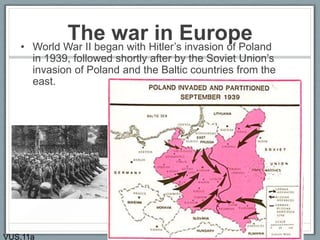
The war in Europe• World War II began with Hitler’s invasion of Poland
in 1939, followed shortly after by the Soviet Union’s
invasion of Poland and the Baltic countries from the
east.
VUS.11a
The war in Europe
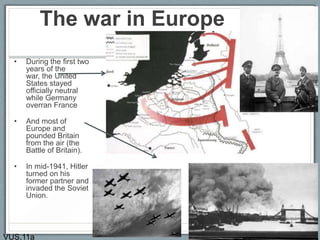
• During the first two
years of the
war, the United
States stayed
officially neutral
while Germany
overran France
• And most of
Europe and
pounded Britain
from the air (the
Battle of Britain).
• In mid-1941, Hitler
turned on his
former partner and
invaded the Soviet
Union.
VUS.11a
The war in Europe
• Despite strong isolationist
sentiment at home, the
United States increasingly
helped Britain.
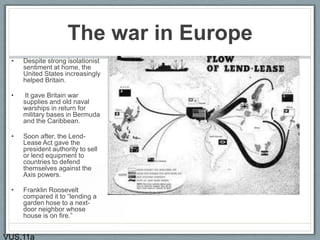
• It gave Britain war
supplies and old naval
warships in return for
military bases in Bermuda
and the Caribbean.
• Soon after, the Lend-
Lease Act gave the
president authority to sell
or lend equipment to
countries to defend
themselves against the
Axis powers.
• Franklin Roosevelt
compared it to “lending a
garden hose to a next-
door neighbor whose
house is on fire.”
VUS.11a
The war in Asia
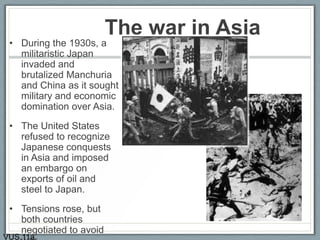
• During the 1930s, a
militaristic Japan
invaded and
brutalized Manchuria
and China as it sought
military and economic
domination over Asia.
• The United States
refused to recognize
Japanese conquests
in Asia and imposed
an embargo on
exports of oil and
steel to Japan.
• Tensions rose, but
both countries
negotiated to avoid
VUS.11a
The war in Asia
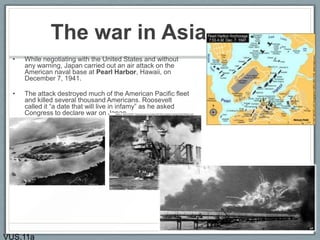
• While negotiating with the United States and without
any warning, Japan carried out an air attack on the
American naval base at Pearl Harbor, Hawaii, on
December 7, 1941.
• The attack destroyed much of the American Pacific fleet
and killed several thousand Americans. Roosevelt
called it “a date that will live in infamy” as he asked
Congress to declare war on Japan.
VUS.11a
The war in Asia
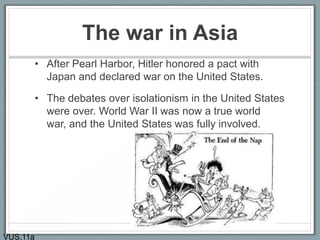
• After Pearl Harbor, Hitler honored a pact with
Japan and declared war on the United States.
• The debates over isolationism in the United States
were over. World War II was now a true world
war, and the United States was fully involved.
VUS.11a
VUS.11b
The student will demonstrate knowledge of World War II by
b) describing and locating the major battles and turning points
of the war in North Africa, Europe, and the Pacific, including
Midway, Stalingrad, the Normandy landing (D-Day), and
Truman’s decision to use the atomic bomb to force the
surrender of Japan.
10
VUS.11b Essential Questions
• What was the overall strategy of America and its
allies in World War II?
• How did America’s strategy during World War II
reflect available resources and the geographical
scope of the conflict?
• Why were some battles of World War II
considered turning points of the war?
11
VUS.11b Essential
Understandings
• Wartime strategies reflect the political and military
goals of alliances, the resources on hand, and the
geographical extent of the conflict.
12
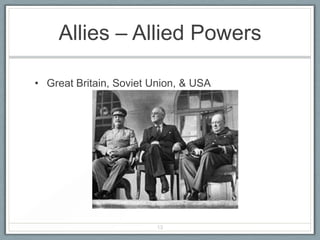
Allies – Allied Powers
• Great Britain, Soviet Union, & USA
13
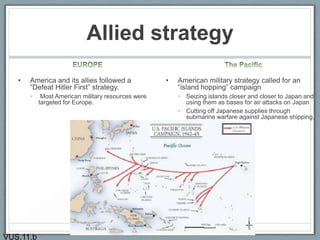
Allied strategy
• America and its allies followed a
“Defeat Hitler First” strategy.
• Most American military resources were
targeted for Europe.
• American military strategy called for an
“island hopping” campaign
• Seizing islands closer and closer to Japan and
using them as bases for air attacks on Japan
• Cutting off Japanese supplies through
submarine warfare against Japanese shipping.
14
VUS.11.b
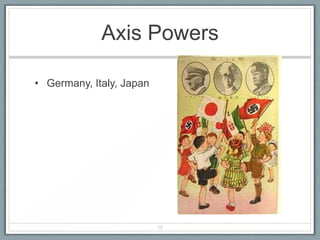
Axis Powers
• Germany, Italy, Japan
15
Axis strategy
• Hoped to defeat the Soviet Union quickly
• Gain control of Soviet oil fields
• Force Britain out of the war through a
bombing campaign and submarine warfare
• Before America’s industrial and military
strength could turn the tide.
• Following Pearl Harbor, Japan invaded the
Philippines and Indonesia
• Planned to invade both Australia and
Hawaii.
• Its leaders hoped that America would then
accept Japanese predominance in
Southeast Asia and the Pacific, rather than
conduct a bloody and costly war to reverse
Japanese gains
16
VUS.11.b
Major battles: North Africa
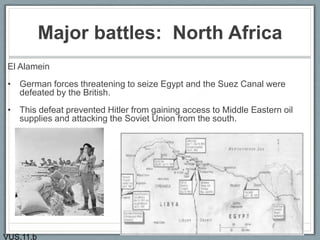
El Alamein
• German forces threatening to seize Egypt and the Suez Canal were
defeated by the British.
• This defeat prevented Hitler from gaining access to Middle Eastern oil
supplies and attacking the Soviet Union from the south.
17
VUS.11.b
Major battles: Europe
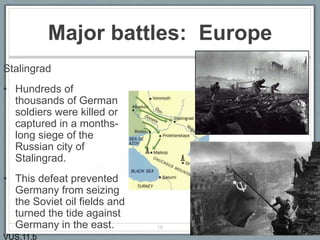
Stalingrad
• Hundreds of
thousands of German
soldiers were killed or
captured in a months-
long siege of the
Russian city of
Stalingrad.
• This defeat prevented
Germany from seizing
the Soviet oil fields and
turned the tide against
Germany in the east. 18
VUS.11.b
Major battles: Europe
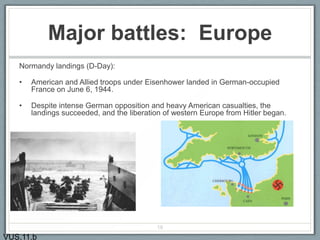
Normandy landings (D-Day):
• American and Allied troops under Eisenhower landed in German-occupied
France on June 6, 1944.
• Despite intense German opposition and heavy American casualties, the
landings succeeded, and the liberation of western Europe from Hitler began.
19
VUS.11.b
Major battles: Pacific
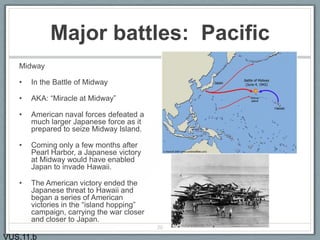
Midway
• In the Battle of Midway
• AKA: “Miracle at Midway”
• American naval forces defeated a
much larger Japanese force as it
prepared to seize Midway Island.
• Coming only a few months after
Pearl Harbor, a Japanese victory
at Midway would have enabled
Japan to invade Hawaii.
• The American victory ended the
Japanese threat to Hawaii and
began a series of American
victories in the “island hopping”
campaign, carrying the war closer
and closer to Japan.
20
VUS.11.b
Major battles: Pacific
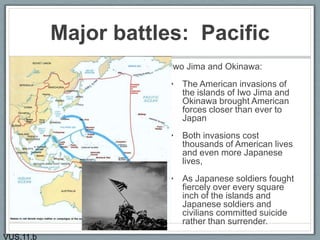
Iwo Jima and Okinawa:
• The American invasions of
the islands of Iwo Jima and
Okinawa brought American
forces closer than ever to
Japan
• Both invasions cost
thousands of American lives
and even more Japanese
lives,
• As Japanese soldiers fought
fiercely over every square
inch of the islands and
Japanese soldiers and
civilians committed suicide
rather than surrender.
21
VUS.11.b
Major battles: Pacific
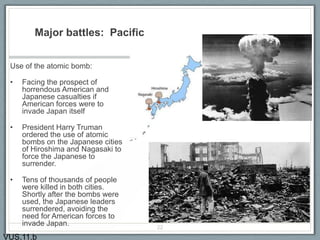
Use of the atomic bomb:
• Facing the prospect of
horrendous American and
Japanese casualties if
American forces were to
invade Japan itself
• President Harry Truman
ordered the use of atomic
bombs on the Japanese cities
of Hiroshima and Nagasaki to
force the Japanese to
surrender.
• Tens of thousands of people
were killed in both cities.
Shortly after the bombs were
used, the Japanese leaders
surrendered, avoiding the
need for American forces to
invade Japan. 22
VUS.11.b
VUS.11c
The student will demonstrate
knowledge of World War II by
c) describing the role of all-
minority military units, including
the Tuskegee Airmen and Nisei
regiments.
VUS.11c Essential Questions
• How did minority participation in World War II
reflect social conditions in the United States?
• How did minorities contribute to Allied victory?
VUS.11c Essential
Understandings
• World War II solidified the nation’s role as a global
power, ushered in social changes, and
established reform agendas that would preoccupy
public discourse in the United States for the
remainder of the twentieth century.
• Women entered into previously male job roles as
African Americans and others struggled to obtain
desegregation of the armed forces and end
discriminatory hiring practices.
Minority Participation
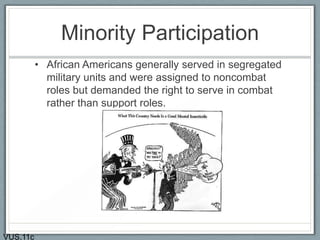
• African Americans generally served in segregated
military units and were assigned to noncombat
roles but demanded the right to serve in combat
rather than support roles.
VUS.11c
Minority Participation
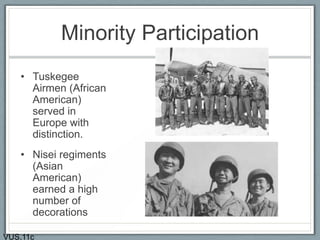
• Tuskegee
Airmen (African
American)
served in
Europe with
distinction.
• Nisei regiments
(Asian
American)
earned a high
number of
decorations
VUS.11c
Minority Participation
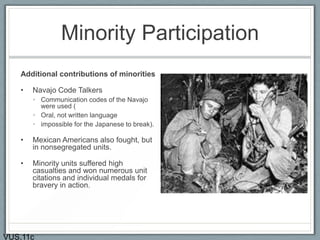
Additional contributions of minorities
• Navajo Code Talkers
• Communication codes of the Navajo
were used (
• Oral, not written language
• impossible for the Japanese to break).
• Mexican Americans also fought, but
in nonsegregated units.
• Minority units suffered high
casualties and won numerous unit
citations and individual medals for
bravery in action.
VUS.11c
VUS.11d
The student will demonstrate
knowledge of World War II by
d) examining the Geneva
Convention and the treatment of
prisoners of war during World War
II.
VUS.11d Essential Questions
• What was the purpose of the Geneva
Convention?
• How did the treatment of prisoners of war differ
during the war?
VUS.11d Essential
Understandings
• The conduct of war often reflects the social and
moral codes of a nation.
• The treatment of prisoners of war often reflects
the savage nature of conflict and the cultural
norms of a nation.
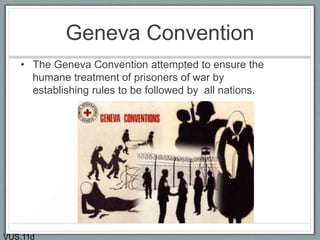
Geneva Convention
• The Geneva Convention attempted to ensure the
humane treatment of prisoners of war by
establishing rules to be followed by all nations.
VUS.11d
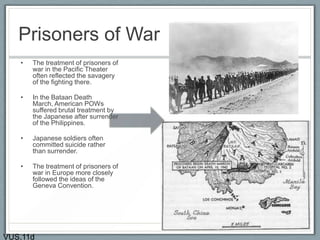
Prisoners of War
• The treatment of prisoners of
war in the Pacific Theater
often reflected the savagery
of the fighting there.
• In the Bataan Death
March, American POWs
suffered brutal treatment by
the Japanese after surrender
of the Philippines.
• Japanese soldiers often
committed suicide rather
than surrender.
• The treatment of prisoners of
war in Europe more closely
followed the ideas of the
Geneva Convention.
VUS.11d
VUS.11e
The student will demonstrate
knowledge of World War II by
e) analyzing the Holocaust
(Hitler’s “final solution”), its
impact on Jews and other
groups, and the postwar trials of
war criminals.
VUS.11e Essential Questions
• What was the Holocaust and who were its
victims?
• What was the short-term and long-term
significance of the Holocaust?
VUS.11e Essential
Understandings
• Specific groups, often the object of hatred and
prejudice, face increased risk of discrimination
during wartime.
Terms to know
Genocide:
• The systematic and purposeful destruction of a
racial, political, religious, or cultural group
Final Solution:
• Germany’s decision to exterminate all Jews
VUS.11e
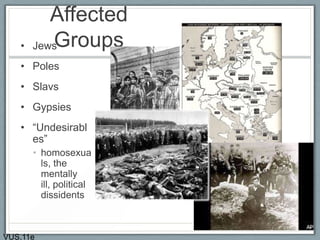
Affected
Groups• Jews
• Poles
• Slavs
• Gypsies
• “Undesirabl
es”
• homosexua
ls, the
mentally
ill, political
dissidents
VUS.11e
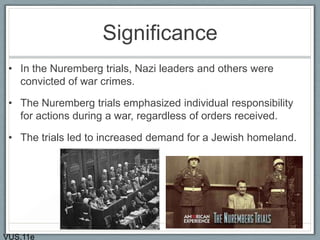
Significance
• In the Nuremberg trials, Nazi leaders and others were
convicted of war crimes.
• The Nuremberg trials emphasized individual responsibility
for actions during a war, regardless of orders received.
• The trials led to increased demand for a Jewish homeland.
VUS.11e

Vus11

  • 1.
    VUS.11a The student willdemonstrate knowledge of World War II by a) analyzing the causes and events that led to American involvement in the war, including military assistance to the United Kingdom and the Japanese attack on Pearl Harbor.
  • 2.
    VUS.11a Essential Questions •How did the United States respond to increasing totalitarian aggression in Europe and Asia? • What caused America’s gradual abandonment of its policy of neutrality?
  • 3.
    VUS.11a Essential Understandings • TheUnited States gradually abandoned neutrality as events in Europe and Asia pulled the nations toward war.
  • 4.
    The war inEurope• World War II began with Hitler’s invasion of Poland in 1939, followed shortly after by the Soviet Union’s invasion of Poland and the Baltic countries from the east. VUS.11a
  • 5.
    The war inEurope • During the first two years of the war, the United States stayed officially neutral while Germany overran France • And most of Europe and pounded Britain from the air (the Battle of Britain). • In mid-1941, Hitler turned on his former partner and invaded the Soviet Union. VUS.11a
  • 6.
    The war inEurope • Despite strong isolationist sentiment at home, the United States increasingly helped Britain. • It gave Britain war supplies and old naval warships in return for military bases in Bermuda and the Caribbean. • Soon after, the Lend- Lease Act gave the president authority to sell or lend equipment to countries to defend themselves against the Axis powers. • Franklin Roosevelt compared it to “lending a garden hose to a next- door neighbor whose house is on fire.” VUS.11a
  • 7.
    The war inAsia • During the 1930s, a militaristic Japan invaded and brutalized Manchuria and China as it sought military and economic domination over Asia. • The United States refused to recognize Japanese conquests in Asia and imposed an embargo on exports of oil and steel to Japan. • Tensions rose, but both countries negotiated to avoid VUS.11a
  • 8.
    The war inAsia • While negotiating with the United States and without any warning, Japan carried out an air attack on the American naval base at Pearl Harbor, Hawaii, on December 7, 1941. • The attack destroyed much of the American Pacific fleet and killed several thousand Americans. Roosevelt called it “a date that will live in infamy” as he asked Congress to declare war on Japan. VUS.11a
  • 9.
    The war inAsia • After Pearl Harbor, Hitler honored a pact with Japan and declared war on the United States. • The debates over isolationism in the United States were over. World War II was now a true world war, and the United States was fully involved. VUS.11a
  • 10.
    VUS.11b The student willdemonstrate knowledge of World War II by b) describing and locating the major battles and turning points of the war in North Africa, Europe, and the Pacific, including Midway, Stalingrad, the Normandy landing (D-Day), and Truman’s decision to use the atomic bomb to force the surrender of Japan. 10
  • 11.
    VUS.11b Essential Questions •What was the overall strategy of America and its allies in World War II? • How did America’s strategy during World War II reflect available resources and the geographical scope of the conflict? • Why were some battles of World War II considered turning points of the war? 11
  • 12.
    VUS.11b Essential Understandings • Wartimestrategies reflect the political and military goals of alliances, the resources on hand, and the geographical extent of the conflict. 12
  • 13.
    Allies – AlliedPowers • Great Britain, Soviet Union, & USA 13
  • 14.
    Allied strategy • Americaand its allies followed a “Defeat Hitler First” strategy. • Most American military resources were targeted for Europe. • American military strategy called for an “island hopping” campaign • Seizing islands closer and closer to Japan and using them as bases for air attacks on Japan • Cutting off Japanese supplies through submarine warfare against Japanese shipping. 14 VUS.11.b
  • 15.
    Axis Powers • Germany,Italy, Japan 15
  • 16.
    Axis strategy • Hopedto defeat the Soviet Union quickly • Gain control of Soviet oil fields • Force Britain out of the war through a bombing campaign and submarine warfare • Before America’s industrial and military strength could turn the tide. • Following Pearl Harbor, Japan invaded the Philippines and Indonesia • Planned to invade both Australia and Hawaii. • Its leaders hoped that America would then accept Japanese predominance in Southeast Asia and the Pacific, rather than conduct a bloody and costly war to reverse Japanese gains 16 VUS.11.b
  • 17.
    Major battles: NorthAfrica El Alamein • German forces threatening to seize Egypt and the Suez Canal were defeated by the British. • This defeat prevented Hitler from gaining access to Middle Eastern oil supplies and attacking the Soviet Union from the south. 17 VUS.11.b
  • 18.
    Major battles: Europe Stalingrad •Hundreds of thousands of German soldiers were killed or captured in a months- long siege of the Russian city of Stalingrad. • This defeat prevented Germany from seizing the Soviet oil fields and turned the tide against Germany in the east. 18 VUS.11.b
  • 19.
    Major battles: Europe Normandylandings (D-Day): • American and Allied troops under Eisenhower landed in German-occupied France on June 6, 1944. • Despite intense German opposition and heavy American casualties, the landings succeeded, and the liberation of western Europe from Hitler began. 19 VUS.11.b
  • 20.
    Major battles: Pacific Midway •In the Battle of Midway • AKA: “Miracle at Midway” • American naval forces defeated a much larger Japanese force as it prepared to seize Midway Island. • Coming only a few months after Pearl Harbor, a Japanese victory at Midway would have enabled Japan to invade Hawaii. • The American victory ended the Japanese threat to Hawaii and began a series of American victories in the “island hopping” campaign, carrying the war closer and closer to Japan. 20 VUS.11.b
  • 21.
    Major battles: Pacific IwoJima and Okinawa: • The American invasions of the islands of Iwo Jima and Okinawa brought American forces closer than ever to Japan • Both invasions cost thousands of American lives and even more Japanese lives, • As Japanese soldiers fought fiercely over every square inch of the islands and Japanese soldiers and civilians committed suicide rather than surrender. 21 VUS.11.b
  • 22.
    Major battles: Pacific Useof the atomic bomb: • Facing the prospect of horrendous American and Japanese casualties if American forces were to invade Japan itself • President Harry Truman ordered the use of atomic bombs on the Japanese cities of Hiroshima and Nagasaki to force the Japanese to surrender. • Tens of thousands of people were killed in both cities. Shortly after the bombs were used, the Japanese leaders surrendered, avoiding the need for American forces to invade Japan. 22 VUS.11.b
  • 23.
    VUS.11c The student willdemonstrate knowledge of World War II by c) describing the role of all- minority military units, including the Tuskegee Airmen and Nisei regiments.
  • 24.
    VUS.11c Essential Questions •How did minority participation in World War II reflect social conditions in the United States? • How did minorities contribute to Allied victory?
  • 25.
    VUS.11c Essential Understandings • WorldWar II solidified the nation’s role as a global power, ushered in social changes, and established reform agendas that would preoccupy public discourse in the United States for the remainder of the twentieth century. • Women entered into previously male job roles as African Americans and others struggled to obtain desegregation of the armed forces and end discriminatory hiring practices.
  • 26.
    Minority Participation • AfricanAmericans generally served in segregated military units and were assigned to noncombat roles but demanded the right to serve in combat rather than support roles. VUS.11c
  • 27.
    Minority Participation • Tuskegee Airmen(African American) served in Europe with distinction. • Nisei regiments (Asian American) earned a high number of decorations VUS.11c
  • 28.
    Minority Participation Additional contributionsof minorities • Navajo Code Talkers • Communication codes of the Navajo were used ( • Oral, not written language • impossible for the Japanese to break). • Mexican Americans also fought, but in nonsegregated units. • Minority units suffered high casualties and won numerous unit citations and individual medals for bravery in action. VUS.11c
  • 29.
    VUS.11d The student willdemonstrate knowledge of World War II by d) examining the Geneva Convention and the treatment of prisoners of war during World War II.
  • 30.
    VUS.11d Essential Questions •What was the purpose of the Geneva Convention? • How did the treatment of prisoners of war differ during the war?
  • 31.
    VUS.11d Essential Understandings • Theconduct of war often reflects the social and moral codes of a nation. • The treatment of prisoners of war often reflects the savage nature of conflict and the cultural norms of a nation.
  • 32.
    Geneva Convention • TheGeneva Convention attempted to ensure the humane treatment of prisoners of war by establishing rules to be followed by all nations. VUS.11d
  • 33.
    Prisoners of War •The treatment of prisoners of war in the Pacific Theater often reflected the savagery of the fighting there. • In the Bataan Death March, American POWs suffered brutal treatment by the Japanese after surrender of the Philippines. • Japanese soldiers often committed suicide rather than surrender. • The treatment of prisoners of war in Europe more closely followed the ideas of the Geneva Convention. VUS.11d
  • 34.
    VUS.11e The student willdemonstrate knowledge of World War II by e) analyzing the Holocaust (Hitler’s “final solution”), its impact on Jews and other groups, and the postwar trials of war criminals.
  • 35.
    VUS.11e Essential Questions •What was the Holocaust and who were its victims? • What was the short-term and long-term significance of the Holocaust?
  • 36.
    VUS.11e Essential Understandings • Specificgroups, often the object of hatred and prejudice, face increased risk of discrimination during wartime.
  • 37.
    Terms to know Genocide: •The systematic and purposeful destruction of a racial, political, religious, or cultural group Final Solution: • Germany’s decision to exterminate all Jews VUS.11e
  • 38.
    Affected Groups• Jews • Poles •Slavs • Gypsies • “Undesirabl es” • homosexua ls, the mentally ill, political dissidents VUS.11e
  • 39.
    Significance • In theNuremberg trials, Nazi leaders and others were convicted of war crimes. • The Nuremberg trials emphasized individual responsibility for actions during a war, regardless of orders received. • The trials led to increased demand for a Jewish homeland. VUS.11e