RBC METHODOLOGIES-II
I.ERYTHROCYTE SEDIMENTATION RATE(ESR)
 Rate of settling of RBC from the plasma after the addition of
anticoagulant.
Importance of ESR
1. Good index for the presence of hidden carcinoma but active
diseases.
2. It measures the suspension stability of RBC.
3. It measures the abnormal concentration of fibrinogen and
serum globulin.
Roleaux formation
(Packing or piling of RBC)
METHODS
A.Wintrobe and landsberg method
 Anticoagulant used- Ammonium potassium oxalate
(wintrobe solution/ double oxalate/balanced oxalate/ paul-
Heller’s soln.)
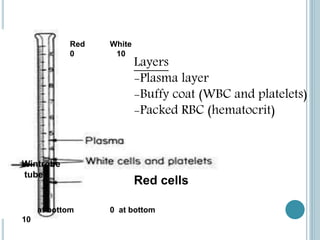
 Tube – wintrobe tube
- Left side – red; 0 on top and 10 cm bottom.
- Right side – white; 10 cm top and 0 bottom.
 Procedure
1. With a long stem pasteur pipet, fill the wintrobe tube with
oxalated blood up to 0 mark.
2. Let the wintrobe tube stand perfectly vertical.
3. Read result after 1 hour. Reading must be done on the left
red side of the tube.
Normal values
 Male - (0-9) mm/hr
 Female - ( 0-20 )mm/hr ( bcg less RBC )
 Children- (1-13) mm/hr
White
10
Red
0
Red cells
0 at bottomat bottom
10
Layers
-Plasma layer
-Buffy coat (WBC and platelets)
-Packed RBC (hematocrit)
Wintrobe
tube
 Females have more space in settle down and faster than male
and children because they have less RBC.
( 1cm – 10mm/hr)
B.Westergren method (200mm) – most sensitive and most
accurate .
- Anticoagulant used -3.8% sodium citrate
- Tube- westergren tube (through suction method long tube)
200 mm
0
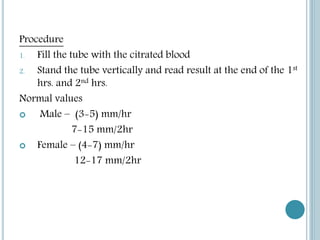
Procedure
1. Fill the tube with the citrated blood
2. Stand the tube vertically and read result at the end of the 1st
hrs. and 2nd hrs.
Normal values
 Male – (3-5) mm/hr
7-15 mm/2hr
 Female – (4-7) mm/hr
12-17 mm/2hr
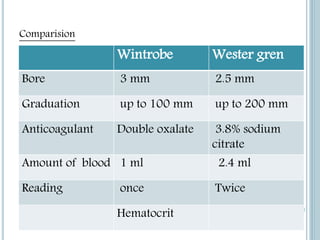
Comparision
Wintrobe Wester gren
Bore 3 mm 2.5 mm
Graduation up to 100 mm up to 200 mm
Anticoagulant Double oxalate 3.8% sodium
citrate
Amount of blood 1 ml 2.4 ml
Reading once Twice
Hematocrit
C. Graphic cutler
Anticoagulant – 3.8% sodium citrate
D. Linzenmeier
Anticoagulant – 3.8% sodium citrate
E. Roarke- Ernstiene
Anitocagulant – Heparin
F. Bray’s
Anticoagulant- 3.8% sodium citrate
G. Micro methods
1) Micro landau
 Anticoagulant- 5% sodium citrate
2) Smith micro
 Anticoagulant- 5% sodium citrate
3) Crista or hellige- vollmer
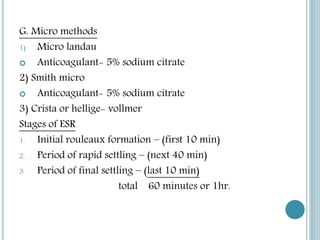
Stages of ESR
1. Initial rouleaux formation – (first 10 min)
2. Period of rapid settling – (next 40 min)
3. Period of final settling – (last 10 min)
total 60 minutes or 1hr.
Factors in ESR
1. Intrinsic Factor
- nos of RBC ( less RBC faster settlement)
- size of RBC ( Bigger the size is faster the settlement)
- viscosity of Plasma ( less viscous fast settlement)
* nos of RBC- inversely
* size of RBC- directly
2. Extrinsic factor
 Length of tube ( smaller length fast settlement)
 Diameter of tube (wider diameter fast settlement)
 Position of tube(vertical or slightly fast settlement
 Temperature ( high temp. fast settlement)
 Pipetting ( incorrect pipetting result error)
 Volume of blood ( less blood faster settle.)
 Anticoagulant (more anticoagulant slow settlement)
II Osmotic fragility test
 Test the stability of RBC in hypotonic solutions.
 Follows the law of osmosis.
 Factor affecting OFT
- Red cell shape
- Red cell volume
- Red cell surface Area
- State of Red cell membrane
*Fragile cells( decrease)- spherocytes
*Resistant cells( increase)- sickle cell , target cell, reticulocytes
METHODS
1. Sanford method
 Different conc. Of hypotonic solution
 12 test-tube is used
 Initial solution used – 0.5% Nacl
Interpretation
 No hemolysis – tubes with compact sediment and clear
solution.
 Initial hemolysis -1st tube from the left with not so compact
sediment and with dark red solution
 Complete hemolysis - 1st tube from the left without
sediment and with dark red solution.
Normal values
 Initial hemolysis- tube 22
 Complete hemolysis- tube17
Increase OFT
 Initial hemolysis- tube 24 ( increased-hemolytic anemia ,
hereditary spherocyte)
 Complete – tube 20 { decrease-sickle cell anemia, thalassemia
, jaundice, SIDA(severe ion deficiency Anemia)}.
Decreased OFT
 Initial hemolysis-tube 19
 Complete hemolysis-tube 15
2. Modified Sanford – in terms of ml
3. Griffin and Sanford method
4. Dacies method
 Hemolysis read is used through spectrophotometer.
(Transparent – fake pink- light pink- red)
III.ERYTHROCYTE INDICES
 Important in assessing borderline types of anemia.
 Computed using 3 determinants Hb, hematocrit and RBC count.
A. Mean corpuscular volume (MCV)
 Average volume of an individual RBC.
volume % Hct x 10 = cubic micra or femtoliter
RBC in millions
 Normal value- 82- 92 cubic micra.
Interpretation
 95- 160 cubic micra- macrocyte
 72-79 cubic micra – microcyte
 50-71 cubic micra – microcyte hypochromic
(less Hb)
Example
Hct = 46 vol %
RBC count – 5,000,000/ cumm
MCV= 46 x 10 = 92 cubic micra
5
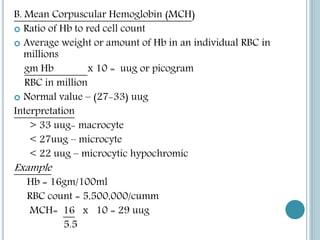
B. Mean Corpuscular Hemoglobin (MCH)
 Ratio of Hb to red cell count
 Average weight or amount of Hb in an individual RBC in
millions
gm Hb x 10 = uug or picogram
RBC in million
 Normal value – (27-33) uug
Interpretation
> 33 uug- macrocyte
< 27uug – microcyte
< 22 uug – microcytic hypochromic
Example
Hb = 16gm/100ml
RBC count = 5,500,000/cumm
MCH= 16 x 10 = 29 uug
5.5
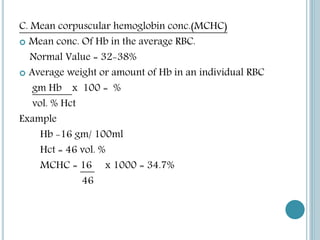
C. Mean corpuscular hemoglobin conc.(MCHC)
 Mean conc. Of Hb in the average RBC.
Normal Value = 32-38%
 Average weight or amount of Hb in an individual RBC
gm Hb x 100 = %
vol. % Hct
Example
Hb -16 gm/ 100ml
Hct = 46 vol. %
MCHC = 16 x 1000 = 34.7%
46
 Normal – normochromic
 < 32 – hypochromic
 > 38 – hyperchromic

RBC Methodology

  • 1.
  • 2.
    I.ERYTHROCYTE SEDIMENTATION RATE(ESR) Rate of settling of RBC from the plasma after the addition of anticoagulant. Importance of ESR 1. Good index for the presence of hidden carcinoma but active diseases. 2. It measures the suspension stability of RBC. 3. It measures the abnormal concentration of fibrinogen and serum globulin. Roleaux formation (Packing or piling of RBC)
  • 3.
    METHODS A.Wintrobe and landsbergmethod  Anticoagulant used- Ammonium potassium oxalate (wintrobe solution/ double oxalate/balanced oxalate/ paul- Heller’s soln.)  Tube – wintrobe tube - Left side – red; 0 on top and 10 cm bottom. - Right side – white; 10 cm top and 0 bottom.
  • 4.
     Procedure 1. Witha long stem pasteur pipet, fill the wintrobe tube with oxalated blood up to 0 mark. 2. Let the wintrobe tube stand perfectly vertical. 3. Read result after 1 hour. Reading must be done on the left red side of the tube. Normal values  Male - (0-9) mm/hr  Female - ( 0-20 )mm/hr ( bcg less RBC )  Children- (1-13) mm/hr
  • 5.
    White 10 Red 0 Red cells 0 atbottomat bottom 10 Layers -Plasma layer -Buffy coat (WBC and platelets) -Packed RBC (hematocrit) Wintrobe tube
  • 6.
     Females havemore space in settle down and faster than male and children because they have less RBC. ( 1cm – 10mm/hr) B.Westergren method (200mm) – most sensitive and most accurate . - Anticoagulant used -3.8% sodium citrate - Tube- westergren tube (through suction method long tube)
  • 7.
  • 8.
    Procedure 1. Fill thetube with the citrated blood 2. Stand the tube vertically and read result at the end of the 1st hrs. and 2nd hrs. Normal values  Male – (3-5) mm/hr 7-15 mm/2hr  Female – (4-7) mm/hr 12-17 mm/2hr
  • 9.
    Comparision Wintrobe Wester gren Bore3 mm 2.5 mm Graduation up to 100 mm up to 200 mm Anticoagulant Double oxalate 3.8% sodium citrate Amount of blood 1 ml 2.4 ml Reading once Twice Hematocrit
  • 10.
    C. Graphic cutler Anticoagulant– 3.8% sodium citrate D. Linzenmeier Anticoagulant – 3.8% sodium citrate E. Roarke- Ernstiene Anitocagulant – Heparin F. Bray’s Anticoagulant- 3.8% sodium citrate
  • 11.
    G. Micro methods 1)Micro landau  Anticoagulant- 5% sodium citrate 2) Smith micro  Anticoagulant- 5% sodium citrate 3) Crista or hellige- vollmer Stages of ESR 1. Initial rouleaux formation – (first 10 min) 2. Period of rapid settling – (next 40 min) 3. Period of final settling – (last 10 min) total 60 minutes or 1hr.
  • 12.
    Factors in ESR 1.Intrinsic Factor - nos of RBC ( less RBC faster settlement) - size of RBC ( Bigger the size is faster the settlement) - viscosity of Plasma ( less viscous fast settlement) * nos of RBC- inversely * size of RBC- directly
  • 13.
    2. Extrinsic factor Length of tube ( smaller length fast settlement)  Diameter of tube (wider diameter fast settlement)  Position of tube(vertical or slightly fast settlement  Temperature ( high temp. fast settlement)  Pipetting ( incorrect pipetting result error)  Volume of blood ( less blood faster settle.)  Anticoagulant (more anticoagulant slow settlement)
  • 14.
    II Osmotic fragilitytest  Test the stability of RBC in hypotonic solutions.  Follows the law of osmosis.  Factor affecting OFT - Red cell shape - Red cell volume - Red cell surface Area - State of Red cell membrane *Fragile cells( decrease)- spherocytes *Resistant cells( increase)- sickle cell , target cell, reticulocytes
  • 15.
    METHODS 1. Sanford method Different conc. Of hypotonic solution  12 test-tube is used  Initial solution used – 0.5% Nacl Interpretation  No hemolysis – tubes with compact sediment and clear solution.  Initial hemolysis -1st tube from the left with not so compact sediment and with dark red solution  Complete hemolysis - 1st tube from the left without sediment and with dark red solution.
  • 16.
    Normal values  Initialhemolysis- tube 22  Complete hemolysis- tube17 Increase OFT  Initial hemolysis- tube 24 ( increased-hemolytic anemia , hereditary spherocyte)  Complete – tube 20 { decrease-sickle cell anemia, thalassemia , jaundice, SIDA(severe ion deficiency Anemia)}. Decreased OFT  Initial hemolysis-tube 19  Complete hemolysis-tube 15
  • 17.
    2. Modified Sanford– in terms of ml 3. Griffin and Sanford method 4. Dacies method  Hemolysis read is used through spectrophotometer. (Transparent – fake pink- light pink- red)
  • 18.
    III.ERYTHROCYTE INDICES  Importantin assessing borderline types of anemia.  Computed using 3 determinants Hb, hematocrit and RBC count. A. Mean corpuscular volume (MCV)  Average volume of an individual RBC. volume % Hct x 10 = cubic micra or femtoliter RBC in millions  Normal value- 82- 92 cubic micra.
  • 19.
    Interpretation  95- 160cubic micra- macrocyte  72-79 cubic micra – microcyte  50-71 cubic micra – microcyte hypochromic (less Hb) Example Hct = 46 vol % RBC count – 5,000,000/ cumm MCV= 46 x 10 = 92 cubic micra 5
  • 20.
    B. Mean CorpuscularHemoglobin (MCH)  Ratio of Hb to red cell count  Average weight or amount of Hb in an individual RBC in millions gm Hb x 10 = uug or picogram RBC in million  Normal value – (27-33) uug Interpretation > 33 uug- macrocyte < 27uug – microcyte < 22 uug – microcytic hypochromic Example Hb = 16gm/100ml RBC count = 5,500,000/cumm MCH= 16 x 10 = 29 uug 5.5
  • 21.
    C. Mean corpuscularhemoglobin conc.(MCHC)  Mean conc. Of Hb in the average RBC. Normal Value = 32-38%  Average weight or amount of Hb in an individual RBC gm Hb x 100 = % vol. % Hct Example Hb -16 gm/ 100ml Hct = 46 vol. % MCHC = 16 x 1000 = 34.7% 46
  • 22.
     Normal –normochromic  < 32 – hypochromic  > 38 – hyperchromic