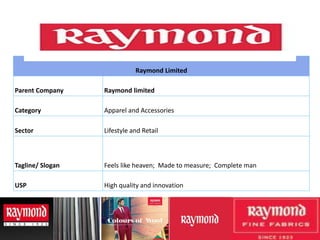
Raymond Limited
Parent Company Raymond limited
Category Apparel and Accessories
Sector Lifestyle and Retail
Tagline/ Slogan Feels like heaven; Made to measure; Complete man
USP High quality and innovation
SWOT Analysis
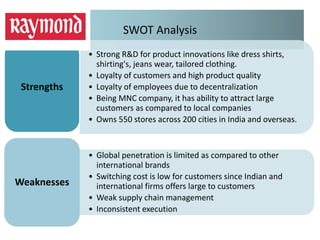
• Strong R&D for product innovations like dress shirts,
shirting's, jeans wear, tailored clothing.
• Loyalty of customers and high product quality
• Loyalty of employees due to decentralization
• Being MNC company, it has ability to attract large
customers as compared to local companies
• Owns 550 stores across 200 cities in India and overseas.
Strengths
• Global penetration is limited as compared to other
international brands
• Switching cost is low for customers since Indian and
international firms offers large to customers
• Weak supply chain management
• Inconsistent execution
Weaknesses
Opportunities
•Special offers for corporates and business
institutions
•Global expansion would give more opportunity for
brand to grow
Threats
•Increase in competition in domestic market due
to large number of formal wear brands coming
up
•Regional trade alliances – All major players in
the industry are competing with each other not
only on low price but better quality.
•Increase in social and ecological awareness ,
company will be in constant pressure to follow
labor laws and environmental laws
SWOT Analysis
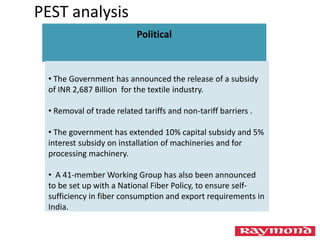
Political
• The Government has announced the release of a subsidy
of INR 2,687 Billion for the textile industry.
• Removal of trade related tariffs and non-tariff barriers .
• The government has extended 10% capital subsidy and 5%
interest subsidy on installation of machineries and for
processing machinery.
• A 41-member Working Group has also been announced
to be set up with a National Fiber Policy, to ensure self-
sufficiency in fiber consumption and export requirements in
India.
PEST analysis
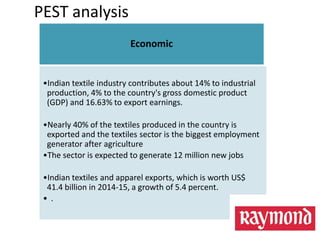
Economic
•Indian textile industry contributes about 14% to industrial
production, 4% to the country's gross domestic product
(GDP) and 16.63% to export earnings.
•Nearly 40% of the textiles produced in the country is
exported and the textiles sector is the biggest employment
generator after agriculture
•The sector is expected to generate 12 million new jobs
•Indian textiles and apparel exports, which is worth US$
41.4 billion in 2014-15, a growth of 5.4 percent.
• .
PEST analysis
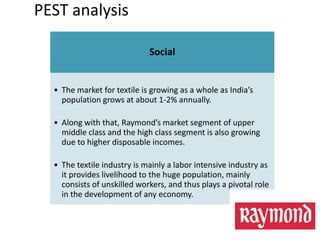
Social
• The market for textile is growing as a whole as India’s
population grows at about 1-2% annually.
• Along with that, Raymond’s market segment of upper
middle class and the high class segment is also growing
due to higher disposable incomes.
• The textile industry is mainly a labor intensive industry as
it provides livelihood to the huge population, mainly
consists of unskilled workers, and thus plays a pivotal role
in the development of any economy.
PEST analysis
•Since the textile industry is more labour
intensive.
•Technical textiles.
•Medical Textile
•Manmade textile
•computerized flat knitting and embroidering
•Technology Upgradation Fund Scheme has
infused investment of more than INR 2,687
Billion
PEST analysis
Technological
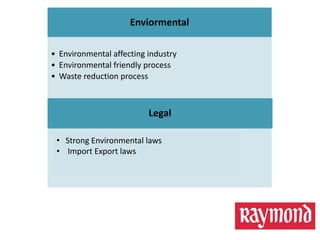
Enviormental
• Environmental affecting industry
• Environmental friendly process
• Waste reduction process
.
Legal
• Strong Environmental laws
• Import Export laws

Raymond pestel & swot

  • 1.
    Raymond Limited Parent CompanyRaymond limited Category Apparel and Accessories Sector Lifestyle and Retail Tagline/ Slogan Feels like heaven; Made to measure; Complete man USP High quality and innovation
  • 2.
    SWOT Analysis • StrongR&D for product innovations like dress shirts, shirting's, jeans wear, tailored clothing. • Loyalty of customers and high product quality • Loyalty of employees due to decentralization • Being MNC company, it has ability to attract large customers as compared to local companies • Owns 550 stores across 200 cities in India and overseas. Strengths • Global penetration is limited as compared to other international brands • Switching cost is low for customers since Indian and international firms offers large to customers • Weak supply chain management • Inconsistent execution Weaknesses
  • 3.
    Opportunities •Special offers forcorporates and business institutions •Global expansion would give more opportunity for brand to grow Threats •Increase in competition in domestic market due to large number of formal wear brands coming up •Regional trade alliances – All major players in the industry are competing with each other not only on low price but better quality. •Increase in social and ecological awareness , company will be in constant pressure to follow labor laws and environmental laws SWOT Analysis
  • 4.
    Political • The Governmenthas announced the release of a subsidy of INR 2,687 Billion for the textile industry. • Removal of trade related tariffs and non-tariff barriers . • The government has extended 10% capital subsidy and 5% interest subsidy on installation of machineries and for processing machinery. • A 41-member Working Group has also been announced to be set up with a National Fiber Policy, to ensure self- sufficiency in fiber consumption and export requirements in India. PEST analysis
  • 5.
    Economic •Indian textile industrycontributes about 14% to industrial production, 4% to the country's gross domestic product (GDP) and 16.63% to export earnings. •Nearly 40% of the textiles produced in the country is exported and the textiles sector is the biggest employment generator after agriculture •The sector is expected to generate 12 million new jobs •Indian textiles and apparel exports, which is worth US$ 41.4 billion in 2014-15, a growth of 5.4 percent. • . PEST analysis
  • 6.
    Social • The marketfor textile is growing as a whole as India’s population grows at about 1-2% annually. • Along with that, Raymond’s market segment of upper middle class and the high class segment is also growing due to higher disposable incomes. • The textile industry is mainly a labor intensive industry as it provides livelihood to the huge population, mainly consists of unskilled workers, and thus plays a pivotal role in the development of any economy. PEST analysis
  • 7.
    •Since the textileindustry is more labour intensive. •Technical textiles. •Medical Textile •Manmade textile •computerized flat knitting and embroidering •Technology Upgradation Fund Scheme has infused investment of more than INR 2,687 Billion PEST analysis Technological
  • 8.
    Enviormental • Environmental affectingindustry • Environmental friendly process • Waste reduction process . Legal • Strong Environmental laws • Import Export laws