ANALYSIS OF
TEXTILE INDUSTRY
By
Gugan kumar .G
 India’s textiles sector is one of the oldest industries in Indian
economy contributing to India’s exports with approximately 11 per
cent of total exports.
 The textile industry employs about 40 million workers and 60
million indirectly.
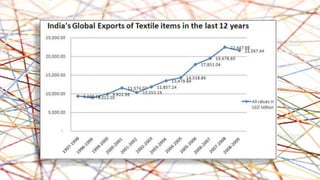
 India's overall textile exports during FY 2015-16 stood at US$ 40
billion.
INTRODUCTION
The textile industry has two broad segments:-
1) First, the unorganised sector consists of handloom, handicrafts and sericulture, which are
operated on a small scale and through traditional tools and methods.
2) The second is the organised sector consisting of spinning, apparel and garments segment which
apply modern machinery and techniques such as economies of scale.
MARKET SHARE
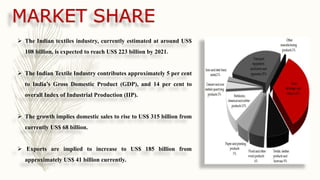
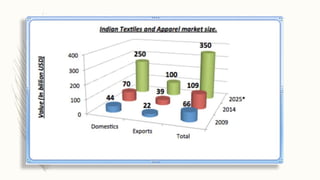
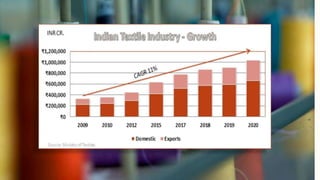
 The Indian textiles industry, currently estimated at around US$
108 billion, is expected to reach US$ 223 billion by 2021.
 The Indian Textile Industry contributes approximately 5 per cent
to India’s Gross Domestic Product (GDP), and 14 per cent to
overall Index of Industrial Production (IIP).
 The growth implies domestic sales to rise to US$ 315 billion from
currently US$ 68 billion.
 Exports are implied to increase to US$ 185 billion from
approximately US$ 41 billion currently.
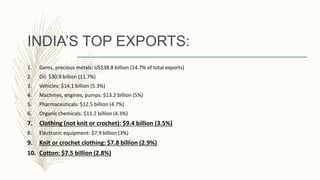
INDIA’S TOP EXPORTS:
1. Gems, precious metals: US$38.8 billion (14.7% of total exports)
2. Oil: $30.9 billion (11.7%)
3. Vehicles: $14.1 billion (5.3%)
4. Machines, engines, pumps: $13.2 billion (5%)
5. Pharmaceuticals: $12.5 billion (4.7%)
6. Organic chemicals: $11.2 billion (4.3%)
7. Clothing (not knit or crochet): $9.4 billion (3.5%)
8. Electronic equipment: $7.9 billion (3%)
9. Knit or crochet clothing: $7.8 billion (2.9%)
10. Cotton: $7.5 billion (2.8%)
INVESTMENTS
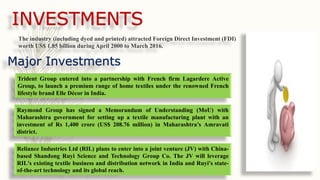
The industry (including dyed and printed) attracted Foreign Direct Investment (FDI)
worth US$ 1.85 billion during April 2000 to March 2016.
Trident Group entered into a partnership with French firm Lagardere Active
Group, to launch a premium range of home textiles under the renowned French
lifestyle brand Elle Décor in India.
Major Investments
Raymond Group has signed a Memorandum of Understanding (MoU) with
Maharashtra government for setting up a textile manufacturing plant with an
investment of Rs 1,400 crore (US$ 208.76 million) in Maharashtra’s Amravati
district.
Reliance Industries Ltd (RIL) plans to enter into a joint venture (JV) with China-
based Shandong Ruyi Science and Technology Group Co. The JV will leverage
RIL's existing textile business and distribution network in India and Ruyi's state-
of-the-art technology and its global reach.
Dupont has joined hands with RIL and Vipul Sarees for use of its
renewable fibre product Sorona to make an ‘environment-friendly’
version of this ethnic ladies wear.
Snapdeal has partnered with India Post to jointly work on bringing
thousands of weavers and artisans from Varanasi through its
website.
Welspun India Ltd (WIL), part of the Welspun Group has unveiled
its new spinning facility at Anjar, Gujarat - the largest under one
roof in India. The expansion project reflects the ethos of the
Government of Gujarat’s recent ‘Farm-Factory-Fabric-Fashion-
Foreign’ Textile Policy, which is aimed at strengthening the entire
textile value-chain.
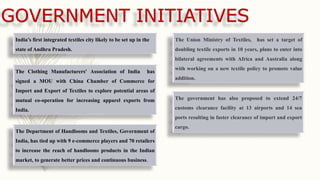
India’s first integrated textiles city likely to be set up in the
state of Andhra Pradesh.
GOVERNMENT INITIATIVES
The Department of Handlooms and Textiles, Government of
India, has tied up with 9 e-commerce players and 70 retailers
to increase the reach of handlooms products in the Indian
market, to generate better prices and continuous business.
The Union Ministry of Textiles, has set a target of
doubling textile exports in 10 years, plans to enter into
bilateral agreements with Africa and Australia along
with working on a new textile policy to promote value
addition.
The Clothing Manufacturers' Association of India has
signed a MOU with China Chamber of Commerce for
Import and Export of Textiles to explore potential areas of
mutual co-operation for increasing apparel exports from
India.
The government has also proposed to extend 24/7
customs clearance facility at 13 airports and 14 sea
ports resulting in faster clearance of import and export
cargo.
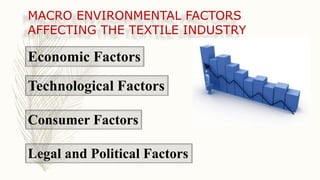
MACRO ENVIRONMENTAL FACTORS
AFFECTING THE TEXTILE INDUSTRY
Technological Factors
Legal and Political Factors
Consumer Factors
Economic Factors
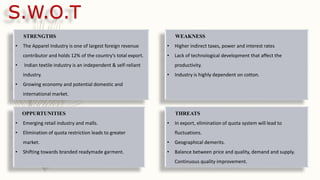
STRENGTHS
• The Apparel Industry is one of largest foreign revenue
contributor and holds 12% of the country’s total export.
• Indian textile industry is an independent & self-reliant
industry.
• Growing economy and potential domestic and
international market.
OPPURTUNITIES
• Emerging retail industry and malls.
• Elimination of quota restriction leads to greater
market.
• Shifting towards branded readymade garment.
WEAKNESS
• Higher indirect taxes, power and interest rates
• Lack of technological development that affect the
productivity.
• Industry is highly dependent on cotton.
THREATS
• In export, elimination of quota system will lead to
fluctuations.
• Geographical demerits.
• Balance between price and quality, demand and supply.
Continuous quality improvement.
S.W.O.T
Textile industry

Textile industry

  • 1.
  • 2.
     India’s textilessector is one of the oldest industries in Indian economy contributing to India’s exports with approximately 11 per cent of total exports.  The textile industry employs about 40 million workers and 60 million indirectly.  India's overall textile exports during FY 2015-16 stood at US$ 40 billion. INTRODUCTION
  • 3.
    The textile industryhas two broad segments:- 1) First, the unorganised sector consists of handloom, handicrafts and sericulture, which are operated on a small scale and through traditional tools and methods. 2) The second is the organised sector consisting of spinning, apparel and garments segment which apply modern machinery and techniques such as economies of scale.
  • 4.
    MARKET SHARE  TheIndian textiles industry, currently estimated at around US$ 108 billion, is expected to reach US$ 223 billion by 2021.  The Indian Textile Industry contributes approximately 5 per cent to India’s Gross Domestic Product (GDP), and 14 per cent to overall Index of Industrial Production (IIP).  The growth implies domestic sales to rise to US$ 315 billion from currently US$ 68 billion.  Exports are implied to increase to US$ 185 billion from approximately US$ 41 billion currently.
  • 8.
    INDIA’S TOP EXPORTS: 1.Gems, precious metals: US$38.8 billion (14.7% of total exports) 2. Oil: $30.9 billion (11.7%) 3. Vehicles: $14.1 billion (5.3%) 4. Machines, engines, pumps: $13.2 billion (5%) 5. Pharmaceuticals: $12.5 billion (4.7%) 6. Organic chemicals: $11.2 billion (4.3%) 7. Clothing (not knit or crochet): $9.4 billion (3.5%) 8. Electronic equipment: $7.9 billion (3%) 9. Knit or crochet clothing: $7.8 billion (2.9%) 10. Cotton: $7.5 billion (2.8%)
  • 9.
    INVESTMENTS The industry (includingdyed and printed) attracted Foreign Direct Investment (FDI) worth US$ 1.85 billion during April 2000 to March 2016. Trident Group entered into a partnership with French firm Lagardere Active Group, to launch a premium range of home textiles under the renowned French lifestyle brand Elle Décor in India. Major Investments Raymond Group has signed a Memorandum of Understanding (MoU) with Maharashtra government for setting up a textile manufacturing plant with an investment of Rs 1,400 crore (US$ 208.76 million) in Maharashtra’s Amravati district. Reliance Industries Ltd (RIL) plans to enter into a joint venture (JV) with China- based Shandong Ruyi Science and Technology Group Co. The JV will leverage RIL's existing textile business and distribution network in India and Ruyi's state- of-the-art technology and its global reach.
  • 10.
    Dupont has joinedhands with RIL and Vipul Sarees for use of its renewable fibre product Sorona to make an ‘environment-friendly’ version of this ethnic ladies wear. Snapdeal has partnered with India Post to jointly work on bringing thousands of weavers and artisans from Varanasi through its website. Welspun India Ltd (WIL), part of the Welspun Group has unveiled its new spinning facility at Anjar, Gujarat - the largest under one roof in India. The expansion project reflects the ethos of the Government of Gujarat’s recent ‘Farm-Factory-Fabric-Fashion- Foreign’ Textile Policy, which is aimed at strengthening the entire textile value-chain.
  • 12.
    India’s first integratedtextiles city likely to be set up in the state of Andhra Pradesh. GOVERNMENT INITIATIVES The Department of Handlooms and Textiles, Government of India, has tied up with 9 e-commerce players and 70 retailers to increase the reach of handlooms products in the Indian market, to generate better prices and continuous business. The Union Ministry of Textiles, has set a target of doubling textile exports in 10 years, plans to enter into bilateral agreements with Africa and Australia along with working on a new textile policy to promote value addition. The Clothing Manufacturers' Association of India has signed a MOU with China Chamber of Commerce for Import and Export of Textiles to explore potential areas of mutual co-operation for increasing apparel exports from India. The government has also proposed to extend 24/7 customs clearance facility at 13 airports and 14 sea ports resulting in faster clearance of import and export cargo.
  • 13.
    MACRO ENVIRONMENTAL FACTORS AFFECTINGTHE TEXTILE INDUSTRY Technological Factors Legal and Political Factors Consumer Factors Economic Factors
  • 14.
    STRENGTHS • The ApparelIndustry is one of largest foreign revenue contributor and holds 12% of the country’s total export. • Indian textile industry is an independent & self-reliant industry. • Growing economy and potential domestic and international market. OPPURTUNITIES • Emerging retail industry and malls. • Elimination of quota restriction leads to greater market. • Shifting towards branded readymade garment. WEAKNESS • Higher indirect taxes, power and interest rates • Lack of technological development that affect the productivity. • Industry is highly dependent on cotton. THREATS • In export, elimination of quota system will lead to fluctuations. • Geographical demerits. • Balance between price and quality, demand and supply. Continuous quality improvement. S.W.O.T