ACCOUNTS ASSIGNMENT                                                          Mohit Sharma

                                                                          11BSP1978

Annual report of Raymond textile -
RATIO ANALYSIS

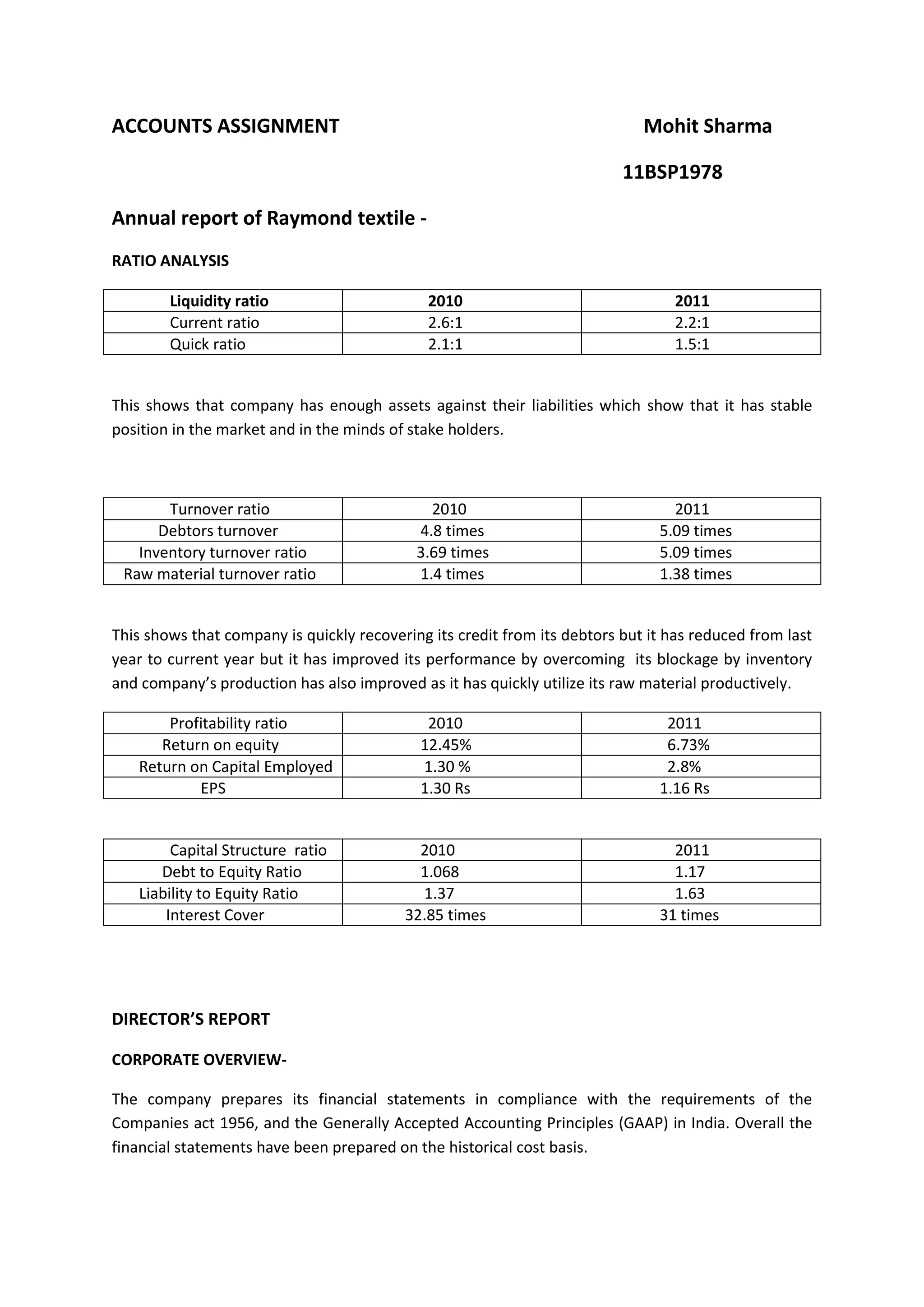
        Liquidity ratio                       2010                                2011
        Current ratio                         2.6:1                               2.2:1
        Quick ratio                           2.1:1                               1.5:1


This shows that company has enough assets against their liabilities which show that it has stable
position in the market and in the minds of stake holders.


       Turnover ratio                         2010                               2011
      Debtors turnover                      4.8 times                          5.09 times
   Inventory turnover ratio                 3.69 times                         5.09 times
 Raw material turnover ratio                1.4 times                          1.38 times


This shows that company is quickly recovering its credit from its debtors but it has reduced from last
year to current year but it has improved its performance by overcoming its blockage by inventory
and company’s production has also improved as it has quickly utilize its raw material productively.

       Profitability ratio                   2010                               2011
      Return on equity                      12.45%                              6.73%
   Return on Capital Employed               1.30 %                              2.8%
           EPS                              1.30 Rs                            1.16 Rs


        Capital Structure ratio             2010                                 2011
      Debt to Equity Ratio                  1.068                                1.17
   Liability to Equity Ratio                1.37                                 1.63
       Interest Cover                     32.85 times                          31 times


DIRECTOR’S REPORT

CORPORATE OVERVIEW-

The company prepares its financial statements in compliance with the requirements of the
Companies act 1956, and the Generally Accepted Accounting Principles (GAAP) in India. Overall the
financial statements have been prepared on the historical cost basis.
FINANCIAL HEIGHTS -

Directors are optimistic that the company’s performance will improve and also observe that the
exceptional change of Rs. 238 crore in the financial statements for FY 2011 consequent to the
workers settlement in Thane has resulted in a net loss of Rs. 100.19. Out of the amount available for
appropriation, Directors recommend a dividend of 10% aggregating to Rs. 6.14 crore on equity
shares. Company continues with its task to build business with long-term goals based on its intrinsic
strength in terms of its powerful brands, quality manufacturing prowess, distribution, strength and
customer relationships. Rationalising and streamlining operations to bring about efficiencies and
reduce cost will remain top priority

OVERVIEW OF THE ECONOMY-

The global economic recovery is gaining strength and the IMF has projected a 4.5% world growth in
2011 and 2012. While growth in emerging economies remain strong, that in the US and European
region is slowly gaining momentum. The Indian Economy registered improved growth and was
among the better performers amid emerging market economies. Central statistical Organization’s
recent estimated Indian GDP growth rate at 8.6% for 2010-11 is consistent with the RBI’s projections
for the same period. The other indicators such as latest Purchasing Managers Index, direct and
indirect tax collections, merchandize exports and bank credit suggest that the growth momentum
persists.

ANALYSIS AND REVIEW-

Textile industry conditions- The textile industry is one of the largest and most important section in
the Indian economy in terms of output, foreign exchange earnings and employment. India’s textile
industry is one of the leading textile industries in the world.

Notwithstanding signs of recovery from the previous financial crisis, the textile and apparel industry
went through a tough year struggling with the surging and fluctuating prices of raw materials.
However, the Government is making efforts in boosting the textile industry through various
initiatives and investments are increasing steadily. The Ministry of Textiles has sanctioned a total of
US$ 133 million under Technology Upgradation Fund Schemes (TUFS) during September 2010. The
industry is expected to continue to grow at a significant rate in the future, as it is fuelled by a strong
domestic consumption.

OVERVIEW
The Company is the market leader in the textiles sector in India, has a powerful brand ‘Raymond’,
state-of-the-art manufacturing facilities and a strong all India retail presence in the form of ‘The
Raymond Shop’ (‘TRS’). The Company is considered as the most respected company in the Apparel
and Textile sector of India. The Company is on the path to becoming a lifestyle solution for
discerning customers with an offering of a range of fabrics, garments and accessories in a premium
shopping environment. The Company continues its growth of its retail network of ‘TRS’ in tier 3, 4
and 5 towns.
Market Share and Retail Network-
The Company is the market leader in India and is considered as one of the most formidable players
in the global markets for high-quality suiting. The Company continued its focus on retail segment
expansion during this financial year.

Export-
The Exports market conditions were tough during the financial year because of severe competition
and continuous increase in the raw material prices resulting in increase in the input costs. The
Textile exports for the financial year 2010- 2011 remained flat and were Rs. 136.40 crore as against
Rs. 133.64 crore in the previous year.

RISK MANAGEMENT
The Company is exposed to risks from market fluctuations of foreign exchange, interest rates,
commodity prices, business risk, compliance risks and people risks.

1. Foreign Exchange Risk-
The Company’s policy is to actively manage its long term foreign exchange risk within the framework
laid down by the Company’s forex policy.

2. Interest Rate Risk-
Given the interest rate fluctuations, the Company has adopted a prudent and conservative risk
mitigating strategy to minimise the interest costs.

CORPORATE SOCIAL RESPONSIBILITY (CSR)
The Company has an innate desire and zeal to contribute towards the welfare and social upliftment
of the community.
The Company continues to support the following CSR initiatives:
• Smt. Sulochanadevi Singhania School at Thane, Maharashtra and the Kailashpat Singhania High
School in Chhindwara, M.P., having overall strength of around 7400 students, provide quality
education not only to the Raymond employees’ children, but also to the children of the local
populace;
• Raymond Embryo Research Centre for cattle is a centre set up at Gopalnagar, Bilaspur in
Chhattisgarh and its ceaseless efforts and endeavours have made several significant achievements in
Embryo Transfer. Raymond was the first organisation in India to introduce Embryo Transfer in
Sheep;
• J. K. Trust Gram Vikas Yojana (JKTGVY) launched in 1997 helps transfer of the technical expertise
gained over three decades to the grass-root level. The mission of this initiative is to significantly
improve the quality of life in India’s rural areas through a “Cattle Breed Improvement Programme”.
This initiative operates in a network of over 4000 Integrated Livestock Development Centre in
Chhattisgarh, Madhya Pradesh, Uttarakhand and Andhra Pradesh; and
• Raymond Rehabilitation Centre has been set-up for the welfare of under-privileged children at
Jekegram, Thane. This initiative enables less fortunate children to be self-sufficient in life. The Centre
provides free vocational training workshops to young boys over the age of 16. The three-month
vocational courses comprise of basic training in electrical, air-conditioning, refrigeration and
plumbing, etc.

ENVIRONMENT AND SAFETY
The Company is conscious of the importance of environmentally clean and safe operations. The
Company’s policy requires the conduct of all operations in such manner so as to ensure safety of all
concerned, compliance of statutory and industrial requirements for environment protection and
conservation of natural resources to the extent possible.

CORPORATE GOVERNANCE

1. COMPANY’S PHILOSOPHY ON CODE OF GOVERNANCE:
Corporate Governance provides corporates with a framework to pursue the objectives of the
organisation effectively. With the combination of ethical values with business acumen, globalisation
with national interest and core business with emerging businesses, Raymond is amongst the most
respectable organisations in India. The Company will continue to focus its resources, strengths and
strategies to achieve the vision of becoming a global leader in Textile, Apparel, Garmenting and
Lifestyle Brands while upholding the Core values of Quality, Trust, Leadership and Excellence.

Raymond has a strong legacy of fair, transparent, ethical processes and best-of-breed practices. The
Company has adopted a Code of Business Conduct and Ethics for its Board of Directors and Senior
Management. This Code is on the Company’s website. The Company’s Corporate Governance
philosophy is further strengthened through the Raymond Code of Conduct for Prevention of Insider
Trading, as also the Charter – Business for Peace. The Company has in place an Information Security
Policy that ensures proper utilisation of Information Technology (IT) resources.

2. DISCLOSURES:
a. Disclosure on materially significant related party transactions that may have potential conflict
with the interests of the Company at large.
There are no materially significant related party transactions made by the Company with its
Promoters, Directors or Management, their subsidiaries or relatives etc., that may have potential
conflict with the interests of the Company at large. Transactions with related parties as per
requirements of Accounting Standard (AS-18) – ‘Related Party Disclosures’ are disclosed in Note No.
17 of Schedule 16 to the Accounts in the Annual Report.
b. Disclosure of Accounting Treatment
In the preparation of the financial statements, the Company has followed the Accounting Standards
referred to in Section 211(3) (c) of the Companies Act, 1956. The significant accounting policies
which are consistently applied are set out in the Annexure-1 to Notes to the Accounts.
c. Risk Management
Business risk evaluation and management is an ongoing process within the Company. During the
year under review, a detailed exercise on ‘Risk Assessment and Management’ was carried out
covering the entire gamut of business operations and the Board was informed of the same.
d. Details of non-compliance by the Company, penalties, strictures imposed on the Company by
Stock Exchanges or SEBI or any statutory authority, on any matter related to capital markets,
during the last three years.
The Company has complied with all requirements of the Listing Agreements entered into with the
Stock Exchanges as well as the regulations and guidelines of SEBI. Consequently, there were no
strictures or penalties imposed by either SEBI or the Stock Exchanges or any statutory authority for
non-compliance of any matter related to the capital markets during the last three years.
e. Non-mandatory requirements
Adoption of non-mandatory requirements of Clause 49 of the Listing Agreement is being reviewed
by the Board from time-to-time.

Annual report of raymond

  • 1.
    ACCOUNTS ASSIGNMENT Mohit Sharma 11BSP1978 Annual report of Raymond textile - RATIO ANALYSIS Liquidity ratio 2010 2011 Current ratio 2.6:1 2.2:1 Quick ratio 2.1:1 1.5:1 This shows that company has enough assets against their liabilities which show that it has stable position in the market and in the minds of stake holders. Turnover ratio 2010 2011 Debtors turnover 4.8 times 5.09 times Inventory turnover ratio 3.69 times 5.09 times Raw material turnover ratio 1.4 times 1.38 times This shows that company is quickly recovering its credit from its debtors but it has reduced from last year to current year but it has improved its performance by overcoming its blockage by inventory and company’s production has also improved as it has quickly utilize its raw material productively. Profitability ratio 2010 2011 Return on equity 12.45% 6.73% Return on Capital Employed 1.30 % 2.8% EPS 1.30 Rs 1.16 Rs Capital Structure ratio 2010 2011 Debt to Equity Ratio 1.068 1.17 Liability to Equity Ratio 1.37 1.63 Interest Cover 32.85 times 31 times DIRECTOR’S REPORT CORPORATE OVERVIEW- The company prepares its financial statements in compliance with the requirements of the Companies act 1956, and the Generally Accepted Accounting Principles (GAAP) in India. Overall the financial statements have been prepared on the historical cost basis.
  • 2.
    FINANCIAL HEIGHTS - Directorsare optimistic that the company’s performance will improve and also observe that the exceptional change of Rs. 238 crore in the financial statements for FY 2011 consequent to the workers settlement in Thane has resulted in a net loss of Rs. 100.19. Out of the amount available for appropriation, Directors recommend a dividend of 10% aggregating to Rs. 6.14 crore on equity shares. Company continues with its task to build business with long-term goals based on its intrinsic strength in terms of its powerful brands, quality manufacturing prowess, distribution, strength and customer relationships. Rationalising and streamlining operations to bring about efficiencies and reduce cost will remain top priority OVERVIEW OF THE ECONOMY- The global economic recovery is gaining strength and the IMF has projected a 4.5% world growth in 2011 and 2012. While growth in emerging economies remain strong, that in the US and European region is slowly gaining momentum. The Indian Economy registered improved growth and was among the better performers amid emerging market economies. Central statistical Organization’s recent estimated Indian GDP growth rate at 8.6% for 2010-11 is consistent with the RBI’s projections for the same period. The other indicators such as latest Purchasing Managers Index, direct and indirect tax collections, merchandize exports and bank credit suggest that the growth momentum persists. ANALYSIS AND REVIEW- Textile industry conditions- The textile industry is one of the largest and most important section in the Indian economy in terms of output, foreign exchange earnings and employment. India’s textile industry is one of the leading textile industries in the world. Notwithstanding signs of recovery from the previous financial crisis, the textile and apparel industry went through a tough year struggling with the surging and fluctuating prices of raw materials. However, the Government is making efforts in boosting the textile industry through various initiatives and investments are increasing steadily. The Ministry of Textiles has sanctioned a total of US$ 133 million under Technology Upgradation Fund Schemes (TUFS) during September 2010. The industry is expected to continue to grow at a significant rate in the future, as it is fuelled by a strong domestic consumption. OVERVIEW The Company is the market leader in the textiles sector in India, has a powerful brand ‘Raymond’, state-of-the-art manufacturing facilities and a strong all India retail presence in the form of ‘The Raymond Shop’ (‘TRS’). The Company is considered as the most respected company in the Apparel and Textile sector of India. The Company is on the path to becoming a lifestyle solution for discerning customers with an offering of a range of fabrics, garments and accessories in a premium shopping environment. The Company continues its growth of its retail network of ‘TRS’ in tier 3, 4 and 5 towns.
  • 3.
    Market Share andRetail Network- The Company is the market leader in India and is considered as one of the most formidable players in the global markets for high-quality suiting. The Company continued its focus on retail segment expansion during this financial year. Export- The Exports market conditions were tough during the financial year because of severe competition and continuous increase in the raw material prices resulting in increase in the input costs. The Textile exports for the financial year 2010- 2011 remained flat and were Rs. 136.40 crore as against Rs. 133.64 crore in the previous year. RISK MANAGEMENT The Company is exposed to risks from market fluctuations of foreign exchange, interest rates, commodity prices, business risk, compliance risks and people risks. 1. Foreign Exchange Risk- The Company’s policy is to actively manage its long term foreign exchange risk within the framework laid down by the Company’s forex policy. 2. Interest Rate Risk- Given the interest rate fluctuations, the Company has adopted a prudent and conservative risk mitigating strategy to minimise the interest costs. CORPORATE SOCIAL RESPONSIBILITY (CSR) The Company has an innate desire and zeal to contribute towards the welfare and social upliftment of the community. The Company continues to support the following CSR initiatives: • Smt. Sulochanadevi Singhania School at Thane, Maharashtra and the Kailashpat Singhania High School in Chhindwara, M.P., having overall strength of around 7400 students, provide quality education not only to the Raymond employees’ children, but also to the children of the local populace; • Raymond Embryo Research Centre for cattle is a centre set up at Gopalnagar, Bilaspur in Chhattisgarh and its ceaseless efforts and endeavours have made several significant achievements in Embryo Transfer. Raymond was the first organisation in India to introduce Embryo Transfer in Sheep; • J. K. Trust Gram Vikas Yojana (JKTGVY) launched in 1997 helps transfer of the technical expertise gained over three decades to the grass-root level. The mission of this initiative is to significantly improve the quality of life in India’s rural areas through a “Cattle Breed Improvement Programme”. This initiative operates in a network of over 4000 Integrated Livestock Development Centre in Chhattisgarh, Madhya Pradesh, Uttarakhand and Andhra Pradesh; and • Raymond Rehabilitation Centre has been set-up for the welfare of under-privileged children at Jekegram, Thane. This initiative enables less fortunate children to be self-sufficient in life. The Centre provides free vocational training workshops to young boys over the age of 16. The three-month vocational courses comprise of basic training in electrical, air-conditioning, refrigeration and plumbing, etc. ENVIRONMENT AND SAFETY The Company is conscious of the importance of environmentally clean and safe operations. The Company’s policy requires the conduct of all operations in such manner so as to ensure safety of all
  • 4.
    concerned, compliance ofstatutory and industrial requirements for environment protection and conservation of natural resources to the extent possible. CORPORATE GOVERNANCE 1. COMPANY’S PHILOSOPHY ON CODE OF GOVERNANCE: Corporate Governance provides corporates with a framework to pursue the objectives of the organisation effectively. With the combination of ethical values with business acumen, globalisation with national interest and core business with emerging businesses, Raymond is amongst the most respectable organisations in India. The Company will continue to focus its resources, strengths and strategies to achieve the vision of becoming a global leader in Textile, Apparel, Garmenting and Lifestyle Brands while upholding the Core values of Quality, Trust, Leadership and Excellence. Raymond has a strong legacy of fair, transparent, ethical processes and best-of-breed practices. The Company has adopted a Code of Business Conduct and Ethics for its Board of Directors and Senior Management. This Code is on the Company’s website. The Company’s Corporate Governance philosophy is further strengthened through the Raymond Code of Conduct for Prevention of Insider Trading, as also the Charter – Business for Peace. The Company has in place an Information Security Policy that ensures proper utilisation of Information Technology (IT) resources. 2. DISCLOSURES: a. Disclosure on materially significant related party transactions that may have potential conflict with the interests of the Company at large. There are no materially significant related party transactions made by the Company with its Promoters, Directors or Management, their subsidiaries or relatives etc., that may have potential conflict with the interests of the Company at large. Transactions with related parties as per requirements of Accounting Standard (AS-18) – ‘Related Party Disclosures’ are disclosed in Note No. 17 of Schedule 16 to the Accounts in the Annual Report. b. Disclosure of Accounting Treatment In the preparation of the financial statements, the Company has followed the Accounting Standards referred to in Section 211(3) (c) of the Companies Act, 1956. The significant accounting policies which are consistently applied are set out in the Annexure-1 to Notes to the Accounts. c. Risk Management Business risk evaluation and management is an ongoing process within the Company. During the year under review, a detailed exercise on ‘Risk Assessment and Management’ was carried out covering the entire gamut of business operations and the Board was informed of the same. d. Details of non-compliance by the Company, penalties, strictures imposed on the Company by Stock Exchanges or SEBI or any statutory authority, on any matter related to capital markets, during the last three years. The Company has complied with all requirements of the Listing Agreements entered into with the Stock Exchanges as well as the regulations and guidelines of SEBI. Consequently, there were no strictures or penalties imposed by either SEBI or the Stock Exchanges or any statutory authority for non-compliance of any matter related to the capital markets during the last three years. e. Non-mandatory requirements Adoption of non-mandatory requirements of Clause 49 of the Listing Agreement is being reviewed by the Board from time-to-time.