RAY OPTICS - II
1. Refraction through a Prism
2. Expression for Refractive Index of Prism
3. Dispersion
4. Angular Dispersion and Dispersive Power
5. Blue Colour of the Sky and Red Colour of the Sun
6. Compound Microscope
7. Astronomical Telescope (Normal Adjustment)
8. Astronomical Telescope (Image at LDDV)
9. Newtonian Telescope (Reflecting Type)
10.Resolving Power of Microscope and Telescope
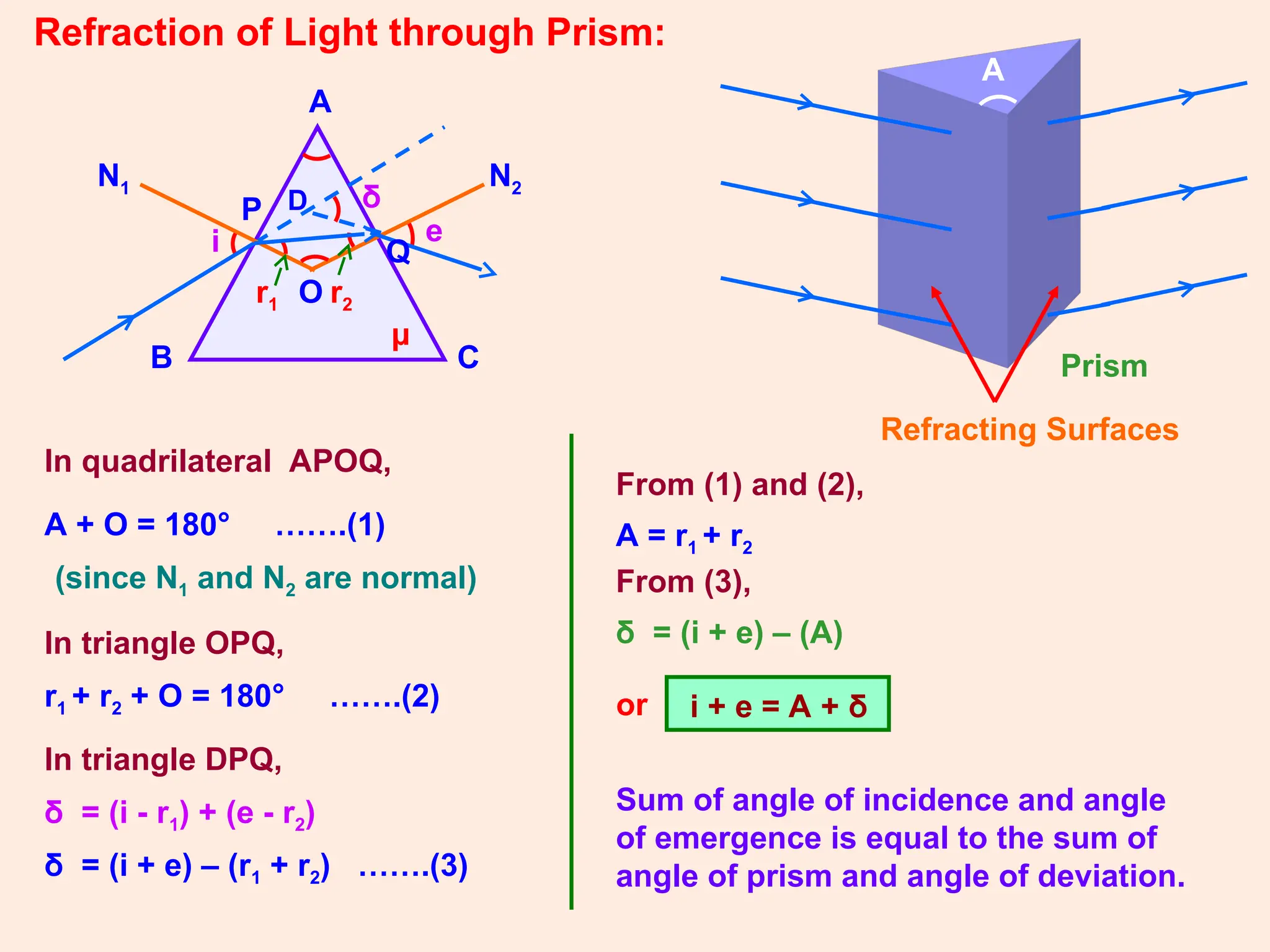
Refraction of Light through Prism:
A
Refracting Surfaces
Prism
i
δ
A
B C
e
O
P
Q
r1 r2
N1 N2
D
In quadrilateral APOQ,
A + O = 180° …….(1)
(since N1 and N2 are normal)
In triangle OPQ,
r1 + r2 + O = 180° …….(2)
In triangle DPQ,
δ = (i - r1) + (e - r2)
δ = (i + e) – (r1 + r2) …….(3)
From (1) and (2),
A = r1 + r2
From (3),
δ = (i + e) – (A)
or i + e = A + δ
μ
Sum of angle of incidence and angle
of emergence is equal to the sum of
angle of prism and angle of deviation.
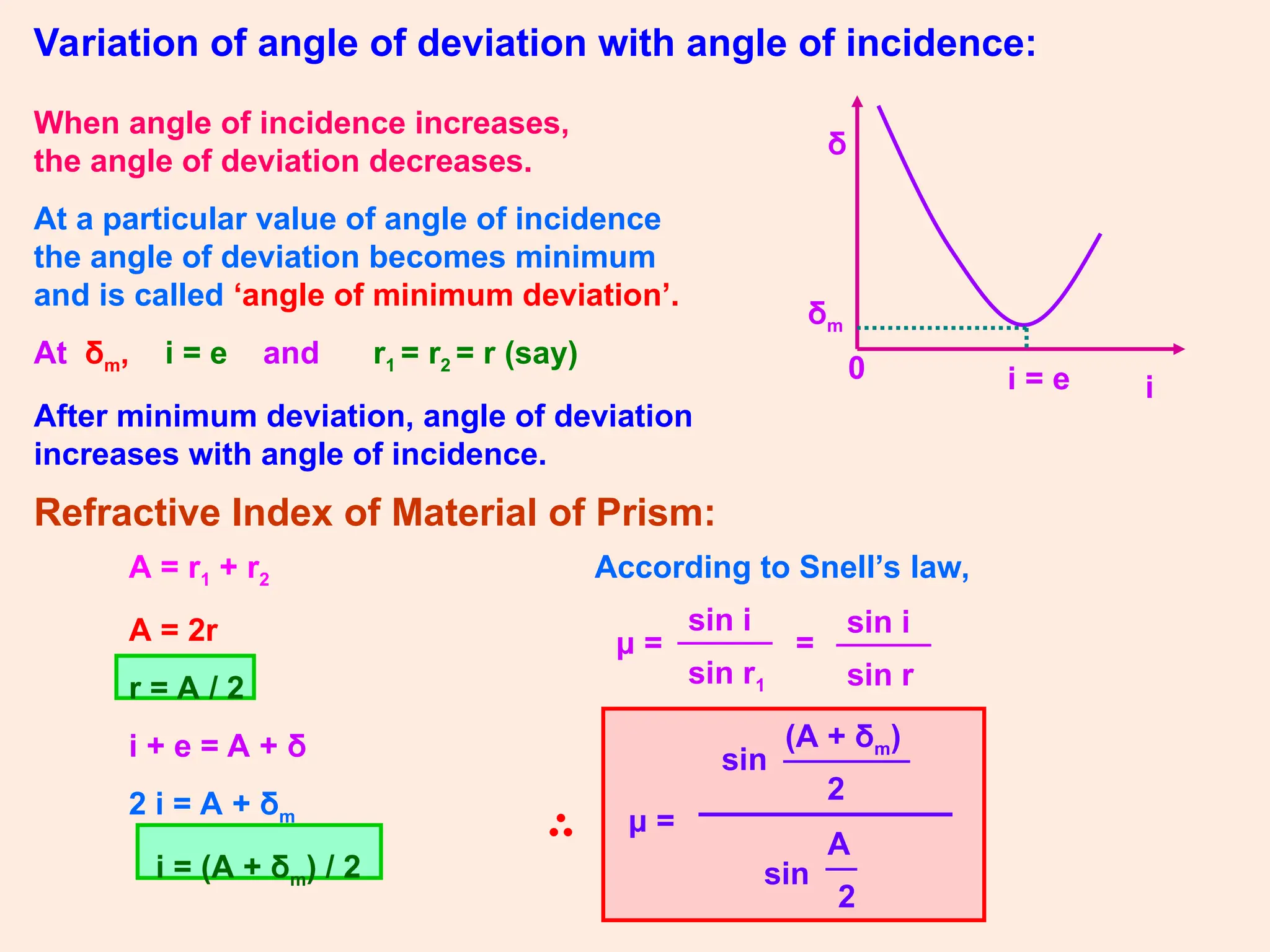
Variation of angle of deviation with angle of incidence:
δ
i
0 i = e
δm
When angle of incidence increases,
the angle of deviation decreases.
At a particular value of angle of incidence
the angle of deviation becomes minimum
and is called ‘angle of minimum deviation’.
At δm, i = e and r1 = r2 = r (say)
After minimum deviation, angle of deviation
increases with angle of incidence.
Refractive Index of Material of Prism:
A = r1 + r2
A = 2r
r = A / 2
i + e = A + δ
2 i = A + δm
i = (A + δm) / 2
According to Snell’s law,
sin i
μ =
sin r1
sin i
sin r
=
μ =
sin
(A + δm)
2
sin
A
2
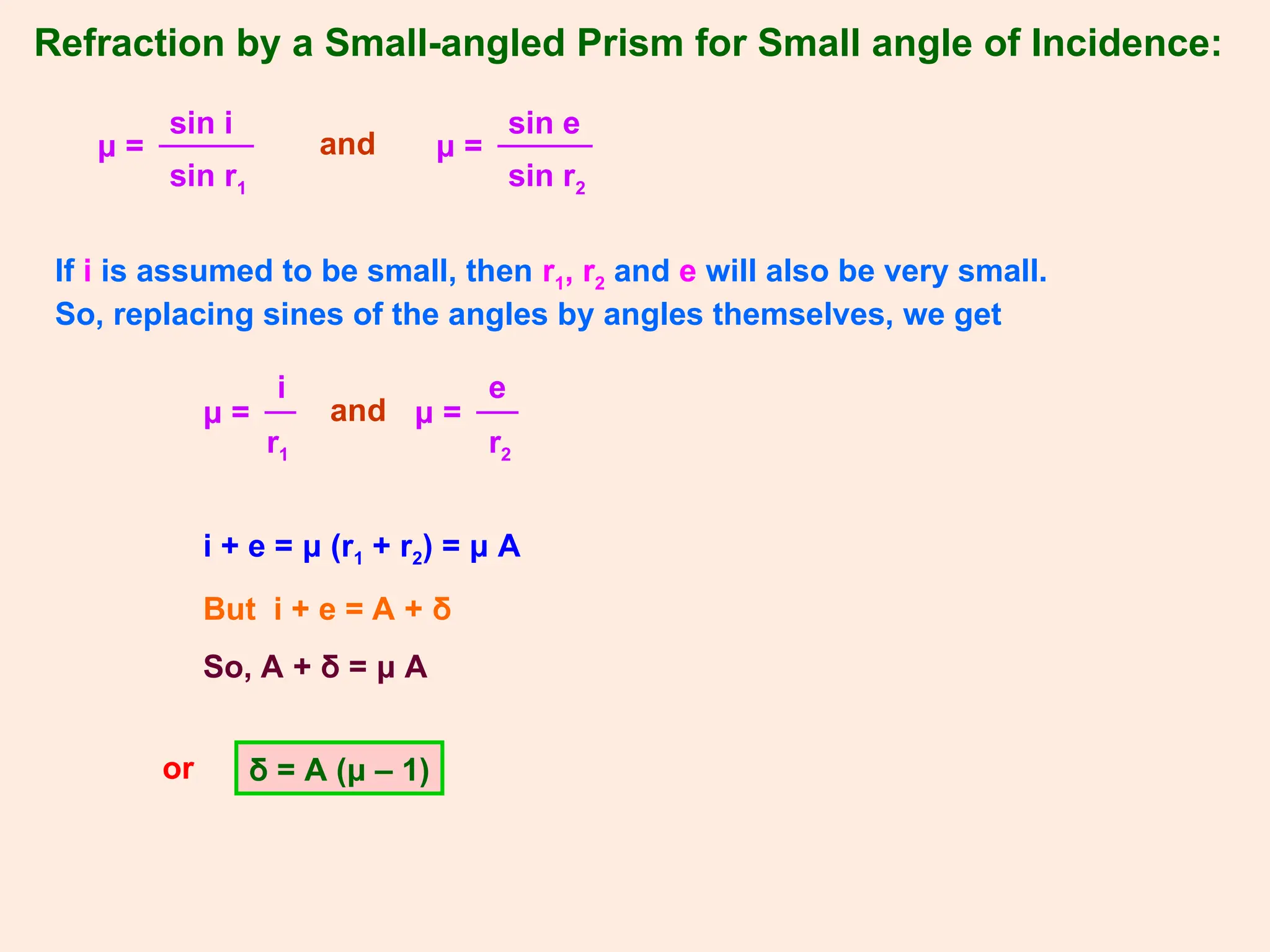
Refraction by a Small-angled Prism for Small angle of Incidence:
sin i
μ =
sin r1
sin e
μ =
sin r2
and
If i is assumed to be small, then r1, r2 and e will also be very small.
So, replacing sines of the angles by angles themselves, we get
i
μ =
r1
and
e
μ =
r2
i + e = μ (r1 + r2) = μ A
But i + e = A + δ
So, A + δ = μ A
or δ = A (μ – 1)
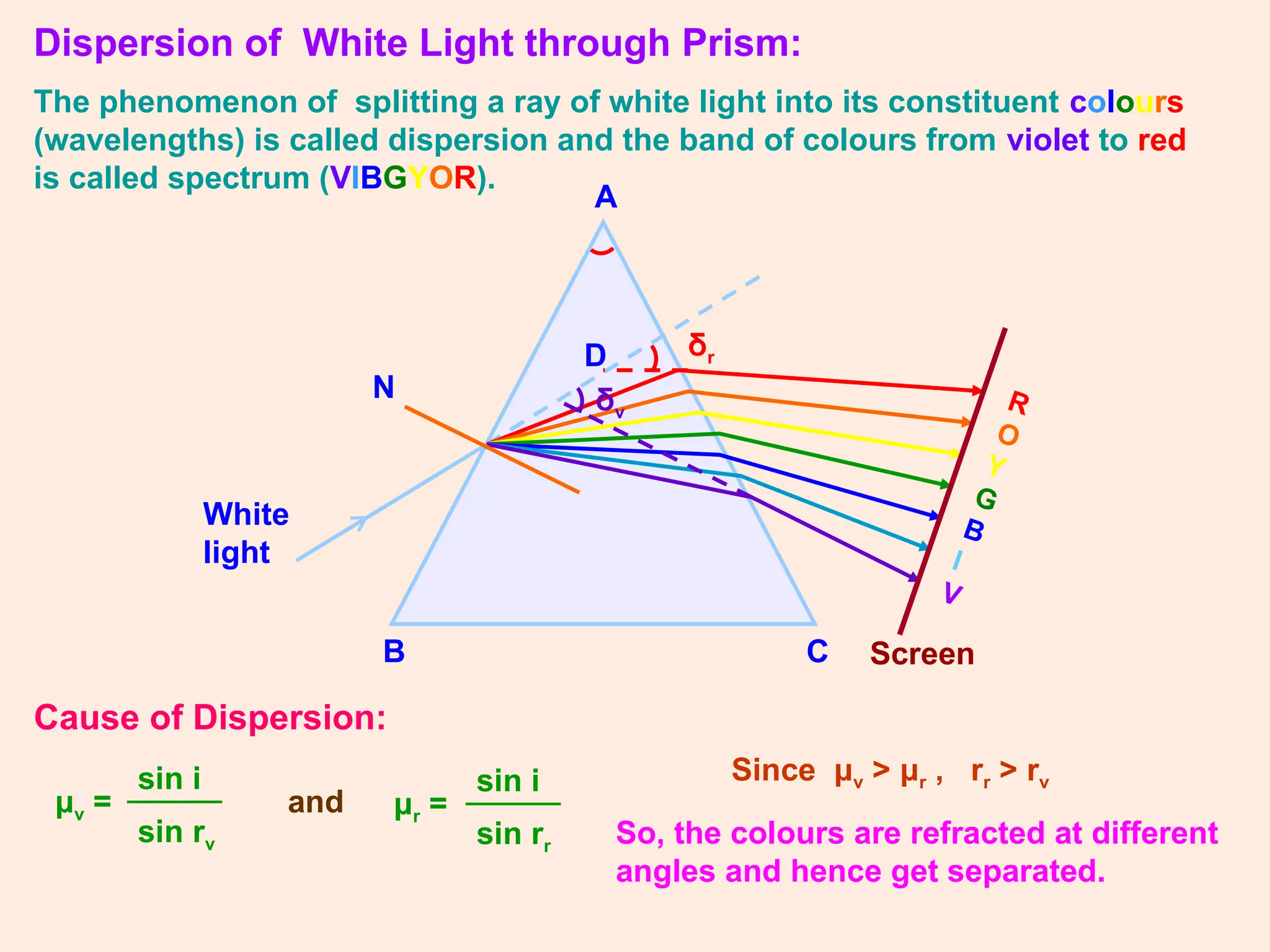
Dispersion of White Light through Prism:
The phenomenon of splitting a ray of white light into its constituent colours
(wavelengths) is called dispersion and the band of colours from violet to red
is called spectrum (VIBGYOR).
δr
A
B C
D
White
light
δv
Cause of Dispersion:
sin i
μv =
sin rv
sin i
μr =
sin rr
and
Since μv > μr , rr > rv
So, the colours are refracted at different
angles and hence get separated.
R
O
Y
G
B
I
V
Screen
N
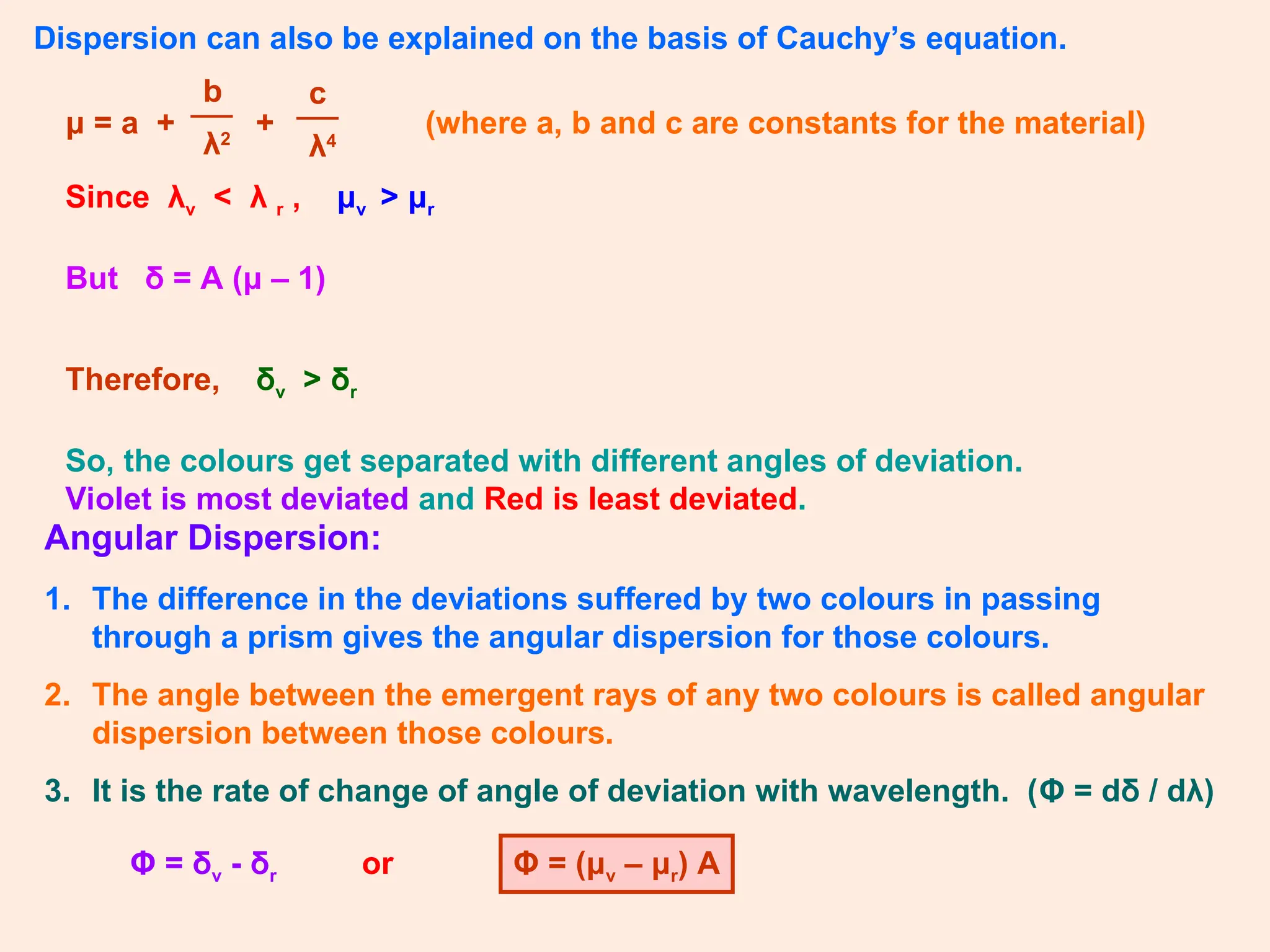
Dispersion can also be explained on the basis of Cauchy’s equation.
μ = a +
b
λ2
c
λ4
+ (where a, b and c are constants for the material)
Since λv < λ r , μv > μr
But δ = A (μ – 1)
Therefore, δv > δr
So, the colours get separated with different angles of deviation.
Violet is most deviated and Red is least deviated.
Angular Dispersion:
1. The difference in the deviations suffered by two colours in passing
through a prism gives the angular dispersion for those colours.
2. The angle between the emergent rays of any two colours is called angular
dispersion between those colours.
3. It is the rate of change of angle of deviation with wavelength. (Φ = dδ / dλ)
Φ = δv - δr or Φ = (μv – μr) A
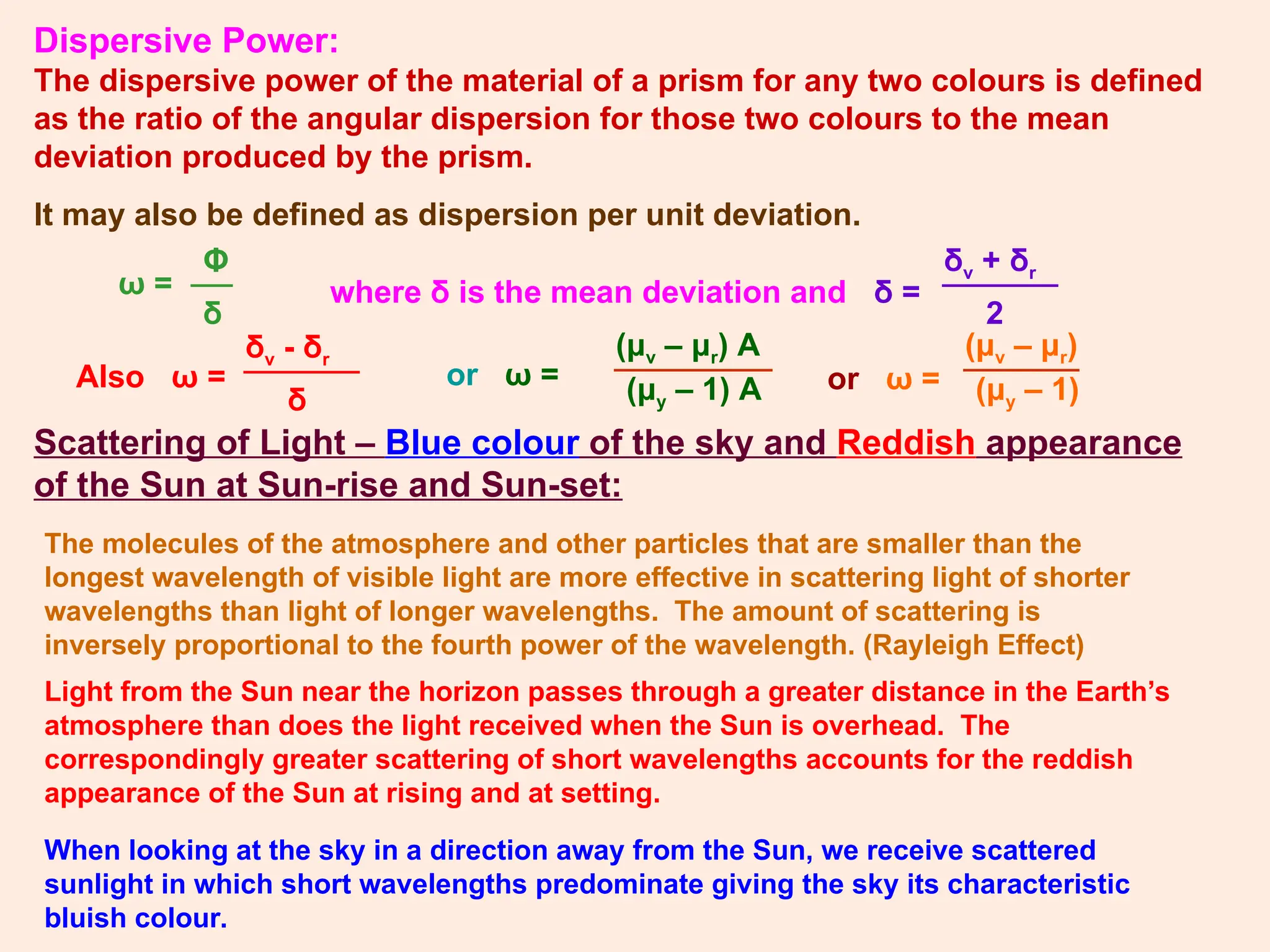
Dispersive Power:
The dispersive power of the material of a prism for any two colours is defined
as the ratio of the angular dispersion for those two colours to the mean
deviation produced by the prism.
It may also be defined as dispersion per unit deviation.
ω =
Φ
δ
where δ is the mean deviation and δ =
δv + δr
2
Also ω =
δv - δr
δ
or ω =
(μv – μr) A
(μy – 1) A or ω =
(μv – μr)
(μy – 1)
Scattering of Light – Blue colour of the sky and Reddish appearance
of the Sun at Sun-rise and Sun-set:
The molecules of the atmosphere and other particles that are smaller than the
longest wavelength of visible light are more effective in scattering light of shorter
wavelengths than light of longer wavelengths. The amount of scattering is
inversely proportional to the fourth power of the wavelength. (Rayleigh Effect)
Light from the Sun near the horizon passes through a greater distance in the Earth’s
atmosphere than does the light received when the Sun is overhead. The
correspondingly greater scattering of short wavelengths accounts for the reddish
appearance of the Sun at rising and at setting.
When looking at the sky in a direction away from the Sun, we receive scattered
sunlight in which short wavelengths predominate giving the sky its characteristic
bluish colour.
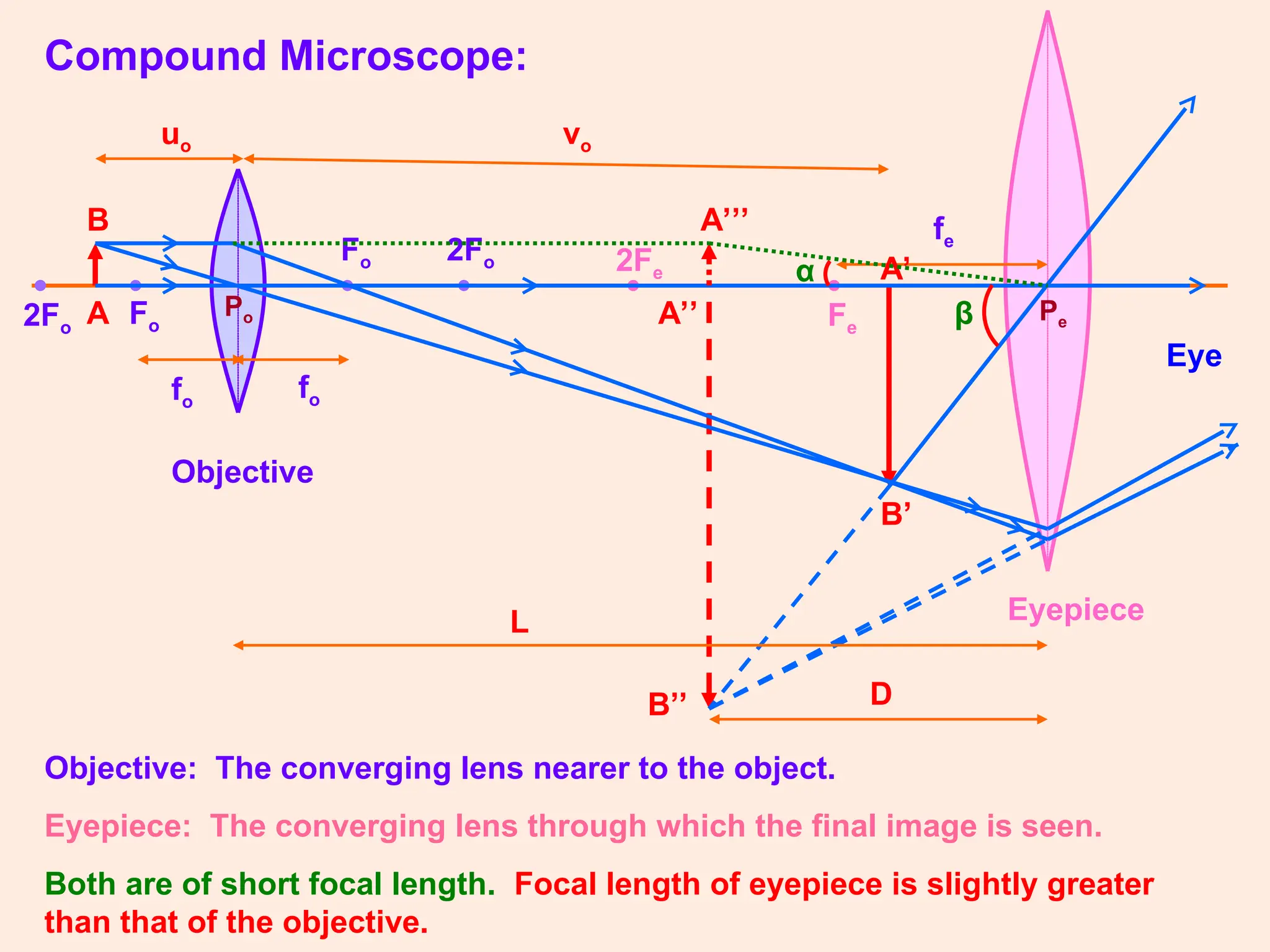
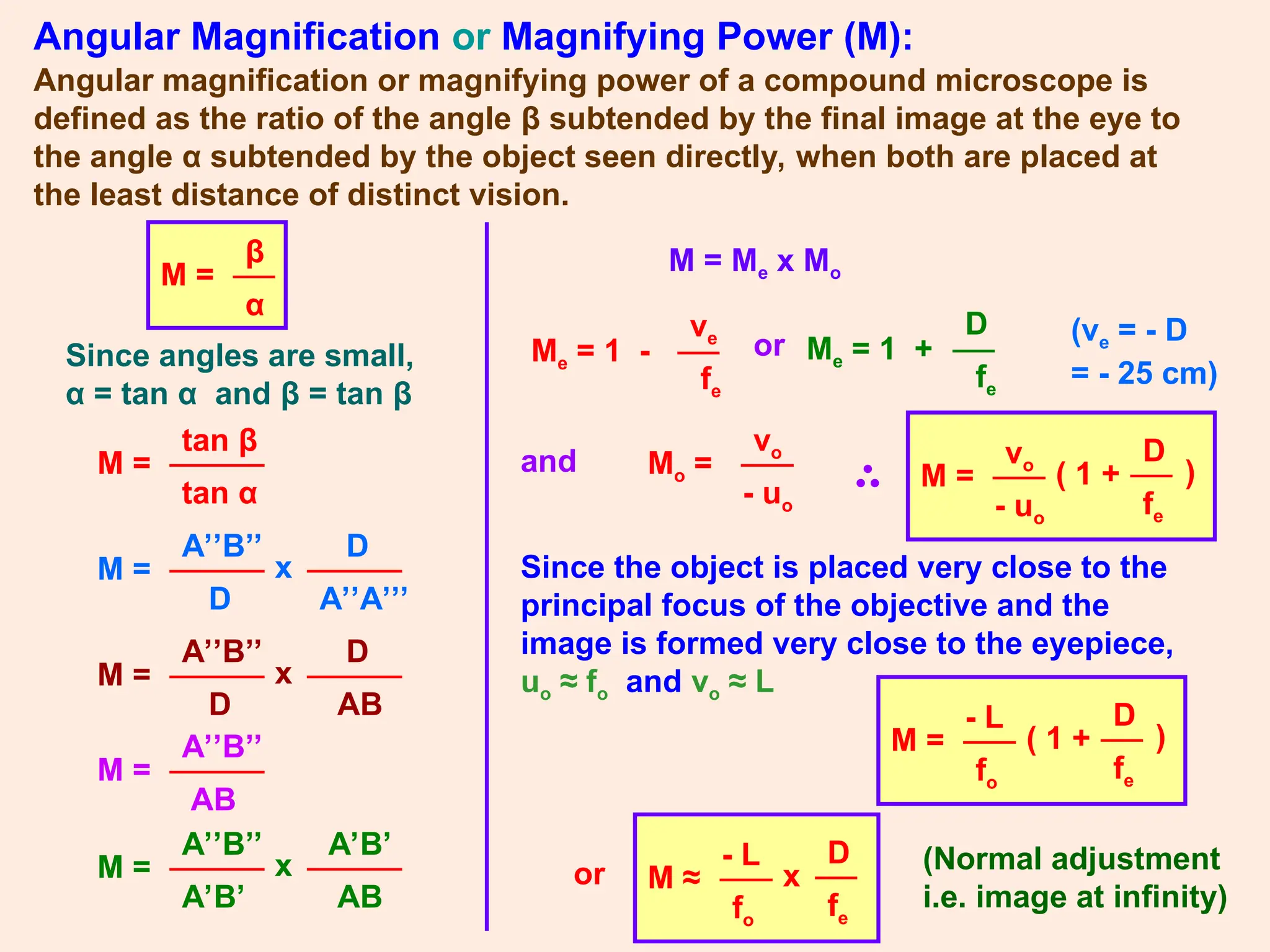
Compound Microscope:
• •
• • •
Fo
•
Fo
Fe
2Fe
2Fo
fo
fo
fe
Eye
A
B
A’
B’
A’’
B’’
Objective
Eyepiece
2Fo
Objective: The converging lens nearer to the object.
Eyepiece: The converging lens through which the final image is seen.
Both are of short focal length. Focal length of eyepiece is slightly greater
than that of the objective.
A’’’
α
β
D
L
vo
uo
Po Pe
Angular Magnification or Magnifying Power (M):
Angular magnification or magnifying power of a compound microscope is
defined as the ratio of the angle β subtended by the final image at the eye to
the angle α subtended by the object seen directly, when both are placed at
the least distance of distinct vision.
M =
β
α
Since angles are small,
α = tan α and β = tan β
M =
tan β
tan α
M =
A’’B’’
D
x
D
A’’A’’’
M =
A’’B’’
D
x
D
AB
M =
A’’B’’
AB
M =
A’’B’’
A’B’
x
A’B’
AB
M = Me x Mo
Me = 1 +
D
fe
and Mo =
vo
- uo
M =
vo
- uo
( 1 +
D
fe
)
Since the object is placed very close to the
principal focus of the objective and the
image is formed very close to the eyepiece,
uo ≈ fo and vo ≈ L
M =
- L
fo
( 1 +
D
fe
)
or M ≈
- L
fo
x
D
fe
(Normal adjustment
i.e. image at infinity)
Me = 1 -
ve
fe
or (ve = - D
= - 25 cm)
I
Image at
infinity
•
Fe
α
α
Fo
Objective
Eyepiece
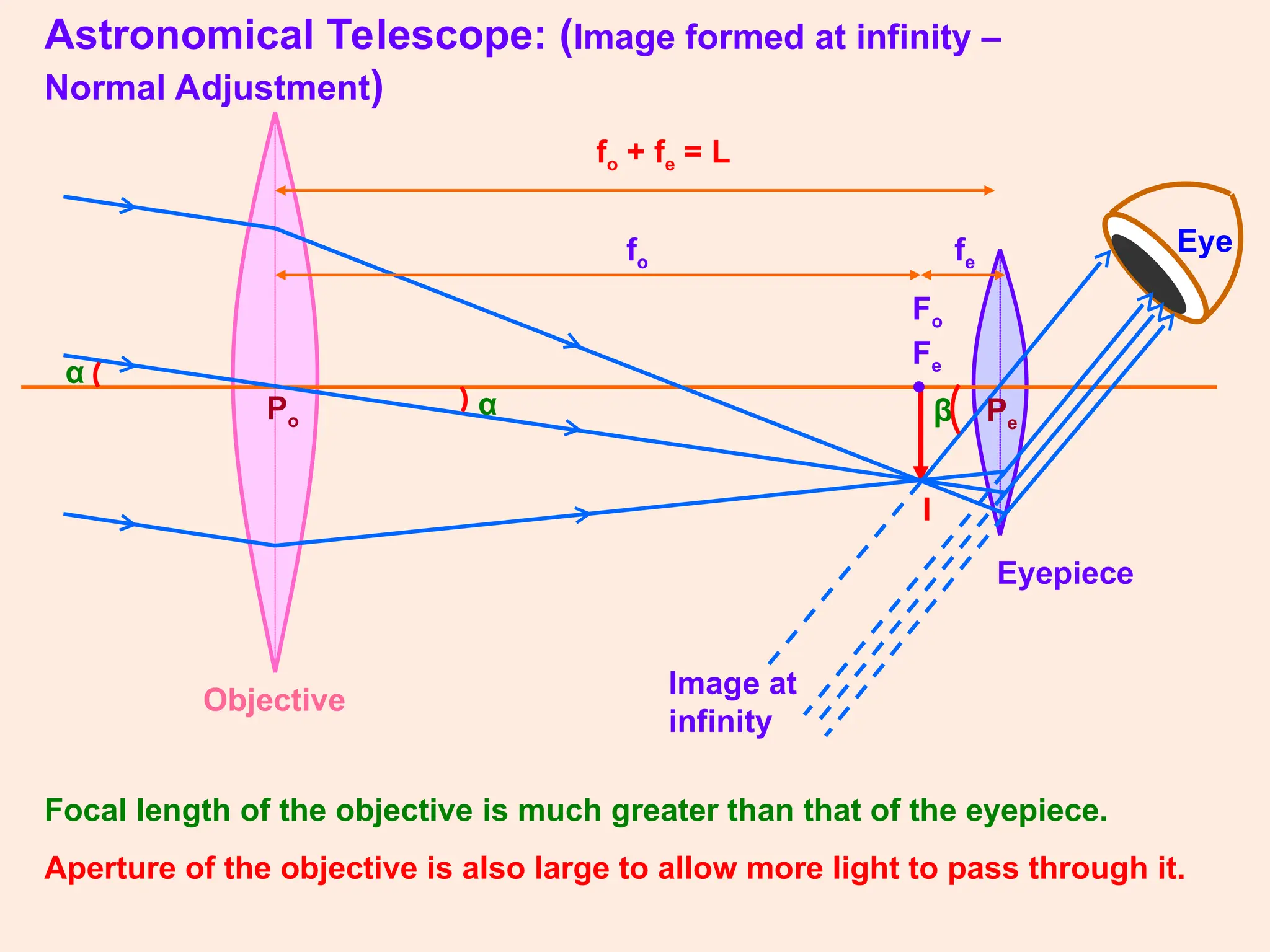
Astronomical Telescope: (Image formed at infinity –
Normal Adjustment)
fo fe
Po Pe
Eye
β
fo + fe = L
Focal length of the objective is much greater than that of the eyepiece.
Aperture of the objective is also large to allow more light to pass through it.
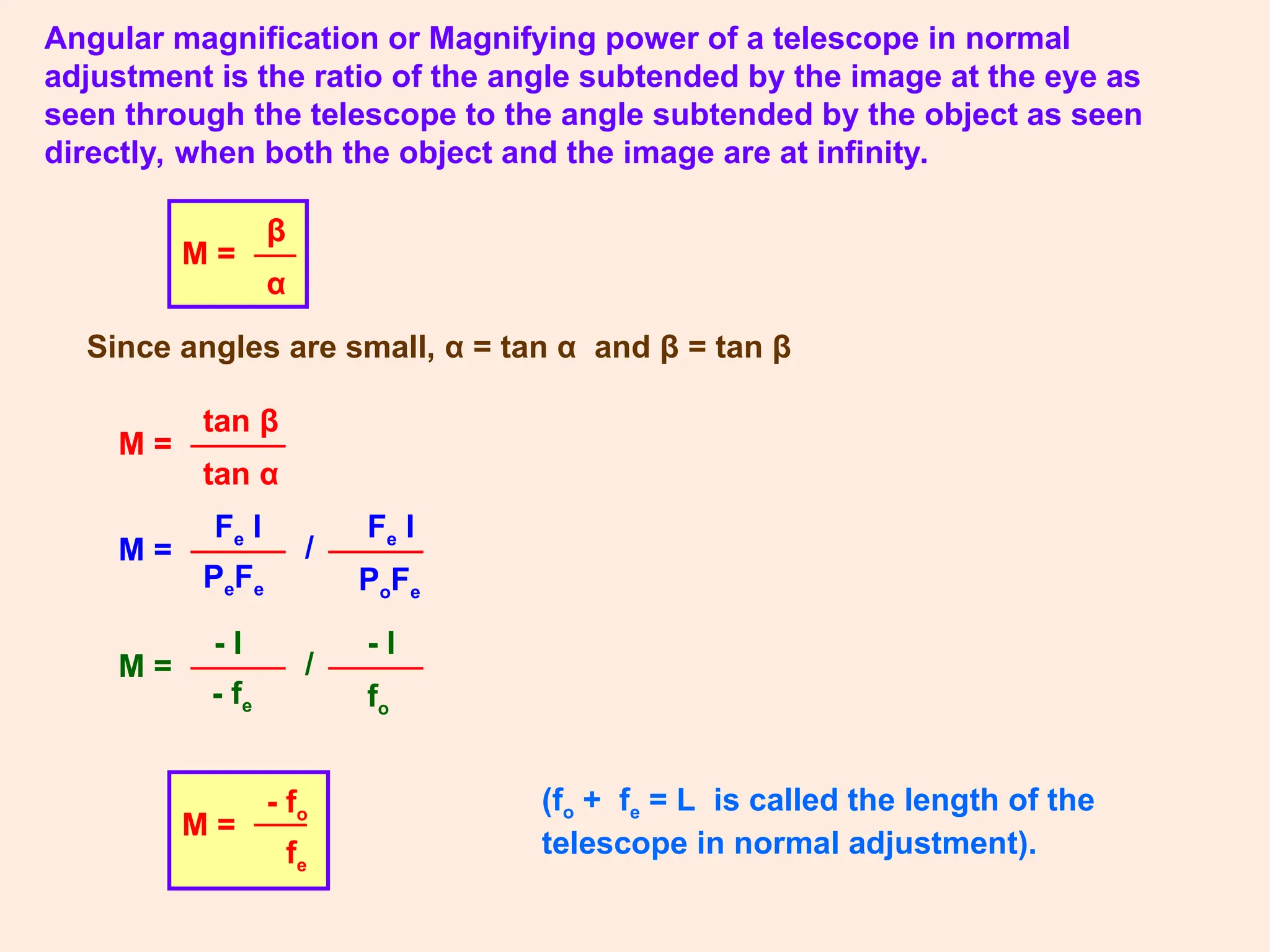
Angular magnification or Magnifying power of a telescope in normal
adjustment is the ratio of the angle subtended by the image at the eye as
seen through the telescope to the angle subtended by the object as seen
directly, when both the object and the image are at infinity.
M =
β
α
Since angles are small, α = tan α and β = tan β
M =
tan β
tan α
(fo + fe = L is called the length of the
telescope in normal adjustment).
M = /
Fe I
PoFe
Fe I
PeFe
M = /
- I
fo
- I
- fe
M =
- fo
fe
I
A
B
α
Objective
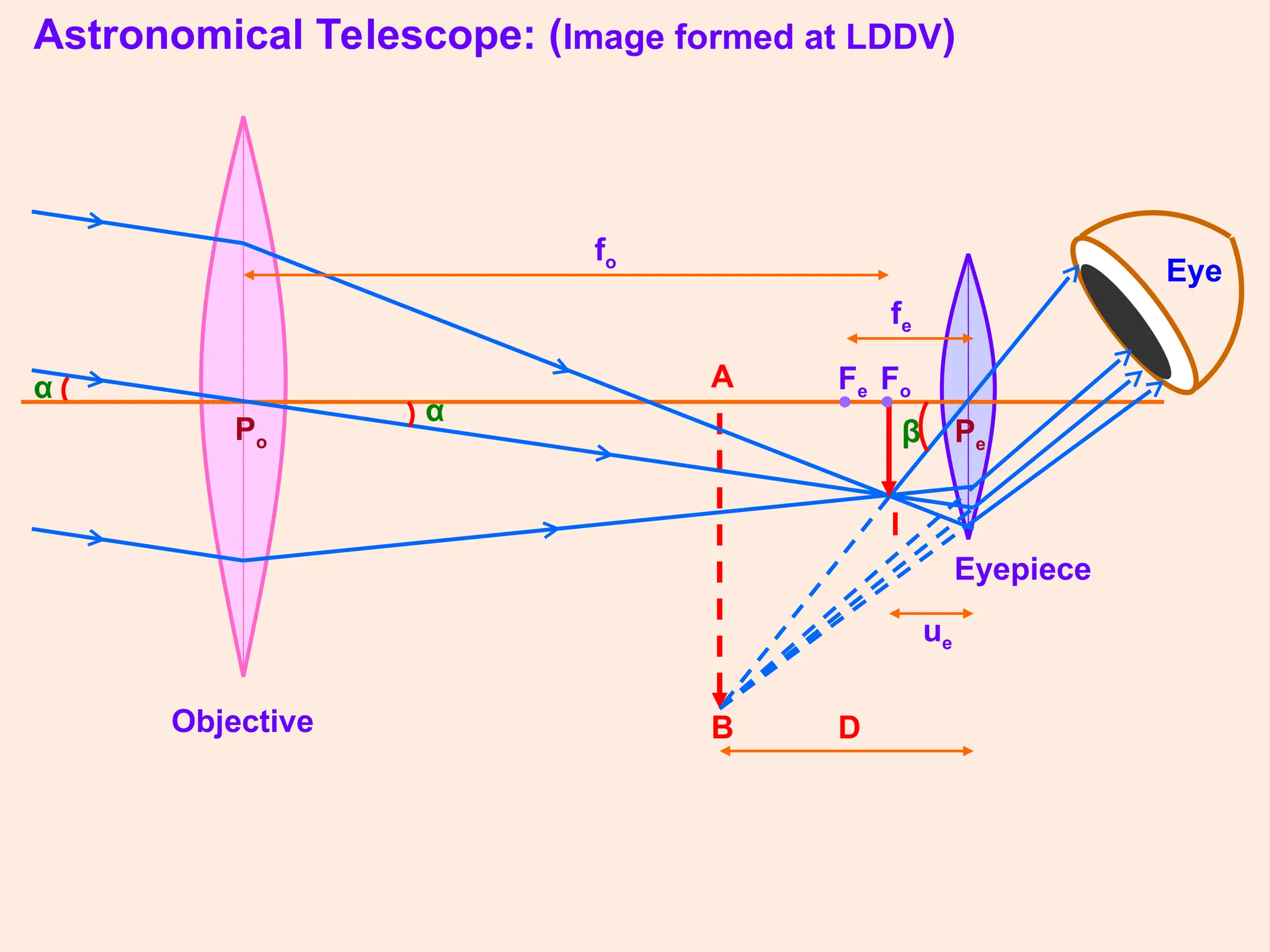
Astronomical Telescope: (Image formed at LDDV)
Po
Fo
Eye
Pe
β
fo
Fe
• •
fe
α
Eyepiece
ue
D
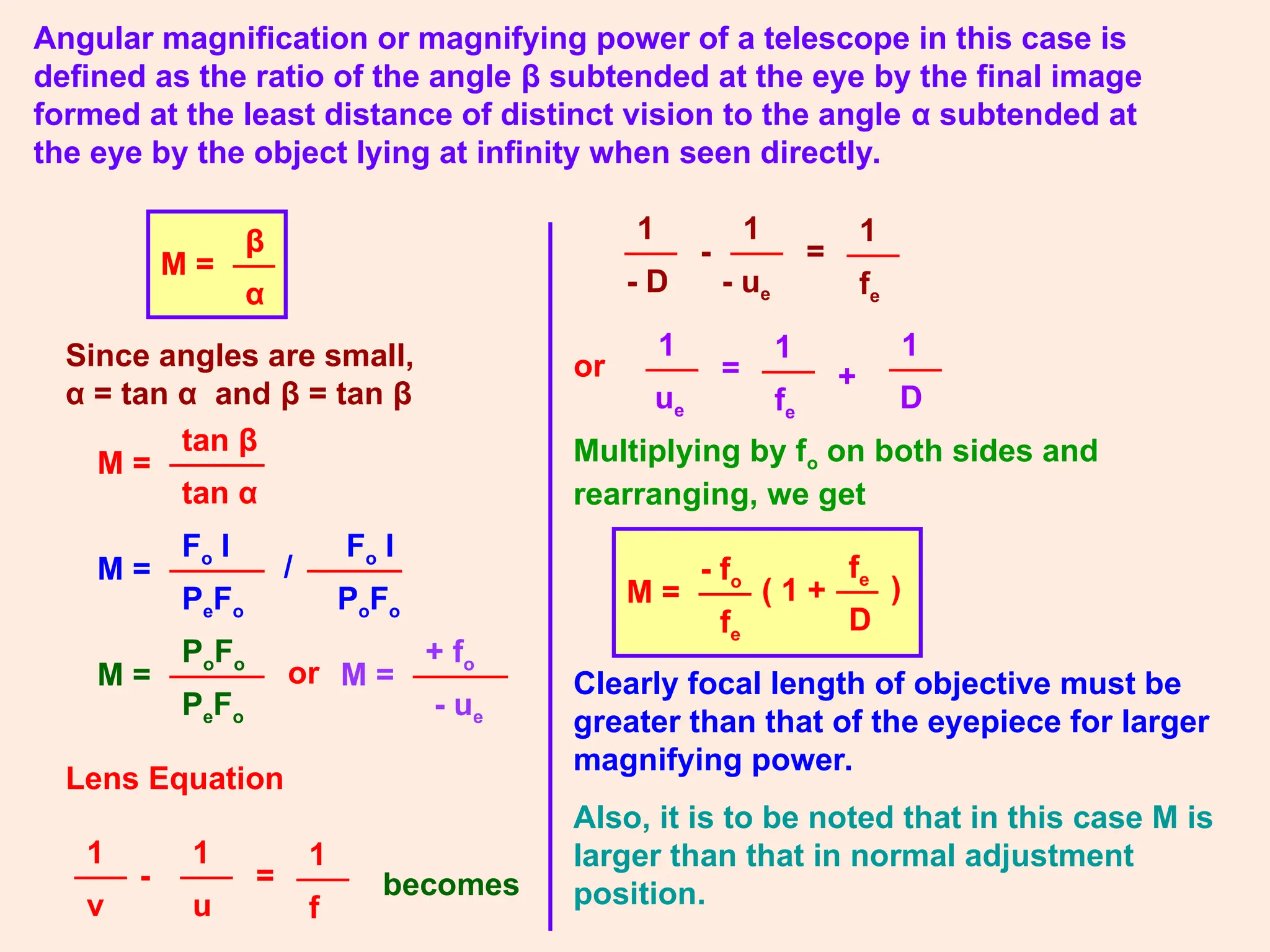
Angular magnification or magnifying power of a telescope in this case is
defined as the ratio of the angle β subtended at the eye by the final image
formed at the least distance of distinct vision to the angle α subtended at
the eye by the object lying at infinity when seen directly.
M =
β
α
Since angles are small,
α = tan α and β = tan β
M =
tan β
tan α
M =
Fo I
PeFo
/
Fo I
PoFo
M =
PoFo
PeFo
M =
+ fo
- ue
Multiplying by fo on both sides and
rearranging, we get
M =
- fo
fe
( 1 +
fe
D
)
-
1
u
1
f
1
v
=
-
1
- ue
1
fe
1
- D
=
or
Lens Equation
becomes
or +
1
ue
1
fe
1
D
=
Clearly focal length of objective must be
greater than that of the eyepiece for larger
magnifying power.
Also, it is to be noted that in this case M is
larger than that in normal adjustment
position.
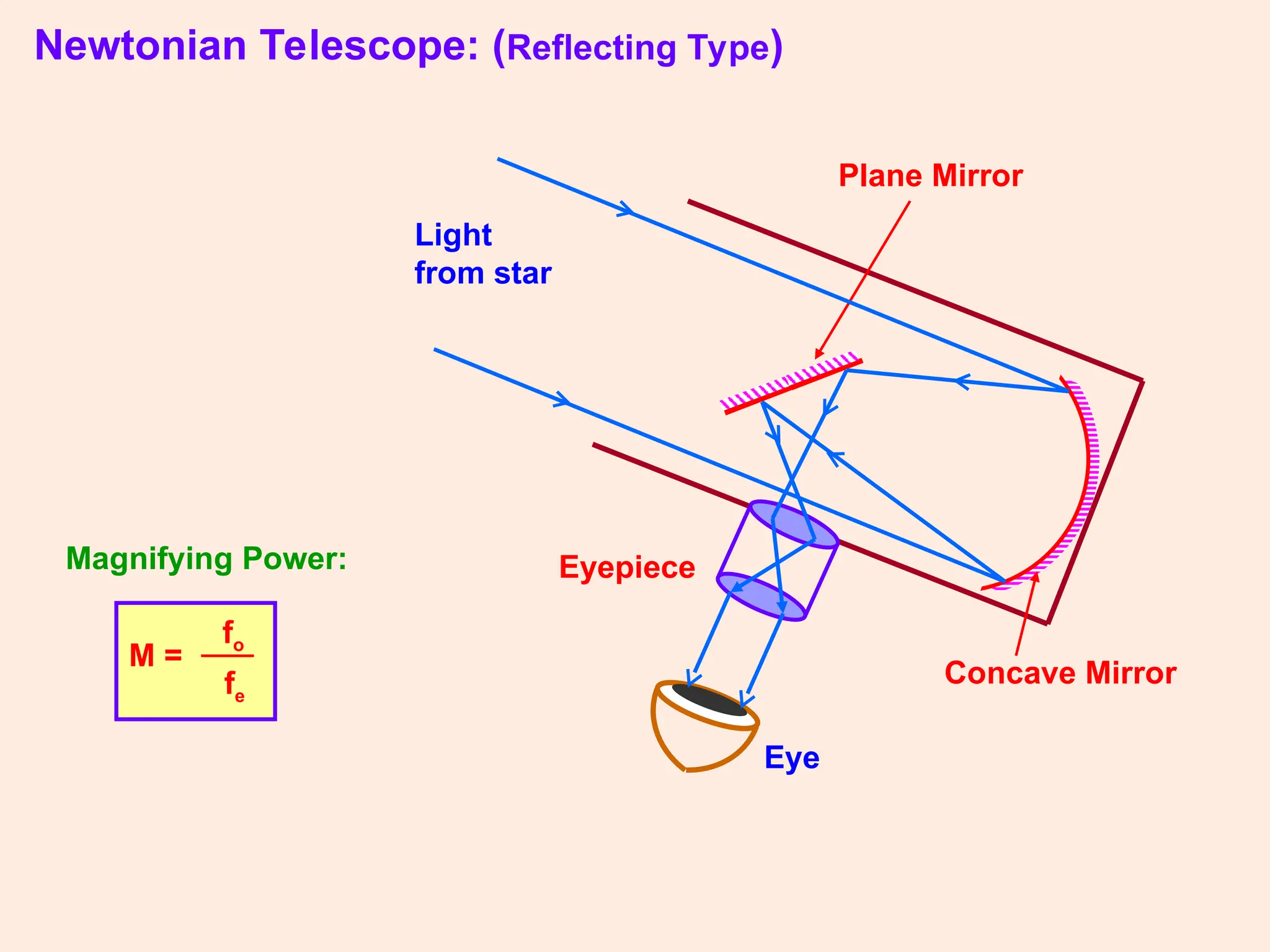
Newtonian Telescope: (Reflecting Type)
Concave Mirror
Plane Mirror
Eyepiece
Eye
Light
from star
M =
fo
fe
Magnifying Power:
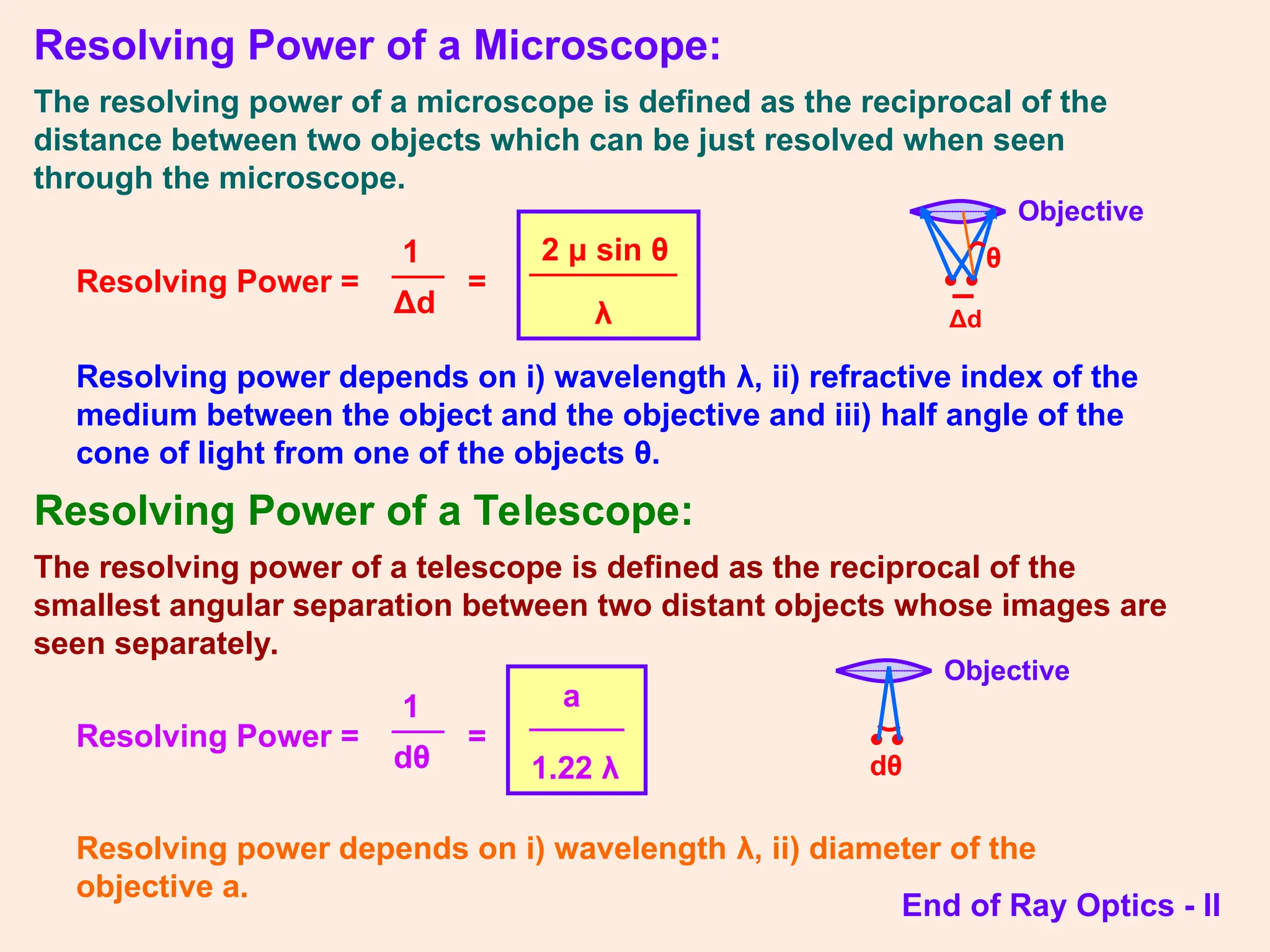
Resolving Power of a Microscope:
The resolving power of a microscope is defined as the reciprocal of the
distance between two objects which can be just resolved when seen
through the microscope.
Resolving Power =
1
Δd
=
2 μ sin θ
λ
Resolving power depends on i) wavelength λ, ii) refractive index of the
medium between the object and the objective and iii) half angle of the
cone of light from one of the objects θ.
Resolving Power of a Telescope:
The resolving power of a telescope is defined as the reciprocal of the
smallest angular separation between two distant objects whose images are
seen separately.
Resolving Power =
1
dθ
=
a
1.22 λ
Resolving power depends on i) wavelength λ, ii) diameter of the
objective a.
End of Ray Optics - II
• •
Δd
θ
Objective
• •
dθ
Objective

2_Ray_Optics_2_class 12 notes for students.ppt

  • 1.
    RAY OPTICS -II 1. Refraction through a Prism 2. Expression for Refractive Index of Prism 3. Dispersion 4. Angular Dispersion and Dispersive Power 5. Blue Colour of the Sky and Red Colour of the Sun 6. Compound Microscope 7. Astronomical Telescope (Normal Adjustment) 8. Astronomical Telescope (Image at LDDV) 9. Newtonian Telescope (Reflecting Type) 10.Resolving Power of Microscope and Telescope
  • 2.
    Refraction of Lightthrough Prism: A Refracting Surfaces Prism i δ A B C e O P Q r1 r2 N1 N2 D In quadrilateral APOQ, A + O = 180° …….(1) (since N1 and N2 are normal) In triangle OPQ, r1 + r2 + O = 180° …….(2) In triangle DPQ, δ = (i - r1) + (e - r2) δ = (i + e) – (r1 + r2) …….(3) From (1) and (2), A = r1 + r2 From (3), δ = (i + e) – (A) or i + e = A + δ μ Sum of angle of incidence and angle of emergence is equal to the sum of angle of prism and angle of deviation.
  • 3.
    Variation of angleof deviation with angle of incidence: δ i 0 i = e δm When angle of incidence increases, the angle of deviation decreases. At a particular value of angle of incidence the angle of deviation becomes minimum and is called ‘angle of minimum deviation’. At δm, i = e and r1 = r2 = r (say) After minimum deviation, angle of deviation increases with angle of incidence. Refractive Index of Material of Prism: A = r1 + r2 A = 2r r = A / 2 i + e = A + δ 2 i = A + δm i = (A + δm) / 2 According to Snell’s law, sin i μ = sin r1 sin i sin r = μ = sin (A + δm) 2 sin A 2
  • 4.
    Refraction by aSmall-angled Prism for Small angle of Incidence: sin i μ = sin r1 sin e μ = sin r2 and If i is assumed to be small, then r1, r2 and e will also be very small. So, replacing sines of the angles by angles themselves, we get i μ = r1 and e μ = r2 i + e = μ (r1 + r2) = μ A But i + e = A + δ So, A + δ = μ A or δ = A (μ – 1)
  • 5.
    Dispersion of WhiteLight through Prism: The phenomenon of splitting a ray of white light into its constituent colours (wavelengths) is called dispersion and the band of colours from violet to red is called spectrum (VIBGYOR). δr A B C D White light δv Cause of Dispersion: sin i μv = sin rv sin i μr = sin rr and Since μv > μr , rr > rv So, the colours are refracted at different angles and hence get separated. R O Y G B I V Screen N
  • 6.
    Dispersion can alsobe explained on the basis of Cauchy’s equation. μ = a + b λ2 c λ4 + (where a, b and c are constants for the material) Since λv < λ r , μv > μr But δ = A (μ – 1) Therefore, δv > δr So, the colours get separated with different angles of deviation. Violet is most deviated and Red is least deviated. Angular Dispersion: 1. The difference in the deviations suffered by two colours in passing through a prism gives the angular dispersion for those colours. 2. The angle between the emergent rays of any two colours is called angular dispersion between those colours. 3. It is the rate of change of angle of deviation with wavelength. (Φ = dδ / dλ) Φ = δv - δr or Φ = (μv – μr) A
  • 7.
    Dispersive Power: The dispersivepower of the material of a prism for any two colours is defined as the ratio of the angular dispersion for those two colours to the mean deviation produced by the prism. It may also be defined as dispersion per unit deviation. ω = Φ δ where δ is the mean deviation and δ = δv + δr 2 Also ω = δv - δr δ or ω = (μv – μr) A (μy – 1) A or ω = (μv – μr) (μy – 1) Scattering of Light – Blue colour of the sky and Reddish appearance of the Sun at Sun-rise and Sun-set: The molecules of the atmosphere and other particles that are smaller than the longest wavelength of visible light are more effective in scattering light of shorter wavelengths than light of longer wavelengths. The amount of scattering is inversely proportional to the fourth power of the wavelength. (Rayleigh Effect) Light from the Sun near the horizon passes through a greater distance in the Earth’s atmosphere than does the light received when the Sun is overhead. The correspondingly greater scattering of short wavelengths accounts for the reddish appearance of the Sun at rising and at setting. When looking at the sky in a direction away from the Sun, we receive scattered sunlight in which short wavelengths predominate giving the sky its characteristic bluish colour.
  • 8.
    Compound Microscope: • • •• • Fo • Fo Fe 2Fe 2Fo fo fo fe Eye A B A’ B’ A’’ B’’ Objective Eyepiece 2Fo Objective: The converging lens nearer to the object. Eyepiece: The converging lens through which the final image is seen. Both are of short focal length. Focal length of eyepiece is slightly greater than that of the objective. A’’’ α β D L vo uo Po Pe
  • 9.
    Angular Magnification orMagnifying Power (M): Angular magnification or magnifying power of a compound microscope is defined as the ratio of the angle β subtended by the final image at the eye to the angle α subtended by the object seen directly, when both are placed at the least distance of distinct vision. M = β α Since angles are small, α = tan α and β = tan β M = tan β tan α M = A’’B’’ D x D A’’A’’’ M = A’’B’’ D x D AB M = A’’B’’ AB M = A’’B’’ A’B’ x A’B’ AB M = Me x Mo Me = 1 + D fe and Mo = vo - uo M = vo - uo ( 1 + D fe ) Since the object is placed very close to the principal focus of the objective and the image is formed very close to the eyepiece, uo ≈ fo and vo ≈ L M = - L fo ( 1 + D fe ) or M ≈ - L fo x D fe (Normal adjustment i.e. image at infinity) Me = 1 - ve fe or (ve = - D = - 25 cm)
  • 10.
    I Image at infinity • Fe α α Fo Objective Eyepiece Astronomical Telescope:(Image formed at infinity – Normal Adjustment) fo fe Po Pe Eye β fo + fe = L Focal length of the objective is much greater than that of the eyepiece. Aperture of the objective is also large to allow more light to pass through it.
  • 11.
    Angular magnification orMagnifying power of a telescope in normal adjustment is the ratio of the angle subtended by the image at the eye as seen through the telescope to the angle subtended by the object as seen directly, when both the object and the image are at infinity. M = β α Since angles are small, α = tan α and β = tan β M = tan β tan α (fo + fe = L is called the length of the telescope in normal adjustment). M = / Fe I PoFe Fe I PeFe M = / - I fo - I - fe M = - fo fe
  • 12.
    I A B α Objective Astronomical Telescope: (Imageformed at LDDV) Po Fo Eye Pe β fo Fe • • fe α Eyepiece ue D
  • 13.
    Angular magnification ormagnifying power of a telescope in this case is defined as the ratio of the angle β subtended at the eye by the final image formed at the least distance of distinct vision to the angle α subtended at the eye by the object lying at infinity when seen directly. M = β α Since angles are small, α = tan α and β = tan β M = tan β tan α M = Fo I PeFo / Fo I PoFo M = PoFo PeFo M = + fo - ue Multiplying by fo on both sides and rearranging, we get M = - fo fe ( 1 + fe D ) - 1 u 1 f 1 v = - 1 - ue 1 fe 1 - D = or Lens Equation becomes or + 1 ue 1 fe 1 D = Clearly focal length of objective must be greater than that of the eyepiece for larger magnifying power. Also, it is to be noted that in this case M is larger than that in normal adjustment position.
  • 14.
    Newtonian Telescope: (ReflectingType) Concave Mirror Plane Mirror Eyepiece Eye Light from star M = fo fe Magnifying Power:
  • 15.
    Resolving Power ofa Microscope: The resolving power of a microscope is defined as the reciprocal of the distance between two objects which can be just resolved when seen through the microscope. Resolving Power = 1 Δd = 2 μ sin θ λ Resolving power depends on i) wavelength λ, ii) refractive index of the medium between the object and the objective and iii) half angle of the cone of light from one of the objects θ. Resolving Power of a Telescope: The resolving power of a telescope is defined as the reciprocal of the smallest angular separation between two distant objects whose images are seen separately. Resolving Power = 1 dθ = a 1.22 λ Resolving power depends on i) wavelength λ, ii) diameter of the objective a. End of Ray Optics - II • • Δd θ Objective • • dθ Objective