Definition of Surveillance
Anongoing, systematic collection, analysis, and
interpretation of health-related data essential to the
planning, implementation, and evaluation of public
health practice, closely integrated with the timely
dissemination of these data to those responsible for
prevention and control.
Source: WHO
2
3.
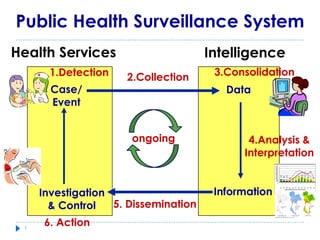
Public Health SurveillanceSystem
Health Services Intelligence
Case/
Event
Data
Investigation
& Control
2.Collection
4.Analysis &
Interpretation
5. Dissemination
ongoing
3
1.Detection
Information
3.Consolidation
6. Action
4.
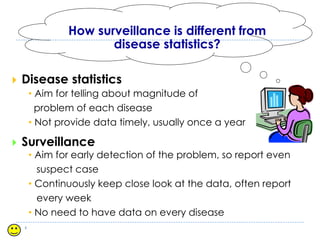
How surveillance isdifferent from
disease statistics?
Disease statistics
Surveillance
• Aim for telling about magnitude of
problem of each disease
• Not provide data timely, usually once a year
• Aim for early detection of the problem, so report even
suspect case
• Continuously keep close look at the data, often report
every week
• No need to have data on every disease
4
5.
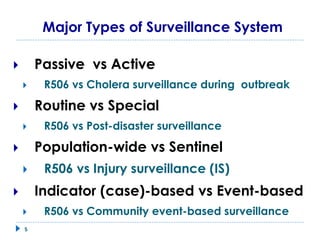
Major Types ofSurveillance System
Passive vs Active
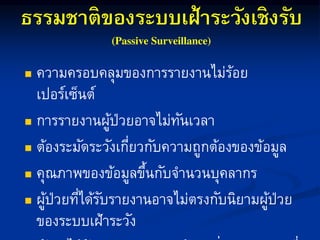
R506 vs Cholera surveillance during outbreak
Routine vs Special
R506 vs Post-disaster surveillance
Population-wide vs Sentinel
R506 vs Injury surveillance (IS)
Indicator (case)-based vs Event-based
R506 vs Community event-based surveillance
5
6.
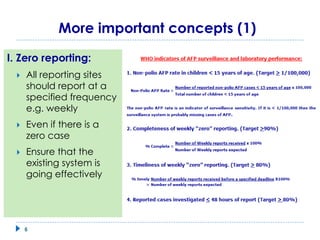
More important concepts(1)
I. Zero reporting:
All reporting sites
should report at a
specified frequency
e.g. weekly
Even if there is a
zero case
Ensure that the
existing system is
going effectively
6
7.
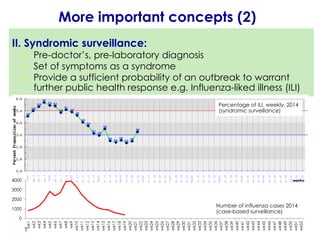
More important concepts(2)
II. Syndromic surveillance:
Pre-doctor’s, pre-laboratory diagnosis
Set of symptoms as a syndrome
Provide a sufficient probability of an outbreak to warrant
further public health response e.g. Influenza-liked illness (ILI)
0
1000
2000
3000
4000
wk1
wk2
wk3
wk4
wk5
wk6
wk7
wk8
wk9
wk10
wk11
wk12
wk13
wk14
wk15
wk16
wk17
wk18
wk19
wk20
wk21
wk22
wk23
wk24
wk25
wk26
wk27
wk28
wk29
wk30
wk31
wk32
wk33
wk34
wk35
wk36
wk37
wk38
wk39
wk40
wk41
wk42
wk43
wk44
wk45
wk46
wk47
wk48
wk49
wk50
wk51
wk52
Number of influenza cases 2014
(case-based surveillance)
Percentage of ILI, weekly, 2014
(syndromic surveillance)
7
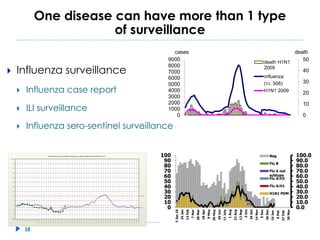
One disease canhave more than 1 type
of surveillance
Influenza surveillance
Influenza case report
ILI surveillance
Influenza sero-sentinel surveillance
0.0
10.0
20.0
30.0
40.0
50.0
60.0
70.0
80.0
90.0
100.0
0
10
20
30
40
50
60
70
80
90
100
3
Jan
10
24
Jan
14
Feb
7
Mar
28
Mar
18
Apr
9
May
30
May
20
Jun
11
July
1
Aug
22
Aug
12
Sep
3
Oct
24
Oct
14
Nov
5
Dec
26
Dec
16
Jan
6
Feb
27
Feb
20
Mar
Neg
Flu B
Flu A not
subtype
Flu A:H3
Flu A:H1
H1N1 PDM
0
10
20
30
40
50
0
1000
2000
3000
4000
5000
6000
7000
8000
9000
death
cases
death H1N1
2009
influenza
(รง. 506)
H1N1 2009
10
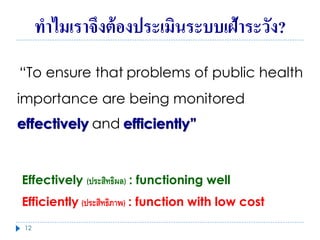
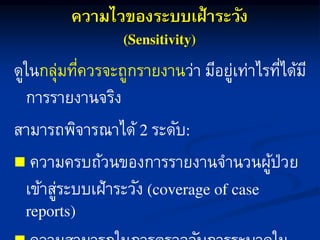
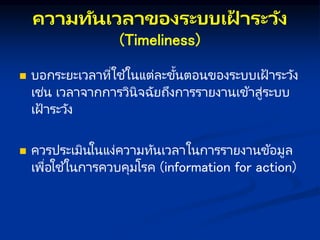
ทำไมเรำจึงต้องประเมินระบบเฝ้ำระวัง?
“To ensure thatproblems of public health
importance are being monitored
effectively and efficiently”
Effectively (ประสิทธิผล) : functioning well
Efficiently (ประสิทธิภาพ) : function with low cost
12
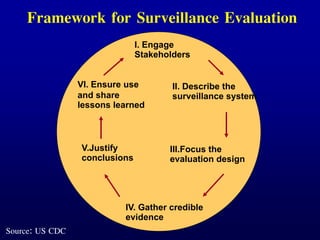
I. Engage
Stakeholders
II. Describethe
surveillance system
III.Focus the
evaluation design
IV. Gather credible
evidence
V.Justify
conclusions
VI. Ensure use
and share
lessons learned
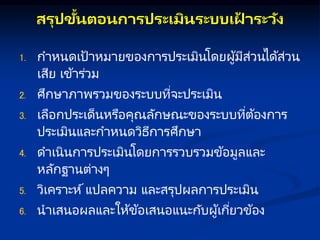
Framework for Surveillance Evaluation
Source: US CDC
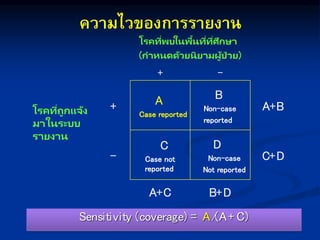
ความไวของการรายงาน
Sensitivity (coverage) =A/
(A+ C)
โรคที่พบในพื้นที่ที่ศึกษา
(กษ หนดด้วยนิย มผู้ป่ วย)
+ -
โรคที่ถูกษแจ้ง
ม ในระบบ
ร ยง น
+ A
Case reported
B
Non-case
reported
A+B
-
C
Case not
reported
D
Non-case
Not reported
C+D
A+C B+D
31.
Sensitivity of Chikungunyasurveillance report
Met case
definition
Not met case
definition
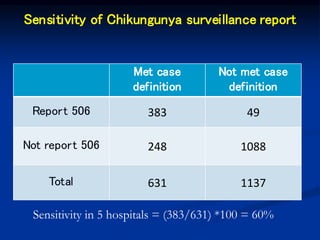
Report 506 383 49
Not report 506 248 1088
Total 631 1137
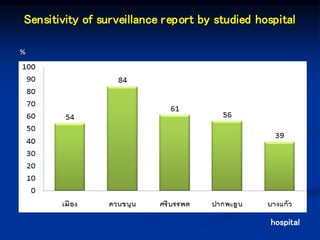
Sensitivity in 5 hospitals = (383/631) *100 = 60%
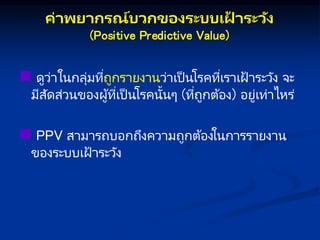
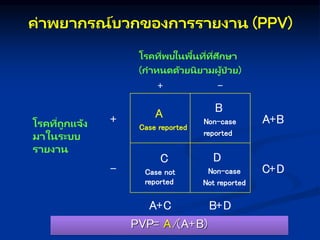
ค่ พย กษรณ์บวกษของกษรร ยง น (PPV)
PVP= A/(A+B)
โรคที่พบในพื้นที่ที่ศึกษา
(กษ หนดด้วยนิย มผู้ป่ วย)
+ -
โรคที่ถูกษแจ้ง
ม ในระบบ
ร ยง น
+ A
Case reported
B
Non-case
reported
A+B
-
C
Case not
reported
D
Non-case
Not reported
C+D
A+C B+D
36.
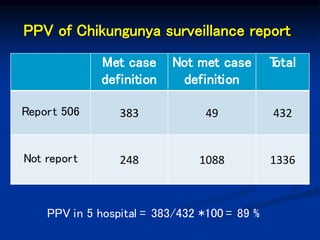
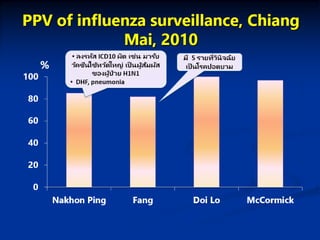
PPV of Chikungunyasurveillance report
Met case
definition
Not met case
definition
T
otal
Report 506 383 49 432
Not report 248 1088 1336
PPV in 5 hospital = 383/432 *100 = 89 %
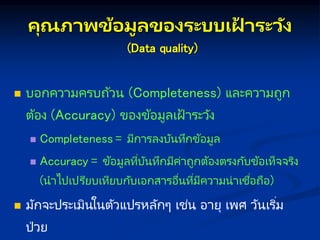
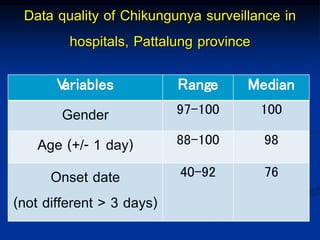
Data quality ofChikungunya surveillance in
hospitals, Pattalung province
V
ariables Range Median
Gender 97-100 100
Age (+/- 1 day) 88-100 98
Onset date
(not different > 3 days)
40-92 76
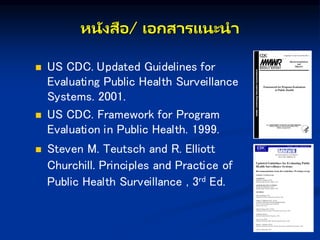
หนังสือ/ เอกษส รแนะน
US CDC. Updated Guidelines for
Evaluating Public Health Surveillance
Systems. 2001.
US CDC. Framework for Program
Evaluation in Public Health. 1999.
Steven M. Teutsch and R. Elliott
Churchill. Principles and Practice of
Public Health Surveillance , 3rd Ed.