RATE DISTORTION THEORY
INFORMATION THEORY
1
GROUP NO:21 Batch:T5
1)Rutuja R. Pawar(2013BIT006)
2)Samruddhi S. Kanhere(2013BIT018)
3)Pranali P. Rasal(2013BIT026)
INTRODUCTION
 Major Branch Of Information Theory
 There are 2 types of compression schemes.
1. Lossless compression
2. Lossy compression
 Provides the theoretical foundations for lossy data compression schemes
 Gives an analytical expression for how much compression can be achieved using
lossy compression methods
Information Theory
2
25-Apr-16
FOUNDER
CLAUDE SHANNON
Information Theory
3
25-Apr-16
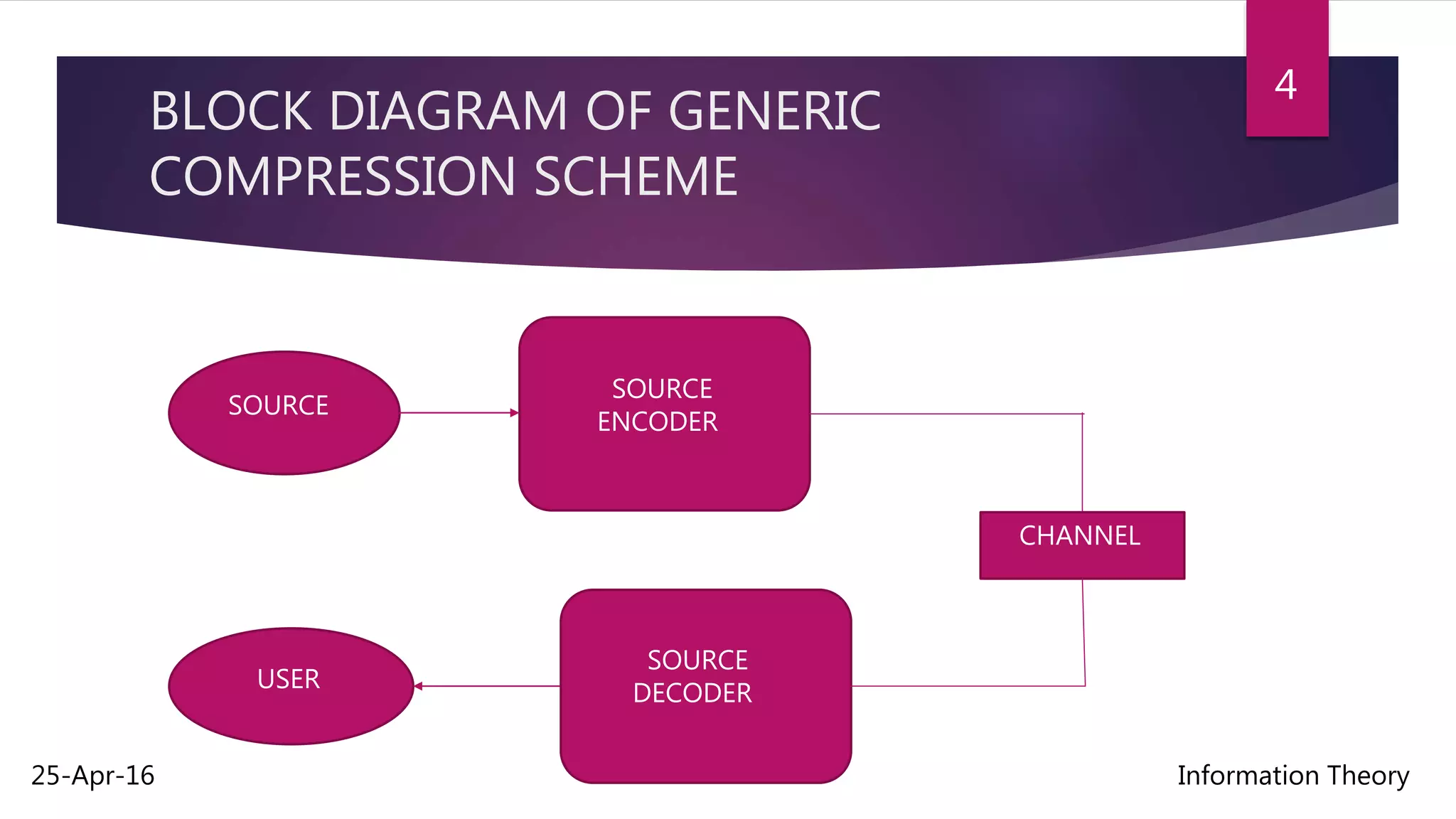
BLOCK DIAGRAM OF GENERIC
COMPRESSION SCHEME
4
 USER
SOURCE
SOURCE
ENCODER
SOURCE
DECODER
CHANNEL
25-Apr-16 Information Theory
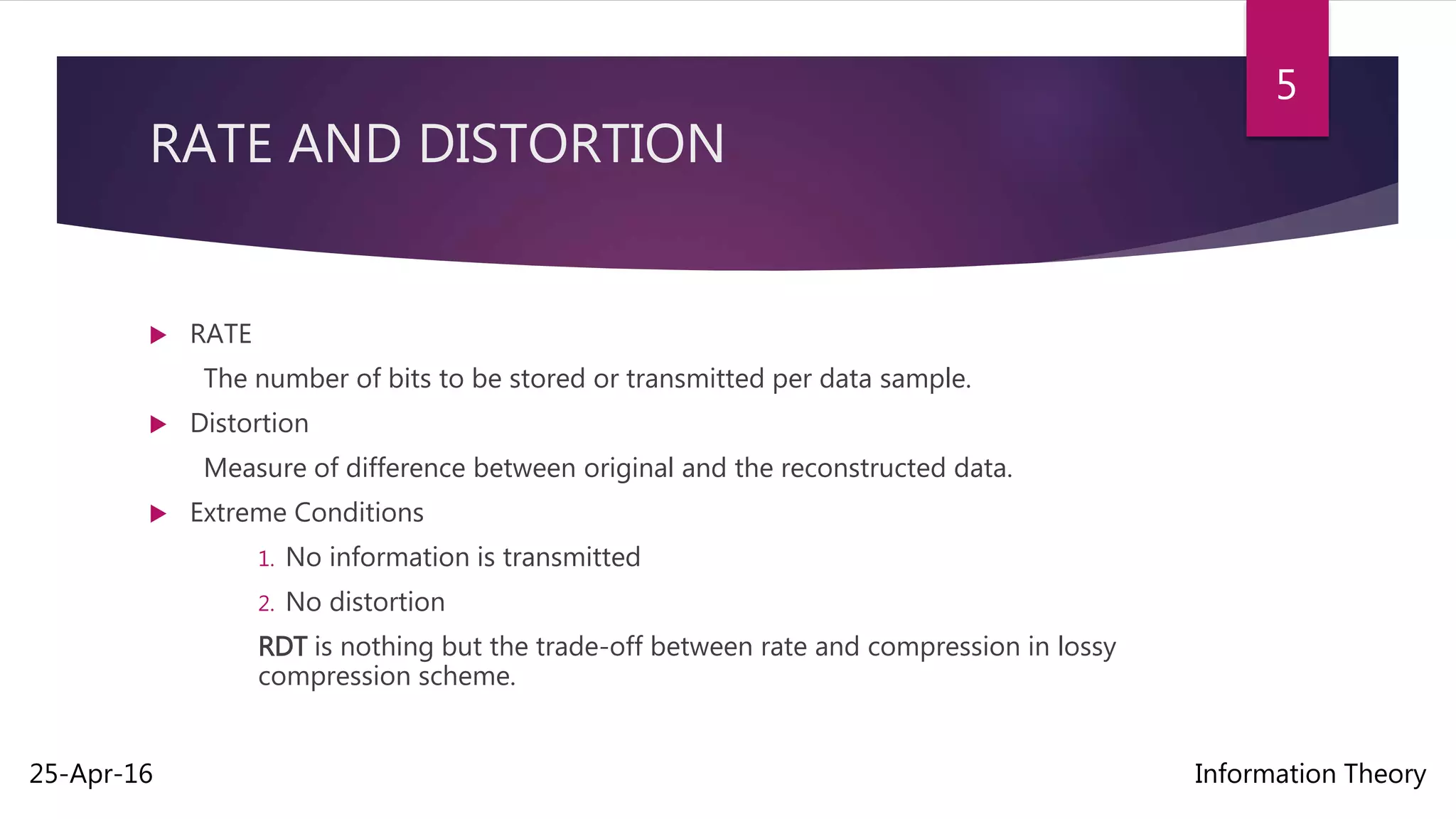
RATE AND DISTORTION
 RATE
The number of bits to be stored or transmitted per data sample.
 Distortion
Measure of difference between original and the reconstructed data.
 Extreme Conditions
1. No information is transmitted
2. No distortion
RDT is nothing but the trade-off between rate and compression in lossy
compression scheme.
5
25-Apr-16 Information Theory
GOAL
MINIMIZE
AMOUNT
OF DISTORTION
LOWEST RATE
POSSIBLE
6
25-Apr-16 Information Theory
MEASURING CLOSENESS FOR
RECONSTRUCTED DATA
7
1) Humans:
• Accurate
• Not practical
• Not useful in mathematical design approaches
2) Quantitative Metrics:
• Mathematical design approach
• Not accurate
25-Apr-16
25-Apr-16 Information Theory
THEORY
 Given a source distribution and the distortion measure,
 What is the minimum expected distortion achievable at
particular rate?
OR
 What is the minimum rate required to achieve particular
distortion?
8
25-Apr-16 Information Theory
FINDING DISTORTION
1)Squared Measure
d(x,y) = (x-y)^2
2)Absolute Difference
d(x,y) = |x-y|
We use average measures for calculations.
1)Mean squared error
2)Avg. of absolute difference(Image compression algo.)
9
25-Apr-16 Information Theory
RATE DISTORTION FUNCTION
10
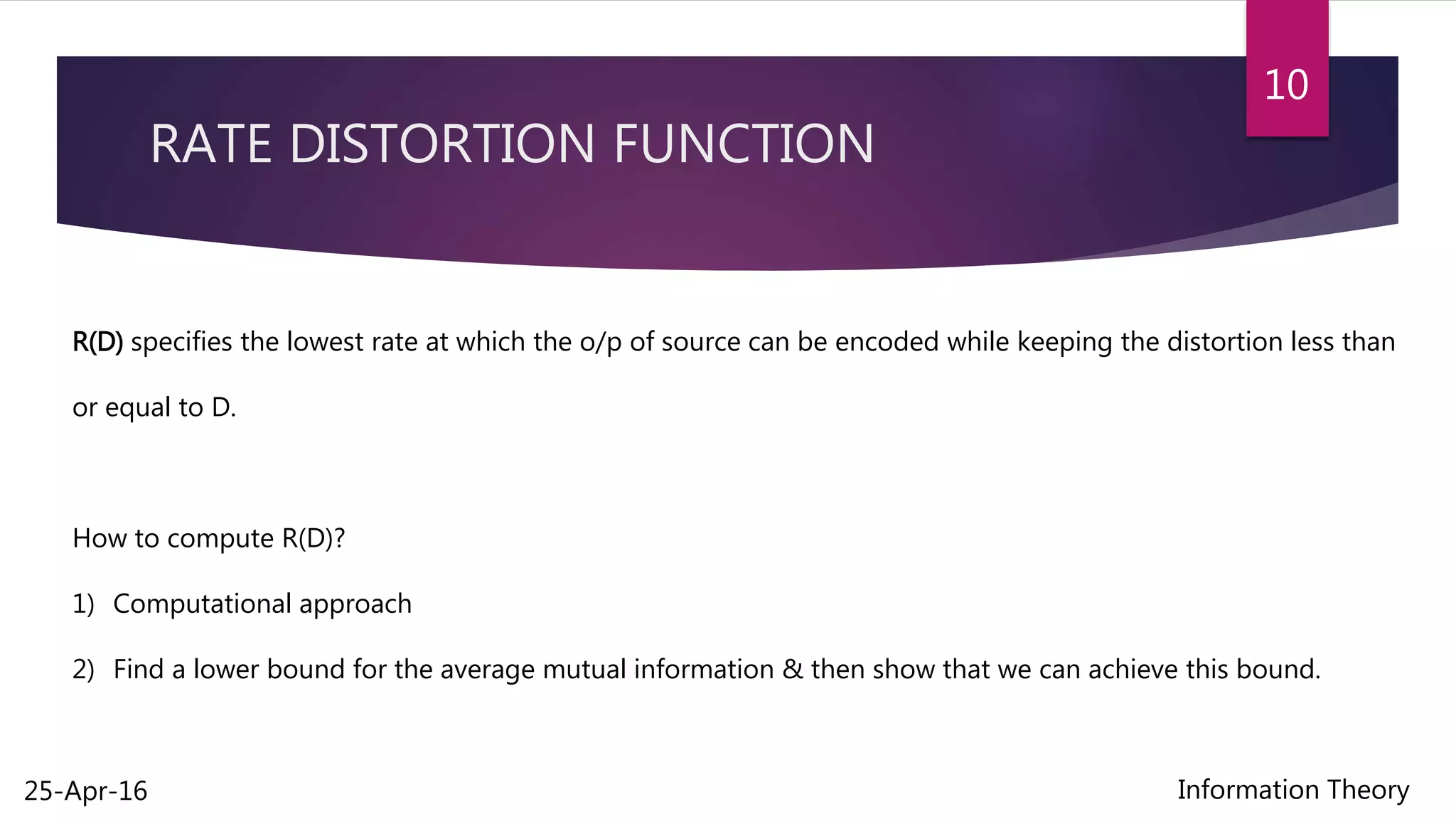
R(D) specifies the lowest rate at which the o/p of source can be encoded while keeping the distortion less than
or equal to D.
How to compute R(D)?
1) Computational approach
2) Find a lower bound for the average mutual information & then show that we can achieve this bound.
25-Apr-16 Information Theory
RATE DISTORTION FUNCTION
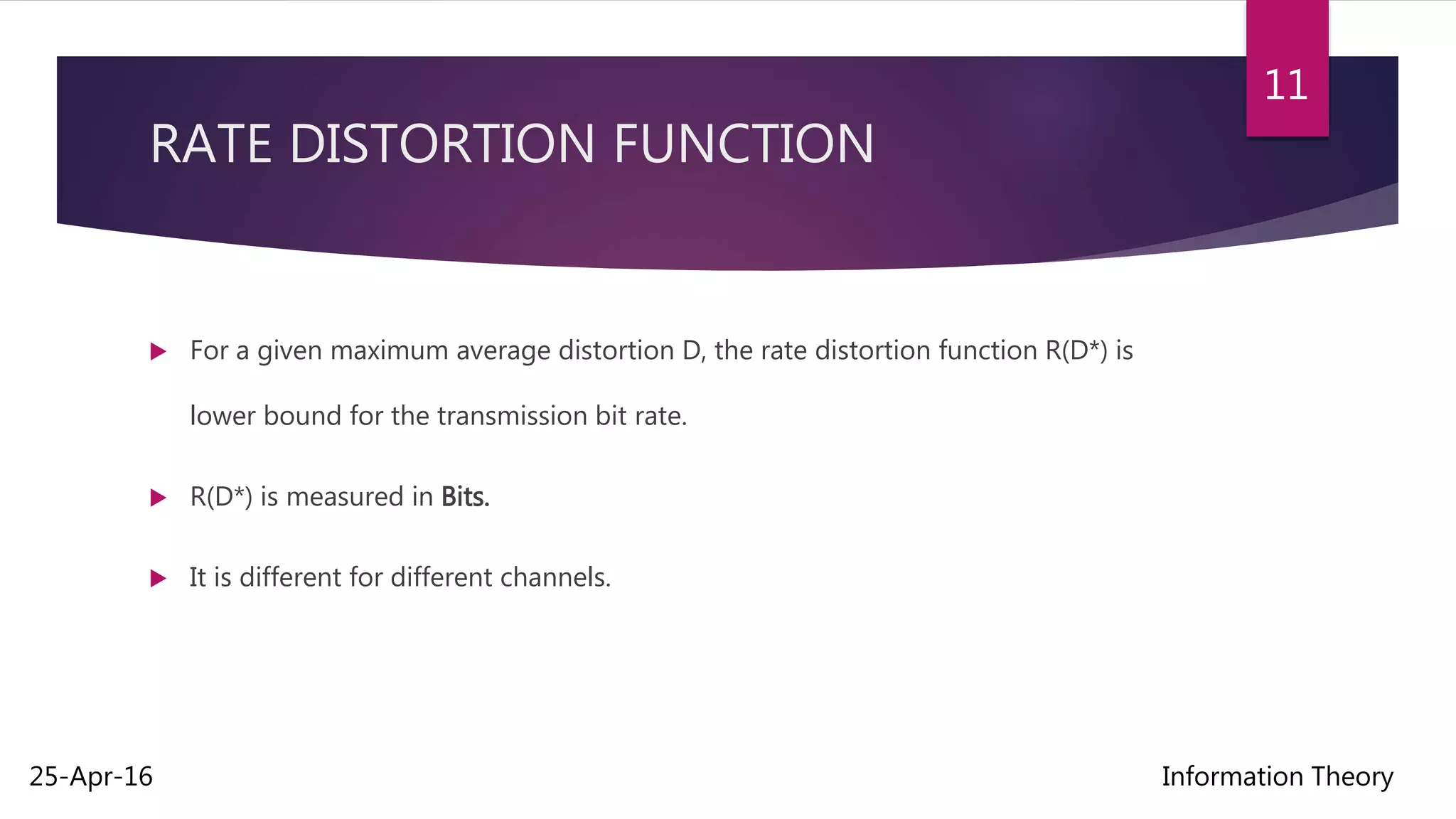
 For a given maximum average distortion D, the rate distortion function R(D*) is
lower bound for the transmission bit rate.
 R(D*) is measured in Bits.
 It is different for different channels.
11
25-Apr-16 Information Theory
THANK YOU!!!
12

Rate distortion theory

  • 1.
    RATE DISTORTION THEORY INFORMATIONTHEORY 1 GROUP NO:21 Batch:T5 1)Rutuja R. Pawar(2013BIT006) 2)Samruddhi S. Kanhere(2013BIT018) 3)Pranali P. Rasal(2013BIT026)
  • 2.
    INTRODUCTION  Major BranchOf Information Theory  There are 2 types of compression schemes. 1. Lossless compression 2. Lossy compression  Provides the theoretical foundations for lossy data compression schemes  Gives an analytical expression for how much compression can be achieved using lossy compression methods Information Theory 2 25-Apr-16
  • 3.
  • 4.
    BLOCK DIAGRAM OFGENERIC COMPRESSION SCHEME 4  USER SOURCE SOURCE ENCODER SOURCE DECODER CHANNEL 25-Apr-16 Information Theory
  • 5.
    RATE AND DISTORTION RATE The number of bits to be stored or transmitted per data sample.  Distortion Measure of difference between original and the reconstructed data.  Extreme Conditions 1. No information is transmitted 2. No distortion RDT is nothing but the trade-off between rate and compression in lossy compression scheme. 5 25-Apr-16 Information Theory
  • 6.
  • 7.
    MEASURING CLOSENESS FOR RECONSTRUCTEDDATA 7 1) Humans: • Accurate • Not practical • Not useful in mathematical design approaches 2) Quantitative Metrics: • Mathematical design approach • Not accurate 25-Apr-16 25-Apr-16 Information Theory
  • 8.
    THEORY  Given asource distribution and the distortion measure,  What is the minimum expected distortion achievable at particular rate? OR  What is the minimum rate required to achieve particular distortion? 8 25-Apr-16 Information Theory
  • 9.
    FINDING DISTORTION 1)Squared Measure d(x,y)= (x-y)^2 2)Absolute Difference d(x,y) = |x-y| We use average measures for calculations. 1)Mean squared error 2)Avg. of absolute difference(Image compression algo.) 9 25-Apr-16 Information Theory
  • 10.
    RATE DISTORTION FUNCTION 10 R(D)specifies the lowest rate at which the o/p of source can be encoded while keeping the distortion less than or equal to D. How to compute R(D)? 1) Computational approach 2) Find a lower bound for the average mutual information & then show that we can achieve this bound. 25-Apr-16 Information Theory
  • 11.
    RATE DISTORTION FUNCTION For a given maximum average distortion D, the rate distortion function R(D*) is lower bound for the transmission bit rate.  R(D*) is measured in Bits.  It is different for different channels. 11 25-Apr-16 Information Theory
  • 12.