OUR TEAM:-
• Akshay Nair
• Pawan Patel
• Priyanka Nayak
• Sharvari Chalke
• Jotiram Pawar
• Sonali
• Nishar Khaja
• Saket Choudhary
Content
• Introduction
• History
• Vision & Mission
• Product
• Process
• Plant Location
• Plant Layout
• Challenges
• Competitors
• Marketing
•Sales & Distribution
• Supply-Chain
Management
•Finance
• Social Responsibilities
• Milestone
• Conclusion
Brief Intro of TATA MOTORS
 World’s today is fast paced, intermediate, world where people are
asking for new answer mobility, India’s leading automotive company
Tata motors is surging ahead with innovative solution.
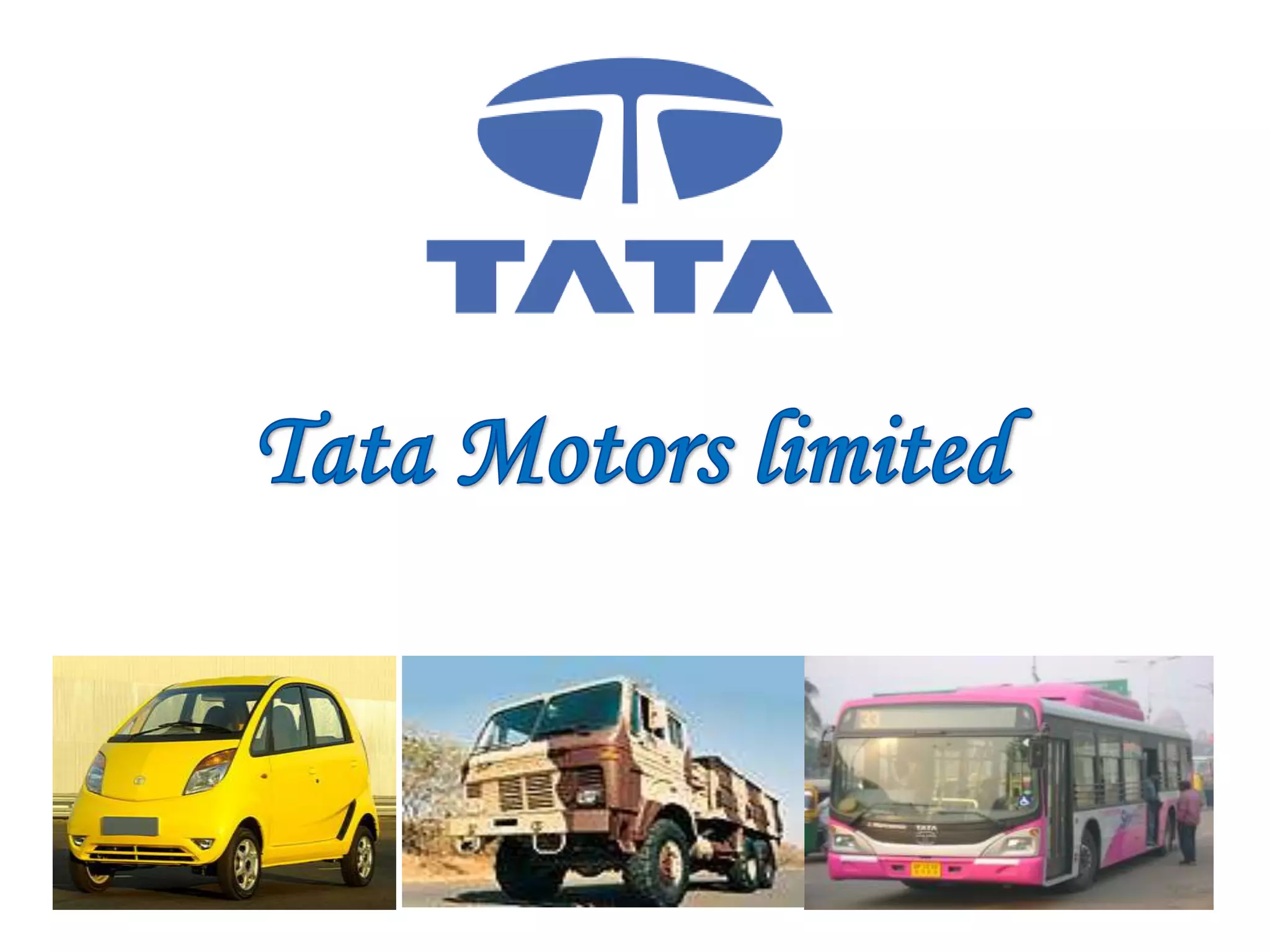
Tata Motors Limited is India's largest automobile company. It is the
leader in commercial vehicles in each segment, and among the top
three in passenger vehicles with winning products in the compact,
midsize car and utility vehicle segments.
The company is the world's fourth largest truck manufacturer, and the
world's second largest bus manufacturer.
Tata Motors has been at the forefront of the Indian automobile
industry's anti-pollution efforts by introducing cleaner engines.
Therefore Tata Motors Limited is always committed to understanding
customer needs.
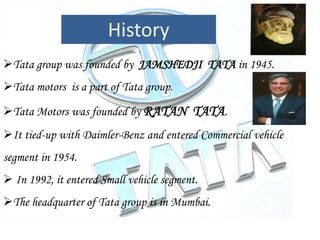
Tata group was founded by JAMSHEDJI TATA in 1945.
Tata motors is a part of Tata group.
Tata Motors was founded by RATAN TATA.
It tied-up with Daimler-Benz and entered Commercial vehicle
segment in 1954.
 In 1992, it entered Small vehicle segment.
The headquarter of Tata group is in Mumbai.
History
“Most admired by our customers,
employees, business partners and
shareholders for the experience and
value they enjoy from being with
us.”
“To be passionate in anticipating and
providing the best vehicles and
experiences that excite our
customers globally.”
Product
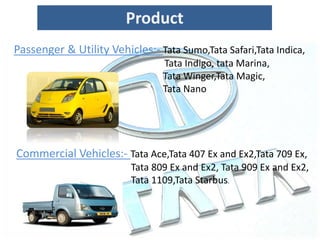
Passenger & Utility Vehicles:- Tata Sumo,Tata Safari,Tata Indica,
Tata Indigo, tata Marina,
Tata Winger,Tata Magic,
Tata Nano
Commercial Vehicles:- Tata Ace,Tata 407 Ex and Ex2,Tata 709 Ex,
Tata 809 Ex and Ex2, Tata 909 Ex and Ex2,
Tata 1109,Tata Starbus.
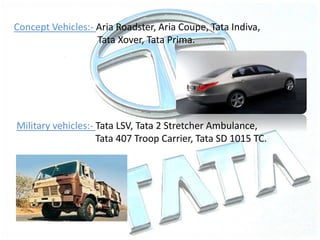
Concept Vehicles:- Aria Roadster, Aria Coupe, Tata Indiva,
Tata Xover, Tata Prima.
Military vehicles:- Tata LSV, Tata 2 Stretcher Ambulance,
Tata 407 Troop Carrier, Tata SD 1015 TC.
Production Process
• The Passenger Car Division in 'K' block
executes the entire process of car
manufacture over five shops –
Engine shop
Transmission shop
Press and body shops
Paint shop
The trim and final assembly shop.
• The shops are fully automated ensuring that
there is minimal chance for error in the
manufacturing processes. After the car is
completely assembled, it goes through several
checks like
Wheel alignment
Sideslip test
Brake test
Shower test
& A short test run
before it is ready for dispatch. All systems such as
materials management, maintenance and other
activities are computerized, enabling smooth
operations and minimum inventory needs
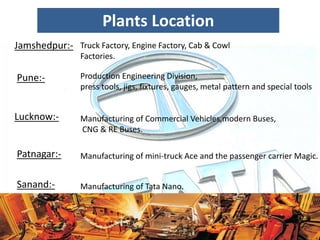
Plants Location
Jamshedpur:- Truck Factory, Engine Factory, Cab & Cowl
Factories.
Pune:- Production Engineering Division,
press tools, jigs, fixtures, gauges, metal pattern and special tools
Lucknow:- Manufacturing of Commercial Vehicles,modern Buses,
CNG & RE Buses.
Patnagar:- Manufacturing of mini-truck Ace and the passenger carrier Magic.
Sanand:- Manufacturing of Tata Nano.
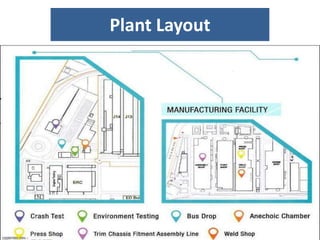
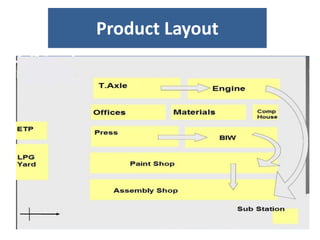
Plant Layout
Product Layout
Challenges
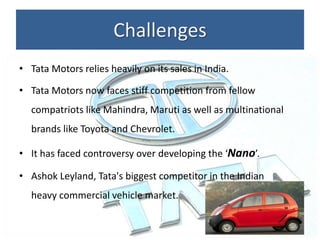
• Tata Motors relies heavily on its sales in India.
• Tata Motors now faces stiff competition from fellow
compatriots like Mahindra, Maruti as well as multinational
brands like Toyota and Chevrolet.
• It has faced controversy over developing the ‘Nano’.
• Ashok Leyland, Tata's biggest competitor in the Indian
heavy commercial vehicle market.
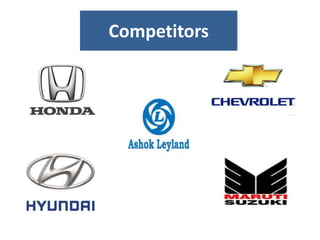
Competitors
Marketing
• Marketing plan is feature plans for an
organization, for proper marketing plan
organization should know about present
marketing conduction. on that basis they can
forecast there feature plans.
• Until now Tata motors use different marketing
plans for there automobiles. Each and every year
they launch new automobiles with new deign and
features with different price. Mainly they focus
midsize car which is affordable for lower income
people.
Sale & Distribution
• This is the largest distribution network for automobiles
in India. distribution network of Tata has been a key
factor in success in the domestic market.
• In addition to the dealer outlets, we also have a strong
after sales service network comprising over 650
authorized service centers.
• A substantial number of our vehicles are sold directly
to dealers from our regional sales offices. We provide
cash incentives to better performing dealers. We sell
government and military vehicles as well as a small
number of other vehicles directly to customers.
Supply-Chain Management
• Tata simply "focused on the supply chain" to meet the price
expectations.
• The cost cutting strategy of Tata was their distribution
channel: Hub & Spoke
• City Dealers act as hubs ▫ Reach to semi-urban and rural
areas – spokes
• 600 retail outlets
• Supplier cluster around the plant in the same vendor park
• Open Distribution – Mobilize large no. of 3PL to reach rural
areas
• Increased modularity in products and processes
• Built long term personal relationships with vendors
• Innovation in manufacturing processes done locally to
avoid extra costs
Finance
• Finance plays an important role in production
process.
• Finance function integrates all other functions
or operations of the company.
• Without finance function the company can't
run, do its statutory compliances, achieve its
objects and meet stakeholder's expectations.
Social Responsibility
•“A Company that cares about the future”
•Committed to corporate social responsibility.
•Signed the United Nations Global Compact.
• The two main sustainable strategies at Tata Motors:
Pollution Prevention (P2) Resource Recovery (R2)
• Cleaner Engines
• Advanced emission testing labs
• Developing alternate search engines.
Milestones
Tata Motors enters Bangladesh’s new car
market
Tata Ace races through the one-million
mark in just 2,680 days.
Tata Safari Storme, the Real SUV, hits the
road
Launch of PT Tata Motors Indonesia
Tata Motors plant at Dharwad comes on
stream
Tata Motors enters into distribution
agreement in Myanmar and Launch of Tata
Conclusion
• Tata Motors has been at the forefront of the Indian automobile
industry's anti-pollution efforts by introducing cleaner engines.
Therefore Tata Motors Limited is always committed to
understanding customer needs.
• The name of TATA itself says it all –
 Trust
 Acceptability
 Transparency
 Accountability
Tata motors

Tata motors

  • 2.
    OUR TEAM:- • AkshayNair • Pawan Patel • Priyanka Nayak • Sharvari Chalke • Jotiram Pawar • Sonali • Nishar Khaja • Saket Choudhary
  • 3.
    Content • Introduction • History •Vision & Mission • Product • Process • Plant Location • Plant Layout • Challenges • Competitors • Marketing •Sales & Distribution • Supply-Chain Management •Finance • Social Responsibilities • Milestone • Conclusion
  • 4.
    Brief Intro ofTATA MOTORS  World’s today is fast paced, intermediate, world where people are asking for new answer mobility, India’s leading automotive company Tata motors is surging ahead with innovative solution. Tata Motors Limited is India's largest automobile company. It is the leader in commercial vehicles in each segment, and among the top three in passenger vehicles with winning products in the compact, midsize car and utility vehicle segments. The company is the world's fourth largest truck manufacturer, and the world's second largest bus manufacturer. Tata Motors has been at the forefront of the Indian automobile industry's anti-pollution efforts by introducing cleaner engines. Therefore Tata Motors Limited is always committed to understanding customer needs.
  • 5.
    Tata group wasfounded by JAMSHEDJI TATA in 1945. Tata motors is a part of Tata group. Tata Motors was founded by RATAN TATA. It tied-up with Daimler-Benz and entered Commercial vehicle segment in 1954.  In 1992, it entered Small vehicle segment. The headquarter of Tata group is in Mumbai. History
  • 6.
    “Most admired byour customers, employees, business partners and shareholders for the experience and value they enjoy from being with us.” “To be passionate in anticipating and providing the best vehicles and experiences that excite our customers globally.”
  • 7.
    Product Passenger & UtilityVehicles:- Tata Sumo,Tata Safari,Tata Indica, Tata Indigo, tata Marina, Tata Winger,Tata Magic, Tata Nano Commercial Vehicles:- Tata Ace,Tata 407 Ex and Ex2,Tata 709 Ex, Tata 809 Ex and Ex2, Tata 909 Ex and Ex2, Tata 1109,Tata Starbus.
  • 8.
    Concept Vehicles:- AriaRoadster, Aria Coupe, Tata Indiva, Tata Xover, Tata Prima. Military vehicles:- Tata LSV, Tata 2 Stretcher Ambulance, Tata 407 Troop Carrier, Tata SD 1015 TC.
  • 9.
    Production Process • ThePassenger Car Division in 'K' block executes the entire process of car manufacture over five shops – Engine shop Transmission shop Press and body shops Paint shop The trim and final assembly shop.
  • 10.
    • The shopsare fully automated ensuring that there is minimal chance for error in the manufacturing processes. After the car is completely assembled, it goes through several checks like Wheel alignment Sideslip test Brake test Shower test & A short test run before it is ready for dispatch. All systems such as materials management, maintenance and other activities are computerized, enabling smooth operations and minimum inventory needs
  • 11.
    Plants Location Jamshedpur:- TruckFactory, Engine Factory, Cab & Cowl Factories. Pune:- Production Engineering Division, press tools, jigs, fixtures, gauges, metal pattern and special tools Lucknow:- Manufacturing of Commercial Vehicles,modern Buses, CNG & RE Buses. Patnagar:- Manufacturing of mini-truck Ace and the passenger carrier Magic. Sanand:- Manufacturing of Tata Nano.
  • 12.
  • 13.
  • 14.
    Challenges • Tata Motorsrelies heavily on its sales in India. • Tata Motors now faces stiff competition from fellow compatriots like Mahindra, Maruti as well as multinational brands like Toyota and Chevrolet. • It has faced controversy over developing the ‘Nano’. • Ashok Leyland, Tata's biggest competitor in the Indian heavy commercial vehicle market.
  • 15.
  • 17.
    Marketing • Marketing planis feature plans for an organization, for proper marketing plan organization should know about present marketing conduction. on that basis they can forecast there feature plans. • Until now Tata motors use different marketing plans for there automobiles. Each and every year they launch new automobiles with new deign and features with different price. Mainly they focus midsize car which is affordable for lower income people.
  • 18.
    Sale & Distribution •This is the largest distribution network for automobiles in India. distribution network of Tata has been a key factor in success in the domestic market. • In addition to the dealer outlets, we also have a strong after sales service network comprising over 650 authorized service centers. • A substantial number of our vehicles are sold directly to dealers from our regional sales offices. We provide cash incentives to better performing dealers. We sell government and military vehicles as well as a small number of other vehicles directly to customers.
  • 19.
    Supply-Chain Management • Tatasimply "focused on the supply chain" to meet the price expectations. • The cost cutting strategy of Tata was their distribution channel: Hub & Spoke • City Dealers act as hubs ▫ Reach to semi-urban and rural areas – spokes • 600 retail outlets • Supplier cluster around the plant in the same vendor park • Open Distribution – Mobilize large no. of 3PL to reach rural areas • Increased modularity in products and processes • Built long term personal relationships with vendors • Innovation in manufacturing processes done locally to avoid extra costs
  • 20.
    Finance • Finance playsan important role in production process. • Finance function integrates all other functions or operations of the company. • Without finance function the company can't run, do its statutory compliances, achieve its objects and meet stakeholder's expectations.
  • 21.
    Social Responsibility •“A Companythat cares about the future” •Committed to corporate social responsibility. •Signed the United Nations Global Compact. • The two main sustainable strategies at Tata Motors: Pollution Prevention (P2) Resource Recovery (R2) • Cleaner Engines • Advanced emission testing labs • Developing alternate search engines.
  • 22.
    Milestones Tata Motors entersBangladesh’s new car market Tata Ace races through the one-million mark in just 2,680 days. Tata Safari Storme, the Real SUV, hits the road Launch of PT Tata Motors Indonesia Tata Motors plant at Dharwad comes on stream Tata Motors enters into distribution agreement in Myanmar and Launch of Tata
  • 23.
    Conclusion • Tata Motorshas been at the forefront of the Indian automobile industry's anti-pollution efforts by introducing cleaner engines. Therefore Tata Motors Limited is always committed to understanding customer needs. • The name of TATA itself says it all –  Trust  Acceptability  Transparency  Accountability