Computational Light Transport and Computational Photography: Inverse problemsCamera CultureRamesh  RaskarRamesh Raskarhttp://raskar.infoMIT Media Labraskar@mit.edu
How to Invent?After X, what is neXtFull Presentation at http://www.slideshare.net/cameraculture/raskar-ideahexagonapr2010Ramesh Raskar, MIT Media Lab
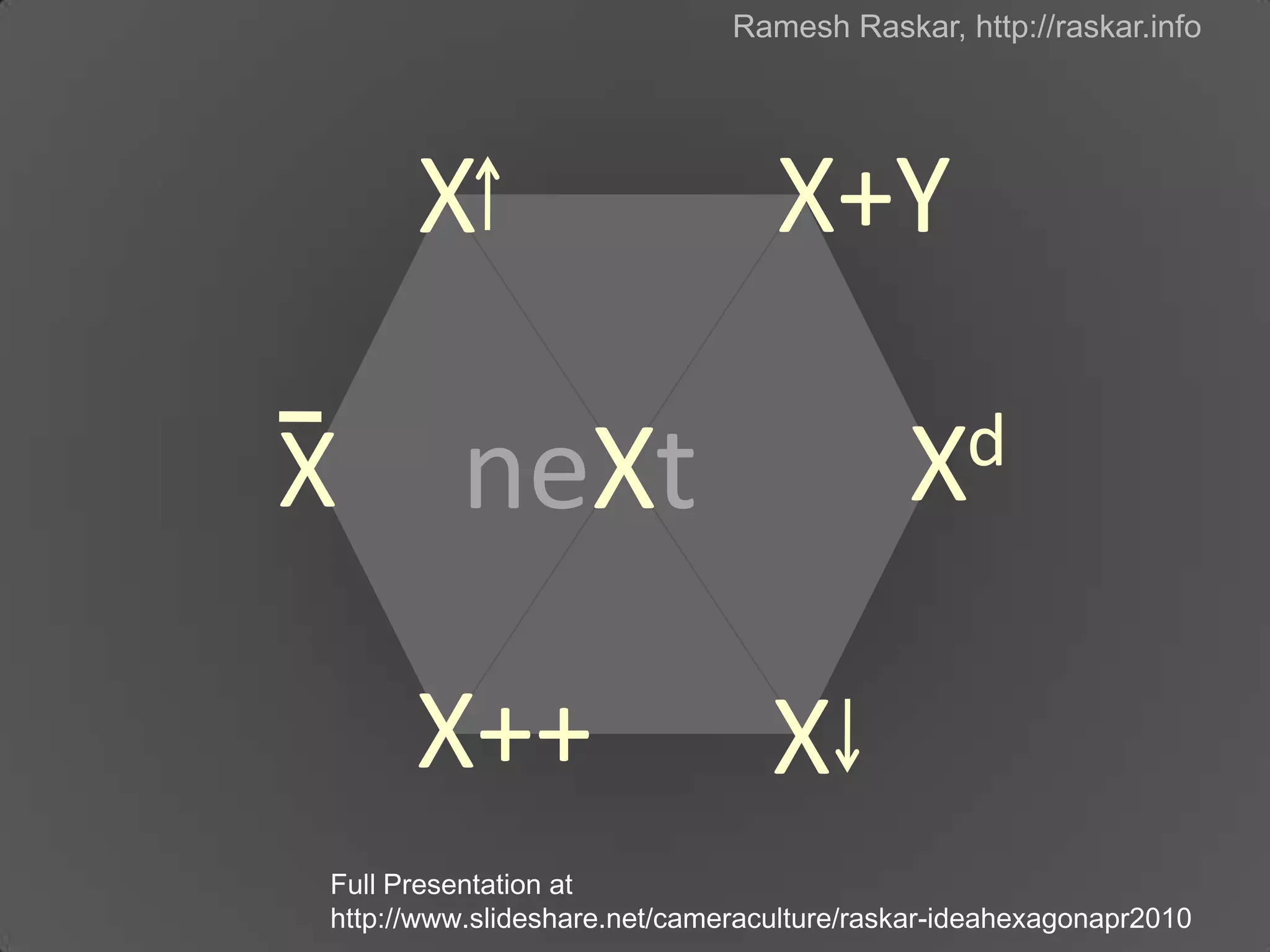
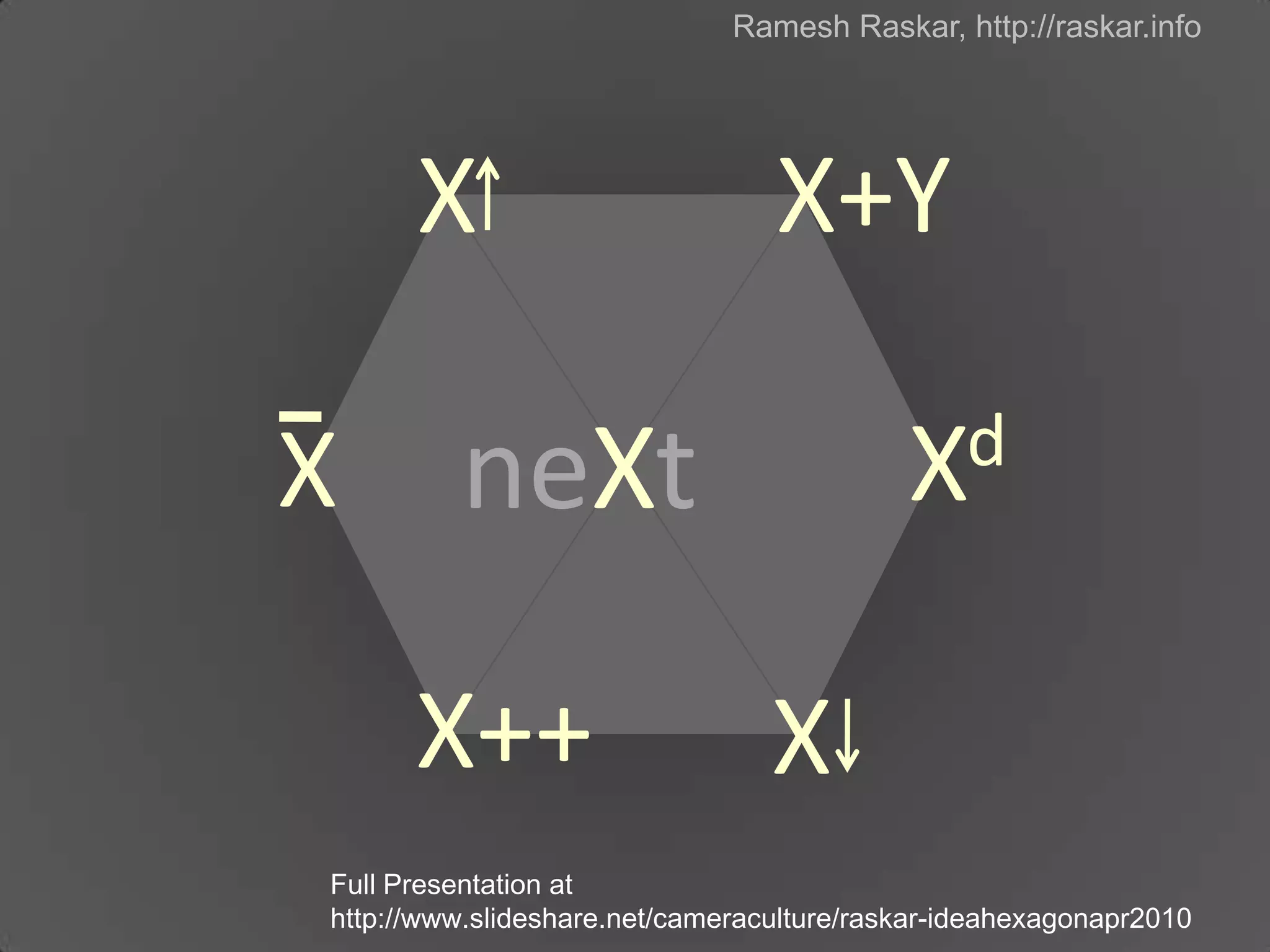
Ramesh Raskar, http://raskar.infoX+YXneXtXdXX++XFull Presentation at http://www.slideshare.net/cameraculture/raskar-ideahexagonapr2010
Simple Exercise .. Image CompressionSave Bandwidth and storageWhat is neXt
Strategy #1:    XdExtend it to next (or some other) dimension ..
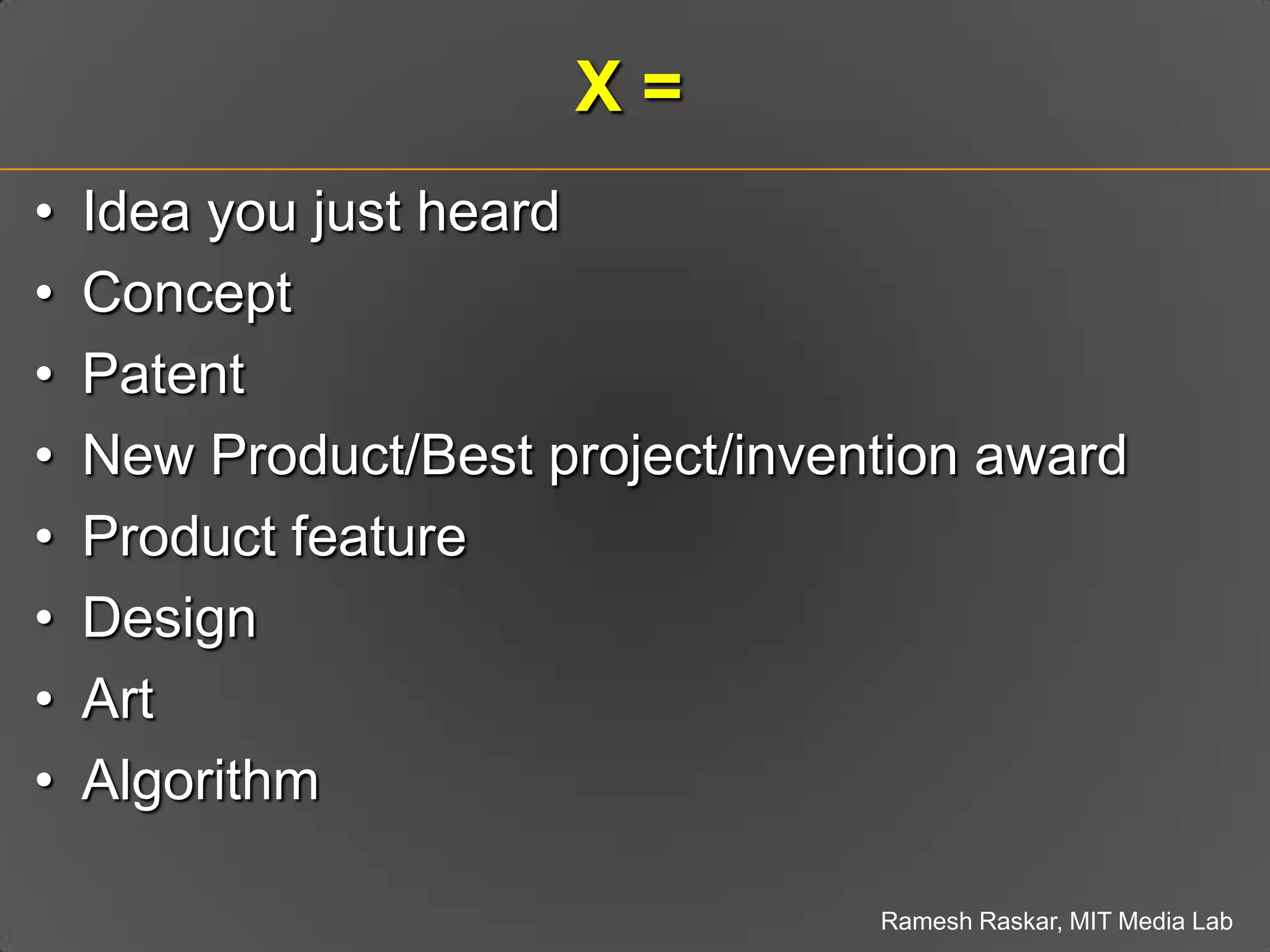
X = Idea you just heardConceptPatentNew Product/Best project/invention awardProduct featureDesignArtAlgorithm
Ramesh Raskar, http://raskar.infoX+YXneXtXdXX++XFull Presentation at http://www.slideshare.net/cameraculture/raskar-ideahexagonapr2010
Research .. http://raskar.infoHow to come up w ideas: Idea HexagonHow to write a paperHow to give a talkOpen research problemsHow to decide merit of a projectHow to attend a conference, brainstormFacebook.com/ rRaskarTipsGet on Seminar/Talks mailing lists worldwidehttp://www.cs.virginia.edu/~robins/YouAndYourResearch.htmlWhy do so few scientists make significant contributions and so many are forgotten in the long run?Highly  recommended Hamming talk at Bell Labs
Is project worthwhile? Heilmeier's Questionshttp://en.wikipedia.org/wiki/George_H._Heilmeier#Heilmeier.27s_CatechismWhatWhat are you trying to do? Articulate your objectives using absolutely no jargon.Related workHow is it done today, and what are the limits of current practice?ContributionWhat's new in your approach and why do you think it will be successful?MotivationWho cares?If you're successful, what difference will it make?ChallengesWhat are the risks and the payoffs?How much will it cost?How long will it take?EvaluationWhat are the midterm and final "exams" to check for success?Raskar additions: Why now? (why not before, what’s new that makes possible)Why us? (wrong answers: I am smart, I can work harder than others)
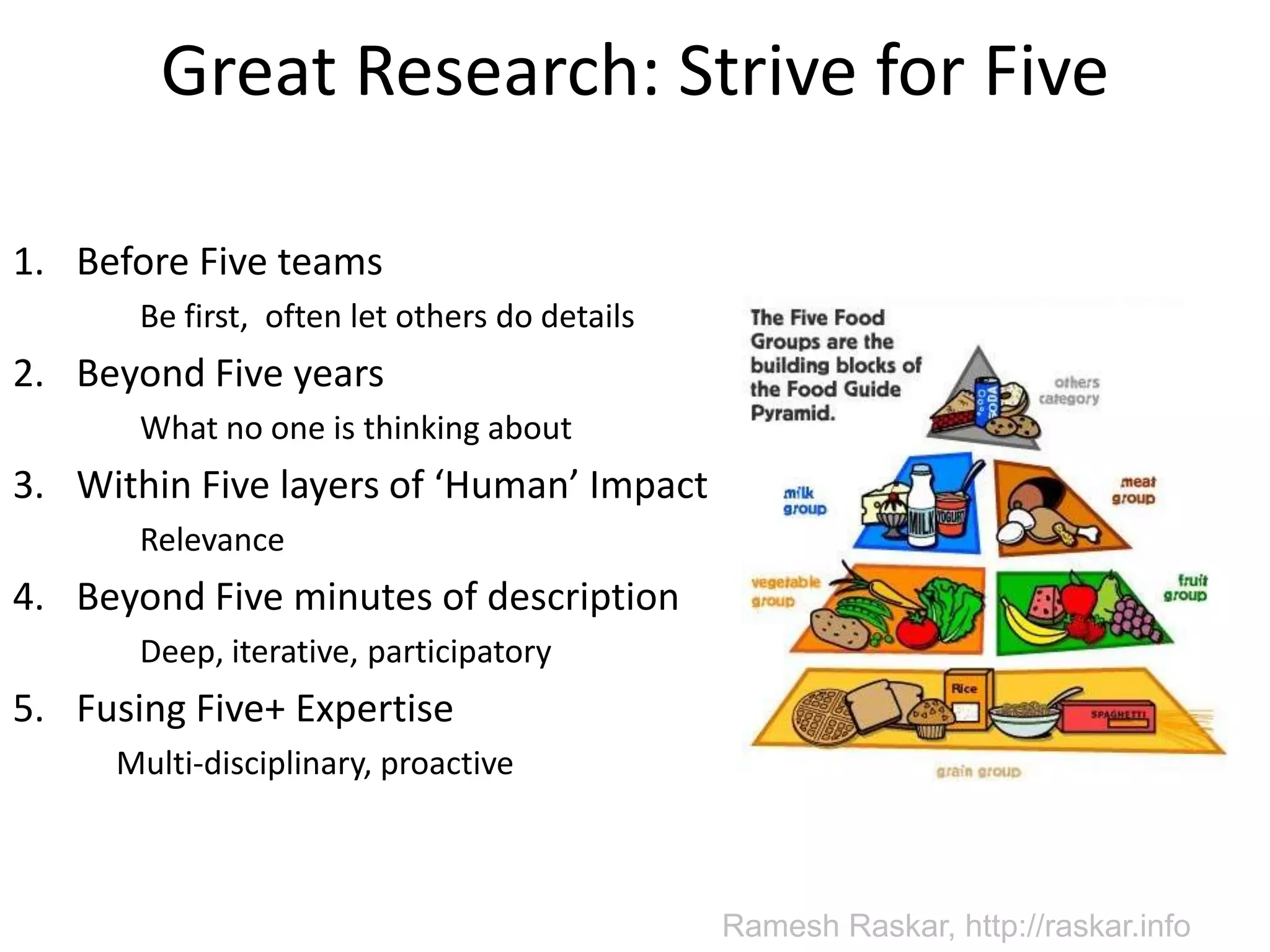
Great Research: Strive for FiveBefore Five teams	Be first,  often let others do detailsBeyond Five years	What no one is thinking aboutWithin Five layers of ‘Human’ Impact	RelevanceBeyond Five minutes of description	Deep, iterative, participatoryFusing Five+ Expertise	Multi-disciplinary, proactiveRamesh Raskar, http://raskar.info
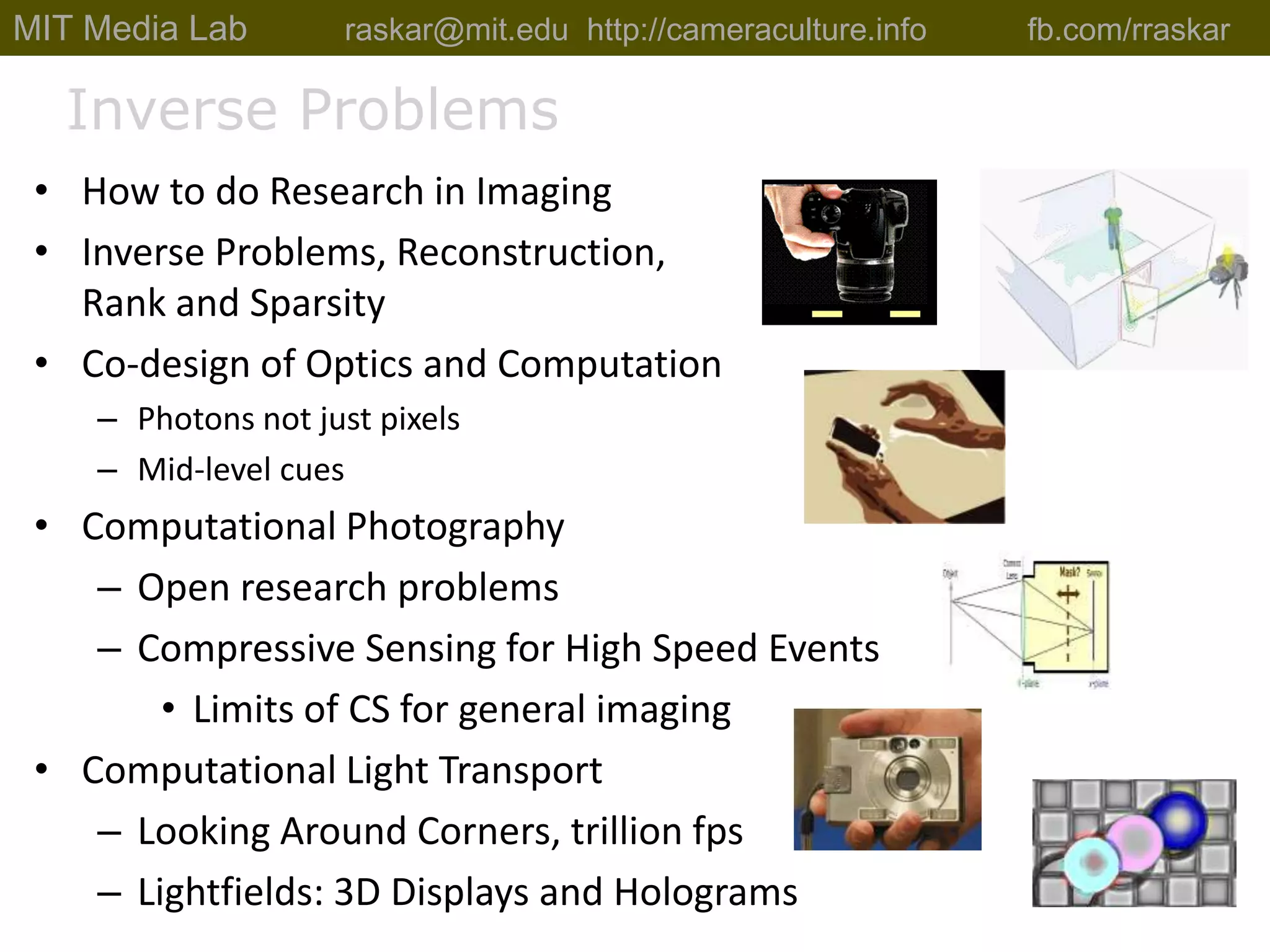
MIT Media Lab          raskar@mit.edu  http://cameraculture.info	fb.com/rraskarInverse ProblemsHow to do Research in ImagingInverse Problems, Reconstruction, Rank and SparsityCo-design of Optics and ComputationPhotons not just pixelsMid-level cuesComputational PhotographyOpen research problemsCompressive Sensing for High Speed EventsLimits of CS for general imagingComputational Light TransportLooking Around Corners, trillion fpsLightfields: 3D Displays and Holograms
Tools forVisual ComputingShadowRefractiveReflectiveFernald, Science [Sept 2006]
Computational PhotographyCamera CultureRamesh  Raskar
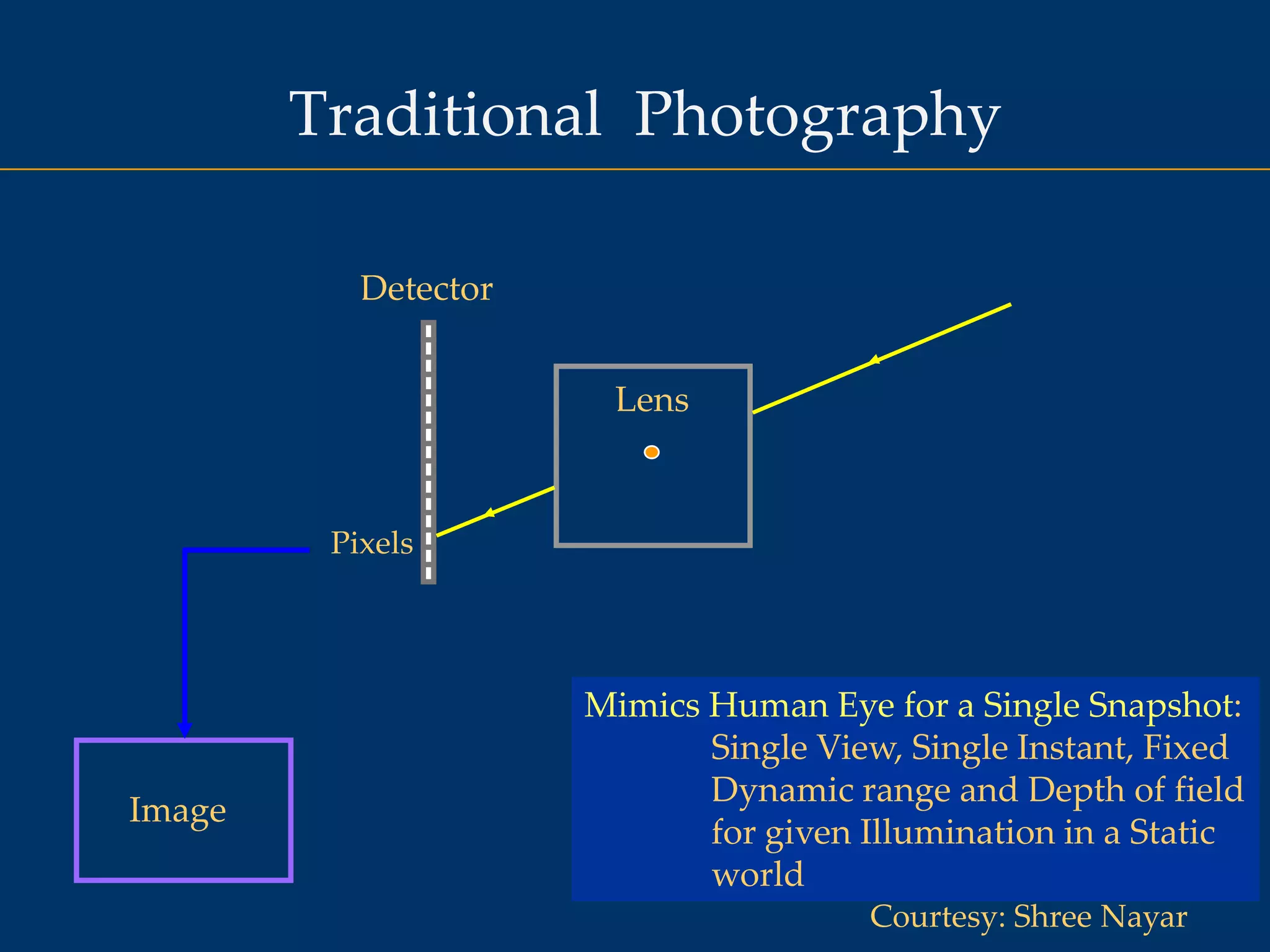
Traditional  PhotographyDetectorLensPixelsMimics Human Eye for a Single Snapshot:	Single View, Single Instant, Fixed 	Dynamic range and Depth of field 	for given Illumination in a Static 	worldImageCourtesy: Shree Nayar
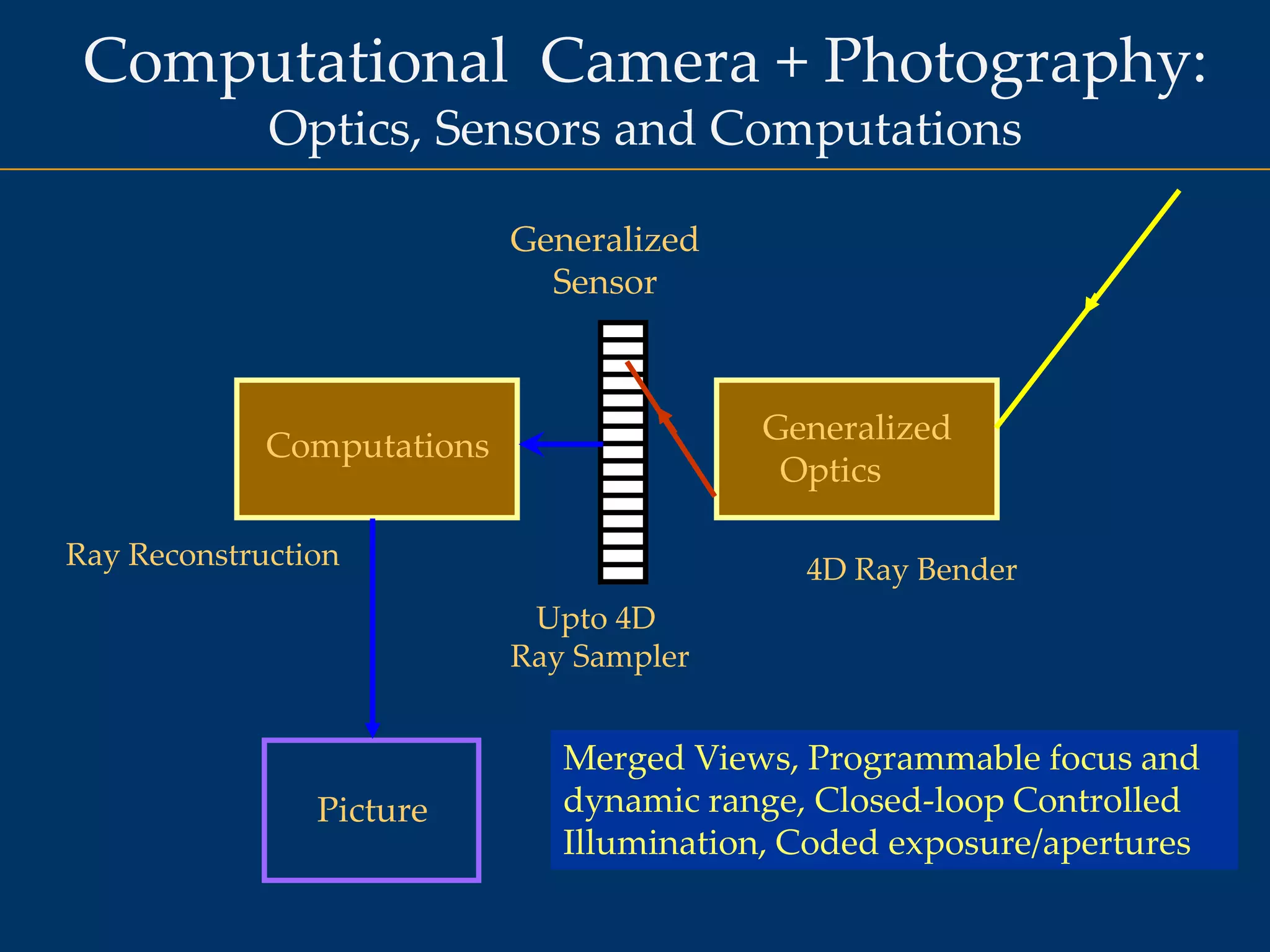
PictureComputational  Camera + Photography: Optics, Sensors and ComputationsGeneralizedSensorGeneralized  OpticsComputationsRay Reconstruction4D Ray BenderUpto 4D Ray SamplerMerged Views, Programmable focus and dynamic range, Closed-loop Controlled Illumination, Coded exposure/apertures
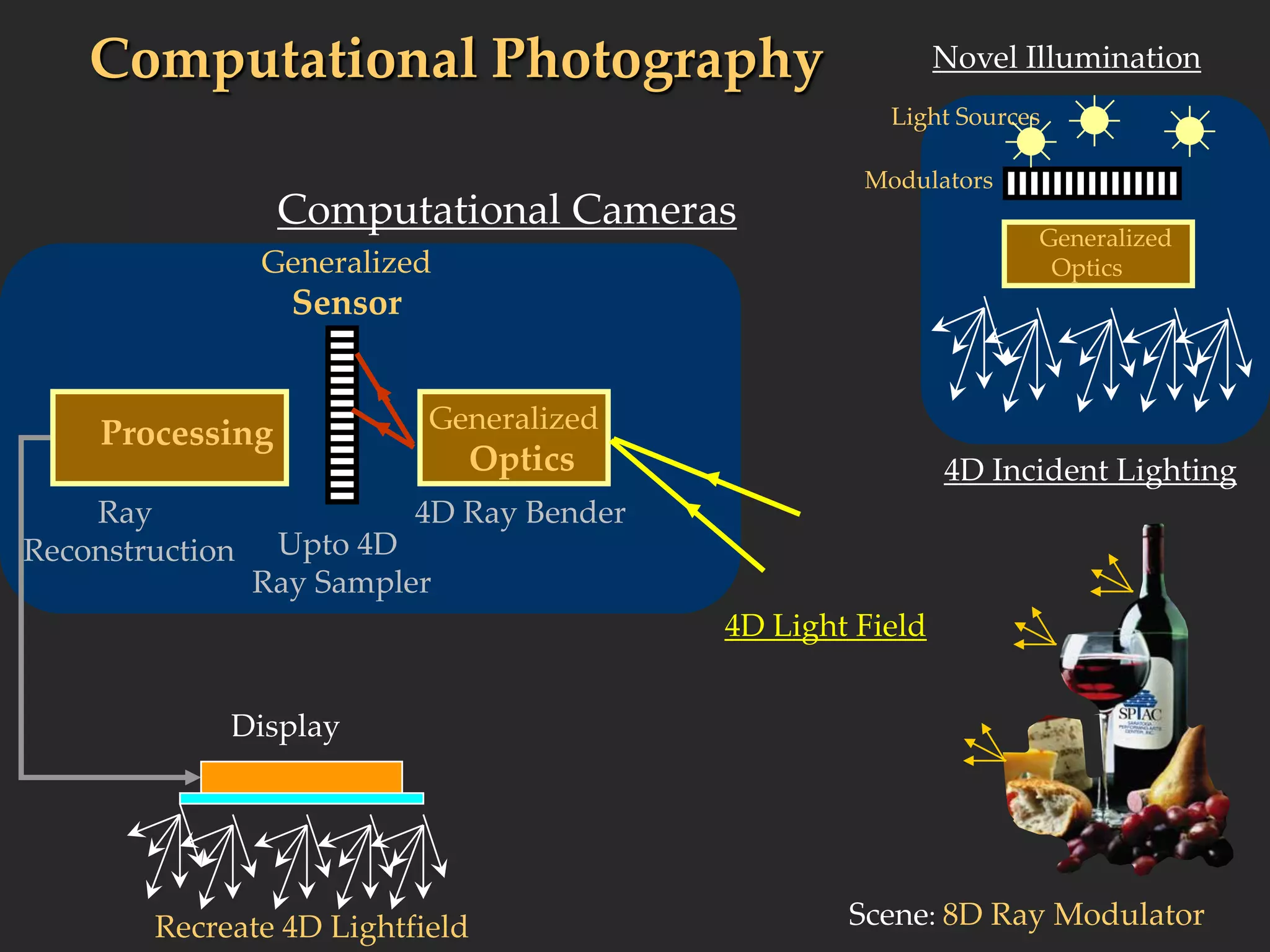
Computational PhotographyNovel IlluminationLight SourcesModulatorsComputational CamerasGeneralized  OpticsGeneralizedSensorGeneralizedOpticsProcessing4D Incident Lighting4D Ray BenderRay ReconstructionUpto 4D Ray Sampler4D Light FieldDisplayScene: 8D Ray ModulatorRecreate 4D Lightfield
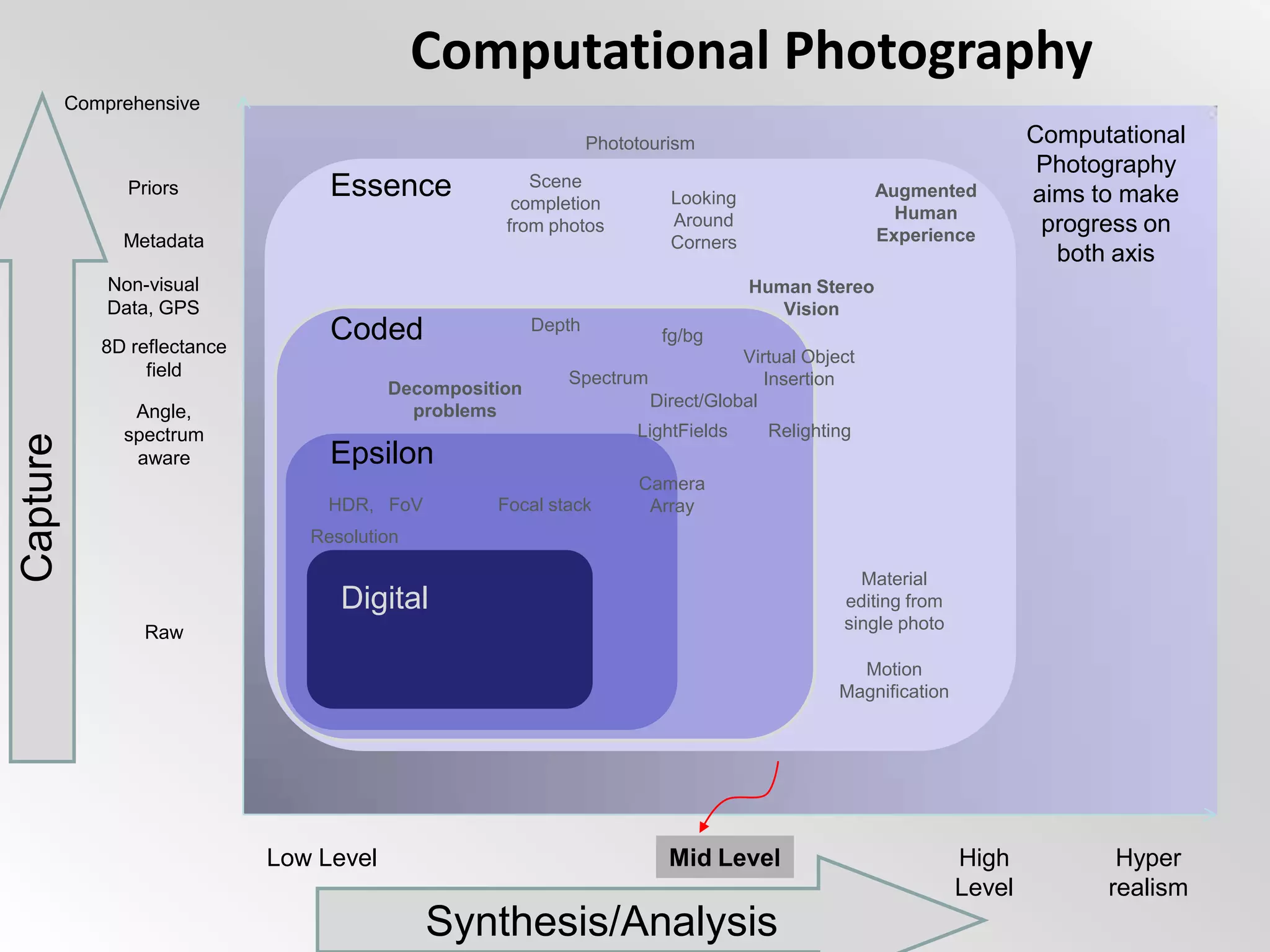
Computational Photography [Raskar and Tumblin]captures a machine-readable representation of our world tohyper-realistically synthesize the essence of our visual experience. ResourcesICCP 2012, Seattle Apr 2012Papers due Dec 2nd, 2011http://wikipedia.org/computational_photographyhttp://raskar.info/photo
Computational PhotographyComputational Photography aims to make progress on both axisPhototourismComprehensiveEssenceScene completion from photosAugmented Human ExperienceLooking Around CornersPriorsCaptureHuman Stereo VisionMetadataCodedDepthfg/bgNon-visual Data, GPSVirtual Object InsertionSpectrumDecomposition problems8D reflectance fieldDirect/GlobalLightFieldsRelightingEpsilonAngle, spectrum awareCamera ArrayHDR,   FoVFocal stackResolutionMaterial editing from single photoDigitalMotion MagnificationRawLow LevelMid LevelHighLevelHyper realismSynthesis/Analysis
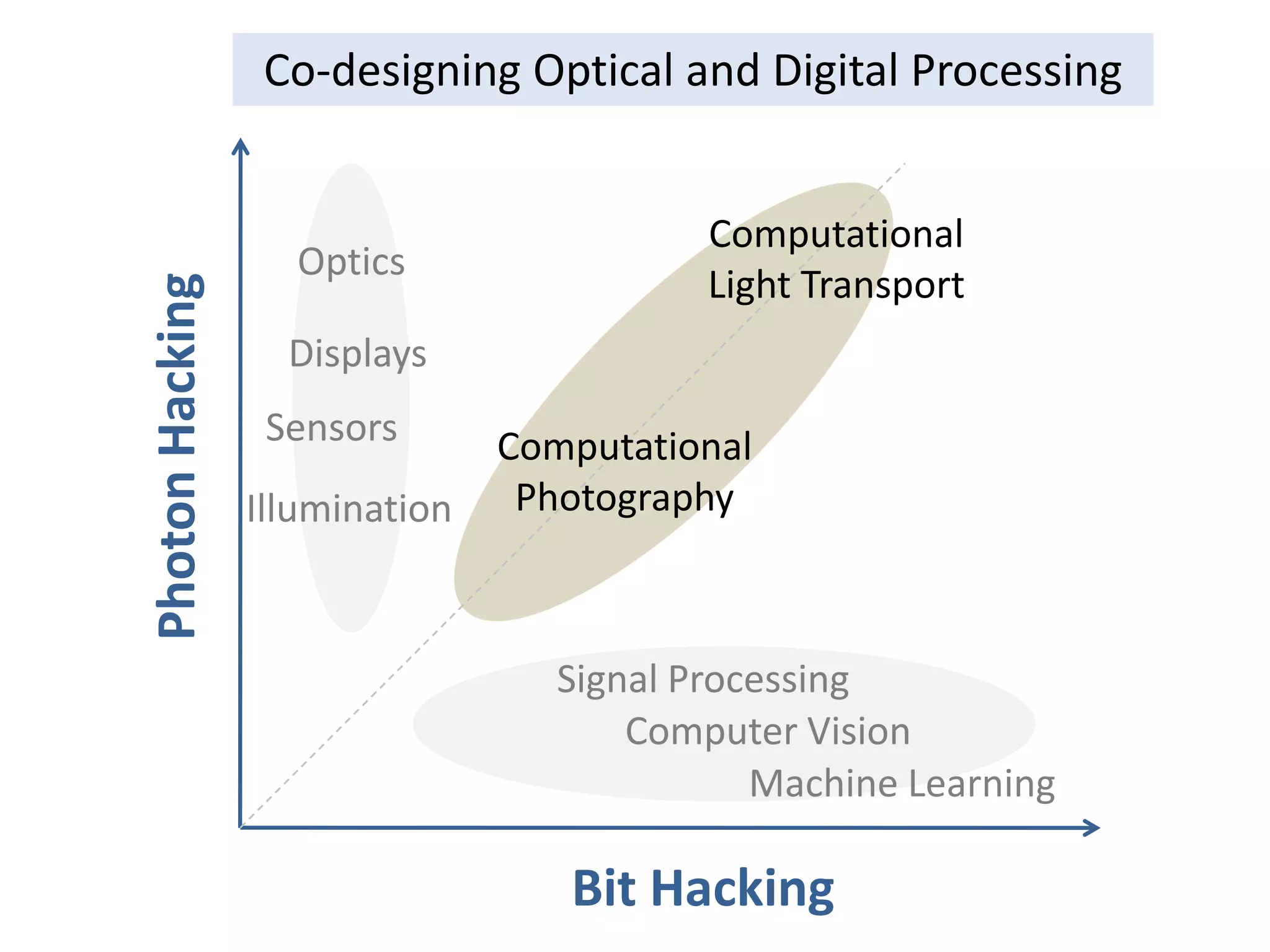
Co-designing Optical and Digital ProcessingComputational Light TransportOpticsDisplaysSensorsComputational PhotographyPhoton HackingIlluminationSignal ProcessingComputer VisionMachine LearningBit Hacking
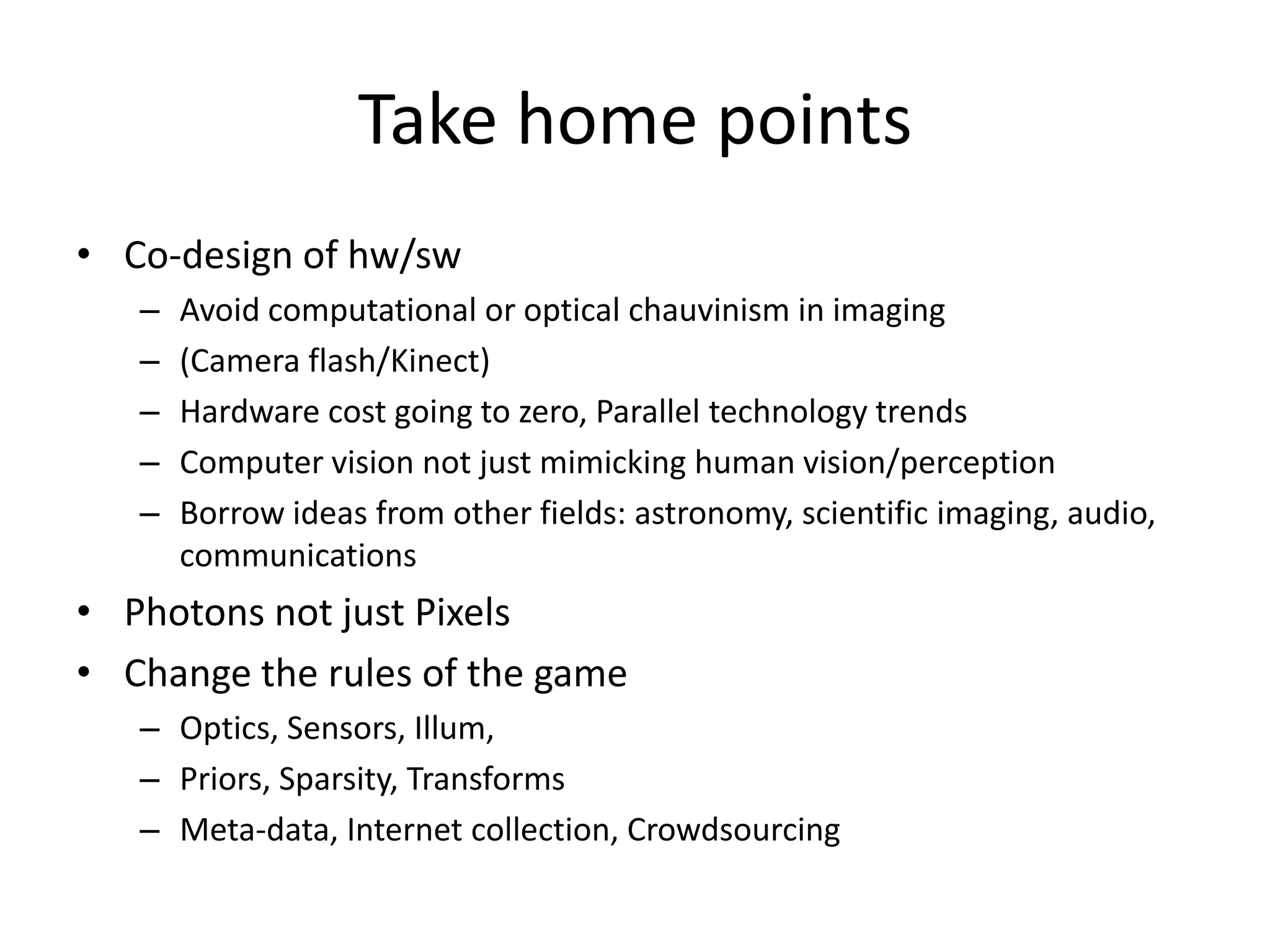
Take home pointsCo-design of hw/swAvoid computational or optical chauvinism in imaging  (Camera flash/Kinect)Hardware cost going to zero, Parallel technology trendsComputer vision not just mimicking human vision/perceptionBorrow ideas from other fields: astronomy, scientific imaging, audio, communicationsPhotons not just PixelsChange the rules of the gameOptics, Sensors, Illum, Priors, Sparsity, TransformsMeta-data, Internet collection, Crowdsourcing
Computational PhotographyWish List: Open Research ProblemsCamera CultureRamesh  Raskar
Wish #1Ultimate Post-capture ControlCamera CultureRamesh  Raskar
Digital Refocusing using Light Field Camera125μ square-sided microlenses[Ng et al 2005]
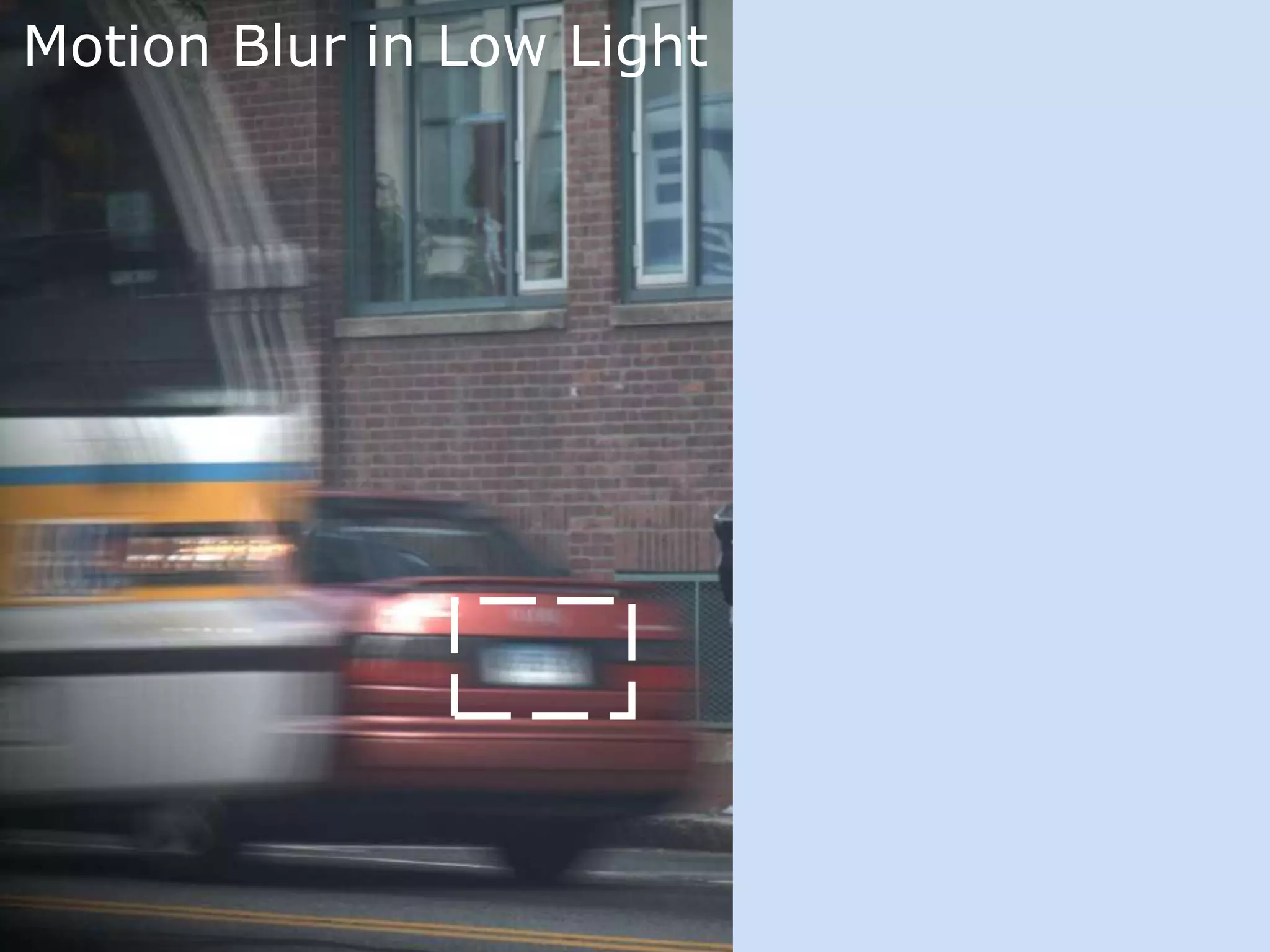
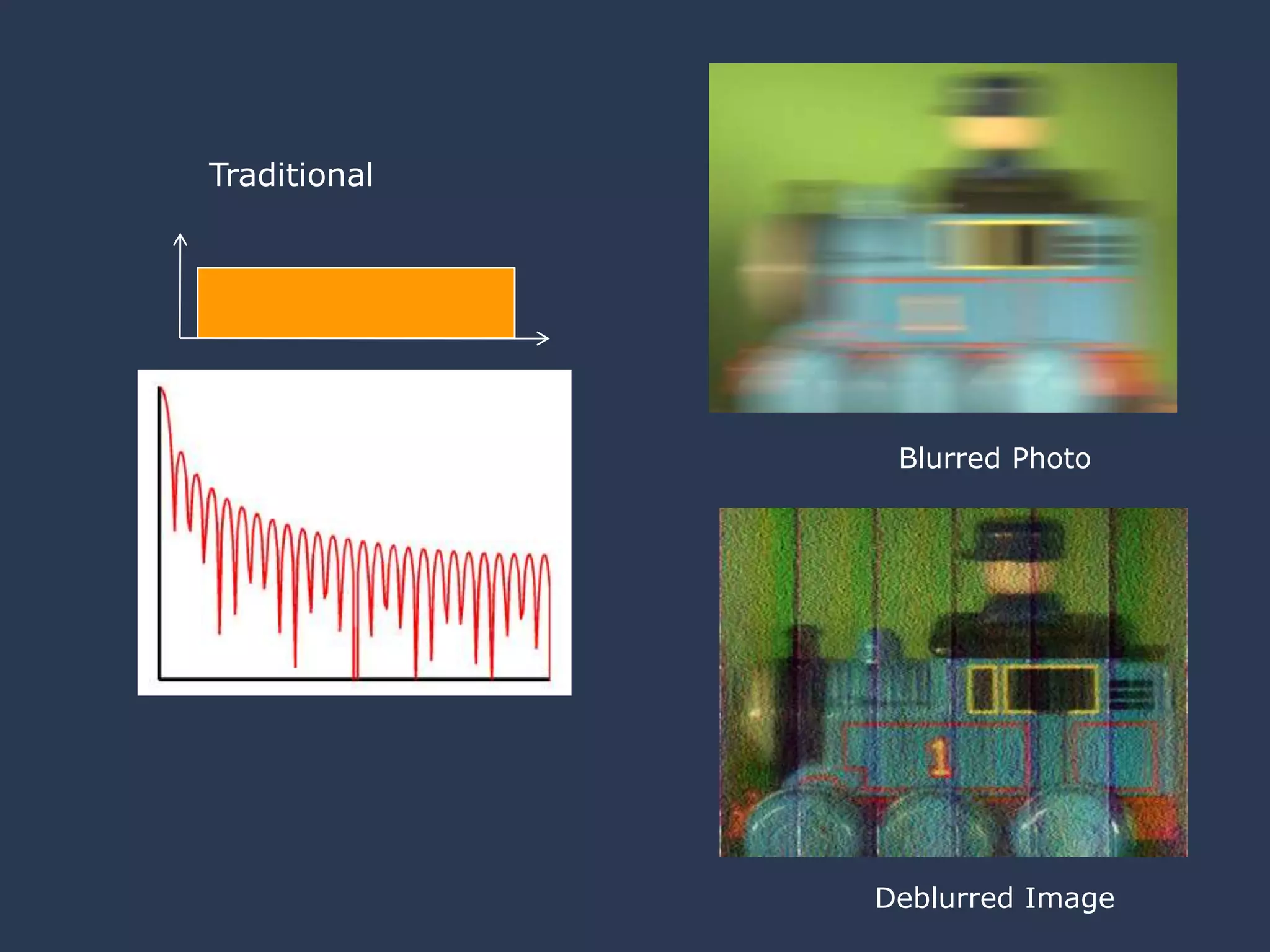
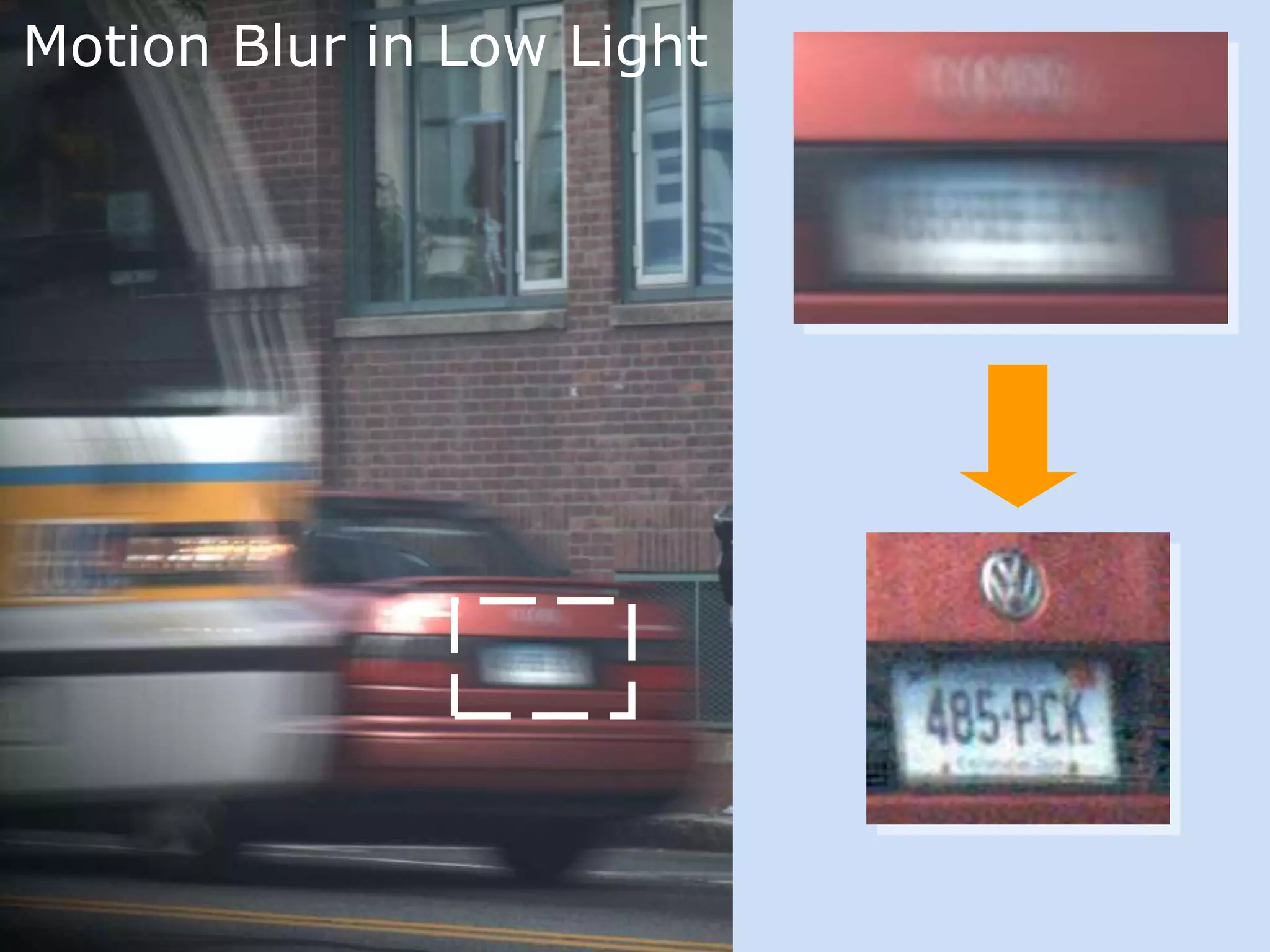
Motion Blur in Low Light
TraditionalBlurred PhotoDeblurred Image
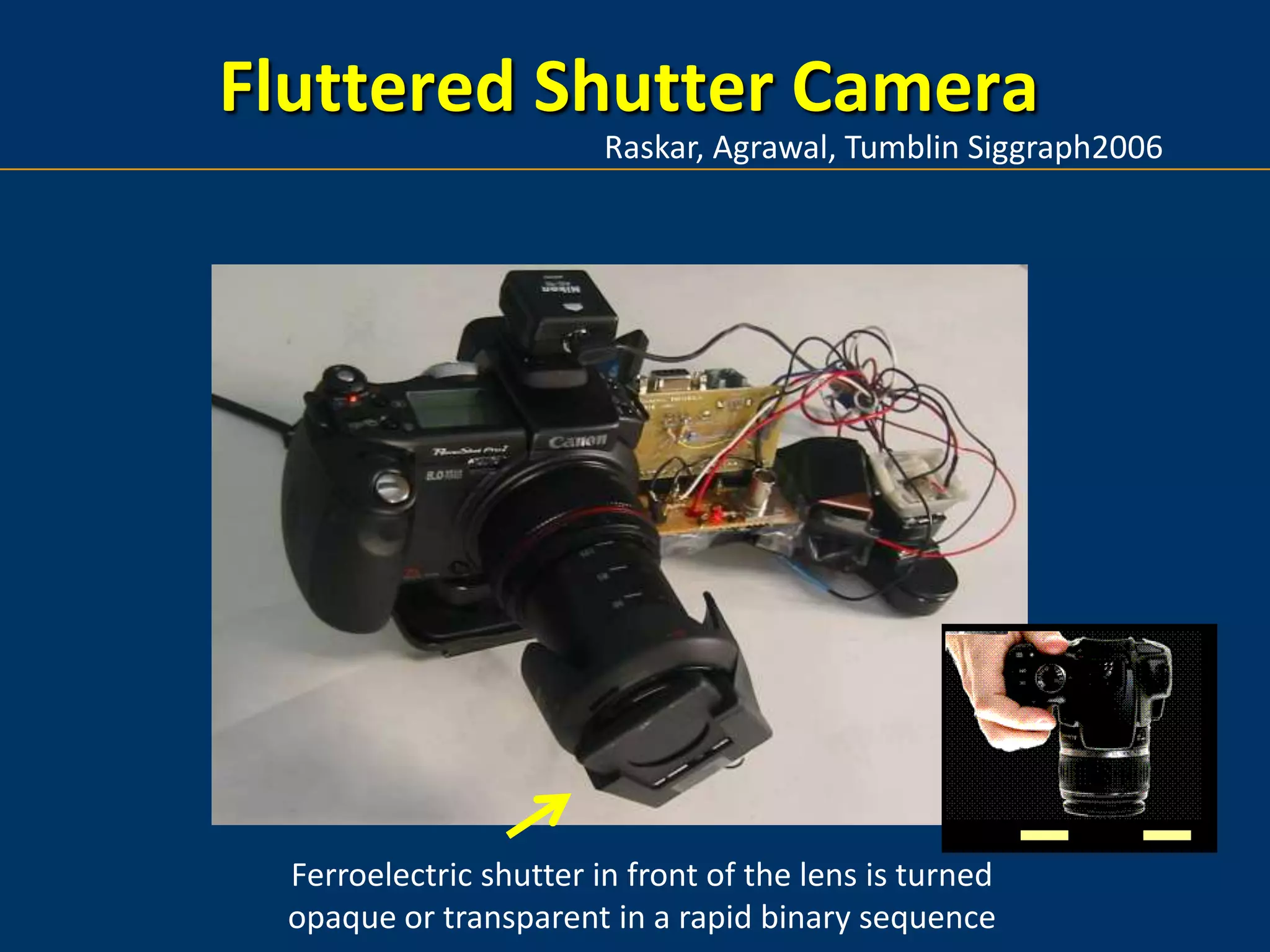
Fluttered Shutter CameraRaskar, Agrawal, Tumblin Siggraph2006Ferroelectric shutter in front of the lens is turnedopaque or transparent in a rapid binary sequence
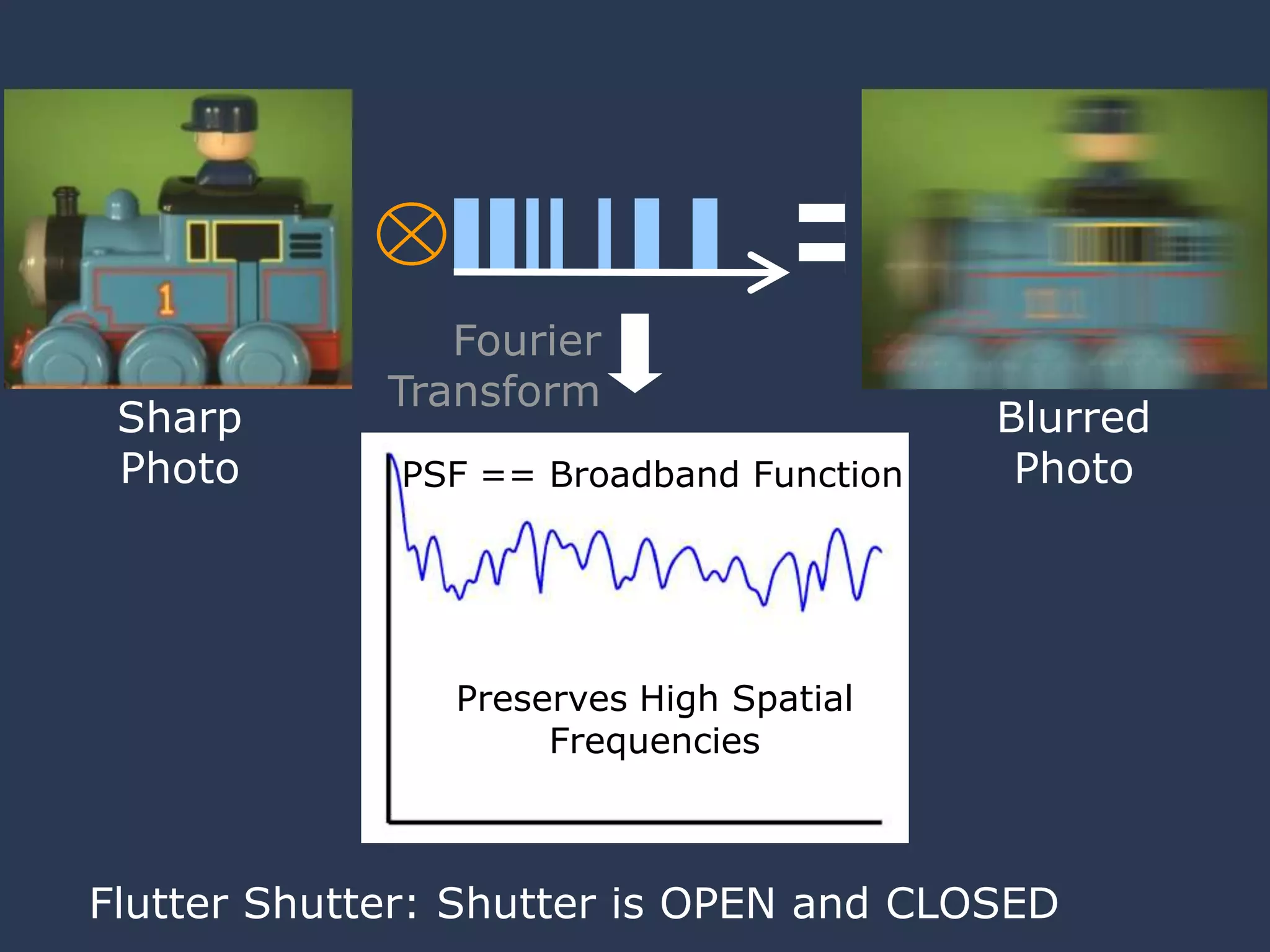
Preserves High Spatial FrequenciesFourier TransformSharp PhotoBlurred PhotoPSF == Broadband FunctionFlutter Shutter: Shutter is OPEN and CLOSED
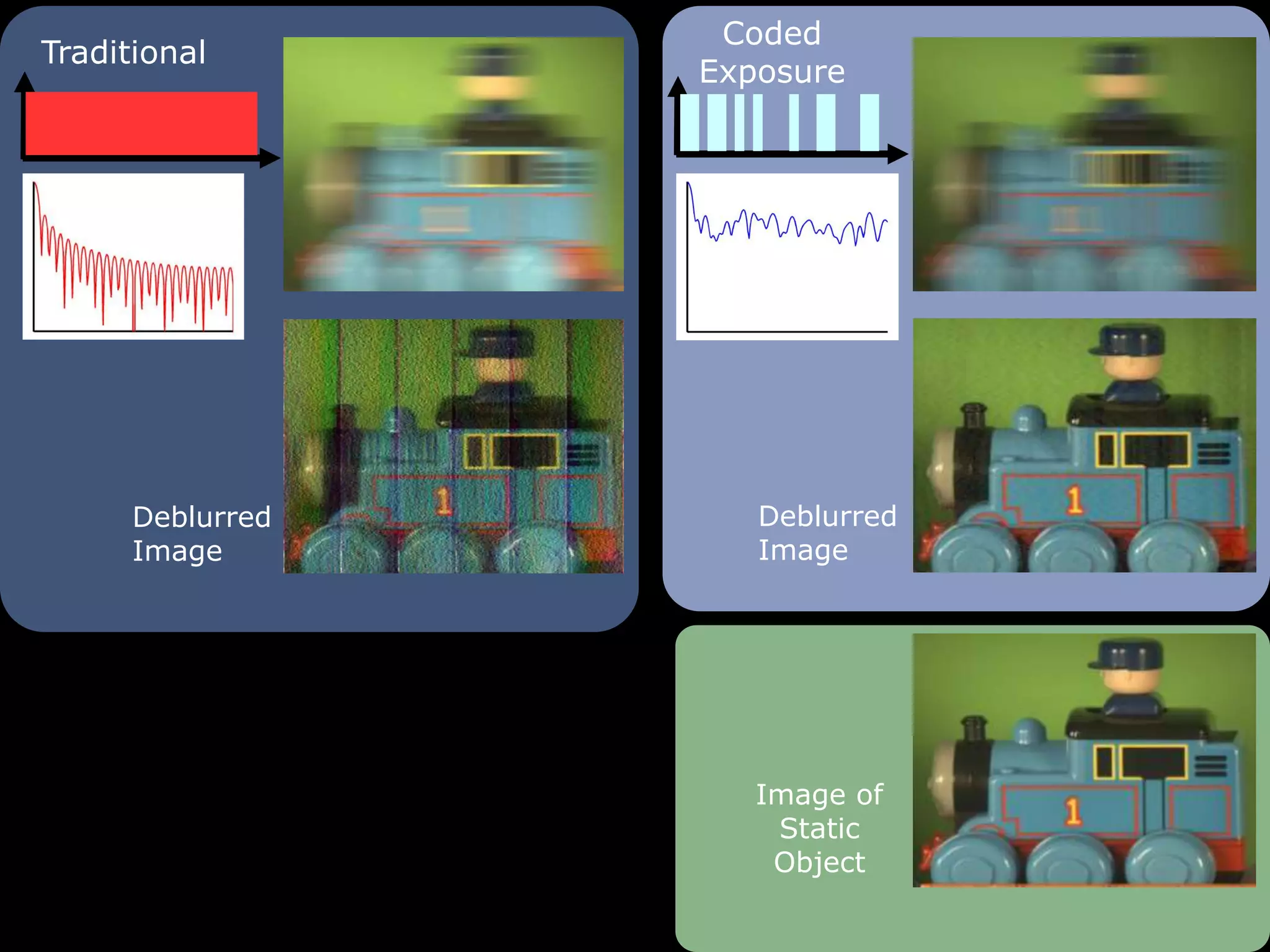
Coded ExposureTraditionalDeblurred ImageDeblurred ImageImage of Static Object
Motion Blur in Low Light
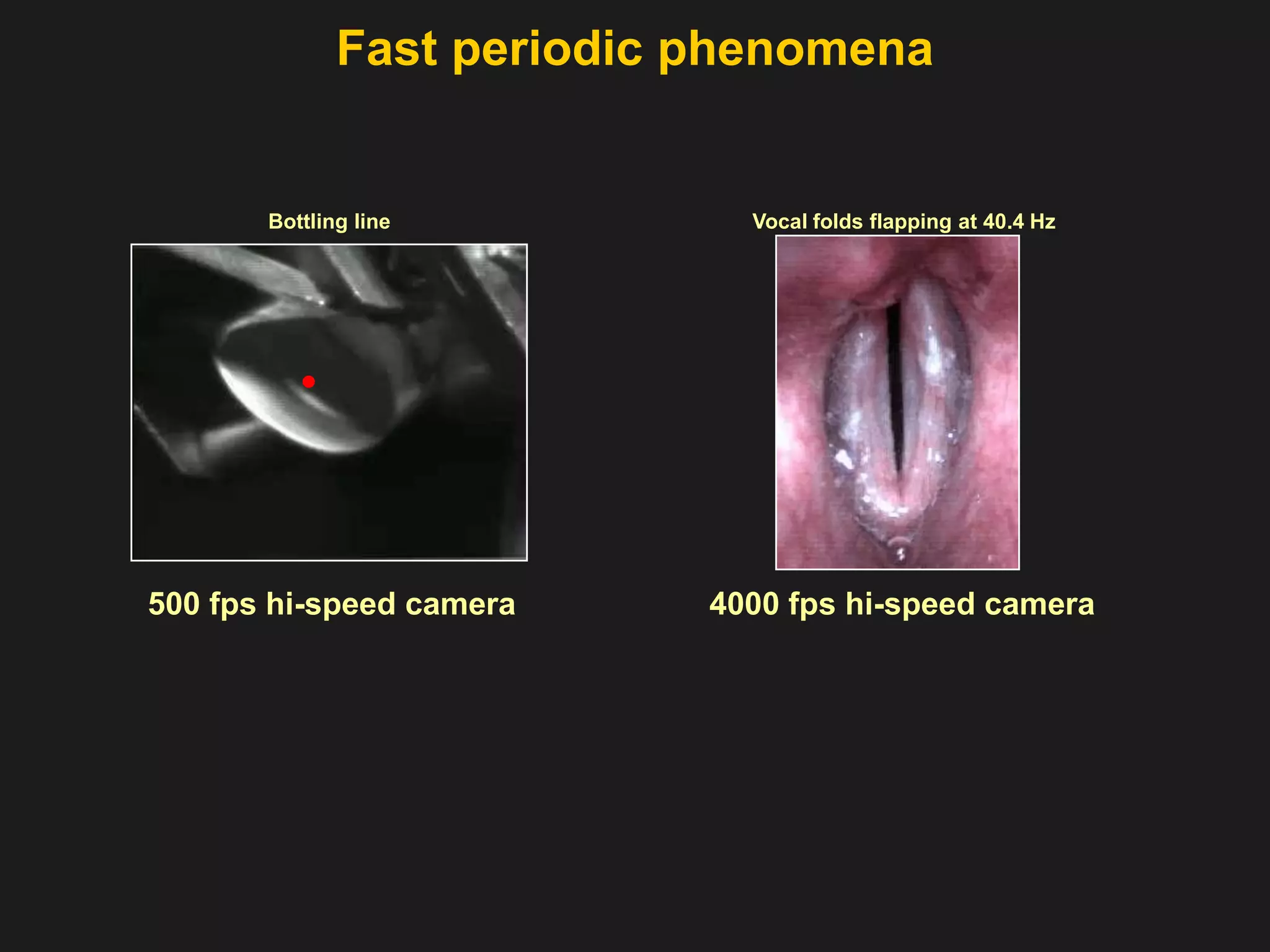
Fast periodic phenomenaVocal folds flapping at 40.4 HzBottling line4000 fps hi-speed camera500 fps hi-speed camera
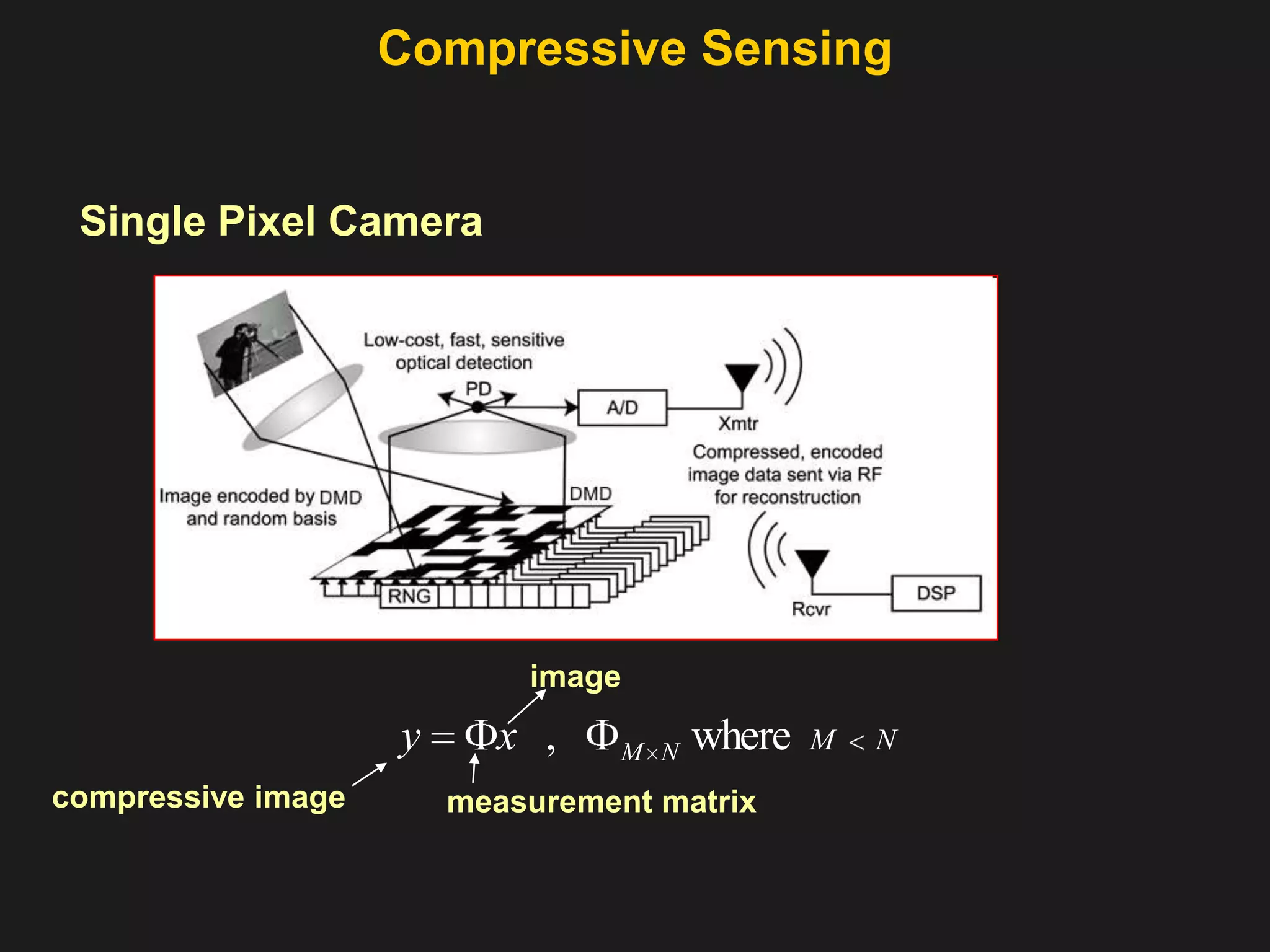
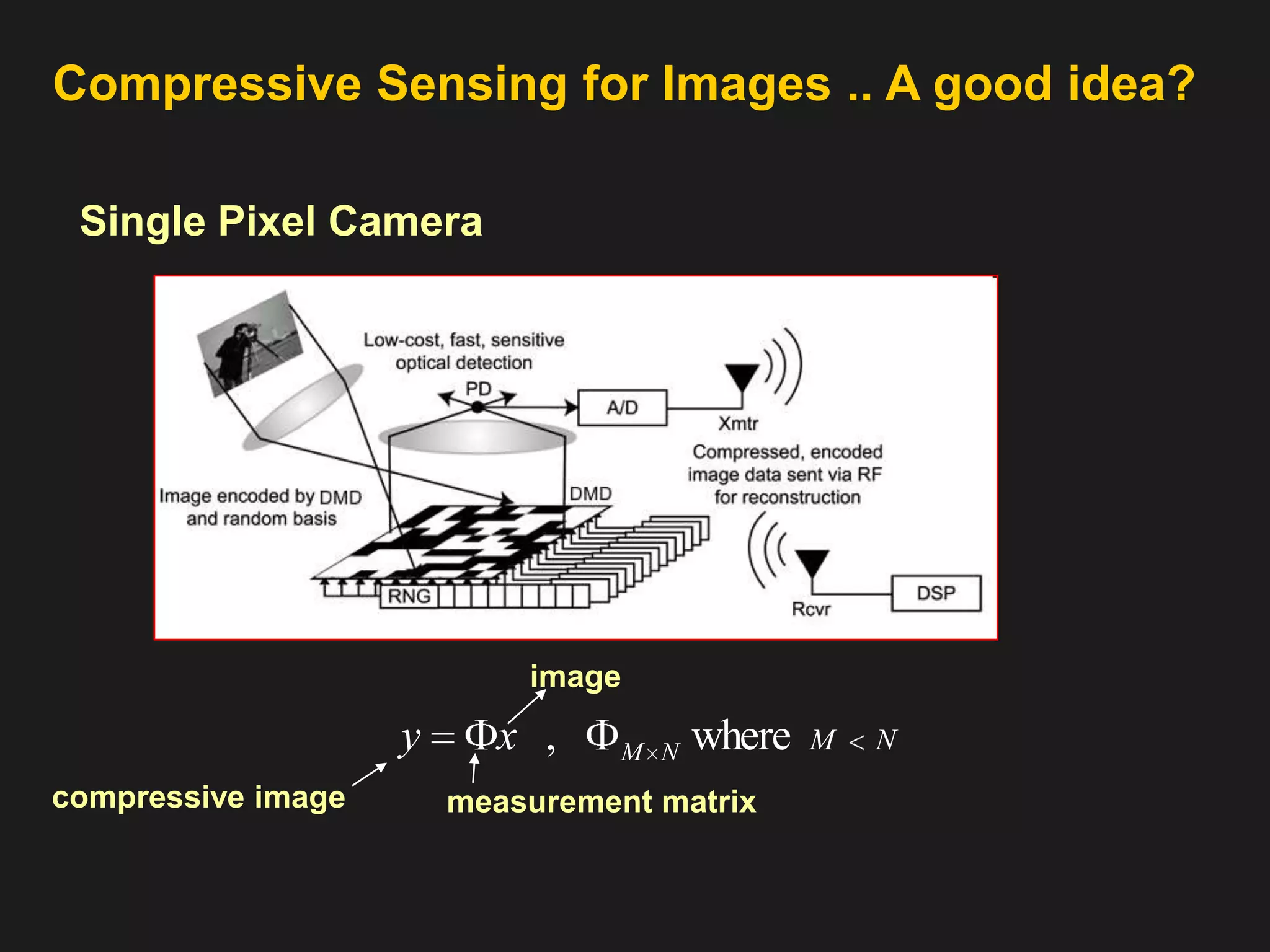
Compressive Sensing Single Pixel Cameraimagecompressive imagemeasurement matrix
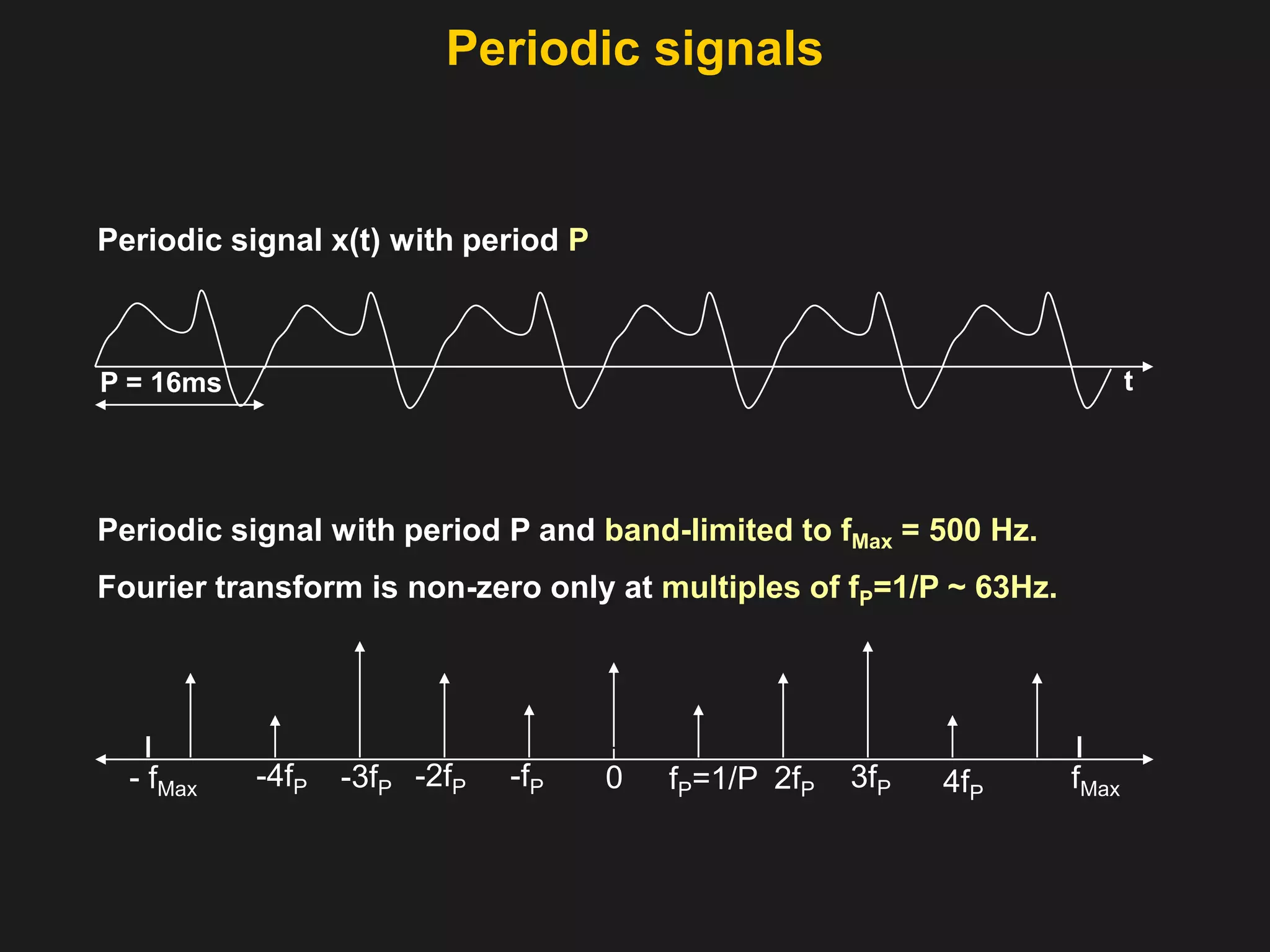
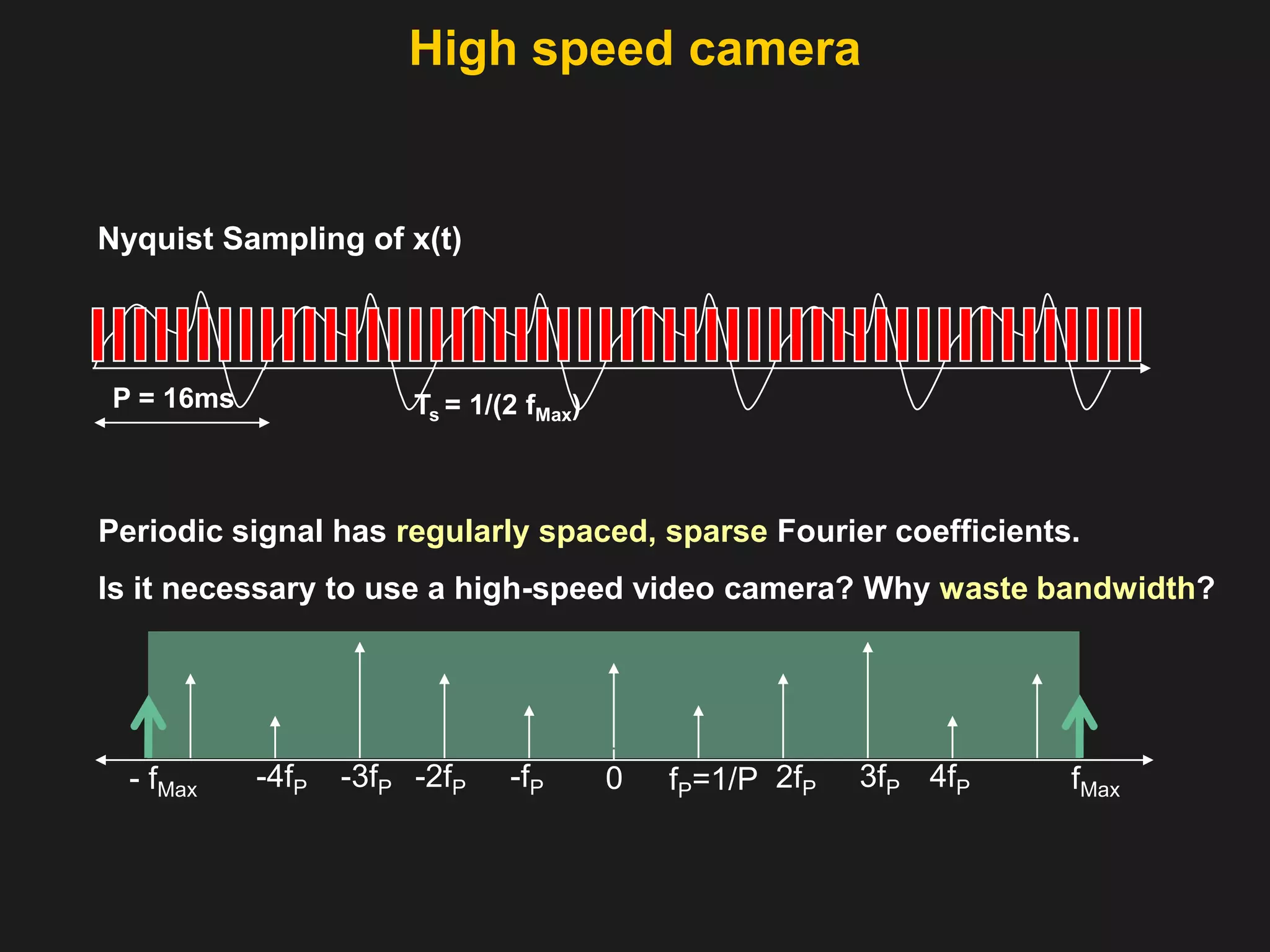
Periodic signals-fP-2fP-4fP3fP-3fP0fMax- fMax2fPfP=1/P4fPPeriodic signal x(t) with period PtP = 16msPeriodic signal with period P and band-limited to fMax = 500 Hz. Fourier transform is non-zero only at multiples of fP=1/P ~ 63Hz.
High speed cameraP = 16msTs = 1/(2 fMax)-fP-2fP-4fP-3fP4fP3fP2fP0fMax- fMaxfP=1/PNyquist Sampling of x(t) Periodic signal has regularly spaced, sparse Fourier coefficients. Is it necessary to use a high-speed video camera? Why waste bandwidth?
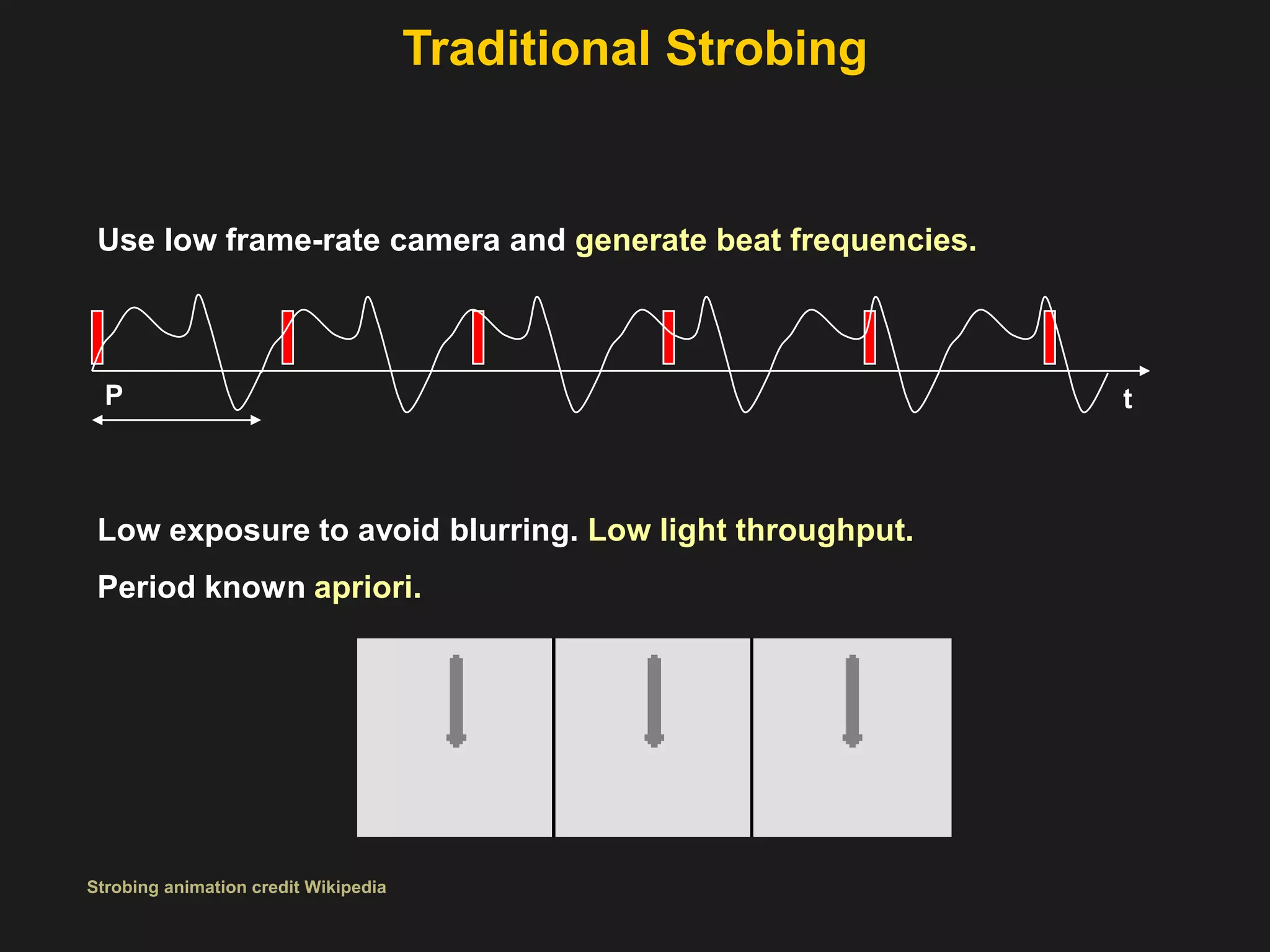
Traditional StrobingUse low frame-rate camera and generate beat frequencies.PtLow exposure to avoid blurring. Low light throughput.Period known apriori.Strobing animation credit Wikipedia
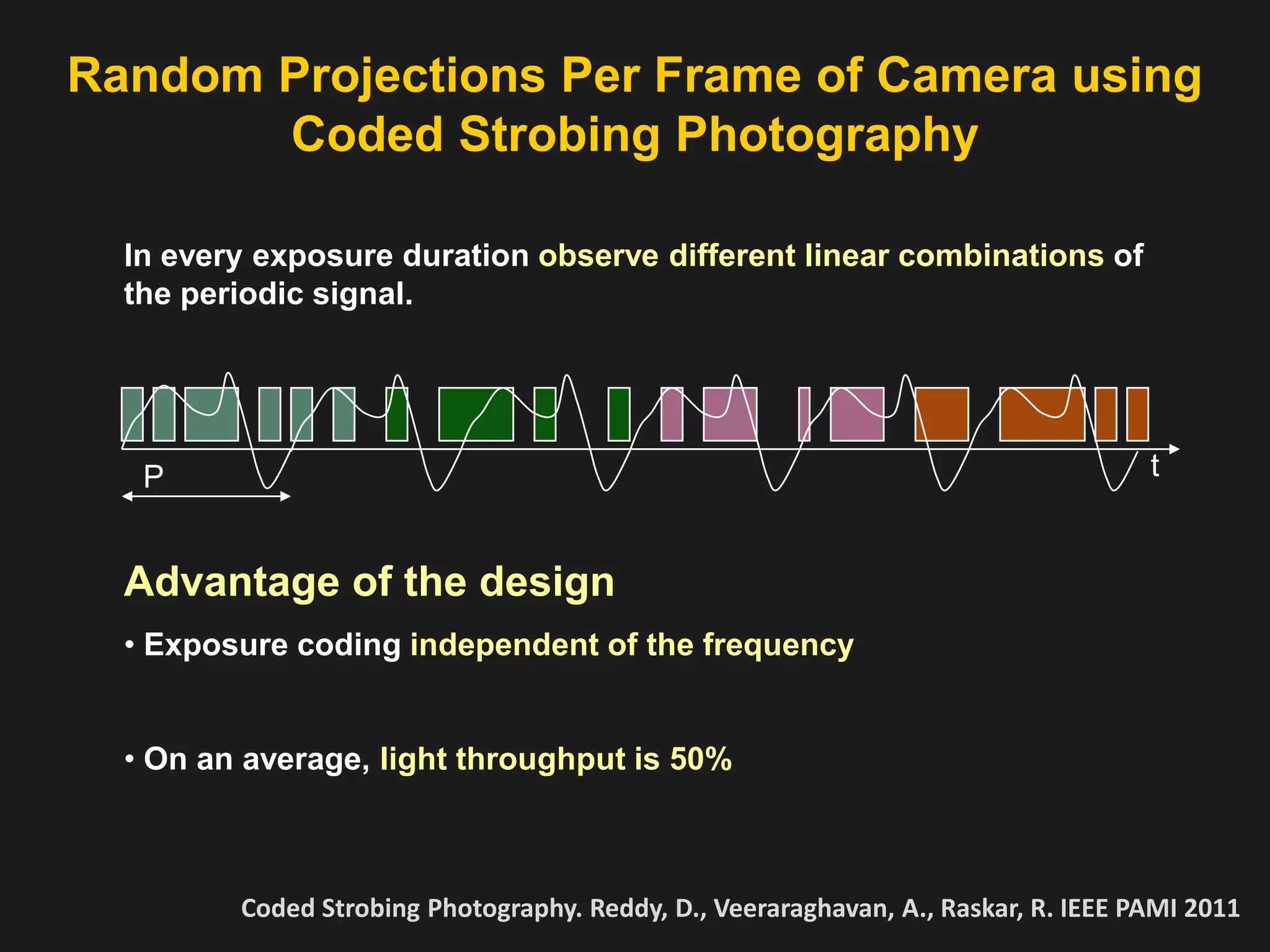
tPRandom Projections Per Frame of Camera using Coded Strobing PhotographyIn every exposure duration observe different linear combinations of the periodic signal.Advantage of the design  Exposure coding independent of the frequency
 On an average, light throughput is 50%Coded Strobing Photography. Reddy, D., Veeraraghavan, A., Raskar, R. IEEE PAMI 2011
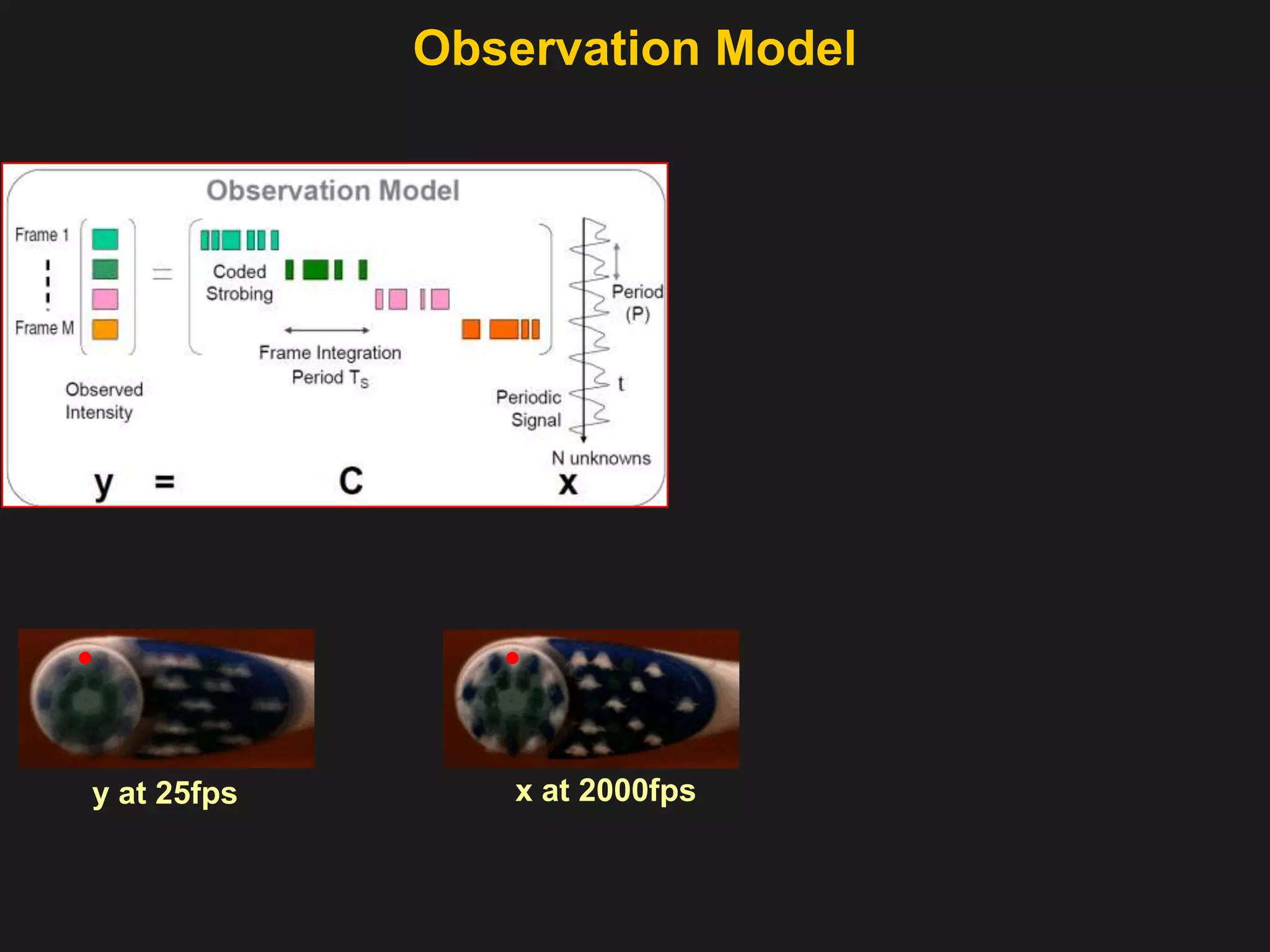
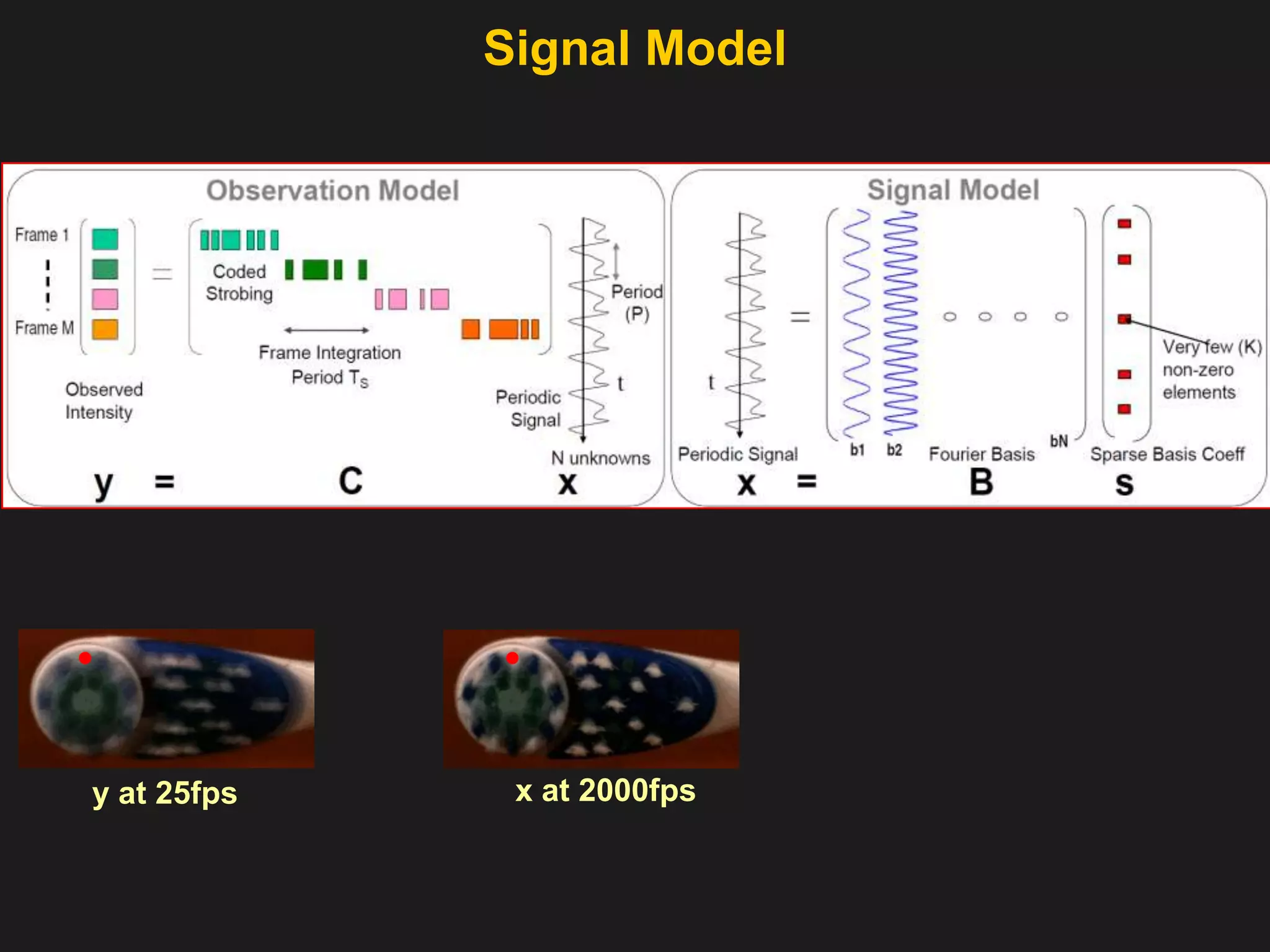
Observation Modelx at 2000fpsy at 25fps
Signal Modelx at 2000fpsy at 25fps
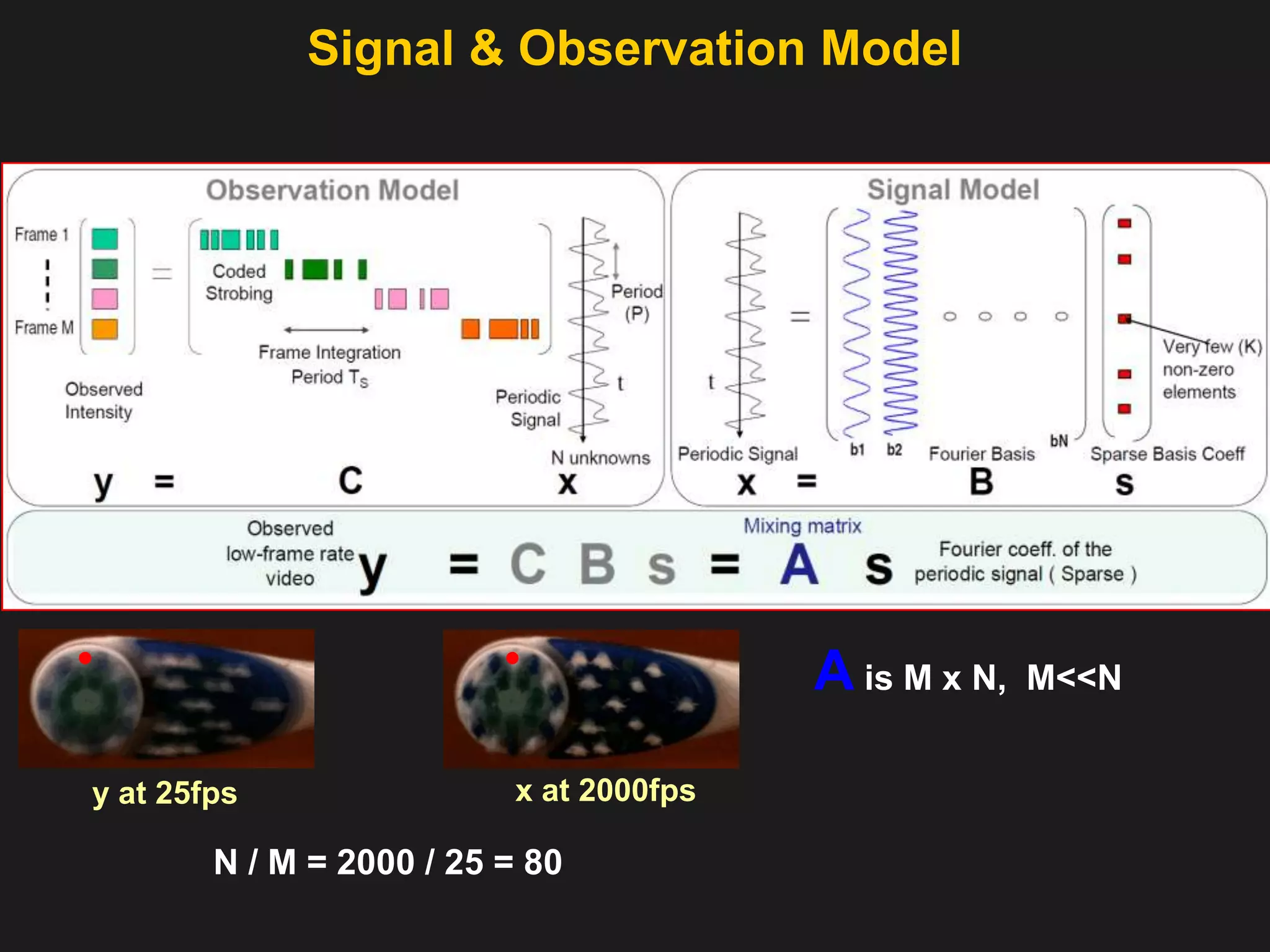
Signal & Observation ModelAis M x N,  M<<Nx at 2000fpsy at 25fps N / M = 2000 / 25 = 80
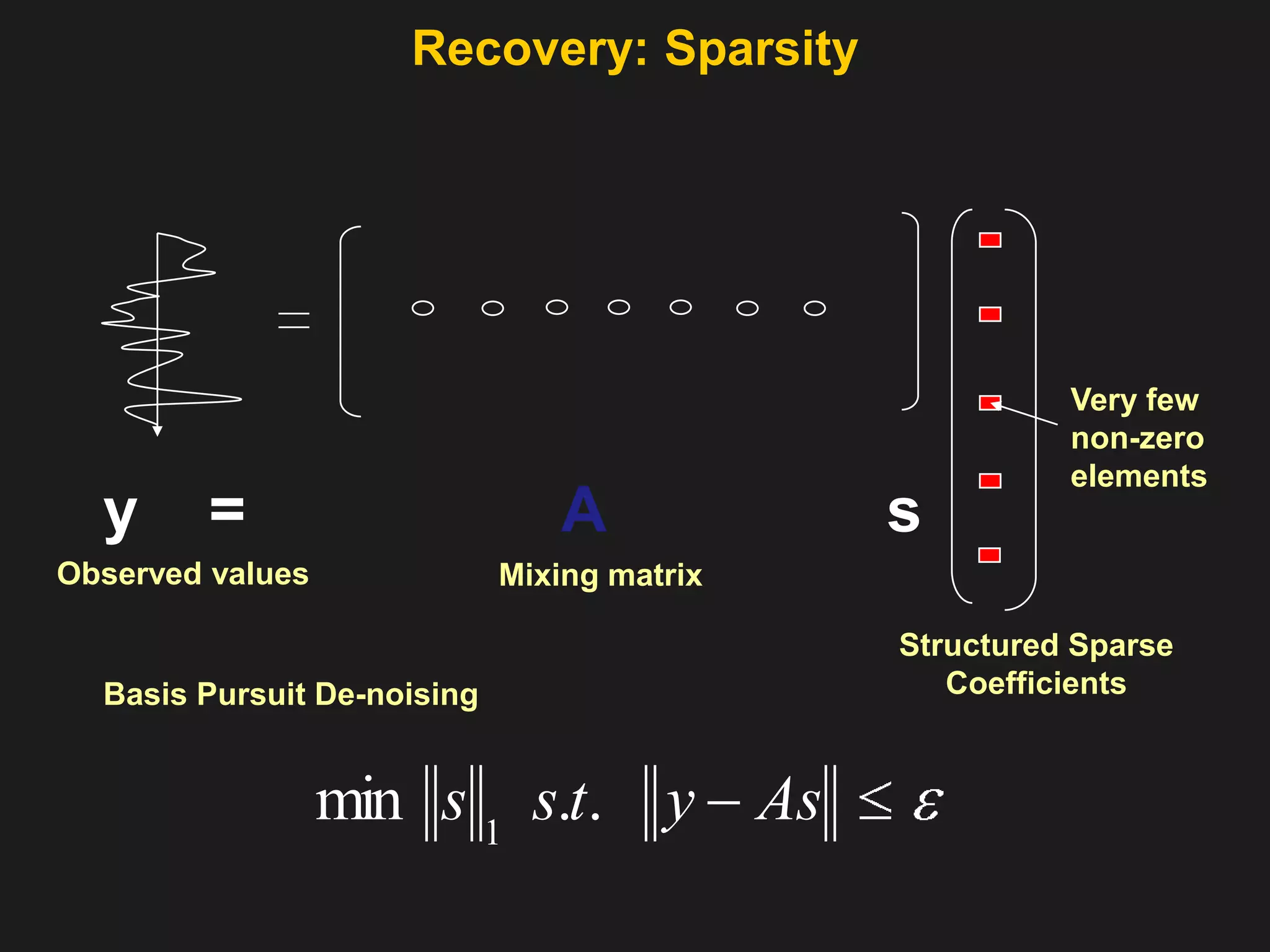
Recovery: SparsityVery few non-zero elementsy    =                  A                sObserved valuesMixing matrixStructured Sparse CoefficientsBasis Pursuit De-noising
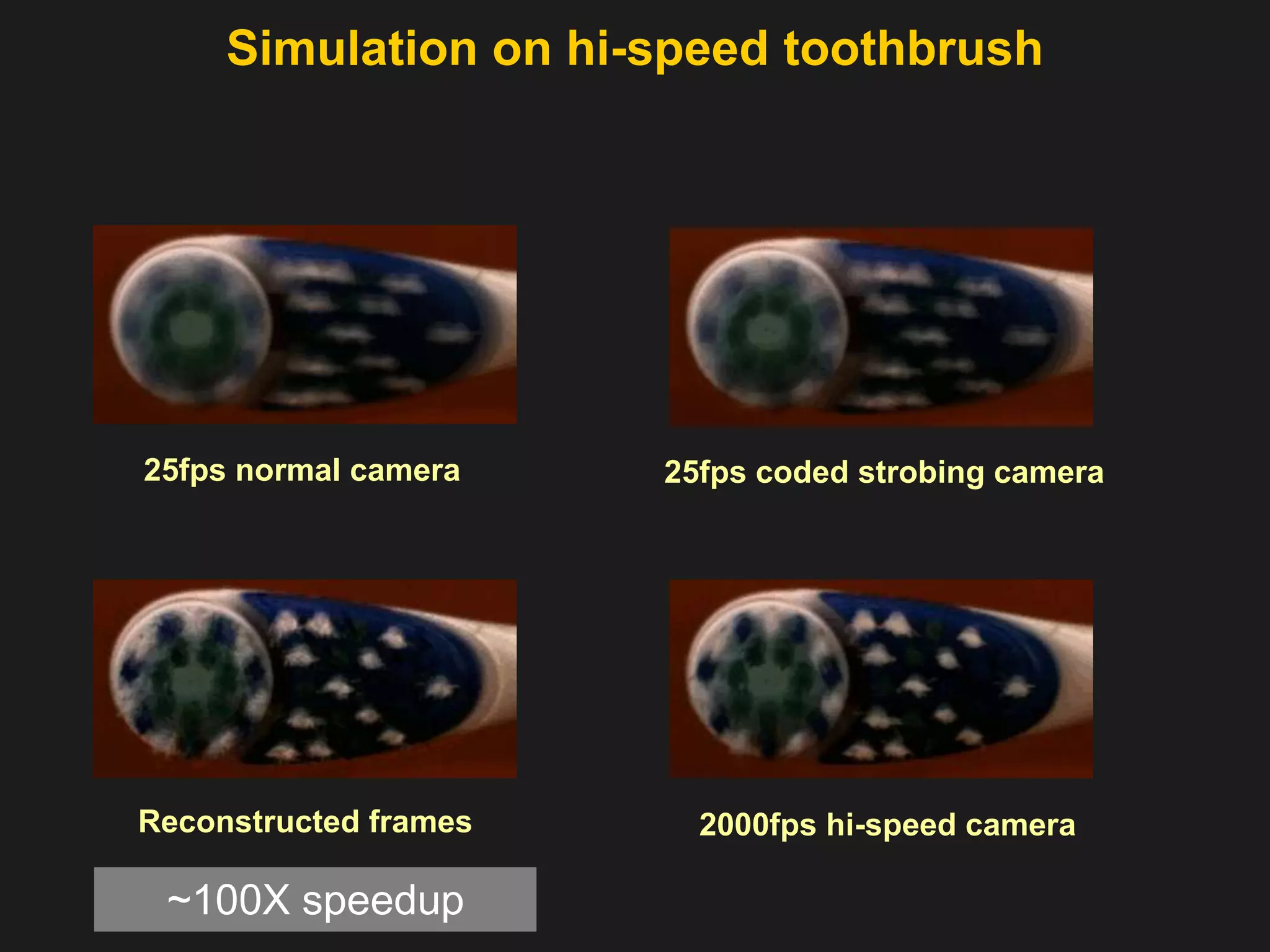
Simulation on hi-speed toothbrush25fps normal camera25fps coded strobing cameraReconstructed frames2000fps hi-speed camera~100X speedup
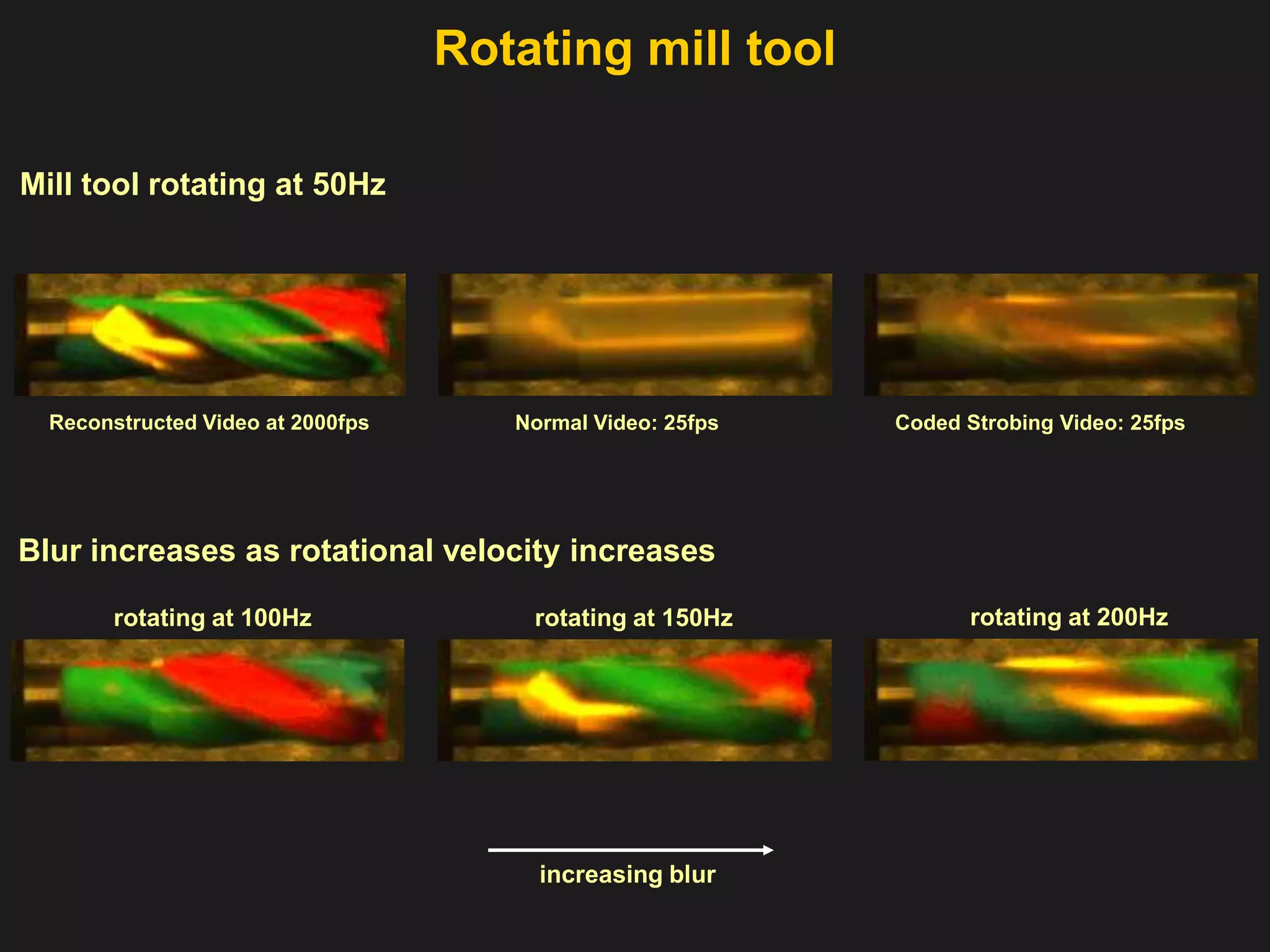
Rotating mill toolMill tool rotating at 50HzReconstructed Video at 2000fpsNormal Video: 25fpsCoded Strobing Video: 25fpsBlur increases as rotational velocity increases rotating at 200Hzrotating at 150Hzrotating at 100Hzincreasing blur
Compressive Sensing for Images .. A good idea?Single Pixel Cameraimagecompressive imagemeasurement matrix
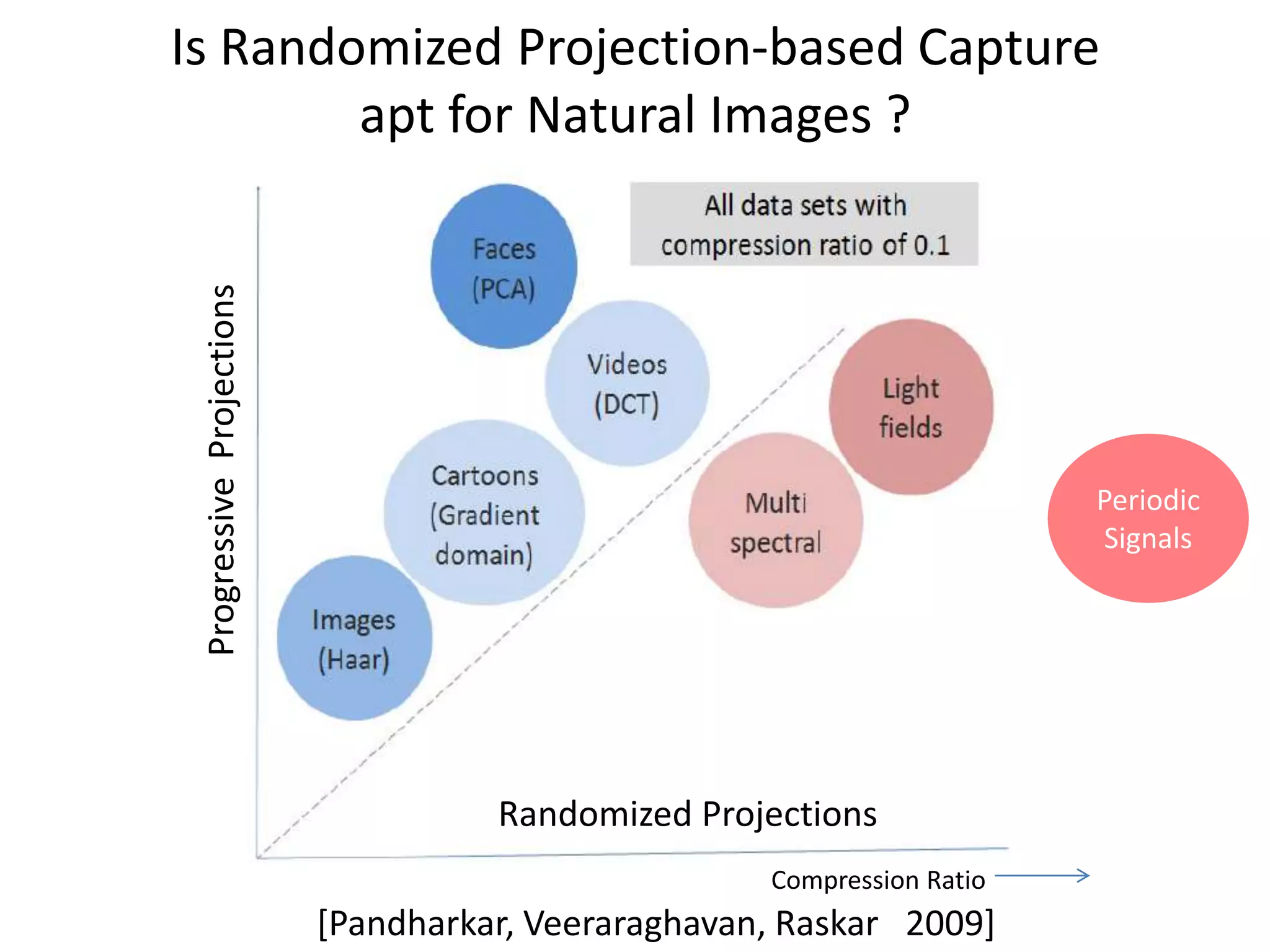
Is Randomized Projection-based Captureapt for Natural Images ? Periodic SignalsProgressive  ProjectionsRandomized ProjectionsCompression Ratio[Pandharkar, Veeraraghavan, Raskar   2009]
Compact ProgrammableLights ?
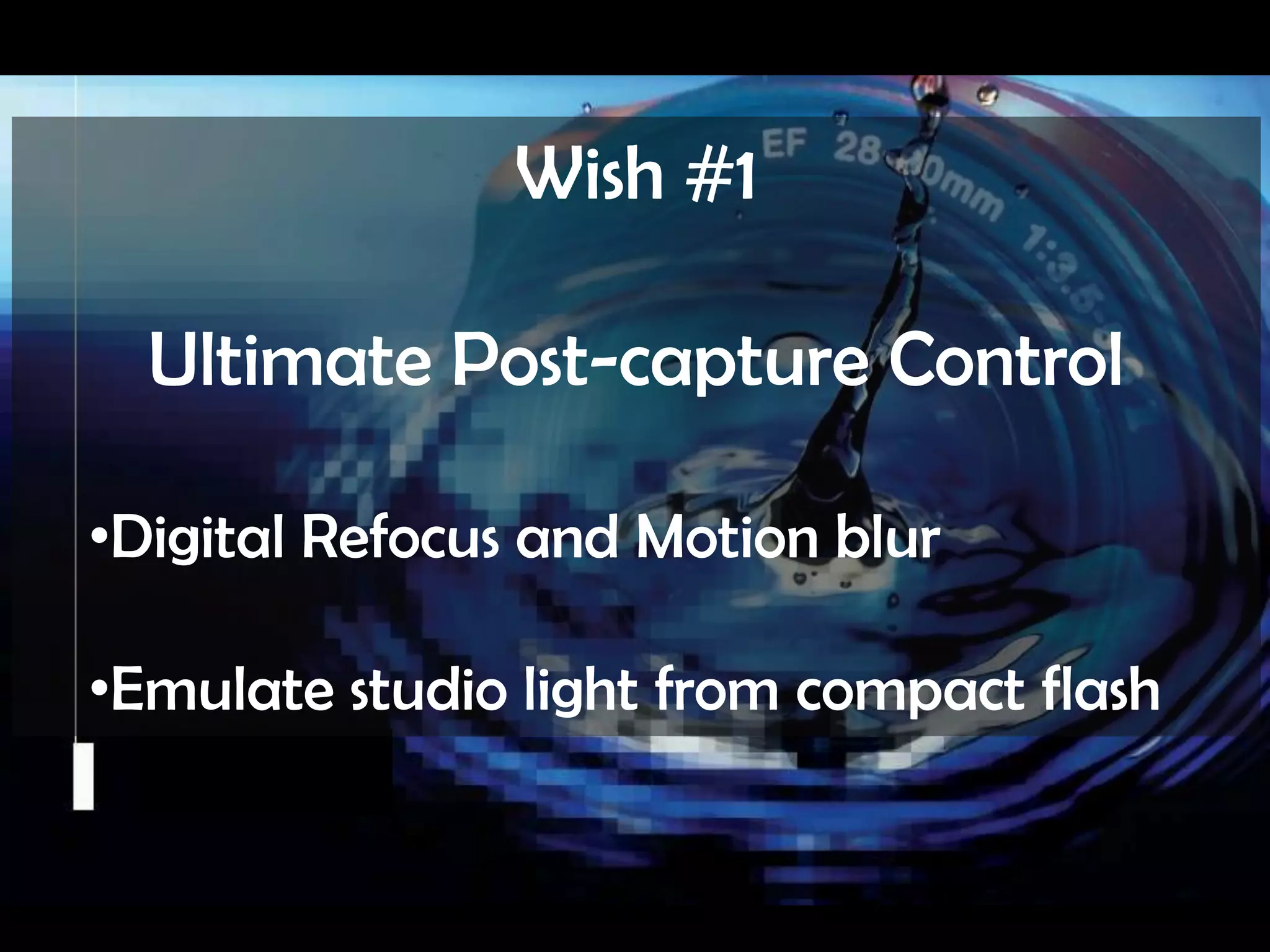
Wish #1Ultimate Post-capture ControlDigital Refocus and Motion blur
Emulate studio light from compact flashCamera CultureRamesh  Raskar
Wish #2Freedom  from  FormSize, Weight, Power, UI
Flat camera: 		Bidirectional screen (BiDi)Shallow DoF from tiny lensCamera CultureRamesh  Raskar
Wish #3Understand the WorldCamera CultureRamesh  Raskar
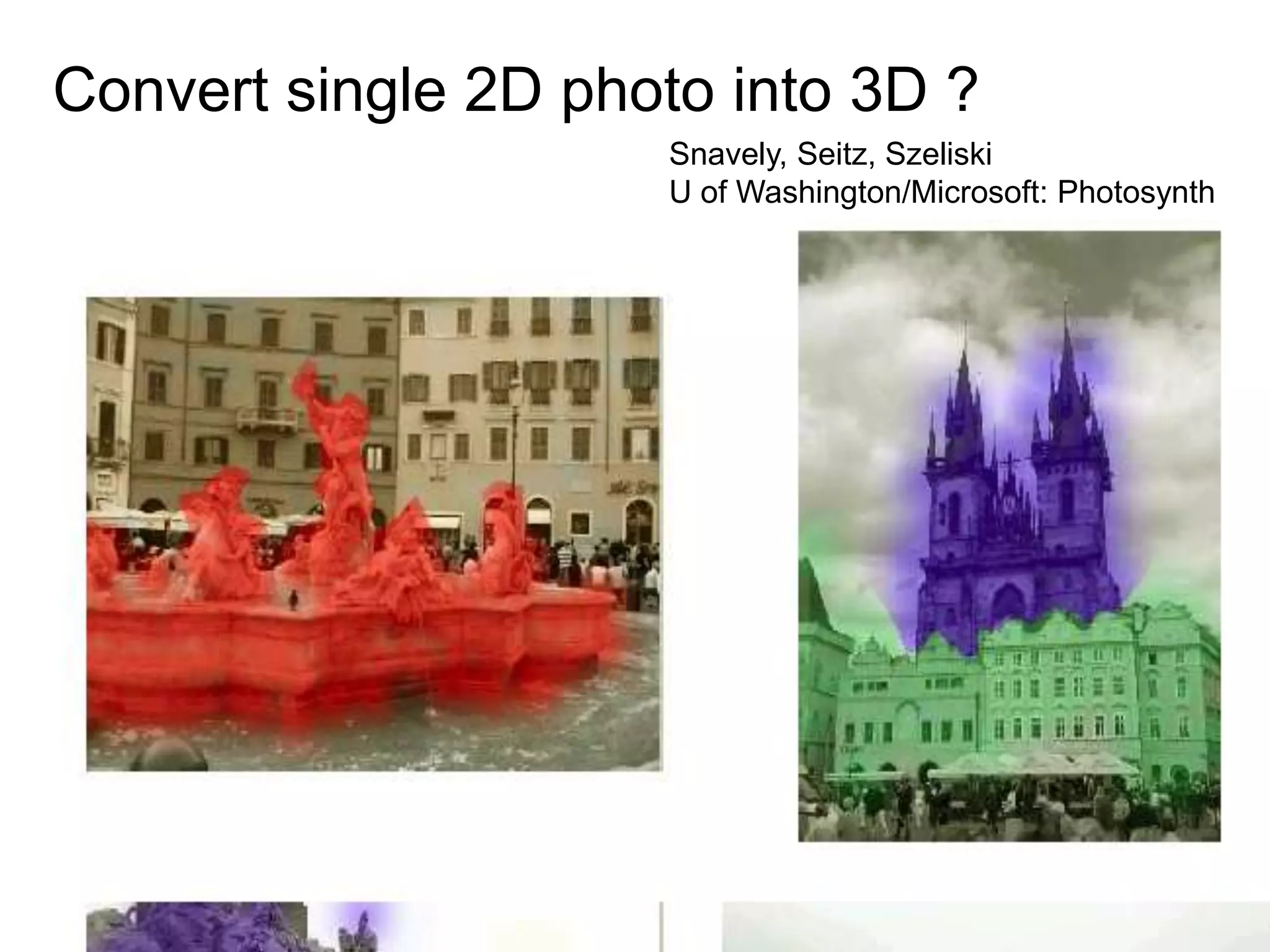
Convert single 2D photo into 3D ?Snavely, Seitz, SzeliskiU of Washington/Microsoft: Photosynth
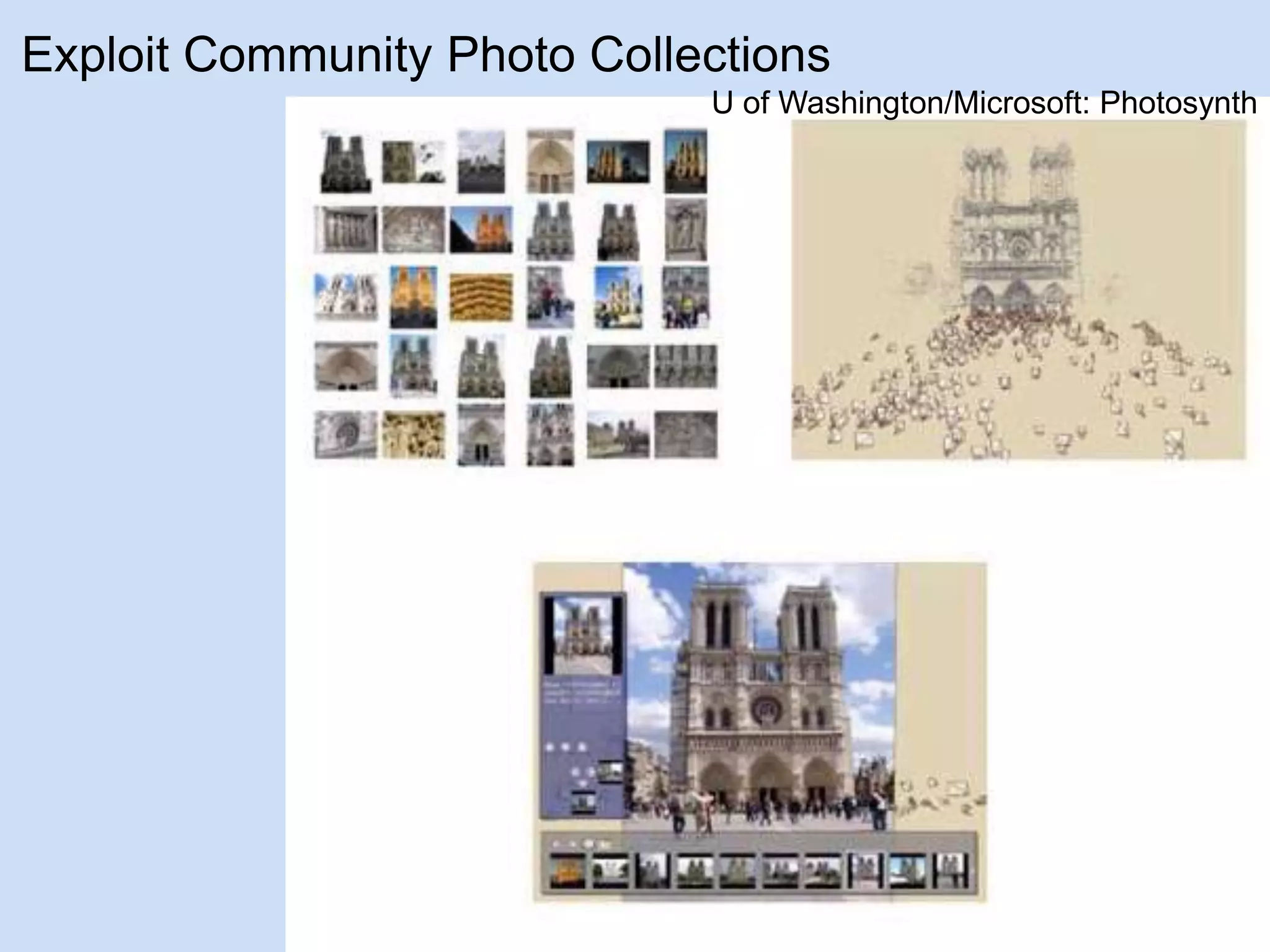
Exploit Community Photo CollectionsU of Washington/Microsoft: Photosynth
Wish #3Understand the WorldIdentify/recognize Materials
3D Awareness
Interact with informationCamera CultureRamesh  Raskar
Wish #4Sharing Visual ExperienceLifeLog Auto-summary
Privacy in public and authentication
Hyper-real Photo Frames
Print ‘material’ Camera CultureRamesh  Raskar
Wish #5Capturing EssenceCamera CultureRamesh  Raskar
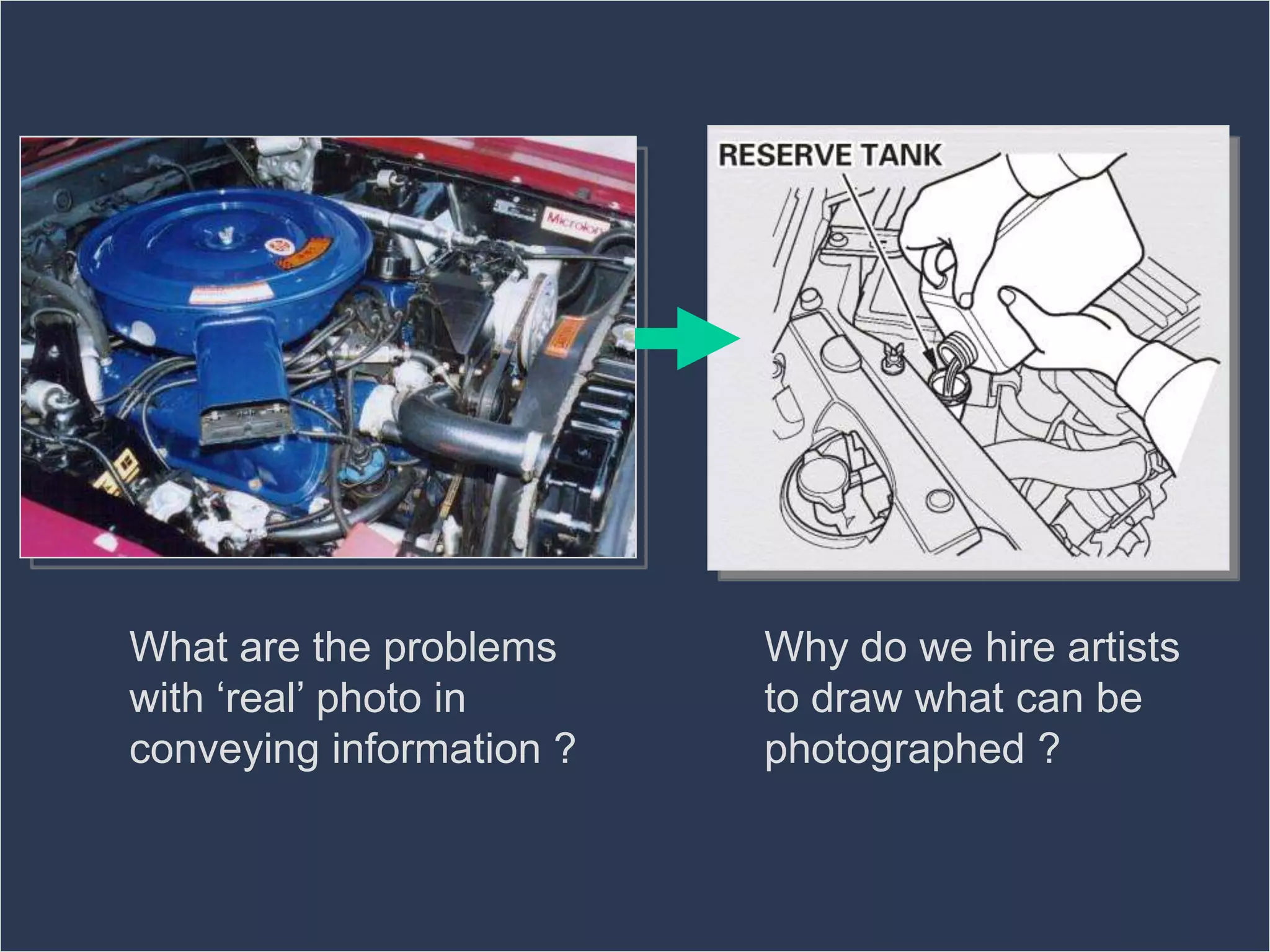
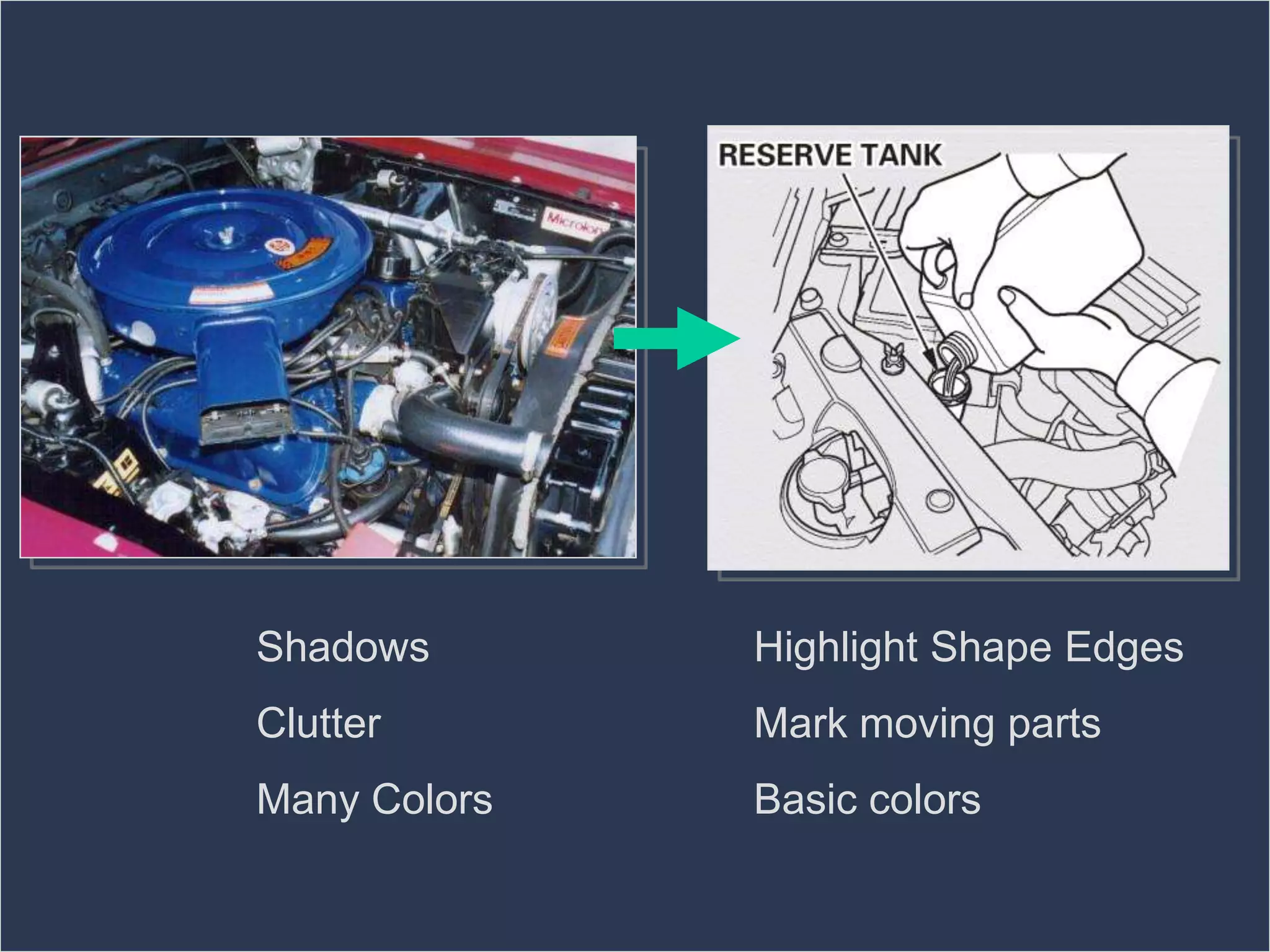
What are the problems with ‘real’ photo in conveying information ?Why do we hire artists to draw what can be photographed ?
ShadowsClutterMany ColorsHighlight Shape EdgesMark moving partsBasic colors
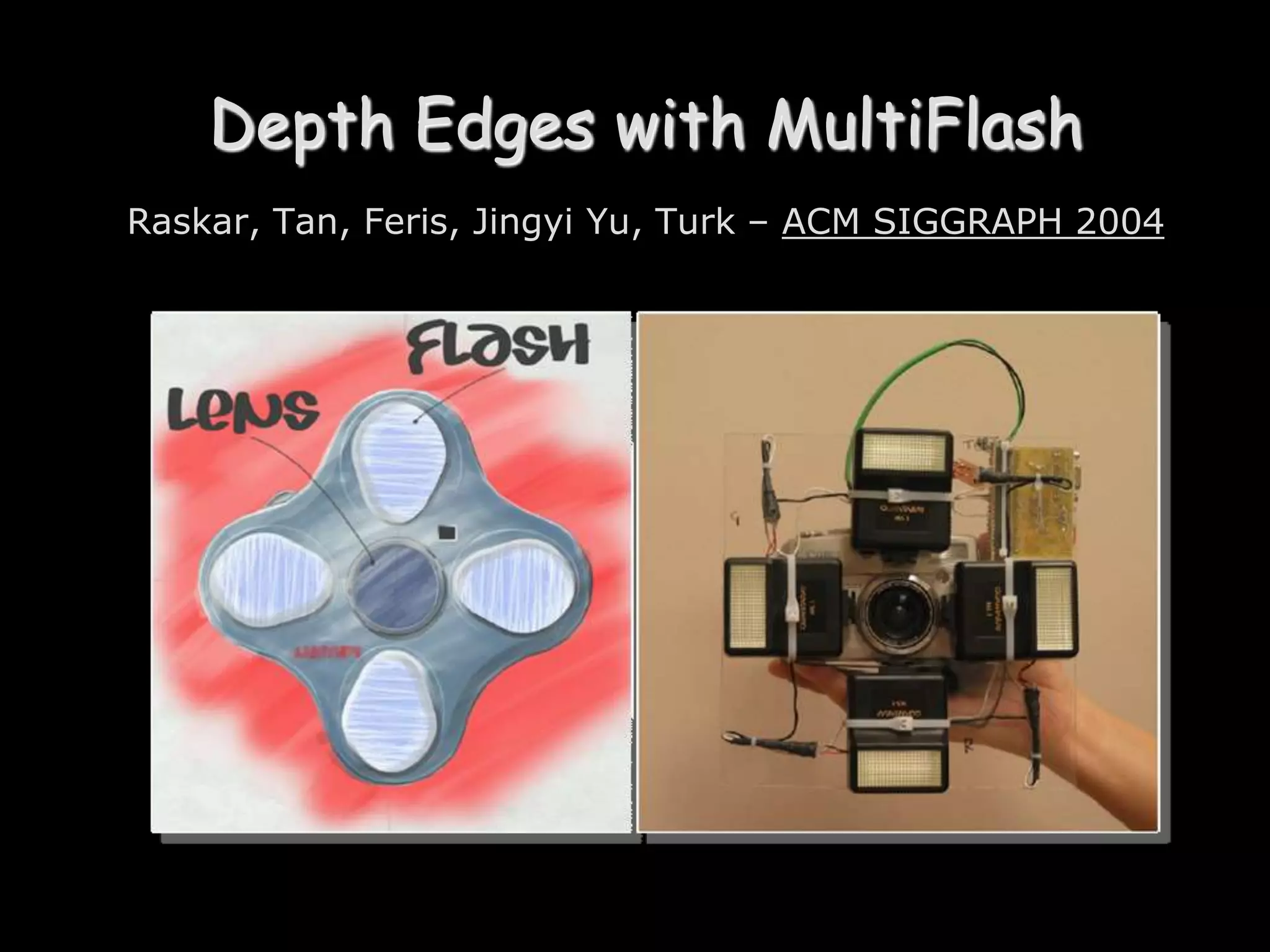
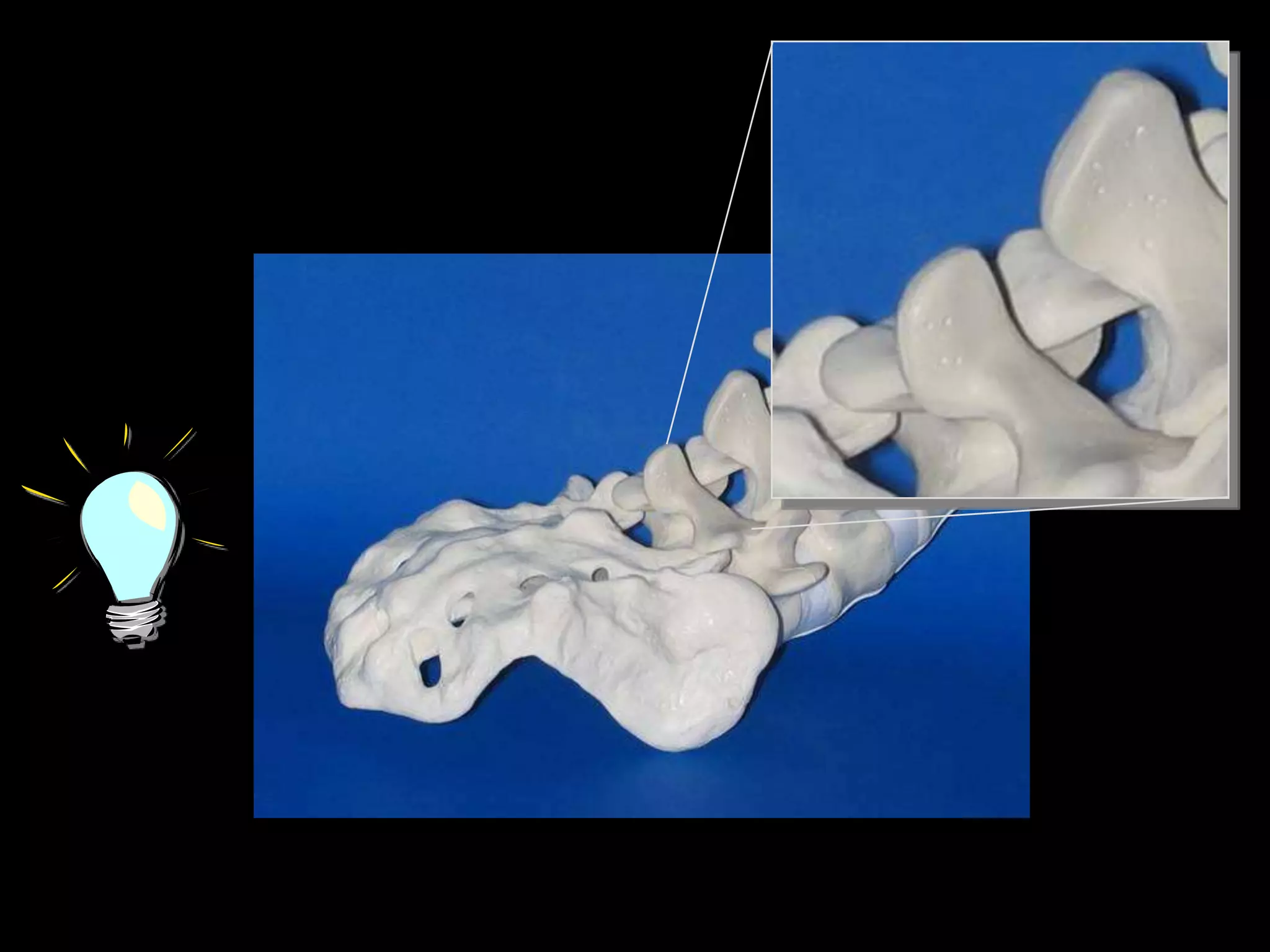
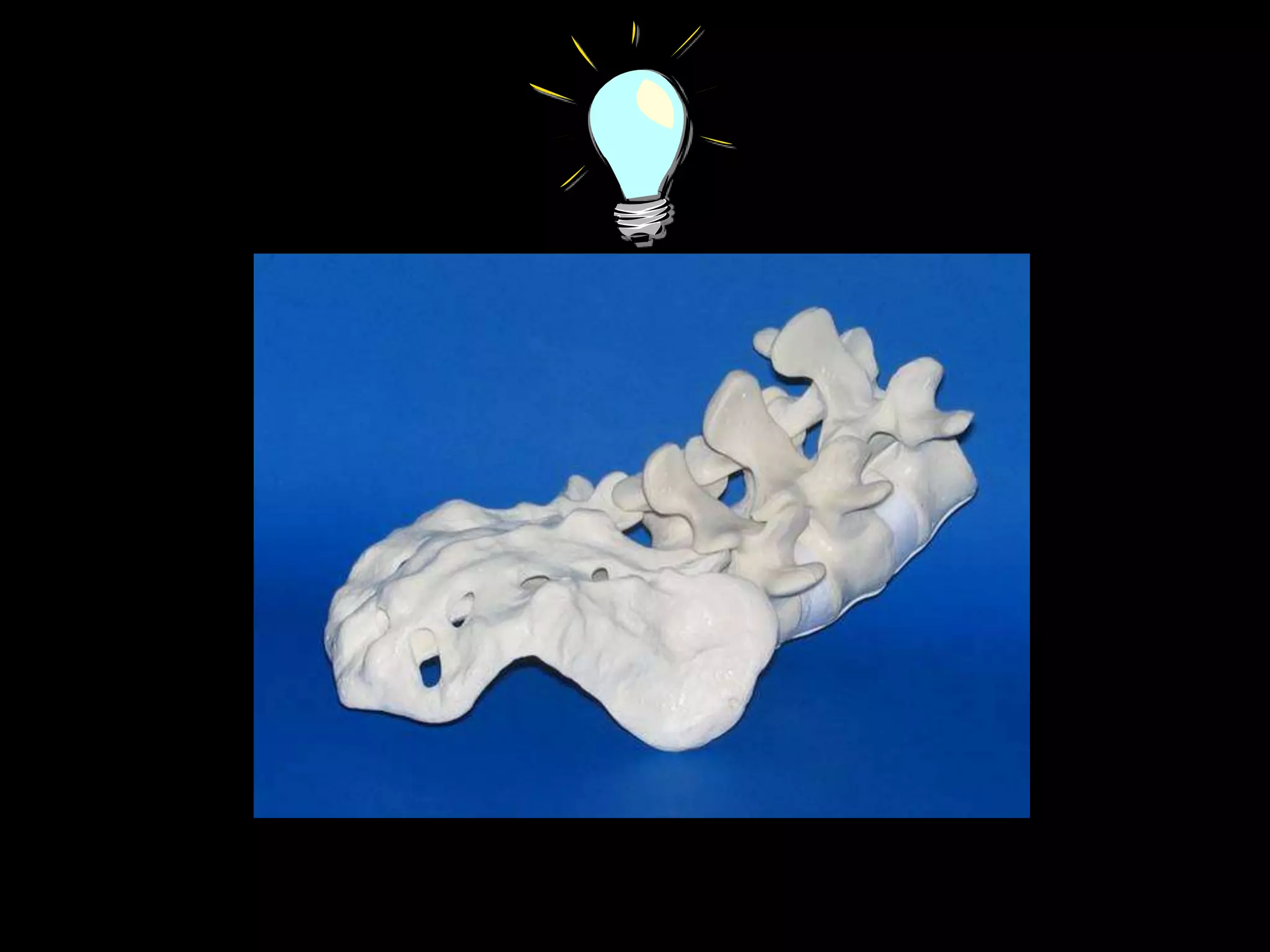
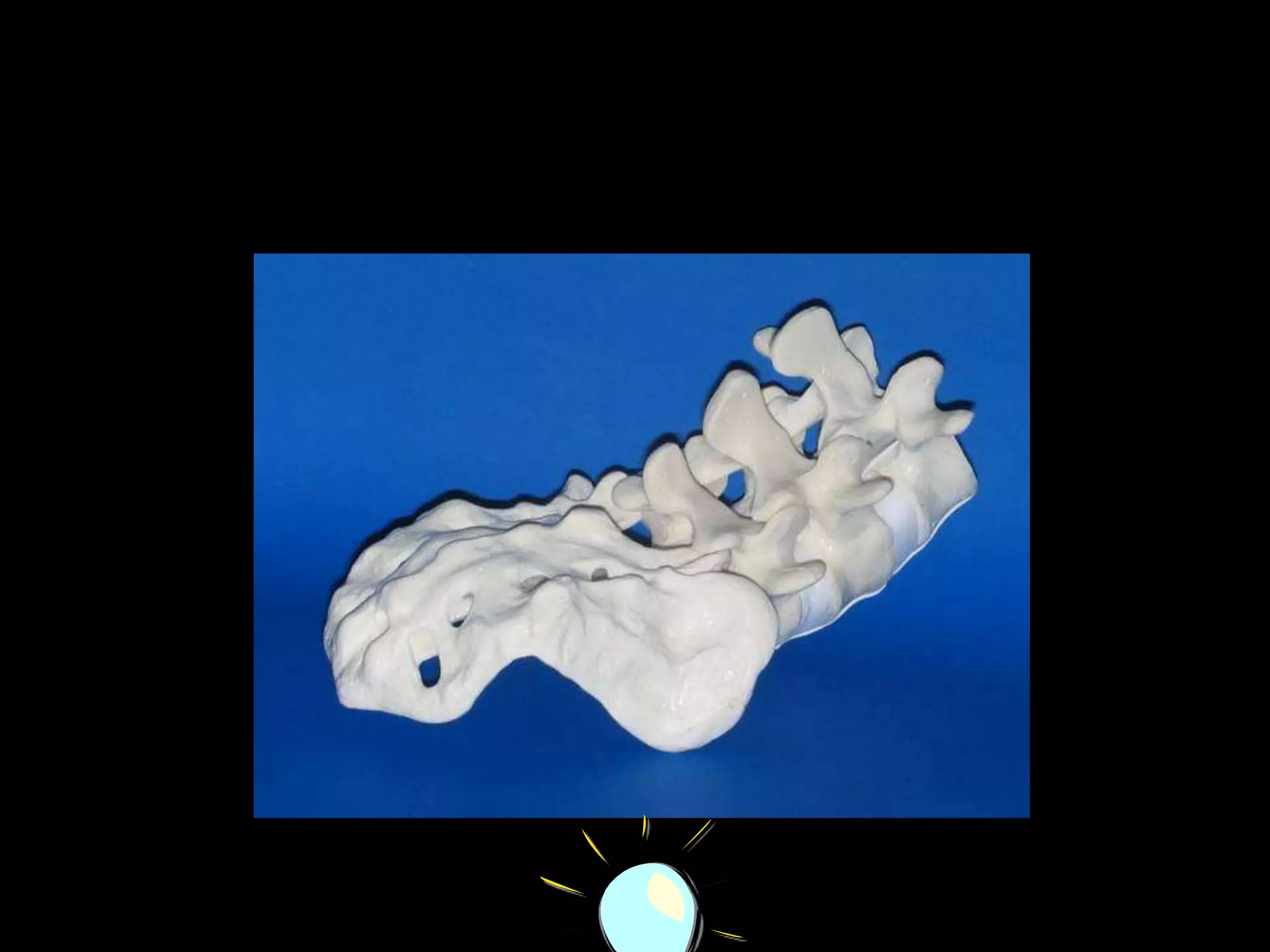
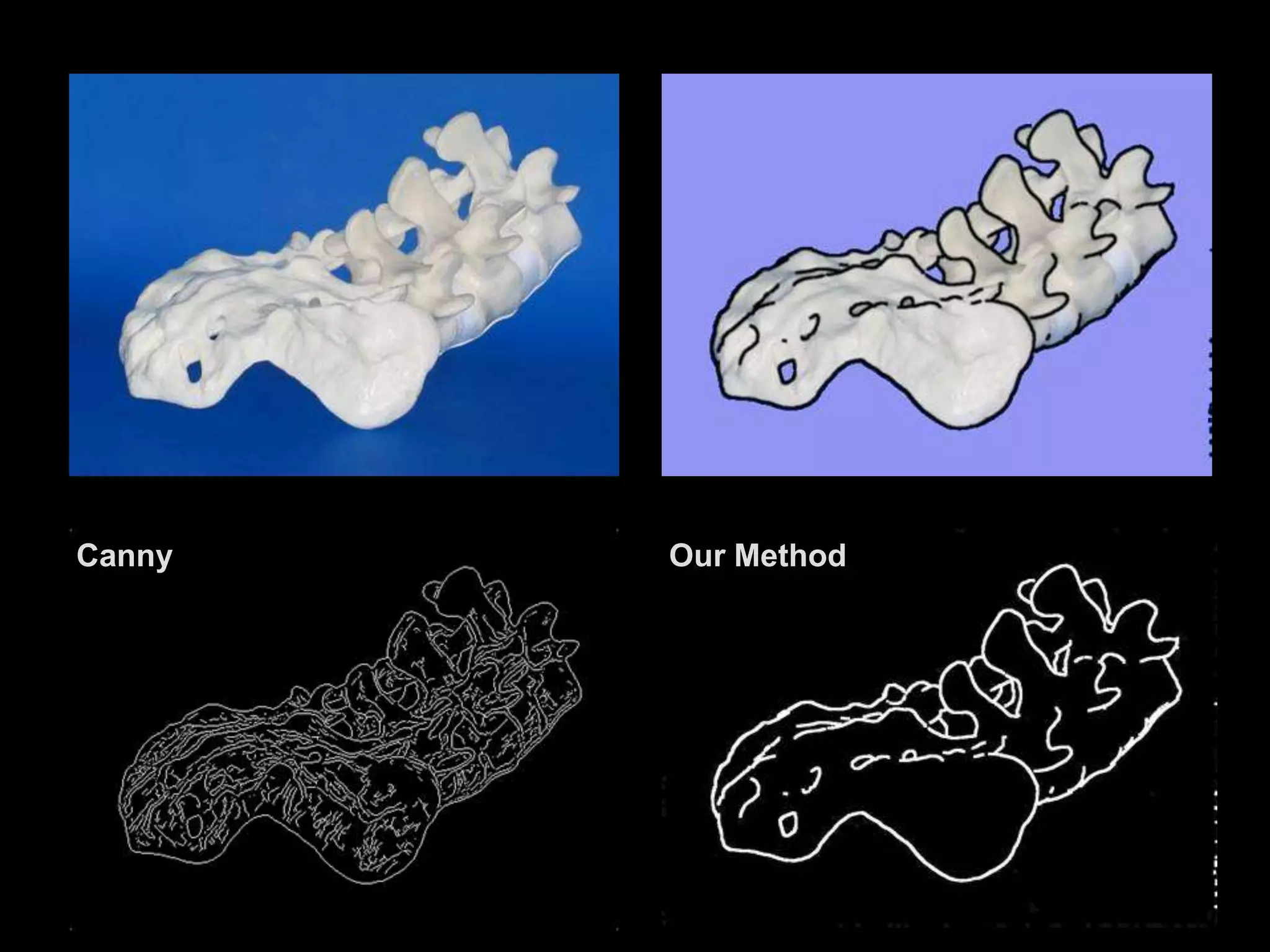
Depth Edges with MultiFlashRaskar, Tan, Feris, Jingyi Yu, Turk – ACM SIGGRAPH 2004
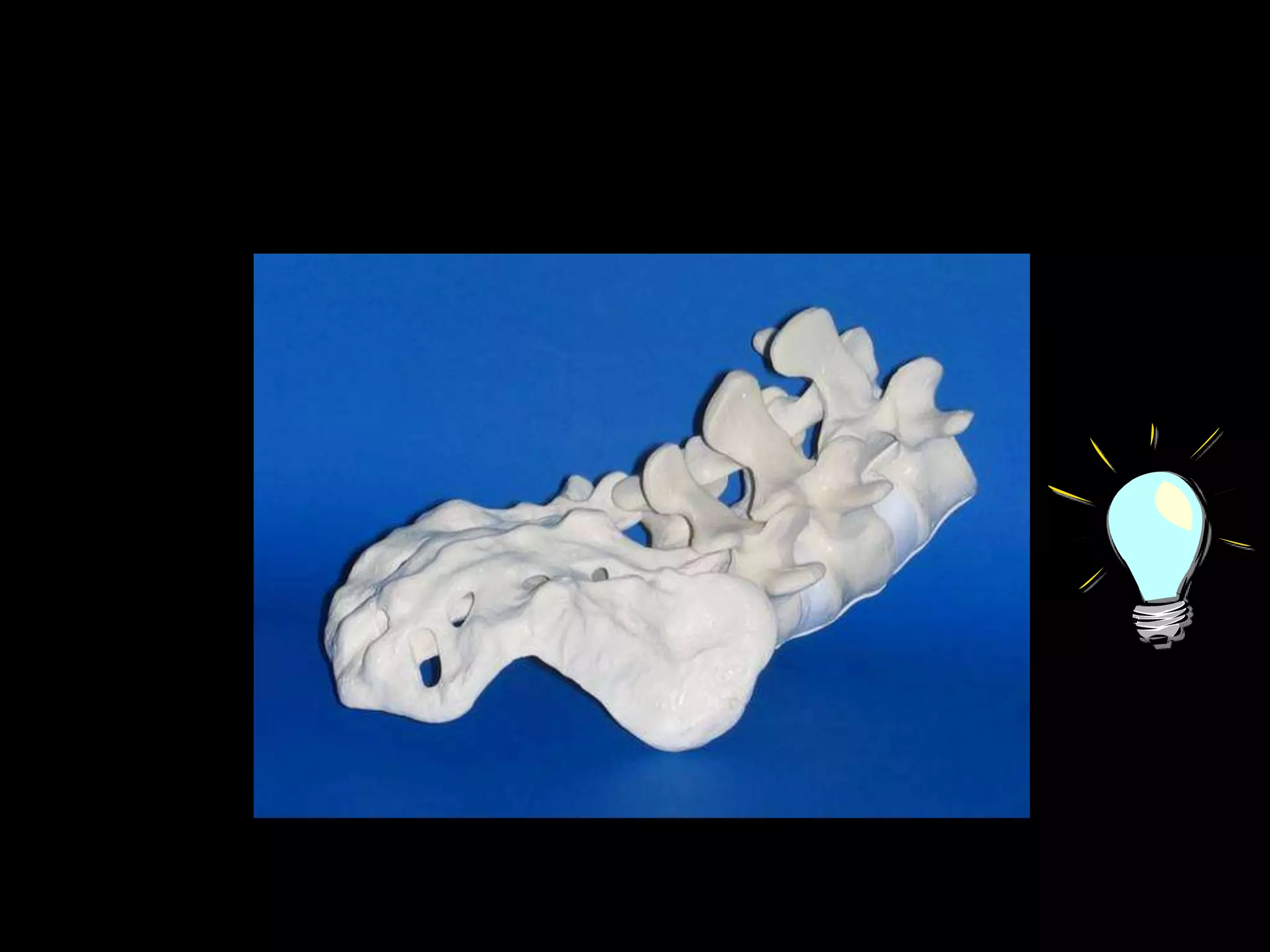
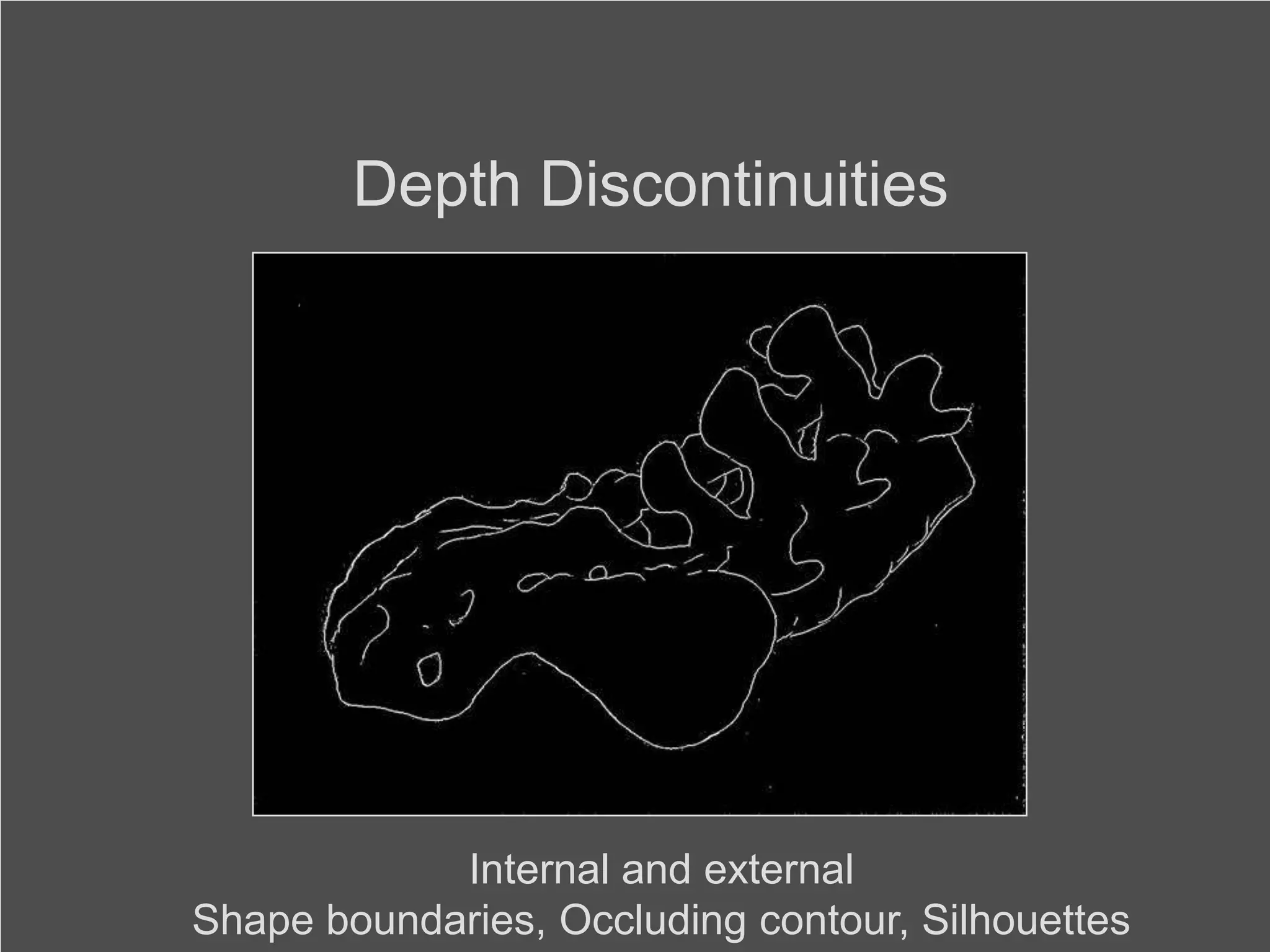
Depth DiscontinuitiesInternal and externalShape boundaries, Occluding contour, Silhouettes
Depth Edges
Our MethodCanny
ResultPhotoCanny Intensity Edge DetectionOur Method
QuestionsWhat will a camera look like in 10,20 years?How will a billion networked and portable cameras change the social culture? How will online photo collections transform visual social computing?How will movie making/new reporting change?
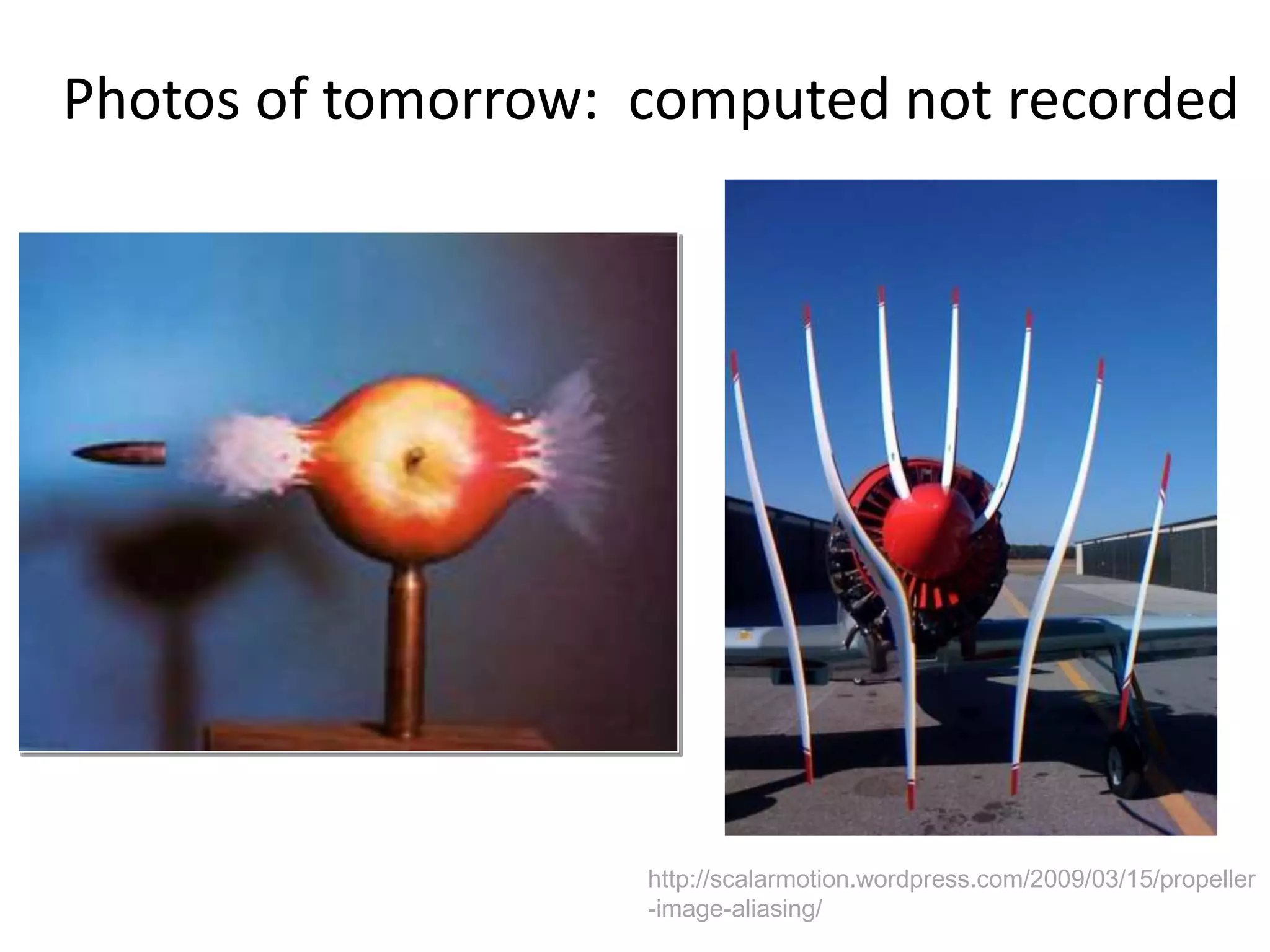
Photos of tomorrow:  computed not recordedhttp://scalarmotion.wordpress.com/2009/03/15/propeller-image-aliasing/
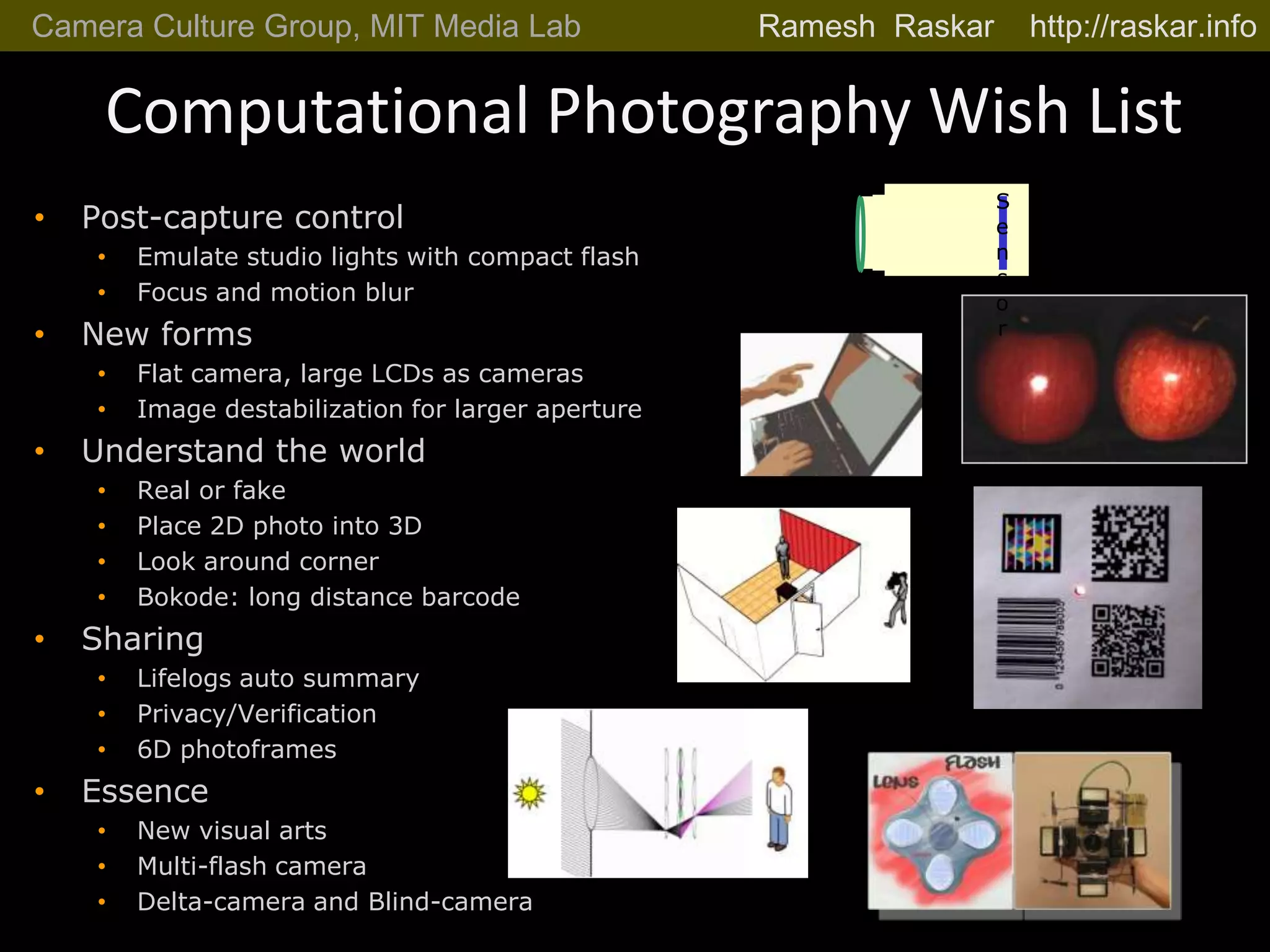
Camera Culture Group, MIT Media Lab                    Ramesh  Raskar    http://raskar.infoSensorComputational Photography Wish ListPost-capture control
Emulate studio lights with compact flash
Focus and motion blur
New forms
Flat camera, large LCDs as cameras
Image destabilization for larger aperture
Understand the world
Real or fake
Place 2D photo into 3D
Look around corner
Bokode: long distance barcode
Sharing
Lifelogs auto summary
Privacy/Verification
6D photoframes
Essence
New visual arts
Multi-flash camera
Delta-camera and Blind-cameraTake home pointsCo-design of hw/swAvoid computational or optical chauvinism in imaging  (Camera flash/Kinect)Hardware cost going to zero, Parallel technology trendsComputer vision not just mimicking human vision/perceptionBorrow ideas from other fields: astronomy, scientific imaging, audio, communicationsPhotons not just PixelsChange the rules of the gameOptics, Sensors, Illum, Priors, Sparsity, TransformsMeta-data, Internet collection, Crowdsourcing
MIT Media Lab          raskar@mit.edu  http://cameraculture.info	fb.com/rraskarInverse ProblemsHow to do Research in ImagingInverse Problems, Reconstruction, Rank and SparsityCo-design of Optics and ComputationPhotons not just pixelsMid-level cuesComputational PhotographyOpen research problemsCompressive Sensing for High Speed EventsLimits of CS for general imagingComputational Light TransportLooking Around Corners, trillion fpsLightfields: 3D Displays and Holograms
Every  Photon  has a Story
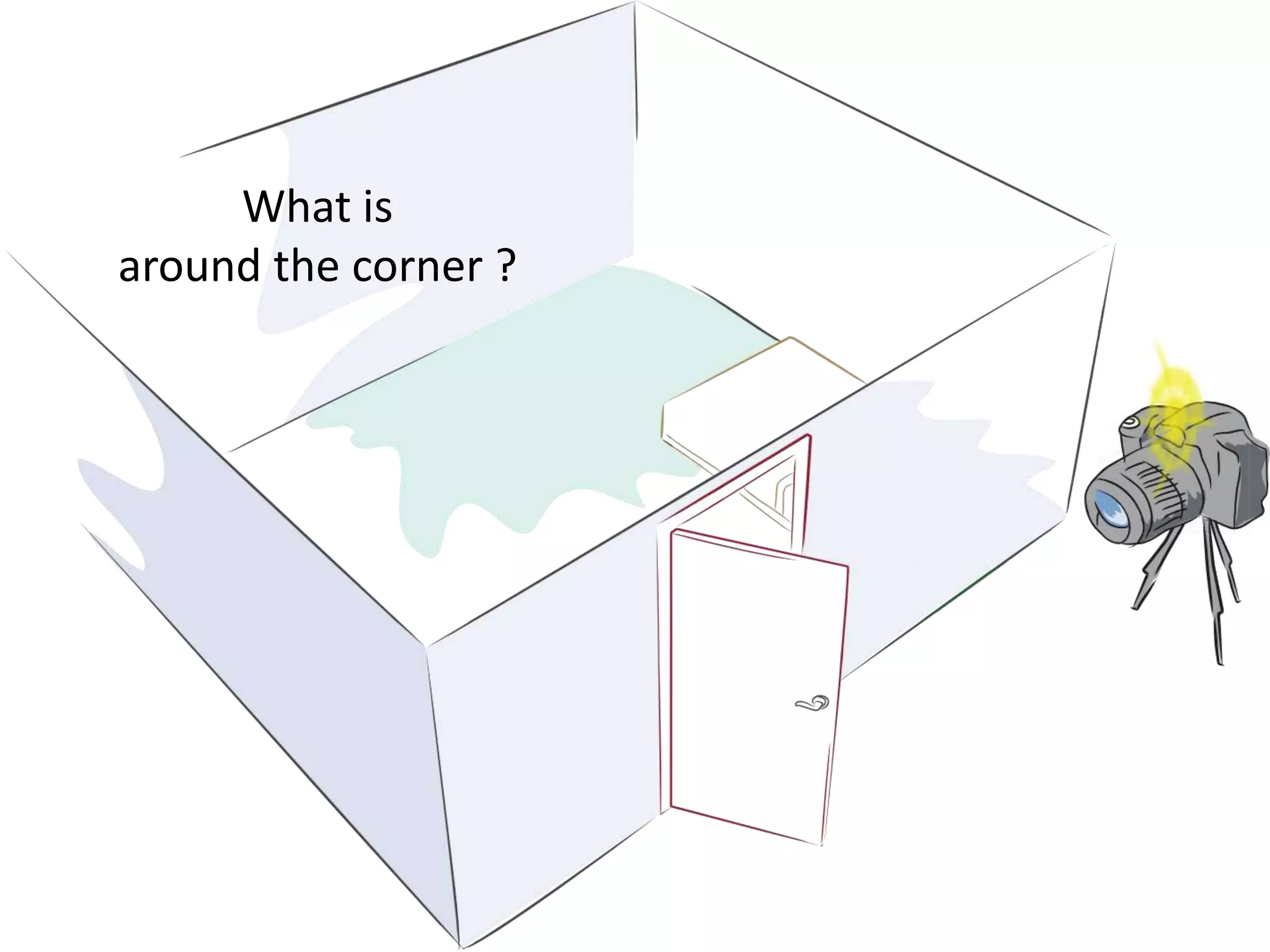
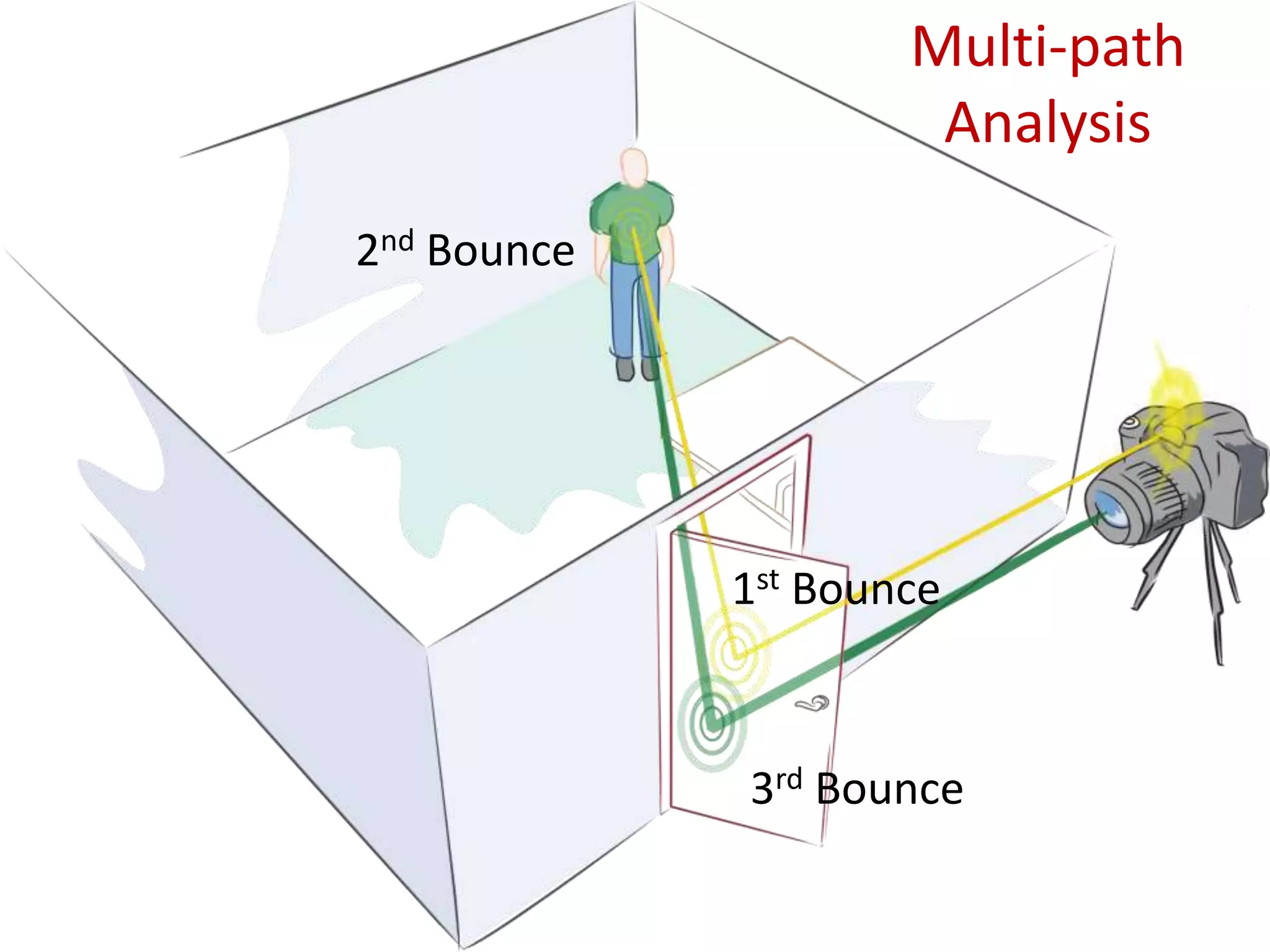
What isaround the corner ?
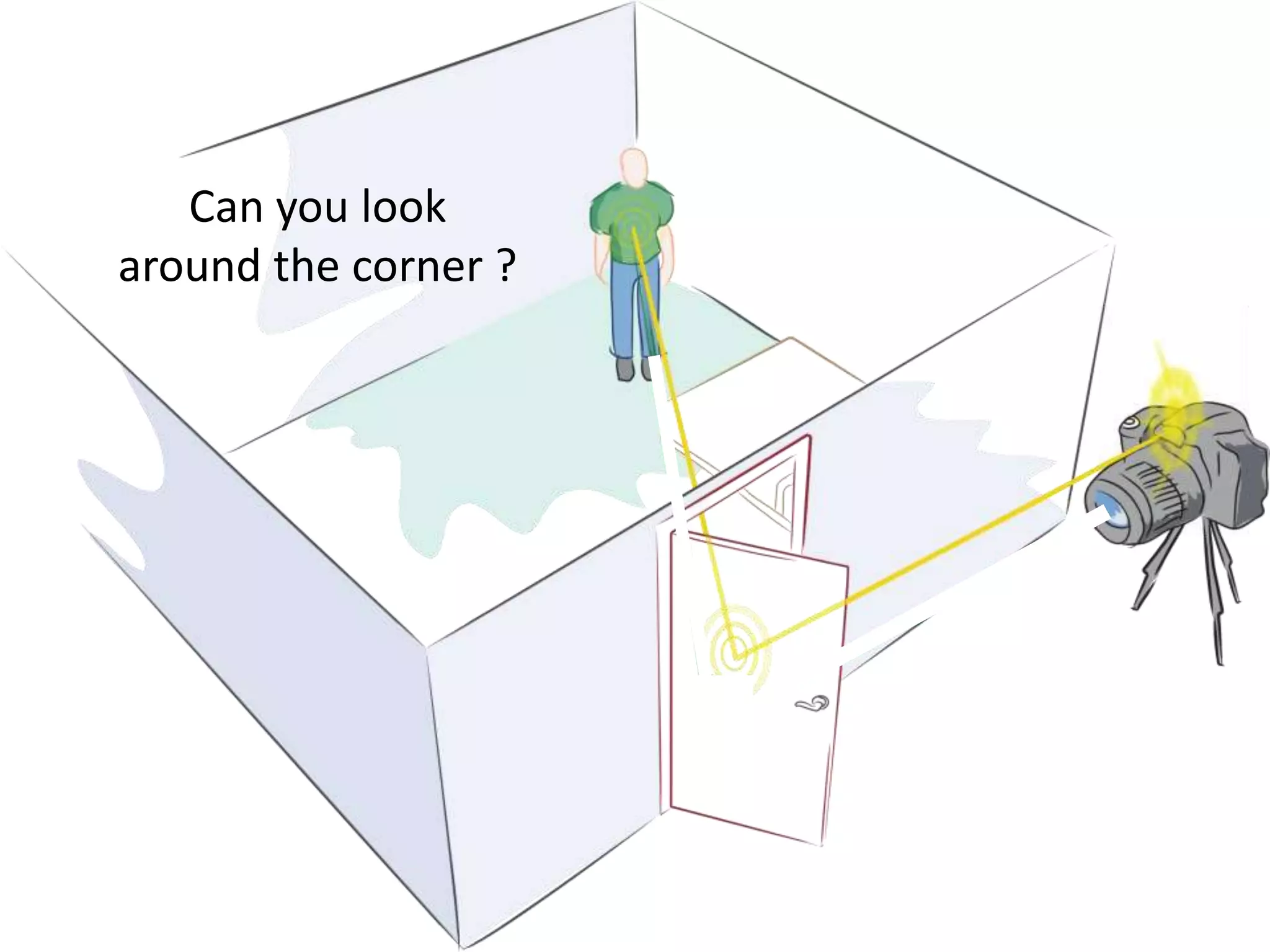
Can you look around the corner ?
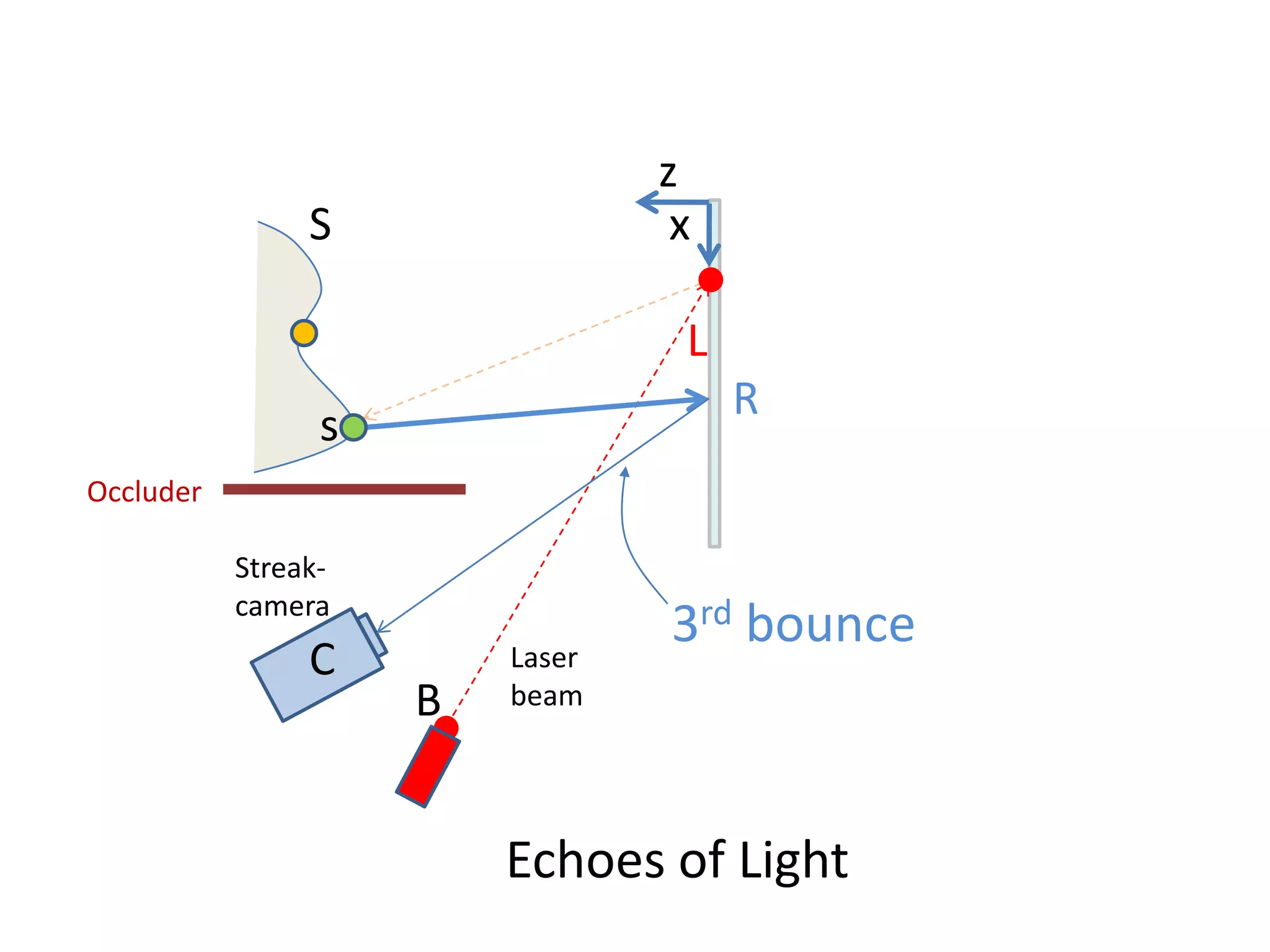
Multi-path Analysis2nd Bounce1st Bounce3rd Bounce
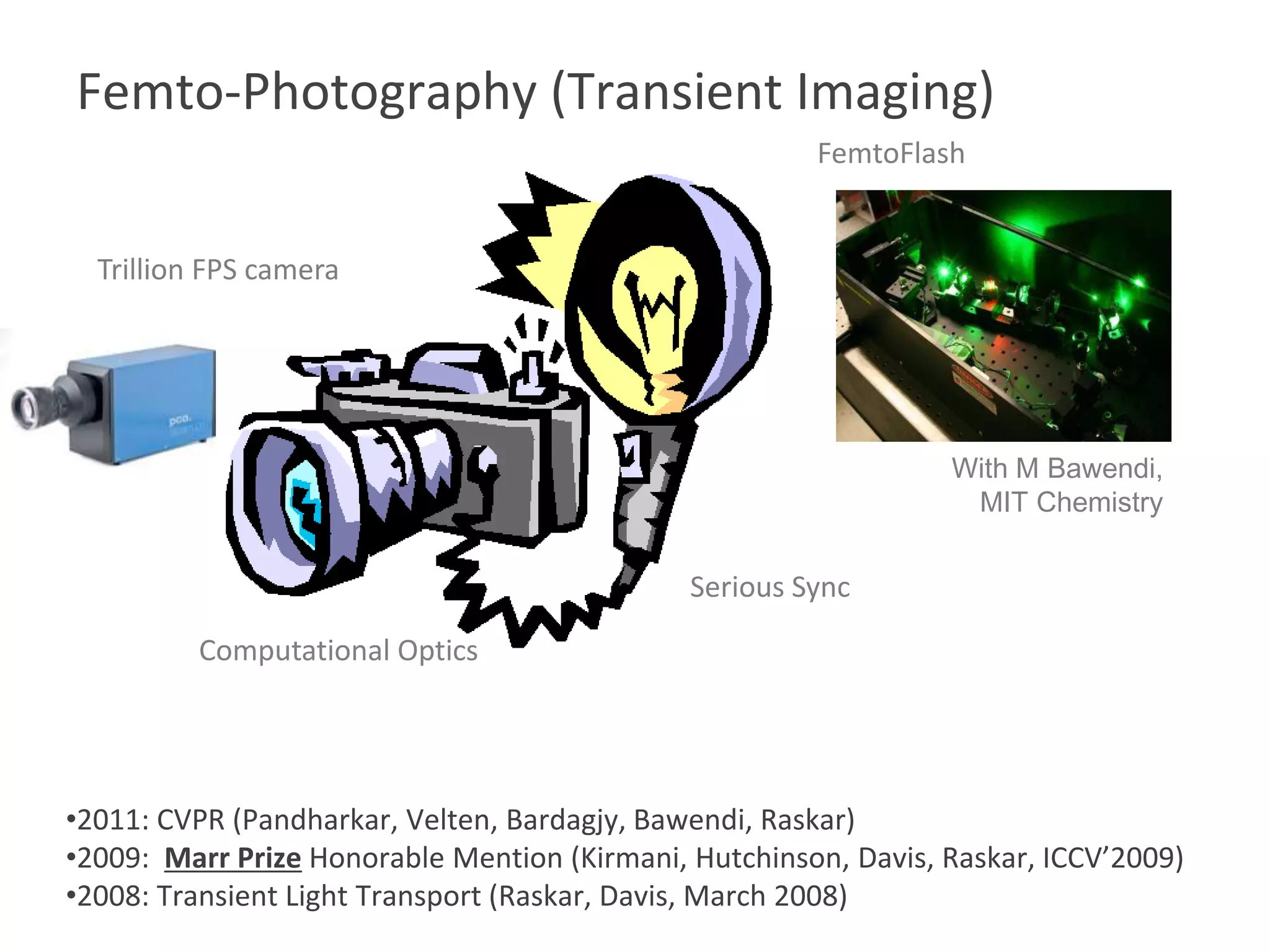
Femto-Photography (Transient Imaging)FemtoFlashTrillion FPS cameraWith M Bawendi, MIT ChemistrySerious SyncComputational Optics2011: CVPR (Pandharkar, Velten, Bardagjy, Bawendi, Raskar)
2009:  Marr PrizeHonorable Mention (Kirmani, Hutchinson, Davis, Raskar, ICCV’2009)
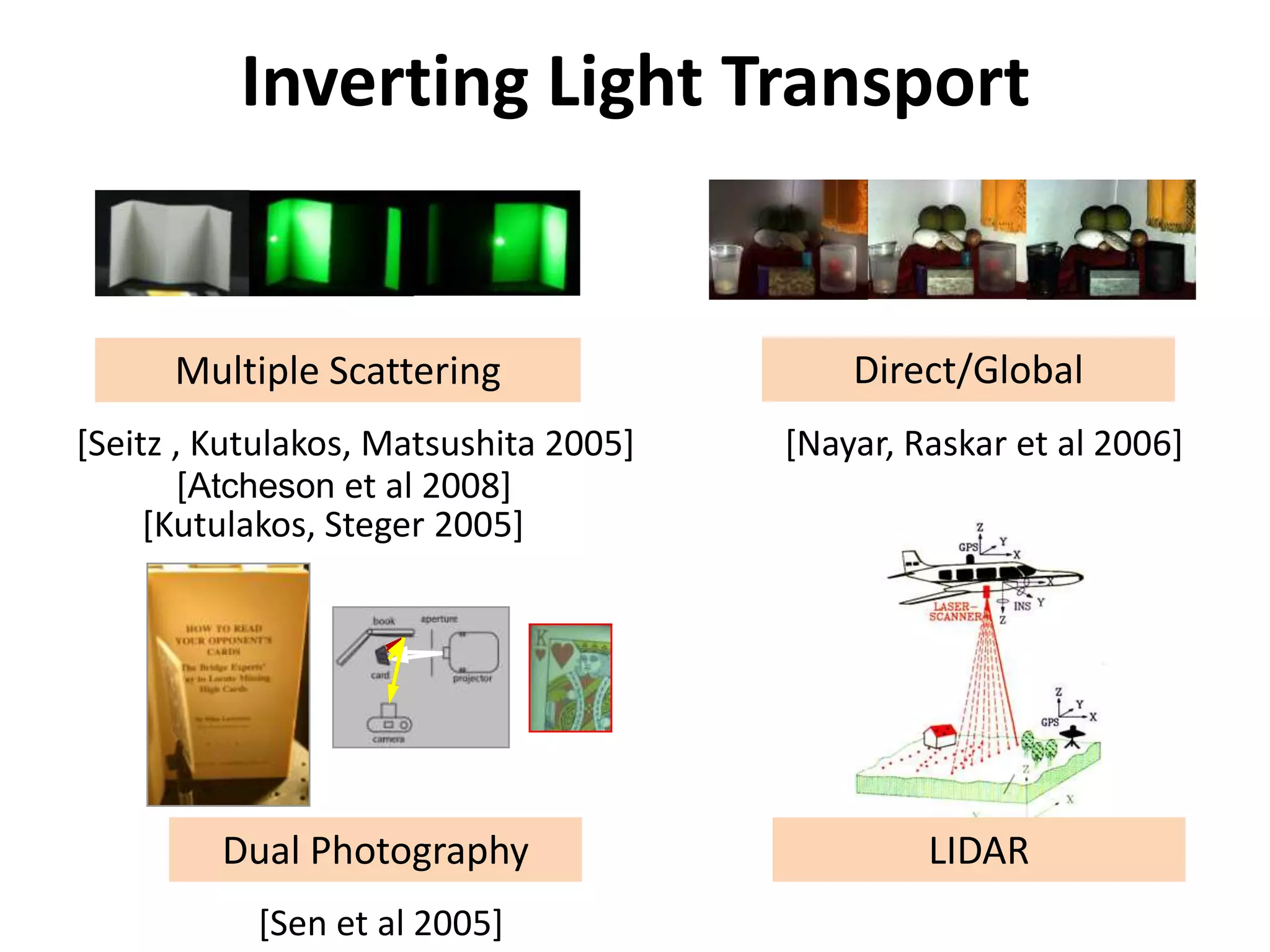
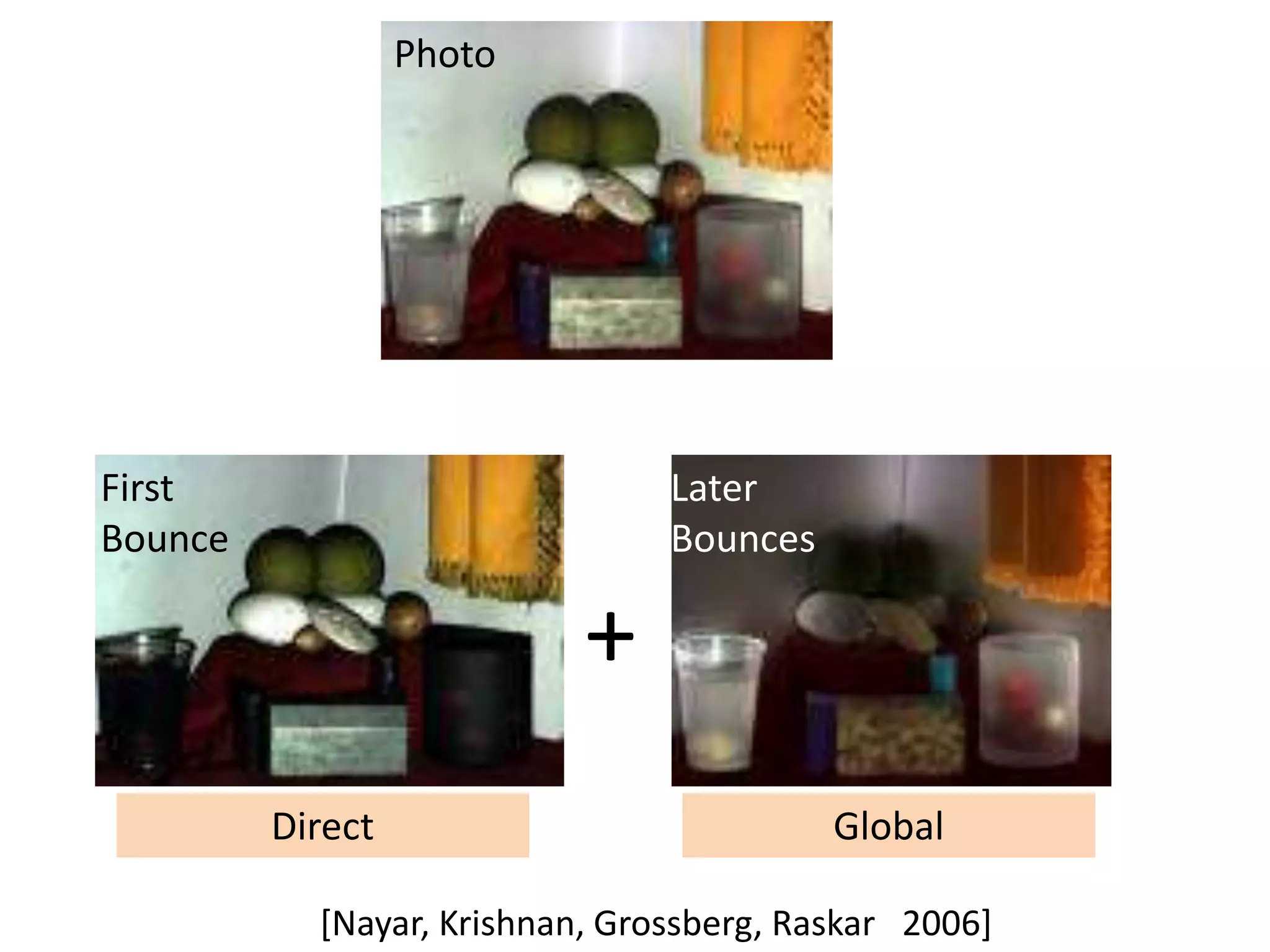
2008: Transient Light Transport (Raskar, Davis, March 2008)Inverting Light TransportDirect/GlobalMultiple Scattering[Seitz , Kutulakos, Matsushita 2005][Nayar, Raskar et al 2006][Atcheson et al 2008][Kutulakos, Steger 2005]Dual PhotographyLIDAR[Sen et al 2005]
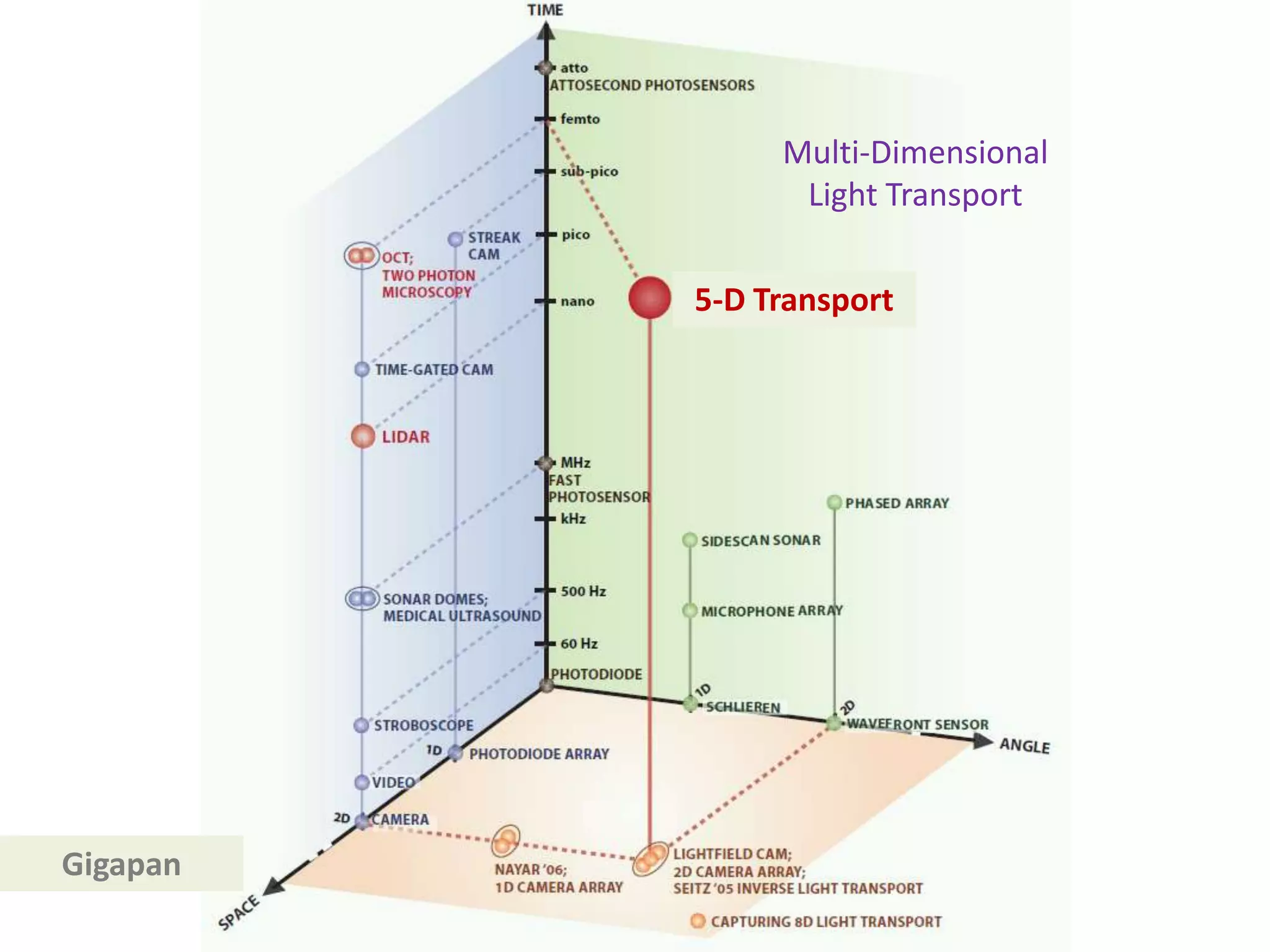
Multi-Dimensional Light Transport5-D TransportGigapan
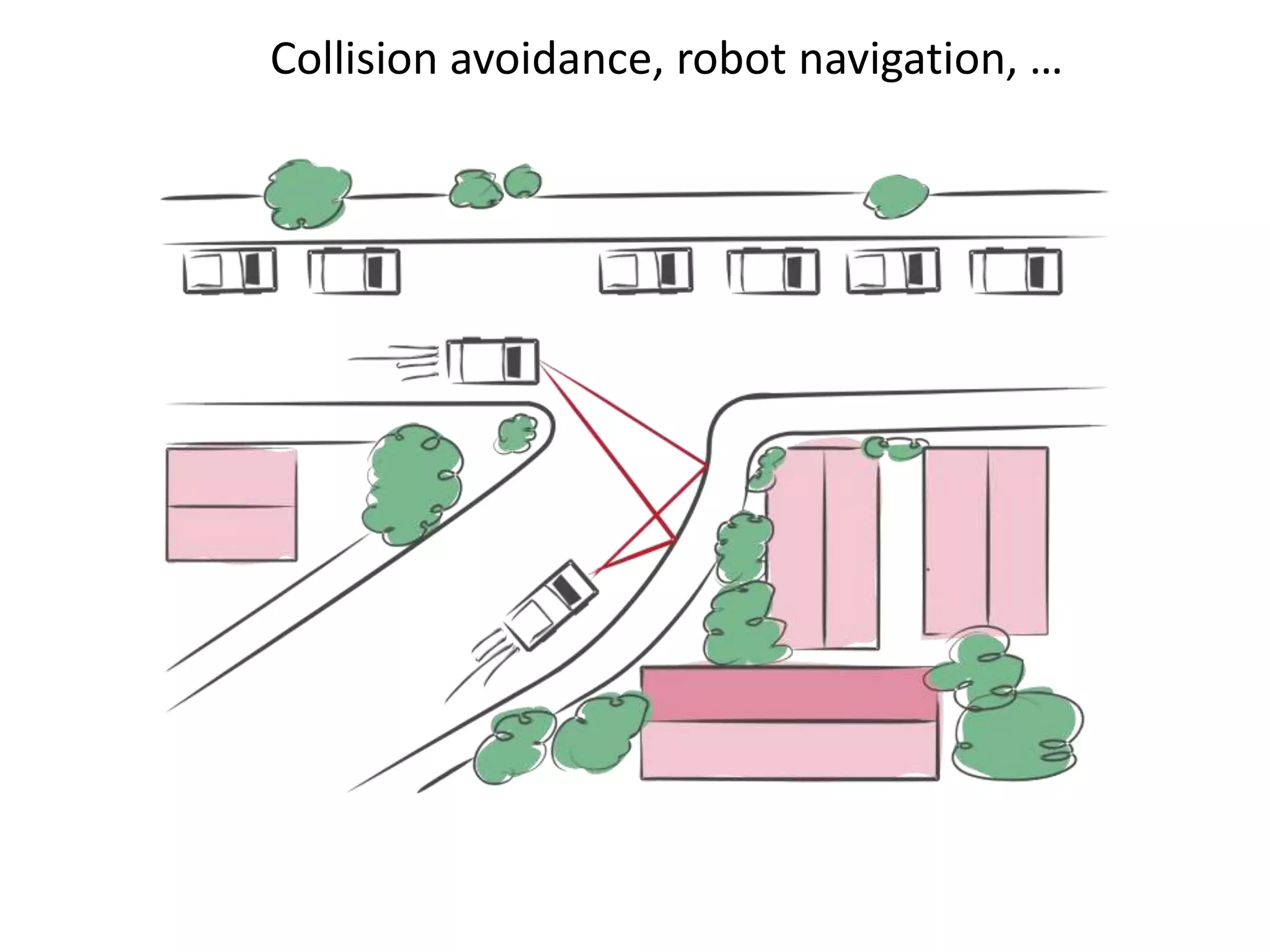
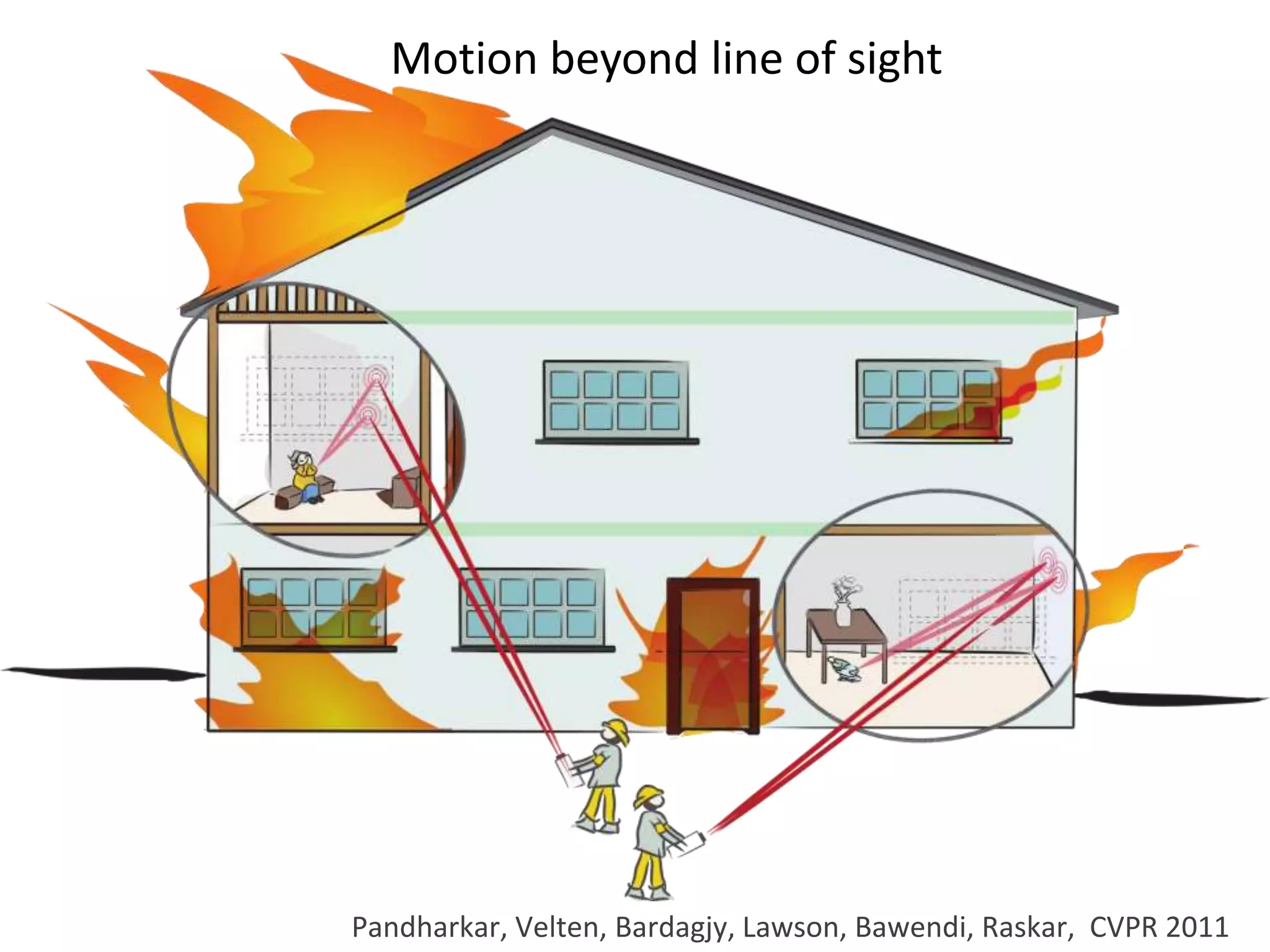
Collision avoidance, robot navigation, …
zxSLRsOccluderStreak-camera3rd bounceCLaser beamBEchoes of Light
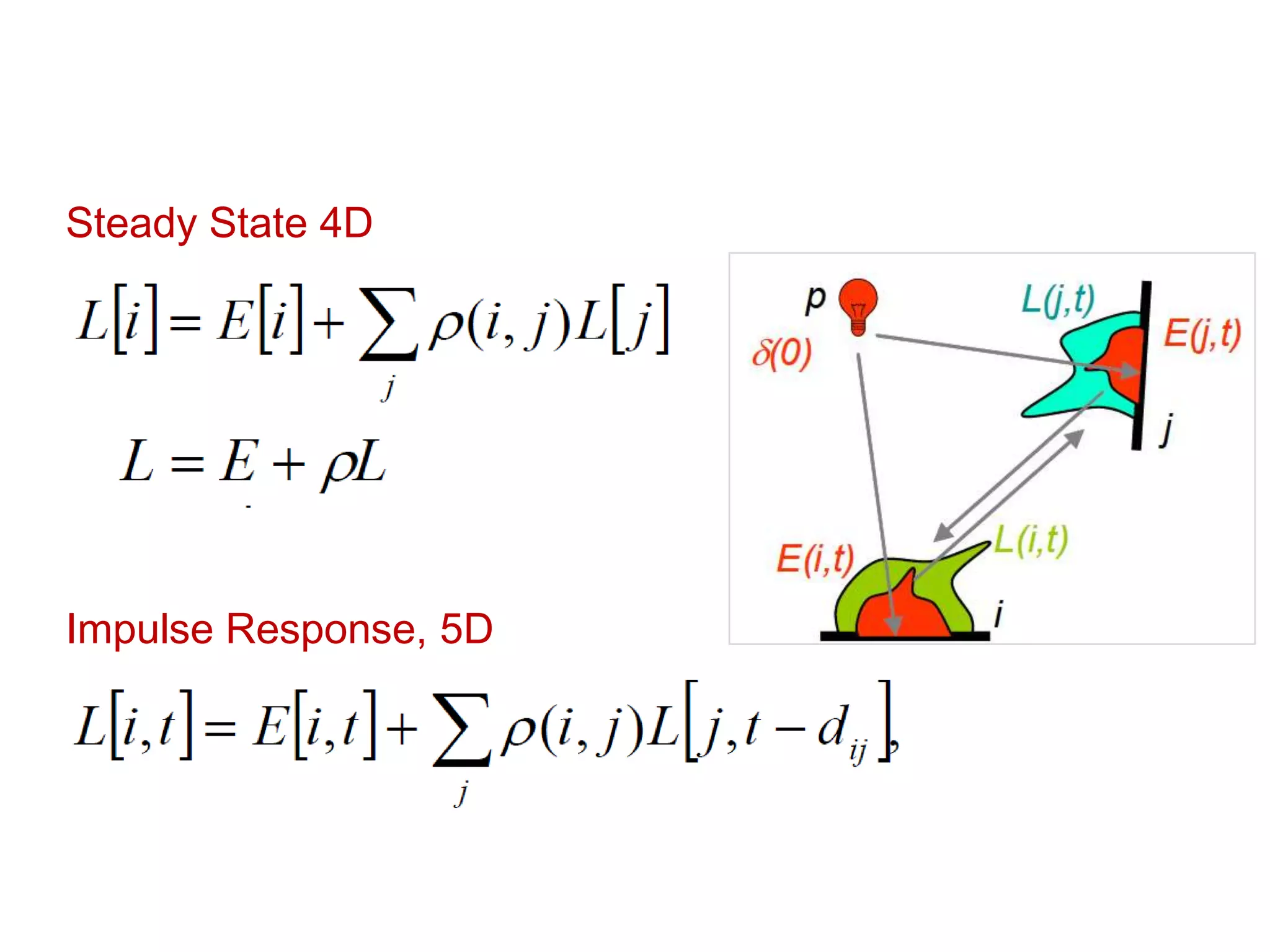
Steady State 4DImpulse Response, 5D
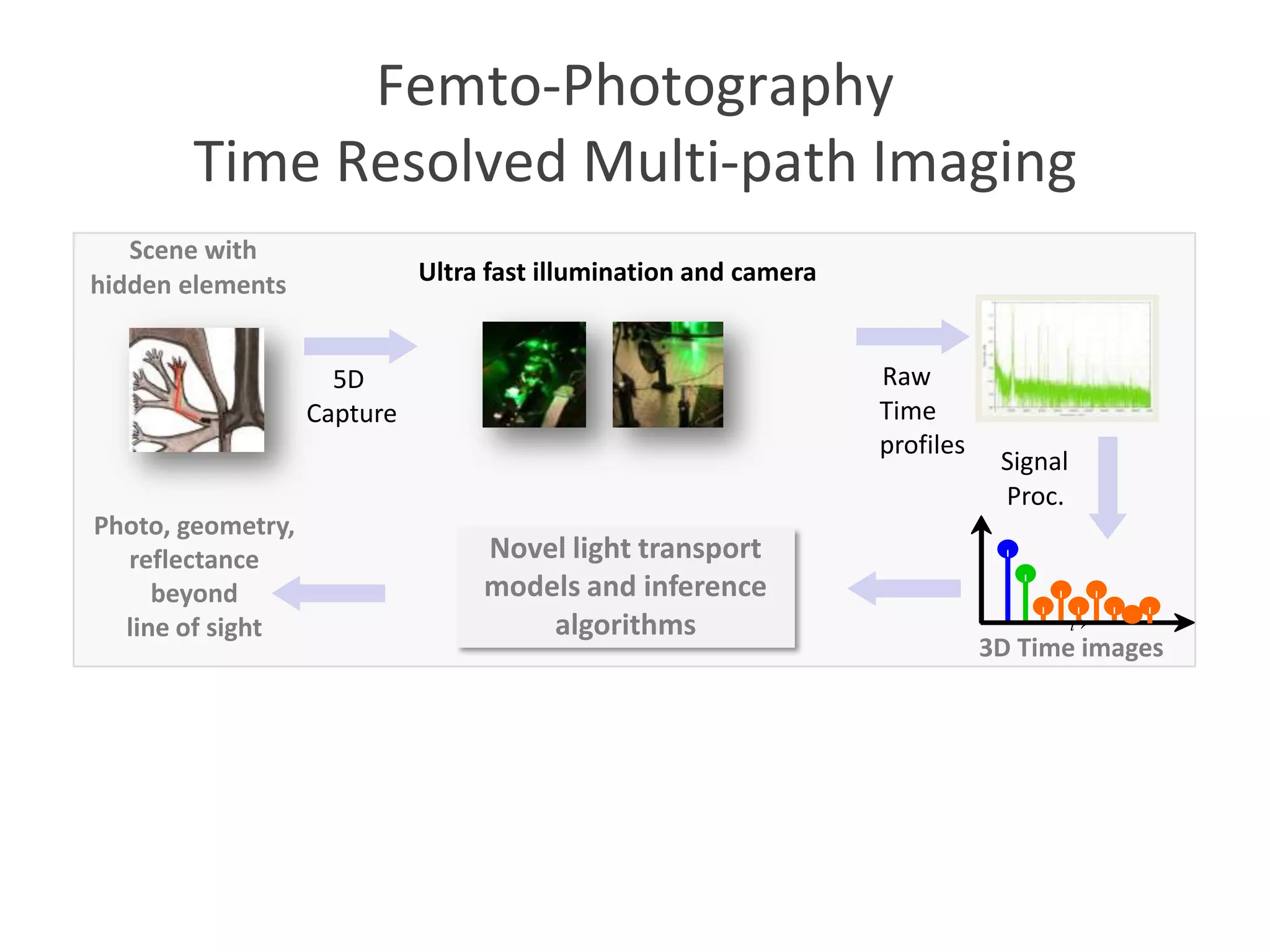
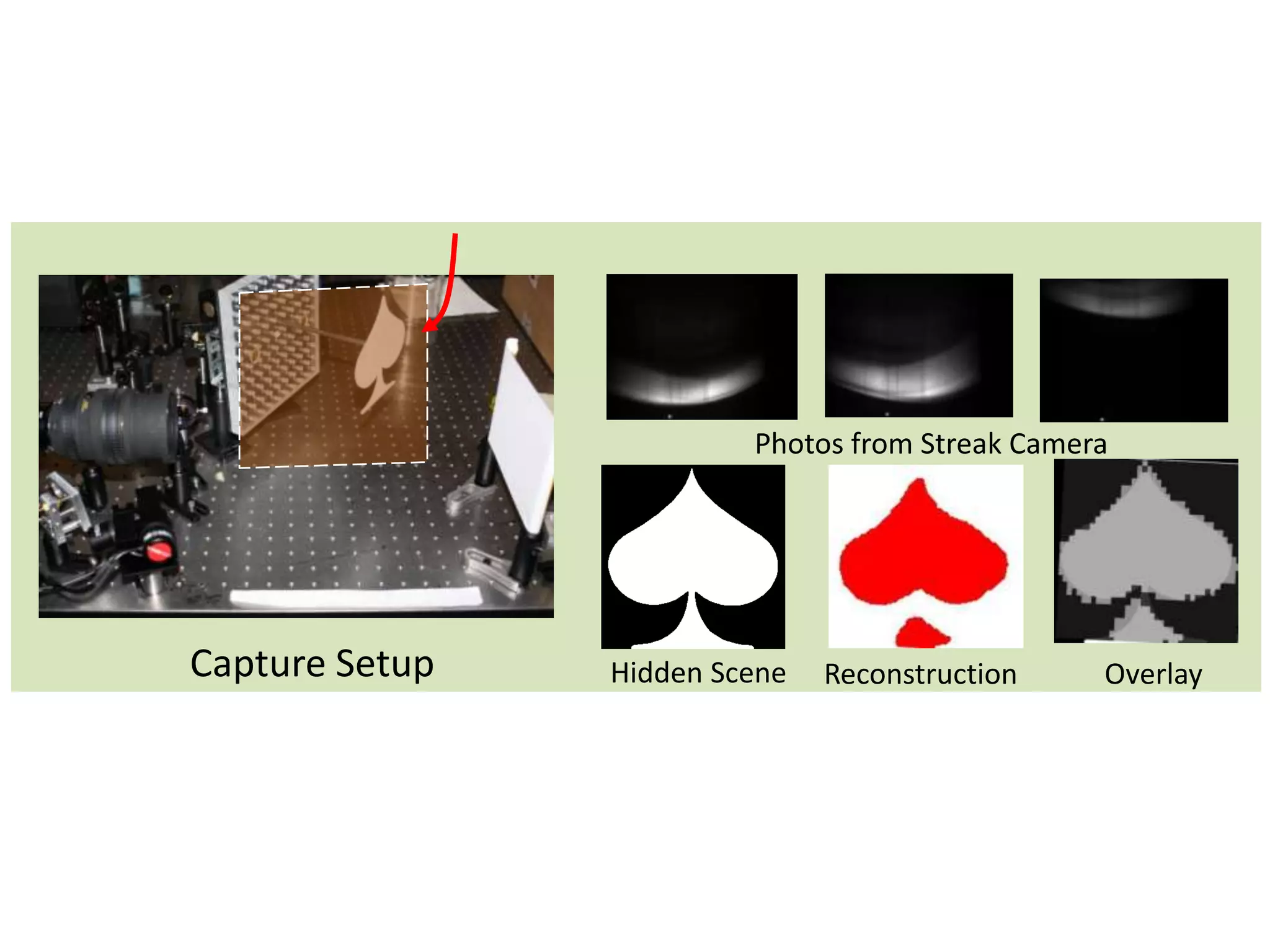
Scene with Ultra fast illumination and camerahidden elementsRaw 5D CaptureTime profilesSignal Proc.Photo, geometry, reflectance beyond line of sight Novel light transport models and inference algorithms®t3D Time imagesFemto-PhotographyTime Resolved Multi-path Imaging
TeamMoungi G. Bawendi, Professor, Dept of Chemistry, MITJames Davis, UC Santa CruzAndreas Velten, Postdoctoral Associate, MIT Media LabRohitPandharkar, RA, MIT Media LabOtkrist Gupta, RA, MIT Media LabAndrew Matthew Bardagjy, RA, MIT Media LabNikhil Naik, RA, MIT Media LabTyler Hutchison, RA, MIT Media LabEverett Lawson, MIT Media LabRamesh Raskar, Asso. Prof., MIT Media LabCamera CultureRamesh  Raskar
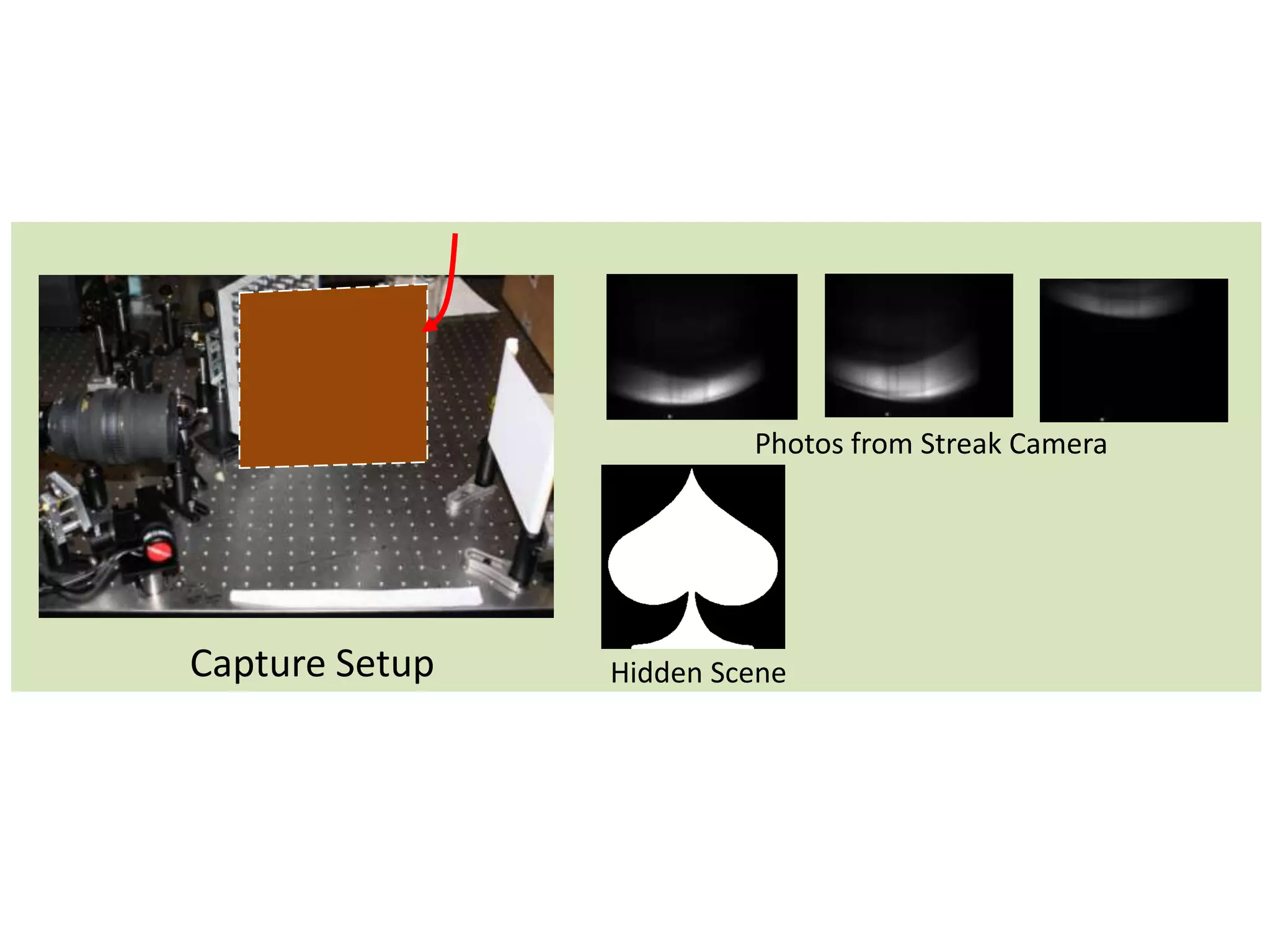
Photos from Streak CameraCapture SetupHidden Scene
Photos from Streak CameraCapture SetupHidden SceneOverlayReconstruction
Motion beyond line of sightPandharkar, Velten, Bardagjy, Lawson, Bawendi, Raskar,  CVPR 2011
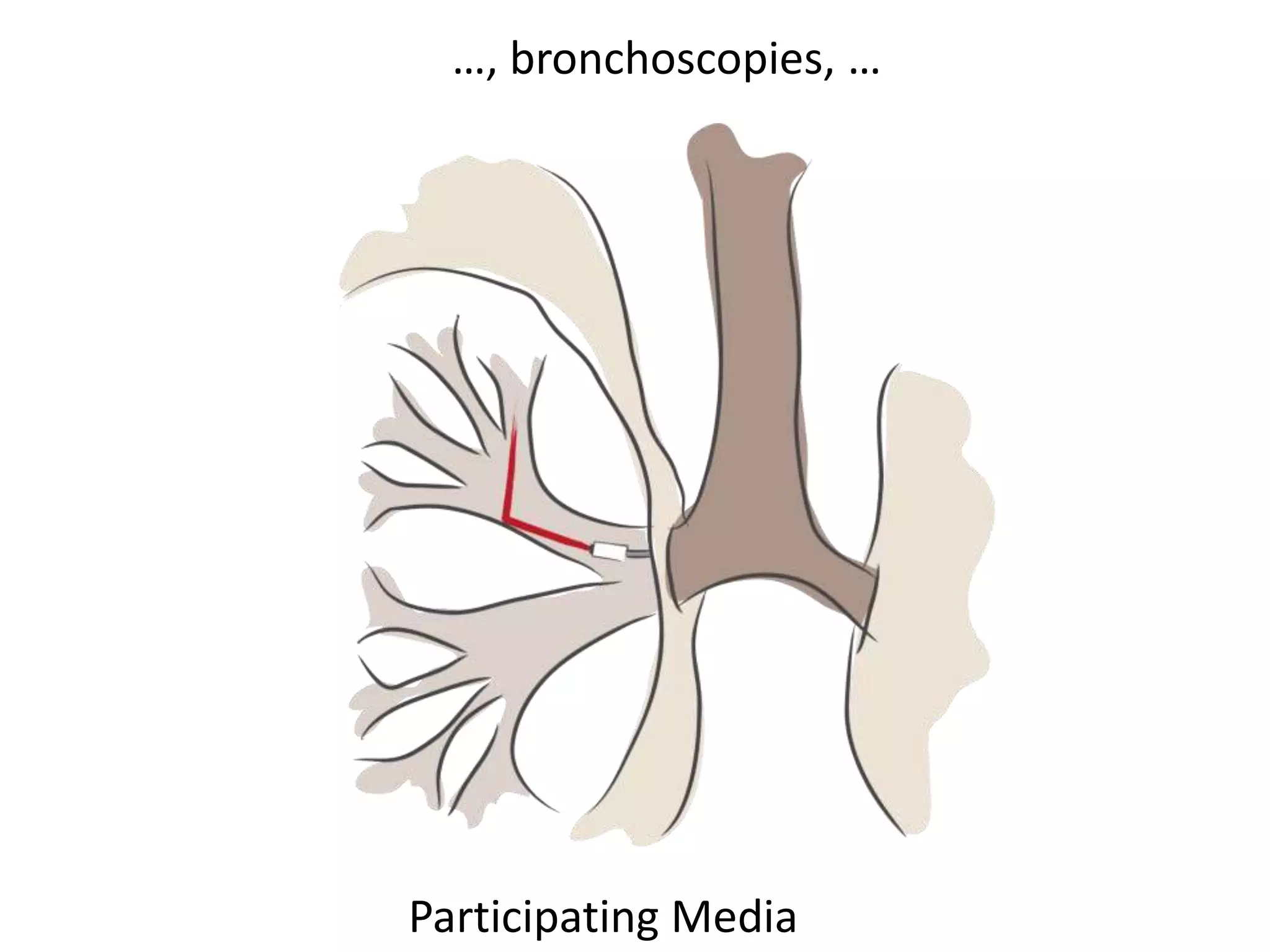
…, bronchoscopies, …Participating Media
PhotoFirst BounceLater Bounces+DirectGlobal[Nayar, Krishnan, Grossberg, Raskar   2006]
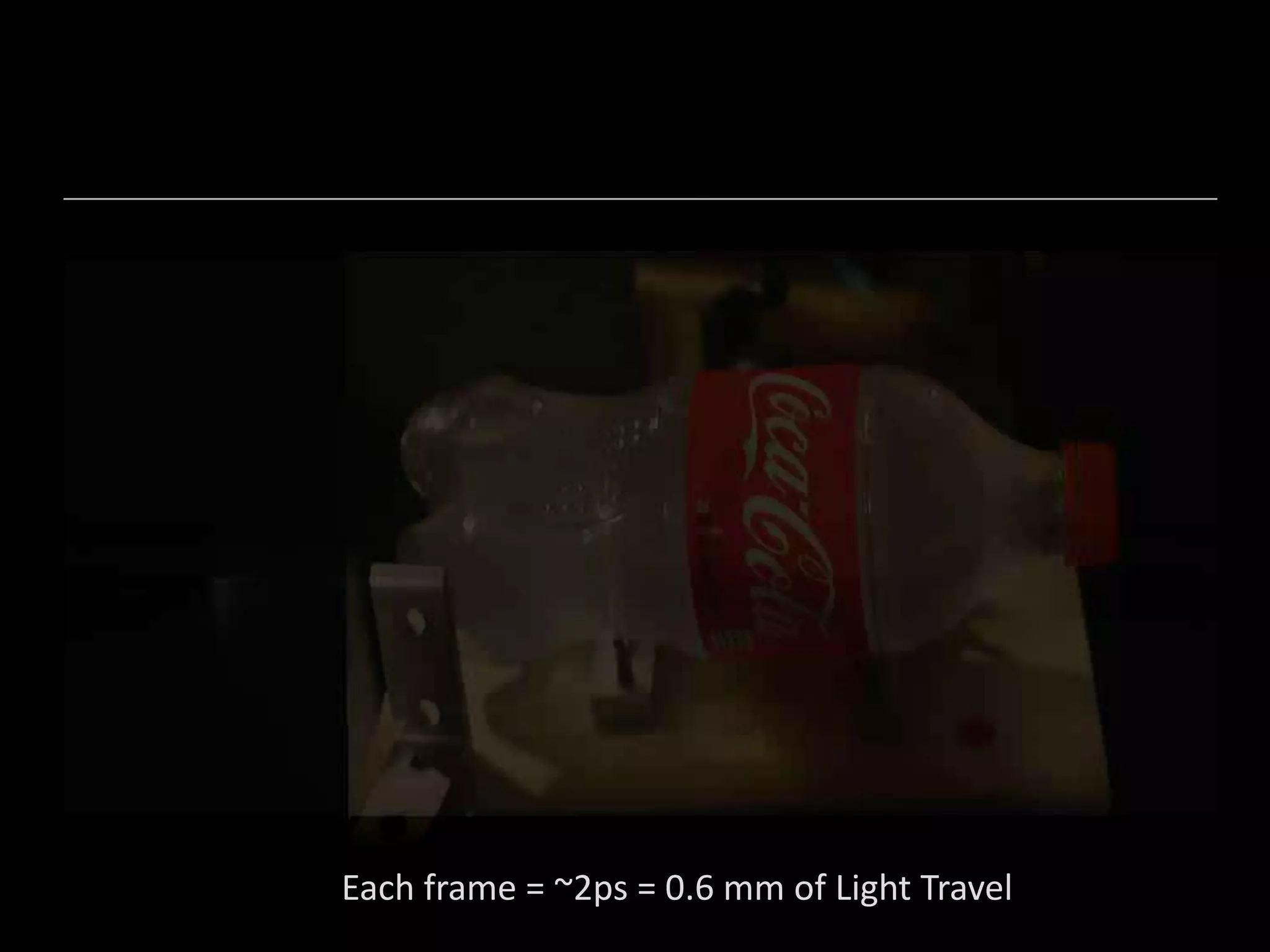
Each frame = ~2ps = 0.6 mm of Light Travel
Ripples of Waves
MIT Media Lab          raskar@mit.edu  http://cameraculture.info	fb.com/rraskarInverse ProblemsHow to do Research in ImagingInverse Problems, Reconstruction, Rank and SparsityCo-design of Optics and ComputationPhotons not just pixelsMid-level cuesComputational PhotographyOpen research problemsCompressive Sensing for High Speed EventsLimits of CS for general imagingComputational Light TransportLooking Around Corners, trillion fpsLightfields: 3D Displays and Holograms
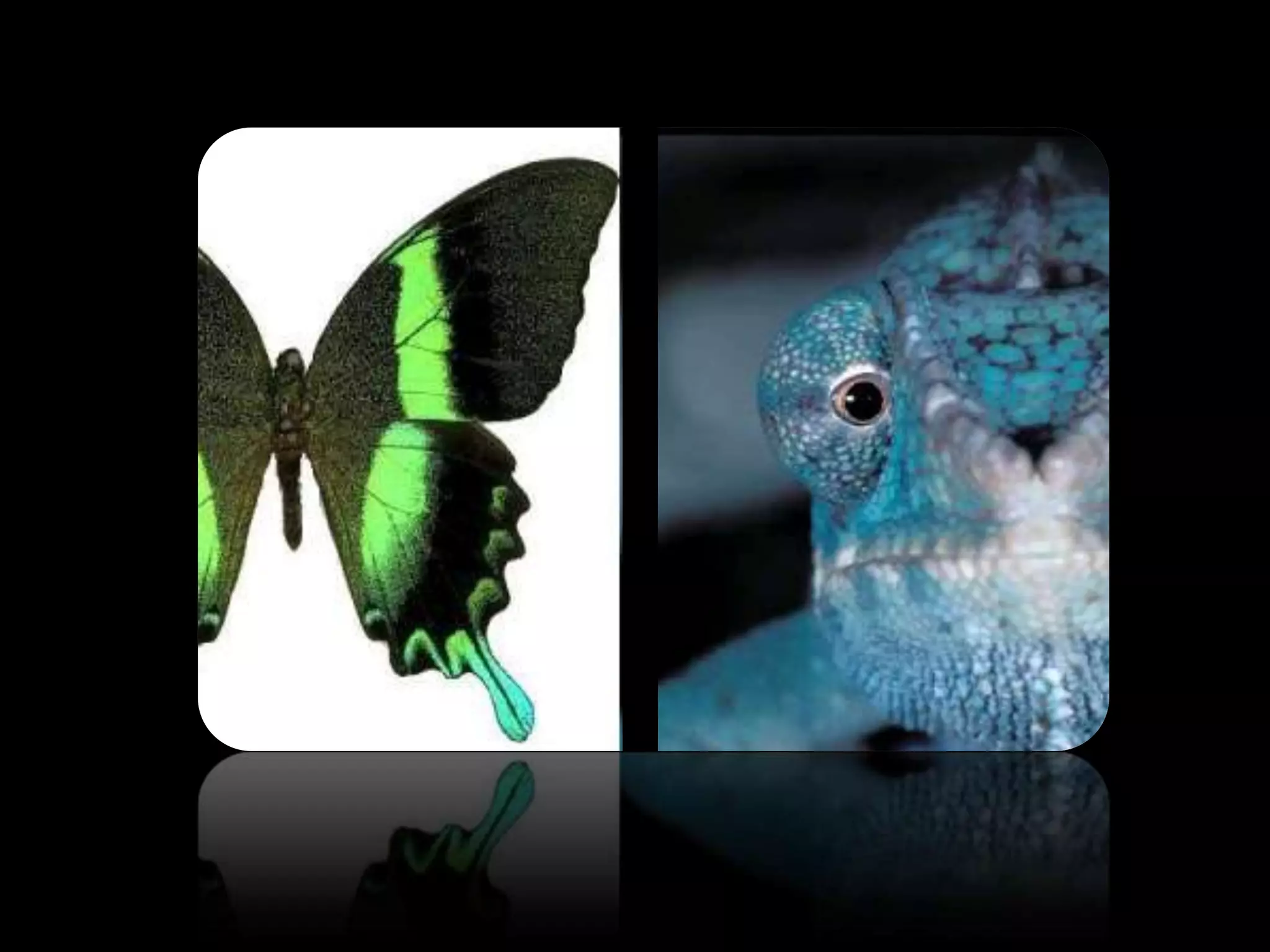
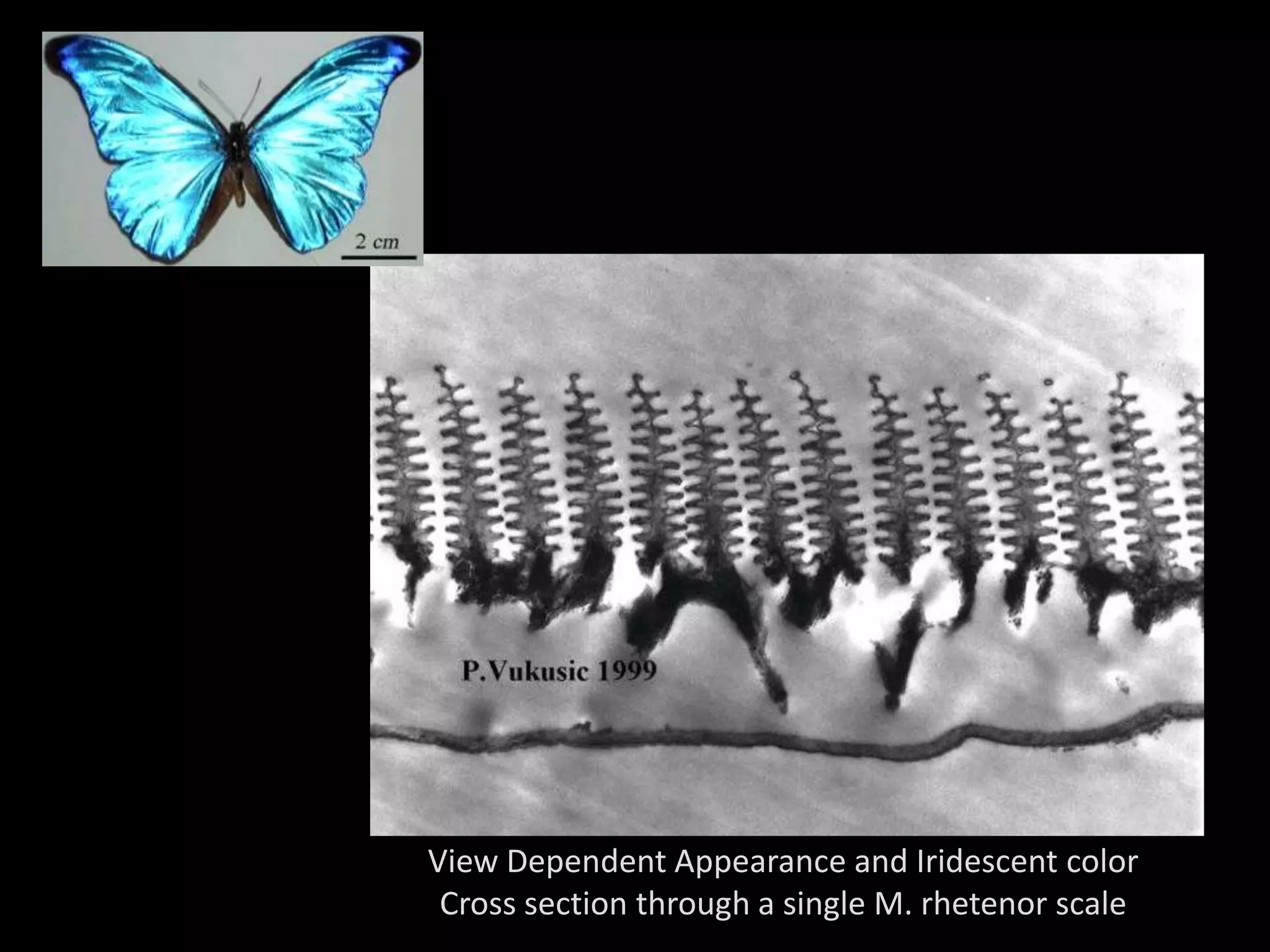
View Dependent Appearance and Iridescent color Cross section through a single M. rhetenor scale
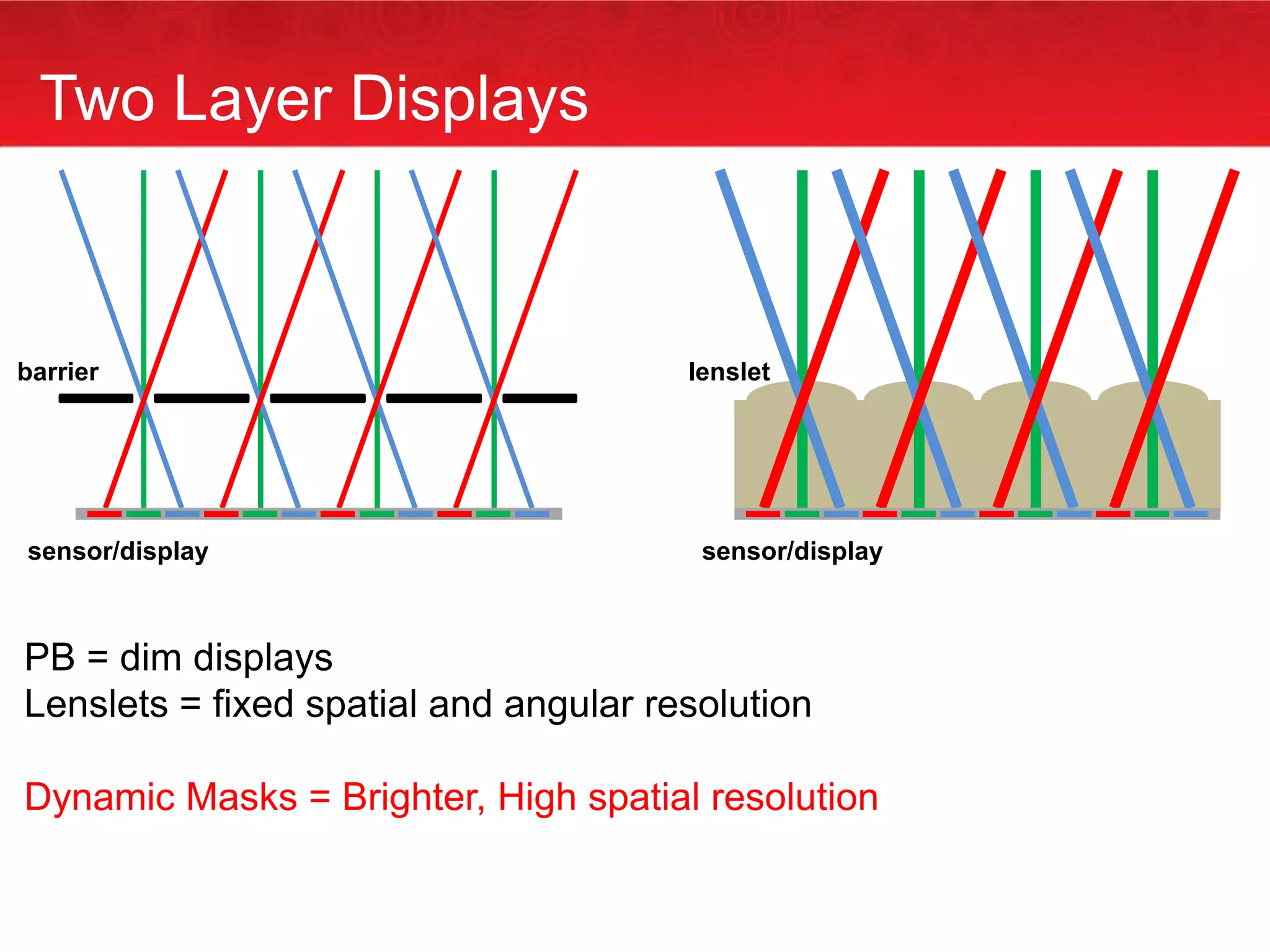
Two Layer Displaysbarrierlensletsensor/displaysensor/displayPB = dim displaysLenslets = fixed spatial and angular resolutionDynamic Masks = Brighter, High spatial resolution
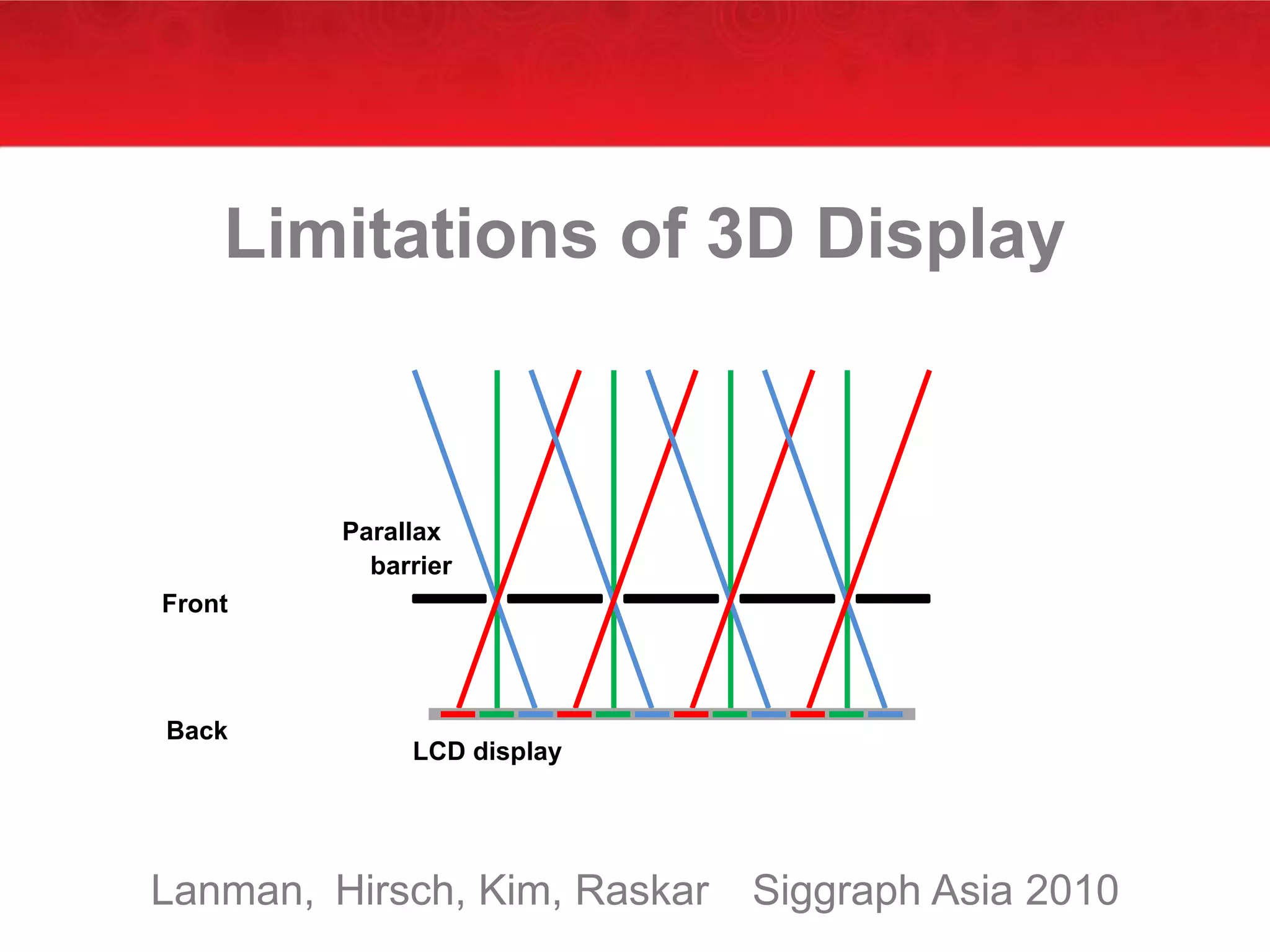
 Limitations of 3D DisplayParallaxbarrierLCD displayFrontBackLanman, Hirsch, Kim, RaskarSiggraph Asia 2010
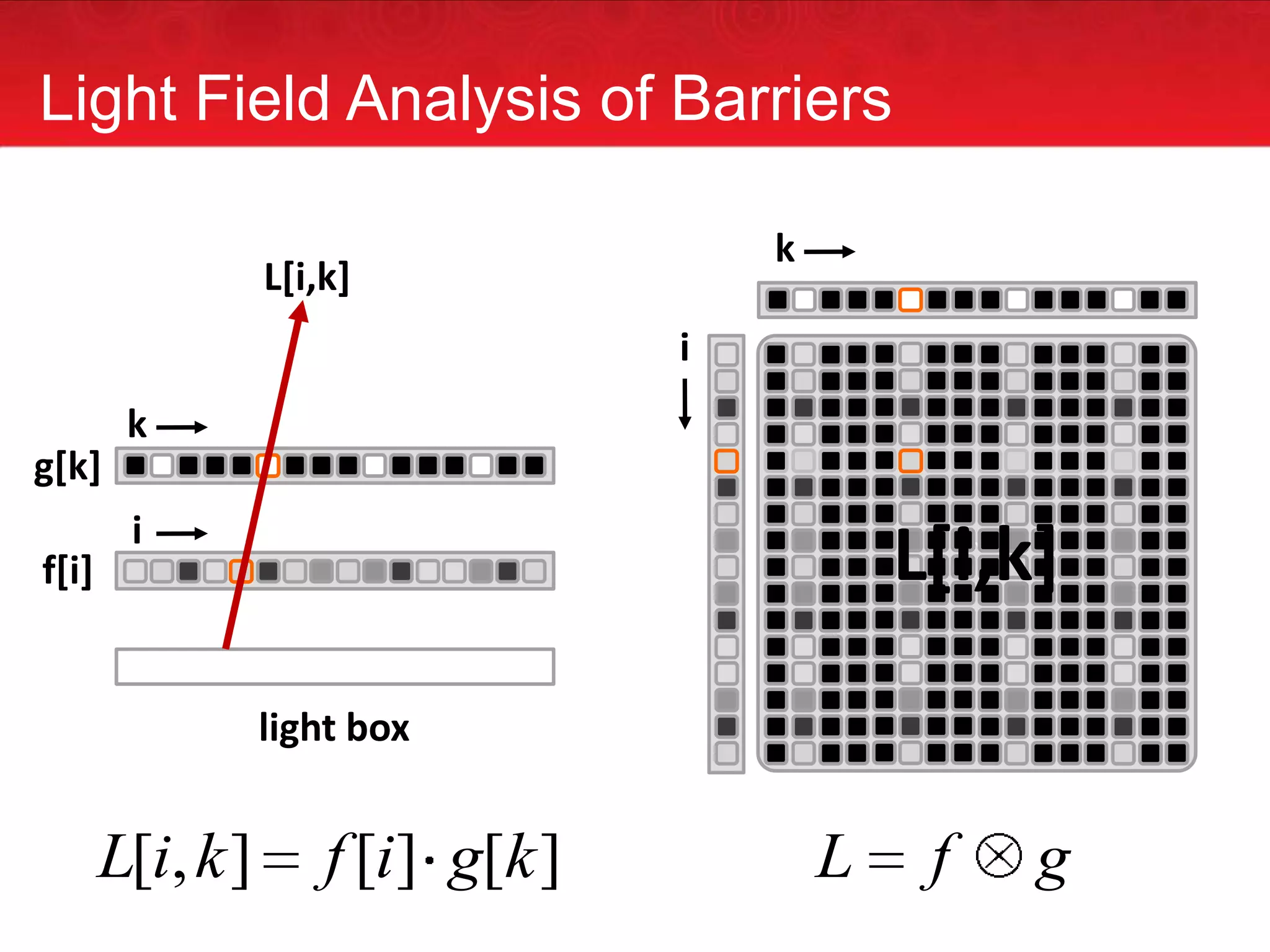
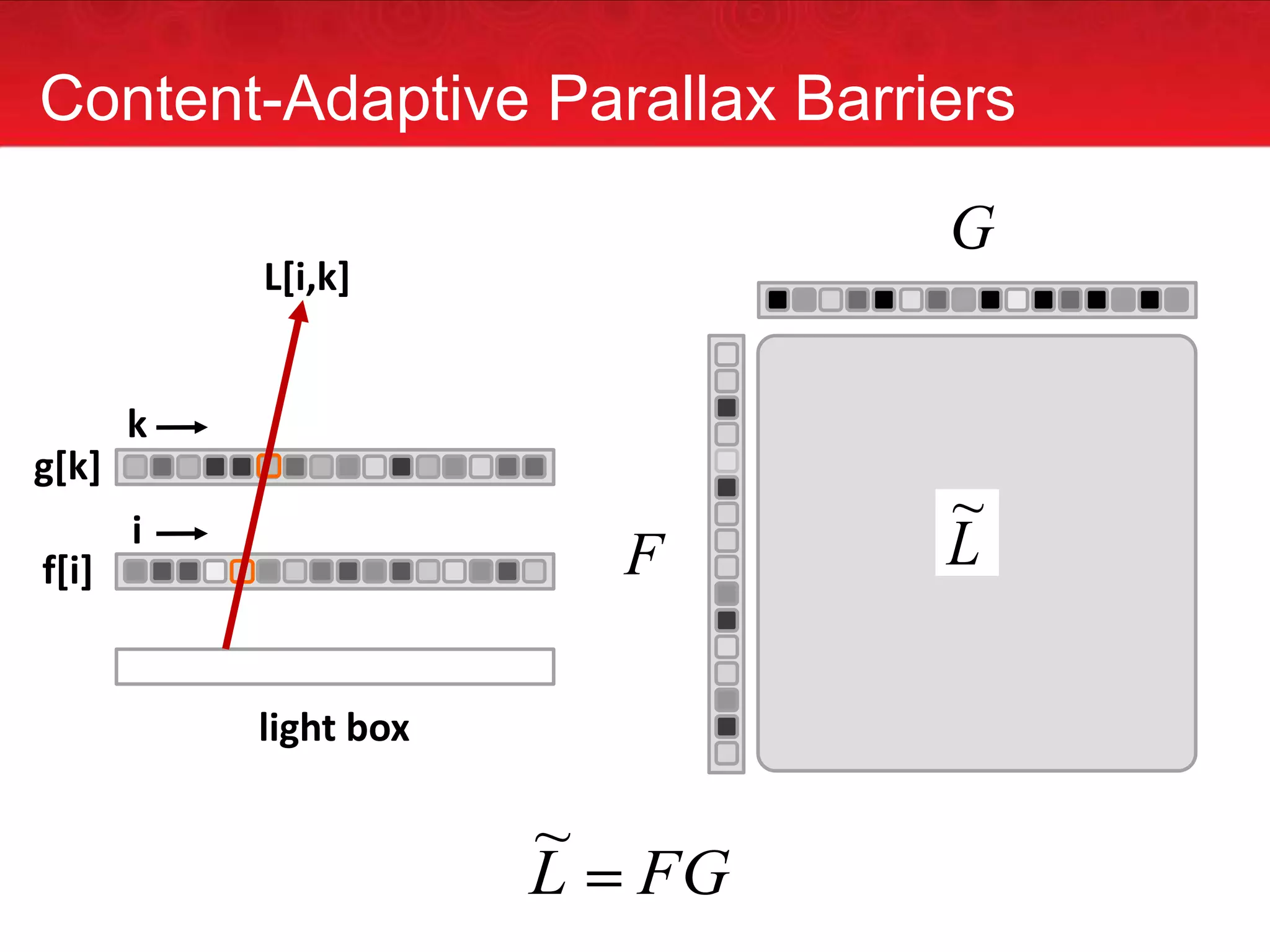
Light Field Analysis of BarrierskL[i,k]i`kg[k]iL[i,k]f[i]light box
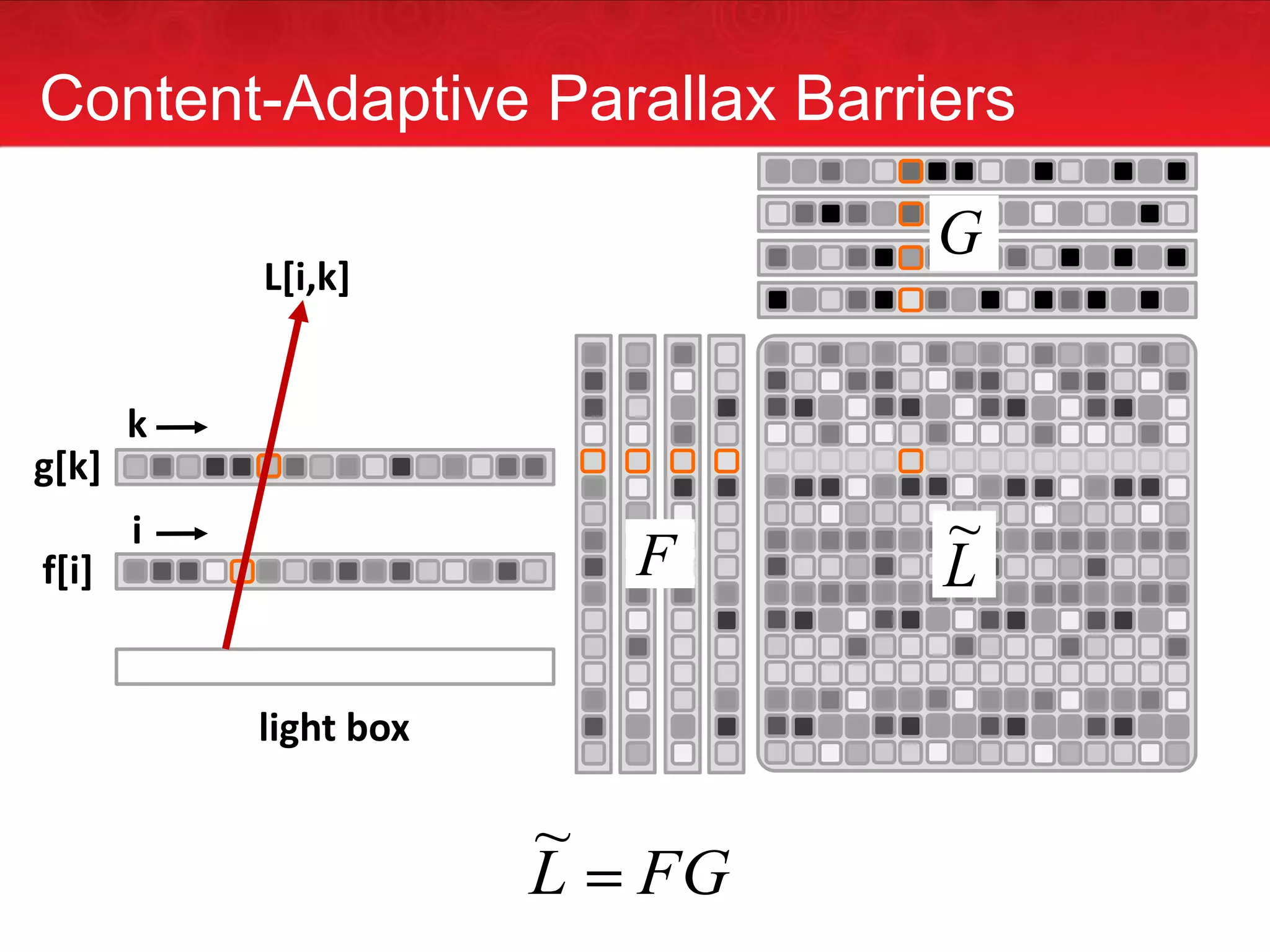
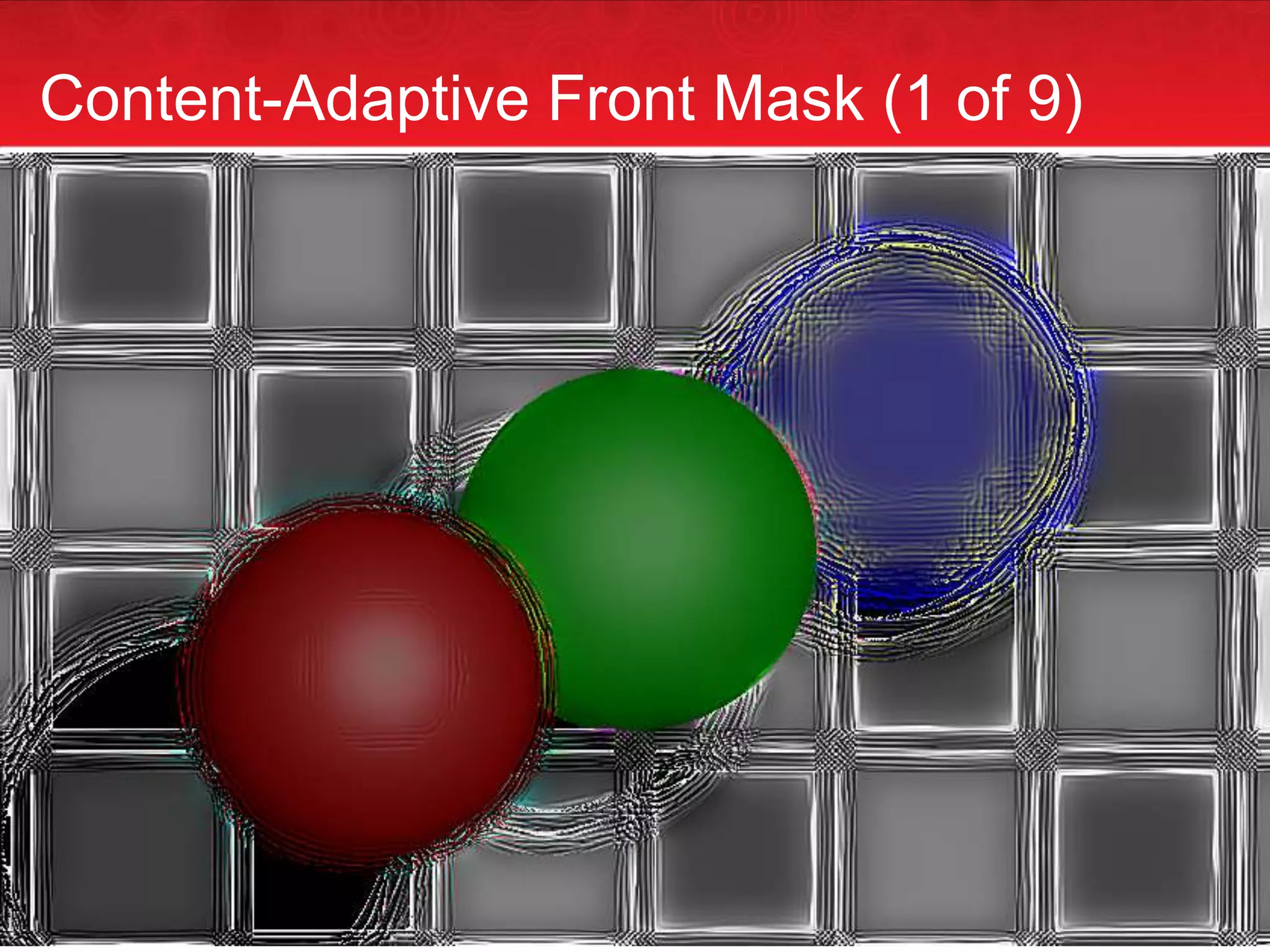
Content-Adaptive Parallax BarriersL[i,k]`kg[k]if[i]light box
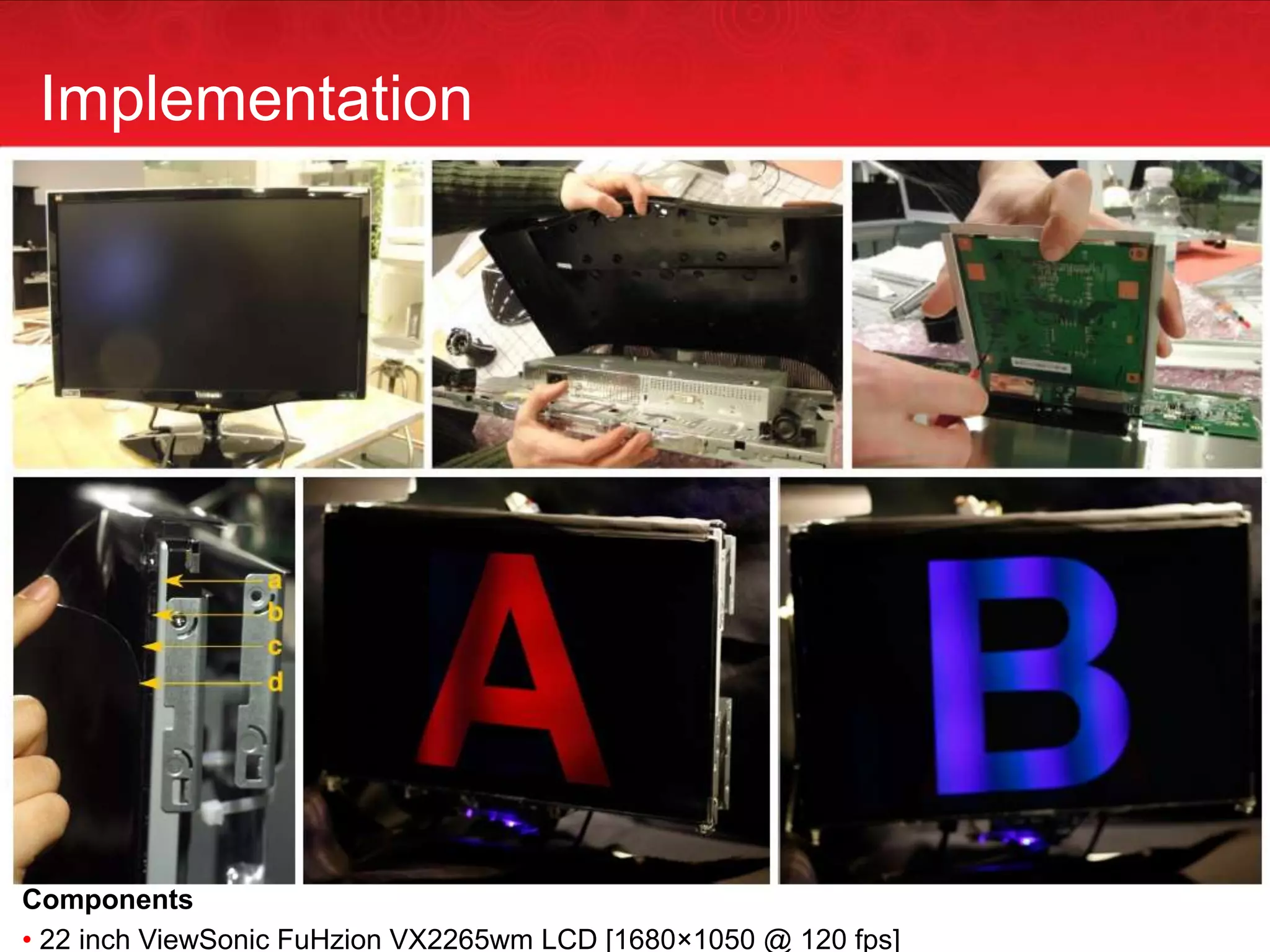
ImplementationComponents 22 inch ViewSonic FuHzion VX2265wm LCD [1680×1050 @ 120 fps]Content-Adaptive Parallax BarriersL[i,k]`kg[k]if[i]light box
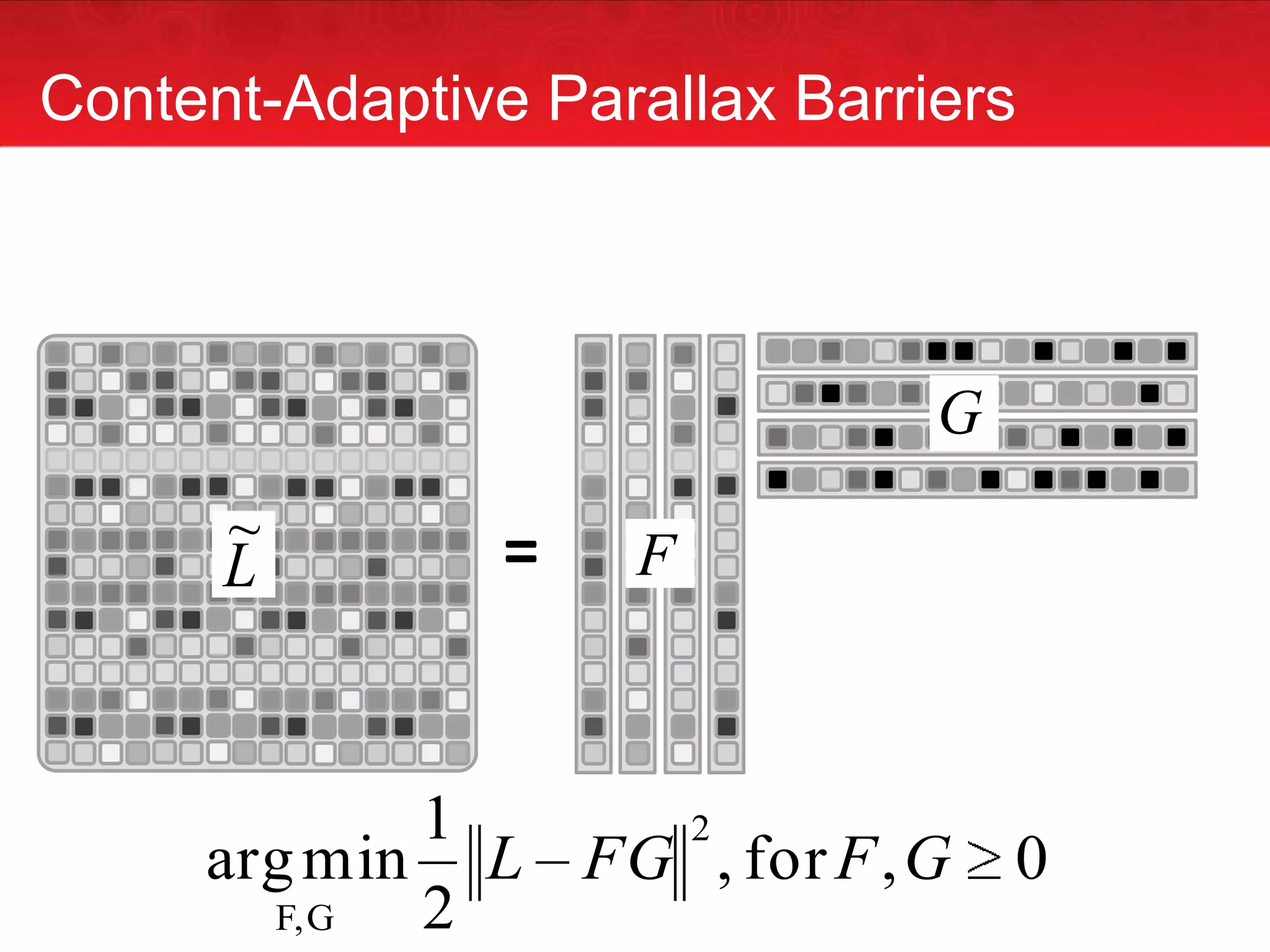
Content-Adaptive Parallax Barriers`=
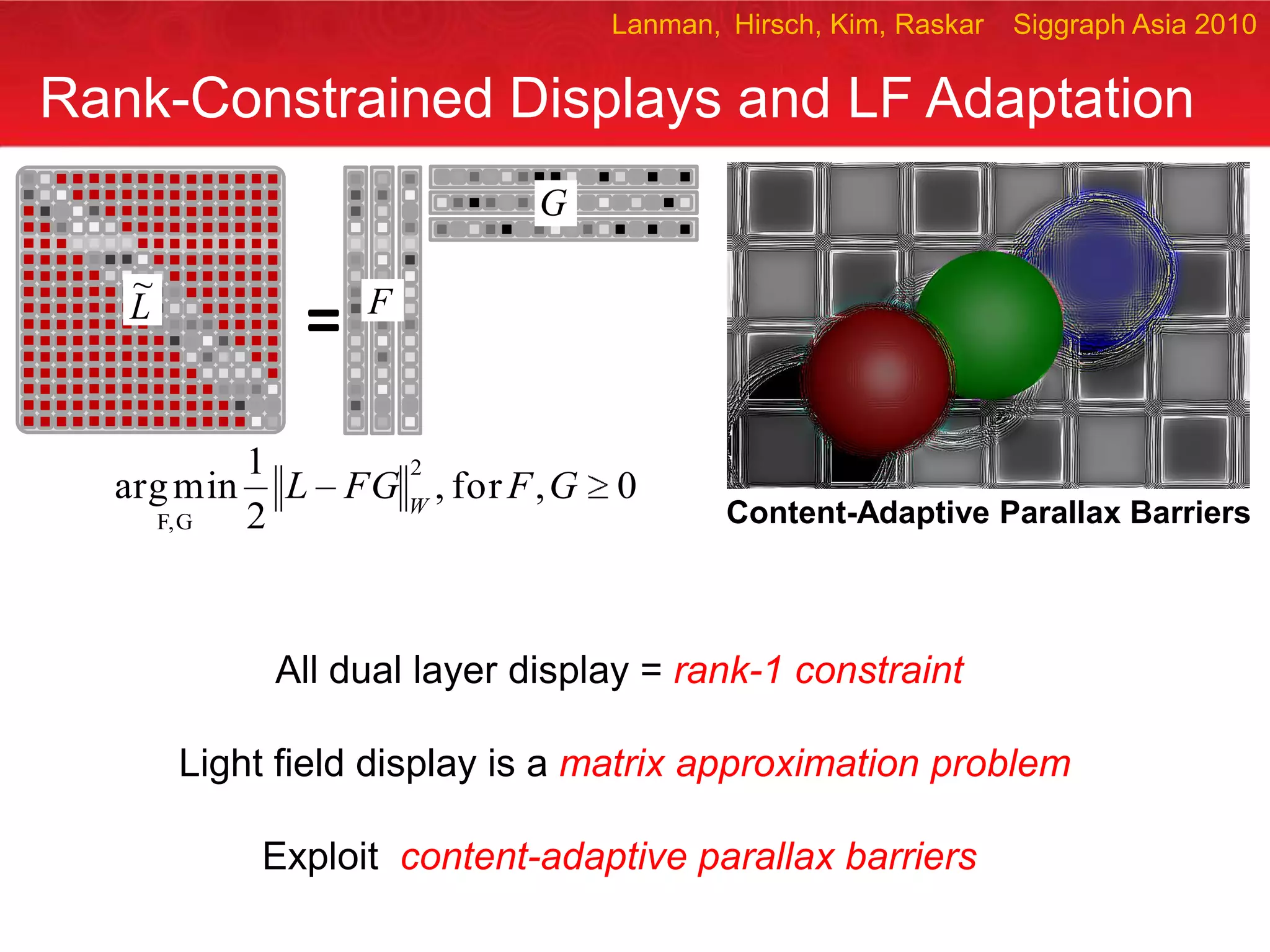
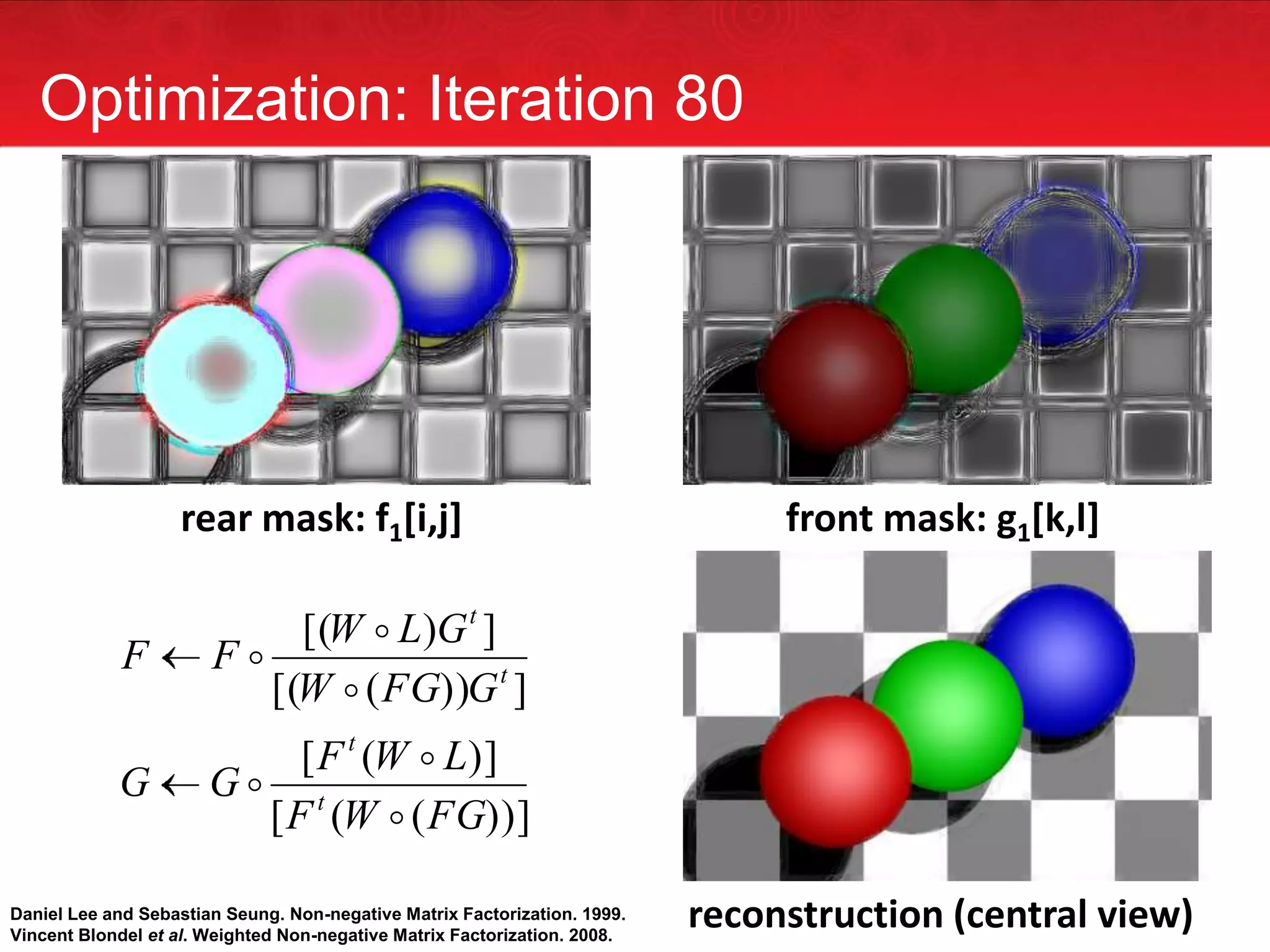
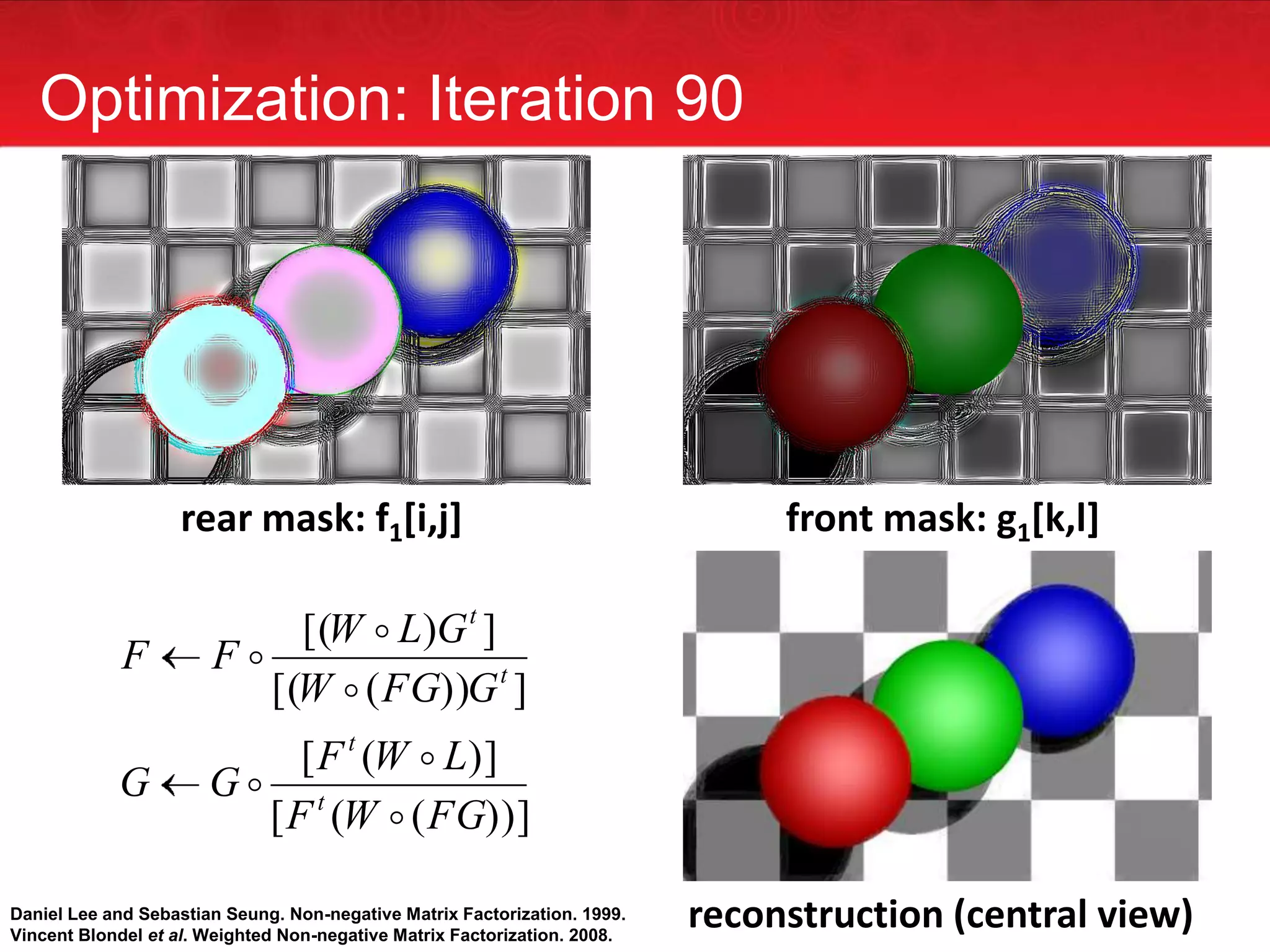
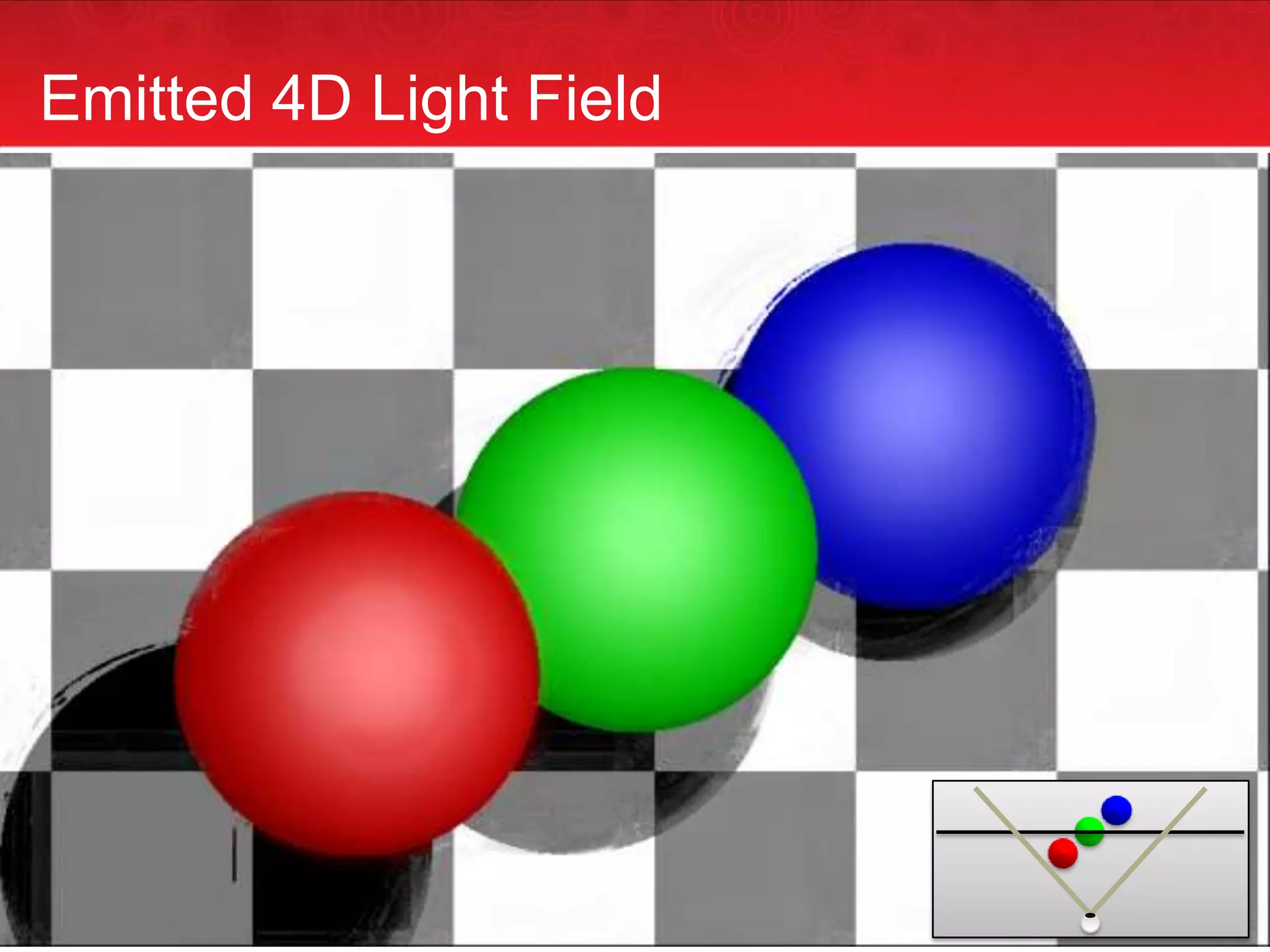
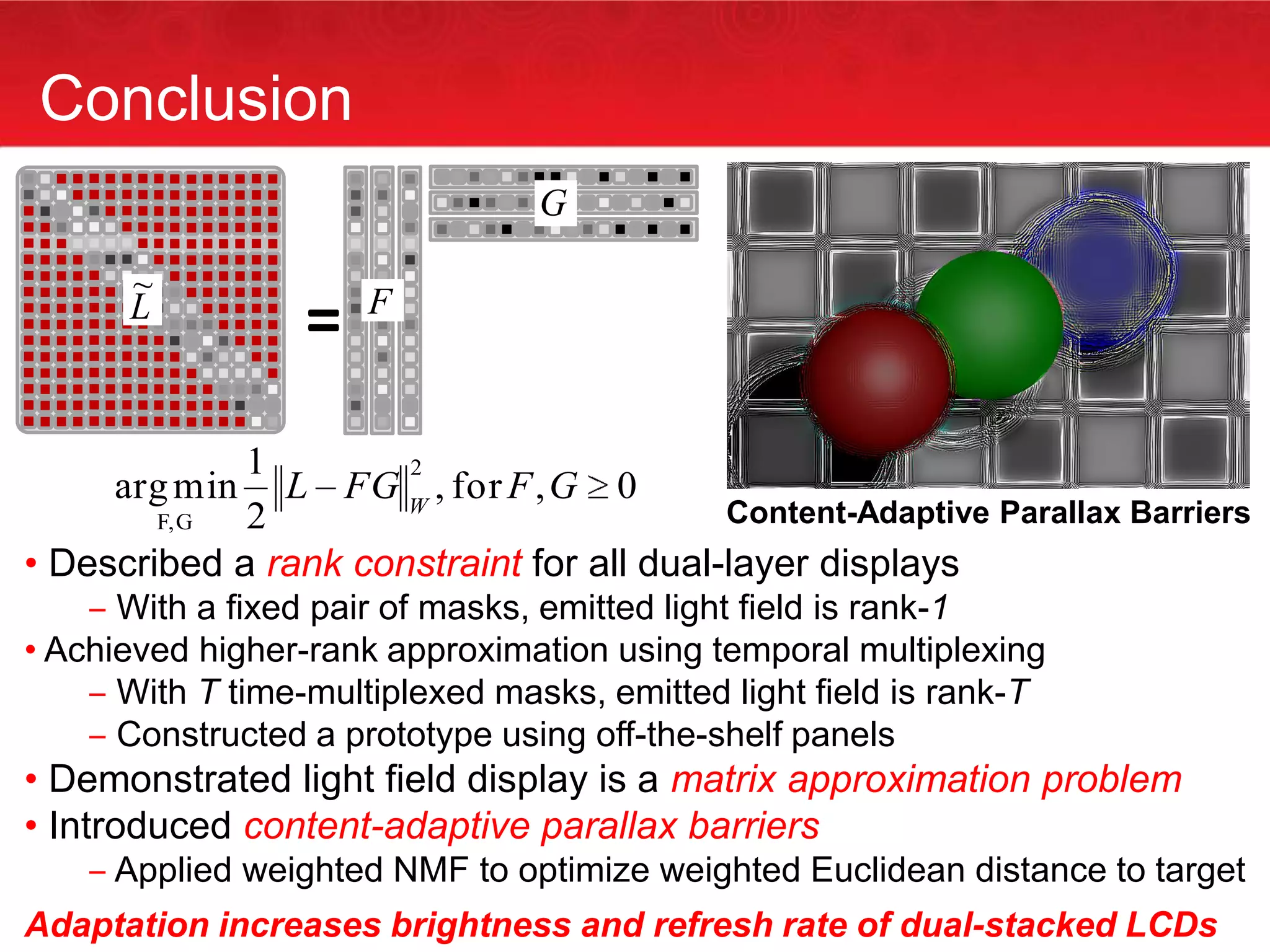
Lanman, Hirsch, Kim, Raskar   Siggraph Asia 2010Rank-Constrained Displays and LF Adaptation`Content-Adaptive Parallax Barriers=All dual layer display = rank-1 constraint Light field display is a matrix approximation problemExploit  content-adaptive parallax barriers
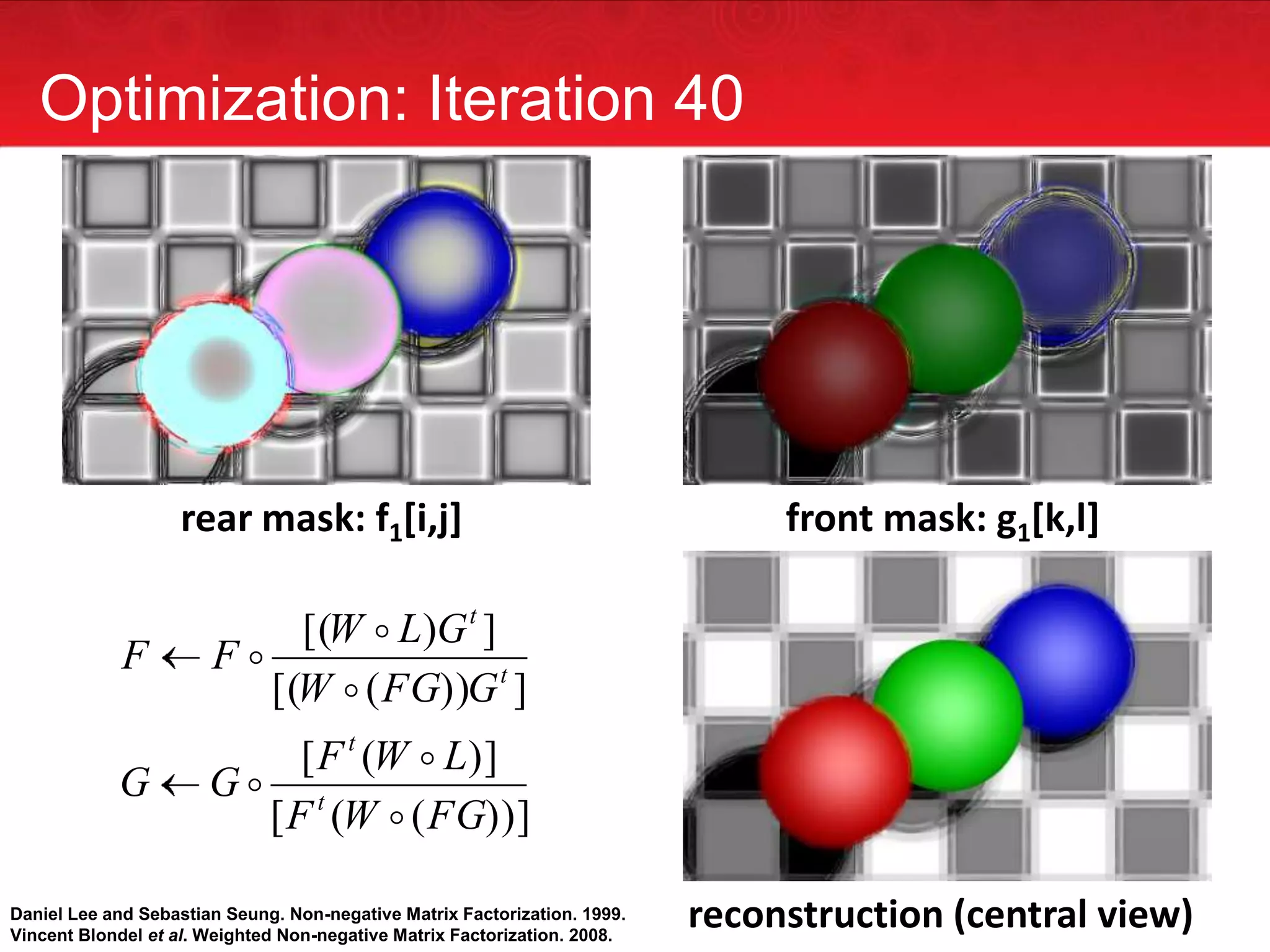
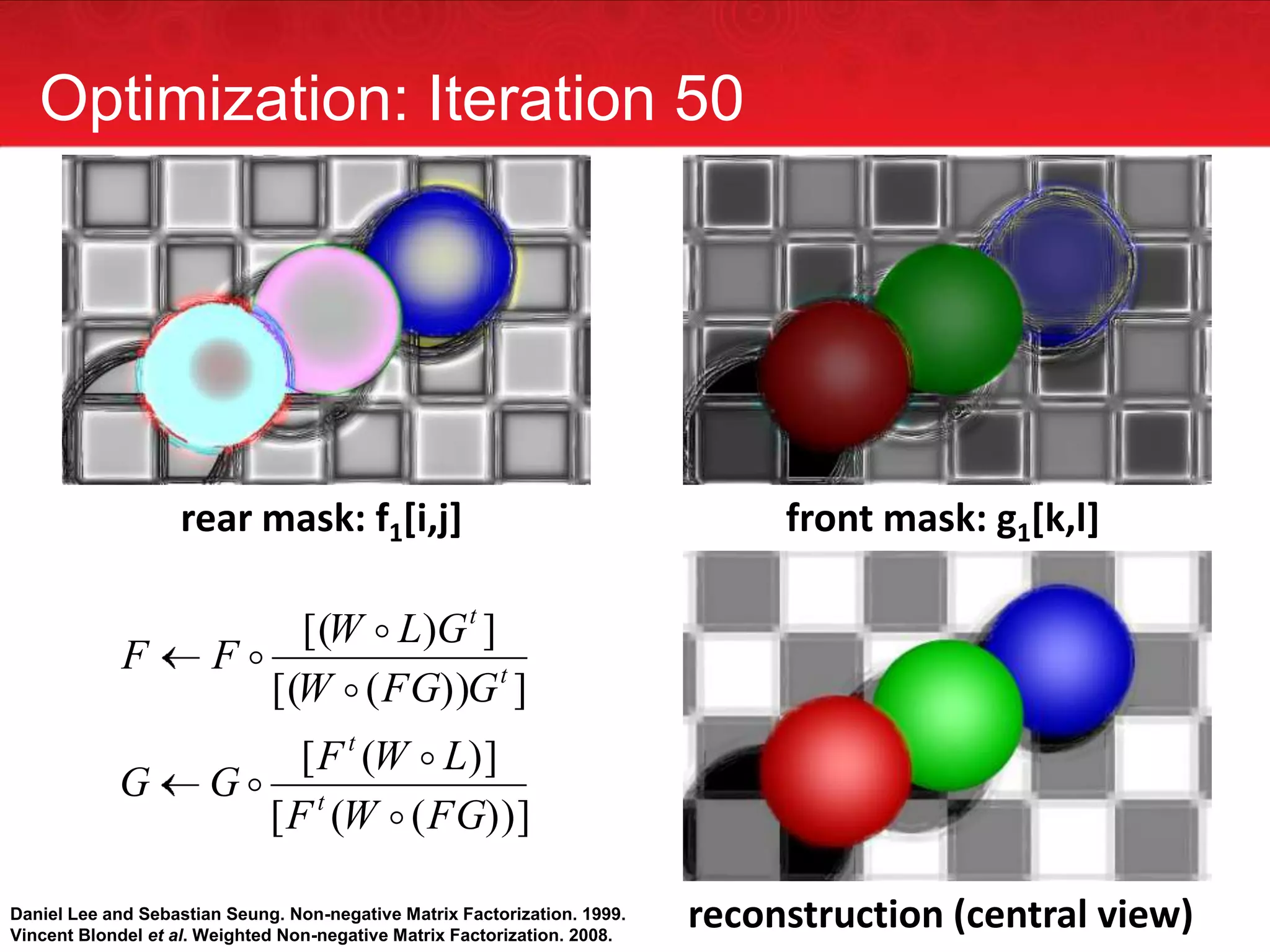
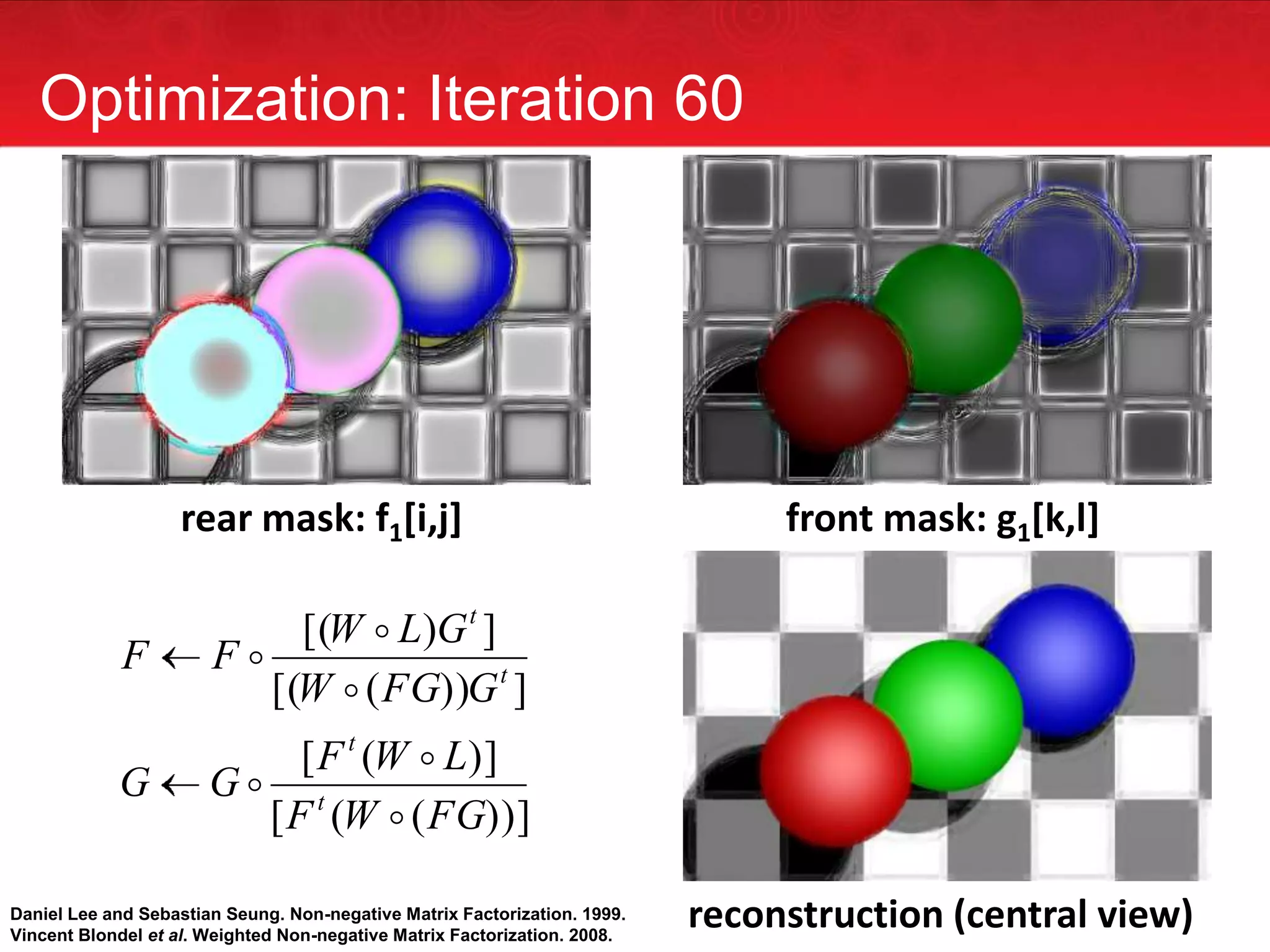
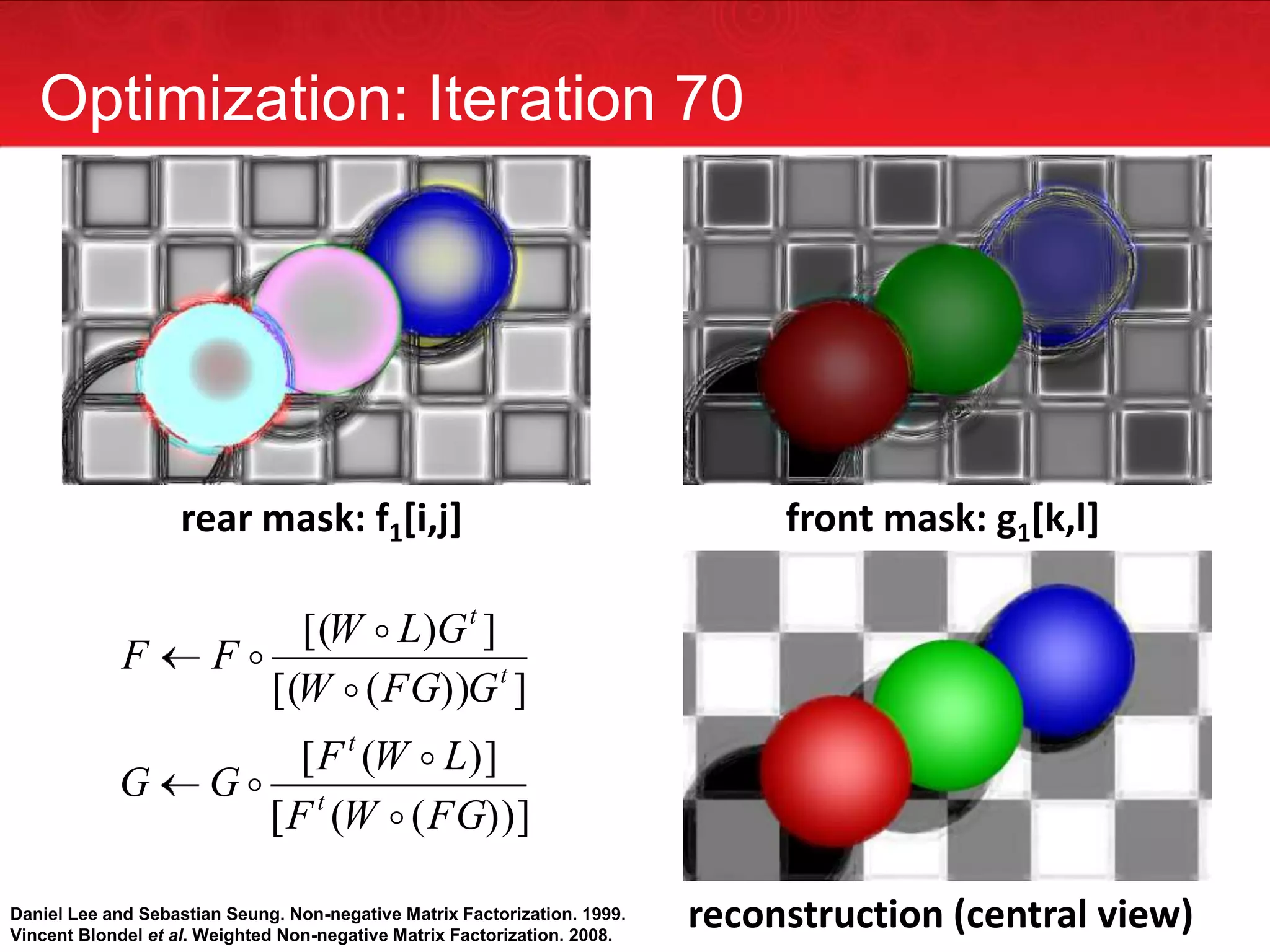
Optimization: Iteration 1rear mask: f1[i,j]front mask: g1[k,l]reconstruction (central view)Daniel Lee and Sebastian Seung. Non-negative Matrix Factorization. 1999.Vincent Blondel et al. Weighted Non-negative Matrix Factorization. 2008.
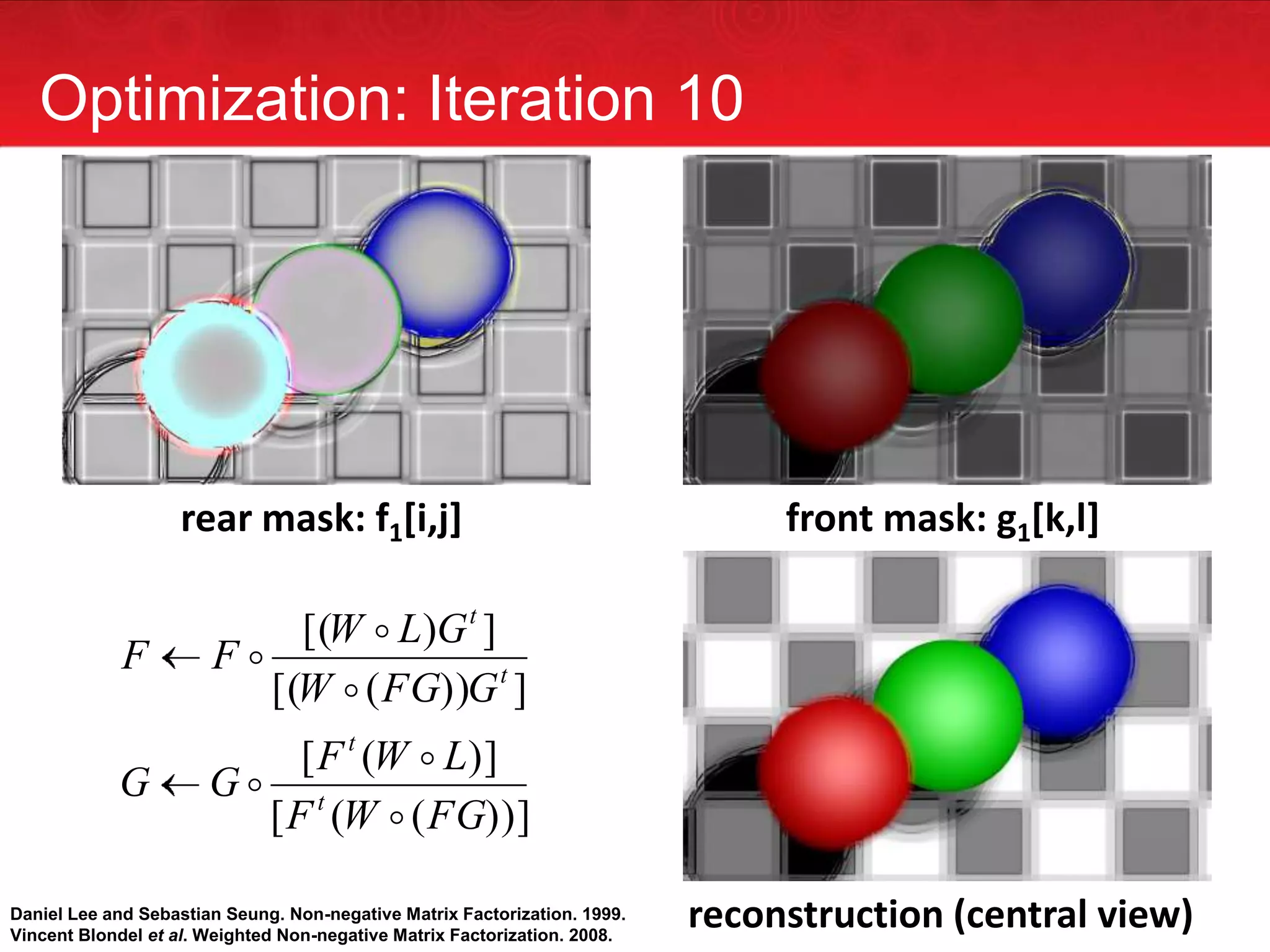
Optimization: Iteration 10rear mask: f1[i,j]front mask: g1[k,l]reconstruction (central view)Daniel Lee and Sebastian Seung. Non-negative Matrix Factorization. 1999.Vincent Blondel et al. Weighted Non-negative Matrix Factorization. 2008.
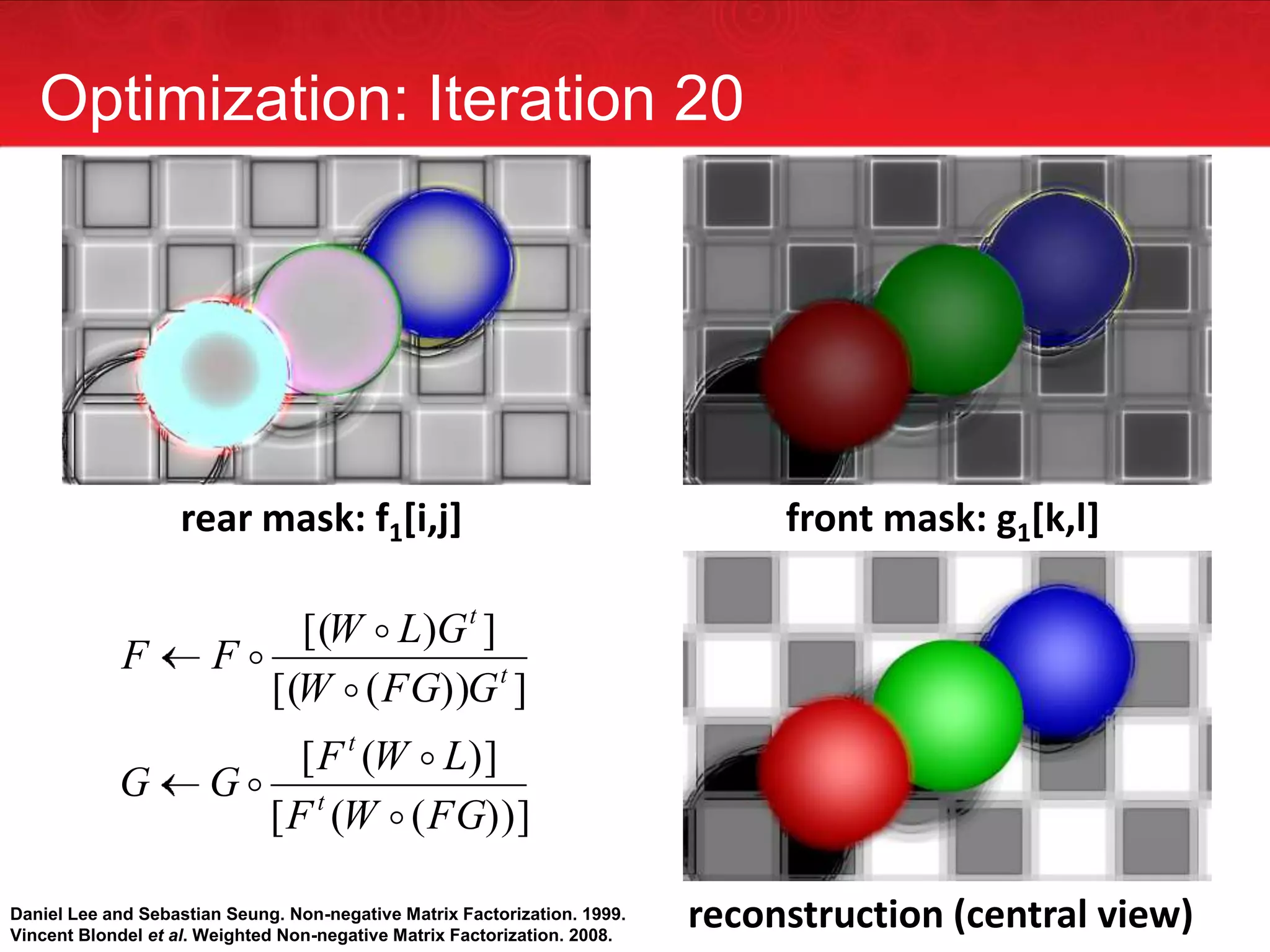
Optimization: Iteration 20rear mask: f1[i,j]front mask: g1[k,l]reconstruction (central view)Daniel Lee and Sebastian Seung. Non-negative Matrix Factorization. 1999.Vincent Blondel et al. Weighted Non-negative Matrix Factorization. 2008.

Raskar, Rank and Sparsity in Computational Photography and Computational Light Transport, Computer Vision Summer School

  • 1.
    Computational Light Transportand Computational Photography: Inverse problemsCamera CultureRamesh RaskarRamesh Raskarhttp://raskar.infoMIT Media Labraskar@mit.edu
  • 3.
    How to Invent?AfterX, what is neXtFull Presentation at http://www.slideshare.net/cameraculture/raskar-ideahexagonapr2010Ramesh Raskar, MIT Media Lab
  • 4.
    Ramesh Raskar, http://raskar.infoX+YXneXtXdXX++XFullPresentation at http://www.slideshare.net/cameraculture/raskar-ideahexagonapr2010
  • 5.
    Simple Exercise ..Image CompressionSave Bandwidth and storageWhat is neXt
  • 6.
    Strategy #1: XdExtend it to next (or some other) dimension ..
  • 7.
    X = Ideayou just heardConceptPatentNew Product/Best project/invention awardProduct featureDesignArtAlgorithm
  • 8.
    Ramesh Raskar, http://raskar.infoX+YXneXtXdXX++XFullPresentation at http://www.slideshare.net/cameraculture/raskar-ideahexagonapr2010
  • 9.
    Research .. http://raskar.infoHowto come up w ideas: Idea HexagonHow to write a paperHow to give a talkOpen research problemsHow to decide merit of a projectHow to attend a conference, brainstormFacebook.com/ rRaskarTipsGet on Seminar/Talks mailing lists worldwidehttp://www.cs.virginia.edu/~robins/YouAndYourResearch.htmlWhy do so few scientists make significant contributions and so many are forgotten in the long run?Highly recommended Hamming talk at Bell Labs
  • 10.
    Is project worthwhile?Heilmeier's Questionshttp://en.wikipedia.org/wiki/George_H._Heilmeier#Heilmeier.27s_CatechismWhatWhat are you trying to do? Articulate your objectives using absolutely no jargon.Related workHow is it done today, and what are the limits of current practice?ContributionWhat's new in your approach and why do you think it will be successful?MotivationWho cares?If you're successful, what difference will it make?ChallengesWhat are the risks and the payoffs?How much will it cost?How long will it take?EvaluationWhat are the midterm and final "exams" to check for success?Raskar additions: Why now? (why not before, what’s new that makes possible)Why us? (wrong answers: I am smart, I can work harder than others)
  • 11.
    Great Research: Strivefor FiveBefore Five teams Be first, often let others do detailsBeyond Five years What no one is thinking aboutWithin Five layers of ‘Human’ Impact RelevanceBeyond Five minutes of description Deep, iterative, participatoryFusing Five+ Expertise Multi-disciplinary, proactiveRamesh Raskar, http://raskar.info
  • 12.
    MIT Media Lab raskar@mit.edu http://cameraculture.info fb.com/rraskarInverse ProblemsHow to do Research in ImagingInverse Problems, Reconstruction, Rank and SparsityCo-design of Optics and ComputationPhotons not just pixelsMid-level cuesComputational PhotographyOpen research problemsCompressive Sensing for High Speed EventsLimits of CS for general imagingComputational Light TransportLooking Around Corners, trillion fpsLightfields: 3D Displays and Holograms
  • 13.
  • 14.
  • 15.
    Traditional PhotographyDetectorLensPixelsMimicsHuman Eye for a Single Snapshot: Single View, Single Instant, Fixed Dynamic range and Depth of field for given Illumination in a Static worldImageCourtesy: Shree Nayar
  • 16.
    PictureComputational Camera+ Photography: Optics, Sensors and ComputationsGeneralizedSensorGeneralized OpticsComputationsRay Reconstruction4D Ray BenderUpto 4D Ray SamplerMerged Views, Programmable focus and dynamic range, Closed-loop Controlled Illumination, Coded exposure/apertures
  • 17.
    Computational PhotographyNovel IlluminationLightSourcesModulatorsComputational CamerasGeneralized OpticsGeneralizedSensorGeneralizedOpticsProcessing4D Incident Lighting4D Ray BenderRay ReconstructionUpto 4D Ray Sampler4D Light FieldDisplayScene: 8D Ray ModulatorRecreate 4D Lightfield
  • 18.
    Computational Photography [Raskarand Tumblin]captures a machine-readable representation of our world tohyper-realistically synthesize the essence of our visual experience. ResourcesICCP 2012, Seattle Apr 2012Papers due Dec 2nd, 2011http://wikipedia.org/computational_photographyhttp://raskar.info/photo
  • 19.
    Computational PhotographyComputational Photographyaims to make progress on both axisPhototourismComprehensiveEssenceScene completion from photosAugmented Human ExperienceLooking Around CornersPriorsCaptureHuman Stereo VisionMetadataCodedDepthfg/bgNon-visual Data, GPSVirtual Object InsertionSpectrumDecomposition problems8D reflectance fieldDirect/GlobalLightFieldsRelightingEpsilonAngle, spectrum awareCamera ArrayHDR, FoVFocal stackResolutionMaterial editing from single photoDigitalMotion MagnificationRawLow LevelMid LevelHighLevelHyper realismSynthesis/Analysis
  • 20.
    Co-designing Optical andDigital ProcessingComputational Light TransportOpticsDisplaysSensorsComputational PhotographyPhoton HackingIlluminationSignal ProcessingComputer VisionMachine LearningBit Hacking
  • 21.
    Take home pointsCo-designof hw/swAvoid computational or optical chauvinism in imaging (Camera flash/Kinect)Hardware cost going to zero, Parallel technology trendsComputer vision not just mimicking human vision/perceptionBorrow ideas from other fields: astronomy, scientific imaging, audio, communicationsPhotons not just PixelsChange the rules of the gameOptics, Sensors, Illum, Priors, Sparsity, TransformsMeta-data, Internet collection, Crowdsourcing
  • 22.
    Computational PhotographyWish List:Open Research ProblemsCamera CultureRamesh Raskar
  • 23.
    Wish #1Ultimate Post-captureControlCamera CultureRamesh Raskar
  • 24.
    Digital Refocusing usingLight Field Camera125μ square-sided microlenses[Ng et al 2005]
  • 25.
  • 26.
  • 27.
    Fluttered Shutter CameraRaskar,Agrawal, Tumblin Siggraph2006Ferroelectric shutter in front of the lens is turnedopaque or transparent in a rapid binary sequence
  • 28.
    Preserves High SpatialFrequenciesFourier TransformSharp PhotoBlurred PhotoPSF == Broadband FunctionFlutter Shutter: Shutter is OPEN and CLOSED
  • 29.
  • 30.
  • 31.
    Fast periodic phenomenaVocalfolds flapping at 40.4 HzBottling line4000 fps hi-speed camera500 fps hi-speed camera
  • 32.
    Compressive Sensing SinglePixel Cameraimagecompressive imagemeasurement matrix
  • 33.
    Periodic signals-fP-2fP-4fP3fP-3fP0fMax- fMax2fPfP=1/P4fPPeriodicsignal x(t) with period PtP = 16msPeriodic signal with period P and band-limited to fMax = 500 Hz. Fourier transform is non-zero only at multiples of fP=1/P ~ 63Hz.
  • 34.
    High speed cameraP= 16msTs = 1/(2 fMax)-fP-2fP-4fP-3fP4fP3fP2fP0fMax- fMaxfP=1/PNyquist Sampling of x(t) Periodic signal has regularly spaced, sparse Fourier coefficients. Is it necessary to use a high-speed video camera? Why waste bandwidth?
  • 35.
    Traditional StrobingUse lowframe-rate camera and generate beat frequencies.PtLow exposure to avoid blurring. Low light throughput.Period known apriori.Strobing animation credit Wikipedia
  • 36.
    tPRandom Projections PerFrame of Camera using Coded Strobing PhotographyIn every exposure duration observe different linear combinations of the periodic signal.Advantage of the design Exposure coding independent of the frequency
  • 37.
    On anaverage, light throughput is 50%Coded Strobing Photography. Reddy, D., Veeraraghavan, A., Raskar, R. IEEE PAMI 2011
  • 38.
    Observation Modelx at2000fpsy at 25fps
  • 39.
    Signal Modelx at2000fpsy at 25fps
  • 40.
    Signal & ObservationModelAis M x N, M<<Nx at 2000fpsy at 25fps N / M = 2000 / 25 = 80
  • 41.
    Recovery: SparsityVery fewnon-zero elementsy = A sObserved valuesMixing matrixStructured Sparse CoefficientsBasis Pursuit De-noising
  • 42.
    Simulation on hi-speedtoothbrush25fps normal camera25fps coded strobing cameraReconstructed frames2000fps hi-speed camera~100X speedup
  • 43.
    Rotating mill toolMilltool rotating at 50HzReconstructed Video at 2000fpsNormal Video: 25fpsCoded Strobing Video: 25fpsBlur increases as rotational velocity increases rotating at 200Hzrotating at 150Hzrotating at 100Hzincreasing blur
  • 44.
    Compressive Sensing forImages .. A good idea?Single Pixel Cameraimagecompressive imagemeasurement matrix
  • 45.
    Is Randomized Projection-basedCaptureapt for Natural Images ? Periodic SignalsProgressive ProjectionsRandomized ProjectionsCompression Ratio[Pandharkar, Veeraraghavan, Raskar 2009]
  • 46.
  • 47.
    Wish #1Ultimate Post-captureControlDigital Refocus and Motion blur
  • 48.
    Emulate studio lightfrom compact flashCamera CultureRamesh Raskar
  • 49.
    Wish #2Freedom from FormSize, Weight, Power, UI
  • 50.
    Flat camera: Bidirectionalscreen (BiDi)Shallow DoF from tiny lensCamera CultureRamesh Raskar
  • 51.
    Wish #3Understand theWorldCamera CultureRamesh Raskar
  • 52.
    Convert single 2Dphoto into 3D ?Snavely, Seitz, SzeliskiU of Washington/Microsoft: Photosynth
  • 53.
    Exploit Community PhotoCollectionsU of Washington/Microsoft: Photosynth
  • 54.
    Wish #3Understand theWorldIdentify/recognize Materials
  • 55.
  • 56.
  • 57.
    Wish #4Sharing VisualExperienceLifeLog Auto-summary
  • 58.
    Privacy in publicand authentication
  • 59.
  • 60.
    Print ‘material’ CameraCultureRamesh Raskar
  • 61.
    Wish #5Capturing EssenceCameraCultureRamesh Raskar
  • 62.
    What are theproblems with ‘real’ photo in conveying information ?Why do we hire artists to draw what can be photographed ?
  • 63.
    ShadowsClutterMany ColorsHighlight ShapeEdgesMark moving partsBasic colors
  • 64.
    Depth Edges withMultiFlashRaskar, Tan, Feris, Jingyi Yu, Turk – ACM SIGGRAPH 2004
  • 69.
    Depth DiscontinuitiesInternal andexternalShape boundaries, Occluding contour, Silhouettes
  • 70.
  • 71.
  • 72.
  • 73.
    QuestionsWhat will acamera look like in 10,20 years?How will a billion networked and portable cameras change the social culture? How will online photo collections transform visual social computing?How will movie making/new reporting change?
  • 74.
    Photos of tomorrow: computed not recordedhttp://scalarmotion.wordpress.com/2009/03/15/propeller-image-aliasing/
  • 75.
    Camera Culture Group,MIT Media Lab Ramesh Raskar http://raskar.infoSensorComputational Photography Wish ListPost-capture control
  • 76.
    Emulate studio lightswith compact flash
  • 77.
  • 78.
  • 79.
    Flat camera, largeLCDs as cameras
  • 80.
  • 81.
  • 82.
  • 83.
  • 84.
  • 85.
  • 86.
  • 87.
  • 88.
  • 89.
  • 90.
  • 91.
  • 92.
  • 93.
    Delta-camera and Blind-cameraTakehome pointsCo-design of hw/swAvoid computational or optical chauvinism in imaging (Camera flash/Kinect)Hardware cost going to zero, Parallel technology trendsComputer vision not just mimicking human vision/perceptionBorrow ideas from other fields: astronomy, scientific imaging, audio, communicationsPhotons not just PixelsChange the rules of the gameOptics, Sensors, Illum, Priors, Sparsity, TransformsMeta-data, Internet collection, Crowdsourcing
  • 94.
    MIT Media Lab raskar@mit.edu http://cameraculture.info fb.com/rraskarInverse ProblemsHow to do Research in ImagingInverse Problems, Reconstruction, Rank and SparsityCo-design of Optics and ComputationPhotons not just pixelsMid-level cuesComputational PhotographyOpen research problemsCompressive Sensing for High Speed EventsLimits of CS for general imagingComputational Light TransportLooking Around Corners, trillion fpsLightfields: 3D Displays and Holograms
  • 95.
    Every Photon has a Story
  • 96.
  • 97.
    Can you lookaround the corner ?
  • 98.
  • 99.
    Femto-Photography (Transient Imaging)FemtoFlashTrillionFPS cameraWith M Bawendi, MIT ChemistrySerious SyncComputational Optics2011: CVPR (Pandharkar, Velten, Bardagjy, Bawendi, Raskar)
  • 100.
    2009: MarrPrizeHonorable Mention (Kirmani, Hutchinson, Davis, Raskar, ICCV’2009)
  • 101.
    2008: Transient LightTransport (Raskar, Davis, March 2008)Inverting Light TransportDirect/GlobalMultiple Scattering[Seitz , Kutulakos, Matsushita 2005][Nayar, Raskar et al 2006][Atcheson et al 2008][Kutulakos, Steger 2005]Dual PhotographyLIDAR[Sen et al 2005]
  • 102.
  • 103.
  • 104.
  • 105.
  • 106.
    Scene with Ultrafast illumination and camerahidden elementsRaw 5D CaptureTime profilesSignal Proc.Photo, geometry, reflectance beyond line of sight Novel light transport models and inference algorithms®t3D Time imagesFemto-PhotographyTime Resolved Multi-path Imaging
  • 107.
    TeamMoungi G. Bawendi,Professor, Dept of Chemistry, MITJames Davis, UC Santa CruzAndreas Velten, Postdoctoral Associate, MIT Media LabRohitPandharkar, RA, MIT Media LabOtkrist Gupta, RA, MIT Media LabAndrew Matthew Bardagjy, RA, MIT Media LabNikhil Naik, RA, MIT Media LabTyler Hutchison, RA, MIT Media LabEverett Lawson, MIT Media LabRamesh Raskar, Asso. Prof., MIT Media LabCamera CultureRamesh Raskar
  • 108.
    Photos from StreakCameraCapture SetupHidden Scene
  • 109.
    Photos from StreakCameraCapture SetupHidden SceneOverlayReconstruction
  • 110.
    Motion beyond lineof sightPandharkar, Velten, Bardagjy, Lawson, Bawendi, Raskar, CVPR 2011
  • 111.
  • 112.
  • 114.
    Each frame =~2ps = 0.6 mm of Light Travel
  • 115.
  • 118.
    MIT Media Lab raskar@mit.edu http://cameraculture.info fb.com/rraskarInverse ProblemsHow to do Research in ImagingInverse Problems, Reconstruction, Rank and SparsityCo-design of Optics and ComputationPhotons not just pixelsMid-level cuesComputational PhotographyOpen research problemsCompressive Sensing for High Speed EventsLimits of CS for general imagingComputational Light TransportLooking Around Corners, trillion fpsLightfields: 3D Displays and Holograms
  • 120.
    View Dependent Appearanceand Iridescent color Cross section through a single M. rhetenor scale
  • 121.
    Two Layer Displaysbarrierlensletsensor/displaysensor/displayPB= dim displaysLenslets = fixed spatial and angular resolutionDynamic Masks = Brighter, High spatial resolution
  • 122.
    Limitations of3D DisplayParallaxbarrierLCD displayFrontBackLanman, Hirsch, Kim, RaskarSiggraph Asia 2010
  • 123.
    Light Field Analysisof BarrierskL[i,k]i`kg[k]iL[i,k]f[i]light box
  • 124.
  • 125.
    ImplementationComponents 22 inchViewSonic FuHzion VX2265wm LCD [1680×1050 @ 120 fps]Content-Adaptive Parallax BarriersL[i,k]`kg[k]if[i]light box
  • 126.
  • 127.
    Lanman, Hirsch, Kim,Raskar Siggraph Asia 2010Rank-Constrained Displays and LF Adaptation`Content-Adaptive Parallax Barriers=All dual layer display = rank-1 constraint Light field display is a matrix approximation problemExploit content-adaptive parallax barriers
  • 128.
    Optimization: Iteration 1rearmask: f1[i,j]front mask: g1[k,l]reconstruction (central view)Daniel Lee and Sebastian Seung. Non-negative Matrix Factorization. 1999.Vincent Blondel et al. Weighted Non-negative Matrix Factorization. 2008.
  • 129.
    Optimization: Iteration 10rearmask: f1[i,j]front mask: g1[k,l]reconstruction (central view)Daniel Lee and Sebastian Seung. Non-negative Matrix Factorization. 1999.Vincent Blondel et al. Weighted Non-negative Matrix Factorization. 2008.
  • 130.
    Optimization: Iteration 20rearmask: f1[i,j]front mask: g1[k,l]reconstruction (central view)Daniel Lee and Sebastian Seung. Non-negative Matrix Factorization. 1999.Vincent Blondel et al. Weighted Non-negative Matrix Factorization. 2008.
  • 131.
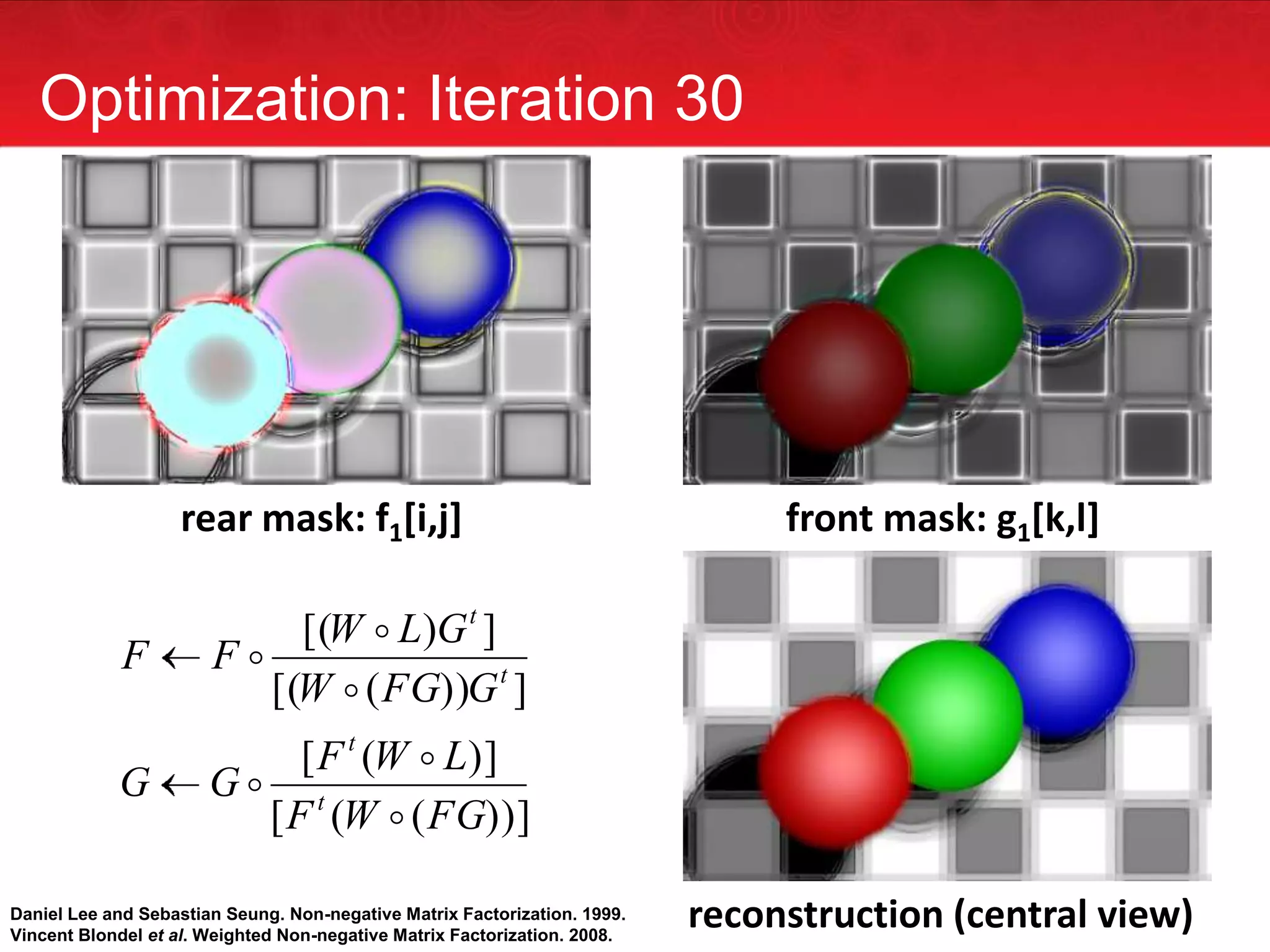
    Optimization: Iteration 30rearmask: f1[i,j]front mask: g1[k,l]reconstruction (central view)Daniel Lee and Sebastian Seung. Non-negative Matrix Factorization. 1999.Vincent Blondel et al. Weighted Non-negative Matrix Factorization. 2008.
  • 132.
    Optimization: Iteration 40rearmask: f1[i,j]front mask: g1[k,l]reconstruction (central view)Daniel Lee and Sebastian Seung. Non-negative Matrix Factorization. 1999.Vincent Blondel et al. Weighted Non-negative Matrix Factorization. 2008.
  • 133.
    Optimization: Iteration 50rearmask: f1[i,j]front mask: g1[k,l]reconstruction (central view)Daniel Lee and Sebastian Seung. Non-negative Matrix Factorization. 1999.Vincent Blondel et al. Weighted Non-negative Matrix Factorization. 2008.
  • 134.
    Optimization: Iteration 60rearmask: f1[i,j]front mask: g1[k,l]reconstruction (central view)Daniel Lee and Sebastian Seung. Non-negative Matrix Factorization. 1999.Vincent Blondel et al. Weighted Non-negative Matrix Factorization. 2008.
  • 135.
    Optimization: Iteration 70rearmask: f1[i,j]front mask: g1[k,l]reconstruction (central view)Daniel Lee and Sebastian Seung. Non-negative Matrix Factorization. 1999.Vincent Blondel et al. Weighted Non-negative Matrix Factorization. 2008.
  • 136.
    Optimization: Iteration 80rearmask: f1[i,j]front mask: g1[k,l]reconstruction (central view)Daniel Lee and Sebastian Seung. Non-negative Matrix Factorization. 1999.Vincent Blondel et al. Weighted Non-negative Matrix Factorization. 2008.
  • 137.
    Optimization: Iteration 90rearmask: f1[i,j]front mask: g1[k,l]reconstruction (central view)Daniel Lee and Sebastian Seung. Non-negative Matrix Factorization. 1999.Vincent Blondel et al. Weighted Non-negative Matrix Factorization. 2008.
  • 138.
  • 139.
  • 140.
  • 141.
    Conclusion`Content-Adaptive Parallax Barriers=Described a rank constraint for all dual-layer displays
  • 142.
    With afixed pair of masks, emitted light field is rank-1
  • 143.
    Achieved higher-rankapproximation using temporal multiplexing
  • 144.
    With Ttime-multiplexed masks, emitted light field is rank-T
  • 145.
    Constructed aprototype using off-the-shelf panels
  • 146.
    Demonstrated lightfield display is a matrix approximation problem
  • 147.
  • 148.
    Applied weightedNMF to optimize weighted Euclidean distance to targetAdaptation increases brightness and refresh rate of dual-stacked LCDs
  • 149.
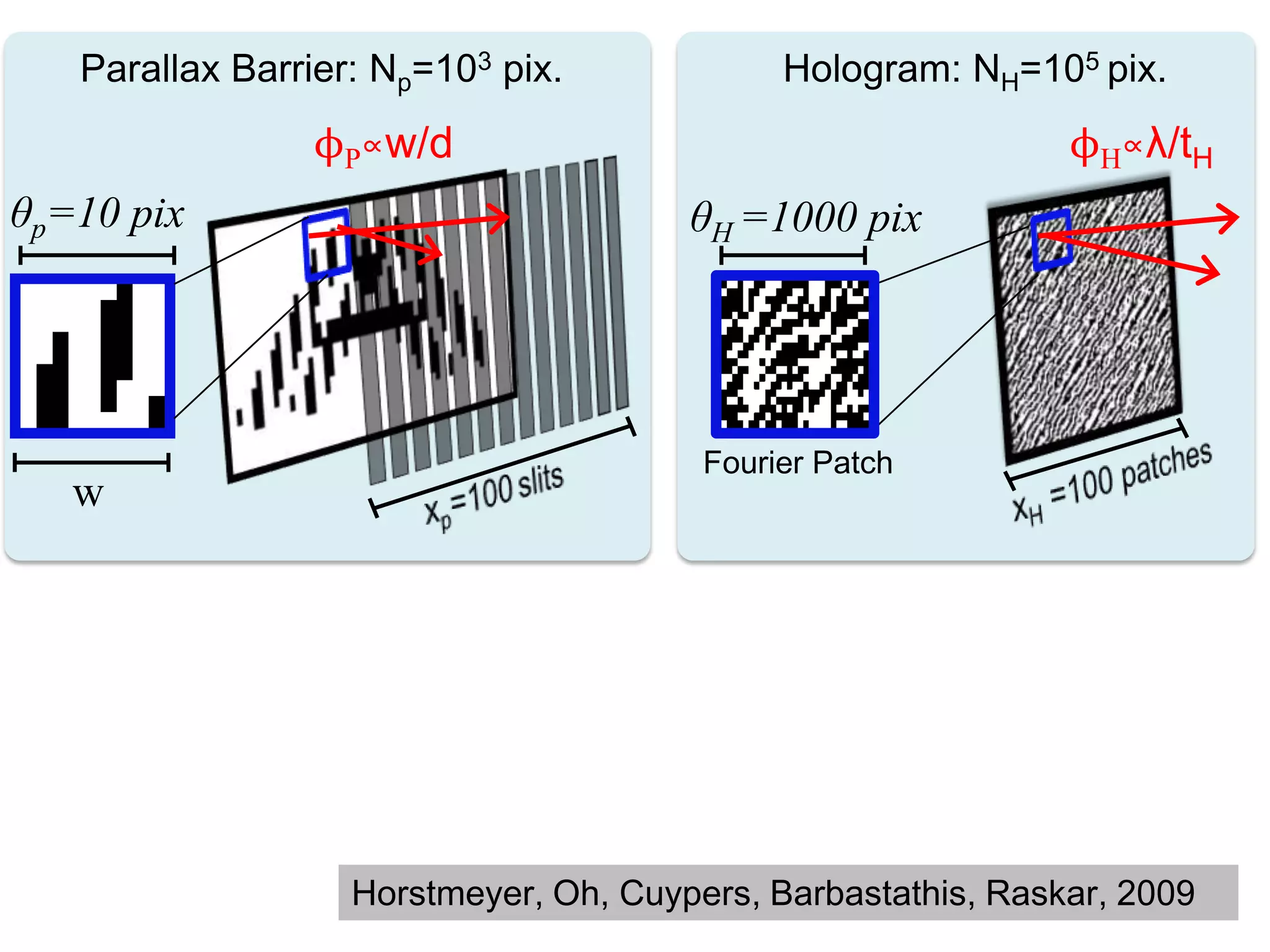
    Parallax Barrier: Np=103pix.Hologram: NH=105 pix.ϕP∝w/dϕH∝λ/tHθp=10 pixθH =1000 pixFourier PatchxH =100 patcheswxp=100slitsHorstmeyer, Oh, Cuypers, Barbastathis, Raskar, 2009
  • 150.
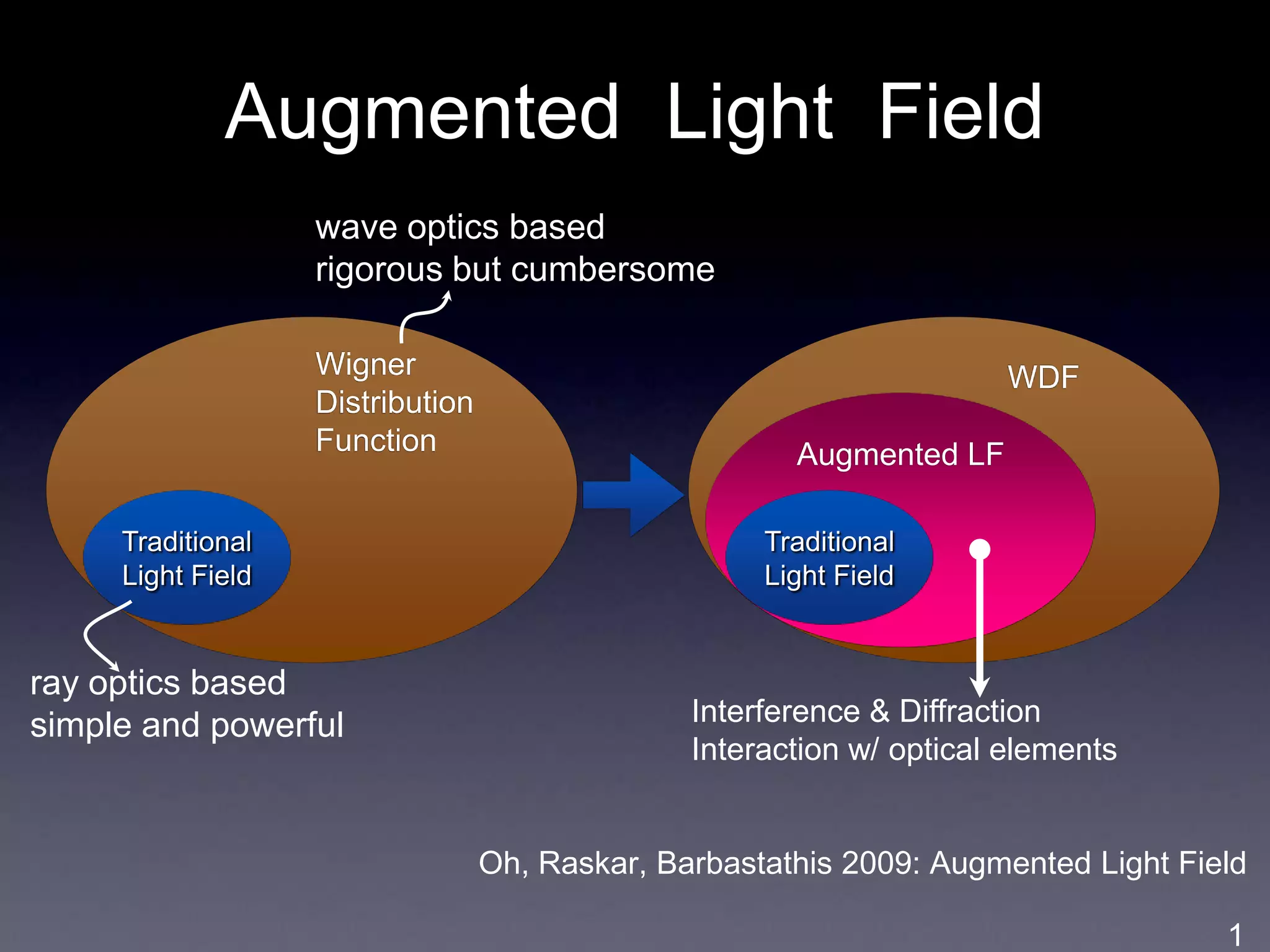
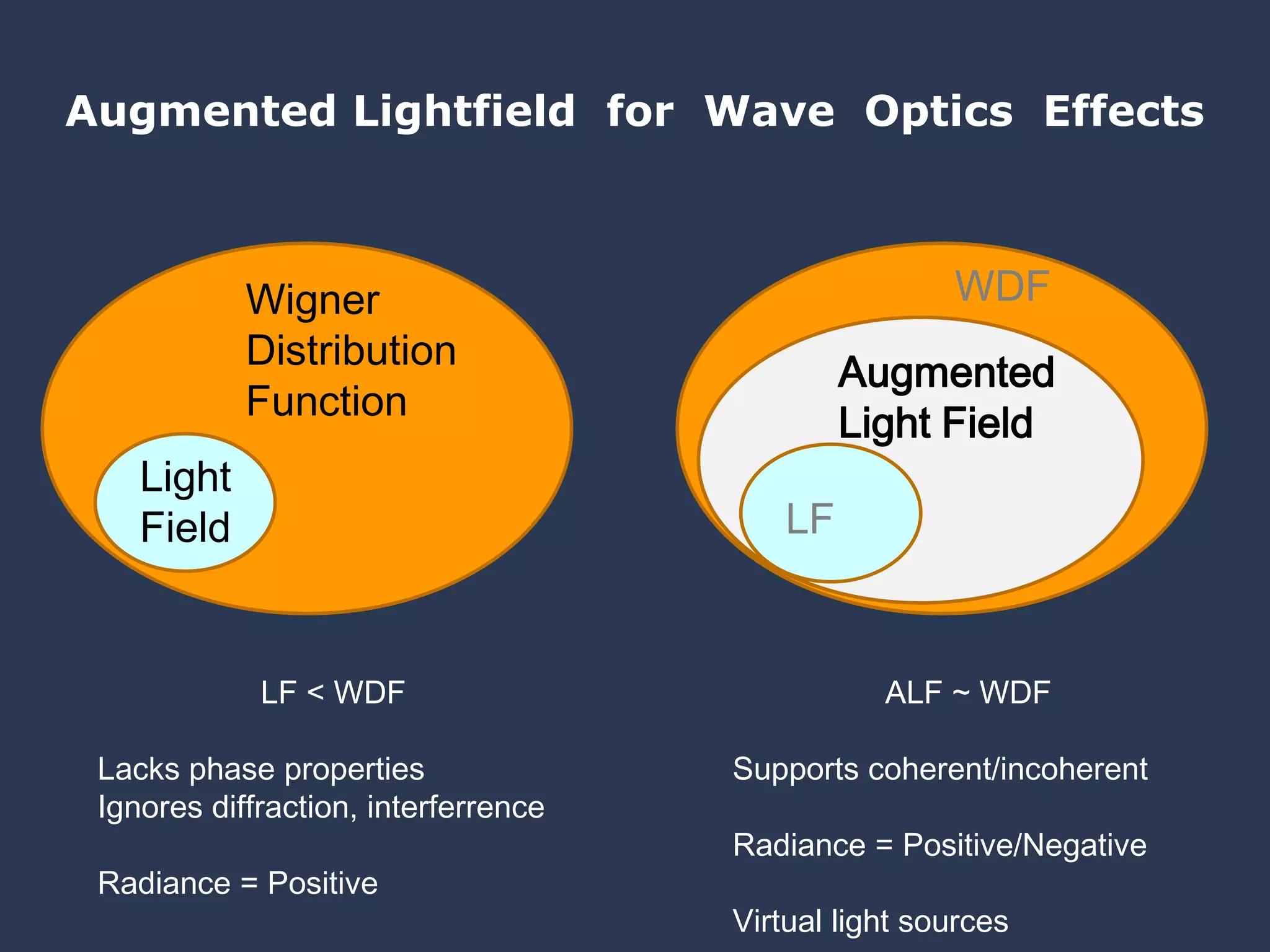
    Augmented Light Field118wave optics basedrigorous but cumbersomeWigner Distribution FunctionWDFAugmented LFTraditional Light FieldTraditional Light Fieldray optics basedsimple and powerfulInterference & DiffractionInteraction w/ optical elementsOh, Raskar, Barbastathis 2009: Augmented Light Field
  • 151.
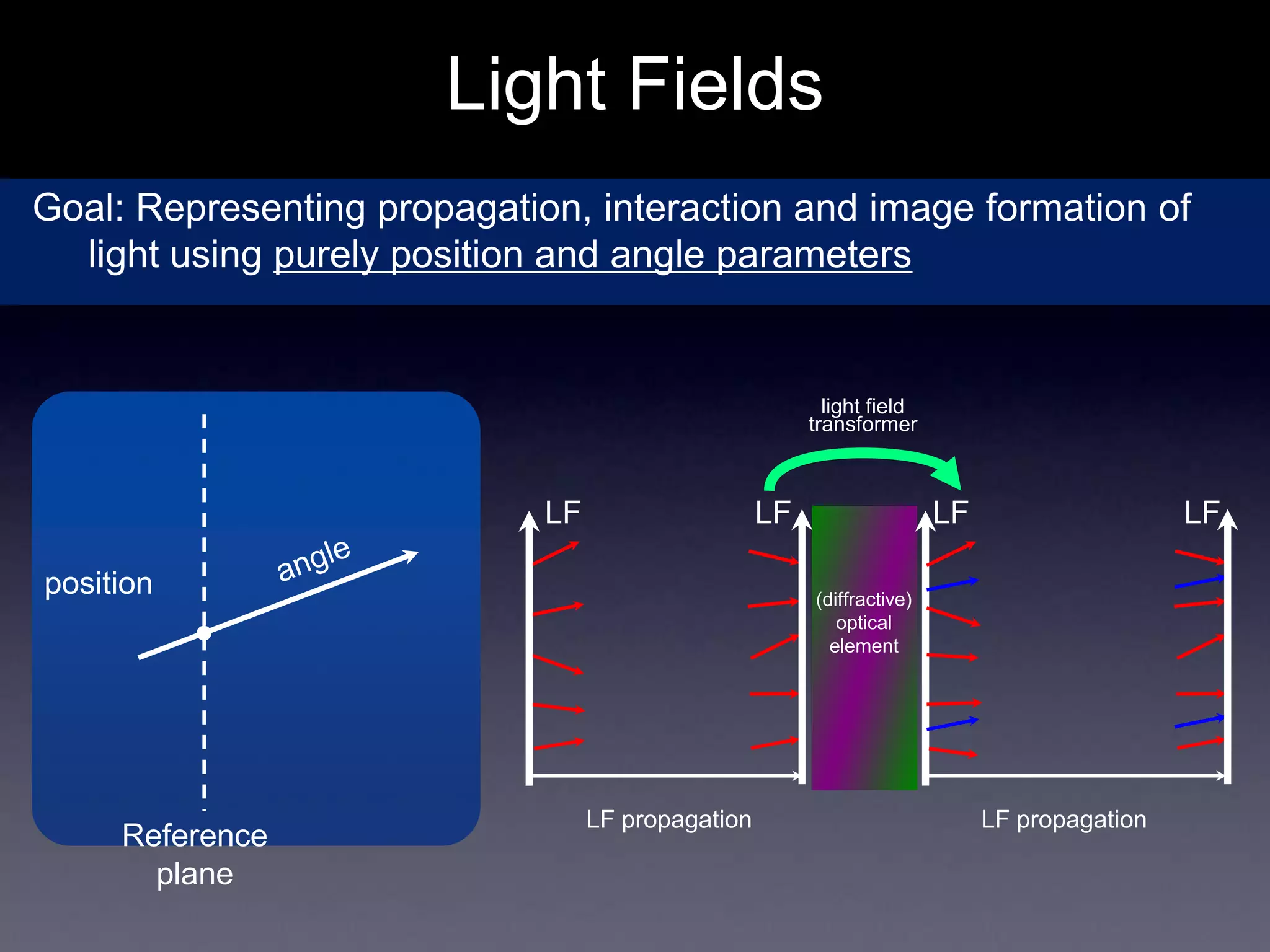
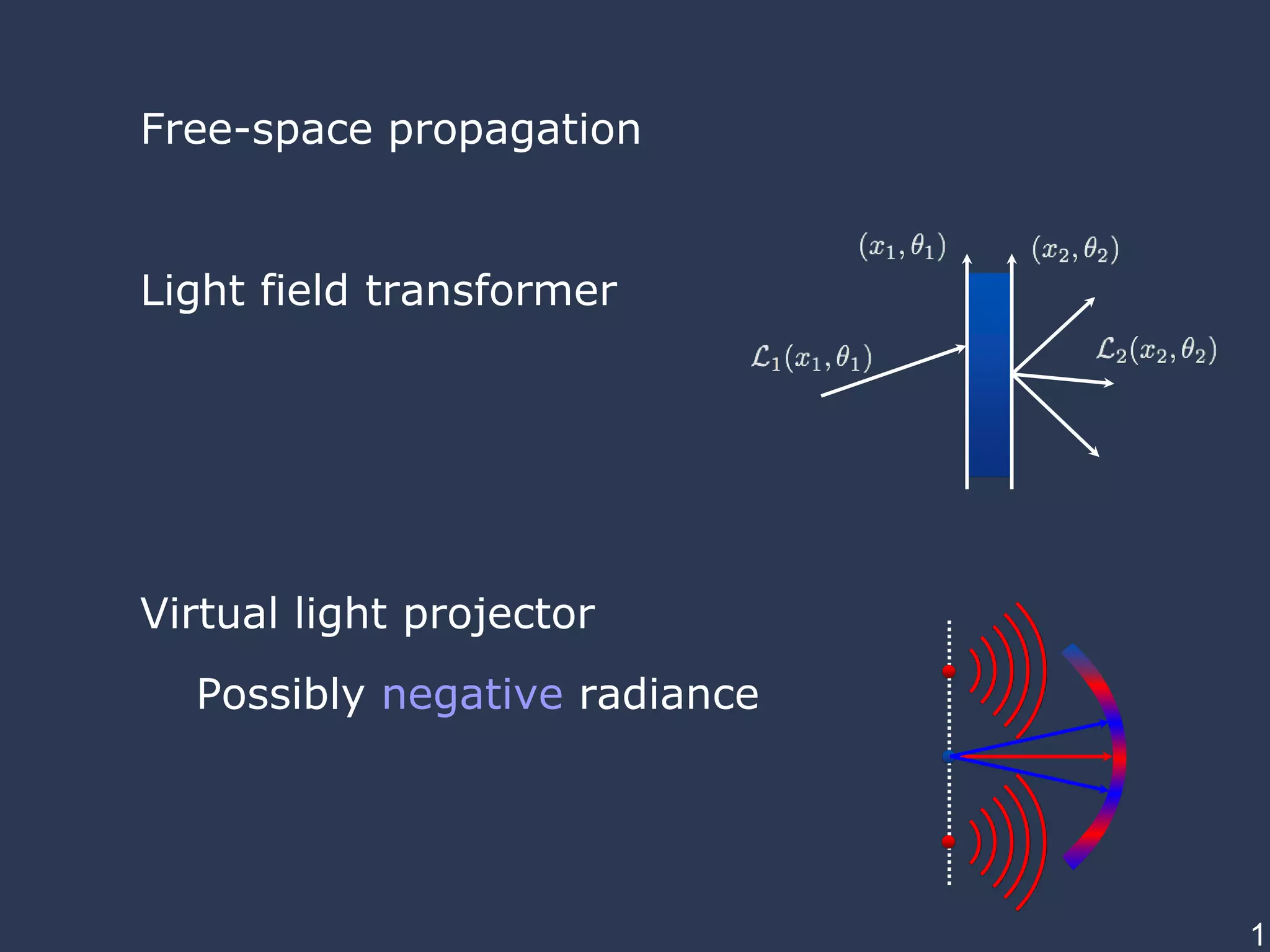
    positionlight field transformerLFLFLFLF(diffractive)opticalelementReferenceplaneLF propagationLF propagationLight FieldsGoal: Representing propagation, interaction and image formation of light using purely position and angle parametersangle
  • 152.
    Augmented Lightfield for Wave Optics EffectsWDFWigner Distribution FunctionAugmented Light FieldLight FieldLFLF < WDFLacks phase propertiesIgnores diffraction, interferrenceRadiance = PositiveALF ~ WDFSupports coherent/incoherentRadiance = Positive/NegativeVirtual light sources
  • 153.
    Free-space propagationLight fieldtransformerVirtual light projector Possibly negative radiance121
  • 154.
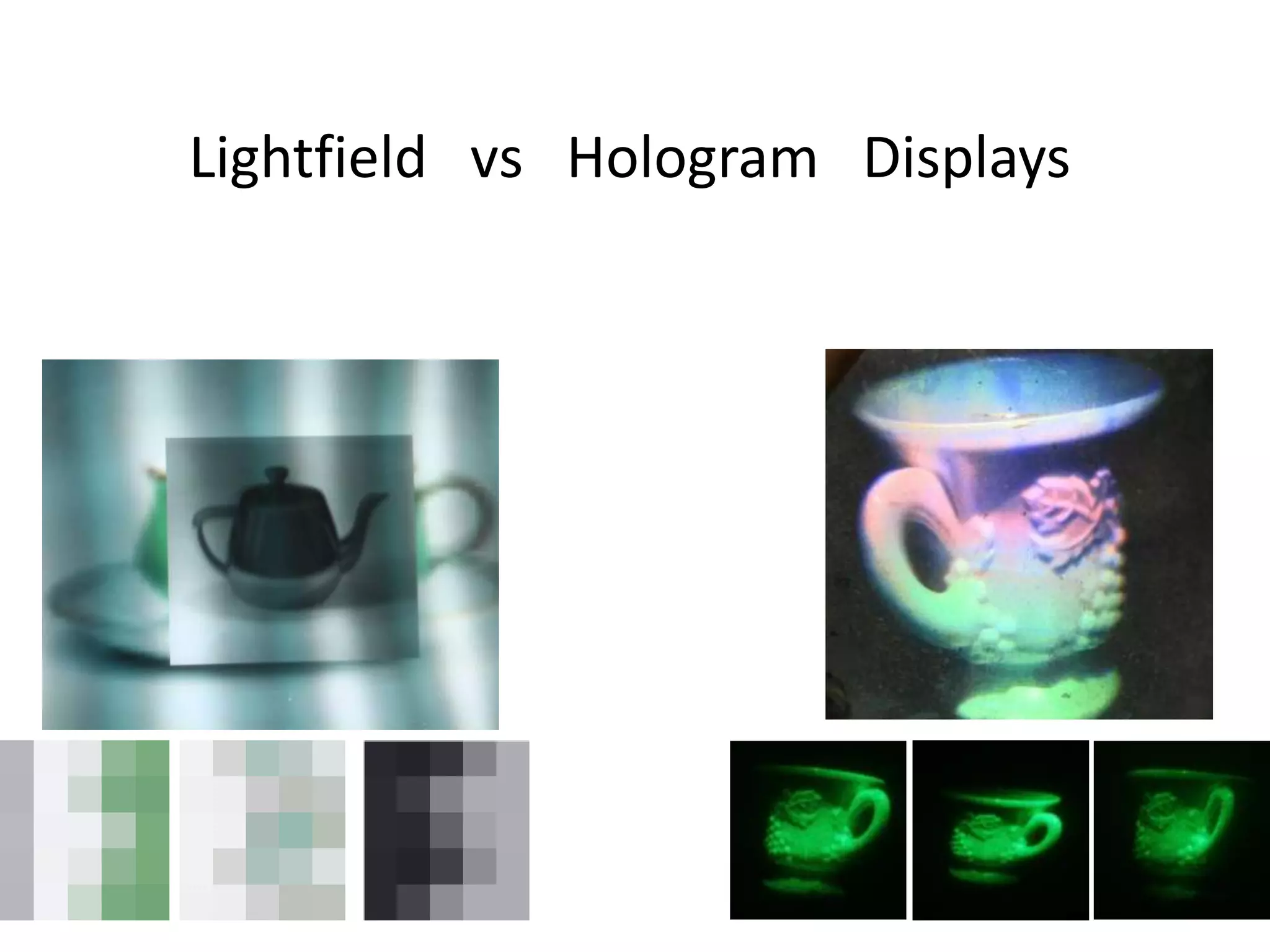
    Lightfieldvs Hologram Displays
  • 155.
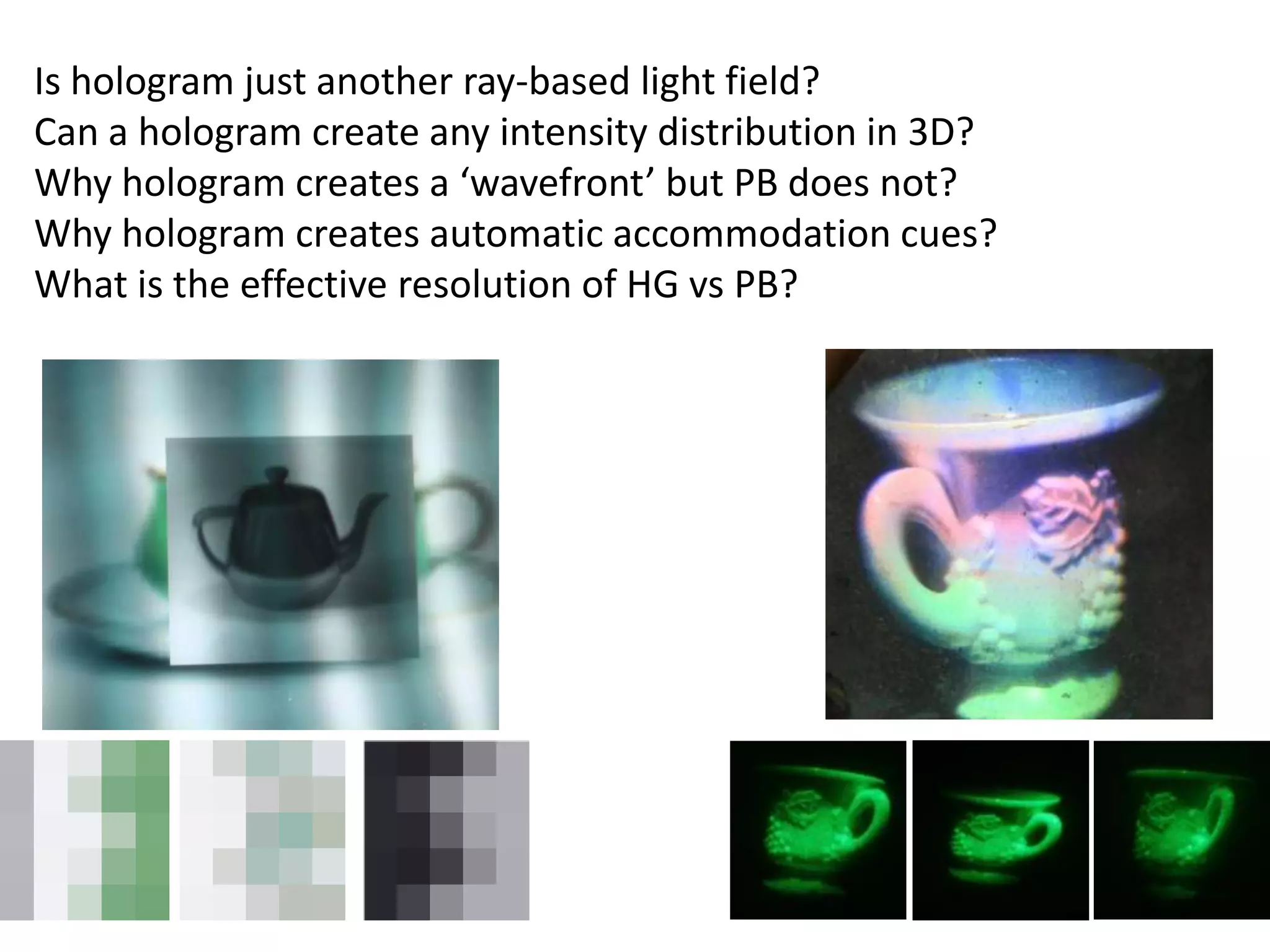
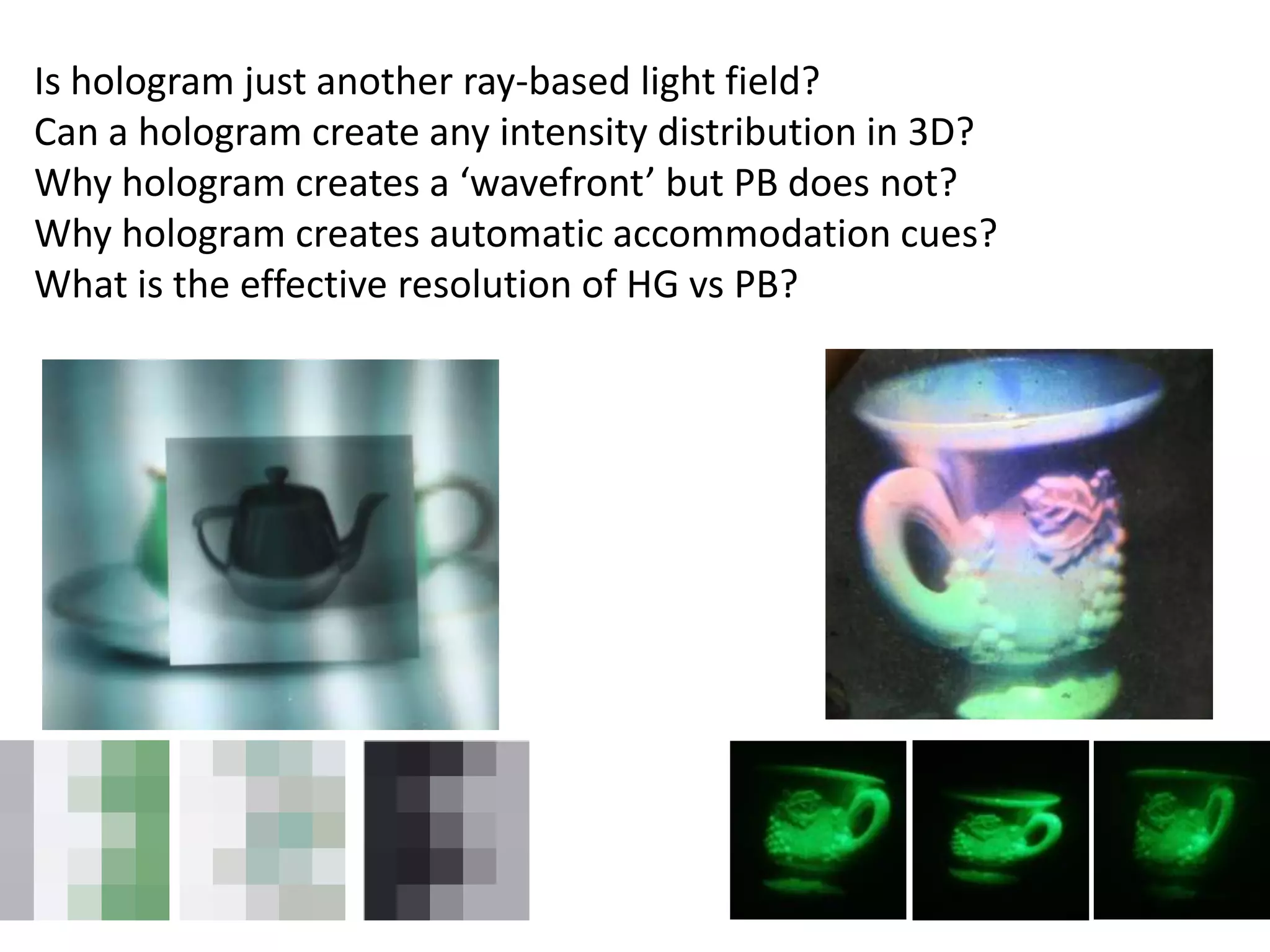
    Is hologram justanother ray-based light field?Can a hologram create any intensity distribution in 3D?Why hologram creates a ‘wavefront’ but PB does not?Why hologram creates automatic accommodation cues?What is the effective resolution of HG vs PB?
  • 156.
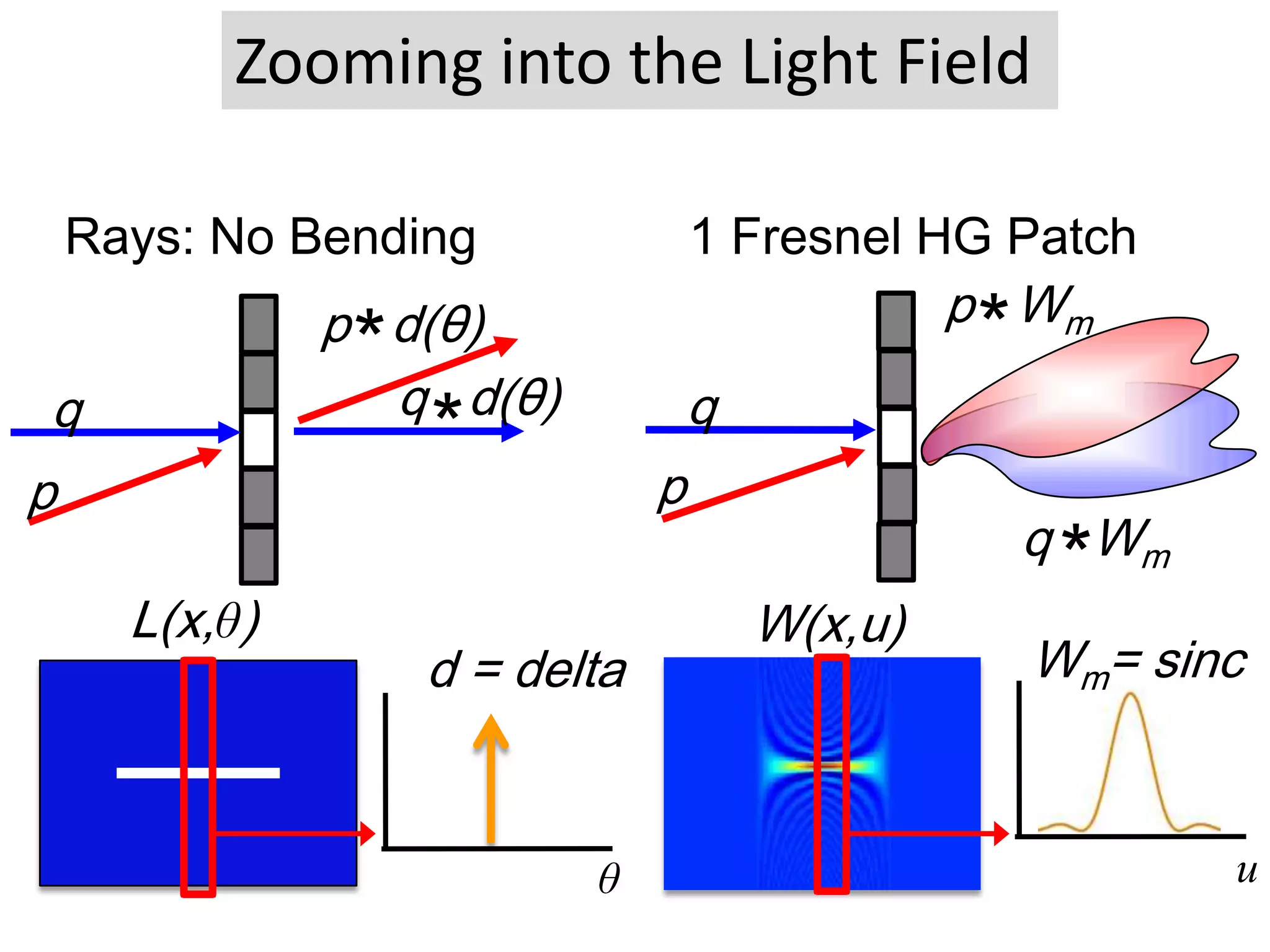
    Zooming into theLight FieldRays: No Bending1 Fresnel HG Patchp Wm* * p d(θ)q d(θ)* qqpp* q WmL(x,θ)W(x,u)Wm= sincd = deltauθ
  • 157.
    Algebraic Rank ConstraintRank-3Rank-1Rank-1s1*s1m2s1*m2s1(a)Parallax Barrier(c) Hybrid(b) Holograms1s1
  • 158.
    (a) Two Slits,CoherentInterferencexʹRank-1-1Transformu-TransformR45, Dx<t(x+xʹ/2)t*(x-xʹ/2)>t(x1)t*(x2)t(x+xʹ/2)t*(x-xʹ/2)W(x,u)
  • 159.
  • 160.
    Is hologram justanother ray-based light field?Can a hologram create any intensity distribution in 3D?Why hologram creates a ‘wavefront’ but PB does not?Why hologram creates automatic accommodation cues?What is the effective resolution of HG vs PB?
  • 161.
    Three QuestionsWhat arethe benefits of higher dimensional imaging?Why is the algebraic rank of a Light Field not full?What makes looking around the corner possible?
  • 162.
    How to doResearch in Imaginghttp://raskar.infoHow to come up w ideas: Idea HexagonHow to write a paperHow to give a talkOpen research problemsHow to decide merit of a projectHow to attend a conference, brainstormFacebook.com/ rRaskarTipsGet on Seminar/Talks mailing lists worldwidehttp://www.cs.virginia.edu/~robins/YouAndYourResearch.htmlWhy do so few scientists make significant contributions and so many are forgotten in the long run?Highly recommended Hamming talk at Bell Labs
  • 163.
    Take home pointsCo-designof hw/swAvoid computational or optical chauvinism in imaging (Camera flash/Kinect)Hardware cost going to zero, Parallel technology trendsComputer vision not just mimicking human vision/perceptionBorrow ideas from other fields: astronomy, scientific imaging, audio, communicationsPhotons not just PixelsChange the rules of the gameOptics, Sensors, Illum, Priors, Sparsity, TransformsMeta-data, Internet collection, Crowdsourcing
  • 164.
    MIT Media Lab raskar@mit.edu http://cameraculture.info fb.com/rraskarInverse ProblemsHow to do Research in ImagingInverse Problems, Reconstruction, Rank and SparsityCo-design of Optics and ComputationPhotons not just pixelsMid-level cuesComputational PhotographyOpen research problemsCompressive Sensing for High Speed EventsLimits of CS for general imagingComputational Light TransportLooking Around Corners, trillion fpsLightfields: 3D Displays and HologramsApply for internships/post-docneXt

Editor's Notes

  • #4 Six ways of coming up with new ideas based on an idea ‘X’.Ramesh RaskarAssociate ProfessorMIT Media Labhttp://raskar.infohttp://cameraculture.infoFull Presentation at http://www.slideshare.net/cameraculture/raskar-ideahexagonapr2010http://raskar.infohttp://cameraculture.info
  • #5 Full Presentation at http://www.slideshare.net/cameraculture/raskar-ideahexagonapr2010
  • #6 X up: Airbags for car, for helicopter
  • #9 Full Presentation at http://www.slideshare.net/cameraculture/raskar-ideahexagonapr2010
  • #11 http://en.wikipedia.org/wiki/George_H._Heilmeier#Heilmeier.27s_Catechism
  • #12 Five on Five= If more than five teams in the world are doing the same research, don’t do it.= If you disappear for five years, will someone do it anyway? Then your idea is not that great anyway. = Can you explain your work in five sentences to your grandmahow it will impact human life?= If you can explain the idea in five minutes to a student and disappear for five years, will s/he be able to do it on her/his own without additional input from you/without iterations .. It is too obvious and lacks depth .. Don’t do it.= Strive to work on ideas that may require five+ disciplines .. Today’s research is highly team-driven and more diverse the required team composition, more fun you will have and also indicates a natural barrier to entry for others satisfying condition 1 and 2Much like the food pyramid, five servings are the goal and will make you stronger .. But ok if your research project does not satisfy all five conditions
  • #16 But the world is 4D
  • #20 See computationalphotography.orgMove away from obsession about SNR, space-bandwidth, diffraction limit and so on
  • #21 My work involves creative new ways to play with light by co-designing optical and digital processing.My work lies at the INTERSECTION of processing of photons and processing of bits.At MERL, I transformed the field of computational photography, with key papers and impact on productsAt Media Lab, I invented a new field ‘computational light transport’
  • #45 Compressive sensing via random projections not suitable for images and even videos
  • #46 Rudy Burger, ‘don’t use flash and destroy the image’Can we use flash not just for improving scene brightness but for enhancing the mood? Like in studio lights?Main difference between professionals and consumers is lighting.
  • #68 http://cameraculture.infohttp://raskar.info
  • #74 My idea is to use the multiple bounces of light i.e. echoes of light.Echoes of sound -&gt; Echoes of lightWe all know about echoes of sound.But sounds travels slow and we can actually hear the echoesLight travels fast so we need specialized hardware to ‘listen’ to these echoes.So we end up using light sources and cameras that run at a trillion frames per second (not a million and not a billion, but trillion)
  • #75 Trillion fps camera (which was previously used only for specialized biochemistry expt)This new form of imaging is possible by fusion of dissimilar .. A specialized camera previously used only in biochemistry labs and a new computational method that analyzes multiple bounces of light.I started the project just before I joined MIT in summer 2008.The hardware we use is in the lab of Prof Bawendi, MIT Chemistry, who is now a collaborator
  • #81 Here is a road map for this ambitious research project based on time-resolved imaging .. Non line of sight Looking around corner (LaC) is just one example .. Such Time resolved imaging requires one to develop a completely new set of tool for understanding our world.This is a project I started just before coming to MIT via an NSF proposal.
  • #83 The reconstruction is very low right now, about 80x80 pixels. So these are just baby steps.
  • #84 The reconstruction is very low right now, about 80x80 pixels. So these are just baby steps.Data collected and reconstructions program by Andreas Velten, scientist in my group
  • #85 Pandharkar, Velten, Bardagjy, Lawson, Bawendi, Raskar, CVPR 2011
  • #95 A cross section through a single M. rhetenor scale. Light reflected off each level of the “Christmas tree structure” gives the butterfly its iridescent color. Credit: Pete Vukusic, University of Exeter
  • #97 Lanman, Hirsch, Kim, RaskarSiggraph Asia 2010