CE 370
Filtration
Definition and Objective
Filtration is a solid-liquid separation where the
liquid passes through a porous medium to
remove fine suspended solids.
The main objective of filtration is to produce
high-quality drinking water (surface water) or
high-quality effluent (wastewater)
Uses
 Water Treatment
 To filter chemically coagulated water
 Settled water
 Wastewater Treatment
 Untreated secondary effluent
 Chemically treated secondary effluent
 Chemically treated raw wastewater
Classifications of Filters
 Single-medium filters (used in water)
 Have one type of medium
 Medium usually sand or crushed anthracite coal
 Dual-medium filters (used in water and wastewater)
 Have two types of media
 Usually crushed anthracite and sand
 Multi-media filters (used in water and wastewater)
 Have three types of media
 Usually crushed anthracite, sand, and garnet
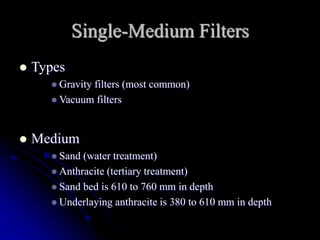
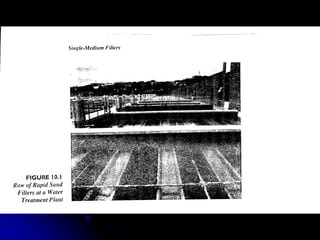
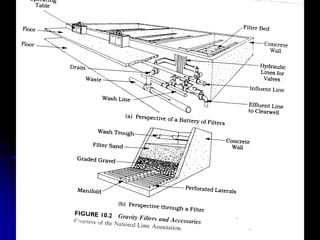
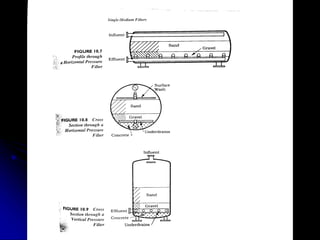
Single-Medium Filters
 Types
 Gravity filters (most common)
 Vacuum filters
 Medium
 Sand (water treatment)
 Anthracite (tertiary treatment)
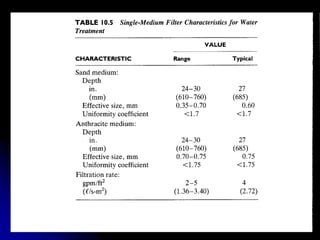
 Sand bed is 610 to 760 mm in depth
 Underlaying anthracite is 380 to 610 mm in depth
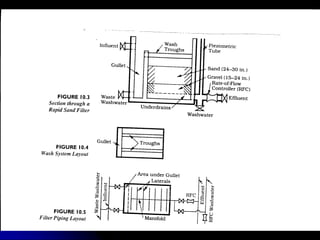
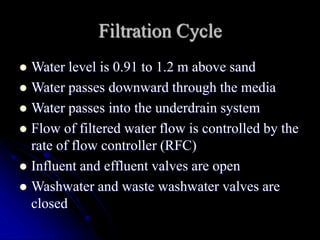
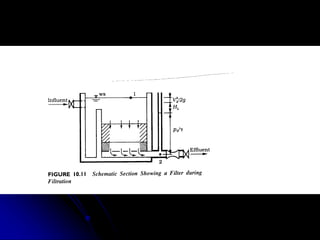
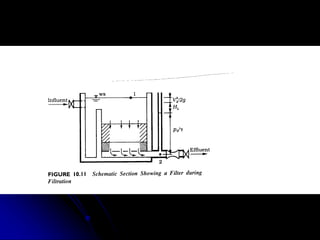
Filtration Cycle
 Water level is 0.91 to 1.2 m above sand
 Water passes downward through the media
 Water passes into the underdrain system
 Flow of filtered water flow is controlled by the
rate of flow controller (RFC)
 Influent and effluent valves are open
 Washwater and waste washwater valves are
closed
Mechanisms of Particle Removal
 Surface Removal
 Particles larger than the pore size of the medium
 Cake layer is formed
 Depth Removal (most important in water
treatment)
Mechanisms of Particle Removal
 Adhesion
 Particles collide with sand surface and adhere to it
 Flocculation
 Some particles may be brought together
(flocculate) and become bigger
 Sedimentation
 Flocculated flocs settle on sand particles
 Straining
 Due to decrease in pore size of the medium
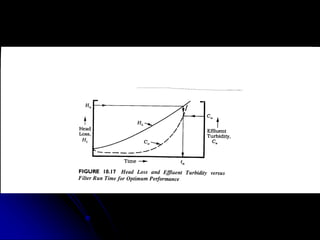
Head loss
 Head loss is caused by accumulation of particles on
top and within the depth of the filter
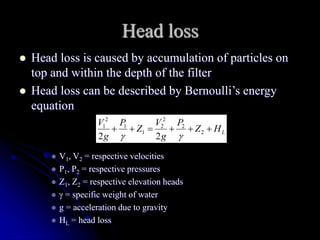
 Head loss can be described by Bernoulli’s energy
equation
 V1, V2 = respective velocities
 P1, P2 = respective pressures
 Z1, Z2 = respective elevation heads
  = specific weight of water
 g = acceleration due to gravity
 HL = head loss
L
H
Z
P
g
V
Z
P
g
V





 2
2
2
2
1
1
2
1
2
2 

Head loss
 Head loss of clean filter is 0.15 to 0.46 m
 As filtration progresses, head loss increases
 When head loss reaches 1.8 to 2.4 m, the filter
is cleaned (backwashed)
Filtration Rate
 Standard filtration rate is 1.36 l/s-m2 of filter
bed
 Presently, rates between 1.36 to 3.40 l/s-m2 are
used
 Filters are run at
 Constant filtration rate (most common)
 Declining filtration rate
 Longer running period
 Better quality of effluent
 Limited to medium to large plants
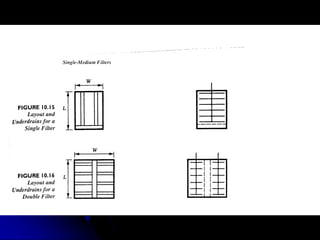
Filter Dimensions
 Single filter
 Length to width ratio is 1 : 1.5 to 1 : 2
 Double filter in one concrete basin
 Almost square with length to width ratio of 1 : 1
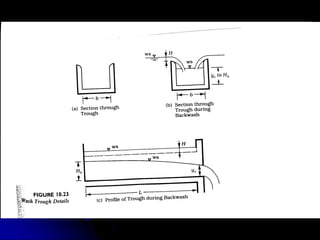
Backwash
 Filter run depends on quality of feed water
 Filter run may range between less than a day to
several days
 Objective of backwash is to remove
accumulated particles on the surface and
within the filter medium
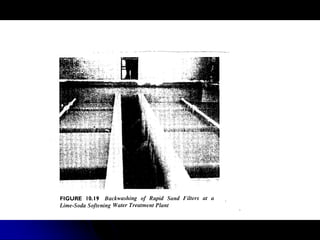
 Backwash is performed using wash water or
air scouring
Backwash
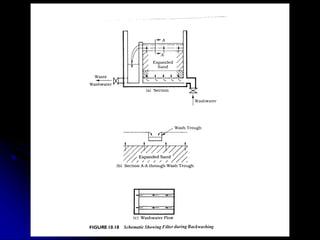
 During backwash, the sand bed expands
 Bed expansion is between 20 to 50%
 Backwash flow is between 10.2 to 13.6 l/s-m2
 Backwash continues till the waste washwater
is relatively clear
Figure 10.18
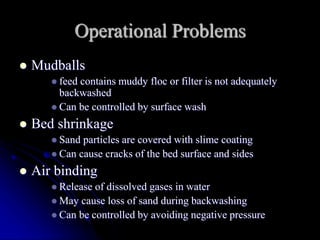
Operational Problems
 Mudballs
 feed contains muddy floc or filter is not adequately
backwashed
 Can be controlled by surface wash
 Bed shrinkage
 Sand particles are covered with slime coating
 Can cause cracks of the bed surface and sides
 Air binding
 Release of dissolved gases in water
 May cause loss of sand during backwashing
 Can be controlled by avoiding negative pressure
Multimedia Filters
 Becoming popular in water treatment
 The main type of filters in tertiary and
advanced treatments
 Advantages over single-medium filters:
 Longer filtration runs
 Higher filtration rates
 Ability to filter water with higher turbidity or SS
 Advantages are due to:
 Media particle size
 Different specific gravities of the media
 The media gradation
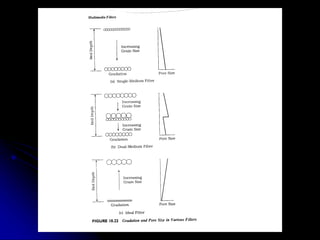
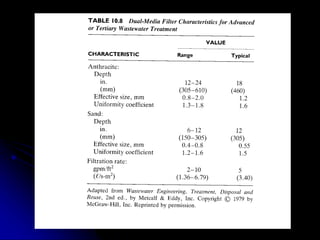
Dual-Media Filters
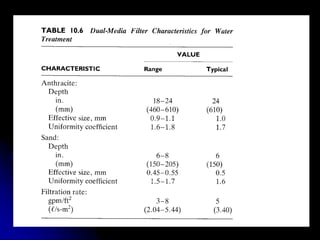
 Consists of a layer of anthracite (18 - 24 inch)
above a layer of sand (6 – 12 inch)
 Pore volume is higher than that in single filter
 Specific gravity of coal is 1.2 to 1.6
 Specific gravity of sand is 2.65
 Filtration rate is between 2 – 10 gal/min-ft2
 Common filtration rates are 3-6 gal/min-ft2
Fig 10.22
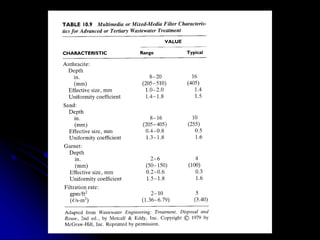
Mixed-Media Filters
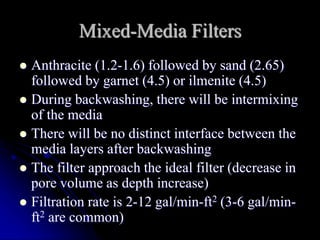
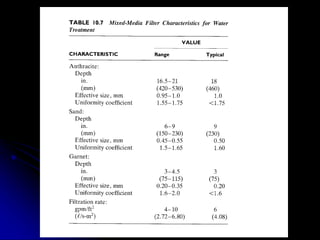
 Anthracite (1.2-1.6) followed by sand (2.65)
followed by garnet (4.5) or ilmenite (4.5)
 During backwashing, there will be intermixing
of the media
 There will be no distinct interface between the
media layers after backwashing
 The filter approach the ideal filter (decrease in
pore volume as depth increase)
 Filtration rate is 2-12 gal/min-ft2 (3-6 gal/min-
ft2 are common)
Filtration in Water Treatment
 Slow sand filtration
 Single-medium
 San size 0.2 to 0.4 mm
 Filtration rates of 0.05 to 0.15 gal/min-ft2
 Cleaned manually (every 4 to 6 weeks)
 Needs large area and manual labors
 Has been replaced by rapid sand filter
Filtration in Water Treatment
 Rapid Sand Filter
 Preceded by coagulation, flocculation, and sedimentation
 Filtration rates between 3 to 5 gal/min-ft2
 Turbidity removal is 90 to 98%
 Consist of coarse sand (in-depth filtration)
 Sand beds are 24 to 30 inch thick
 Sand effective size 0.35 to 0.70 mm
 Dual-media and mixed-media filters
 Larger pore volume
 Higher filtration rates
 Longer running times
 Less backwash water per unit volume of filtrate
Filtration in Wastewater Treatment
 Used in advanced treatment
 Secondary effluent
 Chemically treated secondary effluent
 Chemically treated primary or raw wastewater
 Usually dual- or mixed media filters
 Size of media is different from that used in water
treatment
 granules are larger to:
 To keep the desired flow rate
 To keep the desires storage volume for flocculated floc
Filtration in Wastewater Treatment
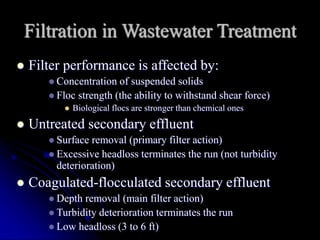
 Filter performance is affected by:
 Concentration of suspended solids
 Floc strength (the ability to withstand shear force)
 Biological flocs are stronger than chemical ones
 Untreated secondary effluent
 Surface removal (primary filter action)
 Excessive headloss terminates the run (not turbidity
deterioration)
 Coagulated-flocculated secondary effluent
 Depth removal (main filter action)
 Turbidity deterioration terminates the run
 Low headloss (3 to 6 ft)
Filtration in Wastewater Treatment
 Filter aids are added to:
 Strengthen the chemical floc
 Allow higher filtration rates
 Longer filter runs
 Operational problems
 Buildup of microbial slime
 Can be prevented by surface wash or air scouring
 Encrustation of calcium carbonate
 Occurs when high pH coagulation is used
 Can be prevented by carbonation
Filtration of Secondary Effluents
 Previous studies showed that:
 Feed SS is 18.3 mg/l
 SS removal is 66.2%
 Filter run is 15.6 hours
 Filtration rate is 3.7 gal/min-ft2
 Dual- and mixed-media filters were used
 Mixed-media filters gave better results
Filtration of Chemically Coagulated Effluents
 Previous studies showed that:
 SS is 9.3 mg/l
 SS removal of 74.2%
 Filter run of 33.7 hours
 Filtration rate of 3 gal/min-ft2
 Mixed-media filters gave better results
Filtration of Chemically Treated
Primary or Raw Wastewater
 Previous studies showed that:
 SS is 122 to 133 mg/l
 SS removal of 73.0%
 Filter run of 24 to 31 hours
 Filtration rate of 3.3 gal/min-ft2
 Mixed-media filters gave better results
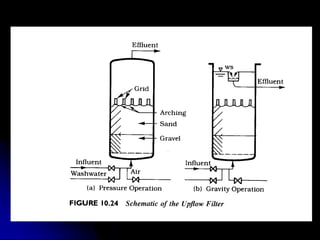
Upflow Filtration
 Flow is upward (from coarse to fine)
 Single-medium (sand)
 Bed fluidization can be avoided by:
 Using deeper bed
 Placing restraining grid on the top of the bed
 Air scouring is used during backwashing
 Mainly used in industrial and municipal wastewater treatment
 Filtration rate is 2 to 3 gal/min-ft2
 Terminal headloss is 6 to 20 ft
 Design values are:
 Bed depth is 60 inches (sand 2-3 mm) and 4 inches ( sand of 10-15 mm)
 Average feed SS of 17 mg/l
 SS removal of 64.6%
 Filtration rate of 2 to 5 gal/min-ft2
 Filter run of 7 to 150 hours
3501556.ppt

3501556.ppt

  • 1.
  • 2.
    Definition and Objective Filtrationis a solid-liquid separation where the liquid passes through a porous medium to remove fine suspended solids. The main objective of filtration is to produce high-quality drinking water (surface water) or high-quality effluent (wastewater)
  • 3.
    Uses  Water Treatment To filter chemically coagulated water  Settled water  Wastewater Treatment  Untreated secondary effluent  Chemically treated secondary effluent  Chemically treated raw wastewater
  • 4.
    Classifications of Filters Single-medium filters (used in water)  Have one type of medium  Medium usually sand or crushed anthracite coal  Dual-medium filters (used in water and wastewater)  Have two types of media  Usually crushed anthracite and sand  Multi-media filters (used in water and wastewater)  Have three types of media  Usually crushed anthracite, sand, and garnet
  • 5.
    Single-Medium Filters  Types Gravity filters (most common)  Vacuum filters  Medium  Sand (water treatment)  Anthracite (tertiary treatment)  Sand bed is 610 to 760 mm in depth  Underlaying anthracite is 380 to 610 mm in depth
  • 11.
    Filtration Cycle  Waterlevel is 0.91 to 1.2 m above sand  Water passes downward through the media  Water passes into the underdrain system  Flow of filtered water flow is controlled by the rate of flow controller (RFC)  Influent and effluent valves are open  Washwater and waste washwater valves are closed
  • 13.
    Mechanisms of ParticleRemoval  Surface Removal  Particles larger than the pore size of the medium  Cake layer is formed  Depth Removal (most important in water treatment)
  • 14.
    Mechanisms of ParticleRemoval  Adhesion  Particles collide with sand surface and adhere to it  Flocculation  Some particles may be brought together (flocculate) and become bigger  Sedimentation  Flocculated flocs settle on sand particles  Straining  Due to decrease in pore size of the medium
  • 15.
    Head loss  Headloss is caused by accumulation of particles on top and within the depth of the filter  Head loss can be described by Bernoulli’s energy equation  V1, V2 = respective velocities  P1, P2 = respective pressures  Z1, Z2 = respective elevation heads   = specific weight of water  g = acceleration due to gravity  HL = head loss L H Z P g V Z P g V       2 2 2 2 1 1 2 1 2 2  
  • 18.
    Head loss  Headloss of clean filter is 0.15 to 0.46 m  As filtration progresses, head loss increases  When head loss reaches 1.8 to 2.4 m, the filter is cleaned (backwashed)
  • 19.
    Filtration Rate  Standardfiltration rate is 1.36 l/s-m2 of filter bed  Presently, rates between 1.36 to 3.40 l/s-m2 are used  Filters are run at  Constant filtration rate (most common)  Declining filtration rate  Longer running period  Better quality of effluent  Limited to medium to large plants
  • 20.
    Filter Dimensions  Singlefilter  Length to width ratio is 1 : 1.5 to 1 : 2  Double filter in one concrete basin  Almost square with length to width ratio of 1 : 1
  • 21.
    Backwash  Filter rundepends on quality of feed water  Filter run may range between less than a day to several days  Objective of backwash is to remove accumulated particles on the surface and within the filter medium  Backwash is performed using wash water or air scouring
  • 22.
    Backwash  During backwash,the sand bed expands  Bed expansion is between 20 to 50%  Backwash flow is between 10.2 to 13.6 l/s-m2  Backwash continues till the waste washwater is relatively clear
  • 23.
  • 26.
    Operational Problems  Mudballs feed contains muddy floc or filter is not adequately backwashed  Can be controlled by surface wash  Bed shrinkage  Sand particles are covered with slime coating  Can cause cracks of the bed surface and sides  Air binding  Release of dissolved gases in water  May cause loss of sand during backwashing  Can be controlled by avoiding negative pressure
  • 27.
    Multimedia Filters  Becomingpopular in water treatment  The main type of filters in tertiary and advanced treatments  Advantages over single-medium filters:  Longer filtration runs  Higher filtration rates  Ability to filter water with higher turbidity or SS  Advantages are due to:  Media particle size  Different specific gravities of the media  The media gradation
  • 28.
    Dual-Media Filters  Consistsof a layer of anthracite (18 - 24 inch) above a layer of sand (6 – 12 inch)  Pore volume is higher than that in single filter  Specific gravity of coal is 1.2 to 1.6  Specific gravity of sand is 2.65  Filtration rate is between 2 – 10 gal/min-ft2  Common filtration rates are 3-6 gal/min-ft2
  • 29.
  • 30.
    Mixed-Media Filters  Anthracite(1.2-1.6) followed by sand (2.65) followed by garnet (4.5) or ilmenite (4.5)  During backwashing, there will be intermixing of the media  There will be no distinct interface between the media layers after backwashing  The filter approach the ideal filter (decrease in pore volume as depth increase)  Filtration rate is 2-12 gal/min-ft2 (3-6 gal/min- ft2 are common)
  • 31.
    Filtration in WaterTreatment  Slow sand filtration  Single-medium  San size 0.2 to 0.4 mm  Filtration rates of 0.05 to 0.15 gal/min-ft2  Cleaned manually (every 4 to 6 weeks)  Needs large area and manual labors  Has been replaced by rapid sand filter
  • 32.
    Filtration in WaterTreatment  Rapid Sand Filter  Preceded by coagulation, flocculation, and sedimentation  Filtration rates between 3 to 5 gal/min-ft2  Turbidity removal is 90 to 98%  Consist of coarse sand (in-depth filtration)  Sand beds are 24 to 30 inch thick  Sand effective size 0.35 to 0.70 mm  Dual-media and mixed-media filters  Larger pore volume  Higher filtration rates  Longer running times  Less backwash water per unit volume of filtrate
  • 36.
    Filtration in WastewaterTreatment  Used in advanced treatment  Secondary effluent  Chemically treated secondary effluent  Chemically treated primary or raw wastewater  Usually dual- or mixed media filters  Size of media is different from that used in water treatment  granules are larger to:  To keep the desired flow rate  To keep the desires storage volume for flocculated floc
  • 39.
    Filtration in WastewaterTreatment  Filter performance is affected by:  Concentration of suspended solids  Floc strength (the ability to withstand shear force)  Biological flocs are stronger than chemical ones  Untreated secondary effluent  Surface removal (primary filter action)  Excessive headloss terminates the run (not turbidity deterioration)  Coagulated-flocculated secondary effluent  Depth removal (main filter action)  Turbidity deterioration terminates the run  Low headloss (3 to 6 ft)
  • 40.
    Filtration in WastewaterTreatment  Filter aids are added to:  Strengthen the chemical floc  Allow higher filtration rates  Longer filter runs  Operational problems  Buildup of microbial slime  Can be prevented by surface wash or air scouring  Encrustation of calcium carbonate  Occurs when high pH coagulation is used  Can be prevented by carbonation
  • 41.
    Filtration of SecondaryEffluents  Previous studies showed that:  Feed SS is 18.3 mg/l  SS removal is 66.2%  Filter run is 15.6 hours  Filtration rate is 3.7 gal/min-ft2  Dual- and mixed-media filters were used  Mixed-media filters gave better results
  • 43.
    Filtration of ChemicallyCoagulated Effluents  Previous studies showed that:  SS is 9.3 mg/l  SS removal of 74.2%  Filter run of 33.7 hours  Filtration rate of 3 gal/min-ft2  Mixed-media filters gave better results
  • 44.
    Filtration of ChemicallyTreated Primary or Raw Wastewater  Previous studies showed that:  SS is 122 to 133 mg/l  SS removal of 73.0%  Filter run of 24 to 31 hours  Filtration rate of 3.3 gal/min-ft2  Mixed-media filters gave better results
  • 45.
    Upflow Filtration  Flowis upward (from coarse to fine)  Single-medium (sand)  Bed fluidization can be avoided by:  Using deeper bed  Placing restraining grid on the top of the bed  Air scouring is used during backwashing  Mainly used in industrial and municipal wastewater treatment  Filtration rate is 2 to 3 gal/min-ft2  Terminal headloss is 6 to 20 ft  Design values are:  Bed depth is 60 inches (sand 2-3 mm) and 4 inches ( sand of 10-15 mm)  Average feed SS of 17 mg/l  SS removal of 64.6%  Filtration rate of 2 to 5 gal/min-ft2  Filter run of 7 to 150 hours