Welcome
RANDOMIZED CLINICAL TRIALS
24/12/2023
www.clinosol.com | follow us on social media @clinosolresearch 1
Sravani Yenneti
M. Pharmacy
Student ID: CLS_232/112023
Randomized Clinical Trials
10/18/2022
www.clinosol.com | follow us on social media @clinosolresearch 2
INTRODUCTION:
RCT’s are the experimental studies designed to
assess the effectiveness of medical interventions.
These are the studies in clinical research in
which, participants are randomly (randomized)
assigned to an experimental group or a control
group. These studies measures the effectiveness
of a new intervention or treatment.
Randomized Clinical Trials
10/18/2022
www.clinosol.com | follow us on social media @clinosolresearch 3
PURPOSE OF RCT’S:
 The main purpose of RCT’s is to measure the effectiveness
of a new intervention or treatment.
 These studies reduces bias and provides a rigorous tool to
examine cause-effect relationships between an intervention
and outcome.
 These studies plays a pivotal role in providing robust
evidence for medical decision-making.
Randomized Clinical Trials
10/18/2022
www.clinosol.com | follow us on social media @clinosolresearch 4
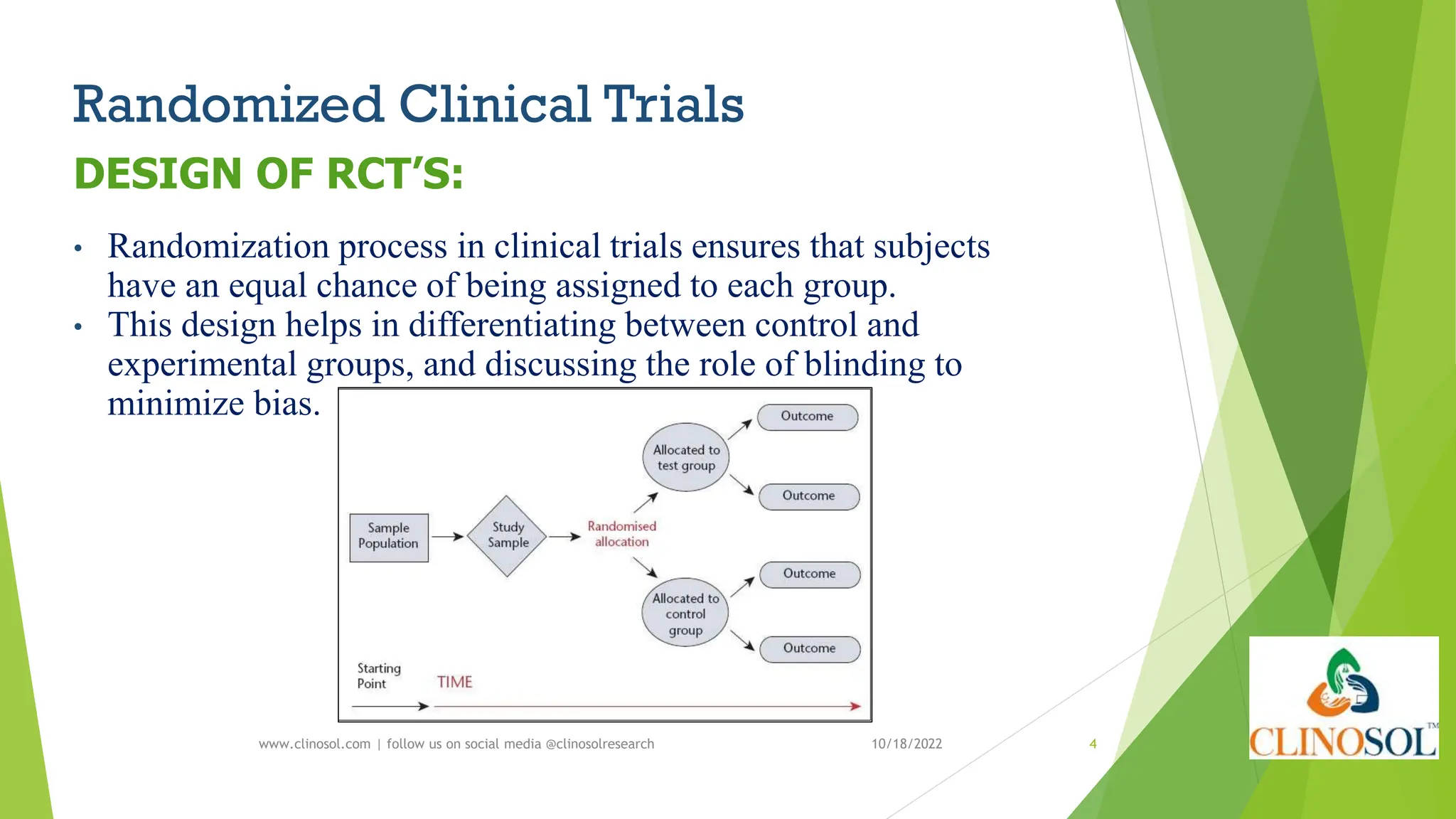
DESIGN OF RCT’S:
• Randomization process in clinical trials ensures that subjects
have an equal chance of being assigned to each group.
• This design helps in differentiating between control and
experimental groups, and discussing the role of blinding to
minimize bias.
Randomized Clinical Trials
RANDOMIZATION TECHNIQUES:
1. Simple : Complete randomness of assignment of treatment to a
particular group.
2. Stratified : Treatment and control groups are balanced on
important prognostic factors like gender, age etc., that can
influence the outcome of the study.
3. Block : Subjects are divided into blocks and randomization is
carried out in each blocks.
10/18/2022
www.clinosol.com | follow us on social media @clinosolresearch 5
Randomized Clinical Trials
STATISTICAL ANALYSIS:
 Null hypotheses – the intervention will have no impact on the
outcome measure.
− Outcome will be similar in both the test and control
groups
 Alternative hypotheses − intervention will have meaningful
effect and statistically significant.
 Statistical method (e.g.);
− Pre and post intervention differences = paired t-test
− Mean differences pre and post between two group =
independent test
− Mean differences pre and post between more than two
groups = ANOVA
10/18/2022
www.clinosol.com | follow us on social media @clinosolresearch 6
Randomized Clinical Trials
CHALLENGES IN RCT’S:
 Participant recruitment can be a significant challenge
in RCT’s. Researches may struggle to enroll a
sufficiently diverse and representative sample,
impacting the generalizability of study findings.
 Maintaining participant engagement throughout the
trial is crucial. High dropout rates can compromise the
study’s internal validity and statistical power, affecting
the reliability of results.
10/18/2022
www.clinosol.com | follow us on social media @clinosolresearch 7
Randomized Clinical Trials
CONCLUSION:
 As the results of a randomized clinical trial can have a
significant impact on human health and on the way
that health care is provided, it is very important to
understand the overall course of each individual
research.
 Successful RCT’s can have a profound impact on
clinical practise, shaping guidelines and improving
patient outcomes.
10/18/2022
www.clinosol.com | follow us on social media @clinosolresearch 8
Randomized Clinical Trials
REFERENCES:
 BJOG. Author manuscript; available in PMC 2018 Dec 1. Published in final edited
form as: BJOG. 2018 Dec; 125(13): 1716. Published online 2018 Jun
19. doi: 10.1111/1471-0528.15199
10/18/2022
www.clinosol.com | follow us on social media @clinosolresearch 9
ThankYou!
www.clinosol.com
(India | Canada)
9121151622/623/624
info@clinosol.com
10/18/2022
www.clinosol.com | follow us on social media @clinosolresearch 10

Randomized Clinical Trials and Clinical Research

  • 1.
    Welcome RANDOMIZED CLINICAL TRIALS 24/12/2023 www.clinosol.com| follow us on social media @clinosolresearch 1 Sravani Yenneti M. Pharmacy Student ID: CLS_232/112023
  • 2.
    Randomized Clinical Trials 10/18/2022 www.clinosol.com| follow us on social media @clinosolresearch 2 INTRODUCTION: RCT’s are the experimental studies designed to assess the effectiveness of medical interventions. These are the studies in clinical research in which, participants are randomly (randomized) assigned to an experimental group or a control group. These studies measures the effectiveness of a new intervention or treatment.
  • 3.
    Randomized Clinical Trials 10/18/2022 www.clinosol.com| follow us on social media @clinosolresearch 3 PURPOSE OF RCT’S:  The main purpose of RCT’s is to measure the effectiveness of a new intervention or treatment.  These studies reduces bias and provides a rigorous tool to examine cause-effect relationships between an intervention and outcome.  These studies plays a pivotal role in providing robust evidence for medical decision-making.
  • 4.
    Randomized Clinical Trials 10/18/2022 www.clinosol.com| follow us on social media @clinosolresearch 4 DESIGN OF RCT’S: • Randomization process in clinical trials ensures that subjects have an equal chance of being assigned to each group. • This design helps in differentiating between control and experimental groups, and discussing the role of blinding to minimize bias.
  • 5.
    Randomized Clinical Trials RANDOMIZATIONTECHNIQUES: 1. Simple : Complete randomness of assignment of treatment to a particular group. 2. Stratified : Treatment and control groups are balanced on important prognostic factors like gender, age etc., that can influence the outcome of the study. 3. Block : Subjects are divided into blocks and randomization is carried out in each blocks. 10/18/2022 www.clinosol.com | follow us on social media @clinosolresearch 5
  • 6.
    Randomized Clinical Trials STATISTICALANALYSIS:  Null hypotheses – the intervention will have no impact on the outcome measure. − Outcome will be similar in both the test and control groups  Alternative hypotheses − intervention will have meaningful effect and statistically significant.  Statistical method (e.g.); − Pre and post intervention differences = paired t-test − Mean differences pre and post between two group = independent test − Mean differences pre and post between more than two groups = ANOVA 10/18/2022 www.clinosol.com | follow us on social media @clinosolresearch 6
  • 7.
    Randomized Clinical Trials CHALLENGESIN RCT’S:  Participant recruitment can be a significant challenge in RCT’s. Researches may struggle to enroll a sufficiently diverse and representative sample, impacting the generalizability of study findings.  Maintaining participant engagement throughout the trial is crucial. High dropout rates can compromise the study’s internal validity and statistical power, affecting the reliability of results. 10/18/2022 www.clinosol.com | follow us on social media @clinosolresearch 7
  • 8.
    Randomized Clinical Trials CONCLUSION: As the results of a randomized clinical trial can have a significant impact on human health and on the way that health care is provided, it is very important to understand the overall course of each individual research.  Successful RCT’s can have a profound impact on clinical practise, shaping guidelines and improving patient outcomes. 10/18/2022 www.clinosol.com | follow us on social media @clinosolresearch 8
  • 9.
    Randomized Clinical Trials REFERENCES: BJOG. Author manuscript; available in PMC 2018 Dec 1. Published in final edited form as: BJOG. 2018 Dec; 125(13): 1716. Published online 2018 Jun 19. doi: 10.1111/1471-0528.15199 10/18/2022 www.clinosol.com | follow us on social media @clinosolresearch 9
  • 10.