Welcome
Randomized Clinical Trials
G.Naga malleshwari
B. Pharmacy
Student ID – 182/092023
30/9/2023
www.clinosol.com | follow us on social media
@clinosolresearch
1
Contents
 Introduction
 Importance
 Steps in RCT
 -Protocol design
 -Selecting reference and experimental population
 -Randomization
 -Intervention
 -Follow up
 -Assessment of outcome
 Types of RCT
 Conclusion
 References
30/9/2023
www.clinosol.com | follow us on social media
@clinosolresearch
2
INRODUCTION
DEFINITION:
“An epidemiological experiment in which subjects in a population are randomly
allocated into groups usually called study and control groups to receive and not receive
an experimental prevention or therapeutic procedure, maneuver, or intervention”.
- John M. Last, 2001
30/9/2023
www.clinosol.com | follow us on social media
@clinosolresearch
3
RCTs are quantitative, comparative, controlled experiments in
which investigators study two or more interventions in a series
of individuals who receive them in random order. (Stedman’s
medical dictionary)
 The RCT is one of the simplest and most powerful tools in
clinical research.
 To provide high-quality evidence for decision-making in
healthcare
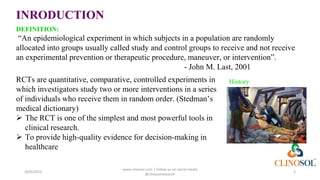
History
Importance of randomized clinical trials
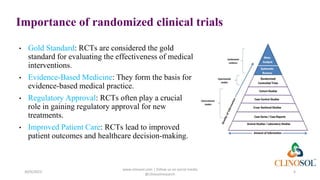
• Gold Standard: RCTs are considered the gold
standard for evaluating the effectiveness of medical
interventions.
• Evidence-Based Medicine: They form the basis for
evidence-based medical practice.
• Regulatory Approval: RCTs often play a crucial
role in gaining regulatory approval for new
treatments.
• Improved Patient Care: RCTs lead to improved
patient outcomes and healthcare decision-making.
30/9/2023
www.clinosol.com | follow us on social media
@clinosolresearch
4
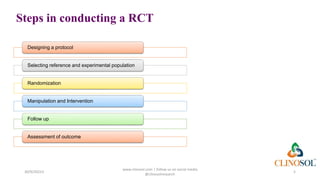
Steps in conducting a RCT
Designing a protocol
Selecting reference and experimental population
Randomization
Manipulation and Intervention
Follow up
Assessment of outcome
30/9/20223
www.clinosol.com | follow us on social media
@clinosolresearch
5
Designing a protocol
-Aims and objectives of the study
-Research Questions to be answered
-Criteria for selection, Sample size, Procedure
for allocation of study and control groups
-Patient consent, adverse events
-Treatments to be applied
-Responsibilities of people involved in trial
 Once a protocol as been made its should be
strictly adhered
30/9/2023
www.clinosol.com | follow us on social media
@clinosolresearch
6
Selecting reference and experimental
population
 Reference or target population: population to which the
findings of trial, if found successful, are expected to be
applicable(eg. Drugs, vaccines, or any other procedures)
 Experimental or study population: actual population that
participates in the experimental study
Criteria – must give informed consent
-eligible for the trial
-belong to reference population
30/9/2023
www.clinosol.com | follow us on social media
@clinosolresearch
7
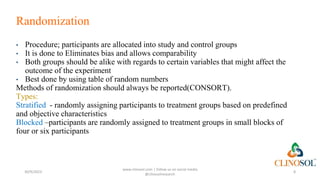
Randomization
• Procedure; participants are allocated into study and control groups
• It is done to Eliminates bias and allows comparability
• Both groups should be alike with regards to certain variables that might affect the
outcome of the experiment
• Best done by using table of random numbers
Methods of randomization should always be reported(CONSORT).
Types:
Stratified - randomly assigning participants to treatment groups based on predefined
and objective characteristics
Blocked –participants are randomly assigned to treatment groups in small blocks of
four or six participants
30/9/2023
www.clinosol.com | follow us on social media
@clinosolresearch
8
Manipulation/ Intervention
 Having formed the study and control groups, the next step is
to manipulate the study groups by withdrawal or reduction of
the suspected causal factor (eg: this may be drug, vaccine
etc.) as laid down in the protocol
 It creates an independent variable
30/9/2023
www.clinosol.com | follow us on social media
@clinosolresearch
9
Follow up
Implies examination of the experimental and control group
subjects
-at defined intervals of time,
-in a standard manner, with equal intensity, under the same given
circumstances
Attrition: some loses to follow up are inevitable due to factors like
death, migration or loss or interest
30/9/2023
www.clinosol.com | follow us on social media
@clinosolresearch
10
Assessment of results
Positive results- benefits such as incidence or severity of disease
Negative results- severity and frequency of side effects,
complications , including death
 Biases: subject variation, observer bias, evaluation bias
Can be minimized by blinding
o Single blind trial –participants is not aware whether he
belongs to study or control group
o Double blind trial – neither the participant nor the
investigator is aware
o Triple blind trial –the participant, investigator and person
analyzing data all are blind
30/9/20223
www.clinosol.com | follow us on social media
@clinosolresearch
11
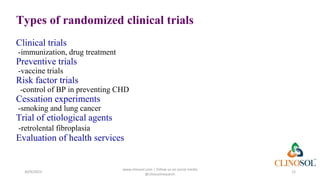
Types of randomized clinical trials
Clinical trials
-immunization, drug treatment
Preventive trials
-vaccine trials
Risk factor trials
-control of BP in preventing CHD
Cessation experiments
-smoking and lung cancer
Trial of etiological agents
-retrolental fibroplasia
Evaluation of health services
30/9/2023
www.clinosol.com | follow us on social media
@clinosolresearch
12
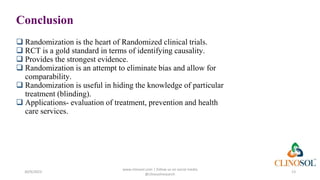
Conclusion
 Randomization is the heart of Randomized clinical trials.
 RCT is a gold standard in terms of identifying causality.
 Provides the strongest evidence.
 Randomization is an attempt to eliminate bias and allow for
comparability.
 Randomization is useful in hiding the knowledge of particular
treatment (blinding).
 Applications- evaluation of treatment, prevention and health
care services.
30/9/2023
www.clinosol.com | follow us on social media
@clinosolresearch
13
References
 Park’s textbook of preventive and social medicine, park.
K.
 Leon Gordis. Epidemiology. Elseiver: 2004
 Wikipedia
30/9/2023
www.clinosol.com | follow us on social media
@clinosolresearch
14
Thank You!
www.clinosol.com
(India | Canada)
9121151622/623/624
info@clinosol.com
30/9/2023
www.clinosol.com | follow us on social media
@clinosolresearch
15

Randomized Clinical Trials

  • 1.
    Welcome Randomized Clinical Trials G.Nagamalleshwari B. Pharmacy Student ID – 182/092023 30/9/2023 www.clinosol.com | follow us on social media @clinosolresearch 1
  • 2.
    Contents  Introduction  Importance Steps in RCT  -Protocol design  -Selecting reference and experimental population  -Randomization  -Intervention  -Follow up  -Assessment of outcome  Types of RCT  Conclusion  References 30/9/2023 www.clinosol.com | follow us on social media @clinosolresearch 2
  • 3.
    INRODUCTION DEFINITION: “An epidemiological experimentin which subjects in a population are randomly allocated into groups usually called study and control groups to receive and not receive an experimental prevention or therapeutic procedure, maneuver, or intervention”. - John M. Last, 2001 30/9/2023 www.clinosol.com | follow us on social media @clinosolresearch 3 RCTs are quantitative, comparative, controlled experiments in which investigators study two or more interventions in a series of individuals who receive them in random order. (Stedman’s medical dictionary)  The RCT is one of the simplest and most powerful tools in clinical research.  To provide high-quality evidence for decision-making in healthcare History
  • 4.
    Importance of randomizedclinical trials • Gold Standard: RCTs are considered the gold standard for evaluating the effectiveness of medical interventions. • Evidence-Based Medicine: They form the basis for evidence-based medical practice. • Regulatory Approval: RCTs often play a crucial role in gaining regulatory approval for new treatments. • Improved Patient Care: RCTs lead to improved patient outcomes and healthcare decision-making. 30/9/2023 www.clinosol.com | follow us on social media @clinosolresearch 4
  • 5.
    Steps in conductinga RCT Designing a protocol Selecting reference and experimental population Randomization Manipulation and Intervention Follow up Assessment of outcome 30/9/20223 www.clinosol.com | follow us on social media @clinosolresearch 5
  • 6.
    Designing a protocol -Aimsand objectives of the study -Research Questions to be answered -Criteria for selection, Sample size, Procedure for allocation of study and control groups -Patient consent, adverse events -Treatments to be applied -Responsibilities of people involved in trial  Once a protocol as been made its should be strictly adhered 30/9/2023 www.clinosol.com | follow us on social media @clinosolresearch 6
  • 7.
    Selecting reference andexperimental population  Reference or target population: population to which the findings of trial, if found successful, are expected to be applicable(eg. Drugs, vaccines, or any other procedures)  Experimental or study population: actual population that participates in the experimental study Criteria – must give informed consent -eligible for the trial -belong to reference population 30/9/2023 www.clinosol.com | follow us on social media @clinosolresearch 7
  • 8.
    Randomization • Procedure; participantsare allocated into study and control groups • It is done to Eliminates bias and allows comparability • Both groups should be alike with regards to certain variables that might affect the outcome of the experiment • Best done by using table of random numbers Methods of randomization should always be reported(CONSORT). Types: Stratified - randomly assigning participants to treatment groups based on predefined and objective characteristics Blocked –participants are randomly assigned to treatment groups in small blocks of four or six participants 30/9/2023 www.clinosol.com | follow us on social media @clinosolresearch 8
  • 9.
    Manipulation/ Intervention  Havingformed the study and control groups, the next step is to manipulate the study groups by withdrawal or reduction of the suspected causal factor (eg: this may be drug, vaccine etc.) as laid down in the protocol  It creates an independent variable 30/9/2023 www.clinosol.com | follow us on social media @clinosolresearch 9
  • 10.
    Follow up Implies examinationof the experimental and control group subjects -at defined intervals of time, -in a standard manner, with equal intensity, under the same given circumstances Attrition: some loses to follow up are inevitable due to factors like death, migration or loss or interest 30/9/2023 www.clinosol.com | follow us on social media @clinosolresearch 10
  • 11.
    Assessment of results Positiveresults- benefits such as incidence or severity of disease Negative results- severity and frequency of side effects, complications , including death  Biases: subject variation, observer bias, evaluation bias Can be minimized by blinding o Single blind trial –participants is not aware whether he belongs to study or control group o Double blind trial – neither the participant nor the investigator is aware o Triple blind trial –the participant, investigator and person analyzing data all are blind 30/9/20223 www.clinosol.com | follow us on social media @clinosolresearch 11
  • 12.
    Types of randomizedclinical trials Clinical trials -immunization, drug treatment Preventive trials -vaccine trials Risk factor trials -control of BP in preventing CHD Cessation experiments -smoking and lung cancer Trial of etiological agents -retrolental fibroplasia Evaluation of health services 30/9/2023 www.clinosol.com | follow us on social media @clinosolresearch 12
  • 13.
    Conclusion  Randomization isthe heart of Randomized clinical trials.  RCT is a gold standard in terms of identifying causality.  Provides the strongest evidence.  Randomization is an attempt to eliminate bias and allow for comparability.  Randomization is useful in hiding the knowledge of particular treatment (blinding).  Applications- evaluation of treatment, prevention and health care services. 30/9/2023 www.clinosol.com | follow us on social media @clinosolresearch 13
  • 14.
    References  Park’s textbookof preventive and social medicine, park. K.  Leon Gordis. Epidemiology. Elseiver: 2004  Wikipedia 30/9/2023 www.clinosol.com | follow us on social media @clinosolresearch 14
  • 15.
    Thank You! www.clinosol.com (India |Canada) 9121151622/623/624 info@clinosol.com 30/9/2023 www.clinosol.com | follow us on social media @clinosolresearch 15