
Alternative Bearing Surfaces-
Evidence So Far.
Dr Rajesh PDr Rajesh P
Government Medical College,Government Medical College,
KozhikodeKozhikode
Tribology
• Science of interactive surfaces
in relative motion
• Incorporates the concepts of
wear, friction, and lubrication
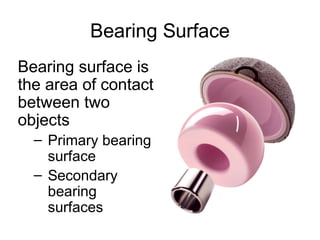
Bearing Surface
Bearing surface is
the area of contact
between two
objects
– Primary bearing
surface
– Secondary
bearing
surfaces
Hip arthritis is a problem of the bearing
surface
Bearing surfaces
• Perpendicular to the force transmitted
• Subject to relative motion
• Relative motion of two surfaces in
contact is resisted by the force called
friction
• This leads to wear
Wear
• Is the removal of material from
opposing and moving surfaces under
an applied load
• The primary mechanisms of wear are
– Abrasion
– Adhesion
– Fatigue
– Third-body wear
Cause of Wear
• Wear occurs mainly due to motion
between articulating surfaces
• It may also occur due to
unintended impingement or motion
• Wear leads to formation of wear
particles
Effect of Wear Particles
• Mechanical
• Biological
– Direct cytotoxicity
– Immunological response
– Carcinogenicity
– Systemic toxicity
Low Friction Arthroplasty- Charnley
• Stainless steel head on UHMWPE
cup articulation
• Bone cement for fixation
• Small head to reduce wear
Polyethylene
• Discovered in 1935
• Viscoelastic and thermoplastic polymer
• Long chains of the monomer ethylene
(C2H4)n
• All carbon-carbon and carbon-hydrogen
bonds are single
Types of Polyethylene
• Low-density polyethylene - Density of
0.910 to 0.940 g/cm3
• High-density polyethylene - Density
greater than 0.941 g/cm
• UHMWPE - Average molecular
weight of greater than 3 million
g/mol
UHMWPE
• Extremely long chains of ethylene
• Crystalline domains embedded within an
amorphous matrix
• Mainstay of joint replacement over last 40
years
Results in Elderly
• Very good long term results
• Remains the gold standard in elderly
• Geriatric patients with low activity
demands
Operation of the 20th
century
Learmonth I. The operation of the century:
total hip
replacement. Lancet 2007;370:1508-19
Extended Indications for THR
• Its success expanded its use in
more active patients younger than
65 years
• 270,000 THRs in USA per year
and 70,000 in UK per year
• 12% in those less than 55 years
Results in the Young
Longevity & High demands
• 15 year survival rate is less than 60% in
those less than 55 years.
• Osteolysis seen in 60% of young active
patients with UHMWPE at 5 years.
Schmalzried et al The mechanism of loosening of cemented acetabular
components in total hip arthroplasty: analysis of specimens retrieved at autopsy.
Clin Orthop 1992;274:60-78
THRs in patients under 30 years
– 49 hips in 44 patients
– HA coated stem and cup
No stem revisions at 10-16 years
24 out of 49 cups revised due to
loosening
H. Wangen . Hip arthroplasty in patients younger than 30 years: excellent
ten to 16-year follow-up results with a HA-coated stem . International
Orthopaedics (SICOT) (2008) 32:203–208
Prosthetic Failure
• Aseptic loosening and osteolysis
secondary to wear are the
primary cause of failure
• Second major cause is dislocation
seen in about 4% mostly in the
first 6 months
Cause of Osteolysis
• Cement was thought to be the
cause ‘Cement disease’
• Polyethylene wear particles
are the cause for osteolysis
Reduction of wear strategies
• Improved designs to lower contact
stresses and sliding distances between
moving parts.
• Altering the structure of polyethylene-
Process of cross-linking.
• Avoid the use of polyethylene
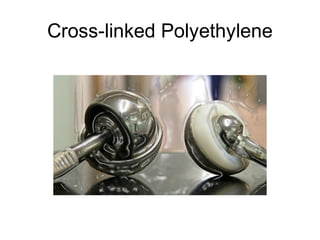
Cross-linked Polyethylene
Cross-linked Polyethylene (XLPE)
• Is it more resistant to wear?
• Has it reduced osteolysis?
• Is it compatible with large diameter heads?
• Is there any increase in fatigue related
failures?
• Is the longevity better?
Is XLPE more resistant to wear?
74% reduction in total penetration of
highly cross-linked polyethylene when
compared with
conventional polyethylene at an
average of 9 years
Wear analysis of first-generation highly cross-
linked polyethylene in primary total hip arthroplasty: an average
9-year follow-up. Reynolds SE et al. J Arthroplasty. 2012
Jun;27(6):1064-8
Evidence for reduced wear
• Rajadhyaksha . Five year comparative study of highly crosslinked (Crossfire) and traditional
polyethylene. J. Arthroplasty. 2009;24:161-167.
• D’Antonio. Five year experience with Crossfire highly crosslinked polyethylene Clin Orthop
2005;441:143-150
• Engh. A randomized prospective evaluation of outcomes after THA using cross-linked
marathon and non-crosslinked Enduron polyethylene liners. J. Arthroplasty. 2006;21(Suppl)
17-25
• Mutimer.Highly cross-linkedpolyethylene reduces wear in THA at 5 years CORR
2010;468:3228-3233.
• MacCalden. Wear rate of highly crosslinked polyethylene in THA.A RCT. JBJS A 2009 91A
773-782.
• Geerdink. Cross-linked compared to historical polyethylene in THA: An 8 year clinical study.
CORR 2009;467:979-984.
Does reduced XLPE wear lower
osteolysis?
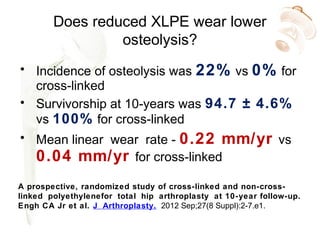
• Incidence of osteolysis was 22% vs 0% for
cross-linked
• Survivorship at 10-years was 94.7 ± 4.6%
vs 100% for cross-linked
• Mean linear wear rate - 0.22 mm/yr vs
0.04 mm/yr for cross-linked
A prospective, randomized study of cross-linked and non-cross-
linked polyethylenefor total hip arthroplasty at 10-year follow-up.
Engh CA Jr et al. J Arthroplasty. 2012 Sep;27(8 Suppl):2-7.e1.
Does reduced XLPE wear lower
osteolysis?
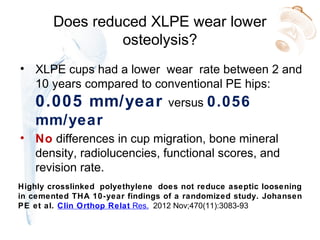
• XLPE cups had a lower wear rate between 2 and
10 years compared to conventional PE hips:
0.005 mm/year versus 0.056
mm/year
• No differences in cup migration, bone mineral
density, radiolucencies, functional scores, and
revision rate.
Highly crosslinked polyethylene does not reduce aseptic loosening
in cemented THA 10-year findings of a randomized study. Johansen
PE et al. Clin Orthop Relat Res. 2012 Nov;470(11):3083-93
Other evidence for reduced osteolysis
• Engh CA, Jr, Stepniewski AS, Ginn SD, Beykirch SE,
Sychterz-Terefenko CJ, Hopper RH, Jr, et al. A
randomized prospective evaluation of outcomes after
total hip arthroplasty using cross-linked marathon and
non-cross-linked Enduron polyethylene liners.
J.Arthroplasty 2006;21(6 Suppl 2):17–25.
• Illgen RL,2nd, Forsythe TM, Pike JW, Laurent MP,
Blanchard CR. Highly crosslinked vs. conventional
polyethylene particles—an in vitro comparison of biologic
activities. J Arthroplasty 2008;23(5):721–31.
• Illgen RL, 2nd, Bauer LM, Hotujec BT, Kolpin SE,
Bakhtiar A, Forsythe TM. Highly crosslinked vs.
conventional polyethylene particles: relative in vivo
inflammatory response. J Arthroplasty 2009;24(1):117–24
Is it compatible with large diameter
heads?
• Two important issues have been
dislocation and wear
• Larger heads reduce dislocation and
increase range of movement but increase
poly wear
• Rim cracking and catastrophic liner failure
with conventional polyethylene if thickness
is less than 5mm
Is it compatible with large diameter
heads?
• XLPE cups of 3.8mm Vs 5.8mm
• No difference between the groups
• However most investigators
advise against the use of thin
shells
Early Outcomes of Sequentially Cross-Linked Thin Polyethylene
Liners with Large Diameter Femoral Heads in Total Hip
Arthroplasty. Siraj Sayeed et al. Bulletin of theNYU Hospital for Joint
Diseases 2011;69(Suppl 1):S90-4
Thin shells may lead to early failure
•4 cases of early failure within one year
reported
Tower SS, Currier JH, Currier BH, et al. Rim
cracking of the cross-linked longevity
polyethylene acetabular liner after total hip
arthroplasty. J Bone Joint Surg Am.
2007;89(10):2212-7.
Is there any increase in fatigue related
failures?
• Crosslinking leads to unfavourable changes
in the ultimate tensile strength, ductility,
modulus, toughness, and crack propagation
• But long term effects is not available
• So far clinical outcomes are favourableSo far clinical outcomes are favourable
• Pruitt LA. Deformation, yielding, fracture and fatigue behavior of
conventional and highly cross-linked ultra high molecular weight
polyethylene. Biomaterials 2005;26(8):905–15.
• Bradford L, Baker D, Ries MD, Pruitt LA. Fatigue crack propaga-tion
resistance of highly crosslinked polyethylene. Clin Orthop Relat Res 2004;
429:68–72.
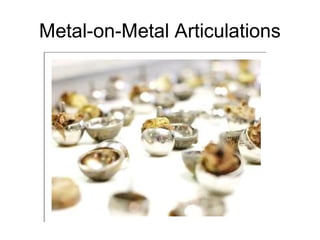
Metal-on-Metal Articulations
MoM
• In clinical use longer than any
bearing surface
• Most commonly used option until
the 1970s
• The most apparent advantage is
its greater resistance to wear
MoM
• Has an initial run-in phase of increased
wear followed by steady state wear phase
• Yearly run-in wear rate is 25 µm
• Steady-state wear of 3 to 7 µm
• Equal to only 2% of the wear rate of
UHMWPE
• Theoretically should last a life time even in
the young
Particle number
• MOM articulations produce
approximately 6.7 X 10¹² to 2.5 X
1014 particles each year
• 13500 times the number of
polyethylene particles produced
by MoP articulations
MoM Bearings
• 5-10 times increase in the serum
metal ion levels
• Hence not advisable in women of
child bearing age
• Long term effects is a concern
Effect of increased metal ions
• Carcinogenesis, metal sensitivity and
organ toxicity
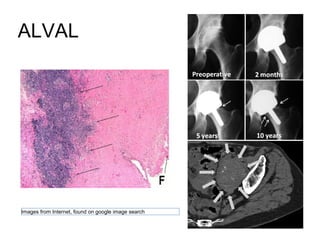
• Locally unusual lymphocytic
aggregates called acute lymphocytic
vasculitis associated lesions (ALVAL)
or pseudotumour are seen
ALVAL
Images from Internet, found on google image search
Australian Orthopaedic Association
National Joint Replacement Registry
• First reported increased revision rates in
2008
• Larger MoM femoral heads were
associated with more than two times the
rate of revision as that associated with
smaller MoM femoral heads. (9.4%: 4.5%)
Seventh Annual Report (2010) of the NJR
for England and Wales Registry
• At five years, the rate of revision of large
femoral head MoM prostheses was at least
twice that of all other cemented, hybrid,
and conventional total hip replacements.
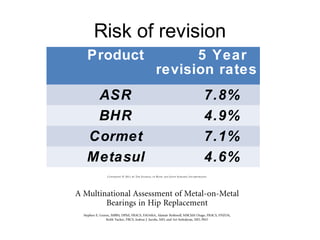
A Multinational Assessment of Metal-on-
Metal Bearings in Hip Replacement
Data from the Australian, England and
Wales, and New Zealand registries
Increased rate of revision for large
femoral head MoM prostheses when
compared to other bearing surfaces
Stephen E. Graves et al. A Multinational Assessment of Metal-on-Metal
Bearings in Hip Replacement. J Bone Joint Surg Am.2011;93 Suppl 3(E):43-7
Risk of revision
Product 5 Year
revision rates
ASR 7.8%
BHR 4.9%
Cormet 7.1%
Metasul 4.6%
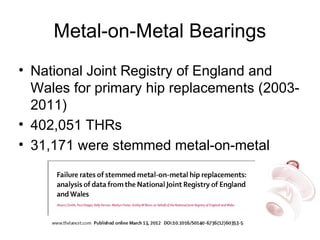
Metal-on-Metal Bearings
• National Joint Registry of England and
Wales for primary hip replacements (2003-
2011)
• 402,051 THRs
• 31,171 were stemmed metal-on-metal
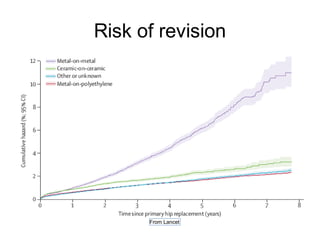
Risk of revision
From Lancet
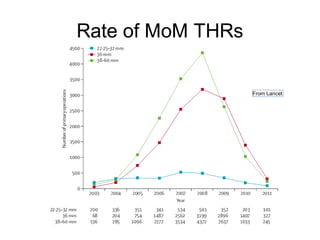
Rate of MoM THRs
From Lancet
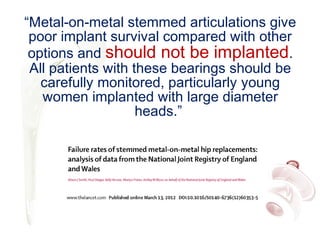
“Metal-on-metal stemmed articulations give
poor implant survival compared with other
options and should not be implanted.
All patients with these bearings should be
carefully monitored, particularly young
women implanted with large diameter
heads.”
Metal-on-Metal Bearings
“The lack of a clinical advantage with metal
bearings and the significant downsides to t
he use of metal on metal mean that, in the‐ ‐
author’s opinion this bearing option
should be used with
great caution, if at all.”
The Journal of Arthroplasty Vol. 25 No. 1 2
010
Editorial
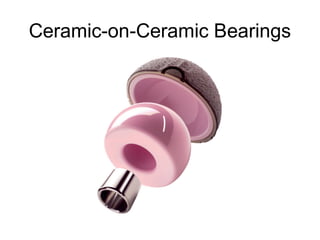
Ceramic-on-Ceramic Bearings
Ceramic on Ceramic (COC) Bearings
• Ist
Generation- 1974-88 – Low density, high
porosity and large grain size, Either
cemented or press-fitted.
• IInd
Generation -1988-94- Increased purity
and smaller grain size. Titanium shell with
alumina liner
Ceramic on Ceramic (COC) Bearings
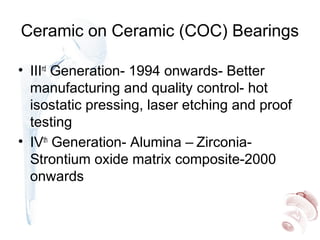
• IIIrd
Generation- 1994 onwards- Better
manufacturing and quality control- hot
isostatic pressing, laser etching and proof
testing
• IVth
Generation- Alumina – Zirconia-
Strontium oxide matrix composite-2000
onwards
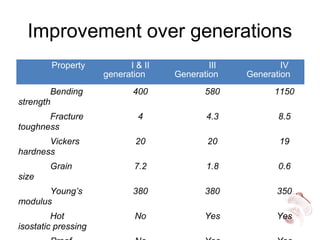
Improvement over generations
Property I & II
generation
III
Generation
IV
Generation
Bending
strength
400 580 1150
Fracture
toughness
4 4.3 8.5
Vickers
hardness
20 20 19
Grain
size
7.2 1.8 0.6
Young’s
modulus
380 380 350
Hot
isostatic pressing
No Yes Yes
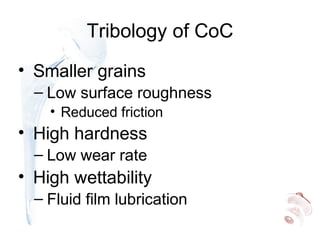
Tribology of CoC
• Smaller grains
– Low surface roughness
• Reduced friction
• High hardness
– Low wear rate
• High wettability
– Fluid film lubrication
Evidence on Ceramic-on-Ceramic
• Is it more resistant to wear?
• Has it reduced osteolysis?
• Any unique complications?
• Is the longevity better?
Is it more resistant to wear?
Mean total wear at five years
• 0.869mm for the conventional polyethylene
• 0.329mm for the HXLPE
• 0.035mm for the CoC group0.035mm for the CoC group
A prospective randomised controlled trial comparing three alternative bearing
surfaces in primary total hip replacement. V. S. Nikalaou et al. J Bone Joint
Surg Br 2012; 94-B:459-65
Has it reduced osteolysis?
• Reaction to alumina wear debris is
fibrocytic with very few macrophages
and no giant cells
• Lower concentration of wear particles
in the periprosthetic tissue
Has it reduced osteolysis?
CoC is the only bearing that has
long term survival without adverse
reaction to wear debris
Any unique complications?
Liner Fracture
• Ceramic is a brittle material with no
ductility and limited bending strength
• Old generation CoC had fracture rate as
high as 20%
• Risk of fracture with newer CoC is
approximately 0.02% to 0.1%
Hamilton WG, McAuley JP, Dennis DA, Murphy JA, Blumenfeld TJ, Politi J. THA
with Delta ceramic on ceramic: results of a multi-center investigational device
exemption trial. Clin Orthop Relat Res 2010;468(2):358-66.
Any unique complications?
Squeaking
• Incidence varies from less than 1% to 20%
• May be due to
– Localized “striped” wear
– Changes of fluid film lubrication conditions
– Femoral head micro-separation
• Clinically often minor and revision
indicated only occasionally.
Any unique complications?
Less chance to customize
• CoC systems have only one head size per
cup diameter
• No lateralized liners, elevated rims etc
• Equalizing leg lengths and maximizing
stability is more challenging
• Loss of all of these options may
currently be the most substantial
disadvantage of CC THA
Any unique complications?
Liner chipping on insertion
• Titanium shell is thinner than ceramic and
has only 30% stiffness of ceramic
• On impaction of liner, the shell expands
• Failure to seat the liner increases chance
of chipping
• Design related
Any unique complications?
Difficulties during revision
• Total synoviectomy needed
• Liner exchange may not be
sufficient as the removal may
damage the shell or taper
Is the longevity better?
• High survivor-ship especially in young and
active patients, with survival rates free of
revision from 90.8% to 97.4% at ten years
• Comparable but not better than the best
outcomes for both MoM, MoP and CoP
articulations
Bizot P, Larrouy M, Witvoet J, Sedel L, Nizard R (2000) Press-fit metal-
backed alumina sockets: a minimum 5-year followup study. Clin Orthop Relat
Res 134–142
Garcia-Rey E, Cruz-Pardos A, Garcia-Cimbrelo E (2009) Alumina-on-alumina
total hip arthroplasty in young patients: diagnosis is more important than age.
Clin Orthop Relat Res 467:2281–2289
Ceramic on XLPE Vs CPE
• Both creep and wear rates of XLPE were
significantly lower than those of CPE
• Varying femoral head material, size, implantation
period, and patient demographics had no adverse
effect on XLPE but on CPE
Wear resistant performance of highly cross-linked and annealed ultra-high
molecular weight polyethylene against ceramic heads in total hip arthroplasty
Taishi Sato et al.
J Orthop Res 30:2031–2037, 2012
Journal of Orthopaedic Research
Volume 30, Issue 12, pages 2031–2037, December 2012
CROSS-LINKED POLYETHYLENE WEAR IN TOTAL HIP JOINT REPLACEMENTS WITH 36MM
CERAMIC HEADS
E. Selvarajah, G. Hooper, G. Inglis, T. Woodfield and P. Devane
J Bone Joint Surg Br 2010 vol. 92-B no. SUPP I 225
• Assessed the rate of polyethylene wear of a
36mm ceramic femoral head and a highly
cross-linked polyethylene (X3 Stryker) liner
• Demonstrated much higher early linear wear
rates compared to other studies using 28
and 32 mms heads.
• This higher rate may be associated with the
creep phenomenon and early bedding-in.
Ceramic on XLPE - Effect of large head size
Conclusions
• XLPE so far shows promising results
• But long term results are yet to come
• The biological response to metal debris
limit use of MoM
• Ceramic shows promise, but have its own
unique problems

Alternative bearing surfaces

  • 1.
    Alternative Bearing Surfaces- EvidenceSo Far. Dr Rajesh PDr Rajesh P Government Medical College,Government Medical College, KozhikodeKozhikode
  • 2.
    Tribology • Science ofinteractive surfaces in relative motion • Incorporates the concepts of wear, friction, and lubrication
  • 3.
    Bearing Surface Bearing surfaceis the area of contact between two objects – Primary bearing surface – Secondary bearing surfaces
  • 4.
    Hip arthritis isa problem of the bearing surface
  • 5.
    Bearing surfaces • Perpendicularto the force transmitted • Subject to relative motion • Relative motion of two surfaces in contact is resisted by the force called friction • This leads to wear
  • 6.
    Wear • Is theremoval of material from opposing and moving surfaces under an applied load • The primary mechanisms of wear are – Abrasion – Adhesion – Fatigue – Third-body wear
  • 7.
    Cause of Wear •Wear occurs mainly due to motion between articulating surfaces • It may also occur due to unintended impingement or motion • Wear leads to formation of wear particles
  • 8.
    Effect of WearParticles • Mechanical • Biological – Direct cytotoxicity – Immunological response – Carcinogenicity – Systemic toxicity
  • 9.
    Low Friction Arthroplasty-Charnley • Stainless steel head on UHMWPE cup articulation • Bone cement for fixation • Small head to reduce wear
  • 10.
    Polyethylene • Discovered in1935 • Viscoelastic and thermoplastic polymer • Long chains of the monomer ethylene (C2H4)n • All carbon-carbon and carbon-hydrogen bonds are single
  • 11.
    Types of Polyethylene •Low-density polyethylene - Density of 0.910 to 0.940 g/cm3 • High-density polyethylene - Density greater than 0.941 g/cm • UHMWPE - Average molecular weight of greater than 3 million g/mol
  • 12.
    UHMWPE • Extremely longchains of ethylene • Crystalline domains embedded within an amorphous matrix • Mainstay of joint replacement over last 40 years
  • 13.
    Results in Elderly •Very good long term results • Remains the gold standard in elderly • Geriatric patients with low activity demands
  • 14.
    Operation of the20th century Learmonth I. The operation of the century: total hip replacement. Lancet 2007;370:1508-19
  • 15.
    Extended Indications forTHR • Its success expanded its use in more active patients younger than 65 years • 270,000 THRs in USA per year and 70,000 in UK per year • 12% in those less than 55 years
  • 16.
    Results in theYoung Longevity & High demands • 15 year survival rate is less than 60% in those less than 55 years. • Osteolysis seen in 60% of young active patients with UHMWPE at 5 years. Schmalzried et al The mechanism of loosening of cemented acetabular components in total hip arthroplasty: analysis of specimens retrieved at autopsy. Clin Orthop 1992;274:60-78
  • 17.
    THRs in patientsunder 30 years – 49 hips in 44 patients – HA coated stem and cup No stem revisions at 10-16 years 24 out of 49 cups revised due to loosening H. Wangen . Hip arthroplasty in patients younger than 30 years: excellent ten to 16-year follow-up results with a HA-coated stem . International Orthopaedics (SICOT) (2008) 32:203–208
  • 18.
    Prosthetic Failure • Asepticloosening and osteolysis secondary to wear are the primary cause of failure • Second major cause is dislocation seen in about 4% mostly in the first 6 months
  • 19.
    Cause of Osteolysis •Cement was thought to be the cause ‘Cement disease’ • Polyethylene wear particles are the cause for osteolysis
  • 20.
    Reduction of wearstrategies • Improved designs to lower contact stresses and sliding distances between moving parts. • Altering the structure of polyethylene- Process of cross-linking. • Avoid the use of polyethylene
  • 21.
  • 22.
    Cross-linked Polyethylene (XLPE) •Is it more resistant to wear? • Has it reduced osteolysis? • Is it compatible with large diameter heads? • Is there any increase in fatigue related failures? • Is the longevity better?
  • 23.
    Is XLPE moreresistant to wear? 74% reduction in total penetration of highly cross-linked polyethylene when compared with conventional polyethylene at an average of 9 years Wear analysis of first-generation highly cross- linked polyethylene in primary total hip arthroplasty: an average 9-year follow-up. Reynolds SE et al. J Arthroplasty. 2012 Jun;27(6):1064-8
  • 24.
    Evidence for reducedwear • Rajadhyaksha . Five year comparative study of highly crosslinked (Crossfire) and traditional polyethylene. J. Arthroplasty. 2009;24:161-167. • D’Antonio. Five year experience with Crossfire highly crosslinked polyethylene Clin Orthop 2005;441:143-150 • Engh. A randomized prospective evaluation of outcomes after THA using cross-linked marathon and non-crosslinked Enduron polyethylene liners. J. Arthroplasty. 2006;21(Suppl) 17-25 • Mutimer.Highly cross-linkedpolyethylene reduces wear in THA at 5 years CORR 2010;468:3228-3233. • MacCalden. Wear rate of highly crosslinked polyethylene in THA.A RCT. JBJS A 2009 91A 773-782. • Geerdink. Cross-linked compared to historical polyethylene in THA: An 8 year clinical study. CORR 2009;467:979-984.
  • 25.
    Does reduced XLPEwear lower osteolysis? • Incidence of osteolysis was 22% vs 0% for cross-linked • Survivorship at 10-years was 94.7 ± 4.6% vs 100% for cross-linked • Mean linear wear rate - 0.22 mm/yr vs 0.04 mm/yr for cross-linked A prospective, randomized study of cross-linked and non-cross- linked polyethylenefor total hip arthroplasty at 10-year follow-up. Engh CA Jr et al. J Arthroplasty. 2012 Sep;27(8 Suppl):2-7.e1.
  • 26.
    Does reduced XLPEwear lower osteolysis? • XLPE cups had a lower wear rate between 2 and 10 years compared to conventional PE hips: 0.005 mm/year versus 0.056 mm/year • No differences in cup migration, bone mineral density, radiolucencies, functional scores, and revision rate. Highly crosslinked polyethylene does not reduce aseptic loosening in cemented THA 10-year findings of a randomized study. Johansen PE et al. Clin Orthop Relat Res. 2012 Nov;470(11):3083-93
  • 27.
    Other evidence forreduced osteolysis • Engh CA, Jr, Stepniewski AS, Ginn SD, Beykirch SE, Sychterz-Terefenko CJ, Hopper RH, Jr, et al. A randomized prospective evaluation of outcomes after total hip arthroplasty using cross-linked marathon and non-cross-linked Enduron polyethylene liners. J.Arthroplasty 2006;21(6 Suppl 2):17–25. • Illgen RL,2nd, Forsythe TM, Pike JW, Laurent MP, Blanchard CR. Highly crosslinked vs. conventional polyethylene particles—an in vitro comparison of biologic activities. J Arthroplasty 2008;23(5):721–31. • Illgen RL, 2nd, Bauer LM, Hotujec BT, Kolpin SE, Bakhtiar A, Forsythe TM. Highly crosslinked vs. conventional polyethylene particles: relative in vivo inflammatory response. J Arthroplasty 2009;24(1):117–24
  • 28.
    Is it compatiblewith large diameter heads? • Two important issues have been dislocation and wear • Larger heads reduce dislocation and increase range of movement but increase poly wear • Rim cracking and catastrophic liner failure with conventional polyethylene if thickness is less than 5mm
  • 29.
    Is it compatiblewith large diameter heads? • XLPE cups of 3.8mm Vs 5.8mm • No difference between the groups • However most investigators advise against the use of thin shells Early Outcomes of Sequentially Cross-Linked Thin Polyethylene Liners with Large Diameter Femoral Heads in Total Hip Arthroplasty. Siraj Sayeed et al. Bulletin of theNYU Hospital for Joint Diseases 2011;69(Suppl 1):S90-4
  • 30.
    Thin shells maylead to early failure •4 cases of early failure within one year reported Tower SS, Currier JH, Currier BH, et al. Rim cracking of the cross-linked longevity polyethylene acetabular liner after total hip arthroplasty. J Bone Joint Surg Am. 2007;89(10):2212-7.
  • 31.
    Is there anyincrease in fatigue related failures? • Crosslinking leads to unfavourable changes in the ultimate tensile strength, ductility, modulus, toughness, and crack propagation • But long term effects is not available • So far clinical outcomes are favourableSo far clinical outcomes are favourable • Pruitt LA. Deformation, yielding, fracture and fatigue behavior of conventional and highly cross-linked ultra high molecular weight polyethylene. Biomaterials 2005;26(8):905–15. • Bradford L, Baker D, Ries MD, Pruitt LA. Fatigue crack propaga-tion resistance of highly crosslinked polyethylene. Clin Orthop Relat Res 2004; 429:68–72.
  • 32.
  • 33.
    MoM • In clinicaluse longer than any bearing surface • Most commonly used option until the 1970s • The most apparent advantage is its greater resistance to wear
  • 34.
    MoM • Has aninitial run-in phase of increased wear followed by steady state wear phase • Yearly run-in wear rate is 25 µm • Steady-state wear of 3 to 7 µm • Equal to only 2% of the wear rate of UHMWPE • Theoretically should last a life time even in the young
  • 35.
    Particle number • MOMarticulations produce approximately 6.7 X 10¹² to 2.5 X 10¹⁴ particles each year • 13500 times the number of polyethylene particles produced by MoP articulations
  • 36.
    MoM Bearings • 5-10times increase in the serum metal ion levels • Hence not advisable in women of child bearing age • Long term effects is a concern
  • 37.
    Effect of increasedmetal ions • Carcinogenesis, metal sensitivity and organ toxicity • Locally unusual lymphocytic aggregates called acute lymphocytic vasculitis associated lesions (ALVAL) or pseudotumour are seen
  • 38.
    ALVAL Images from Internet,found on google image search
  • 39.
    Australian Orthopaedic Association NationalJoint Replacement Registry • First reported increased revision rates in 2008 • Larger MoM femoral heads were associated with more than two times the rate of revision as that associated with smaller MoM femoral heads. (9.4%: 4.5%)
  • 40.
    Seventh Annual Report(2010) of the NJR for England and Wales Registry • At five years, the rate of revision of large femoral head MoM prostheses was at least twice that of all other cemented, hybrid, and conventional total hip replacements.
  • 41.
    A Multinational Assessmentof Metal-on- Metal Bearings in Hip Replacement Data from the Australian, England and Wales, and New Zealand registries Increased rate of revision for large femoral head MoM prostheses when compared to other bearing surfaces Stephen E. Graves et al. A Multinational Assessment of Metal-on-Metal Bearings in Hip Replacement. J Bone Joint Surg Am.2011;93 Suppl 3(E):43-7
  • 42.
    Risk of revision Product5 Year revision rates ASR 7.8% BHR 4.9% Cormet 7.1% Metasul 4.6%
  • 43.
    Metal-on-Metal Bearings • NationalJoint Registry of England and Wales for primary hip replacements (2003- 2011) • 402,051 THRs • 31,171 were stemmed metal-on-metal
  • 44.
  • 45.
    Rate of MoMTHRs From Lancet
  • 46.
    “Metal-on-metal stemmed articulationsgive poor implant survival compared with other options and should not be implanted. All patients with these bearings should be carefully monitored, particularly young women implanted with large diameter heads.”
  • 47.
    Metal-on-Metal Bearings “The lackof a clinical advantage with metal bearings and the significant downsides to t he use of metal on metal mean that, in the‐ ‐ author’s opinion this bearing option should be used with great caution, if at all.” The Journal of Arthroplasty Vol. 25 No. 1 2 010 Editorial
  • 48.
  • 49.
    Ceramic on Ceramic(COC) Bearings • Ist Generation- 1974-88 – Low density, high porosity and large grain size, Either cemented or press-fitted. • IInd Generation -1988-94- Increased purity and smaller grain size. Titanium shell with alumina liner
  • 50.
    Ceramic on Ceramic(COC) Bearings • IIIrd Generation- 1994 onwards- Better manufacturing and quality control- hot isostatic pressing, laser etching and proof testing • IVth Generation- Alumina – Zirconia- Strontium oxide matrix composite-2000 onwards
  • 51.
    Improvement over generations PropertyI & II generation III Generation IV Generation Bending strength 400 580 1150 Fracture toughness 4 4.3 8.5 Vickers hardness 20 20 19 Grain size 7.2 1.8 0.6 Young’s modulus 380 380 350 Hot isostatic pressing No Yes Yes
  • 52.
    Tribology of CoC •Smaller grains – Low surface roughness • Reduced friction • High hardness – Low wear rate • High wettability – Fluid film lubrication
  • 53.
    Evidence on Ceramic-on-Ceramic •Is it more resistant to wear? • Has it reduced osteolysis? • Any unique complications? • Is the longevity better?
  • 54.
    Is it moreresistant to wear? Mean total wear at five years • 0.869mm for the conventional polyethylene • 0.329mm for the HXLPE • 0.035mm for the CoC group0.035mm for the CoC group A prospective randomised controlled trial comparing three alternative bearing surfaces in primary total hip replacement. V. S. Nikalaou et al. J Bone Joint Surg Br 2012; 94-B:459-65
  • 55.
    Has it reducedosteolysis? • Reaction to alumina wear debris is fibrocytic with very few macrophages and no giant cells • Lower concentration of wear particles in the periprosthetic tissue
  • 56.
    Has it reducedosteolysis? CoC is the only bearing that has long term survival without adverse reaction to wear debris
  • 57.
    Any unique complications? LinerFracture • Ceramic is a brittle material with no ductility and limited bending strength • Old generation CoC had fracture rate as high as 20% • Risk of fracture with newer CoC is approximately 0.02% to 0.1% Hamilton WG, McAuley JP, Dennis DA, Murphy JA, Blumenfeld TJ, Politi J. THA with Delta ceramic on ceramic: results of a multi-center investigational device exemption trial. Clin Orthop Relat Res 2010;468(2):358-66.
  • 58.
    Any unique complications? Squeaking •Incidence varies from less than 1% to 20% • May be due to – Localized “striped” wear – Changes of fluid film lubrication conditions – Femoral head micro-separation • Clinically often minor and revision indicated only occasionally.
  • 59.
    Any unique complications? Lesschance to customize • CoC systems have only one head size per cup diameter • No lateralized liners, elevated rims etc • Equalizing leg lengths and maximizing stability is more challenging • Loss of all of these options may currently be the most substantial disadvantage of CC THA
  • 60.
    Any unique complications? Linerchipping on insertion • Titanium shell is thinner than ceramic and has only 30% stiffness of ceramic • On impaction of liner, the shell expands • Failure to seat the liner increases chance of chipping • Design related
  • 61.
    Any unique complications? Difficultiesduring revision • Total synoviectomy needed • Liner exchange may not be sufficient as the removal may damage the shell or taper
  • 62.
    Is the longevitybetter? • High survivor-ship especially in young and active patients, with survival rates free of revision from 90.8% to 97.4% at ten years • Comparable but not better than the best outcomes for both MoM, MoP and CoP articulations Bizot P, Larrouy M, Witvoet J, Sedel L, Nizard R (2000) Press-fit metal- backed alumina sockets: a minimum 5-year followup study. Clin Orthop Relat Res 134–142 Garcia-Rey E, Cruz-Pardos A, Garcia-Cimbrelo E (2009) Alumina-on-alumina total hip arthroplasty in young patients: diagnosis is more important than age. Clin Orthop Relat Res 467:2281–2289
  • 63.
    Ceramic on XLPEVs CPE • Both creep and wear rates of XLPE were significantly lower than those of CPE • Varying femoral head material, size, implantation period, and patient demographics had no adverse effect on XLPE but on CPE Wear resistant performance of highly cross-linked and annealed ultra-high molecular weight polyethylene against ceramic heads in total hip arthroplasty Taishi Sato et al. J Orthop Res 30:2031–2037, 2012 Journal of Orthopaedic Research Volume 30, Issue 12, pages 2031–2037, December 2012
  • 64.
    CROSS-LINKED POLYETHYLENE WEARIN TOTAL HIP JOINT REPLACEMENTS WITH 36MM CERAMIC HEADS E. Selvarajah, G. Hooper, G. Inglis, T. Woodfield and P. Devane J Bone Joint Surg Br 2010 vol. 92-B no. SUPP I 225 J Bone Joint Surg Br 2010 vol. 92-B no. SUPP I 225 J Bone Joint Surg Br 2010 vol. 92-B no. SUPP I 225 • Assessed the rate of polyethylene wear of a 36mm ceramic femoral head and a highly cross-linked polyethylene (X3 Stryker) liner • Demonstrated much higher early linear wear rates compared to other studies using 28 and 32 mms heads. • This higher rate may be associated with the creep phenomenon and early bedding-in. Ceramic on XLPE - Effect of large head size
  • 66.
    Conclusions • XLPE sofar shows promising results • But long term results are yet to come • The biological response to metal debris limit use of MoM • Ceramic shows promise, but have its own unique problems