Funding Options for Early Stage Companies
November 14, 2013
Today’s Expert
• Jean Hammond;
• Supporting Growth of education and learning cluster in Boston: LearnLaunch,
LearnLaunchX,
• Active angel in lots of deals, first investor in Zip car:
Launchpad, Golden Seeds, & Hub Angels
• Serial entrepreneur:
Axon Networks and Quarry Technologies
• Eco-system supporter:
Board TCN, MIT Trust Center, Mass Challenge, TechStars, & ACA/ARI trainer

jean@jph-associates.com

3
Agenda
•
–

•
–

•

•
–

4
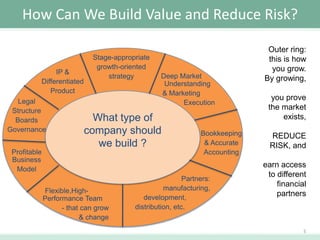
How Can We Build Value and Reduce Risk?

IP &
Differentiated
Product
Legal
Structure
Boards
Governance

Stage-appropriate
growth-oriented
strategy

Deep Market
Understanding
& Marketing
Execution

What type of
company should
we build ?

Profitable
Business
Model

Flexible,HighPerformance Team
- that can grow
& change

Bookkeeping
& Accurate
Accounting

Partners:
manufacturing,
development,
distribution, etc.

Outer ring:
this is how
you grow.
By growing,
you prove
the market
exists,

REDUCE
RISK, and
earn access
to different
financial
partners

5
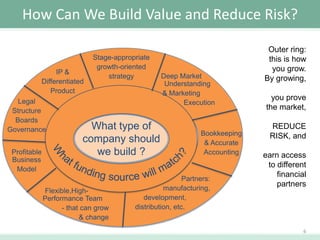
How Can We Build Value and Reduce Risk?

IP &
Differentiated
Product
Legal
Structure
Boards
Governance
Profitable
Business
Model

Stage-appropriate
growth-oriented
strategy

What type of
company should
we build ?

Flexible,HighPerformance Team
- that can grow
& change

Deep Market
Understanding
& Marketing
Execution

Bookkeeping
& Accurate
Accounting

Partners:
manufacturing,
development,
distribution, etc.

Outer ring:
this is how
you grow.
By growing,
you prove
the market,
REDUCE
RISK, and
earn access
to different
financial
partners

6
Funding the Company
Before you can get funded,
you have to know

where to look
Before you know where to look,
you need to understand

what you are

7
What Type of Company Are You?
• In many cases the nature of the business
decides the type of company …
• In others, changing how you bring the product
to market can really affect the cost of scaling
and the funding requirements
• Example: license new battery technology to existing
players vs build a battery company with outsource
manufacturing or build a manufacturer

• Every company’s financing path is unique
8
All Financial Partners Are Specialists
• Fundingcomes in distinct flavors; all financial partners are
specialists
• To understand who to approach and when to get to them takes
really understanding what they specialize in. You need to
match type of company to the type of funding partner
• Different types of funding partners specialize in different levels
of risk, so apply different funding criteria

• Most basic rule: the more risk a funding partner
takes, the more return (and control) they are
going to require
9
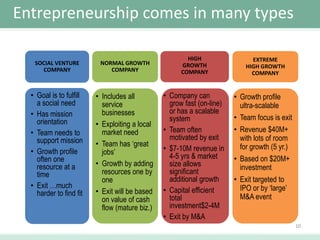
Entrepreneurship comes in many types
SOCIAL VENTURE
COMPANY

NORMAL GROWTH
COMPANY

• Goal is to fulfill
a social need
• Has mission
orientation
• Team needs to
support mission
• Growth profile
often one
resource at a
time
• Exit …much
harder to find fit

• Includes all
service
businesses
• Exploiting a local
market need
• Team has ‘great
jobs’
• Growth by adding
resources one by
one
• Exit will be based
on value of cash
flow (mature biz.)

HIGH
GROWTH
COMPANY

• Company can
grow fast (on-line)
or has a scalable
system
• Team often
motivated by exit
• $7-10M revenue in
4-5 yrs & market
size allows
significant
additional growth
• Capital efficient
total
investment$2-4M
• Exit by M&A

EXTREME
HIGH GROWTH
COMPANY

• Growth profile
ultra-scalable
• Team focus is exit
• Revenue $40M+
with lots of room
for growth (5 yr.)
• Based on $20M+
investment
• Exit targeted to
IPO or by ‘large’
M&A event

10
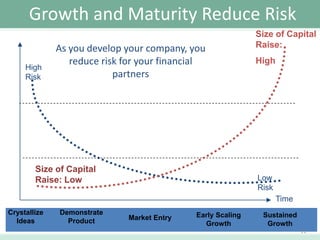
Growth and Maturity Reduce Risk
High
Risk

As you develop your company, you
reduce risk for your financial
partners

Size of Capital
Raise: Low

Size of Capital
Raise:
High

Low
Risk
Time

Crystallize
Ideas

Demonstrate
Product

Market Entry

Early Scaling
Growth

Sustained
Growth 11
11
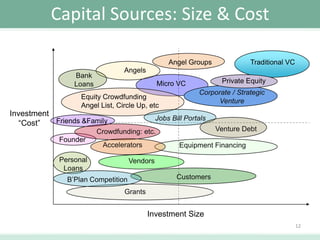
Capital Sources: Size & Cost
Angel Groups
Angels

Bank
Loans

Private Equity

Micro VC

Equity Crowdfunding
Angel List, Circle Up, etc

Investment
Friends &Family
“Cost”

Corporate / Strategic
Venture

Jobs Bill Portals
Venture Debt

Crowdfunding: etc.
Founder

Traditional VC

Accelerators

Personal
Loans

Equipment Financing

Vendors

B’Plan Competition

Customers

Grants

Investment Size
12
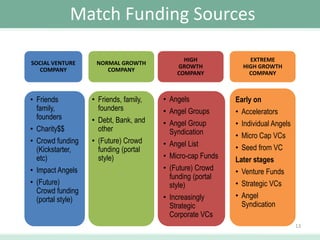
Match Funding Sources
SOCIAL VENTURE
COMPANY

• Friends
family,
founders
• Charity$$
• Crowd funding
(Kickstarter,
etc)
• Impact Angels
• (Future)
Crowd funding
(portal style)

NORMAL GROWTH
COMPANY

• Friends, family,
founders
• Debt, Bank, and
other
• (Future) Crowd
funding (portal
style)

HIGH
GROWTH
COMPANY

EXTREME
HIGH GROWTH
COMPANY

• Angels
• Angel Groups
• Angel Group
Syndication
• Angel List
• Micro-cap Funds
• (Future) Crowd
funding (portal
style)

Early on
• Accelerators
• Individual Angels
• Micro Cap VCs
• Seed from VC
Later stages
• Venture Funds
• Strategic VCs
• Angel
Syndication

• Increasingly
Strategic
Corporate VCs

13
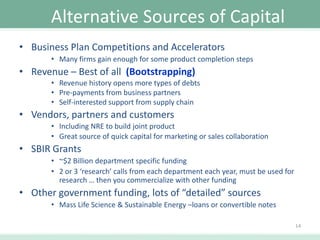
Alternative Sources of Capital
• Business Plan Competitions and Accelerators
• Many firms gain enough for some product completion steps

• Revenue – Best of all (Bootstrapping)
• Revenue history opens more types of debts
• Pre-payments from business partners
• Self-interested support from supply chain

• Vendors, partners and customers
• Including NRE to build joint product
• Great source of quick capital for marketing or sales collaboration

• SBIR Grants
• ~$2 Billion department specific funding
• 2 or 3 ‘research’ calls from each department each year, must be used for
research … then you commercialize with other funding

• Other government funding, lots of “detailed” sources
• Mass Life Science & Sustainable Energy –loans or convertible notes
14
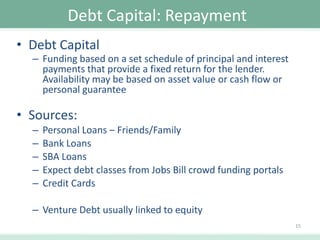
Debt Capital: Repayment
• Debt Capital

– Funding based on a set schedule of principal and interest
payments that provide a fixed return for the lender.
Availability may be based on asset value or cash flow or
personal guarantee

• Sources:
–
–
–
–
–

Personal Loans – Friends/Family
Bank Loans
SBA Loans
Expect debt classes from Jobs Bill crowd funding portals
Credit Cards

– Venture Debt usually linked to equity
15
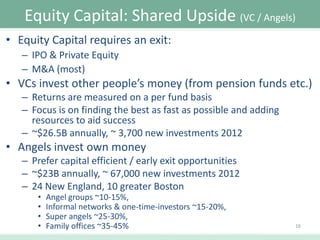
Equity Capital: Shared Upside (VC / Angels)
• Equity Capital requires an exit:
– IPO & Private Equity
– M&A (most)

• VCs invest other people’s money (from pension funds etc.)
– Returns are measured on a per fund basis
– Focus is on finding the best as fast as possible and adding
resources to aid success
– ~$26.5B annually, ~ 3,700 new investments 2012

• Angels invest own money
– Prefer capital efficient / early exit opportunities
– ~$23B annually, ~ 67,000 new investments 2012
– 24 New England, 10 greater Boston
•
•
•
•

Angel groups ~10-15%,
Informal networks & one-time-investors ~15-20%,
Super angels ~25-30%,
Family offices ~35-45%

16
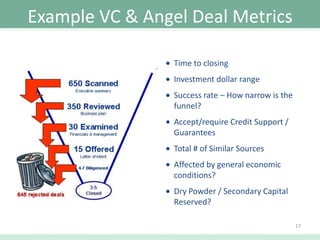
Example VC & Angel Deal Metrics
Time to closing
Investment dollar range
Success rate – How narrow is the
funnel?
Accept/require Credit Support /
Guarantees
Total # of Similar Sources
Affected by general economic
conditions?
Dry Powder / Secondary Capital
Reserved?
17
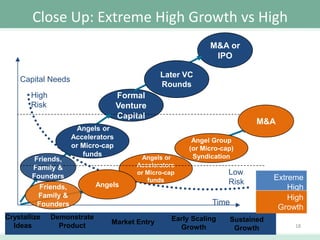
Close Up: Extreme High Growth vs High
Growth
M&A or
IPO
Later VC
Rounds

Capital Needs
High
Risk

Formal
Venture
Capital

Friends,
Family &
Founders

Angels or
Accelerators
or Micro-cap
funds

Friends,
Family &
Founders
Crystallize
Ideas

Demonstrate
Product

Angels

M&A

Angels or
Accelerators
or Micro-cap
funds

Angel Group
(or Micro-cap)
Syndication

Low
Risk
Time

Market Entry

Early Scaling
Growth

Sustained
Growth

Extreme
High
Growth
High
Growth
18
Agenda
•
–

•
–

•

•
–

19
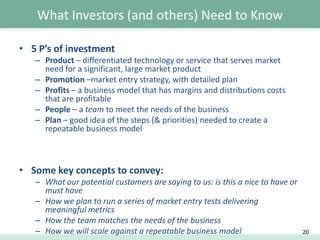
What Investors (and others) Need to Know
• 5 P’s of investment
– Product – differentiated technology or service that serves market
need for a significant, large market product
– Promotion –market entry strategy, with detailed plan
– Profits – a business model that has margins and distributions costs
that are profitable
– People – a team to meet the needs of the business
– Plan – good idea of the steps (& priorities) needed to create a
repeatable business model

• Some key concepts to convey:
– What our potential customers are saying to us: is this a nice to have or
must have
– How we plan to run a series of market entry tests delivering
meaningful metrics
– How the team matches the needs of the business
– How we will scale against a repeatable business model

20
First Time Entrepreneurs
• Without a startup track record, funding can be a challenge
– …. Later stage because of risk

• Moving from negative to positive
– Communicate relevant experience
– Hire a compelling management team

– Surround yourself with experts
– Show us some milestone accomplishments
• Don’t ask us to take a leap of faith – show us how you are
going to be successful

21
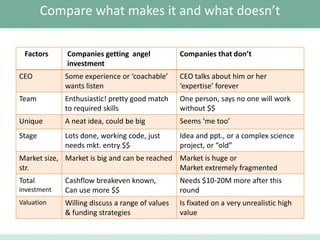
Compare what makes it and what doesn’t
Factors

Companies getting angel
investment

Companies that don’t

CEO

Some experience or ‘coachable’
wants listen

CEO talks about him or her
‘expertise’ forever

Team

Enthusiastic! pretty good match
to required skills

One person, says no one will work
without $$

Unique

A neat idea, could be big

Seems ‘me too’

Stage

Lots done, working code, just
needs mkt. entry $$

Idea and ppt., or a complex science
project, or “old”

Market size, Market is big and can be reached Market is huge or
str.
Market extremely fragmented
Total
investment
Valuation

Cashflow breakeven known,
Can use more $$

Needs $10-20M more after this
round

Willing discuss a range of values
& funding strategies

Is fixated on a very unrealistic high
value
The odds are bad …
• What doesn’t work
• Deals that can’t develop an exit should bootstrap, get debt, etc

• Companies at too early of stage – risk set large
• Entrepreneurs expecting too high a valuations
• Asking for the wrong amount of money
• And .. The odds are bad … may have a “hard presentation slot”

• Find a champion (before you apply if possible) !!!!
What are the Deal Marketing Materials

• Business Summary -2-5 pages with financial summary

• 12-20 slide pitch deck with a backup side for every serious
question
• 5-8 page market (size and structure) summary
• Integrated financial model
• 30 second elevator pitch
• 1-2 minute tell me more / meeting request pitch
(write a business plan for yourself)
Creating an Effective Presentation
• Elevator pitch – who are you and what do you do and why?
• Market opportunity
– What is the problem you are solving
– How big is the market
• Product or service (intellectual property)
• Target clients and business model
• Go to market strategy
• Competitive landscape and advantage
– Barriers to entry
• The management team
– Hiring plan
• Financial summary, including last year’s P & L and 3 year projections
• Funding needs for this round & use of funds
– history of funding to date
– pre-money valuation
Agenda
•
–

•
–

•

•
–

26
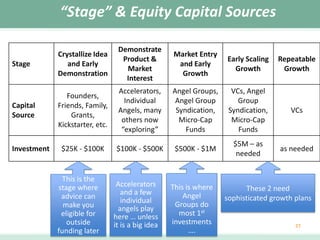
“Stage” & Equity Capital Sources
Stage

Crystallize Idea
and Early
Demonstration

Demonstrate
Product &
Market
Interest

Market Entry
and Early
Growth

Early Scaling
Growth

Repeatable
Growth

Capital
Source

Founders,
Friends, Family,
Grants,
Kickstarter, etc.

Accelerators,
Individual
Angels, many
others now
“exploring”

Angel Groups,
Angel Group
Syndication,
Micro-Cap
Funds

VCs, Angel
Group
Syndication,
Micro-Cap
Funds

VCs

$25K - $100K

$100K - $500K

$500K - $1M

$5M – as
needed

as needed

Investment

This is the
stage where
advice can
make you
eligible for
outside
funding later

Accelerators
and a few
individual
angels play
here … unless
it is a big idea

This is where
Angel
Groups do
most 1st
investments
….

These 2 need
sophisticated growth plans

27
Funding Sources
1. Funding partners are specialists
2. To understand who to approach and when to get to
them takes really understanding what they
specialize in. You need to match your company type
to the right type of funding partner
3. Company stage is shorthand for types of risks that
business faces
– Risk awareness is the key to early successful
communication with funders
28
Closing Thoughts…
Leverage the Entrepreneurial Community in Boston!
-Greenhorn Connect
-Etc.

29
Funding Options for Early Stage Companies

Grants, etc
30
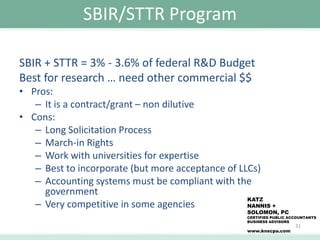
SBIR/STTR Program
SBIR + STTR = 3% - 3.6% of federal R&D Budget
Best for research … need other commercial $$
• Pros:
– It is a contract/grant – non dilutive
• Cons:
– Long Solicitation Process
– March-in Rights
– Work with universities for expertise
– Best to incorporate (but more acceptance of LLCs)
– Accounting systems must be compliant with the
government
KATZ
– Very competitive in some agencies
NANNIS +

SOLOMON, PC

CERTIFIED PUBLIC ACCOUNTANTS
BUSINESS ADVISORS

www.knscpa.com

31
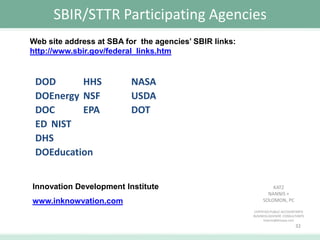
SBIR/STTR Participating Agencies
Web site address at SBA for the agencies’ SBIR links:
http://www.sbir.gov/federal_links.htm

DOD
HHS
DOEnergy NSF
DOC
EPA
ED NIST
DHS
DOEducation

NASA
USDA
DOT

Innovation Development Institute
www.inknowvation.com

KATZ
NANNIS +
SOLOMON, PC
CERTIFIED PUBLIC ACCOUNTANTS
BUSINESS ADVISOR CONSULTANTS
lnannis@knscpa.com

32
SBIR/STTR Participating Agencies (cont’d)
www.masslifesciences.com

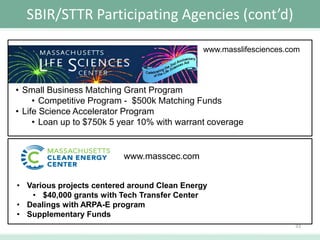
• Small Business Matching Grant Program
• Competitive Program - $500k Matching Funds
• Life Science Accelerator Program
• Loan up to $750k 5 year 10% with warrant coverage

www.masscec.com
• Various projects centered around Clean Energy
• $40,000 grants with Tech Transfer Center
• Dealings with ARPA-E program
• Supplementary Funds
33
SBIR/STTR Participating Agencies (cont’d)
Massachusetts Technology Transfer Center

www.mattcenter.org

Mission is to support technology transfer activities between research
institutes and companies in Massachusetts.
•
Fund researchers at universities
•
Move their inventions to development
•
Development of the feasibility in specific industry applications

•
•
•
•

Small and Medium Massachusetts manufacturers
Term loans and working capital loans
Contract and purchase order financing
Targeted technical assistance-50% paid by MGCC

34
SBIR/STTR Participating Agencies (cont’d)

Web site for entrepreneurs is:
http://www.sba.gov/starting_business/ind
ex.html

Services Specific Territories
Management Consulting
Start-up Consulting

Web site for lending programs is:
http://www.sba.gov/financing/
index.html

Business Plan Development
Financing Plan Development

Low Cost Training Programs
7(a) Loan Program
Disaster Recovery
CDC / 504 Program
Micro Loans

Procurement Technical Assistance
Center

Mass Export Center

Small Business Investment Companies
35
SBIR/STTR Participating Agencies (cont’d)

www.mass-ventures.com

•

Normally fills a gap in Angel or Venture Round, Seed / 1st

•

Massachusetts-based companies

•

$250,000 - $500,000

•

State-funded VC

•

START Program- Phase II Matching Grant Program
•

Initially $6M as part of bond fund

•

10 at $100k; 5 at $200K; 2 at $500K in first year

•

2nd year of program – first 100K applications are over

36
Additional Resources
Commonwealth of Massachusetts
www.mass.gov/bizteam
Smaller Business Association of New England
www.sbane.org
Association of Corporate Growth
www.acgboston.org
City of Boston Resource Guide
www.cityofboston.gov/dnd/obd/BRG/A_intro.asp
States of NH, CT, RI,VT, ME Doing Business Guides
www.nh.gov/businesses/doing.html
www.ct.govthen go to “Doing Business”
www.ri.gov/business/
vermont.gov/doing_business/business.html
www.maine.gov/portal/business/small_bus.html

37
38
What Do We Mean By “Risk”
Examples of things that make a company risky to a financial
partner:

•
•
•
•
•
•
•
•
•
•

Your company is early stage
You need more money, now or down the road
You are a new entrepreneur
You have unproven technology
You need to raise equity instead of asset backed debt with
obligation to repay
You are chasing a new unproven market
You have less IP or defensibility
Your business does not have high growth
You have a longer path to exit
You have fewer exit options
39

Understand All of Your Funding Options

  • 2.
    Funding Options forEarly Stage Companies November 14, 2013
  • 3.
    Today’s Expert • JeanHammond; • Supporting Growth of education and learning cluster in Boston: LearnLaunch, LearnLaunchX, • Active angel in lots of deals, first investor in Zip car: Launchpad, Golden Seeds, & Hub Angels • Serial entrepreneur: Axon Networks and Quarry Technologies • Eco-system supporter: Board TCN, MIT Trust Center, Mass Challenge, TechStars, & ACA/ARI trainer jean@jph-associates.com 3
  • 4.
  • 5.
    How Can WeBuild Value and Reduce Risk? IP & Differentiated Product Legal Structure Boards Governance Stage-appropriate growth-oriented strategy Deep Market Understanding & Marketing Execution What type of company should we build ? Profitable Business Model Flexible,HighPerformance Team - that can grow & change Bookkeeping & Accurate Accounting Partners: manufacturing, development, distribution, etc. Outer ring: this is how you grow. By growing, you prove the market exists, REDUCE RISK, and earn access to different financial partners 5
  • 6.
    How Can WeBuild Value and Reduce Risk? IP & Differentiated Product Legal Structure Boards Governance Profitable Business Model Stage-appropriate growth-oriented strategy What type of company should we build ? Flexible,HighPerformance Team - that can grow & change Deep Market Understanding & Marketing Execution Bookkeeping & Accurate Accounting Partners: manufacturing, development, distribution, etc. Outer ring: this is how you grow. By growing, you prove the market, REDUCE RISK, and earn access to different financial partners 6
  • 7.
    Funding the Company Beforeyou can get funded, you have to know where to look Before you know where to look, you need to understand what you are 7
  • 8.
    What Type ofCompany Are You? • In many cases the nature of the business decides the type of company … • In others, changing how you bring the product to market can really affect the cost of scaling and the funding requirements • Example: license new battery technology to existing players vs build a battery company with outsource manufacturing or build a manufacturer • Every company’s financing path is unique 8
  • 9.
    All Financial PartnersAre Specialists • Fundingcomes in distinct flavors; all financial partners are specialists • To understand who to approach and when to get to them takes really understanding what they specialize in. You need to match type of company to the type of funding partner • Different types of funding partners specialize in different levels of risk, so apply different funding criteria • Most basic rule: the more risk a funding partner takes, the more return (and control) they are going to require 9
  • 10.
    Entrepreneurship comes inmany types SOCIAL VENTURE COMPANY NORMAL GROWTH COMPANY • Goal is to fulfill a social need • Has mission orientation • Team needs to support mission • Growth profile often one resource at a time • Exit …much harder to find fit • Includes all service businesses • Exploiting a local market need • Team has ‘great jobs’ • Growth by adding resources one by one • Exit will be based on value of cash flow (mature biz.) HIGH GROWTH COMPANY • Company can grow fast (on-line) or has a scalable system • Team often motivated by exit • $7-10M revenue in 4-5 yrs & market size allows significant additional growth • Capital efficient total investment$2-4M • Exit by M&A EXTREME HIGH GROWTH COMPANY • Growth profile ultra-scalable • Team focus is exit • Revenue $40M+ with lots of room for growth (5 yr.) • Based on $20M+ investment • Exit targeted to IPO or by ‘large’ M&A event 10
  • 11.
    Growth and MaturityReduce Risk High Risk As you develop your company, you reduce risk for your financial partners Size of Capital Raise: Low Size of Capital Raise: High Low Risk Time Crystallize Ideas Demonstrate Product Market Entry Early Scaling Growth Sustained Growth 11 11
  • 12.
    Capital Sources: Size& Cost Angel Groups Angels Bank Loans Private Equity Micro VC Equity Crowdfunding Angel List, Circle Up, etc Investment Friends &Family “Cost” Corporate / Strategic Venture Jobs Bill Portals Venture Debt Crowdfunding: etc. Founder Traditional VC Accelerators Personal Loans Equipment Financing Vendors B’Plan Competition Customers Grants Investment Size 12
  • 13.
    Match Funding Sources SOCIALVENTURE COMPANY • Friends family, founders • Charity$$ • Crowd funding (Kickstarter, etc) • Impact Angels • (Future) Crowd funding (portal style) NORMAL GROWTH COMPANY • Friends, family, founders • Debt, Bank, and other • (Future) Crowd funding (portal style) HIGH GROWTH COMPANY EXTREME HIGH GROWTH COMPANY • Angels • Angel Groups • Angel Group Syndication • Angel List • Micro-cap Funds • (Future) Crowd funding (portal style) Early on • Accelerators • Individual Angels • Micro Cap VCs • Seed from VC Later stages • Venture Funds • Strategic VCs • Angel Syndication • Increasingly Strategic Corporate VCs 13
  • 14.
    Alternative Sources ofCapital • Business Plan Competitions and Accelerators • Many firms gain enough for some product completion steps • Revenue – Best of all (Bootstrapping) • Revenue history opens more types of debts • Pre-payments from business partners • Self-interested support from supply chain • Vendors, partners and customers • Including NRE to build joint product • Great source of quick capital for marketing or sales collaboration • SBIR Grants • ~$2 Billion department specific funding • 2 or 3 ‘research’ calls from each department each year, must be used for research … then you commercialize with other funding • Other government funding, lots of “detailed” sources • Mass Life Science & Sustainable Energy –loans or convertible notes 14
  • 15.
    Debt Capital: Repayment •Debt Capital – Funding based on a set schedule of principal and interest payments that provide a fixed return for the lender. Availability may be based on asset value or cash flow or personal guarantee • Sources: – – – – – Personal Loans – Friends/Family Bank Loans SBA Loans Expect debt classes from Jobs Bill crowd funding portals Credit Cards – Venture Debt usually linked to equity 15
  • 16.
    Equity Capital: SharedUpside (VC / Angels) • Equity Capital requires an exit: – IPO & Private Equity – M&A (most) • VCs invest other people’s money (from pension funds etc.) – Returns are measured on a per fund basis – Focus is on finding the best as fast as possible and adding resources to aid success – ~$26.5B annually, ~ 3,700 new investments 2012 • Angels invest own money – Prefer capital efficient / early exit opportunities – ~$23B annually, ~ 67,000 new investments 2012 – 24 New England, 10 greater Boston • • • • Angel groups ~10-15%, Informal networks & one-time-investors ~15-20%, Super angels ~25-30%, Family offices ~35-45% 16
  • 17.
    Example VC &Angel Deal Metrics Time to closing Investment dollar range Success rate – How narrow is the funnel? Accept/require Credit Support / Guarantees Total # of Similar Sources Affected by general economic conditions? Dry Powder / Secondary Capital Reserved? 17
  • 18.
    Close Up: ExtremeHigh Growth vs High Growth M&A or IPO Later VC Rounds Capital Needs High Risk Formal Venture Capital Friends, Family & Founders Angels or Accelerators or Micro-cap funds Friends, Family & Founders Crystallize Ideas Demonstrate Product Angels M&A Angels or Accelerators or Micro-cap funds Angel Group (or Micro-cap) Syndication Low Risk Time Market Entry Early Scaling Growth Sustained Growth Extreme High Growth High Growth 18
  • 19.
  • 20.
    What Investors (andothers) Need to Know • 5 P’s of investment – Product – differentiated technology or service that serves market need for a significant, large market product – Promotion –market entry strategy, with detailed plan – Profits – a business model that has margins and distributions costs that are profitable – People – a team to meet the needs of the business – Plan – good idea of the steps (& priorities) needed to create a repeatable business model • Some key concepts to convey: – What our potential customers are saying to us: is this a nice to have or must have – How we plan to run a series of market entry tests delivering meaningful metrics – How the team matches the needs of the business – How we will scale against a repeatable business model 20
  • 21.
    First Time Entrepreneurs •Without a startup track record, funding can be a challenge – …. Later stage because of risk • Moving from negative to positive – Communicate relevant experience – Hire a compelling management team – Surround yourself with experts – Show us some milestone accomplishments • Don’t ask us to take a leap of faith – show us how you are going to be successful 21
  • 22.
    Compare what makesit and what doesn’t Factors Companies getting angel investment Companies that don’t CEO Some experience or ‘coachable’ wants listen CEO talks about him or her ‘expertise’ forever Team Enthusiastic! pretty good match to required skills One person, says no one will work without $$ Unique A neat idea, could be big Seems ‘me too’ Stage Lots done, working code, just needs mkt. entry $$ Idea and ppt., or a complex science project, or “old” Market size, Market is big and can be reached Market is huge or str. Market extremely fragmented Total investment Valuation Cashflow breakeven known, Can use more $$ Needs $10-20M more after this round Willing discuss a range of values & funding strategies Is fixated on a very unrealistic high value
  • 23.
    The odds arebad … • What doesn’t work • Deals that can’t develop an exit should bootstrap, get debt, etc • Companies at too early of stage – risk set large • Entrepreneurs expecting too high a valuations • Asking for the wrong amount of money • And .. The odds are bad … may have a “hard presentation slot” • Find a champion (before you apply if possible) !!!!
  • 24.
    What are theDeal Marketing Materials • Business Summary -2-5 pages with financial summary • 12-20 slide pitch deck with a backup side for every serious question • 5-8 page market (size and structure) summary • Integrated financial model • 30 second elevator pitch • 1-2 minute tell me more / meeting request pitch (write a business plan for yourself)
  • 25.
    Creating an EffectivePresentation • Elevator pitch – who are you and what do you do and why? • Market opportunity – What is the problem you are solving – How big is the market • Product or service (intellectual property) • Target clients and business model • Go to market strategy • Competitive landscape and advantage – Barriers to entry • The management team – Hiring plan • Financial summary, including last year’s P & L and 3 year projections • Funding needs for this round & use of funds – history of funding to date – pre-money valuation
  • 26.
  • 27.
    “Stage” & EquityCapital Sources Stage Crystallize Idea and Early Demonstration Demonstrate Product & Market Interest Market Entry and Early Growth Early Scaling Growth Repeatable Growth Capital Source Founders, Friends, Family, Grants, Kickstarter, etc. Accelerators, Individual Angels, many others now “exploring” Angel Groups, Angel Group Syndication, Micro-Cap Funds VCs, Angel Group Syndication, Micro-Cap Funds VCs $25K - $100K $100K - $500K $500K - $1M $5M – as needed as needed Investment This is the stage where advice can make you eligible for outside funding later Accelerators and a few individual angels play here … unless it is a big idea This is where Angel Groups do most 1st investments …. These 2 need sophisticated growth plans 27
  • 28.
    Funding Sources 1. Fundingpartners are specialists 2. To understand who to approach and when to get to them takes really understanding what they specialize in. You need to match your company type to the right type of funding partner 3. Company stage is shorthand for types of risks that business faces – Risk awareness is the key to early successful communication with funders 28
  • 29.
    Closing Thoughts… Leverage theEntrepreneurial Community in Boston! -Greenhorn Connect -Etc. 29
  • 30.
    Funding Options forEarly Stage Companies Grants, etc 30
  • 31.
    SBIR/STTR Program SBIR +STTR = 3% - 3.6% of federal R&D Budget Best for research … need other commercial $$ • Pros: – It is a contract/grant – non dilutive • Cons: – Long Solicitation Process – March-in Rights – Work with universities for expertise – Best to incorporate (but more acceptance of LLCs) – Accounting systems must be compliant with the government KATZ – Very competitive in some agencies NANNIS + SOLOMON, PC CERTIFIED PUBLIC ACCOUNTANTS BUSINESS ADVISORS www.knscpa.com 31
  • 32.
    SBIR/STTR Participating Agencies Website address at SBA for the agencies’ SBIR links: http://www.sbir.gov/federal_links.htm DOD HHS DOEnergy NSF DOC EPA ED NIST DHS DOEducation NASA USDA DOT Innovation Development Institute www.inknowvation.com KATZ NANNIS + SOLOMON, PC CERTIFIED PUBLIC ACCOUNTANTS BUSINESS ADVISOR CONSULTANTS lnannis@knscpa.com 32
  • 33.
    SBIR/STTR Participating Agencies(cont’d) www.masslifesciences.com • Small Business Matching Grant Program • Competitive Program - $500k Matching Funds • Life Science Accelerator Program • Loan up to $750k 5 year 10% with warrant coverage www.masscec.com • Various projects centered around Clean Energy • $40,000 grants with Tech Transfer Center • Dealings with ARPA-E program • Supplementary Funds 33
  • 34.
    SBIR/STTR Participating Agencies(cont’d) Massachusetts Technology Transfer Center www.mattcenter.org Mission is to support technology transfer activities between research institutes and companies in Massachusetts. • Fund researchers at universities • Move their inventions to development • Development of the feasibility in specific industry applications • • • • Small and Medium Massachusetts manufacturers Term loans and working capital loans Contract and purchase order financing Targeted technical assistance-50% paid by MGCC 34
  • 35.
    SBIR/STTR Participating Agencies(cont’d) Web site for entrepreneurs is: http://www.sba.gov/starting_business/ind ex.html Services Specific Territories Management Consulting Start-up Consulting Web site for lending programs is: http://www.sba.gov/financing/ index.html Business Plan Development Financing Plan Development Low Cost Training Programs 7(a) Loan Program Disaster Recovery CDC / 504 Program Micro Loans Procurement Technical Assistance Center Mass Export Center Small Business Investment Companies 35
  • 36.
    SBIR/STTR Participating Agencies(cont’d) www.mass-ventures.com • Normally fills a gap in Angel or Venture Round, Seed / 1st • Massachusetts-based companies • $250,000 - $500,000 • State-funded VC • START Program- Phase II Matching Grant Program • Initially $6M as part of bond fund • 10 at $100k; 5 at $200K; 2 at $500K in first year • 2nd year of program – first 100K applications are over 36
  • 37.
    Additional Resources Commonwealth ofMassachusetts www.mass.gov/bizteam Smaller Business Association of New England www.sbane.org Association of Corporate Growth www.acgboston.org City of Boston Resource Guide www.cityofboston.gov/dnd/obd/BRG/A_intro.asp States of NH, CT, RI,VT, ME Doing Business Guides www.nh.gov/businesses/doing.html www.ct.govthen go to “Doing Business” www.ri.gov/business/ vermont.gov/doing_business/business.html www.maine.gov/portal/business/small_bus.html 37
  • 38.
  • 39.
    What Do WeMean By “Risk” Examples of things that make a company risky to a financial partner: • • • • • • • • • • Your company is early stage You need more money, now or down the road You are a new entrepreneur You have unproven technology You need to raise equity instead of asset backed debt with obligation to repay You are chasing a new unproven market You have less IP or defensibility Your business does not have high growth You have a longer path to exit You have fewer exit options 39

Editor's Notes

  • #9 Ask the audience how many people in the first company4 scientist, 2-3 customer support scientists, 2 deal makers etc ceo, books … maybe 10Battery company … product managers, sales teams, senior vp of manufacturing to hold the outsource guys feet to the fire … 30 people?If we manufacture then we need a lot folks … work in the factory … work on regulated disposal of manufacturing … lots of stuffYou get all the margin but you have all the costs.
  • #10 Detailed specialist … don’t ask a dermatologist to take on brain surgeryOr a radiologist to be a psychiatrist In general, when you ask a brain surgeon about you pimple they just stare at you.Funding criteria includes timing
  • #11 Key point all types of start ups are “worthy and good”Capital comes in complex flavors … need to find the matchAsking the “peppermint chip” capital to get friendly with an “dill pickle” company type
  • #14 Key point all types of start ups are “worthy and good Capital
  • #29 Detailed specialist … don’t ask a dermatologist to take on brain surgeryOr a radiologist to be a psychiatrist In general, when you ask a brain surgeon about you pimple they just stare at you.Funding criteria includes timing