2011-2012

Crane Runway Girder
Dr. Ibrahim Fahdah
Damascus University

https://sites.google.com/site/ifahdah/home/lectures
2011-2012
2011-2012

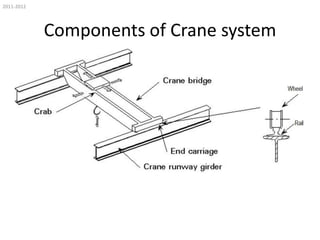
Components of Crane system
2011-2012

The Crane Runway Girder and the
Structure
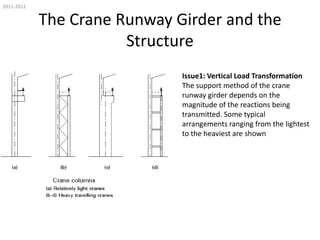
Issue1: Vertical Load Transformation
The support method of the crane
runway girder depends on the
magnitude of the reactions being
transmitted. Some typical
arrangements ranging from the lightest
to the heaviest are shown
2011-2012

The Crane Runway Girder and the
Structure
Issue2: Free Rotation at the Supports
Free rotation at the supports of crane
runway girders is important in order to
prevent bending and torsional moments
in the columns.
2011-2012

The Crane Runway Girder and the
Structure
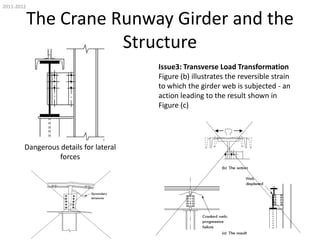
Issue3: Transverse Load Transformation
Figure (b) illustrates the reversible strain
to which the girder web is subjected - an
action leading to the result shown in
Figure (c)

Dangerous details for lateral
forces
2011-2012

The Crane Runway Girder and the
Structure
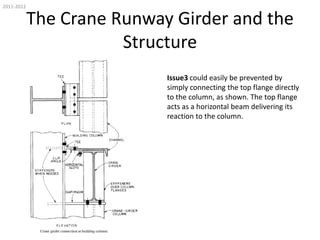
Issue3 could easily be prevented by
simply connecting the top flange directly
to the column, as shown. The top flange
acts as a horizontal beam delivering its
reaction to the column.
2011-2012

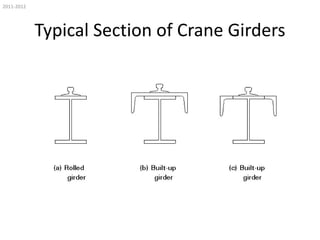
Typical Section of Crane Girders
2011-2012

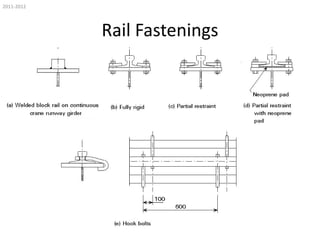
Rail Fastenings
2011-2012

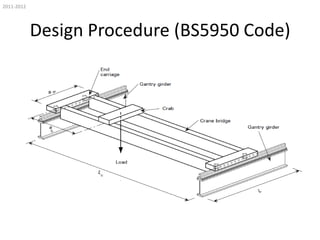
Design Procedure (BS5950 Code)
2011-2012

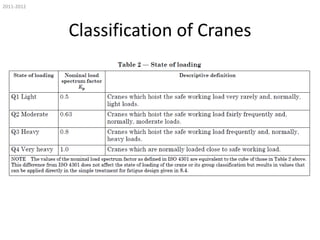
Classification of Cranes
2011-2012

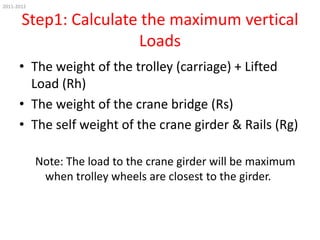
Step1: Calculate the maximum vertical
Loads
• The weight of the trolley (carriage) + Lifted
Load (Rh)
• The weight of the crane bridge (Rs)
• The self weight of the crane girder & Rails (Rg)
Note: The load to the crane girder will be maximum
when trolley wheels are closest to the girder.
2011-2012

Step1: Calculate the maximum vertical
Loads (cont.)

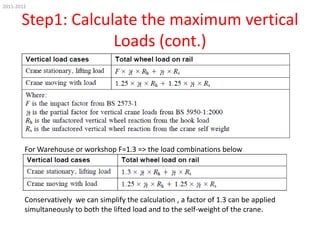
For Warehouse or workshop F=1.3 => the load combinations below

Conservatively we can simplify the calculation , a factor of 1.3 can be applied
simultaneously to both the lifted load and to the self-weight of the crane.
2011-2012

Step1: Calculate the maximum vertical
Loads (cont.)

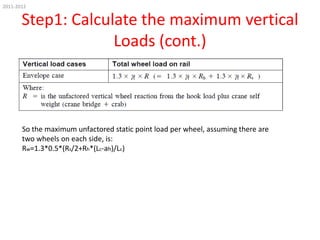
So the maximum unfactored static point load per wheel, assuming there are
two wheels on each side, is:
Rw=1.3*0.5*(Rs/2+Rh*(Lc-ah)/Lc)
2011-2012

Step2: Calculate the Horizontal Loads

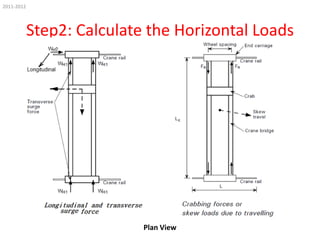
Plan View
2011-2012

Step2: Calculate the Horizontal Loads
• Inertia forces produced by the motion drives
or brakes. Referred to as the surge load.
(clause 3.1.5.1 of BS 2573-1:1983[4]).
• Skew loads due to travelling referred to as the
crabbing force. (clause 3.1.5.2, BS 2573: Part
1:1983 [4])
2011-2012

Step2: Calculate the Horizontal Loads
• Transverse Surge load is taken as 10% of the combined
weight of the crab and the lifted load.
• Longitudinal Surge load of 5% of the static vertical
reactions. (i.e. from the weight of the crab, crane
bridge and lifted load).

• Crabbing forces are obtained from clause 4.11.2 (BS
5950-1:2000). If the crane is class Q1 or Q2, then the
crabbing forces would not need to be considered.
Note : Horizontal loads need not to be combined together.
2011-2012

Step3: Load Combinations
Wv
FR

Wh1

Rail

Wheel
Wh2

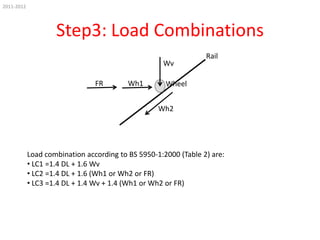
Load combination according to BS 5950-1:2000 (Table 2) are:
• LC1 =1.4 DL + 1.6 Wv
• LC2 =1.4 DL + 1.6 (Wh1 or Wh2 or FR)
• LC3 =1.4 DL + 1.4 Wv + 1.4 (Wh1 or Wh2 or FR)
2011-2012

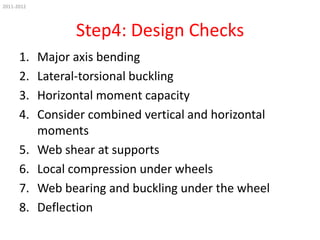
Step4: Design Checks
1.
2.
3.
4.
5.
6.
7.
8.

Major axis bending
Lateral-torsional buckling
Horizontal moment capacity
Consider combined vertical and horizontal
moments
Web shear at supports
Local compression under wheels
Web bearing and buckling under the wheel
Deflection
2011-2012

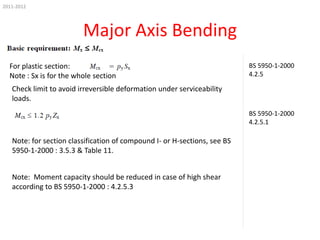
Major Axis Bending
For plastic section:
Note : Sx is for the whole section

BS 5950-1-2000
4.2.5

Check limit to avoid irreversible deformation under serviceability
loads.
BS 5950-1-2000
4.2.5.1

Note: for section classification of compound I- or H-sections, see BS
5950-1-2000 : 3.5.3 & Table 11.
Note: Moment capacity should be reduced in case of high shear
according to BS 5950-1-2000 : 4.2.5.3
2011-2012

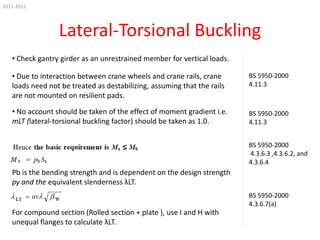
Lateral-Torsional Buckling
• Check gantry girder as an unrestrained member for vertical loads.
• Due to interaction between crane wheels and crane rails, crane
loads need not be treated as destabilizing, assuming that the rails
are not mounted on resilient pads.
• No account should be taken of the effect of moment gradient i.e.
mLT (lateral-torsional buckling factor) should be taken as 1.0.

BS 5950-2000
4.11.3

BS 5950-2000
4.11.3
BS 5950-2000
4.3.6.3 ,4.3.6.2, and
4.3.6.4

Pb is the bending strength and is dependent on the design strength
py and the equivalent slenderness λLT.
BS 5950-2000
4.3.6.7(a)

For compound section (Rolled section + plate ), use I and H with
unequal flanges to calculate λLT.
2011-2012

Horizontal Moment Capacity
Horizontal loads are assumed to be carried by the top flange plate only.

Moment capacity of the top flange plate, Mc,plate is equal to the
lesser of 1.2py Zplate and py*Splate.

BS 5950-1-2000
4.2.5
2011-2012

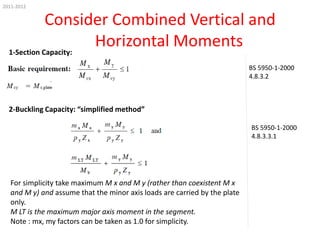
Consider Combined Vertical and
Horizontal Moments
1-Section Capacity:
BS 5950-1-2000
4.8.3.2

2-Buckling Capacity: “simplified method”
BS 5950-1-2000
4.8.3.3.1

For simplicity take maximum M x and M y (rather than coexistent M x
and M y) and assume that the minor axis loads are carried by the plate
only.
M LT is the maximum major axis moment in the segment.
Note : mx, my factors can be taken as 1.0 for simplicity.
2011-2012

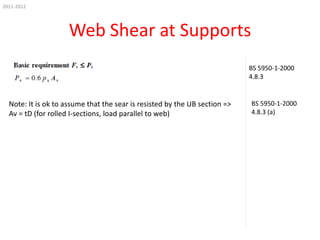
Web Shear at Supports
BS 5950-1-2000
4.8.3

Note: It is ok to assume that the sear is resisted by the UB section =>
Av = tD (for rolled I-sections, load parallel to web)

BS 5950-1-2000
4.8.3 (a)
2011-2012

Local Compression under Wheels
The local compressive stress in the web due to a crane wheel load
may be obtained by distributing it over
a length xR given by:

45

HR
Tplate
Tflange

2(HR+T)
The stress (fw) obtained by dispersing the wheel load over the length
xR should not be greater than py for the web.

BS 5950-1-2000
4.11.1
2011-2012

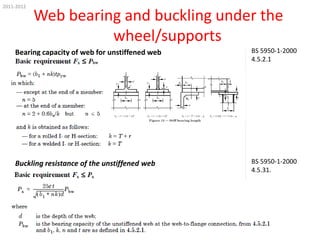
Web bearing and buckling under the
wheel/supports

Bearing capacity of web for unstiffened web

BS 5950-1-2000
4.5.2.1

Buckling resistance of the unstiffened web

BS 5950-1-2000
4.5.31.
2011-2012

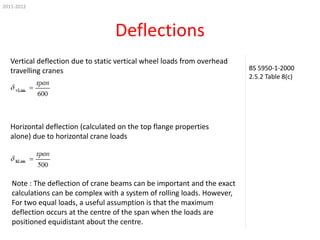
Deflections
Vertical deflection due to static vertical wheel loads from overhead
travelling cranes

Horizontal deflection (calculated on the top flange properties
alone) due to horizontal crane loads

Note : The deflection of crane beams can be important and the exact
calculations can be complex with a system of rolling loads. However,
For two equal loads, a useful assumption is that the maximum
deflection occurs at the centre of the span when the loads are
positioned equidistant about the centre.

BS 5950-1-2000
2.5.2 Table 8(c)

Crane

  • 1.
    2011-2012 Crane Runway Girder Dr.Ibrahim Fahdah Damascus University https://sites.google.com/site/ifahdah/home/lectures
  • 2.
  • 3.
  • 4.
    2011-2012 The Crane RunwayGirder and the Structure Issue1: Vertical Load Transformation The support method of the crane runway girder depends on the magnitude of the reactions being transmitted. Some typical arrangements ranging from the lightest to the heaviest are shown
  • 5.
    2011-2012 The Crane RunwayGirder and the Structure Issue2: Free Rotation at the Supports Free rotation at the supports of crane runway girders is important in order to prevent bending and torsional moments in the columns.
  • 6.
    2011-2012 The Crane RunwayGirder and the Structure Issue3: Transverse Load Transformation Figure (b) illustrates the reversible strain to which the girder web is subjected - an action leading to the result shown in Figure (c) Dangerous details for lateral forces
  • 7.
    2011-2012 The Crane RunwayGirder and the Structure Issue3 could easily be prevented by simply connecting the top flange directly to the column, as shown. The top flange acts as a horizontal beam delivering its reaction to the column.
  • 8.
  • 9.
  • 10.
  • 11.
  • 12.
    2011-2012 Step1: Calculate themaximum vertical Loads • The weight of the trolley (carriage) + Lifted Load (Rh) • The weight of the crane bridge (Rs) • The self weight of the crane girder & Rails (Rg) Note: The load to the crane girder will be maximum when trolley wheels are closest to the girder.
  • 13.
    2011-2012 Step1: Calculate themaximum vertical Loads (cont.) For Warehouse or workshop F=1.3 => the load combinations below Conservatively we can simplify the calculation , a factor of 1.3 can be applied simultaneously to both the lifted load and to the self-weight of the crane.
  • 14.
    2011-2012 Step1: Calculate themaximum vertical Loads (cont.) So the maximum unfactored static point load per wheel, assuming there are two wheels on each side, is: Rw=1.3*0.5*(Rs/2+Rh*(Lc-ah)/Lc)
  • 15.
    2011-2012 Step2: Calculate theHorizontal Loads Plan View
  • 16.
    2011-2012 Step2: Calculate theHorizontal Loads • Inertia forces produced by the motion drives or brakes. Referred to as the surge load. (clause 3.1.5.1 of BS 2573-1:1983[4]). • Skew loads due to travelling referred to as the crabbing force. (clause 3.1.5.2, BS 2573: Part 1:1983 [4])
  • 17.
    2011-2012 Step2: Calculate theHorizontal Loads • Transverse Surge load is taken as 10% of the combined weight of the crab and the lifted load. • Longitudinal Surge load of 5% of the static vertical reactions. (i.e. from the weight of the crab, crane bridge and lifted load). • Crabbing forces are obtained from clause 4.11.2 (BS 5950-1:2000). If the crane is class Q1 or Q2, then the crabbing forces would not need to be considered. Note : Horizontal loads need not to be combined together.
  • 18.
    2011-2012 Step3: Load Combinations Wv FR Wh1 Rail Wheel Wh2 Loadcombination according to BS 5950-1:2000 (Table 2) are: • LC1 =1.4 DL + 1.6 Wv • LC2 =1.4 DL + 1.6 (Wh1 or Wh2 or FR) • LC3 =1.4 DL + 1.4 Wv + 1.4 (Wh1 or Wh2 or FR)
  • 19.
    2011-2012 Step4: Design Checks 1. 2. 3. 4. 5. 6. 7. 8. Majoraxis bending Lateral-torsional buckling Horizontal moment capacity Consider combined vertical and horizontal moments Web shear at supports Local compression under wheels Web bearing and buckling under the wheel Deflection
  • 20.
    2011-2012 Major Axis Bending Forplastic section: Note : Sx is for the whole section BS 5950-1-2000 4.2.5 Check limit to avoid irreversible deformation under serviceability loads. BS 5950-1-2000 4.2.5.1 Note: for section classification of compound I- or H-sections, see BS 5950-1-2000 : 3.5.3 & Table 11. Note: Moment capacity should be reduced in case of high shear according to BS 5950-1-2000 : 4.2.5.3
  • 21.
    2011-2012 Lateral-Torsional Buckling • Checkgantry girder as an unrestrained member for vertical loads. • Due to interaction between crane wheels and crane rails, crane loads need not be treated as destabilizing, assuming that the rails are not mounted on resilient pads. • No account should be taken of the effect of moment gradient i.e. mLT (lateral-torsional buckling factor) should be taken as 1.0. BS 5950-2000 4.11.3 BS 5950-2000 4.11.3 BS 5950-2000 4.3.6.3 ,4.3.6.2, and 4.3.6.4 Pb is the bending strength and is dependent on the design strength py and the equivalent slenderness λLT. BS 5950-2000 4.3.6.7(a) For compound section (Rolled section + plate ), use I and H with unequal flanges to calculate λLT.
  • 22.
    2011-2012 Horizontal Moment Capacity Horizontalloads are assumed to be carried by the top flange plate only. Moment capacity of the top flange plate, Mc,plate is equal to the lesser of 1.2py Zplate and py*Splate. BS 5950-1-2000 4.2.5
  • 23.
    2011-2012 Consider Combined Verticaland Horizontal Moments 1-Section Capacity: BS 5950-1-2000 4.8.3.2 2-Buckling Capacity: “simplified method” BS 5950-1-2000 4.8.3.3.1 For simplicity take maximum M x and M y (rather than coexistent M x and M y) and assume that the minor axis loads are carried by the plate only. M LT is the maximum major axis moment in the segment. Note : mx, my factors can be taken as 1.0 for simplicity.
  • 24.
    2011-2012 Web Shear atSupports BS 5950-1-2000 4.8.3 Note: It is ok to assume that the sear is resisted by the UB section => Av = tD (for rolled I-sections, load parallel to web) BS 5950-1-2000 4.8.3 (a)
  • 25.
    2011-2012 Local Compression underWheels The local compressive stress in the web due to a crane wheel load may be obtained by distributing it over a length xR given by: 45 HR Tplate Tflange 2(HR+T) The stress (fw) obtained by dispersing the wheel load over the length xR should not be greater than py for the web. BS 5950-1-2000 4.11.1
  • 26.
    2011-2012 Web bearing andbuckling under the wheel/supports Bearing capacity of web for unstiffened web BS 5950-1-2000 4.5.2.1 Buckling resistance of the unstiffened web BS 5950-1-2000 4.5.31.
  • 27.
    2011-2012 Deflections Vertical deflection dueto static vertical wheel loads from overhead travelling cranes Horizontal deflection (calculated on the top flange properties alone) due to horizontal crane loads Note : The deflection of crane beams can be important and the exact calculations can be complex with a system of rolling loads. However, For two equal loads, a useful assumption is that the maximum deflection occurs at the centre of the span when the loads are positioned equidistant about the centre. BS 5950-1-2000 2.5.2 Table 8(c)