INDOOR AIR POLLUTION: RADON

In 1990 EPA placed indoor air pollution at the top of the list of 18
sources of cancer risk

Indoor pollution is rated by risk analysis scientists as high-risk
health problem for humans

Radon is one of the three most dangerous indoor air pollutants,
along with cigarette smoke and formaldehyde

Radon is the second leading cause of lung cancer, after smoking

Nearly 1 in 15 homes in the U.S. has high level of indoor radon

The U.S. Surgeon General and EPA recommend all homes be
tested for radon

Homes with high radon level can be fixed
INDOOR AIR POLLUTION: RADON
CHARACTERISTICS

Radioactive element

Naturally occurring

Colorless, odorless, and tasteless

Derived from natural decay of uranium

Chemically inert

When it decays, it releases decay products (progeny) which
can attach themselves to tiny dust particles in indoor air and
can be inhaled into human lungs, exposing them to densely
ionizing alpha particles
INDOOR AIR POLLUTION:RADON
Radon is estimated to
cause about 20,000
deaths per year. The
number of deaths
from other causes are
taken from the 1990
National Safety
Council Report.
INDOOR AIR POLLUTION:RADON

Most of the cancer risk
resulting from radon in
the household water
supply is due to
inhalation of the
radioactive by-products
that are produced from
radon that has been
released from the water
into the air, rather than
from drinking water.
INDOOR AIR POLLUTION: RADON

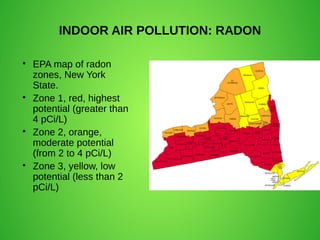
EPA map of radon
zones, New York
State.

Zone 1, red, highest
potential (greater than
4 pCi/L)

Zone 2, orange,
moderate potential
(from 2 to 4 pCi/L)

Zone 3, yellow, low
potential (less than 2
pCi/L)
INDOOR AIR POLLUTION: RADON
Radon levels in outdoor
air, indoor air, soil air and
ground water can be very
different.
INDOOR AIR POLLUTION:RADON
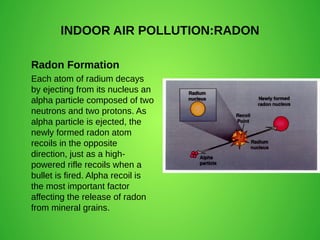
Radon Formation
Each atom of radium decays
by ejecting from its nucleus an
alpha particle composed of two
neutrons and two protons. As
alpha particle is ejected, the
newly formed radon atom
recoils in the opposite
direction, just as a high-
powered rifle recoils when a
bullet is fired. Alpha recoil is
the most important factor
affecting the release of radon
from mineral grains.
INDOOR AIR POLLUTION: RADON
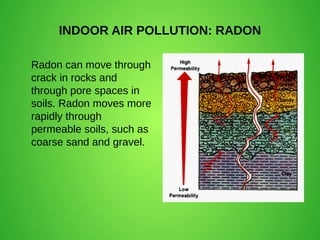
Radon can move through
crack in rocks and
through pore spaces in
soils. Radon moves more
rapidly through
permeable soils, such as
coarse sand and gravel.
INDOOR AIR POLLUTION: RADON
Some radon atoms
remain trapped in the
soil and decay to form
lead; other atoms
escape quickly into the
air.
Homes in areas with
drier, highly permeable
soils, may have high
levels of indoor radon.
INDOOR AIR POLLUTION: RADON
A. Cracks in concrete slabs
B. Spaces behind brick walls
C. Pores and cracks in concrete
blocks
D. Floor wall joints
E. Exposed soil as in a sump
F. Weeping tile, if drained to open
sump
G. Mortar joints
H. Loose fitting pipe penetrations
I. Open tops of block walls
J. Building materials such as some
rocks
K. Water, from some wells
INDOOR POLLUTION: RADON
In areas where the main
water supply is from
private wells and small
public water works, radon
in ground water can add
radon to the indoor air.
INDOOR AIR POLLUTION: RADON
HEALTH EFFECTS

Radon causes about 20,000 lung cancer deaths each year (only
effect definitely linked)

Even very small exposures to radon can result in lung cancer

No threshold below which levels are harmless

Many smokers will get lung cancer because of the synergy
between radon and cigarette smoking

Epidemiological studies (miners) an animal studies are supporting
evidence that confirm radon as a cause of lung cancer

The BEIR (“Biological Effects of Ionizing Radiation”) VI Report of
the National Academy of Sciences, the most comprehensive study
to date, supports that conclusion.
INDOOR AIR POLLUTION: RADON
Soil Air Radon Data
A scientist collects samples of soil air to
determine its radon content.
The methods for measuring radon can be a
passive device buried in the soil, or a sample
of soil air collected from a probe driven into the
ground.
INDOOR AIR POLLUTION: RADON
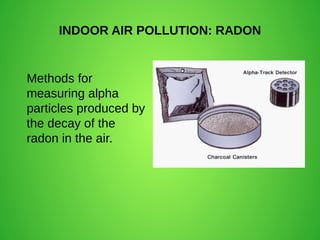
Methods for
measuring alpha
particles produced by
the decay of the
radon in the air.
INDOOR AIR POLLUTION:RADON
Active Sub slab Suction
It is the most common and
most reliable radon reduction
method. One or more suction
pipes are inserted through the
floor slab into the soil
underneath. A radon vent fan
connected to the suction pipes
draws the radon gas from
below the house and releases
it into the outdoor air while
creating a negative pressure
(vacuum) beneath the slab.
INDOOR AIR POLLUTION: RADON
Radon Resistant-
Construction Techniques
A. Gas Permeable Layer
B. Plastic Sheeting
C. Sealing and Caulking
D. Vent Pipe
E. Junction Box
Other radon reduction
techniques include sealing,
home/room pressurization,
heat recovery ventilation and
natural ventilation.
INDOOR AIR POLLUTION:RADON
Conclusions

Indoor radon is a public health problem

Millions of homes are estimated to have
elevated radon levels

The solution is straight forward

The health risks of radon can be reduced

Radon Gas

  • 1.
    INDOOR AIR POLLUTION:RADON  In 1990 EPA placed indoor air pollution at the top of the list of 18 sources of cancer risk  Indoor pollution is rated by risk analysis scientists as high-risk health problem for humans  Radon is one of the three most dangerous indoor air pollutants, along with cigarette smoke and formaldehyde  Radon is the second leading cause of lung cancer, after smoking  Nearly 1 in 15 homes in the U.S. has high level of indoor radon  The U.S. Surgeon General and EPA recommend all homes be tested for radon  Homes with high radon level can be fixed
  • 2.
    INDOOR AIR POLLUTION:RADON CHARACTERISTICS  Radioactive element  Naturally occurring  Colorless, odorless, and tasteless  Derived from natural decay of uranium  Chemically inert  When it decays, it releases decay products (progeny) which can attach themselves to tiny dust particles in indoor air and can be inhaled into human lungs, exposing them to densely ionizing alpha particles
  • 3.
    INDOOR AIR POLLUTION:RADON Radonis estimated to cause about 20,000 deaths per year. The number of deaths from other causes are taken from the 1990 National Safety Council Report.
  • 4.
    INDOOR AIR POLLUTION:RADON  Mostof the cancer risk resulting from radon in the household water supply is due to inhalation of the radioactive by-products that are produced from radon that has been released from the water into the air, rather than from drinking water.
  • 5.
  • 6.
    INDOOR AIR POLLUTION:RADON  EPA map of radon zones, New York State.  Zone 1, red, highest potential (greater than 4 pCi/L)  Zone 2, orange, moderate potential (from 2 to 4 pCi/L)  Zone 3, yellow, low potential (less than 2 pCi/L)
  • 7.
    INDOOR AIR POLLUTION:RADON Radon levels in outdoor air, indoor air, soil air and ground water can be very different.
  • 8.
    INDOOR AIR POLLUTION:RADON RadonFormation Each atom of radium decays by ejecting from its nucleus an alpha particle composed of two neutrons and two protons. As alpha particle is ejected, the newly formed radon atom recoils in the opposite direction, just as a high- powered rifle recoils when a bullet is fired. Alpha recoil is the most important factor affecting the release of radon from mineral grains.
  • 9.
    INDOOR AIR POLLUTION:RADON Radon can move through crack in rocks and through pore spaces in soils. Radon moves more rapidly through permeable soils, such as coarse sand and gravel.
  • 10.
    INDOOR AIR POLLUTION:RADON Some radon atoms remain trapped in the soil and decay to form lead; other atoms escape quickly into the air. Homes in areas with drier, highly permeable soils, may have high levels of indoor radon.
  • 11.
    INDOOR AIR POLLUTION:RADON A. Cracks in concrete slabs B. Spaces behind brick walls C. Pores and cracks in concrete blocks D. Floor wall joints E. Exposed soil as in a sump F. Weeping tile, if drained to open sump G. Mortar joints H. Loose fitting pipe penetrations I. Open tops of block walls J. Building materials such as some rocks K. Water, from some wells
  • 12.
    INDOOR POLLUTION: RADON Inareas where the main water supply is from private wells and small public water works, radon in ground water can add radon to the indoor air.
  • 13.
    INDOOR AIR POLLUTION:RADON HEALTH EFFECTS  Radon causes about 20,000 lung cancer deaths each year (only effect definitely linked)  Even very small exposures to radon can result in lung cancer  No threshold below which levels are harmless  Many smokers will get lung cancer because of the synergy between radon and cigarette smoking  Epidemiological studies (miners) an animal studies are supporting evidence that confirm radon as a cause of lung cancer  The BEIR (“Biological Effects of Ionizing Radiation”) VI Report of the National Academy of Sciences, the most comprehensive study to date, supports that conclusion.
  • 14.
    INDOOR AIR POLLUTION:RADON Soil Air Radon Data A scientist collects samples of soil air to determine its radon content. The methods for measuring radon can be a passive device buried in the soil, or a sample of soil air collected from a probe driven into the ground.
  • 15.
    INDOOR AIR POLLUTION:RADON Methods for measuring alpha particles produced by the decay of the radon in the air.
  • 16.
    INDOOR AIR POLLUTION:RADON ActiveSub slab Suction It is the most common and most reliable radon reduction method. One or more suction pipes are inserted through the floor slab into the soil underneath. A radon vent fan connected to the suction pipes draws the radon gas from below the house and releases it into the outdoor air while creating a negative pressure (vacuum) beneath the slab.
  • 17.
    INDOOR AIR POLLUTION:RADON Radon Resistant- Construction Techniques A. Gas Permeable Layer B. Plastic Sheeting C. Sealing and Caulking D. Vent Pipe E. Junction Box Other radon reduction techniques include sealing, home/room pressurization, heat recovery ventilation and natural ventilation.
  • 18.
    INDOOR AIR POLLUTION:RADON Conclusions  Indoorradon is a public health problem  Millions of homes are estimated to have elevated radon levels  The solution is straight forward  The health risks of radon can be reduced