Fostering The Roles of Universities
In Implementing The Sustainable
Development of The Surrounding
Community
Mohamed Labib Salem, PhD
Professor of Immunology
Faculty of Science, Tanta University, Egypt
Presented at:
2nd Int. Environment Forum:
New Environmental Horizons of Sustainable Environment
27-29 November, 2008, Tanta University, Egypt
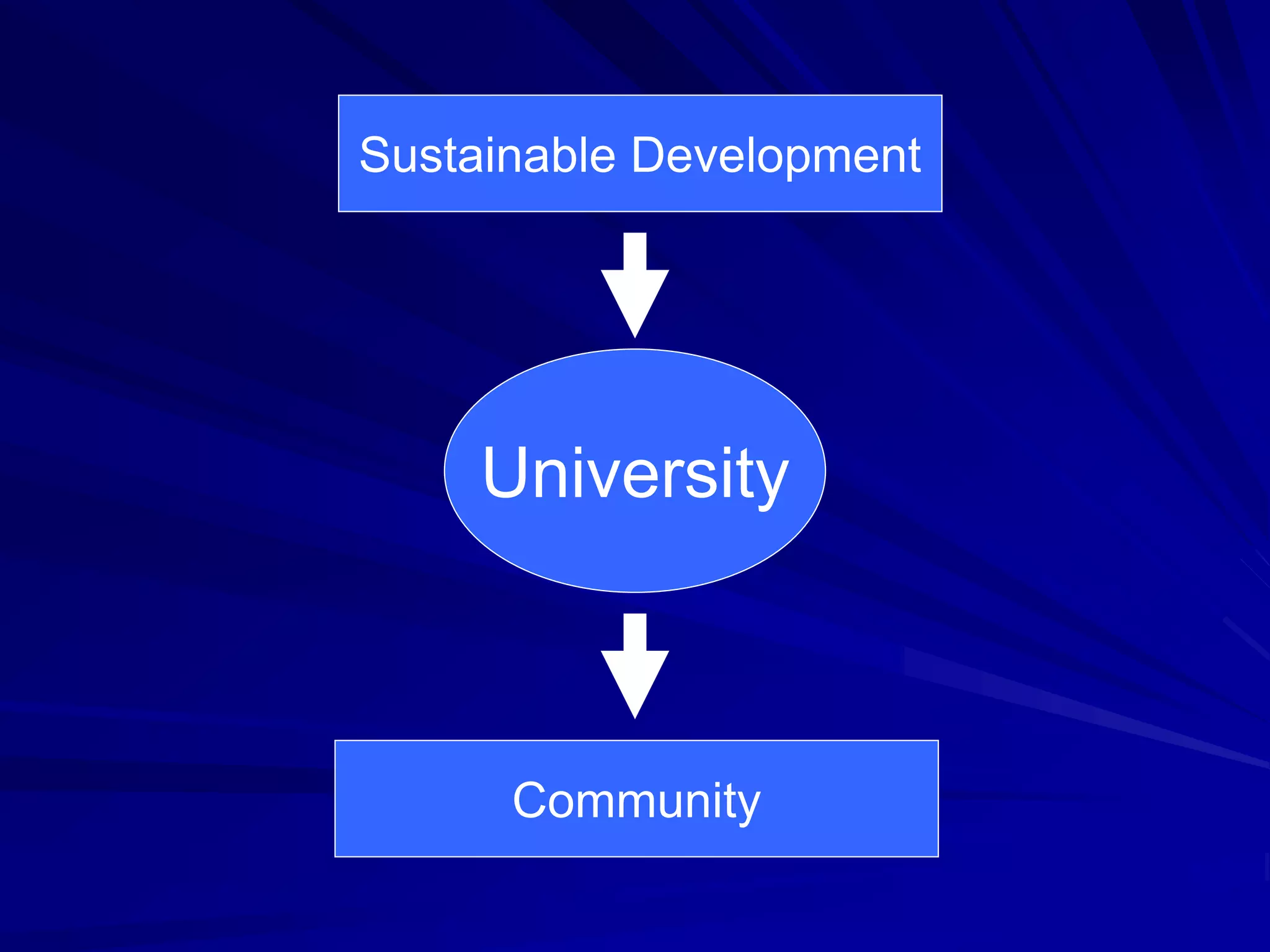
Sustainable Development
University
Community
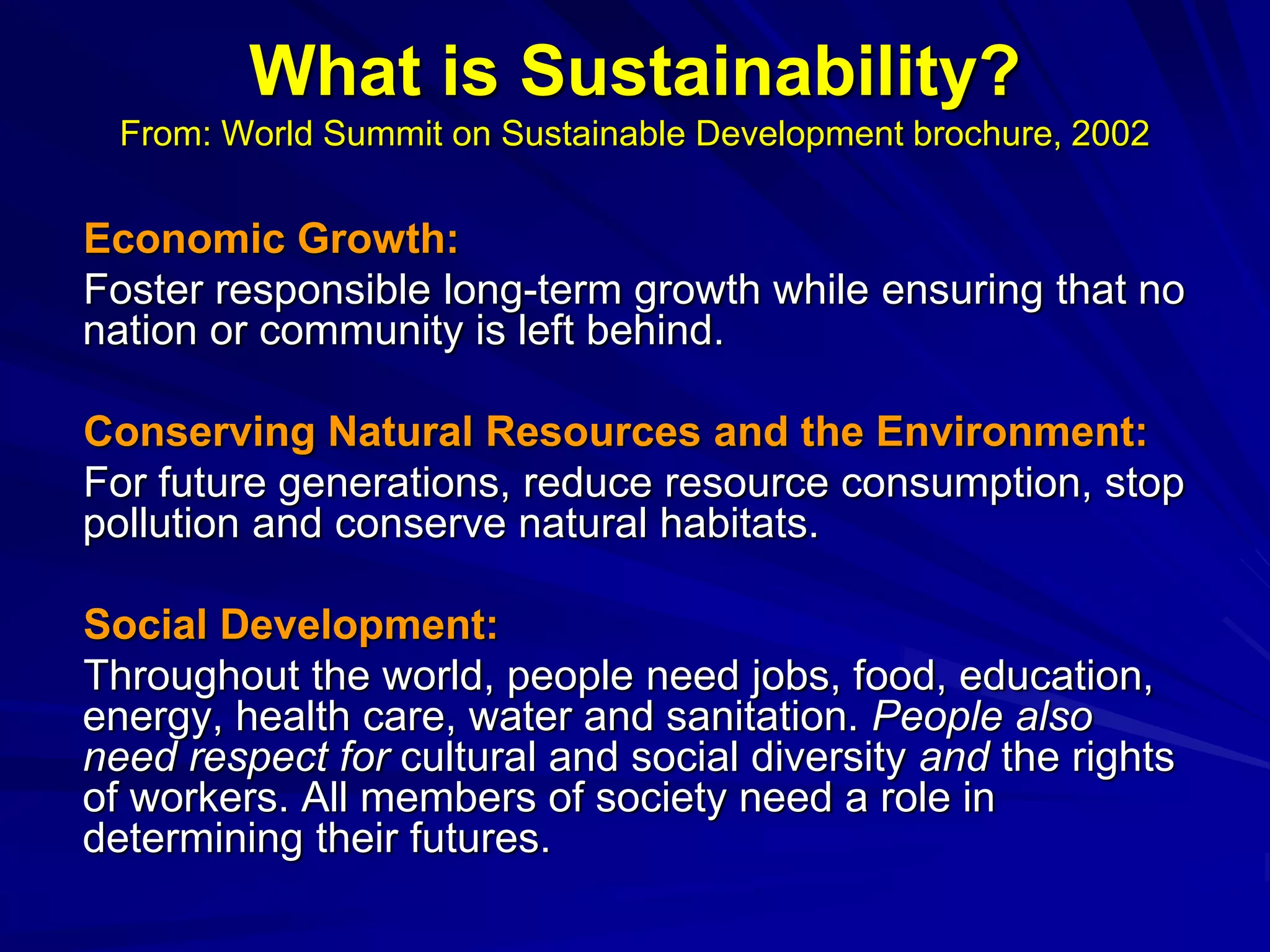
What is Sustainability?
From: World Summit on Sustainable Development brochure, 2002
Economic Growth:
Foster responsible long-term growth while ensuring that no
nation or community is left behind.
Conserving Natural Resources and the Environment:
For future generations, reduce resource consumption, stop
pollution and conserve natural habitats.
Social Development:
Throughout the world, people need jobs, food, education,
energy, health care, water and sanitation. People also
need respect for cultural and social diversity and the rights
of workers. All members of society need a role in
determining their futures.
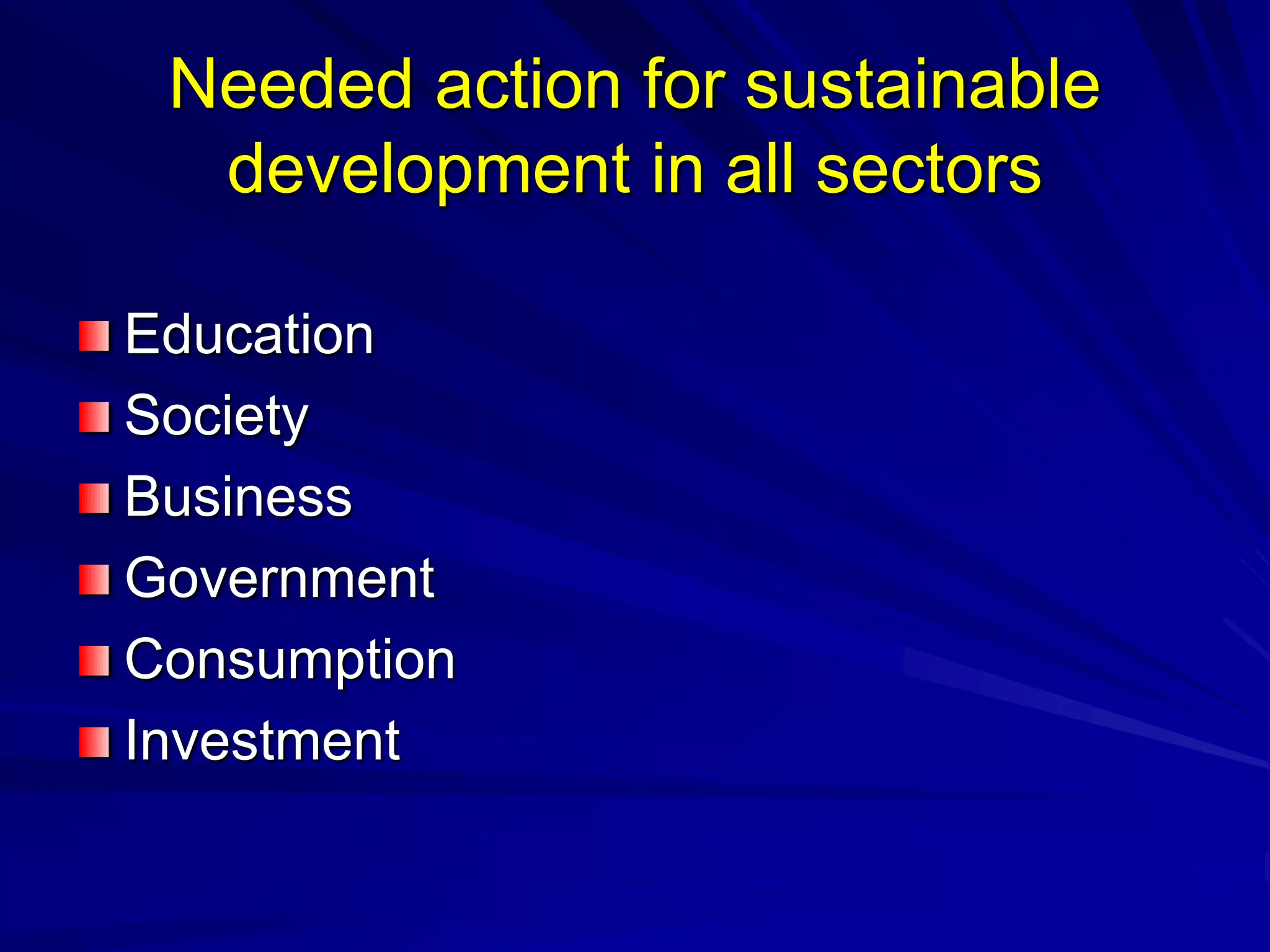
Needed action for sustainable
development in all sectors
Education
Society
Business
Government
Consumption
Investment
Sustainable Development
Source:
World Commission on Economic Development.
(1987). Our Common Future. England: Oxford
University Press.
“meeting the needs of the present without
compromising the ability of future
generations to meet their own needs”
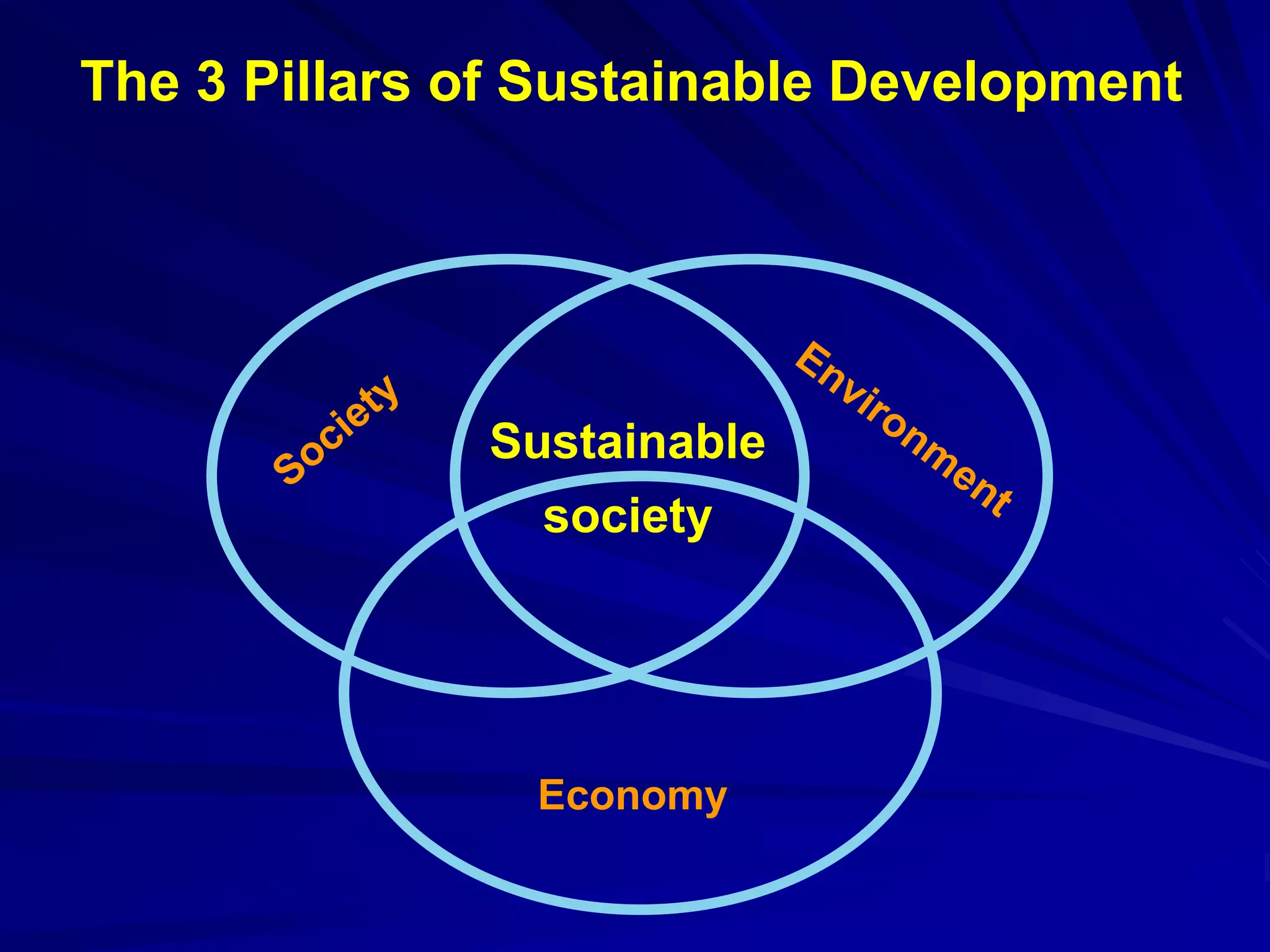
The 3 Pillars of Sustainable Development
Economy
Sustainable
society
• “Environmentally responsible citizens accept
responsibility for what happens in their
community – not only environmentally but also
politically, and socio-economically”
Education for not bout Sustainable Development
Education for Sustainable Development (ESD)
“enables people to develop the knowledge, values
and skills to participate in decisions …, that will
improve the quality of life now without damaging
the planet for the future.”
Source: Sustainable Development Education Panel (1999),
First annual Report 1998, London Department of the
Environment, Transport and the Regions, p. 30.
Education for a Sustainable Development
The United Nations
has declared a
Decade of Education for
Sustainable Development
2005-2014
Where CAN ESD be delivered?
UNIVERSITY…………..
• Universities make a large economic entity
consuming a big amount of resources,
purchasing products and services.
• Universities must make sustainability an integral
part of the institution’s daily operations:
- consumption,
- waste management,
- use of water, energy, and paper
- attempt to reduce their ecological footprint.
• These efforts should be tied to the formal
Curriculum and Research
ESD and Universities
Education and ESD:
Responsibilities of Universities
• To foster clear awareness of, and concern about
economic, social, political and ecological inter
dependence in urban and rural areas.
• Train the leaders and teachers of tomorrow the idea of
sustainable development
• Encourage students to gain knowledge and think about
what to do, individually and socially.
• Communicating this knowledge to decision-makers and
the public-at-large.
• Help people to find new solutions to the environmental,
economic, and social issues.
KEY CONCEPTS of ESD
Educators have a responsibility to prepare
all students to be:
socially and environmentally responsible
active global citizens
A national partnership with ULSF will help
make this task happen.
(ULSF) The Association of University Leaders
for a Sustainable Future
A leading international non-profit organization
strengthening higher education’s capacity to
make sustainability and environmental literacy a
major focus of teaching, research, service, and
operations.
www.ulsf.org
ULSF – continued
ULSF pursues its mission through:
Research and publications
Campus assessment
Online resources and in person support
International partnerships (e.g. GHESP) to
advance education for sustainability.
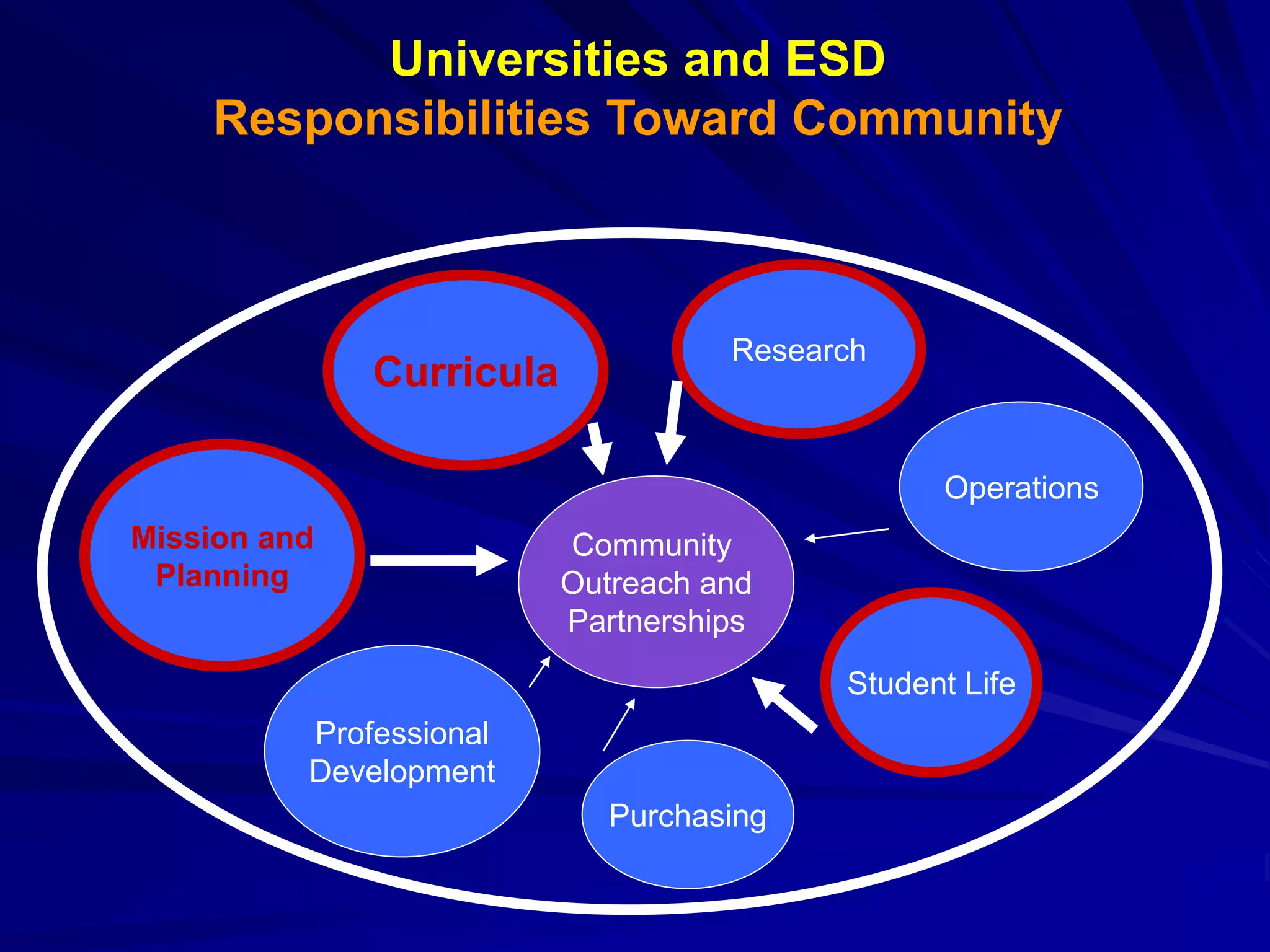
Mission and
Planning
Curricula
Community
Outreach and
Partnerships
Operations
Research
Student Life
Professional
Development
Purchasing
Universities and ESD
Responsibilities Toward Community
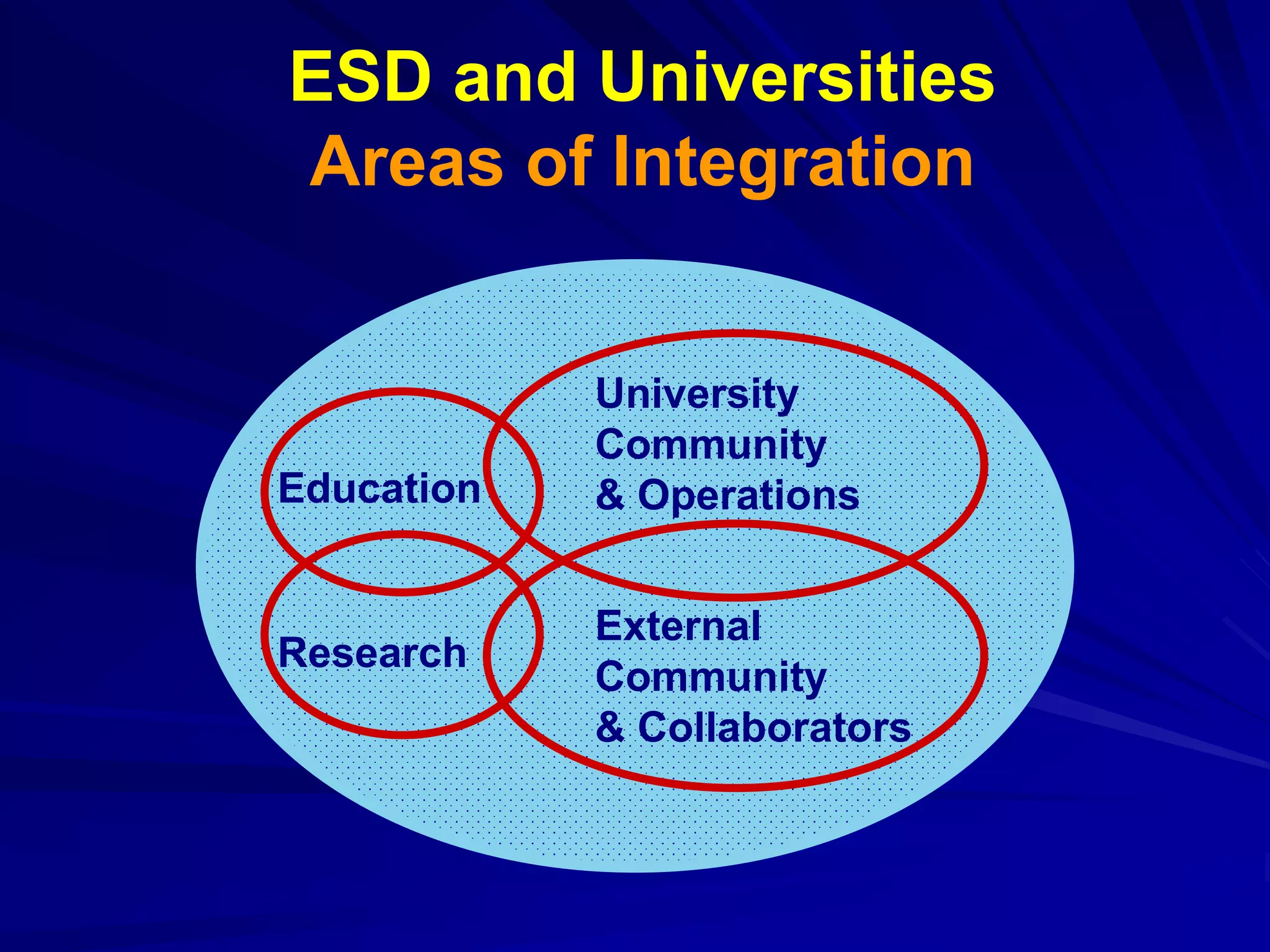
ESD and Universities
Areas of Integration
Education
Research
University
Community
& Operations
External
Community
& Collaborators
Community-based Service
Cleaning
Health (Infection, Substance abuse, Smoking, etc..)
Illiteracy
Law
Culture
Housing
Saving energy, water, etc…
Recycling
Traffic
Small business
Plantation
ESD & Teaching
On campus Service
o Orient teaching courses to be based on ESD.
o Involve students in teaching ESD.
o Dedicate the 1st lecture in each course to
explain how the course (contents) serves ESD.
o Invite community members to contribute and
present in the campus.
o Assign a prize (award) for students for ESD-
related subjects.
ESD & Teaching
Off campus Service
o Outreach Religion scholars with the most recent
knowledge in ESD.
o Convey ESD to the entire community members through
workshop and working groups.
o Outreach Elementary, Middle, and High School students
to educate ESD.
o Dedicate one day to serve the surrounding environment
by performing ESD related aspects.
ESD & Research
On campus Service
Each department to define the research
projects.
At least 25% of these projects has to be
ESD-based.
ESD & Research
Off campus Service
Define the community based on their
needs.
Establish research centers in rural area.
Introduce research to community
Involve community in research idea
Discuss research results non-technically
with community
Apply the outcomes to benefit the
community
ESD & Market
On campus Service
Make a list of the potential market jobs.
Arrange a annual job fair in which
graduates can interact with stakeholders.
Graduate to spend a 2-month working
service in a relevant market.
Periodical invitation of relevant
stakeholders to give talks to students.
ESD & Market
Off campus Service
Outreach the stakeholders and convince them to
dedicate specific # of jobs to graduate students.
Make a club for the graduates.
Follow up and analyze the nature, the numbers,
location, requirements, and satisfaction of their job.
Analyze the feedback from the graduates who are
already in the market.
Invite them to give talks about their own experience
What else???
Whatever we can do….
we should just do it….
Thank you
Mohamed Labib Salem
Prof. of Imunology, Faculty of Science, Tanta
University

Fostering The Roles of Universities In Implementing The Sustainable Development of The Surrounding Community By Prof. Mohamed Labib Salem, PhD

  • 1.
    Fostering The Rolesof Universities In Implementing The Sustainable Development of The Surrounding Community Mohamed Labib Salem, PhD Professor of Immunology Faculty of Science, Tanta University, Egypt Presented at: 2nd Int. Environment Forum: New Environmental Horizons of Sustainable Environment 27-29 November, 2008, Tanta University, Egypt
  • 2.
  • 3.
    What is Sustainability? From:World Summit on Sustainable Development brochure, 2002 Economic Growth: Foster responsible long-term growth while ensuring that no nation or community is left behind. Conserving Natural Resources and the Environment: For future generations, reduce resource consumption, stop pollution and conserve natural habitats. Social Development: Throughout the world, people need jobs, food, education, energy, health care, water and sanitation. People also need respect for cultural and social diversity and the rights of workers. All members of society need a role in determining their futures.
  • 4.
    Needed action forsustainable development in all sectors Education Society Business Government Consumption Investment
  • 5.
    Sustainable Development Source: World Commissionon Economic Development. (1987). Our Common Future. England: Oxford University Press. “meeting the needs of the present without compromising the ability of future generations to meet their own needs”
  • 6.
    The 3 Pillarsof Sustainable Development Economy Sustainable society
  • 7.
    • “Environmentally responsiblecitizens accept responsibility for what happens in their community – not only environmentally but also politically, and socio-economically” Education for not bout Sustainable Development Education for Sustainable Development (ESD)
  • 8.
    “enables people todevelop the knowledge, values and skills to participate in decisions …, that will improve the quality of life now without damaging the planet for the future.” Source: Sustainable Development Education Panel (1999), First annual Report 1998, London Department of the Environment, Transport and the Regions, p. 30. Education for a Sustainable Development
  • 9.
    The United Nations hasdeclared a Decade of Education for Sustainable Development 2005-2014
  • 10.
    Where CAN ESDbe delivered? UNIVERSITY…………..
  • 11.
    • Universities makea large economic entity consuming a big amount of resources, purchasing products and services. • Universities must make sustainability an integral part of the institution’s daily operations: - consumption, - waste management, - use of water, energy, and paper - attempt to reduce their ecological footprint. • These efforts should be tied to the formal Curriculum and Research ESD and Universities
  • 12.
    Education and ESD: Responsibilitiesof Universities • To foster clear awareness of, and concern about economic, social, political and ecological inter dependence in urban and rural areas. • Train the leaders and teachers of tomorrow the idea of sustainable development • Encourage students to gain knowledge and think about what to do, individually and socially. • Communicating this knowledge to decision-makers and the public-at-large. • Help people to find new solutions to the environmental, economic, and social issues.
  • 13.
    KEY CONCEPTS ofESD Educators have a responsibility to prepare all students to be: socially and environmentally responsible active global citizens A national partnership with ULSF will help make this task happen.
  • 14.
    (ULSF) The Associationof University Leaders for a Sustainable Future A leading international non-profit organization strengthening higher education’s capacity to make sustainability and environmental literacy a major focus of teaching, research, service, and operations. www.ulsf.org
  • 15.
    ULSF – continued ULSFpursues its mission through: Research and publications Campus assessment Online resources and in person support International partnerships (e.g. GHESP) to advance education for sustainability.
  • 16.
    Mission and Planning Curricula Community Outreach and Partnerships Operations Research StudentLife Professional Development Purchasing Universities and ESD Responsibilities Toward Community
  • 17.
    ESD and Universities Areasof Integration Education Research University Community & Operations External Community & Collaborators
  • 18.
    Community-based Service Cleaning Health (Infection,Substance abuse, Smoking, etc..) Illiteracy Law Culture Housing Saving energy, water, etc… Recycling Traffic Small business Plantation
  • 19.
    ESD & Teaching Oncampus Service o Orient teaching courses to be based on ESD. o Involve students in teaching ESD. o Dedicate the 1st lecture in each course to explain how the course (contents) serves ESD. o Invite community members to contribute and present in the campus. o Assign a prize (award) for students for ESD- related subjects.
  • 20.
    ESD & Teaching Offcampus Service o Outreach Religion scholars with the most recent knowledge in ESD. o Convey ESD to the entire community members through workshop and working groups. o Outreach Elementary, Middle, and High School students to educate ESD. o Dedicate one day to serve the surrounding environment by performing ESD related aspects.
  • 21.
    ESD & Research Oncampus Service Each department to define the research projects. At least 25% of these projects has to be ESD-based.
  • 22.
    ESD & Research Offcampus Service Define the community based on their needs. Establish research centers in rural area. Introduce research to community Involve community in research idea Discuss research results non-technically with community Apply the outcomes to benefit the community
  • 23.
    ESD & Market Oncampus Service Make a list of the potential market jobs. Arrange a annual job fair in which graduates can interact with stakeholders. Graduate to spend a 2-month working service in a relevant market. Periodical invitation of relevant stakeholders to give talks to students.
  • 24.
    ESD & Market Offcampus Service Outreach the stakeholders and convince them to dedicate specific # of jobs to graduate students. Make a club for the graduates. Follow up and analyze the nature, the numbers, location, requirements, and satisfaction of their job. Analyze the feedback from the graduates who are already in the market. Invite them to give talks about their own experience
  • 25.
    What else??? Whatever wecan do…. we should just do it…. Thank you Mohamed Labib Salem Prof. of Imunology, Faculty of Science, Tanta University