BIO-5006 Sustainable
Development
13.3.2013
Introduction to the course
Annina Takala
annina.takala@tut.fi
Learning outcomes
According to the curricula
• The student will have basic information and preparedness on
concepts, policies and challenges of sustainable development.
Core content
• History and concept of sustainable development. Technology and
sustainable development.
• Policies and strategies for promotion of sustainable development.
• Ecological and social problems, dilemmas and challenges in
promotion of sustainable development.
2
Group work:
case study - role play
• Course participants are divided into three groups focusing on a
specific case. Each case will have three different interest groups.
• The cases are:
– CASE 1: Should TUT be a Fairtrade University?
– CASE 2: “Blood minerals” in Nokia mobile phones
– CASE 3: Finnish forestry and the forests of Lapland
3
CASE 1: Should TUT be
a Fairtrade University?
• Setting: TUT has been challenged to apply for a status of a
Fairtrade University. Board of the TUT Foundation is trying to make
a decision whether to apply for the status, as it is seen that Fair
Trade could be one way of promoting TUT’s new strategy. However,
some critics maintain that Fair Trade is not really sustainable.
– Group A: The Fairtrade Foundation representatives who say
that Fairtrade is sustainable
– Group B: Critics who say that Fairtrade is not a sustainable way
to fulfil the new Strategy
– Group C: Researchers, who have assessed the sustainability of
Fairtrade
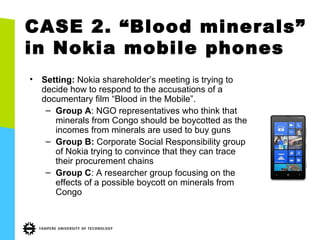
CASE 2. “Blood minerals”
in Nokia mobile phones
• Setting: Nokia shareholder’s meeting is trying to
decide how to respond to the accusations of a
documentary film “Blood in the Mobile”.
– Group A: NGO representatives who think that
minerals from Congo should be boycotted as the
incomes from minerals are used to buy guns
– Group B: Corporate Social Responsibility group
of Nokia trying to convince that they can trace
their procurement chains
– Group C: A researcher group focusing on the
effects of a possible boycott on minerals from
Congo
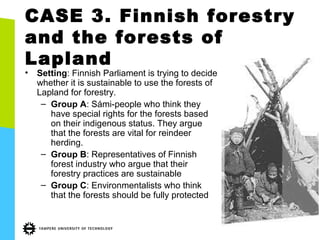
CASE 3. Finnish forestry
and the forests of
Lapland
• Setting: Finnish Parliament is trying to decide
whether it is sustainable to use the forests of
Lapland for forestry.
– Group A: Sámi-people who think they
have special rights for the forests based
on their indigenous status. They argue
that the forests are vital for reindeer
herding.
– Group B: Representatives of Finnish
forest industry who argue that their
forestry practices are sustainable
– Group C: Environmentalists who think
that the forests should be fully protected
…group work
• Each interest group prepares a short paper (max 2 pages) 
arguing for their point of view and interests
• Central points are presented to the ”audience” (depending on the
case audience can be Board of the TUT Foundation, shareholder’s
meeting or meeting of the Finnish parliament)
• After presentations there will be a short debate
• ”Audience” will vote based on the presentations
• Try to assume your roles and think of the context (both as
presenters and audience)
• Written paper should be made available through Moodle by 17.4.
• Presentations are on 24.4. and 8.5.
Motivation – why should one
study sustainable
development?
8
Why?
• Sustainable development is something of great significance and its
significance will only grow in the future
 everyone in higher education needs to learn this
 needs to be a part of every engineer’s competence
9
So, what does one actually
have to learn?
10
Learning
outcomes/objectives…
Contents/knowledge:
 challenges of sustainable development, causes and effects
 material and energy flows
 indicators, tools to manage and assess sustainable development
11
…learning
outcomes/objectives
Different dimensions of sustainable development and the
interdependencies  holistic view (“seeing the bigger picture”),
– systemic and life cycle thinking
– wider (social, environmental, political and legal) context of
engineering
– interdisciplinarity, transdiscplinarity
– communication, interaction, and group working skills
– sharing one’s own expertise
– understanding one’s own role  possibilities and limitations
of own expertise
12
…learning
outcomes/objectives
Autonomous, divergent and critical thinking
defining problems, asking questions
Creativity, innovativeness and entrepreneurship
13
So, how can these be
achieved?
14
Different perspectives: Education
for Sustainable Development
• Specialisation in sustainable development (educating SD-
engineers)
• Greening the campus (e.g. recycling, limiting energy
consumption)
• Compulsory course on sustainable development for all students
(one course is enough, content-oriented)
• Integrating sustainable development in all degree programmes
(sustainable development is part of every course in every degree
programme)
• Sustainable education (change of paradigm in education)
15
Sustainable education
E.F. Schumacher: “The volume of education…continues to
increase, yet so do pollution, exhaustion of resources,
and the dangers of ecological catastrophe. If still more
education is to save us, it would have to be education of
a different kind: an education that takes us into the depth
of things.”
(Quoted in Sterling 2001, 21)
Arjen E. Wals (2006, 41): “quality education and a more
sustainable world are two sides of the same coin”
Changing Education Paradigms
16
Many universities have
taken action...
• The Alliance for Global Sustainability:
Massachusetts Institute of Technology (MIT), The
University of Tokyo, Chalmers University of
Technology & Swiss Federal Institute of Technology
(ETH Zürich)
• Vision of Chalmers University of Technogy:
Chalmers for a sustainable future
• Aalto-university:
http://www.aalto.fi/en/about/sustainability/
• University of Tampere
http://www.uta.fi/ekokampus/en/index.html
17
Green Campus
Lappeenranta University of Technology
http://www.lut.fi/web/en/green-campus
BIO-5000
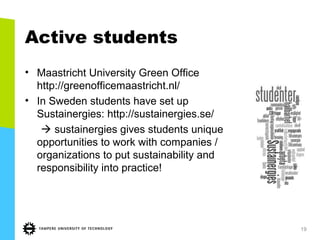
Active students
• Maastricht University Green Office
http://greenofficemaastricht.nl/
• In Sweden students have set up
Sustainergies: http://sustainergies.se/
 sustainergies gives students unique
opportunities to work with companies /
organizations to put sustainability and
responsibility into practice!
19
TUT?
13.01.16 20
The strategy of TUT for 2013–2016
“Technology for the benefit of
people and the environment”
“Tampere University of Technology courageously explores new
avenues of research and education in the fields of engineering. The
University acknowledges its responsibility for the future by
maintaining high ethical standards in all its endeavours for the
benefit of the environment, Finnish society and humanity as a
whole. The University’s friendly and inclusive community spirit is
conducive to academic and professional success.”
21
If you want to study more SD at
TUT
• ARK-53806, Sustainable Design Studio, 15 op (Autumn, periods I-II)
• ARK-53706 Negotiating and Designing Sustainable Change
(Autumn, periods I-II)
22
Extra material
• Towards Sustainable Development in Higher Education –
Reflections.
http://www.minedu.fi/export/sites/default/OPM/Julkaisut/2007/liitt
eet/opm06.pdf?lang=e
• Arjen E.J. Wals: The end of ESD... The beginning of
transformative learning – emphasizing the E in ESD. In (p. 41-
59)
http://www.minedu.fi/export/sites/default/OPM/Kansainvaeliset_
asiat/kansainvaeliset_jaerjestoet/unesco/suomen_unesco-
toimikunta/julkaisut/Kestxvx_kehitystx_edistxvx_koulutus.pdf
• Blewitt, J. & Cullingford, C. (Eds.). 2004. The Sustainability
Curriculum. The Challenge for Higher Education. Earthscan,
London. [Available through TUT E-library: Ebrary]
23
…extra material
• Corcoran, P.B. & Wals, A.E.J. (Ed.). 2004. Higher education and the
challenge of sustainability – Problematics, promise and practice.
355 s. Kluwer Academic Publishers, Dordrecht. [Available through
TUT E-library: Ebrary]
• Mulder, Karel (Ed.) 2006. Sustainable Development for Engineers. A
Handbook and Resource Guide. Greenleaf publishing.
• Sterling, S. 2001. Sustainable Education. Re-visioning Learning and
Change. Schumacher Briefings 6.
• Takala, A. & Korhonen-Yrjänheikki, K. 2011. A national
collaboration process: Finnish engineering education for the benefit
of people and environment. Science and Engineering Ethics. DOI
10.1007/s11948-011-9330-y. [Available through TUT e-library]
24

Introduction to Sustainable Development

  • 1.
    BIO-5006 Sustainable Development 13.3.2013 Introduction tothe course Annina Takala annina.takala@tut.fi
  • 2.
    Learning outcomes According tothe curricula • The student will have basic information and preparedness on concepts, policies and challenges of sustainable development. Core content • History and concept of sustainable development. Technology and sustainable development. • Policies and strategies for promotion of sustainable development. • Ecological and social problems, dilemmas and challenges in promotion of sustainable development. 2
  • 3.
    Group work: case study- role play • Course participants are divided into three groups focusing on a specific case. Each case will have three different interest groups. • The cases are: – CASE 1: Should TUT be a Fairtrade University? – CASE 2: “Blood minerals” in Nokia mobile phones – CASE 3: Finnish forestry and the forests of Lapland 3
  • 4.
    CASE 1: ShouldTUT be a Fairtrade University? • Setting: TUT has been challenged to apply for a status of a Fairtrade University. Board of the TUT Foundation is trying to make a decision whether to apply for the status, as it is seen that Fair Trade could be one way of promoting TUT’s new strategy. However, some critics maintain that Fair Trade is not really sustainable. – Group A: The Fairtrade Foundation representatives who say that Fairtrade is sustainable – Group B: Critics who say that Fairtrade is not a sustainable way to fulfil the new Strategy – Group C: Researchers, who have assessed the sustainability of Fairtrade
  • 5.
    CASE 2. “Bloodminerals” in Nokia mobile phones • Setting: Nokia shareholder’s meeting is trying to decide how to respond to the accusations of a documentary film “Blood in the Mobile”. – Group A: NGO representatives who think that minerals from Congo should be boycotted as the incomes from minerals are used to buy guns – Group B: Corporate Social Responsibility group of Nokia trying to convince that they can trace their procurement chains – Group C: A researcher group focusing on the effects of a possible boycott on minerals from Congo
  • 6.
    CASE 3. Finnishforestry and the forests of Lapland • Setting: Finnish Parliament is trying to decide whether it is sustainable to use the forests of Lapland for forestry. – Group A: Sámi-people who think they have special rights for the forests based on their indigenous status. They argue that the forests are vital for reindeer herding. – Group B: Representatives of Finnish forest industry who argue that their forestry practices are sustainable – Group C: Environmentalists who think that the forests should be fully protected
  • 7.
    …group work • Eachinterest group prepares a short paper (max 2 pages)  arguing for their point of view and interests • Central points are presented to the ”audience” (depending on the case audience can be Board of the TUT Foundation, shareholder’s meeting or meeting of the Finnish parliament) • After presentations there will be a short debate • ”Audience” will vote based on the presentations • Try to assume your roles and think of the context (both as presenters and audience) • Written paper should be made available through Moodle by 17.4. • Presentations are on 24.4. and 8.5.
  • 8.
    Motivation – whyshould one study sustainable development? 8
  • 9.
    Why? • Sustainable developmentis something of great significance and its significance will only grow in the future  everyone in higher education needs to learn this  needs to be a part of every engineer’s competence 9
  • 10.
    So, what doesone actually have to learn? 10
  • 11.
    Learning outcomes/objectives… Contents/knowledge:  challenges ofsustainable development, causes and effects  material and energy flows  indicators, tools to manage and assess sustainable development 11
  • 12.
    …learning outcomes/objectives Different dimensions ofsustainable development and the interdependencies  holistic view (“seeing the bigger picture”), – systemic and life cycle thinking – wider (social, environmental, political and legal) context of engineering – interdisciplinarity, transdiscplinarity – communication, interaction, and group working skills – sharing one’s own expertise – understanding one’s own role  possibilities and limitations of own expertise 12
  • 13.
    …learning outcomes/objectives Autonomous, divergent andcritical thinking defining problems, asking questions Creativity, innovativeness and entrepreneurship 13
  • 14.
    So, how canthese be achieved? 14
  • 15.
    Different perspectives: Education forSustainable Development • Specialisation in sustainable development (educating SD- engineers) • Greening the campus (e.g. recycling, limiting energy consumption) • Compulsory course on sustainable development for all students (one course is enough, content-oriented) • Integrating sustainable development in all degree programmes (sustainable development is part of every course in every degree programme) • Sustainable education (change of paradigm in education) 15
  • 16.
    Sustainable education E.F. Schumacher:“The volume of education…continues to increase, yet so do pollution, exhaustion of resources, and the dangers of ecological catastrophe. If still more education is to save us, it would have to be education of a different kind: an education that takes us into the depth of things.” (Quoted in Sterling 2001, 21) Arjen E. Wals (2006, 41): “quality education and a more sustainable world are two sides of the same coin” Changing Education Paradigms 16
  • 17.
    Many universities have takenaction... • The Alliance for Global Sustainability: Massachusetts Institute of Technology (MIT), The University of Tokyo, Chalmers University of Technology & Swiss Federal Institute of Technology (ETH Zürich) • Vision of Chalmers University of Technogy: Chalmers for a sustainable future • Aalto-university: http://www.aalto.fi/en/about/sustainability/ • University of Tampere http://www.uta.fi/ekokampus/en/index.html 17
  • 18.
    Green Campus Lappeenranta Universityof Technology http://www.lut.fi/web/en/green-campus BIO-5000
  • 19.
    Active students • MaastrichtUniversity Green Office http://greenofficemaastricht.nl/ • In Sweden students have set up Sustainergies: http://sustainergies.se/  sustainergies gives students unique opportunities to work with companies / organizations to put sustainability and responsibility into practice! 19
  • 20.
  • 21.
    The strategy ofTUT for 2013–2016 “Technology for the benefit of people and the environment” “Tampere University of Technology courageously explores new avenues of research and education in the fields of engineering. The University acknowledges its responsibility for the future by maintaining high ethical standards in all its endeavours for the benefit of the environment, Finnish society and humanity as a whole. The University’s friendly and inclusive community spirit is conducive to academic and professional success.” 21
  • 22.
    If you wantto study more SD at TUT • ARK-53806, Sustainable Design Studio, 15 op (Autumn, periods I-II) • ARK-53706 Negotiating and Designing Sustainable Change (Autumn, periods I-II) 22
  • 23.
    Extra material • TowardsSustainable Development in Higher Education – Reflections. http://www.minedu.fi/export/sites/default/OPM/Julkaisut/2007/liitt eet/opm06.pdf?lang=e • Arjen E.J. Wals: The end of ESD... The beginning of transformative learning – emphasizing the E in ESD. In (p. 41- 59) http://www.minedu.fi/export/sites/default/OPM/Kansainvaeliset_ asiat/kansainvaeliset_jaerjestoet/unesco/suomen_unesco- toimikunta/julkaisut/Kestxvx_kehitystx_edistxvx_koulutus.pdf • Blewitt, J. & Cullingford, C. (Eds.). 2004. The Sustainability Curriculum. The Challenge for Higher Education. Earthscan, London. [Available through TUT E-library: Ebrary] 23
  • 24.
    …extra material • Corcoran,P.B. & Wals, A.E.J. (Ed.). 2004. Higher education and the challenge of sustainability – Problematics, promise and practice. 355 s. Kluwer Academic Publishers, Dordrecht. [Available through TUT E-library: Ebrary] • Mulder, Karel (Ed.) 2006. Sustainable Development for Engineers. A Handbook and Resource Guide. Greenleaf publishing. • Sterling, S. 2001. Sustainable Education. Re-visioning Learning and Change. Schumacher Briefings 6. • Takala, A. & Korhonen-Yrjänheikki, K. 2011. A national collaboration process: Finnish engineering education for the benefit of people and environment. Science and Engineering Ethics. DOI 10.1007/s11948-011-9330-y. [Available through TUT e-library] 24

Editor's Notes

  • #21 Miten kestävä kehitys näkyy TTY:llä?