One of the management function that seeks
to essess and address the causes and effects
of uncertainty and risk on an organization.
To enable an organization to progress toward
its goal and objectives(mission) in the most
direct,efficient,and effective path.
Process of thinking systematically about all
possible risks, problems or disasters before
they happen and setting up procedures that
will avoid the risk, or minimize its impact, or
cope with its impact.
Should anticipate the risks that will hinder
the ultimate goal of them which is to attain
success in the world and here after.
Indicates how do Muslim reduce the risk of
loss and calamities
Aim to reduce the utilization of resourcess
(financial and non-financial) and to minimize
the negative effects of risks or maximize the
opportunities and goals.
The goal must be aligned with the syariah
To preserve the operating effectiveness of
the organization, to make sure that it is not
prevented from attaining its other goal by
pure risks or the losses arising from those
risks.
Equally important in the view of some-is the
humanitarian goal of protecting employees
from accidents that might result in death or
serious injury.
I. PRE LOSS
 necessary before a loss actually takes place so
that the impact of the loss should it occur can
be minimized.
 Necessary before a loss since it reduce fear
and worry.
 necessary in some cases because is made
compulsory by law.
 EXAMPLE : the government sets a regulation
that requires firms to install safety devices to
protect workers from harm such as wearing
safety helmets and eye-goggles are made
compulsory in the construction industry to
avoid injuries among workers.
II. POST LOSS
 Ensures the survival of the organization even
after a loss has taken place – organization
must be able to continue its operation.
 Ensures the stability of earnings – do not have
to stop and the organizations can concentrate
on their business activities as usual.
 Reduce the overall impact of losses toward the
organization and the society – loss occur not
only will the organization suffer but the loss
has to be burned by society as well.
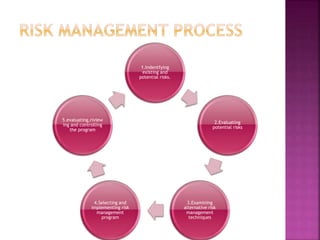
1.Indentfying
existing and
potential risks.
2.Evaluating
potential risks
3.Examining
alternative risk
management
techniques
4.Selecting and
implementing risk
management
program
5.evaluating,riview
ing and controlling
the program
STEP 1 : INDENTIFYING EXISTING AND POTENTIAL RISKS
 by which an organization is able to learn of
the areas in which it is exposed to risk.
 Designed to develop information on sources
of risk, hazards,risk factors, perils, and
exposures to loss.
 Ensure that all loss exposures are identified
is not an easy task.
Losses can be claasified as those that can
result in :
 direct damage (damage to building)
 Indirect damage (loss of profit due to
business interruption)
 Liability (court award to third party since
fire was cause negligence of the owner of
building)
 Loss of key employee (CEO dies or disable as
a result of fire)
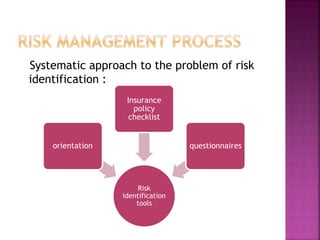
Systematic approach to the problem of risk
identification :
Risk
identification
tools
orientation
Insurance
policy
checklist
questionnaires
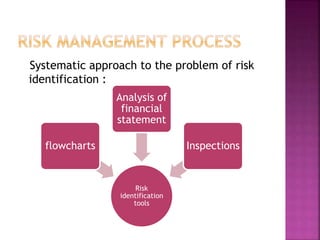
Systematic approach to the problem of risk
identification :
Risk
identification
tools
flowcharts
Analysis of
financial
statement
Inspections
STEP 2 : EVALUATING POTENTIAL RISK
 Evaluate them in terms of financial loss.
 Measuring the severity (potential size of the loss) and
frequency (the probability that it is likely to occur).
 Example : a supermarket entity that experiences high
frequency of losses .losses that fall in this category
would be shoplifthing of small items such as chocolate
bars or snacks.we very seldom hear of a supermarket
being close down because of that. – loss with high
severity.
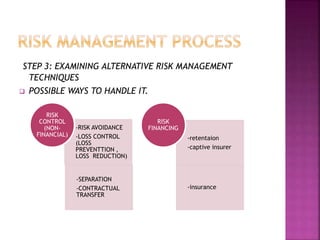
STEP 3: EXAMINING ALTERNATIVE RISK MANAGEMENT
TECHNIQUES
 POSSIBLE WAYS TO HANDLE IT.
-RISK AVOIDANCE
-LOSS CONTROL
(LOSS
PREVENTTION ,
LOSS REDUCTION)
-SEPARATION
-CONTRACTUAL
TRANSFER
RISK
CONTROL
(NON-
FINANCIAL)
-retentaion
-captive insurer
-insurance
RISK
FINANCING
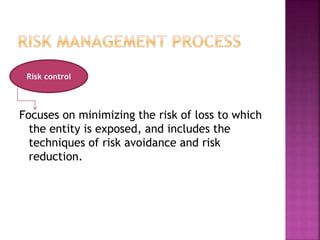
Focuses on minimizing the risk of loss to which
the entity is exposed, and includes the
techniques of risk avoidance and risk
reduction.
Risk control
Risk control
Risk avoidance :
 By not engaging in that particular hazardous
activity or operation.
 Manufacturer can avoid the risk of liability
associated with hazardous products by
picking another product line.
Risk control
Loss control :
 Avoidance designed to reduce the frequency,
severity, or unpredictability of losses.
 Two perspective :
*loss prevention (reduce frequency)- example,
employees wear and use all the time any
protective equipment or clothing provided.
*loss reduction (reduce severity before and
after loss) - example, seat belts and air bags are
designed to minimize the amount of damage at
the time an accident occurs.
Separation :
 Reduce the impact of losses.
 Example , location of each building must be
properly planned so as to minimize losses in
the case of event such as fire.
 The separation of warehouse from operation
section in a factory.
Contractual transfer :
 Incorporation- where the owner transfer the risk
to corporation by registering the company.
 Leasing contract- an agreement where the owner
or landlord transfer the risks to the tenants.
 Hedging- an agreement to buy or sell a
commodity at a certain price to avoid losses due
to price increase or decrease.
 Hold-harmless agreement- agreement between a
retailer and a manufacturer whereby the later
agrees to bear losses due to the manufacturer of
defective products thus relieving of any liability.
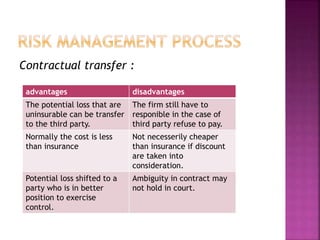
Contractual transfer :
advantages disadvantages
The potential loss that are
uninsurable can be transfer
to the third party.
The firm still have to
responible in the case of
third party refuse to pay.
Normally the cost is less
than insurance
Not necesserily cheaper
than insurance if discount
are taken into
consideration.
Potential loss shifted to a
party who is in better
position to exercise
control.
Ambiguity in contract may
not hold in court.
Risk financing
Retention :
 The company will bear the consequences of
the loss.
 To pay for losses it incurs.
 Less expensive than purchasing insurance
because many frictional costs (administrative
costs of purchasing insurance, commission to
insurance sales people, premium taxes,
insurer profit)
Self insurance and captive insurers :
 Self insurance is one of the oldest
alternatives and remains one of the most
popular.
 Rather than purchase an insurance policy , a
company will elect to retain an eligible risk
while designating an amount of money
calculated to compensate for the potential
future loss.
 A capture insureris , in general term, a
licensed insurance company established by a
non-insurance parent company to insure the
risks of the parent company.
 Example, maybank group is the parent
company of maybank assurance sdn.bhd .
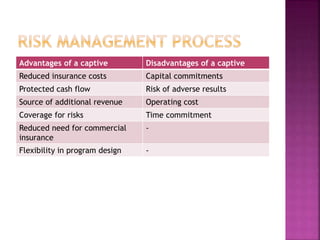
Advantages of a captive Disadvantages of a captive
Reduced insurance costs Capital commitments
Protected cash flow Risk of adverse results
Source of additional revenue Operating cost
Coverage for risks Time commitment
Reduced need for commercial
insurance
-
Flexibility in program design -
Insurance :
 Financing method of transferring the
financial consequences of potential
accidental from an insured firm or family to
an insurer.
 Use when the organization feels that it is
more economical and beneficial to transfer
the risk to another party.
STEP 4 : SELECTION AND IMPLEMENTATION OF
THE RISK MANAGEMENT PROCESS
 Draw up and implement the risk management
program
 Based on 2 factors :
*financial criteria – affect the organization’s
profitability or rate of return.
*non-financial criteria- affects the growth of
the organization, humanitarian aspects and
legal requirements.
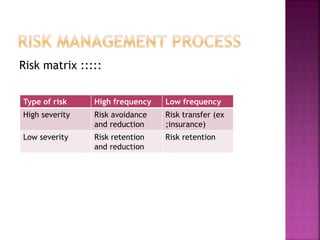
Risk matrix :::::
Type of risk High frequency Low frequency
High severity Risk avoidance
and reduction
Risk transfer (ex
;insurance)
Low severity Risk retention
and reduction
Risk retention
STEP 5 : EVALUATION,REVIEW AND CONTROL
 Must be monitored and controlled
systematically.
 Periodically reviewid to ensure that the
techniques employed are still suitable and
they satisfy the current conditions.
 To review decisions and discover mistakes, it
is hoped, before they become costly.

Risk management

  • 2.
    One of themanagement function that seeks to essess and address the causes and effects of uncertainty and risk on an organization. To enable an organization to progress toward its goal and objectives(mission) in the most direct,efficient,and effective path. Process of thinking systematically about all possible risks, problems or disasters before they happen and setting up procedures that will avoid the risk, or minimize its impact, or cope with its impact.
  • 3.
    Should anticipate therisks that will hinder the ultimate goal of them which is to attain success in the world and here after. Indicates how do Muslim reduce the risk of loss and calamities Aim to reduce the utilization of resourcess (financial and non-financial) and to minimize the negative effects of risks or maximize the opportunities and goals. The goal must be aligned with the syariah
  • 4.
    To preserve theoperating effectiveness of the organization, to make sure that it is not prevented from attaining its other goal by pure risks or the losses arising from those risks. Equally important in the view of some-is the humanitarian goal of protecting employees from accidents that might result in death or serious injury.
  • 5.
    I. PRE LOSS necessary before a loss actually takes place so that the impact of the loss should it occur can be minimized.  Necessary before a loss since it reduce fear and worry.  necessary in some cases because is made compulsory by law.  EXAMPLE : the government sets a regulation that requires firms to install safety devices to protect workers from harm such as wearing safety helmets and eye-goggles are made compulsory in the construction industry to avoid injuries among workers.
  • 6.
    II. POST LOSS Ensures the survival of the organization even after a loss has taken place – organization must be able to continue its operation.  Ensures the stability of earnings – do not have to stop and the organizations can concentrate on their business activities as usual.  Reduce the overall impact of losses toward the organization and the society – loss occur not only will the organization suffer but the loss has to be burned by society as well.
  • 7.
    1.Indentfying existing and potential risks. 2.Evaluating potentialrisks 3.Examining alternative risk management techniques 4.Selecting and implementing risk management program 5.evaluating,riview ing and controlling the program
  • 8.
    STEP 1 :INDENTIFYING EXISTING AND POTENTIAL RISKS  by which an organization is able to learn of the areas in which it is exposed to risk.  Designed to develop information on sources of risk, hazards,risk factors, perils, and exposures to loss.  Ensure that all loss exposures are identified is not an easy task.
  • 9.
    Losses can beclaasified as those that can result in :  direct damage (damage to building)  Indirect damage (loss of profit due to business interruption)  Liability (court award to third party since fire was cause negligence of the owner of building)  Loss of key employee (CEO dies or disable as a result of fire)
  • 10.
    Systematic approach tothe problem of risk identification : Risk identification tools orientation Insurance policy checklist questionnaires
  • 11.
    Systematic approach tothe problem of risk identification : Risk identification tools flowcharts Analysis of financial statement Inspections
  • 12.
    STEP 2 :EVALUATING POTENTIAL RISK  Evaluate them in terms of financial loss.  Measuring the severity (potential size of the loss) and frequency (the probability that it is likely to occur).  Example : a supermarket entity that experiences high frequency of losses .losses that fall in this category would be shoplifthing of small items such as chocolate bars or snacks.we very seldom hear of a supermarket being close down because of that. – loss with high severity.
  • 13.
    STEP 3: EXAMININGALTERNATIVE RISK MANAGEMENT TECHNIQUES  POSSIBLE WAYS TO HANDLE IT. -RISK AVOIDANCE -LOSS CONTROL (LOSS PREVENTTION , LOSS REDUCTION) -SEPARATION -CONTRACTUAL TRANSFER RISK CONTROL (NON- FINANCIAL) -retentaion -captive insurer -insurance RISK FINANCING
  • 14.
    Focuses on minimizingthe risk of loss to which the entity is exposed, and includes the techniques of risk avoidance and risk reduction. Risk control
  • 15.
    Risk control Risk avoidance:  By not engaging in that particular hazardous activity or operation.  Manufacturer can avoid the risk of liability associated with hazardous products by picking another product line.
  • 16.
    Risk control Loss control:  Avoidance designed to reduce the frequency, severity, or unpredictability of losses.  Two perspective : *loss prevention (reduce frequency)- example, employees wear and use all the time any protective equipment or clothing provided. *loss reduction (reduce severity before and after loss) - example, seat belts and air bags are designed to minimize the amount of damage at the time an accident occurs.
  • 17.
    Separation :  Reducethe impact of losses.  Example , location of each building must be properly planned so as to minimize losses in the case of event such as fire.  The separation of warehouse from operation section in a factory.
  • 18.
    Contractual transfer : Incorporation- where the owner transfer the risk to corporation by registering the company.  Leasing contract- an agreement where the owner or landlord transfer the risks to the tenants.  Hedging- an agreement to buy or sell a commodity at a certain price to avoid losses due to price increase or decrease.  Hold-harmless agreement- agreement between a retailer and a manufacturer whereby the later agrees to bear losses due to the manufacturer of defective products thus relieving of any liability.
  • 19.
    Contractual transfer : advantagesdisadvantages The potential loss that are uninsurable can be transfer to the third party. The firm still have to responible in the case of third party refuse to pay. Normally the cost is less than insurance Not necesserily cheaper than insurance if discount are taken into consideration. Potential loss shifted to a party who is in better position to exercise control. Ambiguity in contract may not hold in court.
  • 20.
    Risk financing Retention : The company will bear the consequences of the loss.  To pay for losses it incurs.  Less expensive than purchasing insurance because many frictional costs (administrative costs of purchasing insurance, commission to insurance sales people, premium taxes, insurer profit)
  • 21.
    Self insurance andcaptive insurers :  Self insurance is one of the oldest alternatives and remains one of the most popular.  Rather than purchase an insurance policy , a company will elect to retain an eligible risk while designating an amount of money calculated to compensate for the potential future loss.
  • 22.
     A captureinsureris , in general term, a licensed insurance company established by a non-insurance parent company to insure the risks of the parent company.  Example, maybank group is the parent company of maybank assurance sdn.bhd .
  • 23.
    Advantages of acaptive Disadvantages of a captive Reduced insurance costs Capital commitments Protected cash flow Risk of adverse results Source of additional revenue Operating cost Coverage for risks Time commitment Reduced need for commercial insurance - Flexibility in program design -
  • 24.
    Insurance :  Financingmethod of transferring the financial consequences of potential accidental from an insured firm or family to an insurer.  Use when the organization feels that it is more economical and beneficial to transfer the risk to another party.
  • 25.
    STEP 4 :SELECTION AND IMPLEMENTATION OF THE RISK MANAGEMENT PROCESS  Draw up and implement the risk management program  Based on 2 factors : *financial criteria – affect the organization’s profitability or rate of return. *non-financial criteria- affects the growth of the organization, humanitarian aspects and legal requirements.
  • 26.
    Risk matrix ::::: Typeof risk High frequency Low frequency High severity Risk avoidance and reduction Risk transfer (ex ;insurance) Low severity Risk retention and reduction Risk retention
  • 27.
    STEP 5 :EVALUATION,REVIEW AND CONTROL  Must be monitored and controlled systematically.  Periodically reviewid to ensure that the techniques employed are still suitable and they satisfy the current conditions.  To review decisions and discover mistakes, it is hoped, before they become costly.