Chapter-4
Topics Covered
Insurability of Risk
Risk Management Decision-Making
Legal Liability for Injury
Overview
 Requirements of an insurable risk
 Large number of similar risk exposure units
 Accidental and unintentional loss
 No catastrophic loss
 Determinable and measurable loss
 Calculable chance of loss
Definition of 'Insurable Risk'
 Definition: A risk that conforms to the norms and
specifications of the insurance policy in such a way
that the criterion for insurance is fulfilled is called
insurable risk.
 Description: There are various essential conditions
that need to be fulfilled before acceptance of
insurability of any risk. In case of a scenario where
the loss is too huge that no insurer would want to
pay for it, the risk is said to be uninsurable.
 A risk may not be termed as insurable if it is
immeasurable, very large, certain or not definable.
Insurance - Insurable Risks
 Insurable Risks: Risks are generally divided
into two classes:
 Pure risks and Speculative risks.
Pure Risks- these risks involve only the
chance of loss, there is never an opportunity
for gain or profit.
Examples: injury from an accident, loss of
home from an earthquake.
Only Pure Risks are Insurable
Insurance - Insurable Risks
Speculative Risks- These risks involve
both the chance of gain or loss.
Examples: Gambling at the race track, or
investing in the real estate market.
Speculative Risk is not Insurable
Elements of an Insurable Risk
 Loss must not be catastrophic
 Loss must be unexpected or accidental
 Loss produced by the risk must be
definite and
 Measurable must be a significantly large
number of homogeneous exposure units
to make the losses reasonable predictable
Economic Scale
 Risks can also be evaluated on an economic scale
comparing static and dynamic risks:
Static Risks are the losses that are caused by factors
other than a change in the economy (for example-
hurricanes, earthquakes, other natural disasters)
Dynamic Risks are the result of the economy changing
(examples- inflation, recession, and other business
cycle changes).
 Dynamic risks are not insurable.
Factors Determining Insurable
Risk
 If the insurance company has enough statistics to work out the
probability of the risk, this is called an insurable risk.
 Actuaries are highly qualified people working for insurance
companies; their role is to work out exactly what risks the company
will carry. The degree of the risk will influence the insurance
premium.
 Some examples of insurable risk
 Fire insurance
 The book value and the market or replacement value of insured property
 Money in transit-An insurance policy in which the insurance company will
pay if money is stolen or lost when it is being moved between two places,
for example between a shop and a bank.
 Storm, damage and theft
 Fidelity insurance -Insurance taken out by an employer against losses
incurred through dishonesty by employees.
Factors Determining
Uninsurable Risk
 An insurance company cannot calculate the
probability of the risk
 Risk is too widespread- war, catastrophic
 When the loss is incurred due to your own
deliberate actions
Insurable Types of Risk
 Personal risk is any risk that can affect the health or safety
of an individual, such as being injured by an accident or
suffering from an illness.
 Property risk is any risk that can cause a partial or total loss
to property, such as theft, fire, or so-called "acts of God".
 Liability risk is the personal or business risk associated with
being found liable to another because of negligence or willful
acts that caused a loss to another's property or person, such as
injuring someone while driving under the influence of
alcohol, or because the insured failed to perform a duty, such
as performing contractual obligations.
 How does liability risk convert into legal
risk?
Uninsurable Risk
 Price fluctuations from the time the order for
goods is placed and the delivery of the goods.
 Different price levels at different places
 New inventions that replace old technology,
eg. In the IT industry
 Nuclear weapons or war
 Changes in fashions when goods become
obsolete.
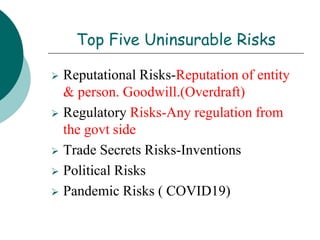
Top Five Uninsurable Risks
 Reputational Risks-Reputation of entity
& person. Goodwill.(Overdraft)
 Regulatory Risks-Any regulation from
the govt side
 Trade Secrets Risks-Inventions
 Political Risks
 Pandemic Risks ( COVID19)
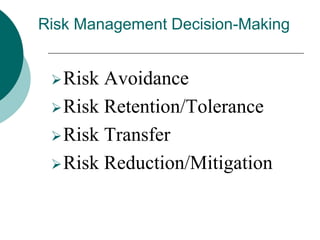
Risk Management Decision-Making
Risk Avoidance
Risk Retention/Tolerance
Risk Transfer
Risk Reduction/Mitigation
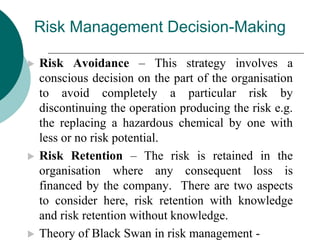
Risk Management Decision-Making
 Risk Avoidance – This strategy involves a
conscious decision on the part of the organisation
to avoid completely a particular risk by
discontinuing the operation producing the risk e.g.
the replacing a hazardous chemical by one with
less or no risk potential.
 Risk Retention – The risk is retained in the
organisation where any consequent loss is
financed by the company. There are two aspects
to consider here, risk retention with knowledge
and risk retention without knowledge.
 Theory of Black Swan in risk management -
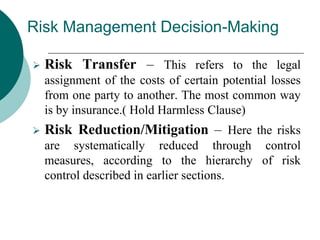
Risk Management Decision-Making
 Risk Transfer – This refers to the legal
assignment of the costs of certain potential losses
from one party to another. The most common way
is by insurance.( Hold Harmless Clause)
 Risk Reduction/Mitigation – Here the risks
are systematically reduced through control
measures, according to the hierarchy of risk
control described in earlier sections.
Others Risk Management Tools
 Risk management information
System(RMIS)
 Risk Management Intranet
 Risks Mapping
 Value at risk(VAR) analysis
 Catastrophic Modeling
Risk Management Information
System (RMIS)
 A risk management information
system (RMIS) is an information system that
assists in consolidating property values, claims,
policy, and exposure information and
providing the tracking and management
reporting capabilities to enable the user to
monitor and control the overall cost of risk
management.
Risk Management Intranet
 An intranet is a private network with search
capabilities designed for a limited, internal
audience.
 Academic organizations use such management
because the main goal is to provide and maintain an
environment that will enhance and support the
mission and academic goals of the University.
 Exceptional service is an essential component and
goal of all departmental undertakings.
Risks Mapping
 The goal of a risk map is to improve an
organization's understanding of its risk
profile and appetite.
 Clarify thinking on the nature and impact of
risks.
 Improve the organization's risk assessment
model.
Value at risk(VAR) analysis
 Value at risk (VaR) is a statistical technique
used to measure and quantify the level of
financial risk within a firm or investment
portfolio over a specific time frame.
 Value at risk is used by risk managers in
order to measure and control the level
of risk which the firm undertakes.
 It can determined using historical data and
running a computer simulation.
Catastrophic Modeling
 Catastrophe modeling (also known as cat
modeling) is the process of using
computer-assisted calculations to
estimate the losses that could be
sustained due to a catastrophic event
such as a hurricane or earthquake.
Legal Liability for Injury
The legal claim that a
person failed to act as a
reasonable and prudent
person should, thereby
resulting in injury to another
person.
4 Required Elements
 Duty
 Proper Instruction
 Access to Medical Care
 Proper Progressions
 Safe Facilities
 Appropriate Supervision
 Teach safety procedures
4 Required Elements
 Breach
 Failure to meet the standard of Care
 Cause
 The breach must be the cause of the harm.
 Harm
 In most jurisdictions, the harm must be
physical.
Tort Law
 Tort: a French word for wrong; a private or civil
wrong or injury, other than breach of contract,
suffered due to another person's conduct.
 Tort law: a part of the civil law that provides
remedies for acts that cause harm; therefore,
injured parties may file civil lawsuits in an attempt
to seek compensation for their injuries.
Tort Law
 Tort damages are monetary damages
that are sought from the offending
party.
 They are intended to compensate the
injured party for the injury suffered.
Tort law imposes a duty on
persons and business agents
not to intentionally or negligently
injure others in society.
ns and business agents not to
intentionally or negligently injure
others in society.
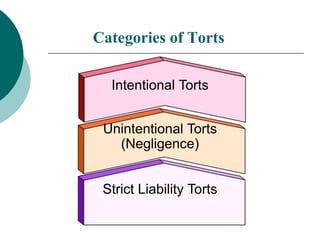
Categories of Torts
Intentional Torts
Strict Liability Torts
Unintentional Torts
(Negligence)

Chapter 4 insurability of risk

  • 1.
    Chapter-4 Topics Covered Insurability ofRisk Risk Management Decision-Making Legal Liability for Injury
  • 2.
    Overview  Requirements ofan insurable risk  Large number of similar risk exposure units  Accidental and unintentional loss  No catastrophic loss  Determinable and measurable loss  Calculable chance of loss
  • 3.
    Definition of 'InsurableRisk'  Definition: A risk that conforms to the norms and specifications of the insurance policy in such a way that the criterion for insurance is fulfilled is called insurable risk.  Description: There are various essential conditions that need to be fulfilled before acceptance of insurability of any risk. In case of a scenario where the loss is too huge that no insurer would want to pay for it, the risk is said to be uninsurable.  A risk may not be termed as insurable if it is immeasurable, very large, certain or not definable.
  • 4.
    Insurance - InsurableRisks  Insurable Risks: Risks are generally divided into two classes:  Pure risks and Speculative risks. Pure Risks- these risks involve only the chance of loss, there is never an opportunity for gain or profit. Examples: injury from an accident, loss of home from an earthquake. Only Pure Risks are Insurable
  • 5.
    Insurance - InsurableRisks Speculative Risks- These risks involve both the chance of gain or loss. Examples: Gambling at the race track, or investing in the real estate market. Speculative Risk is not Insurable
  • 6.
    Elements of anInsurable Risk  Loss must not be catastrophic  Loss must be unexpected or accidental  Loss produced by the risk must be definite and  Measurable must be a significantly large number of homogeneous exposure units to make the losses reasonable predictable
  • 7.
    Economic Scale  Riskscan also be evaluated on an economic scale comparing static and dynamic risks: Static Risks are the losses that are caused by factors other than a change in the economy (for example- hurricanes, earthquakes, other natural disasters) Dynamic Risks are the result of the economy changing (examples- inflation, recession, and other business cycle changes).  Dynamic risks are not insurable.
  • 8.
    Factors Determining Insurable Risk If the insurance company has enough statistics to work out the probability of the risk, this is called an insurable risk.  Actuaries are highly qualified people working for insurance companies; their role is to work out exactly what risks the company will carry. The degree of the risk will influence the insurance premium.  Some examples of insurable risk  Fire insurance  The book value and the market or replacement value of insured property  Money in transit-An insurance policy in which the insurance company will pay if money is stolen or lost when it is being moved between two places, for example between a shop and a bank.  Storm, damage and theft  Fidelity insurance -Insurance taken out by an employer against losses incurred through dishonesty by employees.
  • 9.
    Factors Determining Uninsurable Risk An insurance company cannot calculate the probability of the risk  Risk is too widespread- war, catastrophic  When the loss is incurred due to your own deliberate actions
  • 10.
    Insurable Types ofRisk  Personal risk is any risk that can affect the health or safety of an individual, such as being injured by an accident or suffering from an illness.  Property risk is any risk that can cause a partial or total loss to property, such as theft, fire, or so-called "acts of God".  Liability risk is the personal or business risk associated with being found liable to another because of negligence or willful acts that caused a loss to another's property or person, such as injuring someone while driving under the influence of alcohol, or because the insured failed to perform a duty, such as performing contractual obligations.  How does liability risk convert into legal risk?
  • 11.
    Uninsurable Risk  Pricefluctuations from the time the order for goods is placed and the delivery of the goods.  Different price levels at different places  New inventions that replace old technology, eg. In the IT industry  Nuclear weapons or war  Changes in fashions when goods become obsolete.
  • 12.
    Top Five UninsurableRisks  Reputational Risks-Reputation of entity & person. Goodwill.(Overdraft)  Regulatory Risks-Any regulation from the govt side  Trade Secrets Risks-Inventions  Political Risks  Pandemic Risks ( COVID19)
  • 13.
    Risk Management Decision-Making RiskAvoidance Risk Retention/Tolerance Risk Transfer Risk Reduction/Mitigation
  • 14.
    Risk Management Decision-Making Risk Avoidance – This strategy involves a conscious decision on the part of the organisation to avoid completely a particular risk by discontinuing the operation producing the risk e.g. the replacing a hazardous chemical by one with less or no risk potential.  Risk Retention – The risk is retained in the organisation where any consequent loss is financed by the company. There are two aspects to consider here, risk retention with knowledge and risk retention without knowledge.  Theory of Black Swan in risk management -
  • 15.
    Risk Management Decision-Making Risk Transfer – This refers to the legal assignment of the costs of certain potential losses from one party to another. The most common way is by insurance.( Hold Harmless Clause)  Risk Reduction/Mitigation – Here the risks are systematically reduced through control measures, according to the hierarchy of risk control described in earlier sections.
  • 16.
    Others Risk ManagementTools  Risk management information System(RMIS)  Risk Management Intranet  Risks Mapping  Value at risk(VAR) analysis  Catastrophic Modeling
  • 17.
    Risk Management Information System(RMIS)  A risk management information system (RMIS) is an information system that assists in consolidating property values, claims, policy, and exposure information and providing the tracking and management reporting capabilities to enable the user to monitor and control the overall cost of risk management.
  • 18.
    Risk Management Intranet An intranet is a private network with search capabilities designed for a limited, internal audience.  Academic organizations use such management because the main goal is to provide and maintain an environment that will enhance and support the mission and academic goals of the University.  Exceptional service is an essential component and goal of all departmental undertakings.
  • 19.
    Risks Mapping  Thegoal of a risk map is to improve an organization's understanding of its risk profile and appetite.  Clarify thinking on the nature and impact of risks.  Improve the organization's risk assessment model.
  • 20.
    Value at risk(VAR)analysis  Value at risk (VaR) is a statistical technique used to measure and quantify the level of financial risk within a firm or investment portfolio over a specific time frame.  Value at risk is used by risk managers in order to measure and control the level of risk which the firm undertakes.  It can determined using historical data and running a computer simulation.
  • 21.
    Catastrophic Modeling  Catastrophemodeling (also known as cat modeling) is the process of using computer-assisted calculations to estimate the losses that could be sustained due to a catastrophic event such as a hurricane or earthquake.
  • 22.
    Legal Liability forInjury The legal claim that a person failed to act as a reasonable and prudent person should, thereby resulting in injury to another person.
  • 23.
    4 Required Elements Duty  Proper Instruction  Access to Medical Care  Proper Progressions  Safe Facilities  Appropriate Supervision  Teach safety procedures
  • 24.
    4 Required Elements Breach  Failure to meet the standard of Care  Cause  The breach must be the cause of the harm.  Harm  In most jurisdictions, the harm must be physical.
  • 25.
    Tort Law  Tort:a French word for wrong; a private or civil wrong or injury, other than breach of contract, suffered due to another person's conduct.  Tort law: a part of the civil law that provides remedies for acts that cause harm; therefore, injured parties may file civil lawsuits in an attempt to seek compensation for their injuries.
  • 26.
    Tort Law  Tortdamages are monetary damages that are sought from the offending party.  They are intended to compensate the injured party for the injury suffered.
  • 27.
    Tort law imposesa duty on persons and business agents not to intentionally or negligently injure others in society. ns and business agents not to intentionally or negligently injure others in society.
  • 28.
    Categories of Torts IntentionalTorts Strict Liability Torts Unintentional Torts (Negligence)