
NOTICE: PROPRIETARY AND CONFIDENTIAL
This material is proprietary to and contains trade secrets and information which is solely the property of Centric Consulting, LLC. It is solely for the Client’s internal use and shall not be used, reproduced, copied, disclosed, transmitted, in whole or in part,
without the express consent of Centric Consulting, LLC. © 2016 Centric Consulting, LLC. All rights reserved.
Testing
Strategy:
The Silver Bullet
Presented by: Matthew Eakin, Test Strategist
Matt.Eakin@centricconsulting.com
@MatthewEakin
MatthewEakin
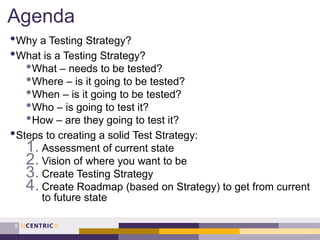
Agenda
•Why a Testing Strategy?
•What is a Testing Strategy?
•What – needs to be tested?
•Where – is it going to be tested?
•When – is it going to be tested?
•Who – is going to test it?
•How – are they going to test it?
•Steps to creating a solid Test Strategy:
1. Assessment of current state
2. Vision of where you want to be
3. Create Testing Strategy
4. Create Roadmap (based on Strategy) to get from current
to future state
2
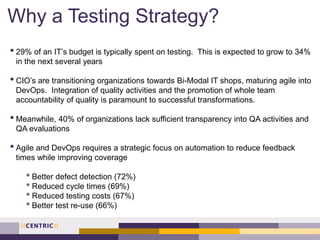
Why a Testing Strategy?
• 29% of an IT’s budget is typically spent on testing. This is expected to grow to 34%
in the next several years
• CIO’s are transitioning organizations towards Bi-Modal IT shops, maturing agile into
DevOps. Integration of quality activities and the promotion of whole team
accountability of quality is paramount to successful transformations.
• Meanwhile, 40% of organizations lack sufficient transparency into QA activities and
QA evaluations
• Agile and DevOps requires a strategic focus on automation to reduce feedback
times while improving coverage
• Better defect detection (72%)
• Reduced cycle times (69%)
• Reduced testing costs (67%)
• Better test re-use (66%)
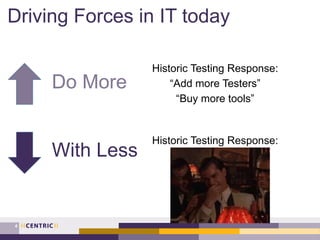
Driving Forces in IT today
Historic Testing Response:
4
With Less
Do More
Historic Testing Response:
“Add more Testers”
“Buy more tools”
What is a Test Strategy
What needs to be tested
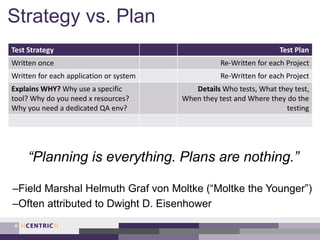
Strategy vs. Plan
Test Strategy Test Plan
Written once Re-Written for each Project
Written for each application or system Re-Written for each Project
Explains WHY? Why use a specific
tool? Why do you need x resources?
Why you need a dedicated QA env?
Details Who tests, What they test,
When they test and Where they do the
testing
6
“Planning is everything. Plans are nothing.”
–Field Marshal Helmuth Graf von Moltke (“Moltke the Younger”)
–Often attributed to Dwight D. Eisenhower
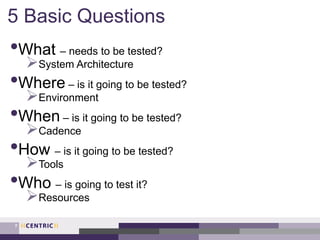
5 Basic Questions
•What – needs to be tested?
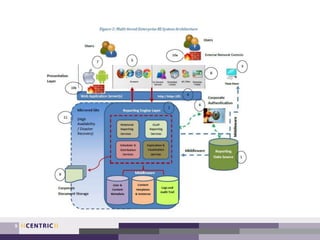
System Architecture
•Where – is it going to be tested?
Environment
•When – is it going to be tested?
Cadence
•How – is it going to be tested?
Tools
•Who – is going to test it?
Resources
7
System Architecture
What needs to be tested
9
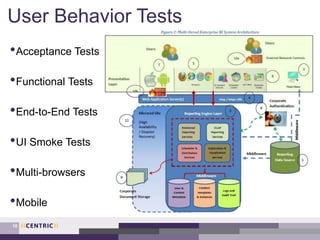
User Behavior Tests
10
•Acceptance Tests
•Functional Tests
•End-to-End Tests
•UI Smoke Tests
•Multi-browsers
•Mobile
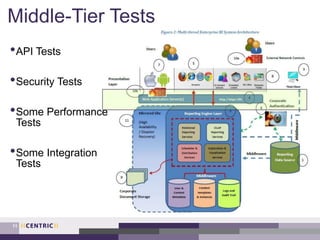
Middle-Tier Tests
11
•API Tests
•Security Tests
•Some Performance
Tests
•Some Integration
Tests
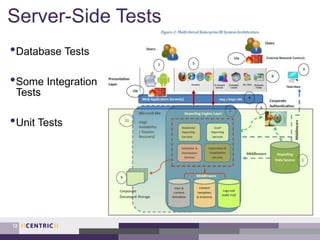
Server-Side Tests
12
•Database Tests
•Some Integration
Tests
•Unit Tests
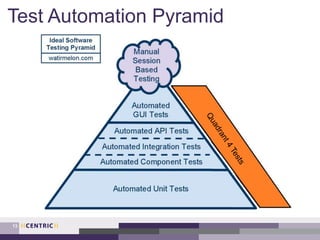
Test Automation Pyramid
13
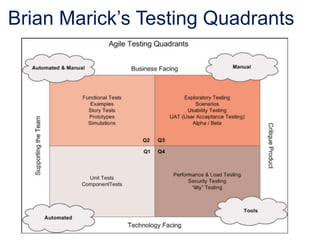
Brian Marick’s Testing Quadrants
Environment
Where is it going to be tested?
16
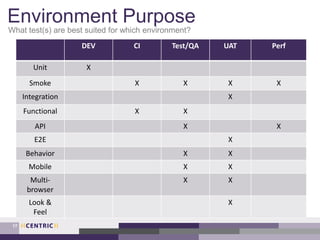
Environment Purpose
What test(s) are best suited for which environment?
17
DEV CI Test/QA UAT Perf
Unit X
Smoke X X X X
Integration X
Functional X X
API X X
E2E X
Behavior X X
Mobile X X
Multi-
browser
X X
Look &
Feel
X
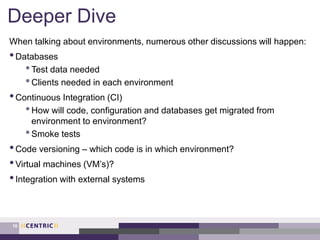
Deeper Dive
When talking about environments, numerous other discussions will happen:
•Databases
•Test data needed
•Clients needed in each environment
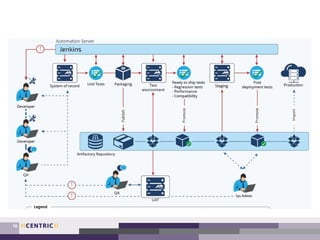
•Continuous Integration (CI)
•How will code, configuration and databases get migrated from
environment to environment?
•Smoke tests
•Code versioning – which code is in which environment?
•Virtual machines (VM’s)?
•Integration with external systems
18
Cadence
When is it going to be tested?
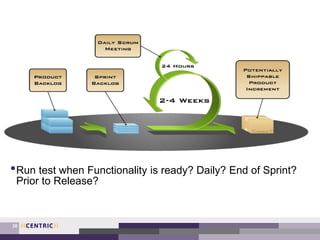
•Run test when Functionality is ready? Daily? End of Sprint?
Prior to Release?
20
Tools
How are the tests going to be executed?
Needs Checklist
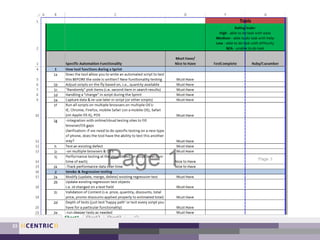
KEY: you don’t need 1 tool that “does it all.” But you are going to need
tool(s) to do what you need done.
What have you learned thus far?
•Types of tests needed to be executed (API tests, DB validation, UI tests,
Integration tests, etc.)
•Will you be using CI to migrate code?
•When will the tests be executed during a Sprint (cadence)?
•Will you need to run a single test? Group of tests? Smoke tests?
•Collaboration/Review on scripts?
22
23
Resources
Who is going to be executing the tests?
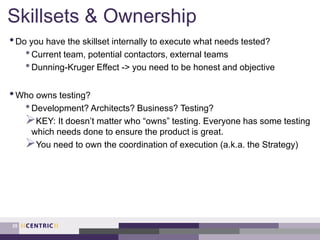
Skillsets & Ownership
•Do you have the skillset internally to execute what needs tested?
•Current team, potential contactors, external teams
•Dunning-Kruger Effect -> you need to be honest and objective
•Who owns testing?
•Development? Architects? Business? Testing?
KEY: It doesn’t matter who “owns” testing. Everyone has some testing
which needs done to ensure the product is great.
You need to own the coordination of execution (a.k.a. the Strategy)
25
Additional Strategies
Important areas which need to be addressed
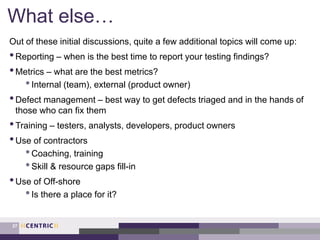
What else…
Out of these initial discussions, quite a few additional topics will come up:
•Reporting – when is the best time to report your testing findings?
•Metrics – what are the best metrics?
•Internal (team), external (product owner)
•Defect management – best way to get defects triaged and in the hands of
those who can fix them
•Training – testers, analysts, developers, product owners
•Use of contractors
•Coaching, training
•Skill & resource gaps fill-in
•Use of Off-shore
•Is there a place for it?
27
Where to start
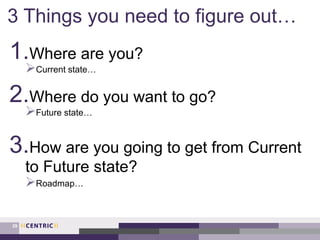
3 Things you need to figure out…
1.Where are you?
Current state…
2.Where do you want to go?
Future state…
3.How are you going to get from Current
to Future state?
Roadmap…
29
Current State
How to determine where you are…
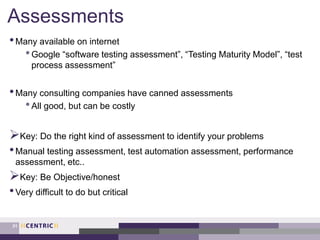
Assessments
•Many available on internet
•Google “software testing assessment”, “Testing Maturity Model”, “test
process assessment”
•Many consulting companies have canned assessments
•All good, but can be costly
Key: Do the right kind of assessment to identify your problems
•Manual testing assessment, test automation assessment, performance
assessment, etc..
Key: Be Objective/honest
•Very difficult to do but critical
31
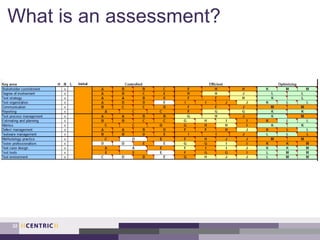
What is an assessment?
32
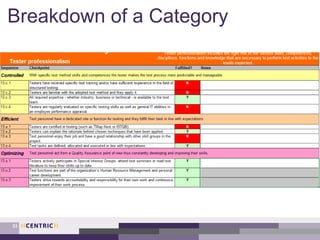
Breakdown of a Category
33
Future State
Where do you want to be…
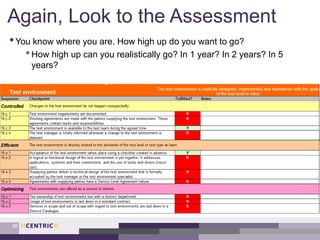
Again, Look to the Assessment
•You know where you are. How high up do you want to go?
•How high up can you realistically go? In 1 year? In 2 years? In 5
years?
35
Roadmap
How to get from Current to Future State
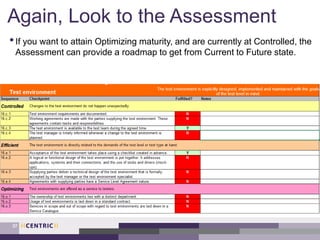
Again, Look to the Assessment
•If you want to attain Optimizing maturity, and are currently at Controlled, the
Assessment can provide a roadmap to get from Current to Future state.
37
Test Strategy Document
Putting it all together
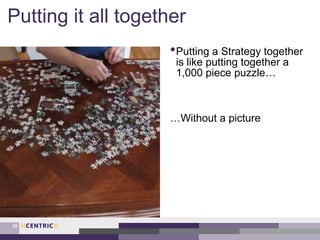
•Putting a Strategy together
is like putting together a
1,000 piece puzzle…
…Without a picture
39
What to consider
•Pain Points
•What is causing the most testing pain?
•Budget (testing and department)
•What do you have the $$ to do?
•Department Priorities
•What does everyone else on the team feel is important?
•Department Politics & Culture
•What can you realistically get done?
•What will people realistically do?
•What is completely new?
40
Each Criteria
•Documentation of current state
•State the facts (good, bad, ugly)
•Document what you found
•Recommendations
•How do you plan to improve?
•Tools?
•Personnel?
•Training?
•System resources?
•When do you plan to improve?
•Immediate (now), Short-Term (over the next few months), Medium-
Term (1-2 years), Long-Term (future)
41
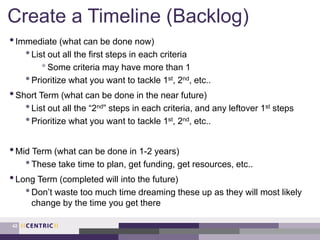
Create a Timeline (Backlog)
•Immediate (what can be done now)
•List out all the first steps in each criteria
•Some criteria may have more than 1
•Prioritize what you want to tackle 1st, 2nd, etc..
•Short Term (what can be done in the near future)
•List out all the “2nd” steps in each criteria, and any leftover 1st steps
•Prioritize what you want to tackle 1st, 2nd, etc..
•Mid Term (what can be done in 1-2 years)
•These take time to plan, get funding, get resources, etc..
•Long Term (completed will into the future)
•Don’t waste too much time dreaming these up as they will most likely
change by the time you get there
42
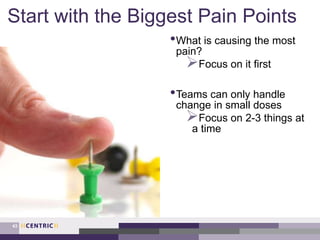
Start with the Biggest Pain Points
•What is causing the most
pain?
Focus on it first
•Teams can only handle
change in small doses
Focus on 2-3 things at
a time
43
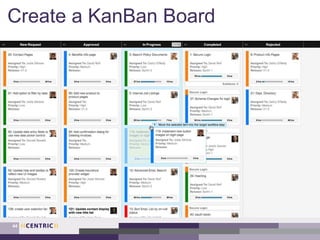
Create a KanBan Board
44
How does this enable
you to do more,
with less?
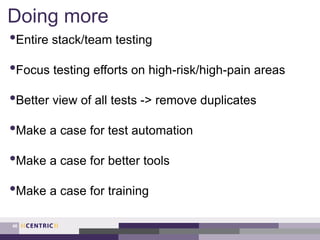
Doing more
•Entire stack/team testing
•Focus testing efforts on high-risk/high-pain areas
•Better view of all tests -> remove duplicates
•Make a case for test automation
•Make a case for better tools
•Make a case for training
46
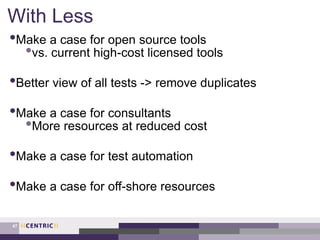
With Less
•Make a case for open source tools
•vs. current high-cost licensed tools
•Better view of all tests -> remove duplicates
•Make a case for consultants
•More resources at reduced cost
•Make a case for test automation
•Make a case for off-shore resources
47

Test Strategy-The real silver bullet in testing by Matthew Eakin

  • 1.
    NOTICE: PROPRIETARY ANDCONFIDENTIAL This material is proprietary to and contains trade secrets and information which is solely the property of Centric Consulting, LLC. It is solely for the Client’s internal use and shall not be used, reproduced, copied, disclosed, transmitted, in whole or in part, without the express consent of Centric Consulting, LLC. © 2016 Centric Consulting, LLC. All rights reserved. Testing Strategy: The Silver Bullet Presented by: Matthew Eakin, Test Strategist Matt.Eakin@centricconsulting.com @MatthewEakin MatthewEakin
  • 2.
    Agenda •Why a TestingStrategy? •What is a Testing Strategy? •What – needs to be tested? •Where – is it going to be tested? •When – is it going to be tested? •Who – is going to test it? •How – are they going to test it? •Steps to creating a solid Test Strategy: 1. Assessment of current state 2. Vision of where you want to be 3. Create Testing Strategy 4. Create Roadmap (based on Strategy) to get from current to future state 2
  • 3.
    Why a TestingStrategy? • 29% of an IT’s budget is typically spent on testing. This is expected to grow to 34% in the next several years • CIO’s are transitioning organizations towards Bi-Modal IT shops, maturing agile into DevOps. Integration of quality activities and the promotion of whole team accountability of quality is paramount to successful transformations. • Meanwhile, 40% of organizations lack sufficient transparency into QA activities and QA evaluations • Agile and DevOps requires a strategic focus on automation to reduce feedback times while improving coverage • Better defect detection (72%) • Reduced cycle times (69%) • Reduced testing costs (67%) • Better test re-use (66%)
  • 4.
    Driving Forces inIT today Historic Testing Response: 4 With Less Do More Historic Testing Response: “Add more Testers” “Buy more tools”
  • 5.
    What is aTest Strategy What needs to be tested
  • 6.
    Strategy vs. Plan TestStrategy Test Plan Written once Re-Written for each Project Written for each application or system Re-Written for each Project Explains WHY? Why use a specific tool? Why do you need x resources? Why you need a dedicated QA env? Details Who tests, What they test, When they test and Where they do the testing 6 “Planning is everything. Plans are nothing.” –Field Marshal Helmuth Graf von Moltke (“Moltke the Younger”) –Often attributed to Dwight D. Eisenhower
  • 7.
    5 Basic Questions •What– needs to be tested? System Architecture •Where – is it going to be tested? Environment •When – is it going to be tested? Cadence •How – is it going to be tested? Tools •Who – is going to test it? Resources 7
  • 8.
  • 9.
  • 10.
    User Behavior Tests 10 •AcceptanceTests •Functional Tests •End-to-End Tests •UI Smoke Tests •Multi-browsers •Mobile
  • 11.
    Middle-Tier Tests 11 •API Tests •SecurityTests •Some Performance Tests •Some Integration Tests
  • 12.
    Server-Side Tests 12 •Database Tests •SomeIntegration Tests •Unit Tests
  • 13.
  • 14.
  • 15.
    Environment Where is itgoing to be tested?
  • 16.
  • 17.
    Environment Purpose What test(s)are best suited for which environment? 17 DEV CI Test/QA UAT Perf Unit X Smoke X X X X Integration X Functional X X API X X E2E X Behavior X X Mobile X X Multi- browser X X Look & Feel X
  • 18.
    Deeper Dive When talkingabout environments, numerous other discussions will happen: •Databases •Test data needed •Clients needed in each environment •Continuous Integration (CI) •How will code, configuration and databases get migrated from environment to environment? •Smoke tests •Code versioning – which code is in which environment? •Virtual machines (VM’s)? •Integration with external systems 18
  • 19.
    Cadence When is itgoing to be tested?
  • 20.
    •Run test whenFunctionality is ready? Daily? End of Sprint? Prior to Release? 20
  • 21.
    Tools How are thetests going to be executed?
  • 22.
    Needs Checklist KEY: youdon’t need 1 tool that “does it all.” But you are going to need tool(s) to do what you need done. What have you learned thus far? •Types of tests needed to be executed (API tests, DB validation, UI tests, Integration tests, etc.) •Will you be using CI to migrate code? •When will the tests be executed during a Sprint (cadence)? •Will you need to run a single test? Group of tests? Smoke tests? •Collaboration/Review on scripts? 22
  • 23.
  • 24.
    Resources Who is goingto be executing the tests?
  • 25.
    Skillsets & Ownership •Doyou have the skillset internally to execute what needs tested? •Current team, potential contactors, external teams •Dunning-Kruger Effect -> you need to be honest and objective •Who owns testing? •Development? Architects? Business? Testing? KEY: It doesn’t matter who “owns” testing. Everyone has some testing which needs done to ensure the product is great. You need to own the coordination of execution (a.k.a. the Strategy) 25
  • 26.
    Additional Strategies Important areaswhich need to be addressed
  • 27.
    What else… Out ofthese initial discussions, quite a few additional topics will come up: •Reporting – when is the best time to report your testing findings? •Metrics – what are the best metrics? •Internal (team), external (product owner) •Defect management – best way to get defects triaged and in the hands of those who can fix them •Training – testers, analysts, developers, product owners •Use of contractors •Coaching, training •Skill & resource gaps fill-in •Use of Off-shore •Is there a place for it? 27
  • 28.
  • 29.
    3 Things youneed to figure out… 1.Where are you? Current state… 2.Where do you want to go? Future state… 3.How are you going to get from Current to Future state? Roadmap… 29
  • 30.
    Current State How todetermine where you are…
  • 31.
    Assessments •Many available oninternet •Google “software testing assessment”, “Testing Maturity Model”, “test process assessment” •Many consulting companies have canned assessments •All good, but can be costly Key: Do the right kind of assessment to identify your problems •Manual testing assessment, test automation assessment, performance assessment, etc.. Key: Be Objective/honest •Very difficult to do but critical 31
  • 32.
    What is anassessment? 32
  • 33.
    Breakdown of aCategory 33
  • 34.
    Future State Where doyou want to be…
  • 35.
    Again, Look tothe Assessment •You know where you are. How high up do you want to go? •How high up can you realistically go? In 1 year? In 2 years? In 5 years? 35
  • 36.
    Roadmap How to getfrom Current to Future State
  • 37.
    Again, Look tothe Assessment •If you want to attain Optimizing maturity, and are currently at Controlled, the Assessment can provide a roadmap to get from Current to Future state. 37
  • 38.
  • 39.
    Putting it alltogether •Putting a Strategy together is like putting together a 1,000 piece puzzle… …Without a picture 39
  • 40.
    What to consider •PainPoints •What is causing the most testing pain? •Budget (testing and department) •What do you have the $$ to do? •Department Priorities •What does everyone else on the team feel is important? •Department Politics & Culture •What can you realistically get done? •What will people realistically do? •What is completely new? 40
  • 41.
    Each Criteria •Documentation ofcurrent state •State the facts (good, bad, ugly) •Document what you found •Recommendations •How do you plan to improve? •Tools? •Personnel? •Training? •System resources? •When do you plan to improve? •Immediate (now), Short-Term (over the next few months), Medium- Term (1-2 years), Long-Term (future) 41
  • 42.
    Create a Timeline(Backlog) •Immediate (what can be done now) •List out all the first steps in each criteria •Some criteria may have more than 1 •Prioritize what you want to tackle 1st, 2nd, etc.. •Short Term (what can be done in the near future) •List out all the “2nd” steps in each criteria, and any leftover 1st steps •Prioritize what you want to tackle 1st, 2nd, etc.. •Mid Term (what can be done in 1-2 years) •These take time to plan, get funding, get resources, etc.. •Long Term (completed will into the future) •Don’t waste too much time dreaming these up as they will most likely change by the time you get there 42
  • 43.
    Start with theBiggest Pain Points •What is causing the most pain? Focus on it first •Teams can only handle change in small doses Focus on 2-3 things at a time 43
  • 44.
  • 45.
    How does thisenable you to do more, with less?
  • 46.
    Doing more •Entire stack/teamtesting •Focus testing efforts on high-risk/high-pain areas •Better view of all tests -> remove duplicates •Make a case for test automation •Make a case for better tools •Make a case for training 46
  • 47.
    With Less •Make acase for open source tools •vs. current high-cost licensed tools •Better view of all tests -> remove duplicates •Make a case for consultants •More resources at reduced cost •Make a case for test automation •Make a case for off-shore resources 47

Editor's Notes

  • #2 Alternate for Title Slide: slide 15
  • #4 Improved Business Outcomes It’s no longer about rapid delivery, but rapid delivery of value Alignment of testing and business Faster feedback Lower costs
  • #6 Alternate for slide 1
  • #9 Alternate for slide 1
  • #16 Alternate for slide 1
  • #20 Alternate for slide 1
  • #22 Alternate for slide 1
  • #25 Alternate for slide 1
  • #27 Alternate for slide 1
  • #29 Alternate for slide 1
  • #31 Alternate for slide 1
  • #35 Alternate for slide 1
  • #37 Alternate for slide 1
  • #39 Alternate for slide 1
  • #46 Alternate for slide 1